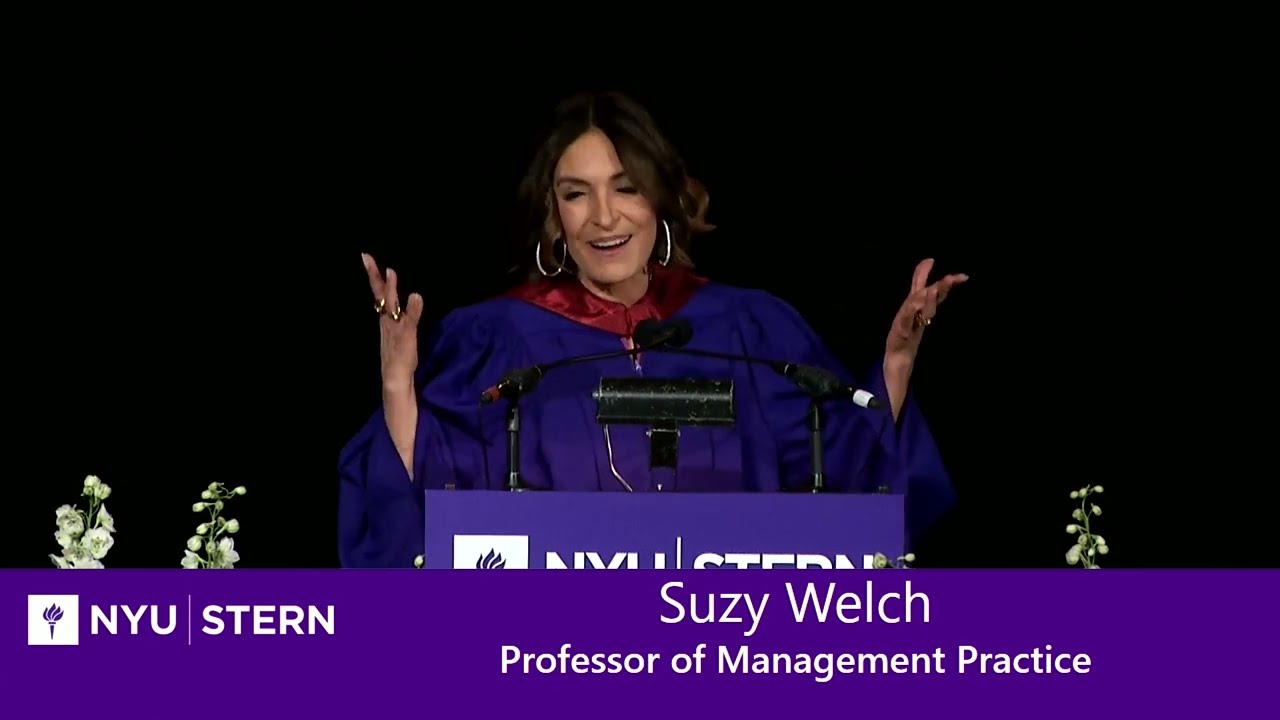
Suzy Welch Urges NYU Stern MBAs to Ditch Networking for Friends
NYU Stern
Transactional networking and the search for a lone savior mentor fail to drive careers, requiring graduates to build authentic friendships and treat every encounter as a source of wisdom.
AI-assisted summary of Professor of Management Practice Suzy Welch | NYU Stern MBA and PhD Convocation, Class of 2024 — original source. Check the original for full context.
Source published:
Key ideas
- Suzy Welch addresses NYU Stern's MBA and PhD Class of 2024, designating them 'the new ones' and delivering three counterintuitive rules to accelerate their professional success. (0:08)
- Welch rejects traditional networking as mercenary and transactional, advising graduates instead to focus on genuine friendships that form a resilient career mosaic. (2:30)
- Challenging the lone mentor myth, Welch argues that professionals should treat everyone as a mentor and actively extract knowledge from every encounter. (4:28)
- Welch highlights an informal field experiment at LAX showing that smiling broadly with your teeth yielded an 87.5% reciprocal smile rate, serving as an open signal of confidence and warmth. (6:10)
Detailed notes
## Background Published on YouTube by NYU Stern on September 22, 2026, this video captures Professor of Management Practice Suzy Welch delivering an address at the NYU Stern MBA and PhD Convocation on May 17, 2024. The official description highlights Welch's roles as a professor and Director of the Initiative on Purpose and Flourishing as she shares departing advice with the graduating Class of 2024.
## TL;DR Drawing on a memorable childhood observation from her son declaring 'we are the new ones,' Professor Suzy Welch presents three contrarian principles to help graduates accelerate their integration into the professional world. She advises abandoning transactional networking in favor of building a rich, resilient mosaic of authentic friendships. She then dismantles the fantasy of finding a single savior mentor, arguing instead that graduates should extract wisdom from everyone around them. Finally, citing a humorous field experiment during an airport layover, Welch urges students to disarm the world by smiling with their teeth, meeting their futures with authentic, defenseless warmth.
## Atmosphere & style The address is lively, conversational, and playfully irreverent, balancing self-deprecating humor with deep affection for the graduating cohort. Welch subverts traditional business school conventions with comedic timing—joking about whether her counterintuitive advice might get her fired—while keeping the audience engaged through direct audience participation. The tone shifts gracefully from humorous, relatable anecdotes to earnest, empowering inspiration, leaving the auditorium feeling seen, energized, and embraced.
## Bulletin - [00:08](https://www.youtube.com/watch?v=X1FAVD0cuGw&t=8s) Suzy Welch addresses NYU Stern's MBA and PhD Class of 2024, designating them 'the new ones' and delivering three counterintuitive rules to accelerate their professional success. - [02:30](https://www.youtube.com/watch?v=X1FAVD0cuGw&t=150s) Welch rejects traditional networking as mercenary and transactional, advising graduates instead to focus on genuine friendships that form a resilient career mosaic. - [04:28](https://www.youtube.com/watch?v=X1FAVD0cuGw&t=268s) Challenging the lone mentor myth, Welch argues that professionals should treat everyone as a mentor and actively extract knowledge from every encounter. - [06:10](https://www.youtube.com/watch?v=X1FAVD0cuGw&t=370s) Welch highlights an informal field experiment at LAX showing that smiling broadly with your teeth yielded an 87.5% reciprocal smile rate, serving as an open signal of confidence and warmth.
## Key takeaways - [00:08](https://www.youtube.com/watch?v=X1FAVD0cuGw&t=8s) Welch thanks outgoing Dean Raghu Sundaram and credits Ken Langone with opening the door for her to pitch her initial course and join the NYU Stern faculty. - [01:12](https://www.youtube.com/watch?v=X1FAVD0cuGw&t=72s) Welch shares an anecdote from 30 years ago when her five-year-old son declared to an older woman in a supermarket: 'Well, we are the new ones.' - [02:08](https://www.youtube.com/watch?v=X1FAVD0cuGw&t=128s) Welch names the graduating Class of 2024 'the new ones' who must claim their place in society through accelerated, counterintuitive approaches. - [02:30](https://www.youtube.com/watch?v=X1FAVD0cuGw&t=150s) Rule 1 urges graduates not to network, labeling conventional networking as transactional, mercenary, and ineffective. - [03:05](https://www.youtube.com/watch?v=X1FAVD0cuGw&t=185s) Extraordinarily successful leaders attribute their success to a few good ideas, tremendous luck, and great friends rather than networking. - [03:40](https://www.youtube.com/watch?v=X1FAVD0cuGw&t=220s) Friendships do not all have to be 'besties'; together they assemble like imperfect individual tiles into a rich and resilient life mosaic. - [04:28](https://www.youtube.com/watch?v=X1FAVD0cuGw&t=268s) Rule 2 dismisses the romantic myth of finding a single, heroic mentor who swoops in to orchestrate one's career. - [04:58](https://www.youtube.com/watch?v=X1FAVD0cuGw&t=298s) Professionals should extract wisdom from everyone they meet, recognizing that every individual knows something they do not. - [05:15](https://www.youtube.com/watch?v=X1FAVD0cuGw&t=315s) Welch explains how she relied on crowdsourced mentorship, learning teaching techniques from Professor Nate Pettit and reevaluating her 80-hour workweeks through student feedback. - [06:10](https://www.youtube.com/watch?v=X1FAVD0cuGw&t=370s) Rule 3 encourages graduates to smile at everyone with their teeth, signaling warmth, confidence, and complete defenselessness. - [06:52](https://www.youtube.com/watch?v=X1FAVD0cuGw&t=412s) During a seven-hour flight delay at LAX, Welch tested toothy smiles on passing travelers and observed an 87.5% return rate. - [07:35](https://www.youtube.com/watch?v=X1FAVD0cuGw&t=455s) Baring your teeth in an open smile proves that you are authentic, eager to learn, and ready to engage without defensive posturing. - [08:05](https://www.youtube.com/watch?v=X1FAVD0cuGw&t=485s) Welch closes by encouraging graduates to meet the world with goodness and open authenticity so society will gladly make room and welcome them.
## Detailed walkthrough ### [00:08](https://www.youtube.com/watch?v=X1FAVD0cuGw&t=8s) Gratitude, Origins, and "The New Ones"
Professor Suzy Welch opens her address by offering heartfelt thanks to NYU Stern Dean Raghu Sundaram, noting the deep honor it has been to work alongside him over the past two years and wishing him godspeed as he prepares to transition to university-wide leadership. She reflects on following Ken Langone on stage, revealing an origin story known to few: her very presence on the NYU faculty began several years earlier when she had an idea for a course. The first person she called was Ken, who offered to get her in a room with Raghu. Extending her gratitude to both Ken and his wife Elaine for their boundless generosity and wisdom, she then turns to the families in attendance, noting that having four children of her own, she has sat in those same seats as an NYU parent. Turning warmly to the graduating MBA and PhD Class of 2024, she greets them with enthusiasm: "Hi! Good to see you all. You know I love you. I am Suzy Welch."
To frame her message, Welch recounts a memory from thirty years earlier when her son Roscoe, who just turned 35, was five years old. At the time, she was raising four children under the age of five and living in what she terms an exhausted, sleep-deprived "zombie phase." While pushing Roscoe through a supermarket and zoning out by the grapefruits, an older woman stepped up beside them. As any parent of a precocious five-year-old fears what unfiltered observation might pop out, Welch watched in horror as Roscoe turned to the woman and asked point-blank, "Are you old?" The woman cheerfully replied that she was, prompting Roscoe to examine her with a gimlet eye before declaring, "Well, we are the new ones." Delivering that line to the auditorium, Welch directly designates the graduates as the modern heirs to that statement: "Class of 2024, you are the new ones!"
- **Origins at NYU:** Welch pitched her initial teaching concept to Ken Langone, who facilitated the meeting with Dean Raghu Sundaram that brought her to Stern. - **Family Ties:** Welch is an NYU parent four times over; her son Roscoe was five when the grapefruit aisle encounter occurred. - **The Core Mandate:** As "the new ones," society must eventually make room for them, but Welch offers three counterintuitive rules to dramatically accelerate that process.
[02:30](https://www.youtube.com/watch?v=X1FAVD0cuGw&t=150s) Rule 1: Do Not Network—Make Friends Instead
Welch acknowledges that while the world will naturally make room for newcomers over time, graduates do not have the patience to wait passively. Taking advantage of the final moments she has the students "in my clutches as a professor," she lays out her first counterintuitive rule: "Do not, do not network." Acknowledging that this blasphemously defies standard business school dogma—joking, "Sorry, am I fired?"—she argues that networking is inherently mercenary, transactional, and ultimately ineffective.
Instead, Welch urges students to focus entirely on making authentic friends. When extraordinarily successful figures are pressed on the true drivers of their careers, they consistently attribute their rise to three factors: a few good ideas, a tremendous amount of luck, and great friends. Looking across the stage, she calls on Ken Langone to confirm whether friendships paved his path, receiving an immediate affirmation. Welch emphasizes that not everyone needs to become an intimate confidant or "bestie." Instead, she visualizes each friend as an individual tile: no single tile is flawless on its own—just as no graduate is complete in isolation—but when arranged together, they form the intricate, resilient mosaic of a rich life.
```mermaid flowchart TD accTitle: From Networking to Lasting Connection accDescr: Contrasts traditional transactional networking with building a mosaic of genuine friendships. subgraph Transactional["The Conventional Path"] A["Mercenary Networking"] --> B["Superficial Exchanges"] B --> C["Transactional / Ineffective"] end subgraph Mosaic["The Suzy Welch Approach"] D["Make Genuine Friends"] --> E["Diverse Imperfect 'Tiles'"] E --> F["Resilient, Beautiful Career Mosaic"] end ```
[04:28](https://www.youtube.com/watch?v=X1FAVD0cuGw&t=268s) Rule 2: Ditch the Lone Mentor Myth—Learn from Everyone
Welch moves directly into her second contrarian principle, risking the ire of university leadership once again: do not waste time hunting for an elusive mentor. She dismisses the romantic notion of a single hero galloping in on a stallion to sweep someone up and orchestrate their career as an absolute fantasy that almost never happens. Instead of relying on one savior, professionals should treat every person they encounter as a source of wisdom, recognizing that everyone knows something they do not. The real task is seeking out that latent knowledge and extracting it.
Welch shares that her own career is guided by mentors everywhere. When she arrived at NYU Stern without formal classroom training, the administration sent her to sit in on classes taught by Management Professor Nate Pettit, through which she learned the craft of teaching. Moreover, she credits the students themselves as her most transformative mentors. While acknowledging it might sound "cringey," she explains that their perspectives forced her to confront fundamental assumptions about her life, including challenging her habit of logging 80-hour workweeks. Though that introspection led her to reaffirm that she genuinely loves work—almost as much as she loves her dogs—the students' probing pushed her to consciously choose her commitments rather than drift into them blindly.
- **The Mentor Myth:** No lone individual will swoop in on a stallion to build or rescue someone's career. - **Crowdsourced Mentorship:** Welch learned pedagogy by shadowing Nate Pettit and received perspective shifts directly from her Stern students. - **Self-Interrogation:** Student questions caused Welch to critically evaluate her 80-hour workweeks, ultimately clarifying her deep passion for her profession.
[06:10](https://www.youtube.com/watch?v=X1FAVD0cuGw&t=370s) Rule 3: Smile with Your Teeth and Embrace Authenticity
Introducing her final insight, Welch humorously bills it as a deep, profound, philosophical concept that "maybe the PhDs will sort of dig this one more than the MBAs." The grand rule: smile at everyone with your teeth. To prove she is serious, she demonstrates the wide, toothy grin on stage and commands the audience to turn to their neighbors and do the exact same thing right then and there.
Welch insists this is grounded in empirical field research. While enduring a grueling seven-hour Delta Air Lines delay at Los Angeles International Airport (LAX), she decided to behave like a true professor and run an experiment. Walking through the terminal, she beamed broadly with her teeth at passersby and discovered that an astonishing 87.5% of travelers smiled back with their teeth. She joked that she desperately wished she had merchandise to sell given the conversion rate. On a deeper level, she explains that baring your teeth in an unguarded smile communicates confidence, warmth, and complete defenselessness: it signals that you are one of the "new ones," eager to engage, ready to make friends, open to learning from everyone, and unafraid to show your authentic self.
Welch concludes by looking at the graduates crossing the threshold into the post-academic world. As society sizes up whether the Class of 2024 truly belongs, she charges them to prove it not through defensive posturing, but through friendship, eager curiosity, and radiant goodness. When they meet the world with an open, authentic toothy smile, the world will readily step aside, look back at them with love, and say: "Welcome."
## Notable quotes > [00:08](https://www.youtube.com/watch?v=X1FAVD0cuGw&t=8s) Hi! Good to see you all. You know I love you. I am Suzy Welch. — Suzy Welch
> [00:08](https://www.youtube.com/watch?v=X1FAVD0cuGw&t=8s) Are you old? — Roscoe Welch
> [00:08](https://www.youtube.com/watch?v=X1FAVD0cuGw&t=8s) Well, we are the new ones. — Roscoe Welch
> [00:08](https://www.youtube.com/watch?v=X1FAVD0cuGw&t=8s) Class of 2024, you are the new ones! — Suzy Welch
> [02:30](https://www.youtube.com/watch?v=X1FAVD0cuGw&t=150s) Do not, do not network. — Suzy Welch
> [02:30](https://www.youtube.com/watch?v=X1FAVD0cuGw&t=150s) Sorry, am I fired? — Suzy Welch
> [06:10](https://www.youtube.com/watch?v=X1FAVD0cuGw&t=370s) Welcome. — Suzy Welch
## Mentioned Suzy Welch, Raghu Sundaram, Ken Langone, Elaine Langone, Roscoe Welch, Nate Pettit, Delta Air Lines, Los Angeles International Airport (LAX), NYU Stern School of Business
## Video description Suzy Welch, NYU Stern Professor of Management Practice and Director, Initiative on Purpose and Flourishing, addresses Stern's MBA and PhD Class of 2024 on Friday, May 17, 2024. See additional features here: https://www.stern.nyu.edu/graduation/archive
[Source](https://www.youtube.com/watch?v=X1FAVD0cuGw)