AMD Pivots to Data Centers as Gaming Revenue Drops 31% Below $1B
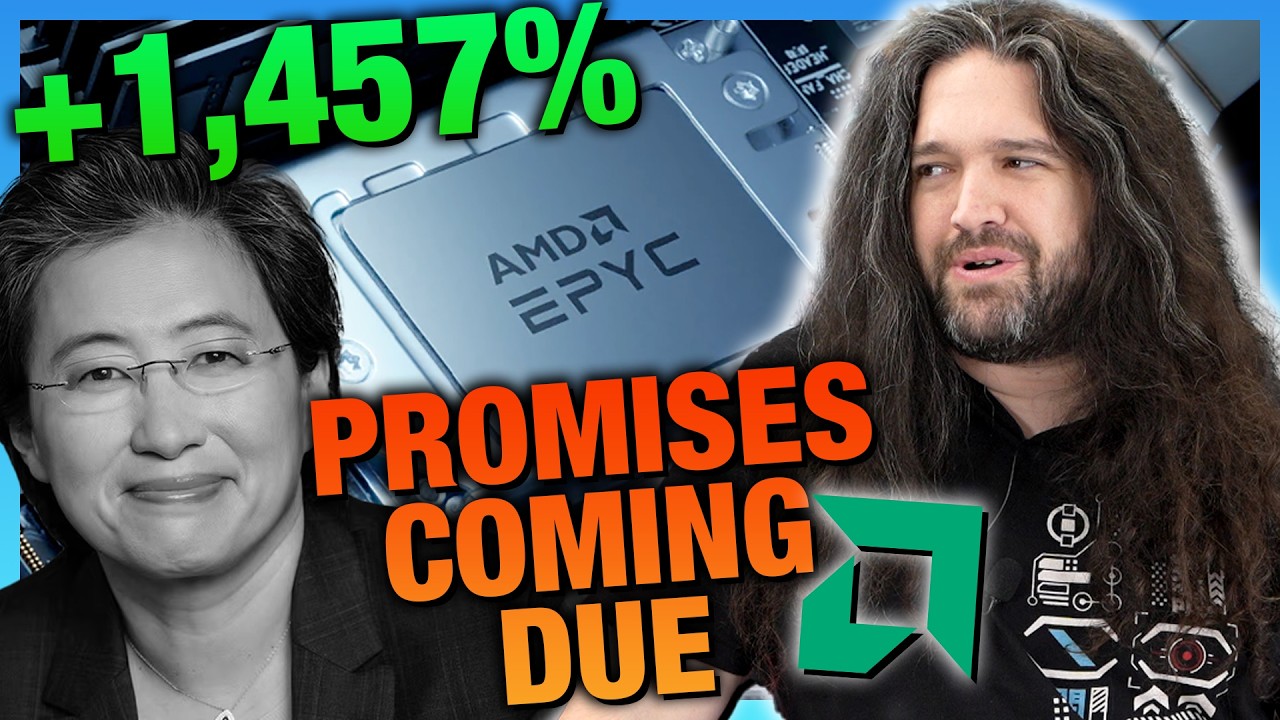
AMD's Reality Distortion Field — Gamers Nexus

Gamers Nexus

AMD has abandoned the consumer gaming base that saved it from bankruptcy to chase speculative, equity-backed artificial intelligence contracts, leaving the chipmaker vulnerable if enterprise data center demand falters.

AI-assisted summary of AMD's Reality Distortion Field — original source. Check the original for full context.

Source published:

Key ideas

  • AMD reported record total Q2 2026 revenue of $11.5 billion (up 50% year-over-year), but gaming revenue fell 31% to $779 million, revealing a sharp divergence between enterprise data center expansion and consumer market contraction. (0:00)
  • AMD's data center division surged to $6.7 billion in quarterly revenue (+107% year-over-year) and $2.1 billion in operating profit, generating nearly four times the operating income of client and gaming segments combined. (1:26)
  • To secure multi-gigawatt hardware commitments for its Helios rack-scale platform, AMD issued performance-based warrants granting OpenAI and Meta up to 160 million common shares each tied to delivery milestones. (21:40)
  • Massive data center consumption of memory supplies has driven late-cycle price increases across consoles—pushing the PS5 to $650 and PS5 Pro to $900—and triggered severe sales drops across the broader PC enthusiast ecosystem. (13:29)

Detailed notes

## Background Published by Gamers Nexus on YouTube on August 24, 2026, this video analysis examines AMD's recent earnings report showing a steep decline in gaming revenue alongside billions of dollars committed to enterprise data center rollouts. According to the page description, AMD has labeled itself a "data center-first" company, seemingly turning its back on the consumer gaming segment that kept the business solvent during its leanest years.

## TL;DR Gamers Nexus breaks down AMD's record Q2 2026 revenue of $11.5 billion, highlighting a stark internal divergence: enterprise data center earnings surged past $6.7 billion while gaming silicon plummeted 31% below $1 billion. Host Steve Burke traces how the consumer gamers and console buyers who saved AMD from bankruptcy during the PS4 and early Zen eras are being sidelined for high-margin AI accelerators and rack-scale Helios systems. The investigation details AMD's speculative, multi-gigawatt deals and stock warrant arrangements with OpenAI, Meta, and Anthropic, alongside severe memory supply crunches driving up console and PC component pricing. Burke warns that AMD's aggressive pivot leaves it highly exposed to an artificial intelligence bubble built on unproven assumptions about power, supply chains, and enterprise software returns.

## Atmosphere & style The video carries an incisive, sardonic, and disillusioned tone as Steve Burke dissects corporate slide decks and SEC filings with trademark deadpan wit. Balancing rigorous financial literacy with raw enthusiast frustration, the delivery swings from biting metaphors—like AMD pumping up the AI bubble with a bicycle pump behind Nvidia's air compressor—to weary, blunt warnings that historic component pricing is never coming back. It feels less like an ordinary tech product review and more like a forensic corporate post-mortem, stripping away AMD's long-standing 'underdog' halo to expose ruthless enterprise priorities.

## Bulletin - [00:00](https://www.youtube.com/watch?v=vYosAN7UShU&t=0s) AMD reported record total Q2 2026 revenue of $11.5 billion (up 50% year-over-year), but gaming revenue fell 31% to $779 million, revealing a sharp divergence between enterprise data center expansion and consumer market contraction. - [01:26](https://www.youtube.com/watch?v=vYosAN7UShU&t=86s) AMD's data center division surged to $6.7 billion in quarterly revenue (+107% year-over-year) and $2.1 billion in operating profit, generating nearly four times the operating income of client and gaming segments combined. - [21:40](https://www.youtube.com/watch?v=vYosAN7UShU&t=1300s) To secure multi-gigawatt hardware commitments for its Helios rack-scale platform, AMD issued performance-based warrants granting OpenAI and Meta up to 160 million common shares each tied to delivery milestones. - [13:29](https://www.youtube.com/watch?v=vYosAN7UShU&t=809s) Massive data center consumption of memory supplies has driven late-cycle price increases across consoles—pushing the PS5 to $650 and PS5 Pro to $900—and triggered severe sales drops across the broader PC enthusiast ecosystem.

## Key takeaways - [00:00](https://www.youtube.com/watch?v=vYosAN7UShU&t=0s) Tech executives project the high-performance and AI computing market to reach $2 trillion over the next four to five years, with dedicated AI accelerators hitting $1.4 trillion by 2030. - [01:26](https://www.youtube.com/watch?v=vYosAN7UShU&t=86s) AMD data center operating income reached $2.1 billion in Q2 2026, marking a 1,457% year-over-year increase that rebounded from an $800 million MI308 export control charge incurred in Q2 2025. - [04:05](https://www.youtube.com/watch?v=vYosAN7UShU&t=245s) AMD's pivot away from retail consumers abandons the low-margin console hardware (PS4, Xbox One) and Zen desktop CPU launches that rescued the company from bankruptcy a decade ago. - [07:10](https://www.youtube.com/watch?v=vYosAN7UShU&t=430s) AMD is replicating its consumer GPU strategy in the enterprise by undercutting NVIDIA by billions in cloud subsidies and investments, though AMD lacks the massive balance sheet cushion needed if the AI bubble bursts. - [10:21](https://www.youtube.com/watch?v=vYosAN7UShU&t=621s) While Ryzen client CPU sales rose 23% year-over-year to $3.1 billion, gaming revenue plunged 31% to $779 million as consumers faced prohibitive component costs and memory price hikes. - [12:39](https://www.youtube.com/watch?v=vYosAN7UShU&t=759s) Slumping consumer hardware sales are forcing PC case and cooler manufacturers into cost-down engineering, lower-quality materials, and cosmetic RGB gimmicks rather than functional innovation. - [13:29](https://www.youtube.com/watch?v=vYosAN7UShU&t=809s) Console hardware unit shipments plunged (PS5 shipments dropping from 2.5M to 1.6M units) as memory costs surged 2.5x, driven largely by hyperscalers stockpiling chips. - [17:16](https://www.youtube.com/watch?v=vYosAN7UShU&t=1036s) AMD leadership explicitly redefined the firm as a 'data center-first company,' leaving gaming and consumer silicon as secondary concerns compared to high-margin enterprise deployments. - [19:10](https://www.youtube.com/watch?v=vYosAN7UShU&t=1150s) AMD debuted its Zen 6 microarchitecture in EPYC Venice CPUs for data center Helios racks, while offering consumer desktop buyers opportunistic re-launches on older architectures like the Ryzen 7 5800X3D. - [21:40](https://www.youtube.com/watch?v=vYosAN7UShU&t=1300s) AMD structured hardware deployment agreements with OpenAI and Meta around equity warrants offering each customer up to 160 million common shares upon hitting multi-gigawatt delivery thresholds. - [24:17](https://www.youtube.com/watch?v=vYosAN7UShU&t=1457s) AMD committed up to $5 billion in direct equity investment into Anthropic alongside a 2-gigawatt Helios deployment, reflecting high-stakes FOMO in an overheated AI market. - [26:38](https://www.youtube.com/watch?v=vYosAN7UShU&t=1598s) AMD faces intense delivery pressure over a 12- to 18-month window to fulfill billions in dense silicon and power commitments across Oracle, Microsoft, Meta, OpenAI, Anthropic, and Core Scientific. - [27:36](https://www.youtube.com/watch?v=vYosAN7UShU&t=1656s) Lisa Su's market optimism relies on unverified prerequisites: sufficient power grid capacity, stable semiconductor supply chains, sustained liquidity, and actual commercial productivity from AI models. - [29:15](https://www.youtube.com/watch?v=vYosAN7UShU&t=1755s) Between Q2 2022 and Q2 2026, AMD data center revenue jumped more than fourfold from $1.5 billion to $6.7 billion, while combined client and gaming revenue remained flat at $3.8 billion. - [30:14](https://www.youtube.com/watch?v=vYosAN7UShU&t=1814s) A 7x to 10x surge in memory pricing on top of pre-existing inflation has permanently shifted the Overton window on component costs, eliminating historical rock-bottom price baselines. - [32:05](https://www.youtube.com/watch?v=vYosAN7UShU&t=1925s) The generative AI infrastructure buildout is sustained by a narrow circle of B2B mega-corporations; if capital flows dry up, consumer revenue will not be large enough to backstop hardware makers. - [33:58](https://www.youtube.com/watch?v=vYosAN7UShU&t=2038s) The hollowing out of consumer-advocating PR teams inside AMD has shattered the company's sympathetic 'underdog' image, exposing aggressive corporate practices similar to NVIDIA's.

## Detailed walkthrough ### [00:00](https://www.youtube.com/watch?v=vYosAN7UShU&t=0s) Infinity Dollars: Big Tech's AI Market Projections

While NVIDIA CEO Jensen Huang is "standing next to the bubble with an air compressor that he shoved into its ass," AMD CEO Lisa Su has traditionally been "standing nearby with a bicycle pump." Despite the difference in scale, AMD has fully embraced the tech industry's astronomical AI predictions. Executives consistently paint staggering growth trajectories: projections peg the high-performance and AI computing market to reach $2 trillion over the next four to five years, the server CPU market to grow by over 50% to exceed $200 billion by 2030, and the dedicated AI accelerator market to hit roughly $1.4 trillion by 2030. When asked on CNBC by Jim Cramer if CPU business lower margins would drag AMD down, Su affirmed her bullish stance, with Cramer framing it as entirely additive.

```mermaid flowchart TD accTitle: Tech Industry AI Market Projections Through 2030 accDescr: Visual breakdown of AMD and industry market size projections for AI accelerators, server CPUs, and overall high-performance AI computing. subgraph Projections["Projected 2030 Market Caps"] A["Server CPU Market<br/>$200B+"] B["AI Accelerator Market<br/>~$1.4 Trillion"] end Projections --> C["Total High-Performance & AI Computing<br/>$2+ Trillion by 2030"] ```

Financially, AMD reported a record $11.5 billion in total revenue during Q2 2026, marking a 50% increase year-over-year. However, that top-line triumph obscures a dramatic internal divergence: gaming revenue plummeted by 31%, dropping below $1 billion. This sharp drop caught the public eye in part because NVIDIA had quietly restructured its financial disclosures months earlier, burying its gaming metrics inside a broader "Edge" computing category to mask consumer declines. AMD did not obscure its gaming figures in that manner, leaving its gaming contraction completely exposed.

- Q2 2026 AMD Total Revenue: Record $11.5 billion (up 50% year-over-year). - Q2 2026 AMD Gaming Revenue: Down 31% year-over-year, dropping below $1 billion. - Server CPU Market Projection: Anticipated to surge beyond $200 billion by 2030. - AI Accelerator Market Projection: Forecasted to hit approximately $1.4 trillion by 2030.

---

[01:26](https://www.youtube.com/watch?v=vYosAN7UShU&t=86s) The Data Center Shift and Political Tailwinds

Fueling AMD's revenue surge is a massive data center buildout that has consumed much of the global memory supply. AMD's data center revenue surged by 107% year-over-year, while operating income skyrocketed an astounding 1,457%. This astronomical percentage gain requires historical context: in Q2 2025, AMD's data center segment posted negative operating income after absorbing an $800 million charge on MI308 inventory caused by sudden U.S. government export controls. The geopolitical landscape later shifted; an arrangement allowed AMD to resume shipping select AI GPUs to China, such as the MI325X, subject to a federal tariff cut that escalated from 15% to 25%. Alongside high-profile photo ops involving Donald Trump, Melania Trump, and figures like Howard Lutnick, Lisa Su made peace with the administration, boasting about "building the brains behind all of the wonderful AI."

Policy disruptions aside, AMD sold vast quantities of server hardware in Q2 2026. The data center segment alone brought in $6.7 billion in revenue and $2.1 billion in operating income. By comparison, during the same quarter in 2022, the segment brought in just $1.5 billion in revenue and $472 million in operating income—a more than 4x increase in both revenue and operating profit in four years. Today, data center profits dwarf the consumer side: data center operating income was nearly four times that of AMD's client and gaming segments combined.

- Q2 2026 Data Center Segment: $6.7 billion revenue, $2.1 billion operating income (107% revenue growth year-over-year). - Comparison to Q2 2022: Data center revenue was $1.5 billion with $472 million operating income. - Q2 2025 Inventory Charge: $800 million write-down on MI308 accelerators due to export controls. - China Export Cuts: U.S. government extracted a 15% to 25% take on MI325X exports.

---

[04:05](https://www.youtube.com/watch?v=vYosAN7UShU&t=245s) Consumers Propped Up AMD—Now They're Left Behind

AMD’s pivot to prioritizing the enterprise is a stark departure from its historical roots. A little over a decade ago, the company hovered near bankruptcy. The segment that kept AMD solvent during those lean years was gaming—specifically gamers buying consoles like the Sony PlayStation 4 and Microsoft Xbox One powered by low-margin AMD semi-custom APUs. Later, the successful rollout of the Zen CPU architecture on desktop PCs and workstations restored AMD's market relevance and financial health. Now, having crossed into massive data center profitability, AMD acts as if it no longer needs retail consumers, prioritizing enterprise sales instead.

```mermaid flowchart LR accTitle: AMD Historical Revenue Engine Shift accDescr: Diagram illustrating how AMD moved from low-margin consumer console chips to high-margin AI data center silicon. subgraph Past["Survival Era (2013-2017)"] direction TB P1["PS4 / Xbox One APUs<br/>(Single-digit margins)"] --> P2["Zen 1 Architecture<br/>(Consumer & DIY Desktop)"] end subgraph Present["Enterprise Pivot (2022-2026)"] direction TB E1["Client/Gaming De-prioritized<br/>(Sub-$1B Gaming Revenue)"] --> E2["Data Center / AI Accelerators<br/>($6.7B Revenue, 4x Op Income)"] end Past --> Present ```

The 31% year-over-year collapse in gaming revenue serves as hard, audited proof of a widespread slump across the consumer PC hardware industry. While component manufacturers for PC cases, coolers, and peripherals had already reported year-over-year drops between 40% and 70% in Gamers Nexus's supply-chain reporting, many of those private companies lack transparent public filings. AMD’s earnings provide verified silicon-level data confirming the steep decline, compounded by skyrocketing RAM prices. Unlike peripheral or case manufacturers that are getting hammered by fierce competition and market contraction, AMD remains heavily insulated by its enterprise profits. Internally, AMD has quietly hollowed out its consumer-facing media teams, consolidating public relations into a two-person desk running an old-school, buddy-buddy media model while parting ways with established consumer PR talent.

- Historical Survival: Low-margin semi-custom silicon in Xbox One and PS4 sustained AMD through the mid-2010s. - Zen Turning Point: Desktop PC gamers and workstation enthusiasts revitalized the brand's finances starting in 2017. - Component Industry Context: Case, cooler, and peripheral manufacturers have suffered 40% to 70% year-over-year sales contractions. - PR Restructuring: AMD eliminated key consumer PR roles, shrinking the team to a two-person unit.

---

[07:10](https://www.youtube.com/watch?v=vYosAN7UShU&t=430s) NVIDIA Minus $50: The "NVIDIA Minus $5 Billion" Enterprise Strategy

AMD is replicating its consumer GPU playbook directly in the AI enterprise sphere. In consumer GPUs, AMD's go-to tactic has consistently been: do whatever NVIDIA does, subtract $50, and hope for the best. In the enterprise landscape, AMD is running that same play, but scaled up to subtracting billions of dollars in investments and cloud subsidies.

While NVIDIA, major memory makers, and hyperscalers boast market valuations well north of a trillion dollars, AMD does not possess endless capital reserves to bankroll entire AI ecosystems or unilaterally backstop massive data center deals. When OpenAI launched ChatGPT in November 2022, AMD was valued at around $100 billion; by mid-2026, its market cap expanded to approximately $800 billion. To avoid falling behind in the generative AI race, AMD committed up to $5 billion into AI lab Anthropic, scaled out deployment partnerships with Meta, and heavily financed the "Neocloud" GPU rental market to challenge NVIDIA's infrastructure dominance. However, because AMD operates without NVIDIA's massive capital cushion, it carries far greater downside exposure if the broader AI bubble experiences an unexpected correction.

- Historical Valuation Jump: Market cap rose from roughly $100 billion in late 2022 to around $800 billion by mid-2026. - Enterprise Counter-Strategy: Committing up to $5 billion to Anthropic alongside deals with Meta and Neocloud GPU rental providers. - Earnings Date: Q2 2026 financial report published on August 4, 2026.

[09:25](https://www.youtube.com/watch?v=vYosAN7UShU&t=565s) Massive Data Center Windfalls and the Export Control Caveat

AMD posted a gross margin of 54%, with more than half of its total revenue now driven entirely by enterprise data center customers. For the quarter, AMD's data center segment generated $6.7 billion in revenue—a 107% year-over-year surge. Even more staggering is its operating income, which hit $2.1 billion. That represents an astronomical increase of 1,457% compared to the second quarter of 2025.

```mermaid flowchart TD accTitle: AMD Segment Performance Divergence accDescr: Comparison of AMD Data Center segment growth versus Gaming segment decline.

subgraph DataCenter["Data Center Surge"] DC_Rev["Revenue: $6.7B (+107% YoY)"] DC_OI["Operating Income: $2.1B (+1,457% YoY)"] end

subgraph GamingSegment["Gaming Collapse"] G_Rev["Q2 Revenue: $779M (-31% YoY)"] G_H1["H1 Revenue: $1.5B (-15% YoY)"] end ```

These monumental figures do come with a notable caveat courtesy of US federal export regulations. In April 2025, AMD announced it was forced to take approximately $800 million in charges after being barred from exporting its Instinct MI308 GPUs to China under federal export controls. Although AMD negotiated an agreement with the government a few months later allowing MI308 shipments to resume, the company still had to absorb that $800 million charge in its Q2 2025 financials.

[10:21](https://www.youtube.com/watch?v=vYosAN7UShU&t=621s) The Depressing Divergence: Gaming and Client Financials

While data center numbers hit record highs, comparing them to consumer gaming paints what Gamers Nexus describes as an "interesting, by which we mean depressing" picture. AMD reports its consumer silicon across Client (desktop and laptop Ryzen CPUs) and Gaming (Radeon GPUs and semi-custom console SoCs). Combined, the Client and Gaming segments generated $3.8 billion in revenue and $582 million in operating income—a drop from the $767 million in operating income posted during the same period a year earlier.

A closer look at the split reveals where the breakdown occurred: - **Client Segment:** Reached $3.1 billion in revenue, growing 23% year-over-year on the back of Ryzen processors. - **Gaming Segment:** Plunged by 31% year-over-year down to just $779 million. - **First Half of 2026 Gaming Total:** Reached $1.5 billion, representing an overall 15% decline compared to the first half of 2025.

On the earnings call, CEO Lisa Su attributed the drop to "lower semi-custom sales at this stage of the console cycle," adding that graphics card revenue dropped because "higher industry-wide component costs contributed to higher graphics card prices and weighed on overall demand." Gamers Nexus points out the irony: Su cites component costs—chiefly the severe memory shortage—without acknowledging that AMD's own aggressive enterprise expansion is actively consuming that global supply and driving prices up.

[12:39](https://www.youtube.com/watch?v=vYosAN7UShU&t=759s) The Knock-On Effects for the PC Hardware Ecosystem

Blaming the age of the PlayStation 5 and Xbox Series consoles is an oversimplification that avoids confronting how broken the broader consumer hardware market has become. People are not avoiding purchases simply because console architectures are older; they are being priced out of computing and gaming entirely.

This collapse in consumer volume inflicts severe damage on enthusiast hardware manufacturers such as Hyte, Fractal Design, and Arctic: - **Reduced Innovation:** Companies can no longer afford to fund high-risk, unconventional case and cooling designs. - **Cost-Down Engineering:** To preserve margins without pricing out buyers, manufacturers are forced to lower build quality—using thinner steel chassis, cheap rubber grommets, and cutting corners on internal cooler design. - **Superficial Gimmicks:** Engineering budgets are shifted away from functional performance advances and redirected into low-effort cosmetic selling points like additional RGB LEDs and cheap LCD screens. - **Industry Brain Drain and Consolidation:** Experienced engineering talent is permanently pushed out of the enthusiast space, leading to boutique brands shutting down or being acquired and stripped for parts.

[13:29](https://www.youtube.com/watch?v=vYosAN7UShU&t=809s) Skyrocketing Console Prices and Microsoft's "Token Maxer" Hypocrisy

In SEC filings, AMD admits its semi-custom business relies heavily on the console design pipeline and the health of Sony and Microsoft hardware sales. AMD even claimed the revenue collapse was "partially offset by higher sales of Radeon GPUs," directly contradicting Lisa Su's spoken commentary on the earnings call that graphics demand had dropped year-over-year.

Meanwhile, console makers have instituted unprecedented mid-to-late-cycle price hikes, largely driven by memory and storage costs: - **PlayStation 5 (1TB):** Increased to $650 late in its product cycle. - **PlayStation 5 Pro:** Priced at $900, reaching roughly $1,000 once an optional disc drive is added. - **PlayStation Portal & Steam Hardware:** Valve's Steam Deck saw price increases while its next-generation Steam Machine suffered massive delays due to memory constraints. - **Console Unit Sales:** Sony's PS5 hardware shipments plunged from 2.5 million units down to 1.6 million units year-over-year. Microsoft's Xbox hardware revenue dropped by 29% over the same timeframe.

```mermaid flowchart LR accTitle: Memory Supply Squeeze Impact on Consumer Tech accDescr: Flow diagram showing how enterprise data centers monopolize memory, causing console price spikes and tanking hardware sales.

subgraph Enterprise["Enterprise AI Expansion"] Hyperscalers["Hyperscalers (Microsoft, Meta)"] -->|"Hoard Memory Inventory"| Shortage["Global Memory Shortage"] end

subgraph ConsumerImpact["Consumer Gaming Market"] Shortage --> PriceHikes["Hardware Prices Spike: PS5 to $650, PS5 Pro to $900"] PriceHikes --> DemandCrash["Demand Drops: PS5 Sales Fall to 1.6M Units"] end ```

Microsoft publicly cried foul on June 25th, issuing a statement that console storage and memory costs have surged by more than 2.5x and are expected to double again by fall 2027, stressing that consoles are sold at razor-thin margins or outright losses compared to smartphones. Gamers Nexus rejects this stance, pointing out that "the call is coming from inside of the house." Microsoft generated $90 billion in quarterly revenue with a 67% gross margin and could easily absorb hardware subsidies. Instead, Microsoft is one of the primary drivers of the memory supply crunch, with its CEO openly boasting about being an addicted "token maxer" and admitting the company hoards massive stockpiles of chips that sit unpowered in inventory simply because they lack physical data center shells to plug them into.

[17:16](https://www.youtube.com/watch?v=vYosAN7UShU&t=1036s) Forgetting the Lifeline: AMD's Pivot to "Data Center-First"

This abandonment of consumer hardware marks a dramatic philosophical departure from the products that saved AMD from insolvency just a decade ago. In the early 2010s, winning the semi-custom contracts for the PlayStation 4 and Xbox One provided the stable cash flow that prevented AMD from filing for Chapter 11 bankruptcy. AMD leadership previously acknowledged the PS4 chip as one of the most vital launches in corporate history.

Similarly, early Ryzen processors were a desperate hail-mary. AMD engineer Amit Mehra noted in a previous Gamers Nexus interview that the team was effectively "betting the company on Zen."

While those engineers did heroic work, corporate leadership has shifted focus entirely. Back in 2024, Lisa Su declared AMD a "data center-first company." The gaming and semi-custom segments—once the literal lifelines that kept the lights on—are now treated as near-afterthoughts that executives would happily watch become rounding errors, mirroring Nvidia's shift toward high-margin AI computing, where Su now targets an addressable market projected to reach two trillion dollars.

[19:10](https://www.youtube.com/watch?v=vYosAN7UShU&t=1150s) Helios and Enterprise Priority: Zen 6 for Data Centers, Scraps for Gamers

At its Advancing AI event in late July, AMD unveiled Helios, a massive rack-scale data center platform designed to train and run frontier artificial intelligence models. AMD leadership presented the product with theatrical flair—joking about being the "Vanna White of chips" while hoisting enterprise silicon on stage—prompting Steve to mock the corporate posturing with a dry, *"How do you do, fellow kids?"* According to AMD's official positioning, Helios is engineered specifically for "frontier AI, large-scale inference, and foundation model training." The rack integrates Instinct GPUs, EPYC CPUs, Pensando networking accelerators, and AMD software stacks into a dense, proprietary footprint packing 72 Instinct MI455X GPUs and 18 EPYC Venice CPUs per rack. Notably, the Venice processors serve as the debut vehicle for AMD's next-generation Zen 6 microarchitecture.

While enterprise deployments receiving new CPU architectures ahead of consumer sockets is not unprecedented, the optics underscore a stark divergence in AMD's priorities. The enterprise market receives cutting-edge Zen 6 silicon while gaming revenue continues to plummet. In contrast to the billions poured into data center hardware, the consumer desktop market is offered minor re-releases like the Ryzen 7 5800X3D—a processor on a socket and architecture that is nearly five years old—and an under-the-radar launch of a prior-generation 7700X3D that barely received a whisper of media promotion. Steve characterizes the 5800X3D re-launch as an opportunistic cash grab designed to squeeze repeat sales out of users stranded on older AM4 platforms who cannot afford the switch to DDR5 memory:

> "It's an opportunistic launch that's preying on the fact that people can't afford DDR5 and they're staying on DDR4. That's what I think that launch is. But that's what we get."

- **Helios Rack Density:** 72 AMD Instinct MI455X GPUs and 18 EPYC Venice CPUs per rack. - **Architectural Debut:** Zen 6 makes its first commercial appearance in EPYC Venice data center processors rather than client desktop CPUs. - **Consumer Hardware Scraps:** A re-release of the Ryzen 7 5800X3D on AM4 DDR4 alongside a quiet launch of the Ryzen 7 7700X3D.

---

[21:40](https://www.youtube.com/watch?v=vYosAN7UShU&t=1300s) Circular Warrants: Trading Equity for Hyperscale Hardware Commitments

To secure massive deployment figures for Helios, AMD announced major agreements with leading AI developers, structured around unusual financial arrangements. OpenAI announced plans to deploy Helios systems across multiple sites in the second half of 2026, accelerating further into 2027 as part of a 6-gigawatt deployment plan originally agreed upon in October 2025. Described by AMD as a "win-win," the partnership involved AMD granting OpenAI performance-based stock warrants allowing the AI firm to acquire up to 160 million AMD common shares. The initial tranche vests alongside the first 1-gigawatt hardware rollout, with subsequent tranches unlocking as purchases scale up toward the 6-gigawatt ceiling.

AMD executed a nearly identical equity-for-hardware pact with Meta. Billed as a lead customer for EPYC Venice and a bespoke semi-custom MI450-based GPU, Meta committed to deploying up to 6 gigawatts of AMD Instinct silicon starting in the second half of 2026. In exchange, AMD granted Meta a performance warrant for up to 160 million shares of AMD stock, vesting upon the attainment of specific GPU shipment and delivery thresholds. Steve points out that while corporate cross-ownership is common, seeing vendors effectively give away chunks of their own equity to incentivize customers to buy their enterprise hardware resembles a circular, self-inflating structure:

> "If you buy enough AMD GPUs, then you get the privilege of also buying AMD's shares... I'm not an economist, I'm just a computer hardware reviewer... and I'm just looking at it going, does anyone see the house of cards, and it's kind of pyramid-shaped?"

```mermaid flowchart LR accTitle: AMD Hyperscale AI Partnerships and Warrants accDescr: Flowchart illustrating AMD hardware commitments and equity warrants with OpenAI, Meta, and Anthropic.

subgraph AMD["AMD"] Sil["EPYC Venice & Instinct GPUs"] War["Common Stock Warrants"] Inv["Capital Investments"] end

subgraph Hyperscalers["AI & Cloud Customers"] OAI["OpenAI<br/>(6 GW Deployment)"] META["Meta<br/>(6 GW Deployment)"] ANT["Anthropic<br/>(2 GW Deployment)"] end

Sil -->|"Helios Systems"| OAI War -.->|"Up to 160M Shares"| OAI

Sil -->|"Custom MI450 & Venice"| META War -.->|"Up to 160M Shares"| META

Sil -->|"MI250 in Helios"| ANT Inv -.->|"Up to $5B Investment"| ANT ```

- **OpenAI Terms:** Deployment of Helios systems scaling to 6 GW; performance warrant granted for up to 160 million AMD shares vesting in tiered tranches. - **Meta Terms:** Lead buyer for EPYC Venice and custom MI450 accelerators; 6 GW hardware target starting H2 2026; warrant for up to 160 million AMD shares. - **Vesting Status:** AMD regulatory filings confirm that as of the reporting date, none of the performance warrant shares for either OpenAI or Meta have officially vested or become exercisable.

---

[24:17](https://www.youtube.com/watch?v=vYosAN7UShU&t=1457s) Anthropic, Industry Bubble Psychology, and Lack of Alternatives

AMD's dealmaking expanded further at the Advancing AI event via a multi-gigawatt agreement with Anthropic. Under the terms, Anthropic agreed to deploy up to 2 gigawatts of AMD Instinct accelerators inside Helios infrastructure beginning in the first half of 2027. In tandem with the hardware commitment, AMD pledged an equity investment of up to $5 billion directly into Anthropic. Steve frames this massive capital outlay as AMD succumbing to severe FOMO in an overheated sector, following prior cash injections into Anthropic from Nvidia, Microsoft, Micron, Amazon, Google, Samsung, and SK Hynix.

This mutual financial backing feeds into broader concerns about an artificial intelligence investment bubble. Steve references Jensen Huang's past acknowledgment that tech bubbles inevitably burst, joking about having to use a bicycle pump to keep the hype inflated once Jensen runs out of air in his compressor. If and when the B2B bubble faces a correction, Steve expresses hope that consumers retain long memories about how hardware vendors neglected them. Unfortunately, PC enthusiasts currently lack viable alternatives: Intel remains financially tangled and partially beholden to competitors, while domestic Chinese CPU and GPU alternatives, though progressing, have not yet reached performance parity with western silicon.

- **Anthropic Partnership:** Deployment of up to 2 GW of AMD Instinct hardware in Helios starting H1 2027, paired with an AMD investment commitment of up to $5 billion. - **Syndicate Backers:** Anthropic has accepted parallel investment capital from Nvidia, Microsoft, Amazon, Google, Micron, Samsung, and SK Hynix. - **Market Constraints:** Disillusioned gamers cannot easily abandon AMD or Nvidia due to architectural performance gaps with emerging alternatives.

---

[26:38](https://www.youtube.com/watch?v=vYosAN7UShU&t=1598s) Billions in Commitments Coming Due Over 12 to 18 Months

The sheer volume of multi-gigawatt delivery pledges places AMD under enormous execution pressure across late 2026 and throughout 2027. Outside of Meta, OpenAI, and Anthropic, Oracle has signed on to deploy 50,000 AMD Instinct GPUs starting in Q3 2026, Microsoft is slated to accept initial Helios deliveries in H2 2026, and "neo-cloud" provider Core Scientific agreed to a 500-megawatt deployment scheduled for 2027. In total, AMD has committed to delivering billions of dollars worth of ultra-dense silicon, power infrastructure, and cooling solutions to hyperscalers within a compressed 12- to 18-month window.

| Partner / Customer | Hardware Deployment Scope | Delivery / Deployment Window | Financial / Strategic Terms | |:--- |:--- |:--- |:--- | | **Oracle** | 50,000 Instinct GPUs | Q3 2026 (scaling into 2027) | Cloud infrastructure rollout | | **Microsoft** | Helios rack-scale systems | Second half of 2026 | Enterprise cloud integration | | **Meta** | Up to 6 GW (EPYC Venice + custom MI450) | Second half of 2026 | Up to 160M share warrant | | **OpenAI** | Up to 6 GW (Helios deployments) | H2 2026 (accelerating 2027) | Up to 160M share warrant | | **Anthropic** | Up to 2 GW (Helios deployments) | First half of 2027 | AMD investing up to $5 billion | | **Core Scientific** | 500 MW data center footprint | Starting in 2027 | Neo-cloud provider agreement |

---

[27:36](https://www.youtube.com/watch?v=vYosAN7UShU&t=1656s) Parsing Lisa Su's "Lizard Speak": High Margins Built on Promises

When pressed by financial analysts during an investor roundtable about whether these astronomical market projections are attainable, AMD CEO Lisa Su provided a cautious, qualified defense. Su claimed AMD sees "very significant demand across virtually every part of the portfolio," which provides "near-term confidence." However, she hedged against long-term forecasts:

> "I wouldn't say that our crystal ball is perfect. But I can say that it's self-consistent. So, it's self-consistent that assumes, you know, all of the aspects of is power available, is supply available, is capital available, and is productivity going to be able to close, you know, that loop when we're looking at TAMs."

Translating this corporate rhetoric into plain reality reveals that AMD's entire financial roadmap rests on four massive, unproven prerequisites. First, municipal power grids and data centers must somehow supply massive amounts of electrical power that currently does not exist. Second, semiconductor supply chains must sustain unprecedented component volumes without bottlenecks. Third, venture capital and institutional liquidity must remain limitless. Finally, enterprise AI models must demonstrate real-world commercial productivity that actually justifies corporate software spending, rather than remaining speculative vanity projects. Until those four pillars are tested, AMD continues to harvest Wall Street premiums on speculative expectations:

> "Hopes and dreams are pretty high margin. It's not a whole lot of cost built into those."

Steve contrasts this speculative future with AMD's past financial reporting structure, noting that AMD only began formally breaking out its Data Center division as a distinct reporting segment in Q2 2022 to reflect how executive leadership pivoted resources toward strategic end markets.

[29:15](https://www.youtube.com/watch?v=vYosAN7UShU&t=1755s) Data Center Explosion vs. Consumer Stagnation

A historical comparison between AMD's earnings in 2022 and 2026 highlights a massive structural transformation in the business. AMD's data center segment encompasses server CPUs (EPYC processors), data center GPUs, Pensando networking, and Xilinx adaptive computing assets. Back in the second quarter of 2022, AMD's data center arm pulled in $1.5 billion in revenue—an 83% year-over-year jump fueled by strong adoption of EPYC—and posted $472 million in operating income. By comparison, during that exact same quarter, client revenue reached $2.2 billion and gaming generated $1.7 billion, totaling roughly $3.9 billion combined.

Fast-forward to the second quarter of 2026: data center revenue surged to roughly $6.7 billion, marking a more than fourfold increase. Client and gaming combined, however, generated about $3.8 billion—virtually flat compared to where it stood four years prior. This stagnation is not surprising given macroeconomic realities: consumer hardware costs continue to spiral upward while regular wages remain largely stagnant alongside persistent inflation. There is simply a hard ceiling on how much hardware consumers can purchase under those conditions.

```mermaid flowchart LR accTitle: AMD Revenue Comparison 2022 vs 2026 accDescr: Visual flowchart comparing AMD's Data Center and Combined Client and Gaming revenue between Q2 2022 and Q2 2026.

subgraph Y2022["Q2 2022 Revenue"] DC22["Data Center: $1.5B"] CG22["Client + Gaming: $3.9B"] end

subgraph Y2026["Q2 2026 Revenue"] DC26["Data Center: ~$6.7B (>4x Growth)"] CG26["Client + Gaming: ~$3.8B (Flat)"] end

DC22 -->|"Surges to"| DC26 CG22 -->|"Remains flat at"| CG26 ```

- **Q2 2022 Data Center:** $1.5 billion revenue (+83% YoY), $472 million operating income. - **Q2 2022 Client & Gaming:** $2.2 billion (Client) + $1.7 billion (Gaming) = $3.9 billion total. - **Q2 2026 Data Center:** ~$6.7 billion (over 4x growth compared to 2022). - **Q2 2026 Client & Gaming:** ~$3.8 billion (effectively identical to four years prior).

[30:14](https://www.youtube.com/watch?v=vYosAN7UShU&t=1814s) Shifting the Overton Window on Hardware Pricing

Industry reporting recently highlighted memory prices surging seven- to ten-fold year-over-year. While high memory prices had already been accepted as an ongoing reality for some time, the insidious detail is that this new 7x to 10x surge is measured against price levels that were *already* inflated when the spike began around October and November. This continuously elevates the reference point—shifting the Overton window of what consumers consider acceptable pricing.

When hardware prices eventually experience minor downward corrections, it should not be celebrated as a return to normal. Steve stresses that buyers should never expect pricing to return to historic, rock-bottom lows per gigabyte: "That shit's never coming back. Like, I'm happy to put that out there. You can clip this if you want. I don't give a [shit]. It's not coming back to the prices that it used to be." While companies deserve severe pushback, pure inflation alone guarantees those old floors are gone for good, barring some major functional trade-off.

[32:05](https://www.youtube.com/watch?v=vYosAN7UShU&t=1925s) The AI Bubble and the Fragility of B2B Investments

The AI data center boom is being artificially inflated by deep-pocketed mega-corporations, governments, and Wall Street finance. Metaphorically, everyone who owns an air compressor has it hooked directly into the bubble, and companies like AMD are working overtime with bicycle pumps to keep blowing it up. Meanwhile, figures like Sam Altman or Elon Musk—and particularly enterprise behemoths like Oracle—stand nearby holding the metaphorical needle, effectively threatening to pop the bubble if capital stops flowing to keep them afloat.

Broader socioeconomic trends show wealth increasingly pooling into an ultra-concentrated tier of mega-entities. These same corporations are both the manufacturers and the sole buyers of this expensive compute hardware. Because client hardware spending is constrained, if the B2B enterprise market suffers a major collapse or an anchor tenant goes bust and calls into question returns across the tech sector, consumer revenue will not be large enough to catch these firms. NVIDIA might have the reserves to survive, but the danger of a rapid downward spiral across enterprise hardware remains high.

[33:58](https://www.youtube.com/watch?v=vYosAN7UShU&t=2038s) The Fallen Facade: AMD as a "Data Center-First" Company

Lisa Su signaled AMD's trajectory back in 2024 when she declared AMD to be a "data center-first" company, a statement that has only solidified with time. Steve reflects on his long tenure reviewing AMD hardware and his interactions with the company behind the scenes. While there were exceptional PR professionals in the past who genuinely advocated for consumers—taking critical feedback straight to upper management to fix bad products rather than acting as spin doctors—most of those individuals have since been pushed out, reassigned, or have left AMD entirely.

Without those consumer champions buffering the organization, the reality of AMD's upper management, marketing, and PR has come into plain view: they have always played dirty games similar to NVIDIA. For years, AMD avoided public scrutiny because enthusiasts treated them as the heroic underdog, granting them a protective shield against criticism. Now that AMD has abandoned consumers to chase data center margins, the friendly facade has finally shattered, and Steve welcomes the fact that the broader PC hardware community can now see the company for what it actually is.

## Notable quotes > [00:00](https://www.youtube.com/watch?v=vYosAN7UShU&t=0s) standing next to the bubble with an air compressor that he shoved into its ass — Steve Burke

> [00:00](https://www.youtube.com/watch?v=vYosAN7UShU&t=0s) standing nearby with a bicycle pump — Steve Burke

> [01:26](https://www.youtube.com/watch?v=vYosAN7UShU&t=86s) building the brains behind all of the wonderful AI — Lisa Su

> [10:21](https://www.youtube.com/watch?v=vYosAN7UShU&t=621s) lower semi-custom sales at this stage of the console cycle — Lisa Su

> [10:21](https://www.youtube.com/watch?v=vYosAN7UShU&t=621s) higher industry-wide component costs contributed to higher graphics card prices and weighed on overall demand — Lisa Su

> [13:29](https://www.youtube.com/watch?v=vYosAN7UShU&t=809s) the call is coming from inside of the house — Steve Burke

> [17:16](https://www.youtube.com/watch?v=vYosAN7UShU&t=1036s) betting the company on Zen — Amit Mehra

> [17:16](https://www.youtube.com/watch?v=vYosAN7UShU&t=1036s) data center-first company — Lisa Su

> [19:10](https://www.youtube.com/watch?v=vYosAN7UShU&t=1150s) It's an opportunistic launch that's preying on the fact that people can't afford DDR5 and they're staying on DDR4. That's what I think that launch is. But that's what we get. — Steve Burke

> [21:40](https://www.youtube.com/watch?v=vYosAN7UShU&t=1300s) If you buy enough AMD GPUs, then you get the privilege of also buying AMD's shares... I'm not an economist, I'm just a computer hardware reviewer... and I'm just looking at it going, does anyone see the house of cards, and it's kind of pyramid-shaped? — Steve Burke

> [27:36](https://www.youtube.com/watch?v=vYosAN7UShU&t=1656s) I wouldn't say that our crystal ball is perfect. But I can say that it's self-consistent. So, it's self-consistent that assumes, you know, all of the aspects of is power available, is supply available, is capital available, and is productivity going to be able to close, you know, that loop when we're looking at TAMs. — Lisa Su

> [27:36](https://www.youtube.com/watch?v=vYosAN7UShU&t=1656s) Hopes and dreams are pretty high margin. It's not a whole lot of cost built into those. — Steve Burke

> [30:14](https://www.youtube.com/watch?v=vYosAN7UShU&t=1814s) That shit's never coming back. Like, I'm happy to put that out there. You can clip this if you want. I don't give a [shit]. It's not coming back to the prices that it used to be. — Steve Burke

## Mentioned AMD, NVIDIA, Jensen Huang, Lisa Su, Jim Cramer, CNBC, Donald Trump, Melania Trump, Howard Lutnick, Sony, Microsoft, PlayStation 4, Xbox One, PlayStation 5, PlayStation 5 Pro, Xbox Series, PlayStation Portal, Valve, Steam Deck, Steam Machine, Zen, Zen 6, Ryzen, Ryzen 7 5800X3D, Ryzen 7 7700X3D, EPYC, EPYC Venice, Instinct MI308, Instinct MI325X, Instinct MI450, Instinct MI455X, Pensando, Xilinx, Helios, OpenAI, ChatGPT, Sam Altman, Meta, Anthropic, Oracle, Core Scientific, Micron, Amazon, Google, Samsung, SK Hynix, Elon Musk, Intel, Hyte, Fractal Design, Arctic, Amit Mehra, Steve Burke, Gamers Nexus

## Video description Sponsor: Thermaltake TR200 WS mATX Case on Amazon https://geni.us/bviRvG AMD's revenue went down in gaming in this past earnings report, indicating the realized decline for the rest of the gaming industry. Meanwhile, the company has billions of dollars in commitments coming due as promised for its data center rollout. The company has called itself "data center-first," seemingly abandoning the segment that kept AMD alive in its worst years.

The best way to support our work is through our store: https://store.gamersnexus.net/

Like our content? Please consider becoming our Patron to support us: http://www.patreon.com/gamersnexus

TIMESTAMPS

00:00 - Infinity Dollars 02:44 - Consumers Propped-Up AMD 05:23 - Proof of Consumer Hardware Collapse 07:10 - NVIDIA Minus 5 Billion Dollars 10:07 - Gaming is Down 13:29 - AMD Says Consoles Are to Blame 17:43 - AMD Has Changed 26:38 - Debts Coming Due 28:51 - Conclusion: Hopes and Dreams are High Margin

** Please like, comment, and subscribe for more! **

Links to Amazon and Newegg are typically monetized on our channel (affiliate links) and may return a commission of sales to us from the retailer. This is unrelated to the product manufacturer. Any advertisements or sponsorships are disclosed within the video ("this video is brought to you by") and above the fold in the description. We do not ever produce paid content or "sponsored content" (meaning that the content is our idea and is not funded externally aside from whatever ad placement is in the beginning) and we do not ever charge manufacturers for coverage.

Follow us in these locations for more gaming and hardware updates:

t: http://www.twitter.com/gamersnexus f: http://www.facebook.com/gamersnexus w: http://www.gamersnexus.net/

Our policies, processes, and ethics statements relating to review samples, advertising, travel, errors, and more are transparently and publicly available on this page: https://gamers.nexus/ethics-statements

Steve Burke: Host, Writing Mike Gaglione: Editing Vitalii Makhnovets: Editing Ben Benson: Writing

[Source](https://www.youtube.com/watch?v=vYosAN7UShU)

中文简报

游戏收入暴跌31%跌破10亿美元,AMD全面转向数据中心 AMD为了追逐带有股权绑定的投机性AI合同,冷落了曾助其摆脱破产困境的消费级游戏群体;一旦企业数据中心需求动摇,这家芯片制造商将面临巨大风险。 Gamers Nexus详细分析了AMD在2026年第二季度创纪录的115亿美元营收,指出其内部存在剧烈分化:企业数据中心收入飙升突破67亿美元,而游戏芯片业务则暴跌31%,降至10亿美元以下。主持人Steve Burke梳理了在PS4和早期Zen时代曾助AMD免于破产的消费级玩家与主机买家,如今如何因高利润率的AI加速器及机架级Helios系统而被边缘化。该调查详细披露了AMD与OpenAI、Meta和Anthropic达成的投机性吉瓦级协议及股票认股权证安排,以及严重的内存供应短缺如何推高主机和PC配件价格。Burke警告称,当前人工智能泡沫建立在电力、供应链及企业软件回报等未经证实的假设之上,AMD的激进转型使其面临严重的风险敞口。 AMD公布2026年第二季度总营收达到创纪录的115亿美元(同比增长50%),但游戏业务营收下滑31%至7.79亿美元,凸显出企业数据中心扩张与消费级市场萎缩之间的急剧分化。 (0:00) AMD数据中心部门季度营收飙升至67亿美元(同比增长107%),营业利润达21亿美元,几乎是客户端与游戏部门营业利润总和的四倍。 (1:26) 为确保其Helios机架级平台获得数吉瓦规模的硬件采购承诺,AMD发行了与交付里程碑挂钩的业绩认股权证,分别授予OpenAI和Meta至多1.6亿股普通股。 (21:40) 数据中心对内存供应的巨大消耗导致主机在产品周期后期反常涨价——PS5售价被推高至650美元,PS5 Pro达900美元——并引发了更广泛的PC发烧友生态系统销量大幅下滑。 (13:29)

Reading summary

Gamers Nexus argues that AMD has structurally deprioritized the consumer PC gaming base that once saved it from bankruptcy, pivoting aggressively toward enterprise AI windfalls that rely on speculative market forecasts and high-risk circular financial deals. Enterprise Surges Mask Consumer Hardware Contraction (10:21) AMD's Q2 2026 financial report highlighted record total revenue of $11.5 billion, up 50% year-over-year, but revealed a stark internal divide. The Data Center segment drove $6.7 billion in revenue (up 107% year-over-year) and $2.1 billion in operating income—a 1,457% increase compared to Q2 2025, when AMD absorbed an $800 million write-down on MI308 accelerators due to U.S. export controls. By contrast, combined Client and Gaming revenue stood at $3.8 billion, virtually flat compared to Q2 2022, while Gaming revenue alone plunged 31% year-over-year to $779 million. While AMD CEO Lisa Su attributed the gaming contraction to mid-cycle console slowdowns and rising component costs, Gamers Nexus contends that enterprise data center demand is itself consuming global memory supply, driving component prices up. This has triggered price hikes on hardware like the PlayStation 5 and suppressed broader PC desktop sales, leaving component makers for cases, coolers, and peripherals facing private supply-chain contractions between 40% and 70%. Diverging Product Priorities and Consumer Neglect (19:10) AMD's current posture represents a sharp shift from the early 2010s, when low-margin semi-custom console contracts for the PlayStation 4 and Xbox One kept the company from Chapter 11 bankruptcy before Zen CPUs revived its retail desktop presence. Having declared itself a 'data center-first' firm, AMD now debuts architectural milestones in enterprise silicon while consumer retail receives older silicon refreshes. At its Advancing AI event, AMD introduced the Helios rack-scale platform—packing 72 Instinct MI455X GPUs and 18 EPYC Venice processors—marking the architectural debut of Zen 6 exclusively for enterprise customers. In contrast, retail desktop consumers received re-releases of older parts, such as the Ryzen 7 5800X3D on the five-year-old AM4 platform and an unpromoted Ryzen 7 7700X3D. Gamers Nexus characterizes this as an effort to extract sales from consumers trapped on DDR4 memory who cannot afford newly inflated DDR5 system pricing. Circular Warrants and Hyperscaler Commitments (21:40) To counter Nvidia's enterprise dominance, AMD has engaged in aggressive financial packaging to lock in multi-gigawatt hardware deployments across 2026 and 2027. Both OpenAI and Meta agreed to deploy up to 6 gigawatts of AMD infrastructure—including custom MI450 GPUs and EPYC Venice CPUs—in exchange for performance-based stock warrants allowing each customer to acquire up to 160 million AMD common shares as deployment milestones are met. AMD expanded these commitments by pledging an equity investment of up to $5 billion into Anthropic alongside a 2-gigawatt deployment pact, while also taking on massive supply commitments for Oracle (50,000 Instinct GPUs), Microsoft, and Core Scientific (500 megawatts). Gamers Nexus points out that granting equity warrants to incentivize enterprise hardware purchases resembles a circular, self-inflating structure that places intense execution strain on AMD over a narrow 12- to 18-month delivery window. The Fragile Assumptions of AI Market Projections (27:36) Industry projections cited by AMD executives forecast high-performance AI computing to surpass $2 trillion by 2030, with dedicated AI accelerators accounting for $1.4 trillion and server CPUs exceeding $200 billion. However, when pressed by analysts, Lisa Su acknowledged that AMD's long-term projections remain contingent on whether sufficient electrical power, supply chains, venture capital liquidity, and verified commercial productivity close the loop. Gamers Nexus cautions that AMD's market valuation expanded from roughly $100 billion in late 2022 to roughly $800 billion in mid-2026 without the massive cash cushion enjoyed by Nvidia. If real-world enterprise software productivity fails to validate the astronomical infrastructure spending, or if capital dries up, AMD faces severe downside exposure without a healthy consumer hardware division to cushion the fall. Gamers Nexus concludes that while AMD once enjoyed consumer goodwill as an industry underdog, its pivot toward high-margin enterprise AI has exposed standard corporate self-interest. The central unresolved question is whether B2B enterprise software revenues will ever deliver tangible economic returns before capital reserves exhaust themselves, or if the broader hardware ecosystem will be left to absorb the fallout of a popping bubble.

Source quotes

[0:00] Steve Burke: standing next to the bubble with an air compressor that he shoved into its ass [0:00] Steve Burke: standing nearby with a bicycle pump [1:26] Lisa Su: building the brains behind all of the wonderful AI [10:21] Lisa Su: lower semi-custom sales at this stage of the console cycle [10:21] Lisa Su: higher industry-wide component costs contributed to higher graphics card prices and weighed on overall demand [13:29] Steve Burke: the call is coming from inside of the house [17:16] Amit Mehra: betting the company on Zen [17:16] Lisa Su: data center-first company [19:10] Steve Burke: It's an opportunistic launch that's preying on the fact that people can't afford DDR5 and they're staying on DDR4. That's what I think that launch is. But that's what we get. [21:40] Steve Burke: If you buy enough AMD GPUs, then you get the privilege of also buying AMD's shares... I'm not an economist, I'm just a computer hardware reviewer... and I'm just looking at it going, does anyone see the house of cards, and it's kind of pyramid-shaped? [27:36] Lisa Su: I wouldn't say that our crystal ball is perfect. But I can say that it's self-consistent. So, it's self-consistent that assumes, you know, all of the aspects of is power available, is supply available, is capital available, and is productivity going to be able to close, you know, that loop when we're looking at TAMs. [27:36] Steve Burke: Hopes and dreams are pretty high margin. It's not a whole lot of cost built into those. [30:14] Steve Burke: That shit's never coming back. Like, I'm happy to put that out there. You can clip this if you want. I don't give a [shit]. It's not coming back to the prices that it used to be.

Original transcript

[0:00] So, where Jensen Huang is standing next [0:02] to the bubble with an air compressor [0:04] that he shoved into its ass, Lisa Su is [0:06] standing nearby with a bicycle pump. [0:08] >> Why wouldn't you want more intelligence? [0:10] Of course you want more intelligence. [0:11] >> The market for high-performance and AI [0:14] computing over the next, you know, four [0:15] or five years is going to reach $2 [0:17] trillion [0:18] of town. [0:19] >> We now expect the server CPU market to [0:21] grow by over 50% to over 200 billion by [0:25] 2030, going up to over $2 trillion [0:29] as we go through 2030. The AI [0:31] accelerator market is going to reach [0:32] about 1.4 trillion by 2030. So, what do [0:37] you think about that? Is that a big [0:38] number? [0:38] >> Just harping the analyst cuz the stock's [0:40] down, didn't I? Some of these analysts [0:41] are somehow thinking that your CPU [0:43] business cuz it's lower margin is going [0:44] to hurt you. I don't see how that's [0:46] possible. I think it's just 100% [0:48] additive. Am I too bullish about AMD? [0:51] >> Well, I think Jim, you're right on a [0:53] couple of aspects. You know, they need [0:54] to keep the money flowing whenever the [0:55] executives wheel out Jim Cramer and [0:58] CNBC. AMD made a record 11 and a half [1:01] billion dollars in revenue during the [1:02] second quarter of 2026, an increase of [1:04] 50% compared to last year. But AMD's [1:07] gaming revenue is down 31% shocker. [1:10] >> Surely nobody saw this coming. Surely [1:12] Nvidia wouldn't hide its gaming revenue [1:15] months prior within the broader edge [1:16] computing categories to disguise how [1:18] much the gaming revenue has declined, [1:19] leaving AMD out to dry when it forgets [1:21] to do the same for its own numbers. [1:22] Nobody could have ever seen this coming. [1:26] Fueled by a reckless data center [1:27] buildout that's consuming the global [1:29] memory supply, AMD's data center revenue [1:31] is up 107% compared to last year. AMD's [1:34] data center segment increased its [1:35] operating income by a whopping 1,457% [1:41] year-over-year. But it does come with a [1:43] different important caveat, which is in [1:44] the second quarter of 2025, AMD's data [1:46] center business recorded a negative [1:48] operating income due to AMD taking an [1:50] 800 million dollar charge on MI308 [1:53] inventory from the US government's [1:55] export controls. But that's okay because [1:57] AMD and the US government made up, and [1:59] Trump agreed to let AMD sell its own AI [2:01] GPUs to China as long as the government [2:03] got a 15% cut. No, wait, 25%. They [2:06] wanted that later out of the sales from [2:07] AMD's MI325X exports, which makes sense [2:11] because Lisa has been busy making [2:12] friends with Epstein Island tourist [2:14] Tower Latnik and Melania going to the [2:17] movie premiere where the first lady [2:18] grifted tens of millions of dollars from [2:20] tech companies, and of course President [2:22] Trump now actually remembers Lisa's [2:24] name. [2:25] >> the incredible work that your [2:26] administration has done to support the [2:27] semiconductor industry. You know, we're [2:29] building the brains behind all of the [2:31] wonderful AI that's being built here. [2:33] >> Lisa Su of AMD, Lisa. [2:38] Lisa? [2:39] Thank you. Congratulations. Great job. [2:42] >> Despite the government's meddling, [2:44] although it seems to be both ways now, [2:46] AMD isn't shedding any tears because the [2:49] company still sold billions of dollars [2:52] worth of data center hardware last [2:53] quarter. AMD's data center segment [2:55] generated $6.7 billion in revenue and [2:58] $2.1 billion in operating income. In [3:00] fact, AMD's data center business has [3:02] grown drastically ever since the AI hive [3:04] mind has infected every single executive [3:06] on the planet because [3:08] they will become one with AI. Resistance [3:11] is futile. [3:13] >> Why do you resist? We only wish to raise [3:16] quality of life for all species. [3:19] >> I like my [music] species the way it is. [3:22] >> A narrow vision. [3:24] You will become one with the Borg. [3:26] >> For the same time frame in 2022, AMD [3:28] made $1.5 billion in revenue and $472 [3:31] million in operating income. From 2022 [3:34] to 2026, AMD increased both revenue and [3:36] operating income from its data center [3:38] business by more than 4x. Today, AMD's [3:41] growth in data center alone has far [3:43] surpassed what it makes in the consumer [3:45] business. Last quarter, AMD's data [3:47] center business made nearly four times [3:48] as much operating income as its client [3:50] and gaming segment did. And these gaming [3:52] revenue even decreased by about $300 [3:55] million, [3:56] falling below $1 billion. While its [3:58] gaming revenue falls, AMD expects its [4:00] data center business to accelerate [4:02] further in the second half of 2026. AMD [4:05] nearly went bankrupt over a decade ago. [4:07] Today, AMD is setting revenue records. [4:10] But it's specifically consumers and [4:12] actually gamers in particular who helped [4:15] AMD survive off of what seems like [4:17] single-digit margins on gaming consoles [4:19] like the Xbox One and the PlayStation 4 [4:22] with semi-custom AMD chips. The company [4:25] saw a major boon when it finally [4:27] launched its new Zen architecture where [4:29] gaming and home workstation users [4:32] enabled AMD to finally become relevant [4:34] again. So now, AMD like its friends [4:37] doesn't need consumers. It can just keep [4:39] selling back to the businesses. Before [4:41] that, this video is brought to you by [4:42] Thermaltake and the TR200 WS micro [4:45] chassis, a micro ATX stout case. It [4:48] includes an optional 5 1/4 bay for [4:50] either a screen or 5 1/4 drives. The [4:53] case has a highly perforated side panel, [4:55] a color accent front styled like other [4:57] popular cases, can fit radiators and [4:59] closed-loop liquid coolers in the top up [5:01] to 360 mm claim support, and a total of [5:04] seven 120 mm fan mounting locations [5:07] between the top, bottom, and rear of the [5:09] case. Max CPU tower cooler clearance is [5:11] claimed at 175 mm and GPU clearance at [5:14] 365 mm. The chassis provides a portable, [5:17] highly compatible box for your builds. [5:19] Learn more at the link in the [5:20] description below. Now that 31% revenue [5:23] fall in gaming is really interesting. [5:24] So, yes, AMD's doing very well elsewhere [5:27] in the company. But what that does is [5:29] give us the first real insight to what [5:32] we know is happening in the consumer [5:34] industry, but with some more numbers to [5:35] it. Where previously all we've had to [5:37] work with is some of the figures from [5:39] the case and cooler and peripheral [5:41] manufacturers, but a lot of those [5:43] companies aren't publicly traded. So [5:44] this is like verified data at least to [5:46] the extent it can be and it's our first [5:49] real look at the impact of these [5:51] companies shifting their focus and the [5:53] RAM prices skyrocketing because [music] [5:55] Nvidia hid its gaming numbers previously [5:58] where it moved its gaming revenue into a [6:01] broader computing category for what they [6:03] call Edge and that meant that until [6:06] AMD's earnings we haven't had a way to [6:08] see silicon vendor numbers and [music] [6:11] chip designer numbers for just how [6:14] completely the consumer market [6:16] is. Now we knew it from the numbers [6:18] obtained in our collapse documentary [6:19] which is now unironically available on [6:21] Blu-ray on our store and still for free [6:23] on YouTube. Those numbers showed a [6:25] year-on-year decline of 40 to 70% for [6:28] some of the case and cooling and various [6:30] component manufacturers. If AMD's down [6:32] 30% that means that companies that have [6:34] more competition like case makers or [6:36] motherboard makers they're down even [6:38] more and they're splitting at weird [6:40] ways. So the difference is that AMD [6:43] unlike these other component makers [6:45] >> [music] [6:45] >> isn't hurting because AMD rakes in the [6:48] billions elsewhere although it has [6:50] consolidated its consumer PR team into [6:52] being mostly run by two people who have [6:54] a very old-school approach to [6:56] buddy-buddy media relations but that's [6:57] kind of a topic for a different time. It [6:59] does however give us some insight into [7:00] the fact that AMD's getting rid of its [7:01] consumer PR people who were actually [7:02] really good at folks like consumer PR [7:04] and knew how to work with the media and [7:05] now they don't have them for those [7:07] roles. So as a backdrop Lisa has finally [7:09] also let the facade slip to let us all [7:12] know that her company is just as we [7:14] think corrupt as the memory makers. [7:16] >> And everybody is so friendly. Everyone [7:19] loves each other. [7:21] Even if they're competitors, it doesn't [7:23] matter. [7:23] >> All right, so coming from the world of [7:24] consumer hardware reviews it's been [7:26] pretty interesting to see how AMD has [7:28] applied its exact same unsuccessful [7:30] strategy for GPUs [7:32] to its AI build-out business. Where with [7:35] GPUs the strategy is do whatever Nvidia [7:38] is doing and subtract $50 for it and [7:40] kind of hope for the best. And now [7:42] they're doing that same thing, and it's [7:43] just on a scale of subtracting billions [7:45] of dollars instead, and it's in the form [7:47] of investments. We spent multiple videos [7:49] going over Nvidia's and Micron's [7:50] financials. Now we're turning towards [7:52] AMD for this one, and AMD doesn't [7:54] generate the headlines like Nvidia does, [7:57] but it is very important to this whole [7:58] discussion. AMD doesn't have the [8:00] billions upon billions of dollars to [8:01] fund the AI ecosystem, to backstop data [8:04] center deals, and prop up the AI bubble. [8:06] AMD doesn't exceed more than a trillion [8:08] dollars in market capitalization like [8:10] Nvidia, the memory manufacturers, and [8:12] the hyperscaler cloud companies. [8:13] Regardless, AMD's fortunes have risen [8:15] with the AI infrastructure buildout, if [8:17] you can call it a buildout. And we also [8:19] think that AMD is in a riskier position [8:21] than Nvidia if the bubble were to [8:23] spontaneously deflate. So, where Jensen [8:25] Huang is standing next to the bubble [8:27] with an air compressor that he's shoved [8:29] into its ass, we used to see Lisa Su [8:31] standing nearby with a bicycle pump. [8:33] >> AI is a tool to help all of our [8:35] businesses become more productive. This [8:37] is where we make AI. Give the AI the [8:40] opportunity with all the tools and all [8:42] the capabilities to really bring [8:45] meaningful real-world impact. I think AI [8:47] compute equates to intelligence, and [8:50] [music] why wouldn't you want more [8:51] intelligence? Of course you want more [8:53] intelligence. [8:54] >> AMD is riding the AI wave. Just [8:55] recently, AMD said it would invest up to [8:57] $5 billion in cloud creator Anthropic, [9:00] expand its data center deployments with [9:02] Meta, and support the GPU rental [9:04] industry known as Neoclouds to compete [9:06] with Nvidia. AMD had a market cap around [9:08] $100 billion [9:09] when OpenAI released ChatGPT in November [9:12] 2022. Today, AMD's market cap is around [9:15] $800 billion. On August 4th, AMD [9:17] released its earnings for the second [9:19] quarter of 2026. AMD generated a record [9:21] $11.5 billion in revenue with a gross [9:25] margin of 54%. Wow, that is gross. More [9:29] than half of AMD's revenue came from [9:31] data center customers. AMD's data center [9:33] business generated $6.7 billion in [9:36] revenue for the quarter, up 107% [9:38] year-over-year. Further, AMD's data [9:40] center segment made $2.1 billion in [9:43] operating income, an increase of, and [9:45] yes, this is a real number, 1,457% [9:49] compared to the second quarter of 2025. [9:52] >> So, what do you think about that? Is [9:53] that a big number? [9:54] >> AMD's data center figures do come with a [9:55] caveat courtesy of the federal [9:57] government. In April 2025, AMD announced [9:59] that it would take charges of around [10:01] $800 million due to the government's [10:02] export controls. As we said a moment [10:04] ago, AMD was prevented from exporting [10:07] its MI308 GPUs to China. AMD and the [10:10] government reached a deal a few months [10:11] later that would allow AMD to export [10:14] MI308s, but AMD still recorded $800 [10:17] million worth of charges in 2025 second [10:19] quarter results. Now, where it gets [10:21] interesting, by which we mean [10:23] depressing, is comparing AMD's data [10:26] center revenue figures to its gaming [10:28] figures. AMD's client and gaming segment [10:30] bundles several AMD product categories, [10:32] including Ryzen processors for desktops [10:35] and laptops in its client business, and [10:36] Radeon GPUs in the gaming business. [10:39] AMD's gaming business also includes [10:40] semi-custom SOC or system-on-chip [10:43] products. In total, [music] AMD [10:45] generated $3.8 billion in revenue and [10:47] $582 million in operating income in its [10:49] client and gaming segment. AMD's [10:51] operating income actually decreased from [10:53] a year prior when AMD made $767 million [10:56] in the segment. AMD's client business [10:58] made $3.1 billion in revenue, an [11:01] increase of 23% year-over-year. On the [11:03] other hand, AMD's gaming business [11:05] decreased by 31% to a mere $779 million [11:11] compared to the prior year period. AMD [11:13] CEO Lisa Su addressed the gaming revenue [11:16] drop on the earnings call. [11:18] >> In gaming, revenue declined 31% [11:20] year-over-year to $779 million, [11:23] primarily due to lower semi-custom sales [11:25] at this stage of the console cycle. [11:28] Gaming graphics revenue also declined [11:30] year-over-year as higher industry-wide [11:33] component costs contributed to higher [11:35] graphics card prices and weighed on [11:37] overall demand. [11:38] >> In addition to mentioning the higher [11:40] component costs, otherwise known as the [11:41] memory shortage that AMD is helping [11:43] contribute to, AMD blamed its declining [11:45] gaming revenue on the late stage of the [11:48] console cycle. Now, that is part of it [11:51] because it does sell semi-custom chips [11:53] and the consoles currently are pretty [11:55] old. But Microsoft and Sony are not just [11:58] not selling as many Xboxes and [12:00] PlayStations used to, they've also [12:02] increased the prices because of the [12:04] component shortages or elevated costs [12:09] largely because of AMD participated in [12:11] that market as well. So, it's [12:13] interesting that she's talking about how [12:15] it's the late stage of the console [12:16] cycles that are to blame for this. [12:19] Seemingly trying to avoid firm language [12:21] as to just how completely the [12:23] consumer market is for reasons [12:25] >> [music] [12:25] >> not related to how old the devices are. [12:27] It's like at this point it's less about [12:29] the age of the devices and it's more [12:32] about the entire rest of the industry [12:34] being too expensive for people to get [12:36] into. Uh but AMD wants to keep one foot [12:38] in the door of gaming, so that's what we [12:39] see. This [12:40] hurts companies like Hyte, Fractal, [12:42] Arctic, and other small innovative [12:44] brands in the space disproportionately [12:46] and that's what we're continuing to see [12:47] where the knock-on effect will be less [12:49] investment and risk-taking designs, a [12:51] cost down and the component quality. [12:54] You'll see thinner steels, for example, [12:56] worse grommets in cases, uh coolers that [12:59] cut corners and focus on just more LEDs [13:02] and screens as opposed to more features [13:04] that actually require engineering to [13:06] advance them. That's where we'll see the [13:07] impact and again critically a loss of [13:10] talent that we can't get back and [13:12] possibly at the end of this companies [13:14] shuttering or being bought or merged [13:16] into. So, we covered all this in that [13:18] 3-hour document I previously linked [13:20] below, but now we're really starting to [13:23] see the impacts of it on a verifiable [13:26] side with those silicon numbers. That's [13:28] the important thing here. So, AMD shared [13:31] more detail about its gaming woes in a [13:33] financial filing. In the first half of [13:35] 2026, AMD generated 1.5 billion dollars [13:38] in revenue from gaming, a decrease, they [13:40] say, of 15% from the first half of 2025. [13:44] Again, AMD cited lower semi-custom [13:47] revenue for the decline in gaming with a [13:51] very shallow depth to the analysis. The [13:53] company said the decline was, quote, [13:55] "partially offset by higher sales," end [13:57] quote, "of Radeon GPUs." Although [13:59] weirdly, Lisa Su also said that graphics [14:01] demand declined year-over-year. AMD [14:03] makes chips for Microsoft Xbox and Sony [14:06] PlayStation. And AMD's fortunes rely [14:08] upon console sales. AMD says that its [14:11] success, of quote, "its semi-custom SOC [14:13] products and its client and gaming [14:15] segment is dependent on securing [14:17] customers for its semi-custom design [14:19] pipeline and consumer market conditions, [14:22] including the success of game console [14:24] systems and next generation consoles for [14:25] Sony and Microsoft," end quote. Someone [14:27] get them to use some AI to insert some [14:29] punctuation into that run-on sentence. [14:31] The memory shortage has driven console [14:33] prices higher. Sony and Microsoft each [14:35] increased prices for PlayStation and [14:36] Xbox consoles, respectively, this year. [14:39] AMD also supplies Valve for its Steam [14:40] Machine, which was massively delayed and [14:43] which is constrained by memory supply, [14:44] and supplies the Steam Deck hardware. [14:46] Steam Decks saw a price increase this [14:48] past year, likely reducing demand [14:51] alongside their age. In a blog post from [14:53] April 6th, Sony said it decided to [14:55] increase prices for the PlayStation 5, [14:57] PS5 Pro, and PlayStation Portal handheld [15:00] due to, quote, "continued pressures in [15:02] the global economic landscape," end [15:03] quote. A PS5 console with 1 TB of [15:06] storage now costs $650, [15:10] and that's actually late in the cycle, [15:13] like AMD was saying. But that price is [15:15] what we think matters. The PS5 Pro [15:17] edition costs $900. Adding a disc drive [15:20] puts you around $1,000, although you [15:22] won't need that anymore according to [15:24] Sony. Microsoft shared more than Sony [15:26] when it came to gouging gaming [15:28] customers. On June 25th, Microsoft said [15:30] that quote, "Console storage and memory [15:32] prices have increased by more than [15:34] 2.5x." And quote, "And that it expects [15:37] another doubling by the fall of 2027." [15:39] Microsoft further said quote, "The [15:41] entire consumer electronics industry is [15:43] struggling with the current components [15:44] crisis, but the effects are particularly [15:47] hard on consoles. Unlike phones, [15:49] computers, speakers, and other consumer [15:50] devices, consoles are typically not sold [15:52] at a profit, but instead for less than [15:54] they cost to make." And quote, "Just to [15:56] be clear here, the call is coming from [15:58] inside of the house." Microsoft can't [15:59] pretend that it's a a bystander subject [16:03] to the price increases when it is a [16:05] large driver for the reason those prices [16:08] go up. I mean, Microsoft's own CEO [16:12] brags about how AI is addictive and how [16:17] he is a token maxer. [16:19] >> I'm like a token maxer, too. So, [16:21] it's addictive. It's kind of like, "Hey, [16:23] I love this thing." [16:24] >> So, it's not like they don't have any [16:25] control over the situation. I mean, [16:27] they're buying inventory that by their [16:28] own admission, they don't even power on. [16:31] >> You may actually have a bunch of chips [16:33] sitting in the inventory that I can't [16:35] plug in. In fact, that is my problem [16:37] today, right? It's not a supply issue of [16:40] chips. It's actually [16:41] uh the fact that I don't have warm [16:43] shells to plug into. [16:44] >> Microsoft made 90 billion dollars last [16:47] quarter with a gross margin of 67%. Do [16:49] you think they can afford to sell a few [16:51] consoles at a loss if they want to [16:53] actually compete with Sony and Nintendo? [16:54] But, that's not what it's about. As [16:56] prices have increased, console sales [16:58] have gone down. In its last quarterly [17:00] financial update, Sony disclosed that [17:02] PS5 hardware decreased to 1.6 million [17:04] units from 2.5 million units in the same [17:06] period the year prior. Similarly, in [17:09] July, Microsoft disclosed that its Xbox [17:11] hardware revenue declined by 29% [17:13] year-over-year. Over a A ago, AMD made [17:16] deals with Microsoft and Sony to supply [17:17] them with semi-custom chips for their [17:19] next generation consoles. These deals [17:21] helped AMD stay alive and keep from [17:24] folding, even by AMD's own admission. In [17:26] July 2024, Tom's Hardware reported that [17:29] AMD's senior director of consumer and [17:32] gaming client business said that the [17:34] PlayStation 4 chip was, quote, one of [17:36] the most successful launches in AMD [17:39] history, helping AMD to avoid [17:42] bankruptcy, end quote. In our own [17:44] interview with AMD's engineers, Ahmed [17:47] Mera said that Ryzen was a gamble to [17:49] save the company. [17:50] >> We were betting the company on Zen, [17:53] effectively, right? That's how we were [17:55] treating it, right? [17:56] Were we really? I I don't know, but it [17:58] was close. [17:59] >> Just to be clear, those engineers, still [18:01] awesome, but AMD has changed and AMD [18:04] doesn't want to play with us anymore. [18:06] I'm not just talking Gamers Nexus, I [18:08] mean, consumers. Lisa Su called AMD a, [18:12] quote, data center first company, end [18:14] quote, back in 2024. AMD's data center [18:17] business continues to surge while its [18:18] gaming business, especially for [18:20] consoles, is showing signs of weakness. [18:22] So, AMD's gaming and console businesses [18:25] have gone from a literal lifeline that [18:27] kept the company afloat when it was on [18:30] the verge of bankruptcy, when they talk [18:31] about [music] [18:32] betting the company on an architecture [18:35] that was sold to gamers and consumers, [18:38] they've gone from that to that entire [18:41] segment being an afterthought. It's they [18:44] would love for it to be a rounding [18:45] error. It's not quite there for AMD like [18:47] it is for Nvidia, but that would be the [18:49] objective, we think. [18:50] >> [music] [18:50] >> And these days, AMD is all in on AI. [18:53] >> This is like an incredible moment for [18:56] AI. You know, we look at our, you know, [18:58] markets, spend time with our customers [19:00] all the time and, you know, from what we [19:02] see today, you know, the market for [19:04] high-performance and AI computing over [19:06] the next, you know, four or five years [19:08] is going to reach two trillion dollars [19:10] of TAM in market opportunity. So, it's [19:12] really huge and tremendous. [19:14] >> AMD hosted its Advancing AI event in [19:16] late July and launched its new data [19:18] center solution, Helios. [19:20] >> Now, Helios is built to train and run [19:23] the most demanding frontier models in [19:24] the world at massive scale. [19:27] And I have a lot of show and tell for [19:28] you. [19:29] So, for those of you who know me, you [19:31] know that I love holding up chips. [19:36] I call myself sometimes the Vanna White [19:38] of chips. [19:40] >> How do you do, fellow kids? [19:41] >> What? [19:42] >> In a press release, AMD said Helios is [19:44] for, quote, frontier AI, large-scale [19:46] inference, and foundation model [19:48] training, unquote. AMD Helios combines [19:50] multiple data center technologies, [19:51] including Instinct GPUs, Epic CPUs, [19:54] Pensando solutions, and AMD software [19:56] into one rack-scale solution. Helios [19:59] racks are packed with AMD silicon. [20:01] Helios includes 72 Instinct MI455X GPUs [20:05] and 18 Epic Venice CPUs in one rack. [20:08] AMD's Venice CPUs will be the first from [20:10] the company to use its new Zen 6 [20:12] architecture. [20:12] >> It's not necessarily abnormal for these [20:15] companies to launch a new architecture [20:16] with enterprise first. We have seen that [20:18] a lot in the past. Not always, sometimes [20:20] it does come to consumer first. [20:21] But, what's different here is that [20:25] it's the data center world is getting [20:27] Zen 6. [20:29] And [snorts] [20:30] AMD's gaming revenue is down. [20:32] >> [music] [20:32] >> Uh [20:32] woe is them, I guess. [20:35] But, in the gaming world, what we're [20:36] getting is a re-release of the 5800X3D, [20:40] which is a nearly 5-year-old CPU that [20:44] AMD has gracefully bestowed upon us. [20:48] Like, we should be thankful to [20:50] them for remembering to ship something [20:52] this year, uh even though I I still [20:55] personally think that the 5800X3D [20:58] re-release is a means of maximizing the [21:03] amount of times that you can get a [21:04] customer to buy a CPU for the same [21:06] platform by [21:09] treating the RAM situation as an [21:12] opportunity. It is an opportunistic [21:14] launch [21:15] that's preying on the fact that people [21:18] can't afford DDR5 and they're staying on [21:20] DDR4. That's what I think that launch [21:22] is. Uh but that's what we get. And then [21:26] a 7700X3D from a prior generation that [21:28] gets hardly a whisper into the into the [21:31] media from AMD. So that's that's what [21:33] the consumers get. At that Ventana AI [21:35] event, AMD promoted many partners that [21:37] will use AMD's new data center hardware. [21:40] We'll talk about a few of those starting [21:42] with OpenAI. OpenAI plans to use AMD's [21:45] Helios solutions across multiple [21:46] deployments in the second half 2026 with [21:49] data center deployments accelerating in [21:51] 2027. According to AMD's press release, [21:54] these Helios deployments would mark the [21:56] initial phase of the 6 GW deployment [21:59] that AMD and OpenAI announced in October [22:02] 2025. AMD called it a true, quote, [22:05] win-win for both companies, end quote. [22:07] >> Win-win-win. [22:09] >> AMD won so hard that it offered OpenAI a [22:12] piece of itself. At that time, AMD [22:14] issued OpenAI a warrant that would allow [22:16] it to acquire up to 160 million shares [22:19] of AMD stock that would vest as specific [22:21] milestones are achieved. AMD's press [22:24] release said, quote, the first tranche [22:25] vests with initial 1 GW deployment with [22:28] additional tranches vesting as purchases [22:30] scale up to 6 GW, end quote. In addition [22:33] to the news with OpenAI, AMD expanded [22:35] upon agreement with Meta. Per AMD's [22:38] press release, Meta is a lead customer [22:40] for AMD's Epic Venice CPUs and will [22:42] deploy a custom MI450 based GPU. Meta is [22:46] upgrading its GPU hardware after using [22:48] AMD's MI300X and MI350 GPUs. Meta and [22:52] AMD already partner for large-scale data [22:54] center deployment. In February this [22:56] year, AMD and Meta announced that they [22:58] would deploy up to 6 GW of AMD Instinct [23:01] GPUs. The first deployment would begin [23:03] in the second half of 2026. AMD and Meta [23:06] would also align their roadmaps across [23:08] silicon, systems, and software. AMD took [23:10] the same approach with Meta as it did [23:12] with OpenAI with regard to letting Meta [23:14] own AMD stock. AMD said that it {quote} [23:18] issued Meta a performance-based warrant [23:20] for up to 160 million shares of AMD [23:22] common stock structured to vest as [23:23] specific milestones associated with [23:25] Instinct GPU shipments are achieved. [23:27] {end quote} So, we're seeing a pattern [23:28] here. If you buy enough AMD GPUs, then [23:31] you get the privilege of also buying [23:33] AMD's shares. And and really the [23:36] the concern like companies owning part [23:38] of companies is not new, obviously. But, [23:41] the amount of it we're seeing now, [23:44] especially between companies that are [23:46] all propping each other up, that should [23:48] really be setting off a lot of alarm [23:50] bells for people, I think. I'm not an [23:52] economist. I'm just like a a [23:55] I'm I'm a computer hardware reviewer. [23:57] >> [laughter] [23:57] >> And uh otherwise on the financial side, [24:01] a pretty normal guy. And I'm just [24:03] looking at it going [24:05] ah Did Does anyone Anyone see the and it [24:09] like the cards and the the house [24:12] and it's kind of it's kind of [24:13] pyramid-shaped. [24:15] None of this has happened yet, even. [24:17] That's the interesting thing. Like a lot [24:18] of these deals. AMD's financial filings [24:20] confirm that none of the warrant shares [24:23] for OpenAI or Meta have vested or become [24:26] exercisable yet. Further, at the [24:28] Advancing AI event, AMD and Anthropic [24:30] agreed to a deal where Anthropic would [24:32] deploy up to 2 gigawatts of AMD's MI250 [24:35] GPUs in Helios solutions. The first [24:37] deployment would begin in the first half [24:39] of 2027. As part of the deal, AMD has [24:42] said it would invest up to $5 billion in [24:44] Anthropic. Maybe AMD felt pressure to [24:46] give Anthropic money. Nvidia, Microsoft, [24:48] Micron, Amazon, Google, Samsung, and SK [24:50] Hynix have all already given Anthropic [24:52] money. AMD didn't want to be left [24:53] behind. And we think the next 12 to 18 [24:55] months are going to be crucial for AMD [24:57] more than typically. And that's [24:59] specifically because a lot of these [25:00] agreements and deals are coming due and [25:03] these milestones are coming up. Where if [25:05] they're not hit, that's going to have a [25:07] big impact on how all the companies that [25:10] are propping each other up work. I at [25:12] least assume I have to start using that [25:14] bicycle pump when Jensen Huang runs out [25:17] of air to compress in his compressor or [25:19] something. [25:20] There should be a lot of air, but I [25:21] guess if you suck it all the atmosphere [25:23] and shove it into a bubble, then it [25:25] probably does start to run a little low [25:26] on the outside. Uh now, when the bubble [25:29] does finally collapse, with Jensen [25:32] Huang, he he did say in that video about [25:35] clowns that we posted the other day that [25:38] the bubble will come someday. So, when [25:41] that day comes, thank you Jensen for [25:43] putting that on record. That'll be [25:44] useful one day. [25:45] Uh [25:46] I guess our hope is that hopefully [25:48] consumers have a long enough memory to [25:51] not buy from these companies [25:53] until they feel pain when their B2B side [25:58] hopefully at some point does show a [26:01] response to reality is how I'll phrase [26:03] it. Um and you know, you stretch out the [26:06] life of prior devices as long as [26:07] possible or who knows? Maybe there's [26:09] some competition at some point. It [26:11] probably comes from China at this point [26:13] because that's kind of the only place [26:14] we're seeing GPU and CPU [26:16] um development come out right now. It's [26:17] just it's not quite at the level yet [26:19] that we see from AMD and Nvidia. Uh [26:22] maybe it'd be nice to point to Intel and [26:25] say, "Go there." But then Intel's owned [26:28] like 5% or so by Nvidia. So, it's kind [26:30] of a shallow victory on that front. [26:33] Uh [26:34] and they're all they're all involved [26:36] here. They're all guilty. So, anyway, [26:38] Oracle said it would deploy 50,000 AMD [26:41] Instinct GPUs in the third quarter of [26:44] 2026. That is coming due with more to [26:47] come in 2027. AMD and Meta have a 6 [26:50] gigawatt data center deployment [26:51] agreement and those are set to begin in [26:53] the second half of 2026. AMD has a [26:56] similar 6-gigawatt agreement with [26:57] OpenAI. AMD will start shipping Helios [27:00] systems to Microsoft in the second half [27:01] of 2026. AMD's 2-gigawatt deal with [27:04] Anthropic is slated to start in the [27:06] first half of 2027. AMD's 500-megawatt [27:09] deal with a neo cloud called Core [27:11] Scientific will begin in 2027. We could [27:13] go on. The point is AMD has billions [27:16] upon billions of dollars of commitments [27:18] that are coming due with hyperscale and [27:21] cloud companies and frontier AI model [27:23] makers over the next 12 to 18 months or [27:26] so. Uh in July, AMD held an investor [27:29] round table. And Lisa Su tried to [27:31] reassure investors about its market [27:34] predictions with a roundabout answer. [27:36] >> We continue to see just um you know, [27:39] very significant demand across [27:41] uh you know, virtually every part of the [27:43] portfolio. And I think that gives us a [27:46] lot of near-term confidence in you know, [27:48] these higher market projections. Now, [27:50] that being said, I mean, we have to see [27:51] how things develop um over time. So, I [27:53] wouldn't say that our crystal ball is [27:55] perfect. But I can say that it's [27:57] self-consistent. So, it's [27:58] self-consistent that assumes um you [28:01] know, all of the aspects of is power [28:03] available, is supply available, is [28:04] capital available, and is productivity [28:06] going to be able to close um you know, [28:08] that loop when we're when we're looking [28:10] at temps. [28:11] >> Once you disentangle the executive [28:13] lizard speak back into plain English, [28:15] there's a lot of assumptions packed into [28:17] that statement. We'll try to simplify [28:18] her answer. We think she's saying that [28:21] for AMD's projections to become reality, [28:23] data centers would need ample power they [28:26] don't have currently. The tech industry [28:29] would need adequate supply, which we [28:31] don't have currently. AI companies would [28:33] need funding, which we do seem to have [28:35] that part. And the promise of AI's [28:37] productivity gains need to actually pay [28:40] off, i.e., the product needs to have a [28:44] reason to exist. In other words, AI will [28:46] need to start making or saving many more [28:48] companies a lot more money because right [28:50] now it's not. But for now, even if they [28:52] don't, AMD is still profiting off of the [28:54] promise of AI. And hopes and dreams are [28:57] pretty high margin. It's not a whole lot [28:58] of cost built into those. We'll look [29:00] back at AMD's financials from 4 years [29:02] ago when AMD began separating out its [29:04] data center revenue in second quarter [29:06] 2022. So we use that to compare. At the [29:08] time, AMD said that it aligned its quote [29:10] financial reporting with the way AMD now [29:11] manages its business and strategic end [29:13] markets, end quote. AMD's data center [29:15] segment includes revenue from server [29:17] CPUs, data center GPUs, Pensando, and [29:19] Xilinx. In the second quarter of 2022, [29:21] AMD's data center business made $1.5 [29:23] billion in revenue, an increase of 83% [29:26] year-over-year thanks to customers [29:28] buying epic processors. Of that, AMD [29:30] recorded $472 million in operating [29:32] income. In the same 2022 time frame, AMD [29:36] made $2.2 billion from its client [29:38] segment and $1.7 billion from the gaming [29:40] segment. Combined, the client and gaming [29:42] businesses made around $3.9 billion in [29:44] revenue. Comparing these numbers to the [29:46] second quarter of 2026, AMD's data [29:48] center segment made about $6.7 billion [29:51] in revenue, so it's up. AMD's client and [29:53] gaming segment generated about $3.8 [29:55] billion in 2022 to 2026. AMD's data [29:58] center revenue grew by more than again [30:00] 4x, while AMD's combined client and [30:02] gaming revenue is about the same. A big [30:04] shocker, there's only so much consumer [30:05] hardware that consumers can buy when [30:07] consumer hardware prices keep going up [30:09] and wages are relatively stagnant, [30:11] there's inflation, and all this other [30:12] stuff. But the the really staggering [30:14] thing even at this point to to me, as [30:17] someone who's been following this really [30:18] closely for a while, is that just the [30:20] other day saw a story that was like [30:23] memory prices are up 7 to 10 times [30:24] year-over-year. And my first thought [30:26] was, yeah, we know this is like really [30:28] old news. Like this is not this has been [30:30] true for quite some time. It's been up 7 [30:32] to 10x in some categories of memory for [30:35] a while. And then [30:37] I realized the point of it, which was [30:40] >> That's up from when it was already [30:42] starting to go up. Slowly, it wasn't bad [30:45] until October, November, but it was [30:47] starting. And so, that that that marker, [30:51] that reference point we have, is now the [30:54] elevated reference point. [30:56] That's the shift of the Overton window. [30:58] That's the shift of what's acceptable, [31:00] of what our our reference point is. As [31:03] we go on, I hope people remember that [31:06] where when these prices might eventually [31:08] have to slightly come down, it's not [31:11] going to be a big celebration it goes [31:12] back to normal. That shit's never coming [31:14] back. Like I'm I'm happy to put that out [31:16] there. You can clip this if you want. I [31:17] don't give a It's not coming back [31:19] to the prices that it used to be. It [31:21] might go down, and I hope one day it [31:23] goes down a lot. I hope these companies [31:25] get what's coming to them, and [31:28] it comes back down for consumer. [31:31] I just don't see it going back down to [31:34] those lowest [31:36] basically historic low levels that we [31:38] had, at least per gigabyte, or however [31:40] you want to split it up, uh without some [31:43] kind of other trade-off. And [31:45] you I'd love to be wrong. And I hope I [31:48] am, and I hope someone can clip this one [31:49] day and be like, [31:50] "Look, he's wrong. Uh it's 2035, and the [31:53] prices are lower than ever." Um but, you [31:56] know, given inflation's on my side, I [31:57] think I got a pretty good shot there. [31:59] So, [laughter] [32:00] anyway, that's without That's without [32:02] inflation adjustment. But, the point is [32:05] AI data centers are supported by mega [32:07] corporations and governments and the [32:09] financial industry. So, everyone who has [32:12] an air compressor has their air [32:13] compressor hooked up to the ass of the [32:15] bubble, and everyone who's got a bicycle [32:18] pump is doing their best to contribute, [32:20] like AMD. [32:21] And I I guess you've got some people [32:23] standing in there with a needle, like [32:24] like Sam Altman or like Elon Musk, where [32:27] they're just like, "Should I be the one [32:29] who does this?" [32:31] Or Or Oracle. Oracle's really probably [32:33] the real one in there with the needle. [32:34] Oracle's like, "I'm going to do it I'm [32:36] going to do it. I'll [32:38] kill this bubble if you don't keep me [32:39] afloat. [32:40] So, anyway, you know, broader [32:42] socioeconomic commentary [32:44] we know that wealth has continued to [32:46] shift towards the very top percentage of [32:50] wealth holders. [32:51] And a lot of those, I'll say entities [32:54] rather than just people because it [32:55] includes, you know, I'll include the [32:57] companies here. A lot of those entities [32:59] are the ones that are at this point the [33:02] customers for the product, too. They [33:04] make it and they buy it. And uh [33:07] that just means that [33:10] as we've seen [33:12] e- consumer, even consumers [33:15] buying, say there is supply to buy and [33:17] it's at an okay price. Like if things go [33:19] south with data centers, it's actually [33:21] it's I don't think it's even going to be [33:22] enough to support some of these [33:23] companies. But there's something like [33:25] Nvidia, they'll probably be fine. But [33:27] it's just as a non-finance person, but [33:30] looking at the earnings and [33:32] the numbers we're talking about these [33:34] days [33:35] and where we've come from in just 6 [33:37] years where like gaming and consumer was [33:40] such a big part of the business is, if [33:41] something really goes south in the B2B [33:44] world uh [33:46] and someone [33:49] crashes in a way that calls into [33:51] question the rest of the investments you [33:53] know, that's I think that's when we see [33:54] the spiral. So, um anyway, [33:56] I'm not an expert on that stuff, but [33:58] that's my feeling on it. As you [33:59] mentioned earlier, Lisa Su said AMD is a [34:02] data center first company now. That was [34:04] back in 2024. She was ahead of the the [34:06] game. And her statement becomes more [34:08] true over time. And I'll just say this. [34:11] As someone who's reviewed [34:13] AMD hardware for a long time [34:16] I can tell you firsthand [34:18] how [34:20] we'd have these calls and discussions [34:23] and conversations with AMD and my [34:25] experience, broadly speaking, with some [34:27] exceptions of some some really good PR [34:30] people who stepped in. And by good PR [34:32] people, I mean actually cared about the [34:34] end user. Like the type of people who [34:36] would take our feedback and bring it to [34:39] management and say, "They're right. Can [34:41] we fix this?" That's what I mean by good [34:42] PR people, not spin doctors. [34:45] Those people are largely out of the way [34:46] at AMD now. They're not We don't [34:48] interact with them anymore. They're not [34:49] Some of them are not there anymore. Some [34:50] of them moved to other departments. [34:52] Um [34:54] but with the exception of those people, [34:57] AMD's My experience has been that AMD's [35:00] upper management and AMD's people in [35:03] control of marketing and PR have, I [35:05] think, always played dirty. And we've [35:07] talked about that over the years. [35:09] And I guess [35:11] all I can say is I'm happy the rest of [35:14] the world sees it now. Cuz this is [35:16] something we've talked about. It's [35:17] always been very difficult to talk about [35:20] where it's like, "Yeah, you know the [35:21] dirty that Nvidia does? [35:24] Have you thought maybe AMD does the same [35:26] stuff? They're just the underdog, so [35:28] they've got that protective shield [35:29] around them." I'm glad people can see [35:31] it. [35:32] That's all I have to say about that. So, [35:35] the the facade is falling. [35:37] Um but anyway, we'll have more to talk [35:40] about. Subscribe for more. Go to [35:41] store.gamersnexus.net [35:43] or patreon.com/gamersnexus [35:44] to support us directly, and we'll see [35:46] you all next time.