Fractal Design Summit Trails Cheaper Rivals in Thermal Benchmarks
Gamers Nexus
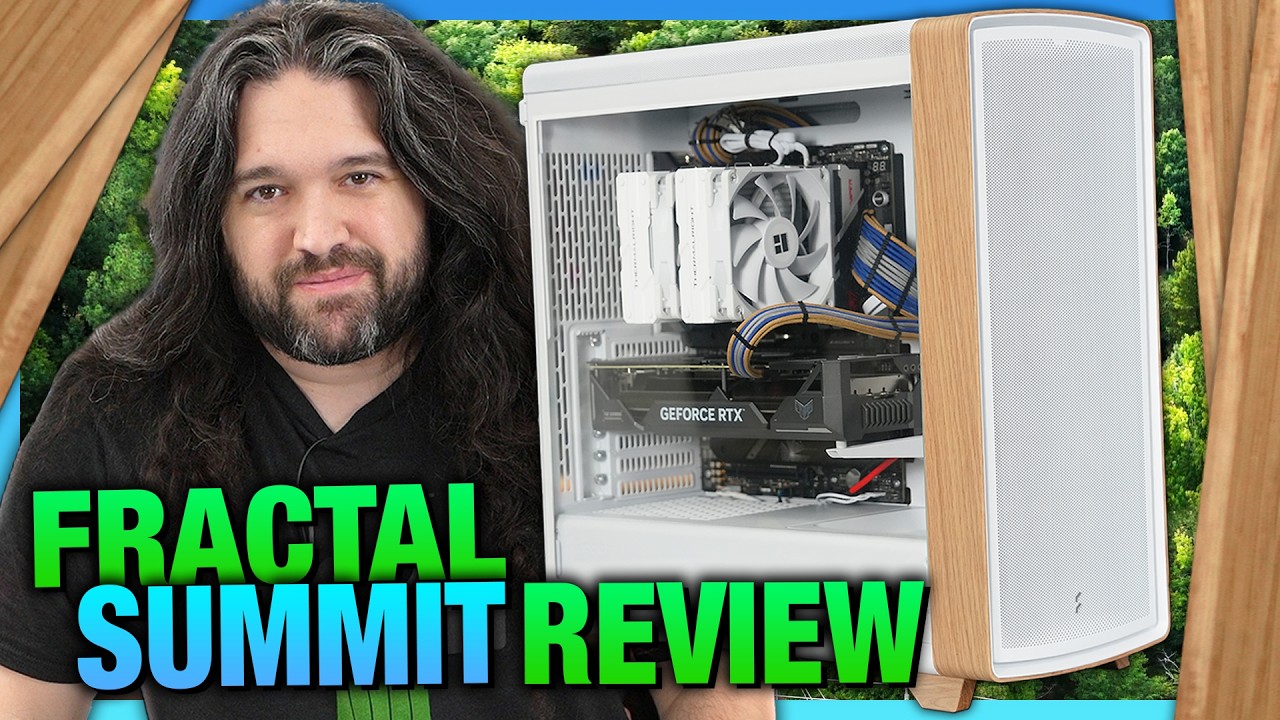
Gamers Nexus finds the $170 Fractal Summit underperforms cheaper alternatives and Fractal's own Meshify 3 as factory cost-cutting impairs cable routing and cooling efficiency.
AI-assisted summary of Fractal Summit Case Review | Thermal Benchmarks, Noise, & Cable Management — original source. Check the original for full context.
Source published:
Key ideas
- Fractal Design's Summit chassis ($170–$200) expands real steam-bent wood accents around its outer frame, but displays visible signs of cost-cutting and loose out-of-the-box hardware. (0:01)
- Thermal and acoustic benchmarks show the Summit trailing competitors, producing higher GPU core temperatures (46°C delta noise-normalized) and increased noise at full speed (40.8 dBA vs. 37.5 dBA on the Meshify 3) due to front-mesh air shearing. (13:03)
- Interior chassis volume was prioritized for additional drive mounting spots above the airflow scoop over cable routing channels, yet Fractal failed to include the brackets required to mount drives out of the box. (10:29)
- With internal alternatives like the Meshify 3 and cheaper third-party rivals like the Lian Li Lancool 207 ($120–$125) and Antec Flux Pro ($150), Gamers Nexus concluded the Summit is difficult to recommend on performance or value alone. (17:54)
Detailed notes
## Background Published on YouTube by Gamers Nexus on September 2, 2026, this video reviews the Fractal Summit PC chassis. According to the show notes, the review evaluates thermal performance, noise and acoustics, cable management, and build quality, comparing the new enclosure against competitors from Lian Li, Cooler Master, Corsair, and Hyte.
## TL;DR Gamers Nexus provides a comprehensive evaluation of the Fractal Summit, a $170 to $200 chassis distinguished by curved real-wood exterior trimming and high-end liquid crystal polymer fans. While the case boasts wide GPU clearance and an aerodynamically unrestrictive front fascia, it suffers from minor out-of-the-box quality control issues, compromised cable routing channels, and drive-bay volume expansion that lacks the necessary mounting brackets out of the box. Standardized acoustic and thermal benchmarking reveals that the Summit trails behind competitors like the Antec Flux Pro and Lian Li Lancool 207—as well as Fractal's own Meshify 3—yielding louder noise levels at full speed and mediocre GPU cooling. Consequently, the team concludes the chassis lacks a distinct competitive edge, rendering it difficult to recommend on performance or value unless a builder is entirely sold on its specific wooden aesthetic.
## Atmosphere & style The presentation carries Gamers Nexus's signature analytical rigor and dry, consumer-advocate deadpan humor, balanced with candid industry context about shrinking DIY hardware margins. Steve Burke delivers unvarnished technical criticism—poking fun at oxymoronic 'blackout' RGB branding and office aesthetic disputes—while maintaining strict objective discipline across charts and acoustic data. The review feels grounded, transparent, and slightly weary of corporate cost-cutting, concluding with an unusually intimate behind-the-scenes admission regarding the financial losses of running rigorous chassis benchmarks as a therapeutic palate cleanser from tech industry news.
## Bulletin - [00:01](https://www.youtube.com/watch?v=yEb_4Y58jaY&t=1s) Fractal Design's Summit chassis ($170–$200) expands real steam-bent wood accents around its outer frame, but displays visible signs of cost-cutting and loose out-of-the-box hardware. - [13:03](https://www.youtube.com/watch?v=yEb_4Y58jaY&t=783s) Thermal and acoustic benchmarks show the Summit trailing competitors, producing higher GPU core temperatures (46°C delta noise-normalized) and increased noise at full speed (40.8 dBA vs. 37.5 dBA on the Meshify 3) due to front-mesh air shearing. - [10:29](https://www.youtube.com/watch?v=yEb_4Y58jaY&t=629s) Interior chassis volume was prioritized for additional drive mounting spots above the airflow scoop over cable routing channels, yet Fractal failed to include the brackets required to mount drives out of the box. - [17:54](https://www.youtube.com/watch?v=yEb_4Y58jaY&t=1074s) With internal alternatives like the Meshify 3 and cheaper third-party rivals like the Lian Li Lancool 207 ($120–$125) and Antec Flux Pro ($150), Gamers Nexus concluded the Summit is difficult to recommend on performance or value alone.
## Key takeaways - [00:01](https://www.youtube.com/watch?v=yEb_4Y58jaY&t=1s) PC case manufacturers are increasingly shifting into the $170 to $200 price segment to sustain profit margins amid a contracting DIY market and high platform costs. - [02:39](https://www.youtube.com/watch?v=yEb_4Y58jaY&t=159s) The Summit features a continuous steam-bent oak or walnut exterior trim and matching solid wood load-bearing feet, giving it a distinctive rounded silhouette. - [02:39](https://www.youtube.com/watch?v=yEb_4Y58jaY&t=159s) Fractal created an extensive SKU lineup priced at $170, with the exception of the $200 'Ambience Blackout' variant, which ironically adds a front ARGB light strip to a blackout-branded model. - [04:41](https://www.youtube.com/watch?v=yEb_4Y58jaY&t=281s) The chassis expands GPU clearance to 425 mm (up from 349 mm on the Meshify 3) and replaces proprietary RGB hubs with standard 3-pin ARGB motherboard headers. - [07:18](https://www.youtube.com/watch?v=yEb_4Y58jaY&t=438s) Stock white Moment fans utilize liquid crystal polymer (LCP) blades, which resist centrifugal stretching and thermal creep to maintain tight sub-millimeter tip clearances. - [08:54](https://www.youtube.com/watch?v=yEb_4Y58jaY&t=534s) Gamers Nexus encountered out-of-the-box quality control issues, including an un-torqued front emblem badge and an unsecured 2.5-inch drive stud rattling loose in the chassis. - [10:29](https://www.youtube.com/watch?v=yEb_4Y58jaY&t=629s) Internal cable routing is hindered by reduced arch sizing, scarce Velcro ties, and the allocation of volume to unpopulated drive positions that lack mounting hardware out of the box. - [10:29](https://www.youtube.com/watch?v=yEb_4Y58jaY&t=629s) The included GPU anti-sag bracket secures to the flexible sheet metal of the motherboard tray rather than the chassis frame, causing visible arm droop under heavy graphics card loads. - [13:03](https://www.youtube.com/watch?v=yEb_4Y58jaY&t=783s) Noise-normalized testing at 27 dBA yielded a competitive 46°C CPU delta over ambient, but GPU thermals lagged behind leaders due to increased distance between the front baffle and the graphics card. - [16:17](https://www.youtube.com/watch?v=yEb_4Y58jaY&t=977s) At 100% fan speed, air shearing against the front panel drove the Summit's acoustic output to 40.8 dBA, running louder and warmer than the Meshify 3 at 37.5 dBA. - [16:17](https://www.youtube.com/watch?v=yEb_4Y58jaY&t=977s) Removing the front exterior panel produced only a 2°C drop in CPU delta, confirming that the front mesh pattern is aerodynamically transparent despite acoustic shearing. - [19:05](https://www.youtube.com/watch?v=yEb_4Y58jaY&t=1145s) The Summit struggles against aggressive competition, including Fractal's own Meshify 3 and North XL, as well as the Lian Li Lancool 207 and Antec Flux Pro, both of which offer more pre-installed fans for less money. - [20:30](https://www.youtube.com/watch?v=yEb_4Y58jaY&t=1230s) Gamers Nexus noted that standardized PC case reviews currently operate at a net financial loss (such as an estimated $1,400 loss on the HAF II 500) due to low viewership and extensive testing overhead.
## Detailed walkthrough ### [00:01](https://www.youtube.com/watch?v=yEb_4Y58jaY&t=1s) DIY Market Realities and the Fractal Summit Concept
As Gamers Nexus finishes up an extensive two-hour investigation into consumer devices spying on users in their homes, the team turns to an in-depth review of the Fractal Summit PC case. The Summit lands in the increasingly crowded $170 to $200 price bracket. This pricing trend reflects the harsh financial realities currently facing PC case manufacturers: as the DIY PC market contracts, brands have realized that the primary customers still buying components are enthusiasts willing to spend absurd sums—like $1,400 on system memory. This shift aligns directly with insights shared by Cooler Master in the Gamers Nexus *COLLAPSE* documentary, where industry veterans explained that pushing into the premium, high-margin sector is often the only way case manufacturers can survive while waiting for memory and platform prices to normalize.
Fractal Design carries substantial pedigree in this space after single-handedly popularizing the modern use of wood accents in chassis design with the Fractal North. With the Summit, Fractal takes that concept further by wrapping a curved wooden perimeter around the outside of the chassis. However, the case also exhibits telltale signs of margin pressure and cost-cutting that Fractal historically avoided. The top panel, for instance, features an edge-to-edge mesh that feels noticeably flimsier than older Fractal chassis, lacking the structural stamping or bracing they typically employed.
The aesthetic execution also comes across as somewhat disjointed: the exterior mixes a canvas-style pull strap at the rear, real curved wood trimming at the front, white painted steel, structural plastic, and tempered glass. Despite this slightly cluttered mixture of materials, Fractal’s traditional engineering polish still shines in specific mechanical touchpoints. The front panel removal mechanism is standout, utilizing a satisfying socketing action that snaps in and out of place with a reassuring, high-quality mechanical click.
---
[01:59](https://www.youtube.com/watch?v=yEb_4Y58jaY&t=119s) Sponsor: Thermaltake TR200 WS Micro Chassis
The review is sponsored by Thermaltake and their TR200 WS micro chassis, a compact and stout micro-ATX enclosure. The chassis features an optional 5.25-inch external drive bay capable of housing an accessory display screen or optical media drive. It incorporates heavily perforated side panels alongside a front accent trim reminiscent of popular modern cases. Cooling compatibility includes support for closed-loop liquid coolers and radiators up to 360 mm mounted in the top, alongside seven total 120 mm fan mounts spread across the top, bottom, and rear panels. Hardware clearance is rated for CPU tower air coolers up to 175 mm tall and graphics cards up to 365 mm long, packaging broad component support into a portable footprint.
---
[02:39](https://www.youtube.com/watch?v=yEb_4Y58jaY&t=159s) Exterior Design, Wood Crafting, and the "Blackout" RGB Oxymoron
The primary design hook of the Fractal Summit is the real wood frame wrapping the front panel, gently curving along the top and bottom edges. The profile evokes older rounded chassis silhouettes such as the Silverstone Primera PM01 or the NZXT Manta. The bottom of the chassis features four matching solid wood feet, which are handsomely shaped and proportioned to ensure adequate intake clearance from the desk surface. Aesthetics remain highly divisive even within the Gamers Nexus office: while some staff members appreciate the look, videographer Vitalii strongly dislikes it, prompting Steve Burke's warning that "you really don't want to be on Vitaly's bad side, especially if you're a computer case."
Fractal brings back several recognizable utility features seen on previous cases, including internal cable-aligner arches, a lower PSU-shroud airflow scoop, and premium LCP (liquid crystal polymer) stock fans. At the same time, Fractal continues its trend of creating an overwhelming matrix of SKUs. The Summit is offered with solid steel or tempered glass side panels, in black or white colorways, paired with either oak or walnut wood trim.
```mermaid flowchart TD accTitle: Fractal Summit SKU Configuration Breakdown accDescr: Diagram illustrating the branching SKU options and pricing tiers for the Fractal Summit case.
subgraph BaseSKUs["Base Summit SKUs ($170)"] Base["Base Models"] --> Colors["Black or White Chassis"] Base --> Wood["Oak or Walnut Accents"] Base --> Side["Solid Steel or Tempered Glass"] Base --> Blackout["Blackout (Blackened Oak Trim)"] end
subgraph AmbientSKU["Premium Ambience SKU ($200)"] Ambient["Summit Ambience Blackout"] --> LightTint["TG Light Tint"] Ambient --> RGBStrip["Front Perimeter ARGB Strip"] end ```
The naming conventions also include "Blackout" and "Ambience Blackout" variants. Steve takes humorous issue with the latter branding, noting that adding an RGB light strip around the front panel directly contradicts the definition of a blackout build:
> "It’s not—if you put RGB lights in it, literally anywhere, it's no longer blackout. Not the biggest scandal in the world... but come on. At that point, maybe you could call it dark or something, but even then it's still got RGB lights in it. If we could use language properly, that'd be great."
Pricing across the lineup is structured so that almost every variant—whether solid, glass, oak, or walnut—retails at $170, with the sole exception being the Summit Ambience Blackout TG Light Tint model, which carries a $30 premium at $200.
---
[04:41](https://www.youtube.com/watch?v=yEb_4Y58jaY&t=281s) Chassis Layout, Radiator Fitment, and Comparison to the Meshify 3
Out of the box, the Summit includes three front intake fans. The exterior side panels release via rear-mounted pull tabs and captive thumbscrews, retaining Fractal's welcome practice of including optional screw positions so users can secure panels during transit. Structurally, bending real wood around the front fascia represents an impressive manufacturing feat. A single continuous strip of oak or walnut is steam-bent around the entire perimeter and joined cleanly at the bottom seam. Using solid wood for the chassis feet is equally uncommon; historically, few brands besides Cryorig have relied on wood as a load-bearing element due to natural grain variability. Builders should exercise caution when transporting the case: while the feet easily bear weight when resting flat, they are held in place by relatively short screws that could shear if the case is dropped directly on a corner.
```mermaid flowchart LR accTitle: Dimensional and Clearance Comparison between Summit and Meshify 3 accDescr: Flowchart comparing GPU clearance, radiator support, and RGB ecosystem between Fractal Summit and Fractal Meshify 3.
subgraph Meshify["Fractal Meshify 3"] M_GPU["GPU Clearance: 349 mm"] M_Hub["Ambience Pro RGB Hub"] M_Rad["Restricted Top Radiator Space"] end
subgraph Summit["Fractal Summit"] S_GPU["GPU Clearance: 425 mm"] S_Hub["Standard 3-Pin ARGB Headers"] S_Rad["360 mm Removable Top Tray"] end ```
While initially appearing to be a simple front-panel redesign of the Meshify 3—similar to how the Epoch related to the North—the Summit is physically larger and features distinct internal dimensions: - Maximum GPU clearance expands dramatically from 349 mm in the Meshify 3 to 425 mm in the Summit (approaching the Meshify 3 XL). - The removable top mounting bracket accommodates 360 mm liquid cooling radiators, though clearance remains tight enough that most AIOs must be oriented with their hoses toward the front of the chassis. - Front cooling mounts use stamped mounting rails with fixed slots for top, middle, and bottom fan positions, eliminating continuous sliding adjustability. - Unlike the Meshify 3 Ambience Pro RGB, the Summit abandons specialized proprietary fan hubs and custom USB-C wiring in favor of standard off-the-shelf ARGB pin headers.
---
[07:18](https://www.youtube.com/watch?v=yEb_4Y58jaY&t=438s) Reinforced Cable Grommets and LCP Fan Engineering
Fractal incorporates subtle, thoughtful quality-of-life improvements inside the main chamber. The chassis features only one primary pass-through grommet along the motherboard tray, but it includes molded plastic perimeter locking clips. These retention clips physically secure the rubber gasket to the steel cutout, preventing the rubber from popping loose when bundles of stiff 24-pin ATX cables are pushed through. It is the type of invisible engineering expense that few first-time builders will consciously notice, but one that drastically improves the building experience for experienced system assemblers.
The chassis includes white Moment fans built using LCP (liquid crystal polymer) fan blades. While standard black LCP often displays an uneven, swirled gray surface finish, the white implementation features an appealing, subtle stone-matte texture. The choice of LCP material is an intentional, performance-driven engineering decision: - Liquid crystal polymer exhibits superior mechanical rigidity and tensile strength compared to conventional PBT or ABS plastics. - Standard plastic fan blades experience thermal expansion, centrifugal stretching, and creep over years of operation, forcing fan designers to leave wide clearance gaps between the blade tips and the outer frame housing to avoid scraping. - LCP prevents blade deformation under high rotational loads, enabling engineers to tighten the blade-to-frame clearance tolerances down to sub-millimeter margins. - This tight tip clearance minimizes air leakage around the edges, maximizing static pressure, airflow delivery, and acoustic efficiency through restrictive dust filters and radiator fins.
[08:54](https://www.youtube.com/watch?v=yEb_4Y58jaY&t=534s) Liquid Crystal Polymer Fans, Out-of-the-Box QC Issues, and Build Refinements
Liquid crystal polymer (LCP) fan construction offers genuine advantages—preventing fan blades from warping over time and clipping against the frame without having to sacrifice clearance and aerodynamic performance—though the material is undeniably expensive. However, unboxing the Fractal Summit revealed immediate quality control blunders. Right out of the box, a plastic component was found rattling loose inside the chassis, alongside a loose Fractal emblem badge on the front panel. The exterior badge is held on with screws that simply had not been torqued down at the factory—an easy fix with a screwdriver, but a sloppy first impression. The loose plastic piece turned out to be one of the removable mounting studs for 2.5-inch storage drives located beneath the power supply shroud, which had also failed to be properly secured. While nothing was outright snapped or permanently broken, the experience points toward assembly lapses and penny-pinching in manufacturing.
The stock fans are designed to be daisy-chained and run off a single extension cable included in the accessory pack. Given Fractal's somewhat mixed historical track record with included fan hubs, omitting a dedicated hub may have been as much a reliability choice as a bill-of-materials cost cut. Looking past the initial QC stumbles, several subtle mechanical refinements over the Meshify 2 are evident: - The screw anchoring the airflow scoop is captive and positioned in plain sight, eliminating the risk of a builder ripping out a hidden fastener. - The front fan brackets now use captive screws. - The front panel snaps securely into a spring-loaded latch resting against twin rubber stoppers. - The plastic cable routing arches are no longer directional or keyed, resolving what Gamers Nexus previously considered their single "most ridiculous" gripe with the Meshify series—where an oriented logo prevented flipping the arches upside down.
[10:29](https://www.youtube.com/watch?v=yEb_4Y58jaY&t=629s) Radiator Compatibility and Cable Routing Trade-Offs
Worries that the internal airflow scoop would block front liquid cooling proved largely unfounded: a standard 25 mm thick 360 mm radiator clears it without needing removal. Builders should note that although the front rails accept up to three 140 mm fans, 360 mm remains the maximum radiator size supported. At the top of the chassis, a removable bracket leaves the roof wide open for effortless motherboard installation and can house up to a 360 mm radiator, provided the tubing faces forward toward the front of the enclosure. Installing a liquid cooler up top does, however, obstruct the motherboard tray's upper passthrough cutouts, complicating EPS CPU power routing.
Fractal's allocation of interior volume drew sharp criticism. Rather than leveraging the Summit's extended chassis dimensions to widen and simplify cable paths, the design team prioritized drive-mounting real estate directly above the airflow scoop. As a consequence, the cable arches are noticeably reduced in both size and frequency compared to the Meshify 2, crammed into the corners of the chassis. While standard power supply leads can be coerced into place, intuitive pathways are lacking, and the accessory kit includes only a single strip of hook-and-loop Velcro (forcing users to scavenge extra ties from the rear of the tray).
```mermaid flowchart TD accTitle: Chassis Internal Space Trade-off accDescr: Diagram showing how Fractal allocated internal volume to extra drive positions rather than cable management channels.
subgraph Internal_Space["Chassis Internal Space Allocation"] direction TB Space["Summit Extra Interior Volume"] Routing["Cable Management Space<br/>(Arches shrunk & displaced into corner)"] DriveSpace["Drive Mounting Real Estate<br/>(Area directly above airflow scoop)"] end
subgraph Hardware_Outcome["Hardware & Consumer Reality"] direction TB MissingHW["No Extra Cages / Brackets Included<br/>(Simultaneous drive support matches Meshify 3)"] UserPain["Consumer Perspective:<br/>Extra space present, but unusable out of the box"] end
Space -->|"sacrificed"| Routing Space -->|"allocated to"| DriveSpace DriveSpace --> MissingHW MissingHW --> UserPain ```
Making matters worse, Fractal provides no extra brackets or mounting cages to actually populate these drive bays out of the box. Simultaneous drive capacity out of the carton remains completely identical to the smaller Meshify 3 unless a buyer sources aftermarket hardware or 3D prints their own brackets. From a consumer perspective, the trade-off falls flat: cable routing was compromised to provide theoretical expansion that cannot actually be used without spending more money, all to shave fifty cents or a dollar off the factory bill of materials.
The integrated GPU anti-sag bracket shows a similar mix of good intentions and compromised execution. While mechanically sturdy and straightforward to adjust, it braces against the chassis motherboard tray rather than a rigid frame member. Because the sheet metal of the tray exhibits flex, the bracket arm sags under heavy loads. The straight horizontal lines of the support arm make any resulting droop glaringly visible, and tightening the bracket mounting screws onto the sharp sheet metal stamped out and chewed through the included plastic washers.
[13:03](https://www.youtube.com/watch?v=yEb_4Y58jaY&t=783s) Thermal Testing Methodology and Noise-Normalized Benchmarks
Thermal evaluations focus on competitive context against key contemporary enclosures: - Fractal Summit (Tested configuration: $170) - Antec Flux Pro ($150 to $185) - Lian Li Lancool 207 ($120 to $125 / sub-$100 bracket) - Fractal North XL ($156 to $195) - Cooler Master HAF 500 / HAF II 500 (~$200) - Hyte X50 Air (Tested with Antec Flux non-Pro fans)
Testing includes a baseline run with the front exterior panel removed to measure flow restriction; large deltas (5°C to 10°C, as once seen on cases like the original H500P) signal severe choking, whereas deltas around 2°C indicate an aerodynamically transparent front fascia.
All noise-normalized thermal comparisons are conducted in a calibrated hemi-anechoic chamber, dialing back chassis fan speeds until reaching exactly 27 dBA SPL at a 1-meter measuring distance from the front baffle.
``` Noise-Normalized CPU Thermals (27 dBA SPL @ 1 m) =========================================================== Cooler Master HAF II 500 | 43°C ΔT over ambient Meshify 2 | 44°C ΔT over ambient Lian Li Lancool 207 | 45°C ΔT over ambient Antec Flux Pro | 45°C ΔT over ambient Fractal Summit | 46°C ΔT over ambient (Tied Meshify 2 XL) ```
In the CPU noise-normalized test, the Summit performed respectably, averaging 46°C above ambient on the CPU P-cores to tie the Meshify 2 XL. While strong, it trailed top-tier airflow benchmarks: the Lian Li 207 and Antec Flux Pro hit 45°C over ambient, while the standard Meshify 2 delivered 44°C over ambient using effectively identical fans. The Meshify 2 benefits from a more compact internal chamber that concentrates fan output closer to the core socket rather than dispersing it across a larger footprint.
Graphics card cooling under noise-normalized conditions proved significantly more problematic. The Summit settled at 46°C over ambient on the GPU core and 50°C on the video memory (VRAM). By contrast: - Meshify 3 pulled 43°C on the GPU core and 46°C on VRAM. - Lian Li 207 and Fractal North XL both tied at 44°C GPU delta. - Antec Flux Pro led the field at 41°C above ambient. - Cooler Master HAF II 500 placed just behind the 207 at the top of the chart.
The Summit's elongated chassis proportions work against it here: the increased distance between the front intake baffle and the graphics card prevents the bottom airflow scoop from pushing air directly into the graphics card's intake fans.
[16:17](https://www.youtube.com/watch?v=yEb_4Y58jaY&t=977s) 100% Fan Speed Thermals and Early Conclusions
Running all chassis fans at 100% full speed yielded an average P-core result of 44°C above ambient on the Summit. Popping the front panel off entirely caused temperatures to fall merely two degrees to 42°C delta. This small 2°C variance confirms that the Summit's front mesh is engineered well aerodynamically and presents virtually no intake restriction.
Acoustic behavior at maximum speed, however, revealed notable drawbacks. Despite the Summit spinning its fans at the exact same 1800 RPM ceiling as the Meshify 3, the Summit measured significantly louder at 40.8 dBA versus the Meshify 3's 37.5 dBA—a disparity driven almost entirely by air shearing against the Summit's specific front panel pattern. Simultaneously, the Meshify 3 ran both quieter and cooler, landing at 42°C on the CPU cores. The mesh-sided Fractal North XL ran louder still at 45 dBA (matching 42°C on P-cores alongside the Flux Pro), while the budget Lian Li 207 held the lead at 41°C.
| Case | Full Speed Noise (dBA) | Full Speed CPU (P-Core ΔT) | Full Speed GPU (Core ΔT) | |:--- |:--- |:--- |:--- | | **Fractal Summit** | 40.8 dBA | 44°C | 45°C | | **Fractal Summit (Panel Off)** | — | 42°C | 45°C | | **Fractal Meshify 3** | 37.5 dBA | 42°C | 41°C | | **Antec Flux Pro** | — | 42°C | 38°C | | **Lian Li Lancool 207** | — | 41°C | ~43°C | | **Fractal North XL (Mesh)** | 45.0 dBA | 42°C | 44°C |
GPU results at full speed mirrored the noise-normalized tests. Running the Summit with its front panel on versus off made virtually zero impact on graphics thermals—both configurations rounded out to 45°C over ambient on the core and 49°C on VRAM. Compared to class leaders like the Antec Flux Pro (38°C average) and Meshify 3 (41°C average), the Summit sits at the bottom half of the performance stack.
These results left the testing team with an inescapable feeling of déjà vu. While acknowledging the tough market realities and narrow manufacturing margins facing case makers today, the data makes the Summit difficult to justify on pure performance or build value over alternatives like the Meshify 3, leaving aesthetic appeal as its primary selling point.
[17:54](https://www.youtube.com/watch?v=yEb_4Y58jaY&t=1074s) Value Assessment and Market Reality: The Summit’s Lack of Identity
Unless you are completely sold on the exterior design, there is very little justification for buying the Fractal Summit. As Steve highlights, the market already offers superior options across the board, including within Fractal’s own catalog like the Meshify 3 series, as well as significantly cheaper alternatives from competitors. Stripped of its aesthetics, the Summit fails to present any unique, specialized, or exceptionally well-executed feature that warrants picking it over the competition. A major contributing factor is an industry-wide trend: case manufacturers are visibly cutting corners and designing to lower budgets because they find themselves in a precarious financial situation. While Gamers Nexus sympathizes with the financial pressures vendors face, Steve points out that everyday consumers ultimately do not care about a manufacturer's underlying accounting woes; buyers only care if a chassis delivers good value for their hard-earned money.
At its price tag, the Summit is simply "fine," but that is hardly a compelling endorsement when equal or better enclosures can be had for the exact same amount or less. Beyond that, the physical craftsmanship leaves something to be desired. The exterior feels somewhat hastily thrown together, featuring differing materials where adjacent edges do not line up with complete precision. While the tolerances are close, they are visibly imperfect, undermining the premium impression Fractal usually delivers.
[19:05](https://www.youtube.com/watch?v=yEb_4Y58jaY&t=1145s) Fractal and Third-Party Alternatives
Comparing the Summit directly against internal and external competition reveals just how crowded the segment is. The top-tier Fractal Summit retails at $200. In comparison, Fractal's own Meshify 3 Ambience Pro RGB variant—normally positioned at a higher MSRP—sits at $192 on sale, effectively undercutting the top-end Summit while feeling like a far more coherent, "fully formed thought." The Meshify 3 brings its own distinct styling, superior high-end accent lighting, identical fans, and better thermal performance. Some baseline Meshify 3 SKUs even dip as low as $155. While the Meshify has slightly less internal clearance, the Summit squanders its extra space anyway: it includes additional drive mount locations, but Fractal does not provide the hardware required to use them out of the box, forcing users to either buy separate brackets or 3D-print their own. For those determined to have a wooden aesthetic, the larger Fractal North XL frequently goes on sale around $156.
The situation becomes even harder for the Summit when third-party manufacturers are brought into the equation: - **Lian Li Lancool 217 (or 207 series):** Priced around $125 with wood trim, including a generous out-of-the-box configuration of five stock fans. - **Antec Flux Pro / P-series:** Coming in around $150 while including six pre-installed stock fans and delivering excellent airflow out of the box. - **Cooler Master HAF II 500:** Sitting in the $200 bracket, presenting a radically different, high-airflow alternative. - **Hyte X50:** Available around $150; while users need to supply their own cooling fans, the $50 delta under the Summit easily covers an aftermarket fan pack.
[20:30](https://www.youtube.com/watch?v=yEb_4Y58jaY&t=1230s) Final Verdict and the Cost of Independent Hardware Testing
Ultimately, both Steve and Patrick view the Fractal Summit with a collective "meh." It is far from an inherently defective or terrible chassis, but it brings no distinct innovation, offers worse space efficiency and materials than previous iterations, and clearly exhibits signs of aggressive cost-cutting. Concluding the review, Steve offers some candid transparency regarding the channel's testing economics. Because broader PC building activity has slumped, standard chassis reviews attract fewer views than deep dives or news reporting, meaning Gamers Nexus actively subsidizes them. For instance, testing the Cooler Master HAF II 500 resulted in a net loss of roughly $1,400 due to the extensive bench labor and acoustic validation required.
The team intentionally accepts these losses because they genuinely enjoy doing rigorous hardware evaluations, using support from Patreon and their online merchandise store to offset the deficits. Steve jokes that spending days testing steel and fan curves provides a much-needed mental palate cleanser from the relentless, depressing wave of artificial intelligence corporate news. To wrap up, he teases that a massive journalistic investigation that has consumed his time for over five weeks is nearing release.
- **Review Economics:** Gamers Nexus ran an estimated $1,400 loss producing the Cooler Master HAF II 500 review due to the high labor overhead of standardized thermal/acoustic testing. - **Upcoming Coverage:** A major investigative exposé, five-plus weeks in development, is scheduled to follow shortly.
## Notable quotes > [02:39](https://www.youtube.com/watch?v=yEb_4Y58jaY&t=159s) you really don't want to be on Vitaly's bad side, especially if you're a computer case. — Steve Burke
> [02:39](https://www.youtube.com/watch?v=yEb_4Y58jaY&t=159s) It’s not—if you put RGB lights in it, literally anywhere, it's no longer blackout. Not the biggest scandal in the world... but come on. At that point, maybe you could call it dark or something, but even then it's still got RGB lights in it. If we could use language properly, that'd be great. — Steve Burke
> [03:43](https://www.youtube.com/watch?v=yEb_4Y58jaY&t=223s) blackened oak — Fractal Design
> [03:43](https://www.youtube.com/watch?v=yEb_4Y58jaY&t=223s) no wood, just trim — Steve Burke
> [08:54](https://www.youtube.com/watch?v=yEb_4Y58jaY&t=534s) most ridiculous — Steve Burke
> [17:54](https://www.youtube.com/watch?v=yEb_4Y58jaY&t=1074s) fine — Steve Burke
> [19:05](https://www.youtube.com/watch?v=yEb_4Y58jaY&t=1145s) fully formed thought — Steve Burke
> [20:30](https://www.youtube.com/watch?v=yEb_4Y58jaY&t=1230s) meh — Steve Burke
## Mentioned Gamers Nexus, Steve Burke, Patrick Lathan, Vitalii Makhnovets, Tim Phetdara, Fractal Design, Fractal Summit, Fractal Summit Ambience Blackout, Fractal North, Fractal North XL, Fractal Meshify 2, Fractal Meshify 2 XL, Fractal Meshify 3, Fractal Meshify 3 XL, Fractal Meshify 3 Ambience Pro RGB, Fractal Epoch, Fractal Pop 2 Vision, Fractal Torrent, Thermaltake TR200 WS, Cooler Master, Cooler Master HAF II 500, Cooler Master HAF 500, Cooler Master H500P, COLLAPSE, Silverstone Primera PM01, NZXT Manta, Cryorig, Lian Li Lancool 207, Lian Li Lancool 217, Lian Li O11 Vision Compact, Antec Flux Pro, Hyte X50, Corsair FRAME 4000D RS ARGB, Moment fans
## Video description Sponsor: Thermaltake TR200 WS mATX Case on Amazon https://geni.us/bviRvG Our review of the Fractal Summit case looks at thermal performance, noise and acoustics, cable management, build quality, and more. The Summit follows Fractal's Epoch and Meshify 3 launches in recent years and lines-up against Lian Li, Cooler Master, Corsair, and Hyte for similarly priced cases.
Watch our COLLAPSE documentary that features Cooler Master: https://www.youtube.com/watch?v=zyQwAhppWj8
The best way to support our work is through our store: https://store.gamersnexus.net/
Like our content? Please consider becoming our Patron to support us: http://www.patreon.com/gamersnexus
RELATED PRODUCTS [Affiliate Links]
Fractal Summit on Amazon: https://geni.us/IWVxy Cooler Master HAF II 500 on Amazon: https://geni.us/iNYDYB HAVN BF 360 Flow on Amazon: https://geni.us/PRsOyke Hyte X50 on Amazon: https://geni.us/CEBL Fractal Torrent on Amazon: https://geni.us/A2S4z Fractal Pop 2 Vision on Amazon: https://geni.us/maKH1H Lian Li O11 Vision Compact on Amazon: https://geni.us/S0Wl Fractal Meshify 3 Ambience Pro RGB on Amazon: https://geni.us/BjOq5 Antec Flux Pro on Amazon: https://geni.us/CaPv Lian Li Lancool 207 on Amazon: https://geni.us/HILbWU Corsair FRAME 4000D RS ARGB on Amazon: https://geni.us/mfBx6F
TIMESTAMPS
00:00 - Fractal Summit Case Review 02:40 - The Build Basics 07:18 - Cable Management and Fans 13:06 - Thermal Test Setup 14:25 - CPU Thermals: Noise-Normalized 15:39 - GPU Thermals: Noise-Normalized 16:20 - CPU Thermals: Full Speed 17:17 - GPU Thermals: Full Speed 17:38 - Conclusion
CORRECTIONS: 03:43 - Fractal contacted us to note that blackout models have "blackened oak" trim, so we removed an earlier comment that they had "no wood, just trim," which we wrote based on photos in the marketing materials from Fractal, as we did not have the blackout case.
** Please like, comment, and subscribe for more! **
Links to Amazon and Newegg are typically monetized on our channel (affiliate links) and may return a commission of sales to us from the retailer. This is unrelated to the product manufacturer. Any advertisements or sponsorships are disclosed within the video ("this video is brought to you by") and above the fold in the description. We do not ever produce paid content or "sponsored content" (meaning that the content is our idea and is not funded externally aside from whatever ad placement is in the beginning) and we do not ever charge manufacturers for coverage.
Follow us in these locations for more gaming and hardware updates:
t: http://www.twitter.com/gamersnexus f: http://www.facebook.com/gamersnexus w: http://www.gamersnexus.net/
Our policies, processes, and ethics statements relating to review samples, advertising, travel, errors, and more are transparently and publicly available on this page: https://gamers.nexus/ethics-statements
Steve Burke: Host, Writing, Test Lead Patrick Lathan: Testing, Writing Vitalii Makhnovets: Camera, Editing Tim Phetdara: Camera, Editing
[Source](https://www.youtube.com/watch?v=yEb_4Y58jaY)