Quantum Uncertainty Explains Fading Cosmic Expansion, Study Shows
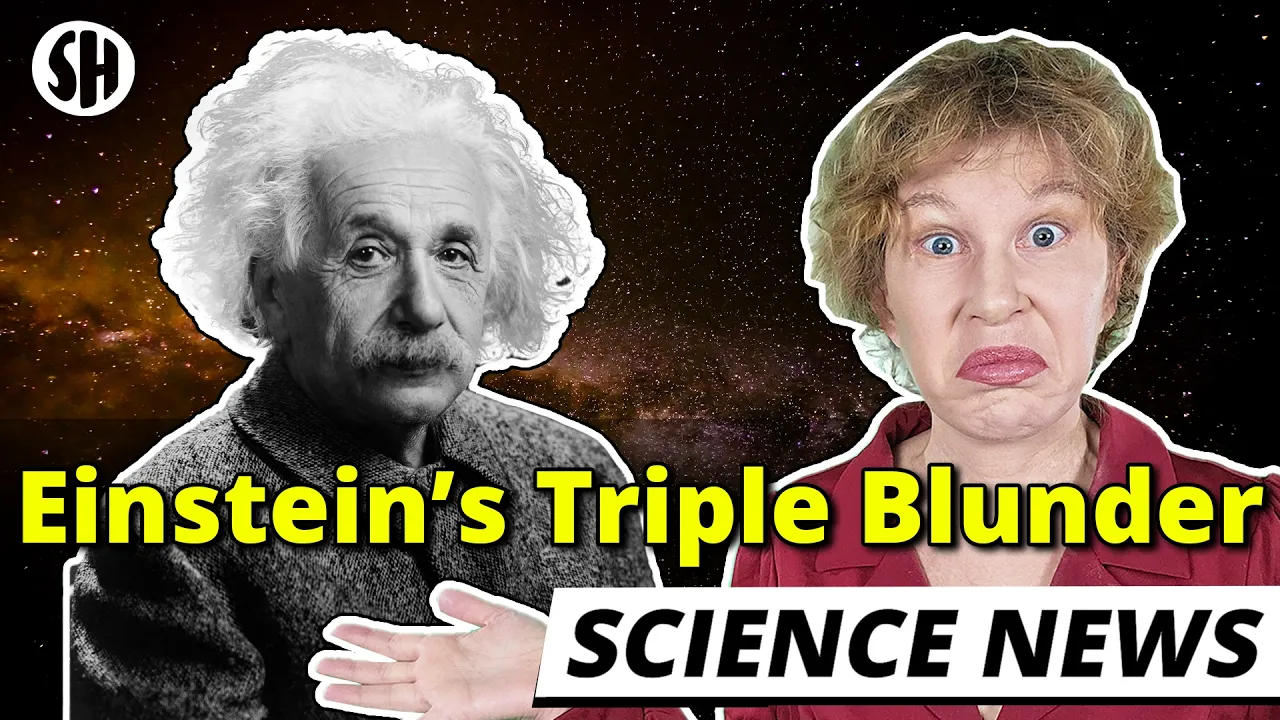
Sabine Hossenfelder
Astronomical data showing a decreasing expansion rate may provide the first empirical evidence of quantum gravity, as Heisenberg uncertainty between cosmic size and expansion speed systematically suppresses dark energy.
AI-assisted summary of Einstein’s Biggest Blunder Might Have Been Even Bigger! — original source. Check the original for full context.
Source published:
Key ideas
- Recent cosmological data from surveys including DESI and DES indicate that the cosmic expansion rate is not accelerating at a constant pace, but is instead decreasing over time. (0:00)
- A new theoretical physics paper proposes that dark energy's decline stems from Heisenberg's uncertainty principle applied to the cosmos, where the universe's size and expansion rate act as complementary variables. (1:46)
- If validated, the cosmological uncertainty model would constitute the first empirical evidence of gravity exhibiting quantum mechanical behavior. (0:00)
- The proposal suffers from significant limitations: it relies on an unconstrained free parameter and lacks derivation from formal quantum gravity frameworks like string theory or loop quantum gravity. (4:02)
Detailed notes
## Background This video was published on YouTube by Sabine Hossenfelder on September 15, 2026. According to the description, it covers recent astronomical observations suggesting the expansion of the universe is not accelerating at a steady rate, and explores a new paper proposing that quantum mechanics could explain this phenomenon as gravity's first observed quantum behavior.
## TL;DR Recent observational data from surveys like DESI and DES indicate that cosmic acceleration is declining over time rather than remaining constant, hinting that dark energy is dynamic. A newly published physics paper suggests this shift can be explained by applying Heisenberg's uncertainty principle to the cosmos as complementary variables of universe size and expansion rate. The resulting quantum variance mathematically reduces the observed acceleration compared to classical predictions. While conceptually clever and minimal, the model relies on a free parameter and lacks a derivation from an underlying theory of quantum gravity, giving it a 4 out of 10 on Hossenfelder's 'bullshit meter.'
## Atmosphere & style The presentation carries Sabine Hossenfelder’s signature dry, analytical wit and skepticism, blending genuine scientific intrigue with sharp, grounded reality checks. Complex cosmological mathematics and historical anecdotes about Einstein are delivered with brisk, no-nonsense pacing and deadpan humor. Watching it feels like an accessible yet intellectually rigorous briefing from an insider who appreciates elegant theoretical ideas but refuses to let hype outrun empirical evidence.
## Bulletin - [00:00](https://www.youtube.com/watch?v=Kln2KRqrZOk&t=0s) Recent cosmological data from surveys including DESI and DES indicate that the cosmic expansion rate is not accelerating at a constant pace, but is instead decreasing over time. - [01:46](https://www.youtube.com/watch?v=Kln2KRqrZOk&t=106s) A new theoretical physics paper proposes that dark energy's decline stems from Heisenberg's uncertainty principle applied to the cosmos, where the universe's size and expansion rate act as complementary variables. - [00:00](https://www.youtube.com/watch?v=Kln2KRqrZOk&t=0s) If validated, the cosmological uncertainty model would constitute the first empirical evidence of gravity exhibiting quantum mechanical behavior. - [04:02](https://www.youtube.com/watch?v=Kln2KRqrZOk&t=242s) The proposal suffers from significant limitations: it relies on an unconstrained free parameter and lacks derivation from formal quantum gravity frameworks like string theory or loop quantum gravity.
## Key takeaways - [00:00](https://www.youtube.com/watch?v=Kln2KRqrZOk&t=0s) Astronomical observations suggest that cosmic acceleration is weakening rather than remaining steady, raising the possibility of a future cosmic contraction. - [00:00](https://www.youtube.com/watch?v=Kln2KRqrZOk&t=0s) Albert Einstein originally introduced a negative cosmological constant in 1917 to maintain a static universe, later abandoning it once cosmic expansion was discovered. - [00:00](https://www.youtube.com/watch?v=Kln2KRqrZOk&t=0s) The cosmological constant was revived with a positive sign in the late 1990s following distant supernova measurements proving accelerated cosmic expansion. - [00:00](https://www.youtube.com/watch?v=Kln2KRqrZOk&t=0s) Modern surveys like DESI and DES suggest dark energy is dynamical rather than uniform, challenging standard cosmological models. - [01:46](https://www.youtube.com/watch?v=Kln2KRqrZOk&t=106s) The new paper treats the overall size of the universe and its rate of expansion as quantum complementary observables that cannot be simultaneously measured with arbitrary precision. - [01:46](https://www.youtube.com/watch?v=Kln2KRqrZOk&t=106s) The observed cosmic acceleration is reduced by quantum variance—the mathematical difference between the mean of the square of the expansion rate and the square of its mean. - [01:46](https://www.youtube.com/watch?v=Kln2KRqrZOk&t=106s) Because cosmic uncertainty scales alongside the volume of the universe, the correction factor naturally changes over cosmic history. - [01:46](https://www.youtube.com/watch?v=Kln2KRqrZOk&t=106s) Theoretical physicists such as Lawrence Krauss remain cautious, questioning whether the empirical evidence for dynamic dark energy will endure under future scrutiny. - [04:02](https://www.youtube.com/watch?v=Kln2KRqrZOk&t=242s) A major weakness of the hypothesis is its inability to calculate the absolute magnitude of the quantum effect from first principles, requiring a free parameter. - [04:02](https://www.youtube.com/watch?v=Kln2KRqrZOk&t=242s) The cosmic uncertainty relation lacks a rigorous derivation from established quantum gravity candidates, earning the model a 4 out of 10 on the channel's evaluation scale. - [04:02](https://www.youtube.com/watch?v=Kln2KRqrZOk&t=242s) Despite these flaws, the model provides an inventive, minimalist attempt to connect cosmological observational anomalies with quantum foundations.
## Detailed walkthrough ### [00:00](https://www.youtube.com/watch?v=Kln2KRqrZOk&t=0s) The Fading Acceleration and Einstein's Constant
Recent astronomical observations have revealed a startling twist in cosmology: the universe is not expanding the way physicists long assumed. Instead of accelerating at a steady, unchanging rate, the acceleration appears to be decreasing. If that downward trend continues, the cosmic expansion could eventually halt and reverse, causing the universe to shrink. A new paper published in a top physics journal proposes a radical explanation: the universe as a whole is subject to the quantum uncertainty principle. If correct, this would mark the very first empirical evidence of gravity behaving according to quantum mechanics.
Dark energy is the catch-all term for whatever mysterious force drives the universe to accelerate outwards. The simplest theoretical incarnation is a cosmological constant—an energy density that stays perfectly uniform over time. Albert Einstein originally introduced this constant into general relativity in 1917, ironically using a negative term to prevent the universe from expanding and force it into a static state. Once Edwin Hubble and others demonstrated that the universe was actively expanding, Einstein discarded the term, famously lamenting it as his "biggest blunder" (though historians still debate whether he ever actually uttered that specific phrase). In the late 1990s, observations of distant supernovae proved that cosmic expansion was not slowing down under gravity, but accelerating. The cosmological constant was promptly revived—this time with a positive sign.
```mermaid flowchart TD accTitle: Evolution of the Cosmological Constant accDescr: Diagram showing how Einstein's cosmological constant evolved from 1917 to modern observations. subgraph Historical["Historical Models"] A["1917: Einstein's Constant<br/>(Introduced to keep universe static)"] --> B["1930s: Term Discarded<br/>(Einstein's 'biggest blunder')"] B --> C["Late 1990s: Dark Energy Discovered<br/>(Constant resurrected with positive sign)"] end subgraph Modern["Modern Shift"] C --> D["Recent Data: DESI & Surveys<br/>(Dark energy value is decreasing)"] D --> E["New Proposal: Quantum Uncertainty<br/>(Variance reduces observed acceleration)"] end ```
- Einstein introduced the cosmological constant in 1917 to keep the universe static. - In the late 1990s, the constant returned with a positive sign to account for accelerated expansion. - Modern observational efforts—including the Dark Energy Spectroscopic Instrument (DESI), the Dark Energy Survey (DES), and large-scale cosmic structure analyses—indicate dark energy is not truly constant, but decreasing over time.
---
[01:46](https://www.youtube.com/watch?v=Kln2KRqrZOk&t=106s) Applying Quantum Uncertainty to the Cosmos
The author of the new paper argues that dark energy's time-dependent decline stems directly from Heisenberg's uncertainty principle operating at the cosmic scale. In quantum mechanics, certain complementary pairs of observables cannot simultaneously possess arbitrarily sharp values. For instance, pinpointing a particle's exact position causes repeated measurements of its velocity to fluctuate wildly, producing a broad statistical spread. Applying this foundational logic to cosmology means one cannot simultaneously know both the precise physical size of the universe and the exact rate at which that size changes.
Because this quantum uncertainty scales with the size of the universe, it cannot remain constant over cosmic history. In astronomical observations, researchers extract the mean value of the square of the expansion rate, whereas theoretical general relativity predicts the square of the mean value. The difference between these two mathematical operations is precisely the variance—the quantum uncertainty:
$$\Delta = \langle \dot{a}^2 \rangle - \langle \dot{a} \rangle^2$$
Consequently, the observed cosmic acceleration is systematically smaller than classical equations predict, diminished by a correction factor derived from quantum variance that evolves alongside the universe's volume.
- Cosmic complementary variables: The overall scale/size of the universe versus its rate of expansion. - The mathematical discrepancy between the mean of the square and the square of the mean yields the quantum variance. - This variance predicts a specific time dependence for the cosmic expansion rate, though current observational datasets are not yet precise enough to confirm the exact curve. - Scientific consensus remains cautious; for instance, theoretical physicist Lawrence Krauss has expressed skepticism on joint news podcasts, doubting that evidence for dynamic dark energy will hold up over time.
---
[04:02](https://www.youtube.com/watch?v=Kln2KRqrZOk&t=242s) Theoretical Shortcomings and Einstein’s Legacy
Evaluating the paper's overall merits, the core thesis is an appealing, minimalistic piece of reasoning grounded in fundamental physics. However, it suffers from two significant theoretical flaws: 1. **Unconstrained magnitude:** The model cannot calculate the absolute size of the quantum effect from first principles, requiring a free parameter. As the joke goes: "The constant is free. The predictive power costs extra." 2. **Missing quantum gravity derivation:** The author does not derive this cosmic uncertainty relation from any leading quantum gravity framework (such as string theory or loop quantum gravity).
Because of these loose ends, the paper rates a 4 out of 10 on the "bullshit meter"—promising and clever, but incomplete. Nonetheless, bridging the gap between cosmological observational anomalies and quantum gravity represents the kind of conceptual breakthrough foundational physics desperately needs. There is also a satisfying historical irony: Einstein would turn out to be wrong for introducing the constant to force a static cosmos, wrong for throwing it away, and wrong for ignoring quantum mechanics—yet his framework remains the bedrock that makes the entire debate possible.
---
[05:20](https://www.youtube.com/watch?v=Kln2KRqrZOk&t=320s) Data Privacy and Incogni
Online tracking and phone number leaks regularly expose personal information to internet scrapers and data brokers. Whenever an individual visits websites, automated systems track identity, location, and browsing history, which companies monetize by selling profiles to marketing databases and data brokers. While data privacy laws grant individuals the right to have their personal details scrubbed from these repositories, manually submitting opt-out requests to dozens of individual brokers is tedious and time-consuming.
- Incogni automates data removal by issuing repetitive, legally binding deletion requests to data brokers on behalf of users. - Subscribers receive regular status updates monitoring which databases have purged their information. - A custom removal feature allows users to submit specific problem websites directly for cleanup. - Viewers can use code `SABINE` for a 60% discount on annual subscriptions.
## Notable quotes > [00:00](https://www.youtube.com/watch?v=Kln2KRqrZOk&t=0s) Instead of accelerating at a steady, unchanging rate, the acceleration appears to be decreasing. — Sabine Hossenfelder
> [00:00](https://www.youtube.com/watch?v=Kln2KRqrZOk&t=0s) If that downward trend continues, the cosmic expansion could eventually halt and reverse, causing the universe to shrink. — Sabine Hossenfelder
> [00:00](https://www.youtube.com/watch?v=Kln2KRqrZOk&t=0s) If correct, this would mark the very first empirical evidence of gravity behaving according to quantum mechanics. — Sabine Hossenfelder
> [00:00](https://www.youtube.com/watch?v=Kln2KRqrZOk&t=0s) Once Edwin Hubble and others demonstrated that the universe was actively expanding, Einstein discarded the term, famously lamenting it as his "biggest blunder" — Sabine Hossenfelder
> [01:46](https://www.youtube.com/watch?v=Kln2KRqrZOk&t=106s) In quantum mechanics, certain complementary pairs of observables cannot simultaneously possess arbitrarily sharp values. — Sabine Hossenfelder
> [01:46](https://www.youtube.com/watch?v=Kln2KRqrZOk&t=106s) Applying this foundational logic to cosmology means one cannot simultaneously know both the precise physical size of the universe and the exact rate at which that size changes. — Sabine Hossenfelder
> [01:46](https://www.youtube.com/watch?v=Kln2KRqrZOk&t=106s) The difference between these two mathematical operations is precisely the variance—the quantum uncertainty — Sabine Hossenfelder
> [04:02](https://www.youtube.com/watch?v=Kln2KRqrZOk&t=242s) The constant is free. The predictive power costs extra. — Sabine Hossenfelder
> [04:02](https://www.youtube.com/watch?v=Kln2KRqrZOk&t=242s) Einstein would turn out to be wrong for introducing the constant to force a static cosmos, wrong for throwing it away, and wrong for ignoring quantum mechanics—yet his framework remains the bedrock that makes the entire debate possible. — Sabine Hossenfelder
## Mentioned Albert Einstein, Dark Energy, Cosmological Constant, Edwin Hubble, Dark Energy Spectroscopic Instrument (DESI), Dark Energy Survey (DES), Heisenberg's Uncertainty Principle, Lawrence Krauss, General Relativity, String Theory, Loop Quantum Gravity, Incogni
## Video description Take back your personal data with Incogni! Use code Sabine at the link below and get 60% off annual plans: https://incogni.com/sabine
For years the expansion of the universe looked like it was speeding up at a steady rate. The latest observations say otherwise, and one physicist thinks the explanation has been hiding in quantum mechanics all along. And if that holds, we are looking at gravity revealing its quantum nature for the first time. Let's take a look.
Paper: https://doi.org/10.1103/zgnd-h2xv
#science #sciencenews #physics #darkenergy #quantumphysics
👕T-shirts, mugs, posters and more: ➜ https://sabines-store.dashery.com/ 💌 Support me on Donorbox ➜ https://donorbox.org/swtg 👉 Transcript with links to references on Patreon ➜ https://www.patreon.com/Sabine 📝 Transcripts and written news on Substack ➜ https://sciencewtg.substack.com/ 📩 Free weekly science newsletter ➜ https://sabinehossenfelder.com/newsletter/ 👂 Audio only podcast ➜ https://open.spotify.com/show/0MkNfXlKnMPEUMEeKQYmYC 🔗 Join this channel to get access to perks ➜ https://www.youtube.com/channel/UC1yNl2E66ZzKApQdRuTQ4tw/join 📚 Buy my book ➜ https://amzn.to/3HSAWJW
[Source](https://www.youtube.com/watch?v=Kln2KRqrZOk)