Physicist Louis Vervoort Pushes AI to Settle Philosophical Debates
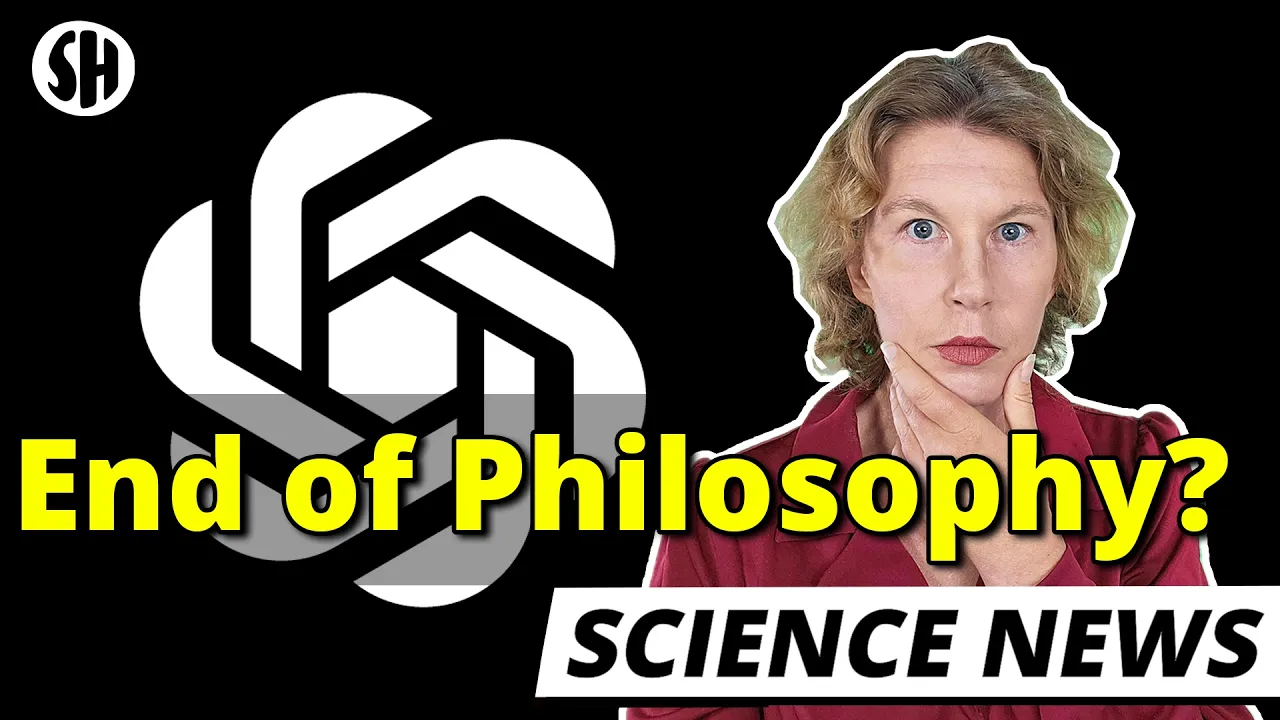
Sabine Hossenfelder
Artificial intelligence cannot render philosophy obsolete because determining what constitutes a valid explanation is itself an irreducible philosophical problem that empirical algorithms cannot resolve.
AI-assisted summary of AI Will End Philosophy, Physicist Claims — original source. Check the original for full context.
Source published:
Key ideas
- Physicist and philosopher Louis Vervoort argues in a new book that artificial intelligence will soon render much of philosophy obsolete by formalizing debates into empirical, theoretical-physics-style problem solving. (0:00)
- Vervoort proposes evaluating philosophical ideas through a 'maximally coherent theory' framework, scoring theories by counting answered questions and contradictions using AI tools like ChatGPT. (0:00)
- Sabine Hossenfelder rejects both Vervoort's approach and standard academic rebuttals, arguing that defining what constitutes a 'best' explanation is fundamentally a philosophical question that science cannot quantify. (2:39)
- Awarding Vervoort's book a 6/10 on her 'bullshit meter,' Hossenfelder predicts AI will mostly be used by academics to automate the writing of dense papers, potentially forcing the field to raise its standards. (4:57)
Detailed notes
## Background Published on YouTube by Sabine Hossenfelder on September 19, 2026, this video examines a recent debate triggered by a physicist who authored a book claiming artificial intelligence will soon render philosophy obsolete. As described in the video's notes, while a philosopher has pushed back against this premise, Hossenfelder argues that both participants in the controversy are missing the fundamental point.
## TL;DR Hossenfelder evaluates Louis Vervoort's book *Problem Solving in Philosophy*, which contends that philosophy should be treated like theoretical physics by using AI to objectively score candidate theories for maximal coherence. She critiques Vervoort's selective ChatGPT experiments and his dismissal of foundational issues like the problem of induction, while also faulting academic philosophy for responding with bloated, obvious counterarguments. Ultimately, she asserts that philosophy exists specifically to tackle unscientific or pre-empirical questions that AI scoring metrics cannot resolve, rating the claim that AI will end philosophy at a 6 out of 10 on her 'bullshit meter' while predicting AI will mostly just automate the writing of unread academic papers.
## Atmosphere & style The presentation is dry, deadpan, and unapologetically pragmatic, punctuated by Hossenfelder's trademark self-deprecating wit and sharp dismissals of academic pretension. It feels like an irreverent reality check from a working physicist who happily pokes fun at both long-winded philosophers and overconfident physicists trying to conquer outside disciplines. The narrative arc moves from humorous deconstructions of prompt-engineering 'experiments' to substantive, incisive epistemological distinctions, maintaining an engaging and skeptical vibe throughout.
## Bulletin - [00:00](https://www.youtube.com/watch?v=RmvQtxc9R3Q&t=0s) Physicist and philosopher Louis Vervoort argues in a new book that artificial intelligence will soon render much of philosophy obsolete by formalizing debates into empirical, theoretical-physics-style problem solving. - [00:00](https://www.youtube.com/watch?v=RmvQtxc9R3Q&t=0s) Vervoort proposes evaluating philosophical ideas through a 'maximally coherent theory' framework, scoring theories by counting answered questions and contradictions using AI tools like ChatGPT. - [02:39](https://www.youtube.com/watch?v=RmvQtxc9R3Q&t=159s) Sabine Hossenfelder rejects both Vervoort's approach and standard academic rebuttals, arguing that defining what constitutes a 'best' explanation is fundamentally a philosophical question that science cannot quantify. - [04:57](https://www.youtube.com/watch?v=RmvQtxc9R3Q&t=297s) Awarding Vervoort's book a 6/10 on her 'bullshit meter,' Hossenfelder predicts AI will mostly be used by academics to automate the writing of dense papers, potentially forcing the field to raise its standards.
## Key takeaways - [00:00](https://www.youtube.com/watch?v=RmvQtxc9R3Q&t=0s) Louis Vervoort, holder of PhDs in both physics and philosophy, authored 'Problem Solving in Philosophy: How to Do Philosophy in the Age of Ultra-Intelligent AI' claiming AI can settle core philosophical debates. - [00:00](https://www.youtube.com/watch?v=RmvQtxc9R3Q&t=0s) Vervoort asserts that philosophy should adopt the overarching methodology of natural science and theoretical physics rather than remain divided in perpetual debate. - [00:00](https://www.youtube.com/watch?v=RmvQtxc9R3Q&t=0s) Under Vervoort's framework, AI selects the 'maximally coherent theory' by tallying answered questions, accounted counterexamples, and avoided contradictions. - [00:00](https://www.youtube.com/watch?v=RmvQtxc9R3Q&t=0s) In an informal test, Vervoort prompted GPT-4 on the nature of causality and declared the model correct when it chose counterfactual causality, which happened to match his personal stance. - [00:00](https://www.youtube.com/watch?v=RmvQtxc9R3Q&t=0s) Vervoort anticipates AI resolving topics such as free will and the problem of induction, while excluding existential questions like the existence of God. - [02:39](https://www.youtube.com/watch?v=RmvQtxc9R3Q&t=159s) A philosopher's formal critique argued that AI can assemble arguments but cannot replace human subjective reflection, which Hossenfelder viewed as a 15-page statement of the obvious. - [02:39](https://www.youtube.com/watch?v=RmvQtxc9R3Q&t=159s) Attempting to turn philosophy into an empirical science misunderstands that philosophy exists specifically to investigate questions where empirical data cannot provide an answer. - [02:39](https://www.youtube.com/watch?v=RmvQtxc9R3Q&t=159s) Deciding which quantitative metrics define the 'best' explanation is an unsolved philosophical question that cannot be automated away by science. - [02:39](https://www.youtube.com/watch?v=RmvQtxc9R3Q&t=159s) Vervoort dismisses the problem of induction as an unprovable operative axiom, which avoids the core philosophical question of why empirical regularity holds in reality. - [04:57](https://www.youtube.com/watch?v=RmvQtxc9R3Q&t=297s) Hossenfelder predicts academic philosophers will inevitably use AI to automate the production of unread, verbose papers due to human laziness. - [04:57](https://www.youtube.com/watch?v=RmvQtxc9R3Q&t=297s) The widespread automation of paper drafting could paradoxically force human philosophers to improve the overall quality and substance of their ideas. - [04:57](https://www.youtube.com/watch?v=RmvQtxc9R3Q&t=297s) Hossenfelder rates Vervoort's book a 6 out of 10 on her 'bullshit meter,' recognizing value in formalizing explanatory metrics while rejecting the premise that AI ends philosophy.
## Detailed walkthrough ### [00:00](https://www.youtube.com/watch?v=RmvQtxc9R3Q&t=0s) Louis Vervoort's Proposal to Sciencify Philosophy
A physicist has written a book arguing that artificial intelligence will soon render much of philosophy obsolete, prompting a rebuttal from a philosopher. Sabine Hossenfelder assesses the dispute by noting: "And I think, well, they're both wrong." The book, titled *Problem Solving in Philosophy: How to Do Philosophy in the Age of Ultra-Intelligent AI*, is written by Louis Vervoort. Vervoort is not an uninitiated outsider; after earning a PhD in physics, he completed a second doctorate in philosophy—leading Sabine to joke that he is "not your stereotypical ignorant physicist with a YouTube channel, you have me for that."
Vervoort's core contention is that philosophy ought to be practiced like an empirical natural science in general, and theoretical physics in particular. He asserts that philosophy has matured sufficiently to reach reasonably definitive conclusions on core debates, claiming that natural science and theoretical physics share a single overarching method that philosophers should adopt. Under this view, philosophical theories should be evaluated by identifying the "maximally coherent theory"—the framework that yields the highest number of coherent answers to well-posed questions, accounts for the most counterexamples, and minimizes contradictions with accepted background knowledge. Because this process largely reduces to tallying answered questions and contradictions, Vervoort argues that AI is uniquely suited to perform it.
```mermaid flowchart TD accTitle: Maximally Coherent Theory Evaluation accDescr: Flowchart illustrating Louis Vervoort's proposed AI method for selecting the best philosophical theory. subgraph Input ["Philosophical Theories"] T["Candidate Hypotheses"] end subgraph Metrics ["AI Quantitative Scoring"] M1["Maximize Answers to Well-Posed Problems"] M2["Explain Counterexamples"] M3["Minimize Contradictions with Known Facts"] end subgraph Output ["Outcome"] MCT["Maximally Coherent Theory"] end T --> Metrics M1 --> MCT M2 --> MCT M3 --> MCT ```
To support his thesis, Vervoort conducted an informal "experiment" targeting the problem of defining causality. He prompted ChatGPT (GPT-4 at the time) to determine the superior notion of causality. When the model answered "counterfactual causality," Vervoort deemed the response correct—primarily because it matched his own favored definition. Sabine dryly observes, "Maybe doing philosophy like theoretical physics is not the flex he thinks it is." Beyond causality, Vervoort anticipates AI resolving issues such as free will (which he considers clearly nonexistent) and induction (which he labels a pseudoproblem). However, he stops short of claiming AI will settle all philosophical questions; broader existential inquiries like the meaning of life or the existence of God remain unsettled, at least "until ChatGPT 7.8 max pro ultra agrees with him."
- **Author**: Louis Vervoort (holds dual PhDs in Physics and Philosophy). - **Book Title**: *Problem Solving in Philosophy: How to Do Philosophy in the Age of Ultra-Intelligent AI*. - **Methodological Claim**: Quantifying explanatory power via the "maximally coherent theory" through algorithmic counting of answers, counterexamples, and contradictions. - **ChatGPT Experiment**: Prompted GPT-4 on causality; the AI selected counterfactual causality, aligning with the author's own preferred theory.
---
[02:39](https://www.youtube.com/watch?v=RmvQtxc9R3Q&t=159s) The Philosopher's Rebuttal and the Problem of Induction
Before the book's release, Vervoort published a paper presenting the same thesis, prompting a formal critique from a philosopher titled *"Can we automate philosophy through AI? And should we want to?"* The philosopher argues that if philosophy is defined as generating hypotheses and assessing arguments, an AI could theoretically execute it; however, if philosophy is understood as thinking through these conceptual puzzles oneself, machines cannot substitute for human reflection. Sabine expresses frustration with the response, remarking that stretching such a straightforward observation into a 15-page paper exemplifies her main grievance with academic philosophy: using "loads of words to say the pathetically obvious."
At the same time, Sabine finds Vervoort's physicist-centric approach equally unconvincing. Determining how to quantify what makes an explanation "best" is fundamentally a philosophical puzzle in its own right. Trying to "sciencify" philosophy fundamentally misunderstands its role: philosophy exists precisely to interrogate problems that science cannot—or cannot yet—answer. While certain topics eventually cross the boundary into empirical science (consciousness is undergoing this transition now, and free will is likely to follow), scientific methodologies cannot subsume foundational philosophical premises.
This shortcoming is particularly evident in Vervoort's treatment of the problem of induction—the classic question of why empirical regularity holds over time, why the laws of physics remain constant, why the sun rises daily, why atoms remain stable, and "why does Sabine keep making stupid jokes." Appealing to historical observation constitutes circular reasoning, as it attempts to validate induction by using induction. Vervoort circumvents this by dismissing the question as meaningless, arguing induction should be treated as an unprovable axiom that requires no justification. Sabine counters that while induction must be adopted as an axiom *within* science to enable scientific inquiry, asking *why* that axiom holds in reality is a philosophical question outside the scope of science. Simply declaring non-scientific questions to be invalid is a pseudo-argument that "even Claude could tell" fails scrutiny.
- **Philosophical Counter-argument**: Distinguishes between automated argument generation and subjective, deliberate contemplation. - **The Epistemic Boundary**: Philosophy addresses issues where empirical data and scientific testing are unavailable. - **The Problem of Induction**: Justifying inductive consistency cannot be achieved empirically without circular reasoning; labeling an operative axiom a non-question evades the foundational issue.
---
[04:57](https://www.youtube.com/watch?v=RmvQtxc9R3Q&t=297s) The Reality of Philosophical Discourse and Saily Sponsor
Reflecting on both arguments, Sabine concludes that both scholars miss a far more mundane reality: "humans are by default lazy." Given that a substantial volume of published academic philosophy consists of dense prose that few ever read, academics will inevitably offload paper writing to AI systems—a transition Sabine believes is already underway. Her hope is that widespread automation will ultimately pressure philosophers to elevate the substantive quality of their discourse.
Evaluating the book overall, Sabine awards it a 6 out of 10 on her "bullshit meter." Her rating remains relatively moderate because she believes Vervoort's attempt to formally quantify explanatory value has merit as an analytical tool; she simply rejects the premise that it will make philosophical thinking obsolete. She quips that even if artificial intelligence were to render the discipline completely redundant, "philosophers will spend the next fifty years debating whether that actually happened."
The video concludes with a sponsorship segment for Saily, an eSIM data provider designed for international travel. Sabine explains that an eSIM allows travelers to circumvent steep roaming charges by switching directly to local digital plans, while also offering practical use cases such as keeping SIM-free backup phones connected or configuring a virtual location. She highlights the user setup—installing the app, selecting an overseas data plan, entering the code SABINE for a 15% discount, and activating the eSIM profile—alongside customer protections including 24/7 support and a money-back guarantee if the profile fails on a given handset.
- **Bullshit Meter Rating**: 6/10 (acknowledges value in quantifying explanatory strength, despite overreaching claims). - **Future of Academic AI**: Anticipates widespread automated generation of papers due to human convenience, potentially raising standards for human contributions. - **Saily eSIM Features**: Travel roaming mitigation, secondary phone connectivity, virtual location settings, 24/7 customer service, and a money-back guarantee with promo code SABINE.
## Notable quotes > [00:00](https://www.youtube.com/watch?v=RmvQtxc9R3Q&t=0s) And I think, well, they're both wrong. — Sabine Hossenfelder
> [00:00](https://www.youtube.com/watch?v=RmvQtxc9R3Q&t=0s) not your stereotypical ignorant physicist with a YouTube channel, you have me for that. — Sabine Hossenfelder
> [00:00](https://www.youtube.com/watch?v=RmvQtxc9R3Q&t=0s) Maybe doing philosophy like theoretical physics is not the flex he thinks it is. — Sabine Hossenfelder
> [00:00](https://www.youtube.com/watch?v=RmvQtxc9R3Q&t=0s) until ChatGPT 7.8 max pro ultra agrees with him. — Sabine Hossenfelder
> [02:39](https://www.youtube.com/watch?v=RmvQtxc9R3Q&t=159s) Can we automate philosophy through AI? And should we want to? — Critique Paper Title
> [02:39](https://www.youtube.com/watch?v=RmvQtxc9R3Q&t=159s) loads of words to say the pathetically obvious. — Sabine Hossenfelder
> [02:39](https://www.youtube.com/watch?v=RmvQtxc9R3Q&t=159s) why does Sabine keep making stupid jokes. — Sabine Hossenfelder
> [02:39](https://www.youtube.com/watch?v=RmvQtxc9R3Q&t=159s) even Claude could tell — Sabine Hossenfelder
> [04:57](https://www.youtube.com/watch?v=RmvQtxc9R3Q&t=297s) humans are by default lazy. — Sabine Hossenfelder
> [04:57](https://www.youtube.com/watch?v=RmvQtxc9R3Q&t=297s) philosophers will spend the next fifty years debating whether that actually happened. — Sabine Hossenfelder
## Mentioned Louis Vervoort, Sabine Hossenfelder, ChatGPT, GPT-4, Claude, Problem Solving in Philosophy: How to Do Philosophy in the Age of Ultra-Intelligent AI, Saily
## Video description 🌎 Get an exclusive 15% discount on Saily data plans! Use the code SABINE at checkout. Download the Saily app or go to: https://saily.com/sabine ⛵
A physicist has written an entire book arguing that artificial intelligence will soon make philosophy obsolete. A philosopher disagrees. I think they're both missing the point. Let's take a look.
https://doi.org/10.1007/978-3-032-17756-8
#philosophy #ai #sciencenews #physics
👕T-shirts, mugs, posters and more: ➜ https://sabines-store.dashery.com/ 💌 Support me on Donorbox ➜ https://donorbox.org/swtg 👉 Transcript with links to references on Patreon ➜ https://www.patreon.com/Sabine 📝 Transcripts and written news on Substack ➜ https://sciencewtg.substack.com/ 📩 Free weekly science newsletter ➜ https://sabinehossenfelder.com/newsletter/ 👂 Audio only podcast ➜ https://open.spotify.com/show/0MkNfXlKnMPEUMEeKQYmYC 🔗 Join this channel to get access to perks ➜ https://www.youtube.com/channel/UC1yNl2E66ZzKApQdRuTQ4tw/join 📚 Buy my book ➜ https://amzn.to/3HSAWJW
[Source](https://www.youtube.com/watch?v=RmvQtxc9R3Q)