Economists Rebuke Stiglitz Over Degrowth Push Citing Poverty Risks
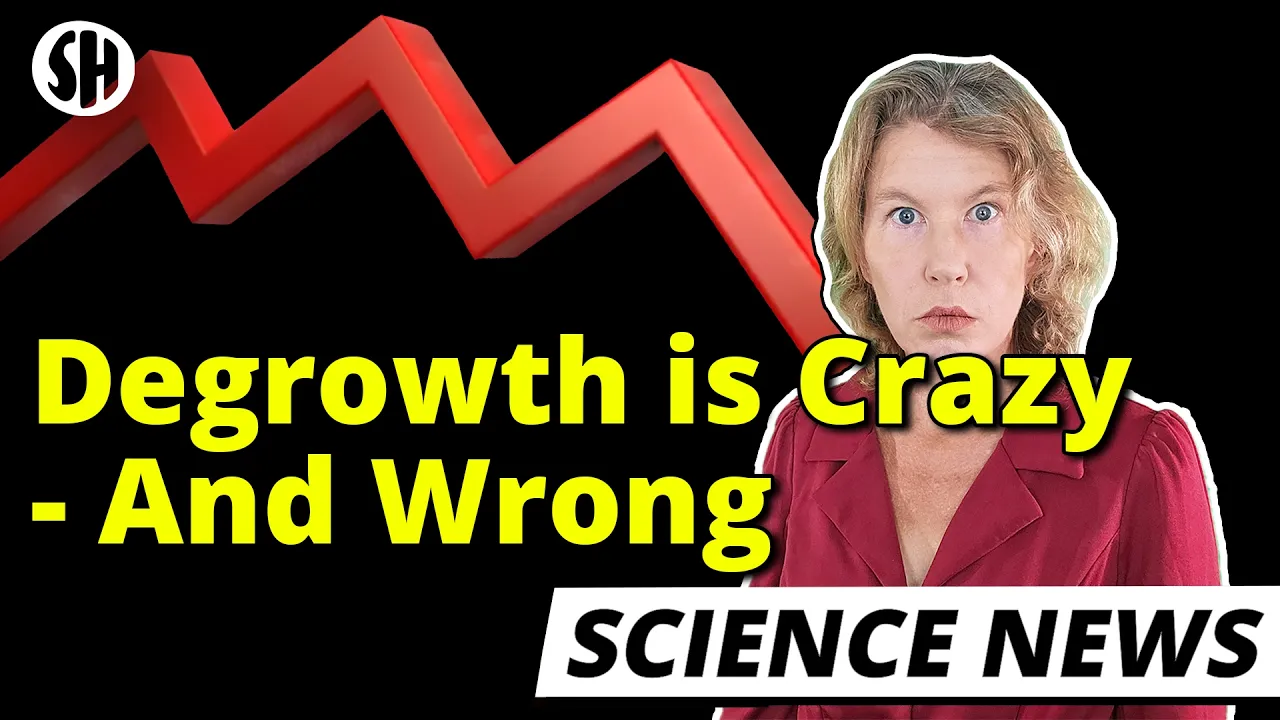
Sabine Hossenfelder
Degrowth theory relies on ideological opinion rather than empirical modeling, ignoring technological decoupling and threatening human welfare by attacking the primary driver of global poverty reduction.
AI-assisted summary of Degrowth Just Got a Brutal Reality Check — original source. Check the original for full context.
Source published:
Key ideas
- A Guardian op-ed co-authored by Nobel laureate Joseph Stiglitz argues that economic growth is a doomed strategy, reigniting debate over the degrowth movement. (0:00)
- A 2024 literature review revealed that approximately 90% of published academic papers on degrowth are opinion pieces rather than empirical economic research. (0:00)
- Mainstream economists strongly reject degrowth claims, noting that global poverty reduction over the past 50 years directly correlates with GDP expansion. (2:21)
- Environmental economics demonstrates that economic growth can be decoupled from emissions and material resource consumption through technological efficiency. (4:02)
Detailed notes
## Background Published on YouTube by Sabine Hossenfelder on September 21, 2026, this video examines the degrowth movement following a Guardian op-ed by prominent economists, including a Nobel laureate, claiming economic growth is a doomed strategy. The channel description notes that after falling into the rabbit hole of what the movement actually publishes, Sabine concluded that the ideology behind degrowth is misguided and dangerous.
## TL;DR Sabine scrutinizes the academic and philosophical foundations of the degrowth movement, highlighting that roughly 90% of its published literature consists of ideological opinion rather than empirical economic modeling. She refutes claims that growth has uncoupled from human well-being, pointing out that global poverty alleviation has historically depended on economic expansion and that growth reflects value creation rather than raw material depletion. Highlighting mainstream economists who push back against degrowth, she emphasizes that decoupling carbon emissions from GDP growth is achievable, warning that suppressing economic activity through degrowth threatens modern human prosperity.
## Atmosphere & style The video carries Sabine's trademark blend of dry wit, sharp skepticism, and pragmatic exasperation. Moving quickly from bemusement at intersectional academic jargon to incisive economic critique, her delivery feels like a brisk, reality-check lecture designed to puncture fashionable theoretical bubbles with empirical facts. The overall tone is urgent yet analytical, leaving viewers with a grounded appreciation for decentralized economic systems over top-down ideological experiments.
## Bulletin - [00:00](https://www.youtube.com/watch?v=8GYDQU5ftBs&t=0s) A Guardian op-ed co-authored by Nobel laureate Joseph Stiglitz argues that economic growth is a doomed strategy, reigniting debate over the degrowth movement. - [00:00](https://www.youtube.com/watch?v=8GYDQU5ftBs&t=0s) A 2024 literature review revealed that approximately 90% of published academic papers on degrowth are opinion pieces rather than empirical economic research. - [02:21](https://www.youtube.com/watch?v=8GYDQU5ftBs&t=141s) Mainstream economists strongly reject degrowth claims, noting that global poverty reduction over the past 50 years directly correlates with GDP expansion. - [04:02](https://www.youtube.com/watch?v=8GYDQU5ftBs&t=242s) Environmental economics demonstrates that economic growth can be decoupled from emissions and material resource consumption through technological efficiency.
## Key takeaways - [00:00](https://www.youtube.com/watch?v=8GYDQU5ftBs&t=0s) The degrowth movement argues that continuous economic growth is unsustainable on a finite planet, echoing the Club of Rome's 1970s report, 'The Limits to Growth'. - [00:00](https://www.youtube.com/watch?v=8GYDQU5ftBs&t=0s) Over the past decade, modern degrowth literature has merged heavily with intersectional academia, frequently framing capitalism alongside patriarchy, extractivism, and colonialism. - [00:00](https://www.youtube.com/watch?v=8GYDQU5ftBs&t=0s) Publications such as The Degrowth Journal require editorial candidates to align with explicit anti-capitalist ideology, compromising traditional standards of scientific objectivity. - [02:21](https://www.youtube.com/watch?v=8GYDQU5ftBs&t=141s) The assertion that growth has decoupled from shared prosperity is contradicted by global data showing steep declines in poverty where economies expand. - [02:21](https://www.youtube.com/watch?v=8GYDQU5ftBs&t=141s) Poverty persists primarily in regions suffering from stagnant economic growth rather than in those experiencing expansion. - [02:21](https://www.youtube.com/watch?v=8GYDQU5ftBs&t=141s) Degrowth conflates physical material consumption with economic value creation, which expands through technological innovation and resource efficiency. - [02:21](https://www.youtube.com/watch?v=8GYDQU5ftBs&t=141s) Attributing poverty solely to capitalism ignores contributing factors such as government policy, war, debt, natural disasters, and misguided economic ideologies. - [04:02](https://www.youtube.com/watch?v=8GYDQU5ftBs&t=242s) Legitimate environmental economics focuses on decoupling, with several developed nations having proven that GDP can grow while carbon dioxide emissions drop. - [04:02](https://www.youtube.com/watch?v=8GYDQU5ftBs&t=242s) Academic economists have pushed back strongly against the Guardian piece, labeling its underlying scholarship sloppy and noting that growth is the only historically proven anti-poverty program. - [04:02](https://www.youtube.com/watch?v=8GYDQU5ftBs&t=242s) Empirical studies confirm that virtually every cross-national metric of material well-being strongly correlates with GDP per capita. - [04:02](https://www.youtube.com/watch?v=8GYDQU5ftBs&t=242s) Capitalism serves as a vital self-organizing system for decentralized resource allocation, making deliberate degrowth a dangerous threat to human welfare.
## Detailed walkthrough ### [00:00](https://www.youtube.com/watch?v=8GYDQU5ftBs&t=0s) The Resurgence of Degrowth and Academic Ideology
The Guardian ran an article with the provocative headline: *"We economists have done the maths: growth is a doomed strategy."* Among the co-authors is Joseph Stiglitz, a Nobel laureate in economics. Sabine views this group of "degrowthers" as dangerous. At its core, degrowth is the premise that economic growth is inherently unsustainable and that humanity must halt its aspiration for expansion to preserve the environment and prevent self-destruction. The concept is not novel; it traces directly back to the early 1970s and the Club of Rome’s famous report, *The Limits to Growth*, which argued that because the Earth and its resources are finite, economies cannot expand indefinitely.
```mermaid flowchart TD accTitle: Evolution of the Degrowth Ideology accDescr: Diagram tracing degrowth from the Club of Rome to modern academic intersectionality.
subgraph Origins["1970s Foundation"] CR["Club of Rome: 'Limits to Growth'"] --> LF["Finite planet implies finite economic expansion"] end
subgraph ModernShift["Past Decade Evolution"] LF --> Merge["Merged with intersectional academia"] Merge --> DJ["Degrowth Journal & Degrowth.info"] DJ --> Beliefs["Frames capitalism as extractivism, colonialism, & patriarchy"] end
subgraph Criticism["Scientific Assessment"] Beliefs --> Lit["2024 review: ~90% of degrowth papers are pure opinion"] Lit --> Flaw["Lacks empirical economic modeling"] end ```
Over the past decade, however, the movement has drifted into what Sabine terms "ideological mush." Her first encounter occurred years ago after producing a video arguing that pricing carbon is essential to combat climate change, only to be told that capitalism is inseparable from the patriarchy. Platforms like *Degrowth.info* market the concept as an academic research field dedicated to exposing intersecting "systems of domination such as capitalism, extractivism, colonialism, and patriarchy." Academic titles in this space include papers like *"Towards a Feminist Decolonial Degrowth Approach"* and *"Why degrowth needs Black ecology."*
- *The Degrowth Journal* requires prospective editors to commit to anti-capitalist positions and intersectional theory, abandoning traditional standards of scientific objectivity. - A 2024 literature review reported that roughly 90% of published degrowth papers are opinion pieces rather than empirical studies.
---
[02:21](https://www.youtube.com/watch?v=8GYDQU5ftBs&t=141s) Deconstructing the Core Arguments Against Growth
While the Guardian editorial strikes a comparatively moderate tone, Sabine points out that its central claims crumble under economic scrutiny. The authors assert that *"Growth has become decoupled from shared prosperity,"* a claim refuted by global history. Over the past 50 years, global poverty has dropped precipitously as a direct consequence of economic expansion. The areas suffering from persistent high poverty rates are almost exclusively those where economic growth has stagnated. While capitalism has expanded access to nutrition, medicine, and education, localized issues—such as persistent wealth inequality in the United States—are driven by domestic policy rather than an inherent failure of growth itself.
```mermaid flowchart LR accTitle: Mechanics of Decoupling vs Degrowth Fallacy accDescr: Comparing the false assumptions of degrowth with the reality of economic growth via decoupling and efficiency.
subgraph DegrowthClaim["Degrowth Premise"] D1["Finite Physical Resources"] --> D2["Growth Requires Raw Consumption"] D2 --> D3["Inevitable Collapse"] end
subgraph EconomicReality["Economic Reality"] R1["Technology & Efficiency"] --> R2["Value Added Per Resource Unit"] R3["Decoupling Emissions"] --> R2 R2 --> R4["Sustained Growth Without Exploitation"] end ```
The piece also recycles the Club of Rome claim that physical limits prevent endless economic expansion. Sabine highlights two key flaws: first, human civilization has barely scratched the surface of planetary resources; second, economic output does not simply track physical material consumption. Economic growth measures value creation, which routinely increases through efficiency, smarter resource allocation, and technological innovation—or even expansion off-world. Addressing the authors' claim that *"Poverty is manufactured,"* Sabine agrees that while governmental policies shape poverty, it is absurd to place exclusive blame on capitalism while ignoring factors like war, national debt, natural disasters, and misguided ideological movements like degrowth.
---
[04:02](https://www.youtube.com/watch?v=8GYDQU5ftBs&t=242s) Economists Push Back and the Value of Capitalism
Examining the actual academic literature reveals almost no rigorous research evaluating real-world degrowth pathways. The sparse papers that do model degrowth scenarios rely on speculative assumptions, concluding they might work only *"if you try really hard and no one chops off your head while you try."* By contrast, legitimate environmental economics concentrates on "decoupling"—expanding economic output while reducing carbon emissions and material footprints. Several developed nations have demonstrated absolute decoupling by growing their GDP while steadily reducing annual carbon dioxide emissions.
Professional economists reacted harshly to the Guardian essay on X: - **Vincent Geloso** (Professor of Economics): Noted he has written papers debunking the work of several co-authors, criticizing their scholarship as "sloppy and/or outright incompetent." - **Pedro Santa Clara** (Professor of Finance): Stated plainly that *"Growth is the only anti-poverty program that has ever worked."* - **Andrew Jonelis** (Assistant Professor): Highlighted empirical studies proving that every cross-national measure of human material well-being maintains a direct statistical correlation with GDP per capita.
Sabine stresses that capitalism represents humanity's most vital emergent innovation after spoken language. As a decentralized, self-organizing mechanism for resource allocation, it functions successfully regardless of whether individual actors understand its mechanisms. Deliberately suppressing economic output through degrowth amounts to an *"unusually aggressive beta test"* that threatens human well-being.
---
[06:17](https://www.youtube.com/watch?v=8GYDQU5ftBs&t=377s) Sponsor Segment: Ground News
Navigating mainstream coverage of economic and regulatory policies is frequently complicated by repetitive headlines and hidden editorial slant. Sabine uses **Ground News**, an aggregation platform that consolidates reporting from worldwide outlets to provide concise summaries and media-bias breakdowns.
As an example, coverage of California's newly introduced artificial intelligence regulations reveals that while right-leaning and left-leaning outlets frame the debate with varying nuances, Ground News's cross-comparison shows broad consensus across the spectrum: voluntary safety pledges from tech firms are inadequate, making state-mandated standards necessary. The platform incorporates a factuality scoring system, ownership transparency for every news outlet, and a "Blindspot" feature that identifies stories covered exclusively by one end of the political spectrum. Viewers can secure a 40% discount on the comprehensive Vantage plan by visiting `ground.news/sabine`.
## Notable quotes > [00:00](https://www.youtube.com/watch?v=8GYDQU5ftBs&t=0s) We economists have done the maths: growth is a doomed strategy. — The Guardian / Economists
> [02:21](https://www.youtube.com/watch?v=8GYDQU5ftBs&t=141s) Growth has become decoupled from shared prosperity — The Guardian / Economists
> [02:21](https://www.youtube.com/watch?v=8GYDQU5ftBs&t=141s) Poverty is manufactured — The Guardian / Economists
> [04:02](https://www.youtube.com/watch?v=8GYDQU5ftBs&t=242s) if you try really hard and no one chops off your head while you try. — Sabine Hossenfelder
> [04:02](https://www.youtube.com/watch?v=8GYDQU5ftBs&t=242s) sloppy and/or outright incompetent. — Vincent Geloso
> [04:02](https://www.youtube.com/watch?v=8GYDQU5ftBs&t=242s) Growth is the only anti-poverty program that has ever worked. — Pedro Santa Clara
> [04:02](https://www.youtube.com/watch?v=8GYDQU5ftBs&t=242s) unusually aggressive beta test — Sabine Hossenfelder
> [00:00](https://www.youtube.com/watch?v=8GYDQU5ftBs&t=0s) Towards a Feminist Decolonial Degrowth Approach
> [00:00](https://www.youtube.com/watch?v=8GYDQU5ftBs&t=0s) Why degrowth needs Black ecology
## Mentioned Sabine Hossenfelder, The Guardian, Joseph Stiglitz, Club of Rome, The Limits to Growth, Degrowth.info, The Degrowth Journal, Vincent Geloso, Pedro Santa Clara, Andrew Jonelis, Ground News, X (Twitter)
## Video description Go to https://ground.news/sabine to get 40% off the Vantage plan and see through sensationalized reporting. Stay fully informed on events around the world with Ground News.
The Guardian recently ran a piece by a group of economists, one of them a Nobel laureate, arguing that economic growth is a doomed strategy. I went and looked at what this movement actually publishes, and I fell into a rabbit hole I did not expect. I think these people are dangerous. Let's take a look.
#degrowth #economics #climatechange #sciencenews
👕T-shirts, mugs, posters and more: ➜ https://sabines-store.dashery.com/ 💌 Support me on Donorbox ➜ https://donorbox.org/swtg 👉 Transcript with links to references on Patreon ➜ https://www.patreon.com/Sabine 📝 Transcripts and written news on Substack ➜ https://sciencewtg.substack.com/ 📩 Free weekly science newsletter ➜ https://sabinehossenfelder.com/newsletter/ 👂 Audio only podcast ➜ https://open.spotify.com/show/0MkNfXlKnMPEUMEeKQYmYC 🔗 Join this channel to get access to perks ➜ https://www.youtube.com/channel/UC1yNl2E66ZzKApQdRuTQ4tw/join 📚 Buy my book ➜ https://amzn.to/3HSAWJW
[Source](https://www.youtube.com/watch?v=8GYDQU5ftBs)