Chinese Quantum Test Confirms Feynman Math, Not Physical Reality
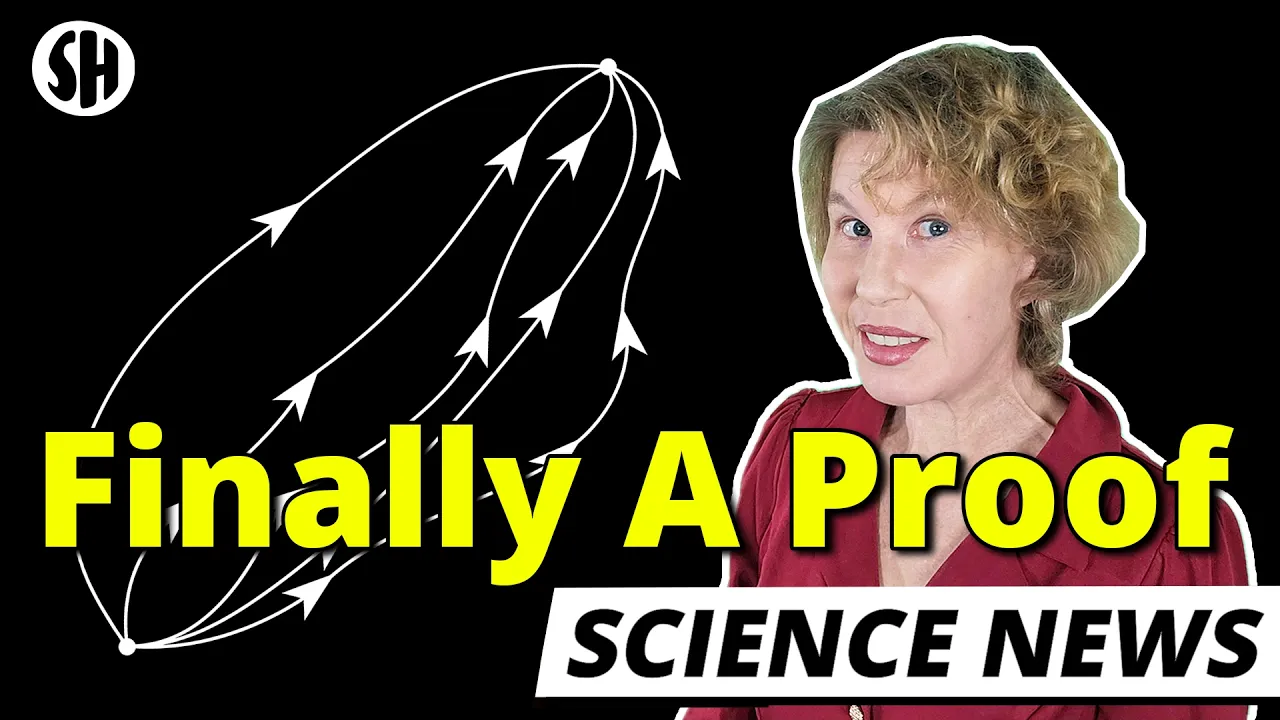
Sabine Hossenfelder
Tracking photons across intermediate measurement points verifies standard quantum probability calculations but cannot prove that unobserved particles physically travel every path simultaneously.
AI-assisted summary of FINALLY: A Proof that Particles Take All Paths At Once? — original source. Check the original for full context.
Source published:
Key ideas
- Physicists in China published experimental results claiming to prove that Richard Feynman's path integral represents physical reality rather than a mere mathematical tool. (0:00)
- The experimental design sent single photons through a spatial grid of 17 longitudinal by 5 transverse points to track amplitude evolution between intermediate locations. (3:15)
- Sabine Hossenfelder disputes the authors' interpretations, rating the claim 9 out of 10 on the 'bullshit meter' because measuring intermediate points cannot reveal what particles do unobserved. (3:15)
- The experiment fails to bypass foundational quantum limitations formulated by Einstein and Bell, leaving quantum interpretation questions unresolved. (4:33)
Detailed notes
## Background Published on YouTube by Sabine Hossenfelder on September 24, 2026, this video examines sensational claims in quantum physics. According to the description, Sabine evaluates a study by a Chinese research team asserting they experimentally proved Richard Feynman's eighty-year-old postulate that particles physically take all paths simultaneously.
## TL;DR Sabine analyzes an experiment claiming to prove that quantum particles physically travel every possible path at once, rather than treating Feynman's path integral merely as a mathematical calculation tool. She explains that Feynman's framework sums amplitudes over unobserved trajectories, but the Chinese researchers introduced a physical grid of intermediate measurement points. By measuring the photons along these points, the team simply confirmed Feynman's uncontested mathematical formulas rather than discovering what particles do when unobserved. Consequently, Sabine awards the paper a nine out of ten on her 'bullshit meter' and notes that unresolved foundational questions raised by Albert Einstein and John Bell remain entirely untouched.
## Atmosphere & style The video has a sharp, wry, and no-nonsense tone, driven by Sabine's signature deadpan delivery and impatience with scientific sensationalism. She blends dry, self-deprecating humor with rigorous analytical precision, taking evident pleasure in dismantling overhyped press headlines. Watching it feels like a grounding, clarifying masterclass in separating legitimate optical experimental results from unwarranted philosophical hype.
## Bulletin - [00:00](https://www.youtube.com/watch?v=A2ImadKWaHA&t=0s) Physicists in China published experimental results claiming to prove that Richard Feynman's path integral represents physical reality rather than a mere mathematical tool. - [03:15](https://www.youtube.com/watch?v=A2ImadKWaHA&t=195s) The experimental design sent single photons through a spatial grid of 17 longitudinal by 5 transverse points to track amplitude evolution between intermediate locations. - [03:15](https://www.youtube.com/watch?v=A2ImadKWaHA&t=195s) Sabine Hossenfelder disputes the authors' interpretations, rating the claim 9 out of 10 on the 'bullshit meter' because measuring intermediate points cannot reveal what particles do unobserved. - [04:33](https://www.youtube.com/watch?v=A2ImadKWaHA&t=273s) The experiment fails to bypass foundational quantum limitations formulated by Einstein and Bell, leaving quantum interpretation questions unresolved.
## Key takeaways - [00:00](https://www.youtube.com/watch?v=A2ImadKWaHA&t=0s) Classical mechanics predicts single deterministic trajectories, whereas quantum mechanics calculates probabilities across all conceivable paths. - [00:00](https://www.youtube.com/watch?v=A2ImadKWaHA&t=0s) Richard Feynman introduced the path integral formulation 80 years ago, summing amplitudes over all possible paths to yield probabilities matching Schrödinger's wave equation. - [00:00](https://www.youtube.com/watch?v=A2ImadKWaHA&t=0s) Feynman's formulation produces a vivid mental picture of particles taking all paths simultaneously, often used to justify parallel universe interpretations. - [00:00](https://www.youtube.com/watch?v=A2ImadKWaHA&t=0s) Google Quantum AI previously cited path-like quantum behaviors to suggest quantum computers operate across parallel multiverses. - [00:00](https://www.youtube.com/watch?v=A2ImadKWaHA&t=0s) Path integrals inherently compute paths that are never directly observed, because placing intermediate detectors collapses the system to a single observed path. - [03:15](https://www.youtube.com/watch?v=A2ImadKWaHA&t=195s) The Chinese research team sent single photons through a spatial grid of 17 longitudinal points and 5 transverse points. - [03:15](https://www.youtube.com/watch?v=A2ImadKWaHA&t=195s) The experiment verified that Feynman's mathematical formulas correctly calculate amplitude evolution between specific measurement points. - [03:15](https://www.youtube.com/watch?v=A2ImadKWaHA&t=195s) The experimental setup did not demonstrate unobserved behavior, but instead simply detected photons traversing observed points. - [03:15](https://www.youtube.com/watch?v=A2ImadKWaHA&t=195s) Hossenfelder rates the paper's interpretive claim a 9 out of 10 on the bullshit meter despite the quality of the optical execution. - [04:33](https://www.youtube.com/watch?v=A2ImadKWaHA&t=273s) The debate reflects the long-standing question explored by Einstein and Bell regarding whether unobserved systems have definite hidden states. - [04:33](https://www.youtube.com/watch?v=A2ImadKWaHA&t=273s) Bell's theorem rules out local realism only if superdeterminism is assumed to be false, an assumption that remains untested. - [04:33](https://www.youtube.com/watch?v=A2ImadKWaHA&t=273s) Intermediate path measurements cannot resolve fundamental quantum interpretation problems, leaving the foundational interpretation of quantum physics an open question.
## Detailed walkthrough ### [00:00](https://www.youtube.com/watch?v=A2ImadKWaHA&t=0s) Feynman's Path Integral and the Multiverse Debate
In classical mechanics, macroscopic objects follow deterministic, predictable trajectories. If you throw a ball, its trajectory is dictated entirely by its initial position and velocity—or as Sabine jokes, if she throws it, she will likely tear an unfamiliar body part while watching the ball vanish into the bushes. In quantum mechanics, however, this deterministic pathing vanishes. Eighty years ago, Richard Feynman proposed the path integral formulation: rather than calculating a single trajectory connecting a starting point to an endpoint, one considers every conceivable path connecting the two points. An amplitude is computed for every possible path, and these amplitudes are summed together to determine the overall probability of finding the particle at a specific destination.
```mermaid flowchart TD accTitle: Comparison of Classical Path versus Feynman Path Integral accDescr: Classical mechanics follows a single deterministic trajectory while quantum mechanics sums amplitudes across all paths. subgraph Classical["Classical Physics"] C1["Initial State"] -->|"Single deterministic path"| C2["Final State"] end subgraph Quantum["Feynman Path Integral"] Q1["Source"] -->|"Path A amplitude"| SUM{"Sum Amplitudes"} Q1 -->|"Path B amplitude"| SUM Q1 -->|"Path C amplitude"| SUM SUM -->|"Calculate probability"| Q2["Detector"] end ```
Feynman proved that this path integral formulation yields the exact same mathematical predictions as the Schrödinger equation using the wave function. The conceptual appeal of the method is that it offers a vivid mental picture of quantum weirdness: particles seemingly taking all possible paths at the same time. This conceptual model has spurred decades of foundational debate. Many physicists treat this description as literal reality, sometimes citing it as evidence for parallel universes. Sabine points to a Google quantum computing press release claiming their experiments gave "credence to the notion that quantum computation occurs in many parallel universes, in line with the idea that we live in a multiverse, a prediction first made by David Deutsch."
- The fundamental measurement catch: by construction, path integrals sum over unobserved paths. An observer only detects the particle at its destination; placing an intermediate detector collapses the system into observing only a single path. - A research team in China recently published a paper asserting that these paths are "more than mere mathematical artifacts" and actually "reflect a physical aspect of quantum reality."
---
[03:15](https://www.youtube.com/watch?v=A2ImadKWaHA&t=195s) What the Chinese Experiment Actually Measured
The validity of Feynman’s mathematical framework is not under dispute—it has been verified by thousands of experiments over several decades. Rather, the crux of the issue is whether the Chinese team's experiment demonstrated what particles do when they are *not* being watched. In their setup, the researchers sent individual photons, one at a time, through a spatial grid of measurement locations consisting of 17 points along the propagation axis and 5 points transverse to it. By picking pairs of grid points, they tracked the amplitude evolution between them and confirmed that the mathematical behavior matches Feynman’s path integral predictions.
Headlines quickly followed, with *New Scientist* declaring: "Richard Feynman’s 80-year-old quantum postulate has now been validated." While Sabine notes that the *New Scientist* headline is actually more measured than the authors' own conclusions, the claim of proving physical reality falls flat:
- The experiment validated that Feynman's mathematical formulas add up correctly between points of interaction, a result no physicist doubted. - It did not determine what photons do in the absence of observation. Instead, by inserting intermediate grid measurements, the experiment simply detected photons traversing specific measured paths. - Sabine awards the paper a "9 out of 10 on the bullshit meter," characterizing it as a well-executed optical experiment hitched to a deeply flawed physical interpretation.
---
[04:33](https://www.youtube.com/watch?v=A2ImadKWaHA&t=273s) Foundations of Physics, Bell's Inequality, and Upgrading Coding Skills
This conflation highlights why progress in the foundations of physics frequently stalls. The team attempted to resolve the identical dilemma that Albert Einstein and John Bell grappled with: does a quantum system truly occupy all potential configurations when unobserved, or does it hold a definite state that remains concealed? Bell's inequality was designed to interrogate precisely this question. Bell's theorem only forces a non-local or non-realist interpretation if one assumes superdeterminism is impossible—an assumption that has never been definitively ruled out. Setting up another path measurement cannot bypass this fundamental limitation. As Sabine concludes: "Feynman is still right, we still don’t know how to interpret quantum physics, and John Bell is still dead."
Shifting gears to personal projects, Sabine mentions that the last time she wrote software it was in Fortran, prompting her to modernize her backend skills using the video's sponsor, Boot.dev.
- Boot.dev focuses on backend languages that power real-world infrastructure, such as Python, SQL, and Go. - Rather than passive video consumption, the platform uses an interactive, browser-based coding setup that mimics an RPG progression system alongside an endless practice area called the "training grounds." - Sabine highlights using it to better understand web security vulnerabilities and data handling while developing a personal platform for her content, offering viewers 25% off their first year using the code `SABINE`.
## Notable quotes > [00:00](https://www.youtube.com/watch?v=A2ImadKWaHA&t=0s) credence to the notion that quantum computation occurs in many parallel universes, in line with the idea that we live in a multiverse, a prediction first made by David Deutsch. — Sabine Hossenfelder
> [00:00](https://www.youtube.com/watch?v=A2ImadKWaHA&t=0s) more than mere mathematical artifacts — Sabine Hossenfelder
> [00:00](https://www.youtube.com/watch?v=A2ImadKWaHA&t=0s) reflect a physical aspect of quantum reality. — Sabine Hossenfelder
> [03:15](https://www.youtube.com/watch?v=A2ImadKWaHA&t=195s) Richard Feynman’s 80-year-old quantum postulate has now been validated. — New Scientist
> [03:15](https://www.youtube.com/watch?v=A2ImadKWaHA&t=195s) 9 out of 10 on the bullshit meter — Sabine Hossenfelder
> [04:33](https://www.youtube.com/watch?v=A2ImadKWaHA&t=273s) Feynman is still right, we still don’t know how to interpret quantum physics, and John Bell is still dead. — Sabine Hossenfelder
## Mentioned Richard Feynman, Erwin Schrödinger, Albert Einstein, John Bell, David Deutsch, Google, New Scientist, Boot.dev, Python, SQL, Go, Fortran
## Video description Click this link https://boot.dev/?promo=SABINE and use my code SABINE to get 25% off your first payment for boot.dev."
Eighty years ago Richard Feynman said that a quantum particle takes every possible path at the same time. A team of physicists in China now says they have experimentally shown this is not just an interpretation but physical reality, and the headlines duly followed. I had a look at what they actually measured.
Paper: DOI: 10.1126/sciadv.aeh1011
#science #sciencenews #physics #quantumphysics
👕T-shirts, mugs, posters and more: ➜ https://sabines-store.dashery.com/ 💌 Support me on Donorbox ➜ https://donorbox.org/swtg 👉 Transcript with links to references on Patreon ➜ https://www.patreon.com/Sabine 📝 Transcripts and written news on Substack ➜ https://sciencewtg.substack.com/ 📩 Free weekly science newsletter ➜ https://sabinehossenfelder.com/newsletter/ 👂 Audio only podcast ➜ https://open.spotify.com/show/0MkNfXlKnMPEUMEeKQYmYC 🔗 Join this channel to get access to perks ➜ https://www.youtube.com/channel/UC1yNl2E66ZzKApQdRuTQ4tw/join 📚 Buy my book ➜ https://amzn.to/3HSAWJW
[Source](https://www.youtube.com/watch?v=A2ImadKWaHA)