Zuckerberg Targets Apple Architecture to Secure Meta Independence
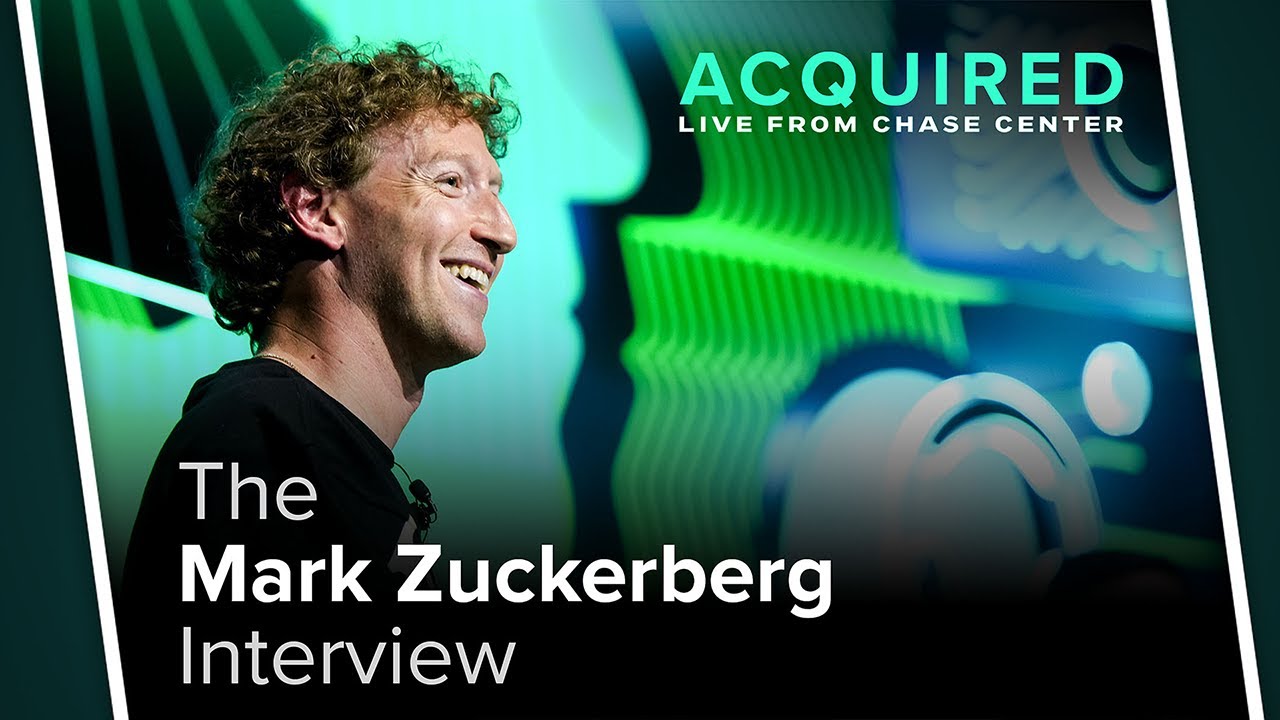
Acquired
Meta is structurally engineered to amplify Mark Zuckerberg's long-horizon strategic bets, positioning the company for a fifteen-year ideological battle against Apple's closed computing model.
AI-assisted summary of The Mark Zuckerberg Interview — original source. Check the original for full context.
Source published:
Detailed notes
## Background Published on YouTube by the channel Acquired on September 18, 2024, this page features a live interview with Meta founder and CEO Mark Zuckerberg. The video description highlights that the event took place in front of a live crowd of 6,000 people at the Chase Center, offering a remarkably candid look into Meta's company strategy, early Facebook history, and Zuckerberg's real, intense daily demeanor leading the company.
## TL;DR In this extensive live interview, Mark Zuckerberg discusses his evolving leadership philosophy, emphasizing a shift toward high-conviction open-source initiatives and products that are "awesome" rather than just "good," such as Reality Labs and Meta AI. He reflects on massive historical challenges, including the painful 2012 HTML5 mobile rewrite and a profound "20-year mistake" regarding political miscalculations post-2016. Zuckerberg explains how Meta's corporate structure and rapid-iteration strategy allow the company to survive competitive waves, positioning Apple as their primary ideological rival in a long-term battle over the fundamental architecture of computing platforms.
## Atmosphere & style The interview carries an intense, high-energy arena vibe, blending the polished professionalism of a major tech event with the raw, unpredictable edge of a live performance without retakes. Zuckerberg exhibits a newly confident, unapologetic demeanor, showing sharp competitive drive alongside self-critical reflection when discussing past corporate traumas. The dynamic between the hosts and Zuckerberg is intellectually heavy-hitting yet peppered with casual humor, moving from deep analytical breakdowns of tech strategy to lighthearted personal anecdotes about custom shirts, family concerts, and Hawaiian cattle farming.
## Key takeaways - [18:37](https://www.youtube.com/watch?v=QciJ9ubeLQk&t=1117s) Mark Zuckerberg views Meta not as a social media app company, but as a technology company focused fundamentally on human connection. - [10:22](https://www.youtube.com/watch?v=QciJ9ubeLQk&t=622s) Meta's ultimate strategic goal for its smart glasses initiative is to create high-fidelity holograms that blend into the physical environment to serve as the ultimate digital social and AI experience. - [21:15](https://www.youtube.com/watch?v=QciJ9ubeLQk&t=1275s) Zuckerberg defines a true technology company by having deep technical competence embedded within its leadership, contrasting it with companies that have non-technical CEOs and boards. - [22:59](https://www.youtube.com/watch?v=QciJ9ubeLQk&t=1379s) Meta's core operational strategy relies on continuous, rapid iteration and shipping products early to establish tight feedback loops, presenting a philosophical opposite to Apple's highly polished, secretive approach. - [33:50](https://www.youtube.com/watch?v=QciJ9ubeLQk&t=2030s) Open-sourcing key technologies like the Open Compute project and Llama is a pragmatic, strategic move designed to standardize industry supply chains, cut costs, and ensure Meta's autonomy from competitor platforms. - [35:55](https://www.youtube.com/watch?v=QciJ9ubeLQk&t=2155s) The company's early HTML5 mobile strategy was a massive miscalculation that forced Zuckerberg to freeze all new feature development for 18 months to execute a total native rewrite of their mobile apps. - [42:08](https://www.youtube.com/watch?v=QciJ9ubeLQk&t=2528s) Zuckerberg reflects on his response to the post-2016 political onslaught as a '20-year mistake' because he misdiagnosed a political blame-seeking crisis as a good-faith corporate issue, over-accepting responsibility. - [47:10](https://www.youtube.com/watch?v=QciJ9ubeLQk&t=2830s) Meta's super-voting corporate structure and early cash-generative nature have uniquely insulated Zuckerberg, allowing him to maintain a long-horizon strategy through intense reputational and economic cycles. - [51:53](https://www.youtube.com/watch?v=QciJ9ubeLQk&t=3113s) Zuckerberg advises founders to maintain maximum flexibility to pivot early on, noting that over-staffing projects too early dilutes individual agency and entrenches employee ego against necessary corporate shifts. - [53:57](https://www.youtube.com/watch?v=QciJ9ubeLQk&t=3237s) The massive investment in Reality Labs is a calculated long-term move to secure platform autonomy, eliminate third-party platform taxes, and transition the company into building 'awesome' and inspiring products. - [01:07:26](https://www.youtube.com/watch?v=QciJ9ubeLQk&t=4046s) Zuckerberg predicts a 10-to-15-year ideological battle with Apple over the fundamental architecture of the next generation of computing, with Meta championing an open ecosystem against Apple's integrated closed model. - [01:18:25](https://www.youtube.com/watch?v=QciJ9ubeLQk&t=4705s) Unlike other legendary tech founders who eventually step back, Zuckerberg at age 40 remains more deeply embedded in Meta than ever, viewing the company as his lifelong vehicle for product execution. - [01:23:48](https://www.youtube.com/watch?v=QciJ9ubeLQk&t=5028s) Meta is legally, financially, organizationally, and culturally engineered from top to bottom to operate as an ultimate amplifier for Mark Zuckerberg's personal strengths and vision.
## Detailed walkthrough ### [00:00](https://www.youtube.com/watch?v=QciJ9ubeLQk&t=0s) The New Era of Mark Zuckerberg
Ben Gilbert and David Rosenthal open the show by discussing how many interviews with Mark Zuckerberg they watched to prepare for this live event—estimating around 30 to 40. David observes that Zuckerberg’s interviews follow distinct three-to-four-year eras, with the "04 to 06 vintage" standing out as a favorite. Both hosts agree that they might have just witnessed the beginning of a brand-new era right on stage.
The iconic *Acquired* theme song "Who Got the Truth" by Mike Taylor transitions the episode into the formal kickoff of the fall 2024 season. Ben and David welcome listeners to this highly anticipated episode: a fast-tracked audio release of their interview with Mark Zuckerberg, recorded live in front of a massive crowd at the Chase Center.
- The live show featured surprise appearances from tech and media heavyweights Jensen Huang, Daniel Ek, and Emily Chang. - Musician Mike Taylor performed the podcast's theme song live on stage. - A full film production team is working behind the scenes to edit the remaining 90 minutes of content from the live show, slated for release in the following weeks.
---
[01:48](https://www.youtube.com/watch?v=QciJ9ubeLQk&t=108s) Gratitude and Big Numbers with JP Morgan Payments
The hosts take time to thank their season sponsors, highlighting StatSig—a product acceleration platform utilized by companies ranging from OpenAI to series A startups—and Crusoe, a climate-aligned AI cloud and data center operator. They reserve an immense expression of gratitude for their presenting partner, JP Morgan Payments, for securing the Chase Center and orchestrating the entire evening. David shares that the partnership has gone far beyond what either side originally imagined.
Ben explains that the payments division of JP Morgan is the largest and most trusted provider in the world. The sheer scale of their operation is staggering, moving vast sums of money globally every single day. For the first time, the hosts felt what it was like to operate as a large, world-class organization rather than a small, independent podcast team. They give a special shout-out to Dustin Sedwick, the CMO of JP Morgan Payments and a long-time listener of the show, who acted as the primary driving force behind the event.
- JP Morgan Payments moves $1 trillion a day, representing almost 25% of all US dollar payment flows in the global economy. - Pretty much every major company covered on *Acquired* works with JP Morgan Payments. - The hosts got to experience new payment technology live at the venue, including "pay by face" biometric payments.
---
[04:52](https://www.youtube.com/watch?v=QciJ9ubeLQk&t=292s) Jamie Dimon Passes the Mic
To officially introduce the interview, the hosts share a recorded message from Jamie Dimon, the Chairman and CEO of JP Morgan Chase. Dimon welcomes the audience to the Chase Center, calling it one of his favorite arenas, and expresses his enthusiasm for the year-long partnership between JP Morgan Payments and *Acquired*. Though he notes, "sorry I couldn't be there in person tonight," he wishes everyone an enjoyable show before handing the floor back over to Ben and David.
---
[05:30](https://www.youtube.com/watch?v=QciJ9ubeLQk&t=330s) Regrets, Startups, and Learning Through Suffering
Mark Zuckerberg joins the hosts on stage, immediately joking about a video he watched of Jensen Huang "correcting the record." Zuckerberg laughs that he might need to book a follow-up episode just to apologize in advance for everything he might say tonight, before quickly adding, "Naw, just kidding... I don't apologize anymore." David jumps in with a heavy-hitting opening question, asking if Zuckerberg would still have started Facebook if he knew then what he knows today.
Zuckerberg admits that Jensen Huang’s famous sentiment about the agonizing nature of starting a company is highly accurate. He recalls the early days of running a startup as full of extreme volatility, where it constantly felt like the company "could just die at any moment." While he has fond memories, he notes that it was not the most fun part of his life that he wishes to relive. He reflects that it is a positive trait of human nature that people naturally underestimate how painful an endeavor will be, because that blindness is exactly what allows them to go out and do good things.
The conversation shifts to Zuckerberg's current attire. He explains that he has started collaborating with fashion designer Mike Amir to design his own clothes, noting that if Meta is going to design eyewear, they need to get good at clothing design too. His shirt features the classical Greek saying *Pathei Mathos*, which translates to "learning through suffering." Zuckerberg explains that values aren't what a company writes down on a wall; they are lived behaviors that are only truly discovered when hitting your head against challenges and making hard tradeoffs.
- *Pathei Mathos* ("learning through suffering") is described by Zuckerberg as a small family saying, originally introduced to him by his sister. - Zuckerberg references an old Michael Jordan Nike commercial about failing over and over again as a mindset that deeply resonates with his own journey. - The hosts point out that by their count, Meta has faced more existential challenges in its first 20 years than almost any other meaningful company in history.
---
[10:22](https://www.youtube.com/watch?v=QciJ9ubeLQk&t=622s) The Decade-Long Quest for Smart Glasses
Holding up a pair of Meta's smart glasses, David asks for the origin story of the product. Zuckerberg explains that while Meta has built social experiences for 20 years, he has never viewed Meta as a social media or social app company. Instead, he defines it as a "social connection company" focused on building the future of human connection. Because the early team consisted of just a handful of college kids, they lacked the resources to define the smartphone platform when it emerged, forcing them to build within constraints set by others.
For Meta's next chapter, Zuckerberg wants to build ideal social experiences from first principles, shifting away from small screens that pull attention away from the real world. He envisions a future where smart glasses serve as the perfect AI assistant because they can see and hear what the user experiences. Furthermore, the ultimate state of these glasses will involve projecting high-fidelity holograms into the real world, providing a realistic physical sense of human presence. He notes that while people love to "intellectualize everything," humans are deeply physical beings, and blending holograms into the physical environment will represent both the ultimate digital social experience and the ultimate incarnation of AI.
- Meta has been working on this massive smart glasses initiative for 10 years. - The project requires building a completely novel holographic display stack, entirely independent of traditional TV or phone screen lineages. - Packing chips, microphones, speakers, cameras, eye-tracking sensors, batteries, and new RF protocols into a fashionable form factor remains an immense engineering challenge.
---
[15:19](https://www.youtube.com/watch?v=QciJ9ubeLQk&t=919s) From "Practice Projects" to Massive Companies
Zuckerberg pulls back the curtain on Meta's product strategy, explaining that they decided to partner with EssilorLuxottica (the makers of Ray-Ban) to see what technology they could fit into a standard form factor today. He candidly admits that when they started the Ray-Ban collaboration, he viewed it largely as a "practice project" meant to pave the way for their ultimate holographic glasses.
This admission prompts a humorous tangent about how Zuckerberg views early projects. He recalls arriving in Silicon Valley from Harvard with Dustin Moskovitz and a small crew, driving down Highway 101, and marveling at giant corporate headquarters like eBay and Yahoo. At the time, Facebook already had significant scale, yet Zuckerberg remembers thinking, "surely the project that we're working on now is not a company." He acknowledges he simply lacked the ambition to turn it into a massive corporation at the very beginning—it just happened naturally through hard work.
Bringing it back to the smart glasses, Ben points out a striking detail for the audience: Meta manufactured and shipped the initial version of these smart glasses before large language models (LLMs) or the ChatGPT moment entered public consciousness, meaning they were not originally built with the current wave of conversational AI in mind.
[17:22](https://www.youtube.com/watch?v=QciJ9ubeLQk&t=1042s) The AI Pivot and the High-Stakes Phone Call
A few years ago, Mark Zuckerberg would have predicted that AR holograms would hit the market before full-scale AI. However, the technological wave shifted, reversing that order. This change turned Meta's smart glasses into an ideal product because they already possessed the necessary physical hardware: cameras to see what the user sees, microphones, and speakers. Zuckerberg recalls calling Alex Himel, the head of the product group, to propose a major pivot: making Meta AI the primary feature of the glasses.
The transition happened with astonishing speed. Zuckerberg remembers coming in the next week and finding that the team had built a working prototype by Tuesday, confirming his belief that it would be a highly successful product. The host shares a "much more high-stakes version" of that same story told by Himel himself. Himel recalled driving on the highway with his kids on a Saturday when he received a sudden call from Zuckerberg asking: "Those glasses, could we put Meta AI in them running on device and like ship that soon so we can see if that's a good idea or not?" Zuckerberg laughs and concedes that the story tracks with his memory.
---
[18:37](https://www.youtube.com/watch?v=QciJ9ubeLQk&t=1117s) Surviving Nine Waves of Imminent Doom
The discussion shifts to a core question: why has Meta worked so spectacularly well and remained one of the most valuable companies in the world through multiple technology waves? The host lists the nine specific eras where the public narrative insisted that Facebook and Meta were "screwed" and doomed to obsolescence: Friendster, Myspace, Twitter Gen 1, Instagram, Snapchat, WhatsApp, TikTok, Apple's App Tracking Transparency (ATT), and now ChatGPT. Every time a competitor like Snapchat discovered a new feature like Stories, the public assumed Meta was obsolete.
Zuckerberg attributes their resilience to a fundamental identity definition: "we're a technology company that is focused on human connection, not a specific type of app." Because they never viewed themselves strictly as a website or a social network, building hardware like smart glasses is simply a natural continuation of their mission to help people feel present with one another. Zuckerberg emphasizes that many companies define themselves too narrowly. Surviving these waves requires a deep technology foundation, noting that he was a systems engineering student in college before starting the company.
---
[21:15](https://www.youtube.com/watch?v=QciJ9ubeLQk&t=1275s) What Makes a Real Technology Company
The conversation jumps back to the early days of social networking. While Friendster and Myspace seem quaint today, calculating social graphs and managing the scaling challenges of determining who knows whom and what to show them is an incredibly difficult computing problem. Zuckerberg explains that a product definition can easily be framed so broadly that the underlying technology becomes impossible to solve. The key is to have a smart product definition combined with superior technical competence.
When Zuckerberg first arrived in Silicon Valley, he noticed a striking contradiction: many businesses calling themselves "technology companies" were not actually set up that way. He observed companies where the CEO was non-technical, the board had no technical members, and only a single person on the management team—the head of engineering—possessed a technical background. Zuckerberg warns, "if that's your team, then you're not a technology company." At Meta, he intentionally balances the leadership team to ensure a large portion of product group managers climbed through technical pathways, embedding that competence into the company's decision-making and culture.
---
[22:59](https://www.youtube.com/watch?v=QciJ9ubeLQk&t=1379s) The Turn-Based Strategy Game of Rapid Iteration
Meta's core strategy relies on continuous platform migration fueled by an extreme focus on rapid iteration. Zuckerberg defines Meta's ultimate strategy plainly: "if we can learn faster than every other company, we're going to win." By shipping products early, establishing a tight feedback loop, and digesting what people like, Meta can out-iterate its rivals by the time a product reaches its third, fourth, or fifth version.
The host brings up a piece of prep research where an industry insider described Zuckerberg as a master strategist who "plays the company as if it's a turn-based strategy game." Under this framework, Zuckerberg simply ensures he gets more turns than anyone else and learns more from each turn than the next player. Zuckerberg agrees with the speed and iteration elements but notes that great engineering and rapid shipping are distinct values. Meta represents the philosophical opposite of Apple. While Apple takes a long time to polish a product in secret before a major release, Meta's culture accepts the discomfort of shipping things early.
- **Apple's Approach:** Long development cycles, high polish, delayed releases tailored to their unique culture. - **Meta's Approach:** Shipping early to test reasonable hypotheses, gathering real-world feedback, and iterating continuously.
---
[27:41](https://www.youtube.com/watch?v=QciJ9ubeLQk&t=1661s) Hypotheses, Brand Damage, and the Statue of David
The conversation touches on the risk of damaging a company's brand by shipping unpolished products. Zuckerberg clarifies that Meta does not ship things they believe are bad, but they do want to ship early enough to discover what the product will actually be used for. He points to their current AI initiatives as a prime example: it is clear AI will be transformative, but the initial, highly valuable use cases are still unknown. If a shipped product sucks, people won't use it and no data will be collected; therefore, the product must be a viable test of a hypothesis.
When asked if product creation is an act of *invention* (conceiving a statue of David and carving it into the world) or *discovery* (using tools to find the David already hidden inside the marble), Zuckerberg argues it must be both. Relying solely on customer discovery lacks the conviction needed to see hard things through, while relying solely on pure invention fails to achieve product-market fit.
---
[30:01](https://www.youtube.com/watch?v=QciJ9ubeLQk&t=1801s) Learning from the Market and the Open Source Legacy
The host notes that while Meta has willed long-term hardware visions into existence through massive investments in Reality Labs, they have also shown a genius for pure discovery, such as adopting the Stories format after it proved successful elsewhere. Zuckerberg takes pride in this flexibility, stating that Meta is not embarrassed to learn from patterns established by others to build a better version. He observes that "there are more smart people outside of your company than inside your company," and ignoring market signals means missing critical consumer data.
The dialogue shifts to open source technology. The host highlights a thesis that Meta has been the largest beneficiary of open source technology in the modern world. Zuckerberg agrees, noting that Meta could not have been built without open source software, a reality that is true for virtually every tech company launched since the late 1990s. As the first massive company built on the LAMP stack, Meta used open source to develop and iterate rapidly. This choice was also historical positioning: because Meta came after Google—which kept its distributed computing infrastructure proprietary as a competitive advantage—Meta chose to open up its infrastructure rather than hide it.
[33:50](https://www.youtube.com/watch?v=QciJ9ubeLQk&t=2030s) The Strategic Play of Open Source and Llama
Reflecting on how tech giants navigate proprietary versus shared technology, the conversation turns to the philosophy behind open-sourcing massive projects. Building an open ecosystem allows a community to grow around the technology, effectively turning it into an industry standard. In the case of initiatives like Open Compute, standardizing the supply chain around specific designs dramatically cuts production costs, drives up quality, and creates a massive influx of supply, saving billions of dollars. This pragmatic, rather than dogmatic, approach explains the balance between open and closed-source strategies.
The exact same playbook applies to the development of artificial intelligence models like Llama. The overriding goal is ensuring unhindered access to a leading AI model. Having been through volatile shifts on other platforms, the imperative now is to own core technology platforms—whether that means AR glasses, mixed reality, or AI—rather than being at the mercy of competitors. Software ecosystems naturally improve when more people use them, aligning long-term business survival with open-source collaboration.
* The Open Compute project standardized supply chains, lowering production costs and saving the company billions of dollars. * The ultimate strategic goal for AI and mixed reality is ensuring autonomy so the company does not have to "fully depend on anyone else". * The speaker highlights the historical frustration of building on external mobile platforms where owners could simply say, "nah, you can't build that."
---
[35:55](https://www.youtube.com/watch?v=QciJ9ubeLQk&t=2155s) The Great Mobile Detour: HTML5 and the IPO Drawdown
The interview takes a sudden, sharp detour when the host eagerly interrupts to ask about a historical pivot point: the eve of the 2012 IPO. At the time, Facebook's mobile strategy relied heavily on HTML5. Going public with a \$100 billion market cap, the company subsequently suffered a massive 50% draw down over the next three months. The host questions the speaker's mindset during this tumultuous drop and asks how that specific technical trauma informs their current strategic approach.
The speaker explains that the company's legacy was rooted in web development, where engineers were accustomed to writing code once and deploying it continuously—a perfect match for their high-velocity iteration style. When the smartphone app model exploded, the engineering team recoiled at the prospect of building separate apps for fragmented platforms (iOS, Android, BlackBerry, Windows Mobile) and waiting weeks for App Store approvals. Their solution was to build a native shell around a web platform, betting that what they lost in native responsiveness, they would make up for in sheer engineering velocity. It turned out to be a massive miscalculation; native integration was absolutely critical for mobile interactions to feel right.
* Facebook went public in 2012 at a **$100 billion market cap** before experiencing a **50% draw down** within three months. * The original mobile strategy utilized an HTML5 web platform wrapped in a native shell to target Android, iPhone, BlackBerry, and Windows Mobile simultaneously. * The bet was that engineering velocity and focusing on one single code platform would outweigh the downsides of a non-native user experience.
---
[38:22](https://www.youtube.com/watch?v=QciJ9ubeLQk&t=2302s) Pausing Features for a Painful Ground-Up Rewrite
Realizing the HTML5 strategy was failing coincided with an era of explosive mobile growth where the company had virtually zero mobile revenue. On desktop computers, ads lived comfortably in a dedicated right-hand column, but on mobile, that real estate vanished. The product team had to invent the "feed ad" from scratch, which faced steep resistance from both advertisers attached to legacy formats and users protective of their organic feeds. To fix the underlying platform, the speaker made the high-stakes decision to freeze all new feature development across the entire company for about a year and a half to execute a total native rewrite.
History is littered with tech companies like Netscape that attempted ground-up rewrites while simultaneously trying to add features, causing projects to loop indefinitely and fail. To eliminate this risk, the company accepted the pain of flatlining feature growth while their desktop-based, monetizable web traffic shrank in real-time. Strategically, the speaker notes that knowing what to do when you are winning is incredibly difficult, but "when you're losing, it's usually pretty clear what you have to do." Despite intense pressure from new public investors who hated the prospect of zero monetization for 18 months, the company bore the pain, stabilized execution, and ultimately emerged in phenomenal shape.
* The company completely paused new feature development for roughly a year and a half to rewrite the mobile apps from scratch. * Desktop monetization relied on a side column, whereas mobile required inventing the "feed ad," a format that didn't exist yet. * The speaker notes that jumping from one "local Hill" of success to a new one is a profound cultural challenge for any tech company.
---
[42:08](https://www.youtube.com/watch?v=QciJ9ubeLQk&t=2528s) The 20-Year Political Miscalculation
Shifting from technical failures to broader public criticism, the discussion enters deeply self-critical territory. The speaker reflects on how dramatically the political environment shifted around 2016. Prior to the U.S. presidential election, public and media sentiment toward the company was almost entirely positive, save for the early IPO drop. Afterward, the company faced non-stop negative sentiment. While the speaker felt competent managing a tech company focused on human connection, they lacked sophistication regarding the political landscape and fundamentally misdiagnosed the incoming crisis.
The core regret stems from treating a highly charged political onslaught as a traditional corporate crisis. The speaker's natural instinct was to take full ownership and responsibility for societal problems being blamed on social media. However, while good-faith actors wanted genuine fixes, political actors were simply looking for a scapegoat. By internalizing every accusation, the company inadvertently invited critics to hit them harder. The speaker labels the 2012 IPO stumble a mere year-and-a-half mistake, but characterizes this ongoing political miscalculation as a "20-year mistake" that will require another decade to fully work through.
> "I think we accepted other people's view of some of the things that, you know, they were asserting that we were doing wrong or were responsible for that I don't actually think we were."
* Pre-2016 corporate sentiment was overwhelmingly positive, but it permanently inverted into negative territory post-election. * The speaker admits to misdiagnosing political blame-seeking as a good-faith corporate crisis, leading them to over-accept responsibility. * Resolving the reputational fallout of this era is projected to be a **20-year cycle** starting from 2016, requiring roughly another decade to normalize the brand.
---
[47:10](https://www.youtube.com/watch?v=QciJ9ubeLQk&t=2830s) Academic Reassurance and the Power of Super-Voting Shares
When asked if the company has finally established a clear framework for what issues they are genuinely responsible for versus what is out of their control, the speaker points to years of accumulated academic research. A key lesson learned was the necessity of funding and supporting independent, third-party academic studies well in advance. When an existential corporate crisis hits, a tech company has zero public credibility defending itself; however, respected external academics looking objectively at data can effectively demonstrate that social media is often uncorrelated with the specific societal harms being alleged.
The conversation pivots to how the speaker is uniquely insulated to weather a 20-year reputational cycle—an advantage the hosts attribute to the company's "super-voting shares." Starting a company at 19 years old provides a unique long-term perspective, akin to "Buffet duration." The speaker notes that a non-founder CEO without this specific corporate structure simply could not maintain such a long-horizon strategy. The structural insulation dates back to a defining trauma in 2006, when Yahoo offered to buy the company for \$1 billion. The entire management team and board wanted to sell and actively tried to fire the speaker. Because communication of the long-term vision had been poor, the entire management team quit within the year after the sale was rejected, permanently cementing the need for absolute founder control.
* Long-term strategic decisions are heavily enabled by a corporate structure featuring super-voting shares. * In 2006, Yahoo offered to buy the company for **$1 billion**, triggering an internal revolt where the board tried to fire the founder. * Because the acquisition was blocked, the entire management team quit over the course of the following year.
[49:51](https://www.youtube.com/watch?v=QciJ9ubeLQk&t=2991s) Learning Through Suffering and the Yahoo Offer
Reflecting on the early days of Facebook, the speaker admits that while they recognized the project was awesome and highly important to the world, they lacked the sophistication to think in terms of long-term financial plans. When Yahoo came forward with a massive acquisition offer, it felt to many employees like "all their startup dreams come true," making it entirely understandable why people thought they should take it. Because the speaker had not yet articulated a clear, long-term case explaining that they had no intention of selling the company, simply stating, "hey I think we should turn this down because um we're going to do this" was not particularly confidence-inspiring.
This period became a profound lesson in "learning through suffering." Wanting to build the company rather than sell it, the speaker realized they needed to establish a governance structure that would make it harder for them to get fired from their own company. Fortunately, because the business became highly cash-generative very early on, it stood as a real going concern. They didn't need to "cut off your arm and sell it to someone" just to keep building. The interviewer notes a fundamental misunderstanding about Facebook: while many romanticize the idea of starting a company for the glamorous aspects of being a startup, the speaker seemingly "hated being a startup" and wanted to transition into a stable, going concern as fast as possible. The speaker agrees, noting, "I think we're having a lot more fun now."
- Yahoo offered to buy Facebook during its early phase, which employees viewed as a dream come true. - The company's early cash-generative nature saved it from needing dilutive or desperate capital to survive. - The experience forced the creation of a protective corporate governance structure to keep the founder in control.
[51:53](https://www.youtube.com/watch?v=QciJ9ubeLQk&t=3113s) Advice to Founders and the Power of Lean Teams
When asked for advice for founders who romanticize the idea of starting a company, the speaker warns against diving rigidly into a single idea. They emphasize the necessity of maintaining flexibility to "be nimble and pivot around until you can like figure out what works." Part of the reason the speaker didn't initially view Facebook as a massive company was because, during school, they had built around 12 different things purely because they wanted them to exist. They would build one, have fun, upkeep it if people used it, and then move on to the next idea.
Maintaining this early flexibility is significantly easier when "you can just have meetings in your own head about what direction you want to go in." Once a company hires a massive headcount, shifting directions becomes burdened by employee ego and pride, as people invest themselves heavily in a specific path and must be explicitly convinced to change. The speaker notes that this is exactly why they have recently pushed to get Meta back to being "whatever the leanest version of a large company is." While lacking resources is tough, having more people working on a project than its current stage warrants is highly problematic; it strips away individual agency, makes the work less fun, and ultimately fails to attract the best talent.
- The speaker built roughly 12 different projects while in school before Facebook took off. - Small teams prevent the entrenchment of ego, making corporate pivots much easier to execute. - Over-staffing early-stage projects dilutes individual agency and drives away top-tier talent.
[53:57](https://www.youtube.com/watch?v=QciJ9ubeLQk&t=3237s) Reality Labs, Platform Taxes, and the Pursuit of "Awesome"
The interviewer playfully challenges the speaker, pointing out that Meta is spending a "gajillion dollars" on Reality Labs—a technical term, they joke—despite it not making much money yet. The speaker defends the scale of the investment as a strategic choice for the next 10 to 20 years. They are entirely certain that augmented reality, holographic presence, and smart glasses will become ubiquitous products. "If all we get is all the people in the world who already have glasses upgrading to glasses that have ai in them, then like this is already going to be one of the most successful products in the history of the world."
Beyond the product vision, the investment is a calculated move to control their own destiny and escape the financial taxes imposed by rival platforms. The speaker shares that Meta estimated they might be "twice as profitable if we own the platform," due to current restrictions that dictate how they can run their ad business or what products they are allowed to ship. While the speaker has "learned a thing or two since the Yahoo days" and can now articulate a financial case to investors, their true motivation remains the product experience. They recall a value shift inspired by early Oculus team members who distinguished between building "good" things and "awesome" things. While social media is "good" and incredibly useful for over 3 billion daily users, "awesome is different—awesome is uplifting and inspiring... and just like leads you to just be way more optimistic about the future."
- Meta features a massive user base, with roughly 3.3 billion people using its family of apps on a daily basis. - Internal estimates suggest Meta could potentially be twice as profitable if it owned the underlying operating platform rather than operating under third-party constraints. - The long-term AR goal focuses initially on upgrading the global population of existing glasses-wearers with AI-enabled eyewear.
[57:47](https://www.youtube.com/watch?v=QciJ9ubeLQk&t=3467s) Personal Inspirations and the Evolution of Mark Zuckerberg
Looking ahead to the next 15 years, the speaker wants the company to stand for things that are awesome in addition to things that are good, pointing to Reality Labs, core AI research, and new apps as primary vehicles for this mission. They attribute this shift in perspective partly to where they are in life, noting that they now prioritize doing inspiring things with inspiring people. This philosophy extends directly into their personal life, where they tackle complex science problems alongside their wife, Priscilla, collaborate with world-class fashion designers, and work with talented artists like Daniel Arsham to revive the Roman tradition of sculpting loved ones.
The speaker also shares a colorful glimpse into another side project: a cattle ranch in Kauai where they are attempting to raise the highest quality beef in the world. They joke about a standout steer named Chun, describing him as "the man" who keeps busting through steel enclosures whenever he spots a female cow. "I feel like that's the kind of bull that you want to make the highest quality beef in the world," the speaker laughs, summarizing their current era as simply wanting to do high-quality, awesome things with awesome people.
- The shift toward long-term, legacy projects crystallized during the reflection time provided by the COVID-19 pandemic. - Personal projects include a collaboration with artist Daniel Arsham to create a sculpture of the speaker's wife. - The speaker runs a cattle ranch in Kauai aimed at producing world-class beef.
[01:00:32](https://www.youtube.com/watch?v=QciJ9ubeLQk&t=3632s) Navigating the Pandemic, Recessions, and the "Meta" Rebrand
When asked if this focus on inspiration was a gradual shift or an hidden trait that finally surfaced, the speaker points to the operational shifts during COVID-19 as a major catalyst. As an introverted person, the temporary move to remote work granted them much-needed time for reflection. This period coincided with intense political turbulence in the country, placing Meta directly in the center of public scrutiny. During this era of reflection, long-standing bets like Reality Labs (started in 2014) and FAIR (Fundamental AI Research, started around 2012–2013) reached a critical maturity juncture. The speaker decided to double down rather than treat them as hobbies, fully anticipating that short-term investors would hate the massive capital expenditures. What they didn't anticipate was a simultaneous economic recession. The company experienced a brutal market correction, which the speaker dryly notes makes "losing half of your market cap... quaint compared to losing 80% of your market cap."
As the conversation shifts to a lightning round, the interviewer asks if the speaker would still choose the name "Meta" if they were rebranding the company today. The speaker enthusiastically affirms the choice, explaining that with four—and potentially five, if Threads continues to scale—apps reaching over a billion users, it no longer made sense for the parent company to carry the name of just one app. Addressing corporate critics, the speaker reveals that many advisers pushed for the rebrand as a way to run away from the political baggage of the Facebook brand. The speaker adamantly rejected that cowardice, stating, "we don't run away from that... we run towards something, we don't run away from things." The name Meta was intentionally chosen to lean directly into the future they are actively trying to build.
- FAIR (Fundamental AI Research) was initiated around 2012 or 2013, while the Reality Labs push began in earnest in 2014. - Meta's ecosystem boasts four different apps that have crossed the 1-billion-user threshold, with Threads positioned as a potential fifth. - The speaker rejected advice to use the rebrand as an escape from political controversies, insisting the name change be a proactive embrace of the metaverse.
[01:06:03](https://www.youtube.com/watch?v=QciJ9ubeLQk&t=3963s) Strategy, Brand, and the "Mark-Shaped Hole"
The hosts pitch a strategic perspective on Meta's core competency, suggesting that rather than defining himself or the company by a specific future, Mark Zuckerberg maximizes degrees of freedom and maneuverability. They argue that Meta's brand should avoid "pigeonholing" itself, acting instead as a versatile spaceship ready to maneuver wherever the world goes. Mark understands the point but firmly rejects that style of leadership. He explains that Meta operates by aligning tightly around a specific vision and mission and running hard toward it, rather than hedging bets.
Mark emphasizes that Meta is a company that "puts a flag down" regarding its direction. He jokes that if a wall is placed in front of them, they won't simply steer around it to maintain flexibility. Instead, they will drive straight through it, leaving a "mark-shaped hole in the wall."
- Meta's leadership style is defined by committing heavily to a chosen vision rather than preserving passive maneuverability. - Mark prefers a decisive, high-conviction approach to product discovery and execution over strategic neutrality.
[01:07:26](https://www.youtube.com/watch?v=QciJ9ubeLQk&t=4046s) Competition and the Ideological Battle with Apple
The conversation transitions from Mark's past personal annual challenges to his current fast-paced lifestyle, which the hosts joke has evolved into "weekly challenges" involving designing t-shirts, martial arts, and making sculptures. Mark admits he has transitioned into more extreme sports and fighting simply because he is highly competitive. When asked who his primary competition is, he broadens the scope from social media platforms to a massive architectural rivalry with Apple. Mark states that Apple is a far bigger competitor than most people realize, predicting a 10-to-15-year "ideological battle" over the fundamental architecture of the next generation of computing platforms.
This rivalry centers on the historical tension between closed, integrated ecosystems and open ecosystems. Mark points out that while the iPhone won the current mobile generation and created a strong recency bias toward closed models, open models have triumphed in past eras, such as Windows in the PC era. Mark's explicit goal for the next 15 years is to build the next generation of open platforms—spanning open-source AI like Llama to smart glasses—and ensure that the open ecosystem wins this time around. He believes this will foster a significantly more vibrant tech industry where a developer starting out in a dorm room does not have to "ask for permission" to build something awesome.
- Mark views Apple as Meta's primary, deeply value-driven competitor for the next 10 to 15 years. - Every major computing generation (PC, mobile) has featured a duel between open and closed architectures. - Meta’s core objective is to ensure open platforms win the next computing era, reducing gatekeeping for developers.
[01:11:08](https://www.youtube.com/watch?v=QciJ9ubeLQk&t=4268s) Advice for Founders and the Taylor Swift Lesson
When asked what modern advice he has for the founders and builders in the audience that differs from standard "pattern matching" a 2004-era Mark Zuckerberg, Mark keeps it simple: "just do something that you care about." He acknowledges that there are many different valid ways to build a successful company, noting that Meta’s rapid learning strategy worked well for his team but isn't the only blueprint.
To illustrate the importance of authenticity, Mark shares a charming family anecdote about taking his daughter to a Taylor Swift concert. Afterward, his daughter expressed that she wanted to be just like Taylor Swift when she grew up. Mark told her gently that that specific path wasn't available to her. After thinking it over, his daughter replied, "all right, when I grow up I want people to want to be like August Chan Zuckerberg." Mark enthusiastically celebrated this mindset, concluding that the ultimate goal for any founder or individual is to learn from others but ultimately "do your own thing."
- Mark advises against blindly copying historical tech founder blueprints, as different strategies work for different teams. - August Chan Zuckerberg is the name of Mark's daughter featured in the concert anecdote.
[01:13:01](https://www.youtube.com/watch?v=QciJ9ubeLQk&t=4381s) A Custom Gift and Live Show Reflections
As the live interview wraps up, the hosts present Mark with a custom, "one of one" t-shirt tailored specifically to "size Zuck" so it can never be replicated. Mark jokes about his style evolution, noting that he used to only wear one specific type of gray shirt but has since moved on to more varied designs. The custom shirt features two sets of GPS coordinates on the back to commemorate his journey: the first marks Kirkland House at Harvard, where he wrote the first line of code for Facebook, and the second marks the Chase Center, where the live event is being recorded.
After Mark leaves the stage, hosts Ben and David reflect on the sheer scale of the evening, calling the experience of interviewing Mark live in front of a 6,000-person arena crowd "absolutely crazy" and the wildest experience of their lives. They note that despite Mark doing various podcast and traditional press interviews throughout the year, this event felt completely different because of the raw energy of a live arena performance with no safety net, no breaks, and no retakes.
- The custom shirt features coordinates for Kirkland House (Harvard) and the Chase Center (San Francisco). - Meta executives and board members traveled to attend the live recording, treating it as a milestone event.
[01:14:40](https://www.youtube.com/watch?v=QciJ9ubeLQk&t=4480s) Sponsor Spotlights: Stat Sig and Crusoe
The hosts take a moment to thank their sponsors, tying their products directly back to the themes of the interview. They first highlight Stat Sig, contrasting Mark's famous "move fast and break things" mantra with the reality that Facebook rarely actually breaks. They explain that Meta spent hundreds of thousands of engineering hours building internal deployment tools that allow any engineer or intern to ship features safely using real-time metrics and guardrails. Stat Sig, founded by an ex-Meta team, productizes this exact capability for the broader market, offering feature flags, product analytics, and experimentation tools to companies like OpenAI, Microsoft, Notion, Anthropic, and Figma.
Next, they spotlight Crusoe, a climate-aligned cloud platform tailored for intense AI workloads. Crusoe addresses the biggest physical bottleneck to modern AI progress—energy—by building and operating GPU data centers powered by stranded, low-cost clean energy that would otherwise be wasted or emitted as greenhouse gases. The hosts, who are also investors in Crusoe, note that the company has gigawatts of power in its development pipeline, delivering massive computational infrastructure with zero or negative emissions to some of the largest enterprises and startups in the world.
- Stat Sig was founded by an ex-Meta engineering team to democratize data-driven, rapid product iteration. - Key Stat Sig clients include OpenAI, Microsoft, Notion, Anthropic, and Figma. - Crusoe provides GPU cloud infrastructure by capturing stranded energy, utilizing a pipeline reaching gigawatt scales.
[01:18:25](https://www.youtube.com/watch?v=QciJ9ubeLQk&t=4705s) Analyzing Mark's Psyche and the "20-Year Mistake"
In their final analytical breakdown of the night, Ben and David discuss how surprisingly open Mark was to exploring history, despite normally being "manically focused on the future." In pre-show conversations, Mark had explicitly challenged them to focus on what lies ahead because he viewed them as a history podcast, yet on stage, he fully embraced the retrospective format. This willingness allowed the hosts to draw powerful historical through-lines to Meta's current state, highlighting a distinct pattern of long-term execution.
The hosts conclude that Mark is still completely locked into his role, noting that unlike other legendary founders who eventually step back into chairman or board roles, Mark appears more embedded in Meta than ever at age 40. They mention getting chills when Mark candidly discussed his "20-year mistake" regarding political calculations, but getting even more chills when he casually added that "20 years actually isn't that long." This casual remark heavily implies that Mark views Meta as the lifelong vehicle through which he intends to build things, and that he is nowhere near the twilight of his career.
- The hosts note that among his contemporary founders, only Nvidia's Jensen Huang shares Mark's level of prolonged, intense active leadership. - Mark's perspective on time reveals he views his first 20 years at the company as merely an initial chapter.
[01:22:17](https://www.youtube.com/watch?v=QciJ9ubeLQk&t=4937s) Reality Labs as Zuckerberg's "Blue Origin"
The conversation wraps around to how Mark Zuckerberg operates within his own company, framing Reality Labs as his personal passion project—akin to Jeff Bezos's Blue Origin, but nested entirely within Meta. The hosts point out that while other big tech founders historically step down to a board role or exit the company to pursue massive, capital-intensive side ventures, Mark is executing his "huge swings under one corporate umbrella". This leads to an intriguing contemplation of what the unintended or intended outcomes of co-mingling such massive, diverse bets will look like 20 to 50 years from now. For Mark, Meta serves as the ultimate vehicle to execute "things that he thinks are awesome products" and to maximize his control over his universe. The speakers share a lighthearted moment comparing his playbook to a Starcraft pro player operating a turn-based strategy game where the goal is to "get more turns, learn more on each turn," highlighting his deep desire for high degrees of freedom.
- Reality Labs is compared directly to Jeff Bezos's Blue Origin, but unique because it exists inside Meta rather than as a separate entity. - The timeline for reflecting on the success or failure of this co-mingling strategy is estimated to be 20 to 50 years into the future. - Zuckerberg's philosophy is framed as maximizing freedom to avoid being "boxed in."
[01:23:48](https://www.youtube.com/watch?v=QciJ9ubeLQk&t=5028s) The Misunderstood Core of Meta
The ultimate, overwhelming takeaway from the entire experience ties back to a go-to research interview question Ben asks sources: "What is the one thing that is most misunderstood about this company?" For years, sources at Meta have universally answered with one word: "Mark." The hosts admit they never fully grasped the depth of that answer until tonight. They realize that Meta is architected from top to bottom—legally, financially, organizationally, and culturally—to act as an ultimate amplifier for Zuckerberg's immense strengths. While the public readily accepts that Apple was an extension of Steve Jobs, Microsoft of Bill Gates, or Nvidia of Jensen Huang, the public narrative has largely failed to realize that Meta operates exactly the same way. In a moment of punny humor, they joke that Meta is still very much a "Mark Zuckerberg production."
- A core superpower of Meta is that it is structurally engineered to "take the gain on Mark's output and turn it up, you know, 10,000x." - The public narrative openly attributes the identity of Apple to Jobs and Nvidia to Jensen, but often misses this exact same dynamic between Meta and Zuckerberg.
[01:25:31](https://www.youtube.com/watch?v=QciJ9ubeLQk&t=5131s) Housekeeping, Thank Yous, and Credits
The episode transitions into its final wrap-up, with the hosts thanking the listeners and inviting them to engage across various community platforms. They plug the Acquired Slack channel, their email list, their merchandise store, and their second show, AC2, which features insightful conversations with earlier-stage founders and CEOs. Reflecting on the massive scale of the event, they jokingly express relief and exhaustion, saying, "God, if we ever do something like that again," referring to filling venues like the Chase Center.
The hosts conclude with a string of specific credits and gratitude. They extend a massive thank you to Mark Zuckerberg, the entire Meta executive team, and Hermes for dressing them for the night, which they call their "favorite Easter egg of the night." Finally, they acknowledge Jamie Dimon, JPMorgan Chase, and JPMorgan Payments for the partnership that made the entire dream event possible, before signing off with their signature outro music.
- Community platforms mentioned for listener engagement: acquired.fm/slack and the email list at acquired.fm/email. - Side project highlighted: AC2, their secondary show focusing on early-stage company interviews. - Key sponsors and partners thanked: Jamie Dimon, JPMorgan Chase, JPMorgan Payments, and Hermes for providing the hosts' attire. - The episode ends with a promise to return in a couple of weeks with a full show.
## Notable quotes > [04:52](https://www.youtube.com/watch?v=QciJ9ubeLQk&t=292s) sorry I couldn't be there in person tonight — Jamie Dimon
> [05:30](https://www.youtube.com/watch?v=QciJ9ubeLQk&t=330s) Naw, just kidding... I don't apologize anymore. — Mark Zuckerberg
> [05:30](https://www.youtube.com/watch?v=QciJ9ubeLQk&t=330s) learning through suffering — Mark Zuckerberg
> [15:19](https://www.youtube.com/watch?v=QciJ9ubeLQk&t=919s) surely the project that we're working on now is not a company — Mark Zuckerberg
> [17:22](https://www.youtube.com/watch?v=QciJ9ubeLQk&t=1042s) Those glasses, could we put Meta AI in them running on device and like ship that soon so we can see if that's a good idea or not? — Mark Zuckerberg
> [18:37](https://www.youtube.com/watch?v=QciJ9ubeLQk&t=1117s) we're a technology company that is focused on human connection, not a specific type of app — Mark Zuckerberg
> [21:15](https://www.youtube.com/watch?v=QciJ9ubeLQk&t=1275s) if that's your team, then you're not a technology company — Mark Zuckerberg
> [22:59](https://www.youtube.com/watch?v=QciJ9ubeLQk&t=1379s) if we can learn faster than every other company, we're going to win — Mark Zuckerberg
> [30:01](https://www.youtube.com/watch?v=QciJ9ubeLQk&t=1801s) there are more smart people outside of your company than inside your company — Mark Zuckerberg
> [33:50](https://www.youtube.com/watch?v=QciJ9ubeLQk&t=2030s) nah, you can't build that — Mark Zuckerberg
> [38:22](https://www.youtube.com/watch?v=QciJ9ubeLQk&t=2302s) when you're losing, it's usually pretty clear what you have to do — Mark Zuckerberg
> [42:08](https://www.youtube.com/watch?v=QciJ9ubeLQk&t=2528s) I think we accepted other people's view of some of the things that, you know, they were asserting that we were doing wrong or were responsible for that I don't actually think we were. — Mark Zuckerberg
> [49:51](https://www.youtube.com/watch?v=QciJ9ubeLQk&t=2991s) hey I think we should turn this down because um we're going to do this — Mark Zuckerberg
> [53:57](https://www.youtube.com/watch?v=QciJ9ubeLQk&t=3237s) If all we get is all the people in the world who already have glasses upgrading to glasses that have ai in them, then like this is already going to be one of the most successful products in the history of the world. — Mark Zuckerberg
> [01:00:32](https://www.youtube.com/watch?v=QciJ9ubeLQk&t=3632s) we don't run away from that... we run towards something, we don't run away from things — Mark Zuckerberg
> [01:11:08](https://www.youtube.com/watch?v=QciJ9ubeLQk&t=4268s) all right, when I grow up I want people to want to be like August Chan Zuckerberg — August Chan Zuckerberg
## Mentioned Mark Zuckerberg, Ben Gilbert, David Rosenthal, Acquired, YouTube, Chase Center, Meta, Daniel Ek, Emily Chang, Jensen Huang, Mike Taylor, Mike Amiri, Jeff Sainlar, StatSig, OpenAI, Crusoe, JP Morgan Payments, Dustin Sedwick, Jamie Dimon, JP Morgan Chase, Facebook, Michael Jordan, Nike, EssilorLuxottica, Ray-Ban, Dustin Moskovitz, eBay, Yahoo, ChatGPT, Alex Himel, Friendster, Myspace, Twitter, Instagram, Snapchat, WhatsApp, TikTok, Apple, Open Compute, Llama, Netscape, Warren Buffett, Oculus, Priscilla Chan, Daniel Arsham, Chun, FAIR, Threads, August Chan Zuckerberg, Taylor Swift, Kirkland House, Harvard, Microsoft, Notion, Anthropic, Figma, Jeff Bezos, Blue Origin, Starcraft, Steve Jobs, Bill Gates, Hermes
[Source](https://www.youtube.com/watch?v=QciJ9ubeLQk)