Martin Shkreli: Big Pharma's Blind Spot, Betting Against Quantum & What Prison Taught Him
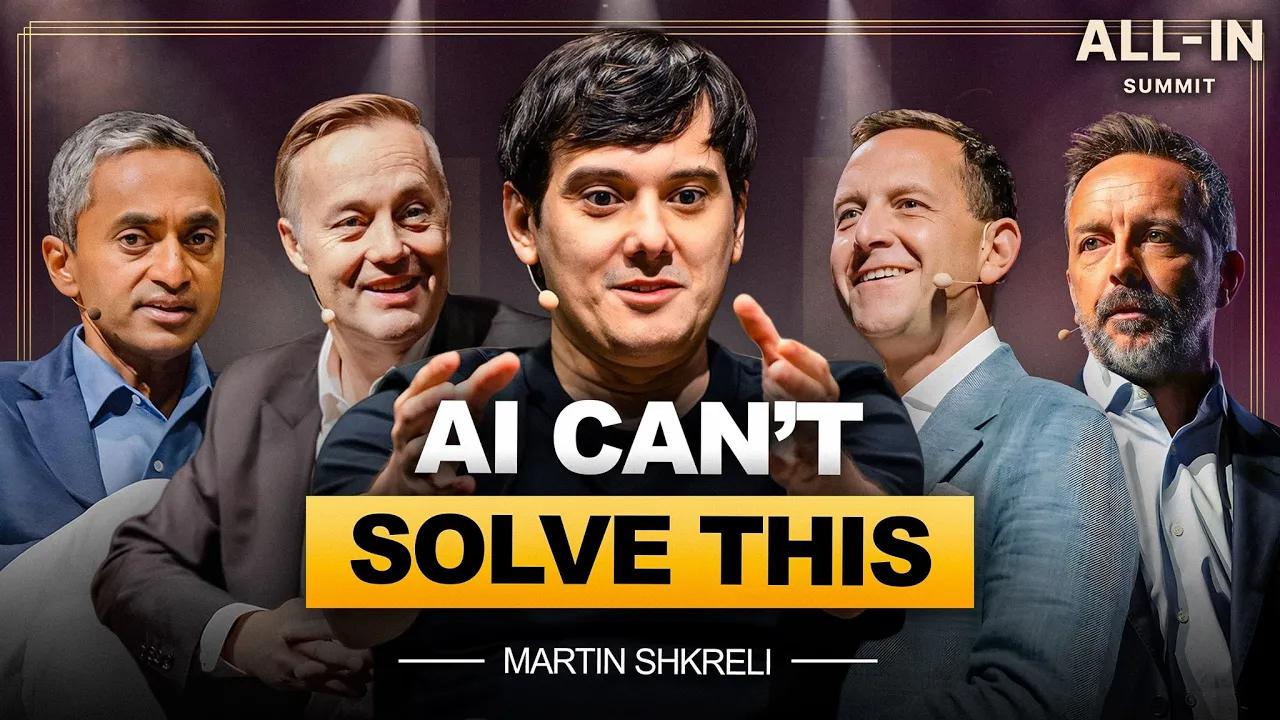
Martin Shkreli: Big Pharma's Blind Spot, Betting Against Quantum & What Prison Taught Him — All-In Podcast

All-In Podcast

AI-assisted summary of Martin Shkreli: Big Pharma's Blind Spot, Betting Against Quantum & What Prison Taught Him — original source. Check the original for full context.

Source published:

Key ideas

  • Martin Shkreli challenges the commercial viability of quantum computing, labeling it a narrow 'one-trick' technology restricted to integer factorization and discrete logarithms while running at kilohertz clock speeds without quantum RAM. (0:49)
  • Shkreli highlights pharmaceutical licensing arbitrage as a major source of biotech alpha, citing how acquiring dormant compounds like Sparsentan for $1M–$2M and repivoting them to rare diseases yielded FDA approval and a multi-billion-dollar valuation. (8:48)
  • Pushing back on AI drug discovery hype, Shkreli predicts zero AI-discovered drugs will achieve clinical relevance over the next decade, arguing that empirical clinical trial biology—not computational molecular dynamics—is the true bottleneck. (16:06)
  • Shkreli projects that current brute-force GPU silicon infrastructure will eventually become obsolete scrap, positioning analog optical computing (photonics) as the true long-term breakthrough for zero-energy matrix multiplication workloads. (6:04)

Detailed notes

## Background Published on YouTube by the All-In Podcast on October 12, 2026, this episode features Martin Shkreli joining the hosts to break down why he is shorting quantum computing, his strategy for acquiring mispriced Big Pharma assets, the realities of AI in drug discovery, and the personal lessons learned from his federal prison sentence.

## TL;DR Martin Shkreli joins the Besties to present a technical critique of quantum computing, labeling it commercially narrow compared to classical computing and pointing toward analog optical computing as the true frontier for AI workloads. He details his historical pharmaceutical playbook of licensing dormant compounds from major pharma giants and repositioning them for rare diseases, while voicing strong skepticism that AI models will replace traditional drug discovery anytime soon. Critiquing Effective Altruism and AI existential risk narratives, he predicts that end consumers and distribution-heavy giants like Meta will capture AI's ultimate value. Shkreli closes with candid personal reflections on the 'gifted-kid trap,' admitting that an ego-driven refusal to acknowledge his trading shortcomings led to his downfall and explaining how prison stripped away his superficial markers of success.

## Atmosphere & style The conversation carries a lively, fast-paced, and intellectually combative energy, seamlessly shifting between playful jabs about Shkreli's notorious past and deep technical sparring over silicon architectures. The dynamic between Shkreli and the Besties is informal and collegial, with the hosts challenging his provocative market assertions while giving him room to deliver sharp, rapid-fire monologues. As the discussion moves from Wall Street cynicism and tech debates to life behind bars, the mood transitions into an unexpectedly quiet, introspective reckoning with ego, intellectual vanity, and personal vulnerability.

## Bulletin - [00:49](https://www.youtube.com/watch?v=yZR8QW4qQmM&t=49s) Martin Shkreli challenges the commercial viability of quantum computing, labeling it a narrow 'one-trick' technology restricted to integer factorization and discrete logarithms while running at kilohertz clock speeds without quantum RAM. - [08:48](https://www.youtube.com/watch?v=yZR8QW4qQmM&t=528s) Shkreli highlights pharmaceutical licensing arbitrage as a major source of biotech alpha, citing how acquiring dormant compounds like Sparsentan for $1M–$2M and repivoting them to rare diseases yielded FDA approval and a multi-billion-dollar valuation. - [16:06](https://www.youtube.com/watch?v=yZR8QW4qQmM&t=966s) Pushing back on AI drug discovery hype, Shkreli predicts zero AI-discovered drugs will achieve clinical relevance over the next decade, arguing that empirical clinical trial biology—not computational molecular dynamics—is the true bottleneck. - [06:04](https://www.youtube.com/watch?v=yZR8QW4qQmM&t=364s) Shkreli projects that current brute-force GPU silicon infrastructure will eventually become obsolete scrap, positioning analog optical computing (photonics) as the true long-term breakthrough for zero-energy matrix multiplication workloads.

## Key takeaways - [00:49](https://www.youtube.com/watch?v=yZR8QW4qQmM&t=49s) Quantum computing fundamentally misleads the public as 'faster computing' despite excelling only at narrow polynomial-time algorithms like Shor's, while failing at standard sorting and general algorithms. - [04:18](https://www.youtube.com/watch?v=yZR8QW4qQmM&t=258s) Commercial quantum hardware remains incapable of handling basic operational math like multiplying 300 by 200, leading Shkreli to short the sector despite timing-related financial losses. - [06:04](https://www.youtube.com/watch?v=yZR8QW4qQmM&t=364s) Modern artificial intelligence is constrained by O(n^3) matrix multiplication, making photonic and analog optical computing attractive alternatives due to near-zero energy consumption. - [08:48](https://www.youtube.com/watch?v=yZR8QW4qQmM&t=528s) Big Pharma companies consistently discard viable therapeutics due to shifting therapeutic priorities, opening substantial alpha for agile operators to repurpose neglected molecules for orphan diseases. - [08:48](https://www.youtube.com/watch?v=yZR8QW4qQmM&t=528s) Sparsentan serves as a case study for drug arbitrage, where a $2 million acquisition from Bristol Myers Squibb was repivoted from hypertension to FSGS, creating Travere Therapeutics' multi-billion-dollar market cap. - [11:11](https://www.youtube.com/watch?v=yZR8QW4qQmM&t=671s) Massive AI data center CapEx buildouts face technological obsolescence risks, as brute-force silicon will eventually yield to fundamentally superior architectures like photonics. - [11:11](https://www.youtube.com/watch?v=yZR8QW4qQmM&t=671s) Algorithmic advances delivering 1,000x efficiency gains could threaten Nvidia's margins and revenue if end-user compute demand fails to scale proportionally under Jevons paradox. - [12:45](https://www.youtube.com/watch?v=yZR8QW4qQmM&t=765s) Shkreli condemns the Effective Altruism movement and AI doomsday rhetoric as performative self-importance, emphasizing that software models can be disconnected and do not present bioweapon threats. - [16:06](https://www.youtube.com/watch?v=yZR8QW4qQmM&t=966s) Clinical trial complexity, off-target toxicity, and biological unpredictability prevent computational AI tools from rapidly solving pharmaceutical drug development. - [17:07](https://www.youtube.com/watch?v=yZR8QW4qQmM&t=1027s) The addressable market for artificial intelligence is effectively infinite because enterprise demand for compute-driven optimization and autonomous corporate verticals vastly exceeds the existing white-collar wage base. - [18:27](https://www.youtube.com/watch?v=yZR8QW4qQmM&t=1107s) The AI value chain mirrors the early internet buildout, where infrastructure profits eventually diffuse into consumer surplus and broad distribution platforms like Meta out-monetize pure model vendors. - [21:24](https://www.youtube.com/watch?v=yZR8QW4qQmM&t=1284s) The 'gifted-kid trap' drives brilliant founders into catastrophic rule-breaking and fraud because their egos cannot tolerate admitting failure or mediocrity in a given domain. - [23:15](https://www.youtube.com/watch?v=yZR8QW4qQmM&t=1395s) Federal prison stripped away Shkreli's narrow obsession with being perceived as an elite trader, demonstrating the universal simplicity of human motivations across all socioeconomic backgrounds.

## Detailed walkthrough ### [00:00](https://www.youtube.com/watch?v=yZR8QW4qQmM&t=0s) Intro: The "Pharma Bro" Reputation and Arrival

The episode opens with archival media clips recounting Martin Shkreli’s notoriety as the self-styled "most hated man in America" after he raised the price of the life-saving antiparasitic drug Daraprim by roughly 5,000%. The montage paints him as the ultimate caricature of unrestrained capitalistic greed, backed by his own past provocations: that company executives can theoretically be prosecuted for failing to maximize profits, that his fiduciary duty was to make as much money as possible, and his dismissive attitude toward critics—"And if I'm the enemy for you, good. I'm happy, man. I'm fulfilling some need in your life." The clips touch on his seven-year prison sentence and his infamous purchase of the sole copy of the Wu-Tang Clan album *Once Upon a Time in Shaolin*, which he bought with no immediate intention of listening to, remarking bluntly, "It's not a good record. Ego is the fountainhead of all progress."

Walking into the studio to sit with the Besties, the hosts greet him warmly, joking that he came dressed in "Brad's outfit" (referencing Brad Gerstner’s familiar tech-investor uniform). Shkreli laughs along as the hosts set up an expansive interview touching on his Wall Street origins, his controversial pharmaceutical moves, prison life, and his vocal public skepticism of quantum computing.

[00:49](https://www.youtube.com/watch?v=yZR8QW4qQmM&t=49s) The Quantum Computing Skeptic: Why It's a "Fugazi" for Business

The hosts jump straight into Shkreli’s aggressive public stance against the quantum computing sector, noting that he has labeled the current industry a complete "fraud" and a "fugazi" where corporate executives could end up in legal jeopardy. Setting up the topic, they ask him to lay out his thesis and jokingly ask for his advice to those future inmate executives on how to survive in the hoosegow, teasing reports that Shkreli channeled his inner Lex Luthor to run the prison yard.

Shkreli begins his rebuttal with a nod to his wife, Chelsea, whom he describes as an under-the-radar technology heavyweight who was an early team member at OpenAI. Noting the family contrast—her father was an early employee at NVIDIA, while in his own family he was "one of the first people in prison"—he jokes that he married her to "shift the gene pool over a little bit." Chelsea studied at MIT and taught quantum computing alongside Scott Aaronson, one of the foremost theorists in the space. Over long discussions, she walked Shkreli through what quantum computing actually is versus the public perception. Shkreli argues that the broader tech and investment communities mistakenly view quantum computing as simply "faster computing," which completely misunderstands the underlying science.

The fundamental disconnect, Shkreli explains, stems from the origins of the field in Peter Shor’s famous thought experiment, which proved that certain classes of mathematical algorithms could run faster on novel physical hardware media. While theoretically revolutionary, it is commercially narrow because quantum computers excel at essentially one primary algorithmic trick: converting exponential-time problems into polynomial-time solutions for integer factorization and the Elliptic Curve Discrete Logarithm Problem (ECDLP). For typical computational workloads, quantum machines are abysmal. Referencing the foundational algorithms textbook *Introduction to Algorithms* (CLRS), Shkreli points out that even basic operations like bubble sort or merge sort on a deck of cards cannot run faster on a quantum machine: - Quantum processors run at clock speeds measured in hundreds or thousands of hertz (Hz/kHz), whereas modern classical silicon runs at gigahertz (GHz). - Quantum machines execute single-threaded, single-core pipelines for conventional sorting workloads. - There is no functional equivalent to quantum RAM; inputs must be exceptionally small, meaning quantum computers cannot ingest or process large-scale datasets. - For commercial applications, unless an organization is specifically in the business of factoring large prime products, quantum hardware offers no performance edge over modern GPU clusters.

```mermaid flowchart TD accTitle: Quantum vs Classical Workloads accDescr: Diagram contrasting how classical computing and quantum computing handle general algorithms versus factorization. subgraph Classical["Classical Computing (CPUs / GPUs)"] A["Gigahertz Clock Speeds (GHz)"] --> C["Fast General Computing"] B["Massive Memory & RAM"] --> C C --> D["Sorting, Database Operations & AI Matmul"] end

subgraph Quantum["Quantum Hardware Realities"] E["Hertz/Kilohertz Clock Speeds (Hz)"] --> G["Severe Processing Bottleneck"] F["No Quantum RAM (Tiny Inputs Only)"] --> G G --> H["Fails at Standard Algorithms (CLRS Sorts)"] G --> I["Shor's Algorithm: Integer Factoring & ECDLP in Polynomial Time"] end ```

[04:18](https://www.youtube.com/watch?v=yZR8QW4qQmM&t=258s) Transistor Comparisons, Testing Machines, and Shorting the Sector

Chamath pushes back, playing devil's advocate by comparing current quantum hardware to the primordial dawn of computing when engineers were just inventing the initial transistor. In that framing, the hardware is currently raw physics; once developers figure out basic gates, logic trees, operating systems, and higher-level software layers, computational breakthroughs might blossom beyond narrow algorithmic niches.

Shkreli rejects the analogy from an investment standpoint, asking whether an investor in the mid-20th century would have profited going long on vacuum tubes, mercury delay lines, punch cards, or core memory—technologies that became obsolete before scalable computing arrived. He notes that early precursors like the Computing-Tabulating-Recording Company (CTR) had to be folded into IBM just to survive. Shkreli views quantum as both a technological and a business-model trap: major tech giants like Google, IBM, and Microsoft pour hundreds of millions of dollars each year into quantum labs simply hoping that useful commercial applications might eventually materialize.

To test the technology directly, Shkreli and his wife accessed virtually every commercially available quantum system, testing IBM's cloud hardware and prototype setups: - Current systems fail at basic arithmetic tasks: *"We cannot multiply 300 by 200 on any of these."* - Shkreli built an aggressive short position against publicly traded quantum computing companies. - While the market didn't immediately validate his trade, leading to losses, he wryly summarizes the outcome: *"Unfortunately, we lost millions of dollars shorting quantum computing companies, but I told my wife that we gained billions in insight."*

[06:04](https://www.youtube.com/watch?v=yZR8QW4qQmM&t=364s) The Real Bottleneck: GPUs, Matmul, and Analog Optical Computing

Asked where the true computational frontier lies if quantum fails to deliver beyond specialized cryptographic cracking, Shkreli steers the conversation toward artificial intelligence workloads. He argues that modern AI is essentially synonymous with matrix multiplication ("matmul"), pointing out that modern GPUs spend upwards of 99.9% of their operating time multiplying lists of numbers.

The fundamental limitation of modern silicon computing for AI is computational complexity: - Classical matrix multiplication scales at roughly $O(n^3)$ operations. - Multiplying two $1,000 \times 1,000$ square matrices on an NVIDIA GPU requires roughly one billion individual mathematical operations. - Scaling this workload across trillion-parameter AI models imposes massive thermal, energy, and hardware burdens on data centers.

While researching alternatives, Shkreli came across a Microsoft research paper exploring Analog Optical Computing (AOC)—joking that in New York City politics, AOC represents something very different. The breakthrough insight in optical computing is that performing matrix multiplications using light beams occurs essentially instantaneously and with virtually zero energy cost (*"matmuls in light are free"*). Shkreli notes that he is actively exploring founding a company in the space, highlighting early-stage hardware startups like Neurophos, Optalysys, and Lumai that are attempting to build photonic matrix multiplication cores capable of outpacing traditional NVIDIA GPUs, even though critical technical hurdles around nonlinearity and memory integration remain unresolved.

[07:41](https://www.youtube.com/watch?v=yZR8QW4qQmM&t=461s) Origin Story: Starting at 16 Under Jim Cramer

The hosts transition from Shkreli's tech thesis back to his finance background, prompting him to trace his trajectory from hedge fund manager to the Daraprim acquisition that made him an international headline. Shkreli recalls breaking into Wall Street at age 16 when he landed a position at Jim Cramer’s hedge fund, Cramer Berkowitz.

Despite Cramer’s bombastic television persona, Shkreli describes him as an exceptionally sharp and disciplined investor during the 1980s and 1990s. Cramer’s strategy relied on constant intraday trading—buying and selling equities relentlessly throughout every session to squeeze out marginal gains, compounding at an impressive 23% net of fees annually. Shkreli attributes landing the gig as a teenager to living in Manhattan, having a "big mouth," obsessing over stock market mechanics, and idolizing Bill Gates. One day on the trading floor, Cramer singled him out, pointed at him, and gave him the assignment that defined the next two decades of his career: *"Genomics, you're going to look at genomics."*

[08:48](https://www.youtube.com/watch?v=yZR8QW4qQmM&t=528s) Arbitraging Big Pharma: Finding Alpha in Forgotten Molecules

Martin Shkreli recounts transitioning from working at a Tiger Cub hedge fund to launching his own fund, where he realized he was fundamentally a better entrepreneur and private equity investor than a public markets trader. Looking across asset classes, he identified massive inefficiency and alpha in the marketplace for individual drug molecules rather than public equities. Big pharmaceutical conglomerates regularly mothballed promising compounds; Pfizer or Bristol Myers Squibb would license away the rights to a drug for $1 million to $2 million simply because it did not fit their internal therapeutic priorities. Shkreli built startups around acquiring these cast-off assets, productizing them, and repricing or redirecting them toward high-unmet-need indications.

```mermaid flowchart LR accTitle: Drug Repositioning Arbitrage Flow accDescr: Shkreli's strategy for identifying dormant Big Pharma assets and pivoting them to rare disease indications for FDA approval. subgraph Sourcing ["1. Sourcing & Screening"] A["Big Pharma Pipeline<br/>(Pfizer / BMS)"] -->|"License for $1M–$2M"| B["NLP & Paper Screening<br/>(40M Medical Papers)"] end subgraph Repositioning ["2. Indication Pivot"] B -->|"Repurpose Indication"| C["Sparsentan Pivot:<br/>Hypertension → FSGS"] end subgraph Commercialization ["3. Approval & Value"] C -->|"Clinical Trials & FDA"| D["FDA Approval / $6B Market Cap"] end ```

The core operational bottleneck in executing this strategy was human bandwidth: vetting clinical data, sifting through patents, visiting academic labs, and building business development relationships. To tackle the literature overload, Shkreli even launched an early natural language processing (NLP) venture in 2015 utilizing IBM Watson to ingest medical research. While Watson "wasn't great," the objective was parsing through roughly 40 million published biomedical papers to uncover diamonds in the rough.

He illustrates this playbook with Sparsentan, a drug he named that eventually secured FDA approval and blockbuster status under Travere Therapeutics (formerly Retrophin), currently a multi-billion-dollar public company. Bristol Myers Squibb had originally developed the molecule for essential hypertension—a crowded, sleepy market with razor-thin margins. Shkreli's team acquired it for $2 million and redirected the clinical focus to focal segmental glomerulosclerosis (FSGS), a devastating rare kidney disease with zero approved therapies. Repositioning the molecule unlocked an FDA approval that now serves 30,000 patients, leading Shkreli to remark with a grin, "I can be a good guy too," while noting that transforming a $2 million asset into a $6 billion company remains the ultimate art of biotechnology. When asked how this differs from Royalty Pharma, he clarifies that while both exploit market mispricings, Royalty Pharma specializes in discounting cash flows—such as acquiring New York University's royalty stream on Remicade for roughly one times earnings before it experienced a twenty-fold surge.

[11:11](https://www.youtube.com/watch?v=yZR8QW4qQmM&t=671s) The AI CapEx Buildout, Photonic Computing, and Jevons Paradox

Brad Gerstner shifts the conversation from pharmaceutical arbitrage to macro technology, asking how Shkreli views the colossal CapEx cycle driving AI compute infrastructure and where the systemic risks or short opportunities lie. Shkreli remains skeptical of the current brute-force hardware approach, arguing that physical silicon scaling is inherently transitory: in twenty years, current workhorse hardware—including Nvidia's H100, B100, and B200 GPUs—will end up sitting in the scrap heap. He views extreme proposals like placing data centers in orbit or constructing dedicated nuclear reactors as fundamentally misguided attempts to scale inefficient architectures when entirely superior compute paradigms, such as photonic computing, represent the genuine future. He notes that even Sam Altman recently acknowledged photonic compute as a viable long-term path.

While Shkreli remains net-long semiconductor equities in the immediate term, he highlights significant tension around algorithmic efficiency and demand elasticity: - Jevons paradox implies that hyper-efficient compute drives exponentially greater consumption rather than lower spend, a thesis echoed to him by Scale AI founder Alexandr Wang. - Silicon Valley researchers are actively developing alternative transformer architectures that promise 1,000x efficiency improvements; if model efficiency scales by three orders of magnitude without an equivalent surge in end-user workload demand, it poses a direct existential headwind to Nvidia's margin and revenue trajectory. - Drawing historical parallels, Shkreli warns that while going long AI infrastructure feels undeniable today, investors in 2000 held identical convictions regarding perpetual growth for networking titans like Cisco and Yahoo right before the dot-com unwind.

[12:45](https://www.youtube.com/watch?v=yZR8QW4qQmM&t=765s) Dario Amodei, Effective Altruism, and the Rise of e/acc

When asked about his portfolio style, Shkreli confirms he no longer operates an outside hedge fund and trades personal capital with high agility. He used recent market drawdowns triggered by Anthropic CEO Dario Amodei's widely discussed essay ("Machines of Loving Grace") as an entry point to aggressively buy tech dips, calling the market panic over the writing "ridiculous."

Despite respecting Anthropic's multi-billion-dollar valuation, Shkreli pulls no punches regarding Dario Amodei, branding him a fear-mongering operator whose corporate lineage mirrors silicon-valley opportunism. Shkreli invokes a Pandora's box metaphor: if an employee is invited inside OpenAI, shown proprietary research breakthroughs, and immediately leaves with several co-founders to replicate the exact technology next door under a new banner, it borders on trade-secret appropriation—drawing comparisons to the criminal prosecution of Anthony Levandowski in the autonomous vehicle sector.

Shkreli directs equal scorn at the Effective Altruism (EA) ecosystem, claiming personal involvement in seeding and popularizing the counter-movement known as "e/acc" (effective accelerationism). He frames the apocalyptic rhetoric of AI doomers as performative nerd posturing: - While athletic "jocks" understand how to carry themselves smoothly under public scrutiny, technical "nerds" thrust into global prominence often panic and draw sensationalist attention to themselves by declaring their code an existential threat. - He emphasizes that generative models remain software that can simply be unplugged, dismissing apocalyptic bioweapon scenarios and pointing out that Dario Amodei's prior predictions—such as near-total global human unemployment within one to five years—are steadily expiring unfulfilled.

[16:06](https://www.youtube.com/watch?v=yZR8QW4qQmM&t=966s) The Reality of Drug Discovery vs. The AI Hype Cycle

Shkreli rejects Amodei's grand assertions that artificial intelligence will rapidly eradicate human disease, predicting flatly that not a single AI-discovered drug will achieve clinical relevance over the next decade. Drawing on his direct background designing molecules, raising capital, and shepherding compounds through Phase 3 trials to FDA approvals, he argues that computational power has never been the actual bottleneck in bringing drugs to market.

Researchers have leveraged supercomputing clusters—ranging from legacy Cray mainframes to modern GPU arrays—for molecular dynamics and target binding for decades. However, biology's intrinsic unpredictability, off-target toxicity, and human clinical trial requirements resist pure software optimization. Turning to the macro economics of the generative AI boom, Shkreli observes that a substantial portion of the $400 billion in redirected venture capital effectively acts as an internal loop where venture capitalists funnel limited-partner capital directly back into purchasing compute tokens, creating fragile valuation multiples that rely on downstream productivity gains that have yet to mathematically materialize.

[17:07](https://www.youtube.com/watch?v=yZR8QW4qQmM&t=1027s) The Boundless TAM for Intelligence and AI-Spawned Enterprises

Martin Shkreli challenges the conservative assumption that the total addressable market (TAM) for artificial intelligence should be bounded by the existing knowledge worker economy. Limiting the TAM to white-collar labor fundamentally misses the scope of what is unfolding, because human demand for work and intelligence is effectively infinite. To illustrate, Shkreli brings up a close friend who recently left OpenAI—the person responsible for inventing OpenAI's reasoning models—to launch an under-the-radar startup called Core Automation. Shkreli envisions a future where frontier artificial intelligence does not just assist existing businesses, but autonomously spawns entire industry-specific corporations from within frontier labs, effectively incubating a synthetic S&P 500 under a single umbrella:

```mermaid flowchart TD accTitle: Frontier Labs as Enterprise Incubators accDescr: Diagram illustrating how frontier AI models branch into fully autonomous industry verticals forming a synthetic S&P 500.

subgraph FrontierLabs["Frontier Foundation Models (OpenAI / Anthropic)"] F1["Core Reasoning Engine"] end

subgraph AutonomousVerticals["AI-Spawned Corporate Verticals"] V1["OpenAI Pharma"] V2["OpenAI Motors"] V3["OpenAI Aviation"] end

subgraph CorporateClients["Enterprise Compute Deployment"] C1["Enterprise Capital ($10B+)"] -->|"10M GPUs deployed"| F1 F1 -->|"Net Present Value Analysis"| C2["Optimized Strategic Decisions"] end

F1 --> V1 F1 --> V2 F1 --> V3 ```

To drive home the economic rationale, Shkreli outlines a thought experiment with McDonald’s. Rather than spending millions hiring traditional management consulting firms like McKinsey or running focus groups, a corporate giant could easily justify an NPV-positive $10 billion check to OpenAI to deploy 10 million GPUs dedicated entirely to calculating the single best new sandwich recipe to launch. As long as intelligence gains do not hit an asymptotic plateau where additional inference tokens stop yielding better answers, deploying millions of synthetic GPU minds directly into corporate decision-making represents an almost bottomless capital sink.

- **Infinite TAM Thesis**: Restricting AI's market potential to the existing knowledge workforce understates the market; the actual limit is tied directly to the infinite demand for raw intelligence. - **Core Automation**: Founded by the creator of OpenAI's reasoning architecture, aiming to build systems capable of running automated, self-directed businesses. - **Consulting Replacement**: Giant corporations can deploy massive GPU clusters to bypass legacy advisory services (McKinsey, focus groups) for high-stakes strategic choices.

---

[18:27](https://www.youtube.com/watch?v=yZR8QW4qQmM&t=1107s) The Internet Analogy: Why Meta Wins and Hardware Hedges the Frontier

When asked for a historical mental model to understand the emerging AI marketplace—whether it behaves like oil, utilities, or Jensen Huang’s analogy of free tap water versus eight-dollar bottled water—Shkreli compares it directly to the early commercial internet. In his view, the primary winners will inevitably be the end consumers and businesses who receive a nearly "tax-free" highway of intelligence, with hardware and infrastructure suppliers like Cisco skimming a cut along the margins while foundational intelligence becomes ubiquitous and free in everyone's pocket.

When the discussion shifts to which mega-cap company is best positioned to sustainably overearn on this dynamic, Shkreli points straight to Meta. While chatbots represent an early, primitive phase that the tech world will soon laugh about, Meta possesses world-class distribution and proven consumer product muscle, as demonstrated by their hardware and product execution around platforms like Muse and the Ray-Ban smart glasses under Alex Himel. Furthermore, Shkreli endorses holding equity in OpenAI and Anthropic, praising Sam Altman’s move to aggressively hedge model capabilities with proprietary hardware infrastructure, ensuring that the distribution and delivery of intelligence capture as much value as the raw model weights themselves.

- **Market Model**: The AI boom mirrors the build-out of the internet, where consumer surplus and broad enterprise enablement eclipse the profits of pure-play model providers. - **Meta’s Strategic Moat**: Massive global distribution paired with demonstrated consumer hardware chops positions Meta to out-monetize pure infrastructure vendors. - **Chatbot Obsolescence**: Current text-prompt chatbots are merely "day one" artifacts of early AI that will appear quaint in hindsight.

---

[20:10](https://www.youtube.com/watch?v=yZR8QW4qQmM&t=1210s) Elon, Bostrom, and the Effective Altruism "Fear-Mongering"

The panel turns to Elon Musk’s proposal for "competitor peer review"—a proposed third-way mechanism designed to balance competitive velocity with AI safety. Shkreli dismisses the entire safety premise, invoking an old quip that if Warren Buffett had a time machine, he would go back and shoot the Wright brothers to spare capitalism the economic devastation of the airline industry. In Shkreli's estimation, the entire existential AI panic can be traced to Nick Bostrom's book *Superintelligence*, which he argues fundamentally terrified Elon Musk.

Shkreli takes aim at the Effective Altruism (EA) movement, criticizing its adherents for a brand of "narcissistic self-importance" that weaponizes fear-mongering under the guise of philosophical rigor. While OpenAI adopts safety posturing largely to keep pace with Anthropic’s positioning, Shkreli praises leaders who possess "the spine" to reject doomsday rhetoric—specifically Meta, Jensen Huang, and the executive administration. At the end of the day, Shkreli insists, artificial intelligence is simply computer science, not an existential threat. When a co-host pushes back by listing undeniably brilliant figures embedded in the EA circle—Dario Amodei, Dustin Moskovitz, and Sam Bankman-Fried—Shkreli counters that being an intellectual outlier in one discipline often blinds someone to basic realities in another: "Sometimes you can be really smart at one thing and really dumb at another." He pauses to wryly add: "I'm a good example."

---

[21:24](https://www.youtube.com/watch?v=yZR8QW4qQmM&t=1284s) The Gifted-Kid Trap: SBF, Elizabeth Holmes, and Admitting Failure

The hosts seize on Martin's quip to probe the intersection between extreme heterodox intellect and rule-breaking. Brilliant minds often achieve massive alpha precisely because they refuse to think conventionally, but that same disregard for standard norms can easily bleed into ignoring legal and regulatory boundaries. Drawing on his own experiences—including personal conversations where he gave advice to Sam Bankman-Fried on how to survive behind bars—Shkreli breaks down what went wrong with FTX’s founder, whose 2021–2022 venture portfolio (including an early stake in Anthropic) initially appeared brilliant.

Shkreli identifies this failure mode as the "intellectually gifted kid trap"—an albatross that crushed figures like Bankman-Fried, Elizabeth Holmes, and Galleon Group founder Raj Rajaratnam. Gifted founders often become prisoners of their own self-image, burdened by a desperate need to live up to an inflated standard of genius. Rather than admitting failure or stepping back when things unravel, they resort to catastrophic compromises. Shkreli candidly applies this exact diagnosis to his own past downfall:

> "I think you have this self-conscious [feeling that] you have to live up to something, and sometimes wanting to live up to that big thing can be very detrimental. And just failing and admitting that you are not that great at that is not that bad. I had a hard time admitting I was not the best hedge fund manager in the world, but I was a wonderful entrepreneur. That simple refusal to admit that put me in prison."

- **The Gifted-Kid Albatross**: Growing up labeled as intellectually exceptional creates an existential fear of admitting mediocrity, pushing ambitious operators into high-risk deception when their bets fail. - **Historical Parallels**: SBF, Elizabeth Holmes, and Raj Rajaratnam all fell victim to the inability to acknowledge operational limits or capital market failures. - **Personal Realization**: Shkreli acknowledges that refusing to accept his shortcomings as a trader directly caused his legal conviction and imprisonment.

---

[23:15](https://www.youtube.com/watch?v=yZR8QW4qQmM&t=1395s) Life in the Big House and the Psychology of Ego

Asked how serving federal prison time changed his worldview, Shkreli reflects on the hidden psychological drivers governing high-achieving individuals. Looking back, he realizes he was quietly petrified of not being regarded as a world-class trader—a fixation he now views as completely absurd, given that life offers numerous meaningful paths: being a long-term value investor, a scientist, a startup founder, or simply a dedicated father. Fixating the ego on a single external identity marker proved to be his greatest vulnerability.

When asked what life inside the "big house" actually taught him about human nature, Shkreli speaks about the unexpected universality among inmates. Stripped of wealth, social status, and external accolades, people from wildly different backgrounds end up wrestling with the exact same emotional realities: grieving friendships that faded after conviction, aching for estranged loved ones, and sharing the universal desire to be a good father. The experience served as an equalizer, stripping away ego and showing that beneath elite achievement, the fundamental human motivations are remarkably simple. The hosts close the discussion by commending Shkreli for his sharp, unfiltered perspective, inviting him to return to the show anytime.

## Notable quotes > [00:00](https://www.youtube.com/watch?v=yZR8QW4qQmM&t=0s) And if I'm the enemy for you, good. I'm happy, man. I'm fulfilling some need in your life. — Martin Shkreli

> [00:00](https://www.youtube.com/watch?v=yZR8QW4qQmM&t=0s) It's not a good record. Ego is the fountainhead of all progress. — Martin Shkreli

> [04:18](https://www.youtube.com/watch?v=yZR8QW4qQmM&t=258s) We cannot multiply 300 by 200 on any of these. — Martin Shkreli

> [04:18](https://www.youtube.com/watch?v=yZR8QW4qQmM&t=258s) Unfortunately, we lost millions of dollars shorting quantum computing companies, but I told my wife that we gained billions in insight. — Martin Shkreli

> [06:04](https://www.youtube.com/watch?v=yZR8QW4qQmM&t=364s) matmuls in light are free — Martin Shkreli

> [07:41](https://www.youtube.com/watch?v=yZR8QW4qQmM&t=461s) Genomics, you're going to look at genomics. — Jim Cramer

> [08:48](https://www.youtube.com/watch?v=yZR8QW4qQmM&t=528s) I can be a good guy too — Martin Shkreli

> [20:10](https://www.youtube.com/watch?v=yZR8QW4qQmM&t=1210s) Sometimes you can be really smart at one thing and really dumb at another. — Martin Shkreli

> [20:10](https://www.youtube.com/watch?v=yZR8QW4qQmM&t=1210s) I'm a good example. — Martin Shkreli

> [21:24](https://www.youtube.com/watch?v=yZR8QW4qQmM&t=1284s) I think you have this self-conscious [feeling that] you have to live up to something, and sometimes wanting to live up to that big thing can be very detrimental. And just failing and admitting that you are not that great at that is not that bad. I had a hard time admitting I was not the best hedge fund manager in the world, but I was a wonderful entrepreneur. That simple refusal to admit that put me in prison. — Martin Shkreli

## Mentioned Martin Shkreli, Daraprim, Wu-Tang Clan, Once Upon a Time in Shaolin, Brad Gerstner, Chamath Palihapitiya, Chelsea Shkreli, OpenAI, NVIDIA, Scott Aaronson, Peter Shor, Introduction to Algorithms (CLRS), IBM, Google, Microsoft, Neurophos, Optalysys, Lumai, Jim Cramer, Cramer Berkowitz, Bill Gates, Pfizer, Bristol Myers Squibb, Travere Therapeutics, Retrophin, Sparsentan, Royalty Pharma, Alexandr Wang, Scale AI, Dario Amodei, Anthropic, Anthony Levandowski, Core Automation, McKinsey & Company, McDonald's, Meta, Alex Himel, Warren Buffett, Nick Bostrom, Superintelligence, Elon Musk, Jensen Huang, Dustin Moskovitz, Sam Bankman-Fried, Elizabeth Holmes, Raj Rajaratnam, Galleon Group, FTX

## Video description (0:00) Martin Shkreli joins the Besties! (0:55) Why quantum computing is a one-trick business and why he’s betting against it (7:42) The drugs big pharma sells too cheap and his journey from hedge fund trader to pharma (11:37) AI, drug discovery, and who actually wins (21:32) Brilliance and rule-breaking, the gifted-kid trap & what prison taught him

Thanks to our partners for making this possible!

IREN is a vertically integrated AI Cloud platform, delivering data centers, compute and software for AI training and inference. https://iren.com/

Oracle connects the data, applications, and infrastructure that turn AI into business outcomes—with the flexibility, choice, and control to optimize as AI evolves. http://oracle.com/ai EY helps tech innovators scale from startup to exit to megacap. You build the future. We’ll handle the rest. http://www.ey.com

Meta believes the future is for everyone. We're focused on giving every person the tools to reach their full potential and making sure the benefits of technology are distributed to all. http://www.meta.com

Keel Infrastructure owns the power, land, and connectivity that HPC and AI run on - backed by secured energy assets and established grid interconnections across North America. https://keelinfra.com/

Airwallex - Agentic Global Business Accounts. Open local accounts in 70+ countries to accept payments, earn yield, pay globally, and manage spend. http://airwallex.com

PayPal has been revolutionizing commerce globally for more than 25 years. Creating innovative experiences that make moving money, selling, and shopping simple, personalized, and secure, PayPal empowers consumers and businesses in approximately 200 markets to join and thrive in the global economy. For more information, visit https://www.paypal.com

Google for Startups connects founders with the right people, products, and best practices to help startups build faster and go further. https://startup.google.com/

Explore ideas, industries, and technologies worth understanding with Chamath every week on Learn with Me: https://research.socialcapital.com/allin

Follow the besties: https://x.com/chamath https://x.com/Jason https://x.com/DavidSacks https://x.com/friedberg

Follow on X: https://x.com/theallinpod

Follow on Instagram: https://www.instagram.com/theallinpod

Follow on TikTok: https://www.tiktok.com/@allin

Follow on LinkedIn: https://www.linkedin.com/company/allinpod

Intro Music Credit: https://rb.gy/tppkzl https://x.com/yung_spielburg

#allin #tech #news

[Source](https://www.youtube.com/watch?v=yZR8QW4qQmM)

中文简报

马丁·什克雷利:大型药企的盲区、做空量子计算与狱中领悟 马丁·什克雷利(Martin Shkreli)做客节目,对量子计算提出了技术层面的批评,称其相较于经典计算而言商业应用过于狭窄,并指出模拟光计算才是承载AI工作负载的真正前沿。他详细拆解了自己以往的制药运作策略,即从大型制药巨头处授权引进休眠化合物并重新定位用于罕见病,同时强烈怀疑AI模型短期内无法取代传统药物研发。在抨击有效利他主义和AI存在性风险论调的同时,他预测终端消费者和拥有强大分发渠道的巨头(如Meta)将斩获AI的最终价值。最后,什克雷利坦诚反思了“天赋少年陷阱”,承认因自负而不愿面对自身交易短板导致了他的垮台,并讲述了牢狱生活如何剥离了他对成功的表面化认知。 马丁·什克雷利质疑量子计算的商业可行性,称其为仅局限于整数分解和离散对数的狭隘“单一技能”技术,且在没有量子RAM的情况下仅以千赫兹级时钟频率运行。 (0:49) 什克雷利指出医药授权套利是生物科技领域超额收益(alpha)的主要来源,并举例说明以100万至200万美元收购Sparsentan等休眠化合物并转投罕见病领域,最终如何获得了FDA批准和数十亿美元的估值。 (8:48) 针对AI药物研发的炒作,什克雷利预测未来十年内不会有任何AI发现的药物达到临床相关性,并认为实证临床试验生物学——而非计算分子动力学——才是真正的瓶颈所在。 (16:06) 什克雷利预计当前基于暴力计算的GPU硅基基础设施最终将沦为淘汰废品,并认为模拟光计算(光子学)才是实现零能耗矩阵乘法工作负载的真正长期突破方向。 (6:04)

Reading summary

Martin Shkreli argues that commercial enthusiasm for quantum computing and AI-driven drug discovery misjudges fundamental physical and biological constraints, asserting that real technological leverage lies in photonic matrix multiplication, ubiquitous AI distribution, and unconstrained demand for synthetic intelligence. Commercial Limits of Quantum and Photonic Alternatives (0:49) Shkreli contends that the commercial market mistakenly views quantum computing as broadly accelerated computing, when in reality its proven advantage is narrowly confined to integer factorization and discrete logarithms via Shor's algorithm. Because quantum hardware operates at clock speeds measured only in hertz or kilohertz, lacks quantum RAM, and executes single-threaded pipelines for standard operations, it cannot outperform classical silicon on general algorithms or data-intensive tasks. Direct testing on cloud systems from providers like IBM failed at basic arithmetic such as multiplying 300 by 200, which contributed to personal losses on his short positions against quantum firms. Instead of quantum systems, Shkreli identifies Analog Optical Computing (AOC) as the genuine frontier for artificial intelligence infrastructure. Modern GPUs spend the vast majority of their operational time performing matrix multiplication scaling at roughly O(n^3) complexity, which imposes massive thermal and energy burdens on data centers. Because optical computing performs matrix multiplications using light beams virtually instantaneously and at negligible energy cost, Shkreli views photonics as the architecture that will eventually render current GPU clusters obsolete, despite lingering technical hurdles around nonlinearity and memory integration. Pharmaceutical Repositioning Versus AI Discovery Claims (8:48) Reflecting on his career in biotechnology, Shkreli details his strategy of acquiring discarded molecules from major pharmaceutical companies for $1 million to $2 million. Rather than attempting de novo drug design, his approach identified cast-off compounds and redirected them toward underserved indications. He illustrates this with Sparsentan, which was licensed from Bristol Myers Squibb after being shelved for essential hypertension and successfully repositioned for focal segmental glomerulosclerosis (FSGS), ultimately achieving FDA approval and supporting a multi-billion-dollar valuation under Travere Therapeutics. In contrast, Shkreli rejects claims that generative AI will rapidly revolutionize medicine, forecasting that zero AI-discovered drugs will achieve clinical relevance over the next decade. He argues that computational power has never been the primary bottleneck in drug development. Supercomputing clusters have modeled molecular dynamics for decades, but biological unpredictability, off-target toxicity, and human clinical trials present intrinsic constraints that software cannot circumvent. Infinite Demand for Intelligence and Distribution Moats (17:07) Shkreli disputes the assumption that artificial intelligence's market size is constrained by the existing white-collar workforce, asserting that demand for intelligence is effectively infinite. He envisions frontier labs spawning synthetic, autonomous corporate verticals across entire industries. Under this model, large corporations could deploy millions of GPUs—such as an illustrative $10 billion allocation to compute optimal product recipes—to replace traditional management consultancies and focus groups, provided that additional inference tokens continue to deliver superior decisions without hitting diminishing returns. Drawing parallels to the commercial build-out of the internet, Shkreli predicts that raw intelligence will become a low-cost, ubiquitous commodity, meaning the primary economic value will accrue to end users and platforms with superior distribution. Consequently, he views consumer-facing companies with proven product and hardware execution, particularly Meta, as better positioned to sustainably monetize AI than pure-play model developers, while noting that early text-prompt chatbots will soon appear obsolete. AI Doomerism and the Psychology of Failure (20:10) Shkreli dismisses existential AI risk and the Effective Altruism movement as fear-mongering and performative posturing by technologists unused to public scrutiny, reiterating that models remain software that can simply be unplugged. He critiques figures like Anthropic CEO Dario Amodei for apocalyptic predictions that have failed to materialize, arguing that high technical intelligence in one field does not prevent profound misjudgments in others. This dynamic connects to what Shkreli terms the 'gifted-kid trap,' where high-achieving founders like Sam Bankman-Fried, Elizabeth Holmes, and Raj Rajaratnam resort to catastrophic deceptions because their identities cannot tolerate admitting failure. Reflecting on his own federal conviction and prison sentence, Shkreli acknowledges that his refusal to admit he was an ineffective public markets trader directly led to his downfall. He describes his incarceration as a leveling experience that dismantled status fixations and revealed universal human priorities across diverse backgrounds. Shkreli pairs extreme technological optimism regarding photonic compute and corporate AI adoption with deep skepticism toward quantum commercialization and AI-designed therapeutics. His outlook leaves open whether emerging photonic hardware can overcome critical engineering hurdles before classical silicon scaling reaches its economic limits.

Detailed notes — zh

## Background 本期内容由知名播客《All-In Podcast》于 2026 年 10 月 12 日发布在 YouTube 平台。节目邀请到备受争议的前对冲基金与药企高管马丁·施克莱里(Martin Shkreli)做客,深入探讨了他公开做空量子计算的底层逻辑、大药厂被低估的资产套利、AI 在药物研发中的虚假幻象,以及经历联邦监狱服刑后对‘天才儿童陷阱’的人性反思。 ## TL;DR 马丁·施克莱里在节目中火力全开,首先从硬件时钟频率与算法局限性切入,痛批量子计算不过是仅擅长质因数分解的商业骗局,并指出光子计算才具备颠覆 GPU 矩阵乘法的物理优势。随后他回顾了早年从百时美施贵宝以极低成本收购闲置分子、重构罕见病适应症打造重磅药的套利历程,同时直言当前由风投和代币循环炒作的‘AI 制药’在未来十年内绝无可能获批核心药物。最后,他反思了有效利他主义(EA)阵营的技术末日论,剖析了包括 SBF 在内的天才们因无法面对自身平庸而滑向犯罪深渊的心理机制,并分享了狱中岁月带给他对平凡人性的敬畏与沉淀。 ## Atmosphere & style 整场对话火花四溅、节奏极快,充斥着硅谷创投圈特有的极客术语与华尔街交易员的辛辣粗粝。施克莱里毫无顾忌地撕扯行业滤镜,以‘反派英雄’式的自信对量子计算狂热和主流 AI 叙事进行降维嘲讽,主持团队则在捧腹打趣与尖锐追问间巧妙拉扯。随着话题从算力前沿转向牢狱反省,现场氛围又戏剧性地从锋芒毕露的傲慢过渡到坦率自嘲的沉静,带给听众一种既硬核刺激又充满人性张力的独特听感。 ## Bulletin - [00:49](https://www.youtube.com/watch?v=yZR8QW4qQmM&t=49s) 马丁·施克莱里公开做空量子计算,指出其时钟频率极低且缺乏量子内存,仅适用于质因数分解等狭窄领域,商业上难以抗衡经典计算与模拟光子计算。 - [16:09](https://www.youtube.com/watch?v=yZR8QW4qQmM&t=969s) 施克莱里断言未来十年内绝不会出现由 AI 主导发现并获批上市的新药,当前 AI 领域的数千亿美元风投资金多数只是回流到芯片与 token 采购的闭环泡沫中。 - [08:48](https://www.youtube.com/watch?v=yZR8QW4qQmM&t=528s) 大药厂存在严重的资产低估与官僚机制,施克莱里曾以 200 万美元低价买下百时美施贵宝废弃的高血压候选分子,将其重构为治疗罕见肾病(FSGS)的重磅药司帕生坦(Sparsentan),如今相关公司市值已达 60 亿美元。 - [21:06](https://www.youtube.com/watch?v=yZR8QW4qQmM&t=1266s) 施克莱里反思 SBF、伊丽莎白·霍姆斯与自己的牢狱经历,指出“天才儿童陷阱”往往源于无法承认自己在某些领域的平庸,这种必须维持全能形象的自负最终导致了违法与毁灭。 ## Key takeaways - [00:49](https://www.youtube.com/watch?v=yZR8QW4qQmM&t=49s) 量子计算并非速度更快的通用计算机,其运行频率仅为数百至数千赫兹,在排序等基础算法上甚至远慢于传统 CPU。 - [02:00](https://www.youtube.com/watch?v=yZR8QW4qQmM&t=120s) 量子计算的核心突破仅限于肖尔算法等特定指数级压缩问题,在缺乏量子内存(Quantum RAM)的情况下无法处理现实商业场景的大规模数据吞吐。 - [04:18](https://www.youtube.com/watch?v=yZR8QW4qQmM&t=258s) 当前量子计算类似历史上被淘汰的打孔卡和水银延迟线等过渡技术,科技巨头在该领域的巨额研发缺乏清晰的商业变现路径。 - [06:06](https://www.youtube.com/watch?v=yZR8QW4qQmM&t=366s) AI 算力的本质瓶颈是矩阵乘法(Matmul),模拟光子计算(AOC)利用光波干涉能够在物理层面几乎免费完成矩阵乘法,未来潜力远超量子计算并可能威胁英伟达的硅基垄断地位。 - [07:42](https://www.youtube.com/watch?v=yZR8QW4qQmM&t=462s) 施克莱里 16 岁师从吉姆·克莱默进入华尔街,随后在导师指导下转向基因组学与生物医药领域,奠定了日后的医药投资认知。 - [08:48](https://www.youtube.com/watch?v=yZR8QW4qQmM&t=528s) 大药厂内部存在巨大的资产套利空间,通过将大企业管线中闲置的普通病种分子重新定义并开发为罕见病孤儿药,可以创造出数十亿美元的商业价值。 - [11:11](https://www.youtube.com/watch?v=yZR8QW4qQmM&t=671s) 英伟达现有芯片从 20 年维度看终将沦为过时硬件,盲目预期算力需求无上限扩张忽视了架构效率跃升可能带来的需求放缓风险。 - [12:45](https://www.youtube.com/watch?v=yZR8QW4qQmM&t=765s) 施克莱里公开反对有效利他主义(EA)宣扬的 AI 灭世论与道德恐慌,主张推行强调技术快速演进、反对扼杀式监管的有效加速主义(e/acc)。 - [16:09](https://www.youtube.com/watch?v=yZR8QW4qQmM&t=969s) AI 无法攻克生物医药的核心痛点,制药研发的主要壁垒在于不可逾越的湿实验验证、药理毒理学机制以及临床审批流程,而非算力不足。 - [17:07](https://www.youtube.com/watch?v=yZR8QW4qQmM&t=1027s) AI 的潜在市场空间不会仅局限于替代知识工作者,随着前沿推理模型的发展,大模型公司内部可能衍生出涵盖制药、航空、制造等多行业的垂直自动化实体。 - [19:00](https://www.youtube.com/watch?v=yZR8QW4qQmM&t=1140s) AI 浪潮的终局红利将流向获得低成本智能的普通消费者与掌握强大分发渠道的巨头(如 Meta),交付模型的产品力与硬件入口可能比单纯拥有最强基座模型更具壁垒。 - [21:06](https://www.youtube.com/watch?v=yZR8QW4qQmM&t=1266s) 自幼背负“神童”光环的精英往往会掉入无法坦然接受自身短板的自负陷阱,这种盲目维持成功的执念直接诱发了欺诈行为与身败名裂。 - [23:14](https://www.youtube.com/watch?v=yZR8QW4qQmM&t=1394s) 牢狱生涯剥离了财富与地位光环,让人看清人类最底层的共性需求依然是对情感联结的渴望与对家庭的责任。 ## Detailed walkthrough ### [00:00](https://www.youtube.com/watch?v=yZR8QW4qQmM&t=0s) 序幕与马丁·施克莱里登场 伴随着开场旁白与背景音乐,马丁·施克莱里(Martin Shkreli)被冠以“全美最招人恨的男人”这一名号引入节目。他曾将一款救命药物的价格暴涨 5000%,从而沦为资本主义贪婪的典型代表;他因证券欺诈等罪名在联邦监狱服刑 7 年;他曾以数百万美元买下传奇嘻哈团体吴唐族(Wu-Tang Clan)全球仅存一张的孤版专辑《Once Upon a Time in Shaolin》却声称没打算听,甚至放言“自我(Ego)是一切进步的源泉”。 随后,主持人团队(The Besties)热烈欢迎施克莱里来到现场。现场打趣他今天穿了一身类似布拉德·格斯特纳(Brad Gerstner)风格的服装。主持人随即抛出开场话题:施克莱里近期在公开场合对量子计算(Quantum Computing)发起了极其猛烈的抨击,称其纯属一场可能导致高管坐牢的骗局(Fraud / Fugazi)。主持人半开玩笑地向他提出了一个双重问题:第一,为什么他认为量子计算是个不折不扣的骗局;第二,考虑到施克莱里自己在牢狱生涯中不仅没被击垮,反而“像莱克斯·卢瑟(Lex Luthor)一样掌控了整个放风广场(the yard)”,他对那些未来可能因欺诈而入狱的量子计算公司 CEO 们有什么实用的服刑建议。 ### [00:49](https://www.youtube.com/watch?v=yZR8QW4qQmM&t=49s) 量子计算为什么是“单一技巧的把戏” 施克莱里首先向自己的妻子切尔西(Chelsea)致敬,称她是科技界极有分量的人物,不仅是 OpenAI 最早期的成员之一,其父亲还是英伟达(NVIDIA)最早期的初创成员之一。施克莱里自嘲道,自己家族之前出的都是“最早进监狱的人”,如今总算在基因库上完成了向上修正。切尔西曾在麻省理工学院(MIT)求学,并与量子计算领域的泰斗级学者斯科特·阿伦森(Scott Aaronson)一同教授过量子计算课程。正是切尔西花了无数小时,才将量子计算的真实物理和数学本质灌输进施克莱里的脑中。 施克莱里指出,大众普遍存在一个巨大的认知误区,错误地把“量子计算”等同于“速度更快的计算机”。事实完全相反,整个量子计算学科的诞生,本质上源于彼得·肖尔(Peter Shor)的一个思维实验,即某些特定算法在不同物理媒介中能以极高的效率运行。然而在商业世界上,这根本谈不上什么革命: - **时钟频率极其低下**:现代量子计算机的运行频率仅有几百到几千赫兹(Hz),而普通计算机早已普及千兆赫兹(GHz)级别。在面对绝大多数日常计算任务时,量子计算机只能以单核、单线程的方式慢吞吞运行。 - **经典算法表现糟糕**:如果用经典计算机科学教材《算法导论》(CLRS)开篇最基础的洗牌或排序算法(如冒泡排序、归并排序)来测试,量子计算狂热者以为量子计算机会更快,但实际上它根本无法超越经典计算机。 - **只能解决极狭窄的问题**:量子计算机真正的“魔术”仅限于将指数时间算法压缩为多项式时间算法,即针对大整数分解(Integer Factorization)的肖尔算法(Shor's Algorithm)以及椭圆曲线离散对数问题(ECDLP)。对于极客和理论数学家而言,这是无与伦比的优雅技巧;但对商业世界来说,除非你的核心业务就是专门做质因数分解,否则它毫无商业价值。 - **缺乏量子内存(Quantum RAM)**:量子计算机没有存储系统,它要求输入问题的体积必须极其微小,无法承载现实世界的海量数据吞吐。正因如此,每次有量子计算创业公司向 OpenAI 推销时,OpenAI 的态度都是直接回绝、毫无兴趣。 ```mermaid flowchart TD accTitle: Quantum vs Classical Workloads accDescr: 展现量子计算仅擅长质因数分解,但在通用计算、存储与高吞吐量上被经典计算彻底压制。 subgraph Narrow["量子计算专长(极窄领域)"] A["整数分解 / ECDLP"] -->|"肖尔算法"| B["多项式时间求解 (魔术般的理论突破)"] end subgraph Limitations["量子计算致命短板"] C["时钟频率:仅数百至数千 Hz"] D["无量子内存 (No Quantum RAM)"] E["基础算法(排序、过滤等)单核单线程极慢"] end subgraph Reality["商业与 AI 现实需求"] F["海量数据吞吐与存储"] G["大规模稠密矩阵乘法 (Matmul)"] H["英伟达 GPU 集群与光子计算"] end Narrow -.->|"缺乏通用商业价值"| Limitations Limitations -.->|"完全无法满足"| Reality ``` ### [04:18](https://www.youtube.com/watch?v=yZR8QW4qQmM&t=258s) 早期技术假说 vs 商业破产现实 现场主持人们虽然基本认同施克莱里的分析,但也尝试站在反方立场提出辩护:当前量子计算是否正处于类似计算机晶体管刚刚发明的原始阶段?如果未来能够将大量量子比特拼装在一起,攻克量子逻辑门、建立基础操作系统,并开发出成熟的底层软件编程机制,计算瓶颈是否会被打破? 施克莱里针锋相对地反驳,这种逻辑忽视了商业投资的本质。历史上许多真实出现过的过渡形态技术——打孔卡(Punch cards)、真空管(Vacuum tubes)、汞延迟线存储器(Mercury delay lines)和磁芯内存(Core memory),这些技术在当时都有对应的上市公司(例如后来并入 IBM 的计算机打表记录公司 CTR),但它们最终全部破产或被彻底淘汰: - **投资不能押注死胡同**:不能因为一项技术处于萌芽期,就盲目做多注定会被淘汰的过渡形态; - **科技巨头的自欺欺人**:当询问 Google、IBM 或微软为何每年要在量子计算上烧掉数亿美元时,他们的回答普遍是“也许未来某天能砸出点成果”,在施克莱里看来,这根本不是严肃的商业模式; - **令人震惊的硬件现状**:全球范围内 Google 只有几台量子原型机,IBM 仅搭建了一个规模微小的量子云服务。施克莱里透露,他和妻子切尔西尝试过全球几乎所有对外开放的量子计算机,结果连简单的 `300 × 200` 乘法都无法在任何一台机器上顺利完成。 面对主持人的追问,施克莱里大方承认自己一直在公开做空量子计算相关股票。尽管由于市场情绪难以择时,这一做空仓位让他承受了数百万美元的亏损,但他戏谑地向妻子解释道:“我们虽然亏损了几百万美元,但收获了价值几十亿美元的深度认知。” ### [06:06](https://www.youtube.com/watch?v=yZR8QW4qQmM&t=366s) 算力极限与光子计算的降维打击 当主持人追问真正的计算前沿在哪里、量子计算在破译密码学之外还能否找到算力突破口时,施克莱里直言,把希望寄托在量子破译上非常离谱,因为当前科技界面临的核心瓶颈完全在别处。 施克莱里强调,每当大众提到“AI”时,他在脑海中浮现的唯一词汇其实是“Matmul”(矩阵乘法,Matrix Multiplication)。现代 GPU 99.9% 的运行时间都在做两组数字列表的相乘。而在传统硅基芯片上,矩阵乘法在算法复杂度上是 $O(n^3)$ 级别的时间复杂度。施克莱里预言,随着未来 5 到 10 年算力社会的演进,类似复杂度对数算法等计算机科学概念将成为大众日常口头禅。以当下的英伟达 GPU 为例,计算两个包含 1000 个元素的方阵相乘,需要执行高达十亿次运算操作,算力开销极为惊人。 施克莱里提到,自己最近在翻阅微软研究院一篇关于模拟光学计算(Analog Optical Computing, 简称 AOC)的论文时眼前一亮——在光信号物理系统中,光波的干涉和衍射使得矩阵乘法几乎是“免费”的,它是在瞬时物理时间内自发完成的。这一特性具备颠覆英伟达硅基硬件的潜力。他和团队正在评估是否基于该路线创立一家新公司,同时市场上也涌现出了包括 Neurophos、Opticor 以及 Lumai 在内的一批初创企业,致力于研发光子矩阵乘法核心(Photonic Matmul Cores)。尽管光计算目前在非线性激活函数和数据存储等方面依然存在工程挑战,但其物理维度的优势远超虚无缥缈的量子计算。 ### [07:42](https://www.youtube.com/watch?v=yZR8QW4qQmM&t=462s) 16岁入行:从对冲基金学徒到医药领域 话题转向施克莱里的早年发家史与极具争议的医药投资履历。主持人回顾道,公众对他最深刻的印记,莫过于他以对冲基金经理的身份收购药企,随后将一款老药的价格暴涨数十倍。 施克莱里回忆,自己的职业投资生涯始于 16 岁,当时他进入了知名投资人吉姆·克莱默(Jim Cramer)创办的对冲基金担任学徒。施克莱里评价克莱默是一位极其出色、技艺高超的交易员。克莱默的投资风格带有浓厚的 1980 和 1990 年代华尔街特色:全天候不间断地买卖所有品种,通过频繁的高强度交易榨取微薄利润。在扣除高昂的管理费和提成之后,克莱默的基金依然能交出高达年化 23% 的净回报率。 当主持人惊叹他如何在 16 岁的年纪拿到这份华尔街对冲基金工作时,施克莱里坦言,自己当时生活在曼哈顿,靠着初生牛犊不怕虎的“大嘴巴”、对股票投资的极度狂热,以及把比尔·盖茨视作偶像的执着,硬生生闯出了一条路。直到有一天,克莱默在交易室里用手指着年幼的施克莱里下达指令:“基因组学(Genomics),你去给我看基因组学方向。”自此,施克莱里正式踏入了生物医药与基因科学的大门,开启了日后引爆全美舆论风暴的医药投资历程。 ### [08:48](https://www.youtube.com/watch?v=yZR8QW4qQmM&t=528s) 从对冲基金到药企创业:大药厂被低估的“分子套利”与 Sparsentan 的诞生 马丁·施克莱利(Martin Shkreli)回顾了自己早年的职业轨迹:离开老虎系基金(Tiger Cub)后,他创办了自己的对冲基金,但很快意识到比起在二级市场做一名交易员,自己在创业和私募股权投资(PE)方面要擅长得多。当时二级市场的公开股票定价极其有效,但在早期候选药物分子的交易市场上,却蕴藏着难以想象的超额收益(Alpha)。他打了个生动的比方:像辉瑞(Pfizer)或百时美施贵宝(Bristol Myers Squibb)这样的大型药企,其官僚机制极其低效,甚至愿意以区区 100 万到 200 万美元的“白菜价”,卖掉一个潜在价值 10 亿美元的资产,“他们根本不在乎”。施克莱利当年仅花 200 万美元从百时美施贵宝买下一款药物,后来围绕该资产创立的公司上市后市值已飙升至 60 亿美元。 在创办了两家模式相似的药企后,施克莱利发现团队最大的瓶颈不是资金,而是临床资产的筛选与审阅能力。在制药领域,业务拓展(BD)意味着需要海量阅读学术论文、专利文件,频繁穿梭于各大高校和初创公司之间。为了解决这一吞吐量难题,他在 2015 年顺势做了一家小型自然语言处理(NLP)公司,甚至尝试用 IBM Watson 去阅读医学界发表的全部 4000 万篇论文,不过效果并不理想。当被问及如何在短时间内将一个低价资产运作到数十亿美元时,施克莱利详细拆解了司帕生坦(Sparsentan)的经典案例:百时美施贵宝最初研发该分子是用于治疗高血压(Hypertension),但高血压市场早已严重饱和且竞争激烈;施克莱利将其重构并转向局灶节段性肾小球硬化症(FSGS)——这是一种此前从未有获批药物的罕见肾脏疾病。通过重新定义适应症,该药最终成功获得 FDA 批准,挽救了 3 万名罕见病患者,他也借此幽默地调侃了一句:“你看,我也可以当个好人。” ```mermaid flowchart LR accTitle: 大药厂闲置资产套利与价值重塑流程 accDescr: 展示将大药厂废弃分子通过重新定位罕见病适应症转化为数十亿美元获批药物的商业路径 subgraph Phase1["资产获取与甄别"] A["大药厂管线废弃分子"] -->|"低价收购 ($1M-$2M)"| B["NLP/文本挖掘评估"] end subgraph Phase2["适应症重构"] B --> C["放弃红海市场 (如高血压)"] C --> D["锁定孤儿药/罕见病 (如 FSGS)"] end subgraph Phase3["价值变现"] D --> E["FDA 临床批准"] E --> F["数十亿美元市值重塑"] end ``` - **百时美施贵宝交易**:以 200 万美元低价买下候选分子,孵化的公司如今已公开上市,估值达到 60 亿美元。 - **Sparsentan(司帕生坦)**:施克莱利亲自命名的药物,将原本用于高血压的闲置资产变更为治疗 FSGS(局灶节段性肾小球硬化症),成为 3 万名罕见病患者唯一的首选药物,现已成为重磅炸弹(Blockbuster)级药物。 - **Royalty Pharma 模式对比**:不同于通过临床重构获取价值,Royalty Pharma(药物版税公司)走的是纯现金流折现逻辑,例如当年以 1 倍收益的极度折让价买下纽约大学(NYU)持有的英夫利西单抗(Remicade)版税,随后该笔版税现金流暴涨了 20 倍。 --- ### [11:11](https://www.youtube.com/watch?v=yZR8QW4qQmM&t=671s) AI 算力与资本支出:光子计算、杰文斯悖论与英伟达的隐忧 布拉德(Brad Gerstner)将话题引向当前宏观科技市场的最大杠杆——人工智能的资本支出(Capex)狂潮与算力军备竞赛,询问施克莱利如何看待背后的潜在风险以及多空布局。施克莱利直言不讳地指出,如果把时间线拉长到 20 年,英伟达如今炙手可热的 H100、B100、B200 等芯片终将沦为“废铁堆里的垃圾”。他认为业界目前大费周章地规划太空数据中心、重启核电站来给芯片供能是荒谬的,核心在于传统计算架构的物理极限;更理性的路径是制造更快的芯片,例如光子计算(Photonic Computing)。他特别提到 OpenAI 的萨姆·奥特曼(Sam Altman)在播客上也公开发表过类似观点,认可光子计算可能是未来方向。 在被问及短期对半导体产业的态度时,施克莱利表示自己目前仍持有半导体多头仓位,但他提醒人们不要盲目信仰算力需求的无上限扩张。Scale AI 创始人亚历山大·王(Alexandr Wang)曾向他提到“杰文斯悖论”(Jevons Paradox,即资源利用效率提高会刺激更多需求),但施克莱利对此持审慎态度。如果硅谷研发出效率提升 1000 倍的新型 Transformer 架构,从根本上对英伟达将是巨大打击。算力或许会呈百万倍提升,但人类总人口并没有增加百万倍。他将当前的狂热与 2000 年互联网泡沫做了对比:“在 2000 年的时候,所有人肯定也觉得雅虎(Yahoo)和思科(Cisco)是无可匹敌、必须做多的信仰之选”,但历史往往会给出意想不到的答案。 - **硬件生命周期论**:预测未来二十年内,现有的英伟达先进制程 GPU(H100、B100、B200)都将被更先进、更高效的算力媒介(如光子计算)彻底淘汰。 - **架构效率风险**:一旦更高效的算法模型使算力利用率提升千倍,硬件需求增速将无法线性维持,直接威胁硬件供应商的垄断利润。 - **投资历史类比**:现在的英伟达叙事,与 2000 年互联网泡沫顶峰时期的思科(Cisco)与雅虎极为相似,盲目做多蕴含系统性反转风险。 --- ### [12:45](https://www.youtube.com/watch?v=yZR8QW4qQmM&t=765s) 抨击 Dario Amodei、EA 假道学与 e/acc 加速主义的兴起 谈及个人的投资管理策略,施克莱利表示自己已不再运作对冲基金,而是纯粹管理个人自有资金,这让他能够保持高度的敏锐与灵活。例如前一天 Anthropic 首席执行官达里奥·阿莫代伊(Dario Amodei)发表文章引发市场抛售时,他便逆势大举加仓,认为那种恐慌情绪纯属荒谬。尽管承认阿莫代伊打造了一家千亿美元级别的企业,但施克莱利对其个人行事风格充满鄙夷,直指其为“贩卖恐惧者”(Fear-mongerer)。他尖锐地批判了阿莫代伊离开 OpenAI 自立门户的道德硬伤:“这就好比我向你打开了潘多拉魔盒,你惊叹不已,转头却对我说:‘谢了马丁,我去街角开一家潘多拉魔盒 2 代’——正常情况下这早已涉及商业秘密诉讼了。” 随后,讨论深入到了有效利他主义(EA)与有效加速主义(e/acc)的意识形态碰撞。施克莱利声称自己参与发起并推广了 e/acc 运动,以此作为抵御 EA 假道学与恐慌叙事的反叛力量。他严厉抨击了硅谷那些沉迷于宣扬“AI 将毁灭人类”的技术宅(Nerds):体育生在聚光灯下知道如何应对,而技术宅一旦获得聚光灯便手足无措,只能通过极度夸大自己研发成果的破坏力来博取眼球。他认为归根结底“这只是软件而已”,只要拔掉电源插头就能解决问题,远未到末日降临的时刻。 - **对 Dario Amodei 的质疑**:指责其预测频频落空,例如两年前曾断言人类将在 1 到 5 年内全面失业(如今仅剩三年期限),还曾扬言 AI 将攻克所有疾病。 - **思想流派对立**: - **有效利他主义(EA)**:强调存在主义风险(x-risk),热衷宣扬技术失控的灭世论与道德恐慌。 - **有效加速主义(e/acc)**:由施克莱利等群体大力倡导,主张技术快速迭代、敢于突破规则,反对过早对软件技术设立扼杀式监管。 --- ### [16:09](https://www.youtube.com/watch?v=yZR8QW4qQmM&t=969s) 戳破 AI 制药幻象与 4000 亿美元 VC 的“代币循环” 针对阿莫代伊关于“AI 将彻底攻克人类所有疾病”的宏大叙事,施克莱利亮出了自己在生物医药领域的深厚经验,直接予以无情嘲讽。他当场反问在座的主持人们:“如果你们当中有人亲手做出一款新药、并拿到过 FDA 审批的,请举手?”现场一片沉默。他直言不讳地断言:“未来十年内,绝不可能出现任何一款由 AI 主导研发的相关药物。” 施克莱利解释道,计算机在生物制药中的应用绝非新鲜事物。他自己早在数年前就曾搭建克雷(Cray)超级计算机集群来分析候选化合物,如今迁移到 GPU 固然提高了算力效率,但药物研发的真正瓶颈从来不是算力,而是极其繁琐、复杂且充满不可预测性的生物湿实验(Wet Lab)、药理毒理学机制以及人体临床试验。单纯依靠大模型生成分子结构,根本无法跨越漫长的人体生理验证壁垒。最后,他一语道破当前 AI 创投领域的资本闭环真相:风投机构(VC)从有限合伙人(LP)那里融来数千亿美元资金,转手将这些资本作为支票开给初创公司,而初创公司最终只是把钱重新流转去购买算力代币(Tokens)和英伟达硬件。整个生态充斥着严重的估值虚高陷阱与代币购买循环,远未产生与其估值匹配的真实生产力跃迁。 - **AI 制药十年的绝对看空**:坚称无论技术概念如何天花乱坠,未来十年内都不可能有任何一款关键药物完全依赖 AI 发现并获批上市。 - **算力工具的历史延续**:从早期的 Cray 超算集群演进到当下的 GPU 集群,计算技术的进步只是辅助工具,无法替代生物学实验与严苛的临床监管审批。 - **4000 亿美元 VC 代币陷阱**:黄仁勋提及重定向流入 AI 领域的数千亿美元风投资本,本质上是 LP 资金通过初创公司被兜售成了换取芯片与代币调用的过路费。 ### [17:07](https://www.youtube.com/watch?v=yZR8QW4qQmM&t=1027s) 无限的智能需求与 AI 市场终局 对谈从 AI 市场的潜在规模(TAM)展开。Martin Shkreli 认为,如果像某些投资人(如 Brad Gerstner)那样将市场规模仅框定在替代“知识工作者”(knowledge workers)的范畴,实际上严重低估了整体空间。人类对智能的需求和对工作的需求都是无限的。他提到一位刚离开 OpenAI 创办 Core Automation 的好友——此人曾在 OpenAI 主导发明了推理模型(reasoning model),目前正在做一家相对低调的初创公司。他的愿景是未来让 AI 自动化创办企业:在 OpenAI 或 Anthropic 内部,可能会衍生出 OpenAI Pharma(制药)、OpenAI Motors(汽车)、OpenAI Aviation(航空)等子实体,宛如在单一大模型公司内部再造一个标普 500 指数(S&P 500)。 为了具象化这种“无上限”的算力需求,Shkreli 举了一个极端案例:像麦当劳(McDonald's)这样的企业,完全有能力直接砸下 100 亿美元对 OpenAI 说:“给我调用 1000 万张 GPU,算出我们接下来应该推出的下一款王牌汉堡是什么。”只要智能的产出不会迅速陷入渐近线平台期(asymptotic plateau),即更多的 token 仍能带来更优的商业洞察,那么用 1000 万张 GPU 的算力替代麦肯锡咨询或焦点小组,其净现值(NPV)就是正向的。 ```mermaid flowchart TD accTitle: AI市场终局与价值流向 accDescr: 展示从底层算力到垂直领域衍生以及最终价值分配的逻辑架构 subgraph Compute["底层算力与模型"] A["大规模 GPU 算力集群"] --> B["前沿推理模型 / 基础大模型"] end subgraph Applications["垂直自动化衍生企业"] B --> C["OpenAI Pharma (医药)"] B --> D["OpenAI Motors (汽车)"] B --> E["企业战略决策 (如麦当劳百亿算力优化)"] end subgraph ValueFlow["最终价值归属"] C & D & E --> F["消费者与终端企业 (获得低门槛/免费智能基础设施)"] C & D & E --> G["分发与产品巨头 (Meta、硬件整合生态)"] end ``` 当被问及当前 AI 市场(少数供应商掌控核心稀缺资源、高估值吸引大量资本加剧竞争)与以往历史周期的可比性时,Shkreli 指出它最像早期的互联网时代: - 真正的最终赢家是获得近乎“免税”智能红利的广大消费者和普通企业,正如当今人人兜里都揣着免费的超级智能。 - 像思科(Cisco)这样的基础设施铲子股可能会分到一部分利润,但主要红利依然流向生态系统。 - 在讨论谁能超额盈利(overearn)以及持续多久时,Shkreli 特别看好 Meta,理由是 Meta 拥有不可撼动的分发渠道(如结合 Muse 等产品的产品力)。 - 他虽然看好 OpenAI 和 Anthropic,并透露自己通过多种渠道持有 OpenAI 股份,但他强调 Sam Altman 布局硬件是对冲大模型同质化的绝妙之举,未来“如何交付模型”可能比单纯“拥有最强模型”更具商业价值。 ### [20:10](https://www.youtube.com/watch?v=yZR8QW4qQmM&t=1210s) 对有效利他主义(EA)与 AI 灭世论的批判 针对埃隆·马斯克(Elon Musk)提出由竞争对手互相进行同行评审(competitor peer review)来兼顾安全与演进速度的折中方案,Shkreli 直言不讳地表达了对所谓“AI 安全恐惧论”的蔑视。他引用了沃伦·巴菲特(Warren Buffett)的著名调侃——巴菲特曾戏称如果能穿越时空,他会在小鹰镇击毙莱特兄弟(Wright brothers),以阻止航空业后来给资本主义带来的资本损耗。 Shkreli 认为,尼克·波斯特洛姆(Nick Bostrom)写的《超级智能》(*Superintelligence*)彻底吓坏了马斯克,而有效利他主义(Effective Altruism, EA)圈子里弥漫着一种极度自恋且自以为是的救世主心态,助长了毫无根据的技术恐慌: - OpenAI 内部许多人其实并不真正相信所谓的“灭世威胁”,他们参与安全叙事只是为了在舆论上与 Anthropic 保持步调一致。 - 相比之下,Meta、英伟达的黄仁勋(Jensen Huang)以及白宫高层更具骨气,能够公开点破这一点——这归根结底只是“计算机科学”,没必要神化成生存危机。 ### [21:06](https://www.youtube.com/watch?v=yZR8QW4qQmM&t=1266s) 天才儿童的陷阱:从 SBF、伊丽莎白·霍姆斯到自身入狱的反思 对谈随后转入对非传统天才与规则破坏者的探讨。主持人指出,像 Dario Amodei、达斯汀·莫斯科维茨(Dustin Moskovitz)以及山姆·班克曼-弗里德(Sam Bankman-Fried, SBF)等 EA 阵营的人物智商极高,极度聪慧的人往往也是异端思维者(heterodox),但这种不墨守成规的特质也往往让他们在遵纪守法上滑向边缘。主持人提问曾给 SBF 提供过狱中生存建议的 Shkreli,SBF 究竟是如何从 2021-2022 年被奉为投资天才的神坛上跌落的。 Shkreli 剖析了天才身上的致命弱点: - **天才儿童的沉重枷锁**:自幼顶着“智力超群”光环成长的人,内心背负着巨大的心理包袱(albatross)。这种现象在伊丽莎白·霍姆斯(Elizabeth Holmes)、帆船集团(Galleon Group)的拉杰·拉贾拉特南(Raj Rajaratnam)以及 SBF 身上一再重演。 - **无法面对平庸**:他们极度渴望维系自己无所不能的形象,这种必须兑现外界期许的自负构成了巨大的毁灭性力量。 - **Shkreli 的亲身教训**:“坦然承认失败、承认自己在某个领域其实没那么出色,并没什么大不了的。”Shkreli 直言,自己当年就是无法承认自己不是世界上最顶尖的对冲基金经理,即便他作为创业者极其优秀,但他对承认交易短板的顽固抗拒,最终直接将他送进了监狱。 ### [23:14](https://www.youtube.com/watch?v=yZR8QW4qQmM&t=1394s) 监狱岁月的心理重塑与人性共鸣 谈及监狱生活带来的转变,Shkreli 的态度显得更加平和与通透。他承认心理机制的力量无比强大,人类的大多数行为往往受制于未被察觉的内在驱动力:当年他被一种“绝不能被视为蹩脚交易员”的虚荣恐惧完全绑架,如今回头看只觉得荒谬可笑。人完全可以转型去做长线投资、价值投资、创业、或者单纯做一名科学家,执念于某一个特定身份只会招致毁灭。 被问及在狱中究竟学到了什么时,Shkreli 分享了最触动他的人性体悟: - 在铁窗之内,不论每个人的出身背景或所犯罪行有多大差异,剥离所有光环后,人与人之间底层的共性其实完全一致。 - 每个人都在为朋友断了联络而失落,都在深切思念着生命中牵挂的那个人。 - 无论一个人在外部世界曾攀爬到何种权力和财富高度,在最底层,人最渴望的不过是做好一个称职的父亲、维系真挚的情感联结。这种对平凡人性的重新审视,让他变得更加沉静和专注。 节目在对 Shkreli 独立思考与直率表达的赞赏中收尾,主持团队感谢他的坦诚分享,并邀请他未来再度做客。 ## Notable quotes > [00:00](https://www.youtube.com/watch?v=yZR8QW4qQmM&t=0s) 自我(Ego)是一切进步的源泉 — 马丁·施克莱里 > [04:18](https://www.youtube.com/watch?v=yZR8QW4qQmM&t=258s) 我们虽然亏损了几百万美元,但收获了价值几十亿美元的深度认知。 — 马丁·施克莱里 > [07:42](https://www.youtube.com/watch?v=yZR8QW4qQmM&t=462s) 基因组学(Genomics),你去给我看基因组学方向。 — 吉姆·克莱默 > [08:48](https://www.youtube.com/watch?v=yZR8QW4qQmM&t=528s) 他们根本不在乎 — 马丁·施克莱里 > [08:48](https://www.youtube.com/watch?v=yZR8QW4qQmM&t=528s) 你看,我也可以当个好人。 — 马丁·施克莱里 > [11:11](https://www.youtube.com/watch?v=yZR8QW4qQmM&t=671s) 在 2000 年的时候,所有人肯定也觉得雅虎(Yahoo)和思科(Cisco)是无可匹敌、必须做多的信仰之选 — 马丁·施克莱里 > [12:45](https://www.youtube.com/watch?v=yZR8QW4qQmM&t=765s) 这就好比我向你打开了潘多拉魔盒,你惊叹不已,转头却对我说:‘谢了马丁,我去街角开一家潘多拉魔盒 2 代’——正常情况下这早已涉及商业秘密诉讼了。 — 马丁·施克莱里 > [12:45](https://www.youtube.com/watch?v=yZR8QW4qQmM&t=765s) 这只是软件而已 — 马丁·施克莱里 > [16:09](https://www.youtube.com/watch?v=yZR8QW4qQmM&t=969s) 如果你们当中有人亲手做出一款新药、并拿到过 FDA 审批的,请举手? — 马丁·施克莱里 > [16:09](https://www.youtube.com/watch?v=yZR8QW4qQmM&t=969s) 未来十年内,绝不可能出现任何一款由 AI 主导研发的相关药物。 — 马丁·施克莱里 > [17:07](https://www.youtube.com/watch?v=yZR8QW4qQmM&t=1027s) 给我调用 1000 万张 GPU,算出我们接下来应该推出的下一款王牌汉堡是什么。 — 马丁·施克莱里 > [21:06](https://www.youtube.com/watch?v=yZR8QW4qQmM&t=1266s) 坦然承认失败、承认自己在某个领域其实没那么出色,并没什么大不了的。 — 马丁·施克莱里 ## Mentioned 马丁·施克莱里 (Martin Shkreli), 切尔西 (Chelsea), 布拉德·格斯特纳 (Brad Gerstner), 吉姆·克莱默 (Jim Cramer), 彼得·肖尔 (Peter Shor), 斯科特·阿伦森 (Scott Aaronson), 比尔·盖茨 (Bill Gates), 萨姆·奥特曼 (Sam Altman), 亚历山大·王 (Alexandr Wang), 达里奥·阿莫代伊 (Dario Amodei), 黄仁勋 (Jensen Huang), 埃隆·马斯克 (Elon Musk), 沃伦·巴菲特 (Warren Buffett), 尼克·波斯特洛姆 (Nick Bostrom), 达斯汀·莫斯科维茨 (Dustin Moskovitz), 山姆·班克曼-弗里德 (Sam Bankman-Fried), 伊丽莎白·霍姆斯 (Elizabeth Holmes), 拉杰·拉贾拉特南 (Raj Rajaratnam), All-In Podcast, OpenAI, 英伟达 (NVIDIA), Anthropic, Meta, 谷歌 (Google), 微软 (Microsoft), IBM, 辉瑞 (Pfizer), 百时美施贵宝 (Bristol Myers Squibb), Royalty Pharma, Scale AI, Core Automation, Neurophos, Opticor, Lumai, 思科 (Cisco), 雅虎 (Yahoo), 麦当劳 (McDonald's), 麦肯锡 (McKinsey), 帆船集团 (Galleon Group), FDA (美国食品药品监督管理局), 吴唐族 (Wu-Tang Clan), 《Once Upon a Time in Shaolin》, 《算法导论》 (CLRS), 《超级智能》 (Superintelligence), 肖尔算法 (Shor's Algorithm), 司帕生坦 (Sparsentan), 英夫利西单抗 (Remicade), IBM Watson, H100 / B100 / B200 GPU, 克雷超级计算机 (Cray Supercomputer) ## Video description (0:00) Martin Shkreli joins the Besties! (0:55) Why quantum computing is a one-trick business and why he’s betting against it (7:42) The drugs big pharma sells too cheap and his journey from hedge fund trader to pharma (11:37) AI, drug discovery, and who actually wins (21:32) Brilliance and rule-breaking, the gifted-kid trap & what prison taught him Thanks to our partners for making this possible! IREN is a vertically integrated AI Cloud platform, delivering data centers, compute and software for AI training and inference. https://iren.com/ Oracle connects the data, applications, and infrastructure that turn AI into business outcomes—with the flexibility, choice, and control to optimize as AI evolves. http://oracle.com/ai EY helps tech innovators scale from startup to exit to megacap. You build the future. We’ll handle the rest. http://www.ey.com Meta believes the future is for everyone. We're focused on giving every person the tools to reach their full potential and making sure the benefits of technology are distributed to all. http://www.meta.com Keel Infrastructure owns the power, land, and connectivity that HPC and AI run on - backed by secured energy assets and established grid interconnections across North America. https://keelinfra.com/ Airwallex - Agentic Global Business Accounts. Open local accounts in 70+ countries to accept payments, earn yield, pay globally, and manage spend. http://airwallex.com PayPal has been revolutionizing commerce globally for more than 25 years. Creating innovative experiences that make moving money, selling, and shopping simple, personalized, and secure, PayPal empowers consumers and businesses in approximately 200 markets to join and thrive in the global economy. For more information, visit https://www.paypal.com Google for Startups connects founders with the right people, products, and best practices to help startups build faster and go further. https://startup.google.com/ Explore ideas, industries, and technologies worth understanding with Chamath every week on Learn with Me: https://research.socialcapital.com/allin Follow the besties: https://x.com/chamath https://x.com/Jason https://x.com/DavidSacks https://x.com/friedberg Follow on X: https://x.com/theallinpod Follow on Instagram: https://www.instagram.com/theallinpod Follow on TikTok: https://www.tiktok.com/@allin Follow on LinkedIn: https://www.linkedin.com/company/allinpod Intro Music Credit: https://rb.gy/tppkzl https://x.com/yung_spielburg #allin #tech #news [Source](https://www.youtube.com/watch?v=yZR8QW4qQmM)

Source quotes

[0:00] 马丁·施克莱里: 自我(Ego)是一切进步的源泉 [4:18] 马丁·施克莱里: 我们虽然亏损了几百万美元,但收获了价值几十亿美元的深度认知。 [7:42] 吉姆·克莱默: 基因组学(Genomics),你去给我看基因组学方向。 [8:48] 马丁·施克莱里: 他们根本不在乎 [8:48] 马丁·施克莱里: 你看,我也可以当个好人。 [11:11] 马丁·施克莱里: 在 2000 年的时候,所有人肯定也觉得雅虎(Yahoo)和思科(Cisco)是无可匹敌、必须做多的信仰之选 [12:45] 马丁·施克莱里: 这就好比我向你打开了潘多拉魔盒,你惊叹不已,转头却对我说:‘谢了马丁,我去街角开一家潘多拉魔盒 2 代’——正常情况下这早已涉及商业秘密诉讼了。 [12:45] 马丁·施克莱里: 这只是软件而已 [16:09] 马丁·施克莱里: 如果你们当中有人亲手做出一款新药、并拿到过 FDA 审批的,请举手? [16:09] 马丁·施克莱里: 未来十年内,绝不可能出现任何一款由 AI 主导研发的相关药物。 [17:07] 马丁·施克莱里: 给我调用 1000 万张 GPU,算出我们接下来应该推出的下一款王牌汉堡是什么。 [21:06] 马丁·施克莱里: 坦然承认失败、承认自己在某个领域其实没那么出色,并没什么大不了的。

Source quotes

[0:00] Martin Shkreli: And if I'm the enemy for you, good. I'm happy, man. I'm fulfilling some need in your life. [0:00] Martin Shkreli: It's not a good record. Ego is the fountainhead of all progress. [4:18] Martin Shkreli: We cannot multiply 300 by 200 on any of these. [4:18] Martin Shkreli: Unfortunately, we lost millions of dollars shorting quantum computing companies, but I told my wife that we gained billions in insight. [6:04] Martin Shkreli: matmuls in light are free [7:41] Jim Cramer: Genomics, you're going to look at genomics. [8:48] Martin Shkreli: I can be a good guy too [20:10] Martin Shkreli: Sometimes you can be really smart at one thing and really dumb at another. [20:10] Martin Shkreli: I'm a good example. [21:24] Martin Shkreli: I think you have this self-conscious [feeling that] you have to live up to something, and sometimes wanting to live up to that big thing can be very detrimental. And just failing and admitting that you are not that great at that is not that bad. I had a hard time admitting I was not the best hedge fund manager in the world, but I was a wonderful entrepreneur. That simple refusal to admit that put me in prison.

Original transcript

[0:00] He's been called the most hated man in [0:02] America because he jacked [music] up the [0:03] cost of a life-saving drug, [0:05] >> raised the price of a life-saving drug [0:08] 5,000%. [music] [0:09] He became the poster child for [0:11] capitalistic greed. [0:12] >> Martin Strelly, 7 years in prison, [0:13] [music] we definitely plan on raising [0:15] the price. That's for sure. You can be [0:17] prosecuted for not [music] maximizing [0:19] profit, and you have to do everything in [0:20] your power to make as much money as [0:22] possible. And if I'm the enemy for you, [0:24] good. I'm happy, man. I'm fulfilling [0:26] some need in your life. purchased the [0:28] only copy of a legendary [music] Wuang [0:29] Clan album with no immediate plans to [0:31] play it. [0:32] >> It's not a good record. Ego is [music] [0:34] the fountain head of All Progress. [0:36] >> Please welcome Martinrelli. [0:43] >> Good. [0:43] >> Welcome, Martin. Thanks for coming out. [0:45] Nice to meet you. [0:46] >> You wore Brad's outfit today. [0:48] >> Exactly. [laughter] [0:49] >> All right. Welcome, Martin. Um, we got [0:52] so many topics to go into with you, but [0:53] I want to start with one. um you've [0:58] basically taken down quantum computing. [1:00] You said you'd think that this is a [1:02] fraud uh that people might be going to [1:05] jail. So twopart question. Number one, [1:10] uh maybe you could give us your thesis [1:11] on on why this is a fraud or fugazi, a [1:14] fugizi, whatever it is. Um [1:17] >> discretiad [1:18] >> and a discard. And then two, your best [1:21] advice for those CEOs when they do go to [1:24] jail. You've got a little experience. [1:26] >> Yeah. [laughter] [1:28] >> Best advice in terms of you don't seem [1:32] to be the kind of guy who would thrive [1:33] in prison, but from what I understand, [1:35] Martin, [1:36] >> you shot, [1:39] you turned into Lex Luthther and you [1:41] were running the yard, I understand. So, [1:44] break us through the quantum trade and, [1:46] you know, best practices when you go to [1:48] the Huskow. Yeah. So, I I have to shout [1:50] out my my wife Chelsea. So, Chelsea um [1:54] very few people know her, but she's uh I [1:56] think a big deal in technology. She was [1:57] one of the first people at OpenAI and [2:00] her father, believe it or not, was one [2:01] of the first people at NVIDIA. In my [2:03] family, I was one of the first people in [2:04] prison. So, [laughter] [2:07] I thought I'd switch the gene pool, you [2:08] know, shift it over a little bit. But [2:11] [laughter] [2:11] Chelsea t um studied MIT and taught uh [2:14] quantum computing with Scott Aronson, [2:15] the the pre-minent guy in quantum and [2:18] you know, we we uh she she got to teach [2:20] me over many hours, you know, uh [2:23] penetrated my thick head, you know, what [2:25] exactly quantum computing even is. And I [2:26] think a lot of people sort of synonymize [2:28] it with faster computing, which sounds [2:30] great. That's really not what it is at [2:31] all. [2:32] >> No. [2:32] >> Um and I think the the basic point of [2:34] quantum computing is that there's one [2:36] algorithm. In fact, the whole field was [2:37] invented because of Peter Shore's [2:39] thought experiment. Peter uh considered [2:41] this idea that there are kinds of [2:43] algorithms that you can run faster in [2:45] different media. That was a [2:47] revolutionary idea in computing but it's [2:49] not really a revolutionary idea for [2:51] business because and this is my thesis [2:53] of course uh because there's one [2:55] algorithm that runs faster in a quantum [2:58] computer and so if you ask somebody [2:59] which computer can sort a deck of cards [3:02] if anybody know the famous algorithms [3:04] book CLRS you know the first five pages [3:07] are about sorting algorithms like bubble [3:08] sort and merge sort and things like that [3:10] and I asked quantum fans well which one [3:12] can sort it faster and they said well of [3:14] course the quantum computer and I said [3:15] of course Not that's not the case. The [3:17] modern quantum computers run at a clock [3:18] speed of hundreds of hertz or thousands [3:21] of hertz, not at the gigahertz that [3:23] we're used to. They're single core and [3:25] they're single threaded when it comes to [3:26] doing a job like a merge sword or [3:28] something like that. So the only thing [3:30] it's really good at which indeed is a [3:31] magic trick is going from exponential [3:33] time algorithm which is integer [3:34] factorization or elliptic curve discrete [3:36] log problem which I want to mention a [3:39] little later. Shout out to the ECDLP [3:41] problem. The quantum computers can do [3:43] those in polinomial time, which is [3:44] remarkable. And to a nerd, that's the [3:47] greatest coolest magic trick ever. But [3:49] to a business person, unless you were in [3:51] the business of factoring numbers, [3:53] there's there's not a whole lot uh to be [3:54] excited about here. So the other [3:55] algorithms that quantum could do are not [3:58] much faster. So they'll never beat an [4:00] Nvidia machine. They'll never beat a [4:02] million Nvidia machines. And quantum [4:04] doesn't have storage. There's no such [4:05] thing as quantum RAM. Uh so you have to [4:07] design a problem that has a really [4:09] really small input. uh you cannot put [4:11] the world's compute into it. Every time [4:13] somebody pitches open AI from what I've [4:15] heard about quantum computer, they they [4:17] say no, we're not interested. [4:18] >> I I think I'm closer to you in my [4:21] perspectives on quantum. But let me take [4:23] the other side. Let's just take the [4:24] other side. The other side would say, [4:26] look, we're in this very early [4:28] primordial phase of actually, you know, [4:30] constructing the transistor. And from [4:32] the transistor, what we're going to do [4:34] is like put a bunch of these things [4:35] together. We're going to figure out [4:36] gates. We're going to figure out logic. [4:38] We'll then be able to build some [4:39] reasonable operating system on top of [4:41] it. We'll have some reasonable, you [4:43] know, as like uh mechanisms to write [4:45] software to these things and none of [4:47] that really exists. So, do you buy that [4:50] we're just at an early phase and this is [4:52] why we're frustrated that there's a a [4:54] computational limitation except to a [4:56] very narrow use case? Like do you [4:58] believe that that could be possible? [4:59] >> Yeah. No, of course. Uh I think the [5:01] issue though is do you buy would you go [5:03] long punch cards and vacuum tubes, [5:04] right? uh mercury delay lines, core [5:06] memory, these are all things that [5:08] disappeared and went bankrupt. Those are [5:09] those were stocks at one point. Uh CTR, [5:12] you know, uh computer tabulator machine [5:14] got incorporated into IBM. [5:15] >> But okay, so but your critique is is [5:17] business model and timing or is it [5:19] technological? [5:20] >> I think it's both. You know, I think [5:21] that if you when you talk to Google or [5:23] IBM or Microsoft and ask them why why [5:24] are you spending hundreds of millions a [5:26] year on this, they say, well, someday [5:28] there might be something that comes out [5:29] of it. That's not a great business to [5:30] me. [5:31] >> Well, it is very shocking. I mean, you [5:32] you can probably tell the story, but how [5:33] many machines actually how how many [5:35] machines does IBM and Google actually [5:36] have? [5:37] >> Uh, very few. So, Google has a few [5:39] prototypes. IBM has a little cloud. [5:40] Chelsea and I have tried every single [5:42] quantum computing uh quantum computer in [5:43] the world. We cannot multiply 300 by 200 [5:46] on any of these. [5:47] >> And you're shorting them? [5:49] >> Yeah, I've been short them. Uh, [5:50] unfortunately, we lost millions of [5:52] dollars shorting quantum computing [5:54] companies, but I told my wife that we [5:55] gained billions in insight. [5:58] [laughter] [5:58] >> Right. It's uh it's it's not easy to [6:01] time the markets. Yes, definitely. [6:04] >> So, where where is the natural [6:06] computational edge? I mean, some people [6:08] would say it's going to be towards [6:10] encryption and defeating encryption [6:11] because now we can actually use what [6:13] it's actually good at to essentially [6:15] brute force solutions to things that we [6:16] can't solve today. [6:17] >> I I think it's crazy to even think about [6:19] it because we have a computational [6:21] problem that we're trying to solve. And [6:22] every time somebody uses the word AI, I [6:25] actually think of the word matmo. These [6:27] are matt mole machines and I think that [6:30] as we [6:31] >> matrix multiplication is what he's [6:32] referring [6:33] >> right so so multiplying two lists of [6:34] numbers is what a GPU spends 99.9% of [6:37] its time doing [6:38] >> but it does it in n cubed time now [6:40] what's funny I think things like [6:41] complexity log algorithms are going to [6:43] be parlance uh you know in the next 5 to [6:45] 10 years as we m move towards a society [6:49] so n cubed means if you want to multiply [6:51] a thousand element square matrix versus [6:53] another thousand element square matrix [6:54] on an nvidia machine it takes a billion [6:56] operations [6:57] That's a lot of operations. [7:02] I was flipping through [7:06] a paper from Microsoft that was called [7:08] AOC, analog optical computing. In New [7:11] York, that means something different, [7:12] but AOC in this case is [7:14] >> Yeah. [7:15] >> Uh, and what I saw in the corner of my [7:17] eye was that Matt Moles in light are [7:19] free. [7:20] >> Yeah. [7:20] >> They happen in instant time, which is a [7:22] really remarkable thing. So we're [7:24] investigating maybe we'll start a [7:25] company uh or something like that but [7:27] the there's a couple of startups like [7:29] Neurofas Opticore Lumi that want to make [7:32] these photonic matal cores which would [7:34] run circles around what Nvidia does. Now [7:36] of course that's not the whole story [7:39] there's a lot of details and [7:40] nonlinearity and storage [7:41] >> just be beyond the the hatred for [7:45] quantum and your raging short that may [7:47] or may not be winning. You were a hedge [7:49] fund manager, correct? And the famous [7:52] episode um just to catch everybody up [7:54] was uh you bought a drug and then you [7:58] inflated the price of the drug. Is that [8:00] what happened? Can you just give us the [8:02] just the [8:03] >> Yes. the history and what takes you now [8:05] to [8:06] >> Yeah. I started at 16 at Jim Kramer's [8:08] hedge fund. Kramer was actually a [8:10] tremendously uh effective and skilled [8:12] trader. Uh but Kramer's idea of [8:14] investing was to, you know, buy and sell [8:16] all day, every day, everything. And he [8:19] somehow squeezed profits out of it. That [8:21] was the way you do it sort of in the 80s [8:22] and 90s. And he actually made 23% a [8:24] year, uh net net of fees. [8:26] >> And so you worked for him as a 16-y old. [8:27] >> I worked for him at 16. [8:29] >> How did you get that job? [8:30] >> Uh just being in Manhattan, having a big [8:31] mouth, and you know, it's a great city. [8:33] Uh and uh loving stocks, loving [8:36] investing. Bill Gates was my hero. [8:38] >> Uh and I found a way to you know, get [8:40] into that. And Kramer one day pointed at [8:42] me and said, "Genomics, you're going to [8:43] look at genomics." And I uh said, [8:45] "Okay." And it was a lot of fun. And I [8:48] went to a tiger cub. I started my own [8:49] fund. I realized I was a much better [8:51] entrepreneur and private equity guy than [8:53] a trader. We found that the the [8:54] marketplace for molecules had huge [8:56] amounts of alpha. Whereas the [8:58] marketplace at public companies, we [8:59] could buy a drug from I bought a drug [9:01] from Myers for 2 million. And that same [9:04] company is public today. It's worth 6 [9:05] billion. So that was my first startup. [9:08] And um it was a really inefficient [9:11] market. Fiser would sell you a drug for [9:13] a million bucks that was worth a billion [9:14] dollars. They didn't care. [9:15] >> Sell you the rights to the drugs. You [9:17] could you can productize it, price it. [9:18] >> Yeah, absolutely. [9:19] >> I'm sorry. What do you mean? You just [9:20] knock on Fizer's door. They're like, [9:21] "Take what you'd like for a million [9:23] dollars?" [9:23] >> We saw this and we built two very [9:25] similar companies that uh our biggest [9:28] constraint was uh finding people to vet [9:32] these assets. So I started a small [9:34] >> NL clinically. [9:35] >> Yeah. just reading papers, reading uh uh [9:38] patents, going to universities and small [9:40] drug companies and big drug companies, [9:41] making relationships. It's called [9:43] business development in our field. And [9:45] our biggest bandwidth was problem was [9:46] was reading these papers. So I started a [9:49] small NLP company on the side in 2015. [9:51] We had Watson. It was great. Uh we tried [9:54] to read every it wasn't great. We tried [9:56] to read every paper that was published [9:58] in medicine. It was 40 million papers. [10:00] And having humans do that is a really [10:02] tough thing. How do you take a molecule [10:03] and flip it from 25 million to six bill? [10:06] What what are you doing in that 6 or 9 [10:08] months that you own it? [10:09] >> I think so. What I did with with [10:10] Sparantan, a drug that I named and and [10:13] is now FDA approved now a blockbuster [10:14] drug is Bristol discovered and developed [10:17] it for hypertension, which is sort of a [10:19] dead sleepy market that nobody really [10:21] needs. [10:22] >> Hypertension, high blood pressure. [10:23] >> Yeah. And so we we moved into a disease [10:25] called FSGS, uh which is a disease that [10:28] never had a drug approved for it. So you [10:30] sort of try to angle it in a way that [10:32] makes sense. And in that case the drug [10:34] got FD approved. 30,000 people who have [10:36] focusal glamial sclerosis and never [10:38] never had a drug before now have a drug. [10:40] I can be a good guy too. Uh and I think [10:42] the you know that that was you know it's [10:45] it's the art of that field. It's a great [10:47] way to make a billion dollars. It's uh [10:49] >> is this what royalty pharma does? [10:51] >> Roy Van but is is this also what Royalty [10:53] Pharma does? They'll come in. [10:54] >> Yeah. Royalty is a bit of a different [10:55] player. Genius guys obviously they they [10:57] their big claim to fame was they went to [10:59] NYU was getting this big royalty from [11:01] from Remicade and they bought it for [11:03] like one times earnings. Yeah. [11:04] >> And then that royalty 20xed [11:06] >> they buy the cash flows at a bigger [11:07] discount than how they're being [11:09] >> Brad. I know you want to get in here so [11:10] jump in. [11:11] >> Martin take this framework now you know [11:13] you know kind of the big levers in the [11:16] market today right what's expected in [11:18] terms of compute what's expected in [11:20] terms of this capex buildout. Are you [11:22] spending much time looking at that? And [11:24] do you see any boogeyman there? What are [11:26] you worried about? What would you be [11:27] shorting? What would you be long in that [11:29] complex? [11:30] >> Yeah, I mentioned photonic computing [11:31] before because I do think in in 20 years [11:33] these H100s are in the scrap heap. B100s [11:36] are in the scrap heap, B200s in the [11:37] scrap heap. There's we're we're going to [11:39] find ways to do this better. I think [11:40] it's insane that we're thinking about [11:41] space. I think it's insane we're [11:42] thinking about nuclear. Sam Alman [11:44] finally said publicly that he thinks [11:46] photonic computing is on a rival [11:48] podcast. uh the that batonic computing [11:50] could be the future. So I'm I'm just [11:53] wondering why we think this is a sane [11:54] idea to cover the earth with computers [11:57] when we can make a faster one. I think [11:58] that that doesn't mean Nvidia is not [12:00] along and I'm long semis right now. Um I [12:03] think Jeban always wins in the end. [12:05] Everyone Jeban's paradox is you know uh [12:07] the crap out of everything. Alex Wang [12:09] told me Jeban's going to you know take [12:11] care of all this will be a millionx [12:13] computer improvement. There are guys in [12:14] the valley talking about better [12:15] transformers that are a thousand times [12:17] better. If there's a thousand times more [12:20] efficient transformer, that's bad for [12:22] Nvidia. There's no doubt about that. So, [12:24] you know, we're not going to have a [12:26] million x demand. Uh now, we we we might [12:29] in another way. Uh but there aren't a [12:31] million x more people. You know, whether [12:32] we have a million x more compute needs, [12:34] you know, we'll have to see. For now, I [12:36] think there's, you know, my guess, like [12:38] anybody else's is long, but I probably [12:40] would have guessed in 2000 that Yahoo [12:42] and Cisco belongs too. So it's it's a [12:44] tricky place. [12:45] >> So how do you man do do you run a hedge [12:46] fund still? [12:47] >> I don't. Okay. So you're managing your [12:49] own money and when you think about [12:50] portfolio allocation, are you thinking [12:52] about it in the way you did when you ran [12:54] your fund or are you looking for [12:56] specific high alpha events or startup or [12:59] disruption and really going long behind [13:01] those and not really thinking about [13:02] competing with the market? [13:04] >> Yeah, I I I I'm sort of nimble. I mean, [13:06] I think this this Dario trade was like a [13:09] great reason to go long. So, I sort of [13:10] piled in, you know, uh, onto the sphere, [13:13] but I really I [13:14] >> thinking the selloff yesterday was sort [13:15] of like just a head. [13:17] >> Yeah, I think it was ridiculous. Yeah. [13:18] >> What did you think about his essay? [13:20] >> Uh, I think I think that [13:23] I want to pay difference to him creating [13:25] a trillion dollar company, but I kind of [13:26] hate the guy. And I think that he, [13:29] >> you know, it's not easy to make. [13:31] >> I I think he's a fear-mongerer. I mean, [13:33] I also think that he, you know, imagine [13:35] you and I started a business and I I [13:37] said, I'm going to show you Pandora's [13:39] box. Here it is. And you say, "Wow, [13:40] that's amazing." And he said, "Thanks a [13:42] lot, Martin. I'm going down the street. [13:43] I'm going to start Pandora's box 2." [13:45] What are you doing? You know, it would I [13:48] would probably sue you for trade secrets [13:49] or something. This is exactly what [13:50] happened. Um, [13:51] >> so you're saying because he was at [13:53] OpenAI [13:55] and then he and his five or six [13:57] co-founders leave. You're saying that [14:00] like [14:01] >> would you be would you be friends with [14:02] that guy? Would you like that? [14:04] >> Well, I mean, I think the thing with [14:05] Silicon Valley is that it kind of [14:07] happens a lot. Um, and you know, it's [14:10] it's sort of hard to pinpoint what is a [14:12] patent versus what is, you know, [14:14] retained knowledge. I'm I'm not excusing [14:16] it and I'm not saying I I know ex [14:18] anything that happened, but um [14:19] >> the way guy went to jail for it. [14:22] >> Well, I think that that was because he [14:24] was found to have actually stolen [14:26] physical documents that were um Okay. [14:29] So, you have you have a an issue with [14:32] sort of the origin story of [14:34] >> the fear-mongering, the ridiculous, you [14:35] know, hyperbole, right? You know, he [14:37] says the AI is going to help drug [14:39] development will kill. [14:39] >> Let me ask you to what about effective [14:42] altruism? [14:43] >> Yeah, even [snorts] worse. [14:45] >> Why? Why is What do you find so bosome [14:47] about this group of people? Let's unpack [14:49] it. [14:50] >> Yeah. So, so I helped popularize and I [14:53] even think I would say start the EAC [14:55] movement which was this counter [14:57] insurgency. I I think that [14:59] >> sorry there's EA. [15:00] >> Yes. [15:01] >> And then there's EAC [15:02] >> which was intentionally named. [15:03] >> EA is effective altruism. EAC is [15:07] >> effective accelerationism. [15:08] >> Effective accelerationism [15:09] >> which means [15:10] >> which means [15:11] >> that's a great question. Uh it may it [15:13] does mean sort of move fast and break [15:14] things and you know it's no secret that [15:17] Zuckerberg came out the other day and [15:18] said you know we should move fast in AI. [15:20] I think the fear-mongering is is a [15:22] little ridiculous and there'll be time [15:24] to panic. It's just not now. Um physical [15:26] AI presents those opportunities. You [15:28] know for now I mean uh you can turn off [15:31] the computer. It's it's it's not that [15:32] big of a deal. I think nerds get carried [15:34] away. Um, you know, if you ever were a [15:36] nerd or a jock, I was, believe it or [15:38] not, a little bit of both. The jocks [15:39] know what to do when they're the [15:41] spotlight's on them. You know, the nerds [15:42] don't and they clam up and some of them [15:44] instead of saying everything's fine, [15:46] they want to draw attention to [15:47] themselves. They want to say, "Well, the [15:48] thing I'm working on is really amazing." [15:49] And the reality is that, you know, this [15:51] is just software. It's it's it's not uh [15:53] the end of the world. It is the most [15:55] important kind of software ever made, as [15:57] you said earlier, but it's not going to [15:59] kill us all. Uh Dario also said that [16:01] we'd be fully unemployed within, you [16:02] know, one to five years about two years [16:04] ago. Well, he's got three years left. Uh [16:06] he also said that we'd cure all [16:07] diseases. I don't think there'll be a [16:09] single AI relevant drug in the next 10 [16:11] years. Um AI does not help drug [16:14] discovery. If you've ever built drugs, [16:15] and raise your hand if you've made a [16:17] drug, gotten FDA approval for a drug. [16:19] Okay, I'm pretty sure that's it. Um you [16:21] know, it's pretty hard. Uh it's pretty [16:24] hard to do. And and and we've had [16:26] computers for a long time. I built a [16:27] cray cluster to analyze drugs. Now I can [16:30] use, you know, GPUs. It's great, but [16:32] there isn't much AI can help us with in [16:34] drug discovery. Other [16:35] >> what is what is the revenue cycle that's [16:36] driving valuation? So just unpack it [16:38] from a hedge funer. You're sitting [16:40] there, you're like, well, [16:41] >> you see these run rates, right? Um I [16:44] think Jensen mentioned it yesterday, [16:46] $400 billion have gone into venture that [16:48] has been redirected into AI. So, do you [16:51] interpret that as VCs funneling LP money [16:55] to buy tokens effectively? [16:57] >> Yeah, I think so. And and [16:58] >> that's your argument. [16:59] >> Yeah. And I think you're going to have [17:00] one. [17:00] >> So, there's a valuation trap in there, [17:02] do you think? [17:03] >> I [snorts] don't think so. I think that [17:04] what you mentioned earlier with [17:05] productivity, I mean, there is infinite [17:07] demand for intelligence and infinite [17:09] demand for work. You know, when you said [17:10] the workforce, I said I think Brad's [17:12] making a mistake here because if if you [17:13] take the TAM and limit it to knowledge [17:15] workers, you're really undercutting the [17:17] TAM for sure. And you know the there's [17:19] >> trying to be conservative. [17:20] >> Yeah. There there's there's no limit [17:22] towards intelligence. One example I used [17:23] to give and um my my buddy started left [17:26] a open AI started a company called core [17:27] automation which we're really excited [17:28] about. I think I mentioned the other [17:29] night u he invented the reasoning model [17:32] at openai and he's got a somewhat under [17:34] the radar startup. Um, I think that [17:37] you're going to have AI starting [17:38] businesses and that's I think part of [17:41] his plan is to is to have within, you [17:44] know, Open AI, Open AI Pharma, Open AI [17:47] Motors, Open AI Aviation, Open AI, etc. [17:50] And, you know, he he'll have his [17:51] versions of those. And you're going to [17:53] have a whole S&P 500 within Open AI or [17:56] anthropic or or wherever. Um, so I think [17:59] that the opportunities are are [18:00] boundless. And and one last thing is [18:02] that McDonald's can afford to spend $10 [18:05] billion and say, "Open open AAI, give me [18:07] 10 million GPUs. I want to know what the [18:09] best next sandwich we should launch is." [18:11] And that's an NPV positive. You know, uh [18:14] if the intelligence is worth it, if it's [18:15] not asmmptotic, at some point, you know, [18:16] more tokens doesn't get you a better [18:18] answer. But, you know, when that day [18:19] comes where where you say, you know, [18:21] instead of hiring Mackenzie or focus [18:22] group, I need 10 million GPU minds to [18:24] think about what is what should [18:26] McDonald's do right now. What is a good [18:27] analog for the open a sorry for the AI [18:30] marketplace meaning you see a handful of [18:33] providers of a critical resource you see [18:35] incredible valuations that obviously [18:37] attracts a lot of incremental capital it [18:39] that breeds a lot of competition there's [18:42] various different solutions Jensen made [18:44] the analogy yesterday of like it's kind [18:45] of like water you still have $8 water [18:47] but you still have the free water and [18:48] there's a there's a world in which you [18:50] know all flowers bloom what's your [18:53] mental model how do you equate this to [18:55] previous markets that that we would [18:57] understand oil or other [18:58] >> has to be like the internet I you know [19:00] at least part of it you know has to be [19:01] like the internet where the only winners [19:03] >> specifically [19:03] >> yeah the only winners are going to be [19:05] consumers and and businesses they get [19:07] this tax-free kind of internet Cisco and [19:09] some other guys will get a little bit [19:10] out of it but the the the main highway [19:12] that we're all going to benefit from [19:13] which we already are as we have free [19:15] intelligence in our pocket [19:16] >> so but that I would interpret what [19:18] you're saying then as like we have to [19:19] now right now be guessing around a who's [19:22] going to overearn and b the duration of [19:23] that over earning [19:24] >> sure and I think it's meta [19:25] >> timing [laughter] I think [19:27] >> I think it's meta [19:28] >> meaning the company meta. [19:28] >> Yeah, they they have they have [19:29] >> Why is that? [19:30] >> They they have the distribution with [19:32] Muse. They showed that they still have [19:33] product chops. Um I think we're still in [19:35] day one of of AI. I actually think that [19:38] you know the chat bots are this we're [19:39] going to look back and laugh and say [19:41] these are the early [19:41] >> Would you own would you go out today and [19:43] buy open AI and anthropic? [19:45] >> Yeah. Uh yeah. So we have open AI [19:47] obviously through through through a few [19:49] different ways. And um I think that [19:51] Sam's hedge with hardware is is really [19:54] brilliant because the you know he'll [19:56] always have the best model I think but [19:58] being able to deliver that model is [20:00] probably be more valuable than you know [20:02] and that's where we saw with Muse you [20:03] know this really creative product work [20:05] that that that Alex did um shows a you [20:08] know a new avenue for them. What did you [20:10] think about Elon's suggestion of [20:12] competitor peer review as kind of this [20:15] third way, this middle ground pragmatic [20:17] solution to uh uh balancing safety and [20:21] and speed? You know, they said that the [20:23] Wright brothers uh if Warren Buffet [20:25] could go back in time, he'd go back and [20:26] shoot the Wright brothers and stop the [20:27] aviation industry from ruining [20:28] capitalism. I think that Nick Boston [20:30] wrote this book, Super Intelligence, [20:32] that scared the hell out of Elon. And [20:34] you know, maybe I'm not advocating for [20:36] violence, but you know, it would it [20:37] would have been better if some of the EA [20:39] kind of folks never sort of had this [20:42] like narcissistic kind of [20:43] self-importance that is driving some of [20:46] these fear mongering. And I think OpenAI [20:48] doesn't believe it. I think they're in [20:49] this as wanting to not be too different [20:52] from uh anthropic. Uh thankfully, you [20:55] know, some other guys have the spine. [20:57] Meta has the spine to call it out and [20:58] say this is nonsense. The president has [21:00] the spine to do the same. Jensen has the [21:02] spine to do the same. It's just computer [21:04] science. It's not that big of a deal. [21:06] >> Some of these EA guys are pretty [21:07] brilliant. Uh Daario's no dummy. [21:11] Dustin Mosovitz. [21:13] Um Sam Bankman Freed. [21:15] >> Sometimes you can be really smart at one [21:16] thing and really dumb at another. [21:17] >> Let me ask you this question. Do you And [21:19] I actually Yeah. [21:22] I'm a good example. [21:23] >> Well, well, so this is this is actually [21:25] my point. I I feel like some of the [21:26] smartest people are unconventional [21:28] thinkers and you you're clearly a [21:31] brilliant person. People that are [21:33] brilliant are generally brilliant [21:34] because they're not conventional. [21:36] They're they're they're they're [21:37] heterodox in some way. But in the same [21:40] vein, if you have that brilliance, [21:42] perhaps it's also hard for you to be [21:43] conventional in the ways that are [21:45] perhaps call it law-abiding. And um I've [21:49] [laughter] [21:50] Yeah. And by the way, I just [21:52] >> Hold on one sec. Hold on one sec. So I [21:53] just like So I I want to just ask your [21:55] opinion on Sam Bankman Freed. [21:57] >> Yeah. [21:57] >> So you've met the guy you you were uh I [22:00] think right? [22:01] >> I give him advice. give him advice on [22:03] how to tough it out. But can you just [22:05] give us your sense on the guy, [22:09] >> you know, he was early in anthropic at [22:11] the beginning. You look at the you look [22:13] at the portfolio of investments made, [22:16] >> you look at the portfolio of investments [22:17] he made across the board, it was crazy [22:19] in 2021, 2022, looked like [22:21] >> and [22:22] >> genius. Yeah. [22:23] >> Genius. Can you just tell us a little [22:25] bit about what got that guy off track? [22:27] Is it that he was so out of the bounds [22:29] as a thinker? That's what got him all [22:31] the alpha but in the same way it also [22:32] got him in trouble [22:33] >> or was it speed? [22:35] >> Yeah, I think I think it's both you know [22:36] I think that one of the problems if you [22:38] grow up as a intellectually gifted [22:40] person you have this big albatross. I [22:42] think this happened as well to Elizabeth [22:43] Holmes. You know, uh Raj Rodney was [22:46] another example of you know head for [22:47] manager that was was a decent investor. [22:50] Uh you know it was much more that he you [22:53] know I think you you know to keep it [22:54] short you have this self-conscious you [22:56] have to live up to something and [22:58] sometimes wanting to live up to that big [23:00] thing can be um very detrimental and [23:02] just failing and admitting that you are [23:04] not that great at that is not that bad. [23:06] I had a hard time admitting I was not [23:08] the best hetero manager in the world, [23:10] but I was a wonderful entrepreneur. That [23:12] simple refusal to admit that put me in [23:14] prison. [23:14] >> Have you changed your views on or [23:16] behavior? Like what has changed about [23:17] you from prison? Like what's what's the [23:19] what's the change? [23:20] >> I I think that you know, psychology is a [23:23] really powerful force. You know, we all [23:25] do things. Our all of our actions are [23:27] motivated by some innate drives that [23:28] that we don't always understand. You [23:30] know, I didn't realize how petrified I [23:32] was of not being seen as a great trader. [23:34] What a stupid thing. you know what a big [23:36] deal, you know, uh you can be a great [23:38] long-term investor, value investor, [23:39] entrepreneur, you know, startup guy, [23:41] whatever, you know. [23:41] >> Dad, [23:42] >> what's up, [23:43] >> dad? [23:43] >> Yeah, a great guy, great a great [23:45] scientist, whatever. Uh, you know, but [23:47] if you really like fixate your own mind [23:49] on I have to be this, then that can be [23:51] really detrimental. Uh, putting aside [23:54] your case, valid or not, you know, if [23:57] you were um targeted uh for whatever [24:00] reasons, what did you learn during your [24:04] uh time in the in the big house? And how [24:06] did it change you as a person? Because [24:09] you're very different, you know, you you [24:11] seem to have gotten a lot sharper and a [24:13] little bit more methodical in your [24:15] approach to life. So, take us through [24:17] what you learned in that time. [24:19] >> Oh, thanks a lot. Um, I think that the [24:22] one of the interesting things about [24:23] prison is no matter where anybody's from [24:25] or or what they did or whatever, [24:27] everyone sort of has a lot of these same [24:28] real common features that bind us as [24:30] humans, everyone's sort of uh upset that [24:33] their friend didn't stay in touch or [24:34] longing for that person that that you [24:36] know they miss or whatever the case is. [24:38] And it's really uh refreshing, you know, [24:41] uh to remember that, you know, we're, [24:43] you know, no matter what heights we [24:45] achieve that at at bottom, you know, [24:47] like you said earlier, we all want to be [24:48] the best dad we can or whatever the case [24:50] is. [24:51] >> Martin, you're you're look, I think [24:52] you're just a very independent thinker [24:54] and you're also uh you're willing to say [24:57] the things and communicate in a way that [24:58] other people don't. That's why we wanted [24:59] to have you here. Um and I think [25:02] obviously this was a great showcase of [25:04] that. We really appreciate you taking [25:05] the time to be with us. Thank you. [25:07] >> Thank you so much. That's great. [25:09] >> Thanks, B. Nice to meet you. Nice to [25:10] meet you. Hey, man. Come back anytime. [25:13] [music] [25:13] Thank you.