Zuckerberg Targets Apple Architecture in Next-Gen Platform War
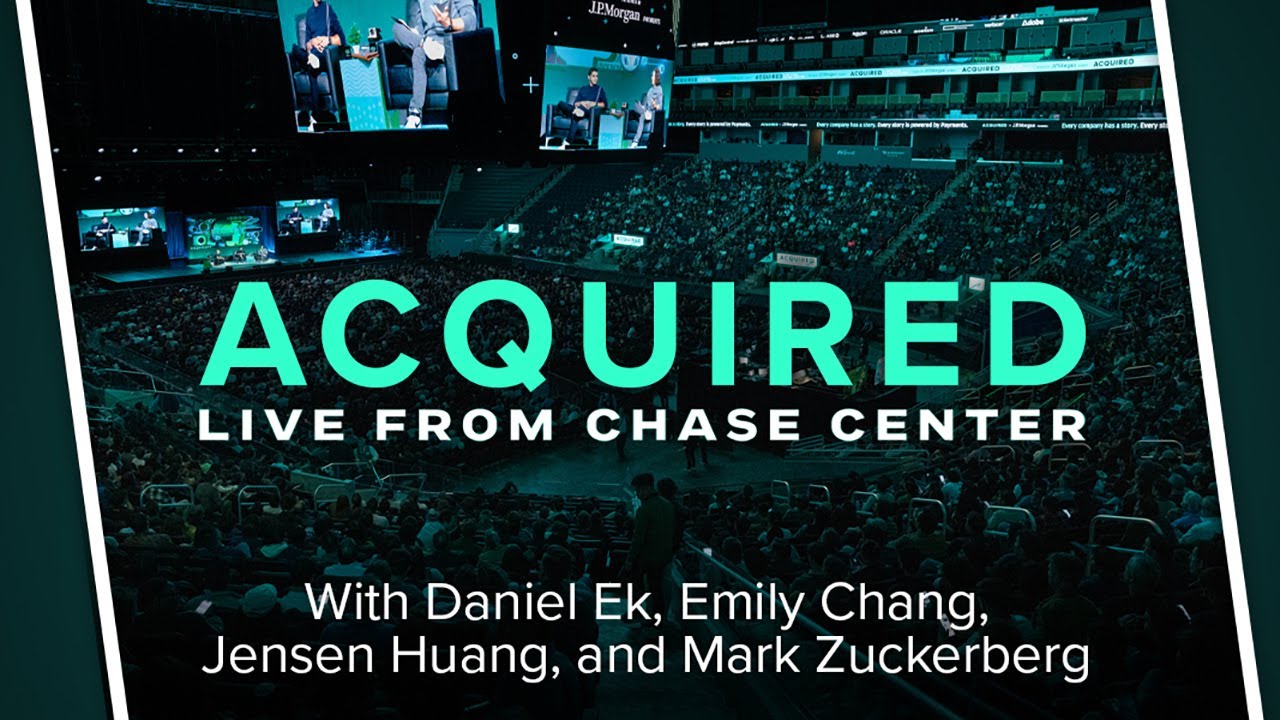
Acquired
Meta is doubling down on open-source AI and hardware infrastructure to bypass rival mobile ecosystem taxes and permanently secure product independence.
AI-assisted summary of Acquired LIVE from Chase Center (with Daniel Ek, Emily Chang, Jensen Huang and Mark Zuckerberg) — original source. Check the original for full context.
Source published:
Detailed notes
## Background Published on YouTube by the channel Acquired on September 30, 2024, this video captures a massive, sold-out live event at the Chase Center in San Francisco. The page description highlights it as a celebration of the podcast's nine-year journey, styled like a wedding for 6,000 fans, and featuring an extraordinary guest lineup that includes Jamie Dimon, Daniel Ek, Emily Chang, Jensen Huang, and Mark Zuckerberg.
## TL;DR The live event serves as a high-octane exploration of tech history, business strategy, and the evolution of massive platforms. In the first act, Spotify CEO Daniel Ek joins the hosts to discuss the podcasting medium's expansion, his company's organic product growth, and his long-standing relationship with Meta. The second act features Bloomberg's Emily Chang putting the hosts through a 'speedrun' of the Acquired canon, re-evaluating and upgrading past company grades for tech giants like YouTube, LinkedIn, and SpaceX. Finally, Meta CEO Mark Zuckerberg takes the stage for an extensive breakdown of his entrepreneurial philosophy, overcoming existential platform challenges, the strategic pivot into open-source AI and smart glasses, and his long-term vision for Reality Labs.
## Atmosphere & style The atmosphere is electric, celebratory, and deeply collaborative, carrying the immense energy of a packed 6,000-person arena while maintaining the intimate, analytical rapport of a backyard tech conversation. It opens with an undercurrent of high-stakes backstage anticipation that dissolves into a collective celebration of the Silicon Valley spirit. The hosts display a self-deprecating yet highly professional dynamic, shifting smoothly from humorous behind-the-scenes vulnerability to deep-dive strategic sparring. When tech luminaries like Ek and Zuckerberg share the stage, the mood balances high-level executive gravitas with candid, vulnerable reflections on the 'suffering' and resilience required to build generational companies.
## Key takeaways - [02:00](https://www.youtube.com/watch?v=KVc7EVfWq3M&t=120s) Acquired's live show at the Chase Center in San Francisco drew an audience of 6,000 fans, highlighting the massive organic growth of the podcast since 2015 via word-of-mouth compounding. - [09:26](https://www.youtube.com/watch?v=KVc7EVfWq3M&t=566s) Spotify founder Daniel Ek joined as a surprise guest, revealing that users have consumed over 5 million hours of Acquired content on Spotify alone, tripling year-over-year. - [16:00](https://www.youtube.com/watch?v=KVc7EVfWq3M&t=960s) The evolution of the podcast medium has drastically expanded its total addressable market, driven heavily by wireless headphones acting as a macro tailwind for long-form listening. - [19:32](https://www.youtube.com/watch?v=KVc7EVfWq3M&t=1172s) Daniel Ek noted the rapid rise of video podcasts on Spotify, fueled by younger demographics seeking autonomy and a closer connection to content creators. - [22:19](https://www.youtube.com/watch?v=KVc7EVfWq3M&t=1339s) Spotify and Facebook established deep social roots in 2008–2009 when an integration into the Facebook News Feed drove viral growth and structural social features for Spotify. - [29:14](https://www.youtube.com/watch?v=KVc7EVfWq3M&t=1754s) Spotify's internal culture prioritizes deliberate game-theorizing and debate ('talk is cheap') before coding because music licensing regulations make standard 'failing fast' too costly. - [46:08](https://www.youtube.com/watch?v=KVc7EVfWq3M&t=2768s) The hosts upgraded their historical grade of Google's acquisition of YouTube to an A+, acknowledging they originally underestimated AI-driven feed recommendation models and creator monetization dynamics. - [52:08](https://www.youtube.com/watch?v=KVc7EVfWq3M&t=3128s) Microsoft's acquisition of LinkedIn has quietly compounded into a massive success, with revenue growing fivefold over eight years to over $16 billion. - [55:50](https://www.youtube.com/watch?v=KVc7EVfWq3M&t=3350s) SpaceX's Starlink has achieved significant scale, tracking toward $6.5 billion in revenue for 2024 and operating roughly two-thirds of all active satellites currently orbiting Earth. - [01:10:13](https://www.youtube.com/watch?v=KVc7EVfWq3M&t=4213s) NVIDIA CEO Jensen Huang clarified his viral comments on entrepreneurship, stating he would start the company again but emphasizing that a certain level of ignorance is a necessary superpower to endure early startup hardships. - [01:13:58](https://www.youtube.com/watch?v=KVc7EVfWq3M&t=4438s) Mark Zuckerberg discussed the volatility of early startups, noting that true values and resilience are forged through 'Pathos Mathos' (learning through suffering). - [01:23:56](https://www.youtube.com/watch?v=KVc7EVfWq3M&t=5036s) Meta's smart glasses strategy pivoted rapidly following a weekend phone call by Zuckerberg to integrate Meta AI directly onto the device, making AI its flagship feature. - [01:26:51](https://www.youtube.com/watch?v=KVc7EVfWq3M&t=5211s) Zuckerberg attributes Meta's structural resilience across nine waves of existential competition to its explicit focus as a technology and systems engineering company, rather than just a single app. - [01:32:41](https://www.youtube.com/watch?v=KVc7EVfWq3M&t=5561s) Meta values shipping early hypotheses over receiving immediate public praise, prioritizing the real-world user data and rapid learning loops gained from early releases. - [01:40:21](https://www.youtube.com/watch?v=KVc7EVfWq3M&t=6021s) Meta leverages open-source strategies, such as the Open Compute Project and Llama AI architecture, to drive industry standards and secure platform independence from rival operating systems. - [01:52:00](https://www.youtube.com/watch?v=KVc7EVfWq3M&t=6720s) Zuckerberg protects Meta's long-term product vision and massive investments (like Reality Labs) through a dual-class share structure with super-voting shares, a system designed after a near-firing during a 2006 Yahoo buyout offer. - [02:08:27](https://www.youtube.com/watch?v=KVc7EVfWq3M&t=7707s) A philosophical shift is underway at Meta to transition from building merely 'good' or useful products to inspiring and 'awesome' products over the next 15 years. - [02:11:35](https://www.youtube.com/watch?v=KVc7EVfWq3M&t=7895s) Zuckerberg firmly rejected suggestions to rebrand Meta as a way to escape political controversy, stating that the rebrand to 'Meta' was an intentional decision to run toward a positive future vision. - [02:16:17](https://www.youtube.com/watch?v=KVc7EVfWq3M&t=8177s) Zuckerberg frames the next 10 to 15 years as an ideological platform battle against Apple, contrasting Apple's closed integrated ecosystem with Meta's push to build next-generation open platforms using Llama and smart glasses.
## Detailed walkthrough ### [00:02](https://www.youtube.com/watch?v=KVc7EVfWq3M&t=2s) The Missing Thumb Drive and a Live Venue Entrance
The episode opens with backstage banter and a last-minute panic as Ben Gilbert asks David Rosenthal if he brought a thumb drive containing the "Who Got the Truth" MP3 file for the venue's sound crew. David responds incredulously, wondering why he would bring a thumb drive when he emailed the file roughly three weeks prior. Ben underscores the gravity of the situation by reminding him that a crowd of 6,000 people is waiting outside to hear it, but David remains confident that the production team will figure out a solution.
The scene transitions into the show's theme music, "Who Got the Truth," playing loudly as the lights come up. The announcer introduces Ben Gilbert and David Rosenthal to the stage as the creators of the *Acquired* podcast, prompting massive applause from the crowd at the Chase Center in San Francisco. Standing before the audience, the hosts celebrate the fact that they did not actually need the thumb drive after all.
- Venue: Chase Center, San Francisco - Audience Size: 6,000 people - Opening Song: "Who Got the Truth"
[00:21](https://www.youtube.com/watch?v=KVc7EVfWq3M&t=21s) A Surprise Welcome from Jamie Dimon
After welcoming the crowd to *Acquired Live*, Ben and David introduce a special surprise guest to officially kick off the night: Jamie Dimon, the Chairman and CEO of JPMorgan Chase. Dimon appears via a pre-recorded video message to welcome the listeners to the Chase Center, which he notes is one of his favorite arenas. He highlights the year-long partnership between JPMorgan Payments and *Acquired*, praising the show's storytelling and educational value regarding the world's greatest companies. He expresses his regrets for not being able to attend in person before handing the stage back to the hosts.
Ben and David offer a massive thank you to JPMorgan and their payments team, specifically calling out Dustin Sedgwick, the CMO of JPMorgan Payments. They describe Sedgwick as a longtime listener who acted as the primary driving force behind the event. They also thank his marketing team, specifically naming Hannah, Nick, Vinnie, Amy, and Carli, joking that for the first time, they understand what it feels like to have a fully built-out corporate team rather than just "two guys in their basement."
[00:40](https://www.youtube.com/watch?v=KVc7EVfWq3M&t=40s) Show Format and "How the Sausage is Made"
Ben lays out the structure for the evening, revealing that the live show will feature three acts instead of one, with Meta CEO Mark Zuckerberg appearing as the headline guest in the third act following an intermission. To answer the frequent listener question of what gets cut during their typical nine-hour recording sessions, David and Ben share a humorous behind-the-scenes blooper reel.
The montage exposes the raw, unedited reality of their production process, featuring complaints about a lack of oxygen and overheating after five and a half hours of recording, pausing for bathroom breaks, pouring champagne, and getting interrupted by the screaming engines of the Blue Angels overhead. The clip highlights their internal debates over pacing, fixing historical timeline errors, debating whether to completely restart a recording 40 minutes in, and a continuous loop of filler words like "um," "uh," and "totally." David jokes, "That is how the sausage is made," noting that their editor, Steven, has to deal with that chaos every single month.
- Event Structure: Three distinct acts with a built-in intermission - Headliner: Mark Zuckerberg (scheduled for Act III) - Typical Recording Length: 9 hours of raw audio edited down to 3–5 hours
[00:08](https://www.youtube.com/watch?v=KVc7EVfWq3M&t=8s) A Celebration of the Bay Area and Daniel Ek Takes the Stage
David explains that for this live event, they are throwing the traditional *Acquired* playbook out the window. Instead of analyzing the distant past, the night is designed as a party and a celebration of technology, the San Francisco Bay Area, and the listeners themselves. Ben notes that they have lived a lifetime of milestones over the past year—both hosts had children, they were profiled by *The Wall Street Journal*, and the show experienced explosive growth. To discuss this "State of the Union," they introduce a surprise guest who is both a major fan of the show and a global expert on podcasting: Daniel Ek, the founder and CEO of Spotify.
Daniel Ek walks out to a roaring crowd, joking that the arena is a "little kind of an echoey studio" and poking fun at the hosts for finally executing a video format after he spent years begging them to do so. Ek reflects on his own journey as a fan of the show, noting that he started listening in 2019 and is amazed to see how they scaled from a small base to an arena-sized audience in just five years.
- Guest: Daniel Ek, Founder & CEO of Spotify - Daniel Ek's Listening History: Fan of *Acquired* since 2019
[12:02](https://www.youtube.com/watch?v=KVc7EVfWq3M&t=722s) Analyzing the Global Growth Metrics of Acquired
Daniel Ek presents a series of growth charts to celebrate the show's achievements. Ben explains that the podcast has relied entirely on organic, year-over-year word-of-mouth compounding since 2015, without a single dollar spent on paid marketing. Ek reveals that on Spotify alone, users have consumed over 5 million hours of *Acquired* content, a metric that tripled over the previous year. Ben jokes that his math puts this total at over 400 years of collective listening time, humorously adding, "We feel like it was 400 years making the episodes."
The discussion shifts to audience loyalty, with Ek pointing out that the show added over 250,000 followers on Spotify in the last year alone. Ben, a self-described "reformed venture capitalist," points out a sharp, unprecedented kink in their subscriber chart corresponding directly to *The Wall Street Journal* article published in May. Ek also underscores the international footprint of the show, highlighting explosive, non-English-speaking growth metrics across global markets.
- Total Listening Time on Spotify: Over 5 million hours (tripled year-over-year) - Subscriber Growth: Added more than 250,000 followers on Spotify - Global Growth Hotspots: Mexico (5x growth), Hong Kong, Israel, and Singapore
[16:00](https://www.youtube.com/watch?v=KVc7EVfWq3M&t=960s) The Evolution of the Podcast Medium and Expanding the TAM
Ek pivots the conversation to ask how this level of scale was possible, contextualizing it with Spotify's own data: in 2019, Spotify had only a few million podcast listeners, a figure that has since grown to over 150 million. David admits that when they started, they conceptualized their Total Addressable Market (TAM) through a narrow venture lens, assuming their audience was capped at the world's population of business school students, or roughly one million people. However, they realized that because they focus on deep, human storytelling, the appeal is universal. Ben attributes their success to a massive macro tailwind, noting that the proliferation of wireless headphones created a modern cultural norm where people are completely comfortable spending hours listening to esoteric, deeply researched topics.
Ek uses the moment to push the hosts to bring the show's video format onto Spotify. Ben states that he believes their current TAM is at least 10 times larger than their current audience size, even if they keep the exact same product and stick to their disciplined schedule of shipping one episode per month. Ben then turns the tables on Ek, asking how founders should navigate expanding beyond their core competency without losing what made them successful in the first place, reminding him that Spotify's original vision "was you were music on Facebook." Ek responds that expansion must always start with a deep understanding of your audience, using Germany as a case study where record labels organically hacked Spotify by uploading audiobooks long before the platform formally launched a dedicated audiobook service.
[19:32](https://www.youtube.com/watch?v=KVc7EVfWq3M&t=1172s) The Audio Tapestry and the Push for Video
The evolution of Acquired's format mirrors a broader trend toward expanding adjacent content, beginning with simple podcast uploads, expanding into audiobooks, and now facing the frontier of video. Ben and David discuss their long-held belief that "nobody wants to sit and watch us in our Studios as Talking Heads going yak yak yak." However, they have recently begun to question whether visually rich subjects—such as their massive four-hour audio history of Hermes—deserve an equally compelling visual tapestry. Despite the potential, David admits he will likely resist the transition to video "kicking and screaming," strongly believing that Acquired's high-caliber, busy audience values the format precisely because it doesn't demand undivided attention. Audio allows listeners to multitask, whether they are running, driving, or mowing the lawn.
Daniel Ek offers a contrasting perspective, noting that the rapid growth of video on platforms like Spotify has been one of his biggest surprises. While older generations might question the format, younger consumers do not differentiate between audio and video; they simply want to feel a "closer presence to the person" they are listening to. The audience’s connection to the creators is already evident in things like the popularity of blooper reels and high live event attendance. Ek emphasizes that incorporating video isn't necessarily about forcing someone to watch a full four-hour block, but about offering consumers the autonomy to dive in and out of specific segments, giving both creators and consumers novel ways to directly interact.
- **Podcast Adjacencies:** Content expansion often starts with user suggestions or organic behavior, leading from podcasts to audiobooks. - **The Hermes Example:** Acquired spent 4 hours on the multi-hundred-year history of Hermes purely in an audio format. - **Spotify Ecosystem:** Spotify is currently experiencing massive growth in video consumption, particularly driven by younger demographics.
---
[22:19](https://www.youtube.com/watch?v=KVc7EVfWq3M&t=1339s) Striking a Friendship: The Social Roots of Spotify and Facebook
Teasing their next regular episode—which will focus on a "Menlo Park based technology company"—Ben draws a parallel between holding onto a vision too tightly and the early days of Spotify's distribution through Facebook. Ek recounts the little-told backstory of his relationship with Mark Zuckerberg, revealing that pre-Facebook, Zuckerberg had actually tried to launch a music startup himself before realizing how difficult the industry was. This shared passion for music brought them together after Ek was introduced to Zuckerberg through Sean Parker in either 2008 or 2009. At the time, Spotify was not yet live in the United States, and Zuckerberg was living in a very small house where they initially jammed on social music concepts over a backyard barbecue.
To build anticipation before the US launch, Spotify used a highly strategic "secret club" approach to growth. They seeded single accounts to influencers one at a time, allowing Sean Parker to use invites as a form of high-value social currency. The inflection point arrived when Zuckerberg posted a status update stating "Spotify is so good," which triggered a wave of FOMO as users clamored for access. This early collaboration culminated in a product launch aligned with the Spotify US release, integrating directly into a very young Facebook News Feed. Users scrolling through their feeds could see real-time updates of what their friends were listening to, piped directly from Spotify.
- **Strategic Introductions:** Sean Parker introduced Daniel Ek to Mark Zuckerberg in 2008 or 2009. - **The Invite Economy:** Spotify invites served as an exclusive social currency for years prior to the official US launch. - **Legacy Features:** The real-time friend listening sidebar on Spotify desktop is a 13-year-old legacy feature born from this early Facebook integration.
---
[27:18](https://www.youtube.com/watch?v=KVc7EVfWq3M&t=1638s) Redefining Social Listening and the Pandemic Catalyst
While the explicit broadcast of every friend's listening habits eventually faded from Facebook's core layout—mirroring a broader industry shift away from presence-based social features that also impacted gaming eras like Farmville—Ek maintains that music is inherently social. He addresses David's observation that modern users think of Spotify as a utility for music, podcasts, and audiobooks rather than a social network. Ek explains that the initial product hypothesis was slightly off: people do not necessarily want to passively spy on *all* of their friends' listening habits. Instead, they want to actively collaborate on shared listening experiences.
This realization birthed "Jam," a product allowing groups of friends to synchronously alter and queue music together. The concept originated during the COVID-19 pandemic as a tool for isolated individuals to maintain a sense of connection through synchronized music, acting like "the best of linear TV brought to music." The feature has experienced rapid global growth, shifting from a pandemic lifeline to a mainstay feature at live parties, replacing the old, cumbersome practice of passing around a single physical phone to change tracks.
- **Farmville Metric:** At the time of its IPO, north of 10% of Facebook's revenue was derived from Zynga (the creators of Farmville). - **The "Jam" Feature:** A rapid-growth collaborative feature allowing real-time, shared queue control regardless of whether users are physically together or remote.
---
[29:14](https://www.youtube.com/watch?v=KVc7EVfWq3M&t=1754s) Learning from Zuckerberg and the "Talk is Cheap" Culture
Reflecting on his 15-year relationship with Zuckerberg as fellow founders in the trenches, Ek identifies Zuckerberg as "the best learner I've ever seen." He describes Zuckerberg's uncanny ability to enter a conversation knowing very little about a complex topic and emerge by the next meeting knowing more than most experts due to his relentless tenacity and curiosity. Ek has also adapted structural lessons from Meta, specifically noting Zuckerberg's mastery of large-scale meetings. While Ek prefers small intimate gatherings, Zuckerberg routinely runs highly productive product reviews with 15 to 20 people in the room, ensuring everyone feels heard.
When Ben describes Ek as a "softspoken" but "fierce competitor" who carefully calculates the chessboard much like Zuckerberg, Ek shares his personal boundary: "The rule I have with Mark is I don't try to go into a competition with them because I know it'll end badly for both of us." He jokingly cites Zuckerberg's intense physical drive, noting that Zuckerberg famously tore his ACL in a sport rather than giving up.
This hyper-deliberate competitive style defines Spotify’s internal culture. Alongside Product Officer and CTO Gustav, Ek champions the phrase "talk is cheap" in an inverted, virtuous way. While Silicon Valley values moving fast and breaking things, Spotify spends an immense amount of time debating, game-theorizing, and over-communicating before writing a single line of code. Because Spotify operates in a heavily regulated licensing ecosystem where a single minor product change can require one to two years of industry negotiation, they cannot afford to fail fast. They must be entirely certain they are right before they execute.
- **Meeting Dynamics:** Mark Zuckerberg routinely runs efficient, collaborative product reviews with 15-20 attendees. - **Spotify's Cultural Mantra:** "Talk is cheap"—meaning it is far less expensive to thoroughly debate and game-theorize an idea than it is to build the wrong product. - **The Anti-Fail-Fast Model:** Spotify intentionally positions itself as a deliberate, highly methodical operator rather than the fastest ship-and-iterate company.
---
[34:52](https://www.youtube.com/watch?v=KVc7EVfWq3M&t=2092s) The Swift Ascent to Podcast Market Leadership
Despite their highly methodical, slow-and-steady approach, Spotify's entry into the podcasting market in 2019 resulted in an incredibly rapid ascent to global dominance. When asked exactly when Spotify became the market leader, Ek notes that while it varied by region, the platform captured a significant number of markets across 2020 and 2021, cementing its status as the global market leader by 2022—just three years after launch.
This explosive growth came from a highly contrarian bet. At the time of their launch, conventional industry wisdom dictated that consumers required completely siloed, standalone applications for different media formats. Spotify rejected this fragmentation, viewing both formats simply as "listening." By leveraging an established user base that has grown from several hundred million to "way north of half a billion people" today, Spotify successfully cross-recommended premium podcast content directly to their existing music listeners.
- **Launch Timeline:** Spotify entered the podcasting space in 2019 and achieved global market leadership by 2022. - **User Base Scale:** Spotify's active user base currently sits well over 500 million (half a billion) people. - **The Core Thesis:** Disrupted the industry by consolidating music and podcasts into a single streaming ecosystem rather than maintaining separate apps.
[36:37](https://www.youtube.com/watch?v=KVc7EVfWq3M&t=2197s) Spotify's Organic Product Growth and "Terrible Experiences"
The conversation highlights Spotify’s methodical expansion into new mediums, including its rollout of audiobooks a year prior to increase user listening time. Striking a balance between expansion and core product integrity is critical; as the speakers note, pushing unwanted content into an established listening channel can easily "blow up your core." The platform's success relies entirely on users being genuinely open to utilizing it for a "new job."
Remarkably, the host and Daniel reflect on how deliberate, top-down strategy initiatives at Spotify often fail. Instead, the real breakthroughs emerge organically from existing behaviors already happening on the platform. Germany serves as a fascinating early indicator for both podcasting and books. Around 2018, books began climbing Spotify's top music track charts in Germany, making the company the biggest book distributor in the country completely by accident.
> "When your product is being used in spite of it actually being a pretty terrible experience, you kind of know you've got something."
This accidental success served as the exact genesis for building out a dedicated audiobook product ecosystem. As Daniel signs off, expressing his excitement to watch the rest of the night, the hosts pivot to the next portion of the event.
---
[38:40](https://www.youtube.com/watch?v=KVc7EVfWq3M&t=2320s) Sponsor Spotlight: Stat Sig and the Facebook Engineering Culture
The hosts introduce Stat Sig, a product acceleration platform used by thousands of companies ranging from OpenAI to early-stage startups. Stat Sig’s founding story is deeply intertwined with Facebook's historical engineering culture, famously summarized by Mark Zuckerberg's catchphrase, "move fast and break things."
Despite this aggressive mandate, Facebook rarely suffered catastrophic breaks because the company invested hundreds of thousands of engineering hours into robust internal tooling. These proprietary tools allowed any engineer to independently deploy features and track metrics in real time. If a metric tanked, the guardrails allowed them to roll back the changes instantly.
* **The Stat Sig Solution:** Founded by an ex-Meta team, Stat Sig productized this internal capability for the broader tech ecosystem. * **All-in-One Platform:** The tool integrates feature flags, product analytics, experimentation, and observability into a single platform. * **Major Clients:** Enterprise users include Microsoft, Notion, Anthropic, Figma, and OpenAI.
---
[40:34](https://www.youtube.com/watch?v=KVc7EVfWq3M&t=2434s) Sponsor Spotlight: Cruso and the Physical Infrastructure of AI
The discussion turns to Cruso, a climate-aligned AI infrastructure provider that operates GPU data centers powered by clean, low-cost "stranded energy" that would otherwise be wasted or emitted as greenhouse gases. What started a year prior as an "insane concept" has evolved into an AI cloud infrastructure that rivals the major hyperscalers, attracting some of the largest companies in the world.
The hosts emphasize that while AI is often conceptualized as phds tinkering with model weights, there is a massive industrial side involving cooling, construction, steel, and pipes. Cruso deploys hundreds of construction workers, steelworkers, and electricians to build data centers in some of the harshest environments on Earth.
* **Power Pipeline:** Cruso has gigawatts of power in its development pipeline—equivalent to nuclear reactor capacities. * **The AI Bottleneck:** The primary constraint on current AI progress is no longer compute capacity, but raw energy availability. * **Dual Engagement Models:** Customers can access Cruso through a managed AI Cloud (ideal for startups) or directly as an enterprise data center customer.
---
[43:07](https://www.youtube.com/watch?v=KVc7EVfWq3M&t=2587s) Act Two: Speedrunning the Acquired Canon with Emily Chang
Moving into "Act Two" of the evening, the hosts detail their planning process. Rather than asking the audience what they wanted to hear, they scanned their inbox. The second most frequent type of email received reads: "you did this episode, you were wrong, you need to fix it." To address these historical missteps and update the Acquired canon, they invite Emily Chang, host of Bloomberg's *The Circuit*, onto the stage.
Before diving into the business critiques, the hosts grill Emily for research regarding Mark Zuckerberg's viral 4th of July wake-surfing video, where he famously wears a completely dry tuxedo while holding an American flag and drinking a beer. Ben notes that whenever he tries to wake surf, he has to start submerged in the water, which would instantly ruin a suit.
Emily confirms that the feat is entirely real, explaining that Zuckerberg is skilled enough to perform a "dry start"—riding the board directly off the swim platform of the moving boat without ever falling into the water. She adds that both Mark and Priscilla can genuinely "shred."
---
[46:08](https://www.youtube.com/watch?v=KVc7EVfWq3M&t=2768s) Revisiting the YouTube Acquisition Grade
Emily wastes no time "twisting the knife" on the hosts' past grading mistakes, taking them back to 2016 when they covered Google's acquisition of YouTube. At the time, David gave the deal a C, and Ben suggested it could be as bad as a C-.
The hosts cringe as Emily reads their exact historical quotes back to them. Ben had claimed he was "bearish on YouTube primarily because it's not a destination," while David had openly questioned, "who goes to YouTube and discovers something?"
``` "The sad part is that we actually said that and decided to revisit this... YouTube was like the utility that you uploaded a video to and then you could embed it on your site." ```
In their defense, Ben notes that AI-driven feed recommenders and social media algorithmic sorting were just starting to take off at that exact moment. Google and Meta began buying up massive amounts of GPUs to train recommendation models, completely transforming platforms into the ultimate destination sites—a killer AI use case that they completely overlooked a decade ago.
---
[48:48](https://www.youtube.com/watch?v=KVc7EVfWq3M&t=2928s) The Modern Economy of YouTube and Creator Dynamics
Today, analysts suggest that if YouTube were spun out of Google, it would be valued at half a trillion dollars—nearly double the market cap of Netflix. Furthermore, YouTube TV is on track to become the largest cable provider in the United States.
However, David offers a legitimate business defense for their past skepticism: Google only reports YouTube's revenue, never its true profitability. When they graded the episode, YouTube was on a \$5 billion revenue run rate and losing massive amounts of money as a total "money pit." Today, it sits at a \$35 billion to \$40 billion annual revenue run rate, but its underlying business model remains uniquely expensive compared to traditional media.
* **Revenue Splits:** YouTube pays out 55% of revenue on long-form content and 45% on Shorts directly to creators. * **Content Spend:** This variable cost resulted in \$70 billion paid out to creators over the last three years, outstripping Netflix’s total content budget. * **Revised Grade:** The hosts unanimously upgrade the acquisition to an **A+** today, citing its immense strategic value as the world's second-largest search engine and its existential defensive value to Google's core business.
---
[52:08](https://www.youtube.com/watch?v=KVc7EVfWq3M&t=3128s) The LinkedIn Acquisition: A Hidden \$100 Billion Success Story
Emily moves to the next company on the list: LinkedIn. The hosts covered Microsoft's acquisition of LinkedIn just three days after it was announced, initially giving it a highly positive "A" grade despite having no long-term historical data to back it up.
While the hosts were right to be positive, they admit they had no idea just how massive the running room ahead actually was. At the time of acquisition, LinkedIn's advertising and content ecosystems barely existed. Today, the platform generates over \$16 billion in revenue—a 5x increase over the eight years since it was bought.
* **Revenue Composition:** Out of its current revenue, over \$5 billion comes strictly from advertising and content products developed post-acquisition. * **Platform Engagement:** The hosts note that Acquired has an equal number of followers on LinkedIn compared to other major social platforms, yet the actual user engagement is 5x to 10x higher. * **Market Capitalization Value:** While a 5x revenue increase over eight years is excellent rather than historically anomalous, it essentially created an independent company worth well over \$100 billion, all quietly compounding inside Microsoft.
[54:03](https://www.youtube.com/watch?v=KVc7EVfWq3M&t=3243s) The Microsoft-LinkedIn Breakthrough
The hosts recall the complete shock of Microsoft acquiring LinkedIn, a massive tech transaction that occurred without a single leak or early media report. Emily Chang shares a personal anecdote of being caught entirely off guard at the "crack of dawn." Her producer had been calling her phone non-stop, eventually calling her husband to deliver the news: "Microsoft just bought LinkedIn and you have to interview Satya and Jeff Weiner in an hour." Despite the chaotic rush, she pulled off the interview successfully.
Chang introduces fresh insights regarding Microsoft’s evolution, quoting LinkedIn co-founder Reed Hoffman, who remains on the Microsoft board. Hoffman characterizes Satya Nadella's leadership style as a "refounder" or a "late stage co-founder," noting that a refounder doesn't need to have been "in the garage from day one." According to Hoffman, Nadella successfully shifted Microsoft's trajectory away from a "Cutthroat culture and competition only practices" to focus heavily on social networks, collaboration, the cloud, and the early waves of artificial intelligence.
- The Microsoft acquisition of LinkedIn was executed with total secrecy, lacking any prior media leaks. - Kevin Scott, the current CTO of Microsoft, originally joined the tech giant from LinkedIn. - Reed Hoffman was an early investor and board member at OpenAI, mirroring Microsoft's current position as its largest backer.
[55:50](https://www.youtube.com/watch?v=KVc7EVfWq3M&t=3350s) SpaceX and the Starlink Juggernaut
The discussion shifts rapidly to SpaceX, one of the podcast's most popular historical episodes. When the show originally covered the company in May 2020, SpaceX was valued at \$36 billion and had completed 26 successful launches that year. The growth since then is described as "an insane" acceleration; the company completed 96 launches in the previous year and is targeting 118 for the current year, averaging more than two launches a week.
However, the hosts highlight that the core launch business is no longer the most financially compelling piece. Starlink has completely transformed the enterprise, tracking toward an estimated \$6.5 billion in revenue for 2024 and reportedly achieving profitability. The rapid consumer adoption is underscored by its 3 million subscribers accumulated just three years post-launch, shifting Starlink from a "pie in the sky" concept into a dominant aerospace asset.
- SpaceX completed 96 launches last year and targets 118 this year, equating to a launch roughly every three days. - Starlink’s 7,000 active satellites represent approximately two-thirds of all operational satellites currently orbiting Earth. - Starlink as a standalone entity is noted to be worth significantly more than the entire \$36 billion SpaceX valuation from 2020. - The speakers joke about geopolitical dynamics, noting NASA had no choice but to rely on SpaceX to rescue stranded astronauts since options with Russia, China, or Boeing were complicated or non-viable.
[57:55](https://www.youtube.com/watch?v=KVc7EVfWq3M&t=3475s) Valuing the Taylor Swift Enterprise
The conversation turns to Taylor Swift, who previously received an A+ grade on the show. The hosts debate how to properly calculate the enterprise value of a single artist, noting that conventional corporate metrics are hard to apply. When the original episode aired, Forbes estimated her net worth at \$550 million. Today, the scale has fundamentally shifted; the hosts estimate that Swift generated roughly \$550 million in "free cash flow" over the past 12 months alone.
A significant miscalculation from their previous coverage involved streaming economics. While industry myths suggested streaming platforms yield low returns for top-tier creators, Swift reportedly cleared "well over \$100 million from Spotify streaming alone" last year. Because she successfully executed her strategy to re-record her master albums, an incredibly high percentage of those streams direct maximum gross margins straight back to her, allowing her to out-earn the world's top Hollywood actors and athletes from streaming alone.
- The Eras Tour grossed \$1.1 billion in calendar year 2023, eclipsing the previous all-time historical record for a tour, which took multiple years to earn. - Assuming an efficient, high-margin touring operation of 30% to 35%, the tour yielded \$300 million to \$350 million in direct annual cash flow. - Her direct-to-theater concert film grossed \$267 million at the box office, bypassing traditional Hollywood middlemen, with an additional \$75 million secured via a streaming rights deal with Disney. - The hosts debate whether Swift’s business commands a premium multiple similar to major content houses like Disney, which trades at 20x free cash flow. Applying that multiple to her \$550 million cash flow would value her enterprise at \$11 billion. - Ben expresses skepticism over a 20x multiple, warning against valuing an asset based on an extreme outlier year with zero diversification, while David defends the enterprise lens, noting she is "the Rolling Stones of this generation."
[01:05:38](https://www.youtube.com/watch?v=KVc7EVfWq3M&t=3938s) JP Morgan Payments Takes the Stage
Following Emily Chang's departure, the hosts introduce Max Neukirchen and Umar Farooq, the global co-heads of their presenting partner, JP Morgan Payments, to conduct an unprecedented live ad-read on stage. Neukirchen defines the business simply: they help companies receive, hold, send, and safeguard money against fraud, leveraging transactional insights to scale operations. Their client footprint spans from local corner coffee shops requiring point-of-sale hardware to massive global marketplaces and multinational financial institutions.
Farooq expands on how the institution keeps pace with Silicon Valley innovation. Operating within their Onyx business unit, JP Morgan runs the largest financial blockchain ecosystem on the planet, moving larger transaction volumes than standard commercial crypto blockchains. Furthermore, they are deeply integrated into embedded finance systems and rely on internal AI models to actively combat adversarial fraud networks.
- JP Morgan Payments operates across 160 different countries worldwide. - The business moves approximately \$10 trillion every single day, which represents roughly 1 out of every 4 dollars moving globally. - The executives state that corporate clients "simply can't outgrow us," positioning themselves as a permanent financial infrastructure partner from startup to scale.
[01:10:13](https://www.youtube.com/watch?v=KVc7EVfWq3M&t=4213s) Jensen Huang Clarifies the Record
Before heading into the event intermission, the hosts share a special video message from a previous landmark guest, NVIDIA CEO Jensen Huang. The hosts explain that a clip from their past interview with Huang went viral, racking up tens of millions of views and hitting major publications like the Wall Street Journal and The New York Times. Because the snippet was widely misunderstood, the hosts actually pulled it down out of respect and invited Huang back to clarify his true meaning.
In the video, Huang addresses his viral response to the question of whether he would start NVIDIA all over again if he knew then what he knows now. His original answer—"absolutely not"—was widely sensationalized. Huang clarifies with a smile that "of course I would start the company if I knew it would turn out this way." His real point was a commentary on the sheer, agonizing difficulty of early-stage entrepreneurship.
- Huang stresses that building a company from scratch is "insanely hard" due to the overwhelming volume of unknowns. - Success requires surrounding oneself with exceptional talent to navigate intense adversity and outmaneuver highly intelligent adversaries.
[01:12:20](https://www.youtube.com/watch?v=KVc7EVfWq3M&t=4340s) Ignorance as an Entrepreneurial Superpower
Reflecting on his 31 years of running NVIDIA, Jensen Huang discusses how a 29-year-old’s brain would simply reject starting a company if all the impending hardships, pain, and suffering were compressed into it beforehand. This leads to what he describes as the "superpower" of entrepreneurs: a certain level of ignorance. Not knowing just how incredibly difficult the journey will be is precisely what allows an entrepreneur to take the leap and get started in the first place.
With the historical record officially corrected and a brief moment of banter, the hosts announce the night's main event. After a star-studded lineup featuring Jensen Huang of NVIDIA and Daniel Ek of Spotify, the crowd welcomes Meta's iconic founder and CEO, Mark Zuckerberg, to the stage amidst roaring music and high energy.
---
[01:13:58](https://www.youtube.com/watch?v=KVc7EVfWq3M&t=4438s) Pathos Mathos: Learning Through Suffering
Taking his seat, Zuckerberg jokes that after watching Jensen correct the record, he might need to book an entire second session just to apologize for whatever he says during this interview. When a host laughs that Zuckerberg does not apologize anymore, the discussion jumps straight into a burning question: if Zuckerberg knew then what he knows today, would he have actually started Facebook? Zuckerberg agrees with Jensen's sentiment, recalling the immense volatility and "thrashing" of the early startup days where everything felt like it could die at any moment. While he looks back on those times with fond memories, it is not a part of his life he wishes to relive. He attributes the willingness to start companies to a saving grace of human nature—the tendency to underestimate future pain in order to go out and accomplish good things.
The conversation naturally shifts to Zuckerberg's custom-designed attire. He explains that since Meta is designing eyewear and other wearables, he decided it was time to "get good at this" by collaborating with fashion designer Mike Amir. Zuckerberg shows off his shirt, which features the classical Greek saying *Pathos Mathos*, meaning "learning through suffering." When asked what the phrase means to him personally, Zuckerberg shares that it embodies the entrepreneurial journey.
"Values are not what you write down on the wall, it’s like your lived behaviors," Zuckerberg explains, noting that true values and one's place in the world are only discovered by repeatedly hitting your head against challenges and making hard trade-offs. The hosts point out that by their count, Meta has faced more existential challenges in its first 20 years than almost any meaningful company in history. Zuckerberg embraces this "dubious distinction," noting that the iconic Nike ad where Michael Jordan talks about failing over and over to achieve success deeply resonates with him.
---
[01:18:34](https://www.youtube.com/watch?v=KVc7EVfWq3M&t=4714s) The Evolution of Social Connection and Smart Glasses
Zuckerberg introduces Meta's smart glasses, created in partnership with EssilorLuxottica (the makers of Ray-Ban). He explains that Meta has been building social experiences for 20 years, shifting from websites to mobile apps. However, he has never viewed Meta as just a social media or app company; rather, it is a "social connection company" dedicated to building the future of human connection. Because the early days of Facebook coincided with the dawn of smartphones, a handful of college kids didn't have the resources to define that computing platform. For Meta's next chapter, Zuckerberg wants to build ideal social experiences from first principles, rather than being restricted by platforms built by others.
The ultimate goal is a pair of normal-looking glasses that can see what you see and hear what you hear, acting as a contextual AI assistant while projecting holographic images into the world. Zuckerberg describes a future where people can experience a realistic, physical sense of human presence even if one person is only there as a hologram. This mixed-reality environment will serve as the ultimate digital social experience and the ultimate incarnation of AI. Meta has been working on this massive project for 10 years, conquering monumental hurdles such as engineering a brand-new holographic display stack, miniaturizing components, and integrating chips, speakers, cameras, eye-tracking, batteries, and novel RF protocols into a sleek form factor.
* **10 Years:** The amount of time Meta has spent developing its advanced AR glasses technology. * **EssilorLuxottica:** Meta's core design and manufacturing partner for the Ray-Ban smart glasses. * **Hardware Components Packed into Glasses:** Custom holographic display stack, chips, microphones, speakers, cameras, eye-tracking sensors, batteries, and novel RF protocols.
---
[01:23:56](https://www.youtube.com/watch?v=KVc7EVfWq3M&t=5036s) The Saturday Phone Call and Pivoting to AI
Zuckerberg admits that when they first partnered with EssilorLuxottica, he initially viewed the basic smart glasses as a "practice project" to learn how to build advanced eyewear. One of the hosts jokingly cuts in to remind him that Zuckerberg originally thought Facebook itself was just a temporary project. This sparks a tangent about Zuckerberg's early days arriving in Silicon Valley with Dustin Moskovitz. Driving down Highway 101 past the headquarters of eBay and Yahoo, they hoped to build a real company like that "one day"—completely missing the reality that the Facebook project they were already scaling *was* that company.
Returning to the glasses, Zuckerberg describes how the explosive, full-scale transformation of AI completely changed the trajectory of the product. The hosts emphasize to the audience that these glasses were originally shipped before large language models (LLMs) or the public "ChatGPT moment" penetrated mainstream consciousness. Zuckerberg notes that he initially expected AR holograms to mature before full-scale AI, but when the timeline flipped, he realized the glasses—equipped with cameras, speakers, and mics—were the perfect vehicle for AI.
The host shares a high-stakes behind-the-scenes story told by Alex Himel, who runs the product group. Himel was driving on the highway with his kids on a Saturday when Zuckerberg called him out of the blue, asking if they could pivot, put Meta AI directly on the device, and ship it immediately to see if it worked. Zuckerberg laughs and confirms the story tracks perfectly. By the following Tuesday, the team had already put together a working prototype, cementing Meta AI as the flagship feature of a highly successful product.
---
[01:26:51](https://www.youtube.com/watch?v=KVc7EVfWq3M&t=5211s) The Nine Waves of Existential Competition
The conversation pivots to a central question: why has Meta worked so spectacularly well, maintaining its status as one of the most valuable companies in the world through multiple technology waves? The hosts list nine distinct eras where the public narrative insisted Facebook and Meta were completely "screwed" and destined to go obsolete:
1. MySpace 2. Twitter (Gen 1) 3. Instagram 4. Snapchat (particularly when they invented "Stories") 5. WhatsApp 6. TikTok 7. Apple's App Tracking Transparency (ATT) framework 8. The rise of ChatGPT
Despite these continuous existential threats, Meta has thrived. Zuckerberg explains that the through-line of the company's DNA is its identity as a technology company focused broadly on human connection, rather than a specific app or website. For him, transitioning from apps to smart glasses that deliver a sense of presence is a completely natural continuation of their core mission. He credits their resilience to a deeply rooted technological foundation, noting that his own background as an engineer who focused heavily on systems engineering in college shapes how the entire company approaches complex problem-solving.
[01:29:19](https://www.youtube.com/watch?v=KVc7EVfWq3M&t=5359s) Building a True Technology Company
The conversation kicks off with a look back at the scaling challenges of early social networks like Friendster and Myspace. Calculating social graphs and determining mutual connections was an incredibly difficult computational problem that blended product philosophy with technological capability. Mark Zuckerberg explains that if a product's definition is too general, the underlying technology becomes practically impossible to solve. A successful tech firm requires a smart product definition paired with a relentless drive to execute the technology better than anyone else.
Zuckerberg recalls that when he first arrived in Silicon Valley, he noticed that many self-proclaimed "technology companies" weren't actually structured as such. They often featured non-technical CEOs, boards completely devoid of technical expertise, and just a single head of engineering representing the technical side on the management team. To combat this, Zuckerberg intentionally structures his management team with a strong contingent of leaders who rose through the company's technical pathways. While he acknowledges that not everyone should be an engineer, a company cannot truly call itself a technology company without a significant share of technical leadership. This foundational focus is what allows Meta to transition fluidly from platform to platform.
- **Product vs. Tech:** A broad product definition can make technical implementation impossible; smart constraints are required. - **The Silicon Valley Observation:** Early tech companies often lacked technical depth at the executive and board levels. - **Organizational Learning:** Zuckerberg defines Meta's core strategy not as a single fixed idea, but as the ability to iterate and learn faster than any competitor.
---
[01:32:41](https://www.youtube.com/watch?v=KVc7EVfWq3M&t=5561s) The Turn-Based Strategy of Shipping Early
An interviewer brings up a piece of feedback from a research call, where an observer described Zuckerberg as a master strategist who "plays the company as if it's a turn-based strategy game." The goal is simply to secure more turns than anyone else and extract more learning from each turn. While Zuckerberg jokingly caveats his strategic record with the things he incorrectly assumed would be unimportant, he agrees that speed of iteration is a distinct, vital value. He contrasts Meta's cultural DNA directly with Apple's slow, hyper-polished methodology.
At Meta, internal conversations frequently push right up to the line of being embarrassed by a product's initial release. Zuckerberg strongly advocates for a culture that values shipping early over receiving immediate public accolades. Waiting around for praise means missing critical windows to capture real-world user data. While the hosts push back, suggesting that releasing unpolished tools could damage the brand, Zuckerberg specifies that they never intentionally ship bad products. Instead, they release functional, early hypotheses to figure out what the use cases actually are—a strategy they are currently leaning into heavily with their AI rollouts.
> "If you want to wait until you get praised all the time, you're missing a bunch of the time when you could have learned a bunch of useful stuff."
---
[01:36:53](https://www.youtube.com/watch?v=KVc7EVfWq3M&t=5813s) Product Creation: Invention vs. Discovery
The hosts pose a philosophical question about product development: Is it an act of invention or one of discovery? They use the metaphor of Michelangelo's David, asking if the perfect product is already inside the marble waiting to be uncovered via user feedback, or if it is fully conceived in the creator's mind first. Zuckerberg rejects the binary choice, stating it is a mix of both. True product creation requires holding internal values about what *should* exist in the world, while simultaneously staying highly attuned to what resonates with users. Relying only on personal vision leads to a lack of product-market fit, while relying purely on market feedback leaves a team without the conviction to survive hard times.
To illustrate, Zuckerberg points to the creation of the Facebook News Feed in 2006. Prior to that, social networks were just static collections of profile pages. Meta established a seminal pattern by ranking and streaming updates into a singular feed—a concept that is now an absolute baseline for any social product. Conversely, he notes that Meta takes equal pride in adopting and improving formats discovered by others, such as the Stories format. He candidly admits that "there are more smart people outside of your company than inside," and refusing to learn from the broader market means missing vital consumer signals.
---
[01:40:21](https://www.youtube.com/watch?v=KVc7EVfWq3M&t=6021s) Open Source as a Strategic Imperative
The discussion shifts to open-source technology. The interviewers posit that Meta has historically been one of the single largest beneficiaries of open source in the modern world. Zuckerberg agrees, noting that Meta was the first major corporation built entirely on the LAMP stack (Linux, Apache, MySQL, PHP) and could not have been created without it. However, Meta’s relationship with open source evolved uniquely because they came into maturity right after Google.
Google had already built massive, proprietary distributed computing infrastructure as a competitive advantage. When Meta built its own version, Zuckerberg realized that keeping it closed offered them no leverage against Google. By opening it up through initiatives like the Open Compute Project, Meta turned its designs into the industry standard. This moved the entire supply chain, made production significantly cheaper, and saved the company billions of dollars. Zuckerberg applies this exact same playbook to artificial intelligence with Llama, explaining that large models are ecosystems that inherently grow stronger the more people build on top of them.
- **The LAMP Stack Legacy:** Meta’s early foundation was built entirely on free, open-source software, enabling rapid development. - **The Open Compute Win-Win:** Standardizing hardware designs across the industry drove down supply chain costs globally. - **Platform Independence:** Developing core tech platforms like Llama, AR glasses, and mixed reality ensures Meta won't have its product decisions blocked by rival mobile operating systems.
The HTML5 Mobile Pivot and the Post-IPO Drawdown
The conversation shifts dramatically as one of the hosts eagerly "grabs the wheel" to steer the discussion toward Facebook's historic mobile transition. In May 2012, right around the time of its initial public offering (IPO), Facebook had built its mobile experience on HTML5. The company went public at a massive \$104 billion market cap, only to suffer a painful 50% drawdown over the subsequent three months—a collapse heavily attributed to their broken mobile strategy. Asked how this brutal period informs his current approach to massive technological shifts like AI, Mark Zuckerberg explains that the company’s legacy was deeply rooted in building for the web. They were accustomed to a continuous deployment style where they could write code once and ship it instantly.
When smartphones emerged, the native app ecosystem felt incredibly restrictive to Facebook's fast-moving culture. They balked at the idea of building distinct apps for every operating system, waiting weeks for app store approvals, and navigating bureaucratic review processes. Their solution was to build a native shell containing a web-based platform. Zuckerberg recalls thinking that whatever performance downside they suffered from not being native would be easily offset by sheer engineering velocity and the ability to maintain a single codebase across Android, iPhone, BlackBerry, and Windows Mobile. "Well, we were wrong," Zuckerberg admits bluntly. The native integration turned out to be completely critical for the user experience and making interactions feel smooth.
- Facebook went public at a \$104 billion market cap in May 2012, followed by a 50% stock plunge over three months. - The HTML5 approach was designed to target all major operating systems of the era simultaneously: Android, iPhone, BlackBerry, and Windows Mobile. - Facebook chose to completely pause new feature development for roughly a year to execute a native rewrite from scratch, citing historical tech industry failures like Netscape as cautionary tales of trying to add features during an underlying platform overhaul.
Monetizing Mobile and Surviving the Rewrite
The technical rewrite coincided with an explosion in mobile traffic, creating a terrifying structural crisis: Facebook had zero mobile revenue. Zuckerberg notes that on desktop, the user interface featured a main application column and a separate side column dedicated to ads. Mobile offered no such real estate, meaning the team had to invent an entirely new paradigm. "Let's be clear, the feed ad had not been invented yet," a host chimes in. Advertisers were deeply resistant to their formats being altered to look like organic feed stories, while users were hostile to commercial content encroaching on their personal feeds.
Compounding the problem, as desktop usage shrank and unmonetized mobile usage grew, the percentage of Facebook's traffic that could actually make money plummeted. Despite the immense public pressure of being a newly public company, Zuckerberg kept the focus on the long game. He notes that while it is strategically difficult to figure out the next move when you are winning, "when you're losing it's usually pretty clear what you have to do." Internal teams felt better sooner because the path forward was obvious, even if Wall Street panicked over a year and a half of stagnant financial performance. Looking back, Zuckerberg jokes that a year-and-a-half-long mistake that cuts your market cap in half is "not that bad" in the grand scheme of things.
- Desktop monetization relied on a dedicated side column for advertisements, which did not exist on smaller mobile screens. - The company faced simultaneous pushback from advertisers who resisted the feed format and users who disliked ads in their organic feeds. - Zuckerberg describes the cultural difficulty of abandoning a working "local hill" to leap to another, contrasted with the clarity that comes from an outright crisis.
The 20-Year Political Miscalculation
The hosts push Zuckerberg to turn his reflective eye toward deeper criticisms of Meta, asking which historical critique he views as the most legitimate. Zuckerberg reflects on how the political environment shifted violently around 2016. Prior to the 2016 U.S. presidential election, public and media sentiment toward Facebook was overwhelmingly positive, barring the brief post-IPO dip. Immediately after the election, the sentiment flipped into a relentless wave of negativity. Zuckerberg confesses that he lacked political sophistication and fundamentally misdiagnosed the problem.
His core regret stems from treating a highly charged political crisis with the standard playbook of a corporate crisis. In business, the right instinct is to take complete ownership of an issue and vow to fix it. However, Zuckerberg notes that in politics, while some actors operate in good faith, many are simply looking for a scapegoat to blame. By repeatedly accepting responsibility for massive, systemic societal ills that people blamed on tech, Facebook essentially invited further attacks. Zuckerberg estimates that if the IPO mobile pivot was a year-and-a-half mistake, this political miscalculation is a "20-year mistake" that will take another decade to fully resolve.
- Zuckerberg distinguishes between Meta's identity as a "technology company" versus a "human connection company," rather than just a social network. - The shift in public sentiment occurred sharply around the 2016 election, moving from consistently positive to consistently negative. - Zuckerberg believes Meta should have been much firmer in pushing back against unproven allegations regarding social media's correlation with societal harms. - To counter ungrounded claims, Meta has pivoted toward supporting independent, third-party academic research in advance, recognizing that the company lacks standalone credibility when under political fire.
Super-Voting Shares and the Yahoo Buyout Lesson
The conversation turns to Meta's unique governance structure and the immense advantage of Zuckerberg's long-term "Buffett duration" perspective. Because Zuckerberg started the company as a 19-year-old college dropout, he enjoys a massive horizon of remaining career longevity. Crucially, he protects this long-term view through a dual-class share structure with super-voting shares—a mechanism that non-founder CEOs simply do not have. Zuckerberg traces the origin of this absolute control back to a traumatizing corporate crisis in 2006, when Yahoo offered to buy Facebook for \$1 billion.
At the time, Facebook was just a two-year-old project. Every single member of the management team wanted to sell, the board of directors actively tried to fire Zuckerberg for refusing the offer, and within a year, the entire executive team quit in protest. Zuckerberg takes the blame for the fallout, admitting he lacked the corporate sophistication to articulate a long-term financial plan or explain why the company would be worth far more in the future. "It probably wasn't super confidence-inspiring to them when I was like, 'Hey, I think we should turn this down because we're going to do this,'" he recalls. Shaken by the experience of nearly being ousted from his own creation, he resolved to set up a governance structure that would make it impossible to fire him again. The hosts marvel at this narrative of "learning through suffering," pointing out that Facebook's early cash-generative nature meant Zuckerberg never had to "cut off his arm" and cede ultimate control just to survive.
- In 2006, Yahoo offered to buy Facebook for \$1 billion, leading to a massive internal rift when Zuckerberg refused to sell. - The entire management team subsequently left the company within a year due to the strategic disagreement and a lack of shared long-term vision. - The near-firing drove Zuckerberg to intentionally design a corporate governance system centered around super-voting shares to secure absolute founder control.
[01:59:17](https://www.youtube.com/watch?v=KVc7EVfWq3M&t=7157s) Keeping Startups Lean and the Myth of Romanticizing Early Stages
The common perception of Facebook is that it represents the prototypical startup, framing Mark Zuckerberg as the iconic founder of the century. However, it is noted that while many people romanticize starting a company for glamorous reasons, Zuckerberg actually wanted to transition Facebook out of the chaotic "startup" phase as quickly as possible into a stable, going concern. Reflecting on this, Zuckerberg shares that he is having much more fun now because he actually has the capability to work on the things he wants. He cautions founders against diving headfirst into an idea simply for the sake of starting a company, noting that such a rigid approach is dangerous.
Zuckerberg emphasizes that the early phase of a project requires extreme nimbleness and the flexibility to pivot. To illustrate, he reveals that during his college days, he built around 12 different things just because he wanted them to exist. He didn't initially realize Facebook would become a massive company; he was simply building tools, helping upkeep the ones people kept using, and moving on to the next idea. He argues that maintaining internal flexibility is much easier when you can "have meetings in your own head" about changing direction. Once a large team is hired, people invest their egos and pride into a specific path, making it much harder to convince them to change course. This is why Meta has actively worked to strip away excess layers and return to the leanest possible version of a large company.
- Zuckerberg built roughly 12 different projects while in school before Facebook became a definitive company. - A major pitfall of scaling too quickly is that having too many people on a project reduces individual agency, which kills fun and prevents the company from attracting top-tier talent.
[02:01:51](https://www.youtube.com/watch?v=KVc7EVfWq3M&t=7311s) Reality Labs, Strategic Autonomy, and the Economics of Platform Taxes
When challenged on whether spending a "gajillion dollars" on Reality Labs violates his own rule about keeping resource allocation appropriate to a project's stage, Zuckerberg defends the massive investment by looking at a 10-to-20-year horizon. He is entirely confident that AR glasses and holographic presence will become completely ubiquitous. He points out that if Meta can simply capture the existing global market of people who already wear glasses and upgrade them to AI-powered eyewear, it will easily become one of the most successful products in history.
Beyond product vision, there is a stark, multi-billion-dollar strategic calculation behind owning the next computing platform: controlling their own destiny. Zuckerberg shares that Meta conducted an internal estimate to calculate how much profitability they lose from their core Family of Apps due to "taxes" and restrictions imposed by rival platforms (like Apple and Google). When external platforms dictate how Meta can run its ad business or restrict what products can be shipped, user engagement and satisfaction drop. Zuckerberg estimates that Meta might be twice as profitable today if they owned the underlying platform. While he notes he has "learned a thing or two since the Yahoo days" about articulating a long-term business case to skeptical investors, his primary motivation remains the product experience itself.
- Zuckerberg believes upgrading the existing population of glasses-wearers to AI glasses would make it one of the most successful product launches ever. - Internal estimates suggest Meta could potentially be twice as profitable if they weren't subjected to rival platform restrictions and ad-tracking limitations. - Zuckerberg notes that his absolute control over the company's governance allows him to maintain these massive investments in Reality Labs even when short-term investors object.
[02:04:04](https://www.youtube.com/watch?v=KVc7EVfWq3M&t=7444s) Shifting Focus From "Good" to "Awesome" Products
Zuckerberg details a profound philosophical shift in his leadership, inspired by a distinction early Oculus team members taught him: the difference between building "good" things versus "awesome" things. Good products are useful, helpful, and add daily value to people's lives—a standard Meta has clearly achieved with its massive user base. However, "awesome" products are fundamentally different; they are uplifting, inspiring, and make people feel deeply optimistic about the future and humanity. Zuckerberg acknowledges that while more than 3 billion people use Meta's products daily because they are incredibly useful for connecting, building businesses, and forming communities, very few people actually get out of bed in the morning and enthusiastically celebrate social media as an inspiring concept.
Looking ahead at the next 15 years of his career, Zuckerberg wants Meta to stand for things that are inspiring and awesome, placing both Reality Labs and their core AI initiatives squarely into this bucket. This corporate shift mirrors a deeper evolution in his personal life as he grows older. Zuckerberg explains that he now prioritizes working on inspiring projects with inspiring people. This includes solving complex scientific problems alongside his wife, Priscilla, collaborating with world-class fashion designers, and commissioning contemporary artists like Daniel Arsham to create a sculpture of his wife to revive the ancient Roman tradition of sculpting loved ones.
- Meta's core products currently reach a staggering 3.3 billion daily active users across its family of apps. - Zuckerberg identifies Reality Labs and fundamental AI research as the primary vehicles for this new 15-year era of creating "awesome" products. - His side projects include a cattle ranch in Kauai where he is attempting to raise the highest quality beef in the world. - He shares an anecdote about a steer named "Chun," who repeatedly busts through steel enclosures whenever he sees a female cow—humorously noting that this relentless drive is exactly "the kind of bull that you want" for world-class breeding.
[02:08:27](https://www.youtube.com/watch?v=KVc7EVfWq3M&t=7707s) The COVID-19 Reflection and the Decision to Double Down
When asked if this radical evolution in his personality and focus was sudden or gradual, Zuckerberg attributes a lot of the change to the operational shifts during the COVID-19 pandemic. Being naturally introverted, the temporary shift to remote work gave him much-needed time alone to step back and reflect. This period of isolation coincided with an incredibly intense, difficult political climate in the United States, with Meta sitting squarely at the center of the storm. This high-pressure environment forced deep introspection about what the company should represent.
During this period, long-term bets that had been simmering at a smaller scale since 2012 and 2014—namely the Fundamental AI Research (FAIR) team and Reality Labs—reached a critical crossroads. Zuckerberg had to decide whether to treat them as minor hobbies or to truly double down on them. He chose to lean in fully, despite knowing it would require massive, painful capital expenditures on AI infrastructure and that investors would heavily push back in the short term. What he did not anticipate was a simultaneous macroeconomic recession. Zuckerberg reflects on the brutal financial hit, joking that losing half of your market cap feels "quaint" compared to the sharper, near-80% drop they actually faced. Ultimately, he views these painful periods as refining fires that make the company stronger.
- Meta's fundamental AI research (FAIR) began around 2012–2013, while the Reality Labs initiative officially kicked off around 2014. - The decision to massively scale up AI infrastructure and metaverse spending coincided with a market downturn where Meta lost a staggering portion of its market valuation. - Zuckerberg embraces these corporate crises, stating, "you learn who you are through challenges" and that painful periods ultimately improve the company.
[02:11:35](https://www.youtube.com/watch?v=KVc7EVfWq3M&t=7895s) Why the Name "Meta" Was Chosen and Running Towards a Vision
As the interview transitions into a concluding lightning-round format, the discussion turns to the company's famous rebranding. Given that Meta's core competencies span massive, disparate sectors like AI, AR, and VR, the interviewer questions whether Zuckerberg would still choose the name "Meta" if he were renaming the company today, or if he would prefer something more generic to maximize his future "maneuverability" and avoid being pigeonholed. Zuckerberg firmly defends the choice, stating simply, "I like Meta. It's a good name." He explains that the rebranding was born out of a practical reality: the company had evolved from just Facebook with a few side projects into an expansive "family of apps" featuring four separate platforms that boast over a billion users each—with Threads tracking to potentially become the fifth in the coming years.
Zuckerberg addresses the cynical view surrounding the corporate name change, revealing that during their peak political and brand crises, many advisors suggested changing the name as a way to "run away" from the damaged Facebook brand. Zuckerberg adamantly rejected that cowardice, telling his team, "we don't run away from that." He insisted that the company would only rebrand when they had a name that actively invoked the positive future they were building. Choosing "Meta" was an intentional choice to lean directly into their massive long-term investments right when the controversy was at its highest. He concludes by rejecting the idea of keeping a completely open-ended corporate identity just to maximize freedom, stating that Meta's ultimate identity comes from aligning around a explicit mission and running directly toward it.
- Meta currently features four distinct apps with over 1 billion users, and Zuckerberg expects Threads to become the fifth within the next three years. - Zuckerberg explicitly rejected internal proposals to use the rebrand as a shield to escape political controversy, insisting that they only move when "running towards something."
[02:14:51](https://www.youtube.com/watch?v=KVc7EVfWq3M&t=8091s) "Mark-Shaped Holes" and the Evolution of Challenges
The conversation shifts to how Mark Zuckerberg handles his personal time and challenges. The host observes that while they all used to watch Zuckerberg's public annual challenges with inspiration when they were younger, everyone on stage has since grown older, managing families and companies of varying sizes. While most people find their free time entirely "sucked" away by these mounting demands, Zuckerberg has surprisingly expanded his personal pursuits. When asked what he means, the host laughs and points out that Zuckerberg has transitioned from annual challenges to what feels like weekly challenges—designing t-shirts, making sculptures, and raising things. Zuckerberg chuckles, stating simply, "I'm trying to do inspiring things." He also admits to being incredibly competitive, noting that he has recently gotten into extreme sports and fighting.
[02:16:17](https://www.youtube.com/watch?v=KVc7EVfWq3M&t=8177s) The Next Architectural Ideological Battle with Apple
When asked who his competition is, Zuckerberg takes a broader view beyond sports, evaluating the social media and platform landscapes. He explicitly names Apple as a far bigger competitor than people realize, explaining that observers often assume the two companies are executing completely different strategies. Over the next 10 to 15 years, Zuckerberg predicts a deep "ideological battle over what should the architecture be of the next set of platforms." He details the historical computing cycles—from PCs to mobile—noting that every generation has featured a clash between a closed, integrated model and an open ecosystem.
Zuckerberg argues that a profound "recency bias" exists because the iPhone essentially won the intellectual and commercial battle of the mobile era, leading the public to view the closed model as inherently superior. However, he counters this by reminding the audience that Windows and its open ecosystem led the PC era. His core objective for the next decade and a half is to build the next generation of open platforms—spanning open AI models like Llama to smart glasses—and ensure that the open model wins to create a more vibrant tech industry. He views this not merely as a product competition, but a deeply values-driven conflict. He wants to ensure that a developer starting out in a dorm room today, just as he did, does not have to "ask for permission" to build awesome things.
- **Historical Precedent:** Windows proved that an open ecosystem could lead a computing era, challenging the assumption that Apple's closed model is the only successful blueprint. - **Strategic Horizon:** The open vs. closed platform battle is projected to play out aggressively over the next 10 to 15 years. - **Key Open Technologies Mentioned:** Llama (AI architecture) and smart glasses.
[02:18:55](https://www.youtube.com/watch?v=KVc7EVfWq3M&t=8335s) Final Advice to Founders: The Taylor Swift Lesson
As the live session moves toward its closing question, the hosts ask Zuckerberg what advice he has for the numerous builders and founders in the audience. They note that the current tech landscape represents the most interesting environment for opportunity since the early days of mobile, and ask how modern founders should navigate this without simply trying to "pattern match Mark Zuckerberg from 2004." Zuckerberg advises founders to focus on doing something they genuinely care about and to learn as quickly as possible. Recognizing that different strategies work for different teams, he shares a lighthearted, personal anecdote about taking his daughter to a Taylor Swift concert.
After the show, his daughter expressed that she wanted to be just like Taylor Swift when she grew up. Zuckerberg joked back, "You can't, that's not available to you." After thinking it over, his daughter replied, "All right, when I grow up I want people to want to be like August Chan Zuckerberg." Delighted by her ambition, Zuckerberg uses the story to emphasize his ultimate piece of advice for the creators in the room: "Look, learn from other people's successes and failures, but do your own thing."
[02:20:48](https://www.youtube.com/watch?v=KVc7EVfWq3M&t=8448s) A Custom "Size Zuck" Shirt and Event Wrap-up
To close out the evening, the hosts present Zuckerberg with a custom, one-of-one designed shirt. Zuckerberg jokes about his style evolution, admitting, "I used to only wear one type of shirt, now I've moved on." The hosts explain the deep personalization woven into the gift, pointing out that it is tailored specifically to "size Zuck" so no duplicate can ever be made. Furthermore, the back of the shirt features two specific sets of GPS coordinates celebrating his journey: the first marks Kirkland House, the Harvard dorm where he wrote the very first line of code for Facebook, and the second marks the Chase Center, where they are standing tonight.
Following Zuckerberg's departure from the stage, the hosts express gratitude to the massive team required to pull off the live event, noting that the production took up their entire summer and involved about a thousand people. They extend specific thanks to the Meta executive team, Daniel Ek and the Spotify team, Emily and Lauren from Bloomberg, Jensen Huang and the Nvidia team, and Hermes for dressing them. They close with an emotional thank you to their wives and families, and express deep appreciation to Jamie Dimon, JP Morgan Chase, and JP Morgan Payments for a "dream partnership" that made the entire evening possible. The event concludes with a live musical performance as the Acquired podcast signs off live from the Chase Center.
- **Kirkland House Coordinates:** Commemorates the physical birthplace of Facebook's original codebase. - **Chase Center Coordinates:** Marks the venue of the live podcast event. - **Production Scale:** The event required the work of dozens of core coordinators and roughly 1,000 total staff members over the course of the summer.
## Notable quotes > [04:00](https://www.youtube.com/watch?v=KVc7EVfWq3M&t=240s) That is how the sausage is made — David
> [22:19](https://www.youtube.com/watch?v=KVc7EVfWq3M&t=1339s) Spotify is so good — Mark Zuckerberg
> [29:14](https://www.youtube.com/watch?v=KVc7EVfWq3M&t=1754s) The rule I have with Mark is I don't try to go into a competition with them because I know it'll end badly for both of us. — Daniel Ek
> [29:14](https://www.youtube.com/watch?v=KVc7EVfWq3M&t=1754s) talk is cheap — Daniel Ek
> [36:37](https://www.youtube.com/watch?v=KVc7EVfWq3M&t=2197s) When your product is being used in spite of it actually being a pretty terrible experience, you kind of know you've got something. — Daniel Ek
> [46:08](https://www.youtube.com/watch?v=KVc7EVfWq3M&t=2768s) bearish on YouTube primarily because it's not a destination — Ben
> [46:08](https://www.youtube.com/watch?v=KVc7EVfWq3M&t=2768s) who goes to YouTube and discovers something? — David
> [54:03](https://www.youtube.com/watch?v=KVc7EVfWq3M&t=3243s) Microsoft just bought LinkedIn and you have to interview Satya and Jeff Weiner in an hour. — Emily Chang's producer
> [01:10:13](https://www.youtube.com/watch?v=KVc7EVfWq3M&t=4213s) of course I would start the company if I knew it would turn out this way — Jensen Huang
> [01:13:58](https://www.youtube.com/watch?v=KVc7EVfWq3M&t=4438s) learning through suffering — Mark Zuckerberg
> [01:13:58](https://www.youtube.com/watch?v=KVc7EVfWq3M&t=4438s) Values are not what you write down on the wall, it’s like your lived behaviors — Mark Zuckerberg
> [01:18:34](https://www.youtube.com/watch?v=KVc7EVfWq3M&t=4714s) social connection company — Mark Zuckerberg
> [01:29:19](https://www.youtube.com/watch?v=KVc7EVfWq3M&t=5359s) technology companies — Mark Zuckerberg
> [01:32:41](https://www.youtube.com/watch?v=KVc7EVfWq3M&t=5561s) If you want to wait until you get praised all the time, you're missing a bunch of the time when you could have learned a bunch of useful stuff. — Mark Zuckerberg
> [01:36:53](https://www.youtube.com/watch?v=KVc7EVfWq3M&t=5813s) there are more smart people outside of your company than inside — Mark Zuckerberg
> [02:11:35](https://www.youtube.com/watch?v=KVc7EVfWq3M&t=7895s) I like Meta. It's a good name. — Mark Zuckerberg
> [02:18:55](https://www.youtube.com/watch?v=KVc7EVfWq3M&t=8335s) Look, learn from other people's successes and failures, but do your own thing. — Mark Zuckerberg
## Mentioned Ben Gilbert, David Rosenthal, Chase Center, San Francisco, Who Got the Truth, Jamie Dimon, JPMorgan Chase, JPMorgan Payments, Dustin Sedgwick, Hannah, Nick, Vinnie, Amy, Carli, Mark Zuckerberg, Meta, Blue Angels, Steven, The Wall Street Journal, Daniel Ek, Spotify, Mexico, Hong Kong, Israel, Singapore, Hermes, Sean Parker, Facebook, Facebook News Feed, Farmville, Zynga, Jam, Gustav, Silicon Valley, Germany, StatSig, OpenAI, Microsoft, Notion, Anthropic, Figma, Crusoe, Act Two, Emily Chang, Bloomberg, The Circuit, Priscilla, Google, YouTube, Netflix, YouTube TV, Shorts, LinkedIn, Satya Nadella, Jeff Weiner, Reed Hoffman, Kevin Scott, SpaceX, Starlink, NASA, Russia, China, Boeing, Taylor Swift, Forbes, Max Neukirchen, Umar Farooq, Onyx, Jensen Huang, NVIDIA, The New York Times, Mike Amiri, Nike, Michael Jordan, EssilorLuxottica, Ray-Ban, Dustin Moskovitz, eBay, Yahoo, Alex Himel, ChatGPT, MySpace, Twitter, Instagram, Snapchat, WhatsApp, TikTok, Apple, Friendster, Myspace, Michelangelo, LAMP stack, Linux, Apache, MySQL, PHP, Open Compute Project, Llama, Android, iPhone, BlackBerry, Windows Mobile, Netscape, Wall Street, Buffett, Reality Labs, Family of Apps, Daniel Arsham, Chun, August Chan Zuckerberg, Lauren, Oculus, Fundamental AI Research, FAIR, Threads, Windows, Kirkland House, Harvard, Kauai
[Source](https://www.youtube.com/watch?v=KVc7EVfWq3M)