Phrasal verbs 短语动词是啥?|英语自学指北第 25 周
逃离平庸
AI-assisted summary of Phrasal verbs 短语动词是啥?|英语自学指北第 25 周 — original source. Check the original for full context.
Source published:
Key ideas
- 英语自学指北历时25周迎来《Essential Grammar in Use》(剑桥初级英语语法)最后一章,重点梳理核心考点短语动词(Phrasal Verbs)。 (0:00)
- 短语动词的含义由其搭配的介词或副词小品词(如 in, out, on, off, back 等)主导,具备极强的空间方位与逻辑画面感。 (0:00)
- 短语动词带宾语时存在严格语序差异:普通名词宾语可放两端或中间,但代词(it / them)必须严格置于动词与小品词之间。 (5:00)
- 本章节系统解析了电器开关、物品存取及物归原位(如 bring back, give back 等)的高频短语动词及其实战用法。 (5:00)
Detailed notes
## Background 该视频由 Bilibili UP 主“逃离平庸”于 2026 年 10 月 6 日发布。视频简介说明这是“英语自学指北第 25 周,收官!”,标志着历时大半年的全书语法学习正式迎来最终篇章。
## TL;DR 本期内容聚焦《Essential Grammar in Use》最后一章的核心语法点——短语动词(Phrasal Verbs)。讲解首先梳理了由普通动词搭配 in、out、on、off、up、down 等介词或副词小品词所构成的空间感与状态转换逻辑;随后深入剖析了带宾语时的语序规则,强调普通名词作宾语时位置灵活,但当宾语为 it 或 them 等代词时必须夹在动词与小词中间。通过大量生活化例句,视频系统收官了全书初级语法的学习体系。
## Atmosphere & style 视频洋溢着扎实、通透且带有圆满收官成就感的教学氛围。讲解者用条理清晰、抽丝剥茧的语调拆解抽象语法,通过充满画面感的动态空间意象让小词规律变得自然易懂。整期内容既有条分缕析的理性严谨,又伴随着历经 25 周自学长跑迎来终点的轻松与欣慰感。
## Bulletin - [00:00](https://www.bilibili.com/video/BV1jCpF6WEeU?t=0s) 英语自学指北历时25周迎来《Essential Grammar in Use》(剑桥初级英语语法)最后一章,重点梳理核心考点短语动词(Phrasal Verbs)。 - [00:00](https://www.bilibili.com/video/BV1jCpF6WEeU?t=0s) 短语动词的含义由其搭配的介词或副词小品词(如 in, out, on, off, back 等)主导,具备极强的空间方位与逻辑画面感。 - [05:00](https://www.bilibili.com/video/BV1jCpF6WEeU?t=300s) 短语动词带宾语时存在严格语序差异:普通名词宾语可放两端或中间,但代词(it / them)必须严格置于动词与小品词之间。 - [05:00](https://www.bilibili.com/video/BV1jCpF6WEeU?t=300s) 本章节系统解析了电器开关、物品存取及物归原位(如 bring back, give back 等)的高频短语动词及其实战用法。
## Key takeaways - [00:00](https://www.bilibili.com/video/BV1jCpF6WEeU?t=0s) 短语动词(Phrasal Verb)由普通动词与特定介词或副词小品词结合而成,表达具体动作或状态,与泛指的动词短语有细微区别。 - [00:00](https://www.bilibili.com/video/BV1jCpF6WEeU?t=0s) 小品词 in 与 out 围绕“容器内外”展开,如进入密闭车内用 get in,下车或朝窗外看用 get out 与 look out。 - [00:00](https://www.bilibili.com/video/BV1jCpF6WEeU?t=0s) on 与 off 对应物体表面或公共交通工具,登上公交为 get on,从表面掉落离开则用 fall off。 - [00:00](https://www.bilibili.com/video/BV1jCpF6WEeU?t=0s) up 与 down 表示纵向位移与姿态转换,包含站立(stand up)、仰望(look up)与坐下(sit down)、躺平(lie down)。 - [00:00](https://www.bilibili.com/video/BV1jCpF6WEeU?t=0s) away 与 off 均带有离去意味(如 run away、drive off),其中 be away 特指离开后身处别处的静止状态。 - [00:00](https://www.bilibili.com/video/BV1jCpF6WEeU?t=0s) back 强调折返,需注意 went back 侧重“回去”的动作过程,而 be back 则侧重“回到原处”的状态。 - [00:00](https://www.bilibili.com/video/BV1jCpF6WEeU?t=0s) over 与 round / around 分别表达越过(如 climb over, turn over)与掉头折返(如 look round, turn around)。 - [05:00](https://www.bilibili.com/video/BV1jCpF6WEeU?t=300s) 短语动词接普通名词宾语时位置灵活,既可放在小词之后(put on your coat),也可放在动词与小词之间(put your coat on)。 - [05:00](https://www.bilibili.com/video/BV1jCpF6WEeU?t=300s) 短语动词接代词宾语(it / them)时规则严苛,代词必须置于动词和小词之间(如 put it on),绝对不可说 put on it。 - [05:00](https://www.bilibili.com/video/BV1jCpF6WEeU?t=300s) 电器与灯具开关动词(turn on/off, switch on/off)同样严格遵循代词放中间的规则,必须表述为 turn it off。 - [05:00](https://www.bilibili.com/video/BV1jCpF6WEeU?t=300s) 归还原位类动词(bring back, take back, give back, put back)在代词指代物品时均需将代词插入短语中间。 - [05:00](https://www.bilibili.com/video/BV1jCpF6WEeU?t=300s) 短语动词章节的结课标志着历时大半年的整本《Essential Grammar in Use》初级语法自学教程圆满收官。
## Detailed walkthrough ### [00:00](https://www.bilibili.com/video/BV1jCpF6WEeU?t=0s) 什么是短语动词及其常见小词搭配
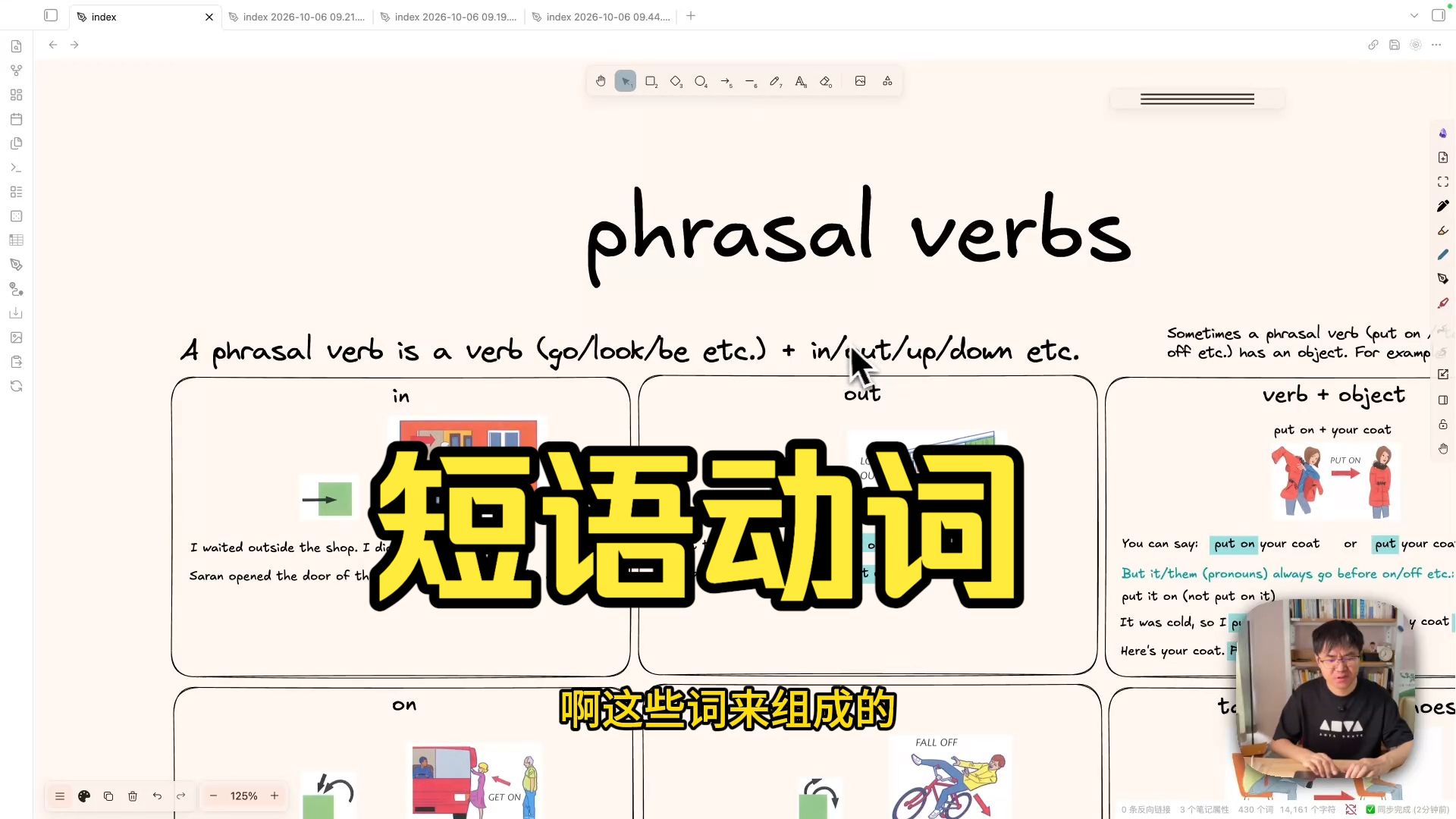
在自学英语的第 25 周,历时大半年之后,整本《Essential Grammar in Use》(剑桥初级英语语法)终于迎来了最后一章——短语动词(Phrasal Verbs)。短语动词和日常汉语语境中泛指的“动词短语”存在细微区别。所谓 Phrasal Verb,就是由一个普通动词(如 *go*、*look*、*be* 等)加上一些特定的小词(介词或副词小品词,如 *in*、*out*、*up*、*down* 等)组合而成的新短语,用来表达一个具体的动作或状态。
这些搭配的含义往往由其附带的小词决定,具有很强的画面感与逻辑性: - **in**:最核心的感觉是“进入容器内部”,含义非常宽泛。*go* 是走,*go in* 就是走进去,例如:“*I waited outside the shop, I didn't go in.*”(我在店外等,没有走进去);*get in* 则是进入车内等密闭空间,例如:“*Sarah opened the door of the car and got in.*”(莎拉打开车门坐了进去,句末省去了 car,因为语境中已明确说明)。 - **out**:表示“从容器里出来”。*look out* 是朝外看,“*I went to the window and looked out.*”(我走到窗户旁向外看);从车里下来则是 *get out*,“*The car stopped and a woman got out.*”(车停了下来,一名女士从车里出来了)。 - **on 与 off**:*on* 通常指到达物体的表面,登上公共交通工具就是 *get on*,“*The bus came and I got on.*”(公交车来了,我上车了);*off* 则表示从表面离开或掉落,搭配 *fall* 就是摔下、跌落,“*Be careful, don't fall off!*”(小心点,别摔下来)。 - **up 与 down**:*up* 强调向上或状态的转换。从坐姿到直立是 *stand up*,“*He stood up and left the room.*”;从躺卧到起床也是状态改变,“*I usually get up early.*”;仰头则是 *look up*,“*We looked up at the stars in the sky.*”。相反,*down* 表示朝下或落下来,掉落是 *fall down*(“*The picture fell down.*”);坐下是 *sit down*(“*Would you like to sit down?*”);平躺则是 *lie down*(“*Lie down on the floor.*”)。 - **away 与 off**:两者均带有“离开”的意味。小偷拔腿逃跑是 *run away*(“*The thief ran away.*”);驾车离去是 *drive away*(“*Emma got into the car and drove away.*”),这里也可以替换为 *run off* 或 *drove off*。此外,*be away* 或 *go away* 等同于离开并身处别处,“*Tom has gone away for a few days.*”(汤姆已经离开几天了)。 - **back**:表示“返回”。*come back* 是回来,如调侃警告式的“*Don't come back!*”(走吧,再也别回来了);出去吃饭后回酒店是 *went back*(“*We went out for dinner and then went back to our hotel.*”)。需要注意 *went back* 与 *be back* 的细微区别:*went back* 强调“回去、返回”这一动作过程,而 *be back* 强调“回到此地”的存在状态(“*Tom is away, he will be back on Monday.*”)。 - **over 与 round / around**:*over* 表达“越过、翻过”,如翻墙爬过是 *climb over*(“*The wall wasn't very high, so we climbed over.*”),翻书页则是 *turn over*(“*Turn over and look at the next page.*”)。*round* 或 *around* 表达绕圈或掉头,转头看是 *look round / look around*(“*Somebody shouted my name, so I looked round.*”),散步一小时后原路折返是 *turn round / turn around*(“*After an hour, we turned around and went back.*”)。
[05:00](https://www.bilibili.com/video/BV1jCpF6WEeU?t=300s) 带宾语的短语动词与代词位置规则
短语动词不仅可以单独使用,有时还会接动作承受的对象(Object,宾语)。当短语动词接宾语时,句式结构就会涉及宾语的摆放位置。以 *put on*(穿上)和 *take off*(脱下)为例,普通名词作宾语时通常有两种语序,但一旦换成代词(如 *it*、*them*),规则就变得极其严格。
```mermaid flowchart TD accTitle: Phrasal Verb Object Placement accDescr: Diagram showing word order rules when phrasal verbs take noun objects versus pronoun objects.
A["短语动词 + 宾语 (Phrasal Verb + Object)"] --> B{"宾语类型"} B -->|"普通名词 (Noun)"| C["位置灵活 (两种皆可)"] C --> C1["动词 + 小词 + 名词<br/>put on your coat"] C --> C2["动词 + 名词 + 小词<br/>put your coat on"] B -->|"代词: it / them (Pronoun)"| D["位置固定 (只能放中间)"] D --> D1["动词 + 代词 + 小词<br/>put it on / take them off"] D -.->|"错误用法 (Forbidden)"| D2["动词 + 小词 + 代词<br/>put on it / take off them"] ```
在日常表达中,针对普通名词宾语,说 "*put on your coat*" 或 "*put your coat on*" 完全等价,“*It was cold, so I put on my coat.*” 与 “*It was cold, so I put my coat on.*” 都表示天气冷穿上外套。然而,当指代前文提过的物品并使用代词 *it* 或 *them* 时,代词必须置于动词和小词之间(before on/off): - 只能说 "*Here is your coat. Put it on.*",绝对不能说 "*put on it*"。 - 脱鞋时,名词既可以说 "*I'm going to take off my shoes.*",也可以说 "*I'm going to take my shoes off.*";但若鞋子脏了指代它们,就只能说 "*Your shoes are dirty, take them off.*",不可说 "*take off them*"。
同样的规则贯穿在其他常用短语动词中: - **turn on / turn off** 与 **switch on / switch off**:指开、关电器或电灯。“*It was dark, so I turned on the light.*” 亦可写为 “*turned the light on.*”;若是代词,只能是 “*You can turn it off.*”。换成 switch 也是同理:“*I switched on the lights and switched off the television.*”。 - **pick up 与 put down**:指捡起与放下。“*Those are my keys on the floor. Can you pick them up for me?*”(地板上是我的钥匙,能帮我捡起来吗?此处代词 them 居中);放下书本可以说 “*I stopped reading and put my book down.*”,也可以说 “*put down my book.*”。 - **bring back / take back / give back / put back**:围绕“物归原位”展开。*take* 是拿走,*bring back* 则是带回来,“*You can take my umbrella, but please bring it back.*”;退换买小了的毛衣是送到商店 “*I took my new sweater back to the shop. It was too small for me.*”;物归原主是归还 “*I've got Rachel's keys, I have to give them back to her.*”;把信重新装回信封则是 “*I read the letter and then put it back in the envelope.*”。
随着短语动词讲解的结束,《Essential Grammar in Use》全书的核心语法内容正式宣告完结。这套英语自学指北教程历经 25 周的稳步推进,至此也圆满迎来了收尾阶段。
## Notable quotes > [00:00](https://www.bilibili.com/video/BV1jCpF6WEeU?t=0s) I waited outside the shop, I didn't go in.
> [00:00](https://www.bilibili.com/video/BV1jCpF6WEeU?t=0s) Sarah opened the door of the car and got in.
> [00:00](https://www.bilibili.com/video/BV1jCpF6WEeU?t=0s) The car stopped and a woman got out.
> [00:00](https://www.bilibili.com/video/BV1jCpF6WEeU?t=0s) Be careful, don't fall off!
> [00:00](https://www.bilibili.com/video/BV1jCpF6WEeU?t=0s) Tom has gone away for a few days.
> [00:00](https://www.bilibili.com/video/BV1jCpF6WEeU?t=0s) The wall wasn't very high, so we climbed over.
> [00:00](https://www.bilibili.com/video/BV1jCpF6WEeU?t=0s) After an hour, we turned around and went back.
> [05:00](https://www.bilibili.com/video/BV1jCpF6WEeU?t=300s) It was cold, so I put on my coat.
> [05:00](https://www.bilibili.com/video/BV1jCpF6WEeU?t=300s) Here is your coat. Put it on.
> [05:00](https://www.bilibili.com/video/BV1jCpF6WEeU?t=300s) Your shoes are dirty, take them off.
> [05:00](https://www.bilibili.com/video/BV1jCpF6WEeU?t=300s) Those are my keys on the floor. Can you pick them up for me?
> [05:00](https://www.bilibili.com/video/BV1jCpF6WEeU?t=300s) You can take my umbrella, but please bring it back.
> [05:00](https://www.bilibili.com/video/BV1jCpF6WEeU?t=300s) I've got Rachel's keys, I have to give them back to her.
## Mentioned 逃离平庸, Essential Grammar in Use, Sarah, Emma, Tom, Rachel
## Video description 英语自学指北第 25 周,收官!!!!
[Source](https://www.bilibili.com/video/BV1jCpF6WEeU)