Vercel CEO Says AI Assistant v0 Scaled to $4 Million ARR in 13 Months
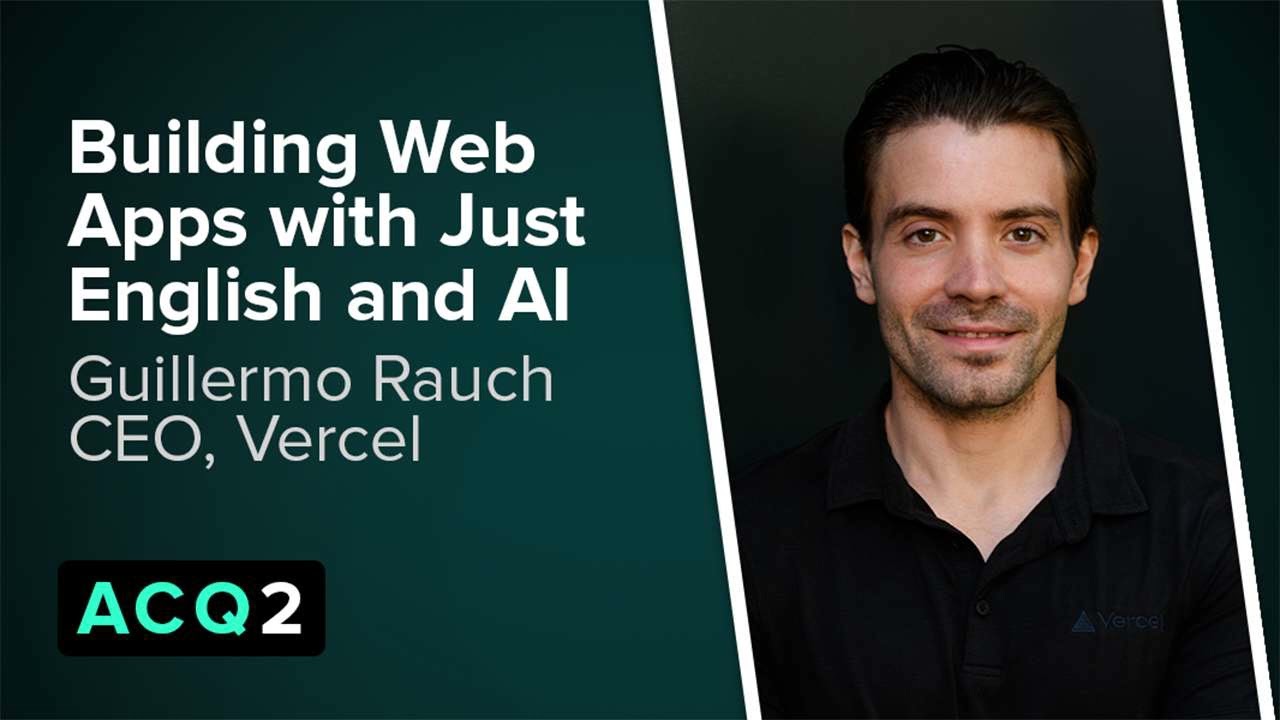
Acquired
The marginal cost of software production is dropping to zero as artificial intelligence shifts development away from writing code toward human taste and direction.
AI-assisted summary of ACQ2: Building Web Apps with Just English and AI (with Vercel CEO Guillermo Rauch) — original source. Check the original for full context.
Source published:
Detailed notes
## Background Published on February 18, 2025, on YouTube by the Acquired channel, this ACQ2 episode features an interview with Vercel founder and CEO Guillermo Rauch. The page description outlines Vercel's massive scaling milestones, including crossing $100 million in annualized revenue, its recent $3.25 billion valuation, and the explosive launch of its AI website generator, "v0."
## TL;DR Guillermo Rauch details how Vercel evolved from an ambitious frontend-focused framework into the dominant infrastructure powering modern web applications, retail giants, and leading AI platforms like ChatGPT. The conversation centers heavily on Vercel's recent explosive growth driven by v0, an AI assistant translating plain English into working code, which achieved millions in ARR within weeks. Rauch also shares his unconventional philosophy on maintaining a lean 550-person headcount, staying deeply technical as a CEO, and navigating the future where software creation becomes a highly democratized machine capability guided by human taste.
## Atmosphere & style The conversation carries a highly energetic, technical, and forward-looking tone, driven by Rauch's deep personal passion for developer experience and design. It feels like an intimate, behind-the-scenes insider session among industry peers rather than a rigid corporate interview. There is a palpable sense of excitement and a mutual marveling at how fast AI is shrinking software production timelines, transitioning from early technical struggles to a dynamic, 'magical' landscape where a product can take over the internet in under 24 hours.
## Key takeaways - [01:03](https://www.youtube.com/watch?v=4VG9B05xD7M&t=63s) Vercel acts as the invisible infrastructure skeleton for high-traffic internet events, including the 2024 U.S. election (Washington Post, Perplexity, Polymarket) and massive Black Friday retail operations. - [01:03](https://www.youtube.com/watch?v=4VG9B05xD7M&t=63s) Next.js has become the definitive gold standard frontend framework for the AI wave, powering the user interfaces of ChatGPT, Claude, Sora, and Midjourney for over 1.3 million active developers. - [01:56](https://www.youtube.com/watch?v=4VG9B05xD7M&t=116s) Vercel was founded to automate the complex pipeline of bridging raw, powerful open-source tools like Kubernetes and React into a seamless, rapid deployment workflow for developers. - [04:20](https://www.youtube.com/watch?v=4VG9B05xD7M&t=260s) Vercel intentionally bet on dynamic, cloud-rendered architectures over static applications, recognizing that mobile browsing requires offloading heavy compute burdens away from user devices. - [12:08](https://www.youtube.com/watch?v=4VG9B05xD7M&t=728s) The platform's automatic generation of secure, ephemeral preview URLs for every separate git branch revolutionized corporate collaboration and eliminated localized engineering bottlenecks. - [17:07](https://www.youtube.com/watch?v=4VG9B05xD7M&t=1027s) Vercel's AI assistant, v0, flipped the development paradigm to "code last" by translating plain English prompts into working interfaces, rapidly scaling from $1 million to $4 million ARR in just over a month. - [19:30](https://www.youtube.com/watch?v=4VG9B05xD7M&t=1170s) AI tools like v0 shift software development from a highly specialized mechanics-driven profession into a commodity, elevating human taste, direction, and creativity as the ultimate competitive advantages. - [22:26](https://www.youtube.com/watch?v=4VG9B05xD7M&t=1346s) The open-source Vercel AI SDK has enabled an industry-wide wave of specialized domain-expert AI assistants, mirroring Jensen Huang's prediction that companies will refactor into "token factories." - [24:09](https://www.youtube.com/watch?v=4VG9B05xD7M&t=1449s) Vercel utilizes rigorous guardrails like evaluations, benchmarks, and custom design systems to train AI models, shifting their decade-long framework focus from human optimization to AI optimization. - [26:16](https://www.youtube.com/watch?v=4VG9B05xD7M&t=1576s) v0 has transformed enterprise sales cycles by allowing solutions engineers to instantly turn legacy website screenshots or client links into high-performance Next.js working models mid-call. - [31:35](https://www.youtube.com/watch?v=4VG9B05xD7M&t=1895s) Guillermo Rauch advises technical founders to dominate a narrow niche before expanding, noting Vercel earned the right to build a comprehensive "developer cloud" only after mastering frontend speed. - [34:33](https://www.youtube.com/watch?v=4VG9B05xD7M&t=2073s) Rauch maintains a firm commitment to keeping Next.js completely open-source, viewing the web as a fundamentally decentralized space where developers shouldn't need permission to innovate. - [36:35](https://www.youtube.com/watch?v=4VG9B05xD7M&t=2195s) Vercel's business model treats infrastructure as a byproduct or output of the application, aligning commercial monetization with cloud usage tiers similar to Snowflake or Databricks. - [41:06](https://www.youtube.com/watch?v=4VG9B05xD7M&t=2466s) The platform's security architecture was heavily hardened by serving early crypto and blockchain spikes, leading to an automated DDOS mitigation engine that triggers within seconds. - [46:27](https://www.youtube.com/watch?v=4VG9B05xD7M&t=2787s) Rauch advocates for the "technical CEO" model, staying deeply involved in product pricing, sales commissions, and code realities while maintaining a lean company headcount of 550 employees. - [52:04](https://www.youtube.com/watch?v=4VG9B05xD7M&t=3124s) Vercel addresses platform graduation risk by building advanced escape hatches directly into the infrastructure, enabling tiny teams like Polymarket to handle historic traffic spikes safely. - [53:44](https://www.youtube.com/watch?v=4VG9B05xD7M&t=3224s) The marginal cost of software production dropping toward zero is driving a massive influx of "citizen developers" who can ship functional browser-automation agents in under 24 hours.
## Detailed walkthrough ### [00:00](https://www.youtube.com/watch?v=4VG9B05xD7M&t=0s) Defining Vercel and the Pursuit of Developer Experience
Guillermo Rauch, the co-founder and CEO of Vercel, joins the podcast to discuss his journey building a company that has achieved widespread developer adoption and a valuation of over $3 billion. When asked to look past the flashy financial metrics and high-profile client lists to describe the core identity of his company, Rauch describes Vercel as "the infrastructure platform to build and deploy modern web applications." He explains that his deep personal obsession with developer experience, web performance, and clean design is hardcoded into the platform's DNA. For the average person browsing the internet, Vercel's impact is seamless: whenever you click a link and the experience is exceptionally fast and delightful, it is highly likely that the application was built on Vercel.
[01:03](https://www.youtube.com/watch?v=4VG9B05xD7M&t=63s) Real-World Scale: From the 2024 Election to AI Pioneers
To illustrate the massive reach of the platform, Rauch points out how Vercel acts as the invisible spine for major internet events that demand massive scale and real-time data tracking. During the November 2024 U.S. presidential election, users were constantly refreshing news sites for the latest updates; platforms like the *Washington Post*, the *Minnesota Star Tribune*, and digital innovators like Polymarket and Perplexity all relied on Vercel's infrastructure to handle the traffic. The same holds true for massive retail events like Black Friday, where household enterprise names like Bose, Fanatics, and Supreme, alongside emerging brands like Axel Arigato or Ragul, leverage Vercel to deliver highly dynamic consumer experiences without crashing.
This infrastructure dominance has transferred directly into the modern artificial intelligence wave as well. Rauch notes that Next.js has become the definitive gold standard for frontend engineering in the AI space. Whenever a user interacts with cutting-edge AI systems, they are almost certainly using a user interface built on their framework.
- Major AI applications built entirely on Next.js include ChatGPT, OpenAI's Operator, Claude, Sora, and Midjourney. - Next.js currently supports a community of 1.3 million monthly active developers.
[01:56](https://www.youtube.com/watch?v=4VG9B05xD7M&t=116s) The 2015 Cloud Dilemma and the Democratization Effort
Looking back to around 2015, the landscape of web development was highly unequal. Tech giants like Google, Meta, and Amazon possessed the resources to build fast, hyper-dynamic, and tailored web experiences, but the rest of the internet was incredibly static. While cloud computing was on the rise, actually utilizing it effectively was so difficult that Rauch notes "it felt like you needed a PhD." When Rauch started out, he didn't initially intend to build Vercel as it exists today; he simply wanted to build a website with ambitious aspirations to match the quality bar of a giant like Google or Amazon, only to hit a wall of extreme infrastructure complexity.
At that specific point in time, Google had just open-sourced Kubernetes for infrastructure orchestration, and Meta had open-sourced React to drive user interfaces. While the prevailing industry narrative celebrated these open-source tools as the solution to a faster web, the reality for the average developer or enterprise undergoing digital transformation was painful. Grabbing these raw technologies meant spending months or entire quarters manually configuring, assembling, and binding them into custom internal platforms. Vercel was born out of a desire to automate that entire pipeline and bridge the gap between powerful open-source ingredients and the rapid creation of delightful user experiences.
[04:20](https://www.youtube.com/watch?v=4VG9B05xD7M&t=260s) The Strategic Bet on Dynamic Web Architectures
While Vercel initially launched as a highly general platform where users could deploy almost any type of backend or application, Rauch eventually steered the company to focus explicitly on frontend development. This alignment matched his personal journey, having been obsessed with refining customer-facing interfaces since he was 12 or 13 years old. This focus led him to write the first lines of code for Next.js, an open-source framework built on top of React. To explain the relationship between the two, Rauch uses a vehicle analogy: "things like react are like the engine and people need a car to go from A to B." Next.js and Vercel became that car—and ultimately a space shuttle to the cloud—benefiting businesses directly because a faster website converts users at a higher rate and generates more revenue.
Choosing this architectural path was highly controversial at the time. Much of the developer community and venture capital ecosystem had taken a "weird detour towards static applications," a trend that deeply puzzled Rauch. Having previously authored the real-time websocket library Socket.io, he was obsessed with real-time communication and knew that the future belonged to dynamic, cloud-rendered experiences. He recognized that as mobile browsing grew, developers needed to offload the heavy rendering and compute burdens away from the user's physical device and onto the cloud. By quietly making a long-term bet on dynamic infrastructure—a system that took years to perfect regarding security and multi-tenancy—Vercel created a standardized framework. This standardization allows enterprises to easily recruit talent and tap into a global zeitgeist of collective knowledge, where even modern LLMs are pre-trained experts in their specific tooling stack.
[12:08](https://www.youtube.com/watch?v=4VG9B05xD7M&t=728s) The Magic of Preview Environments and Team Velocity
Rauch admits that his original engineering focus was singularly centered on the speed of the deployment pipeline, aiming for a mathematical perfection from "keystroke to live application" to shrink a process that normally took weeks of human coordination down to a single terminal command or `git push`. What he initially underestimated, however, was the profound corporate value of collaboration. By engineering Vercel to automatically deploy every single separate git branch into a secure, ephemeral URL, the platform fundamentally altered how modern organizations collaborate.
This single feature eliminated a toxic, age-old developer frustration where engineers had to say, "I can only show you on my machine," resulting in situations where developers had to walk across an office holding a laptop over a colleague's desk. Rauch highlights the absurdity of outdated workflows by sharing a conversation he had with the CIO of one of the largest banks in the world. Because the bank lacks this preview technology, their teams must coordinate calendar invites for 12 separate people a week in advance just to have an engineer screen-share a basic feature update. Vercel's preview URLs allow teams to instantly load up a live environment directly on a mobile phone to see exactly what the end user will experience, which forces desktop-bound developers to face real-world conditions. Reflecting on the ease Vercel brings to the profession, Rauch jokes that "developers sometimes like we are the most coddled people in the planet."
[17:07](https://www.youtube.com/watch?v=4VG9B05xD7M&t=1027s) Disrupting the End-User Experience with v0
The conversation shifts from Vercel’s early history to the "magic moments" that define a company's trajectory. While most companies point to events in their first few years, Vercel's most profound breakthrough happened nine years into its journey. The catalyst was the launch of v0, an AI assistant for web development that functions like a "startup within a startup." Recognizing that large language models (LLMs) had already been trained extensively on React and Next.js, Vercel saw an opportunity to completely flip the traditional development process. Instead of being code-first, v0 is "code last," translating plain English prompts into fully working user interfaces and applications, allowing anyone with an idea to "cook."
The financial and usage trajectory of v0 has been unlike anything Vercel has ever seen. Released as a research preview in September 2023, the tool took ten months to hit $1 million in ARR. From there, the growth exploded exponentially: it took a mere 14 days to go from $1 million to $2 million, and just 20 more days to scale from $2 million to $4 million. This unprecedented surge in user activity has had massive infrastructure implications, effectively turning Vercel into a company that is "making the hyperscalers run out of GPU capacity" across the world's largest data regions.
- **v0 Launch:** Introduced as a research preview in September 2023. - **ARR Growth Milestones:** 10 months to hit $1 million, 14 days to hit $2 million, and 20 days to hit $4 million.
---
[19:30](https://www.youtube.com/watch?v=4VG9B05xD7M&t=1170s) Democratizing Software and the Evolution of Development
By shifting the entry point of software creation from a web browser to a simple prompt at `v0.dev`, Vercel has expanded its top-of-funnel from a couple million professional developers to potentially hundreds of millions or billions of people. Even for seasoned veterans who have been in the arena "since I'm almost in diapers," the technical capability of the AI is staggering. The speaker shares an "aha moment" where they used v0 to recreate their personal blog, which had originally been hand-coded using Next.js. The AI-generated output was objectively superior—it was natively responsive across desktop and mobile, and it automatically configured accessibility capabilities and tags that the human creator had forgotten.
This transformation signals a broader shift for Vercel from a developer-focused brand into something closer to a consumer brand. The speaker suggests that software development will evolve similarly to language translation; just as Google Translate turned translation from a highly specialized profession into a commoditized machine capability, AI will increasingly dominate the mechanics of writing code. However, human ingenuity remains vital. The critical elements moving forward are human taste, direction, and the creativity required to choose which problems to solve.
---
[22:26](https://www.youtube.com/watch?v=4VG9B05xD7M&t=1346s) The Ripple Effect: Token Factories and Open Source
Vercel's success with v0 is inspiring an industry-wide wave of specialized AI assistants. The open-source architecture underpinning the tool, known as the Vercel AI SDK, has allowed other startups to clone the "secret sauce" and apply it to completely different fields. The speaker notes recent viral success stories on social media, such as a "v0 for CAD" designed for architects and 3D printing. Other emergent applications include "e0" (v0 for email) and "Open Evidence" (a v0 for medicine built using Next.js and Vercel).
This phenomenon aligns with Nvidia CEO Jensen Huang's prediction that most companies will eventually "refactor themselves into token factories." Organizations take their internal domain expertise and opinionated views of the world—which for Vercel was web development, design, and engineering—and bake them into an expert AI.
- **AI SDK:** Vercel's open-source framework used by developers to build their own expert AI assistants. - **Open Evidence:** A specialized medical AI tool built on top of Next.js and Vercel infrastructure.
---
[24:09](https://www.youtube.com/watch?v=4VG9B05xD7M&t=1449s) The Technology Behind v0: Learning from Failure
The conceptual foundation of v0 actually stems from a failed Vercel product called "Next.js Live." Years prior, the company attempted to run the entire Next.js development environment directly inside a web browser, aiming to bypass the traditional design phase so creators could design entirely with code. It fell flat because visual thinkers still faced a steep coding learning curve. The speaker contrasts this by noting Next.js Live was their "Newton" and v0 is their "iPhone." By pairing the browser-based rendering environment with state-of-the-art foundation models, v0 delivers high-quality outputs that avoid the low-effort "slop" often associated with generic AI generation.
To maintain strict quality and "imbue Vercel employees' taste" into the machine, the engineering team utilizes rigorous guardrails, including evaluations (evals), benchmarks, prompts, Retrieval-Augmented Generation (RAG), and custom design systems tailored specifically for AI. This represents a paradigm shift for framework design. While the company spent its first decade building software frameworks optimized for human engineers, it is now actively designing frameworks and systems optimized for artificial intelligence.
---
[26:16](https://www.youtube.com/watch?v=4VG9B05xD7M&t=1576s) Scaling Human Expertise and Shortening Sales Cycles
For years, the creators of Next.js were overwhelmed by enterprise demands for manual training and support. Despite employing top-tier open-source talent—including the tech lead of React and the core teams behind Next.js and Svelte—individual engineering inboxes simply could not scale to support tens of millions of users. Vercel is solving this bottleneck by feeding their developers' preference and demonstration data directly into v0, creating a sustainable, scalable mechanism for code audits, migrations, and support.
An unexpected, emergent property of v0 is its ability to automatically migrate legacy frameworks over to modern Next.js architecture, solving a historical sales hurdle where enterprise clients lacked the developer hours to rebuild old systems. This has fundamentally transformed Vercel's sales cycle from a "trust me bro" pitch into instantaneous proof. Sales and solutions engineers can take a literal screenshot of a prospect's legacy website during a live call, drop it into v0, and generate a high-performance working model in seconds. Instead of passing around text documents or contract drafts, collaboration now happens dynamically via shared v0 links.
---
[29:12](https://www.youtube.com/watch?v=4VG9B05xD7M&t=1752s) Hitting the Physical Limits of Developer Experience
Reflecting on an alternate universe where LLMs never emerged, the speaker admits that Vercel would have eventually hit diminishing returns on traditional developer experience (DX) innovations. Developers require exceptionally fast feedback loops to maintain their "mythical flow zone." To optimize this, Vercel previously innovated at the infrastructure layer, partnering deeply with AWS's serverless team to generate instant deployment previews via serverless functions rather than spinning up millions of dollars of redundant cluster infrastructure.
However, engineering feedback loops can only be accelerated so far before hitting the literal speed of light and the boundaries of physical reality. The speaker highlights a proof of concept (POC) where Vercel cut a cutting-edge database company's developer feedback loop down from 60 minutes to just two minutes. While getting loops down to two seconds remains a goal, the primary bottleneck is no longer the speed of the hardware, but the sheer volume of humans capable of doing the work. Tools like v0 solve this human bottleneck by inviting an entirely new demographic into software creation.
---
[31:35](https://www.youtube.com/watch?v=4VG9B05xD7M&t=1895s) Founder Advice: Dominating a Niche Before Expanding
When offering advice to technical founders looking to balance an open-source project with a for-profit corporation, the speaker emphasizes the absolute necessity of being world-class at a single thing. "Being a jack of all trades doesn't work in this world." Vercel's initial breakout occurred only when they hyper-focused on a narrow niche: creating the absolute fastest websites, frontends, and e-commerce storefronts. Only after securing that category crown did they begin their broader transition from a "frontend cloud" to a comprehensive "developer cloud."
Many entrepreneurs make the mistake of trying to make their day-one product match the massive scale of their ultimate ambition. Vercel intentionally practiced patience, establishing a "dance with the customer" where the users pulled features out of the company when they were ready. For years, users begged for database integrations and backend support, and Vercel repeatedly responded with, "We're not ready yet." Now that their infrastructure handles frontend workloads for massive brands like Logitech and Ikea (via Svelte support) alongside Next.js, Vercel has earned the right to expand into processing backend checkout workflows, SAS applications, and AI token management.
[34:33](https://www.youtube.com/watch?v=4VG9B05xD7M&t=2073s) The Philosophy of Open Source and the Decentralized Web
When asked if he ever considered a different business model that generated direct revenue from Next.js instead of keeping it entirely open source, Guillermo Rauch gives an emphatic, "never absolutely not." For Rauch, open source is deeply personal; growing up in Argentina, it was literally his "ticket out of Argentina and into the world." As a developer, he cannot fathom starting an application today on a framework that is proprietary, noting that it simply does not make sense in the modern ecosystem.
This philosophy is being applied once again with Vercel's AI SDK. The company saw an opportunity to democratize the creation of applications like ChatGPT, operating on the firm belief that there will not be just one AI rule to govern them all. Rauch views the web as fundamentally decentralized—a place where you have your own domain name and set your own rules. Disruption happens natively on the web; for instance, ChatGPT itself was originally launched as a research preview website built with Next.js. The AI SDK has grown from 100,000 downloads a week to nearly a million downloads a week in about a year, becoming the second-largest AI module behind OpenAI for JavaScript and front-end applications, despite having no direct monetization strategy.
- Vercel's AI SDK grew from 100,000 to nearly 1,000,000 downloads per week in approximately one year. - The AI SDK is the second most popular method for integrating AI into front-end or JavaScript applications, trailing only OpenAI. - The deployment model of the web means developers do not have to ask for permission or purchase a license from anyone to innovate.
---
[36:35](https://www.youtube.com/watch?v=4VG9B05xD7M&t=2195s) Infrastructure as an Output of the Application
Vercel's monetization strategy relies on earning developer trust through open source, knowing that when it comes time to deploy, creators will choose Vercel because the company has "sweated the details of the parts of infrastructure that they don't care about." Rauch acknowledges that while some developers enjoy the "IKEA effect" of building infrastructure once for the educational experience, successful modern enterprises prefer to offload that heavy lifting. He compares Vercel's utility model to Snowflake, Databricks, and Data Dog: if an application is small, the developer pays very little, but if it takes over the world, they pay more.
When cautioned by the host about taking open source to a logical extreme and potentially giving away the "golden goose," Rauch explains that open-sourcing Vercel's internal infrastructure software hits diminishing returns. The complexity of running 20 global regions with hundreds of microservices each is mind-bogglingly complex and largely operational—relying on continuous monitoring, upgrades, rolling systems, and staging techniques rather than raw source code. Open source shines brightest when providing a programming model. Vercel's disruptive thesis is that "infrastructure has to be an output of the application." Rather than forcing developers to start with cloud infrastructure, Next.js allows them to focus entirely on the application, making it multicloud and self-hostable by default, while Vercel remains the optimized commercial deployment option.
- Vercel's business model aligns costs with usage, mirroring infrastructure giants like Snowflake, Databricks, and Data Dog. - Next.js defines and declares the application, inverting the traditional cloud approach by treating infrastructure as a byproduct. - Open-sourcing Vercel's underlying platform would provide little value to the audience because its true worth lies in operational execution, not code.
---
[39:12](https://www.youtube.com/watch?v=4VG9B05xD7M&t=2352s) Inspiring Business Models: Beyond the Legacy Support Sucks Era
Reflecting on the evolution of open-source business models, Rauch notes that historical options "basically used to suck" because companies like Red Hat were limited to scaling via manual support contracts. In designing Vercel, there were few direct historical examples to copy. He identifies GitHub as a close parallel on the pre-production side because it built a massive collaboration platform on top of Git, an open-source component they did not create. While GitHub provides URLs to code, Vercel provides "URLs to working applications," though Rauch playfully argues that code itself will become less important over time as it falls into the domain of AIs.
On the infrastructure side, Databricks serves as the premier operational inspiration. Just as Databricks adopted Apache Spark and engineered a highly optimized cloud compute engine for it, Vercel provides a highly optimized, global runtime for Next.js. While anyone can attempt a do-it-yourself setup, scaling global compute clusters, securing applications, mitigating DDOS attacks, and maintaining uptime during massive traffic spikes represents Vercel's true commercial "secret sauce."
---
[41:06](https://www.youtube.com/watch?v=4VG9B05xD7M&t=2466s) Hardened by Crypto: Security and the Enterprise Inflection Point
When asked about the inflection points where massive corporations and banks finally trusted a startup with their core infrastructure, Rauch credits an unlikely catalyst: the crypto space. Because Vercel naturally attracts disruptive waves of technology due to deployment speed, most early crypto and AI startups built on the platform. Rauch notes with a laugh that crypto attracted "literally the worst darkest actors inside of the internet," forcing Vercel to 10x its security services. The platform had to master everything from the careful encryption of secret vaults for database credentials and wallets to instant traffic discernment.
This baptism by fire allowed Vercel to pioneer a "zero configuration, secure by default" architecture. Unlike legacy edge providers or out-of-the-cloud CDNs like Akamai or Cloudflare—which filter traffic from afar without hosting the actual application—Vercel must block 100% of malicious traffic instantly because they host the origin. Rauch loved being put through the ringer by high-traffic events like blockchain launches, NFT drops, and meme coin spikes. This exposure bolstered Vercel's security to industry-leading levels, achieving DDOS mitigation times measured in seconds, whereas competitors often take minutes. There is a "delicious irony" that Fortune 500 companies executing digital transformations today are benefiting from a platform hardened by internet bad actors targeting crypto properties like Solana.
- Solana and the majority of large NFT and blockchain companies use Vercel as their "Web Two face to web 3." - Vercel builds CDN and Web Application Firewall (WAF) capabilities directly into its core platform. - Vercel's automated DDOS mitigation triggers within seconds, vastly outperforming legacy multi-minute response times.
---
[44:46](https://www.youtube.com/watch?v=4VG9B05xD7M&t=2686s) Mergers, Acquisitions, and Corporate Talent Retention
Beyond security, Rauch outlines a fascinating side effect of widespread developer adoption: Next.js has become a common language that accelerates corporate mergers and acquisitions. When an incumbent enterprise acquires a fast-moving startup to absorb its innovation, integration times drop dramatically if both use Next.js. Because infrastructure is an output of the application, integrating two companies effectively reduces to simply merging two front-ends while keeping backend services pluggable.
This standardization creates a "greater than the sum of the parts effect." Enterprises are actively migrating to Vercel not just for the technology, but as a mechanism to attract and retain elite engineering talent who refuse to work with archaic tools. Rauch expresses delight that top global brands use the platform, teasingly hinting at a favorite German automobile company whose design and taste sensibilities align perfectly with Vercel's aesthetic.
---
[46:27](https://www.youtube.com/watch?v=4VG9B05xD7M&t=2787s) The Technical CEO and Driving Product Velocity
Sharing a core conviction that runs counter to traditional management advice, Rauch believes that CEOs—especially technical ones—"can and should be involved in every aspect of the business." He rejects the idea of creating information silos, choosing instead to stay active in everything from tuning quarterly sales commissions and closing enterprise deals to defining product pricing and roadmaps. At 550 employees, Vercel avoids wasting time on executive briefings because the leadership team remains directly grounded in the reality of the product.
Rauch preserves this deep connection by continuously using Vercel and its generative AI interface, v0, while maintaining a direct line to the developer community. Vercel prioritizes hiring people with technical backgrounds across all departments, ensuring that the company's internal velocity mirrors the speed of the product itself. This culture of speed has become a core export; when major enterprise CIOs and CTOs meet with Rauch, they frequently ask him to teach them how Vercel builds software so they can replicate that exact operational velocity within their own organizations.
- Vercel disclosed hitting $100 million in annualized revenue in May 2024. - The company's revenue is growing at an 80% year-over-year rate, while its developer base more than doubled over the past year. - Vercel operates at significant global scale with a lean headcount of only 550 employees.
---
[49:38](https://www.youtube.com/watch?v=4VG9B05xD7M&t=2978s) High-Altitude Leadership and Lean Team Realities
Addressing the potential trade-off of micromanagement when a CEO is highly involved, Rauch explains that his goal is not to execute the labor, but to provide high-quality feedback. He acts as a "bridge to reality" by bringing raw customer stories directly to his executives and holding them accountable. He expects his leaders to be capable of demoing the product themselves, insisting that a leader must truly understand an area rather than completely outsourcing knowledge to a subordinate.
This structural efficiency allows Vercel to remain remarkably lean relative to its revenue scale. Rauch highlights "v0" as a prime example of a "startup within a startup." The v0 team built their rapidly growing product using exclusively public, full-stack Vercel tools, managing front-ends, back-ends, databases, and AI model procurement entirely on the home platform. Rauch neurotically monitors this team to ensure they never "cheat" by asking Vercel's internal infrastructure teams for special favors or custom code, proving that an external team of fewer than 10 people can build an industry-defining product using Vercel out of the box.
[52:04](https://www.youtube.com/watch?v=4VG9B05xD7M&t=3124s) Overcoming "Graduation Risk" and the Power of Tiny Teams
The speaker addresses the "scary ghost of every startup that tries to simplify things"—the dreaded graduation risk where a growing company feels it will eventually outgrow a managed platform like Vercel. Guillermo expresses immense confidence that their platform has eliminated this issue entirely. He notes that as long as he is alive and deeply involved in the details, he will ensure that all advanced capabilities and escape hatches are built directly into the platform itself. This structural design allows engineering teams to remain remarkably small because they do not need to provision specialized, heavy infrastructure when they hit massive scale.
To illustrate this, he points to Polymarket as a prime example of a tiny team that handled traffic surges during the election that "would scare infrastructure teams." This level of traffic normally requires decades of internet infrastructure experience to sustain, yet the platform kept it seamless. Looking forward, the combination of AI-generated code and abstracted infrastructure means that massive scale can be maintained with absolute simplicity. The speaker predicts this will put "downward pressure on headcount," not by forcing developers into retirement, but by enabling fewer people to create more products that reach significantly more users.
- **Graduation Risk:** The anxiety that a startup will eventually have to migrate off a simplified platform once they scale to millions of requests per second. - **Polymarket Example:** A small team that successfully sustained massive, intimidating traffic spikes during the election without an enterprise-sized infrastructure team. - **Future Headcount Dynamics:** Fewer people will be required to build at an incredible scale, shifting the focus toward a higher volume of product creation globally.
[53:44](https://www.youtube.com/watch?v=4VG9B05xD7M&t=3224s) Shipping an Internet-Sensation Agent in 24 Hours
The conversational speed accelerates as Guillermo shares a recent, real-world example of how fast software production is moving. Right after OpenAI released its "Operator" capability, a Vercel customer utilized v0 to build a completely new interface, hooked it up to cloud-based browser infrastructure to automate tasks, and leveraged models like DeepSeek to provision the agent. The entire product went from a raw concept—the idea that an AI agent could control a web browser and self-task for people—to launching live on the internet in under 24 hours.
The launch instantly took over the internet. Guillermo recounts tweeting about it and receiving astonished emails from people as far away as China saying they were "losing my mind" over how fast it happened. While he acknowledges that sustainable innovation requires more than a single viral launch, the fact that the timeline has shrunk to hours, days, or weeks highlights a massive shift. As the "marginal cost of software production goes to zero," the market will see a massive influx of creators and "citizen developers." Guillermo hopes Vercel remains in the middle of this evolution, facilitating both AI agents and human builders alike.
- **The 24-Hour Launch:** A developer used v0, cloud browser infrastructure, and DeepSeek to launch a functional browser-automation agent within a single day of OpenAI's Operator announcement. - **Global Reaction:** The rapid release caused a viral stir on X (formerly Twitter), drawing immediate feedback from users in China shocked by the speed of development. - **Citizen Developers:** The economic shift of software costs dropping to zero allows non-traditional developers to enter the market and ship products instantly.
[55:20](https://www.youtube.com/watch?v=4VG9B05xD7M&t=3320s) Closing Thoughts and Call to Action
The host wraps up the interview, noting that they "can't imagine a better place to leave it" and thanks Guillermo for a super fun conversation. When asked where listeners should go to explore these tools, Guillermo directs the audience to find them on X at either `v0.dev` or Vercel to share feedback. For those ready to build, his instructions are beautifully simple: head straight to `v0.dev`, type in an idea, press submit, and "off you go."
- **Where to Connect:** Users can reach out or provide feedback directly via X (formerly Twitter) by tagging v0 or Vercel. - **Getting Started:** Builders are encouraged to visit `v0.dev` to instantly prototype ideas with a single prompt submission.
## Notable quotes > [00:00](https://www.youtube.com/watch?v=4VG9B05xD7M&t=0s) the infrastructure platform to build and deploy modern web applications. — Guillermo Rauch
> [01:56](https://www.youtube.com/watch?v=4VG9B05xD7M&t=116s) it felt like you needed a PhD. — Guillermo Rauch
> [04:20](https://www.youtube.com/watch?v=4VG9B05xD7M&t=260s) things like react are like the engine and people need a car to go from A to B. — Guillermo Rauch
> [04:20](https://www.youtube.com/watch?v=4VG9B05xD7M&t=260s) weird detour towards static applications — Guillermo Rauch
> [12:08](https://www.youtube.com/watch?v=4VG9B05xD7M&t=728s) I can only show you on my machine — Guillermo Rauch
> [12:08](https://www.youtube.com/watch?v=4VG9B05xD7M&t=728s) developers sometimes like we are the most coddled people in the planet. — Guillermo Rauch
> [17:07](https://www.youtube.com/watch?v=4VG9B05xD7M&t=1027s) startup within a startup. — Guillermo Rauch
> [17:07](https://www.youtube.com/watch?v=4VG9B05xD7M&t=1027s) making the hyperscalers run out of GPU capacity — Guillermo Rauch
> [19:30](https://www.youtube.com/watch?v=4VG9B05xD7M&t=1170s) since I'm almost in diapers, — Guillermo Rauch
> [22:26](https://www.youtube.com/watch?v=4VG9B05xD7M&t=1346s) refactor themselves into token factories. — Guillermo Rauch
> [31:35](https://www.youtube.com/watch?v=4VG9B05xD7M&t=1895s) Being a jack of all trades doesn't work in this world. — Guillermo Rauch
> [34:33](https://www.youtube.com/watch?v=4VG9B05xD7M&t=2073s) never absolutely not. — Guillermo Rauch
> [34:33](https://www.youtube.com/watch?v=4VG9B05xD7M&t=2073s) ticket out of Argentina and into the world. — Guillermo Rauch
> [36:35](https://www.youtube.com/watch?v=4VG9B05xD7M&t=2195s) infrastructure has to be an output of the application. — Guillermo Rauch
> [39:12](https://www.youtube.com/watch?v=4VG9B05xD7M&t=2352s) URLs to working applications — Guillermo Rauch
> [41:06](https://www.youtube.com/watch?v=4VG9B05xD7M&t=2466s) literally the worst darkest actors inside of the internet, — Guillermo Rauch
> [41:06](https://www.youtube.com/watch?v=4VG9B05xD7M&t=2466s) delicious irony — Guillermo Rauch
> [46:27](https://www.youtube.com/watch?v=4VG9B05xD7M&t=2787s) can and should be involved in every aspect of the business. — Guillermo Rauch
> [49:38](https://www.youtube.com/watch?v=4VG9B05xD7M&t=2978s) bridge to reality — Guillermo Rauch
> [52:04](https://www.youtube.com/watch?v=4VG9B05xD7M&t=3124s) scary ghost of every startup that tries to simplify things — Guillermo Rauch
> [53:44](https://www.youtube.com/watch?v=4VG9B05xD7M&t=3224s) marginal cost of software production goes to zero, — Guillermo Rauch
## Mentioned Vercel, Guillermo Rauch, v0, Next.js, Stripe, Adobe, Runway, YouTube, Acquired, Washington Post, Minnesota Star Tribune, Polymarket, Perplexity, Bose, Fanatics, Supreme, Axel Arigato, Ragul, ChatGPT, Operator, Claude, Sora, Midjourney, OpenAI, Google, Meta, Amazon, Kubernetes, React, Socket.io, Vercel AI SDK, Open Evidence, Nvidia, Jensen Huang, Next.js Live, Svelte, Logitech, Ikea, AWS, Snowflake, Databricks, Data Dog, Red Hat, GitHub, Git, Apache Spark, Akamai, Cloudflare, Solana, DeepSeek, X
[Source](https://www.youtube.com/watch?v=4VG9B05xD7M)