Azelaic Acid + Tretinoin: Can You Use Them Together? | Dermatologist
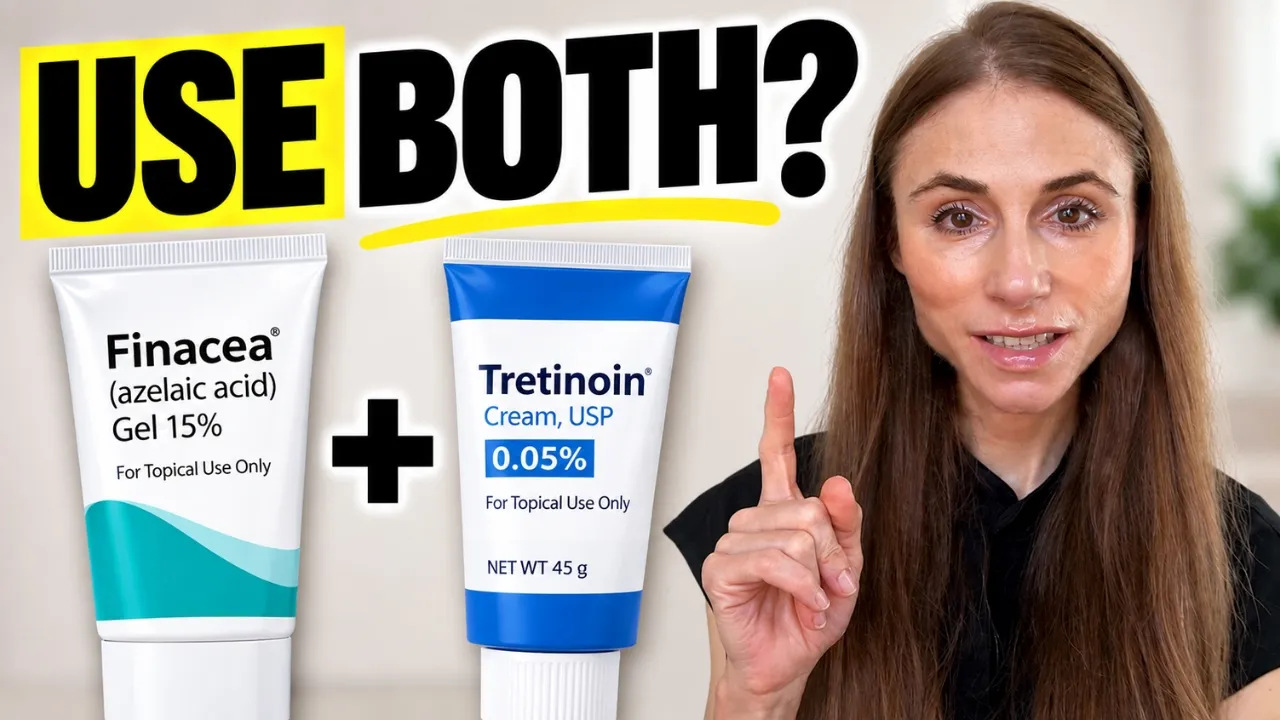
Dr Dray
AI-assisted summary of Azelaic Acid + Tretinoin: Can You Use Them Together? | Dermatologist — original source. Check the original for full context.
Source published:
Key ideas
- Combining azelaic acid and tretinoin addresses acne and post-inflammatory hyperpigmentation through complementary, non-redundant pathways: retinoids normalize epidermal turnover while azelaic acid provides antimicrobial action and inhibits the tyrosinase enzyme. (3:22)
- Clinical trial data in papulopustular rosacea demonstrates that once-daily azelaic acid achieves comparable reduction in inflammatory lesions to standard twice-daily dosing while cutting side effects and prescription refill costs in half. (4:13)
- Topical retinoids are not strictly contraindicated in rosacea; they can promote dermal connective tissue remodeling and reduce surface corneocytes that harbor inflammatory Demodex face mites. (5:58)
- Maximalist multi-serum regimens increase skin barrier irritation, which sabotages treatment by triggering inflammatory cascades that worsen both active acne breakouts and post-inflammatory hyperpigmentation. (9:21)
Detailed notes
## Background Published on YouTube by dermatologist Dr Dray on September 22, 2026, this video explores whether azelaic acid can be paired with tretinoin or other topical retinoids. According to the video description, Dr. Dray covers how these two ingredients function across acne, rosacea, and post-inflammatory hyperpigmentation, examining dosing frequencies, clinical evidence, and methods for mitigating irritation without overcomplicating skincare routines.
## TL;DR Dr. Dray details how azelaic acid and tretinoin operate through distinct, complementary biological pathways, making them a clinically potent combination for acne and post-inflammatory hyperpigmentation. Addressing application frequency, she highlights clinical data showing that once-daily azelaic acid can achieve comparable outcomes to twice-daily dosing with substantially less burning and barrier irritation, particularly in rosacea patients. She dispels myths regarding retinoid use in rosacea while stressing that active combinations should be approached conservatively rather than stacking products haphazardly. Ultimately, she recommends a streamlined regimen—such as azelaic acid with sunscreen in the morning and a retinoid at night—advising patients to master one active for several months before introducing another.
## Atmosphere & style The presentation is candid, grounded, and refreshingly no-nonsense, delivered with Dr. Dray's trademark blend of clinical pragmatism and wry humor. Speaking directly to the camera, she cuts through social media consumerism and algorithm-driven trends with blunt reassurance to 'stop overthinking' skincare. The experience feels like a grounded, stress-relieving consultation that liberates viewers from skincare anxiety and reframes skin health around patient consistency rather than complex routines.
## Bulletin - [03:22](https://www.youtube.com/watch?v=MYiOWPf354A&t=202s) Combining azelaic acid and tretinoin addresses acne and post-inflammatory hyperpigmentation through complementary, non-redundant pathways: retinoids normalize epidermal turnover while azelaic acid provides antimicrobial action and inhibits the tyrosinase enzyme. - [04:13](https://www.youtube.com/watch?v=MYiOWPf354A&t=253s) Clinical trial data in papulopustular rosacea demonstrates that once-daily azelaic acid achieves comparable reduction in inflammatory lesions to standard twice-daily dosing while cutting side effects and prescription refill costs in half. - [05:58](https://www.youtube.com/watch?v=MYiOWPf354A&t=358s) Topical retinoids are not strictly contraindicated in rosacea; they can promote dermal connective tissue remodeling and reduce surface corneocytes that harbor inflammatory Demodex face mites. - [09:21](https://www.youtube.com/watch?v=MYiOWPf354A&t=561s) Maximalist multi-serum regimens increase skin barrier irritation, which sabotages treatment by triggering inflammatory cascades that worsen both active acne breakouts and post-inflammatory hyperpigmentation.
## Key takeaways - [00:37](https://www.youtube.com/watch?v=MYiOWPf354A&t=37s) Azelaic acid is a multifunctional dicarboxylic acid with anti-inflammatory, antimicrobial, and pigment-regulating properties FDA-approved for acne, rosacea, and melasma. - [02:17](https://www.youtube.com/watch?v=MYiOWPf354A&t=137s) Tretinoin functions via retinoic acid receptors to normalize epidermal desquamation, clearing microcomedones and stimulating dermal collagen synthesis to combat photoaging. - [03:22](https://www.youtube.com/watch?v=MYiOWPf354A&t=202s) Pairing tretinoin with azelaic acid aligns with AAD guidelines by targeting cutaneous conditions through separate, complementary biological pathways rather than redundant mechanisms. - [03:22](https://www.youtube.com/watch?v=MYiOWPf354A&t=202s) The combination is particularly potent for post-inflammatory hyperpigmentation, as azelaic acid inhibits tyrosinase directly while tretinoin accelerates the shedding of existing pigment pools. - [04:13](https://www.youtube.com/watch?v=MYiOWPf354A&t=253s) Prescription 15% azelaic acid gel is labeled for twice-daily application, but once-daily use offers comparable clearance for papulopustular rosacea with markedly less stinging, dryness, and erythema. - [04:13](https://www.youtube.com/watch?v=MYiOWPf354A&t=253s) Once-daily dosing reduces prescription consumption by half, making medical management substantially more affordable and sustainable for sensitive-skin patients. - [05:58](https://www.youtube.com/watch?v=MYiOWPf354A&t=358s) Retinoids can be used cautiously in rosacea to support tissue remodeling and clear cellular debris that harbors Demodex mites, dispelling the myth that the ingredient class is entirely off-limits. - [07:51](https://www.youtube.com/watch?v=MYiOWPf354A&t=471s) An effective daily regimen can be kept simple: apply azelaic acid in the morning under sunscreen, and apply tretinoin at night followed by moisturizer if needed. - [07:51](https://www.youtube.com/watch?v=MYiOWPf354A&t=471s) When using azelaic acid twice daily, layering it immediately before or after tretinoin at night is acceptable, and the combined base vehicles often render a separate night cream unnecessary. - [07:51](https://www.youtube.com/watch?v=MYiOWPf354A&t=471s) Prescription topicals are tested in clinical trials as standalone treatments; stacking them with numerous cosmetic serums risks vehicle incompatibility and increases irritation. - [09:21](https://www.youtube.com/watch?v=MYiOWPf354A&t=561s) Managing skin disease is medical care that requires individual personalization rather than a rigid, maximalist social media 'cookbook approach.' - [11:04](https://www.youtube.com/watch?v=MYiOWPf354A&t=664s) The framework for pairing azelaic acid with tretinoin applies equally to other retinoids, including adapalene, tazarotene, trifarotene, and over-the-counter retinol or retinaldehyde. - [12:39](https://www.youtube.com/watch?v=MYiOWPf354A&t=759s) For photoaging, topical retinoids carry the primary body of evidence, whereas azelaic acid acts mainly as a tone- and texture-supporting adjuvant rather than a primary anti-aging therapy. - [13:16](https://www.youtube.com/watch?v=MYiOWPf354A&t=796s) Skincare newcomers should introduce only one active ingredient at a time and evaluate results consistently for three full months before considering layering an additional active.
## Detailed walkthrough ### [00:00](https://www.youtube.com/watch?v=MYiOWPf354A&t=0s) Introduction: The Buzz Around Combining Actives
Dr. Dray opens the discussion by welcoming viewers back and addressing a pervasive skincare dilemma: many individuals already using a prescription topical retinoid like tretinoin frequently encounter online recommendations advocating for pairing it with azelaic acid. Because social media skincare discourse constantly hypes the combination as a powerhouse duo, questions naturally arise regarding whether combining them is actually necessary, whether they truly work well together, and what frequency is required to achieve noticeable clinical results.
The goal of the video is to cut through the confusion, demystify the science behind both ingredients, and provide clear, dermatological guidance on whether to use them in tandem or alone. Rather than following blanket internet advice, Dr. Dray emphasizes evaluating your skin's unique tolerance and specific conditions to determine if a multi-ingredient approach is genuinely worth the investment.
[00:37](https://www.youtube.com/watch?v=MYiOWPf354A&t=37s) What Does Azelaic Acid Do? Mechanisms and Benefits
Azelaic acid is a dicarboxylic acid renowned in dermatology for its multi-functional versatility. It possesses anti-inflammatory, antimicrobial, and pigment-modulating properties, earning FDA-approved status as a prescription intervention for three widely divergent skin concerns: acne vulgaris, rosacea, and melasma. In acne management, azelaic acid suppresses inflammatory pathways, reduces the bacterial load of *Cutibacterium acnes* (*C. acnes*), and provides mild exfoliation that helps keep follicular units clear of microcomedones.
Beyond clearing active breakouts, one of azelaic acid’s standout virtues is its exceptional ability to treat and prevent unwanted post-inflammatory hyperpigmentation (PIH). When acne lesions heal—particularly in deeper Fitzpatrick skin types—they frequently leave behind stubborn, long-lasting dark spots. Azelaic acid offers a strategic "two for one" advantage: it calms the underlying inflammatory breakout while simultaneously targeting pigment production. It accomplishes this by directly inhibiting tyrosinase, the rate-limiting enzyme utilized by melanocytes to synthesize melanin. Because inflammation is a primary catalyst triggering excess pigment deposition, azelaic acid's dual anti-inflammatory and tyrosinase-inhibiting properties make it a formal recommendation in the American Academy of Dermatology (AAD) acne guidelines.
- **Classification:** Dicarboxylic acid with antimicrobial, anti-inflammatory, and pigment-regulating properties. - **Target Microorganism:** Reduces colonization by *Cutibacterium acnes*. - **Mechanism against Hyperpigmentation:** Directly inhibits tyrosinase in melanocytes while curbing inflammatory drivers of post-inflammatory hyperpigmentation. - **Prescription Indications:** Formally utilized for acne vulgaris, papulopustular rosacea, and melasma.
[02:17](https://www.youtube.com/watch?v=MYiOWPf354A&t=137s) What Does Tretinoin Do? Cellular Turnover and Anti-Aging
Tretinoin is a potent prescription topical retinoid that functions by binding to retinoic acid receptors and altering gene expression within epidermal and dermal cells. Its primary biological effect is normalizing epidermal cell differentiation and turnover. By regulating cellular desquamation, tretinoin corrects abnormal follicular plugging, effectively clearing both closed comedones (whiteheads) and open comedones (blackheads). Beyond acute acne clearance, retinoids serve as an essential maintenance therapy, sustaining remission and preventing future microcomedones through persistent anti-inflammatory and keratoregulating effects.
Outside of acne, tretinoin remains the gold standard in topical anti-aging and photodamage repair. It stimulates dermal fibroblasts to ramp up collagen synthesis, thereby improving skin firmness and smoothing fine lines and wrinkles. Furthermore, tretinoin accelerates epidermal shedding to disperse concentrated melanin pools, helping fade solar lentigines (sun-induced age spots), mottled hyperpigmentation, and persistent textural roughness caused by cumulative lifetime ultraviolet radiation exposure.
- **Primary Mechanism:** Modulates gene expression to normalize epidermal turnover and desquamation. - **Acne Applications:** Reverses follicular hyperkeratinization (comedolysis) and functions as long-term maintenance therapy. - **Collagen & Aging:** Upregulates dermal collagen production to mitigate fine lines, wrinkles, and tactile roughness. - **Pigment Effects:** Hastens epidermal cell renewal to shed superficial age spots and sun-induced discoloration.
[03:22](https://www.youtube.com/watch?v=MYiOWPf354A&t=202s) Why Combine Them? Complementary Mechanisms of Action
When evaluating whether to pair tretinoin with azelaic acid, Dr. Dray emphasizes that the two ingredients are distinct rather than redundant. They tackle skin dysfunction through completely separate, complementary physiological pathways. In clinical practice and per AAD acne treatment guidelines, pairing therapies with differing mechanisms of action is the preferred strategy because it attacks cutaneous disease from multiple angles simultaneously.
```mermaid flowchart TD accTitle: Complementary Mechanisms of Tretinoin and Azelaic Acid accDescr: Diagram illustrating how tretinoin and azelaic acid utilize distinct cellular pathways to resolve acne and post-inflammatory hyperpigmentation.
subgraph Retinoid["Tretinoin (Retinoid)"] R1["Normalizes Epidermal Turnover"] R2["Prevents Follicular Plugging"] R3["Accelerates Pigment Shedding"] end
subgraph Azelaic["Azelaic Acid (Dicarboxylic Acid)"] A1["Inhibits Tyrosinase Activity"] A2["Antimicrobial against C. acnes"] A3["Suppresses Inflammatory Cascades"] end
subgraph Outcomes["Targeted Clinical Outcomes"] T1["Acne Clearance & Prevention"] T2["Resolution of Dark Marks (PIH)"] end
R1 --> T1 R2 --> T1 A2 --> T1 A3 --> T1
R3 --> T2 A1 --> T2 A3 --> T2 ```
In an acne routine, tretinoin focuses on unclogging pores and preventing retention hyperkeratosis, while azelaic acid provides antimicrobial defense against bacteria and downregulates inflammation. When dealing with post-acne dark marks, their combined synergy is equally striking: tretinoin speeds up cell turnover to purge pooled pigment and suppresses upregulated melanin pathways, while azelaic acid shuts down the tyrosinase enzyme at the source. This convergence produces faster, more comprehensive clearance than either ingredient can typically deliver on its own.
[04:13](https://www.youtube.com/watch?v=MYiOWPf354A&t=253s) Twice-Daily vs. Once-Daily Azelaic Acid and the Rosacea Trial
A frequent question patients ask is whether azelaic acid truly requires twice-daily application. While prescription formulations (such as 15% gel) are officially labeled for twice-daily dosing, Dr. Dray clarifies that a rigid two-times-a-day schedule is not an absolute requirement for every patient or condition. Individual tolerability and clinical context often warrant a more flexible approach.
To illustrate this, she highlights a small clinical trial examining papulopustular rosacea. In the study, investigators compared once-daily application against the standard twice-daily regimen over a 12-week period. The results demonstrated that once-daily azelaic acid was clinically comparable to twice-daily dosing for reducing inflammatory papules and pustules. Crucially, applying it once daily led to substantially less burning, stinging, erythema, and dryness—side effects to which rosacea patients are uniquely susceptible. Furthermore, once-daily application makes the medication significantly more economical, as patients use half as much product and require far fewer prescription refills over time.
For acne and hyperpigmentation, the clinical evidence comparing once-daily versus twice-daily dosing is less clearly demarcated, and prescribers typically instruct patients to use it twice daily. Nevertheless, Dr. Dray observes that many real-world patients achieve excellent clinical outcomes using it only once a day—whether due to cost concerns, sensitive skin, or simple misunderstanding of label instructions.
[05:58](https://www.youtube.com/watch?v=MYiOWPf354A&t=358s) Debunking the Myth: Can You Use Retinoids with Rosacea?
Dr. Dray tackles a widespread skincare myth: the belief that individuals with rosacea can never, under any circumstances, use a topical retinoid like tretinoin. While rosacea-prone skin is inherently fragile, reactive, and prone to flushing, clinical evidence shows that topical retinoids can actually provide therapeutic value for the condition. Retinoids stimulate dermal remodeling, reinforce connective tissue, and impart anti-inflammatory benefits that help stabilize vascular and tissue reactivity.
Additionally, retinoids eliminate dead surface corneocytes that can otherwise create an hospitable environment for *Demodex* face mites, an organism recognized as an inflammatory trigger in papulopustular rosacea. Over-the-counter retinoid alternatives, such as cosmetic retinol and retinaldehyde, have also demonstrated utility in normalizing epidermal proliferation and downregulating inflammatory cascades, helping clear persistent inflammatory papules. Dr. Dray acknowledges that navigating the initial retinization process can be difficult for rosacea patients, requiring close monitoring for irritation, but emphasizes that the ingredient class is not categorically off the table.
[07:08](https://www.youtube.com/watch?v=MYiOWPf354A&t=428s) When Would You Use It Twice a Day?
Deciding on the frequency of azelaic acid application ultimately hinges on the diagnosis, prescription instructions, and individual barrier tolerance. If a patient is managing acne or stubborn hyperpigmentation and their dermatologist prescribed a twice-daily regimen, adhering to that recommendation is the best initial course.
However, adjustments should be made based on skin response: - **Papulopustular Rosacea:** If a patient cannot tolerate twice-daily application due to severe stinging, dryness, or irritation, stepping down to once-daily dosing provides an evidence-backed alternative that maintains clinical efficacy while sparing the skin barrier. - **Acne and Pigmentation:** Patients instructed to apply it twice daily who struggle with cost or mild irritation can discuss tapering to once daily with their prescriber once disease control is established. - **Individual Reassessment:** Therapeutic schedules are not static; dosing frequency can always be re-evaluated over time to balance efficacy, financial cost, and skin comfort.
[07:51](https://www.youtube.com/watch?v=MYiOWPf354A&t=471s) How to Build the Routine: Application Order and Keeping It Simple
When it comes to layering tretinoin and azelaic acid, Dr. Dray urges patients to avoid paralysis by analysis: "Stop overthinking it. Just put it on your face and move on." Clinical skincare does not require an elaborate multi-step regimen to be effective.
| Time of Day | Step 1 | Step 2 | Step 3 (Optional) | |:--- |:--- |:--- |:--- | | **Morning (AM)** | Cleanse skin (or splash with water) | Apply Azelaic Acid to bare skin | Broad-spectrum Sunscreen (doubles as daily moisturizer) | | **Evening (PM) - Standard** | Cleanse skin | Apply Tretinoin (or retinoid/retinol) | Moisturizer (only if the retinoid vehicle is not hydrating enough) | | **Evening (PM) - Twice-Daily Azelaic** | Cleanse skin | Apply Tretinoin, followed by Azelaic Acid (or vice versa) | Moisturizer (often unnecessary due to multiple moisturizing base vehicles) |
For patients using azelaic acid once daily, the most practical approach is applying it in the morning on clean, dry skin, followed by a broad-spectrum sunscreen that doubles as a moisturizer. Tretinoin is reserved for the nighttime routine, followed by a dedicated moisturizer if desired. Dr. Dray notes that many prescription tretinoin cream vehicles are sufficiently emollient on their own, meaning many users do not need an additional night cream.
If a patient is directed to use azelaic acid twice daily, both actives can be layered at night. In this scenario, order of application is largely arbitrary: azelaic acid can be applied before or after tretinoin depending on personal preference. Because the patient is already applying two medicated creams or gels layered on top of each other, the skin is often adequately moisturized without adding a separate night cream.
Finally, Dr. Dray cautions against diluting these targeted treatments with complex multi-serum regimens: "What about my serums? What about this y'all?" She reminds viewers that prescription topicals are tested in clinical trials as standalone interventions, not stacked underneath ten cosmetic serums. Layering excessive products creates diminishing returns, risks vehicle incompatibility, and increases barrier irritation.
[09:21](https://www.youtube.com/watch?v=MYiOWPf354A&t=561s) The Trap of Overcomplication and the "Cookbook Approach"
When managing conditions like rosacea, acne, and hyperpigmentation, the governing rule is simple: "fewer products, fewer problems." Piling on serums and treatments in pursuit of fading dark marks or banishing breakouts exponentially increases the risk of barrier irritation, which directly sabotages pigment clearance and worsens acne flares. Dr. Dray warns that if you find yourself constantly stressing over what to apply next, you have already overcomplicated your routine. In fact, if social media is triggering that anxiety, she suggests deleting apps like TikTok and Instagram altogether.
Dr. Dray points out that the social media skincare space creates false pressure to adopt maximalist routines: "You don't get a gold medal in skincare because you have the most TikTok algorithmic routine that gets the most clicks, the most likes, the most hype on social media." Managing skin conditions is medical care, not baking, and it cannot follow a rigid "cookbook approach." In baking, failing to follow a recipe to a tee might cause bread to sink or end up with a texture like chewing gum; clinical dermatology, however, requires nuance, patience, and individual personalization. Layering dozens of products to compete with internet trends will not earn anyone a "collagen medal of honor."
- Excessive product layering triggers irritation, which worsens both active acne and post-inflammatory hyperpigmentation. - Skincare requires tailoring to personal tolerance, not following internet algorithms.
[11:04](https://www.youtube.com/watch?v=MYiOWPf354A&t=664s) Applying the Framework to Other Retinoids
The logic behind combining azelaic acid with tretinoin extends to the entire retinoid family. Patients using other prescription topical retinoids—such as adapalene, tazarotene, or trifarotene—follow the exact same principles of skin tolerance, frequency, and barrier preservation.
The concept also applies to over-the-counter cosmetic vitamin A derivatives, including retinol and retinaldehyde. Regardless of whether an individual is applying a high-strength prescription medication or a gentle cosmetic formulation, the key consideration is how active vitamin A interacts with the skin barrier when paired alongside azelaic acid.
[11:28](https://www.youtube.com/watch?v=MYiOWPf354A&t=688s) Target Concerns: Acne Plus Dark Marks, Rosacea, and Photoaging
The case for combining a topical retinoid with azelaic acid becomes particularly compelling for individuals dealing with acne paired with post-inflammatory hyperpigmentation. In this scenario, azelaic acid works synergistically with the retinoid: both ingredients tackle acne through distinct mechanisms, while azelaic acid provides targeted pigment-modulating benefits to fade dark marks left in the wake of breakouts.
For rosacea, the calculation shifts. Azelaic acid is an established, FDA-approved, first-line therapy for rosacea, whereas topical retinoids are not standard, even if anecdotal and clinical experience indicates they may help some patients. Because rosacea skin is inherently hyper-reactive, prone to flushing, and easily sensitized by drying topicals, a conservative approach is crucial. Clinical evidence supports that once-daily azelaic acid can be just as effective as twice-daily application for rosacea, making once-daily application an ideal starting frequency to avoid flare-ups.
When it comes to photoaging, topical retinoids are the gold standard, while azelaic acid does not carry the same robust anti-aging evidence base. Nevertheless, azelaic acid's anti-inflammatory properties and gentle resurfacing can smooth rough skin texture and improve overall tone. Even so, Dr. Dray cautions against adopting an "everything but the kitchen sink" mindset in an attempt to make skin "go back in time," as overloading actives inevitably provokes the barrier damage and inflammation one is attempting to treat.
[13:16](https://www.youtube.com/watch?v=MYiOWPf354A&t=796s) Managing Irritation: The One-Ingredient-at-a-Time Rule
Rather than worrying about which product to layer first, the fundamental rule is simple: do not assume you need both ingredients in the first place. Skincare beginners who are naive to both retinoids and azelaic acid should always introduce only one active ingredient at a time and stick with it consistently.
```mermaid flowchart TD accTitle: Staged Introduction of Skincare Actives accDescr: Decision flow for introducing azelaic acid or retinoids one at a time over a three-month evaluation period. subgraph Step1["Phase 1: Single Active"] A["Start with One Active<br/>(Azelaic Acid or Retinoid)"] --> B["Test Tolerance<br/>(e.g., Once Daily for 2 Weeks)"] B --> C["Adjust Frequency<br/>(Maintain Daily or Alternate)"] end subgraph Step2["Phase 2: Evaluation"] C --> D["Stay Consistent<br/>for 3 Months"] D --> E{"Are Results<br/>Satisfactory?"} end subgraph Step3["Phase 3: Outcome"] E -->|"Yes"| F["Maintain Simple Routine<br/>(Avoid Extra Products)"] E -->|"Plateau / Need More"| G["Consult Dermatologist<br/>to Layer Second Active"] end ```
For instance, someone prescribed azelaic acid might start by applying it once daily for the first couple of weeks to assess tolerability. If the skin handles it well, they can attempt bumping up to twice daily; if that triggers excessive dryness or peeling, they can safely scale back to once daily. Giving an active three full months allows the skin cycle time to respond. Many individuals find that a single well-tolerated active resolves their concerns entirely, making an additional active ingredient completely superfluous. Only if progress plateaus after establishing tolerance should they consult their dermatologist about cautiously layering in a retinoid (or vice versa).
- Begin with a single ingredient to establish baseline tolerance before layering. - Give a new active a consistent 3-month trial period before declaring it insufficient. - Scale back frequency immediately if peeling, stinging, or redness occurs.
[15:53](https://www.youtube.com/watch?v=MYiOWPf354A&t=953s) The Bottom Line and Evidence-Based Pairings
Ultimately, azelaic acid paired with a topical retinoid (or cosmetic retinol/retinaldehyde) is an effective, evidence-backed combination—especially for those managing acne alongside stubborn hyperpigmentation. However, it is not an obligatory routine for everyone. For some, the combination adds unnecessary irritation; for others, it is simply redundant. Rosacea patients can also utilize the pair, but must remain extra vigilant and conservative to prevent flushing and barrier breakdown.
For viewers seeking an accessible, science-backed anti-aging pairing available at the drugstore without high costs or social media fluff, Dr. Dray highlights the combination of topical retinoids with AmLactin lotion (ammonium lactate), directing viewers to an end-screen video for a full breakdown. She wraps up the discussion by reminding viewers to like, subscribe, and wear daily sunscreen.
## Notable quotes > [00:37](https://www.youtube.com/watch?v=MYiOWPf354A&t=37s) two for one — Dr. Dray
> [07:51](https://www.youtube.com/watch?v=MYiOWPf354A&t=471s) Stop overthinking it. Just put it on your face and move on. — Dr. Dray
> [07:51](https://www.youtube.com/watch?v=MYiOWPf354A&t=471s) What about my serums? What about this y'all? — Dr. Dray
> [09:21](https://www.youtube.com/watch?v=MYiOWPf354A&t=561s) fewer products, fewer problems — Dr. Dray
> [09:21](https://www.youtube.com/watch?v=MYiOWPf354A&t=561s) You don't get a gold medal in skincare because you have the most TikTok algorithmic routine that gets the most clicks, the most likes, the most hype on social media. — Dr. Dray
> [09:21](https://www.youtube.com/watch?v=MYiOWPf354A&t=561s) cookbook approach — Dr. Dray
> [09:21](https://www.youtube.com/watch?v=MYiOWPf354A&t=561s) collagen medal of honor — Dr. Dray
> [11:28](https://www.youtube.com/watch?v=MYiOWPf354A&t=688s) everything but the kitchen sink — Dr. Dray
> [11:28](https://www.youtube.com/watch?v=MYiOWPf354A&t=688s) go back in time — Dr. Dray
## Mentioned Dr. Dray, American Academy of Dermatology (AAD), Cutibacterium acnes, Demodex, AmLactin, TikTok, Instagram, YouTube, Amazon
## Video description Can you use azelaic acid with tretinoin or another topical retinoid? Dermatologist Dr. Dray explains how these two skincare ingredients can work together for acne, rosacea, post-inflammatory hyperpigmentation, and other common skin concerns.
Azelaic acid has anti-inflammatory, antimicrobial, and pigment-modulating properties, making it useful for acne, rosacea, and dark marks left behind after breakouts. Tretinoin and other topical retinoids work differently by helping normalize skin cell turnover, prevent clogged pores, treat acne, and improve signs of photoaging.
Dr. Dray explains why combining azelaic acid and tretinoin can be particularly useful for people dealing with acne and hyperpigmentation, how to introduce both ingredients without unnecessarily irritating the skin, and whether azelaic acid really needs to be used twice a day.
The video also explores the evidence for once-daily vs. twice-daily azelaic acid for papulopustular rosacea, why once-daily treatment may be a reasonable option for some people, and how individual skin tolerance should guide your skincare routine.
Dr. Dray also discusses using azelaic acid with adapalene, tazarotene, or trifarotene, whether retinoids can be used with rosacea, and why adding more active ingredients does not necessarily mean better results.
In this video:
• Can you use azelaic acid with tretinoin? • How azelaic acid works for acne and hyperpigmentation • How tretinoin works for acne and photoaging • Why azelaic acid and retinoids can complement each other • Does azelaic acid need to be used twice a day? • Once-daily vs. twice-daily azelaic acid for rosacea • Azelaic acid for post-inflammatory hyperpigmentation • Using azelaic acid with adapalene, tazarotene, and trifarotene • Can you use tretinoin if you have rosacea? • Azelaic acid and tretinoin for anti-aging • How to reduce irritation from combining active ingredients • Why more skincare actives are not always better • How to build a simple azelaic acid and retinoid routine
Timestamps
0:00 Introduction 0:37 What Does Azelaic Acid Do? 2:17 What Does Tretinoin Do? 3:22 Why Combine Azelaic Acid and Tretinoin? 4:13 Do You Need Azelaic Acid Twice a Day? 7:07 When Would You Use It Twice a Day? 7:51 How to Combine Azelaic Acid With a Retinoid 11:04 What If You Use Adapalene or Tazarotene? 11:28 Acne Plus Dark Marks 11:59 What About Rosacea? 12:39 What About Photoaging? 13:16 The Biggest Issue: Irritation 15:53 My Bottom Line
The key takeaway is that twice-daily azelaic acid is not automatically better than once-daily treatment. Prescription azelaic acid 15% gel is labeled for twice-daily use for rosacea, but clinical research has found comparable improvement with once-daily application for papulopustular rosacea. The ideal frequency depends on the specific product, condition being treated, tolerability, and consistency.
For many people, a simple routine of azelaic acid in the morning, tretinoin at night, moisturizer, and daily sunscreen can be an effective approach. The goal is not to use the maximum number of skincare actives, but to find a routine that provides benefits without excessive irritation.
#AzelaicAcid #Tretinoin #AzelaicAcidAndTretinoin #Retinoids #Acne #Hyperpigmentation #Rosacea #PostInflammatoryHyperpigmentation #Skincare #Dermatologist #DrDray #AntiAgingSkincare #Retinol #AcneTreatment #skincareroutine
FTC: This video is not sponsored. Links are commissionable, meaning I may earn commission from purchases made through links.
💜Shop my Amazon store https://o.bttn.io/0BwiPWFIZLG 💜Follow me on liketoknowit https://www.liketoknow.it/drdrayzday 💜Social media Instagram @drdrayzday Pinterest https://www.pinterest.com/drdrayzday/ Facebook @DrDrayzDay Twitter: @drdrayzday Tiktok: @drdrayzday
Disclaimer: This video is not intended to provide diagnosis, treatment or medical advice. Content provided on this Youtube channel is for informational purposes only. Please consult with a physician or other healthcare professional regarding any medical or health related diagnosis or treatment options. Information on this Youtube channel should not be considered as a substitute for advice from a healthcare professional. The statements made about specific products throughout this video are not to diagnose, treat, cure or prevent disease.
[Source](https://www.youtube.com/watch?v=MYiOWPf354A)