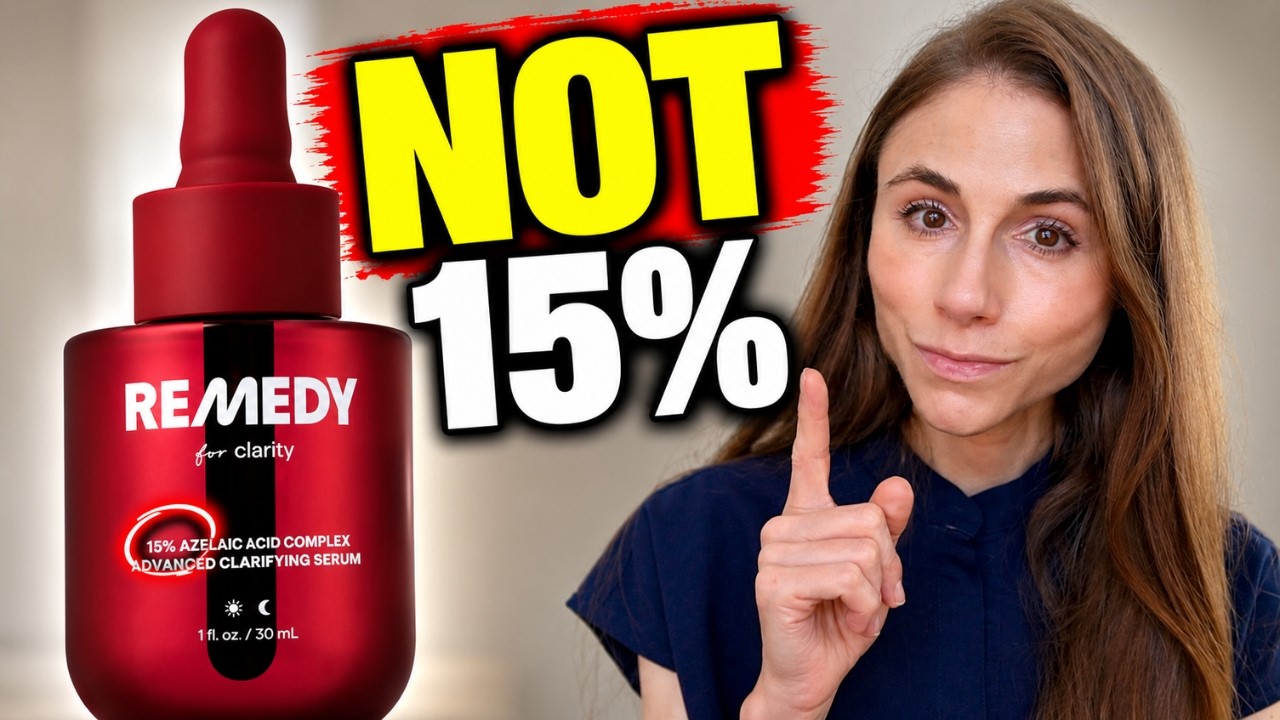
REMEDY Adds Derivative to Claim 15% Azelaic Strength, Dr Dray Says
Dr Dray
REMEDY's $25 serum cannot substitute for prescription medicine because its 15% complex relies on an unproven azelaic derivative that lacks clinical trial evidence for acne or rosacea.
AI-assisted summary of REMEDY 15% Azelaic Acid Review: Is It Really 15%? — original source. Check the original for full context.
Source published:
Key ideas
- REMEDY's 15% Azelaic Acid Complex achieves its advertised percentage by pairing 10% pure azelaic acid with 5% potassium azeloyl diglycinate (azeloglycine), meaning it is not a 15% pure azelaic acid medication. (0:35)
- In the United States, over-the-counter cosmetic azelaic acid is capped at 10% and restricted to cosmetic claims, whereas clinically proven treatments for acne, rosacea, and melasma require 15% to 20% prescription-strength formulations. (0:35)
- Scientific evidence for potassium azeloyl diglycinate remains weak, with existing rosacea trials lacking vehicle controls and zero clinical data evaluating its performance on acne or hyperpigmentation. (2:37)
- Dr. Dray discontinued testing the serum after two weeks due to recurrent eyelid dryness and facial itching triggered by the azeloglycine derivative, opting instead for the similarly priced ($25) Anua 10% Azelaic Acid Serum. (7:12)
Detailed notes
## Background Published by dermatologist Dr. Dray on YouTube on September 30, 2026, this video reviews the REMEDY 15% Azelaic Acid Complex Advanced Clarifying Serum. According to the description, Dr. Dray examines the product's formulation—explaining that it contains 10% azelaic acid combined with 5% potassium azeloyl diglycinate rather than true 15% azelaic acid—while assessing its clinical backing, comparing it to Anua's 10% serum, and sharing her own testing results.
## TL;DR Dr. Dray clarifies that the serum is a cosmetic product capped at 10% azelaic acid with an added 5% potassium azeloyl diglycinate derivative, warning consumers not to mistake it for prescription-strength medication. She highlights supportive ingredients like niacinamide, beta-glucan, and vitamin B12, but notes that potassium azeloyl diglycinate lacks strong controlled clinical evidence for acne or hyperpigmentation. Dr. Dray experienced eyelid dryness and facial itching after two weeks of use—a personal sensitivity she attributes to the derivative—leading her to stop testing. While she considers the $25 price point reasonable and the formula suitable for cosmetic maintenance, she personally prefers the Anua 10% Azelaic Acid Serum and emphasizes that cosmetic serums cannot replace proven treatments for diagnosed skin conditions.
## Atmosphere & style The presentation is marked by Dr. Dray's signature calm, pragmatic, and authoritative clinical demeanor, blending consumer advocacy with rigorous dermatologic critique. Her delivery is refreshingly candid as she demystifies skincare marketing claims without veering into hyperbole, maintaining a level-headed and educational tone throughout. Watching the video feels like an intimate, transparent consultation with an objective expert who thoughtfully separates physiological science and personal adverse reactions from commercial hype.
## Bulletin - [00:35](https://www.youtube.com/watch?v=RtnlMdbZW4k&t=35s) REMEDY's 15% Azelaic Acid Complex achieves its advertised percentage by pairing 10% pure azelaic acid with 5% potassium azeloyl diglycinate (azeloglycine), meaning it is not a 15% pure azelaic acid medication. - [00:35](https://www.youtube.com/watch?v=RtnlMdbZW4k&t=35s) In the United States, over-the-counter cosmetic azelaic acid is capped at 10% and restricted to cosmetic claims, whereas clinically proven treatments for acne, rosacea, and melasma require 15% to 20% prescription-strength formulations. - [02:37](https://www.youtube.com/watch?v=RtnlMdbZW4k&t=157s) Scientific evidence for potassium azeloyl diglycinate remains weak, with existing rosacea trials lacking vehicle controls and zero clinical data evaluating its performance on acne or hyperpigmentation. - [07:12](https://www.youtube.com/watch?v=RtnlMdbZW4k&t=432s) Dr. Dray discontinued testing the serum after two weeks due to recurrent eyelid dryness and facial itching triggered by the azeloglycine derivative, opting instead for the similarly priced ($25) Anua 10% Azelaic Acid Serum.
## Key takeaways - [00:00](https://www.youtube.com/watch?v=RtnlMdbZW4k&t=0s) The REMEDY serum retails for around $25 and combines 10% azelaic acid with 5% potassium azeloyl diglycinate to market a '15% azelaic acid complex'. - [00:35](https://www.youtube.com/watch?v=RtnlMdbZW4k&t=35s) Cosmetic azelaic acid in the US is legally limited to 10% concentration and cannot make medical claims to treat acne, rosacea, or hyperpigmentation. - [00:35](https://www.youtube.com/watch?v=RtnlMdbZW4k&t=35s) Prescription-strength azelaic acid (15%–20%) possesses robust clinical trial backing for treating skin diseases, whereas cosmetic formulations are limited to improving appearance and soothing redness. - [02:37](https://www.youtube.com/watch?v=RtnlMdbZW4k&t=157s) Potassium azeloyl diglycinate cannot be clinically equated to pure azelaic acid, and adding 5% of this derivative does not match the efficacy of a 15% prescription formulation. - [02:37](https://www.youtube.com/watch?v=RtnlMdbZW4k&t=157s) The primary clinical study on 5% potassium azeloyl diglycinate lacked a placebo vehicle control, leaving it unproven whether patient symptom relief stemmed from the derivative or merely the moisturizing base. - [02:37](https://www.youtube.com/watch?v=RtnlMdbZW4k&t=157s) There are currently no clinical trials evaluating potassium azeloyl diglycinate for the treatment of acne or hyperpigmentation. - [02:37](https://www.youtube.com/watch?v=RtnlMdbZW4k&t=157s) Dr. Dray suggests marketing the formula as a '15% complex' is clever branding that may mislead consumers into believing they are purchasing medication-strength azelaic acid. - [05:54](https://www.youtube.com/watch?v=RtnlMdbZW4k&t=354s) Niacinamide is included to support skin barrier integrity, soothe inflammation, and inhibit melanosome transfer to improve uneven pigmentation. - [05:54](https://www.youtube.com/watch?v=RtnlMdbZW4k&t=354s) The formulation incorporates vitamin B12 and beta-glucan to calm inflammation and help mitigate the transient stinging and itching frequently triggered by azelaic acid. - [05:54](https://www.youtube.com/watch?v=RtnlMdbZW4k&t=354s) Botanical extracts such as centella asiatica, licorice root, and green tea provide additional antioxidant and anti-redness support. - [07:12](https://www.youtube.com/watch?v=RtnlMdbZW4k&t=432s) Dr. Dray stopped using the serum after two weeks due to eyelid dryness and facial itching, noting she has experienced the same reaction from other products containing potassium azeloyl diglycinate. - [07:12](https://www.youtube.com/watch?v=RtnlMdbZW4k&t=432s) Dr. Dray clarifies that her adverse reaction is a personal ingredient sensitivity and does not mean the product is unsafe or ineffective for other users. - [08:23](https://www.youtube.com/watch?v=RtnlMdbZW4k&t=503s) There is no comparative clinical evidence showing that pairing 10% azelaic acid with potassium azeloyl diglycinate provides superior results over a standard 10% azelaic acid formulation. - [09:26](https://www.youtube.com/watch?v=RtnlMdbZW4k&t=566s) Dr. Dray prefers the similarly priced Anua 10% Azelaic Acid Serum, which shares core soothing botanicals but omits potassium azeloyl diglycinate and vitamin B12. - [10:45](https://www.youtube.com/watch?v=RtnlMdbZW4k&t=645s) Consumers should evaluate the REMEDY serum strictly as a cosmetic maintenance product for skin tone and redness rather than a substitute for prescription medical treatments.
## Detailed walkthrough ### [00:00](https://www.youtube.com/watch?v=RtnlMdbZW4k&t=0s) REMEDY 15% Azelaic Acid Complex Introduction
Dr. Dray introduces the REMEDY 15% Azelaic Acid Complex Advanced Clarifying Serum, a product retailing for roughly $25 whether bought directly through REMEDY's site or from Amazon. She points out that $25 is the standard going rate across nearly all REMEDY serums, most of which she has already reviewed on her channel.
Right off the bat, she issues a major clarification: while the product is boldly marketed as a "15% azelaic acid complex," it is **not** a 15% azelaic acid serum. In the United States, cosmetic formulations are legally capped at a maximum of 10% azelaic acid. She emphasizes that pure azelaic acid is a genuinely useful dermatologic ingredient known for its anti-inflammatory properties, its ability to regulate keratinization in the epidermis, and its impact on pigment production. However, there is a strict divide between cosmetic claims and prescription medicine:
```mermaid flowchart TD accTitle: Comparison of Cosmetic vs Prescription Azelaic Acid accDescr: Chart contrasting cosmetic 10 percent formulas against 15 to 20 percent prescription treatments.
subgraph Cosmetic["Cosmetic Formulations (Max 10%)"] C1["Available Over the Counter (~$25)"] C2["Improves Appearance & Skin Tone"] C3["Calms Skin Redness"] C4["Cannot Legally Claim to Treat Diseases"] end
subgraph Rx["Prescription Formulations (15% – 20%)"] R1["Requires Prescription / DTC Clinic in US"] R2["Clinically Proven to Treat Acne"] R3["Clinically Proven to Treat Rosacea"] R4["Clinically Proven to Treat Melasma & Hyperpigmentation"] end ```
- In the US, prescription-strength formulations range between 15% and 20% and must be obtained via a doctor or direct-to-consumer telehealth platforms (though they are sold over the counter in some other countries). - Cosmetic products (10% strength) can only legally claim to improve the general look of the skin, even out skin tone, or soothe mild redness. - Cosmetic products cannot legally claim to *treat* acne, rosacea, hyperpigmentation, or melasma, because 10% has never been clinically established in trials to treat those medical diseases. - Consumers should not mistake the "15%" label on this bottle for an affordable prescription substitute: "They're not the same thing, okay? This is not intended to treat a skin disease and it's not 15% azelaic acid."
---
[02:37](https://www.youtube.com/watch?v=RtnlMdbZW4k&t=157s) Potassium Azeloyl Diglycinate Explained
Dr. Dray pulls back the curtain on how REMEDY arrives at the "15% complex" claim: the formula combines 10% azelaic acid with 5% potassium azeloyl diglycinate (often referred to as azeloglycine), an azelaic acid derivative. While derived from azelaic acid, this ingredient is far less researched. Dr. Dray evaluates a notable trial published in the *Journal of Dermatologic Treatment*, where patients presenting primarily with rosacea-associated erythema and telangiectasias used a topical cream containing 5% potassium azeloyl diglycinate twice daily for 12 weeks. While investigators reported reductions in stinging and burning, Dr. Dray emphasizes that the study suffers from critical methodological limitations.
Chief among these limitations is the complete lack of a placebo or vehicle control. "You don't just put pure potassium azeloyl diglycinate on the skin, sprinkle it on like a salt shaker," she explains; it must be delivered within a topical moisturizing base. Without testing the identical vehicle base without the active, it is impossible to know whether the soothing of sensitive skin was driven by the derivative itself or merely by moisturizing the skin barrier. Furthermore, the trial compared patients only against their own baseline, and all subjects had already been treated previously with established medical therapies like topical azelaic acid or metronidazole.
There are currently zero clinical studies evaluating potassium azeloyl diglycinate for acne or hyperpigmentation. Dr. Dray expresses skepticism about its role in the serum, remarking: "I think they put it in there because they believe it might help. I also think they put it in there because azelaic acid complex sounds like azelaic acid and it sounds like, 'Oh wow, this is 15%. I'm getting more like a medication strength.' A little sneaky."
- Potassium azeloyl diglycinate lacks any robust evidence demonstrating added benefit over 10% azelaic acid alone. - It cannot be mathematically or clinically substituted for pure azelaic acid to claim a 15% therapeutic effect. - The only clinical data available evaluates rosacea sensitivity symptoms in an uncontrolled, non-placebo vehicle study.
---
[05:54](https://www.youtube.com/watch?v=RtnlMdbZW4k&t=354s) Niacinamide, Beta Glucan, Vitamin B12 & Botanicals
Turning to the remainder of the ingredient list, Dr. Dray highlights what she calls "the workhorse of the skin care industry" that nobody can escape: niacinamide. For those who tolerate it—including Dr. Dray herself—niacinamide is an excellent supportive ingredient that strengthens the skin barrier, reduces inflammation, and blocks the melanosome transfer from melanocytes into surrounding epidermal keratinocytes to help brighten uneven tone.
The rest of the formula features soothing, hydrating, and antioxidant agents that complement skin clarity: - **Beta-glucan:** Provides intense hydration and barrier support. - **Vitamin B12:** Included for its emerging topical evidence in reducing inflammation and easing cutaneous itch—an especially clever addition given that azelaic acid frequently triggers transient tingling and itching upon application. - **Centella Asiatica Extract:** Offers antioxidant defense and calms irritation. - **Licorice Root Extract:** A well-regarded botanical often utilized to combat redness and uneven pigmentation. - **Green Tea Extract:** Delivers soothing polyphenol antioxidant protection.
Dr. Dray summarizes the overall formula as thoughtful and logical on paper for anyone seeking general improvements in clarity and tone while mitigating background redness, assuming the skin tolerates all components well.
---
[07:12](https://www.youtube.com/watch?v=RtnlMdbZW4k&t=432s) Dr. Dray's Personal Experience and Product Evaluation
Sharing her hands-on testing experience, Dr. Dray reveals that after a couple of weeks of use, she developed noticeable eyelid dryness and persistent facial itching. This reaction mirrors previous experiences she has had with other skincare products formulated with potassium azeloyl diglycinate. While pure azelaic acid is notorious for inducing temporary tingling or itchiness, she notes that in her personal case, prolonged itching and eyelid dermatitis have consistently surfaced only when using products with the potassium azeloyl diglycinate derivative.
Because of this flare-up, she stopped using the serum after two weeks and was unable to evaluate its long-term benefits for skin clarity or tone. She is careful to remind viewers that her personal reaction does not classify the serum as bad or unsafe: individual sensitivities vary greatly, and this simply marks the second time that this specific derivative has disagreed with her skin.
Reflecting on the product as a whole, Dr. Dray considers the $25 price point quite fair for an elegant, multi-ingredient 10% azelaic acid serum packed with supportive soothers. However, the core question remains whether the 5% potassium azeloyl diglycinate provides any real functional advantage, or whether it simply exists to help the product stand out in a saturated market and justify the "15%" label on the front of the box. Currently, there is a total void of head-to-head clinical data proving that combining 10% azelaic acid with this derivative outperforms standard 10% azelaic acid formulations, nor is there evidence showing cosmetic 10% formulas match prescription strengths for clinical efficacy.
[09:26](https://www.youtube.com/watch?v=RtnlMdbZW4k&t=566s) REMEDY vs. Anua 10% Azelaic Acid Serum
While cosmetic azelaic acid products are popular, there is still no robust clinical evidence that a 10% strength can actually treat medical dermatological conditions like acne, rosacea, melasma, or hyperpigmentation in the way prescription formulations do. When choosing an over-the-counter option, Dr. Dray personally prefers, frequently buys, and enjoys the Anua Azelaic Acid 10 Serum. She has reviewed the Anua serum previously and even addressed viewer concerns raised on TikTok regarding a rumored formulation change; she covered that in a dedicated video detailing why the change is not a concern for her.
Comparing the two formulations, Anua shares a very similar core botanical and brightening profile—featuring niacinamide, licorice root, and centella asiatica—but it omits both potassium azeloyl diglycinate and vitamin B12. For Dr. Dray's skin, the Anua formula simply performs better. Both serums retail in roughly the same price ballpark around $25, give or take a dollar depending on the retailer. While Dr. Dray sticks with Anua, she emphasizes that both serums are very good formulas. The REMEDY serum could easily become a "holy grail" for consumers who are already fans of the REMEDY brand, tolerate its ingredients well, and want to incorporate azelaic acid into their regimen.
| Feature / Ingredient | REMEDY 15% Azelaic Acid Complex | Anua Azelaic Acid 10 Serum | |:--- |:--- |:--- | | **Azelaic Acid** | 10% | 10% | | **Potassium Azeloyl Diglycinate** | 5% | None | | **Vitamin B12** | Included | None | | **Shared Soothing Actives** | Niacinamide, Centella Asiatica, Licorice Root | Niacinamide, Centella Asiatica, Licorice Root | | **Price Point** | ~$25 | ~$25 (give or take a dollar) | | **Dr. Dray's Preference** | Experienced dryness and irritation | Personal favorite; frequently repurchased |
---
[10:45](https://www.youtube.com/watch?v=RtnlMdbZW4k&t=645s) Final Verdict: Cosmetic Benefits vs. Medical Treatments
From an objective standpoint, Dr. Dray notes that science cannot yet confirm what the addition of potassium azeloyl diglycinate truly offers to consumers beyond standard azelaic acid, nor how this hybrid cosmetic formula compares to prescription-strength medications. Consequently, shoppers should not rely on this serum—or any cosmetic-grade azelaic acid—as a primary treatment for diagnosed skin disorders like active acne, rosacea, melasma, or deep hyperpigmentation. Those seeking to resolve medical skin issues are far better served by evidence-based prescription treatments. Instead, the REMEDY serum should be viewed strictly through the lens of cosmetic maintenance: soothing the skin and improving overall skin tone evenness.
Regarding her own adverse reaction, Dr. Dray clarifies that experiencing eyelid dryness and itching from potassium azeloyl diglycinate is a recurring sensitivity for her personally: "It's a me issue. It's not necessarily a REMEDY azelaic acid serum issue." She encourages viewers who tolerate the ingredients to consider it, especially if they already enjoy the REMEDY lineup. She concludes by directing viewers to her previous review of another REMEDY serum, reminding everyone to like, share, subscribe, and wear their sunscreen.
## Notable quotes > [00:00](https://www.youtube.com/watch?v=RtnlMdbZW4k&t=0s) 15% azelaic acid complex — Dr. Dray
> [00:00](https://www.youtube.com/watch?v=RtnlMdbZW4k&t=0s) They're not the same thing, okay? This is not intended to treat a skin disease and it's not 15% azelaic acid. — Dr. Dray
> [02:37](https://www.youtube.com/watch?v=RtnlMdbZW4k&t=157s) You don't just put pure potassium azeloyl diglycinate on the skin, sprinkle it on like a salt shaker — Dr. Dray
> [02:37](https://www.youtube.com/watch?v=RtnlMdbZW4k&t=157s) I think they put it in there because they believe it might help. I also think they put it in there because azelaic acid complex sounds like azelaic acid and it sounds like, 'Oh wow, this is 15%. I'm getting more like a medication strength.' A little sneaky. — Dr. Dray
> [02:37](https://www.youtube.com/watch?v=RtnlMdbZW4k&t=157s) Oh wow, this is 15%. I'm getting more like a medication strength. — Dr. Dray
> [02:37](https://www.youtube.com/watch?v=RtnlMdbZW4k&t=157s) A little sneaky. — Dr. Dray
> [05:54](https://www.youtube.com/watch?v=RtnlMdbZW4k&t=354s) the workhorse of the skin care industry — Dr. Dray
> [09:26](https://www.youtube.com/watch?v=RtnlMdbZW4k&t=566s) holy grail — Dr. Dray
> [10:45](https://www.youtube.com/watch?v=RtnlMdbZW4k&t=645s) It's a me issue. It's not necessarily a REMEDY azelaic acid serum issue. — Dr. Dray
## Mentioned Dr. Dray, REMEDY, REMEDY 15% Azelaic Acid Complex Advanced Clarifying Serum, Anua, Anua Azelaic Acid 10 Serum, Journal of Dermatologic Treatment, Amazon, TikTok, Azelaic acid, Potassium azeloyl diglycinate, Azeloglycine, Niacinamide, Beta-glucan, Vitamin B12, Centella asiatica, Licorice root, Green tea extract, Metronidazole
## Video description Dermatologist Dr. Dray reviews the REMEDY 15% Azelaic Acid Complex Advanced Clarifying Serum, a $25 skincare serum marketed as containing a 15% azelaic acid complex. But there is an important distinction: this is not a 15% azelaic acid serum. The formula contains 10% azelaic acid plus 5% potassium azeloyl diglycinate, also known as azeloglycine. Dr. Dray breaks down what is known about these ingredients, how potassium azeloyl diglycinate compares with azelaic acid, and whether this combination offers meaningful benefits over a traditional 10% azelaic acid product. The video also covers the evidence for azelaic acid in acne, rosacea, and hyperpigmentation, the limited clinical evidence for potassium azeloyl diglycinate, and the other ingredients in the formula, including niacinamide, beta glucan, vitamin B12, centella asiatica, licorice root, and green tea extract. Dr. Dray also shares her personal experience using the REMEDY serum. After a couple of weeks, she developed eyelid dryness and facial itching and discontinued the product. She notes that this is her individual experience and does not mean everyone will experience irritation. The video also compares the REMEDY serum with the Anua 10% Azelaic Acid Serum, which Dr. Dray personally uses and repurchases. The two products have a similar overall concept and price range, but the Anua serum does not contain potassium azeloyl diglycinate or vitamin B12. Most importantly, Dr. Dray explains why “15% azelaic acid complex” does not mean 15% azelaic acid, and why consumers should not assume that 5% potassium azeloyl diglycinate is equivalent to an additional 5% azelaic acid. She also discusses why she would like to see prescription-strength azelaic acid become available over the counter in the United States, given its versatility in dermatology and established history of use.
Products Mentioned Remedy 15% Azelaic Acid Complex Advanced Clarifying Serum https://amzlink.to/az0M7w6trRrcB Anua Azelaic Acid 10 Serum https://amzlink.to/az0DaPVjUyYmq
Timestamps 0:00 REMEDY 15% Azelaic Acid Complex Introduction 0:35 What Does 10% Azelaic Acid Actually Do? 2:37 Potassium Azeloyl Diglycinate Explained 5:54 Niacinamide, Beta Glucan, Vitamin B12 & Botanicals 7:12 Dr. Dray's Experience With the Serum 8:23 Is the $25 Price Worth It? 9:35 REMEDY vs. Anua 10% Azelaic Acid 11:27 Final Thoughts
Keywords: azelaic acid, azelaic acid serum, 10% azelaic acid, 15% azelaic acid, potassium azeloyl diglycinate, azeloglycine, REMEDY azelaic acid, REMEDY 15% Azelaic Acid Complex, Anua azelaic acid, azelaic acid for acne, azelaic acid for rosacea, azelaic acid for hyperpigmentation, dermatologist skincare review, azelaic acid review, best azelaic acid serum, prescription azelaic acid, cosmetic azelaic acid
#AzelaicAcid #AzelaicAcidSerum #remedyskincare #Acne #Rosacea #Hyperpigmentation #SkincareReview #Dermatologist #DrDray FTC: This video is not sponsored. Links are commissionable, meaning I may earn commission from purchases made through links.
💜Shop my Amazon store https://o.bttn.io/0BwiPWFIZLG 💜Follow me on liketoknowit https://www.liketoknow.it/drdrayzday 💜Social media Instagram @drdrayzday Pinterest https://www.pinterest.com/drdrayzday/ Facebook @DrDrayzDay Twitter: @drdrayzday Tiktok: @drdrayzday
Disclaimer: This video is not intended to provide diagnosis, treatment or medical advice. Content provided on this Youtube channel is for informational purposes only. Please consult with a physician or other healthcare professional regarding any medical or health related diagnosis or treatment options. Information on this Youtube channel should not be considered as a substitute for advice from a healthcare professional. The statements made about specific products throughout this video are not to diagnose, treat, cure or prevent disease.
[Source](https://www.youtube.com/watch?v=RtnlMdbZW4k)