Rails Creator DHH Abandons Hand-Written Code for AI-Generated Rust
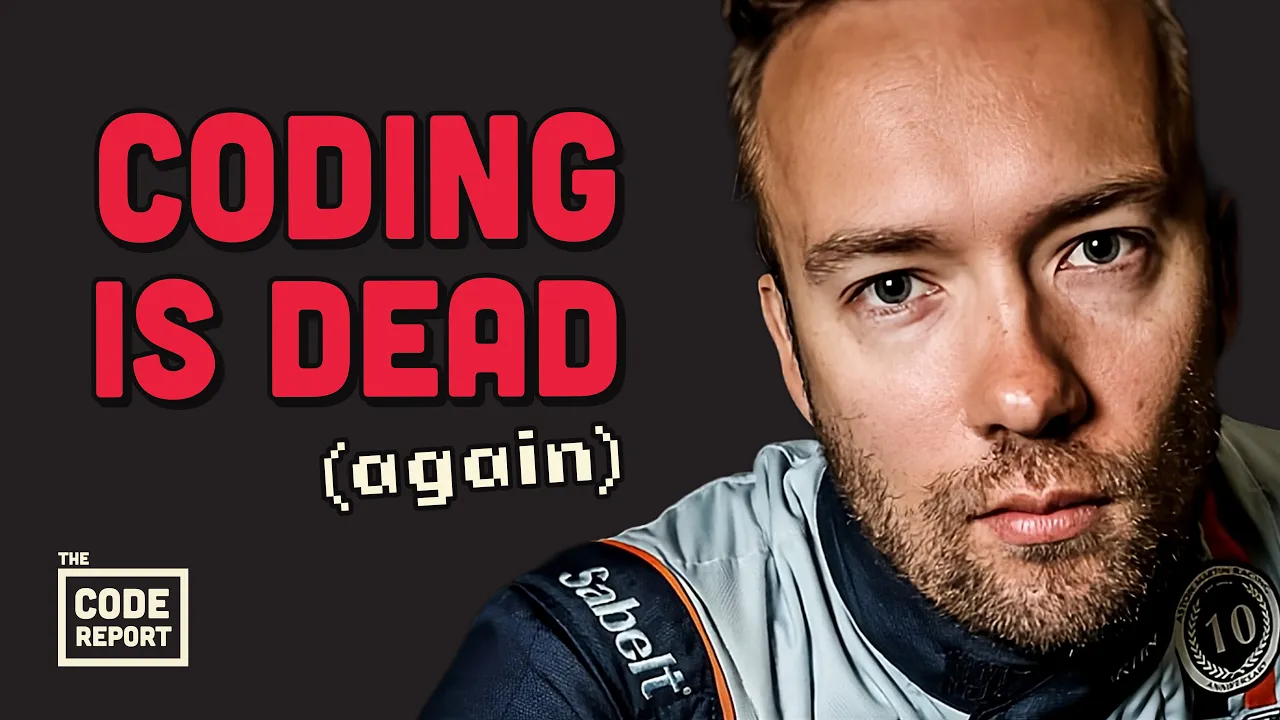
Fireship
Writing code by hand has become economically obsolete as autonomous agents generating low-level Rust slash infrastructure costs by 95%, shifting software engineering value from syntax creation to system architecture.
AI-assisted summary of DHH has gone completely off the rails... — original source. Check the original for full context.
Source published:
Key ideas
- At Rails World, Ruby on Rails creator DHH declared hand-written source code economically obsolete, urging engineers to embrace agentic workflows over manual coding. (0:00)
- Basecamp's rewrite of the HEY email backend into AI-generated Rust slashed server CPU and memory consumption by 95%, underscoring a shift toward machine-first performance over human ergonomics. (1:10)
- DHH reported expanding his output from 30,000 lines of Ruby per year to 150,000 lines per month using agents, while a poll of 1,200 Rails World attendees showed fewer than 1% still write code manually. (3:55)
- As the marginal cost of creating code drops to zero, software engineering bottlenecks have shifted downstream to pull request triage, dependency management, and code review. (5:45)
Detailed notes
## Background Published by Fireship on YouTube on September 28, 2026, this episode of The Code Report reacts to David Heinemeier Hansson (DHH) declaring to 1,200 Rails developers that writing code by hand is over. The video explores which developer skills are still worth having in an agent-driven world and features a showcase of CodeRabbit Triage.
## TL;DR At the Rails World conference, Ruby on Rails creator DHH delivered a startling keynote proclaiming that writing code by hand is economically obsolete, advocating instead for AI-generated Rust to achieve massive efficiency gains. This paradigm shift diminishes traditional 'keyboard martial arts' and human-centric framework ergonomics, redirecting value toward problem definition, system architecture, and token-optimized execution. With agents making syntax generation essentially free, the industry's primary operational bottleneck has shifted downstream toward reviewing, testing, and triaging massive pull request backlogs.
## Atmosphere & style The presentation is trademark Fireship: fast-paced, satirical, and irreverent, balancing genuine career nostalgia with deadpan comedic absurdity. It opens with dramatic, mock-tragic shock—likening DHH's stance to bulldozing a childhood home or the Pope preaching atheism—before peppering the narrative with ridiculous fake startup pitches like 'Donker.' Beneath the chaotic humor and existential anxiety about the death of developer happiness lies a spirited, pragmatic case for technological optimism.
## Bulletin - [00:00](https://www.youtube.com/watch?v=OuNKBjuV7A4&t=0s) At Rails World, Ruby on Rails creator DHH declared hand-written source code economically obsolete, urging engineers to embrace agentic workflows over manual coding. - [01:10](https://www.youtube.com/watch?v=OuNKBjuV7A4&t=70s) Basecamp's rewrite of the HEY email backend into AI-generated Rust slashed server CPU and memory consumption by 95%, underscoring a shift toward machine-first performance over human ergonomics. - [03:55](https://www.youtube.com/watch?v=OuNKBjuV7A4&t=235s) DHH reported expanding his output from 30,000 lines of Ruby per year to 150,000 lines per month using agents, while a poll of 1,200 Rails World attendees showed fewer than 1% still write code manually. - [05:45](https://www.youtube.com/watch?v=OuNKBjuV7A4&t=345s) As the marginal cost of creating code drops to zero, software engineering bottlenecks have shifted downstream to pull request triage, dependency management, and code review.
## Key takeaways - [00:00](https://www.youtube.com/watch?v=OuNKBjuV7A4&t=0s) DHH announced to over 1,000 developers at Rails World that writing application code by hand is no longer economically viable. - [00:00](https://www.youtube.com/watch?v=OuNKBjuV7A4&t=0s) Rejecting tech pessimism, DHH declared that 'the black pill is for losers,' urging engineers to adapt to AI-driven workflows rather than mourn legacy practices. - [01:10](https://www.youtube.com/watch?v=OuNKBjuV7A4&t=70s) Mastery over complex editor configurations and terminal keybindings no longer grants a meaningful productivity edge in an agent-driven development cycle. - [01:10](https://www.youtube.com/watch?v=OuNKBjuV7A4&t=70s) Command-line interfaces remain essential, but their primary audience has shifted from human operators to autonomous software agents. - [01:10](https://www.youtube.com/watch?v=OuNKBjuV7A4&t=70s) The industry's historical emphasis on 'developer happiness' is giving way to designs optimized for AI token efficiency and raw runtime execution speed. - [01:10](https://www.youtube.com/watch?v=OuNKBjuV7A4&t=70s) Despite previously calling Rust inhumane for human coders, DHH endorsed AI-generated Rust after using it to reduce HEY's infrastructure footprint by 95%. - [03:55](https://www.youtube.com/watch?v=OuNKBjuV7A4&t=235s) DHH escalated his personal coding output from roughly 30,000 lines of Ruby per year to 150,000 lines of agent-generated code per month. - [03:55](https://www.youtube.com/watch?v=OuNKBjuV7A4&t=235s) An informal poll of 1,200 Rails World attendees revealed only about five engineers still spend significant portions of their workweek hand-coding. - [03:55](https://www.youtube.com/watch?v=OuNKBjuV7A4&t=235s) Core engineering value resides in architecture, problem formulation, and operational security rather than syntax authoring. - [03:55](https://www.youtube.com/watch?v=OuNKBjuV7A4&t=235s) On-demand agentic tooling has dramatically lowered execution barriers, giving a distinct advantage to optimistic builders who iterate quickly. - [05:45](https://www.youtube.com/watch?v=OuNKBjuV7A4&t=345s) Mass AI code generation has created an acute operational crisis in pull request reviews, turning review backlogs into the primary engineering constraint. - [05:45](https://www.youtube.com/watch?v=OuNKBjuV7A4&t=345s) Modern developer tooling is increasingly shifting toward risk-weighted triage and automated review prioritization to handle massive surges in agent-created pull requests.
## Detailed walkthrough ### [00:00](https://www.youtube.com/watch?v=OuNKBjuV7A4&t=0s) DHH’s Bombshell at Rails World and the AI Rust Heresy
At the Rails World conference in Austin, Texas, Ruby on Rails creator David Heinemeier Hansson (DHH) took the stage in front of over a thousand Rails developers and dropped an existential bomb: writing Rails or any source code by hand is effectively dead, no longer economically viable, and anyone clinging to the past needs to move on. DHH punctuated this message with a stern warning against tech pessimism: "The black pill is for losers. Don't be a loser." Instead of championing the beloved framework he authored, DHH used his keynote to advocate for AI-generated Rust. For the audience and the broader developer ecosystem, this was the spiritual equivalent of the Pope showing up to Easter Mass to preach the virtues of atheism.
For the host of The Code Report, the keynote struck an intensely personal nerve. Ruby on Rails was the foundational framework that originally launched his software engineering career and directly led to the birth of the Fireship YouTube channel. Watching DHH abandon manual Rails coding felt like watching his own childhood home get bulldozed just to make room for a giant data center. The keynote forced an immediate reckoning with whether DHH has genuinely diagnosed the structural future of software engineering or simply fallen victim to extreme "AI psychosis."
- **Setting:** Rails World Conference in Austin, Texas, with over 1,000 developers in attendance. - **DHH's Thesis:** Writing application source code by hand is economically obsolete and impossible to justify commercially. - **Core Catchphrase:** "The black pill is for losers. Don't be a loser." - **Host's Career Connection:** Rails was the host's first professional framework, providing the technical runway that eventually produced the Fireship platform.
---
[01:10](https://www.youtube.com/watch?v=OuNKBjuV7A4&t=70s) The Death of Keyboard Martial Arts and Developer Happiness
The report examines the first skill rendered obsolete in this new era: "keyboard martial arts." Only a few years ago, mastery of tools like Neovim, memorizing hundreds of keybindings, and tweaking elaborate text editor configurations could tangibly accelerate a developer's output. But when an AI agent handles the overwhelming majority of code edits, being able to wipe out the contents of a pair of parentheses in three rapid keystrokes without reaching for a mouse has been downgraded from a superpower to a niche party trick. While DHH remains an avid Neovim user and still insists on the primacy of the command-line interface (CLI), he explicitly argued that CLIs are no longer intended for human eyes. During his keynote, DHH demanded: "It is your obligation to deliver those CLIs by next Friday so I can use your application without actually ever having to touch it." Mastering editors and terminal mechanics no longer provides a competitive edge in developer productivity.
```mermaid flowchart TD accTitle: Paradigm Shift in Software Engineering accDescr: Comparison of traditional human-centric development versus modern agent-driven development. subgraph Traditional["Traditional Paradigm (Human Happiness)"] A["Human Programmer"] -->|"Handcrafted edits"| B["Keyboard Mastery & IDEs"] B -->|"Framework ergonomics"| C["Ruby on Rails / React"] C -->|"Costly execution"| D["High CPU / Memory Footprint"] end subgraph Agentic["Emerging Paradigm (Agentic Efficiency)"] E["High-Level Problem Spec"] -->|"Prompts & Agents"| F["Agentic CLI Interfaces"] F -->|"AI Generation"| G["Token-Optimized Rust"] G -->|"Machine execution"| H["95% Resource Reduction"] end ```
The erosion of human craft extends directly into web frameworks such as Ruby on Rails, React, Svelte, Angular, and Tailwind CSS. Rails rose to dominance on the promise of prioritizing developer happiness—a feeling epitomized back in 2008 when running `rails new` generated a complete MVC CRUD application within seconds like a magic wand. But developer happiness as an engineering target is now practically dead. Highlighting this shift, the host notes that his own startup, Horse Tinder, bypassed modern frameworks altogether in favor of vanilla JavaScript and a backend written in Rust.
DHH's transformation on this topic is particularly striking. He was once a vocal critic of Rust, famously describing it in the past as "AN AWFUL, AWFUL, AWFUL PROGRAMMING LANGUAGE when you subject humans to write it. Absolutely inhumane." Yet in his keynote, DHH revealed that Basecamp is actively rewriting the backend of their email service, HEY, not with human-crafted Ruby, but using fully AI-generated Rust: "Rust is amazing if you never, ever, ever have to look at it yourself." The technical payoff was undeniable: the Rust rewrite slashed server CPU and memory consumption by 95%. Going forward, the frameworks that survive will not be the ones that spark joy in human coders; they will be the ones that minimize AI token consumption and maximize runtime raw performance. Eventually, the entire landscape of distinct frameworks, languages, and runtimes may collapse into a single universal, token-efficient language designed exclusively for machines.
- **Editor Mastery:** Spending hundreds of hours perfecting Neovim setups or terminal shortcuts yields negligible returns when agents generate and edit code. - **Agent-First CLIs:** CLIs remain mandatory, but their primary consumers are now autonomous agents executing programmatic workflows rather than human operators. - **The End of Developer Happiness:** Frameworks optimized around pleasant syntax and developer ergonomics are yielding to low-level, high-efficiency systems. - **The HEY Email Rewrite:** Rewriting the HEY email application from Ruby on Rails to AI-generated Rust yielded an immediate 95% reduction in CPU and memory usage.
---
[03:55](https://www.youtube.com/watch?v=OuNKBjuV7A4&t=235s) The Death of Hand-Written Code and Why the Optimists Win
Turning to the act of writing software by hand, DHH shared staggering personal productivity metrics: he went from writing around 30,000 lines of Ruby code per year to generating roughly 150,000 lines of code every single month using automated agents. To test whether this was an isolated anomaly, DHH conducted a live show-of-hands poll across the 1,200 attendees at Rails World, asking how many still spent a material portion of their week hand-coding. Only about five people in the entire auditorium raised their hands, implying that less than 1% of the audience still writes code manually.
Despite hand-written code disappearing, the industry has not seen the total collapse of engineering employment, nor have Silicon Valley firms stopped offering lucrative six-figure salaries. The explanation is simple: mechanical syntax generation was never the truly valuable part of software engineering. The irreplaceable skill has always been problem definition, system architecture, security planning, and operational efficiency—tasks that agents dramatically accelerate rather than replace.
DHH's warning against being a "loser" was not an insult aimed at developers who cherish Rails, write code manually, or struggle with a failing startup. Rather, it was a critique of cynicism and defeatism. With an on-demand army of robotic coding agents at everyone's disposal, "there’s never been a better time to be an idiot with an idea." The host illustrates this with a comedic anecdote: when his startup Horse Tinder failed to raise a Series A funding round, he pivoted immediately to "Donker"—pitched as "Grindr for gay donkeys"—which is now preparing for an initial investment round backed by Sam Altman, Peter Thiel, and Tim Cook. Quoting Charlie Chaplin's famous line, "you'll never find a rainbow if you're looking down," the video emphasizes that optimism and rapid execution are the real competitive differentiators.
- **DHH's Output Jump:** Increased from ~30,000 lines of Ruby annually to ~150,000 lines of agent-generated code per month. - **Rails World Poll:** Out of 1,200 professional developers, only around 5 developers still spend meaningful time writing code manually. - **Real Value in Engineering:** Translating ambiguous business problems into secure, high-performance architecture rather than typing syntax. - **The Startup Pivot Joke:** Transitioning from the failed Horse Tinder to Donker ("Grindr for gay donkeys"), jokingly targeting capital from Sam Altman, Peter Thiel, and Tim Cook.
---
[05:45](https://www.youtube.com/watch?v=OuNKBjuV7A4&t=345s) The Post-Coding Bottleneck: CodeRabbit Triage
While generative agents have effectively driven the marginal cost of creating code down to zero, they have simultaneously created an acute operational bottleneck on everything that follows. Development teams are routinely swamped under backlogs of 200 open pull requests, while standard GitHub views only allow sorting by chronological order. This problem introduces CodeRabbit, the sponsor of the episode, which tackles PR overload using automated triage.
CodeRabbit Triage delivers a "next best action" dashboard across an organization's repositories, ranking pending PRs by risk profile, review effort, and blocking dependencies. It guides engineers on which PRs to inspect first, recommends how deep the review needs to go, identifies necessary teammates, and flags PRs that can be closed safely. Developers can even fix failing builds and resolve merge conflicts directly from the review queue without having to switch tabs. Holding the status of the number-one installed AI application on GitHub, CodeRabbit helps teams merge pull requests up to four times faster.
- **The New Bottleneck:** Writing code is essentially free, but reviewing, vetting, and managing pull requests has become an overwhelming operational hurdle. - **CodeRabbit Triage Capabilities:** Evaluates pull requests across all team repositories, scoring them by security risk, review complexity, and blocking status. - **Queue Management:** Enables engineers to fix failing CI builds and clear merge conflicts directly within the interface without opening extra browser tabs. - **Adoption Metric:** Holds the spot as the #1 most installed AI application on GitHub, driving average merge speeds up by 4x.
## Notable quotes > [00:00](https://www.youtube.com/watch?v=OuNKBjuV7A4&t=0s) The black pill is for losers. Don't be a loser. — David Heinemeier Hansson (DHH)
> [00:00](https://www.youtube.com/watch?v=OuNKBjuV7A4&t=0s) AI psychosis — Host
> [01:10](https://www.youtube.com/watch?v=OuNKBjuV7A4&t=70s) keyboard martial arts — Host
> [01:10](https://www.youtube.com/watch?v=OuNKBjuV7A4&t=70s) It is your obligation to deliver those CLIs by next Friday so I can use your application without actually ever having to touch it. — David Heinemeier Hansson (DHH)
> [01:10](https://www.youtube.com/watch?v=OuNKBjuV7A4&t=70s) AN AWFUL, AWFUL, AWFUL PROGRAMMING LANGUAGE when you subject humans to write it. Absolutely inhumane. — David Heinemeier Hansson (DHH)
> [01:10](https://www.youtube.com/watch?v=OuNKBjuV7A4&t=70s) Rust is amazing if you never, ever, ever have to look at it yourself. — David Heinemeier Hansson (DHH)
> [03:55](https://www.youtube.com/watch?v=OuNKBjuV7A4&t=235s) there’s never been a better time to be an idiot with an idea. — Host
> [03:55](https://www.youtube.com/watch?v=OuNKBjuV7A4&t=235s) Grindr for gay donkeys — Host
> [03:55](https://www.youtube.com/watch?v=OuNKBjuV7A4&t=235s) you'll never find a rainbow if you're looking down — Charlie Chaplin
> [05:45](https://www.youtube.com/watch?v=OuNKBjuV7A4&t=345s) next best action
## Mentioned David Heinemeier Hansson (DHH), Ruby on Rails, Rust, Ruby, Rails World, The Code Report, Fireship, Neovim, Basecamp, HEY, React, Svelte, Angular, Tailwind CSS, JavaScript, Horse Tinder, Donker, Sam Altman, Peter Thiel, Tim Cook, Charlie Chaplin, CodeRabbit, GitHub
## Video description CodeRabbit Triage prioritizes all your team's pull requests for you. Try it free: https://coderabbit.link/fireship-014
DHH told 1,200 Rails developers that writing code by hand is over... so let's find out which programming skills are actually still worth having.
Want more Fireship?
🗞️ Newsletter: https://bytes.dev 🧠 Courses: https://fireship.dev
[Source](https://www.youtube.com/watch?v=OuNKBjuV7A4)