Khoo Says AI Trading Compresses Bear Markets, Widening Value Discounts
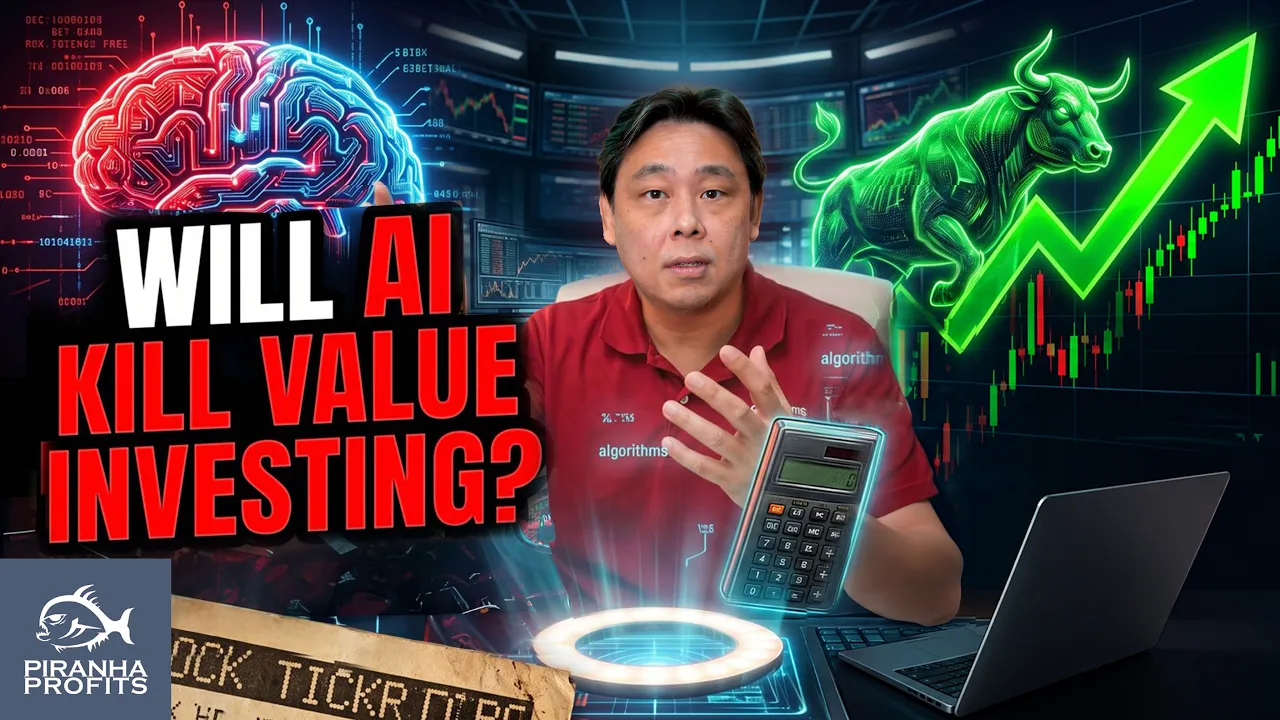
Adam Khoo
High-frequency algorithms compress bear markets from months to weeks by trading on short-term momentum rather than fundamentals, creating steeper pricing dislocations that patient investors can systematically exploit.
AI-assisted summary of Will AI Kill Value Investing? How to Beat the Algorithms in 2026. — original source. Check the original for full context.
Source published:
Key ideas
- Rather than making markets hyper-efficient, algorithmic trading—which now drives 60% to 70% of trading volume—has compressed 20% bear-market declines from a historical average of ~250 days down to less than 30 days, creating faster and deeper valuation discounts for long-term investors. (16:43)
- Even heavily scrutinized mega-cap stocks continue to experience major mispricings, with intrinsic value scans showing discounts of roughly 38% on ServiceNow, 34% on Meta Platforms, and nearly 12% on Microsoft. (3:42)
- Since the launch of ChatGPT on November 30, 2022, Adam Khoo's Value Momentum Investing approach has generated a 137% cumulative return against the S&P 500's 90% (and 25.66% YTD vs. 13.00%), demonstrating that systematic quality-value investing outperforms in the AI era. (5:28)
- Relying on generic AI chatbots to pick stocks fails because LLMs synthesize historical market consensus—eliminating any differentiated edge—while hallucinating financial figures like EPS and valuation ratios up to 39% of the time. (22:47)
Detailed notes
## Background Published by Adam Khoo on YouTube on August 14, 2026, this video addresses the growing retail anxiety that artificial intelligence and algorithmic trading are rendering value investing obsolete. According to the show notes, Khoo sets out to debunk common myths, explaining why AI stock-picking fails, how high-frequency machines create faster valuation discounts, and how his Value Momentum Investing framework capitalizes on machine-driven volatility.
## TL;DR Adam Khoo counters the prevailing narrative that AI and high-frequency algorithms have eliminated market inefficiencies, demonstrating that mega-cap leaders continue to trade at significant discounts to intrinsic value. He argues that using general AI models to pick stocks guarantees mediocre consensus returns, while general chatbots frequently hallucinate critical financial data with unearned confidence. Because algorithms trade on microsecond timeframes without regard for business fundamentals, they dramatically compress market cycles and produce sharper, faster sell-offs. Investors can exploit these algorithmic overreactions by filtering strictly for the top 1% highest-quality businesses and systematically accumulating shares in tranches at strong technical support levels.
## Atmosphere & style The presentation carries the brisk, confident energy of a seasoned market veteran brushing aside modern techno-panic with historical perspective. Khoo speaks in a candid, engaging instructional style, blending technical charts and hard valuation data with sharp humor, relatable dating analogies, and cautionary parables about AI hallucinations. The delivery feels pragmatic and empowering, steering viewers away from paralysis and framing algorithmic volatility not as an existential threat, but as an exceptional profit opportunity.
## Bulletin - [16:43](https://www.youtube.com/watch?v=QzqQwF9hCNY&t=1003s) Rather than making markets hyper-efficient, algorithmic trading—which now drives 60% to 70% of trading volume—has compressed 20% bear-market declines from a historical average of ~250 days down to less than 30 days, creating faster and deeper valuation discounts for long-term investors. - [03:42](https://www.youtube.com/watch?v=QzqQwF9hCNY&t=222s) Even heavily scrutinized mega-cap stocks continue to experience major mispricings, with intrinsic value scans showing discounts of roughly 38% on ServiceNow, 34% on Meta Platforms, and nearly 12% on Microsoft. - [05:28](https://www.youtube.com/watch?v=QzqQwF9hCNY&t=328s) Since the launch of ChatGPT on November 30, 2022, Adam Khoo's Value Momentum Investing approach has generated a 137% cumulative return against the S&P 500's 90% (and 25.66% YTD vs. 13.00%), demonstrating that systematic quality-value investing outperforms in the AI era. - [22:47](https://www.youtube.com/watch?v=QzqQwF9hCNY&t=1367s) Relying on generic AI chatbots to pick stocks fails because LLMs synthesize historical market consensus—eliminating any differentiated edge—while hallucinating financial figures like EPS and valuation ratios up to 39% of the time.
## Key takeaways - [00:00](https://www.youtube.com/watch?v=QzqQwF9hCNY&t=0s) Underperforming investors and fund managers frequently blame AI—citing instant fundamental screening, homogenized retail prompts, and microsecond institutional HFT execution—to rationalize poor returns and justify giving up on active investing. - [02:28](https://www.youtube.com/watch?v=QzqQwF9hCNY&t=148s) Claims that new technology will permanently kill active investing recur every decade, echoing past panics over Bloomberg terminals in the 1980s, S&P 500 index funds in the 1990s, and quantitative arbitrage funds in the 2000s. - [03:42](https://www.youtube.com/watch?v=QzqQwF9hCNY&t=222s) Substantial valuation gaps persist even across heavily covered trillion-dollar and mega-cap equities, including ServiceNow (~38% discount), Meta Platforms (~34% discount), Eli Lilly (12% discount), Microsoft (11.98% discount), and UnitedHealth Group (10% discount). - [05:28](https://www.youtube.com/watch?v=QzqQwF9hCNY&t=328s) Real-world performance refutes the death of value investing: since ChatGPT launched on November 30, 2022, the Value Momentum Investing framework returned 137% versus 90% for the S&P 500, and 25.66% YTD through August 13 versus the benchmark's 13.00%. - [08:49](https://www.youtube.com/watch?v=QzqQwF9hCNY&t=529s) Asking an LLM what stock to buy guarantees mediocrity because AI models operate on historical data and mathematical probability, synthesizing existing crowd sentiment and analyst consensus rather than generating a differentiated edge. - [10:12](https://www.youtube.com/watch?v=QzqQwF9hCNY&t=612s) While intraday retail traders cannot compete with institutional supercomputers on microsecond latency, long-term investors play a multi-year game where mechanical liquidity churning actually widens short-term pricing inefficiencies. - [10:38](https://www.youtube.com/watch?v=QzqQwF9hCNY&t=638s) High-frequency trading robots execute 60% to 70% of all market volume with complete disregard for intrinsic business value, amplifying systemic volatility and driving steeper sell-offs and faster rebounds. - [11:26](https://www.youtube.com/watch?v=QzqQwF9hCNY&t=686s) The 'quality value investing' philosophy prioritizes business caliber over cheap multiples, restricting investments to the top 1% of companies featuring wide economic moats, consistent revenue and cash flow growth, and ROIC and ROE exceeding 12% to 15%. - [14:01](https://www.youtube.com/watch?v=QzqQwF9hCNY&t=841s) Because short-term emotions and algorithmic momentum cause share prices to swing wildly around a rising intrinsic value curve, investors should accumulate undervalued stocks in structured tranches at technical support levels rather than attempting to time exact bottoms. - [16:43](https://www.youtube.com/watch?v=QzqQwF9hCNY&t=1003s) Automated trading has compressed multi-year market cycles into weeks: while 20% bear-market declines took ~250 days in the pre-algo era and just over 100 days in 2022, both the COVID crash and the 2025 tariff sell-off dropped 20% in under 30 days. - [20:20](https://www.youtube.com/watch?v=QzqQwF9hCNY&t=1220s) Fundamental valuation modeling places Microsoft's intrinsic value near $570 and Meta Platforms' near $900 (~34% discount), with big tech's large debt and capex figures easily supported by fortress balance sheets and massive operating cash flows. - [22:14](https://www.youtube.com/watch?v=QzqQwF9hCNY&t=1334s) Meta Platforms' chart exhibits a rhythmic wave structure currently resting on a strong technical support floor, presenting a compelling risk-to-reward entry point ahead of its next upward cycle. - [22:47](https://www.youtube.com/watch?v=QzqQwF9hCNY&t=1367s) Generic consumer chatbots like ChatGPT, Claude, Gemini, and Grok hallucinate financial data—quoting stale prices, wrong EPS, and invented valuation ratios—up to 39% of the time with complete confidence, requiring investors to use specialized, data-verified financial tools for research.
## Detailed walkthrough ### [00:00](https://www.youtube.com/watch?v=QzqQwF9hCNY&t=0s) The Panic Over AI and Value Investing
A narrative has taken hold across financial circles that artificial intelligence is making value investing obsolete. As retail traders adopt AI-driven stock pickers, investors lean on generative tools for research, and major institutions deploy machine-learning models into high-frequency trading (HFT), many market participants feel outmatched. The prevailing fear is that markets have become hyper-efficient, squeezing out every edge and making it impossible to consistently beat benchmark indices.
```mermaid flowchart TD accTitle: The AI Efficiency Argument vs Investor Reality accDescr: Flowchart illustrating the common fear that AI tools eliminate all market edges versus the resulting investor despair.
subgraph Fear["The Market Narrative"] A["Retail AI Stock Picking"] --> D["Hyper-Efficient Market"] B["Instant Fundamental Research"] --> D C["Algorithmic HFT Execution"] --> D end
subgraph Outcome["The Flawed Conclusion"] D --> E["No Undervalued Stocks Left"] E --> F["Edge Eroded: Give up & Buy the Index"] end ```
Underperforming investors and struggling institutional fund managers frequently rationalize their poor returns by blaming AI across three main arguments: - **Instantaneous Fundamental Analysis:** In previous eras, uncovering deeply undervalued businesses required spending hours digging through financial reports and manually running discounted cash flow models. Today, automated tools compute intrinsic values within seconds. Skeptics argue that because screening occurs instantaneously, undervaluation disappears before humans can react. - **Homogenized Stock Selection:** Millions of retail investors use identical AI prompts asking, *"What stock should I buy?"* Critics claim this widespread reliance on uniform models funnels capital into identical tickers, eliminating the distinct information edge required to outperform the S&P 500 or Nasdaq 100. - **Institutional Algorithmic Execution:** Supercomputers powered by complex neural networks execute orders within microseconds. Human discretionary traders compare facing these machines to playing chess against a grandmaster supercomputer, assuming automated market makers capture every penny of edge.
---
[02:28](https://www.youtube.com/watch?v=QzqQwF9hCNY&t=148s) A Familiar Excuse Across Market Decades
The panic that modern technology will permanently destroy active market participation is entirely unfounded. Looking back across financial history reveals that market participants advance nearly identical doomsday arguments roughly once every decade:
| Decade | Technological or Structural Innovation | Common Panic / Excuse for Underperformance | |:--- |:--- |:--- | | **1980s** | Bloomberg Terminal & Computerized Charting | Claimed unequipped individual investors could never compete against institutional data access. | | **1990s** | S&P 500 Passive Index Funds | Claimed broad index saturation would distort price discovery and prevent active alpha generation. | | **2000s** | Early Quantitative & Statistical Arbitrage Funds | Claimed mathematical algorithms executing rules-based trades would extract all market edge. | | **Present** | Artificial Intelligence & Generative LLMs | Claiming AI eliminates deep valuation discounts and renders human analysis useless. |
Just as previous technological shifts failed to eliminate market mispricings, modern algorithmic dominance has not broken value investing. Blaming AI is simply the latest excuse for flawed strategies and poor execution.
---
[03:42](https://www.youtube.com/watch?v=QzqQwF9hCNY&t=222s) Evidence: Large-Cap Mispricings Persist
The claim that instant AI valuation prevents high-quality companies from becoming deeply undervalued collapses under scrutiny. Even within the highly scrutinized mega-cap universe, substantial valuation gaps appear continuously. A quick scan of tools like the AI-powered Stock Oracle Value Radar shows quality assets trading well beneath fair value:
- **Microsoft (MSFT):** Despite heavy research coverage from institutional analysts, trading at an intrinsic valuation discount of **11.98%**. - **Meta Platforms (META):** Trading at an estimated discount of **34%**. - **Eli Lilly (LLY):** Undervalued by **12%** (though personal investment preference may avoid pharmaceutical developers). - **ServiceNow (NOW):** Trading at roughly a **38%** discount to fair value. - **UnitedHealth Group (UNH):** Undervalued by **10%** (having traded at near a 50% discount when accumulated previously). - **Recent Opportunities:** Mega-cap tech names like Alphabet (Google), Nvidia, and Netflix offered significant double-digit margins of safety only weeks and months prior.
If automated algorithms instantly priced equities at perfection, wide valuation discounts across trillion-dollar companies could not exist.
---
[05:28](https://www.youtube.com/watch?v=QzqQwF9hCNY&t=328s) Performance Data and Real-World Outperformance
Real-world returns demonstrate that a systematic framework outperforms market benchmarks even as algorithmic adoption accelerates. Since the launch of ChatGPT on November 30, 2022—the turning point marking modern consumer and institutional AI integration—the Value Momentum Investing approach has widened its outperformance over the broader indices:
- **Year-to-Date Return:** Generating **25.66%** through August 13 against the S&P 500's **13.00%**. - **Post-AI Launch Period (Nov 30, 2022 to Present):** Generating a cumulative return of **137%**, compared to the S&P 500's **90%**. - **Account Transfer Detail:** A severe balance drawdown shown on portfolio equity charts during February reflects an operational transfer rather than a trading loss; 99% of funds were moved from an individual personal account into a corporate entity to safeguard against prospective US estate taxes on non-resident accounts.
Student case studies demonstrate that disciplined execution consistently captures market alpha: - One long-term student joining August 26, 2024, transitioned away from haphazard stock picks toward a rule-based system, securing **$445,000 in net profit** with a **37% gain**. - A student enrolling in the Whale Investor course in February 2026 generated a **42% year-to-date return** focusing strictly on top-percentile companies.
---
[08:49](https://www.youtube.com/watch?v=QzqQwF9hCNY&t=529s) Why Using AI to Pick Stocks Guarantees Mediocrity
Neither successful systematic investors nor their students rely on AI prompts to select portfolio holdings. Asking an LLM, *"What stock should I buy?"* is a guaranteed route to underperformance. Large language models excel at synthesizing information, parsing earnings transcripts, and organizing financial data, but fail fundamentally at alpha generation.
```mermaid flowchart LR accTitle: The Consensus Loop of AI Stock Picking accDescr: Flowchart showing how AI models synthesize past consensus data into crowded trades with zero alpha.
A["Historical Data & Consensus Reports"] --> B["AI Processing Engine"] B --> C["Consolidated Crowd Sentiment"] C --> D["Zero Differentiated Edge"] ```
AI operates entirely on historical datasets and mathematical probability, effectively synthesizing market consensus. When prompted for investment ideas, the algorithm compiles whatever the market already accepts: popular sentiment, widely published analyst ratings, and established narratives.
Buying an AI's chosen equities simply executes consensus crowd psychology. Because outperforming a benchmark index requires holding a differentiated view from the crowd, relying on an engine trained on the crowd cannot work: "When everyone thinks they've got an edge, no one has an edge... AI *is* the market."
---
[10:12](https://www.youtube.com/watch?v=QzqQwF9hCNY&t=612s) Time Horizons: Retail Investors vs. Machine Speed
The argument that algorithmic trading drains market profits applies selectively depending on an investor's operational timeframe: - **Intraday Traders:** Attempting to scalp micro-movements on short timeframes puts individual retail day traders in direct competition with collocated institutional supercomputers executing orders in microseconds. Competing on raw latency is mathematically unsustainable. - **Long-Term Value Momentum Investors:** High-frequency algorithms focus purely on millisecond price discrepancies rather than multi-year corporate cash flows. This mechanical, ultra-fast liquidity churning does not eliminate value-oriented opportunities—it exacerbates short-term market inefficiencies, creating larger pricing dislocations for patients investors to exploit.
[10:38](https://www.youtube.com/watch?v=QzqQwF9hCNY&t=638s) The Algorithmic Reality: High-Frequency Machines and Market Volatility
Currently, between 60% and 70% of all buying and selling transactions across the stock market are executed not by human beings, but by high-frequency trading robots. These algorithms operate with complete disregard for intrinsic value or underlying business fundamentals. Instead, their decisions are governed strictly by short-term price action, technical signals, and execution speeds.
This dominance of algorithmic trading fundamentally alters market dynamics by drastically ramping up systemic volatility. Rather than creating smooth, efficient price curves, machine trading exaggerates both directions: sell-offs become steeper and swifter, while subsequent rebounds occur with violent speed. Far from harming long-term investors, this heightened volatility creates an unprecedented advantage for disciplined practitioners. By driving share prices away from business realities at machine speed, algorithms create regular, deep pricing dislocations that investors can systematically exploit.
[11:26](https://www.youtube.com/watch?v=QzqQwF9hCNY&t=686s) The Quality Value Investing Philosophy and the Top 1% Filter
Adam Khoo clarifies that while he is widely categorized as a value investor, his actual framework is best described as "quality value investing." Under this approach, valuation is secondary to business caliber; an investor must never buy a mediocre company simply because the stock appears cheap on a multiples basis. The core objective is to identify and own only the top 1% highest-quality companies in the entire market, which possess durable competitive advantages and predictable financial performance.
```mermaid flowchart TD accTitle: Quality Value Filter accDescr: Criteria used to screen for top 1 percent quality businesses before considering valuation. subgraph S1["Quality Screening Criteria"] A["Wide Economic Moat<br/>(High barrier to entry)"] B["Consistent Trajectory<br/>(Revenue, Op Income & OCF)"] C["High Capital Efficiency<br/>(ROIC > 12-15%, ROE > 12-15%)"] end subgraph S2["Valuation Layer"] D["Stock Oracle AI Valuation<br/>(Intrinsic Value Calculation)"] E["Margin of Safety Entry<br/>(Accumulate in Tranches)"] end S1 --> S2 ```
To demonstrate how an investor can evaluate these criteria in seconds, Khoo references Stock Oracle, an AI-enabled fundamental analysis tool. Taking Microsoft as an example, the tool quickly assesses predictable cash flow, profitability, growth rate, economic moat, and balance sheet resilience:
- **Wide Economic Moat:** The company must have virtually impenetrable defenses against disruption or intense market competition. - **Consistent Top- and Bottom-Line Expansion:** A multi-year history of uninterrupted upward trajectory across revenue, operating income, and net operating cash flow. - **Superior Return Metrics:** High return on invested capital (ROIC) and return on equity (ROE) well above the baseline hurdle of 12% to 15%. Microsoft, for instance, registers an ROIC of 26% and an ROE of 34%. - **Selectivity:** Less than 1% of all publicly traded equities satisfy these strict fundamental benchmarks.
[14:01](https://www.youtube.com/watch?v=QzqQwF9hCNY&t=841s) Intrinsic Value vs. Sentiment Waves: How to Accumulate in Tranches
The primary reason to restrict investments to the top 1% is the mathematical conviction that their intrinsic value must inevitably rise over time as the companies generate expanding pools of operational cash. However, share price trajectories never climb in a smooth, straight line. In the short term, market pricing is dictated by emotions, headline news, macro sentiment, and deliberate price manipulation driven by high-frequency algorithms.
When positive headlines and algorithmic momentum push a stock up, "the stock price can go whoa!" surging well above its underlying fair value. Conversely, when panic, bad news, or technical sell orders hit, the price overshoots downward, sinking deeply below intrinsic value. These downward deviations represent the investor's designated "buy zone."
Khoo emphasizes that attempting to pinpoint the absolute market bottom is a fool's errand. Instead of trying to catch falling knives at exact lows, investors should initiate accumulation once a stock trades at a sufficient margin of safety—such as 20% below intrinsic value—and execute buys in structured tranches at technical support levels:
- Rather than going all-in at once, allocate capital in tranches (e.g., buying a quarter position at an initial support zone). - If algorithmic selling drags the price lower, purchase a second quarter. - When price action stabilizes and starts to rebound, add the next quarter. - This tranche approach achieves a favorable average cost near cyclical lows without requiring market-timing perfection, allowing capital to compound smoothly as price eventually tracks the rising intrinsic value curve upward.
[16:43](https://www.youtube.com/watch?v=QzqQwF9hCNY&t=1003s) Compressing the Cycles: Why Faster Crashes Benefit Modern Value Investors
In the pre-AI era, market cycles unfolded at a glacial pace. Before the rise of algorithmic trading networks, it often took many months or years for stock prices to slowly grind below intrinsic value, and subsequent recoveries to fair value took years to materialize. In contrast, modern automated markets compress multi-year cycles into a matter of weeks.
Khoo points to historical market data illustrating how machine execution has magnified volatility spikes and truncated bear markets:
| Era / Market Cycle Event | Historical Dynamics & Speed to 20% Bear Market Drop | |:--- |:--- | | **Pre-Algo Era (1997–2000s)** | Historically took an average of **~250 days** (nearly three quarters of a year) for the market to drop 20% into bear market territory. Major crisis spikes in the VIX generally crested around 50. | | **Algo Era (2018–2022)** | In the 2022 bear market, the 20% decline was compressed down to **just over 100 days**. Major VIX volatility spikes reached much higher peaks during systemic shocks. | | **Modern AI/Algo Era (COVID & 2025 Tariff Crash)** | In the 2025 tariff sell-off, the 20% drop occurred in **less than 30 days**; during the COVID crash, the 20% drop materialized in **less than a month**. |
Rather than fearing these violent drop-offs, Khoo views them as "fantastic" for disciplined investors. Machine-induced liquidations trigger sharp V-shaped market recoveries. Investors who keep their emotions in check can now buy into top-tier businesses at 30% to 40% discounts far more frequently than previous generations of investors ever could.
[20:20](https://www.youtube.com/watch?v=QzqQwF9hCNY&t=1220s) Real-World Case Studies: Analyzing Microsoft and Meta Platforms
Khoo walks through live chart and valuation breakdowns of two mega-cap leaders to illustrate the difference between buying at deep bottoms versus accumulating mid-rebound:
- **Microsoft ($MSFT):** The stock demonstrates a clear recurring rhythm of alternating waves up and waves down. A prime accumulation window occurred when the stock hit support and printed a clean double-bottom pattern. With an estimated intrinsic value of approximately $570, Microsoft remains undervalued, though Khoo notes that buying after it has already completed half of its upward wave is noticeably less advantageous than catching it directly at the support floor. - **Meta Platforms ($META):** Meta presents an exceptionally compelling risk-to-reward ratio. According to Stock Oracle's algorithmic valuation and discounted cash flow modeling, Meta's intrinsic value stands at roughly $900 per share, leaving the stock trading at a deep discount of approximately 34%. - **Addressing Debt Concerns:** Khoo addresses investor anxiety over big tech's soaring debt loads and massive capital expenditure budgets. While headline debt figures reach tens of billions of dollars, they remain entirely manageable when measured against the companies' fortress balance sheets, massive cash and cash equivalents, and relentless operational cash flow generation. Meta scores at the top of the spectrum across predictability, profitability, economic moat strength, and overall balance sheet health.
[22:14](https://www.youtube.com/watch?v=QzqQwF9hCNY&t=1334s) Meta at Key Support and Market Patience
Analyzing Meta Platforms, Adam notes that he personally already holds a full position and is not adding more shares, but emphasizes that if an investor does not yet have enough Meta in their portfolio, the current level presents an attractive entry point: "if I didn't have enough Meta, would I add more here? I wouldn't mind." Looking at Meta's price chart reveals a steady, rhythmic wave structure: "wave up, wave down, wave up, wave down..." repeatedly bouncing off a well-defined price floor.
The stock is resting right at a very strong level of support. Using his familiar dating analogy, Adam remarks that "the girl hasn't run away yet"—the stock is still patiently waiting at support rather than breaking down, setting the stage for what should eventually be a substantial move to the upside. The market continues to offer abundant opportunities for investors who stay patient and concentrate their capital on great companies.
[22:47](https://www.youtube.com/watch?v=QzqQwF9hCNY&t=1367s) The Danger of AI Hallucinations in Financial Research
While AI can be an exceptional tool for research when deployed correctly, Adam reiterates that it is outright terrible at actually picking stocks. Using generic consumer chatbots like ChatGPT, Gemini, or Grok for financial analysis carries massive risk because roughly 30% or more of their output consists of pure hallucinations—data the model simply invents.
When questioned about their own reliability, modern frontier models will openly admit to this flaw. Adam shares that he directly asked Claude how much data in its financial prompt responses is hallucinated. The model admitted that chatbots state wrong earnings per share (EPS), quote stale stock prices, and deliver completely invented valuation ratios—all with total, unshakeable confidence.
```mermaid flowchart TD accTitle: Generic LLM Financial Research Risks accDescr: Diagram illustrating how general AI chatbots hallucinate financial data leading to bad investment decisions.
subgraph Prompting ["User Inquiry"] A["Retail Investor"] -->|"Prompts general LLM (ChatGPT / Claude / Gemini)"| B["Standard Chatbot Interface"] end
subgraph ModelOutput ["Model Processing & Flaws"] B --> C{"Up to 39% Hallucination Rate"} C --> D["Wrong Earnings Per Share (EPS)"] C --> E["Stale / Lagging Stock Prices"] C --> F["Completely Invented Valuation Ratios"] end
subgraph Result ["High-Confidence Failure"] D & E & F --> G["Delivered with 'Total Confidence'"] G --> H["Severe Capital Loss / Bad Trades"] end ```
Industry findings show that chatbots produce incorrect financial facts up to 39% of the time. Adam asks the audience incredulously how anyone could possibly stake their hard-earned money on an engine that feeds them made-up numbers almost four out of ten times. He compares this blind trust to a dark cartoon strip:
> A man holds up a wild mushroom and asks an AI chatbot, *"Is this mushroom edible?"* > > The AI responds with supreme confidence: *"Yes."* > > The man eats it and instantly drops dead. The AI immediately follows up: *"You're right. It's a poisonous mushroom. Would you like to learn more about poisonous mushrooms?"* > > The punchline: *"Well, no. I'm dead."*
To protect against this, specialized AI-enabled tools like Stock Oracle are built to ground algorithmic research in verified data feeds so investors do not rely on hallucinated figures.
- Standard chatbots invent financial figures, misstate EPS, and cite stale market prices up to 39% of the time. - Generic LLMs deliver false facts with the exact same authoritative tone as factual ones. - Purpose-built financial platforms like Stock Oracle are necessary to constrain AI to accurate research.
[24:19](https://www.youtube.com/watch?v=QzqQwF9hCNY&t=1459s) Channel Outro and Wealth Academy Resources
Wrapping up the video, Adam urges viewers to hit the subscribe button and click the notification bell to get immediate alerts whenever a new market breakdown is released. For those looking to build consistent income streams and master the craft of trading and investing across global financial markets, he points viewers to the training programs hosted at Piranha Profits (`piranhaprofits.com`).
He also invites traders to explore the live interactive mentorship curriculum through Wealth Academy Live (`wealthacademylive.com`), where students learn hands-on strategies live online. Signing off with his trademark blessing to the trading community, Adam leaves the audience with: "This is Adam Khoo, and may the markets be with you."
## Notable quotes > [00:00](https://www.youtube.com/watch?v=QzqQwF9hCNY&t=0s) What stock should I buy? — Adam Khoo
> [08:49](https://www.youtube.com/watch?v=QzqQwF9hCNY&t=529s) When everyone thinks they've got an edge, no one has an edge... AI *is* the market. — Adam Khoo
> [14:01](https://www.youtube.com/watch?v=QzqQwF9hCNY&t=841s) the stock price can go whoa! — Adam Khoo
> [22:14](https://www.youtube.com/watch?v=QzqQwF9hCNY&t=1334s) if I didn't have enough Meta, would I add more here? I wouldn't mind. — Adam Khoo
> [22:14](https://www.youtube.com/watch?v=QzqQwF9hCNY&t=1334s) wave up, wave down, wave up, wave down... — Adam Khoo
> [22:14](https://www.youtube.com/watch?v=QzqQwF9hCNY&t=1334s) the girl hasn't run away yet — Adam Khoo
> [22:47](https://www.youtube.com/watch?v=QzqQwF9hCNY&t=1367s) Is this mushroom edible? — Adam Khoo
> [22:47](https://www.youtube.com/watch?v=QzqQwF9hCNY&t=1367s) You're right. It's a poisonous mushroom. Would you like to learn more about poisonous mushrooms?
> [22:47](https://www.youtube.com/watch?v=QzqQwF9hCNY&t=1367s) Well, no. I'm dead.
> [24:19](https://www.youtube.com/watch?v=QzqQwF9hCNY&t=1459s) This is Adam Khoo, and may the markets be with you. — Adam Khoo
## Mentioned Adam Khoo, Alphabet, Bloomberg Terminal, ChatGPT, Claude, Eli Lilly, Gemini, Grok, Meta Platforms, Microsoft, Nasdaq 100, Netflix, Nvidia, Piranha Profits, S&P 500, ServiceNow, Stock Oracle, UnitedHealth Group, Wealth Academy, Whale Investor
## Video description Will AI kill value investing? Not even close! but it IS changing everything.
62% of retail investors now use AI to pick stocks. Algorithms run 60-70% of all trading volume. And a growing fear is spreading: that machines will make markets so efficient, there will never be an undervalued stock again.
In this video, I will show you the facts
I'll show you: • Why AI stock-picking fails, when everyone has the same edge, nobody has an edge • How AI is trained on consensus, so it literally becomes the market it's trying to beat • Why the algorithms play a completely different game on a different time frame than you do • How machine-speed trading is creating bigger, faster discounts than we've ever seen • The right way to use A... as your analyst, never your fund manager • The exact Value Momentum Investing method my students use to profit from all of it
======================== Stock Investing & Trading insights by Adam Khoo will show you profitable trading and investment opportunities in today's stock markets.
These are essential strategies for stock traders and investors who want to improve their investment and trading performance.
Adam Khoo is a professional stock investor and options trader and the best-selling author of 16 books including 'Winning the Game of Stocks" and "Profit from the Panic". Thousands of students have profited from his sharp investment insights into the world of stock market investing and trading. ===================== Sign up for our courses/mentorship programs 📗 Value Momentum Investing: http://bit.ly/4mqrEVP 📙 Options Waverider™: http://bit.ly/4c5xyrR 📘 Price Action Manipulation™ (Trading): http://bit.ly/48FUAmQ 📕 Income Investing™ (Dividends): http://bit.ly/3Ow8CRj
Grab our Playbook Subscriptions Ultimate Investors Playbook™: http://bit.ly/3QiN6zT Options Tactics Playbook™: http://bit.ly/4tCQFPL PAM™ Trader Playbook: http://bit.ly/4mmYnv0 ===================== 💻 Join Our Wealth Academy Live Seminars https://www.wealthacademyglobal.com ===================== 🧑🏫 Visit Adam Khoo Learning Technologies Group https://www.akltg.com ===================== Follow Me On Social Media 🌟 Facebook: https://facebook.com/adamkhoosuccess 🌟 Instagram: https://www.instagram.com/adamkhoosuccess/ ===================== Follow Piranha Profits On Social Media 🐟 Facebook: https://www.facebook.com/piranhaprofits 🐟 Instagram: https://www.instagram.com/piranhaprofits 🐟 Telegram: https://t.me/piranhaprofits 🐟 Discord: https://discord.gg/piranhaprofits ===================== 👉 If you've found this video helpful, please LIKE, SHARE, & COMMENT 👉 SUBSCRIBE to my Channel for more Market Analyses & Investing Strategies 👉 Click on the NOTIFICATION BELL to get notified whenever I upload a new video ===================== 💸 MAY THE MARKETS BE WITH YOU! 💸
[Source](https://www.youtube.com/watch?v=QzqQwF9hCNY)