Investor Adam Khoo Warns Penny Stocks Destroy Capital
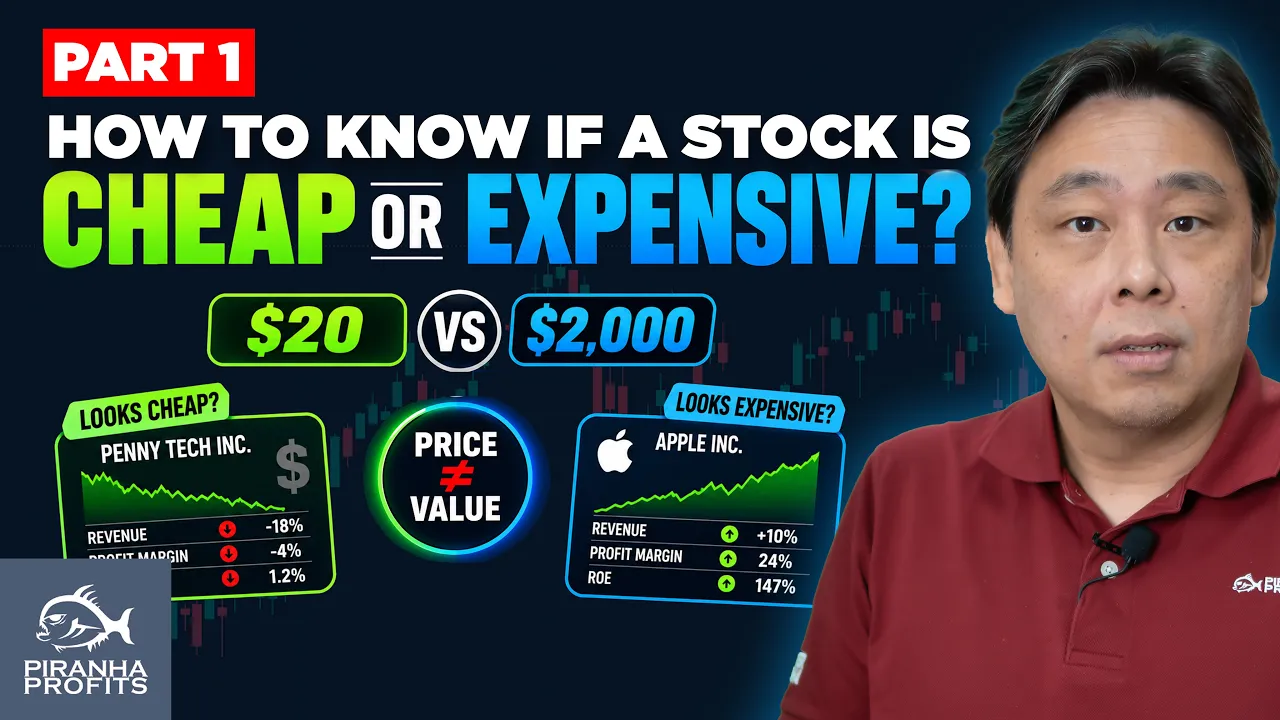
How to Know if a Stock is Cheap or Expensive? Part 1 of 2 — Adam Khoo

Adam Khoo

Low nominal share prices do not indicate economic value because companies with insurmountable liabilities and zero cash flow possess an intrinsic value of zero.

AI-assisted summary of How to Know if a Stock is Cheap or Expensive? Part 1 of 2 — original source. Check the original for full context.

Source published:

Key ideas

  • Nominal share price does not reflect actual business value, meaning a stock trading at $0.03 can represent an infinite premium if intrinsic value is zero, as demonstrated by Adam Khoo's total loss of $30,000 in insolvent L&M Group. (0:41)
  • Selling high-quality compounders simply because they reach fair value creates severe opportunity cost; exiting Alphabet at $960 in 2013 forfeited a subsequent 1,400% gain as cumulative stock splits later elevated its equivalent unadjusted price to roughly $13,700. (2:52)
  • Valuation models are only as dependable as a company's cash flow consistency, making steady compounders like Mastercard straightforward to appraise while volatile cyclicals like Micron or loss-making narrative stocks belong in the 'too hard' basket. (12:07)
  • Intrinsic value functions as a dynamic range rather than a static figure or short-term timing tool, with market sentiment causing share prices to swing around fair value like a pendulum before eventually mean-reverting. (18:34)

Detailed notes

## Background This masterclass video was published by professional investor and author Adam Khoo on his YouTube channel on August 19, 2026. According to the page description, the session serves as part one of a two-part framework designed to teach investors how to determine intrinsic value, differentiate nominal share prices from business worth, and avoid dangerous valuation traps.

## TL;DR Adam Khoo establishes that nominal stock prices mean nothing without fundamental business context, illustrating through personal investing mistakes how penny stocks can be worthless while high-dollar shares can be cheap. He argues that intrinsic value is the present value of all future cash flows and represents an upward-sloping compounding curve for the top 1% of wide-moat businesses. Investors must treat valuation as an estimated range derived from predictable earnings rather than volatile, cyclical, or early-stage speculations. Ultimately, market prices behave like an emotional pendulum that swings around intrinsic value, meaning long-term investors should prioritize business quality first, accumulate shares below fair value with a margin of safety, and avoid buying statistically cheap decaying companies.

## Atmosphere & style The presentation carries the pragmatic, educational energy of an experienced trader holding a candid debrief with his audience. Khoo balances hard-earned vulnerability—sharing self-deprecating accounts of wiping out $30,000 on a penny stock or foolishly selling Google too early—with rigorous, no-nonsense financial analysis. Watching the session feels structured, empowering, and grounded, using straightforward whiteboard-style mental models and charts to demystify market psychology and replace short-term panic with disciplined value investing principles.

## Bulletin - [00:41](https://www.youtube.com/watch?v=VNE11qpvVBY&t=41s) Nominal share price does not reflect actual business value, meaning a stock trading at $0.03 can represent an infinite premium if intrinsic value is zero, as demonstrated by Adam Khoo's total loss of $30,000 in insolvent L&M Group. - [02:52](https://www.youtube.com/watch?v=VNE11qpvVBY&t=172s) Selling high-quality compounders simply because they reach fair value creates severe opportunity cost; exiting Alphabet at $960 in 2013 forfeited a subsequent 1,400% gain as cumulative stock splits later elevated its equivalent unadjusted price to roughly $13,700. - [12:07](https://www.youtube.com/watch?v=VNE11qpvVBY&t=727s) Valuation models are only as dependable as a company's cash flow consistency, making steady compounders like Mastercard straightforward to appraise while volatile cyclicals like Micron or loss-making narrative stocks belong in the 'too hard' basket. - [18:34](https://www.youtube.com/watch?v=VNE11qpvVBY&t=1114s) Intrinsic value functions as a dynamic range rather than a static figure or short-term timing tool, with market sentiment causing share prices to swing around fair value like a pendulum before eventually mean-reverting.

## Key takeaways - [00:00](https://www.youtube.com/watch?v=VNE11qpvVBY&t=0s) A stock's nominal dollar price is completely decoupled from its economic value; a $2,000 stock can be an undervalued bargain while a $20 stock can be massively overpriced. - [00:41](https://www.youtube.com/watch?v=VNE11qpvVBY&t=41s) Purchasing shares in distressed or cash-flow-negative companies based on a low nominal price tag creates severe capital risk because a business with zero intrinsic value is expensive at any price. - [02:52](https://www.youtube.com/watch?v=VNE11qpvVBY&t=172s) Selling top-tier compounders immediately upon reaching fair value is often a mistake because their underlying intrinsic value expands continuously alongside rising cash flows and earnings. - [06:40](https://www.youtube.com/watch?v=VNE11qpvVBY&t=400s) The intrinsic value of any business is fundamentally defined as the discounted present value of all the future cash flows and earnings it will generate over its lifetime. - [08:20](https://www.youtube.com/watch?v=VNE11qpvVBY&t=500s) Short-term market prices are driven by headlines, emotion, and macro panic rather than business reality, providing opportunities to buy growing businesses like Microsoft at deep valuation discounts. - [10:39](https://www.youtube.com/watch?v=VNE11qpvVBY&t=639s) Retail investors consistently lose money by buying at cyclical peaks fueled by hype and panic-selling at bottoms due to lacking an intrinsic value anchor. - [12:07](https://www.youtube.com/watch?v=VNE11qpvVBY&t=727s) Valuation reliability requires high earnings and cash flow predictability; highly cyclical companies produce wide, speculative valuation bands that make dependable fair value modeling impossible. - [16:18](https://www.youtube.com/watch?v=VNE11qpvVBY&t=978s) Early-stage or narrative-driven companies with negative free cash flow, such as SpaceX, yield valuation dispersions so broad that they cannot be reliably used for buy-and-hold investing. - [18:34](https://www.youtube.com/watch?v=VNE11qpvVBY&t=1114s) Intrinsic value should always be treated as an estimated range spanning bear, base, and bull cases rather than a single static number. - [18:34](https://www.youtube.com/watch?v=VNE11qpvVBY&t=1114s) Acquiring shares at or below conservative bear-case estimates establishes a crucial margin of safety that protects investor capital against forecasting errors. - [20:51](https://www.youtube.com/watch?v=VNE11qpvVBY&t=1251s) Intrinsic value provides medium- to long-term price gravitation but offers no predictive capability regarding short-term price timing or immediate momentum. - [21:08](https://www.youtube.com/watch?v=VNE11qpvVBY&t=1268s) The stock market acts like a pendulum where intrinsic value is the center; extreme sentiment pushes prices far above or below fair value before prices inevitably mean-revert. - [22:57](https://www.youtube.com/watch?v=VNE11qpvVBY&t=1377s) Investors must prioritize business quality over cheapness to avoid value traps, where decaying businesses with eroding moats continually lose intrinsic value over time.

## Detailed walkthrough ### [00:00](https://www.youtube.com/watch?v=VNE11qpvVBY&t=0s) Price vs. Value: The Fundamental Investor Dilemma

To succeed as an investor, the core objective sounds deceptively simple: consistently buy stocks when they are cheap and sell them when they are expensive. In practice, however, the overwhelming majority of market participants fail because they have no framework for valuing an underlying company. A novice investor often confuses nominal share price with true economic worth, failing to recognize that a stock trading at $20 can be drastically overpriced, while a stock trading at $2,000 might actually be an incredible bargain.

Valuation is the bridge between market price and business fundamentals. Across this two-part masterclass, Adam Khoo introduces the structured valuation methodologies he uses to identify precise entry prices, determine when to exit, and prevent the catastrophic errors that trap retail traders who rely on nominal share prices alone.

---

[00:41](https://www.youtube.com/watch?v=VNE11qpvVBY&t=41s) The Penny Stock Trap: Losing $30,000 on L&M Group

Adam Khoo traces his earliest encounter with valuation back roughly 23 years to around 2001, when he was trading Singapore equities under the naive assumption that a low share price was synonymous with a bargain. Scanning the Singapore Exchange for the lowest nominal price tag on the board, he stumbled across L&M Group, a distressed construction firm trading at just 3 cents per share. Thinking, "3 cents, how much lower can it go? It can only go up," he bought a substantial position.

When the stock tumbled to 2 cents a few months later, Khoo doubled down, convinced he was following in the footsteps of his hero Warren Buffett and acquiring an even deeper discount. The stock then slid to 1 cent. Treating 1 cent as the absolute mathematical floor—convinced it was impossible to sink any further—he poured in even more capital, bringing his total investment to $30,000, a massive sum for him at the time. Shortly thereafter, L&M Group declared insolvency due to unpayable debts, trading was suspended, the shares were wiped out to zero, and his entire $30,000 evaporated.

```mermaid flowchart TD accTitle: The Penny Stock Fallacy Breakdown accDescr: Visualizing how a falling share price lures uneducated investors into insolvency. subgraph Trap["The Retail Illusion"] P1["Buys at 3¢<br/>'How much lower can it go?'"] --> P2["Price drops to 2¢<br/>Buys more ('I am Warren Buffett')"] P2 --> P3["Price drops to 1¢<br/>Accumulates $30,000 total position"] end subgraph Reality["Fundamental Insolvency"] P3 --> C1["Company declares insolvency<br/>Debts unpayable & cash flow negative"] C1 --> C2["Trading suspended<br/>Intrinsic value = $0.00"] C2 --> C3["Total loss of $30,000"] end ```

Years later, after studying formal business valuation, Khoo realized that buying L&M Group at 3 cents was not cheap at all—it was exorbitantly expensive. A proper inspection of the company’s assets, liabilities, and ongoing cash flows would have revealed an intrinsic value of zero. Paying three cents for something inherently worthless represents an infinite premium, a painful lesson that taught him never to equate a low nominal share price with value.

- **Company:** L&M Group (Singapore-listed construction company). - **Initial Buy Price:** $0.03 per share. - **Averaging Down Points:** $0.02, then $0.01 per share. - **Total Capital Lost:** $30,000 (stock suspended and went to zero). - **Core Lesson:** A stock with zero cash flow and insurmountable liabilities has an intrinsic value of zero, making any positive purchase price expensive.

---

[02:52](https://www.youtube.com/watch?v=VNE11qpvVBY&t=172s) Selling Winners Too Early: The Google Valuation Lesson

Armed with intrinsic value calculations, Khoo executed one of his most lucrative historical investments in March 2011, when Alphabet (Google) was trading around $540 per share. By modeling Google’s projected cash flows and earnings power, he calculated its intrinsic value to be approximately $900, representing an approximate 40% discount. When friends protested that $540 was an expensive stock, Khoo countered that nominal share price is irrelevant compared to the discounted value of future corporate profits.

Khoo held the shares for roughly two years until 2013, when Google crossed his calculated intrinsic target, and he sold out at $960 per share for an 80% gain. While he initially celebrated feeling "like a genius," looking back he admits the exit was foolish. Google subsequently executed two major stock splits: a 2-for-1 split in 2014 and a 20-for-1 split in 2022 (a cumulative 40-fold split multiplier). Accounting for those splits, today’s post-split price of around $344 translates to a pre-split equivalent of roughly $13,700 per share. Selling at $960 meant forfeiting an additional 15-fold surge—a 1,400% gain.

```mermaid flowchart LR accTitle: Google Valuation and Compounding Timeline accDescr: Progression of Google share price from March 2011 to current day showing the cost of selling too early. A["March 2011<br/>Bought at $540<br/>Fair Value: $900"] --> B["2013<br/>Sold at $960<br/>Booked +80% profit"] B --> C["2014 & 2022<br/>Stock Splits<br/>2:1 and 20:1 (40x total)"] C --> D["Current Value<br/>$344 post-split<br/>= $13,700 unadjusted (+1,400%)"] ```

That experience forged Khoo's second cardinal investing rule: never sell an exceptional company simply because the share price has caught up to its estimated intrinsic value. With top-tier businesses, intrinsic value is not a static figure; it continuously compounds as the business expands earnings and generates rising free cash flow. Although Khoo traded in and out of Google over subsequent cycles, his latest position carries an average cost basis of $111 against a market price of $342 to $344. Even though Google trades slightly above his current intrinsic value estimate of $319 (roughly 7% overvalued), he refuses to sell, knowing that the company's compounding engine will continue pulling intrinsic value upward over time.

- **Google Purchase (March 2011):** $540 per share (intrinsic value estimated at $900; ~40% margin of safety). - **Google Exit (2013):** ~$960 per share (+80% realized gain). - **Stock Split Multiplier:** 2-for-1 (2014) and 20-for-1 (2022) = 40x share count expansion. - **Equivalent Unadjusted Price Today:** ~$13,700 per share (a ~15-fold or 1,400% opportunity cost). - **Current Position Metrics:** Average cost basis of $111, trading at ~$342–$344 vs. current intrinsic value of $319 (~7% overvalued).

---

[06:40](https://www.youtube.com/watch?v=VNE11qpvVBY&t=400s) What Is Intrinsic Value and Why Great Businesses Compound

At its core, a share of stock is fractional ownership of an operating business, and a business is fundamentally a machine designed to generate shareholder cash flows. The intrinsic worth of any enterprise is equal to all the cash it will produce in the future, discounted back to the present day using the time value of money. Depending on the company's operating profile and capital structure, that financial stream can be appraised through metrics like net income or free cash flow.

Khoo restricts his portfolio to elite businesses, which he estimates make up less than 1% of all publicly listed equities. The defining attribute of these rare compounders—such as Microsoft, Google, Mastercard, Visa, and McDonald’s—is an enduring competitive moat that enables them to reliably expand operating cash flow and net profits decade after decade. Because their cash generation steadily rises, their intrinsic value curves slope consistently upward over long horizons.

---

[08:20](https://www.youtube.com/watch?v=VNE11qpvVBY&t=500s) Market Sentiment, Volatility, and Exploiting Mispricings

Even though the intrinsic value of an elite company steadily appreciates, its day-to-day share price never moves in a straight line. In the short run, equity prices are governed by market supply and demand, dictated by headline news, psychological swings, macroeconomic sentiment, and institutional manipulation. When speculative enthusiasm peaks, market prices detach from fundamentals and surge far above fair value, rendering shares overvalued.

Conversely, when macro panic takes hold—as seen during the 2022 bear market when Federal Reserve interest rate hikes triggered widespread doom-and-gloom—prices collapse far below fair value. During that 2022 plunge, Microsoft’s underlying earnings and cash flows were actively expanding, yet terrified market participants dumped the stock as if the business were collapsing. While unsophisticated investors fear this back-and-forth price swinging, intelligent investors embrace volatility. Fluctuations create temporary market mispricings, opening up windows to purchase a company worth $200 at a steep discount of $150, or to observe it rise to $350 when irrational market euphoria takes over.

- **Short-Term Price Drivers:** Human emotion, headlines, shifting sentiment, interest rate expectations, and market manipulation. - **The 2022 Bear Market Example:** Microsoft shares sank on rate hike panic despite the company delivering higher year-over-year profits and growing cash flows. - **Investor Mindset:** Volatility is not risk; it is the mechanism that creates deep valuation discounts below intrinsic value.

[10:39](https://www.youtube.com/watch?v=VNE11qpvVBY&t=639s) Why Most Retail Investors Lose Money Around Fair Value

When a stock trades below its intrinsic value, it is fundamentally undervalued, marking the precise zone where investors should be steadily accumulating shares. A critical mindset shift is realizing that an investor does not need to time the absolute bottom. An investor can buy an undervalued stock and watch the market price drop further in the short term, yet it remains completely irrelevant over an extended horizon. As long as the purchase is executed below intrinsic value, the market price will eventually gravitate back toward and exceed that benchmark, while the underlying intrinsic value of a quality business continues to expand year after year.

The tragedy for the vast majority of retail investors is that they navigate the market completely blind to intrinsic value. Lacking any anchor of true business worth, retail buyers chase stocks at cyclical peaks driven by good news, hype, and euphoria. When the inevitable pullback occurs, fear takes over with cries of "we're going to die," prompting them to panic-sell at the trough. As the stock recovers, they get excited and repeat the cycle—buying high and selling low until their capital is depleted. Conversely, anchoring to a disciplined framework guarantees an edge: by acquiring shares beneath intrinsic value and holding until price stretches significantly above fair value, long-term capital loss is effectively eliminated. The natural "million-dollar question" everyone immediately demands answered is how intrinsic value is actually calculated.

```mermaid flowchart TD accTitle: Retail Investor Cycle vs Value Investor Framework accDescr: Contrasting how uninformed retail traders buy on hype and panic sell versus how value investors accumulate below intrinsic value.

subgraph Retail["Retail Investor Trap"] R1["Stock Surges on Hype & Good News"] -->|"Buy at Highs"| R2["Price Corrects Sharply"] R2 -->|"Panic: 'We're going to die!' / Sell at Lows"| R3["Capital Depletion"] end

subgraph Value["Disciplined Value Framework"] V1["Price Drops Below Fair Value"] -->|"Accumulate Shares / Don't Fear Dips"| V2["Hold with Margin of Safety"] V2 -->|"Price & Intrinsic Value Rise Over Time"| V3["Sell Only When Way Above Intrinsic Value"] end ```

[12:07](https://www.youtube.com/watch?v=VNE11qpvVBY&t=727s) Valuation Rule 1: Cash Flow Consistency Determines Reliability

Before diving into intrinsic value formulas, investors must grasp the fundamental prerequisite of valuation: the more consistent a company’s profits and operating cash flows, the more reliable the calculated valuation will be. If a firm exhibits predictable, compounding earnings, projecting its performance over the next 5 to 10 years carries high statistical confidence. When applied to stable enterprises, valuation models output dependable figures rather than speculative guesswork.

To illustrate this, Adam Khoo contrasts two dramatically different business profiles: - **Mastercard (MA):** A textbook example of valuation consistency. Its operating income and operating cash flow track an exceptionally steady upward staircase year after year. Because its revenue engine behaves predictably, deriving its intrinsic value yields a highly trustworthy target. - **Micron Technology (MU):** A classic cyclical semiconductor manufacturer whose operating income and cash flows violently swing between massive surges and sharp plunges. Following an explosive jump in recent earnings, market participants face an impossible forecasting problem: will earnings keep skyrocketing, or will they mean-revert to historical troughs?

Because of Micron's volatility, two rational analysts can arrive at vastly different outcomes. An optimist projecting sustained growth might calculate an intrinsic value of $1,000 per share, while a conservative analyst factoring in downcycles might determine it is worth only $300. As Warren Buffett famously advocates, when a company’s future is that unpredictable, it should simply be placed in the "too hard" pile and avoided for long-term buy-and-hold investing. While cyclical swings can be traded short-term using options paired with strict stop losses, trying to anchor an investment portfolio to an unreliable valuation range is inherently flawed.

[16:18](https://www.youtube.com/watch?v=VNE11qpvVBY&t=978s) Valuing Unpredictable Growth vs. Consistent Compounders

The dilemma of unpredictable cash flows becomes even more extreme when assessing high-growth or early-stage enterprises. Examining a company like SpaceX highlights the severe limitations of traditional discounted cash flow calculations. Operating income remains scarce, the business recently logged substantial losses, and operating cash flow is heavily offset by massive negative free cash flow. Forecasting what such a company will earn in 5 or 10 years is essentially an exercise in narrative rather than arithmetic.

An optimist who takes Elon Musk's long-term targets at face value might conclude that the company is a bargain at $200 per share. Meanwhile, a skeptic who doubts the timeline or feasibility of those targets might conclude the business is worth merely $50 or $20 per share. Such an immense dispersion makes any formal valuation output functionally meaningless for core investing. While short-term options speculation can capture quick directional momentum on these names, disciplined long-term capital belongs elsewhere. In sharp contrast stands a powerhouse like Microsoft, where operating income and cash flows rise with mechanical consistency year after year, rendering its intrinsic value straightforward to model and highly dependable.

[18:34](https://www.youtube.com/watch?v=VNE11qpvVBY&t=1114s) Valuation Rule 2: Valuation is a Range, Not a Static Number

The second essential principle is recognizing that intrinsic value is never a single, precise figure; it is always an estimated range dictated by future growth assumptions. When analytical tools like Stock Oracle generate an intrinsic value, that figure represents the baseline or "base case." Around that base case lies an optimistic "bull case" where everything goes right, and a pessimistic "bear case" where operational headwinds materialize.

For volatile, cyclical companies like Micron or early-stage ventures like SpaceX, the gap between the bear case and the bull case is enormous. For dominant, steady compounders like Mastercard, Meta, or Microsoft, the cash flow predictability narrows the valuation band significantly. The goal of an intelligent investor is not to pinpoint fair value to the exact penny, but rather to ensure they purchase shares at or below the base case—and ideally below the conservative bear case to secure a wide margin of safety.

Adam Khoo references the classic historical case study of Warren Buffett and Charlie Munger assessing American Express: - **Warren Buffett (The Optimist):** Modeled growth projections that produced an intrinsic value of $60 per share. - **Charlie Munger (The Skeptic):** Considered Buffett’s assumptions overly aggressive, projecting slower growth to arrive at an intrinsic value of $40 per share. - **The Market Reality:** American Express was trading at just $30 per share at the time.

It ultimately did not matter which business titan was closer to the exact number. Because both valuations sat well above the prevailing $30 share price, the market offered an undeniable margin of safety that protected their capital against forecasting errors.

[20:51](https://www.youtube.com/watch?v=VNE11qpvVBY&t=1251s) Valuation Rule 3: Intrinsic Value Does Not Predict Short-Term Timing

The third critical takeaway is that intrinsic value provides zero timing insight into short-term price movements. Novice investors frequently fall into the trap of assuming that identifying an undervalued stock guarantees it will rally tomorrow or next week. Similarly, they assume an overvalued stock must immediately roll over and crash. Intrinsic value is an anchor of fundamental business worth over multi-year cycles, not a short-term market timing indicator.

[21:08](https://www.youtube.com/watch?v=VNE11qpvVBY&t=1268s) The Market Pendulum and Short-Term Sentiment vs. Long-Term Value

An undervalued stock will not necessarily start rising tomorrow, just as an overvalued stock will not immediately plunge. In the short term, a stock that is cheap can easily become even cheaper, and an expensive stock can climb to even more irrational heights. Short-term price action is fundamentally unpredictable because it is driven entirely by human emotions, headlines, news events, market manipulation, and political noise such as "Trump's tweets." While no one can forecast short-term fluctuations with 100% accuracy, investors can form intelligent hypotheses by pairing fundamentals with technical analysis. Technical tools help gauge momentum, identify key support levels, and estimate when a reversal is likely to occur.

```mermaid flowchart LR accTitle: The Market Valuation Pendulum accDescr: Diagram illustrating how stock prices swing above and below intrinsic value due to sentiment before reverting over time.

subgraph PriceSwings["Market Price Sentiment"] direction TB High["Overvalued Peak\n(Greed / Euphoria)"] Low["Undervalued Trough\n(Fear / Panic)"] end

subgraph Anchor["Fair Value Base"] IV["Intrinsic Value\n(Pendulum Center)"] end

Low -->|"Mean Reversion"| IV High -->|"Mean Reversion"| IV IV -.->|"Swings Above"| High IV -.->|"Swings Below"| Low ```

Intrinsic value serves a different purpose: it establishes where the share price will gravitate over the medium to long term. Investors often get frustrated when they buy below intrinsic value and watch the price drop further, but this is a natural consequence of short-term market sentiment. Conversely, if a stock trades above fair value, selling it immediately is often premature because the momentum can push it even higher. The market behaves like a pendulum where intrinsic value is the resting center point; prices constantly swing between extreme highs and extreme lows, but over time, they inevitably revert back to fair value.

[22:57](https://www.youtube.com/watch?v=VNE11qpvVBY&t=1377s) Avoiding the Value Trap: Prioritizing Business Quality Over Cheapness

The final foundational rule before tackling valuation formulas is to never buy low-quality or mediocre businesses simply because their share price appears discounted. As the saying goes, "cheap crap is still crap." Business quality must always remain the primary filter, with valuation acting strictly as a secondary consideration. When an investor buys a decaying company with shrinking profits, loss of market share, and an eroding economic moat, the underlying intrinsic value is actively declining over time. The business becomes less valuable every single day because its earning power is disappearing.

```mermaid flowchart TD accTitle: Value Trap vs High-Quality Compounder accDescr: Flowchart contrasting structural decline in a value trap against expanding intrinsic value in top-tier companies.

subgraph ValueTrap["The Value Trap Mechanism"] direction TB VT1["Eroding Moat &\nDeclining Profits"] --> VT2["Intrinsic Value Falls Over Time"] VT2 --> VT3["Stock Looks 'Cheap'"] VT3 --> VT4["Cheap Gets Cheaper\n(Permanent Loss of Capital)"] end

subgraph TopTier["Top 1% Quality Compounder"] direction TB HQ1["Wide Moat & High ROE/ROIC"] --> HQ2["Growing Revenues & Earnings"] HQ2 --> HQ3["Intrinsic Value Expands Upward"] HQ3 --> HQ4["Buying Dips Compounds Wealth"] end ```

This dynamic is the classic definition of a "value trap"—a stock that looks statistically cheap on paper, but only because the company is experiencing permanent structural decline. Even if such a stock experiences an occasional dead-cat bounce, its long-term trajectory is inevitably downward, proving that "cheap gets cheaper, low gets lower." Rather than chasing bargain-bin traps, disciplined investors focus exclusively on the top 1% of businesses: enterprises protected by durable economic moats, elevated return on equity (ROE), high return on invested capital (ROIC), and steadily rising revenues and profits. When intrinsic value is sloping upward, buying shares during temporary price dips allows long-term wealth to compound safely.

- **Primary Criterion:** Business quality, wide economic moats, and growing cash flows. - **Secondary Criterion:** Valuation and margin of safety relative to fair value. - **The Value Trap Hazard:** Low multiples attached to a business in structural decay represent an illusion of value, not an opportunity.

[25:06](https://www.youtube.com/watch?v=VNE11qpvVBY&t=1506s) Part 2 Preview and Resources

With the core conceptual foundations of intrinsic value established, the subsequent video (Part 2) will focus on practical application and mathematical models. It will demonstrate specific valuation methodologies tailored to different sectors, including how to evaluate banks, high-growth technology companies, speculative or currently unprofitable businesses, and cyclical industries. Viewers are encouraged to subscribe and turn on channel notifications so they do not miss the release of Part 2, and to explore structured courses and live training programs available through Piranha Profits and Wealth Academy Global.

## Notable quotes > The single biggest mistake investors make is confusing share price with actual business value. — Adam Khoo

> A great company can turn into a terrible investment if you overpay, while a high-dollar stock can be an absolute steal if it trades below its fair value. — Adam Khoo

> [00:41](https://www.youtube.com/watch?v=VNE11qpvVBY&t=41s) 3 cents, how much lower can it go? It can only go up — Adam Khoo

> [02:52](https://www.youtube.com/watch?v=VNE11qpvVBY&t=172s) like a genius — Adam Khoo

> [10:39](https://www.youtube.com/watch?v=VNE11qpvVBY&t=639s) we're going to die

> [12:07](https://www.youtube.com/watch?v=VNE11qpvVBY&t=727s) too hard — Warren Buffett

> [21:08](https://www.youtube.com/watch?v=VNE11qpvVBY&t=1268s) Trump's tweets — Adam Khoo

> [22:57](https://www.youtube.com/watch?v=VNE11qpvVBY&t=1377s) cheap crap is still crap — Adam Khoo

> [22:57](https://www.youtube.com/watch?v=VNE11qpvVBY&t=1377s) cheap gets cheaper, low gets lower — Adam Khoo

## Mentioned Adam Khoo, Alphabet, American Express, Charlie Munger, Donald Trump, Elon Musk, Federal Reserve, Google, L&M Group, Mastercard, McDonald's, Micron Technology, Microsoft, Piranha Profits, Profit from the Panic, Singapore Exchange, SpaceX, Stock Oracle, Visa, Warren Buffett, Wealth Academy Global, Winning the Game of Stocks

## Video description Is a $20 stock actually cheap? Is a $2,000 stock expensive? The single biggest mistake investors make is confusing share price with actual business value.

A great company can turn into a terrible investment if you overpay, while a high-dollar stock can be an absolute steal if it trades below its fair value.

In this video, I break down the exact framework I use for determining the intrinsic value of a stock, buying with a margin of safety, and protecting your portfolio from valuation traps.

What You Will Learn: 1) Price vs. Value: Why nominal share prices mean nothing without business context. 2) Quality Over Cheapness: Why buying a great business at a fair price beats buying a bad business at a discount. 3) Valuation is a Range: How to handle cash flow uncertainty and why you shouldn't try to value every stock on the market. 4) Margin of Safety: How to build a buffer for error before making any investment.

======================== Stock Investing & Trading insights by Adam Khoo will show you profitable trading and investment opportunities in today's stock markets.

These are essential strategies for stock traders and investors who want to improve their investment and trading performance.

Adam Khoo is a professional stock investor and options trader and the best-selling author of 16 books including 'Winning the Game of Stocks" and "Profit from the Panic". Thousands of students have profited from his sharp investment insights into the world of stock market investing and trading. ===================== Sign up for our courses/mentorship programs 📗 Value Momentum Investing: http://bit.ly/4mqrEVP 📙 Options Waverider™: http://bit.ly/4c5xyrR 📘 Price Action Manipulation™ (Trading): http://bit.ly/48FUAmQ 📕 Income Investing™ (Dividends): http://bit.ly/3Ow8CRj

Grab our Playbook Subscriptions Ultimate Investors Playbook™: http://bit.ly/3QiN6zT Options Tactics Playbook™: http://bit.ly/4tCQFPL PAM™ Trader Playbook: http://bit.ly/4mmYnv0 ===================== 💻 Join Our Wealth Academy Live Seminars https://www.wealthacademyglobal.com ===================== 🧑‍🏫 Visit Adam Khoo Learning Technologies Group https://www.akltg.com ===================== Follow Me On Social Media 🌟 Facebook: https://facebook.com/adamkhoosuccess 🌟 Instagram: https://www.instagram.com/adamkhoosuccess/ ===================== Follow Piranha Profits On Social Media 🐟 Facebook: https://www.facebook.com/piranhaprofits 🐟 Instagram: https://www.instagram.com/piranhaprofits 🐟 Telegram: https://t.me/piranhaprofits 🐟 Discord: https://discord.gg/piranhaprofits ===================== 👉 If you've found this video helpful, please LIKE, SHARE, & COMMENT 👉 SUBSCRIBE to my Channel for more Market Analyses & Investing Strategies 👉 Click on the NOTIFICATION BELL to get notified whenever I upload a new video ===================== 💸 MAY THE MARKETS BE WITH YOU! 💸

[Source](https://www.youtube.com/watch?v=VNE11qpvVBY)

中文简报

投资人Adam Khoo警告仙股会毁灭资本 名义股价低并不代表具备经济价值,因为负债累累且现金流为零的公司其内在价值为零。 Adam Khoo指出,脱离企业基本面背景的名义股价毫无意义,并通过个人的投资失误说明了仙股可能一文不值,而高价股反而可能很便宜。他认为,内在价值是所有未来现金流的现值,对排名前1%的宽护城河企业而言,它表现为一条向上倾斜的复利曲线。投资者必须将估值视为基于可预测收益得出的估算区间,而非波动剧烈、具有周期性或处于早期阶段的投机。归根结底,市场价格就像围绕内在价值摆动的情绪钟摆,这意味着长期投资者应首先重视企业质量,在低于公允价值且具备安全边际时积累股份,并避免买入统计学上看似便宜但正在衰退的公司。 名义股价并不能反映实际企业价值,这意味着如果内在价值为零,以0.03美元交易的股票就可能代表无限溢价,Adam Khoo在资不抵债的L&M Group上遭遇30,000美元的全额亏损便证明了这一点。 (0:41) 仅仅因为达到公允价值就卖出优质复利型企业会造成严重的机会成本;2013年以960美元退出Alphabet错失了随后1,400%的涨幅,因为随后的多次拆股使其未调整的等效股价后来升至约13,700美元。 (2:52) 估值模型的可靠性取决于公司现金流的稳定性,这使得像Mastercard这样稳步复利的企业易于评估,而像Micron这样波动剧烈的周期股或亏损的故事型股票则属于“太难”一类。 (12:07) 内在价值是一个动态区间,而非静态数字或短期择时工具,市场情绪导致股价如钟摆般围绕公允价值摆动,并最终实现均值回归。 (18:34)

Reading summary

Adam Khoo argues that successful equity investing depends on evaluating a business's underlying cash flows and intrinsic value rather than its nominal share price, as low-priced shares can be inherently worthless while high-priced compounders often trade at discounts. Nominal Share Price Versus Intrinsic Value (0:41) Novice investors frequently confuse nominal share prices with economic worth, falsely assuming low-dollar stocks represent bargains. Khoo illustrates this through his early investment in L&M Group around 2001, where he purchased shares at 3 cents and averaged down at 2 cents and 1 cent, eventually losing his full $30,000 when the debt-laden company went bankrupt. Because the firm possessed zero cash flows and insurmountable liabilities, its intrinsic value was zero, making even a penny share price infinitely expensive. Conversely, high nominal prices can conceal significant discounts. In March 2011, Khoo purchased Alphabet (Google) at $540 per share against an estimated intrinsic value of $900. Although he realized an 80% gain by selling at $960 in 2013, he notes this exit sacrificed substantial compounding. Following two subsequent splits (2-for-1 in 2014 and 20-for-1 in 2022), that position's unadjusted equivalent reached approximately $13,700 per share. Khoo emphasizes that intrinsic value is dynamic rather than static; top-tier companies continuously expand their earnings, meaning an investor should not automatically sell a high-performing business merely because its market price reaches an initial fair value estimate. Cash Flow Predictability Governs Valuation Accuracy (12:07) A company's intrinsic worth equals the present value of all its projected future cash flows discounted over time. However, valuation models only yield reliable outputs when an enterprise demonstrates consistent, predictable operating profits. Khoo contrasts Mastercard, which features stable year-over-year gains in operating income and cash flows, with cyclical semiconductor producers like Micron Technology, whose violent profit swings prevent analysts from calculating a reliable fair value. When cash flow projections vary widely—such as with high-growth or speculative ventures like SpaceX, which carry operating losses and negative free cash flow—valuation becomes a narrative rather than an analytical exercise. In these instances, intrinsic value calculations can diverge drastically depending on whether optimistic or pessimistic growth scenarios are assumed. Khoo contends that businesses with unpredictable operating results belong in Warren Buffett's 'too hard' pile, reserving core long-term capital strictly for companies whose revenue models provide high forecasting confidence. Valuation Ranges and Sentiment-Driven Market Fluctuations (18:34) Intrinsic value cannot be pinned down to a single exact number; it functions as a spectrum encompassing base, bull, and bear scenarios. Khoo cites Warren Buffett and Charlie Munger's evaluation of American Express, where Buffett estimated fair value at $60 per share while Munger conservatively calculated $40. Because the stock traded at $30, both analysts identified a clear margin of safety, demonstrating that exact precision is unnecessary when the purchase price sits comfortably below conservative estimates. Furthermore, intrinsic value offers zero timing insight into short-term trading behavior. Market prices behave like a pendulum swinging around fair value, driven by headline sentiment, macro fear, and emotional extremes. In the 2022 bear market, for instance, Microsoft's market price collapsed on interest rate concerns despite rising profits and expanding cash flows. Khoo emphasizes that disciplined investors must endure short-term downside fluctuations after buying beneath intrinsic value, knowing market prices eventually mean-revert toward corporate earnings over multi-year periods. Prioritizing Business Quality Over Statistical Cheapness (22:57) A primary hazard in value investing is falling into a 'value trap' by acquiring fundamentally deteriorating companies simply because they appear cheap on standard valuation multiples. When a company suffers from an eroding economic moat, shrinking margins, and declining market share, its intrinsic value decays continuously. In such cases, low nominal prices do not offer protection because structural declines drag fair value lower over time. To prevent permanent capital loss, Khoo asserts that qualitative business evaluation must always serve as the primary filter, leaving valuation models as a secondary screening mechanism. Long-term capital should target the estimated top 1% of public companies that possess enduring competitive moats, high returns on equity and invested capital, and reliably rising revenues. When intrinsic value trends upward, purchasing shares during transient market sell-offs creates a repeatable framework for compounding wealth. This discussion establishes the theoretical framework of intrinsic value and business quality, leaving the mathematical formulas and sector-specific models—such as the distinct valuation approaches required for banks, high-growth technology firms, and cyclical equities—to be detailed in the program's second part.

Source quotes

Adam Khoo: The single biggest mistake investors make is confusing share price with actual business value. Adam Khoo: A great company can turn into a terrible investment if you overpay, while a high-dollar stock can be an absolute steal if it trades below its fair value. [0:41] Adam Khoo: 3 cents, how much lower can it go? It can only go up [2:52] Adam Khoo: like a genius [10:39] we're going to die [12:07] Warren Buffett: too hard [21:08] Adam Khoo: Trump's tweets [22:57] Adam Khoo: cheap crap is still crap [22:57] Adam Khoo: cheap gets cheaper, low gets lower

Original transcript

[0:00] To be a profitable investor, you must be [0:02] able to consistently buy stocks when [0:04] they are low or cheap and only sell them [0:06] when they're high or expensive. The [0:09] trouble with most investors is that [0:10] they've got no idea how to value a stock [0:13] because we know that a $20 stock can [0:16] actually be very expensive and a $2,000 [0:18] stock can actually be very cheap. So, in [0:20] this video, I'm going to show you all [0:22] the different methods I use to value a [0:24] stock so I know exactly what's the price [0:26] to buy and what's the price to sell. [0:28] It's a two-part video, so catch both [0:30] parts. [0:41] One of the first lessons I learned about [0:43] valuation was back in 2010. This was [0:45] like 23 years ago. So, at that time, I [0:48] thought that a low stock price meant [0:50] that it was cheap. And so, at a time, I [0:52] was trading Singapore stocks. And I [0:54] looked for the the lowest price stock uh [0:56] in the Singapore market which was L&M [0:59] Group which was a construction company. [1:01] So it had the lowest price. It was [1:03] selling at 3 cents. So I thought you [1:05] know 3 cents how much lower can it go? [1:08] It can only go up. So I bought a lot of [1:10] shares at 3 cents. A few months later it [1:12] dropped from 3 cents to 2 cents. And I [1:14] said how much lower can it go? It's now [1:17] even more undervalued. Let's go buy more [1:19] shares. I'm Warren Buffett. Because I [1:21] read a book written about him. I was so [1:23] inspired. And then from 3 cent, sorry, [1:25] from 2 cents, it dropped to 1 cent. And [1:27] when it dropped to 1 cent, I said, "This [1:29] has got to be the bottom. It cannot go [1:32] below 1 cent. It's impossible. It's got [1:34] to go up." So I bought even more. And in [1:37] total, I put in $30,000. Now, to me, at [1:40] that time, 23 years ago, it was a lot of [1:43] money. I said, you know what? I'm going [1:44] to get rich. A few months later, the [1:46] company declared that they were [1:47] insolvent, which means they couldn't [1:49] carry on as a company because they [1:51] couldn't pay their debts and the stock [1:53] became suspended. Essentially, I [1:54] couldn't sell the shares anymore and it [1:56] essentially went to zero and I lost [1:58] everything. And here you can see exactly [2:00] what happened. I bought it here at 3 [2:02] cents thinking that it's so cheap, it's [2:04] so undervalued, dropped to 1 cent, got [2:06] suspended and I lost everything. And [2:08] that was the first lesson I learned [2:10] about valuation. That a low price stock [2:14] doesn't mean it is cheap. In fact, years [2:17] later when I started to learn about [2:20] intrinsic value, what I realized that [2:22] when I bought it at 3 cents, it was not [2:24] cheap. It was very very expensive. [2:27] Because if I had done a valuation of the [2:31] business looking at their assets, their [2:33] liabilities, their cash flow, I would [2:34] have found that the company was [2:36] worthless because they were on the verge [2:38] of bankruptcy, they were not making [2:40] money and the intrinsic value was [2:42] actually zero. So when I paid 3 cents [2:46] for something that's zero, it's very [2:48] very expensive. And I learned the lesson [2:51] the hard way. Once I learned how to [2:53] calculate the intrinsic value of a [2:55] stock, I managed to make much more [2:57] profitable decisions. So, for example, [2:59] in 2011, I made one of my best [3:01] investments at the time. So, in March of [3:04] 2011, I looked at Google and at the time [3:07] uh it was selling at $540 [3:10] per share. And I calculated at the time [3:12] the intrinsic value was about $900. So, [3:16] I said it's worth $900. It's selling at [3:19] $5.40. It's like 40% undervalued. It's [3:22] it's cheap. And so at a time I had [3:24] friends who said, "But $540 is a very [3:27] expensive stock." I said, "No, you [3:28] cannot look at the share price. You have [3:30] to look at the intrinsic value based on [3:32] the cash flow and the profits of the [3:34] company." And they say, "Okay, [3:35] whatever." Right? So I bought it at [3:37] $540. Now bear in mind that this price [3:40] that you see is before the stock split. [3:43] Uh Google, they split the stock in 2014 [3:47] and 2022. In 2014, they did a two for [3:50] one stock split, which means uh the [3:52] share price dropped by half, but they [3:54] doubled the number of shares that you [3:56] owned. And then in 2022, they did a 20 [3:59] for one stock split, which means that [4:01] one share you own become 20 shares and [4:04] the share price divide by 20. So this [4:07] price is before the stock splits, right? [4:11] So I bought it at $540 and I held on to [4:14] it. And then in about 2 years in 2013 [4:18] once it got to my intrinsic value I sold [4:20] it at about $960 and I got about 80% [4:24] return and I felt like a genius. I'm so [4:26] smart. But looking back I was an idiot. [4:29] Why? Because this is what happened to [4:31] the stock price after I sold it in 2013. [4:34] You can see how much higher it has come [4:37] and where it is today. By the way, this [4:40] price that you see here is based on [4:42] after the stock split. So after the [4:43] stock split, currently Google is selling [4:46] at $344. Right now, if Google didn't do [4:49] the two share splits, you multiply 344 [4:52] by 40 times because it split two times [4:55] in 2014 and 20 uh split in 2022, which [5:00] means that the share price today without [5:02] a split would actually be $13,700. [5:06] So think about it. I bought it at $5.40. [5:09] I sold it at 960. I made uh 80% return [5:12] thinking I was a genius. But if I held [5:15] it on, it would have grown another [5:18] 15fold [5:20] to today's price. That's about 1,400%. [5:24] And that was another painful lesson that [5:27] I learned. And the second lesson is [5:28] this. Don't sell a stock just because [5:31] the price hit the intrinsic value. Why? [5:35] Because a great business, the intrinsic [5:37] value doesn't stay the same. A great [5:40] business like Google, like Microsoft and [5:43] Amazon, the intrinsic value will keep [5:45] compounding and growing over time as the [5:49] company makes more and more profits and [5:51] cash flow. You guys know I did [5:53] eventually buy Google back and then I [5:54] sold it as a profit again. I bought it [5:56] back, sold it again. But the more recent [5:58] time when I bought it, I'm holding on to [6:00] it and I'm not selling it. So, you can [6:02] see my average price since the last time [6:04] I bought it and I've been adding more [6:06] along the way. As you can see, uh, [6:08] Google over here, uh, my average price [6:10] is $111. [6:12] Uh, and now it's selling at $342. But am [6:15] I buying more right now? No. Because [6:17] currently, it is slightly overvalued. [6:19] Currently, the intrinsic value of uh, [6:22] Google is $319. [6:25] So, at $344, it's about 7% overvalued. [6:28] But am I selling? No. I learned my [6:31] lesson. I'm not selling just because it [6:33] is slightly overvalued. Over time, the [6:35] intrinsic value will keep growing as [6:38] long as it's a great business. So, what [6:40] is the meaning of intrinsic value? Let's [6:43] break it down. Now, remember that when [6:44] you buy shares of a stock, you are [6:47] buying a piece of a business. Now, what [6:50] is a business? A business is a [6:52] money-making machine. A machine that [6:54] generates profits for its shareholders. [6:57] And so, the more money it makes, the [7:00] more it is worth. Very simple. So, what [7:02] is a business worth? is worth all the [7:05] money it will make in the future [7:07] discounted to present value because of [7:10] the time value of money. So how do you [7:12] measure the money you'll make? So you [7:14] can measure it by uh net income, by free [7:18] cash flow. There are many ways to [7:20] measure it and different companies we [7:21] use different ways to measure it [7:23] depending on what is more uh relevant. [7:25] So we'll go into that more in the later [7:27] part of this video. Now, as you know, I [7:29] only invest in great businesses, which [7:32] make up less than 1% of all the [7:34] businesses on the stock market. So, a [7:37] great business is one where it can [7:39] consistently increase its profits and [7:42] cash flow over the long run. So, in [7:46] other words, it's a business that can [7:47] make more and more money over time. And [7:49] as it makes more and more money over [7:51] time, what happens? the business is [7:53] worth more and more over time which [7:55] means the intrinsic value keeps [7:58] increasing over time. So if you take a [8:00] look at this chart over here you can see [8:02] for example Microsoft is one of those [8:04] great companies and you can see that [8:06] over time the intrinsic value increases [8:09] over time. It keeps going higher and [8:11] higher and higher and higher and higher. [8:13] Same with Google or Mastercard or Visa [8:15] or McDonald's. These are companies that [8:17] keep growing their intrinsic value. [8:20] However, although the business is worth [8:23] more over time, does the share price go [8:25] up in a straight line? No. Share price [8:27] doesn't go up every day, every week, [8:29] every month, or even every year. Because [8:30] in the short term, the market price is [8:33] not driven by the fundamentals of the [8:36] underlying business. Not always. In the [8:38] short term, the market price is driven [8:41] by demand and supply, which is driven by [8:45] emotions, sentiment, news, and [8:48] manipulation. [8:50] Correct. So for example, when there's a [8:52] lot of good news and the market is hyped [8:54] up and there's manipulation, the share [8:57] price can go way above the intrinsic [9:00] value. This is when we say it is [9:02] overvalued. [9:03] But then when there's bad news, there's [9:05] uncertainty, there's manipulation, the [9:07] price can GO, "OH MY GOD, WE'RE GOING TO [9:09] DIE." THIS IS WHAT HAPPENED during the [9:11] bare market of 2022 when the Fed raised [9:14] interest rates. We're going to die, [9:16] right? But if you actually look at the [9:18] business of Microsoft, their profits [9:20] went up. Their their cash flow went up. [9:23] But why did the share price go down? [9:25] Purely emotions, purely short-term [9:28] sentiment. But the actual value of the [9:31] business was compounding higher, right? [9:33] And then when it's good news again, oh, [9:35] the Fed is going to cut interest rates. [9:37] Oh, the market goes up again. And a bad [9:39] news again, and good news again, and bad [9:40] news again, and good news, we're is [9:42] going up. And then bad news, we're going [9:43] to die again. It goes down again. So [9:45] this price waving up, waving down, [9:47] waving up, waving down, waving up, [9:48] waving down, we call that volatility. So [9:51] while most people hate volatility gives [9:53] them a heart attack, as intelligent [9:56] investors, we love volatility. We love [9:58] it. Why? Because it creates the [10:00] temporary mispricing of the business. [10:04] where a business or a stock that is [10:06] worth let's say for example uh worth uh [10:10] $200 [10:12] the share price could be temporarily [10:14] selling at $150. [10:17] So that is when we say it is [10:20] undervalued, selling below its actual [10:22] intrinsic value. And then when there's [10:24] hype, when there's manipulation, the [10:26] share price could go up to let's say [10:28] example $350 [10:31] and it becomes what we call overvalued. [10:33] As intelligent investors, the whole idea [10:35] is to buy when the price is below the [10:39] intrinsic value. It is undervalued. So [10:41] this is where we want to be adding [10:44] shares below the intrinsic value. [10:48] All right? And again I keep saying must [10:50] we always buy at the bottom here? We [10:53] don't. In fact, you could buy here and [10:56] after you buy the price could still go [10:58] down. It doesn't matter because you know [10:59] if you're buying below the intrinsic [11:01] value over time the price will get back [11:04] to the intrinsic value above the [11:06] intrinsic value and over time the [11:07] intrinsic value itself will rise. So [11:11] even though you buy here shortterm it [11:13] goes down over time you'll be very very [11:15] profitable. But the trouble with most [11:17] retail investors is that they've got no [11:19] idea where the intrinsic value is. So [11:23] they could be buying here thinking it is [11:25] cheap because of the good news of the [11:27] hype and then it drops they panic we're [11:29] going to die and they sell here it goes [11:31] up they get excited they buy here it [11:33] drops they sell here. So they buy high [11:35] sell low buy high sell low and they they [11:37] lose money. But if you buy below [11:40] intrinsic value and you stay invested [11:43] and only sell when it's way above [11:44] intrinsic value there's no way you can [11:47] lose money. Of course the million-dollar [11:48] question people always ask IS HOW DO I [11:50] CALCULATE THE INTRINSIC VALUE? TELL ME. [11:52] YOU WANT TO KNOW that's the most [11:53] important secret? Okay, coming to that [11:56] now before I show you how I calculate [11:59] intrinsic value, there are a few [12:02] important keys to understand before we [12:05] we talk about that. Right? So the first [12:07] thing to understand in any kind of [12:10] valuation is this that the more [12:13] consistent the company's profits and [12:16] cash flow, the more reliable [12:19] the valuation you can get. So for [12:22] example, if you look at this stock over [12:25] here, you can see that this stock the [12:27] profits [12:29] are very very consistent. Look at the [12:32] operating income in orange. You can see [12:34] it's very consistent which means that it [12:37] goes up very consistently. So what will [12:39] be the income in the next 5 10 years? [12:42] It'll probably be very very consistent. [12:45] Correct? Look at the uh operating cash [12:47] flow in orange. You can see that it it [12:51] goes up and down but it's very [12:52] consistent and you uh you can kind of [12:55] like you know predict with confidence in [12:58] the next 5 10 years it will be something [13:00] like that. So when you value a company [13:03] that's so consistent the intrinsic value [13:05] you get will be very reliable. [13:09] Okay. Now make a guess any guesses what [13:12] company I'm referring to here. [13:15] Hard to guess right. So let me tell you [13:16] this company is Mastercard. So when you [13:19] calculate the intrinsic value of [13:21] Mastercard, the intrinsic value is very [13:24] reliable because the cash flow is so [13:26] consistent. It's so easy to predict [13:28] where or what the business will be worth [13:31] uh over time. Yeah. Now on the other [13:33] hand, take a look at this company over [13:35] here [13:37] and look at the difference. So look at [13:39] this company. Look at their income, [13:41] their operating income, right? So it [13:43] goes up, it goes down, it goes up, it [13:45] goes down, it and it goes up like crazy [13:48] like this way, right? So is it [13:50] consistent? No, it's very inconsistent. [13:52] It goes up, it goes down, it goes up, it [13:54] goes down. So the question is, what [13:55] would be the profit next year or in 5 [13:59] years? [14:00] It's hard to tell. So people who are [14:02] optimistic about this company, they will [14:04] say, hey, you'll keep going up, right? [14:07] You'll keep going up. But some people [14:09] say, "But historically, it's been very [14:11] inconsistent. It's been very cyclical. [14:13] So after this big jump, we think it's [14:15] going to go down, right? So will it do [14:17] this or will it do this?" Honestly, I [14:21] don't know. It's it's hard to predict. [14:23] Yeah. And again, if you look at the uh [14:26] operating cash flow, same thing. The [14:28] cash goes up, it goes down, it goes up, [14:30] it goes down. Now, it goes up a lot. [14:32] question. Will it keep going up or will [14:34] it go back down to where it is [14:38] historically? [14:39] Very very hard to predict. And so for [14:42] this stock, if you do an intrinsic value [14:45] calculation based on the projection of [14:48] the cash flow and the profits, the [14:50] intrinsic value you get will not be very [14:53] reliable. So, in other words, person A [14:56] who is optimistic, who thinks the price [14:58] will keep going up, they may get an [15:00] intrinsic value of, I don't know, for [15:02] example, they may get an intrinsic value [15:04] of $1,000. [15:06] But the person who is not optimistic [15:08] would say, "Oh, it's very cyclical. So, [15:11] uh the profits will come down in the [15:13] future. So, maybe it's worth only, you [15:15] know, example $300." So, question is it [15:18] 1,000 or is it 300? Don't know, right? [15:21] So whatever valuation you get is very [15:24] unreliable because the cash flow is not [15:27] consistent. Right? So any guesses what [15:29] stock this is? This is micron. Right? [15:33] Take a symbol MU which is right now a [15:35] very hot stock. The price keeps going up [15:37] because people uh are seeing this huge [15:39] jump in profits. But again the question [15:41] is is it sustainable? [15:44] It's a big question mark. Yes, no. Hard [15:47] to tell. Right. So people like Warren [15:49] Buffett, you know, one of the things [15:50] I've learned from him him is that when [15:52] you look at companies like that, they're [15:53] so hard to value uh is better to avoid [15:57] it for investments. You can trade it [15:59] using options for short-term speculation [16:02] with stop losses, but for investments, [16:04] it's very very unreliable whatever [16:06] valuation you get. And that's why people [16:09] have a big argument is is micron [16:11] undervalued or overvalued. It it's hard [16:14] to know. It's it's really hard to to [16:16] know, right? It's not reliable in a way. [16:18] Let's look at another example. So check [16:20] it out over here. You can see this is a [16:22] pretty new company and you can see uh [16:24] the operating income uh is uh very [16:28] little and the profit had a big drop. So [16:31] now it's kind of like losing money. And [16:33] you look at the operating cash flow, the [16:35] cash flow is going up but the free cash [16:37] flow is very negative. So it's a huge [16:40] negative free cash flow. So what would [16:42] be the cash flow and the profits next [16:44] year in 5 years in 10 years? It's very [16:48] unpredictable. So those who are [16:50] optimistic would say, "Oh, the profits [16:52] are going to go going to go all the way [16:54] up there. The cash flow is going to go [16:55] all the way up there." But those who are [16:58] pessimistic would say, you know, maybe [16:59] it's not so high. Maybe somewhere here. [17:01] And those who are pessimistic would say, [17:03] "No, we're going to keep losing money [17:04] for many, many years." So there's a huge [17:07] range of outcomes. And so again, when [17:10] you calculate the intrinsic value, what [17:13] projection would you use? Depends on [17:16] whether you're optimistic or [17:17] pessimistic. Any guesses what stock this [17:19] is? You guessed it. Is a Space X. So [17:22] again, what is SpaceX really worth? It's [17:25] so hard to value it because no one can [17:27] predict the future whether what Elon [17:29] Musk says will come true in that time [17:32] frame. So if you believe that it would [17:34] come true, then is SpaceX uh under value [17:37] right now? Maybe maybe SpaceX is worth [17:40] $200 per share. But if you think that [17:42] Elon is exaggerating that it will not [17:45] happen as fast as he predicts, then [17:48] SpaceX could be worth $50 a share or $20 [17:50] a share. So again, very unreliable no [17:53] matter what valuation you get. So I tend [17:56] to avoid these kind of companies for [17:59] investments. I would trade it with [18:01] options, short-term trade. Yes, make [18:03] money, get in, get out fast, but not for [18:05] a long-term investment. Uh finally, how [18:08] about this company? Would you say this [18:10] is pretty consistent? [18:12] The operating income going up very [18:13] consistently. Where will it be next [18:15] year, 3 years from now, 5 years from [18:16] now? Very consistent. How about the [18:18] operating cash flow? Very, very [18:20] consistent. So this kind of company very [18:23] easy to value. Whatever intrinsic value [18:25] I get, very reliable. Any guesses what [18:28] this one is? That's Microsoft. That's [18:31] Microsoft. So that's key point number [18:33] one to bear in mind. Now key point [18:34] number two is to understand that [18:36] valuation is never one number. It's [18:39] always a range depending on your growth [18:41] assumptions. So for example, when you [18:43] look at stock oracle or when I show you [18:45] how to calculate intrinsic value, the [18:48] intrinsic value that uh I get is always [18:51] what I call a base case valuation. Base [18:54] case valuation. But there's always a [18:57] optimistic bullcase valuation and a [19:00] pessimistic bare case valuation because [19:03] in business as you know there are many [19:04] outcomes. Things could turn out very [19:06] well, things could turn out very badly [19:08] and things could go as per normal. So [19:11] when we look at intrinsic value it is [19:13] the base case but bear in mind there's [19:15] always a range [19:17] of valuations right and again the more [19:20] unpredictable the profits are like SP X [19:24] like Micron very unpredict unpredictable [19:26] the the the range is very very wide. So [19:30] again, SpaceX could be worth, you know, [19:33] 50 bucks. It could be worth 200 bucks. [19:35] Very wide range. But a company like [19:38] Mastercard or Meta or Microsoft where [19:41] the cash flow, the profits are very [19:43] consistent, the range is very very [19:46] narrow. It's a very narrow range. So [19:48] it's kind of like [19:50] it it can't deviate that much, right? So [19:52] the whole point about an investor is as [19:55] long as we buy when the share price is [19:57] near the fair value it is pretty okay. [20:01] And of course if we can buy below the [20:03] fair price even below the bare case then [20:08] we've got a wider margin of safety. Like [20:10] many years ago Warren Buffett and [20:12] Charlie Manger they would value [20:13] companies but they get very different [20:15] numbers. Like they were looking to buy [20:16] American Express. Now Warren Buffett was [20:19] an is an optimist. So when he calculated [20:22] the projections, he said, "Okay, [20:24] American Express is worth $60." But [20:27] Charlie Manger was a pessimist. He said, [20:28] "No, you're too optimistic. I don't [20:30] think you're going to grow very much. [20:31] Uh, American Express is only worth $40." [20:35] So Buffett says it's worth 60. Charlie [20:37] Manga says worth is worth 40. But at [20:40] that time, the share price was at $30. [20:43] It doesn't matter whether uh Buffett or [20:45] Manga were more accurate. What matters [20:48] is the price gave them a margin of [20:50] safety. So that's the whole point of [20:51] investing. Okay. Point number three is [20:53] to understand that intrinsic value does [20:57] not predict the short-term price [21:00] movement. So some people think that oh [21:02] this stock is undervalued means if I buy [21:04] now it's going to go up tomorrow. No. Or [21:06] a stock price is overvalued it means [21:08] it's going to drop tomorrow. No. So a [21:10] stock that is undervalued can become [21:12] even more undervalued. The price can [21:14] still go down in the short term. and a [21:17] price that is a stock that is [21:18] overvalued, the price can still go up [21:20] and become even more overvalued. Yeah. [21:22] So, understand that in the short term, [21:24] you cannot always predict where the [21:26] price will go because the short term the [21:28] price is driven by emotions, news, uh [21:32] Trump's tweets and manipulation. You [21:34] cannot predict the short-term price [21:35] movements with 100% accurately accuracy, [21:38] right? But you can guess intelligently [21:41] using technical analysis. So for me, I [21:44] use technical analysis to kind of like [21:46] anticipate the momentum of the stock. Is [21:49] it more likely to move higher? Is it [21:51] going to reverse based on a support [21:53] level? I use technical analysis. But [21:55] again, intrinsic value tells you where [21:57] the price will go over the medium to [22:01] longer term. So again like I said if you [22:03] find that [22:05] uh the intrinsic value is here for [22:07] example and you bought it let's say here [22:10] and you say hey it doesn't work I bought [22:13] it below intrinsic value it keeps going [22:16] down of course because short-term it is [22:19] is is sentiment right but again if you [22:22] stay invested as an investor over time [22:25] it would revert to the intrinsic value [22:28] same thing here if the price is above [22:30] the intrinsic value. Don't think, hey, [22:32] I'm going to sell it because it's going [22:34] to go down. No, it can still go even [22:36] higher. It can go even more overvalued, [22:39] right? But again, over time, it would [22:41] always come back to the intrinsic value. [22:44] So, think of it like a pendulum. The [22:46] intrinsic value is the center of the [22:48] pendulum. And the pendulum swings from [22:51] again high to low to high, but it always [22:54] comes back to that that base case. Okay. [22:57] The last fourth point before I teach you [22:59] how to calculate intrinsic value and in [23:02] fact you can guess that will be coming [23:04] in part two of this video. So part one [23:05] is really setting up understanding [23:07] intrinsic value the points about [23:09] intrinsic value and then part two of the [23:10] video will be how to calculate and [23:13] determine intrinsic value. Last point I [23:15] want to make is do not fall into the [23:18] trap of buying lowquality businesses or [23:21] mediocre businesses because they're [23:23] undervalued. Again, cheap crap is still [23:27] crap. So to me, the quality of the [23:29] business is the priority. Always make [23:32] sure it's a high quality business. [23:34] Valuation is important, but it is only [23:36] secondary. So let me explain why. When [23:39] you buy a lowquality business where the [23:42] profits are falling, where they're [23:44] losing market share, the the economic [23:47] mode is deteriorating. [23:49] The problem with this business is their [23:51] is that their intrinsic value [23:55] is going down. So the business is [23:57] getting less and less valuable over time [23:59] because it makes less and less money. [24:01] Right? So the mistake people make is [24:04] that they they buy a lousy company when [24:07] it is [24:09] undervalued. So you can see it's [24:10] undervalued here and they buy it and it [24:12] can go up temporarily of course but long [24:15] run the share price will still go down. [24:17] So cheap gets cheaper, low gets lower. [24:20] What is this called? This is called a [24:22] value trap. So you got to avoid value [24:25] traps where the stock looks looks cheap [24:29] but it is cheap because the business is [24:32] going through a structural decline. [24:34] Yeah. So that is why I only invest in [24:37] the top 1% of companies where again the [24:40] economic mode is strong, the return on [24:44] equity, return of return on capital is [24:46] high. the revenues, the profits are [24:48] growing and so the intrinsic value is [24:51] increasing over time. The green line, [24:53] that's the intrinsic value, right? So [24:55] when the share price is undervalued, [24:58] undervalued, I know that if I keep [25:00] adding when it's undervalued, over time [25:02] it would compound in value. All right, [25:06] so we've covered these four points. You [25:08] understand intrinsic value. I'll see you [25:11] guys in part two where I'll run through [25:13] all the different methods of how to [25:15] calculate intrinsic value for banks, for [25:18] tech companies, for speculative growth [25:20] companies that could still be [25:21] unprofitable, for uh cyclical companies, [25:25] for all kinds of companies. So, see you [25:26] guys in part two and remember to [25:28] subscribe so you get alerted the moment [25:30] part two is out. See you guys and may [25:32] the markets be with you. If you want to [25:34] catch my latest videos, click on the [25:36] subscribe button right now. Click on the [25:38] bell so you get instant notifications [25:40] once I upload my latest video. If you [25:43] want to check out my online courses, go [25:45] on to piranhaprofits.com [25:47] where you're going to learn how to [25:48] invest and how to trade the financial [25:50] markets and create an income from all [25:52] around the world. If you want to join my [25:55] live Wealthacademy program, go on to [25:57] wealthacademy global.com and find out [26:00] more about how you can learn investing [26:01] and trading live online. This is Adam [26:04] Coup and may the markets be with