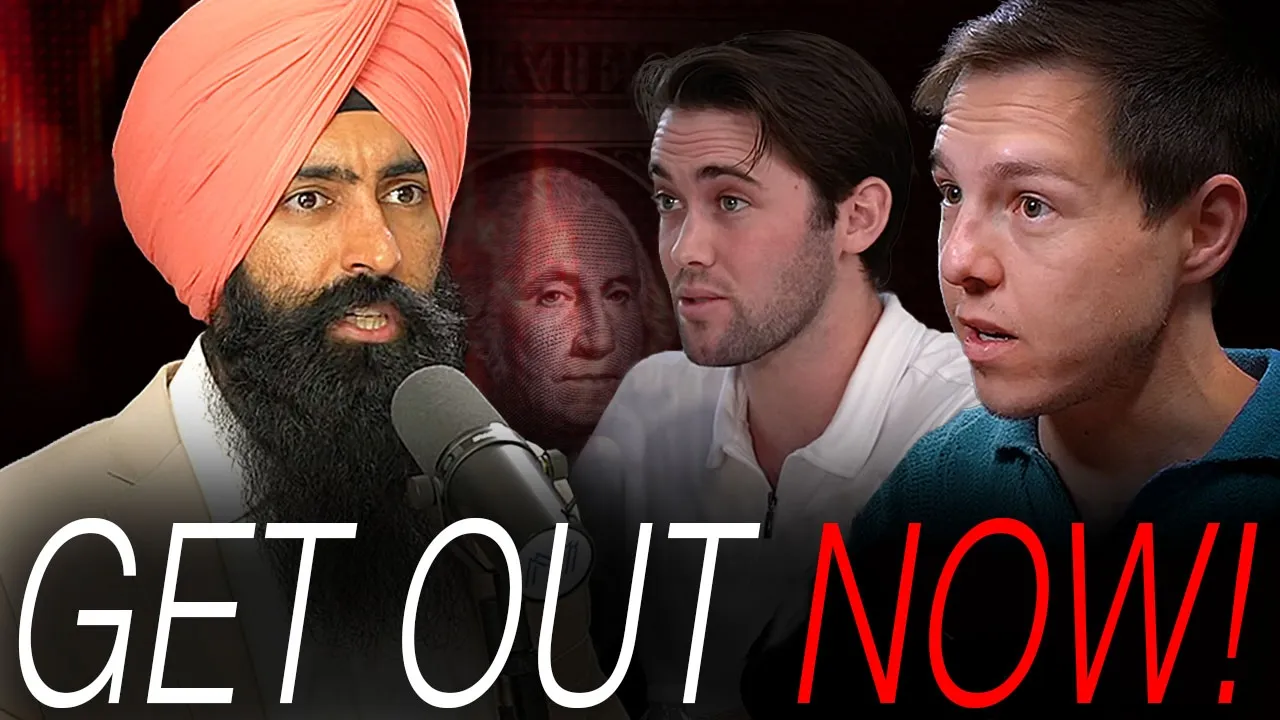
The United States national debt stands near $40 trillion with an annual deficit of roughly $2 trillion, with about one-third of existing debt scheduled to refinance at substantially higher interest rates. (46:06)
Official Consumer Price Index data understates real inflation by substituting actual home prices with owner's equivalent rent and weighting discretionary deflating goods against essential living expenses. (22:28)
The recommended foundational financial rule allocates income into 75% spending, 15% investing, and 10% savings until an emergency cushion of 3 to 12 months is established, before converting permanently to a 75/25 spending-to-investing model. (28:02)
Real estate investments should target a minimum 7% cash-on-cash yield based entirely on distributable cash flow rather than speculative property value appreciation. (96:50)
Detailed notes
## Background
Published on YouTube by The Iced Coffee Hour on September 20, 2026, this episode features entrepreneur and financial educator Jaspreet Singh in conversation with co-hosts Graham Stephan and Jack Selby. According to the show description and notes, the discussion covers the systemic devaluation of the US dollar, upcoming economic shifts, and practical investment strategies, alongside announcements for Singh's live investing workshop.
## TL;DR
Financial educator Jaspreet Singh details how federal deficit spending, approaching $40 trillion in national debt, and systemic inflation serve as a hidden tax that penalizes wage earners while rewarding asset owners. He warns against lifestyle inflation and high-interest consumer debt, promoting structured spending frameworks like the 75/15/10 rule and an automated 'Always Be Buying' investment philosophy centered on cash-flowing real estate and index funds. The dialogue also explores Singh's personal asset allocation, his Sikh heritage and Quadrofitt philosophy, entity structuring for legal asset protection, and co-host Jack Selby's method of building wealth through providing undeniable upfront value.
## Atmosphere & style
The podcast carries an energetic, pragmatic, and analytical tone, balancing sobering macroeconomic warnings with transparent, actionable wealth-building advice. The dynamic between Singh, Stephan, and Selby is collegial and conversational, shifting effortlessly from high-stakes fiscal policy debates to lighthearted banter over cheap cars, office workouts, and spontaneous games of rock-paper-scissors. Listening feels like sitting in on an candid, marathon masterclass where complex market mechanics and personal finance philosophies are broken down through grounded personal history, relatable parables, and relentless discipline.
## Bulletin
- [46:06](https://www.youtube.com/watch?v=__OSbMbXW2c&t=2766s) The United States national debt stands near $40 trillion with an annual deficit of roughly $2 trillion, with about one-third of existing debt scheduled to refinance at substantially higher interest rates.
- [22:28](https://www.youtube.com/watch?v=__OSbMbXW2c&t=1348s) Official Consumer Price Index data understates real inflation by substituting actual home prices with owner's equivalent rent and weighting discretionary deflating goods against essential living expenses.
- [28:02](https://www.youtube.com/watch?v=__OSbMbXW2c&t=1682s) The recommended foundational financial rule allocates income into 75% spending, 15% investing, and 10% savings until an emergency cushion of 3 to 12 months is established, before converting permanently to a 75/25 spending-to-investing model.
- [01:36:50](https://www.youtube.com/watch?v=__OSbMbXW2c&t=5810s) Real estate investments should target a minimum 7% cash-on-cash yield based entirely on distributable cash flow rather than speculative property value appreciation.
## Key takeaways
- [01:09](https://www.youtube.com/watch?v=__OSbMbXW2c&t=69s) Traditional education trains individuals to trade time for wages, whereas tax codes and capital systems heavily favor asset owners and corporate equity.
- [04:00](https://www.youtube.com/watch?v=__OSbMbXW2c&t=240s) True wealth is measured in units of time—how long a lifestyle can be sustained without working—rather than gross annual earnings or luxury possessions.
- [12:08](https://www.youtube.com/watch?v=__OSbMbXW2c&t=728s) Automated, uninterrupted investing beats market timing; purchasing exclusively at historic market tops still generates significant long-term wealth if capital is never liquidated.
- [16:11](https://www.youtube.com/watch?v=__OSbMbXW2c&t=971s) Monetary debasement serves as an invisible tax on wage earners and cash savers, transferring purchasing power directly to physical and productive asset owners.
- [26:57](https://www.youtube.com/watch?v=__OSbMbXW2c&t=1617s) Eliminating consumer debt compounded at 20% to 25% interest and establishing an initial emergency cushion must precede investing in speculative assets or equities.
- [33:28](https://www.youtube.com/watch?v=__OSbMbXW2c&t=2008s) Historical collapses of major empires are consistently preceded by wide wealth divergence, excessive state spending, and currency devaluation.
- [49:09](https://www.youtube.com/watch?v=__OSbMbXW2c&t=2949s) Global reserve currencies historically follow approximate century-long cycles, requiring strategic asset diversification across real estate, equities, and physical stores of value.
- [59:39](https://www.youtube.com/watch?v=__OSbMbXW2c&t=3579s) The pressure to display status through luxury vehicles with four-figure monthly payments prevents high-income earners from building genuine net worth.
- [01:01:01](https://www.youtube.com/watch?v=__OSbMbXW2c&t=3661s) Financial bubbles progress from underlying asset accumulation into debt leverage and ultimately speculative layered derivatives and prediction betting.
- [01:04:35](https://www.youtube.com/watch?v=__OSbMbXW2c&t=3875s) Investment success is driven more by emotional psychology than mathematical calculation, as panic-selling during major market drawdowns destroys compounded returns.
- [01:21:41](https://www.youtube.com/watch?v=__OSbMbXW2c&t=4901s) Relying on passive cash-flow yields to exceed monthly living expenses provides greater financial security than liquidating principal balances via the traditional 4% rule.
- [01:33:25](https://www.youtube.com/watch?v=__OSbMbXW2c&t=5605s) Holding real estate assets in separate corporate entities insulates personal wealth against lawsuits while providing depreciation write-offs and 1031 exchange benefits.
- [01:57:05](https://www.youtube.com/watch?v=__OSbMbXW2c&t=7025s) Building initial wealth and career momentum relies on offering upfront, high-leverage execution for free to establish indispensability before transitioning into equity and revenue share.
## Detailed walkthrough
### [00:00](https://www.youtube.com/watch?v=__OSbMbXW2c&t=0s) Teaser: The System That Profits Off Financial Ignorance
Civilizations throughout history have risen and fallen largely due to widening wealth gaps, and modern economic pressures are pushing society toward a critical breaking point. With national debt hovering around $40 trillion and annual deficit spending approaching $2 trillion, the financial deck remains heavily tilted against ordinary workers. While over 40% of Americans remain unfamiliar with essential wealth-building vehicles like Roth IRAs, high-yield savings accounts, and money market funds, the rules of the economy systematically reward owners rather than wage earners. Despite markets trading near all-time highs, the baseline reality for most families remains perilous: without financial education, they are perpetually one missed paycheck away from bankruptcy.
[01:09](https://www.youtube.com/watch?v=__OSbMbXW2c&t=69s) The Truth About Money Nobody Teaches You
Welcoming Jaspreet Singh (founder of Minority Mindset) to the show in Detroit, Graham Stephan opens by addressing Jaspreet’s frequent assertion that the general public fundamentally misunderstands money. Jaspreet explains that the vast majority of people are conditioned through schooling to trade time for a paycheck, chase raises, and climb the corporate ladder. In stark contrast, wealthy individuals aim to *own* the corporate ladder and put capital to work so they do not have to labor for it directly.
```mermaid
flowchart TD
accTitle: The Traditional Career Track vs Investor Mindset
accDescr: Flowchart contrasting the traditional corporate path with the asset ownership approach practiced by wealthy individuals.
subgraph Traditional["The Traditional Worker Track"]
A["School & Degree"] --> B["Entry-Level Job"]
B --> C["Corporate Ladder & Raises"]
C --> D["Trading Time for Paycheck"]
end
subgraph Investor["The Investor Ownership Path"]
E["Capital Accumulation"] --> F["Acquire Cash-Flowing Assets"]
F --> G["Assets Fund Lifestyle"]
G --> H["Time & Financial Freedom"]
end
```
Jaspreet shares that this perspective was absent from his own upbringing. The son of hardworking Indian immigrants who arrived in the United States with very little, his career path seemed predetermined. His father presented him with an ultimatum: "Jaspreet, you can either be a doctor or you can be a failure. You get to pick." While pursuing medicine, Jaspreet started digging into personal finance and realized the economic system does not exist to reward workers or consumers—it is engineered to enrich investors. The institutions surrounding average consumers thrive directly on their financial ignorance:
- **Banks** profit continuously off consumer debt and interest payments.
- **Corporations** profit when consumers spend beyond their means to maintain an image.
- **Wall Street** profits by charging the highest expense ratios to investors who do not know better.
- **The Government** collects the highest tax brackets from earned wage income rather than optimized asset portfolios.
[04:00](https://www.youtube.com/watch?v=__OSbMbXW2c&t=240s) Having Money vs. Being Wealthy
When asked about the dividing line between merely having money and possessing actual wealth, Jaspreet emphasizes that spending power is an illusion. Someone earning an income can buy expensive designer clothes, luxury vehicles, high-end vacations, or large homes, but spending cash balances naturally depletes them. This dynamic explains why high earners, athletes, and celebrities regularly slide into bankruptcy. Today, roughly half of Americans making over $250,000 a year live paycheck to paycheck with zero accumulated net worth.
True wealth is measured in time rather than dollar figures: if you stop working right now, how long can your current lifestyle survive? Jaspreet was able to reach full financial independence by his late 20s because his baseline living expenses were intentionally kept low while his cash-flowing assets produced enough to cover everything indefinitely.
[05:45](https://www.youtube.com/watch?v=__OSbMbXW2c&t=345s) Buying Back Time and Breaking Conditioning
Jaspreet’s aggressive drive to accumulate assets originated in childhood observations of his father's relentless work ethic. Seeing his dad work through every weekend without a single Saturday or Sunday off made him realize that money was the sole tool capable of buying his father's time back. Household obligations—mortgage payments, groceries, and remittances sent back to relatives in India—demanded constant labor.
Contrasting this urgent reality with the standard platitude that "money is bad" or "the root of all evil," Jaspreet concluded that while money should never become one's life, mastering it is mandatory. As his businesses expanded, he resisted lifestyle inflation: rather than upgrading cars or houses, every dollar generated was redirected into acquiring rental properties, index funds, and cash-producing assets.
[07:13](https://www.youtube.com/watch?v=__OSbMbXW2c&t=433s) The Luxury Car Dilemma and the Psychology of Desire
Reflecting on the exact milestone where he first felt rich, Jaspreet recounts his early 20s fascination with the BMW i8, particularly its futuristic butterfly doors. Around age 22, transitioning out of event promotions into real estate wholesaling and licensing, he received a breakthrough commission check of $10,000. Experiencing lumpy, inconsistent payouts, he wrestled with the temptation to finance a BMW 3 Series instead of the unattainable i8.
Ultimately, Jaspreet chose deferred gratification, realizing that buying another rental property could eventually yield the cash flow to pay for the car. Years later, once his portfolio grew to the point where purchasing an i8 in cash would have zero impact on his finances, his desire to own the car evaporated completely.
Graham Stephan relates immediately, sharing an identical experience:
- At 15 and 16 years old, Graham's ultimate holy-grail dream car was a Lamborghini.
- Later, he faced a pivotal crossroad where he had to choose between putting his capital toward a Lamborghini Gallardo Superleggera or investing in a duplex.
- Choosing the duplex set up his long-term financial trajectory, and by the time his net worth easily allowed him to buy the supercar without feeling it, the impulse to own it had vanished.
[09:25](https://www.youtube.com/watch?v=__OSbMbXW2c&t=565s) Trophies, Material Things, and College Wrestling
The conversation turns to the psychology of buying luxury status symbols and how those desires evolve over time. Graham reflects on how buying an exotic car once felt like the ultimate ambition, but today it just sounds like an unnecessary hassle. While he acknowledges a lingering interest in a Mercedes SLS AMG—partly because he views it as a solid investment—his day-to-day vehicle remains a modest 2019 Tesla Model 3, and he previously spent years driving a $1,000 Volvo. He admits that earlier in his career, an exotic car like a Lamborghini served primarily as a trophy, a tangible marker signifying that he had achieved a certain level of success. Over time, the illusion wore off: dealing with routine maintenance, oil changes, detailing, and insurance made him realize the classic cliché is true—"You end up not owning your things... they own you." His obsession with luxury watches faded in the exact same way, prompting him to start selling off pieces because the desire simply vanished.
Jaspreet Singh agrees, pointing out that maturity shifts priorities from chasing material objects toward seeking personal freedom and financial security. Looking back at his twenties, Jaspreet laughs at how much "stupider" he was, recounting college memories where his definition of fun was wildly different. Because he did not drink alcohol, he would invite friends over to his place, push the living room couches against the wall, clear the floor, and host full-blown wrestling matches fueled entirely by gallons of milk and chocolate milk to encourage everyone to stay healthy. Jack and Graham joke about setting up an inflatable wrestling pool of chocolate milk on the podcast set right then and there.
[12:08](https://www.youtube.com/watch?v=__OSbMbXW2c&t=728s) The Parable of Cousin Bunty: Why Market Timing Fails
When Graham asks whether investors should be worried about stocks hovering near all-time highs, Jaspreet explains that while buying at record peaks makes shares more expensive in the short term, markets breaking new records is historically normal. The stock market consistently marches upward over long horizons. To illustrate this, Jaspreet shares the cautionary hypothetical story of his "broke cousin Bunty"—whom he labels the worst market timer of all time.
Bunty managed to invest exclusively at the absolute market peaks across four decades:
```mermaid
flowchart TD
accTitle: The Worst Market Timer in History
accDescr: Visualizing the four terrible investments made by cousin Bunty right before major market crashes.
A --> B
B --> C
C --> D
D --> E["Outcome: $100,000 invested<br/>Never Sold: Grew to $500,000<br/>With Dividends Reinvested: ~$1,000,000"]
```
- **1987:** Bunty invests his first $10,000 right before Black Monday, the worst single-day market crash in history. Heartbroken, he swears off investing for years, but crucially, he never sells.
- **2000:** Having finally regained his confidence, he invests $20,000 at the very peak of the dot-com bubble. The next day, tech stocks collapse and the Nasdaq plunges by roughly 75% to 78%.
- **2008:** Eight years later, feeling brave again, he puts $30,000 into the market right at the 2008 top. The housing market implodes immediately after, dragging the broader indices down with it.
- **2020:** Deciding to make one final attempt, he puts $40,000 into the market at the pre-pandemic high in early 2020, only for the world to shut down and stocks to get cut in half.
Despite putting in a total of $100,000 across four separate market peaks right before historic crashes, Bunty did the one thing that mattered most: he held on. Today, that original $100,000 is worth around $500,000, and if he had reinvested dividends along the way, it would be worth roughly $1,000,000. Citing studies showing that the best-performing investment accounts often belong to dead people because they never touch their holdings, Jaspreet advocates for an "ABB" strategy: "Always Be Buying."
Graham introduces the episode sponsor, Northwest Registered Agent, drawing a parallel between the timeless investing rule—"time in the market beats timing the market"—and entrepreneurship. Aspiring founders often stall for months searching for the ideal moment to launch a venture, when the real priority should be establishing core infrastructure immediately. Northwest Registered Agent helps business owners register an online presence by offering a free business phone line, website, domain name, and email setup without forcing users to form an LLC upfront or purchase upsells.
[16:11](https://www.youtube.com/watch?v=__OSbMbXW2c&t=971s) The Hidden Tax: How Free Money and Inflation Expand the Wealth Gap
Addressing the stark disconnect between ordinary citizens struggling to afford daily life while the stock market rips higher, Jaspreet outlines the systemic mechanics at play. The economic structure is engineered specifically to reward investors and asset owners, a reality rarely taught in traditional schooling. During the COVID-19 pandemic, governments created trillions of dollars out of thin air to fund stimulus packages, unemployment checks, Paycheck Protection Program (PPP) loans, and business subsidies. While the public celebrated the arrival of stimulus cash, Jaspreet cautions that "the most expensive kind of money is free money."
When governments print massive sums rather than funding programs solely through tax revenue, an indirect cost is extracted from the public through currency dilution. Jaspreet dubs this inflation a "hidden tax," which manifests in rising prices for grocery staples like eggs, everyday items like coffee, and major purchases like housing and vehicles. Those without assets or financial education simply work for wages that lose purchasing power, whereas asset owners see their equities and real estate appreciate rapidly alongside the expanded money supply. Furthermore, the Federal Reserve maintains an explicit 2% annual inflation target—a threshold deliberately set because it steadily erodes purchasing power at a rate slow enough that everyday citizens hardly notice.
[18:33](https://www.youtube.com/watch?v=__OSbMbXW2c&t=1113s) The Inflation Reality and the Deflation Trap
Jaspreet Singh reflects on how gradual inflation blinds the average consumer. Even when price increases seem mild, prices are relentlessly climbing beneath the surface; they simply rise at a pace low enough that people fail to register the day-over-day pain. This dynamic formed the very foundation of his channel's initial viral breakout back in 2016, when he posted about a steady 2% to 3% rate. While the public understands inflation better today, he stresses that it is not a passing phase, but an ongoing reality that has persisted for decades.
Jack Selby challenges this premise by asking whether an economy ought to experience inflation at all, pointing out that in an efficient capitalist system, technological advances and production efficiencies should naturally make goods cheaper—driving deflation. Jaspreet pushes back firmly: capitalists and investors actively want inflation because of the foundational rules of money: money flows to the investor, and inflation directly enriches asset owners while eroding the purchasing power of everyday wage earners. When inflation hits, a static paycheck buys fewer vacations and consumer goods as an ever-larger chunk gets eaten by rent.
```mermaid
flowchart TD
accTitle: The Divergent Effects of Inflation
accDescr: Diagram showing how inflation flows toward investors while reducing consumer purchasing power.
subgraph INFLATION["Persistent Inflation"]
I["Money Supply Expands / Prices Rise"]
end
subgraph INVESTOR["The Investor Path"]
I -->|"Asset Values Rise"| INV["Investors Gain Wealth"]
INV -->|"Rule: System Benefits Assets"| CAP["Capital Expands"]
end
subgraph WORKER["The Consumer Path"]
I -->|"Real Purchasing Power Falls"| CON["Workers Squeezed"]
CON -->|"Rent & Necessities Consume Paycheck"| BROKE["Discretionary Spending Collapses"]
end
```
Jaspreet warns that the alternative—prolonged deflation—is far worse, citing Japan as the quintessential historical warning. For decades, Japan battled falling asset values alongside falling prices. While cheap goods sound appealing, deflation caused Japanese incomes and wages to decline concurrently. In an effort to escape this spiral, the Bank of Japan spent decades aggressively printing money and driving interest rates down into negative territory (effectively paying the government to borrow money). That prolonged stimulus finally backfired, pushing Japan into its own inflationary environment and sending shockwaves across the globe through the unraveling of the "yen carry trade."
- **The Yen Carry Trade Mechanism:** Wall Street hedge funds and institutional investors borrowed massive sums of yen essentially for free, converted the currency into US dollars, and deployed that cheap leverage directly into US equities, Treasuries, and real estate for nearly risk-free spreads.
- **The Modern Reversal:** As Japan’s central bank raised interest rates to combat domestic inflation, the cost of borrowing rose, forcing institutions to unwind these positions and restricting the flow of institutional dollars into US financial markets.
---
[22:28](https://www.youtube.com/watch?v=__OSbMbXW2c&t=1348s) The Numbers the Government Doesn't Want You to See
When Jack asks Jaspreet what the actual rate of inflation is in the United States, Jaspreet gives a stark rule of thumb: "Take whatever rate the government says, multiply it by two." He firmly asserts that true inflation runs closer to 6% to 7% rather than official government figures. The gap between official metrics and street-level reality exists because government agencies have altered how the Consumer Price Index (CPI) is calculated.
Historically, CPI factored in actual housing sale prices. Today, it replaces that metric with "owner's equivalent rent"—a subjective survey asking homeowners what they hypothetically think their home would rent or sell for. Furthermore, CPI is calculated as a broad aggregate basket of goods. While 50% to 80% of an everyday family’s budget is locked into non-negotiable necessities—housing, car payments, groceries, and insurance—the index dilutes these soaring expenses by averaging them against items undergoing deflation, such as consumer electronics, toys, and furniture. As a result, a worker receiving a 5% annual raise is still falling further behind year-over-year in terms of real purchasing power.
---
[24:37](https://www.youtube.com/watch?v=__OSbMbXW2c&t=1477s) Financial Education Over Formal Education
Addressing whether the system is broken, Jaspreet insists it is operating as designed: "The system is rigged. It is so rigged. It is unfair. It is rigged towards investors." He recalls the personal anger he felt after realizing that working hard, earning degrees, and following the traditional script does not create wealth on its own. While he clarifies that people should still pursue careers and professions like medicine, he emphasizes that formal education only trains people to work, whereas financial education teaches people how to build and keep wealth.
When breaking down why the average person struggles, Jaspreet outlines a specific financial hierarchy:
1. **Spending:** Learning to live below your means and controlling lifestyle creep.
2. **Income:** Earning enough margin to support sustained saving.
3. **Investing:** Consistently directing capital into compounding assets.
```mermaid
flowchart LR
accTitle: Jaspreet Singh's Wealth Hierarchy
accDescr: A progressive three-stage model for wealth creation starting with spending control, moving to income expansion, and finishing with automated investing.
S["1. Spending Control"] -->|"Live Below Means"| I["2. Income Expansion"]
I -->|"Maximize Margin"| INV["3. Capital Investing"]
INV -->|"Compounding Returns"| W["Long-Term Wealth"]
```
Jack questions whether there is an absolute income threshold below which building wealth is physically impossible. Jaspreet notes that location dictates that line entirely: making under $110,000 for a family of four in California leaves a household near the poverty line, whereas that same income in Metro Detroit provides a comfortable life. Reaching a financial breakthrough often requires moving to lower-cost regions, making temporary sacrifices, or choosing to live uncomfortably to generate investable cash flow.
---
[26:57](https://www.youtube.com/watch?v=__OSbMbXW2c&t=1617s) The Emergency Cushion and Credit Card Trap
For anyone living paycheck to paycheck and seeking a clear path forward, Jaspreet outlines the first two mandatory steps before investing a single dollar into the stock market:
1. **Build an Initial $2,000 Cushion:** Amass an emergency fund of $2,000 as fast as humanly possible, keeping it strictly reserved for true emergencies rather than discretionary splurges like a new TV.
2. **Eradicate High-Interest Debt:** Systematically wipe out high-interest obligations such as credit cards and payday loans.
To illustrate the crushing mathematical reality of high-interest consumer debt, Jaspreet contrasts the power of compounding interest when it works for you versus against you. If someone were to invest a one-time lump sum of $8,000 at an exceptional 20% annual return, after 40 years without adding another penny, that balance would compound to over $11 million. However, ordinary retail investors almost never achieve a guaranteed 20% return in the markets. The entities that actually bank an automatic 20% to 25% return every year are credit card companies like American Express, Visa, Mastercard, and Discover—funded entirely out of consumers' pockets. Paying down that high-interest debt provides a guaranteed return and must take absolute priority over any market investment.
[28:02](https://www.youtube.com/watch?v=__OSbMbXW2c&t=1682s) Escaping the Financial Danger Zone and the 75/15/10 Rule
Jaspreet Singh emphasizes that carrying high-interest debt places someone squarely in what he terms the "financial danger zone." Acknowledging that his blunt advice might hurt feelings, he states he is not speaking to win friends or make people happy, but to transform their financial lives. Anyone trapped in this zone must adopt a lifestyle of extreme sacrifice: eliminating restaurant visits, branded clothing, vacations, and even streaming services like Netflix.
When met with the common objection that Netflix only costs around $15 a month, Jaspreet counters that the issue is not the subscription fee, but the behavioral cost. The average American spends over two hours a day in front of the television. Someone bleeding 15% to 25% annual interest on credit card debt cannot afford the luxury of sitting around for two hours rotting their brain. Instead of unwinding after a difficult workday with entertainment, they should be reading personal finance books, learning income-generating skills on YouTube, driving for Uber, or finding any side hustle to increase their income. High-interest debt is actively "skinning you alive," enriching creditors while keeping the borrower poor.
Once high-interest debt is eliminated, Jaspreet recommends systemizing cash flow using his straightforward 75/15/10 framework:
```mermaid
flowchart TD
accTitle: The 75/15/10 System and Wealth Transition
accDescr: Visual breakdown of how income is allocated across spending, investing, and saving, and how it shifts once emergency savings goals are met.
subgraph S1["Phase 1: Building Savings (75/15/10)"]
Income["Every Dollar Earned"] --> Spend["Max 75% Spent"]
Income --> Invest["Min 15% Invested"]
Income --> Save["Min 10% Saved"]
end
Save --> Goal{"Emergency Fund Met?<br/>3 to 12 months"}
- **Spending (Maximum 75%):** Out of every dollar earned, no more than 75 cents can be spent on lifestyle expenses.
- **Investing (Minimum 15%):** At least 15 cents must be put into income-producing assets before anything else is spent.
- **Saving (Minimum 10%):** At least 10 cents goes toward an emergency fund until a clear milestone is reached.
Jaspreet explains that the size of this emergency reserve depends on age and personal risk profile: a 25-year-old with minimal obligations might require only 3 months of living expenses, while a 45-year-old supporting a spouse and children may need a full year. Crucially, once that target is funded, holding additional idle cash is counterproductive. At that point, the system converts permanently into a **75/25 rule**, directing 25 cents of every single dollar earned into investments indefinitely.
---
[30:26](https://www.youtube.com/watch?v=__OSbMbXW2c&t=1826s) Sponsor: Claude
Jack breaks in to share how their internal business operations adapted over the year to focus on efficiency, from hiring a full-time video editor and upgrading their studio to overhauling internet speeds. The single biggest leap in productivity, however, came from integrating Claude. Described as an AI thinking partner for problem solvers rather than a simple chatbot, Claude collaborates on complex workflows, writing real spreadsheets, formatting reports, and manipulating local files directly. The team highlights the release of the newest model, Opus 3.5, and notes that the podcast relies on Claude across every administrative and creative facet—from drafting video titles, outlines, and scripts to handling data research, invoicing, and generating clips for their secondary channel. Viewers are encouraged to try the tool and Claude Pro at `claude.ai/icedcoffee`.
Jack introduces AG1 as their go-to solution for maintaining health during hectic travel and production schedules. Designed as an all-in-one morning habit, a single scoop mixed into 8 ounces of water delivers multivitamins, prebiotics, probiotics, superfoods, and antioxidants. Jack candidly admits that eating enough vegetables and tracking micronutrients is difficult for him, making the simplicity of the AG1 NextGen formula—which packs over 75 clinically tested ingredients to support energy, gut health, and immune function—an easy way to cover nutritional gaps. The audience is offered a 20% discount on their first subscription order of AG1 NextGen or AG1 Pro by visiting `drinkag1.com/ich`.
---
[33:28](https://www.youtube.com/watch?v=__OSbMbXW2c&t=2008s) Personal Responsibility, the Wealth Gap, and the Fall of Empires
Returning to the interview, the hosts press Jaspreet on the balance between personal responsibility and systemic economic pressures. Jaspreet does not dispute that the Federal Reserve's monetary printing and specific political policies systematically disadvantage everyday citizens. However, he maintains that blaming politicians, the Fed, or employer conditions changes nothing about an individual's personal ledger:
> "You can blame your boss. You can blame the Fed. You can blame the government. You can blame everything all day and night long. That's not going to change your outcome... If you want to change where you are, you have to take 100% of that."
The conversation shifts to the expanding wealth divide and whether runaway inequality eventually destabilizes society. Jaspreet points out that throughout history, an extreme divergence between the ultra-wealthy and the broad population has been a primary leading indicator of imperial collapse. When basic necessities become unaffordable for the working majority while a small cohort amasses outsized fortunes, civil unrest inevitably follows. Although Jaspreet concedes that extreme wealth concentration can harm societal cohesion, he argues that government-mandated caps on personal wealth create even more destructive consequences by suppressing economic motivation.
When asked whether the modern United States is uniquely shielded due to upward economic mobility, Jaspreet identifies currency debasement as the deeper, recurring mechanism that destroys great powers:
- **Growth and Overspending:** A civilization rises to power and attempts to maintain unsustainable public expenditures.
- **Avoidance of Taxes:** Raising taxes is politically toxic, prompting governments to monetize deficits by printing money instead.
- **Short-Term Euphoria:** The newly created liquidity creates a temporary illusion of prosperity as asset prices rise, spending climbs, and jobs appear plentiful.
- **Currency Devaluation:** Over time, the purchasing power of the currency erodes, leaving workers trading their labor for money that steadily loses real value.
- **Widening Inequality:** Because fresh capital flows straight into financial assets, currency expansion enriches asset owners while penalizing wage earners, ultimately driving the wealth gap past the breaking point.
[37:28](https://www.youtube.com/watch?v=__OSbMbXW2c&t=2248s) The Root Causes of Wealth Inequality: Education vs. Discipline
Jaspreet Singh reiterates his "money rule number two": inflation benefits the investor by making asset owners richer. While investors initially feel great seeing their portfolio values rise, inflation forces someone else down the line to foot the bill. When asked whether there is genuinely more opportunity to build wealth today than ever before, Jaspreet agrees 100%, acknowledging that it is technically easier to become wealthy now than at any point in history. However, this creates a paradox: if opportunity is at an all-time high, why does wealth inequality continue to widen?
Jaspreet points directly to the lack of financial education. Society funnels people into formal education under the premise that high-status professions guarantee wealth: "We go through formal education because I think if I become a doctor, I'm going to become rich. I think if I'm an attorney, I'm going to become successful. Well, a lot of doctors are broke. A lot of attorneys are broke. And I'm telling you this as an attorney." Jack pushes back, questioning whether the issue is truly education or rather personal discipline. Jack draws an analogy to morbid obesity, arguing that an overweight person already knows that eating healthier and cutting calories will lead to weight loss; the issue is behavioral execution rather than lack of information. Furthermore, with YouTube and ChatGPT readily accessible, high-quality financial guidance from creators like Graham Stephan or Minority Mindset is just a search query away.
Jaspreet counters that discipline is merely an offshoot of education, and the fundamental problem is that average citizens do not even possess baseline financial literacy. To prove this, Jaspreet shares that he has taken to the streets to interview everyday pedestrians without cherry-picking or editing clips. When asked basic questions—"What is inflation?", "What is our national debt?", "What is an asset?", "What is a bond or a stock?"—the average person has no clue. While information exists online, most people do not even know what questions to ask.
---
[39:55](https://www.youtube.com/watch?v=__OSbMbXW2c&t=2395s) The "Midwit" Trap and Generational Poverty Mindsets
Jack brings up the classic "IQ bell curve" meme regarding investing:
- **Left end (low IQ):** Individuals who admit they know nothing and simply dump all their money into passive index funds.
- **Middle (average IQ / "midwits"):** Individuals overwhelmed by data analytics, CPI reports, inflation metrics, and options trading, perpetually trying to time the market and getting burned.
- **Right end (high IQ):** Sophisticated investors who understand macro complexities but realize market timing is futile, ultimately executing the exact same simple strategy as the left side.
```mermaid
flowchart LR
accTitle: The Investor IQ Bell Curve
accDescr: A comparison showing how low-IQ and high-IQ investors share simple index strategies while midwits overcomplicate with market timing.
subgraph BellCurve["Investor Behavior Across IQ Curve"]
A["Low IQ:<br/>Keeps it simple,<br/>buys index funds"]
B["Middle IQ:<br/>Overcomplicates with CPI,<br/>options, and market timing"]
C["High IQ:<br/>Understands macro,<br/>returns to simple index funds"]
end
A -.->|"Same End Result"| C
B -->|"Underperforms"| C
```
Jaspreet argues that Jack's characterization of the left side is overly optimistic. In reality, the true low end of the spectrum has no idea what an index fund even is. Jaspreet points out that the average American spends more on their monthly Netflix subscription than they contribute to building personal wealth. Half of the American population has zero retirement savings and zero investments across 401(k)s, IRAs, individual stocks, or cryptocurrency.
Jaspreet reflects on his own journey 15 to 20 years earlier, when he did not know what a dividend, an asset, or a brokerage account was. Without that baseline knowledge, high earners simply buy depreciating consumer goods and wonder why they stay broke. This cycle fuels what Jaspreet terms "generational poverty" and "money trauma"—an inherited psychological script where money is viewed as evil, scarce, or impossible to master. Breaking out requires stacking practical financial education on top of traditional schooling.
- Half of all Americans have no investments or retirement accounts whatsoever (no 401(k), IRA, stocks, or crypto).
- A cited historical study revealed Americans spent more money on coffee than on their retirement contributions.
- Generational poverty is driven by cultural money trauma rather than genetics.
---
[43:23](https://www.youtube.com/watch?v=__OSbMbXW2c&t=2603s) The $40 Trillion Time Bomb and How Government Debt Works
When asked about the single biggest hidden risk facing the economy, Jaspreet points to the federal debt, which stands at roughly $40 trillion—representing $40 trillion in expenditures that the government never earned. Currently, the U.S. government runs an annual structural deficit of around $2 trillion.
Jaspreet breaks down the entire fiscal apparatus. The federal government generates approximately $5 trillion annually through a wide web of taxes:
- Personal income taxes
- Payroll taxes (Medicare and Social Security)
- Capital gains taxes on sold assets
- Sales taxes and property taxes
- Import tariffs and corporate income taxes
- State and local municipal taxes
- Excise "sin" taxes (alcohol, cigarettes), toll fees, and estate ("death") taxes
Rather than operating prudently by spending $4 trillion and investing the remaining $1 trillion surplus, the government spends the full $5 trillion revenue plus an additional $2 trillion of borrowed funds.
```mermaid
flowchart TD
accTitle: Federal Budget Deficit and Debt Financing Flow
accDescr: Flowchart illustrating government revenue collection, deficit spending, and borrowing sources including the Federal Reserve.
subgraph Spending["Federal Outlays (~$7 Trillion)"]
Budget["Annual Federal Spending"]
end
subgraph Deficit["Annual Deficit (~$2 Trillion)"]
Borrowing["Borrowing / Debt Issuance"]
end
subgraph Lenders["Lenders to the US Government"]
Public["Retail Investors (Treasuries/Muni Bonds)"]
Corps["Corporations"]
Foreign["Foreign Nations (Japan as #1 Lender)"]
Fed["Federal Reserve (Prints Currency)"]
end
Taxes --> Budget
Borrowing --> Budget
Public --> Borrowing
Corps --> Borrowing
Foreign --> Borrowing
Fed --> Borrowing
```
To cover this gap, the Treasury borrows through several channels: retail investors buying Treasuries, corporations, foreign allies (with Japan serving as the largest foreign creditor), and the central bank. Jaspreet demystifies the Federal Reserve, noting that despite its name, it is not a bank where everyday citizens can make deposits, holds no true reserves of cash, and operates as an entity independent of federal control. When the Federal Reserve finances government shortfalls, it prints new currency into existence, sparking the inflation that erodes everyday purchasing power. Jaspreet warns that this compounding $40 trillion debt load took an especially dangerous turn when interest rates shifted dramatically following the pandemic period.
[46:06](https://www.youtube.com/watch?v=__OSbMbXW2c&t=2766s) The $40 Trillion Time Bomb and the Debt Refinance Trap
Jaspreet Singh breaks down the looming crisis tied to the national debt. During 2020 and 2021, interest rates plummeted to historical lows. While ordinary citizens were rushing to refinance mortgages or buy homes, the United States government did the exact same thing with its national debt. However, prior to 2020, the Treasury's standard strategy when refinancing was locking in long-term debt via 10-year or 30-year Treasuries, mirroring a standard fixed 30-year home mortgage. During the pandemic, the government "got a little greedy," opting against locking in a 30-year rate around 2.1% in favor of 5-year paper at roughly 1.8% just to shave off thirty basis points.
That short-sighted bet is coming due. About one-third of the entire national debt is scheduled to reset at prevailing market rates. Because interest rates are significantly higher now than they were during the pandemic, the servicing cost of the debt is exploding—not strictly because the country borrowed more principal (though it did), but because rolling over the debt has become drastically more expensive. Today, national debt interest payments surpass total spending on the military. For every dollar collected in federal taxes, approximately 20 cents goes solely toward servicing interest payments rather than providing productive services.
If debt costs climb further, policymakers will face an ugly dilemma: hike taxes or print currency. The latter triggers a death spiral: printing money to pay back existing debt is essentially like "paying off the Amex with the Discover card." When foreign and domestic investors lose faith in the dollar, yields climb, dollar purchasing power craters, and the problem spirals. In response to Graham Stephan bringing up former Fed Governor Kevin Warsh's counter-argument—that artificial intelligence could drive a massive productivity boom and deflation that outgrows the debt—Jaspreet expresses skepticism: "AI is going to make life so much cheaper... Great. Let's see it happen."
```mermaid
flowchart TD
accTitle: US Debt Rollover Trap
accDescr: Visual flow showing how short-term debt refinancing leads to higher borrowing costs and currency debasement.
subgraph Decision["2020–2021 Short-Term Debt Choice"]
A["Low Interest Rate Era"] --> B["Lock 5-Year Debt at ~1.8%<br/>instead of 30-Year at ~2.1%"]
end
subgraph Rollover["Rollover Crisis"]
B --> C["~1/3 of National Debt Resets"]
C --> D["Higher Yields & Refinancing Costs"]
end
subgraph Consequences["Fiscal & Monetary Fallout"]
D --> E["Debt Servicing > Military Budget<br/>(20¢ per Tax Dollar to Interest)"]
E --> F["Print Money to Service Debt<br/>('Amex paid with Discover')"]
F --> G["Loss of Faith in USD & Inflation"]
end
```
[49:09](https://www.youtube.com/watch?v=__OSbMbXW2c&t=2949s) The Reserve Currency Lifecycle and True Asset Diversification
Jaspreet contextualizes the potential fall of the US dollar through the lens of historical empire cycles. The United States only gained world reserve currency status following the Bretton Woods conference after World War II in 1944. Historically, world superpowers maintain their dominant status for approximately a century (give or take a few decades). While better fiscal discipline, balanced budgets, and reducing the debt-to-GDP ratio could lengthen that lifespan, history dictates that dominance does not last forever: "Every empire comes to an end." He compares the US position to once-untouchable corporate titans like Sears, which thirty years ago was the largest and most praised retailer on Earth before going bankrupt, noting that even a giant like Amazon will eventually experience its own rise and fall.
To hedge against this inevitable decline, Jaspreet argues that holding hard investments across distinct asset classes is non-negotiable. When Graham Stephan pushes back, questioning why a 100% equity portfolio like a Vanguard Total World Stock Market Index Fund isn't diversified enough, Jaspreet points out that being all-in on equities leaves an investor fully exposed to paper assets that can crash together. Different asset classes operate on different cycles:
- In 2022, Bitcoin fell roughly 60%, stocks declined by around 20%, but housing and gold held strong or gained.
- In 2020, during the initial COVID panic, equities dropped 30%-plus and Bitcoin fell, while real estate and gold quickly surged.
- **Jaspreet's Personal Asset Allocation (Excluding His Operating Business Briefs Media):**
- **Real Estate:** ~50%
- **Stocks:** ~30%
- **Speculative (Crypto & Startups):** ~18%
- **Physical Gold:** ~2%
[53:14](https://www.youtube.com/watch?v=__OSbMbXW2c&t=3194s) Startup Regrets and Five-Star Detroit Hospitality
Discussing his 18% speculative allocation, Jaspreet admits that angel investing in startups has been his worst-performing asset category, producing zero realized returns to date. Graham and Jack Selby immediately commiserate, recalling their own missed opportunities. Graham laments passing up an early angel investment in the company Grunt Style (or similar angel syndicates pitched to creators) that ended up producing a 100x exit for mutual friends. Graham jokingly vents his frustration: "Just... come on, man. Come on. Give me a break. Someone's got to give me a break here, Jack."
The conversation shifts to lighthearted banter about Graham and Jack's trip to Detroit to tape the episode. Jaspreet rolled out the red carpet for them, booking them into the Shinola Hotel. Graham expresses shock at how luxurious the stay has been, noting their room has an outdoor balcony, a dedicated living room, two separate bathrooms, and hand-written inspirational messages on their mirrors from Jaspreet's team, in addition to being greeted by name at the airport. Jaspreet passes all credit to his staff, explaining that because outsiders often hold negative stereotypes about Detroit—associating it solely with *8 Mile* and urban decay—his team goes above and beyond so visitors leave thinking, "Oh, Detroit. I loved Detroit."
[55:45](https://www.youtube.com/watch?v=__OSbMbXW2c&t=3345s) Sponsor: ZipRecruiter & Scrimping on Hotel Coffee
Graham jokes about doing whatever he can to pinch pennies after seeing a text message offering room charges and an on-site hotel restaurant downstairs, only to discover a basic cup of coffee cost $10. Rather than pay the exorbitant price, he opted out completely, drawing laughs about saving money wherever possible because "you got enough here."
This banter transitions into a sponsor segment for ZipRecruiter. Jack and Graham recount the story of hiring their team member Michael, who initially approached them offering to manage their X account entirely for free. After he crushed the role, they gradually entrusted him with more responsibilities until bringing him on full-time. While unusual stunts like working for free stand out, ZipRecruiter eliminates the guesswork by allowing qualified candidates to attach a personal note explaining why they want the role. The platform features an interface that surfaces the most enthusiastic and qualified candidates first, backed by its standing as the top-rated hiring site on G2, where four out of five employers find a quality candidate within their first day.
[56:55](https://www.youtube.com/watch?v=__OSbMbXW2c&t=3415s) The Trauma of Poverty: From the 1947 Partition to Financial Security
Jaspreet Singh reflects on the paradox of modern life: people dedicate their entire adult lives to working for money, yet financial education is completely avoided in polite society. To explain why security dominates people's relationship with money, Jaspreet shares the harrowing history of his family during the 1947 Partition of India. His grandparents were Sikhs living in West Punjab. When the partition line severed the state, non-Muslims on the western side were forced to flee east under threat of massacre. His grandfather fled on foot carrying only a sword, the clothes on his back, and the shoes on his feet. Along the journey, a mob ambushed them; his grandfather watched his own uncle get cut in half, loaded him onto a horse, and never saw him again.
```mermaid
flowchart TD
accTitle: Generational Trauma to Wealth Mindset
accDescr: Flowchart tracing how the trauma of partition led to an obsession with job security and ultimately the need to build real wealth.
subgraph Trauma ["Historical Scarcity"]
A["1947 Partition of Punjab"] --> B["Extreme Poverty & Starvation"]
B --> C["Inability to Practice Seva"]
end
subgraph Survival ["Immigrant Conditioning"]
C --> D["Deep Psychological Need for Safety"]
D --> E["Pursuit of Degrees & 'Safe' Corporate Salaries"]
end
subgraph Realization ["Financial Awakening"]
E --> F["Single-Income Fragility Trap"]
F --> G["Building True Equity & Assets"]
end
```
By the time his grandfather reached East Punjab, he had lost his shoes, had nowhere to sleep, and possessed no money for food. In Punjabi, his grandfather would often recount that "the biggest disease is poorness." In Sikhism, *seva* (selfless service) is a fundamental pillar of faith, yet during that crisis, his grandfather was surrounded by starving children who died before his eyes, completely unable to feed them or himself. That profound scarcity left a permanent mark. When Jaspreet's father faced his own hardships and later immigrated to America, this generational trauma morphed into a relentless obsession with safety. Families convince themselves that getting a prestigious degree and securing a corporate job provides ultimate protection, failing to realize that relying strictly on a single salary leaves a household just one layoff, illness, or tragedy away from financial ruin.
- In the 1947 Partition of Punjab, Sikhs on the west side had to migrate east to escape sectarian violence.
- Jaspreet's grandfather fled with only a sword, lost his footwear, and experienced absolute homelessness and hunger.
- The inability to feed starving children violated the Sikh spiritual mandate of *seva*, cementing poverty in his mind as the ultimate affliction.
- Relying exclusively on active labor income leaves families vulnerable to total ruin if the wage earner cannot work.
[59:39](https://www.youtube.com/watch?v=__OSbMbXW2c&t=3579s) Looking Rich vs. Being Rich: The $1,000 Car Payment Trap
Jaspreet argues that society hides behind moral posturing—claiming money is "evil" or that discussing wealth is improper—simply to cover up deep personal insecurities. People construct conversational smoke screens because confronting their own financial instability is painful. To break this cycle, Jaspreet deliberately speaks in terms that make audiences uncomfortable, forcing them to confront the choices they make between appearances and actual freedom.
Today, an unprecedented number of Americans carry monthly car payments exceeding $1,000 for luxury vehicles like Cadillac Escalades and BMWs. When insurance, fuel, and regular maintenance are factored in, the real carrying cost is even higher, while many of these same drivers have zero dollars invested in the market. Jaspreet admits that early in his entrepreneurial journey, the moment he started making money, he desperately wanted a BMW so everyone would think he was rich. However, once he accumulated serious, lasting wealth, the need to impress others evaporated entirely. To actually become wealthy, one must sacrifice looking rich in the short term.
- An all-time record number of Americans are currently paying car payments of $1,000 or more per month.
- Luxury car commitments drain capital before accounting for insurance, routine maintenance, or fuel.
- Superficial displays of wealth often mask nonexistent investment portfolios.
[01:01:01](https://www.youtube.com/watch?v=__OSbMbXW2c&t=3661s) Prediction Markets and Phase Three of Market Bubbles
When Graham asks about the growing trend of investors treating the market like a casino, Jaspreet expresses intense disgust for two specific industries: Buy Now, Pay Later (BNPL) platforms and prediction markets like Kalshi. Although Jaspreet was presented with early-stage angel investment deals in both spaces that would have yielded massive financial returns, he turned them down on moral grounds. Graham pushes back, arguing that prediction markets can function as a rational hedge—allowing an investor whose stock portfolio is down to offset losses by betting the market will open lower. Jaspreet dismisses this immediately: "No, it's gambling. It is betting."
```mermaid
flowchart LR
accTitle: The Three Phases of an Investment Cycle
accDescr: Flowchart illustrating the evolution of an investment bubble from asset ownership to excessive debt and finally speculative derivatives.
P1["Phase 1: Asset Ownership<br/>• Buying stocks for cash<br/>• Direct real estate purchases<br/>• Owning actual Bitcoin"]
--> P2["Phase 2: Debt & Leverage<br/>• Margin borrowing<br/>• Zero-down mortgages<br/>• Leveraged crypto plays"]
--> P3["Phase 3: Pure Derivatives<br/>• Binary prediction bets<br/>• 4x leveraged futures<br/>• Credit default swaps"]
```
To illustrate how prediction platforms warp investor psychology, Jaspreet highlights bets on Bitcoin hitting milestones like $1,000,000. If an investor purchases one Bitcoin at $100,000 and it climbs to $1,000,000, they pocket a $900,000 gain. But on a prediction market, a correct out-of-the-money bet can pay out 10x, 20x, or even 100x their wager—dwarfing the returns of owning the underlying asset, even if one were to foolishly buy Bitcoin with borrowed debt. This asymmetry lures retail participants into taking on debt simply to gamble on outcomes, representing what Jaspreet outlines as the classic "Phase Three" of historical financial bubbles:
- **Phase One:** Investors purchase the core asset because they believe in the fundamental value (buying real estate, individual equities, or Bitcoin).
- **Phase Two:** Investors demand greater exposure and use debt to amplify returns (margin loans for stocks, zero-down financing for real estate).
- **Phase Three:** Market participants abandon the asset entirely to trade layered derivatives (4x leveraged futures, binary prediction markets, and complex synthetic instruments).
Jaspreet warns that every major collapse throughout financial history has coincided with an explosion of Phase Three derivatives. In the 2008 financial crisis, zero-down subprime mortgages were only the initial trigger; the true structural contagion that wiped out Wall Street investment banks like Lehman Brothers was the unchecked mountain of credit derivatives built on top of those underlying loans.
[01:04:35](https://www.youtube.com/watch?v=__OSbMbXW2c&t=3875s) The Danger of Derivatives, Margin, and Leverage
The conversation opens with a breakdown of systemic financial risk, pointing out that during past crashes, it was not just base debt, but the derivatives of derivatives—CDOs, mortgage-backed securities, and layered bets stacked on top—that caused the entire house of cards to collapse. A modern parallel is drawn to booming prediction markets: retail investors are no longer merely buying underlying assets or borrowing to buy them; they are borrowing money to buy derivatives of those assets chasing a 100x return.
When asked whether taking on margin ever makes sense, the response is clear: while some individuals have certainly gotten wealthy doing it, taking on margin is strongly discouraged for normal investors. Graham Stephan notes that guests on previous shows have argued that, mathematically, buying a 2x leveraged S&P 500 index fund yields outsized lifetime returns if an investor is young and can tolerate the drawdowns. Jaspreet Singh pushes back, noting that "the math doesn't always math for people."
Historically, the S&P 500 has averaged roughly 10% annualized over the last century, whereas the Nasdaq-100 (tracked by the Invesco QQQ ETF) has averaged 14% to 15% since inception. Despite superior historical returns, the average person avoids putting all their money in QQQ because the volatility on the downside is emotionally unbearable. High theoretical returns collapse the moment panic sets in during a severe downturn.
```mermaid
flowchart TD
accTitle: Math versus Psychology in Debt and Investing
accDescr: Shows the contrast between mathematical optimization and human behavior in personal finance.
subgraph DebtStrategy["Debt Payoff Strategies"]
D1["Debt Avalanche<br/>(Pay highest interest first)"] -->|Mathematically Optimal| R1["Saves the most interest"]
D2["Debt Snowball<br/>(Pay lowest balance first)"] -->|Psychologically Optimal| R2["Small quick wins build habit"]
end
[01:06:13](https://www.youtube.com/watch?v=__OSbMbXW2c&t=3973s) The Psychology of Investing and "Always Be Buying"
Referencing Dave Ramsey, the host points out that personal finance is as much about human psychology as it is about mathematics. Ramsey advocates the "debt snowball" (paying off the smallest debt balances first) over the mathematically superior "debt avalanche" (paying off the highest interest rates first) because small wins create momentum and keep people consistent.
Jaspreet recounts a conversation with an exceptionally rare individual—a close friend who actually built real wealth purely through trading. That friend argued that trading success is split evenly: 50% psychology and 50% mathematics. The tragedy of modern retail trading is that almost no one pays attention to psychological discipline; everyone simply obsesses over trying to buy at $100 and sell at $1,000. This explains the industry adage that "the best investors are often dead people, because dead people don't sell."
To eliminate human error, Jaspreet advocates the "Always Be Buying" (ABB) framework, which he detailed in an ebook:
- Buy when markets are up, down, or sideways.
- Buy regardless of which political party occupies the White House.
- Buy whether it is raining or sunny, without attempting to time market tops and bottoms.
While broad-market dollar-cost averaging into the S&P 500 creates solid wealth, Jaspreet explains why his team at Briefs Finance focuses on seeking slightly better returns to combat the rising cost of living:
- **Baseline Scenario:** Investing $500 per month for 30 years at a 10% average annual return yields just under $1,000,000.
- **Enhanced Scenario:** Investing that exact same $500 per month for 30 years at a 13% average return yields over $1,750,000.
- Securing an extra 3% in annual returns produces more than $750,000 in additional wealth without requiring a penny more in capital or another hour on the job.
[01:09:24](https://www.youtube.com/watch?v=__OSbMbXW2c&t=4164s) Rock-Paper-Scissors and Spotting Market Shifts Early
The hosts debate whether markets are efficient enough to be beaten systematically. Graham argues that survivorship bias creates an illusion of skill. If a million people throw darts or try to predict red versus black on a roulette wheel 30 times in a row, a tiny handful of people will succeed purely through statistical variance, yet they will convince themselves they possessed predictive intuition. Jack Selby compares it to a global rock-paper-scissors tournament where one person inevitably wins thousands of matches consecutively by pure chance. Jaspreet counters that, unlike pure random chance, investing allows for actionable systems and behavioral pattern recognition. Jack challenges him playfully on the spot:
> **Jack Selby:** "All right. So beat me then."
> *[Jack and Jaspreet play a spontaneous round of rock-paper-scissors; Jaspreet loses immediately]*
> **Jack Selby:** "Wow."
> **Jaspreet Singh:** "Yeah, [laughter] I was showing you not to do this."
> **Jack Selby:** "You haven't mastered the strategy yet."
> **Jaspreet Singh:** "Yeah, but if you understand the strategy or a strategy, you have a better shot."
Jaspreet explains that outperformance does not require shooting for unrealistic 20% annual returns; it requires tracking macro capital flows before they hit mainstream headlines. Rather than reacting to news, his team employs a "boots on the ground" research model:
- **Drones:** When President Trump signed an executive order regarding drones, Briefs Finance’s head of research visited manufacturing facilities and interviewed drone executives directly to map out market trajectories.
- **Space Sector:** Heading into 2026, retail investors jumped into SpaceX hype only after headlines exploded. However, in 2025, an executive order directing capital to space exploration and tax provisions in the "One Big Beautiful Bill Act" had already signaled federal capital reallocation. Researching those policy flows beforehand allowed them to position in space-related equities well before the mainstream rally.
- **Tariffs and Trade Shifts:** When new tariffs were introduced, retail traders panicked, while institutional money on Wall Street quietly repositioned into resilient supply chain logistics and infrastructure around key bottlenecks like the Panama Canal.
[01:13:23](https://www.youtube.com/watch?v=__OSbMbXW2c&t=4403s) Developing a Systematic Edge in Supply Chains
Jaspreet explains that institutional Wall Street firms had quietly begun shifting billions of dollars into emerging supply chain and shipping logistics companies. His research team caught the move early and published a detailed report alerting their audience. While not every call hits—sometimes an investment thesis is early, occasionally wrong, and often right—having a structured research system drastically improves the probability of winning over time. He compares blind investing without a framework to playing rock-paper-scissors: you might make a clever move and still lose because the opponent randomly guesses right, but systematically stripping emotion out of the process allows investors to capture slightly better percentage returns. In compounding, those marginal extra returns inevitably multiply into substantially larger fortunes.
When Graham asks what massive opportunities exist today that the broader market has failed to price in, Jaspreet invokes an old Gold Rush analogy through the lens of his head of investment research. During the Gold Rush, the crowds rushed out to dig up nuggets, but the merchants selling picks and shovels walked away wealthy with reliable profits. Jaspreet’s firm looks one derivative deeper: they invest in the iron ore and lumber required to manufacture the picks and shovels in the first place.
[01:14:49](https://www.youtube.com/watch?v=__OSbMbXW2c&t=4489s) Critical Minerals, Government Spending, and the Helium Squeeze
To hunt for those foundational "iron ore and lumber" plays, Jaspreet's head of research recently traveled to Brazil to inspect mining operations firsthand. A massive macroeconomic divergence is occurring around critical minerals, driven by geopolitical friction and high technology demand:
```mermaid
flowchart TD
accTitle: Critical Minerals Supply Chain Pressures
accDescr: Flowchart illustrating how geopolitical friction, defense needs, and AI data centers drive government spending into critical mineral supply chains.
subgraph MacroPressures["Geopolitical & Tech Catalysts"]
Tariffs["U.S.-China Trade War & Tariffs"]
Defense["Missile & Defense System Needs"]
AIData["Global AI Race & Data Centers"]
end
subgraph SupplyBottlenecks["Supply Constraints"]
ChinaDominance["Over-reliance on Chinese Refining"]
DepletedReserves["Decreasing Accessible Global Ore"]
HeliumShock["Qatar Helium Production Disruptions"]
end
subgraph MarketImpact["Capital Inflows"]
USGSpending["U.S. Government Deploys Billions"]
DeepValue["Upstream Upheaval (Miners & Coolants)"]
end
Following the trade war and steep tariffs imposed on China, Western policymakers were caught flat-footed regarding their supply chain vulnerabilities. Jaspreet notes that his head of research attended a closed congressional summit where officials openly admitted they had no idea how reliant American defense systems and precision missiles were on Chinese mineral processing. Because the United States government is the single biggest spender in the global economy—dwarfing mega-cap tech giants like Nvidia or private aerospace firms like SpaceX—the federal push to domestically re-shore and rebuild mineral processing is deploying billions of dollars into targeted infrastructure.
Simultaneously, accessible reserves for essential industrial inputs are tightening just as demand explodes. Beyond defense hardware, consumer electronics like iPhones and high-density artificial intelligence data centers are competing for the exact same minerals. Countries worldwide, from China to the United Arab Emirates and Dubai, are racing to build out compute infrastructure.
Jaspreet highlights helium as a prime, under-appreciated example. While the public views helium as novelty gas for party balloons, industrial helium is an indispensable coolant for the intense heat produced during semiconductor chip manufacturing. Following drone and missile strikes in the Middle East that damaged critical helium facilities in Qatar—one of the world's primary global producers—helium output took an immediate hit. Jaspreet stresses that retail investors sourcing tips from Reddit, CNBC, or basic ChatGPT queries miss these boots-on-the-ground supply chain shocks because public artificial intelligence models only regurgitate information already plastered across the internet.
[01:18:14](https://www.youtube.com/watch?v=__OSbMbXW2c&t=4694s) The Stock Picking Fallacy and the "TMR" Framework
Graham jokes that Jack just wants Jaspreet to tell him which single stock ticker to buy, prompting Jaspreet to push back on generic stock tips. A single stock pick is useless without understanding an investor’s exact timeline, psychological tolerance, and capital base. He segments investors into three primary categories:
* **Growth Investors:** Individuals looking to aggressively compound principal over long horizons through capital appreciation.
* **Income Investors:** Individuals prioritizing consistent, defensive cash distributions and ongoing yield (Jaspreet places himself here, remarking that he refuses to buy Nvidia because its cash dividend and direct cash flow distribution profile "sucks").
* **Wealth Preservation Investors:** High-net-worth individuals holding several million dollars or more, whose sole mandate is mitigating downside risk and ensuring they never lose principal.
* **Speculators / Gamblers:** Jack's self-deprecating category, defined by betting on zero-day-to-expiration (0DTE) out-of-the-money call options.
For individuals wondering how much capital they need to reach financial freedom, Jaspreet strips the equation down to the **TMR Framework**:
* **Time:** The duration capital has to compound. If an investor cannot go back in time, their only way to adjust the time variable is to delay retirement, working until age 70 or 75 instead of exiting at 65.
* **Money:** The sheer volume of raw cash funneled into assets. If time is running short, an individual must increase top-line income—whether by scaling a core enterprise or taking on side work like driving for Uber—while aggressively curtailing lifestyle overhead to deploy heavier sums.
* **Returns:** The yield or rate of capital appreciation captured. Boosting returns requires stepping out on the risk curve to target asymmetric opportunities rather than coasting purely on index funds.
Jaspreet emphasizes that beginners should simply start by purchasing broad market indexes like the S&P 500 before attempting to graduate into private equity, active real estate, or complex commodities. Investors can evaluate their own standing by testing the interactive calculators available on his company platform, briefs.co, to see whether their current combination of time, savings volume, and targeted returns will realistically deliver long-term solvency.
[01:21:41](https://www.youtube.com/watch?v=__OSbMbXW2c&t=4901s) Defining Wealth: The 4% Rule vs. Cash Flow
For a growth investor, retirement math often boils down to the standard 4% rule. If someone has accumulated a $1,000,000 portfolio, following this guideline allows them to withdraw and live on $40,000 a year. While conventional financial advisers suggest that being able to sell off 4% of a portfolio each year makes an individual wealthy, Jaspreet Singh rejects that approach for his personal goals. He does not like liquidating principal; instead, he prioritizes pure cash flow.
```mermaid
flowchart LR
accTitle: Two Approaches to Wealth
accDescr: Comparison of the 4% capital drawdown model versus the cash flow reinvestment model.
subgraph Growth["Growth Investor (4% Rule)"]
A["$1,000,000 Assets"] -->|"Sell 4% annually"| B["$40,000/yr Living Budget"]
B --> C["Portfolio Principal Depleted/Drawn"]
end
subgraph CashFlow["Cash Flow Investor"]
D["$5,000/mo Living Expenses"] --> E["$5,100/mo Passive Cash Flow"]
E --> F["Assets Untouched & True Freedom"]
end
```
To a cash flow investor, wealth is achieved the moment passive income consistently outpaces living expenses. If living expenses sit at $5,000 a month and investments reliably generate $5,100 a month in passive cash flow without requiring any assets to be sold, true financial freedom has been unlocked. For wealth preservation investors, the goal shifts again—it is less about chasing upside and more about hedging so money is not wiped out during the next major market downturn.
---
[01:22:36](https://www.youtube.com/watch?v=__OSbMbXW2c&t=4956s) The $10 Million Benchmark and the Illusion of "Enough"
When asked what amount creates true security, Graham Stephan pegs the number at roughly $10 million. In Graham's estimation, an eight-figure net worth insulates an individual and their family from practically any unforeseen crisis—severe medical emergencies, catastrophic family needs, and day-to-day overhead—while permitting them to buy a comfortable home and live virtually anywhere in the United States within reason. He qualifies this by noting it assumes a person is not trying to collect Rolls-Royces, Bentleys, and Lamborghinis.
The discussion quickly turns into banter about luxury lifestyles and personal definitions of happiness:
- Jaspreet jokes about wanting both a Bentley and a Lamborghini, asking how $10 million could possibly suffice if that is the dream.
- Jack Selby playfully counters with his own hypothetical: what if someone just wants to live in a shack down in Guatemala while parking a Bentley outside?
- Graham humorously points out that costs depend entirely on the specs—whether it is a Continental GTC, whether it has a supercharger, or if it comes equipped with the Mulliner Driving Specification.
Jaspreet stresses that "personal finance is personal." While shouting out a round figure like $10 million makes for an attractive podcast soundbite, reality varies wildly by person. For one family, $10 million guarantees generational freedom forever; for an ultra-wealthy spender, $10 million would not even cover the operating costs of maintaining a private jet for twelve months.
---
[01:23:54](https://www.youtube.com/watch?v=__OSbMbXW2c&t=5034s) Business as a Sport and the Competitive Drive
Graham brings up the psychological trap where high earners hit the goals any rational person would deem sufficient, yet find themselves compelled to keep pushing. He points to Warren Buffett continuing to work long after amassing more wealth than nearly anyone on earth. Jaspreet emphasizes that Buffett certainly stopped working for money decades ago—he continued simply because he loved the craft and derived deep fulfillment from it. Business functions like an elite sport, and at a certain tier, continuing to grind beyond an amount like $10 million is fundamentally disconnected from monetary necessity; players stay in the arena because they love the game.
To illustrate competitive obsession, the conversation turns to sports and table games:
- Jack admits he actually loves losing games because losing pushes him to try as hard as humanly possible, giving him the thrill of being genuinely challenged.
- Winning too easily robs an activity of all enjoyment. Jack recounts going to Life Time Fitness in Las Vegas to play pickleball, expecting intense competition.
- Instead of finding equals, he found casual players whom he "absolutely obliterated," which made the experience so unsatisfying that he would play a single match and walk out bored.
---
[01:26:08](https://www.youtube.com/watch?v=__OSbMbXW2c&t=5168s) The Quadrofit Theory and Building Purpose Beyond Profit
Reflecting on his early days chasing wealth, Jaspreet explains that going through severe personal trials forced him to realize money represents only a fraction of a whole life. True fulfillment requires balance across four pillars, a framework he terms his **Quadrofit Theory**:
1. **Physically Fit:** Caring for your body not just to look good in the gym, but to prevent illness, avoid chronic health issues, and maintain high energy.
2. **Mentally Fit:** Curating your environment to eliminate negative, toxic individuals who drain joy and drag down ambitions.
3. **Spiritually Fit:** Finding your underlying purpose—not necessarily religious, but having a clear mission and a distinct reason to jump out of bed every morning. Jaspreet warns that anyone whose only purpose is stacking cash will wake up miserable once they hit $10 million, wondering why they should even bother getting up.
4. **Financially Fit:** Possessing sufficient financial abundance to achieve independence, pursue personal passions, and support loved ones.
```mermaid
flowchart TD
accTitle: Jaspreet Singh's Quadrofit Framework
accDescr: The four core pillars of fulfillment according to Jaspreet Singh.
subgraph Quadrofit["The Quadrofit Framework"]
PF["Physical Fitness<br/>(Health, energy, disease prevention)"]
MF["Mental Fitness<br/>(Positive circles, low toxicity)"]
SF["Spiritual Fitness<br/>(Purpose, mission, reasons to wake up)"]
FF["Financial Fitness<br/>(Freedom, security, supporting family)"]
end
PF --- MF
MF --- SF
SF --- FF
FF --- PF
```
Applying this philosophy to Briefs Media, Jaspreet explains why he never built the company to chase an immediate acquisition. His drive stems from wanting to build the educational resources he desperately needed 15 to 20 years earlier. In fact, after running the company without taking any compensation, this year marks the first time he has taken an actual salary: exactly $5,000 per month, making him the lowest-paid person on the company's payroll.
He notes that if his motivation were purely financial, he could easily launch and sell high-ticket $15,000 to $25,000 investment coaching packages on YouTube and retire to a beach. Doing so, however, would leave him spiritually hollow and unfulfilled. Jaspreet rejects the out-of-touch platitude that money does not matter, pointing out that when bills pile up, parents fall ill, or children need care, money is an essential 100% motivator to dig out of the hole. But once financial security is established, additional sports cars lose their appeal. Real excitement comes from purpose, service, and treating business as a challenging sport.
---
[01:29:41](https://www.youtube.com/watch?v=__OSbMbXW2c&t=5381s) The "Be Great" Phase: Asset Protection and Giving Back
Once someone clears the survival and accumulation hurdles and secures genuine wealth, Jaspreet transitions them into what he calls the **"Be Great" phase**. This stage divides into two distinct responsibilities:
- **Protecting what you built:** Setting up proper legal and structural shields—such as trusts, limited liability companies (LLCs), and robust insurance policies—to insulate personal assets from unexpected liabilities and lawsuits.
- **Serving the broader community:** Using financial resources, personal energy, and time to give back, rooted in the principle that the more abundance an individual creates, the greater their capacity to serve others.
[01:30:08](https://www.youtube.com/watch?v=__OSbMbXW2c&t=5408s) Protecting Assets and the Craigslist Tenant Nightmare
Jaspreet explains that the essential foundation of asset protection begins with understanding how the legal and economic system works: he does not personally own any of his assets. He does not hold houses, businesses, or rental properties under the name "Jaspreet Singh"; everything is placed inside separate legal entities. Reflecting on his early real estate days, he contrasts his earlier success story with the darker reality of his first deal. At age 19, he bypassed professional property management and posted an ad on Craigslist, renting to the very first applicant without screening or qualifying them. Graham winces in agreement, mentioning he had to evict a tenant who trashed his property, but Jaspreet tells him, "You got off easy."
Jaspreet’s tenant became a continuous headache. He received frantic phone calls about absurd issues, including a demand for an entirely new kitchen countertop because the tenant had cut cucumbers directly on it without a cutting board. Another time, the tenant caused a panic claiming the electrical wiring was faulty and the house was about to ignite, demanding that Jaspreet race over with the fire department and an electrician. When Jaspreet rushed to the house, he discovered it was simply a burned-out light bulb. Eventually, the difficult tenant vacated, a new tenant moved in, and Jaspreet thought the drama was over. However, around age 22, he was served with a lawsuit alleging that the former tenant had slipped and fallen in the bathtub because it became "too slippery when the water was on." The former tenant hired a free legal-aid attorney to shake down who they assumed was a wealthy landlord, despite Jaspreet being barely in his twenties and lacking excess cash.
The podcast takes a brief interlude where the hosts announce a collaboration with Jaspreet for an upcoming live session:
- **Event:** A free live workshop hosted by Jaspreet Singh focused on profiting from the falling dollar and navigating major investing pitfalls in the volatile current market.
- **Date & Times:** September 29th, with two session options: 10:30 AM ET or 8:00 PM ET.
- **Access:** Viewers can register via the link provided in the episode description.
[01:33:25](https://www.youtube.com/watch?v=__OSbMbXW2c&t=5605s) Entity Structuring and Legal Loopholes in the Tax Code
Returning to the lawsuit story, Graham asks how Jaspreet proved the tenant lied. A diligent property manager Jaspreet hired later on had kept detailed records. The tenant had previously reported a quarter-sized chip in the bathtub, but every time a contractor was sent to repair it, the tenant postponed the appointment, explaining that the husband was recovering from a fall at a friend's barbecue. The manager documented each instance, and when cross-referenced against the tenant's medical records during litigation, it proved the injury had occurred at a barbecue rather than in the tub. More importantly, because the property was held in an entity rather than Jaspreet’s name, his exposure was strictly capped to the assets inside that entity:
```mermaid
flowchart TD
accTitle: Real Estate Asset Protection and Tax Wealth Flow
accDescr: Diagram showing how an entity insulates personal wealth from lawsuits and how real estate profits roll over via a 1031 exchange.
subgraph LegalProtection["Asset Protection Shield"]
TenantLawsuit["Tenant Lawsuit / Claim"] -->|"Claims against"| EntityHoldings["LLC / Business Entity<br>(Rental Property)"]
EntityHoldings -.->|"Barrier: Personal assets protected"| PersonalAssets["Jaspreet's Personal Wealth"]
end
subgraph TaxStrategy["Tax Deferral Cycle"]
BuyProp["Buy Property: $100,000"] -->|"Appreciates to"| SellProp["Sale Price: $200,000<br>($100k Profit)"]
SellProp -->|"1031 Exchange<br>($0 Capital Gains Tax)"| ReinvestProp["Acquire New Property: $200,000+<br>(More Cash Flow & Write-offs)"]
end
```
Jaspreet emphasizes that high earners must build a team featuring a skilled attorney and a sharp tax accountant, because taxes quickly become a person's single largest expense. The US tax code spans over 2,000 pages, but tax rates and brackets occupy only a paragraph; the remainder consists of deductions, write-offs, and legal incentives.
Wealthy investors favor real estate primarily because it pairs income with massive tax advantages:
- **Depreciation & Deductions:** Enables investors to generate substantial cash flow while reporting zero taxable income.
- **No Reliance on IRAs/401(k)s:** Jaspreet deliberately avoids 401(k)s and traditional IRAs because he dislikes locking away capital and relinquishing liquidity and control.
- **Section 1031 Exchange:** Allows an investor to sell an appreciated property held for at least one year (e.g., bought for $100,000, sold for $200,000) and roll the entire $100,000 gain into a new property without paying immediate taxes, resetting depreciation schedules and expanding cash flow indefinitely.
- **Estate Planning:** Jaspreet stresses consulting an estate planning attorney for wills and trusts because without explicit directives, the government decides asset distribution.
[01:36:50](https://www.youtube.com/watch?v=__OSbMbXW2c&t=5810s) The 7% Cash-on-Cash Return Rule
Graham asks whether real estate remains a viable investment given that the market, much like equities, is hovering near historic highs. Jaspreet confirms it is, provided one invests for income rather than appreciation. He treats price appreciation as speculative "icing on the cake" rather than an investment thesis, noting that predicting real estate values is as uncertain as speculating on Bitcoin or rare Pokémon cards.
Instead of targeting "net return"—which combines rental income with hypothetical future property appreciation—Jaspreet evaluates opportunities purely on **cash-on-cash return**:
- **Definition:** The actual net cash yield paid into the investor's bank account every year as a percentage of the upfront cash invested, after paying all mortgage, operating, maintenance, and vacancy expenses.
- **Target Threshold:** Jaspreet requires a **7% minimum cash-on-cash return**. For every $100,000 of personal capital invested, the deal must generate at least $7,000 per year in clean, distributable cash flow.
[01:38:59](https://www.youtube.com/watch?v=__OSbMbXW2c&t=5939s) Real Estate vs. Business Growth & Asset Systems
Graham Stephan raises a common dilemma facing entrepreneurs: if an investment property yields around 7%, wouldn't focusing that same time and energy on one's business generate far higher returns—potentially tripling the earnings instead of chasing a modest return on borrowed capital? Jaspreet Singh agrees without hesitation that his business will grow much faster than 7% annually. However, he emphasizes the necessity of asset diversification and explains that wealth building requires building automated systems. Money generated by the business is divided systematically—reinvesting capital for business growth, allocating funds to savings, and deploying capital into investments according to clear rules (such as the 75/15/10 plan discussed earlier).
```mermaid
flowchart TD
accTitle: Business Revenue Capital Allocation Flow
accDescr: Visual flow showing how business revenue is distributed into growth, savings, and diverse investments.
Rev["Business Revenue"] --> Growth["Business Reinvestment\n(High Growth)"]
Rev --> Sav["Savings Cushion"]
Rev --> Inv["Investment Capital"]
To prevent real estate from becoming a distraction that pulls focus away from core operations, Jaspreet treats it as truly passive. It took him over a decade to establish a reliable property management team, allowing him to spend the vast majority of his working hours dedicated to his primary business while spending minimal time on property operations.
When asked what specific property types he buys (apartments, residential homes, etc.), Jaspreet responds that investors shouldn't be dogmatic. Instead of getting locked into YouTube debates over whether to start with real estate, stocks, or crypto, he advises approaching the market as an opportunistic investor:
- If the stock market drops 50% tomorrow, allocate capital to stocks rather than forcing money into real estate.
- Align capital deployment with your specific circle of competence and available learning bandwidth.
- While he has not invested in self-storage, hotels, or commercial properties (outside of a single mixed-use building), he remains open to learning new asset classes if an opportunity presents itself.
---
[01:41:14](https://www.youtube.com/watch?v=__OSbMbXW2c&t=6074s) Contrarian Investment Beliefs and "Financial Tuition"
Jaspreet readily acknowledges holding views that irritate prominent financial commentators on all sides:
- Robert Kiyosaki dislikes stocks, yet Jaspreet actively invests in equities.
- Many mainstream voices argue against physical real estate, but he maintains a heavy footprint there.
- Warren Buffett famously despises cryptocurrencies, yet Jaspreet holds a crypto allocation.
He stresses that personal finance is inherently personal and that everyone must invest according to what they understand. While he ventures into speculative startup investing without having made significant profits from it yet, he continues doing so to learn and capture future upside.
The conversation pivots to luxury vehicles. Jaspreet considers cars a "stupid liability to blow your money on," particularly when an investor has not yet achieved financial stability. Jack Selby jokes that he clearly hasn't owned a "Ferrari scooter yet." Jaspreet clarifies that while he has no issue with someone buying a brand-new car, an exotic ride, or a first-class flight if they can comfortably afford it, he dislikes treating cars as an investment vehicle. He mentions a mechanic friend with a car shop who profitably flips rebuilt damaged vehicles, but acknowledges he lacks the skill, interest, or knowledge to copy that strategy.
Asked about the single best investment he ever made, Jaspreet answers immediately: "Myself." Having grown up with zero background in finance or entrepreneurship, his self-education evolved through clear stages:
1. Audio CDs
2. Books
3. Courses and paid workshops
4. Coaching programs
5. Hiring exceptionally smart personnel
He terms these expenses "financial tuition"—the inescapable fee required to understand how money operates. However, he insists his most valuable lessons never came from books or coaches, but from making "expensive mistakes" in real estate, business ventures, and YouTube. Recalling a lesson from Spanx founder Sara Blakely, whose father would ask at the dinner table, "What did you screw up at today?" rather than asking what she won at, Jaspreet argues that willing participants must endure dozens or hundreds of failed routes to uncover the single path to success.
---
[01:44:29](https://www.youtube.com/watch?v=__OSbMbXW2c&t=6269s) Life Outside of Money: Workouts, Gardening, and Chocolate Milk
Graham shifts to a side of Jaspreet rarely highlighted on his channel: his personal life, family, and hobbies. Jaspreet describes himself as a dedicated family person who comes from a large family and prioritizes spending time with relatives and close friends.
His routine outside of office hours reveals several surprising habits:
- **Office Workouts:** To eliminate the excuse of being too busy to exercise, Jaspreet converted one of his office conference rooms into a private gym. Graham and Jack tease him about rumors that he bench-presses in full business attire. Jaspreet confirms that between meetings, he will take off his suit jacket and knock out a bench press set in his dress shirt, joking that taking ten minutes to change clothes would defeat the purpose when he only has a 90-second gap.
- **Travel & Food:** While childhood travel consisted almost entirely of visiting family in India, his work and YouTube career now take him around the world—including visits to Graham and Jack's home base in Las Vegas. He identifies as a massive foodie; Indian food is his top favorite, followed closely by Jamaican, Greek, and sushi.
- **Gardening:** Defying the stereotypical financial influencer persona, Jaspreet maintains a substantial backyard vegetable garden where he cultivates tomatoes, eggplants, okra, and watermelons. Graham jokes that he needs a garden tour and should launch a second YouTube channel.
- **Outdoor Training & Tastes:** Although he dislikes long-distance running, he forces himself to run under the beating sun for mental endurance, though he genuinely loves sprinting. While he previously detested all olives, he has recently warmed up to both black and green varieties.
- **Simple Pleasures:** Unpretentious in his downtime, Jaspreet quips that if anyone suggests grabbing chocolate milk and wandering around the city, he will instantly accept and take them to "the best chocolate milk in Detroit."
[01:47:19](https://www.youtube.com/watch?v=__OSbMbXW2c&t=6439s) Why Jaspreet Doesn't Drink: Bets, Business, and Being Present
Jaspreet explains that he has never had a single sip of alcohol in his entire life. When asked whether his sobriety is religious or personal, he explains that it originated as a religious observance, but quickly evolved into both a personal resolve and a practical business principle. During his freshman year of college, a peer bet him $5 that he would start drinking before graduating; Jaspreet took the bet, never drank, and jokes that the classmate still never paid him the $5. Later, when Jaspreet was running an event and party promotion business, an experienced mentor gave him blunt advice: party promoters who drink end up "peeing away all your profits."
Beyond financial sense, Jaspreet realized that alcohol alters how people behave and think, making him question why he would ever want to enter an unnatural mental state where he isn't himself. He observes that many individuals rely on drinking as a crutch for social confidence, claiming they need alcohol to loosen up. Jaspreet counters that he already feels completely open, energetic, and loose all day long without needing a substance. He notes that while his YouTube persona is serious and analytical, he is quite playful and goofy in everyday life—even keeping Nerf guns for everyone in his office and taking no offense at jokes made at his expense.
[01:48:39](https://www.youtube.com/watch?v=__OSbMbXW2c&t=6519s) Sikh Identity, the Turban, and the Duty to Defend
The conversation shifts to Jaspreet's faith, clarifying the pronunciation of "Sikh" (pronounced *sik*). He explains the tradition behind his head covering, referred to variously as a turban, *pagri* (often shortened to *pagg*), or *dastar*. Contrary to a common childhood misconception that the turban contains his brain, Jaspreet clarifies that it covers uncut hair, as Sikhs practice *kesh* (allowing hair to grow naturally). Turbans come in various shapes, styles, and sizes—smaller ones for home or travel, and full-sized wraps for going out in public—with no strict rules regarding color.
```mermaid
flowchart TD
accTitle: The Three Pillars of Sikh Philosophy
accDescr: Diagram illustrating the three foundational tenets of Sikhism explained by Jaspreet Singh.
subgraph Pillars ["Three Core Sikh Pillars"]
A["Naam Japna<br>('Remember God')"]
B["Vand Chhako<br>('Serve others before yourself')"]
C["Kirat Karo<br>('Earn an honest living')"]
end
Pillars --> Practical["Manifested in Daily Life & Business:<br>Empowering communities, honesty, and purposeful service"]
```
Jaspreet outlines the origins of Sikhism as a movement born out of conflict among rival religions and rigid caste systems. Sikhs were established as protectors obligated to defend those who could not protect themselves. Because of this protective duty, distinct outward symbols were adopted so anyone in danger could immediately recognize a Sikh in a crowd:
- **The Dastar / Turban:** A visible crown and protective covering worn at all times in public.
- **The Kara:** An iron/steel bracelet worn on the wrist, serving as an unmistakable identifier and reminder of ethical action.
Jaspreet reflects on his personal spiritual path, noting that he lived with his deeply religious grandparents growing up. Although he drifted away from the faith for a short period as an adolescent, he later studied it on his own terms and developed immense admiration for its synthesis of martial duty and philosophical living. He breaks down the three core pillars of Sikhism:
1. *Naam Japna* — Continually remembering God.
2. *Vand Chhako* — Sharing with others and selfless service (*seva*) before catering to oneself.
3. *Kirat Karo* — Earning an honest, truthful living through earnest hard work.
[01:51:22](https://www.youtube.com/watch?v=__OSbMbXW2c&t=6682s) The Power of Service: Why the Number 13 Matters
Jaspreet demonstrates how the Sikh ethos of service directly shapes his business strategy at Briefs Media. While Western culture treats 13 as an unlucky number, Punjabi culture regards it as exceptionally auspicious. In Punjabi, the word for thirteen is *tera*, which also translates to "yours" or "belonging to God." This originates from a popular story involving the founder of Sikhism, Guru Nanak, who was weighing out provisions and provisions of vegetables for distribution; when he reached the number thirteen (*tera*), he entered a divine state, repeating *"tera, tera, tera"* ("I am yours, all is Yours, God").
Inspired by this spiritual foundation:
- Briefs Media operates on a stated long-term mission to help **1.3 billion people** become financially literate and build investment wealth.
- The company intentionally schedules and publishes its flagship investment reports on the **13th of every month**, a quiet internal nod to the principle of divine service rather than a marketing stunt.
- Jaspreet roots his business in Detroit specifically to help revitalize and build up the local community.
The hosts ask several lighthearted logistical questions about wearing a turban:
- **Hair growth:** Jaspreet confirms that hair naturally hits a terminal length; his own hair reaches down to his hips and has stayed around that length without growing continuously forever.
- **Helmets and safety:** When asked whether he wears a bicycle or motorcycle helmet, Jaspreet explains that strictly speaking, the traditional Sikh view considers the turban itself to be the warrior's helmet. Placing another headgear over it is traditionally viewed as disrespectful to the dignity and weight of the turban. While riding motorcycles without a helmet carries safety risks, many Sikhs in India and worldwide proudly ride with only their turbans on.
[01:55:10](https://www.youtube.com/watch?v=__OSbMbXW2c&t=6910s) Checking the Economic Pulse: Jack Selby's Covered Call Strategy
Turning the tables, Jaspreet asks Graham Stephan and Jack Selby for their current read on the broader economy. Graham shares that he feels asset valuations are running "quite bubbly," yet he refuses to try timing the market. Meanwhile, Jack reveals that his portfolio is somewhat insulated because he actively sells covered call options on equities he already owns.
Jaspreet pushes back skeptically on options trading, asking Jack why he plays with calls when most options traders end up losing money. Jack defends his strategy by clarifying key details of his approach:
- He does not buy speculative calls; he writes (sells) covered calls against shares of high-conviction companies he already owns.
- He targets stocks displaying high enough implied volatility that selling weekly out-of-the-money calls generates a steady cash-flow yield relative to the per-share cost basis.
- He treats the option premiums as weekly income and a downside hedge on positions he is content to hold long-term.
- When Jaspreet presses him on whether he has ever lost money or come out ahead overall, Jack admits he has suffered losses on individual trades, but maintains that his net profits have comfortably exceeded his total losses.
[01:56:09](https://www.youtube.com/watch?v=__OSbMbXW2c&t=6969s) The Zero-Sum Game of Options Trading
The conversation continues with a debate over whether trading call options is worth the risk compared to straightforward investing. While buying options can produce quick windfalls, Jack Selby and Graham Stephan point out that an investor would often make substantially more money in the long run simply by purchasing and holding the underlying stock—or even using a two-times leveraged position on a major company like Google—without exposing themselves to the brutal expiration mechanics of options contracts. Graham notes that he avoids options entirely because of how consistently regular people lose money on them, remarking that the only people truly getting wealthy off options seem to be the ones selling educational courses on how to trade them.
Jaspreet Singh and Jack highlight the reality that options trading is essentially a zero-sum game. Aside from market makers capturing the bid-ask spread, every trade comes down to one person attempting to time the market while another sells them the contract and profits off their attempt.
[01:57:05](https://www.youtube.com/watch?v=__OSbMbXW2c&t=7025s) How Jack Built His Wealth: The "Undeniable Value" Strategy
Transitioning from financial instruments to career-building, Jaspreet turns the spotlight on Jack, asking him to revisit his origin story: how he managed to co-create one of the most successful podcasts in the world and what advice he would give to someone trying to build wealth outside of a traditional path. Jack attributes the foundation of his personal net worth to aggressively living below his means. He caught an early break by earning a comfortable living at a young age, crossing the $100,000 annual income mark by age 21, and chose to save as much cash as humanly possible rather than inflating his lifestyle.
```mermaid
flowchart TD
accTitle: The Undeniable Value Career Progression
accDescr: Flowchart illustrating how Jack Selby leveraged free, high-value labor into an equity partnership with Graham Stephan.
subgraph S1["Initial Outreach"]
A["Send persistent, no-risk pitch<br>(7 emails over several months)"]
B["Offer total availability for free<br>('Charge zero money')"]
A --> B
end
subgraph S2["Execution"]
C["Execute unglamorous, difficult task<br>flawlessly without distraction"]
D["Systematically absorb extra responsibility"]
B --> C
C --> D
end
subgraph S3["Equity & Expansion"]
E["Establish undeniable indispensability"]
F["Pitch new venture:<br>The Iced Coffee Hour podcast"]
G["Secure revenue-share equity partnership"]
D --> E
E --> F
F --> G
end
```
Beyond frugality, Jack emphasizes that anyone looking to bypass a standard W-2 corporate ladder must figure out how to provide undeniable, undeniable value to established players. He illustrates this with his own entry into working with Graham:
- Jack was an unknown internet stranger who sent seven polite, persistent emails over the span of a couple of months.
- His pitch was an offer Graham could not refuse: Jack offered to do literally any task Graham needed, at any hour, driving anywhere, completely free of charge.
- Graham handed Jack an unglamorous, difficult task that he could not even pay other people to complete. Jack put everything else in his life aside and executed it flawlessly.
- By continuously taking on more workload without complaint, Jack made himself indispensable, turning an unpaid apprenticeship into a true partnership.
- Jack then conceived the concept for *The Iced Coffee Hour*, building a distinct media brand on top of Graham's existing platform in exchange for an ongoing percentage split.
[01:59:03](https://www.youtube.com/watch?v=__OSbMbXW2c&t=7143s) Proximity and Gravity: The Arbitrage of Opportunity
Jaspreet agrees that this approach represents the single most reliable blueprint for breaking into an industry. An ambitious newcomer can approach an established business—like Jaspreet’s *Minority Mindset*—and pitch a concrete, done-for-you growth plan: offering to repurpose existing long-form content across multiple platforms to generate an extra $500,000 per year in exchange for a performance-based rev share. If the pitch works and the creator grants permission to test it, the newcomer instantly secures a lucrative income stream.
Jack compares this dynamic to the physics of gravity: capital and high-profile individuals naturally attract mass and opportunity. When an entrepreneur's time is worth $1,000 an hour, it makes zero economic sense for them to pursue an opportunity paying $500 an hour, even if they recognize its value. A newcomer whose time is currently valued at $10 an hour can step in, capture that $500-an-hour opportunity, and thrive on the spread.
Graham provides a concrete example through Anton, a creator who recently approached him:
- Anton pitched Graham on producing custom YouTube Shorts: "Graham, you're not doing custom shorts. I'll give you custom shorts. Let's just do 10 of them."
- Anton removed all risk: he wrote all the scripts, asked Graham only to film, and handled the editing from start to finish for free.
- The trial was so successful that Graham hired Anton full-time and aggressively referred him to fellow top creators, causing Anton’s business to rapidly expand.
- The downside for Anton was a few days of unpaid work, while the upside was an entire network of high-paying clients.
Graham and Jack joke that they frequently spot existing companies leaving vast sums on the table—sometimes as much as $100 million in potential annual revenue—simply because the leadership cannot see the content and media distribution strategies that the podcast team implements every day. Graham quips that companies looking to capture that upside can reach them at `consulting@icedcoffeehour.com`.
[02:03:04](https://www.youtube.com/watch?v=__OSbMbXW2c&t=7384s) Outro and Next Episode Teaser
Jaspreet wraps up by offering listeners a free copy of his investing book, titled *ABB: Always Be Buying: How to Find Opportunity in Any Market*, explaining that his team poured significant effort into the guide and is distributing it for free via a link in the episode description. Graham and Jack encourage viewers to follow Jaspreet’s content, submit collab requests across their social platforms, and thank their dedicated channel members who receive early, uncensored access to every interview.
The episode finishes with a rapid-fire teaser for the upcoming show: a conversation revolving around Hunter Biden's recent foray into launching a meme cryptocurrency linked to his infamous laptop, which abruptly crashed and lost nearly all its value shortly after launch.
[02:04:08](https://www.youtube.com/watch?v=__OSbMbXW2c&t=7448s) Teaser: Legal Battles, Washington Power, and Off-the-Record Questions
The episode concludes with a dramatic preview of an upcoming conversation delving into political scandals, crushing legal debt, and the staggering reach of federal power. The discussion opens on the topic of Hunter Biden's laptop, noting that authorities held possession of it for over three years and asserting that it contains "indisputable evidence of crime." The guest grimly observes the sheer toll of being targeted by the legal system, remarking that "regardless of whether you get indicted or convicted, it can kill you."
When asked about the financial fallout and the exact debt accumulated while waging these protracted legal defenses, the guest reveals the total stands at "about $15 million." Reflecting on the political machinery behind it all, they emphasize that "the real power in Washington DC is money" and caution that the federal government possesses leverage and authority far beyond what ordinary citizens can remotely fathom. When prompted to rate their current financial health on a scale of one to ten, the guest candidly laughs and rates it "a zero."
The teaser details extraordinary personal spending habits, noting that more than $200,000 a month was being burned through on lavish living—including luxury hotel suites, large cash withdrawals, extensive dental procedures, and payments on a Porsche. In a final, humorous beat before the audio cuts out, the interview pivots into hushed territory: "By the way, this is—we can edit this part out. It's off the record. Are aliens real, or are they—? We should probably stop the cameras."
- **Legal Defense Debt:** Fighting the ongoing legal battles resulted in an estimated debt burden of roughly $15 million.
- **Lavish Monthly Burn Rate:** Over $200,000 per month was expended across cash withdrawals, high-end hotel stays, dental work, and Porsche payments.
- **Current Financial State:** Described self-deprecatingly by the guest as a flat "zero" out of ten.
## Notable quotes
> [01:09](https://www.youtube.com/watch?v=__OSbMbXW2c&t=69s) Jaspreet, you can either be a doctor or you can be a failure. You get to pick. — Jaspreet Singh
> [09:25](https://www.youtube.com/watch?v=__OSbMbXW2c&t=565s) You end up not owning your things... they own you. — Graham Stephan
> [16:11](https://www.youtube.com/watch?v=__OSbMbXW2c&t=971s) the most expensive kind of money is free money. — Jaspreet Singh
> [22:28](https://www.youtube.com/watch?v=__OSbMbXW2c&t=1348s) Take whatever rate the government says, multiply it by two. — Jaspreet Singh
> [24:37](https://www.youtube.com/watch?v=__OSbMbXW2c&t=1477s) The system is rigged. It is so rigged. It is unfair. It is rigged towards investors. — Jaspreet Singh
> [33:28](https://www.youtube.com/watch?v=__OSbMbXW2c&t=2008s) You can blame your boss. You can blame the Fed. You can blame the government. You can blame everything all day and night long. That's not going to change your outcome... If you want to change where you are, you have to take 100% of that. — Jaspreet Singh
> [37:28](https://www.youtube.com/watch?v=__OSbMbXW2c&t=2248s) We go through formal education because I think if I become a doctor, I'm going to become rich. I think if I'm an attorney, I'm going to become successful. Well, a lot of doctors are broke. A lot of attorneys are broke. And I'm telling you this as an attorney. — Jaspreet Singh
> [49:09](https://www.youtube.com/watch?v=__OSbMbXW2c&t=2949s) Every empire comes to an end. — Jaspreet Singh
> [56:55](https://www.youtube.com/watch?v=__OSbMbXW2c&t=3415s) the biggest disease is poorness. — Jaspreet Singh
> [01:01:01](https://www.youtube.com/watch?v=__OSbMbXW2c&t=3661s) No, it's gambling. It is betting. — Jaspreet Singh
> [01:04:35](https://www.youtube.com/watch?v=__OSbMbXW2c&t=3875s) the math doesn't always math for people. — Jaspreet Singh
> [01:06:13](https://www.youtube.com/watch?v=__OSbMbXW2c&t=3973s) the best investors are often dead people, because dead people don't sell. — Jaspreet Singh
> [01:22:36](https://www.youtube.com/watch?v=__OSbMbXW2c&t=4956s) personal finance is personal — Jaspreet Singh
> [01:59:03](https://www.youtube.com/watch?v=__OSbMbXW2c&t=7143s) Graham, you're not doing custom shorts. I'll give you custom shorts. Let's just do 10 of them. — Graham Stephan
## Mentioned
Jaspreet Singh, Graham Stephan, Jack Selby, The Iced Coffee Hour, Minority Mindset, Briefs Media, Briefs Finance, Federal Reserve, Bank of Japan, Northwest Registered Agent, Claude, AG1, ZipRecruiter, American Express, Visa, Mastercard, Discover, Netflix, Uber, YouTube, ChatGPT, Google, Tesla Model 3, Volvo, BMW i8, BMW 3 Series, Lamborghini Gallardo Superleggera, Mercedes SLS AMG, Porsche, Vanguard Total World Stock Market Index Fund, Invesco QQQ ETF, Grunt Style, Shinola Hotel, Kalshi, Dave Ramsey, Donald Trump, SpaceX, Panama Canal, One Big Beautiful Bill Act, Nvidia, Warren Buffett, Robert Kiyosaki, Sara Blakely, Spanx, Guru Nanak, Life Time Fitness, Craigslist, ABB: Always Be Buying: How to Find Opportunity in Any Market, Hunter Biden
## Video description
Northwest Registered Agent: Form your LLC today - free business phone number, website & domain included at https://www.northwestregisteredagent.com/ich
Claude: Get started with Claude today at https://claude.ai/icedcoffee
AG1: For a limited time, save 20% on your first subscription order of AG1 Next Gen or AG1 Pro at https://drinkag1.com/ich
ZipRecruiter: Try ZipRecruiter for FREE at https://ziprecruiter.com/ICH
Join Jaspreet Singh's Livestream on Sept 29th (10:30AM or 8:00PM ET) → https://briefs.finance/ichsep29
For sponsorships or business inquiries reach out to: icedcoffeehourpartnerships@gmail.com
Apply for The Index Membership: https://entertheindex.com/
Timestamps:
00:00:00 - Intro
00:01:09 - The Truth About Money Nobody Teaches You
00:07:13 - The One Purchase That Keeps People Broke Forever
00:15:02 - Sponsor: Northwest Registered Agent
00:16:11 - The Hidden Tax You're Already Paying
00:22:28 - The Numbers The Government Doesn't Want You To See
00:30:26 - Sponsor: Claude
00:31:52 - Sponsor: AG1
00:33:28 - Why Every Empire In History Has Collapsed
00:37:43 - Why 99% Of People Will Never Be Rich
00:43:23 - The $40 Trillion Time Bomb
00:49:09 - The End Of The US Dollar
00:56:01 - Sponsor: ZipRecruiter
00:56:55 - Would You Rather Look Rich Or Be Rich?
01:01:01 - The Biggest Scam In Investing Right Now
01:05:32 - Why Smart People Still Lose All Their Money
01:11:20 - Where The Smart Money Is Moving Next
01:18:14 - The Only Number That Decides If You Get Rich
01:23:54 - What Happens After You Actually Get Rich
01:32:19 - Sponsor: Free Investing Workshop
01:33:18 - How The Rich Legally Pay Almost Nothing
01:39:08 - The Mistakes That Made Him Millions
01:44:29 - The Part Of His Life Nobody Ever Sees
01:55:10 - How Jack Actually Built His Wealth
02:03:04 - Outro
For Podcast Inquiries, please DM @icedcoffeehour on Instagram!
*Some of the links and other products that appear on this video are from companies which Graham Stephan & Jack Selby will earn an affiliate commission or referral bonus. Graham Stephan & Jack Selby are part of an affiliate network and receives compensation for sending traffic to partner sites. The content in this video is accurate as of the posting date. Some of the offers mentioned may no longer be available.
Jaspreet Singh argues that the modern economic system systematically disadvantages wage earners through currency dilution and deficit spending, requiring individuals to counter inflationary pressures by prioritizing cash-flow assets, debt elimination, and institutional legal protections.
Structural Inflation and Sovereign Debt Pressures (16:11)
Singh contends that government stimulus and deficit spending operate as a hidden tax extracted through currency dilution. With the United States national debt hovering near $40 trillion and the annual federal deficit running around $2 trillion against approximately $5 trillion in tax revenue, debt-servicing costs have surpassed the national defense budget, absorbing roughly 20 cents of every federal tax dollar collected. Singh notes that a significant portion of pandemic-era short-term debt is resetting at substantially higher interest rates, compounding fiscal strain.
Simultaneously, Singh asserts that official Consumer Price Index metrics mask real purchasing power erosion. Because the calculation utilizes subjective owner's equivalent rent rather than actual home purchase prices and balances non-negotiable living costs against deflationary consumer goods, workers receiving standard pay raises still fall behind real inflation, widening the divergence between asset owners and wage earners.
Foundational Reserves and Debt Elimination Hierarchy (26:57)
Before deploying capital into equities or real estate, Singh outlines a strict sequence for financial stabilization: controlling expenditures, establishing an immediate $2,000 emergency cushion, and eliminating high-interest consumer liabilities. He stresses that while individuals rarely attain guaranteed 20% annual returns in public markets, credit card companies routinely collect 20% to 25% returns funded by borrower balances.
Retiring high-interest consumer obligations functions as a mathematically guaranteed return. Singh warns that failing to grasp this compounding dynamic traps ordinary households, noting that educational institutions condition people to trade time for corporate wages while neglecting the mechanics of capital accumulation and compounding interest.
Cash-Flow Investing Versus Speculative Leverage (81:41)
In building an investment portfolio, Singh rejects the traditional 4% retirement drawdown framework in favor of pure cash flow, defining true wealth as the point where passive distributions exceed living expenses without depleting underlying principal. For direct real estate investments, he insists on a minimum 7% cash-on-cash yield, treating future market appreciation merely as speculative upside rather than a core thesis.
Both Singh and Graham Stephan express skepticism toward modern market speculation, including prediction platforms, Buy Now Pay Later services, and leveraged options trading. Singh characterizes these vehicles as late-cycle speculative traps where participants borrow against derivatives rather than owning underlying assets. Instead of attempting to time market volatility, Singh advocates tracking structural capital allocations, highlighting systemic shifts into critical mineral supply chains driven by geopolitical tensions and industrial demand.
Wealth Psychology and Institutional Asset Protection (89:41)
Singh and Stephan observe that financial maturity typically shifts an individual's focus from acquiring material status symbols, such as exotic vehicles, toward securing personal autonomy and time freedom. Both describe early ambitions to own high-end sports cars that evaporated once their asset bases grew large enough to easily afford them.
Upon achieving financial surplus, Singh emphasizes transitioning into asset protection through legal structures. Recounting liabilities and tenant disputes from his early real estate ventures, he emphasizes that none of his properties or businesses remain under his personal name. Instead, assets are held inside dedicated entities, trusts, and commercial insurance policies to shield capital from litigation while enabling philanthropic distribution.
While the discussion outlines a structured framework for individual solvency through cash-flow investing and legal insulation, it leaves unresolved the broader macroeconomic trajectory of escalating sovereign debt, noting that historically, unaddressed wealth divergence and fiscal dilution have destabilized imperial economies.
Source quotes
[1:09] Jaspreet Singh: Jaspreet, you can either be a doctor or you can be a failure. You get to pick.
[9:25] Graham Stephan: You end up not owning your things... they own you.
[16:11] Jaspreet Singh: the most expensive kind of money is free money.
[22:28] Jaspreet Singh: Take whatever rate the government says, multiply it by two.
[24:37] Jaspreet Singh: The system is rigged. It is so rigged. It is unfair. It is rigged towards investors.
[33:28] Jaspreet Singh: You can blame your boss. You can blame the Fed. You can blame the government. You can blame everything all day and night long. That's not going to change your outcome... If you want to change where you are, you have to take 100% of that.
[37:28] Jaspreet Singh: We go through formal education because I think if I become a doctor, I'm going to become rich. I think if I'm an attorney, I'm going to become successful. Well, a lot of doctors are broke. A lot of attorneys are broke. And I'm telling you this as an attorney.
[49:09] Jaspreet Singh: Every empire comes to an end.
[56:55] Jaspreet Singh: the biggest disease is poorness.
[61:01] Jaspreet Singh: No, it's gambling. It is betting.
[64:35] Jaspreet Singh: the math doesn't always math for people.
[66:13] Jaspreet Singh: the best investors are often dead people, because dead people don't sell.
[82:36] Jaspreet Singh: personal finance is personal
[119:03] Graham Stephan: Graham, you're not doing custom shorts. I'll give you custom shorts. Let's just do 10 of them.
Original transcript
[0:00] And every civilization that has rose has
[0:02] fallen because of a growing wealth gap.
[0:05] >> Elon Musk, the world's richest person,
[0:08] has also become the world's first
[0:10] trillionaire.
[0:10] >> At what point though does the wealth gap
[0:13] get so big that all of a sudden
[0:14] something has to break. It is profitable
[0:18] to keep you financially stupid. It is
[0:20] profitable to keep you poor. Most
[0:22] Americans today would rather look rich
[0:24] than be rich. Over 40% of us are
[0:26] unfamiliar with Roth IAS, money market
[0:28] accounts, and high yield savings.
[0:30] >> It is so rigged, it is unfair. It is
[0:32] rigged towards investors.
[0:34] >> So, what do you think is the biggest
[0:35] risk for the economy that no one is
[0:37] going to see coming?
[0:38] >> Right now, we have about $40 trillion of
[0:41] national debt. We are spending about $2
[0:43] trillion a year that we don't have right
[0:45] now.
[0:46] >> Do you think it's a negative that right
[0:47] now stocks are near their all-time
[0:49] highs? Yeah, I mean markets are high,
[0:51] but if you hold on, historically, it has
[0:53] been proven that you're going to become
[0:55] wealthy. And what can [music] the
[0:56] average person do to protect themselves?
[0:58] You're one paycheck away from your
[1:00] family being broke because if you want
[1:02] to be rich,
[1:07] Jessree, thank you so much for coming on
[1:09] the ice coffee hour. Well, thank you for
[1:10] coming to Detroit. So, you host the
[1:12] Minority Mindset YouTube channel with
[1:13] over 2 and a2 million subscribers, and
[1:15] you've previously said that nobody
[1:17] understands how money works. How does it
[1:20] work? The average person thinks money is
[1:22] something I have to go to work to earn.
[1:24] No wealthy person thinks that way. The
[1:27] average person goes to school to get a
[1:30] good degree, to get a good job, to get a
[1:34] paycheck, to hopefully get a good raise,
[1:36] to hopefully get a promotion to climb
[1:38] the corporate ladder. No wealthy person
[1:41] thinks that way. What wealthy people
[1:44] want to do is the opposite. They want to
[1:46] own the corporate ladder. They don't
[1:48] want to have to go to work to make
[1:50] money. They want to figure out how they
[1:51] can make money through their money. And
[1:55] the reason why I talk about this so much
[1:57] is because this is something that I wish
[2:00] somebody would have taught me. I did
[2:02] everything right. My parents came to
[2:05] this country America with very little
[2:08] and they wanted me to become successful
[2:09] because they worked very hard.
[2:12] And in their eyes, the way you become
[2:14] successful is very obvious. You do what
[2:17] everybody says. You look at that career
[2:20] pamphlet which says the highest income
[2:22] people are doctors. So my dad was very
[2:25] uh plain about it. He said, "Just sprit,
[2:28] you can either be a doctor or you can be
[2:30] a failure. You get to pick." And so, uh,
[2:33] you know, I thought nothing against
[2:35] that. That makes sense. So, I was on
[2:38] this path getting a grade, studying
[2:39] hard, thinking that I'm going to become
[2:41] a doctor. And then along the way, I
[2:43] started learning about money. And I
[2:45] learned that wealthy people don't want
[2:46] to work to get a big paycheck. They want
[2:48] to work to own the assets that are going
[2:50] to pay them. And when I learned that, I
[2:52] started changing what I did, which
[2:55] changed how I earned money. And that was
[2:58] that light bulb moment when I realized
[3:00] our economic system is not designed to
[3:04] reward workers. Our economic system is
[3:06] not designed to reward consumers. It is
[3:09] designed to make one person rich,
[3:12] investors. It is profitable to keep you
[3:16] financially stupid. It is profitable to
[3:18] keep you poor. And it made me so angry
[3:21] when I learned this because when you
[3:23] look at it, banks profit when you're in
[3:25] debt. The longer you stay in debt, the
[3:27] richer they get. Corporations profit
[3:29] when you spend money. The more money you
[3:31] spend, the richer they get. You spend
[3:33] money you don't have, they get even
[3:34] richer. Wall Street profits when you
[3:36] don't know how to invest because now
[3:38] you're going to pay the highest expense
[3:39] ratio. The government profits when you
[3:41] don't understand how money works cuz
[3:42] you're going to pay the highest taxes.
[3:44] You profit when you're financially
[3:45] educated. But we're never taught that
[3:47] financial education. That's why I teach
[3:50] that. So, it sounds like to join the
[3:52] investor class is not just a decision
[3:54] that you need to make in life to be
[3:56] wealthy. It sounds like it's the
[3:58] decision. What is the main difference
[4:00] between someone who has money and
[4:02] someone who's wealthy? When you have
[4:04] money, you can buy nice stuff. You can
[4:06] buy a car. You can buy some nice
[4:07] clothes. You can buy a fancy vacation.
[4:09] You can maybe even buy a house. But when
[4:11] you have money and you start spending
[4:13] that money, the amount of money you have
[4:15] starts to go down. If you have $100,000
[4:16] in the bank and you start spending, it's
[4:18] going to start to shrink. You could have
[4:20] a million dollars, even $10 million, but
[4:23] if you just spend that money, the money
[4:24] is going to continually shrink and
[4:26] shrink and shrink. And that's why you
[4:27] hear the stories of athletes,
[4:29] celebrities, famous people who make
[4:31] millions of dollars, but end up broke or
[4:33] bankrupt. In fact, today about half of
[4:37] Americans who are making over a4 million
[4:40] a year live paycheck to paycheck with
[4:43] zero dollars to show for, zero wealth.
[4:45] They have the nice car. They have the
[4:47] nice clothes. They have the nice stuff.
[4:49] But they have no actual wealth. Wealth
[4:51] is a matter of time. If you were to stop
[4:56] working today,
[4:59] how long will the money keep coming in?
[5:01] How long can you continue to afford your
[5:02] lifestyle? Because the average person
[5:04] will say, "Well, if I stop working
[5:05] today,
[5:07] I'm going to be struggling like in two
[5:09] weeks, a month, two years." Like when
[5:12] when is that time? And that's what
[5:14] wealth is. is when you can say, "Oh, I
[5:16] mean, I I can start working today and
[5:18] it's not going to change my life." Now
[5:20] you're wealthy. But the only way that
[5:22] can happen is when you're not relying on
[5:25] your work to get paid. Can you stop
[5:29] working today?
[5:30] >> Yes.
[5:30] >> At what age could you stop working?
[5:32] >> My late 20s.
[5:34] >> Late 20s.
[5:35] >> How were you able to do that?
[5:36] >> I had enough cash flow and assets with a
[5:39] low enough expenses
[5:42] that I could just live off of my
[5:43] investments. Here's what I'm curious
[5:45] about. Because if you were able to do
[5:46] it, why didn't everyone else? I wanted
[5:50] to become wealthy because I saw how hard
[5:52] my dad worked. I wanted to be able to
[5:54] buy his time back.
[5:56] He did not have the opportunity to have
[5:58] a Saturday and a Sunday off. I didn't
[6:00] get to spend a lot of time with him when
[6:02] I was a kid. So, as a kid, I realized
[6:04] that I wanted to make money because if I
[6:06] had money, I could say, "Dad, don't work
[6:08] anymore." But we couldn't because my dad
[6:10] needed money to pay the mortgage. She
[6:12] needed money to put food on the table.
[6:13] He needed money to send money back to
[6:15] India. And so I knew that there was this
[6:17] importance of money. But at the same
[6:18] time, everybody around me keeps saying,
[6:20] "Don't worry about money. Don't stress
[6:21] about money. Money is bad. Money is
[6:22] evil." So it never made sense to me.
[6:25] Which is why I started to really kind of
[6:27] dial in and understand, okay, money is
[6:29] important, but it's not your life. And
[6:31] that was what really kind of drove me to
[6:34] want to start earning money, start
[6:36] investing my money, get extremely
[6:38] aggressive with my investments.
[6:41] and do that again and again and again.
[6:43] Even as I was making big money like I I
[6:47] I started growing my business more.
[6:50] And I was making money not to have a
[6:53] nice car, not to have a big house, not
[6:56] to go on fancy vacations. I was making
[6:58] money so I could buy more rental
[7:00] properties or buy more stocks or buy
[7:02] more assets. And so that was my core
[7:05] model is I'm I'm making money not for
[7:07] myself. I'm making money to buy
[7:08] investments so I can live off of my
[7:09] investments. When was the exact moment
[7:11] that you first felt rich?
[7:13] >> When I was like 21, 22, I really wanted
[7:16] a BMW i8.
[7:18] >> I really really wanted It is exactly. It
[7:22] was those those uh butterfly doors. I
[7:23] really wanted a BMW i8
[7:26] >> and I started to make some better money
[7:28] when I was like 22 because I left the
[7:31] party business and I entered real
[7:32] estate. I was buying rental properties,
[7:33] but I started wholesaling real estate
[7:36] and I was a real estate salesperson. I
[7:38] got my license. It took me a long time
[7:40] to start my get my first commission
[7:41] check. But sometimes those commission
[7:43] checks are pretty big. Like my first
[7:44] commission check, I think it was 10,000
[7:47] bucks, which is a lot of money in one
[7:49] check. And I was like, "Oh my god, I'm
[7:52] making so much money." The problem is
[7:53] those checks are not consistent.
[7:54] Sometimes you get a big check, sometimes
[7:56] you don't get any checks. But I was
[7:58] like, "I'm going to get a BMW." And so
[8:00] my dream was to get the i8, but I was
[8:03] like, "You know what? That's probably
[8:04] way too out of my reach right now. So
[8:06] let me get the 3 series." And I kept
[8:08] going back and forth because I was like,
[8:10] "Well, I could buy the 3 series or I
[8:11] could buy a rental property that will
[8:12] buy my 3 series." And so I never bought
[8:15] that car. I just bought more
[8:17] investments.
[8:18] It was hard when you're young 20s cuz
[8:20] you want the nice stuff. But I uh told
[8:23] myself, "No, I'm going to just keep
[8:24] buying the rental properties. I'm going
[8:26] to keep buying the rental properties."
[8:27] Then I bought more investments and
[8:29] stuff. And then eventually I was like, I
[8:31] can go buy the i8 today. I wouldn't even
[8:34] notice it. like it wouldn't really
[8:35] affect me at all if I bought the i8,
[8:38] but I don't really want it. And I guess
[8:41] that was, if you say the moment I felt
[8:43] rich, it didn't feel like a aha moment,
[8:45] but when I knew that I could buy the i8,
[8:49] my desire for it also went down. Like my
[8:52] desire for the car was way up here when
[8:54] I couldn't afford it. As soon as I could
[8:56] afford it, the desire is like way down
[8:58] here. Does that take some of the joy out
[8:59] of it, though? Because I thought the
[9:01] same thing. I had always wanted a
[9:02] Lamborghini ever since I was like 15, 16
[9:06] years old. Like that for me was like the
[9:08] grail car. And I remember there's a
[9:10] point there where I I decided between
[9:12] buying a duplex and getting a
[9:14] Lamborghini Gallardo Super Lua and I
[9:17] took the duplex and years later it got
[9:21] to a point where you could go and buy
[9:22] the Lamborghini. You wouldn't notice it,
[9:24] but I don't want it anymore. Yeah.
[9:25] >> And now the idea of buying the car just
[9:27] sounds like a hassle. But part of me
[9:30] thinks that like my gosh,
[9:31] >> but you're you would probably still want
[9:33] to buy a car now that's like five times
[9:35] more expensive. And so maybe it is like
[9:38] you don't have you that that desire did
[9:41] not translate into a new desire of like
[9:43] a even nicer car like a Ferrari or even
[9:46] nicer Lambo or the Ford GT.
[9:48] >> No. No, it didn't. Now the SLS AMG
[9:51] Mercedes is the only car I want but but
[9:53] because I think it's also a good
[9:54] investment.
[9:54] >> So now you just don't care for cars. Oh,
[9:57] that's why I still drive the 2019 Tesla
[10:00] Model 3. Like, I just don't care. For a
[10:02] while, I was driving a $1,000 Volvo.
[10:05] >> So, do you think then that suggests then
[10:07] that the desire to buy that Lamborghini
[10:10] came from some sort of like validation
[10:12] or filling up the cup?
[10:14] >> Yeah. It was more of like a trophy like
[10:15] you get the car when you achieve a
[10:17] certain level of success. And that car
[10:19] for me was like the trophy.
[10:21] If I could get that car, then that work
[10:26] for it. You know what's funny though?
[10:27] And then you own a couple of cars and
[10:29] you're like, I got to get an oil change.
[10:31] I got to go do this. I got to get a
[10:32] detailed insurance. And you end up not
[10:35] owning your things, but the classic
[10:36] cliche is real. They own you. Same thing
[10:38] with watches. I used to want all these.
[10:40] The desire for watches now is the lowest
[10:43] it's ever been. There's not a watch I
[10:45] want. And I started selling off like a
[10:47] few little things here and there. just
[10:48] don't don't want them anymore.
[10:50] >> Yeah. I mean, you go from wanting
[10:51] material things to then wanting just
[10:53] freedom and wanting security. And I
[10:56] think that starts to change. Maybe also
[10:58] comes with age. When I was in my 20s, I
[11:00] was a lot stupider. And by stupider, I
[11:03] mean a lot of ways I was just stupider.
[11:04] And I look back, I'm like, "Wow,
[11:08] I can't believe I did that." But, you
[11:09] know, you're young, right? I'm not like
[11:11] beating myself over it.
[11:12] >> What did you do?
[11:12] >> I mean, what what I used to call fun in
[11:14] college is not what I would call fun
[11:16] now. like me and my friends would get
[11:18] together. I didn't drink, right? So,
[11:19] we'd have my friends come over and we'd
[11:21] put all the sofas to the side and we
[11:23] said, "We're going to have a wrestling
[11:24] match. We all and I and we'd pull out
[11:27] milk and chocolate milk cuz that was my
[11:28] thing cuz I was like, you know, I don't
[11:29] drink so I'm going to encourage people
[11:30] to be healthy and we put out bottles of
[11:33] chocolate milk and milk and we'd drink
[11:35] milk and wrestle each other."
[11:36] >> That sounds awesome.
[11:37] >> It was a lot of fun, man. What are you
[11:38] talking about?
[11:38] >> Don't you do that, Jack?
[11:40] >> That sounds incredible.
[11:41] >> Oh, we could do it right now, man.
[11:42] >> I've Can you get some chocolate milk?
[11:45] [laughter] So yeah, we we could
[11:46] definitely make that happen.
[11:47] >> Dude, I just imagine a inflatable pool
[11:49] where you just dump the milk.
[11:50] >> I actually thought that you were talking
[11:51] about like you were pouring the milk on
[11:52] you when you were wrestling. That's like
[11:54] that's literally what I thought you were
[11:55] going.
[11:55] >> Wow. Uh never we never went that far.
[11:57] Okay.
[11:58] >> But but you know, it's just just like
[11:59] being kids, being dumb, just you know,
[12:02] >> just things like that. Just like we were
[12:05] just reckless. So, if investing is one
[12:08] of the ways to get to a point to being
[12:09] wealthy, does it concern you at all? Or
[12:11] do you think it's a negative that right
[12:13] now stocks are near their all-time
[12:14] highs? Uh, I think it's a negative in
[12:17] the sense that it's more expensive to
[12:19] buy, but I don't think it's a negative
[12:22] that markets are high. Markets are
[12:24] always going to be breaking new record
[12:25] highs. Historically, the stock market
[12:27] always goes up. It doesn't mean it
[12:28] always goes up, but over time, it always
[12:31] goes up. And I like to tell the story of
[12:34] uh my broke cousin Bunty here. and is a
[12:36] hypothetical person, but he's the worst
[12:39] investor of all time. He made his first
[12:41] investment in 1987, right before Black
[12:44] Monday, the biggest one-day stock market
[12:47] crash in history. And he put $10,000 in.
[12:50] And then immediately the markets fell.
[12:53] But he did one thing right. He didn't
[12:54] sell. So he held on, but he felt so bad
[12:59] that he didn't invest again. But then he
[13:01] finally built his confidence years later
[13:03] and he made his second investment in
[13:06] 2000 at the peak of the market right
[13:09] before the dotcom bubble burst and he
[13:10] invested $20,000 because he finally
[13:13] built up some more confidence. He
[13:15] invested the $20,000 and the next day
[13:17] the dotcom bubble burst and we saw the
[13:20] NASDAQ fall by 75 78%. Now he was
[13:24] heartbroken. He said I'm not investing
[13:26] again but he held on.
[13:29] Some years go by, he started to build
[13:31] his confidence again and he said, "You
[13:33] know what? Okay, I'm going to invest
[13:34] again for the third time. This time it
[13:36] was 2008." He invests $30,000. At the
[13:40] market peak in 2008, the next day the
[13:44] housing market implodes. The stock
[13:46] market crashes. He's heartbroken again.
[13:48] I invested $10,000 before the Black
[13:50] Monday crash, $20,000 before the dot
[13:53] crash, $30,000 before the housing market
[13:55] crash. This is horrible.
[13:58] But then he starts to build his
[13:59] confidence again and he decides to make
[14:01] one last investment. The year 2, 2020,
[14:05] he invests $40,000 right at the market
[14:08] peak. He's so excited. The next day, the
[14:11] pandemic hits, the market's cut in half,
[14:14] and now he's heartbroken again. He
[14:16] invested $100,000 between 1987 to 2020.
[14:21] And he only invested those four points
[14:23] at the market peak. But he did one thing
[14:25] right. He didn't sell
[14:27] that $100,000 today is worth $500,000.
[14:31] If he reinvested his dividends, it's
[14:33] worth a million. So, yeah, I mean,
[14:36] markets are high. You're going to pay a
[14:37] premium to buy stocks when they're high.
[14:39] It's cheaper to buy them when they're
[14:40] low. But if you hold on, historically,
[14:43] it has been proven that you're going to
[14:45] become wealthy. In fact, they did a
[14:47] study and they found that the best
[14:48] investors are dead people because dead
[14:52] people don't sell. And so if you go in
[14:54] with the mentality of what I call ABB,
[14:56] always be buying,
[14:59] you can build wealth in any market. Hey,
[15:00] by the way, speaking of this, I know we
[15:02] have all heard the saying, time in the
[15:04] market beats timing the market. But it's
[15:06] funny, the same logic also applies to
[15:08] starting a business. I think a lot of
[15:10] people spend months waiting for the
[15:12] perfect time to start when realistically
[15:14] the most important thing is just getting
[15:16] the basics in place and then building
[15:18] from there. Personally, one of the first
[15:20] things I would do is lock down your
[15:21] business name online because a
[15:23] professional website and domain
[15:25] immediately gives you a place for people
[15:26] to actually find you, understand what
[15:28] you do, and take you seriously. And
[15:30] that's why we love working with our
[15:31] sponsor, Northwest Registered Agent. No
[15:33] joke, they give you a dedicated business
[15:34] phone line, domain, website, and email
[15:37] all for free. You can literally have a
[15:39] real business set up without purchasing
[15:41] anything or even forming an LLC. And the
[15:43] reason they do it is simple. They want
[15:44] to help you get started, support you as
[15:46] you grow, and keep you independent. You
[15:48] can own your own domain and website. And
[15:50] if you ever want to move it elsewhere,
[15:51] you can. That is why if you've been
[15:53] using your personal phone number for
[15:54] business, don't have a website, or you
[15:56] want an LLC, it's time to fix that. Just
[15:59] go to northwestregisteredagent.com/ic
[16:02] to get started. That is
[16:03] northwestregistered agent.com/ic
[16:06] or just click the link down below in the
[16:08] description to get started with
[16:09] Northwest's free identity services.
[16:11] Thank you Northwest registered agent for
[16:12] sponsoring this episode. So why do you
[16:14] think then there's such a disconnect
[16:16] between what's happening throughout our
[16:18] economy, people struggling and the stock
[16:20] market that's just ripping higher? Our
[16:23] economic system has talked about this is
[16:25] designed to make investors rich. We
[16:28] don't learn that and it is happening at
[16:31] such an exponential level. During the
[16:33] pandemic trillions of dollars of money
[16:36] was created was printed out of thin air.
[16:38] It went out in the form of stimulus
[16:39] checks, unemployment checks, PPP loans,
[16:42] grants, money for businesses. And at
[16:45] first, everybody felt rich.
[16:48] But I say the most expensive kind of
[16:50] money is free money because everybody
[16:52] felt rich. They loved this idea of free
[16:54] money. But do you know who pays the
[16:55] price for free money? The person who
[16:57] doesn't know where free money came from.
[17:00] Because if you don't know where the free
[17:01] money is coming from, you're the one
[17:03] that's paying the price. Because if we
[17:06] could just print money out of thin air,
[17:09] why do we have to pay taxes? I mean, the
[17:12] government collects about $5 trillion a
[17:13] year in taxes, but they printed about $5
[17:16] trillion. So, why do I have to pay taxes
[17:18] in the first place? The reason is
[17:20] there's a cost to printing that money.
[17:22] And that cost is what I call a hidden
[17:25] tax. The hidden tax is the price of your
[17:27] coffee going up, the price of your eggs
[17:29] going up, the price of your house and
[17:31] your car and everything going up. It's
[17:33] inflation. And so the average person
[17:35] doesn't get that financial education
[17:36] because chances are if you're like most
[17:38] people, you didn't learn about inflation
[17:40] and investing and cash flow in school.
[17:42] So you did what everybody else did. You
[17:45] studied hard. You had a good job. You're
[17:47] working really hard trying to get that
[17:48] raise, trying to get the paycheck,
[17:49] thinking that's what you're supposed to
[17:50] do. But the wealthy are paying a
[17:52] completely different game. And now when
[17:54] you start printing money, you start to
[17:56] see a bigger divide. The wealthy get
[17:57] wealthier. They get wealthier even
[17:59] faster. And it's happening so fast right
[18:02] now. In fact, you have a lot of
[18:03] financial guests on your channel. You've
[18:04] talked about the Federal Reserve Bank.
[18:06] The Federal Reserve Bank has what's
[18:07] called an inflation target of 2%. But
[18:12] have you ever wondered why they say
[18:13] that? What does that mean? It means they
[18:16] want on average the price of things to
[18:18] go up by 2% a year. But have you
[18:21] wondered why 2%? Why not 1%. Why not 0%.
[18:25] The reason why they want 2% inflation is
[18:28] because 2% inflation is low enough that
[18:30] the average person doesn't notice the
[18:33] prices of things rising. But it doesn't
[18:35] mean that the prices of things aren't
[18:36] rising. It means that they're rising low
[18:39] enough that the average person is not
[18:41] noticing a big difference day over day,
[18:44] but it's happening whether you notice it
[18:45] or not. This was actually the concept
[18:48] that made my YouTube channel first go
[18:50] viral back in 2016 when I was talking
[18:53] about 2 to 3% inflation. And now a lot
[18:55] more people know what inflation is, but
[18:56] it's not a temporary thing. It's been
[18:58] happening for decades and it's going to
[19:00] continue happening.
[19:01] >> Should we even be experiencing
[19:03] inflation? A lot of capitalists say that
[19:05] in a capitalistic economy, it the
[19:07] natural state should actually be
[19:09] deflation. Things get cheaper because it
[19:11] becomes more efficient to produce goods.
[19:13] I don't think any capitalist says that
[19:15] there should be deflation. I think every
[19:17] capitalist is actually in favor of
[19:18] slight inflation. Well, I'm saying that
[19:20] capitalism if running as it as it
[19:24] should, then it would be deflationary. A
[19:25] lot of things are naturally
[19:26] deflationary. Some things are, but some
[19:28] things wouldn't be. A lot of investors
[19:30] want inflation because inflation makes
[19:32] investors richer. Right? Remember the
[19:34] three rules of money. Money flows to the
[19:35] investor. Inflation benefits the
[19:38] investor. Our economic system is
[19:40] designed to benefit the investor. So,
[19:41] when inflation happens, it makes the
[19:43] investor richer. So a lot of investors,
[19:45] capitalists want inflation, but there's
[19:48] a consequence to that as well because
[19:50] that means the average person loses
[19:52] their buying power because when
[19:54] inflation happens, my paycheck doesn't
[19:57] stretch as far. I can't as buy as many
[19:59] vacations. I can't buy as many nice
[20:01] things because more of my money is going
[20:03] just to my rent. So I have less
[20:05] discretionary spending power. So there's
[20:07] that yin and the yang there. But when
[20:09] you talk about deflation, I think what
[20:11] you're talking about is the prices of
[20:12] things falling. Deflation has a kind of
[20:14] a different meaning. Um because the
[20:17] reason why people hate deflation is
[20:19] because deflation also means asset
[20:21] prices are falling. Japan is an example
[20:24] of that. For decades, Japan faced
[20:28] deflation, not inflation. They faced an
[20:31] economy where asset prices are falling
[20:32] and things were falling. And now you're
[20:34] going to say, "Wow, that sounds great.
[20:36] What's the problem with that?" Incomes
[20:37] were also falling. So imagine not
[20:40] getting a raise. You got to pay a cut.
[20:41] And so that's why for decades the
[20:43] Japanese government was printing money.
[20:46] They also kept interest rates very low.
[20:49] And when I say very low, I don't mean 1%
[20:52] or 0%. I mean negative interest rates.
[20:55] So they had negative interest rates,
[20:57] which meant I borrow $100 and I pay back
[21:00] 90. Kind of a weird concept, but it was
[21:02] the government that was borrowing the
[21:03] money and it was their central bank that
[21:05] was lending the money. So the central
[21:06] bank didn't mind losing money on every
[21:08] investment. And so the government was
[21:10] able to borrow a lot of money. They were
[21:13] printing a lot of money and they were
[21:15] stimulating the heck out of their
[21:16] economy. They did that for decades to
[21:18] try to get out of deflation. Today
[21:21] they're paying the price because now
[21:23] they're facing inflation and now they're
[21:26] trying to control the inflation which is
[21:28] also impacting the United States
[21:30] economy. Now you're going to say, "Oh,
[21:31] how the heck is Japan on the other end
[21:33] of the world impacting the United
[21:34] States?" through a concept called the
[21:36] yen carry trade, which means investors,
[21:41] Wall Street, were going to Japan and
[21:43] saying, "Oh, we could borrow a lot of
[21:47] yen for essentially free.
[21:51] Sign me up." And they were borrowing
[21:53] huge sums of money immediately,
[21:55] converting it to dollars, buying stocks,
[21:58] buying treasuries, buying real estate,
[22:01] because now you're essentially borrowing
[22:02] millions of dollars for free. and you
[22:05] just throw it into the treasury market,
[22:06] throw into the stock market, throw into
[22:08] the real estate market, and you're
[22:09] getting an infinite return because your
[22:11] cost of money is free. And so now, as
[22:14] Japan's interest rates have gone up to
[22:15] fight inflation, that yen carry trade
[22:18] has also been hurt because now Wall
[22:20] Street's saying, "Oh, we can't borrow
[22:22] this money for free anymore." I don't
[22:24] know if we want to do this, which means
[22:26] less dollars are flowing into the stock
[22:27] market.
[22:28] >> What do you think the actual rate of
[22:30] inflation is in the United States? Take
[22:33] whatever rate the government says,
[22:34] multiply it by two.
[22:35] >> So you think it's really more like 6 to
[22:38] 7% right now?
[22:39] >> 100%.
[22:40] >> How are they able to manipulate the
[22:42] numbers to make it look so much lower?
[22:44] >> So inflation is measured through a
[22:47] number called CPI. That definition of
[22:49] CPI, the consumer price index has been
[22:52] changed. I'll give you one example. Uh
[22:55] back in the day, CPI used to look at a
[22:58] number called uh housing prices.
[23:02] And so they would take a look at how
[23:04] much housing prices went up and then
[23:06] they would take that number and put it
[23:07] into inflation. Makes sense. The housing
[23:09] price is shown in the inflation market.
[23:11] Infl shown in the inflation numbers.
[23:13] They don't do that today. They call it
[23:15] owner's equivalent rent. What the heck
[23:17] is that? So now what they're doing is
[23:19] they're surveying homeowners to see if
[23:21] you were to rent your home or sell your
[23:23] home, how much would it be worth? And
[23:26] they're taking people's perspectives of
[23:28] what they think the house is worth and
[23:30] taking that as the inflation number. So
[23:32] if we start to change the definitions,
[23:34] we can start to kind of manipulate the
[23:36] inflation numbers. Don't forget
[23:38] inflation is also an average.
[23:42] So the average person's expenses are
[23:44] like my housing costs, my car costs, my
[23:47] grocery costs, and my insurance. Well,
[23:50] those four things are make up maybe 80%,
[23:53] 60%, 50%, a huge chunk of your income,
[23:57] but it might not be that perspective or
[24:00] that percentage of the inflation number
[24:02] because now they're also going to factor
[24:04] in the cost of toys, toy inflation. And
[24:06] so when we see toy deflation, the price
[24:08] of toys fall or the price of furniture
[24:10] fall, that brings the average inflation
[24:12] number down. So the average inflation
[24:14] number is the average across of all
[24:16] goods when most of your money is going
[24:18] to your house, your car, your groceries,
[24:21] and your insurance. So you would argue
[24:23] even if you're getting a 5% raise
[24:25] year-over-year, you're still more broke
[24:28] with the raise than you were the year
[24:29] before?
[24:30] >> Yes. Does that mean the system's broken?
[24:33] >> No. No, it's doing exactly what it's
[24:34] supposed to do,
[24:35] >> which is make investors rich.
[24:37] >> The system is rigged. It is so rigged.
[24:40] It is unfair. It is rigged towards
[24:42] investors. That's why I got so angry
[24:44] when I learned this
[24:46] because I thought I did everything
[24:47] right. I was checking all the boxes. I
[24:49] was working so hard trying to become
[24:52] successful the way that everybody tells
[24:54] you to become successful. But the way
[24:56] that people actually become financially
[24:59] successful is not by following the same
[25:01] path. is by becoming an investor. Now,
[25:03] I'm not saying don't get a job. Don't
[25:05] work to become a doctor. I'm not saying
[25:07] that at all. I'm saying you have to have
[25:10] to have to have financial education on
[25:13] top of your formal education. Your
[25:15] formal education by itself is not going
[25:16] to make you rich. Your financial
[25:18] education is going to make you rich. So,
[25:20] if you were to distill the problem down
[25:22] for the average person, you would not
[25:24] say it's an income problem. You would
[25:25] not say it's a spending problem. You
[25:27] would simply say that it is a choice of
[25:29] investing. Well, it starts with your
[25:31] spending, then it becomes income, and
[25:34] then it becomes your investments.
[25:36] Because even if you make whatever, let's
[25:38] say you make $50,000 a year, the first
[25:41] step is to learn how to live below your
[25:45] means, if you can't do that, it is going
[25:48] to be impossible for you to build
[25:50] wealth. You have to learn how to
[25:52] organize your money and spend less than
[25:55] what you're bringing in. And when you
[25:57] bring less spend than what's less than
[25:58] what you're bringing in, you save some
[26:01] money. You put some money aside for your
[26:03] investments. Now you start investing
[26:05] your money. And now you can do the math.
[26:07] If I'm investing, let's call it $5,000 a
[26:10] year. How long until I'm wealthy? Well,
[26:14] if you're getting a 10% return on your
[26:15] money, just put that into a calculator
[26:16] and you'll see how long it'll take. Is
[26:18] there an income that it is physically
[26:20] impossible to build wealth at?
[26:22] >> It depends where you live. In
[26:23] California, if you're, I think, under
[26:25] $110,000 a year with a family of four,
[26:28] you're considered poverty. In Metro
[26:30] Detroit, you're considered rich. So,
[26:33] sometimes you have to get out of where
[26:35] you are in order to become
[26:38] successful and sometimes you have to
[26:41] make some more sacrifices, which means
[26:44] maybe live smaller, live uncomfortable.
[26:46] So for someone watching right now and
[26:47] they're not investing like what at what
[26:50] level should they start considering as a
[26:53] first objective to increase their
[26:54] income? At what income should they be
[26:56] like, "Okay, I have to increase this."
[26:57] >> Well, the first thing you should do
[26:58] before you do anything else is you got
[27:00] to make sure you have a financial
[27:01] cushion. Start with $2,000. Save $2,000
[27:05] as fast as humanly possible. Once you do
[27:08] that, and this is an emergency fund,
[27:10] this is not $2,000 to go out and buy a
[27:12] TV. The second thing you need to do is
[27:14] you need to pay off your high interest
[27:16] debt, your credit cards, your payday
[27:17] loans, and other things like that.
[27:19] Because if I told you, Jack,
[27:22] give me $8,000 today. I'm going to
[27:25] invest it and get a 20% return on your
[27:27] money. In 40 years, you don't have to
[27:30] invest another penny again. In 40 years,
[27:32] that $8,000 is going to grow not to
[27:35] $100,000, not a million dollar, not $3
[27:38] million, not $5 million, not $10
[27:40] million, but over $11 million. Now,
[27:44] you're going to say, "All right, sign me
[27:44] up. I got $8,000." Well, the problem is
[27:47] you're probably not going to get 20%
[27:49] returns. But do you know who is MX,
[27:52] Mastercard, Visa, Discover, and you're
[27:54] paying that every time you keep credit
[27:56] card debt, which is why you need to pay
[27:58] that off before you think about
[27:59] investing. When you don't have $2,000
[28:02] and when you have this high interest
[28:03] debt, you are in what I call the
[28:05] financial danger zone. Now, I'm going to
[28:07] tell you something that probably will
[28:09] hurt people's feelings, but I don't say
[28:10] what I say to make people happy. I don't
[28:13] say what I say to make friends. I say
[28:14] what I say to help people be better with
[28:16] money. If you are in the financial
[28:18] danger zone, you have to make extreme
[28:20] sacrifice. That means no eating at
[28:22] restaurants, no name brand clothes, no
[28:25] vacations, and no more Netflix until you
[28:30] get out of the financial danger zone.
[28:31] Now, you're going to say, "Just, what do
[28:32] you mean no Netflix? It's like $15 a
[28:34] month." It's not about the $15 a month.
[28:37] The average American watches over 2
[28:41] hours of television a day. If you're
[28:43] paying 15 to 25% a year in interest, you
[28:47] should not feel comfortable enough to
[28:49] sit there and spend two hours rotting
[28:51] your mind watching Netflix. Are you
[28:53] going to say, "Well, Jaspit, I had a
[28:55] hard day. I need to relax." Cool. Read a
[28:57] book about money. Watch YouTube videos
[28:59] about her earn more money. Go drive
[29:01] Uber. Go do something to earn some more
[29:03] money or to learn how you can earn some
[29:04] more money. or you can do something that
[29:07] way you can get out of the financial
[29:08] danger zone because and I say this with
[29:10] as much love as possible. It is skinning
[29:12] you alive. It is screwing you over and
[29:14] you're making everybody else rich except
[29:16] yourself.
[29:17] So start there. Step number three is you
[29:20] got to start systemizing your money. The
[29:22] simplest rule that I teach is 751510,
[29:27] which says for every dollar that you
[29:29] earn from here on out, 75 cents is the
[29:32] maximum that you can spend, 15 cents is
[29:36] the minimum you invest, 10 cents is the
[29:39] minimum you save. That way, now whether
[29:42] you're making $20,000 a year, $200,000 a
[29:44] year, $2 million a year, you're always
[29:46] saving and investing before you spend
[29:49] all of your money. And now you continue
[29:51] doing this until you hit a good savings
[29:54] goal for you. So, you know, if you're 25
[29:56] years old, you don't need a year's of
[29:59] savings. You can be more aggressive.
[30:00] Maybe you only need 3 months of savings.
[30:02] But if you're 45 with kids and a spouse,
[30:06] more financial responsibilities, you
[30:08] might need a year's worth of savings,
[30:10] but you don't need more than a year.
[30:11] Save that year's worth of savings. And
[30:14] now 7525. You're spending 75 cents of
[30:18] every dollar that you earn. You're
[30:19] investing 25 cents of every dollar that
[30:21] you earn and you do this in perpetuity.
[30:24] How much of this falls on the average
[30:25] person to take personal responsibility
[30:28] versus economic conditions? This year,
[30:31] we really started looking at the entire
[30:32] business through one lens. How do you
[30:34] get more efficient? We hired a full-time
[30:36] editor, got a new studio, upgraded the
[30:38] Wi-Fi, and honestly, we've made amazing
[30:39] progress. But the biggest change by far
[30:41] came from using today's sponsor, Claude.
[30:43] Claude is the AI for problem solvers.
[30:45] It's the collaborator that understands
[30:47] your entire workflow and thinks with
[30:49] you, not for you. So whether you're
[30:51] debugging code at midnight, building a
[30:53] financial model, or strategizing your
[30:55] next business move, Claude extends your
[30:57] thinking to tackle the problems that
[30:58] matter. And co-work goes way beyond a
[31:00] chatbot. It's not answering questions.
[31:02] It's actually doing the work. Real
[31:04] spreadsheets, formatted reports,
[31:06] organized files directly on your
[31:07] computer. No uploads, no cleanup. Plus,
[31:10] Claude's newest model, Fable 5, is live
[31:12] and ready to help you solve your most
[31:14] complex problems. It is truly phenomenal
[31:16] how much time Claude has given back to
[31:18] our business. I kid you not, we use it
[31:20] for literally everything from video
[31:22] titles, outlines, scripts, research,
[31:25] data, invoicing. It's even editing the
[31:28] videos on the Clips channel. I'm telling
[31:29] you, if there is anything repetitive or
[31:31] tedious that you're doing daily, it's
[31:33] time to start using Claude. I could go
[31:34] on and on and on about the different
[31:36] ways we're using it here at the Ice
[31:37] Coffee Hour. For problems worth solving,
[31:39] get started with Claude at
[31:41] claude.ai/iced
[31:43] coffee. Once again, that's
[31:44] claude.ai/iced
[31:46] coffee and check out Claude Pro, which
[31:48] includes access to all of the features
[31:50] mentioned in today's episode.
[31:52] Claude.ai/iced
[31:54] coffee. By the way, speaking of saving
[31:55] time, summer's basically over and this
[31:57] is the time of year where life starts to
[31:59] get busy again. Work picks up, schedules
[32:01] get packed, we're traveling, I kid you
[32:03] not, non-stop. And we literally have a
[32:05] million things going on. And at least
[32:06] for me, one of the first things that
[32:08] starts to slip is my health. And that's
[32:09] exactly where our partner AG1 comes in.
[32:11] For those unaware, AG1 is a daily health
[32:13] drink. We're talking multivitamin, pre
[32:15] and probiotics, superfoods, and
[32:18] antioxidants allin one. Literally just a
[32:21] single scoop, 8 ounces of water, done.
[32:24] And the reason for this is simple. AG1
[32:26] helps to maintain energy, support gut
[32:28] health, and support immune health. AG1
[32:30] is also clinically shown to support gut
[32:33] health, and fill in common nutrient
[32:34] gaps. On top of that, the NextGen
[32:36] formula delivers 75 plus ingredients
[32:38] clinically shown to support gut health,
[32:40] fill common nutrient gaps, and improve
[32:42] key nutrient levels within 3 months.
[32:44] That is why no matter where your morning
[32:45] starts, you're getting highquality
[32:46] nutritional support. Hold on.
[32:50] Every single day. So AG1 sent us over a
[32:52] care package and I've been trying it out
[32:53] and it genuinely tastes really good.
[32:55] It's also super nice to increase
[32:58] simplicity in my life because I'll admit
[33:00] I'm not very good at eating my
[33:01] vegetables or making sure I'm getting
[33:03] all of these micronutrients. I don't
[33:04] know, it's complicated. But I have AG1.
[33:06] I can drink it every day and it's great
[33:08] to fill in all of those nutritional gaps
[33:10] and it's super easy. So, for a limited
[33:12] time, you could save 20% off your first
[33:14] subscription order of H1 NextG or H1 Pro
[33:18] when you go to drinkag.com/ic.
[33:21] That is drinkagg.com/ic.
[33:25] One more time, that is drinkag.com/ic.
[33:28] Now that things are picking back up, how
[33:30] much of this falls on the average person
[33:32] to take personal responsibility versus
[33:35] economic conditions? You can't control
[33:38] economic conditions, but you can control
[33:39] what you do. You can blame your boss.
[33:42] You can blame the Fed. You can blame the
[33:43] government. You can blame everything all
[33:44] day and night long. That's not going to
[33:46] change your outcome. I mean, you can
[33:48] blame everybody. You can blame me. You
[33:49] can blame you. You can blame YouTube.
[33:52] Doesn't change where you are. And so, if
[33:54] you want to change where you are, you
[33:56] have to take 100% of that. And you
[34:00] you're right. I mean, yeah, our economic
[34:02] system is screwing the average person.
[34:03] The Fed when they print money is
[34:05] screwing the average person. Certain
[34:06] policies are going to screw the average
[34:08] person. Okay.
[34:10] Now, what are you going to do about it?
[34:12] And so, if you want to change your
[34:13] position, the best thing you can do is
[34:15] change what you do.
[34:16] >> How big of a problem is the wealth gap
[34:18] that some people are doing extremely
[34:20] well while others are really beginning
[34:23] to struggle?
[34:24] >> Well, it depends from what perspective.
[34:26] I mean, it's a huge problem, but you can
[34:30] change which side of the coin you are
[34:31] on. At what point though does the wealth
[34:34] gap get so big that all of a sudden
[34:37] something has to change or something has
[34:39] to break? Well, if you look at history,
[34:43] any and every civilization that has rose
[34:47] has fallen because of a growing wealth
[34:50] gap. That was one of the key factors
[34:52] that has caused a civilization to
[34:53] collapse. When you have such a big
[34:55] divide between the rich and the poor,
[34:58] that is a sign, a signal that is
[35:02] civilization is nearing its end.
[35:05] So it is 100% a problem when it comes
[35:07] from a civilization standpoint because
[35:10] you can't live in a society where you
[35:12] have some people that are incredibly
[35:13] rich and everybody else can't afford
[35:16] to buy basic necessities. Are we there
[35:19] yet? Well, it feels like it, but that is
[35:22] a huge problem.
[35:24] And now, how do you fix it? You know,
[35:27] you can talk about politics and whatever
[35:28] they want to do all day and night long.
[35:30] I can't change that. But what I can do
[35:31] is teach people how to start beating
[35:34] themselves out of that position.
[35:35] >> Is there ever a point where having too
[35:37] much money is actually bad for society?
[35:39] >> I'm sure there is. But but I think
[35:43] limiting somebody's wealth is just as
[35:46] bad, if not worse. Do you think that
[35:49] that exact thing that you just said,
[35:51] limiting someone's wealth, was the
[35:53] differentiating factor between the other
[35:55] empires that have fallen because of a
[35:57] wealth gap and current status of the
[36:00] United States, which is like class
[36:02] mobility is still an achievable thing in
[36:04] America today. It's not easy, but it is
[36:07] there. Whereas back in the day with
[36:08] these fallen empires, it wasn't
[36:10] necessarily a thing.
[36:11] >> It definitely has to do with it. The
[36:13] thing that you want to pay attention to
[36:15] really is the currency. Because the
[36:17] currency is what led to so many
[36:19] civilizations falling because what we've
[36:21] seen happen time and time again is that
[36:24] a civilization starts to grow. They
[36:26] become powerful and then they want to
[36:28] keep growing. And so how can you keep
[36:30] growing is you start spending more
[36:32] money. But if you don't have money to
[36:34] spend as a government, what do you do?
[36:36] You can raise taxes but people don't
[36:38] like raising taxes. The other is you can
[36:40] print money. And so what you start to
[36:43] see is civilizations start to print more
[36:45] and more money to boost the economy and
[36:47] it works in the beginning because people
[36:49] feel rich. More money is created. More
[36:52] spending is happening. More jobs are
[36:55] created. People feel like the growing
[36:56] asset values are growing up. But that
[36:58] can only happen for so long. And
[37:01] eventually people start to question that
[37:03] same currency. It's called devaluation
[37:05] of currency. And it's happened time and
[37:07] time again. And when that devaluation of
[37:10] currency starts to happen, people are
[37:12] working for money that doesn't really
[37:14] have much value. And now what are you
[37:17] actually working for? And that's when
[37:19] you start to see the big problems. And
[37:21] that's the exact same thing that causes
[37:23] the divide between the rich and the
[37:25] poor. Because when you have money
[37:26] printing happen, that's what causes
[37:28] inflation. That inflation is what's
[37:30] making investors richer. Remember money
[37:32] rule number two, inflation benefits the
[37:34] investor. Inflation makes the investor
[37:36] richer. And so inflation happens. that
[37:38] makes the investor richer. They feel
[37:39] great at first, but at what cost?
[37:41] Somebody's got to pay that money back.
[37:43] So, if there is more opportunity now
[37:46] than there ever was in the past, well,
[37:48] first of all, let me assess. Do you
[37:49] agree with that statement or do you
[37:51] disagree?
[37:51] >> 100%.
[37:52] >> So, it's easier to become wealthy now
[37:54] than it ever has been in the past.
[37:55] >> Yes.
[37:56] >> So, why does wealth inequality actually
[37:59] happen then?
[38:00] >> Goes back to the financial education.
[38:03] What are people doing? I mean, how else
[38:06] does anybody do anything? We go through
[38:08] formal education because I think if I
[38:10] become a doctor, I'm going to become
[38:12] rich. I think if I'm an attorney, I'm
[38:14] going to become successful. Well, a lot
[38:16] of doctors are broke. A lot of attorneys
[38:17] are broke. And I'm telling you this as
[38:19] an attorney. Do you think it's mostly
[38:21] education or do you think that it's
[38:23] mostly discipline? Because if you go to
[38:25] someone I mean, I could be totally wrong
[38:26] here, but like if you go to someone
[38:27] who's like morbidly obese and you ask
[38:29] them, you know, what's going on here?
[38:32] They're not going to say, "Oh, like I I
[38:34] didn't know that if I ate less or like I
[38:36] ate more healthy food, like I'd be able
[38:37] to shed some of these pounds." They'd
[38:39] probably say something like, "Well, you
[38:41] know, I just don't necessarily want to
[38:42] or it's like like more of a condition or
[38:44] something." Maybe a horrible analogy,
[38:46] but you you get the point.
[38:47] >> On top of what Jack said, I think
[38:49] education is pretty out there like in
[38:52] terms of investing or saving money or
[38:54] making more.
[38:55] >> If you're in a bad spot, literally just
[38:57] say, "I'm in a bad spot financially on
[38:59] anything. YouTube Chad GBT. Yeah,
[39:01] there's going to be people giving bad
[39:02] advice, but Graham's probably going to
[39:03] rank at the top and so you'll probably
[39:04] be okay.
[39:06] >> Or a minority mindset.
[39:06] >> Or a minority mindset.
[39:08] >> Discipline is a part of education. But
[39:10] here's the problem. I want you to go
[39:11] outside and ask somebody, "What's
[39:14] inflation?
[39:15] How much inflation are we seeing? What's
[39:17] our national debt? What is an asset?
[39:20] Tell me what the answers you see." And
[39:22] you're going to say, "Well, okay. I
[39:23] don't have time to do that for this
[39:24] podcast. I've already done it." And I've
[39:26] gone to the streets and I've asked
[39:27] people the same questions. that posted
[39:29] videos of me talking to regular people
[39:31] asking what is inflation? How much
[39:33] national debt do we have? How do you
[39:35] become wealthy? What is an asset? How do
[39:36] you invest your money? What is a bond?
[39:38] What is a stock? The average person has
[39:40] no idea. And it's funny. I get comments
[39:43] saying, "Well, how many people did you
[39:44] have to interview to find these? We
[39:46] didn't cut people out. We didn't have to
[39:48] people. It's just the education is
[39:51] available.
[39:53] Unfortunately, many people don't know.
[39:55] But how much of that is actually
[39:57] valuable to know?" Because there is like
[39:59] kind of like that that IQ curve those
[40:02] are funny
[40:02] >> of like people on the very far left are
[40:05] like I don't know anything so I'm just
[40:06] going to put my you know all my money in
[40:08] index funds and then you get into the
[40:10] middle of like oh I need to assess
[40:11] inflation I need to assess this I need
[40:13] to understand this options all these
[40:14] things yeah CPI this and that all of
[40:17] this data analytics
[40:18] >> and yet they get stuck in the middle
[40:20] trying to time things trying to do this
[40:22] trying to do that and then you go all
[40:23] the way over on the right side like the
[40:25] high IQ individuals that are just like
[40:27] Yeah, all of that stuff still does
[40:29] exist, but it's not going to necessarily
[40:31] dictate my investing decisions. And so,
[40:33] the people on the high and low IQ side
[40:35] of the spectrum are essentially doing
[40:37] the exact same thing. I think you're
[40:39] wrong about where the low IQ spectrum is
[40:41] because a lot of people don't know what
[40:42] an index fund is. And that's a huge
[40:45] chunk. And that's what I'm talking
[40:46] about. I don't care which way you
[40:47] invest. Just invest. Index funds are
[40:50] fine. But you have to start investing.
[40:52] The average American today is investing
[40:54] more money into the Netflix subscription
[40:56] than they are their actual wealth.
[40:58] >> Is that true?
[40:59] >> 100%.
[41:00] >> There was a study that came out years
[41:01] ago. I made a whole video on this that
[41:03] Americans were spending more money on
[41:04] coffee than they were on their
[41:06] retirement.
[41:07] >> Half of Americans have no money saved
[41:10] for retirement. Half of Americans have
[41:12] no investments at all. I'm talking about
[41:14] 401k, IRA, stock market, crypto,
[41:17] whatever. They don't have anything. But
[41:19] many Americans have a Netflix
[41:20] subscription. And so when we're in that
[41:23] level of society where most people have
[41:28] little to no investments statistically,
[41:31] but investments are how you become
[41:33] wealthy. Education is the first step to
[41:36] even understand that this is possible.
[41:38] Because if you were like me, you know,
[41:41] 15, 20 years ago and didn't know what a
[41:43] dividend was, I didn't know what an
[41:44] asset was, didn't know what a stock
[41:46] brokerage was, then yeah, I'm going to
[41:49] be a little angry because, well, I if I
[41:51] continue doing what I was doing, I would
[41:53] have had no idea how some people
[41:54] continue to become rich while I work a
[41:57] job, make a good income, I have nice
[42:00] stuff, but I have no wealth. That's the
[42:02] problem. And it starts with education.
[42:04] Discipline is a part of it. Action is a
[42:05] part of it. I mean, there's so many
[42:06] things that are part of it, but you have
[42:08] to start somewhere. And education, if
[42:11] you can start learning how savings work
[42:13] now, it's up to you to decide if you
[42:14] want to do it. America is a free
[42:16] country. You have the freedom to become
[42:18] successful. You have the freedom to be a
[42:20] cat if you want. You can choose. But if
[42:23] you don't know what the options are,
[42:24] what are you going to choose? You're
[42:25] going to choose whatever you know. And
[42:26] if all you ever heard was we can't
[42:28] afford nice things, that's for rich
[42:30] people. Rich people are bad. that rich
[42:32] people are evil. Well, you grow up
[42:34] through this generational poverty. What
[42:36] is generational poverty? It's not a DNA
[42:37] that you have. There's no sign in your
[42:40] cells that you're going to be broke.
[42:42] It's you grow up with this what I call
[42:44] money trauma, which is you grow up
[42:46] learning that money is bad, money is
[42:49] evil, you can't have money. Money is,
[42:51] you know, this foreign thing that you
[42:52] can't ever understand.
[42:54] And that's all you think is reality. And
[42:56] until you get out of that bubble and
[42:58] realize, oh my god, there's a whole
[43:00] world of financial education out here,
[43:02] now you can start to see something
[43:03] different. Because everybody knows
[43:05] formal education, everybody knows
[43:07] school, everybody will tell you, yeah,
[43:09] if you want to become successful, just
[43:10] get a good job, get another degree, get
[43:13] another whatever.
[43:15] But if you really want to become
[43:17] successful, formal education is not bad,
[43:20] but you have to take financial education
[43:22] and put it on top of that. So, what do
[43:23] you think is the biggest risk for the
[43:25] economy that no one is going to see
[43:27] coming?
[43:28] >> Right now, we have about $40 trillion of
[43:30] national debt, which means that our
[43:33] government today has spent $40 trillion
[43:38] that it did not generate. We are
[43:40] spending about $2 trillion a year that
[43:43] we don't have right now. So, here's how
[43:45] our government works. The government has
[43:47] one source of revenue, taxes, from
[43:50] taxpayers.
[43:52] Now, what are the taxes that you pay?
[43:54] Well, you're going to go to work and
[43:56] you're going to pay an income tax. Then
[43:57] you got to pay Medicare and social
[43:59] security taxes. Then you got to pay your
[44:01] capital gains taxes. When you buy a
[44:03] stock and sell it for a profit, then you
[44:05] got to pay your sales tax. When you go
[44:07] to the store and you want to buy
[44:08] something, then maybe you buy a house
[44:10] and you buy a property tax, you have to
[44:12] pay property taxes. Now, we have to
[44:14] think about tariff taxes. When you buy
[44:15] something for a from a foreign country,
[44:17] then you have to pay corporate taxes. If
[44:19] you're a corporation and you make a
[44:20] profit, then you have your local taxes,
[44:22] you know, your California taxes or your
[44:24] New York taxes or maybe your city taxes.
[44:27] And you also have to think about your
[44:28] other taxes, which are things like
[44:30] cigarette tax, toll tax, alcohol taxes.
[44:33] And then you also have your death tax,
[44:34] estate tax. If you die with a lot of
[44:36] money and it goes, you know, to the your
[44:38] heirs, that's another tax. So there's a
[44:40] lot of different types of taxes. The
[44:41] government's going to collect about $5
[44:43] trillion in taxes this year. Then
[44:45] they're going to go out and spend that
[44:47] money. Now, if the government was um
[44:50] financially sound, you would think that
[44:53] they would maybe spend $4 trillion and
[44:55] save and invest 1 trillion. It's not
[44:58] what they do. They spend all 5 trillion
[45:01] and then some. They're going to spend an
[45:03] additional $2 trillion.
[45:05] But where do they borrow that money?
[45:07] Because that money has to come from
[45:08] somewhere. They could borrow the money
[45:10] from people like you and me. I know you
[45:11] like to lend money to the government
[45:12] through your treasury, your municipal
[45:14] bonds. They can borrow money from
[45:16] corporations. They can borrow money from
[45:17] countries like Japan because Japan is
[45:19] the largest foreign lender to the United
[45:22] States. Or they can borrow money from
[45:24] the central bank, the Federal Reserve
[45:26] Bank. But the Federal Reserve Bank is
[45:28] not a bank because you and I can't go
[45:29] there to deposit money. It's not a
[45:31] reserve because it's not sitting on any
[45:33] cash reserves. It's not even federal. It
[45:35] says so on its website. But they have
[45:37] the ability to print money and they lend
[45:39] that money to the government. So when
[45:41] the government spends money they don't
[45:43] have, that money gets printed at some
[45:45] point. some of it does. So spending
[45:48] money is inflation. So now the
[45:51] government's going to spend $2 trillion
[45:52] they don't have. Okay, cool. Well, now
[45:54] what has happened is we have $40
[45:56] trillion of national debt. And then
[45:59] something really bad happened during the
[46:01] pandemic time. A lot of bad things
[46:02] happened, but I'm going to talk about
[46:04] this particular instance. Interest rates
[46:06] fell to the lowest levels in the history
[46:09] of time in 2020 and 2021. Do you know
[46:12] what everybody did? Well, they
[46:14] refinanced their house or they bought a
[46:15] house. They refinanced their loans at a
[46:17] low interest rate. The government did
[46:19] the same thing. They refinanced all
[46:22] their national debt.
[46:24] Now, historically, we're going to talk
[46:26] pre2020. When the government would
[46:28] refinance their debt, one of the things
[46:30] they like to do was get what's called
[46:32] long-term debt. Usually, like a 10year
[46:34] or 30-year loan, they would lock it in
[46:36] just like a 30-year mortgage. They did
[46:38] something different during the pandemic.
[46:40] The government got a little greedy. They
[46:42] said, "Well, why would we want to lock
[46:43] in a, I don't know, a 2.1% loan for 30
[46:46] years when we could get a 18 1.8% loan
[46:50] for 5 years?" And so they started
[46:54] locking in these shortterm loans at
[46:57] slightly lower interest rates. That was
[46:59] great for 2020 through 2025. Here we are
[47:03] in 2026
[47:05] and about a third of our national debt
[47:09] is going to readjust in 2026.
[47:13] Okay. Well, why why does that matter?
[47:15] Interest rates today in 2026 are a whole
[47:18] lot higher than they were back during
[47:20] the pandemic era, which means our
[47:22] national debt cost is about to go up.
[47:27] Not because we're borrowing more money,
[47:28] even though we are, but because the cost
[47:30] of that debt is going up. Well, why does
[47:33] that matter? Today, we are paying more
[47:36] money in national debt than we are our
[47:39] military. Which means for every dollar
[47:41] you pay in taxes, 20 cents is going just
[47:45] in interest payments. Not to make your
[47:47] life better, but just to pay back back
[47:50] interest.
[47:51] Well, now we're borrowing more money,
[47:53] racking up our national debt. And you
[47:54] know what else is happening? It's about
[47:56] to get more expensive,
[47:58] which means more of your taxes are going
[48:00] to have to go to paying back
[48:03] that interest, which means either we're
[48:05] going to have to raise our taxes to keep
[48:07] funding things, or we're going to have
[48:08] to print more money. And if we print
[48:09] more money, our national debt becomes
[48:10] more expensive. And not just that, now
[48:12] we're hearing more proposals about why
[48:14] don't we just print money to pay back
[48:16] the debt. And now you can start to see
[48:17] the problem. Why don't we just pay off
[48:19] the MX with the Discover card? And
[48:21] that's what we are getting closer and
[48:25] closer to.
[48:27] And if people start to lose faith in the
[48:32] dollar, interest rates go up more, hurts
[48:35] the value of the dollar, hurts the value
[48:37] of our country, and you can start to see
[48:39] how that becomes a big problem. So the
[48:40] national debt is a problem, and people
[48:44] will realize it's a problem after it
[48:46] really becomes a problem. What do you
[48:47] think to the counter of that though that
[48:49] some people say that AI is going to
[48:51] boost productivity to the point where
[48:53] all of a sudden we're going to be making
[48:55] so much money that the national debt is
[48:58] not going to matter as much as it does
[48:59] today? That's what the new Fed chairman
[49:01] Kevin Worsh is saying. The Federal
[49:03] Reserve Bank says goes back to what
[49:05] we're talking about with deflation. AI
[49:07] is going to make life so much cheaper.
[49:09] It's going to make things so much
[49:10] better. Great. Let's see it happen. So,
[49:13] how do you think this is all going to
[49:14] play out? And what can the average
[49:16] person do to protect themselves? How is
[49:18] it going to play out is you can take a
[49:21] look at history and anytime you have a
[49:23] the United States is the world's
[49:24] economic superpower. We are the world's
[49:27] reserve currency. We weren't always the
[49:28] world's reserve currency. We only became
[49:31] the world's reserve currency after World
[49:32] War II around 1944. And so generally
[49:36] historically the world's superpower
[49:38] stays in power for around a 100 or so
[49:40] years. You can plus or minus some
[49:41] decades but around that time. We can't
[49:44] be the world's superpower forever,
[49:45] especially if we keep these types of
[49:47] spending habits. Now, we can extend our
[49:49] lifespan by learning to control our
[49:51] spending by working to balance our
[49:54] budget a little bit better by working to
[49:57] reduce our debt to GDP ratio. But if we
[50:00] just keep spending money free and
[50:02] freely, you know, eventually we're going
[50:04] to have more problems and we might not
[50:05] be the world's reserve currency forever.
[50:08] Now, when is that? Is it our lifetimes?
[50:10] I don't know. Is it this decade?
[50:12] Probably not.
[50:14] But eventually that change will come.
[50:17] Every empire comes to an end. Sears was
[50:20] the biggest retailer in the world. If
[50:23] you talked to somebody 30 years ago and
[50:25] said, "Well, what are your thoughts
[50:27] about Sears?" Everybody would say, "Oh
[50:29] my god, it's the best. It's the biggest.
[50:30] It's the most profitable. It's the most
[50:32] amazing." Nobody would have thought that
[50:34] it was going to go bankrupt. But here we
[50:35] are today and it's bankrupt. Amazon is
[50:37] not always going to be in business. It's
[50:39] going to rise. It's going to fall.
[50:42] Just like that. every empire is going to
[50:44] have its up and it's down. So, how can
[50:47] people protect themselves? It goes back
[50:48] to exactly what we've been talking
[50:50] about. Owning investments is the way
[50:52] that you become wealthy. It's the way
[50:53] that you protect yourself. It's the way
[50:55] that you can
[50:57] hedge yourself against any financial
[51:00] downturn. Now, different investments
[51:01] have different,
[51:03] I guess, values, but if you can have a
[51:07] truly a diversified portfolio, that's
[51:10] how you can protect yourself. Does a
[51:11] diversified portfolio need to be spread
[51:14] across multiple different brokerages or
[51:17] are you good just to like pick one of
[51:19] them and then and it's part for the
[51:21] course? By diversified portfolio, I mean
[51:23] diversified across different asset
[51:25] classes. So a lot of people think
[51:27] diversified means I'm going to own some
[51:29] blue chip funds, some international
[51:32] funds, some growth funds, and dividend
[51:34] funds. But you're all invested in
[51:36] stocks. Diversified portfolio is I own
[51:39] stocks. I own some real estate. Maybe I
[51:42] own some crypto. Maybe I own some gold.
[51:44] That's a diversified portfolio.
[51:47] When you own the different asset
[51:48] classes, what's wrong with owning a 100%
[51:51] stocks?
[51:51] >> You're fully invested in paper assets.
[51:53] >> But let's just say that you own a world
[51:57] stock market index fund. The entire
[51:59] world, even though it's in stocks,
[52:01] couldn't you say that's still pretty
[52:02] well diversified?
[52:03] >> The total stock market fund, the
[52:04] Vanguard fund, also goes down. So, if
[52:07] you want to own assets that don't all go
[52:09] down at the same time, you have to own
[52:10] different asset classes. Take a look at
[52:12] the last 10 years. 2022, Bitcoin fell by
[52:17] around 60ish%.
[52:19] The stock market fell by around 20%,
[52:22] housing market was booming, gold prices
[52:24] were booming. 2020, the stock market
[52:27] fell by 30 some%. Bitcoin prices fell.
[52:30] Housing prices went up. Gold prices went
[52:32] up. So when you start to understand that
[52:34] not all assets move in the same cycle
[52:36] but all assets move in cycles that's
[52:38] where having different asset classes can
[52:40] benefit.
[52:41] >> How is your personal portfolio broken
[52:43] down across different assets?
[52:45] >> I have five different assets. Number one
[52:47] is my own business briefs finance.
[52:48] Number two is real estate. Number three
[52:50] is stocks. Number four is what I call
[52:52] speculative. This is me investing in
[52:54] startups and investing in crypto. And
[52:56] number five is investing in gold. Gold's
[52:58] about 2% of my portfolio. And what are
[53:00] the percentages of the others?
[53:02] >> We take out the business. Uh real
[53:03] estate's about 50%, stocks 30%.
[53:07] The speculative about 18%, gold 2%.
[53:11] >> What's in the speculative the 18%.
[53:14] >> That's the crypto and that is the
[53:17] startups that I invest in. Startups have
[53:19] not been a good investment for me. Um I
[53:21] I I haven't seen a return on my startups
[53:24] yet. Hopefully one day I will.
[53:26] >> Same with me.
[53:27] >> Yeah.
[53:27] >> Same with me. You know what's so funny
[53:29] is I got pitched grunts and didn't
[53:32] invest in that one.
[53:34] >> Everyone else I knew in the same funds.
[53:36] It's the same group of people who were
[53:37] just like decided not to do that one.
[53:40] That's the one that had 100x exit. 100x
[53:46] 100.
[53:46] >> That's huge.
[53:47] >> And that's the one I didn't buy.
[53:48] >> Yeah. You know,
[53:49] >> just Come on, man. Come on. Give me a
[53:51] break. Someone's got to give me a break
[53:54] here, Jack.
[53:54] >> That's not the one that you didn't
[53:56] invest in. I'm sure that plenty of us.
[53:58] It is I have passed up on text messages
[54:01] that say, "Hey, hey, me too. And who
[54:03] needs 100x more? This guy." So, we both
[54:06] missed out. That's fine. You guys are
[54:08] both doing good. You guys are both doing
[54:10] okay. We're doing all right.
[54:12] >> Anyway, your channel is doing amazing.
[54:14] The podcast's doing great. Sponsorships
[54:16] are booming. I think you guys you guys
[54:18] just you guys flew out here in class
[54:20] staying at a nice hotel. You guys
[54:21] >> You put us in the hotel.
[54:22] >> You put us in the class. Thank you. By
[54:24] the way, guys, this was, by the way, I
[54:26] mean, taking a step outside this podcast
[54:28] for a second. You put us in a phenomenal
[54:31] hotel, the Chanola Hotel here in
[54:33] Detroit. I did not think it was going to
[54:35] be I was amazed. There's literally an
[54:37] outside balcony. I have never in my
[54:39] entire life had a hotel with a balcony
[54:42] like a or an outside whatever you call
[54:44] that.
[54:45] >> Our hotel has a living room and two
[54:48] bathrooms. Two bathrooms in a hotel
[54:50] room. Did you use both of them?
[54:52] >> No. You should. And also, you wrote or
[54:56] someone from your team wrote like
[54:58] inspirational quotes on our on our
[55:00] mirrors. Like, we didn't even have to
[55:01] check in. This was like level service.
[55:04] Huge. So, thank you. At the airport, we
[55:06] show up and it says Graham Stefen, Jack
[55:08] Elby.
[55:08] >> Well, I can't take that credit. I'll say
[55:10] that. Great. Thank you. Thank you to my
[55:12] entire team.
[55:13] >> Uh yeah, our team does a amazing job
[55:16] >> taking care of our guests because you
[55:17] know what? When I'll tell you why. when
[55:20] people come out to uh or when we invite
[55:23] people to Detroit, the first thing I
[55:24] say, Detroit, 8 Mile, what does that
[55:27] mean? And so, we want people to say,
[55:29] "Oh, Detroit. I loved Detroit." And so,
[55:31] I appreciate that. And uh it's part of
[55:33] my culture, too. Uh we like to take care
[55:34] of our guests and and and I really I
[55:36] can't take that credit. My team does an
[55:37] amazing job. They uh they're out late
[55:40] taking care of everything. So, I didn't
[55:41] even know all that happened until you
[55:42] guys told me. So, thank you. But I am
[55:44] I'm trying to save you a little bit of
[55:45] money because in the text message they
[55:47] said that we could put any like charges
[55:49] on the room or there's like a restaurant
[55:50] downstairs. I'm like that's what I
[55:52] looked at the cost of a coffee $10. So I
[55:55] didn't do it.
[55:56] >> Well, thank you Graham. I appreciate it.
[55:57] >> So if I could save money in any little
[55:59] one uh cuz you got enough here.
[56:01] >> When our employee Michael first came to
[56:03] us, he offered to run our ex account
[56:05] completely for free and so we just kind
[56:07] of figured why not. Well, he ended up
[56:08] absolutely crushing it and so we slowly
[56:10] started giving him more and more tasks
[56:12] and now he's a full-time employee. When
[56:13] you're hiring, it's always helpful to
[56:14] know who really wants the job. But you
[56:16] don't need unusual stunts. You just need
[56:19] a sponsor, Zip Recruiter.
[56:20] >> On Zip Recruiter, qualified candidates
[56:21] can add a personal note to tell you why
[56:23] they're interested in your job, so you
[56:25] can see the most motivated people right
[56:26] away. And right now, you could try it
[56:28] for free at ziprecruiter.com/ic.
[56:31] And Zip Recruiter has a new feature that
[56:33] shows you the most interested qualified
[56:35] candidates first, so you meet the right
[56:36] people faster.
[56:37] >> It is no wonder Zip Recruiter is the
[56:39] number one rated hiring site based on
[56:41] G2. Ziprecruiter makes it easy for
[56:42] amazing candidates to get your
[56:44] attention. Four out of five employers
[56:45] who post on Ziprecruiter get a quality
[56:47] candidate within the first day. So try
[56:49] it for free at ziprecruiter.com.
[56:52] Again, that is ziprecruiter.com/ic.
[56:55] Meet your match on Zip Recruiter. If I
[56:58] could save money in any little way there
[57:00] cuz you got enough here.
[57:01] >> I appreciate it. Well, you know, you
[57:03] guys are doing an amazing job. Again,
[57:04] you know, for us, it's we want to
[57:06] educate the world about finances because
[57:10] isn't it crazy that we all go to work
[57:12] every single day to earn money, but
[57:14] we're never taught about money. In fact,
[57:15] most people are are actively avoiding
[57:18] the topic of money. I don't know if I
[57:20] told you guys this, but you know, my
[57:22] grandparents
[57:24] were refugees because my family is from
[57:26] state in India called Punjab. In 1947,
[57:30] the state of Punjab was severed. And if
[57:32] you were a sick, which is the religion
[57:34] that I am, and you were on the west
[57:36] side, you had to migrate east or you
[57:38] were going to be.
[57:40] So when that happened, my grandparents
[57:43] had to migrate east. And it wasn't like,
[57:45] you know, a luxurious migration like my
[57:47] grandfather had a sword in his hand and
[57:50] the shoes on his feet and the clothes on
[57:52] his back and that was it. During the
[57:55] process, he saw his they got attacked by
[57:57] a mob. He saw his uncle get his in half.
[58:00] He put him on a horse. That was the last
[58:02] time he saw him. He made it to the new
[58:04] east side of Punjab. He lost his shoes
[58:07] along the way. Was barefoot. Didn't have
[58:09] a place to stay. Didn't have money to
[58:12] eat.
[58:13] And he talks about during that time the
[58:16] he said this in Punjabi but the the
[58:18] biggest disease is poorness, poverty.
[58:22] The reason why is in the sik religion
[58:25] service
[58:26] sava is a core fundamental tenant. And
[58:31] he says during the time I saw so many
[58:32] hungry kids, kids that died from hunger
[58:34] in front of my eyes. I couldn't feed
[58:37] them. I couldn't even feed myself. And
[58:39] so when you have that level of poverty,
[58:42] you know, you want security. You want
[58:43] safety. My dad went through his own.
[58:45] There was other attacks that happened.
[58:47] He went through his own stuff. You come
[58:48] to America and you go through this level
[58:50] of like insecurity.
[58:53] All you want is security. And so when
[58:55] you want security, what do you do? You
[58:57] want a safe, secure job. And this is
[59:00] what gets me so riled up is we we're
[59:02] told that the safe, secure job is, you
[59:04] know, getting a good degree. Yes, it can
[59:07] give you a good income,
[59:09] but that income by itself is not enough.
[59:12] If you want to actually become
[59:13] financially secure, just having a salary
[59:16] is not going to do it. Because what
[59:18] happens if you stop working? What
[59:20] happens if you want to stop working?
[59:21] What happens if you can't work? What
[59:23] happens if you lose your job? What
[59:25] happens if you get hit by a bus and your
[59:26] family needs an income? Right? I mean, I
[59:28] don't want to be dire, but you know, you
[59:30] have to start to think about these
[59:31] things. And if your sole income relies
[59:34] on you working, you're one paycheck away
[59:36] from your family being broke.
[59:39] Yet, there are some people in this world
[59:41] that become incredibly wealthy.
[59:44] And we don't understand how or why.
[59:46] Right? So, we start to put these smoke
[59:47] screens that money is bad, money is
[59:48] evil, don't talk about money. But the
[59:50] reality is we're insecure about money.
[59:53] And when you're insecure about money,
[59:54] you don't want to talk about your
[59:55] insecurities. They just put a smoke
[59:57] screen up above it. So, we just don't
[59:58] talk about it.
[60:00] But my goal is try to, you know, I talk
[60:03] about sometimes things in a way that are
[60:04] in uncom uncomfortable. I do that
[60:07] deliberately because until you
[60:09] understand how this works, you can't
[60:12] make a change. And when you start to
[60:14] wake up now, you can start learning and
[60:15] take that first step. Then you can start
[60:17] getting disciplined, right? And then you
[60:18] get to make that choice. Do you want the
[60:20] watch? Do you want the car? Do you want
[60:22] the freedom? And most Americans today
[60:23] would rather look rich than be rich. We
[60:25] have more Americans paying $1,000 a
[60:28] month on their car payment than ever
[60:30] before. $1,000 a month on your car.
[60:33] That's just the car payment. We're not
[60:34] talking about the insurance, the oil
[60:36] changes, the gas,
[60:38] and how much investments do you have?
[60:40] For many people, it's nothing.
[60:42] And so, would you rather look rich with
[60:44] the Escalade or whatever, the BMW, or do
[60:47] you want to be rich? Because if you want
[60:48] to be rich, you got to sacrifice the BMW
[60:52] and the Escalade for a little while. And
[60:53] it goes back to that that confidence
[60:55] because guess what? When I started to
[60:56] make a little bit of money, I wanted the
[60:57] BMW. I wanted to look like I was rich.
[61:00] When I started to make some serious
[61:01] money,
[61:03] I didn't care. So, how do you feel that
[61:05] some people are confusing investing
[61:06] right now with gambling?
[61:09] >> What are your thoughts on prediction
[61:10] markets? Oh my god.
[61:14] There's a few things I I I don't like
[61:16] using the word word I hate, but there's
[61:17] a few things I really really really
[61:19] dislike. One is buy now pay later. The
[61:22] other is prediction markets. You know,
[61:24] uh we talked about startup investments,
[61:26] right? I had a couple opportunities to
[61:28] invest in prediction market companies
[61:30] and buy now pay later companies. Oh man,
[61:34] I would have been made so much money on
[61:36] those investments, but I refused because
[61:37] I morally could not agree to invest in
[61:39] those things. Oh my god, is absurd. I'm
[61:42] trying to just calm down so I can talk
[61:44] about this because it has got to the
[61:46] point you can go into call sheet or
[61:47] whatever you know there is out there and
[61:49] you can start to predict is the stock
[61:51] market going to open up tomorrow or down
[61:53] tomorrow. You're telling me you're going
[61:54] to bet on it instead of actually buying.
[61:56] >> It's not really betting. It's hedging.
[61:58] >> No, it's gambling. It is betting.
[61:59] >> Well, you could hedge because if your
[62:00] portfolio is down, you could hedge that
[62:02] it's going to open down and
[62:04] >> which is 100% a gamble. the way the way
[62:07] that it works. One of the most popular
[62:09] bets on call sheet has been Bitcoin. Is
[62:12] Bitcoin going to hit $100,000, $200,000,
[62:14] a million dollar, whatever. And I
[62:16] started to do the math. Why would
[62:18] anybody want to bet if Bitcoin is going
[62:20] to hit, let's just call it a million
[62:22] dollar
[62:22] >> instead of buying the Bitcoin?
[62:25] Because if you bought one Bitcoin, let's
[62:27] just say for $100,000, and it went up to
[62:29] a million, the most you're going to make
[62:31] is a $900,000 difference. But if you bet
[62:34] on it and you got it right, you're not
[62:36] going to make $900,000. You can make 10,
[62:39] 20, or even 100x that, which is more
[62:42] than even if I, and I don't recommend
[62:44] this,
[62:45] >> going into debt to buy Bitcoin,
[62:48] you're still not going to get the same
[62:50] returns than if you just went and
[62:51] gambled that money. So, you know what
[62:52] people are doing now? They're saying,
[62:53] "Wow, not only could I make these huge
[62:56] spreads on betting, how about I go into
[63:00] debt to start betting?" And this is what
[63:02] I call phase three of the investment
[63:04] cycle. Phase one of the investment cycle
[63:06] is I want to buy an investment because I
[63:09] want to own the underlying asset. I want
[63:11] to buy Bitcoin because I like the
[63:12] Bitcoin. I want to buy a stock because I
[63:14] like the underlying asset. I want to buy
[63:16] real estate because I like the
[63:17] underlying asset.
[63:19] Phase two is I want more of that asset,
[63:22] so I'm going to leverage it up with
[63:23] debt. I want to buy more stocks. I'm
[63:25] going to use more margin. I want to buy
[63:26] more real estate. I'm going to do zero
[63:28] money down programs. I'm going to buy a
[63:30] lot of just as much debt as possible to
[63:32] buy that real estate. Same with
[63:33] cryptocurrency. Then phase three, this
[63:36] is what we've seen happen with every
[63:37] bubble in history is now it's the
[63:40] derivatives. It's not the debt. I am
[63:43] gambling on the derivative of the
[63:45] original asset. If it's stocks, phase
[63:47] one is I'm buying the stock because I
[63:49] like the underlying company. Phase two
[63:52] is I am using margin to buy the stock.
[63:54] Phase three is forget the stock. I'm
[63:56] going to gamble on the stock. I'm going
[63:58] to buy these 4x futures on the stock
[64:02] which is now a derivative of a
[64:03] derivative so I can amplify my returns
[64:05] if I'm right. You can take a look at
[64:07] every market crash in history. We
[64:08] started to see these derivatives rise
[64:10] which was a key indicator that there was
[64:12] a burst coming. Take a look at real
[64:15] estate. When the 2008 housing market
[64:17] happened, it wasn't because people were
[64:19] buying houses with no money down. Yeah,
[64:21] that contributed to it. But the real
[64:23] downfall that led to the fall of Lehman
[64:27] Brothers and all the big firms on Wall
[64:29] Street was now the derivatives was the
[64:33] I'm going in and I'm buying the
[64:35] derivative of the derivatives, the
[64:36] CDOS's, the mortgage back securities,
[64:38] all that stuff that was happening there.
[64:40] And then all the other derivatives on
[64:42] top of that is what caused the house of
[64:44] cards to fall even more. And so now when
[64:47] we have these prediction markets which
[64:49] are booming, people are now not buying
[64:51] the underlying asset. They're not going
[64:53] into debt to buy the underlying asset.
[64:56] They're going into debt to buy the
[64:58] derivative of the underlying asset
[65:00] because I can 100x my returns. Is there
[65:02] ever a scenario where it makes sense to
[65:05] take on margin? I don't recommend it.
[65:07] I'm sure there is. People have gotten
[65:08] rich with it. So absolutely there are. I
[65:11] don't recommend it. We've spoken with
[65:12] two people in the past who say that
[65:14] mathematically it's best to buy a 2x
[65:18] leveraged S&P 500 index fund. And if
[65:21] you're young and can write out the
[65:22] volatility and keep buying over enough
[65:25] time, you'll see outsized returns. The
[65:29] math doesn't always math for people. We
[65:32] could say, hey, look, just buy and hold
[65:34] an investment. But how many people sell
[65:36] when markets go down? Why is you talked
[65:38] about the S&P 500? The S&P 500 has
[65:41] averaged about 10ish% a year for the
[65:43] last 100 years. The NASDAQ 100 has
[65:46] averaged 14 15% a year, maybe a little
[65:49] bit more since inception. Well, why
[65:52] don't people buy QQQ instead of the S&P
[65:55] 500? I know people do, but talk about
[65:57] the average person. Because QQQ, the
[66:00] NASDAQ 100 goes down way more when
[66:02] markets go down. And that volatility is
[66:05] hard for the average person. And so,
[66:07] yeah, we can always talk about math and
[66:09] numbers. Math and numbers don't always
[66:11] add up to success. I love Dave Ramsey.
[66:13] One of the things that Dave Ramsey
[66:14] always talks about that money is just as
[66:16] much psychology as it is math, which is
[66:18] why he preaches what's called the debt
[66:20] snowball, which is uh pay off the lowest
[66:22] debts first, as opposed to the debt
[66:24] avalanche, which is paying off the
[66:26] highest interest rate debts first. The
[66:28] math says you're going to save money if
[66:30] you pay off the highest interest rate
[66:31] debts first.
[66:33] But according to him, you're going to
[66:35] get out of debt faster if you actually
[66:39] just stay consistent with paying off
[66:40] your debt. And if you stay consistent,
[66:42] the way you do that is just by getting
[66:43] the small wins. So for money, how much
[66:46] of it is psychological versus
[66:47] mathematical? If you were to give a
[66:49] ranking or a percentage based on this,
[66:52] >> a friend of mine is a very successful,
[66:55] he's a trader, also an investor, but he
[66:57] made his money through trading. And I
[66:59] there's very few people that I can
[67:01] actually say that for because I don't
[67:02] really know anybody who made money from
[67:04] trading except one guy. And what he
[67:07] tells me is it's 50% psychological, 50%
[67:10] mathematical.
[67:11] And what's interesting is he tries to
[67:14] teach the psychology of investing. You
[67:16] say, "Yeah, you know what sucks about
[67:17] it? Nobody pays attention. Nobody cares
[67:20] about the psychology of investing. We
[67:22] just look at the numbers because we want
[67:23] to buy it for 100 and sell it for a
[67:25] thousand, but we don't understand the
[67:27] psychology associated with it." Which is
[67:29] why the best investors are often dead
[67:31] people because dead people don't sell.
[67:34] What I try to do is teach like I wrote a
[67:36] whole ebook on this called always be
[67:38] buying ABB. Uh and the idea is with
[67:43] this idea of always we buy you're going
[67:45] to buy when markets are up buy when
[67:47] markets are down. You buy when markets
[67:49] are sideways. You buy when there's a
[67:50] Republican in the White House. You buy
[67:51] when there's a Democrat. You buy when
[67:53] it's raining. You buy when it's sunny.
[67:54] You buy no matter what. And that has
[67:57] been proven to win historically. You
[68:00] talked about a spectrum, right? You got
[68:01] list like bell curve. Some people just
[68:03] got to get their money in order and
[68:04] start investing in the S&P 500. Then
[68:07] there's a person that says, "Okay, you
[68:08] know what? The S&P 500 is cool, but I
[68:10] want to do a little bit more because if
[68:12] I can get slightly better gains, I can
[68:15] have significantly more wealth. This is
[68:18] what we focus in on at Briefs Finance.
[68:20] The whole idea of for the person that
[68:24] wants to be a little bit more involved
[68:26] to get slightly better gains, how can it
[68:28] can lead to more wealth? Because if you
[68:30] invest $500 a month for 30 years, get a
[68:34] 10% return, you're going to retire with
[68:36] just under a million dollars. Not bad.
[68:39] The only problem is because of the
[68:41] rising cost of living, that million
[68:43] dollars might not be enough. So, what
[68:46] can you do? Well, if you got not 20%
[68:49] returns or even 15% returns, but let's
[68:51] just say 13% average returns, which is
[68:54] 100% possible,
[68:56] you do the same $500 a month at just 13%
[68:59] a year. You don't invest another dollar.
[69:02] You don't have to save another penny.
[69:03] You don't have to work another job. If
[69:04] you're just investing the same amount of
[69:06] money, getting slightly better returns.
[69:08] Now, you're not going to have a million
[69:10] or $1.5 million. You're going to have
[69:12] over $1.7 million. You're going to have
[69:15] over $750,000 more just because you got
[69:18] slightly better returns. It's not for
[69:20] everybody, but for somebody who wants a
[69:22] little bit more risk, that is an option.
[69:24] So, would you then argue that markets
[69:26] are not perfectly efficient? And if you
[69:29] are an astute and disciplined investor,
[69:32] you can beat the markets. Many people
[69:34] do. Not everybody. Most people don't,
[69:36] but many people do. What do you think,
[69:38] Graham?
[69:39] I think
[69:41] such a small percentage of people out
[69:43] there could do it consistently. But I
[69:45] think there's also a lot of just bias
[69:48] that if you have, let's say, a million
[69:49] people all throwing darts and you tell
[69:53] those people that they could predict
[69:54] where they throw the dart and all this
[69:56] sort of stuff. Out of enough people,
[69:58] there's going to be like 20 people who
[70:00] are just like consistently correct. Same
[70:01] thing if you say like, can you predict
[70:03] red or black 30 times in a row? Like
[70:06] statistically it's so impossible. But
[70:07] with a billion people all just guessing,
[70:10] you're going to have someone who just
[70:11] like gets it right and it'll be like,
[70:13] "Oh no, I just knew. I felt it." You
[70:15] know what I always thought is if you
[70:16] split up the world into two single file
[70:19] lines and then you made each of them do
[70:21] rock paper scissors
[70:22] >> and you and everyone competed against
[70:24] everyone there would be one person that
[70:26] would win rock paper scissors like
[70:29] >> you know however many times in a row
[70:31] 10,000 times in a row but the difference
[70:34] >> rock paper scissors and investing is you
[70:36] can have a system for investing. You
[70:38] could have a system for rock, paper,
[70:39] scissors. It would be I looked in his
[70:41] eyes and like they're a little shifty
[70:43] than or if they do rock then they're
[70:45] more likely to do paper afterwards and
[70:47] like do enough calculations basic
[70:49] because there is believe in a strategy
[70:50] for playing rock paper scissors.
[70:52] >> I'm sure there is. And so the people
[70:53] that understand that strategy are going
[70:54] to win, right?
[70:55] >> All right. So beat me then.
[70:56] >> So you just
[71:03] Wow.
[71:07] Yeah, [laughter] I was showing
[71:10] >> you not to do this.
[71:11] >> You haven't mastered the strategy yet.
[71:13] >> Yeah,
[71:14] >> but if you understand the strategy or a
[71:17] strategy, you have a better shot. You
[71:18] can't guarantee anything, but you have a
[71:20] better shot. And when you look for
[71:23] slightly better returns, it becomes a
[71:25] lot more accessible than trying to shoot
[71:26] for 20% returns because what we do here
[71:30] is we are actively looking for what we
[71:33] call a shift, a market shift. Where is
[71:35] money moving? And we like to do what's
[71:38] called boots on the ground, which is
[71:40] trying to get information from the
[71:42] people that are actually doing the
[71:43] thing. So, we're head of investing
[71:45] research. When we heard the news that
[71:47] President Trump signed a new executive
[71:48] order on drones, you know what we did?
[71:51] We went to drone facilities talking to
[71:53] drone executives to understand where is
[71:54] the drone market moving to find
[71:56] investment opportunities. It worked out
[71:58] very well for us. Everybody's talking
[71:59] about SpaceX in 2026. You know what's
[72:02] funny about SpaceX? Everybody's talking
[72:03] about it after it hits the news because
[72:05] that's unfortunately how most people
[72:07] invest. They are reactionary. They
[72:09] invest after it's on the news. But by
[72:11] the time it's on the news, a lot of the
[72:13] real money has been made. Well, here's
[72:15] what's interesting. What we noticed is
[72:16] in 2025, President Trump signed two
[72:19] executive orders. Well, one executive
[72:21] order and a new tax bill. One of the
[72:23] executive orders was allocating more
[72:25] money towards space exploration. That
[72:26] was interesting. Then the tax bill, the
[72:29] one big beautiful bill act, we know it
[72:31] cut taxes for a lot of people. You know
[72:33] what else it did? It allocated more
[72:35] money towards space. H So we looked into
[72:39] that, my investment research head and
[72:41] then we published a report on why we are
[72:43] starting to buy space investments. Those
[72:46] space investments went up in 2025, but
[72:48] they boomed going up to 2026 with the
[72:50] whole SpaceX thing. And then we saw what
[72:52] happened to SpaceX. But it was
[72:54] understanding where the money is moving
[72:56] before it hits the news. That's
[72:57] research. That's a system. What
[72:59] everybody else is doing is they invest
[73:01] based off of news. When the tariffs hit,
[73:03] I mean, I got endless stories. When
[73:04] tariffs hit, do you know what everybody
[73:06] did? They panicked. Do you want to know
[73:07] what Wall Street did?
[73:09] They started moving the money. They were
[73:11] buying the global supply chain,
[73:14] >> things in the Panama Canal. They were
[73:16] buying different types of things where
[73:17] where money is going to move because
[73:18] they knew the global shipping was going
[73:20] to change. We saw that. We saw Wall
[73:23] Street firms were moving billions of
[73:24] dollars into these new supply chain and
[73:26] shipping companies. We found that. We
[73:28] published that as a report to say, "Hey,
[73:30] this is what's happening." That ended up
[73:32] being a great investment. We're not
[73:33] right on everything. Sometimes we're
[73:34] wrong. Sometimes we're early. Sometimes
[73:37] we're right. But the idea is when you
[73:39] have a system, when you have research,
[73:41] when you have something, it can help you
[73:43] get a better chance of being right.
[73:45] Can't guarantee it. You can have the
[73:47] best rock paper scissors system and
[73:48] still be wrong cuz that one person
[73:49] guessed something. But the idea is if
[73:52] you're just trying to do a little bit
[73:53] better and you have a true system and
[73:55] you know what you're following, if
[73:56] you're trying to find the money, try to
[73:57] take the emotions out now, you have a
[74:00] better chance to get slightly better
[74:02] returns. And if you can get slightly
[74:04] better returns, it can lead to
[74:05] significantly more wealth.
[74:07] >> So what are the best opportunities that
[74:10] you're seeing today that the market's
[74:12] not priced in yet?
[74:13] >> Here's what we do. Uh or at least I'm a
[74:15] head of investing research. I'm going to
[74:16] take his um quote here. So the gold rush
[74:19] happened, right? gold rush was everybody
[74:20] wants to go and dig up the next gold.
[74:22] The people that got rich was the people
[74:23] that were selling the picks and shovels
[74:25] because everybody needed a pick and
[74:27] shovel, right, to dig up the gold. But
[74:29] what we try to do is we do the iron ore
[74:32] and lumber investing, which is the picks
[74:34] and shovels actually need lumber and
[74:36] they need the iron in order to produce
[74:38] the picks and shovels. So, it's taking a
[74:40] one layer deeper. So, that's how we try
[74:42] to do is we try to look a couple layers
[74:44] deeper to find those types of
[74:46] opportunities. And so he was just in
[74:49] Brazil going into certain mines over
[74:50] there looking at how certain metals are
[74:52] pulled out of the ground because
[74:54] critical minerals are a big shift in our
[74:58] economy. There's a couple reasons why.
[75:01] Number one is we have uh a trade war
[75:04] going on with China. President Trump put
[75:06] on huge tariffs on China. China has been
[75:09] the world's producer of certain metals.
[75:12] The idea is we need these metals in
[75:15] order to run our economy.
[75:17] and China's the only producer of them.
[75:19] What we did not know in the United
[75:21] States was how reliant we are we were on
[75:24] China. How do I know that? Because
[75:27] United States Congress had a
[75:28] congressional summit. We were invited
[75:29] there. My head of investment research
[75:30] was sitting there as they said we did
[75:32] not realize how much our defense systems
[75:35] meaning our uh missiles
[75:38] needed
[75:39] minerals from China. So now we're trying
[75:42] to rebuild our supply chain. So now the
[75:44] United States government is investing
[75:47] billions of dollars to rebuild this
[75:50] supply chain of metals and minerals,
[75:52] which means more money, right? Because
[75:55] as an investor, you want to invest where
[75:57] the money is moving. The biggest spender
[75:59] in our economy is not you or me. It's
[76:01] not Nvidia or SpaceX. It's the United
[76:03] States government. So now the government
[76:05] is investing huge sums of money to build
[76:07] this new supply chain of metals and
[76:09] minerals, and we're trying to identify
[76:11] where they're going to do it. The other
[76:13] problem is certain metals and minerals
[76:15] are seeing a decreasing supply or at
[76:19] least decreasing easily accessible
[76:22] supply which means we could be seeing
[76:24] shortages of certain minerals because we
[76:27] need these in order to produce missiles
[76:29] and our defense stuff but we also need
[76:32] it for iPhones. We also need it for AI
[76:35] and data centers. So we know how big of
[76:37] you know a thing AI is. It's not just in
[76:39] the United States. China wants to beat
[76:41] the United States in AI. The UAE, Dubai
[76:45] wants to beat the United States in AI. I
[76:46] mean, the whole world is trying to
[76:47] invest in AI. It's not just the United
[76:49] States. These data centers need more
[76:52] metals and minerals. For example,
[76:55] helium. What do we think of helium?
[76:57] That's what goes in balloons, right?
[76:59] Yeah. But you know what else helium is
[77:00] used for? Is used to cool down
[77:03] semiconductors
[77:05] because data centers get really hot.
[77:07] Okay, that's cool. Well, you know,
[77:08] producing helium there there's there's
[77:10] not like a we can't just get more. I
[77:12] mean, there's a limited supply of it.
[77:13] And do you know what else happened?
[77:15] Because of this war in the Middle East,
[77:16] a big producer of helium and Qatar was
[77:19] bombed. That means the production of
[77:21] helium is going to get hurt. Now, when
[77:24] are we going to see that in the economy?
[77:25] At some point, which means well,
[77:28] producing those semiconductor chips
[77:29] could become a little bit more
[77:30] expensive. And so when you start to
[77:33] understand these types of things, now
[77:34] you can start to do that again research,
[77:36] have a system to understand where the
[77:38] money is moving. But again, we have
[77:40] full-time people that this is all they
[77:42] do. That's what gives us an edge. The
[77:45] average person is just trying to buy
[77:47] stocks they hear about on CNBC or Reddit
[77:49] or now ChatGpt. Again, I love AI, but AI
[77:53] is only as powerful as the information
[77:55] AI has, and AI only has the information
[77:58] that's publicly available on the
[77:59] internet. But we're trying to go out and
[78:01] get boots on the ground to get more
[78:03] information, not to guarantee returns,
[78:07] but to improve our odds of getting
[78:09] returns because that's what we publish
[78:11] to our investors. It's like, where do we
[78:13] see these opportunities?
[78:14] >> So, Jack wants to know what stock to
[78:16] buy.
[78:17] >> I don't know. I can't tell you what
[78:18] stock to buy.
[78:19] >> No, no, no. I don't want to know. Jack
[78:20] wants to know.
[78:21] >> Jack, what I want you to do is I'm going
[78:23] to set you up with Jackson over there
[78:25] and he's going to walk you through
[78:26] because it depends. And here's why I'm
[78:28] saying I don't know. Because if I give
[78:30] you a stock pick, there's a lot more to
[78:32] it than just me telling you what stock
[78:34] you should buy. Because what's a good
[78:37] stock for me may not be a good stock for
[78:38] you. Because number one, we have three
[78:40] types of investors. There's growth
[78:42] investors, income investors, wealth
[78:44] preservation investors.
[78:45] >> And then there's Jack.
[78:46] >> And then there's there's gamblers,
[78:48] right?
[78:48] >> There's zero day out of the money call
[78:50] options.
[78:51] >> Growth investors are going to have
[78:52] different types of opportunities.
[78:55] Income investors are going to have
[78:56] different types of opportunities because
[78:57] they want cash flow. wealth preservation
[78:59] investors, the people that have, you
[79:01] know, a couple million dollars or more,
[79:03] and we just don't want to lose our
[79:04] money, they have different
[79:05] opportunities. So, when people say,
[79:07] "What stock should I buy?" Oh my god.
[79:08] It's like,
[79:11] you can't answer that question because
[79:13] there's so much that goes into it.
[79:14] What's your risk tolerance? How do you
[79:16] want to make money? How long do you want
[79:18] to hold? And so, this is where I can't
[79:21] tell you what to buy, but I can give you
[79:22] the research, depending on where it is
[79:24] you are as an investor, to start looking
[79:26] and researching. That's what we do.
[79:28] We're not here to tell you what to buy.
[79:30] We're here to show you where the
[79:31] opportunities are depending on what type
[79:33] of investor you are and then you can go
[79:34] out and make that decision for yourself
[79:36] because I like income. I like cash flow.
[79:40] It sounds like you don't. So, we're
[79:42] going to, you know, because here's the
[79:43] thing, right? You might think Nvidia is
[79:44] a great stock. I don't want to buy
[79:46] Nvidia. Their cash flow sucks. And so,
[79:49] that's why what your goal is as an
[79:52] investor is going to help dictate your
[79:53] investing decisions. But now we got to
[79:57] let's go back to the spectrum you were
[79:59] talking about, right? Not everybody
[80:01] needs to do this, but everybody just
[80:03] gots to get started. And you can just
[80:05] start with the S&P 500. It's great. But
[80:07] then maybe you want to graduate to the
[80:09] next thing and the next thing. Maybe you
[80:10] want some real estate. Maybe you want
[80:11] some other stuff. But you got to
[80:12] understand where you are. Because
[80:13] ultimately there's three things that
[80:15] will determine how wealthy you become.
[80:17] TMR. Time, money, returns.
[80:21] Time is how long your money has to grow.
[80:24] The longer you invest your money, the
[80:26] wealthier you're going to become. So,
[80:28] you can either start investing last
[80:30] year, which unfortunately I don't think
[80:32] you can do, or you can invest for an
[80:34] extra 5 years, meaning you hold off on
[80:36] retirement. That's one option. You can
[80:38] work until 70 or 75 instead of 65.
[80:42] Option number two is you can invest more
[80:44] money. So, Jack, on the side, you can
[80:45] start driving Uber in addition to doing
[80:47] the podcast. That's an option. You can
[80:49] have more money to invest more or you
[80:50] can grow your business or whatever it is
[80:52] you want to make more money but you have
[80:53] to put more money into your investments.
[80:55] You can also live smaller. Option number
[80:57] three if those two are not enough is you
[81:00] can improve your returns. And if you
[81:03] want to improve your returns you have to
[81:04] take on some additional risk and you
[81:06] have to see now where on this spectrum
[81:08] of TMR you are to see how much wealth
[81:11] you need to be able to be free, wealthy,
[81:14] rich, secure, whatever your definition
[81:17] of or goal you want is. But you're going
[81:18] to need some amount of money. Go to our
[81:20] website briefs.co and you can, you know,
[81:22] find calculators there. Just plug in the
[81:24] numbers and see, do you have enough time
[81:26] to become wealthy? Are you investing
[81:27] enough money or are you getting enough
[81:29] returns?
[81:30] >> When does someone have enough money? And
[81:31] is there an amount that you say that
[81:33] they should shift from growth to
[81:35] preservation?
[81:36] >> I don't give recommendations, but here's
[81:39] how you can think about it. Wealth as a
[81:41] growth investor is relatively simple.
[81:43] It's the 4% rule, but this is what many
[81:45] people have followed. You might want to
[81:46] you adjust it for whatever you are. The
[81:48] idea being if you have a million dollars
[81:50] of assets,
[81:52] you can live off of 4% of that $40,000.
[81:56] Is that enough for you? Because what
[81:58] many, you know, financial adviserss say
[82:00] is if you can live off of 4% of your
[82:02] investments, you can just sell that and
[82:04] live off of that and you are wealthy.
[82:06] That's not my goal. I don't like that. I
[82:08] like cash flow. What's the definition of
[82:10] wealth? As a cash flow investor, your
[82:12] income exceeds your expenses. If your
[82:15] expenses are $5,000 a month and you're
[82:17] making $5,100 a month passively from
[82:20] your investments, you are wealthy
[82:22] because you don't have to sell your
[82:23] investments and your income is paying
[82:27] for your expenses and now you are free.
[82:30] As a wealth preservation investor, it's
[82:32] a little bit different. The idea here is
[82:34] you just don't want to lose your money
[82:35] when the next market crash happens. What
[82:36] do you think, Graeme?
[82:39] I think
[82:42] probably $10 million is an amount that
[82:44] most people I think could be insulated
[82:47] from a lot of things. I'm talking like
[82:49] medical issues, family emergencies,
[82:52] expenses while still living practically
[82:55] anywhere they want in the United States
[82:58] within reason. Like not driving
[83:00] Rolls-Royces and Bentleys and Lambos,
[83:02] but like having a pretty decent house.
[83:04] But I want a Bentley and a Lambo. So,
[83:07] how is that enough for me?
[83:08] >> Then I would say you probably need a
[83:09] little more 10 million plus, you know?
[83:12] >> But what if I just want to live in
[83:13] Guatemala
[83:14] and live in a small shack with a
[83:17] Bentley?
[83:18] I'm giving this is me with a with with
[83:21] >> Well, it depends if it's a GTC. It
[83:23] depends if it's supercharged,
[83:25] >> if you got the Muller package. I mean,
[83:27] there's a lot of
[83:28] >> That's a really good point.
[83:29] >> Personal finance is personal. That's
[83:31] why, you know, you can say 10 million,
[83:34] it's cool, makes a good sound clip. The
[83:36] end of the day, it really depends.
[83:38] Personal finance is personal. For some
[83:39] people, 10 million is like, "Oh my god,
[83:41] I'm going to live free for the rest of
[83:42] my life." For other people, $10 million,
[83:44] I can't afford my private jet for one
[83:46] year with $10 million. So, figure out
[83:48] where you want to be and TMR, calculate
[83:52] what is real wealth for you. But do you
[83:54] think some people get into somewhat of
[83:56] like a money trap, a psychological money
[83:59] trap where they're in pursuit of money?
[84:01] They reach an amount that any reasonable
[84:04] person like would be satisfied with with
[84:06] their goals and yet they continue to
[84:09] push subconscious sort of thing. Why did
[84:12] Warren Buffett continue working when he
[84:14] had more money than almost everybody in
[84:16] the world? One could argue he wasn't
[84:18] working for money. He wasn't. 100% he
[84:21] wasn't working for money. He was working
[84:22] because he loved what he did. It was
[84:24] fulfilling for him. Some people play the
[84:26] game. It's a business. Business is a
[84:28] game. Some people enjoy it. And so, you
[84:31] know, at some point you become really
[84:33] delusional. And it's not about the
[84:35] money. Really, there is a point. And
[84:37] maybe it is $10 million.
[84:39] If you're working beyond $10 million,
[84:42] it's probably because you're a little
[84:44] bit delusional. And you're not doing it
[84:45] for the money. You're doing it because
[84:46] you love the game. You like business.
[84:48] Business is a sport. You play sports
[84:50] when you're young. What' you play?
[84:51] played baseball, basketball, soccer,
[84:53] ping pong.
[84:54] >> Ping pong.
[84:55] >> Well, I mean,
[84:56] >> frisbee. [laughter]
[84:58] >> I rollerb bladed.
[85:00] >> I like ping pong.
[85:02] >> We got a ping pong table. Might have to
[85:03] set that up. But
[85:04] >> a nice one.
[85:05] >> Did you like the competition?
[85:06] >> I honestly love the I love losing.
[85:10] >> Okay. Why' you like losing?
[85:11] >> Because I feel like I can try as hard as
[85:14] I can. Like I feel challenged.
[85:15] >> You feel challenged?
[85:16] >> Yeah.
[85:16] >> So now imagine this. You never lost.
[85:20] You're so good.
[85:21] >> Yeah, that's not very fun at all.
[85:22] >> It's not very fun.
[85:23] >> I go to Lifetime Fitness in Vegas. I
[85:26] maybe I shouldn't, but I go to Lifetime
[85:27] Fitness in Vegas and uh there's a few of
[85:29] them. And I Well, there's two. And I
[85:32] absolutely obliterate every single
[85:34] person there. And this is not like
[85:36] patting myself.
[85:38] >> What?
[85:38] >> Working out or?
[85:39] >> No. No. At pickle ball. They have a
[85:40] pickle ball. Oh, I thought you meant
[85:42] like at like lifting weights.
[85:43] >> Why are you so shocked?
[85:46] Cuz I see some like bodybuilders.
[85:48] >> Yeah. Well, you know, I'm, you know,
[85:49] it's a bit of a
[85:50] >> We'll put you on the deadlift in our
[85:51] office. We got a little
[85:52] >> Yeah, my back's hurting a little bit
[85:54] right now. Save for later. But I go
[85:56] there and I play pickle ball with these
[85:57] people, but these are like very casual
[85:59] players. I'm not a very casual player.
[86:01] Like, I want to win. And it's not fun
[86:03] because I'll go I'll want to play for a
[86:05] while and I end up I'll end up playing
[86:06] one game and leave.
[86:08] >> I learned this the hard way. Um, but
[86:11] when I was first like under the on the
[86:14] hunt for money, I was chasing money.
[86:17] And you know, I went through some hard
[86:20] things in my life where I realized money
[86:22] isn't what it's about. Money is one part
[86:24] of life. If you want, you really want to
[86:27] just be happy and fulfilled. And that
[86:29] means you have to be physically fit,
[86:30] mentally fit, spiritually fit, and
[86:32] financially fit. I call this my
[86:34] quadrofit theory. physically fit because
[86:37] you know you want to look good in the
[86:38] gym, but also you just don't want to be
[86:40] sick. You don't want to be unhealthy.
[86:41] You want to feel good. Mentally fit
[86:43] because you don't want to be surrounded
[86:44] by toxic people and you know just people
[86:47] that are constantly bringing you down
[86:48] and very negative and just draining your
[86:50] happiness. Then they're spiritually fit.
[86:53] This is not about being religious. This
[86:56] is about your purpose. And I want you to
[86:58] remember what I just said here about
[86:59] your purpose. Because if your purpose is
[87:02] making money, if you wake up with $10
[87:04] million, you're going to feel so
[87:06] miserable. Because now, why do you need
[87:08] to get out of bed? More money. What is
[87:10] more money going to do? You need a
[87:12] purpose. You need a reason to get out of
[87:13] bed every single day. Then there's
[87:15] financially fit, which is you want to be
[87:17] financially free. You want to have money
[87:19] so you can do more of the things that
[87:20] you love and take care of the people
[87:21] around you. When I started Briefs
[87:23] Finance, I didn't do it because I needed
[87:25] the money. And this is like one of the
[87:26] things that Graham, you were asking me,
[87:28] what was my goal? Do I want to get
[87:29] acquired or whatever? The reason I'm not
[87:31] after an acquisition, and I don't want
[87:32] to say never say never, but the reason
[87:34] why we haven't sold, we're not after an
[87:36] acquisition, is because I started this
[87:40] because of a mission. I want to help me
[87:44] 15 years ago, 20 years ago. When I
[87:47] started the company, I this is the first
[87:50] year I took a salary out of the company.
[87:52] This is the first year I took a dollar
[87:53] out of the company. Not a profit. I'm
[87:55] talking about anything as a salary. You
[87:56] know how much I'm paying myself? $5,000
[87:59] a month. I am the lowest paid employee
[88:02] on payroll. Why? Because I'm not doing
[88:04] it because I, you know, I need the
[88:06] money. I'm sure it's worth a lot of
[88:08] money, okay? But I don't, that's not my
[88:11] motivator. If I didn't have briefs
[88:13] finance, I would be just fine. I do it
[88:16] because I want to. I do it because I
[88:18] need to. If I just wanted to make money,
[88:20] I would probably just go out and sell a
[88:22] 15 to $25,000 coaching program on how
[88:25] you can build your investments and just
[88:26] sell that on YouTube because I could
[88:27] probably sell a good amount of them and
[88:29] live on a beach and uh just do that. But
[88:31] guess what? You know, spiritually, I'd
[88:32] probably feel really empty because I'm
[88:36] not fulfilled. And so you talk about,
[88:38] you know, money and a motivator, it
[88:40] dude, when you're when you're struggling
[88:41] with money, money can be a motivator
[88:43] 100%. And I hate when people say, "Oh,
[88:46] don't work for money. Money is not a
[88:47] motivator." is you become so out of
[88:49] touch because when you're struggling
[88:50] with money, money is a motivator. When
[88:52] your parents are sick, money is a
[88:54] motivator. When your kids are sick, your
[88:56] wife wants a vacation, money wants money
[88:58] is a motivator to get out of the hole.
[89:00] But after you become free,
[89:02] how you know a second or third
[89:04] Lamborghini is not a motivator, but that
[89:07] spiritual fitness is a motivator. And
[89:09] often times money follows. It's like a
[89:11] it's like the score. You want to win.
[89:13] You do it for the competitiveness. You
[89:16] do it because there's a purpose behind
[89:18] it. You do it because of something
[89:19] deeper.
[89:20] And that's what gets you excited. I am
[89:22] excited to work. Why do I drive to come
[89:25] here? Why do I work every single day so
[89:27] hard? I love it. It's fun for me. I
[89:30] enjoy it. We're making a difference in
[89:32] people's lives. That's what I want to
[89:34] do. And I think about like what would I
[89:36] do if I were to retire, quote unquote
[89:37] retire? I would be bored. This is what I
[89:40] want to do. So, when you actually hit
[89:41] that point, how do you make sure you
[89:43] protect your money? I know you were
[89:44] talking before about maybe setting up
[89:46] trusts or LLC's or maybe having really
[89:49] good insurance. Yeah. So, this is what I
[89:52] call the be great phase.
[89:55] There's two parts to this. The first is
[89:58] you want to be great for yourself and
[89:59] your family by protecting your assets.
[90:01] The other is be great for your community
[90:02] by also giving back because I believe
[90:04] the more you have the more you can give.
[90:06] Giving can be money, it can be time, it
[90:08] could be knowledge, but you should give.
[90:10] Now, how do you protect your assets?
[90:13] The first thing is understanding now how
[90:15] our how our economic system works. I
[90:18] don't own anything in my name. I don't
[90:20] own a house. I don't own a business. I
[90:23] don't own any rental properties.
[90:25] Daspit Singh is not the owner of him. It
[90:27] is the entities that are the owner of
[90:29] them. Why?
[90:32] I told you about my first rental
[90:33] property. Well, I told you kind of the
[90:35] the sunshine and rainbows part of it.
[90:38] There's a stormy part to that story as
[90:40] well, which is I brought in a nightmare
[90:43] tenant because I didn't work with my
[90:46] property manager. I just put out a ad on
[90:48] what was it called? The uh Craigslist.
[90:50] >> Craigslist.
[90:51] >> Craigslist. And uh I just found the
[90:52] first tenant without uh qualifying them.
[90:54] I just put them
[90:56] >> Yeah. Well, hopefully it worked well for
[90:57] you. No. Okay. So,
[90:58] >> I know I had to evict them. They trashed
[91:00] my house. Yeah.
[91:01] >> You got off easy. So, they were a
[91:05] nightmare tenant. I was 19. I was
[91:07] getting calls every day about, oh, I was
[91:11] cutting cucumbers on the countertop and
[91:13] I without a cutting board and I
[91:15] scratched the countertop. I need a new
[91:16] countertop right now. The place is a
[91:18] dump. It's a mess. I've renovated
[91:20] everything. I'll put a new countertop. I
[91:21] don't know what I was supposed to do. Oh
[91:23] my god. I think I think something's
[91:24] wrong with the electrical. I think the
[91:25] house is about to go up in flames. You
[91:27] need to get here right now. Bring the
[91:28] fire department. Bring an electrician.
[91:30] I'm freaking out. I get my electrician
[91:33] or I get a electrician. We drive up to
[91:34] that propert right away. Find out that a
[91:37] light bulb had fused. All this stuff
[91:40] goes on and on and on. Eventually, they
[91:42] decide to leave. We get a new tenant.
[91:44] Everything is good. I'm like 22 years
[91:46] old now or something. And I get a packet
[91:49] delivered to me saying, "You're being
[91:52] sued." What? The tenant slipped and fell
[91:55] in your bathtub because the tub was too
[91:58] slippery when the water was on, so they
[92:00] want damages. What?
[92:03] I didn't understand. They used one of
[92:05] those, you know, free attorneys that you
[92:06] can go through, whatever.
[92:08] >> Well, we found out through all the stuff
[92:10] that they actually slipped and fell at a
[92:12] friend's barbecue, but we're trying to
[92:14] come after the quote unquote rich
[92:15] landlord. I'm like a young 20some kid. I
[92:18] don't have any extra money.
[92:19] >> How do you find out they slipped at the
[92:20] barbecue? Hey, by the way, really quick,
[92:22] I just want to pop in and say that we
[92:24] were talking to Jasperit after filming
[92:26] this episode and he was telling us about
[92:28] his upcoming live stream that he's doing
[92:30] and we just liked it so much that we
[92:33] decided to actually partner up with him
[92:34] on this. Uh, so on September 29th, he is
[92:37] running a free live workshop about how
[92:40] to profit from the falling dollar and
[92:42] also some of the most common investing
[92:44] mistakes that people are making in just
[92:46] a market like this, which is crazy.
[92:48] Again, it's totally free September 29th
[92:51] and there are two time slots. You could
[92:52] join either at 10:30 in the morning or
[92:55] 8:00 p.m. Eastern. So, if you've enjoyed
[92:57] the podcast so far and you want to hear
[92:59] more, just click the link down below in
[93:01] the description to reserve your spot.
[93:03] What's going on in the market right now
[93:05] is just absolutely insane. So, this
[93:08] should provide a little more context.
[93:10] Again, it is totally free. We just
[93:12] genuinely like what he's doing and uh we
[93:15] think it could be of value. So again,
[93:16] the link is down below in the
[93:18] description to sign up, reserve your
[93:20] spot, totally free. Enjoy. Now, let's
[93:23] get back to the episode. How do you find
[93:25] out they slipped at the barbecue? I had
[93:27] hired a better property manager after I
[93:29] hired the first one.
[93:31] There was a chip in the bathtub about a
[93:33] size of a quarter
[93:35] and they made a complaint about it. So,
[93:37] they sent a contractor to go fix it. The
[93:40] contractor goes there. They said, "Oh,
[93:42] our um the husband slipped and fell at a
[93:44] barbecue. We can't come right now. So my
[93:46] property manager documented it. They go
[93:49] back. Oh, he's still recovering from the
[93:50] slip at the barbecue. Documented. Third
[93:53] time. You know, we don't want it
[93:54] anymore. Documented. So we had this
[93:56] documentation. We then aligned that with
[93:59] their um health records. Turns out, oh,
[94:03] it was a slip at the barbecue that
[94:04] caused the slip, not a slip in the
[94:06] bathtub. In any case, it was an
[94:08] insurance thing. But do you know what
[94:10] else?
[94:11] I didn't own the property. The property
[94:13] was owned by an entity. And when a
[94:15] property is owned by an entity, the most
[94:18] that somebody could take is whatever is
[94:20] inside the entity. They can't come after
[94:23] my personal assets because I don't own
[94:25] it. The entity does. So, you're creating
[94:27] a new human. So, you want to get a good
[94:29] attorney who can help you build these
[94:31] types of entities. The second thing is
[94:32] you want to get a good tax accountant,
[94:35] maybe a good tax attorney. Your biggest
[94:37] expense as you start to become wealthier
[94:40] is probably not going to be what you
[94:42] think it is. It'll probably be taxes
[94:44] because you're paying taxes as soon as
[94:46] you earn the money. But the tax code,
[94:49] and I can show you, it's in the office.
[94:51] It's about 2,000 pages long, the tax
[94:53] code. And the tax code is not what your
[94:55] tax brackets are. That's like one
[94:56] paragraph in the 2,000 some pages.
[94:59] It's the deductions, the write offs, the
[95:03] loopholes that the people who can get
[95:06] the good accountants, get a good
[95:07] attorneys can actually use. So, learn
[95:10] how to use the tax code to your
[95:11] advantage because it is a rule book that
[95:14] allows some people to pay less money in
[95:15] taxes 100% legally. We were talking
[95:19] about real estate before. The reason why
[95:21] so many wealthy people love investing in
[95:23] real estate isn't just because of the
[95:26] cash flow. It's because of the tax
[95:28] breaks. You can make a lot of money in
[95:30] real estate and pay little to zero
[95:32] dollars in taxes 100% legally through
[95:35] the tax write offs that are allowed
[95:37] there. A lot of people think about, oh,
[95:40] the only way to get tax-free wealth is a
[95:43] 401k or IRA. I don't have a 401k. I
[95:46] don't have an IRA. To me, I don't like
[95:49] the control that I get from it because I
[95:51] can't access my money. But I can use
[95:53] real estate to grow my wealth tax-free
[95:55] because there's something called the
[95:56] 1031 exchange which says if I buy a
[95:59] property for let's say $100,000, it goes
[96:01] up in value to $200,000,
[96:04] I can sell it, take that $100,000 of
[96:07] profit, pay $0 in taxes, buy a new
[96:10] property for $200,000,
[96:13] generate more cash flow, more write
[96:15] offs, and I can do that again and again
[96:17] and again as long as I hold the property
[96:18] for at least a year. Now, it's not so
[96:20] simple, but you want to have a good
[96:21] accountant who can help you with that.
[96:23] And this is where now having a good
[96:25] accountant to understand the tax law can
[96:28] help you understand how you can pay less
[96:29] money in taxes. Then you need to think
[96:31] about estate planning. Get yourself a
[96:33] good estate planning attorney, a will, a
[96:35] trust. You know, for some people, a will
[96:37] is better. For some people, a trust is
[96:39] better. For some people, you need both.
[96:41] Personal finance is personal. Get an
[96:43] attorney who's going to help you because
[96:44] the last person you want to decide where
[96:46] your money is going to go is the
[96:48] government. Is housing still a good
[96:50] investment? 100%.
[96:52] It's just like the stock market. The
[96:54] stock market is at an all-time high. Is
[96:56] it still a good investment? Absolutely.
[96:58] We could see the housing market go down.
[97:00] We could see it go up more. But my game
[97:03] in real estate is not to see prices go
[97:05] up. That's icing on the cake. If it
[97:07] happens, great. My goal is cash flow.
[97:10] This Jack, you're going to love it. You
[97:11] can do the math. You can see how much am
[97:13] I going to pay for the property, what is
[97:16] my cost, what are my expenses, what is
[97:19] my income going to look like. And you
[97:20] can predict this much better than you
[97:22] can predict the price of a Pokemon card
[97:24] or predict the price of Bitcoin or a
[97:26] call sheet prediction because now you
[97:28] can do the math to understand what is
[97:30] the rental market in the area and you
[97:33] can put in a little factor for you being
[97:35] wrong. You can even add in a little kind
[97:37] of line item.
[97:39] And now you can see, well, I am
[97:40] anticipated to make, you know, let's
[97:42] just say $100 a month of cash flow. Now
[97:44] you can start to predict that much
[97:46] better. What sort of yield do you go
[97:49] after when you buy a property? Is it
[97:51] 10%, 12%, like what's your cash on cash
[97:54] return or what's the net return you look
[97:57] for at a property?
[97:58] >> I don't look for net return. I look for
[97:59] cash on cash return. Let me explain the
[98:01] difference and I'll explain how much.
[98:03] When people think net return, they
[98:04] think, okay, I bought this property for
[98:06] $100,000. I'm generating, let's just
[98:08] say, $100 a month in profit and then it
[98:10] goes up in value to $200,000. So net
[98:14] return is, you know, the $100 a month
[98:16] plus the growth in the property value. I
[98:18] don't care about that growth in property
[98:20] value. Yeah, it's nice, but that's not
[98:22] how I'm basing my investments because
[98:24] that's gambling to me. That's
[98:25] speculation. There's a chance that it
[98:27] goes up in value. There's a chance it
[98:28] stays the same. There's a chance it goes
[98:30] down. I can't predict that increase in
[98:32] appreciation, but I can calculate how
[98:34] much cash flow I'm going to get. So when
[98:37] I think of my investment philosophy, I
[98:40] look for cash on cash return, which is
[98:41] if I'm going to invest $100,000 today.
[98:44] How much cash flow is going to come out
[98:46] come into my pocket? I look for 7%. So
[98:49] if I invest $100,000 today, $7,000 a
[98:53] year of profit after expenses hits my
[98:57] bank account. Now, you could argue that
[98:59] let's just say it's 7%. Couldn't you
[99:03] focus that exact same time on your
[99:04] business and make way more than what you
[99:08] would earn from a property? And I
[99:09] understand it's maybe not apples to
[99:11] apples here and that the property is a
[99:12] bit passive, but I look at my own
[99:14] portfolio and I think, oh man, if I
[99:16] borrow at this and I buy this, I could
[99:19] make this. Or if I just spend a little
[99:22] more time doing better at the business,
[99:27] I could just make triple that.
[99:28] >> You're 100% right. my business is going
[99:30] to grow a lot faster than 7% a year. But
[99:33] diversification of assets. So you just
[99:37] build a system.
[99:39] The business makes some money. Some of
[99:40] the money is going to go back in for
[99:42] growth right back into the business.
[99:43] Some of the money is going to go for
[99:45] savings. Some of the money is going to
[99:46] be invested right. We talked about 7510.
[99:49] So you know the business is going to
[99:50] have its own system.
[99:51] >> The money is going to come in for my
[99:53] investments. I'm going to invest some in
[99:55] real estate. I'm going to invest some in
[99:56] stocks. I'm going to invest some other
[99:58] places. So, you just build systems for
[100:00] how you're going to use your money.
[100:01] >> How do you make sure you're not
[100:02] distracted when you buy a property from
[100:04] taking your eye off the business?
[100:05] >> You don't want to chase the shiny
[100:07] object, but for me, real estate is
[100:09] passive. Uh, I have a great management
[100:11] team. It took me more than a decade to
[100:14] build it. And uh, when I'm in the
[100:17] business, I'm spending my time in the
[100:18] business. I mean, you're you have to
[100:20] figure out that time for you, but I
[100:22] spent a lot of time in my business and a
[100:24] lot less time on my real estate. What
[100:27] are you buying in real estate? Are you
[100:28] buying apartment buildings, houses,
[100:31] >> residential? You get that comment on
[100:33] YouTube. What should I start with? Real
[100:34] estate, stocks, crypto. Look for the
[100:37] opportunity.
[100:38] And um be an opportunist.
[100:42] If you see an opportunity where the
[100:43] stock market were to fall by 50%
[100:46] tomorrow, I'm not going to say, "Oh, I
[100:47] must invest my money in real estate. I
[100:48] can't invest in the stock market."
[100:50] There's the opportunity. If I see an
[100:52] opportunity to invest in something else,
[100:54] I will invest in that. And you know,
[100:55] it's wherever your knowledge is. Like I
[100:58] haven't invested in self- storage. If I
[101:00] found the time and I saw an opportunity,
[101:02] yeah, maybe I would because you know,
[101:03] it's fun to to learn new things. But
[101:05] I've never done that before. I've never
[101:06] done hotels. I've never done commercial
[101:08] minus one mixeduse building. But that's,
[101:10] you know, it's just wherever you see
[101:12] your knowledge and then where you have
[101:13] the time to learn.
[101:14] >> Do you have an investing belief that
[101:16] people would disagree with?
[101:17] >> I'm sure I have many. Number one, I
[101:19] invest in stocks. Robert Kiyosaki hates
[101:21] that. Number two, I invest in real
[101:22] estate. A lot of people hate that.
[101:24] Number three, I have some crypto. Warren
[101:26] Buffett would hate that. Personal
[101:28] finance is personal. But invest in what
[101:30] you understand. Now, the speculative is
[101:32] what I don't fully understand. I haven't
[101:34] really made any money with my startups,
[101:36] but I want to. So, I'm going to keep
[101:37] doing it because I see the opportunity
[101:39] there. Just uh you got to do what you
[101:41] believe in. I have a friend. He is a
[101:44] great investor in cars.
[101:47] I don't believe in investing in cars. I
[101:49] think cars are a stupid liability to
[101:51] blow your money on when you don't have
[101:52] it.
[101:53] >> You've obviously never owned a Ferrari
[101:55] scooter yet.
[101:55] >> I haven't.
[101:56] >> No. And it shows.
[101:57] >> Yeah, you're right. Um, but I believe
[102:00] it's a stupid investment. It's a
[102:02] liability that loses value. I'm not
[102:04] against buying a nice car if you can
[102:05] afford it. I'm not against buying a new
[102:07] car if you can afford it. It's like
[102:09] flying first class. Go ahead, do it. But
[102:11] I am not a huge fan of, you know, the
[102:14] idea of investing in cars. I got a
[102:17] friend. He's got a uh like a car shop.
[102:21] He buys broken up cars, fixes them,
[102:24] sells them for a profit. I would never
[102:26] do that. I don't know how to do that. I
[102:28] don't want to do that. But he makes a
[102:30] great living doing it. What's the best
[102:32] investment you've ever made?
[102:34] >> Myself. What was the specific thing that
[102:36] you did to invest in yourself?
[102:38] >> I spent a lot of time learning. I didn't
[102:41] grow up learning about investing. I
[102:43] didn't grow up learning about
[102:44] entrepreneurship.
[102:46] So, I started by reading books.
[102:47] Actually, I started by listening to
[102:48] audio CDs, then I read books, then I
[102:52] bought classes,
[102:54] coaching,
[102:56] hiring smart people. This is what I call
[102:59] financial tuition. So, we talked about
[103:01] formal education, you know, your formal
[103:03] tuition. Financial tuition is the cost
[103:07] you pay to learn the money side of
[103:09] things. But you want to know the best
[103:11] lessons? It wasn't my books or the
[103:12] courses or the coaching. It was the
[103:14] mistakes I made. I have made so many
[103:17] expensive mistakes. I have made more
[103:19] mistakes than more people have even
[103:22] started. I have made so many expensive
[103:25] mistakes. I've made so many mistakes in
[103:27] real estate. I've made so many mistakes
[103:29] in business. I made so many mistakes on
[103:31] YouTube. I've made so many mistakes. And
[103:35] some of them are extremely costly.
[103:37] Financially costly, mentally costly. It
[103:40] cost me sleep sometimes. But you learn
[103:43] way more from your mistakes than you do
[103:44] your successes. And people will
[103:46] definitely judge you and hate on you for
[103:48] your mistakes. And uh Sarah Blakeley,
[103:52] who is the founder of Spanx, I heard her
[103:54] say this one time and it really
[103:55] resonated with me that when she was a
[103:57] kid, her dad used to ask her, "What did
[104:00] you screw up at today?" Not, "What did
[104:03] you do good at? What did you win at?
[104:05] What did you make a mistake in?" To
[104:06] encourage you to make mistakes. Because
[104:08] if you can make mistakes,
[104:11] you are going to be willing to become
[104:12] more successful. So, you got to be
[104:14] willing to make those mistakes. You got
[104:16] to be willing to screw up. And you got
[104:18] to be willing to do it again and again
[104:19] and again because you don't know the
[104:21] right path,
[104:23] but you can get there by trying all the
[104:26] wrong paths. And you don't know how many
[104:28] wrong paths you're going to have to take
[104:29] to get there. Might take 10. It might
[104:31] take 15. It might take a hundred. But
[104:33] you got to keep screwing up in order to
[104:34] get there.
[104:35] >> What do you do outside of making money?
[104:37] because I've never really heard you talk
[104:39] about family, hobbies,
[104:42] >> vacations, what you do, like spare time.
[104:46] >> I'm a huge family guy, so I I have a
[104:48] pretty big family. And uh I I like
[104:51] spending time with my family and
[104:52] friends. I like working out. Me, too. Um
[104:56] >> now, we heard that you work out wearing
[104:58] that. Like you just take your jacket off
[105:00] and you'll like lift. Is that true?
[105:01] >> Uh we have a little gym in the office,
[105:03] right? We took one of our conference
[105:04] rooms and turned that into a gym because
[105:06] uh one complaint that I had was we work
[105:08] so much I don't have time to work out.
[105:10] So we brought the gym into the office
[105:11] >> and yeah I mean sometimes you're just
[105:13] walking between one meeting to the other
[105:14] and you just do a bench press set. I
[105:16] enjoy it. It's fun for me. It's the
[105:17] competition and I enjoy just I enjoy
[105:19] lifting.
[105:20] >> But you wear that shirt if you're
[105:22] lifting.
[105:23] >> Well, I mean what's the alternative? I'm
[105:24] going to take 10 minutes to change my
[105:25] clothes.
[105:26] >> 10 minutes. It's maybe you have an
[105:27] undershirt on. you just take this off
[105:29] and you
[105:29] >> Yeah, sometimes if I if I if I have like
[105:32] uh enough time, like if I have a
[105:34] 30-minute break, then sure, I'll take 30
[105:36] minutes to do that. But if I got like
[105:38] >> a minute and a half, I'm just going to
[105:39] go drop a set and go into my next
[105:40] meeting.
[105:42] So, yeah, I like working out. I like I
[105:44] do enjoy traveling now. Uh I didn't grow
[105:47] up traveling that much. Traveling for me
[105:49] was going to India to visit family. Now,
[105:52] uh, I've been able to travel a lot more
[105:53] and thankfully my business and work and
[105:56] YouTube has allowed me to travel a lot
[105:57] more. I've traveled to your guys' house,
[105:59] too, in Vegas. Vegas is so beautiful. I
[106:01] like eating. I'm a big food guy. Food is
[106:05] like like
[106:05] >> What's your favorite dish?
[106:06] >> I love Indian food.
[106:07] >> Okay.
[106:08] >> Indian food is like my favorite. But I I
[106:10] I like Jamaican food. I like I can't
[106:12] even think of one food that I don't
[106:14] like. I love Greek food.
[106:15] >> I like sushi.
[106:17] >> This is There's really nothing
[106:18] >> tomatoes.
[106:19] >> I love I grow tomatoes, man. I I love
[106:20] gardening. Um I I have a pretty big
[106:23] garden in my backyard. I got tomatoes, I
[106:25] got eggplants, I got okra, watermelon.
[106:27] >> I'd love to see a garden tour.
[106:29] >> Yeah,
[106:30] >> start a second channel. I do a garden.
[106:32] >> I love gardening, dude. Like, you know,
[106:34] I love being in the sun. I I hate
[106:37] running. I like sprinting though. But I
[106:38] do run just for the the pushing of it.
[106:42] Um I like being out in the sun and and
[106:44] running in the sun. Uh when it's hot
[106:46] outside and the sun's beating on you. To
[106:48] me, that just feels so good. So yeah, I
[106:51] mean I like a there's very few things
[106:52] that I don't like. Olives. I used to not
[106:55] like olives.
[106:55] >> Oh, I love olives.
[106:56] >> But now I'm becoming okay with olives.
[106:59] I've kind of had the green ones or the
[107:00] black ones.
[107:01] >> Both. They're okay now. I used to hate
[107:02] them both.
[107:03] >> But you know, it's uh
[107:05] >> very few things.
[107:06] >> That's what I'm saying. But there's very
[107:08] few things I don't like. If you say, you
[107:10] know what, let's go grab some chocolate
[107:11] milk and walk around the city. I'm going
[107:12] say, let's do it. I'll show you the best
[107:15] chocolate milk in Detroit and we're
[107:17] going to go have some fun. And in terms
[107:19] of not drinking, have you ever had a sip
[107:21] of alcohol? No,
[107:21] >> I don't drink. Is that more of a
[107:23] religious or is it personal?
[107:24] >> I started off religious.
[107:26] >> Okay. 100%.
[107:28] >> And then it became personal because
[107:30] somebody made a bet with me in college.
[107:31] He said, "I bet you $5 that you're going
[107:33] to start drinking before you graduate or
[107:35] freshman year."
[107:36] >> I said, "You're on."
[107:37] >> So, he never paid me that $5. I never
[107:40] drank. And then it became a business
[107:41] thing because u I was in the party
[107:44] business and uh one of the guys I was
[107:47] working with said you know just a piece
[107:48] of advice don't drink because what
[107:50] happens to party promoters who drink is
[107:52] they uh he used a very vulgar word but
[107:55] he they you essentially pee away all
[107:57] your profits.
[107:58] >> I was like oh okay that makes sense. So
[107:59] I just I never got into it and then I
[108:02] saw like it changes the way you think
[108:04] and how you act. Why would I want to
[108:06] ever be in that state of like not being
[108:08] me? Because you know why do people
[108:10] drink? They're not confident. A lot of
[108:12] times it's like I need to drink. People
[108:14] would say I need to drink so I can feel
[108:16] more open and loose. Oh my god. What I
[108:20] mean I I feel open and loose right all
[108:22] day and long, right? See, I don't need
[108:24] to drink to do that. I can have fun. I
[108:26] >> We have Nerf guns. Everybody's got a
[108:28] Nerf gun in the office. I I don't like
[108:29] having boring stuff. I'm I'm a you know,
[108:32] I'm pretty serious on YouTube and stuff,
[108:33] but you know, I'm a pretty goofy guy in
[108:35] that sense. Like I
[108:36] >> You're not going to hurt my feelings if
[108:37] you make a joke about me. On the topic
[108:39] of a religion, you said you're a sik.
[108:41] >> Yeah, it's pronounced sik.
[108:43] >> Sik.
[108:43] >> S i k h.
[108:44] >> S i k h. So I'm curious with the head.
[108:47] >> Turban. Yeah.
[108:48] >> So when are you um supposed to wear it
[108:50] and when are you allowed to take it off?
[108:52] >> So you're supposed to wear it all the
[108:52] time, especially when you go out. So
[108:54] turban is, you know, what many people
[108:56] call it in um our religion? There's a
[108:58] lot of ways you can call it a bugi,
[109:00] short for uh bug or dustar. It's a head
[109:04] covering. They come in many different
[109:05] shapes and sizes. Uh you got smaller
[109:07] ones. You've seen you'll see kids
[109:09] wearing smaller ones. Uh when I'm home,
[109:11] I'll have a smaller one on traveling.
[109:13] Sometimes I'll wear a smaller one.
[109:15] There's there's a lot of variation,
[109:16] shape, sizes. A lot of common questions
[109:19] is number one, does the color matter?
[109:21] No, you wear whatever color you want. A
[109:23] question I would get asked as a kid a
[109:25] lot was, "Is that your brain inside of
[109:26] there?" No, it's your hair because we're
[109:28] not supposed to cut our hair. And so
[109:30] it's there to cover our hair. And it's
[109:32] the reason why we wear it is actually
[109:34] it's like a um identification. So the
[109:38] sik religion was born
[109:41] out of essentially conflict
[109:44] and there was a lot of conflict that
[109:45] used to happen between different
[109:47] religions, different casts and the idea
[109:51] was siks are supposed to be protectors
[109:54] for people that cannot protect and
[109:56] defend themselves. So how can you
[109:58] identify a sick? One easy way is through
[110:00] the turban or another one is right here.
[110:02] This is called a ka uh it's a bracelet.
[110:04] It's a way to identify a sick. So if you
[110:06] needed help, uh you can reach out to a
[110:09] sick and they're supposed to help you.
[110:11] By nature, we're supposed to be
[110:12] defenders.
[110:13] >> Are you born into that or is it
[110:16] something that you earn with age? Like
[110:18] is is it something where it's like your
[110:20] parents were sick and that makes you
[110:22] sick?
[110:23] >> I can't speak for other people, but I
[110:24] was born into the religion and my
[110:27] grandparents were very religious and
[110:29] they they taught me a lot about it. They
[110:31] I lived with my grandparents growing up.
[110:32] So they lived in our house and so they
[110:35] taught me about it. Then as I got older
[110:37] I kind of for a little period of time I
[110:39] I drifted away and then I started
[110:42] learning myself more about it and I said
[110:43] you know this is something that I really
[110:44] like and respect because it's as much of
[110:47] like you know defending as it is about a
[110:50] philosophy and way of life. What's the
[110:53] main philosophical point that speaks to
[110:55] you that attracted you back to being a
[110:57] sick? There's three core elements.
[111:03] Namjapo means remember God
[111:06] means serve others before you serve
[111:08] yourself
[111:10] means earn an honest living and those
[111:13] that's the core pillars philosophy of
[111:16] the sick religion service is a big
[111:18] element of it to be able to want to make
[111:21] the world a better place I'll give you
[111:22] an example so I talked about I'll make a
[111:24] business example uh it briefs finance we
[111:27] want to help people start investing
[111:29] become investor investors get better
[111:30] investments. Uh, obviously we can't
[111:32] guarantee anything, but we are on a
[111:34] mission to help 1.3 billion people be
[111:37] better with money. Why 1.3?
[111:40] In the American culture, 13 is often
[111:43] considered bad luck. Unlucky 13 in our
[111:46] culture, 13 is actually good luck
[111:48] because 13, the way you say it in our
[111:50] language, Punjabi is
[111:54] 13, but also means yours. So there's a
[111:57] story where um one of our founders, our
[112:00] first founder was counting um vegetables
[112:04] to give and he he got lost in the number
[112:06] 13. He kept saying the idea being
[112:11] this is what I'm doing is service to you
[112:13] and service to God and I my whole
[112:16] presence is to serve. So that number 13
[112:19] is a good luck measure. So we are on a
[112:23] mission to serve 1.3 billion people.
[112:25] when we publish our investment reports,
[112:28] we publish them on the 13th of the
[112:29] month. Now, we don't advertise this.
[112:31] This is just something that I did as
[112:32] the, you know, founder of the company
[112:34] that I wanted to help kind of live with
[112:38] that service. Now, I get I'm not
[112:39] perfect. I'm not a saint. I'm not, you
[112:41] know, advocating that I'm anything like
[112:43] that. But for me, service, doing things
[112:47] to help others is an important part of
[112:48] what we do. It's an important part of
[112:50] what I do. Why am I in the city of
[112:52] Detroit? Because I want to help build
[112:53] this city. Uh there's a lot that we can
[112:56] serve here in the city and in the world.
[112:58] So that's why we do what we do.
[113:01] [clears throat]
[113:01] >> I have to ask, do you have like a really
[113:04] strong hairline? Cuz I've never seen
[113:06] like
[113:07] >> Yeah.
[113:08] >> your hair.
[113:10] >> I'm very fortunate that I have a good
[113:11] hairline. A lot of people that I know,
[113:13] they have a receding hairline. Um but
[113:15] no, I actually I'm very fortunate, very
[113:17] blessed. I got good jeans for a good
[113:19] hairline. But when are you allowed to
[113:22] like have your,
[113:23] >> you know, when I'm home, I'm going to
[113:25] sleep, I'll take off my turban. I'll put
[113:26] on a small one. You know, it's it's
[113:27] there's no like, oh, when you're inside
[113:29] the doors, you must take it off. We're
[113:31] not a like superstitious religion. It's
[113:34] it's more of like you you wear it as an
[113:35] identity.
[113:36] >> You said you're not allowed to get your
[113:37] hair cut, but wouldn't like how how is
[113:39] how does that work out? Because wouldn't
[113:40] it just grow forever?
[113:42] >> Yeah, but your hair stops growing after
[113:44] a certain time.
[113:45] >> Oh, it does. Yeah. Like my hair has been
[113:47] around my hips at at my hips for as long
[113:50] as I can remember. It hasn't really
[113:52] grown past that.
[113:53] >> Can you wear a helmet? Like if you were
[113:55] to ride a bicycle or a motorcycle?
[113:58] >> Yeah. So, I mean there there's different
[113:59] opinions on this, but if you want to go
[114:01] >> That's a good question.
[114:02] >> I I am curious.
[114:03] >> Yeah. I I never wear a helmet when I
[114:04] ride a bicycle. Um
[114:06] >> Oh, wow.
[114:06] >> Some people will, but if I tell you kind
[114:09] of like the core philosophy,
[114:11] >> core philosophy is your turban is your
[114:14] helmet. And that's what people will
[114:17] fight for. And so people will ride a
[114:19] motorcycle without a uh a helmet on. My
[114:22] family in India, they drive motorcycles
[114:23] without a helmet on. So you know, it's
[114:26] it's a risk absolutely. But you know,
[114:28] people understand also the the turban
[114:30] carries a lot of value um a lot of
[114:33] significance, a lot of cultural
[114:34] significance, religious significance, a
[114:36] lot of uh a lot of weight is put into
[114:39] the turbine itself. And so, uh, you
[114:43] know, covering it with something that
[114:46] would be considered disrespectful in
[114:47] that sense.
[114:48] >> Interesting.
[114:49] >> I like the idea of like identifying the
[114:51] people that like serve is pretty cool.
[114:53] >> Yeah. I would love to see a video from
[114:55] you on like on religion. I find it
[114:58] really interesting.
[114:59] >> I feel like we just did one right now.
[115:01] >> Yeah. But I know, but you talking about
[115:02] like what specifically drew you to this
[115:04] just just separate from the iced coffee
[115:06] hour.
[115:07] >> I I personally think would be very
[115:08] interesting.
[115:09] >> All right. We'll make it happen.
[115:10] >> Cool. Any questions for us? Anything we
[115:13] could answer for you?
[115:14] >> How do you guys feel the economy is
[115:16] doing?
[115:17] >> For Jack, he's selling call options. So,
[115:19] he's uh you know, so it doesn't matter
[115:21] if it's up or down. It
[115:22] >> really doesn't matter.
[115:24] >> Personally, I think things are are quite
[115:26] bubbly, but I know myself well enough
[115:28] that I'm not going to try to time the
[115:30] market.
[115:30] >> Why do you do call options?
[115:32] >> Um,
[115:32] >> you know, you're probably going to lose.
[115:34] >> Well, it depends. I sell covered calls
[115:37] on stocks. So, like if there's a company
[115:40] that I like that has enough volatility
[115:43] where I can receive like a somewhat
[115:46] meaningful percentage of the cost per
[115:48] share back every week, I'll continue to
[115:51] do that. And so, it to me, I like the
[115:53] guaranteed income. I like the hedging on
[115:56] a company that I that I do enjoy. Um I I
[116:00] don't see it as necessarily risky.
[116:02] >> Have you lost money in it?
[116:03] >> I have. Yeah.
[116:04] >> Have you made more than you lost?
[116:06] >> Yeah. Good. I've made more than I have
[116:09] lost for sure on call options.
[116:10] >> But he would have made more money just
[116:12] buying the underlying stock and all.
[116:14] >> Yeah, I would have made more money
[116:15] buying the underlying stock. But those
[116:16] are two completely different strategies.
[116:18] You would have made more money not
[116:19] buying your 4GT but by buying
[116:22] >> No, I actually made now more money.
[116:23] >> No, I know. But but but by buying let's
[116:26] just say like 2x levered Google
[116:28] positions.
[116:29] >> Oh yeah.
[116:30] >> See, it's like it's completely different
[116:32] um investment. A lot of people lose
[116:35] money with options, which is why I don't
[116:36] mess with options. And what I've heard
[116:38] is that the people that make the most
[116:39] money with options are the people
[116:41] selling the courses on how to do
[116:43] options. I don't sell education on
[116:45] options,
[116:46] >> but options is it's a zero- sum game.
[116:49] >> And so, like, the only argument that I
[116:51] would accept is that the only people
[116:52] making money are the people benefiting
[116:54] off the spread. But the way I see it is
[116:57] like you have a person that's trying to
[116:59] time the market and you have the other
[117:01] person that's that's selling the other
[117:03] person that ability. You have an
[117:05] interesting story and I think you should
[117:07] share that one more time here because
[117:11] you came up on this podcast built one of
[117:13] the biggest podcasts in the world
[117:14] through a very unique way. And I think a
[117:17] lot of people that are probably watching
[117:19] this are thinking how can I build
[117:20] wealth?
[117:22] How did you build wealth? Then how do
[117:24] you think the average person can start
[117:25] building wealth now?
[117:26] >> Well, I would say I built wealth because
[117:28] I always lived beneath my means. So like
[117:31] obviously it helped that I started
[117:32] earning a decent living at a relatively
[117:34] young age. Like by the time I was 21, I
[117:37] was making living like a pretty
[117:38] comfortable salary. That was the first
[117:39] year I think I remember I I broke like
[117:41] $100,000 was my income. Um and so I I
[117:44] always saved as much as I could. And so
[117:46] I would say that that's like how I
[117:47] technically built wealth. Um, but the
[117:51] way that I think most people should
[117:53] approach it if they don't want a classic
[117:55] W2 job is find a way to provide
[117:58] undeniable value. And so when I first
[118:02] started working with Graham, I gave him
[118:03] an offer that was so good that he would
[118:07] have been dumb to refuse. What was the
[118:09] offer?
[118:09] >> It was basic. I mean, granted, this is
[118:12] from like an online internet strange
[118:13] person cuz I emailed him this, right?
[118:15] But it was persistent. It was seven
[118:16] emails over the course of a couple of
[118:18] months. Um, but I was basically just
[118:19] like, I will do anything that you need
[118:21] me to do whenever you need me to do it.
[118:23] Charge zero money. I'm just there to try
[118:25] to help the cause. Like, I can drive to
[118:27] you. I can do anything.
[118:30] >> And so, he gave me a task that he
[118:32] couldn't even pay people to do. And then
[118:34] I did that. And then I did it like this.
[118:37] And I did it like perfectly. Like that
[118:38] was all that I did. Put everything else
[118:40] aside. And then slowly started like
[118:42] taking on more and more responsibility
[118:43] until it got to the point where like my
[118:45] value was undeniable. And then it was
[118:47] sort of like a a team, a partnership,
[118:49] like we were in this together. And then
[118:50] I was able to like come up with the idea
[118:52] of the Ice Coffee Hour podcast and and
[118:54] create our business off of his
[118:57] pre-existing business that was kind of
[118:59] its own thing. And then I just, you
[119:01] know, we have a percent split on that.
[119:03] So
[119:03] >> yeah, and that is the easiest way I
[119:05] think to build wealth because I could go
[119:07] to you, let's just say, let's say I'm a
[119:09] nobody. I could say, "I love minority
[119:11] mindset and I have this way that we
[119:14] could make you an extra $500,000 a year.
[119:17] No extra work on your one. I'm just
[119:19] going to take your content and repurpose
[119:20] it in this way and I'm going to post on
[119:22] these. I'm going to do this XYZ. Uh, and
[119:25] all I want for that is, you know, a
[119:27] small percentage and I'll do all the
[119:29] work for you." And maybe you say, "Hey,
[119:30] let's just test it." And it works. Okay,
[119:33] perfect. Well, now you have a little
[119:34] percentage of that income stream. Yeah,
[119:36] >> there are so many ways that people could
[119:39] take advantage of just working with
[119:41] other people who are doing something
[119:42] that you want to get into and just put
[119:44] your own spin on things. If you're
[119:46] already making a lot of money, then it's
[119:48] more than likely that you're in an
[119:50] ecosystem where there's opportunity
[119:52] everywhere. Opportunity is like gravity.
[119:55] Like it just it all attracts like the
[119:57] same mass. Like the people that are that
[119:59] are driving it are the people making a
[120:01] lot of money. Like it's it's a whole
[120:02] ecosystem. If you can put yourself in
[120:04] that ecosystem, you can latch on to an
[120:06] opportunity that that person would not
[120:08] have done otherwise, even if they knew
[120:09] that it was a thing just because their
[120:11] time is, let's say, worth $1,000 an
[120:12] hour, while yours is at the current
[120:14] state worth $10 an hour and this
[120:16] opportunity is $500 an hour. So, this
[120:18] person's whose time is worth $1,000 an
[120:20] hour. It would not be worth it for them
[120:22] to take a $500 an hour opportunity, but
[120:24] it's definitely worth it for you. Yeah.
[120:25] I also think working for free in the
[120:27] beginning, just offering a free service
[120:28] is the best way in. Uh, our guy, can I
[120:31] shout out Anton? Yeah. Yeah. Anton's
[120:33] fantastic. So, Anton came to me and
[120:36] says, "Graham, you're not doing custom
[120:37] shorts. I'll give you custom shorts.
[120:41] Let's just do 10 of them." And it's on
[120:43] me. There's no risk to you. I'll do all
[120:45] the scripting. You just review it. You
[120:47] film it. I'll do all the editing. You
[120:49] could change whatever you want. There's
[120:50] no risk. And I did. Anton was fantastic.
[120:54] So, what do I do now? I'm working with
[120:56] Anton full-time and I'm recommending
[120:58] Anton to everyone who wants to do shorts
[121:00] because he's just genuinely that good.
[121:02] Like he helped me out and now I want to
[121:03] help him out and so now he's working
[121:06] with like a few of the other creative
[121:07] and then you know he's doing it for
[121:08] someone else and now they go and like oh
[121:11] Anton's awesome. I'm going to refer him
[121:12] out and now Anton's business is booming.
[121:15] I'm not saying that was because of me
[121:16] cuz he was doing well to begin with but
[121:18] like it certainly it gets your foot in
[121:20] the door to all these other things and
[121:22] you never know where it's going to lead
[121:23] and what's the worst case? It didn't
[121:25] work out with Anton. He spent a few days
[121:28] of his time working. It didn't work out.
[121:30] Oh well. It's like that's the worst
[121:32] case.
[121:33] >> Yeah. I love it. That's I would say that
[121:35] if you guys are looking to try to
[121:38] increase your income, make more money,
[121:40] then I would say the most important
[121:41] thing is to get within an ecosystem of
[121:44] people who are making a lot of money and
[121:46] provide undeniable value. And in my
[121:49] case, I sort of didn't have any regard
[121:50] whatsoever for my time for anything. I
[121:53] was just like, "Yep, let me provide you
[121:54] value." So I was lucky cuz I didn't have
[121:55] rent or anything. I was I was eight what
[121:58] 20 19ish 20 at the time. I was young.
[122:01] >> Um so I was fortunate in that capacity.
[122:03] But if you guys do the same I I think
[122:05] that that if I were to say anything is
[122:06] probably the the highest likelihood of
[122:08] of making good money. But you know what?
[122:10] We were even thinking about doing
[122:12] something like this. There have been a
[122:13] few companies out there where we look at
[122:15] what they're doing and we're like oh my
[122:17] gosh you could easily make and I it
[122:19] sounds like we're exotic. You could
[122:21] easily make an extra $100 million a year
[122:23] in revenue easily if you did XYZ.
[122:27] And we know we could implement that
[122:29] within the company so quickly if they
[122:32] just did this and we know it, but
[122:34] they're not doing it and they don't
[122:35] realize that they should be doing it,
[122:37] but we see it cuz we're in that space.
[122:40] There are so many things that we just
[122:41] want to like do. Obviously, our time is
[122:43] a bit limited, but uh you know what?
[122:45] Consulting at iced coffee hour.com.
[122:48] >> There we go. I like it. For certain
[122:49] companies, I think it makes sense. Like,
[122:51] uh, it gets me going. Jack and I were
[122:53] going back and forth with all these we
[122:55] >> But the important part is the ecosystem.
[122:57] It's like if you're in proximity to
[122:58] people that are doing well, then
[123:01] >> like gravity, they're going to attract
[123:02] opportunity.
[123:03] >> I love it.
[123:04] >> Yeah.
[123:04] >> Cool.
[123:04] >> Cool. Thank you so much. We'll link to
[123:06] all of your information down below in
[123:08] the description. For anyone who's not
[123:09] already subscribed to you, all your
[123:11] information is going to be down below or
[123:13] uh if you accept the collab request,
[123:15] it'll show up against the ice coffee
[123:16] hour. And then we could do the same for
[123:19] our episode, too.
[123:20] >> I love that. Can I also give you guys
[123:21] the ebook to put in the description?
[123:23] Yeah, for sure.
[123:24] >> We just wrote a new book on investing. I
[123:26] call it ABB, always be buying, how to
[123:28] find opportunity in any market. Uh we
[123:30] spent a lot of time on the ebook. We're
[123:32] giving it away for free. So, I'll give
[123:33] you guys a link that you can put in that
[123:35] description.
[123:35] >> Awesome. Link down below. Thank you so
[123:38] much. Thank you to all of our channel
[123:40] members as well who get the content
[123:42] early, uncensored. Hope you enjoy this.
[123:45] And uh our next episode is already live
[123:47] by the way for channel members. So
[123:48] really hope you enjoy it. Thank you so
[123:50] much and until next time.
[123:51] >> Till next time.
[123:51] >> Hunter Biden.
[123:52] >> Hunter Biden.
[123:53] >> Hunter Biden is now out with a new
[123:55] slaptop crypto coin and it crashed and
[123:58] burned, [music] losing almost all of its
[124:00] value.
[124:01] >> What was going through your mind when
[124:02] you saw it go from 50 to
[124:05] Yeah. [laughter]
[124:07] >> So, the FBI has had physical [music]
[124:08] possession of Hunter Biden's laptop for
[124:10] more than 3 years. Now, on that laptop
[124:13] is indisputable evidence of crime.
[124:15] Regardless of whether you get indicted
[124:17] or convicted, it can kill you. [music]
[124:19] >> How much is that debt for fighting those
[124:22] legal battles?
[124:22] >> Like about $15 million.
[124:25] The real power [music] in Washington DC
[124:27] is money. The federal government's power
[124:30] is beyond anything that you can remotely
[124:33] imagine. [music]
[124:33] >> How would you rate your finances? one
[124:35] out of 10
[124:36] >> right now.
[124:36] >> Yeah.
[124:37] >> A zero. [laughter]
[124:38] >> He spent more than [music] $200,000 a
[124:40] month on things like luxury hotel rooms,
[124:43] cash withdrawals, dental work, and
[124:45] payments on a Porsche.
[124:46] >> By the way, this is We can edit this
[124:48] part out. It's off the record. Are
[124:50] aliens real, or are they? I We should
[124:52] probably stop the cameras. Okay.
[124:55] [music]
[125:01] >> [music]