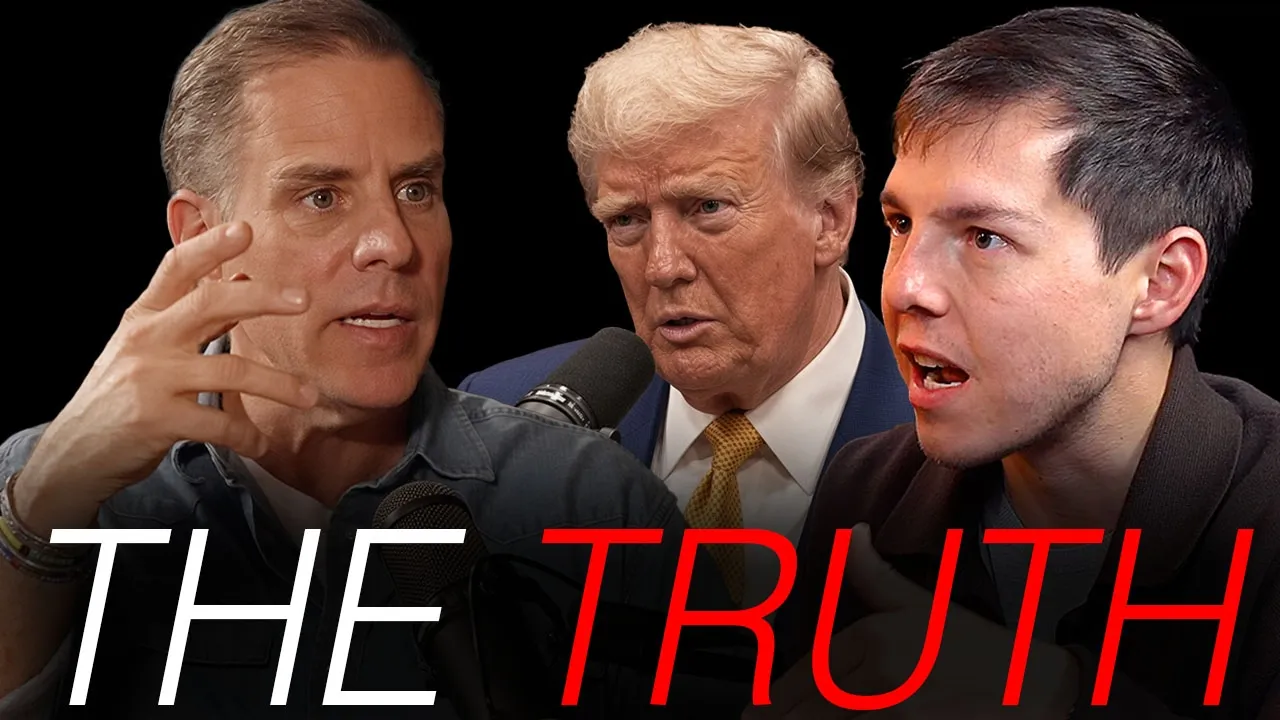
Hunter Biden reveals he owes roughly $15 million in debt, attributing 100% of it to four continuous years of defending against concurrent federal investigations and congressional probes. (49:20)
Holding virtually zero liquid assets, Hunter Biden is actively negotiating payment plans with law firms while relying on Substack subscriptions, art sales, and two jobs to cover basic living costs. (54:12)
The launch of 'Laptop Coin' briefly spiked to a theoretical $316 billion market cap due to a market maker deploying only $5,000 of liquidity, leaving trading bots to dominate initial order execution. (64:24)
Forensic audits showed no insider sales or developer withdrawals occurred during the Laptop Coin launch, with 30% insider equity locked under multi-year vesting schedules. (73:42)
Detailed notes
## Background
This interview was published on YouTube by The Iced Coffee Hour, hosted by Graham Stephan and Jack Selby, on September 28, 2026. According to the episode description and timestamps, the video features a comprehensive audit of Hunter Biden's personal finances, exploring his $15 million in legal debt, zero-stock portfolio, the rollout of Laptop Coin, and his current efforts to rebuild his life.
## TL;DR
In this extensive discussion, Hunter Biden reveals that his $15 million debt burden is entirely the product of four years spent mounting defenses against simultaneous federal agencies and congressional committees rather than personal extravagance. Holding virtually no liquid assets and recovering from the loss of his California home to wildfires, he explains how he sustains daily expenses in Cape Town through Substack writing and selling original paintings. Biden also examines the macroeconomic and existential threats posed by artificial intelligence, comparing potential futures to Star Trek abundance or Star Wars conflict. Additionally, he addresses the chaotic rollout of Laptop Coin, defending its tokenomics and philanthropic aims while attributing its wild $316 billion chart glitch to market-maker blunders and automated bot trading.
## Atmosphere & style
The conversation maintains a surprisingly candid, reflective, and at times weary tone as Biden dissects the crushing weight of public scrutiny and federal investigations. Rather than adopting a combative stance, he speaks with disarming vulnerability, blending dark humor with philosophical musings on art, addiction recovery, and technological change. The hosts provide an inquisitive, grounding environment that allows the dialogue to oscillate naturally between granular financial mechanics and sobering reflections on starting over from scratch.
## Bulletin
- [49:20](https://www.youtube.com/watch?v=fMTatHxmSNE&t=2960s) Hunter Biden reveals he owes roughly $15 million in debt, attributing 100% of it to four continuous years of defending against concurrent federal investigations and congressional probes.
- [54:12](https://www.youtube.com/watch?v=fMTatHxmSNE&t=3252s) Holding virtually zero liquid assets, Hunter Biden is actively negotiating payment plans with law firms while relying on Substack subscriptions, art sales, and two jobs to cover basic living costs.
- [01:04:24](https://www.youtube.com/watch?v=fMTatHxmSNE&t=3864s) The launch of 'Laptop Coin' briefly spiked to a theoretical $316 billion market cap due to a market maker deploying only $5,000 of liquidity, leaving trading bots to dominate initial order execution.
- [01:13:42](https://www.youtube.com/watch?v=fMTatHxmSNE&t=4422s) Forensic audits showed no insider sales or developer withdrawals occurred during the Laptop Coin launch, with 30% insider equity locked under multi-year vesting schedules.
## Key takeaways
- [47:12](https://www.youtube.com/watch?v=fMTatHxmSNE&t=2832s) Industry experts cite an estimated 10% probability of AI-driven existential catastrophe, framing the trajectory between post-scarcity abundance and severe disruption.
- [47:12](https://www.youtube.com/watch?v=fMTatHxmSNE&t=2832s) Widespread deployment of AGI risks displacing up to 95% of the human workforce, triggering structural identity and economic crises prior to reaching material abundance.
- [49:20](https://www.youtube.com/watch?v=fMTatHxmSNE&t=2960s) Hunter Biden's $15 million debt stems entirely from prolonged legal defense against multiple DOJ branches, U.S. Attorney's Offices, IRS-CI, and congressional committees.
- [51:46](https://www.youtube.com/watch?v=fMTatHxmSNE&t=3106s) Navigating federal enforcement power operates like the 'eye of Sauron,' where the financial cost of legal defense can bankrupt a target regardless of guilt or trial outcome.
- [51:46](https://www.youtube.com/watch?v=fMTatHxmSNE&t=3106s) Direct executive branch control over the Department of Justice risks undermining constitutional democracy and tilting governance toward a monarchy.
- [54:12](https://www.youtube.com/watch?v=fMTatHxmSNE&t=3252s) Hunter Biden has avoided bankruptcy thus far by structuring informal payment settlements with legal defense creditors, keeping legal liquidation as a last resort.
- [57:12](https://www.youtube.com/watch?v=fMTatHxmSNE&t=3432s) Living in Cape Town, South Africa, Hunter funds everyday family expenses via Substack writing and original art sales without maintaining any stock or investment portfolio.
- [01:02:19](https://www.youtube.com/watch?v=fMTatHxmSNE&t=3739s) Laptop Coin integrated community-driven mechanics, allocating 70% to community distribution and charity contributions toward addiction recovery rather than insider enrichment.
- [01:04:24](https://www.youtube.com/watch?v=fMTatHxmSNE&t=3864s) A severe execution error by a global market maker deployed only 30,000 tokens out of millions, creating extreme illiquidity that briefly distorted implied market capitalization to $316 billion.
- [01:05:56](https://www.youtube.com/watch?v=fMTatHxmSNE&t=3956s) Centralized exchanges canceled scheduled token listings 48 hours prior to launch following social media outrage, forcing trades onto volatile decentralized venues.
- [01:13:42](https://www.youtube.com/watch?v=fMTatHxmSNE&t=4422s) Forensic data revealed that roughly 85% of early trading activity came from algorithmic bots, while insider allocations remained locked under a six-month hold and two-year vesting.
- [01:15:12](https://www.youtube.com/watch?v=fMTatHxmSNE&t=4512s) Hunter Biden likens meme tokens to neutral instruments like a hammer, asserting that fiat currencies themselves operate as collective faith-based social constructs.
- [01:22:50](https://www.youtube.com/watch?v=fMTatHxmSNE&t=4970s) Double standards exist in media coverage between Hunter's satirical crypto project and extractive crypto ventures launched by members of the Trump family.
## Detailed walkthrough
### [00:00](https://www.youtube.com/watch?v=fMTatHxmSNE&t=0s) Host Introduction and Episode Teaser
Graham Stephan opens the episode with a direct disclaimer to viewers, noting that while it is unusual for the channel to deliver this kind of preface, the conversation turned out to be "a little spicy," prompting them to repost it separately. Acknowledging that Hunter Biden is an intensely polarizing public figure whose views will provoke strong disagreements, Graham stresses the channel's belief in hosting diverse perspectives and extending an open forum even when hosts or viewers disagree. He also mentions that an uncut version of the interview is available exclusively to channel members.
The episode kicks off with a rapid-fire teaser highlighting the dramatic revelations to come. When asked how he would rate his current personal finances on a scale from one to ten, Hunter bluntly responds, "A zero." The preview touches on the fallout of his controversial Laptop-themed cryptocurrency, which suffered an immediate and catastrophic collapse, leaving Graham to question what went through Hunter's mind as the price cratered from fifty. It also flashes to discussions about the FBI’s multi-year custody of Hunter's laptop, the mounting legal scrutiny from Delaware federal prosecutors over federal tax laws, and Hunter's staggering legal defense bills—which he confirms reached "about $15 million." The preview rounds out with Hunter reflecting on the overwhelming, unimaginable reach of federal authority and the influence of raw money in Washington, DC, capped by an off-the-record laugh where Graham jokes about whether aliens are real.
[01:37](https://www.youtube.com/watch?v=fMTatHxmSNE&t=97s) Why Hunter Biden Agreed to Come On
Graham and Jack welcome Hunter to the studio, and Graham immediately asks what motivated him to sit down for a long-form conversation on a personal finance podcast and what he hopes to gain from it. Hunter shares that he has been a frequent viewer of *The Iced Coffee Hour*, admiring the show's caliber of guests and the hosts' ability to ask insightful, educational questions from which he consistently learns. Beyond personal appreciation, Hunter views the podcast as a rare bridge to a massive, influential audience—primarily younger people outside his own age bracket and typical political circles—who seldom hear from someone with his background in an unvarnished format. He commends the hosts for maintaining an "apolitical" and "equal opportunity" platform where genuine conversation takes precedence over partisan theater.
When asked what message he hopes listeners will take away from the discussion, Hunter takes aim at modern digital culture. He explains that social media algorithms systematically feed the public a toxic, hyper-polarized narrative that the country is hopelessly divided and teetering on the edge of a literal or figurative civil war. Hunter rejects this doom-laden framing, emphasizing that "our algorithms are not our reality." When individuals set aside algorithmic feeds and examine their actual day-to-day lives—their neighbors, their communities, and their shared aspirations—they discover that human beings have vastly more in common than the differences highlighted online.
[03:35](https://www.youtube.com/watch?v=fMTatHxmSNE&t=215s) Universal Pain and Grief as Human Connectors
Graham points out that while Hunter has made several podcast appearances recently, the hosts wanted to steer clear of the same repetitive talking points rehashed across mainstream media, asking what subject he wishes interviewers would explore instead. Hunter points directly to the universal experience of pain and grief. He recalls a past appearance on *Real Time with Bill Maher*, noting that Maher is great, but a rapid ten-minute television segment leaves zero room for deep exploration. When Hunter told Maher that society fails to talk enough about grief, Maher pushed back, claiming people discuss it all the time. Hunter argues that while grief is often acknowledged in passing, its deeper mechanics are almost never unpacked.
Hunter explains that everyday people do not connect with him because of his privileged political lineage or media notoriety, but because of his visible human brokenness. While most people have not lived under the national media microscope, almost everyone has a brother, a child, or a loved one who has struggled with trauma or addiction. Rather than people "identifying out" by viewing him as an unrelatable caricature, they identify with his story because he has chosen to be radically honest about his past and present failures. Jack observes that pain is typically viewed as an isolating, strictly personal burden, whereas Hunter frames it as an interpersonal language. Hunter enthusiastically agrees:
> "The one thing that a human being is guaranteed to experience in a lifetime regardless of its length is pain. It's not love. It's not any other emotion. It is the experience of pain."
Hunter emphasizes that this shared vulnerability serves as an essential bridge for empathy, dictating how human beings treat one another when they realize suffering is a universal constant.
[06:56](https://www.youtube.com/watch?v=fMTatHxmSNE&t=416s) Seven Years of Public Silence Under Investigation
Addressing what the public fundamentally gets wrong about him, Hunter explains that a specific, distorted caricature was aggressively constructed over nearly seven years before he ever began speaking publicly on his own behalf. Despite growing up within a prominent political dynasty, Hunter describes himself as someone who led a comparatively private life and was naturally camera-shy, possessing strong opinions but intentionally staying out of the limelight.
When his personal life became a media firestorm, he remained silent for years due to two strict principles:
- **Legal Self-Preservation:** As a trained lawyer himself, Hunter knew that anyone targeted by a Department of Justice investigation must follow standard defense protocol: keep your mouth shut, adhere strictly to legal counsel, and avoid aggravating the situation through public commentary.
- **Protecting His Father's Administration:** Despite maintaining an exceptionally close personal bond with his father, Hunter deliberately avoided entangling himself in Joe Biden's policy agenda or presidential administration, refusing to create political distractions that would hinder the White House from executing its platform.
[08:39](https://www.youtube.com/watch?v=fMTatHxmSNE&t=519s) Why Joe Biden Refused to Ever Own a Stock
Transitioning the interview toward personal finance and wealth management, Graham brings up Joe Biden’s well-known, lifelong refusal to ever own individual stocks or corporate securities, asking whether that rigid philosophy was passed down to Hunter during his upbringing. Hunter contextualizes the origins of his father's strict financial rule, tracing it back to Joe Biden’s initial election to the United States Senate in 1972 at the age of twenty-nine.
Hunter explains that the 1972 campaign took place in an era defined by political scandal—just before Watergate, but directly following the public disgrace of Vice President Spiro Agnew, who was forced to resign over financial kickbacks and corrupt stock deals involving political donors. Recognizing that a United States senator wields immense power over legislation, regulations, and tax policies affecting every domestic corporation and publicly traded company in the world, Joe Biden made a permanent ethical commitment never to own individual stocks or corporate bonds to avoid any appearance of a conflict of interest.
Hunter notes that while his father naturally receives standard institutional retirement benefits—including his Senate pension along with his vice-presidential and presidential pensions, which are managed independently through broader retirement funds—he never personally traded or held individual market equities throughout his half-century in public office.
[10:26](https://www.youtube.com/watch?v=fMTatHxmSNE&t=626s) The Biden Family's Lack of Financial Literacy and Congressional Stock Trading
Hunter acknowledges having mixed feelings about his father’s strict financial choices, admitting that at times he gets "a little angry" about Joe Biden's blanket refusal to own any stock. While Jack and Graham maintain that investing in equities is fundamental and something they encourage for everyday viewers, Hunter agrees it is entirely honorable for an ordinary citizen—yet represents an inescapable conflict of interest for someone serving in the Senate, the House, or the executive branch. In Hunter's view, officials holding that magnitude of power should be required to put their assets into genuinely blind trusts, and anyone unwilling to make that sacrifice simply should not serve. Graham points out that his father could have captured 95% of the ethical benefit while still building wealth by buying broad-market index funds rather than individual company shares.
Hunter readily agrees, remarking candidly that "the Biden family could have used some financial literacy" for a very long time. Beyond the ethical stance, however, lay a simpler reality: Joe Biden simply did not have the spare cash to invest in equities. Hunter points out that when his father first entered the United States Senate in 1972, the annual salary was roughly $46,000. Even over his full 36-year tenure, Hunter estimates his father's salary averaged roughly $175,000 annually. Hunter observes that the general public assumes all senators are fabulously wealthy, but 90% of those entering the Senate arrive already rich because legislative office itself is not designed to generate personal wealth—unless one trades individual stocks or pursues outside income. Despite recurring public outrage over both Democrats and Republicans actively trading stocks while in office, meaningful reform never passes because the very individuals with the authority to change the rules are the sole beneficiaries of the system.
[13:12](https://www.youtube.com/watch?v=fMTatHxmSNE&t=792s) Money in Politics and the Illusion of Congress Wealth
Addressing how influence truly functions in Washington, D.C., Hunter stresses that the real leverage is not about making individual lawmakers personal millionaires. Rather, it centers on the unchecked power of special interests to dictate policy outcomes. Following landmark Supreme Court jurisprudence, the flood of money entering the political system became essentially unlimited. Hunter points to major corporate lobbies, such as the pharmaceutical industry, which pour hundreds of millions of dollars into targeted advertising campaigns in contested congressional districts and funnel vast sums through political action committees (PACs) to back candidates who align with their policy priorities.
```mermaid
flowchart TD
accTitle: Special Interest Influence in Politics
accDescr: Diagram illustrating how corporate lobbying and campaign spending shape congressional policy.
subgraph CorporatePower["Moneyed Interests"]
A["Corporations & Trade Groups<br>(e.g., Big Pharma)"]
end
subgraph InfluenceMachinery["Electoral & Media Leverage"]
B["Targeted District Ad Campaigns"]
C["PAC & Super PAC Contributions"]
end
[16:08](https://www.youtube.com/watch?v=fMTatHxmSNE&t=968s) Graduating with $165,000 in Debt and House Flipping
Turning to Hunter’s personal mindset, he confesses that he genuinely wants to develop a healthier relationship with money. Marrying young without any family wealth, he never grew up around dinner table conversations about financial planning. He vividly recalls arriving on campus for his first semester at Georgetown University, needing to hand-deliver a $7,500 tuition check on the exact day move-in took place—long after other students had mailed theirs—because his father had to refinance a portion of their family property just to scrape the funds together. Accumulating money for its own sake was never celebrated in the Biden household; while business careers were not disdained, the family culture prioritized a higher calling centered squarely on public service.
Hunter agrees that he wishes he had possessed greater financial acumen regarding savings and disciplined investing. After completing Georgetown with roughly $60,000 in student loan debt, he joined the Jesuit Volunteer Corps—a domestic counterpart to the Peace Corps—earning a stipend of just $80 a month while pooling resources in communal housing. Stationed in Portland, Oregon, he ran an emergency service center, advocating for struggling families to get their heating and electricity turned back on during freezing winters. Soon after, he married and welcomed his first daughter, Naomi. When he enrolled in Yale Law School, he took on another $120,000 to $130,000 in educational debt, graduating with roughly $165,000 in total debt, a baby to support, and zero savings.
- **Georgetown University debt:** ~$60,000
- **Jesuit Volunteer Corps pay:** $80/month
- **Yale Law School additional debt:** ~$120,000 to $130,000
- **Total starting debt upon graduation:** ~$165,000
Despite starting in a substantial financial hole, Hunter bought a rundown home within a year of graduating from law school, completing the physical renovations with his own hands. He subsequently flipped that home and repeated the process twice more, ultimately using those profits to establish an emergency cushion, fund his three daughters' educations, and secure a primary residence in Washington, D.C., where he lived for two decades.
[19:26](https://www.youtube.com/watch?v=fMTatHxmSNE&t=1166s) Best Investments and Rating Current Finances a Zero
When asked about his most successful financial investment, Hunter does not hesitate: real estate. Hands-on remodeling was ingrained in him from childhood. Delaware was full of classic architectural estates in the Brandywine River Valley, many originally constructed by the wealthy DuPont family that had fallen into disrepair. Following the death of Hunter's mother, Joe Biden purchased an old DuPont estate that was slated for demolition.
Hunter, his brother Beau, and their father spent the subsequent 20 years restoring the house together. It became a running joke among childhood friends that anyone visiting the Biden residence should expect to spend at least half their time put to work on whatever construction project was underway. However, when Graham asks Hunter how he would rate his personal finances today on a scale of one to ten, Hunter immediately delivers a blunt, laughing assessment: "A zero."
[20:35](https://www.youtube.com/watch?v=fMTatHxmSNE&t=1235s) The Dot-Com Crash and Data Privacy Law
Hunter traces his early career back to graduating from law school and joining a bank, serving first as an attorney and subsequently entering their executive training program to become a banker. He worked his way up to Senior Executive Vice President and performed exceptionally well before moving to Washington, D.C., to work under Commerce Secretary Bill Daley at the U.S. Department of Commerce. Hunter sought the role specifically to grasp what was then a burgeoning technological frontier: the internet. With many of his peers launching digital startups, he was appointed Executive Director of e-Commerce around 1999 and 2000, giving him an early vantage point on emerging digital platforms.
```mermaid
flowchart TD
accTitle: Hunter Biden's Early Career Path
accDescr: Progression from banking executive to Department of Commerce, legal plans, and Jesuit university consulting.
subgraph Corporate_Government["Banking & Government (1990s)"]
A["Bank Attorney & Senior EVP"] --> B["U.S. Dept. of Commerce<br/>(Exec. Director of e-Commerce)"]
end
subgraph Legal_Pivot["Dot-Com Crash & Pivot"]
B --> C["Planned Law Firm:<br/>E-Commerce & Data Privacy"]
C -->|"2000 Dot-Com Crash<br/>(Clients lose funding)"| D["Georgetown Priest Referral"]
end
subgraph University_Practice["Jesuit University Consulting"]
D --> E["St. Joe's University<br/>(Ph.D. urban education program)"]
E --> F["Network Expansion:<br/>Scranton, Regis, Detroit Mercy"]
F --> G["17+ Jesuit Universities"]
end
G -->|"Obama selects Joe Biden (2008)"| H["Voluntarily Shuts Down Practice<br/>to avoid federal conflict of interest"]
```
When the dot-com crash hit in 2000, it completely upended Hunter's next entrepreneurial move. He had planned to launch a private law practice specializing in e-commerce policy and digital privacy—a domain he anticipated would become the defining regulatory issue of the early 2000s. He was focused on how companies harvested personally identifiable information (PII) without consumers' knowledge or through obscure opt-in terms. However, once the bubble burst, the multi-millionaire founders who needed cutting-edge counsel suddenly had no viable companies left to pay their legal retainers.
[22:37](https://www.youtube.com/watch?v=fMTatHxmSNE&t=1357s) Building and Walking Away from the Jesuit University Practice
With his tech venture stalled, Hunter turned to a Georgetown Jesuit priest who had been a longtime mentor. The priest suggested speaking with the president of Saint Joseph's University in Philadelphia, who was trying to secure federal appropriations for a university initiative that sent Ph.D. education students into the city's toughest neighborhoods. Hunter helped them secure the funding, prompting the university president to recommend him to the president of the University of Scranton. That led to an introduction to Regis University, and soon Hunter had built a thriving federal-relations practice around higher education.
Hunter's client roster grew to represent more than 17 Jesuit universities nationwide, securing appropriations for initiatives like a mobile dental clinic for the University of Detroit Mercy in an underserved area lacking dental offices. The practice proved highly lucrative, easily covering private school tuition in Washington, D.C. for his daughters, a family home, two cars, and keeping him entirely debt-free. However, when Barack Obama selected Joe Biden as his running mate in 2008, Hunter made the difficult decision to shut the firm down entirely:
> "I unilaterally and volunteered to give up that business, which was really hard for me to do."
When asked if he could have sold the business for a lump-sum payout, Hunter explains that it was impossible because the entire firm was built on his personal trust and relationships with Jesuit university presidents. On the personal finance front, Hunter admits he was not investing in the stock market the way he should have. A business partner kept him disciplined and frugal, ensuring money went into standard, non-risky vehicles like 401(k) accounts and 529 college savings plans, but Hunter stayed away from equities out of an admitted lack of understanding and risk aversion.
[25:37](https://www.youtube.com/watch?v=fMTatHxmSNE&t=1537s) Four Jobs Today: Addiction Recovery, Tenants' Rights, and Art
When Jack asks Hunter at what point in his life he worked the hardest, Hunter immediately answers: "Right now." He laughs off the common social media troll refrain telling him to "get a real job," explaining that he is actively balancing four different roles:
1. **Peak Path Health:** Serving as a principal at this Los Angeles recovery center, Hunter is establishing the Peak Path Health Foundation. The foundation provides free aftercare and advisory support for people completing standard 30-day rehab programs who cannot afford continuous care. Hunter views the post-30-day drop-off as the single most critical gap in the healthcare system, noting that leaving vulnerable individuals with nowhere safe to go is the primary driver of recovery recidivism.
2. **BASTA Universal:** Working with this Los Angeles-based 501(c)(3) tenants' rights and homelessness prevention organization.
3. **Fine Art:** Producing and selling original fine art paintings.
4. **Writing / Authorship:** Developing upcoming books and creative projects.
The mention of homelessness prevention sparks a quick debate with Graham, who owned a house in Santa Monica and ended up selling it partly due to the overwhelming impact of local homelessness. Hunter agrees that the conditions are staggering, recounting the massive tent cities that sprang up in Venice when he lived there. Turning attention to Hunter's artistic career, Graham and Jack point to two large, textured original pieces Hunter brought into the studio to display behind the set, setting up a deeper inquiry into the art market and the pricing of his work.
[27:59](https://www.youtube.com/watch?v=fMTatHxmSNE&t=1679s) Mid-Show Sponsors: Gusto and Upwork
As the conversation turns toward how Hunter prices his paintings and navigates selling his artwork, the hosts step away for sponsor messages:
- **Gusto:** Graham and Jack highlight that as a business grows, back-office administration quickly outpaces simple profit tracking. Gusto provides an all-in-one payroll, benefits, and HR platform designed for remote-friendly small businesses. It handles payroll, tax filings, direct deposits, 401(k)s, workers' compensation, and offers access to certified HR professionals. Jack shares that *The Iced Coffee Hour* used Gusto when hiring their first full-time editor this year, praising how seamless the setup was without any hidden fees.
- **Upwork:** Jack introduces Upwork as a direct solution for hiring vetted freelance talent across software development, AI implementation, design, and operations. Through Upwork's Business Plus tier, companies gain access to the top 1% of freelance talent and receive an AI-powered curated shortlist in under six hours, keeping contracts, communication, and payments consolidated in a single dashboard.
[30:38](https://www.youtube.com/watch?v=fMTatHxmSNE&t=1838s) Setting Art Prices and the New York Post "$500,000" Narrative
The conversation transitions from an ad read for Upwork into Hunter Biden's art career, with the hosts asking how his prices have fluctuated over recent years. Hunter clarifies that he has never set the price for a painting himself; instead, prices have always been established by an independent third-party gallerist based on market demand. Jack and Graham point out that browsing hunterbiden.com feels like shopping for ultra-luxury goods where prospective buyers must click to "inquire about the price," joking about whether gallerists secretly Google buyers to charge Jeff Bezos a million dollars while offering someone else a piece for fifty cents.
Hunter explains the origins of his public art career, emphasizing that while he had painted his entire life without ever selling or showing his work, he met a New York gallerist, George Bergès, entirely by chance when a mutual friend brought him to Hunter's home in California. Bergès urged him to put together a gallery exhibition. Critically, this agreement was reached well before Joe Biden had secured the Democratic nomination—before the primary losses in Iowa, New Hampshire, and Nevada—meaning it had no political calculation behind it.
The media storm erupted when the *New York Post* approached an anonymous Midtown Manhattan gallerist who speculated that Hunter’s art was worth anywhere between $100,000 and $500,000 per painting. When reporters later asked Bergès about pricing, he simply pointed to the *New York Post* article, cementing the public narrative that the sitting president's son was selling artwork for half a million dollars apiece.
[34:48](https://www.youtube.com/watch?v=fMTatHxmSNE&t=2088s) House Subpoenas, Ethics Rules, and the Highest Sale Price
The viral claim of $500,000 paintings eventually triggered an investigation by the House Oversight Committee during congressional impeachment inquiries. Congress subpoenaed every single collector who had purchased a piece from Hunter, as well as the gallerist and attendees who merely visited the show. Hunter notes that these buyers were forced to pay hundreds of thousands of dollars in legal fees just to sit under oath and disclose the exact amounts they paid, creating a public record that debunked the inflated press estimates.
When asked why selling a painting for $500,000 would be inherently wrong even if it were true, Hunter answers, "Nothing." He argues that there is nothing wrong with it as long as there is total transparency and no foreign influence peddling. To contrast his situation, he brings up contemporary news reports alleging that a sanctioned Russian oligarch with ties to Vladimir Putin funded hundreds of thousands of dollars for Donald Trump Jr.'s wedding costs. To eliminate any ethical questions, Hunter implemented strict guardrails while his father was in office:
- Art was never sold to anyone outside the United States.
- The White House imposed an anonymity rule where buyers remained anonymous even to Hunter himself, a requirement he found frustrating because few art collectors want to buy work without the artist knowing who they are.
- The highest price any single painting of his ever fetched was $85,000.
- Because the gallery took its standard 50% commission, Hunter received just under half of that top sale price.
Hunter adds that now that his father has left office and no one in the family holds elected power, his art sells strictly for whatever the open market will bear. When asked who the coolest people are to own his work, he laughs off a joke about Donald Trump, highlighting instead that he gifted alcohol-ink-on-aluminum floral paintings to his mother, First Lady Jill Biden, who hung them in the White House residence before bringing them home. He also gifted a painting inspired by the *Book of Kells*—the historic illuminated manuscript at Trinity College Dublin—to actor Martin Sheen after Sheen and his wife Janet interviewed him, bonding over their shared family experiences.
[38:08](https://www.youtube.com/watch?v=fMTatHxmSNE&t=2288s) Writing as a Fourth Job and Organizing Document Dumps with AI
Hunter describes writing as his fourth full-time job. Following his 2021 memoir, *Beautiful Things*, he transitioned to publishing on Substack, where he is releasing two new books. The first is an emotional, linear continuation of his memoir detailing his internal feelings and reactions as events unfolded. The second project is far more complex: an exhaustive forensic accounting of the rooms he was never in—documenting what he describes as an orchestrated seven-year political and media campaign to dehumanize him and sway national politics.
```mermaid
flowchart TD
accTitle: Hunter Biden Research Workflow with AI
accDescr: Diagram showing how hundreds of thousands of pages of source documents are processed by AI into structured maps and timelines for book writing.
subgraph RawData["Source Material"]
A["Investigative Documents"]
B["Senate Intelligence Records"]
C["Press & Media Reports"]
end
subgraph AIProcessing["AI Processing Engine"]
D["Ingest Thousands of Pages"]
E["Generate Glossaries of Names"]
F["Build Timelines & Mind Maps"]
end
subgraph Output["Manuscript Output"]
G["Substack Book 2: Fully Footnoted Account"]
end
RawData --> D
D --> E
D --> F
E --> G
F --> G
```
Tackling this second project required sorting through hundreds of thousands of pages of congressional records, declassified Senate Intelligence Committee material, and investigative reporting. Hunter reveals that he turned directly to artificial intelligence to organize the massive archive. By feeding thousands of pages into AI models, he generated structured glossaries of key players, cross-referenced concurrent timelines, and created relational mind maps showing who was connected to whom, enabling him to produce a fully footnoted manuscript.
One of the hosts shares a similar research workflow using Anthropic's Claude: to prepare for interviewing Hunter, he downloaded the audio transcripts from over 25 podcast appearances Hunter had made over the previous year, converted them into PDFs, loaded them into a Claude Project knowledge base, and queried the model to identify recurring themes and topics that had already been extensively covered.
[40:33](https://www.youtube.com/watch?v=fMTatHxmSNE&t=2433s) Streamlining Research and the Power of LLMs
The hosts detail how large language models have transformed podcast preparation. By feeding twenty past podcast transcripts into an LLM as context, they were able to extract a statistical breakdown in roughly fifteen minutes: topics like the laptop appeared across all 20 episodes, Burisma was mentioned in 18 out of 20, and the tool immediately surfaced gaps that had never been asked before. Processing 30-plus hours of video content to yield instant, accurate analysis was once completely out of reach for independent creators. Hunter Biden expresses admiration for the transparency around these tools, noting that when he arrived at the studio, it was just the two hosts running everything themselves—not a 10-to-15-person production crew with researchers and notebooks, as seen on traditional studio sets.
```mermaid
flowchart TD
accTitle: AI Research Pipeline
accDescr: Visualizing how podcast transcripts are fed into an LLM to generate prep outlines versus historical manual investigative teams.
subgraph INP["Input Data"]
T["20 Podcast Transcripts<br>(30+ Hours of Audio)"]
end
subgraph PROC["LLM Context Engine"]
CL["Claude / Context Window"]
end
Hunter highlights how this shift democratizes heavy research. He brings up the current Substack debate over AI detection software, pointing out its deep flaws—such as flagging original essays written in 1996 as "75% AI" simply because the models were trained on that author's public writing. Drawing a parallel to legendary investigative journalism, Hunter observes that figures like Bob Woodward have always relied on large teams of researchers and co-writers to comb through massive documents. Today, a single person can feed a 600-page House Oversight Committee report alongside sixteen other dense government dossiers directly into Claude. Provided you know what questions to ask and how to structure the inquiries, the tool effectively functions as an elite research staff at your fingertips.
[43:31](https://www.youtube.com/watch?v=fMTatHxmSNE&t=2611s) Existential Risk, Valuations, and the AI Horizon
When asked about the existential risks and safety debates surrounding artificial intelligence, Hunter admits he vacillates between two distinct viewpoints. On one hand, he wonders whether the doom-mongering is partially manufactured by tech executives to inflate company valuations, justify massive burn rates, and juice upcoming IPOs. On the other hand, the sheer retail capability of tools available right now represents an undeniable sea change. The public sees only the tip of the iceberg, whereas industry insiders like Elon Musk, Sam Altman, and Anthropic's Dario Amodei have sounded alarms, with former researchers publicly discussing p(doom) figures like a 10% risk of human extinction.
Hunter believes humanity is standing at the precipice of the single most significant evolutionary leap in human history. Citing futurist Ray Kurzweil and Nick Bostrom's *Superintelligence*, he emphasizes that once a system surpasses human cognition, outcomes become completely unpredictable—akin to an advanced alien spacecraft landing in downtown Los Angeles. He frames the bifurcation of the future as a choice between two sci-fi paradigms:
- **A Star Trek Future:** A post-scarcity, utopian horizon solving human health, longevity, cancer, climate change, and global energy distribution.
- **A Star Wars Future:** Geopolitical conflict, uncontrollable dislocation, or outright extinction.
[47:12](https://www.youtube.com/watch?v=fMTatHxmSNE&t=2832s) The Age of Abundance and the Shock of AGI
When the hosts ask whether he plans to invest in the stock market to capture an AI-driven "age of abundance"—joking that investor Chris Camillo of Dumb Money has touted plays like Amazon, Robinhood, and Bloom Energy based on a thesis of automated robot labor that collapses consumer costs—Hunter laughs that he would be calling the hosts for stock tips instead. While welcoming the concept of abundance, he sounds a sobering note, referencing former Google executive Mo Gawdat.
The economic and psychological shock wave leading up to that era will be severe. If projections hold true that upwards of 95% of human employment could become unnecessary or irrelevant in an Artificial General Intelligence (AGI) world, society will face massive disruption. Stripping people of their economic agency and personal sense of purpose will create an unprecedented crisis of human identity long before any utopian stability is achieved.
[49:20](https://www.youtube.com/watch?v=fMTatHxmSNE&t=2960s) The Real Mechanics of $15 Million in Legal Debt
The conversation pivots to Hunter's personal finances, specifically his public acknowledgment of being roughly $15 million in debt at 56 years old. Hunter describes the burden as "staggeringly difficult" to navigate as he tries to negotiate terms with his creditors. He stresses an unequivocal clarification: every single dollar of that $15 million balance stems strictly from defending himself across four continuous years of high-stakes litigation, with zero percent attributed to substance use, reckless spending, or past personal habits.
```mermaid
flowchart TD
accTitle: Hunter Biden Legal Defense Fronts
accDescr: Breakdown of the numerous federal offices and congressional committees running parallel investigations against Hunter Biden.
The hosts question how legal bills could reach eight figures without law firms stepping away once balances eclipsed $500,000. Hunter explains that the sheer volume of separate, simultaneous investigations by the federal government and Congress made the legal defense effort astronomically expensive:
- **Department of Justice (DOJ):** Main Justice in Washington, D.C.
- **U.S. Attorney's Offices:** Separate proceedings in Delaware, Los Angeles, Washington D.C., and Pittsburgh.
- **DOJ Tax Division:** Specialized criminal tax attorneys (CrimTax).
- **Internal Revenue Service:** The IRS Criminal Investigation (IRS-CI) unit.
- **House of Representatives:** Inquiries from the House Oversight Committee, House Judiciary Committee, and House Intelligence Committee.
- **United States Senate:** Formal proceedings and oversight from the Senate Judiciary Committee.
Each entity operated on independent timelines with distinct document subpoenas, hearings, and forensic workflow tracks, forcing his defense teams to generate tens of thousands of billable hours just to keep up.
[51:46](https://www.youtube.com/watch?v=fMTatHxmSNE&t=3106s) The "Eye of Sauron": The Power and Cost of Federal Defense
When asked whether he could have simply utilized a free public defender to navigate his legal battles, Hunter Biden clarifies that he did not qualify for one. Reflecting on what happens to an ordinary citizen caught in a similar predicament, he emphasizes that the immense machinery of the state is incomprehensible until turned upon you: "The federal government's power is beyond anything that you can remotely imagine. It's like the eye of Sauron." He describes how this sprawling enforcement apparatus encompasses the Department of Justice, the FBI, the IRS, the SEC, and the CFTC. Historically, he notes, strict norms separated executive politics from criminal investigations; the last president who attempted to direct the Department of Justice in such an overtly political manner was Richard Nixon during the Saturday Night Massacre, which ultimately precipitated his resignation.
Hunter warns that allowing the executive branch to direct the Department of Justice at personal whim transforms the American system into a monarchy. The sheer endurance required to withstand federal scrutiny often decides the outcome before a gavel even strikes: "The process is the thing that, regardless of whether you get indicted or convicted, it can bankrupt you." Defending against protracted, complicated federal investigations routinely demands hundreds of thousands or millions of dollars, creating an existential financial burden for anyone targeted.
```mermaid
flowchart TD
accTitle: The Burden of Federal Enforcement
accDescr: Diagram illustrating the components of the federal regulatory apparatus and its financial impact on defendants.
subgraph FedAgencies["Federal Investigative & Regulatory Apparatus"]
DOJ["Department of Justice (DOJ)"]
FBI["Federal Bureau of Investigation (FBI)"]
TaxSec["IRS, SEC, & CFTC"]
end
subgraph DefenseBurden["Defense & Financial Reality"]
Proc["Lengthy & Complex Proceedings"]
Cost["Millions in Defense Legal Fees"]
Result["Risk of Involuntary Insolvency / Bankruptcy"]
end
[54:12](https://www.youtube.com/watch?v=fMTatHxmSNE&t=3252s) Navigating $15 Million in Debt and Current Assets
Confronted with roughly $15 million in legal debt, Hunter discusses why he has not simply declared bankruptcy. While he admits that filing for bankruptcy remains a real possibility and may ultimately prove to be his only recourse, he is actively attempting to come to terms with his primary creditors—mostly law firms. He has managed to renegotiate and reset several accounts into more realistic payment plans because he intends to make good on what he legitimately owes.
When asked about his remaining net worth and personal property, Hunter confirms that he possesses virtually zero liquid assets. His tangible holdings consist primarily of personal items, including his Timex watch, alongside the catalog of original artwork he has accumulated. Because there are no legal caps preventing him from earning income, he remains focused on rebuilding wealth through his craft. He points prospective art collectors to his website, `hunterbiden.com`, while continuing to run a subscription platform on Substack and maintaining two other active jobs.
- **Current assets:** Timex watch, personal belongings, and unsold original paintings; zero liquid cash reserves.
- **Estimated liability:** Roughly $15 million owed, predominantly to defense attorneys and law firms.
- **Current earning channels:** Direct artwork sales via `hunterbiden.com`, a Substack publication, and two concurrent jobs.
Jack Selby introduces episode sponsor Shopify, explaining that aspiring entrepreneurs frequently keep ideas trapped inside their heads or notes apps instead of launching. Shopify removes standard launch hurdles—such as hiring developers, mastering code, or spending months building an e-commerce website—by providing ready-to-use themes and an AI-driven site builder. The platform's integrated checkout system, Shop Pay, boosts conversions and allows returning customers to complete transactions with a single tap. Jack shares personal experience building five distinct online stores across various ventures prior to his podcast career, highlighting that Shopify powers everyone from global enterprises like Mattel and Gymshark to first-time founders. Viewers are invited to start a free trial at `shopify.com/ich`.
[57:12](https://www.youtube.com/watch?v=fMTatHxmSNE&t=3432s) Rebuilding From Zero: Cape Town, Substack, and Future Platforms
Returning from the break, Hunter addresses his required monthly debt obligations, stating that because there is no formal legal judgment entered against him, there is no court-mandated monthly repayment figure. Instead, he has been given leeway by several creditors to renegotiate terms, though he acknowledges he is currently locked in active litigation with one creditor over outstanding fees. After a humorous side banter where the hosts jokingly ask off-the-record whether aliens are real—leading Hunter to deadpan that they should probably cut the cameras—the conversation returns to how someone in extreme debt manages daily cash flow.
Hunter reveals that he does not have enough discretionary cash to invest in the stock market or build a traditional savings cushion. His Substack proceeds currently cover basic living expenses, but little else. Following the loss of his California rental home to wildfires, he and his South African wife, Melissa Cohen, relocated temporarily to Cape Town to stay with her family and friends. Hunter describes falling in love with Cape Town's community, noting that its dramatic affordability provides a peaceful environment for a complete financial and personal reset. Looking ahead, he mentions having conversations with creators like Andrew Callaghan from *Channel 5* about potential media collaborations or establishing an independent platform. However, he remains cautious about committing to grueling 52-week broadcast schedules, prioritizing the daily painting routine that grounded his sobriety and helped save his life.
[01:00:05](https://www.youtube.com/watch?v=fMTatHxmSNE&t=3605s) Marketing Art and the Craft of Creation
The hosts suggest that Hunter leverage social media to document his creative process, proposing that time-lapse videos of his painting sessions could double as effective marketing and drive direct sales on his website. Graham and Jack describe popular Instagram and TikTok formats where artists dramatically reveal a completed canvas to trending audio, though Jack jokes about the cliché of creators exploiting angles for algorithmic reach.
Hunter reflects on how documentary storytelling can transform an audience's appreciation of a medium. He points to the documentary series *Chef's Table*, admitting that even as someone who is not a formal chef or dedicated foodie, the episodes frequently move him to tears: "Why am I crying about some Argentinian chef talking about, you know, the farm-to-table process that he goes through?" He explains that genuine emotional resonance stems from capturing the meticulous, vulnerable process of true artisanship—a narrative depth he hopes to reflect through his own artistic career.
[01:01:21](https://www.youtube.com/watch?v=fMTatHxmSNE&t=3681s) Finding Joy in Process Art and David Choe
Hunter Biden reflects on what draws him to art as both a creator and a viewer, comparing the appeal of watching the physical artistic process to watching food preparation videos where hands wash, slice, and pick ingredients. For him, the most captivating art content mirrors the relaxing simplicity of Bob Ross. When the hosts suggest he could easily produce his own Bob Ross-style show, Hunter enthusiastically agrees and brings up artist David Choe. Hunter jokes that he needs to increase his creatine intake because his memory slipped for a second trying to recall Choe's name.
The hosts mention that Choe famously made a fortune by accepting equity instead of cash for painting murals at Facebook's early headquarters. Hunter points out that Choe is far more than that single deal: he was one of Anthony Bourdain’s closest friends, a brilliant fine artist, and a compelling performance artist who produces that exact style of raw, process-driven television today.
---
[01:02:19](https://www.youtube.com/watch?v=fMTatHxmSNE&t=3739s) Inside the Launch and Tokenomics of "Laptop Coin"
The conversation pivots to Hunter’s controversial foray into cryptocurrency with his project, Laptop Coin. Hunter explains that his objective was to design a token that fundamentally inverted the predatory mechanics common to celebrity meme coins, such as the Trump token. Most celebrity tokens, he argues, are engineered for "max extraction"—allocating up to 80% to insiders with minimal lockup periods, leaving retail traders as exit liquidity. In contrast, Hunter claims his project allocated only 30% to insiders while dedicating 70% to community building, including a 20% total giveaway distributed across two distinct airdrops.
Hunter also introduced a novel prediction-market mechanism tied directly to token burns and philanthropic contributions. Using the Philadelphia Eagles' season opener as an example, an Eagles victory triggered an automatic burn of 5% of the coin's supply to enhance token value for holders. Had they lost, that equivalent value would have been funneled directly into a charitable fund dedicated to addiction recovery. Under this model, charitable allocations could scale from a mandatory 5% minimum up to 35%, settling around an expected 15%. Beyond the mechanics, Hunter freely admits the project was meant as a political troll aimed at the 18-to-35 demographic that dominates the meme coin ecosystem: "I'm not the first meme coin... I'm like the 10 millionth meme coin."
```mermaid
flowchart TD
accTitle: Laptop Coin Tokenomics and Prediction Market Mechanics
accDescr: Flow diagram showing the token distribution of Laptop Coin and the prediction market outcome mechanics.
subgraph Distribution["Laptop Coin Token Allocation"]
A["Total Supply"] --> B["30% Inside Allocation"]
A --> C["70% Community & Growth"]
C --> D["20% Two-Stage Airdrop"]
C --> E["Liquidity & Prediction Pool"]
end
subgraph Prediction["Prediction Market Mechanics (e.g., Eagles Game)"]
E --> F{"Event Outcome"}
F -->|"Team Wins"| G["Burn 5% Supply\n(Appreciates Holder Value)"]
F -->|"Team Loses"| H["Direct to Charity\n(5% to 35% for Addiction Recovery)"]
end
```
---
[01:04:24](https://www.youtube.com/watch?v=fMTatHxmSNE&t=3864s) The Market Maker Blunder and a $316 Billion Glitch
The public launch derailed almost instantly due to an execution failure by their market maker. Hunter recounts that the token was set to launch at a modest market cap around $50 million. However, despite possessing over 1.5% of the token supply (15.5 million tokens) and $1 million in cash set aside for liquidity, the leading global market maker deployed a mere $5,000—representing just 30,000 coins—into the initial liquidity pool.
With virtually no liquidity against surging demand, automated trading algorithms instantly hijacked the launch. Hunter notes that roughly 85% of early trades were executed by bots. Because thin liquidity caused tiny buy orders to skyrocket the unit price, the implied market cap shot from $50 million to $200 billion, and peaked within three minutes at an astronomical $316 billion—surpassing the market capitalization of BlackRock—before crashing just as swiftly. The hosts point out that when a couple of users buy a few thousand dollars' worth of an asset with nonexistent depth, the math spits out an absurd valuation, though Hunter remains baffled as to why an experienced market maker failed to deploy their available capital.
- **Initial target valuation:** Around $50 million market cap.
- **Liquidity deployed:** Only $5,000 out of $1,000,000 available cash.
- **Peak glitch market cap:** $316 billion in roughly three minutes.
- **Trading volume breakdown:** ~85% of initial trades were executed by automated bots.
---
[01:05:56](https://www.youtube.com/watch?v=fMTatHxmSNE&t=3956s) Ideology, Pushback, and Centralized Exchange Cancellations
The hosts push back, questioning why Hunter would step into the minefield of meme coins when the sector is plagued by scams and the mechanics are nearly impossible to explain to a general audience. Hunter defends his foundational interest in digital assets, noting that he read *The Internet of Money* and developed a conviction around microtransactions and the democratization of finance during his tenure working with the United Nations World Food Programme. He felt the political establishment had exploited an otherwise libertarian-leaning, apolitical community during the prior election cycle, and he wanted to engage that space on its own terms.
When the hosts argue that almost no meme coins succeed and that even Dogecoin began organically as a joke, Hunter counters that every token undergoes a technical launch. Laptop Coin was originally slated to list on major centralized crypto exchanges, which would have guaranteed sufficient liquidity. However, 48 hours before the rollout, a massive wave of online hostility on crypto Twitter—driven by bots, political opponents, and trolls—pressured the centralized exchanges into pulling out. Left solely on decentralized exchanges with a mishandled liquidity pool, the launch was crushed. Despite the setback, Hunter plans a relaunch, emphasizing that millions of dollars from token reserves will still be directed toward addiction recovery organizations over the next two years.
---
[01:09:28](https://www.youtube.com/watch?v=fMTatHxmSNE&t=4168s) Podcasting, Risk-Taking, and Unconventional Media Appearances
The hosts suggest that Hunter is fighting an uphill battle in crypto when he could achieve far greater success, goodwill, and financial recovery simply by leaning into his natural charisma through social media and hosting his own podcast. They praise his recent media tour, calling out his humility and self-awareness, especially his willingness to sit down on Matan Even's chaotic show and take every punch in stride.
Hunter acknowledges that appearances like Matan Even carry enormous risk with zero obvious upside. Yet he approaches his public appearances deliberately, choosing unconventional platforms across the entire spectrum. While some critics were outraged that he went on Matan's show, others labeled him a "traitor" for speaking with Tucker Carlson or Candace Owens, while another camp questioned why he appeared on Andrew Callaghan's *Channel 5*. Hunter explains that he is a genuine consumer of independent, outsider media and prefers stepping directly into unfamiliar and challenging arenas rather than playing it safe.
[01:11:25](https://www.youtube.com/watch?v=fMTatHxmSNE&t=4285s) The Meme Coin Accusation and Generational Divides
Addressing the skepticism surrounding his recent media presence, Hunter Biden pushes back aggressively against the accusation that his re-emergence into the public eye—including launching on X (formerly Twitter) in May and sitting down for an interview with Candace Owens—was an orchestrated promotional runway designed to pump and dump a cryptocurrency meme coin. He insists that he has "been kicked in the teeth about 500 times" and, by ordinary standards, should not even be alive, much less executing a cynical financial grift. For him, stepping into public forums was never about pre-selling a token; it was born out of a desire to communicate directly with demographic groups outside mainstream political channels after years of suffering global humiliation and finally coming to terms with his own identity.
Hunter highlights what he views as a sharp generational divide regarding digital assets. When speaking to older individuals around age forty, their eyes glaze over and they immediately dismiss everything related to cryptocurrency or meme coins as an outright grift. Conversely, audiences aged eighteen to thirty perceive meme culture as a dominant, native reality with profound cultural and economic ripple effects. Acknowledging that launching a meme coin carried immense reputational risk, Hunter maintains that as long as his actions remain ethical and honest, the project will eventually vindicate his original goal of cultivating community across non-traditional channels.
[01:13:42](https://www.youtube.com/watch?v=fMTatHxmSNE&t=4422s) Tokenomics, Insiders, and the Asian Bot Activity
When the hosts press him directly on who won and who lost money on Laptop Coin, Hunter states unequivocally that no insiders have pocketed a single dollar. He breaks down the structural design of the token, explaining that internal equity holders are subject to strict holding requirements: a six-month lockup during which tokens cannot be touched or liquidated, followed by a linear vesting schedule spanning two years. The remaining supply is partitioned into dedicated reserves for a foundation, a decentralized liquidity pool, an community airdrop allocation, and an event-burn mechanism tied to prediction markets.
```mermaid
flowchart TD
accTitle: Laptop Coin Token Distribution
accDescr: Structural allocation breakdown for Laptop Coin including insider lockups and ecosystem pools.
subgraph Supply["Token Supply Allocation"]
direction TB
A["Insider Equity (30%)"] -->|"6-Month Lockup"| B["2-Year Vesting Schedule"]
C["Liquidity Pool"]
D["Foundation Reserve"]
E["Airdrop Allocation"]
F["Event Burn / Prediction Market"]
end
```
Regarding retail losses, Hunter acknowledges that certain individual wallets suffered drawdowns, primarily in the range of a few hundred to several thousand dollars. Because the project was only five days post-launch at the time of recording, his team commissioned two independent investigative forensic reports to map every transaction:
- **Insider Realized Profit:** $0 extracted by developers, founders, or equity holders.
- **Insider Vesting Terms:** 30% insider allocation locked completely for 6 months, followed by a 2-year vesting period.
- **Initial Volume Anomaly:** Forensic findings revealed that approximately 85% of the total trading volume during the volatile first hour was generated by automated trading bots, predominantly operating out of Asia.
- **Remediation Plan:** Tracing individual retail wallets via forensic reports to explore potential restitution or corrective steps.
[01:15:12](https://www.youtube.com/watch?v=fMTatHxmSNE&t=4512s) Degens, NFTs, and the Hammer Analogy
The conversation turns to the speculative reality of meme tokens, with the hosts asking whether courting "degens"—traders merely attempting to flip tokens for quick liquidity—is an effective path. Hunter agrees with the baseline premise that meme coins are not investments and reveals that his explicit warning from the outset was: "Do not buy my coin." He compares them to digital novelty trading cards rather than traditional equity, noting that 90% of participants enter with full awareness of the speculative, attention-driven environment.
```
"Meme coins are a tool, just like a hammer: you can
use it to build something, or you can use it to
tear down something."
— Hunter Biden
```
Despite acknowledging the chaotic behavior of the crypto space, Hunter rejects the notion that the entire asset class should be written off. He likens the current state of meme coins to the early trajectory of Non-Fungible Tokens (NFTs): while predatory behavior and speculative bubbles tainted public perception, the core underlying technology retains real utility. To Hunter, tokenization functions like a hammer—a neutral instrument that can be wielded destructively or repurposed constructively to organize communities, raise capital transparently, and build shared value if executed with the right ethical safeguards.
[01:17:15](https://www.youtube.com/watch?v=fMTatHxmSNE&t=4635s) Fiat Arrogance and the 2008 Comparison
Challenging traditional financial critiques that write off crypto as a haven for criminal activity and fraud, Hunter turns the criticism back toward conventional banking systems. He questions the moral superiority of fiat currency, jokingly observing that the physical dollar bill is itself essentially a faith-based meme. When skeptics cite illicit black-market crypto trades, Hunter counters by pointing out that no cryptocurrency firm caused the catastrophic systemic collapse of 2008, nor does crypto hold a monopoly on financial crimes compared to legacy institutions:
- **2008 Financial Crisis:** Caused entirely by Wall Street investment banking failures (such as Lehman Brothers), not decentralized protocols.
- **Money Laundering Precedents:** Major multinational banking conglomerates (e.g., historical regulatory settlements involving legacy banks like Citibank) have frequently been implicated in large-scale laundering schemes.
- **Generational Economy:** A massive emerging demographic transacts within a parallel digital economy that legacy institutions ignore out of arrogance.
- **Debt Strategy Distinction:** Hunter stresses that the meme coin was never intended as a personal vehicle to repay his massive legal liabilities, but rather as an engagement experiment.
[01:18:48](https://www.youtube.com/watch?v=fMTatHxmSNE&t=4728s) The Market Maker "Black Box" and Radical Transparency
Hunter reveals that the rocky launch of Laptop Coin was triggered by unexpected market maker mechanics behind an institutional "Chinese wall." Under standard market structures, token issuers are legally and operationally insulated from order-book execution to prevent manipulation. However, that lack of visibility left his team in the dark when a single market maker holding consolidated liquidity made abrupt execution decisions that impacted other liquidity providers, precipitating an instant price disruption on launch day.
While frustrated by the lack of transparency in that market-making apparatus, Hunter accepts complete ownership of the outcome, emphasizing that the only viable path forward is "radical transparency." The hosts commend him for sitting down without placing any topics off-limits prior to the recording. Hunter notes that the coin’s liquidity pool has since stabilized, giving the team the foundation required to execute their original utility roadmap and fulfill commitments to genuine participants in the community.
[01:20:52](https://www.youtube.com/watch?v=fMTatHxmSNE&t=4852s) The $316 Billion "Mount Everest" Spike and Liquidity Mechanics
Hunter recounts the surreal experience of sitting in front of monitors during the coin's rollout and watching an unprecedented chart form in real time. The project was intended to launch at a $50 million valuation—and sits around a $200 million fully diluted valuation (FDV) now, which on paper would represent a respectable, stable trajectory. Instead, within ten minutes of going live, the chart executed what he describes not just as a standard crypto "Christmas tree," but a full "Mount Everest," rocketing up to an astronomical $316 billion theoretical market cap before crashing all the way back down. When Graham and Jack ask how much actual volume transacted during that historic spike, Hunter clarifies that the trading volume was minuscule.
Because the initial liquidity pool had so little capital backing it, singular market orders swung the paper valuation wildly. Hunter notes that even a trivial trade—someone putting in an order as small as $10—could artificially push the calculated market cap up by tens of billions of dollars. Graham acknowledges the mathematical reality of automated market makers, noting that while the math checks out, explaining illiquid slippage to a mainstream public primed for scandal is an unenviable task. As Hunter points out, the general public has little patience for the mechanics of liquidity pools, order books, and bid-ask spreads—the financial "lube of an engine" without which any lone market buy order sends the price parabolic.
```mermaid
flowchart LR
accTitle: Thin Liquidity Volatility Mechanism
accDescr: Diagram illustrating how small buy orders into an illiquid pool caused an artificial market cap spike to 316 billion dollars before collapsing.
subgraph Pool["Liquidity Pool Setup"]
A["Intended Launch<br/>$50M Valuation"] --> B["Thin Liquidity<br/>Lacking Deep Capital"]
end
subgraph Shock["Market Distortion"]
B --> C["Small Market Buy Orders<br/>($1 - $100)"]
C --> D["Paper Valuation Spike<br/>$316 Billion Peak"]
end
subgraph Collapse["Price Normalization"]
D --> E["'Mount Everest' Crash"]
E --> F["Stabilized FDV<br/>(~$200M)"]
end
```
[01:22:50](https://www.youtube.com/watch?v=fMTatHxmSNE&t=4970s) Trolling the Trumps and Intentional Tokenomics
Hunter contrasts the scrutiny he faces with the free pass he believes is given to political rivals who launch crypto projects. He points directly to the Trump-associated coins, noting that Donald Trump Jr. and Eric Trump's ventures reportedly collapsed by 95% after insiders executed an 80% extraction: "Does anybody sit here and ask Don and Eric of why they would ever get involved in this?" In contrast, Hunter claims his original motivation was an explicit troll aimed at satirizing how the Trump family takes over industries, co-opts hype, and extracts maximum liquidity at the expense of retail traders.
His intent was to design a system with the exact opposite economic architecture. Rather than cashing out, Hunter insists his team structured the tokenomics so that no one could ever credibly accuse him of pulling a rug pull. Yet despite those high-minded rationales, the paper mechanics backfired publicly within three minutes when tiny retail trades between $1 and $100 triggered the massive valuation distortion. Looking back at the launch moment, Hunter admits his early excitement evaporated almost instantly into disbelief as veteran crypto advisors in the room froze in shock, watching the runaway algorithm with pure dread.
- **Intended Launch Valuation**: Targeted at approximately $50 million.
- **Peak Market Cap Spike**: Glitched upward to a theoretical $316 billion in minutes.
- **Comparative Loss**: Notes that Trump-backed crypto projects plummeted 95% after an alleged 80% maximum insider extraction, without comparable media fallout.
- **Token Design**: Built specifically to lock out insider dumping and disprove rug pull accusations.
[01:24:46](https://www.youtube.com/watch?v=fMTatHxmSNE&t=5086s) Audits, Aerodrome, and the Hawk Tuah Comparison
Addressing skepticism about celebrity-backed tokens, Hunter rejects comparisons to internet figures who claim ignorance after disaster strikes. When the hosts bring up the infamous Hawk Tuah meme coin launched by Haliey Welch, Hunter argues she was likely duped and manipulated by predatory operators who extracted millions from her community while she had no clue how the mechanics functioned. He also points to the rapid collapse of the coin linked to New York City Mayor Eric Adams, which crashed to zero within 72 hours due to immediate insider selling. Unlike those cases, Hunter insists he entered the space with "full eyes wide open."
To prove he never dumped tokens or extracted capital, Hunter outlines the remaining assets in the project:
- The coin continues to trade around its baseline target valuation.
- A two-year burn mechanism linked to prediction markets is built in.
- Over 10% of the token supply remains strictly reserved for community airdrops.
- A substantial allocation is set aside for charitable donations.
Rather than running away from the disaster, Hunter reveals he commissioned an independent after-action audit. By feeding the raw transaction logs provided by the decentralized exchange Aerodrome directly into Claude AI, his team was able to map out wallet-by-wallet activity during the spike. Hunter promises to send the comprehensive report to Graham and Jack by the end of the week so they can link it directly in the episode description for radical transparency.
[01:27:36](https://www.youtube.com/watch?v=fMTatHxmSNE&t=5256s) Recovery, Resilience, and Taking a Punch in the Face
The conversation turns to why celebrity-branded meme coins routinely fail compared to decentralized, community-driven tokens that feature anonymous mascots rather than living people. Hunter reflects that he may have gotten ahead of himself by attempting to turn his personal identity into an ideological symbol. To him, the project was never merely about a token; it was intended as a vehicle for themes of resilience, recovery, and redemption—the conviction that individuals have the right to reclaim their own narratives rather than remaining trapped inside storylines written by political adversaries.
Hunter acknowledges the practical necessity of rebuilding his family's financial future and regaining personal autonomy, but emphasizes that his real life expertise lies in survival. Having lived through public ruin, addiction, and relentless legal scrutiny, he views the crypto debacle as simply another heavy blow he must weather head-on: "I took a swing. I had the exact right intentions... and now I got to get back up. I took a punch in the face on this one, but it's not the first time." Instead of deflecting blame onto advisors or pretending the incident never occurred, Hunter insists that walking away is no longer an option.
[01:29:46](https://www.youtube.com/watch?v=fMTatHxmSNE&t=5386s) Personal Financial Goals and Paying Back Legal Debts
Taking full ownership of his circumstances, Hunter Biden reflects on accountability, remarking, "There's an explanation out there, but ultimately at the end of the day, everything that happens is my responsibility." When asked about his immediate financial goals, he emphasizes that his top priority is making good on the legitimate debts incurred for his legal defense over the past several years. He notes that his relationship with those creditors remains largely positive; they have been understanding, willing to work with him, and supportive of his efforts to resolve the balances.
Beyond clearing his debts, Hunter insists he has no desire to hoard material possessions. While he admits an appreciation for craftsmanship—referencing watch dealer and creator Nico Leonard, adding that he loves a Rolex even though he currently wears a Timex—he explains that luxury items are not the goal. Instead, his focus is shaped by the turmoil he has survived: creating a secure environment to nurture his core relationships with his family, beginning with his wife Melissa, their young son Beau, and his daughters, free from the monthly panic over rent and basic expenses.
When asked if investing plays a role in his current strategy, Hunter explains that he cannot even consider investing until he meets his immediate obligations. He notes that the opportunity to begin rebuilding his livelihood in a meaningful way only started roughly 16 months prior. At present, income from selling his art and other work allows him to cover rent, put food on the table, and meet his immediate living costs. While he does not employ a formal financial adviser or money manager, he relies on a small circle of trusted confidants for guidance.
[01:32:52](https://www.youtube.com/watch?v=fMTatHxmSNE&t=5572s) The National Debt and the Reality of "Taxing the Billionaires"
Turning to the broader US economy, Hunter points to the looming $40 trillion national debt as the single greatest systemic threat. While attributing a significant portion of recent debt increases across administrations, he stresses that no single president can be blamed. Rather, he views the crisis as a political unwillingness to confront unpopular truths regarding both government revenue and entitlement spending.
Hunter critiques the progressive catchphrase "tax the billionaires" through the lens of tax policy mechanics. Because federal revenue relies predominantly on income tax, raising income tax rates does little to extract revenue from the ultra-wealthy. Figures like Elon Musk take no salary, while Jeff Bezos famously drew a modest salary of around $100,000, avoiding ordinary income brackets entirely. Out of roughly 350 million Americans, only about 984 families are billionaires, and virtually none generate their wealth through standard taxable income.
Citing the book *The Second Estate* by a tax law scholar, Hunter draws a historical parallel to pre-revolutionary France in the late 18th century, where the feudal aristocracy (the Second Estate) engineered exemptions from royal taxation, shifting the entire burden down to common working people. Today, while an annual income of approximately $750,000 places a household in the top 1%, the chasm between earning $750,000 and possessing a billion dollars in net worth is vast:
> "The difference between $750,000 as your income and a billion is not, you know, here to the moon—it's here to Pluto."
He argues that while middle-class Americans may oppose aggressive taxation out of an aspirational desire to earn $1 million or $5 million one day, they conflate high wage earnings with extreme dynastic wealth. Devising a mechanism to tax wealth rather than income remains necessary yet immensely complicated.
[01:37:10](https://www.youtube.com/watch?v=fMTatHxmSNE&t=5830s) Government Spending, DOGE, and the Gutting of USAID
Addressing Graham's question about whether the government should simply rein in spending before raising taxes, Hunter acknowledges that fiscal discipline is essential. He notes that past Democratic administrations successfully addressed the problem, pointing out that his father reduced the federal deficit and Bill Clinton balanced the budget with a Democratic Congress. However, he harshly criticizes the modern slash-and-burn approach implemented under initiatives like Elon Musk's Department of Government Efficiency (DOGE).
Hunter highlights DOGE's targeting and effective dismantling of the United States Agency for International Development (USAID), noting that the entire agency accounted for less than 3% of the federal budget. When Graham suggests that DOGE merely sought transparency by annotating fund usage rather than eliminating the agency outright, Hunter pushes back forcefully, stating that the operations and thousands of overseas field workers—particularly across Sub-Saharan Africa—were gutted.
```mermaid
flowchart TD
accTitle: Government Efficiency Debate vs Soft Power Reality
accDescr: Contrasting DOGE cuts to USAID with the real-world humanitarian and intelligence functions of foreign aid.
subgraph DOGE_Critique ["DOGE Approach"]
A["Targeted Foreign Aid"] -->|"Less than 3% of federal budget"| B["Gutted USAID Operations"]
B --> C["Abolished Thousands of Field Roles"]
end
subgraph Strategic_Impact ["Strategic & Humanitarian Consequences"]
C --> D["Critical Global Aid Halted<br/>(e.g., PEPFAR - 20M+ Lives Saved)"]
C --> E["Loss of Soft Power & On-the-Ground Intelligence"]
end
```
He defends USAID's historical legacy, citing initiatives like PEPFAR (the President's Emergency Plan for AIDS Relief), which saved over 20 million lives globally. Responding to criticisms popularized by commentators like Joe Rogan—who argued USAID served as a front for CIA operations and intelligence funding—Hunter does not dodge the reality, asking:
> "Well, what if some of it was? How do you think we got information and intelligence in places in the world where nobody could have ever gone?"
Hunter draws on his personal governance experience as the former chairman of the board of World Food Program USA, which supported the UN World Food Programme by overseeing roughly $2.6 billion (representing 60% of the agency's global budget) to feed 75 million people across 80 countries. Foreign aid, he concludes, represents not just vital humanitarian relief, but a fundamental pillar of American strategic influence and national security.
[01:39:53](https://www.youtube.com/watch?v=fMTatHxmSNE&t=5993s) USAID as America’s Greatest Soft Diplomacy
Hunter Biden passionately defends the mission of USAID, describing it as the nation's single most vital form of soft diplomacy. Whether dealing with refugee crises or natural catastrophes like a tsunami in the Philippines, USAID personnel are consistently the first on the ground, delivering crates of food and medical supplies emblazoned with the words, "a gift from the American people." When asked why political opponents and initiatives like DOGE would want to eliminate such programs, Hunter argues it stems from a profound distrust of foreign assistance and an ideological hostility toward compassion itself, pointing back to rhetoric that framed empathy as a corrosive force in American culture.
Hunter pushes back against the familiar populist argument that asks why the federal government is spending money overseas instead of taking care of homeless Americans at home. In his view, a truly great nation does not have to choose; it holds both the capacity and the moral duty to do both. He emphasizes that serving as benefactors to vulnerable populations whom no one else defends is where the true power and global moral standing of the United States resides. Glancing at his impassioned delivery, the hosts tease him, joking that his monologue sounded like a polished campaign speech. Hunter laughs at himself, admitting that he caught himself raising his hands with his thumbs tucked—a classic political gesture—and doing bullet points, while reiterating that global humanitarian relief remains something he cares deeply about.
- **Soft Diplomacy at the Frontlines:** USAID's ability to arrive first at disaster zones with American-branded aid is characterized as an irreplaceable geopolitical asset.
- **The False Dilemma:** Hunter rejects the notion that foreign aid must be stripped to fund domestic social safety nets, maintaining that the U.S. has the resources and responsibility to address both simultaneously.
---
[01:42:02](https://www.youtube.com/watch?v=fMTatHxmSNE&t=6122s) Rapid Fire: Zero Stocks and Life Inside the White House
Transitioning into rapid-fire questions to close out the episode due to tight time constraints, Graham Stephan asks Hunter directly if he owns a single stock. Hunter gives an unequivocal, one-word response: "No." Stunned by the answer, the hosts immediately offer to send him money on the spot so he can open an account and buy his first share, suggesting a standard starting position like Apple. Hunter laughs along, playfully agreeing that if they supply the cash, he will find a way to place the order.
The hosts then ask what surprised him most about spending time at the White House. Rather than highlighting grand architecture or political maneuvering, Hunter speaks with immense fondness about the permanent White House residence staff. He describes them as some of the most dedicated, warm, and professional people in the world. Because these career staffers remain in their roles from one presidential administration to the next, serving Democratic and Republican families with equal honor and neutrality, Hunter notes that their unwavering dignity makes walking through the doors of the executive residence a truly beautiful experience.
---
[01:43:22](https://www.youtube.com/watch?v=fMTatHxmSNE&t=6202s) Donald Trump: Cruelty, Delusion, and Tenacity
When pressed for a specific critique of Donald Trump, Hunter immediately points to what he considers his defining trait: "his cruelty." Asked for a concrete example, Hunter specifies that Trump's treatment and verbal berating of female reporters particularly bothers him.
Conversely, when asked what trait he admires most about Trump, Hunter does not hesitate to name his sheer "tenacity." He elaborates with humor, observing that Trump has elevated "delusional thinking to an art form that is almost hard not to admire." Hunter cites Trump's self-reported physical stats as a quintessential example, remarking that Trump genuinely seems to believe he stands 6-foot-3 and weighs 225 pounds, whereas Hunter estimates his actual height is closer to 6 feet and his weight somewhere around 275 or 280 pounds. Hunter marvels at Trump's unique ability to be so completely self-deluded that he projects his beliefs into reality. Asked if he can impersonate the former president, Hunter laughs and immediately declines to attempt a Trump voice.
---
[01:44:41](https://www.youtube.com/watch?v=fMTatHxmSNE&t=6281s) Vulnerability, Total Exposure, and Financial Peace of Mind
Probing into his everyday habits and inner life, the hosts ask Hunter what the cheapest thing about him is, to which he answers his wardrobe. Pointing to his casual Levi's shirt, he mentions that his wife, Melissa, likely bought it for him. Asked about his biggest insecurity, Hunter explains that over the course of seven years in recovery and personal rebuilding, he was forced to surrender virtually all of his defenses. In the past, his deepest fear was the terror of having his darkest secrets uncovered—specifically, having the public discover him in seedy motel rooms with people one would never want to be around. Because every humiliating detail of his addiction and private life was subsequently ripped open and published for the world to see, he considers that radical transparency one of the greatest blessings of his life, stating frankly that having his secrets exposed ultimately saved him.
The emotional conversation turns lighter when Hunter shares that he cries all the time, revealing that he broke down in tears just the previous night while watching the Paramount+ series *Special Ops: Lioness* when Zoe Saldaña’s character, Joe, was finally recovered. To wrap up the audit, the hosts ask what net worth would make him feel truly financially independent. Hunter references previous guest John Morgan, who stated he needed $30 million and a fully paid-off house. Hunter figures he could manage with about a third of that target: $10 million and a debt-free home—a number the hosts agree is the sweet spot for many people. After exchanging mutual gratitude and floating a future part-two appearance, the interview concludes.
---
[01:46:40](https://www.youtube.com/watch?v=fMTatHxmSNE&t=6400s) Next Episode Previews: Campus Debates and Joshua Weissman
The episode wraps up with a high-energy preview reel of upcoming content for channel members. The first teaser previews an intense, combative conversation about political polarization, showing heated footage of student confrontations on a college campus. The guest discusses the difficulty of changing minds in echo chambers, noting that while left-wing peers dominate cultural parties, staying vocal and un-PC has personally cost him tens of millions of dollars.
The second preview spotlights celebrated chef and YouTube creator Joshua Weissman. Weissman reflects on his journey from an overweight teenager with an obsession for food to a shredded, highly successful digital creator commanding over 10 million subscribers. Weissman talks about bypassing traditional culinary school to learn grueling restaurant line techniques on the job, recounts gruesome kitchen accidents involving chef knives, and reflects on the widespread prevalence of substance abuse in the hospitality sector. He also previews his newly opened brick-and-mortar restaurant venture, *Ben & Linds*, and debates the economics of empire-building chefs like Gordon Ramsay.
[01:49:18](https://www.youtube.com/watch?v=fMTatHxmSNE&t=6558s) Outro and Closing Music
The episode concludes with the closing outro music, wrapping up the conversation and financial audit with Hunter Biden.
## Notable quotes
> [51:46](https://www.youtube.com/watch?v=fMTatHxmSNE&t=3106s) The federal government's power is beyond anything that you can remotely imagine. — Hunter Biden
> [51:46](https://www.youtube.com/watch?v=fMTatHxmSNE&t=3106s) It's like the eye of Sauron. — Hunter Biden
> [51:46](https://www.youtube.com/watch?v=fMTatHxmSNE&t=3106s) The process is the thing that, regardless of whether you get indicted or convicted, it can bankrupt you. — Hunter Biden
> [01:00:05](https://www.youtube.com/watch?v=fMTatHxmSNE&t=3605s) Why am I crying about some Argentinian chef talking about, you know, the farm-to-table process that he goes through? — Hunter Biden
> [01:02:19](https://www.youtube.com/watch?v=fMTatHxmSNE&t=3739s) I'm not the first meme coin... I'm like the 10 millionth meme coin. — Hunter Biden
> [01:15:12](https://www.youtube.com/watch?v=fMTatHxmSNE&t=4512s) Do not buy my coin. — Hunter Biden
> [01:15:12](https://www.youtube.com/watch?v=fMTatHxmSNE&t=4512s) Meme coins are a tool, just like a hammer: you can use it to build something, or you can use it to tear down something. — Hunter Biden
> [01:22:50](https://www.youtube.com/watch?v=fMTatHxmSNE&t=4970s) Does anybody sit here and ask Don and Eric of why they would ever get involved in this? — Hunter Biden
## Mentioned
Amazon, Andreas Antonopoulos, Andrew Callaghan, Anthony Bourdain, Anthropic, BlackRock, Bloom Energy, Bob Ross, Bob Woodward, Candace Owens, CFTC, Channel 5, Chef's Table, Chris Camillo, Citibank, Claude, CrimTax, Dario Amodei, David Choe, Dogecoin, DOJ, Donald Trump Jr., Dumb Money, Elon Musk, Eric Trump, Facebook, FBI, Graham Stephan, Gymshark, House Intelligence Committee, House Judiciary Committee, House Oversight Committee, Hunter Biden, IRS-CI, Jack Selby, Laptop Coin, Lehman Brothers, Matan Even, Mattel, Melissa Cohen, Mo Gawdat, Nick Bostrom, Philadelphia Eagles, Ray Kurzweil, Richard Nixon, Robinhood, Sam Altman, SEC, Senate Judiciary Committee, Shop Pay, Shopify, Superintelligence, The Internet of Money, Timex, Tucker Carlson, United Nations World Food Programme, X
## Video description
Cash App: Download Cash App Today: https://click.cash.app/ui6m/lpr7iap4 #cashapppod
Gusto: Try Gusto for FREE for 3 months at https://gusto.com/ICED
Upwork: Post your job free at http://upwork.com/COFFEE and connect with top talent to grow your business.
Shopify: Stop waiting for permission to build something. Your next revenue stream starts free at https://shopify.com/ich
Cash App is a financial services platform, not a bank. Banking services provided by Cash App’s bank partner(s). Prepaid debit cards issued by Sutton Bank, Member FDIC. Cash App Visa® Debit Flex Cards issued by Sutton Bank, Member FDIC, and The Bancorp Bank, N.A., pursuant to a license from Visa U.S.A. Inc. See terms and conditions for the Sutton prepaid card, Sutton debit flex card, and Bancorp debit flex card. Cash App Green features, Savings, Direct deposit, Round ups, Overdraft coverage and Discounts provided by Cash App, a Block, Inc. brand. Visit cash.app/legal/podcast for full disclosures.
For sponsorships or business inquiries reach out to: icedcoffeehourpartnerships@gmail.com
Apply for The Index Membership: https://entertheindex.com/
Timestamps:
00:00:00 - Intro
00:01:37 - Why Hunter Biden Agreed To Come On
00:03:35 - The One Thing Every Human Is Guaranteed To Experience
00:08:39 - Why Joe Biden Refused To Ever Own A Stock
00:12:54 - Why Congress Will Never Stop Trading Stocks
00:14:27 - Sponsor: Cash App
00:16:08 - Starting Out $165,000 In Debt
00:20:26 - Why He Rates His Finances A Zero
00:25:35 - The 4 Jobs He's Working Right Now
00:27:59 - Sponsor: Gusto
00:29:50 - Sponsor: Upwork
00:31:10 - The Truth About The $500,000 Paintings
00:38:08 - How He Used AI To Write His Next Book
00:43:31 - Is AI The End Of The World?
00:49:20 - What $15 Million In Legal Debt Actually Looks Like
00:55:41 - Sponsor: Shopify
00:57:12 - Rebuilding His Life From Zero
01:02:13 - What Really Happened With Laptop Coin
01:05:50 - Why He Launched A Meme Coin In The First Place
01:13:37 - Who Actually Lost Money On The Coin
01:22:50 - Why Nobody Asks The Trumps About Their Coin
01:27:29 - How To Get Back Up After Losing Everything
01:32:43 - The Biggest Threat To The US Economy
01:36:58 - What DOGE Really Did To USAID
01:42:02 - Does Hunter Biden Own A Single Stock?
01:46:40 - Preview Of Our Next Episode
For Podcast Inquiries, please DM @icedcoffeehour on Instagram!
*Some of the links and other products that appear on this video are from companies which Graham Stephan & Jack Selby will earn an affiliate commission or referral bonus. Graham Stephan & Jack Selby are part of an affiliate network and receives compensation for sending traffic to partner sites. The content in this video is accurate as of the posting date. Some of the offers mentioned may no longer be available.
In an interview on The Iced Coffee Hour, Hunter Biden assesses his personal finances at zero, attributing roughly $15 million in debt entirely to multi-year legal defense costs while detailing the ethical rules, systemic pressures, and ill-fated ventures that shaped his financial reality.
Legal Defense Liabilities and Financial Insolvency (49:20)
Hunter Biden rates his current personal finances as a zero out of ten, disclosing approximately $15 million in accumulated liabilities. He states that this debt does not stem from past personal spending or substance abuse, but entirely from legal defense bills accrued over four years of parallel investigations led by multiple United States Attorney offices, Department of Justice divisions, the IRS, and several congressional committees. Because he did not qualify for a public defender and faced an expansive federal apparatus, sustaining representation required millions of dollars without any formal court-ordered repayment schedule yet finalized.
Family Ethics and Congressional Stock Ownership (8:39)
Addressing why he owns zero stocks, Hunter explains his upbringing under Joe Biden’s lifelong refusal to hold equities or corporate bonds. Originating during the 1972 Senate campaign following the corruption scandal of Vice President Spiro Agnew, the policy was intended to avoid conflicts of interest while overseeing corporate legislation. Hunter acknowledges mixed feelings about this stance, conceding that his family lacked basic financial literacy and could have utilized broad-market index funds or blind trusts, especially given that a Senate salary—averaging roughly $175,000 annually over 36 years—left little surplus capital.
The Ill-Fated Launch of Laptop Coin (64:24)
Hunter addresses the public fallout from his cryptocurrency project, Laptop Coin, which experienced a catastrophic rollout. Targeted for an initial $50 million market capitalization, the project was destabilized when its third-party market maker deployed only $5,000 of a planned $1 million liquidity reserve. The resulting illiquidity allowed automated trading bots to trigger rapid slippage, briefly inflating the paper valuation to an anomalous peak of $316 billion before it collapsed. Pushing back against allegations of an insider pump-and-dump, Hunter asserts that core insiders remain subject to a six-month lockup and a two-year vesting schedule, and notes that an independent audit of Aerodrome transaction records showed no insider liquidity extraction.
Institutional Power, Soft Diplomacy, and Fiscal Policy (51:46)
Reflecting on his interactions with the federal government, Hunter compares the enforcement reach of executive and regulatory bodies to an overwhelming power that can bankrupt individuals through protracted process alone. On broader governance, he argues that resolving the $40 trillion national debt cannot be achieved simply by popular slogans like 'tax the billionaires,' as the ultra-wealthy avoid standard income tax brackets. He also criticizes spending cut proposals like the Department of Government Efficiency (DOGE), arguing that eliminating foreign aid organizations such as USAID dismantles critical soft diplomacy and international crisis relief that accounts for less than 3% of the federal budget.
While Hunter Biden maintains that total public exposure of his past failures provided personal relief, he remains constrained by eight-figure legal liabilities, navigating daily expenses through writing and creative projects while attempting to renegotiate terms with creditors.
Source quotes
[51:46] Hunter Biden: The federal government's power is beyond anything that you can remotely imagine.
[51:46] Hunter Biden: It's like the eye of Sauron.
[51:46] Hunter Biden: The process is the thing that, regardless of whether you get indicted or convicted, it can bankrupt you.
[60:05] Hunter Biden: Why am I crying about some Argentinian chef talking about, you know, the farm-to-table process that he goes through?
[62:19] Hunter Biden: I'm not the first meme coin... I'm like the 10 millionth meme coin.
[75:12] Hunter Biden: Do not buy my coin.
[75:12] Hunter Biden: Meme coins are a tool, just like a hammer: you can use it to build something, or you can use it to tear down something.
[82:50] Hunter Biden: Does anybody sit here and ask Don and Eric of why they would ever get involved in this?
Original transcript
[0:00] Hey everybody. So, it's not usual that I
[0:02] have to do an intro like this, but let's
[0:03] just say this episode was a little spicy
[0:06] and as a result of that, we had to
[0:08] repost it separately. We know that he's
[0:10] a bit of a polarizing figure and not
[0:11] everyone's going to agree with his
[0:13] views. But we also believe there's value
[0:15] in having conversations with people
[0:16] across a wide range of perspectives and
[0:19] having the ability to hear somebody else
[0:21] out even if you don't agree with them,
[0:23] we think is just overall a good thing.
[0:24] So, with that said, here is the uh spicy
[0:27] episode. And if you want to see this, by
[0:29] the way, uncensored, which is probably
[0:31] how it should be viewed, feel free to
[0:33] join as a channel member. You can see
[0:35] the full episode there. Uh, this is the
[0:37] episode though that, uh, should be
[0:39] interesting. Enjoy. How would you rate
[0:40] your finances? One out of 10
[0:42] >> right now.
[0:42] >> Yeah.
[0:43] >> A zero.
[0:44] >> Hunter Biden.
[0:45] >> Hunter Biden.
[0:46] >> Hunter Biden is now out with a new
[0:48] slaptop crypto coin and it crashed and
[0:51] burnt, losing almost all of its value.
[0:54] What was going through your mind when
[0:56] you saw it go from 50 to
[1:00] [laughter]
[1:00] >> So the FBI has had physical possession
[1:02] of Hunter Biden's laptop for more than 3
[1:04] years. Now on that laptop is
[1:06] indisputable evidence of crime
[1:08] regardless of whether you get indicted
[1:10] [music]
[1:10] or convicted. It can you how much is
[1:13] that debt for fighting those legal
[1:15] battles
[1:15] >> like about $15 million. The real power
[1:19] in Washington [music] DC is money. The
[1:21] federal government's power is beyond
[1:24] anything that you can remotely imagine.
[1:26] >> With federal prosecutors in Delaware
[1:28] investigating Hunter Biden and whether
[1:30] he broke federal tax [music] law,
[1:32] >> by the way, this is We can edit this
[1:34] part out. It's off the record. Are
[1:35] aliens real or are they?
[1:37] >> We should probably stop the cameras.
[1:39] Okay,
[1:40] [music]
[1:43] >> Hunter Biden, thank you so much for
[1:45] coming on the ice coffee hour.
[1:46] >> Thanks for having me. So, I'm very
[1:48] curious why agreed to do the podcast.
[1:51] >> Oh, I think you're fascinating. I love
[1:52] the guests that you have on. I watch you
[1:54] all the time and I think you ask really
[1:57] insightful questions and the truth of
[1:59] the matter is is that I usually learn
[2:01] something when I'm listening to you.
[2:03] >> I really appreciate that, man. What do
[2:04] you have to gain from coming on, though?
[2:07] Well, for me it's a opportunity to talk
[2:10] to people who I think have an enormous
[2:12] amount of influence in a uh in a
[2:15] category of listeners that most of the
[2:18] people that are my age and and uh you
[2:21] know political persuasion don't
[2:23] necessarily have a chance to talk to and
[2:26] um I know that you guys are equal
[2:27] opportunity in terms of
[2:29] >> you know and apolitical and most
[2:31] everything
[2:32] >> but um I just think that you uh do a
[2:35] really incredible job of like asking
[2:38] really insightful questions. So, you
[2:40] know, maybe I get to learn something
[2:41] myself. More than anything, that's what
[2:43] it's about. Yeah.
[2:44] >> What's the message that you hope viewers
[2:46] could take away from this?
[2:47] >> I think that we're fed, particularly at
[2:50] this moment in time, this u algorithm
[2:52] that we're so divided that things are so
[2:56] desperate that we are um on the verge of
[2:58] a civil war, so to speak, uh literally
[3:01] or figuratively. And while all of that
[3:03] may seem true and um I I I truly believe
[3:07] that uh that our algorithms are not our
[3:10] reality. I think that if people just
[3:12] think about themselves and their own uh
[3:14] personal lives and think about their
[3:16] neighbors and think about the
[3:18] aspirations of their their neighbors and
[3:20] their community, the truth is that we
[3:22] all share far more in common than we do
[3:24] um have uh differences with each other.
[3:27] One of the things that I've noticed,
[3:29] you've done a lot of podcasts recently.
[3:31] You've talked about a lot as well, and
[3:32] when we were doing research for our
[3:35] episode, we didn't want to cover the
[3:37] same things that you've talked about
[3:38] every single time. And I am curious,
[3:41] what is something you wish other people
[3:42] had asked you?
[3:44] >> We kind of always touch this uh topic of
[3:48] universal pain that everyone
[3:50] experiences, but I don't really ever get
[3:52] to go in depth about it. And I remember
[3:54] on I I did Bill Maher's show and I like
[3:57] Bill and but it's a it's a 10-minute
[3:59] format and it's not a two-hour format
[4:02] which doesn't lend itself to kind of
[4:03] really kind of in-depth discussions. But
[4:05] I said to him, I said, "I don't think we
[4:07] get to talk about issues like grief and
[4:10] and nearly enough." And he goes, "I
[4:12] think we talk about it all the time."
[4:14] And in one respect, it's true is that
[4:16] it's something that gets mentioned, but
[4:19] never really in depth. And I think
[4:21] that's one of the ways that I have uh
[4:24] been able to connect with people more
[4:26] than anything is not they they don't
[4:29] associate out with me. Um uh instead
[4:33] they identify with me because of my
[4:36] experiences. And so not everybody was a
[4:39] a
[4:41] and not everybody had my experience in
[4:43] terms of that becoming a widely widely
[4:46] talked about public person. But
[4:48] everybody has a brother that has uh you
[4:51] know, so to speak, uh that has uh dealt
[4:55] with um everybody has a um a loved one,
[4:59] I I've never met anyone that hasn't been
[5:01] impacted by it in some way. And with me,
[5:04] there's this piece that uh because of
[5:07] who my father was and because of the
[5:10] notoriety that I've received because of
[5:12] negative kind of conspiratorial press
[5:14] about that involves politics. You would
[5:18] think that that people wouldn't find a
[5:20] connection, but it's the exact opposite.
[5:22] they have found a connection in uh in
[5:26] the way in which I've been I think
[5:27] particularly for someone in my position
[5:29] radically honest about not just my past
[5:32] but my present. So what do you think is
[5:34] then left out of the conversation about
[5:37] grief and and that should be included
[5:41] that pain is the um uh the universal
[5:44] connector is I always I I I say this a
[5:48] lot is that uh the one thing that a
[5:50] human being is guaranteed to experience
[5:53] um uh in a lifetime regardless of its
[5:57] length is pain. It's not love. It's not
[6:00] any other emotion. It is the experience
[6:02] of of pain and that pain can take many
[6:05] forms. Some of it self-inflicted, some
[6:07] of it is not. And uh and I think that
[6:11] what we don't uh necessarily talk about
[6:14] is the the role of that pain in the way
[6:17] in which people treat each other. You're
[6:19] saying then that this pain that everyone
[6:22] is guaranteed to experience is mostly
[6:24] seen as a personal experience. But what
[6:26] you're saying is that it's more
[6:27] interpersonal that it's more of like a
[6:30] language like a communication thing that
[6:31] everyone experiences and that's the
[6:33] thing that we should observe as opposed
[6:35] to pain solely being a person.
[6:36] >> Exactly. Again, it it it's this whole
[6:39] idea what the back to what I originally
[6:41] said. It it is a way in which we can
[6:44] identify with each other, not a way in
[6:46] which we identify out um from each
[6:48] other.
[6:49] >> And uh and you are just articulated much
[6:52] better than I have over the course of
[6:53] the last few months, but that's exactly
[6:55] right. Yeah. So what do you feel like
[6:56] people get wrong about you?
[6:57] >> Oh, I think that they get a lot of
[6:59] things wrong based upon a narrative that
[7:00] has been spun for close to seven years
[7:03] be before I started to speak for myself.
[7:06] You know, when my name uh kind of became
[7:10] ubiquitous, it was by no um uh intention
[7:15] on my part. I had led a uh relatively
[7:19] private life um in a very public family.
[7:22] I I'm I camera shy um in some ways. Not
[7:26] that I didn't have a lot of opinions and
[7:28] and a lot to say and a lot of experience
[7:30] to talk about things that I cared about,
[7:32] but the truth of the matter is is that I
[7:34] I usually shied away from them. Uh when
[7:37] that happened, um you know, I didn't
[7:39] really have an opportunity over the
[7:41] course of the last 7 years uh to speak
[7:44] for myself for a couple reasons. one, if
[7:47] you're under investigation from the
[7:48] Department of Justice, as a as a former
[7:51] lawyer myself, I can tell you is keep
[7:53] your mouth shut and um follow the
[7:55] direction of your attorneys. Um and
[7:58] don't make matters worse. That was part
[8:00] of the reason. And the second part of
[8:01] the reason is is that I have a very very
[8:04] close relationship with my dad, but I
[8:06] never ever involved my dad in myself in
[8:10] in my father's politics and policy in
[8:13] office. meaning that I I I
[8:16] and didn't have
[8:19] any intention of further complicating a
[8:22] very very difficult uh job of uh of the
[8:25] administration in uh in executing on
[8:30] their plan and and their agenda which is
[8:32] very different than mine. Now, speaking
[8:34] of your dad, uh, he had previously said,
[8:36] because we're mostly a finance podcast
[8:39] at the end of the day, we talk about
[8:40] economics and personal finances.
[8:42] >> Your dad previously said that he vowed
[8:45] to never own a stock.
[8:47] >> I was curious if those financial beliefs
[8:51] >> transferred over to you as well, if you
[8:52] grew up with that.
[8:53] >> Let me explain why he said that.
[8:56] >> Yeah.
[8:56] >> He got elected to the United States
[8:58] Senate at the age of 29 in 1972. Mhm.
[9:02] >> And the story of the day at that time
[9:05] during that election uh it was
[9:07] pre-Watergate but it was post Spiro Agnu
[9:10] who had resigned um as vice president
[9:14] and the reason that he had resigned had
[9:16] to do with whether I forget whether it
[9:19] was stock manipulation or um you know he
[9:22] took stock from a a donor and then uh
[9:25] basically he was getting paid off um and
[9:28] and so during that campaign he made a
[9:30] commitment that he would never want a
[9:32] stock or a bond for this reason is that
[9:34] it is um a a United States senator has a
[9:39] um an almost uh unlimited uh uh ability
[9:44] to impact policy that that affects every
[9:49] company in the world and um excuse me at
[9:51] least every company in the United States
[9:53] every and particularly every publicly
[9:55] traded company. And so he had made a
[9:58] commitment uh not to own a stock or bond
[10:01] to never have that conflict of interest
[10:03] and he kept that commitment. Now of
[10:05] course you know he has a retirement
[10:07] account and he has his you know Senate
[10:09] pension and his vice presidential and
[10:11] presidential pension and I'm sure those
[10:12] pensions are you know uh disassociated
[10:15] from him invested into the market and
[10:18] whatever way that uh retirement funds
[10:20] are. But he never has personally um he
[10:23] kept that commitment the entire time.
[10:26] Sometimes I I get a little uh uh uh
[10:30] angry that he did that.
[10:32] >> And that's what we're trying to promote
[10:34] to the viewer is that it's not a bad
[10:36] thing.
[10:37] >> No, by the way, not not at all. And
[10:39] that's and 100% not even remotely a bad
[10:42] thing,
[10:43] >> but it is an inherent conflict of
[10:45] interest for somebody that is serving in
[10:48] Congress, serving in the executive
[10:50] branch, serving as a United States
[10:52] senator in the House of Representatives.
[10:54] And if people that have that kind of
[10:56] authority cannot set aside and put in
[10:59] like blind trust, truly truly blind
[11:01] trust while they serve, then I don't
[11:03] think that they should be serving.
[11:05] >> I agree with you. I think that it was
[11:06] actually an incredibly noble position to
[11:08] take to not own any stock. However, he
[11:11] could have got, in my opinion, the exact
[11:13] same effect, maybe 95% of that effect,
[11:16] saying, "I'm never going to buy an
[11:18] individual company. I'm only ever going
[11:19] to buy index funds."
[11:21] >> Yeah.
[11:21] >> Well, here's another thing about that.
[11:22] Okay, you're absolutely right. Is that
[11:25] the Biden family could have used some
[11:27] financial literacy for we we for for a
[11:30] very long time. Um and and the other
[11:34] side of it is this is my dad never had
[11:35] any money to buy any um equity. Uh
[11:38] >> you don't get paid well as like a
[11:39] senator.
[11:40] >> Well, I mean 1972 I think that the
[11:42] salary of a United States senator was
[11:44] like $46,000 and it went up when in I
[11:47] think in the in the 80s maybe early 90s.
[11:50] Um, and I don't don't hold me to the
[11:52] exact numbers, but you know, I think
[11:53] over the course of the 36 years that he
[11:55] served, I think that his probably
[11:57] average salary was about $175,000 a
[12:00] year,
[12:01] >> maybe not even um uh actually if you
[12:04] include the the those earlier years in
[12:06] the 70s and early 80s. And I and I know
[12:09] and people are not going to believe me
[12:11] about this um because you think United
[12:13] States senator, oh, they're all rich.
[12:15] Well, 90% of them that come into the
[12:18] United States Senate come in already
[12:20] rich because of the fact that it is not
[12:23] a place to go to make money. um if
[12:26] you're not making money on the side and
[12:29] he was not making money on the side and
[12:32] there's very very few ways to do that
[12:34] today in in Congress other than by
[12:39] buying individual stocks and trading in
[12:42] in the way that uh we see many of the
[12:45] members of Congress both Democrats and
[12:47] Republicans have done and u it's been
[12:49] made public over the course of the last
[12:51] uh several years and remember this is a
[12:54] recurring ing thing that comes up and
[12:56] then they don't do anything it but comes
[12:58] up and people get pissed off.
[12:59] >> Why don't they do anything?
[13:00] >> Because
[13:01] >> take a guess who's benefiting from it,
[13:03] right? And who's actually going to do
[13:05] anything to who has the power to change
[13:06] it.
[13:06] >> So the people who have the power to
[13:07] change it don't want to change it
[13:08] basically
[13:09] >> cuz they're the only people that benefit
[13:10] and they benefit enormously from it.
[13:12] >> Yeah. And by the way, not just remember
[13:14] who else benefits from it is the
[13:17] companies. [clears throat] Yeah.
[13:18] Exactly. the people look the real power
[13:21] in Washington DC is um is uh is money
[13:27] and it's and it's not the way most
[13:29] people think. It's not by making a uh
[13:32] individual congressperson
[13:34] um you know a millionaire or you know uh
[13:37] it's not a personal financial benefit
[13:40] the vast majority of people who go serve
[13:42] in the Senate or the or the House of
[13:44] Representatives. what the real power is
[13:47] is the way in which uh money interest
[13:51] are able to impact policy that is
[13:56] important to them. And so if you're the
[13:58] pharmaceutical industry, you spend
[14:00] hundreds of millions of dollars and what
[14:03] you do is you have uh you know targeted
[14:06] ad campaigns in certain districts and
[14:08] you are able to give money to packs that
[14:10] that support Congress people you know uh
[14:13] that support whatever position that you
[14:15] want them to take. The the amount of
[14:17] money is staggering and after the
[14:19] Supreme Court decision basically there's
[14:21] unlimited money um in in politics now.
[14:24] So given what you've seen, what is your
[14:26] relationship to money? Now, we've been
[14:28] talking about insane amounts of money in
[14:31] politics, but for most of us, every
[14:33] dollar matters. And when you do spend
[14:35] your money, it is so important that
[14:37] you're able to make the most of it. And
[14:38] that's where our partner Cash App comes
[14:40] in. With the Cash App card, your
[14:41] everyday spending can unlock actual
[14:43] benefits, including personalized
[14:45] cashback offers at places you already
[14:47] like to shop. And those benefits could
[14:48] go even further with the new Cash App
[14:50] green status. Cash App does more than
[14:52] you think when it comes to having your
[14:54] back and making sure your money stays
[14:56] your money. Cash App just released a new
[14:58] status program for the way people
[14:59] actually spend called Cash App Green.
[15:02] And now when you spend at least $500 a
[15:04] month with the Cash App card, you earn
[15:05] Green status which unlocks benefits like
[15:07] up to $200 of free overdraft coverage.
[15:10] If you overdraft unexpectedly, there are
[15:12] no hidden fees. You also unlock higher
[15:14] borrow limits and custom personalized
[15:16] cashback offers every Friday at places
[15:18] you love to shop. Turn every day into
[15:20] status with Cash App Green. Download
[15:22] Cash App today or visit cash.app to
[15:25] learn more about this and other
[15:27] financial benefits. New Cash App
[15:29] customers can earn $10 if they use code
[15:31] cash app 10 in their profile at signup
[15:33] and send $5 to a friend within 14 days.
[15:36] Terms apply. Download Cash App today and
[15:38] make your money work for you. Link in
[15:40] bio. Cash App is a financial services
[15:42] platform, not a bank. Banking services
[15:43] provided by Cash Apps bank partners.
[15:45] Prepaid debit cards issued by Sutton
[15:46] Bank. Member FDIC. Cash App Visa debit
[15:48] flex cards issued by Sutton Bank member
[15:50] FDIC and the Bank NA pursuant to a
[15:53] license from Visa USA Inc. See terms and
[15:55] conditions for the Sutton Prepaid card,
[15:57] Sutton Debit Flex Card and Bank Corp
[15:59] Debit Flex Card, Cash App Green
[16:00] features, savings, direct deposit
[16:02] roundups, overdraft coverage and
[16:03] discounts provided by Cash App, a Block
[16:05] Inc. brand. Visit
[16:06] cash.app/legal/mpodcast
[16:08] for full disclosures. So, given what
[16:10] you've seen, what is your relationship
[16:12] to money? I want to have a better
[16:14] relationship with money.
[16:16] And I really mean that is that I got
[16:18] married very young and I didn't have any
[16:20] family money. And I'd never had anyone
[16:22] in in in my life in which money was the
[16:26] um [clears throat] uh money was a
[16:28] central part of like a a dinner table
[16:30] conversation. You know, I always
[16:33] remember my first semester um tuition at
[16:36] Georgetown University was I think
[16:39] $7,500. and we had to deliver it on the
[16:42] day that I came to campus unlike most
[16:45] people had already sent their checks in.
[16:47] And because he had to um mortgage a
[16:51] piece of, you know, uh refinance a piece
[16:53] of the our house, the property to be
[16:56] able to come up with that. And that's
[16:58] kind of the way that that my brother and
[17:00] I were raised. And the the other side of
[17:03] it too is that money for money's sake
[17:06] was never something that was um
[17:09] celebrated in my family. Um it it wasn't
[17:12] looked down upon. Um I didn't have kind
[17:15] of like a negative view of people that
[17:17] were business people and uh but the the
[17:20] higher calling was always something what
[17:22] is you know what what's your purpose? Um
[17:25] and and it revolved around the idea of
[17:27] service more than anything. Do you wish
[17:29] that you would have been better with
[17:31] money in terms of your education and
[17:34] buying stocks and saving a certain
[17:37] percentage?
[17:38] >> Oh, 100%. After Georgetown, I had about
[17:41] $60,000 in student loan debt. And I went
[17:44] to do a thing called the Jesuit
[17:46] Volunteer Corp, which was like the
[17:47] domestic Peace Corp, where you make $80
[17:49] a month, literally, and you pull your
[17:51] money and you live with other
[17:52] volunteers. and I ran an emergency
[17:54] service center in this neighborhood in
[17:56] Portland where I help families that
[17:58] couldn't get their lights turned on or
[18:00] their utilities uh were off in the
[18:02] winter and I would uh advocate for them
[18:05] and and help them get those things back
[18:07] up so that they could have you know that
[18:10] heat in you know in the middle of
[18:12] winter. And then I got married and had
[18:14] it and and had Naomi, my first child.
[18:16] And then I got uh in in law school and I
[18:19] took out I think at the time it was all
[18:23] in for law school when I graduated from
[18:25] Yale about
[18:28] uh another 130,000 $120,000 for that.
[18:32] Immediately out I was a young father, a
[18:35] Yale law graduate uh with no savings and
[18:39] about you know $165,000
[18:42] in debt. And the only reason I bring
[18:44] that up is because you you asked and u
[18:46] but also is is that I look today and um
[18:51] and even with that I was able within uh
[18:55] a year of graduating law school able to
[18:57] go buy a house
[18:59] >> and fix it up myself. And that's what we
[19:01] did. And I then flipped that house and I
[19:05] was able to um do that um two more
[19:08] times. And that's the way that I had put
[19:11] a little money away in terms of uh and
[19:14] having savings and giving myself a
[19:16] little bit of a cushion to be able to
[19:17] send three daughters to, you know, uh to
[19:20] to school and and you know and have a
[19:23] house and ultimately in Washington DC
[19:25] for 20 years.
[19:26] >> Yeah. What's been your best investment?
[19:29] >> Real estate. Yeah. And so,
[19:32] um, one of the things that my brother
[19:35] and I did with my dad is that we would
[19:37] literally his, um, we just used to love
[19:40] doing this. And Delaware has these
[19:42] beautiful, beautiful old, uh, homes,
[19:44] just incredible like classic
[19:46] architecture and the Brandy River Valley
[19:48] and, uh, really, really neat. And old
[19:50] uh, all of the DuPont family had these
[19:53] amazing estates and and really cool
[19:55] homes, but, you know, a lot of them were
[19:57] fixer uppers. So he did that when um
[20:00] when we were young after my mom we
[20:02] bought this old Dupon estate that they
[20:04] were going to tear down and then we
[20:06] spent the next 20 years um you know
[20:08] working on it. And so I had and I love
[20:12] to do that with my dad um and my brother
[20:15] and uh you know the the joke was that if
[20:18] you came over to our house all all of
[20:20] our friends um is that you expect to be
[20:24] put to work for at least at least half
[20:26] the time that you were there. There was
[20:27] always a project that was going on.
[20:29] >> How would you rate your finances? One
[20:31] out of 10.
[20:32] >> A zero. [laughter]
[20:34] >> What makes it a zero?
[20:35] >> When I when I got out of law school, I
[20:37] went to work at a uh at at a bank uh as
[20:41] as an attorney and then in their uh in
[20:43] their executive program uh to become a a
[20:47] banker also. And um and I left there as
[20:52] a senior executive vice president and
[20:54] had done very well. And I went to work
[20:58] um in DC and I went to work for a guy
[21:01] named Bill Daly at the Department of
[21:02] Commerce where I wanted specifically to
[21:05] understand this new thing called the
[21:08] internet and a lot of my friends were um
[21:12] uh were building online companies and
[21:15] and so I became the executive director
[21:18] of e we used to call it e-commerce.
[21:21] >> This is like 1999.
[21:23] >> Yeah.
[21:23] >> 2000. And I got a really incredible view
[21:26] into what was coming next in terms of
[21:29] new technology and particularly as it
[21:31] related to at the time being called
[21:32] e-commerce and the internet. And then
[21:34] you know the crash came then in 2000 and
[21:38] what I uh had intended to do was go up
[21:41] open up a law firm to uh
[21:44] [sighs and gasps]
[21:44] to uh focus on e-commerce e-commerce
[21:48] policy and also the the uh the new uh
[21:54] issue which I thought was going to be
[21:56] the most important issue going into the
[21:58] early 2000s was privacy. the way in
[22:01] which people's personally identifiable
[22:02] information was being shared and
[22:05] collected as data without their
[22:07] knowledge um or with opt-in processes in
[22:11] so many different um ways in which the
[22:13] internet was collecting our information
[22:16] and then the the the bubble happened.
[22:18] And so all of those friends of mine that
[22:20] were worth not all but a lot of my
[22:23] friends who were worth millions and
[22:24] millions of dollars who needed that type
[22:26] of advice from uh from somebody who was
[22:29] uh kind of on the cutting edge of
[22:30] understanding it um no longer had had
[22:33] companies to pay any legal bills. And um
[22:37] I had a friend who was a Jesuit priest
[22:39] that I when I was at Georgetown was a
[22:41] mentor of mine. He suggested that um I I
[22:44] talked to the president at the time of
[22:45] St. Joe's University, which is one of
[22:47] many uh incredible institutions, Jesuit
[22:50] universities, and they needed help with
[22:53] um potentially securing federal dollars
[22:55] to do uh a program of sending their PhD
[23:01] um education students into the the the
[23:04] toughest neighborhoods in Philadelphia
[23:06] to provide for support and um help. And
[23:09] so I helped him do that. And then he
[23:11] recommended me to a friend who at
[23:13] Scranton University. And then he
[23:14] recommended me to the that another
[23:17] priest, Jesuit priest who was president
[23:19] of university and I worked at Regis and
[23:21] I ended up that became my business. The
[23:23] whole point being is I built a really
[23:25] incredible business around that. And
[23:27] then when Barack Obama uh and uh chose
[23:30] my father to be uh vice president, what
[23:32] I did because I thought that there was
[23:35] potentially a um a conflict of interest
[23:38] of me um uh looking towards uh securing
[23:43] dollars within the federal budget for
[23:46] even though it was for like a mobile
[23:47] dental clinic in in in Detroit for
[23:50] Detroit Mercy where there was no dentist
[23:52] office or even if it was all of these
[23:54] kind of like uh great programs.
[23:56] >> Yeah,
[23:57] >> it's still uh I I
[24:01] >> uh unilaterally and volunteered to give
[24:04] up that business which was really hard
[24:06] for me to do.
[24:06] >> Was it making money?
[24:07] >> Oh yeah. From at that time for me I
[24:11] represented probably over 17 um Jesuit
[24:14] universities.
[24:14] >> Could you have sold that business if it
[24:16] was doing well and just like sell I get
[24:18] a lump sum for that index? No, because
[24:20] it was all based upon my personal
[24:22] relationship with this network of Jesuit
[24:24] um uh presidents and and what I was able
[24:26] to do for them in particular. And
[24:29] >> were you making like six figures, a
[24:31] million dollars? Like it was
[24:32] >> I forget what the exact number was, but
[24:34] it was enough for me to be able to pay
[24:35] for my girls to go to to private school
[24:37] in Washington DC and own a home and and
[24:40] uh and have two cars and and not have
[24:43] any debt at that.
[24:44] >> Were you investing it?
[24:45] >> Not in not in the way that I should have
[24:47] been. No, absolutely not. What were you
[24:50] investing in?
[24:50] >> Um, no, no, I mean like not because I
[24:52] was investing in other things. I wasn't
[24:54] investing in a I I had a a friend who
[24:57] became my partner and he did a really
[25:00] great job of making certain that I was
[25:03] being uh responsible, frugal with with
[25:07] my money. Yeah.
[25:08] >> So, he was monitoring your budget and
[25:10] investing extra funds or just kind of
[25:13] making sure that you don't fall behind.
[25:16] >> Not but again, not into the market. I
[25:18] didn't have any understanding uh of uh
[25:20] or I didn't felt feel like I had any
[25:22] understanding but you know in terms of a
[25:24] 401k retirement fund all you know um
[25:28] 529s all of the things that you would
[25:31] would do responsibly without being um uh
[25:35] being a risk taker in any way.
[25:37] >> Yeah.
[25:37] >> When in your life were you working your
[25:39] hardest?
[25:40] >> Right now.
[25:41] >> Right now is harder than when you were
[25:43] representing these different colleges.
[25:46] >> Yeah. Because right now I basically have
[25:48] four different jobs. You know the the
[25:49] the common refrain from people the
[25:53] trolls um online is get a real job. like
[25:56] [laughter]
[25:58] so right now I am a um a principal at a
[26:01] recovery center here in Los Angeles
[26:03] called Peak Path Health and the my
[26:06] responsibility is to uh stand up a
[26:09] foundation the Peak Path Health
[26:11] Foundation for the purposes of creating
[26:13] a free afterare and uh availability for
[26:16] free afterare and advice for people that
[26:18] don't have the money to go anywhere
[26:20] after they've done 30 days if they were
[26:22] lucky enough to get those 30 days. I
[26:24] think it's the most significant I mean
[26:26] most important gap in the health care
[26:28] system as it relates to recovery. People
[26:31] do their 30 days they have nowhere to
[26:32] go. They have uh often times where they
[26:35] do have to go is not only dangerous it
[26:37] almost um ensures and that's why I
[26:40] believe that you have the level of
[26:41] recidivism or in people coming out of
[26:44] recovery and so it's something that is
[26:46] near and dear to my heart but that's one
[26:47] of the jobs I have. I also work with an
[26:49] organization called Basta Universal and
[26:52] they are 501c3 and they uh uh are a
[26:56] tenants rights and homeless prevention
[26:58] organization here in uh in Los Angeles.
[27:01] >> That's Graham's favorite.
[27:02] >> Oh man.
[27:03] >> Oh yeah.
[27:04] >> Well, no, he he's had some problems with
[27:06] rental properties here in Los Angeles.
[27:08] >> Oh gosh. I So I had a house in Santa
[27:11] Monica and the homeless was a huge huge
[27:15] issue.
[27:15] >> Yeah. Well, okay. I mean that was
[27:17] massive and it and it got so bad ended
[27:20] up selling the house. Not because of the
[27:23] homeless people specifically, but I mean
[27:25] that didn't help.
[27:27] >> Oh, kind of doesn't even remotely help.
[27:28] I mean the 10 cities that came up in in
[27:31] Venice when I lived there and and the
[27:32] way in which I mean anyway those are two
[27:35] that are like full-time jobs in in and
[27:38] of themselves. And then I'm an artist
[27:41] >> as we can see.
[27:42] >> Yes, guys. These are two pieces of art
[27:44] that you can see behind Hunter and
[27:46] behind us. This is
[27:47] >> He brought these to show them off. And
[27:49] let me tell you, they are impressive.
[27:50] >> I am a huge fan of your art.
[27:52] >> Thank you.
[27:53] >> I really, really like it. And I'm
[27:55] curious to take a quick side tangent
[27:57] here.
[27:58] >> What is it like selling your art? And
[28:00] how have your art prices fluctuated over
[28:03] the last few years? But before we go
[28:05] into hunter's art business, it's funny
[28:07] because when the topic of money comes
[28:08] up, we always want to know the
[28:10] interesting stuff like how much it
[28:12] costs, how much they made, how much
[28:14] profit there is, but we rarely talk
[28:16] about all the details behind the scenes
[28:18] because as a business begins to grow, so
[28:20] does the amount that you need to keep
[28:22] track of. Bingo, Graham. And eventually
[28:24] you realize that making money is only
[28:26] one aspect of running a business.
[28:28] There's this whole other side that no
[28:29] one even thinks about until they have to
[28:31] deal with it, which is exactly where our
[28:32] partner Gusto comes in. For those
[28:34] unaware, Gusto is an online payroll and
[28:36] benefit software built for small
[28:37] businesses. It is all-in-one, remote
[28:40] friendly, and incredibly easy to use.
[28:42] So, you could pay, hire, onboard, and
[28:44] support your team from anywhere. It
[28:46] handles literally everything from
[28:48] payroll, tax filing, direct deposits,
[28:50] health benefits, 401k, workers comp, all
[28:52] of the stuff that I do not want to think
[28:53] about. On top of that, if you ever hit a
[28:55] tough HR situation, you get direct
[28:58] access to certified HR experts. Plus,
[29:01] switching is super easy, too. All you
[29:02] have to do is transfer over your
[29:03] existing data and you are up and running
[29:05] fast. No joke, you won't pay a single
[29:07] scent until you run your first payroll.
[29:09] After that, it's one flat monthly price
[29:12] for unlimited payroll runs. No hidden
[29:14] fees. This year, we actually hired our
[29:16] first ever full-time editor, and we used
[29:18] Gusto to set up everything. It was
[29:21] genuinely easy, and I did not crash out.
[29:23] It's no wonder that Gusto is ranked
[29:25] number one on G2's highest satisfaction
[29:27] products list for 2026, and over 500,000
[29:30] small businesses trust it. So try Custoa
[29:32] today at gustto.comiced
[29:36] and get three months free when you run
[29:38] your first payroll. It's three months of
[29:39] free payroll at gustto.com/iced.
[29:44] One more time, that is gustto.com/iced
[29:48] or just click the link down below in the
[29:50] description. So now that you've got the
[29:51] back end of your business handled,
[29:52] finding the people to actually help your
[29:54] business grow is what comes next. So
[29:57] whether you need an editor, a designer,
[29:59] a developer, or someone to help with a
[30:01] very specific skill set, that's where
[30:02] our partner Upwork comes in. Upwork is
[30:04] where businesses find highly skilled
[30:06] freelance professionals for specialized
[30:07] work from software development and AI
[30:09] implementation to marketing, design, and
[30:11] business operations. You can browse
[30:13] profiles, review past work, and get help
[30:15] scoping the role so you know exactly
[30:17] what you're getting before you commit to
[30:19] anyone. With Business Plus, you can
[30:21] access the top 1% of talent on Upwork.
[30:23] AI powered shortlisting delivers a
[30:25] curated short list of top freelancers
[30:27] matched to your goals in under 6 hours.
[30:29] No endless searching required. Plus,
[30:31] contracts and payments all live in one
[30:33] place so you're not chasing down
[30:34] invoices while simultaneously trying to
[30:37] run the company.
[30:38] >> I've personally used Upwork a ton and it
[30:40] genuinely makes the entire process
[30:41] easier. Signing up is free and posting a
[30:43] job takes minutes. If you're looking for
[30:45] talent and you're not posting on Upwork,
[30:47] what are you doing? On top of that, over
[30:49] 170,000 freelancers on the platform hold
[30:52] a five-star rating, so you're hiring
[30:54] someone with a verified track record.
[30:56] Visit upwork.com right now and post your
[30:58] job for free. That is upwork.com to
[31:01] connect with top talent ready to help
[31:02] your business grow. Once again, upw.com,
[31:06] upwork.com, or just click the link down
[31:08] below in the description. What is it
[31:09] like selling your art, and how have your
[31:12] art prices fluctuated over the last few
[31:15] years?
[31:15] >> My prices have never fluctuated. my
[31:17] prices are are a reflection of the of
[31:21] the market. And so I've never set a
[31:24] price for a painting myself. I've always
[31:26] let like a third party independent uh
[31:29] player do that.
[31:30] >> See, when I was going on your website,
[31:31] hunterbiden.com, if you want to look at
[31:33] the art,
[31:34] >> I not a paid promotion. I saw each piece
[31:37] of art and then I clicked on it. It said
[31:39] like inquire about the price and I'm
[31:41] like this is exactly how very very very
[31:45] expensive and luxury things kind of
[31:47] market things like they don't tell you
[31:48] the price.
[31:49] >> I always thought because I've inquired
[31:51] on a few pieces
[31:52] >> and not not your pieces specifically
[31:54] just in general and I always wondered
[31:56] it's like do they just Google you and
[31:57] they're like what's his net worth and
[31:59] >> let's just say it's like oh it's Jeff
[32:00] Bezos. Yeah. the price is like a million
[32:02] dollars. But if you know Jack over here
[32:04] inquires
[32:05] >> 50ents. No. So, so here's how it
[32:08] originally worked with my art. Okay. So,
[32:10] what happened was is that uh I've been
[32:13] an artist my whole life. I've never I
[32:15] hadn't sold my art. Um uh I hadn't shown
[32:18] in a gallery. But before my dad was even
[32:21] won the nomination, I met a gallerist in
[32:24] New York just by chance who came to my
[32:27] house in California with a mutual friend
[32:29] and he looked at my art and he goes,
[32:32] "Hey, have you ever thought about
[32:34] showing your art?" And I said, "Yeah, I
[32:36] mean, it's like a dream of mine, but
[32:37] no." He said, "Well, let's keep
[32:39] talking." And we and we talked and
[32:41] talked and uh he said, "Let's plan a um
[32:45] a gallery show." remember this before he
[32:48] lost Iowa, lost New Hampshire, lost
[32:50] Nevada. This was not anything remotely
[32:53] political. And um when I joined when I
[32:57] when I agreed to be represented by this
[33:00] gallery in New York. So when I had the
[33:03] show, however, what ended up happening
[33:05] was is that the New York Post kind of
[33:07] set me up. And I really mean this. They
[33:09] went to somebody, an anonymous gallerist
[33:11] in Midtown Manhattan. They said, "How
[33:13] much is Hunter Biden's art worth?" And
[33:14] he said, "Anywhere from $100,000 a piece
[33:17] to $500,000 a piece." And I mean I was
[33:20] like, "All right." Like that's great,
[33:22] dude. like that. And I called George and
[33:25] he kind of laughed and he go and the the
[33:27] gallerist at the time and he laughed and
[33:30] he said well you know it's nice for
[33:32] people to believe that but you know like
[33:34] it's not um you know as as a u first
[33:37] time exhibiting artist I mean the prices
[33:40] in anybody's estimation of what I've
[33:42] been able to sell my art for is are
[33:44] really great and I've been able to
[33:46] maintain a serious price that does not
[33:49] make it just an inexpensive commodity.
[33:52] No. However, no piece of art that I've
[33:54] ever sold has been close to what the New
[33:57] York Post said. And so what they did
[33:59] then, however, is George then, this my
[34:03] gallerist was asked by uh people uh in
[34:06] the press, well, how much is Hunter's
[34:08] art for? And he pointed to to that
[34:10] article. And so then it was Hunter Biden
[34:12] was selling his art while his dad was
[34:14] president of the United States for
[34:15] $500,000 a piece. Now, I can tell you
[34:18] that's not true. And the reason I can
[34:20] tell you that's not true is because they
[34:21] had an entire impeachment hearing over
[34:23] it. They subpoenaed every person that
[34:25] ever bought a piece of art from me and
[34:27] including the gallerist and people that
[34:29] just attended the show. All of whom had
[34:31] to pay hundreds of thousands of dollars
[34:33] in legal fees to testify under oath that
[34:36] it had nothing to do with anything and
[34:39] how much they bought each painting for.
[34:41] And then they made all of that public.
[34:43] So you can go read it all online in the,
[34:45] you know, House Oversight Committee like
[34:47] which is mixed in with Yeah.
[34:48] >> Let me ask you this. Hypothetically, if
[34:50] you were selling for 500,000 a piece.
[34:52] Yeah.
[34:53] >> What's wrong with that?
[34:55] >> Nothing. And that's exactly the point is
[34:57] this is that number one, certainly
[35:00] nothing wrong with it. Now, number two,
[35:02] as long as you're transparent about it
[35:04] and uh and that I can show that I'm not
[35:07] selling to a Russian oligarch. Like take
[35:08] the story today that's out as it relates
[35:10] to Don Jr. is that a Russian oligarch
[35:12] came in that he's known for maybe a
[35:14] couple years. He gets remarried and this
[35:18] Russian oligarch who's close to to Putin
[35:20] paid hundreds of thousands of dollars in
[35:22] costs for his wedding. Okay. Now, I
[35:26] think that it's kind of a legitimate
[35:27] question to say, what is this person
[35:30] that's in 62 pictures with Putin and is
[35:33] sanctioned by the Ukrainian government
[35:36] and uh doing paying for the president's
[35:39] son's second wedding on a island and
[35:42] like what what's that all about? And so
[35:44] with me, I made it clear is that anybody
[35:47] that bought my art is that I would not
[35:49] sell to anyone outside of the United
[35:51] States. I would make it all transparent
[35:53] and I would make it all available to um
[35:57] to to anybody and they even made a rule
[35:59] while my dad was president that it would
[36:01] be anonymous to me which made it almost
[36:03] impossible in many ways. Like who wants
[36:05] to buy a piece of art and never be known
[36:07] to the artist that they're buying the
[36:09] piece of art?
[36:10] >> But that was the the the case and and
[36:12] there's nothing wrong with it. Now my
[36:15] dad's no longer president. Nobody in my
[36:17] family has any power over anything as it
[36:19] relates to elected office in any way.
[36:21] I'm an artist. I sell my art. I sell it
[36:23] for the price that the market will
[36:24] support.
[36:25] >> What's the most you've sold a piece of
[36:27] art for?
[36:27] >> I think the highest price was 85,000.
[36:30] >> Yeah. Well, by the way, which in through
[36:32] the gallery, which I got 50% of a little
[36:34] under 50% of. So, when you sell through
[36:36] a gallery, they take 50%.
[36:38] >> I was curious, are you allowed to say
[36:41] who the coolest person is who bought
[36:43] your art?
[36:44] >> I can tell you the coolest person who
[36:45] has a piece of my art
[36:47] >> is um Trump.
[36:49] >> No.
[36:50] >> [laughter]
[36:52] >> That would be
[36:53] >> that would be pretty cool. Yeah.
[36:55] >> Well, there's the coolest person and the
[36:56] most important person. The most
[36:58] important person that has a number of
[36:59] pieces of art are my mom. I gifted her
[37:02] for Christmas these uh these beautiful
[37:04] flowers on with alcohol ink on aluminum
[37:07] sheet that I knew she would love. And so
[37:10] she put them up in the White House in
[37:11] the residence which is really really
[37:13] cool. And now they're at home with her.
[37:15] >> But I have um I have some I I just gave
[37:18] I I just did an interview with uh
[37:21] somebody who who not just because of his
[37:25] work in film but because of the person
[37:27] that he has been in public life is been
[37:32] uh some someone that I truly truly
[37:34] admire. It was Martin Sheen and he came
[37:37] to do a uh to interview me.
[37:39] >> Wow.
[37:40] And I really really just love him and
[37:42] his wife Janet and um and we have a lot
[37:46] of shared kind of understanding in terms
[37:48] of in families and things like that. And
[37:51] um I I gave him a painting that meant a
[37:54] a lot to me that I had painted which was
[37:57] um based upon the book of Kels which is
[37:59] a ancient Irish text of the Bible that
[38:02] was created by Irish monks a long long
[38:05] long time ago that's at Trinity College
[38:06] right now. A couple others but mainly
[38:09] the I gift it to my friends. Yeah.
[38:11] >> So, what's the fourth job then?
[38:13] >> The fourth job is writing. You know, I
[38:16] wrote one book and I it was released in
[38:18] 2021 and I have been writing on Substack
[38:21] now and it's a full-time job. I have two
[38:24] books that I've written that I'm
[38:25] releasing on Substack right now that are
[38:27] uh one is kind of the continuation of
[38:29] the of the original memoir, Beautiful
[38:32] Things, and then another one is a uh is
[38:35] an accounting of what happened in the
[38:36] rooms that I wasn't in. kind of the
[38:38] conspiracy to dehumanize uh me and uh
[38:42] impact our politics. And I'd done an
[38:44] enormous amount of research and uh
[38:47] investigation into that over the course
[38:49] of the seven years. One of the things
[38:50] about it that was so incredible though
[38:52] is this
[38:53] >> is that I was able to write the other
[38:56] book which is an incredibly cathartic
[38:58] experience because just from it linearly
[39:01] I could tell the story of what happened
[39:03] to me when you know how I felt about it
[39:05] the internal emotions and um and
[39:08] reactions to events that were occurring
[39:10] to me as they occurred to me. The other
[39:13] one was like a like hundreds of
[39:17] thousands of pages of documents and
[39:20] investigative work and Senate um you
[39:22] know intelligence committee uh
[39:23] declassified information and loads and
[39:26] loads of of uh press of reporting on it.
[39:30] >> It was just like trying to get it all in
[39:33] one place and which I've been fascinated
[39:35] watching some of the people that are
[39:37] experts with you guys is AI. I was able
[39:40] to use AI to feed in um literally
[39:43] thousands of pages of documents to
[39:45] number one literally give me a glossery
[39:47] of names of the people and um and
[39:50] concurrent timelines and uh like mind
[39:53] maps of you know who was connected to
[39:56] who which allowed me then to write that
[39:58] second book with a you know with all the
[40:00] footnotes and everything that I would
[40:02] do.
[40:02] >> So here's a really good way to digest a
[40:04] ton of research. If you open up Claude,
[40:07] you create a project. This is one of the
[40:09] ways that I researched you for this
[40:11] podcast. I listened to quite a few of
[40:13] your podcasts you've been on. I didn't
[40:14] listen to all of them because there's
[40:15] probably 25 plus in the past 6 months or
[40:17] so or maybe year.
[40:19] >> And so I downloaded the transcript for
[40:21] every single one of the podcasts.
[40:23] >> And then I saved it as a PDF and then
[40:26] uploaded it to the context of the Claude
[40:28] project. And then I asked how many times
[40:31] were these things covered in the
[40:32] podcast? And there were certain things
[40:33] like the laptop which was covered in you
[40:35] know it said 20 of the 20 podcast
[40:37] samples I provided. There were other
[40:39] things that were you know berisma that
[40:41] were covered you know 18 out of 20
[40:43] times. And then it also gave me a list
[40:44] of things that weren't covered in any of
[40:46] the podcasts that you did. And this was
[40:48] all done in like 15 minutes of just
[40:50] downloading transcripts and then
[40:52] uploading his context. And then it's
[40:54] able to look through
[40:54] >> insane
[40:55] >> 20 plus probably 30 plus hours of
[40:58] content and and and know perfect answers
[41:00] immediately. It's incredible. It's truly
[41:03] truly incredible. And I love people that
[41:06] are transparent about how they are using
[41:08] it
[41:09] >> because the the beauty of the ability
[41:12] for like for instance, I came in here,
[41:16] it's just you two.
[41:17] >> Mhm. And so everybody knows there's not
[41:19] a team of people setting up a production
[41:22] and lighting and and uh like has like
[41:25] notebooks and by the way where by the
[41:27] way I've been to podcasts where that's
[41:29] the case
[41:30] >> there where there's at least 10 or 15
[41:32] people that are in the background doing
[41:35] things
[41:36] >> the cap the ability for you to do all
[41:39] your own research to be able to you know
[41:40] get yourselves over here to set up to be
[41:43] able to do it to um to to agree with
[41:45] each other what the and do it as often.
[41:48] I'm I'm I'm assuming that I'm not the
[41:51] only person that you use that technique
[41:54] >> to to research, right? It's just it's
[41:57] truly incredible the productivity that
[41:59] speeds us up if you're transparent about
[42:01] it in a way that which by the way so
[42:03] there's this whole debate on Substack
[42:05] right now is they put in one of those AI
[42:07] detection tools for everybody and number
[42:09] one a lot of the authors are saying this
[42:11] is to bull like I'll put in a piece that
[42:15] I wrote in 1996
[42:18] and and this AI detection tool will come
[42:21] up and say this is a you know this is
[42:24] 75% % AI and the reason is is because AI
[42:28] trained itself off the piece that that
[42:29] person wrote.
[42:30] >> Yeah. And so the whole thing is is a
[42:33] little wonky still. Anyway, but here's
[42:35] what I feel like [sighs]
[42:37] is I know some of the the books that I I
[42:40] think that are one of some of the
[42:42] greatest um for instance works of of
[42:45] long form journalism like Bob Woodward's
[42:47] books and I Bob Woodward is obviously an
[42:49] amazing one of the the Hall of Fame
[42:51] investigative reporters that we've ever
[42:53] had. Right. Well, I know Bob Woodward
[42:55] works with a team of researchers, and he
[42:59] always has. He works with a team of
[43:01] other writers that um uh that collect
[43:03] that information and that go through the
[43:07] uh uh 600page
[43:10] um House Oversight Committee report
[43:13] >> and um so forth. Man, you can take that
[43:16] House Oversight Committee report and
[43:17] beat it into uh Claude and well with 16
[43:22] other uh equally dense reports and and
[43:25] if you are if you have the capacity to
[43:27] know what you want and what you're
[43:29] looking for and how to um and how to
[43:33] organize it um you can do incredible
[43:36] things. Really truly incredible things.
[43:38] >> What do you think about some of the
[43:39] safety issues about AI? I vacasillate
[43:42] between it's all a hoax um and I mean
[43:45] and and I'm exaggerating like it's all
[43:48] like a it's all just to uh you know
[43:51] drive uh you know
[43:53] >> regulation.
[43:53] >> No, I mean it's all just to drive value
[43:56] like that you know this the end of the
[43:58] world and AI is you know because they're
[44:00] trying to juice their IPOs um which they
[44:03] have to do in order to be able to
[44:04] sustain the burn rate that they're going
[44:07] through. I mean, you know that there's a
[44:08] whole strain of thought Oh, yeah.
[44:10] >> from legitimate people that that's what
[44:12] it is. I find that just by my own um uh
[44:18] um and which is which is nothing. I mean
[44:22] as compared to what I know others have
[44:24] been able to do using AI is that there's
[44:27] a staggering difference in the way in
[44:30] which human beings are just by the AI
[44:34] that is available today on a retail
[44:37] level can live their lives if they
[44:40] engaged with it. Well, I have a feeling
[44:42] that what we see is just the tip of the
[44:44] iceberg. Like what really is going on
[44:46] behind like if they make something
[44:48] public?
[44:48] >> Yeah.
[44:49] >> It's a dumb down version of like what's
[44:51] really going on. Oh, look man, I don't
[44:54] know many many people I mean what did
[44:56] did uh Elon and
[44:58] >> Sam Elman
[44:59] >> Sam came out and they said that you know
[45:01] like yeah we got a real problem slow
[45:04] down a little
[45:05] >> slow down and Daario is saying you know
[45:08] like yeah this could be the end of the
[45:10] world and and that viral tweet that went
[45:12] out from that former anthropic and said
[45:14] it's you know
[45:15] >> a 10% chance and then you look at some
[45:17] like incredible thinkers here's what I
[45:19] think I think that we are on the verge
[45:21] of the probably the most significant not
[45:24] probably the most significant
[45:26] evolutionary leap in human kind
[45:30] throughout all of history. If you think
[45:33] about it is that if you listen to people
[45:35] like Kerszswhile and you read about uh
[45:39] some of the most important thinkers in
[45:41] this space is this if you read super
[45:44] intelligence
[45:46] it literally
[45:48] no one no one can tell you what happens
[45:52] next. There's not a it's it would
[45:54] literally be as the equivalent of a
[45:59] alien um you know spaceship you know
[46:02] landing in you know the middle of of of
[46:05] LA that was so superior in every um uh
[46:09] almost every respect to us in terms of
[46:12] our capacity to reason and and
[46:15] effectuate decisions and everything
[46:17] changes then and nobody can tell you
[46:20] what that means. Now I always say is it
[46:23] do we have a Star Trek future or do we
[46:25] have a Star Wars future and I think that
[46:28] along the way think of all the amazing
[46:31] amazing things that we are uh on the
[46:34] verge of solving right now u according
[46:38] to very smart and I think responsible
[46:42] people whether it's related to our
[46:44] health related to longevity related to
[46:47] um cancer research uh related to climate
[46:50] change related to the way in which we
[46:53] produce and distribute energy around the
[46:55] world. Um just a a an incredibly um you
[47:01] utopian potential in our future. And the
[47:05] other side of it is that you know it may
[47:08] just kill us all. I guess I'm somewhere
[47:10] in the middle. I would love to know what
[47:12] your thoughts are on the potential age
[47:14] of abundance and if AI ends up being
[47:18] this amazing thing and the economy is
[47:21] doing great and people's ailments are
[47:23] all cured and and we have this age of
[47:26] abundance. How you're planning on
[47:28] capturing that in the stock market? Are
[47:31] you going to be investing in AI and like
[47:33] buying different you know are you are
[47:35] you looking
[47:36] >> I'm calling you guys for advice is what
[47:38] I'm going to be doing. Well, technically
[47:39] it's not financial advice because
[47:42] for entertainment purposes only,
[47:44] >> you can make a lot of money. You know,
[47:46] >> Chris Camillo really likes Amazon and
[47:48] Robin Hood
[47:49] >> and Bloom,
[47:50] >> which I have done well in
[47:52] >> all three.
[47:52] >> All three, actually. All three. Yeah.
[47:54] Thanks, Chris.
[47:54] >> Chris Camilillo is a guy that we bring
[47:56] on the podcast. He's like a very smart
[47:57] >> Oh, yeah. Yeah. Like five times now.
[48:01] Yeah. He's a part of Dumb Money and he
[48:02] put me on to a few stocks that have
[48:04] they've done well. So, I appreciate
[48:05] that, Chris. Yeah. He has a thesis that
[48:07] we're going to have robot workers and
[48:09] they're going to take over just about
[48:11] everything and we could create just
[48:12] about anything we want that's going to
[48:14] bring the price down
[48:16] >> and effectively make
[48:18] >> big purchases meaningless because you
[48:20] could just create anything that you want
[48:21] though.
[48:22] >> Yeah. No, I I
[48:25] >> bring it on.
[48:26] >> Bring it on.
[48:26] >> Yeah. Yeah.
[48:27] >> Because I I I really do mean that is
[48:29] that um there's what's his name? Mo. uh
[48:32] he was at Google the but he he makes
[48:35] that point is that I think in order to
[48:37] get there it is going to be the the
[48:39] dislocation the um uh the uh the feeling
[48:45] of uh of
[48:48] uh
[48:49] not not not having control over our
[48:53] future is going to be it it's going to
[48:55] be really difficult. It's it's going to
[48:57] be a difficult transition process for us
[48:59] to go through. And if they are right
[49:03] that 95% of employment will be not only
[49:07] unnecessary but irrelevant in a world in
[49:10] which there is AGI. Um then like that's
[49:15] going to be a tough time for people to
[49:17] figure out where where they fit in the
[49:19] world.
[49:20] >> I'm curious to know you've gone on the
[49:22] record and mentioned that you're like 15
[49:24] or so million dollars in debt.
[49:25] >> Yeah. How does that affect daily life
[49:28] being $15 million in debt?
[49:30] >> It's staggeringly difficult in in this
[49:33] way is that the idea that I'm 56 years
[49:35] old and a I'm uh uh
[49:40] going to have to be able to figure out
[49:42] my way out of that. Now, to be fair is
[49:44] that I hope that I can come to terms
[49:46] with some of the people that I um owe
[49:49] owe money to. I'm I'm trying in earnest
[49:51] to be able to uh to do what I can do to
[49:56] um do that. Now, for everybody who's
[49:58] listening, that debt was directly and
[50:03] solely related to my legal bills that I
[50:06] had over that were acred over the course
[50:09] of four years. None of that debt has
[50:11] anything to do with my use or anything.
[50:16] I did not it none of it. How much is
[50:18] that debt?
[50:19] >> Like about $15 million.
[50:21] >> How every single penny of that is to
[50:23] defend yourself. [snorts] How do they
[50:24] keep going like more and more and more?
[50:27] I would just think that for most people
[50:29] they would stop at like, hey, listen,
[50:30] you owe us like 500 grand. We're not
[50:32] we're going to stop find someone to
[50:34] represent you for free. I feel like the
[50:35] public you guys have not had um uh No,
[50:38] you know what? They wouldn't. And one
[50:39] one of the reasons that they uh that I
[50:42] did have some people that did and they
[50:43] they were great to me, really wonderful
[50:46] to me. But if I had owed that, then I
[50:48] would it would be even more. It's it
[50:50] it's insanely just think about this,
[50:52] okay? I had a um uh the the Department
[50:57] of Justice, Maine Justice, the US
[50:59] Attorney's Office in Delaware, the US
[51:01] Attorney's Office in Los Angeles, the US
[51:03] Attorney's Office in Washington DC, the
[51:05] US Attorney's Office in Pittsburgh,
[51:07] Crimax at uh uh which is a different
[51:11] division within the DOJ, the IRS
[51:14] investig Criminal Investigation Unit,
[51:17] and um uh and House Oversight Committee,
[51:21] House Intelligence Committee,
[51:23] uh Senate over uh uh Senate Judiciary,
[51:26] House Judiciary,
[51:28] all of those are separate and um uh uh
[51:31] work product, you know, uh workflows in
[51:34] in a law firm as well as uh responding
[51:38] to uh and understanding how to be able
[51:41] to communicate whatever we needed to be
[51:42] able to communicate through the press
[51:44] through courts and court filings.
[51:46] >> Could you have gotten a free public
[51:47] defender?
[51:48] >> No, I could not have. So if this happens
[51:51] to the average person,
[51:53] >> yeah,
[51:54] >> what are they expected to do?
[51:55] >> Well, this is why I always say, and I
[51:57] said this before it became my reality,
[52:00] is this.
[52:03] The federal government's power is
[52:07] beyond anything that you can remotely
[52:10] imagine. It's like the eye of Sauron.
[52:12] >> When you say the federal government,
[52:14] who? I mean, the Department of Justice
[52:16] and all of the agencies that uh uh that
[52:19] are either directly connected to it or
[52:21] um that are part of the executive
[52:23] branch, it's incredible.
[52:24] >> Is it a specific individual or cohort of
[52:26] people that like give out those
[52:28] instructions and directions or is it
[52:30] just like this, you know,
[52:32] >> it's not supposed to be. and not just by
[52:34] Norm, but in the the last president of
[52:37] the United States that was instructing
[52:39] his Department of Justice what to do was
[52:41] Richard Nixon and he had to resign
[52:43] because he he even attempted it and what
[52:46] was called the Friday night which led to
[52:49] him leaving office. We are in a in in a
[52:52] whole new world. And we were in a whole
[52:53] new world as it relates to the way in
[52:55] which the executive, the actual
[52:58] president of the United States and the
[52:59] people that surround him in the White
[53:01] House are directing the um uh the the
[53:06] internal matters of the Department of
[53:08] Justice. So when I say the the the
[53:11] federal government, I mean the
[53:12] Department of Justice, the FBI, the IRS,
[53:14] that whole paniply of enforcement
[53:16] organizations, including the SEC, the
[53:18] CFTC, and all of those different
[53:20] organizations. They need to be separated
[53:22] from politics in the political arm of
[53:24] the executive for the exact reason of
[53:28] it's not intended to be a uh it uh
[53:32] depended upon the
[53:36] the whim of a single person. That's
[53:39] called a that's called a monarchy. it
[53:42] truly if their gaze falls upon you
[53:46] [sighs]
[53:48] the process is the thing that regardless
[53:52] of whether you get indicted or convicted
[53:54] it can you I mean it can bankrupt you it
[53:58] if you want to mount a defense it cost
[54:01] can cost depending upon the the length
[54:03] and complication of what you're being
[54:05] investigated for can cost hundreds of
[54:07] thousands if not millions of dollars to
[54:10] be able to defend. So why not just
[54:12] declare for bankruptcy?
[54:13] >> Well, uh I might and truth of the matter
[54:16] is is that that may be the only option
[54:18] and I'm trying to come to terms with u
[54:20] with the my creditors which are mainly
[54:23] law firms and and also a few others in
[54:26] which I have been able to reset some of
[54:28] the a a more reasonable and realistic
[54:31] payment plan with them. But you know I I
[54:34] plan on making good on what I'm
[54:36] responsible to make good for. Do you
[54:37] have like any assets now or how is it
[54:40] trying to acquire wealth when you're $15
[54:42] million in debt?
[54:43] >> Uh about and that's about and and that's
[54:45] a rough number is that No, I don't. Um
[54:48] the only assets I have I mean I have
[54:50] this as Nico would be happy with this. I
[54:52] have my Timexy.
[54:54] >> Yeah, by the way, which I love. But uh
[54:56] my only assets are my paintings that
[54:58] that I have and you know like the stuff
[55:01] that you accumulate over the course of
[55:03] but no I don't have any liquid assets um
[55:06] in anyway.
[55:07] >> How much money are you allowed to make?
[55:09] >> Well, I can make as much money as I
[55:10] possibly can and that's and and so you
[55:12] can still build wealth.
[55:13] >> Yeah. Oh, absolutely. So, you know, I
[55:15] mean I I I hopefully am have a a uh what
[55:20] I want is a long and sustainable career
[55:22] in art. Um and I have uh you you
[55:27] building some wealth is that anyone that
[55:30] wants to go look at my art that's a
[55:32] legitimate collector and and uh really
[55:34] does uh love art can go to
[55:36] honorbiden.com and look at art. I'm
[55:38] building a a subscription platform on
[55:40] Substack and I have two jobs.
[55:43] >> What's your monthly payment towards this
[55:44] debt? Like is there a certain amount you
[55:46] have to put away? Hey, before we go into
[55:48] that, while Hunter's Dream is building
[55:49] up his art business, I'm sure most of
[55:51] you watching have an idea of your own.
[55:54] Something you would like to turn into
[55:55] your own business, but you just haven't
[55:57] gotten around to doing it yet. And
[55:59] unfortunately, that's where most ideas
[56:00] stay in your head, in your notes app, or
[56:03] you just telling yourself that you'll
[56:04] get to it eventually. But now, getting
[56:06] started is a lot easier than it used to
[56:07] be. You don't need a huge team, know how
[56:09] to code, or spend months building a
[56:10] website. Because with our partner
[56:12] Shopify, you could take your idea and
[56:14] start turning it into a real business.
[56:16] Everything that you need to start
[56:18] selling is included and ready to go from
[56:19] day one. You can launch a store in a few
[56:21] simple steps, and their AI site builder
[56:23] and design templates mean it actually
[56:25] looks good without hiring anyone. And
[56:26] when your first customer is ready to
[56:28] pay, Shop Pay is the easiest checkout on
[56:30] the market, so more of them actually
[56:32] complete the purchase. Plus, when they
[56:33] come back, all their details are saved.
[56:35] One tap and they are done. I've
[56:37] personally used Shopify a ton because
[56:39] before I worked with Graham, I set up
[56:40] probably five different Shopify stores
[56:42] because I tried literally everything.
[56:44] Drop shipping, you name it. I kept going
[56:46] back to Shopify because I kid you not,
[56:48] there is not even a competitor. If you
[56:49] want to sell stuff online, Shopify is
[56:51] the best way to do it. Not to mention,
[56:53] Shopify powers millions of businesses
[56:55] worldwide. From leading names like
[56:57] Mattel and Gym Shark to everyday
[56:59] entrepreneurs just getting started. So,
[57:01] if you're ready to hear the of your
[57:03] first sale today, head over to
[57:04] shopify.com/ic
[57:06] to start your free trial today at
[57:08] shopify.com/ic.
[57:10] One more time, that is shopify.com/ic
[57:13] or just click the link down below in the
[57:14] description to get started today. What's
[57:16] your monthly payment towards this debt?
[57:18] Like, is there a certain amount you have
[57:20] to put away?
[57:20] >> Yeah. No, not right now. um is that I so
[57:23] I have not there there has been no
[57:25] judgment against me so I don't have to
[57:27] now with with others that that are part
[57:31] of that uh they have given me the space
[57:34] to be able to renegotiate the terms of
[57:36] of of paying that back. But with um one
[57:38] of them I'm in litigation right now and
[57:40] we'll see where that goes.
[57:41] >> By the way, this is we can edit this
[57:43] part out off the record. Are aliens real
[57:46] or are they
[57:46] >> I I we should probably stop the cameras.
[57:50] >> Okay, cool. We're getting into some
[57:53] >> tricky territory. So, a little more
[57:55] clarity around building wealth while
[57:57] you're in this debt. Are you able to
[57:59] like save money and buy stocks? Are you
[58:01] buying stocks or how are you investing?
[58:03] >> No, I'm not there yet. And so, the truth
[58:05] of the matter is is that o over the past
[58:09] uh what has it been about four months
[58:11] since I initially went back on social
[58:13] media, I've gone on shows. I haven't uh
[58:16] kind of created my own platform yet
[58:18] other than my Substack and and that bill
[58:21] is slow, but it definitely isn't enough
[58:22] money to invest in anything. It pays it
[58:25] pays the bills right now. And you know,
[58:28] we lost the ability to go back to our
[58:30] rental home uh because of the fires out
[58:32] here. And my wife is South African and
[58:35] so we decided to go over to Cape Town
[58:38] and uh spend some time with her family
[58:41] which gave us the ability to have
[58:42] somewhere to stay for a period of time
[58:44] with friends and family there. And the
[58:46] truth is I fell in love with Cape Town.
[58:48] It's one of the most magnificent places
[58:49] in the world. An incredible community of
[58:52] people. But more than anything is it's
[58:54] affordable. It's very very affordable.
[58:57] And so what we're what I am in right now
[59:00] is a a complete rebuilding process, like
[59:04] just complete rebuilding process. And
[59:06] there isn't um there's not enough wiggle
[59:08] room for uh for saving yet. But I'm I'm
[59:12] trying to build something. You know,
[59:14] I've talked with Andrew Callahan um to
[59:17] do maybe a a show with them. I've talked
[59:20] to a couple other people about um
[59:22] building a platform. I mean, I don't
[59:24] know whether I have an enemy to do what
[59:27] um what you guys do 52 weeks out of the
[59:30] year. I mean, it's it's an enormous
[59:32] amount of of uh commitment. Uh and and
[59:35] and I'm and I am incredibly impressed
[59:39] with it. And it's not that I don't want
[59:41] to make the commitment, but I have to
[59:42] figure out [gasps]
[59:44] uh how to number one maintain a thing
[59:48] that is part of what helped save my
[59:50] life, which is my art. is the uh the
[59:53] practice of art is not just important to
[59:55] me in the sense of the for the idea that
[59:58] I could sell paintings. That's the least
[60:00] on the list of why I call myself an
[60:03] artist first before anything else.
[60:05] >> You could have a social media page and
[60:07] monetize it and use it to actually
[60:09] market your art about your art. Like if
[60:12] you had a time of you making a piece and
[60:15] you posted it on social media, I think
[60:17] that that it do really well and then you
[60:19] listed it for sale and it that was like
[60:21] immediate perfect marketing for that
[60:23] exact piece.
[60:23] >> I follow so many artists on Instagram
[60:25] and my favorites are when they have the
[60:27] canvas turned around and it's like a
[60:29] sound and then they slowly
[60:32] see what it is.
[60:33] >> You have to be like a really pretty girl
[60:34] in a [laughter] for it to do.
[60:37] >> I always get
[60:39] I always get a little annoyed with them.
[60:41] I'm like, just turn it around because
[60:42] she was [laughter] a big guy. But you're
[60:44] right. You know what? You know what I
[60:46] always thought is that one of the
[60:47] reasons why you you remember that show
[60:49] Chef's Table, which I think is still on.
[60:51] You ever seen It's an amazing amazing
[60:53] show about cooking. I I'm not a cook and
[60:55] I'm not a chef and I and I'm not a
[60:57] foodie. I enjoy food. But the thing
[61:00] about that show that was so um uh that
[61:02] that just made I I mean you literally
[61:05] end up crying in every episode and I'm
[61:07] like why am I crying about some
[61:08] Argentinian chef talking about you know
[61:11] the farmtot process that he goes
[61:13] through. But part of it is is the way in
[61:16] which they film people in the process of
[61:19] of their artisanship
[61:21] >> uh you know like literally washing their
[61:22] hands as they slice or pick or things
[61:25] like that. And um and I've always
[61:27] thought that about art. The content that
[61:29] I most appreciate about art is watching
[61:32] um it's like Bob Ross. Yeah.
[61:34] >> Like you you people love
[61:36] >> you could have your own Bob Ross show
[61:38] that that would be very easy to produce.
[61:39] >> Yeah. You know who does that? That is uh
[61:42] the genius is Oh my god, I can't believe
[61:46] I have to uh up my creatine dose. Get my
[61:48] memory back. [laughter]
[61:49] >> What do you the artist um Choy uh Cho um
[61:53] David? Is it David Cho? the the the
[61:55] artist. He did really really well for
[61:58] himself because he painted that mural
[61:59] for for Facebook at the at the outset of
[62:03] equity,
[62:03] >> but but but he's much more than that. He
[62:05] was one of Anthony Bourdain's closest
[62:07] friends, but he's an incredible
[62:09] incredible artist and he does a show
[62:11] like that now. He's he's also a
[62:13] performance artist in and of himself,
[62:15] but yeah,
[62:16] >> I love that.
[62:17] >> So, I'm curious. We had to ask you.
[62:19] >> Yeah.
[62:19] >> What was behind laptop? What happened?
[62:24] Okay, so here's exactly what happened. I
[62:26] set out to build and the whole purpose
[62:29] of doing this was to build a coin a
[62:32] token that was different in every
[62:35] respect than what every other um uh
[62:38] celebrity token including Trump token
[62:40] was built in which every one of them was
[62:43] built for max extraction 80% insiders um
[62:48] you know no lock up or you know very
[62:50] limited lock up and just pure extraction
[62:53] from the market [snorts] and which
[62:55] everyone has proven to be. And so I
[62:57] built a coin that number one reversed
[63:00] the tokconomics in which 30% of the coin
[63:03] was to the uh on the inside and 70% of
[63:07] the coin basically was to develop and
[63:11] create community. 20% airdrop
[63:13] immediately give away or over the course
[63:16] of two airdrops give away a total of 20%
[63:19] of the value of the coin. And then this
[63:22] first ever unique element of a token
[63:26] ever done before and was a prediction
[63:28] market was basically embedded into the
[63:30] coin. So for instance like yesterday
[63:33] it's kind of trivial and fun as the
[63:35] Eagles win their season opener. So they
[63:38] won their season opener. That means we
[63:40] burn I think in this instance 5% of the
[63:42] coin which raises the value for the rest
[63:44] of the community. And if the Eagles had
[63:46] lost you would dedicate that amount to
[63:49] charity. So we have a minimum of 5%
[63:51] charity and up could be up to a maximum
[63:54] obviously about 35% charity but more
[63:56] will probably end up in like the 15%
[63:58] range and so all of these things and
[64:01] also it was to troll it was to troll
[64:04] which is important to me um politically
[64:07] and particularly with this audience
[64:08] which I think is uh uh not exclusively
[64:12] but a majority of 18 to kind of 35 year
[64:15] old uh that are engaged in
[64:18] cryptocurrency are engaged in memecoins.
[64:20] Like I'm not the first memecoin, you
[64:22] know, I'm like the 10 millionth
[64:23] memecoin.
[64:24] >> But what happened was this is that on
[64:27] launch day within the first minutes the
[64:31] a global leading market maker who had
[64:36] over 1.5% of the coin for liquidity
[64:41] only deployed $5,000
[64:45] into the into the market for liquidity
[64:47] purposes. And so it went from we
[64:51] launched at $50 million. That was our uh
[64:54] that was our our our launch price. It
[64:56] was significantly I mean low 50 million
[64:59] and and within 3 minutes it went to $316
[65:04] billion because we only had 5 they only
[65:06] put $5,000
[65:08] 30,000 coins into the liquidity pool
[65:11] which made it impossible for anybody to
[65:14] uh execute their trades. And then all
[65:16] the which we knew is all the bots came
[65:18] in. I think something like uh 85% of all
[65:22] of the trades in that first moment were
[65:23] were bots. But it drove the price up to
[65:26] 200 billion and then up to $316 billion
[65:30] market cap which is larger than the
[65:31] market cap of Black Rockck. And then
[65:34] within minutes it came down to to
[65:36] >> but that's because they had a couple of
[65:38] people put a few thousand in at these
[65:41] high prices because there wasn't enough
[65:42] liquidity to satisfy like more
[65:44] reasonable
[65:45] >> price and so what is the explanation of
[65:48] which we are trying to get an answer to
[65:50] of only putting they had one they had a
[65:53] million dollars in cash
[65:54] >> but available. Why would you create the
[65:56] coin in the first place? Because in my
[65:58] mind I'm like that a sounds like a
[66:00] recipe for disaster and b like good luck
[66:03] explaining that to to any audience aside
[66:05] from our audience like our audience even
[66:08] I understand like 5% of what you said I
[66:12] don't get it
[66:13] >> I I get it and defensible but people
[66:15] won't get it.
[66:16] >> Yeah. No, let me tell you why is this is
[66:18] that I I read the internet of money and
[66:21] from my own experience when I worked at
[66:23] the UN uh US world food program and
[66:27] believing in digital money micro uh uh
[66:31] transactions and the idea that of the
[66:34] democratization of finance. I truly
[66:36] believe in the crypto community. I
[66:38] believe in that. Okay. And what I
[66:41] thought happened in the last election
[66:42] was just a bastardization of and and a
[66:46] taking advantage of an entire community
[66:48] that is largely apolitical that is
[66:50] almost in every respect libertarian in
[66:52] the best sense of of the word. And I
[66:55] just found that it was an incredibly
[66:56] dynamic way to talk to a new audience. I
[66:59] thought and I still do think and I think
[67:01] that that's what we will achieve when uh
[67:03] you know when this evens out which it's
[67:05] not gone in in any in any way. there's
[67:08] still value in the coin and there's
[67:10] still value in the message. So, one of
[67:12] the things I like that that like look of
[67:15] like, oh, like why would you do this
[67:16] anyway? Well, because like the millions
[67:20] of people that are invested into this
[67:22] economy is that I believed in it too and
[67:24] I think that I can do it a different way
[67:25] and I think that I can show that I can
[67:27] do it.
[67:27] >> From my perspective, it's like I've
[67:29] never seen a memecoin launch successful
[67:33] ever.
[67:34] >> Well, number one, that's not necessarily
[67:35] true. But what's been successful?
[67:38] >> Well, I mean, Dogecoin's been
[67:39] successful,
[67:40] >> but that was never that was never
[67:41] launched. That was launched as a bit of
[67:43] a joke before memecoins became a thing.
[67:45] And it that happened organically. Yeah.
[67:47] But no, it didn't happen organically.
[67:49] There was a launch. Every coin goes
[67:51] through a launch. Okay. Is that what
[67:53] didn't happen uh uh organically with us
[67:56] is that we were on the centralized
[67:58] exchanges or had commitments from
[68:00] centralized exchanges 48 hours before.
[68:03] That will alleviated all of this. And
[68:05] after we announced that the coin would
[68:08] be coming out in 48 hours, we got just
[68:11] ravaged on uh crypto Twitter by uh
[68:14] whether it was trolls or bots or you
[68:16] know actual people. And we lost our um
[68:19] uh we lost our listings on the
[68:21] centralized exchanges at that time. And
[68:23] so there was 1.5 million um uh tokens
[68:27] available 1.5% uh 15.5 million tokens in
[68:32] the um in the liquidity pool for this
[68:34] market maker and instead of deploying
[68:37] even if they had deployed uh 20% of it
[68:40] or 10% of it instead they deployed less
[68:43] than 1% of it and it completely ruined
[68:46] the launch. Now we have a shot to
[68:48] relaunch and make it meaningful and do
[68:51] exactly what I said. But I here here's
[68:53] the other side of it is this. Ultimately
[68:56] the value of this coin I get to give
[68:58] away to charity maybe anywhere from five
[69:02] to let's say 20% depending upon the
[69:05] prediction market aspect of it away
[69:08] which even today under this scenario
[69:11] over the course of of at least two years
[69:13] I will get to give away millions of
[69:16] dollars to charity all dedicated to uh
[69:19] the uh recovery in it space. What other
[69:22] project could I do that would remotely
[69:26] um uh I'll I'll tell you that I think
[69:29] you create your own podcast.
[69:31] >> Yeah. Social media.
[69:32] >> And because from my perspective, you
[69:35] have just been on this like massive
[69:37] comeback
[69:38] >> where I've been seeing you everywhere,
[69:41] clipped everywhere. You've come off
[69:44] really likable, really just charismatic.
[69:47] >> The humility is the thing that sticks
[69:48] out to me. the fact that you went on
[69:50] Matan Evan
[69:51] >> and talk about anything
[69:52] >> and just rolled with the punches
[69:54] >> oh my gosh like I listened to I loved
[69:57] the episode
[69:58] >> and I feel like man if you just continue
[70:01] in that trajectory it's so good
[70:04] >> and that to me is like that seems
[70:05] organic
[70:06] >> that seems like you're having fun like
[70:08] you don't have to be here like even when
[70:10] you agree to do that I'm like really
[70:12] >> that that's I I was like
[70:14] >> we we're telling people yo we got we got
[70:16] hunter coming and everyone's like no way
[70:18] that's so Cool. So, to me, I'm like,
[70:20] "Oh, yeah. Just continue doing that."
[70:22] >> Yeah. Well, by the way, that's what I'm
[70:23] going to continue to do
[70:25] >> is this was one look, I'm taking a swing
[70:27] in ways that I think are are from
[70:30] anybody's perspective are risky. So,
[70:33] from your perspective, it's like I like
[70:35] you guys think it's cool. I went on
[70:37] Matan. There's a whole audience out
[70:39] there who is saying, "What the did you
[70:41] go on Matan for?" Excuse my language. Or
[70:44] by I mean, they are, right? And so there
[70:46] is a
[70:47] >> that's everyone who goes on Matan is
[70:48] like
[70:49] >> by the way why did you go so much to
[70:51] lose nothing to gain nothing to gain and
[70:53] in the same respect I have a whole
[70:55] audience of people out there that say
[70:56] why are you going to talk to Tucker
[70:58] Carlson traitor you know you're a
[71:00] traitor why did you talk to Candace
[71:01] Owens and then there's a whole group of
[71:04] people that say channel 5ahan
[71:07] you know isn't that the guy that like
[71:09] was filming backyard brawls in you know
[71:12] out of his uh camper van you know what I
[71:14] mean whereas I know it to very different
[71:16] maybe because I'm a consumer of it in in
[71:19] a um in a in a in a in a way that I
[71:22] think is interesting to me but also this
[71:25] is who else goes to go talk to those
[71:27] people and that was the idea of the the
[71:30] the crypto community and the reason to
[71:32] immerse myself
[71:33] >> the hard part is that now there is this
[71:35] narrative out there that's like oh you
[71:38] were doing all this like promotion to
[71:41] lead up to this like crypto meme coin
[71:44] >> cash out
[71:46] of it. It's not here and I'm going to
[71:48] stay here. And so that's not to it it
[71:50] the reality and the truth. And by the
[71:52] way, and sometimes perception becomes
[71:55] reality, but not in the instance
[71:56] [clears throat] of me. What I have found
[71:57] is this is that I've been kicked in the
[71:59] teeth about 500 times. I shouldn't be
[72:02] here by all accounts by and by anybody's
[72:05] um estimation before I went out on
[72:07] Twitter in May of of this year. Didn't
[72:10] have anything to do with cryptocurrency
[72:12] or any any of that. I didn't go on
[72:14] Candace Owens show with the intent and
[72:17] idea that that's what, you know, this is
[72:19] all about. This was something that I
[72:22] thought was an opportunity and I still
[72:24] do to talk to an entirely different
[72:26] audience. When I talk to somebody that's
[72:28] 40 years old about cryptocurrency or
[72:31] about memecoins, I mean, their eyes
[72:33] glaze over and they say it's all a
[72:36] grift. When I talk to somebody who's
[72:38] between the age of 18 and 30, it's a
[72:40] very, very, very different thing. meme
[72:43] culture in and of itself is not
[72:44] something most people and that
[72:46] understand, but it is a incredibly
[72:49] powerful culture with in its in its own
[72:52] silo that has I think ripple effects
[72:55] across the board. And so I'm going to
[72:58] try everything that I can and as long as
[73:00] I do it in an ethical way, as long as I
[73:02] do it in a way that I'm comfortable
[73:04] with, because one of the other things is
[73:06] this is that I know me for the first
[73:09] time and uh you know I' I've gotten to
[73:11] know me in a way and be comfortable and
[73:13] confident in in in uh in my truth in a
[73:17] way that most people don't ever have to
[73:19] go through and being completely and
[73:22] utterly shamed in the in on a global
[73:25] scale. And so I agree with you is that
[73:28] it was a risk. I took the risk. I I'm
[73:31] absolutely certain that this is
[73:34] ultimately at the end of the day going
[73:35] to do exactly what I intended it for it
[73:38] to do. And I get to tell that story, but
[73:40] it's going to take a little bit of time.
[73:42] >> So who made money and who lost money so
[73:46] far with Laptop Coin?
[73:48] >> Nobody made money. Nobody on the inside
[73:50] has made any money. Um the the way that
[73:53] it works is that the uh the 30% that is
[73:57] dedicated to what you know quote unquote
[73:59] insiders which is the uh people who hold
[74:02] equity in the coin
[74:04] cannot touch or uh their money for at
[74:08] least 6 months and then invest over a
[74:10] 2-year period of time. There's a
[74:12] foundation, there's a liquidity pool,
[74:14] and then there is the pull related to
[74:16] the airdrop and the pull related to the
[74:19] event burn, the prediction market side
[74:21] of it. So, nobody on the inside has uh
[74:24] has extracted any money from this.
[74:26] >> But what about losing money? Like, did
[74:28] you have any wallets that lost a lot of
[74:30] money on the coin? Mostly like a couple
[74:33] hundred, few thousand.
[74:34] >> Yeah, exactly. And um right now what
[74:36] we're doing, we're only 5 days in. So
[74:38] right now what we're doing we have two
[74:40] independent reports that are being done
[74:41] and I'm going to figure out exactly um
[74:44] uh who I think that and last I looked
[74:47] one of the reports came back and 85% of
[74:49] the of the trading that occurred in that
[74:51] first hour in which any um uh
[74:54] significant uh change of of capital and
[74:57] hands happened was uh was through bots
[75:01] um and so and mainly in Asia but we'll
[75:04] be able to identify every every single
[75:06] wallet and every single and hopefully um
[75:09] do what we can to to yeah correct it.
[75:12] >> This may be a very harsh opinion, but I
[75:15] would just like to say that meme coins
[75:17] are exactly like the emphasis on meme.
[75:20] Like for the most part, you know what
[75:22] you're getting
[75:22] >> for every part. They're not an
[75:24] investment like it's not even Oh, well,
[75:27] by the way, [clears throat]
[75:28] >> do not buy my coin is the line that I
[75:30] used when I started out this thing. And
[75:33] it is not an investment in any way. It's
[75:36] like a trading card literally.
[75:38] >> But if someone doesn't understand that a
[75:42] >> who doesn't understand that the 90% of
[75:44] the market is a bunch of deans that are
[75:46] are uh literally and you know at to
[75:51] trading
[75:52] >> and that's [clears throat] what it is
[75:52] and it's all about attention. It's who
[75:54] can attain, sustain and maintain. I'm
[75:57] thinking like is that the market you
[75:58] want to go after is like dgens who are
[76:00] just trying to like flip a
[76:03] talk to an educated audience or
[76:04] uneducated and and hopefully
[76:06] >> I don't disagree. I don't disagree. What
[76:08] I am saying is this is that I took a
[76:10] shot and I think that I can still prove
[76:12] my point as it relates to the coin. I
[76:14] think that I can show that it can be
[76:16] done differently. I think that I can
[76:17] show that it can be a tool. I think that
[76:19] it's a tool just like any hammer. You
[76:22] can use it to build something or you can
[76:23] use it to tear down something. And also
[76:25] I can say this to you is this and I also
[76:28] think it is a way in which you can build
[76:31] community and do well and do good at the
[76:33] same time if you do it the right way.
[76:35] >> I agree. That's what I believe and and
[76:36] the same rule applies to NFTTS. NFTs
[76:39] were a tool but the way that the
[76:41] community used NFTTS was somewhat
[76:44] predatory. However, NFTs as an as a a
[76:48] fundamental idea are actually really
[76:51] interesting. they're really interesting
[76:53] and there's a lot of value in that. It's
[76:55] just the way that the community adopted
[76:57] it and expressed that fundamental idea
[76:59] and it's the exact same
[77:00] >> parts of the community and that is the
[77:01] exactly the growth phase that all of
[77:04] cryptocurrency is in right now. So I
[77:06] hear all of these people say, "Oh, this
[77:08] is all a sham. This is all a scam." It's
[77:10] like as if as if the dollar bill
[77:13] [laughter] is anything but mean.
[77:15] >> Okay, that's all right. And so and and
[77:17] also, you know, like this idea, well,
[77:19] what's it's a it's a way for people to
[77:21] operate um anonymously in a black market
[77:24] and in a criminal way. Well, as far as I
[77:26] can remember is that no cryptocurrency
[77:29] um uh or or anyone involved in
[77:31] cryptocurrency was involved in the the
[77:33] crash of 2008. I don't know of any
[77:36] Lehman Brothers in cryptocurrency right
[77:37] now. I also don't know of any city bank
[77:39] that has been laundering the money for
[77:42] organizations for, you know, however
[77:44] long. And I by the way allegedly as it
[77:47] [laughter] relate to that. Okay. I'm
[77:48] >> really careful about not getting sued.
[77:50] >> Yeah. No, exactly. But I really do mean
[77:52] this in terms of like this idea of the
[77:54] arrogance of fiat currency and the
[77:56] establishment and banking.
[77:59] Cryptocurrency has a future. I am not
[78:01] the evangelist for it. But I am a
[78:04] believer in it. I am a believer in the
[78:06] idea that there's an entire generation
[78:07] of people engaged in an economy that
[78:10] most people my age don't even take a a
[78:13] second glance at or understand. So you
[78:15] asked me how do you in the future build
[78:19] wealth in this environment in which you
[78:21] are under that you have debt. Memecoin
[78:23] is not the answer to that for me
[78:25] understanding it understanding um it to
[78:29] the degree and its relationship to uh to
[78:32] the to the current economy in which I've
[78:34] been talking to
[78:36] >> whether it's you guys or whether it's
[78:38] through a show like Matan or whether
[78:41] it's through you know whatever audience
[78:43] is out there. And so look is that also,
[78:48] you know, kind of live and learn is one
[78:50] of the things too is this is that uh
[78:52] that we had no um uh optics into and
[78:56] which you're not supposed to because
[78:57] there's supposed to be a Chinese wall
[78:58] with the with the market maker and you
[79:01] know one up, you know, can ruin a
[79:03] day, you know what I mean? And not only
[79:05] ruin a day, but I now it's my
[79:07] responsibility to make it good. And as
[79:09] long as I'm just radically transparent
[79:12] about it, which I plan to be and I am
[79:15] being right now as much as I can be in
[79:17] terms of getting the actual information
[79:18] of what happened exactly and you know
[79:21] make good where I can make good then you
[79:23] know what I all the other stuff is not
[79:26] even remotely off the table.
[79:28] >> From what I see it does appear like the
[79:31] best way out is through and with radical
[79:34] transparency which it does appear that
[79:36] you're providing. So, that's really good
[79:38] because, you know, I I didn't nec I
[79:40] didn't think that this was a cash grab
[79:42] from the beginning. I thought, you know,
[79:43] obviously there's there's a chance that
[79:44] it is.
[79:45] >> Um, but I tend to believe the people
[79:48] that are willing to sit down in front of
[79:50] us and answer all of the questions with
[79:53] potentially millions of people watching.
[79:55] >> Exactly.
[79:56] >> And and before the podcast when we ask
[79:58] you, hey, is there anything off limits?
[79:59] You say,
[80:00] >> nah,
[80:00] >> nothing. Nothing.
[80:02] >> Nothing. And I answer every single
[80:03] question that I possibly can. And um and
[80:07] I just know this too, the coin is
[80:10] stabilized. There is a an assurance that
[80:13] it is stabilized and that we can
[80:15] actually pro uh do what we intended to
[80:17] do with the coin and uh and make good if
[80:20] there was anything to make good about.
[80:22] But to uh but it all came down to that
[80:25] one market maker, one decision and it
[80:28] was hard not to see how it was almost
[80:30] not intentional. And I'm not saying that
[80:31] it was it was gross negative.
[80:32] >> But could you see before launching that
[80:34] they only had Oh, because you can't see
[80:36] into that. So that when you're sitting
[80:38] on the other side, the market makers
[80:40] like a black box
[80:41] >> and um and there are several market
[80:44] makers that you use, they had all of the
[80:46] liquidity and we're providing that
[80:48] liquidity to other market makers. And
[80:50] there was the whole thing. And so when
[80:52] we were sitting there just looking at
[80:53] our screens and you see this, just think
[80:55] about this. There there's never been a
[80:58] coin ever that hit $316 billion market
[81:01] cap anywhere. We launched at 50 million.
[81:04] We're at a I don't know 200 million FTV
[81:07] right now. So if that had been our
[81:10] trajectory, it would this would have
[81:12] been a great success, right? But it in
[81:16] 10 minute it didn't just do a Christmas
[81:18] tree. It did a Mount Everest and then it
[81:22] came all the way back down. But it was
[81:24] literally
[81:26] that um spike happened in like a minutes
[81:31] minutes of the of the coin launch. how
[81:33] much volume then was actually transacted
[81:36] during that time period.
[81:37] >> Hey, by the way, really quick, if you
[81:39] want extra content just like this, as
[81:41] well as early access and a bonus post
[81:43] show posted every single week, feel free
[81:45] to join as a channel member to get
[81:47] immediate access to all of that as well
[81:49] as early access to everything else that
[81:51] we post along with priority responses to
[81:54] all of your comments. So, if that sounds
[81:55] cool, feel free to join. Would love to
[81:57] have you on board. Thanks so much. We'll
[81:59] get back to the podcast now. How much
[82:01] volume then was actually transacted
[82:03] during that time?
[82:04] >> Very little period.
[82:05] >> Very little. Like you could have made a
[82:06] $10, you know, purchase of the coin and
[82:08] it sent it up $30 billion. I mean,
[82:11] literally. [laughter]
[82:12] >> See, that's I I it makes sense
[82:15] mathematically. It's just I don't envy
[82:16] you because you now need to explain
[82:18] yourself out of that.
[82:19] >> Exactly. And by the way, and like you
[82:21] said, nobody's nobody has an interest in
[82:23] understanding liquidity and how a
[82:25] liquidity pool too complicated. Barely,
[82:28] right? Nobody. You have people that are
[82:30] bidding and you have people that are
[82:32] asking. Those are the people that are
[82:33] willing to pay a certain price and
[82:35] willing to sell at a certain price and
[82:37] then you have this money that makes the
[82:38] transaction actually occur. Now, if
[82:41] there's not enough money to make the
[82:42] transaction occur, then like if someone
[82:45] Yeah. If someone puts a market order at
[82:48] a buy, but there's no money that
[82:49] fulfills it and there's no one that's
[82:51] necessarily selling it, then like the
[82:53] price can spike. It can go down. And so,
[82:56] basically, it's it's like the the lube
[82:57] of an engine. If that's absent, Why do
[82:59] you why do you coin and it went to $75
[83:02] billion? Just remember this. Trumpcoin
[83:05] has lost 95% of its value. Does anybody
[83:08] sit here and ask Don and Eric of why
[83:10] they would ever get involved in this?
[83:12] And they took out 80% max extraction 3.9
[83:16] but they don't give a and what I was
[83:18] trying to do was show that you could do
[83:19] it the exact opposite. I wanted it to be
[83:22] the specific troll of how they have
[83:25] taken over industries and and and ideas
[83:28] and and made them theirs and then Max
[83:31] extracted from them and done the exact
[83:33] opposite of of uh of what they said that
[83:36] they were going to do, you know. And so
[83:38] I may have had all these high fallutin
[83:40] reasons of doing it of doing it. Bottom
[83:42] line is this. In 3 minutes, the coin
[83:45] went from $50 million where we intended
[83:48] to launch it. And because of literally
[83:50] singular trades that could have been
[83:52] anywhere from a dollar to to $100, send
[83:55] it billions of dollars, higher than any
[83:58] any any other coin, I think, by a factor
[84:00] of of of several has ever traded, ever
[84:04] had a market.
[84:05] >> I would be excited to hear your third
[84:06] party investigations into the matter. If
[84:08] you publish that, I think I will also
[84:10] what I will do is I'll give them to you
[84:11] guys. I'll come back. I'm also very
[84:12] curious through them. Yeah.
[84:14] >> What was going through your mind when
[84:15] you saw it go?
[84:17] [laughter]
[84:18] >> That's what was going through my mind.
[84:20] >> You should have done like a live stream
[84:21] launch.
[84:22] >> Literally the smile turned
[84:23] >> by the way. No, literally it was that
[84:25] >> because for the first like what the B
[84:28] the first two minutes you must have just
[84:29] thought like like you know the truly
[84:31] truly truly experienced people that are
[84:33] part of this. They were sitting there
[84:34] going like and I'm like
[84:36] >> what like how is what
[84:39] >> you know? And it was just the most
[84:43] infuriating because by the way the whole
[84:44] thing was that when I started this I
[84:46] said the only way that I'm doing this is
[84:48] that if no one ever could accuse me of
[84:50] doing a rugpool and so we built
[84:52] everything into the tokconomics of it so
[84:55] that you could never
[84:56] >> but I feel like that's what everyone
[84:57] says and then it's somehow it's just
[84:59] like
[84:59] >> by the way name me one other person
[85:01] [clears throat] that has gone through
[85:02] this that you know a celebrity that is
[85:04] >> probably the hawk tuo was like the last
[85:05] one and it seemed like she was like she
[85:08] disappeared and the only reason to get
[85:10] back is Like she's funny, but my my
[85:12] point is is that there were people that
[85:14] extracted from her coin. She was not
[85:16] involved in her coin. She got duped and
[85:18] conned by a bunch of people. I did not
[85:20] look man, I didn't get duped and conned
[85:21] by anybody. I went into this with full
[85:24] eyes wide open exactly what I was trying
[85:26] to tend to do. And by the way, and still
[85:28] have the coin still sits at the value
[85:31] that I wanted it to launch at. It holds
[85:33] that value. We have a two years of of
[85:37] prediction market um of predictions to
[85:39] to burn coins. We still have over 10% of
[85:42] the coin to be able to airdrop to to
[85:44] community. I still have an enormous
[85:46] amount of the of the value of the coin
[85:48] to be able to give away to charity.
[85:50] Look, that's it. The proof is in the
[85:52] pudding. the the the and the and the
[85:55] pudding is it the ingredients have to be
[85:58] an afteraction report an independent um
[86:00] study what happened in that 316
[86:03] >> to see how many wallets were affected by
[86:05] it you know was it
[86:06] >> I promise you I guarantee you I will I
[86:08] will come back or I'll you guys will be
[86:10] some of the first I will send the
[86:11] reports to and I'm and by the way that's
[86:13] not like like four months from now I
[86:16] mean that's like the end of this week.
[86:18] >> Oh wow.
[86:18] >> Yeah.
[86:18] >> Yeah. Text it over. Actually, we could
[86:20] just put it in the description. We could
[86:22] link to the report in the description of
[86:23] the video if you guys would like to see
[86:25] it.
[86:25] >> Absolutely. Radical
[86:26] >> transparency. I could upload it to
[86:27] Claude so I understand what it means.
[86:29] >> Exactly. By the and that, by the way,
[86:32] one of the reasons that we were able to
[86:33] figure that out is exactly that is
[86:35] because Aerodome gave us their initial
[86:38] report of exactly what happened and we
[86:40] were able to feed it into Claude and
[86:42] give it into a granular level of exactly
[86:44] what happened and that's the and that's
[86:46] what was fed out of it. I'm surprised by
[86:48] your seemingly like understanding.
[86:50] >> Oh yeah. I don't even understand crypto
[86:52] and stuff like that and even like
[86:53] knowledge on the Hawkua coin. [laughter]
[86:55] You know,
[86:56] >> I knew all the coins because I looked
[86:57] into every one of them and I wanted to
[86:59] know exactly what happened. You know,
[87:01] one of the things that had happened was
[87:03] the Eric Adams coin and what you
[87:04] figuring out Eric Adams launched a coin
[87:06] and he did this that and the other thing
[87:08] and then it it went to zero within 72
[87:10] hours. And I said like okay like what
[87:13] are the mechanics of that? Why did that
[87:16] happen? Did somebody fully extract? And
[87:18] it turns out I believe allegedly someone
[87:20] extracted within the within the first in
[87:23] from the inside. It became clear that
[87:25] the coin went to zero. So how do you
[87:27] build a coin that does what coins were
[87:30] intended to do? Tokens were intended to
[87:32] do in terms of building something and
[87:33] not max extracting. And that's what we
[87:35] did.
[87:36] >> Well, it seems like the best meme coins
[87:38] though are not associated with a person.
[87:40] Like I'm thinking recently it was like
[87:41] pawns
[87:43] >> was one of those meme coins shot up. But
[87:46] when it's like there's not a person,
[87:48] it's not a thing. It just somehow
[87:50] >> appears one day and then some groups get
[87:53] a hold of it and they're like
[87:54] >> maybe I got a little bit um ahead of
[87:56] myself as being an idea and not just a
[87:58] person. And the idea is this is the idea
[88:02] of of u resilience, recovery,
[88:04] redemption. The idea that we all get to
[88:07] tell our own stories that we don't have
[88:09] to live in the narratives that have been
[88:11] written for us. That's the idea. You
[88:13] guys ask me why I'm doing this is not
[88:15] just a coin in any way. The larger
[88:18] picture of this is that I would like to
[88:22] build something. I think it's important.
[88:24] I know that it's important in terms of
[88:26] my my future to have a financial future
[88:28] that goes along with it for my family,
[88:30] for my uh for for my children. Um but
[88:35] for me too in order to be able to make
[88:37] independent decisions to do the things
[88:39] that matter to me that's important but
[88:42] really what is the why I spend this much
[88:44] time talking about this is because I
[88:48] know I have one thing that I am uh uh
[88:52] eminently qualified to talk to other
[88:54] people about and that's how about
[88:56] surviving that's how to make it through
[89:00] how to walk through the fire about the
[89:04] idea that you know what, you may get
[89:06] knocked down, but it truly in life is
[89:09] all about how you get back up. And so I
[89:12] look at this thing as that I look at,
[89:14] look, I took a swing. I had the exact
[89:17] right intentions. I promise you I'll be
[89:19] able to show that in every single way.
[89:21] And now I got to get back up. I took a
[89:23] punch in the face on this one, but it's
[89:25] not the first time. And and it's not
[89:27] like I'm I'm happy that it happened,
[89:29] >> but I know that that is something that
[89:32] is uh uh that I just can't walk away
[89:36] from things anymore and act as if they
[89:38] did not happen or that I was duped or
[89:41] that you know somebody un you know
[89:43] nefarious like you know it there is no
[89:46] excuse. There's an explanation out there
[89:49] but ultimately at the end of the day
[89:51] everything that happens is my
[89:53] responsibility. What sort of financial
[89:55] goals do you have for your own life?
[89:58] >> My immediate financial goal would be to
[90:01] uh to make good on um the debts that I
[90:05] owe. That's number one. Is um is to uh
[90:10] is to have the capacity to um to come to
[90:14] terms with the people that I
[90:16] legitimately owe money to um for my
[90:19] defense over that period of time. How
[90:20] how does that relationship look today
[90:23] with those people?
[90:24] >> Oh, with most of them it's great. It
[90:26] it's they've been very understanding and
[90:28] and and been willing to work with me um
[90:31] on that and believe in me and believe in
[90:33] the idea that uh that that I that I will
[90:36] do exactly that. But number two is not I
[90:40] have no interest in in um in things. Not
[90:45] that I don't like things like I was
[90:47] talking about Nico um Leonard in
[90:49] watches. I love watches, you know. I
[90:51] mean, I don't wear this a Timex as like
[90:53] a statement because I only wear a Timex,
[90:55] you know. I mean, I love a Rolex. I I'm
[90:57] not saying that I don't like nice
[90:58] things, but that's not my goal. And
[91:01] maybe it's because of what I've gone
[91:03] through and where I've been to. My goal
[91:06] is to be able to have and live in an
[91:08] environment in which I can nurture the
[91:11] the the the most important relationships
[91:14] that I have and that's with my family
[91:16] beginning with Melissa and Bo and my
[91:18] daughters and to have an adequate space
[91:21] that you're not spending all of your
[91:24] time like wondering what you're going to
[91:26] do at the end of the month. Um that's
[91:29] it. That's really it.
[91:30] >> Does investing play a role in that? Do
[91:32] you ask?
[91:33] >> Well, I I hope that it would. I I really
[91:35] hope that it would, but um I have to get
[91:38] there first. I have to get to the space
[91:41] where there's any opportunity of any
[91:44] dollar that I make uh going to anything
[91:49] other than um uh my immediate um uh uh
[91:53] obligations right now.
[91:55] >> So, what is your current like monthly
[91:57] expenses? I imagine that you could sell
[91:59] your art and like cover that and then
[92:01] some,
[92:02] >> you know.
[92:03] >> Yeah. Like Yeah. I mean, I'm I'm I'm I'm
[92:06] working on it, you know what I mean? and
[92:07] and um and just remember is that
[92:10] literally truly it's just like this is
[92:12] the the only opportunity for me to be
[92:15] able to do this in a in any um
[92:18] meaningful way just started like 16
[92:20] months ago,
[92:21] >> you know, and I'm working on it and I
[92:23] and uh and right now um I'm I am a able
[92:28] to do the things that I need to be able
[92:30] to do to cover my obligations to people
[92:32] that I need to cover my obligations to
[92:34] to take care of the family, put food on
[92:36] the table,
[92:37] and um and pay the rent.
[92:39] >> Do you have a financial adviser or any
[92:41] sort of money manager?
[92:42] >> No, not not technically, but but I but I
[92:45] do have uh people that I trust very much
[92:48] that have been very helpful in in in
[92:50] advising me.
[92:52] >> Do you have any concerns about the
[92:53] future of the US economy?
[92:55] >> I have Oh, yeah.
[92:58] >> What do you think is the biggest issue
[92:59] right now?
[92:59] >> $40 trillion in in in debt.
[93:02] >> What do you think that comes from? I
[93:04] think 35% of the more than that comes
[93:08] from uh one presidency and that's this
[93:10] one and over the the two presidencies.
[93:13] But you can't blame all of the debt on
[93:15] any single president. I think that it is
[93:18] unwillingness for us to really look at
[93:20] the at at uh very uncomfortable and
[93:23] unpopular um things that would
[93:26] potentially need to be done in order for
[93:28] us to live in our means. Now remember, I
[93:30] mean, [sighs]
[93:32] you know, part of it is about revenue,
[93:35] but um uh but the other part of it is
[93:38] about uh the way in which we um uh
[93:42] address entitlements and and at some
[93:45] point we're going to have to be able to
[93:47] uh reconcile uh the two or or not and
[93:51] and face the consequences of that.
[93:53] >> What do you think are the top three
[93:54] things that would need to change in
[93:56] order to stabilize the US debt? Number
[93:59] one is to uh is to uh come to terms with
[94:05] uh how we are going to continue to
[94:08] organize and and run our entitlement
[94:10] programs. Number two, you know, there's
[94:13] this whole push from progressives about,
[94:17] you know, a a very easy catchphrase, tax
[94:20] the billionaires. Tax the billionaires.
[94:22] Well, the fact of the matter is is that
[94:26] when most people associate taxes, they
[94:28] associate it with the income tax, which
[94:29] is the largest driver of revenue in with
[94:32] the federal government. Billionaires
[94:33] don't pay income tax. And not because
[94:35] they're cheats on their taxes, but
[94:37] because they take advantage of the
[94:39] system as it exists. And you know, I
[94:41] mean, Elon Musk pays him famously pays
[94:44] himself no salary. You know, Jeff Bezos
[94:46] pays himself $100,000. Why would you uh
[94:50] pay yourself a salary to be taxed in
[94:53] normal income? So taxing the income of
[94:56] billionaires, it is um is meaningless.
[94:58] Now, that being said, too, is that, you
[95:01] know, I think people don't truly
[95:03] understand that out of 350 million
[95:06] Americans, there's only 984 families
[95:08] that are truly billionaires and they pay
[95:10] no income taxes. Have you guys read
[95:12] which is an incredible book and I and I
[95:14] suggest that you read it? It's called
[95:16] the second estate and it's by this uh
[95:18] professor who is a tax expert and she
[95:21] talks about how we're dangerously coming
[95:24] close to a to a a society that very much
[95:28] resembles France in the uh late 1700s
[95:32] early 1800s in which you had what they
[95:35] called the second estate is that you had
[95:37] the king but then you had the feudal
[95:38] that it basically they had created a
[95:41] system by which they were not taxed by
[95:43] the by the king and they passed all of
[95:46] those taxes down to working people and
[95:49] um and right now the vast majority of
[95:52] taxes fall on the 99%.
[95:55] So think about it.
[95:56] >> Well, I thought the bottom 50% pays
[95:59] pretty much nothing in tax.
[96:01] >> Well, here's the thing though. Between
[96:03] 99% What do you think that the the uh uh
[96:07] that would put you in the top 1% of
[96:10] income earners in the United States?
[96:12] >> 700,000.
[96:13] >> That's exactly right. $750,000.
[96:16] >> $750,000.
[96:19] And I don't uh believe that most people
[96:21] think what we we all know is that the
[96:25] the chasm between $750,000
[96:28] as your income and uh and a billion is
[96:32] from not, you know, here not to the
[96:36] moon, it's here to Pluto.
[96:38] >> Yeah.
[96:38] >> And so it's not about income tax. And
[96:42] many people have these aspirations and
[96:44] they think look you know I don't tax the
[96:46] rich I want to be rich one day you know
[96:49] I want to make a million dollars I want
[96:50] to make $5 million I want to make $10
[96:52] million the difference between doing
[96:54] that in income and having a you know a
[96:58] billion dollars in wealth is you know
[97:01] two very very different worlds. So how
[97:02] do you tax wealth and it's a really
[97:05] tricky thing because you need to tax
[97:07] wealth. Wouldn't wouldn't someone then
[97:10] say, "Well, why don't we get our
[97:12] spending under control first and then
[97:13] figure out how much we need?"
[97:15] >> Because here's the thing about that.
[97:16] Think about the politics of that.
[97:17] Getting our spending under control. All
[97:19] right. What what in every situation, of
[97:23] course, you should get your spending
[97:24] under control. You know, a bunch of
[97:26] Democrats did it. My dad reduced the
[97:28] deficit for for the first time in uh I
[97:31] don't know how how many uh presidencies.
[97:33] Bill Clinton bal famously balanced the
[97:36] budget with the Democratic Congress. Do
[97:38] you know what I mean? So getting our
[97:40] spending under control is obviously
[97:43] something that's really important. But
[97:45] the way in which they went about it in
[97:46] this past uh you know two years is is
[97:50] asinine. I mean like take for instance
[97:52] like the the whole uh Doge push. You
[97:55] know Doge you know ended USAD. You know
[97:58] how much money we spent on USAD and as a
[98:01] percentage of the budget? Less than 3%.
[98:03] >> So I thought and again I could be
[98:05] misinformed here, but I thought in terms
[98:07] of ending it, it wasn't ending it. It
[98:09] was just annotating exactly what the
[98:12] funds were using.
[98:13] >> No, they ended it. It's over. USAD
[98:16] basically all of the uh uh all of the
[98:18] organizations that were uh funded by
[98:21] USAD that promulgated anything from the
[98:24] PEPAR program that saved 20 million
[98:26] lives around the world to enormous
[98:28] amount of good that we've done over in
[98:30] the world since its inception in uh you
[98:33] know 50 years ago is gone is effectively
[98:36] gone
[98:36] >> and I'll put it up if I'm incorrect here
[98:38] I'll I'll note that I'm incorrect I
[98:39] thought Elon said that he wasn't ending
[98:41] it he just wanted to annotate what the
[98:43] funds were used for and if they agreed
[98:46] to publicly disclose exactly where the
[98:48] funds went, he was all for it.
[98:50] >> He said that and that's not true. 100%
[98:53] he 100% say say that and I can show you
[98:55] where it is absolutely not the truth is
[98:58] that we had I don't know how many
[99:00] thousands of workers that were in
[99:01] subsaharan Africa um that work for US ID
[99:04] distributing these programs that were
[99:06] critical to the you know to so many
[99:09] people and saving so many lives. And
[99:11] then there's this whole argument that he
[99:13] says, "Oh, well, you know, it was all,
[99:14] you know," Joe Rogan says, "Oh, what,
[99:16] you know, it was all CIA fronts and, you
[99:18] know, intelligence operations and they
[99:20] were, you know, funneling money into
[99:22] you, you know, uh, my my point about
[99:25] that is, yeah,
[99:27] >> well, what if some of it was? What do
[99:29] you how do you think we got information
[99:32] and intelligence in places in the world
[99:34] where no other plbody could have ever
[99:36] gone?" I work for the US UN war food
[99:39] program as chairman of the board of
[99:40] that. We were responsible for the $2.6
[99:42] billion, 60% of the UN World Food
[99:45] Programs budget, the largest
[99:47] humanitarian organization in the world.
[99:48] We fed 70 million pe uh 75 million
[99:52] people in 80 different countries around
[99:53] the world on a daily basis where every
[99:56] single major hot spot in uh in in the
[99:59] world at at day one from whether it's
[100:02] refugee crisis created by or a tsunami
[100:06] in um in the Philippines. And you know
[100:09] who is there first? Who is there first?
[100:13] USA ID with boxes and boxes of material
[100:16] and and and food for these people in
[100:19] which it says a gift from the American
[100:20] people on every one of them. It was the
[100:22] most important soft diplomacy that we
[100:25] had as a nation.
[100:26] >> Why would they want to end the programs?
[100:29] >> Because I think that he had an enormous
[100:32] distrust and and uh dislike for for
[100:34] programs like USAD. I don't think that
[100:37] he uh um believes in them. I don't think
[100:40] that he believes that as he said
[100:42] famously said is that the thing that is
[100:44] the most um you know corrosive thing in
[100:47] American culture is the idea of empathy.
[100:50] Remember when he said that and I think
[100:52] that that's because what he believes and
[100:54] I also think that he believes that
[100:56] that's because he could at that time is
[100:58] that they were almost on power. And
[101:00] what's the lowest hanging fruit?
[101:02] Everybody always says, "Well, you're
[101:04] spending money over there and why aren't
[101:06] you spending it on the homeless people
[101:07] over here?" Well, I think we're a great
[101:09] nation. I think that we can do both. And
[101:12] I think that we need to do both because
[101:15] it's our responsibility as a great
[101:16] nation to be able to do both. I think
[101:19] that it is in our interest to be the
[101:22] benefactors of people that no other
[101:25] people stand up for in in the world. I
[101:28] think it's the greatest power of the
[101:30] United States of America is the idea of
[101:32] who we are.
[101:35] And right now, who are we? All it seems
[101:38] to me is we're dropping and we're not
[101:41] dropping uh uh you know uh food and
[101:44] medicine in any way.
[101:45] >> That sounded like a campaign speech to
[101:47] me.
[101:49] >> I saw the hands with the thumbs kind of
[101:51] right here. I know that's kind of the
[101:52] way
[101:52] >> I started to do my bullet point.
[101:54] >> Oh my gosh.
[101:55] >> You gave me away. [laughter] No, it's
[101:57] something I care deeply about.
[101:59] >> Yeah, I care deeply about.
[102:01] >> All right. Unfortunately, we are in a
[102:03] strong time constraint, so we would love
[102:06] to do a part two at some time. Love to,
[102:09] but we're going to do rapid fire
[102:11] questions to kick this uh to an end. Do
[102:14] you own a single stock?
[102:16] >> No.
[102:18] >> I know.
[102:19] >> That was like being dropped right there.
[102:22] That's crazy. Can I let us like send you
[102:24] a stock?
[102:25] >> Oh my gosh. I can send you a stock.
[102:26] >> Of course. Yeah.
[102:27] >> They can't send a stock. Open up. I will
[102:30] give you the money to buy a stock.
[102:31] >> Yeah.
[102:32] >> You tell me the stock and I'll and I'll
[102:35] and I'll find the money to put into
[102:36] >> buy like one share of Apple.
[102:37] >> Okay.
[102:38] >> You know, not advice. That's crazy. I'll
[102:41] I'll give you the money,
[102:42] >> right?
[102:43] >> Okay. What was the biggest surprise that
[102:45] you've seen at the White House? how uh
[102:49] dedicated
[102:51] the uh the the staff that remains with
[102:55] the White House are most wonderful
[102:56] people in the world. It was maybe not a
[102:59] surprise, but they
[103:01] they made it a beautiful experience to
[103:03] be there and they they stay through
[103:05] administration to administration
[103:07] >> and they show no sort of
[103:09] >> No, they're wonderful wonderful people
[103:12] and just incredibly dedicated to the
[103:13] idea of the of the honor of every anyone
[103:16] to ever walk through those doors. They
[103:19] they're just really really really cool,
[103:21] beautiful people.
[103:22] >> I want a specific answer for this. What
[103:24] is your one least favorite thing about
[103:26] Trump? his his cruelty
[103:29] his cruelty.
[103:30] >> One specific example of that
[103:32] >> the way in which he particularly talks
[103:35] to uh female reporters really really
[103:39] really really bothers me.
[103:41] >> Yeah.
[103:42] >> What is the one thing that you admire
[103:44] most about Trump?
[103:46] >> His tenacity.
[103:47] >> Anything specific? He has taken um
[103:52] uh
[103:55] delusional thinking
[103:58] [laughter]
[103:58] to a to an art form that is um that is
[104:04] almost hard not to admire. I give you an
[104:07] example. I really do think that he
[104:09] thinks that he's 6'3, weighs 225 lbs.
[104:12] >> What do you think he actually is?
[104:13] >> I think he's probably more like 6 feet
[104:15] and probably weighs 280. I mean uh and
[104:18] maybe 275 if you know but but it's
[104:23] amazing how much that he is um
[104:27] self-diluted in in things to the degree
[104:29] that he makes into a reality.
[104:31] >> Can you do a Trump impression?
[104:33] >> No, I can't. [laughter]
[104:37] I'm not going to try.
[104:39] >> What's the cheapest thing about you?
[104:42] >> Probably um clothes.
[104:44] >> What brand is that shirt?
[104:46] >> Levis's. I don't even know. I think
[104:47] Melissa bought me this. I love that.
[104:49] >> Yeah. Yeah.
[104:50] >> What's your biggest insecurity?
[104:51] >> Uh, almost every one of the true
[104:54] insecurities
[104:55] I got to lay down
[104:58] um over the course of the last seven
[105:00] years in rebuilding my life. And uh I
[105:03] would have said before that you were
[105:05] going to find out about my secrets. My
[105:07] biggest insecurity would be that that
[105:09] you would have found out I was not just
[105:12] an my biggest insecurity would have been
[105:14] that you found out that I was in motel
[105:16] rooms with people that you don't want to
[105:18] be in motel rooms with. But every single
[105:22] one of my secrets has been exposed.
[105:26] >> So it's almost a blessing.
[105:27] >> It was one of the greatest blessings of
[105:29] my life.
[105:30] >> Saved my life.
[105:31] >> When's the last time you cried? Last
[105:33] night I was watching Lioness and they
[105:37] found Joe. Do you guys watch Lioness?
[105:39] >> No, I don't know what the I don't know
[105:41] what you're talking about. That's
[105:42] amazing. I don't know what it is, but
[105:44] >> Well, everybody will know Lioness is a
[105:45] show on Paramount. It's one of the um
[105:48] Zoe's and she was and they found her.
[105:52] >> I was good.
[105:53] >> Was overwhelmed.
[105:54] >> And lastly,
[105:55] >> I cry all the time.
[105:57] >> If you had this amount of money, you
[105:59] would feel financially free. So, I
[106:02] watched you with John umgan.
[106:04] [clears throat]
[106:04] John Morgan. Yeah. I' I' I'd say half
[106:07] that. I need half that. What he said,
[106:09] remember$ 30 million in a paid off
[106:11] house.
[106:11] >> $30 million in a paid off house. I I can
[106:14] do with maybe a a uh
[106:17] >> I guess, you know, a third of that in a
[106:19] paid off house.
[106:20] >> That's a great number. That's what a lot
[106:22] of people say. A lot of people say is 10
[106:24] in a paidoff house.
[106:24] >> Yeah.
[106:25] >> Yeah.
[106:26] >> Yeah.
[106:26] >> Cool. All right. Well, Hunter, thank you
[106:28] so much for coming on the Ice Coffee
[106:30] Hour. This was an honor. Such an honor.
[106:32] >> No, mine. I'd love you guys. So, thanks.
[106:34] >> I'm coming back.
[106:35] >> Yes, we would love to have you back on.
[106:37] >> Okay. All right.
[106:38] >> Thank you guys so much for watching. All
[106:40] of his information will be linked down
[106:41] below in the description, including the
[106:43] gallery.
[106:44] >> So, if you want to check it out, you
[106:46] know where to find it. Thank you so much
[106:48] for watching. Till next time.
[106:49] >> This something that the left is
[106:50] fundamentally right about that the right
[106:52] does not want to acknowledge.
[106:54] >> Nothing.
[106:56] >> Get the out OF MY FACE. GO TO HELL.
[106:58] >> AND WHO THE HELL LETS YOU back on THIS
[107:00] CAMPUS?
[107:01] >> GOOD LUCK BECAUSE THEY DON'T GIVE A
[107:03] >> How difficult is it to change someone's
[107:05] mind?
[107:07] >> Depends.
[107:08] >> You ass you.
[107:10] >> So I have plenty of friends. I'm fine
[107:12] having a few enemies. They're all in the
[107:13] same room. They're all going to the same
[107:15] parties. And when they all share the
[107:17] same world [music] view, it's a blind
[107:19] spot.
[107:19] >> How much money have you lost by not
[107:22] being PC?
[107:24] >> Many tens of millions of dollars. I've
[107:26] had people say that I was a hate speaker
[107:28] because I said soccer was
[107:29] >> I do. I think so.
[107:31] >> What political beliefs have you changed
[107:32] your mind on?
[107:33] >> I don't know that anyone has ever
[107:34] actually convinced me to take a more
[107:37] left position.
[107:37] >> Who's been the most intelligent person
[107:39] you've debated?
[107:39] >> People aren't going to like this answer.
[107:48] >> Hey, how about this? If that wasn't
[107:50] enough, you get our next episode as well
[107:52] for a limited time. So, if you join as a
[107:54] channel member, you get now two of our
[107:57] following episodes right now to watch.
[107:59] Our next one's actually with Joshua
[108:00] Weissman. So, if you want the preview of
[108:02] that, here you go. Enjoy. So, you
[108:04] started out as an overweight teenager
[108:06] who loved food and now you're shredded,
[108:08] rich, successful YouTuber with 10
[108:10] million subscribers. How much time is
[108:12] realistically needed to get to like a
[108:14] decently impressive home chef? I didn't
[108:16] go to culinary school. I [music] worked
[108:17] in restaurants in real life scenarios
[108:19] learning real life techniques and
[108:21] tricks. Where's the lamb?
[108:24] >> What's the worst thing you've seen
[108:25] [music] in a restaurant?
[108:26] >> State officials today looking to address
[108:28] the growing issue of substance abuse
[108:30] within the restaurant and hospitality
[108:32] industry. [music]
[108:32] >> There have been people that I've worked
[108:33] with that were like addicted and then
[108:35] one day they just disappeared.
[108:37] >> Someone was standing up with their chef
[108:39] knife. [music] The person stood up and
[108:40] turned into their knife. They got rushed
[108:42] to the hospital, got stitched up, went
[108:44] back to service. How much money do you
[108:45] think your restaurant's going to make? I
[108:47] have no idea. I mean, how much does
[108:49] Gordon Ramsay make on [music] his
[108:50] restaurant? It's like $200 million a
[108:51] year. This is my new restaurant which
[108:52] officially opens today and it's called
[108:54] Ben & Linds. What's the most you've ever
[108:56] paid for a meal?
[108:57] >> One of the most expensive ones was for
[108:58] you guys.
[108:59] >> I wouldn't say it's phenomenal.
[109:00] >> Not my cup of tea. It's too buttery.
[109:02] >> Buttery buttery. What is the biggest
[109:05] mistake that you have [music] made?
[109:12] [music]
[109:18] >> [music]