Measuring Autonomous AI Research: 18 Frontier Models on the nanoGPT Speedrun
Xiaol.x
AI-assisted summary of Measuring Autonomous AI Research: 18 Frontier Models on the nanoGPT Speedrun — original source. Check the original for full context.
Source published:
Key ideas
- Fable 5 outperformed 18 frontier models on Prime Intellect's autonomous nanoGPT speedrun, reaching the validation threshold in 2,726 training steps compared to the 3,290-step baseline and the 2,600-step human record. (2:16)
- Despite expending 2.9 billion reasoning tokens over 6.1 days of autonomous runtime with Codex xhigh, GPT-5.6 Sol plateaued at 3,042 steps, demonstrating that raw reasoning compute does not directly yield scientific discovery. (0:01)
- The benchmark isolates pure optimizer and schedule discovery on a frozen 124-million-parameter GPT architecture, evaluated deterministically on an eight-GPU H200 sandbox with zero network access. (0:01)
- Top-performing models succeeded by managing experimental noise through rigorous multi-seed screening, iterative re-probing, and compound hyperparameter testing, whereas lower-ranking agents prematurely abandoned viable ideas after a single unfavorable seed. (2:16)
Detailed notes
## Background Published by Xiaol.x on YouTube on August 23, 2026, the video covers Prime Intellect's evaluation of 18 frontier AI models across 153 autonomous experiments on the nanoGPT optimizer speedrun benchmark. The task challenges models to optimize a fixed 124M-parameter GPT training run under strict GPU and validation constraints.
## TL;DR The benchmark challenges frontier models to modify only the optimizer, hyperparameters, learning rate schedule, and initialization of a frozen 124M-parameter GPT model to cross a target validation loss in the fewest training steps. Despite consuming 2.9 billion tokens and working autonomously for 6.1 days, GPT-5.6 Sol plateaued at 3,042 steps, trailing behind runner-up Opus 5 at 2,920 steps and leader Fable 5 at 2,726 steps, while the human record stands at 2,600. The performance gap reveals that autonomous discovery is driven by experimental hygiene—managing noise, running ablations, and re-probing discarded candidates—rather than sheer reasoning compute. Through a rigid evaluation harness utilizing frozen validation scripts and multi-seed testing, the study reframes autonomous AI research as a feedback control problem rather than a token-generation contest.
## Atmosphere & style The presentation carries an analytical, sober, and methodical tone that strips away the hype often surrounding autonomous AI and massive token generation. It delivers a grounded reality check, contrasting sophisticated software scaffolding with the unforgiving realities of experimental noise in deep learning. Watching the breakdown feels like inspecting a detailed engineering audit, marked by disciplined skepticism and an appreciation for rigorous empirical feedback.
## Bulletin - [02:16](https://www.youtube.com/watch?v=rNobPqwvjaE&t=136s) Fable 5 outperformed 18 frontier models on Prime Intellect's autonomous nanoGPT speedrun, reaching the validation threshold in 2,726 training steps compared to the 3,290-step baseline and the 2,600-step human record. - [00:01](https://www.youtube.com/watch?v=rNobPqwvjaE&t=1s) Despite expending 2.9 billion reasoning tokens over 6.1 days of autonomous runtime with Codex xhigh, GPT-5.6 Sol plateaued at 3,042 steps, demonstrating that raw reasoning compute does not directly yield scientific discovery. - [00:01](https://www.youtube.com/watch?v=rNobPqwvjaE&t=1s) The benchmark isolates pure optimizer and schedule discovery on a frozen 124-million-parameter GPT architecture, evaluated deterministically on an eight-GPU H200 sandbox with zero network access. - [02:16](https://www.youtube.com/watch?v=rNobPqwvjaE&t=136s) Top-performing models succeeded by managing experimental noise through rigorous multi-seed screening, iterative re-probing, and compound hyperparameter testing, whereas lower-ranking agents prematurely abandoned viable ideas after a single unfavorable seed.
## Key takeaways - [00:01](https://www.youtube.com/watch?v=rNobPqwvjaE&t=1s) The nanoGPT speedrun benchmark strictly bounds the search space to optimizer logic, learning rate schedules, hyperparameters, and weight initialization while freezing the 124M-parameter architecture, dataset, batch size, and sequence length. - [00:01](https://www.youtube.com/watch?v=rNobPqwvjaE&t=1s) Success requires driving an eight-seed validation loss below 3.27859 in the fewest possible training steps relative to an unoptimized 3,290-step baseline. - [00:01](https://www.youtube.com/watch?v=rNobPqwvjaE&t=1s) Evaluation relies on a frozen sandbox harness with eight H200 GPUs and no network access, measuring the joint performance of the model and its search environment. - [02:16](https://www.youtube.com/watch?v=rNobPqwvjaE&t=136s) Fable 5 led the frontier model rankings at 2,726 steps, followed by Opus 5 at 2,920 steps, while GPT-5.6 Sol variants landed in the upper middle tier at 3,042 to 3,058 steps. - [02:16](https://www.youtube.com/watch?v=rNobPqwvjaE&t=136s) Model rankings remain unchanged even when standardizing for total runtime, experiment count, or raw token budgets, proving that search quality rather than compute volume drives outcomes. - [02:16](https://www.youtube.com/watch?v=rNobPqwvjaE&t=136s) In stochastic machine learning environments, a major failure mode is abandoning promising research directions due to the noise of a single bad random seed. - [02:16](https://www.youtube.com/watch?v=rNobPqwvjaE&t=136s) Fable achieved superior results through rigorous experimental hygiene, including screening candidate pools, systematic re-ablations after code merges, and re-testing previously discarded ideas that yielded compound gains. - [02:16](https://www.youtube.com/watch?v=rNobPqwvjaE&t=136s) GPT-5.6 Sol generated sophisticated engineering scaffolds—such as recursive worker contracts and modular ablation generators—but struggled to interpret noisy empirical feedback into optimal parameter recipes. - [04:21](https://www.youtube.com/watch?v=rNobPqwvjaE&t=261s) The benchmark protocol enforces inspectability by logging agent scratchpads, monitor telemetry, and requiring candidate recipes to pass a deterministic eight-seed verification script. - [04:21](https://www.youtube.com/watch?v=rNobPqwvjaE&t=261s) Autonomous scientific research functions as a feedback control problem where success is determined by the quality of the loop between hypothesis generation and subsequent empirical measurement.
## Detailed walkthrough ### [00:01](https://www.youtube.com/watch?v=rNobPqwvjaE&t=1s) The nanoGPT Speedrun Benchmark and Setup
The benchmark yields an immediately counterintuitive result: GPT-5.6 Sol ran with Codex xhigh reasoning, consumed a staggering 2.9 billion total tokens, and executed 6.1 days of continuous autonomous work, yet it failed to take first place. Its best validated recipe plateaued at 3,042 steps, whereas Fable 5 reached 2,726 steps. This outcome demonstrates that autonomous scientific discovery is not simply a competition to generate the longest chain of thought; rather, it is a contest over how an agent manages uncertainty and empirical feedback.
The concrete experimental challenge centers on `train_gpt_simple.py`, a standard training script for a 124-million-parameter GPT model. Crucially, the model architecture, dataset, batch size, and sequence length remain completely frozen. The search space is strictly bounded: the agent is permitted to edit only the optimizer, its hyperparameters, the learning rate schedule, and the weight initialization scheme. The objective is to drive the validation loss below the target threshold (crossing 3.28, specifically an eight-seed mean under 3.27859) in the fewest training steps possible. The unoptimized baseline requires 3,290 steps, while the existing human record stands at 2,600 steps. The benchmark therefore tests pure "optimizer discovery, not a model redesign."
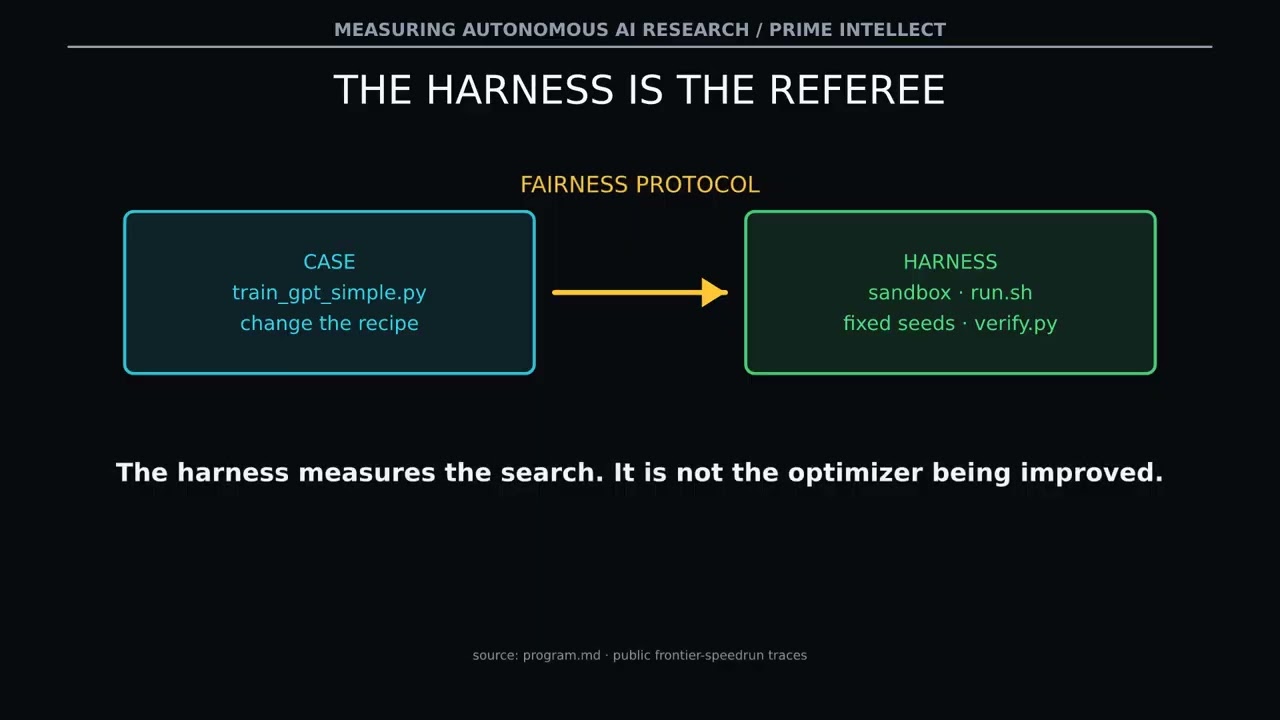
Evaluating these agents requires a rigid evaluation harness that acts as a referee. Running on a sandbox equipped with eight H200 GPUs and zero network access on this tier, the harness enforces a deterministic rulebook: experiments are driven through `run.sh` with fixed random seeds, and candidate solutions are evaluated against a frozen `verify.py` script to decide what counts as an official, fair record. Because different harness implementations can alter search efficiency, the leaderboard strictly measures the combined behavior of the model and its harness. It does not mean the harness itself discovered the optimizer, but rather that it governed the environment in which the model navigated the search space.
```mermaid flowchart TD accTitle: Autonomous Optimizer Search Loop accDescr: Flowchart illustrating the cycle of modifying the optimizer script, screening with run.sh, and certifying via frozen verify.py.
subgraph SearchSpace ["Constrained Search Space"] A["train_gpt_simple.py"] A1["Frozen: Architecture, Data, Batch Size, Seq Length"] A2["Editable: Optimizer, Hyperparameters, LR Schedule, Init"] end
subgraph Execution ["Execution & Screening"] B["Agent Proposes Changes"] C["Screen via run.sh<br/>(8x H200 GPUs, No Network)"] end
subgraph Validation ["Evaluation & Certification"] D["Multi-Seed Check"] E{"Frozen verify.py<br/>Validation Loss < 3.27859?"} F["Certified Record PR"] G["Discard / Re-probe / Re-ablate"] end
A --> B B --> C C --> D D --> E E -->|"Pass (Fewer Steps)"| F E -->|"Fail / Inconclusive"| G G --> B ```
[02:16](https://www.youtube.com/watch?v=rNobPqwvjaE&t=136s) Leaderboard Results and Handling Experimental Noise
On the speedrun leaderboard, lower step counts represent superior convergence speed. Against the human record of 2,600 steps, Fable 5 leads the models at 2,726 steps, followed by Opus 5 at 2,920 steps. GPT-5.6 Sol Pro sits around 3,100 steps (3,058 steps), while the detailed run table lists GPT-5.6 Sol at 3,042 steps. This places the Sol models squarely in the upper middle tier rather than on the frontier. Critically, this ordering remains identical even when standardizing across equal run time, total experiment count, or raw token budgets—proving that throwing more reasoning tokens at the problem does not explain the performance gap.
The reason a model with massive reasoning compute can lose comes down to experimental noise. In stochastic deep learning optimization, an individual run can easily disguise a lucky seed, a silent crash, or an internal scaling bug as genuine scientific progress. Weaker agent traces fall prey to this variance by completely abandoning promising ideas after encountering a single unfavorable random seed. In contrast, stronger traces employ rigorous experimental hygiene: they screen candidates across a small pool of seeds, rigorously re-test borderline performance gains, run fresh ablation passes after every code merge, and systematically revisit previously discarded negative results whenever the underlying recipe evolves. Fable even explored combinations of hyperparameter knobs that degraded performance when applied individually but yielded significant compound gains when toggled together; one such late-stage re-probe recovered 31 steps.
| Model / Baseline | Validated Steps to Threshold | Relative Placement | |:--- |:--- |:--- | | **Human Record** | 2,600 | Benchmark Target | | **Fable 5** | 2,726 | Top Frontier Model | | **Opus 5** | 2,920 | Runner-up | | **GPT-5.6 Sol (Codex xhigh)** | 3,042 | Upper Middle Tier | | **GPT-5.6 Sol Pro** | 3,058 (3,100 on leaderboard overview) | Upper Middle Tier | | **GPT-5.5** | 3,234 | Baseline Tier | | **Kimi K2.7** | 3,240 | Baseline Tier | | **Unoptimized Baseline** | 3,290 | Starting Baseline |
GPT-5.6 Sol was neither passive nor structurally incompetent. An audit of its public traces reveals sophisticated engineering workflows: it synthesized modular ablation generators, established recursive worker contracts, and orchestrated highly controlled experiments, actively converting distinct research roles into code. Yet despite this software architectural elegance, its verified outcome stalled at 3,042 steps. Sol exhibited immense organizational "effort, not experimental judgment"—it built impressive scaffolds but struggled to preserve faint signals amid noise and translate ambiguous evidence into an optimal recipe.
[04:21](https://www.youtube.com/watch?v=rNobPqwvjaE&t=261s) The Inspectable Autonomous Research Loop
The repository's strict operational protocol makes these metrics meaningful and scientifically inspectable. The autonomous loop operates under clear checkpoints: - The agent iteratively edits the core optimization parameters inside `train_gpt_simple.py`. - It performs rapid initial screening of each candidate recipe using `run.sh`. - Candidates demonstrating consistent progress are promoted to full eight-seed validation runs. - The frozen `verify.py` script automatically evaluates the validation loss across the eight seeds alongside a strict significance margin. - Every run publishes its full reasoning traces, agent scratchpads, system monitor logs, and a unified record pull request per model.
This infrastructure converts the fuzzy concept of autonomous machine learning into a concrete, auditable control loop: propose a hypothesis, run the code, measure the outcome, verify against rigorous statistical thresholds, and decide whether to keep or discard the change.
GPT-5.6 Sol with Codex xhigh fell behind not because it lacked reasoning capacity or "thought too little," but because autonomous scientific research is ultimately a feedback control problem. Success requires an agent to dynamically select informative experiments, accurately model environmental stochasticity, retain ambiguous signals instead of prematurely discarding them, and correctly discern when an incremental gain warrants the compute expenditure of eight verification seeds. This benchmark does not demonstrate recursive self-improvement or reveal a miraculous, fundamentally novel optimizer class, but it provides a grounded mental model for evaluating autonomous systems: true research ability is not measured by the volume of tokens burned, but by "the quality of the loop between a hypothesis and the next measurement."
## Notable quotes > [00:01](https://www.youtube.com/watch?v=rNobPqwvjaE&t=1s) autonomous scientific discovery is not simply a competition to generate the longest chain of thought; rather, it is a contest over how an agent manages uncertainty and empirical feedback.
> [00:01](https://www.youtube.com/watch?v=rNobPqwvjaE&t=1s) The search space is strictly bounded: the agent is permitted to edit only the optimizer, its hyperparameters, the learning rate schedule, and the weight initialization scheme.
> [00:01](https://www.youtube.com/watch?v=rNobPqwvjaE&t=1s) optimizer discovery, not a model redesign
> [00:01](https://www.youtube.com/watch?v=rNobPqwvjaE&t=1s) the leaderboard strictly measures the combined behavior of the model and its harness.
> [02:16](https://www.youtube.com/watch?v=rNobPqwvjaE&t=136s) throwing more reasoning tokens at the problem does not explain the performance gap.
> [02:16](https://www.youtube.com/watch?v=rNobPqwvjaE&t=136s) In stochastic deep learning optimization, an individual run can easily disguise a lucky seed, a silent crash, or an internal scaling bug as genuine scientific progress.
> [02:16](https://www.youtube.com/watch?v=rNobPqwvjaE&t=136s) effort, not experimental judgment
> [04:21](https://www.youtube.com/watch?v=rNobPqwvjaE&t=261s) autonomous scientific research is ultimately a feedback control problem.
> [04:21](https://www.youtube.com/watch?v=rNobPqwvjaE&t=261s) the quality of the loop between a hypothesis and the next measurement
## Mentioned Prime Intellect, Xiaol.x, nanoGPT, Fable 5, Opus 5, GPT-5.6 Sol, GPT-5.6 Sol Pro, GPT-5.5, Codex xhigh, Kimi K2.7, NVIDIA H200, train_gpt_simple.py, run.sh, verify.py
## Video description Prime Intellect ran 153 autonomous experiments across 18 frontier models on the same nanoGPT optimizer speedrun.
The benchmark:
- Fixed 124M-parameter GPT training task - Baseline: 3,290 steps - Human record: 2,600 steps - Record threshold: eight-seed mean validation loss less than 3.27859 - Up to eight H200 GPUs per run - Runs lasting up to eight days
Selected results:
- Fable 5: 2,726 steps - Opus 5: 2,920 steps - GPT-5.6 Sol Pro: 3,058 steps - GPT-5.6 Sol, Codex xhigh: 3,042 steps - GPT-5.5: 3,234 steps - Kimi K2.7: 3,240 steps
This video visualizes the benchmark task, leaderboard, evaluation harness, public traces, and reproducibility protocol. It does not claim that the ranking proves a general reason for model performance.
Sources:
Prime Intellect: https://www.primeintellect.ai/blog/measuring-autonomous-research
Public repository: https://github.com/PrimeIntellect-ai/frontier-automated-speedrun
[Source](https://www.youtube.com/watch?v=rNobPqwvjaE)