Mathematics in the Age of AI — Terence Tao’s Five-Stage Test for Real Progress
Xiaol.x
AI-assisted summary of Mathematics in the Age of AI — Terence Tao’s Five-Stage Test for Real Progress — original source. Check the original for full context.
Source published:
Key ideas
- Terence Tao argues that equating raw AI proof capability with mathematical progress is a category error, likening the current institutional shift to the foundational crisis of mathematics around 1900. (0:01)
- To prevent Goodhart's law from distorting research incentives, Tao outlines a five-stage problem-solving pipeline: Generation, Verification, Exposition, Acceptance, and Canonicalization. (2:35)
- In the 'First Proof' benchmark, four AI systems achieved passing evaluations on 7 of 10 novel research-grade problems at compute costs ranging from tens to hundreds of dollars per problem. (5:27)
- The rapid abundance of machine-generated arguments threatens 'proof indigestion,' making human attention the critical bottleneck for verification, peer review, and conceptual understanding. (5:27)
Detailed notes
## Background Published on YouTube by Xiaol.x on August 24, 2026, this visual Leanim lecture explores Terence Tao’s essay "Mathematics in the Age of AI." Drawing on Tao's paper, the presentation examines what the mathematical community should value when proof generation becomes abundant, contrasting raw automated capabilities with the social and pedagogical architecture of research mathematics.
## TL;DR The lecture addresses the category error of equating raw automated proof generation with true mathematical progress, warning that Goodhart’s law risks reducing mathematical inquiry to benchmark scores. Drawing on Terence Tao's framework, it introduces a five-stage pipeline spanning generation, verification, exposition, acceptance, and canonicalization to prevent "proof indigestion" as AI makes proof candidates abundant. Using benchmarks like the First Proof project and a concrete modulo 6 walkthrough, the talk highlights why human exposition, peer scrutiny, and conceptual friction remain vital to building shared, lasting mathematical understanding.
## Atmosphere & style The presentation carries the measured, intellectually rigorous tone of an advanced academic blackboard seminar. Its narrative unfolds methodically, balancing cautionary warnings about institutional complacency with a constructive, deeply philosophical outlook on mathematical practice. Watching the Leanim visual animations feels patient, analytical, and clarifying, transforming potentially abstract debates about AI automation into grounded reflections on human insight and pedagogy.
## Bulletin - [00:01](https://www.youtube.com/watch?v=tKG6mQIWdEM&t=1s) Terence Tao argues that equating raw AI proof capability with mathematical progress is a category error, likening the current institutional shift to the foundational crisis of mathematics around 1900. - [02:35](https://www.youtube.com/watch?v=tKG6mQIWdEM&t=155s) To prevent Goodhart's law from distorting research incentives, Tao outlines a five-stage problem-solving pipeline: Generation, Verification, Exposition, Acceptance, and Canonicalization. - [05:27](https://www.youtube.com/watch?v=tKG6mQIWdEM&t=327s) In the 'First Proof' benchmark, four AI systems achieved passing evaluations on 7 of 10 novel research-grade problems at compute costs ranging from tens to hundreds of dollars per problem. - [05:27](https://www.youtube.com/watch?v=tKG6mQIWdEM&t=327s) The rapid abundance of machine-generated arguments threatens 'proof indigestion,' making human attention the critical bottleneck for verification, peer review, and conceptual understanding.
## Key takeaways - [00:01](https://www.youtube.com/watch?v=tKG6mQIWdEM&t=1s) Evaluating AI solely by counting solved problems conflates technical capability with the broader goals, values, and social architecture of mathematics. - [00:01](https://www.youtube.com/watch?v=tKG6mQIWdEM&t=1s) Unlike the foundational crisis of 1900 which challenged axiomatic truth, modern AI challenges the social contracts of the profession, including authorship, hiring criteria, and what constitutes understanding. - [00:01](https://www.youtube.com/watch?v=tKG6mQIWdEM&t=1s) The AI capability conjecture should be treated as a parameterized claim across cost, supervision, task type, and correctness rather than a monolithic prediction. - [02:35](https://www.youtube.com/watch?v=tKG6mQIWdEM&t=155s) When single metrics like problem counts become explicit targets under Goodhart's law, they risk divorcing raw proof generation from essential outcomes like theory building, community health, and student training. - [02:35](https://www.youtube.com/watch?v=tKG6mQIWdEM&t=155s) A proof verified by proof assistants like Lean or Rocq can remain an unreadable, multi-gigabyte black box that fails to advance human understanding without exposition. - [02:35](https://www.youtube.com/watch?v=tKG6mQIWdEM&t=155s) Tao structures mathematical progress into a five-stage pipeline: candidate generation, formal verification, clear exposition, community acceptance, and textbook canonicalization. - [05:27](https://www.youtube.com/watch?v=tKG6mQIWdEM&t=327s) Results from the 'First Proof' project show that AI models can solve novel research problems cheaply, but such benchmarks measure only the initial generation stage. - [05:27](https://www.youtube.com/watch?v=tKG6mQIWdEM&t=327s) 'Proof indigestion' arises when generation and verification outpace the scarce supply of expert human attention required for peer review and canonicalization. - [07:15](https://www.youtube.com/watch?v=tKG6mQIWdEM&t=435s) Tracing the elementary theorem that primes greater than 3 satisfy p ≡ 1, 5 (mod 6) demonstrates how each stage transforms raw calculation into pedagogical and contextualized theory. - [07:15](https://www.youtube.com/watch?v=tKG6mQIWdEM&t=435s) Echoing William Thurston, the fundamental metric of mathematical research remains whether work empowers humans to think and understand more clearly, rather than the mere volume of proven statements. - [07:15](https://www.youtube.com/watch?v=tKG6mQIWdEM&t=435s) Polishing away the intellectual friction and visible struggles found in dense human mathematics risks stripping away essential cues that build intuition and warn learners of treacherous terrain.
## Detailed walkthrough ### [00:01](https://www.youtube.com/watch?v=tKG6mQIWdEM&t=1s) The Category Error: Capability vs. Mathematical Purpose
The discussion opens with an uncomfortable thought experiment: if artificial intelligence reaches the point where it can routinely solve a meaningful fraction of research-level mathematics, what should the mathematical community actually optimize for? The instinctive, simple response is to point to a single number and start counting solved problems. However, drawing on Terence Tao’s essay *Mathematics in the Age of AI*, this response is identified as a fundamental category error. AI capability is a purely technical matter of what a system can do; the goals, values, and social architecture of mathematics are an entirely separate question. Generating a raw proof does not by itself constitute mathematical progress. A proof only becomes truly valuable through a progressive journey: verification, clear exposition, communal acceptance, and ultimate absorption into shared mathematical theory.
To frame this challenge, Tao invokes a historical analogy to the foundational crisis of mathematics around 1900. When Russell's paradox and Kurt Gödel’s incompleteness theorems shook the discipline, mathematicians were forced to make their underlying axiomatic foundations completely explicit. That crisis did not destroy mathematics; instead, it created a trusted, inspectable, and rigorous framework that eventually enabled computerized proof mechanization. Tao argues that modern AI is triggering a comparable institutional tremor, but at an entirely different layer. The stress is not falling on mathematical truth itself, but on the implicit social contracts of the profession: - What counts as a genuine contribution? - What work do hiring committees and grant panels reward? - What constitutes true human understanding? - Who actually did the work when a machine is in the loop?
The constructive takeaway is clear: the mathematical community must make its professional values explicit now, before commercial and automated tools make those decisions by default.
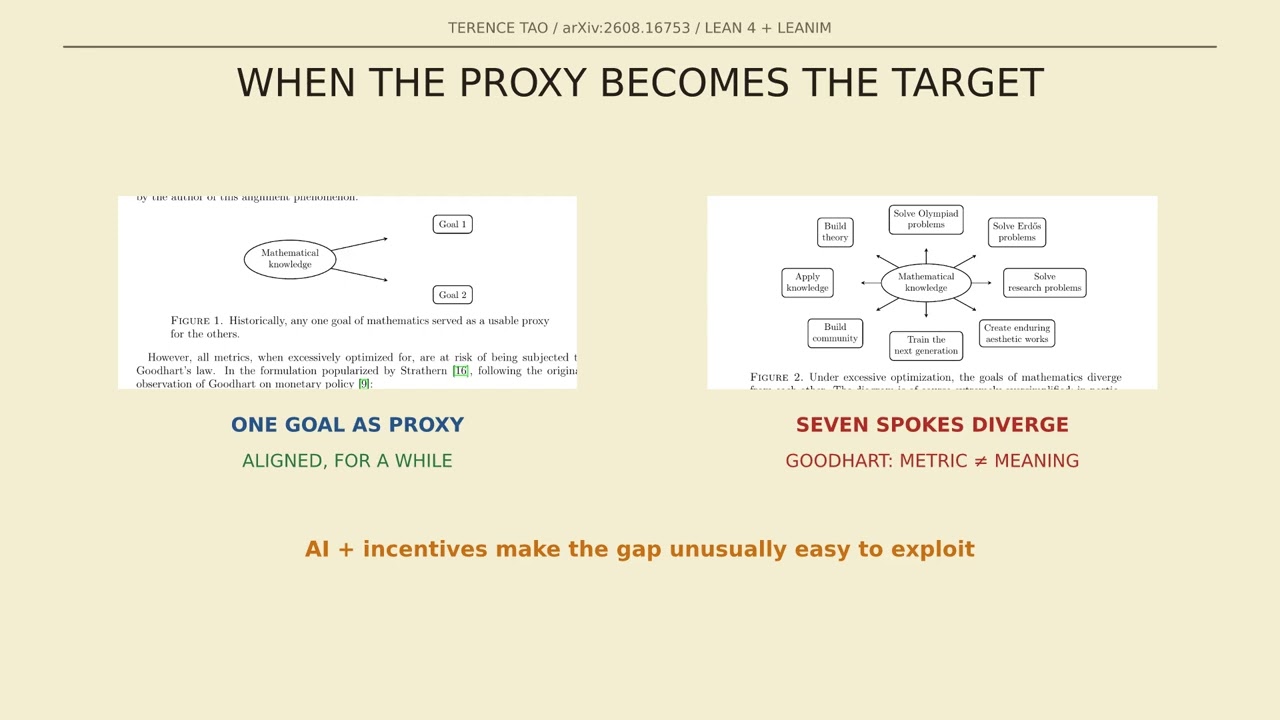
To untangle these tensions, two distinct inquiries must be kept separate. The first is the "AI capability conjecture," which is deliberately framed as a parameterized family of claims rather than a sweeping prophecy: under some level of cost and supervision, certain systems can perform certain research tasks with a certain degree of correctness. The second, entirely orthogonal inquiry concerns the fundamental purpose of mathematical research. Tao’s partial catalog of mathematical values includes solving open problems, building overarching theories, understanding the natural world, sustaining a healthy academic community, training students, accumulating enduring shared knowledge, and crafting arguments of lasting beauty. One can readily acknowledge rapid gains in AI capability without conflating raw output with mathematical fulfillment.
[02:35](https://www.youtube.com/watch?v=tKG6mQIWdEM&t=155s) Goodhart’s Law and the Five-Stage Problem-Solving Pipeline
Historically, the diverse goals of mathematical research were tightly bundled together. When a mathematician attacked a major open problem, the struggle would naturally generate new foundational techniques, spark a research community, produce graduate textbooks, and unlock practical applications. Because these outcomes traveled as a pack, a single visible metric—such as solving a famous open problem—could safely serve as a proxy for all the hidden, downstream benefits. Today, however, Goodhart’s law looms: the moment a proxy measure becomes an explicit target, it ceases to be a good measure. Machine learning systems excel at exploiting the gap between appearance and substance, and economic incentives aggressively prioritize easily benchmarked figures. As a result, the historic hub of mathematics splinters into disconnected, competing spokes: solving International Mathematical Olympiad (IMO) problems, solving Erdős problems, developing structural theories, training researchers, and crafting lasting works. Optimizing solely for problem counts risks starving every other dimension of the discipline.
```mermaid flowchart TD accTitle: Tao's Five-Stage Mathematical Pipeline accDescr: A pipeline showing the five iterative stages from raw candidate generation to canonical theory, highlighting potential failure modes.
subgraph GenerationStage["Stage 1: Production"] A["1. Generation (Goal 6.1)<br/>AI produces candidate proof"] end
subgraph VerificationStage["Stage 2: Validation"] B["2. Verification (Goal 6.2)<br/>Formal kernel check (Lean/Rocq/HOL)"] end
subgraph HumanEcology["Stages 3–5: Social & Intellectual Integration"] C["3. Exposition (Goal 6.3)<br/>Readable, human-digestible prose"] D["4. Acceptance (Goal 6.4)<br/>Referee review & community adoption"] E["5. Canonicalization (Goal 6.5)<br/>Definitive theory & textbook integration"] end
A -->|"Risk: Hallucinations & plausibility traps"| B B -->|"Risk: Opaque, unreadable black boxes"| C C -->|"Bottleneck: Scarce expert attention"| D D -->|"Long-term synthesis"| E ```
To demonstrate how optimization fails when reduced to a single arrow, consider what happens when the target is simply "proof generation." If success is scored merely by the volume of purported solutions, a system wins by flooding the discipline with superficially plausible but fatally flawed arguments—an automated version of the endless amateur manuscripts claiming to solve the Riemann hypothesis. Adding a verification gate using interactive proof assistants like Lean, Coq/Rocq, or HOL stops invalid arguments in their tracks, particularly as autoformalization bridges natural language and formal code. Yet even a fully verified proof can remain an impenetrable, multi-gigabyte black box: formally correct, enormous in scale, and understood by no human being on Earth. Correctness is an absolute prerequisite, but it does not satisfy the social and intellectual meaning of mathematics.
To address this gap, Tao formulates an iterative progression of mathematical goals that transforms the single generation arrow into a complete social pipeline: - **Goal 6.1 (Generation):** Produce a candidate solution to an open problem. - **Goal 6.2 (Verification):** Validate the argument through rigorous or formal verification to make it trustworthy. - **Goal 6.3 (Exposition):** Communicate the ideas clearly and intuitively so the argument becomes teachable to others. - **Goal 6.4 (Digestion and Acceptance):** Subject the work to peer scrutiny, refereeing, and community absorption so it becomes shared knowledge. - **Goal 6.5 (Canonicalization):** Reformulate the theorem in its natural generality, connect it to adjacent disciplines, and position the cleanest proof within standard theory.
This five-stage pipeline is not academic bureaucracy wrapped around mathematics; it represents the essential communal process by which a private, isolated proof matures into collective human understanding.
[05:27](https://www.youtube.com/watch?v=tKG6mQIWdEM&t=327s) The "First Proof" Receipt and the Threat of Proof Indigestion
Concrete evidence of AI's shifting footprint comes from recent evaluations such as the second batch of the "First Proof" project. In this trial, four publicly accessible AI systems were evaluated on ten novel, research-grade problems authored by practicing mathematicians under controlled conditions. Seven out of the ten problems received at least one passing evaluation, with computational costs running on the order of tens to hundreds of dollars per problem. This benchmark serves as a meaningful local receipt for raw AI capability, demonstrating that modern models can tackle genuinely new research tasks at reasonable cost. However, a benchmark score reveals nothing about whether the resulting arguments are lucidly explained, historically attributed, digested by experts, or ready to be taught in a seminar. A performance benchmark illuminates only the first stage of generation; Tao’s philosophical argument begins precisely where the benchmark stops.
The immediate danger arising from this imbalance is what Tao terms "proof indigestion"—the structural crisis of transitioning from an era of proof scarcity to one of proof abundance: - If generation accelerates much faster than verification, backlogs of unvetted, plausibly written arguments drown out genuine work. - If verification tools accelerate faster than exposition, libraries of verified but utterly unreadable formal code accumulate without conceptual explanations. - When verified arguments surge in volume, the subsequent stages—peer review, journal filtering, and canonicalization—form severe bottlenecks because their sole non-scalable input is expert human attention.
Traditional academic institutions were built during centuries when valid proofs were exceedingly rare. Priority disputes, journals, prestigious prizes, and university hiring all relied on proof generation as an accurate proxy for overall mathematical excellence. Under conditions of automated abundance, that historic proxy saturates and breaks down. The emerging crisis is therefore not just technical, but deeply institutional: the mathematical community must intentionally invest in the labor-intensive stages that convert a torrential stream of algorithmic output into knowledge that humans can comprehend, teach, and build upon.
[07:15](https://www.youtube.com/watch?v=tKG6mQIWdEM&t=435s) A Modulo 6 Walkthrough, Thurston’s Test, and Preserving Friction
To clarify how each link in the chain adds value, the discussion examines a simple, concrete example: the elementary theorem stating that every prime number greater than three is congruent to either $1$ or $5$ modulo $6$ ($p \equiv 1, 5 \pmod 6$). Tracing this through the five-stage pipeline reveals the distinct contribution of each step: 1. **Generation:** An automated system generates the theorem statement and candidate argument, while a human mathematician checks its framing and verifies historical attribution. 2. **Verification:** A formal proof assistant verifies the compact proof by partitioning the integers into six residue classes ($0, 1, 2, 3, 4, 5 \pmod 6$) and mechanically discarding the residue classes divisible by $2$ and $3$. 3. **Exposition:** A human mathematician translates the formal kernel check into accessible conceptual prose so a student can grasp the core idea—that primes cannot be multiples of 2 or 3—rather than just trusting a boolean verification flag. 4. **Acceptance:** An expert referee evaluates the written note, connects it to standard modular arithmetic lemmas, checks contextual framing, and approves it for publication. 5. **Canonicalization:** A textbook author situates the result within the broader architecture of number theory, placing it naturally alongside the Sieve of Eratosthenes and Dirichlet’s theorem on primes in arithmetic progressions.
To navigate this landscape responsibly, Tao highlights emerging policy frameworks such as the Leiden Declaration principles on research integrity. These guidelines mandate disclosing AI tool usage, actively supporting peer review, safeguarding the human accountability of authorship, and enforcing meticulous attribution. This outlook echoes William Thurston’s foundational test from his reflections on mathematical progress: the true measure of research is not simply whether new theorems are proven, but whether our work enables people to understand and think more clearly and effectively about mathematics.
This human dimension is underscored by an anecdote regarding the dense analytical papers of Jean Bourgain. In Bourgain’s work, the awkward transitions, technical hurdles, and visible struggles on the page served a crucial pedagogical purpose—they functioned as intellectual road signs warning readers precisely where the mathematical terrain was treacherous and where they needed to slow down. A hyper-optimized, perfectly smooth AI output risks polishing away this productive friction, obscuring the conceptual hurdles that train human intuition. Ultimately, Tao’s paradigm is neither reflexively anti-AI nor naively techno-optimistic. It envisions a balanced five-stage intellectual ecology where automated engines can rapidly accelerate generation, while human mathematicians retain responsibility for meaning, clear explanation, value judgments, and the enduring memory of the discipline.
## Notable quotes > [00:01](https://www.youtube.com/watch?v=tKG6mQIWdEM&t=1s) AI capability is a purely technical matter of what a system can do; the goals, values, and social architecture of mathematics are an entirely separate question.
> [00:01](https://www.youtube.com/watch?v=tKG6mQIWdEM&t=1s) The stress is not falling on mathematical truth itself, but on the implicit social contracts of the profession — Terence Tao
> [00:01](https://www.youtube.com/watch?v=tKG6mQIWdEM&t=1s) the mathematical community must make its professional values explicit now, before commercial and automated tools make those decisions by default.
> [02:35](https://www.youtube.com/watch?v=tKG6mQIWdEM&t=155s) the moment a proxy measure becomes an explicit target, it ceases to be a good measure.
> [02:35](https://www.youtube.com/watch?v=tKG6mQIWdEM&t=155s) Correctness is an absolute prerequisite, but it does not satisfy the social and intellectual meaning of mathematics.
> [05:27](https://www.youtube.com/watch?v=tKG6mQIWdEM&t=327s) A performance benchmark illuminates only the first stage of generation; Tao’s philosophical argument begins precisely where the benchmark stops.
> [05:27](https://www.youtube.com/watch?v=tKG6mQIWdEM&t=327s) the structural crisis of transitioning from an era of proof scarcity to one of proof abundance — Terence Tao
> [05:27](https://www.youtube.com/watch?v=tKG6mQIWdEM&t=327s) When verified arguments surge in volume, the subsequent stages—peer review, journal filtering, and canonicalization—form severe bottlenecks because their sole non-scalable input is expert human attention.
> [07:15](https://www.youtube.com/watch?v=tKG6mQIWdEM&t=435s) the true measure of research is not simply whether new theorems are proven, but whether our work enables people to understand and think more clearly and effectively about mathematics. — William Thurston
> [07:15](https://www.youtube.com/watch?v=tKG6mQIWdEM&t=435s) A hyper-optimized, perfectly smooth AI output risks polishing away this productive friction, obscuring the conceptual hurdles that train human intuition.
> [07:15](https://www.youtube.com/watch?v=tKG6mQIWdEM&t=435s) automated engines can rapidly accelerate generation, while human mathematicians retain responsibility for meaning, clear explanation, value judgments, and the enduring memory of the discipline.
## Mentioned Terence Tao, Mathematics in the Age of AI, Goodhart's law, Kurt Gödel, Bertrand Russell, First Proof project, Lean, Leanim, Coq / Rocq, HOL, International Mathematical Olympiad (IMO), Paul Erdős, Bernhard Riemann, Jean Bourgain, William Thurston, Leiden Declaration, Eratosthenes, Peter Gustav Lejeune Dirichlet
## Video description What happens when AI can solve a meaningful fraction of research-level mathematics?
In this visual Leanim lecture, we explore Terence Tao’s essay Mathematics in the Age of AI through a professional, values-first lens. The central question is not only whether AI can generate proofs, but what mathematics should value once proof generation becomes abundant.
We examine:
- The difference between AI capability and mathematical purpose - Goodhart’s law and the danger of optimizing one metric - Why a correct proof may still be unreadable or socially incomplete - Tao’s five-stage problem-solving pipeline: generation, verification, exposition, acceptance, and canonicalization - The First Proof project and what “7 of 10 passing problems” really demonstrates - The coming challenge of “proof indigestion” - A concrete example: proving that every prime greater than 3 is congruent to 1 or 5 modulo 6 - Why human explanation, attribution, judgment, and mathematical memory remain essential
This is an independent educational interpretation of Tao’s essay, created as a Leanim blackboard animation.
Paper: https://arxiv.org/abs/2608.16753
#TerenceTao #Mathematics #ArtificialIntelligence #ProofAssistants #Lean #MathematicalResearch #AI
[Source](https://www.youtube.com/watch?v=tKG6mQIWdEM)