SPADE Generates Python Worlds to Beat Fixed-Task AI Baselines
Xiaol.x
A single model alternating between environment designer and player outperforms fixed training baselines by using hint-based regret to generate learnable code tasks.
AI-assisted summary of Can an AI Teach Itself? SPADE Writes Its Own Training Worlds — original source. Check the original for full context.
Source published:
Key ideas
- SPADE introduces a self-play framework where a single language model alternates between designing executable Python environments and acting as the reasoning agent that solves them. (1:49)
- To prevent tasks from becoming trivial or impossible, the framework guides curriculum design using 'hint-based regret', which measures the performance gap between agent trials run with and without a privileged clue. (2:32)
- Evaluated on a 30B parameter Mixture-of-Experts model (3B active), SPADE outperformed fixed-environment baselines by 5.3 points across eight reasoning benchmarks and gained 13.9 points on AceBench. (4:48)
- Despite strong empirical transfer gains, the authors caution that real-world deployment requires strict Python sandboxing, verifier validation, and corpus grounding to prevent tasks from collapsing into repetitive mazes. (5:36)
Detailed notes
## Background Published on YouTube by Xiaol.x on August 29, 2026, this video introduces SPADE, a self-play framework where a single language model acts both as an environment designer writing Python games and as an agent learning to solve them. According to the description, the video showcases a complex thermodynamics lab example and explains how hint-based regret allows the model to build difficult yet learnable training environments.
## TL;DR SPADE introduces a self-play framework where a single language model alternates between designing executable, Gym-style Python environments and acting as the reasoning agent navigating them. To ensure tasks are pedagogically valuable rather than trivial or impossible, the system optimizes for 'hint-based regret'—measuring the performance gap between runs with and without privileged clues—while anchoring difficulty to a 40%–60% win rate. Guided by corpus grounding and memory, the generated curriculum evolves from basic legal dispute forums into multi-variable orbital mechanics and thermodynamics simulations. In evaluations using a 30B Mixture-of-Experts model, SPADE consistently outperformed fixed-environment baselines across reasoning, science, and tool-use benchmarks. While conceptually transformative, the video highlights major practical hurdles, including code sandboxing, verifier bugs, infrastructure demands, and the potential for optimization gaming.
## Atmosphere & style The presentation blends rigorous technical deconstruction with evocative storytelling, opening immediately inside the mechanics of generated code before broadening out to systems architecture. The delivery is analytical, paced, and intellectually engaged, using intuitive analogies like learning thermostats to make high-level reinforcement learning concepts feel tangible. A noticeable shift occurs near the end, where the excitement of benchmark gains gives way to a measured, grounded reality check on compute constraints and security sandboxing. The overall experience feels like an immersive, high-level research seminar that respects the engineering hurdles just as much as the conceptual breakthrough.
## Bulletin - [01:49](https://www.youtube.com/watch?v=DF07x8Nubz0&t=109s) SPADE introduces a self-play framework where a single language model alternates between designing executable Python environments and acting as the reasoning agent that solves them. - [02:32](https://www.youtube.com/watch?v=DF07x8Nubz0&t=152s) To prevent tasks from becoming trivial or impossible, the framework guides curriculum design using 'hint-based regret', which measures the performance gap between agent trials run with and without a privileged clue. - [04:48](https://www.youtube.com/watch?v=DF07x8Nubz0&t=288s) Evaluated on a 30B parameter Mixture-of-Experts model (3B active), SPADE outperformed fixed-environment baselines by 5.3 points across eight reasoning benchmarks and gained 13.9 points on AceBench. - [05:36](https://www.youtube.com/watch?v=DF07x8Nubz0&t=336s) Despite strong empirical transfer gains, the authors caution that real-world deployment requires strict Python sandboxing, verifier validation, and corpus grounding to prevent tasks from collapsing into repetitive mazes.
## Key takeaways - [00:00](https://www.youtube.com/watch?v=DF07x8Nubz0&t=0s) Generated environments operate as standard Gym-style Python classes using reset and step interfaces that manage latent states and verifiable rewards. - [00:00](https://www.youtube.com/watch?v=DF07x8Nubz0&t=0s) Late-stage curriculum tasks reach significant complexity, including a 376-line thermodynamics laboratory managing 19 state variables across a 12-turn budget. - [01:49](https://www.youtube.com/watch?v=DF07x8Nubz0&t=109s) A single shared set of model weights powers both the Environment Designer and the Reasoning Agent, creating a mutually reinforcing learning loop. - [02:32](https://www.youtube.com/watch?v=DF07x8Nubz0&t=152s) The framework avoids common adversarial self-play failure modes by quantifying hint-based regret (R_hinted - R_unhinted) to verify that an environment is both challenging and solvable. - [03:15](https://www.youtube.com/watch?v=DF07x8Nubz0&t=195s) A difficulty anchor targets an unhinted agent win rate between 40% and 60% to keep curriculum generation focused at the agent's moving learning frontier. - [03:15](https://www.youtube.com/watch?v=DF07x8Nubz0&t=195s) Curriculum tasks visibly evolve over training, advancing from simple legal dispute arbitration forums to orbital mechanics simulations and genetics labs. - [03:59](https://www.youtube.com/watch?v=DF07x8Nubz0&t=239s) External corpus grounding is essential to maintain diversity; without it, generated environments collapse into repetitive maze variants. - [04:48](https://www.youtube.com/watch?v=DF07x8Nubz0&t=288s) On tool-use benchmarks, SPADE achieves a 5.7-point improvement on multi-turn BFCL and a 13.9-point gain on AceBench compared to fixed-environment baselines. - [04:48](https://www.youtube.com/watch?v=DF07x8Nubz0&t=288s) Model scaling curves demonstrate that SPADE's performance advantage widens as model capacity grows, while fixed-environment baselines plateau. - [05:36](https://www.youtube.com/watch?v=DF07x8Nubz0&t=336s) Practical deployment hurdles include the necessity of multi-GPU compute, sandboxed code execution, defenses against hint-regret gaming, and the risk of bugs in generated verifiers.
## Detailed walkthrough ### [00:00](https://www.youtube.com/watch?v=DF07x8Nubz0&t=0s) Inside the Thermodynamics Lab: What an Executable Environment Looks Like
The walkthrough opens by diving straight into the SPADE paper’s richest late-curriculum showcase: a full-fledged thermodynamics laboratory. Rather than generating a trivial, one-line multiple-choice question, the model writes a functioning, stateful text game. The scenario presents the player with a transparent chamber containing a cloud of gas atoms and a palette of five possible actions: scan, heat, expand, cool, and measure entropy. To successfully solve it, the agent must first scan the system's hidden parameters and then execute an exact sequence of physical interventions across four consecutive commands: activating heating triples the temperature; initiating expansion triples the volume while keeping temperature constant; cooling restores the temperature back to its starting level; and finally, measuring the current entropy prompts the environment to confirm, "Net entropy change zero, success, reward one."
This late-stage curriculum task is not a hard-coded benchmark, but 376 lines of generated Python code managing 19 internal state variables within a strict 12-turn budget. It demonstrates the tangible reality of an executable training world where every single interaction alters internal mechanics. Under the hood, every SPADE environment adheres to a standard Gym-style contract featuring `reset` and `step` methods. The `reset` call initializes the latent state and returns the opening observation, while each `step` takes an action, updates the physical state, emits the subsequent observation along with a reward signal, and determines whether the episode has reached completion. Because the generated program encapsulates both the environment dynamics and the evaluation verifier, it can represent everything from simple diagnostic puzzles and negotiations to complex, multi-turn tool-use workflows.
- **Thermodynamics lab specifications**: 376 lines of Python code, 19 state variables, and a 12-turn interaction budget. - **Action space**: Scan, heat, expand, cool, and measure entropy. - **Gym-style interface**: `reset()` constructs the hidden state and initial view; `step(action)` modifies internal state, yields observations, and computes verifiable rewards.
[01:49](https://www.youtube.com/watch?v=DF07x8Nubz0&t=109s) One Policy, Two Hats: Self-Play Through Stateful Code
The core mechanism powering SPADE is a dual-role policy loop where a single language model alternates between two complementary personas. In the role of the Environment Designer, the model consumes a grounding text passage alongside memories of past environments to synthesize a runnable Python class (complete with `reset` and `step` logic) as well as an accompanying privileged hint. Shifting into the role of the Reasoning Agent, the exact same model enters that newly minted environment and attempts to navigate it over multiple turns. Crucially, both roles update the very same underlying model weights. Success as an agent informs its capacity to design meaningful curricula, and designing better curricula in turn cultivates a more capable problem solver.
```mermaid flowchart TD accTitle: SPADE Dual-Role Architecture accDescr: Flow diagram showing how a single policy acts as both an environment designer and a reasoning agent to compute hint-based regret.
subgraph Designer ["Role 1: Environment Designer"] A["Corpus Passage & Memory"] --> B["Generate Python Environment<br/>(reset, step, verifier)"] B --> C["Privileged Hint"] end
subgraph Agent ["Role 2: Reasoning Agent"] D["Agent Run 1:<br/>Unhinted Trial"] E["Agent Run 2:<br/>Hinted Trial"] end
subgraph Evaluation ["Curriculum Optimization"] F["Hint-Based Regret<br/>(Return Gap)"] G["Difficulty Anchor<br/>(40%–60% Win Rate)"] end
B --> D B --> E C --> E D --> F E --> F F --> G G -->|"Update Shared Policy Weights"| A ```
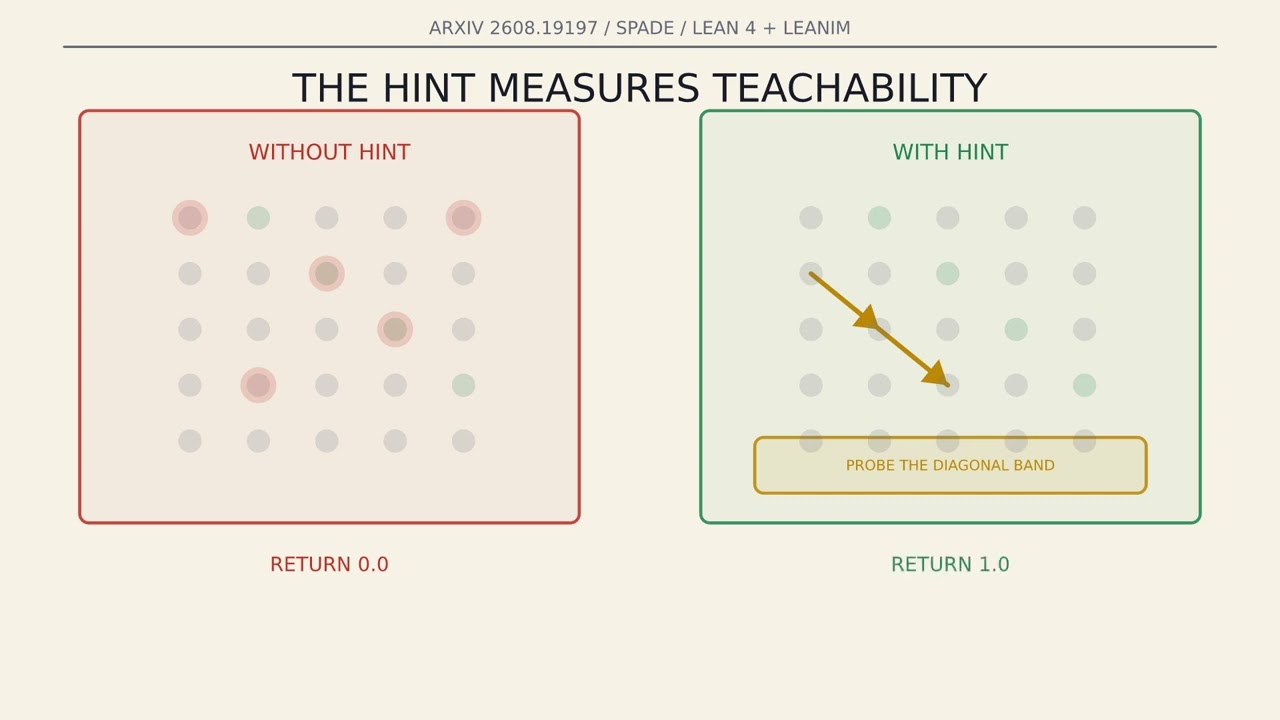
This dynamic sidesteps the typical failure modes of adversarial training. If an adversary were purely hostile, it would easily maximize loss by constructing impossible, unsolvable environments; conversely, a purely cooperative teacher would hand out trivial tasks with no pedagogical value. SPADE resolves this dilemma using "hint-based regret." The system runs each generated environment twice: once with the agent operating blind, and once with the privileged clue provided. For instance, in a toy fiber-grid environment, an unhinted agent wanders aimlessly and fails to notice an underlying diagonal structure, whereas the hinted agent leverages the clue to reach the goal. The resulting difference in return—the regret gap—serves as a quantitative signal. A large positive gap proves that the environment is genuinely difficult without the key insight, but fully solvable once the underlying concept is grasped.
- **Dual-role parameter sharing**: Designer and Agent share the exact same neural network weights, creating a mutual reinforcement loop. - **Hint-based regret metric**: Computed as the performance spread between privileged-hint and unhinted runs ($R_{\text{hinted}} - R_{\text{unhinted}}$). - **Incentive design**: Avoids the trap of impossible environments (where both runs fail) and trivial tasks (where both runs succeed with zero regret).
[03:15](https://www.youtube.com/watch?v=DF07x8Nubz0&t=195s) The Frontier Thermostat and Curriculum Evolution
The video compares environment generation to a thermostat tuned to the agent's moving learning frontier. If every agent solves a task effortlessly, the world is "too cold" and provides zero learning gradient; if no agent can solve it even when equipped with privileged help, the world is "too hot" and produces pure noise. To stay in the ideal learning pocket, SPADE pairs its floored hint-regret metric with a difficulty anchor that targets win rates in the 40% to 60% band. External corpus grounding provides diverse raw thematic material, while an environment memory module retains effective past mechanics, ensuring the curriculum advances toward higher complexity rather than degenerating into arbitrary chaos.
This evolution is visible in the paper's experimental progression. Early training checkpoints construct modest scenarios such as legal dispute arbitration forums. As training proceeds, the policy begins generating orbital mechanics simulations, genetics research laboratories, and intricate thermodynamic manipulation tasks. These are not merely textual re-skins of the same quiz template; they represent distinct codebases featuring custom state representations, unique action spaces, and customized automated verifiers. Replaying thousands of generated tasks as an embedding space visualizes this dynamic: without external corpus grounding, the generated tasks collapse into repetitive variations of rotating mazes. Grounding breaks this symmetry, preventing the model from spiraling into inward-facing self-talk.
- **Target performance window**: Difficulty anchor targets an unhinted win rate between 40% and 60%. - **Curriculum progression**: Evolves from simple legal dispute forums to orbital physics simulations and thermodynamics experiments. - **Role of grounding**: Without corpus grounding, task variety collapses into degenerate, repetitive maze layouts.
[04:48](https://www.youtube.com/watch?v=DF07x8Nubz0&t=288s) Transfer Performance and the Practical Reality
When evaluated against traditional training approaches, SPADE shows distinct empirical advantages. Using a 30-billion total parameter Mixture-of-Experts model with 3 billion active parameters, SPADE outperforms the strongest fixed-environment baseline (trained via Group Relative Policy Optimization, or GRPO) by an average of 5.3 points across eight reasoning, mathematics, coding, and science benchmarks. In specialized tool-use evaluations, the performance leap is even more pronounced, scoring 5.7 points higher on the multi-turn Berkeley Function Calling Leaderboard (BFCL) and gaining 13.9 points on AceBench. Furthermore, scaling curves highlight that SPADE's lead widens as model capacity grows, whereas the fixed-environment GRPO baseline plateaus.
Despite these strong numbers, the host takes a deep breath and offers a grounded, two-part verdict. Conceptually, SPADE is a major leap forward: formalizing environment design as a learned policy operating over executable `reset`/`step` contracts is far more expressive than frozen task generation. Practically, however, it remains an involved research framework rather than a turnkey, out-of-the-box product. Generated Python scripts demand rigorous sandboxing and semantic validation to avoid security risks and runtime crashes. Moreover, automated verifiers can contain bugs, hint-regret dynamics can be gamed by an optimization loop, task diversity remains heavily tethered to the quality of the grounding corpus, and replicating the training run demands substantial multi-GPU infrastructure. The lasting takeaway is architectural: true progress comes from training the world builder alongside the learner and measuring whether the worlds it invents can actually teach.
- **Model configuration**: 30B total parameters, 3B active parameters. - **Benchmark gains**: +5.3 points average across 8 math, science, code, and reasoning suites over fixed-environment baselines. - **Tool-use metrics**: +5.7 points on BFCL multi-turn; +13.9 points on AceBench agent. - **Core limitations**: Requires robust code sandboxing, reliable verification logic, multi-GPU infrastructure, and defenses against hint-regret gaming.
## Notable quotes > [00:00](https://www.youtube.com/watch?v=DF07x8Nubz0&t=0s) What if an AI did not just solve training tasks—but learned to design the worlds it trains in? — Xiaol.x
> [00:00](https://www.youtube.com/watch?v=DF07x8Nubz0&t=0s) Net entropy change zero, success, reward one. — Environment
> [01:49](https://www.youtube.com/watch?v=DF07x8Nubz0&t=109s) Success as an agent informs its capacity to design meaningful curricula, and designing better curricula in turn cultivates a more capable problem solver. — Xiaol.x
> [01:49](https://www.youtube.com/watch?v=DF07x8Nubz0&t=109s) If an adversary were purely hostile, it would easily maximize loss by constructing impossible, unsolvable environments; conversely, a purely cooperative teacher would hand out trivial tasks with no pedagogical value. — Xiaol.x
> [01:49](https://www.youtube.com/watch?v=DF07x8Nubz0&t=109s) A large positive gap proves that the environment is genuinely difficult without the key insight, but fully solvable once the underlying concept is grasped. — Xiaol.x
> [03:15](https://www.youtube.com/watch?v=DF07x8Nubz0&t=195s) If every agent solves a task effortlessly, the world is "too cold" and provides zero learning gradient; if no agent can solve it even when equipped with privileged help, the world is "too hot" and produces pure noise. — Xiaol.x
> [03:15](https://www.youtube.com/watch?v=DF07x8Nubz0&t=195s) These are not merely textual re-skins of the same quiz template; they represent distinct codebases featuring custom state representations, unique action spaces, and customized automated verifiers. — Xiaol.x
> [03:15](https://www.youtube.com/watch?v=DF07x8Nubz0&t=195s) Without external corpus grounding, the generated tasks collapse into repetitive variations of rotating mazes. — Xiaol.x
> [04:48](https://www.youtube.com/watch?v=DF07x8Nubz0&t=288s) Conceptually, SPADE is a major leap forward: formalizing environment design as a learned policy operating over executable reset/step contracts is far more expressive than frozen task generation. — Xiaol.x
> [04:48](https://www.youtube.com/watch?v=DF07x8Nubz0&t=288s) Practically, however, it remains an involved research framework rather than a turnkey, out-of-the-box product. — Xiaol.x
> [04:48](https://www.youtube.com/watch?v=DF07x8Nubz0&t=288s) The lasting takeaway is architectural: true progress comes from training the world builder alongside the learner and measuring whether the worlds it invents can actually teach. — Xiaol.x
## Mentioned AceBench, Berkeley Function Calling Leaderboard (BFCL), Group Relative Policy Optimization (GRPO), Gym, Python, SPADE, Xiaol.x
## Video description What if an AI did not just solve training tasks—but learned to design the worlds it trains in?
This video explains SPADE, a self-play framework where one language model plays two roles:
- An Environment Designer that writes complete Python game environments - A Reasoning Agent that learns by interacting with them
The opening uses the paper’s richest late-curriculum example: a thermodynamics lab. The agent must scan the system, heat the gas, expand it, cool it, and finally measure entropy. Every message changes the environment’s state, and success produces a verifiable reward.
The key idea is hint-based regret: compare how well the agent performs with and without a privileged clue. This lets SPADE generate environments that are difficult—but still learnable.
Is this a genuinely new direction? Conceptually, yes. But it is not yet an out-of-the-box recipe: generated code needs sandboxing, verifiers can be wrong, diversity depends on grounding data, and training requires serious infrastructure.
Chapters:
00:00 Play the paper’s richest text game 01:09 What is an executable environment? 01:49 One policy wears two hats 02:32 The hint measures teachability 03:15 A thermostat for the moving frontier 03:59 The playground visibly evolves 04:48 Does transfer beat fixed environments? 05:36 New direction—but not out of the box
Paper: https://arxiv.org/abs/2608.19197 Project: https://spade-rl.github.io Code: https://github.com/spade-rl/spade
#AI #MachineLearning #ReinforcementLearning #LLM #SelfPlay #SPADE
[Source](https://www.youtube.com/watch?v=DF07x8Nubz0)