OpenAI GPT-6 Skips Equilibrium Solvers for Finite Recurrent Loops
Xiaol.x
Recurrent-depth architectures treat depth as an unrolled test-time compute budget rather than a fixed-point equilibrium problem, delivering approximately half the performance gain of unique layers per iteration.
AI-assisted summary of Is GPT-6's "Recurrent Depth" Just a DEQ? Looped Transformers & Their Scaling Laws|Loop State EP.01 — original source. Check the original for full context.
Source published:
Key ideas
- Recurrent-depth transformers are fundamentally distinct from Deep Equilibrium Models (DEQs): they execute finite unrolled iterations with backpropagation rather than relying on numerical root-finders to solve for fixed points, enabling them to naturally represent multi-step periodic orbits. (1:09)
- The iso-depth parameter exchange rate converges to φ = 0.46, meaning one recurrent pass yields roughly half the utility of a brand-new unique layer at matched FLOPs, explaining why production architectures cap loops between 2 and 4 iterations. (10:52)
- In test-time recurrence sweeps, Huginn's 3.5B-parameter model matched the forward FLOPs of a 50B dense model at 32 recurrent passes, driving GSM8K Chain-of-Thought accuracy from near 0% to the 40s. (6:41)
- Pre-training laws from the Ouro project (7.7T tokens) show that recurrent loops expand algorithmic manipulation capacity—matching an 8B dense model on reasoning using a 2.6B looped architecture—while factual memory capacity remains bound to physical parameters at ~2 bits per parameter. (9:11)
Detailed notes
## Background Published on YouTube by Xiaol.x on September 4, 2026, this debut episode of the research podcast 'Loop State' examines rumors surrounding the 'recurrent depth' architecture behind OpenAI's GPT-6 (codename Astra). The page description outlines an inquiry into whether this design is merely a rebranded Deep Equilibrium Model (DEQ), tracing the intellectual lineage of looped transformers and analyzing three empirical scaling laws that govern their performance.
## TL;DR Hosts Theo and Mara establish that recurrent depth is fundamentally distinct from a DEQ: instead of relying on numerical solvers and implicit differentiation to find a static fixed point, looped transformers unroll weight-tied blocks across a finite compute budget, naturally supporting periodic orbits as well as fixed points. Drawing on architectures like Huginn and findings from Saunshi et al. and Ouro, they show that accuracy scales linearly with log depth and fits clean Chinchilla-style power laws during pre-training. Crucially, iso-depth scaling benchmarks establish an exchange rate of φ ≈ 0.46, meaning a recurrent pass yields about half the utility of a fresh layer and explaining why industry applications stop at two to four loops. The hosts conclude by separating verified facts from speculation, noting that while the mechanics are proven at smaller scales, frontier-level scaling metrics and inference trade-offs remain closely guarded proprietary secrets.
## Atmosphere & style The discussion carries the sharp, caffeinated rhythm of an intense chalkboard seminar between two researchers who have combed through every pre-print on the topic. Rendered cleanly on a Leanim board with natural MiniMax voice synthesis, Mara's focused cross-examinations balance Theo's encyclopedic recall of papers and empirical formulas. The mood is intellectually grounded and refreshingly skeptical, refusing to indulge in frontier AI hype while methodically dissecting the raw mathematics and engineering trade-offs of modern architectures.
## Bulletin - [01:09](https://www.youtube.com/watch?v=V03zLD8JKuU&t=69s) Recurrent-depth transformers are fundamentally distinct from Deep Equilibrium Models (DEQs): they execute finite unrolled iterations with backpropagation rather than relying on numerical root-finders to solve for fixed points, enabling them to naturally represent multi-step periodic orbits. - [10:52](https://www.youtube.com/watch?v=V03zLD8JKuU&t=652s) The iso-depth parameter exchange rate converges to φ = 0.46, meaning one recurrent pass yields roughly half the utility of a brand-new unique layer at matched FLOPs, explaining why production architectures cap loops between 2 and 4 iterations. - [06:41](https://www.youtube.com/watch?v=V03zLD8JKuU&t=401s) In test-time recurrence sweeps, Huginn's 3.5B-parameter model matched the forward FLOPs of a 50B dense model at 32 recurrent passes, driving GSM8K Chain-of-Thought accuracy from near 0% to the 40s. - [09:11](https://www.youtube.com/watch?v=V03zLD8JKuU&t=551s) Pre-training laws from the Ouro project (7.7T tokens) show that recurrent loops expand algorithmic manipulation capacity—matching an 8B dense model on reasoning using a 2.6B looped architecture—while factual memory capacity remains bound to physical parameters at ~2 bits per parameter.
## Key takeaways - [00:01](https://www.youtube.com/watch?v=V03zLD8JKuU&t=1s) Reports that GPT-6 (Astra) utilizes recurrent depth stem from a single anonymous leak, with OpenAI Chief Scientist Jakub Pachocki only confirming that compute-graph depth is within a factor of two of GPT-4. - [01:09](https://www.youtube.com/watch?v=V03zLD8JKuU&t=69s) Recurrent depth differs from DEQs in its mathematical contract: DEQs train for fixed-point stationarity via implicit differentiation, whereas looped transformers optimize representations over a bounded iteration budget. - [01:09](https://www.youtube.com/watch?v=V03zLD8JKuU&t=69s) Looped transformer hidden states exhibit complex dynamical behaviors—settling into fixed points for simple tokens and stable periodic orbits for complex reasoning—which DEQ root-finders cannot represent. - [02:02](https://www.youtube.com/watch?v=V03zLD8JKuU&t=122s) The Huginn architecture guarantees path independence by initializing with Gaussian noise and freshly re-injecting static input embeddings at every recurrent iteration. - [03:25](https://www.youtube.com/watch?v=V03zLD8JKuU&t=205s) Replacing looped execution with explicit DEQ fixed-point solvers slows down training and degrades final model quality, demonstrating that equilibrium convergence is unnecessary for latent reasoning. - [05:31](https://www.youtube.com/watch?v=V03zLD8JKuU&t=331s) Looped transformers trace a distinct lineage from 2018 Universal Transformers through theoretical algorithmic formulations to large-scale pre-training efforts like Huginn and Ouro. - [06:41](https://www.youtube.com/watch?v=V03zLD8JKuU&t=401s) Test-time recurrence acts as a dynamic compute knob, where harder benchmarks like GSM8K and ARC-Challenge continue extracting accuracy gains at high loop budgets. - [06:41](https://www.youtube.com/watch?v=V03zLD8JKuU&t=401s) Early-exit heuristics based on token KL divergence enable adaptive inference, allowing straightforward tasks to exit early while difficult dilemmas utilize extra recurrent passes. - [07:58](https://www.youtube.com/watch?v=V03zLD8JKuU&t=478s) Accuracy scales linearly with log effective depth, with looped models capturing 60% of unshared layer performance on math word problems and 120% on algorithmic reasoning primitives. - [07:58](https://www.youtube.com/watch?v=V03zLD8JKuU&t=478s) Weight tying in looped blocks acts as a helpful inductive bias for iterative computation, successfully executing internal multi-step reasoning without emitting chain-of-thought tokens. - [09:11](https://www.youtube.com/watch?v=V03zLD8JKuU&t=551s) Ouro established a modified Chinchilla scaling law incorporating an explicit recurrence term, achieving an R² of 0.96 across a 7.7-trillion-token pre-training regime. - [09:11](https://www.youtube.com/watch?v=V03zLD8JKuU&t=551s) Recurrent depth does not expand factual knowledge storage—which remains fixed at approximately 2 bits per stored parameter—but instead increases reasoning manipulation applied to stored knowledge. - [10:52](https://www.youtube.com/watch?v=V03zLD8JKuU&t=652s) Iso-depth scaling laws establish an exchange rate of φ = 0.46, meaning unrolling a single block 4 times yields the computational utility of roughly 1.9 unshared unique layers. - [10:52](https://www.youtube.com/watch?v=V03zLD8JKuU&t=652s) The parameter exchange rate φ is sensitive to training architecture, dropping to 0.38 under truncated backpropagation and rising to 0.65 when dense hyper-connections are introduced. - [12:14](https://www.youtube.com/watch?v=V03zLD8JKuU&t=734s) Recurrent depth trades stored weights for inference latency and KV cache memory bandwidth, as every recurrent pass recomputes attention and appends cache states. - [13:30](https://www.youtube.com/watch?v=V03zLD8JKuU&t=810s) Looped transformers reframe transformer depth from a rigid structural geometry into an allocateable, per-token compute budget.
## Detailed walkthrough ### [00:01](https://www.youtube.com/watch?v=V03zLD8JKuU&t=1s) Astra, GPT-6, and the "Recurrent Depth" Leak
The episode opens with Mara and Theo digging into the mystery surrounding OpenAI's newly shipped frontier model, GPT-6 (codenamed Astra), which dropped on September 3, 2026. Two days prior to launch, *The Information* cited a single anonymous source claiming Astra relies on a "constrained form of recurrent depth"—essentially taking a single block of transformer layers and reusing it across an iterative loop. When asked about it, OpenAI offered neither a confirmation nor a clear denial; Chief Scientist Jakub Pachocki merely noted that the depth of Astra's computation graph is within a factor of two of GPT-4, and the official release post avoided the term entirely. Reported, not confirmed.
```mermaid flowchart LR accTitle: Astra Recurrent Depth Speculation accDescr: Pipeline from the anonymous leak about Astra's recurrent depth to the community hypothesis comparing it to DEQs. A["Leak (The Information)<br/>'Constrained Recurrent Depth'"] --> B["Jakub Pachocki<br/>'Compute graph depth within 2x GPT-4'"] B --> C{"Community Question<br/>Is this just a DEQ?"} ```
The immediate question sweeping the machine learning community was whether this supposedly novel architecture was merely a Deep Equilibrium Model (DEQ) repackaged under marketing buzzwords. Theo and Mara tackle this head-on: rather than saving the conclusion for the end, they settle the DEQ comparison immediately before tracing the lineage and the empirical scaling laws governing looped transformers.
---
[01:09](https://www.youtube.com/watch?v=V03zLD8JKuU&t=69s) The Fundamental Difference: DEQ vs. Looped Transformer
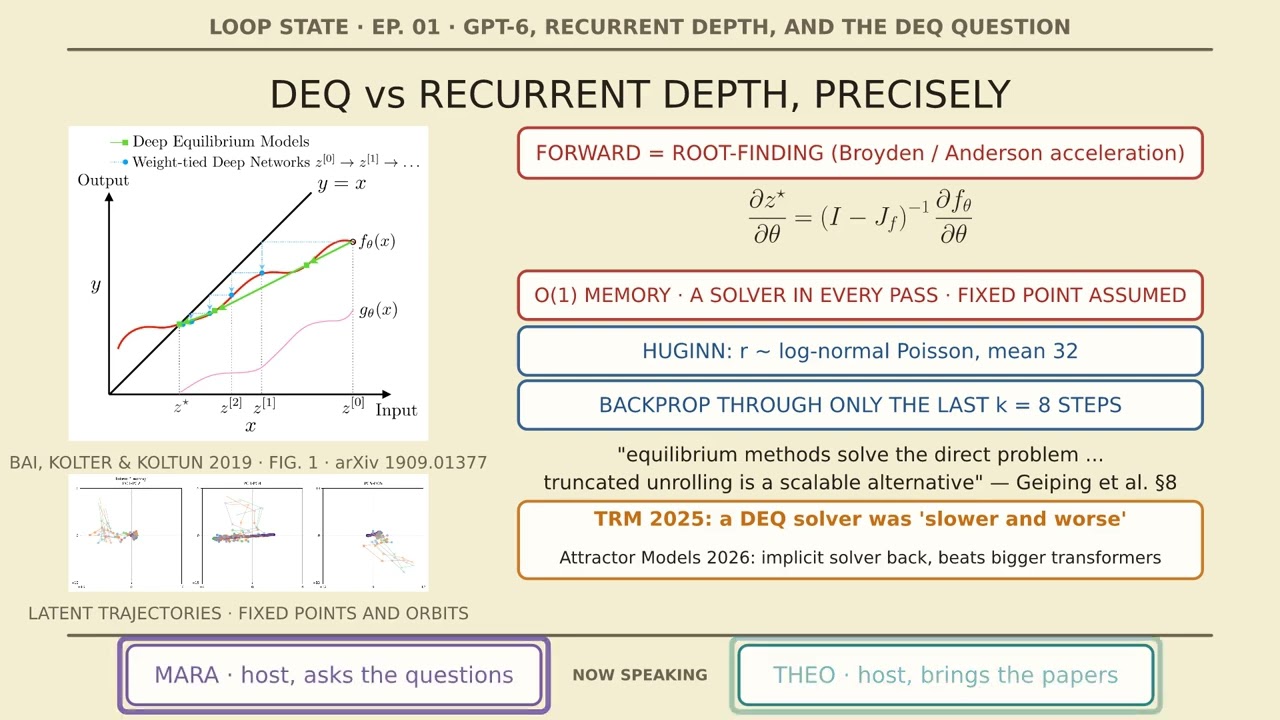
Theo gives an unambiguous verdict: recurrent depth is *not* a DEQ, despite both paradigms reusing a single weight-tied layer block. A DEQ is strictly defined by an equilibrium condition; it solves for an explicit fixed-point hidden state $z^*$ satisfying $z^* = f(z^*, x)$, utilizing numerical root-finders and computing gradients via the implicit function theorem. A looped transformer operates under an entirely different contract: it simply unrolls the block for a pre-allocated or sampled budget of steps and backpropagates through that unrolled trajectory.
As Mara summarizes, "One is find the equilibrium. The other is iterate and stop when you've had enough." While a DEQ trains a model to produce a stationary state, recurrent depth trains the representation to be maximally useful after a bounded compute budget. Furthermore, empirical observations reveal that hidden states in looped models exhibit complex dynamical behaviors: while simple tokens may settle into fixed points, difficult reasoning tokens routinely fall into stable periodic orbits. Because a DEQ's root-finder can only resolve a single fixed point per input, it cannot naturally represent an orbit.
| Property | Deep Equilibrium Model (DEQ) | Recurrent-Depth / Looped Transformer | |:--- |:--- |:--- | | **Mathematical Contract** | Solves for equilibrium: $z^* = f(z^*, x)$ | Finite iteration: $s_i = R(E, s_{i-1})$ | | **Training Gradient** | Implicit differentiation at $z^*$ (IFT) | Truncated backpropagation through depth | | **Solver Required** | Yes (e.g., Broyden, Anderson acceleration) | No numerical solver | | **Memory Footprint** | $O(1)$ constant in depth | Proportional to unrolled backprop window | | **Representable Dynamics** | Fixed points only | Fixed points AND multi-step orbits |
---
[02:02](https://www.youtube.com/watch?v=V03zLD8JKuU&t=122s) Mechanics of a Recurrent Depth Pass: Huginn Architecture
To make the mechanics concrete, Theo walks through the forward pass of Huginn, the open 3.5-billion-parameter reference model published by Geiping et al. in February 2025. The architecture is split into three modular stages:
1. **Prelude:** A shallow prefix of initial transformer layers that embeds the input sequence into a base latent tensor, $E$. 2. **Recurrent Block ($R$):** The core weight-tied transformer block unrolled across depth. 3. **Coda:** A shallow postfix of final layers that unembeds the latent representation into output token logits.
```mermaid flowchart TD accTitle: Huginn Recurrent Depth Forward Pass accDescr: Dataflow diagram of the Huginn architecture showing prelude embedding, recurrent block iterations with fresh injection, and coda projection. subgraph S1 ["1. Embedding"] Tokens["Input Tokens"] --> Prelude["Prelude Layers"] Prelude --> E["Latent Vector E"] end
subgraph S2 ["2. Recurrent Loop (Steps 1 to r)"] Noise["s₀ ~ Gaussian Noise"] --> Loop E -->|"Fresh injection at step i"| Loop["sᵢ = R(E, sᵢ₋₁)"] Loop -->|"Iterate r times"| Loop end
subgraph S3 ["3. Prediction"] Loop -->|"Final state sᵣ"| Coda["Coda Layers"] Coda --> Logits["Output Token Logits"] end ```
Crucially, the starting state $s_0$ is initialized as pure Gaussian noise rather than the token embedding itself. At every recurrence step $i \in \{1, \dots, r\}$, the static embedding $E$ is injected fresh alongside the prior recurrent state:
$$s_i = R(E, s_{i-1})$$
Theo identifies this continuous re-injection as the "deep thinking" trick originated in work by Bansal and Anil. Feeding $E$ into every iteration guarantees path independence, stabilizing recurrence so the final trajectory does not degenerate or drift based on initial noise. Mara draws the direct analogy: the recurrence operator functions like iterative optimization, repeatedly re-reading the conditioning data at every step just as gradient descent repeatedly queries a dataset.
---
[03:25](https://www.youtube.com/watch?v=V03zLD8JKuU&t=205s) Solvers, Orbits, and Truncated Unrolling
Comparing the training pipelines highlights the architectural divergence between classical DEQs and recurrent depth. Bai, Kolter, and Koltun (2019) designed DEQs to find $z^* = F(z^*, x)$ using root-finding algorithms such as Broyden's method or Anderson acceleration. Because gradients are derived purely at the fixed point via the implicit function theorem, DEQs never store intermediate activations, yielding $O(1)$ constant memory overhead with respect to depth. The heavy penalty is paying for an iterative numerical solver during *both* the forward and backward passes, under the strict mathematical assumption that a stable fixed point exists.
Huginn discards these assumptions completely: - **Randomized Recurrence:** During pre-training, the recurrent budget $r$ is sampled dynamically from a log-normal Poisson distribution with a mean of 32. - **Truncated Backpropagation:** Gradients are backpropagated solely through the final 8 unrolled steps, mirroring truncated backpropagation through time (BPTT) in recurrent neural networks, but executed down the depth dimension. - **Non-Equilibrium Dynamics:** Examining latent trajectories demonstrates that simpler tokens converge toward stationary fixed points, whereas complex tokens drift into multi-step periodic orbits.
Subsequent investigations have tested whether explicit fixed-point solvers could be reintroduced into recursive architectures. In the Tiny Recursive Model (Jolicoeur-Martineau, 2025), replacing looped execution with a DEQ solver made training markedly slower and harmed model quality, reinforcing their thesis that "converging to a fixed point is not essential." While recent attractor architectures continue to explore implicit differentiation to outperform standard transformers, the consensus remains that recurrent depth treats depth as a flexible compute budget rather than a mathematical destination.
---
[05:31](https://www.youtube.com/watch?v=V03zLD8JKuU&t=331s) Lineage: From Universal Transformers to GPT-6
The hosts map the intellectual lineage that elevated looping from an obscure architectural tweak into a primary frontier pre-training axis:
```mermaid flowchart TD accTitle: Lineage of Looped Transformers accDescr: Historical progression from Universal Transformers in 2018 up to Astra and GPT-6 in 2026. UT["2018: Universal Transformers<br/>(Dehghani et al.)<br/>Recurrent layer + ACT halting"] DEQ["2019: Deep Equilibrium Models<br/>(Bai et al.)<br/>Infinite depth fixed-point limit"] PROG["2023: Algorithmic Foundations<br/>Giannou et al. (programmable computer)<br/>Yang et al. (iterative algorithms)"] SCALE["2025: Scaling Explosion<br/>• Huginn (Geiping et al., 3.5B)<br/>• Saunshi et al. (Latent Thoughts law)<br/>• Ouro (Zhu et al., 7.7T tokens)<br/>• Mixture-of-Recursions (Bae et al.)"] GPT6["2026: Frontier Deployment<br/>GPT-6 / Astra<br/>Constrained recurrent depth"]
UT --> DEQ UT --> PROG DEQ --> SCALE PROG --> SCALE SCALE --> GPT6 ```
- **2018 (Universal Transformers):** Dehghani et al. pioneer recurrently applying a single transformer layer alongside adaptive computation time (ACT) for dynamic halting. - **2019 (Deep Equilibrium Models):** Bai, Kolter, and Koltun take the looped block to its mathematical limit at infinity, using numerical solvers to find fixed points. - **2023 (Algorithmic Expressivity):** Theoretical works demonstrate the distinct computational advantages of looping: Giannou et al. prove looped transformers act as programmable computers, while Yang et al. demonstrate that loops learn iterative routines far better than fixed-depth networks. - **2025 (The Scaling Explosion):** - *Huginn* (Geiping et al.): Validates stable pre-training of a 3.5-billion-parameter recurrent model over 800 billion tokens. - *Saunshi et al.:* Formalize looped transformers as internal "latent thoughts" and derive the first depth scaling law. - *Ouro* (Zhu et al.): Pre-trains recurrent language models on a massive 7.7-trillion-token corpus. - *Mixture-of-Recursions* (Bae et al.): Implements dynamic token-level routing, allowing individual tokens to selectively choose their own recurrent loop count. - **2026:** Frontier model implementations culminate in OpenAI's GPT-6 (Astra).
---
[06:41](https://www.youtube.com/watch?v=V03zLD8JKuU&t=401s) Scaling Law 1: Test-Time Recurrence (Huginn)
The first scaling law governs what happens when you hold pre-trained weights constant and adjust the number of recurrent iterations $r$ during inference. Huginn evaluated test-time recurrence sweeps across $r \in [1, 64]$ on their 3.5-billion-parameter checkpoint trained on 800 billion tokens.
The performance gains scale dramatically with task difficulty: - **GSM8K (Chain-of-Thought):** Starts near 0% accuracy at $r = 1$, surpasses 25% around $r = 8$, and climbs into the 40s by $r = 32$. - **ARC-Challenge:** Rises steadily from 22% up to 44%. - **OpenBookQA:** Improves from 25% to approximately 41%.
Harder tasks continue consuming depth compute productively far longer than easier tasks. Geiping et al. plot a secondary horizontal axis labeled "materialized parameters": unrolling the 3.5B core block for 32 recurrent passes executes the forward FLOPs equivalent to a 50-billion-parameter dense model, all while retaining the GPU memory footprint of 3.5 billion stored weights.
To prevent simple prompts from wasting FLOPs, Huginn deploys a zero-shot early-exit heuristic. If the Kullback–Leibler (KL) divergence between token representations across two consecutive recurrent steps drops below $5 \times 10^{-4}$ (5 in 10,000), the loop halts immediately. Under this rule, straightforward high school mathematics problems exit early, whereas intricate ethical and moral dilemmas require an average of 3.5 additional recurrent iterations before stabilizing.
---
[07:58](https://www.youtube.com/watch?v=V03zLD8JKuU&t=478s) Scaling Law 2: Accuracy is Linear in Log Depth (Saunshi et al.)
Saunshi et al. (2025) investigate the expressivity of recurrent depth by comparing a 4-layer core block looped $L \in \{1, 2, 3, 6, 9, 12\}$ times against an unshared baseline transformer featuring $4L$ unique layers. While both setups share the identical effective depth ($4L$), the looped variant uses $L$ times fewer total parameters.
Their empirical evaluation establishes a universal log-depth scaling relationship that cleanly fits both architectures:
$$\text{Accuracy} = \alpha \log(\text{Effective Depth}) + \beta$$
The critical metric is the efficiency ratio $\alpha_{\text{loop}} / \alpha_{\text{base}}$, which measures how much of the unshared depth benefit is retained when weight-tying the layers: - **Math Word Problems & OpenBookQA:** The ratio reaches roughly 0.6, meaning looping provides 60% of the accuracy gains of adding unshared parameters. - **Reasoning Primitives:** The ratio hits 1.2—meaning looping a single block actually *outperforms* stacking fresh, unconstrained layers.
When an underlying task requires iterative algorithmic computation, parameter sharing acts as an inductive bias rather than a penalty. Saunshi et al. prove theoretically that a single-layer transformer block looped $\log N$ times can compose $N$ permutation group elements, demonstrating that looped execution faithfully simulates internal chain-of-thought reasoning without emitting intermediate tokens.
---
[09:11](https://www.youtube.com/watch?v=V03zLD8JKuU&t=551s) Scaling Law 3: Chinchilla for Loops (Ouro)
In the Ouro study, Zhu et al. extend the Chinchilla pre-training scaling laws by introducing an explicit term for recurrent depth. Fitting evaluation loss across five model sizes (53 million to 1.36 billion parameters) and recurrence counts ($T_{\max} \in \{1, 2, 4, 8\}$) over a 7.7-trillion-token budget, they model loss as:
$$L = E + \frac{A}{(N + t_1)^\alpha} + \frac{B}{(D + t_2)^\beta} + \frac{C}{(T_{\max} + t_3)^\gamma}$$
The fit achieves an $R^2$ of 0.96 with a positive exponent $\gamma$, confirming that increasing loop budgets yields predictable power-law reductions in pre-training perplexity.
However, Theo highlights the necessary caveat: at equal FLOP budgets, a dense transformer composed of fresh layers still outperforms a looped model by 1.5 to 4 benchmark points. This performance gap widens as the loop count increases and narrows as model parameter size expands. Looping confers sheer parameter efficiency, not "free" accuracy.
Under heavy pre-training, Ouro demonstrates that a 2.6-billion-parameter model looped 4 times matches standard 8-billion dense models on reasoning-heavy tasks. Probing the hidden activations reveals the underlying mechanism: recurrent loops do not expand factual memory storage—which remains fundamentally pegged at roughly 2 bits per parameter—but instead expand the computational manipulation capacity applied to those stored facts. Bae et al.'s Mixture-of-Recursions reinforces this at isoFLOP frontiers, showing that routing compute dynamically per token maximizes reasoning efficiency without bloating parameter counts.
---
[10:52](https://www.youtube.com/watch?v=V03zLD8JKuU&t=652s) The Exchange Rate: How Much is One Recurrence Worth? ($\phi = 0.46$)
Closing the loop on parameter efficiency, Theo cites an April 2026 paper (*Iso-Depth Scaling Laws*) that computes an exact exchange rate between repeated blocks and fresh layers. Fitting 116 experimental runs to a modified Chinchilla formula, the authors express effective parameter count by weighting recurrent blocks with an exponent $\phi$:
$$N_{\text{eff}} = N_{\text{unique}} + r^\phi \cdot N_{\text{recurrent}}$$
Across the benchmark sweeps, $\phi$ converges with tight confidence bounds to **0.46**: - At matched compute, one recurrence pass is worth roughly half of a unique, unshared transformer block. - Unrolling a single block through 4 loops behaves mathematically like 1.9 distinct layers, rather than 4 full layers.
This exchange rate explains why industrial implementations converge on conservative recurrence budgets: - **Nambe:** Loops 2 times. - **Loopy:** Loops 2 times. - **Ouro:** Loops 4 times. - **OpenAI (Astra):** Jakub Pachocki's comment that graph depth is within a factor of two implies an internal recurrence budget of 3 to 4 loops.
Industry practitioners deliberately cap recurrence where the marginal return curves flatten. Finally, Theo points out that $\phi$ is sensitive to the underlying optimization recipe: truncating backpropagation drops $\phi$ to 0.38, whereas introducing dense hyper-connections across the loop elevates $\phi$ to 0.65. Tuning this parameter exchange rate represents the precise optimization frontier that top labs now compete over.
[12:14](https://www.youtube.com/watch?v=V03zLD8JKuU&t=734s) What the Evidence Actually Shows: GPT-6 Rumors vs. Academic Limits
Mara pulls back to ground the discussion in what is verified versus what is pure speculation, asking point-blank what the community actually knows about GPT-6 versus what is merely being inferred. When stripped down to confirmed public facts, the record is remarkably sparse: there is only a single anonymous report citing "recurrent depth," a post from OpenAI Chief Scientist Jakub Pachocki bounding the compute-graph depth at roughly twice that of GPT-4, and a system card noting that a drop in chain-of-thought monitoring capability was not differentially caused by architecture. Everything else—the actual loop count, the training distribution over recurrence factor $r$, and the empirical scaling curve—remains completely hidden behind closed doors.
```mermaid flowchart TD accTitle: Recurrent Depth Inference Trade-off accDescr: Diagram illustrating the operational cost and latency trade-offs during test-time recurrence passes. subgraph LoopStage["Recurrent Block (Pass 1 to r)"] Attn["Recompute Attention"] Attn --> KV["Write KV Cache Entry"] KV --> Exit{"Early Exit Gate?"} end In["Token Representation"] --> Attn Exit -->|"Continue Loop"| Attn Exit -->|"Exit / Max Steps"| Out["Output Token"] ```
Theo points out that the published academic literature has severe boundaries of its own. Huginn represents an academic exploration evaluated on a single 3.5-billion-parameter checkpoint trained on 800 billion tokens without a learning rate cooldown. On the other end, Ouro pushed training out to 7.7 trillion tokens, but its model sizes capped out at 2.6 billion parameters. Simply put, no one in the open research community has ever published a frontier-scale scaling law incorporating an explicit loop term.
Compounding these empirical gaps is the unresolved question of serving and inference costs. Recurrent depth fundamentally trades stored parameter weights for wall-clock latency: every single loop recomputes attention across the sequence and writes a fresh entry into the KV cache. While architectural mitigations like early-exit routing gates and reusing only the deepest cache entry can ease the burden, running recurrent iterations inflates latency per token. The actual economic exchange rate between memory bandwidth, latency, and parameter reuse at frontier scale is completely unpublished. As Theo and Mara summarize, the only defensible baseline claim is that "GPT-6 loops. The loop is a proven third scaling axis at small scale, and the frontier numbers are unknown. That's the whole claim."
- **Public evidence on GPT-6 (Astra):** One anonymous report in *The Information*, an informal upper bound from Jakub Pachocki stating compute-graph depth is within twice GPT-4's depth, and an official system card clarification regarding chain-of-thought monitor degradation. - **Limits of open benchmarks:** Huginn trained a single 3.5B model on 800B tokens with no learning rate schedule cooldown; Ouro trained across 7.7T tokens but strictly on sub-3B scale models (topping out at 2.6B). - **Inference overhead:** Recurrence imposes severe compute penalties by continually appending to the KV cache and recomputing self-attention layers unless managed by early-exit gating heuristics.
---
[13:30](https://www.youtube.com/watch?v=V03zLD8JKuU&t=810s) Final Takeaways: Depth as a Per-Token Budget and the Mystery of $\varphi$
Wrapping up the inaugural episode, Mara provides her core synthesis of the architectural debate: recurrent depth is fundamentally not a Deep Equilibrium Model (DEQ). Rather than seeking a fixed point through root-finding algorithms and implicit differentiation, it is a practical looped transformer that treats computational depth as an allocateable compute budget spent dynamically per token—a budget governed in open papers by a predictable logarithmic law.
Theo frames the ultimate open research frontier around the parameter substitution metric $\varphi$ (phi). In recent iso-depth scaling literature, the exchange rate between a stored unique parameter and an unrolled, recurrent parameter hovers around $\varphi = 0.46$, meaning a looped iteration buys roughly half the utility of a brand-new unique weight block. Whether frontier-scale pre-training alters this exchange rate remains the primary secret guarded by frontier labs: "That's the number GPT-6 knows and we don't." With that lingering mystery, the hosts sign off with the show's signature motto: "Iterate until it makes sense."
## Notable quotes > [00:01](https://www.youtube.com/watch?v=V03zLD8JKuU&t=1s) constrained form of recurrent depth — The Information
> [01:09](https://www.youtube.com/watch?v=V03zLD8JKuU&t=69s) One is find the equilibrium. The other is iterate and stop when you've had enough. — Mara
> [02:02](https://www.youtube.com/watch?v=V03zLD8JKuU&t=122s) deep thinking — Theo
> [03:25](https://www.youtube.com/watch?v=V03zLD8JKuU&t=205s) converging to a fixed point is not essential. — Alexia Jolicoeur-Martineau
> [06:41](https://www.youtube.com/watch?v=V03zLD8JKuU&t=401s) materialized parameters — Theo
> [07:58](https://www.youtube.com/watch?v=V03zLD8JKuU&t=478s) latent thoughts — Saunshi et al.
> [12:14](https://www.youtube.com/watch?v=V03zLD8JKuU&t=734s) GPT-6 loops. The loop is a proven third scaling axis at small scale, and the frontier numbers are unknown. That's the whole claim. — Theo and Mara
> [13:30](https://www.youtube.com/watch?v=V03zLD8JKuU&t=810s) That's the number GPT-6 knows and we don't. — Theo
> [13:30](https://www.youtube.com/watch?v=V03zLD8JKuU&t=810s) Iterate until it makes sense. — Mara and Theo
## Mentioned OpenAI, GPT-6 (Astra), GPT-4, Jakub Pachocki, The Information, Mara, Theo, Loop State, Deep Equilibrium Models (DEQ), Huginn, Ouro, Universal Transformers, Tiny Recursive Model, Mixture-of-Recursions, Path Independent Equilibrium Models, Geiping et al., Saunshi et al., Zhu et al., Bai, Kolter & Koltun, Alexia Jolicoeur-Martineau, Bae et al., Giannou et al., Yang et al., GSM8K, ARC-Challenge, OpenBookQA, Nambe, Loopy, Leanim, MiniMax
## Video description OpenAI's GPT-6 (codename Astra) shipped on September 3, 2026, and one architecture phrase leaked out with it: "recurrent depth." One block of layers, reused in a loop. The first question everyone asked: is this just a deep equilibrium model wearing a new name?
Loop State is a two-host research podcast rendered as a Leanim board. Mara asks the questions, Theo brings the papers. We answer the DEQ question first, then trace the looped-transformer lineage and the three scaling laws people have measured for it.
Short answer: no. A DEQ solves for a fixed point z* = f(z*, x) with a root-finder and trains through it with implicit differentiation. Recurrent-depth transformers unroll a weight-tied block a finite number of times and backpropagate through the unrolled steps. No solver, no fixed point required. The tell: looped models show fixed points AND orbits, and a DEQ can only represent the former.
Chapters 00:00 Cold open: a frontier model that loops 01:09 The answer: not a DEQ, and why 02:02 One forward pass: prelude, recurrent block, coda (Huginn) 03:25 DEQ vs recurrent depth, precisely 05:31 The lineage: Universal Transformers to GPT-6
Chapters 00:00 Cold open: a frontier model that loops 01:09 The answer: not a DEQ, and why 02:02 One forward pass: prelude, recurrent block, coda (Huginn) 03:25 DEQ vs recurrent depth, precisely 05:31 The lineage: Universal Transformers to GPT-6 06:41 Scaling law 1: test-time recurrence (Huginn 3.5B) 07:58 Scaling law 2: accuracy is linear in log depth (Saunshi et al.) 09:11 Scaling law 3: a Chinchilla term for loops (Ouro, 7.7T tokens) 10:52 How much is one recurrence worth? φ = 0.46 12:11 What the evidence does not show 13:30 Sign-off
On GPT-6: the "recurrent depth" claim comes from a single anonymous source (The Information, Sept 1). OpenAI has not confirmed it. Jakub Pachocki said Astra's compute-graph depth is withinpapers, and we label it that way.
Papers discussed - Scaling up Test-Time Compute with Latent Reasoning: A Recurrent Depth Approach (Huginn), Geiping et al. 2025: https://arxiv.org/abs/2502.05171 - Reasoning with Latent Thoughts: On the Power of Looped Transformers, Saunshi et al. 2025: https://arxiv.org/abs/2502.17416 - Scaling Latent Reasoning via Looped Language Models (Ouro), Zhu et al. 2025: https://arxiv.org/abs/2510.25741 - Iso-Depth Scaling Laws: How Much Is One Recurrence Worth?, 2026: https://arxiv.org/abs/2604.21106 - Deep Equilibrium Models, Bai, Kolter & Koltun 2019: https://arxiv.org/abs/1909.01377 - Mixture-of-Recursions, Bae et al. 2025: https://arxiv.org/abs/2507.10524 - Tiny Recursive Model, Jolicoeur-Martineau 2025: https://arxiv.org/abs/2510.04871 - Universal Transformers, Dehghani et al. 2018: https://arxiv.org/abs/1807.03819 - Path Independent Equilibrium Models, Anil et al. 2022: https://arxiv.org/abs/2211.09961
Key numbers - Huginn: 3.5B params, 800B tokens; GSM8K CoT goes from ~0% at r=1 to the 40s at r=32; r=32 is the compute of a ~50B dense model. - Saunshi: Acc = α log D + β; α_loop/α_base = 0.6 on math word problems, 1.2 on reasoning primitives. - Ouro: L = E + A/(N+t₁)^α + B/(D+t₂)^β + C/(T_max+t₃)^γ, R² = 0.96; 2.6B × 4 loops ≈ 8B dense on reasoning benchmarks; knowledge capacity stays ~2 bits/param. - Iso-depth law: φ = 0.46, so at matched FLOPs one recurrence is worth about half a unique block. That's why industry stops at 2 to 4 loops.
Production: two MiniMax voices at natural 1.0× speed, every turn measured before a single frame was drawn; rendered with Leanim (Lean 4). Source figures are rasterized from the arXiv e-prints and credited on screen.
#GPT6 #OpenAI #LoopedTransformer #RecurrentDepth #DeepEquilibrium #ScalingLaws #LLM #AIResearch #Huginn #Ouro
[Source](https://www.youtube.com/watch?v=V03zLD8JKuU)