Recurrent Diffusion Model Hits 99.9% Sudoku Accuracy Without Timesteps
Xiaol.x
Isolating reasoning within an uncorrupted recurrent latent enables models to solve complex puzzles under continuous maximal noise injection without step counters or external verifiers.
AI-assisted summary of How AI Solves Sudoku Through Noise: The Hidden State That Learns to Reason — original source. Check the original for full context.
Source published:
Key ideas
- A new framework (arXiv:2609.01449) equips a diffusion denoiser with persistent recurrent memory but no timestep or iteration counter, achieving a 99.9% exact solve rate on Sudoku Extreme at 10,000 steps and 98.93% on Maze Unique in 100 steps. (0:00)
- Rather than annealing noise at test time, continuously injecting maximal Gaussian noise at every single inference step enables single-trajectory exploration, locking 99.24% of converged trajectories onto the correct solution. (4:14)
- Mid-inference causal interventions reveal the observable board is disposable: resetting the noisy board while keeping the hidden state raises solve rates from 82.5% to 88.09%, whereas resetting the hidden state drops accuracy to 58.03%. (5:18)
- The hidden state receives zero direct supervision, developing purely as an indirect learner through four-step truncated backpropagation across an annealed diffusion training curriculum. (3:00)
Detailed notes
## Background Published on YouTube by Xiaol.x on September 7, 2026, this video breaks down arXiv:2609.01449, 'Diffusion as a Training Curriculum for Timestep-Free Iterative Reasoning,' through a two-host podcast format. The presentation explains how equipping a diffusion denoiser with persistent recurrent memory enables it to solve complex reasoning benchmarks like Sudoku and mazes without timesteps, iteration counters, or external verifiers.
## TL;DR The episode analyzes a recurrent architecture where a diffusion denoiser operates without explicit timesteps or counters, decoupling noisy observable states from an uncorrupted internal memory latent. By passing representations through a shared transformer block that forks into a normalized hidden state and an observable prediction, the network accumulates reasoning across iterations without suffering from drift. Trained via truncated backpropagation on an annealed curriculum, the system can solve puzzles even when unknown cells are wiped with maximal Gaussian noise at every inference step, achieving a 99.9% exact solve rate on Sudoku Extreme at 10,000 steps. Surgical interventions confirm that the hidden state acts as a spatially structured logical notebook rather than a simple clock, establishing that recurrence powers the reasoning while diffusion serves as the curriculum.
## Atmosphere & style The video adopts an intellectually engaging, podcast-style dialogue where co-hosts unpack counterintuitive technical paradoxes with infectious curiosity. Mara and her co-host anchor the dense architectural formulas and ablation metrics in vivid conceptual analogies, such as contrasting a malfunctioning sensor with a clean notebook. The pacing moves smoothly from mechanical breakdowns to empirical post-mortems, giving the listener the sensation of sitting in on a rigorous yet accessible research lab debrief.
## Bulletin - [00:00](https://www.youtube.com/watch?v=d1xVxxPTwus&t=0s) A new framework (arXiv:2609.01449) equips a diffusion denoiser with persistent recurrent memory but no timestep or iteration counter, achieving a 99.9% exact solve rate on Sudoku Extreme at 10,000 steps and 98.93% on Maze Unique in 100 steps. - [04:14](https://www.youtube.com/watch?v=d1xVxxPTwus&t=254s) Rather than annealing noise at test time, continuously injecting maximal Gaussian noise at every single inference step enables single-trajectory exploration, locking 99.24% of converged trajectories onto the correct solution. - [05:18](https://www.youtube.com/watch?v=d1xVxxPTwus&t=318s) Mid-inference causal interventions reveal the observable board is disposable: resetting the noisy board while keeping the hidden state raises solve rates from 82.5% to 88.09%, whereas resetting the hidden state drops accuracy to 58.03%. - [03:00](https://www.youtube.com/watch?v=d1xVxxPTwus&t=180s) The hidden state receives zero direct supervision, developing purely as an indirect learner through four-step truncated backpropagation across an annealed diffusion training curriculum.
## Key takeaways - [00:00](https://www.youtube.com/watch?v=d1xVxxPTwus&t=0s) The model operates as an 'anytime solver' with no clock, timestep index, or iteration counter, determining progress strictly from the corrupted board, fixed clues, and previous latent memory. - [00:00](https://www.youtube.com/watch?v=d1xVxxPTwus&t=0s) Reasoning scales continuously with recurrent compute depth instead of drifting or plateauing, reaching a 99.9% solve rate on Sudoku Extreme given 10,000 steps. - [00:54](https://www.youtube.com/watch?v=d1xVxxPTwus&t=54s) Fixed clue pinning isolates immutable puzzle constraints from corrupted guesses, ensuring original givens never degrade while allowing the observable board to fluctuate. - [00:54](https://www.youtube.com/watch?v=d1xVxxPTwus&t=54s) A dual-branch recurrent backbone splits the processed latent into an uncorrupted memory update via LayerNorm and a visible board guess via a linear output map. - [00:54](https://www.youtube.com/watch?v=d1xVxxPTwus&t=54s) The recurrent framework generalizes across domains by swapping the relational self-attention used for Sudoku with local convolutional cellular-automaton blocks for maze solving. - [03:00](https://www.youtube.com/watch?v=d1xVxxPTwus&t=180s) Truncated backpropagation through time over four steps updates memory indirectly, as loss is applied exclusively to output predictions rather than the hidden state. - [03:00](https://www.youtube.com/watch?v=d1xVxxPTwus&t=180s) Diffusion functions fundamentally as a structured training curriculum rather than an inference schedule; removing noise during training causes complete model collapse. - [04:14](https://www.youtube.com/watch?v=d1xVxxPTwus&t=254s) Forcing maximal noise at every inference step enables a single trajectory to explore alternative hypotheses without needing external rule verifiers or parallel beam search. - [04:14](https://www.youtube.com/watch?v=d1xVxxPTwus&t=254s) Eliminating inference noise causes accuracy to drop to 49.39%, demonstrating that continuous stochastic injection is required to prevent the model from getting stuck. - [05:18](https://www.youtube.com/watch?v=d1xVxxPTwus&t=318s) Causal ablations prove the hidden memory is not an abstract step counter, as spatially shuffling memory vectors degrades solve rates to 29.38% and global shuffling collapses performance to 0.27%. - [06:23](https://www.youtube.com/watch?v=d1xVxxPTwus&t=383s) The core mental model frames the architecture as a noisy sensor paired with a clean notebook: diffusion provides the curriculum, while recurrence carries the reasoning. - [06:23](https://www.youtube.com/watch?v=d1xVxxPTwus&t=383s) Visual trajectories show candidate cell assignments dynamically flipping between correct and incorrect states across iterations as the persistent notebook progressively resolves the puzzle.
## Detailed walkthrough ### [00:00](https://www.youtube.com/watch?v=d1xVxxPTwus&t=0s) A Timestep-Free Denoiser with Persistent Memory
The episode opens by introducing a deceptively simple question explored in arXiv:2609.01449: what happens if a diffusion denoiser is given a persistent memory but stripped of any clock, timestep index, or iteration counter? The co-host immediately points out the seeming paradox—without a diffusion timestep $t$ or an iteration index, the neural network has no explicit way of knowing whether it is executing step 1 or step 100. The answer is that the network simply does not know. At any given iteration, it only observes three things: a corrupted puzzle state, a set of fixed clue cells, and a hidden latent tensor carried over from the immediately preceding step.
The practical consequence of this design is an "anytime solver" whose reasoning capabilities scale directly with recurrent depth. Rather than degrading or drifting when pushed past its initial horizon, more inference steps consistently improve the accuracy of the answer. The hosts highlight the paper's benchmark numbers to illustrate just how potent this mechanism is: on the benchmark dataset Sudoku Extreme, the model achieves a 99.9% exact solve rate when given 10,000 inference steps. On Maze Unique, it achieves a 98.93% solve rate in 100 steps. As Mara emphasizes, the headline story here is not generating visually appealing images; it is about computation accumulating steadily in a latent space where noise cannot wipe it out: "computation accumulating somewhere the noise cannot erase."
- **Core premise**: A diffusion denoiser operating with persistent recurrent memory ($h_k$) but zero awareness of time, step count, or iteration index. - **Sudoku Extreme performance**: Reaches 99.9% exact solve rate at 10,000 inference steps. - **Maze Unique performance**: Achieves 98.93% exact solve rate at 100 inference steps.
---
[00:54](https://www.youtube.com/watch?v=d1xVxxPTwus&t=54s) Pinned Givens and the Two-Stream Architecture
To explain how the system isolates reasoning from corruption, the hosts dissect the observable board state. In a Sudoku instance, the board consists of fixed clue cells (givens) and unknown cells. The clues remain permanently pinned, while only the unknown cells undergo corruption. This means the observable board $x_k$ at step $k$ is never the final ground truth; it is merely a noisy, fluctuating guess. Under the paper's variance-preserving diffusion path, unknown cells at $t=0$ are maximally corrupted with Gaussian noise, whereas at $t=1$ they represent the clean target. Through an explicit pinning operation, the fixed clue embeddings are copied directly back into every corrupted board, guaranteeing that the original givens never drift or degrade. This decouples the representation into two distinct information streams: the observable board can be overwritten at will, while the underlying puzzle geometry and clue identities remain immutably accessible.
```mermaid flowchart TD accTitle: Recurrent Diffusion Block Architecture accDescr: Diagram showing how pinned noisy board and hidden state pass through shared transformer blocks to produce both updated memory and the current prediction.
subgraph Inputs ["Input Processing"] X["Pinned Noisy Board xₖ"] --> EMB["Embed Eₓ + Pos + Clues"] H_IN["Previous Memory hₖ"] --> ADD["Feature Summation"] EMB --> ADD end
subgraph Core ["Recurrent Backbone"] ADD --> TRANS["Shared Transformer B_θ (8 Inner Passes)"] TRANS --> Z["Final Latent zₖ"] end
subgraph Outputs ["Dual Output Branches"] Z --> LN["LayerNorm(zₖ)"] Z --> LIN["Linear Output Map Eₒ"] LN --> H_OUT["Next Memory hₖ₊₁"] LIN --> Y_HAT["Denoised Guess ŷₖ"] end ```
The underlying network architecture processes these streams through an iterative loop. First, the pinned noisy board is embedded via an input mapping $E_x$, combined with learned positional features and a binary clue flag. The previous hidden state $h_k$ is then added directly to this representation. Crucially, $h_k$ is neither sampled from diffusion noise nor copied from any clean label; it is an internal construct generated entirely by the model itself. The merged features pass through a shared pre-norm transformer block $B_\theta$ applied across eight inner recurrent passes to produce a final latent tensor $z_k$. At that point, the latent splits into two separately normalized functional pathways:
1. **Persistent memory ($h_{k+1}$)**: Formed as $h_{k+1} = \text{LayerNorm}(z_k)$, this branch carries the refined reasoning state forward into the next recurrent step without fresh corruption. 2. **Current prediction ($\hat{y}_k$)**: Processed through a linear output map $E_o$, this branch emits the current denoised board guess.
The hosts note the architectural elegance: "Same computation, two destinations. Memory for future reasoning, prediction for the current visible answer." While Sudoku uses relational self-attention masks along rows, columns, and $3 \times 3$ boxes to model constraints, the exact same recurrent interface transfers to maze solving simply by swapping the attention module for a local convolutional cellular-automaton-style block.
---
[03:00](https://www.youtube.com/watch?v=d1xVxxPTwus&t=180s) Training Curriculum via Truncated Recurrence
The discussion turns to the training mechanism, which bridges diffusion noise schedules and recurrent backpropagation. Rollouts are sampled with variable trajectory lengths between 20 and 160 steps, but gradients are not backpropagated through the entire sequence. Instead, the model uses truncated backpropagation through time (BPTT), allowing gradients to flow through only four consecutive denoising steps. At each four-step boundary, the computation graph is detached, but the numerical hidden state $h_k$ survives intact across the boundary. The subsequent segment picks up that exact memory vector and pairs it with a newly sampled corruption of the clean target.
Because the loss function is an unweighted masked mean squared error applied exclusively to the prediction branch $\hat{y}_k$ over those four steps, there is zero direct supervision or loss applied to $h_k$. This turns the hidden state into an "indirect learner": gradient descent only updates the memory pathway if storing information there genuinely enhances the model's future prediction accuracy. Furthermore, training relies on an annealed corruption curriculum that starts with heavily corrupted states and gradually introduces cleaner targets. The hosts review the ablation studies demonstrating why this curriculum is indispensable:
- **Fixed noise training**: Training with fixed noise levels degrades the solve rate to approximately 82.73%. - **Zero noise training**: Completely removing noise corruption during training causes the model to collapse to a 0% solve rate in the reported setup. - **The primary role of diffusion**: As the hosts summarize, diffusion's critical contribution is serving as an ordered training curriculum rather than dictating the inference sampler.
---
[04:14](https://www.youtube.com/watch?v=d1xVxxPTwus&t=254s) Inference with Maximal Noise and Single-Trajectory Exploration
At test time, the standard execution starts with the hidden memory initialized to zeros ($h_0 = 0$) and all unknown cells initialized to pure Gaussian noise. But the authors introduced a profoundly counterintuitive modification: fixing the inference noise level permanently at $t=0$. This means that on every single inference step, every unknown cell is forcibly wiped and replaced with fresh, maximal Gaussian noise.
The hosts marvel at the resulting dynamic. The visible board is completely memoryless, forced into constant amnesia, yet the hidden state remains untouched by the corruption: "The visible board keeps forgetting. The hidden state does not. Noise explores alternatives in $X$. Memory carries structured progress in $H$." This separation allows a single rollout trajectory to simultaneously explore hypotheses and settle toward the solution without requiring parallel beam searches, candidate selectors, or external rule verifiers. Over repeated steps, the decoded Sudoku stabilizes even under constant noise injection:
- **Convergence stability**: 99.24% of trajectories remain locked on the unique correct solution once converged under maximal noise forcing. - **Ablation with zero noise**: When inference noise is completely eliminated, performance drops dramatically to 49.39%, proving that persistent stochastic noise performs active, necessary exploration.
---
[05:18](https://www.youtube.com/watch?v=d1xVxxPTwus&t=318s) Intervention Experiments and the Mechanics of the Hidden State
To verify what kind of information the hidden tensor actually maintains, the authors performed causal surgical interventions midway through inference—specifically at step 200 of a 400-step rollout:
| Intervention Condition (at Step 200) | Resulting Solve Rate | Mechanistic Takeaway | |:--- |:--- |:--- | | **Keep memory, reset board $x$ to pure noise** | **Rises from 82.5% to 88.09%** (annealed) | The observable board is entirely disposable; memory carries the solution. | | **Keep board $x$, reset memory $h$ to zero** | **Drops to 58.03%** | Without accumulated memory, the observable board alone cannot sustain reasoning. | | **Shuffle memory spatially across cell positions** | **Drops to 29.38%** | Memory maintains strict spatial correspondence with the puzzle board. | | **Shuffle memory values globally** | **Collapses to 0.27%** | Memory is not an abstract step counter; it encodes fine-grained instance state. |
These empirical results settle what the memory actually does: it is not a generic counter or timing device, but a spatially organized, instance-specific representation of where that exact puzzle stands in its logical resolution. Memory capacity also directly governs problem-solving performance: scaling the hidden state width from 64 channels to 256 channels yields consistent accuracy improvements across all evaluated recurrent compute budgets.
---
[06:23](https://www.youtube.com/watch?v=d1xVxxPTwus&t=383s) Code Boundaries, the Mental Model, and Visual Convergence
The conversation touches on reproducibility and the paper's implementation details. While the arXiv publication provides precise algorithmic pseudocode and full architectural specifications, it does not link to an official open-source code repository. Nonetheless, the hosts note that the algorithmic contract is clear and reproducible: pin the clue cells, embed the board and previous hidden state, loop the shared transformer or convolutional block eight times, split the latent into normalized memory and output prediction, and train with four-step truncated backpropagation. The only major difference across domains is communication topology: Sudoku relies on relational self-attention across rows, columns, and blocks, whereas maze solving relies on local cellular-automaton-style convolutions.
Mara and her co-host articulate the clean mental model of the system: > "The clean mental model is a noisy sensor plus a clean notebook. The sensor is $x_k$. The notebook is $h_k$. The denoiser reads both, writes a prediction, and updates the notebook."
Training requires an annealed noise schedule to teach the notebook what logical progress looks like, but once trained, the model can discard the clock and operate under continuous sensor noise. The motto of the paper brings it together: "Diffusion supplies the curriculum. Recurrence supplies the reasoning."
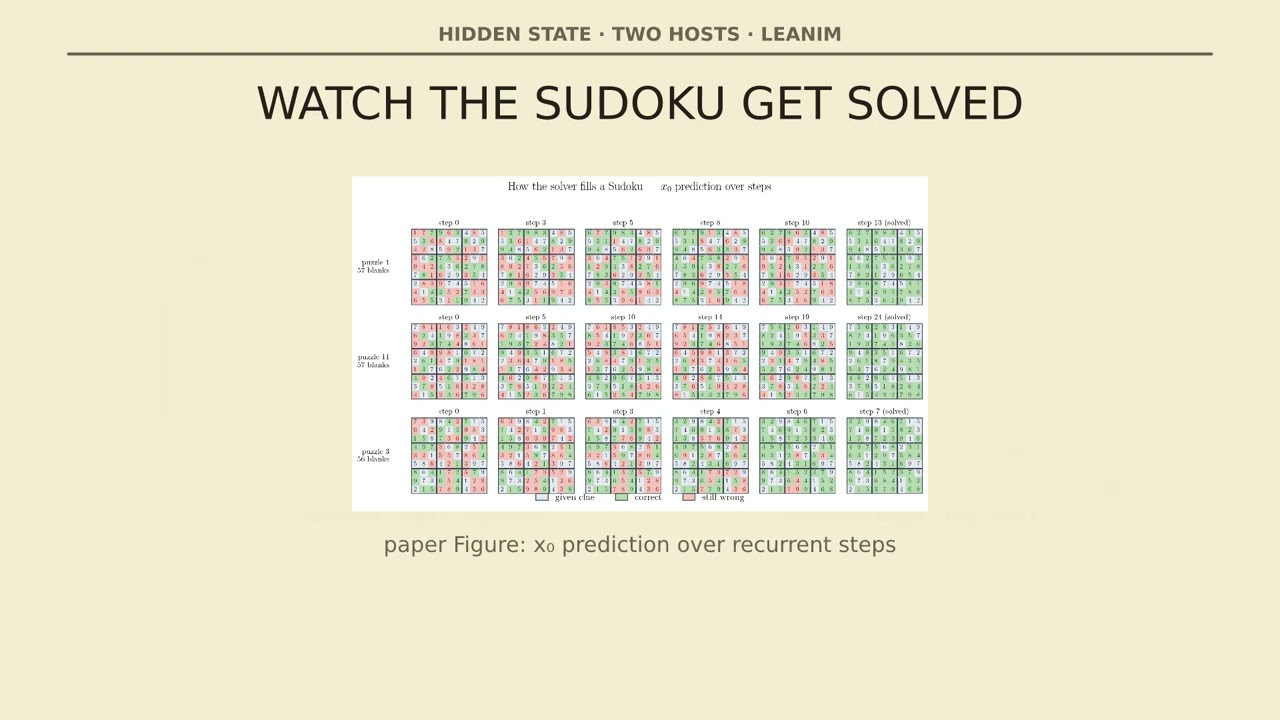
The walkthrough concludes by examining the paper's visual filmstrip of a Sudoku solve. Progress is not an instantaneous, single-pass completion; rather, at steps 0, 3, 5, 8, and 10, candidate cells continuously flip between correct and incorrect assignments (turning green or red) as the recurrent trajectory refines its hypothesis. The observable prediction is allowed to make mistakes because the hidden notebook preserves the underlying work. Quantitatively, this explains why memory-equipped models exhibit an upward-climbing accuracy curve that approaches 100% as step count $k$ increases, whereas memoryless diffusion baselines plateau prematurely.
## Notable quotes > [00:00](https://www.youtube.com/watch?v=d1xVxxPTwus&t=0s) computation accumulating somewhere the noise cannot erase. — Mara
> [00:54](https://www.youtube.com/watch?v=d1xVxxPTwus&t=54s) Same computation, two destinations. Memory for future reasoning, prediction for the current visible answer.
> [04:14](https://www.youtube.com/watch?v=d1xVxxPTwus&t=254s) The visible board keeps forgetting. The hidden state does not. Noise explores alternatives in X. Memory carries structured progress in H.
> [06:23](https://www.youtube.com/watch?v=d1xVxxPTwus&t=383s) The clean mental model is a noisy sensor plus a clean notebook. The sensor is xₖ. The notebook is hₖ. The denoiser reads both, writes a prediction, and updates the notebook. — Mara
> [06:23](https://www.youtube.com/watch?v=d1xVxxPTwus&t=383s) Diffusion supplies the curriculum. Recurrence supplies the reasoning.
## Mentioned arXiv:2609.01449, Sudoku Extreme, Maze Unique, Diffusion as a Training Curriculum for Timestep-Free Iterative Reasoning, Xiaol.x, Mara
## Video description What happens when a diffusion model gets a persistent memory but no timestep, no iteration counter, and no external verifier?
This video explains arXiv:2609.01449, Diffusion as a Training Curriculum for Timestep-Free Iterative Reasoning, through a two-host podcast-style lesson.
We follow the paper’s actual Sudoku results and show:
- How the noisy observable state xₖ changes at every step. - Where the persistent hidden state hₖ comes from. - Why hₖ₊₁ = LayerNorm(zₖ) becomes the model’s clean memory. - How the same latent produces both memory and the current prediction. - Why training needs annealed noise as a curriculum. - Why inference can use fresh maximal noise at every step. - How memory-enabled models continue solving as recurrent depth increases. - Why removing or shuffling the hidden state destroys performance. - How the method transfers from Sudoku to maze solving. - What the paper’s implementation specification says, and what remains unpublished.
The central idea is simple:
Diffusion supplies the training curriculum. Recurrence carries the reasoning.
Paper: https://arxiv.org/abs/2609.01449
Chapters:
00:00 A denoiser that keeps thinking 00:52 The observable puzzle state 02:02 Where the hidden state comes from 03:25 Training the memory indirectly 05:05 Inference with maximal noise 06:40 Interventions reveal what memory stores 08:00 Watching Sudoku get solved 09:20 Final mental model and code boundary
[Source](https://www.youtube.com/watch?v=d1xVxxPTwus)