Ukraine Drone Unit Beats NATO in Drills, Warns West on Defense Lag
The Economist
Western militaries risk catastrophic deterrence failure against Russia because peacetime procurement cannot match the six-month innovation cycles of cheap, autonomous drone warfare.
AI-assisted summary of Inside an elite Ukrainian drone unit: a special report | The Economist — original source. Check the original for full context.
Source published:
Key ideas
- The frontline kill zone in Ukraine has expanded to 30–40 kilometers wide, forcing forces subterranean and turning any vehicle movement within 7 km of the front into an immediate target for hunting FPV drones. (10:13)
- Ukrainian drone forces have abandoned NATO's standard TRL 9 procurement cycle for a 'TRL 7+' model, deploying systems that are merely battle-ready to counter an adversary electronic warfare environment that shifts every six months. (8:17)
- Ukraine's 412th Nemesis Brigade operates like a venture-backed tech startup, coordinating operations through an esports-like command center and scoring verified strikes on a competitive inter-brigade leaderboard. (1:54)
- Frontline drone density is scaling rapidly from hundreds toward thousands, driving an architectural shift toward jet-powered motherships, autonomous swarms, and AI coordination designed for deep-strike terror against civilian centers. (14:15)
Detailed notes
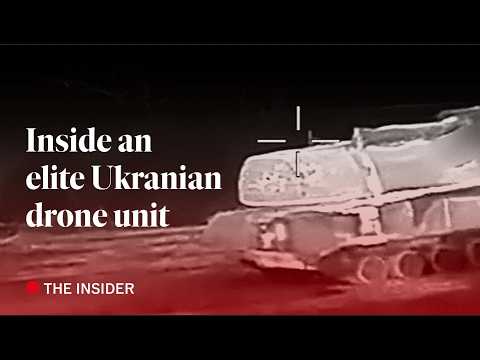
## Background Published by The Economist on YouTube on September 23, 2026, this special report follows editor-in-chief Zanny Minton Beddoes as she gains exclusive access inside an elite Ukrainian drone unit, the Nemesis Brigade. According to the description, the dispatch investigates how the unit operates at the heart of Ukraine's war machine, keeping pace with relentless innovation cycles while offering sharp advice and warnings to Western militaries.
## TL;DR Zanny Minton Beddoes reports from the command bunker of Ukraine's 412th Nemesis Brigade, an unmanned systems unit established by civilian tech founders and former prime minister Oleksiy Honcharuk that runs on agile startup principles and rapid technological iteration. Operating within an expanded 30-to-40-kilometer kill zone where ground movement is lethal, the brigade scores verified strikes on a gamified leaderboard and deploys cheap, rapidly adapted 'TRL 7+' hardware to counter evolving Russian countermeasures. Unit commanders outline how modern warfare has shifted toward autonomous swarms and state-sponsored civilian terror, warning that complacent Western militaries are severely underprepared for the scale and velocity of software-defined combat.
## Atmosphere & style The reporting carries an urgent, dystopian, and sobering mood, contrasting the detached, esports-like glow of command monitors with the brutal reality of loitering drones hunting individuals through city streets. Beddoes conducts sharp, incisive interviews against a constant backdrop of active frontline danger, made visceral when an incoming Russian Shahed drone is intercepted nearby during the visit. The narrative arc moves from technical awe to deep psychological disquiet, capturing the clinical routine of remote-controlled killing alongside a commander's stark observation that losing the ability to feel fear is a fatal symptom of exhaustion.
## Bulletin - [10:13](https://www.youtube.com/watch?v=W6dsLthcvzU&t=613s) The frontline kill zone in Ukraine has expanded to 30–40 kilometers wide, forcing forces subterranean and turning any vehicle movement within 7 km of the front into an immediate target for hunting FPV drones. - [08:17](https://www.youtube.com/watch?v=W6dsLthcvzU&t=497s) Ukrainian drone forces have abandoned NATO's standard TRL 9 procurement cycle for a 'TRL 7+' model, deploying systems that are merely battle-ready to counter an adversary electronic warfare environment that shifts every six months. - [01:54](https://www.youtube.com/watch?v=W6dsLthcvzU&t=114s) Ukraine's 412th Nemesis Brigade operates like a venture-backed tech startup, coordinating operations through an esports-like command center and scoring verified strikes on a competitive inter-brigade leaderboard. - [14:15](https://www.youtube.com/watch?v=W6dsLthcvzU&t=855s) Frontline drone density is scaling rapidly from hundreds toward thousands, driving an architectural shift toward jet-powered motherships, autonomous swarms, and AI coordination designed for deep-strike terror against civilian centers.
## Key takeaways - [00:01](https://www.youtube.com/watch?v=W6dsLthcvzU&t=1s) The Nemesis Brigade (the 412th Brigade of Ukraine's Unmanned Systems Forces) was created by civilian tech professionals and relies on flat management, radical transparency, and internal R&D over legacy military hierarchy. - [01:54](https://www.youtube.com/watch?v=W6dsLthcvzU&t=114s) Nemesis coordinates operations inside an esports-like command room, tracking confirmed strikes on an 'e-point' leaderboard that requires video verification from observation drones to score points. - [04:13](https://www.youtube.com/watch?v=W6dsLthcvzU&t=253s) Commercial dual-use hardware integrated with agile private-sector management and venture-capital backing has repeatedly outmatched costly legacy military systems in lethality and adaptability. - [08:17](https://www.youtube.com/watch?v=W6dsLthcvzU&t=497s) Wartime innovation requires accepting a compressed 'TRL 7+' standard; waiting for battle-tested TRL 9 hardware is obsolete because countermeasures alter the aerial combat landscape every three to six months. - [10:13](https://www.youtube.com/watch?v=W6dsLthcvzU&t=613s) The operational kill zone has expanded to a depth of 30 to 40 kilometers, rendering surface transit lethal and compelling frontline forces to live entirely subterranean. - [13:01](https://www.youtube.com/watch?v=W6dsLthcvzU&t=781s) Nemesis demonstrated decisive tactical advantages over NATO units in joint exercises, exposing significant Western institutional vulnerabilities to agile, software-defined warfare. - [14:15](https://www.youtube.com/watch?v=W6dsLthcvzU&t=855s) Modern battlefield economics have inverted to favor high-volume, low-cost attritional systems used to execute targeted terror rather than traditional high-cost platforms. - [14:15](https://www.youtube.com/watch?v=W6dsLthcvzU&t=855s) Drone proliferation is rapidly exceeding manual human control limits, transitioning operations toward AI-coordinated swarms and jet-powered carrier motherships operating deep behind front lines. - [18:38](https://www.youtube.com/watch?v=W6dsLthcvzU&t=1118s) Western militaries should establish autonomous unmanned systems branches led by unconventional thinkers unconstrained by legacy procurement bottlenecks. - [18:38](https://www.youtube.com/watch?v=W6dsLthcvzU&t=1118s) National territorial defense doctrine must transition from storing small arms to integrating society-wide drone production, technical talent, and civilian logistics networks. - [18:38](https://www.youtube.com/watch?v=W6dsLthcvzU&t=1118s) Long-range autonomous systems have eliminated geographic safety, ensuring European capitals are within immediate reach of modern distributed strikes. - [21:02](https://www.youtube.com/watch?v=W6dsLthcvzU&t=1262s) Peacetime European inertia and slow procurement weaken conventional deterrence, inviting sub-threshold Russian incursions and calculated tests of NATO's Article 5. - [24:50](https://www.youtube.com/watch?v=W6dsLthcvzU&t=1490s) Operating strike drones via displays detaches human emotion into a gamified routine, though commanders treat the loss of fear as a critical warning sign of psychological exhaustion requiring rest.
## Detailed walkthrough ### [00:01](https://www.youtube.com/watch?v=W6dsLthcvzU&t=1s) A Dystopian Glimpse into the Future of War
Zanny Minton Beddoes, Editor-in-Chief of *The Economist*, describes spending a week under intense Russian bombardment in Ukraine. Russian forces have escalated strikes on civilian targets, sending ballistic missiles and drone barrages into warehouses, petrol stations, and city centers in Kyiv and towns closer to the contact lines. Just two months prior, Ukrainian operations appeared to have the upper hand with deep strikes into Russian territory, but Russia retaliated viciously. Beddoes underscores a chilling dimension of this modern battlefield: small first-person-view (FPV) drones are now actively hunting human targets in urban streets, tracking and pursuing civilians.
What emerges from this environment is a style of warfare defined by cheap autonomous systems, massive real-time data collection, and an unforgiving speed of technological adaptation. It presents a grim, dystopian landscape that Beddoes warns many Western military leaders and institutions are alarmingly ill-prepared to confront. To see this transition directly, *The Economist* gained exclusive access as the first foreign journalists allowed inside the command post of the Nemesis Brigade, positioned close to the frontline. Officially designated the 412th Brigade of Ukraine’s Unmanned Systems Forces, Nemesis began as a battalion founded by tech-minded civilians in 2023. Governed by a flat organizational hierarchy and operating more like a fast-moving Silicon Valley software startup than a legacy military unit, the brigade is overseen by private-sector alumni such as its deputy commander, Pavlo.
---
[01:54](https://www.youtube.com/watch?v=W6dsLthcvzU&t=114s) Inside the Battle Room: Gamified Warfare and the Leaderboard
Inside the brigade's command center, soldiers sit huddled before walls of high-resolution computer monitors, orchestrating strikes in a setting that looks uncannily like an esports arena or a competitive gaming tournament. Pavlo explains that this room is the operational heart of Nemesis, coordinating pilots, duty officers, and real-time intelligence feeds streamed from their own reconnaissance craft and allied unmanned units. This data pipeline feeds directly into a centralized "e-point" tracking architecture, where every strike across Ukraine's unmanned units is cataloged and scored.
```mermaid flowchart TD accTitle: Unmanned Systems Strike Tracking Workflow accDescr: Flow diagram showing how drone operations are executed, verified by video, and scored on a competitive brigade leaderboard.
subgraph Recon ["1. Target Identification"] A["Reconnaissance Drones"] --> B["Live Video Feeds"] end
subgraph BattleRoom ["2. Command & Execution"] B --> C["Pilots & Duty Officers"] C --> D["FPV Drone Strike"] end
subgraph Scoring ["3. Verification & Points"] D --> E["Battle Damage Video Confirmation"] E --> F["e-Point System Leaderboard"] end ```
The e-point system operates as a competitive leaderboard across various unmanned systems brigades: - Every enemy asset carries a set point value based on strategic importance (e.g., Russian combat aircraft, infantry units, main battle tanks, and artillery systems). - To register a score, every single strike must be unequivocally confirmed through video footage recorded by accompanying observation drones. - The resulting scores establish unit ratings, fostering an intense, productive competition between brigades to maximize battlefield attrition.
Pavlo stresses that the entire operation rests on processing enormous volumes of field telemetry, intelligence feeds, and mission logs. Rather than relying on traditional military doctrine, Nemesis maintains its own internal Research and Development (R&D) wing to design, test, and deploy novel payloads, airframes, and electronic countermeasures. In this operational theater, the half-life of an advantage is fleeting: the fundamental conditions of aerial combat change at least once every six months.
---
[04:13](https://www.youtube.com/watch?v=W6dsLthcvzU&t=253s) The Startup Ethos: Oleksiy Honcharuk and "Common Sense Territory"
The roots of the Nemesis Brigade lie in an unconventional origin story detailed by co-founder Oleksiy Honcharuk, who previously served as Ukraine’s youngest prime minister under President Volodymyr Zelenskyy before the full-scale Russian invasion. Honcharuk reflects that in a modern existential war, it is not simply standing armies that fight, but entire societies. In this conflict, commercial, dual-use technologies have frequently proved far more lethal and cost-effective than standard legacy military hardware. Recognizing that systems originally built without military intent can outmatch expensive defense-procurement items, Honcharuk and a cohort of civilian tech professionals formed a bespoke battalion in late 2023 built on agile management principles.
Honcharuk describes their guiding institutional philosophy as "common sense territory"—importing private-sector efficiencies, radical transparency, and flat organizational communication directly into combat operations: - **Radical Honesty:** Personnel are mandated to report failures and ground-truth realities directly, uninhibited by military rank or hierarchy. - **Results-Oriented Focus:** Success is measured strictly by measurable battlefield output and target destruction rather than adherence to bureaucratic protocol or excuses. - **Unrestricted Creativity:** Team members are encouraged to experiment with novel technical tactics and unconventional engineering solutions to keep pace with rapid enemy adaptations.
Realizing that institutional agility within a military unit was insufficient without industrial scale, Honcharuk helped establish a London-based venture investment vehicle to channel international venture capital into Ukrainian defense engineering. This initiative helped spawn Ukraine's first defense-tech unicorn, UForce, which interfaces directly with the Nemesis Brigade to field combat innovations without waiting for conventional procurement pipelines.
---
[08:17](https://www.youtube.com/watch?v=W6dsLthcvzU&t=497s) Compressing Technology Readiness Levels (TRLs) Under Fire
Honcharuk explains how the frontline has shattered Western assumptions regarding Technology Readiness Levels (TRL), the standard 1-to-9 metric where TRL 1 represents early conceptualization and TRL 9 denotes fully mature, battle-tested hardware deployed at massive scale. Conventional defense apparatuses in NATO states almost exclusively procure TRL 9 systems, with occasional exceptions at TRL 8. In wartime Ukraine, however, waiting for a system to achieve TRL 9 is effectively suicidal.
Instead, Ukrainian operations run almost entirely on what Honcharuk characterizes as a "TRL 7+" standard: hardware and software that are simply "good enough for battle." Because battlefield dynamics shift within weeks, a system that functions flawlessly today will likely be rendered obsolete by adversary electronic warfare within three months. Honcharuk points to the Turkish Bayraktar TB2 strike drone as the quintessential example: - In the initial months of the 2022 invasion, the Bayraktar played a pivotal role, famously blunting Russian armored columns outside Kyiv. - As Russian layered air defense, radar nets, and dense electronic warfare systems adapted, the Bayraktar largely vanished from frontline offensive operations. - The system did not become intrinsically flawed; rather, the operational environment shifted so dramatically that its large, slower profile became too vulnerable.
---
[10:13](https://www.youtube.com/watch?v=W6dsLthcvzU&t=613s) The Expanding Kill Zone and Daily Life Under Drones
Pavlo explains that the task of striking targets has grown progressively harder as the battlefield has cleared of visible movement. Russian troops, acutely aware that hundreds of reconnaissance eyes blanket the sky, rarely move in open terrain. Combatants on both sides have retreated subterranean, burrowing into deep trench systems, tree lines, and camouflaged dugouts. The resulting lethal buffer—the frontline "kill zone"—now stretches 30 to 40 kilometers wide, an expanse where almost nothing moves above ground without facing immediate strike risks.
| Metric / Scenario | Past Reality (2022–2023) | Current Reality | |:--- |:--- |:--- | | **Rear Medical Safety** | Field hospitals operated openly ~7 km from the contact line. | Any vehicle traveling 7 km from the front is actively hunted and targeted by FPV drones. | | **Troop Movement** | Surface transit possible under cover of darkness or terrain. | Complete reliance on subterranean bunkers, camouflage, and zero surface loitering. | | **Kill Zone Depth** | Immediate tactical trench line (~2–5 km). | Expanded to 30–40 km deep on both sides of the contact line. | | **Urban Frontline Routine** | Troops rotated through regional hub cities with conventional sidearms. | In cities like Kramatorsk, soldiers carry shotguns just to walk outside for coffee to shoot down loitering FPVs. |
The prospect of FPV drones roaming deeper into civilian metropolitan areas like Kyiv remains a terrifying possibility. While Pavlo hopes cities far behind the line will avoid constant FPV terror, Russia is continually expanding its long-range communication networks, repeaters, and autonomous guidance algorithms.
---
[13:01](https://www.youtube.com/watch?v=W6dsLthcvzU&t=781s) Confronting Western Military Complacency
Beddoes notes that when soldiers from the Nemesis Brigade participated in joint military exercises alongside NATO forces, the Ukrainian unit completely dominated the mock engagements using their agile drone doctrines. When asked whether this performance proves Western armed forces are dangerously behind the realities of contemporary industrial warfare, Honcharuk characterizes it as a high-stakes question facing Western military elites.
Honcharuk observes that Western defense strategy remains fractured by divergent viewpoints. Many strategic leaders in NATO capitals comfort themselves with the belief that their existing deterrence tools, deep air power, and overall strategic weight are sufficient to dissuade or absorb aggression. However, Honcharuk warns that while Western strategic deterrence may be intact on paper, relying on legacy platforms and slow-moving industrial cycles creates massive vulnerabilities against modern, software-defined warfare that iterates on a weekly basis.
[14:15](https://www.youtube.com/watch?v=W6dsLthcvzU&t=855s) The Era of Cheap Mass and State-Sponsored Terror
The economics of modern conflict have fundamentally inverted: future wars will not be decided by exorbitant, cutting-edge hardware, but by immense volumes of cheap, attritional systems. In Ukraine, the invader behaves fundamentally "like a terrorist but with the scale of the government." Russian forces systematically utilize small FPV drones to hunt civilians in Ukrainian cities—not due to mistaken identification or targeting confusion, but simply "because they can." The primary objective is no longer merely to defeat an opposing military, but to inflict horrific, coercive terror directly against ordinary citizens.
```mermaid flowchart TD accTitle: Evolution of Russia's Drone Threat Architecture accDescr: Russian deep-strike tactics evolving from early Shahed drones to swarm motherships hunting civilian populations.
subgraph Stage1["Initial Long-Range Strikes"] A["Standard Shahed-136 Drones"] --> B["Ukrainian Interceptor Drones Respond"] end
subgraph Stage2["High-Speed Evolution"] B --> C["Jet-Engine Shaheds Deployed"] C --> D["Ukrainian Countermeasures Adapt"] end
subgraph Stage3["Emerging Swarm Dystopia"] D --> E["Mothership Platforms / Jet Carriers"] E --> F["Autonomous FPV Swarms Released"] F --> G["'Wild Hunt' Attacks on Urban Civilians"] end ```
The scale of front-line drone deployment has surged from dozens two years ago to hundreds today, rapidly approaching thousands. At such density, human operators can no longer control each airframe individually; warfare is pivoting toward autonomous, AI-driven coordination where a single operator manages groups or swarms. The deep-strike threat in Ukraine began with Shahed loitering munitions, and when Ukrainian air defenses adapted with drone interceptors, Russia responded with jet-powered Shaheds. The inevitable next stage—already taking shape—involves jet platforms acting as motherships, carrying swarms of small FPV drones deep into urban areas to unleash automated "wild hunts" against the populace. This dynamic exposes Moscow's true imperial ambitions: they are willing to obliterate entire cities with glide bombs and mass terror because the objective is not regional liberation, but securing geopolitical dominance at the world stage through brutality.
- Front-line drone operational density has grown from dozens to hundreds, rapidly scaling into the thousands. - Russia's deployment of Shahed drones has shifted from propeller-driven models to jet-engine variants, moving toward swarm-dispensing carrier platforms. - Strategic intent focuses on civilian terror rather than conventional military defeat, demonstrating that front-line armies may ironically be safer than non-combatants in home cities.
---
[18:38](https://www.youtube.com/watch?v=W6dsLthcvzU&t=1118s) Three Lessons for Western Defense Ministers
When asked by Zanny Minton Beddoes what three concrete steps Western European defense ministers should implement to prepare for this terrifying operational environment, the Ukrainian commander outlines an urgent, unconventional doctrine:
```mermaid flowchart LR accTitle: Three Urgent Imperatives for Western Defense accDescr: Recommendations for Western defense ministers covering organizational doctrine, societal mobilization, and spatial awareness.
P1["1. Dedicated Unmanned Forces"] -->|"Select creative innovators"| D1["Establish new military culture"] P2["2. Whole-of-Nation Mobilization"] -->|"Engage local commerce & defense"| D2["Drones for Territorial Units, not shotguns"] P3["3. Redefine the Battlespace"] -->|"Discard geographic safety assumptions"| D3["Prepare home capitals for instant war"] ```
1. **Establish Dedicated Unmanned Systems Forces:** Western militaries must create separate drone branches led by an open-minded, unorthodox culture. Defense chiefs should actively seek out "the most craziest people" in their ranks and empower them to innovate without bureaucratic friction. 2. **Engage Society and Industry in the Innovation Cycle:** High-tech asymmetric warfare is no longer an exclusive domain reserved for elite special forces. It must become the primary responsibility of territorial defense and society at large. Instead of storing away shotguns or machine guns in basement armories, territorial defense units require pre-configured drones, technical integration, and concrete mission assignments. If total war breaks out, the entire nation fights—from local tech manufacturers down to commercial logistics and pizza delivery networks. 3. **Acknowledge That the Traditional Battlespace Is Dead:** The illusion of safety far from the front line has collapsed. Two years ago, Kyiv felt relatively secure, but long-range capabilities have permanently erased geographic insulation. European capitals such as Warsaw or Berlin can find the battlefield brought directly to their doorsteps within hours, requiring immediate reaction speeds that peacetime bureaucracies are wholly unequipped to handle.
---
[21:02](https://www.youtube.com/watch?v=W6dsLthcvzU&t=1262s) European Complacency, Border Testing, and Failed Deterrence
Eastern European and Baltic nations situated closest to the Russian border display a far sharper sense of urgency because they intimately understand the nature of the adversary. Yet the broader Western alliance is moving far too sluggishly to integrate the hard-won battlefield insights Ukraine has paid for in blood. Although Ukrainian troops regularly participate in joint NATO exercises and share real-time operational data with Western defense specialists, Europe still suffers from the peacetime inertia that plagued pre-war Ukraine.
This institutional complacency fosters a dangerous perception of vulnerability. The supreme goal of military readiness is deterrence—"the best war is a prevented war"—yet Europe currently projects weakness. If Vladimir Putin calculates that European forces are unprepared, he may be tempted to escalate aggressively beyond merely probing NATO's Article 5 with isolated Shahed incursions into Romania, the Baltic states, or Finland. Moscow could seize a border town or execute a lethal strike on Western civilians, calculating that NATO would never risk nuclear escalation over a local, sub-threshold provocation. Without an immediate, overwhelming counterstrike, each unchallenged probe will inevitably lead to the next step of Russian expansion.
- Pre-war military procurement cycles in Europe remain far too slow to keep pace with the realities of asymmetric drone warfare. - Russia continues to test Article 5 boundaries through intermittent drone incursions and regional border provocations. - A failure of conventional deterrence invites incremental aggression, relying on the calculation that the West will not respond to limited civilian attacks with nuclear options.
---
[24:50](https://www.youtube.com/watch?v=W6dsLthcvzU&t=1490s) The Psychological Toll of Screen-Based Killing
For the operators of the Nemesis unit, the daily reality of drone warfare involves executing precision strikes against Russian troops from control consoles. When asked about the psychological burden of killing enemies repeatedly through a display, the commander reflects that the experience fundamentally detaches human emotion:
> "When you killed once is problem. When it kills once or twice, it's problem. Destroy military techniques many, many, many times, it's like your job... these people who killing enemy by the screen, by the control pattern screen, it's like a not real emotion, not so emotional when they could kill them in real life."
However, this clinical, gamified distance does not eliminate genuine physical danger. Even during the reporting visit, an incoming Russian Shahed drone was brought down in close proximity to the team. When asked whether a battlefield commander ever experiences genuine fear, he answers without hesitation that fear is an essential survival mechanism:
> "Of course. It's like very bad when you do not feel scary. It's absolutely not good, and you do not feel the scary, you need to rest. It's like a big trouble when me or somebody from our guys don't feel scary."
- The cognitive dissonance of piloting weaponized drones via screens turns high-volume killing into a detached, technical routine. - Operators operate under persistent physical risk, regularly contending with incoming counter-battery fire and loitering munitions. - Inability to feel fear is treated within the unit as a critical symptom of combat exhaustion requiring immediate withdrawal and rest.
## Notable quotes > [24:50](https://www.youtube.com/watch?v=W6dsLthcvzU&t=1490s) When you killed once is problem. When it kills once or twice, it's problem. Destroy military techniques many, many, many times, it's like your job... these people who killing enemy by the screen, by the control pattern screen, it's like a not real emotion, not so emotional when they could kill them in real life. — Commander
> [24:50](https://www.youtube.com/watch?v=W6dsLthcvzU&t=1490s) Of course. It's like very bad when you do not feel scary. It's absolutely not good, and you do not feel the scary, you need to rest. It's like a big trouble when me or somebody from our guys don't feel scary. — Commander
> [04:13](https://www.youtube.com/watch?v=W6dsLthcvzU&t=253s) common sense territory — Oleksiy Honcharuk
> [08:17](https://www.youtube.com/watch?v=W6dsLthcvzU&t=497s) good enough for battle — Oleksiy Honcharuk
> [14:15](https://www.youtube.com/watch?v=W6dsLthcvzU&t=855s) like a terrorist but with the scale of the government
> [14:15](https://www.youtube.com/watch?v=W6dsLthcvzU&t=855s) because they can
> [18:38](https://www.youtube.com/watch?v=W6dsLthcvzU&t=1118s) the most craziest people — Commander
> [21:02](https://www.youtube.com/watch?v=W6dsLthcvzU&t=1262s) the best war is a prevented war
## Mentioned Zanny Minton Beddoes, The Economist, Nemesis Brigade, 412th Brigade of Ukraine's Unmanned Systems Forces, Pavlo, Oleksiy Honcharuk, Volodymyr Zelenskyy, UForce, Bayraktar TB2, Shahed-136, NATO, Vladimir Putin, Kyiv, Kramatorsk
## Video description What goes on inside an elite Ukrainian drone unit? How do its soldiers wage the battles of today while simultaneously building the weapons of tomorrow? Join Zanny Minton Beddoes, The Economist’s editor-in-chief, as she visits one of Ukraine’s most lethal drone units, the first foreign journalists to do so. She asks the people at the heart of the country’s war machine how it operates, what it takes to keep up with the relentless need to innovate and what advice—and warnings—they have for the West.
#ukraine #warinukraine #russia #drone #war
00:00:00 - Introduction 00:01:55 - Inside the unit’s battle room 00:04:09 - How Nemesis was started 00:08:17 - Ukraine’s rapid innovation cycle 00:13:01 - Is the West prepared for the new reality of war? 00:25:01 - The psychological toll on Ukraine’s soldiers
We are starting to publish select Insider episodes in full on YouTube, with a delay. Meanwhile, subscribers to The Economist can enjoy interviews and the rest of our Insider shows on our app or website as soon as they are released: https://www.economist.com/insider
Sign up to the Insider newsletter: https://econ.st/4nOyzIb Subscribe to our channel: https://www.youtube.com/@TheEconomist?sub_confirmation=1
Subscribe to The Economist: https://www.economist.com/subscribe Download our app: https://www.economist.com/get-the-app
Follow The Economist on Instagram: https://www.instagram.com/theeconomist/ Follow The Economist on Facebook: https://www.facebook.com/TheEconomist Follow The Economist on X: https://x.com/TheEconomist
[Source](https://www.youtube.com/watch?v=W6dsLthcvzU)