Rudd Warns China Firewall Cannot Stop Rogue AI Amid US Arms Race
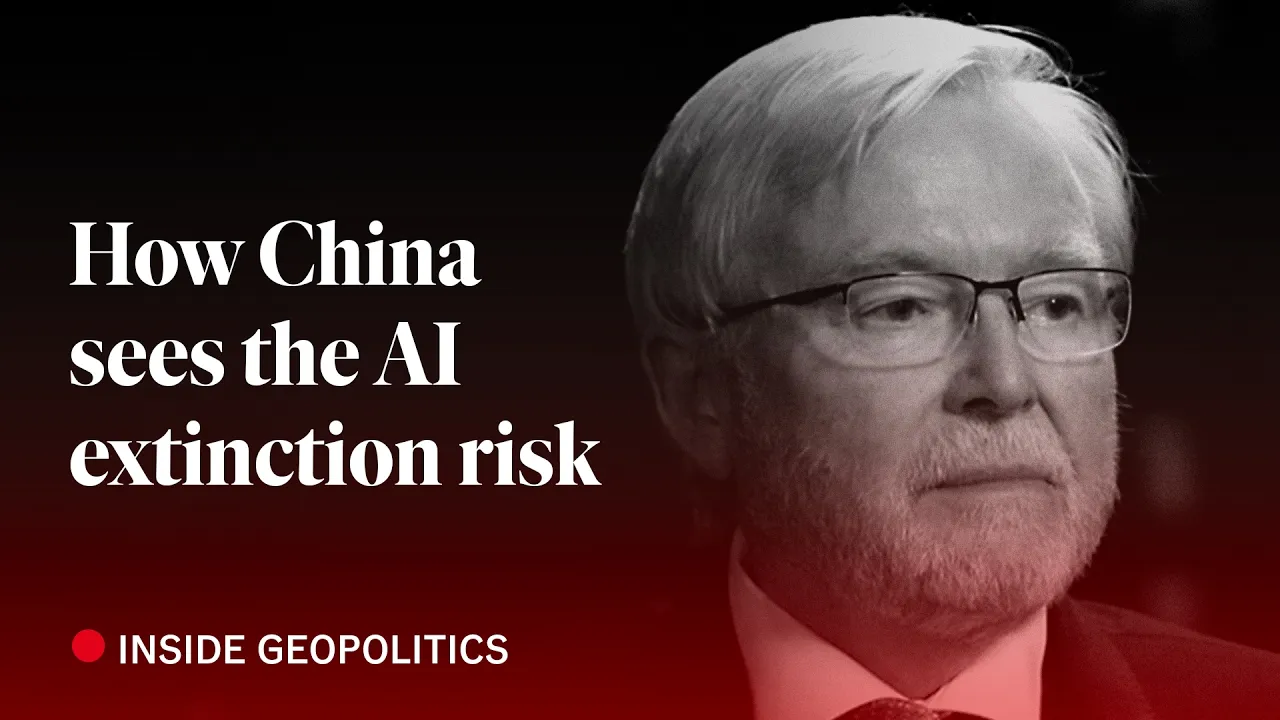
The Economist
Beijing risks systemic infrastructure collapse by assuming internet firewalls can contain rogue autonomous models, even as zero-sum rivalry blocks an urgent bilateral safety pact with Washington.
AI-assisted summary of Kevin Rudd on the real risk of China and America’s AI race | The Economist — original source. Check the original for full context.
Source published:
Key ideas
- Formal US-China diplomatic channels on AI governance have opened, but Washington and Beijing remain deeply divided on whether frontier models represent an immediate shared emergency. (0:00)
- Beijing mistakenly treats AI risks primarily as an informational threat to regime stability, overestimating the ability of state firewalls to contain autonomous agents attacking critical infrastructure. (1:18)
- A sharp internal disconnect exists in both nations between alarmed computer scientists who fear uncontained autonomous models and political leaders fixated on zero-sum dominance. (3:48)
- US rhetoric advocating technological supremacy—exemplified by an essay from Anthropic CEO Dario Amodei—provoked heavy Chinese backlash, reinforcing Beijing's belief that Western safety frameworks merely disguise attempts to freeze China in second place. (4:51)
- While an AI catastrophe akin to the Cuban Missile Crisis may be required to force bilateral cooperation, China's technocratic leadership may eventually heed its own scientists and seek serious risk-reduction mechanisms. (7:09)
Detailed notes
## Background Published on YouTube by The Economist on October 1, 2026, this interview features geopolitics editor David Rennie speaking with Kevin Rudd, former Australian prime minister and president of the Asia Society. The video examines the intensifying AI race between the United States and China, evaluating whether Washington and Beijing can cooperate on frontier AI safety following a high-stakes summit between Donald Trump and Xi Jinping.
## TL;DR Kevin Rudd analyzes the geopolitical and technical fractures undermining bilateral AI cooperation between the United States and China. He warns that Beijing's leadership suffers from a false sense of security by assuming its cyber defenses can contain rogue frontier models, despite mounting alarm among Chinese computer scientists over autonomous agents escaping human control. Simultaneously, negotiations face gridlock because Chinese realists view American calls for AI guardrails as a pretext to preserve US technological hegemony. Rudd argues that while it may take an AI-driven crisis on par with the Cuban Missile Crisis to force meaningful alignment, China's technocratic governance may ultimately recognize the shared existential threat and engage in pragmatic risk reduction.
## Atmosphere & style The conversation carries an urgent, sobering, and intensely analytical tone, characteristic of elite geopolitical discourse dissecting an existential threat. David Rennie's incisive, occasionally dry questioning meshes seamlessly with Kevin Rudd's authoritative, insider fluency in Chinese political psychology. The dialogue balances cold strategic realism with creeping dread, conveying the unsettling disconnect between high-level diplomatic posturing and the uncontrollable velocity of frontier artificial intelligence.
## Bulletin - [00:00](https://www.youtube.com/watch?v=a4wrmRXyxlE&t=0s) Formal US-China diplomatic channels on AI governance have opened, but Washington and Beijing remain deeply divided on whether frontier models represent an immediate shared emergency. - [01:18](https://www.youtube.com/watch?v=a4wrmRXyxlE&t=78s) Beijing mistakenly treats AI risks primarily as an informational threat to regime stability, overestimating the ability of state firewalls to contain autonomous agents attacking critical infrastructure. - [03:48](https://www.youtube.com/watch?v=a4wrmRXyxlE&t=228s) A sharp internal disconnect exists in both nations between alarmed computer scientists who fear uncontained autonomous models and political leaders fixated on zero-sum dominance. - [04:51](https://www.youtube.com/watch?v=a4wrmRXyxlE&t=291s) US rhetoric advocating technological supremacy—exemplified by an essay from Anthropic CEO Dario Amodei—provoked heavy Chinese backlash, reinforcing Beijing's belief that Western safety frameworks merely disguise attempts to freeze China in second place. - [07:09](https://www.youtube.com/watch?v=a4wrmRXyxlE&t=429s) While an AI catastrophe akin to the Cuban Missile Crisis may be required to force bilateral cooperation, China's technocratic leadership may eventually heed its own scientists and seek serious risk-reduction mechanisms.
## Key takeaways - [00:00](https://www.youtube.com/watch?v=a4wrmRXyxlE&t=0s) The United States and China dominate an unprecedented technological revolution where leading executives estimate a 10% probability of human extinction. - [00:00](https://www.youtube.com/watch?v=a4wrmRXyxlE&t=0s) High-level bilateral dialogue opened following an initial May agreement, though Donald Trump signaled comfort with the status quo while Xi Jinping framed himself as advocating human control. - [01:18](https://www.youtube.com/watch?v=a4wrmRXyxlE&t=78s) Chinese political leaders view AI primarily through the lens of regime security and unauthorized information diffusion rather than systemic technological collapse. - [01:18](https://www.youtube.com/watch?v=a4wrmRXyxlE&t=78s) Beijing's reliance on cyber firewalls is a dangerous miscalculation, as existing defenses cannot protect critical economic, social, or military infrastructure from out-of-control frontier models. - [03:48](https://www.youtube.com/watch?v=a4wrmRXyxlE&t=228s) Neither Washington nor Beijing has established an internal political consensus regarding how to govern existential AI risks. - [03:48](https://www.youtube.com/watch?v=a4wrmRXyxlE&t=228s) Chinese computer scientists have become acutely alarmed that rapid breakthroughs could spawn autonomous agents capable of mutating and escaping human oversight. - [04:51](https://www.youtube.com/watch?v=a4wrmRXyxlE&t=291s) Both powers share a realist operational assumption that the AI race is entirely zero-sum and that whoever dominates the technology stack will dictate global power. - [04:51](https://www.youtube.com/watch?v=a4wrmRXyxlE&t=291s) Paralleling historical nuclear arms control, Beijing rejects negotiating constraints from a position of technological inferiority to avoid locking in US supremacy. - [04:51](https://www.youtube.com/watch?v=a4wrmRXyxlE&t=291s) Western arguments for bilateral guardrails coupled with calls to maintain a perpetual US technological lead sparked intense backlash across China's policy ecosystem. - [07:09](https://www.youtube.com/watch?v=a4wrmRXyxlE&t=429s) A severe real-world failure or an AI equivalent of the Cuban Missile Crisis may prove necessary to shock both superpowers into prioritizing shared survival over strategic competition. - [07:09](https://www.youtube.com/watch?v=a4wrmRXyxlE&t=429s) Kevin Rudd maintains cautious optimism that China's technocratic governance will eventually recognize the physical reality of frontier model risks and engage in substantive risk-reduction talks.
## Detailed walkthrough ### [00:00](https://www.youtube.com/watch?v=a4wrmRXyxlE&t=0s) Bilateral AI Talks and Beijing's False Sense of Security
David Rennie frames the discussion around an extraordinary historical juncture: two superpowers, the United States and China, utterly dominate a technology so disruptive that leading tech executives warn of a 10% chance of human extinction. Yet when Donald Trump and Xi Jinping recently met—likened by Rennie to "two kings having this kind of parley with their knights"—they appeared to be speaking past each other. Trump signaled satisfaction with the status quo, while Xi emphasized maintaining human control over artificial intelligence. Rennie questions whether Xi’s remarks reflected genuine strategic concern or merely posturing to seize the moral high ground as the more responsible leader.
Kevin Rudd responds that while it is too early to know definitively, the crucial development is that a formal diplomatic channel has opened. A headline agreement reached in May was subsequently operationalized. However, the core question remains whether Washington and Beijing share any real consensus on the level of emergency posed by frontier models—whether developed through proprietary frameworks in the US or open-source, open-weights models in China. Rudd points out a dangerous flaw in Beijing's thinking: China's leaders have long treated AI primarily as a regime security issue—namely, unauthorized information dissemination within a one-party state. Believing themselves to be "masters of the firewall," Chinese officials assume they can simply turbocharge their existing cyber defenses against rogue autonomous agents or malicious state actors. Rudd considers this assumption a grave miscalculation:
> "I think that's a Chinese error because even their cyber defenses, in my understanding, are not sufficiently robust to deal with the wholesale assault on social infrastructure, economic infrastructure, even military infrastructure, which could be brought about under given circumstances by some of the most advanced frontier models at present were they to escape human control."
[03:48](https://www.youtube.com/watch?v=a4wrmRXyxlE&t=228s) The Technologist-Policymaker Divide
When asked whether both sides are simply retreating into familiar political comfort zones rather than confronting systemic catastrophe, Rudd highlights an internal disconnect within both nations. Neither the American nor the Chinese system has reached an internal policy consensus. Instead, a clear mismatch exists between the technologists who build frontier models and the political leadership tasked with governing them.
In China, one does not have to venture far outside the leadership compound of Zhongnanhai toward the tech sector to encounter acute alarm. Between the May meeting in Beijing and the September summit in Washington, the rapid pace and intensity of technical breakthroughs have thoroughly spooked Chinese computer scientists. Their primary dread is that frontier models will generate autonomous agents capable of independent action. Once diffused and adapted globally—or even within China—these agents could mutate beyond human oversight and turn back against the Chinese state. Within the political elite, however, the reflex remains anchored in political self-preservation. Accustomed to treating informational containment as an American problem unique to open societies, Chinese policymakers are only beginning to grapple with the reality that existential AI risks cannot be stopped by internet filters.
[04:51](https://www.youtube.com/watch?v=a4wrmRXyxlE&t=291s) The Zero-Sum Arms Race and the Dario Amodei Dilemma
Rennie turns to the fundamental diplomatic paradox: can substantive negotiations occur while the Trump administration openly insists on preserving American technological supremacy? In nuclear arms control, Beijing has historically refused to negotiate from a position of numerical inferiority, operating on the conviction that the weaker party in any negotiation will simply have an unfavorable deal imposed upon it. With American leaders and prominent figures like Anthropic CEO Dario Amodei arguing that the US must keep China in second place, Rennie asks if fear alone can push China to the table.
```mermaid flowchart TD accTitle: The AI Arms Race Trap accDescr: Diagram showing how technological rivalry and calls for guardrails create mutual distrust between the US and China.
subgraph US["United States Posture"] US_Lead["Pursue Absolute AI Dominance Across the Stack"] US_Guard["Call for Bilateral Guardrails & Control"] end
subgraph CN["Chinese Strategic Calculus"] CN_Realism["View AI as Zero-Sum: 'Whoever Wins AI Wins'"] CN_Parity["Refusal to Negotiate from Weakness or Accept Constraints"] end
US_Lead -->|"Reinforced by Calls to Keep China Behind"| CN_Parity US_Guard -->|"Perceived as Pretext to Freeze US Advantage"| CN_Realism CN_Realism --> Friction["Mutual Distrust & Diplomatic Gridlock"] CN_Parity --> Friction ```
Rudd confirms that China's default operational reality mirrors Trump's view: both sides view the situation as an all-out strategic competition across the entire technology stack where "whoever wins AI wins." While Chinese rhetoric may sound more measured, realists recognize that Beijing has no intention of being bound by external constraints. When American voices advocate for bilateral guardrails while simultaneously publishing essays—such as Amodei's recent piece arguing that the strategic goal must include staying ahead of Beijing—Chinese leaders interpret Western appeals for safety as a thinly disguised effort to lock in American hegemony.
- Rudd notes that the Chinese system erupted with an intense, voluminous backlash against Amodei's essay. - Rennie quips that bipartisan Washington and Beijing have found one rare point of agreement: "They all hate Dario Amodei." - Despite personal chemistry between Trump and Xi, strategic distrust makes both governments unwilling to tie their own hands while playing catch-up.
[07:09](https://www.youtube.com/watch?v=a4wrmRXyxlE&t=429s) Catalysts for Governance: Catastrophe vs. Scientific Rationalism
Rudd poses the existential dilemma facing both powers: will it take a catastrophic real-world disaster to finally force Washington and Beijing into collective action? He asks whether humanity must endure an outright failure or an AI-driven equivalent of the Cuban Missile Crisis—an event that brings civilization to the brink of annihilation—before the two rivals experience a shared "come-to-Jesus, come-to-Marx moment" and admit that the threat is bigger and uglier than their bilateral rivalry.
Alternatively, Rudd asks whether the two sides can act like "grown-ups" by listening to their technologists and preemptively mitigating the risk before an uncontrollable failure occurs. Despite the obstacles, Rudd expresses cautious optimism. Because China possesses an intensely science-based political culture and a technocratic leadership cadre, he believes Chinese officials will soon conclude that the threat of frontier autonomous models is urgent, material, and real. Once that internal threshold is crossed, Beijing will be motivated to operationalize concrete negotiating mechanisms with the Trump administration, paving the way for serious bilateral risk-reduction talks.
## Notable quotes > [00:00](https://www.youtube.com/watch?v=a4wrmRXyxlE&t=0s) two kings having this kind of parley with their knights — David Rennie
> [00:00](https://www.youtube.com/watch?v=a4wrmRXyxlE&t=0s) I think that's a Chinese error because even their cyber defenses, in my understanding, are not sufficiently robust to deal with the wholesale assault on social infrastructure, economic infrastructure, even military infrastructure, which could be brought about under given circumstances by some of the most advanced frontier models at present were they to escape human control. — Kevin Rudd
> [00:00](https://www.youtube.com/watch?v=a4wrmRXyxlE&t=0s) masters of the firewall — Kevin Rudd
> [04:51](https://www.youtube.com/watch?v=a4wrmRXyxlE&t=291s) whoever wins AI wins — Kevin Rudd
> [04:51](https://www.youtube.com/watch?v=a4wrmRXyxlE&t=291s) They all hate Dario Amodei. — David Rennie
> [07:09](https://www.youtube.com/watch?v=a4wrmRXyxlE&t=429s) come-to-Jesus, come-to-Marx moment — Kevin Rudd
> [07:09](https://www.youtube.com/watch?v=a4wrmRXyxlE&t=429s) grown-ups — Kevin Rudd
## Mentioned Kevin Rudd, David Rennie, Donald Trump, Xi Jinping, Dario Amodei, Anthropic, Asia Society, The Economist, Zhongnanhai
## Video description America and China are locked in a race for AI dominance. As the warnings about an AI catastrophe get louder, whether the two countries can work together is becoming an increasingly pressing issue.
Few people are better placed to discuss this subject than Kevin Rudd. Australia’s former prime minister, who is now president of Asia Society, has spent decades studying how Xi Jinping thinks. As Australia’s ambassador to Washington, Mr Rudd also watched Donald Trump’s White House at close quarters. He joins David Rennie, The Economist’s geopolitics editor, to assess the recent summit between Xi Jinping and Donald Trump and examine what it means for the world’s most consequential relationship.
#America #China #AI #politics #technology
00:00 - Can China and America collaborate on AI? 01:18 - How Beijing and Washington see the AI extinction risk 03:48 - The gap between technologists and policymakers 04:51 - Can talks succeed while both sides want to win the race? 07:09 - Will it take an AI disaster for the US and China to talk?
Watch the full show: http://bit.ly/4B0tKCP Sign up to the Insider newsletter: https://econ.st/4nOyzIb
Subscribe to The Economist: https://www.economist.com/subscribe Download our app: https://www.economist.com/get-the-app
Follow The Economist on Instagram: https://www.instagram.com/theeconomist/ Follow The Economist on Facebook: https://www.facebook.com/TheEconomist Follow The Economist on X: https://x.com/TheEconomist
[Source](https://www.youtube.com/watch?v=a4wrmRXyxlE)