Economist Editors Spurn Wealth Taxes, Back Consumption for AI Era
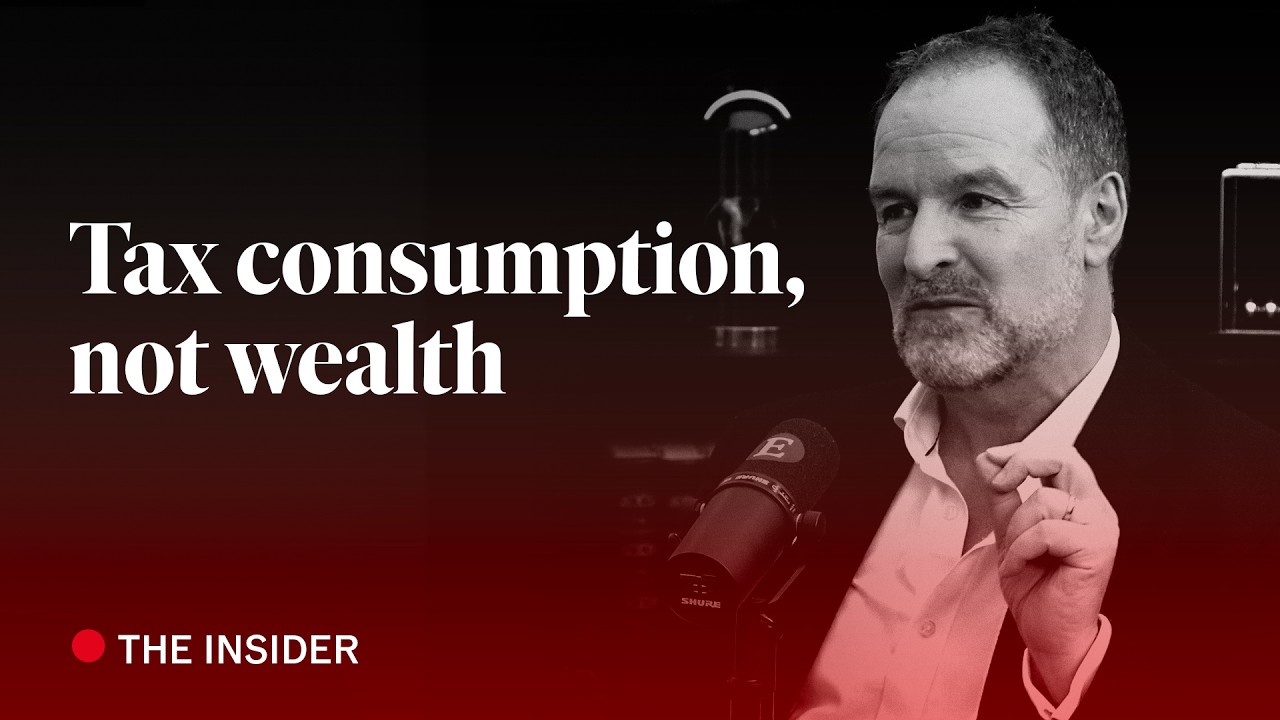
The Economist
Direct taxes on billionaires fail to raise meaningful revenue and risk asset expropriation, meaning governments must rely on broad consumption taxes and reformed capital gains to redistribute artificial intelligence windfalls.
AI-assisted summary of How to reform the tax system | The Economist — original source. Check the original for full context.
Source published:
Key ideas
- An Economist viewer poll shows consumption taxes (35%) and billionaire taxes (31%) as the leading proposals for funding public finances in an AI-driven economy. (0:00)
- Economists argue that broad consumption taxes effectively operate as indirect wealth taxes by eroding future purchasing power, avoiding the capital flight historically triggered by direct wealth taxes. (4:54)
- While the United States operates a highly progressive income tax that achieves modest redistribution, European nations achieve far greater equality through flat consumption taxes paired with robust welfare spending. (4:54)
- Rather than adopting radical wealth taxes that verge on property expropriation, the panel urges reforming capital gains taxes to properly capture windfall super-profits without penalizing ordinary savers. (8:36)
Detailed notes
## Background Published on YouTube by The Economist on October 3, 2026, this panel discussion explores how governments should modernize tax policy as artificial intelligence reshapes the economy. According to the page description, the publication's top editors weigh options for raising public revenue, evaluating whether to levy taxes on consumption, compute, land, or the tech billionaires amassing fortunes from AI.
## TL;DR The panel explores how governments should adapt fiscal policy in an AI-driven economy where returns increasingly accrue to capital rather than human labor. Editors Zanny Minton Beddoes, Tom, and Henry Curr evaluate the trade-offs between simplicity, efficiency, and progressivity, arguing that tax systems work best when broad, efficient levies are paired with robust redistribution on the spending side. While recognizing the populist appeal of targeting billionaires, the speakers caution against direct wealth taxes, highlighting historical failures, capital flight, and the risks of property expropriation. Instead, they advocate for a pragmatic composite of broad-based consumption taxes, non-distortive land value taxation, and targeted reforms to capital gains rules to capture runaway tech windfalls.
## Atmosphere & style The discussion carries the polished, intellectually brisk ambiance characteristic of The Economist's editorial board, blending rigorous macroeconomic theory with dry, urbane humor. The rapport between Zanny Minton Beddoes, Henry Curr, and Tom is collegial and fluid, seamlessly shifting from historical maxims about plucking geese to personal frustrations with bureaucratic tax filing. Rather than getting swept up in populist rhetoric, the tone remains detached, measured, and analytical, dissecting radical tax ideas with calm skepticism and a pragmatic commitment to economic efficiency.
## Bulletin - [00:00](https://www.youtube.com/watch?v=e9OAazrjenc&t=0s) An Economist viewer poll shows consumption taxes (35%) and billionaire taxes (31%) as the leading proposals for funding public finances in an AI-driven economy. - [04:54](https://www.youtube.com/watch?v=e9OAazrjenc&t=294s) Economists argue that broad consumption taxes effectively operate as indirect wealth taxes by eroding future purchasing power, avoiding the capital flight historically triggered by direct wealth taxes. - [04:54](https://www.youtube.com/watch?v=e9OAazrjenc&t=294s) While the United States operates a highly progressive income tax that achieves modest redistribution, European nations achieve far greater equality through flat consumption taxes paired with robust welfare spending. - [08:36](https://www.youtube.com/watch?v=e9OAazrjenc&t=516s) Rather than adopting radical wealth taxes that verge on property expropriation, the panel urges reforming capital gains taxes to properly capture windfall super-profits without penalizing ordinary savers.
## Key takeaways - [00:00](https://www.youtube.com/watch?v=e9OAazrjenc&t=0s) A viewer poll on taxing the AI era ranked consumption taxes first at 35%, followed by billionaires at 31%, compute at 19%, robots at 9%, and land at 5%. - [00:00](https://www.youtube.com/watch?v=e9OAazrjenc&t=0s) Targeting billionaires directly provides minimal revenue stability because the ultra-rich possess mobile assets and can easily relocate across jurisdictions. - [00:00](https://www.youtube.com/watch?v=e9OAazrjenc&t=0s) A balanced tax regime in an AI era should combine broad consumption taxes, moderate capital levies, and higher land taxes on immobile, scarce property. - [02:00](https://www.youtube.com/watch?v=e9OAazrjenc&t=120s) The primary objectives of any tax architecture are funding public services and redistributing income based on political priorities. - [02:00](https://www.youtube.com/watch?v=e9OAazrjenc&t=120s) Tax design relies on three core tenets—simplicity, efficiency, and progressivity—which often exist in direct tension with one another. - [02:00](https://www.youtube.com/watch?v=e9OAazrjenc&t=120s) Policymakers should evaluate the tax and transfer system holistically rather than forcing every single tax instrument to fulfill all three design criteria simultaneously. - [02:00](https://www.youtube.com/watch?v=e9OAazrjenc&t=120s) If AI drives returns to human labor close to zero, public finances will be compelled to extract revenue where economic returns accumulate: capital. - [04:54](https://www.youtube.com/watch?v=e9OAazrjenc&t=294s) Raising consumption taxes indirectly levies wealth by reducing the real purchasing power of accumulated fortunes by that same percentage. - [04:54](https://www.youtube.com/watch?v=e9OAazrjenc&t=294s) The central justification for wealth taxes, championed by economists like Gabriel Zucman, is political rather than fiscal: curbing oligarchical lobbying and corporate dominance. - [04:54](https://www.youtube.com/watch?v=e9OAazrjenc&t=294s) Direct wealth taxes have historically been discarded by developed nations due to immense administrative overhead and accelerated capital flight. - [04:54](https://www.youtube.com/watch?v=e9OAazrjenc&t=294s) Tax policy cannot be judged independently of government expenditure; European redistribution succeeds via social transfers rather than narrow, progressive tax carve-outs. - [08:36](https://www.youtube.com/watch?v=e9OAazrjenc&t=516s) Direct wealth confiscation lacks natural boundaries and creates a slippery slope toward unchecked property expropriation, as exemplified by California's proposed wealth tax. - [08:36](https://www.youtube.com/watch?v=e9OAazrjenc&t=516s) Current capital gains rules are economically distorted, undertaxing massive windfall super-profits from tech ventures while overtaxing ordinary savings. - [08:36](https://www.youtube.com/watch?v=e9OAazrjenc&t=516s) Restructuring existing capital gains taxes offers a far more pragmatic and fair solution than introducing experimental wealth taxes.
## Detailed walkthrough ### [00:00](https://www.youtube.com/watch?v=e9OAazrjenc&t=0s) Viewer Poll: What Should Be Taxed in the AI Era?
The discussion opens with the results of a viewer poll asking how taxes should be levied as artificial intelligence reshapes the economy. The options and their respective shares of the vote were:
- **Consumption:** 35% - **Billionaires:** 31% - **Compute:** 19% - **Robots:** 9% - **Land:** 5%
Reacting to the tally, Zanny Minton Beddoes praises the audience as thoughtful and well-informed, noting that economists broadly view consumption taxes as an exceptionally efficient mechanism for raising revenue. A consumption tax can be structured progressively through welfare transfers or large threshold exemptions before any tax kicks in. However, she argues that relying exclusively on consumption taxes is politically untenable in an AI-driven economy where vast, unprecedented returns accrue to capital and its owners.
While Zanny hopes "billionaires" serves as popular shorthand for taxes on capital more broadly, she cautions against relying on targeted billionaire taxes. Though politically popular, taxing billionaires directly yields relatively little revenue, and the ultra-wealthy are hyper-mobile and easily relocate their assets. Her own ideal composite would rely heavily on consumption taxes, paired with moderate capital taxation and a significantly higher emphasis on land taxes, treating land as a scarce and readily taxable commodity. She also highlights that this shift would represent a far more dramatic transformation for the United States than for Europe, where value-added and consumption taxes already account for a major portion of public revenue.
[02:00](https://www.youtube.com/watch?v=e9OAazrjenc&t=120s) Principles of an Ideal Tax System
Turning to foundational theory, the panel explores what constitutes a well-designed tax framework. Tom outlines the two primary purposes of any tax system: first, raising sufficient revenue to fund public services, and second, enabling redistribution from the richest to the poorest depending on the governing political priorities. To achieve these goals, economists traditionally lean on three guiding principles:
- **Simplicity:** Tax codes must avoid onerous administrative burdens. Tom recalls his own experience living in the United States, spending hours untangling tax returns trying to determine eligibility for various overlapping credits. - **Efficiency:** Taxes should minimize economic distortions by treating different forms of economic activity equally rather than penalizing or encouraging specific choices. - **Progressivity:** Those reaping the greatest financial windfalls from technological shifts, such as AI, should shoulder a proportionately higher tax burden.
```mermaid flowchart TD accTitle: Holistic Tax and Spending Framework accDescr: Diagram illustrating how tax instruments, core design goals, and spending interact across the whole economy.
subgraph Revenue["Tax Instruments"] C["Consumption Tax\n(Broad Base)"] K["Capital & Wealth Tax\n(Progressive)"] L["Land Value Tax\n(Non-Distortive)"] end
subgraph CoreGoals["System Goals"] R["Revenue Maximization"] E["Economic Efficiency"] S["Simplicity & Transparency"] end
subgraph State["Spending & Redistribution"] W["Welfare & Public Services"] P["Net Progressivity"] end
C --> R L --> E K --> P R --> W W --> P ```
Zanny notes that these three goals are frequently in tension with one another, invoking Jean-Baptiste Colbert’s famous adage that the art of taxation consists in plucking the goose to obtain the largest possible amount of feathers with the smallest possible amount of hissing. In an AI scenario where returns to human labor collapse toward zero, tax collectors must inevitably go where the wealth resides: capital returns. While widespread AI assistance might theoretically reduce the friction of personal tax filing by automating optimization, she insists that simplicity remains essential. Tom adds that policymakers often err by demanding that every individual tax levy meet all three criteria at once. A rational system looks at the balance as a whole—using broad consumption taxes to generate massive baseline revenue, targeted capital taxes for equity, and social spending to compensate lower-income households.
[04:54](https://www.youtube.com/watch?v=e9OAazrjenc&t=294s) Consumption Taxes, Progressivity, and the Case of Wealth Taxes
Henry Curr challenges the assumption that consumption taxes are inherently regressive, arguing they are unfairly maligned. If a government increases the consumption tax rate by five percentage points, it diminishes the real purchasing power of an ultra-wealthy individual's accumulated fortune by five percent, effectively functioning like an indirect wealth tax. Because the ultimate economic purpose of a fortune is spending, raising consumption taxes clips that wealth at the register.
Henry contrasts this economic view with that of French economist Gabriel Zucman, a leading proponent of wealth taxes whom Henry interviewed for *Inside Economics*. Zucman’s case for a direct wealth tax rests not solely on fiscal efficiency, but on neutralizing political power: fortunes left unspent are deployed to lobby politicians, purchase competitors, and sway democratic institutions. While Henry acknowledges this political argument as respectable, he remains unconvinced that wealth taxes work in practice, noting that historical attempts across developed nations have repeatedly been abandoned because of capital flight and implementation difficulties.
Zanny and Tom emphasize that the debate cannot separate taxation from public expenditure. The United States already possesses an extraordinarily progressive federal income tax, where the top 1% pays a massive share of total collections; yet the overall US system achieves far less redistribution than European countries. European nations rely heavily on flat consumption taxes, but maintain larger states that redistribute far more cash and services on the spending side. When economists draft a tax reform blueprint on a clean sheet of paper—an exercise Zanny jokes guarantees it will never be enacted into law—they must first define the expected size of the state and its spending mandate. Attempting to achieve progressivity solely by layering carve-outs and special rules onto the tax code invariably destroys simplicity, leaving systems bloated and inefficient.
[08:36](https://www.youtube.com/watch?v=e9OAazrjenc&t=516s) The Limits of Redistribution and Fixing Capital Gains
The debate over wealth taxes centers on whether curbing the outsized power of tech tycoons justifies unprecedented state intervention. One speaker weighs the political justification for such measures—specifically the fear that billionaires wield excessive political influence and entrench a self-perpetuating oligarchy at the expense of a meritocratic society. While acknowledging that a society pushed to a dystopian extreme might eventually need to pull that lever, the speaker remains unconvinced that matters have deteriorated to such a desperate point: "I think you have to get to a really bad place, and I'm not convinced that society's there yet."
From a purely economic standpoint, redistributing wealth through direct confiscation poses a severe slippery slope. The underlying principle has "no natural limit," meaning political pressure will inevitably push the boundary as far as possible. Proposals currently being floated, such as the wealth tax under discussion in California, edge dangerously close to the outright "expropriation of property," setting a precedent described as "quite chilling." Consequently, radical wealth taxes fail to convince on both practical and philosophical grounds.
Rather than inventing novel levies destined to misfire, policymakers should look at fixing existing mechanisms like capital gains tax. The current framework is notoriously tangled and structurally warped: it systematically undertaxes astronomical windfall profits—precisely the mega-returns that artificial intelligence billionaires stand to rake in—while unfairly penalizing the modest, normal gains accumulated by ordinary savers. Leveling that playing field and reforming capital gains offers a far more pragmatic and equitable path forward than rushing into an experimental wealth tax regime.
- **The slippery slope of redistribution:** Without a built-in threshold, using the tax code to redistribute wealth invites unending political escalation toward asset seizure. - **The California wealth tax proposal:** Viewed critically by the panel as bordering on property expropriation. - **Capital gains asymmetry:** Current rules distort incentives by overtaxing standard savings returns while undertaxing runaway super-profits generated by tech windfalls.
## Notable quotes > [02:00](https://www.youtube.com/watch?v=e9OAazrjenc&t=120s) plucking the goose to obtain the largest possible amount of feathers with the smallest possible amount of hissing — Zanny Minton Beddoes
> [08:36](https://www.youtube.com/watch?v=e9OAazrjenc&t=516s) I think you have to get to a really bad place, and I'm not convinced that society's there yet.
> [08:36](https://www.youtube.com/watch?v=e9OAazrjenc&t=516s) no natural limit
> [08:36](https://www.youtube.com/watch?v=e9OAazrjenc&t=516s) expropriation of property
> [08:36](https://www.youtube.com/watch?v=e9OAazrjenc&t=516s) quite chilling
## Mentioned Zanny Minton Beddoes, Tom, Henry Curr, Gabriel Zucman, Jean-Baptiste Colbert, Inside Economics, The Economist, United States, Europe, California
## Video description As AI transforms the economy, governments will need new ways to raise money. Should they tax consumption, compute, land or the billionaires getting richer from the technology? Our top editors weigh up the options.
#AI #Tax #WealthTax
00:00 What should be taxed in the AI era? 02:00 The ideal tax system 04:54 Are consumption taxes unfair? 08:13 Are wealth taxes a good idea?
Watch the full show: bit.ly/3Voqh0w Sign up to the Insider newsletter: https://econ.st/4nOyzIb
Subscribe to The Economist: https://www.economist.com/subscribe Download our app: https://www.economist.com/get-the-app
Follow The Economist on Instagram: https://www.instagram.com/theeconomist/ Follow The Economist on Facebook: https://www.facebook.com/TheEconomist Follow The Economist on X: https://x.com/TheEconomist
[Source](https://www.youtube.com/watch?v=e9OAazrjenc)