Room-Temperature Superconductor Finally Found?
Sabine Hossenfelder
AI-assisted summary of Room-Temperature Superconductor Finally Found? — original source. Check the original for full context.
Source published:
Key ideas
- A Russian research team released an unreviewed preprint claiming to observe magnetic flux line trapping—a core signature of type-II superconductivity—in processed graphite at temperatures up to 390 K (about 117 °C). (1:49)
- The preparation requires grinding bulk graphite for 30 hours into nanometer-thick flakes and baking them in open air at 400 °C for 24 hours, forming a network of micro-wrinkles. (1:49)
- The study does not include a direct measurement of zero electrical resistance, an omission caused by the severe technical difficulty of probing sub-micrometer flakes without contact resistance artifacts. (1:49)
- Because the recipe uses accessible, low-cost equipment, independent laboratories worldwide are expected to quickly verify or refute the claims, though Sabine rates it a 7 out of 10 on her skepticism meter. (3:20)
Detailed notes
## Background Published on YouTube by Sabine Hossenfelder on September 27, 2026, this video examines a newly surfaced preprint claiming the discovery of an accessible room-temperature superconductor candidate. According to the page description, a research team in Russia reports finding a key signature of superconductivity surviving well above room temperature in ordinary ground-up, baked graphite—a recipe simple enough for labs worldwide to test.
## TL;DR Physicist Sabine Hossenfelder analyzes an unreviewed preprint from Russian researchers claiming that mechanically ground bulk graphite baked in air exhibits magnetic flux line trapping up to roughly 120 °C (390 K). While this pinning effect is a recognized signature of type-II superconductivity, the study notably lacks direct zero-resistance electrical measurements, which are notoriously difficult on sub-micrometer flakes. Tempered by the recent memory of past failures like LK-99 and Ranga Dias's retracted papers, Sabine rates the claim a 7 out of 10 on her 'bullshit meter' while highlighting that its simple preparation will allow rapid replication attempts by both human researchers and competing AI labs.
## Atmosphere & style The presentation is dryly humorous, biting, and scientifically grounded, characterized by Sabine's signature deadpan delivery and satirical barbs about European technological stagnation. It balances genuine curiosity about an accessible experimental recipe with a seasoned, weary skepticism born from years of overhyped superconductor breakthroughs. Watching it feels like getting a sharp, no-nonsense reality check that cuts through viral physics headlines with calculated amusement.
## Bulletin - [01:49](https://www.youtube.com/watch?v=1RoTQ3hP4Uk&t=109s) A Russian research team released an unreviewed preprint claiming to observe magnetic flux line trapping—a core signature of type-II superconductivity—in processed graphite at temperatures up to 390 K (about 117 °C). - [01:49](https://www.youtube.com/watch?v=1RoTQ3hP4Uk&t=109s) The preparation requires grinding bulk graphite for 30 hours into nanometer-thick flakes and baking them in open air at 400 °C for 24 hours, forming a network of micro-wrinkles. - [01:49](https://www.youtube.com/watch?v=1RoTQ3hP4Uk&t=109s) The study does not include a direct measurement of zero electrical resistance, an omission caused by the severe technical difficulty of probing sub-micrometer flakes without contact resistance artifacts. - [03:20](https://www.youtube.com/watch?v=1RoTQ3hP4Uk&t=200s) Because the recipe uses accessible, low-cost equipment, independent laboratories worldwide are expected to quickly verify or refute the claims, though Sabine rates it a 7 out of 10 on her skepticism meter.
## Key takeaways - [00:00](https://www.youtube.com/watch?v=1RoTQ3hP4Uk&t=0s) All confirmed superconductors currently require cooling below −100 °C, though fundamental physical principles do not rule out ambient room-temperature operation. - [00:00](https://www.youtube.com/watch?v=1RoTQ3hP4Uk&t=0s) Achieving room-temperature superconductivity would transform power grids, electronics, supercomputers, and magnetic confinement systems for nuclear fusion. - [00:00](https://www.youtube.com/watch?v=1RoTQ3hP4Uk&t=0s) Unlike complex or exotic compounds, the newly proposed candidate material is common graphite subjected to standard mechanical and thermal processing. - [01:49](https://www.youtube.com/watch?v=1RoTQ3hP4Uk&t=109s) A preprint by Russian researchers claims to identify superconducting signatures persisting at and above 390 K (117 °C). - [01:49](https://www.youtube.com/watch?v=1RoTQ3hP4Uk&t=109s) The synthesis involves ball-milling graphite into micrometer-wide, nanometer-thick flakes and baking them in open air at 400 °C for 24 hours. - [01:49](https://www.youtube.com/watch?v=1RoTQ3hP4Uk&t=109s) Microscopic examination showed that baking in open air creates a dense network of micro-wrinkles, which is absent in untreated or vacuum-baked samples. - [01:49](https://www.youtube.com/watch?v=1RoTQ3hP4Uk&t=109s) When cooled to 10 K in a magnetic field, the wrinkled graphite exhibited magnetic flux line trapping that persisted even when heated past room temperature to roughly 120 °C. - [01:49](https://www.youtube.com/watch?v=1RoTQ3hP4Uk&t=109s) Direct zero-resistance verification is missing because contact and probe resistance present major technical hurdles on ultra-thin, sub-micrometer flakes. - [03:20](https://www.youtube.com/watch?v=1RoTQ3hP4Uk&t=200s) Wrinkled graphite was previously studied as a potential superconductor several years ago, but those findings were never replicated. - [03:20](https://www.youtube.com/watch?v=1RoTQ3hP4Uk&t=200s) Magnetic flux trapping alone does not constitute definitive proof of superconductivity and does not prove the material can be drawn into functional wires. - [03:20](https://www.youtube.com/watch?v=1RoTQ3hP4Uk&t=200s) Sabine rates the claim a 7 out of 10 on her skepticism meter, emphasizing that the paper is an unreviewed preprint in a field prone to false alarms. - [03:20](https://www.youtube.com/watch?v=1RoTQ3hP4Uk&t=200s) The simple preparation recipe allows independent laboratories around the world to test and replicate the findings rapidly. - [03:20](https://www.youtube.com/watch?v=1RoTQ3hP4Uk&t=200s) Past room-temperature superconductor claims, such as Ranga Dias's discredited publications and LK-99's impurity artifacts, underscore the need for caution. - [03:20](https://www.youtube.com/watch?v=1RoTQ3hP4Uk&t=200s) Human researchers are currently competing against approximately one thousand AI research labs in the race to uncover ambient superconductors.
## Detailed walkthrough ### [00:00](https://www.youtube.com/watch?v=1RoTQ3hP4Uk&t=0s) The Promise and Hyped Potential of Room-Temperature Superconductors
Physics is completely packed with "supers": physicists constantly talk about supersymmetry, superfluids, quantum superpositions, supermassive black holes, supercooled liquids, and, of course, superconductors. In real-world physics, superconductors are far from hypothetical. They are materials whose electrical resistance plummets to virtually zero, allowing electrical currents to flow indefinitely without any energy loss. The frustrating catch is that every confirmed superconductor discovered so far requires super-low temperatures to operate—typically plunging below −100 °C. Yet fundamental physics dictates no reason why superconductivity cannot occur at ambient room temperature.
If a true ambient-pressure, room-temperature superconductor were uncovered, the technological consequences would be revolutionary. It would radically transform energy efficiency across all electronics and overhaul power grids. Sabine cannot resist poking fun at European technological ambitions, noting that lossless power transmission means "we could finally plaster the Sahara desert with solar panels to power Europe's non-existing data centers." Similarly, room-temperature superconductors would make it vastly simpler to construct powerful magnets needed to achieve nuclear fusion ignition—again, "to power Europe's non-existing data centers"—and build faster supercomputers "to speed up Europe's non-existing data centers." In any case, Europe could simply "sell it to China." The most refreshing twist about this latest preprint is that the candidate material is not an exotic, hard-to-synthesize compound; it is ordinary graphite given a peculiar mechanical and thermal treatment, making it considerably easier to source than fictional "unobtanium."
[01:49](https://www.youtube.com/watch?v=1RoTQ3hP4Uk&t=109s) Wrinkled Graphite and Trapped Magnetic Flux
The new claim arrives via an unreviewed preprint from a research team in Russia, asserting that they have observed "one of the key signatures of superconductivity" surviving at and above 390 K (roughly 117 °C). Their preparation recipe began by mechanically grinding bulk graphite for 30 hours, reducing it to tiny flakes measuring several micrometers across and merely tens of nanometers in thickness. From there, they split the flakes into three experimental batches: one sample was kept completely as-is, the second was baked in a vacuum, and the third was heated in open air for 24 hours at approximately 400 °C.
```mermaid flowchart TD accTitle: Preparation and Testing of Wrinkled Graphite accDescr: Flowchart detailing the Russian team's mechanical and thermal processing of graphite to produce magnetic flux trapping.
subgraph PREP["Graphite Preparation"] A["Bulk Graphite"] -->|"Ball-mill grind for 30 hours"| B["Flakes (micrometer-wide, nm-thick)"] end
subgraph TREATMENT["Thermal Treatment Batches"] B --> C["Sample 1: As-is (control)"] B --> D["Sample 2: Heated in vacuum"] B --> E["Sample 3: Baked in air (24 hrs at 400°C)"] end
subgraph TESTING["Testing & Discovery"] E --> F["Forms dense network of micro-wrinkles"] F --> G["Cooled to 10 K with magnetic field"] G --> H["Magnetic flux line trapping observed"] H -->|"Heated to ~120°C (390 K)"| I["Trapping signature persists"] end ```
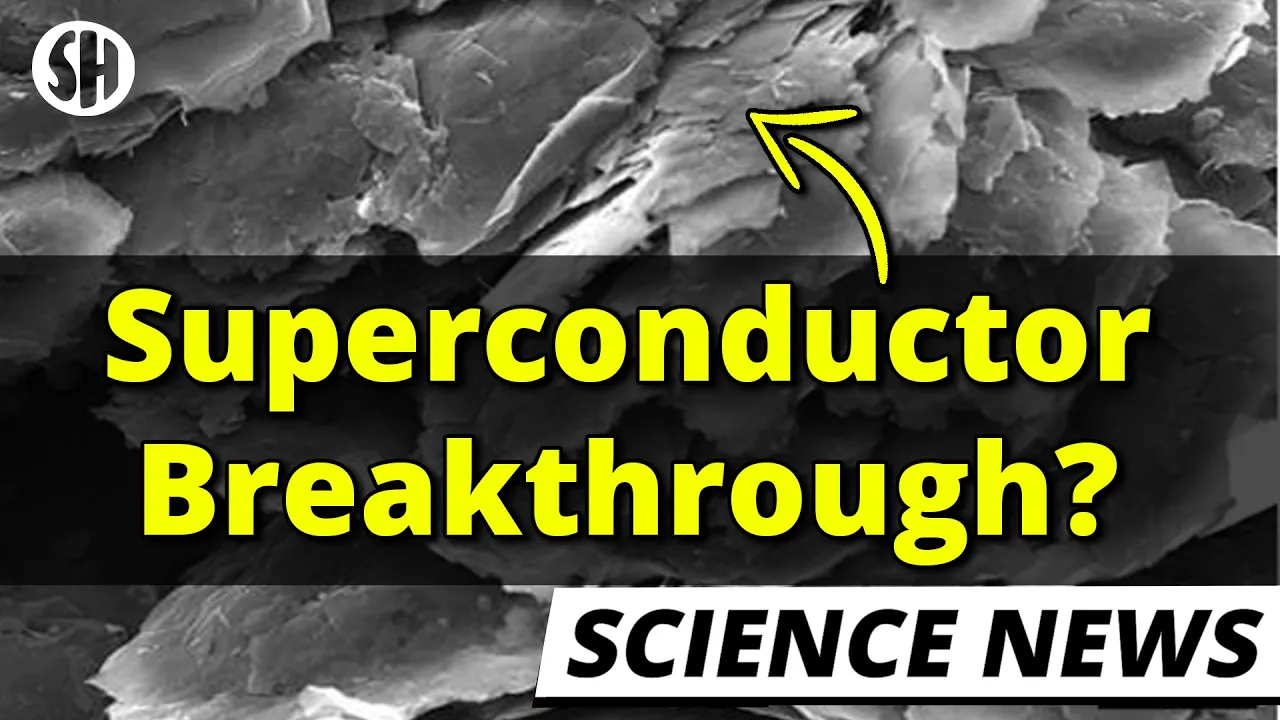
Under an electron microscope, only the third sample—the graphite baked in air—revealed a dense, interlocking network of micro-wrinkles. When the researchers cooled this wrinkled graphite down to 10 K and introduced a magnetic field, slightly displacing the field caused the magnetic field lines to become pinned in place. This phenomenon, known as magnetic flux line trapping, represents a quintessential calling card of superconducting materials. Crucially, when they warmed the sample up past room temperature to nearly 120 °C, the flux-trapping effect stubbornly remained intact.
- **Key experimental omission:** The researchers did not directly measure electric resistance dropping to zero. Measuring zero resistance on sub-micrometer, ultra-thin flakes is notoriously difficult because contact and probe resistance can dwarf the sample's signal, a stumbling block that previously derailed claims around LK-99. - **Why flux trapping matters:** Even without a zero-resistance trace, magnetic flux line pinning is a fundamental hallmark of type-II superconductivity, qualifying the wrinkled graphite as a legitimate candidate worthy of inspection.
[03:20](https://www.youtube.com/watch?v=1RoTQ3hP4Uk&t=200s) Cautious Skepticism and the Race Between Humans and AI
The notion of wrinkled graphite acting as a superconductor is not completely unprecedented; a paper exploring the concept surfaced several years ago, though it was never successfully replicated. Nevertheless, Sabine warns that heavy skepticism is warranted. Aside from remaining an unvetted preprint, the presence of magnetic flux trapping does not constitute definitive proof of superconductivity, nor does it demonstrate that such wrinkled flakes could ever be fabricated into practical, wire-like electronic components. On her personal "bullshit meter," she rates the announcement a 7 out of 10. The major redeeming factor is that the recipe requires straightforward, accessible equipment, allowing independent laboratories worldwide to confirm or debunk the findings very quickly.
The scientific landscape is cluttered with the wreckage of previous room-temperature superconductor announcements. Every few years, a sensational claim emerges: Ranga Dias published high-profile room-temperature superconductor papers that could not be replicated and ended under clouds of academic fraud allegations; more recently, the viral LK-99 hype cycle collapsed once independent teams demonstrated that its apparent transitions stemmed from copper sulfide impurities and flawed resistivity artifacts. Now, human experimentalists are racing alongside approximately one thousand AI research labs pursuing the exact same materials breakthrough in an ultimate human-versus-machine faceoff. Sabine quips that viewers should not worry if machine intelligence prevails, because "if AI wins, it will summarize the result for you in five simple bullet points." She closes the report by acknowledging her community supporters on Patreon and YouTube, noting that viewer contributions keep her independent channel running without outside corporate sponsors.
## Notable quotes > [00:00](https://www.youtube.com/watch?v=1RoTQ3hP4Uk&t=0s) we could finally plaster the Sahara desert with solar panels to power Europe's non-existing data centers. — Sabine Hossenfelder
> [00:00](https://www.youtube.com/watch?v=1RoTQ3hP4Uk&t=0s) to power Europe's non-existing data centers — Sabine Hossenfelder
> [00:00](https://www.youtube.com/watch?v=1RoTQ3hP4Uk&t=0s) to speed up Europe's non-existing data centers. — Sabine Hossenfelder
> [00:00](https://www.youtube.com/watch?v=1RoTQ3hP4Uk&t=0s) sell it to China. — Sabine Hossenfelder
> [01:49](https://www.youtube.com/watch?v=1RoTQ3hP4Uk&t=109s) one of the key signatures of superconductivity — Sabine Hossenfelder
> [03:20](https://www.youtube.com/watch?v=1RoTQ3hP4Uk&t=200s) bullshit meter — Sabine Hossenfelder
> [03:20](https://www.youtube.com/watch?v=1RoTQ3hP4Uk&t=200s) if AI wins, it will summarize the result for you in five simple bullet points. — Sabine Hossenfelder
## Mentioned Sabine Hossenfelder, LK-99, Ranga Dias, Patreon, YouTube
## Video description 👉 Support me on Patreon ➜ https://www.patreon.com/Sabine 👕T-shirts, mugs, posters and more: ➜ https://sabines-store.dashery.com/ 💌 Support me on Donorbox ➜ https://donorbox.org/swtg
There's a new candidate for a room temperature superconductor, and it isn't some exotic compound, it's graphite, just ground up and baked. A team in Russia says they have found one of the key signatures of superconductivity that survives well above room temperature. The good news is that anyone can try to reproduce this. Let's take a look.
Paper: https://doi.org/10.48550/arXiv.2609.15712
#superconductor #physics #sciencenews #materialsscience #science
📝 Transcripts and written news on Substack ➜ https://sciencewtg.substack.com/ 📩 Free weekly science newsletter ➜ https://sabinehossenfelder.com/newsletter/ 👂 Audio only podcast ➜ https://open.spotify.com/show/0MkNfXlKnMPEUMEeKQYmYC 🔗 Join this channel to get access to perks ➜ https://www.youtube.com/channel/UC1yNl2E66ZzKApQdRuTQ4tw/join 📚 Buy my book ➜ https://amzn.to/3HSAWJW
[Source](https://www.youtube.com/watch?v=1RoTQ3hP4Uk)