Helion Energy Delays Power Goal as Physicists Reject Fusion Design
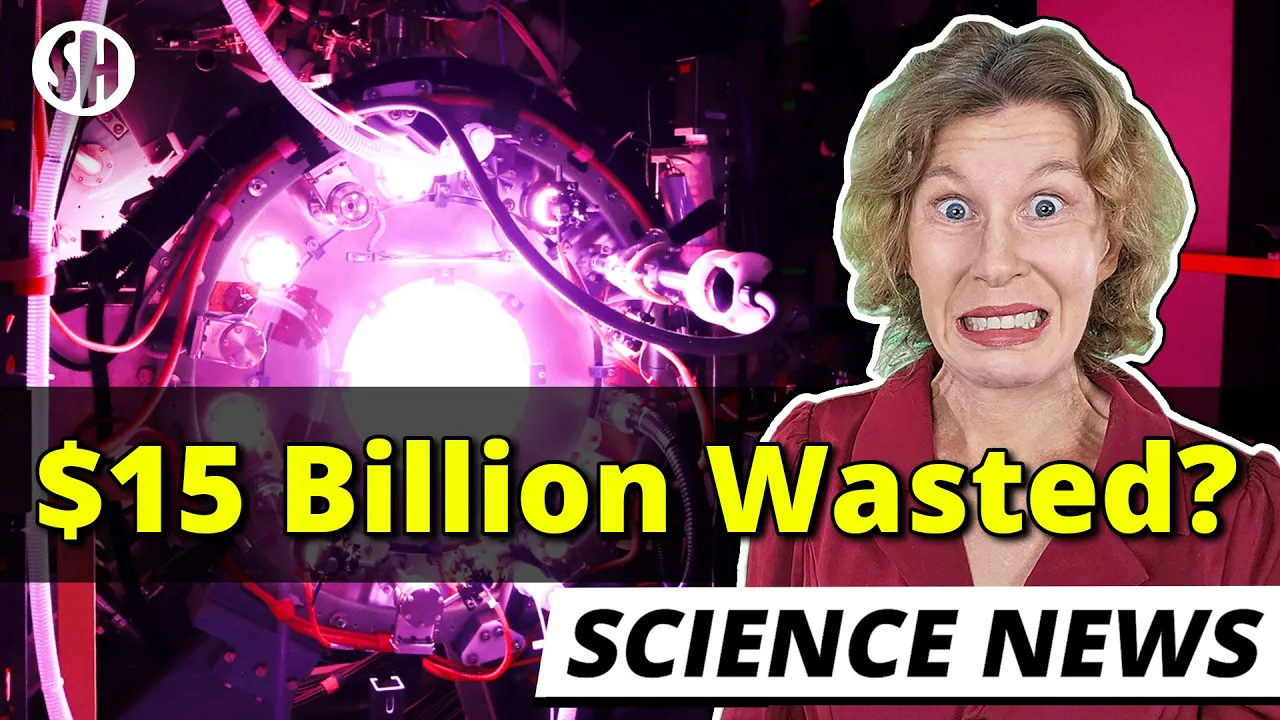
Sabine Hossenfelder
Independent researchers, including the plasma physicist whose work founded the company, conclude that rapid thermal equilibration and weak magnetic coupling make net electricity generation physically impossible for Helion's colliding-plasmoid reactor.
AI-assisted summary of This $15 Billion Nuclear Fusion Machine Can’t Work, Physicists Say — original source. Check the original for full context.
Source published:
Key ideas
- Private investment in nuclear fusion reached a record $4.48 billion over the past 12 months, pushing cumulative sector funding since 2021 past $14 billion despite recurring project delays. (0:00)
- Helion Energy's valuation surged threefold to $15 billion, propelled by circular funding loops where corporate investors like Microsoft and Nucor finance the startup while contracting to buy its future electricity. (0:00)
- Three independent research groups, including foundational plasma physicist John Slough, published findings concluding that Helion's colliding Field-Reversed Configuration machine cannot achieve net energy. (1:49)
- Independent thermodynamic and electromagnetic analyses revealed that Helion's design suffers from near-instantaneous ion-electron thermalization and an inefficient 1% magnetic field coupling that fails even at 50 Tesla. (1:49)
Detailed notes
## Background Published on YouTube by Sabine Hossenfelder on September 30, 2026, this video examines the widening credibility gap among commercial fusion ventures. According to the page description, while fusion startups continuously delay their target deadlines, Helion Energy has seen its valuation surge to fifteen billion dollars despite three independent research groups—including the physicist whose research formed the basis of its design—concluding that its machine fundamentally cannot work.
## TL;DR Private investment in nuclear fusion has skyrocketed past $14 billion, propelled by circular deals where corporate tech backers invest in startups while simultaneously contracting to purchase their hypothetical future electricity. Amid this hype, Helion Energy's valuation has ballooned to $15 billion, even as serious scientific critiques mount against its pulsed Field-Reversed Configuration (FRC) collider. Three independent studies—from foundational researcher John Slough, the Max Planck Institute, and a French plasma physics group—demonstrate that Helion's design suffers from fatal ion-electron thermalization and drastic magnetic coupling inefficiencies, ruling out net power. While Helion has brushed off these findings and pushed back its deployment timeline, the critique underscores a recurring industry pattern where poorly understood shortcut concepts look rapid and promising only until their physical limits are rigorously established.
## Atmosphere & style The presentation carries Sabine's trademark blend of dry skepticism, analytical rigor, and sharp wit, cutting cleanly through Silicon Valley's venture capital buzzwords. It moves methodically from the financial circularity of corporate clean-energy pledges to the unforgiving thermodynamics of plasma physics, maintaining an objective and grounded perspective throughout. Watching the segment feels like an overdue reality check, contrasting breathless techno-optimism with the slow, unyielding realities of experimental science.
## Bulletin - [00:00](https://www.youtube.com/watch?v=wwB4hB9QJX8&t=0s) Private investment in nuclear fusion reached a record $4.48 billion over the past 12 months, pushing cumulative sector funding since 2021 past $14 billion despite recurring project delays. - [00:00](https://www.youtube.com/watch?v=wwB4hB9QJX8&t=0s) Helion Energy's valuation surged threefold to $15 billion, propelled by circular funding loops where corporate investors like Microsoft and Nucor finance the startup while contracting to buy its future electricity. - [01:49](https://www.youtube.com/watch?v=wwB4hB9QJX8&t=109s) Three independent research groups, including foundational plasma physicist John Slough, published findings concluding that Helion's colliding Field-Reversed Configuration machine cannot achieve net energy. - [01:49](https://www.youtube.com/watch?v=wwB4hB9QJX8&t=109s) Independent thermodynamic and electromagnetic analyses revealed that Helion's design suffers from near-instantaneous ion-electron thermalization and an inefficient 1% magnetic field coupling that fails even at 50 Tesla.
## Key takeaways - [00:00](https://www.youtube.com/watch?v=wwB4hB9QJX8&t=0s) Nuclear fusion startups are persistently delaying delivery dates, sharpening the distinction between credible designs and unviable concepts. - [00:00](https://www.youtube.com/watch?v=wwB4hB9QJX8&t=0s) The fusion industry is experiencing an unprecedented capital boom, securing over $14 billion since 2021 and $4.48 billion in the last year alone. - [00:00](https://www.youtube.com/watch?v=wwB4hB9QJX8&t=0s) Circular financing structures closely mirror trends in AI, with corporate giants like Microsoft, Google, and Nucor simultaneously investing in fusion ventures and agreeing to purchase power that may never materialize. - [01:49](https://www.youtube.com/watch?v=wwB4hB9QJX8&t=109s) Helion Energy attempts to achieve fusion via a Field-Reversed Configuration (FRC), accelerating and colliding two plasma rings to extract electricity directly through inductive magnetic coils rather than steam turbines. - [01:49](https://www.youtube.com/watch?v=wwB4hB9QJX8&t=109s) John Slough, the plasma physicist whose academic research forms the foundation of Helion's architecture, stated that Helion's dual-ring collision design hits fundamental physics barriers and will never work. - [01:49](https://www.youtube.com/watch?v=wwB4hB9QJX8&t=109s) A Max Planck Institute study demonstrated that the kinetic energy from Helion's plasma collision rapidly thermalizes between ions and electrons, preventing the claimed temperature disparity necessary for practical net gain. - [01:49](https://www.youtube.com/watch?v=wwB4hB9QJX8&t=109s) French plasma physicists calculated that only about 1% of input magnetic energy couples into the plasma, rendering net energy impossible under any realistic scenario, even at 50-Tesla magnetic field strengths. - [01:49](https://www.youtube.com/watch?v=wwB4hB9QJX8&t=109s) Helion dismissed external peer-reviewed critiques by claiming outside physicists modeled an outdated design, while quietly postponing its projected net electricity delivery from 2028 to 2029–2030. - [04:48](https://www.youtube.com/watch?v=wwB4hB9QJX8&t=288s) Commercial fusion approaches are diverging in viability: pure inertial confinement ventures have stalled, whereas conventional magnetic designs like tokamaks, stellarators, and levitating dipoles continue steady progress. - [04:48](https://www.youtube.com/watch?v=wwB4hB9QJX8&t=288s) Speculative hybrid systems, such as sheared-flow Z-pinches and pulsed magnetic devices, carry high physics risk because their underlying plasma dynamics are not yet fully understood. - [04:48](https://www.youtube.com/watch?v=wwB4hB9QJX8&t=288s) Net electricity production from any commercial fusion reactor remains highly unlikely before the end of the decade.
## Detailed walkthrough ### [00:00](https://www.youtube.com/watch?v=wwB4hB9QJX8&t=0s) The Fusion Funding Boom and Circular Investment Loops
Nuclear fusion startups have developed a recurring habit of pushing back their promised completion dates, a reality that Sabine notes is hardly unexpected. What is far more revealing, however, is that the divide between which ventures are making credible progress and which are floundering is finally coming into sharp focus. In particular, the outlier approach championed by Helion Energy has run into severe scientific headwinds. Over the past decade, private capital pouring into the sector has reached unprecedented heights: fusion companies pulled in a record $4.48 billion in the preceding 12 months alone, driving the cumulative total invested since 2021 past the $14 billion mark.
Yet beneath these staggering funding figures lies an incestuous, circular dynamic remarkably similar to current patterns in artificial intelligence financing. The very corporations bankrolling these fusion ventures are simultaneously executing power purchase agreements to buy electricity that may never actually materialize: - **Google** invested in Commonwealth Fusion Systems and simultaneously pledged to purchase electricity from them. - **Microsoft** heavily invested in OpenAI, whose CEO Sam Altman serves as a primary backer and board chair of Helion Energy; Microsoft then signed a high-profile agreement to purchase electricity from Helion. - **Nucor**, the American steel manufacturing giant, invested directly in Helion while signing an agreement to procure power from Helion's future machines.
While these arrangements are entirely legal, they have helped inflate Helion's valuation to a massive $15 billion—a threefold increase since January of the prior year—even as technical skepticism against the company's core mechanism mounts.
```mermaid flowchart LR accTitle: Circular Investment Structure in Nuclear Fusion Startups accDescr: Diagram illustrating how corporate investors fund fusion startups and contract to buy power back from them.
subgraph Investors["Corporate Backers"] MSFT["Microsoft / Sam Altman"] GOOG["Google"] NUC["Nucor Steel"] end
subgraph Startups["Fusion Ventures"] HEL["Helion Energy\n($15B Valuation)"] CFS["Commonwealth Fusion"] end
MSFT -->|"Capital Investment"| HEL HEL -.->|"Future Power Delivery"| MSFT
GOOG -->|"Capital Investment"| CFS CFS -.->|"Future Power Delivery"| GOOG
NUC -->|"Capital Investment"| HEL HEL -.->|"Future Power Delivery"| NUC ```
---
[01:49](https://www.youtube.com/watch?v=wwB4hB9QJX8&t=109s) How Helion Works and Why Physicists Say It Won't
Helion Energy relies on a non-traditional concept known as a Field-Reversed Configuration (FRC). Instead of confining plasma continuously, Helion uses pulsed magnetic fields to accelerate two distinct plasmoids or fuel "blobs" toward each other from opposite ends of a chamber. These rings collide and are violently compressed in the center, jacking up temperature and pressure to ignite nuclear fusion. Because the internal magnetic field of the rings opposes the external field, it creates a self-confining FRC geometry. A signature selling point of Helion's architecture is direct inductive energy conversion: rather than letting fusion heat boil water into steam to spin conventional turbines, the expanding plasma pushes back against the magnetic field coils, recovering electricity directly. When Sabine first evaluated the concept, she felt skeptical, viewing it as essentially an ad-hoc particle collider that seemed far less likely to break even than established magnetic confinement systems like stellarators.
```mermaid flowchart TD accTitle: Helion Energy Field-Reversed Configuration Collision Process accDescr: Steps of Helion's pulsed plasma collision and direct energy recovery concept.
subgraph Collision["1. Acceleration & Compression"] A1["Form FRC Plasma Ring A"] --> C["High-Velocity Collision\nin Center Chamber"] A2["Form FRC Plasma Ring B"] --> C C --> D["Magnetic Compression to\nFusion Conditions"] end
subgraph Extraction["2. Direct Energy Recovery"] D --> E["Plasma Expansion\nAgainst Magnetic Coils"] E --> F["Direct Electric Current\nInduced in Circuitry"] end ```
Recently, three independent research groups have published damning critiques arguing that Helion’s machine is fundamentally incapable of achieving net power: - **John Slough**, the pioneering plasma physicist whose academic research at the University of Washington laid the groundwork for Helion's device, stated bluntly in an interview with *Scientific American* that Helion's machine would never work. Slough remarked that the company has "run up against a fundamental aspect" and that "he can't see anything in the physics" that allows it to succeed. Slough has since pursued his own concept involving a single plasma ring squeezed gradually rather than colliding two rings. - **Max Planck Institute for Plasma Physics researchers** analyzed Helion's thermodynamic collision mechanics. Helion claims net gain is attainable because the collision deposits the bulk of the kinetic energy directly into heavy fuel nuclei rather than lightweight electrons, keeping energy where fusion needs it. The Max Planck team demonstrated that while this disparity may exist for an instant post-impact, energy redistributes between ions and electrons almost instantaneously, choking off any path to nuclear ignition. They concluded that "only for very small values of gain which are of no practical interest for power production with the initial temperature differences result in the improvement predicted by Helion." - **A French plasma physics team** calculated that magnetic field coupling is drastically inefficient: only roughly 1% of the input magnetic field energy actually couples into the plasma, representing an overwhelming loss. Their paper concluded that for any realistic scenario, "net energy is never achieved even at a magnetic field strength of 50 Tesla."
Helion brushed aside these peer-reviewed objections by asserting that outside physicists were merely evaluating an obsolete machine design and claiming they already know how to resolve the issues without disclosing the solution. In the meantime, Helion quietly pushed its projected milestone for delivering net electricity back from 2028 to 2029 or 2030.
---
[04:48](https://www.youtube.com/watch?v=wwB4hB9QJX8&t=288s) The Broader Fusion Landscape and Outskill Sponsorship
Looking across the broader commercial fusion landscape, Sabine notes that alternative approaches are experiencing sharply divergent fates. Pure inertial confinement concepts—exemplified by First Light Fusion—appear to have stalled after early fanfare. Conversely, the more conventional approaches continue to deliver steady, incremental progress: tokamaks, stellarators, and magnetic dipole concepts such as OpenStar Technologies' levitating dipole experiment. In between sit speculative hybrid approaches, such as Zap Energy's sheared-flow-stabilized Z-pinch or Pacific Fusion's pulsed magnetic system. While these hybrids are far riskier because their underlying plasma physics is less mature, their simplicity could theoretically yield faster progress if their core hypotheses hold. Even so, Sabine argues that seeing anyone achieve net electricity production before the close of the decade remains exceedingly improbable, summarizing the dilemma: "understood physics is slow, poorly understood physics is fast, right up until you understand it."
The episode wraps up with a sponsored segment for Outskill, an educational platform offering a 3-hour hands-on crash course on OpenAI's GPT-6 Astra. As an official OpenAI partner, Outskill claims early testing access to help users build practical workflows—such as automated job searches matched to individual skill sets or real-time portfolio stock alerts. Attendees receive the "Astra Power Playbook" containing plug-and-play prompts and templates, accessible via an on-screen QR code or video description link.
## Notable quotes > [00:00](https://www.youtube.com/watch?v=wwB4hB9QJX8&t=0s) This $15 Billion Nuclear Fusion Machine Can’t Work, Physicists Say — Sabine Hossenfelder
> [00:00](https://www.youtube.com/watch?v=wwB4hB9QJX8&t=0s) Fusion startups keep postponing their dates, but it's becoming clear who is doing well and who isn't. — Sabine Hossenfelder
> [00:00](https://www.youtube.com/watch?v=wwB4hB9QJX8&t=0s) Helion is valued at fifteen billion dollars, and three groups have now said their machine cannot work, one of them the researcher whose work it is based on. — Sabine Hossenfelder
> [01:49](https://www.youtube.com/watch?v=wwB4hB9QJX8&t=109s) run up against a fundamental aspect — John Slough
> [01:49](https://www.youtube.com/watch?v=wwB4hB9QJX8&t=109s) he can't see anything in the physics — John Slough
> [01:49](https://www.youtube.com/watch?v=wwB4hB9QJX8&t=109s) only for very small values of gain which are of no practical interest for power production with the initial temperature differences result in the improvement predicted by Helion. — Max Planck Institute for Plasma Physics researchers
> [01:49](https://www.youtube.com/watch?v=wwB4hB9QJX8&t=109s) net energy is never achieved even at a magnetic field strength of 50 Tesla. — French plasma physics team
> [04:48](https://www.youtube.com/watch?v=wwB4hB9QJX8&t=288s) understood physics is slow, poorly understood physics is fast, right up until you understand it. — Sabine Hossenfelder
## Mentioned Sabine Hossenfelder, Helion Energy, Sam Altman, Google, Commonwealth Fusion Systems, Microsoft, OpenAI, Nucor, John Slough, University of Washington, Scientific American, Max Planck Institute for Plasma Physics, First Light Fusion, OpenStar Technologies, Zap Energy, Pacific Fusion, Outskill, GPT-6 Astra, Astra Power Playbook, Field-Reversed Configuration
## Video description 👉 Grab your free seat to the GPT 6 Astra Crash Course: https://links.outskill.com/SAHOOCT1 🔐 100% Discount for the first 1000 people 💥 Master GPT 6 Astra, Build Powerful AI Agent Workflows & Unlock the Astra Power Playbook — All for Free! 🎁 Bonuses worth $5100+ if you join and attend
Fusion startups keep postponing their dates, but it's becoming clear who is doing well and who isn't. Helion is valued at fifteen billion dollars, and three groups have now said their machine cannot work, one of them the researcher whose work it is based on. Let's take a look.
Paper: https://doi.org/10.1007/s10894-026-00554-2 Paper 2: https://doi.org/10.1007/s10894-026-00565-z
#sciencenews #physics #nuclearfusion #energy #technology
👕T-shirts, mugs, posters and more: ➜ https://sabines-store.dashery.com/ 💌 Support me on Donorbox ➜ https://donorbox.org/swtg 👉 Transcript with links to references on Patreon ➜ https://www.patreon.com/Sabine 📝 Transcripts and written news on Substack ➜ https://sciencewtg.substack.com/ 📩 Free weekly science newsletter ➜ https://sabinehossenfelder.com/newsletter/ 👂 Audio only podcast ➜ https://open.spotify.com/show/0MkNfXlKnMPEUMEeKQYmYC 🔗 Join this channel to get access to perks ➜ https://www.youtube.com/channel/UC1yNl2E66ZzKApQdRuTQ4tw/join 📚 Buy my book ➜ https://amzn.to/3HSAWJW
[Source](https://www.youtube.com/watch?v=wwB4hB9QJX8)