Carpet-3 Logs 300 TeV Cosmic Photon Defying Special Relativity
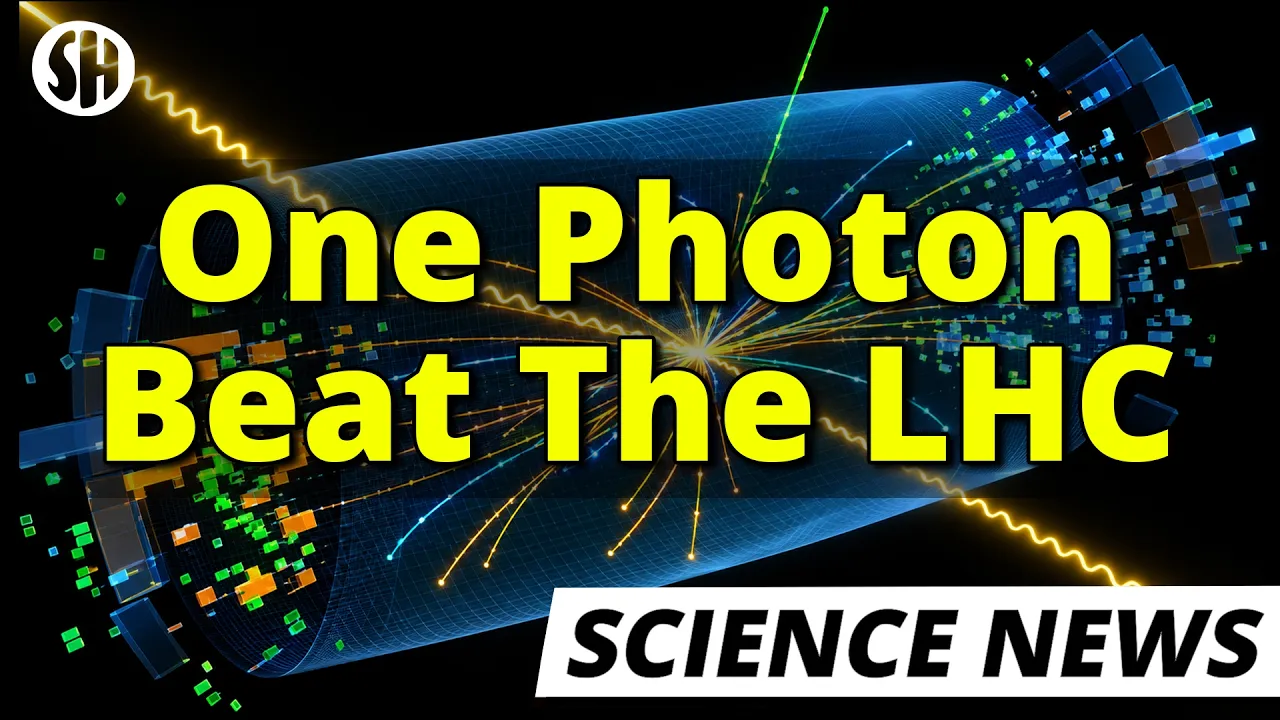
Sabine Hossenfelder
While researchers argue the anomalous photon evidences quantum gravity through broken Lorentz invariance, retrofitted mathematical models make an instrument error or coincidence far more probable than a rewrite of relativity.
AI-assisted summary of Mystery Photon Might Be First Evidence for Quantum Gravity — original source. Check the original for full context.
Source published:
Key ideas
- Physicists have proposed that a solitary 300 TeV photon detected from the historic October 2022 gamma-ray burst could represent the first observational evidence for quantum gravity. (0:00)
- Under standard cosmological physics, the probability of a 300 TeV photon surviving intergalactic cosmic microwave background scattering across billions of light-years is roughly 10^-96. (1:32)
- A mundane alternative explanation, such as an instrument misidentification or an unrelated local event, carries a far more probable estimated likelihood of 1 in 30,000. (1:32)
- While quantum gravity models can account for the photon by breaking Lorentz invariance, Sabine rates the proposal a 7 out of 10 on the bullshit meter because dispersion relations can easily be retrofitted to any data after the fact. (2:50)
Detailed notes
## Background Published on YouTube by Sabine Hossenfelder on October 3, 2026, this video examines a recent physics paper claiming the potential first evidence of quantum gravity. According to the description, the claim stems from an ultra-high-energy photon detected in Russia in October 2022 that theoretically should never have survived its journey to Earth.
## TL;DR Physicists analyzing the record-bright October 2022 gamma-ray burst reported that the Russian Carpet-3 experiment detected a single photon carrying roughly 300 TeV of energy—about 100 times that of the Large Hadron Collider. Standard physics dictates that interactions with the cosmic microwave background should have destroyed such a particle over cosmological distances, giving it an astronomically tiny survival probability of roughly 10⁻⁹⁶. To explain its arrival, researchers proposed that quantum spacetime effects break Lorentz invariance, allowing the photon to travel without standard absorption. However, Sabine remains skeptical, rating the theoretical post-hoc fitting a seven out of ten on her 'bullshit meter' while highlighting the perennial unreliability of isolated, single-event anomalies.
## Atmosphere & style The presentation is defined by Sabine Hossenfelder's trademark deadpan humor, sharp skepticism, and pragmatic clarity. Rather than indulging in sensational headlines about revolutionary physics, the tone feels intellectually sobering, punctuating complex cosmological principles with dry comparisons like lawn clover and a literal 'bullshit meter.' It delivers the feeling of a grounded sanity check against speculative theoretical overreach, pairing awe for extreme cosmic events with hard-nosed scientific realism.
## Bulletin - [00:00](https://www.youtube.com/watch?v=3rxQyfOfjuU&t=0s) Physicists have proposed that a solitary 300 TeV photon detected from the historic October 2022 gamma-ray burst could represent the first observational evidence for quantum gravity. - [01:32](https://www.youtube.com/watch?v=3rxQyfOfjuU&t=92s) Under standard cosmological physics, the probability of a 300 TeV photon surviving intergalactic cosmic microwave background scattering across billions of light-years is roughly 10^-96. - [01:32](https://www.youtube.com/watch?v=3rxQyfOfjuU&t=92s) A mundane alternative explanation, such as an instrument misidentification or an unrelated local event, carries a far more probable estimated likelihood of 1 in 30,000. - [02:50](https://www.youtube.com/watch?v=3rxQyfOfjuU&t=170s) While quantum gravity models can account for the photon by breaking Lorentz invariance, Sabine rates the proposal a 7 out of 10 on the bullshit meter because dispersion relations can easily be retrofitted to any data after the fact.
## Key takeaways - [00:00](https://www.youtube.com/watch?v=3rxQyfOfjuU&t=0s) A single photon measuring roughly 300 TeV was recorded by the Carpet-3 air shower experiment in Russia from the October 2022 gamma-ray burst. - [00:00](https://www.youtube.com/watch?v=3rxQyfOfjuU&t=0s) The detected photon possessed approximately 100 times the collision energy generated by the Large Hadron Collider. - [00:00](https://www.youtube.com/watch?v=3rxQyfOfjuU&t=0s) Unlike typical quantum gravity proposals involving extra dimensions and speculative particle zoos, this hypothesis is based on a single detected particle. - [01:32](https://www.youtube.com/watch?v=3rxQyfOfjuU&t=92s) Intergalactic space is saturated with cosmic microwave background radiation, which normally absorbs ultra-high-energy photons via pair production over cosmological distances. - [01:32](https://www.youtube.com/watch?v=3rxQyfOfjuU&t=92s) Standard quantum electrodynamics gives the photon an infinitesimally small survival probability of roughly 10^-96 over its journey to Earth. - [01:32](https://www.youtube.com/watch?v=3rxQyfOfjuU&t=92s) The likelihood of a false identification or an unrelated local photon coinciding with the burst is estimated at roughly 1 in 30,000, making it vastly more plausible under standard physics. - [02:50](https://www.youtube.com/watch?v=3rxQyfOfjuU&t=170s) Candidate quantum gravity theories propose discrete spacetime that acts like a modern ether at extreme scales, violating Einstein's principle of Lorentz invariance. - [02:50](https://www.youtube.com/watch?v=3rxQyfOfjuU&t=170s) Because modified dispersion relations can be mathematically tuned to make photons travel faster, slower, farther, or shorter, the hypothesis is heavily retrofitted to the observation. - [04:08](https://www.youtube.com/watch?v=3rxQyfOfjuU&t=248s) Physics has a history of isolated, unrepeatable single-event anomalies—such as the 1982 candidate signal for a magnetic monopole—that were never replicated. - [04:08](https://www.youtube.com/watch?v=3rxQyfOfjuU&t=248s) Extreme cosmic phenomena remain valuable natural laboratories for exploring physics at energy scales far beyond the reach of terrestrial colliders.
## Detailed walkthrough ### [00:00](https://www.youtube.com/watch?v=3rxQyfOfjuU&t=0s) An Impossible Photon from Deep Space
A team of physicists has proposed that they may have found the very first evidence for quantum gravity. Unusually for theoretical physics, this proposal does not rely on extra dimensions—"from the 17th dimension with a small zoo of hypothetical particles"—but on a single, isolated photon. The particle was detected by the Carpet-3 air shower experiment in Russia and seems to have originated from an energetic gamma-ray burst billions of light-years away. The detection is notable not only because Carpet-3 was relatively obscure prior to this event, but because the source was the brightest gamma-ray burst ever recorded, occurring in October 2022.
While several observatories worldwide picked up high-energy photons from this colossal burst, Carpet-3 registered an event in an entirely different class: a single photon packing roughly 300 tera-electronvolts (TeV) of energy. That is approximately 100 times the collision energy produced by the Large Hadron Collider, meaning a solitary cosmic photon managed to casually outperform several billion euros worth of premier European research infrastructure. According to the press release accompanying the research paper, the arrival of this photon implies that observable effects attributed to quantum gravity might emerge at extreme energy scales.
- The detection stems from the historic October 2022 gamma-ray burst (GRB 221009A), widely regarded as the brightest burst ever witnessed. - The single detected photon measured around 300 TeV—roughly two orders of magnitude beyond the peak energy achieved at the Large Hadron Collider.
[01:32](https://www.youtube.com/watch?v=3rxQyfOfjuU&t=92s) The Cosmic Microwave Background Filter and the Odds
The fundamental mystery is not that an exploding star produced such high energy in the first place; dying stars that trigger gamma-ray bursts generate astronomical quantities of power. The true puzzle is how the photon reached Earth at all. Space is far from empty; it is saturated with the relic radiation of the cosmic microwave background (CMB). At sufficiently high energies, photons do not simply pass through one another unnoticed—they interact and scatter via pair production, effectively making intergalactic space opaque to ultra-high-energy light over cosmological distances. Traversing billions of light-years through this background bath should have guaranteed the photon's destruction en route.
```mermaid flowchart LR accTitle: Photon Journey through Intergalactic Space accDescr: Diagram illustrating how a high-energy photon encounters cosmic microwave background radiation and should undergo pair production.
subgraph Source["Distant Universe"] GRB["Gamma-Ray Burst<br/>(Dying Star)"] -->|"Emits 300 TeV Photon"| P1["High-Energy Photon"] end
subgraph Intergalactic["Intergalactic Medium"] P1 --> Int{"Interaction with CMB"} CMB["Cosmic Microwave Background"] --> Int Int -->|"Standard Physics"| Annihilated["Pair Production<br/>(Should be absorbed)"] Int -.->|"Anomalous Survival"| Earth["Carpet-3 Detector<br/>(Earth)"] end ```
When calculating the probability that a 300 TeV photon could survive billions of light-years of CMB interaction and hit a terrestrial detector, the study's authors arrived at odds of roughly $10^{-96}$. As a comparison, that is "roughly comparable to the chance I'll ever get rid of the clover in our lawn"—a number so infinitesimally tiny that under standard physics, it simply should never happen. Conventional alternative explanations are far more probable: the signal could have been an unrelated photon originating from a local source closer to Earth that just happened to arrive simultaneously with the burst, or an entirely different particle erroneously flagged by the instrumentation. The authors estimate the probability of such an unrelated coincidental detection or misidentification at about 1 in 30,000, which is vastly more plausible than the standard-model survival odds.
- Under standard quantum electrodynamics and cosmology, the calculated survival probability for this 300 TeV photon over billions of light-years is roughly $10^{-96}$. - The probability that the signal was a false identification or an unrelated local event masquerading as part of the burst is estimated at approximately 1 in 30,000.
[02:50](https://www.youtube.com/watch?v=3rxQyfOfjuU&t=170s) Quantum Gravity, a Modern Ether, and the "Bullshit Meter"
If the photon did travel from the burst, it could signal an underlying flaw in Albert Einstein’s theory of special relativity. Standard calculations rely strictly on Lorentz invariance—the principle that physical laws and the speed of light are identical across all inertial reference frames, picking out no preferred state of rest or motion. However, many candidate models of quantum gravity posit that spacetime is discrete, composed of fundamental "space-time atoms" or quanta. At short distances and low energies, this structure remains undetectable, but over cosmological distances and at extreme energies, spacetime might act as a physical medium. This concept acts as a modern counterpart to the classical luminiferous ether.
The primary critique of invoking quantum gravity for this observation lies in theoretical flexibility. By modifying dispersion relations and breaking Lorentz invariance, theorists can construct mathematical frameworks where energetic photons travel faster, slower, farther, or shorter distances than standard relativity allows. Because nearly any outcome can be retrofitted mathematically, this paper rates a "seven out of 10 on the bullshit meter." While the detector data itself is valid and genuinely perplexing, mathematical models can be engineered after the fact to substantiate virtually any preferred hypothesis, quantum gravity included.
[04:08](https://www.youtube.com/watch?v=3rxQyfOfjuU&t=248s) The Dilemma of Single-Event Anomalies and Staying Prepared
This detection raises an enduring methodological challenge in modern astrophysics: how seriously the scientific community should take isolated, single-event anomalies. The history of physics contains several dramatic, unrepeatable occurrences—such as the infamous candidate signal for a magnetic monopole recorded on Valentine's Day in 1982, or isolated ultra-high-energy neutrino signals—that vanished without replication and remain unresolved. Nonetheless, paying attention to single events is worthwhile because they may serve as early harbingers of new phenomena. Ultra-high-energy gamma-ray bursts provide extreme natural laboratories unattainable on Earth, even if currently, "quantum gravity consists of one photon, one paper, and several thousand physicists trying very hard not to look too excited."
Transitioning from scientific surprises to everyday life, being prepared for unpredictable outcomes is preferable to repairing damage after things go wrong. Preventive measures—such as wearing sunblock, scheduling dental cleanings twice a year, keeping emergency glass-breaking tools in the car, packing noise-canceling headphones, or storing a freezer cake for unexpected occasions—mirror online security precautions. Internet protection is supported through sponsor NordVPN, which secures digital traffic across global servers and incorporates advanced antivirus defense against malware, malicious trackers, and online scams. Viewers can access an exclusive promotional deal using the link `nordvpn.com/sabine` or the promo code `SABINE`.
## Notable quotes > [00:00](https://www.youtube.com/watch?v=3rxQyfOfjuU&t=0s) from the 17th dimension with a small zoo of hypothetical particles — Sabine Hossenfelder
> [01:32](https://www.youtube.com/watch?v=3rxQyfOfjuU&t=92s) roughly comparable to the chance I'll ever get rid of the clover in our lawn — Sabine Hossenfelder
> [02:50](https://www.youtube.com/watch?v=3rxQyfOfjuU&t=170s) seven out of 10 on the bullshit meter — Sabine Hossenfelder
> [04:08](https://www.youtube.com/watch?v=3rxQyfOfjuU&t=248s) quantum gravity consists of one photon, one paper, and several thousand physicists trying very hard not to look too excited — Sabine Hossenfelder
## Mentioned Carpet-3, Large Hadron Collider, Albert Einstein, NordVPN
## Video description Upgrade your online protection with an all-in-one security app! Get an exclusive NordVPN deal + 4 months extra ➼ https://nordvpn.com/sabine Risk-free thanks to NordVPN's 30-day money-back guarantee!
In October 2022, a detector in Russia caught a single photon with an energy far beyond anything our particle colliders can produce. According to physics as we know it, it should never have made it to Earth. Now a team of physicists says it might be the first evidence for quantum gravity. Let's take a look.
Paper: https://doi.org/10.1103/zjh2-mc47
#sciencenews #physics #quantumphysics #space
👕T-shirts, mugs, posters and more: ➜ https://sabines-store.dashery.com/ 💌 Support me on Donorbox ➜ https://donorbox.org/swtg 👉 Transcript with links to references on Patreon ➜ https://www.patreon.com/Sabine 📝 Transcripts and written news on Substack ➜ https://sciencewtg.substack.com/ 📩 Free weekly science newsletter ➜ https://sabinehossenfelder.com/newsletter/ 👂 Audio only podcast ➜ https://open.spotify.com/show/0MkNfXlKnMPEUMEeKQYmYC 🔗 Join this channel to get access to perks ➜ https://www.youtube.com/channel/UC1yNl2E66ZzKApQdRuTQ4tw/join 📚 Buy my book ➜ https://amzn.to/3HSAWJW
[Source](https://www.youtube.com/watch?v=3rxQyfOfjuU)