SoL-Pi Harness Cuts AI Agent Costs 33% in EdgeBench Tests
Xiaol.x
Filtering automated research proposals down to four context and execution mechanisms lowers AI agent operating costs by one-third while retaining roughly 94% of baseline capability, though compounding recursive self-improvement remains unproven.
AI-assisted summary of SoL-Pi: Scaling Auto-Research Loops for Efficient Agent Harnesses — original source. Check the original for full context.
Source published:
Key ideas
- SoL-Pi filters 152 automated research proposals down to four validated harness mechanisms that optimize agent efficiency without altering underlying model weights. (1:45)
- On 51 held-out EdgeBench tasks, SoL-Pi cuts execution costs by approximately one-third and token consumption by 45% to 49% while retaining roughly 94% of native Pi's capability score. (8:10)
- The four surviving mechanisms—Action Fusion, ObservationPack, Evidence-Preserving Reducer, and Online Context Compact—mitigate redundant API round-trips, repetitive log replaying, and context debt. (4:13)
- True compounding, runaway recursive self-improvement remains an unverified hypothesis; SoL-Pi relies on a hybrid research workflow guided by human-defined constraints. (11:47)
Detailed notes
## Background Published on YouTube by Xiaol.x on September 11, 2026, this two-host explainer examines "SoL-Pi: Scaling Auto-Research Loops for Efficient Agent Harnesses." According to the video description, the program tracks how 152 proposed research directions were narrowed down to four core mechanisms—Action Fusion, ObservationPack, the Evidence-Preserving Reducer, and Online Context Compact—evaluating whether an agent can lower its operational costs while retaining roughly 94% of its benchmark capabilities.
## TL;DR The episode analyzes SoL-Pi, an approach that optimizes autonomous agent harnesses—prompts, tools, and memory management—without altering model weights to curb runaway token waste. By filtering 152 candidate hypotheses down to four surviving mechanisms, the harness introduces batched command execution, disk-backed observation paging, receipt-verified log reduction, and economically calculated context compaction. Evaluated across 51 held-out EdgeBench tasks, SoL-Pi achieves roughly a one-third reduction in cost and a 45% to 49% drop in total token consumption while preserving approximately 94% of the native Pi baseline's accuracy. Finally, the hosts draw a strict line between these validated efficiency gains and speculative claims, clarifying that a fully compounding, autonomous self-improvement loop remains an unproven hypothesis.
## Atmosphere & style The presentation carries an analytical, disciplined, and engineering-minded tone that deliberately counters runaway AI self-improvement hype. Driven by an explanatory two-host dialogue supported by technical animations and concrete debugging walkthroughs, the atmosphere feels like an objective technical audit. Its narrative moves from an enticing premise about slashing research bills to granular architectural scrutiny, concluding with a grounded reality check on the boundaries of recursive agent discovery.
## Bulletin - [01:45](https://www.youtube.com/watch?v=x9r85EtVFM8&t=105s) SoL-Pi filters 152 automated research proposals down to four validated harness mechanisms that optimize agent efficiency without altering underlying model weights. - [08:10](https://www.youtube.com/watch?v=x9r85EtVFM8&t=490s) On 51 held-out EdgeBench tasks, SoL-Pi cuts execution costs by approximately one-third and token consumption by 45% to 49% while retaining roughly 94% of native Pi's capability score. - [04:13](https://www.youtube.com/watch?v=x9r85EtVFM8&t=253s) The four surviving mechanisms—Action Fusion, ObservationPack, Evidence-Preserving Reducer, and Online Context Compact—mitigate redundant API round-trips, repetitive log replaying, and context debt. - [11:47](https://www.youtube.com/watch?v=x9r85EtVFM8&t=707s) True compounding, runaway recursive self-improvement remains an unverified hypothesis; SoL-Pi relies on a hybrid research workflow guided by human-defined constraints.
## Key takeaways - [00:00](https://www.youtube.com/watch?v=x9r85EtVFM8&t=0s) Autonomous agent research often wastes significant token budgets on repetitive loops and bloated contexts, making harness efficiency a critical bottleneck. - [00:00](https://www.youtube.com/watch?v=x9r85EtVFM8&t=0s) SoL-Pi optimizes the agent harness—including prompts, tool wrappers, memory layouts, and delegation rules—leaving foundation model weights untouched. - [01:45](https://www.youtube.com/watch?v=x9r85EtVFM8&t=105s) An automated discovery loop funneled 152 candidate research hypotheses down to four production mechanisms under a strict requirement to preserve capability. - [01:45](https://www.youtube.com/watch?v=x9r85EtVFM8&t=105s) Evaluation relies on EdgeBench, a suite of 51 long-horizon, real-world executable tasks held out entirely from the discovery process to prevent train-set memorization. - [04:13](https://www.youtube.com/watch?v=x9r85EtVFM8&t=253s) Action Fusion bundles predictable dependent command pairs, such as file edits and subsequent test suites, into a single round trip to eliminate unnecessary model calls. - [04:13](https://www.youtube.com/watch?v=x9r85EtVFM8&t=253s) ObservationPack limits terminal outputs larger than 10 KiB to two full provider requests before offloading them to disk and referencing them via lightweight handles and byte offsets. - [04:13](https://www.youtube.com/watch?v=x9r85EtVFM8&t=253s) The Evidence-Preserving Reducer uses a secondary model to extract structured error receipts from massive logs, verifying quoted lines against source hashes to prevent hallucinations. - [04:13](https://www.youtube.com/watch?v=x9r85EtVFM8&t=253s) Online Context Compact dynamically recalculates break-even economics at plan boundaries, ensuring context rewrites save more tokens than they consume in cache invalidation. - [08:10](https://www.youtube.com/watch?v=x9r85EtVFM8&t=490s) The screening dataset comprised 535 executable tasks, including 495 historical GitHub PR/issue pairs and 40 synthetic verification scenarios. - [08:10](https://www.youtube.com/watch?v=x9r85EtVFM8&t=490s) Empirical testing showed financial cost reductions of ~33% ($894 on the GPT backend and $1,158 on Claude Opus 5) alongside minimal drops in task accuracy. - [08:10](https://www.youtube.com/watch?v=x9r85EtVFM8&t=490s) Overall token usage dropped by 45% to 49%, translating to API-equivalent savings of 50% to 54% over model-native harness baselines. - [11:47](https://www.youtube.com/watch?v=x9r85EtVFM8&t=707s) The demonstrated breakthrough is a disciplined empirical process of broad exploration and strict evidence preservation, rather than a science-fiction open-ended recursive loop.
## Detailed walkthrough ### [00:00](https://www.youtube.com/watch?v=x9r85EtVFM8&t=0s) The Core Problem: Agent Token Waste and Harness Self-Improvement
The discussion opens with a provocative premise: "What if the next breakthrough in AI research is not a larger model, but a smaller bill?" The hosts point out that an agent can successfully execute a coding task on its first attempt, only to spend the next hour trapped in repetitive loops, burying its original insight under an ever-growing pile of context. This waste introduces the core motivation behind SoL-Pi. When AI is tasked with recursive self-improvement—using AI to refine the very systems that build AI—every single exploratory experiment burns tokens, whether it succeeds or fails. If researchers merely scale up the search space without constraining waste, the research process looks remarkably busy rather than genuinely productive.
Crucially, the hosts clarify that this optimization does not touch the underlying model weights. Instead, the optimization target is the *harness*: the prompts, tools, memory layouts, validation checks, and delegation rules that govern how a foundation model behaves as an autonomous researcher. The challenge is establishing trust: an idea might seem clever in theory, but it cannot be accepted if it degrades core capability, fails on unseen tasks, or never even activates during evaluation. To avoid this, the research loop enforces a strict rule: any surviving proposal must reduce token consumption or monetary cost while respecting a predetermined capability threshold.
```mermaid flowchart TD accTitle: SoL-Pi Recursive Harness Search Loop accDescr: 152 initial proposals funnel through multi-task checks to produce 4 validated mechanisms. subgraph S1["Search Pool"] A["152 Proposed Directions"] end subgraph S2["Evaluation and Screening"] B["Trajectory Analysis & Review"] C["Screening on 535 Training Tasks"] D["Validation on 51 Held-out EdgeBench Tasks"] end subgraph S3["Final Integration"] E["4 Surviving Mechanisms"] F["SoL-Pi Harness"] end A --> B B --> C C --> D D --> E E --> F ```
- **Harness Scope**: Covers prompts, tool wrappers, memory caches, delegation rules, and verification pipelines, leaving model weights completely untouched. - **Recursive Nature**: Discovered improvements reshape future iterations of the search space, using evidence from earlier runs to inform subsequent experiments while maintaining a fixed meta-research protocol.
---
[01:45](https://www.youtube.com/watch?v=x9r85EtVFM8&t=105s) The 152-to-4 Funnel and EdgeBench Validation
The hosts walk through the full SoL-Pi system pipeline. Starting from an initial baseline harness, the system branches out into 152 distinct proposed research directions. Each branch represents an unverified hypothesis rather than an assumed optimization. Agents analyze where current execution patterns burn unnecessary effort, implement specific candidate changes, and evaluate them first on known trajectories before running them across held-out environments.
As empirical evidence is gathered, weak candidates are discarded, and the branching tree aggressively narrows down until only four mechanisms survive. The hosts emphasize the distinction between what has actually been shown versus what remains theoretical: 1. **Demonstrated Phase**: Searching an expansive hypothesis space and empirically discovering four durable efficiency mechanisms within an agent harness. 2. **Proposed Compounding Phase**: Using the newly optimized, lower-cost harness to recursively fund and run subsequent generations of harness searches—a self-funding loop that remains an unverified hypothesis.
To ensure candidates do not simply overfit or memorize their testbeds, the evaluation setup uses EdgeBench, an evaluation suite featuring 51 long-horizon, executable agent tasks. Because these long-horizon runs take hours to execute, uncurbed context expansion and redundant API queries quickly become prohibitively expensive.
- **Initial Funnel**: 152 proposed research directions filtered down to 4 final production mechanisms (roughly a 1-in-40 acceptance rate). - **EdgeBench Benchmark**: 51 long-horizon, real-world executable tasks held out entirely from the discovery loop to prevent train-set memorization.
---
[04:13](https://www.youtube.com/watch?v=x9r85EtVFM8&t=253s) The Four Surviving Efficiency Mechanisms
The conversation shifts to a granular code and workflow walkthrough, using a concrete debugging scenario to explain how each of the four surviving mechanisms eliminates waste.
```mermaid flowchart LR accTitle: The Four Surviving Harness Mechanisms accDescr: Step-by-step application of Action Fusion, ObservationPack, Evidence-Preserving Reducer, and Online Context Compact. subgraph Step1["Execution"] AF["Action Fusion<br/>(Batch Edit + Test)"] end subgraph Step2["Ingestion"] EPR["Evidence-Preserving Reducer<br/>(Receipt Verification)"] end subgraph Step3["Storage"] OP["ObservationPack<br/>(Handles & Byte Offsets)"] end subgraph Step4["Lifecycle"] OCC["Online Context Compact<br/>(Break-Even Compaction)"] end AF --> EPR EPR --> OP OP --> OCC ```
#### 1. Action Fusion In typical agent workflows, an agent edits a file, waits for the environment output, calls the model back to decide what to do next, and then issues a test command (such as `npm test`) that it already knew it had to run. Action Fusion merges predictable command pairs into a single round trip: - The agent combines an edit or write operation with a dependent follow-up test in one payload. - The runtime executes the edit first; if it succeeds, it triggers the follow-up command immediately and returns a combined observation. - If the initial edit fails, the dependent test command is aborted, and the failure is reported without burning an extra model call.
#### 2. ObservationPack When command executions return voluminous output logs, agents typically keep replaying the identical output in full across every subsequent prompt. ObservationPack changes this paradigm from "replay every byte" to "keep access to every byte": - Text payloads larger than 10 KiB are delivered in full for only two provider requests. - For all subsequent queries, the raw payload is replaced by a lightweight, stable handle accompanied by brief excerpts, while the full log is archived locally on disk. - If the agent needs to inspect specific missing lines, it invokes `observation_recall` using the handle and a byte offset, returning a targeted page alongside the next offset.
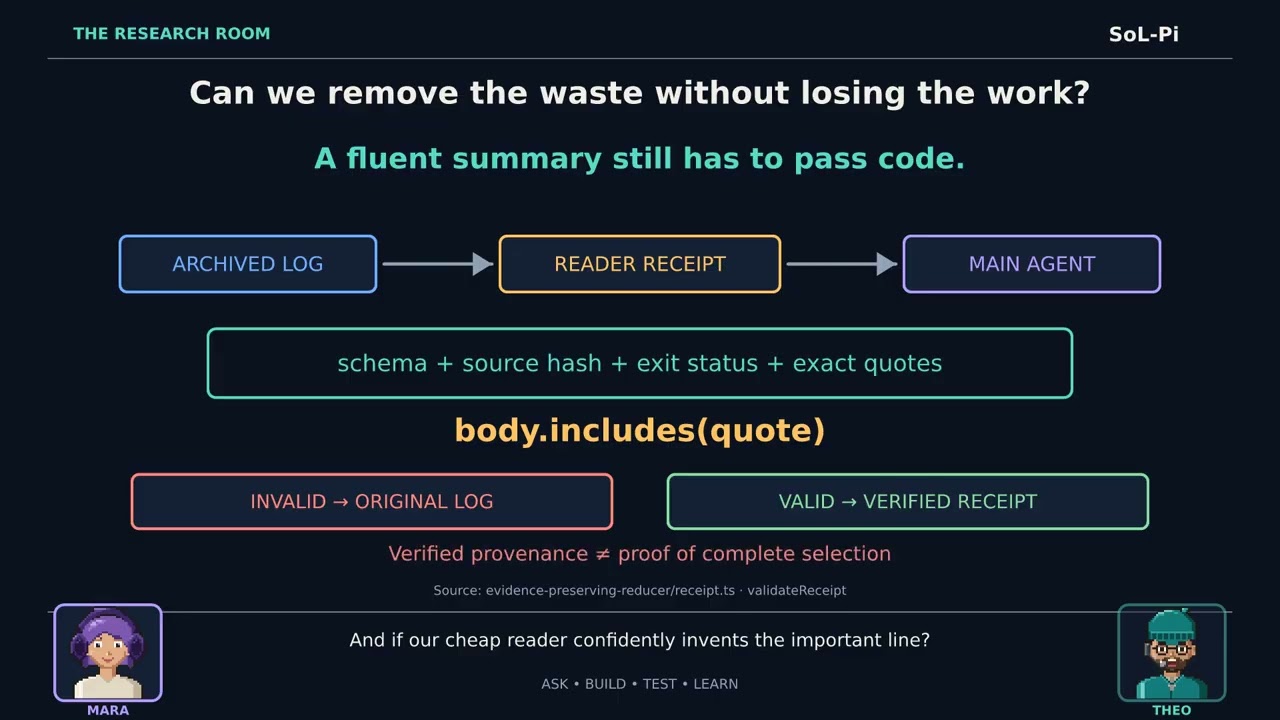
#### 3. Evidence-Preserving Reducer Massive build or test failure traces often hide just a few critical lines of root-cause information inside thousands of lines of noise. The Evidence-Preserving Reducer delegates the initial parsing of giant logs to a cheaper secondary model: - The secondary model summarizes the output into a structured "receipt," noting status, uncertainty, and exact verbatim quotations of error lines. - The harness guards against hallucinations by validating the receipt against the source hash, ensuring every quoted line exists verbatim in the local archive. - If the reducer fails verification, the harness falls back to the original raw output, guaranteeing provenance even though it cannot guarantee the cheap reader picked every single relevant line.
#### 4. Online Context Compact Even when an issue is resolved, past debugging transcripts persist in the active context window, incurring ongoing costs. However, summarizing context too aggressively can invalidate prefix cache hits and trigger expensive prompt re-encodings. Online Context Compact evaluates whether to rewrite context at plan boundaries based on a strict financial break-even calculation: - Compaction eligibility is calculated as: $$\text{Break-Even Requests} = \frac{\text{Rewrite Cost}}{\text{Savings Per Request}}$$ - The harness factors in outstanding cache debt, contextual safety margins, and context window pressure before triggering native Pi compaction. - If compaction is economically justified, the active task continues seamlessly into a fresh turn with reduced context debt.
---
[08:10](https://www.youtube.com/watch?v=x9r85EtVFM8&t=490s) Benchmark Results, Score Tradeoffs, and Boundaries
The hosts address the critical question of whether these optimizations represent a true efficiency breakthrough or merely a "very elegant shortcut" where an agent cuts costs by giving up on hard tasks. To prevent degradation, SoL-Pi enforces two strict gating criteria: 1. Every capability metric must remain within a pre-declared tolerance margin. 2. At least one efficiency metric (cost or token count) must show marked improvement.
The training and development environment spans 535 executable scenarios. Of these, 495 were extracted from historical GitHub pull request and issue pairs (where an environment is rolled back, confirmed to fail on a regression test, and checked for a pass after applying the patch), while 40 are synthetic tasks paired with programmatic verifiers. A candidate that fails on the 51 held-out EdgeBench tasks is discarded immediately, without feeding that failure trace back into the repair loop.
| Backend Model | Harness | Cost (USD) | EdgeBench Score | |:--- |:--- |:--- |:--- | | **GPT-5.6 / SoL Backend** | Native Pi Baseline | Baseline | 44.88 | | | **SoL-Pi** | **$894** (~33% reduction) | **42.00** | | **Claude Opus 5 Backend** | Native Pi Baseline | Baseline | 44.76 | | | **SoL-Pi** | **$1,158** (~33% reduction) | **42.22** |
The financial and performance data show significant token savings alongside a slight drop in accuracy: - **Cost & Token Reductions**: SoL-Pi cuts financial costs by approximately one-third compared to the native Pi baseline, reducing total token consumption by 45% to 49%. Compared to model-native harness baselines, API-equivalent costs drop by 50% to 54%. - **Capability Preservation**: Across both backends, SoL-Pi retains roughly 94% of native Pi's EdgeBench benchmark score (dropping from 44.88 to 42.00 on the GPT backend, and from 44.76 to 42.22 on Claude Opus 5).
The hosts conclude with important caveats regarding the project's scope. The research was a hybrid effort rather than an end-to-end autonomous discovery system: human researchers established initial architectural principles, curated directional proposals, and refined the final implementations. Furthermore, while the public repository provides the four Pi extensions, it does not include the full large-scale automated research pipeline used to discover them, leaving the vision of a fully autonomous, compounding recursive loop as a hypothesis for future work.
[11:47](https://www.youtube.com/watch?v=x9r85EtVFM8&t=707s) Demonstrated Reality vs. Compounding Self-Improvement
The discussion wraps up with a grounded reality check regarding recursive self-improvement and the vision of an agent loop that can indefinitely "discover an even cheaper harness." The hosts make it clear that an infinite, runaway "compounding cycle has not been demonstrated here." Rather than validating science-fiction scenarios of open-ended recursive self-upgrades, the actual achievement of SoL-Pi is far more practical, disciplined, and concrete.
What the project truly proves is an empirical recipe for building efficient research agents without sacrificing task capability: "Search broadly, preserve evidence, and make each saved token pass an exam." Rather than cutting context blindly or assuming optimization loops can endlessly feed into themselves, real progress comes from casting a wide net over potential harness improvements, strictly protecting task-critical findings, and subjecting every single efficiency gain to rigorous benchmark evaluation.
- **Unproven claims vs. reality:** An infinite, compounding loop of self-discovered harnesses remains unproven. - **The core demonstrated principle:** Broad exploration paired with strict evidence preservation, ensuring any token savings pass direct evaluation exams.
## Notable quotes > [00:00](https://www.youtube.com/watch?v=x9r85EtVFM8&t=0s) What if the next breakthrough in AI research is not a larger model, but a smaller bill?
> [00:00](https://www.youtube.com/watch?v=x9r85EtVFM8&t=0s) harness
> [04:13](https://www.youtube.com/watch?v=x9r85EtVFM8&t=253s) replay every byte
> [04:13](https://www.youtube.com/watch?v=x9r85EtVFM8&t=253s) keep access to every byte
> [04:13](https://www.youtube.com/watch?v=x9r85EtVFM8&t=253s) receipt
> [08:10](https://www.youtube.com/watch?v=x9r85EtVFM8&t=490s) very elegant shortcut
> [11:47](https://www.youtube.com/watch?v=x9r85EtVFM8&t=707s) discover an even cheaper harness
> [11:47](https://www.youtube.com/watch?v=x9r85EtVFM8&t=707s) compounding cycle has not been demonstrated here
> [11:47](https://www.youtube.com/watch?v=x9r85EtVFM8&t=707s) Search broadly, preserve evidence, and make each saved token pass an exam.
## Mentioned SoL-Pi, Pi, EdgeBench, Xiaol.x, NVlabs, Action Fusion, ObservationPack, Evidence-Preserving Reducer, Online Context Compact, GPT-5.6, Claude Opus 5, GitHub, Lean, Leanim, Manim, MiniMax, Aura
## Video description Can AI make its own research process cheaper—and still get the work done?
In this two-host explainer, we explore SoL-Pi: Scaling Auto-Research Loops for Efficient Agent Harnesses. Follow 152 proposed research directions down to four surviving mechanisms, using official animations, code walkthroughs, and visual explanations.
We unpack Action Fusion, ObservationPack, the Evidence-Preserving Reducer, and Online Context Compact—and explain what “recursive self-improvement” means in this project.
The central tradeoff: approximately one-third lower cost than Pi while retaining roughly 94% of its average EdgeBench score. We examine both the savings and the limitations.
Chapters: 00:00 Why does agent research waste tokens? 01:14 What is recursive harness improvement? 01:45 Complete official SoL-Pi animation 02:46 Demonstrated research versus future possibilities 04:13 Four mechanisms that reduce wasted work 08:10 Can we trust the savings?
Sources: https://nvlabs.github.io/SoL-Pi/ https://github.com/NVlabs/SoL-Pi
Created with Lean/Leanim and Manim. AI-generated narration via MiniMax/Aura. Official visuals credited to NVlabs.
#SoLPi #AIAgents #AutoResearch #MachineLearning #Manim
[Source](https://www.youtube.com/watch?v=x9r85EtVFM8)