OpenAI Solves Forced Navier–Stokes Blowup as Core Physical Case Looms
Xiaol.x
OpenAI's counterexample satisfies the Clay Millennium conditions by reverse-engineering a collapsing vortex whose mathematical blowup is canceled by an artificial external force, leaving the question of whether natural fluids break down completely untouched.
AI-assisted summary of How OpenAI's AI "Broke" Navier–Stokes: The Finite-Time Blowup Proof, Explained | Loop State EP.03 — original source. Check the original for full context.
Source published:
Key ideas
- OpenAI released a 166-page paper claiming to resolve alternatives (C) and (D) of the Clay Millennium Prize problem by proving finite-time blowup for the 3D forced Navier–Stokes equations. (0:01)
- The proof operates 'backwards' by constructing an engineered, diverging flow and spending the analytical bulk ensuring the residual forcing function and all its derivatives remain smooth through the singularity. (4:19)
- Although the peak fluid speed reaches infinity at t = 1, total kinetic energy remains finite—and drops toward zero in the core—because the singular volume contracts faster than speed diverges. (11:47)
- The paper does not resolve alternatives (A) and (B): whether an unforced fluid with f = 0 can develop a singularity remains entirely open, and the Clay Institute has not certified the result. (13:24)
Detailed notes
## Background Published on YouTube on September 12, 2026, by the channel Xiaol.x, this episode of the podcast Loop State (EP.03) breaks down OpenAI's 166-page paper, 'Finite Time Blowup for Navier–Stokes.' Hosts Mara and Theo walk through how the paper claims to resolve alternatives (C) and (D) of the Clay Millennium Prize problem by constructing a smooth fluid driven by a smooth force that hits infinite speed in finite time while maintaining finite total energy.
## TL;DR The hosts explain how the proof bypasses forward numerical integration by engineering an explicit blowup velocity field backwards, shifting the mathematical burden into showing that the residual external force remains completely smooth through the singularity. By introducing an anisotropic exponent h, the construction breaks collinear scaling and allows an iterative cycle of oscillating wave pulses to cancel singular residual terms order by order until the force is flat. Total kinetic energy remains finite—and actually drops to zero inside the collapsing vortex core—because the core's volume contracts faster than its peak speed squares grow. Finally, the breakdown is converted into a Millennium Prize counterexample via uniqueness arguments, though the hosts stress that the proof only resolves the artificially forced problem and leaves the classic unforced Navier–Stokes question completely open.
## Atmosphere & style The discussion carries a lucid, intellectually rigorous, and pedagogical energy driven by Mara and Theo's collaborative back-and-forth rhythm. Moving seamlessly from vivid mechanical intuitions—such as 'a vortex that eats itself'—into fine-grained mathematical calculus, the conversation feels like an advanced chalkboard seminar brought to life. Crucially, the tone avoids uncritical tech hype, maintaining a sober, disciplined scientific skepticism that dedicates substantial care to outlining boundaries, computational caveats, and the lack of external peer review.
## Bulletin - [00:01](https://www.youtube.com/watch?v=RzJokrUsnbM&t=1s) OpenAI released a 166-page paper claiming to resolve alternatives (C) and (D) of the Clay Millennium Prize problem by proving finite-time blowup for the 3D forced Navier–Stokes equations. - [04:19](https://www.youtube.com/watch?v=RzJokrUsnbM&t=259s) The proof operates 'backwards' by constructing an engineered, diverging flow and spending the analytical bulk ensuring the residual forcing function and all its derivatives remain smooth through the singularity. - [11:47](https://www.youtube.com/watch?v=RzJokrUsnbM&t=707s) Although the peak fluid speed reaches infinity at t = 1, total kinetic energy remains finite—and drops toward zero in the core—because the singular volume contracts faster than speed diverges. - [13:24](https://www.youtube.com/watch?v=RzJokrUsnbM&t=804s) The paper does not resolve alternatives (A) and (B): whether an unforced fluid with f = 0 can develop a singularity remains entirely open, and the Clay Institute has not certified the result.
## Key takeaways - [00:01](https://www.youtube.com/watch?v=RzJokrUsnbM&t=1s) The paper targets the forced Navier–Stokes problem, constructing a smooth fluid driven by a smooth force that hits infinite speed at t = 1. - [01:34](https://www.youtube.com/watch?v=RzJokrUsnbM&t=94s) The Millennium Prize problem formulation splits into four cases: alternatives (A) and (B) examine unforced fluids (f = 0), while (C) and (D) involve smooth external forcing. - [04:19](https://www.youtube.com/watch?v=RzJokrUsnbM&t=259s) Instead of solving the PDE forward in time, the authors engineer a diverging velocity candidate u and evaluate the residual force f, shifting the entire proof burden into proving f remains smooth. - [05:29](https://www.youtube.com/watch?v=RzJokrUsnbM&t=329s) A naive self-similar profile fails because all terms in the residual lock into the same temporal power, making differential cancellations impossible across the domain. - [06:53](https://www.youtube.com/watch?v=RzJokrUsnbM&t=413s) Introducing an anisotropic scaling parameter h decouples radial contraction (tau^(1/2)) from vertical contraction (tau^(1/2 - h)), splitting residual terms into distinct temporal orders. - [08:29](https://www.youtube.com/watch?v=RzJokrUsnbM&t=509s) Oscillating wave pulses with zero-mean velocity generate non-zero mean momentum fluxes, cancelling leading-order residual stresses in an annular region around the core. - [10:13](https://www.youtube.com/watch?v=RzJokrUsnbM&t=613s) An iterative four-step correction cycle improves residual decay order-by-order, yielding a 'flat' force whose space-time derivatives vanish faster than any power near the blowup. - [11:47](https://www.youtube.com/watch?v=RzJokrUsnbM&t=707s) Due to core volume scaling of tau^(3/2 - h) versus velocity squared scaling of tau^(-1 - 2h), the kinetic energy in the collapsing core drops to zero as t approaches 1. - [12:26](https://www.youtube.com/watch?v=RzJokrUsnbM&t=746s) Outside the core annulus, the flow reduces to a pure swirl obeying the radial heat equation, allowing the solution to be smoothly cut off without disturbing the blowup column. - [12:26](https://www.youtube.com/watch?v=RzJokrUsnbM&t=746s) Lemma 10.5 uses weak-strong uniqueness to show any smooth candidate solution must coincide with the constructed blowup before t = 1, ruling out the existence of global smooth solutions. - [13:24](https://www.youtube.com/watch?v=RzJokrUsnbM&t=804s) The forcing function is meticulously engineered and compactly supported rather than physically occurring in nature, settling the Millennium Prize statement strictly as written. - [13:24](https://www.youtube.com/watch?v=RzJokrUsnbM&t=804s) OpenAI reported verifying the proof in Lean using internal AI models, but the proof lacks external peer review and has not been certified by the Clay Mathematics Institute. - [13:24](https://www.youtube.com/watch?v=RzJokrUsnbM&t=804s) Priority for resolving finite-time blowup for the forced Euler equations belongs to Levent Alpöge and Tristan Buckmaster, which OpenAI explicitly acknowledged.
## Detailed walkthrough ### [00:01](https://www.youtube.com/watch?v=RzJokrUsnbM&t=1s) The Counterexample: A Vortex That Eats Itself
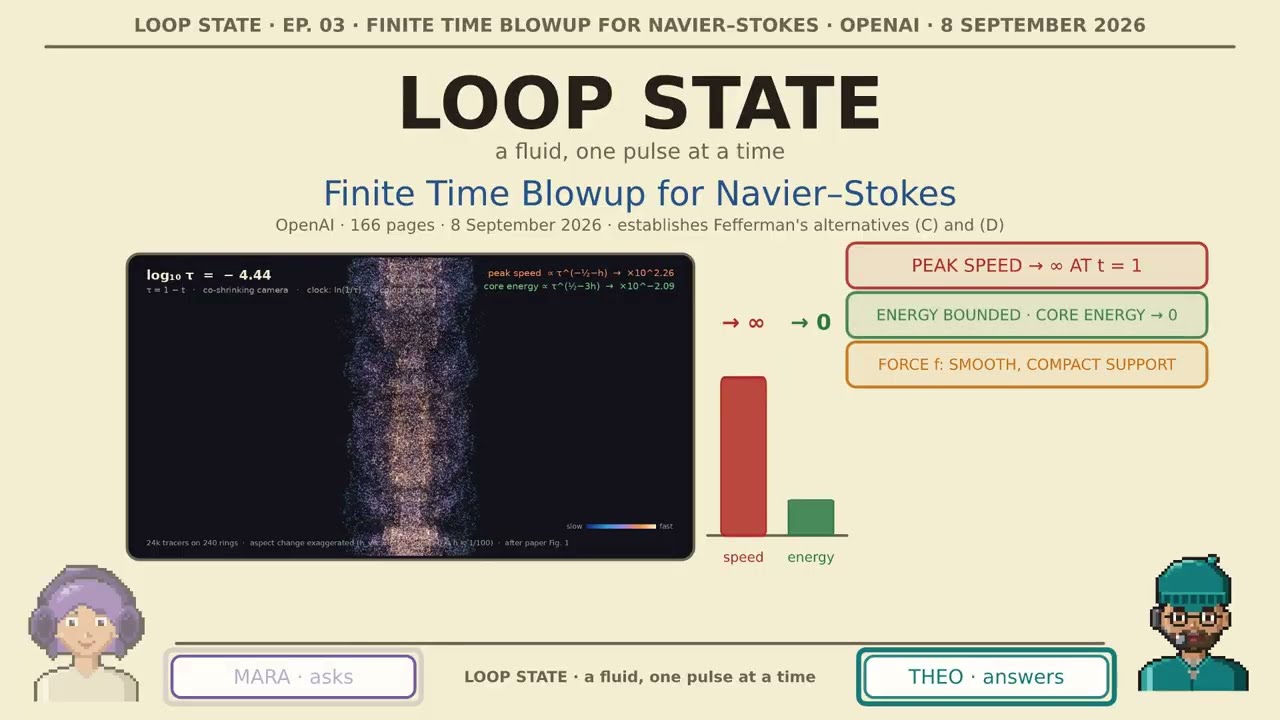
On September 8, 2026, OpenAI released a 166-page paper titled *"Finite Time Blowup for Navier–Stokes"*. Hosts Mara and Theo open the discussion by examining what this counterexample flow actually looks like before jumping into the formal mathematics. Theo describes the core mechanism as "a vortex that eats itself." In this configuration, fluid spirals inward toward a vertical axis and is ejected along that axis—shooting upward on one side and downward on the other. As the system evolves toward time $t = 1$, the vortex core contracts, thinning out faster than it shortens in height. Consequently, the fluid velocity inside this shrinking column climbs without bound, hitting infinite speed precisely at time $t = 1$.
```mermaid flowchart TD accTitle: Fluid dynamics of the self-collapsing vortex accDescr: Fluid spirals radially inward into a narrowing column, which accelerates vertical jets and drives velocity to infinity within a shrinking core volume.
subgraph INFLOW["Inflow & Contraction"] A["Inward Radial Spiral"] --> B["Vortex Core Thinning"] end
subgraph BLOWUP["Core Dynamics"] B --> C["Axial Ejection (Up/Down Jets)"] C --> D["Speed Climbs Unbounded"] D --> E["Blowup at t = 1 (Infinite Speed)"] end
subgraph ENERGY["Volume & Energy"] B --> F["Core Volume Shrinks Rapidly"] F --> G["Kinetic Energy in Core -> 0"] end ```
The construction yields a smooth fluid driven by a smooth force that reaches an infinite speed within finite time, all while maintaining finite total energy. Crucially, the total kinetic energy contained within the vortex core does not explode; it actually drops toward zero as the core collapses. Because an enormous peak speed is concentrated inside an vanishingly small spatial volume, the integral of energy remains well-behaved. Theo and Mara emphasize an important contextual caveat: while OpenAI reported that the entire proof is formalized in Lean, the Clay Mathematics Institute has not certified the result, and no external peer review has taken place yet.
---
[01:34](https://www.youtube.com/watch?v=RzJokrUsnbM&t=94s) Navier–Stokes Fundamentals and the Four Clay Millennium Problems
Navier–Stokes is simply Newton's second law ($F = ma$) applied to a microscopic parcel of fluid. Dividing force by mass yields acceleration, which decomposes into the unsteady time derivative $\partial_t u$ and the non-linear convective transport term $(u \cdot \nabla)u$, accounting for the parcel changing position within a varying velocity field. The balance of forces acting on the parcel includes:
1. **Pressure gradient** ($-\nabla p$): Pushes fluid parcels from high-pressure regions to low-pressure regions. 2. **Viscous dissipation** ($\nu \Delta u$): Internal friction between neighboring fluid layers that smooths out sharp velocity gradients. 3. **External forcing** ($f$): An applied body force driving the fluid.
These forces are bound together under the incompressibility constraint $\nabla \cdot u = 0$, meaning fluid cannot be squeezed along one axis without stretching along another. This divergence-free condition turns pressure into a global enforcer across the domain rather than an isolated local effect. The central mathematical battle is between viscosity (a linear term that smooths variations) and transport (a quadratic term $(u \cdot \nabla)u$ that steepens gradients). The 90-year-old open question asks whether viscous smoothing always wins in three dimensions.
The Clay Millennium Prize problem formulated by Charles Fefferman offers four distinct paths:
| Alternative | Domain | Forcing ($f$) | Problem Direction | |:--- |:--- |:--- |:--- | | **(A)** | Whole space $\mathbb{R}^3$ | Zero ($f = 0$) | Regularity (Smooth forever) | | **(B)** | Periodic torus $\mathbb{T}^3$ | Zero ($f = 0$) | Regularity (Smooth forever) | | **(C)** | Whole space $\mathbb{R}^3$ | Smooth external $f$ | Breakdown / Finite-time blowup | | **(D)** | Periodic torus $\mathbb{T}^3$ | Smooth external $f$ | Breakdown / Finite-time blowup |
Theorem 1.1 of the OpenAI paper directly targets alternative (C): starting from rest ($u|_{t=0} = 0$), driven by a smooth and compactly supported force, the flow develops infinite speed at $t = 1$ while keeping total energy bounded. Because the construction is compactly supported in space and time, Corollary 10.6 wraps the solution onto the torus, establishing alternative (D). Theo clarifies that this does not resolve whether an unforced fluid can blow up—alternatives (A) and (B) remain wide open, meaning the paper does not show that ordinary "water in a glass can blow up."
---
[04:19](https://www.youtube.com/watch?v=RzJokrUsnbM&t=259s) Designing a Breakdown by Running the Equation Backwards
Directly solving the non-linear partial differential equation forward in time to hit a singularity is notoriously difficult. Instead, the paper bypasses forward integration entirely by running the equation backwards. One picks an explicit, smooth velocity candidate $u$ and pressure $p$ whose peak velocity blows up at $t = 1$. The residual is then evaluated directly:
$$f \coloneqq \partial_t u + (u \cdot \nabla)u - \nu \Delta u + \nabla p$$
By defining $f$ as this exact residual, Navier–Stokes is satisfied by construction.
This reverses the mathematical hurdle. Navier–Stokes is never in danger of failing; rather, the entire analytical burden shifts into the regularity of $f$. The challenge is finding a velocity field $u$ that diverges at $t = 1$ while ensuring that $f$ and all of its derivatives remain completely smooth, bounded, and well-behaved through $t = 1$. Individual terms in the residual may blow up individually, but their divergences must cancel out completely when summed together.
```mermaid flowchart LR accTitle: The residual cancellation architecture accDescr: Diverging velocity components generate diverging individual terms whose singularities must cancel out to yield a smooth residual force f.
subgraph VELOCITY["Engineered Flow u"] U["Choose Diverging Flow u<br/>(Peak speed -> inf at t=1)"] end
subgraph RESIDUAL["Residual Computation"] U --> T1["Time Derivative: dt u (Diverges)"] U --> T2["Transport: (u. grad)u (Diverges)"] U --> T3["Viscosity: - nu Delta u (Diverges)"] U --> T4["Pressure Gradient: grad p"] end
subgraph CANCELLATION["Target Property"] T1 & T2 & T3 & T4 --> RES["Sum = Residual Force f"] RES --> CANCEL{"Engineered Cancellation"} CANCEL --> OK["f and all derivatives remain SMOOTH through t=1"] end ```
---
[05:29](https://www.youtube.com/watch?v=RzJokrUsnbM&t=329s) Why the Naive Self-Similar Guess Fails
To illustrate why this cancellation is difficult, Theo and Mara explore a simplified 1D toy cartoon: 1D space, $\nu = 1$, zero pressure, setting $f = u_t + u u_x - u_{xx}$. Testing a standard self-similar Gaussian bump scaling with $\tau = 1 - t$:
$$u_0(x, t) = \tau^{-1/2} \exp\left(-\frac{x^2}{\tau}\right)$$
The peak amplitude grows as $\tau^{-1/2}$, and the spatial width contracts as $\sqrt{\tau}$, creating infinite velocity at $t = 1$. However, evaluating the force at $x = 0$ exposes a fatal breakdown: - By symmetry, the convective transport term vanishes: $u u_x|_{x=0} = 0$. - The time derivative yields: $\partial_t u_0|_{x=0} = \frac{1}{2}\tau^{-3/2}$. - The viscous term contributes: $-u_{xx}|_{x=0} = 2\tau^{-3/2}$. - Summing these yields a total force of $\frac{5}{2}\tau^{-3/2}$, which blows up violently as $\tau \to 0$.
Because every term carries the exact same power of $\tau$, they add together rather than canceling. In any single-scale self-similar Ansatz, the differential operators preserve collinear scaling, making cancellation impossible across the domain.
---
[06:53](https://www.youtube.com/watch?v=RzJokrUsnbM&t=413s) Breaking the Tie with the Anisotropic Exponent $h$
To overcome collinear scaling, the paper introduces a tiny parameter $h \in (0, 1/100)$. This exponent breaks the single-scale symmetry by decoupling spatial and temporal contractions: - The core radius contracts at rate $\tau^{1/2}$. - The core height contracts at rate $\tau^{1/2 - h}$.
Because the height shrinks slower than the radius, the vortex core deforms into an increasingly slender column. The velocities scale anisotropically as well: swirl and axial velocities scale as $\tau^{-1/2 - h}$, while the radial inflow scales as $\tau^{-1/2}$. This means the swirl Reynolds number diverges to infinity, causing fluid parcels to complete ever more revolutions per diffusion time, while the radial Reynolds number remains bounded so viscosity can still compete with inflow.
In the 1D cartoon, this corresponds to an anisotropic profile $\tau^{-a} \exp(-\tilde{x}^2)$ where $\tilde{x} = x / \tau^b$, with $a$ and $b$ offset by $\pm h/3$. The force at the origin splits into terms of different orders:
$$a \tau^{-a - 1} + 2 \tau^{-a - 2b}$$
Because the exponents differ by $\frac{2}{3}h$, the terms no longer lock together. While this split initially seems worse because both terms diverge, it makes the diverging pieces distinct. The exponent $h$ provides separate "handles" that allow corrections to target individual divergent components without disrupting the others.
---
[08:29](https://www.youtube.com/watch?v=RzJokrUsnbM&t=509s) Canceling Residuals via Oscillating Wave Pulses
With separate handles available, corrections can be applied to cancel residual terms. In the 1D cartoon, this is demonstrated by adding an odd pulse:
$$w = -c(\tau) \tau^{-a} x \exp(-\tilde{x}^2)$$
Although $w(0) = 0$, its non-zero spatial slope at the origin interacts with the non-zero background velocity via the transport term $u w_x$. Setting $c(\tau) = a + 2\tau^{2h/3}$ forces the total residual at $x = 0$ to cancel out identically.
In the full 3D paper, the background vortex leaves an uncanceled residual within an annular region surrounding the core, which matches the negative divergence of a Reynolds stress tensor: - Pulses are introduced as oscillating waves whose velocity averages to zero around the azimuth, but whose momentum flux does not vanish. - Outward fluid motion carrying excess swirl and inward fluid motion carrying a swirl deficit both transport angular momentum radially outward. - Just as in the 1D product $u w_x$, zero-mean fluctuations yield a non-zero mean momentum flux. - Proposition 7.5 establishes that two wave families provide two independent flux directions, and the required residual stress lies strictly inside the cone they span, ensuring strictly positive weights. - Each wave pulse is seeded by an exponentially small forcing, amplified via background shear, and eventually dissipated by viscosity as shear cascades its wavelength down to dissipative scales.
---
[10:13](https://www.youtube.com/watch?v=RzJokrUsnbM&t=613s) The Iterative Cycle and the Flat Force
Canceling the leading-order residual creates secondary errors: the correction pulse $w$ generates a linear term (the pulse interacting with the background) and a quadratic term (the pulse interacting with itself). The paper formalizes this correction cycle using four distinct operations:
```mermaid flowchart TD accTitle: The four-step correction cycle accDescr: Iterative four-step cycle resolving wave amplitudes, pulse amplitudes, mean flow/pressure, and radial moments to eliminate errors order by order.
subgraph CYCLE["Four-Step Residual Correction Cycle"] STEP1["1. Solve wave amplitude equations<br/>(Leftover harmonics)"] STEP2["2. Adjust pulse amplitudes<br/>(Cross-covariance fixes average stress)"] STEP3["3. Correct angular mean flow and pressure"] STEP4["4. Solve 5 radial moment equations<br/>(Maintains compact support & incompressibility)"]
STEP1 --> STEP2 STEP2 --> STEP3 STEP3 --> STEP4 end
STEP4 -->|"Gains 1/10 per pass"| STEP1 ```
- Each iteration improves residual decay by $q^{h \sigma}$, where $\sigma$ begins at $1/5$ and gains $1/10$ with each pass, driving $\sigma \to \infty$. - Summing these corrections with spatial cutoff functions shrinking toward the singularity produces a **flat** residual. - "Flat" means every space-time derivative of the residual vanishes faster than any power of the distance to the singularity: bounded by $C_N q^N$ for all $N \ge 1$. - Lemma 10.3 extends this flat residual smoothly past $t = 1$, yielding an external forcing supported up to $t = 2$.
---
[11:47](https://www.youtube.com/watch?v=RzJokrUsnbM&t=707s) Finite Kinetic Energy in an Infinite-Speed Flow
A fluid reaching infinite speed while keeping finite total kinetic energy seems paradoxical, but Theo explains that it is entirely resolved by volume scaling:
- **Radius:** $r \sim \tau^{1/2}$ - **Height:** $z \sim \tau^{1/2 - h}$ - **Core Volume:** $V \sim r^2 z \sim (\tau^{1/2})^2 \tau^{1/2 - h} = \tau^{3/2 - h}$ - **Peak Speed Squared:** $|u|^2 \sim (\tau^{-1/2 - h})^2 = \tau^{-1 - 2h}$ - **Core Kinetic Energy:**
$$E_{\text{core}} \sim \int_{\text{core}} |u|^2 \, dV \sim \tau^{3/2 - h} \cdot \tau^{-1 - 2h} = \tau^{1/2 - 3h}$$
Because $h < 1/100$ (and strictly less than $1/6$), the exponent $1/2 - 3h$ remains strictly positive. Consequently, as $\tau \to 0$, the kinetic energy trapped inside the core goes to zero. The same volumetric bookkeeping applies to the dissipation rate, keeping integrated energy dissipation finite. Lemma 10.4 establishes these rigorous localized bounds directly from the governing equations, proving that infinite velocity can occur inside a localized singularity without exceeding finite energy bounds.
[12:26](https://www.youtube.com/watch?v=RzJokrUsnbM&t=746s) The Spatial Cutoff and Lemma 10.5: Turning Construction into Contradiction
To wrap up the blowup construction, the spatial boundaries of the flow have to be tamed. Outside the core and beyond the outer annulus, the fluid flow behaves as a pure swirl that solves the radial heat equation exactly. Because it satisfies the heat equation on its own, it requires absolutely no external forcing in that region. This convenient property allows the authors to cut everything off in space using smooth cutoff functions, leaving the collapsing core completely untouched. Furthermore, a standard scaling argument takes the solution derived for viscosity $\nu = 1$ and extends it to hold for every positive viscosity $\nu > 0$.
However, an important logical gap remains before concluding the proof: the Millennium Prize statement requires showing that *no* smooth, bounded-energy global solution can exist for this setup, whereas the authors have merely explicitly constructed one particular blow-up solution. The hosts explain that this gap is bridged by Lemma 10.5. By standard uniqueness and weak-strong uniqueness principles, any hypothetical smooth solution sharing the exact same forcing, zero initial data, and bounded energy must coincide identically with the constructed solution before time $t = 1$. Consequently, any smooth candidate inherits the exact same finite-time singularity, meaning it cannot be extended globally in time. That contradiction establishes Theorem 1.1.
```mermaid flowchart TD accTitle: Navier-Stokes Blowup Contradiction Flow accDescr: Diagram showing how the constructed blowup solution forces any hypothetical smooth solution to blow up via Lemma 10.5.
subgraph Construction ["Constructed Solution"] A["Core Swirl & Annulus"] --> B["Spatial Cutoffs"] B --> C["Blowup Solution (t < 1)"] end
subgraph Contradiction ["Uniqueness Contradiction"] D["Hypothetical Global Smooth Solution\n(Zero initial data, same smooth force)"] C --> E["Lemma 10.5: Must agree before t = 1"] D --> E E --> F["Smooth solution inherits blowup"] F --> G["No global smooth solution can exist\n(Theorem 1.1 Proven)"] end ```
- Outside the annulus, the fluid is a pure swirl governed entirely by the heat equation, requiring zero external forcing. - Smooth spatial cutoffs cleanly isolate the active collapsing column without disturbing the singular dynamics. - Scaling extends the viscosity $\nu = 1$ solution to arbitrary positive viscosity parameters. - Lemma 10.5 forces any candidate smooth solution with matching initial data and forcing to agree with the blowup profile, ruling out global smoothness.
---
[13:24](https://www.youtube.com/watch?v=RzJokrUsnbM&t=804s) Caveats and Boundaries: What the Paper Does Not Settle
With the proof explained, the hosts pivot directly to the caveats: "Now the part where we say what this does not settle. Boundaries—give me the list." They run through six essential points to prevent misunderstandings:
1. **Forced vs. Unforced**: The paper addresses only alternatives (C) and (D) of the Clay Millennium Prize formulation—the forced Navier–Stokes problem. Alternatives (A) and (B), which ask whether an unforced, smooth fluid left entirely alone can blow up from smooth initial data, remain completely untouched. 2. **Artificial, Tuned Forcing**: The forcing function is engineered, smooth, and compactly supported, meticulously tuned so that the corrective pulses arrive exactly when and where needed. "Nobody claims this flow arises in nature. It settles the Millennium statement as written, not a physical question." 3. **Verification Status**: While OpenAI claims the paper's Lean formalization was machine-checked in approximately 17 hours using GPT-6 Astra, this is purely internal self-reporting. As of September 11, 2026, there is no formal external peer review, and the Clay Mathematics Institute has stated it is not treating the Millennium Prize problem as resolved. 4. **Compute and Resource Claims**: OpenAI reported utilizing an unreleased internal model more capable than GPT-6 Astra, coordinating roughly 10,000 concurrent agents over 88 hours to produce the result, consuming roughly 130 billion output tokens. OpenAI has explicitly stated it does not plan to claim the $1 million prize money. 5. **Priority and Prior Art**: Priority for the forced Euler problem belongs to mathematicians Levent Alpöge (Anthropic) and Tristan Buckmaster (NYU), who independently resolved forced Euler blowup using an Anthropic AI model. OpenAI explicitly acknowledged their priority on Euler; OpenAI's paper focuses strictly on the viscous Navier–Stokes equation. 6. **The Podcast's Explanatory Toy Model**: The hosts clarify that the one-dimensional toy model ($5/2 \, \tau^{-3/2}$) used earlier in the episode to illustrate the pulse cancellation strategy was created purely by the podcast hosts for pedagogy. It is not an actual formula from the 166-page paper, and anyone quoting it as such is misattributing the show's heuristic.
---
[15:17](https://www.youtube.com/watch?v=RzJokrUsnbM&t=917s) Final Takeaways and the Unanswered Millennium Problem
In wrapping up the episode, the hosts emphasize the central conceptual insight of the entire proof: the difficulty was never about magically inverting a differential equation, but rather engineering a candidate flow from scratch and "spending 160 pages making the leftover force smooth." The flow shoots fluid out at infinite speed along an ever-narrowing column, all while total kinetic energy remains bounded and actually vanishes in the core.
Yet the core physical intuition of fluid mechanics remains unresolved. Strip away the carefully sculpted external force, leave a smooth parcel of fluid to evolve purely under its own inertia and viscosity, and mathematics still cannot say whether it stays smooth forever or tears itself apart. Alternatives (A) and (B) of the Clay Millennium Prize problem remain just as open and mysterious as they were before this proof was published.
## Notable quotes > [00:01](https://www.youtube.com/watch?v=RzJokrUsnbM&t=1s) a vortex that eats itself. — Theo
> [01:34](https://www.youtube.com/watch?v=RzJokrUsnbM&t=94s) Navier–Stokes is simply Newton's second law ($F = ma$) applied to a microscopic parcel of fluid.
> [01:34](https://www.youtube.com/watch?v=RzJokrUsnbM&t=94s) water in a glass can blow up. — Theo
> [04:19](https://www.youtube.com/watch?v=RzJokrUsnbM&t=259s) By defining $f$ as this exact residual, Navier–Stokes is satisfied by construction.
> [05:29](https://www.youtube.com/watch?v=RzJokrUsnbM&t=329s) Because every term carries the exact same power of $ au$, they add together rather than canceling.
> [06:53](https://www.youtube.com/watch?v=RzJokrUsnbM&t=413s) The exponent $h$ provides separate "handles" that allow corrections to target individual divergent components without disrupting the others.
> [08:29](https://www.youtube.com/watch?v=RzJokrUsnbM&t=509s) Just as in the 1D product $u w_x$, zero-mean fluctuations yield a non-zero mean momentum flux.
> [13:24](https://www.youtube.com/watch?v=RzJokrUsnbM&t=804s) Now the part where we say what this does not settle. Boundaries—give me the list.
> [13:24](https://www.youtube.com/watch?v=RzJokrUsnbM&t=804s) Nobody claims this flow arises in nature. It settles the Millennium statement as written, not a physical question.
> [13:24](https://www.youtube.com/watch?v=RzJokrUsnbM&t=804s) The one-dimensional toy model ($5/2 \, \tau^{-3/2}$) used earlier in the episode to illustrate the pulse cancellation strategy was created purely by the podcast hosts for pedagogy.
> [15:17](https://www.youtube.com/watch?v=RzJokrUsnbM&t=917s) spending 160 pages making the leftover force smooth.
> [15:17](https://www.youtube.com/watch?v=RzJokrUsnbM&t=917s) Strip away the carefully sculpted external force, leave a smooth parcel of fluid to evolve purely under its own inertia and viscosity, and mathematics still cannot say whether it stays smooth forever or tears itself apart.
## Mentioned Anthropic, Charles Fefferman, Clay Mathematics Institute, Clay Millennium Prize, Euler equations, Finite Time Blowup for Navier–Stokes, GPT-6 Astra, Lean, Lean 4, Leanim, Levent Alpöge, Loop State, Mara, Navier–Stokes equations, Newton's second law, OpenAI, Theo, Tristan Buckmaster, Xiaol.x
## Video description On 8 September 2026, OpenAI released a 166-page paper, "Finite Time Blowup for Navier–Stokes," claiming to settle alternatives (C) and (D) of the Clay Millennium Prize problem: a smooth fluid, pushed by a smooth force, that reaches infinite speed in finite time while its energy stays bounded.
In this episode of Loop State, Mara and Theo walk through what the paper actually proves and how the proof works, from the equation itself to the last lemma.
We open with a particle render of the counterexample flow: a vortex whose core spirals inward, shoots fluid out along the axis, and collapses into an ever-thinner column as the speed inside climbs without bound.
CHAPTERS 0:00 What does a fluid that breaks Navier–Stokes lo 1:35 What is the Navier–Stokes equation actually sa 2:50 What exactly does the Millennium problem ask? 4:19 How do you build a blow-up instead of searchinhe-force trick) 5:29 Why does the naive self-similar guess fail? (o 6:53 What does the exponent h buy you? 8:29 How do oscillating pulses cancel a force they 10:13 How do you make the error vanish to every ord 11:47 Why is the energy finite while the speed is i 13:24 What does this paper not settle? 15:17 Sign-off
WHAT THIS EPISODE IS CAREFUL ABOUT • The theorem is the FORCED problem (alternatives C (A and B), whether a fluid left alone can blow up, is untouched. • The force is designed, smooth, and compactly suppw arises in nature. • The Lean formalization is public (github.com/openwe did not build it. As of 11 September 2026 there is no external peer review, and the Clay Mathematics Ie result. • Agent counts, hours, tokens, and the model descris. • Alpöge and Buckmaster's priority on the forced Euy OpenAI. • The one-dimensional toy model (f = u_t + u·u_x − he shape of the strategy. It is not in the paper.
SOURCES Paper (PDF): https://cdn.openai.com/pdf/32d9f210-8bier-stokes.pdf OpenAI blog post: https://openai.com/index/navier-s Lean formalization: https://github.com/openai/Navie Clay problem statement (Fefferman): https://www.cla2022/06/navierstokes.pdf
HOW IT WAS MADE Two-host podcast rendered as a Leanim board (Lean 4-hd. Pixel-art avatars, SVG diagrams (redrawn afterthe paper's Figures 1–6), and the tracer render of this episode. The tracer animation advects 24kparticles in the paper's similarity variables with ial stretch is exaggerated for visibility, as in thepaper's own Fig. 1.
#NavierStokes #MillenniumPrize #OpenAI #Mathematicsean4
[Source](https://www.youtube.com/watch?v=RzJokrUsnbM)