Twelve "World Model" Papers in One Week. Is It One Thing Yet? | Loop State EP.05
Xiaol.x
AI-assisted summary of Twelve "World Model" Papers in One Week. Is It One Thing Yet? | Loop State EP.05 — original source. Check the original for full context.
Source published:
Key ideas
- A wave of twelve papers and one model card in a single week reveals that 'world model' has become a generic job description spanning at least six disparate architectures rather than a unified model class. (0:00)
- Causal audits expose severe disconnects in memory and physics: video world models retain up to 102% of their performance gain when fed corrupt or mean donor vectors, and self-consistency metrics fail to detect models that are systematically wrong about physical dynamics. (9:45)
- Virtually all embodied gains remain confined to software simulators, with the sole real-robot evaluation across the twelve papers comprising just two tasks, twenty trials, and no reported error bars. (15:18)
- Simpler geometric alternatives challenge high-compute video rollouts: KU Leuven's FOCI policy achieves 44% to 88% success on RLBench tasks using single-view RGB-D pose estimation and analytical kinematics after 27 minutes of consumer GPU training. (12:55)
Detailed notes
## Background Published on YouTube by Xiaol.x on September 18, 2026, this episode of the research podcast Loop State reviews a sudden flood of twelve arXiv papers and one model card tagged with the phrase 'world model' that appeared over a single week. Hosts Mara and Theo dissect the source TeX and tables of each release to investigate whether the field has finally converged on a unified architecture and whether these models actually deliver on their promises. According to the show notes, their answer is a definitive no—the label has become an operational job description implemented across at least six distinct technical strategies and confined almost entirely to software simulators.
## TL;DR Surveying twelve papers from early September 2026, hosts Mara and Theo determine that 'world model' is not a singular architecture but a broad job description spanning external rule engines, attention-level view synthesis, diffusion sampler steering, latent tokenizers, and policy regularizers. While large-scale efforts like Pelican-Sim and HaWMPO report impressive closed-loop metrics within simulated benchmarks, none demonstrate rigorous, multi-seed policy transfer on physical hardware. Crucially, the wave's two audit papers reveal foundational vulnerabilities: memory-augmented video models retain their performance gains even when injected with random donor vectors, and models can maintain high self-consistency while hallucinating completely broken physics. Consequently, generative video rollouts remain unproven as dependable simulators, especially when stripped-down classical geometric baselines like FOCI achieve competitive manipulation results with zero imagined pixels.
## Atmosphere & style The episode carries the calm, razor-sharp energy of an uncompromising academic reading group operating with zero patience for public relations spin. Rendered through minimalist pixel avatars on an interactive Leanim board, Mara and Theo share an easy, dryly skeptical rapport as they systematically deconstruct headline metrics down to their narrow ablation deltas. It feels like an intellectual reality check against modern AI hype, combining meticulous respect for source data with biting humor about broken GitHub links, circular benchmark judges, and video renderers masquerading as physical simulators.
## Bulletin - [00:00](https://www.youtube.com/watch?v=tV5ETq21X0k&t=0s) A wave of twelve papers and one model card in a single week reveals that 'world model' has become a generic job description spanning at least six disparate architectures rather than a unified model class. - [09:45](https://www.youtube.com/watch?v=tV5ETq21X0k&t=585s) Causal audits expose severe disconnects in memory and physics: video world models retain up to 102% of their performance gain when fed corrupt or mean donor vectors, and self-consistency metrics fail to detect models that are systematically wrong about physical dynamics. - [15:18](https://www.youtube.com/watch?v=tV5ETq21X0k&t=918s) Virtually all embodied gains remain confined to software simulators, with the sole real-robot evaluation across the twelve papers comprising just two tasks, twenty trials, and no reported error bars. - [12:55](https://www.youtube.com/watch?v=tV5ETq21X0k&t=775s) Simpler geometric alternatives challenge high-compute video rollouts: KU Leuven's FOCI policy achieves 44% to 88% success on RLBench tasks using single-view RGB-D pose estimation and analytical kinematics after 27 minutes of consumer GPU training.
## Key takeaways - [00:00](https://www.youtube.com/watch?v=tV5ETq21X0k&t=0s) The term 'world model' functions as an operational role ('the thing an agent acts inside and learns from') implemented across control mechanisms, simulators, latent state compressors, and policy regularizers rather than a single technical architecture. - [03:04](https://www.youtube.com/watch?v=tV5ETq21X0k&t=184s) Control in generative video world models sits along an architectural spectrum, ranging from external symbolic rule engines (Programmable World Model) and cross-attention injection (World in World) down into mid-flight diffusion latent editing (ActionSplice). - [03:04](https://www.youtube.com/watch?v=tV5ETq21X0k&t=184s) ActionSplice demonstrates that a 12M parameter neural corrector can intercept diffusion rollouts to reduce latency by 62%–76%, but generation collapses if actions are spliced beyond the third of four denoising steps. - [06:19](https://www.youtube.com/watch?v=tV5ETq21X0k&t=379s) Pelican-Sim 1.0 showcases strong visual fidelity (FVD ~5) and 0.994 policy-ranking correlation in imagination, but all evaluations occurred inside an artificial simulator (RoboTwin) with zero real hardware validation. - [08:10](https://www.youtube.com/watch?v=tV5ETq21X0k&t=490s) VideoTok4D demonstrates that factoring video into view-invariant static and dynamic tokens gains 2.5 dB in novel view synthesis while using orders of magnitude fewer parameters than explicit 3D baselines. - [09:45](https://www.youtube.com/watch?v=tV5ETq21X0k&t=585s) A causal audit of video memory architectures (DinoWM) reveals that replacing retrieved memory with unrelated context or global mean vectors preserves 93% to 102% of performance gains, indicating the pathways provide generic 'representation repair' rather than semantic grounding. - [12:05](https://www.youtube.com/watch?v=tV5ETq21X0k&t=725s) The IMPLY audit shows that standard self-consistency metrics exhibit near-zero correlation (0.1–0.3) with true physical rollout errors because degenerate models can agree with their own hallucinations, whereas physically anchored consistency achieves an AUROC of 1.0. - [12:55](https://www.youtube.com/watch?v=tV5ETq21X0k&t=775s) Robotic policy works treat world models across three paradigms: HaWMPO uses a video world model as a reinforcement learning dream simulator, Dynin uses masked video prediction as an auxiliary feature regularizer, and FOCI bypasses world models entirely. - [12:55](https://www.youtube.com/watch?v=tV5ETq21X0k&t=775s) Dynin-Robotics achieves a 47% task success rate through multi-modal joint denoising, but its generative visual head produces next-frame predictions (PSNR 20.8) that lose to a trivial baseline copying the previous frame (PSNR 31.0). - [12:55](https://www.youtube.com/watch?v=tV5ETq21X0k&t=775s) FOCI demonstrates that classical 6D pose estimation paired with analytical planners achieves up to 88% one-shot success, showing that perception accuracy rather than generative imagination remains the primary operational bottleneck. - [15:18](https://www.youtube.com/watch?v=tV5ETq21X0k&t=918s) The latest research wave suffers from critical methodological weaknesses: near-total reliance on software sandboxes, lack of multi-seed variance reporting, circular evaluation using uncalibrated VLMs, and pervasive reproducibility gaps. - [16:41](https://www.youtube.com/watch?v=tV5ETq21X0k&t=1001s) Theo and Mara conclude that a world model will only be validated when an embodied policy trained inside generated rollouts out-executes non-world-model baselines on physical hardware with multi-seed error bars and survives causal evidence-swap audits.
## Detailed walkthrough ### [00:00](https://www.youtube.com/watch?v=tV5ETq21X0k&t=0s) Twelve Papers in One Week: A Role, Not an Architecture
Between September 8 and September 11, an avalanche of research hit arXiv: twelve papers and one model card, every single one prominently sporting the phrase "world model." Opening the episode, Mara puts the fundamental question directly to Theo: after this sudden deluge, has a world model finally stabilized into one concrete concept, and does it actually work? Theo's immediate verdict cuts through the hype: "No, it is not one thing. It's a job description." Across this batch of work, that single job description is implemented in at least six fundamentally distinct ways, almost exclusively confined to simulators. Rather than signaling that world models have truly arrived, the wave indicates that the *terminology* has arrived—along with the realization that the phrase is being applied to wildly divergent architectures.
Theo maps out the taxonomy across six functional categories on Mara's board: - **Control**: Three papers attempting to steer generative video rollouts. - **Simulator**: One paper building a video-based substitute for a robot's physical environment. - **State**: Two papers compressing scenes or dynamic ecosystems into latent states. - **Policy**: Three papers exploring robot policies that either leverage or deliberately bypass a world model. - **Audit**: Two papers investigating whether these models actually know what they claim to know or use what they retrieve. - **Stretch**: Two works that claim the label without actually being world models.
As Theo runs through the six meanings in a single breath—listing everything from rule engines paired with video renderers to diffusion sampler correctors, mixture-of-experts simulators, 1,500-token scene compressions, and GRUs gated on forest canopy height—Mara notices he has actually counted seven. Crucially, the two stretch papers illustrate how far the branding has drifted. Persimmon v0.1 from the startup Humans& uses a 550-billion-parameter closed-weight Nemotron base to simulate the human user on the other side of a dialogue, not the external physical world; its own model card does not even use the phrase "world model." Meanwhile, a paper on Negative Self-Distillation from Virginia and Stanford is pure LLM mathematical reasoning, containing zero mentions of world models or simulation environments in its source text. In today's research landscape, "world model" has become an operational role—"the thing an agent acts inside and learns from"—rather than any unified model architecture. Consequently, the first real technical battleground is deciding where the control mechanisms should actually reside.
```mermaid flowchart TD accTitle: Spectrum of Control Mechanisms in Generative World Models accDescr: Diagram illustrating the three loci of control from external rule engines down to the diffusion sampling latent trajectory.
subgraph External ["Furthest Out: Explicit State Engine"] A["Programmable World Model\n(Alaya Lab)"] --> B["Rule Engine & Compiler\n(3D bounding boxes + health/faction)"] B --> C["Pixel-Aligned Masks"] C --> D["Video Model Renderer"] end
subgraph Attention ["Midway: Inside the Attention Layer"] E["World in World\n(Westlake University)"] --> F["Frozen LingBot-World"] G["Depth-Warped Views +\nAvatar Renders"] -->|"KV injection tagged with camera & time"| F end
subgraph Sampler ["Closest to Pixels: Inside the Sampler"] H["ActionSplice\n(Texas A&M)"] --> I["4-Step Denoising Rollout"] J["12M Parameter Corrector"] -->|"Nudges latent trajectory mid-flight (steps 1–3)"| I end ```
---
[03:04](https://www.youtube.com/watch?v=tV5ETq21X0k&t=184s) Placing the Controls: Outside, Inside Attention, and in the Sampler
When steering a generative video world model, researchers disagree on where control signals should enter the pipeline. Three papers in the pile offer three distinct answers, arranged by how far their control mechanism sits from raw pixel generation:
The furthest out is **Programmable World Model** from Alaya Lab. Here, control is entirely decoupled from neural hallucination: a coding agent writes programmatic game rules, a symbolic rule engine tracks every entity as an explicit 3D bounding box tagged with state variables like health and faction, and a compiler rasterizes those states into pixel-aligned ID and direction masks. The generative video model is reduced to a pure visual renderer executing downstream of the engine. On their custom 50-clip combat benchmark, this explicit setup hits 94% accuracy on alive character counts and 98% on identifying who has died, whereas the strongest video-only baseline languishes at 41% and 8%. While Mara initially marvels at the massive 98-versus-8 gap, Theo emphasizes that it reflects fundamentally different inputs rather than algorithmic superiority: the baselines received only text sentences, while the programmable model received rich pixel-aligned masks. The paper contains no ablation disentangling the explicit state engine from spatial conditioning, nor does it report training scale; what survives is simply proof that symbolic engines excel at counting.
Moving inward, **World in World** from Westlake University places control directly inside cross-attention without requiring any fine-tuning. Building on a frozen LingBot-World checkpoint, the system injects depth-warped target viewpoints and rendered avatars into extra key-value attention slots tagged with camera poses and timestamps. While the paper touts camera-controlled re-rendering improvements—achieving a V-Bench score of 85.2 against an 84.3 baseline and a camera rotation error of 2.8° versus 3.2°—Theo points out that the paper's ablation study tells the true story. Removing depth warping causes rotation error to surge from 1.8° to 6.1°, whereas the authors' bespoke architectural contributions merely nudge error from 2.0° down to 1.8°. In reality, the heavy lifting is done by a capable backbone paired with standard geometric depth warping.
The closest approach to raw pixels is **ActionSplice** from Texas A&M, which introduces control directly into the diffusion sampling loop. Typically, generating a chunk of video takes multiple denoising iterations (here, four steps). If a user provides an action input halfway through that chunk, systems must either discard the progress and restart or force the user to wait. ActionSplice inserts a tiny 12-million-parameter neural corrector that intercepts the half-denoised latent and steers it onto the trajectory the new action would have produced, letting sampling continue uninterrupted.
- ActionSplice reduces feature distance to full rollback rollouts by 62% to 76% compared to simply hot-swapping conditioning tokens. - Blinded human raters detect the executed action 95% to 100% of the time, dropping latency from nine stale frames to roughly one. - However, the constraints are severe: tested on only three primitive actions (*forward*, *backward*, and *turn left*) with a single seed per prompt. - Latency spans 2.5 to 7 seconds before pixels appear (far from real-time interactive control), and editing after step three of the four denoising steps causes generation to disintegrate.
---
[06:19](https://www.youtube.com/watch?v=tV5ETq21X0k&t=379s) Pelican-Sim 1.0: Dream Simulators and the Closed-Loop Mirage
Moving from visual control to physics simulation, **Pelican-Sim 1.0** from Beijing humanoid robotics company X-Humanoid attempts to act as a general world model simulator for embodied intelligence. Built on an MoE (Mixture of Experts) Cosmos-Predict video transformer backbone, it is conditioned on a 28-dimensional joint vector alongside rendered skeleton video. The model was trained on an immense dataset of roughly one million trajectories totaling 8,000 hours, featuring a 32-billion-parameter teacher evaluated over 200 steps that was subsequently distilled into a 4-step student model running 5.7 times faster. On visual fidelity alone, it excels: evaluated on the RoboTwin benchmark, its Fréchet Video Distance (FVD) plummets from 26.6 (the best baseline) down to approximately 5.
Video fidelity, however, is trivial compared to the core embodied promise: closing the loop so that an autonomous policy can learn entirely inside the model's generated rollouts. Pelican-Sim claims three distinct closed-loop successes: 1. **Policy ranking in imagination**: Ranking candidate policies purely inside generated rollouts achieves a 0.994 correlation with their rankings on the target task. 2. **Action selection**: Filtering and choosing the best action through imagined futures raises task success from 43% to 64%. 3. **Reinforcement learning**: Executing GRPO (Group Relative Policy Optimization) entirely within the synthesized simulator improves policy success from 63% to 75%.
Despite looking like the strongest closed-loop numbers in the entire batch of papers, Theo unpacks the critical fine print: every single result was evaluated inside RoboTwin—itself an artificial software simulator. Not a single policy trained or evaluated by Pelican-Sim ever touched physical hardware. Furthermore, the abstract's eye-catching headline claiming data augmentation boosts performance from 70% to 93% is pulled from an unconstrained scaling table; in an honest, capacity-matched cross-domain evaluation, the improvement shrinks to a modest 72% versus 70%. Achieving that high 0.994 policy-ranking correlation required 1,000 task-specific adaptation rollouts, and the evaluator judge was fine-tuned on the very tasks being evaluated. To cap it off, the paper's advertised GitHub repository led to a 404 page at the time of review, confirming that big-compute synthetic world modeling remains confined to a software sandbox.
---
[08:10](https://www.youtube.com/watch?v=tV5ETq21X0k&t=490s) Remembering the World: Pixels vs. State in VideoTok4D and Earth System Models
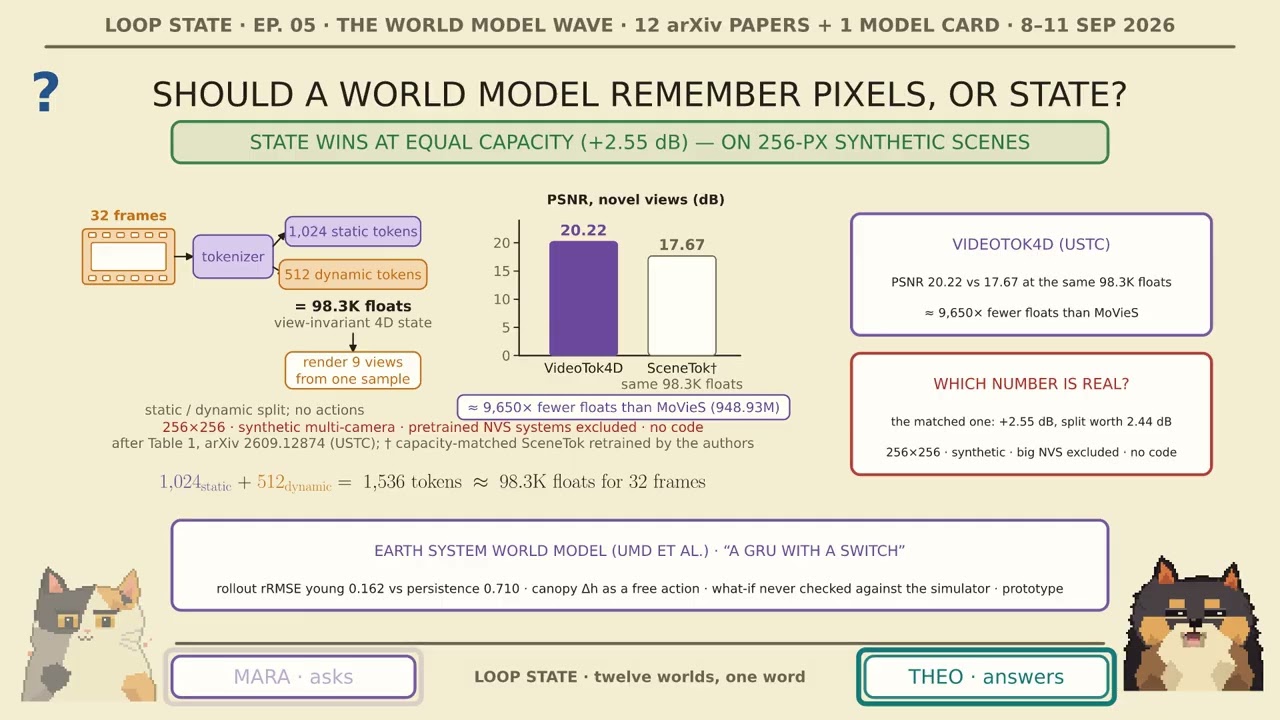
While Pelican-Sim focuses on generating frame-by-frame pixels, **VideoTok4D** from the University of Science and Technology of China (USTC) argues that predicting raw frames is fundamentally the wrong state representation for a world model. Instead of binding memory to a specific camera view, VideoTok4D factors a 32-frame video clip into 1,024 static tokens and 512 dynamic tokens. The static branch captures view-invariant 3D scene geometry, while motion is routed into the dynamic branch through pose-compensated optical flow.
In novel view synthesis benchmarks across synthetic multi-camera scenes, VideoTok4D demonstrates dramatic efficiency gains. Constrained to an identical budget of 98,000 floating-point numbers, it scores a PSNR of 20.2 compared to 17.7 for a capacity-matched video tokenizer baseline. While the paper highlights that it uses roughly 10,000 times fewer floats than the most bloated explicit 3D reconstruction baselines, Theo points to the matched 2.5 dB gain as the meaningful result—with ablation studies proving that separating static and dynamic representations accounts for 2.4 dB of that boost. Nevertheless, the evaluation is limited: it relies on low-resolution 256×256 synthetic renderings, excludes major pre-trained view synthesis models, and provides no released code.
A parallel perspective on state compression appears in the **Earth System World Model for What-If Simulations** from the University of Maryland and partners. Here, the world model is a recurrent neural network (GRU) trained on complex carbon cycle simulators. It introduces interactive intervention by treating annual forest canopy height change as an external action variable governed by a switch gate, allowing users to override predictions with manual values. Mara wryly reduces the setup to "a GRU with a switch." In passive forecasting across young forests, it maintains a low 0.16 error compared to 0.7 for baseline persistence models. However, the model's imagined counterfactuals were never validated against reruns of the ground-truth physical simulator, and dramatic interventions like clear-cutting represent extreme distribution shifts the network never encountered during training, leaving it as an unverified prototype.
---
[09:45](https://www.youtube.com/watch?v=tV5ETq21X0k&t=585s) The Audits: Unused Memories and Physically Anchored Consistency
The most durable and revealing contributions in the pile are the audit papers, which investigate whether world models actually rely on the data they claim to use. The first audit, conducted by researchers from UIUC and Adobe ("Does Video Memory Use What It Retrieves?"), delivers an unsettling finding regarding memory-augmented video world models. The authors devised a causal test: take a frozen video world model with an external memory retrieval pathway, replace the retrieved memory vector with a donor vector from completely unrelated contexts while leaving everything else untouched, and measure how much of the performance gain persists.
If memory modules genuinely retrieve and ground specific spatial details, corrupting or swapping the memory should cripple the rollout. Instead, when evaluating DinoWM on egocentric video: - Supplying a memory vector retrieved from an entirely incorrect scene preserves **93%** of the performance advantage over disabling memory entirely. - Feeding in an identity-free vector containing only the global training mean retains **102%** of the benefit, performing slightly better than the true memory within noise margins.
Rather than performing factual recall, the memory pathway merely provides "representation repair," acting as a generic feature stabilizer. In native memory architectures like WorldMem, memory specificity proves only slightly better: swapping in a donor memory from a different location within the same trajectory retains 94% of the performance gain, though dropping donor embeddings from an entirely different biome finally cuts the retained gain down to 44%. By contrast, when the same causal corruption is applied to an architecture where memory genuinely grounds spatial entities—such as SAM 2 (Segment Anything Model 2)—video segmentation performance instantly collapses from 0.93 to 0.18, and target reappearance tracking drops to zero. Real memory systems fail when corrupted; these video world models simply ignore the semantic content of what they retrieve.
```mermaid flowchart TD accTitle: Causal Memory Swap Audit accDescr: Flowchart contrasting how DinoWM and SAM 2 respond when their retrieved memory vector is corrupted with an unrelated donor.
A["Retrieved Memory Input"] --> B{"Audit: Inject Donor Memory\nfrom Wrong Scene / Mean"}
subgraph DinoWM ["DinoWM (Video World Model)"] B --> C["Training Mean Vector\nor Wrong Scene Donor"] C --> D["93% – 102% of Performance Gain Retained"] D --> E["Diagnosis: Representation Repair\n(Memory content is ignored)"] end
subgraph SAM2 ["SAM 2 (Segmentation Model)"] B --> F["Wrong Spatial Memory Donor"] F --> G["Segmentation Drops: 0.93 to 0.18\nTracking Drops to 0%"] G --> H["Diagnosis: True Semantic Memory\n(Fails when corrupted)"] end ```
The second audit, **IMPLY** (authored by two independent researchers in a concise seven-page paper), exposes an equally severe loophole in physics self-consistency. When a world model rolls out physical interactions, such as robotic object pushes, one can invert an analytical physics simulator to compute the implied mass and friction of the simulated objects across multiple runs. Standard self-consistency checks evaluate whether different rollouts produced by the same model agree with one another. IMPLY demonstrates that self-consistency alone is fatally flawed: a degenerate world model that completely ignores the input object and blindly predicts a generic, typical push will agree with itself perfectly across every generation, achieving an impressive ROC score of 0.7 despite hallucinating physics that have nothing to do with reality. To prevent models from being confidently wrong together, IMPLY anchors rollouts against real physical calibration pushes previously observed in the environment, forcing the model's internal physics to match the ground-truth world rather than its own internal hallucinations.
[12:05](https://www.youtube.com/watch?v=tV5ETq21X0k&t=725s) Auditing Physical Consistency: IMPLY and Confident Hallucinations
When evaluating whether a world model understands physical laws, standard evaluation benchmarks often lean on self-consistency—checking whether multiple simulated rollouts agree with one another. The audit paper IMPLY demonstrates why this metric is dangerously deceptive. A world model can hallucinate an incorrect physical outcome with complete internal consistency, generating rollouts that perfectly match each other while blatantly violating Newtonian mechanics. In self-consistency tests, such an erroneous model appears indistinguishable from an oracle. However, when evaluated using IMPLY’s physically anchored consistency metric, the faulty model is caught immediately with an AUROC of 1.0. As Theo highlights, standard self-consistency metrics are completely blind to the exact failure mode engineers worry about: a model that is confidently, systematically wrong.
On a fine-tuned V-JEPA 2 checkpoint, the anchored consistency score tracks ground-truth physical rollout error with a correlation coefficient between 0.92 and 0.99. In stark contrast, self-consistency shows a near-useless correlation of just 0.1 to 0.3. The authors tested this by rolling out sliding objects under varying friction conditions. Yet, the paper has its own strict caveats: all evaluations were conducted purely in simulation with a single contact type, and the researchers deliberately trained the physical evidence into the audited model. When they attempted the same test on a pure pixel-generation model, the architecture generated an identical 26 mm slide across every initial velocity tested, failing so thoroughly on basic dynamics that it could not even be meaningfully scored. Across the week's two audit papers, the moral is clear: benefit and internal agreement do not constitute scientific evidence—only swapping or perturbing the underlying evidence reveals what the model actually knows.
- **Self-consistency correlation with true error**: 0.1 to 0.3. - **IMPLY anchored consistency correlation with true error**: 0.92 to 0.99. - **Detection AUROC of unanchored physical errors**: 1.0. - **Pixel model physical failure**: Produced an identical 26 mm slide across all speeds regardless of friction or velocity.
---
[12:55](https://www.youtube.com/watch?v=tV5ETq21X0k&t=775s) Do Robot Policies Actually Need a World Model? (HaWMPO, Dynin, FOCI)
The robotics papers in this wave form a spectrum of three fundamentally distinct architectural philosophies regarding what role—if any—a world model should play in policy learning.
```mermaid flowchart TD accTitle: Robotics Policy Architecture Spectrum accDescr: Three architectural paradigms comparing how HaWMPO, Dynin-Robotics, and FOCI treat world modeling in policy execution.
subgraph HaWMPO["HaWMPO (RL Dream World)"] H_WM["5B Video World Model"] -->|"Simulated Rollouts"| H_Critic{"Hallucination Critic"} H_Critic -->|"Filter / Discount"| H_Policy["GRPO Policy Optimization"] end
subgraph Dynin["Dynin-Robotics (Multi-Task Regularizer)"] D_Tokens["Tokens: Image + Text + Action"] --> D_Transformer["Masked Fusion Transformer"] D_Transformer -->|"Joint Denoising"| D_Action["Action Output (Policy)"] D_Transformer -.->|"Auxiliary Loss (PSNR 20.8)"| D_Frame["Frame Prediction"] end
subgraph FOCI["FOCI Policy (No World Model)"] F_Vision["Single RGB-D Camera (1 Demo)"] --> F_Pose["Relative 6D Object Pose"] F_Pose --> F_Planner["Analytical Kinematic Planner"] end ```
The first approach, **HaWMPO** (Hallucination-Aware World Model-based Policy Optimization) from JD Research Academy, treats the world model as an offline reinforcement learning dream simulator. The authors train a Vision-Language-Action (VLA) policy using Group Relative Policy Optimization (GRPO) entirely within rollouts generated by a 5-billion-parameter video world model. To counteract drift, they introduce a hallucination critic (AUROC 0.94) designed to detect and discount dreamed chunks it does not trust. On the LIBERO-3 benchmark suite, HaWMPO achieves an average success rate of 63.7%, compared to 60.9% without the critic, improving over an initial baseline of 48.7%. However, Theo and Mara point out that this 48.7% baseline was deliberately crippled by restricting training to a single demonstration per task; a full-data baseline on the same policy achieves roughly 97%. Furthermore, adding the critic actually degraded performance on the LIBERO-Goal suite by 2.4 percentage points, leaving it unproven whether the approach provides any meaningful value when starting from a robust policy.
The second paradigm, **Dynin-Robotics** from Seoul National University, integrates world modeling as an auxiliary side job within a single network. Built as an omnimodal masked fusion transformer spanning visual frames, text descriptions, goal states, and action tokens, the model alternates roles depending on which token span is masked: mask actions and it functions as a policy; mask the next visual span and it acts as a frame predictor. On an out-of-distribution VLA benchmark, simultaneously denoising the goal image, robot joint actions, and future video frames boosts task success from 41% to 47%, whereas denoising either modality alone degrades performance. Yet when evaluated strictly as a visual world model, its next-frame prediction yields a PSNR of only 20.8, losing handily to a trivial baseline that simply copies the previous video frame (PSNR 31.0). In practice, its world-modeling head functions strictly as a feature regularizer rather than a functional environment simulator.
The final entry, KU Leuven’s **FOCI Policy**, stands in stark opposition to the entire cluster by discarding world models altogether. Operating with a single demonstration, one RGB-D camera view, and just 27 minutes of training on a single consumer NVIDIA RTX 2080 Ti GPU, FOCI uses point-cloud geometry to estimate an object's 6D pose relative to a target and delegates trajectory execution to an analytical planner. Across 18 one-shot RLBench tasks, FOCI achieves a 44% success rate using estimated object poses, which jumps to 88% when fed ground-truth poses. This disparity proves that its primary performance ceiling is raw perceptual accuracy rather than task reasoning or dynamic planning. As Mara notes, if classical geometry paired with a single demonstration can achieve 44% to 88% success without dreaming future pixels, complex video world models have yet to justify their enormous computational footprint.
- **HaWMPO LIBERO-3 performance**: 63.7% with critic vs. 60.9% without critic (from a crippled 1-demo baseline of 48.7%; full-data policy reaches ~97%). - **HaWMPO Hallucination Critic metric**: AUROC 0.94 on detecting video hallucination, but caused a 2.4-point drop on the LIBERO-Goal suite. - **Dynin-Robotics out-of-distribution VLA-Bench**: 47% success with joint denoising vs. 41% baseline. - **Dynin-Robotics frame synthesis quality**: PSNR 20.8 (beaten by naive last-frame copy at PSNR 31.0). - **FOCI hardware requirements**: 27 minutes on an RTX 2080 Ti, 1 demonstration, 0 world models. - **FOCI RLBench 18-task one-shot benchmark**: 44% with predicted poses; 88% with ground-truth poses.
---
[15:18](https://www.youtube.com/watch?v=tV5ETq21X0k&t=918s) What the Wave Leaves Unsettled: Simulation, Variance, and Evaluation Gaps
Stepping back from the individual papers, the hosts step through a dedicated boundary chapter summarizing five critical methodological weaknesses that leave the broader field unresolved:
1. **The Simulation Trap**: Almost the entire body of literature remains confined to synthetic environments—RoboTwin, LIBERO, RLBench, MuJoCo, synthetic game renders, or global carbon-cycle emulators. The only real-world physical robot evaluation in the entire batch of 12 papers comes from HaWMPO, consisting of a minuscule sample size of two tasks, twenty trials, and no reported confidence intervals or error bars. 2. **Missing Variance and Multi-Seed Rigor**: None of the twelve papers report multi-seed error bars on their headline claims. Only FOCI explicitly documents per-task trial counts and random simulation seeds. Several papers in the wave omit a formal limitations section entirely. 3. **Circular VLM-Based Evaluation**: Multiple teams rely on self-constructed evaluation benchmarks scored by vision-language models (VLMs)—such as 50 gaming combat clips graded by a Qwen model, or a robotic video judge fine-tuned directly on the tasks it evaluates. While acceptable for early exploratory prototypes, these uncalibrated judges provide weak foundations for broad capability claims. 4. **Reproducibility Deficits**: Only two works—ActionSplice and Negative Self-Distillation—released both code and functional model checkpoints. Dynin-Robotics published a GitHub repository lacking model weights; Pelican-Sim included a broken link returning an HTTP 404 error; and the remaining eight papers released no code or artifacts whatsoever. 5. **Semantic Dilution of "World Model"**: The research community has expanded the label to encompass wildly disparate architectures, ranging from a user simulator and a mathematical reasoning paper to a recurrent gated unit equipped with a dynamic routing switch. The phrase has become a catch-all marketing term stripped of precise meaning.
Mara and Theo argue that the two audit papers provide the necessary corrective lens. Rather than debating what a model is called, researchers must test what internal representations the model actually uses under strict causal perturbations: "Does the model's output change when you swap its evidence? Everything else is rendering."
---
[16:41](https://www.youtube.com/watch?v=tV5ETq21X0k&t=1001s) The Verdict: Is It One Thing, and Does It Work?
To conclude the review, both hosts deliver their bottom-line verdicts in a single sentence:
> **Theo**: "No. A world model is a job description, and this week the job was done six or seven different ways." > > **Mara**: "In simulation, yes. And Pelican-Sim closes a loop on real hardware and on whether the model knows anything. The evidence is the two audits, and they check before you trust."
The hosts establish explicit empirical criteria for what evidence would flip their verdicts in the future. To convert Theo to a decisive "yes," the community must produce two distinct milestones: first, an embodied robot policy trained or planned inside a video world model that beats its non-world-model baseline on physical hardware with multi-seed error bars; second, evidence-swap audits becoming a mandatory, standardized baseline table in every submission. Conversely, Mara's verdict will drop to a firm "no" if video simulators continue chasing lower Fréchet Video Distance (FVD) while naive frame-copying outperforms their physics, and if architectural memory pipelines continue claiming 102% task improvements while secretly processing synthetic or unread noise. Under those conditions, these architectures are merely video renderers—and as Mara puts it bluntly, "renderers don't plan."
Theo's closing advice for researchers navigating the current literature is to bypass promotional abstracts and scrutinize the ablation tables, where claimed advances frequently collapse to narrow margins: FVD improvements from 2.0 to 1.8, task success rising from 70% to 72%, or 63% success derived from a deliberately crippled baseline of 48%. The research wave is undeniable, but the actual margins of progress remain razor-thin. For Theo, the most anticipated paper of the coming week is simple: the first world model that publicly fails an evidence-swap audit, diagnoses the causal disconnect, and demonstrates a verified fix.
## Notable quotes > [00:00](https://www.youtube.com/watch?v=tV5ETq21X0k&t=0s) No, it is not one thing. It's a job description. — Theo
> [00:00](https://www.youtube.com/watch?v=tV5ETq21X0k&t=0s) the thing an agent acts inside and learns from
> [08:10](https://www.youtube.com/watch?v=tV5ETq21X0k&t=490s) a GRU with a switch. — Mara
> [15:18](https://www.youtube.com/watch?v=tV5ETq21X0k&t=918s) Does the model's output change when you swap its evidence? Everything else is rendering.
> [16:41](https://www.youtube.com/watch?v=tV5ETq21X0k&t=1001s) No. A world model is a job description, and this week the job was done six or seven different ways. — Theo
> [16:41](https://www.youtube.com/watch?v=tV5ETq21X0k&t=1001s) In simulation, yes. And Pelican-Sim closes a loop on real hardware and on whether the model knows anything. The evidence is the two audits, and they check before you trust. — Mara
> [16:41](https://www.youtube.com/watch?v=tV5ETq21X0k&t=1001s) renderers don't plan. — Mara
## Mentioned ActionSplice, Adobe, Alaya Lab, DinoWM, Dynin-Robotics, Earth System World Model for What-If Simulations, FOCI Policy, HaWMPO, Humans&, IMPLY, JD Research Academy, KU Leuven, LIBERO, LingBot-World, Mara, Negative Self-Distillation, Nemotron, NVIDIA RTX 2080 Ti, Pelican-Sim 1.0, Persimmon v0.1, Programmable World Model, Qwen, RLBench, RoboTwin, SAM 2, Seoul National University, Stanford University, Texas A&M, Theo, UIUC, University of Maryland, University of Science and Technology of China (USTC), University of Virginia, V-JEPA 2, VideoTok4D, Westlake University, World in World, WorldMem, X-Humanoid
## Video description Between 8 and 11 September 2026, twelve arXiv papers and one model card landed, all carrying the phrase "world model." Mara and Theo read every one from the source and ask a single question: is a world model finally one thing, and does it work?
Short answer: no. It's a job description, done at least six different ways, and almost entirely inside simulators. The most durable papers in the pile are the two audits, which show a video world model can benefit from memory it never reads and agree with itself about physics it has wrong.
Chapters 00:00 Twelve world-model papers in one week. What actually moved? 01:32 What does "world model" even mean this week? 03:04 Where should control live: outside, inside attention, or in the sampler? 06:19 Can a video model be a robot's simulator yet? 08:10 Should a world model remember pixels, or state? 09:45 Does a world model actually use the memory it retrieves? 11:31 How do you catch a world model that is confidently wrong about physics? 13:00 Do robot policies actually need a world model? 15:11 What does the wave not settle? 16:41 So, is a world model finally one thing, and does it work? 17:38 Sign-off
Papers discussed Control • Programmable World Model, arXiv 2609.10540 • World in World: Explore the World with World Models, arXiv 2609.11548 • ActionSplice: In-Flight Action Editing for Interactive World Models, arXiv 2609.08230 Simulator • Pelican-Sim 1.0: A General World Model Simulator for Embodied Intelligence, arXiv 2609.12036 State • VideoTok4D: A 4D-Aware Video Tokenizer for Compact World Representation, arXiv 2609.12874 • Earth System World Model for What-If Simulations, arXiv 2609.08855 Policy • HaWMPO: Hallucination-Aware World Model-based Policy Optimization, arXiv 2609.09941 • Dynin-Robotics: Omnimodal Unified Diffusion Vision-Language-Action Model, arXiv 2609.13053 • FOCI Policy: Focus on Object-Centric Interactions, arXiv 2609.08743 Audit • Does Video Memory Use What It Retrieves? A Causal Audit of Memory Specificity, arXiv 2609.12090 • IMPLY: Physically Anchored Consistency for World-Model Rollouts, arXiv 2609.12441 Stretch (carry the label, aren't world models) • Persimmon v0.1 Model Card (humans&), a user model: persimmon.humansand.ai/blog/persimmon-model-card.html • Negative Self-Distillation: Learning to Reason by Avoiding Flaws, arXiv 2609.11699
Key numbers are quoted from each paper's TeX source. Where a paper's abstract and its tables disagree, we quote the table and say so. Everything downstream of a world model in this wave is measured inside a simulator; the one real-robot result (HaWMPO, two tasks,twenty trials) has no error bars.
Loop State is a two-host research podcast rendered as a Leanim board (Lean 4). Voices: MiniMax speech-2.8-hd. Charts, pixel avatarsand board animations are authored for the episode; no paper figures are reproduced.
#WorldModels #Robotics #MachineLearning #arXiv #EmbodiedAI #VideoGeneration #AIResearch
[Source](https://www.youtube.com/watch?v=tV5ETq21X0k)