Why Your Agent Doesn't Need a Bigger Context Window: Language Model Shape
Xiaol.x
AI-assisted summary of Why Your Agent Doesn't Need a Bigger Context Window: Language Model Shape — original source. Check the original for full context.
Source published:
Key ideas
- Standard decoder-only models force all agent interactions into an autoregressive token stream with causal masking, prompting proposals to rethink neural contracts to natively fit agent workloads. (0:00)
- In long-horizon agent histories reaching 100k turns, recency does not equate to importance, requiring dense attention nearby but selective access to critical distant constraints. (1:52)
- Recursive Language Models (RLMs) decouple input scale from context limits by manipulating large files and persistent history as variables inside an executable REPL environment. (3:43)
- Agentic self-improvement in RLM workspaces operates by revising external executable code against deterministic test suites while model weights remain completely static. (10:49)
Detailed notes
## Background Published on YouTube by Xiaol.x on September 28, 2026, the video explores Alex L. Zhang's blog post "Language Model Shape." Through hand-drawn blackboard illustrations, co-hosts Mara and Theo examine whether AI systems must always rely on flat decoder-only token streams or whether neural architecture contracts can be redesigned to natively fit complex agent tasks.
## TL;DR The presentation contrasts standard decoder-only models with alternative architectural shapes, arguing that historical importance does not correlate with recency over long agent horizons. Using Recursive Language Models (RLMs) and an invoice parsing example, the speakers show how treating history and inputs as programmatic REPL variables allows deterministic code execution while keeping neural contexts bounded. They examine Zhang's proposed two-stream architecture—combining an auto-compacting recurrent state with dense causal attention—alongside row-constrained readouts for fast pre-fill decisions. Finally, they demonstrate that agent self-improvement operates by iteratively refining executable code against unit tests under frozen model weights, concluding with a pragmatic four-step research methodology for testing non-standard model contracts.
## Atmosphere & style The presentation has the crisp, patient cadence of an intimate chalk-and-talk university seminar. Mara prompts and questions while Theo visualizes concepts stroke by stroke on a digital blackboard, grounding lofty theoretical ideas into tangible diagrams and code traces. The dialogue remains calm, analytical, and refreshingly skeptical of industry hype, methodically stripping away buzzwords around "agent self-improvement" to reveal straightforward engineering mechanics and testable trade-offs.
## Bulletin - [00:00](https://www.youtube.com/watch?v=Yc-0oi3VeiA&t=0s) Standard decoder-only models force all agent interactions into an autoregressive token stream with causal masking, prompting proposals to rethink neural contracts to natively fit agent workloads. - [01:52](https://www.youtube.com/watch?v=Yc-0oi3VeiA&t=112s) In long-horizon agent histories reaching 100k turns, recency does not equate to importance, requiring dense attention nearby but selective access to critical distant constraints. - [03:43](https://www.youtube.com/watch?v=Yc-0oi3VeiA&t=223s) Recursive Language Models (RLMs) decouple input scale from context limits by manipulating large files and persistent history as variables inside an executable REPL environment. - [10:49](https://www.youtube.com/watch?v=Yc-0oi3VeiA&t=649s) Agentic self-improvement in RLM workspaces operates by revising external executable code against deterministic test suites while model weights remain completely static.
## Key takeaways - [00:00](https://www.youtube.com/watch?v=Yc-0oi3VeiA&t=0s) The decoder-only architecture enforces a causal triangle where each output token depends strictly on its past prefix, shifting the output sequence by one position relative to inputs. - [00:00](https://www.youtube.com/watch?v=Yc-0oi3VeiA&t=0s) Modern agent harnesses spend significant complexity wrapping prompts and retries around the rigid 'arbitrary text in, arbitrary text out' decoder interface. - [01:52](https://www.youtube.com/watch?v=Yc-0oi3VeiA&t=112s) Extended agent execution histories demand high-resolution dense attention for immediate steps alongside selective long-distance retrieval for critical original constraints and past errors. - [03:43](https://www.youtube.com/watch?v=Yc-0oi3VeiA&t=223s) Recursive Language Models store large files in an external execution workspace (REPL), passing only pointers and metadata to the bounded model context. - [03:43](https://www.youtube.com/watch?v=Yc-0oi3VeiA&t=223s) RLMs delegate quantitative arithmetic and filtering to deterministic code execution while utilizing language models strictly for qualitative semantic parsing. - [05:22](https://www.youtube.com/watch?v=Yc-0oi3VeiA&t=322s) Generalizing the RLM interface treats prompts, tool dumps, and past interaction histories as addressable variables rather than flat, endlessly growing text strings. - [06:57](https://www.youtube.com/watch?v=Yc-0oi3VeiA&t=417s) Zhang proposes a two-stream model architecture separating an auto-compacting recurrent state for aging history from a dense causal attention window for active tokens. - [08:53](https://www.youtube.com/watch?v=Yc-0oi3VeiA&t=533s) Row-constrained output contracts replace full autoregressive decoding sequences with small sets of readout stems or scalar decisions evaluated during a single pre-fill pass. - [08:53](https://www.youtube.com/watch?v=Yc-0oi3VeiA&t=533s) Non-standard output contracts break reliance on standard next-token cross-entropy loss, necessitating custom regression, classification, or calibrated scoring objectives. - [10:49](https://www.youtube.com/watch?v=Yc-0oi3VeiA&t=649s) Agentic self-improvement occurs programmatically when an agent updates and persists helper code in its environment to correct logged failures without modifying neural network weights. - [11:20](https://www.youtube.com/watch?v=Yc-0oi3VeiA&t=680s) Validating code revisions against deterministic test suites ensures changes fix root causes without regressing on edge cases before committing code back to the workspace. - [12:19](https://www.youtube.com/watch?v=Yc-0oi3VeiA&t=739s) Independent research into novel model shapes should define explicit contracts, build inspectable harnesses, and benchmark across multidimensional trade-offs against decoder baselines. - [12:19](https://www.youtube.com/watch?v=Yc-0oi3VeiA&t=739s) Rather than forcing complex harnesses to adapt to a single flat model shape, neural architectures should be designed to match harness state and task requirements halfway.
## Detailed walkthrough ### [00:00](https://www.youtube.com/watch?v=Yc-0oi3VeiA&t=0s) Figure One: Decoder-Only Contract and Causal Masking
The discussion opens directly on the blackboard, where Alex L. Zhang's conceptual framing of model contracts is laid out stroke by stroke. In Zhang's first figure, three distinct architectural contracts are contrasted: the standard decoder-only model, a hybrid half-recurrent/half-dense design, and a row-constrained output contract. To parse them, the board adopts a strict visual convention read strictly from bottom to top: blue labels denote input and output tokens, red lines denote internal model computations, and green lines represent connections shuttling memory into active calculation paths. Focusing first on the left panel, four discrete bottom positions—$X_1, X_2, X_3$, and $X_4$—are drawn as a readable proxy for a sequence extending to an arbitrary horizon $X_N$. Directly above these bottom tokens sits the outer boundary of the model.
Mara questions why the labels along the upper boundary start with $X_2$ rather than $X_1$. Theo clarifies the classic next-token autoregressive contract: at the very first step, the model observes only $X_1$ and produces the prediction for $X_2$. Moving rightward to position three, the model absorbs $X_1, X_2$, and $X_3$ through three traced incoming connections to predict $X_4$. Completing this causal triangle reveals the defining property of decoder-only systems: every generated token depends strictly upon its past prefix and can never inspect future positions. The entire top row is cleanly shifted by one step ($X_2, X_3, X_4, X_5 \dots X_{N+1}$). During generation, the model appends its newly emitted token to the tail of the sequence and loops. This setup establishes an "arbitrary text in and arbitrary text out" abstraction—an immensely flexible contract that modern agent harnesses manage by wrapping prompts, tool schemas, and execution retries around it. Yet, as the speakers emphasize, rearranging layers inside that box often leaves this external interface completely frozen. The central provocation Zhang poses is whether the fundamental neural contract should be redesigned to natively fit complex agent tasks, rather than forcing harnesses to twist every problem into linear autoregressive text generation.
```mermaid flowchart TD accTitle: Standard Decoder-Only Causal Triangle accDescr: Diagram illustrating token inputs X1 through X4 predicting shifted output tokens X2 through X5 under a causal mask. subgraph Inputs ["Input Stream (Bottom)"] X1["X1"] X2["X2"] X3["X3"] X4["X4"] end subgraph Model ["Causal Model Computation"] M1["Step 1"] M2["Step 2"] M3["Step 3"] M4["Step 4"] end subgraph Outputs ["Shifted Predictions (Top)"] Y2["X2"] Y3["X3"] Y4["X4"] Y5["X5"] end
X1 --> M1 X1 --> M2 X2 --> M2 X1 --> M3 X2 --> M3 X3 --> M3 X1 --> M4 X2 --> M4 X3 --> M4 X4 --> M4
M1 --> Y2 M2 --> Y3 M3 --> Y4 M4 --> Y5 ```
- **Bottom-to-Top Reading:** Inputs reside on the bottom row; model transformations sit in the middle; predicted tokens emit from the top row. - **Shifted Indexing:** The contract maps prefix $X_{1:t}$ directly to the next token $X_{t+1}$. - **Harness Encapsulation:** Tool calls, prompts, and agent loops are external constructs built to satisfy this rigid token-completion interface.
---
[01:52](https://www.youtube.com/watch?v=Yc-0oi3VeiA&t=112s) Figure Two: Importance Is Not Recency in Agent History
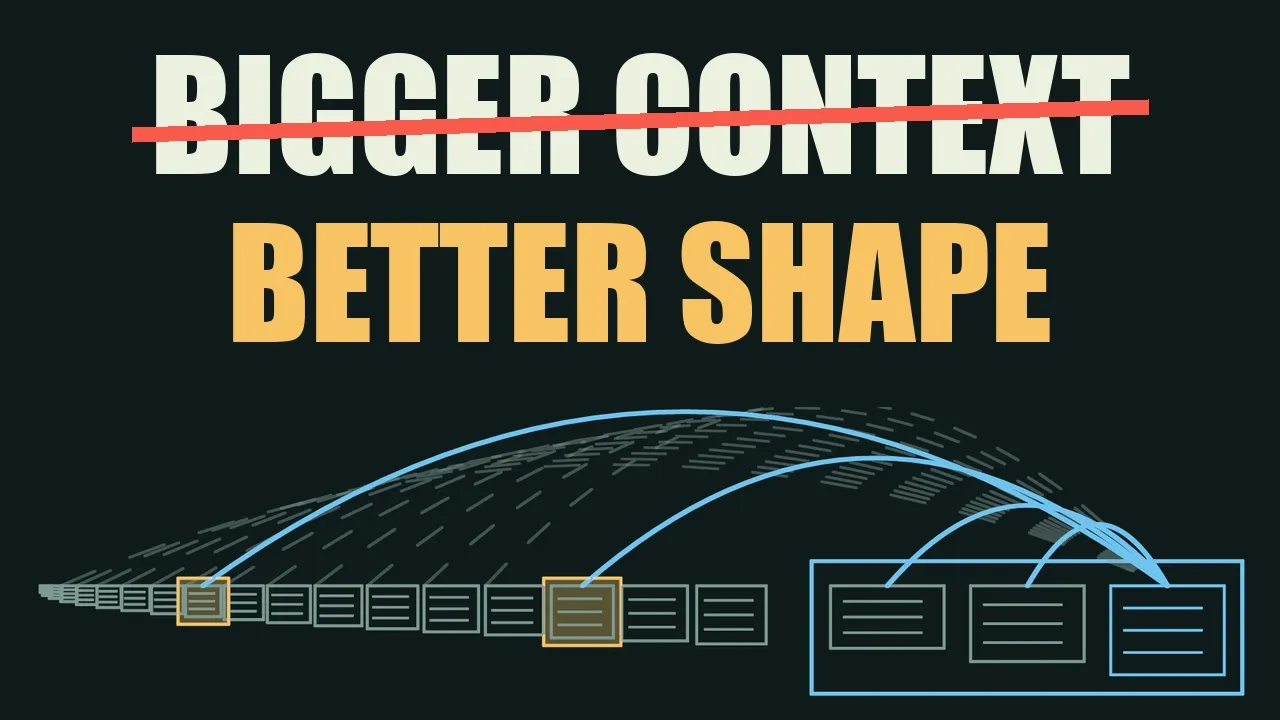
To justify why an alternative interface is necessary, the conversation moves to Zhang's second figure, which illustrates how an agent's operational history actually behaves over extended execution horizons. Theo sketches an elongated timeline receding into tiny, condensed records toward the distant left and expanding toward the active "now" on the right—a history that could hypothetically stretch over 100,000 turns in complex software engineering or debugging tasks. At the right edge, a tight box encompasses the immediate local workspace labeled "think", "edit", and "now". Solid blue lines feed directly into the present step. This working region requires dense, high-resolution attention because the agent must carefully scrutinize its latest environment observation and the immediate preceding actions that provoked it.
Distant history, however, behaves entirely differently. Faint, dashed arcs stretch back across pages of logs, tool output dumps, and failed exploratory paths. Treating every historical token with equal, dense quadratic attention imposes extreme compute costs, while naive fixed-size context windows eventually force lossy context truncation or aggressive summarization. But "old does not mean irrelevant." To prove this, Theo highlights two critical historical items in bright gold: 1. **The Original User Constraint:** A distant directive from turn one—"User, keep the public API"—carries a heavy, unbroken blue arc spanning across thousands of turns directly into the current edit. If a loose summarization pass strips this constraint, the agent risks refactoring the code into a breaking change. 2. **An Earlier Test Failure:** A distant pytest run failure from dozens of turns back sends another strong arc into the active decision, providing the exact failure signal needed to prevent repeating an invalid patch.
The core architectural takeaway is that recency does not dictate importance. An agent requires "dense access nearby, selective access far back." A simple fixed-size recurrent vector often struggles with exact historical retrieval, prompting Zhang to advocate for a hybrid structure: a recurrent or compressed historical backbone coupled with a localized dense transformer, possibly utilizing coarse memory indexing to pull back exact, uncorrupted textual records on demand.
---
[03:43](https://www.youtube.com/watch?v=Yc-0oi3VeiA&t=223s) Recursive Language Models: The Toy Invoice Specimen
To ground these theoretical memory demands in execution mechanics, the speakers examine a concrete toy specimen inspired by Recursive Language Models (RLMs, arXiv:2512.24601). The running benchmark task is straightforward: sum the values of all paid invoices (measured in cents) across an enterprise document far too massive to fit into a single model context window. Instead of dumping raw bytes into a massive prompt or relying on naive semantic chunking, an RLM places the large document inside a stateful Python execution workspace—a Read-Eval-Print Loop (REPL) where variables persist, code executes, and targeted sub-outputs are inspected programmatically.
```mermaid flowchart TD accTitle: Recursive Language Model Workspace Flow accDescr: An RLM orchestrates a persistent document variable through code execution, filtering invoice entries via recursive LLM calls. subgraph Environment ["Python REPL Workspace"] DOC["document = [Raw Large File]"] RES["results = []"] end subgraph Agent ["Model Context (Bounded)"] PTR["Handles & Metadata"] CODE["Generated Python Code"] end subgraph Evaluation ["Execution & Sub-calls"] SLICE["Slice: Paid 1200¢, Pending 700¢, Paid 300¢"] SUB["Recursive LM Call: Extract status & amount"] SUM["Python Arithmetic: 1200 + 300 = 1500¢"] end
DOC -.->|Metadata only| PTR PTR --> CODE CODE --> SLICE SLICE --> SUB SUB --> RES RES --> SUM ```
Theo diagrams two side-by-side containers: a large external container holding the full `document` variable, and a compact box representing the bounded `model context`. The agent is given only basic metadata and programmatic handles (such as file slices or pointers) rather than the raw text. Through generated Python snippets, the model selectively reads chunks. When text requires qualitative understanding, the code invokes a sub-language-model call on that specific slice and saves the parsed structured output into a persistent variable.
In this toy scenario, three records are examined: - Record A: Paid, 1200 cents - Record B: Pending, 700 cents - Record C: Paid, 300 cents
The generated program filters out the pending 700-cent item and relies on Python's native runtime to calculate $1200 + 300 = 1500$ cents. Crucially, the model does not perform brittle arithmetic over tokens; deterministic code handles calculation, while the neural network handles semantic extraction. The recursive mechanism allows sub-calls to instantiate new RLM processes on nested sub-problems if needed. While this pattern does not magically erase token costs or inference latency, it fundamentally decouples input scale from model window limitations through symbolic handles.
---
[05:22](https://www.youtube.com/watch?v=Yc-0oi3VeiA&t=322s) Everything as a Variable: Refactoring the Interface
Building on the invoice demo, Theo writes the central design philosophy across the middle of the board: "Make every input a variable and make the REPL history a variable, too." Under this paradigm, the system interface is generalized so that user instructions, long-term logs, environment observations, and REPL interaction traces are treated as named, addressable programmatic objects in memory rather than an ever-accumulating text stream copied into subsequent prompts.
Instead of stuffing the entire context window with historical turns, the agent uses code to query its own past. In the invoice example, if the agent previously stumbled by accidentally counting a pending invoice, the REPL history preserves the exact prior correction ("pending does not mean paid"). When refactoring its filtering function, the model can inspect that specific historical record cleanly rather than relying on a lossy, hand-waving summary. The speakers note that while some writing attributes long-horizon stability and agentic self-improvement to this variable-centric generalization, treating everything as a variable does not eliminate the harness entirely. A runtime supervisor, memory storage, execution sandbox, and dispatch policies are still mandatory. However, refactoring the system interface this way highlights the bridge to Zhang's proposal: instead of managing this purely through software harnesses around standard decoders, could neural architectures natively support this input-output structure?
- **Named Objects:** User prompts, external files, and tool execution logs are stored as variables in a shared execution environment. - **Targeted Addressing:** Models pull only targeted slices into their immediate context, keeping the active context window lean. - **Exact Historical Retrieval:** Retains programmatic pointers to exact prior failures and edge cases, avoiding degradation caused by naive summaries.
---
[06:57](https://www.youtube.com/watch?v=Yc-0oi3VeiA&t=417s) Two Input Streams: Recurrent State and Dense Attention
Returning to Figure One's middle panel, Theo details Zhang's proposal for an architectural contract featuring two distinct input streams inside a single model boundary. The diagram uses superscripts to denote stream identity rather than mathematical powers. Stream one ($X^{(1)}$) rises vertically into a recurrent state marked with a feedback loop, continually updating a persistent latent representation as tokens flow in over time. Stream two ($X^{(2)}$) sits horizontally alongside it, representing current tokens engaged in dense causal attention.
```mermaid flowchart LR accTitle: Two-Stream Architecture with Recurrent State and Dense Window accDescr: Architectural separation between a recurrent state for aging history and dense causal attention for current active tokens. subgraph Stream1 ["Stream 1: History"] S1_Inputs["Aging Tokens X^(1)"] --> REC["Recurrent State (Persistent Loop)"] end subgraph Stream2 ["Stream 2: Working Window"] S2_Inputs["Current Tokens X^(2)"] --> DENSE["Dense Causal Attention"] end subgraph Integration ["Cross-Stream Bridge"] REC -->|"Green Projection Lines"| DENSE end DENSE --> OUT["Current Predictions / Actions"] ```
The speakers trace the green lines linking these components: the recurrent state fans out into the dense working window, allowing current computations to condition directly on the compressed historical state. This setup is distinct from conventional hybrid models (such as architectures alternating between Mamba/SSM layers and Transformer attention layers across a shared residual stream). Zhang's sketch proposes two functionally separate input pipelines: - **Stream One (Recurrent Path):** Carries aging history, broad trajectories, and historical tool runs in an auto-compacting state. - **Stream Two (Dense Path):** Houses immediate local observations and working memory, computing full dense attention over the recent turn.
Theo stresses that this is an architectural hypothesis rather than a proven panacea. A compressed recurrent state inherently risks lossy representations or dropped pointers to critical past evidence. The sketch defines a clear separation of roles—auto-compacting history alongside local dense attention—without yet guaranteeing empirical speedups, retrieval fidelity, or infinite context capacity.
---
[08:53](https://www.youtube.com/watch?v=Yc-0oi3VeiA&t=533s) Row-Constrained Outputs and Pre-fill Decision Readouts
The right panel of Figure One shifts attention to the output boundary. Standard decoder-only models maintain an exact 1:1 mapping between bottom input positions and top output positions. In contrast, Zhang's third panel illustrates a "row-constrained output" model: an extensive sequence of inputs feeds through the network, but only a small set of readout stems (drawn schematically as three stems) emerges from the top.
```mermaid flowchart TD accTitle: Row-Constrained Output Contract accDescr: Many input tokens are processed down to a small set of specialized output stems evaluated in a pre-fill pass. subgraph In ["Broad Input Sequence"] I1["X1"] I2["X2"] I3["..."] IN["XN"] end subgraph Body ["Internal Representation Layers"] REP["Dense / Structured Processing"] end subgraph Out ["Row-Constrained Readouts"] R1["Scalar / Decision 1"] R2["Decision 2"] R3["Decision 3"] end
I1 --> REP I2 --> REP I3 --> REP IN --> REP REP --> R1 REP --> R2 REP --> R3 ```
Instead of requiring an autoregressive decoding loop where tokens are generated sequentially, row-constrained readouts can evaluate a targeted decision within a single pre-fill pass. The speakers connect this concept to Jev, a system mentioned in Zhang's writing that restricts output space to a scalar real number bounded between 0 and 1. While a single scalar is a specific subset of row-constrained outputs, it illustrates the practical benefit: evaluating fuzzy conditional logic or binary routing directly at the end of prompt ingestion without paying the latency and token overhead of generating autoregressive explanations.
Altering the output contract fundamentally changes the training objective: - **Standard Decoders:** Rely naturally on next-token cross-entropy loss over text tokens. - **Row-Constrained Models:** Require dedicated scoring, calibration, and regression/classification objectives (such as Jev's calibrated decision objective, whose proprietary details remain unpublished).
The overarching research inquiry unites all three panels: whether moving away from universal token continuation toward structured dual-stream inputs and row-constrained readouts provides superior compute-performance trade-offs for agentic workflows.
---
[10:49](https://www.youtube.com/watch?v=Yc-0oi3VeiA&t=649s) Concrete Self-Improvement: Revising Code Rather Than Weights
To demystify the concept of agentic self-improvement, the discussion returns to the invoice specimen. If an initial invoice helper script contains a logic flaw—summing every invoice regardless of status—it outputs 2200 cents ($1200 + 700 + 300$) instead of the expected 1500 cents.
An independent validation check flags the mismatch against expected test data. This failure record, encompassing the erroneous script, the test discrepancy, and the specific pending invoice that caused the error, is committed into the persistent REPL history. The agent reads this concrete error record, diagnoses that its filter missed the `pending` check, synthesizes a revised Python script containing a strict `status == 'paid'` filter, and re-executes the test suite. This demonstrates that self-improvement in an RLM environment operates by revising external executable code and persistent workspace state, rather than through updating model weights.
[11:20](https://www.youtube.com/watch?v=Yc-0oi3VeiA&t=680s) Verifying Revisions: Code Checks, Fixed Weights, and the Improvement Loop
When an agent updates a helper function in its persistent workspace, fixing the single example that previously failed is not sufficient proof that the code is sound. To guard against regressions, the environment runs the revised helper against a broader validation suite: an all-pending batch, an empty batch, and an unseen paid amount. The revision is accepted and committed back to the workspace only if every single check passes. Once verified, that updated helper becomes available for the next task. This return path constitutes the actual "improvement loop"—ensuring subsequent runs invoke a demonstrably better-tested procedure rather than unverified hallucinations.
```mermaid flowchart TD accTitle: Verification and Self-Improvement Loop accDescr: Flowchart showing code revision passing through deterministic test checks before being committed back to the workspace. subgraph Eval ["Verification Suite"] A["Revised Helper Code"] --> B{"Run 4 Checks"} B -->|"Fails any"| C["Reject Revision"] B -->|"Passes 4/4"| D["Accept Revision"] end subgraph Loop ["Workspace State"] D --> E["Persist to Workspace"] E --> F["Available for Next Task"] F -.->|"Return Arrow"| A end ```
In the toy trace under discussion, the legacy helper passed only two out of four checks, whereas the revised helper successfully cleared all four. Theo and Mara emphasize that these are deterministic code assertions rather than qualitative language model benchmarks or probabilistic evals. Crucially, the neural network weights remain entirely static throughout the entire execution. If the system later fine-tunes or trains model weights on these generated trajectories, that represents a completely distinct training stage with its own independent evaluation protocol. The architecture provides an "enabling interface" rather than a magical promise of compounding self-improvement; if the unit tests are weak, memory retrieval fails, or the environment provides a misleading success signal, the self-improvement loop quickly breaks down.
- The test suite validates boundary conditions: a previously failing case, an all-pending batch, an empty batch, and an unseen paid amount. - In the concrete trace, the baseline helper passed 2 of 4 checks, while the revised code achieved 4 of 4. - Weights remain completely frozen during the loop; trajectory fine-tuning is an optional, separate offline step. - Vulnerabilities that can break self-improvement include brittle or lenient unit tests, corrupted workspace retrieval, and false-positive reward signals.
[12:19](https://www.youtube.com/watch?v=Yc-0oi3VeiA&t=739s) A Four-Step Recipe for Independent Research and Matching Shape to Harness
The discussion concludes with an actionable four-step methodology for independent researchers investigating non-standard model shapes and agent interfaces:
1. **Write the contract on paper first**: Explicitly specify what enters the model, what exits it, and exactly what internal or external state persists across conversation turns. 2. **Build the minimal inspectable harness**: Construct the smallest possible test harness that directly exposes those values. Explicitly name every field, preserve raw ground-truth evidence, and ensure all underlying assumptions can be inspected and debugged before writing custom model architectures. 3. **Benchmark against a strong decoder-only baseline**: Test the new shape directly against standard decoder architectures on the precise task it was engineered to solve. Evaluate multidimensional metrics rather than vanity scores alone: operational inference cost, effective task horizon, retrieval quality, uncertainty calibration, and the rate of failure recovery. 4. **Keep empirical claims appropriately narrow**: Demonstrating a superior operational trade-off for long-horizon agent memory is a concrete technical win, but it is not a sweeping proof of generalized machine intelligence.
Ultimately, the core philosophy behind Alex L. Zhang's formulation comes down to an intuitive architectural realization: AI practitioners need to "stop asking every harness to reshape itself around one universal model interface." Instead of continually torturing dynamic, structured agent tasks into a single flat token stream for a standard decoder, researchers should observe what the problem natively demands in terms of state, action spaces, and feedback mechanisms—and design the model's structural shape to meet the harness halfway.
## Notable quotes > [00:00](https://www.youtube.com/watch?v=Yc-0oi3VeiA&t=0s) arbitrary text in and arbitrary text out
> [01:52](https://www.youtube.com/watch?v=Yc-0oi3VeiA&t=112s) User, keep the public API
> [01:52](https://www.youtube.com/watch?v=Yc-0oi3VeiA&t=112s) old does not mean irrelevant.
> [01:52](https://www.youtube.com/watch?v=Yc-0oi3VeiA&t=112s) dense access nearby, selective access far back.
> [05:22](https://www.youtube.com/watch?v=Yc-0oi3VeiA&t=322s) Make every input a variable and make the REPL history a variable, too. — Theo
> [05:22](https://www.youtube.com/watch?v=Yc-0oi3VeiA&t=322s) pending does not mean paid
> [08:53](https://www.youtube.com/watch?v=Yc-0oi3VeiA&t=533s) row-constrained output
> [11:20](https://www.youtube.com/watch?v=Yc-0oi3VeiA&t=680s) improvement loop
> [11:20](https://www.youtube.com/watch?v=Yc-0oi3VeiA&t=680s) enabling interface
> [12:19](https://www.youtube.com/watch?v=Yc-0oi3VeiA&t=739s) Write the contract on paper first
> [12:19](https://www.youtube.com/watch?v=Yc-0oi3VeiA&t=739s) Build the minimal inspectable harness
> [12:19](https://www.youtube.com/watch?v=Yc-0oi3VeiA&t=739s) Benchmark against a strong decoder-only baseline
> [12:19](https://www.youtube.com/watch?v=Yc-0oi3VeiA&t=739s) Keep empirical claims appropriately narrow
> [12:19](https://www.youtube.com/watch?v=Yc-0oi3VeiA&t=739s) stop asking every harness to reshape itself around one universal model interface.
## Mentioned Alex L. Zhang, Language Model Shape, Mara, Theo, Recursive Language Models (RLMs), Python, REPL, Mamba, State Space Models (SSM), Transformer, Jev, LeanIM, LaTeX, pytest, Xiaol.x
## Video description Should every AI system be a decoder that reads one long token stream? We work through Alex L. Zhang's "Language Model Shape" on a hand-drawn blackboard, rebuilding both of its figures stroke by stroke.
Mara asks and Theo draws. We cover: • How to read the input/output contract of a decoder-only model (shifted outputs, causal triangle) • Why importance is not recency in a 100k-turn agent history • A Recursive Language Model (RLM) follow-through: one invoice, a document variable, a persistent REPL • What changes when instructions and history become variables too • Two input streams (recurrent state + current tokens) and row-constrained outputs • What "self-improvement" actually improves: a reviseights • A four-step research plan for independent research
Notes: the invoice checks are a small executed toy e. The architecture ideas are presented as hypotheses. The extension to all inputs and full history comes f we couldn't identify the paper behind it.
Chapters 00:00 Read figure one: the shifted token rows 01:52 Read figure two: importance is not recency 03:43 RLM: follow one invoice through the workspace 05:22 Why does the RLM intuition matter? 06:57 Read the middle panel: two input streams 08:53 Read the right panel: fewer output positions 10:49 What exactly improves in self-improvement? 12:19 What should an independent researcher do?
Sources • Alex L. Zhang, Language Model Shape: hhttps://alexzhang13.github.io/blog/2026/shape/ • Recursive Language Models (arXiv:2512.24601): https://arxiv.org/abs/2512.24601
Visuals: native LeanIM vector strokes + LaTeX. Voiceces at natural speed.
#LLM #AIAgents #RecursiveLanguageModels #MachineLear
[Source](https://www.youtube.com/watch?v=Yc-0oi3VeiA)