Klarna CEO Targets $10 Million Per Employee in AI Push
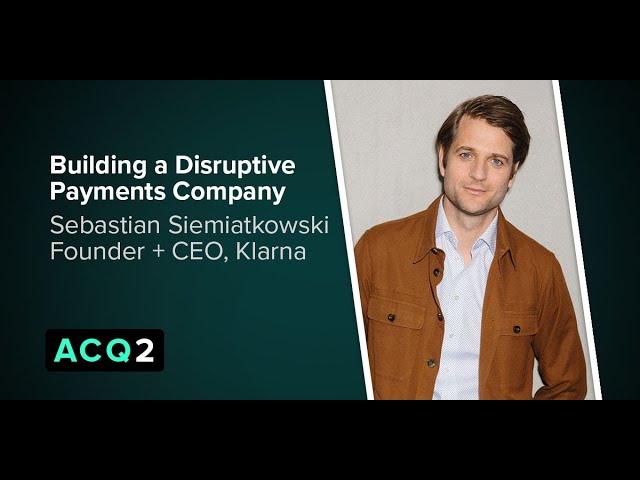
Acquired
Aggressive AI integration allows fintech firms to shrink headcount through natural attrition while driving revenue per employee toward historic highs, leaving legacy banking institutions unable to compete.
AI-assisted summary of ACQ2: Building a Disruptive Payments Company (with Klarna CEO Sebastian Siemiatkowski) (Audio) — original source. Check the original for full context.
Source published:
Detailed notes
## Background Published on YouTube by the channel Acquired on March 13, 2025, this video features an episode originally released on June 24, 2024. The page description outlines a highly honest and thoughtful business strategy discussion detailing how Klarna navigated the rapid rise of buy-now-pay-later over 19 years and how its CEO leverages an aggressive AI strategy for cost reduction and product innovation.
## TL;DR In this episode, Klarna co-founder and CEO Sebastian Siemiatkowski breaks down the fundamentals of the global payments value chain and recounts the company's evolution from a scrappy Swedish open-invoice factoring startup into a global financial heavyweight. He outlines how Klarna successfully pivoted to a consumer-focused digital financial assistant strategy after realizing it couldn't out-execute back-end payment processors like Adyen and Stripe. Finally, Siemiatkowski details Klarna's aggressive, Elon Musk-inspired cost-consciousness and its revolutionary deployment of AI, which has already taken over two-thirds of its customer service operations and paved the way for hyper-efficient, ultra-lean 'Tiger' companies.
## Atmosphere & style The discussion possesses a deeply engaging, intellectually stimulating, and transparent tone, moving far beyond a standard corporate interview into a high-level masterclass for business strategy nerds. Siemiatkowski brings a refreshing, candid humility to the conversation, openly laughing at his past brashness as a 'brat kid' and acknowledging Klarna's historical missteps in copying predatory banking tricks. The narrative dynamic with the hosts feels collaborative and collegial, capturing an emotional arc that spans the high-stakes pressure of sudden valuation drops to an electric, forward-looking excitement about the imminent, AI-driven disruption of traditional banking.
## Key takeaways - [00:00](https://www.youtube.com/watch?v=rUtQ6PAsBV4&t=0s) The global payments value chain consists of three foundational components: the issuing banks, the networks (Visa/Mastercard) that govern financial standards, and the acquiring payment service providers (PSPs) that partner with merchants. - [02:24](https://www.youtube.com/watch?v=rUtQ6PAsBV4&t=144s) Klarna was founded out of an insight that early e-commerce merchants in Sweden desperately needed a secure payment methodology that mitigated consumer distrust of inputting debit card information online. - [05:33](https://www.youtube.com/watch?v=rUtQ6PAsBV4&t=333s) The 'buy now, pay later' concept mirrors historical mail-order catalog 'bill me' options, tapping into the psychology that consumers prefer inspecting goods before paying. - [11:10](https://www.youtube.com/watch?v=rUtQ6PAsBV4&t=670s) Klarna achieved day-one positive cash flow and capital efficiency by delaying merchant payouts for three weeks, taking on default risk while essentially utilizing merchant float to fund early scaling without massive external credit lines. - [16:46](https://www.youtube.com/watch?v=rUtQ6PAsBV4&t=1006s) Klarna's expansion into the UK and US was catalyzed by a massive, overlooked macroeconomic shift after the 2007 financial crisis: millennial and Gen Z consumers dramatically favored debit cards over traditional credit cards. - [20:54](https://www.youtube.com/watch?v=rUtQ6PAsBV4&t=1254s) A key target demographic for BNPL is 'self-aware avoiders'—high-earning consumers who consciously reject traditional credit card mechanics, minimum monthly balances, and predatory interest loops. - [20:54](https://www.youtube.com/watch?v=rUtQ6PAsBV4&t=1254s) Traditional banks suffer from the Innovator's Dilemma, as adopting clear, interest-free pay-in-4 installment plans would cannibalize their highly profitable revolving credit portfolios that rely on high interest rates. - [29:32](https://www.youtube.com/watch?v=rUtQ6PAsBV4&t=1772s) To exploit the consumer data loop, traditional banking models historically eliminated the choice between debit and credit at points of sale, artificially inflating monthly statements to force consumers to revolve debt. - [35:55](https://www.youtube.com/watch?v=rUtQ6PAsBV4&t=2155s) Following an aggressive back-end market push by competitors like Adyen and Stripe, Klarna executed a critical strategic pivot in 2015 away from merchant checkout dominance to winning the direct consumer relationship. - [39:35](https://www.youtube.com/watch?v=rUtQ6PAsBV4&t=2375s) The ultimate goal for modern financial platforms is to operate as automated, proactive digital financial assistants that autonomously optimize consumer balances, lower interest rates, and eliminate excess banking fees. - [43:35](https://www.youtube.com/watch?v=rUtQ6PAsBV4&t=2615s) Klarna maintains a unique structural advantage over legacy four-party networks by possessing granular, SKU-level product data due to its history as an open-invoice processor, which it surfaces directly inside its consumer app. - [49:35](https://www.youtube.com/watch?v=rUtQ6PAsBV4&t=2975s) To establish rapid scale in the competitive US market against Afterpay, Klarna deployed a 'browser hack' that enabled consumers to use virtual Klarna-backed cards at non-integrated merchants, instantly unlocking massive transaction volume and consumer downloads. - [01:02:45](https://www.youtube.com/watch?v=rUtQ6PAsBV4&t=3765s) While expanding into the US cost roughly $1 billion in annualized cash burn at its low point, the investment was structurally justified by the sheer size of the multi-trillion dollar financial services market landscape. - [01:06:44](https://www.youtube.com/watch?v=rUtQ6PAsBV4&t=4004s) Inspired by Elon Musk's extreme cost consciousness, Klarna's operational philosophy shifted toward aggressively bending the corporate cost curve downward while maintaining upward revenue momentum. - [01:08:50](https://www.youtube.com/watch?v=rUtQ6PAsBV4&t=4130s) Klarna is avoiding mass layoffs by freezing recruitment and letting natural annual attrition shrink the workforce, while using AI to restructure internal operational workflows and eliminate role duplication. - [01:08:50](https://www.youtube.com/watch?v=rUtQ6PAsBV4&t=4130s) Implementing an AI customer support assistant allowed Klarna to instantly absorb two-thirds of all global customer service inquiries while maintaining customer satisfaction scores on par with human agents. - [01:15:26](https://www.youtube.com/watch?v=rUtQ6PAsBV4&t=4526s) AI adoption is paving the way for ultra-lean, hyper-efficient 'Tiger' companies that will drastically elevate traditional corporate revenue-per-employee benchmarks. - [01:16:33](https://www.youtube.com/watch?v=rUtQ6PAsBV4&t=4593s) While top tech firms like Apple or Netflix produce around $2 million in revenue per employee, optimized AI-native or AI-adaptive companies are projected to hit unprecedented baselines of $5 million to $10 million per employee. - [01:18:00](https://www.youtube.com/watch?v=rUtQ6PAsBV4&t=4680s) Legacy banking institutions face severe structural disadvantages due to slow decision-making and archaic technology stacks, triggering a massive operational revival for agile digital fintech players.
## Detailed walkthrough ### [00:00](https://www.youtube.com/watch?v=rUtQ6PAsBV4&t=0s) The Payments Landscape and the Klarna Story
The episode kicks off with a deeper dive into the global payments landscape, following up on a previous episode focused on Visa. The hosts are joined by Sebastian Siemiatkowski, the co-founder and CEO of Klarna, a brand recognized globally as a heavyweight in the "buy now, pay later" (BNPL) space, though it harbors ambitions to command a much broader presence across the entire payment ecosystem. Klarna was founded 19 years ago in Stockholm, Sweden—drawing an immediate parallel to fellow Swedish tech giant Spotify—and has grown to serve 150 million global consumers while powering 2 million payments a day.
When asked to provide a high-level, five-minute overview of the payments value chain for a listener base full of tech "geeks," Siemiatkowski breaks the landscape down into three foundational components: the issuing side, the networks, and the acquiring side. The issuing side consists of the banks that provide consumers with cards linked to a line of credit or a positive balance. The networks, dominated by Visa and MasterCard, set the global financial standards, handle brand recognition to ensure card acceptance, and govern the actual exchange of financial information and transactional settling. Finally, the acquiring side features payment service providers (PSPs) that partner directly with merchants to enable payment acceptance, supplying physical terminals for brick-and-mortar stores or managing the checkout and cashier experience for e-commerce websites. Siemiatkowski notes that numerous specialized companies circulate around this core structure to provide fraud recognition or underwriting, and even e-commerce platforms like Shopify have effectively morphed into large-scale fintech operations.
---
[02:24](https://www.youtube.com/watch?v=rUtQ6PAsBV4&t=144s) The Foundering Insight: From Telemarketing to E-Commerce
Siemiatkowski rewinds nearly two decades to explain the initial spark that led to the creation of Klarna. Always harboring a dream to start a business, he grew up inspired by Swedish icons like Ikea founder Ingvar Kamprad and read Richard Branson's book about the Virgin Group at age 14. After two years at the Stockholm School of Economics and a flying-free sabatical year traveling around the world, he returned home jobless in the wake of the dot-com bubble crash. Unable to secure a job at a traditional accounting firm like PwC, he desperately took a position as a sales guy at an account receivables factoring and collections company—the last place he ever imagined working. Drawing on his teenage experience working extra hours as a telemarketer "trying to sell a subscription to a magazine," his new job required him to open physical telephone catalogs and cold-call midsize Swedish businesses to pitch factoring services.
The company he worked for was bizarrely named "Acme," an intentional nod to the dummy corporation Microsoft used in all its presentations, which the founders mistakenly believed amounted to free advertising. Cold-calling was incredibly tough in 2003; traditional accounting ladies at midsize firms were intensely loyal to their existing providers and unbothered by a promise to save $1,000 in fees. However, Siemiatkowski struck a unique pain point when he began calling early e-commerce entrepreneurs. In a pre-Amazon Sweden, these scrappy founders had discovered they could buy incredibly cheap Google AdWords for terms like "cat food" and instantly attract flocks of customers to their websites. These early digital storefronts were in desperate need of a reliable payment methodology.
---
[05:33](https://www.youtube.com/watch?v=rUtQ6PAsBV4&t=333s) The Birth of Buy Now, Pay Later in Sweden
During this early era of internet commerce, Visa and MasterCard card payments were the default standard, but mail-order catalog businesses had long relied on a "bill me" option. The old catalog companies understood that selling at a distance required a different psychological approach than brick-and-mortar shopping, where a customer can physically touch a product before parting with their money. Offering an open invoice gave the consumer the security of inspecting the goods—ensuring the cat food was healthy and as advertised—before paying. This security was vital in Sweden, where consumers predominantly held debit cards rather than credit cards, viewing credit as a dangerous "lender of last resort." Inputting a debit card number online was seen as a massive risk that exposed a consumer's entire hard-earned salary account balance to an unknown merchant.
Recognizing that successful mail-order companies migrating to the web were thriving by offering an "open invoice payment method," Siemiatkowski realized Acme was far too unserious of a company to develop his ideas. He returned to his university's incubator to launch the concept himself. Alongside his high school friend Niklas and a university friend, they set out in late autumn. By December, they secured a business angel investor who injected cash and introduced them to engineers. Working in their spare time over four months, the engineers built a minimum viable product (MVP) capable of processing and underwriting transactions.
- **Initial Angel Investment:** The founders asked for \$40,000, but the angel insisted on giving \$60,000 in exchange for a 10% stake in the company. - **Capital Efficiency:** Klarna only spent \$30,000 of that initial funding before hitting profitability roughly six months into operations. - **Total Capital Raised to Date:** Approximately \$4 billion.
---
[11:10](https://www.youtube.com/watch?v=rUtQ6PAsBV4&t=670s) The Golden Goose: Achieving Positive Cash Flow Through Factoring
A recurring question from early skeptics was how a tiny startup could possibly fund the massive capital reserves required to purchase invoices from merchants and wait for consumers to pay. From a traditional financial perspective, a factoring business requires massive credit lines or deep equity capital to bridge the float. However, Klarna uncovered a contrarian entrepreneurial insight: early online merchants were surprisingly poor at managing or understanding cash flow. They weren't looking for a cash flow solution; they were terrified of consumer default risk and the administrative nightmare of collections. Some merchants had attempted to print and mail invoices themselves—much like a local residential electrician would—but panicked over the prospect of hiring collection agencies or handling customer support.
Klarna cleverly structured a business model that solved these exact fears while turning the traditional financial paradigm on its head. They took on 100% of the customer default risk and managed the entire administration, but they stipulated that they would not pay the merchant until three weeks after the transaction occurred. Because many consumers paid their invoices instantaneously or well before the due date, Klarna created a factoring model that generated a highly positive cash flow from day one.
- **The Float Advantage:** Merchants essentially funded Klarna's rapid scale during its first few years, rendering external funding rounds unnecessary until much later. - **Tiered Pricing:** If a merchant explicitly demanded immediate cash, Klarna simply charged them a higher transaction fee, keeping the system profitable. - **The Evolution of the Phrase:** Siemiatkowski notes that they operated for over a decade simply providing open invoices before the industry adopted the generalized "buy now, pay later" terminology around 2015, which initially frustrated him as he watched clone companies gain traction under the new label.
[15:06](https://www.youtube.com/watch?v=rUtQ6PAsBV4&t=906s) Coining "Buy Now Pay Later" and Early Geographic Expansion
The speaker reflects with relief on discovering the true origins of the phrase "buy now pay later." While there was some anxiety that a competitor like Afterpay had coined the ubiquitous term, a dive into the archives revealed that the *Financial Times* actually used "buy now pay later" in a headline describing Klarna back in 2013 or 2014, shortly before Afterpay launched. This discovery brought peace of mind from a "pure prestige perspective." This space naturally favored local players who tailored their products to regional needs before global scaling took over—resulting in a landscape of distinct Australian, Swedish, and American providers racing to expand outward.
When Klarna first launched in Sweden, its subsequent steps seemed humorous in retrospect. The company initially expanded into Norway and Finland—markets of just about 4 million people each. This move was largely dictated by merchant demand, as Swedish e-commerce businesses were already active in those neighboring Nordic countries. Klarna's next major breakthrough occurred in Germany and the Netherlands, chosen specifically because those regions possessed a deeply rooted tradition of *Rechnung* (invoice buying), which aligned perfectly with the core BNPL concept.
---
[16:46](https://www.youtube.com/watch?v=rUtQ6PAsBV4&t=1006s) The Accidental British Conquest and the Rise of Debit
For a long time, Klarna's leadership was convinced that breaking into the US and UK markets was impossible because credit card penetration was so high. Between 2010 and 2015, the company focused instead on competing with Stripe and Adyen in the Payment Service Provider (PSP) space and trying to make the complex, multi-jurisdictional regulatory landscape of Germany work. When a small team was finally sent to the UK in 2015 to test the waters, they returned enthusiastic about a massive short-term BNPL opportunity. The speaker initially rejected the idea outright, telling the team it was a "terrible idea" and ordering them to focus strictly on high-ticket financing for expensive items like mattresses and home electronics—the approach Affirm was taking. Furthermore, the speaker explicitly forbade them from targeting massive fashion whales right away.
The UK team completely ignored these directives. Six to twelve months later, during a business review, they admitted they were still pursuing large fashion retailers. Despite receiving another stern warning that it was a "horrible idea," the team returned three months later having signed ASOS. The launch was a "smashing success." This independent thinking exposed a massive macroeconomic shift that Klarna's leadership had missed, but Afterpay had noticed in Australia: while credit card usage had doubled over a decade, debit card usage had grown tenfold. A new generation of consumers either could not access or completely distrusted credit cards. Ultimately, it wasn't Klarna that figured out the Anglo-American markets; rather, a shifting demographic and the fallout of the 2007 financial crisis turned the US and UK markets into versions of the Swedish market, primed for unstructured, digital debit transactions.
- **Credit vs. Debit Growth:** Between 2007–2008 and 2018, credit card usage grew 2x, whereas debit card usage grew 10x. - **The ASOS Milestone:** The signing of the massive fashion retailer ASOS served as the proof-of-concept that unlocked the UK market for Klarna. - **Macroeconomic Drivers:** Tougher credit underwriting restrictions and a ban on aggressive campus credit card promotions after 2007 left a massive online shopping demographic without traditional credit options.
---
[20:54](https://www.youtube.com/watch?v=rUtQ6PAsBV4&t=1254s) The "Self-Aware Avoiders" and the Innovator's Dilemma
The speaker highlights a profound May 2014 McKinsey report titled *"New Frontiers in Credit Card Segmentation: Tapping Unmet Consumer Needs,"* published five years before BNPL exploded in the US. The report identified a massive, overlooked segment making up roughly 20% of the US population, dubbed "self-aware avoiders." These were high-earning, high-spending individuals who consciously rejected credit cards because they hated the industry's predatory tactics—such as dangling massive credit limits, burying consumers in debt, and encouraging minimum monthly payments to maximize revolving interest. While the banking industry remained pathologically obsessed with "reward seekers," these avoiders actively desired simple fees, transparent terms, structural protection against missing payments, and a clear payoff horizon for major purchases.
This dynamic highlights a classic case of Clayton Christensen's "low-end disruption" and the Innovator's Dilemma. Traditional banks make extraordinary margins running credit portfolios with 30% revolving interest rates. To an incumbent bank executive, offering an interest-free "pay-in-4" installment plan sounds financially unappealing because it generates significantly less revenue per user. Even though the BNPL model is fundamentally better for consumers and keeps them out of systemic debt, banks are structurally paralyzed from adopting it because doing so would cannibalize their highly profitable revolving fee streams. Klarna and Afterpay had a pure upside advantage because they carried no legacy portfolios to protect.
- **The McKinsey Segment:** "Self-Aware Avoiders" constituted an estimated 20% of the US market in 2014, defined by high median annual household incomes but an absolute aversion to traditional credit mechanics. - **The Core Desires of Avoiders:** Simple and transparent fees, explicit payoff horizons per major purchase, and "swipe-to-installment" functionality.
---
[26:38](https://www.youtube.com/watch?v=rUtQ6PAsBV4&t=1598s) Copying Predatory Banking Tricks—And Unlearning Them
The speaker candidly confesses that Klarna did not start out with perfect corporate social responsibility. When Klarna first introduced revolving credit and high-ticket financing in Sweden around 2007, they analyzed competing banks to see how they made money. They discovered clever, highly profitable "tricks." A classic banking tactic involved offering a "12 months interest-free" plan, but sending a monthly statement featuring two options: a higher payment that preserved the 0% interest, and a lower minimum payment. If a consumer accidentally or out of financial strain paid the lower amount, the entire balance automatically shifted into a 36-month revolving account bearing 20% interest.
"Oh okay, that's how you make business in the banking world. Awesome, let's do it," the speaker recalls thinking at the time. Klarna copied these exact tactics and made a tremendous amount of money. However, over the years, the leadership team began to self-reflect, questioning if consumers truly understood what they were signing up for and whether these practices were healthy. Klarna ultimately reversed course, systematically stripping out these legacy banking mechanisms. The speaker notes that back in the 1990s and 2000s, profit maximization was the sole driving force in corporate culture, and if a tactic was legal and drove interest revenue, it was deployed without a single thought for consumer financial health.
---
[29:32](https://www.youtube.com/watch?v=rUtQ6PAsBV4&t=1772s) How Banks Engineered the Death of the Debit/Credit Choice
To illustrate how banks intentionally nudged consumers into debt, the speaker shares an anecdote from working at Burger King at 15 years old. In those days, swiping a card required the user to manually select "Press 1 for Debit, Press 2 for Credit" directly on the point-of-sale terminal. This choice made perfect sense: everyday purchases like fast food could be cleared immediately via debit, while large, significant purchases could be intentionally placed on credit.
The banks systematically removed this choice from card terminals. Today, swiping a credit card automatically puts every single transaction—from a low-cost Burger King meal to weekly groceries at Walmart—directly onto a single monthly revolving statement. Banks engineered this change because mixing daily consumption with large expenses balloons the final monthly statement. If a consumer's monthly bill was kept to $500 by paying for food with debit, they could easily afford to pay it off in full. By inflating the bill to $1,000 by consolidating all spending onto credit, the banks dramatically increased the likelihood that the consumer would be unable to pay the full balance, forcing them to revolve and trigger highly lucrative interest charges.
<FollowUp label="Would you like to explore how Klarna restructured its business model to move away from these banking tactics?" query="How did Klarna structurally change its revenue model and product design when it decided to remove the traditional revolving credit tactics used by banks?"/>
[31:17](https://www.youtube.com/watch?v=rUtQ6PAsBV4&t=1877s) Reintroducing Balance: Debit vs. Credit
The traditional credit card model functions in a heavily incentivized loop designed to maximize consumer interest and revolving debt. Because revolving balances drive the massive profits that fund lucrative cashback and rewards programs, financial institutions are naturally discouraged from steering customers toward immediate payments. Klarna is intentionally disrupting this loop by reintroducing clear choices at checkout. Their objective is to offer an elegant balance of "pay now" and "pay later" solutions, effectively reviving spending models that are fundamentally healthier for long-term credit management.
Currently, the global layout of Klarna's transaction volume reflects a meaningful shift toward immediate payments, though regional differences remain stark. Within the next one to two years, Klarna aims for its presence on any merchant website to universally signal the availability of both credit and debit options.
- Globally, debit transactions already comprise approximately 35% of Klarna's total volume. - The United States market remains predominantly credit-driven for Klarna. - The long-term target for online transaction volume is a balanced 50/50 split between debit and credit. - For physical, in-store environments, Klarna anticipates a future proportion of roughly 80% debit and 20% credit.
[32:47](https://www.youtube.com/watch?v=rUtQ6PAsBV4&t=1967s) The Failed Dream of Klarna Checkout
The physical footprint of Klarna has become highly visible, with large-scale marketing campaigns blanketing major retail hubs, such as the Stonestown Galleria mall in San Francisco. This extensive in-store presence often surprises consumers who traditionally associate the company with online e-commerce. Historically, Klarna attempted to conquer the merchant processing space under an ambitious strategy to "close the loop." Around 2009 and 2010, the company launched *Klarna Checkout*, a product designed to serve simultaneously as the merchant acquirer, the payment service provider (PSP), and the issuer, allowing businesses to accept everything from Visa and Mastercard to localized payment options.
During this era, a young, 30-year-old Sebastian Siemiatkowski confidently pitched this product to his board as a direct threat to emerging payment players. Recognizing that engineers were the ones actually integrating platforms, Klarna aimed to compete aggressively with the Collison brothers at Stripe by building developer-friendly APIs. Siemiatkowski even personally approached Peter van der Does, the co-founder of Adyen—which at the time was smaller than Klarna in revenue and headcount—and brashly told him, "Peter, you have to sell your business to me because I'm going to run you over." Looking back with a laugh, Siemiatkowski notes that van der Does viewed him as a "brat kid," and it ultimately took several years of mending fences for them to become good friends.
- *Klarna Checkout* achieved massive localized success, processing over 50% of all online transactions in the Nordic region for a period. - The company struggled to scale the checkout product internationally, falling behind the rapid feature deployment of competitors. - A critical execution gap formed by 2013, highlighted by Adyen adding dozens of Asian payment methods while Klarna's checkout integrations remained stagnant for two years.
[35:55](https://www.youtube.com/watch?v=rUtQ6PAsBV4&t=2155s) The 2015 Strategic Pivot to the Consumer
The absolute breaking point for Klarna's merchant platform strategy came in 2015 when Adyen successfully signed Spotify. Watching their fiercest competitor lock down a high-profile client right in Klarna's own Swedish backyard was a clear wake-up call. The executive team realized they were being out-executed on the broad PSP front. They faced a stark choice: pretend to be a secondary version of Stripe or Adyen and engineer an exit to a larger firm—similar to how Swedish payment processor Bambora was acquired by Ingenico—or completely pivot their core business model.
Choosing to pivot, Klarna shifted its primary focus away from competing for back-end merchant dominance and instead doubled down on winning the consumer relationship. This strategic transition was further complicated by the simultaneous departure of Klarna's second co-founder, leaving Siemiatkowski to build a fresh leadership team. Abandoning the practice of hiring outside executives, he promoted high-performing junior managers from within the ten-year-old company. Gathered around a blank white paper, this new management team set out to map the long-term evolution of digital financial services.
- Shopify's aggressive push into its own ecosystem effectively blocked Klarna's primary entry point to smaller U.S. merchants. - Silicon Valley companies like Fast attempted similar checkout-focused models with high visibility but varying degrees of long-term success. - Today, former rivals Adyen and Stripe have transformed into Klarna's largest distributors, embedding Klarna directly into their networks rather than competing on direct merchant integrations.
[39:35](https://www.youtube.com/watch?v=rUtQ6PAsBV4&t=2375s) The Rise of the Digital Financial Assistant
The core thesis developed by Klarna’s new leadership team centered on the inevitability of automated financial management, drawing a direct parallel to the steady, logical trajectory of self-driving cars. They envisioned a future where a proactive, digital financial assistant handles the tedious, opaque tasks historically managed by traditional wealth managers or banks. This software layer will autonomously scan a user's accounts, negotiate lower interest rates, detect overpayments on recurring expenses like mortgages, and seamlessly execute bank switches with a simple, one-word confirmation from the consumer.
While traditional banks once held the localized trust required to act as financial advisers, they ultimately leveraged that trust to maximize institutional profits rather than consumer well-being. The introduction of hyper-personalized, automated advisory software represents an incredibly disruptive force that threatens to dismantle the historical structural inefficiencies of the banking industry.
- Banking institutions have historically enjoyed massive "excess profits" because moving between banks is deliberately high-friction and confusing for consumers. - Winning the digital assistant race requires an operator with massive global scale, as volume dictates the viability of running cross-border financial AI. - Deep consumer data trust is the primary prerequisite; an assistant can only provide high-value, cost-saving recommendations if it maintains an uninhibited view of a consumer's transactions.
[43:35](https://www.youtube.com/watch?v=rUtQ6PAsBV4&t=2615s) Weaponizing SKU-Level Data
Klarna possesses a massive structural advantage over traditional payment processing giants: native access to itemized, SKU-level data. Because Klarna originated as an open-invoice business, the company was legally and operationally required to generate detailed, line-item invoices from day one. When a consumer makes a purchase via Klarna at a merchant like H&M, the platform does not merely register a generic dollar amount and a merchant ID; it captures the precise product name, sweater color, and garment size, even rendering rich item imagery directly inside the customer app.
Retrofitted data transmission remains a monumental challenge for legacy financial networks. Built on half-century-old foundations, standard credit card rails were never designed to carry massive payloads of granular product information. While networks like Visa and Mastercard attempted to introduce "Level 3" data parameters in the 1990s to capture deeper commercial transaction info, the rigid architecture of a four-party payment network created a massive bottleneck.
- Four-party payment networks (Visa/Mastercard) stall out because any data update requires thousands of independent issuing banks to simultaneously redesign their consumer apps to display it. - Three-party closed-loop networks (Klarna, American Express, PayPal) can instantly ingest merchant data and surface it directly to the end user. - Securing this deep data requires an immense amount of personal outreach; Sebastian Siemiatkowski spent hundreds of hours in direct negotiations convincing top retail CEOs at brands like Macy’s, Sephora, and H&M to trust Klarna with their raw SKU feeds.
The Three-Front Battle for Global Scale
The strategic roadmap for Klarna required building a recognizable consumer brand, hence the "smooth" marketing aesthetic and iconic pink color palette. The competitive landscape was divided into three clear categories: big tech giants (Apple, Amazon, Google), nimble fintech challengers (Revolut, Chime, Nubank), and traditional banking incumbents (Goldman Sachs' Marcus). In order to win, Klarna had to move and innovate faster than these entities. Looking forward, the ultimate goal remains for three or four large global players to emerge as comprehensive digital financial assistants for their customers.
The "Good to Great" Philosophy and Klarna Everywhere
Drawing inspiration from Jim Collins' management book *Good to Great*, specifically the tenet "don't bet on a single technology," Klarna sought to solve a major consumer limitation: the inability to use Klarna at non-integrated points of sale. To combat this, they introduced a physical card to allow usage everywhere, accepting the tradeoff of losing granular SKU-level data on those transactions. This created internal app complexities, such as explaining to consumers why purchase images appeared for some transactions but not others, but the trade-off was necessary to expand market reach.
Missing the First Wave in the US Market
Klarna initially missed out on the early US market momentum. Out of nowhere, Nick Molnar and his team from the Australian competitor Afterpay arrived in the US, signed a massive RFP with Urban Outfitters, and gathered rapid traction. While Affirm had been operating for years on high-ticket items (like $1,000 boosted boards), Afterpay pioneered the "paying for a $10 t-shirt" low-ticket BNPL model. Coming to the US in the summer of 2019, Klarna realized they were on the verge of missing a critical opportunity to establish scale in the world's largest market. They reacted frantically, getting their own "Pay in 4" product live in the US market within just two to three months.
The Ultimate Entrepreneurial Challenge: Faking the Win
Despite having a richer product and more historical features than Afterpay, Klarna faced the classic corporate dilemma: "you don't get fired for choosing IBM." US e-commerce chiefs chose Afterpay simply because they were perceived as the market leader. To shift this perception, Klarna engineered a "browser hack" within their app. The Klarna app incorporated an internal web browser enabling users to shop at any retailer—even non-partners like Amazon. The app dynamically generated a one-time virtual Visa card and auto-filled it at checkout. This approach allowed Klarna to secure the coveted SKU-level data via the browser interface and flip the sales pitch to merchants using a single App Annie download chart showing they had more consumer downloads than Afterpay.
- The Klarna browser generates over $10 billion in transaction volume. - The success of the browser strategy ultimately helped Klarna sign major US merchants like Sephora and Macy's.
Acquired Sponsor: Vanta
Ben and David introduce long-time sponsor Vanta, a trust management platform that automates security reviews and compliance frameworks such as SOC 2, ISO 27001, GDPR, and HIPAA. Referencing Jeff Bezos' philosophy that companies should only focus on what "makes your beer taste better," the hosts emphasize that while compliance is vital for unlocking revenue, it adds zero flavor to the core product. Vanta replaces manual spreadsheets with a single API-connected pane of glass.
- Vanta services over 7,000 customers globally and integrates with more than 300 external tools. - Acquired listeners receive $1,000 in free credit by visiting [vanta.com/acquired](https://vanta.com/acquired).
Training for the Champions League Final of Corporate Pressure
Reflecting on Klarna's 19-year journey as a private company—navigating shifting business models, massive funding rounds, valuation volatility, and intense corporate governance "succession drama"—the speaker shares insights on managing extreme psychological pressure. Rather than letting desperation or confusion paralyze him, he adopts the mindset of an elite athlete, comparing the corporate struggle to Zlatan Ibrahimović playing in a Champions League final or cyclists enduring the Tour de France. When under massive stress, he pumps Queen's "Under Pressure" at maximum volume in his car to lean into the moment, viewing intense challenges as a hard-earned privilege.
- Klarna was officially recognized as Europe's most valuable fintech when its valuation peaked at $50 billion. - The speaker notes that when valuations grow faster than revenue and profit, a market correction is inevitable.
[01:01:46](https://www.youtube.com/watch?v=rUtQ6PAsBV4&t=3706s) The Whiplash of Startup Volatility
The conversation highlights the jarring reality of running a high-stakes startup, contrasting a glamorous, high-profile lifestyle with sudden market downturns. The speaker recalls a surreal 24-hour window where they had dinner with Boris Johnson and immediately flew to a private conference attended by Elon Musk and Kim Kardashian. During this moment, they found themselves wondering, "is this what life is going to be like now?" The answer arrived brutally just three months later: the market shifted, Klarna's valuation dropped to $6.5 billion, fundraising became nearly impossible, and newspapers were actively writing about their apparent failure, openly questioning if their next product would even work.
Despite the intense stress of the situation, the speaker notes a strange, re-energizing upside to the chaos, stating, "it's obviously horrible to some degree but it's also like wow I'm living again." They admit that while they didn't plan for or want the crisis—and perhaps could have avoided it with smarter planning—being backed into a corner forces an entrepreneur to simply wake up, face reality, and make the best of the situation on the ground.
---
[01:02:45](https://www.youtube.com/watch?v=rUtQ6PAsBV4&t=3765s) Capital Efficiency and the Trillion-Dollar Market
Addressing a question about whether their aggressive decisions and subsequent board friction were simply the most forward-looking choices possible at the time, the speaker sets the record straight regarding Klarna's historical finances. They emphasize a fact frequently overlooked by the media: Klarna was consistently profitable every single year up until 2019. While they still raised capital during those early years, it was strictly to grow and support their balance sheet, not to stay afloat. The speaker points out that the media often fails to separate primary fundraising from secondary transactions, masking the reality that Klarna was actually one of Sequoia’s most capital-efficient investments for its first decade.
The financial dynamic shifted dramatically when Klarna decided to go "all in" on a rapid expansion into the United States and other new territories. This aggressive push led to heavy investing and a steep cash burn, reaching a low point where their worst single EBITDA month was negative $150 million—representing an annualized burn rate of roughly $1 billion.
- **The Dilution Paradox:** Despite a $1 billion annual burn, investors were aggressively cheering the company on, granting them a peak valuation of $50 billion. At that scale, a $1 billion loss represented a mere 2% annual dilution, which the speaker argues is incredibly low for an opportunity of that magnitude. - **The Total Addressable Market:** The speaker justifies the massive scale of investment by pointing out that payments and financial services represent a trillion-dollar opportunity. They note it is "not unthinkable" that a top player in this space could eventually be worth hundreds of billions or even a trillion dollars, drawing a direct parallel to the scale of Visa.
---
[01:04:46](https://www.youtube.com/watch?v=rUtQ6PAsBV4&t=3886s) Strategic Regrets and Playing the Game on the Field
Reflecting on past choices with the benefit of hindsight, the speaker acknowledges that not every decision was perfectly sane. While they express zero regret over their aggressive marketing investments and rapid market expansion, they openly regret the speed and scale of their internal hiring, admitting, "we expanded too fast in hiring, we should have been a little bit more careful about that."
The conversation then pivots to a famous tech adage from investor Bill Gurley: "you got to play the game on the field." The speaker agrees completely, noting that during their peak growth years, their rival Afterpay was playing an incredibly aggressive game, forcing Klarna to match their pace or risk losing cultural and operational relevance entirely. This intense competitive landscape drove a rapid escalation in Klarna's valuation over just a few years.
- **Valuation Timeline:** - **2016/2017:** Valued at $2 billion. - **2019:** Reached $5 billion when Dragoneer backed them, believing Klarna had a real shot in the US market despite the fact that "Afterpay was kicking our ass." - **2020:** Hit $10 billion after Silver Lake invested, observing that Klarna was not just competing but actively outperforming Afterpay. - **2021:** Climbed to $30 billion (and eventually $50 billion) as investors realized the company was far ahead of the curve.
> "I still look at the fact of like the company's soon going to do over $3 billion worth of Revenue and it's this size after 20 years... I think it's an okay achievement."
---
[01:06:44](https://www.youtube.com/watch?v=rUtQ6PAsBV4&t=4004s) The Elon Musk Philosophy: Extreme Cost Consciousness
Turning toward the future, the host steers the conversation toward artificial intelligence and its immediate, practical applications inside Klarna. The speaker explains that their current operational philosophy was heavily inspired by Walter Isaacson's biography of Elon Musk. While the speaker has always found Musk's ability to simultaneously build electric cars and rockets mind-blowing and inspirational, reading the book revealed a completely different trait: "he's a freaking cheap bastard like he is so cost conscious."
The speaker recounts a specific anecdote from the book detailing how NASA spent $3 million on an air conditioning unit for a rocket, while Musk’s team went to Home Depot, bought a unit for $5,000, and found that it worked just as well. This relentless, cross-the-board cost focus yields highly profitable companies with massive revenue growth, even in deep tech sectors like SpaceX. This realization completely reframed the ultimate operational challenge for Klarna: engineering a business model where the revenue line goes up while the cost curve simultaneously bends downward.
---
[01:08:50](https://www.youtube.com/watch?v=rUtQ6PAsBV4&t=4130s) Deploying AI to Build a Leaner Organization
The speaker identifies AI as the primary enabler for shrinking costs while growing revenue. Currently employing around 4,000 people, Klarna is actively avoiding the pain and low morale associated with standard corporate layoffs. Instead, they are leveraging natural tech attrition—which typically sits around 20% per year as employees hit five-year tenures—to thoughtfully downsize. By freezing almost all non-engineering recruitment since late 2023, the company is shrinking naturally by 20% annually while using AI to restructure workflows and eliminate internal duplication.
The most publicized success of this strategy has taken place within their customer service operations. Beyond their internal staff, Klarna traditionally relied on 2,000 to 3,000 external customer service agents provided by third-party suppliers. By injecting AI directly into customer support, they achieved a massive operational breakthrough.
- **The Customer Satisfaction Milestone:** The first major breakthrough occurred when customer satisfaction scores for AI interactions landed completely on par with human agents. This marked a massive shift away from the universally hated, rigid IVR ("press one for this, press two for that") systems and frustratingly basic online chatbots of the past. - **The Two-Thirds Drop:** Upon launching the feature globally, the AI instantly took over two-thirds (66%) of all customer service errands, leaving only one-third for human agents to resolve.
The speaker notes that because their third-party customer service vendors are massive global operations employing over a million people collectively, the 700 full-time agents Klarna no longer required were simply redeployed to other corporate clients, resulting in zero immediate job losses. However, the speaker stresses that they deliberately chose to share these metrics with the public and politicians to spark a serious conversation about the long-term societal and economic implications of AI, noting that future implementations across other companies will eventually impact net employment.
---
[01:15:26](https://www.youtube.com/watch?v=rUtQ6PAsBV4&t=4526s) The Rise of "Tiger" Companies
The host points out that for the past decade, early-stage founders in Silicon Valley have romanticized small, ultra-lean teams—pointing to rare anomalies like Instagram or WhatsApp, which scaled to massive user bases with only a handful of employees before being acquired by Facebook and scaled traditionally. While that dream was largely a myth for a long time due to the sheer operational complexity of scaling a business, both speakers agree that AI is suddenly making the ultra-lean, high-output company a tangible reality. The speaker concludes by introducing their core thesis on the matter, coining the term "Tigers" to describe an emerging class of companies. These organizations are deeply embedding AI into the core of their operations from day one, entirely reimagining how value is created.
[01:16:33](https://www.youtube.com/watch?v=rUtQ6PAsBV4&t=4593s) The Rise of "Tiger" Companies and the $10 Million Metric
The landscape of corporate productivity is on the verge of a dramatic shift driven by AI adoption. Forward-thinking companies are radically reshaping how they work, ship code, and launch product features. There is a palpable sense of excitement around tech leaders like Brian Chesky at Airbnb, who are openly sharing their aggressive AI integrations. This structural transformation will allow agile companies to accelerate far ahead of their respective industries. The key operational metric to watch is revenue per employee, which is poised to reach heights that are historically unprecedented.
To put this shift into perspective, historical and current corporate benchmarks highlight just how massive this leap will be. Traditionally, older, less efficient companies operate at lower baselines, but top-tier modern tech giants have pushed the envelope much further. The speaker envisions a near future where elite, AI-accelerated companies leave current giants in the dust, drastically improving both the quality and overall pace of software development. While the timeline for true Artificial General Intelligence (AGI) remains an open question, the short-term reality over the next 6 to 12 months is going to be "revolutionizing."
* **Klarna's Evolution:** Historically operated at roughly $0.6 million in revenue per employee; it has now climbed to nearly $1 million. * **Current Tech Benchmarks:** Apple and Netflix lead the pack, sitting at approximately $2 million in revenue per employee. * **Financial Services Benchmarks:** Goldman Sachs operates at roughly $1 million per employee, while Visa sits slightly higher at about $1.1 million. * **The Future "Tiger" Target:** Highly optimized AI-native or AI-adaptive companies are expected to eventually hit $5 million to $10 million in revenue per employee.
[01:18:00](https://www.youtube.com/watch?v=rUtQ6PAsBV4&t=4680s) The FinTech Revival and the Champions League Ahead
The massive gap in operational efficiency creates a stark, almost irreconcilable reality for legacy institutions. When considering how a traditional bank could possibly compete with these hyper-efficient organizations, the speaker admits, "I just don't understand how that's going to work... I can't compute." Traditional players are severely bogged down by slow decision-making processes and ancient technology stacks, making it incredibly difficult to adapt. This friction paves the way for a massive, imminent revival of the fintech sector, with early signs already popping up across global markets.
A wave of momentum is building behind several key fintech players. Digital banks and platforms like Nubank, Monzo, and Revolut are performing phenomenally well, alongside companies like Dave, which rebounded beautifully after facing heavy initial criticism. This wave of disruption will not be isolated to finance; similar patterns of hyper-acceleration will replicate across multiple sectors, creating an environment that is equal parts exciting and challenging. Reflecting on his own journey and the massive transformation left to play out, the speaker concludes with a sports analogy, noting that "maybe I haven't played that Champions League final yet, still ahead of us."
The conversation wraps up on a high, collegial note. The hosts express admiration for the unexpected macro-insights, joking that while they anticipated a standard chat about the payments industry, this closing segment opened up an entirely new chapter. They coin and credit the term "tiger" companies as a much tighter, better descriptor for this new corporate breed than the overused "unicorns." Given the breakneck pace of AI, they joke about inviting him back not in 6 to 12 months, but perhaps in just "two or three weeks" to see how the landscape has shifted.
## Notable quotes > [32:47](https://www.youtube.com/watch?v=rUtQ6PAsBV4&t=1967s) Peter, you have to sell your business to me because I'm going to run you over. — Sebastian Siemiatkowski
> [26:38](https://www.youtube.com/watch?v=rUtQ6PAsBV4&t=1598s) Oh okay, that's how you make business in the banking world. Awesome, let's do it — Sebastian Siemiatkowski
> [01:01:46](https://www.youtube.com/watch?v=rUtQ6PAsBV4&t=3706s) is this what life is going to be like now? — Sebastian Siemiatkowski
> [01:01:46](https://www.youtube.com/watch?v=rUtQ6PAsBV4&t=3706s) it's obviously horrible to some degree but it's also like wow I'm living again. — Sebastian Siemiatkowski
> [01:04:46](https://www.youtube.com/watch?v=rUtQ6PAsBV4&t=3886s) we expanded too fast in hiring, we should have been a little bit more careful about that. — Sebastian Siemiatkowski
> [01:04:46](https://www.youtube.com/watch?v=rUtQ6PAsBV4&t=3886s) Afterpay was kicking our ass. — Sebastian Siemiatkowski
> [01:04:46](https://www.youtube.com/watch?v=rUtQ6PAsBV4&t=3886s) I still look at the fact of like the company's soon going to do over $3 billion worth of Revenue and it's this size after 20 years... I think it's an okay achievement. — Sebastian Siemiatkowski
> [01:06:44](https://www.youtube.com/watch?v=rUtQ6PAsBV4&t=4004s) he's a freaking cheap bastard like he is so cost conscious. — Sebastian Siemiatkowski
> [01:18:00](https://www.youtube.com/watch?v=rUtQ6PAsBV4&t=4680s) I just don't understand how that's going to work... I can't compute. — Sebastian Siemiatkowski
> [01:18:00](https://www.youtube.com/watch?v=rUtQ6PAsBV4&t=4680s) maybe I haven't played that Champions League final yet, still ahead of us. — Sebastian Siemiatkowski
## Mentioned Klarna, Sebastian Siemiatkowski, Visa, MasterCard, Spotify, Shopify, Ingvar Kamprad, Ikea, Richard Branson, Virgin Group, Stockholm School of Economics, PwC, Acme, Google AdWords, Amazon, Niklas, Afterpay, Stripe, Adyen, Affirm, ASOS, McKinsey, Clayton Christensen, Burger King, Walmart, Klarna Checkout, Collison brothers, Peter van der Does, Bambora, Ingenico, Apple, Google, Revolut, Chime, Nubank, Goldman Sachs' Marcus, Jim Collins, Good to Great, Nick Molnar, Urban Outfitters, App Annie, Vanta, Jeff Bezos, Zlatan Ibrahimović, Queen, Boris Johnson, Elon Musk, Kim Kardashian, Sequoia, EBITDA, Dragoneer, Silver Lake, Bill Gurley, Walter Isaacson, SpaceX, NASA, Home Depot, Instagram, WhatsApp, Facebook, Brian Chesky, Airbnb, Netflix, Goldman Sachs, Monzo, Dave
[Source](https://www.youtube.com/watch?v=rUtQ6PAsBV4)