Hugging Face CEO Rejects Large-Model Monopoly, Backs In-House AI
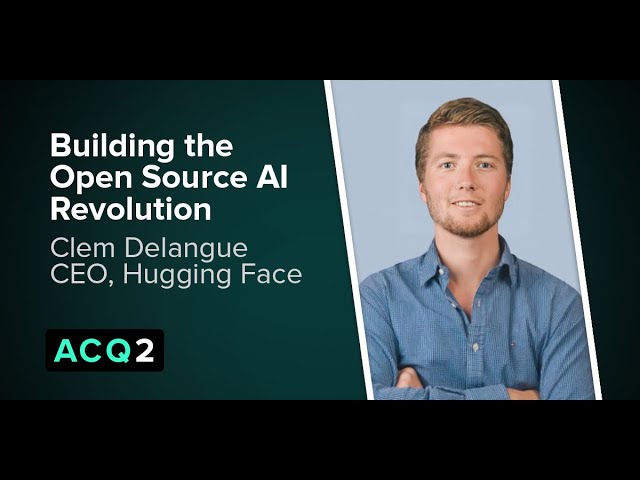
ACQ2: Building the Open Source AI Revolution (with Hugging Face CEO, Clem Delangue) — Acquired

Acquired

Corporate adoption will shift away from third-party APIs toward millions of specialized, cheap models built natively by internal scientific teams.

AI-assisted summary of ACQ2: Building the Open Source AI Revolution (with Hugging Face CEO, Clem Delangue) — original source. Check the original for full context.

Source published:

Detailed notes

## Background Published by the Acquired channel on YouTube on March 20, 2025, this ACQ2 episode features an interview with Hugging Face CEO Clem Delangue. The page description outlines the current state of the open-source AI ecosystem, highlighting Hugging Face's role as a leading platform for hosting AI models and datasets, and showcasing Delangue's contrarian view that thousands of companies will build specialized, in-house AI models rather than relying on a few central APIs.

## TL;DR Hugging Face CEO Clem Delangue discusses the paradigm shift from traditional software engineering to an ecosystem driven by 'AI Builders' who train models and curate data. He traces the company's accidental pivot from a teenage chatbot startup to a $4.5 billion infrastructure pillar following the release of Google's BERT model. Delangue champions the safety and innovation benefits of radical open-source AI, challenging the corporate 'existential risk' narrative. Ultimately, he predicts a future defined by millions of cheap, specialized, domain-specific models created by a globally diverse pool of builders rather than a handful of closed-source tech monopolies.

## Atmosphere & style The conversation carries a grounded, authentic, and forward-looking energy, striking a balance between high-stakes tech economics and a passion for open-science community building. Delangue rejects mainstream doomsday hype with a calm, rational perspective, treating the AI boom as a massive, practical evolution in engineering—a 'bicycle for the bicycle for the mind.' The dynamic between the hosts and Delangue is collegial and collaborative, evolving from nostalgic reflections on early startup struggles into an insightful critique of traditional venture capital playbooks. Listening feels like sitting in on a transparent, behind-the-scenes strategy session where the future of software is being actively mapped out by an accessible, community-first expert.

## Key takeaways - [00:00](https://www.youtube.com/watch?v=hzc1covUhYM&t=0s) A profound paradigm shift is occurring where "AI Builders" are emerging as the new generation of software engineers, constructing technology by training models and curating datasets rather than writing lines of traditional code. - [04:14](https://www.youtube.com/watch?v=hzc1covUhYM&t=254s) Hugging Face serves as the "GitHub for AI," requiring an integrated infrastructure to host massive datasets, run live applications, and provide compute platforms for model training due to the unique collaborative needs of machine learning teams. - [10:14](https://www.youtube.com/watch?v=hzc1covUhYM&t=614s) The company accidentally pivoted into an open-source juggernaut after Chief Scientist Thomas Wolf spent a weekend porting Google's TensorFlow-based BERT model into PyTorch, revealing a massive community demand for an independent model host. - [18:08](https://www.youtube.com/watch?v=hzc1covUhYM&t=1088s) Half of the repositories on Hugging Face are entirely private, reflecting a progressive runway where organizations are met where they are, allowing them to open what they feel comfortable opening while building internal AI systems. - [18:08](https://www.youtube.com/watch?v=hzc1covUhYM&t=1088s) Open science and decentralized AI are presented as essential safeguards for humanity, protecting against a dangerous future where a single company or organization monopolizes a non-decentralized Artificial General Intelligence (AGI). - [19:54](https://www.youtube.com/watch?v=hzc1covUhYM&t=1194s) The term "AI" creates misleading science-fiction doomsday narratives; it is better understood as "software 2.0," acting as a compounded form of human leverage—or a "bicycle for the bicycle for the mind." - [26:16](https://www.youtube.com/watch?v=hzc1covUhYM&t=1576s) The macro landscape has become significantly less open over the last two to three years as commercial incentives and safety-based arguments have reduced corporate willingness to share defining research breakthroughs. - [32:04](https://www.youtube.com/watch?v=hzc1covUhYM&t=1924s) The archetypal founder profile for AI startups has shifted from traditional software engineers to specialized research scientists who require massive upfront capital and intense compute infrastructure. - [37:05](https://www.youtube.com/watch?v=hzc1covUhYM&t=2225s) Hugging Face demonstrates high capital efficiency by raising slightly over $500 million and spending less than $250 million, achieving profitability by avoiding the staggering capital expenditures required for foundational training runs. - [39:40](https://www.youtube.com/watch?v=hzc1covUhYM&t=2380s) The platform monetizes through sustainable, high-margin bundles like "locked-in compute" and its Enterprise Hub, eliminating complexity for companies so they require fewer machine learning infrastructure deployment engineers. - [49:41](https://www.youtube.com/watch?v=hzc1covUhYM&t=2981s) The mainstream consensus that a few massive tech monopolies will consolidate the market with "god models" is challenged by the view that thousands of companies will build small, specialized, cheap models optimized for their unique domains. - [54:57](https://www.youtube.com/watch?v=hzc1covUhYM&t=3297s) AI development breaks the traditional "Lean Startup" playbook of rapid, incremental iteration; instead, it operates on timelines of months or years to yield discrete, foundational breakthroughs. - [58:53](https://www.youtube.com/watch?v=hzc1covUhYM&t=3533s) While the closed-source thesis argues that proprietary application data creates an unassailable training loop, sustainable AI moats will likely mirror traditional software dynamics like compute scale and social network effects. - [01:04:36](https://www.youtube.com/watch?v=hzc1covUhYM&t=3876s) The global population of AI builders is predicted to scale from 5 million to potentially match or eclipse the 50 million traditional software engineers within a few years due to lower barriers to entry like data curation and feedback. - [01:08:56](https://www.youtube.com/watch?v=hzc1covUhYM&t=4136s) Hugging Face's acquisition of the huggingface.com domain after seven years on .co serves as a lesson for early-stage entrepreneurs to not sweat minor details early on if underlying community value is strong.

## Detailed walkthrough ### [00:00](https://www.youtube.com/watch?v=hzc1covUhYM&t=0s) The Core of the AI Builder Movement

Clem Delang introduces Hugging Face at a deeply critical inflection point for artificial intelligence, positioning the company directly at the center of the shifting technological landscape. The conversation frames the episode as an accessible entry point for anyone to understand the divergence between open-source and closed-source AI ecosystems, along with the fundamental virtues and trade-offs of each side. Delang describes a profound paradigm shift where "AI Builders" are emerging as the new generation of software engineers. While the previous technological era relied on writing millions of lines of code to build world-changing platforms like Facebook or Google, modern technology is constructed by training models, curating data sets, and developing AI-driven applications.

The conversation draws a parallel between the current AI surge and the Web 2.0 era of 2008 to 2010, recalling the excitement around restful APIs and "API mashups" that allowed developers to daisy-chain distinct corporate services into entirely new creations. Delang notes that this modular approach is starting to completely reinvent established domains like search and social networking, while simultaneously unlocking extreme, unprecedented capabilities that hint at artificial general intelligence (AGI). The scale of this movement is underscores Hugging Face's commercial footprint, with major tech giants backing the platform and millions of models circulating through its pipeline.

* Hugging Face is valued at $4.5 billion as of the recording date. * Core investors include Nvidia, Salesforce, Google, Amazon, Intel, AMD, Qualcomm, and IBM. * The platform serves over 5 million daily AI builders. * The community has collectively shared over 3 million models, data sets, and applications. * Notable hosted models mentioned include Meta's Llama 3.1, Stable Diffusion, OpenAI's Whisper, and Flux. * The platform is rapidly approaching the milestone of 1 million public models.

[04:14](https://www.youtube.com/watch?v=hzc1covUhYM&t=254s) Expanding the "GitHub for AI" Model

The discussion transitions into the precise mechanics of how Hugging Face functions, comparing it directly to GitHub but tailored specifically for the realities of machine learning. Delang points out that AI is fundamentally different from traditional software, meaning it cannot follow the exact same repository playbook. Beyond merely uploading a pile of code, AI development demands an integrated infrastructure capable of hosting massive datasets, running live applications, and providing a heavy compute platform where users can actively train models.

A frequently underestimated driver of Hugging Face's massive growth is its robust suite of collaborative features. Delang highlights that "you don't build AI by yourself as a single individual," emphasizing that teams require specialized tools to version control data sets, report bugs, and review complex architectures collectively. This collaborative necessity has caused the footprint of AI engineering teams within large enterprises to explode from tiny groups of five or ten people into sprawling divisions encompassing thousands of active users.

* A new model, data set, or app is built every 10 seconds on the Hugging Face platform. * Major enterprise clients utilizing Hugging Face both privately and publicly include Microsoft, Nvidia, and Salesforce. * Key collaboration features include model and dataset versioning, bug reporting, in-line reviewing, and public/private commenting.

[06:52](https://www.youtube.com/watch?v=hzc1covUhYM&t=412s) From Teen Chatbots to AI Infrastructure

Delang looks back to the unlikely origins of the company in 2016, when he co-founded Hugging Face alongside Julian and Thomas. Named directly after the hugging face emoji Unicode code point, the startup originally began as an interactive chatbot intended primarily as a fun virtual friend for teenagers. Delang admits they started well before the current era of popular artificial intelligence, operating under the labels of machine learning and deep learning. His early inspiration stemmed from working 15 years prior at Moodstocks, a Parisian startup specializing in machine learning for computer vision, which opened his eyes to the profound disruptive potential of the technology.

The co-founders originally set out to tackle conversational AI because they felt existing offerings like Siri and Alexa "suck," drawing nostalgic inspiration instead from Tamagotchis—the beloved virtual pocket pets of the past. They spent three full years developing this conversational AI pet and managed to raise two rounds of venture capital on an entirely different premise than what the company is known for today. Delang offers a warm shout-out to their earliest backers who took a massive gamble on a group of "random French dudes with like no specific background or credentials with a broken English."

* Hugging Face was co-founded in 2016 by Clem Delang, Julian Chaumond, and Thomas Wolf. * The team raised $6 million over three years for the initial teenage chatbot concept before pivoting. * Early institutional backing was led by John Borthwick and Matt Hartman at Beta Works in New York, marking one of their largest financial bets. * Impactful angel investors included Ron Conway’s family fund (SV Angel) and Richard Socher, who was the Chief Scientist at Salesforce at the time and later founded u.com.

[10:14](https://www.youtube.com/watch?v=hzc1covUhYM&t=614s) The Accidental Pivot via Google's BERT

The structural transformation of Hugging Face into an open-source juggernaut happened entirely by accident, timed around the release of Google’s landmark Transformer paper. In 2017 and 2018, the state-of-the-art for natural language processing was heavily constrained, relying on tiny models trained on hyper-specific, meticulously clean datasets. When Google open-sourced its groundbreaking BERT model on a Friday afternoon, Chief Scientist Thomas Wolf noticed a major friction point: Google had built the model in TensorFlow, but the broader research community predominantly preferred PyTorch. Wolf decided to spend his weekend porting the model into PyTorch just for fun.

On Monday morning, Wolf tweeted out his completed PyTorch version of BERT, and the tweet instantly garnered a thousand likes—an amount that felt like "breaking the internet" to the small team at the time. This viral wave of developer interest exposed a massive, unaddressed bottleneck in the ecosystem: tech giants were building models in their own heavily endorsed, proprietary software stacks, leaving a massive vacuum for an independent player to translate and host these tools for the wider community. Delang credits this "gift from fate" as the catalyst that prompted them to approach their investors six months later, pitch a total pivot, and systematically construct the Transformers library.

* The original repository name for the project was `pre-trained-pytorch-bert`, which evolved into `pytorch-transformers`, then `transformers`, and finally expanded into the full Hugging Face platform. * Early open-source contributions included the ExcelNet model from Guillaume Lample (who later founded Mistral AI) and OpenAI’s original gpt2 model back when the organization was still open-source.

[17:21](https://www.youtube.com/watch?v=hzc1covUhYM&t=1041s) The Philosophy and Limits of Radical Openness

Hugging Face has become fiercely celebrated for its culture of transparency, taking the core tenets of open-source software and embedding them directly into their corporate operations. Delang details how this philosophy manifests internally, revealing that the company maintains an exceptionally open internal environment, even granting all employees direct access to the official corporate Twitter and social media accounts. When questioned about where the boundary lies between beneficial openness and competitive exposure, Delang clarifies that they are not a decentralized autonomous organization (DAO) and do not publish internal salaries. Instead, their primary mission is about providing the tools that lower the friction for *other* companies to be more open than they would ever be on their own, without forcing a rigid ideological agenda upon them.

[18:08](https://www.youtube.com/watch?v=hzc1covUhYM&t=1088s) The Tides That Lift All Boats: Embracing Open Science

The landscape of modern AI hosting is far from monolithic; in fact, half of the repositories on Hugging Face are completely private. Companies frequently use the platform to build and store internal AI systems without sharing them publicly. The speaker notes that Hugging Face is entirely comfortable with this dynamic, recognizing that some organizations naturally build more openly than others. The goal is simply to meet companies where they are and empower them to "open what they feel comfortable opening." This doesn't always mean releasing massive models or expansive datasets; sometimes, it's as simple as publishing a research paper, since openness is arguably even more critical for scientific advancement than it is for AI development as a whole. This step-by-step approach gives organizations a progressive runway to share more over time and actively contribute back to the global community.

Ultimately, the belief is that openness and open science serve as "the tides that lift all boats." By providing widespread access, everyone gains the ability to build, understand, and achieve true transparency regarding how AI systems function—or fail to function. This collaborative environment is framed as a foundational prerequisite for a safer future, especially amid the mounting hype around Artificial General Intelligence (AGIMS). The speaker admits to being "incredibly scared of a non-decentralized AGI," arguing that the risk to humanity skyrockets if only a single company or organization manages to monopolize it. Conversely, putting the technology into the hands of everyone—not just private corporations, but also policy makers, nonprofits, and civil society—presents a far safer and more exciting vision for the future.

[19:54](https://www.youtube.com/watch?v=hzc1covUhYM&t=1194s) AGI Misconceptions and Software 2.0

When pushed on whether current AI models represent genuine stepping stones or a completely separate path to AGI, the speaker describes them as "building blocks" in terms of technological learning, but argues that the terminology itself has triggered a massive societal misunderstanding. Calling the technology "artificial intelligence" inherently evokes science fiction tropes, rapid acceleration, and the Singularity. On the ground, however, the speaker views it not as a looming sci-fi entity, but as a new paradigm for engineering, prefering the term "software 2.0." Just as traditional software has steadily iterated over the decades, software 2.0 will continue to improve step-by-step. The speaker dismisses the idea that labeling it AI brings us any closer to a "Robocop scenario of kind of like an all-dominating AI system that is going to take over the world."

The conversation shifts to how two entirely different technological concepts are currently masquerading under the single banner of AI. The first is this concept of software 2.0, which acts as "software on steroids," amplifying human leverage and allowing tiny teams to build a staggering richness of applications at blinding speeds—representing a 10x improvement over previous development paradigms. The second concept is the classic Turing test milestone, where a human interacts with an entity and is utterly convinced it is another human. The speaker finds it somewhat amusing that both are lumped together under the same name when one is fundamentally just leverage for builders.

- **Terminology Preference**: Suggests replacing "AI" with "software 2.0" to dispel sci-fi doomsday narratives. - **The Dual Identity of AI**: Distinguishes between developer leverage (software 2.0) and human-mimicking systems (Turing test pass).

[22:11](https://www.youtube.com/watch?v=hzc1covUhYM&t=1331s) The Hype of the Chatbot and the Bicycle for the Mind

Demystifying the sudden shock of conversational AI, the speaker suggests that society may be overestimating the breakthrough of human-mimicking bots, remarking that it doesn't feel "incredibly difficult and incredibly mindblowing that we finally managed to build the chatbots." In fact, having expected a viable chatbot as early as 2016, the speaker expresses surprise that it took the industry this long to build a good one. It is easy for society to become so entrenched in the present that they forget past technical milestones. The speaker compares the current awe over AI to historical leaps: the first vehicles that moved faster than human legs, the first computers capable of lightning-fast information retrieval, and the early days of querying Google to pull up any fact in seconds. While these milestones are taken for granted now, they were profoundly impressive in their moment.

While it is normal for builders to hype their creations, society must maintain moderation, understand that technology will progress steadily, and steer it toward a positive direction for humanity. The speaker confidently asserts that "everything is going to be fine" and that the world is not on the brink of a doomsday scenario in a few months because of a chatbot. Amused by this grounded perspective, the host connects the idea back to a famous Steve Jobs quote: "a computer is a bicycle for the mind." If traditional computing acted as a mechanical multiplier for human cognitive output—much like a bicycle scales a human's walking pace—then software 2.0 is effectively a "bicycle for the bicycle for the mind," acting as a compounded form of human leverage.

---

[24:25](https://www.youtube.com/watch?v=hzc1covUhYM&t=1465s) Sponsor Break: Vanta

The hosts take a moment to thank their long-time sponsor, Vanta, the leading trust management platform that automates security reviews and compliance efforts. Vanta handles heavily resource-draining frameworks like SOC 2, ISO 27001, GDPR, and HIPAA compliance monitoring, streamlining what is typically an incredibly tedious process for companies. The hosts connect Vanta's service to a core philosophy often discussed on the show—Jeff Bezos's famous advice that a company should focus exclusively on "what actually makes your beer taste better." In other words, organizations should dedicate their precious time and resources strictly to the things that move the needle for their product and customers, outsourcing everything else.

While compliance and vendor trust are essential for unlocking revenue and satisfying partners, managing them adds zero unique flavor to a company's actual core product. Vanta replaces fragmented tools, endless spreadsheets, and manual review processes with a single software pane of glass that hooks directly into a company’s services via APIs.

- **Automated Frameworks**: SOC 2, ISO 27001, GDPR, and HIPAA. - **Integration Ecosystem**: Integrates with over 300 external tools and supports custom private integrations for internal systems. - **Real-Time Monitoring**: Security reviews are shifted from static snapshots to real-time tracking. - **Listener Benefit**: Acquired listeners receive $1,000 in free credit courtesy of Vanta CEO Christina Cacioppo by visiting `[vanta.com/acquired](https://vanta.com/acquired)`.

---

[26:16](https://www.youtube.com/watch?v=hzc1covUhYM&t=1576s) The Pendulum of Openness and Commercial Pressures

Reflecting on the last six to seven years of modern AI development, the host asks whether the pendulum between open and closed models has shifted significantly, or if the landscape has always maintained a steady split between open academic research and closed corporate tech giants like Google and Facebook. The speaker responds that framing the issue as a binary debate can be highly misleading because "open source is kind of like the foundation to all AI." Even staunchly closed-source organizations like OpenAI and Anthropic rely heavily on open research and open-source infrastructure at the lower layers of their technology stacks. They are essentially building proprietary applications on top of a shared, open foundation.

However, looking at the macro shifts over the last few years, the speaker acknowledges that the field has undeniably become less open than it used to be. During the 2017 to 2019 era, the research community openly published defining breakthroughs—which is exactly how architectural pillars like Transformers and BERT emerged. Tech giants like Google and OpenAI routinely shared their models and core discoveries, a spirit of radical collaboration that directly catalyzed the rapid progress enjoyed today. For instance, OpenAI took the shared Transformer architecture and iterated on it to build GPT-2 and GPT-3. Over the last two to three years, however, commercial incentives have taken hold, accompanied by what the speaker calls "misleading arguments" regarding safety to justify shutting doors, resulting in open science being far less celebrated than it once was.

- **Historical Milestones**: The open release of the Transformer architecture and BERT models between 2017–2019. - **The Shift**: Commercial competition and existential risk arguments have reduced corporate willingness to share research openly over the last 2–3 years.

[28:56](https://www.youtube.com/watch?v=hzc1covUhYM&t=1736s) The Existential Risk Narrative and the History of Fear

Digging into the mechanics of the closed-source argument, the host asks why the speaker finds the safety-based objections to open source so misleading. The speaker explains that many figures in the industry lean heavily on the "existential risk of AI" to claim that sharing research is fundamentally too dangerous because bad actors might exploit it. This playbook is far from novel; throughout history, every major technology cycle has sparked similar resistance. Critics once claimed that books were inherently dangerous, arguing that they shouldn't be distributed freely to the public and that individuals should require a license to write or share them. The host counters that while this happened during the nuclear era, the software industry never saw this level of panic, noting that no one tried to restrict SaaS, mobile apps, or state-actor access to mobile software.

The speaker points out that the cycle with AI has moved exponentially faster, taking the public from total ignorance to mainstream saturation overnight, which heightens collective anxiety and leaves room for manipulation. Furthermore, branding the technology "artificial intelligence" makes it inherently scarcer and more terrifying to the public than if it were simply called software. The host notes that in the early days of computing, the field was viewed as a niche community of "nerds" carrying forward the open, anti-authoritarian norms of the 1960s and 70s Bay Area hippie movement. Today, the stakes are dramatically higher, and power is heavily concentrated in the hands of a few massive tech monopolies. The speaker’s core mission in championing openness is to dismantle this concentration, aiming to empower thousands of independent AI companies and hand a new generation of founders, CEOs, and teams the cards to reshape the world.

[32:04](https://www.youtube.com/watch?v=hzc1covUhYM&t=1924s) Investing in the New Paradigm: Scientists vs. Software Engineers

To illustrate the immediate, democratizing impact of these open tools, the host shares a story about a non-technical startup founder who decided to build an AI product for his small, bootstrapped business. Utilizing tools likely found on Hugging Face, the founder built and launched an application in just a couple of weeks, completely transforming his business with a world-class product. The speaker finds this trend incredibly heartening, reiterating that we do not need to obsess over doomsday narratives or AGI super-intelligence when the practical reality of this new engineering paradigm is already profoundly disruptive. This paradigm shift will fundamentally alter how startups are built, run, and funded.

Drawing from personal experience, having made 100 angel investments over the past two years primarily within the Hugging Face community, the speaker explains that building an AI startup requires tossing out the mature software playbook entirely. Investors cannot simply rely on the traditional "Lean Startup" methodology where a CEO, a CTO, and a small team build an MVP and run lean through successive funding rounds. For one, many AI startups require massive upfront capital and intense compute infrastructure before generating any revenue—as seen with foundational model companies like OpenAI or Mistral.

Furthermore, the archetypal founder profile has flipped; today's pioneers are rarely traditional software engineers—they are scientists. While a massive amount of capital is currently flowing into foundational Large Language Models (LLMs), text is only a single modality. The future will require foundational models for video, biology, chemistry, audio, and imagery. The speaker posits a contrarian view: rather than a world where small teams build lightweight applications purely on top of third-party APIs, many enduring AI companies will need to build distinct foundational models across these diverse modalities, requiring incredibly large capital investments to achieve step-function advancements.

- **Angel Investment Footprint**: 100 angel investments made over the past two years within the Hugging Face ecosystem. - **Founder Demographics**: A distinct shift from traditional software engineers to specialized research scientists. - **Future Modalities**: Anticipates foundational model breakthroughs stretching far beyond text into video, biology, chemistry, audio, and image processing.

[37:05](https://www.youtube.com/watch?v=hzc1covUhYM&t=2225s) Tearing Up the Software Playbook

The sheer volume of capital required by foundational model companies reshapes traditional venture economics. Even if there are a thousand times more regular startups consuming AI APIs, the massive training runs of foundational players ensure that the majority of investment dollars will still flow to them. Companies like OpenAI and Hugging Face did not behave like traditional software organizations. OpenAI, for example, kicked off with a massive billion-dollar raise and spent six to seven years focused entirely on open source and open science before shifting models. Hugging Face similarly operated in a fully open-source, community-driven space for years despite conventional advice.

This divergence demonstrates why AI requires throwing away the old software playbook to build something from scratch using first principles. Hugging Face itself has been remarkably capital efficient, raising just over $500 million over seven years while spending less than half of it. Because they are profitable—a rarity among AI startups—they do not face the staggering capital expenditure requirements for computing and training that burden players like OpenAI.

* **Hugging Face Capital Efficiency:** Raised slightly over $500 million over 7 years; spent less than $250 million. * **OpenAI Initial Launch:** Commenced with a $1 billion capital raise, operating under an open-source/open-science framework for 6 to 7 years.

---

[39:40](https://www.youtube.com/watch?v=hzc1covUhYM&t=2380s) High-Margin Infrastructure and "Locked-In Compute"

Platforms that support a community bear a long-term responsibility toward the users building on top of them. Rather than trying to compete in a "race to the bottom" on compute prices—a brutal business model dominated by hyperscalers with unmatched cash flow—Hugging Face centers its economics on sustainable, high-margin bundles. By partnering with cloud providers, they offer seamless integration for inference endpoints and GPU spaces. This experience is so tightly woven into the platform features that it becomes ten times easier for a company to buy the bundle rather than independently sourcing compute from AWS or Google Cloud.

This model introduces what can be called "locked-in compute," where the value is derived from eliminating complexity rather than raw hardware trading. Instead of hiring ten machine learning infrastructure deployment engineers to hand off work from AI researchers, a company might only need one or two. Additionally, Hugging Face drives 100% margin growth through features like its Enterprise Hub offering, operating on proven B2B SaaS frameworks without needing to reinvent a monetization strategy from scratch.

> "We make the experience so much more seamless, so much less complex, which is the name of the game for AI... instead of having 10 mL Engineers, maybe they going to have one or two."

---

[44:36](https://www.youtube.com/watch?v=hzc1covUhYM&t=2676s) The Curve of Visibility and the Platform Curse

While foundational companies generate significant revenue, their ultimate profitability remains an open question. Hugging Face avoids this uncertainty by securing a spot as the primary platform for AI builders. However, being an infrastructure-first platform comes with a specific challenge: a lack of mainstream consumer "sexiness." Like GitHub—which transformed technology development over 20 years yet rarely captured the same public visibility as Facebook or Google—Hugging Face operates primarily behind the scenes.

Compounding this visibility curse is the challenge of balancing mature, stable software solutions with the blistering speed of underlying AI research. To navigate this tension without missing the next technological wave, Hugging Face intentionally keeps its team lean. They employ around 250 team members, deliberately choosing to stay an order of magnitude smaller than their peers rather than scaling up to 2,000 employees.

* **Team Size Strategy:** Operating with 250 employees to maintain agility, intentionally passing on scaling to 2,000 people.

---

[49:41](https://www.youtube.com/watch?v=hzc1covUhYM&t=2981s) The Contrarian Future of Specialized, Cheap Models

The current era where companies consume large models via external APIs is likely a transitional period born out of temporary complexity. Much like the early days of the web when creators relied heavily on no-code tools like Dreamweaver, FrontPage, or Squarespace before developing internal engineering capabilities, companies are using APIs because they lack native AI infrastructure. In the future, every tech company will become an AI company, building, fine-tuning, and optimizing its own specialized models.

This point of view runs directly counter to the mainstream consensus that five to eight massive players will consolidate the market by spending $10 billion to $100 billion every few years on "god models." The massive daily activity on Hugging Face—where a new model, dataset, or app is uploaded every 10 seconds—proves that builders want smaller, efficient, and cheaper models optimized for specific latencies, hardware, and domains. A banking customer support chatbot does not need to know "the meaning of life"; it just needs to be fast and cost-effective.

> "An AI company using an API sounds very unintuitive or it doesn't sound like the optimal way to be AI... I believe in a world where there's almost as many models as code repositories today."

---

[54:57](https://www.youtube.com/watch?v=hzc1covUhYM&t=3297s) Why the AI Paradigm Demands Real Scientists

The defining difference between the software era and the AI era is that AI is fundamentally science-driven rather than purely engineering-driven. While practitioners in the software space are historically called "computer scientists," the term is mostly a misnomer; software engineers study and operate a man-made system rather than exploring phenomena occurring in the natural world like biology, chemistry, or physics.

Because AI introduces true scientific experimentation, founding teams must adjust their core talent makeup. Having a co-founder with a legitimate scientific background has become a necessary prerequisite for success. This trend is visible across the most prominent players in the landscape, from Ilya Sutskever's foundational role at OpenAI to the leadership core at Hugging Face itself.

* **Key Skill Shift:** Transitioning from pure software engineering structures to hiring scientific backgrounds capable of running experimental research.

Traditional Software vs. AI Research Paradigms

The speakers contrast the engineering skill sets and operational timelines required for traditional software startups versus AI research companies. In traditional software, the prevailing culture centers on continuous deployment and shipping exceptionally fast. A software product can succeed commercially by simply improving by 5% every two weeks; over time, those marginal increments compound into a highly differentiated product that retains users. In contrast, the AI paradigm revolves around foundational advancements. Training and optimizing large models takes months rather than days, meaning value creation occurs in discrete, massive leaps. A team might work in isolation for six months to a year, ultimately releasing a model that is ten times better than the existing state-of-the-art.

The host pushes back slightly on the idea that AI companies just disappear for years to build, calling it a bit of "revisionist history" regarding OpenAI. While OpenAI was not mainstream during its early years, they were continuously releasing research projects—such as training Universe on Grand Theft Auto, GPT, and GPT-2—even if those early iterations lacked immediate commercial value. However, the guest counters that relative to OpenAI's massive scale and initial $1 billion investment, their shipping cadence of one major release every three to six months was significantly slower than a traditional software company operating on a comparable budget. Because deploying large models requires a complete retraining cycle rather than a simple code update, continuous deployment is structurally unfeasible. Consequently, the best advice for an AI entrepreneur is to literally "trash their Lean Startup book" to avoid falling into old software development habits that do not fit the physics of AI.

* Traditional software engineering leans heavily on rapid, incremental iteration (e.g., 5% improvements every two weeks). * AI development operates on a timeline of months or years to yield breakthroughs that are 10x better than existing tools. * OpenAI began with a $1 billion investment, releasing research milestones roughly every 3 to 6 months.

---

Moats, Economies of Scale, and the Open Source vs. Closed Source Debate

The host introduces a prominent market argument favoring closed-source AI: as models increasingly require real-time interaction data for fine-tuning, companies that tightly integrate the model within a proprietary application will capture a powerful feedback loop. In this closed ecosystem, user interactions directly inform and improve the next model version. Conversely, in an open-source framework, users fork the model and build disparate applications, meaning the resulting real-time interaction data remains fragmented and rarely flows back upstream to make the foundational model smarter.

The guest emphasizes that creating sustainable moats and economies of scale in AI remains an open question, and he warns against overhyping any single competitive advantage. AI moats will likely mirror traditional software dynamics but with heightened intensity. For instance, hardware and compute scale will mirror cloud infrastructure monopolies where massive scale drives down unit costs. On the social side, platforms like GitHub or major social networks maintain dominance through powerful network effects where collaborative usage makes the platform exponentially more valuable over time. To illustrate that data moats are not insurmountable, the guest points out that OpenAI initially had no proprietary data advantage—they simply scraped the public web like anyone else could. Similarly, Hugging Face succeeded not through an initial data monopoly, but by fostering a community-driven social network effect. From an ethical standpoint, it would be dangerous and sad if only five closed-source companies monopolized AI; a healthy ecosystem requires thousands of winners to break established monopolies.

* The closed-source thesis argues that proprietary application data creates an unassailable upstream training loop. * Compute scale acts as a cost-based moat, while community platforms rely on a "social network effect" to retain dominance. * GitHub is cited as an example of an unchallenged software platform sustained purely by collaborative network effects.

---

The Explosion of AI Builders and Democratic Technology Creation

When asked whether the future of AI expansion depends on training highly specialized scientists or making tools easier to use, the guest asserts that expanding the pool of "AI Builders" is paramount. Based on active user metrics, there are currently around 5 million AI builders globally, given that most work through Hugging Face in some capacity. In comparison, the global software engineering population sits at roughly 50 million, while GitHub boasts over 100 million total users. The guest predicts that within a few years, the number of AI builders will match or eclipse the number of traditional software engineers, potentially scaling to 10 times their population.

This massive scaling is possible because the barrier to entry for AI is fundamentally lower and less rigid than traditional coding. To be a software engineer, one must master complex syntax and write lines of text perfectly. To be an AI builder, an individual can contribute domain expertise, curate data, or evaluate outputs, which opens the field to non-programmers. The guest notes that Silicon Valley and San Francisco tech circles often forget how small a group of people currently shapes products for the rest of the world. By expanding the builder base globally, society can produce highly inclusive products that targetedly solve deep-seated social issues.

* There are an estimated 5 million AI builders in the world today compared to approximately 50 million traditional software engineers. * GitHub has over 100 million total users, though a substantial portion are not core software developers. * AI contributions extend beyond writing code to include data curation, feedback, and domain-specific alignment.

---

Closing Remarks and Milestone Announcements

The conversation concludes on a celebratory note as the guest reveals that Hugging Face officially acquired the `huggingface.com` domain name just a few days prior. For the first seven years of the company's existence, they operated entirely on `huggingface.co`. This milestone serves as a practical lesson for early-stage entrepreneurs to "not sweat the small things early on," proving that an unusual company name or a non-standard top-level domain will not hinder a startup's trajectory if the underlying community value is strong. Listeners looking to engage with the platform or follow the guest's insights can find him actively sharing updates on X (formerly Twitter) and LinkedIn.

* Hugging Face successfully acquired the `huggingface.com` domain after operating on `huggingface.co` for 7 years. * The guest can be found online via X and LinkedIn for ongoing discussions and community interactions.

## Notable quotes > [04:14](https://www.youtube.com/watch?v=hzc1covUhYM&t=254s) you don't build AI by yourself as a single individual — Clem Delangue

> [06:52](https://www.youtube.com/watch?v=hzc1covUhYM&t=412s) random French dudes with like no specific background or credentials with a broken English — Clem Delangue

> [10:14](https://www.youtube.com/watch?v=hzc1covUhYM&t=614s) gift from fate — Clem Delangue

> [18:08](https://www.youtube.com/watch?v=hzc1covUhYM&t=1088s) open what they feel comfortable opening — Clem Delangue

> [18:08](https://www.youtube.com/watch?v=hzc1covUhYM&t=1088s) the tides that lift all boats — Clem Delangue

> [18:08](https://www.youtube.com/watch?v=hzc1covUhYM&t=1088s) incredibly scared of a non-decentralized AGI — Clem Delangue

> [19:54](https://www.youtube.com/watch?v=hzc1covUhYM&t=1194s) software 2.0 — Clem Delangue

> [19:54](https://www.youtube.com/watch?v=hzc1covUhYM&t=1194s) Robocop scenario of kind of like an all-dominating AI system that is going to take over the world — Clem Delangue

> [19:54](https://www.youtube.com/watch?v=hzc1covUhYM&t=1194s) software on steroids — Clem Delangue

> [22:11](https://www.youtube.com/watch?v=hzc1covUhYM&t=1331s) incredibly difficult and incredibly mindblowing that we finally managed to build the chatbots — Clem Delangue

> [22:11](https://www.youtube.com/watch?v=hzc1covUhYM&t=1331s) a computer is a bicycle for the mind — Host

> [22:11](https://www.youtube.com/watch?v=hzc1covUhYM&t=1331s) bicycle for the bicycle for the mind — Host

> [24:25](https://www.youtube.com/watch?v=hzc1covUhYM&t=1465s) what actually makes your beer taste better — Host

> [26:16](https://www.youtube.com/watch?v=hzc1covUhYM&t=1576s) open source is kind of like the foundation to all AI — Clem Delangue

> [39:40](https://www.youtube.com/watch?v=hzc1covUhYM&t=2380s) We make the experience so much more seamless, so much less complex, which is the name of the game for AI... instead of having 10 mL Engineers, maybe they going to have one or two. — Clem Delangue

> [49:41](https://www.youtube.com/watch?v=hzc1covUhYM&t=2981s) An AI company using an API sounds very unintuitive or it doesn't sound like the optimal way to be AI... I believe in a world where there's almost as many models as code repositories today. — Clem Delangue

> [54:57](https://www.youtube.com/watch?v=hzc1covUhYM&t=3297s) trash their Lean Startup book — Clem Delangue

> [01:04:00](https://www.youtube.com/watch?v=hzc1covUhYM&t=3840s) not sweat the small things early on — Clem Delangue

## Mentioned ACQ2: Building the Open Source AI Revolution, Clem Delangue, Hugging Face, Acquired, YouTube, Facebook, Google, Nvidia, Salesforce, Amazon, Intel, AMD, Qualcomm, IBM, Meta, Llama 3.1, Stable Diffusion, OpenAI, Whisper, Flux, GitHub, Microsoft, Julian Chaumond, Thomas Wolf, Moodstocks, Siri, Alexa, Tamagotchi, John Borthwick, Matt Hartman, Beta Works, Ron Conway, SV Angel, Richard Socher, u.com, TensorFlow, PyTorch, Transformers, BERT, ExcelNet, Guillaume Lample, Mistral AI, GPT-2, Steve Jobs, Vanta, Christina Cacioppo, Anthropic, GPT-3, Jeff Bezos, AWS, Dreamweaver, FrontPage, Squarespace, Ilya Sutskever, Universe, Grand Theft Auto, LinkedIn, X

[Source](https://www.youtube.com/watch?v=hzc1covUhYM)

中文简报

Hugging Face CEO反对大模型垄断,力挺企业自研AI 企业的应用模式将从第三方API转向由内部科研团队原生构建的数百万个专用且廉价的模型。 Hugging Face首席执行官Clem Delangue探讨了从传统软件工程向由负责训练模型和整理数据的“AI构建者”驱动的生态系统的范式转变。他回顾了在Google发布BERT模型后,公司如何意外地从一家青少年聊天机器人初创公司转型为估值45亿美元的基础设施支柱。Delangue极力主张全面开源AI在安全和创新方面的优势,对企业界渲染的“生存风险”论调提出质疑。最终,他预测未来将由全球多元化的构建者群体创造的数百万个廉价、专业且针对特定领域的模型来定义,而非由少数闭源科技巨头所垄断。 一场深刻的范式转变正在发生:“AI构建者”正作为新一代软件工程师崭露头角,他们通过训练模型和整理数据集来构建技术,而非编写传统代码行。 (0:00) Hugging Face被定位为“AI领域的GitHub”,由于机器学习团队独特的协作需求,需要整合基础设施来托管海量数据集、运行实时应用程序并为模型训练提供计算平台。 (4:14) 在首席科学家Thomas Wolf花了一个周末将Google基于TensorFlow的BERT模型移植到PyTorch后,公司意外转型为开源巨头,这揭示了社区对独立模型托管平台的巨大需求。 (10:14) Hugging Face上半数的仓库完全是私有的,这反映出一种渐进式的推进路径,即顺应机构当下的实际需求,允许它们在构建内部AI系统的同时,选择性开源适合公开的内容。 (18:08) 开放科学与去中心化AI被视为人类的重要保障,可防范单一公司或机构垄断非去中心化通用人工智能(AGI)的危险未来。 (18:08)

Reading summary

Hugging Face CEO Clem Delangue argues that artificial intelligence represents an open, science-driven paradigm shift—termed "software 2.0"—where progress relies on millions of global builders deploying specialized, transparent models rather than a few centralized monopolies operating closed systems. The Hugging Face Platform and Infrastructure (4:14) Hugging Face evolved from a 2016 conversational chatbot startup for teenagers—which raised $6 million before pivoting around an open-source PyTorch port of Google's BERT—into an AI collaboration platform valued at $4.5 billion. Backed by investors including Nvidia, Salesforce, and Google, the platform hosts over 3 million models, datasets, and applications, serving 5 million daily AI builders. A new asset is created on the platform every 10 seconds, approaching the milestone of 1 million public models. Unlike traditional code repositories, machine learning infrastructure requires hosting massive datasets, running live applications, and managing versioning across enterprise teams. Delangue emphasizes capital efficiency: Hugging Face has raised roughly $500 million over seven years, spent less than $250 million, operates profitably with about 250 employees, and generates revenue through high-margin enterprise hub subscriptions and "locked-in compute" integrations that abstract cloud deployment complexities. Reframing AI as Software 2.0 (19:54) Delangue advocates replacing the term "artificial intelligence" with "software 2.0" to dispel sci-fi doomsday narratives and existential risk panics, which he compares to historical fears surrounding the spread of books. He distinguishes between conversational chatbots meeting the Turing test and developer leverage that acts as a compounded multiplier—a "bicycle for the bicycle for the mind"—offering a 10x improvement over previous programming paradigms. He disputes claims that open-source AI is fundamentally unsafe, arguing that corporate competitors use safety rhetoric as a pretext to shut down open research and protect commercial interests. Delangue contends that open science provides essential transparency and accountability, arguing that a single corporation monopolizing artificial general intelligence poses a far greater societal danger than decentralized public access. Scientific Research Replaces the Lean Playbook (32:04) The transition from conventional software to AI represents a shift from pure engineering to experimental science. In traditional software startups, teams iterate incrementally—often aiming for 5% improvements every two weeks using the "Lean Startup" methodology. AI development, by contrast, relies on extensive scientific training runs lasting months or years to achieve step-function advancements, making continuous deployment structurally unfeasible. Consequently, founding teams increasingly require research scientists rather than standard software engineers. This scientific dynamic transforms capital requirements. Foundational model creators face massive upfront compute expenditures before generating revenue, as shown by OpenAI raising $1 billion initially and operating for years within an open-science framework. Drawing on his 100 angel investments within the Hugging Face community, Delangue expects enduring foundational models to emerge across diverse modalities beyond text, including video, chemistry, biology, and audio. The Rise of Specialized Models (49:41) Delangue challenges the mainstream projection that five to eight hyperscalers will consolidate the entire market by spending tens of billions on consolidated "god models." Instead, he views third-party API consumption as a transitional phase comparable to early web tools like FrontPage or Dreamweaver. As technical capabilities mature, Delangue forecasts that every tech company will become an AI company that trains, fine-tunes, and optimizes smaller, domain-specific models tailored to precise costs and latencies. Addressing competitive moats, Delangue downplays claims that closed-source systems possess an unassailable advantage through proprietary user feedback loops, noting that early leaders like OpenAI began by scraping public web data. Sustainable advantages in AI will instead mirror traditional software dynamics: compute scale driving down unit costs, and collaborative platforms sustaining dominance through community network effects. While Delangue projects that global AI builders could expand from 5 million today to eclipse the world's 50 million traditional software engineers, unresolved questions remain regarding whether closed application data loops will ultimately outcompete open research and how pure foundational model providers will achieve sustainable long-term profitability.

精炼阅读摘要

Hugging Face 联合创始人兼首席执行官 Clem Delangue 指出,人工智能的本质是更具开发杠杆的“软件 2.0”,其终局并非由少数科技巨头垄断千亿美元级通用模型,而是由数以千万计的 AI 构建者通过开源科学协同开发数百万个特定领域的专用模型。 平台生态与高利润基础设施 (4:14) Hugging Face 估值已达 45 亿美元,吸引了包括 Nvidia、Salesforce、Google 和 Amazon 在内的多家科技巨头投资,平台上托管的模型、数据集和应用总数已超过 300 万个。与传统代码托管平台 GitHub 不同,机器学习需要承载海量数据集、实时应用部署以及算力训练基础设施。Delangue 指出,平台目前服务超过 500 万名日活跃 AI 构建者,平均每 10 秒就会诞生一个新资产。 在商业模式上,Hugging Face 刻意避开与公有云厂商展开降价竞争,而是提供集成了推理终端(Inference Endpoints)和计算空间的软硬件捆绑服务,通过大幅降低模型部署复杂度来实现高毛利的“锁定算力”模式,使企业所需的机器学习运维团队规模从十人缩减至一到两人。配合 Enterprise Hub 等企业级 SaaS 服务,Hugging Face 实现了罕见的盈利状态;在成立七年间仅累计募集略高于 5 亿美元资金,实际消耗不到一半,并刻意将团队规模维持在约 250 人以保持敏捷迭代。 破除 AGI 迷思与研发范式重构 (19:54) Delangue 主张以“软件 2.0”替代带有科幻色彩的“人工智能”概念,以消除公众对机器霸权或奇点来临的末日恐慌。他将行业现状划分为两个被混为一谈的维度:一是通过图灵测试、模仿人类对话的聊天机器人,他认为这类技术的实现属于循序渐进的历史必然;二是作为工程倍增器的软件 2.0,其本质是史蒂夫·乔布斯所谓“心灵自行车”的再放大,能为开发者带来十倍级的生产力提升。 在底层研发逻辑上,AI 与传统软件的研发规律存在根本性冲突。传统软件开发推崇每两周迭代 5% 的持续部署和精益创业法则,而基础 AI 研发更接近自然科学实验,往往需要以数月甚至一年为周期进行长周期模型训练,进而带来非连续性的跃升突破。因此,AI 创业团队需要彻底抛弃传统的精益软件法则,其核心创始人画像也从传统的软件架构师全面转向具备实验性探索能力的科研学者。 开源科学底座与安全借口批判 (26:16) 针对过去两至三年间行业从高度透明转向闭源保守的趋势,Delangue 强调开源研究始终是整个 AI 产业的共同底座。即便是 OpenAI 或 Anthropic 等闭源公司,也是建立在 Transformer 架构与 BERT 等早期公开发布的科研成果之上。他批评部分巨头以“AI 生存性风险”为由关闭技术共享窗口,指出此类言论属于典型的商业防御借口,历史上类似印刷术传播之初也曾遭遇类似的安全恐慌指责。 Delangue 警告称,如果通用技术被极少数非分散化的商业寡头完全垄断,人类面临的系统性风险反而会急剧上升。为了兼顾商业诉求与开源协作,Hugging Face 并不推行僵化的激进意识形态,平台上甚至有一半的存储库处于完全私有状态。其核心使命是通过降低技术门槛,允许企业根据自身舒适度逐步开放论文、数据或权重,借助“开源科学”让监管机构、学术界与民间社会共同参与模型透明度建设与技术纠偏。 专用模型趋势与构建者群体爆发 (49:41) 针对由 5 到 8 家巨头耗费上百亿美元通吃市场的“全能模型”主流预测,Delangue 提出了截然不同的反向观点。他认为当前企业依赖第三方大模型 API 只是暂时的过渡形态,正如互联网早期开发者依赖无代码建站工具一样。未来几乎所有科技公司都将转型为 AI 公司,并自主微调针对特定延迟、特定硬件与专业场景优化的紧凑型专用模型——例如银行客服机器人仅需低成本、高效率地处理业务,完全无需承担解答哲学问题的无谓开销。此外,底层模型的创新也正从纯文本向视频、生物学、化学和音频等多模态全面扩散。 在技术壁垒层面,Delangue 反驳了私有交互数据构成绝对护城河的论点,指出 OpenAI 等先驱最初同样依赖公开网络抓取数据起步,长远护城河更可能取决于算力规模经济与协同社区网络效应。他预测全球 AI 构建者规模将从现有的 500 万人迅速爆发,未来有望达到全球 5000 万传统软件工程师群体的数倍。由于 AI 构建不仅限于编写代码,还广泛吸纳了数据标注、反馈对齐和领域知识注入等多元能力,这种平民化浪潮将有效打破技术被少数硅谷精英垄断的产品设计格局。 Delangue 描绘了去中心化开源协作颠覆科技巨头中心化垄断的乐观蓝图,但该路径仍面临核心考验:随着底层训练算力成本呈指数级攀升,社区驱动的开源力量能否在资本密集的超大规模多模态科学探索中持续抗衡封闭巨头?此外,企业从便捷的统一 API 全面转向自建与微调特化模型的转换成本和技术门槛,能否如其预期的节奏顺利下降,仍是决定该产业格局的关键变量。

Detailed notes — zh

## Background 本期节目由知名商业科技播客 Acquired(ACQ2 栏目)于 2025 年 3 月 20 日发布在 YouTube 平台。节目专访了 Hugging Face 联合创始人兼 CEO 克莱姆·德朗格(Clem Delangue),共同探讨开源 AI 生态的现状、Hugging Face 托管数百万模型与数据集的平台演进,以及未来数千家企业构建专属定制模型而非单一依赖基础模型 API 的反共识行业愿景。 ## TL;DR 节目详细回顾了 Hugging Face 从最初一款面向青少年的聊天机器人(AI 电子宠物),意外因移植 PyTorch 版 BERT 踩中开源痛点,进而转型蜕变为估值 45 亿美元的“AI 领域 GitHub”与协作基础设施平台的传奇历程。Clem 深入剖析了开源对破除寡头垄断的关键意义,并指责以“存在性风险”为由搞封闭管控本质上是商业垄断的托词。在商业与战略层面,他分享了 Hugging Face 仅花不到一半融资即实现盈利、拒绝纯硬件价格战而靠高附加值工作流变现的克制哲学。最后,Clem 提出颠覆性预判:调用通用 API 仅是过渡形态,未来随着 AI 构建者规模扩大十倍,属于领域专属小模型自研的时代必将到来。 ## Atmosphere & style 对谈氛围兼具硅谷前沿技术洞察的敏锐与开源黑客文化的纯粹松弛感,主持人的层层追问与 Clem 的坦诚幽默碰撞出极高密度的思想火花。从早年三个操着蹩脚英语的法国青年做 Emoji 电子宠物的自嘲打趣,到探讨 AGI 垄断风险与去中心化信仰时的严肃沉着,整场对话在理性质疑与理想主义情怀之间游刃自如。听感既像置身于两位顶尖投资人与独角兽掌舵者的内部闭门复盘,又洋溢着打破科技巨头壁垒、赋能全球开发者的温和却坚定的布道者热情。 ## Bulletin - [38:32](https://www.youtube.com/watch?v=hzc1covUhYM&t=2312s) Hugging Face 估值已达 45 亿美元并实现盈利,成立 7 年累计融资略超 5 亿美元但仅消耗不到一半,展现出与主流烧钱模型创企截然不同的资本效率与审慎治理。 - [51:22](https://www.youtube.com/watch?v=hzc1covUhYM&t=3082s) CEO Clem Delangue 提出反共识预测:未来不会仅由少数几家巨头垄断 API,而是如同代码仓库一样,成千上万家企业会基于专有数据微调并在内部运行专属的小型基础模型。 - [03:06](https://www.youtube.com/watch?v=hzc1covUhYM&t=186s) 平台规模已突破 500 万注册开发者与超 300 万个模型、数据集及应用,平均每 10 秒即诞生一项新资产,其中多达 50% 为企业私有化使用。 - [01:05:14](https://www.youtube.com/watch?v=hzc1covUhYM&t=3914s) AI 构建者(AI Builders)门槛正从单纯编写代码泛化为贡献领域认知与专有数据,长期来看其从业规模有望达到传统软件工程师(约 5,000 万人)的 10 倍。 ## Key takeaways - [01:04](https://www.youtube.com/watch?v=hzc1covUhYM&t=64s) 从编写代码到构建模型是软件工程范式的根本转移,AI 开发者正逐渐取代传统工程师成为技术创新的核心基石。 - [07:03](https://www.youtube.com/watch?v=hzc1covUhYM&t=423s) Hugging Face 早期曾是一款面向青少年的聊天机器人(电子宠物),因多模型协同管线痛点与 BERT 移植项目的社区爆火,才果断转型为开发者基础设施平台。 - [05:13](https://www.youtube.com/watch?v=hzc1covUhYM&t=313s) 平台并非单纯的代码仓库,而是涵盖海量数据集、应用托管(Spaces)、算力闭环以及模型审查(Review)的高黏性协作生态。 - [17:21](https://www.youtube.com/watch?v=hzc1covUhYM&t=1041s) 去中心化的开源生态是抵御单一科技巨头垄断 AGI 风险的最佳防线,开源与闭源本质上是支撑与被支撑的上下层关系而非互斥。 - [26:21](https://www.youtube.com/watch?v=hzc1covUhYM&t=1581s) 以“存在性风险(existential risk)”为借口推行闭源管控,在商业与历史层面往往混杂着维持既得垄断与制造恐慌的动机。 - [33:18](https://www.youtube.com/watch?v=hzc1covUhYM&t=1998s) 传统的“精益创业(Lean Startup)”与两周一迭代法则在 AI 研发中失效,AI 是科学与数学理论突破驱动,交付周期长且涉及重资产前置投入。 - [34:32](https://www.youtube.com/watch?v=hzc1covUhYM&t=2072s) 基础模型不应局限于文本 LLM,未来在视频、生物、化学、音频等多模态垂直科学领域都将涌现大量独立的基础模型公司。 - [40:18](https://www.youtube.com/watch?v=hzc1covUhYM&t=2418s) 拒绝卷入底层 GPU 算力的逐底价格战,Hugging Face 通过“锁定算力”与工作流打包,大幅降低企业工程运维复杂度以实现高附加值变现。 - [49:18](https://www.youtube.com/watch?v=hzc1covUhYM&t=2958s) 调用统一的第三方 API 只是技术未成熟期的过渡方案,企业核心业务最终都会走向微调专属轻量模型,而非依赖全知全能的上帝模型。 - [48:09](https://www.youtube.com/watch?v=hzc1covUhYM&t=2889s) 组织治理上刻意保持克制,维持约 250 人的精简精英团队,在追求敏捷迭代的同时兼顾生产级基础设施的稳定性。 - [54:28](https://www.youtube.com/watch?v=hzc1covUhYM&t=3268s) AI 创业团队中拥有科学家背景的联合创始人是生存底线,这决定了团队能否完成从工程假设到科学实验的心智模型跃迁。 - [01:00:46](https://www.youtube.com/watch?v=hzc1covUhYM&t=3646s) 数据飞轮并非无懈可击的护城河,AI 生态的长远壁垒依然取决于基础设施的成本规模效应以及开源社区沉淀的协作网络效应。 - [01:07:53](https://www.youtube.com/watch?v=hzc1covUhYM&t=4073s) 创业早期切莫为细枝末节过度焦虑,Hugging Face 顶着 Emoji 表情名称并在长期使用 .co 域名的状况下依然跑通了全球核心平台生态。 ## Detailed walkthrough ### [00:00](https://www.youtube.com/watch?v=hzc1covUhYM&t=0s) 开场:站在 AI 革命的风暴中心 节目开篇,Acquired 主持人热情欢迎了 Hugging Face 的联合创始人兼 CEO 克莱姆·德朗格(Clem Delangue)。在过去几年里,Hugging Face 的名字几乎响彻了整个技术圈,在当前人工智能发展的关键节点上,直接与掌舵人对话正当其时。Clem 感慨道,如今正处于 AI 的极度关键时期,而 Hugging Face 非常荣幸能够置身于这一切风暴的中心,见证并推动行业变革。 主持人明确了本期节目的核心主线:听众即使没有任何 AI 背景知识,也能在听完后彻底厘清“开源 AI”与“闭源生态”的区别、权衡以及各自的优势。节目将以 Hugging Face 充满戏剧性的成长轨迹为线索展开——一家最初顶着 Unicode “拥抱表情包”(🤗)奇特名字的小团队,究竟如何在非典型路径下崛起,并在当今由科技巨头盘踞的格局中,确立自己不可替代的中立核心地位。 ```mermaid flowchart TD accTitle: Hugging Face 核心生态架构图 accDescr: 展示 Hugging Face 如何连接底层算力、资产库、协作功能以及终端应用。 subgraph ASSETS["核心资产托管与版本控制"] M["AI 模型 (Models)"] D["数据集 (Datasets)"] A["应用空间 (Spaces / Apps)"] end subgraph ENGINE["基础设施与协作平台"] C["算力平台 (Compute / 训练与推理)"] COL["协同协作 (Review / 评论 / 报错)"] end subgraph USERS["500 万+ AI 开发者生态"] DEV["独立开发者与开源社区"] ENT["大型企业 (微软、英伟达、Salesforce 等)"] end ASSETS --> ENGINE ENGINE --> USERS ``` --- ### [01:04](https://www.youtube.com/watch?v=hzc1covUhYM&t=64s) 软件新范式:从编写代码到训练模型与构建 AI 当被问及如今该如何定义 Hugging Face 时,Clem 解释道,Hugging Face 已经发展为全球顶级的“AI 构建者(AI Builders)”平台。在他眼中,AI 构建者本质上就是“新一代的软件工程师”。在上一代技术范式中,创造软件产品的核心手段是编写代码——工程师敲出数百万行代码,最终诞生出像 Facebook、Google 这样融入大众日常生活的互联网巨头。 然而在当今的技术范式中,创造产品的方式已经彻底转变为:**使用数据集、训练专属模型,并在此基础上构建 AI 原生应用**。目前全球有超过 500 万名 AI 构建者每天活跃在 Hugging Face 平台上,寻找现成的模型、调取数据集并搭建自己的应用。主持人敏锐地指出,这种生态让人联想起 2008 至 2010 年间 Web 2.0 时代的 RESTful API 浪潮,当时开发者们通过串联各大公司的公开 API 进行“混搭”(Mashups)创新;而如今,模型则成了更具灵活性与颠覆性的新基石。Clem 对此深表赞同,并补充道,AI 不仅在重塑搜索、社交网络等传统互联网功能,还在解锁过去不可想象的超级智能(AGI)潜力。 - **开发者规模**:超过 500 万名活跃的 AI 构建者日常使用该平台。 - **范式转移**:从传统的“写代码构建逻辑”全面转向“用数据训练模型驱动应用”。 - **演进方向**:既替代传统技术(如 AI 搜索、AI 社交),又催生前所未有的全新能力。 --- ### [03:06](https://www.youtube.com/watch?v=hzc1covUhYM&t=186s) 45 亿美元的“AI 领域 GitHub”与惊人的平台规模 录制节目时,Hugging Face 的估值已达到 45 亿美元,其投资者阵容极其豪华,几乎囊括了半个科技硬件与企业软件版图:Nvidia、Salesforce、Google、Amazon、Intel、AMD、Qualcomm 和 IBM。谈及衡量平台规模的核心指标,Clem 强调,除了 500 万注册开发者之外,更令人振奋的是平台上的**使用频率和内容吞吐量**。 截至目前,全球开发者已在平台上共享了超过 300 万个模型、数据集与应用。这里汇聚了当代几乎所有耳熟能详的顶尖开源模型,包括 Meta 的开源大语言模型 Llama 3.1、图像生成领域的标杆 Stable Diffusion 与 Flux,以及 OpenAI 的语音识别模型 Whisper。Clem 透露,平台上的公开模型即将突破 100 万大关;与此同时,几乎还有同等量级的私有模型被各大企业在内部闭门使用。主持人将其形象地比作“AI 领域的 GitHub”——既有完全透明共享的开源集市,也有企业级私有代码仓库。Clem 给出了一个极具画面感的指标:**如今在 Hugging Face 上,每 10 秒钟就会诞生一个全新的模型、数据集或应用**。 - **公司估值**:45 亿美元(由科技巨头生态圈联合注资)。 - **资产沉淀**:平台累计托管超过 300 万个模型、数据集和 AI 应用。 - **公开模型里程碑**:即将突破 100 万个公开模型(私有企业模型数量亦旗鼓相当)。 - **资产生成速率**:每 10 秒钟产生 1 个模型/数据集/应用,在单期播客录制期间就会新增数百个全新资产。 --- ### [05:13](https://www.youtube.com/watch?v=hzc1covUhYM&t=313s) 超越代码仓库:协作、数据集与算力闭环 与传统单纯存储代码的 Git 仓库不同,AI 的工程复杂度要庞大得多。Hugging Face 不仅提供文件托管,还囊括了海量结构化与非结构化数据集、能够直接运行应用的托管平台(Spaces),以及用于模型训练与微调的算力基础设施。然而,Clem 指出,外界往往严重低估了平台另一项至关重要的核心能力——**AI 团队的协作体系(Collaboration)**。 在现代工业界,AI 绝对不是孤胆英雄单打独斗的产物。一个模型的诞生和落地,需要整个工程团队、跨部门同事乃至外部社区专家的密切配合。因此,针对模型和数据集的评论讨论、版本控制、Bug 报错追踪以及类似于代码审查(Code Review)的模型审查机制,成了 Hugging Face 上使用频率最高的功能。几年前,多数企业内部只有 5 到 10 人的边缘 AI 探索小组;而如今,在微软(Microsoft)、英伟达(Nvidia)、Salesforce 等行业先锋内部,已有数千名工程师每天在 Hugging Face 上组队协同,穿梭于公有开源项目与内部私密资产之间。 - **平台全栈模块**:整合了模型库、数据集库、在线应用 Demo 托管(Spaces)以及训练推理算力服务。 - **协作工具属性**:模型与数据集层面的审查、版本追踪、报错与社区批注是其高黏性护城河。 - **企业团队剧变**:从过去 5–10 人的小型实验室,扩张为数千人规模的跨部门企业级工程协同。 --- ### [07:03](https://www.youtube.com/watch?v=hzc1covUhYM&t=423s) 意外的起点:从青少年“AI 电子宠物”到顶级风投的下注 回顾公司的诞生历程,Hugging Face 的转型堪称传奇。2016 年,Clem 与联合创始人 Julien Chaumond、Thomas Wolf 共同创立了这家公司,名字直接取自颜文字 Emoji“🤗”。鲜为人知的是,他们最初的产品完全不是什么 AI 底层基础设施,而是一款**面向青少年群体的聊天机器人——定位为一个会聊天、具有娱乐属性的“AI 拓麻歌子(电子宠物)”**。 Clem 回忆,自己在大约 15 年前曾供职于巴黎的一家计算机视觉初创公司 Moodstocks(后被 Google 收购)。早在 AI 成为流行词汇之前,他就亲身感受到了机器学习与深度学习的颠覆性力量。因此在 2016 年拉上 Julien 和 Thomas 创业时,三个人的初衷非常纯粹:找一个既有高难度科学挑战、又足够好玩的领域。彼时的 Siri 和 Alexa 表现极差,简直“糟糕透顶”("they suck"),他们便下定决心打造一款真正有趣的对话式 AI 电子宠物。 更令人称奇的是,他们在这个“青少年聊天机器人”方向上苦心打磨了整整三年,并依靠这个想法拿到了前两轮风险投资: - 纽约知名孵化机构 **Betaworks**(由 John Borthwick 与 Matt Hartman 领衔)成为了他们最早的天使投资人。Clem 调侃道,当时他们只是三个“英语蹩脚、毫无特殊光环背景的法国普通青年”("random French dudes with broken English"),但 Betaworks 却给予了毫不犹豫的信任。如今,Hugging Face 不仅是 Betaworks 历史上最值钱的投资项目,也是其下注金额最大、回报最高的经典一役。 - 随后,时任 Salesforce 首席科学家、后来创立了 You.com 的知名学者 **Richard Socher** 个人入局。 - 硅谷传奇天使投资人 **罗恩·康威(Ron Conway)** 及其家族基金(SV Angel / A-Capital)领投了后续轮次,在早期阶段给予了他们坚定的资本支持。 主持人打趣地总结道:这一切投资,居然全都是投给“和一个 Emoji 聊天”的产品!此时正是 2016 年前后,Google 具有里程碑意义的 Transformer 论文(《Attention Is All You Need》)要到 2017 年才问世,OpenAI 尚未向 LLM 大模型大举转型,整个自然语言处理(NLP)领域还局限在依赖清洗数据集训练专用微型模型的阶段。然而,正是为了在那个极其受限的技术条件下拼凑出一只能聊天的“电子宠物”,团队不得不四处调用并缝合各种处理不同细分任务的模型,这一痛苦的技术经历,最终阴差阳错地孕育了如今统治 AI 世界的 Hugging Face 模型枢纽。 ### [10:55](https://www.youtube.com/watch?v=hzc1covUhYM&t=655s) 聊天机器人底层的架构痛点与拥抱转型的契机 在 Hugging Face 早期的聊天机器人探索中,团队很快发现构建一个引人入胜的对话系统极其复杂。单靠一个模型根本无法应对各种场景:系统需要一个模型从输入文本中提取核心信息,另一个模型判断说话者的真实意图,第三个模型生成回应,还要有一个专门的模型分析文本背后附带的情感色彩。此外,为了让机器人能自如地畅聊天气、体育以及各类千奇百怪的话题,团队必须接入海量跨领域的不同数据集。这种现实逼迫他们在创业初期就开始思考:究竟该如何搭建一个通用的抽象平台层,使开发者能够灵活组合并管理多个模型与多套数据集?这个最初为了满足内部多模型协同需求的构架,正是日后 Hugging Face 平台的核心雏形。 创业走到第三年时,Hugging Face 已经累计融资约 600 万美元,但他们做出了一个极具勇气的决定——彻底调转船头,放弃原本面向消费端的产品,转型构建开发者基础设施平台。Clem 回顾这段经历时强调,对于所有创业者而言,保持敏捷、顺应时势并在新机会显现时果断抓住至关重要。很多人在投入了数年时间与数百万美元后往往会陷入沉没成本谬误,但 Hugging Face 的经历证明,即便到了创业第三年、融了 600 万美元,只要认清更广阔的发展方向,毅然转型不仅完全可行,甚至可能迎来质的飞跃。 - **多模型协作管线**:构建一个聊天系统需依次串联信息提取模型、意图识别模型、文本生成模型与情感分析模型。 - **数据异构性**:支持天气、体育等多维度跨领域闲聊,迫使团队在底层沉淀支持多数据源接入与调度的基础设施。 - **转型的关键节点**:公司在成立 3 年、融资规模达 600 万美元时完成底层业务与产品路线的全面调优。 --- ### [12:35](https://www.youtube.com/watch?v=hzc1covUhYM&t=755s) Thomas 的周末项目:BERT 移植与 PyTorch 生态爆发 谈到从构想到真正付诸行动的过程,Clem 坦言这一切比外界想象的更加平滑自然。导火索源自联合创始人兼首席科学家 Thomas Wolf 的一次突发奇想。当时 Google 刚刚开源了其具有里程碑意义的 Transformer 架构预训练模型 BERT。那是一个星期五,Thomas 兴奋地跟 Clem 和 Julien Chaumond 分享道:“Google 出了这个全新的 Transformer 模型,它极其出色,但糟心的是它是用 TensorFlow 写的!”彼时 AI 开发者社区中最受欢迎、增长最快的框架早已是 PyTorch。Thomas 跃跃欲试地表示想花整个周末把 BERT 移植到 PyTorch 上。Clem 和 Julien 笑了笑,觉得如果他周末没别的消遣,大可以折腾着玩玩。 到了周一,Thomas 顺利发布了 PyTorch 版本的 BERT 并在 Twitter 上发了一条推文。令所有人始料未及的是,这条推文迅速斩获了 1000 多个点赞。在当时的开发者社区,这简直像是“引爆了整个互联网”。Acquired 主持人感叹道,Google 出于自研技术栈的推广立场,自然会绑定 TensorFlow;然而庞大的开源社区却在渴求 PyTorch 版本的实现。这个巨大需求缺口就像悬在空中的果子,只待有心人摘取。Thomas 的这波操作完美踩中了开源生态的痛点,也成为了宇宙馈赠给 Hugging Face 的巨大转折点。看到如潮水般涌入的开发者热情,团队果断在此方向上加倍投入;短短 6 个月后,他们拿着爆炸式增长的社区采用数据向投资人汇报,果断推进全面业务转型,并赢得了投资人的一致支持。 ```mermaid flowchart TD accTitle: BERT 移植到 PyTorch 及社区驱动的平台演进 accDescr: 展示从 Google 发布 TensorFlow 版本的 BERT 到社区反馈促成 Transformers 库乃至平台成立的过程。 subgraph Porting["周末项目启动"] A["Google 开源 BERT (TensorFlow)"] --> B["Thomas 历时一个周末<br/>移植为 PyTorch 实现"] B --> C["推文破千赞<br/>引发开源社区轰动"] end subgraph Expansion["模型生态扩展"] C --> D["开发者主动提 PR<br/>(XLNet, OpenAI GPT-2)"] D --> E["代码库命名演进:<br/>pre-trained-pytorch-bert<br/>→ pytorch-transformers<br/>→ transformers"] end subgraph Platform["平台化升级"] E --> F["痛点涌现:<br/>GitHub 存不下大权重文件<br/>无法便捷检索过滤数据集"] F --> G["顺势打造新一代<br/>AI 领域的 GitHub"] end ``` --- ### [14:43](https://www.youtube.com/watch?v=hzc1covUhYM&t=883s) 从单个代码仓库到“AI 时代的 GitHub” 从单模型的移植项目蜕变为参天大树般的模型中枢,整个过程完全由社区反馈驱动。第一版代码仓库最初名为 `pre-trained-pytorch-bert`。发布之后,全球各地的顶尖科学家与开发者开始主动联系团队,希望把自己的前沿模型也合并进来。其中包括由现 Mistral AI 创始人 Guillaume Lample 等人参与构建的 XLNet,以及当时处于开源状态的 OpenAI 团队研发的 GPT-2。为了容纳越来越多且不同架构的模型,该代码库随后更名为 `pytorch-transformers`,最终定名为家喻户晓的 `transformers`,成为了整个现代自然语言处理与机器学习领域的事实标准基础设施。 随着代码库的迅速风靡,全新的瓶颈随之出现:开发者们向 Hugging Face 反馈,随着模型体量越来越庞大,GitHub 的文件限制已无法承载数十上百吉字节(GB)的权重文件;与此同时,研究人员希望能够便捷地托管海量数据集,并提供在网页端直接预览、检索、过滤好数据与坏数据的工具。听取了这些切实的呼声后,团队顺理成章地构建了专用的托管平台。几个月后他们恍然大悟:自己不知不觉间已经打造成了专门面向人工智能开发者的“AI 时代的 GitHub”。Clem 强调,Hugging Face 的崛起没有复杂的顶层精密规划,完全依赖数百万 AI 开发者、贡献者不断提交开源模型、数据集、应用与 Bug 修复,社区的互信共建才是成功的基石。 - **命名蜕变轨迹**:`pre-trained-pytorch-bert` ➔ `pytorch-transformers` ➔ `transformers`。 - **代表性早期集成**:Guillaume Lample 主导的 XLNet 以及早期的 OpenAI GPT-2 开放权重模型。 - **痛点驱动的功能迭代**:突破 GitHub 单文件托管大小瓶颈以存放模型权重;内置数据集预览器以实现快速检索与清洗。 --- ### [17:21](https://www.youtube.com/watch?v=hzc1covUhYM&t=1041s) 开源的界限:去中心化 AGI 与“软件 2.0”的本质 当被问及“多大的开放才算过度”以及 Hugging Face 自身的开源边界时,Clem 阐明了务实而温和的理念。Hugging Face 并不像某些 DAO 组织那样极端(例如公开所有员工的薪资),但内部氛围极为透明,甚至连官方社交媒体推特账号都向内部所有员工开放权限。针对平台上托管的资源,Clem 透露了一个鲜为人知的数据:平台上多达半数的模型、数据集与应用其实是私有(Private)存储的。企业为了构建内部专有业务逻辑,完全可以保留私有资产。Hugging Face 并不强制所有人将所有代码公之于众,而是搭建降低开源门槛的工具阶梯——如果企业觉得开源核心模型过于敏感,也可以选择仅分享某篇学术研究论文。科学与 AI 的进步正是靠这种循序渐进的透明度所推动。 在谈及当下炙手可热的 AGI(通用人工智能)议题时,Clem 表达了他对单极化垄断的深切忧虑。他直言自己“对非去中心化的 AGI 极度恐惧”,如果世界上只有单一一家巨头公司掌控了 AGI 的力量,人类面临的系统性风险将达到顶峰;相反,将 AI 工具赋能给民营企业、政策制定者、非营利组织及公民社会各方,才能构建一个更健康、更安全的未来。对于眼下的前沿模型,Clem 更倾向于将其视为一种全新范式的工具,即特斯拉前 AI 总监 Andrej Karpathy 提出的“软件 2.0(Software 2.0)”,而非科幻电影里即将毁灭世界的机械战警(Robocop)。 - **私有与开源并存**:平台上有 50% 的模型、数据集和演示应用均被企业设为 Private 私有模式运行。 - **去中心化防范风险**:科技巨头单一垄断 AGI 带来的风险远高于开源普惠带来的扩散风险。 - **软件 2.0 的生产力跃升**:当前的 AI 并不是单体自发觉醒的科幻超智,而是让极少数开发者以超高杠杆构建出超丰富软件形态的生产力工具跃迁(带来超越以往软件范式的 10 倍效率提升)。 ### [22:03](https://www.youtube.com/watch?v=hzc1covUhYM&t=1323s) 技术演进的视角:聊天机器人并非末日神迹,而是“心智的复合自行车” 在讨论 AI 究竟是“真正的人工智能”还是“开发者的杠杆工具”时,Clem Delangue 指出,外界往往高估了聊天机器人(chatbot)的技术神圣性。对他而言,人类终于造出好用的聊天机器人“并没有那么不可思议或惊天动地”;反之,考虑到过去几十年的技术演进,他甚至惊讶于人类怎么直到今天才搞定聊天机器人。Clem 认为人们总是容易深陷于当下的热潮中,过度放大今天的突破,而忽视了历史上的技术飞跃——例如人类历史上第一批跑得比人快的交通工具、第一台检索信息远超人类大脑的计算机,或是第一次在 Google 上几秒钟内搜到全网信息的震撼。 科技建造者对自己的技术大肆宣传、充满兴奋感是很正常的,但 Clem 强调,整个社会应当保持一份温和与理性。技术会继续稳步提升,人类需要做的是引导它朝着对社会、对人类有益的积极方向前进,完全没必要陷入“几个月内一个聊天机器人就会引发世界末日”的末日恐慌(Doomsday scenario)。Ben 和 David 随之呼应并引用了 Steve Jobs 的名言——“计算机是心智的自行车(a bicycle for the mind)”,用来比喻自行车让人类行进速度远超步行。他们打趣道,如果说传统软件是心智的自行车,那么当下的“软件 2.0 / AI”就像是给自行车套上了自行车,成了一种具有复利倍增效应的“复合自行车(compounded bicycle)”。 - 科技发展是几十年技术积淀的自然延伸,应以温和、理性的态度看待进步,无需神化突破或制造无谓的末日恐慌。 - Steve Jobs 的“心智自行车”隐喻被重新延伸:现代 AI 是赋能开发者与人类生产力的超级杠杆。 --- ### [24:25](https://www.youtube.com/watch?v=hzc1covUhYM&t=1465s) 赞助商插播:Vanta 与“把啤酒酿得更好喝” 节目插入了长期赞助商 Vanta 的介绍。Vanta 是领先的信任管理平台,能够自动化处理企业的安全审查与合规工作,覆盖 SOC 2、ISO 27001、GDPR 以及 HIPAA 等合规认证和实时监控。 David 和 Ben 借用 Jeff Bezos 的经典理论展开阐释:一家公司应当只专注于“让你的啤酒更好喝的事(what actually makes your beer taste better)”,即把全部时间和资源投入到真正能为产品和客户带来质变的核心业务上,其余与核心差异化无关的事项一律外包。合规和安全认证虽然直接决定了企业能否签下大客户、促成营收,但它本身并不能“让啤酒更好喝”。Vanta 通过单一软件控制台、API 连接各类服务并整合了 AI 能力,支持与 300 多种外部工具集成及企业内部私有系统集成,将过去繁琐低效的静态电子表格变成了实时安全审查看板。目前全球已有超过 7,000 家客户在使用 Vanta。 --- ### [26:21](https://www.youtube.com/watch?v=hzc1covUhYM&t=1581s) 开源与闭源的博弈:学术黄金时代与“存在性风险”叙事的商业借口 回顾过去六七年的现代 AI 演进历程,David 询问开源与闭源的钟摆是否发生了剧烈偏转。Clem 直言,把“开源与闭源”对立起来讨论本身就带有一定的误导性,因为开源与开放科学正是整个 AI 领域的底层地基。哪怕是像 OpenAI、Anthropic 这样的闭源大模型公司,其底层技术栈同样大量借力了开源模型、开源工具和公开发表的学术研究。 ```mermaid flowchart TD accTitle: AI技术堆栈中开源与闭源的关系 accDescr: 展示开源底层基石支撑闭源商业应用的层级结构 subgraph OpenLayer ["开源与开放科学底座(基础设施与研究)"] A["开源研究 / 学术论文<br/>(Transformer, BERT 等)"] B["开源工具、框架与数据集<br/>(Hugging Face, PyTorch 等)"] end subgraph ClosedLayer ["上层商业实现与应用"] C["闭源大模型提供商<br/>(OpenAI, Anthropic 等)"] D["专有商业 API / 商业应用"] end A --> C B --> C C --> D ``` 然而 Clem 也承认,与 2017 到 2019 年的前期相比,近两三年的行业整体开放程度确实在下降。回望当年,Google、早期 OpenAI 以及学术界普遍公开发布前沿研究成果,正因如此才诞生了 Transformer 架构和 BERT 模型;OpenAI 也是在 Transformer 基础之上研发出 GPT-2 和 GPT-3,进而催生了今天的 AI 浪潮。如今开放度收缩,一方面是由于商业利益的驱动,另一方面则源于一种“具有误导性的安全论调”——许多人开始大谈特谈所谓的“AI 存在性风险(existential risk)”,宣称“技术太危险了,落入坏人手中会引发灾难,因此不能向大众开源共享”。 Clem 对此嗤之以鼻,指出技术史上每次范式转移都会出现这种保守论调:就像历史上有人曾主张“书籍太危险了,不能随便发给普通大众看,必须少数机构垄断管控,写书和发书都需要许可证”。David 也附和道,在过去的 SaaS 时代或移动应用浪潮中,从未有人跳出来喊“软件即服务太危险了必须严控”,或者“不能让敌对势力掌握 App”。Clem 认为,AI 之所以引发如此极端的恐慌,一方面是因为从大众毫无所知到人尽皆知的周期被急剧压缩,留给了投机者操弄情绪的空间;另一方面,“人工智能”这个名字本身听起来就比普通的“软件”显得唬人和恐怖。 - 闭源公司的底层完全建立在开源社区与开放科学之上,二者是上下层关系而非简单并列。 - 2017–2019 年是高度开放共享的黄金时代,Transformer、BERT 等基石模型的开源直接奠定了本轮 AI 繁荣。 - 借“存在性安全风险(existential risk)”之名实行封闭管控,在历史上屡见不鲜(如对印刷书籍的管制的旧思维),本质上混杂了商业垄断动机与概念恐吓。 --- ### [30:43](https://www.youtube.com/watch?v=hzc1covUhYM&t=1843s) 打破大厂垄断:赋予新一代创业者重洗行业底牌的权利 讨论转入行业竞争格局的变迁。David 提到,早期的计算机黑客文化源自湾区 60、70 年代的嬉皮士运动,整个社区天然崇尚开放与共享;而如今巨额商业利益卷入,竞争风险陡增。Clem 指出,当今的权力高度集中在少数几家科技巨头手中,而在早期软件时代新公司要突围更为容易。 正因如此,Clem 坚定地认为开源至关重要:开源将赋予成千上万家全新 AI 公司诞生的可能。尽管科技巨头在很多方面做得非常出色,但如果能够借助从“传统软件”到“AI”的技术范式转移,重新洗牌(redistribute the cards),让新一代的创业者、CEO 和研发团队走上世界舞台中心,那么科技公司的目标将能更紧密地契合当下社会的真实需求与关切。 Ben 分享了一个身边的真实案例:他的一位非技术背景的朋友独自经营一家小微自筹资金(bootstrapped)公司,几周前决定围绕业务开发 AI 产品,利用现成的 AI 工具(大概率使用了 Hugging Face),仅用十来天就上线了一款令人惊艳、世界顶级水准的产品,彻底改变了其业务形态。Clem 激动地表示,这正是为什么他们完全不需要陷入末日恐慌(Doomsday)或沉迷于所谓的 AGI、超级智能宏大叙事——仅凭当下 AI 作为一种全新技术构建范式,能够赋能无数普通人、激发出海量新功能与新创企,就足以令人热血沸腾。 ### [33:18](https://www.youtube.com/watch?v=hzc1covUhYM&t=1998s) AI 创业与传统软件的范式转移:精益创业的失效 Clem Delangue 指出,AI 正在彻底重塑构建公司、创立初创企业以及风险投资的方式。在过去两年里,Clem 围绕 Hugging Face 生态系统完成了大约 100 笔天使投资,这些经历让他切身感受到打造一家 AI 初创公司与传统软件公司有着本质上的巨大差异。在传统软件时代,行业已经形成了极其成熟的标准手册(Playbooks):配置好 CEO、CTO 与小型核心团队,践行精益创业(Lean Startup)法则,按部就班地经历一轮轮融资,从而最大化成功概率。 但在 AI 浪潮下,这套经验法则正在失效。首先,AI 公司的创始人往往不再是传统的软件工程师,而是科学家;其次,精益创业的低成本迭代模式在很多领域不再适用,像 Mistral、OpenAI 这样需要巨额算力投入的基础模型公司,在产生任何投资回报前就需要极其庞大的前期资本。投资者面对的不再是熟悉的软件财务回报模型和烧钱率(Burn Rate),而是必须“抛弃过去学到并内化的一切经验,从第一性原理重新开始”。 - Clem 在过去两年内以 Hugging Face 社区为核心完成了约 100 笔天使投资。 - 软件模式下的“精益创业 + 标配工程师团队”无法直接套用在需要重算力投入与科学家团队的 AI 初创公司上。 - AI 初创公司的投资逻辑、回报周期与资本消耗结构均发生了根本性改变。 --- ### [34:32](https://www.youtube.com/watch?v=hzc1covUhYM&t=2072s) 基础模型不只是大语言模型:AI 资本与多模态的未来 面对市场上“基础模型公司数量极少”的普遍认知,Clem 提出了极其反共识(Contrarian)的论点:目前绝大多数风险投资都过度集中在基础大语言模型(LLM)上,但这仅仅是文本这一单一模态。未来在视频、生物学(Biology)、化学(Chemistry)、音频(Audio)以及图像等众多领域,都必然会出现各自专属的基础模型。甚至在不久的将来,“基础模型公司”可能根本不是什么罕见物种,而是会像软件范式下的普通软件公司一样,成为未来 AI 公司的标准默认形态。 主持人原本预期 Clem 会主张“未来的 AI 公司只需少数几名员工、调用基础模型 API 就能产生巨大客户价值”,但 Clem 却走向了完全相反的方向——即便成千上万家企业会调用 API,整个生态中绝大部分的风险投资依然会被那些需要推动阶跃式技术突破(Step function advancements)的基础大模型研发和大规模训练任务所吸纳。包括 OpenAI(起步即获 10 亿美元注资并做了 6 至 7 年的开源与开放科学研究)与 Hugging Face(长期以完全开源与社区驱动方式运作),这些早期成功的范例没有一家是按照传统软件 playbook 运转的。 ```mermaid flowchart TD accTitle: AI Investment and Modal Expansion accDescr: 展现从当前单一的文本大模型资本集中走向未来各领域专属基础模型的发展图景。 subgraph Current["当前现状"] LLM["基础文本 LLM<br/>(高资本密度 / 少数巨头)"] end subgraph FutureModals["未来垂直与多模态基础模型"] BioChem["生物与化学模型<br/>(Biology & Chemistry)"] VideoAud["视频与音频模型<br/>(Video & Audio)"] DomainAI["特定科学与产业模型"] end subgraph Paradigm["全新 AI 范式"] NewDefault["基础模型化成为 AI 公司默认形态<br/>(科学家驱动 + 重前期资本)"] end LLM --> FutureModals FutureModals --> Paradigm ``` --- ### [38:32](https://www.youtube.com/watch?v=hzc1covUhYM&t=2312s) 5 亿美元融资仅花一半:Hugging Face 的盈利之道与长期主义 在几乎所有 AI 独角兽都在疯狂烧钱的大环境下,Hugging Face 展现出了罕见的资本效率。Clem 披露,Hugging Face 在过去 7 年中累计融资略高于 5 亿美元,但实际支出还不到其中的一半,并且公司已经实现了**盈利**(Profitable)。与 OpenAI 这类需要承担极端高昂资本支出(CapEx)去预训练超大模型的机构不同,Hugging Face 拥有庞大的免费活跃生态,在此基础上仅凭直接且宽容的免费增值(Freemium)模式,就能轻松获取可观且健康的收入。 这种财务审慎不仅是一种商业策略,更是 Hugging Face 对开发者的伦理责任。Clem 强调,作为一个汇聚了海量开发者与贡献者的社区平台,不能只做一家存在一两年的短命公司。“当人们在你的平台之上构建产品、向平台贡献代码时,你对他们负有一种长期的责任。”为了确保能够长期为社区提供免费的开源平台,构建一个健康、可持续的商业模型是必不可少的底线。 - Hugging Face 成立 7 年累计融资金额略超 5 亿美元。 - 实际运营支出少于融资总额的一半(即烧钱不足 2.5 亿美元)。 - 公司目前已处于盈利状态,在当代 AI 创企中极为罕见。 - 坚持免费增值模式以保障开源生态与社区服务的长期可持续性。 --- ### [40:18](https://www.youtube.com/watch?v=hzc1covUhYM&t=2418s) 拒绝算力价格战:构建“锁定算力”与一站式工作流 针对客户在 Hugging Face 上进行繁重训练与推理需求的计费模式,Clem 明确表示,Hugging Face 从不参与云计算底层硬件的“逐底竞争”(Race to the bottom)。面对拥有恐怖现金流和定价特权的超大规模云厂商(Hyperscalers),单凭算力倒买倒卖极其难以维持。Hugging Face 选择与云厂商合作,并在算力上叠加足以让客户乐意买单的高额附加值;同时推出高毛利的纯软件产品,例如已被众多企业采购的 Enterprise Hub(企业版 Hub)。 在算力变现方面,Clem 提出了“锁定算力”(Locked-in compute)的概念。通过将推理端点(Inference Endpoints)或 Spaces GPU 与 Hugging Face 平台的模型库和开发特性做到深度整合,开发者无需在不同云平台之间来回折腾底层基建。对于企业而言,原本需要专门组建一支包含 10 名机器学习运维/工程团队(ML Engineers)才能完成的部署与训练工作,借助 Hugging Face 的端到端打包服务只需一至两名工程师就能搞定。企业虽然为算力支付了更高的溢价(Markup),但大幅降低了整体工程复杂度与人力成本。 ```mermaid flowchart LR accTitle: Hugging Face Locked-in Compute Value Proposition accDescr: 对比企业自行搭建云基础设施与使用 Hugging Face 一体化平台在人力与复杂度上的差异。 subgraph Traditional["自建云方案(传统模式)"] Cloud["原始云算力<br/>(AWS / GCP)"] LargeTeam["需要 10 名专门的<br/>ML 基础设施部署工程师"] Cloud --> LargeTeam end subgraph HuggingFaceModel["Hugging Face 模式(锁定算力)"] Platform["开源 Hub + 模型库"] Compute["深度集成的算力<br/>(Spaces / 推理端点)"] SmallTeam["仅需 1-2 名工程师<br/>低复杂性极速部署"] Platform --- Compute --> SmallTeam end ``` - 商业化路径多元:不仅包括纯软件高毛利的 Enterprise Hub 订阅,也包含叠加高附加值的算力加价(Markup)。 - 绝不卷入单纯的底层 GPU 算力转售价格战,而是依靠平台生态制造工程便利性壁垒。 - 帮助企业用 1~2 名工程师替代原先 10 人的基础设施运维团队,以此抵消算力溢价。 - 整个 AI 行业在商业变现与利润可持续性探索上仍处极早期,即使是 OpenAI 这样收入庞大的巨头,也仍在寻找终极的盈利模型。 ### [44:43](https://www.youtube.com/watch?v=hzc1covUhYM&t=2683s) 基础设施的商业底气与平台背后的“隐形诅咒” 主持人指出,Hugging Face 在整个 AI 价值链中占据了极其舒适的生态位:向开发者提供丰富的工具与体验,而开发者不仅愿意直接付费,也愿意在计算资源的溢价中买单。与那些商业模式尚未明朗、用户还普遍指望免费聊天代理的基础模型公司相比,Hugging Face 享受着无需从零摸索商业闭环的红利。Clem 对此深表认同。在他看来,只要 AI 成为构建所有现代技术的默认基石,而 Hugging Face 牢牢坐稳 AI 开发者首选平台的位置,建立一个体量庞大且可持续的商业模式就是水到渠成的事;如果不赚钱,那只能说明团队做错了事。因此,他们的核心策略始终是押注于社区、用量与开发者赋能。 随后,主持人抛出了一个尖锐的商业哲学问题:像 Visa 那样的公司商业模式几乎无可挑剔,但几乎所有其他公司在光鲜背后都有一根如影随形的“眼中钉”(thorn in the side)——在 Hugging Face 令人艳羡的行业站位背后,究竟什么最让 Clem 感到头疼?Clem 坦言,这正是“平台型公司固有的诅咒”:为了全力赋能社区,平台自身必须主动退到聚光灯之外。他以 GitHub 为例,GitHub 在过去二十年深刻重塑了软件构建的方式,几乎每个工程师都在用它协同编程,但普通大众并不会像谈论 Facebook 或 Google 那样经常谈论 GitHub。同理,Hugging Face 永远不会像 OpenAI 那样自带大众眼球、具备极高的性感度和公众话题度,他们必须接受长期深居幕后、默默提供支撑的现实。 ```mermaid flowchart LR accTitle: 基础设施平台与终端模型公司的生态定位对比 accDescr: 对比 Hugging Face 等开发者平台与 OpenAI 等基础模型公司在曝光度与商业模式上的差异 subgraph Platform["开发者平台模式 (如 Hugging Face / GitHub)"] P1["赋能全球开发者社区"] --> P2["依托用量与算力溢价变现"] P2 --> P3["退居幕后 / 曝光度较低但现金流稳健"] end subgraph Model["基础模型公司 (如 OpenAI)"] M1["直面终端消费者与巨额研发"] --> M2["公众认知度高 / 极具性感与话题度"] M2 --> M3["商业闭环尚存争议 / 承载免费预期与巨额推理成本"] end ``` ### [48:09](https://www.youtube.com/watch?v=hzc1covUhYM&t=2889s) 极速迭代下的精简哲学:250 人的克制之道 除了甘居幕后的心理落差,Clem 面临的另一大严峻挑战在于底层技术的狂暴演进。虽然 AI 的实际应用正在逐步走向主流,但底层技术架构几乎每天都在发生剧烈变革。作为平台,Hugging Face 必须在两股相互拉扯的力量间寻找平衡:一方面要为企业构建成熟、稳定且可扩展的生产级基础设施,另一方面又必须以极快的速度持续迭代与创新,确保不被下一波技术浪潮抛弃。 为了应对这种撕裂感,Hugging Face 采用了一种极为克制的组织治理策略——刻意维持极小的人员规模。Clem 强调,公司目前仅有约 250 名员工,他们的铁律是让团队人数始终比同赛道对手少一个数量级。“我们完全可以轻易扩张到 2,000 人,但我们宁愿维持 200 人的规模”,Clem 解释道,小而精的精英团队才能在保持快速敏捷反应的同时,支撑起全球规模的基础工具生态。 - **组织规模克制**:Hugging Face 严格控制团队人数,坚决维持在 250 人左右,拒绝盲目扩张至同行常态的 2,000 人。 - **双重核心诉求**:一方面保证底层工具在超大规模调用下的稳定与成熟,另一方面确保对前沿学术与架构突破的秒级跟进。 ### [49:18](https://www.youtube.com/watch?v=hzc1covUhYM&t=2958s) API 只是过渡期:从“代码生成器”走向自建模型 主持人联想到互联网初期的 Yahoo 和 AltaVista 时代,指出如今很多光鲜的基础模型公司虽然账面收入庞大,但底层是否真正具备可持续盈利的能力仍需打上问号。Clem 随即给出了一个极具颠覆性的预判:目前绝大多数企业依赖第三方 API 构建 AI 应用的模式,在本质上是“反直觉且非最优的”,这大概率只是技术成熟前的过渡形态。 Clem 将当前的 API 热潮类比为早期互联网时代:“在软件开发初期,由于技术门槛太高,大家必须借助类似 Dreamweaver、Microsoft FrontPage 甚至是现在的 Squarespace 这种无代码/低代码工具来搭建网页”。企业目前之所以大量调用统一的 API,纯粹是因为它们尚未建立起自研 AI 的技术能力、安全信任和经验沉淀。然而,伴随着工具链的普及与成熟,所有科技公司最终都会变成 AI 公司,而没有人会把自身的核心业务与长期价值完全寄生在别家的 API 上。企业最懂自己的客户偏好、成本约束和业务边界,迟早会亲自下场微调并优化专属模型。 ### [51:22](https://www.youtube.com/watch?v=hzc1covUhYM&t=3082s) 属于专用小模型的未来:模型数量终将比肩代码仓库 针对 Clem 的论断,主持人坦白自己原本属于主流的悲观派:主流观点认为全球最终只会剩下 5 到 8 家万亿巨头,每隔几年砸下 100 亿到 1,000 亿美元进行算力军备竞赛并垄断顶级科研人才,其他人只能乖乖付费调用它们的 API。Clem 承认自己的视角受平台数据影响,但他坚定认为这种垄断论站不住脚——因为在 Hugging Face 上,“平均每 10 秒钟就会诞生一个新的模型、数据集或应用程序”。 在 Clem 看来,世界上不可能只有极少数几个通用大模型。模型本质上是一种全新的“技术栈”(tech stack),就像世界上不会只有几套通用代码仓库一样,未来模型的数量甚至可能接近于今天代码仓库的数量。大部分落地场景并不需要全知全能的“全能上帝模型”(God models),而是需要针对特定领域、特定延迟容忍度、特定硬件环境做极致裁剪的小模型。主持人补充道,过去三年大家被无所不能的大模型震撼,误以为通用模型会彻底淘汰专用模型,但那或许只是历史长河中的短暂偏离。Clem 形象地比喻道:“当你构建一个银行客服机器人时,你根本不需要它能向你解释人生的终极意义。” 去掉这些无关的冗余参数,不仅模型尺寸大幅缩小、训练成本减半,响应速度和运行开销也会得到质的飞跃。 ### [54:28](https://www.youtube.com/watch?v=hzc1covUhYM&t=3268s) AI 创业新范式:为什么创始团队必须有科学家? 如果 Clem 的预测属实——企业终将走向打造专属模型而非简单调用 API,那么今天的创业者如果想切入垂直场景,团队内部究竟需要储备怎样的技能组合?Clem 明确指出,AI 开发范式与传统软件开发范式存在着一道根本性的鸿沟:AI 本质上是一门由“科学驱动”(science-driven)而非“工程驱动”的学科。 这一观点引发了主持人的强烈共鸣。主持人回忆起自己大学学习计算机科学时的困惑:物理、化学、生物研究的都是大自然客观存在的法则,而所谓的“计算机科学”(Computer Science)从命名上就是个误称,它研究的不过是人类自己创造的人造物运转逻辑,本质是纯粹的工程学。Clem 指出,传统软件是确定性的代码编写,而现代 AI 则是充满假设检验、经验调优与未知探索的科学实验。因此,在如今的 AI 创业团队中,拥有深厚科学与学术背景的人才不再是加分项,而是生存底线。Clem 直言:“创始团队中至少有一位科学家出身的联合创始人,是极其关键的胜负手”,无论是 Hugging Face 自身的创业班底,还是 OpenAI 早期有 Ilya Sutskever 这样的顶级科学家坐镇,都从事实层面印证了这一规律。 ### [56:15](https://www.youtube.com/watch?v=hzc1covUhYM&t=3375s) 传统软件工程与 AI 科学研发的心智模型差异 主持人提问:传统软件创业公司所需的工程技能,与 AI 科学家、研究人员所需的技能与心智模型(mindset)之间,究竟存在怎样的本质区别?Clem Delangue 指出,两者的研发节奏(timing)截然不同。在传统软件领域,初创团队普遍信奉快速发布、小步快跑(shipping really fast)的文化;但在 AI 领域,这种模式并不完全适用。尽管每个人都希望尽快交付,但训练和优化一个模型通常最快也要数月时间,而不是几天。因此,AI 从业者必须以完全不同的视角来看待迭代速度与发布周期。 ```mermaid flowchart TD accTitle: 软件工程与AI科研范式对比 accDescr: 展示传统软件微步迭代与AI科学跨越式突破的不同路径 subgraph Software["传统软件范式 (Software Paradigm)"] S1["每两周提升 5%"] --> S2["持续累加价值"] S2 --> S3["频繁持续部署 (Continuous Deployment)"] end subgraph AIScience["AI 科学范式 (AI Science Paradigm)"] A1["闭门研发 6 个月"] --> A2["数学理论与基础突破"] A2 --> A3["实现 10 倍级飞跃并重训发布"] end ``` 在技能结构上,AI 科学家通常需要具备极强的纯数学(pure math)功底,思考的是如何取得相比前沿技术(State of the Art)的基础性突破,追求的是大尺度的性能跃升。在传统软件范式中,如果你让产品比竞品好 5%,两周后再优化 5%,持续累积就能形成足够的差异化来获取和留存用户;而在 AI 科学范式中,往往前 6 个月看不到任何可见的新价值产出,但 6 个月后交付的成果可能直接比现有系统好上 10 倍。 - **经典法则失效**:Clem 建议人们在创立 AI 公司时,“扔掉《精益创业》(Lean Startup)那本书”。因为传统的精益理念已根深蒂固,创业者极易在不自觉中陷入旧套路,而 AI 需要彻底重构创始人的底层操作系统。 - **发布频率争议**:当 Clem 举例称 OpenAI 早期数年几乎没有商业成功、类似闭门研发时,主持人提出反驳,认为 OpenAI 早期非常活跃(如在《侠盗猎车手》(Grand Theft Auto)中训练 Universe,发布 GPT、GPT-2 等,全力押注 Transformer)。Clem 进一步解释,相对于 OpenAI 创立时 10 亿美元的融资体量,三到六个月才发布一项成果的频率,远低于同等预算下传统软件公司的交付节奏。 - **无法持续部署**:大模型需要重训(retrain),无法像传统 Web 软件一样实施零摩擦的持续集成/持续部署(CI/CD)。 --- ### [01:00:46](https://www.youtube.com/watch?v=hzc1covUhYM&t=3646s) 开源与闭源的护城河之争:数据飞轮是不可逾越的壁垒吗? 主持人提出了一个核心争议:在开源与闭源 AI 的竞争中,是否存在一种强大论点支持闭源胜出?该论点认为,随着模型演进越来越依赖实时交互数据,如果一家公司同时掌控顶层应用与底层模型,用户的每一次互动都能直接闭环回流用于模型微调;而开源生态中,模型被下游广泛 Fork,应用端的实时数据无法逆流反馈给上游模型开发者。 ```mermaid flowchart LR accTitle: 商业模式护城河类型对比 accDescr: 对比算力成本规模效应与社区网络效应的两种竞争壁垒机制 subgraph CostMode["成本规模效应 (Cost Economies)"] direction TB C1["基础设施与算力规模扩张"] --> C2["单卡推理/训练成本急剧摊薄"] C2 --> C3["终端价格优势 (类似云厂商/硬件商)"] end subgraph NetworkMode["社交与协作网络效应 (Network Effects)"] direction TB N1["社区开发者协作使用"] --> N2["模型、数据集资产持续沉淀"] N2 --> N3["平台吸引力增加 (类似 GitHub/社交网络)"] end ``` Clem 回应称,目前关于 AI 护城河(moats)与规模经济(economies of scale)的讨论仍然是悬而未决的开放问题,没有任何人确切知道如何构建 AI 的绝对护城河。他的直觉是,AI 的壁垒不会与传统软件有太大区别,主要依然分为两类:一是类似云服务商或芯片硬件厂商的成本规模效应(通过庞大算力规模压低单位价格);二是 Hugging Face 所践行的协作网络效应(network effect),如同 GitHub 或社交网络一样,越多的开发者使用与协作,平台就越具价值且难以被撼动。 - **对数据飞轮神话的降温**:Clem 警示大家不要过度炒作某种单一护城河。如今的领头羊在起步时并没有先天的非对称优势——例如 OpenAI 早期同样没有独占的数据金矿,主要是通过抓取公开网络数据起家;Hugging Face 也是凭借社区驱动,而非先天特权。 - **警惕寡头垄断**:Clem 强调,从商业与伦理角度来看,如果最终全行业只有 5 家巨头胜出,将是极其悲哀且危险的局面,就像世界上如果只有少数几家公司能写软件一样。他坚信 AI 的颠覆性足够强大,完全可以孕育出比传统软件时代更多的成功企业。 - **世纪级破局机会**:AI 是“本世纪打破垄断、重塑既有格局的最大机遇(opportunity of the century to shake things up)”。 --- ### [01:05:14](https://www.youtube.com/watch?v=hzc1covUhYM&t=3914s) 开发者群体的扩容:AI 构建者将是传统程序员的十倍 针对如何打破垄断格局,主持人探讨了实现路径:究竟是需要培养更多专业的 AI 科学家与从业者,还是依赖开发工具与基础设施的大幅简化?Clem 明确表示“两者皆需”,但最关键的瓶颈在于全球 AI 构建者(AI Builders)的数量基数。 | 角色类型 | 当前全球估计规模 | 准入门槛与参与形式 | 未来预期规模 | |:--- |:--- |:--- |:--- | | **软件工程师 (Software Builders)** | 约 5,000 万人(GitHub 拥有超 1 亿注册用户,约半数为实际工程师) | 门槛较高:必须系统学习专业编程语言并编写代码行 | 相对平稳增长 | | **AI 构建者 (AI Builders)** | 约 500 万人(基本映射目前 Hugging Face 的注册用户体量) | 门槛更加泛化:除编写代码外,提供专业领域认知、标注与贡献关键数据集均属于构建行为 | 未来几年有望达 5,000 万至 1 亿,长期可达传统软件工程师的 10 倍 | Clem 阐述道,AI 最美妙的特质在于其约束远比传统软件少。要成为传统软件工程师,学习编程语言与代码语法的门槛横亘在前;而在 AI 时代,只要你能为模型贡献独特的行业专业知识(domain expertise)或高质量数据来促成模型提升,你就是一名合格的 AI 构建者。这种参与门槛的本质改变,意味着未来 AI 构建者的数量完全有可能达到传统软件工程师的 10 倍之多,让更广泛的人群得以参与并改造这项关键技术。 ### [01:07:13](https://www.youtube.com/watch?v=hzc1covUhYM&t=4033s) 让更多人参与塑造技术:超越硅谷视角的包容性未来 Clem Delangue 进一步阐释了他对 AI 普及与去中心化建设的愿景。他指出,旧金山、硅谷乃至整个科技界往往容易陷入一种盲区——人们常常忽视了一个现实:目前实际上只有极少数人在为极其庞大的受众群体塑造产品。如果能够打破这种小圈子的垄断,让更多来自不同背景、拥有不同诉求的人真正参与到构建技术与产品的过程中,那么创造出来的不仅会是品质更优秀的产品,更会是更具包容性、能够切实解决更多社会痛点的技术方案。对于 Clem 而言,这种由全球多元开发者共同塑造的未来图景,无疑是极其令人振奋的。 主持人感叹这番对技术民主化的思考是整期播客最完美的落脚点,并随即询问听众如果想进一步了解 Clem 本人、关注 Hugging Face 或参与到社区中,应该前往何处。 - **多元构建者的力量**:打破硅谷少数工程师的局限,让更多群体参与 AI 的研发与塑造,能够制造出解决更多广泛社会问题的产品。 - **开源生态的终极愿景**:从根本上让技术对齐大众真实需求,而非仅服务于少数科技巨头的商业利益。 --- ### [01:07:53](https://www.youtube.com/watch?v=hzc1covUhYM&t=4073s) 从 huggingface.co 到 .com:早期创业切莫为细枝末节焦虑 谈到如何关注 Hugging Face 时,Clem 笑着揭晓了一个新鲜出炉的好消息:听众既可以访问他们长期使用的 `huggingface.co`,也可以直接输入 `huggingface.com` 了,因为他们几天前才刚刚成功拿下了 `.com` 顶级域名。面对主持人的道贺,Clem 借此分享了一条极具启发性的创业经验:“在早期阶段,你真的不必为细枝末节的事情过度焦虑(you shouldn't sweat the small things early on)。” 他坦言,作为一家硬核 AI 基础设施与平台公司,“Hugging Face(拥抱脸)”这个名字本身就显得相当不落窠臼、与众不同;而且在长达约七年的时间里,他们甚至一直都只保留着 `.co` 后缀的域名,但这一切并没有给公司的飞速发展和业务扩张造成任何实质性阻碍。最后,Clem 提到自己常在 X(原 Twitter)和 LinkedIn 上分享观点与动态,非常欢迎大家在这些平台上关注他或者向他提问。两位主持人在由衷感谢 Clem 的深度分享后,与听众道别,圆满结束了本期节目。 - **域名趣闻**:Hugging Face 创立约七年来一直使用 `huggingface.co`,直到录制播客的前几天才正式收购并拿下 `huggingface.com` 域名。 - **创业心法**:名称奇特或早期未能拿到完美的 `.com` 域名并不致命,产品的核心价值与社区生态远比表面标签更重要。 - **互动渠道**:除官方网站外,Clem 在社交平台 X(Twitter)与 LinkedIn 上均十分活跃,公开与社区开发者保持高频互动。 ## Notable quotes > [03:06](https://www.youtube.com/watch?v=hzc1covUhYM&t=186s) 如今在 Hugging Face 上,每 10 秒钟就会诞生一个全新的模型、数据集或应用。 — Clem Delangue > [07:03](https://www.youtube.com/watch?v=hzc1covUhYM&t=423s) they suck — Clem Delangue > [07:03](https://www.youtube.com/watch?v=hzc1covUhYM&t=423s) random French dudes with broken English — Clem Delangue > [12:35](https://www.youtube.com/watch?v=hzc1covUhYM&t=755s) Google 出了这个全新的 Transformer 模型,它极其出色,但糟心的是它是用 TensorFlow 写的! — Thomas Wolf > [17:21](https://www.youtube.com/watch?v=hzc1covUhYM&t=1041s) 对非去中心化的 AGI 极度恐惧 — Clem Delangue > [22:03](https://www.youtube.com/watch?v=hzc1covUhYM&t=1323s) a bicycle for the mind — Steve Jobs > [24:25](https://www.youtube.com/watch?v=hzc1covUhYM&t=1465s) what actually makes your beer taste better — Jeff Bezos > [38:32](https://www.youtube.com/watch?v=hzc1covUhYM&t=2312s) 当人们在你的平台之上构建产品、向平台贡献代码时,你对他们负有一种长期的责任。 — Clem Delangue > [51:22](https://www.youtube.com/watch?v=hzc1covUhYM&t=3082s) 当你构建一个银行客服机器人时,你根本不需要它能向你解释人生的终极意义。 — Clem Delangue > [54:28](https://www.youtube.com/watch?v=hzc1covUhYM&t=3268s) 创始团队中至少有一位科学家出身的联合创始人,是极其关键的胜负手 — Clem Delangue > [56:15](https://www.youtube.com/watch?v=hzc1covUhYM&t=3375s) 扔掉《精益创业》(Lean Startup)那本书 — Clem Delangue > [01:00:46](https://www.youtube.com/watch?v=hzc1covUhYM&t=3646s) 本世纪打破垄断、重塑既有格局的最大机遇(opportunity of the century to shake things up) — Clem Delangue > [01:07:53](https://www.youtube.com/watch?v=hzc1covUhYM&t=4073s) you shouldn't sweat the small things early on — Clem Delangue ## Mentioned Hugging Face, Clem Delangue, Julien Chaumond, Thomas Wolf, Meta, Llama 3.1, Stable Diffusion, Flux, OpenAI, Whisper, GitHub, Nvidia, Salesforce, Google, Amazon, Intel, AMD, Qualcomm, IBM, Moodstocks, Betaworks, John Borthwick, Matt Hartman, Richard Socher, You.com, Ron Conway, SV Angel, A-Capital, BERT, TensorFlow, PyTorch, Transformers, XLNet, Guillaume Lample, Mistral AI, GPT-2, GPT-3, Andrej Karpathy, Steve Jobs, Vanta, Jeff Bezos, Anthropic, Enterprise Hub, Squarespace, Dreamweaver, Microsoft FrontPage, Ilya Sutskever, Grand Theft Auto ## Video description (Episode originally released Oct 14, 2024) We sit down with Hugging Face CEO Clem Delangue to understand the current state of the open source AI ecosystem. Hugging Face is the leading platform to host and collaborate on AI models, datasets, and applications. They also have a compute offering for AI builders to train their models directly on the platform. Clem has a contrarian take on the future: there will not be just a few major foundation model companies with everyone using their APIs. But rather, that thousands of companies will have their own specialized AI models built in-house for their particular use case. It's obviously a very dynamic landscape and we'll have to see how it shakes out, but Clem has a pretty great viewpoint to see it all, working with their 5 million registered Hugging Face users! *More Acquired:* - Get email updates https://www.acquired.fm/email and vote on future episodes! - Join the Slack http://acquired.fm/slack - Check out the latest swag in the ACQ Merch Store https://www.acquired.fm/store! _Note: Acquired hosts and guests may hold assets discussed in this episode. This podcast is not investment advice, and is intended for informational and entertainment purposes only. You should do your own research and make your own independent decisions when considering any financial transactions._ [Source](https://www.youtube.com/watch?v=hzc1covUhYM)

Source quotes

[3:06] Clem Delangue: 如今在 Hugging Face 上,每 10 秒钟就会诞生一个全新的模型、数据集或应用。 [7:03] Clem Delangue: they suck [7:03] Clem Delangue: random French dudes with broken English [12:35] Thomas Wolf: Google 出了这个全新的 Transformer 模型,它极其出色,但糟心的是它是用 TensorFlow 写的! [17:21] Clem Delangue: 对非去中心化的 AGI 极度恐惧 [22:03] Steve Jobs: a bicycle for the mind [24:25] Jeff Bezos: what actually makes your beer taste better [38:32] Clem Delangue: 当人们在你的平台之上构建产品、向平台贡献代码时,你对他们负有一种长期的责任。 [51:22] Clem Delangue: 当你构建一个银行客服机器人时,你根本不需要它能向你解释人生的终极意义。 [54:28] Clem Delangue: 创始团队中至少有一位科学家出身的联合创始人,是极其关键的胜负手 [56:15] Clem Delangue: 扔掉《精益创业》(Lean Startup)那本书 [60:46] Clem Delangue: 本世纪打破垄断、重塑既有格局的最大机遇(opportunity of the century to shake things up) [67:53] Clem Delangue: you shouldn't sweat the small things early on

Source quotes

[4:14] Clem Delangue: you don't build AI by yourself as a single individual [6:52] Clem Delangue: random French dudes with like no specific background or credentials with a broken English [10:14] Clem Delangue: gift from fate [18:08] Clem Delangue: open what they feel comfortable opening [18:08] Clem Delangue: the tides that lift all boats [18:08] Clem Delangue: incredibly scared of a non-decentralized AGI [19:54] Clem Delangue: software 2.0 [19:54] Clem Delangue: Robocop scenario of kind of like an all-dominating AI system that is going to take over the world [19:54] Clem Delangue: software on steroids [22:11] Clem Delangue: incredibly difficult and incredibly mindblowing that we finally managed to build the chatbots [22:11] Host: a computer is a bicycle for the mind [22:11] Host: bicycle for the bicycle for the mind [24:25] Host: what actually makes your beer taste better [26:16] Clem Delangue: open source is kind of like the foundation to all AI [39:40] Clem Delangue: We make the experience so much more seamless, so much less complex, which is the name of the game for AI... instead of having 10 mL Engineers, maybe they going to have one or two. [49:41] Clem Delangue: An AI company using an API sounds very unintuitive or it doesn't sound like the optimal way to be AI... I believe in a world where there's almost as many models as code repositories today. [54:57] Clem Delangue: trash their Lean Startup book [64:00] Clem Delangue: not sweat the small things early on

Original transcript

[0:00] Clem Delong welcome to aq2 thanks for [0:03] having me it's a pleasure to have you [0:05] here we have heard so much about hugging [0:08] face over the last few years it just [0:10] feels appropriate in this moment to talk [0:12] to you about the company directly I feel [0:15] like at the very critical time for AI [0:18] and with huging face we have the [0:20] pleasure and the honor to be at the [0:22] center of it so excited to be able to [0:25] share some of the things that we're [0:26] seeing I think the listeners who are [0:29] tuning into this saying what is this [0:30] episode going to be about we want to [0:33] frame it as you should come in and you [0:35] don't need to know anything about Ai and [0:37] you should walk out with a pretty clear [0:39] understanding of Open Source AI the more [0:42] closed ecosystem what is the difference [0:43] between the two what are the trade-offs [0:46] what are the virtues of each one and [0:48] we're going to tell it through the [0:49] hugging face story so what role do you [0:51] play in the ecosystem who do you work [0:53] with who do you not how did this thing [0:55] spring up out of quite an unlikely place [0:58] given the name of your company we kind [1:00] work our way backwards at this moment in [1:02] time today how do you describe what [1:04] hugging face is so hugging face has been [1:06] lucky to become the number one platform [1:09] for AI Builders so AI Builders are kind [1:13] of like the new software engineers in a [1:15] way right like in the previous Paradigm [1:17] of Technology the way you would build [1:18] technology was by writing code you would [1:21] write like a million lines of code and I [1:24] would create a product like like a [1:25] Facebook like a Google or all the [1:27] products that we use in our day-to-day [1:29] life [1:30] now today the way that you create [1:32] technology is by training models using [1:36] data sets and building AI apps so most [1:39] of the people that do that today are [1:41] using the hugging face platform to find [1:44] models find data sets and build apps so [1:47] we have over 5 million AI builders that [1:50] are using the platform every day to do [1:52] that the ecosystem around hugging face [1:55] in many ways reminds me of the 2008 to10 [1:59] era of the Web 2.0 sort of restful apis [2:03] that everybody was publishing and you [2:05] could suddenly daisy chain together a [2:06] million different companies Services [2:09] into yeah that the sort of like API [2:11] mashups it kind of feels like there's a [2:13] loose analogy to at least the movement [2:15] that you're on is similar to that one [2:17] what can we create with a bunch of these [2:19] sort of more open flexible building [2:21] blocks yeah it's super exciting because [2:24] it's replacing some of the previous [2:26] capabilities now you're starting to see [2:28] search being being built with AI you're [2:31] starting to see social networks being [2:33] built with AI but at the same time it's [2:36] empowering new use cases it's unlocking [2:40] new capabilities that weren't possible [2:43] before to some extremes right like some [2:45] people are talking about super [2:47] intelligence AGI completely new things [2:50] that we weren't even thinking about in [2:52] the past so we had this kind of like [2:54] very interesting time where the [2:57] technology is starting to catch up to to [2:59] the use cases and we're seeing the [3:01] emergence of a million new things that [3:04] weren't possible before it's cool and [3:06] just so listeners understand the scale [3:07] at what you're operating hugging face is [3:09] currently valued as of recording at $4.5 [3:11] billion dollar investors include Nvidia [3:14] Salesforce Google Amazon Intel AMD [3:16] Qualcomm IBM it's pretty wild set what [3:19] are some metrics that you care about as [3:21] a company that you can sort of use to [3:23] describe the scale at which developers [3:25] are using it today so I was saying that [3:27] we have 5 million AI Builders using the [3:30] platform but more interestingly I think [3:32] it's the frequency and volume of usage [3:35] that they have on the platform so [3:37] collectively they shared over 3 million [3:41] models data sets and apps on the [3:44] platform so some of these models you [3:46] might know them might have heard of them [3:49] like Lama 3.1 maybe you've heard of [3:52] stable diffusion for image maybe you've [3:55] heard of whisper for audio or flux for [3:59] image [4:00] we're going to cross soon 1 million [4:02] public models that have been shared on [4:04] the platform and almost as many that [4:07] have not been shared and that companies [4:09] are using internally privately for their [4:12] use cases so the analogy and and model [4:14] for you guys really is just like GitHub [4:17] except for AI models right you can [4:19] public open source open to everybody and [4:21] companies can also use internal close [4:25] Source repositories for their own use [4:27] right yeah it's a new paradigm so AI is [4:30] quite different than traditional [4:32] software so it's not going to be exactly [4:35] the same but we're similar in the sense [4:38] that we're the most used platform for [4:40] this new class of Technology builders [4:44] for GitHub it was software engineers and [4:46] for us it's AI Builders and to add to [4:49] kind of like the usage side of things [4:53] one interesting metric is now that a [4:56] model a data set or an app is built [5:00] every 10 seconds on the hugging face [5:02] platform so I don't know how long this [5:03] podcast is is going to last but by the [5:06] end of this podcast we're going to have [5:08] a few hundred more models data sets and [5:10] apps built on the hugging face platform [5:13] and to continue to maybe torture the [5:15] repository comparison the set of things [5:18] that need to exist besides I'm going to [5:20] upload a pile of code that everyone can [5:21] see and potentially you know attempt to [5:23] modify it's also the data sets [5:26] themselves it's also a platform to [5:29] actually run applications and also a [5:32] compute platform where if you want to [5:34] train a model that is also possible on [5:37] hugging face right yeah and one [5:39] additional aspect that sometimes people [5:42] underestimate is a lot of features [5:45] around collaboration for building AI the [5:48] truth is that you don't build AI by [5:50] yourself as a single individual you need [5:53] the help of everybody in your team but [5:56] also sometimes people in other teams in [5:59] your company or even people in the field [6:01] right so things like the ability to [6:04] comment on a model on a data set on the [6:07] nap to version your code your models [6:10] your data sets to report bugs to comment [6:14] and add reviews about your your code [6:17] your models your data sets these are [6:19] kind of like some of the most used [6:20] features on the platform because it [6:23] enables bigger and bigger teams to build [6:26] AI together and that's something we [6:27] seeing at companies is that few years [6:30] ago maybe there was small team or five [6:32] 10 people leading the AI teams at [6:35] companies now it's much bigger teams so [6:38] for example at at Microsoft at Nvidia at [6:41] Salesforce we have thousands of users [6:45] using the hugging face platform all [6:47] together privately and and [6:50] publicly so I have a whole bunch of [6:53] questions kind of philosophical ones [6:55] about where AI goes from here and sort [6:57] of how the mental model for the [6:59] ecosystem is different than previous [7:02] generations but to get there I think [7:04] it's helpful to understand how you [7:06] arrived here so in 2016 you co-founded a [7:09] company named after the Unicode code [7:12] Point hugging face the Emoji and as far [7:15] as I can tell it was an emoji that you [7:18] could talk to as a chatbot aimed [7:20] primarily at teenagers is that right yes [7:23] yes absolutely correct there was a long [7:25] journey so you started neither an AI [7:27] infrastructure company nor did you even [7:30] start in the current ERA of Ai No but we [7:33] did start based on our excitement and [7:37] passion for AI even if we weren't even [7:40] calling it AI at the time right we were [7:42] seeing more machine learning deep [7:44] learning I was lucky enough I think it's [7:46] now almost 15 years ago or a few years [7:49] more to work at the startup in Paris [7:53] that was called mood stocks where we're [7:55] doing machine learning for for computer [7:57] vision so much before before a lot of [8:00] people were talking about Ai and it kind [8:03] of made me realize some sort of the [8:05] potential for the new technology and and [8:08] the way we could change things with AI [8:10] so when we started hugging face with my [8:12] co-founders Julian and Thomas we were [8:14] super excited about the topic and we [8:16] were like okay it's going to enable a [8:18] lot of new things so let's start with a [8:21] topic that is both scientifically [8:24] challenging and fun and so we started [8:28] with conversational AI at the time okay [8:30] Siri Alexa they suck we remember our [8:33] tamagi which were this kind of like fun [8:36] virtual pets that you would play with so [8:39] let's build an AI tamaguchi like an AI [8:42] conversational AI that would be fun to [8:44] talk to and that's what we did we worked [8:47] on it for for three years we raised our [8:49] first two rounds of funding on this idea [8:52] so shout out to our first investors who [8:55] invested in a very different idea that [8:57] what we are today who are your early [8:59] investors so our earliest investor was [9:02] beta Works in New York yeah I had no [9:05] idea huh yes with John borwick and Matt [9:08] Atman who were our first supporters [9:12] really backed us when uh we were like [9:14] random French Dudes with like no [9:16] specific background or credentials with [9:19] a broken English I assume you're now the [9:21] most valuable company beta Works has [9:24] ever invested in or yes and more proud [9:27] of the fact that now with the compan [9:29] that they invested the most money in so [9:31] we're like the biggest bets that they've [9:33] made they've been extremely extremely [9:36] supportive but the support from a bunch [9:39] of very uh important impactful Angel [9:42] Investors for us like Richard soer who [9:45] the founder of u.com was the chief [9:46] scientist at Salesforce at the time and [9:49] then the support of the Conway family [9:52] with a capital run by Ron Conway that [9:56] led our next rounds and Ron Conway [10:00] who also kind like supported us [10:02] throughout the early days of fing face [10:04] that's awesome and so this was all still [10:06] for the I'm going to chat with an emoji [10:11] idea yes yes and to put a finer point on [10:14] it you started the company in 2016 2017 [10:17] is when the Transformer paper gets [10:19] released from Google so we are not yet [10:21] to the era of even people in the AI [10:24] Community really knowing llms are close [10:26] to on the Forefront like open AI hadn't [10:28] made their big pivot yet and so the [10:30] state-ofthe-art for natural language [10:32] processing is still like pretty limited [10:35] small models trained on you know very [10:37] particular well cleaned data sets is [10:40] that right yeah and surprisingly or [10:42] luckily that's what led to what hugging [10:45] faces today because at the time the way [10:47] you were doing conversational AI is by [10:51] stitching a bunch of different models [10:53] which would do like very different tasks [10:55] so you would need one model to extract [10:58] information from the text one model to [11:01] detect the intent of the sentence one [11:03] model to generate the answer one model [11:06] to understand the emotion linked with [11:08] the model and so very early on in the [11:11] Journey of Hing facee we started to [11:12] think about like how do you build a [11:16] layer platform an abstraction layer that [11:19] allows you to have multiple models with [11:22] multiple data sets because we wanted the [11:25] chatbot to be able to talk about the [11:27] weather talk about sports talk about so [11:29] many different topics that you needed a [11:31] bunch of different data sets and that [11:34] was kind of like the foundation to what [11:36] hugging face is today like this platform [11:38] to host so many models so many data sets [11:41] so it's a very interesting fate a very [11:43] interesting thing obviously it [11:46] reinforces for people who are listening [11:48] the importance of being flexible being [11:51] opportunistic and being able to seize [11:54] kind of like new opportunities even [11:56] three years in right for us it was three [11:58] years in with maybe six million of [12:01] dollar raised completely changing what [12:04] we're doing what we going after what we [12:08] building obviously we don't regret at [12:11] all but it's a good good learning for [12:13] everyone listening that even like with [12:15] $6 million rais three years in you can [12:19] still pivote and find kind of like a a [12:22] new direction for your company and this [12:23] is for the best how did those [12:26] conversations start how did they go how [12:29] much time did it take to go from talking [12:32] about it to doing it yeah surprisingly [12:35] the transition wasn't as hard as we [12:38] thought it all started from an [12:40] initiative from Thomas who's our third [12:43] co-founder and our chief scientist I [12:45] think it's right at the time when Bert [12:47] so the first very popular Transformers [12:50] models came out that's Google's model [12:52] Google's model that they open first I [12:55] think on a Friday that day I remember [12:57] really vividly tell St us like oh [13:00] there's this new Transformer model that [13:02] came out from Google it's amazing but it [13:05] sucks because it's in tense of flow and [13:08] at the time the most popular language [13:10] for AI was and still is actually pie [13:13] torch and it was like oh I think I'm [13:14] going to spend the weekends porting this [13:16] model into pie torch and Julia and I [13:20] were like okay yeah if you don't have [13:22] anything better to do during your [13:23] weekend just have fun do it and on [13:26] Monday he released a pytorch version of [13:29] birds tweeted about it and I think his [13:33] tweet got maybe like a thousand likes [13:35] and for us at the time we were like what [13:37] is happening here we we broke the [13:39] internet thousand Twitter likes that's [13:42] insane the developer demand is so [13:44] obviously at that point in time pytorch [13:47] but since it was born out of Google of [13:49] course we're going to implement it in [13:50] tensor flow they had to use their own [13:52] sort of endorsed stack it's just waiting [13:54] there for the first person to realize oh [13:56] my God this thing needs to exist in p to [13:59] like go and get all the internet points [14:00] by doing that yeah yeah I guess it's [14:03] another gift from fate or from the [14:05] universe to us that we managed to seize [14:09] thanks to the work of Tom and after that [14:12] we kind of like saw the interest double [14:15] down on it and I think six months later [14:18] we told our investors look this is the [14:20] adoption this is the usage that we're [14:21] getting on on this new new platform we [14:24] think we need to Pivot from one to [14:26] another and luckily they were all super [14:28] supportive and that that's what led to [14:29] the pivote and to the direction that we [14:32] took wow how did you take Thomas porting [14:36] B from tensor flow into P torch into the [14:39] idea of like oh there should actually be [14:40] a platform for this it was very organic [14:43] what we did is really followed Community [14:47] feedback so what happened is after this [14:50] first model release we just started to [14:53] hear from other scientists building [14:55] other models who express interest in [14:58] adding adding their models to our [15:00] library so I think at the time it was [15:03] things like Excel net actually coming if [15:06] I'm not mistaken from guom lump who is [15:08] like the founder of mistra now there was [15:11] I think it was gpt2 from the open AI [15:14] team at the time which was open source [15:16] that's right it used to be open AI yes [15:19] and they told us that they wanted to add [15:21] their model since we really followed the [15:23] community feedback on it and that's what [15:26] kind of like took it from a single model [15:30] repository I think the first name was [15:32] pre-trained pytorch Birds to I think it [15:37] was pytorch [15:39] Transformers to [15:41] Transformers and then it expanded to the [15:43] hugging face platform as we see it now [15:46] and that's the thing you kind of got [15:48] famous for was that Transformers library [15:50] and you were sort of the steward of that [15:53] open source project and you sort of [15:55] constructed the hugging face platform [15:58] around it to sort of host and facilitate [16:00] all the community interaction on [16:01] Transformers and it turned out oh my [16:03] gosh there's a lot of other people who [16:05] are building something that looks like [16:06] our Transformers libraries that also [16:08] want a place for that same [16:10] infrastructure exactly with the same [16:12] process at some points users in the [16:15] community started to tell us oh I have [16:17] bigger models I can't host them on [16:19] GitHub anymore all right let's build a [16:21] platform for that or I want to host my [16:25] data sets but I want to be able to [16:28] search in my data sets to see you know [16:31] is there good data bad data how can I [16:33] filter my data and things like that so [16:35] we started to build that and few months [16:37] later we realized that basically we [16:40] built kind of like a new GitHub for AI [16:42] so our development has always been very [16:46] Community Driven really following the [16:47] feedback from the community and I think [16:50] that's a big part of the reason why [16:52] we've been so successful over the years [16:54] and why the community has contributed so [16:58] much to to our platform and to Our [17:00] Success we couldn't be anywhere close to [17:03] where we are without the millions of AI [17:07] Builders contributors that are sharing [17:09] open models open data sets open apps [17:12] that are contributing with comments with [17:15] bug fixes it's the main reason for [17:18] Success today you're sort of famously [17:21] open I mean you really Embrace this we [17:24] literally will build the product that [17:26] the community tells us they want [17:28] internally you have a very open policy [17:31] the Twitter account your social media [17:32] accounts are actually accessible I think [17:34] by all employees right yes yes as [17:37] someone who is a champion of Open Source [17:40] how much openness is too much openness [17:41] like you're not a dow you don't do the [17:43] thing where you like publish everyone's [17:45] salaries I don't think what do you like [17:47] to be open versus what do you feel is [17:49] good that it's proprietary what we like [17:51] to do is to give tools for companies to [17:55] be more open than they would be without [17:58] us [17:59] but without like forcing them in any way [18:02] so I was mentioning the number of models [18:04] data sets and apps that are built on the [18:05] platform something that people don't [18:08] know as well is that half of them are [18:10] actually private right that companies [18:12] are just using internally for their own [18:14] AI systems that they're not not sharing [18:17] and we're completely fine with that [18:20] because we understand that some [18:22] companies build more openly than than [18:25] others but we want to kind of like [18:27] provide them to [18:29] to open what they feel comfortable [18:32] opening so sometimes it's not you know [18:34] like a big model it's not big data sets [18:37] they can share kind of like a research [18:38] paper on the platform because obviously [18:41] openness is even more important for [18:43] science than it is for AI in general and [18:47] progressively it allows them to share [18:50] more and contribute more to the world [18:53] because ultimately we believe that [18:56] openness and open wor AI open science is [19:01] really kind of like the tides that lift [19:04] all boats right that enable everyone to [19:07] build that enable everyone to understand [19:10] to get transparency on how AI is working [19:15] not working and ultimately leads to a [19:19] safer future it's like a lot of people [19:21] right now are talking about [19:23] AGI I'm incredibly scared of a non [19:27] decentralized AGI you know like if only [19:29] one company one organization gets to a [19:32] gii I think that's when the risk is the [19:36] highest versus if we can give access to [19:39] the technology to everyone not only [19:41] private companies but also policy makers [19:46] nonprofits Civil Society I think it [19:49] creates a much safer future and the [19:52] future I'm much more excited about I was [19:54] going to not go here because it's almost [19:56] like too much of a shiny question to ask [19:59] but we're talking AGI so we have to do [20:01] it do you feel that the models today are [20:05] on a path to AGI or do you feel like AGI [20:08] is something completely separate and [20:10] these are not stepping stones to it well [20:12] I think they're building blocks for AGI [20:16] surely in the sense that we're learning [20:19] how to build some better [20:22] Technologies but I think at the same [20:24] time there's some sort of a [20:26] misconception based on the name of the [20:28] the technology itself we kind of like [20:31] call it AI artificial intelligence and [20:33] so in people's minds it brings [20:36] association with sci-fi with like [20:40] acceleration with [20:41] Singularity whereas for me what I'm [20:44] seeing on the ground is that it's just a [20:47] new paradigm to build technology so I [20:50] prefer to call it almost software 2.0 [20:53] right like you had software before you [20:55] have software 2.0 and I think it will [20:57] keep improving in the next few years the [20:59] way software has kept improving in the [21:02] past few years but it's not because we [21:04] call it AI that it makes it kind of like [21:08] a closer to some sort of Robocop [21:11] scenario of kind of like an all [21:14] dominating AI system that is going to [21:16] take over the world it does feel like [21:18] there's kind of these two different [21:22] things that masquerade under the same [21:24] name as AI one of them is I kind of like [21:26] software 2.0 because software [21:29] gave humans leverage to do more and to [21:32] scale more with a small set of humans [21:36] and this new era of software really [21:39] feels like it's just that on steroids [21:41] the the richness of applications that [21:42] you can build very quickly is [21:45] astonishing and is you know another 10x [21:47] Improvement on top of the amazing [21:50] software paradigms that we had until now [21:52] there is a completely separate thing [21:54] which is things that pass the Turing [21:56] test I'm talking to something and I'm [21:58] pretty convinced that thing is a human [21:59] but it's not and it is a little bit [22:01] funny to me that these are both sort of [22:03] referred to as AI when one is really [22:05] just like Leverage for Builders on how [22:09] much they can make yes it's also maybe [22:11] because we overestimate the second field [22:16] that you're talking about to me it [22:18] doesn't feel [22:21] incredibly difficult and Incredibly [22:25] mindblowing that we finally managed to [22:28] build the chat Bots you thought you [22:30] could do it in 2016 right yeah if [22:33] anything I'm surprised that we didn't [22:35] manage to build a good chatbot before so [22:40] to me even that kind of like falls into [22:43] development of of the technology for the [22:45] past few decades and I think sometimes [22:48] we forget because we so entrenched about [22:51] on kind of like today and and we are [22:54] more impressed with like progress of [22:56] today than progress in the past but [22:58] imagine the first vehicles that were [23:01] going faster than than humans you know [23:03] imagine the the first computer that can [23:06] retrieve information much better than [23:09] humans imagine the first time you would [23:11] go on Google and find any information in [23:14] the matter of a few seconds these are [23:17] all like impressive progress now we take [23:19] them for granted but they were [23:21] impressive progress so I think [23:24] technology continues to progress the way [23:27] it's been progressing for for the past [23:29] few years obviously some of the Builders [23:32] of these Technologies are hyping it [23:35] right and are excited about it which is [23:38] normal but as a society I think it's [23:40] good to keep some moderation and [23:43] understand that the technology will keep [23:45] improving that we need to take it into [23:48] the direction that is positive for us [23:50] for Society for humans and that [23:53] everything is going to be fine that we [23:55] not going to fall into a Doomsday scenar [23:59] in a few months because of a chat but [24:02] fascinating it's funny as you were [24:03] talking you linked it to the bicycle I [24:05] always think back to the Steve Jobs [24:06] quote a computer is a bicycle for the [24:08] mind which is in in many ways saying [24:11] it's it's leverage it's a way for the [24:13] mind to Output way more than it [24:15] otherwise could have the way that a [24:16] bicycle does to someone walking and it's [24:18] almost like this software 2.0 is a [24:21] bicycle for the bicycle for the mind [24:23] it's like a compounded [24:25] bicycle we want to thank our long friend [24:28] of the show vanta the leading trust [24:31] management platform vanta of course [24:33] automates your Security reviews and [24:35] compliance efforts so Frameworks like [24:37] sock 2 ISO 271 gdpr and hipa compliance [24:41] and monitoring vanta takes care of these [24:43] otherwise incredibly time and resource [24:45] training efforts for your organization [24:47] and makes them fast and simple yep vanta [24:49] is the perfect example of the quote that [24:51] we talk about all the time here on [24:53] acquired Jeff Bezos his idea that a [24:55] company should only focus on what [24:57] actually makes your beer taste better [24:59] I.E spend your time and resources only [25:02] on what's actually going to move the [25:03] needle for your product and your [25:04] customers and Outsource everything else [25:07] that doesn't every company needs [25:08] compliance and trust with their vendors [25:10] and customers it plays a major role in [25:12] enabling Revenue because customers and [25:13] partners demand it but yet it adds zero [25:16] flavor to your actual product vanta [25:18] takes care of all of it for you no more [25:20] spreadsheets no fragmented tools no [25:21] manual reviews to Cobble together your [25:23] security and compliance requirements it [25:25] is one single software pane of glass [25:28] that connects to all of your services [25:30] via apis and eliminates countless hours [25:32] of work for your organization there are [25:34] now ai capabilities to make this even [25:36] more powerful and they even integrate [25:38] with over 300 external tools plus they [25:41] let customers build private Integrations [25:43] with their internal systems and perhaps [25:45] most importantly your Security reviews [25:47] are now real time instead of static so [25:49] you can monitor and share with your [25:50] customers and partners to give them [25:52] added confidence so whether you're a [25:54] startup or a large Enterprise and your [25:55] company is ready to automate compliance [25:57] and streamline Security reviews like [25:59] vanta 7,000 customers around the globe [26:01] and go back to making your beer taste [26:03] better head on over to v.com Acquired [26:06] and just tell them that Ben and David [26:07] sent you and thanks to Friend of the [26:10] show Christina vanta CEO all acquired [26:12] listeners get $1,000 of free credit [26:16] v.com acquired you've kind of been there [26:21] for this whole Arc of the modern [26:25] development of AI how would you [26:27] character eyes open versus closed over [26:30] the last you know call it 6 seven years [26:33] that you've been in this does it feel [26:36] like the pendulum has shifted [26:38] significantly during that time or is it [26:41] like oh no well there was always open [26:43] and closed you know you go back to the [26:45] beginning and like well Facebook and [26:47] Google were closed and the academic [26:50] research Community was open how do you [26:52] view it so first the debate itself is a [26:55] bit uh misleading because the truth is [26:57] that open source SCE is kind of like the [26:59] foundation to all AI right something [27:02] that people forget is even the close [27:04] Source companies are using open source [27:06] quite a lot right so like if you think [27:09] about open AI if you think about [27:10] entropic they're using open research [27:13] they're using open source quite a lot so [27:16] it's almost kind of like at two [27:17] different layers of the stack right [27:20] where open source open science is here [27:22] and then you can build kind of like [27:24] close Source on top of this open source [27:27] Foundation but I do think if you look at [27:29] the field in general that it has become [27:33] less open than it used to be we talked [27:36] about 2017 2018 2019 at that time most [27:41] of the research was shared publicly by [27:44] the research Community right that's how [27:46] Transformers emerged that's how birds [27:49] emerged players like Google open AI at [27:53] the time were sharing most of their AI [27:58] research and their [28:00] models which in my opinion led to the [28:04] time that we are now it's all this [28:06] openness and this collaborativeness [28:08] between the fields that led to much [28:11] faster progress than we would have had [28:14] if everything was close Source right [28:16] open AI took Transformers did gpt2 gpt3 [28:21] and that led to where we are today for [28:24] the past few years maybe two three years [28:27] it became a bit Less open or lot more [28:30] open depending on your your point of [28:32] view probably because more commercial [28:35] considerations are starting to play a [28:39] factor also because I think there has [28:41] been some uh misleading arguments around [28:44] the safety of like a openness against [28:48] closeness which leads to something weird [28:51] where open source and open science is [28:53] not as celebrated as it used to be yeah [28:56] maybe talk about that what is the [28:58] argument and why you feel it as [28:59] misleading there are a lot of people [29:01] emphasizing the existential risk of AI [29:06] to justify the fact that it shouldn't be [29:10] as open as it is right saying that it's [29:14] better not to share research because [29:17] it's dangerous a bad actor gets a hold [29:19] of this and could do bad things exactly [29:23] that's not the first time that such [29:25] things have been used actually in every [29:27] technology cycle if you look at it it's [29:29] kind of the same you know like books are [29:31] dangerous they shouldn't be given to [29:34] everyone right like they should be [29:36] controlled just by a few organization [29:39] you need a license to write a book to [29:41] share a book it feels like that's never [29:43] happened though in the like software [29:45] industry yes that happened in the [29:47] nuclear era but like I don't remember [29:49] any of this around like oh my God [29:50] software is a service that's terribly [29:52] dangerous or the mobile apps ah make [29:54] sure State actors don't get a hold of [29:56] that yeah it's true Maybe the cycle has [29:58] been faster with AI between people not [30:02] knowing about the technology at all to [30:04] everyone knowing and so it creates more [30:06] fears more ability for people to [30:09] manipulate and and people to kind of [30:11] like [30:11] mislead maybe the name play the big [30:14] factor right when you call it artificial [30:17] intelligence it's much more scary than [30:20] when you call it software you back in [30:23] the day it was the world viewed what was [30:26] happening as like oh that's a bunch of [30:27] nerds like it was its own community and [30:29] it was the Norms of the community were [30:31] around openness and you really just [30:34] coming out of the hippie movement in the [30:36] Bay Area frankly in the you know 60s and [30:38] 70s but now the stakes are way higher [30:43] yeah the competitive environment is [30:45] quite different too I feel like the [30:48] early days of software I think it was [30:51] easier for new companies new actors to [30:56] emerge then now where you have much more [30:59] concentration of power in the hands of a [31:02] few big technology companies so that [31:06] might play a role for me one of the most [31:09] important things in support to [31:13] openness is that hopefully it's going to [31:17] empower thousands of new AI companies to [31:20] be built which is incredibly [31:23] exciting big companies are doing a lot [31:26] of good and they're doing a great job in [31:28] in many aspects but I think if we can [31:31] use this change in Paradigm between [31:33] software and AI as a way to kind of like [31:37] redistribute the cards and change things [31:40] and Empower a new generation of of [31:44] companies of founders of CEOs of team [31:48] members to play a bigger role in the [31:51] world it would be great I think it would [31:53] align in a way more the challenges and [31:56] the preoccupations of society with what [31:59] companies are actually building so I'm [32:02] excited to try to do that for listeners [32:04] who haven't seen this firsthand I was [32:07] over the weekend with a good friend of [32:08] mine who is a startup founder [32:11] non-technical has a small bootstrapped [32:13] company decided to essentially build an [32:15] AI product around it 10 days ago you [32:19] know built it well probably decided a [32:21] month ago built it over the course of a [32:23] couple weeks being non-technical I'm [32:25] sure using hugging face launched it and [32:28] it's like completely transformed as [32:29] business and like the output of it as a [32:31] product is like mindblowing and world [32:34] class thanks to these AI tools yeah it's [32:38] incredibly exciting that's one of the [32:40] reasons why I feel like uh we we don't [32:43] need the Doomsday scenario of AI or like [32:46] the AGI super intelligence talks about [32:51] AI because just the fact that it's a [32:54] completely new paradigm to build o [32:58] Tech is exciting enough it's already [33:01] kind of like thinking about how many [33:03] people it will Empower how many new [33:06] capabilities how many new startups [33:09] companies it's going to uh [33:12] create is exciting enough for me and for [33:15] a lot of people it's going to change a [33:18] lot of things in the ways that you build [33:21] companies you build startups as you [33:23] mentioned the way you invest in startups [33:26] I know a lot of investors are are [33:28] listening to this podcast I think it's [33:29] going to completely change the way you [33:32] invest in startups I've played a little [33:35] bit with investment at this point I've [33:37] done a hundred Angel investments in the [33:40] past past two years mostly in the [33:42] community around hugging face and I [33:45] think we're starting to see that [33:47] building an AI startup is very different [33:50] than building a software startup in many [33:53] ways that is I think impactful for the [33:57] way you think about about investing and [33:59] returns for for funds like for example [34:03] it seems like it's the first time that [34:06] you're seeing so many of these uh [34:08] startups with very heavy need for [34:12] capital for compute like a mistol that [34:16] we know with like an open AI so I think [34:19] it changed a little bit the way you [34:21] think about investment Returns on [34:24] investment burn for startups that [34:26] category of companies requires way way [34:28] more Capital but there's not that many [34:30] foundational model companies I think [34:32] there could be there could be if you [34:34] think of it most of the investment now [34:36] is going towards foundational [34:39] llms but it's just one modality text [34:43] right what about foundational models for [34:47] for video right what about foundational [34:50] models for biology for chemistry for [34:54] audio for [34:56] image what if actually [34:59] foundational model companies are [35:02] actually just normal AI [35:06] companies the same way software [35:08] companies were like the new type the new [35:10] default for companies in the software [35:12] software Paradigm the truth is that we [35:14] don't know yet right I think it's still [35:17] uh too early to tell exactly what are [35:21] the recipes for AI startups and so [35:25] that's why it's super exciting as an [35:26] investor to [35:28] the truth is you can't apply the same [35:30] Playbook that you used to in software [35:32] right in software you was so mature that [35:34] you had the playbooks right you needed [35:36] like a a co-founder CTO CEO small team [35:41] and then you do the Lean Startup and [35:43] then you follow your rounds and and then [35:44] you get to the highest probability of [35:46] success what if in AI it's completely [35:49] different for example most of the [35:50] founders actually are not software [35:52] Engineers anymore they're scientists [35:54] right it's a totally completely [35:56] different game The Lean Startup doesn't [35:58] work anymore because they need heavy [36:02] capital investment before any sort of [36:04] return so what I'm saying is that it [36:06] just completely changes the game and you [36:09] have to forget everything that you've [36:11] learned everything that you've [36:13] internalized and start from scratch it's [36:15] funny where I thought you were going to [36:17] go with this was AI companies or [36:21] companies that use AI can be just a few [36:24] people and get huge output because [36:26] they're just using the API is provided [36:28] by these foundational model companies [36:30] and there's an extreme amount of [36:32] Leverage to to produce great value for [36:34] customers with few employees you took it [36:36] completely the other direction which I [36:38] think is quite contrarian and said most [36:41] AI companies or perhaps you were saying [36:43] most dollars deployed into AI will [36:47] require new foundational models and [36:50] therefore they're going to be these [36:51] unbelievably large Investments to get [36:54] these step function advancements in a [36:55] lot of different fields am I here you're [36:57] right yeah yeah and I think the truth is [37:00] that nobody knows yet so I'm not saying [37:03] that I'm 100% sure that it's going to go [37:05] that way but I'm saying that it's [37:07] possible and so that's why it's exciting [37:09] to see how how it's going to evolve in [37:12] the next few years one easy way you win [37:14] that argument is that the dollars [37:16] consumed by foundational model companies [37:18] are so large that even if there's a [37:20] thousand times more regular startups [37:22] consuming apis provided by AI companies [37:25] it's still the case that most investment [37:28] dollars will actually go to foundational [37:29] model and and large training runs I mean [37:32] if you look at some of the successful [37:35] companies so far if you look at huging [37:36] face if you look at open AI companies [37:39] like that I don't think they acted in [37:43] the [37:44] traditional way you would expect a [37:46] software company to act right and maybe [37:49] on open AI they they started with a [37:51] billion dollar raise did open source [37:54] open science for for six seven years and [37:57] and then started a completely new model [37:59] for hugging face we operated in like [38:01] fully open source for for many years [38:04] really community-driven very different [38:06] kind of organization than what everyone [38:09] was telling us to do so I think there's [38:12] something to be said about really [38:16] throwing away the [38:18] playbooks throwing away the learnings [38:21] from the software Paradigm and really [38:24] start from scratch maybe start from [38:26] first principles [38:28] and build a new a new model a new [38:30] playbook for for AI has hugging face as [38:33] a company been particularly Capital [38:36] intensive and if so why we haven't so we [38:39] raised a bit more than uh $500 million [38:42] so far over the course of seven years we [38:45] actually spent less than half of that [38:49] and we lucky enough to be profitable [38:52] congratulations which is quite quite [38:54] unusual for most AI startups we have [38:58] like a different kind of model than some [39:01] other AI companies I assume you all [39:04] don't have nearly the same kind of [39:07] capital expenditure requirements that [39:08] say an open AI does in terms of [39:10] computing training yeah yeah and we have [39:14] enough usage already that is free that [39:19] with quite straightforward and quite [39:21] permissive premium model we can easily [39:24] get to a level of Revenue that is meing [39:27] F we have some specificities for sure [39:31] that allows us to do that and it was [39:33] also an intentional decision for us [39:37] because as a community platform we want [39:40] to make sure that we're not going to be [39:42] here just for a year two years when [39:45] people build on top of you when they [39:47] contribute to the platform I think you [39:49] have some sort of a responsibility [39:51] towards them to be here for the long [39:55] term and so finding kind of like a [40:00] profitable sustainable business model [40:04] that doesn't prevent us from doing open [40:07] source and sharing most of the platform [40:10] for free was important for us to be able [40:13] to to deliver to the community that [40:16] we're Gathering to your customers do use [40:19] hugging face for very Capital intensive [40:22] things training these models but that [40:24] doesn't show up in your financials as oh [40:26] my God we had to sync a billion dollars [40:28] into a training run you you partner with [40:30] a cloud provider on the back end and you [40:31] know pass it along to whoever is doing [40:33] the training run right yeah yeah we try [40:36] to find the kind of like sustainable [40:39] ways to do that either by partnering [40:41] with the cloud providers by providing [40:45] enough value so that the companies that [40:47] are buying the compute are okay with [40:50] paying a markup to the compute that [40:53] makes it high margin for us or Pro [40:57] providing paid features that are [41:00] basically like 100% margins like for [41:03] example a lot of uh companies are now [41:06] subscribed to our Enterprise Hub [41:10] offering which is an Enterprise version [41:12] of The Hub which is obviously kind of [41:15] like a different kind of Economics than [41:17] selling compute yeah very proven [41:20] business model you get to choose how you [41:22] make money are you marking up compute [41:23] are you selling SAS are you going the [41:25] Enterprise route and developing this [41:27] custom package for you know every [41:28] engagement I'm very curious on the [41:31] routes where you choose to apply a [41:33] margin or a markup on top of compute [41:37] what is it because clearly you're not [41:39] like ashamed of this and I think it's a [41:40] great business model what is it that [41:42] hugging face can provide where a [41:44] customer goes yeah I'll do it through [41:46] hugging face instead of going and [41:47] figuring out how to do it myself [41:48] directly on a cloud provider we've never [41:51] been so interested in taking part of the [41:54] race to the bottom on compute it's a [41:57] much more challenging business model [42:00] than a lot of people think especially [42:01] with the hyperscaler being in such a [42:04] position of Trends both in terms of [42:06] offering but also in terms of of cash [42:08] flow right giving them the ability to do [42:10] a lot of things that other organization [42:12] wouldn't be able to to do and so the way [42:15] we think about it is instead of taking [42:17] part of this race to the bottom we're [42:20] trying to provide enough value both with [42:24] the platform the features and the [42:26] compute so that companies are [42:29] comfortable paying a sustainable amount [42:32] of money for it so when you use for [42:35] example the platform the idea is and if [42:39] when you use offering like the inference [42:41] end points or spaces gpus on the [42:45] platform the idea is that it's so [42:47] integrated with the feature of the [42:49] platform that it actually makes it 10 [42:52] times easier for you as a company to use [42:55] that as a bundle versus using just the [42:59] platform and then going for cloud [43:01] provider for the compute so it's what I [43:05] call locked in compute it's almost kind [43:07] of like not the compute that you can [43:09] trade in and it doesn't really matter to [43:11] you if you switch from aw as Google [43:13] cloud or or another provider it's more [43:16] we make the experience so much more [43:19] seamless so much less complex which is [43:23] the name of the game for AI right AI is [43:25] still complex for for most most [43:27] companies that at the end of the day yes [43:30] companies are paying more for it but [43:33] instead of having 10 mL Engineers maybe [43:36] they going to have one or two the [43:39] alternative to this would be you have [43:41] your AI researchers working on models [43:45] and then when you want to go train or [43:46] deploy it not through hugging face you [43:49] basically need a whole another team of [43:51] AI infrastructure deployment Engineers [43:53] right yeah yeah as we mentioned before I [43:56] think when the early days of AI we in [44:00] the early days of AI monetization today [44:04] no one knows what is like a profitable [44:07] sustainable business model for AI right [44:10] like even the big players I mean open [44:13] air is of course generating a lot of [44:15] Revenue but the question of [44:18] profitability and sustainability of this [44:21] revenue is still an open question and I [44:24] think they're going to figure it out and [44:25] I hope they're going to figure it out [44:26] but [44:27] we're so early in figuring out business [44:31] models for AI that there's a lot to [44:33] build and so that is extremely exciting [44:36] and I would argue you're not figuring [44:38] out any business model you are using [44:40] time- tested proven ways to make money [44:43] where like you occupy a particular part [44:45] in the value chain where you're [44:47] providing a rich set of experiences to [44:50] developers they're willing to pay for [44:52] that directly they're willing to pay for [44:53] it in the chain of slightly more [44:55] expensive compute the nice thing is you [44:57] get to innovate on all the AI things [44:59] without having to build a business model [45:01] from scratch these foundational model [45:03] companies that is where there's this big [45:05] ofic question of what exactly is the [45:06] business model especially when the [45:09] consumer expectation with interacting [45:11] with all these AI chat style agents is [45:14] that that is free for a huge set of [45:17] functionality yeah the beauty of the [45:20] position we're in is that if you're the [45:24] number one platform that AI Builders are [45:28] using and if AI becomes the default to [45:31] build or Tech it's pretty obvious that [45:35] there's kind of like a sustainable [45:37] massive business model around it right [45:40] otherwise we would be doing something [45:43] wrong that's why we so much focused on [45:45] the usage on the community because we [45:48] believe if we keep figuring it that out [45:53] if we keep leading on on the usage and [45:56] the adoption [45:57] we keep kind of like empowering the [45:59] community to use our tools and be [46:01] successful with our tools there's going [46:03] to be a good things in the future for us [46:06] for ging face and and hopefully for the [46:08] community there are some businesses that [46:10] are just perfect like you sort of [46:11] analyze them Vis is a good example and [46:13] you're like man there's basically [46:15] nothing wrong with this business model [46:17] everything about it is just glorious if [46:20] you are a shareholder of visa and every [46:22] business shy of Visa has these things [46:25] where you're like that's an exceptional [46:27] thing about that business and here's the [46:28] thorn in my side that as I'm operating [46:30] this business I just can't escape this [46:32] thing that kind of sucks we've talked a [46:34] lot about all the ways in which you've [46:36] positioned yourself in a remarkable [46:39] place in the emerging AI ecosystem [46:41] what's the thing that you have to deal [46:43] with where you're like H it is such a [46:44] thorn in my side for us inherently we [46:49] have to almost take a step back from the [46:53] community that we're [46:55] empowering that's kind of like a little [46:57] bit the curse of the platforms so like [47:01] if you think for example of GitHub it's [47:04] probably the company in the past 20 [47:08] years that has empowered the most the [47:13] way you build technology right because [47:16] virtu all software Engineers have used [47:20] GitHub as their way of G flag [47:22] collaboratively building and yet people [47:25] don't talk about them right like don't [47:27] talk about the product it's not as [47:29] visible as Facebook Google or these [47:33] companies can be so we have some sort of [47:36] a curse around I would say visibility [47:38] maybe sexiness will never be kind of [47:41] like an open AI in terms of sexiness and [47:44] hotness and people talking about us and [47:46] always kind of like stay a little bit in [47:48] the background back in the day though [47:51] when GitHub was in its earlier years and [47:53] was a startup it was very the hundred [47:55] million doll series a i still remember [47:57] yeah I remember that for sure it was [48:00] plenty Buzzy but to your point of as a [48:02] infrastructure company or well developer [48:05] RIT large in your case AI Builder [48:07] platform you're more behind the scenes [48:09] and then another challenge for us is [48:12] that yes AI is starting to be mainstream [48:15] in terms of usage but if you really look [48:18] at it the [48:19] underlying technology foundations are [48:22] still evolving really fast and so [48:26] there's constant battle between building [48:31] mature stable platforms and solution but [48:35] at the same time [48:37] innovating iterating fast enough so that [48:41] you don't miss the next wave so for us [48:44] more like as a company [48:46] building aspect it's something that we [48:49] always worried about with 250 team [48:52] members in the company we say that we [48:56] always want to stay order of magnitude [48:58] less team members than our peers like we [49:01] could be 2,000 people but we prefer to [49:04] be 200 and 2,000 as a way to reconcile [49:08] this difficult challenge between [49:10] building really really fast but really [49:13] building tools at that scale that's an [49:16] important challenge for us for sure it's [49:18] such a good point and you made it a [49:19] minute ago I hadn't really considered [49:21] you know we might still be in the sort [49:23] of you know Yahoo alav Vista era of [49:28] foundational model companies many of [49:31] them are very successful you know about [49:32] them as you're saying they make a lot of [49:34] Revenue but like are they fundamentally [49:37] profitable Endeavors yet probably [49:41] not I think we are even when you think [49:44] about how companies are building with AI [49:48] to me an AI company using an [49:52] API sounds very unintuitive or it [49:55] doesn't sound like the optimal way to be [49:59] Ai and more almost kind of like a [50:02] transitional time where the technology [50:06] is still a bit too hard for all [50:10] companies to build AI themselves but I [50:13] would be surprised if it didn't happen [50:16] it's almost kind of like the early days [50:17] of [50:18] software where you had to use I don't [50:22] remember what they were at the time but [50:24] like a square space you had to use kind [50:27] of like a no code platform to build a [50:30] website Dream Weaver and Microsoft front [50:32] page yeah yeah before technology [50:35] companies could learn before software [50:38] Engineers could learn to to build code [50:41] themselves we might be at the same time [50:43] in in AI where companies are using API [50:47] because they haven't built yet the [50:51] capabilities the trust the ability to do [50:54] AI themselves at some point they will [50:57] they know their customers they know [50:59] their constraints they know the value [51:02] that they're providing at some point in [51:04] history all tech companies will be AI [51:08] companies and that means that all [51:10] companies all these Technologies they're [51:12] going to build their own models optimize [51:15] their own models fine-tune their own [51:17] models for their own use case for their [51:19] own constraints for their own domains I [51:22] think this is pretty contrarian too I [51:24] coming into this conversation would have [51:26] fallen in the opposite Camp of there are [51:28] going to be five to eight players maybe [51:32] even consolidating more from there that [51:35] need to spend 10 to hundred billion [51:37] dollar every couple years and no one [51:40] else has that ability to spend or [51:42] attract that sort of research talent and [51:44] so we all consume their apis and you're [51:47] you're proposing a very opposite future [51:49] yeah I mean I'm a bit biased obviously [51:51] by the usage that we see well you're a [51:53] lot closer to it than we are as I was [51:56] saying uh there's a new model data set [51:59] or app that is built on hugging face [52:02] every 10 seconds so I I can't believe [52:04] that these new models are just created [52:08] for the sake of new models I think what [52:10] we're seeing is that you need new models [52:13] because they're like optimized for [52:16] specific domain they optimize for [52:18] specific latency for specific hardware [52:22] for specific use case and so they're [52:26] small smaller more efficient cheaper [52:29] cheaper to run so ultimately I believe [52:31] in a world where there's almost as many [52:34] models as code repositories today and [52:37] actually if you think about models [52:40] they're somehow similar to to code [52:43] repositories right it's a tech stack a [52:45] model is like a tech teex stack so I [52:48] can't imagine that only a few players [52:50] are going to build the Tex tax and that [52:53] everyone else is just going to try to [52:55] Ping them through apis to use their [52:57] their Tex taxs so I Envision a bit of a [53:00] different world yeah it makes sense and [53:02] implicit in your comment is that 99.9 [53:05] something per of models are inexpensive [53:08] to train and do inference on and they're [53:10] small and they're purpose built and you [53:12] know it's it's nice that this thing [53:14] happened in the last three years where [53:16] these sort of God models seem to be able [53:18] to do everything better than all the [53:21] specialized models that people spent 10 [53:23] years building before but that's a [53:25] that's a blip in time and we're going to [53:27] kind of shift back to specialized cheap [53:29] models handling a lot of the labor as as [53:31] everyone gets better at the [53:33] state-of-the-art yeah or something in [53:36] between right it's always kind of like a [53:38] a gradient and I think some some [53:41] companies some context some use cases [53:43] will require very large generalist [53:46] models so like when you're doing a chat [53:49] GPT yes of course you need kind of like [53:51] a big generalist models because your [53:54] users are asking everything but when [53:58] you're building uh banking customer [54:02] support chatbots you don't really needed [54:04] to tell you the meaning of life right so [54:06] you can you can save some of the [54:08] parameters to make sure that your [54:11] chatbot is uh smaller has been trained [54:14] more on the data that is relevant to you [54:17] that is going to cost you less that is [54:20] going to reply faster so that's kind of [54:24] like of course also very depending on [54:26] the use cases that you plan to use AI [54:28] for I'm curious if you're listening to [54:32] this and you're thinking about starting [54:34] a company think about starting an AI [54:36] company maybe you have a use case or a [54:38] you know vertical use case knowledge [54:40] that you want to go [54:42] after what are the ingredients and skill [54:45] sets that you need on your team if you [54:47] if you buy what you're saying of like [54:50] hey you could use apis but like really [54:53] ultimately you want to build your own [54:54] model what do you need to build your own [54:56] model and build a great [54:57] one so for me the main difference [55:00] between the software Paradigm and the AI [55:03] Paradigm is that AI is much more science [55:06] driven than uh software it's a bit of a [55:09] paradox because in software sometimes we [55:11] call people computer scientists right [55:14] but the the reality is that they're not [55:16] really scientist in in the true sense of [55:19] it right such a misnomer they're [55:22] Engineers yeah this always bothered me [55:25] studying computer science in college [55:27] like all of the other Sciences are [55:28] things that occur in our natural world [55:31] biology chemistry physics and computer [55:34] science is like no you're learning how a [55:37] thing that is man-made works and how to [55:39] operate it yeah so to me that's the main [55:42] difference between the software Paradigm [55:44] and the AI Paradigm so when it comes to [55:47] uh founding teams and capabilities I [55:51] think having more science backgrounds [55:54] are actually kind of like a must [55:57] having one co-founder who's a scientist [56:00] I think is a big big plus if you look at [56:03] most of the successful AI companies they [56:06] actually have like a science co-founder [56:09] we do at Hing phas I think open AI has [56:12] of course with with v that's one big [56:15] thing how would you describe the [56:17] difference in mindset and skill set [56:19] between a traditional software startup [56:22] and the engineering skill set you need [56:23] for that versus the scientist skill set [56:26] and the research skill set timing is [56:29] very different and the way you look at [56:32] how fast to uh build something ship [56:35] something when I was more working at [56:39] software startups right we have the the [56:43] CT of like shipping really fast this [56:47] might not be as true for AI I think you [56:51] want to ship as fast as you can but [56:54] realistically to train a model and [56:57] optimize a model it's more at best a [57:01] matter of months than a matter of of [57:03] days so you probably want to look [57:06] differently at how you're shipping how [57:09] fast you're shipping how you're [57:11] iterating on things the skills are quite [57:16] different too I think an AI scientist [57:19] has the potential to be more skilled at [57:21] at math pure math than kind of like an [57:25] engineer at think thinking more in terms [57:28] of like how can I make foundational or [57:32] meaningful progress compared to the [57:35] State ofth art and you kind of like [57:38] looking at bigger scales of improvement [57:42] I think in the software Paradigm you can [57:44] almost think like okay if I make my [57:46] product 5% better than others it's going [57:50] to be enough because I'm going to make [57:53] it 5% better now and then in two weeks [57:56] 5% more and in two weeks 5% more and at [57:58] some point you'll have enough [58:00] differential in terms of value ads to [58:03] get users and convince and retain users [58:05] for science it's almost like you don't [58:08] create any new value you work on [58:10] something for six months and then after [58:14] six months you have something 10 times [58:16] better than the existing right like in a [58:19] way that's what open did right they [58:20] worked for six years barely releasing [58:24] anything or anything successful but at [58:26] some point they were able to release [58:29] something that was probably 10 times [58:31] better than than others so that's kind [58:33] of like a different way of looking at it [58:34] too I'd push back on that I think that's [58:37] a little bit revisionist history I'm [58:39] sure you were watching open AI very [58:41] closely it felt like they were releasing [58:43] all sorts of stuff none of it had any [58:45] commercial value and all of it felt [58:48] super researchy but that thing where [58:51] they trained Universe on Grand Theft [58:53] Auto I mean the GPT and gpt2 they [58:56] weren't known in the mainstream but it [58:58] was like pretty remarkable watching that [59:00] I think them going all in on the [59:02] Transformer and deciding hey we need to [59:05] fundamentally change the set of things [59:06] that we're working on I think that [59:08] company has worked incredibly fast [59:11] shipped pretty fast and now they're [59:14] shipping faster than ever because [59:15] they're actually in this arms race like [59:16] I I definitely don't think of them as a [59:19] go away think and build for 10 years and [59:21] then finally release something they did [59:23] release a lot of things but compared to [59:25] their in their scale knowing that they [59:27] started with a$1 billion investment [59:30] maybe they were releasing one thing [59:32] every three months or like one thing [59:34] every every six months so relatively to [59:37] their to their size and their scale and [59:39] the amount of money that they that they [59:41] raised I think they were shipping and [59:43] releasing way less things than the [59:46] typical software company would would [59:48] have with their budget but I agree with [59:50] you that it was an iterative way I guess [59:52] to the point too like if you have a [59:54] large model you're not not going to do [59:57] continuous deployment because you got to [59:59] retrain the model if nothing else right [60:02] like yeah it's just a different approach [60:04] the best advice I give to people is to [60:07] trash their Lean Startup book when [60:10] they're starting an AI company because I [60:12] think these kind of things have been so [60:15] ingrained into our mind into our way of [60:20] building as kind of like a software [60:23] entrepreneurs that it's really easy to [60:26] fall into the Trap of doing it without [60:31] even realizing we we do it instead of [60:34] completely changing the Paradigm [60:37] changing the operating system of the [60:41] startup Builder which in my opinion [60:43] leads to much better results well Clem [60:46] this brings us to a topic that I've been [60:48] wanting to ask you about which I think [60:49] will be kind of our last major topic for [60:51] today in the discussion of which [60:54] approach will sort of win in the [60:56] marketplace of Open Source versus closed [60:59] Source AI there's a pretty compelling [61:01] argument which is as more training data [61:06] is real-time training data is required [61:09] people's interactions with an [61:11] application will become incredibly [61:13] valuable to fine-tune or train the next [61:16] version of the model there's sort of a a [61:18] compelling argument that as close Source [61:20] AI will win because they're just going [61:22] to get all of that directly from users [61:26] when you own the model and the [61:28] application and you sort of have tightly [61:30] integrated everything versus in the open [61:32] source world like great you publish [61:34] something and then a bunch of people [61:35] Fork it and they build their own [61:36] applications and then the real-time [61:38] interaction data with the application [61:39] doesn't make its way all the way back [61:41] Upstream to make the model smarter how [61:43] do you think about that well I think a [61:45] lot of people are are thinking and [61:47] talking about modes and economies of [61:50] scale for AI I think that all of that is [61:54] is kind of like open question [61:56] at at this point I think nobody really [61:58] knows how to create a mode or like how [62:01] to generate economies of scale for for [62:04] AI my intuition is that they're not [62:07] going to be so different than the [62:11] software Paradigm and that you're going [62:14] to find the same kind of modes maybe [62:17] appli differently but you're going to [62:20] have the cost economies of scale right [62:24] similar maybe to a cloud provider or [62:28] like a hardware provider who can get an [62:30] advantage from larger scale to reduce [62:33] prices I think you're going to have like [62:36] the social modes or like the network [62:39] effect right that's more like the game [62:40] that we play in where when you have [62:42] collaborative usage in a way like your [62:45] platform becomes more and more useful [62:48] the more users you have and so it makes [62:51] it difficult for anyone to compete with [62:53] you right that's why GitHub has never [62:55] really been been challenged or that's [62:58] why social networks are arguably very [63:01] hard to to compete with they're going to [63:04] maybe be more intense than in the [63:06] software Paradigm so maybe the coast [63:08] mode of of compute will be more extreme [63:10] but it's an open question because you [63:13] know if you think about the current [63:15] winners some of the current winners they [63:18] didn't have so much of these advantages [63:21] from the get-go like if you look at open [63:24] a they didn't really have more access to [63:28] data than most companies right they [63:30] ended up scrapping the web and and [63:32] getting data that everyone else could [63:35] could get if you look at hugging face I [63:38] I don't think like going in we had any [63:41] specific advantage that allowed us [63:43] except being kind of like as Community [63:45] Driven driven as as we were that enabled [63:48] us to develop the social network effect [63:52] it's still an open question I would be [63:53] careful of people and companies [63:56] kind of like overplaying and overhyping [63:58] one sort of mode compared to others and [64:01] even if you think of ethically and the [64:03] kind of world that that we need I hope [64:06] that we're not going to have just a few [64:08] companies winning it would be a shame it [64:10] would be quite sad if we ended up with [64:12] uh just five companies winning in AI I [64:16] think it would be dangerous right [64:18] imagine if only a few companies were [64:21] able to do software we would be like in [64:23] a very different world than we are today [64:25] today I hope many companies win I think [64:29] the technology is impactful enough so [64:33] that they can be almost more AI [64:36] companies winning than software [64:39] companies in the past that' be very [64:42] exciting to me and you make a very [64:44] credible argument that it's going to [64:45] empower more people than ever to build [64:47] products and so it stands to reason that [64:50] there should be more companies or or at [64:52] least more attempts to start companies [64:55] that can serve particular customer need [64:56] in this generation than any previous [64:58] generation before AI is the opportunity [65:01] of the century to uh shake things up [65:05] break the monopolies and and break kind [65:08] like the established positions and do [65:12] something a bit new I'm curious to get [65:14] there do you think that we need just [65:18] like a lot more people getting trained [65:22] in how to be AI Builders and AI [65:24] scientists or do we need the tools and [65:30] infrastructure to get a lot easier to [65:32] use or both both but I think it's much [65:35] more important that we get many more AI [65:38] Builders than we do today if you're [65:41] looking at hugging face as I was saying [65:43] we have five million AI Builders right [65:45] so you can assume like most AI Builders [65:47] are using hugging face one way or [65:49] another so you can estimate that there's [65:51] around 5 million AI builders in the [65:53] world today there's probably [65:56] around 5050 million software Engineers [65:59] or like software Builders depending on [66:02] how you set this definition I think [66:05] GitHub has over 100 million users a lot [66:08] of them obviously are not software [66:10] Engineers but probably half of them so [66:13] we we're still at the early Innings [66:15] right it wouldn't be surprising that if [66:17] in the few years you would have more AI [66:20] Builders than software Builders right so [66:24] maybe in a few years you're going to [66:25] have [66:26] 50 million 100 million AI Builders even [66:30] more because the beauty of AI is that [66:34] it's a bit less constraint than software [66:37] in the way that people can contribute to [66:41] it in a way uh to be a software building [66:44] you have to learn a programming language [66:46] and write lines of code which is a [66:48] pretty high barrier to entry versus for [66:50] AI you can be considered an AI Builder [66:53] if you contribute expert is if you [66:56] contribute data to a model that improv [67:00] the model maybe we're going to have like [67:03] 10 times more AI Builders than software [67:06] Builders which would be also good for [67:08] the world because it would mean that [67:10] more people could contribute could [67:13] understand and could kind of like shape [67:16] the technology more aligned with what [67:19] they want I think sometimes in San [67:21] Francisco in Silicon Valley or in Tech [67:23] in in general we forget that it's a very [67:26] small number of people shaping products [67:30] for a much bigger number of people [67:33] whereas if you maybe include more people [67:35] in the building process you can not only [67:38] build better products but more inclusive [67:41] products maybe products that can solve [67:43] more social issues than we've been [67:45] solving and so that's that's quite an [67:47] exciting future for sure well clam I [67:49] can't imagine a better place to leave it [67:53] where should listeners go to learn more [67:54] about you or hugging face or get [67:57] involved huggingface face. actually.com [67:59] we just got the a few days ago hey [68:03] congratulations yes it's a good example [68:06] that you shouldn't Sweat the Small [68:08] Things Early on right our name hugging [68:11] face is obviously very unusual for the [68:13] kind of things we do our domain name for [68:17] like seven years we kept huggingface [68:19] face. but it didn't create too many [68:22] problems for us I'm on Twitter I share a [68:25] lot on X and on LinkedIn so you can [68:29] follow me there or like ask me question [68:31] there and and happy to answer awesome [68:35] well thank you so much and listeners [68:37] we'll see you next time we'll see you [68:39] next time