Yankah Rules Out US Election Takeover, Rejects Rigging Claims
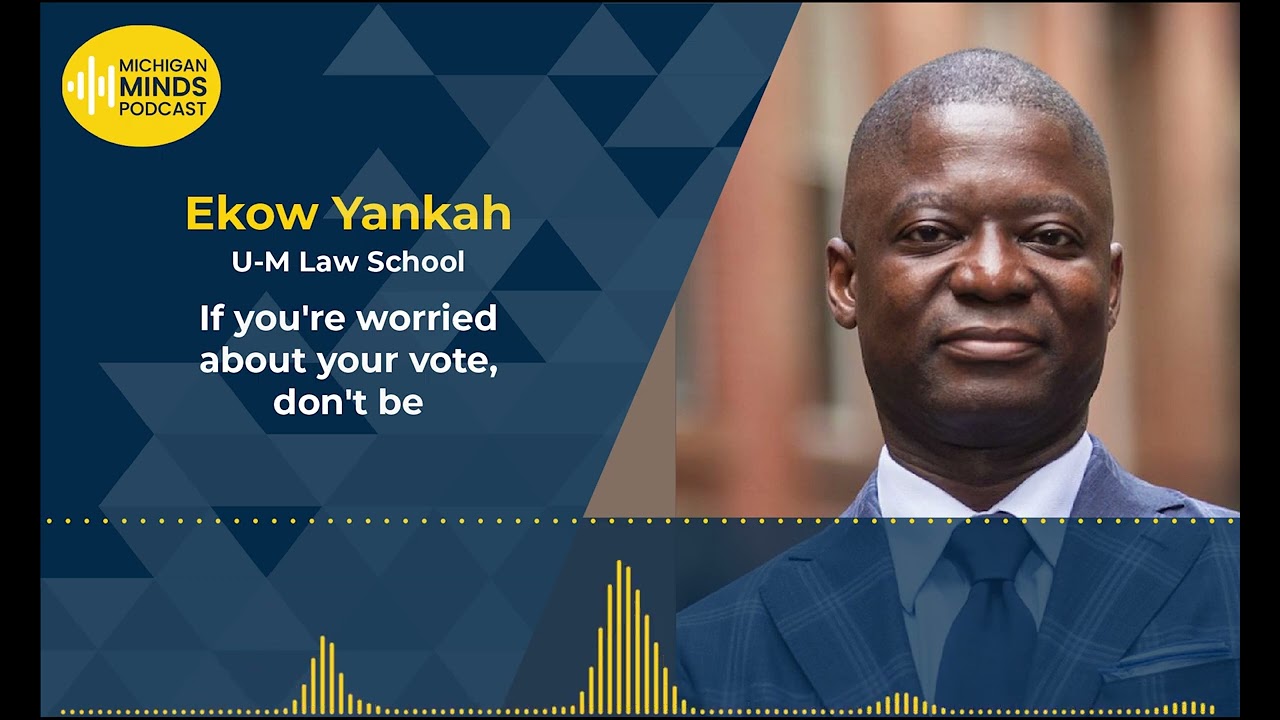
Ekow Yankah: If you're worried about your vote, don't be — University of Michigan

University of Michigan

Decentralized administration and bipartisan oversight make rigging US elections virtually impossible, leaving restrictive voting laws to suppress lawful turnout rather than prevent fraud.

AI-assisted summary of Ekow Yankah: If you're worried about your vote, don't be — original source. Check the original for full context.

Source published:

Key ideas

  • Under the U.S. Constitution, election administration is explicitly decentralized and delegated to state and local governments, making statutory federal takeovers constitutionally non-viable without a constitutional amendment or radical Supreme Court reinterpretation. (0:00)
  • Exhaustive audits and court challenges confirm that widespread voter fraud is virtually non-existent in modern U.S. elections, with multi-million-ballot audits typically revealing only negligible clerical errors. (4:06)
  • Executing coordinated statewide election tampering is practically impossible due to intense decentralization, bipartisan paired tabulators, and statistical tripwires that flag abnormal voting patterns. (9:58)
  • Strict voter identification laws address negligible in-person impersonation while disproportionately locking eligible poor and minority citizens out of the ballot box. (16:02)

Detailed notes

## Background Published on YouTube by the University of Michigan on September 15, 2026, this episode of the Michigan Minds podcast features law and philosophy professor Ekow Yankah in conversation with host Juan Ochoa. The discussion covers the decentralized constitutional design of American elections, the near-impossibility of a federal takeover, the lack of evidence supporting claims of widespread voter fraud, and the robust safeguards securing the ballot box.

## TL;DR Legal scholar and voting rights veteran Ekow Yankah explains that the U.S. Constitution leaves election mechanics strictly to state and local jurisdictions, rendering any attempted federal takeover legally dead on arrival. He emphasizes that widespread voter fraud is a myth repeatedly debunked by courts and audits, arguing that aggressive restrictions like strict photo ID laws act as a 'bazooka to kill a fly' and disproportionately disenfranchise lawful voters. Yankah details how decentralization, bipartisan counting teams, and redundant technological audits make rigging an election virtually impossible. Ultimately, he urges citizens to look past algorithmic outrage, question the motives of those sowing distrust, and recommit to active, empathetic civic engagement.

## Atmosphere & style The conversation carries a measured, scholarly weight that is punctuated by candid moments of professional weariness when addressing persistent conspiracy theories, memorably likened to 'fighting against imaginary dragons.' Juan Ochoa plays an incisive, inquisitive interlocutor, allowing Yankah to balance constitutional theory with deeply humanizing field anecdotes—such as a Republican colleague's sudden empathy for an ID-less grocery shopper. The dialogue progresses from dissecting dark authoritarian anxieties into a calm, reassuring, and civically grounded affirmation of democratic resilience.

## Bulletin - [00:00](https://www.youtube.com/watch?v=aDNf8oawdSU&t=0s) Under the U.S. Constitution, election administration is explicitly decentralized and delegated to state and local governments, making statutory federal takeovers constitutionally non-viable without a constitutional amendment or radical Supreme Court reinterpretation. - [04:06](https://www.youtube.com/watch?v=aDNf8oawdSU&t=246s) Exhaustive audits and court challenges confirm that widespread voter fraud is virtually non-existent in modern U.S. elections, with multi-million-ballot audits typically revealing only negligible clerical errors. - [09:58](https://www.youtube.com/watch?v=aDNf8oawdSU&t=598s) Executing coordinated statewide election tampering is practically impossible due to intense decentralization, bipartisan paired tabulators, and statistical tripwires that flag abnormal voting patterns. - [16:02](https://www.youtube.com/watch?v=aDNf8oawdSU&t=962s) Strict voter identification laws address negligible in-person impersonation while disproportionately locking eligible poor and minority citizens out of the ballot box.

## Key takeaways - [00:00](https://www.youtube.com/watch?v=aDNf8oawdSU&t=0s) Article IV and the constitutional delegation of election administration reserve the authority and mechanics of voting to state and local jurisdictions, keeping elections structurally decentralized. - [01:48](https://www.youtube.com/watch?v=aDNf8oawdSU&t=108s) Hypothetical federal actions to seize or freeze elections through emergency powers would represent an extra-legal collapse of the constitutional order rather than a lawful procedure. - [01:48](https://www.youtube.com/watch?v=aDNf8oawdSU&t=108s) Constitutional documents do not self-enforce; their durability depends entirely on the civic dedication and political will of citizens. - [04:06](https://www.youtube.com/watch?v=aDNf8oawdSU&t=246s) High-profile investigations and dozens of 2020 legal challenges failed to produce evidence of widespread voter fraud, leading judges across the political spectrum to dismiss the suits. - [04:06](https://www.youtube.com/watch?v=aDNf8oawdSU&t=246s) Comprehensive post-election forensic audits consistently demonstrate that deviations amount to minor, human clerical errors—such as five miscast ballots out of twelve million—rather than coordinated fraud. - [06:12](https://www.youtube.com/watch?v=aDNf8oawdSU&t=372s) Policymakers face a fundamental trade-off between striving to eliminate trivial numbers of miscast votes and inadvertently disenfranchising thousands of eligible citizens. - [06:12](https://www.youtube.com/watch?v=aDNf8oawdSU&t=372s) Measures targeting voting access that disproportionately impact minority communities without offering free, accessible compliance resources operate as partisan voter suppression rather than legitimate security. - [09:58](https://www.youtube.com/watch?v=aDNf8oawdSU&t=598s) Rigging a modern state election would require an impossibly large criminal conspiracy across independent local jurisdictions without a single whistleblower emerging. - [09:58](https://www.youtube.com/watch?v=aDNf8oawdSU&t=598s) Tabulation security is reinforced by pairing Democratic and Republican election workers side-by-side to verify counts and oversee machine operations. - [12:44](https://www.youtube.com/watch?v=aDNf8oawdSU&t=764s) Commercial social media algorithms and foreign bot farms deliberately amplify out-of-context, polarizing content to stoke mutual democratic distrust. - [12:44](https://www.youtube.com/watch?v=aDNf8oawdSU&t=764s) Engaging in face-to-face active citizenship and applying humanizing conversational frameworks help citizens resist digital polarization and outrage loops. - [16:02](https://www.youtube.com/watch?v=aDNf8oawdSU&t=962s) Aggressive voter ID mandates function as disproportionate measures against negligible voter impersonation, often penalizing citizens who lack IDs for basic necessities like cashing checks. - [19:17](https://www.youtube.com/watch?v=aDNf8oawdSU&t=1157s) Redundant paper trails, cross-checking audits, and bipartisan professional standards provide built-in accountability that ensures legitimate ballots are counted accurately. - [20:10](https://www.youtube.com/watch?v=aDNf8oawdSU&t=1210s) Voters should critically question the political incentives of figures who actively work to disenfranchise eligible citizens or undermine public faith in election outcomes.

## Detailed walkthrough ### [00:00](https://www.youtube.com/watch?v=aDNf8oawdSU&t=0s) Constitutional Barriers to Federalizing Elections

The discussion opens with host Juan Ochoa introducing Professor Ekow Yankah, the Thomas M. Cooley Professor of Law and associate dean for faculty and research at the University of Michigan Law School. Beyond his scholarly portfolio in political and criminal theory, Yankah brings extensive practical election governance experience: he served for years as co-chair of the New York Democratic Lawyers Council (the voting rights arm of the New York State Democratic Committee and coordinating arm of the Democratic National Committee), received the Guardian of Democracy Award in 2020, and was appointed that same year to chair the New York State Public Campaign Finance Board, a post he held for nearly three years.

Ochoa turns directly to a recurring national talking point: the notion of federalizing or nationalizing United States elections. Given that the U.S. Constitution explicitly delegates election administration to the states, Ochoa asks what concrete legal roadblocks prevent either Congress or the president from enacting a federal takeover. Yankah confirms that the core roadblock is constitutional: while Article IV guarantees a republican form of government, the text makes explicit that the power and mechanics of running elections are decentralized and governed at the state and local levels. Each state retains sovereign authority over how its elections are executed. For any federal overhaul to succeed, it would require either an aggressive, radical reinterpretation by the Supreme Court—something Yankah notes even the most aggressively conservative court would struggle to justify—or a formal constitutional amendment. Without those, any statutory efforts to fundamentally shift election authority to the federal government are, in his words, "constitutionally dead on arrival," even if minor proposals manage to "nibble at the edges."

- **Constitutional Structure:** Article IV guarantees a republican form of government, while administration and execution of elections are explicitly reserved to state and local jurisdictions. - **Barriers to Federalization:** Fundamental centralization would require either a radical Supreme Court reinterpretation or a constitutional amendment.

---

[01:48](https://www.youtube.com/watch?v=aDNf8oawdSU&t=108s) Federal Takeover Fears, Emergency Powers, and the Limits of Written Law

Ochoa presses further, asking whether there is any scenario under current law that could allow the federal government to step in and take over state election systems. Yankah dismisses the idea of a lawful administrative takeover as virtually impossible. The only scenarios ever floated in public discourse belong to "dark possibilities bordering on nihilistic fantasies," such as invoking emergency powers to freeze or halt elections altogether rather than run them. Yankah stresses that if an administration ever successfully executed such a maneuver, it would signal the outright collapse of the constitutional order rather than a legally sanctioned procedure: "Armies can march through the teeth of a constitution."

From a pure legal standpoint, Yankah explains the foundational principle of American administrative and constitutional law: the government must affirmatively demonstrate that it has the enumerated authority to act, rather than citizens having to prove the government is forbidden. Even if Congress attempted to ground federal election management under an expansive reading of the Commerce Clause, it would run headlong into explicit constitutional allocations of state power. Shifting into a broader historical register, Yankah reminds listeners that constitutions are only as durable as the civic dedication behind them. Drawing parallels to the fall of historic empires and the collapse of the Russian Empire into the Soviet Union, he argues that the survival of a political system depends on whether citizens possess the political will to enforce their commitments, rather than assuming text on a page will automatically shield democracy from bad-faith actors and conspiracy theories.

```mermaid flowchart TD accTitle: Constitutional Limits on Federal Election Control accDescr: Flowchart illustrating the constitutional barriers and real-world limits preventing a federal takeover of state-run elections.

subgraph LegalLimits["Constitutional Framework"] A["Federal Ambition to Nationalize Elections"] --> B{"Affirmative Constitutional Authority?"} B -->|"Commerce Clause arguments"| C["Article I & State Police Powers"] C --> D["Constitutionally Dead on Arrival"] end

subgraph ExtraLegal["Extra-Legal Scenarios"] E["Invocation of Emergency Powers"] --> F["Halting Rather Than Running Elections"] F --> G["Collapse of Constitutional Order"] end ```

---

[04:06](https://www.youtube.com/watch?v=aDNf8oawdSU&t=246s) Chasing "Imaginary Dragons": The Evidentiary Reality of Modern Voter Fraud

Turning to modern public anxieties, Ochoa asks about the threshold of evidence courts require before they would consider overturning an election result based on claims of widespread voter fraud. Yankah responds emphatically and with visible frustration: "We should be really clear about this. There is no evidence of voter fraud." For those who spend their careers working in election administration and voting rights, having to continuously litigate and debate baseless fraud claims feels exhausting, like "fighting against imaginary dragons."

While Yankah acknowledges colorful episodes in American political folklore—such as historical mob interference or machine politics in mid-century Chicago—he maintains that in modern American history, widespread voter fraud simply does not occur. He underscores that even when skeptics with sweeping state authority set out to prove fraud, they come up empty-handed: - **The Kobach Investigations:** Former Kansas Secretary of State Kris Kobach was granted extraordinary investigatory powers to uncover widespread fraudulent voting and found nothing meaningful. - **The 2020 Legal Challenges:** President Donald Trump and his legal surrogates, including Rudy Giuliani, filed dozens of challenges across state and federal courts. - **Judicial Rejection:** Judges across the political spectrum—including Democratic appointees, traditional Republican appointees, and Trump's own judicial nominees—systematically dismissed these lawsuits for lack of evidence. - **Audit Discrepancies:** Exhaustive forensic audits examining millions of ballots consistently uncover only negligible, human clerical errors—typically three, five, or eight mistaken ballots out of twelve million cast—which represent honest clerical anomalies rather than coordinated fraud.

---

[06:12](https://www.youtube.com/watch?v=aDNf8oawdSU&t=372s) Security vs. Suppression: Evaluating Election Regulations

Ochoa presents the common counter-argument deployed by election skeptics: even if five miscast ballots will not overturn an election of millions, why should election officials tolerate *any* fraudulent or mistaken votes at all? Yankah agrees that if there were a magical way to reduce three miscast votes to zero, he would gladly do so. However, public policy requires weighing trade-offs in good faith. Yankah frames the central ethical and mechanical dilemma facing election administrators:

> "How much structure are we willing to put in place in order to stop three miscast votes if we know, absolutely know, that this will cause, for example, 15,000 people who have the right to vote to be unable to vote?"

When asked how legal experts distinguish between legitimate election integrity measures and partisan voter suppression, Yankah explains that given the vanishingly small rate of actual fraud, any regulation that erects barriers in front of eligible voters must be viewed with deep suspicion. This is particularly true when rules disproportionately fall on poor and minority communities, such as administrative efforts in Georgia that effectively scrutinize Black and Hispanic voters differently than white voters.

Yankah contrasts suppressive tactics with healthy democratic competition. The conservative politicians deserving of respect, he argues, are those who refuse to manipulate rules against minority voters and instead go out and actively compete to win Hispanic, Black, and Asian voters on policy grounds. Recounting his own bipartisan negotiations over voting reform in New York, Yankah describes offering a compromise: he told Republican counterparts he was willing to entertain voter ID requirements, provided the state made a concurrent commitment to proactively provide free, accessible government IDs to every qualifying citizen. When opponents insist on erecting roadblocks but refuse to provide the resources for eligible voters to clear them, Yankah concludes, their goal is voter suppression rather than election security.

[09:58](https://www.youtube.com/watch?v=aDNf8oawdSU&t=598s) The Mechanics of Modern Election Security: Why Rigging Is Near Impossible

When asked about the physical and legal checks that ensure every vote is counted accurately in November, Ekow Yankah reflects with sadness on the years-long campaign aimed at eroding public faith in election integrity. While legitimate external threats exist—such as foreign adversaries and viral internet disinformation designed to foment mutual distrust and distract citizens from voting in their own interests—the actual voting booth remains exceptionally secure. Yankah emphasizes that tampering with an individual ballot or manipulating tally counts is practically impossible under modern safeguards. To illustrate the absurdity of widespread rigging theories, he notes that "the amount of elegance and effort it took in a fantasy *Ocean's 11* to pull off a Las Vegas heist would pale in comparison to what it would take to pull off a fixed election."

American elections are inherently decentralized and intensely local, relying on overlapping tiers of human oversight and technological verification. To rig an outcome across a state like Michigan, bad actors would need to covertly organize hundreds of election workers across disparate jurisdictions. These officials are checked by secure technology, the machines are vetted by human audits, and independent systems cross-check one another. Furthermore, tabulation is strictly bipartisan: in states like Michigan and New York, Republican and Democratic election workers sit side by side, mutually observing and verifying every tally. Any attempt to artificially manipulate numbers would trip technological alarms, and outside observers tracking baseline demographic trends would instantly detect a county swinging wildly and unnaturally in one direction.

```mermaid flowchart TD accTitle: Layers of Modern Election Verification accDescr: A flowchart depicting the overlapping human, technological, and bipartisan checks that secure votes. subgraph Human["Human Oversight"] HW["Local Election Workers"] BP["Bipartisan Pairs (Democrat & Republican)"] end subgraph Tech["Technological Controls"] VM["Tabulation Machines"] XC["Cross-Checking Audits & Machine Tripwires"] end subgraph Public["External Validation"] OO["Outside Observers & Statistical Tracking"] CR["Certified Results"] end

HW -->|"monitored by"| BP BP -->|"inputs into"| VM VM -->|"verified by"| XC XC -->|"cross-checks"| HW VM -->|"scrutinized by"| OO OO -->|"validates"| CR ```

- **Extreme decentralization:** Coordinated fraud would require hundreds of local officials to orchestrate a criminal conspiracy without a single whistleblower coming forward. - **Bipartisan administration:** Counters from opposing political parties conduct tabulations side-by-side to guarantee mutual scrutiny. - **Statistical tripwires:** Irregular precinct shifts trigger automatic flags among independent analysts and observers monitoring turnout baselines.

---

[12:44](https://www.youtube.com/watch?v=aDNf8oawdSU&t=764s) Algorithms, Distrust, and the Antidote of Active Citizenship

Turning to the crisis of polarization, Yankah examines why citizens are increasingly conditioned to distrust their neighbors. He identifies structural and commercial incentives behind this division: digital media platforms profit by stripping away subtlety and nuance in favor of outrage. Even as an educated legal scholar, he admits he is not immune when scrolling late at night; algorithms routinely surface out-of-context clips of political adversaries looking foolish, which are then artificially amplified by foreign bot networks—including Russian and Chinese troll farms—to create the illusion that half the country is irredeemably hostile or stupid.

The antidote to this manufactured enmity is a renewed commitment to "active citizenship." Rather than retreating into screen-induced cynicism, Yankah urges citizens to canvas, volunteer, and engage in face-to-face political conversations. In-person interactions make it far harder to adopt the role of an ideological "flamethrower." To maintain his own empathy when encountering deeply alien viewpoints, Yankah relies on a personal mental exercise: he pictures his favorite, kindest aunt or family friend who happens to hold that exact belief. While this exercise does not erase genuine, serious disagreements over religion, race, security, or politics, it anchors the dispute in shared humanity. Truly malevolent, toxic actors are "one out of a million," rather than the everyday neighbor living down the street.

- **Algorithmic outrage loops:** Social media algorithms maximize engagement by serving provocative, decontextualized snippets of political opponents. - **Foreign amplification:** Bot networks deliberately elevate extreme content to weaken democratic cohesion from the inside out. - **The "favorite aunt" rule:** A conversational framework that separates fundamental political disagreements from the assumption of bad moral character.

---

[16:02](https://www.youtube.com/watch?v=aDNf8oawdSU&t=962s) Voter ID Requirements: Taking a Bazooka to Kill a Fly

Addressing the contentious legal debate over strict photo identification and citizenship documentation at polling places, Yankah argues that such mandates disproportionately suppress eligible, lawful voters. Pointing to the near-total absence of in-person impersonation fraud, he describes aggressive ID laws as attempting "to take the bazooka and kill the fly that is fake voting." While he has participated in negotiations to explore compromises—such as pairing ID requirements with robust state programs to distribute free, easily accessible identification to all citizens—opponents routinely reject the necessary access provisions, revealing that suppression of legal voters is often the true outcome.

To illustrate how real-world friction prevents valid voting, Yankah recounts an encounter from election night in Cleveland, Ohio, when President Barack Obama was reelected. Working on behalf of the Democratic Party, Yankah struck up a conversation during a rare quiet moment with the Republican woman directing the Cleveland board of elections. Though she had spent her life as a staunch advocate of strict photo ID laws under the assumption that "people need IDs for everything," she shared that an encounter at a local grocery store had recently upended her perspective:

> "She said, 'Yeah, I recently changed my mind. I was at a grocery store... and an older Black woman was there to cash a check, but she couldn't cash a check without the ID. And I had always said, "Look, people need IDs for everything, so why wouldn't we have an ID for voting?" And I saw that this older Black woman really didn't have an ID. And you know, she didn't have an ID cuz she had every incentive in the world to be able to access her check. And it was only when one of the store managers who knew her very well said, "No, no, I know who this is... let her cash her check." That she was able to access her money. This Republican official said it was only then that it really hit me how many people in certain communities in certain places just don't have IDs and I would never want to stop somebody from voting.'"

Yankah explains that observing how ordinary citizens struggle to produce identification even under desperate circumstances, such as buying groceries, demonstrates why lawmakers should hesitate before raising arbitrary hurdles to the ballot box.

---

[19:17](https://www.youtube.com/watch?v=aDNf8oawdSU&t=1157s) Trusting the Safeguards: Professionalism and Built-In Accountability

In closing, Yankah provides a core message of reassurance for listeners worried about the safety and accuracy of their individual votes. Across his direct legal experience in Michigan and several other states, election administrators on both sides of the political aisle routinely demonstrate profound professionalism and a deep dedication to getting the count right.

Beyond personal integrity, the system itself enforces honesty through built-in structural accountability. Election infrastructure is designed with so many redundant checks, transparent paper trails, and internal audits that any deliberate wrongdoing or administrative failure will inevitably be exposed to the public. Because systemic errors are impossible to hide and deeply embarrassing to the administrators running the precincts, the institutional incentives align powerfully to protect every legitimate ballot.

[20:10](https://www.youtube.com/watch?v=aDNf8oawdSU&t=1210s) Protecting the Vote and Questioning Motives Behind Voter Disenfranchisement

Ekow Yankah underscores that across the board, the dedicated duty of election officials "up and down the line" is to guarantee that every lawful ballot is accurately counted. Given the immense administrative labor, scrutiny, and systemic effort devoted to ensuring an accurate count, Yankah urges citizens to look critically at the political motives driving election skepticism. He challenges listeners to ask themselves why certain bad-faith actors remain so intensely focused on disenfranchisement—specifically questioning "why are some people obsessed with either stopping people who have a legitimate right to vote from voting or undermining your faith in advance for their own purposes."

The episode concludes with the *Michigan Minds* closing credits, noting that the podcast is produced by Michigan News, a division within the University of Michigan's Office of the Vice President for Communications.

- **The Role of Election Workers:** Ensuring the integrity and counting of every valid ballot remains the core mission of election administrators at all levels. - **The Core Question for Citizens:** Voters should scrutinize why political figures actively seek to suppress eligible voters or preemptively sabotage public confidence in the electoral system for their own political advantage.

## Notable quotes > [00:00](https://www.youtube.com/watch?v=aDNf8oawdSU&t=0s) constitutionally dead on arrival — Ekow Yankah

> [01:48](https://www.youtube.com/watch?v=aDNf8oawdSU&t=108s) Armies can march through the teeth of a constitution. — Ekow Yankah

> [04:06](https://www.youtube.com/watch?v=aDNf8oawdSU&t=246s) We should be really clear about this. There is no evidence of voter fraud. — Ekow Yankah

> [04:06](https://www.youtube.com/watch?v=aDNf8oawdSU&t=246s) fighting against imaginary dragons — Ekow Yankah

> [06:12](https://www.youtube.com/watch?v=aDNf8oawdSU&t=372s) How much structure are we willing to put in place in order to stop three miscast votes if we know, absolutely know, that this will cause, for example, 15,000 people who have the right to vote to be unable to vote? — Ekow Yankah

> [09:58](https://www.youtube.com/watch?v=aDNf8oawdSU&t=598s) the amount of elegance and effort it took in a fantasy Ocean's 11 to pull off a Las Vegas heist would pale in comparison to what it would take to pull off a fixed election. — Ekow Yankah

> [16:02](https://www.youtube.com/watch?v=aDNf8oawdSU&t=962s) to take the bazooka and kill the fly that is fake voting. — Ekow Yankah

> [16:02](https://www.youtube.com/watch?v=aDNf8oawdSU&t=962s) She said, 'Yeah, I recently changed my mind. I was at a grocery store... and an older Black woman was there to cash a check, but she couldn't cash a check without the ID. And I had always said, "Look, people need IDs for everything, so why wouldn't we have an ID for voting?" And I saw that this older Black woman really didn't have an ID. And you know, she didn't have an ID cuz she had every incentive in the world to be able to access her check. And it was only when one of the store managers who knew her very well said, "No, no, I know who this is... let her cash her check." That she was able to access her money. This Republican official said it was only then that it really hit me how many people in certain communities in certain places just don't have IDs and I would never want to stop somebody from voting.' — Ekow Yankah

> [20:10](https://www.youtube.com/watch?v=aDNf8oawdSU&t=1210s) why are some people obsessed with either stopping people who have a legitimate right to vote from voting or undermining your faith in advance for their own purposes. — Ekow Yankah

## Mentioned Ekow Yankah, Juan Ochoa, University of Michigan Law School, New York Democratic Lawyers Council, New York State Democratic Committee, Democratic National Committee, Guardian of Democracy Award, New York State Public Campaign Finance Board, U.S. Constitution, Article IV, Supreme Court, Commerce Clause, Russian Empire, Soviet Union, Kris Kobach, Donald Trump, Rudy Giuliani, Ocean's 11, Barack Obama, Michigan Minds, Greta Guest, Jeremy Marble, Hans Anderson, Michigan News

## Video description Ekow Yankah, is associate dean for faculty and research, Thomas M. Cooley Professor of Law and a professor of philosophy at the University of Michigan. His work focuses on questions of political and criminal theory and, particularly, questions of political obligation and justifications of punishment.

Yankah joins the Michigan Minds podcast to discuss the legal structures governing American elections, the constitutional roadblocks to federalizing the vote and the reality of modern election security. He also explores the historical context of political power and the importance of active citizenship in maintaining democratic institutions.

When we hear claims of widespread voter fraud in the news, what kind of high level evidence do courts actually require before they would even consider overturning an election result?

We should be really clear about this. There is no evidence of voter fraud. It gets exhausting. I understand that some of us who have worked in elections, election protection, sometimes get frustrated because it feels like you're fighting against imaginary dragons or something, even having to make these arguments.

Maybe in our history there have been some remarkable moments... but in modern history, there is no voter fraud. Even when those who are most skeptical take former high level politicians like Kobach in Kansas and are given extraordinary powers to investigate and find this voter fraud that they have convinced people exists, they can't find it.

Michigan Minds is produced by Greta Guest and hosted by Juan Ochoa. Jeremy Marble is the audio engineer and Hans Anderson provides social media animations. Listen to all episodes of the podcast.

[Source](https://www.youtube.com/watch?v=aDNf8oawdSU)

中文简报

Yankah排除联邦接管美国选举可能,驳斥舞弊指控 去中心化的管理与两党监督让操纵美国选举几乎不可能发生,限制性投票法实为压制合法投票率而非防范欺诈。 法学学者兼投票权资深专家Ekow Yankah解释称,美国宪法严格将选举的具体操作权力留给州和地方管辖区,这使得任何试图由联邦接管选举的企图在法律上根本行不通。他强调,大规模选民欺诈是一个已被法院和审计反复戳穿的谎言,并指出严格的照片身份证法等严苛限制如同“用火箭筒打苍蝇”,会对合法选民造成不成比例的剥权。Yankah详细阐述了去中心化运作、两党联合计票团队以及多重技术审计如何使操纵选举在实际上变得绝无可能。最后,他敦促公众看透算法引发的愤怒,质疑散布不信任言论者的动机,并重新致力于积极且充满同理心的公民参与。 根据美国宪法,选举管理明确属于去中心化架构并下放给州和地方政府,在未通过宪法修正案或最高法院做出根本性重新解释的情况下,通过法定途径由联邦接管选举在宪法层面完全不可行。 (0:00) 详尽的审计和法律诉讼证实,在现代美国选举中,大规模选民欺诈几乎根本不存在,针对数百万张选票的审计通常仅能发现微不足道的文书疏漏。 (4:06) 由于高度去中心化、两党配对计票员制度以及可标出异常投票模式的统计预警机制,在全州范围内实施协同的选举篡改在实际操作中几乎不可能发生。 (9:58) 严格的选民身份证明法针对的是微乎其微的现场冒名顶替现象,却不成比例地将合资格的贫困和少数族裔公民挡在投票箱之外。 (16:02)

Reading summary

Legal scholar Ekow Yankah argues that American elections are structurally protected against federal overreach and widespread fraud by decentralized administration, warning that restrictive voting mandates primarily suppress eligible voters rather than enhance security. Constitutional Barriers to Centralized Election Administration (0:00) Yankah explains that proposals to federalize or nationalize U.S. election administration are constitutionally unviable under the current legal framework. Article IV guarantees a republican form of government, but the Constitution explicitly reserves the mechanics and execution of elections to state and local authorities. Yankah asserts that statutory federal takeovers are "constitutionally dead on arrival" without either a formal constitutional amendment or a radical Supreme Court reinterpretation that even a staunchly conservative bench would struggle to justify. Under U.S. constitutional law, the federal government must affirmatively demonstrate enumerated authority, preventing the use of mechanisms like the Commerce Clause to override explicit state powers. Addressing extreme hypotheticals, Yankah dismisses lawful administrative takeovers, noting that the only floated scenarios involve invoking emergency powers to freeze or halt voting. He stresses that such an outcome would signify the extra-legal collapse of the constitutional order rather than a legally sanctioned procedure, observing that constitutions endure through civic political will rather than written text alone. Decentralized Safeguards and the Absence of Fraud (4:06) Dismissing claims of pervasive voter fraud as "imaginary dragons," Yankah highlights that empirical investigations consistently reveal no evidence of coordinated fraud in modern American elections. High-profile inquiries—including Kansas Secretary of State Kris Kobach's investigation and dozens of post-2020 legal challenges filed by Donald Trump and Rudy Giuliani—were systematically rejected across state and federal courts by judges from across the political spectrum for lack of evidence. Exhaustive post-election forensic audits examining millions of ballots typically uncover only negligible, clerical anomalies, such as three to eight mistaken ballots out of twelve million cast. Operationally, Yankah argues that rigging an election is practically impossible due to extreme decentralization and overlapping security tiers. In states like Michigan and New York, counts are conducted by bipartisan pairs of Democratic and Republican poll workers observing tallies side by side. Manipulating outcomes would require covert coordination across hundreds of local officials without a single whistleblower, while automated technological tripwires and independent demographic tracking would immediately flag unnatural precinct-level shifts. Disproportionate Friction and the Voter ID Dilemma (6:12) Because fraudulent voting occurs at negligible rates, Yankah frames strict voting requirements—such as photo ID and proof of citizenship—as taking "a bazooka to kill a fly." He argues that public policy requires weighing ethical trade-offs: implementing severe administrative barriers to prevent a handful of miscast votes inevitably disenfranchises thousands of eligible citizens. These burdens disproportionately fall on poor and minority populations, as seen in administrative scrutiny in Georgia that disproportionately affects Black and Hispanic voters. Yankah notes that during legislative negotiations in New York, he offered to accept voter ID mandates if the state concurrently provided free, accessible identification to all eligible citizens, but opponents rejected the compromise. Illustrating the real-world friction of strict rules, Yankah recalls a Republican election official in Cleveland, Ohio, who reconsidered her support for ID mandates after watching an elderly Black grocery store customer struggle to cash a check without identification, demonstrating how lack of documentation affects everyday citizens. Algorithmic Outrage and the Role of Citizens (12:44) Yankah identifies digital platforms and foreign disinformation networks—including Russian and Chinese troll farms—as key drivers of civic distrust, noting that commercial algorithms strip away nuance and amplify provocative clips to foster polarization. To counter this manufactured enmity, he advocates for "active citizenship" through canvassing, volunteering, and face-to-face political discussions, where ideological hostility is harder to maintain. To navigate intense disagreements over race, religion, and governance, Yankah relies on the "favorite aunt" mental model, imagining a beloved relative who holds an opposing view to anchor the interaction in shared humanity. Truly toxic actors remain rare, he contends, while most neighbors operate in good faith. Yankah concludes that redundant checks, transparent paper trails, and institutional accountability make systematic election tampering virtually impossible to conceal. He urges the public to look past unfounded fraud narratives and critically interrogate the political motives of actors who actively seek to depress turnout or undermine confidence in democratic processes.

Source quotes

[0:00] Ekow Yankah: constitutionally dead on arrival [1:48] Ekow Yankah: Armies can march through the teeth of a constitution. [4:06] Ekow Yankah: We should be really clear about this. There is no evidence of voter fraud. [4:06] Ekow Yankah: fighting against imaginary dragons [6:12] Ekow Yankah: How much structure are we willing to put in place in order to stop three miscast votes if we know, absolutely know, that this will cause, for example, 15,000 people who have the right to vote to be unable to vote? [9:58] Ekow Yankah: the amount of elegance and effort it took in a fantasy Ocean's 11 to pull off a Las Vegas heist would pale in comparison to what it would take to pull off a fixed election. [16:02] Ekow Yankah: to take the bazooka and kill the fly that is fake voting. [16:02] Ekow Yankah: She said, 'Yeah, I recently changed my mind. I was at a grocery store... and an older Black woman was there to cash a check, but she couldn't cash a check without the ID. And I had always said, "Look, people need IDs for everything, so why wouldn't we have an ID for voting?" And I saw that this older Black woman really didn't have an ID. And you know, she didn't have an ID cuz she had every incentive in the world to be able to access her check. And it was only when one of the store managers who knew her very well said, "No, no, I know who this is... let her cash her check." That she was able to access her money. This Republican official said it was only then that it really hit me how many people in certain communities in certain places just don't have IDs and I would never want to stop somebody from voting.' [20:10] Ekow Yankah: why are some people obsessed with either stopping people who have a legitimate right to vote from voting or undermining your faith in advance for their own purposes.

Original transcript

[0:00] [music] [0:04] Welcome to the Michigan [music] Minds [0:06] podcast where we explore the wealth of [0:08] knowledge from faculty experts at the [0:10] University of Michigan. I am Hana Choa, [0:12] international public relations [0:14] representative for the Michigan news [0:15] office. I am pleased to welcome Eko [0:17] Yanga, [music] [0:18] the Thomas M. Kouli professor of law and [0:20] the associate dean for faculty and [0:22] research [music] at the University of [0:23] Michigan Law School. Beyond his [0:25] research, he served for years as the [0:27] [music] co-chair of the New York [0:29] Democratic Lawyers Council, the Voting [0:31] Rights Arm of the New York State [0:32] Democratic Committee, and the [0:34] Coordinating Arm of the DNC. [music] [0:36] In 2020, the New York Democratic Lawyers [0:38] Council honored him with the Guardian of [0:40] Democracy Award. That same year, he was [0:42] appointed to the New York State Public [0:44] Campaign [music] Finance Board, which he [0:46] chaired for nearly 3 years. Welcome, [0:48] Professor Yanka. [0:49] >> Thanks for having me. We often hear talk [0:52] about nationalizing our elections. Since [0:54] the Constitution leaves election power [0:56] to the states, what are the actual legal [0:58] roadblocks that would stop the president [1:01] or Congress from doing that? [1:03] >> Uh you put your finger on it. Um the [1:05] Constitution guarantees, as far as we [1:08] can hold it, a republican form of [1:10] government, but makes explicit that uh [1:13] elections are to be governed on the [1:15] state and local level. that is each [1:17] state has its own power and control over [1:20] how it's going to execute that election [1:23] um without either a radical [1:26] reinterpretation of that by the Supreme [1:29] Court which even an aggressively [1:32] conservative Supreme Court would [1:33] struggle to change the meaning of that [1:35] or frankly a constitutional amendment um [1:38] or a constitutional amendment I think [1:40] any of these proposals that are swirling [1:42] around they can try to nibble at the [1:44] edges but a real fundamental change [1:45] strikes me as constitutionally dead on [1:47] arrival. [1:48] >> Would there be any scenario under the [1:50] current law that would allow the federal [1:52] government to illegally step in and take [1:54] over a house state runs the elections? [1:57] >> To take over strikes me as very [1:59] difficult. I mean, the only [2:01] possibilities we hear about, and to be [2:03] really honest, these are kind of either [2:05] dark possibilities bordering on [2:07] nihilistic fantasies are these kind of [2:10] ideas where people think under certain [2:12] kinds of emergency acts that you [2:15] wouldn't so much nationalize the [2:16] elections as you would stop them. I [2:18] could imagine somebody trying to do such [2:20] a thing if it was allowed. it would [2:22] really be because we're watching our [2:24] constitutional order collapse, not [2:26] because somebody was legally carefully [2:29] um following the law. [2:31] >> And if a federal takeover were [2:33] attempted, what is the core legal [2:35] argument for why that would be [2:37] considered unconstitutional? [2:38] >> The basic argument is the reminder that [2:41] it's not as though you have to find an [2:42] argument as to why the government's not [2:45] allowed to do something. [2:46] >> In a real sense, you have to find an [2:47] argument as to why the government is [2:49] allowed to do something. And it's just [2:51] very hard to see what the government [2:52] power statutory power would be. Now [2:55] again, if this were not constitutionally [2:57] blocked, the government could make [2:59] arguments that, you know, Congress [3:01] should pass a law. It would certainly, [3:04] you know, it would certainly look like [3:06] it fit under the commerce clause. Um, [3:09] but again, these all run into a [3:10] constitutional roadblock. But I guess we [3:12] should take a moment just to remind [3:14] ourselves. Look, I mean I I know that we [3:17] are all caught up in our daily lives, [3:19] but you know, you should remind yourself [3:21] whether you're a lover of history for [3:23] fun or podcast or just remembering back [3:25] to high school that when you read about [3:27] the ways in which political uh units [3:30] collapse, the way in which empires [3:32] crumble, the way in which the Russian [3:34] Empire turned into the USSR, [3:37] these are not about what was written [3:39] down in the books. It's about whether or [3:40] not people have the political will to [3:42] enforce their political commitments. Um, [3:45] you know, armies can march through the [3:47] teeth of a constitution. And part of the [3:49] question is whether or not we as [3:50] Americans are sufficiently dedicated and [3:53] frankly sufficiently uh invested that [3:56] we're not going to allow every [3:58] conspiracy theory and rumor to make us [4:00] stand down in front of those who would [4:03] um who would undermine our [4:05] constitutional democracy. When we hear [4:07] claims of widespread voter fraud in the [4:10] news, what kind of high level evidence [4:12] do courts actually require before they [4:15] would even consider overturning an [4:17] election result? [4:18] >> We should be really clear about this. [4:20] There is no evidence of voter fraud. I [4:22] mean, people should just be really, [4:23] really clear about this. It gets [4:25] exhausting. Um indeed there's something [4:27] I understand that some of us who are [4:29] have worked in elections election [4:32] protection um sometimes get frustrated [4:35] because it feels like you're fighting [4:37] against imaginary dragons or something [4:39] even having to make these arguments. So [4:41] let's just be clear there is no voter [4:44] fraud. Maybe in our history there have [4:46] been some remarkable moments. You know [4:48] we all hear stories about a stolen [4:50] Chicago election here or a mob. But in [4:53] modern history, there is no voter fraud. [4:56] Even when those who are most skeptical [4:59] take uh former highlevel politicians [5:02] like Kobash in Kansas are given [5:05] extraordinary powers to investigate and [5:09] find this voter fraud that they have [5:11] convinced people exist. They can't find [5:14] it. Even when President Trump argued [5:17] over and over and over that something [5:19] had gone a miss in the elections and [5:22] sent disgraced mayors like Rudy Giuliani [5:25] to make these arguments, they couldn't [5:26] find it. Even when people brought [5:29] countless claims in front of federal [5:31] judges, whether those judges were [5:33] appointed by Republicans or Democrats, [5:35] including judges that were appointed by [5:37] President Trump himself, they were one [5:40] after another after another tossed out [5:42] of court. That is to say, [5:45] under all the circumstances where people [5:48] have looked, long winding audits that [5:50] will come back with three or five, maybe [5:55] eight mistaken votes in elections of [5:58] millions are the closest we find. So [6:01] unless somebody wants to tell me that [6:03] five miscast ballots out of 12 million [6:07] is evidence of voter fraud, there's just [6:09] no serious conversation to be had here. [6:12] There's a group of people who will [6:14] mention, oh, you know, there was uh five [6:16] cases of voter fraud, but like you say, [6:18] if it's not tipping the election one way [6:22] to to another, they'll come back and [6:23] say, why are you okay with any type of [6:26] voter fraud? What would you say then? [6:30] Look, I mean, I don't believe in voter [6:32] fraud. I think these arguments are [6:34] somewhat odd. Um, if I could take it [6:37] down from three miscast votes to zero, I [6:40] would. But here's the question we should [6:42] ask ourselves in really good faith [6:44] because if people really are worried [6:45] about this and I understand that if [6:47] people really think or if people think [6:49] there's symbolic reasons for example to [6:50] have an ID law if there are other [6:52] reasons then we should talk about these [6:54] things I want to take those who are [6:56] worried seriously and credit them with [6:59] good faith but then they have to come to [7:01] the table in good faith they have to [7:03] come to the table having a serious [7:05] discussion about what we're facing so [7:07] here's the question I say back to uh [7:10] colleagues I've had and I don't think of [7:12] these people just as opponents. Some of [7:14] them are because I think they are [7:15] genuinely in bad faith, but I have [7:17] worked in um in offices. I have worked [7:21] for the state of New York, for example, [7:23] trying to get our elections right. I've [7:24] sat across from Republicans where we're [7:27] trying to figure out the best thing to [7:28] do for all the people. And here's the [7:31] question I asked them. [7:33] How much structure are we willing to put [7:35] in place in order to stop three miscast [7:38] votes if we know absolutely know that [7:41] this will cause for example 15,000 [7:44] people who have the right to vote to be [7:46] unable to vote at some point we have to [7:49] have a real conversation about which one [7:52] of these two procedures is protecting [7:54] the people's will and I think it's [7:56] pretty clear as a legal expert how do [7:58] you distinguish between a law that is [8:00] genuinely designed to secure an election [8:02] ction and one that ends up suppressing [8:04] voters. Yeah, I think look I think given [8:08] where we are and given what we know [8:10] about the actual minuscule to vanishing [8:15] instances of voter fraud, laws that [8:18] build and place obstructions in front of [8:21] voters that stop people from voting [8:24] should be treated with deep suspicion. [8:26] Especially when we see these laws over [8:28] and over being aimed at minority [8:30] communities, at poor communities, when [8:32] we see the way, for example, in Georgia, [8:34] people are willing to pass regulatory [8:36] laws that mean that we're going to count [8:39] black, Hispanic, and other votes [8:42] differently than we count white votes. [8:44] We have every reason to be suspicious. [8:46] Indeed, the Republicans who we should be [8:50] proudest of are the ones who say, "And [8:51] fair enough, I'm not going to change the [8:53] way we count Hispanic votes. I'm going [8:55] to go win Hispanic votes. I'm going to [8:57] show you that you can't just think if [8:59] this person is this Hispanic, Chinese, [9:02] Asian, that that they're going to vote [9:05] for you. That's the way democracy should [9:07] run. But if you want to tell me that [9:09] what you really care about is protecting [9:11] the vote, then you have to show me that [9:13] you care about both sides of the coin. [9:16] So, for example, I've negotiated with [9:18] Republicans and said, "I'm willing to [9:21] talk about ID laws that will make it [9:24] harder for some people to vote. If [9:25] you're willing to show me that we as a [9:27] state will provide IDs for those who [9:31] qualify in order to make sure that we're [9:33] not making it harder to vote." And when [9:36] I get people with whom I'm negotiating [9:39] who say they're willing to put up [9:40] roadblocks but not willing to make it [9:42] possible for easier for those who are [9:45] legally have the right to vote to vote, [9:48] then it's hard for me to think that what [9:50] they're really interested in here is [9:52] about making our elections safer and [9:54] more accessible for everybody. For those [9:56] feeling a bit anxious about this [9:58] November, what are the main physical and [10:01] legal checks and balances that ensure [10:03] every vote is actually protected and [10:05] counted correctly? [10:07] >> I mean, [10:09] it really saddens me that there has been [10:12] a yearslong campaign to undermine [10:15] people's faith in the integrity of our [10:17] elections. Um there's a lot to worry [10:20] about and there's a lot to worry about [10:21] in terms of the way that we process and [10:25] think about our elections. So it is [10:27] really worrying that misinformation can [10:29] spread all across the internet. It is [10:31] really worrying that people get their [10:33] facts from not just internal parties [10:35] that want to persuade you but from [10:36] external um adversaries who have a real [10:40] interest in us distrusting each other. [10:42] There are just a million different ways [10:44] in which our moment and our history has [10:47] made it the case that people want you [10:49] not to think as clearly as you can about [10:53] what vote will forward your life and [10:56] your community. [10:59] But outside of that, once you walk into [11:01] the voting booth, the odds of somebody [11:04] being able to manipulate what you [11:06] actually vote and changing the way [11:08] that's counted, you know, the best way I [11:10] put it is [11:13] the amount of elegance and effort it [11:16] took in a fantasy oceans 11 to pull off [11:20] a Las Vegas heist would pale in [11:23] comparison to what it would take to pull [11:26] off a fixed election. Our elections are [11:29] intensely local. They have checks and [11:31] balances all over the place. In order to [11:34] fix an election, you would have to [11:35] organize literally hundreds of officials [11:38] from across the state of Michigan. By [11:40] the way, hundreds of officials who [11:42] themselves are checked by technology. [11:44] The technology is checked then by [11:45] people. The technology across checks [11:47] each other. And if none of that makes [11:49] you feel better, knowing that in state [11:52] after state, I can tell you how it works [11:53] in Michigan. I can tell you how it [11:54] worked in New York. All of these votes [11:56] are counted in a bipartisan manner. So [11:59] you often have uh an election official [12:02] or a Republican and a Democrat in the [12:04] case of Michigan, New York who are there [12:06] side by side counting and verifying [12:09] these uh results. So unless you could [12:12] convince all of those people for some [12:14] bizarre reason to decide to fix an [12:17] election for somebody else and keep it [12:19] secret between all those hundreds of [12:21] people, then you might be able to swing [12:24] the election [12:26] in one place. And even then, you would [12:29] almost certainly trip all the wires of [12:31] the technology. And by the way, all [12:34] outside observers, all outside observers [12:37] would suddenly notice when one county [12:39] swang wildly one way. It it borders on [12:42] the impossible. [12:44] >> You touched on a point that I was [12:47] interested in terms of distrusting. We [12:49] are taught to distrust each other. What [12:52] are some of the ways that uh we can [12:55] combat that? [12:56] >> Yeah, this is a really this is this [12:58] might be the question of our moment. [13:01] This might be the question, frankly, of [13:03] this upcoming generation. Um, it's hard [13:06] to know exactly how to fight against [13:08] these things, not least of which because [13:11] there's a huge financial incentive in us [13:13] actually not speaking about things with [13:15] much clarity or subtlety. Um, I'm not [13:18] immune to it, right? It's very easy when [13:21] I'm tired to get on my phone. Uh, the [13:25] algorithm will give me the most [13:26] outrageous thing that somebody I [13:28] disagree said. It will do it out of [13:30] context and make them look outrageously [13:32] stupid. It will then cultivate all the [13:34] people, 99.9% of whom I don't know, [13:38] including Russian troll bots and Chinese [13:41] trolls, who will amplify that stupid [13:44] thing. And then it'll become very easy [13:45] for me to believe that anybody who [13:47] doesn't agree with me is an awful human [13:49] being. Um, I really think we need to [13:53] think um and rededicate ourselves to [13:56] active citizenship. That means actually [13:58] getting off your phone, getting out [13:59] there, talking to people, canvasing uh [14:02] with people, frankly, disagreeing with [14:04] people in person where it's much harder [14:06] to be a flamethrower, much harder to [14:08] think that everybody on the other side [14:10] is awful. Um, there are some awful [14:12] people out there and there are way too [14:15] many people who have allowed this moment [14:17] to go unchecked and I feel the pain and [14:21] frankly anger about that as much as [14:22] everybody else. but allowing that to [14:25] slip ever more into our phone and not [14:27] talking to each other and just assuming [14:28] that the other side is to be written [14:30] off. Um it's just very clear where that [14:32] leads. Um and that is not a future any [14:34] of us should wish for. [14:35] >> Yeah, I agree with you when you say that [14:38] we should be off of our phones. I [14:40] recently stopped paying so much [14:42] attention to what's going on on my phone [14:44] and uh it just the world just seems a [14:46] lot more calmer that way when you have [14:48] the opportunity to just interact with [14:50] some of these people who you think you [14:52] know might not think the same uh as you [14:54] but if once you start talking you you [14:57] kind of start seeing that you guys are [14:59] on the same page. [15:00] >> Yeah. or even if you're not, you know, [15:01] one thing I do, here's the trick I use [15:04] even with people I really, really [15:05] disagree with, I think of my nicest aunt [15:08] or family friend who believes that. And [15:11] that doesn't mean I disagree with them [15:12] any less, right? We can have really [15:14] serious disagreements about religion, [15:16] about politics, about the role of race [15:18] in America, about security, um, versus [15:22] openness. Um, [15:25] but when I think about my favorite aunt [15:28] who thinks certain things that I really [15:31] don't believe in, I think about some [15:32] family fights. I think about convincing [15:34] them. I think about when it's time to [15:36] let the arguments go, but I don't think [15:38] they're the horrid human being with no [15:40] redeeming qualities. [15:42] >> You know, every now and then we meet [15:44] somebody who we just think is not going [15:46] to be part of our conversation. They are [15:48] so toxic. They are so malevolent. But [15:52] those are one out of a million. They're [15:54] not every single neighbor who disagrees [15:57] with us. Um, and believe me when I say I [16:00] have to remind myself of that as much as [16:02] anybody else, [16:02] >> right? There's a lot of debate around [16:05] requiring proof of citizenship or [16:07] specific IDs to vote. [16:09] >> From a legal perspective, how do these [16:11] requirements change the way a citizen is [16:14] able to exercise the right to vote? [16:16] Again, what they end up doing is they [16:18] end up suppressing uh the votes of lots [16:22] of people who have the right to vote [16:24] while trying hard to take the bazooka [16:29] and kill the fly that is fake voting. Um [16:34] you know, as I said, I've negotiated [16:35] with people to see if they're [16:37] compromises that could be made. If we're [16:39] going to have these kind of [16:40] requirements, then what do we do about [16:41] to make sure that citizens who have the [16:43] right to vote get uh IDs in their hands? [16:46] And if we're not willing to do one, um [16:49] then I don't see why we would suppress [16:52] so many legal votes. Actually, if you [16:54] don't mind, let me tell you a really [16:54] quick story. So, I I had the honor of [16:57] being in Cleveland actually. Um so, I [16:59] was in Cleveland the night President [17:01] Obama got reelected. It was really [17:03] exciting because we knew Cleveland was, [17:05] you know, essentially as Cleveland would [17:07] go, Cleveland, Columbus, a few other [17:09] places, so would Ohio. As Ohio would go, [17:12] so would the election. And so there was [17:14] a kind of a feeling that you were in the [17:15] place that was going to elect or not um [17:19] the president. Well, was going to elect [17:20] the president one way or the other. Um, [17:22] and I was speaking to I I was there [17:24] under uh with the Democratic party and I [17:27] was speaking to the woman who ran the [17:29] Cleveland elections and she was a [17:32] Republican. Um, terrifically [17:34] professional, couldn't have been more [17:35] gracious. Uh, allowed us to do our jobs [17:37] while we tried not to interfere with her [17:39] doing her job. Um, I hope she doesn't [17:41] mind me telling the story. Um but but [17:44] I'll just say really quickly just in one [17:46] spare moment and believe me she didn't [17:47] have a lot of spare moments that [17:49] evening. We just got in a conversation [17:50] about voter IDs and she told me she'd [17:53] always been a supporter of voter IDs and [17:55] I told her why I disagreed. She said, [17:56] "Yeah, I recently changed my mind. I was [17:59] at a grocery store." She told me um and [18:01] an older black woman was there to cash a [18:04] check, but she couldn't cash a check [18:06] without the ID. And I had always said, [18:09] 'Look, people need IDs for everything, [18:11] so why wouldn't we have an ID for [18:13] voting? Um, and I saw that this older [18:16] black woman really didn't have an ID. [18:18] And you know, she didn't have an ID cuz [18:20] she had every incentive in the world to [18:22] be able to access her check. And it was [18:25] only when one of the store managers who [18:27] knew her very well said, "No, no, I know [18:28] who this is it. This is let her cash her [18:31] check." That she was able to access her [18:32] money. [18:34] this Republican um official said it was [18:37] only then that it really hit me how many [18:40] people in certain communities in certain [18:42] places just don't have IDs and I would [18:45] never want to stop somebody from voting. [18:47] Not everybody's going to agree with her. [18:48] Not everybody's going to agree with me. [18:50] I was impressed by her thoughtfulness. [18:52] Frankly, I was impressed by her before [18:54] we agreed on this. But it is a story [18:56] that shows you that even the goodwilled [19:00] idea that well, doesn't everybody have [19:02] an ID? Once you're in the real world and [19:04] you see how even under the most [19:07] desperate circumstances where somebody [19:08] needs this money for groceries, they may [19:10] not have access to it should at least [19:12] give you pause as to why we would put up [19:14] more barriers to people voting. This [19:17] conversation is really interesting and I [19:20] wish we could continue but we've [19:21] actually run out of time. What is the [19:24] one thing that you want our listeners to [19:26] keep in mind uh so they can feel [19:28] confident that the law is working to [19:31] safeguard their individual vote? From my [19:33] experience in not just Michigan, but in [19:36] many states across the country, even [19:39] people who disagree with you, who are [19:42] working within the election system, are [19:44] working incredibly hard to make sure [19:46] that the vote is accurate. And not just [19:50] because they often are people of great [19:54] professionalism, but because the system, [19:56] the infrastructure, and the incentives [20:00] are such that mistakes will be found, [20:03] brought to light, and frankly [20:05] embarrassing. There are so many double [20:07] and triple checks that mistakes are not [20:10] going to pass. And the job of election [20:12] officials up and down the line is to [20:14] make sure that your vote gets counted. [20:17] What you need to think about is given [20:19] how much work is put into counting your [20:21] vote accurately, why are some people [20:23] obsessed with either stopping people who [20:26] have a legitimate right to vote from [20:28] voting or undermining your faith in [20:31] advance for their own purposes. [20:34] [music] [20:37] Thank you for listening to this episode [20:39] of Michigan Minds produced by Michigan [20:41] News, a division of the university's [20:44] office of the vice president for [20:45] communications.