AI English and the environmental cost
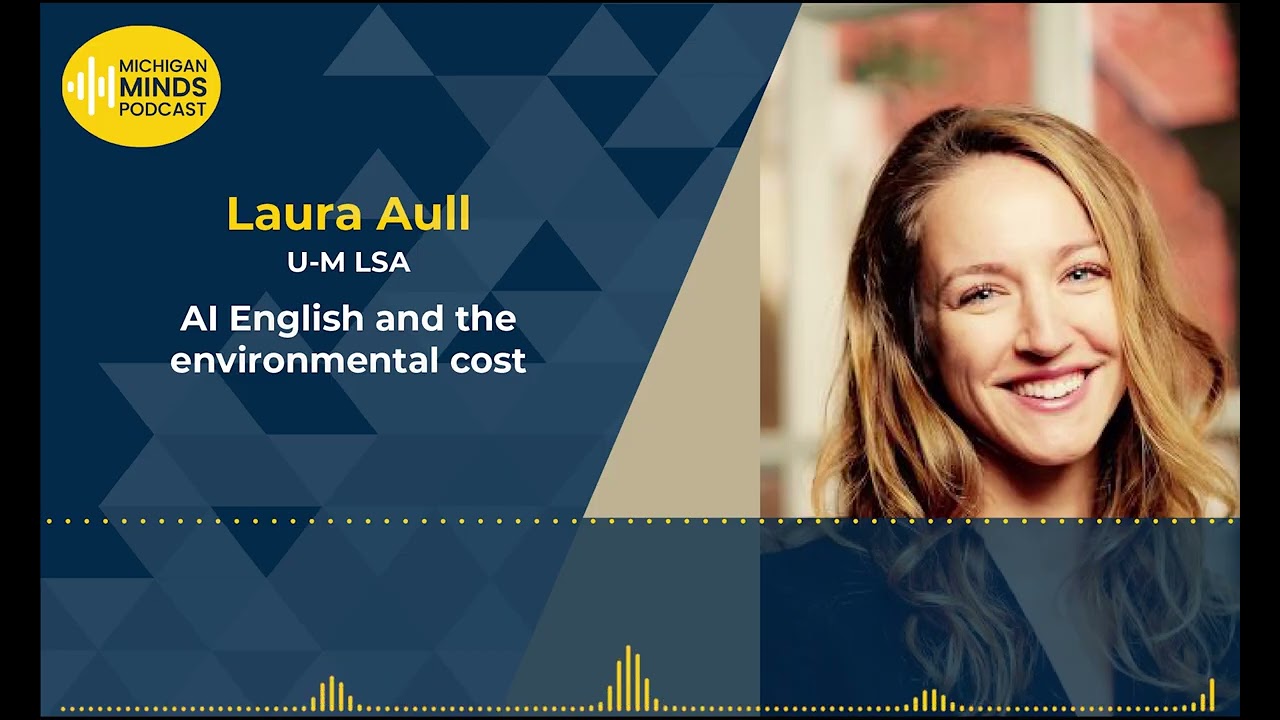
University of Michigan
AI-assisted summary of AI English and the environmental cost — original source. Check the original for full context.
Source published:
Key ideas
- Submitting a simple query to generative AI systems like ChatGPT requires an estimated 50 times more electrical energy than a traditional Google search, accelerating computational carbon footprints and ocean warming. (9:56)
- Empirical linguistic research shows that instructional tuning and prompt engineering do not make machine text more human-like, frequently steering outputs further away from natural conversational patterns. (3:56)
- Current AI detection and evaluation tools systematically penalize non-native English speakers and regional dialect users, falsely flagging standard, careful syntax as plagiarized or machine-generated. (9:56)
- Generative models inherit the narrow cultural values of their developers, producing an 'algorithmic monoculture' that favors standardized 'exam English' over globally spoken varieties. (12:24)
Detailed notes
## Background Published on YouTube by the University of Michigan on September 15, 2026, this episode of the Michigan Minds podcast features English and linguistics professor Laura Aull discussing the emergence and impact of "AI English." The show description highlights how generative AI tools disrupt natural human speech diversity, replicate linguistic bias across automated hiring and housing platforms, and impose a massive, underappreciated carbon footprint through everyday queries.
## TL;DR Linguist Laura Aull explains that generative models produce a homogenized "AI English" driven strictly by probability, flattening the dynamic variation, humble tone, and cognitive readability inherent in living human languages. Because large language models are trained on narrow, prestige dialects like standardized "exam English," automated systems and AI detectors disproportionately penalize multilingual writers and speakers of global dialects such as Jamaican and Indian English. Beyond societal and workplace gatekeeping, everyday adoption of these models carries an alarming environmental cost, requiring roughly 50 times the electricity of standard search engine queries. To preserve authentic human agency, Aull urges society to resist algorithmic monoculture, prioritize linguistic nuance over speed, and cultivate conversational openness rather than assertive machine rhetoric.
## Atmosphere & style The discussion carries an intellectual, measured, and conscientious tone, blending academic corpus linguistics with accessible cultural critique. Juan Ochoa facilitates an easy, thoughtful exchange, allowing Aull to weave together empirical research and personal passions, such as her reflections on ocean warming as a scuba diver. The dialogue moves from diagnostic analytical comparisons to urgent ethical concerns before settling into a warm, encouraging closing call for linguistic empathy and human agency.
## Bulletin - [09:56](https://www.youtube.com/watch?v=lufat51rPUw&t=596s) Submitting a simple query to generative AI systems like ChatGPT requires an estimated 50 times more electrical energy than a traditional Google search, accelerating computational carbon footprints and ocean warming. - [03:56](https://www.youtube.com/watch?v=lufat51rPUw&t=236s) Empirical linguistic research shows that instructional tuning and prompt engineering do not make machine text more human-like, frequently steering outputs further away from natural conversational patterns. - [09:56](https://www.youtube.com/watch?v=lufat51rPUw&t=596s) Current AI detection and evaluation tools systematically penalize non-native English speakers and regional dialect users, falsely flagging standard, careful syntax as plagiarized or machine-generated. - [12:24](https://www.youtube.com/watch?v=lufat51rPUw&t=744s) Generative models inherit the narrow cultural values of their developers, producing an 'algorithmic monoculture' that favors standardized 'exam English' over globally spoken varieties.
## Key takeaways - [00:00](https://www.youtube.com/watch?v=lufat51rPUw&t=0s) Laura Aull's research employs corpus linguistics to analyze digitized texts, examining how linguistic patterns influence educational assessment, power structures, and the boundary between human and synthetic language. - [01:13](https://www.youtube.com/watch?v=lufat51rPUw&t=73s) Unlike traditional voice assistants that act as informational filters, generative AI acts as a language selection engine, taking over intimate personal decisions regarding vocabulary and phrasing. - [01:13](https://www.youtube.com/watch?v=lufat51rPUw&t=73s) Human English represents an expansive world of expressive possibility across global dialects, whereas AI English is merely a narrow 'can of probability' derived from standardized essays, books, and curated web discussions. - [03:56](https://www.youtube.com/watch?v=lufat51rPUw&t=236s) Prompt engineering cannot compensate for structural absences in training data; predictive models lack the conversational breadth and nuanced interpersonal markers required for authentic human warmth. - [05:27](https://www.youtube.com/watch?v=lufat51rPUw&t=327s) Automated writing evaluation is as old as artificial intelligence itself, tracing back to the Project Essay Grade (PEG) system developed in the early 1960s alongside milestone gaming programs. - [05:27](https://www.youtube.com/watch?v=lufat51rPUw&t=327s) Because foundational design choices for LLMs were concentrated among a small, unrepresentative demographic, AI English serves as a linguistic echo of power that systematically marginalizes world Englishes. - [07:52](https://www.youtube.com/watch?v=lufat51rPUw&t=472s) While AI is suited for rule-bound tasks like basic computer coding, high-stakes arenas like hiring, housing, and legal decisions demand human empathy and should not be outsourced to probability-based efficiency. - [09:56](https://www.youtube.com/watch?v=lufat51rPUw&t=596s) A standard ChatGPT query consumes roughly 50 times more electricity than a traditional search engine lookup, raising severe ecological concerns regarding ocean warming. - [11:24](https://www.youtube.com/watch?v=lufat51rPUw&t=684s) Linguistic detection filters exhibit inherent bias against non-native writers and regional varieties like Jamaican and Indian English, misinterpreting their syntax as machine-generated text. - [11:24](https://www.youtube.com/watch?v=lufat51rPUw&t=684s) Across models and architectures, AI text consistently remains more grammatically dense, impersonal, and overly confident, whereas human language thrives on dialectal variety, readability, and humility. - [12:24](https://www.youtube.com/watch?v=lufat51rPUw&t=744s) Large language models reinforce 'exam English'—an artificial dialect historically favored by academic gatekeepers—at the expense of sensible, regularized global forms like English as a Lingua Franca. - [15:59](https://www.youtube.com/watch?v=lufat51rPUw&t=959s) Corpus analysis indicates that AI English suffers from severe cognitive bloat, stacking heavy strings of nominalizations around small verbs rather than utilizing accessible, readable 'noun-verb-noun' syntax. - [18:52](https://www.youtube.com/watch?v=lufat51rPUw&t=1132s) The 'Grammar for Good' initiative advocates for approaching diverse language with curiosity and structuring prose as a humble, qualified dialogue rather than an assertive, megaphone-style broadcast.
## Detailed walkthrough ### [00:00](https://www.youtube.com/watch?v=lufat51rPUw&t=0s) Introducing Professor Laura Aull and the Study of "AI English"
The Michigan Minds podcast opens with Juan Ochoa, international public relations representative for the University of Michigan News office, introducing guest Laura Aull. Aull is a professor of English and linguistics who recently served as director of the English Department Writing Program at the University of Michigan. Her scholarship relies heavily on corpus linguistics—the large-scale analysis of digitized text collections—to explore how recurring patterns in language shape writing assessment, educational achievement, and structures of social power. Within the university, her research directly addresses how people are taught to write and how emerging technologies are actively reconfiguring human communication.
Aull is currently completing two major monographs that frame her current investigations: *AI English: Humans, Machines, and the Future of Writing*, which interrogates the shifting threshold between organic human language and machine-generated text, and *Grammar for Good*, a study exploring how structural linguistic awareness can cultivate more civil and ethical public discourse. Ochoa sets the stage by observing that while consumer AI has quietly integrated into daily life for years through voice assistants like Siri or Alexa, contemporary generative tools represent a dramatic escalation, raising the central question: by adopting these platforms, are users gaining a smart assistant, or are they surrendering their authentic voice?
- Laura Aull's methodology centers on corpus linguistics to investigate language patterns, academic success, and social power dynamics. - Her upcoming monograph *AI English: Humans, Machines, and the Future of Writing* focuses directly on the evolving border between human expression and synthetic text. - Her companion project, *Grammar for Good*, examines the role of linguistic knowledge in promoting ethical, civil discourse.
[01:13](https://www.youtube.com/watch?v=lufat51rPUw&t=73s) A Big Can of Some English: Probability versus Possibility
Addressing the distinction between legacy assistants and modern generative models, Aull draws an instructive comparison between Apple's Siri and OpenAI's ChatGPT. While both systems function through selection—asking Siri to play music requires trusting the algorithm to select specific tracks while excluding others—using ChatGPT to draft an email offloads decisions about language itself. Because language has historically served as a deeply intimate, social human practice, trusting a machine to select vocabulary and phrasing marks a profound shift. Siri acts as an informational selection tool, whereas ChatGPT acts as a language selection engine.
This dynamic illustrates what Aull characterizes as the foundational "creation story" distinguishing human English from AI English. Human English encompasses the vast, open-ended landscape of global English: it spans formal and informal registers, technical and interpersonal modes, native speakers and multi-language users, and regional varieties stretching from Ann Arbor to Sri Lanka. In contrast, AI English is drawn strictly from what is statistically probable within a narrow slice of text—principally standardized exam essays, published books, and sanitized, agreeable internet discussions. Consequently, generative tools default to formal, informational, assertive, and relentlessly enthusiastic phrasing. Aull summarizes the divide with a vivid metaphor: human English represents a vast world of possible expression, whereas AI English is merely "a big can of some English driven by probability." Relying on models like ChatGPT, Claude, Llama, or Gemini inevitably surrenders human choice and voice.
```mermaid flowchart TD accTitle: Human English vs AI English Comparison accDescr: A flowchart contrasting the expansive possibility of global human English with the restricted probability of AI English.
subgraph Human["Human English (World of Possibility)"] H1["Global English Varieties<br>(Ann Arbor to Sri Lanka)"] H2["Fluid Registers<br>(Informal, Interpersonal, Nuanced)"] H3["Native and Multilingual Speakers"] end
subgraph Machine["AI English (Can of Probability)"] M1["Narrow Training Data<br>(Standardized tests, books, polite web posts)"] M2["Statistically Driven Register<br>(Formal, assertive, highly enthusiastic)"] M3["Algorithmic Selection<br>(Curated exclusions)"] end
Human -->|"Infinite expressive choices"| OUT1["Expansive Human Voice"] Machine -->|"Probability-based output"| OUT2["Homogenized Machine Voice"] ```
[03:56](https://www.youtube.com/watch?v=lufat51rPUw&t=236s) The Myth of Prompt Tuning and the Limits of Synthetic Personability
When Ochoa asks whether users naturally counteract machine uniformity by editing outputs or prompting the software to sound more natural, Aull pushes back against widespread assumptions. While instructional tuning and detailed prompt engineering do alter surface-level outputs, Aull points out that empirical linguistic research demonstrates that instructional tuning does not actually bring machine outputs closer to authentic human language—it frequently makes the text even less human-like.
The underlying limitation remains structural: prompt tuning cannot draw from registers the model never ingested. If a user instructs a model to adopt a casual or informal tone, the machine can only simulate informality from the limited sample of informal text inside its dataset. True human language is uniquely personable because real speakers dynamically weave together informational content and nuanced interpersonal markers. Because humans naturally possess this full expressive repertoire, they achieve far greater warmth, humility, and connection when writing independently, even if they occasionally treat generative models as an initial reference point.
- Instructional tuning modifies surface responses but linguistically moves outputs further away from genuine human writing patterns. - AI systems lack access to the organic breadth of conversational and informal speech varieties found across living communities. - Human communicators uniquely balance personal vulnerability, social rapport, and factual information in ways predictive models cannot simulate.
[05:27](https://www.youtube.com/watch?v=lufat51rPUw&t=327s) The History of AI English: From 1960s Automated Grading to LLMs
Tracing how AI English reached its present state, Aull emphasizes that assessing language via computing is as old as artificial intelligence itself. While public memory often anchors the birth of AI to early computing breakthroughs like IBM's checkers-playing program in the 1950s and 1960s, the Project Essay Grade (PEG) automated writing evaluation system was developed during that exact same era in the early 1960s to score student essays mechanically. The quest to measure and capture human expression has accompanied machine learning from its earliest days.
The transition to modern generative systems represents a massive leap in processing scale and architectural sophistication. Contemporary transformer architectures leverage vastly larger datasets and immense compute budgets to process expansive context windows, producing outputs that convincingly mimic authentic human dialogue. Yet the fundamental problem persists: these models were designed by a tiny, unrepresentative demographic. Citing researcher Karen Hao's critical reporting on the geopolitical and social architecture of technology, Aull explains that because a remarkably small group of developers made foundational design choices, AI carries a narrow worldview and an insular set of cultural values. AI English constitutes the direct "linguistic echo" of this concentration of power, inheriting training models that intentionally elevate certain prestige dialects while systematically erasing the vast majority of global English varieties.
- Algorithmic evaluation of writing dates back to PEG (Project Essay Grade) in the early 1960s, running parallel to milestone gaming demonstrations. - Modern large language models rely on transformer architectures and vast context windows to simulate human-like coherence. - Generative models reflect the narrow demographics and worldview of their developers, turning AI English into a linguistic monoculture that excludes broader global practices.
[07:52](https://www.youtube.com/watch?v=lufat51rPUw&t=472s) Efficiency versus Human Nuance in High-Stakes Decision-Making
Addressing common anxieties regarding workplace automation and economic displacement, Aull stresses that whether machines replace human labor depends entirely on context. Generative models operate through probability rather than understanding, leaving them inherently incapable of empathetic or truly innovative decision-making. Routine, rule-governed tasks that map cleanly onto probability distributions—such as producing basic computer code—can be handed off to automation for substantial efficiency gains.
Conversely, domains that demand moral judgment, institutional flexibility, and empathetic nuance must remain under human stewardship. Aull highlights high-stakes arenas where automated decisions introduce dangerous distortions: writing assessment, hiring evaluations, legal decisions, career matching, and housing allocation. Empirical studies consistently demonstrate that algorithmic decision-making in these areas exhibits pronounced discrimination against anyone whose speech deviates from standard "exam English"—the sanitized dialect of standardized testing and academia. Aull cautions that speed and efficiency must never override human fairness: "Human nuance, variety, and flexibility are more worthwhile than efficiency."
| Domain Category | Suitability for AI Automation | Underlying Human or Machine Factor | |:--- |:--- |:--- | | **Basic Computer Coding** | High | Governed by rule-based structures and high probability patterns. | | **Writing Assessment & Grading** | Low (Requires human oversight) | Penalizes expressive deviation and non-standard cultural rhetoric. | | **Hiring & Career Matching** | Low (Requires human oversight) | Systematically favors standardized academic syntax over diverse dialects. | | **Legal & Housing Decisions** | Dangerous (Requires human governance) | Encodes systemic bias, denying opportunities to marginalized English speakers. |
[09:56](https://www.youtube.com/watch?v=lufat51rPUw&t=596s) Looking to 2030: Environmental Cost and Algorithmic Bias
Looking forward toward the year 2030, Ochoa asks whether society will eventually stop caring whether books or journalistic reporting are written by humans or machines. Aull notes that current research reveals humans still care deeply; in fact, recipients react with visceral negativity upon discovering that correspondence or creative text was machine-generated. Setting aside emotional reactions, Aull outlines three urgent structural arguments for why humanity must continue to care, detailing the first two in depth.
The first imperative is the severe environmental cost of large-scale computational processing. Submitting a simple query to ChatGPT consumes roughly 50 times the electrical energy required for an equivalent query on a conventional search engine like Google. Speaking from personal passion as an avid scuba diver, Aull stresses that warming ocean temperatures represent an urgent ecological emergency, arguing that society cannot afford to normalize such extreme energy consumption for trivial digital conveniences. The second imperative is pervasive linguistic bias: automated detectors and language filters systematically penalize writers whose phrasing falls outside narrow statistical norms. Non-native speakers and multilingual writers are routinely subjected to false accusations of plagiarism or caught in AI-detection filters simply because their structured, careful phrasing overlaps with machine outputs, while users of legitimate regional dialects—from Jamaican English to Indian English—find their native varieties discounted entirely.
- Generating a single query through ChatGPT consumes an estimated 50 times more electricity than a traditional Google search. - Aull's direct experience as a scuba diver informs her concern over ocean warming and the irresponsible normalization of AI's carbon footprint. - Stylistic bias in AI detection tools disproportionately harms non-native English writers, falsely flagging authentic work for academic dishonesty while ignoring global dialects like Jamaican and Indian English.
[11:24](https://www.youtube.com/watch?v=lufat51rPUw&t=684s) The Fundamental Divide Between Human and AI English
AI detection tools regularly penalize non-standard dialects and non-native writers, mistakenly flagging their original work for plagiarism or machine generation simply because their syntax deviates from expected norms. Current models struggle to comprehend the broad spectrum of global dialects, remaining largely oblivious to varieties ranging from Jamaican English to Indian English. This points directly to the fundamental divide between human expression and synthetic generation: human English exhibits far greater natural variation and readability. Human language thrives across an expansive tapestry of dialects and genres, remaining less grammatically dense and demonstrably more humble. AI English, on the other hand, presents as rigidly formal, impersonal, and overly sure of itself.
Despite public assumptions that ongoing AI advancements will smooth out these quirks, Professor Laura Aull notes that these defining markers have remained consistent across models, bots, and time. AI text continues to be less readable and far less varied than human writing. Aull warns that if society stops caring whether content is authored by a person or an algorithm, whether by 2030 or in the present day, we are passively consenting to a linguistic future that is flattened, homogenized, and stripped of human character.
[12:24](https://www.youtube.com/watch?v=lufat51rPUw&t=744s) Algorithmic Monoculture and "Exam English"
When asked whether automated language models could level the playing field or merely exacerbate historical exclusions in contexts like job hiring, Aull concedes that in theory, models built on broader varieties of world English or curated small language models (like Bias Shield) could raise awareness. However, the current reality of large language models is that they act as a "big can of some English driven by probability." By prioritizing high-probability sequences, they inherently favor select language users while systematically marginalizing others. Researchers describe this phenomenon using phrases like "homogeneity by design" and "algorithmic monoculture," highlighting how natural variation is smoothed out. Furthermore, post-training instruction tuning tends to amplify this artificiality, making AI outputs sound even more like AI and less like natural human speech.
To illustrate how certain varieties become privileged, Aull prefers the term "exam English" over "standard English." This framing highlights the artificial dialect historically rewarded in classroom instruction, standardized testing, and employment decisions since the dawn of mass public schooling roughly 150 years ago. Exam English typically favors native-speaker idioms, even when those conventions are logically inconsistent.
A prime example is present-tense subject-verb agreement: standard English arbitrarily requires an extra "-s" for the third-person singular ("she asks"), while keeping other forms uninflected ("you ask"). By contrast, English as a Lingua Franca—used by over a billion global speakers as an additional contact language—frequently applies a sensible, regular pattern across all subjects ("I ask, you ask, she ask, they ask"). Despite being less logically consistent, the quirky conventions of exam English remain institutional gatekeepers. Aull urges that preserving the vitality of human language requires tolerating its inherent messiness, embracing innovation, and letting go of rigid biases tied strictly to test-taking conventions.
```mermaid flowchart TD accTitle: Exam English vs Global Lingua Franca accDescr: Diagram illustrating how standardized exam English and global lingua franca differ in consistency and cultural prioritization. subgraph Exam["'Exam English' (Standardized)"] direction TB E1["Inconsistent Verb Forms<br/>('she asks' vs. 'you ask')"] E2["Institutional Gatekeeping<br/>(Schools, Tests, Hiring)"] E1 --> E2 end subgraph ELF["Lingua Franca (Global English)"] direction TB L1["Consistent Verb Forms<br/>('I ask, you ask, she ask, they ask')"] L2["Pragmatic Communication<br/>(1+ Billion Contact Users)"] L1 --> L2 end subgraph AIImpact["Algorithmic Filter"] AI["LLMs & Instruction Tuning"] Mono["Algorithmic Monoculture<br/>(Biased toward standardized probability)"] AI --> Mono end Exam -->|"Reinforces"| AI ELF -.->|"Excluded / Penalized by"| AI ```
[15:59](https://www.youtube.com/watch?v=lufat51rPUw&t=959s) Linguistic Differences: Variation and Readability
Drawing from the corpus analysis conducted for her book *AI English*, Aull compares patterns across centuries of human writing—spanning everything from informal text messages to bureaucratic government memos—against generative outputs from systems like ChatGPT, LLaMA, and DeepSeek. Her findings crystallize around two core linguistic differences:
| Feature Dimension | Human English | AI English | |:--- |:--- |:--- | | **Variation & Cohesion** | High dialect diversity; dynamic expressive forms (e.g., elongating letters like "yaaaay"); varied verb agreements ("they is" alongside "they are"); diverse structural linking devices. | Monotonous lexical choices; rigid adherence to standard verb paradigms; repetitive, predictable cohesive transitions. | | **Grammatical Readability** | Balanced alternation between plain, accessible clauses and dense information structures. | Unrelenting informational density; repetitive strings of long noun phrases wrapped around small verbs. | | **Cognitive Accessibility** | Easy for human brains to parse via clear "noun-verb-noun" flow, clearly identifying who is doing what. | Heavy, difficult-to-parse nominalizations ("noun-noun-noun-verb-noun-noun-noun") that make reading fatiguing. |
When asked whether prompt engineering could resolve this readability gap, Aull explains that research shows users are neither particularly skilled at nor interested in prompting models for plain, accessible syntax. While it is theoretically possible to steer models toward greater readability and variation, default system behaviors consistently trend toward heavy, nominalized bloat.
[18:52](https://www.youtube.com/watch?v=lufat51rPUw&t=1132s) Grammar for Good: Dialogue Over Megaphones
Addressing the pervasive fatigue caused by toxic online communication and constant digital shouting, Aull introduces her project, "Grammar for Good." She outlines actionable ways to adjust both reading and writing habits to foster empathy and clarity:
* **Reading with an open mind:** Readers should approach unfamiliar phrasing with curiosity rather than knee-jerk judgment, asking "what is going on with this English?" and finding delight in dialectal diversity instead of clinging to rigid standard rules. * **Writing as a dialogue rather than a megaphone:** Writers should deliberately structure prose around conversational openness, integrating hedges, qualifiers, and concessions. This rhetorical framing leaves room for reasonable doubt and alternative reactions. * **Rejecting synthetic assertiveness:** AI text frequently mimics a "megaphone"—uncompromisingly direct, assertive, and prone to rhetorical shouting or superficial flattery. In contrast, authentic human communication balances assertion with nuance and humility.
In her closing remarks, Aull urges listeners not to despair about the changing digital landscape. While AI English remains bounded by statistical probability across a narrow slice of text, human language continues to be powered by infinite possibility across global English. By actively confronting linguistic prejudice and keeping an open ear to diverse voices, speakers can protect human agency, choice, and voice for the future.
## Notable quotes > [01:13](https://www.youtube.com/watch?v=lufat51rPUw&t=73s) a big can of some English driven by probability — Laura Aull
> [07:52](https://www.youtube.com/watch?v=lufat51rPUw&t=472s) Human nuance, variety, and flexibility are more worthwhile than efficiency. — Laura Aull
> [09:56](https://www.youtube.com/watch?v=lufat51rPUw&t=596s) So far, humans care very much. And today I think we should care. — Laura Aull
> [09:56](https://www.youtube.com/watch?v=lufat51rPUw&t=596s) Estimates suggest that if you pose a simple query to AI to ChatGPT, let's say versus to a search engine like Google, you're using 50 times the electricity for the simple query. — Laura Aull
> [09:56](https://www.youtube.com/watch?v=lufat51rPUw&t=596s) I'm a serious scuba diver, and I know that the ocean should not get any warmer, and so I don't think we should normalize that kind of environmental impact. — Laura Aull
> [11:24](https://www.youtube.com/watch?v=lufat51rPUw&t=684s) Human English has more variation and readability than AI English, meaning that human English has more varied kinds of dialect and genres and it is less grammatically dense and it's more humble. — Laura Aull
> [11:24](https://www.youtube.com/watch?v=lufat51rPUw&t=684s) AI English is more formal, more impersonal, and more sure of itself. — Laura Aull
> [12:24](https://www.youtube.com/watch?v=lufat51rPUw&t=744s) homogeneity by design — Laura Aull
> [12:24](https://www.youtube.com/watch?v=lufat51rPUw&t=744s) algorithmic monoculture — Laura Aull
> [18:52](https://www.youtube.com/watch?v=lufat51rPUw&t=1132s) what is going on with this English? — Laura Aull
## Mentioned Laura Aull, Juan Ochoa, University of Michigan, Michigan Minds, AI English: Humans, Machines, and the Future of Writing, Grammar for Good, Siri, Alexa, OpenAI, ChatGPT, Google, Claude, Llama, Gemini, DeepSeek, Project Essay Grade (PEG), IBM, Karen Hao, Bias Shield
## Video description Laura Aull, professor of English and linguistics and recent director of the English Department Writing Program at the University of Michigan, joins the Michigan Minds podcast to discuss "AI English," how generative tools disrupt the natural diversity of human speech and why automated hiring and housing systems inherit these linguistic biases. She also explores a largely unexamined downside to our rapid adoption of large language models: the massive, real-world carbon footprint generated by our daily digital conversations.
Do you think people will care whether a human or a robot wrote the news or books we read?
So far, humans care very much. And today I think we should care. And here are three reasons why I think we should. One is the environmental cost of the computer processing used with AI. Estimates suggest that if you pose a simple query to AI to ChatGPT, let's say versus to a search engine like Google, you're using 50 times the electricity for the simple query. I'm a serious scuba diver, and I know that the ocean should not get any warmer, and so I don't think we should normalize that kind of environmental impact.
A second reason is bias. It's clear that AI English tools are biased against language too close to itself or too far away, so it penalizes some English users, including nonnative writers of English, who are more often flagged for plagiarism or more often flagged by AI detection tools even when they haven't used it. And those who use non-standardized dialect AI English don't know varieties from Jamaican English to Indian English.
That leads to the third and final reason, which is that human and AI English are different. Human English has more variation and readability than AI English, meaning that human English has more varied kinds of dialect and genres and it is less grammatically dense and it's more humble. AI English is more formal, more impersonal, and more sure of itself.
[Source](https://www.youtube.com/watch?v=lufat51rPUw)