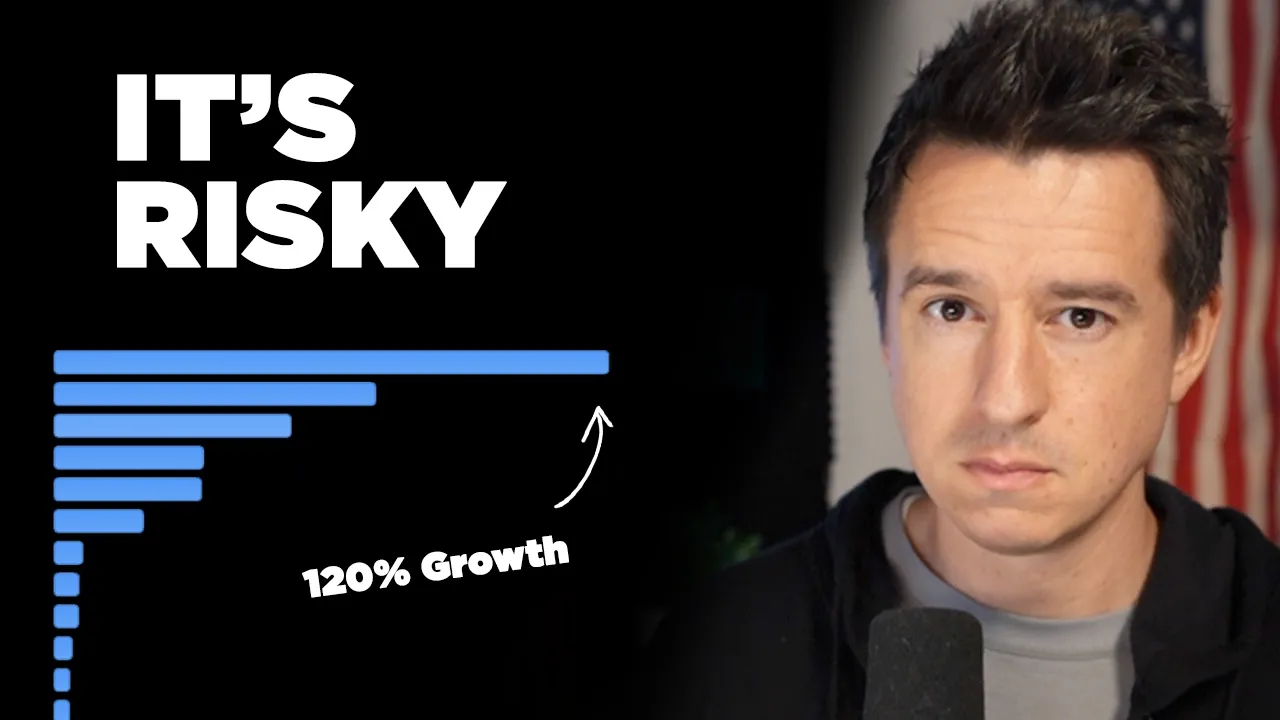
Q3 S&P 500 earnings growth is projected to clear 35%, with 70% to 80% of aggregate expansion driven narrowly by the energy and technology sectors while consumer staples crawls at 3% to 4%. (2:35)
Semiconductor monopoly ASML faces steep hurdles ahead of its Q3 report, with consensus modeling 50%–55% revenue growth and an ~89% EPS surge against a 33x forward P/E and a 1.5% free cash flow yield. (6:17)
Taiwan Semiconductor enters earnings from the top of the AI hardware supply chain at a comparatively moderate 21x forward P/E, benefiting from industry-wide chip volume regardless of whether Nvidia or AMD wins design share. (14:02)
Meta launched its Muse Wonder frontier AI models, reaching near parity with Claude Opus 5.5 through test-time compute scaling on novel reasoning tasks and reinforcing Carlson's multiple expansion target of 26x–27x forward P/E. (19:30)
Detailed notes
## Background
Published by Joseph Carlson After Hours on YouTube on October 12, 2026, the 32-minute video titled 'The Riskiest Earnings Season So Far' provides stock market analysis focused on high-stakes Q3 earnings. The page description features membership links to Carlson's Qualtrim platform, favorite investing books, gear lists, and standard financial disclaimers regarding informational content.
## TL;DR
Joseph Carlson analyzes the unprecedented stakes of the Q3 earnings season, focusing on soaring S&P 500 earnings expectations driven largely by AI and energy. He reviews specific high-conviction holdings including ASML, TSM, JPMorgan, and Meta, highlighting ASML's technological moat and Meta's newly released Muse Wonder frontier AI models. The episode concludes with a market-adjacent 'fail of the week' discussion analyzing singer Kelly Clarkson's viral public dispute with a small Brooklyn boutique.
## Atmosphere & style
The tone blends serious, analytical financial commentary with an informal, conversational 'after hours' vibe. Carlson speaks with high conviction, maintaining an analytical yet approachable demeanor as he balances macroeconomic risks against long-term business moats. The mood shifts seamlessly from intense portfolio evaluations to amused skepticism during the cultural breakdown of a viral celebrity feud.
## Bulletin
- [02:35](https://www.youtube.com/watch?v=vjhRZBn7dbI&t=155s) Q3 S&P 500 earnings growth is projected to clear 35%, with 70% to 80% of aggregate expansion driven narrowly by the energy and technology sectors while consumer staples crawls at 3% to 4%.
- [06:17](https://www.youtube.com/watch?v=vjhRZBn7dbI&t=377s) Semiconductor monopoly ASML faces steep hurdles ahead of its Q3 report, with consensus modeling 50%–55% revenue growth and an ~89% EPS surge against a 33x forward P/E and a 1.5% free cash flow yield.
- [14:02](https://www.youtube.com/watch?v=vjhRZBn7dbI&t=842s) Taiwan Semiconductor enters earnings from the top of the AI hardware supply chain at a comparatively moderate 21x forward P/E, benefiting from industry-wide chip volume regardless of whether Nvidia or AMD wins design share.
- [19:30](https://www.youtube.com/watch?v=vjhRZBn7dbI&t=1170s) Meta launched its Muse Wonder frontier AI models, reaching near parity with Claude Opus 5.5 through test-time compute scaling on novel reasoning tasks and reinforcing Carlson's multiple expansion target of 26x–27x forward P/E.
## Key takeaways
- [02:35](https://www.youtube.com/watch?v=vjhRZBn7dbI&t=155s) Despite rising Treasury and bond yields that typically exert severe downward pressure on equity valuations, the S&P 500 remains near all-time highs due to aggressive earnings forecasts.
- [02:35](https://www.youtube.com/watch?v=vjhRZBn7dbI&t=155s) Aggregate profit expansion across the index is dangerously concentrated, with energy projected to surge ~110% and tech/communications up 50%–60%, leaving broader sectors largely stagnant.
- [02:35](https://www.youtube.com/watch?v=vjhRZBn7dbI&t=155s) While official consensus earnings growth sits at 29.6%, final results are expected to exceed 35% based on S&P 500 constituents beating consensus estimates in 37 of the past 40 quarters.
- [06:17](https://www.youtube.com/watch?v=vjhRZBn7dbI&t=377s) ASML represents Carlson's fastest-growing holding and fifth-largest position ($124,000 value), but its premium valuation leaves virtually no safety cushion if guidance disappoints.
- [08:57](https://www.youtube.com/watch?v=vjhRZBn7dbI&t=537s) Contrary to the conventional belief that competitive moats erode over time, ASML's lead in EUV and High-NA EUV lithography is expanding and remains more than a decade ahead of rivals.
- [11:11](https://www.youtube.com/watch?v=vjhRZBn7dbI&t=671s) ASML's Installed Base Management segment is approaching a $10 billion annual business and could triple to $25 billion–$30 billion over the next decade as complex machines require proprietary servicing and upgrades.
- [14:02](https://www.youtube.com/watch?v=vjhRZBn7dbI&t=842s) TSMC trades at a forward P/E of 21 and a 1.5% free cash flow yield, carrying lower earnings expectations than ASML while anchoring essential global semiconductor fabrication.
- [15:26](https://www.youtube.com/watch?v=vjhRZBn7dbI&t=926s) JPMorgan Chase trades at a 13.5 forward P/E and carries an exceptionally conservative 14% CET1 ratio, signaling substantial capital buffers against potential loan defaults.
- [17:28](https://www.youtube.com/watch?v=vjhRZBn7dbI&t=1048s) Carlson deliberately avoids health insurance giants like UnitedHealth Group due to persistent customer dissatisfaction, political risks, and an economic imbalance where payers out-earn medical care providers.
- [17:53](https://www.youtube.com/watch?v=vjhRZBn7dbI&t=1073s) Third-party delivery platforms like DoorDash and Uber Eats have commoditized restaurant delivery, eroding Domino's Pizza's historical moat of running a proprietary fleet.
- [19:30](https://www.youtube.com/watch?v=vjhRZBn7dbI&t=1170s) Meta's newly released Muse Wonder Full model demonstrated significant benchmark gains by excelling at out-of-distribution reasoning rather than optimized benchmark gaming.
- [19:30](https://www.youtube.com/watch?v=vjhRZBn7dbI&t=1170s) Meta's positioning as a daily-driver personalized autonomous agent distinguishes it from search-oriented AI interfaces, supporting higher multiple valuation expansion.
- [29:04](https://www.youtube.com/watch?v=vjhRZBn7dbI&t=1744s) Carlson uses Kelly Clarkson's viral dispute with a Brooklyn retailer to argue against disproportionate public outrage, referencing rock climber Alex Honnold's philosophy of dismissing minor inconveniences.
## Detailed walkthrough
### [00:00](https://www.youtube.com/watch?v=vjhRZBn7dbI&t=0s) High Stakes for Q3 Earnings and the Week Ahead
The third-quarter earnings season is officially underway. Over the next four weeks, the majority of publicly traded companies will report their financial updates and provide guidance that will likely dictate the overall direction of the market. While high expectations are typical heading into earnings season, the stakes right now are unprecedented. S&P 500 weighted earnings growth is projected to exceed 35%—a massive figure driven almost entirely by a small handful of artificial intelligence and energy companies.
The calendar for the first week alone is packed with market-moving reports. Heavyweights like JPMorgan Chase, UnitedHealth Group, ASML, and TSMC are all slated to deliver results. Outside of earnings, Meta's CEO Mark Zuckerberg made headlines after playfully teasing a watermelon on social media, which turned out to be the codename for Meta's newly released AI model, Llama/Muse Wonder. Following the release and favorable benchmark comparisons, the stock gained 4% in a single session. On a lighter note, the episode promises a look at the "fail of the week" featuring singer Kelly Clarkson's dispute with a small business.
- **Key earnings reports scheduled:** JPMorgan Chase, UnitedHealth Group, ASML, and TSMC.
- **Tech catalyst:** Mark Zuckerberg teased an AI release using a watermelon reference, leading to a 4% single-day pop after benchmarks dropped.
- **Fail of the week:** An upcoming review of Kelly Clarkson's clash with an independent merchant.
Before diving into individual company analyses, Carlson gives an update on his stock research platform, Qualtrim. The service has expanded to include a fully released native mobile app on both iOS and Android, allowing users to track their holdings, read portfolio updates, and inspect underlying business fundamentals on the go. In addition to technical improvements, the platform includes a private, moderated Discord community where members share research on ambitious compounder companies beyond those covered on the public channel, accompanied by periodic deep dives and hour-long portfolio breakdown videos.
---
[02:35](https://www.youtube.com/watch?v=vjhRZBn7dbI&t=155s) Market Divergence: Surging Yields vs. AI-Driven Expectations
Although week three of earnings season usually delivers the heaviest barrage of big-tech results, the tone is established immediately by bellwethers like ASML and TSMC, which serve as direct barometers for the broader AI trade. While financial commentators frequently claim that every incoming season is make-or-break, current macro conditions genuinely justify the hyperbole. Treasury yields and bond yields have climbed substantially—a dynamic that typically exerts severe downward pressure on equities—yet the S&P 500 continues hovering near all-time highs.
```mermaid
flowchart TD
accTitle: S&P 500 Earnings Growth Concentration
accDescr: Diagram showing how AI tech and energy drive market growth while legacy sectors lag.
subgraph Macro ["Macro Backdrop"]
Yields["Rising Treasury & Bond Yields"]
Index["S&P 500 Near All-Time Highs"]
Yields -->|"Puts pressure on valuations"| Index
end
GrowthDrivers -->|"Generates 70-80% of aggregate growth"| Index
LaggingSectors -->|"Minimal contribution"| Index
```
Investors have been remarkably tolerant of lower starting equity yields because earnings expectations are astronomical. Official consensus estimates sit at 29.6%, but final numbers are widely expected to clear 35% because S&P 500 companies have beaten consensus estimates in 37 of the last 40 quarters. However, as one Bloomberg analyst observed, "It's not make or break, but it's a show me," because the bar has been raised instead of lowered. The entire advance has become dangerously bifurcated: between 70% and 80% of aggregate profit expansion stems from technology and energy. Energy earnings per share are projected to surge around 110% year-over-year, while communication services and tech are tracking between 50% and 60%. Meanwhile, neglected pockets of the economy, such as consumer staples, are crawling along with EPS growth between 3% and 4%.
- **Consensus baseline:** S&P 500 EPS growth is modeled at 29.6%, with real-world beats historically pushing outcomes above 35%.
- **Historical beat frequency:** Actual earnings growth exceeded analyst forecasts in 37 of the past 40 quarters.
- **Sector growth disparity:** Energy EPS is forecasted at ~110%, Tech/AI/Communications at 50%–60%, and Consumer Staples at just 3%–4%.
---
[06:17](https://www.youtube.com/watch?v=vjhRZBn7dbI&t=377s) Portfolio Focus: ASML's High-Wire Act Ahead of Earnings
This concentration of hyper-growth is visible within Carlson's personal 14-stock portfolio. Across his holdings, the single fastest-growing business on both a revenue and EPS basis is ASML, which sits as his fifth-largest holding at an aggregate value of approximately $124,000, representing $92,000 in unrealized gains.
Heading into its Wednesday report, ASML faces intense operational targets. Analyst expectations for ASML's year-over-year revenue growth span from 45% up to 60%, with consensus clustered around 50% to 55%. Bottom-line forecasts are even steeper: earnings per share are modeled to expand by roughly 89%. This comparison is not being inflated by an artificially weak baseline from the prior year; it represents clean organic acceleration.
The concern lies in the valuation cushion. ASML trades at roughly 33 times forward earnings with a free cash flow yield of only 1.5%. Because it is "no deal today" and anything but a deep-value stock, any minor miss or guidance hesitation could spark an aggressive sell-off. Balancing high conviction in its semiconductor monopoly against the risk of elevated sentiment, Carlson noted that he previously trimmed his position and took some profits off the table when the stock traded around $1,000 per share to lock in substantial upside.
- **Position metrics:** ASML is Carlson's 5th largest position, valued at $124,000 with $92,000 in total profit.
- **Quarterly projections:** Expected year-over-year revenue expansion of 50%–55% and EPS growth near 89%.
- **Current valuation:** 33 forward P/E ratio alongside a 1.5% free cash flow yield.
[08:57](https://www.youtube.com/watch?v=vjhRZBn7dbI&t=537s) ASML's 10-Year Outlook and Technological Moat
Despite its current share price, Joseph remains committed to holding his ASML position into earnings. He acknowledges that he cannot guarantee how the market will react in the short term—noting that the market has sold down ASML incorrectly in the past and could easily do so again—but he has a high degree of confidence that the company will generate incredibly good returns and strong business prospects over the next decade. Rather than evaluating ASML merely for a single quarter, he owns it for the next 10 years and sees a very bright future driven first and foremost by continued revenue growth, which in turn drives margins and earnings. Because the world is moving toward a reality where virtually every device needs a chip, producing high-quality chips that work across different applications at a cheap price, efficiently, and with a high yield requires going through ASML's machines today—and Joseph believes that will still be true 10 years from now.
While conventional wisdom suggests that economic moats erode and weaken over time—leading some to worry that Chinese competitors will catch up or that companies like Sony might somehow compete with them—Joseph believes the exact opposite will happen with ASML. Over the next decade, he expects ASML's moat to get "bigger and deeper and wider." Even ASML's lower-tier EUV machines have such a wide moat that nobody can copy them, and the company is now selling more of its next-generation High-NA EUV machines ("their supreme EUV machines"). With no one else doing anything remotely close, ASML is literally over a decade ahead of the next closest competitor, and that distance is widening rather than closing. Furthermore, the push for cheaper chips only reinforces the need to go through ASML.
[11:11](https://www.youtube.com/watch?v=vjhRZBn7dbI&t=671s) ASML's Supplier Network, Customer Lock-In, and Installed Base Management
ASML's moat is expanding not just technologically, where they are improving at a faster clip than anyone else, but also across supplier relationships, materials, logistics, and customer relationships. Management has been restrained and disciplined in nurturing ties with customers, who genuinely like working with them; in fact, up until a point, ASML's customers were even invested in the company. Today, ASML has deep-rooted agreements with all the fab makers, whose operations and systems have huge, expensive ASML machines embedded right into them that would take an enormous amount of effort to uproot. On the supply side, ASML relies on exclusive agreements across literally thousands of different supplier companies. Even if a theoretical competitor managed to replicate the technology, the supplier network, and all the complex chemistry to build an equally good machine, they would still have to convince fab customers to switch just to save some money. However, fab makers aren't looking to save money on machines—they want to save time and increase yield, which is what truly costs them the most, so they stick with the partner they trust.
```mermaid
flowchart TD
accTitle: ASML's Multi-Layered Moat and Revenue Drivers
accDescr: How ASML's technology, supply chain, customer integration, and servicing combine to form a full monopoly and drive long-term EPS growth.
subgraph Moat["ASML's Expanding Moat"]
Tech["High-NA EUV Tech (10+ Years Ahead)"]
Supply["1,000s of Exclusive Suppliers & Chemistry"]
Fab["Deep Fab Integration (Yield & Time Focus)"]
Service["Installed Base Management (Exclusive Upgrades)"]
end
Tech --> Monopoly["Full-On Monopoly Position"]
Supply --> Monopoly
Fab --> Monopoly
Service -->|"Approaching $10B to $25B-$30B in 10 Yrs"| Monopoly
Monopoly --> Growth["Baseline 10-Year Revenue & EPS Growth"]
```
Beyond this logistics and distribution moat, once ASML installs these machines, they require continual servicing and upgrades under exclusive agreements—a segment called "Installed Base Management" sales. Joseph jokes that "management" is a bit of a euphemism here, because after a machine is installed, it remains so incredibly complex that it requires ASML's experts to run, service, and upgrade it to new technological iterations, all of which is very expensive. ASML is growing this high-expertise segment dramatically: it is currently approaching a $10 billion business, and Joseph believes it could triple into a $25 billion to $30 billion business in 10 years, driving baseline earnings-per-share growth. Although Joseph is always looking for potential weaknesses—such as competitors on the horizon or management stumbles—he sees none here, calling ASML a "full-on monopoly" led by a disciplined, long-term-focused, top-tier team that acts as a good steward without abusing its unique position.
[14:02](https://www.youtube.com/watch?v=vjhRZBn7dbI&t=842s) Taiwan Semiconductor (TSM): At the Top of the AI Food Chain
Following closely behind ASML as likely the most consequential company reporting this week is Taiwan Semiconductor (TSM), which shares much of the same bull case. Both ASML and TSM sit at the very top of the food chain: it does not matter which chip design company ultimately wins—whether it is AMD or Nvidia—because both ASML and TSM fulfill overall AI demand. While ASML holds a "super monopoly," TSM sits just below it in a highly concentrated, pretty monopolistic position of its own, facing only a couple of competitors doing the same thing. Looking out at a world increasingly run by robotics, machines, and AI, with new devices constantly being created, Joseph expects both ASML and TSM to continue growing over the next 10 years just to keep up with base-level chip production needs.
By the numbers, TSM is not overly expensive and carries slightly lower expectations going into earnings than ASML, leading Joseph to believe TSM will report great earnings and that current shareholders have no reason to sell:
[15:26](https://www.youtube.com/watch?v=vjhRZBn7dbI&t=926s) JPMorgan Chase (JPM): Valuation, KPIs, and the CET1 Ratio
Looking at other companies reporting tomorrow—including JPMorgan, UnitedHealth Group, and Domino's—Joseph expects generally strong results, particularly praising JPMorgan as one of the best companies in the market. He recounts owning JPMorgan after buying it close to COVID and selling it for what he thought was a big gain, only to watch the stock keep climbing—an exit he candidly admits was a mistake. Valuing JPMorgan depends on how an investor frames the business: it currently trades at a 13.5 forward P/E ratio, and since it is a bank, looking at its price-to-book ratio of 2.49 makes it look expensive as a traditional bank with some tech add-ons, whereas viewing it as a digital tech company that also runs a banking system makes it look cheap.
In any case, JPMorgan's 10-year growth has been incredible, backed by strong key performance indicators (KPIs): deposit sizes are increasing as more people save and park their money with JPMorgan, net interest income is rising alongside treasury and interest rates, and average loans across both commercial and personal segments continue to climb. Joseph also highlights a newly added KPI on his platform that he admits he had to look up since he is not a banking expert: the CET1 (Common Equity Tier 1) ratio, which measures how well a bank can cover severe loan losses or a risky investment profile. With banks overall set up really well right now, Joseph likes JPMorgan heading into earnings and wouldn't mind being invested in it.
| CET1 Ratio Level | Risk & Capital Profile |
|:--- |:--- |
| **15%** | Almost too conservative; holds excess capital to cover even terrible situations |
| **14% (JPM Current)** | Very conservative profile; no concerns regarding banking or loan profile (never really dipped below 9%) |
| **Below 9%** | Danger zone where capital buffers become concerning |
[17:28](https://www.youtube.com/watch?v=vjhRZBn7dbI&t=1048s) Why Joseph Avoids UnitedHealth Group (UNH)
Turning to UnitedHealth Group, another company reporting tomorrow that many investors jumped into alongside Warren Buffett, Joseph explains why he decided to stay out of the stock. Simply put, he does not love the insurance business, calling insurance companies "not a fun business." As a general rule, he avoids investing in companies "where basically every customer hates the company," and UnitedHealth Group falls squarely into that category alongside other structural issues.
[17:53](https://www.youtube.com/watch?v=vjhRZBn7dbI&t=1073s) Healthcare Insurers, Domino's Moat Erosion, and Upcoming Earnings
The discussion wraps up on healthcare insurers by highlighting the odd economic imbalance between payers and medical institutions. Health insurance companies routinely generate vastly higher profit margins than the hospitals and healthcare providers actually administering the care—an asymmetry that raises serious legislative and political questions down the line. While beaten-down insurance names are beginning to attract deep-value turnaround investors, Carlson remains entirely uninterested: the combination of toxic "customer bad vibes" and persistent regulatory threats makes the sector unappealing.
Turning to restaurant earnings, Domino’s Pizza is another name facing structural headwinds. Although some market commentary suggests delivery aggregators like DoorDash and Uber Eats are accelerating Domino’s growth, the broader reality is far less favorable. Historically, Domino’s possessed a distinct operational advantage because it built and managed its own proprietary end-to-end delivery fleet; if consumers wanted food delivered to their front door, the choice was essentially Domino's, Papa Johns, or another local pizza shop. Today, a customer opening an app like DoorDash has access to the full menu of nearly every restaurant in town. Delivery has shifted from being a proprietary moat to a generic commodity, turning Domino's into merely one option among hundreds.
Looking at the broader calendar, these names conclude a relatively quiet opening slate. The earnings season ramps up significantly the following week with high-profile reports from Tesla and Netflix, culminating in a critical third week dominated by Big Tech.
---
[19:30](https://www.youtube.com/watch?v=vjhRZBn7dbI&t=1170s) Meta’s Muse Wonder and Closing the Frontier AI Gap
Meta continues to display powerful share price momentum, surging 3% to 4% on the day following a teasing social media post by Mark Zuckerberg. He shared an image of a watermelon with the caption, "Muse ordered me watermelon. How thoughtful." The post was an overt nod to "Watermelon," the internal project codename for Meta’s cutting-edge AI architecture, officially released as the **Muse Wonder** family of frontier models. Scale AI’s Alexandr Wang had previously noted internally that Meta was rapidly catching up to OpenAI and the top frontier labs, and Muse Wonder proves that leap.
```mermaid
flowchart LR
accTitle: Evolution of Meta Frontier Models
accDescr: Progression from early Muse Spark models up to Muse Wonder Full reaching near Claude Opus performance.
subgraph Early["Early Iterations"]
A["Muse Spark"] --> B["Muse Spark 1.1"]
B --> C["Muse Spark 1.2"]
C --> D["Muse Spark 1.3"]
end
subgraph Frontier["Frontier Tier"]
D --> E["Muse Wonder"]
E --> F["Muse Wonder Full"]
F -.->|"Near Parity"| G["Claude Opus 5.5"]
end
```
The progression across benchmark rankings has moved at breakneck speed. While Muse Spark lagged the pack, subsequent revisions jumped multiple spots in rapid succession. The flagship **Muse Wonder Full** model has now surpassed nearly every competing system in the world, sitting virtually neck-and-neck right behind Anthropic’s top-tier Claude Opus 5.5.
Addressing widespread industry skepticism surrounding benchmark manipulation—often referred to as "benchmaxing," where models are over-optimized for curated evaluation tests—Meta highlighted test-time compute scaling on out-of-distribution tasks. Muse Wonder Full demonstrates superior generalization on completely novel, unfamiliar assignments that the training trend line would not have predicted, demonstrating genuine reasoning rather than synthetic score inflation.
In consumer-facing demonstrations, the model acts as a true autonomous agent. When tasked with planning an outdoor run, it opened the user's calendar, verified open time blocks, analyzed local geographic map data, plotted an optimal route matching the requested mileage, and automatically logged the itinerary directly into personal notes. The philosophy behind Muse is having software handle the tedious administrative friction—calculating distances, avoiding repetitive routes, and setting schedules—so users can simply enjoy the activity. To prevent consumer backlash, Meta is heavily focused on safety layers: requiring active user confirmation before executing external tasks and strictly siloing private data.
Financially, Carlson views Meta as exceptionally positioned. Even setting aside generative AI, Meta enjoys rapid core revenue growth, a massive operational moat, and an attractive valuation. With Muse operating as the only scaled, daily-driver personalized agent—contrasted with ChatGPT or Claude, which users primarily treat as search interfaces or enterprise tools—Carlson argues the multiple deserves meaningful expansion up to a 26x–27x forward P/E ratio, making it one of his highest-conviction holdings.
---
[24:01](https://www.youtube.com/watch?v=vjhRZBn7dbI&t=1441s) Fail of the Week: Kelly Clarkson vs. Brooklyn Retailer
The segment transitions to the weekly "Fail of the Week," zeroing in on an explosive, viral social media clash involving singer and inaugural *American Idol* winner Kelly Clarkson. Clarkson took to social media to excoriate a small boutique named Art of Play located in Brooklyn, New York, generating massive online outrage.
Clarkson recounted driving out to the Brooklyn shop intending to buy several specific items, only to feel insulted by the retail staff:
> "Just drove all the way to Brooklyn to check out this store I thought looked really rad and had a few things in mind to buy and literally was looked at as if I couldn't afford it and was told he could find something comparable for me. Wow, dude, you're an idiot and just lost a huge sale. But y'all could go check out Art of Play in Brooklyn if you enjoy being treated like Julia Roberts' character in *Pretty Woman*. For sure. Check it out. Thumbs down."
Carlson expresses immediate skepticism about the veracity of the interaction as described. The trope of an arrogant boutique clerk blatantly refusing service or aggressively steering a customer away from high-end inventory mirrors a Hollywood cliché rather than real-world commerce. In modern retail, especially in wealthy urban pockets, high net worth individuals rarely dress in formal luxury attire; millionaires frequently shop in t-shirts and jeans, and few business owners would brazenly assume an otherwise unassuming shopper cannot afford their products. The notion that a retail worker outright told an interested customer, *"I can tell you can't afford this, let me find you a cheaper alternative,"* feels thoroughly disconnected from how shopkeepers actually behave, yet the post ignited an enormous wave of internet virality.
[26:47](https://www.youtube.com/watch?v=vjhRZBn7dbI&t=1607s) Art of Play's Response and Kelly Clarkson Doubling Down
Kelly Clarkson's social media post criticizing the Brooklyn shop Art of Play snowballed into massive viral outrage, racking up 11,000 reposts, 10,000 comments, 266,000 likes, and 44 million views. Emphasizing that Art of Play is just a small, "hole-in-the-wall business" that previously enjoyed really good ratings and reviews on Google from customers who felt treated very well, Joseph reads the statement issued by the bombarded owner in response to the tens of thousands of enraged commenters:
> "Yesterday, Kelly Clarkson visited us in Brooklyn and inquired about buying Molly, a one-of-a-kind singing and dancing bird automaton who plays an important role in our magic show we host here. Molly is permanently attached to the wall and isn't for sale. However, the negative experience Kelly described on Twitter would resonate with anyone who has ever felt judged in a shop. At Art of Play, whether or not someone comes in to make a purchase or simply look around for a while, they are equally welcome. We greet everyone who walks in the door with an invitation to pick things up and play, and they do. Many stay for hours enjoying puzzles, games, and toys. Imagine our surprise when our small local business was suddenly attacked by 8 million people who have never visited our store. It's been a surreal experience to be the focus of such widespread outrage after just one mention by a celebrity."
Rather than letting the matter end there, Kelly doubled down on her criticism of the small business. She fired back with a sarcastic reply: "Cool, cool. Sure. It wasn't for sale. That's the narrative Art of Play is going to go with. Thumbs up. So, the whole conversation we had when I asked you if it was for sale whilst pointing to the price tag hanging on the wall with the title 'Singing Bird' didn't happen. As you elevator-eyed me, saying in a condescending tone, 'Yes, it's for sale, but it costs $15,000. So, if you'd like me to find something comparable for you, I can.' That all never happened. And now it's not for sale. Okay, cool. So, you're not only rude, you're also a liar. Got it." The store subsequently responded again, noting that they had tried to speak with Kelly in person to clear the air and explain that the price tag was for a different model while that specific bird was not for sale, lamenting how blown out of proportion the situation had become.
```mermaid
flowchart TD
accTitle: Escalation of the Art of Play Social Media Controversy
accDescr: Flow showing how a single in-store interaction escalated into a national news story with 44 million views.
subgraph Incident["1. In-Store Interaction"]
A["Kelly Clarkson asks about 'Singing Bird' price tag"] --> B["Employee allegedly gives '$15,000' condescending reply"]
end
subgraph ViralBlast["2. Public Escalation"]
B --> C["Kelly blasts store name & address to 8.8M X followers"]
C --> D["Post hits 44M views, 266K likes, 11K reposts"]
end
subgraph BackAndForth["3. Public Dispute & Fallout"]
D --> E["Owner explains 'Molly' automaton isn't for sale"]
E --> F["Kelly doubles down: 'not only rude, you're also a liar'"]
F --> G["Store clarifies tag was for a different model; NBC & ABC cover story"]
end
```
[29:04](https://www.youtube.com/watch?v=vjhRZBn7dbI&t=1744s) Disproportionate Outrage and Alex Honnold's Perspective on Small Problems
Looking at the feud, Joseph notes that while there is no video footage or audio recording of what actually transpired inside the shop, even by Kelly's own admission the entire "crime that was committed here" was simply one store employee acting condescending in a single exchange. While Joseph agrees that stores have every incentive to treat customers well and shouldn't judge how much money people have based on what they wear—though he is skeptical that actually happened here—he questions whether one unfriendly interaction warrants putting a small business's full name, address, and city on blast to 8.8 million followers on X (formerly Twitter).
He directly challenges the sense of proportion behind turning a minor grievance into a viral spectacle seen by 44 million people and covered on national television by NBC and ABC: "Was the experience so bad, Kelly, that you had to get it out to 40 million people? Do you think that's a proportionate response? Do you think they really deserve this?" He points out that the conflict could have been handled in a thousand different ways, such as speaking directly to the owner beforehand about the rude experience rather than immediately escalating it to tens of millions of people. The broader lesson, he argues, is that everyone needs to settle down and stop sweating such small, inconsequential things.
To illustrate this mindset, Joseph connects the incident to an interview with rock climber Alex Honnold, who is famous for "free soloing"—climbing without any gear, where a single mistake means death and extreme focus is required. Honnold observed that people generally stress out over far too many trivial things, citing how travelers in airports completely lose their minds if they miss a flight, panicking, "Oh my gosh, I lost my flight. What am I going to do?" Honnold's reaction is simply to catch the next flight a couple of hours later, questioning why anyone acts like it is life or death to wait for two hours inside an air-conditioned building surrounded by food. Joseph notes that people fall into this trap constantly—whether it is erupting into road rage when someone cuts them off in traffic, or putting a business on blast in front of the entire world because someone was unkind—and concludes that people should just relax, forget about these small inconveniences, and move on.
## Notable quotes
> [02:35](https://www.youtube.com/watch?v=vjhRZBn7dbI&t=155s) It's not make or break, but it's a show me — Bloomberg analyst
> [08:57](https://www.youtube.com/watch?v=vjhRZBn7dbI&t=537s) bigger and deeper and wider — Joseph Carlson
> [11:11](https://www.youtube.com/watch?v=vjhRZBn7dbI&t=671s) full-on monopoly — Joseph Carlson
> [17:28](https://www.youtube.com/watch?v=vjhRZBn7dbI&t=1048s) where basically every customer hates the company — Joseph Carlson
> [19:30](https://www.youtube.com/watch?v=vjhRZBn7dbI&t=1170s) Muse ordered me watermelon. How thoughtful. — Mark Zuckerberg
> [24:01](https://www.youtube.com/watch?v=vjhRZBn7dbI&t=1441s) Just drove all the way to Brooklyn to check out this store I thought looked really rad and had a few things in mind to buy and literally was looked at as if I couldn't afford it and was told he could find something comparable for me. Wow, dude, you're an idiot and just lost a huge sale. But y'all could go check out Art of Play in Brooklyn if you enjoy being treated like Julia Roberts' character in Pretty Woman. For sure. Check it out. Thumbs down. — Kelly Clarkson
> [26:47](https://www.youtube.com/watch?v=vjhRZBn7dbI&t=1607s) Molly is permanently attached to the wall and isn't for sale. However, the negative experience Kelly described on Twitter would resonate with anyone who has ever felt judged in a shop. — Art of Play
> [26:47](https://www.youtube.com/watch?v=vjhRZBn7dbI&t=1607s) Cool, cool. Sure. It wasn't for sale. That's the narrative Art of Play is going to go with. Thumbs up. — Kelly Clarkson
> [26:47](https://www.youtube.com/watch?v=vjhRZBn7dbI&t=1607s) So, you're not only rude, you're also a liar. Got it. — Kelly Clarkson
> [29:04](https://www.youtube.com/watch?v=vjhRZBn7dbI&t=1744s) Was the experience so bad, Kelly, that you had to get it out to 40 million people? Do you think that's a proportionate response? Do you think they really deserve this? — Joseph Carlson
> [29:04](https://www.youtube.com/watch?v=vjhRZBn7dbI&t=1744s) Oh my gosh, I lost my flight. What am I going to do? — Alex Honnold
## Mentioned
S&P 500, JPMorgan Chase, UnitedHealth Group, ASML, Taiwan Semiconductor Manufacturing Company (TSMC), Meta, Mark Zuckerberg, Llama, Muse Wonder, Muse Spark, Anthropic, Claude Opus 5.5, OpenAI, ChatGPT, Scale AI, Alexandr Wang, Kelly Clarkson, Art of Play, Qualtrim, Warren Buffett, Domino's Pizza, Papa Johns, DoorDash, Uber Eats, AMD, Nvidia, Sony, Tesla, Netflix, Pretty Woman, Julia Roberts, Alex Honnold, American Idol, NBC, ABC
## Video description
Join Qualtrim, the stock analysis platform I built and use, and join over 13,000 other paying members: https://www.qualtrim.com/
-Disclaimer
Some of the links below are affiliate links, I can earn money from them at no cost to you.
This content is not a solicitation, is not endorsed by M1, and was not reviewed by M1; the opinions expressed are solely those of the authors and do not reflect M1's views. Information presented is accurate as of the video posting date; for the most up-to-date information, please refer to m1.com. Before making any investment decisions, consult your personal investment, legal, and tax advisors, as this content is for informational purposes only and not intended as investment recommendations.
📚 My favorite Investing Books: https://amzn.to/3KwyIhG
📷 All the tech I use to record videos: https://www.amazon.com/shop/josephcarlson/list/2L5YMP4DFYA8O?ref_=cm_sw_r_cp_ud_aipsflist_aipsfjosephcarlson_FAKKKMYKF486ZR6H2DSQ
SOCIAL MEDIA
▀▀▀▀▀▀▀▀▀▀▀▀▀▀▀▀▀▀▀▀▀▀▀▀▀▀
🎥 More free content: https://www.youtube.com/channel/UCbta0n8i6Rljh0obO7HzG9A
🐦 I post random thoughts on Twitter too: https://twitter.com/joecarlsonshow
DISCLAIMER
▀▀▀▀▀▀▀▀▀▀▀▀▀▀▀▀▀▀▀▀▀▀▀▀▀▀
I am not a professional investor and have never claimed to be. I'm an amateur investor sharing my experience of what I've learned, where I have had success, and where I've had failures. I share my thoughts on investing and performance with transparency. My approach and goal to investing is to buy high-quality long-term investments in world-class businesses that I call "compounders". I view my investments as businesses, not as stocks. Before creating content on YouTube full time I worked as a senior-level programmer for 8 years. Over the years as a programmer, I compounded my knowledge of development. I take the same iterative learning approach to my study of investing. I study investing as a craft in the continual pursuit of being better. I will make mistakes in investment decisions from time to time. Results are not guaranteed. Please do not blindly follow me into any investments, and make sure your portfolio and investments are built around your specific income, risk tolerance, personality, timeline, and overall circumstances.
ASML面临89%利润大考,AI主导标普500指数盈利
美债收益率飙升令股市承压,除非ASML等半导体风向标企业实现近90%的净利润增长,才能支撑当前高企的市场估值。
Joseph Carlson分析了第三季度财报季空前的利害关系,重点探讨主要由AI与能源板块推动的标普500指数高企盈利预期。他审视了包括ASML、TSM、JPMorgan和Meta在内的多只高确信度持仓,着重指出了ASML的技术护城河以及Meta新发布的前沿AI模型Muse Wonder。节目最后讨论了与市场相关的“本周败笔”,分析了歌手Kelly Clarkson与布鲁克林一家小型精品店在网络发酵的公开纠纷。
预计标普500指数第三季度盈利增长将突破35%,其中总增幅的70%至80%完全由能源和科技板块拉动,而必需消费品板块增长缓慢,仅为3%至4%。 (2:35)
半导体垄断巨头ASML在第三季度财报公布前面临严苛考验,在对应33倍远期市盈率和1.5%自由现金流收益率的背景下,市场一致预期其营收增长50%至55%、每股收益(EPS)激增约89%。 (6:17)
身处AI硬件供应链顶端的台积电(Taiwan Semiconductor)以相对温和的21倍远期市盈率步入财报季;无论Nvidia还是AMD赢得芯片设计份额,台积电均能从整个行业的芯片出货规模中受益。 (14:02)
Meta发布了Muse Wonder前沿AI模型,通过在新型推理任务上扩展测试时计算(test-time compute),性能几乎追平Claude Opus 5.5,这也进一步支撑了Carlson关于Meta远期市盈率有望扩张至26倍至27倍的目标预期。 (19:30)
Reading summary
Joseph Carlson argues that the current earnings season presents unprecedented market risk because aggregate profit expansion is dangerously concentrated in a small group of artificial intelligence and energy leaders while Treasury yields climb. With expectations elevated, Carlson emphasizes that valuation cushions have thinned, making long-term competitive moats the decisive factor for navigating volatility.
Macro Bifurcation and Elevated Earnings Bars (2:35)
Rising Treasury and bond yields typically depress equity valuations, but the S&P 500 continues trading near all-time highs under expectations of weighted earnings growth exceeding 35%. While consensus estimates baseline at 29.6% EPS growth, markets anticipate beats given that index companies surpassed forecasts in 37 of the last 40 quarters. Carlson points out that this advance is severely bifurcated, with technology and energy driving between 70% and 80% of total aggregate profit expansion.
Forecasts project energy earnings per share to surge roughly 110% year-over-year, while tech and communication services track between 50% and 60%. In contrast, legacy sectors such as consumer staples are crawling along at 3% to 4% growth. Because expectations have been raised rather than lowered, Carlson notes that bellwether companies face a strict "show me" test where any growth shortfall could trigger sharp market pullbacks.
Semiconductor Monopolies at the AI Top (6:17)
Carlson views semiconductor suppliers ASML and Taiwan Semiconductor (TSM) as sitting at the apex of the tech value chain, capturing secular AI spending regardless of whether chip designers like Nvidia or AMD capture individual market share. ASML—Carlson's fifth-largest personal position at $124,000—faces steep near-term targets heading into earnings, with analysts modeling 50% to 55% revenue growth and an 89% EPS increase. Trading at 33 times forward earnings with a 1.5% free cash flow yield, the stock offers minimal valuation cushion, which previously led Carlson to trim shares near $1,000.
Over a 10-year horizon, however, Carlson expects ASML's monopoly to widen rather than erode. Its technological lead in High-NA EUV machinery is backed by thousands of exclusive supplier agreements and deep fab integration, where chipmakers prioritize operational yield and time savings over machine price tags. Furthermore, Carlson forecasts that ASML's high-margin Installed Base Management segment will triple from nearly $10 billion today into a $25 billion to $30 billion servicing business over the decade. Meanwhile, TSM faces comparatively tempered expectations at a 21 forward P/E and a 1.5% free cash flow yield.
Divergent Moats Across Banking, Healthcare, and Food (15:26)
Evaluating other early corporate reports, Carlson distinguishes resilient business models from deteriorating moats. He praises JPMorgan Chase (valued at 13.5 times forward earnings and 2.49 times book value) for consistent deposit growth, climbing net interest income, and an expanding loan book. Its Common Equity Tier 1 (CET1) ratio of 14% indicates a highly conservative capital buffer well above the sub-9% risk zone. In contrast, Carlson avoids UnitedHealth Group despite value interest, citing pervasive customer dissatisfaction and the regulatory vulnerability of health insurers sustaining wider margins than the medical providers actually administering care.
Carlson also highlights structural headwinds for Domino's Pizza. While third-party aggregators such as DoorDash and Uber Eats are seen by some as growth partners, Carlson argues they have fundamentally eroded Domino's competitive advantage. Domino's once dominated local delivery through its proprietary fleet, but app-based platforms have turned food delivery into a generic commodity, transforming Domino's from a unique distribution channel into merely one menu option among hundreds.
Meta's Frontier AI Advances and Valuation Upside (19:30)
Meta shares gained 4% after Mark Zuckerberg teased "Watermelon," the internal codename for its Muse Wonder frontier model family. Benchmarks place the flagship Muse Wonder Full model virtually neck-and-neck with Anthropic's Claude Opus 5.5, validating internal assessments from Scale AI's Alexandr Wang that Meta has rapidly closed the gap with leading frontier labs. Addressing industry concerns over "benchmaxing" (optimizing models purely for public benchmark tests), Carlson notes that Muse Wonder demonstrated test-time compute scaling on novel, out-of-distribution reasoning tasks.
Beyond technical benchmarks, Meta displayed practical agent capabilities, such as cross-referencing user calendars and local map data to plot running routes and record itineraries into personal notes. Because Carlson sees Meta positioning Muse as an integrated, daily-driver personal assistant rather than a narrow search interface, he argues Meta's multiple deserves expansion toward a 26x to 27x forward P/E ratio on top of its already expanding core advertising revenue.
Celebrity Outrage and the Value of Perspective (24:01)
Turning to his "Fail of the Week," Carlson examines an online feud ignited by singer Kelly Clarkson against Brooklyn boutique Art of Play. After feeling condescendingly dismissed over a $15,000 non-sale automaton bird named Molly, Clarkson publicly blasted the shop's name and address to her 8.8 million followers on X, amassing 44 million views. Even after the shop explained that the piece was an integral prop for in-store magic shows rather than retail inventory, Clarkson publicly doubled down, accusing the business owner of lying.
Carlson criticizes the disproportionate damage inflicted on an independent retail store over an alleged single unfriendly interaction. Referencing professional rock climber Alex Honnold's perspective on managing life's trivial stressors—such as calmly waiting out missed airport flights—Carlson argues that escalating minor retail friction to tens of millions of people reflects a broader social failure to keep inconsequential grievances in perspective.
Carlson concludes that while hyper-concentrated earnings and elevated multiples heighten short-term downside risks, investors should look past quarterly volatility by anchoring to durable monopolies like ASML and capital-efficient tech leaders like Meta. The central unresolved question is whether climbing bond yields will eventually force a broader valuation reset across the few growth engines supporting the market.
Source quotes
[2:35] Bloomberg analyst: It's not make or break, but it's a show me
[8:57] Joseph Carlson: bigger and deeper and wider
[11:11] Joseph Carlson: full-on monopoly
[17:28] Joseph Carlson: where basically every customer hates the company
[19:30] Mark Zuckerberg: Muse ordered me watermelon. How thoughtful.
[24:01] Kelly Clarkson: Just drove all the way to Brooklyn to check out this store I thought looked really rad and had a few things in mind to buy and literally was looked at as if I couldn't afford it and was told he could find something comparable for me. Wow, dude, you're an idiot and just lost a huge sale. But y'all could go check out Art of Play in Brooklyn if you enjoy being treated like Julia Roberts' character in Pretty Woman. For sure. Check it out. Thumbs down.
[26:47] Art of Play: Molly is permanently attached to the wall and isn't for sale. However, the negative experience Kelly described on Twitter would resonate with anyone who has ever felt judged in a shop.
[26:47] Kelly Clarkson: Cool, cool. Sure. It wasn't for sale. That's the narrative Art of Play is going to go with. Thumbs up.
[26:47] Kelly Clarkson: So, you're not only rude, you're also a liar. Got it.
[29:04] Joseph Carlson: Was the experience so bad, Kelly, that you had to get it out to 40 million people? Do you think that's a proportionate response? Do you think they really deserve this?
[29:04] Alex Honnold: Oh my gosh, I lost my flight. What am I going to do?
Original transcript
[0:00] Now, we're finally getting into the
[0:01] third quarter earning season. Over the
[0:03] next four weeks, the majority of
[0:04] companies in the stock market will
[0:06] report their earnings and give us a
[0:07] progress update. In that, it'll
[0:10] determine the direction the market takes
[0:12] because like many earning seasons,
[0:14] there's a lot priced in. But in this
[0:16] case, that is especially the truth.
[0:18] There is a lot riding on this earning
[0:21] season. The growth expectations are
[0:23] extraordinary. In fact, the weighted
[0:25] growth of the S&P 500 this earnings
[0:27] quarter is expected to exceed 35%.
[0:31] That is an a massive growth by the
[0:34] market. And the majority of this
[0:35] earnings is reliant on a small number of
[0:37] companies, these so-called AI companies
[0:39] and the energy companies. Now, I'll be
[0:42] breaking down this data, trying to make
[0:44] sense of it. We'll be going through how
[0:45] much of the market is made up by AI,
[0:48] where the earnings are all going, and
[0:50] how this will likely play out over the
[0:51] next year. We'll also be looking at my
[0:53] portfolio and we'll be breaking down how
[0:55] fast my portfolio is expected to grow
[0:57] this quarter. We'll also be looking at
[0:59] the week ahead. For example, if we look
[1:01] at the calendar here, we have a lot of
[1:02] companies reporting earnings this week.
[1:04] For example, we have JP Morgan. That's a
[1:06] big one tomorrow. We have United
[1:08] Healthcare. We have ASML. I own a lot of
[1:10] ASML, super important company in the
[1:12] semiconductor industry. Then, of course,
[1:14] we have TSM and many others. We'll be
[1:17] going through each of them and I'll be
[1:18] giving you my thoughts on what to
[1:19] expect. We also, of course, have news to
[1:21] go through. For example, Mark Zuckerberg
[1:23] ordered a watermelon. He teased that
[1:25] this morning. In reality, that was the
[1:27] code name for the new model that he was
[1:29] going to release. The new model's called
[1:31] Muse Wonder. The stock is now up 4% on
[1:34] the day. And he posted the benchmark.
[1:36] So, we'll be looking at how good this
[1:37] model actually is. And then, finally, as
[1:39] a fail of the week, we have to highlight
[1:40] Kelly Clarkson. We'll be going through
[1:42] her spat with a small business at the
[1:44] end of this episode. Now, of course,
[1:45] just a reminder, if you haven't already,
[1:47] try out qualum.com. It is the website
[1:49] that I own. I created the membership, so
[1:51] it's mine. But even objectively,
[1:54] scientifically, it is the best
[1:55] membership in the world. I really think
[1:57] you'll enjoy it. A lot of people have a
[1:59] lot of fun with this membership. You
[2:00] gain access to a private Discord
[2:02] community that's moderated. You'll meet
[2:04] like-minded investors and they're very
[2:06] ambitious. You'll learn about a lot of
[2:07] stocks that I don't even talk about, as
[2:09] well as you gain access to a lot of
[2:11] exclusive content, deep dives, AMAs. I
[2:13] have hour-long portfolio updates going
[2:15] over each stock that I own and ones that
[2:17] are on my watch list as well as Qualrum
[2:19] is getting better and better with the
[2:20] technology. For example, I just released
[2:22] the mobile app in iOS and Android. The
[2:24] feedback has been overwhelmingly
[2:26] positive. People love it. It helps you
[2:28] check your stocks, keep up to date. It's
[2:30] really easy to use. I think you'll like
[2:31] it. So, try it out now risk-f free. You
[2:33] can do so at qualim.com. Now, jumping
[2:35] in, we start off with Q3 earning season.
[2:38] It has begun. This is the first week.
[2:40] Around week three is where we really
[2:42] have the biggest earnings drop. That's
[2:43] when all the big tech companies report
[2:45] their earnings. But even this week, it
[2:47] starts off with a bank with TSM and
[2:48] ASML. Those are two companies that are
[2:50] very symbolic of how the AI how the
[2:53] whole AI thing will go. And why is AI so
[2:56] important? Well, AI is not just a
[2:58] buzzword. AI really means a lot of
[3:00] earnings growth in this market. Now, the
[3:03] media has hyped this up to of course be
[3:05] a very important earnings season.
[3:07] There's many articles like this where
[3:09] Barren is saying that the next move for
[3:11] stocks hangs in the balance as we jump
[3:12] into Q3 earnings. Now, even though
[3:14] oftentimes it feels like every earning
[3:16] season is the most important earning
[3:18] season, I do believe that this one is
[3:20] actually really important. And part of
[3:21] the reason why is because bond yields
[3:23] are going up. There's a lot of reasons
[3:25] that the market should be down more, but
[3:27] yet the S&P 500 is trending towards
[3:30] all-time highs. So, when we look at
[3:31] this, we're in a situation where stocks
[3:33] should have a lot of pressure because
[3:35] yields are going up on treasuries.
[3:36] Yields are going up on bonds, which
[3:38] typically pushes stocks down, but
[3:41] they've been resistant. And part of the
[3:42] reason they're resistant is because
[3:44] stocks are growing quickly. So investors
[3:47] are more forgiving of their lower
[3:48] starting yields when you can assume a
[3:50] great amount of growth. And the growth
[3:51] being implied in this quarter is
[3:54] substantial. From fact, they say that
[3:56] the S&P 500 is likely to report earnings
[3:59] growth above 35%.
[4:02] So that's the total earnings growth of
[4:04] the S&P 500. Just incredible. So now we
[4:07] know that the analyst estimates
[4:09] expectations are at 29.6%.
[4:12] But the reason they say that it can grow
[4:14] at maybe above 35% is because a majority
[4:17] of time companies report earnings that
[4:19] are above analyst expectations. And this
[4:21] isn't just like a wild prediction. This
[4:23] is mathematically significant. In fact,
[4:25] in 37 of the past 40 quarters, the
[4:28] actual earnings growth rate has exceeded
[4:31] what the analyst predicted. So,
[4:33] overwhelmingly, we have a likelihood of
[4:35] exceeding it again. Now, we know that AI
[4:37] companies, it's not it's not just talk.
[4:40] These companies make up the huge
[4:41] majority of earnings in the S&P 500 to a
[4:44] staggering amount. This highlights the
[4:46] concerns that investors have that so
[4:47] much of this market is being driven by
[4:49] AI. While investors are enthusiastic
[4:51] about hyper earnings growth fueled by AI
[4:54] companies, many are also wondering about
[4:56] how long this trend can continue and
[4:58] what will happen to share prices when it
[5:00] ends. It's all AI land, to a lesser
[5:02] extent, energy and materials, but that's
[5:04] because of geopolitics.
[5:06] It wouldn't surprise me if 70 to 80% of
[5:09] the growth can be attributed to tech and
[5:11] AI. What they're saying here is not an
[5:12] exaggeration either. It is all dependent
[5:14] on AI. Another analyst at Bloomberg
[5:17] said, "It's not make or break, but it's
[5:18] a show me." and the rally needs
[5:20] confirmation because the bar has been
[5:21] raised. Normally companies get to step
[5:24] over a lowered bar. This time they have
[5:26] to jump over a higher one. The risk is
[5:29] with this bifurcated market that the
[5:30] companies that are really generating all
[5:32] the earnings are concentrated into a
[5:34] smaller number of companies specifically
[5:37] technology and energy. Energy is
[5:38] expected to grow around 110% in its
[5:41] earnings per share. technology when you
[5:43] factor in AI companies, communication
[5:46] services is going to be in the range of
[5:47] around 50 to 60%. And then you get to
[5:50] the other sectors, the ones that nobody
[5:52] cares about anymore, financials,
[5:54] utilities, consumer discretionary,
[5:56] consumer staples, some of these are
[5:58] barely growing at all. For example,
[6:00] consumer staples are expected to grow
[6:02] EPS around 3 to 4%. These analysts
[6:05] aren't exaggerating by saying that so
[6:07] much of this market hinges on AI
[6:09] companies. There's such high
[6:10] expectations for them and the market's
[6:12] growth and revenue and earnings per
[6:14] share is being driven by AI companies as
[6:16] well. I can even see it in my portfolio.
[6:18] When I look at my portfolio and the
[6:21] growth of it, I have a number of
[6:22] positions, 14 different companies, all
[6:25] different sizes. And the one that is
[6:27] expected to grow the most in both its
[6:29] earnings per share and in both its
[6:31] revenue is ASML. ASML is my fifth
[6:34] largest position. It's a $124,000
[6:37] position with $92,000 in the green. So,
[6:40] it's been an insane winner already. And
[6:42] ASML is still expected to grow
[6:44] substantially. Now, this is also a
[6:47] company that's reporting earnings on
[6:48] Wednesday. So, let's go ahead and take a
[6:50] look at ASML before it reports its
[6:52] earnings this Wednesday. To put this in
[6:54] perspective, when I do analysis on my
[6:55] companies going into this quarter, I
[6:58] have each one of them here with their
[7:00] unreported quarter expectations. The top
[7:03] company by revenue growth this quarter
[7:05] is ASML. It's expected to grow 50 to
[7:08] 55%. It depends on what analyst you're
[7:11] listening to. The the estimates range
[7:13] from upwards of 60% to like 45 with a
[7:16] mid-range of around 50 to 55%. That is
[7:20] incredible revenue growth. Again, this
[7:23] is not earnings per share growth. This
[7:25] is revenue growth. That's a lot of
[7:27] year-over-year growth. Now, if we look
[7:29] at ASML through the lens of earnings per
[7:31] share, which is even more important than
[7:32] revenue, usually we want the earnings of
[7:34] the company to grow. What do you know?
[7:36] ASML again is at the top of the list. In
[7:38] this case, my more pure AI company, the
[7:41] one that only focuses in the
[7:42] semiconductor industry, both contrasting
[7:45] AI and physical hardware, is the one
[7:47] that's doing the best. ASML is expected
[7:48] to grow its earnings per share by 89%.
[7:52] Somewhere in that range. Again, the
[7:53] analyst assessments vary, but most of
[7:55] them agree it's going to be substantial
[7:57] earnings per share growth. When we look
[7:59] at the earnings per share on the chart,
[8:00] we see that it's not a particularly low
[8:03] year a year ago. So, this isn't like
[8:05] it's coming off of some super low
[8:06] baseline or anything irregular. No, this
[8:08] is just organic growth by ASML. So, ASML
[8:12] like many of these AI companies has
[8:14] extraordinarily high expectations and
[8:16] they need to fulfill on this. They need
[8:18] to come in with these numbers otherwise
[8:19] the stock will be very hurt. So there is
[8:22] downside here. When we look at the
[8:23] company itself, the valuation is
[8:25] relatively high. It's at a 33 Ford PE
[8:28] ratio, a 1.5% free cash yield. So ASML
[8:31] is no deal today. It's not a great value
[8:33] stock by any means, and it has extremely
[8:36] high expectations. Now, normally when I
[8:38] have a stock that's a large position
[8:39] with a high valuation and extremely high
[8:41] expectations, I would approach this
[8:43] earnings with this stock with a lot of
[8:45] trepidation. It would be something where
[8:46] I'm concerned or nervous about going
[8:48] into it because well, I don't want to
[8:50] lose my gains. With ASML, I have taken
[8:53] some money off the table. I sold some
[8:55] when it was close to $2,000 per share,
[8:57] but even with its current share price, I
[8:59] remain holding this position, and I'm
[9:02] going to hold it into earnings. Now, I
[9:04] can't guarantee which way the market
[9:06] will react. The market has sold down
[9:08] ASML incorrectly in the past and they
[9:10] could do it again. But I believe with a
[9:12] high degree of confidence that this
[9:13] company is going to generate incredibly
[9:15] good returns and good business prospects
[9:17] over the next decade. When I look at
[9:20] ASML, I'm not looking at this one just
[9:22] for this quarter. I do own it going for
[9:24] the next 10 years. And when I look at
[9:26] the 10 years for ASML, I believe it has
[9:29] a very bright future. Let's go ahead and
[9:30] just look at some of the things that
[9:32] could occur that I believe are very
[9:34] probable. One of them is continued
[9:36] revenue growth. Now, revenue growth
[9:39] drives everything else. The margins, the
[9:41] the earnings, all of that is driven
[9:43] first by the revenue growth of the
[9:44] company. And why does revenue growth
[9:46] continue to grow for ASML? Well, we're
[9:49] going into a world where everything
[9:50] needs a chip. Like virtually every
[9:52] device needs a chip. And in order to
[9:54] produce good quality chips that actually
[9:57] work for all different applications and
[9:59] to produce them at a cheap price with a
[10:01] high yield efficiently, you have to go
[10:04] through ASML's machines. 10 years in the
[10:06] future, I believe you'll still have to
[10:08] go through ASML's machines. Now, there's
[10:11] a thought that over time moes erode.
[10:14] They get weaker. Like ASML will have
[10:16] Chinese competitors catch up or or
[10:18] different companies like Sony will
[10:20] compete with them somehow. That does
[10:22] happen in some cases, but I actually
[10:24] believe it's going to be the opposite
[10:26] with ASML. I think the moat is actually
[10:28] going to get bigger and deeper and wider
[10:31] over the next 10 years. When you look at
[10:32] what's going on, they are actually
[10:34] starting to sell more of their high NA
[10:36] EUV machines. These are like their
[10:38] supreme EUV machines, not their lower
[10:41] the the lower ones, which even the lower
[10:43] ones are so they're such a wide moat,
[10:45] nobody can copy those, but they're
[10:47] starting to sell their new generation
[10:48] ones that are so far ahead of
[10:50] competitors, they're just not even in
[10:52] sight. There's no one else doing
[10:54] anything remotely close. They are
[10:56] literally over a decade ahead of the
[10:58] next competitor. And they are gaining
[11:00] distance. The distance is not closing
[11:02] in, it's getting wider between ASML and
[11:04] the next closest competitor. There's
[11:06] also the thought that people want
[11:07] cheaper chips, but that means you have
[11:09] to go through ASML. And over time, the
[11:11] moat for ASML is not just expanding
[11:14] technologically. They're not just
[11:15] getting better at what they do at a
[11:17] faster clip than anyone else, but it
[11:19] also expands in lots of different ways.
[11:21] For example, in their supplier
[11:23] relationships, in all their materials,
[11:25] in their logistics with their customer
[11:27] relationship, ASML has navigated this
[11:30] perfectly. Management has been
[11:31] restrained and disciplined in growing
[11:33] the relationship with their customers.
[11:35] They they like them. They have
[11:37] agreements. Their customers up until a
[11:39] point were even invested in ASML. And
[11:41] now they have deep rooted relationships
[11:43] with all the fab makers. These are
[11:45] companies that have ASML machines
[11:47] embedded into their systems and
[11:49] operations. And these are big expensive
[11:51] machines that would take an enormous
[11:52] amount of effort to uproot. And then
[11:55] just going into the supplier
[11:56] relationships, all the exclusive
[11:58] agreements, literally thousands of
[11:59] different companies that ASML gets it
[12:01] supplies from, that would be very
[12:03] difficult for another company to
[12:04] replicate. Not only would a competitor
[12:07] have to replicate ASML's technology, all
[12:10] their supplier relationships, they'd
[12:12] have to figure out all the chemistry,
[12:14] build all of it together, but even if
[12:16] they have a machine that's about as
[12:18] good, they need to convince all the
[12:20] customers of ASML to switch from ASML to
[12:22] them to save some money in the process.
[12:25] Most of these companies don't want to
[12:27] save money. They want to save time and
[12:28] they want to increase yield. That's
[12:30] really what costs them the most. So they
[12:32] will go with the company they have trust
[12:34] with. So you also have a logistics a
[12:37] distribution mode. You also have the
[12:40] fact that when they install machines you
[12:42] have to continually upgrade them service
[12:44] them and you have exclusive agreements
[12:46] doing that. This is called the install
[12:48] base management sales. It it seems like
[12:51] uh management's a bit of a euphemism
[12:53] here but it's basically after machine is
[12:55] installed it's still incredibly complex.
[12:57] You need experts to run it and service
[12:59] it and upgrade it to the new iterations,
[13:01] the new technology. All of that is very
[13:04] expensive. ASML has expertise and
[13:06] they're growing this part of their
[13:08] business dramatically. I believe that in
[13:10] 10 years, this could be a 25 to30
[13:12] billion business. Right now, it's just
[13:15] approaching 10. So, if you have install
[13:17] base management triple over the next 10
[13:20] years, the earnings per share growth of
[13:22] this company is going to grow on a
[13:23] baseline. The biggest thing I'd portray
[13:25] for investors here is when I'm looking
[13:26] at companies, I'm always trying to look
[13:28] at potential weaknesses. Competitors on
[13:30] the horizon, taking their market or
[13:32] stumblings from management team, and I
[13:34] just don't see any here. ASML remains
[13:36] with top tier management, highly
[13:38] disciplined and long-term focused. I
[13:40] don't see any competitors that are doing
[13:42] anything that's remotely threatening to
[13:43] the company. There's always chatter of
[13:45] it that maybe it will happen, but I
[13:47] don't see it here. And I believe that
[13:48] ASML is one of the true companies that
[13:51] has a full monopoly. A full-on monopoly.
[13:55] Now, they're not going to abuse it
[13:56] because they're good stewards over it,
[13:58] but they are in a very unique position.
[14:00] So, this one I'm remaining fully
[14:02] invested in. Now, the next one I think
[14:03] is worth going over. The the company
[14:05] that's likely the most consequential
[14:06] this week, closely followed by ASML, is
[14:09] TSM. And many of the things that I said
[14:11] about ASML, I also think are completely
[14:14] the same for for TSM. They share a lot
[14:16] of the same bullcase. For example, both
[14:19] of these companies, it doesn't really
[14:21] matter which design company wins or
[14:23] which chip ends up winning. Doesn't
[14:25] matter if it's AMD or Nvidia. These
[14:27] companies fulfill on overall AI demand.
[14:30] So, they're at the top of the food
[14:31] chain. Now, TSM is just below ASML. ASML
[14:35] has like a super monopoly, but TSM is
[14:37] pretty monopolistic as well. It only has
[14:39] a couple companies doing the same thing,
[14:40] so it does have some level of
[14:42] competition, but it is very
[14:43] concentrated. And overall, the company
[14:45] has an incredibly fruitful path ahead. I
[14:48] view a world where everything is done by
[14:50] robotics, by machines, by AI. There's so
[14:53] much devices. There's so many things
[14:55] that people are creating all the time to
[14:57] even keep the base level of chip
[14:59] production necessary. Companies like
[15:01] ASML and TSM are going to continue
[15:03] growing for the next 10 years. TSM is
[15:06] also not that expensive by the numbers.
[15:08] Trading at a 21 Ford PE ratio, 1.5% free
[15:12] cash flow yield. This doesn't look like
[15:13] it has overly high expectations. It's a
[15:16] little bit lower expectations going in
[15:18] than ASML. So, I believe that TSM will
[15:21] have great earnings. I think that
[15:22] investors invested in this company
[15:24] should see no reason to sell it as of
[15:25] yet. Now, looking back through the week,
[15:27] we also have companies like JP Morgan,
[15:28] United Health Group, and Domino's
[15:30] reporting earnings all tomorrow as well.
[15:33] I generally think these companies are
[15:34] going to do well. With JP Morgan, this
[15:36] is one of the best companies in the
[15:37] market. I actually really like this one.
[15:39] I own JP Morgan for a while. I made some
[15:42] good money buying this one close to
[15:44] COVID. I sold it at what I thought was a
[15:45] big gain and it was, but the stock just
[15:48] kept going up. So, this was a mistake to
[15:49] sell this one. It currently trades at a
[15:51] 13 1/2 Ford PE ratio. With banks, you
[15:54] should probably use the price to book.
[15:56] 2.49 is expensive for a bank. So, it
[15:59] depends on how you value this one. If
[16:01] you value it as a digital tech company
[16:03] that also is a little bit of a banking
[16:04] system, then JP Morgan's cheap. If you
[16:07] value it as primarily just the bank with
[16:09] some tech add-on stuff, then it's
[16:10] expensive. In any case, the growth has
[16:13] been incredible. Look at how much it's
[16:14] grown in the past 10 years. We also look
[16:16] at the deposit size. We have KPIs here
[16:18] showing that the deposit size is
[16:21] increasing. More people are saving
[16:22] money, putting their money in JP Morgan.
[16:24] The net interest income is also going
[16:26] up. So, as treasury rates go up, as
[16:28] interest rates go up, the average loan,
[16:30] this is an interesting one. This is
[16:32] throughout all of their business,
[16:34] commercial and personal, continues to go
[16:36] up as well. So, they have more average
[16:38] loans. We have another KPI that's been
[16:40] added here. This is one that I actually
[16:42] had to look up. I wasn't familiar with
[16:43] it. I'm not a banking expert, but it's a
[16:45] CCT1 ratio, and this basically says how
[16:49] good the company would be at covering
[16:51] for severe loan losses or their risky
[16:53] investment profile. If it gets up to a
[16:56] point where they have 15% that's almost
[16:58] like the bank is being too conservative.
[17:00] It just has too much money to cover for
[17:01] even terrible situations. If you get
[17:04] below 9% that's where things start to
[17:06] get dangerous. And for JP Morgan they've
[17:09] never really gotten down below that 9%.
[17:11] They are right now at 14%. So right now
[17:14] JP Morgan has a very conservative
[17:16] profile. There should be no concerns as
[17:18] far as their banking and their loan
[17:20] profile is involved. I like it going
[17:22] into this earnings. I think it's going
[17:23] to be good. I think that banks are set
[17:25] up really well right now. I wouldn't
[17:26] mind being invested in JP Morgan.
[17:28] Another company that I've looked at
[17:29] before is United Health Group. This is
[17:32] one that a lot of investors jumped in
[17:33] with Warren Buffett. I decided to stay
[17:36] out of it because I just don't love the
[17:38] business. Insurance companies are not a
[17:40] fun business. I I don't like companies
[17:43] in general where basically every
[17:45] customer hates the company. That's not
[17:47] something that I that I like investing
[17:48] in anyway. And with United Health Group,
[17:51] it also is one of those situations where
[17:53] they earn a lot more money than even the
[17:55] hospitals do, which doesn't make sense.
[17:57] Why should insurance companies have such
[17:59] higher margins than hospitals and
[18:01] healthcare providers themselves? So,
[18:03] there's some problems with the industry
[18:05] that I think could cause issues
[18:06] legislatively down the road. And now the
[18:08] stock is being viewed as a deep value
[18:10] turnaround company. I think it
[18:12] eventually will, but it's not an
[18:13] industry that I'm interested in going
[18:15] into. For me, there's just too many
[18:16] customer bad vibes with that one and too
[18:19] much regulatory concern. Then we have
[18:20] Domino's reporting earnings. This is
[18:22] another one that I'm not super bullish
[18:24] on at this point. There's a thought that
[18:25] Domino's is actually accelerating growth
[18:27] because of Door Dash and Uber Eats, but
[18:30] in my opinion, I don't think that's a
[18:31] good thing for Domino's because Domino's
[18:33] historically was one of like the few
[18:35] places that had delivery. So, when you
[18:37] wanted to order food delivered, you
[18:39] would basically pick between like
[18:41] Domino's and Papa John's and other pizza
[18:43] places. and you'd call them and they
[18:45] have their own delivery network. That
[18:46] was a unique part of the company. But
[18:48] now with Door Dash, when people want
[18:50] food delivered, it's not limited to just
[18:52] pizza. So, I have to believe that that's
[18:54] that's a little bit of a downgrade in
[18:56] the operations of Domino's. Now, people
[18:58] are just ordering from any restaurant.
[19:00] They open up something like uh Door Dash
[19:02] and they they have a whole menu full of
[19:04] different restaurants all over the
[19:05] place. Domino's is just one more
[19:07] company. In the era of Door Dash and
[19:09] Uber Eatats, it doesn't make me quite as
[19:10] excited to own a company like Domino's
[19:12] where their whole thing is delivery.
[19:14] Now, those are the most important
[19:15] companies reporting earnings this week.
[19:16] And then next week, it gets even bigger.
[19:18] We have companies like Tesla and Netflix
[19:20] reporting earnings. And then the third
[19:22] week is by far the most important with
[19:24] all the big tech companies. So, just
[19:26] make sure you're following along.
[19:27] They'll have more commentary in advance
[19:28] to those. Now, moving on, we get into
[19:30] some Meta news. Meta continues trading
[19:33] with a lot of confidence. This stock has
[19:34] a lot of momentum. It's moving up 3 to
[19:37] 4% on the day after Mark Zuckerberg said
[19:41] on a on Twitter. He posted that Muse
[19:44] ordered me watermelon. How thoughtful
[19:46] with a picture of a watermelon. Now,
[19:49] what does that mean? Well, watermelon
[19:51] has been the code name for their new
[19:53] model, for their advanced model.
[19:55] Alexander Wing has said internally that
[19:57] Meta is finally catching up to OpenAI.
[20:00] They're finally catching up to the
[20:02] Frontier models. And how are they
[20:04] catching up to OpenAI? Well, with this
[20:05] model, which is Watermelon, that's the
[20:07] code name for it, but its official name
[20:09] is Muse Wonder. Mark Zuckerberg released
[20:12] today, introducing Muse Wonder, our new
[20:14] family of Frontier models with
[20:16] state-of-the-art performance for
[20:17] personal and professional agentic work.
[20:19] To put it simply, Muse Wonder is super
[20:22] good and Meta has been leaprogging ahead
[20:24] of the competition at a rapid pace. You
[20:26] can see a visual here. You have Muse
[20:28] Spark, which was behind the pack. Then
[20:30] we have Musepark 1.1, then 1.2 two that
[20:33] leaped ahead two positions. Then we have
[20:36] Musepark 1.3 that leaped ahead another
[20:39] three positions. Then we have Muse
[20:41] Wonder. Then we have Muse Wonder full
[20:43] which is now literally ahead of all the
[20:45] models except for Claude Opus 5.5 and it
[20:49] is barely behind Claude Opus. So you can
[20:52] see how fast this is gaining on the
[20:54] other models. Now it's virtually at the
[20:56] top of the pack. It's right there with
[20:57] Anthropic's best current model. Meta
[21:00] also addressed concerns of the
[21:02] benchmarks because we know a lot of
[21:03] models can be trained specifically to
[21:06] perform well during some like benchmark
[21:08] test. This is benchmaxing is what some
[21:11] of them are calling it. Now the
[21:13] important thing here is that both of the
[21:14] models improve similarly on
[21:17] outofdistribution tasks as we scale test
[21:19] time compute but given its distribution
[21:22] performance muse wonderful full performs
[21:24] even better on unfamiliar tasks in Muse
[21:27] Spark 1.3 uh trend would predict. So
[21:30] this is like a weird way of saying that
[21:32] they're not trying to game the
[21:33] benchmark. They're not benchmaxing by
[21:35] just making their models good at a
[21:37] couple tasks that are particularly
[21:39] curated to advance in a benchmark. No,
[21:41] even when you throw all different random
[21:43] tasks, things that it's unfamiliar with,
[21:45] it also has incredibly good performance
[21:47] across the board. Now, they give
[21:49] examples of this model like planning a
[21:51] run. You can see it just open up
[21:52] someone's calendar. It makes a new
[21:54] calendar entry and then you can see the
[21:56] the things like going through all the
[21:58] code and iteration looking at a map of
[22:00] of the location and then it literally
[22:02] draws out a run depending on the
[22:04] person's desired distance they want to
[22:07] run. It it puts all the information into
[22:09] the notes. it has the time for it and
[22:12] everything based on what they want. So
[22:14] if you want Muse to map out a run, you
[22:16] can do that. So this is like one example
[22:18] of I think how Mark Zuckerberg and
[22:21] Alexander and all these people envision
[22:22] people actually using Muse. It's just to
[22:25] do the kind of annoying things that you
[22:27] don't want to do for you, like planning
[22:29] a run. You probably want to go on a run,
[22:31] but you don't want to actually go and
[22:32] figure out where to run and the distance
[22:34] and where would be a good run that's
[22:35] different from the last one you did. So
[22:37] you could have it do that kind of
[22:38] annoying part while you get to focus on
[22:40] the fun part which is going out and
[22:41] actually going on a run. I think that's
[22:43] how they envision it. Of course there's
[22:45] going to be a lot of people that try to
[22:46] use it in bad ways. There's a lot of
[22:49] controls are doing to make sure that the
[22:50] models are safe that they ask for
[22:52] permission before taking tasks that they
[22:54] don't display your information or your
[22:56] personal stuff anywhere. uh there's an
[22:58] enormous amount of effort doing that
[23:00] because if Meta loses trust with their
[23:02] models, if Muse isn't trustworthy, then
[23:05] people aren't going to use the Muse app
[23:06] and so far that's one of the best things
[23:07] they have going for them. I see overall
[23:10] that this is another huge step in meta.
[23:12] I become more and more bullish on this
[23:14] company over time. I think the base
[23:16] thesis for the company is that it was
[23:18] growing really fast. It has a wide moat
[23:19] and it's at a cheap valuation. But now
[23:21] you have a company that also is leading
[23:23] in the pack of AI companies. It has a
[23:26] truly a truly frontier model, one that
[23:29] is right there with Claude. And it's the
[23:31] only company that has a personalized
[23:33] agent, which is Muse. Nobody really
[23:35] looks at ChateBT or Claude as being
[23:37] their personalized agent. They use it
[23:39] for different business applications,
[23:40] maybe answering questions, but Muse has
[23:43] become the deacto agent. So, I believe
[23:45] that Meta still has a significant
[23:47] opportunity here. When I look at this
[23:49] company, it's one of my most exciting
[23:51] investments today. I think the company
[23:53] should be trading at a 26 to 27 Ford PE
[23:56] ratio. I think there should be more
[23:58] multiple expansion. I still believe Meta
[23:59] is undervalued. Now, moving on, we get
[24:01] to this week's fail of the week, which
[24:02] in this case, I have to I believe
[24:04] somewhat surprisingly highlight
[24:06] Clarkson, who is somebody that I I don't
[24:08] believe I've even thought of once since
[24:11] American Idol. I think she's on the
[24:12] first season. That's back when that show
[24:14] was actually really cool. It was
[24:15] exciting. The first season of American
[24:17] Idol, it was something I think the
[24:19] family could gather around and watch.
[24:20] Now they're on season like 15 or 16, who
[24:22] knows? Uh, but in any case, Kelly
[24:25] Clarkson is the singer, American Idol
[24:28] winner. Presumably, she's done stuff
[24:30] after that. I'm not familiar. But
[24:32] regardless, she showed back up on my
[24:34] radar when she went ultra viral after
[24:37] after having a very angry post about a
[24:40] small business. Let's go ahead and take
[24:42] a look at this post. Kelly Clarkson
[24:44] says, "Just drove all the way to
[24:47] Brooklyn to check out this store I
[24:49] thought looked really rad and had a few
[24:51] things in mind to buy and literally was
[24:53] looked at as if I couldn't afford it and
[24:56] was told he could find something
[24:58] comparable for me. Wow, dude, you're an
[25:01] idiot and just lost a huge sale." But
[25:04] y'all could go check out Art of Play in
[25:07] Brooklyn if you enjoy being treated like
[25:09] Julia Roberts character in Pretty Woman.
[25:11] For sure. Check it out. Thumbs down.
[25:14] That's the post. So, from her own words,
[25:16] she was excited to visit this Art of
[25:18] Play store in Brooklyn, like the small
[25:20] shop that has some rad things in it, and
[25:23] she was looking at something that was
[25:24] probably expensive. And the the store
[25:27] employee or owner, whoever it was, uh,
[25:29] gave her the Julia Roberts treatment in
[25:32] Pretty Woman. So, said like, "God, you
[25:33] can't afford this. Look at you dressed
[25:35] in normal clothes. Maybe she wasn't like
[25:37] dressed up fancy or something." And so
[25:39] the employee just assumed that she
[25:41] couldn't afford something expensive.
[25:43] When I was reading this, I was
[25:44] immediately skeptical. What store owner
[25:47] is actually judging whether or not
[25:49] someone can afford something by what
[25:52] they're currently wearing? I don't think
[25:54] people are doing that that much anymore.
[25:57] Most people that that have a ton of
[25:59] money don't dress up super nice. There's
[26:02] plenty of people that have millions of
[26:03] dollars that are dressed in just
[26:04] completely normal clothes, blue jeans
[26:06] and a t-shirt. So, I don't know who
[26:09] would be doing that. It just makes me a
[26:10] little bit skeptical. Am I really to
[26:12] believe that Kelly Clarkson drove to
[26:14] this place? She looked at something
[26:16] expensive and said, "Hey, I'm interested
[26:17] in this thing knowing of the price of
[26:19] it." And the employer or owner, whoever
[26:22] it was, looked at her and said, "You
[26:24] know what? Uh, I don't think so. I I can
[26:27] tell you can't afford this. So, let me
[26:29] find something a little bit more
[26:30] comparable for you, something that you
[26:32] can afford." Does that sound like a real
[26:34] exchange? It doesn't to me, but that's
[26:36] apparently the exchange that she had.
[26:39] And she posts this and it just goes
[26:42] super viral. This is like a level of
[26:44] viral that we don't often see. It got
[26:47] 11,000 reposts, 10,000 comments, 266,000
[26:51] likes, and 44 million views. Now, again,
[26:56] this Art of Place store is like a small
[26:57] business. It's like a hole-in-the-wall
[26:59] business. And now it's a post with 44
[27:02] million views. Now, the owner of the
[27:04] place, getting bombarded with, I'm sure,
[27:06] tens of thousands of people enraged by
[27:08] Kelly Clarkson's post, responded with
[27:10] this. Yesterday, Kelly Clarkson visited
[27:12] us in Brooklyn and inquired about buying
[27:14] Molly, a one-of-a-kind singing and
[27:16] dancing bird automation who plays an
[27:18] important role in our magic show we host
[27:20] here. Molly is permanently attached to
[27:23] the wall and isn't for sale. However,
[27:25] the negative experience Kelly described
[27:27] on Twitter would resonate with anyone
[27:29] who has ever felt judged in a shop. At
[27:32] Art of Play, whether or not someone
[27:34] comes in to make a purchase or simply
[27:36] look around for a while, they are
[27:37] equally welcome. We greet everyone who
[27:40] walks in the door with an invitation to
[27:41] pick things up and play, and they do.
[27:44] Many stay for hours enjoying puzzles,
[27:46] games, and toys. Imagine our surprise
[27:48] when our small local business was
[27:50] suddenly attacked by 8 million people
[27:52] who have never visited our store. It's
[27:54] been a surreal experience to be the
[27:57] focus of such widespread outrage after
[27:58] just one mention by a celebrity. So that
[28:00] was their post. And and keep in mind
[28:03] prior to this, this store had really
[28:05] good ratings on Google. Like everybody
[28:07] thought that they were treated really
[28:08] well. So Kelly's experience here was
[28:10] somewhat unique by the company's own
[28:12] reviews and ratings online. Uh and you
[28:15] think that it would end there, but it
[28:16] didn't. Kelly responded to that,
[28:19] doubling down on her criticism for this
[28:21] small business, saying, "Cool, cool.
[28:23] Sure. It wasn't for sale. That's the
[28:25] narrative art of play is going to go
[28:27] with. Thumbs up. So, the whole
[28:28] conversation we had when I asked you if
[28:30] it was for sale whilst pointing to the
[28:32] price tag hanging on the wall with the
[28:34] title singing bird didn't happen. As you
[28:37] elevator eyed me, saying in a
[28:39] condescending tone, "Yes, it's for sale,
[28:41] but it cost $15,000. So, if you'd like
[28:44] me to find something comparable for you,
[28:45] I can." That all never happened. And now
[28:48] it's not for sale. Okay, cool. So,
[28:50] you're not only rude, you're also a
[28:52] liar. Got it. Now, the store responded
[28:54] to that again, saying they've tried to
[28:55] talk to Kelly in person to clear the air
[28:57] because that specific one isn't for
[28:59] sale. It's for a different model and so
[29:01] on and so forth. And this is really
[29:02] blown out of proportion. Now, when I
[29:05] look at this, I think I don't know what
[29:07] happened here. I don't know what
[29:09] experience Kelly Clarkson really had. We
[29:12] don't have like video footage or audio
[29:14] recording of what went down in this
[29:15] store, but even by her own admission, it
[29:19] was a store employee acting
[29:20] condescending to her. That's the crime
[29:22] that was committed here. One employee in
[29:25] one exchange in one store acted
[29:28] condescending to Kelly Clarkson of which
[29:30] she took to Twitter or ex to post with
[29:34] her 8.8 million followers blasting the
[29:38] company, putting their full name,
[29:40] putting their address, what city they're
[29:41] in, and then telling of this terrible
[29:43] experience she had. Now, I get it. You
[29:47] know, stores should treat people well.
[29:49] Employees should be nice to their
[29:50] customers. that's in their own incentive
[29:52] to do that and they shouldn't be
[29:53] judgmental or they shouldn't try to look
[29:55] at people and judge how much money they
[29:56] have by how much they wear. Even though
[29:58] I'm skeptical of that happening, if
[29:59] there is any store doing that, they
[30:01] shouldn't do that. But regardless, even
[30:04] if the store was rude, even if this
[30:06] employee was judgmental, even if she had
[30:08] a bad experience, does that warrant
[30:10] posting this on an 8.8 million follower
[30:14] feed? Millions of people, literally 40
[30:16] million people have now seen this post.
[30:19] Was the experience so bad, Kelly, that
[30:21] you you had to get it out to 40 million
[30:23] people? Do you think that's a
[30:25] proportionate response? Do you think
[30:27] they really deserve this? 44 million
[30:30] people. Now it's on national television.
[30:32] NBC and ABC are doing news articles on
[30:35] Kelly Clarkson's interaction with one
[30:37] person at one small business, one
[30:40] hole-in-the-wall shop that she had a bad
[30:42] experience in, that somebody was a
[30:44] little bit unfriendly to her. To me, it
[30:47] just feels a bit disproportionate. I
[30:49] don't think this is a this is not a
[30:51] proportionate response by any means.
[30:53] This could have been handled in a
[30:54] thousand different ways. One of them by
[30:56] specifically talking to the owner
[30:57] beforehand and explaining the rude
[30:59] experience. Maybe doing that before
[31:01] escalating it to your feed of tens of
[31:04] millions of people. And I think there's
[31:05] a lesson to learn in this. It's that we
[31:08] should all just settle down a little
[31:09] bit, not sweat such small things. This
[31:12] is a small thing. Having somebody treat
[31:14] you unkindly or judge you a little bit
[31:16] in one store or small business is not a
[31:18] big deal and it's certainly not
[31:20] deserving of blasting that entire small
[31:22] business to the world, making them a
[31:25] national news story over that minor
[31:27] inconvenience.
[31:28] Uh, and it's also something that I think
[31:30] relates to what Alex Hnold has said
[31:32] before. He's the rock climber. He does
[31:35] climb sometimes where he doesn't use any
[31:36] gar. It's called free soloing. When you
[31:38] do that and you make any mistakes, you
[31:40] die. So, he has to be extremely focused
[31:42] when he's doing that. In one interview,
[31:44] Alex said that he thinks generally
[31:46] people stress out about too many little
[31:48] things. For example, he'll see people
[31:50] you'll see people in airports freak out
[31:52] if they miss their flight. Like they
[31:54] just lose their mind. They'll go, "Oh my
[31:56] gosh, I lost my flight. What am I going
[31:57] to do?" And he's like, "Catch the next
[31:59] flight. They they happen every couple of
[32:02] hours. It's not a big deal. What's the
[32:04] problem with waiting a couple hours in
[32:05] an airport? It's an air conditioned
[32:07] building with food all around. yet this
[32:09] person's acting like it's life or death
[32:11] that they missed their flight. And we do
[32:13] that a lot. Someone cuts you out.
[32:16] Someone cuts you off in traffic and now
[32:18] you have road rage. Someone is unkind in
[32:21] a business and now you're going to put
[32:22] them on blast in front of the whole
[32:23] world. These are small things that
[32:25] people should just relax and forget
[32:26] about and move on. That's going to be it
[32:28] for this episode. Hope you enjoyed. See
[32:30] you in the next one.