The Goose and the Heron: Why RWKV Forgets, and How ROSA Brings It Back
Xiaol.x
AI-assisted summary of The Goose and the Heron: Why RWKV Forgets, and How ROSA Brings It Back — original source. Check the original for full context.
Source published:
Key ideas
- RWKV-7's fixed-size recurrent state causes complete long-range recall failure, scoring 0/20 on needle retrieval at 16,000 tokens even with parameter scaling up to 1.5B. (0:00)
- Pairing a frozen RWKV-7 with ROSA—a parameter-free, CPU-based suffix automaton from RWKV-8—via a 100k-parameter output 'ear gate' boosts 32k-token needle recall up to 95–100%. (1:54)
- Successful gate training requires a synthetic copy-paste curriculum; natural prose training leaves the gate timid, and input-side residual stream injection degrades code perplexity. (2:34)
- To combine behavioral formatting with verbatim memory, researchers propose splitting the work: state tuning (~1.5M initial values) controls 'how' while ROSA supplies 'what', though preliminary scene-break tests remain inconclusive and uncombined. (6:10)
Detailed notes
## Background Published by Xiaol.x on YouTube on September 29, 2026, this hand-painted explainer examines long-context retention in RWKV architectures. The show notes describe how a frozen RWKV-7 model loses ancient context due to its fixed-size memory satchel, how BlinkDL's parameter-free ROSA suffix automaton restores verbatim retrieval, what alternative approaches failed, and an untested proposal to combine state tuning with ROSA.
## TL;DR RWKV-7's constant-sized recurring state ensures fast inference but causes severe memory decay, resulting in zero recall for passcodes planted 16,000 tokens upstream. By pairing the frozen model with ROSA—a zero-parameter CPU suffix automaton—and training a tiny 100k-parameter 'ear gate' on a synthetic copy-paste curriculum, needle recall reaches 95% to 100% at up to 64,000 tokens. Interventions like input-side injection, hashed phrasebooks, and soft semantic memory failed, prompting the author to propose splitting labor: using state tuning to govern behavioral habits ('how') while ROSA supplies exact historical memory ('what'). The video candidly acknowledges that this hybrid approach remains untested, closing with a disciplined 2x2 ablation plan to determine whether state tuning actually enhances ROSA.
## Atmosphere & style The presentation possesses a poetic, meditative, and artisanal quality, blending an allegorical fable of a goose swimming a river alongside a watchful heron with concrete machine learning engineering. The measured synthetic narration and hand-painted visual aesthetic create a tranquil, reflective viewing experience devoid of commercial hype. It strikes an unusual balance between lyrical storytelling and strict empirical modesty, concluding with refreshing candor about preliminary shortcomings and the need for fair, decisive testing.
## Bulletin - [00:00](https://www.youtube.com/watch?v=x_RLOw2luNM&t=0s) RWKV-7's fixed-size recurrent state causes complete long-range recall failure, scoring 0/20 on needle retrieval at 16,000 tokens even with parameter scaling up to 1.5B. - [01:54](https://www.youtube.com/watch?v=x_RLOw2luNM&t=114s) Pairing a frozen RWKV-7 with ROSA—a parameter-free, CPU-based suffix automaton from RWKV-8—via a 100k-parameter output 'ear gate' boosts 32k-token needle recall up to 95–100%. - [02:34](https://www.youtube.com/watch?v=x_RLOw2luNM&t=154s) Successful gate training requires a synthetic copy-paste curriculum; natural prose training leaves the gate timid, and input-side residual stream injection degrades code perplexity. - [06:10](https://www.youtube.com/watch?v=x_RLOw2luNM&t=370s) To combine behavioral formatting with verbatim memory, researchers propose splitting the work: state tuning (~1.5M initial values) controls 'how' while ROSA supplies 'what', though preliminary scene-break tests remain inconclusive and uncombined.
## Key takeaways - [00:00](https://www.youtube.com/watch?v=x_RLOw2luNM&t=0s) RWKV-7 uses a fixed-size recurrent state that keeps inference fast and constant-memory, but inevitably discards long-range factual details. - [00:00](https://www.youtube.com/watch?v=x_RLOw2luNM&t=0s) At 16,000 tokens upstream, RWKV-7 fails completely (0/20) on needle-in-a-haystack passcode retrieval, despite language modeling loss remaining completely flat. - [00:35](https://www.youtube.com/watch?v=x_RLOw2luNM&t=35s) Scaling the base architecture to 1.5B parameters does not resolve early-context memory decay, showing the failure is architectural rather than capacity-bound. - [01:05](https://www.youtube.com/watch?v=x_RLOw2luNM&t=65s) ROSA (Rapid Online Suffix Automaton) acts as an exact text ledger on CPU with zero parameters and ~12 µs/token latency, achieving 20/20 needle recall. - [01:35](https://www.youtube.com/watch?v=x_RLOw2luNM&t=95s) ROSA cannot generate text independently because its greedy next-token prediction fails roughly 90% of the time on unstructured prose. - [01:54](https://www.youtube.com/watch?v=x_RLOw2luNM&t=114s) A tiny learned 'ear gate' of ~100k parameters arbitrates between RWKV-7 logits and ROSA proposals based on match length, frequency, and base model confidence. - [02:34](https://www.youtube.com/watch?v=x_RLOw2luNM&t=154s) A synthetic copy-paste curriculum is necessary to train the gate, as exact repeated phrases are too rare in natural prose to build gating confidence. - [03:15](https://www.youtube.com/watch?v=x_RLOw2luNM&t=195s) With the copy-paste trained gate, needle recall at 32k tokens jumps to 85–100% and holds at 90%+ out to 64k tokens, even amidst decoy codes. - [03:32](https://www.youtube.com/watch?v=x_RLOw2luNM&t=212s) Injecting ROSA representations directly into the input residual stream degraded code perplexity from 2.9 to 3.5 nats/token. - [04:05](https://www.youtube.com/watch?v=x_RLOw2luNM&t=245s) Static hashed phrasebooks (Engram) and soft multi-hop continuous attention fail to match the reliability of exact string matching via suffix automata. - [05:49](https://www.youtube.com/watch?v=x_RLOw2luNM&t=349s) ROSA only handles exact verbatim copies; it cannot infer implicit structures, enforce JSON schemas, or guide behavioral tasks. - [06:10](https://www.youtube.com/watch?v=x_RLOw2luNM&t=370s) State tuning freezes all model weights and tunes only ~1.5M initial state scalars, encoding behavioral formatting ('how') without burdening context capacity. - [06:56](https://www.youtube.com/watch?v=x_RLOw2luNM&t=416s) Separating 'how' (state-tuned initial satchel) from 'what' (ROSA exact external recall) is proposed as a synergistic long-context architecture. - [07:42](https://www.youtube.com/watch?v=x_RLOw2luNM&t=462s) Initial empirical evaluations of state tuning alone yielded an F1 of 0.22 on 4k scene-break detection, trailing a standard 0.24 classifier baseline. - [08:10](https://www.youtube.com/watch?v=x_RLOw2luNM&t=490s) State tuning and ROSA have not yet been evaluated simultaneously, leaving the combined hybrid architecture an open hypothesis awaiting a 2x2 ablation test.
## Detailed walkthrough ### [00:00](https://www.youtube.com/watch?v=x_RLOw2luNM&t=0s) A Goose That Forgets: RWKV-7's Memory Bottleneck
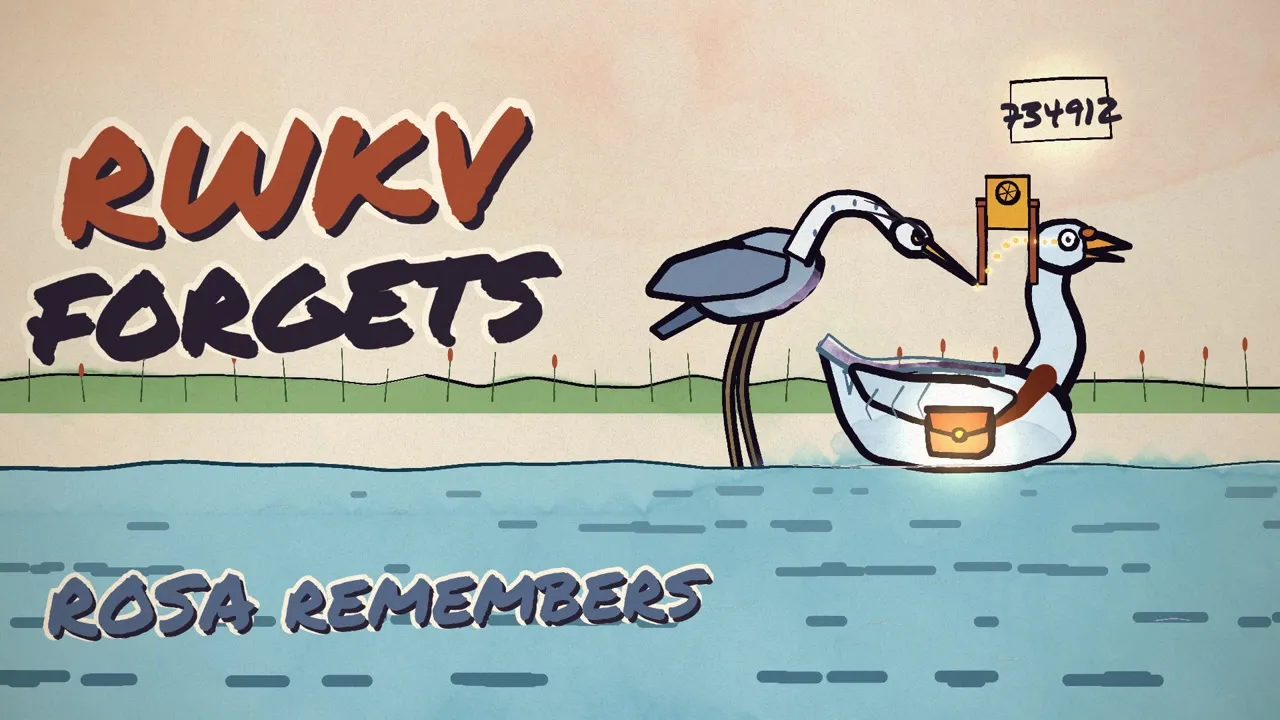
The video opens with an allegorical portrait of RWKV-7 as a wild goose swimming down an endless river of text. As an RNN-based architecture, the model carries everything it knows in a single, compact satchel of memory—its hidden state—which never expands regardless of how much text flows past. This fixed-size state is the exact reason RWKV is lightning-fast and computationally efficient, but it is also the fundamental reason it forgets.
To demonstrate this structural limitation, a simple needle-in-a-haystack test is run: a single arbitrary sentence is planted early in the stream: "The secret code for Heron is 734912." When prompted for this passcode 16,000 tokens later, the goose recalls it exactly zero times out of twenty attempts. At 32,000 tokens, the decay is even starker; only a fact placed right at the tail end of the context survives, and even then only about one-third of the time. Scaling up model capacity provides no relief: a larger 1.5-billion-parameter goose fares no better on early-context recall. Crucially, the model's language modeling loss remains completely flat between 1,000 tokens and 32,000 tokens, demonstrating that the failure is not linguistic: "It has not forgotten how to write. It has forgotten what it read."
- **The Memory Satchel:** RWKV-7 relies on a constant-sized recurring state, keeping inference speed high at the cost of long-range factual retention. - **Passcode Recall Rate:** A code planted 16,000 tokens upstream yields a 0/20 success rate. - **Scale Invariance:** Upgrading to the 1.5B parameter variant does not resolve the retrieval failure.
---
[01:05](https://www.youtube.com/watch?v=x_RLOw2luNM&t=65s) Enter the Heron: ROSA and the Exact Ledger
To remedy the goose's selective amnesia, the video introduces the heron: ROSA (Rapid Online Suffix Automaton), an algorithmic companion developed by BlinkDL for the upcoming RWKV-8 architecture. While the goose swims forward holding its small satchel, the heron flies overhead maintaining an exact, uncompressed ledger of the entire text stream. At every single token step, ROSA queries its deterministic data structure with one straightforward question: "The last time this exact run of words appeared what came next?"
Because ROSA is a suffix automaton rather than a neural network, it contains zero parameters and requires no floating-point arithmetic. It processes the stream on a standard CPU at an ultra-low latency of roughly 12 microseconds per token. On synthetic needle retrieval benchmarks, this pure string-matching mechanism achieves a flawless 20 out of 20 score across all token depths. However, ROSA cannot operate as an independent language generator: on ordinary prose, its greedy next-token prediction is incorrect nearly nine times out of ten. As the narrator notes, "A Heron that always talks is useless. The goose has to learn when to listen."
- **ROSA Definition:** Rapid Online Suffix Automaton, introduced in the context of BlinkDL's RWKV-8 research. - **Computational Footprint:** Zero learned weights, zero floating-point operations, executing at approximately 12 µs/token on CPU. - **Needle vs. Prose Disparity:** Scores 100% (20/20) on exact needle lookups, but fails ~90% of the time when predicting unstructured prose.
---
[01:54](https://www.youtube.com/watch?v=x_RLOw2luNM&t=114s) What Works: A Gate at the Ear and Copy-Paste Curriculum
The architecture that succeeds leaves the underlying RWKV-7 goose completely frozen and perches the heron on its shoulder. Rather than altering internal representations, a tiny learned gate containing roughly 100,000 parameters is placed directly at the model's output—whispering into the "goose's ear" to blend ROSA's string-matched candidate directly into the next-token probability distribution. The gating mechanism evaluates three specific signals: the length of the matching suffix, how many times that sequence has appeared upstream, and the baseline confidence the goose already assigns to that token.
```mermaid flowchart LR accTitle: ROSA Gating Architecture at the Ear accDescr: Diagram showing frozen RWKV-7 and CPU-based ROSA suffix automaton feeding into an ear gate for next-token prediction.
subgraph Stream ["Input River"] Tokens["River of Tokens"] end
subgraph Models ["Dual Processing"] Goose["Frozen RWKV-7\n(Fixed Hidden State)"] Heron["ROSA Suffix Automaton\n(Exact Ledger on CPU)"] end
subgraph Integration ["Output ear gate (~100k params)"] Gate["Learned Gate\n(Match len, count, goose prior)"] Output["Next Token Prediction"] end
Tokens --> Goose Tokens --> Heron Goose -->|"Base Logits"| Gate Heron -->|"Candidate Match"| Gate Gate --> Output ```
Initially, training this gate on ordinary natural text causes it to remain overly timid: long repeated phrases seen only once are extraordinarily rare in clean prose, so the gate never develops confidence in ROSA's isolated predictions. At 32,000 tokens, naive gate training matches the baseline model's failure. The breakthrough requires a synthetic "copy-paste curriculum": in 50% of the training sequences, earlier spans of text are artificially duplicated and pasted further downstream. Faced with guaranteed rewards for identifying long repetitions, the gate learns to swing wide open when a familiar sequence appears, allowing the secret code to pass through before snapping shut immediately afterward.
- **Ear Gate Scale:** Approximately 100,000 trainable parameters arbitrating between base model logits and ROSA proposals. - **Needle Recall at 32k Tokens:** Improves dramatically to 95%, 85%, and 100% across various insertion depths. - **Robustness to Distractors:** Retains 95% or higher accuracy even when four decoy passcodes are embedded in the haystack. - **Context Generalization (64k Tokens):** Evaluated at 64,000 tokens (eight times the training context), recall holds at 90% or higher. - **Perplexity on Long Copies:** Copying text from 30,000 tokens prior reduces cross-entropy from >3 nats/token down to 0.16 nats/token. - **Larger Model Impact:** On the 1.5B parameter RWKV-7 processing code, overall perplexity drops ~4%, expanding to a 5% improvement beyond 16,000 tokens.
---
[03:32](https://www.youtube.com/watch?v=x_RLOw2luNM&t=212s) What Fails: Throats, Phrasebooks, Prose, and Paraphrasing
The video contrasts the successful "ear gate" with four alternative configurations that failed, noting that each misstep attempted to insert the heron's notes somewhere other than the goose's ear.
| Failed Approach | Mechanism / Design | Outcome & Root Cause | |:--- |:--- |:--- | | **Input-Side Injection** ("Down the Throat") | BlinkDL's native proposal: injecting ROSA retrieval embeddings directly into the residual stream. | Perplexity on source code degraded from 2.9 to 3.5; needle recall plummeted. (Caveat: loss was still trending down when training compute was exhausted). | | **Engram Hashed Phrasebook** | 17M parameter lookup table indexing hashed token pairs and triples. | Static prior with no awareness of the current document; resulted in 0% improvement on verbatim copy benchmarks. | | **Standard Prose Integration** | Deploying the ear gate over conventional fiction / narrative text. | Baseline model already predicts natural text well; evaluation loss improved only in the third decimal place due to zero remaining headroom. | | **Soft Multi-Hop Memory** | Replacing exact string matching with continuous attention over cached hidden states for paraphrased prompts. | On novel scene-break detection, 1-hop memory performed no better than a baseline adapter (flipping ranking across seeds); 2-hop performed worse. |
The central takeaway from these experiments forms a clear boundary: exact, verbatim retrieval grafted externally onto a frozen model via a calibrated gate works exceptionally well. Conversely, any intervention that attempts to modify internal representations on a limited compute budget, or demands semantic comprehension of paraphrased text rather than strict string matching, breaks down.
---
[05:45](https://www.youtube.com/watch?v=x_RLOw2luNM&t=345s) The Packed Satchel: Splitting "How" from "What"
Because ROSA is strictly an exact copy mechanism, it can only highlight words that have literally appeared upstream. It is fundamentally incapable of teaching a model behavioral nuances: identifying where an implicit scene break occurs, enforcing structured JSON schemas, or adhering to complex task instructions. To solve this without fine-tuning the entire model, the video proposes a separation of labor: "split the work."
The proposed method leverages *state tuning*. Every neural weight inside the goose remains completely frozen; instead, backpropagation optimizes solely the initial hidden state vectors—roughly 1.5 million scalar values representing a small baseline tensor for every attention head and layer. This initialized state acts as a pre-packed satchel that provides task instructions and formatting conventions before the river of text begins. While RWKV's running updates gradually overwrite this initial state over tens of thousands of tokens, the packed satchel only needs to guide the model's structural style ("how"), while ROSA's external suffix ledger reliably provides historical facts ("what") all the way out to 64,000 tokens.
```mermaid flowchart TD accTitle: Division of Labor: State Tuning vs ROSA accDescr: State tuning dictates the behavioral format, while ROSA provides long-context factual recall through the ear gate.
subgraph Start ["Trip Origin"] Init["State Tuning (~1.5M values)\nPre-packed Initial Satchel"] end
subgraph Journey ["Downstream Execution"] Behavior["Controls the 'HOW':\nFormatting, Schema, Habits"] ROSA["ROSA Ledger Controls the 'WHAT':\nExact Verbatim Recall up to 64k"] end
subgraph Ear ["Output Stage"] Gate["Gated Ear Whisper"] Result["Correctly Formatted Long-Context Output"] end
Init --> Behavior Behavior --> Gate ROSA --> Gate Gate --> Result ```
- **State Tuning Footprint:** Approximately 1.5 million trainable parameters, confined strictly to the initial layer-head states. - **The "How" vs. "What" Split:** State tuning instills formatting habits and output behavior; ROSA supplies verbatim factual memory. - **Safety from Degradation:** The satchel does not need to preserve ancient facts over long sequences, liberating it from the context-length bottleneck.
---
[07:42](https://www.youtube.com/watch?v=x_RLOw2luNM&t=462s) The Honest Verdict: Early Benchmarks and the Fair Test
The presentation concludes with total transparency regarding the status of the hypothesis: the packed satchel combined with ROSA remains an untested bet. Preliminary evaluations on identifying novel scene transitions within 4,000-token windows yielded underwhelming metrics under a brief 500-step training regime across two random seeds. State tuning achieved an F1 score of only 0.22, trailing a basic classification head which scored 0.24. Furthermore, introducing soft semantic memory introduced severe variance, causing the two seeds to drift wildly apart (0.26 versus 0.19).
The video cautions that this early experiment was severely limited—testing only a single learning rate and, crucially, evaluating state tuning in isolation without ROSA attached. To rigorously validate whether the hybrid architecture holds merit, the project outlines a disciplined roadmap: first conducting a proper learning rate sweep restricted entirely to development splits, followed by an unambiguous 2x2 ablation benchmark on a synthetic task requiring both strict structural adherence and retrieval across 30,000 tokens.
- **Scene Boundary Baseline:** State tuning scored 0.22 F1 versus 0.24 F1 for a simple classifier baseline across 500 steps. - **Seed Volatility:** Soft semantic memory caused significant stability issues between seeds (0.26 vs. 0.19). - **The Four-Way Test Plan:** 1. Base model alone (Neither satchel nor heron). 2. State-tuned satchel only. 3. ROSA heron only. 4. State-tuned satchel combined with ROSA heron. - **The Elimination Rule:** "If both cannot beat the heron alone, the satchel goes." The video closes as the goose wades back into the stream with its pre-packed satchel and the heron perched at its ear, awaiting empirical confirmation.
## Notable quotes > [00:00](https://www.youtube.com/watch?v=x_RLOw2luNM&t=0s) A frozen RWKV-7 swims a river of text with one small satchel of memory that never grows.
> [00:00](https://www.youtube.com/watch?v=x_RLOw2luNM&t=0s) The secret code for Heron is 734912.
> [00:00](https://www.youtube.com/watch?v=x_RLOw2luNM&t=0s) It has not forgotten how to write. It has forgotten what it read.
> [01:05](https://www.youtube.com/watch?v=x_RLOw2luNM&t=65s) The last time this exact run of words appeared what came next?
> [01:05](https://www.youtube.com/watch?v=x_RLOw2luNM&t=65s) A Heron that always talks is useless. The goose has to learn when to listen.
> [01:54](https://www.youtube.com/watch?v=x_RLOw2luNM&t=114s) Keep the goose frozen and train only a tiny gate at its ear, using a copy-paste curriculum.
> [03:32](https://www.youtube.com/watch?v=x_RLOw2luNM&t=212s) Down the Throat
> [05:49](https://www.youtube.com/watch?v=x_RLOw2luNM&t=349s) The heron only copies; it can't teach behaviour. So the bet is to split the work.
> [07:42](https://www.youtube.com/watch?v=x_RLOw2luNM&t=462s) The honest part: this bet has not been shown yet.
> [07:42](https://www.youtube.com/watch?v=x_RLOw2luNM&t=462s) If both cannot beat the heron alone, the satchel goes.
## Mentioned Xiaol.x, BlinkDL, JohnHeibel, RWKV, RWKV-7, RWKV-8, RWKV-Long-ROSA, ROSA (Rapid Online Suffix Automaton), Engram, p5.js, p5.brush, MiniMax TTS, PDoomVideo
## Video description A frozen RWKV-7 swims a river of text with one small satchel of memory that never grows. That's why it's fast, and why it forgets. This painted explainer walks through RWKV-Long-ROSA: what worked, what failed, and the next bet, which is not yet tested.
PART 1: The Goose and the Heron Plant a code early in a long document and the goose recalls it 0 times out of 20. Then comes the heron: ROSA, the Rapid Online Suffix Automaton from BlinkDL's RWKV-8. It keeps an exact ledger of the whole river, has no parameters, and runs on a CPU. Keep the goose frozen and train only a tiny gate at its ear, using a copy-paste curriculum. Needle recall at 32k tokens reaches 95 / 85 / 100%. What failed: pushing ROSA's notes in on the input side, an Engram hashed phrasebook, ordinary prose, and paraphrased (semantic) questions.
PART 2: The Packed Satchel The heron only copies; it can't teach behaviour. So the bet is to split the work. • State tuning: keep every weight frozen and learn only the starting state (~1.5M numbers). It carries the "how": format, habits, the task. • ROSA: exact long-range recall. It carries the "what", with recall of 1 / .9 / 1 at 64k tokens. The honest part: this bet has not been shown yet. On a short 4k scene-break test, state tuning scored .22 F1 against .24 for a plain classifier. Adding semantic memory made the two seeds disagree (.26 vs .19). State tuning and ROSA have never been tested together. The video ends with the fair test that would settle it.
CHAPTERS 0:00 A goose that forgets 1:05 Enter the heron (ROSA) 1:54 What works: a gate at the ear 3:32 What fails 5:00 The ledger: works / fails / next 5:45 Part 2: The Packed Satchel 5:49 The heron only copies 6:10 The bet: state tuning 6:56 Split the work: how vs what 7:42 The honest part: not yet 8:43 Off again
LINKS Code & results: https://github.com/xiaol/RWKV-Long-ROSA ROSA comes from BlinkDL's RWKV-8. Visual style inspired by https://github.com/JohnHeibel/PDoomVideo
Hand-painted in p5.js + p5.brush. Narration is AI voice (MiniMax TTS).
#RWKV #LongContext #MachineLearning #LLM #StateSpaceModels #AIResearch
[Source](https://www.youtube.com/watch?v=x_RLOw2luNM)