Nvidia GPU Retail Markups Hit 70% as AI Demand Squeezes DRAM Supply
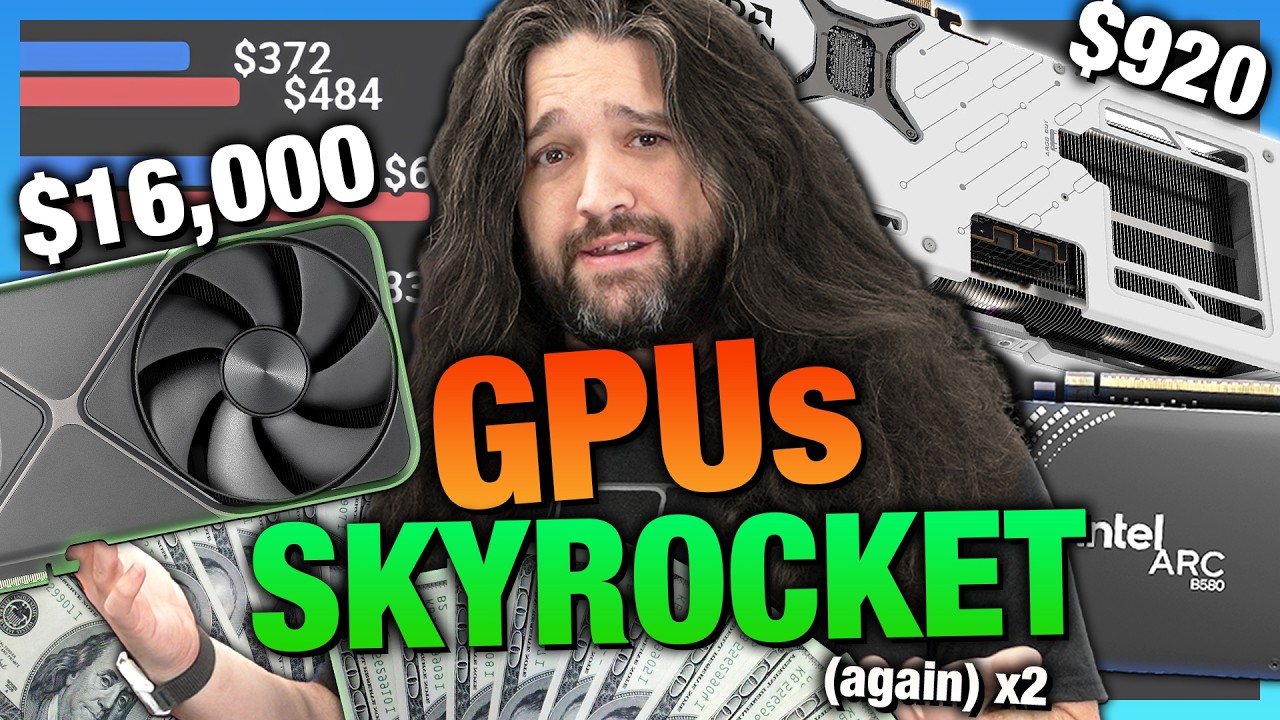
NVIDIA Has GPUs If You Have Coin — Gamers Nexus

Gamers Nexus

Gamers Nexus advises consumers to halt new PC builds as artificial intelligence data center expansion starves memory supply and renders retail graphics card pricing unviable.

AI-assisted summary of NVIDIA Has GPUs If You Have Coin — original source. Check the original for full context.

Source published:

Key ideas

  • NVIDIA graphics cards are now selling at an average of 70% above MSRP, with the flagship RTX 5090 averaging $4,880 in stock—nearly $3,000 or 144% over its baseline list price. (0:01)
  • A severe shortage of GDDR6 and GDDR7 memory driven by AI data center expansion has pushed high-capacity cards (16GB or more) to an average markup of 67% over MSRP, compared to 34% for cards with 12GB or less. (1:53)
  • Add-in board partners are capitalizing on supply narratives, with Jon Peddie Research reporting a 76% surge in year-over-year revenue despite unit shipments rising only 28%. (7:31)
  • Steve Burke explicitly advises against building a new PC under current market conditions unless forced by catastrophic hardware failure or professional compute requirements. (22:13)

Detailed notes

## Background Published on YouTube by Gamers Nexus on September 19, 2026, this report examines consumer graphics card pricing reaching historic highs, led by NVIDIA cards selling on average 70% above MSRP. According to the video description, this worsening market is heavily propelled by an ongoing DRAM availability crisis stemming from AI data center buildouts orchestrated by the GPU manufacturers themselves.

## TL;DR Gamers Nexus analyzes retail pricing data across current-generation GPUs, revealing that in-stock cards have climbed significantly since February 2026, with the RTX 5090 surging to an average street price of $4,880. The escalation is largely driven by soaring GDDR6 and GDDR7 memory costs and vendor-mandated silicon bundles tied to the enterprise AI boom, which disproportionately impacts cards equipped with 16GB or more of VRAM. While AMD and Intel maintain comparatively lower premiums over MSRP, listing availability has contracted unevenly across vendors. Due to these structural market distortions, Steve Burke advises against building a new gaming PC under current conditions, recommending instead that builders hold onto existing hardware or channel their technical curiosity into home networking and privacy-focused homelab projects.

## Atmosphere & style The presentation carries Gamers Nexus's signature blend of data-heavy journalism and deadpan, cynical humor, taking sharp aim at vendor public relations and corporate posturing with dry sarcasm. The emotional tone moves from frustration and grim resignation over runaway component pricing to candid consumer advocacy when Steve explicitly counsels viewers not to buy hardware, despite building PCs being his livelihood. It finishes on an unexpectedly encouraging, rebellious note, channeling enthusiast burnout away from the retail market and toward digital independence, privacy reclamation, and creative hardware repurposing.

## Bulletin - [00:01](https://www.youtube.com/watch?v=vV4fow4JUMk&t=1s) NVIDIA graphics cards are now selling at an average of 70% above MSRP, with the flagship RTX 5090 averaging $4,880 in stock—nearly $3,000 or 144% over its baseline list price. - [01:53](https://www.youtube.com/watch?v=vV4fow4JUMk&t=113s) A severe shortage of GDDR6 and GDDR7 memory driven by AI data center expansion has pushed high-capacity cards (16GB or more) to an average markup of 67% over MSRP, compared to 34% for cards with 12GB or less. - [07:31](https://www.youtube.com/watch?v=vV4fow4JUMk&t=451s) Add-in board partners are capitalizing on supply narratives, with Jon Peddie Research reporting a 76% surge in year-over-year revenue despite unit shipments rising only 28%. - [22:13](https://www.youtube.com/watch?v=vV4fow4JUMk&t=1333s) Steve Burke explicitly advises against building a new PC under current market conditions unless forced by catastrophic hardware failure or professional compute requirements.

## Key takeaways - [00:01](https://www.youtube.com/watch?v=vV4fow4JUMk&t=1s) GPU retail prices across the current generation have escalated significantly over the past six months, leaving the 8GB RX 9060 XT as the sole card to see an average price drop. - [01:53](https://www.youtube.com/watch?v=vV4fow4JUMk&t=113s) NVIDIA and AMD mandate bundled GPU silicon and memory packages to add-in board partners, stripping AIBs of any ability to independently negotiate or source DRAM. - [05:02](https://www.youtube.com/watch?v=vV4fow4JUMk&t=302s) High component costs for 3GB GDDR7 modules ($60 to $70 per chip) have triggered repeated internal delays for NVIDIA's GeForce RTX 50 Super series, preventing the establishment of lower retail baselines. - [07:31](https://www.youtube.com/watch?v=vV4fow4JUMk&t=451s) Jon Peddie Research data reveals that AIB partner revenue grew by nearly 76% year-over-year while volume only increased 28%, indicating retail price hikes far outpace underlying DRAM cost increases. - [09:18](https://www.youtube.com/watch?v=vV4fow4JUMk&t=558s) NVIDIA quietly doubled the direct marketplace price of its RTX Pro 6000 workstation card from $8,565 to $16,000, underscoring its unilateral pricing power when board partners cannot be blamed. - [16:32](https://www.youtube.com/watch?v=vV4fow4JUMk&t=992s) The price premium gap between memory tiers has widened sharply, with 16GB+ cards jumping to 67% over MSRP while sub-16GB cards average 34% over list price. - [18:33](https://www.youtube.com/watch?v=vV4fow4JUMk&t=1113s) NVIDIA's average markup over MSRP expanded to 70%, pulling 42 percentage points ahead of AMD's 28% premium and Intel's 21% premium. - [19:44](https://www.youtube.com/watch?v=vV4fow4JUMk&t=1184s) Retail shelf presence is shifting rapidly, with NVIDIA's share of active in-stock listings dropping from 75% to 66% while AMD expanded to roughly one-third and Intel contracted to just 2%. - [14:30](https://www.youtube.com/watch?v=vV4fow4JUMk&t=870s) Flagship 90-class cards like the RTX 5090 have effectively transitioned into prosumer workstation hardware, incentivizing NVIDIA to anchor future generation MSRPs permanently higher. - [20:35](https://www.youtube.com/watch?v=vV4fow4JUMk&t=1235s) Hoping for an AI bubble burst to normalize GPU pricing carries severe macroeconomic risks, as a broader tech collapse would likely damage consumer employment and discretionary income. - [22:13](https://www.youtube.com/watch?v=vV4fow4JUMk&t=1333s) PC builders are urged to treat current systems like cars and drive them into the ground, salvaging older components or deferring fresh builds entirely until market conditions improve. - [26:13](https://www.youtube.com/watch?v=vV4fow4JUMk&t=1573s) Enthusiasts priced out of modern gaming hardware are encouraged to redirect their technical skills into home labs, local network routing, open-source privacy infrastructure, and smart TV de-telemetry.

## Detailed walkthrough ### [00:01](https://www.youtube.com/watch?v=vV4fow4JUMk&t=1s) NVIDIA, Take the Wheel

NVIDIA GPUs are currently selling at an average of 70% over MSRP, while GPU vendors like NVIDIA and AMD hide behind their add-in board (AIB) partners and pretend they aren't the ones setting the terms. Gamers Nexus has tracked GPU market pricing directly for over a year, and the six-month check-in since their previous update reveals a market that has worsened considerably. Across the board, every single current-generation GPU in stock has seen its average price climb, with the sole exception of the 8GB RX 9060 XT.

The most extreme example is NVIDIA's flagship RTX 5090. Its average in-stock retail price has surged to $4,880—representing a $900 increase over just the past six months. At that price, the RTX 5090 is sitting nearly $3,000 above (or 144% over) its official MSRP. Cards equipped with 16GB or more of VRAM jumped from an average of 44% over MSRP to 67%, while lower-capacity cards (12GB or less) increased from 23% to 34% over MSRP. NVIDIA is the worst offender at 70% over MSRP, while AMD averages 28% over and Intel sits at 21% over. Looking back at Gamers Nexus's November 2025 coverage, Steve had predicted that GPU prices would trend upward rather than downward—a prophecy that would suit a grim Morgan Freeman voiceover: "Things did, in fact, get worse."

- RTX 5090 in-stock average price: $4,880 ($900 jump in 6 months; 144% / ~$3,000 above MSRP). - GPUs with $\ge$16GB VRAM: Average markup increased from 44% to 67% over MSRP. - GPUs with $\le$12GB VRAM: Average markup increased from 23% to 34% over MSRP. - Vendor breakdown over MSRP: NVIDIA at 70%, AMD at 28%, Intel at 21%. - Sole current-gen card escaping in-stock average price hikes: 8GB RX 9060 XT.

---

[01:53](https://www.youtube.com/watch?v=vV4fow4JUMk&t=113s) DRAM Shortage Driving Increases

The primary driver behind the explosive price hikes—particularly on cards packing 16GB or more of VRAM—is the ongoing DRAM shortage hitting the industry. While NVIDIA representatives previously claimed they understand the dire memory situation for consumers and insist they are doing everything they can to help, "the call is coming from inside the house." NVIDIA's own voracious appetite for data center AI hardware is the leading catalyst consuming the memory pool and fueling the AI bubble in the first place.

Recent industry reports from Benchlife indicate NVIDIA increased prices on GDDR6 memory passed along to board partners, piling onto earlier price jumps for GDDR7 modules. United Daily News (UDN) categorized this as the third GPU price hike of the year. Neither NVIDIA nor AMD manufactures memory; they purchase it from suppliers like SK Hynix, Samsung, and Micron, package the memory together with the GPU silicon, and sell the combined kit directly to board partners such as ASUS, MSI, and Gigabyte. The AIBs then mount the bundle onto a PCB with a cooler and provide customer warranty support—"unless they're ASUS." Because vendors mandate purchasing the GPU and memory as a tied bundle, board partners have zero leverage to shop around or negotiate independent memory sourcing.

```mermaid flowchart TD accTitle: GPU Supply Chain and Packaging Flow accDescr: Diagram illustrating how memory and silicon flow from suppliers through GPU vendors and board partners to consumers.

subgraph Upstream["Upstream Component Suppliers"] MEM["Memory Fabricators<br/>(SK Hynix, Samsung, Micron)"] FAB["Foundries / GPU Silicon<br/>(TSMC)"] end

subgraph Vendors["GPU Vendors (Bundle Gatekeepers)"] NVA["NVIDIA & AMD<br/>Combine Silicon + VRAM Bundles"] end

subgraph BoardPartners["AIB Partners"] AIB["Board Partners<br/>(MSI, ASUS, Gigabyte, etc.)<br/>Add PCB, Cooler & Margin"] end

subgraph Retail["Consumer Market"] BUY["End Consumer<br/>Pays Compounded Markup"] end

MEM -->|"GDDR6 / GDDR7 Chips"| NVA FAB -->|"Raw Silicon"| NVA NVA -->|"Mandatory Packaged Bundles<br/>(Priced with vendor markup)"| AIB AIB -->|"Finished Graphics Cards"| BUY ```

According to UDN, 3GB GDDR7 modules have reached between $60 and $70 per chip ($20+ per gigabyte), while standard 2GB GDDR7 chips sit temporarily around $20 ($10 per gigabyte). Consumers pay heavily amplified markups on these costs once boards reach retail. These expensive 3GB chips are designated for halo products like the RTX 5090, RTX Pro 6000, and the long-delayed Super series refresh. MSI Chairman Joseph Hsu (Xu Xiang) confirmed that consumer market shipments are projected to decline 10% to 20% over the year even as average unit prices escalate. By holding off on releasing the Super series, NVIDIA sidesteps having to publish new, painfully high baseline MSRPs that reflect current 3GB memory costs, allowing them to dodge public scrutiny and pretend nothing has changed.

- 3GB GDDR7 chip cost: $60 to $70 per chip (~$20 to $23.33 per GB). - 2GB GDDR7 chip cost: ~$20 per chip (~$10 per GB). - Board assembly structure: Vendors bundle silicon directly with VRAM chips, preventing AIBs from sourcing third-party memory. - Market projection from MSI: Shipments dropping by 10% to 20% year-over-year while per-unit prices rise.

---

[05:02](https://www.youtube.com/watch?v=vV4fow4JUMk&t=302s) Super Series Delay Timeline

The unreleased RTX 50 Super series would ordinarily serve as NVIDIA's mechanism to re-anchor retail pricing tiers, but it has instead been trapped in a continuous loop of delays. The rumored schedule shifted repeatedly across the tech press: initially slated to launch before 2026, then ruled out for CES 2026, then rumored for late Q1/early Q2 2026, deferred to Q3 2026, broadly "pushed back," temporarily reported "back on track" for an early 2027 arrival, and now delayed once more. VideoCardz reported that at least one board partner had received actual GeForce RTX 50 Super hardware before NVIDIA hit the brakes yet again due to memory pricing instability. Rather than inaccurate reporting, these frequent updates reflect NVIDIA shifting its internal roadmap in real time to match component costs.

CNBC reported that 2026 could mark the first year in three decades without an NVIDIA consumer-facing GeForce release. While technically loose in its wording—"it's CNBC, so they have Jim Cramer"—the underlying point holds true: NVIDIA has historically released *something* annually, but 2026 has seen an unprecedented freeze in consumer GPU launches.

---

[06:42](https://www.youtube.com/watch?v=vV4fow4JUMk&t=402s) DEFINITELY COMPETITORS

Simultaneously, AMD notified its board partners that its bundled GPU-and-memory packages would rise in price by at least 10% in August, reportedly holding back until NVIDIA executed its own price hikes first. Steve jokes about how NVIDIA and AMD are fierce, independent rivals who definitely don't align their pricing or benefit from the familial relation between their CEOs, only to cut to a clip of AMD CEO Lisa Su remarking, "In some sense, I think we are probably more aligned than we've ever been, which is actually a really good thing." Steve deadpans in response: "Lisa, really not the best time. I was trying to help you guys out."

---

[07:31](https://www.youtube.com/watch?v=vV4fow4JUMk&t=451s) GPU Public Sales Figures

Hardware manufacturer PC Partner—the parent company behind Zotac, Manli, and Inno3D, as well as a contract manufacturer for AMD and Sapphire—issued formal warnings in a financial filing about persistent headwinds for the second half of 2026. The company cited severe component supply constraints driving up bill-of-materials costs and suppressing end-consumer appetite. PC Partner cautioned that VGA card shipments dropped sharply in the first half of fiscal year 2026 compared to late fiscal year 2025, with shortages expected to hit entry-level graphics cards hardest, directly inflating the average selling price (ASP).

Jon Peddie Research highlighted a striking divergence between volume and gross sales: from Q1 2025 to Q1 2026, add-in board unit shipments grew by roughly 28% year-over-year, while total sales revenue exploded by nearly 76%. Jon Peddie noted that while higher gross revenue doesn't automatically mean higher profits, AIB suppliers appear to be capitalizing on press coverage of memory shortages to hike shelf prices far beyond the actual difference in memory costs. Steve reacts with mock disbelief at the notion that partners like ASUS would ever exploit supply-chain narratives to pad their margins.

- PC Partner financial filing highlights: Substantial drop in H1 FY2026 GPU shipments vs. H2 FY2025; acute scarcity projected for entry-level GPUs. - Jon Peddie Research (Q1 2025 to Q1 2026): AIB unit volume rose ~28% year-over-year, but total dollar sales spiked nearly 76%. - Markup delta: AIB retail pricing increases outpace the actual underlying rise in raw DRAM production costs.

[09:18](https://www.youtube.com/watch?v=vV4fow4JUMk&t=558s) NVIDIA's Silent Price Hikes & The Pro 6000 Benchmark

Calculating the average selling price (ASP) for add-in board (AIB) partners reveals a stark escalation: $668 in Q1 2025 shot up to $918 in Q1 2026—a leap of nearly $250 year-over-year. While NVIDIA refuses to adjust consumer MSRPs despite cards being practically impossible to find at those figures, the company quietly updated its own first-party pricing. On its marketplace, NVIDIA silently increased the price of the RTX Pro 6000 workstation GPU to $16,000, almost doubling its March 2025 launch price of $8,565. This move gives literal meaning to Jensen Huang's past remarks about scarcity being "fantastic for us." The Pro 6000 serves as an unvarnished indicator of NVIDIA's pricing power because, unlike the consumer GeForce stack, NVIDIA cannot hide behind board partners to deflect blame for the markup.

[10:12](https://www.youtube.com/watch?v=vV4fow4JUMk&t=612s) Pricing Methodology: In-Stock vs. Out-of-Stock Data

Gamers Nexus maintains a consistent tracking methodology by pulling all new, first-party Newegg listings for every current GPU generation to compile a market snapshot. The tracking focuses strictly on in-stock listings to reflect what shoppers can actually buy, rather than theoretical availability. - Individual unit counts held by retailers remain unknown; metrics track the count of unique in-stock listings and their active street prices. - Out-of-stock listings are excluded because out-of-stock MSRP cards that have not been available for months or years distort market reality, and some discontinued SKUs (notably from Intel) may never return. - Tracking in-stock listings introduces a slight upward skew because the units left sitting on digital shelves are often the higher-priced cards consumers refuse to buy, yet they remain the sole real-world purchase option.

[11:22](https://www.youtube.com/watch?v=vV4fow4JUMk&t=682s) In-Stock Average Prices: The GDDR7 Inflation Gap

Comparing current in-stock averages to snapshots taken in February reveals that nearly every card has climbed higher. The AMD Radeon RX 9060 XT 8 GB stands as the lone exception, dropping a nominal $15—an indication that bottom-tier demand is finally dragging down prices. Entry and midrange options like the Intel Arc Battlemage B570 and B580, the Radeon RX 9070, RX 9070 XT, and RX 9060 XT 16 GB, alongside NVIDIA's RTX 5050, saw modest hikes between $10 and $46.

Further up the product stack, every NVIDIA card (excluding the 5050 and 5090) increased by $96 to $306 since February. The RTX 5090 saw its average in-stock price surge by an extra $900. A primary hardware driver behind this disproportionate jump is NVIDIA's reliance on GDDR7 memory across its lineup, whereas AMD and Intel still utilize older GDDR6. Beyond memory technology, Gamers Nexus points out plain corporate greed: NVIDIA is actively generating the data center scarcity that strains consumer availability, leaving the retail market with effectively nothing at official MSRP.

```mermaid flowchart TD accTitle: Retail GPU Price Trajectory by Architecture Tier accDescr: Visual flowchart outlining price movements from February to September 2026 across different GPU lines based on memory architecture.

subgraph Modest["Modest Increases & Outliers ($10 to $46)"] A["RX 9060 XT 8GB<br/>(-$15 Drop)"] B["Intel Battlemage B570 / B580<br/>(+ $10 to $46)"] C["RX 9070 / 9070 XT / RTX 5050<br/>(+ $10 to $46)"] end

subgraph HighEnd["GDDR7 & NVIDIA Escalation ($96 to $900+)"] D["Mainstream NVIDIA 50-Series<br/>(+$96 to +$306)"] E["RTX 5090 Flagship<br/>(+$900 In-Stock Average)"] end

A -.-> D B --> D C --> D D --> E ```

[12:27](https://www.youtube.com/watch?v=vV4fow4JUMk&t=747s) Retail Availability & Listing Depletion

Stock health is evaluated by the number of unique board partner models available per GPU. While not a direct tally of warehouse inventory, the count of active listings illustrates relative availability: - **Widest Availability:** The RTX 5080, RTX 5060 Ti 8 GB, and Radeon RX 9070 XT tied at the top, each boasting 15 distinct model listings in stock. - **Extreme Scarcity:** The RTX 5050, RTX 5090, RX 9060 XT 8 GB, and Intel Arc Battlemage cards bottomed out with three or fewer models in stock. - Intel's presence has cratered post-Battlemage launch; maintaining three or fewer listings across the board severely undermines any effort to gain desktop market share.

[13:24](https://www.youtube.com/watch?v=vV4fow4JUMk&t=804s) Percentage Over MSRP & The Prosumer Shift

Calculating the percentage premium of in-stock prices against MSRP exposes massive vendor divides. The AMD Radeon RX 9070 GRE was the only GPU matching its baseline MSRP, though AMD achieved this via marketing sleight of hand by pegging it to the same $550 launch price as the faster RX 9070 non-GRE. Intel Arc Battlemage models sat 18% to 24% over MSRP, while mainstream Radeon offerings hovered between 26% and 45% over sticker price.

``` +--------------------------+-----------------------+ | GPU Model / Family | Average % Over MSRP | +--------------------------+-----------------------+ | Radeon RX 9070 GRE | 0% (At $550 MSRP) | | Intel Battlemage (B-Gen) | 18% - 24% | | AMD Radeon (Mainstream) | 26% - 45% | | NVIDIA RTX 5060 - 5080 | 57% - 86% | | NVIDIA RTX Pro 6000 | ~87% over launch | | NVIDIA RTX 5090 | 144% | +--------------------------+-----------------------+ ```

NVIDIA's gaming stack—including the RTX 5070 Ti, 5070, 5060, 5080, and the 16 GB 5060 Ti—ran 57% to 86% over MSRP. The RTX 5090 blew past the rest of the market at 144% over its list price. This extreme markup stems from AMD abandoning the ultra-enthusiast tier and the 5090 standing as the only consumer card offering more than 16 GB of VRAM.

This divide indicates that future xx90 cards (like an RTX 6090) are being systematically transformed into prosumer workstation hardware. Much like the Titan series of old, cards like the 4090 and 5090 are de facto workstation boards masquerading as consumer gaming products. If the RTX 5090 commands $4,000 to $5,000 on the open market, NVIDIA has little incentive to launch a successor at $2,000; raising baseline MSRPs to $2,500, $3,000, or $4,000 and marketing them toward local AI and creator workflows would formally cement this market tier.

[15:51](https://www.youtube.com/watch?v=vV4fow4JUMk&t=951s) Absolute Dollar Increases Over MSRP

Evaluating absolute dollar premiums demonstrates the heavy penalty on higher-tier cards: - Midrange GPUs from AMD and Intel generally carry absolute markups of $100 to $200 over launch pricing. - NVIDIA cards configured with 12 GB to 16 GB of VRAM demand premiums ranging from $340 to $800 above MSRP. - The RTX 5090 is an extreme outlier, with average in-stock units selling for nearly $3,000 over MSRP. - NVIDIA's RTX Pro 6000 workstation card logs an absolute markup of $8,435 over its launch figure.

[16:32](https://www.youtube.com/watch?v=vV4fow4JUMk&t=992s) Memory Capacity Divide: 16 GB vs. Sub-16 GB Trends

Historical snapshots across June 2025, November 2025, February 2026, and the present highlight a widening split based on VRAM capacity. November 2025 marked the absolute trough and the best buying window of the cycle. At that time, initial launch hysteria had settled and impending tariff impacts had flattened demand right before the current DRAM shortage hit full force.

While premium AIB models historically command modest markups for upgraded VRMs, hybrid coolers, or extreme overclocking features, today's pricing diverges sharply from the normal variance seen during the GTX 10-series, RTX 20-series, or RTX 30-series eras. Base-MSRP cards have vanished, and memory configuration dictates the premium: - **Cards with ≤12 GB VRAM:** Started 25% over MSRP in June 2025, dropped to 3% over in November, rebounded to 23% in February 2026, and now sit at 34% over MSRP. - **Cards with ≥16 GB VRAM:** Sat 33% over MSRP in June 2025, declined to 19% in November, rose to 44% in February, and spiked to 67% over MSRP currently.

High-capacity memory has become the primary driver of retail inflation, systematically penalizing buyers who require 16 GB or more for gaming and workstation tasks.

[18:33](https://www.youtube.com/watch?v=vV4fow4JUMk&t=1113s) Vendor Comparison: NVIDIA vs. AMD Price Premiums

Tracking vendor-level averages over time demonstrates how NVIDIA card prices decoupled from the rest of the market throughout 2025 and 2026: - **NVIDIA:** Sat at 29% over MSRP in June 2025, dipped to 15% in November, jumped to 39% in February 2026, and accelerated to an average of 70% over MSRP in the latest snapshot. - **AMD:** Averaged 21% over MSRP in June 2025, dropped to 7% in November, climbed to 32% in February, and softened slightly to 28% over MSRP currently.

[19:01](https://www.youtube.com/watch?v=vV4fow4JUMk&t=1141s) NVIDIA vs. AMD vs. Intel: Price Premium Over MSRP

AMD managed to keep its retail markup under control in part through strategic product positioning, specifically by pricing the Radeon RX 7900 GRE very close to the Radeon RX 7900 XT. That pricing ceiling effectively forced board partners to maintain the lower MSRP on the GRE model. Intel, meanwhile, charted an erratic course across the tracking period. In June 2025, Intel Arc cards averaged an oddly high 49% over MSRP, though that figure was heavily distorted by several overpriced Gunnir partner listings. By November 2025, Intel prices dropped to an impressive low of just 3% over MSRP, before rebounding to 17% in February 2026 and creeping up to roughly 21% over MSRP in the latest snapshot.

The pricing gap between the two major GPU makers has widened into a chasm. Between June 2025 and February 2026, NVIDIA’s average premium over MSRP sat roughly 7 to 8 percentage points higher than AMD's. In the latest dataset, however, that spread exploded: NVIDIA's average percentage over MSRP is now 42 percentage points greater than AMD's, underscoring how aggressively NVIDIA pricing has decoupled from its original targets compared to the rest of the market.

| Vendor | June 2025 (% Over MSRP) | November 2025 (% Over MSRP) | February 2026 (% Over MSRP) | Latest Snapshot (% Over MSRP) | |:--- |:--- |:--- |:--- |:--- | | **NVIDIA** | ~7–8% higher than AMD | Close to MSRP | ~7–8% higher than AMD | **42% higher than AMD** | | **Intel** | 49% (inflated by Gunnir) | 3% | 17% | 21% | | **AMD** | Baseline competitive | Near MSRP | Baseline competitive | Significantly lower premium |

---

[19:44](https://www.youtube.com/watch?v=vV4fow4JUMk&t=1184s) Market Availability and In-Stock Share by Vendor

Looking at the distribution of total in-stock GPU model listings across vendors highlights significant shifts in retail shelf presence, even if raw unit production volumes remain proprietary. Since June 2025, NVIDIA’s share of total in-stock listings has steadily eroded from roughly 75% down to 66%. In practical terms, NVIDIA went from representing three out of every four available model listings on retailer shelves to two out of three.

```mermaid flowchart TD accTitle: Retail GPU In-Stock Listing Share Trends accDescr: Visual breakdown of vendor retail availability share shifting between June 2025 and late 2026.

subgraph June2025["June 2025 Listing Share"] NV_Old["NVIDIA: ~75% (3 in 4 listings)"] AMD_Old["AMD: 15%"] INT_Old["Intel: ~10% (Peak)"] end

subgraph Late2026["Late 2026 Listing Share"] NV_New["NVIDIA: 66% (2 in 3 listings)"] AMD_New["AMD: ~33% (Nearly 1 in 3)"] INT_New["Intel: ~2% (Near Non-Existent)"] end

NV_Old -->|"Gradual decline"| NV_New AMD_Old -->|"Steady market climb"| AMD_New INT_Old -->|"Severe contraction"| INT_New ```

In stark contrast, AMD has steadily captured retail listing share over the same timeframe. AMD cards accounted for just 15% of in-stock model listings in June 2025, but have climbed to just under a third of all listings today. Intel has moved in the opposite direction: after peaking at nearly 10% of available model listings in June 2025, Intel Arc availability has withered to barely over 2%. Over the course of a single year, AMD dramatically expanded its presence on digital storefronts, while Intel has been reduced to near non-existence.

---

[20:35](https://www.youtube.com/watch?v=vV4fow4JUMk&t=1235s) Conclusion: Structural Market Shifts and the AI Bubble

The fact that graphics card prices are still climbing a year and a half after launch points to a deeper, permanent structural transformation in the consumer GPU landscape. While NVIDIA historically tends to ratchet prices upward with successive architectures—punctuated by rare resets, such as the RTX 30-series adjusting downward from the RTX 20-series—current market behavior suggests launch MSRPs for next-generation products will be significantly higher. As Steve puts it plainly: "There's really no reason to launch a flagship at $2,000 MSRP if it can steadily sell at $4,000 to $5,000."

NVIDIA has already demonstrated this pricing power directly with cards like the Blackwell-based RTX 6000 Ada/Blackwell generation workstation models; because NVIDIA is the sole seller of that hardware, it was forced to adjust the MSRP upward directly rather than blaming partner markup. In Steve's view, the only external force capable of puncturing this pricing spiral would be an outright collapse of the AI market bubble.

However, relying on an AI bubble burst to fix GPU pricing is a dangerous proposition. The scale of the enterprise AI buildout means that a collapse would not be an isolated correction for PC gaming components; it would trigger a severe, broad macroeconomic shock. While Steve caveats that he is not an economist, an economic contagion that resets consumer prices would simultaneously leave consumers without the jobs or disposable income needed to buy hardware anyway.

---

[22:13](https://www.youtube.com/watch?v=vV4fow4JUMk&t=1333s) The Buying Dilemma: Why Steve Advises Against PC Building

Gamers Nexus generally avoids forecasting price trajectories, but the current data strongly indicates that pricing will either plateau at these highs or worsen before any relief arrives. While there were viable buying windows over the past year—most notably in November 2025, when parts were selling close to baseline MSRP—purchasing hardware in the current environment makes virtually no financial sense. Steve explicitly advises viewers against building a PC right now unless they are facing an outright hardware failure, require high-performance compute for their livelihood, or possess enough disposable income to absorb the expense without worrying about unexpected unemployment.

Steve acknowledges the irony of his position, noting, "I make money if you build computers, right? I'm saying that. So, I don't think it makes sense to build computers right now, except for in those very rare instances." The double blow of inflated GPU pricing and the compounding DRAM shortage has ruined the value proposition of the hobby. While companion components like PC cases and CPU coolers are enjoying historically low prices, the core computing silicon makes a fresh system build unviable.

- **Scavenging Alternatives:** Builders determined to assemble a system should salvage existing components where possible, such as carrying over an older RTX 30-series card or repurposing DDR5 memory from an unused system to pair with affordable modern cases and coolers. - **The "Car" Analogy:** Steve compares modern PCs to vehicles—expensive capital investments where the best strategy is to "drive it into the ground" until the hardware simply cannot run anymore. - **Historical Perspective:** Steve reflects on the late tech journalist Gordon Mah Ung, who spent decades reporting on recurring industry claims about the "death of the PC" that never materialized, though Steve admits current structural headwinds feel uniquely hostile to ordinary enthusiasts. - **Upcoming Channel Projects:** Upcoming Gamers Nexus investigations and reviews include component price roundups, the Fractal Summit case review, an LG smart TV privacy deep-dive, and hands-on guides for DIY routers and self-hosted VPNs under the viewer-funded "Data Dragnet" initiative.

---

[26:13](https://www.youtube.com/watch?v=vV4fow4JUMk&t=1573s) A Positive Message: Redirecting Hardware Passion to Home Labs and Privacy

Steve closes the update by reiterating an encouraging takeaway for hobbyists feeling priced out of PC gaming. While the economics of DIY gaming rigs are broken, the core enthusiast drive—the curiosity to learn, tinker, dismantle, and understand computing technology—remains completely intact. Instead of abandoning the hobby, Steve encourages enthusiasts to redirect that energy toward home lab systems, local network infrastructure, and digital privacy.

Building self-hosted home infrastructure does not require high-end, overpriced graphics cards. Enthusiasts can easily pull retired hardware out of storage—such as an older ATX platform, an old NVIDIA GeForce GTX 700-series card, or an AMD Radeon RX 480 or RX 580—drop in an inexpensive network interface card (like a 10Gb NIC), and transform it into a dedicated open-source router or VPN gateway.

- **Ditching "Spy Routers":** Building a custom router allows users to reclaim network privacy from commercial routers loaded with telemetry and background monitoring. - **Smart TV Liberation:** Enthusiasts can focus their tinkering on rooting smart TVs to strip out integrated ad systems and telemetry, or assembling local open-source media appliances. - **Local Cloud Storage:** Setting up local network-attached storage or personal cloud instances provides a direct path to migrate personal data off proprietary cloud ecosystems like Google Drive. - **Accessible Engineering:** These projects offer deep exposure to network engineering, Linux environments, and software configuration at minimal cost using parts users already own.

Steve concludes that while this is a terrible time to build a dedicated gaming PC, it remains a fantastic time to apply enthusiast skills toward digital independence and privacy, thanking supporters who back GN via Patreon and store.gamersnexus.net for funding their investigative reporting.

## Notable quotes > [00:01](https://www.youtube.com/watch?v=vV4fow4JUMk&t=1s) Things did, in fact, get worse. — Steve Burke

> [01:53](https://www.youtube.com/watch?v=vV4fow4JUMk&t=113s) the call is coming from inside the house. — Steve Burke

> [01:53](https://www.youtube.com/watch?v=vV4fow4JUMk&t=113s) unless they're ASUS. — Steve Burke

> [05:02](https://www.youtube.com/watch?v=vV4fow4JUMk&t=302s) it's CNBC, so they have Jim Cramer — Steve Burke

> [06:42](https://www.youtube.com/watch?v=vV4fow4JUMk&t=402s) In some sense, I think we are probably more aligned than we've ever been, which is actually a really good thing. — Lisa Su

> [06:42](https://www.youtube.com/watch?v=vV4fow4JUMk&t=402s) Lisa, really not the best time. I was trying to help you guys out. — Steve Burke

> [09:18](https://www.youtube.com/watch?v=vV4fow4JUMk&t=558s) fantastic for us. — Jensen Huang

> [20:35](https://www.youtube.com/watch?v=vV4fow4JUMk&t=1235s) There's really no reason to launch a flagship at $2,000 MSRP if it can steadily sell at $4,000 to $5,000. — Steve Burke

> [22:13](https://www.youtube.com/watch?v=vV4fow4JUMk&t=1333s) I make money if you build computers, right? I'm saying that. So, I don't think it makes sense to build computers right now, except for in those very rare instances. — Steve Burke

> [22:13](https://www.youtube.com/watch?v=vV4fow4JUMk&t=1333s) drive it into the ground — Steve Burke

## Mentioned Thermal Grizzly Duronaut, Gamers Nexus, Steve Burke, Tim Phetdara, Tannen Williams, NVIDIA, AMD, Intel, RTX 5090, RX 9060 XT, SK Hynix, Samsung, Micron, TSMC, ASUS, MSI, Gigabyte, Benchlife, United Daily News (UDN), RTX Pro 6000, Joseph Hsu (Xu Xiang), VideoCardz, CNBC, Jim Cramer, Lisa Su, PC Partner, Zotac, Manli, Inno3D, Sapphire, Jon Peddie Research, Jensen Huang, Newegg, Intel Arc Battlemage B570, Intel Arc Battlemage B580, Radeon RX 9070, Radeon RX 9070 XT, RTX 5050, RTX 5080, RTX 5060 Ti, Radeon RX 9070 GRE, RTX 5070 Ti, RTX 5070, RTX 5060, RTX 6090, Titan series, RTX 4090, GTX 10-series, RTX 20-series, RTX 30-series, Radeon RX 7900 GRE, Radeon RX 7900 XT, Gunnir, RTX 6000 Ada, Gordon Mah Ung, Fractal Summit, LG, GeForce GTX 700-series, Radeon RX 480, Radeon RX 580, Google Drive

## Video description Sponsor: Thermal Grizzly Duronaut on Amazon - https://geni.us/tpgcPMw GPU prices have become a meme, with NVIDIA leading the pack at (on average) 70% over listed MSRP for its consumer and gaming video cards. AMD and Intel are likewise running higher prices than previously, reaching new highs for GPU prices in our year-long series tracking them. November of 2025 seems like it was the best time to buy, with prices now climbing even past what we saw in February of 2026. This continues to get worse with thanks to the ongoing DRAM availability crisis thanks to AI data center buildout -- one largely caused by the very companies that make the consumer GPUs.

The best way to support our work is through our store: https://store.gamersnexus.net/

Like our content? Please consider becoming our Patron to support us: http://www.patreon.com/gamersnexus

TIMESTAMPS

00:00 - NVIDIA, Take the Wheel 01:53 - DRAM Shortage Driving Increases 05:02 - Super Series Delay Timeline 06:42 - DEFINITELY COMPETITORS 07:31 - GPU Public Sales Figures 10:12 - Price Methodology 11:22 - Average Price Comparison of In Stock GPUs 12:27 - GPU Availability 13:24 - Percent Over MSRP 14:30 - The 90-Class Moves to Workstation and AI 15:51 - Dollar Amount Over MSRP 16:32 - 16GB vs Lower VRAM Price Over MSRP 18:33 - NVIDIA vs AMD vs Intel Price Over MSRP 19:44 - Availability by Vendor 20:35 - Conclusion 26:13 - A Positive Message from Steve

** Please like, comment, and subscribe for more! **

Links to Amazon and Newegg are typically monetized on our channel (affiliate links) and may return a commission of sales to us from the retailer. This is unrelated to the product manufacturer. Any advertisements or sponsorships are disclosed within the video ("this video is brought to you by") and above the fold in the description. We do not ever produce paid content or "sponsored content" (meaning that the content is our idea and is not funded externally aside from whatever ad placement is in the beginning) and we do not ever charge manufacturers for coverage.

Follow us in these locations for more gaming and hardware updates:

t: http://www.twitter.com/gamersnexus f: http://www.facebook.com/gamersnexus w: http://www.gamersnexus.net/

Our policies, processes, and ethics statements relating to review samples, advertising, travel, errors, and more are transparently and publicly available on this page: https://gamers.nexus/ethics-statements

Steve Burke: Host, Additional Writing Tim Phetdara: Editing Tannen Williams: Writing

[Source](https://www.youtube.com/watch?v=vV4fow4JUMk)

中文简报

AI需求挤压DRAM供应,英伟达GPU零售溢价达70% Gamers Nexus建议消费者暂缓装机,称人工智能数据中心的扩张导致显存供应匮乏,零售显卡价格已难以为继。 Gamers Nexus分析了当前世代GPU的零售定价数据,指出自2026年2月以来现货显卡价格显著攀升,其中RTX 5090的平均实际售价已飙升至4,880美元。价格上涨主要是由于GDDR6和GDDR7显存成本激增,以及与企业级AI热潮捆绑的芯片销售政策所致,这对配备16GB或更多显存的显卡造成了不成比例的影响。虽然AMD和Intel相比建议零售价(MSRP)的溢价幅度相对较低,但各厂商在售货源的收缩程度并不均衡。鉴于这种结构性市场扭曲,Steve Burke建议不要在当前条件下组装新的游戏PC,并建议装机爱好者继续使用现有硬件,或将技术兴趣转向家庭网络及注重隐私的Homelab项目。 NVIDIA显卡目前的平均售价比建议零售价(MSRP)高出70%,其中旗舰型号RTX 5090现货均价达4,880美元,比基础建议售价高出近3,000美元,溢价达144%。 (0:01) 受AI数据中心扩张推动,GDDR6和GDDR7显存严重短缺,导致大容量显卡(16GB或以上)相比MSRP平均加价67%,而12GB或以下显卡的溢价为34%。 (1:53) 显卡合作品牌厂商(AIB)正在利用供应短缺说法获利,Jon Peddie Research报告称,尽管显卡出货量同比仅增长28%,但厂商营收却同比激增76%。 (7:31) Steve Burke明确建议在当前市场环境下不要组装新电脑,除非由于灾难性的硬件故障或专业计算需求而被迫进行。 (22:13)

Reading summary

Gamers Nexus reports that retail graphics card prices have climbed substantially above MSRP, driven by an industry-wide DRAM shortage, mandatory vendor component bundling, and enterprise AI demand. With NVIDIA hardware seeing the steepest premiums, the outlet argues consumer flagships are being permanently repositioned as workstation hardware, making complete PC builds economically unviable for typical consumers. Escalating Retail Markups and High-VRAM Premiums (0:01) Tracking of first-party in-stock Newegg listings shows that current-generation GPU retail prices have climbed across nearly every segment. NVIDIA graphics cards lead the inflation at an average of 70% above MSRP, compared to AMD at 28% and Intel at 21%. Cards equipped with 16GB or more of VRAM saw average markups rise from 44% to 67% over MSRP, whereas models with 12GB or less averaged a 34% premium. The sole current-generation card avoiding an in-stock price increase was the 8GB Radeon RX 9060 XT, which dropped by $15. The sharpest increase occurred at the flagship tier. The RTX 5090 reached an average in-stock price of $4,880, sitting roughly $3,000 (or 144%) above MSRP after climbing $900 over six months. Gamers Nexus attributes part of this gap to NVIDIA's architectural reliance on expensive GDDR7 memory, whereas AMD and Intel mainstream cards continue using GDDR6. Across the market, cards with 12GB to 16GB of VRAM carry premiums of $340 to $800 over MSRP, while midrange AMD and Intel options show absolute markups between $100 and $200. Memory Shortages and Mandatory Vendor Bundling (1:53) The broader pricing surge is driven by a DRAM shortage catalyzed by the enterprise AI buildout, which Gamers Nexus notes NVIDIA's own data center hardware is actively consuming. Neither NVIDIA nor AMD manufactures memory; both purchase GDDR modules from SK Hynix, Samsung, and Micron, bundle the memory with their GPU silicon, and sell the packaged kit directly to add-in board (AIB) partners like ASUS, MSI, and Gigabyte. Because vendors mandate this tied bundle, board partners possess zero leverage to source memory independently. Component pricing has escalated sharply. Industry reports from United Daily News indicate 3GB GDDR7 modules cost $60 to $70 per chip ($20+ per gigabyte), compared to roughly $20 for standard 2GB chips. AIB pricing has outrun component costs: Jon Peddie Research found that between Q1 2025 and Q1 2026, AIB unit shipments grew 28% year-over-year while gross sales revenue jumped nearly 76%, driving average selling prices from $668 to $918. PC Partner also issued formal financial warnings citing component supply constraints, falling first-half shipments, and rising production costs. Delayed Product Refreshes and Direct Price Hikes (5:02) To avoid publishing higher baseline MSRPs that reflect current 3GB GDDR7 memory costs, NVIDIA has repeatedly postponed its RTX 50 Super series, shifting projected release windows across 2026 into 2027. Gamers Nexus argues this delay shields NVIDIA from public scrutiny over inflated baseline pricing. VideoCardz reported that at least one board partner received physical Super hardware before NVIDIA halted the launch due to memory pricing instability. Where NVIDIA sells hardware directly, it has raised prices without board partner mediation. On its first-party marketplace, NVIDIA increased the price of the RTX Pro 6000 workstation GPU from its $8,565 launch price to $16,000. Gamers Nexus argues that because AMD has stepped back from the ultra-enthusiast tier, NVIDIA has little economic incentive to price future xx90 flagships at traditional consumer price points when existing halo cards consistently command between $4,000 and $5,000 as prosumer and local AI accelerators. Retail Listing Shifts and Buyer Guidance (19:44) Retail availability has shifted substantially across vendors. Between June 2025 and late 2026, NVIDIA’s share of total in-stock Newegg model listings dropped from roughly 75% to 66%. AMD expanded its share from 15% to nearly 33%, while Intel Arc listings cratered from roughly 10% to just over 2%. Models like the RTX 5080, RTX 5060 Ti 8GB, and RX 9070 XT held the widest availability with 15 listings each, whereas Intel models and the RTX 5090 sat at three or fewer active listings. Due to inflated GPU and DRAM pricing, Gamers Nexus explicitly advises viewers against building a PC unless required for work or hardware replacement. Host Steve compares modern PCs to vehicles that owners should operate until mechanical failure, recommending that enthusiasts instead repurpose older hardware for local network storage, DIY routers, and home privacy labs. He also cautions that relying on an AI bubble collapse to lower GPU pricing could trigger broader macroeconomic disruption that would erode consumer disposable income regardless. Gamers Nexus concludes that graphics card pricing reflects a permanent structural shift rather than a temporary spike, leaving consumers with high price floors. It remains unresolved whether upcoming hardware generations will officially codify these elevated retail prices into higher baseline MSRPs or whether demand will contract enough to enforce a market correction.

Source quotes

[0:01] Steve Burke: Things did, in fact, get worse. [1:53] Steve Burke: the call is coming from inside the house. [1:53] Steve Burke: unless they're ASUS. [5:02] Steve Burke: it's CNBC, so they have Jim Cramer [6:42] Lisa Su: In some sense, I think we are probably more aligned than we've ever been, which is actually a really good thing. [6:42] Steve Burke: Lisa, really not the best time. I was trying to help you guys out. [9:18] Jensen Huang: fantastic for us. [20:35] Steve Burke: There's really no reason to launch a flagship at $2,000 MSRP if it can steadily sell at $4,000 to $5,000. [22:13] Steve Burke: I make money if you build computers, right? I'm saying that. So, I don't think it makes sense to build computers right now, except for in those very rare instances. [22:13] Steve Burke: drive it into the ground

Original transcript

[0:01] Nvidia GPUs are currently on average 70% [0:04] over MSRP, but Nvidia and AMD get to [0:07] hide behind their board partners and [0:08] pretend that they're not the ones in [0:10] control. So, MSI take the wheel. We've [0:12] been tracking GPU prices directly for [0:14] over a year now, and it's been 6 months [0:16] since our last GPU pricing update. [0:18] Things have gotten worse since then. To [0:20] quickly recap today's findings, since [0:22] collecting prices 6 months ago, aside [0:23] from the 8 GB RX960 XT, in stock, [0:26] average prices have increased for all [0:28] current gen GPUs. The RTX5090's in stock [0:31] average price is now an absurd urb [0:32] $4,880, an increase of $900 in the last [0:35] 6 months, making it nearly $3,000 more [0:37] than or 144% greater than its MSRP. [0:40] Average percent over MSRP increased from [0:42] 44% to 67% for GPUs with 16 GB or more [0:46] VRAM and increased from 23% to 34% for [0:49] GPUs with 12 GB or less VRAM. An average [0:52] percent over MSRP for Nvidia GPUs [0:54] skyrocketed from 39% in February of this [0:56] year to 70% over MSRP currently. Of all [0:59] the increases, Nvidia GPUs are the worst [1:01] offender with its 70%. AMD is at 28% [1:04] over MSRP and Intel's at 21% over MSRP. [1:07] For perspective on how this has all [1:08] changed over the last year, here's what [1:10] we said back in November of 2025. My [1:13] guess is that the GB prices will [1:16] probably trend up, not down going [1:18] forward. This is where if we had the [1:20] budget for a voiceover narrator like [1:21] Morgan Freeman, it would come in in the [1:23] script as narrator. Things did in fact [1:27] get worse. Before that, this video is [1:29] brought to you by Thermal Grizzly and [1:30] their new Duronaut thermal paste. [1:32] Thermal Grizzly claims its Duronaut [1:33] paste is intended for long-term [1:35] stability and endurance, focusing on [1:37] paste longevity in addition to the usual [1:39] performance focus. Thermal Grizzly's [1:41] Duronaut paste comes with applicators [1:43] and spreaders and ships in numerous tube [1:45] sizes aiming to provide a high-end paste [1:48] for PC builds and daily driven [1:49] overclocks by enthusiasts. Learn more at [1:52] the link in the description below. The [1:53] fact that GPUs with greater than or [1:55] equal to 16 GB of VRM have seen the [1:57] biggest track average% increase over [1:59] MSRP illustrates the core issue. [2:02] Ultimately, most of these price [2:04] increases come down to the memory [2:05] shortage, if you can call it that, that [2:07] continues to plague the rest of the [2:09] industry. Now, I've said this before, [2:10] but when we spoke with some Nvidia [2:12] people previously, they did mention that [2:14] they knew the memory situation was bad [2:16] for consumers and they're doing [2:18] everything they can do to help. And it's [2:20] just like again the the calls coming [2:22] from inside of the house on that one. [2:24] But uh within the last 2 months, [2:26] Benchife reported that Nvidia raised the [2:28] price of GDDR6 VRAM passed on to AIB [2:31] partners in addition to the GDDR7 [2:33] modules that had already increased [2:34] prices for which UDN claims is quote the [2:37] third price increase for graphics cards [2:39] this year. End quote. For context, [2:40] Nvidia and AMD, of course, they don't [2:42] make the memory, but they buy it from [2:44] SKH High, Samsung, and Micron. Then they [2:46] package that with the GPU itself, which [2:48] they don't technically make, but it's [2:50] under their control, unlike, you know, [2:51] the memory is not directly their [2:52] control. They package those together. [2:54] They sell the package to board partners [2:56] like ASUS, MSI, Gigabyte, and so on. The [2:58] board partners put it all onto a PCB [3:00] with a cooler. Uh, should supply some [3:02] kind of support or warranty sometimes, [3:05] unless they're ASUS. And then that's [3:07] kind of how it works. Uh, the fact that [3:09] the GPU vendors bundle in the memory [3:12] with the GPU itself though gives them [3:13] even greater control over the pricing. [3:16] It means that the partners, they don't [3:18] really get to go out and source their [3:19] own memory. Now, to be fair, I guess [3:21] some of them might not be large enough [3:23] to even source their own memory at this [3:24] point because even companies like Valve [3:26] have stated they have issues getting [3:27] memory supply for things, but GN has [3:29] confirmed that it works this way with [3:30] the AI partners where they buy the [3:32] package from at least Nvidia directly, [3:34] and when that price goes up, the whole [3:36] thing goes up. UDN notes, quote, "At [3:38] present, the price of a 3 GB GDR7 chip [3:40] has risen to between $60 and $70, while [3:43] the standard 2 GB GDR7 chip is [3:46] temporarily priced at $20." End quote. [3:48] making the cost per gigabyte around $20 [3:50] for the three gigabyte module and $10 [3:52] for the two gigabyte module. Of course, [3:54] consumers will pay a multiplier on that [3:56] when buying the completed product. [3:58] Higher density modules like those 3 GB [4:00] modules are found in the RTX 1590, the [4:02] RTX Pro 6000 and would be or would have [4:05] been found in the super series GPUs. But [4:08] of course, Nvidia is largely to blame [4:10] for the memory price increases because [4:12] despite not making memory directly, it [4:14] is the largest driver of the AI bubble [4:16] and the consumption of that memory. UDN [4:18] also reported that MSI chairman Ko Shuan [4:20] said that the shipments of consumer [4:22] market products will decline by 10 to [4:24] 20% this year, but the unit price will [4:26] increase. End quote. And that's why the [4:27] Super series hasn't shown up yet, as [4:29] they're heavily rumored to use the [4:30] disproportionately expensive 3 GB [4:32] modules. And I I personally think that [4:35] it's also because Nvidia would be forced [4:37] to reckon with their fake MSRP at that [4:40] point. And they really don't want to [4:41] look bad by launching the Super Series [4:44] at a significantly elevated MSRP than [4:46] the current 50 series. So they get to [4:48] pretend that nothing has changed by [4:50] doing nothing at all instead. But let's [4:52] get a little deeper into the GB pricing [4:54] situation. So we'll start with the [4:55] lingering super series since that would [4:57] have set the tone for all of this at [4:58] this point. And usually that would be [5:00] the mechanism to reset the prices by [5:01] Nvidia. Here's that timeline. Initially, [5:03] Nvidia's 50 series super GPUs were quote [5:05] rumored to appear before 2026. End [5:07] quote. Then unlikely to appear by CES [5:09] 2026, then quote between late Q1 and [5:12] early Q2 2026 end quote. Then release [5:15] was reportedly delayed to third quarter [5:17] 2026. Then simply quote pushed back end [5:19] quote. Then the release was quote back [5:20] on track and quote with a quote rumored [5:22] early 2027 launch. End quote. Now, Video [5:25] Cards reports that quote, "At least one [5:26] Nvidia board partner has already [5:28] received GeForce RTX50 Super Graphics [5:30] cards," end quote, but claims that [5:31] Nvidia is once again delaying release [5:33] due to VRAM prices. Now, the thing with [5:35] this is I don't think Video Cards got [5:37] those reports wrong. Video Cards has a [5:38] pretty damn good track record with this [5:40] stuff. I think it actually just changed [5:42] that much and that frequently uh and in [5:45] real time. Interestingly, CNBC commented [5:48] back in April, quote, "If analyst [5:50] predictions are correct, 2026 will be [5:52] the first year in three decades that [5:53] Nvidia doesn't release a new generation [5:55] of its consumer-facing GeForce line of [5:57] graphics processing units." End quote. [5:58] There are some caveats to that. The main [6:00] one being that it as written, it is not [6:03] technically correct, but you know, it's [6:07] CNBC, so they have Jim Kramer. Anyway, [6:10] it has historically at least launched [6:12] something is what I think they were [6:14] trying to say per year. Not always a new [6:17] generation of consumer graphics. That's [6:19] not been true for a while now, but you [6:21] typically get something coming out. And [6:23] what is true is that nothing has come [6:26] out. So, at least that much is accurate. [6:30] Video cards also disclosed that AMD [6:32] informed its board partners, quote, that [6:33] prices for GPU and graphics memory [6:35] bundles will increase by at least 10% in [6:37] August. End quote. adding that the [6:39] company reportedly waited for Nvidia to [6:40] raise its prices first. Now, the good [6:42] news here is that Nvidia and AMD are [6:44] competitors. They fight each other. They [6:47] try to best each other. They don't work [6:49] together actively. Nvidia and AMD do not [6:54] work together. They don't collude. [6:56] There's no weird antirust stuff going [6:58] on. The fact that they're controlled by [7:00] the same family has nothing to do with [7:02] any of it. But they do not work [7:04] together. They absolutely don't align [7:09] >> in some sense. Um I think we are [7:12] probably more aligned than we've ever [7:15] been. Uh which was actually a really [7:16] good thing. [7:17] >> Okay. You know, Lisa, really not the [7:19] best time. I was I was trying to help [7:21] you guys out. I just [7:23] >> Everybody is so friendly. Everyone loves [7:26] each other. [7:28] Even if they're competitors, it doesn't [7:29] matter. [7:31] Most recently, PC partner, owner of [7:32] Zotac, Manley, and Inno3D, and [7:35] manufacturer of AMD and Sapphire GPUs, [7:38] warned that GPU price increases were [7:40] coming in the second half of 2026, [7:42] disclosing in a recent financial [7:44] statement filing, quote, "The PC market [7:46] remains highly challenging with [7:48] significant supply constraints driving [7:50] sharp increases in component costs and [7:52] in turn, slowing consumer demand for the [7:54] PC market." In addition, graphics memory [7:56] costs are expected to rise further, [7:58] leading to a substantial increase in VGA [8:00] costs in the second half of the year. [8:02] The quantity of VGA card shipments [8:04] declined substantially in the first half [8:06] of fiscal year 2026 as compared with the [8:09] second half of fiscal year 2025, and [8:12] availability of VGA cards is likely to [8:13] decline further in the second half of [8:15] fiscal year 2026. Beyond the price [8:17] increases, entry-level VGA cards are [8:19] expected to face even more severe [8:21] shortages, which may further drive ASP [8:23] or average selling price upward in the [8:25] second half of fiscal year 2026. End [8:28] quote. John Penny Research also [8:29] commented on the situation, noting that [8:31] from first quarter 25 to first quarter [8:33] 26, add in board units sold increased by [8:35] roughly 28% year-over-year, while sales [8:38] increased by nearly 76%. which he [8:41] clarifies by stating, quote, "This all [8:44] does not necessarily equal an increase [8:45] in profits, although I suspect it does, [8:48] and the AIB suppliers are taking [8:49] advantage of all of the press reports on [8:52] higher memory prices and shortages to [8:54] raise AIB prices more than the delta and [8:56] memory costs." End quote. What? AIB [8:58] partners like ASUS taking advantage of [9:01] things to obscure price increases? No, [9:06] there's no track record of that. [9:11] The twitching is his is years of [9:14] experience. Using John Petty Research's [9:16] units sold and sales figures, we [9:18] calculated AIB average selling price, [9:20] which comes out to $668 in first quarter [9:22] 25 and $918 in first quarter 26, a [9:26] nearly $250 increase year-over-year. But [9:28] we have numbers for sort of actual cards [9:31] sold as completed. And while Nvidia [9:33] refuses to adjust the MSRP of any [9:34] consumer cards, despite them being [9:36] basically impossible to purchase at [9:37] those prices, Nvidia did just silently [9:40] increase the price of its own RTX Pro [9:42] 6000 workstation GPU to $16,000 [9:46] on its marketplace, making it nearly [9:49] double the $8,565 [9:51] March 2025 launch price. At least now we [9:54] know exactly what Jensen meant when he [9:55] said this. And so I I think the the the [9:58] fact that everything is scarce [10:00] is fantastic for us. [10:02] >> The Pro 6000 is actually a really [10:04] interesting one because it's the only [10:05] one that Nvidia has adjusted the pricing [10:07] of, which is because it's also the only [10:09] one that Nvidia can't hide behind [10:11] partners with. All right, time to get [10:13] into the price tracking and changes. Our [10:14] methodology for this has not changed. We [10:16] collected all new first-party listings [10:18] from Newegg for every current GPU in [10:19] order to capture what we believe is a [10:21] representative snapshot of the GPU [10:22] market. Most of our discussion today [10:24] will focus on the instock listings for [10:26] pricing and availability. We don't know [10:28] how many actual units as in the literal [10:31] count of units of a listing Nvidia or [10:34] Amazon or anyone else have in stock. [10:36] What we do have is the number of [10:38] listings in stock and their prices. And [10:41] so that's kind of what we use as our [10:42] source of truth for things. uh we've [10:45] decided to exclude out of stock listings [10:47] mainly for the possibility that one the [10:49] pricing might not be realistic. If it's [10:51] out of stock but it's at MSRP and it [10:52] hasn't been in stock for a year then [10:54] it's irrelevant. Um and two the uh [10:58] listing just might never come back which [10:59] we've seen with some of Intel's SKs. [11:01] That being said, average instock prices [11:03] will likewise lean higher due to the [11:05] fact that they are in stock. So people [11:07] aren't buying them. And so you've got [11:09] kind of either way you're choosing a [11:12] little bit lower than you might [11:13] otherwise expect or a little bit higher [11:15] than you might otherwise expect. Uh but [11:16] the instock ones are the ones you can [11:18] actually buy right now. So that's what [11:19] we use. With the methodology out of the [11:21] way, let's get into the charts. We'll [11:22] start with the average in stock prices. [11:24] As compared to the in stock average [11:25] prices we collected back in February of [11:27] this year. The 8 GB 960 XT was the only [11:30] GPU on the list whose average in stock [11:32] price decreased since February, dropping [11:34] a whopping $15. Maybe low demand is [11:37] finally winning in the supply and demand [11:39] pricing war. The B570, B580, RX970 XT, [11:42] RX970, and RTX5050, and 16 GB RX960 XT [11:47] each saw modest in stock average price [11:49] increases between $10 and $46. Moving [11:52] further down the chart, all Nvidia GPUs [11:54] except for the 50/50 and 5090 increased [11:56] by between $96 and $36. Finally, the RTX [12:01] 590's in stock average price increased [12:02] by $900 since February. We'd assume that [12:05] Nvidia's GPUs are more likely affected [12:07] by the recent price increases due to [12:09] their use of GDR7 VRAM as opposed to the [12:11] previous gen GDDR6 VRAM that Intel and [12:14] AMD use. We'd also assume that Nvidia's [12:16] most affected because they are greedy [12:19] and [laughter] they are the [12:21] ones causing the situation that we are [12:23] in. Anyway, the point is there's [12:26] effectively nothing at MSRP. Up next is [12:28] GPU availability. For this, we'll look [12:30] at the number of different models each [12:32] current GPU has in stock. Obviously, [12:34] this isn't perfect as we don't have the [12:36] actual unit count, but the number of [12:38] listings a particular GPU has in stock [12:40] should be fairly representative of its [12:42] overall availability. The RTX 5080, 560 [12:45] Ti 8 GB, and RX 9070 XT are all tied for [12:48] the most listings in stock, each with 15 [12:51] GPU models currently available at the [12:53] time of collecting our snapshot. On the [12:55] opposite end of the spectrum, the RTX [12:57] 5050, 5090, 9060 XT 8 gigabyte AMD RX [13:01] GPU and Intel's Battle Mage cards each [13:04] have three models or fewer in stock. [13:07] Intel, in particular, has fallen [13:09] significantly since its Battle Mage [13:10] launch. We think this chart emphasizes [13:12] the extremely limited availability for [13:14] the RTX5090 and also highlights a [13:16] particularly concerning area of [13:17] improvement for Intel, who absolutely [13:19] have to have more than three total GPU [13:21] listings available if they want any [13:23] chance at improving market share. The [13:24] next chart plots percent over MSRP as [13:27] calculated against each GPU's in stock [13:29] average price. The RX970 GRE was the [13:31] only current gen GPU whose in stock [13:33] average price was equal to its MSRP, [13:35] which AMD achieved by giving it the same [13:37] $550 MSRP as the better performing RX970 [13:40] nonGRE. Continuing down the chart, [13:42] Intel's Battle Mage GPUs held an [13:44] impressive 18 to 24% over MSRP, and not [13:46] in a good way impressive. While most [13:48] Radeon GPUs saw average prices between [13:51] 26% and 45% over MSRP. Meanwhile, [13:54] Nvidia's 5070Ti, 5070, 5060, 580, and 16 [13:57] GB 5060Ti each ran average in stock [13:59] prices between 57% and 86% over MSRP. [14:02] The worst entry is once again the RTX [14:05] 5090. Its average in stock price reached [14:07] a preposterous 144% over MSRP. We think [14:10] the 5090's skyrocketing price is further [14:13] exaggerated by AMD refusing to compete [14:15] at the high end. In addition to the 5090 [14:17] being the only current gen consumer GPU [14:19] with more than 16 GB of VRAM. For [14:22] further comparison, the RTX Pro 6000's [14:24] current $16,000 price is roughly 87% [14:27] greater than its initial $8,565 [14:30] launch price. [14:31] >> We're going to be rich. [14:32] >> So, to us, it's seemed kind of for a [14:34] while that Nvidia's future 6090 GPU in [14:38] whatever way that exists, especially if [14:40] it exists with the same memory disparity [14:42] as the 508 590 have, will probably be [14:44] pushed into more of a proumer [14:46] workstation class. The 5090 is already [14:49] basically a proumer workstation card [14:52] that is marketed and used for gaming. [14:55] The 4090 was kind of similar, but [14:57] they're really driving that divide, I [15:00] think, further with each generation. And [15:02] it's we're at some point we're going to [15:04] come full circle back to Titans where uh [15:07] I would think that if you're looking at [15:09] the 5090 selling regularly at $4,000 and [15:12] $5,000 as Nvidia, you're going why the [15:15] would we launch a 6090 with a [15:18] $2,000 MSRP? We should just launch it [15:20] with a $4,000 MSRP or whatever 3,000 [15:22] 2500 something to kind of move the [15:24] needle up, increase the average selling [15:26] price. Um, and then we'll make up for it [15:29] at the back end by targeting whatever [15:30] local AI or workstation use or something [15:33] and keep that memory divide to sort of [15:35] further segment the two classes of [15:37] buyer. That's how I see it anyway. Um, [15:40] for the future of the high-end, but [15:42] anyway, we'd be thrilled to be proven [15:44] wrong on this. That would be good for [15:45] everybody, including for us. I But I I'm [15:49] a little worried that we won't be proven [15:50] wrong on that one. This chart shows the [15:52] same data covered previously, but this [15:54] time plots absolute dollar amount [15:55] increase over MSRP rather than [15:57] percentage. As seen here, several [15:59] current genus land between $100 and $200 [16:02] over their MSRP, while all Nvidia GPUs [16:05] at 12 GB to 16 GB of VRAM find [16:07] themselves between the $340 and $800 [16:10] increase mark over their respective [16:11] MSRPs. Unsurprisingly, the worst [16:14] absolute price increase comes from [16:15] Nvidia's RTX 5090, whose instock average [16:18] price reaches nearly $3,000 more than [16:20] its MSRP. For additional comparison, we [16:23] also listed the RTX Pro 6000 on this [16:25] chart, highlighting its ludicrous $8,435 [16:28] price increase from its initial launch [16:30] price. [16:31] >> Getting rich. [16:32] >> The next chart includes data from the [16:34] previous snapshots we collected in June [16:35] 2025, November 2025, and February 2026, [16:39] plus now. The focus here is how percent [16:42] over MSRP differs between GPUs based on [16:44] memory configuration. The X-axis plots [16:47] the date we collected the data. November [16:49] would have been the time to buy. We try [16:51] not to make predictions generally these [16:52] days on prices, but back then we felt [16:55] confidently enough that prices would [16:56] continue to go up to suggest it was the [16:58] best timing. The June 2025 prices were [17:01] elevated since it was still relatively [17:03] close to the launch of the 50 and 90 [17:05] series cards. The November prices were [17:06] suppressed by a reeling postGPU launch [17:09] and mid-tariffs market. And after that, [17:12] the DRAM prices kicked it into high gear [17:14] to exceed even the elevated launch scalp [17:16] prices. Average in stock price for GPUs [17:19] with 12 GB or less VRAM started at 25% [17:22] over MSRP in June, decreased to 3% in [17:25] November, jumped to 23% in February, and [17:28] sits at an average 34% over MSRP [17:30] currently. Now, just as a note here to [17:32] be extra clear, it is normal for the [17:35] price to be elevated over MSRP for [17:37] partner cards that have special [17:39] features, whatever. They're they're [17:41] extra quiet, they're extra cool, they [17:42] have a liquid cooler, they have some [17:44] unlocked overclocking features like the [17:45] old kingpin cards or the Lightning or [17:47] whatever. Some of that is normal, but [17:50] what we showed in one of the previous [17:51] pieces was that compared to prior [17:53] generations like the 10 series, the 20 [17:55] series, and even the 30 series, the [17:57] average increase in price over MSRP [17:59] today far exceeds what we would [18:02] typically see back then. And there are [18:05] fewer at MSRP available listings at any [18:08] given time. So, that's kind of the key. [18:10] Average in stock price for GPUs with 16 [18:12] gigabytes or more VRAM sat at 33% over [18:14] MSRP in June, dropped to 19% in [18:16] November, bounced to 44% in February, [18:19] and skyrocketed to 67% over MSRP [18:22] currently. Ultimately, percent over MSRP [18:24] for all GPUs has steadily increased [18:26] since November, although the gap in [18:28] percent over MSRP between GPUs with [18:30] smaller and larger memory configurations [18:32] has continued to widen since launch. [18:34] This chart illustrates average percent [18:35] over MSRP by GB Vendor as collected in [18:38] our snapshots throughout the past year [18:39] or so. Nvidia's average percent over [18:41] MSRP was at 29% in June, dropped to 15% [18:44] in November, and shot to 39% in February [18:46] before surging to an average 70% over [18:48] MSRP currently. AMD began at an average [18:51] 21% over MSRP in June, fell to 7% in [18:54] November, rose to 32% in February, and [18:57] slightly decreased to an average 28% [18:59] over MSRP currently, which we think AMD [19:01] achieved by pricing its recently [19:03] released 970 GRE close to the 9079 XT, [19:06] which forced partners to maintain the [19:08] lower MSRP of the GRE. Intel's average [19:10] percent over MSRP started at a strangely [19:12] high 49% over MSRP in June, exaggerated [19:15] by several overpriced gunnier listings [19:17] at the time, dropped to an impressive 3% [19:19] over MSRP in November, and increased to [19:22] 17% in February before rising slightly [19:24] to an average 21% over MSRP. Now, [19:27] between our June 2025 and February 2026 [19:29] snapshots, Nvidia held a seven to eight [19:32] percentage point greater percent over [19:33] MSRP than AMD did. However, in our most [19:36] recent snapshot, this gap has widened [19:38] drastically with Nvidia's average [19:40] percent over MSRP now 42 percentage [19:43] points greater than AMD's. Finally, this [19:45] chart shows the percent of total instock [19:48] listings by GPU vendor. Since June of [19:51] 2025, Nvidia's percent of total instock [19:53] listings has gradually declined from [19:55] roughly 75% to 66%. Meaning Nvidia went [19:58] from producing three out of every four [20:01] in stock GPU model listings in June to [20:04] producing two out of three in stock GPU [20:07] model listings currently. Again, we [20:08] don't have the specific unit count. In [20:10] contrast, AMD's percent of total instock [20:12] listings has been on a steady rise since [20:14] June 2025, increasing from 15% to just [20:18] under a third of all listings currently. [20:20] Intel's percent of instock listings has [20:22] steadily declined, peaking at nearly 10% [20:24] in June 2025 to now just over 2% of [20:27] instock listings. Ultimately, AMD had a [20:29] significant gain in market presence [20:31] throughout the past year, while Intel's [20:33] presence is now nearly non-existent. [20:36] Surprising probably nobody who watches [20:37] our channel, GPU prices have gotten a [20:39] lot worse since the last time we [20:40] collected the data. uh that the GPU [20:43] prices are a year and a half after [20:44] launch still on the rise to us indicates [20:48] a broader structural change in the GPU [20:52] market and especially the consumer [20:53] market and how buying GPUs work and it [20:57] may in turn we think lead to nextgen GPU [21:00] prices being even higher at launch. Now, [21:03] it's somewhat normal, not always, they [21:05] sometimes go the opposite direction, but [21:07] it's somewhat normal for Nvidia in [21:08] particular to drag the prices up with [21:10] each generation. We've seen a few [21:12] resets. The 30 series is a reset from [21:13] the 20 series pricing, but generally [21:15] they do try to drag it up. And uh [21:18] defensible or not, [21:20] it normally goes up. The difference is [21:22] we think now those increases are going [21:24] to be a lot more significant based on [21:27] what we're seeing right now. That could [21:28] change. There's really no reason to [21:29] launch a flagship at $2,000 MSRP if it [21:32] can steadily sell at $4,000 to $5,000. [21:35] Nvidia was forced to adjust its RTX Pro [21:38] 6000 price up since it's the only seller [21:40] of the Blackwell model of that card. So, [21:42] it can't hide behind partners for the [21:45] reason for the increase. So, again, the [21:46] only thing we could really see resetting [21:48] this would be a bubble pop in the AI [21:50] market. And unfortunately, we are at the [21:53] point, as we've said, where uh bubble [21:55] pop and the AI market, it's like it's [21:57] not just a reset for prices, you'd hope, [22:00] of things like consumer electronics. [22:02] It's a reset of the economy, and that's [22:04] going to be bad. I'm not an economist, [22:07] but [laughter] I am [22:09] don't think that's going to I don't [22:11] think it's going to be good. Uh anyway, [22:13] we don't like to make forecasts on [22:14] things like pricing, but sometimes it [22:16] feels a little more clear than others. [22:17] Right now, our guess is that it [22:19] maintains or gets worse before it gets [22:20] better. Just like we said last time, [22:22] ultimately we would expect it to get [22:24] worse. The difference is that this time, [22:27] unlike last time, it really doesn't make [22:31] a lot of sense to buy unless you really [22:34] desperately need it. At points in the [22:36] last year, there have been instances, [22:38] especially November of last year, it was [22:40] actually close to MSRP, it was like [22:42] barely elevated in some cases, where it [22:44] made sense to buy, even if the the MSRP [22:47] seems too high for the value you got [22:49] because at least it was MSRP. So, the [22:52] difference now is there's really not a [22:54] reason to buy unless you just you like [22:56] don't have a computer and you need one [22:58] or you don't have a computer with a high [23:00] enough performance GPU and you need one. [23:02] uh or you just have enough disposable [23:05] income where you can still do it and not [23:07] worry about what happens if you lose [23:08] your job next month. Those are the [23:10] situations where it maybe makes sense to [23:12] buy. But as a hobby to build a computer [23:16] for fun, I don't think it makes sense [23:18] right now. That's me saying that. I make [23:20] money if you build computers, right? I'm [23:23] saying that. So, I don't think it makes [23:26] sense to build computers right now, [23:28] except for in those very rare instances [23:31] where if you're watching me and you're [23:32] like, "No, I think I still can." Then [23:34] you still can. But I think for most [23:37] people, it doesn't make sense. And uh [23:41] given the combined RAM and GPU prices, [23:43] we would actively advise against [23:46] building a computer today unless you [23:49] seriously need one. Or you can scrap [23:51] together parts like you've got whatever [23:54] some DDR5 from a build that was just [23:57] sitting there for some reason and you [23:59] can harvest that. Or you've got a GPU [24:01] like you have an older 30 series card [24:03] you can pull that forward and build a [24:05] new computer with the actually pretty [24:07] low case and cooler prices right now [24:10] then more power to you. But things like [24:13] GPU and memory uh prices are are ruining [24:16] it for everybody. And um I don't have [24:19] any idea of when or if there will be [24:22] another good time to build a computer [24:24] like we've seen in the past. Uh this is [24:26] something where I'd love to talk to [24:28] Gordon about it, Gordon Maun, uh because [24:31] he covered sort of the the the end of [24:35] the PC for decades and it never was the [24:38] end of the PC. And so that kind of that [24:41] historical context makes you look at it [24:42] like, okay, maybe it's just like really [24:43] bad right now specifically, but it it [24:46] will get better. I'm really not sure [24:48] though. That's where, you know, the late [24:51] Gordon Maun, I would love to have his [24:52] insight. Um, just from the experience [24:55] covering it, but I I it's not clear to [24:58] me right now when things come back or if [25:02] they do. But anyway, currently we're in [25:06] a situation where it feels like [25:07] computers are kind of like cars. They're [25:08] not that expensive. Obviously, kind of [25:10] getting there if you look at a used car. [25:13] uh the comparison being you're lucky if [25:16] you can drive it into the ground and and [25:19] make use of it until it's driven into [25:20] the ground. Um anyway, furthermore, we'd [25:22] speculate the only way the GB price is [25:24] noticeably improve in the near future [25:25] would be that AI bubble pop. Um but if [25:28] that happens, probably there's a greater [25:29] economic impact. And so even if the [25:31] prices come down, it might be a [25:32] situation where people are like, I can't [25:34] build one anyway because I don't have a [25:35] job or something like that or they just [25:36] need to save money uh to, you know, just [25:39] in case to cover if something bad [25:40] happens. So anyway, that's for the GB [25:42] pricing update. We've got a lot more [25:44] coming up. We have a um well, we have [25:46] some more computer component price [25:48] updates and things coming up. And uh [25:50] we've got the review of the Fractal [25:51] Summit case. We have the LG smart TV [25:54] deep dive. So, we've got a lot of cool [25:56] content and a lot of really cool [25:58] investigations. Right now, we're going [25:59] more into DIY like routers and VPNs and [26:02] things like that. All that content we're [26:04] working on. Thanks to all of you for [26:06] helping fund us in the uh current data [26:09] dragnet campaign that we're running um [26:11] because we can produce that kind of [26:12] content. And I want to put a positive [26:14] message out which I put this in our we [26:15] could get sued for this video, but just [26:17] to reiterate it here in maybe a less um [26:20] elegant way, but despite how bad it is [26:23] in the PCDIY space right now, the thing [26:26] that got all of us here to the interest [26:30] in this type of stuff, that hasn't [26:32] changed. So the the interest in building [26:35] computers, that interest in knowledge [26:38] and learning and understanding them and [26:39] the technology interest, that's all the [26:41] same. I think a good place to apply that [26:43] right now if you're like feeling like [26:45] you've been robbed of your hobby is [26:48] probably to to use this opportunity to [26:51] start learning a new related and also [26:55] very important thing which is home lab [26:57] type stuff. And I don't just mean like [26:59] hosting your own media server. Not [27:01] everyone watches a ton of media. Uh, but [27:03] I also mean building your own router to [27:05] get away from the spy routers that are [27:07] out there and building your own smart TV [27:09] alternative, rooting your smart TV and [27:12] locking it down. All of those are [27:14] enthusiast type things just like PCDIY [27:17] uh with hardware that's either more [27:19] accessible or cheaper or you already [27:22] have which I guess falls under more [27:23] accessible. So, you know, if you're [27:24] building a router, you can take an old [27:26] ATX system. You can take your old GTX [27:28] 700 series or your RX 480, RX 580 series [27:32] computer, pull it out of the attic or [27:34] wherever it is, uh, and put it into [27:36] service as a VPN. Maybe throw a nick in [27:39] there for 10 gigabit or whatever, and [27:42] call it a day. And that's a pretty good [27:44] experience that can apply your [27:45] enthusiast interest to something very [27:47] important right now, which is taking [27:49] control of your stuff and taking control [27:51] of your privacy. Um, and that applies [27:54] equally to self-hosting your sort of, [27:56] we'll call it cloud instance in your [27:57] home to get off of Google Drive, things [27:59] like that. So, there's still good places [28:01] to apply the knowledge and the interest [28:04] that aren't PCDI, but are effectively [28:06] PCDIY. And a lot of it gets into really [28:08] cool networking engineering and software [28:10] and and cool stuff like that. So, I'm [28:12] excited about that stuff. And we've got [28:13] a lot of content for that coming up. [28:15] It's just not a good time to build a [28:17] gaming computer. That's it for this one. [28:18] Thanks for watching. Subscribe for more. [28:20] Hopey that inspired some of you to look [28:21] into it and check our videos if so. And [28:23] you can go to patreon.com/gamersac to [28:25] support us directly or [28:26] store.gamersac.net to contribute to the [28:28] data dragnet campaign that we have going [28:30] on following our LG investigation. [28:32] Thanks for watching. Subscribe for more. [28:33] We'll see you all next time.