Memory Companies Have Destroyed the Consumer Market
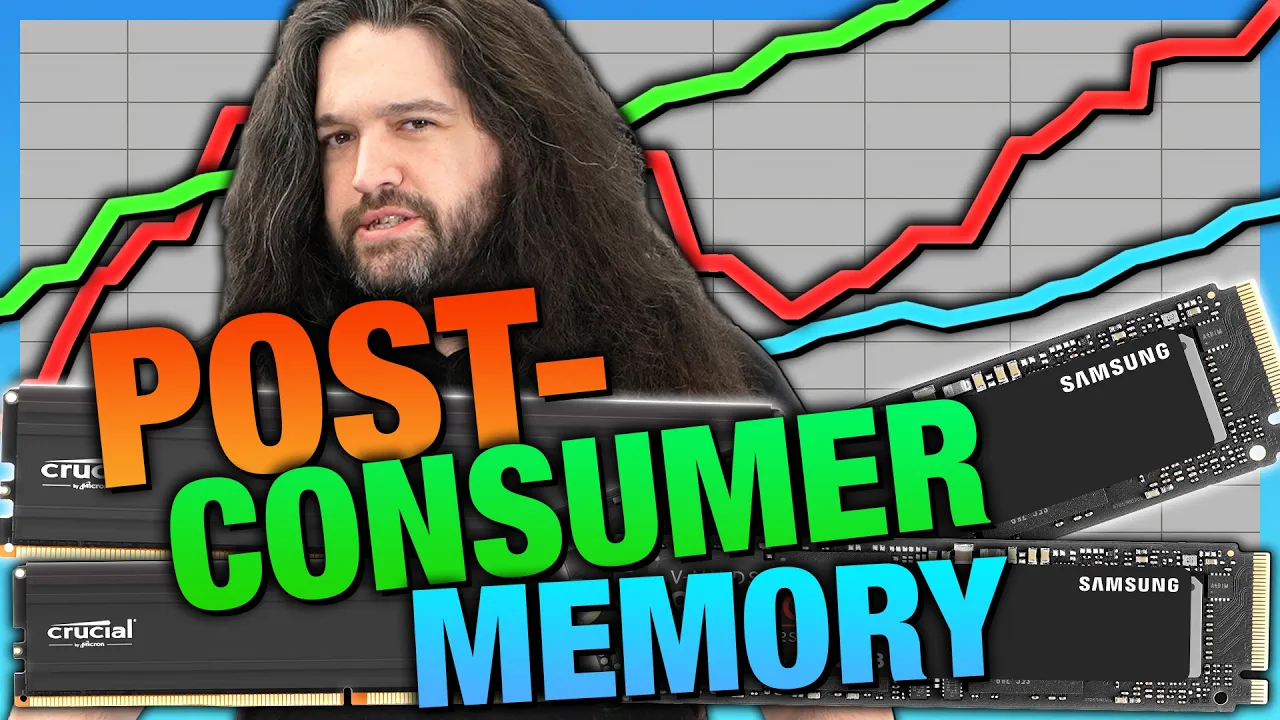
Gamers Nexus
AI-assisted summary of Memory Companies Have Destroyed the Consumer Market — original source. Check the original for full context.
Source published:
Key ideas
- Memory fabricators are suppressing the industry's historical boom-and-bust cycle by locking 50% to 70% of DRAM and NAND production into multi-year Long-Term Agreements with AI hyperscalers through 2028 and beyond. (6:06)
- The top nine cloud service providers are projected to increase capital expenditure to $1.383 trillion in 2027, with DRAM and NAND memory procurement alone accounting for 68% ($940 billion) of that total. (11:27)
- Severe consumer inflation has driven 32 GB DDR5 kits up 363% and 2 TB NVMe drives up 137%, while open spot market pricing for DDR4 and DDR5 dies has surged between 800% and 958%. (15:11)
- Political pushback against rising Chinese suppliers CXMT and YMTC clashes with domestic realities, as US fabs produced just 2% of global DRAM in 2023 and are projected to reach only 10% by 2035. (21:27)
Detailed notes
## Background Published on YouTube by Gamers Nexus on September 21, 2026, this investigative video examines how leading memory manufacturers have structurally dismantled the historical boom-and-bust pricing cycle of DRAM and NAND flash. According to the page description, suppliers like Micron, Samsung, and SK Hynix have shifted massive production capacity into multi-year enterprise agreements with hyperscalers, choking consumer supply and driving hardware costs to unprecedented heights while political leaders tout distant, inadequate domestic manufacturing targets.
## TL;DR Host Steve Burke reports on the catastrophic price hikes across consumer RAM and SSDs, where 32GB and 64GB DDR5 kits have seen surges of several hundred percent due to silicon capacity being redirected to AI hyperscalers. The historic boom-and-bust memory cycle has been effectively broken as manufacturers lock down 50% to 70% of fab capacity in multi-year Long-Term Agreements (LTAs) with cloud giants like Amazon, Microsoft, and Google, while smaller on-premises businesses are priced out and forced into cloud subscriptions. Concurrently, US political bans on rising Chinese memory alternatives like CXMT and YMTC leave Western consumers stranded, especially since subsidized domestic expansions from Micron will only yield modest output by 2035. With industry analysts predicting prolonged shortfalls and retail shelves emptying, personal computing hardware is now inextricably trapped in geopolitical maneuvering and permanent price-floor inflation.
## Atmosphere & style The presentation carries Steve Burke's trademark dry, analytical, and relentlessly critical investigative tone, blending dense financial reporting with biting consumer advocacy. It feels sober and infuriating, methodically dismantling corporate earnings calls and political rhetoric with charts of skyrocketing component costs and spot-market spikes. Burke balances grave geopolitical and economic breakdowns with razor-sharp sarcasm, guiding the viewer through a grim realization that the golden era of budget DIY computing has been traded away for high-margin corporate cloud infrastructure.
## Bulletin - [06:06](https://www.youtube.com/watch?v=78y-N8URhqM&t=366s) Memory fabricators are suppressing the industry's historical boom-and-bust cycle by locking 50% to 70% of DRAM and NAND production into multi-year Long-Term Agreements with AI hyperscalers through 2028 and beyond. - [11:27](https://www.youtube.com/watch?v=78y-N8URhqM&t=687s) The top nine cloud service providers are projected to increase capital expenditure to $1.383 trillion in 2027, with DRAM and NAND memory procurement alone accounting for 68% ($940 billion) of that total. - [15:11](https://www.youtube.com/watch?v=78y-N8URhqM&t=911s) Severe consumer inflation has driven 32 GB DDR5 kits up 363% and 2 TB NVMe drives up 137%, while open spot market pricing for DDR4 and DDR5 dies has surged between 800% and 958%. - [21:27](https://www.youtube.com/watch?v=78y-N8URhqM&t=1287s) Political pushback against rising Chinese suppliers CXMT and YMTC clashes with domestic realities, as US fabs produced just 2% of global DRAM in 2023 and are projected to reach only 10% by 2035.
## Key takeaways - [06:06](https://www.youtube.com/watch?v=78y-N8URhqM&t=366s) Memory fabricators like Micron, Samsung, and SK Hynix have shifted toward multi-year Long-Term Agreements (LTAs) that lock in up to 70% of factory output for enterprise hyperscalers, structurally dismantling the traditional consumer price relief cycle. - [00:01](https://www.youtube.com/watch?v=78y-N8URhqM&t=1s) Retail memory and storage pricing has experienced massive spikes, with 32 GB DDR5 kits jumping 363% to $567.50, 64 GB kits approaching $1,400, and workstation memory configurations inflating to over $23,800. - [03:02](https://www.youtube.com/watch?v=78y-N8URhqM&t=182s) Memory component shortages have cascaded across consumer electronics, forcing a 27.6% surge in smartphone average selling prices, console price hikes by Sony and Microsoft, and broader portfolio increases by Apple and Amazon. - [09:52](https://www.youtube.com/watch?v=78y-N8URhqM&t=592s) Western Digital, Samsung, and other fabricators are securing supply contracts extending as far as 2031, transforming semiconductor manufacturing from cyclical spot markets into rigid, pre-sold order books. - [11:27](https://www.youtube.com/watch?v=78y-N8URhqM&t=687s) Cloud giants are creating a self-reinforcing monopoly: massive hardware procurement prices out on-premises server upgrades for smaller enterprises, forcing them to subscribe to AWS, Microsoft Azure, and Google Cloud. - [13:56](https://www.youtube.com/watch?v=78y-N8URhqM&t=836s) Global wafer allocations are decoupling from client computing, with TrendForce forecasting that desktop and laptop PCs will account for only 5.6% of global DRAM bit demand and 11.5% of NAND demand by 2027. - [16:55](https://www.youtube.com/watch?v=78y-N8URhqM&t=1015s) Spot market die pricing has exhibited speculative, cryptocurrency-like volatility, with 16Gb DDR4 die prices increasing by 958% and 16Gb DDR5 dies climbing 800% between late 2025 and 2026. - [18:30](https://www.youtube.com/watch?v=78y-N8URhqM&t=1110s) Chinese memory producers are rapidly filling the supply void, with CXMT capturing 10% of global DRAM revenue and YMTC entering the top three global NAND makers by routing packaged chips through third parties. - [20:28](https://www.youtube.com/watch?v=78y-N8URhqM&t=1228s) Washington policymakers have strongly opposed Western adoption of Chinese memory, yet domestic manufacturing remains negligible and is projected to reach only 10% of global capacity by 2035—mostly earmarked for enterprise HBM. - [24:19](https://www.youtube.com/watch?v=78y-N8URhqM&t=1459s) Despite receiving roughly $6.5 billion in CHIPS Act subsidies and local tax abatements, Micron faces no regulatory obligations to supply domestic consumer electronics, sparking industry calls to invoke the Defense Production Act. - [26:21](https://www.youtube.com/watch?v=78y-N8URhqM&t=1581s) Market research diverges from component suppliers: while TrendForce models project a NAND flash surplus by 2027, Silicon Motion warns the shortage will worsen and that the retail SSD market has virtually disappeared. - [27:20](https://www.youtube.com/watch?v=78y-N8URhqM&t=1640s) The traditional separation between consumer PC hardware and geopolitics has ended, establishing permanently higher baseline price floors that lock mainstream consumers out of budget hardware.
## Detailed walkthrough ### [00:01](https://www.youtube.com/watch?v=78y-N8URhqM&t=1s) The Death of the Memory Price Cycle and the Consumer Squeeze
The DRAM and NAND flash memory manufacturers driving up the prices of SSDs, RAM, and GPUs appear to have accomplished what they have pursued for decades: suppressing the cyclical boom-and-bust nature of the memory market. Historically, the memory industry operated on swings where periods of oversupply triggered economically rock-bottom prices that heavily favored consumer builds and PC upgrades, before supply tightened and prices temporarily jumped back up. That low-price relief valve is now being systematically eliminated through long-term corporate supply agreements. Politics and memory hardware have become deeply intertwined, as government trade policy collides with semiconductor supply constraints. The impact on day-to-day retail hardware has been severe, with pricing across virtually every memory and storage category exploding:
- **2 TB NVMe SSDs:** Average price increase of 137%. - **2 TB SATA SSDs:** Average price increase of 183%. - **32 GB DDR4 Kits:** Average price increase of 294%. - **32 GB DDR5 Kits:** Average price increase of 363%. - **64 GB DDR5 Kits:** Surged roughly 483%, jumping from historic averages of $240 up to between $1,300 and $1,400.
```mermaid flowchart TD accTitle: DRAM and NAND Supply Allocation Divergence accDescr: Flow diagram showing memory fabrication capacity being diverted away from retail consumers into hyperscaler long-term agreements.
subgraph Production["Memory Fabricators (Fabs)"] FABS["Micron, Samsung, SK Hynix, SanDisk, Kioxia"] end
subgraph Allocation["Capacity Allocation Pivot"] LTA["50%–70% Locked Under Multi-Year LTAs"] REMAIN["Diminishing Remainder"] end
subgraph Destination["End Markets"] HYPER["Hyperscalers & AI Data Centers\n(Nvidia, Amazon, Top Cloud Providers)"] CONS["Consumer & DIY Market\n(Severe Shortages, Skyrocketing Prices)"] SMB["Small Business On-Premises\n(Priced Out & Pushed to Cloud)"] end
FABS --> LTA FABS --> REMAIN LTA --> HYPER REMAIN --> CONS REMAIN --> SMB ```
For professional workstations, content creators, and small engineering firms, the pricing surge is catastrophic. In 2024, Gamers Nexus purchased a 128 GB kit of G.Skill DDR5-6400 ECC registered memory for a Threadripper review bench and production editing rig at $1,060. Today, that exact memory kit is completely absent from mainstream retail; equivalent modules from third-party resellers like Nemix command around $6,800. For high-density enterprise configurations, a 512 GB memory pool that previously commanded $4,200 now lists at an astronomical $23,811.99. Storage drives tell the exact same story: a 4 TB Samsung 990 Pro purchased for a workstation in 2024 for $390 has skyrocketed to $1,100—a 254% markup. This represents a classic "K-shaped" economic divide where retail enthusiasts, budget DIY builders, and small businesses are priced out, while hyperscalers like Nvidia absorb all high-bandwidth memory (HBM) and enterprise inventory.
---
[03:02](https://www.youtube.com/watch?v=78y-N8URhqM&t=182s) Industry-Wide Fallout: Consoles, Smartphones, and Enterprise Cloud Lock-in
The massive diversion of DRAM and NAND silicon into AI data centers extends far beyond DIY enthusiast components; it has disrupted the pricing floor of the entire consumer electronics sector. IDC projections indicate that worldwide smartphone shipments will decline 16.7% in 2026, while the average selling price (ASP) of a smartphone will jump to $581—a 27.6% surge within a single year. Major hardware companies across every consumer vertical have been forced to initiate sweeping, multi-product price hikes:
- **Apple:** Initiated broad price hikes across its entire hardware lineup, including the MacBook Neo, MacBook Air, MacBook Pro, Mac Studio, iPad, iPad Air, iPad Pro, iPad Mini, HomePod, HomePod mini, Apple TV box, and Vision Pro headset. In his final earnings call as CEO, Tim Cook characterized the crisis as a "100-year flood on the memory pricing with exponential increases in memory prices." - **Microsoft Xbox:** Announced that effective August 1, 2026, console prices will rise by $100 for 512 GB models and $150 for 1 TB models, alongside the complete sunsetting of the 2 TB model. Microsoft warned that console storage and memory costs have surged by more than 2.5 times, with projections pointing toward another doubling by autumn 2027. - **Amazon, Nintendo, & Sony:** Amazon hiked prices across its Echo Dot, Echo Show 11, Kindle, Kindle Paperwhite, Fire TV Stick HD, Fire TV Stick 4K Max, Eero 7, and Eero Pro 7 lines. Nintendo raised the MSRP floor for its Switch successor, while Sony issued two separate price increases on the PlayStation 5 within a single twelve-month window. - **Medical Equipment:** A TechInsights executive speaking to the *New York Times* warned that memory constraints stretch well beyond consumer luxuries: "Yes, the prices of your iPhone are going up, but it's also possible the prices of your MRI machine may go up, or worse than that, that MRI machine might not get made."
Simultaneously, Chinese memory fabricators have capitalized on the supply vacuum to achieve unprecedented volume growth. YMTC broke into the top three global NAND manufacturers by shipment volume, surpassing established giants Kioxia, Micron, and SanDisk. In DRAM, CXMT captured 10% of global market share by revenue, marking a six percentage point year-over-year increase according to Counterpoint Research. Yet despite producing JEDEC-standard silicon compatible with platforms like Intel, these Chinese suppliers face strict regulatory pushback and market-entry restrictions from the United States government. With historically cartelized incumbent suppliers aggressively limiting production swings, the traditional market downturn that usually rescues consumer budgets is deliberately being dismantled.
---
[06:06](https://www.youtube.com/watch?v=78y-N8URhqM&t=366s) The Rise of Long-Term Agreements (LTAs) and Cartel-Style Allocation
The primary mechanism breaking the industry's historical boom-and-bust cycle is the rapid adoption of multi-year Long-Term Agreements (LTAs). Traditionally, memory production ran on 3-to-5-year market cycles where periods of severe oversupply forced vendors to dump excess inventory onto the retail spot market at deep discounts. Under the new LTA paradigm, major memory fabricators—Micron, Samsung, and SK Hynix—are binding anywhere from 50% to 70% of their total bit allocation directly to a narrow cadre of just five to sixteen hyperscale enterprise clients, locking down factory output through 2028, 2030, and beyond. As detailed by *Chosun Daily*, LTAs are fundamentally transforming semiconductor fabrication from a volatile boom-bust dynamic into a rigid, order-based system where capacity is pre-sold years in advance.
This structural shift effectively strips away the flexibility fabricators once had to adjust to retail PC hardware demand. As JP Morgan observed, while these contracts shield hyperscale cloud providers from runaway spot costs, they severely hamstring the ability of fabs to supply consumer hardware. In practical terms, this has created a feedback loop: because cloud giants corner the supply of DRAM and flash, prices for physical on-premises servers become prohibitively expensive for small-to-medium businesses. Consequently, independent engineering outfits and small IT departments are forced to abandon bare-metal upgrades entirely and rent computing power from hyperscalers like Amazon Web Services (AWS), further concentrating demand into the cloud data center ecosystem.
Official earnings reports from the world's leading memory manufacturers make their strategic pivot unequivocal:
- **Micron:** The sole US-based memory manufacturer reported that its 16 active LTAs already command 20% of its DRAM capacity and one-third of its NAND production, with plans to put roughly half or more of all company revenue under multi-year contracts. - **SanDisk:** Recorded explosive growth in its enterprise sectors—with data center and edge revenue surging 1,298% and 392% year-over-year while consumer revenue declined by 5%—and confirmed it is committing 50% of its total bit output in 2027 and 67% in 2028 exclusively to LTAs. - **Kioxia:** Confirmed it is actively on track to hit a 50% LTA volume coverage threshold with key enterprise accounts by calendar year 2028. - **Samsung:** Disclosed that it has finalized multi-year supply contracts with the world's top five global data center operators and is actively finalizing terms with five additional major accounts. Samsung plans to dedicate 60% to 70% of its entire production capacity directly to long-term supply agreements, leaving only a fragile minority of fab allocation for non-contracted buyers.
[09:52](https://www.youtube.com/watch?v=78y-N8URhqM&t=592s) Long-Term Agreements and the End of the Memory Cycle
Western Digital's CEO confirmed during an earnings report that long-term agreements (LTAs) have reached unprecedented lengths. While the company had previously secured an LTA with a major customer running through calendar year 2029, they are actively negotiating contracts spanning calendar years 2029, 2030, and even 2031. Customer visibility and appetite for these decade-spanning commitments remain exceptionally strong.
This structural transition to LTAs fundamentally alters how the memory market functions. As highlighted by *The Korea Herald*, moving away from quarterly renegotiations and short-term spot orders threatens to dampen the historical boom-and-bust cycle that has characterized the memory industry for decades. Samsung corroborated this strategy during its latest earnings call, noting that historically recurring downturns and upturns were dictated by volatility in consumer-facing markets. By shifting production capacity toward long-term, backlog-driven enterprise contracts, Samsung and its peers aim to secure corporate stability and price visibility. Industry analysts caution, however, that while LTAs reduce earnings volatility by locking in guaranteed enterprise demand, the actual durability of these agreements will only truly be tested when the broader market enters its next severe economic downturn.
[11:27](https://www.youtube.com/watch?v=78y-N8URhqM&t=687s) Cloud Giants Monopolize Supply and Squeeze On-Premises Competitors
The overarching driver of the memory crunch is the staggering capital expenditure of cloud service providers (CSPs). TrendForce projects that total capex for the world's nine largest CSPs will surge from $922 billion in 2026 to $1.383 trillion in 2027, propelled largely by skyrocketing memory contract prices and aggressive procurement. TrendForce calculates that DRAM and NAND flash purchases alone will command 47% of cloud provider capex in 2026, expanding to a staggering 68% in 2027. In raw capital, that translates to approximately $433 billion spent solely on DRAM and NAND by these nine companies in 2026, ballooning to $940 billion in 2027.
This dynamic creates a vicious cycle that actively benefits the cloud titans at the expense of everyone else. By bidding up RAM and SSD prices to historic highs, CSPs make it prohibitively expensive for smaller, independent enterprises to upgrade their own on-premises server racks. Left with no affordable hardware alternatives, those smaller businesses are forced to abandon self-hosting and rent infrastructure directly from the very cloud providers that caused the hardware inflation.
Amazon's CEO explicitly acknowledged this phenomenon during the company's Q1 2026 earnings call, describing rising memory prices and constrained supply as "a further impetus pushing companies who have on-premises infrastructure into the cloud." He added that conversations with potential enterprise clients had accelerated rapidly because Amazon possessed "a lot more supply than what others have." Gamers Nexus calls this out as saying "the quiet part out loud"—AWS leveraged its scale to hoover up raw component supplies, locking independent businesses out of local hardware and funneling them directly into cloud subscriptions.
The financial payoffs for the hyperscalers have been immediate and massive: - **Google Cloud:** Revenue jumped 82% year-over-year. - **Microsoft Azure & Cloud Services:** Revenue climbed 43% year-over-year. - **Amazon Web Services (AWS):** Sales increased 36.7% year-over-year, marking its fastest quarterly growth rate in 18 quarters.
```mermaid flowchart TD accTitle: The Hyperscaler Cloud Monopoly Feedback Loop accDescr: Diagram showing how cloud provider capital expenditure prices out smaller businesses and forces them into renting cloud instances. subgraph Procurement["Hyperscaler Capital Dominance"] A["Top 9 CSPs Spend Billions on Memory<br>(Capex expands to $1.383T by 2027)"] --> B["CSPs Consume Vast DRAM & NAND Supply<br>(Up to 68% of Total Capex)"] end
subgraph MarketImpact["Market Repercussions"] B --> C["Severe Component Shortages & Price Hikes"] C --> D["Smaller Enterprises Priced Out of On-Premises Hardware"] end
subgraph LockIn["Cloud Adoption"] D --> E["Enterprises Forced to Rent Instances from AWS, Azure & Google"] E --> F["Record Cloud Provider Revenue Growth<br>(AWS +36.7%, Azure +43%, Google +82%)"] F --> A end ```
[13:56](https://www.youtube.com/watch?v=78y-N8URhqM&t=836s) Projected Bit Demand: Enterprise Allocation vs. Consumer Decline
Data from TrendForce underscores a wholesale structural reallocation of global silicon wafer output away from consumer electronics toward enterprise and server architectures. In NAND flash memory, server bit consumption is projected to rise from 44.2% in 2026 to 51.1% in 2027, systematically cannibalizing allocation across PCs, mobile devices, gaming consoles, and client consumer products.
DRAM exhibits an even sharper divergence because server environments strain supply on two fronts: standard high-capacity server system memory modules and High Bandwidth Memory (HBM) integrated into AI accelerators and graphics processing units. TrendForce projects DRAM bit consumption across server and enterprise graphics applications to gain 1.5 and 1.7 percentage points of total global volume, pulling output away from traditional PC, mobile, and consumer applications. By 2027, desktop and laptop PC applications are forecasted to account for a meager 5.6% of global DRAM bit demand and only 11.5% of total NAND bit demand. Compared against historical 2019 figures, server share of DRAM has grown by 13.2 percentage points, while consumer PC share has fallen by 7.1 percentage points.
[15:11](https://www.youtube.com/watch?v=78y-N8URhqM&t=911s) Consumer Pricing Update: RAM, SSDs, and Hard Drives
Gamers Nexus cross-referenced PCPartPicker historical price listings between September 2025 and late 2026 to measure the direct damage inflicted on DIY builders and consumer electronics buyers. The results reveal severe inflation across all core storage and memory categories:
- **2TB NVMe SSDs:** Rose nearly $200, climbing from an average of $143.25 to $340.00. - **2TB SATA SSDs:** Shot up 183%, surging from $112.33 to nearly $318.00, compounded by manufacturers scaling back legacy SATA production lines. - **32GB DDR5-6000 CL30 Kits:** Experienced an astronomical increase of $445 (a 363% surge), leaping from $122.50 to $567.50. - **32GB DDR4 Kits:** Jumped 292%, inflating from $62.00 to $243.00. - **16TB Enterprise/Consumer Hard Drives:** Climbed roughly 129%, increasing from $350.00 in September 2025 to around $800.00, with prices escalating dramatically after April 2026.
DRAM kits experienced far steeper percentage surges than SSDs because DRAM capacity is caught in a pincer movement: manufacturers are diverting raw wafer starts simultaneously into enterprise DDR5 server DIMMs and complex HBM stacks for AI silicon, starving client consumer system memory of production capacity.
[16:55](https://www.youtube.com/watch?v=78y-N8URhqM&t=1015s) Spot Market Explosions and Crypto-Like Volatility
DRAMeXchange spot price trends gathered via the Wayback Machine showcase an open market displaying wild, crypto-like speculative volatility. While spot prices do not represent the bulk contracted rates negotiated by tier-one PC OEMs, they serve as a sensitive barometer for unallocated inventory and desperate open-market demand:
- **16Gb DDR5 Die:** Traded near $6.00 through mid-September 2025, jumped by roughly $20.00 between October and December, and climbed steadily to an average session spot price of $54.00 by 2026—a cumulative surge of roughly 800%. - **512Gb TLC Flash Wafers:** Held at $2.70 between July and September 2025, skyrocketed from $3.00 to $23.00 between October and March 2026, and settled near $21.00 (an increase of approximately 678%). - **16Gb DDR4 Die:** Began July 2025 at approximately $8.60, exploded upward to $78.00 between September and January, briefly dipped to $58.00 in May, and subsequently escalated to $91.00—an aggregate increase of 958%.
Steve jokes that DDR4 spot pricing resembles an altcoin chart from the 2018 cryptocurrency bubble, with the most aggressive inflection point for all memory dies occurring between October 2025 and March 2026.
[18:30](https://www.youtube.com/watch?v=78y-N8URhqM&t=1110s) The Rise of Chinese Memory and Geopolitical Realpolitik
As established suppliers abandon consumer lanes to feed high-margin hyperscalers, emerging Chinese memory fabricators are seizing substantial market share. Counterpoint Research reports that ChangXin Memory Technologies (CXMT) expanded its global DRAM revenue share from 4% in Q2 2025 to 10% in Q2 2026. This rapid rise represents a direct commercial threat to the traditional oligopoly of Samsung, SK Hynix, and Micron.
Gamers Nexus suggests this rapid commercial ascension explains why the United States government has pushed aggressively to ban Chinese competitors. Steve highlights historical precedent: during the Department of Justice's mid-2000s DRAM price-fixing cartel investigation into Samsung, SK Hynix, and Micron, it was US-based Micron that cooperated with prosecutors under leniency rules ("snitches don't get stitches") to escape massive criminal fines while its South Korean rivals faced heavy penalties. Micron now stands as the primary domestic beneficiary of federal protectionist measures.
Meanwhile, Yangtze Memory Technologies Corp (YMTC) has climbed into the top three NAND manufacturers by unit shipment share, surpassing established giants Kioxia, Micron, and SanDisk/Western Digital. To circumvent Western export controls and origin restrictions, reports from *Digitimes* indicate YMTC is selling raw NAND flash dies to independent, third-party module packaging firms. These intermediary makers package the silicon into finished enterprise solid-state drives, which are then sold directly to US-based "neocloud" infrastructure providers, intentionally masking the country-of-origin trail to evade regulatory scrutiny while meeting critical storage shortages.
[20:28](https://www.youtube.com/watch?v=78y-N8URhqM&t=1228s) Geopolitical Backlash Against Chinese Memory
With global memory supplies tightening rapidly, Chinese DRAM manufacturer CXMT has reportedly begun product qualification procedures with small and midsize cloud service providers across North America, including the United States and Canada. By locking in capacity commitments well ahead of time, CXMT has attempted to secure a stable Western customer base early. However, this push into North American hardware infrastructure immediately ran into heavy political opposition. Following a Bloomberg report revealing that Apple had explored purchasing NAND and DRAM chips from CXMT and YMTC, Senate Majority Leader Chuck Schumer reacted aggressively. As Steve Burke quips, Schumer "did what he does best and put his glasses into attack position," drafting a stern letter urging Apple to completely abandon any plans to incorporate memory from CXMT, YMTC, or any other Chinese state-backed supplier, insisting that American companies like Apple ought to buy chips stamped "Made in America."
Commerce Secretary Howard Lutnick voiced similar protectionist sentiments to *The Wall Street Journal*, remarking that while "there have to be other solutions to the memory issue," American tech giants relying on Chinese-manufactured memory remains an unacceptable outcome. Steve points out the glaring disconnect between Washington's rhetoric and practical industrial realities: while politicians demand American-made chips, the domestic memory manufacturing base barely exists.
[21:27](https://www.youtube.com/watch?v=78y-N8URhqM&t=1287s) Micron’s Domestic Capacity Reality and the "2035" Mirage
The demand for domestically produced memory collapses under basic scrutiny of US manufacturing figures. In late 2023, Micron's own CEO publicly acknowledged that the United States accounted for a meager 2% of total global DRAM production. Furthermore, projections from the National Institute of Standards and Technology (NIST) regarding Micron’s massive new fabrication facilities under construction in New York and Idaho suggest that US-based advanced memory manufacturing will only climb from less than 2% up to roughly 10% by the year 2035.
```mermaid flowchart TD accTitle: US DRAM Share Projections vs Market Allocation accDescr: Chart showing US share of DRAM production from 2023 to 2035 and where that capacity is directed.
subgraph Capacity["Global DRAM Production Share"] A["Late 2023: US Share (~2%)"] --> B["2035 Projection: US Share (~10%)"] end
subgraph Allocation["Output Destination"] B --> C["High-Bandwidth Memory (HBM) & Enterprise AI"] B -.->|"Negligible / Shrinking Share"| D["Consumer RAM & Retail Market"] end ```
Steve ridicules the notion that consumers can simply wait out the shortage for domestic fabs to come online: "Great. That's what—it'll get better in nine years for all of us... mark your calendars for your next PC build." Even if that 10% target is realized a decade down the road, there is zero guarantee it will benefit ordinary consumers. A dominant portion of those domestic wafers will inevitably be allocated toward lucrative High Bandwidth Memory (HBM) and enterprise AI accelerators rather than standard consumer desktop DRAM. Consequently, the actual percentage of consumer memory produced domestically could end up even smaller. Micron cannot supply American industry today, nor will it produce enough DRAM in 2035 to meet total demand.
As for Lutnick’s vague assertion that "there have to be other solutions," Steve mocks the lack of practical policy, joking that unless Lutnick plans to "open a fab on his allegedly dead friend's island," no magic capacity is appearing anytime soon. Restricting imports under the guise of security primarily punishes everyday consumers. Standard volatile DRAM is virtually impossible to backdoor or exploit as an attack vector, and while solid-state drives carry controller firmware, they remain verifiable. Furthermore, Burke notes the selective outrage of the "Made in America" label: the vast majority of consumer DRAM comes from South Korea (Samsung and SK Hynix), which is equally foreign-made, yet politicians fixate on arbitrary blockades that directly choke the consumer supply chain.
[24:19](https://www.youtube.com/watch?v=78y-N8URhqM&t=1459s) Subsidies Without Accountability: CHIPS Act vs. Free Market Allocation
The desperation among downstream technology companies has prompted intense lobbying in Washington. *The New York Times* reported that several industry groups have pushed the federal government to impose conditions on semiconductor subsidies, arguing that recipients of funding from the 2022 CHIPS and Science Act should be legally mandated to supply a broader range of commercial customers rather than funneling entire wafer runs exclusively to AI hyperscalers. Other groups have even urged the administration to invoke the Defense Production Act—a Korean War-era emergency statute—to compel memory fabricators to allocate production volume outside of AI infrastructure.
In an interview with *Tom's Hardware*, Silicon Motion Senior Vice President Nelson Duann contrasted the corporate philosophies governing Chinese versus Western suppliers:
> "Because they receive government support, they also have a responsibility to help maintain the health of the local market. Foreign suppliers generally follow the highest return opportunities and can allocate most of their supply to data centers. Chinese suppliers cannot do that in the same way because the government can provide guidance and encourage them to support certain local industries."
Gamers Nexus highlights the bitter irony at play: Micron was awarded roughly $6.5 billion in direct funding under the CHIPS Act, supplemented by billions of dollars in local New York state property tax abatements—subsidies funded by taxpayers who often cannot afford local housing—yet Micron operates under zero regulatory obligations to support domestic consumers or retail PC builders. While American politicians decry Chinese companies like CXMT as unfair "state-backed" entities, Micron functions as an integral contractor within the US military supply chain and receives colossal state subsidies of its own. In practice, both sides are state-backed, but only Western taxpayers get left completely unserved by their domestic champions.
- **CHIPS Act Subsidies:** Micron received approximately $6.5 billion in federal funding plus extensive local tax breaks, yet carries no legal mandate to supply domestic consumer electronics. - **Defense Production Act:** Industry lobbyists have requested executive intervention to divert fab allocation away from exclusive AI data center contracts. - **State-Backed Equivalence:** Both foreign competitors (CXMT, YMTC) and domestic champions (Micron) rely heavily on state financing and military/national security contracts.
[26:21](https://www.youtube.com/watch?v=78y-N8URhqM&t=1581s) Divergent Forecasts: TrendForce vs. Silicon Motion on NAND and DRAM
Industry market analysts hold diverging views regarding how quickly the storage and memory drought might ease. According to projections from TrendForce, NAND flash could see an earlier recovery than DRAM. TrendForce highlights that denser layer-stacking in modern 3D NAND manufacturing, coupled with sluggish consumer device sales, is steadily nudging NAND flash toward a looser supply-demand balance:
> "Boosted by the rollout of new capacity alongside weak consumer demand... NAND flash is shifting towards a looser supply-demand structure and will face downward price adjustment pressure in the second half of the year, underscoring a clear divergence in their market cycles."
TrendForce's sufficiency ratio models forecast NAND flash supply crossing into a positive surplus—where overall bit production exceeds global demand—sometime in 2027. DRAM, by contrast, shows no such relief, with sufficiency ratios projected to deteriorate even further as server demand swallows production capacity.
However, upstream hardware manufacturers express far less optimism than market research firms. Silicon Motion SVP Nelson Duann offered a much grimmer assessment to *Tom's Hardware*, warning that the consumer storage market is being hollowed out:
> "The retail SSD market has almost disappeared. Suppliers can get some bit growth by moving to newer NAND generations, but demand is growing faster. As a result, the shortage will not improve next year. It'll get worse."
| Metric / Outlook | TrendForce Projection | Silicon Motion (Nelson Duann) Assessment | |:--- |:--- |:--- | | **NAND Flash Supply** | Shifts to surplus / positive sufficiency by 2027 | Deficit worsens; bit growth cannot outpace enterprise demand | | **Retail SSD Market** | Faces downward price adjustment pressure in H2 | Consumer retail SSD channel "has almost disappeared" | | **DRAM Sufficiency** | Deteriorating steadily; severe deficits through 2027 | Constrained; supply swallowed primarily by AI data centers |
[27:20](https://www.youtube.com/watch?v=78y-N8URhqM&t=1640s) The Death of the Traditional Hardware Cycle
Reflecting on nearly two decades of covering the PC hardware space, Steve observes that the traditional separation between personal computing and high-stakes geopolitics is permanently gone. While enthusiasts could previously treat gaming rigs as detached from international diplomacy, computer hardware is now thoroughly entangled with global political maneuvering. Politicians across the globe have realized the strategic leverage of DRAM and NAND, meaning decisions to sanction companies, restrict imports, or distribute billions in state subsidies now directly dictate component prices on store shelves.
Crucially, the historic boom-and-bust cycle of memory pricing has been structurally broken. Memory manufacturers have pivoted toward massive long-term agreements (LTAs), with suppliers committing as much as 70% of their operational capacity across three- to five-year horizons. This pivot suppresses traditional cyclical volatility:
- **Elevated Price Floors:** Instead of swinging between catastrophic supplier gluts and brief price spikes, the memory market now operates within a permanently elevated, narrower pricing band. - **Absence of Relief:** When prices eventually soften, the new price floor sits substantially higher than in previous generations, locking consumers out of true budget hardware. - **Economic Catch-22:** Steve dryly notes that the only event likely to crash prices back to rock-bottom levels is a catastrophic macroeconomic bubble burst—an outcome that offers little comfort: "If the price falls in a forest and nobody has money to buy it, did the price really fall?"
Ultimately, the consumer shortage is not merely an accident of sudden AI popularity; it stems from memory manufacturers collectively recognizing their pricing power, ending the era of inexpensive multi-gigabyte memory kits, and prioritizing high-margin enterprise clients at the permanent expense of the consumer PC ecosystem.
[30:40](https://www.youtube.com/watch?v=78y-N8URhqM&t=1840s) Outro and Supporting Gamers Nexus Investigations
Steve wraps up the report by thanking viewers for watching and pointing them toward ways to directly support Gamers Nexus. Producing these kinds of deep-dive reports, intensive industry research, and investigative journalism requires significant time and financial resources. Viewers can visit store.gamersnexus.net to pick up merchandise or back current initiatives, such as the backer kits created for their Data Dragnet campaign—the initiative behind their extensive LG investigation video.
Steve expresses his gratitude to the community, noting that "the support so far has been phenomenal." For those looking to contribute or keep independent hardware investigations going, he directs viewers to check out the GN store or join their community on Patreon. With a quick reminder to subscribe for future reporting, Steve signs off until the next update.
- **Ways to support Gamers Nexus:** Purchasing gear and campaign kits at `store.gamersnexus.net` or backing investigations directly via Patreon (`patreon.com/gamersnexus`). - **Data Dragnet Campaign:** Community funding initiative supporting in-depth investigative pieces, such as the LG investigation project.
## Notable quotes > [03:02](https://www.youtube.com/watch?v=78y-N8URhqM&t=182s) 100-year flood on the memory pricing with exponential increases in memory prices. — Tim Cook
> [03:02](https://www.youtube.com/watch?v=78y-N8URhqM&t=182s) Yes, the prices of your iPhone are going up, but it's also possible the prices of your MRI machine may go up, or worse than that, that MRI machine might not get made. — TechInsights executive
> [11:27](https://www.youtube.com/watch?v=78y-N8URhqM&t=687s) a further impetus pushing companies who have on-premises infrastructure into the cloud. — Amazon CEO
> [11:27](https://www.youtube.com/watch?v=78y-N8URhqM&t=687s) a lot more supply than what others have. — Amazon CEO
> [20:28](https://www.youtube.com/watch?v=78y-N8URhqM&t=1228s) there have to be other solutions to the memory issue — Howard Lutnick
> [21:27](https://www.youtube.com/watch?v=78y-N8URhqM&t=1287s) Great. That's what—it'll get better in nine years for all of us... mark your calendars for your next PC build. — Steve Burke
> [24:19](https://www.youtube.com/watch?v=78y-N8URhqM&t=1459s) Because they receive government support, they also have a responsibility to help maintain the health of the local market. Foreign suppliers generally follow the highest return opportunities and can allocate most of their supply to data centers. Chinese suppliers cannot do that in the same way because the government can provide guidance and encourage them to support certain local industries. — Nelson Duann
> [26:21](https://www.youtube.com/watch?v=78y-N8URhqM&t=1581s) Boosted by the rollout of new capacity alongside weak consumer demand... NAND flash is shifting towards a looser supply-demand structure and will face downward price adjustment pressure in the second half of the year, underscoring a clear divergence in their market cycles. — TrendForce
> [26:21](https://www.youtube.com/watch?v=78y-N8URhqM&t=1581s) The retail SSD market has almost disappeared. Suppliers can get some bit growth by moving to newer NAND generations, but demand is growing faster. As a result, the shortage will not improve next year. It'll get worse. — Nelson Duann
> [27:20](https://www.youtube.com/watch?v=78y-N8URhqM&t=1640s) If the price falls in a forest and nobody has money to buy it, did the price really fall? — Steve Burke
> [30:40](https://www.youtube.com/watch?v=78y-N8URhqM&t=1840s) the support so far has been phenomenal. — Steve Burke
## Mentioned Amazon, Amazon Web Services (AWS), Apple, Apple TV, CHIPS and Science Act, Chuck Schumer, Counterpoint Research, CXMT (ChangXin Memory Technologies), DDR4, DDR5, Defense Production Act, Digitimes, DRAMeXchange, Echo Dot, Echo Show 11, Eero 7, Eero Pro 7, Fire TV Stick 4K Max, Fire TV Stick HD, G.Skill, Gamers Nexus, Google Cloud, High Bandwidth Memory (HBM), Howard Lutnick, IDC, iPad, JP Morgan, Kindle, Kindle Paperwhite, Kioxia, MacBook Air, MacBook Neo, MacBook Pro, Micron, Microsoft Azure, Microsoft Xbox, Nelson Duann, Nemix, Nintendo Switch, Nvidia, PCPartPicker, PlayStation 5, Samsung, Samsung 990 Pro, SanDisk, Silicon Motion, SK Hynix, Steve Burke, Tannen Williams, TechInsights, The Korea Herald, The New York Times, The Wall Street Journal, Tim Cook, Tim Phetdara, Tom's Hardware, TrendForce, Vision Pro, Vitalii Makhnovets, Western Digital, YMTC (Yangtze Memory Technologies Corp)
## Video description Sponsor: Thermal Grizzly Duronaut on Amazon - https://geni.us/tpgcPMw The cyclical nature of memory manufacturing may finally be broken -- and not in a good way for consumers. The memory manufacturers have all moved toward long-term agreements with longer terms and capacity than previously, with Micron, Samsung, and SK Hynix diverting a flood of memory away from consumers. At the same time, Amazon has publicly stated that more users than ever will consider its cloud services due to the rising costs of on-location hardware. But don't worry: By 2035, Micron will save us all.
Watch our GPU pricing update: https://www.youtube.com/watch?v=vV4fow4JUMk Watch our DRAM Cartel documentary: https://www.youtube.com/watch?v=jVzeHTlWIDY Watch our Rise of Chinese Memory documentary: https://www.youtube.com/watch?v=qzfhhAfxK-A
The best way to support our work is through our store: https://store.gamersnexus.net/
Like our content? Please consider becoming our Patron to support us: http://www.patreon.com/gamersnexus
TIMESTAMPS
00:00 - RAM and SSD Prices Skyrocketing 03:02 - Affecting ALL Consumer Electronics 06:06 - Long-Term Agreements 10:18 - Manufacturers Suppressing Cyclical Pricing 11:27 - Cloud and Data Centers Driving Shortage 13:56 - Projected Demand by Application 15:11 - Price Update: SSDs and RAM 16:36 - Price Update: Hard Drives 16:55 - Price Update: Spot Price History 18:30 - Rise of Chinese Manufacturers and US Opposition 21:27 - Micron Will Save Us... in 2035 26:21 - TrendForce 2027 Supply Forecast 27:20 - Conclusion
** Please like, comment, and subscribe for more! **
Links to Amazon and Newegg are typically monetized on our channel (affiliate links) and may return a commission of sales to us from the retailer. This is unrelated to the product manufacturer. Any advertisements or sponsorships are disclosed within the video ("this video is brought to you by") and above the fold in the description. We do not ever produce paid content or "sponsored content" (meaning that the content is our idea and is not funded externally aside from whatever ad placement is in the beginning) and we do not ever charge manufacturers for coverage.
Follow us in these locations for more gaming and hardware updates:
t: http://www.twitter.com/gamersnexus f: http://www.facebook.com/gamersnexus w: http://www.gamersnexus.net/
Our policies, processes, and ethics statements relating to review samples, advertising, travel, errors, and more are transparently and publicly available on this page: https://gamers.nexus/ethics-statements
Steve Burke: Host, Writing Vitalii Makhnovets: Editing Tim Phetdara: Editing Tannen Williams: Writing
[Source](https://www.youtube.com/watch?v=78y-N8URhqM)