"We Know Some Will Call This Circular Financing" - NVIDIA
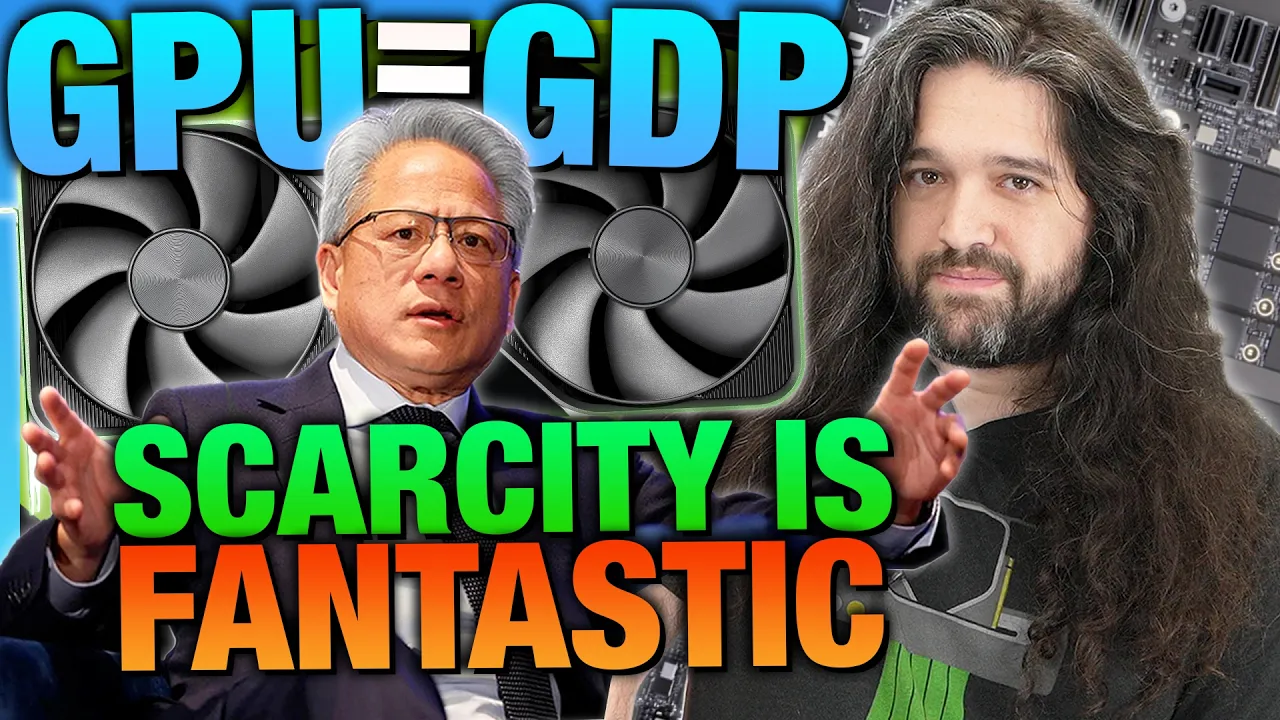
"We Know Some Will Call This Circular Financing" - NVIDIA — Gamers Nexus

Gamers Nexus

AI-assisted summary of "We Know Some Will Call This Circular Financing" - NVIDIA — original source. Check the original for full context.

Source published:

Key ideas

  • NVIDIA posted record Q2 FY2027 revenue of $96.2 billion with 75% gross margins, propelled by an $89 billion data center business that now accounts for 92% of corporate revenue while gaming was omitted from headline investor releases. (2:23)
  • The company expanded its forward supply and capacity commitments from $119 billion to $279 billion in a single quarter, concentrating capital on locking up server-grade high-bandwidth memory and DRAM across Micron, SK Hynix, and Samsung. (18:49)
  • Facing scrutiny over circular financing, NVIDIA backstopped a 20-year, $105 billion Ohio data center lease for OpenAI through SoftBank's SB Energy—a developer with zero operational data centers and ongoing net losses that granted OpenAI $5.5 billion in stock warrants to secure the deal. (30:27)
  • Taiwanese prosecutors indicted nine individuals, including an active NVIDIA senior manager in Taiwan and Supermicro employees, for orchestrating the illicit export of 130 Blackwell B300 enterprise servers into China via Indonesia and Japan. (32:57)
  • NVIDIA reached an agreement to acquire open-source AI community Hugging Face for $12.9 billion—an outlay equivalent to approximately 13 days of NVIDIA's quarterly top-line revenue. (35:47)

Detailed notes

## Background Published on YouTube by Gamers Nexus on September 29, 2026, this video investigates NVIDIA's corporate strategies and explosive enterprise growth. According to the show description, the piece examines NVIDIA's defensive framing of GPU rentability and its insistence that its business represents a 'virtuous cycle' rather than circular financing, while also exploring Jensen Huang's deepening political ties with President Donald Trump and persistent GPU black market smuggling headlines.

## TL;DR Steve Burke breaks down NVIDIA's massive $96 billion quarterly revenue, highlighting how consumer gaming has been completely marginalized in favor of data center dominance. The report scrutinizes NVIDIA's tangled financial arrangements with partners like OpenAI, SB Energy, and SoftBank, dissecting allegations of circular financing that NVIDIA insists are merely an economic 'virtuous cycle.' The video also examines the AI-driven memory squeeze, Jensen Huang's overt courtship of President Donald Trump, and criminal indictments in Taiwan implicating internal staff in smuggling Blackwell servers to China. Ultimately, Gamers Nexus argues that NVIDIA is leveraging its market dominance to turn raw compute into an unavoidable, GDP-defining asset class that it exclusively controls.

## Atmosphere & style The video delivers Steve Burke's signature dry, deadpan, and relentlessly skeptical investigative style, balancing dense financial forensics with sardonic humor. Burke methodically contrasts polished corporate soundbites and stage bravado with SEC risk disclosures, escalating hardware prices, and real-world smuggling busts. It feels like an exhaustive, sobering exposé of the generative AI boom, blending investigative financial journalism with sharp consumer-advocate indignation.

## Bulletin - [02:23](https://www.youtube.com/watch?v=EhgjJBcc0Es&t=143s) NVIDIA posted record Q2 FY2027 revenue of $96.2 billion with 75% gross margins, propelled by an $89 billion data center business that now accounts for 92% of corporate revenue while gaming was omitted from headline investor releases. - [18:49](https://www.youtube.com/watch?v=EhgjJBcc0Es&t=1129s) The company expanded its forward supply and capacity commitments from $119 billion to $279 billion in a single quarter, concentrating capital on locking up server-grade high-bandwidth memory and DRAM across Micron, SK Hynix, and Samsung. - [30:27](https://www.youtube.com/watch?v=EhgjJBcc0Es&t=1827s) Facing scrutiny over circular financing, NVIDIA backstopped a 20-year, $105 billion Ohio data center lease for OpenAI through SoftBank's SB Energy—a developer with zero operational data centers and ongoing net losses that granted OpenAI $5.5 billion in stock warrants to secure the deal. - [32:57](https://www.youtube.com/watch?v=EhgjJBcc0Es&t=1977s) Taiwanese prosecutors indicted nine individuals, including an active NVIDIA senior manager in Taiwan and Supermicro employees, for orchestrating the illicit export of 130 Blackwell B300 enterprise servers into China via Indonesia and Japan. - [35:47](https://www.youtube.com/watch?v=EhgjJBcc0Es&t=2147s) NVIDIA reached an agreement to acquire open-source AI community Hugging Face for $12.9 billion—an outlay equivalent to approximately 13 days of NVIDIA's quarterly top-line revenue.

## Key takeaways - [00:00](https://www.youtube.com/watch?v=EhgjJBcc0Es&t=0s) CEO Jensen Huang explicitly embraces semiconductor and supply chain bottlenecks, positioning scarcity as an asset while projecting 70% revenue growth under a supply-constrained outlook. - [02:23](https://www.youtube.com/watch?v=EhgjJBcc0Es&t=143s) Data center operations generated $89 billion in Q2 FY2027 (up 117% year-over-year), reducing consumer gaming to a financial rounding error that is insufficient to cover NVIDIA's tax bill. - [06:00](https://www.youtube.com/watch?v=EhgjJBcc0Es&t=360s) To counter corporate concerns over artificial intelligence ROI, NVIDIA has begun marketing compute clusters as an 'investable asset class' focused on hourly rental yields. - [06:00](https://www.youtube.com/watch?v=EhgjJBcc0Es&t=360s) NVIDIA doubled the direct purchase price of its first-party Blackwell RTX Pro 6000 workstation GPU from $8,500 to $16,000, signaling steep hardware inflation across enterprise and workstation lines. - [08:18](https://www.youtube.com/watch?v=EhgjJBcc0Es&t=498s) NVIDIA operates an aggressive venture model, funding frontier AI labs on the explicit prerequisite that portfolio companies adopt NVIDIA's technology stack and deploy NVIDIA silicon. - [10:33](https://www.youtube.com/watch?v=EhgjJBcc0Es&t=633s) Addressing allegations of circular financing, NVIDIA disclosed massive multi-gigawatt compute commitments with OpenAI and other labs while framing the feedback loop of revenue buying hardware as a 'virtuous cycle.' - [12:17](https://www.youtube.com/watch?v=EhgjJBcc0Es&t=737s) Hyperscalers prioritizing hourly GPU leasing exposes a fundamental contradiction, indicating that high-margin end-user generative software demand has not caught up to deployed hardware capacity. - [16:03](https://www.youtube.com/watch?v=EhgjJBcc0Es&t=963s) NVIDIA bundled gaming graphics cards into a broad $7.2 billion 'Edge Computing' category alongside robotics and automotive, obscuring PC hardware declines driven by AI-induced component shortages. - [18:49](https://www.youtube.com/watch?v=EhgjJBcc0Es&t=1129s) NVIDIA's forward supply commitments surged to $279 billion across DRAM and HBM producers, cornering memory capacity and directly aggravating global memory price increases. - [23:01](https://www.youtube.com/watch?v=EhgjJBcc0Es&t=1381s) Jensen Huang has deepened political ties with President Donald Trump, who publicly champions data center expansions and holds multi-million-dollar personal investments in NVIDIA and major cloud hyperscalers. - [26:41](https://www.youtube.com/watch?v=EhgjJBcc0Es&t=1601s) NVIDIA, SoftBank, SB Energy, and OpenAI formed a deeply intertwined financing structure around a 4.25 GW campus in Ohio that requires 1.5 million GPUs per hardware generation. - [30:27](https://www.youtube.com/watch?v=EhgjJBcc0Es&t=1827s) SB Energy's SEC IPO filing revealed that the company has no operational data centers, has a history of net losses, and relies fundamentally on NVIDIA residual value guarantees to fund the Ohio project. - [32:57](https://www.youtube.com/watch?v=EhgjJBcc0Es&t=1977s) A criminal indictment in Taiwan directly linked an internal NVIDIA manager and Supermicro staff to a smuggling ring that transferred 74 high-end B300 servers to China, undermining executive claims that enterprise hardware cannot be diverted. - [35:47](https://www.youtube.com/watch?v=EhgjJBcc0Es&t=2147s) The $12.9 billion acquisition of Hugging Face grants NVIDIA control over the primary repository for open-source AI models and datasets while accounting for only 13 days of NVIDIA's revenue. - [38:25](https://www.youtube.com/watch?v=EhgjJBcc0Es&t=2305s) Jensen Huang's core macro thesis equates compute directly to national GDP, aiming to position NVIDIA as the indispensable infrastructure provider for sovereign states worldwide.

## Detailed walkthrough ### [00:00](https://www.youtube.com/watch?v=EhgjJBcc0Es&t=0s) The Scarcity Playbook and Jensen's Greatest Hits

The presentation opens with a montage highlighting NVIDIA's candid stance on supply constraints and runaway demand. Company leadership openly embraces the bottlenecks choking the industry—chips, advanced packaging, power, land, optical interconnects, and even basic construction labor are all running short across the entire supply chain. Rather than viewing this as an impediment, CEO Jensen Huang relishes the dynamic: "I love constraints. I love constraints. The fact that everything is scarce is fantastic for us." The scarcity forms the backdrop for an aggressive financial outlook, with the company projecting roughly 70% revenue growth in fiscal 2028 under what it explicitly labels a "supply-constrained outlook."

In a deadpan reel of recent NVIDIA headlines, Steve Burke mocks Jensen Huang's late arrival to social media, noting that Jensen finally posted on X in 2026, calling himself "probably the last human on Earth that did it." That triviality contrasts sharply with real-world controversies, such as prosecutors in Taiwan indicting nine individuals—including an NVIDIA senior manager in Taiwan and Supermicro employees in New Taipei—for secretly exporting over 100 high-end servers packed with Blackwell GPUs directly to China. Jensen's prior brush-offs claiming GPU smuggling is not a real issue are juxtaposed against these criminal charges, followed by lighthearted reminders that AMD CEO Dr. Lisa Su is his first cousin once removed, brushing aside competitive friction with the classic line: "We're family, and everybody is so friendly."

The real catalyst, however, is NVIDIA's financial performance. In an interview with CNBC's Jim Cramer, who pressed Jensen on how NVIDIA could promise blowout 70% growth when Wall Street was expecting around 45%, Jensen simply responded that demand is not only super strong, but accelerating.

[02:23](https://www.youtube.com/watch?v=EhgjJBcc0Es&t=143s) $96 Billion in 90 Days: The Vanishing Gaming Segment

NVIDIA reported record-shattering earnings for the second quarter of its 2027 fiscal year on August 26. The company raked in $96 billion in total quarterly revenue while sustaining an eye-watering gross margin of 75%. Steve translates this scale into everyday metrics: generating $96 billion over a 90-day period equates to over $1 billion per day, roughly $41 million every single hour, or in humorous economic terms, roughly "28 million Costco hot dogs per hour."

```mermaid flowchart TD accTitle: NVIDIA Q2 FY2027 Revenue Breakdown accDescr: Visualizing the total 96 billion dollar revenue split between Data Center and Edge Computing. subgraph Revenue["NVIDIA Q2 FY2027 Revenue ($96.2B)"] DC["Data Center Business: $89B (92%)<br/>Up 117% year-over-year"] Edge["Edge Computing: $7.2B (8%)<br/>Workstation, Robotics, Auto, Gaming"] end DC --> Drivers["Hyperscalers & AI Frontier Labs"] Edge --> Buried["Consumer Gaming Buried & Omitted"] ```

The engine driving these staggering numbers is NVIDIA's enterprise infrastructure. Its data center segment pulled in $89 billion, accounting for approximately 92% of all company revenue and marking a 117% increase year-over-year. Steve quips, "There's always money in the banana stand," warning that the lack of true diversification means "this is going to be bad when this finally goes." Consumer gaming has become so insignificant to NVIDIA's balance sheet that its entire gaming revenue—now compressed and buried under the "edge" computing umbrella—is not even large enough to cover the company's tax bill. In fact, gaming was completely omitted from the earnings press release and the accompanying CFO commentary, while circular financing made the cut.

- Total Q2 revenue hit $96.2 billion (up 18% quarter-over-quarter and 106% year-over-year). - Gross margins held steady at a massive 75%. - Data center revenue reached $89 billion, representing ~92% of company intake. - Gaming mentions were entirely dropped from the headline investor materials.

[04:20](https://www.youtube.com/watch?v=EhgjJBcc0Es&t=260s) Edge Computing and the Pivot to Autonomous Agents

Outside the core data center numbers, NVIDIA lumped its remaining non-data-center revenue into an "edge computing" bucket totaling $7.2 billion. This category serves as a catch-all for anything that doesn't go into a hyperscale facility: professional workstations, robotics, automotive chips, and traditional consumer gaming graphics cards. Steve points out that Jensen previously signaled a lack of interest in tailoring hardware to human gamers or even humans in general.

Instead, Jensen has pivoted NVIDIA's public narrative toward an entirely new target customer: agentic AI systems. In Jensen's vision, populations of autonomous software agents will operate PCs and digital tools independently, creating an artificial workforce that requires millions of processors to sustain its own productivity. Meanwhile, to keep the broader AI hardware spending machine churning as free cash flow softens, NVIDIA has taken an active role in backstopping enterprise data center deals. The company collaborates directly with Wall Street banks and private equity firms, ensuring liquidity continues flowing into prospective customers so that the AI infrastructure spending bubble remains inflated.

[06:00](https://www.youtube.com/watch?v=EhgjJBcc0Es&t=360s) Compute as an "Asset Class" and Skyrocketing Workstation Hardware

When pressed on the actual return on investment (ROI) that AI delivers to the enterprises purchasing hardware by the truckload, NVIDIA sidesteps hard figures. Rather than demonstrating concrete enterprise balance-sheet returns, company communications nebulously frame the ROI as existing in the overall "usefulness of AI." In its investor blog, NVIDIA announced that compute is evolving into an "investable asset class" on par with stocks, bonds, or real estate, describing compute clusters as digital factories rather than mere silicon chips.

To support this framing, NVIDIA has adopted rental yield metrics reminiscent of the cryptocurrency mining era—a business model NVIDIA once tried hard to distance itself from amid investor lawsuits:

| GPU Architecture / Tier | Rental Pricing Per Hour | Context / Notes | |:--- |:--- |:--- | | **NVIDIA Hopper H100** | $2.35 / hour | Up from previous levels around $1.70 / hour | | **NVIDIA Blackwell B200** | $5.30 to $75.00 / hour | Wide variation based on instance tier & interconnect | | **Blackwell RTX Pro 6000 Workstation** | Outright Purchase: $16,000 | Doubled from original launch MSRP of ~$8,500 |

This hourly rental calculus coincides with sharp hardware price hikes. Immediately preceding its earnings call, NVIDIA quietly doubled the price of its first-party Blackwell RTX Pro 6000 workstation GPU from its launch price of approximately $8,500 up to $16,000. Steve highlights the significance of this move: while NVIDIA can obscure gaming card pricing by hiding behind add-in board (AIB) partners on the consumer RTX 5000 series—maintaining a fictional MSRP while shelf prices surge—the Pro 6000 is sold directly by NVIDIA. The official 100% price increase on first-party workstation silicon serves as a transparent tell of where the broader enterprise and prosumer market is heading.

[08:18](https://www.youtube.com/watch?v=EhgjJBcc0Es&t=498s) Jensen's Venture Model: "We Only Invest if They Use NVIDIA"

Turning to the mechanics of NVIDIA's venture investments, Steve contrasts Jensen Huang's recent statements with remarks made only months prior regarding startup funding. NVIDIA has increasingly deployed its capital directly into the leading frontier AI labs that order massive quantities of GPUs, essentially acting as an ecosystem-level kingmaker.

In an August appearance, Jensen framed these equity stakes as once-in-a-generation strategic opportunities, noting his only real regret was not investing earlier and more aggressively. He openly outlined the symbiotic nature of the funding: NVIDIA behaves much like a venture capital firm, with the crucial caveat that portfolio companies must build on NVIDIA's technology stack and commit to scaling their workloads using NVIDIA hardware. This contrasts with earlier rhetoric where Jensen framed massive capital injections—such as a $30 billion funding round for OpenAI—as an act of ecosystem altruism because "the world wants them to exist" and NVIDIA merely stepped up to help an extraordinary partner before an IPO without intending to overextend its balance sheet.

[10:33](https://www.youtube.com/watch?v=EhgjJBcc0Es&t=633s) Denying Circular Financing and AI ROI

NVIDIA insists that it is definitely not engaging in circular financing by handing billions of dollars to frontier artificial intelligence partners who happen to turn right around and spend that same capital buying NVIDIA GPUs. In public statements, NVIDIA disclosed that OpenAI has committed to substantial deployments of NVIDIA AI infrastructure through 2030, totaling approximately 12 gigawatts of compute. Furthermore, for another frontier AI lab, NVIDIA revealed it is providing "selective credit enhancement" for nearly 2 gigawatts of compute to supplement capacity secured independently. Addressing the obvious optics, NVIDIA’s statement conceded: "We recognize the scale of this support and we know some will call this circular financing. We see it differently."

Steve Burke notes that while the first step to solving a problem is admitting you have one, NVIDIA is also struggling to communicate how any of these enterprise buyers will ever see a return on investment (ROI). At a moment when numerous corporate clients are slashing their AI budgets and openly questioning whether the generative AI juice is worth the capital expenditure squeeze, Jensen Huang claimed that companies are seeing profitable paybacks on massive $50 billion data centers in under twelve months. Jensen pointed to the sheer "productivity" and "the rentability" of NVIDIA's hardware as proof that these capital outlays make sound financial sense.

[12:17](https://www.youtube.com/watch?v=EhgjJBcc0Es&t=737s) "Rentability", the Pickaxe Dilemma, and the "Virtuous Cycle"

The emphasis on GPU "rentability" exposes a fundamental contradiction in the enterprise AI boom. While renting hardware by the hour was always NVIDIA's long-term monetization vision for consumers via cloud services, hyperscalers should not be frantically scrambling to rent out GPU hours if they possessed transformative, high-margin use cases of their own. As Steve illustrates, "You wouldn't rent out your brand new shiny turbo pickaxe if you were literally standing in a gold mine." Yet tech executives continue repeatedly hyping their data operations as literal "gold mines" while leasing out the very tools meant to extract the riches.

```mermaid flowchart TD accTitle: The Virtuous Cycle of AI Compute accDescr: NVIDIA's loop showing how compute, capability, usage, and revenue feed back into hardware purchases.

subgraph Cycle["NVIDIA's 'Virtuous Cycle'"] A["More Compute"] --> B["Better AI Capabilities"] B --> C["Increased Usage"] C --> D["Higher Revenue"] D --> A end ```

To keep the momentum going, NVIDIA coordinated with private equity firms and major banks to mobilize half a trillion dollars ($500 billion) to finance future AI data centers. NVIDIA has rebranded these facilities with blue-collar marketing as "AI factories" to make them sound like industrious job engines, despite the reality that, after initial construction, operating one amounts to roughly four technicians occasionally reseating loose network cables or rebooting crashed server racks until automated robots take over. In its official Q&A defending the capital structure, NVIDIA outlined an ROI formula: more compute creates better AI, better AI generates more usage, more usage produces more revenue, and more revenue buys more compute. While this loop sounds undeniably circular to any outside observer, NVIDIA adamantly brands it a "virtuous cycle"—insisting that a cycle is entirely distinct from a circle.

- **Capital Mobilization:** NVIDIA organized roughly $500 billion across private equity syndicates and banking institutions to fund ongoing data center infrastructure. - **The Justification Loop:** NVIDIA positions the endless cycle of compute driving revenue driving compute as an economic engine rather than balance sheet engineering. - **Hyperscaler Reality:** Heavy reliance on hourly GPU leasing suggests enterprise end-user demand for practical generative software has not caught up to hardware deployment scale.

[14:30](https://www.youtube.com/watch?v=EhgjJBcc0Es&t=870s) Data Center Dominance: Hyperscalers vs. AC

Jensen Huang frequently stumps for these facilities as broad economic engines, asserting on public stages: "We are not a car. This is America's great opportunity... AI factories are generating so many jobs all across America. Hundreds of thousands of jobs. They're improving communities because they're bringing a lot of tax dollars." In reality, municipal data center projects rarely deliver sustained local employment post-construction, and hyperscalers routinely negotiate sweeping multi-year municipal tax abatements and exemptions, draining regional infrastructure rather than contributing net revenue.

Financially, however, NVIDIA’s pivot toward data centers has paid off massively. The data center segment generated $89 billion in a single quarter, reflecting a 117% year-over-year surge. NVIDIA restructured its financial reporting by splitting data center earnings into two dedicated buckets:

- **Hyperscale ($48.7 billion):** Captures spending from public cloud giants and massive consumer internet platforms. - **AI Clouds, Industrial, and Enterprise / AC ($40.3 billion):** Encompasses neoclouds, enterprise businesses, and sovereign government-backed projects.

The scale of this revenue is historic: the $40.3 billion generated by the AC subcategory alone in a single quarter roughly equals the entire purchase price NVIDIA originally offered to acquire Arm just a few years prior before regulatory scrutiny killed the deal.

[16:03](https://www.youtube.com/watch?v=EhgjJBcc0Es&t=963s) Edge Computing and Hiding the Gaming Collapse

Everything outside of massive data centers has been dumped into NVIDIA's "Edge Computing" category—a bargain-bin grab bag that now bundles gaming graphics cards, video game console processors, robotics, automotive chips, professional visualization workstations, and AI-RAN telecommunications hardware. Edge Computing brought in $7.3 billion for the quarter, rising 13% sequentially and 27% year-over-year. However, because gaming was folded directly into this bucket, it accounts for only about 7.5% of NVIDIA's total corporate revenue—a financial rounding error that NVIDIA appeared so embarrassed about that it excluded Edge Computing from its earnings presentation slide deck entirely.

Buried deep in the SEC filings, NVIDIA explained that Edge Computing gains were driven by high-margin Blackwell enterprise workstation deployments, which were partially offset by slumping consumer PC sales caused by system price hikes and elevated memory costs. Two quarters prior, NVIDIA warned investors that hardware supply constraints would squeeze gaming margins before completely erasing gaming as an independent reporting line. This restructuring allows NVIDIA to mask the steep decline in consumer GPU demand caused by AI-driven component shortages. By comparison, competitor AMD explicitly reported a 31% collapse in its standalone gaming segment. NVIDIA avoids exposing similar weakness to Wall Street by diluting PC graphics numbers within enterprise edge metrics.

[18:49](https://www.youtube.com/watch?v=EhgjJBcc0Es&t=1129s) Deprioritized PC Chips and the $279 Billion Supply Commitments

NVIDIA’s disregard for consumer gaming hardware is made obvious by the rollout of its delayed RTX Spark laptop and small-form-factor desktop chip. In NVIDIA's official earnings highlights, the Spark processor was buried all the way down at the 21st bullet point. NVIDIA prioritized corporate announcements above it, including deals securing land, electrical power, and shell capacity with SB Energy (SoftBank Energy), expanding South Korea's AI infrastructure, and collaborating on Japan’s national AI compute systems.

Meanwhile, the acute memory shortage crippling retail PC affordability is an industry crisis of NVIDIA’s own making. Hyperscalers have hoarded high-bandwidth memory (HBM) and DRAM for server racks, inflating prices across the entire semiconductor supply chain. To ensure its server platforms remain unconstrained, NVIDIA has triggered an aggressive capital feedback loop:

- **Total Supply and Capacity Commitments:** Escalated from $119 billion to an eye-watering $279 billion within a single quarter—a net expansion of $160 billion. - **Near-Term Allocation:** $92 billion committed across the remainder of the current fiscal year. - **Future Outyears:** $87 billion earmarked for fiscal year 2028, and $88 billion for fiscal year 2029 (keeping in mind that NVIDIA's reporting calendar runs roughly a year ahead of standard calendar years). - **Stated Focus:** In regulatory disclosures, NVIDIA confirmed these hundreds of billions in forward supply commitments are designated specifically for data center infrastructure systems, led primarily by memory procurement.

[21:01](https://www.youtube.com/watch?v=EhgjJBcc0Es&t=1261s) The DRAM Squeeze and Memory Supply Commitments

NVIDIA is openly pointing fingers at the broader memory shortage for driving up its production costs, even though the company itself is the primary engine behind that scarcity. On an earnings call, NVIDIA CFO Colette Kress rationalized the tight supply by explaining that tighter memory availability is simply a natural symptom of the historic demand surge powering NVIDIA's own explosive growth—unlike standard components that inflate costs without bringing any offsetting upside. Steve Burke dryly quips, "If only somebody could find the guy responsible for this," mocking NVIDIA's feigned detachment when Jensen Huang readily boasts about NVIDIA being the single largest user of high-speed memory in the world.

To protect its product roadmap, NVIDIA has entered into multi-billion-dollar supply agreements with the global DRAM oligopoly—Micron, SK Hynix, and Samsung. Both Micron and SK Hynix publicly announced massive long-term customer pricing frameworks without explicitly naming clients, but NVIDIA's footprint makes it obvious who is locking in those allocations. Memory manufacturers warn that the severe shortages will drag on for years, a dynamic directly exacerbated by NVIDIA aggressively cornering high-bandwidth memory (HBM) supply while consumers and smaller industry players fight over the scraps.

[23:01](https://www.youtube.com/watch?v=EhgjJBcc0Es&t=1381s) Jensen Huang’s Political Ties to President Trump

Beyond tying up billions of dollars in memory capacity, NVIDIA is deploying its immense leverage to ensure that physical data center infrastructure expands uninhibited across the United States. Jensen Huang has aggressively leaned into political schmoozing, frequently praising President Donald Trump’s work ethic, grasp of economics, and responsiveness. Huang has gone on record calling Trump a remarkable listener who remembers every detail and is single-mindedly focused on ensuring the American economy thrives so it can support military superiority.

This alliance is visibly reciprocal. According to reporting from *Wired*, Trump even interrupted an NVIDIA all-hands employee meeting by calling Jensen directly; staffers onstage could distinctly hear Trump’s voice through Huang's live microphone as he congratulated the CEO on NVIDIA’s staggering earnings. Trump repeated this showmanship by ringing Jensen while he was onstage at the All-In Summit with "the besties."

Meanwhile, Trump has actively pushed local governments to greenlight data center builds, framing refusal as economic suicide. Taking to social media the week following NVIDIA's earnings, Trump declared that communities rejecting data centers are practically volunteering to be "backwards and poor," urging officials to "let data rain." While claiming he doesn't take personal positions, financial disclosure filings reveal that Trump holds millions of dollars in NVIDIA shares alongside major equity stakes in hyperscalers like Microsoft, Amazon, and Meta—giving the administration direct financial exposure to the ongoing GPU buildout.

- During live appearances, Jensen has taken calls from Donald Trump both onstage at the All-In Summit and mid-presentation at NVIDIA corporate all-hands meetings. - Trump defended data centers against visual and environmental criticisms, arguing that modern facilities generate their own clean power and stretch up to two to three miles in length. - Federal disclosures show Trump holds multi-million-dollar tech portfolios concentrated in NVIDIA and the hyperscale cloud providers buying its AI silicon.

[26:41](https://www.youtube.com/watch?v=EhgjJBcc0Es&t=1601s) The $105 Billion Ohio Megaproject with OpenAI

Turning toward direct capital commitments, NVIDIA made headlines by restructuring its massive financial pacts with OpenAI. After early reports floated an astronomical $100 billion investment in OpenAI back in September 2025, NVIDIA eventually pulled back, dialing its direct stake down to a "mere" $30 billion. However, that figure was offset by an even larger, indirect infrastructure deal: NVIDIA stepped in to backstop a massive data center project situated at the Ports Pike Technology Campus in Pike County, Ohio, constructed in partnership with SB Energy.

```mermaid flowchart TD accTitle: Ohio Data Center Financing and Deployment Structure accDescr: Flow diagram depicting how NVIDIA, SB Energy, and OpenAI interact to deploy 1.5 million GPUs across a 20-year lease.

subgraph Infrastructure ["Site Development & Power"] SB["SB Energy<br/>(Builds, owns, operates)"] Site["Ports Pike Technology Campus<br/>(Pike County, Ohio)"] Power["4.25 GW Power Capacity"] SB --- Site Site --- Power end

subgraph Commitments ["Capital & Hardware Backstop"] NV["NVIDIA<br/>(Backstops facility & provides hardware)"] Gear["AI Factory Platform<br/>(CPUs, Networking, 1.5M GPUs)"] NV --> Gear end

subgraph Tenant ["End Customer"] OAI["OpenAI<br/>(20-Year Lease / $105 Billion)"] end

Gear -->|"Exclusively hosts"| Site Site -->|"Leased to"| OAI NV -.->|"Backstops lease"| OAI ```

Under this arrangement, SB Energy will construct, own, and operate the Ohio campus, which boasts an initial power envelope of 4.25 gigawatts. OpenAI has signed on as the primary tenant under a 20-year lease valued at roughly $105 billion. In its regulatory filings, NVIDIA confirmed that the facility is set up to host its hardware almost exclusively—covering complete "AI Factory" platform suites of GPUs, CPUs, and high-speed networking fabrics. The site is engineered to scale across multiple refresh cycles, cycling through approximately 1.5 million GPUs per generation, representing between $150 billion and $200 billion in direct hardware value per upgrade wave.

[28:54](https://www.youtube.com/watch?v=EhgjJBcc0Es&t=1734s) Sam Altman's Utility Model for AI Monetization

Addressing how OpenAI actually intends to pay down these hundred-billion-dollar liabilities, Steve showcases Sam Altman laying out his monetization philosophy in interviews. With Altman speaking in his characteristic vocal fry—bordering on what Steve jokes looks like someone about to break down in tears—Altman brushes aside standard product categorization. Instead of viewing OpenAI through individual software silos like ChatGPT, the Codex engine, or raw APIs, Altman describes the business as an omnipresent platform intended to sell intelligence across every point of the cost-performance curve.

In Altman's vision, high-end AI will handle breakthrough scientific discovery, while low-cost, bulk compute will tackle high-volume menial tasks. Steve lampoons Altman's insistence that artificial intelligence should be categorized as an essential public "utility" or raw "commodity" delivered on tap. The video scathingly concludes that this framing is just an attempt to turn cognitive reliance on LLMs into an unavoidable monthly bill—hooking users who have dulled their own faculties through perpetual chatbot dependence, while tech executives casually dismiss the historical warning signs of digital addiction.

[30:27](https://www.youtube.com/watch?v=EhgjJBcc0Es&t=1827s) It's Not a Circle, It's a Cycle: The OpenAI, SB Energy, and SoftBank Web

Steve jokes that there is an undeniable "circularity" to the financial arrangements being struck across the industry—before catching himself to sarcastically correct it to "cycularity," mocking NVIDIA's insistence that their arrangements form a "virtuous cycle" rather than circular financing. Digging into the specifics reveals an extraordinarily tangled web involving SoftBank, SB Energy, OpenAI, and NVIDIA. SB Energy is a SoftBank company. NVIDIA invested $1.5 billion directly into SB Energy. Meanwhile, SoftBank owns roughly 13% of OpenAI. NVIDIA poured $30 billion into OpenAI and is concurrently backing a massive $105 billion data center project that SB Energy will operate and OpenAI will use.

```mermaid flowchart TD accTitle: Circular Financing Flow Between NVIDIA, SoftBank, SB Energy, and OpenAI accDescr: Diagram illustrating financial investments, debt, and operational dependencies linking NVIDIA, SoftBank, SB Energy, and OpenAI.

subgraph Investors ["Capital & Backing"] NV["NVIDIA"] SB["SoftBank"] end

subgraph Operators ["Infrastructure & Users"] SBE["SB Energy (SoftBank Subsidiary)"] OAI["OpenAI"] end

NV -->|"$1.5B Investment"| SBE NV -->|"$30B Investment"| OAI NV -.->|"$105B Project Backstop"| SBE SB -->|"Owns ~13%"| OAI SB -->|"$10B Refinance Loan"| OAI SBE -->|"$5.5B Stock Warrants (Incentive)"| OAI OAI -->|"Leases Ohio Campus"| SBE ```

The layers of debt and incentives only deepen from there. Bloomberg reported that SoftBank sought a $10 billion loan to refinance debt tied to its OpenAI bets, noting the funds could be "partly used to repay a $40 billion bridge loan secured earlier" in the year—effectively taking out a loan to pay off another loan. Bloomberg also projected SoftBank's total investments in OpenAI would hit roughly $65 billion by October. Shortly thereafter, The Wall Street Journal uncovered an enormous $5.5 billion incentive embedded inside the SB Energy and OpenAI arrangement: SB Energy granted OpenAI stock warrants worth around $5.5 billion to incentivize them to lease its planned Ohio data center campus. Crucially, as Quartz observed, SB Energy’s ability to fund that Ohio site is "meaningfully contingent on NVIDIA's commitment to backstop the project through a residual value guarantee."

When SB Energy filed its S-1 IPO paperwork with the SEC on September 1st, the risk disclosures laid bare just how fragile the venture is. SB Energy plainly admitted: "We have limited operating history in data centers with none currently operational, are substantially dependent on OpenAI, and face challenges in personnel, labor, and business management." The filing further acknowledged: "Our data center infrastructure is new, purpose-built for AI, and untested at scale. We have a history of net losses and may not achieve profitability, and we operate in a highly competitive industry." As Steve summarizes, NVIDIA is effectively underwriting a massive project with a company that has zero operational data centers and a history of losses, for a customer (OpenAI) that burns through billions every year, while SoftBank attempts to keep the plates spinning with multi-billion-dollar bridge loans.

- NVIDIA invested $1.5 billion in SB Energy and $30 billion in OpenAI. - NVIDIA provides a residual value guarantee backstopping a $105 billion data center deal for SB Energy and OpenAI. - SoftBank owns ~13% of OpenAI, has committed roughly $65 billion by October, and sought a $10 billion loan to pay down a previous $40 billion bridge loan. - SB Energy gave OpenAI $5.5 billion in stock warrants to convince them to lease the Ohio facility. - SB Energy's SEC IPO filing openly states it has no operational data centers, is untested at scale, and suffers from persistent net losses.

---

[32:57](https://www.youtube.com/watch?v=EhgjJBcc0Es&t=1977s) Smuggling Allegations Reach NVIDIA's Own Ranks

Turning from complex financial machinations to physical hardware, Steve pivots to the recurring issue of GPU black markets. Joking about Gamers Nexus's own award-nominated physical Blu-ray documentary on AI GPU smuggling—complete with custom 3D-printed cases—he contrasts corporate denials with ground reality. While company executives routinely insist that high-end AI servers cannot realistically be diverted, law enforcement continues to bust smuggling rings. Past cases have snared various third parties, including a former Supermicro vice president. However, recent developments in Taiwan hit directly at NVIDIA's internal staff.

Taiwanese prosecutors indicted nine individuals for illicitly trafficking advanced AI hardware into China. Chief among the defendants was an active senior manager at NVIDIA's Taiwan branch (surnamed Chang), whom authorities identified as the central figure orchestrating the operation alongside employees at Supermicro's New Taipei office. The scheme involved 130 of NVIDIA’s flagship B300 enterprise server units. Investigators revealed that 74 of the 130 servers successfully slipped past export restrictions into mainland China by being routed through intermediate hubs in Indonesia and Japan, while Taiwanese customs managed to intercept the remaining 56 units.

This stands in stark contrast to public statements from leadership downplaying diversion risks. Executives often claim server racks are far too massive to smuggle, joking that "NVIDIA's chips are not little tiny potato chips," but massive systems weighing hundreds of pounds up to two tons. In late 2024, Jensen Huang himself boldly challenged skeptics: "Every so often, somebody says, you know, these GPUs are being smuggled. I really would love to see it." Steve quips that it is easy to miss something when you deliberately turn a blind eye. In response to the Taiwan indictments, NVIDIA issued a statement emphasizing that employees are expected to comply fully with the law and that the company is cooperating with local authorities.

- Nine individuals were indicted in Taiwan, including an NVIDIA Taiwan senior manager surnamed Chang and Supermicro staff. - The smuggling operation involved 130 high-end NVIDIA B300 servers. - 74 servers were successfully delivered to China via routing hops through Indonesia and Japan; 56 were intercepted. - Contradicts repeated executive claims that multi-ton server hardware is effectively impossible to smuggle.

---

[35:47](https://www.youtube.com/watch?v=EhgjJBcc0Es&t=2147s) Buying Hugging Face and Controlling the AI Ecosystem

Steve highlights how NVIDIA leverages its astronomical market cap and cash reserves to act as the ultimate kingmaker of tech. Despite Jensen's frequent protests that "we don't pick winners" and must support everyone, NVIDIA routinely deploys its balance sheet to fortify companies that buy its silicon. Tech giants from Alphabet, Microsoft, Meta, and Amazon to privately held model builders like OpenAI and Anthropic all remain tethered to NVIDIA compute.

To cement its dominance across the software ecosystem, NVIDIA agreed to acquire Hugging Face—the central repository and open community for machine learning models and datasets—for approximately $12.9 billion. Boasting 13 million users, nearly 3 million public model repositories, and over 1 million datasets, Hugging Face represents the backbone of open-source AI development. While Jensen insisted on CNBC that Hugging Face will remain an open, platform-agnostic hub where developers can freely pick any frameworks or cloud providers without being forced onto NVIDIA silicon, he admitted that paying nearly $13 billion was necessary to keep the asset secure: "There are other bidders, and $12.9 billion is what it took to close the deal. And it's worth every single penny." Steve puts the sheer scale of the purchase into perspective: for NVIDIA at its current scale, dropping $13 billion is equivalent to roughly 13 days of company revenue.

- NVIDIA agreed to acquire Hugging Face for $12.9 billion. - Hugging Face hosts 2.96 million public model repositories, 1 million datasets, and had 13 million users as of 2025. - Jensen pledged the repository will remain open and will not require NVIDIA compute to build or deploy. - The $13 billion acquisition cost amounts to approximately 13 days of NVIDIA's top-line revenue.

---

[38:25](https://www.youtube.com/watch?v=EhgjJBcc0Es&t=2305s) Compute Equals GDP: The Global Orchestrator

Reflecting on the grander picture, Steve argues that NVIDIA has long ceased to be a simple gaming hardware manufacturer. By financing model makers like Anthropic and OpenAI, backstopping speculative data centers, capitalizing NeoCloud startups like CoreWeave, and supplying hyper-scalers like AWS, NVIDIA has engineered an ecosystem where it is nearly impossible to dislodge. The company has moved beyond needing accountants to needing macro-economists, as its true ambition is to orchestrate the entire global economy.

Jensen has spelled this out directly in his speaking engagements, advancing the thesis that computing capacity directly translates to sovereign wealth: "The first thought is that compute equals revenues. Now the big idea of course: compute equals GDP. That we also know... I'm certain also that compute equals GDP. Therefore, every country will have it because not one country in the future will say, guess what? You know, we're going to opt out on intelligence." Jensen argues that because every sovereign nation will refuse to forgo intelligence, every nation must buy digital compute infrastructure. Steve concludes that under Jensen's logic, if compute is GDP, and NVIDIA is the sole provider of compute, then NVIDIA effectively controls national GDPs—precisely the position of absolute leverage Jensen wants. Steve wraps up by pointing viewers toward the Gamers Nexus store for their investigative documentary on black-market GPU smuggling, or their Patreon to fund future reporting.

## Notable quotes > [00:00](https://www.youtube.com/watch?v=EhgjJBcc0Es&t=0s) I love constraints. I love constraints. The fact that everything is scarce is fantastic for us. — Jensen Huang

> [00:00](https://www.youtube.com/watch?v=EhgjJBcc0Es&t=0s) We're family, and everybody is so friendly. — Jensen Huang

> [02:23](https://www.youtube.com/watch?v=EhgjJBcc0Es&t=143s) There's always money in the banana stand — Steve Burke

> [10:33](https://www.youtube.com/watch?v=EhgjJBcc0Es&t=633s) We recognize the scale of this support and we know some will call this circular financing. We see it differently. — NVIDIA

> [12:17](https://www.youtube.com/watch?v=EhgjJBcc0Es&t=737s) You wouldn't rent out your brand new shiny turbo pickaxe if you were literally standing in a gold mine. — Steve Burke

> [14:30](https://www.youtube.com/watch?v=EhgjJBcc0Es&t=870s) We are not a car. This is America's great opportunity... AI factories are generating so many jobs all across America. Hundreds of thousands of jobs. They're improving communities because they're bringing a lot of tax dollars. — Jensen Huang

> [21:01](https://www.youtube.com/watch?v=EhgjJBcc0Es&t=1261s) If only somebody could find the guy responsible for this — Steve Burke

> [30:27](https://www.youtube.com/watch?v=EhgjJBcc0Es&t=1827s) We have limited operating history in data centers with none currently operational, are substantially dependent on OpenAI, and face challenges in personnel, labor, and business management. — SB Energy

> [30:27](https://www.youtube.com/watch?v=EhgjJBcc0Es&t=1827s) Our data center infrastructure is new, purpose-built for AI, and untested at scale. We have a history of net losses and may not achieve profitability, and we operate in a highly competitive industry. — SB Energy

> [32:57](https://www.youtube.com/watch?v=EhgjJBcc0Es&t=1977s) Every so often, somebody says, you know, these GPUs are being smuggled. I really would love to see it. — Jensen Huang

> [35:47](https://www.youtube.com/watch?v=EhgjJBcc0Es&t=2147s) There are other bidders, and $12.9 billion is what it took to close the deal. And it's worth every single penny. — Jensen Huang

> [38:25](https://www.youtube.com/watch?v=EhgjJBcc0Es&t=2305s) The first thought is that compute equals revenues. Now the big idea of course: compute equals GDP. That we also know... I'm certain also that compute equals GDP. Therefore, every country will have it because not one country in the future will say, guess what? You know, we're going to opt out on intelligence. — Jensen Huang

## Mentioned Jensen Huang, Steve Burke, Jim Cramer, Lisa Su, Colette Kress, Donald Trump, Sam Altman, NVIDIA, Gamers Nexus, Supermicro, AMD, OpenAI, SB Energy, SoftBank, Micron, SK Hynix, Samsung, Hugging Face, Microsoft, Amazon, Meta, Alphabet, Anthropic, CoreWeave, Blackwell, Hopper H100, Blackwell B200, Blackwell RTX Pro 6000, RTX 5000 series, RTX Spark, B300 server, Ports Pike Technology Campus

## Video description Sponsor: ID-Cooling Frozn A620 SLK on Amazon https://geni.us/Vc8Zi NVIDIA keeps talking about GPU rentability, GPUs equaling GDP, how fantastic scarcity is for its business, and how it definitely, absolutely isn't engaging in circular financing. No, NVIDIA says it is not a circle. It's a cycle. A "virtuous cycle" -- which, to be clear, is not a circle. Cycles aren't circles. We are not a car.

While all of this is going on, Jensen Huang gets closer to the US Government and President Trump, who has substantial personal investments in AI companies (including NVIDIA). But for NVIDIA now, it's all data centers, all the time. Oh, and smuggling is still in the headlines.

Buy our AI GPU Black Market documentary on Blu-Ray, which was nominated for awards in reporting: https://store.gamersnexus.net/products/blu-ray-ai-gpu-black-market-gamersnexus-movie-with-booklet

Or watch the documentary for free on YouTube: https://www.youtube.com/watch?v=1H3xQaf7BFI

The best way to support our work is through our store: https://store.gamersnexus.net/

Like our content? Please consider becoming our Patron to support us: http://www.patreon.com/gamersnexus

TIMESTAMPS

00:00 - Circular Financing 04:20 - GPU Rental Price Per Hour 08:00 - There's No ROI on AI 12:10 - Rentability of NVIDIA GPUs 16:03 - Embarrassed About Gaming 20:11 - NVIDIA's Commitments 23:01 - Jensen Sucks Up to Trump 27:40 - Sam Altman Has a Plan TM 30:29 - It's Not a Circle 32:57 - More GPU Smuggling 35:47 - NVIDIA's Investments 38:25 - Conclusion

** Please like, comment, and subscribe for more! **

Links to Amazon and Newegg are typically monetized on our channel (affiliate links) and may return a commission of sales to us from the retailer. This is unrelated to the product manufacturer. Any advertisements or sponsorships are disclosed within the video ("this video is brought to you by") and above the fold in the description. We do not ever produce paid content or "sponsored content" (meaning that the content is our idea and is not funded externally aside from whatever ad placement is in the beginning) and we do not ever charge manufacturers for coverage.

Follow us in these locations for more gaming and hardware updates:

t: http://www.twitter.com/gamersnexus f: http://www.facebook.com/gamersnexus w: http://www.gamersnexus.net/

Our policies, processes, and ethics statements relating to review samples, advertising, travel, errors, and more are transparently and publicly available on this page: https://gamers.nexus/ethics-statements

Steve Burke: Host, Writing Vitalii Makhnovets: Editing Tim Phetdara: Editing Ben Benson: Writing

[Source](https://www.youtube.com/watch?v=EhgjJBcc0Es)

中文简报

NVIDIA:“我们知道有些人会称其为循环融资” Steve Burke 深入剖析了 NVIDIA 高达 960 亿美元的季度营收,指出消费级游戏业务已被完全边缘化,让位于占据主导地位的数据中心业务。该报道审视了 NVIDIA 与 OpenAI、SB Energy 和 SoftBank 等合作伙伴之间错综复杂的财务安排,剖析了针对循环融资的指控,而 NVIDIA 则坚称这仅是经济上的“良性循环”。此外,视频还探讨了 AI 引发的存储芯片紧缺、黄仁勋对唐纳德·特朗普总统的公开示好,以及台湾地区检方针对内部员工涉嫌向中国大陆走私 Blackwell 服务器的刑事起诉。Gamers Nexus 最终认为,NVIDIA 正在利用其市场支配地位,将底层算力转变成一种不可或缺、足以影响 GDP 且由其完全控制的资产类别。 在 890 亿美元数据中心业务的推动下,NVIDIA 2027 财年第二季度营收创下 962 亿美元的历史新高,毛利率达 75%;数据中心业务现已占公司总营收的 92%,而主要面向投资者的公告中已不再提及游戏业务。 (2:23) 该公司在单季度内将其远期供应与产能承诺从 1190 亿美元扩大至 2790 亿美元,集中资金锁定了 Micron、SK Hynix 和 Samsung 的服务器级高带宽内存(HBM)及 DRAM 产能。 (18:49) 在面临循环融资质疑的情况下,NVIDIA 通过 SoftBank 旗下的 SB Energy 为 OpenAI 在俄亥俄州为期 20 年、价值 1050 亿美元的数据中心租赁提供了担保;SB Energy 是一家运营中数据中心数量为零且持续净亏损的开发商,该公司向 OpenAI 授予了 55 亿美元的股票认股权证以促成该交易。 (30:27) 台湾地区检方起诉了 9 名人员,其中包括一名 NVIDIA 在台湾的现任高级经理及 Supermicro 员工,指控其策划通过印度尼西亚和日本非法将 130 台 Blackwell B300 企业级服务器出口至中国大陆。 (32:57) NVIDIA 达成协议以 129 亿美元收购开源 AI 社区 Hugging Face,这笔支出约相当于 NVIDIA 单季度营收运行 13 天的金额。 (35:47)

Reading summary

Gamers Nexus reports that NVIDIA is sustaining unprecedented data center growth through ecosystem-wide financial engineering and multi-billion-dollar supply commitments, even as it marginalizes its consumer PC business and faces scrutiny over circular deals and GPU smuggling. Data Center Dominance and Marginalization of Gaming (2:23) NVIDIA posted record results for the second quarter of fiscal 2027, generating $96.2 billion in revenue with a 75% gross margin. The expansion was almost entirely driven by enterprise infrastructure: data center revenue climbed 117% year-over-year to $89 billion, accounting for roughly 92% of the company's total intake. This segment was split between $48.7 billion from hyperscale cloud operators and $40.3 billion from enterprise, neocloud, and sovereign clients. In contrast, consumer graphics hardware has been sidelined. NVIDIA folded gaming into a broad $7.3 billion 'Edge Computing' bucket alongside automotive, robotics, and professional workstations, omitting standalone gaming mentions from headline investor materials. Gamers Nexus notes this reporting structure masks retail PC weakness driven by component costs, pointing out that competitor AMD explicitly reported a 31% collapse in its standalone gaming segment. Circular Financing and the Ohio Megaproject Web (10:33) NVIDIA is deploying vast sums directly into the customers buying its silicon, committing $30 billion to OpenAI and investing $1.5 billion in SoftBank subsidiary SB Energy. A central pillar of this network is the Ports Pike Technology Campus in Pike County, Ohio—a 4.25-gigawatt development built by SB Energy, which OpenAI agreed to lease for 20 years at roughly $105 billion. The project relies on NVIDIA providing hardware and residual value guarantees to backstop the site, which is planned to house up to 1.5 million GPUs per upgrade cycle. Financial disclosures highlight an intricate dependency web: SoftBank owns roughly 13% of OpenAI and sought a $10 billion loan to refinance a portion of a prior $40 billion bridge loan, while SB Energy issued $5.5 billion in stock warrants to OpenAI to secure the lease. Despite SB Energy’s S-1 filing warning that it has no operational data centers and a history of net losses, NVIDIA rejects characterizations of circular financing, insisting the capital loop between compute, capability, and revenue constitutes a productive 'virtuous cycle.' Supply Monopolization and Escalating Hardware Costs (18:49) To maintain its delivery pace, NVIDIA expanded its forward supply and capacity commitments from $119 billion to $279 billion in a single quarter. This includes $92 billion earmarked for the remainder of the fiscal year, followed by $87 billion in fiscal 2028 and $88 billion in fiscal 2029, directed primarily toward securing high-bandwidth memory (HBM) and DRAM allocations from Micron, SK Hynix, and Samsung. While CFO Colette Kress described acute memory shortages as a natural symptom of surging AI demand, Gamers Nexus argues NVIDIA's aggressive component hoarding is the direct driver of rising hardware costs industry-wide. Simultaneously, NVIDIA doubled the direct purchase price of its Blackwell RTX Pro 6000 workstation GPU from approximately $8,500 to $16,000, while reframing compute clusters as an investable, rentable asset class similar to real estate. Political Leverage, Ecosystem Capture, and Export Scandals (23:01) NVIDIA is heavily reinforcing its strategic moat across software and politics. The company agreed to acquire open-source model repository Hugging Face for $12.9 billion—an amount equal to roughly 13 days of NVIDIA's revenue—while promising the hub will remain platform-agnostic. Concurrently, CEO Jensen Huang has cultivated close ties with President Donald Trump, who publicly urged municipalities to greenlight data center construction and whose federal disclosures reveal multi-million-dollar equity holdings in NVIDIA and hyperscalers. These high-level alliances contrast with regulatory friction on the ground. Despite executive dismissals regarding the feasibility of illicit GPU diversion, Taiwanese prosecutors indicted nine people—including an active NVIDIA Taiwan senior manager and Supermicro staff—for illicitly smuggling 130 Blackwell B300 enterprise servers to China, with 74 units successfully evading export controls through third-party routing. Gamers Nexus concludes that Jensen Huang aims to position NVIDIA as an indispensable macroeconomic orchestrator under his thesis that 'compute equals GDP.' However, the report questions the sustainability of half-trillion-dollar infrastructure buildouts that rely on debt refinancing, equipment rental models, and backstopped leases without clear evidence of enterprise end users realizing actual balance-sheet returns on AI.

Source quotes

[0:00] Jensen Huang: I love constraints. I love constraints. The fact that everything is scarce is fantastic for us. [0:00] Jensen Huang: We're family, and everybody is so friendly. [2:23] Steve Burke: There's always money in the banana stand [10:33] NVIDIA: We recognize the scale of this support and we know some will call this circular financing. We see it differently. [12:17] Steve Burke: You wouldn't rent out your brand new shiny turbo pickaxe if you were literally standing in a gold mine. [14:30] Jensen Huang: We are not a car. This is America's great opportunity... AI factories are generating so many jobs all across America. Hundreds of thousands of jobs. They're improving communities because they're bringing a lot of tax dollars. [21:01] Steve Burke: If only somebody could find the guy responsible for this [30:27] SB Energy: We have limited operating history in data centers with none currently operational, are substantially dependent on OpenAI, and face challenges in personnel, labor, and business management. [30:27] SB Energy: Our data center infrastructure is new, purpose-built for AI, and untested at scale. We have a history of net losses and may not achieve profitability, and we operate in a highly competitive industry. [32:57] Jensen Huang: Every so often, somebody says, you know, these GPUs are being smuggled. I really would love to see it. [35:47] Jensen Huang: There are other bidders, and $12.9 billion is what it took to close the deal. And it's worth every single penny. [38:25] Jensen Huang: The first thought is that compute equals revenues. Now the big idea of course: compute equals GDP. That we also know... I'm certain also that compute equals GDP. Therefore, every country will have it because not one country in the future will say, guess what? You know, we're going to opt out on intelligence.

Original transcript

[0:00] And we know some will call this circular [0:02] financing. [0:03] >> We basically [music] are constrained in [0:05] every single direction, in every single [0:07] way. That constraint is good. That [0:10] constraint um uh is what holds the [0:13] system back. [0:14] >> We're going to be constrained for some [0:15] time. And [0:15] >> but we don't have enough chips. Chips. [0:17] We don't have enough memory memories to [0:19] packaging. We don't have enough land [0:22] power. [0:23] >> We don't have enough construction [0:24] workers, construction workers, [0:26] photonics, connectors, the whole thing. [0:29] the the entire supply chain up and down. [0:32] >> We expect to grow revenue by [0:34] approximately 70% in fiscal 2028. [0:40] This is a supply constrained [music] [0:41] outlook. [0:42] >> I love constraints. I love constraints. [0:44] The fact that everything is scarce is [0:48] fantastic [music] for us. [0:51] >> Nvidia has big news. Jensen joined [0:54] Twitter. It took me until 2026 to have [0:57] the first post on X. You know, it's I'm [1:01] probably the last human on Earth that [1:02] that did it. [1:04] >> No, wait, no, no, that's that's not the [1:05] big news. [1:06] >> Prosecutors in Taiwan have indicted nine [1:09] people for smuggling high-end AI chips [1:11] to China. The defendants include a [1:14] senior manager at Nvidia's Taiwan branch [1:16] and employees at Super Micro's office in [1:19] New Taipei. Authorities say they worked [1:22] together to export and hide the sale of [1:24] over 100 servers to China that contained [1:27] powerful Nvidia Blackwell GPUs. [1:29] >> No, no, that's not it either. Jensen [1:32] already said that uh GPU smuggling isn't [1:34] real. Got to be something else. [1:36] >> Lisa Sue is your first cousin once [1:38] removed. Now [1:39] >> she's the CEO of AMD, by the way. [1:40] >> Yeah. And AMD is now one of your [1:42] competitors in the GPU space. [1:44] No, [1:48] >> we're family [1:49] >> and everybody is so friendly. Everyone [1:52] loves each other. [1:54] Even if they're competitors, it doesn't [1:56] matter. [1:56] >> Everyone already knows that one. Not [1:58] that. [1:58] >> You gave a forecast about revenue that [2:01] was frankly blowout. You expect to grow [2:03] about 70% in fiscal 2028. The street was [2:06] looking for roughly 45%. What gives you [2:09] that confidence? And how the heck could [2:10] you do it? [2:13] Well, it's not easy, but uh let's say [2:17] first of all, demand is super strong and [2:20] incredibly it's accelerating. Kramer, [2:23] that's it. Nvidia announced its latest [2:26] quarterly earnings on August 26th. Once [2:28] again, Nvidia set records. Nvidia made [2:31] $96 billion in revenue with a really [2:34] gross margin of 75%. Nvidia's gaming [2:37] revenue, which is compressed and hidden [2:39] within its edge revenue, isn't even [2:41] enough to pay its tax bill. A quarter is [2:44] about 3 months. So Nvidia did $96 [2:46] billion in 90 days or around a billion [2:50] dollars per day or in other words $41 [2:54] million per hour or in terms that actual [2:57] economists definitely use about 28 [3:00] million Costco hot dogs per hour or as [3:03] it is commonly known 28 million hot dog [3:06] hours. That's what Nvidia made for its [3:09] last quarter. And the money is of course [3:13] in the infrastructure [3:15] as they call it. [3:17] >> It's always money in the banana stand. [3:19] >> Nvidia's data center business generated [3:21] 89 billion or about 92% of the total [3:25] revenue. That's what they mean when they [3:27] talk about diversifying [3:30] your income. This is this is going to be [3:34] bad [laughter] [3:35] when this finally goes. It's [3:38] going to be bad. Nvidia's data center [3:40] business was up 117% from a year ago. [3:42] Nvidia didn't mention gaming in its [3:44] press release actually at all. It also [3:46] didn't mention gaming in its CFO [3:48] commentary, but it did mention Circular [3:51] Financing. That's Before that, [3:54] this video is brought to you by ID [3:56] Cooling and the Frozen A620 sleek CPU [3:59] air cooler, an update to the A620 that [4:01] we tested previously and found to be a [4:03] good performer years ago. but now with [4:05] improved installation features that make [4:06] it easier to install with the central [4:08] fan in place. The Sleek Edition also has [4:11] a matte blackout design for the nonRGB [4:14] blackout enthusiast. Learn more about [4:16] the new A620 Sleek from ID Cooling at [4:19] the link in the description below. [4:20] Nvidia barely mentioned computers in its [4:22] earnings except to say that high memory [4:25] prices slowed down sales. Nvidia's edge [4:27] computing category, the new money [4:29] bucket, where Nvidia buries gaming, made [4:31] $7.2 billion in revenue. Nvidia's edge [4:34] category is revenue from workstation, [4:36] robotics, automotive businesses, and [4:39] gaming and consumer use cases. [4:41] Basically, genuinely, if the chip isn't [4:43] going into a data center, then it's in [4:45] their edge category. But Jensen already [4:47] previously told us that he wasn't [4:50] interested in making products for gamers [4:52] or consumers anymore. In fact, he told [4:54] us he wasn't even interested in making [4:55] products for people. Now these agentic [4:57] systems, agentic agentic AIs will use [5:00] [music] the PC, will use the tools in [5:03] the PC. This entire new population [5:08] of intelligence needs computers to [5:10] operate. They're going to need a lot of [5:12] CPUs. [5:12] >> And I appreciate that that many of us [5:14] grew up in and enjoyed science fiction. [5:17] >> Um but but it's not helpful. [5:19] >> Nvidia isn't stopping. Nvidia expects to [5:22] make about $108 billion in the next [5:24] quarter. And the company continues to [5:26] stack cash while simultaneously [5:28] backstopping data center deals, [5:30] investing in AI companies that buy its [5:32] own products, and working with the [5:34] financial system to fund companies [5:35] that'll buy Nvidia GPUs. Although free [5:38] cash flow is down, Nvidia's working with [5:41] banks and private equity firms to do [5:43] Nvidia's bidding and make sure that [5:44] there's constantly fresh cash in the [5:48] bubble to make sure that it doesn't pop. [5:50] So despite Nvidia caring primarily about [5:53] numbers that begin with B and end in [5:57] aliens, Nvidia has a hard time putting [6:00] AI's return on investment in actual [6:02] numbers other than saying AI's ROI is in [6:07] the quote usefulness of AI end quote. [6:10] Maybe they think ROI means radio on [6:12] internet or something. Somebody call [6:14] Hanaman. Nvidia says that quote compute [6:17] is becoming an investable asset class. [6:20] End quote. You know, like equities, [6:22] bonds, and real estate. They say that [6:24] Nvidia compute isn't just GPUs, but [6:27] factories themselves. And they measure [6:29] GPUs in the same way cryptocurrency [6:30] miners did years ago, which Nvidia used [6:33] to distance itself from to the point of [6:34] being sued. They measure GPUs now by [6:37] rating their GPUs in rental pricing per [6:40] hour. As examples, Nvidia listed the [6:42] H100 at $2.35 per hour, up from $1.70 [6:47] and the Blackwell B200s, ranging from [6:49] $5.30 per hour to $75 per hour, which [6:53] maybe explains the brand new price [6:55] increase right before earnings, where [6:56] Nvidia's first party Blackwell Pro 6000 [6:59] workstation GPU hit $16,000, [7:04] double from its original launch price of [7:06] about $8,500. And that's actually big [7:08] news. Nvidia still hasn't formally [7:10] adjusted its 5000 series MSRPs despite [7:14] it being obvious that they can't achieve [7:16] them. The cards are not available for [7:19] those prices. But with the addin board [7:22] partners in the 5000 series, RTX50 [7:24] series, Nvidia can kind of hide behind [7:26] its partners because they're not the [7:28] only supplier. They're not the only [7:29] retailer of the part. I guess they're [7:31] the only supplier in the sense of the [7:33] silicon. But with the Blackwell Pro [7:35] 6000, you can only buy it from Nvidia in [7:38] an official capacity because they're the [7:41] ones that make it. Uh, so that one has [7:43] to go up when the price has to go up and [7:46] it doubling [7:48] while we all just pretend that the 50 [7:50] series apparently is still technically [7:52] at the original MSRP. That's an [7:54] indicator of where this market's going [7:57] next. That happened recently. But back [7:59] to the blog post, we're now years into [8:02] the AI boom, and not even Nvidia can [8:05] specify what AI's ROI actually is. So, [8:08] Nvidia has really taken to its [8:10] customers, and it's become wealthy based [8:12] on selling hopes, dreams, promises, [8:16] memes, and FOMO. [8:18] Let's get into it. Nvidia released its [8:20] earnings for the second quarter of its [8:22] 2027 fiscal year on August 26th. Nvidia [8:25] made $96.2 $2 billion in the quarter, [8:28] which was up 18% from the prior quarter [8:30] and up 106% from a year ago. Nvidia's [8:33] earnings had a gross margin of 75%. In [8:36] the last quarter, Nvidia expected to [8:38] make around 91 billion in revenue with a [8:40] gross margin around 75%. So, its [8:43] financial figures don't come as a [8:44] surprise. If anything, Nvidia [8:46] outperformed its own projections. Again, [8:49] Nvidia's also changed its tune for [8:50] investing in companies, which has been [8:52] its strategy for a while now. Here's [8:54] Jensen from August. [8:56] >> Investing in these two companies or [8:58] there are several AI labs that we've [9:00] invested in. Investing in these [9:01] companies are once in a generation [9:03] opportunity. I think the only regret [9:06] that I have is that I didn't invest more [9:08] and sooner. There are several companies, [9:10] these Frontier AI labs that are once in [9:13] a generation companies and we want to be [9:15] investors in them. We want to support [9:16] them. We want to be a partner to them. [9:18] We would love for them to build their [9:20] ecosystem on top of us of course and [9:22] then scale up their business along with [9:23] us and so the opportunity to invest in [9:26] them in the beginning was a great [9:28] opportunity frankly I just wish I [9:30] invested more we're investing in the [9:32] ecosystem we're just like a venture [9:34] capitalist in this way except these when [9:36] I invest when we invest in these [9:38] companies these companies use Nvidia [9:40] technologies we only invent invest in [9:43] companies that are extremely high [9:45] quality team great business opportunity [9:48] important important technology and they [9:49] use Nvidia's platform. [9:50] >> And here is the Jensen from a few months [9:52] ago. [9:53] >> When someone like like uh Open AAI needs [9:55] an investment of $30 billion scale um [9:58] because it's still before their IPO and [10:01] [music] and uh u we deeply believe in [10:04] them. Uh we deeply believe that I deeply [10:07] believe that that they're going to be [10:09] they're going to be an well they're an [10:10] extraordinary company already today. [10:12] They're going to be incredible company. [10:14] Uh the world needs them to exist. The [10:16] world wants them to exist. I want them [10:17] to exist and and they have everything on [10:20] they have the wind at their back. Let's [10:22] let's support them and let them scale [10:24] and so so to those those investments [10:26] we'll do because we're they need us to [10:29] do it and um uh but we're we're not [10:32] trying to do as much as possible. We're [10:33] trying to do as little as possible. But [10:35] Nvidia is absolutely not engaging in [10:39] circular financing by giving money to [10:41] partners like Anthropic and OpenAI who [10:44] also happen to be customers who buy the [10:47] GPUs from Nvidia. They're not doing [10:49] that. Just ask Nvidia. [10:52] >> OpenAI has committed to substantially [10:55] deployments of NVIDIA AI arc [10:58] infrastructure through 2030. OpenAI's [11:02] existing and planned commitments [11:04] represent approximately 12 gawatts of [11:06] NVIDIA compute. [11:08] For another frontier AI lab, we will [11:12] provide selective credit enhancement for [11:14] nearly 2 gawatts of compute. This [11:17] complements the substantial NVIDIA [11:20] compute capacity they've secured [11:22] independently without Nvidia's credit [11:25] support. We recognize the scale of this [11:28] support and we know some will call this [11:31] circular financing. We see it [11:33] differently. [11:34] >> Please [11:37] nothing to see here. Please, [11:40] >> you know, they say the first step is [11:42] admitting you have a problem. Nvidia [11:43] also can't figure out how to communicate [11:45] AI's return on investment. At a time [11:47] when many companies are cutting back on [11:49] AI budgets, requesting whether the AI [11:51] juice is worth the AI squeeze, Jensen [11:54] said companies are seeing profitable [11:56] returns on $50 billion data centers [11:58] within just one year. I [12:00] >> mean, I heard the other day that return [12:02] on investment capital is now less than a [12:04] year. [12:06] And we're talking about $50 billion data [12:09] centers. And so that tells you something [12:11] about about the the uh uh the [12:14] productivity of Nvidia's technology and [12:16] the rentability of it. [12:17] >> Notice that key phrase though, the [12:19] rentability of the GPUs. This was always [12:23] the plan for the consumer. But in the [12:25] B2B world with these massive capital [12:28] expenditures to roll things out, the [12:31] hyperscalers shouldn't be scrambling to [12:34] rent the GPUs if they had something [12:36] better to do with them. You wouldn't [12:39] rent out your brand new shiny turbo [12:42] pickaxe if you were literally standing [12:45] in a gold mine. [12:47] >> There's so many companies that would [12:48] like to build. They're sitting on gold [12:50] mines. Gold mine. Gold mine. It's a gold [12:52] mine. Gold mine. Gold mine. [12:54] >> Several weeks ago, Nvidia worked with [12:56] private equity firms and banks to [12:58] mobilize half a trillion dollars to fund [13:01] AI data centers or AI factories as [13:04] Nvidia bluecollar washes them. that [13:06] makes them sound appealing and like it's [13:08] for hard working or something. Even [13:10] though it's going to be like four guys [13:13] occasionally unplugging a network cable [13:15] and plugging it back in, rebooting [13:18] something after the the initial build. [13:22] The robots will probably do that later. [13:23] In its Q&A to support the announcement, [13:26] Nvidia said the return on investment is [13:28] simple. Nvidia says more compute creates [13:30] better AI. Better AI creates more usage. [13:33] More usage creates more revenue. And [13:35] more revenue creates more compute. See, [13:38] that's not a that's not a [13:42] that's not a circle. [13:45] Nvidia's blog says all of this and it [13:48] does sound circular, but Nvidia is [13:51] clear. It's they say a quote virtuous [13:56] cycle end quote. See, not a circle. It's [14:01] a cycle like a like a bicycle where you [14:04] spin your feet and [14:07] Okay. Okay. That's not a that's that's [14:10] not a good example. So, it's a cycle [14:12] with Nvidia always at the beginning and [14:14] the end where it keeps making more [14:16] money. Case in point, Nvidia's second [14:18] quarter earnings. The vast majority of [14:19] Nvidia's revenue has been coming from [14:21] data centers, which Nvidia really wants [14:23] us to love. of the consumers who aren't [14:27] data centers [14:29] also not cars. [14:30] >> We are not a car. This is America's [14:32] great opportunity. This is an [14:34] extraordinary opportunity. AI data [14:36] centers, AI factories are generating so [14:39] many jobs all across America. Hundreds [14:42] of thousands of jobs. They're improving [14:44] communities because they're bringing a [14:46] lot of tax dollars. They're bringing a [14:47] lot of economy into communities. [14:50] >> Just to be clear, data centers don't [14:51] actually bring a lot of taxes. In fact, [14:53] they often get tax [music] breaks and [14:56] tax incentives. It's kind of like the [14:58] opposite. Nvidia's data center business [15:00] generated 89 billion, an increase of [15:03] 117% from a year ago. Nvidia changed how [15:05] it reported data center revenue. Nvidia [15:08] now splits its data center earnings into [15:10] two groups, Hypers scale and then AI [15:12] clouds, industrial and enterprise, known [15:15] as AC. The hypers scale group includes [15:17] revenue from quote public clouds and the [15:19] world's largest consumer internet [15:21] companies end quote. The AC group [15:23] functionally includes everything else [15:25] outside of the hyperscalers like [15:27] neoclouds, governmentbacked AI projects, [15:29] and enterprise customers. Both of [15:31] Nvidia's data center buckets rake in [15:33] billions of dollars, like lots of [15:35] billions. Nvidia made $48.7 billion in [15:38] the hypers scale category in the last [15:40] quarter, and the AC category generated [15:43] $40.3 billion. The crazy part is there [15:46] was a time when Nvidia was trying to buy [15:47] ARM for around that amount of money. not [15:51] too long ago was shot down back then, [15:54] but would have been one quarter of [15:56] revenue from one sort of subcategory by [16:00] Nvidia's money today. Of course, be [16:02] worth more today, too. But, you know, [16:03] Nvidia's remaining revenue came from the [16:05] edge computing category, which serves as [16:08] its sort of grab bag of Nvidia bargain [16:12] bin parts of its business. Edge [16:15] computing includes revenue from Nvidia's [16:17] gaming and console products in addition [16:19] to robotics, automotive, workstations [16:22] and AI ran base stations. Nvidia [16:25] generated 7.3 billion in revenue in the [16:27] edge computing category, an increase of [16:30] 13% from the prior quarter, but remember [16:32] they merged gaming into it and up 27% [16:35] from a year ago, but remember they [16:37] merged gaming into it. All told, [16:39] Nvidia's edge computing category made [16:41] about 7.5% of the company's total [16:43] revenue in the quarter. And that is [16:46] literally a rounding error. That's chump [16:48] change to Nvidia. In fact, Nvidia is so [16:50] embarrassed about the poultry figure [16:52] that Nvidia didn't even include a slide [16:55] about its edge computing category in its [16:57] earnings presentation. That's right. We [17:00] scrolled through the whole thing. It's [17:01] not in there. Nvidia addressed consumer [17:04] products within its financial documents [17:06] buried within them to primarily say uh [17:09] it's bad basically in one of its [17:12] financial forms. Nvidia said quote edge [17:14] computing revenue for the second quarter [17:16] was 7.2 billion up 27% from a year ago [17:19] and up 13% sequentially. The increases [17:21] were driven by strong sales of Blackwell [17:23] workstations partially offset by slower [17:25] consumer PC sales that were tempered by [17:27] elevated memory and systems prices. End [17:30] quote. This follows Nvidia's comments [17:32] from two quarters ago, the fourth [17:33] quarter of their fiscal year 26, when [17:36] Nvidia said that supply constraints [17:38] would be a headwind toward gaming [17:39] revenue in the upcoming fiscal year. [17:41] After this quarter, Nvidia removed [17:43] gaming as a standalone category for [17:45] reporting revenue. Now, in our last [17:47] video about Nvidia's prior earnings and [17:49] some of the games it was playing there [17:51] with its gaming category, we talked [17:54] about how we think Nvidia's burying its [17:56] gaming revenue intensely within the [17:57] broader edge category to kind of [18:00] obiscate and hide how the consumer [18:03] electronics market is getting decimated, [18:05] including its own division [18:08] by the we'll call it hardware shortage, [18:10] primarily memory, which is driven by AI [18:12] demand. So, by doing so, Nvidia doesn't [18:15] have to disclose a drop in consumer GPU [18:17] sales, which might shake some kind of [18:21] confidence somewhere, but most of the [18:23] money is in data centers anyway. We [18:25] think Nvidia likely doesn't want to show [18:27] any sign of any of its businesses [18:29] slowing down, though, or at least not in [18:31] a way that's too obvious. Unlike AMD, [18:33] which just showed a 31% drop for its own [18:36] gaming segment. Nvidia is still selling [18:38] GPUs for gaming and it's slated to [18:40] launch its RTX Spark chip for laptops [18:42] and small desktops later this year. But [18:45] the company no longer prioritizes its [18:47] gaming or its consumer revenue for [18:49] investors. In fact, in Nvidia's own [18:52] earnings report that it just posted, the [18:54] Spark doesn't even show up until the [18:56] 21st bullet point under Nvidia's [18:58] highlights. They don't seem to be too [18:59] proud of reinventing the Windows [19:02] experience or something with Microsoft. [19:04] above the low priority delayed spark. [19:07] You can find Nvidia's bullet point for [19:08] securing quote land power and shell [19:11] capacity and quote with SB Energy quote [19:14] expanding Korea's AI factory ecosystem [19:16] end quote and another one and partnering [19:18] with the Japanese government to launch [19:20] what Nvidia calls quote the world's [19:22] first national AI infrastructure end [19:24] quote whatever that means but good [19:26] timing with what Bessant is doing. [19:28] Gaming products though for Nvidia, it's [19:30] a thing of the past. They don't flaunt [19:32] them anymore. The industrywide memory [19:34] shortage obviously we all know is the [19:37] reason for reduced interest or you know [19:42] ability to afford things like the gaming [19:45] products. But the industrywide memory [19:48] shortage is also created by the industry [19:50] and it's impacting the industry at this [19:52] point. Uh just not these AI hyperscalers [19:55] as much, not the data center companies [19:57] as much. They pay more for it, but [19:59] they're the ones getting all the money [20:00] anyway, and they're sucking it all into [20:02] the data centers, and then they measure [20:04] their uh their value of their products [20:07] in GP rental hours. So, you know, it's [20:09] kind of where it's going anyway. But due [20:11] to the shortage, Nvidia committed [20:12] billions of dollars to secure memory for [20:15] its data center products, which will [20:16] kind of create a feedback loop again. In [20:18] a financial filing, Nvidia reported that [20:20] it had supply and capacity commitments [20:22] of $279 billion in total. Nvidia has [20:26] committed $92 billion for the rest of [20:28] the fiscal year with $87 billion in [20:31] fiscal year 28 and $88 billion in fiscal [20:34] year 29. And just a reminder, their [20:36] fiscal year reports basically about a [20:39] year ahead of the actual year. So we [20:41] kind of draw back for reality. Nvidia's [20:43] long-term supply and capacity [20:44] commitments rose from $119 billion to [20:47] $279 billion in a single quarter, an [20:50] increase of $160 billion. Nvidia noted [20:53] that many of its commitments are for [20:54] memory, saying, quote, "These supply [20:57] commitments are for our data center [20:58] infrastructure systems, primarily memory [21:01] and manufacturing facilities, to produce [21:03] our products for long-term demand across [21:05] current and future product [21:07] architectures." End quote. Even Nvidia [21:08] is blaming the memory shortage for [21:10] driving up costs. on an earnings call [21:12] with its CFO and Nvidia's CFO Colet [21:15] Crest said this [21:17] >> memory scarcity today is being driven in [21:19] large part by the AI buildout itself and [21:23] unlike a component that simply raises [21:25] our cost with no offset benefit. Tighter [21:29] memory supply is a symptom of the same [21:31] demand surge that's driving our own [21:33] growth. We have long-standing deep [21:36] relationships with all three major [21:38] memory suppliers and we're working [21:41] closely with them to further increase [21:43] the capacity our road map requires. [21:46] >> If only somebody could find the guy [21:49] responsible for this. If only we could [21:51] figure out who did this. [21:53] >> We're one of the largest users of [21:55] memories in the world. We're the largest [21:56] computer company in the world. And so we [21:58] use a lot of memory. [21:59] >> We are going to use a lot of high-speed [22:00] memory. [22:01] >> No HBM for you. I need HBM. Micron and [22:05] SKH Highix both recently announced [22:06] long-term customer pricing agreements to [22:08] ensure pricing and supply stability. [22:11] Neither Micron nor SKH Highix disclosed [22:13] to their customers are, but we can [22:15] safely assume that Nvidia's [22:16] multi-billion dollar memory supply [22:18] agreements mean that it has locked in [22:20] memory supply with its key memory [22:21] partners. Nvidia works extensively with [22:23] Micron and SKHEX in addition to Samsung, [22:26] which is basically all of them at least [22:28] that it can work with. Nvidia plans to [22:30] spend billions of dollars with the [22:32] majority of memory manufacturers and [22:34] it's locking in the agreements now. [22:36] Micron, SKH, and Samsung have all said [22:39] the memory shortage will continue for [22:41] years. And Nvidia increasing its memory [22:43] supply purchasing commitment both [22:45] underscores and drives this. And we have [22:47] entire separate videos on the DRAM [22:50] cartel if you'd like to learn about [22:51] that. When Nvidia isn't spending [22:53] billions of dollars on memory, it's [22:55] spending billions of dollars to make [22:56] sure data centers are being built. [22:59] or promise to being built or something. [23:02] The only thing Nvidia has more of than [23:04] money is leverage to get data centers [23:06] built. And Nvidia's political smoozing [23:08] goes straight to the top with Jensen [23:10] constantly gushing about his friend, [23:13] President Trump. He is an incredibly [23:15] hard worker. [23:17] His work ethic, he starts as early as [23:19] anybody else. He's smart. He remembers [23:21] everything. Uh goodness gracious, he [23:24] sure knows numbers. [23:25] >> On the first week of President Trump's [23:26] administration, he said, "Drill, baby, [23:28] drill." He took so much flack for that. [23:31] >> The 101 Trump, President Trump is very [23:34] different. He He surprised me. First of [23:37] all, he's an incredibly good listener. [23:40] Almost everything I've ever said to him, [23:41] he's remembered. He's single-mindedly [23:43] about that. He's single-mindedly about [23:45] making sure that United States economy [23:47] is thriving because he knows that [23:49] [music] if if America's rich, America [23:52] will have the mightiest military because [23:54] you got to fund it somehow. According to [23:56] Wired, Trump called Jensen after [23:57] Nvidia's earnings during an all hands [23:59] employee meeting. Wired said that Jensen [24:02] stepped aside during the meeting to take [24:03] a phone call from Trump and that quote [24:05] staffers could clearly hear Trump's [24:07] distinctive voice through Han's onstage [24:09] microphone, although they couldn't make [24:11] out what he was saying. End quote. [24:12] President Trump later congratulated [24:14] Jensen on the quote incredible numbers [24:16] and quote for Nvidia's earnings. Trump [24:18] also called Jensen when Jensen appeared [24:20] on stage at the All-In Summit in [24:22] September. [24:23] >> Mr. president. [24:26] Oh, yes, sir. Um, I got to tell you [24:28] something. It I I uh if it wasn't [24:32] because of you calling, I would I'm on [24:34] stage with the besties. I'm on stage [24:37] with the besties. [laughter] [24:39] I'm on [clears throat] stage with the [24:40] besties. [24:40] >> Jensen's direct line to the US president [24:42] is paying off for Nvidia. While Trump [24:45] has advocated for data centers [24:46] throughout his second tenure as [24:48] president, Trump is more directly [24:49] appealing to communities to encourage [24:51] data center construction of late. If I [24:53] were a community, I would want the data [24:55] center. [24:55] >> Those communities are going to make a [24:57] fortune where they have the new data [24:58] centers going. So, [24:59] >> if I ran a community, now there are [25:02] different types of communities, but [25:03] generally speaking, if I ran a [25:05] community, if I was a mayor or if I was [25:07] a governor in a state, [25:09] >> if I were a governor, I would want data [25:11] centers so badly. [25:13] >> I would want to have the data centers [25:15] because they bring tremendous income. [25:18] >> I'm not taking positions or I'm just [25:20] think it's a mistake. They're clean. [25:23] They produce their own energy. The new [25:25] ones are producing their own energy. I [25:27] would want to have data center cuz there [25:29] are other communities that want it. When [25:31] a community wants it, it means a lot of [25:33] money is going to come into that [25:34] community. [25:34] >> Unsightly potentially. [25:36] >> Well, I don't think they're unsightly. I [25:37] mean, I'm looking at some of these data [25:38] centers, the most incredible buildings [25:40] I've ever seen. They go for two and a [25:42] half, three miles. [25:43] >> The week after Nvidia's earnings, the [25:45] president posted the following. quote, [25:46] "The only reason that communities [25:48] throughout the USA should not want data [25:50] centers is if they want to end up being [25:52] backwards and poor. If they want to be [25:54] successful and rich with far lower taxes [25:57] and jobs all over the place, let data [25:59] rain." The good news is that there are [26:02] plenty of other places that want them. [26:05] If we kill the golden goose, you will [26:07] only have yourselves to blame. China [26:09] could not be happier with this anti-data [26:12] center movement." End quote. When the [26:13] president wants the data to reign, we [26:16] think that's a pretty clear position. [26:18] Contrary to his prior comments, Trump [26:20] stands to gain from the boom in AI data [26:23] centers. Trump's financial disclosure [26:24] forms show that he owns many tech [26:26] stocks, including millions of dollars [26:28] invested in Nvidia. [26:30] >> I'm not taking positions. [26:31] >> US News and World Report reported that [26:33] Trump owns stock in Microsoft, Amazon, [26:35] and Meta, all of which are hypers scale [26:37] cloud companies that buy millions of [26:38] NVIDIA GPUs. The week before earnings, [26:41] Nvidia and Open AAI helmed by a man who [26:44] has truly perfected vocal fry. [26:47] >> Finance capable systems. How great you [26:49] are. Wow, that's really remarkable. Let [26:50] society be a [music] giant power [26:52] struggle. I expect that to be the case. [26:54] I think humans are totally nuts. [26:56] >> Made an announcement. Nvidia would [26:58] invest up to hundred billion dollars in [27:01] open AI. [27:03] >> This partnership, I mean, this is, you [27:06] know, monumental in size. There's never [27:08] been an engineering project, a technical [27:10] project of this complexity and this [27:12] scale um ever. [27:13] >> No, no, wait, that's not it. Sorry. That [27:15] announcement happened in September of [27:17] 2025. [27:18] Nvidia decided it was a bad idea and [27:20] then it backtracked and then it it gave [27:22] OpenAI a mere $30 billion. [27:25] >> We uh finalized our agreement. We're [27:27] going to invest $30 billion in Open AI. [27:29] Um, [27:31] I think the opportunity to invest a [27:33] hundred billion dollars in OpenAI is [27:34] probably not in not in the not in the [27:37] cards. [27:37] >> And he's not talking about the Nvidia [27:39] trading cards. We're close enough though [27:41] since Nvidia decided to backs stop an [27:43] Ohio data center that OpenAI will lease [27:45] for a mere $105 billion. In a press [27:48] release, Nvidia said that its [27:49] partnership with SB Energy would be at [27:51] the Ports Pike Technology Campus in Pike [27:54] County, Ohio. Quote, "To host Nvidia [27:56] Compute. Open AAI will be the customer. [27:58] SP Energy will build, own, and operate [27:59] the data center under a 20-year lease to [28:01] OpenAI." End quote. Nvidia said the Ohio [28:04] site will use Nvidia's AI factory [28:06] platform, inclusive of its GPUs, CPUs, [28:09] and networking. The initial deployment [28:11] will support 4.25 gawatts worth of [28:13] equipment. In a financial filing, Nvidia [28:15] said that the Ohio site will quote [28:17] exclusively host NVIDIA infrastructure [28:19] under 20-year leases to OpenAI, subject [28:21] to limited exceptions. End quote. Nvidia [28:24] also said the Ohio site could deploy [28:26] about one a.5 million Nvidia GPUs worth [28:29] about 150 billion to $200 billion for [28:32] each generation. Nvidia said the site [28:35] can support quote multiple [28:36] infrastructure cycles end quote meaning [28:38] that it's worth many hundreds of [28:40] billions of dollars to Nvidia over the [28:41] course of 20 years. So if you're [28:43] wondering where the stuff is going, it's [28:45] there. It's because it's a million and a [28:49] half of them. But there's good news. [28:51] Fortunately for Nvidia this time, Sam [28:54] Alman has a plan. He knows how he's [28:58] going to pay the bill. [28:59] >> What? I don't even know the the [29:01] product lines. Like, where's all the [29:02] revenue coming from? Actually, I think [29:04] we should be more of a platform company [29:06] than a product company. We just merged [29:08] Chadbt and Codex together. So, we used [29:10] to have like ChadBt, Codex, and the API. [29:14] um [29:15] >> you know and codeex sort of [29:18] unfortunately named but not was not just [29:20] coding it could kind of do any kind of [29:22] work which confused people [29:23] >> I'm confused by that [29:24] >> yes okay [29:25] >> as were many other people we're going to [29:26] sell great AI at every at every point on [29:30] the cost curve cost performance curve we [29:32] will be the best you know you want [29:33] really high-end AI to discover science [29:35] that's great you want really like [29:37] inexpensive AI to do like you know a [29:40] massive amount of volume of work that [29:42] maybe doesn't require genius level [29:43] intelligence [29:44] We got you covered there, too. [29:47] And [29:48] >> is he is he about to cry? What's What's [29:52] going on? This clip is weird. [29:54] >> It's a new utility, a new commodity, [29:55] whatever you want to call it. [29:56] >> Ah, there it is. We're back to AI being [29:59] a utility company, so it can sell [30:03] intelligence to you on a tap after [30:05] you've mushified your brain by using [30:07] chat GPT for too long. and the vocal fry [30:11] has electrified all of the neurons that [30:13] are in there, forcing you into using [30:16] LLMs for forming basic thought or [30:19] something. We've never seen negative [30:21] consequences of [30:23] internet and social media addiction in [30:25] the past. Surely nothing bad will happen [30:27] with this one. Anyway, there's also a [30:29] certain circularity to this agreement. [30:31] Sorry, cycularity. It's not a circle. [30:34] They were clear about that. It's a It's [30:36] a psych like a [30:40] Let's just move on. SP Energy is a soft [30:42] bank [music] company. Nvidia invested [30:44] $1.5 billion in SP Energy. Soft Bank [30:46] owns about 13% of Open AI. Nvidia [30:49] invested $30 billion in Open AI and is [30:52] now backing this data center deal to the [30:54] tune of $105 billion for SB Energy to [30:58] operate and Open AAI to use. Further, on [31:01] August 28th, GN groupy Bloomberg [31:03] reported that Soft Bank wants a $10 [31:05] billion loan to help refinance debt for [31:07] its investments in OpenAI. According to [31:09] Bloomberg, the loan could be quote [31:11] partly used to repay a $40 billion [31:13] bridge loan secured earlier end quote [31:16] referring to earlier in the year for [31:17] OpenAI, which sounds like a loan to pay [31:19] a loan. Bloomberg also said that [31:21] SoftBank will have invested about $65 [31:23] billion in OpenAI by October. Two days [31:26] later, the Wall Street Journal reported [31:27] on a $ five half billion dollar perk [31:29] found with the SB Energy and OpenAI data [31:31] center deal. According to courts, the [31:33] Wall Street Journal uncovered that SB [31:35] Energy issued OpenAI stock warrants that [31:37] would be worth about $5.5 billion while [31:38] reviewing IPO documents. The outlet said [31:40] that SB Energy's stock warrants act as [31:43] an incentive for OpenAI to lease the [31:45] Ohio data center, which is the same data [31:47] center that Nvidia is providing a [31:49] financial backs stop for. Courts wrote, [31:51] quote, SP Energy's capacity to fund the [31:53] Ohio campus is meaningfully contingent [31:55] on Nvidia's commitment to backs stop the [31:57] project through a residual value [31:59] guarantee. End quote. Then on September [32:01] 1st, SP Energy filed an initial public [32:03] offering with the Security and Exchange [32:05] Commission. In the risk section of its [32:07] SEC filings, SP Energy wrote, quote, "We [32:09] have limited operating history in data [32:11] centers with none currently operational, [32:13] are substantially dependent on OpenAI, [32:15] and face challenges in personnel, labor, [32:17] and business management." End quote. SP [32:19] Energy then said that it has a history [32:21] of losses. Writing quote, "Our data [32:23] center infrastructure is new, [32:24] purpose-built for AI, and untested at [32:26] scale. We have a history of net losses [32:28] and may not achieve profitability, and [32:30] we operate in a highly competitive [32:32] industry." End quote. Nvidia is [32:34] backstopping a data center project with [32:36] SB Energy, a company that doesn't have [32:38] operational data centers and has a [32:40] history of losses for OpenAI, a company [32:42] that's burning billions of dollars per [32:44] year. And SoftBank is trying to hold it [32:47] all together with more billion-dollar [32:48] loans. Soft Bank, SB Energy, and OpenAI [32:51] are becoming increasingly intertwined [32:53] with circular deals. And Nvidia is [32:55] making sure everything's going according [32:57] to plan. But Nvidia is also dealing with [32:59] something a little easier to parse and [33:01] talk about, more smuggling allegations. [33:04] What kind of a lunatic would talk about [33:07] how GPU smuggling is a thing that [33:09] happens? like someone who would burn [33:11] those claims and the report onto a [33:15] physical Blu-ray disc with a separate [33:17] disc about getting Bloomberg that has [33:20] unavailable [33:22] video on the front of the disc in a 3D [33:25] printed case on store.exus.net. [33:28] What kind of a psychopath would do that? [33:31] There's no evidence of chip diversion. [33:33] Spanning years, authorities have charged [33:35] multiple people for smuggling or trying [33:37] to smuggle Nvidia GPUs into China, [33:40] including a former Super Micro vice [33:42] president. And now, an Nvidia employee [33:44] has been charged with doing the same. [33:46] >> Prosecutors in Taiwan have indicted nine [33:48] people for smuggling high-end AI chips [33:51] to China. The defendants include a [33:54] senior manager at Nvidia's Taiwan branch [33:56] and employees at Super Micro's office in [33:59] New Taipei. Taiwanese authorities [34:01] arrested an Nvidia employee in [34:02] connection to smuggling AI servers [34:04] through Taiwan to China. According to [34:06] the Financial Times, authorities charged [34:09] nine people for selling banned servers [34:11] to China. The outlet said that Taiwanese [34:13] authorities quote described a [34:15] Taiwan-based senior manager at Nvidia [34:17] surnamed Jang as the central figure in a [34:20] scheme involving 130 of the chipmaker [34:22] flagship B300 servers. End quote. 74 of [34:25] the 130 servers made their way to [34:27] customers in China after being routed [34:29] through Indonesia or Japan. Taiwanese [34:31] officials halted the remaining 56 [34:33] servers. [34:33] >> Nvidia's chips are not little tiny [34:36] potato chips. These are two tons. Each [34:40] one of our GPUs is a rack that's two [34:42] tons, two tons large or even the smaller [34:45] versions of our racks are hundreds of [34:47] pounds. And so it's not easy to smuggle. [34:50] An Nvidia spokesperson said, quote, "Our [34:52] employees have every incentive to work [34:54] diligently with customers to ensure [34:56] compliance with all applicable laws. We [34:58] will work with Taiwan authorities to [35:00] help them resolve the allegations as [35:01] quickly as possible." End quote. Nvidia [35:04] has long described smuggling as a [35:05] non-starter or said that cobbling [35:08] together data centers from smuggled [35:09] parts won't work. Last December, Jensen [35:12] put out a challenge to wouldbe [35:13] smugglers. [35:14] >> Every so often, somebody says, you know, [35:16] these GPUs are being smuggled. I really [35:19] would love to see it. [35:20] >> Sure. It's easier to see though if you [35:22] don't uh turn a blind eye. [35:25] The old John Erien Been. Nvidia wants to [35:29] be the arbiter of the AI and tech [35:31] ecosystem. Nvidia's balance sheet has [35:34] made that a lot more possible than ever. [35:35] It's a key advantage obviously to have [35:39] unfathomable amounts of money I believe [35:41] was the Markiplier quote once. And for a [35:43] company that insists that it doesn't [35:45] pick winners and losers, [35:46] >> we don't pick winners. And we we like we [35:50] we we need to support everyone. [35:51] >> Nvidia sure is flexing its financial [35:53] assets to support companies that are [35:55] potential customers. Nvidia is the [35:57] largest company by market capitalization [35:59] in the world, at least as we film this. [36:01] And Nvidia sells billions of dollars [36:03] worth of GPUs to the slightly smaller [36:05] mega corporations, including Alphabet, [36:07] aka Google, Microsoft, Amazon, SpaceX, [36:11] and Meta. This doesn't include sales to [36:13] OpenAI and Anthropic, which have yet to [36:15] become public companies. Every one of [36:17] these companies relies upon Nvidia to [36:19] some extent. Shortly after Nvidia [36:21] released its earnings, The Information [36:23] reported that Nvidia agreed to purchase [36:25] HuggingFace, the AI platform community [36:28] and model repository for nearly $13 [36:30] billion. Hugging Phase is important for [36:33] the AI community as it allows developers [36:35] and researchers to access and share AI [36:37] models and data sets. In August, [36:39] HuggingFace said it had 2.96 million [36:42] public model repositories on the site in [36:44] addition to 1 million data sets. Earlier [36:46] this year, HuggingFace boasted that it [36:48] had 13 million users as of 2025. On [36:51] September 3rd, Nvidia confirmed that it [36:53] had agreed to acquire HuggingFace for [36:55] the rumored almost $13 billion. Nvidia [36:58] said that it'll scale Hugging Face's [37:00] platform and expand access for more [37:02] developers. In a blog post, Jensen said [37:04] Nvidia will let Hugging Face continue as [37:06] an open platform. Quote, "Huging Face [37:08] will remain an open platform for the [37:09] entire AI ecosystem. Developers choose [37:11] models they want, the frameworks they [37:13] want, the cloud and inference service [37:15] providers they want, and the computing [37:17] platforms they want. NVIDIA compute will [37:19] not be required to build on or deploy [37:21] through Hugging Face." End quote. On [37:23] CNBC, Jensen said Nvidia's financial [37:25] might helped secure Hugging Face, [37:27] >> but there are other there other biders [37:29] and uh $12.9 billion is what it took to [37:33] close the deal. And um it's worth every [37:35] single penny. It sounds like you're [37:37] confirming that you were concerned that [37:38] if it wound up in different hands, it [37:40] might break the system that was there. [37:42] You you paid $ 122.9 billion to keep it [37:45] out of others hands. [37:46] >> No. Well, uh we paid $ 122.9 billion [37:51] because one, that's what it's worth. And [37:53] two, uh open models means uh so much to [37:56] us. And if it has if if Hugging Face was [38:00] looking for the next chapter and a home [38:02] for their company, Nvidia should be it. [38:04] Nvidia could purchase Hugging Face for$ [38:06] 13 billion and not even flinch. 13 [38:10] billion dollars is 13 days of work for [38:11] Nvidia revenue. Anyway, Nvidia investing [38:14] in AI model companies like OpenAI and [38:16] Enthropic, backstopping data center [38:18] deals, ensuring NeoCloud companies like [38:19] Coree get funded, and selling millions [38:21] of GPUs to the hyperscaled cloud [38:22] companies like AWS will help make Nvidia [38:25] harder to replace. Nvidia hasn't really [38:27] been a gaming company for years at this [38:29] point. And as we've said in the past, [38:31] Nvidia is past the point of just needing [38:33] accountants. It needs economists. Nvidia [38:36] is big money now and its ambitions have [38:39] also never been higher. If Nvidia gets [38:41] its way, it becomes sort of the [38:44] orchestrator of the global economy. [38:47] Jensen himself has sort of hinted at as [38:49] much. [38:49] >> So the first thought is that compute [38:53] equals revenues. Now the big idea of [38:56] course compute equals GDP. That we also [38:59] know. Compute equals a country's GDP. I [39:04] am certain compute equals revenues. I'm [39:06] certain also that compute equals GDP. [39:09] Therefore, every country will have it [39:10] because not one country in the future [39:12] will say, guess what? You know, we're [39:14] going to opt out on intelligence. [39:17] We've got we got I don't know what we [39:20] got, but we we don't need intelligence. [39:22] That's the one thing we don't need. [39:24] Okay. And so if you need intelligence, [39:27] you're going to need digital, you're [39:28] going to need AI, you're going to need [39:30] compute. And so compute equals GDP. I [39:32] know that for certain. [39:33] >> If Nvidia makes compute, and if compute [39:35] is GDP, I guess, then Nvidia drives a [39:40] country's GDP. If Jensen gets his way, [39:44] and that sure seems to be what he wants. [39:46] So, but otherwise, you can go to [39:48] store.camesac.net [39:50] to grab something like our AI GPU black [39:53] market smuggling documentary. It's [39:55] available free on the channel, of [39:57] course. Uh or you can go to [39:58] patreon.com/gamers & throw a few bucks [40:01] our way there to help support the [40:02] upcoming investigation. Thanks for [40:04] watching. Subscribe for more. We'll see [40:05] you all next time.