Noisebridge Hackers Build Open Tools to Bypass Corporate Device Locks
Gamers Nexus
Consumers must replace proprietary firmware with open-source code and decentralized mesh networks to reclaim privacy and defeat corporate device control.
Noisebridge, a volunteer-run nonprofit hacker space established in 2007 in San Francisco, provides public community access to high-temperature 3D printers, laser cutters, CNC mills, and electronics repair facilities without any paid staff. (5:06)
The Fulu Foundation is funding research bounties to challenge DMCA Section 1201, targeting the digital locks that legally prevent consumers from modifying, repairing, or fully owning their purchased electronics. (3:39)
Gamers Nexus and Noisebridge members proposed integrating decentralized Meshtastic or Meshcore tracking chips inside laptop chassis to enable low-power triangulation via rooftop radio repeaters without corporate backdoors. (18:42)
Extensive hardware modification was showcased through a 2013 ThinkPad T430 converted to USB-C charging and flashed with open-source Coreboot/SeaBIOS firmware directly onto the motherboard chip. (9:20)
Detailed notes
## Background
Published on YouTube by Gamers Nexus on October 2, 2026, this video follows host Steve Burke as he visits Noisebridge, an open-to-the-public nonprofit hacker and maker space in San Francisco. According to the description, the visit took place shortly after the channel's crew was robbed in the city, leading them to discover the collective's shared tools—such as 3D printers, CNC mills, and textile stations—and explore hardware hacking and decentralized mesh networking.
## TL;DR
Following a vehicle break-in in San Francisco, Gamers Nexus explores the volunteer-run Noisebridge maker space alongside local hacker Weezy. The tour covers a wide range of grassroots projects, from a heavily upgraded 'Laptop of Theseus' ThinkPad running Coreboot to salvaged silicon in an electronics lab powered by dual Nvidia Titan V servers. Throughout the walkthrough, the hosts examine decentralized radio setups, the Fulu Foundation's legal battle against DMCA Section 1201, and iconic installations like a massive beer-bottle LED matrix. The visit culminates in discussions on open-source hardware tracking, privacy threat models, and reclaiming device ownership from corporate gatekeepers.
## Atmosphere & style
The presentation carries a casual, curious, and irreverent counter-cultural energy that turns a frustrating street robbery into an inspiring dive into hacker culture. Steve's grounded, hardware-focused interview style pairs naturally with the maker community's anti-authoritarian ingenuity, giving the walkthrough the intimate feel of exploring a cluttered, late-night workshop sanctuary. It feels genuinely grassroots and optimistic, highlighting how shared access to tools, knowledge, and salvaged parts can foster technical resilience outside the corporate tech ecosystem.
## Bulletin
- [05:06](https://www.youtube.com/watch?v=z6sF3pLsbKI&t=306s) Noisebridge, a volunteer-run nonprofit hacker space established in 2007 in San Francisco, provides public community access to high-temperature 3D printers, laser cutters, CNC mills, and electronics repair facilities without any paid staff.
- [03:39](https://www.youtube.com/watch?v=z6sF3pLsbKI&t=219s) The Fulu Foundation is funding research bounties to challenge DMCA Section 1201, targeting the digital locks that legally prevent consumers from modifying, repairing, or fully owning their purchased electronics.
- [18:42](https://www.youtube.com/watch?v=z6sF3pLsbKI&t=1122s) Gamers Nexus and Noisebridge members proposed integrating decentralized Meshtastic or Meshcore tracking chips inside laptop chassis to enable low-power triangulation via rooftop radio repeaters without corporate backdoors.
- [09:20](https://www.youtube.com/watch?v=z6sF3pLsbKI&t=560s) Extensive hardware modification was showcased through a 2013 ThinkPad T430 converted to USB-C charging and flashed with open-source Coreboot/SeaBIOS firmware directly onto the motherboard chip.
## Key takeaways
- [05:06](https://www.youtube.com/watch?v=z6sF3pLsbKI&t=306s) Noisebridge operates as an open-door, anarchist maker space funded entirely by donations, giving people who cannot afford expensive tools access to advanced fabrication equipment.
- [03:39](https://www.youtube.com/watch?v=z6sF3pLsbKI&t=219s) Section 1201 of the DMCA presents a major barrier to genuine hardware ownership by treating the circumvention of digital locks as a criminal offense.
- [09:20](https://www.youtube.com/watch?v=z6sF3pLsbKI&t=560s) A customized ThinkPad dubbed the 'Laptop of Theseus' demonstrates the viability of extending decade-old tech through open firmware (Coreboot/SeaBIOS) and internal USB-C power modifications.
- [11:52](https://www.youtube.com/watch?v=z6sF3pLsbKI&t=712s) Operational security relies more on user discipline and behavioral practices than specific hardware, though targeted tools like Tails OS serve high-stakes workflows.
- [13:55](https://www.youtube.com/watch?v=z6sF3pLsbKI&t=835s) Salvaged compute hardware, such as a dual-Titan V Ubuntu rig, continues to handle heavy local AI model generation, often rivaling or exceeding modern workstation setups for specific tasks.
- [16:48](https://www.youtube.com/watch?v=z6sF3pLsbKI&t=1008s) Local mesh initiatives and independent upstream ISPs like Monkeybrains enable spaces to self-host all server infrastructure without relying on centralized tech conglomerates.
- [18:42](https://www.youtube.com/watch?v=z6sF3pLsbKI&t=1122s) Stolen modern electronics often end up stripped for chip-level parts abroad, underscoring the demand for decentralized tracing methods that do not rely on cloud subpoenas.
- [21:55](https://www.youtube.com/watch?v=z6sF3pLsbKI&t=1315s) Fabrication workshops face high operational hurdles; constructing an isolated wood shop with mandatory industrial ventilation nearly bankrupted Noisebridge.
- [24:54](https://www.youtube.com/watch?v=z6sF3pLsbKI&t=1494s) The hacker space merges code and art, featuring installations like laser-cut Quake III fast inverse square root algorithms and a decades-old 45x35 milk-crate beer bottle LED wall.
- [26:38](https://www.youtube.com/watch?v=z6sF3pLsbKI&t=1598s) Community maker spaces serve as a final buffer before e-waste dumps, providing a venue where abandoned CNC and industrial machinery can be revived by spontaneous volunteers.
- [29:14](https://www.youtube.com/watch?v=z6sF3pLsbKI&t=1754s) True hardware independence requires collaboration between open-source communities and consumers to develop tracking and operating tools free of corporate telemetry.
## Detailed walkthrough
### [00:00](https://www.youtube.com/watch?v=z6sF3pLsbKI&t=0s) Introduction to Noisebridge and the Quest for Hardware Ownership
The segment opens with reflections on taking back control of electronics and technology in an era where basic skills like long division are being forgotten. The hosts recount how they ended up at Noisebridge after their car was broken into in San Francisco earlier that year. While wandering through the city's drug markets trying to track down stolen gear, they crossed paths with Weezy, who recognized them from a documentary. Weezy invited them into Noisebridge, an anarchist hacker and maker space located at 272 Capp St in San Francisco. Weezy explains that he previously built a long-range RFID reader using a garage HID reader housing and 18650 battery cells, capable of scanning badges from 12 to 14 inches away inside a backpack. The space is a volunteer-run nonprofit filled with privacy advocates, security enthusiasts, and people passionate about decentralizing technology away from mega-corporations.
[03:39](https://www.youtube.com/watch?v=z6sF3pLsbKI&t=219s) Sponsorship and the Fulu Foundation's Fight Against DMCA Section 1201
The video pauses briefly for an advertisement sponsored by Louis Rossmann's Fulu Foundation, focusing on killing the Digital Millennium Copyright Act (DMCA) Section 1201. The host explains that Section 1201 makes it a criminal act to circumvent digital locks, preventing consumers from truly owning what they buy. Fulu is actively working to build a grassroots coalition of hardware enthusiasts, offering bounties to cybersecurity researchers who successfully unlock devices like the PlayStation 5 that are locked behind artificial corporate barriers. Viewers are encouraged to join Fulu's Zulip chat server to contact representatives and document anti-consumer actions on the Consumer Rights Wiki to push for legislative change.
[05:06](https://www.youtube.com/watch?v=z6sF3pLsbKI&t=306s) Tour of Noisebridge: Access Control and the 3D Printing Room
Returning to the tour, the host demonstrates the unique access control system built out of an old payphone where visitors punch in a code, wait for a beep, and push the door. Noisebridge operates entirely on donations with zero paid staff, keeping tools accessible for people who cannot afford them. Walking into the first room, they check out the 3D printers, including high-end models equipped with an AMS unit and high-temperature capabilities for materials like TPU. Visitors are asked to donate between $2 and $6 depending on usage, though those without cash can contribute spare filament instead.
[06:42](https://www.youtube.com/watch?v=z6sF3pLsbKI&t=402s) Upstairs Fab Area, Fork Bomb Code Art, and the Secret Locker
Moving upstairs—complete with a makeshift ramp used when moving items between buildings—the group examines a piece of wall art created by Dan Angel depicting a Bash fork bomb. The art displays a shell function named `colon` designed to be as terse and cryptic as possible, which calls itself recursively in the background via pipes and ampersands to exponentially spawn processes and crash vulnerable computers. The host then shows off a secret locker project built from precision-cut plywood rectangles held together purely through geometric fit without glue, featuring a slide-out Raspberry Pi touchscreen running Chrome and a custom single-board computer build using a Pi Pico equipped with an RJ45 jack for 10-megabit half-duplex Ethernet and a resistor ladder for analog VGA video output.
[09:20](https://www.youtube.com/watch?v=z6sF3pLsbKI&t=560s) The "Laptop of Theseus": Upgrading a ThinkPad T430
The tour of the personal locker reveals an ongoing, ever-evolving setup packed with art supplies up top, addressable RGB LEDs, and bins of miscellaneous tech gear below. The center of attention is an old Lenovo ThinkPad T430 that served as a daily driver through college. Originally purchased around August 2013, the machine has been modified so extensively over the years that it is affectionately referred to as the "laptop of Theseus."
To bring the decade-old hardware up to modern standards, it was outfitted with custom USB-C charging, allowing it to charge off any standard modern charger rather than the proprietary barrel plug. Beyond power, virtually every component inside has been swapped: an upgraded display panel, expanded storage, refreshed battery, maxed-out RAM, and a faster processor. Crucially, the proprietary BIOS was completely removed and replaced with open-source firmware using Coreboot and SeaBIOS. Doing so required manually clamping a hardware flasher directly onto the motherboard chip. At this point, the only original parts remaining are the motherboard itself and a few fragmented pieces of the plastic shell.
- **Base Platform:** Lenovo ThinkPad T430 (purchased August 2013)
- **Power Modification:** Custom internal USB-C charging port mod
- **Firmware:** Free and open-source Coreboot with SeaBIOS payload (physically flashed via motherboard clip)
- **Hardware Swaps:** Upgraded CPU, RAM, display panel, storage drives, battery, and replacement chassis panels
---
[10:34](https://www.youtube.com/watch?v=z6sF3pLsbKI&t=634s) The Upstairs Co-Working Space and Subversive Art
Moving upstairs, the hosts pass a community reference library stocked with vintage gems like an *Electrical Engineering Reference Manual* and a quick algebra review from 1990, alongside retro computing books on PHP and BeOS ("If you know, you know"). The second floor hosts Noisebridge's dedicated co-working space. Because it is further removed from the street level, it tends to stay cleaner and quieter than the main workshop downstairs. Patrons use the long tables to write software, browse the web, and tackle design work, and the community gathers here every Monday at 7:00 PM for its regular software infrastructure meetup.
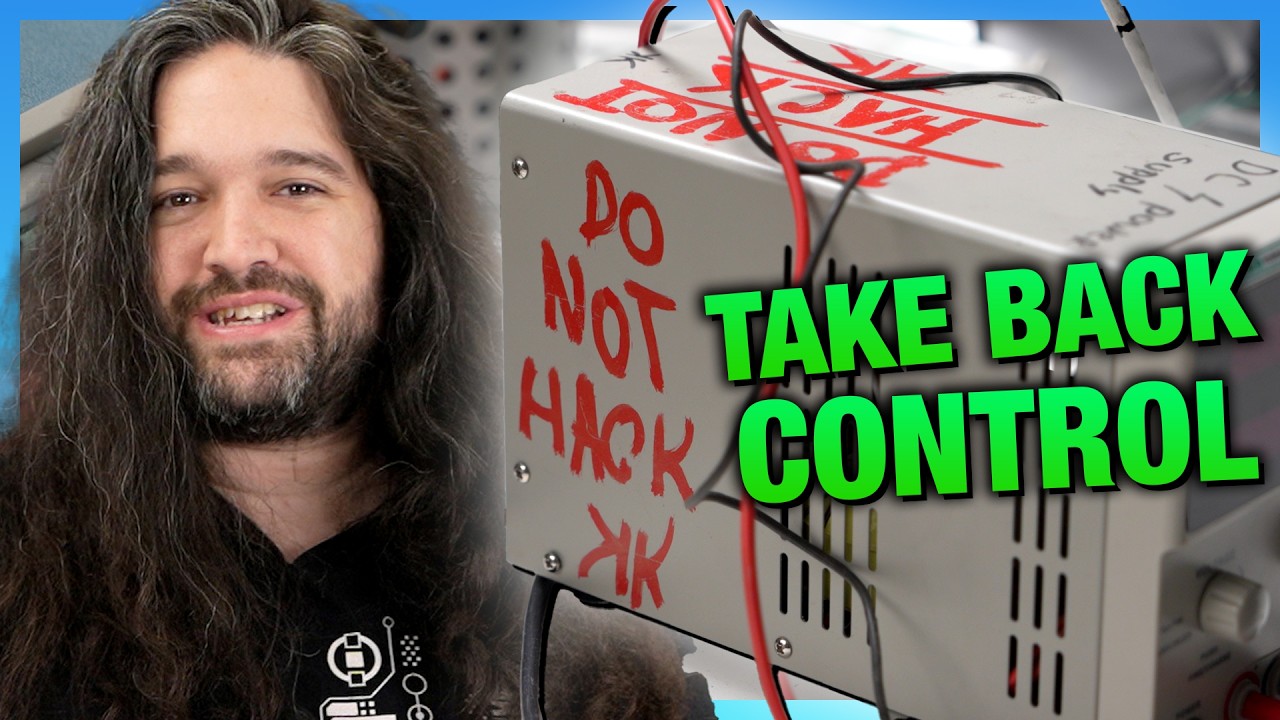
The decor upstairs reflects the irreverent, counter-cultural personality of the space. Hanging prominently on the wall is an autographed, original art piece titled *"Till death do us part,"* depicting Donald Trump and Jeffrey Epstein. When visitors question why an image of those figures belongs on the wall, the makers explain that it serves as a necessary reminder. Elsewhere in the room, a row of non-functional vintage manual typewriters sits along a table as decorative "load balancing," parked near an old Cooler Master desktop chassis labeled "Do not hack" that currently powers a shared 3D design workstation.
---
[11:52](https://www.youtube.com/watch?v=z6sF3pLsbKI&t=712s) RFID Sniffing, Threat Models, and Practical Privacy
When asked about past projects built inside Noisebridge, the guide describes fabricating self-balancing electric unicycles and tinkering with custom microchips. One notable project involved building a stealthy, long-range RFID reader. By pulling a heavy-duty HID reader out of a commercial parking garage mechanism and wiring it to a pair of 18650 lithium-ion cells inside a backpack, the rig could read access cards from 12 to 14 inches away simply by brushing past people on the street. Noisebridge regularly sends speakers to DEF CON to deliver presentations on NFC and RFID vulnerabilities, and the maker community is densely populated by privacy and security researchers.
The conversation turns to everyday device security following Steve's experience of being robbed in San Francisco. Discussing exploits like the Apple Pay and Visa contactless transaction bypass on the iPhone and the popularity of devices like the Flipper Zero, Steve points out the dilemma of laptop security: wanting trace-back capabilities if a device is stolen, without leaving open tracking backdoors that compromise user privacy.
The guide argues that security ultimately comes down to behavioral practices rather than specific gear: "Security is less about the tools that we use and more about what we do with them." While he relies on Tails OS for high-stakes operational security, he still carries an ordinary iPhone and walks the city streets "like an NPC." Ultimately, the most effective privacy guideline ever shared with him boils down to basic operational discipline: "shut the [fuck] up," stay observant with "one eye open, one eye closed," and limit the personal information broadcast into the wild.
- **Backpack RFID Rig:** Built from a salvaged garage HID reader and two 18650 batteries; reads contactless badges at 12–14 inches
- **DEF CON Presentations:** Regular community focus on contactless security, RFID/NFC exploitation, and hardware hacking
- **Privacy Philosophy:** Tails OS used for secure workflows, balanced against pragmatic smartphone use by keeping digital footprints minimal
---
[13:55](https://www.youtube.com/watch?v=z6sF3pLsbKI&t=835s) Inside the Electronics Lab: Old Silicon and Heavy Compute
Down in the electronics laboratory, the benches are outfitted with oscilloscopes, logic analyzers, multimeters, and temperature-controlled soldering stations. Shelves of clearly labeled bins hold assortments of USB-C, Micro-USB, HDMI connectors, and microphones. In the corner sits a half-cabinet server running Ubuntu with two Nvidia Titan V GPUs, which members use for training local AI models focused on code and video generation. The room previously hosted "Circuit Hacking Mondays" and is in the process of being converted into Noisebridge's primary on-site server room.
Browsing through spare component bins feels like "Disney for nerds." The hosts dig through piles of salvaged hardware, uncovering a Mini-ITX build equipped with a Corsair fan, an old Antec 900-era chassis, spare network switches, and a cardboard bin filled with ancient 2 GB sticks of DDR2 and DDR3 memory (all the high-end RAM having long since vanished). One mysterious component bears a blunt handwritten masking-tape note: *"Power port sucks."*
Digging deeper into an unsorted card bin, Steve pulls out an original Nvidia GeForce GTX Titan from the Kepler generation, followed by a GeForce GTX 1080. They reminisce about early Titans having uncapped double-precision FP64 compute performance—a feature Nvidia later neutered on consumer cards to push compute workloads onto enterprise hardware. Despite the age of the lab's hardware, the host notes that their dual-Titan V Ubuntu rig running in parallel still pushes more raw compute power for their workloads than a stock, modern Apple silicon M4 Max machine.
```mermaid
flowchart TD
accTitle: Noisebridge Compute and Electronics Room Infrastructure
accDescr: Layout of the local server rack, donor hardware bins, and workshop benches in the electronics lab.
subgraph ServerRack["Half-Cabinet Local Server"]
OS["Ubuntu Server OS"]
GPU["Dual Nvidia Titan V GPUs"]
Tasks["Local Code Gen & Video Gen Models"]
OS --> GPU
GPU --> Tasks
end
[16:48](https://www.youtube.com/watch?v=z6sF3pLsbKI&t=1008s) Mesh Networking, Monkeybrains, and Custom Hardware Alerts
The electronics room is also home to FPGA development, though the guide jokes that their former FPGA meetup eventually dwindled down to just himself and one other developer. The conversation turns to alternative communications upon spotting a Meshtastic node enclosed in a custom 3D-printed case. Noisebridge shares close ties with its Oakland sister space, Sudo Room, which previously pioneered the Sudo Mesh decentralized networking initiative across the East Bay. The space regularly attracts radio amateurs and network hackers experimenting with RTL-SDR (Software Defined Radio) dongles to capture and analyze RF signals over the air.
Steve notes the surging public interest in decentralized mesh networks as people look for alternatives to centralized internet gatekeepers. For its upstream internet connection, Noisebridge relies on Monkeybrains, an independent San Francisco ISP characterized playfully as "a cult in San Francisco" due to its passionate local following. Monkeybrains feeds the space's connection, allowing the organization to self-host all of its core software and network infrastructure on premises.
To keep members engaged with the organization's non-profit survival, four custom alert kiosks are mounted throughout the facility. Driven by Raspberry Pis and wired to rows of bright, addressable RGB LEDs, the displays trigger real-time light animations whenever a supporter submits a donation to help fund the space.
- **Meshtastic & Radio:** Active community building off-grid nodes; members experiment with RTL-SDR receivers for spectrum monitoring
- **Regional Ties:** Ongoing links with Sudo Room and the historic Sudo Mesh decentralized wireless project in Oakland
- **Internet Infrastructure:** Upstream broadband supplied by local independent ISP Monkeybrains, enabling fully self-hosted servers
- **Donation Indicators:** Four networked Raspberry Pi stations with addressable RGB LEDs flashing real-time donation notifications
[18:42](https://www.youtube.com/watch?v=z6sF3pLsbKI&t=1122s) Raspberry Pi LED Web Control and Laptop Security Discussion
The discussion shifts to a setup where different LED patterns are driven entirely through a web page. The web page pushes JavaScript to a Raspberry Pi, which evaluates the code to drive the LEDs, making the web page the single "source of truth" for all the code. While the system is clean, the creators admit it is "not secure," though they note it poses no risk since there are no sensitive credentials like Stripe tokens stored on the Pi. Other visual projects around the space feature matrix-style effects designed for lower friction and playful utility.
Conversation turns toward personal tech security after Steve mentions having his laptops stolen, including an ASUS Scar 16. The group jokes about how the thief likely has no idea what they took, noting that one of the stolen machines packed 64 GB of memory and that if the perpetrator understood its true value, "he would never have to steal again." They swap stories about stolen devices ending up across the globe—with phones turning up in Abu Dhabi or Kabul where they get desoldered for parts even when locked, while sensitive personal data is typically just thrown in the trash.
To combat this kind of theft in the future, the group brainstorms embedding decentralized hardware trackers like Meshtastic or Meshcore directly inside a laptop's chassis. By leveraging a city-wide mesh network with repeaters on roofs rather than relying on centralized corporations or cloud subpoenas, users could ping and triangulate a device's precise path using low-power internal battery hardware.
- **LED Control Architecture:** Web page acts as the source of truth, pushing JavaScript to a Raspberry Pi to eval and drive LED patterns.
- **Stolen Hardware Realities:** High-end machines like an ASUS Scar 16 with 64 GB of RAM are fenced or stripped for parts overseas (such as Kabul or Abu Dhabi), often netting thieves a fraction of their worth.
- **Decentralized Tracking Idea:** Proposing Meshcore or Meshtastic integration inside laptop chassis to enable local mesh network triangulation without relying on Apple or corporate subpoenas.
```mermaid
flowchart LR
subgraph Setup ["LED Control Setup"]
A["Web Page\n(Source of Truth)"] -->|"Pushes JavaScript"| B["Raspberry Pi"]
B -->|"Evals & Drives"| C["LED Patterns"]
end
subgraph Tracking ["Decentralized Tracking Idea"]
D["Laptop with\nMeshcore/Meshtastic"] -->|"Pings local nodes"| E["City Roof\nRepeaters"]
E -->|"Triangulates"| F["Local Mesh Network"]
end
```
---
[21:55](https://www.youtube.com/watch?v=z6sF3pLsbKI&t=1315s) Exploring Noisebridge Equipment, History, and the Woodshop Toll
Moving downstairs into the main fabrication area, the tour highlights the space's most expensive piece of equipment: a large laser cutter. Members explain that proper training is required to operate it, which takes place on Sundays. Equipment is largely acquired through donations from people who no longer need their laser cutters or 3D printers, though members laugh that Noisebridge can easily become a slippery slope to an e-waste dump yard—jokingly inviting whoever stole the laptops to bring them in with no questions asked and no charges pushed.
The laser cutters handle everything from wood and acrylic to leather and denim for clothing and artwork. The conversation touches on iconic fixtures like the computer chandelier and delves into the history of Noisebridge, which was established in 2007 and recently underwent major reorganizations, including a massive welding workshop. When asked to rank tool popularity, members cite laser cutters, 3D printing, and sewing as top favorites, noting that the woodshop is in a league of its own. Building the dedicated woodshop wall nearly bankrupted the entire non-profit due to the immense costs required for proper dust collection and ventilation, though as the founders joke, "We're called Noisebridge, so we don't give a [expletive] about noise."
- **Equipment Acquisition:** Heavy machinery like laser cutters and 3D printers are primarily sourced through community donations.
- **Material Capabilities:** Laser cutters process wood, acrylic, leather, and denim for custom apparel and intricate art pieces.
- **Financial Toll:** Constructing the isolated woodshop area and its dust collection system was the most expensive project in the space, nearly bankrupting the non-profit.
---
[24:54](https://www.youtube.com/watch?v=z6sF3pLsbKI&t=1494s) Quake III Fast Inverse Square Root Code Art and Flaschen Taschen
A piece of laser-cut wall art catches attention, featuring eight stacked layers of paper where each color corresponds to a different depth and each hole cuts through successive layers. The artwork displays the legendary fast inverse square root algorithm from *Quake III Arena*. The speakers discuss the lore behind the famous bitwise hacking snippet—often attributed to John Carmack, though nobody knows for sure who left the mysterious comments. The function famously treats floats from a bitwise perspective as their own logarithm, allowing integer operations and bitwise hacks to compute square roots exponentially faster.
The tour wraps up in the downstairs co-working area, which hosts Tuesday community meetings at 7:00 PM dedicated to consensus, democracy, and operational excellence. Pointing out another iconic project called "Flaschen Taschen," the host notes that it is temporarily turned off while members reprogram the Raspberry Pi and house it inside a clean custom enclosure.
- **Artistic Code:** Laser-cut layered paper art representing the fast inverse square root algorithm from *Quake III Arena*.
- **Bitwise Magic:** The algorithm leverages floating-point bit representation as a logarithm to perform lightning-fast math via bitwise hacks.
- **Community Meetings:** Tuesday meetings at 7:00 PM bring members together to discuss consensus, governance, and collaborative projects like the Flaschen Taschen display.
[26:38](https://www.youtube.com/watch?v=z6sF3pLsbKI&t=1598s) The Beer Bottle Display and Salvaged Machinery
The tour moves past a massive custom display powered entirely by a Raspberry Pi, complete with QR codes attached to the side that direct visitors to a GitHub repository where anyone can learn how to push animations over the network. When Steve asks about the origin story of the installation, the guide laughs and reveals that well over a decade ago, members basically got drunk for two weeks, gathered up all their empty beer bottles, stuck LEDs in them, and loaded them into plastic milk crates. It has stood in the space for as long as anyone can remember and remains Noisebridge’s most recognizable project, acting as an enduring symbol of the community's DIY ethos. Rather than each crate representing a single block pixel, every individual bottle serves as its own pixel, forming a low-resolution matrix that Steve estimates to be around 45 by 35 bottles across.
Nearby sits an assortment of heavy, mysterious machinery. The guide points out one imposing contraption that looks like an armored tank from the side; while a guest once gave a full presentation explaining its industrial purpose and its internal fluid pump still functions, the surrounding maker space is far too dusty to safely operate it without substantial maintenance. A Roland tabletop CNC machine rests close by as well. The guide explains that Noisebridge acts as a critical intermediate buffer between salvageable hardware and the local e-waste scrapyard. Equipment donated to the space either attracts an enterprising hacker who takes the initiative to maintain and run it, or it eventually moves on, but the space serves as a spirited court of last resort to make discarded tech functional again.
- The iconic beer bottle LED wall runs off a Raspberry Pi and accepts user animations over local network protocols via public GitHub documentation.
- The bottle display resolution is roughly 45 × 35 pixels, with each repurposed bottle serving as an illuminated node.
- Donated industrial gear, including a tabletop Roland CNC mill and educational pump machinery, relies on spontaneous community stewardship to avoid being scrapped.
[28:20](https://www.youtube.com/watch?v=z6sF3pLsbKI&t=1700s) Wood Shop, Metal Shop, and Music Room
Transitioning into the fabrication workshops, the guide presents the dedicated wood shop. The room is fully equipped with benchtop drill presses, table saws, and various handheld saws, accompanied by a dedicated overhead dust-ventilation and air-filtration system. The guide delivers a standard workshop safety rule: stick strictly to the tools you know how to operate and watch your hands so you "don't cut your fingers."
Just beyond lies the metal shop, currently piled with ongoing projects. The guide notes plans to reorganize the space and shift key equipment toward the front entrance near the laser cutters. The shop features another heavy-duty drill press and an industrial metal lathe. Inspecting the machinery, Steve remarks that the equipment strongly resembles the rugged tooling gear he regularly encounters when touring manufacturing and tooling factories in China. Continuing through the building, they step into the music studio, an evolving soundproofed space equipped with guitars, keyboard synthesizers, and an electronic drum kit available for visitors and residents to play and jam.
[29:14](https://www.youtube.com/watch?v=z6sF3pLsbKI&t=1754s) Decentralized Tracking and Tour Conclusion
Wrapping up the tour, Steve expresses his admiration for the scale and community-driven energy of Noisebridge. The host invites the Gamers Nexus team to return, join the maker collective, and bring along a computer so they can collaborate on building a tracking device that is genuinely secure, private, completely decentralized, and based on FLOSS (Free/Libre and Open-Source Software) rather than handing telemetry data over to a single massive corporate monolith. Steve enthusiastically agrees that building an open tracking alternative outside a closed tech ecosystem would be fantastic. With a final laugh about inspecting raw silicon code, Steve wraps up the segment, encouraging viewers to explore the provided project and donation links for Noisebridge before signing off until the next video.
## Notable quotes
> [11:52](https://www.youtube.com/watch?v=z6sF3pLsbKI&t=712s) Security is less about the tools that we use and more about what we do with them.
> [11:52](https://www.youtube.com/watch?v=z6sF3pLsbKI&t=712s) shut the [fuck] up
> [11:52](https://www.youtube.com/watch?v=z6sF3pLsbKI&t=712s) one eye open, one eye closed
> [13:55](https://www.youtube.com/watch?v=z6sF3pLsbKI&t=835s) Disney for nerds.
> [13:55](https://www.youtube.com/watch?v=z6sF3pLsbKI&t=835s) Power port sucks.
> [16:48](https://www.youtube.com/watch?v=z6sF3pLsbKI&t=1008s) a cult in San Francisco
> [18:42](https://www.youtube.com/watch?v=z6sF3pLsbKI&t=1122s) he would never have to steal again.
> [21:55](https://www.youtube.com/watch?v=z6sF3pLsbKI&t=1315s) We're called Noisebridge, so we don't give a [expletive] about noise.
> [28:20](https://www.youtube.com/watch?v=z6sF3pLsbKI&t=1700s) don't cut your fingers.
## Mentioned
Noisebridge, Weezy, Steve Burke, Fulu Foundation, Louis Rossmann, Digital Millennium Copyright Act (DMCA), Zulip, PlayStation 5, Dan Angel, Raspberry Pi, Raspberry Pi Pico, Lenovo ThinkPad T430, Coreboot, SeaBIOS, BeOS, Donald Trump, Jeffrey Epstein, Cooler Master, DEF CON, Flipper Zero, Tails OS, iPhone, Nvidia Titan V, Nvidia GeForce GTX Titan, Nvidia GeForce GTX 1080, Antec 900, Apple M4 Max, Meshtastic, Meshcore, Sudo Room, Sudo Mesh, RTL-SDR, Monkeybrains, ASUS ROG Strix Scar 16, Quake III Arena, John Carmack, Flaschen Taschen, Roland
## Video description
SPONSOR: Contribute to FULU Foundation's Consumer Rights Wiki https://geni.us/lAWAZ or join their Zulip server to take action! https://geni.us/jeEBB Find their bounties here: https://geni.us/Iyzy2n
Shortly after we were robbed in San Francisco earlier this year, we happened across a hacker and maker space known as Noisebridge. The space is open to the public, maintained as a non-profit working space, and has tools and teaching for 3D printing, laser cutters, CNCs, woodshop tools, knitting and sewing tools, and more. We learned about meshnet and meshcore decentralized networking, hacking hardware, and just doing cool things with technology while visiting.
Visit Noisebridge at 272 Capp St, San Francisco, CA 94110. Their website is here: https://www.noisebridge.net/wiki
They also accept donations: https://www.noisebridge.net/wiki/Donate_or_Pay_Dues
The best way to support our work is through our store: https://store.gamersnexus.net/
Like our content? Please consider becoming our Patron to support us: http://www.patreon.com/gamersnexus
TIMESTAMPS
00:00 - INSPIRATION to Own Hardware
05:06 - Welcome to Noisebridge
05:42 - 3D Printer Room
07:03 - Forkbomb Bash Code
08:26 - The Secret Locker
10:34 - Device Security and Tracing
13:54 - Electronics and Decentralized Networking
21:55 - Laser Cutter and Sewing
24:54 - Quake III Code Art
26:26 - Raspberry Pi Projects
29:12 - Conclusion
** Please like, comment, and subscribe for more! **
Links to Amazon and Newegg are typically monetized on our channel (affiliate links) and may return a commission of sales to us from the retailer. This is unrelated to the product manufacturer. Any advertisements or sponsorships are disclosed within the video ("this video is brought to you by") and above the fold in the description. We do not ever produce paid content or "sponsored content" (meaning that the content is our idea and is not funded externally aside from whatever ad placement is in the beginning) and we do not ever charge manufacturers for coverage.
Follow us in these locations for more gaming and hardware updates:
Our policies, processes, and ethics statements relating to review samples, advertising, travel, errors, and more are transparently and publicly available on this page: https://gamers.nexus/ethics-statements
Steve Burke: Host, Editing
Vitalii Makhnovets: Editing
Tannen Williams: Camera
Following a vehicle burglary in San Francisco, Gamers Nexus explores Noisebridge, an anarchist makerspace where members use open-source firmware, salvaged silicon, and decentralized networks to reclaim hardware ownership from corporate ecosystems.
Noisebridge's Structure and Right-to-Repair Advocacy (0:00)
Established in 2007 at 272 Capp Street in San Francisco, Noisebridge operates as a volunteer-run nonprofit without paid staff, funding itself through donations and suggested tool-use fees. The space provides access to expensive machinery like 3D printers, laser cutters, and a woodshop whose costly ventilation system previously strained the organization's finances. Governance relies on weekly consensus meetings on Tuesdays, while upstream internet connectivity is provided by independent local ISP Monkeybrains, enabling on-site server hosting.
Reclaiming Hardware Through Firmware and Modifications (9:20)
The collective's approach to device longevity is exemplified by the "laptop of Theseus," a 2013 Lenovo ThinkPad T430 continually upgraded with modern RAM, solid-state storage, a new display panel, and an internal USB-C charging port. To bypass proprietary control, the owner replaced the stock BIOS with open-source Coreboot and SeaBIOS firmware by physically attaching a hardware flasher directly onto the motherboard chip. This focus on device autonomy aligns with legal advocacy promoted in the video, such as the Fulu Foundation's campaign against Section 1201 of the Digital Millennium Copyright Act (DMCA), which criminalizes circumventing digital locks on hardware like game consoles.
Salvaged Silicon and Localized Computing Infrastructure (13:55)
Noisebridge serves as an intermediate buffer between useful technology and the scrapyard, repurposing discarded hardware that visitors donate. Its electronics lab houses multimeters, oscilloscopes, and bins of older components, including DDR2 and DDR3 memory alongside older GPUs like the Kepler-generation GTX Titan and GTX 1080. For heavier workloads, such as training local AI code and video models, the lab runs a local Ubuntu half-cabinet server equipped with two Nvidia Titan V graphics cards, which the hosts note provides more raw compute power for their specific tasks than a stock Apple M4 Max system.
Decentralized Tracking and Practical Operational Security (11:52)
Spurred by thefts where high-end laptops like an ASUS Scar 16 end up dismantled overseas for parts, the creators discussed decentralized anti-theft tracking alternatives. Rather than relying on commercial trackers tied to cloud subscriptions and telemetry, members proposed embedding Meshtastic or Meshcore radio hardware inside laptop chassis to triangulate location through local rooftop mesh nodes. Regarding broader digital privacy, Noisebridge members who research RFID and NFC vulnerabilities argue that security depends less on specific consumer gadgets and more on disciplined personal behavior—such as using Tails OS for high-risk work while maintaining a minimal profile in everyday life.
Creative Hacking and Physical Installations (26:38)
The facility features installations that blend technical experimentation with public art, including a long-standing display known as "Flaschen Taschen." The installation repurposes an estimated 45-by-35 grid of empty beer bottles inside milk crates into a low-resolution matrix driven by a Raspberry Pi, accepting user-submitted animations through a public GitHub repository. Other projects throughout the shop include laser-cut art illustrating the Quake III Arena fast inverse square root algorithm, Bash fork bomb code, and networked Raspberry Pi stations that trigger real-time LED sequences whenever a patron donates.
While Noisebridge demonstrates viable technical paths for repairing aging hardware and running independent infrastructure, its community-driven model relies entirely on volunteer upkeep and donations, which constantly balance the space between a functional research workshop and an overburdened salvage yard.
Source quotes
[11:52] Security is less about the tools that we use and more about what we do with them.
[11:52] shut the [fuck] up
[11:52] one eye open, one eye closed
[13:55] Disney for nerds.
[13:55] Power port sucks.
[16:48] a cult in San Francisco
[18:42] he would never have to steal again.
[21:55] We're called Noisebridge, so we don't give a [expletive] about noise.
[28:20] don't cut your fingers.
Original transcript
[0:00] In our quest to take back our
[0:01] electronics and bring technology back to
[0:03] a time when it was less
[0:05] dire. I'm trying to trying to get a kid
[0:07] to do long division right now. Basic
[0:09] math is is being forgotten.
[0:11] >> [music]
[0:11] >> Um doesn't matter. That's my question
[0:13] for you. Yeah, I don't think it does.
[0:16] I don't think it does. We visited
[0:17] nonprofit Noisebridge, a hacker and
[0:19] maker space in San Francisco.
[0:21] >> He can do anything. I can't do anything.
[0:24] >> You can find anything.
[0:25] >> You know when people say like I know a
[0:26] guy?
[0:27] >> [laughter]
[0:30] >> That invited us in when they saw us
[0:31] literally wandering around in the drug
[0:33] markets of San Francisco to try and find
[0:36] our that was stolen from us when
[0:38] our car was broken into earlier this
[0:40] year.
[0:42] We never found our stuff, but we did
[0:45] find [music] this guy, Weezy.
[0:47] loved the documentary. I was in
[0:48] Hong Kong when you did that
[0:50] >> Were you, really?
[0:52] Noisebridge?
[0:52] >> Anarchist hacker space.
[0:53] >> We'd never met. He walked up to us on
[0:56] the street while we were watching the
[0:57] cops bust one of the vendor stalls for
[0:59] stolen goods. We took the opportunity to
[1:02] walk a few blocks and learn more.
[1:04] [music]
[1:04] >> What what are some examples of like
[1:05] stuff that you've built or done in here?
[1:07] Like what's Run me through some of the
[1:09] stuff you've done.
[1:10] >> I did like a
[1:11] long-range RFID reader using one of the
[1:14] garage HID reader thing.
[1:17] Put a couple 18650 cells in there and
[1:19] like can basically pick up a badge from
[1:21] like 12-14 inches away. So if I have it
[1:23] in a backpack,
[1:24] um
[1:25] could scan people's cards. Um
[1:28] got a lot of people here that have done
[1:29] presentations that talk about NFC, RFID,
[1:33] security. We've got a lot of security
[1:34] nuts here for sure. A lot of privacy
[1:35] people.
[1:36] >> It wasn't our itinerary, but I learned
[1:38] from a reporter local to the scene long
[1:40] ago, Gordon, that sometimes it's just
[1:42] better to see where the story takes you.
[1:45] And Weezy brought us in to learn about
[1:47] all the ways you can decentralize your
[1:49] life from the mega corporations that run
[1:51] everything with a technology focus. We
[1:54] learned a lot while there.
[1:56] >> Welcome to the electronics room. We have
[1:58] everything here from oscilloscopes to
[2:01] logic analyzers.
[2:02] >> So, it's fast inverse square root from
[2:04] Quake III Arena.
[2:06] >> Okay.
[2:07] >> [laughter]
[2:07] >> You put that into a shell that
[2:10] overwhelms the computer with processes.
[2:12] >> So, this is bash code that defines a
[2:15] function. The function is named colon,
[2:16] which makes it It's meant to be like as
[2:18] terse and hard to interpret as possible
[2:20] just for like the aesthetic of it. This
[2:22] is the the canonical naming is the
[2:23] colon.
[2:24] >> I like just barely started trying to
[2:26] make a single board computer using a Pi
[2:29] Pico.
[2:29] >> But, the biggest thing we learned is
[2:31] that the community is growing for this
[2:32] kind of thing. Even in spite of how AI
[2:34] companies and memory companies have made
[2:36] DIY PCs impossible to afford. We got a
[2:39] box full of RAM.
[2:41] >> What?
[2:42] >> What? That should be behind a locked
[2:44] door.
[2:44] >> of the best things about this space is
[2:46] all of the character everywhere. For
[2:48] example, this firewall solution. With
[2:51] just a pair of scissors, you can
[2:52] activate the firewall and make sure damn
[2:55] near nobody gets in. Or, if you're doing
[2:57] a soldering project, they have basically
[2:59] every small part you could need. There's
[3:01] lots of random resistors or capacitors
[3:03] or surface mount devices and plenty of
[3:05] other cool things just scattered around.
[3:07] It's encouraging to see how many people
[3:09] want to learn more about taking
[3:11] ownership of not only their services,
[3:13] but their electronics. And this is part
[3:15] of a series we're producing about truly
[3:17] taking back control over your devices.
[3:19] In this tour of the Noisebridge Maker
[3:21] and Hacker space, which is open to the
[3:23] public, we hope to share some
[3:25] inspiration to find or create spaces
[3:28] like this near you to help spread
[3:30] knowledge of decentralization,
[3:32] owning your technology, and fighting
[3:34] back against the corporations that are
[3:35] trying to license and rent you
[3:37] everything instead of sell it to you.
[3:39] This is Noisebridge. Before that, this
[3:42] video is brought to you by Louis
[3:43] Rossmann's Fulu Foundation and killing
[3:46] the DMCA section 1201. That's right. He
[3:49] paid for this ad spot specifically so I
[3:52] could say the DMCA. I would have
[3:55] done it for free. We just went on tour
[3:56] with Louis's Fulu Foundation. Fulu is a
[3:59] proponent of owning your own and
[4:01] paying bounties to unlock devices like
[4:03] the PS5 as corporations make it harder
[4:05] than ever to do so. Fulu's bounties for
[4:07] cybersecurity researchers to unlock
[4:09] devices that are locked behind
[4:11] artificial walls. Thanks to the Digital
[4:13] Millennium Copyright Act Section 1201,
[4:15] it's a criminal act to circumvent
[4:17] digital locks. Fulu needs your help to
[4:19] build the grassroots coalition of
[4:21] hardware enthusiasts to ensure
[4:23] governments are informed about
[4:24] technology and how it actually works. To
[4:27] get involved, join Fulu's Zulip chat
[4:29] server and learn about how to contact
[4:31] representatives so that we can all work
[4:33] together to actually change the laws.
[4:35] Likewise, visit the Consumer Rights Wiki
[4:37] to document with evidence instances of
[4:39] the bad and anti-consumer actions of
[4:41] companies which Fulu can use as evidence
[4:43] when speaking with lawmakers about
[4:45] change. The Consumer Rights Wiki is
[4:47] linked below. If you felt like ownership
[4:49] rights have gotten worse but haven't
[4:51] known how to make that better, now is
[4:53] the time to get involved and take
[4:54] action. With enough people, we can get
[4:56] laws passed to protect consumers or in
[4:58] the worst case, at least get some
[4:59] bounties up to support unlocks of
[5:01] devices. Check the links below to get
[5:04] involved and change things for the
[5:05] better. You want to lead the way in?
[5:07] Come on in.
[5:10] >> So, we built our access control system
[5:11] here in the to this payphone.
[5:13] Punch in the code, hear the beep, and
[5:15] push the door.
[5:17] Welcome to Noisebridge. This is like
[5:19] Steve said, an anarchist hacker space.
[5:22] Uh, it's a volunteer-run nonprofit so
[5:23] everything that you see here is donated.
[5:25] Nobody works here. We just work to keep
[5:27] this place alive.
[5:29] Uh, it is not free by any means but we
[5:30] work hard to keep it free for those who
[5:32] can't afford to access things like 3D
[5:34] printers, laser cutters, CNC machines,
[5:37] sewing machines, music equipment,
[5:39] soldering irons. Come on in.
[5:42] Let me show you the first room.
[5:43] >> Okay.
[5:44] >> 3D printers.
[5:48] >> [snorts]
[5:48] >> Then we got
[5:50] >> Yes, we got the fancy proprietary and
[5:52] shitified 3D printers. It's
[5:55] certification. You know what? You just
[5:57] give it the STL, it just shits it out.
[6:00] >> Yeah, I see the you've got the AMS and
[6:01] then you have the high temp I guess that
[6:03] the HT or TPU.
[6:05] >> Yep, yep, yep.
[6:06] >> Do people just um
[6:08] come through and print as they need for
[6:10] projects? Okay.
[6:11] >> And we ask people to donate based on it.
[6:13] So if you use the 3D printers, please
[6:15] donate anywhere from $2 to $6 depending
[6:17] on how much you can do.
[6:19] Some people don't have money, but they
[6:20] have filament. And you get filament.
[6:22] >> It's a great process.
[6:22] >> What's kind of the layout? You have two
[6:24] floors.
[6:25] >> Yes, downstairs is mostly the fabbing
[6:26] area.
[6:27] >> Do you ever use any of the uh
[6:29] fabrication tools or you more upstairs?
[6:31] >> I'm definitely a Verilog developer.
[6:35] >> [laughter]
[6:36] >> I definitely write CUDA kernels.
[6:41] Welcome to the upstairs area.
[6:43] That's our old building right there.
[6:44] >> Oh, really? Okay.
[6:46] >> Don't tell the landlord this, but we did
[6:47] slide some of the things through here
[6:48] when we were moving.
[6:50] Uh-huh.
[6:51] >> Like from one side to the other?
[6:52] >> Yep.
[6:53] >> sick.
[6:55] >> We didn't break anything though.
[6:57] >> To do a
[6:59] >> little ramp.
[7:00] >> Ramp? [laughter]
[7:00] >> Yeah, it's a little ramp here.
[7:02] >> That's awesome. The art on the wall is
[7:05] pretty cool.
[7:05] >> Fork bomb. Dan Angel, our payment portal
[7:08] guy and 3D printing guy, the one that
[7:11] you met downstairs, he made this little
[7:13] art piece for us.
[7:15] It's the fork bomb.
[7:16] You put that into a shell, it overwhelms
[7:19] the computer with processes.
[7:21] >> So this is bash code that defines a
[7:23] function. The function is named colon,
[7:25] which makes it it's meant to be like as
[7:27] terse and hard to interpret as possible
[7:29] just for like the aesthetic of it. This
[7:31] is the the canonical naming is the
[7:32] colon. So it's a function named colon
[7:35] and then the function is called two
[7:36] times within the body of the function.
[7:38] One's piped into the other and then the
[7:40] ampersand puts it in the background so
[7:42] that it doesn't block and that way
[7:45] and over here we invoke the function.
[7:47] This is the initial indication and the
[7:49] subsequent indications. So it ends up
[7:51] calling the exponential
[7:54] exponentially growing number of these
[7:57] colon functions. So you call one and
[8:00] then one calls two and then each one of
[8:01] those two calls two two so then it's
[8:04] like two to the ends per iteration
[8:06] um
[8:07] >> And it's supposed to crash your
[8:08] computer.
[8:09] >> Is that Okay.
[8:10] >> I remember I ran it on like a Mac a
[8:12] couple years ago and like they rate
[8:13] limited forking. So there it was like it
[8:16] didn't actually crash anything.
[8:17] >> They protected it. Okay.
[8:19] >> engineers figured it all out. And then I
[8:20] got one that's like basically trying to
[8:23] bait some
[8:25] tech founder into buying it. It's like
[8:26] [laughter]
[8:27] >> Oh yeah, show them the locker.
[8:28] >> Oh yeah, we got the locker. I was
[8:29] accused of locker mogging with this one.
[8:32] >> Uh-huh.
[8:33] Locker mogging.
[8:34] >> Yeah.
[8:35] I got to get the
[8:37] Okay. So we got
[8:38] >> That's sick.
[8:39] >> So we got like you know I I got these
[8:41] like you know some plywood and it's just
[8:43] like rectangles cut on the table saw and
[8:46] so it's not even like glued or anything.
[8:48] It's just all fit together geometrically
[8:49] and we got like the nice slide out
[8:51] Raspberry Pi touchscreen. Uh
[8:54] with a chrome and then pop-ups and of
[8:56] course all my junk is in here. I've got
[9:00] I like just barely started trying to
[9:02] make a single board computer using a Pi
[9:05] Pico. So this is going to have a RJ45
[9:09] jack on it doing 10 megabit half duplex
[9:12] ethernet and also like analog video out
[9:15] with VGA. It's got some resistor ladder
[9:16] on there for that. Um
[9:18] >> What was the How long did it take you to
[9:20] put it put the locker together the way
[9:22] you have it now?
[9:23] >> It's a growing project.
[9:26] Make it more and more complicated over
[9:27] time. That's the whole goal. I got like
[9:29] my art stuff up here
[9:30] >> the wiki.
[9:31] >> various tech stuff
[9:32] >> Yeah.
[9:32] >> below. Got my LE RGB LEDs. I really love
[9:36] these.
[9:37] >> Specific LEDs do you like?
[9:38] >> Yeah, yeah, yeah. Great.
[9:39] >> Okay. Okay.
[9:42] >> All right. So, this is a
[9:43] ThinkPad T430.
[9:45] >> Okay.
[9:45] >> This is the exact one I used in college,
[9:47] and I've upgraded it like It's pretty
[9:49] nice. So, it's got
[9:51] >> USB-C charging. Got that sick sick
[9:53] USB-C.
[9:55] So, you can just charge it with like a
[9:56] normal thing.
[9:57] >> What what was the original like uh date
[10:00] that you bought the laptop?
[10:02] >> Oh, this is probably 2013, like August.
[10:04] >> Yeah, but no USB-C yet.
[10:06] >> No, no, no. And of course, it's like got
[10:08] an upgraded screen, upgraded storage,
[10:11] upgraded battery, upgraded uh RAM,
[10:13] upgraded CPU. I replaced the BIOS with
[10:17] uh SeaBIOS and Coreboot, so it's got
[10:19] free open-source firmware. You have to
[10:20] like clip onto the motherboard in order
[10:22] to flash that. But basically, the only
[10:23] original thing here
[10:25] is the motherboard and a couple pieces
[10:28] of the shell. I've replaced much of the
[10:29] shell over the years. So, it's like the
[10:31] laptop of Theseus.
[10:34] >> I'll show you guys the rest
[10:35] >> of the space electrical engineering
[10:36] reference manual.
[10:37] >> Quick algebra review. Yeah, get in
[10:39] there.
[10:39] >> 1990.
[10:41] >> Nice.
[10:43] Real This doesn't change a whole
[10:45] lot though, so.
[10:46] >> Yeah.
[10:47] >> [laughter]
[10:47] >> Thank goodness. We got some books here
[10:49] on PHP and BOS.
[10:51] >> Oh, nice.
[10:52] >> BOS. If you know, you know.
[10:54] >> BOS.
[10:54] >> Come on over. This is our upstairs
[10:56] co-working area. So, it's like the
[10:58] downstairs one, but it's a little
[10:59] cleaner cuz it's upstairs, harder to
[11:01] access. People come here to write code,
[11:04] um surf the web, do design stuff. We
[11:07] have our software infrastructure meet up
[11:08] here 7:00 on Mondays. Um
[11:11] >> I like your uh artwork.
[11:13] >> Yes. Oh, yeah, please.
[11:16] Till death do us part.
[11:17] >> Oh, was this Is this an original?
[11:19] >> Was this an original?
[11:20] >> Autographed?
[11:20] >> It is original and autographed.
[11:23] People were like, "Why are you guys
[11:24] putting up pictures of Epstein and
[11:26] Trump?" We're like, "It's a good
[11:27] reminder."
[11:28] >> Here, I see typewriters. That's cool.
[11:29] >> Yeah, these are just more like just for
[11:31] fun? Load balancing.
[11:33] >> [laughter]
[11:34] >> Okay.
[11:36] >> This is really nothing more than just
[11:38] like
[11:39] >> display at this point. Yeah.
[11:41] >> They're not working.
[11:42] >> Ooh, that's an old Cooler Master case.
[11:44] Do not hack. So, this is just in use, I
[11:47] guess, for someone.
[11:48] >> Yeah. I think that's
[11:49] That's like a 3D design workstation.
[11:52] >> What What are some examples of like
[11:53] stuff that you've built or done in here?
[11:55] Like, what's Run me through some of the
[11:57] stuff you've done.
[11:58] >> Built electric unicycles here.
[11:59] Self-balancing vehicles.
[12:01] >> Okay.
[12:01] >> Um
[12:03] Um like DIY
[12:05] chip projects. I did like a
[12:08] long-range RFID reader using one of the
[12:11] garage
[12:12] >> [snorts]
[12:12] >> HID reader things. Put a couple 18650s
[12:15] down in there and like could basically
[12:16] pick up a badge from like 12-14 inches
[12:18] away. So, if I have it in a backpack
[12:20] um
[12:22] could scan people's cards. Um
[12:24] got a lot of people here that have done
[12:25] presentations at Def Con about NFC, RFID
[12:29] security. You've got a lot of security
[12:30] nuts here, for sure. A lot of privacy
[12:32] people. Um
[12:34] >> Yeah, I think a lot of people don't
[12:35] realize how
[12:36] >> insecure their systems are. I recently
[12:38] watched the new Veritasium video
[12:40] on the
[12:41] Apple hack the the Apple Pay hack if
[12:43] with the
[12:45] iPhone with Visa
[12:47] Yeah. That was hilarious.
[12:49] >> I mean, Flipper was the one that I think
[12:51] put that on a lot of people's radar
[12:52] originally.
[12:53] >> Yeah. I remember when it came out, it
[12:55] definitely brought a lot of attention to
[12:56] this space and all that stuff.
[12:57] >> I was just talking to some people about
[12:59] you know, the laptop situation. I was
[13:01] like
[13:02] I I would like to have some level of
[13:04] traceability if it's lost or stolen
[13:06] again.
[13:07] But then you also don't want to be
[13:09] traceable by people you don't want to
[13:10] trace you, right? And so, like
[13:14] something like
[13:15] >> Security is less about the tools that we
[13:17] use and more about what we do with them.
[13:19] That's what I've come to realize over
[13:20] the years. I've
[13:22] Um I run Tails OS for many things that
[13:24] matter.
[13:25] >> Yeah.
[13:25] >> Uh also
[13:28] use an iPhone and walk on the sidewalk
[13:30] like an NPC.
[13:31] >> [laughter]
[13:34] >> Um, it's less about what's in your
[13:37] pocket and more about what you do with
[13:39] it. The information that you're putting
[13:41] out there. Um
[13:43] >> And just the best privacy advice I've
[13:45] ever gotten is shut the up.
[13:47] >> Yeah, that's
[13:47] >> [laughter]
[13:48] >> just good advice, too. Yeah.
[13:49] >> One eye open, one eye closed.
[13:50] >> Yeah.
[13:52] It's easy, yeah. And B E J, yeah.
[13:54] >> Yeah.
[13:55] >> Welcome to the electronics room. We have
[13:57] everything here from oscilloscopes to
[14:00] logic analyzers and bins with labeled
[14:03] HDMI, USB-C, USB micro, mics, things.
[14:06] >> Do you do anything in this room?
[14:07] >> Yeah, this is where I usually SSH into
[14:09] that machine right there that has two
[14:12] Titan V GPUs and I do some training on
[14:14] there.
[14:14] >> Oh, the uh, in the half cab down there?
[14:16] >> Yeah, we do like So, we used to have
[14:18] circuit hacking Mondays here on Mondays.
[14:20] Uh, now we're probably going to turn
[14:21] this into like our server room.
[14:23] >> What are you running on the
[14:25] this cabinet closer to us?
[14:26] >> Uh, we're running Ubuntu.
[14:28] >> Is it just for people to remote into?
[14:30] >> Like, yeah, it's just to be able to
[14:31] remote into. We have a couple of local
[14:32] models there for like
[14:34] code gen and video gen stuff.
[14:36] [clears throat]
[14:36] >> Soldering stations I see. See some
[14:39] analyzers, multimeters, oscilloscopes.
[14:43] >> Yep. Ooh, yeah, we got a couple of
[14:45] different boxes that are just chilling
[14:48] and lying around.
[14:49] >> I'm just curious.
[14:51] Got a Corsair fan in it.
[14:53] >> Mhm.
[14:56] >> Mini ITX.
[14:57] >> Yeah.
[14:59] We got a box full of RAM.
[15:01] >> What?
[15:02] >> Right?
[15:03] >> That should be behind a locked door.
[15:04] >> But all the nice RAM is gone.
[15:06] >> Yeah.
[15:06] >> I wonder what happened to the nice RAM.
[15:09] I wonder what happened to the nice RAM.
[15:11] >> Yeah.
[15:12] >> These are 2 GB sticks.
[15:14] >> DDR 3?
[15:17] Ooh.
[15:17] >> Might be 2. Some of this might be 2.
[15:19] >> This is long ancient RAMs. then
[15:22] >> Is this an Antec 900 series? Not the
[15:25] original 900, but
[15:27] >> of switches, too. That's cool.
[15:28] >> Yeah, we got a lot of networking
[15:30] equipment here.
[15:31] >> Yeah. What's like the main use for
[15:34] having the the random computer hardware
[15:35] parts? You know, how does this stuff, if
[15:37] it gets used, how does it normally get
[15:38] used?
[15:38] >> If anybody wants to grab it and hack on
[15:40] it and know how to use it, then go
[15:42] ahead. Power
[15:45] port
[15:46] sucks.
[15:47] >> Power port sucks, yeah.
[15:49] >> That is some plain English.
[15:51] >> Mhm.
[15:52] >> I'm curious if
[15:52] >> Are those GPUs? Yeah, yeah, go ahead.
[15:54] Grab that. I think that's a GPU right
[15:55] there.
[15:56] >> It is a 700 or 900 series.
[15:59] Titan, yeah.
[16:00] >> 1080?
[16:01] >> No, this would have been
[16:03] >> This looks like the original Titan.
[16:04] Titans were They were cool cards.
[16:06] They're These days, you know,
[16:08] comparatively speaking, very low power,
[16:09] obviously, but
[16:10] >> Mhm.
[16:10] >> What the big advantage of some of the
[16:12] early Titans was
[16:13] uh they had better FP64 double precision
[16:17] performance. And video later started
[16:19] second gen went and that out
[16:21] >> Mhm.
[16:21] >> to, you know, force you to pay more for
[16:23] it, so
[16:24] >> I'm going to put this here for a second.
[16:25] I want
[16:25] >> Yeah, yeah, go ahead, yeah. Dig in
[16:27] there.
[16:28] This is Disney for nerds.
[16:30] >> Did you
[16:31] build your own computer at home?
[16:33] >> Yeah.
[16:34] >> Yeah, what are you running?
[16:35] >> Uh so, right now I'm running a RTX 2070.
[16:38] It's a
[16:39] lot of LEDs, a lot of funzies.
[16:41] >> Yeah, that's it. There's your 1080.
[16:44] That's a good card, still.
[16:45] >> Yeah, that's the one I was looking at.
[16:46] >> Yeah.
[16:47] >> We have two Titan Vs in our server right
[16:49] now that we're running parallel for like
[16:51] still has more flops than like a normie
[16:53] M4 Max chip Apple silicon thing.
[16:55] >> This is the room I spend the most time
[16:57] in at Noisebridge.
[16:58] >> Yeah.
[16:58] >> I do a lot of FPGA programming. We used
[17:02] to have a FPGA meetup here. It was just
[17:04] me and one other FPGA dev.
[17:06] >> [laughter]
[17:06] >> Okay, yeah.
[17:07] >> It is really not that many of us.
[17:09] >> Just adapters.
[17:11] >> Meshtastic.
[17:12] >> Oh, yeah.
[17:13] >> a lot of Meshtastic nerds at
[17:14] Noisebridge. A lot A lot people here
[17:15] really love to do messy things.
[17:18] >> That's a nice case, 3D printed I guess.
[17:20] >> Our sister space in Oakland
[17:22] uh it's called sudo room. And they used
[17:25] to be part of a decentralized network
[17:28] project in the East Bay called sudo
[17:29] mesh, which is separate from
[17:33] the current meshing that's
[17:33] [clears throat] happening, but still
[17:35] nonetheless we got a lot of networking
[17:37] nerds here, radio nerds.
[17:39] Uh I think somebody here the other day
[17:41] was playing with a RTL-SDR software
[17:43] defined radio thingy. We're just waiting
[17:45] to mess
[17:46] transmitting transmissions reads of the
[17:48] network.
[17:49] >> Yeah, lately there's been I feel like a
[17:51] lot more interest in decentralized
[17:53] networking for people, which is probably
[17:55] a good thing at this point.
[17:57] >> That's always been a part of the
[17:58] Noisebridge culture. We're running on
[18:00] um
[18:01] local MonkeyBrains network here in the
[18:04] city
[18:05] and we
[18:07] host a lot of our software
[18:08] infrastructure and do a lot of our like
[18:10] >> Do you have to go through a major
[18:12] So is that the What is MonkeyBrains?
[18:15] >> MonkeyBrains is a
[18:17] little bit more than internet service
[18:18] provider. It's a It's a cult in San
[18:20] Francisco.
[18:21] >> [laughter]
[18:21] >> Okay.
[18:21] >> It's like the most love beloved
[18:23] >> But they are also an ISP?
[18:25] >> Yeah, they are the ISP.
[18:26] >> Okay. Okay, cool.
[18:27] >> We have like four of these around the
[18:29] space.
[18:30] >> So those are like real-time alerts for
[18:32] any kind of donation action that a
[18:35] person has taken. And so it's got those
[18:37] like addressable RGB LEDs that I really
[18:39] like. It's all driven by Raspberry Pis.
[18:42] And so there's different LED patterns
[18:44] and this is just like a web page. The
[18:45] web page shifts JavaScript to the
[18:47] Raspberry Pi, which it then evals and
[18:49] that drives the LEDs. So that way the
[18:51] web page is the source of truth for all
[18:53] the code.
[18:54] >> Cool.
[18:54] >> It's like clean, you know, but not
[18:56] secure.
[18:56] >> Right.
[18:57] >> So it's just shipping, you know, so but
[18:59] there's nothing important on the Pi. So
[19:01] there's no like Stripe credentials or
[19:02] whatever. So it's all good.
[19:03] >> All right.
[19:04] >> There's also this
[19:05] It's like
[19:06] >> Oh, nice.
[19:06] >> like matrix effect.
[19:07] >> Yeah.
[19:09] >> Just like lower friction, but also like
[19:11] the possess effects.
[19:12] >> What was your background before all
[19:14] this?
[19:15] >> web developer.
[19:16] >> Web [laughter] developer?
[19:16] >> He's more than a web developer.
[19:17] >> he likes to say.
[19:18] >> Really, what we need you to do is
[19:19] develop something to find my laptops.
[19:21] >> You have me on signal. Give me every bit
[19:24] of entropy.
[19:25] >> Yeah.
[19:26] >> He can do anything.
[19:27] >> I really can't do anything.
[19:28] >> find anything.
[19:28] >> I can't find
[19:29] >> when people say like I know a guy? The
[19:31] guy I know
[19:31] >> [laughter]
[19:32] >> is the guy I know.
[19:34] >> I put stickers on all my laptops, so if
[19:36] something happens, they're easy to find.
[19:37] >> Yeah, exactly.
[19:38] >> So, that's that's the laptop. The other
[19:40] one was an ASUS Scar 16. So, whoever I'm
[19:44] thinking they're probably going to sell
[19:45] that for like
[19:46] >> It's probably probably long gone.
[19:48] >> It's long gone, but the only thing I'm
[19:50] sad about is whoever stole it is
[19:52] probably going to get 1/10 of the actual
[19:53] value cuz they don't know what they
[19:54] have.
[19:54] >> know what the they have.
[19:55] >> You know, like one of the machines has
[19:57] 64 GB of memory in it. Uh
[19:59] >> You're retired.
[20:00] >> Yeah.
[20:01] >> [laughter]
[20:01] >> Yeah, like that guy, if he knew what he
[20:03] had, he would never have to steal again.
[20:07] >> That's true.
[20:08] >> Yeah. We got mixed stories. It sounds
[20:10] like some of it ends up on the street
[20:11] out there. Some of it just goes to
[20:13] China, you know, if it's like a locked
[20:14] phone or something.
[20:16] >> I've seen that before.
[20:16] >> Yeah.
[20:17] >> Someone stole my phone somewhere like
[20:18] Abu Dhabi now.
[20:19] >> Yeah, right. Normally, cuz like in
[20:21] China, they'll they'll
[20:22] >> My phone ended up in Kabul. [laughter]
[20:25] >> Cuz they like desolder the parts, you
[20:27] know, cuz you can reuse the parts even
[20:29] if the phone's locked. The stuff that
[20:31] any of us would be paranoid about, like
[20:32] the passwords,
[20:33] >> Mhm.
[20:34] >> I think
[20:34] >> Mhm.
[20:35] >> that it's it's most likely that they
[20:37] just throw that in the trash, but
[20:40] obviously, it's not the same.
[20:41] >> That's what we can hope for.
[20:42] >> That's what we hope for. But, it's the
[20:43] most valuable, right?
[20:44] >> You know what would be great? Mesh core.
[20:46] If you get mesh core in the laptop.
[20:48] >> Uh-huh.
[20:48] >> Cuz that's like
[20:49] >> Mesh core in my laptop
[20:51] >> Mhm.
[20:51] >> So, it's not like anyone can say like,
[20:53] "Oh, subpoena Apple. Give me Steve's you
[20:55] know, GPS." It's like if you're within
[20:57] the Bay Area mesh network, which is like
[20:59] not the best, but it's okay. You might
[21:00] be able to ping and see, "Oh, it's next
[21:02] to this router." It's like you can
[21:04] figure out the the path between two
[21:06] nodes and be like, "Oh, it's and you
[21:07] basically you could like triangulate it
[21:09] more or less.
[21:10] >> Um
[21:11] >> That would be sick.
[21:12] >> So, that's probably that's maybe the way
[21:13] cuz it's not like uh you know, a system
[21:16] made to like retain data indefinitely.
[21:18] >> Right.
[21:19] >> It's all and and there's not like one
[21:21] centralized uh corporation which you
[21:23] just need to subpoena.
[21:24] >> Right.
[21:25] >> So, it's just like it's random people.
[21:26] We have a repeater on our roof. It's you
[21:28] know, they're all over the city. So,
[21:30] >> Yeah.
[21:30] >> that's maybe the way and it's you know,
[21:32] pretty low power and it could run off of
[21:34] the internal battery.
[21:35] >> So,
[21:36] >> Ah, yeah. That would be cool.
[21:37] >> They're they're like this big.
[21:39] >> Right. Yeah.
[21:40] >> like
[21:40] >> You can fit that in there.
[21:41] >> In the chassis.
[21:42] >> That's probably the way. That's the
[21:43] that's the hacker find.
[21:44] >> Mesh core? Yeah.
[21:45] >> Mesh core or MeshTastic or something
[21:47] like that.
[21:47] >> Yeah. Maybe after I buy my replacement
[21:49] at some point I'll ping you guys and see
[21:51] if we could I'll fly back out and we'll
[21:53] build a little project.
[21:55] >> We'll definitely do.
[21:55] >> Is this stuff you guys built?
[21:57] >> No. We brought this machine in here.
[21:58] This is killer clean. A 5 V5 arcade
[22:02] machine from 1981.
[22:03] >> seen this this one before.
[22:04] >> We have built arcade machines here and
[22:06] arcade tables.
[22:07] Um
[22:08] one of them is standing right there over
[22:09] there facing the corner because it's not
[22:11] turned on right now. But this guy is
[22:12] turned on. This is a super fun game that
[22:14] I played with my friends before.
[22:15] >> What else is over here, I guess?
[22:17] >> That wrapping this section
[22:18] >> If I'm not mistaken, the laser cutter
[22:20] filter.
[22:21] >> Okay.
[22:21] >> Um I think this right here, if I'm not
[22:23] mistaken.
[22:24] >> Well, I will be mistaken if I say
[22:25] anything cuz I don't know what the
[22:27] this is.
[22:27] >> It's got What is this the laser?
[22:29] >> Downstairs is mostly the fabing area. We
[22:31] have a huge laser cutter. Come on over.
[22:33] This is our most expensive piece of
[22:35] piece of equipment. So, we ask people to
[22:37] get proper training for it on Sundays
[22:39] >> Mhm.
[22:39] >> to learn how to operate it.
[22:41] >> How do you guys normally get your
[22:42] equipment? You just buy it?
[22:43] >> Donations. We ask people, hey, do you
[22:46] have a laser cutter or a 3D printer that
[22:49] you no longer need? Bring it over here.
[22:50] >> Right.
[22:51] >> Um of course,
[22:53] Noisebridge is a very slippery slope to
[22:56] becoming an e-waste dump yard.
[22:58] >> And and if you uh stole my laptops, so
[23:00] can bring them here.
[23:01] >> Yeah, bring them here.
[23:02] >> And we won't tell him.
[23:03] >> Yeah, we won't tell him. I promise.
[23:05] >> They'll get it back to me. We won't We
[23:06] won't push charges. Everything will be
[23:08] cool.
[23:09] So.
[23:09] >> Make that money together.
[23:11] >> [laughter]
[23:12] >> People cut
[23:13] >> This is cool.
[23:13] >> everything from wood to acrylic to
[23:15] leather on these. Sometimes they cut
[23:17] denim to make clothing and stuff like
[23:19] that. But we got all kinds of crazy
[23:21] artwork that happens here.
[23:22] >> As you can see, our computer chandelier.
[23:24] >> Yes.
[23:25] >> Yes. That's a classic. That's been here
[23:27] since I've been here.
[23:28] >> Do you know when this started?
[23:30] >> Yes. So, Noisebridge was established in
[23:31] 2007. We just had a big welding workshop
[23:34] here, and we're trying to reorganize the
[23:36] space, trying to reimagine it.
[23:38] >> Someone can come through and teach
[23:38] welding, I guess.
[23:39] >> Yes.
[23:40] >> Okay.
[23:40] >> People were teaching welding here a
[23:41] while back. We have an industrial
[23:43] knitting machine right there. That thing
[23:44] is huge, and only like two people here
[23:47] in the space know how to operate it.
[23:48] >> I don't know anything about knitting.
[23:49] >> Yeah.
[23:50] >> Sewing machine, too, I guess.
[23:51] >> Yeah, we got a downstairs sewing machine
[23:53] right here. Our upstairs sewing
[23:54] facilities are much more
[23:57] pampered and [music] well taken care of.
[24:01] >> It's not too messy.
[24:02] >> Nice.
[24:06] This looks like some Nightmare Before
[24:08] Christmas.
[24:10] >> [laughter]
[24:11] >> What would you say, if you were to kind
[24:12] of rank the spaces or the types of
[24:14] tools, you know, in terms of
[24:16] uh, level of use popularity, you know,
[24:18] for the community?
[24:19] Like, what gets the most used to kind of
[24:21] the least?
[24:22] >> Oh, I'd probably like say laser cutters,
[24:23] 3D printing, sewing.
[24:25] In that order.
[24:26] >> Which one's the most popular? Cuz we
[24:27] like we did that
[24:28] >> Woodshop. I can't even I can't rank it
[24:31] because
[24:32] on its own thing, the whole woodshop
[24:34] thing costed us the building that wall
[24:36] costed more than everything. Yeah,
[24:37] almost bankrupted the whole space more
[24:39] than everything else combined.
[24:40] >> But you you kind of have to separate it,
[24:41] I guess, right? Just for noise and for
[24:43] ventilation and
[24:44] >> We're called Noisebridge, so we don't
[24:46] give a about
[24:46] >> [laughter]
[24:46] >> noise. But the dust the dust collection,
[24:49] we needed that. We needed to get the
[24:51] dust out of there.
[24:54] Oh, more art on the wall.
[24:56] >> I was going to ask.
[24:57] >> I know the guy that made it. He's not
[24:58] far.
[24:59] >> [laughter]
[24:59] >> What What is this
[25:01] What does it mean?
[25:03] >> Tell us what it means.
[25:04] >> So, it's fast inverse square root from
[25:06] Quake 3 Arena.
[25:08] >> Okay. [laughter]
[25:09] >> And it's a function that like isn't
[25:11] wasn't originally invented for Quake 3
[25:13] Arena, but
[25:14] it's famous because the source code was
[25:16] available and then people saw these
[25:17] comments which were added by some Quake
[25:19] 3 developer.
[25:20] People like to say it's John Carmack,
[25:21] but no one really knows who exactly
[25:23] wrote that in there. But if I recall
[25:25] correctly, there's a lot of explanations
[25:27] online. It's something about So, it like
[25:29] loops it through like in and out of
[25:32] being floating points and then it has
[25:34] this big
[25:35] constant here
[25:37] and it's basically using like floats
[25:40] from a bitwise perspective are their own
[25:42] logarithm, something like that. And then
[25:44] when you perform integer operations, you
[25:45] can [music] you can do things faster
[25:47] through all these bitwise hacks.
[25:49] >> I just like the evil evil bit level
[25:52] hacking. What the
[25:53] >> But as far as like this this
[25:55] It's laser cut, so it's like eight
[25:57] layers of paper and each each color is a
[25:59] different depth.
[26:00] >> Oh, cool. So, so they stack?
[26:02] >> So, yeah, it's all stacked and like each
[26:04] hole is like cut through the successive
[26:05] layers.
[26:07] And then a few of these are around the
[26:08] space.
[26:08] >> Do you cut that downstairs?
[26:10] Very cool.
[26:11] >> I think there is like a slight like
[26:13] syntactical difference. There used to be
[26:15] a space somewhere, maybe.
[26:17] >> This is the downstairs co-working area.
[26:19] This is where we have our Tuesday
[26:20] meetings at 7:00.
[26:21] If you want to learn more about
[26:22] Noisebridge and Consensus and Excellence
[26:25] >> Democracy
[26:26] >> Come here at 7:00. This is Flaschen
[26:27] Taschen. It is our most iconic project
[26:29] today. Very sadly and unfortunately, it
[26:31] is not turned on right now because we
[26:32] are reprogramming the Raspberry Pi
[26:34] putting it in a nice little box.
[26:36] >> so is this driven by a Pi?
[26:38] >> Yeah, this is driven by Raspberry Pi and
[26:40] we have QR codes on the side that link
[26:42] to our GitHub that can let you basically
[26:46] learn how to push animations to it over
[26:48] the network.
[26:49] >> What's the origin story for this?
[26:51] >> We all got drunk for like 2 weeks, got a
[26:54] bunch of beer bottles and put them in
[26:55] milk crates. Yeah, that was hilarious.
[26:57] >> LEDs
[26:58] >> Well over a decade ago, yeah. This is
[27:00] This has been here for as long as I've,
[27:02] you know, Noise Bridge.
[27:03] >> Cool.
[27:03] >> Um, it's our most iconic project today.
[27:05] It's like kind of symbolizes our space.
[27:06] >> Is each milk crate a pixel or is there
[27:09] more, uh, more resolution than that?
[27:11] >> No, no, no, no. Each bottle is a
[27:13] >> a pixel.
[27:13] >> Each bottle acts as a pixel, yeah.
[27:15] >> If each bottle's a pixel, I think it
[27:17] would be It looks like it's maybe like
[27:19] 35 by
[27:20] >> Yeah, cuz that's
[27:21] >> 45 by something.
[27:21] >> 45 by 35, yeah.
[27:23] Yeah, pretty much, yeah. Tiny little
[27:25] display.
[27:25] >> What's going on back here? Is that part
[27:27] of
[27:27] >> Crazy machinery.
[27:28] >> SCM or what is
[27:29] >> We actually had somebody come and give a
[27:31] full presentation on what this machine
[27:33] does.
[27:34] I don't know exactly what it is, but it
[27:35] kind of looks like a tank from the side.
[27:38] >> Oh, yeah.
[27:40] >> Yeah.
[27:40] >> I don't know if it works. I know the
[27:41] pump works, but I
[27:43] To be honest, it's
[27:45] too, uh, too dirty in here to actually
[27:47] >> [laughter]
[27:48] >> use it in here
[27:49] >> Right.
[27:50] >> successfully.
[27:50] >> Just for education.
[27:53] I need maintenance before running.
[27:55] >> We got a CNC Roland
[27:57] tabletop.
[27:58] So,
[28:00] if anybody
[28:01] sees it and takes initiative to take
[28:03] care of it, it gets taken care of, but
[28:04] if it doesn't end up in the e-waste dump
[28:06] yard, then we're kind of like
[28:08] a middle ground between
[28:10] tech ending up in e-waste
[28:12] >> Yeah.
[28:12] >> and junk.
[28:13] >> It either gets
[28:13] >> Because we're like, like, you know, like
[28:15] we come to it like a last resort at
[28:16] Noise Bridge, like, "Make it work." Uh,
[28:18] we got a lot of nifty hackers here.
[28:20] >> For sure that.
[28:20] >> Let me show you guys the wood shop.
[28:21] Welcome to the wood shop. We have
[28:23] everything from drill presses, table
[28:25] saws,
[28:26] um,
[28:27] all kinds of other saws that you can
[28:28] use. And remember, it's always excellent
[28:30] to use tools that you know how to use.
[28:33] Uh, don't cut your fingers.
[28:34] >> Right.
[28:34] >> We got the ventilation.
[28:36] >> Nice. I see the air filtration.
[28:38] >> Yep, yep.
[28:42] Come on over here.
[28:44] Here's our metal shop.
[28:46] >> Wow.
[28:46] >> Kind of a little bit of a mess, but uh,
[28:49] we're going to reorganize it and bring
[28:50] it out near the laser cutter near the
[28:51] front where you guys saw it. We got
[28:52] another drill press and a lathe in
[28:55] [music] there. A lathe.
[28:55] >> This I've seen stuff like this in a lot
[28:57] of the China tooling factories. Like
[28:59] >> Yeah.
[29:01] Come on over. Welcome to the music room.
[29:03] We have guitars, keys,
[29:05] electronic drum set. This is also a room
[29:08] that we're going to
[29:09] >> [music]
[29:09] >> continue evolving on and making better.
[29:14] >> Thank you for the walk through.
[29:16] >> Thank you for coming through and I hope
[29:17] you become
[29:19] a member of this community and hang out
[29:20] with us.
[29:21] >> We're we're impressed. It's very cool
[29:22] space.
[29:24] I'm
[29:24] I'm looking forward to seeing more of
[29:26] the projects out of here.
[29:27] >> Bring your computer and let's do a
[29:29] tracker on it that is
[29:31] decentralized and floss.
[29:33] >> That'd be sick.
[29:34] >> And secure and private.
[29:37] >> And not part of one giant single entity.
[29:39] >> Uh yeah.
[29:41] Let's look at the silicon code.
[29:44] >> [laughter]
[29:45] >> Let's do it.
[29:46] All right, that's the tour and we'll
[29:48] have links below as always for this
[29:50] stuff and otherwise check back for more.
[29:53] Thank you for the tour. We'll see you
[29:54] all next time.
[29:56] >> [laughter]
[29:57] >> Cool.