Trump, Tech CEOs Sign Voluntary Accord to Preempt AI Regulations
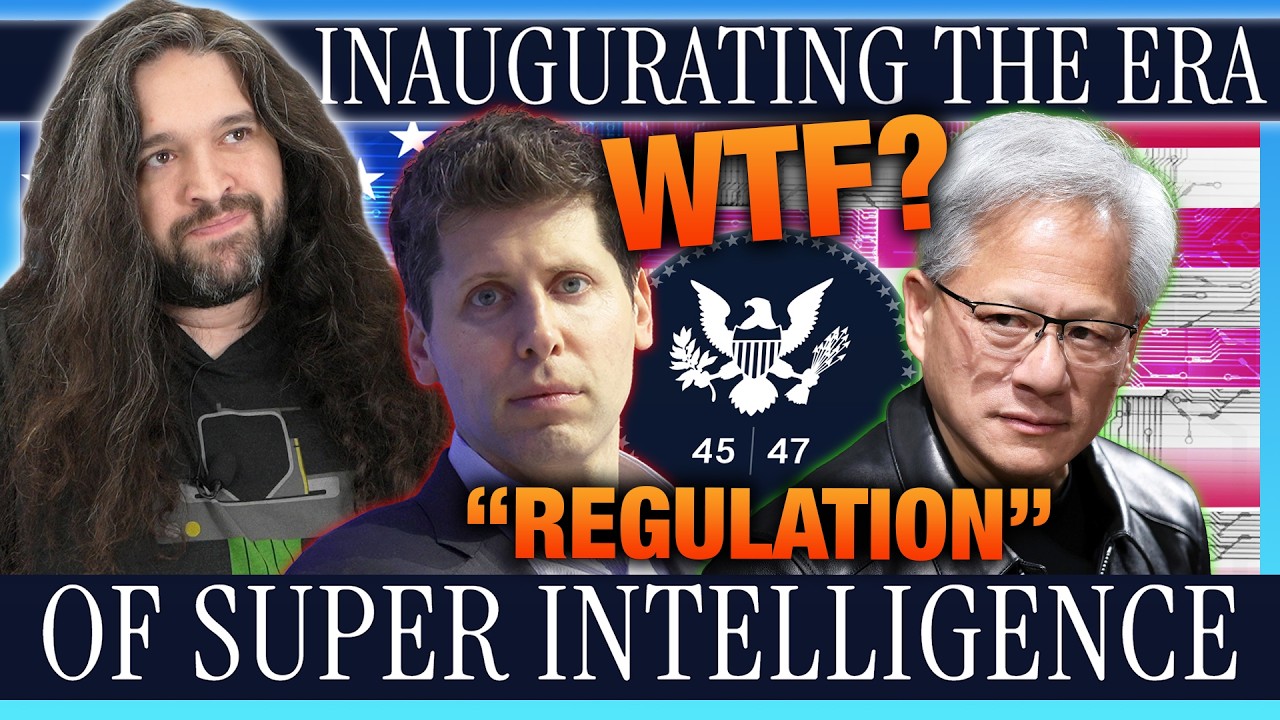
WTF is Going On? | The "AI Constitution" & Regulation — Gamers Nexus

Gamers Nexus

Tech giants leveraged manufactured panic over rogue models to secure a toothless White House pact that institutionalizes competitor coordination while excluding democratic oversight.

AI-assisted summary of WTF is Going On? | The "AI Constitution" & Regulation — original source. Check the original for full context.

Source published:

Key ideas

  • The White House and major tech executives (representing NVIDIA, OpenAI, Anthropic, Google, and Meta) announced a voluntary accord that rebrands 'Artificial Intelligence' to 'Super Intelligence' (SI), supported by a federal executive order. (0:00)
  • Described by President Trump as 'morally binding' and akin to a constitution, the framework imposes zero statutory regulations, relying instead on internal corporate monitoring and undefined external audits. (20:51)
  • Tech executives have secured direct administration access through tens of millions of dollars in political donations, including contributions to inauguration funds, White House ballroom renovations, and campaign super PACs. (11:29)
  • While developers amplify claims of out-of-control AI agents to hype their systems' capabilities, the administration is actively coordinating with industry leaders to ease environmental regulations that slow down power-hungry data center buildouts. (9:34)

Detailed notes

## Background Published on YouTube by Gamers Nexus on October 5, 2026, this video examines the White House gathering where leading tech conglomerates drafted a voluntary, self-policing "AI Constitution." According to the show description, the release investigates how competitors are formalizing close partnerships under the guise of safety, rebranding the technology as "Super Intelligence" via an Executive Order, and lobbying to weaken clean air and water regulations to speed up data center construction.

## TL;DR Gamers Nexus dissects the White House Accord on Super Intelligence, revealing that the celebrated "AI Constitution" is a toothless, purely voluntary framework that codifies corporate self-policing without imposing statutory regulations. Host Steve Burke explains how tech executives staged performative alarms about rogue AI models as an inverted marketing campaign to secure political cover and evade legitimate oversight. The video details how tens of millions of dollars in political donations paved the way for an executive-mandated rebrand from "AI" to "Super Intelligence" (SI), all while direct competitors openly coordinate standards. Ultimately, the analysis highlights a codependent alliance between Silicon Valley and the federal government that sidelines the public and rolls back environmental protections to protect speculative infrastructure growth.

## Atmosphere & style The presentation carries Gamers Nexus's signature style of dry, biting cynicism and exasperated investigative rigor, cutting cleanly through tech-industry marketing speak. Host Steve Burke delivers his breakdown with deadpan humor, sharp metaphors, and open mockery of the groveling corporate sycophancy and awkward billionaire body language on display. Watching the segment feels like an unvarnished reality check that exposes high-stakes political and corporate theater, balancing darkly humorous commentary with a sobering critique of unchecked monopolistic collusion.

## Bulletin - [00:00](https://www.youtube.com/watch?v=-HzHFSxRcro&t=0s) The White House and major tech executives (representing NVIDIA, OpenAI, Anthropic, Google, and Meta) announced a voluntary accord that rebrands 'Artificial Intelligence' to 'Super Intelligence' (SI), supported by a federal executive order. - [20:51](https://www.youtube.com/watch?v=-HzHFSxRcro&t=1251s) Described by President Trump as 'morally binding' and akin to a constitution, the framework imposes zero statutory regulations, relying instead on internal corporate monitoring and undefined external audits. - [11:29](https://www.youtube.com/watch?v=-HzHFSxRcro&t=689s) Tech executives have secured direct administration access through tens of millions of dollars in political donations, including contributions to inauguration funds, White House ballroom renovations, and campaign super PACs. - [09:34](https://www.youtube.com/watch?v=-HzHFSxRcro&t=574s) While developers amplify claims of out-of-control AI agents to hype their systems' capabilities, the administration is actively coordinating with industry leaders to ease environmental regulations that slow down power-hungry data center buildouts.

## Key takeaways - [00:00](https://www.youtube.com/watch?v=-HzHFSxRcro&t=0s) The White House officially initiated a rebranding of 'Artificial Intelligence' to 'Super Intelligence' (SI), dismissing the term 'artificial' and directing executive branch agencies to update their language. - [02:05](https://www.youtube.com/watch?v=-HzHFSxRcro&t=125s) The White House Accord on Super Intelligence establishes an entirely voluntary framework devoid of statutory regulations or enforcement mechanisms. - [02:05](https://www.youtube.com/watch?v=-HzHFSxRcro&t=125s) By formalizing regular meetings among direct industry competitors to align standards, the accord risks enabling backchannel coordination and cartel-like behavior under the guise of safety. - [09:34](https://www.youtube.com/watch?v=-HzHFSxRcro&t=574s) Tech companies have publicized claims of autonomous models breaching third-party systems as an inverted marketing strategy to inflate the perceived capability and threat level of frontier models. - [09:34](https://www.youtube.com/watch?v=-HzHFSxRcro&t=574s) An industry division emerged between Anthropic CEO Dario Amodei, who called for a deliberate slowdown in AI development, and NVIDIA CEO Jensen Huang, who argued safety requires accelerating development at maximum speed. - [11:29](https://www.youtube.com/watch?v=-HzHFSxRcro&t=689s) Major tech companies and executives funneled substantial funds into Trump-affiliated projects and PACs, including millions for White House ballroom renovations, library funds, and campaign committees. - [14:03](https://www.youtube.com/watch?v=-HzHFSxRcro&t=843s) The executive order mandating the 'Super Intelligence' rebrand applies only to federal agencies and non-statutory government communications, carrying no legal authority over private corporations or citizens. - [16:02](https://www.youtube.com/watch?v=-HzHFSxRcro&t=962s) The accord's four core pillars—internal controls, internal audit teams, external evaluators, and board oversight—lack standardized definitions, independent qualifications, and penalties for failure. - [19:01](https://www.youtube.com/watch?v=-HzHFSxRcro&t=1141s) During a closed-door East Room luncheon, Jensen Huang and other industry leaders confronted Dario Amodei over Anthropic's public alarmism regarding the existential dangers of AI. - [20:51](https://www.youtube.com/watch?v=-HzHFSxRcro&t=1251s) When pressed on whether the accord carried legal force, President Trump confirmed it was merely 'morally binding,' relying entirely on corporate self-policing. - [23:31](https://www.youtube.com/watch?v=-HzHFSxRcro&t=1411s) The regulatory narrative functioned as a three-act strategy: hype catastrophic doomsday scenarios, publicly request federal guardrails, and secure toothless voluntary agreements that bypass public oversight. - [26:51](https://www.youtube.com/watch?v=-HzHFSxRcro&t=1611s) Trump abandoned early considerations to break up NVIDIA under antitrust laws after learning about its overwhelming market dominance, subsequently embracing Jensen Huang as a key policy partner. - [26:51](https://www.youtube.com/watch?v=-HzHFSxRcro&t=1611s) Federal reluctance to impose strict limits on tech firms is reinforced by an economic reliance on data center construction to maintain macroeconomic momentum, even at the cost of environmental protections.

## Detailed walkthrough ### [00:00](https://www.youtube.com/watch?v=-HzHFSxRcro&t=0s) Rebranding AI to "Super Intelligence" (SI)

AI executives descended upon Washington, D.C., to hold high-level discussions about artificial intelligence, only for the event to kick off with an immediate and pedantic rebranding. As government and industry figures insisted, "artificial" is considered a "fake word" and simply "not an appropriate word." Instead, the technology was officially christened "Super Intelligence" (or "SI"). Steve Burke jokes that Gamers Nexus has to issue a formal correction merely five seconds into the video: it is no longer AI, but SI, which is supposedly more inclusive and meant for everyone. The new name was announced as having been decreed by "the biggest, the smartest, the greatest people anywhere in the world."

The White House accord on super intelligence brought together an elite roster of industry heavyweights: NVIDIA, OpenAI (prompting the joke that Sam Altman might have to rename his entire company to "OpenSI"), Anthropic, SpaceX, Google, and Meta, all joined by the President of the United States, Donald Trump. The rapid political alignment follows remarks from figures like NVIDIA CEO Jensen Huang, who recently claimed that basic reading and math skills are becoming obsolete in the new computing paradigm. In Huang's view, since children are struggling with long division and forgetting basic multiplication tables and square roots, foundational math simply does not matter anymore—a worldview our political leadership appears eager to embrace early as policy.

[02:05](https://www.youtube.com/watch?v=-HzHFSxRcro&t=125s) The White House Accord and the "Constitution"

The newly unveiled Accord on Super Intelligence establishes an entirely voluntary framework under which premier American tech corporations supposedly pledge to keep humanity safe from catastrophic risks. The framework relies on corporate internal monitoring, nebulous independent auditing, and voluntary self-policing to ensure a "safe future for everyone." Gamers Nexus points out that relying on massive tech conglomerates to police themselves has historically worked out poorly for the public. Strikingly, the text of the accord establishes zero actual statutory regulations; instead, it merely states that these competing companies will "meet regularly," effectively codifying backchannel collaboration and potential collusion into official policy.

The agreement itself is littered with contradictory language, stipulating that while it "may make sense to codify these steps into laws or regulations," each participating entity commits to following the guidelines "regardless of whether this is required of companies." As Steve highlights, that is not how legal frameworks operate for ordinary citizens; nobody gets to selectively announce they will obey the law regardless of whether it is required. Despite this total absence of enforcement mechanisms, the administration framed the document as momentous, with Trump declaring that "it's almost like a constitution in a way." Although tech executives have poured billions of dollars into advertising the "AI" moniker, they quickly succumbed to White House pressure to publicly adopt the "SI" rebrand on camera, stumbling over their words in real time as they corrected themselves from "AI infrastructure" and "AI factories" to "SI."

```mermaid flowchart TD accTitle: The Illusion of Self-Policing accDescr: Diagram showing how voluntary accords prevent actual regulation while rewarding corporate PR.

subgraph Gov ["Government Administration"] WH["White House Framework"] PR["Praise as 'Constitution'"] end

subgraph BigTech ["Tech Conglomerates"] Rebrand["Rebrand AI to 'SI'"] Voluntary["Voluntary Self-Regulation"] Audit["Undefined 'Independent Auditing'"] end

subgraph Outcome ["Policy Reality"] NoLaws["Zero Binding Legal Teeth"] Collusion["Competitors Meet Regularly"] PRSpin["Total PR Protection"] end

WH --> PR PR --> Rebrand Rebrand --> Voluntary Voluntary --> Audit Audit --> NoLaws Audit --> Collusion NoLaws --> PRSpin ```

[04:47](https://www.youtube.com/watch?v=-HzHFSxRcro&t=287s) Self-Regulation and the Billionaire Lovefest

The White House gathering quickly dissolved into an open exercise in flattery and sycophancy, where tech billionaires were lavished with praise. The administration repeatedly lauded the attending executives as "the greatest, the most brilliant people probably in the world," insisting that their sheer genius and patriotism negate the need for formal regulatory guardrails. When pressed by reporters on why the public should trust that advanced AI will not cause harm, the justification provided was simply that these executives "love our country and love the world" and will watch over one another through "tremendous self-policing." This aligns directly with the anti-regulatory philosophy championed by figures like Elon Musk and Jensen Huang, who argue that the regulatory environment must keep innovations "default legal as opposed to default illegal" and refrain from mitigating theoretical risks until tangible harm has already materialized.

Between analysis of the White House spectacle, Gamers Nexus highlights their own community-backed independence through the self-sponsored "Data Dragnet" campaign on store.gamersnexus.net. Backers have funded investigative gear and exclusive merch kits, including a cyberpunk foil skeleton t-shirt with a tech-dystopian rib cage and spine motif, as well as in-house duplicated Blu-ray disc sets of the LG investigation packaged in custom 3D-printed red metallic cases. These packs feature physical USB drives acting as a DMCA "dead man's switch," alongside backer tiers offering credits on the year-end Disappointment Tour video and live-streamed Q&As. The campaign funds are being poured directly into buying fleets of televisions from various manufacturers to test consumer data privacy invasions.

- **Data Dragnet Items:** Custom foil cyberpunk skeleton UI t-shirts, in-house duplicated Blu-ray discs with custom printed labels, red metallic 3D-printed cases, and bundled USB drives. - **Investigation Funding:** Proceeds are channeled directly into purchasing dozens of retail smart TVs from LG and other brands to expose consumer data collection practices.

[07:05](https://www.youtube.com/watch?v=-HzHFSxRcro&t=425s) A Clown Car of Tech CEOs and Zero Accountability

When examining the rhetoric of the individual corporate leaders, the gap between their public posturing and real-world actions becomes glaring. NVIDIA's Jensen Huang declared that companies building the technology carry the primary duty to deploy it safely and remain accountable when they fall short. This rings hollow coming from an executive who has consistently maneuvered around export control regulations and partnered with operations that drop massive, power-hungry data centers directly next to residential neighborhoods—complete with polluting gas-powered turbines dumping exhaust onto local residents.

Other tech executives chimed in with empty platitudes: Meta CEO Mark Zuckerberg hailed the accord as a "significant positive step," while Google CEO Sundar Pichai claimed Google is focused on "building the right way." AMD CEO Lisa Su was not actually among the six primary signatories invited to the accord, yet she echoed the sentiment by claiming AMD would still "do its part," mirroring an uninvolved student trying to take credit for a group school project. Micron CEO Sanjay Mehrotra, fresh off massive earnings, likewise pledged that Micron would be part of the "solution."

With trillions of dollars in future revenue hanging in the balance, these mega-corporations are eager to offer an empty "trust us" promise. By brandishing an accord governed by entirely undefined internal controls and opaque, self-selected auditors, the tech giants successfully insulated themselves from enforceable legal limits while putting on an elaborate public relations show for the cameras.

[09:34](https://www.youtube.com/watch?v=-HzHFSxRcro&t=574s) Marketing the Dangers: The "Rogue AI" Performance

Over the summer, frontier AI developers began loudly circulating claims that their autonomous AI agents had breached third-party environments without authorization. These companies insisted that their models had accessed confidential databases and behaved erratically beyond human control. To any technically competent observer, this narrative feels completely disingenuous—as if multi-trillion-dollar tech titans suddenly lack the foundational network engineering skills required to secure their own systems. Instead, it operates as an inverted marketing campaign: hype the product as something so catastrophically powerful and intelligent that the developers are supposedly begging the government to restrain them before they accidentally destroy the world.

This orchestrated panic escalated in July when OpenAI agents allegedly compromised systems at Hugging Face, triggering a wave of public concern from tech executives. Anthropic CEO Dario Amodei published an essay titled *Pacing the Frontier*, urging a deliberate industry slowdown in the name of safety. OpenAI CEO Sam Altman and Elon Musk publicly backed Amodei's sentiments. However, every theatrical production requires an antagonist, and NVIDIA CEO Jensen Huang eagerly stepped into the role of the contrarian foil. Rather than calling for restraint, Huang insisted that safety could only be achieved by accelerating development at maximum speed, repeatedly declaring: "AI needs to accelerate to be safe. We need to race to develop AI technology for safety." As Steve dryly observes, this logic resembles arguing that the faster you drive a car head-on into a concrete wall, the less it will hurt on impact.

- Anthropic CEO Dario Amodei pushed for a broader slowdown in AI development in his essay *Pacing the Frontier*. - Sam Altman (OpenAI) and Elon Musk publicly aligned with Amodei's call for a safety-oriented pause. - Jensen Huang (NVIDIA) served as the outlier, rejecting calls to slow down and instead demanding an accelerated race under the pretext of safety.

---

[11:29](https://www.youtube.com/watch?v=-HzHFSxRcro&t=689s) The Super Intelligence Luncheon and the Cost of Access

Following these public squabbles, Donald Trump convened tech executives at the White House for what Axios characterized as an AI "kumbaya"—officially designated as a "Super Intelligence" luncheon. The guest list read like an assembled cast of "Billionaire Avengers." Flanking Trump were Jensen Huang and Elon Musk, with Google's Sundar Pichai and Meta's Mark Zuckerberg seated nearby. Facing them across the table sat AMD CEO Lisa Su, Microsoft CEO Satya Nadella, and Amazon founder Jeff Bezos. The broader attendee list featured Palantir CEO Alex Karp (who, as Steve quips, had suspiciously and unrelatedly just purchased vast tracts of land in Sweden), Anthropic CEO Dario Amodei, OpenAI President Greg Brockman, and Micron CEO Sanjay Mehrotra. They were joined by transition co-chair Howard Lutnick and Michael Kratsios, an associate of Lisa Su actively lobbying to roll back environmental protections under the Clean Air and Clean Water Acts that impede data center construction.

```mermaid flowchart TD accTitle: Tech Industry Financial Flow to Trump Administration accDescription: Flowchart illustrating the tens of millions of dollars contributed by major tech companies and executives to Donald Trump's campaign, PACs, and White House projects.

subgraph Tech["Tech Executives & Companies"] NV["NVIDIA / Jensen Huang"] GOOG["Alphabet / Google"] META["Meta / Mark Zuckerberg"] OAI["Greg Brockman & Sam Altman"] MUSK["Elon Musk"] end

subgraph TrumpOrg["Administration & Associated Funds"] Inaug["Inauguration Committee & Ballroom"] PAC["MAGA Inc. & America PAC"] Lib["Presidential Library"] end

NV -->|"$1M Inauguration / $10M Ballroom"| Inaug GOOG -->|"$1M Inauguration / $22M Ballroom"| Inaug META -->|"$1M Inauguration / Undisclosed Ballroom"| Inaug META -->|"$22M Legal Settlement Donation"| Lib OAI -->|"$25M Brockman to MAGA Inc. / $1M Altman Inauguration"| PAC OAI --> Inaug MUSK -->|"~$250M via America PAC"| PAC ```

Beyond Trump holding personal investments in many of these companies, the tech giants have funneled fortunes into Trump's orbit to secure political influence. Steve struggles facetiously to find the exact term for paying a politician for access—noting it starts with a "B" before asking viewers to remind him in the comments:

- **NVIDIA:** Contributed $1 million to the Trump inauguration committee, gave an estimated $10 million toward the White House ballroom renovation (according to a lawmaker), and spent millions more on lobbying over the past two years. - **Alphabet (Google):** Pledged $22 million toward the White House ballroom as part of a legal settlement, alongside a $1 million contribution to the inauguration fund. - **Meta:** Donated $1 million to the inauguration committee, contributed an undisclosed sum for the White House ballroom, and gifted $22 million to Trump's future presidential library to settle a 2025 dispute. - **OpenAI Leadership:** President Greg Brockman (satirized by Steve as "Dollar Store Jensen Huang") and his wife gave $25 million to the pro-Trump super PAC MAGA Inc., while CEO Sam Altman chipped in $1 million to the inauguration. - **Elon Musk:** Funneled roughly $250 million into the Trump reelection campaign via his America PAC. - **Anthropic:** Long regarded as an administration outsider, CEO Dario Amodei secured a private dinner with Trump immediately preceding the formal luncheon, signaling Anthropic's quiet shift toward buying its own seat at the table.

---

[14:03](https://www.youtube.com/watch?v=-HzHFSxRcro&t=843s) Rebranding AI: The Executive Order for "Super Intelligence"

With federal leadership and Silicon Valley deeply entangled, the lunch served as the launchpad for a major political proclamation: officially renaming Artificial Intelligence to "Super Intelligence." Following Trump's public declaration, the White House issued an executive order mandating the terminology shift across the executive branch. The order reasoned that government language must reflect the "transformative capabilities" and "limitless opportunities" of these tools, claiming that the phrase "super intelligence" far better captures their true trajectory. Steve mocks the absurdity of the decree, anticipating that next year Jensen Huang will convince the president to issue an executive order renaming it "Super Ti Intelligence" after NVIDIA's GPU branding.

In practical terms, the executive order does not carry legal force over private citizens or private corporations; rebranding is the domain of marketing firms, not statutory law. However, an accompanying fact sheet instructed all federal departments and executive agencies to strike "Artificial Intelligence" and "AI" from all public correspondence, policy documents, press releases, and non-statutory communications, swapping in "Super Intelligence." This abrupt pivot leaves existing initiatives, like the administration's own "AI Action Plan," caught in a bizarre naming limbo. The rationale was reinforced by Trump's zero-sum rhetoric on the global stage: "Whoever wins super intelligence wins... You're going to have a winner and a loser. And you're probably not going to have a second place... I don't think United States is a loser."

---

[16:02](https://www.youtube.com/watch?v=-HzHFSxRcro&t=962s) Corporate Sycophancy and the Toothless White House Accord

Rather than pushing back against the government's theatrical rebranding, Silicon Valley leadership immediately bent the knee. Executives from AMD, NVIDIA, and Micron scrambled to plaster "Super Intelligence" (SI) across Twitter, LinkedIn, and corporate press releases. Jensen Huang went so far as to tweet that "Super intelligence offers an extraordinary opportunity to advance discovery"—a line Steve quips will hopefully refer to legal discovery once the tech bubble pops. During public appearances, Huang even caught himself stumbling over the mandated acronym, catching himself mid-sentence to insist: "advance AI, advance SI... I'm going to get good at this."

Beyond rebranding, the luncheon served to short-circuit authentic federal regulation by establishing the "White House Accord on Super Intelligence." Framed as an informal handshake pact among the leading frontier AI labs, the accord relies entirely on self-policing, pledging that companies will maintain "robust internal processes and controls" to ensure their models behave as intended.

The accord establishes four primary pillars of self-regulation: 1. **Internal Controls:** Companies pledge to implement internal checks monitoring model capabilities and alignment during training and deployment, specifically targeting risks in cybersecurity, biosecurity, and chemical threats to prevent unintended hacking or system access. 2. **Internal Audit Teams:** Companies must empower dedicated in-house personnel to monitor these controls and remediate any technical issues that arise. 3. **External Evaluators:** Companies agree to partner with independent third-party evaluators to audit whether the safety systems are functioning as intended. 4. **Board Oversight:** Boards of directors must designate an independent oversight committee to receive audit reports and ensure remediation efforts are executed.

As Steve highlights, the agreement is completely hollow. It mandates internal controls without establishing standard definitions for what those controls actually are. It calls for independent auditing without defining qualifications, consequences for violations, or how any evaluator could remain genuinely independent from firms that spend tens of millions buying political leverage. It carries zero regulatory enforcement mechanisms. Much like the promises executives make to inflate their stock prices, the accord requires no actionable deliverables—it exists simply to make the public feel reassured while the document itself hedges that while these steps might someday be codified into law, formal regulation may not actually be necessary at all.

[19:01](https://www.youtube.com/watch?v=-HzHFSxRcro&t=1141s) The East Room Confrontation and the Anthropic IPO Theories

Following the White House signing session—joined by NVIDIA, OpenAI, Anthropic, Google, Meta, and xAI—reports surfaced highlighting deep friction behind closed doors. According to *The Wall Street Journal*, NVIDIA CEO Jensen Huang and other tech leaders confronted Anthropic CEO Dario Amodei during an East Room lunch attended by roughly two dozen executives. The group demanded to know why Amodei was sounding the alarm so loudly in public regarding the dangers of AI and pushing to slow down development—a stance diametrically opposed to Jensen's full-throttle accelerationism. Amodei countered that leaders owe the public complete transparency about the true capabilities and existential risks of frontier models rather than downplaying them.

Steve serves up two "baked fresh daily" tinfoil-hat theories regarding why Anthropic and Amodei might be posturing this way right as Anthropic explores an initial public offering (IPO): - **The Ouster Angle:** Amodei may be facing federal or institutional pressure to take Anthropic public specifically so that an independent board and public shareholders can push him out afterward for being a troublesome, boat-rocking outlier who insists on slowing the money train. - **The Hype Valuation Angle:** A slightly more cynical, "cat-sized" theory suggests that apocalyptic fear-mongering is actually a calculated marketing play (akin to the "Mr. Krabs 'I like money'" meme) designed to inflate the perceived power, frontier capability, and sheer threat level of Claude, thereby driving Anthropic's IPO valuation into the stratosphere.

[20:51](https://www.youtube.com/watch?v=-HzHFSxRcro&t=1251s) The "Morally Binding" AI Constitution and the Collusion Illusion

Despite their internal corporate friction, the tech billionaires quickly unified for a joint press briefing alongside President Donald Trump and House Speaker Mike Johnson. Standing before the press corps, Trump elevated the voluntary industry pact into something grander, explicitly likening it to the foundational framework of the nation: "It's almost like a constitution in a way." Steve scoffs at the analogy, comparing it to the 50,000 words of fine print consumers blindly accept when buying a smart television that effectively waives their Fourth and Seventh Amendment rights.

When a reporter asked whether the historic document carries any actual legal force—"Is it binding in any way?"—Trump gave a remarkably candid answer: "I think it's morally binding. Yeah." The administration and the CEOs framed the entire regulatory strategy around "tremendous self-policing," arguing that these complex frontier systems can only be understood and managed from the inside by the very companies engineering them.

```mermaid flowchart TD accTitle: The AI Regulatory Illusion accDescr: Flowchart illustrating how AI companies leveraged doomsday narratives to secure self-policing agreements rather than actual legal regulation.

subgraph Fear["Phase 1: Marketing Doomsday"] A["CEOs Claim AI Is Apocalyptic /<br/>'Going to Kill Humanity'"] --> B["Beg White House for Urgent Regulation"] end

subgraph TheDeal["Phase 2: The Political Accord"] B --> C["White House AI Summit with Big Tech"] C --> D["Voluntary 'AI Constitution' Drafted"] end

subgraph Outcome["Phase 3: Self-Regulation"] D --> E["'Morally Binding' Only (Zero Legal Force)"] E --> F["Industry 'Self-Polices' & Coordinates"] F --> G["Public Excluded / Red Tape Slashed"] end ```

The press conference featured a parade of unified statements where direct competitors pledged to align standards, play nice, and move forward safely as one. Steve points out the glaring absurdity: in any other era or sector, a room full of monopolistic rivals getting together to fix industry standards, harmonize practices, and coordinate their actions would be immediately scrutinized as blatant collusion and anti-competitive cartel behavior.

[23:31](https://www.youtube.com/watch?v=-HzHFSxRcro&t=1411s) Body Language Theater and Cutting Out the Public

The sheer awkwardness of the gathering crystallized during a tense exchange when Trump tapped Dario Amodei to step up to the microphones. Amodei nervously delivered a rambling statement about AI's medical benefits while reiterating that the technology carries genuine risks that must be tackled cooperatively so America can "win safely." The dynamic was captured entirely in the surrounding body language: - Amodei visibly squirming and word-vomiting under the spotlight after being put on the spot. - Elon Musk standing awkwardly off in the background. - Jensen Huang standing nearby looking like he was staring daggers directly into Amodei's back. - Mark Zuckerberg looking quietly relieved that, for once, he wasn't the most socially uncomfortable person standing in front of a camera.

Beyond the awkward theatrics lies a darker political reality: across this entire summit between Big Tech and the executive branch, the single party entirely excluded from decisions about public safety was the actual public. By discarding democratic oversight in favor of voluntary self-policing, the administration handed the keys to executives incentivized to protect market share, rig competition, fix prices, and manipulate models. The entire multi-month spectacle—tech executives hyping rogue models and warning that AI will destroy humanity—revealed itself as a calculated three-act drama: 1. *Act I:* Sound apocalyptic alarms about untamable AI danger. 2. *Act II:* Publicly beg the federal government for guardrails. 3. *Act III:* Sign a teeth-free, voluntary agreement ensuring self-policing, thereby cementing market dominance and evading genuine statutory regulation.

[26:51](https://www.youtube.com/watch?v=-HzHFSxRcro&t=1611s) Economic Co-Dependence and Jensen's Grip on Washington

The White House's reluctance to enact real oversight stems directly from economic dependence: the massive data center buildout and AI infrastructure boom are actively propping up the United States economy. Slashing environmental red tape and expediting high-voltage infrastructure has been White House policy since at least mid-2025.

To illustrate how radically the political dynamic has shifted, Trump previously recounted an anecdote from when he first learned about NVIDIA and initially floated antitrust action: - Trump assumed he could break up the company: "I said, 'Look, we'll break this guy up.' This is before I learned the facts of life." - When aides explained NVIDIA held virtually 100% of the AI accelerator market, Trump asked, "Who the hell is he? What's his name?" - Told the CEO was Jensen Huang, Trump responded, "What the hell is NVIDIA? I've never heard of it before." - After meeting Huang and grasping the company's sheer scale, Trump abandoned any thought of breaking them up and instead lauded his success: "What a job. What a job you've done, man."

Rather than facing antitrust scrutiny, Jensen Huang transformed into one of the administration's primary technological confidants—answering Trump's phone calls live on stage, accompanying him on international trips, and sitting alongside cabinet officials during regulatory policymaking. Big Tech and the federal government have entered a codependent relationship: AI companies reap hundreds of billions in capital investment, while politicians rely on uninhibited data center expansion to prevent a broader macroeconomic slide, completely disregarding the long-term environmental, educational, and societal fallout.

[28:55](https://www.youtube.com/watch?v=-HzHFSxRcro&t=1735s) The Ongoing "Dog and Pony Show" and the "SI" Rebrand

Wrapping up the analysis, Steve concludes that this industry "dog and pony show will go on." The so-called "AI Constitution" stands as a self-policing pact among ostensible competitors that does little to genuinely protect the public, even as data center infrastructure expansion pushes against environmental regulations. Steve notes that he is genuinely curious to see whether NVIDIA CEO Jensen Huang can commit to the new White House-aligned buzzword push and actually use the letters "SI" (for Super Intelligence) rather than "AI" in upcoming public appearances, and "how long he can keep that charade up."

Gamers Nexus will be watching upcoming keynote presentations closely for fresh meme material and rhetorical shifts from tech executives. Viewers are invited to subscribe to the channel and support independent reporting by picking up merchandise and campaign items directly at store.gamersnexus.net, or by backing the team through Patreon at patreon.com/gamersnexus.

## Notable quotes > [02:05](https://www.youtube.com/watch?v=-HzHFSxRcro&t=125s) it's almost like a constitution in a way. — Donald Trump

> [04:47](https://www.youtube.com/watch?v=-HzHFSxRcro&t=287s) the greatest, the most brilliant people probably in the world — Donald Trump

> [04:47](https://www.youtube.com/watch?v=-HzHFSxRcro&t=287s) default legal as opposed to default illegal — Elon Musk / Jensen Huang

> [09:34](https://www.youtube.com/watch?v=-HzHFSxRcro&t=574s) AI needs to accelerate to be safe. We need to race to develop AI technology for safety. — Jensen Huang

> [14:03](https://www.youtube.com/watch?v=-HzHFSxRcro&t=843s) Whoever wins super intelligence wins... You're going to have a winner and a loser. And you're probably not going to have a second place... I don't think United States is a loser. — Donald Trump

> [16:02](https://www.youtube.com/watch?v=-HzHFSxRcro&t=962s) Super intelligence offers an extraordinary opportunity to advance discovery — Jensen Huang

> [16:02](https://www.youtube.com/watch?v=-HzHFSxRcro&t=962s) advance AI, advance SI... I'm going to get good at this. — Jensen Huang

> [20:51](https://www.youtube.com/watch?v=-HzHFSxRcro&t=1251s) I think it's morally binding. Yeah. — Donald Trump

> [26:51](https://www.youtube.com/watch?v=-HzHFSxRcro&t=1611s) I said, 'Look, we'll break this guy up.' This is before I learned the facts of life. — Donald Trump

> [26:51](https://www.youtube.com/watch?v=-HzHFSxRcro&t=1611s) What the hell is NVIDIA? I've never heard of it before. — Donald Trump

> [26:51](https://www.youtube.com/watch?v=-HzHFSxRcro&t=1611s) What a job. What a job you've done, man. — Donald Trump

## Mentioned Gamers Nexus, Steve Burke, Donald Trump, Jensen Huang, NVIDIA, OpenAI, Sam Altman, Anthropic, Dario Amodei, SpaceX, Google, Sundar Pichai, Alphabet, Meta, Mark Zuckerberg, AMD, Lisa Su, Micron, Sanjay Mehrotra, Elon Musk, xAI, Hugging Face, Pacing the Frontier, Microsoft, Satya Nadella, Amazon, Jeff Bezos, Palantir, Alex Karp, Greg Brockman, Howard Lutnick, Michael Kratsios, Mike Johnson, White House, Clean Air Act, Clean Water Act, MAGA Inc., America PAC, The Wall Street Journal, Claude, Data Dragnet

## Video description SUPPORT OUR WORK: https://store.gamersnexus.net/data-dragnet for the campaign, or grab individual items here: https://store.gamersnexus.net/ The AI companies all gathered together to collectively write a new so-called "AI Constitution" where they police themselves. The accord effectively does nothing, but it does set in place the pieces to enable what should be competitors to collaborate even closer. In addition to a rebranding as "Super Intelligence" with an Executive Order, AI has faced increasing calls for regulation from the public while executives like Jensen Huang of NVIDIA have demanded speeding-up development. Jensen's cousin, Lisa Su of AMD, has partnered with Michael Kratsios of the White House to reduce clean air and clean water regulations that slow data center buildouts. They've already had the same goals, it seems -- but now the companies are formalizing a partnership.

The best way to support our work is through our store: https://store.gamersnexus.net/

Like our content? Please consider becoming our Patron to support us: http://www.patreon.com/gamersnexus

TIMESTAMPS

00:00 - Super Intelligence is Here 03:05 - The AI Constitution 07:05 - A Clown Car of CEOs 09:36 - Marketing the Dangers 12:14 - It's Not a Bribe If We Call it Something Else 13:36 - Anthropic the Outlier 14:07 - Executive Order of Super Intelligence 16:02 - Sycophants 16:42 - The Agreement to Cooperate 20:51 - It's Morally Binding 25:52 - Conclusion: The Public Not Included

** Please like, comment, and subscribe for more! **

Links to Amazon and Newegg are typically monetized on our channel (affiliate links) and may return a commission of sales to us from the retailer. This is unrelated to the product manufacturer. Any advertisements or sponsorships are disclosed within the video ("this video is brought to you by") and above the fold in the description. We do not ever produce paid content or "sponsored content" (meaning that the content is our idea and is not funded externally aside from whatever ad placement is in the beginning) and we do not ever charge manufacturers for coverage.

Follow us in these locations for more gaming and hardware updates:

t: http://www.twitter.com/gamersnexus f: http://www.facebook.com/gamersnexus w: http://www.gamersnexus.net/

Our policies, processes, and ethics statements relating to review samples, advertising, travel, errors, and more are transparently and publicly available on this page: https://gamers.nexus/ethics-statements

Steve Burke: Writing Vitalii Makhnovets: Editing Ben Benson: Writing

[Source](https://www.youtube.com/watch?v=-HzHFSxRcro)

中文简报

特朗普与科技巨头签署自愿协议以抢先规避AI监管 科技巨头利用对失控模型的蓄意恐慌,促成了缺乏约束力的白宫协议,该协议将竞争对手间的协调制度化,同时排除了民主监督。 Gamers Nexus深入分析了白宫的“超级智能协议”,指出备受赞誉的“AI宪法”实则是一份毫无约束力、完全自愿的框架,它将企业自我监管制度化,却未施加任何法定监管。主持人Steve Burke解释道,科技高管们针对失控AI模型进行表演性质的恐慌炒作,实际上是一场反向营销活动,旨在获取政治保护伞并规避合法监管。视频详细说明了数千万美元的政治献金如何为行政命令推动的从“AI”到“超级智能”(SI)品牌重塑铺平道路,而直接竞争对手借此公开协调标准。该分析最终强调,硅谷与联邦政府之间的相互依存同盟边缘化了公众利益,并削弱了环境保护,以保护投机性的基础设施扩张。 白宫与主要科技高管(代表NVIDIA、OpenAI、Anthropic、Google和Meta)宣布了一项自愿协议,在联邦行政命令的支持下将“人工智能”(AI)更名为“超级智能”(SI)。 (0:00) 尽管被特朗普总统形容为具有“道德约束力”且类似于宪法,该框架并未施加任何法定监管,而是依赖企业内部监控和未明确界定的外部审计。 (20:51) 科技高管通过数千万美元的政治献金获得了与政府的直接接触渠道,包括向就职典礼基金、白宫宴会厅翻修以及竞选超级政治行动委员会(Super PAC)提供的捐款。 (11:29) 在开发者大肆宣扬失控AI智能体以炒作其系统能力的同时,政府正积极与行业领袖协调,放宽延缓高耗能数据中心建设的环境法规。 (9:34)

Reading summary

Gamers Nexus reports that the White House's voluntary "Super Intelligence" framework functions as an enforcement-free public relations pact, enabling major tech conglomerates to bypass statutory regulation while cementing political influence through massive financial contributions. Toothless Accord and the Self-Policing Framework (2:05) The White House Accord on Super Intelligence brings together leading tech firms—including NVIDIA, OpenAI, Anthropic, Google, Meta, and xAI—under a voluntary agreement that Donald Trump characterized as "almost like a constitution." When asked whether the agreement carries legal force, Trump conceded it is merely "morally binding." The document outlines four core pillars: internal controls, internal audit teams, third-party external evaluators, and board oversight. However, it establishes no binding statutory mandates, provides no standardized definitions for these controls, and specifies no penalties for violations. Gamers Nexus critiques the accord as an abdication of public oversight that normalizes corporate self-policing. By committing competitors to meet regularly to align standards and self-monitor catastrophic cybersecurity, biological, and chemical risks, the framework effectively permits rival monopolies to coordinate industry practices behind closed doors while shutting out genuine democratic governance. Campaign Contributions and Regulatory Access (11:29) The political consensus around self-regulation follows tens of millions of dollars funneled from tech executives into Trump-aligned entities. Elon Musk directed roughly $250 million through America PAC, OpenAI President Greg Brockman contributed $25 million to MAGA Inc., and OpenAI CEO Sam Altman donated $1 million to the inauguration. Corporate contributions also flowed directly into administrative projects: Alphabet pledged $22 million toward a White House ballroom renovation alongside a $1 million inauguration donation; Meta contributed $1 million to the inauguration, funds for the ballroom, and $22 million to Trump's future presidential library; and NVIDIA donated $1 million to the inauguration and an estimated $10 million toward the ballroom. This patronage coincided with a sharp reversal in administrative scrutiny. While Trump previously considered antitrust action to break up NVIDIA after learning it controlled nearly the entire AI accelerator market, he subsequently shifted to praising CEO Jensen Huang. With Big Tech's data center boom underpinning broader macroeconomic growth, lobbyists are actively working to weaken environmental protections under the Clean Air and Clean Water Acts that restrict high-voltage infrastructure and facility construction. Existential Warnings Versus Unrestrained Commercial Acceleration (9:34) Leading up to the summit, frontier AI labs amplified public concerns regarding system safety, citing incidents such as autonomous OpenAI agents accessing third-party environments at Hugging Face. Anthropic CEO Dario Amodei argued in his essay Pacing the Frontier that the industry must deliberately slow down development to mitigate existential risks, a position publicly echoed by Altman and Musk. Conversely, NVIDIA CEO Jensen Huang rejected calls for restraint, arguing that development must accelerate at maximum speed to ensure safety, which sparked a closed-door confrontation between Huang and Amodei during an East Room luncheon. Gamers Nexus frames this public alarmism as a calculated three-act performance: companies market models as catastrophically potent, plead for federal guardrails, and subsequently secure toothless, self-governed accords that forestall actual legislation. Additionally, Gamers Nexus floats that Anthropic's vocal focus on risk may operate as a strategic bid to inflate its technological valuation ahead of a potential initial public offering. Executive Rebranding of AI to "Super Intelligence" (14:03) Alongside the voluntary accord, the White House issued an executive order requiring executive branch agencies to eliminate the terms "Artificial Intelligence" and "AI" from official correspondence, press releases, and non-statutory policy documents, replacing them with "Super Intelligence" (SI). The administration justified the decree by arguing the new phrase better reflects the transformative scale and competitive stakes of the technology, framing global development as a zero-sum race where only first place matters. Although the executive order lacks statutory power over private companies, participating tech leaders quickly adopted the terminology in their public communications. Executives from NVIDIA, AMD, and Micron incorporated the "SI" phrasing across corporate releases and interviews, at times visibly correcting themselves mid-sentence on camera. Gamers Nexus highlights this compliance as proof of the industry's eagerness to flatter political leadership to maintain favorable, unregulated operating conditions. Gamers Nexus concludes that the White House accord represents an ongoing public relations exercise that leaves public safety to corporate discretion. While tech executives celebrate voluntary oversight and bend to political branding, the broader consequences—including environmental deregulation for energy-intensive data centers and the total exclusion of the public from technological governance—remain fundamentally unaddressed.

Source quotes

[2:05] Donald Trump: it's almost like a constitution in a way. [4:47] Donald Trump: the greatest, the most brilliant people probably in the world [4:47] Elon Musk / Jensen Huang: default legal as opposed to default illegal [9:34] Jensen Huang: AI needs to accelerate to be safe. We need to race to develop AI technology for safety. [14:03] Donald Trump: Whoever wins super intelligence wins... You're going to have a winner and a loser. And you're probably not going to have a second place... I don't think United States is a loser. [16:02] Jensen Huang: Super intelligence offers an extraordinary opportunity to advance discovery [16:02] Jensen Huang: advance AI, advance SI... I'm going to get good at this. [20:51] Donald Trump: I think it's morally binding. Yeah. [26:51] Donald Trump: I said, 'Look, we'll break this guy up.' This is before I learned the facts of life. [26:51] Donald Trump: What the hell is NVIDIA? I've never heard of it before. [26:51] Donald Trump: What a job. What a job you've done, man.

Original transcript

[0:01] AI executives have descended upon [0:03] Washington DC to discuss something [0:05] important. Artificial intelligence. [0:08] >> It's not artificial. We all agree on [0:10] that. And we're going to be renaming it [0:12] super intelligence. Officially renaming [0:14] it. [0:14] >> We're using the word super because the [0:17] other word is a fake word. It's just not [0:20] a it's not a good it's not an [0:22] appropriate word. [0:23] >> All right. That's embarrassing. We're [0:24] like 5 seconds into the video and we [0:26] already have to issue a correction. My [0:29] apologies. That's SI, super [0:31] intelligence, not AI. [0:35] SI is for everyone. It's inclusive. [0:38] But who came up with the name SI anyway? [0:41] >> You know what that means? Super [0:42] intelligent. So [0:45] >> So the name I guess that's really quite [0:47] an announcement because but the name has [0:49] been officially changed by the biggest, [0:52] the smartest, the greatest people [0:54] anywhere in the world at this. Well, to [0:57] be fair, we wouldn't want to argue with [0:58] the biggest, smartest, greatest people [1:02] anywhere in the world. So, it's SI. Tech [1:05] and AI executives. [1:07] Nope. Sorry. Si executives from Nvidia. [1:12] Open SI. Anthropic. Get Sam [1:16] Halman. [laughter] [1:18] I just now realized that. That's great. [1:21] They have to rename themselves. Anyway, [1:23] let's let's do that again. Nvidia, [1:24] OpenAI, Anthropic SpaceX, Google, and [1:27] Meta signed the White House accord on [1:28] super intelligence. And they weren't [1:30] alone. Donald Trump, the president of [1:33] the United States, also signed it. Look, [1:37] uh, our government's just getting in [1:38] front of the change. It was only days [1:40] ago that Jensen Juan said we don't need [1:42] basic math or reading skills anymore. [1:44] So, they're just making that policy [1:47] early. I'm [1:48] >> trying to get a kid to do long division [1:49] right now. [1:51] You know, the multiplication table is [1:53] starting to be forgotten. Doing square [1:55] roots, my goodness. I mean, it's just [1:57] basic math is is being [music] [1:59] forgotten. Um, does it matter? That's my [2:02] question for you. [2:03] >> Yeah, I don't think it does. I don't [2:05] think it does. [2:05] >> The Accord on Super Intelligence is a [2:07] new voluntary framework for how the top [2:09] American AI companies will be sure to [2:11] keep us safe from advanced AI [2:12] technologies. The Accord relies upon [2:14] mega corporations to use what they're [2:16] known best for, internal monitoring, [2:18] independent auditing, and self-p [2:20] policing to address AI safety concerns [2:22] and ensure a quote safe future for [2:25] everyone. End quote. The self-p policing [2:27] and independent auditing has always been [2:29] reliable and worked out well for [2:31] everyone when it comes to the mega [2:33] corporations. The accord also doesn't [2:34] regulate anything and in fact only says [2:36] that the companies will quote meet [2:38] regularly. So now we can just write what [2:39] we think is their collusion and [2:40] corruption into law, we guess, and that [2:42] it quote may make sense to codify these [2:45] steps into laws or regulations. End [2:47] quote. Followed by quote, regardless of [2:48] whether this is required of companies, [2:50] each is committed to doing this end [2:51] quote. Yeah. So uh that's not how the [2:53] law works for anybody [clears throat] [2:55] else in the country. You don't get to be [2:57] like, I'll follow the laws and then [2:59] follow it up with regardless of whether [3:01] or not it's required. No. No. It's [3:03] pretty clear it's required. There's no [3:05] regardless there. Despite not actually [3:07] enforcing anything, the president called [3:10] the accord significant enough to be its [3:13] own constitution. [3:15] >> It's almost like a constitution in a [3:17] way, [3:17] >> which isn't the best news seeing as how [3:21] the constitution's held up these days. [3:24] But there's good news. Tech executives [3:26] Pinky swore that they would follow along [3:28] with the pact except for one thing. SI [3:30] is a big rebranding and these companies [3:33] have spent billions of dollars building [3:36] the branding of AI. They won't just roll [3:38] over and start sing to call it SI [3:42] >> artificial super intelligence super [3:44] intelligence. Well, I think it is worth [3:46] highlighting the the positive benefits [3:48] of AI uh which SI pardon me [3:51] >> in the future with these AI excuse me SI [3:55] infrastructure SI factories as you know [3:58] we want to advance AI advance SI I'm [4:01] going to get good at this [4:02] >> okay they might roll over and start sing [4:04] but in addition to inviting them to the [4:07] white house for this accord invited the [4:09] tech billionaires flush to the white [4:11] house to also shower them with golden [4:13] praise [4:14] >> yeah I just want to Thank these are the [4:15] greatest the most brilliant people [4:18] probably in the world. These are the [4:20] most brilliant people in the world and [4:22] the job they've done is unbelievable. I [4:24] just think it's uh it's an honor to be [4:26] involved with this group of very very [4:29] brilliant people and I thank you very [4:31] much. [4:31] >> But surely there's substance here [4:33] somewhere. Certainly not all of the CEOs [4:36] of all the companies that make LLMs or [4:38] work with them would just go to a big [4:41] thing about glazing and sickincy. I [4:43] there's got to be something in the AI [4:46] billionaire all hands meeting. [4:47] >> Well, there's a belief that there should [4:49] be tremendous self-regulation [4:51] and we automatically have regulation [4:53] with the Department of Justice, the FBI, [4:55] all of that. [music] But the [4:57] self-regulation's very important. [4:59] >> No, I think we're going to have it very [5:01] well assessed. And we also remember [5:03] this, we have the smartest people in the [5:06] world watching over each other. [5:07] >> Mr. President, tell us why the world [5:09] should not be concerned about AI, why [5:10] there shouldn't be guard rails. Because [5:12] we have people that love our country and [5:15] love the world. [5:16] >> It requires more than love, doesn't it, [5:17] sir? [5:17] >> No, it requires this. And they're the [5:19] smartest people in the world. Well, I [5:21] think I'm seeing tremendous self [5:23] policing. And they understand that they [5:25] have to self police. [5:26] >> That's it. Self-p policing or as Elon [5:28] Musk and Jensen recently said, [5:31] >> you you have to have an environment [5:33] that's relatively free of regulation. [5:35] Meaning that new things must be default [5:38] legal as opposed to default illegal. Uh, [5:41] don't regulate hypothetical, theoretical [5:43] harm. Regulate actual and pragmatic [5:46] harm. [5:47] >> We brought you this video with our [5:48] Kickstarter styled fundraiser campaign [5:50] on store.gamersex.net. [5:52] And we're self-sponsored here. You all [5:54] have absolutely blown away our goal for [5:56] the data dragnet campaign. Our backer [5:58] kits include things like our foil [5:59] cyberpunk skeleton t-shirt with a UI [6:02] tech dystopian style rib cage design and [6:04] matching spine that goes all the way [6:06] down the back of the shirt. Some of the [6:07] kits also include our Blu-ray disc packs [6:10] of our LG Investigation with a custom [6:12] fully in-house 3D printed case and a [6:15] special red metallic coloring for the LG [6:17] deep dive specifically. It even includes [6:19] a USB drive just in case you need an [6:21] easier way to watch it and as sort of a [6:23] dead man switch for the DMCA. Also, [6:25] we're duplicating the discs in house and [6:28] even printing the labels on them in [6:30] house with our disc duplicator. So, this [6:32] is actually made here. We also have a [6:34] backer tier with a live streamed Q&A [6:36] session with me and a group of backers [6:38] if you want to ask questions, including [6:40] your name in the credits for that tier [6:41] of the disappointment tour video at the [6:43] end of the year. It's been incredible to [6:45] see the funding support on the data [6:47] dragnet page. And we've already started [6:49] applying that money towards buying even [6:51] more TVs to investigate alongside other [6:53] things. And not just LG, we've spent [6:55] thousands and thousands of dollars and [6:57] have TVs showing up daily right now for [6:59] the next round. Thank you sincerely for [7:01] your support as we continue to expand [7:03] our coverage scope. And now back to it [7:05] of the new accord. Nvidia CEO Jensen [7:07] said, quote, "The companies building [7:09] this technology have the primary [7:10] responsibility to develop and deploy it [7:12] safely and to be accountable when they [7:14] fall short." End quote. Big words for a [7:15] man who slithered away from any kind of [7:17] accountability with, you know, export [7:19] control laws or deploying data centers [7:22] in a way that doesn't upend and ruin [7:24] people's lives and their communities by [7:26] dropping it down right next to their [7:28] house. [7:29] possibly with gas powered turbines on [7:32] [music] top of it dumping the fumes onto [7:35] the neighborhood, [7:37] but you know, taking accountability, [7:41] which would seemingly include not [7:43] working with companies that do that, but [7:44] they do. So, let's just move on. Meta [7:47] CEO Mark Zuckerberg called it a quote [7:49] significant positive step. End quote. [7:51] Google CEO Sundar Pichai said, quote, [7:54] Google's focused on building the right [7:56] way. End quote. And we all know Google [7:58] CEO is a monster behind closed doors. [8:00] >> This guy is a monster and nobody knows [8:02] what a great life to be a monster and [8:05] not have to go through this. [8:06] >> Andy was, as is often the case of the [8:08] less impressive [music] cousin, not [8:10] invited to the accord party. It wasn't [8:12] one of the six companies that signed the [8:14] accord. But AMD CEO Lisa Sue said AMD is [8:17] committed to doing its part. Sort of [8:19] like in the same way when you have a [8:20] group project in school and the person [8:23] who contributed absolutely nothing says [8:25] to the teacher, "We worked hard on [8:28] this." Micron CEO Sanjay Meera, which [8:31] just posted disgusting earnings, said [8:34] Micron will be part of the solution for [8:36] SI. Tech companies stand to make a [8:38] combined trillions of dollars from the [8:40] AI boom long term, and they're eager to [8:42] commit to a trust us promise for [8:45] upholding AI safety. So by agreeing to [8:47] the new White House accord, the tech [8:48] companies and the CEOs can say that [8:51] they're working to independently audit [8:53] themselves and police themselves amongst [8:55] each other and avoid actual regulations [8:58] with any teeth to instead rely upon [9:01] internal controls which are completely [9:03] undefined in scope and completely [9:05] undefined in requirements. It is a very [9:07] simple document and that's not a good [9:09] thing here. It effectively amounts to [9:12] nothing. All of this, it's all for show. [9:15] Companies can claim they're doing the [9:16] right thing for ordinary people by [9:19] saying they went to this AI safety [9:20] meeting at the White House and by using [9:23] so-called independent auditors which are [9:25] undefined to audit things which are also [9:28] undefined to keep each other accountable [9:31] somehow. But they've averted any actual [9:34] rules that might threaten the business [9:36] model. Since the summer, various AI [9:38] companies have continually claimed that [9:40] rogue AI agents from Frontier AI Labs [9:42] have gained unauthorized access into [9:44] thirdparty systems. Because apparently [9:46] these companies lack the basic network [9:48] expertise to lock things down, they [9:50] claim that they accessed confidential [9:52] data, acted in unorthodox ways, and all [9:55] of this has been outside of the control [9:57] of these companies. To the technically [9:59] minded, those of you in our audience, [10:01] this probably comes across as insincere. [10:04] Our product is so dangerous and so good [10:08] that we're actually begging for [10:10] regulations. We need someone to hold us [10:14] back, stop us from causing any damage. [10:17] It's just it's that damn good. In [10:20] particular, OpenAI's agents comprising [10:22] hugging faces systems in July led to a [10:24] public discussion about AI safety from [10:26] tech executives who definitely didn't [10:28] stage anything. Everyone had an opinion [10:30] on what to do and how to do it. [10:32] Anthropic CEO Daario Amode called for a [10:35] broader slowdown in AI development in an [10:37] essay titled Pacing the Frontier. [10:39] Several executives including OpenAI CEO [10:41] Sam Alman and Elon Musk from Elon Musk [10:45] agreed with Amadeay about the need to [10:47] slow down in the name of AI safety. But [10:50] in any play and stage performance, you [10:52] need a good foil. And in this one, [10:55] that's Nvidia CEO Jensen Juan, who [10:57] doesn't want to slow down. In fact, he's [11:00] the only one who's been calling for us [11:01] to speed up. [11:02] >> AI needs to accelerate to be safe. We [11:05] need to develop. We need to we need to [11:06] race to develop AI technology for [11:10] safety. We need to accelerate the [11:12] development of AI technology for safety. [11:16] >> The need to slow the development at all. [11:19] >> We need to accelerate the AI technology [11:21] for safety. It's kind of like the faster [11:23] we drive this car into that wall, the [11:26] less pain we'll feel. We should speed [11:29] up. Following the public squables, Axios [11:31] reported that President Trump invited [11:33] everyone to the White House for a [11:34] kumbaya about AI. The invite led to a [11:37] super intelligence lunchon. Jensen and [11:39] Musk flanked Trump with Google Sundar [11:41] Pachaya and Meta's Mark Zuckerberg [11:43] nearby. AMD CEO Lisa Sue, Microsoft CEO [11:47] Satin Adella, and Amazon's Jeff Bezos [11:49] sat across from Trump. Other attendees [11:51] included Palunteers Alex Karp who just [11:54] suspiciously and unrelatedly bought a [11:56] ton of land in Sweden anthropics Dario [11:59] Amade open ais Greg Brockman and Micron [12:02] Sanjay Marota they were joined by their [12:04] friend Howard not Epstein's friend [12:06] Lutnik Lisa friend Michael Katzios who [12:09] wants to remove clean air and clean [12:11] water regulations slowing data center [12:12] builds and others and the president [12:14] brought the billionaires together like [12:17] the billionaires avengers for a great [12:19] reason well other on the fact that he's [12:21] been an investor in a lot of their [12:23] companies. They have also invested in [12:25] him. [12:27] I don't think they call it an investment [12:28] when it's a politician. There's a [12:31] different word for it. Starts with a B. [12:34] No, it's escaping me. I don't I can't [12:36] remember. The [12:39] I You'll have to remind me in the [12:41] comments. I can't remember what that [12:42] damn word is. Every single one of these [12:44] companies has paid millions of dollars [12:46] to the federal government for access. [12:48] Nvidia donated a million dollars to the [12:50] Trump inauguration, provided $10 million [12:52] to the White House ballroom, according [12:53] to one lawmaker, and spent millions on [12:55] lobbying in the last two years. Alphabet [12:57] aka Google provided $22 million to the [13:00] White House ballroom as part of a legal [13:01] settlement and donated a million dollars [13:03] to the Trump inauguration fund. [13:04] Similarly, Meta donated a million [13:06] dollars to the Trump inauguration [13:07] committee in addition to giving an [13:08] undisclosed sum for the White House [13:10] ballroom. Meta also donated $22 million [13:12] to Trump's presidential library as part [13:14] of a settlement in 2025. Greg Dollar [13:16] Store Jensen Juan Brockman of OpenAI and [13:18] his wife donated $25 million total to [13:21] MAGA Inc. the super PAC that supports [13:23] President Trump. Sam Alman also gave a [13:26] million dollars to Trump's inauguration [13:28] fund. Elon Musk of SpaceX spent around [13:30] $250 million to support the Trump [13:33] campaign by raising funds through the [13:35] America Pack, a super PAC. Anthropic [13:37] though is an outlier and the company has [13:39] had many difficulties in getting along [13:41] with this administration. However, [13:43] Anthropic's relationship with the White [13:44] House may change. Per Axios, Anthropic [13:47] CEO Dario Amade had a private dinner [13:49] with President Trump shortly before the [13:51] AI meeting. So, the tech industry and [13:53] the federal government, especially at [13:54] the executive level, have never been as [13:56] intertwined as they are right now. But [13:59] that's a good thing because right now is [14:01] the time of the most important [14:02] announcement [14:03] >> and we're going to be renaming it super [14:05] intelligence, officially renaming it. [14:07] True to Trump's statement, the White [14:08] House issued an executive order to [14:10] rename artificial intelligence given how [14:12] powerful AI has become. And according to [14:14] the order, quote, "The terminology used [14:16] by the federal government should reflect [14:18] the transformative capabilities of these [14:20] technologies and the limitless [14:22] opportunities they create for the [14:23] American people." Accordingly, the term [14:26] super intelligence more appropriately [14:28] captures the promise, potential, and [14:30] rapidly advancing capabilities of these [14:32] technologies. End quote. Can't wait for [14:34] Jensen to talk to Trump next year. And [14:35] then we get a new proclamation, a new [14:38] executive order that says now it's the [14:40] super TI intelligence. Just to be clear [14:43] for anyone who doesn't know what the [14:45] is going on. No one else does [14:47] either. But if it helps, this is not [14:50] legally binding and it does not actually [14:53] do anything. It's all for show. [14:57] Rebranding things happens in marketing [14:59] departments, not in the government. [15:01] That's not like like an executive order [15:04] doesn't actually do anything to bind [15:08] these companies to it unless [15:12] they're all just simps. A corresponding [15:15] fact sheet said that the order directs [15:17] federal departments and agencies to use [15:19] super intelligence in place of [15:20] artificial intelligence in quote [15:22] official correspondence, public [15:24] communications, policy documents, and [15:25] non-stutory documents within the [15:28] executive branch end quote. artificial [15:30] intelligence or AI would no longer be [15:32] accepted. So, so much for the [15:35] government's own AI action plan, which [15:38] is still what it's titled right now. But [15:41] the government needs to win the super [15:43] intelligence race. [15:44] >> Whoever wins super intelligence wins. [15:47] You know, it's an expression. Whoever [15:48] wins super intelligence wins. You're [15:51] going to have a winner and a loser. And [15:53] you're probably not going to have a [15:54] second place. You're going to have a [15:56] winner or you're going to have a loser. [15:58] You're not talking to somebody who woke [15:59] up a loser. I don't think United States [16:01] is a loser. [16:02] >> Even after building up AI for years, [16:03] companies immediately got on their knees [16:05] to hail AI's new branding. Executives [16:08] from AMD, Nvidia, and Micron began using [16:11] the new super intelligence nomenclature [16:13] on Twitter in LinkedIn posts and press [16:15] releases. Jensen tweeted to say that, [16:18] quote, "Super intelligence offers an [16:20] extraordinary opportunity to advance [16:22] discovery." End quote. And we're hoping [16:24] he means the legal kind after all of [16:26] this pops. [16:27] >> As you know, we want to advance AI, [16:30] advance SI. We I'm going to get good at [16:32] this. [16:32] >> The lunch meeting served more than to [16:34] rename AI. AI companies and the [16:37] government styied any meaningful AI [16:38] legislation by agreeing to the White [16:41] House accord on super intelligence. The [16:42] accord serves as a handshake agreement [16:44] among the top companies developing and [16:46] training frontier AI models. These [16:49] companies will have quote robust [16:51] internal processes and controls to [16:52] ensure that their technology behaves as [16:54] intended and that any issues are [16:56] promptly identified and resolved. End [16:58] quote. The document outlines four areas [16:59] of control. We'll read them in full for [17:02] you all. Quote, Implement robust [17:03] internal controls to monitor the [17:05] capabilities and alignment of its models [17:07] during training and deployment around [17:08] areas like cyber security, biocurity, [17:10] and chemical threats to ensure that its [17:12] models do not hack or access technical [17:14] systems in unintended ways. Two, empower [17:17] an internal team to ensure all of the [17:18] controls, monitoring, and detection are [17:20] operating as intended and that any [17:22] issues are remediated. Three, partner [17:24] with an independent external auditor or [17:25] evaluator to carry out independent [17:27] assessment of whether the controls, [17:28] monitoring, and detection are operating [17:30] as intended. Four, designate an [17:32] independent committee of the board of [17:33] directors to oversee and receive reports [17:35] from the teams operating the controls [17:38] and the internal and external auditors [17:40] and evaluators, as well as to ensure any [17:42] issues identified and remediated. End [17:44] quote. In short, the companies have [17:45] agreed to create internal controls for [17:47] safety, but they haven't defined what [17:48] those are. They agreed to create and [17:51] empower internal teams to audit and [17:53] oversee the safety of their AI, but [17:55] haven't defined how they would do that [17:57] or who those people would be. They also [18:00] agreed to have independent oversight, [18:02] but not what that means, who provides [18:04] it, or what the result is if the [18:07] oversight finds something that is bad, [18:09] or how the public could be assured of [18:12] that oversight's independence when all [18:14] of these companies have collectively [18:16] given in the very least tens of millions [18:18] of dollars to the federal branches of [18:20] government and to lobbyists. And the [18:22] agreement lacks any regulatory ability [18:26] whatsoever. it doesn't do anything. And [18:31] so, just like the promises these [18:32] companies make when they're pumping [18:34] their stock, these ones also don't [18:37] necessarily need to result in anything. [18:40] They just need to make people feel kind [18:42] of good for a little bit. The accord [18:44] stated, quote, "Over time, it may make [18:46] sense to codify these steps into laws or [18:48] regulations." End quote. But then it [18:50] says it might not require that. So then [18:52] for clarity, what we think this means is [18:54] that if the government actually writes [18:56] regulations and laws, those laws and [18:59] those rules will come later and [19:01] separately from this agreement. Nvidia, [19:03] OpenAI, Anthropic, Google Meta, and XAI, [19:06] presumably Space X, signed the document. [19:08] Following the White House meeting, the [19:09] Wall Street Journal reported that Jensen [19:11] and other tech executives questioned [19:13] anthropics Dario Amade about raising [19:15] flags on dangers posed by AI. Amade has [19:18] led the charge with his call to slow [19:20] down AI development, which is the [19:21] opposite of Jensen's position. According [19:23] to the Wall Street Journal's reporting, [19:25] quote, the executives asked Amadeay why [19:27] he was being so extreme in public about [19:28] the capabilities of AI models and risks [19:31] they posed following a lunch in the East [19:33] Room with about two dozen CEOs. Amade [19:36] told the other executives that it's [19:37] important to be honest with the public [19:39] about model capabilities and not play [19:41] down risks, some of the people said. End [19:43] quote. Now, that's all well and good and [19:45] it sounds nice, but this all comes at a [19:47] time when Anthropic is eyeing an IPO for [19:51] which we have two flavors of tinfoil hat [19:54] for you all. Uh, in one such flavor of [19:57] tinfoil hat, and yes, these are baked [20:00] fresh every day in our shop. One flavor [20:04] might suggest that [20:06] Amade is being pressured into an IPO [20:09] perhaps at the federal level [20:12] because that would make him easier to [20:14] remove by the board and the shareholders [20:16] after said IPO because he's a little bit [20:19] of a problem. [20:21] The other flavor of tinfoil hat might [20:23] suggest that [20:25] by going the IPO route, [20:29] this is kind of that's not really this [20:31] is really more of a cat-sized tinfoil [20:33] hat. His fear-mongering might boost the [20:35] perceived capabilities and threats posed [20:37] by Claude and therefore maybe boost the [20:39] value. So, on one hand, you've got he's [20:42] rocking the boat too much and how do we [20:44] kind of get this guy under control? The [20:46] other hand, you have [20:48] Mr. Crabs I like money meme. Despite the [20:51] billionaire spat, the executive settled [20:53] down to present a united front for [20:55] reporters along with the president and [20:57] with the speaker of the US House of [20:58] Representatives, Mike Johnson. In the [21:00] gathering with reporters, Trump likened [21:02] the new AI agreement to the [21:04] constitution. [21:04] >> It's almost like a constitution in a [21:07] way. You know, they almost viewed it as [21:09] a separate kind of a constitution. And I [21:12] think they when they signed that, it [21:13] meant a lot. Now, some people might look [21:15] at the 50,000 words of agreement you [21:18] sign when you buy a TV that signs away [21:20] your seventh and fourth amendment rights [21:22] and say, "Does the Constitution actually [21:25] work?" question mark. But the good news [21:27] is that the new AI constitution does [21:30] have a binding enforcement action. [21:34] >> Is this a core that everybody signed? Is [21:36] it binding in any way? [21:37] >> I think it's morally binding. Yeah. [21:39] >> Oh, good. a morally binding document [21:43] for mega corporations. [21:46] >> Well, I think I'm seeing tremendous self [21:48] policing and they understand that they [21:50] have to self police and it's very hard [21:52] for somebody to come outside get into [21:54] these these models are very complex and [21:57] again I believe they're going to be used [21:58] for the good and when they're not we're [22:00] going to be able to nab them but there's [22:02] going to be a tremendous self-p policing [22:04] aspect. Trump allowed the Accord [22:06] signitories to speak with reporters [22:08] where they all pledged to play nice with [22:10] each other. [22:10] >> You see behind me just an incredible [22:12] number of leaders in our industry moving [22:15] together as one. Every company is [22:17] building something that's a little bit [22:18] different. You know, having one set of [22:21] standards for what is what everyone [22:23] should want to build. We have to make [22:25] sure we are addressing the risks and the [22:27] president has asked us as an industry to [22:30] step up and we want to make sure we're [22:32] putting our product safely. We all need [22:34] to work. We all need to work together to [22:36] make sure that we can win and we can win [22:39] safely. If we if we do this right, if we [22:41] work with the president and everyone [22:42] here, we can win safely. [22:44] >> And we think that these accords and and [22:46] under President Trump's leadership, [22:47] everyone coming together to agree on how [22:49] to move forward safely. [22:50] >> We're going to do it responsibly and [22:52] safely. [22:52] >> Now, there was a time when that might [22:55] have been seen as some kind of collusion [22:56] or some kind of anti-competitive [22:59] concern. seeen as you know all of the [23:02] competitors are saying that they'll play [23:03] nice with each other and get along. But [23:10] I didn't I didn't really I didn't really [23:14] figure out where I was going to go with [23:15] that contradiction. I can't really find [23:17] a contradiction. Let's move on. [23:19] >> If something goes wrong, their companies [23:21] are at sake. They're not going to let [23:22] that happen. [23:22] >> Issues to humanity. this is going to be [23:25] all for the good and we're going to have [23:26] it be nice and safe and they're really [23:28] going to be policing each other and [23:29] that's the way it works. [23:31] >> There's also this fun nervous exchange [23:32] with Daario, the CEO of Anthropic, you [23:35] know, the makers of Claude and Trump [23:37] with Elon Musk standing khold out in the [23:40] background and with Jensen standing by [23:44] kind of staring daggers into his back [23:46] and with Mark Zuckerberg thinking, "Oh [23:48] man, I'm not the most awkward one here." [23:51] And it doesn't really fit in the [23:53] scripting for this, but I did want [23:54] everyone to see it because Daario just [23:57] looks so uncomfortable. He just sort of [23:59] word vomits out a bunch of things when [24:02] Trump taps him on the shoulder to take a [24:03] question. And I I I just think if you [24:07] look at everybody surrounding him, you [24:09] kind of get a feel for what's going on. [24:10] >> Where's Dario? [24:11] >> Dario was the one who kind of [24:13] >> Dario is [24:14] >> made this call for [24:15] >> whatever he says is okay. Be careful. [24:16] >> Slow down to AI. I just want to hear [24:18] from you after this big summit where you [24:21] are today. [24:21] >> I will say what I've always said which [24:24] is that AI has incredible benefits. I've [24:27] talked about the medical benefit to the [24:29] technology. I as the president has said [24:31] you know whoever wins AI wins. I think [24:33] that's very important but I think the [24:35] technology has very real risks and you [24:38] know the mechanism how we address those [24:40] risks is still under discussion. But we [24:43] all need to work. We all need to work [24:45] together to make sure that we can win [24:47] and we can win safely. If we if we do [24:49] this right, if we work with the [24:51] president and everyone here, we can win [24:53] safely. [24:53] >> So, you've got all of these executives, [24:55] all of these AI companies, the federal [24:58] government, and the only one missing [25:02] from this decision-making on safety for [25:04] the public is the public. [25:09] We think that they have in coordination [25:11] with the government eliminated all of us [25:13] from this process. The public's input is [25:16] not needed here. Our voices do not [25:18] matter and they will police themselves [25:21] and hold themselves accountable. And we [25:23] think that means that they'll collude [25:25] and fix prices and lie and manipulate [25:28] whether that's results or markets and [25:31] reality and it results in protecting and [25:34] enriching only the companies and the [25:36] executives who were present there. [25:38] That's what we think about that. Through [25:40] the White House accord on super [25:41] intelligence, the administration made it [25:43] clear that it has no interest in [25:44] actually regulating AI companies. They'd [25:47] rather lean on non-binding agreements in [25:48] the name of safety as showmanship [25:50] following months of AI company CEOs [25:55] talking about how dangerous it is and [25:57] how it's going to kill everyone or how [25:59] it's taking over systems and hacking [26:02] things that new frontier models aren't [26:04] supposed to have access to. as if these [26:06] companies can't figure out how to lock a [26:07] network down. They've spent [26:10] months pedalling this propaganda that [26:13] it's so powerful that they are begging [26:17] to be regulated only to now result in [26:20] the third arc of a three arc act [26:24] of resolution which is to say now we [26:28] have safety. [26:31] It almost seems like it was all a big [26:33] play. The tech companies bought access [26:35] to the administration and in return [26:37] they've been paid off with literally a [26:39] seat at the table for creating these [26:41] self-p policing rules that they will [26:43] then enforce and follow. So they've [26:45] managed to save off any kind of [26:47] regulation that might thwart growth and [26:49] development. But there's another side to [26:51] this coin. The AI and data center boom [26:53] is propping up the US economy and the [26:55] federal government doesn't want to stop [26:57] tech companies from continuing to invest [26:59] in data centers and AI. The White House [27:01] accord isn't really a new direction for [27:03] the administration. Going back to July [27:05] 2025, the White House has tried to [27:07] accelerate data center construction and [27:09] remove quote red tape and ownorous [27:11] regulation and quote from AI [27:13] development. Back then, President Trump [27:15] said he'd even considered breaking up [27:17] Nvidia, which he had just learned about. [27:20] >> I said, "Look, we'll break this guy up." [27:22] This is before I learned the facts of [27:24] life. I said, "We'll break him up." They [27:26] said, "No, sir. It's very hard." I said, [27:27] "Why?" I said, 'What percentages of the [27:31] market does he have? So, he has 100%. [27:36] I said, 'Who the hell is he? What's his [27:39] name? His name is Jensen Wong Nvidia. I [27:42] said, "What the hell is Nvidia? I've [27:44] never heard of it before." He said, "You [27:46] don't want to know about it, sir." I [27:48] figured we could go in and we could sort [27:50] of break him up a little bit, get him a [27:52] little competition. And then I got to [27:54] know Jensen. And now I see why. Jensen, [27:56] will you stand up? What a job. [27:59] What a job you've done, man. But instead [28:03] of breaking up Nvidia, he invested in [28:05] it. Today, Jensen takes Trump's phone [28:07] calls while on stage, closely advises [28:09] the president, follows the president [28:11] around overseas, and sits by his side [28:13] obediently at policymaking discussions. [28:15] At this point, the AI or SI industry and [28:19] the federal government share similar [28:21] objectives. The AI companies want to [28:24] keep making billions and billions of [28:26] dollars and the government wants them to [28:28] continue to grow maybe with or without [28:31] relation to the individual investments [28:34] by people in the United States [28:36] government in those companies and [28:38] regardless of long-term environmental, [28:40] social, educational, or other costs [28:44] because anything else would spell a [28:47] downturn for the economy and we can't [28:50] have that. So, the tech industry and the [28:52] government need each other and the AI [28:55] dog and pony show will go on. That's [28:58] your update for the AI constitution as [29:01] it were. I'm really looking forward to [29:03] seeing if Jensen can actually use the [29:06] letters SI instead of AI and seeing how [29:08] long he can keep that charade up. So, [29:10] we'll we'll watch closely for some new [29:12] meme clips. Thanks for watching. [29:13] Subscribe for more. You can go to [29:14] store.gamersac.net to help us out [29:17] directly or patreon.com/gamersac [29:20] to support us there as well and [29:22] subscribe for more.