DDR3 Rides Again, ft. Wendell of Level1 Techs
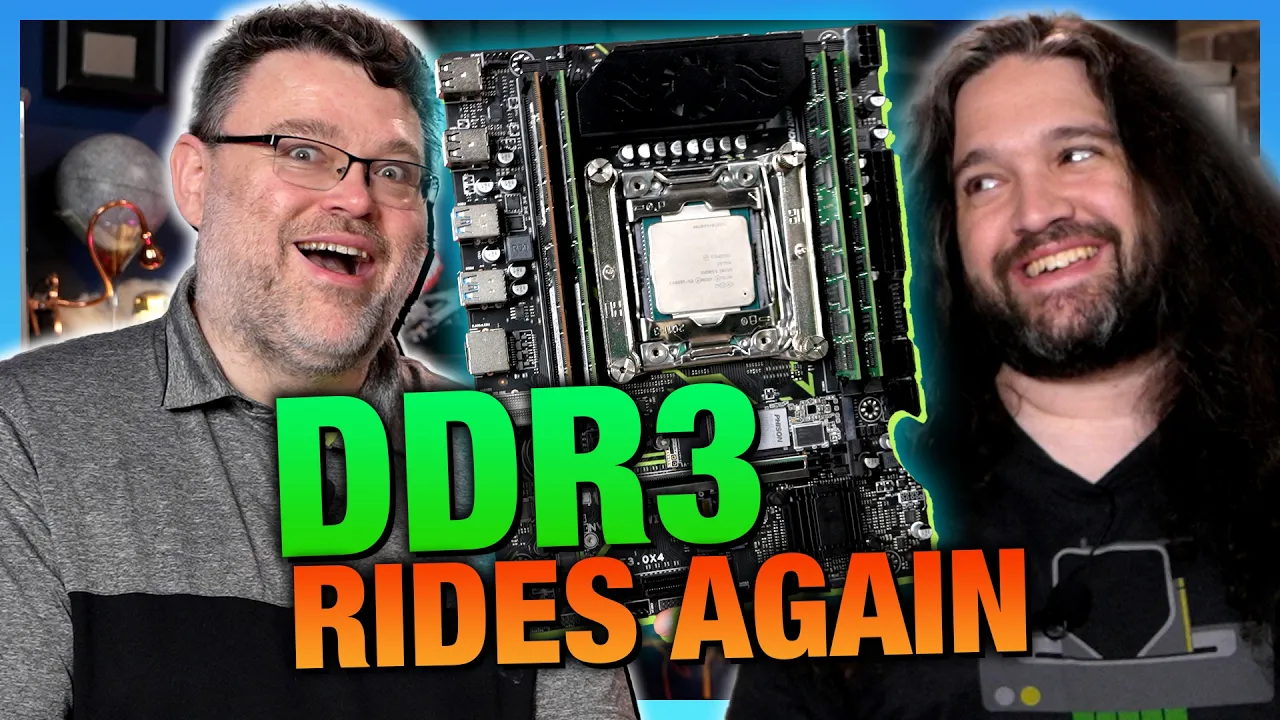
DDR3 Rides Again, ft. Wendell of Level1 Techs — Gamers Nexus

Gamers Nexus

AI-assisted summary of DDR3 Rides Again, ft. Wendell of Level1 Techs — original source. Check the original for full context.

Source published:

Key ideas

  • A severe memory pricing crisis driven by enterprise AI hyperscalers and GPU vendors has sparked a resurgence of legacy DDR3 platforms, prompting Chinese manufacturers to produce brand-new motherboards utilizing decommissioned Intel enterprise chipsets. (0:00)
  • Shenzhen board makers are exploiting undocumented hybrid memory controllers on select Intel Xeon E5 v3 and v4 processors to pair modern enterprise silicon with inexpensive legacy DDR3 RAM. (4:55)
  • Secondary market demand has rapidly driven up the prices of repurposed enterprise parts, including used DDR4 DIMMs, Radeon Pro V540 dual-GPU cards, and NVIDIA Tesla V100 SXM modules. (9:43)
  • Salvaged enterprise hardware is increasingly repurposed for self-hosted home infrastructure like Jellyfin media servers and TrueNAS storage to bypass corporate telemetry and invasive smart devices. (20:18)

Detailed notes

## Background Published on YouTube by Gamers Nexus on October 10, 2026, this video features host Steve Burke alongside Wendell of Level1 Techs discussing the unexpected resurgence of legacy PC hardware. According to the description, the discussion focuses on how an AI-driven memory pricing crisis—spearheaded by companies like NVIDIA and major DRAM suppliers—has forced builders to repurpose older DDR3 and DDR4 platforms for modern self-hosting and DIY home labs.

## TL;DR Steve Burke and Wendell examine how decommissioned enterprise silicon and hybrid motherboards from Chinese manufacturers have kept older architectures like Intel X79 and X99 viable via inexpensive DDR3 memory. They explore bizarre secondary-market finds, including hacked dual-socket consumer boards, TPM bypass modules, and the dual-GPU Radeon Pro V540 equipped with custom blower modifications. Throughout the walkthrough, they critique corporate memory monopolies, artificial Windows 11 obsolescence, and the corporatization of modern hardware. Rather than despairing over prohibitive component costs, they advocate for digital self-reliance by repurposing cast-off enterprise electronics into private, self-hosted Linux servers.

## Atmosphere & style The conversation carries an easygoing, nostalgic workbench camaraderie that seamlessly blends sharp consumer advocacy with joyful hardware tinkering. Steve's dry, sardonic wit balances Wendell's relentlessly pragmatic, dumpster-diving ethos as they handle bare motherboards and swap autobiographical scavenging stories. What begins as a critique of escalating industry greed shifts into an empowering, subversive celebration of the right to repair and community-driven computing.

## Bulletin - [00:00](https://www.youtube.com/watch?v=e4c2FSSaCsw&t=0s) A severe memory pricing crisis driven by enterprise AI hyperscalers and GPU vendors has sparked a resurgence of legacy DDR3 platforms, prompting Chinese manufacturers to produce brand-new motherboards utilizing decommissioned Intel enterprise chipsets. - [04:55](https://www.youtube.com/watch?v=e4c2FSSaCsw&t=295s) Shenzhen board makers are exploiting undocumented hybrid memory controllers on select Intel Xeon E5 v3 and v4 processors to pair modern enterprise silicon with inexpensive legacy DDR3 RAM. - [09:43](https://www.youtube.com/watch?v=e4c2FSSaCsw&t=583s) Secondary market demand has rapidly driven up the prices of repurposed enterprise parts, including used DDR4 DIMMs, Radeon Pro V540 dual-GPU cards, and NVIDIA Tesla V100 SXM modules. - [20:18](https://www.youtube.com/watch?v=e4c2FSSaCsw&t=1218s) Salvaged enterprise hardware is increasingly repurposed for self-hosted home infrastructure like Jellyfin media servers and TrueNAS storage to bypass corporate telemetry and invasive smart devices.

## Key takeaways - [07:10](https://www.youtube.com/watch?v=e4c2FSSaCsw&t=430s) Skyrocketing RAM costs caused by AI demand have made entry-level modern PC building cost-prohibitive, forcing enthusiasts back to legacy memory standards. - [00:00](https://www.youtube.com/watch?v=e4c2FSSaCsw&t=0s) White-label motherboard manufacturers in China sustain the older enterprise ecosystem by desoldering chipsets and Intel NICs from scrapped server blades onto custom consumer PCBs. - [04:55](https://www.youtube.com/watch?v=e4c2FSSaCsw&t=295s) Select Intel Xeon E5 v3/v4 processors retain hidden DDR3 memory controllers originally designed for cloud provider transitions, whereas consumer chips like the Core i7-5960X remain locked to DDR4. - [04:55](https://www.youtube.com/watch?v=e4c2FSSaCsw&t=295s) Arbitrary Windows 11 hardware cutoffs and TPM requirements can be bypassed on legacy systems using add-in discrete 20-pin TPM modules or lightweight Linux operating systems. - [09:43](https://www.youtube.com/watch?v=e4c2FSSaCsw&t=583s) Used enterprise DDR4 prices have surged dramatically compared to historical bargain rates of $10 per DIMM due to manufacturing shifts toward enterprise AI memory. - [11:10](https://www.youtube.com/watch?v=e4c2FSSaCsw&t=670s) The enterprise Radeon Pro V540 combines two RX 5700 GPUs with HBM on a single board, requiring community driver workarounds and frame buffer copying over PCIe to output a display signal. - [14:20](https://www.youtube.com/watch?v=e4c2FSSaCsw&t=860s) Academic institutions and budget labs utilize custom Chinese carrier boards to run decommissioned SXM-format NVIDIA Tesla V100s for affordable double-precision (FP64) compute. - [18:42](https://www.youtube.com/watch?v=e4c2FSSaCsw&t=1122s) Most graphics card hardware failures stem from ancillary components like power delivery, traces, and VRAM chips rather than the core GPU silicon, highlighting the importance of component-level repair shops. - [20:18](https://www.youtube.com/watch?v=e4c2FSSaCsw&t=1218s) Consumer pushback against telemetry and invasive smart TVs provides a compelling practical justification for assembling budget, self-hosted media and storage servers. - [21:32](https://www.youtube.com/watch?v=e4c2FSSaCsw&t=1292s) Legacy enterprise platforms excel at everyday responsiveness and lightweight server workloads, but fall behind sharply when executing modern instruction sets like AVX2 and AVX-512. - [23:24](https://www.youtube.com/watch?v=e4c2FSSaCsw&t=1404s) Scavenged and repurposed 'garbage builds' remain highly effective, practical tools for developing Linux proficiency, networking knowledge, and self-hosting capabilities.

## Detailed walkthrough ### [00:00](https://www.youtube.com/watch?v=e4c2FSSaCsw&t=0s) From Bank Dumpsters to Reborn Silicon

Wendell opens with an autobiographical confession: from before he was a teenager until roughly his second year of college, every computer he owned was pulled directly from the garbage. Some of his earliest rigs were scavenged by literally diving into dumpsters behind banks—an escapade Steve jokingly assumes must have led to his first arrest, though Wendell clarifies it actually netted him his first real job. Steve quips that Wendell is "relentlessly reasonable" compared to his own cynical instincts.

The conversation pivots to the sheer absurdity of their current predicament: in 2026, DDR3 is staging a massive comeback. Both Wendell and Steve spent years openly mocking the refusal of Socket 2011 (v3 and v4) hardware to fade away, constantly advising builders to "let it die" and move on. Steve recalls previous coverage of surplus Amazon Skylake processors that demanded very specific ASRock or Gigabyte motherboards just to boot. Yet here they sit, looking at a newly manufactured motherboard produced in 2026 specifically designed to run Xeon v3 and v4 processors using ancient DDR3 memory.

Steve and Wendell marvel at the massive secondary market—particularly in China—that keeps older enterprise platforms relevant. Board makers like Huananzhi have turned hardware Frankenstein-ing into an art form: desoldering workstation and server chipsets from genuine, decommissioned motherboards and placing them onto custom-designed printed circuit boards. They will build dual-socket boards out of consumer chipsets that were never intended to support two CPUs, or desolder high-value Intel network interface controllers (NICs) from scrapped server blades and drop them straight onto aftermarket PCIe add-in cards.

```mermaid flowchart TD accTitle: Decommissioned Enterprise Hardware Repurposing accDescr: Flow diagram showing how recycled server components are desoldered and repackaged into budget consumer boards and PCIe cards.

subgraph Salvage["Salvaged Enterprise Hardware"] A["Decommissioned X79 / X99 Motherboards"] B["Enterprise Server Blades"] end

subgraph Harvesting["Harvesting & Desoldering"] C["Desoldered Intel Chipsets"] D["Desoldered Intel NICs"] E["Surplus Xeon E5 v3/v4 Silicon"] end

subgraph NewHardware["New 2026 Production"] F["Custom Chinese PCBs (e.g. Huananzhi)"] G["PCIe NIC Add-in Cards"] H["Dual-Socket Consumer/Budget Boards"] I["Hybrid DDR3-capable Motherboards"] end

A --> C B --> D C --> F D --> G F --> H E --> I ```

- Steve recalls buying an entire X99 setup off the sidewalk in Taipei for around $100 just before memory prices spiraled out of control, acquiring a CPU, motherboard, and 16 to 32 GB of RAM for pocket change. - While sidewalk hardware is literal electronic refuse, it represents unmatched value for building budget home labs, DIY pfSense/OPNsense routers, or inexpensive computers for kids.

---

[02:26](https://www.youtube.com/watch?v=e4c2FSSaCsw&t=146s) Sidewalk Finds, ASUS Sabertooth, and Dual-Socket Quirks

Following a brief sponsor spot for the ID-COOLING Frozn A620 SLK/Sleek CPU cooler, Wendell walks through the physical hardware laid out across the desk. The first specimen is an original ASUS Sabertooth X79 board, distinguished by its heavy armor and the infamous tiny active fan cooling the VRM that inevitably failed on almost every owner. Even with its aging architecture, Wendell notes that it remains surprisingly viable in 2026 for constrained, budget-conscious workloads.

Alongside the Sabertooth sits an ASUS Z9 dual-socket server board. Wendell mentions that he previously gave his ASUS Z10 away to an overseas European viewer who was struggling with obsolete parts after Wendell told him on stream to retire his ancient rig. Wendell felt guilty, so he shipped the viewer his own retail ASUS Z10 board and matching CPUs with the condition that it must eventually be returned for a future museum display. The Z9 board on the table, populated with dual Intel Xeon E5-2670 processors and 32 GB of native DDR3 memory, illustrates the platform's enduring utility.

The board exhibits classic enterprise architecture quirks: PCIe lane distribution is split hard down the middle, meaning the white expansion slots route their lanes to socket one while the black expansion slots communicate directly with socket two. While unsuitable for modern gaming due to slow PCIe generation throughput and NUMA topology hurdles, it remains a robust baseline for multi-threaded homelab tasks.

- The ASUS Sabertooth X79 was renowned in its era for thermal armor, military-spec marketing, and aggressive VRM cooling assemblies. - The dual Xeon E5-2670 configuration supplies 16 cores and 32 threads, proving that a multi-socket DDR3 rig can still handle modern lightweight network clustering or low-cost virtualization.

---

[04:55](https://www.youtube.com/watch?v=e4c2FSSaCsw&t=295s) The Drawer of TPM Modules and Secret DDR3 Memory Controllers

The discussion turns to the artificial obsolescence created by modern operating systems. Steve points out that even his high-end Intel Core i9-7980XE workstation is technically locked out of Windows 11 due to arbitrary CPU cutoff lists and TPM requirements. Wendell opens up an entire drawer packed with discrete TPM add-in cards, pulling out 20-pin modules from ASUS and Supermicro. With a satisfying snap ("Boop"), Wendell installs an ASUS TPM module straight into the motherboard header to bypass the installation checks. Wendell—a dedicated Linux user—jokes about how little he tracks Microsoft's releases, wondering if new Windows versions are truly distinct operating systems or simply someone bumping an internal version counter.

Turning back to the modern 2026-manufactured board on the workbench, Wendell explains the bizarre architectural hack that makes it work. When Intel transitioned LGA 2011 from Socket 2011 to 2011-v3 between Haswell-E and Ivy Bridge-E, major cloud providers like Amazon pushed hard to minimize socket disruption. Because Intel designed some Xeon v3 and v4 silicon with hybrid memory controllers that retained legacy DDR3 support alongside modern DDR4 capabilities, third-party board designers in Shenzhen capitalized on these hidden traces.

Not all processors support this trick. High-end consumer desktop chips and specific Xeons do not feature functional DDR3 memory controllers on the silicon: - The Xeon E5-1650 v3 will flatly refuse to POST on this board when paired with DDR3 RAM. - Consumer-grade Extreme Edition chips like the Core i7-5960X remain locked to DDR4 and will not boot on hybrid DDR3 platforms. - Only select Xeon SKUs retaining functional legacy memory controllers can operate on these Frankenstein boards.

---

[07:10](https://www.youtube.com/watch?v=e4c2FSSaCsw&t=430s) Enthusiast Ingenuity vs. the Memory Pricing Crisis

Steve reflects on his deep ambivalence toward this ecosystem. On one hand, the enthusiast in him loves the sheer rebellious ingenuity: Intel strictly forbade two sockets on consumer X79 chipsets, yet manufacturers made it happen anyway; Intel pushed everyone onto expensive DDR4 and DDR5, yet board vendors created new DDR3-based LGA 2011-v3 boards to exploit dirt-cheap surplus server silicon. It represents everything fun and unexpected about PC hardware modification.

On the other hand, the economic reality behind this resurgence is grim. People are not turning to obsolete platforms purely for fun; they are being forced into it because the PC DIY hobby has become prohibitively expensive. The artificial memory pricing crisis—fueled by explosive corporate demand from AI hyperscalers and GPU vendors like NVIDIA absorbing DRAM and HBM supply lines—has pushed the price of standard RAM beyond the reach of entry-level builders.

Despite the frustration, Steve and Wendell urge builders to redirect their energy toward taking back control of their digital lives. Hardware that was once treated as sidewalk trash is more than adequate for self-hosting media libraries, running local file servers, setting up Network Attached Storage (NAS), or building standalone routers. Wendell highlights that pre-8th-generation Intel business desktops and compact mini PCs—discarded in bulk by enterprises due to Windows 11 compliance mandates—can be grabbed for next to nothing from local electronics recyclers.

The newly manufactured LGA 2011-v3 DDR3 motherboard offers a surprisingly robust compact layout for low-cost storage and server duty: - Six onboard SATA ports capable of driving a full six-bay mechanical hard drive storage array. - Two dedicated M.2 slots for solid-state storage or boot drives. - One full-length PCIe Gen 3 x16 slot alongside an open-ended PCIe Gen 3 x4 slot for add-in network cards or HBAs. - The primary disadvantage is higher idle and active power draw compared to modern architectures, but Wendell notes the upfront financial savings completely eclipse the energy delta when brand-new memory alone would instantly ruin an entry-level build's budget.

[09:43](https://www.youtube.com/watch?v=e4c2FSSaCsw&t=583s) Comical Form Factors and the DDR4 Price Squeeze

Examining an extreme Mini-ITX motherboard, Steve recalls its initial release purely because the central CPU socket appeared comically oversized relative to the rest of the PCB, occupying easily 40% of the board's entire surface area. Wendell notes that this design was the origin of the community meme declaring that Mini-ITX form factors were no longer feasible for modern high-performance platforms. ASRock pushed forward anyway, creating an enthusiast Mini-ITX board on a platform that natively supports quad-channel memory. Because physical real estate was so constrained, the board could not accommodate four full-sized memory slots, though Wendell points out that an even sparser server variant existed that utilized SO-DIMMs to save room, stripping away nearly all features except the raw CPU socket and PCIe connectivity.

```mermaid flowchart TD accTitle: Server Decommission to Consumer Resale Bottleneck accDescr: Diagram illustrating how enterprise surplus memory encounters market shortages and pricing surges.

subgraph Enterprise["Enterprise Lifecycle"] A["Servers Decommissioned"] --> B["Enterprise Hardware Dumped on eBay"] end

subgraph MemoryShift["Memory Market Divergence"] B --> C["Used DDR4 DIMMs (historically ~$10)"] D["Production Cuts & AI Redirection"] --> E["DDR4 Spot Prices Surge"] end

subgraph ConsumerMarket["Consumer Reality"] C --> F["Secondary Market Depletion"] E --> F F --> G["Prohibitive Rebuild Costs"] end ```

The board shown runs DDR4—specifically accepting "slow garbage-tier DDR4"—and includes dual gigabit NICs alongside a SATA Express connector that can be adapted back into a couple of PCIe lanes. The discussion turns to the severe price shifts affecting this class of hardware. Roughly a year and a half prior, surplus components and used enterprise DDR4 flooded eBay, allowing buyers to pick up 32 GB or 64 GB kits for roughly $10 a DIMM. In the wake of modern memory reallocation toward enterprise AI lines and sunsetting production, used DDR4 spot prices have surged dramatically, making these budget homelab builds far more expensive than they used to be.

- **Motherboard Layout:** Mini-ITX form factor with a server/HEDT socket taking up roughly 40% of PCB area. - **Memory Limitations:** Quad-channel-capable CPU routed to only two full-size DDR4 DIMM slots due to lack of surface area; server variant used SO-DIMMs. - **I/O Connectivity:** Dual gigabit LAN and SATA Express (adaptable to PCIe lanes). - **Secondary Market Shift:** Previously dirt-cheap DDR4 ($10 per stick) has spiked due to discontinued production and memory fab shifts toward enterprise AI demand.

---

[11:10](https://www.youtube.com/watch?v=e4c2FSSaCsw&t=670s) The Dual-GPU Radeon Pro V540 and Reverse Airflow Shenanigans

Steve shifts attention to a peculiar enterprise accelerator, the Radeon Pro V540. Wendell details that the card features two Radeon RX 5700 GPUs paired with High Bandwidth Memory (HBM) on a single board. While consumer-grade Navi 10 (RX 5700 series) cards utilized traditional GDDR6, AMD manufactured this specialized HBM-equipped dual-die variant in the pre-AI era specifically for enterprise cloud deployments, notably for Amazon Web Services. Because it was tailored for custom data center contracts, official public software support was practically nonexistent. The open-source and modding community intervened to prevent the hardware from ending up in landfills, developing software workarounds to make it functional.

```mermaid flowchart LR accTitle: Dual Radeon Pro V540 Display Routing Workaround accDescr: Pipeline of how Windows renders games on an unported headless GPU and displays via a secondary card.

A["Radeon Pro V540 (Dual 5700 + HBM)"] -->|"Compute / Render via PCIe"| B["Windows OS Hand-off (Laptop dGPU Logic)"] B -->|"Frame Copy across PCIe"| C["Secondary Active GPU"] C -->|"Physical Video Out"| D["Display Monitor"]

subgraph DeadPort["Non-functional"] E["Mini-DisplayPort on V540"] end ```

To tame the massive thermal output of two GPUs packed onto one passive server PCB, Wendell 3D-printed a custom blower adapter fitted with deep, high-static-pressure fans (around 40 mm thick) that move substantial air volume without spinning at thousands of ear-splitting RPMs. Operating the card today brings several quirks: - **OS Support and Performance:** Usable on Windows, though Linux is far better suited. In gaming workloads, it behaves somewhat like CrossFire (or slightly worse, around 1.5x scaling at best), but PCIe lane bifurcation generally restricts practical use to a single GPU core. - **Display Output Routing:** Although the card features a physical mini-DisplayPort, it does not output a display signal. Windows must treat the card like a laptop discrete GPU (dGPU), rendering the game on the V540 dies and copying the frame buffers over the PCIe bus to an entirely separate display-connected GPU. - **Pricing Volatility:** Once available for cheap surplus sums—akin to the BC-250 crypto-mining rigs that went from $50 bargain bins to several hundred dollars—the V540 has seen its secondary-market value climb as tinkers seek out compute density. - **Inverted Cooling Direction:** The factory metal bracket features an airflow indicator arrow stamped in the reverse direction of standard server rack pull. Wendell and Steve speculate this was tailored specifically for custom Amazon chassis designs where the GPUs were positioned directly at the front cold-aisle intake rather than the rear exhaust.

---

[14:20](https://www.youtube.com/watch?v=e4c2FSSaCsw&t=860s) Enterprise Surplus, SXM Adapters, and the Right to Repair

Looking ahead, Wendell and Steve analyze whether the current AI hardware boom will eventually benefit budget builders once hyperscalers retire their gear. The future of surplus hardware—such as NVIDIA Grace Hopper or Grace Blackwell superchips populated with high-density LPDDR5X—faces physical hurdles. Most modern accelerators bypass consumer PCIe slots and standard DIMMs, using soldered components or proprietary modular forms like CAMM and SXM mezzanine form factors. Steve remarks that utilizing these chips will require back-alley Shenzhen workshops to run desoldering and re-balling operations, or third parties to build custom interposer motherboards.

```mermaid flowchart TD accTitle: Enterprise Mezzanine Repurposing Cycle accDescr: How decommissioned SXM enterprise modules find a second life in budget academic research.

subgraph EnterpriseRetire["Hyperscaler Decommissioning"] A["NVIDIA V100 / SXM Modules"] --> B["Enterprise Surplus Market"] end

subgraph ShenzhenEcosystem["Shenzhen Hardware Engineering"] B --> C["Custom 2-Slot / 4-Slot SXM Carrier Motherboards"] C --> D["MCIO / PCIe Standard Breakouts"] end

subgraph BudgetResearch["Academic Research Deployment"] D --> E["Local Universities & Labs"] E --> F["Double-Precision (FP64) Compute Workloads"] end ```

Wendell highlights that this reverse-engineering pipeline is already thriving with SXM carrier boards coming out of China. Local universities and budget labs are buying stable dual- and quad-socket SXM carrier motherboards to deploy decommissioned NVIDIA Tesla V100s. Even though the V100 is nearly a decade old, its native double-precision (FP64) compute remains fast and economical for scientific workloads, far outpacing modern consumer cards where FP64 is artificially throttled. However, heightened demand for budget compute has warped this surplus tier: V100 modules that previously bottomed out near $200 have rebounded back toward $1,000.

This dynamic underscores the growing need for independent hardware repair infrastructure. Because official manufacturers frequently refuse board-level repairs—exemplified by Steve's mention of Micron reportedly confiscating a customer's RAM sticks during an RMA—domestic operations like Northwest Repair and GPU Lab are vital. Wendell stresses that the community must fiercely protect third-party BGA rework and component-level repair shops from corporate attempts to shut down board repairs under the guise of intellectual property infringement.

[18:42](https://www.youtube.com/watch?v=e4c2FSSaCsw&t=1122s) The Economic Realities of Memory Production and Component Repairs

The conversation kicks off on the economic feasibility of hardware repairs in the face of widespread hardware crunches. Steve points out that the industry can no longer take for granted the ability to simply "print more memory sticks as we had been doing since time immemorial." Reflecting on domestic manufacturing history, he recalls touring an SMT line operated by Kingston in Fountain Valley, California, back around 2012. At the time, Kingston produced system memory domestically primarily because the US government mandated domestic manufacturing for its contracts. While Steve notes that those lines have long since been taken offline without being revived, the emergence of domestic repair ecosystems represents a promising alternative.

Historically, undertaking complex BGA (ball grid array) memory chip replacements was almost exclusively confined to specialized repair shops in China. Wendell points out that the vast majority of hardware casualties observed across tech communities stem not from silicon degradation, but from failures in surrounding components: PCB trace burnouts, power delivery failure, faulty connector interfaces, or degraded memory modules. Because the core ASIC rarely suffers terminal damage, resurrecting these components is almost always viable. Wendell shares his own internal tension regarding high-end hardware modifications: while he owns functioning GeForce RTX 4090 Founders Edition cards and ponders memory upgrades, he acknowledges that manual desoldering and resoldering may not match automated factory tolerances—yet knowing a repair shop can salvage a failed mod if the ASIC remains unharmed lowers the stakes considerably.

- Kingston previously ran domestic US SMT production lines in Fountain Valley, California, primarily driven by US government purchasing requirements around 2012. - The bulk of graphics card breakdowns are caused by ancillary board hardware—power delivery stages, trace damage, connectors, and VRAM chips—rather than the GPU silicon itself. - High-risk hobbyist mods, such as VRAM upgrades on flagship RTX 4090 boards, are viable largely because un-cooked core ASICs can simply be resoldered or sent off for repair if a mod fails.

---

[20:18](https://www.youtube.com/watch?v=e4c2FSSaCsw&t=1218s) Pushback Against User Hostility: Building Self-Hosted Homelabs

Steve and Wendell emphasize that enthusiasts no longer have to contrive excuses to assemble unconventional PC builds. In past hardware eras, tinkering with strange configurations felt like an unnecessary detour, but modern commercial electronics have turned actively hostile toward consumers. Invasive data harvesting, embedded telemetry, and privacy-violating smart televisions provide a concrete reason for people to assemble localized network systems. Wendell notes that if a user simply wants a television that refuses to spy on them, the incentive to salvage inexpensive legacy enterprise hardware and launch an independent media server (such as Jellyfin) is immense. Routing an HDMI cable directly through the floor from a basement server up into the living room completely cuts out invasive software layers.

```mermaid flowchart TD accTitle: Self-Hosted Alternative to Smart Devices accDescr: Flow showing how hostile connected tech pushes users toward local, salvaged home servers.

subgraph ConsumerProblems["Consumer Pain Points"] A["Invasive Smart TVs & Hardware"] B["Telemetry & Spyware"] A --- B end

subgraph LocalSolution["Salvaged Local Homelab"] C["Surplus / White-Label Server Board"] D["Lightweight OS: Linux / TrueNAS / LibreELEC"] E["Local Streaming: Jellyfin / Direct HDMI"] C --> D --> E end

ConsumerProblems -->|"Incentivizes Exit"| LocalSolution ```

Examining a white-label motherboard sitting between them, Steve points out that it carries an "X99 XD3" designation but completely lacks a recognizable corporate branding or manufacturer label, shouting "AliExpress, woo!" Wendell jokes that stripping manufacturing logos makes it "hard to track down who to send the assassins to," while Steve wryly quips that Intel currently has much bigger problems on its hands than hunting down unauthorized Chinese motherboard manufacturers recycling older chipset silicon.

---

[21:32](https://www.youtube.com/watch?v=e4c2FSSaCsw&t=1292s) Architectural Bottlenecks vs. Real-World Compute Usability

Wendell warns against viewing older platforms through absolute performance numbers, suggesting people conceptualize platform capabilities as a "point constellation." When considering plain-jane tasks—running standard desktop programs, loading daily utilities, or performing generic computing—the platform feels surprisingly responsive and modern. However, the moment workloads shift into specialized instruction domains such as AVX2 or AVX-512, the architecture drops off precipitously. Complex computation libraries relying on contemporary mathematical accelerations expose the deep limitations of legacy enterprise processors:

> "I want you to think of like one of those point constellations... the point constellation for this is like 'I just want to open and run an app.' It's not as awful as you might expect. But for AVX-256, AVX-512, not a thing. Like deep computation optimizations, libraries, things that use instruction sets that have been optimized to solve specific problems, you are way behind the curveball on that."

For operating systems, Wendell and Steve highlight that these platforms behave vastly better as Linux appliances than Windows environments. Operating as a headless TrueNAS storage box or a LibreELEC/Jellyfin media center, the hardware functions without friction. Wendell suggests pairing these setups with bottom-tier or aging discrete graphics cards—half-jokingly citing budget low-end GPUs like an RX 950 or ancient hardware with basic video encoders. Steve laughs that nobody in history has ever praised a bottom-tier card as having a "great use," with Wendell characterizing those low-spec budget GPUs as the hardware equivalent of "straight-to-DVD" movies skipping theaters entirely: manufactured exclusively to serve as an intermediary stop between factory lines and a basement home theater server before ultimately reaching the landfill.

---

[23:24](https://www.youtube.com/watch?v=e4c2FSSaCsw&t=1404s) Garbage Builds, Nostalgia, and Channeling Envy into Action

Steve reminisces about his deep affection for early enthusiast architectures like the X58 and X99 eras due to the wild proliferation of unconventional, oddball motherboard configurations. Wendell shares a personal backstory: from before his teenage years up through his sophomore year of college, every computer he ever owned was retrieved entirely from the trash. He recounts literally crawling into a dumpster behind a local bank to fish out decommissioned office rigs, an escapade that surprisingly landed him his very first IT job rather than an arrest. Wendell insists there is zero shame in operating so-called "garbage builds," as they remain potent vehicles for personal growth, enabling users to learn Linux commands, practice programming, and manage network infrastructure.

Steve concludes that the baseline interaction between modern CPUs and memory has not changed drastically for everyday consumer tasks. Rather than letting mounting hardware prices and corporate gatekeeping generate hollow consumer despair, Steve and Wendell urge builders to channel that frustration into productive resistance—deploying self-hosted home setups, studying tech policy, and giving cast-off enterprise electronics a second life. The segment winds down with Wendell noting that the well of bizarre, bargain-basement hardware is essentially infinite, though oddities like the crypto-mining BC-250 board have recently seen price spikes as secondary markets catch on.

## Notable quotes > [00:00](https://www.youtube.com/watch?v=e4c2FSSaCsw&t=0s) relentlessly reasonable — Steve Burke

> [00:00](https://www.youtube.com/watch?v=e4c2FSSaCsw&t=0s) let it die — Steve Burke

> [04:55](https://www.youtube.com/watch?v=e4c2FSSaCsw&t=295s) Boop — Wendell

> [09:43](https://www.youtube.com/watch?v=e4c2FSSaCsw&t=583s) slow garbage-tier DDR4 — Wendell

> [18:42](https://www.youtube.com/watch?v=e4c2FSSaCsw&t=1122s) print more memory sticks as we had been doing since time immemorial — Steve Burke

> [20:18](https://www.youtube.com/watch?v=e4c2FSSaCsw&t=1218s) AliExpress, woo! — Steve Burke

> [20:18](https://www.youtube.com/watch?v=e4c2FSSaCsw&t=1218s) hard to track down who to send the assassins to — Wendell

> [21:32](https://www.youtube.com/watch?v=e4c2FSSaCsw&t=1292s) I want you to think of like one of those point constellations... the point constellation for this is like 'I just want to open and run an app.' It's not as awful as you might expect. But for AVX-256, AVX-512, not a thing. Like deep computation optimizations, libraries, things that use instruction sets that have been optimized to solve specific problems, you are way behind the curveball on that. — Wendell

> [21:32](https://www.youtube.com/watch?v=e4c2FSSaCsw&t=1292s) great use — Steve Burke

> [21:32](https://www.youtube.com/watch?v=e4c2FSSaCsw&t=1292s) straight-to-DVD — Wendell

> [23:24](https://www.youtube.com/watch?v=e4c2FSSaCsw&t=1404s) garbage builds — Wendell

## Mentioned Amazon, Amazon Web Services, AMD, ASRock, ASUS, ASUS Sabertooth X79, ASUS Z10, ASUS Z9, BC-250, Gigabyte, GPU Lab, Huananzhi, ID-COOLING Frozn A620 SLK, Intel, Intel Core i7-5960X, Intel Core i9-7980XE, Intel Xeon E5-1650 v3, Intel Xeon E5-2670, Jellyfin, Kingston, LibreELEC, Micron, NVIDIA, NVIDIA Grace Blackwell, NVIDIA Grace Hopper, NVIDIA GeForce RTX 4090 Founders Edition, NVIDIA Tesla V100, Northwest Repair, OPNsense, pfSense, Radeon Pro V540, Radeon RX 5700, Radeon RX 950, Steve Burke, Supermicro, TrueNAS, Wendell, Windows 11, X58, X79, X99, X99 XD3

## Video description Sponsor: ID-Cooling Frozn A620 SLK on Amazon https://geni.us/Vc8Zi We talk with Wendell about cool, older hardware that's still useful -- especially for self-hosting and bringing services into your own hands. The unfortunate reason DDR3 has once again found modern usefulness is due to the memory pricing crisis, perpetrated by AI companies -- namely, NVIDIA -- and the memory companies who supply them. We talk some cool, new-old hardware, including new motherboards with DDR3 and DDR4 support.

The best way to support our work is through our store: https://store.gamersnexus.net/

Like our content? Please consider becoming our Patron to support us: http://www.patreon.com/gamersnexus

Find Level1 Techs here: https://www.youtube.com/c/Level1Techs Watch our "Fix Broken Things" video with Louis Rossmann: https://www.youtube.com/watch?v=b4wwvKcsblE Watch our video of Brother Zhang's repair shop: https://www.youtube.com/watch?v=TcRGBeOENLg

TIMESTAMPS

00:00 - The X79 and X99 Platform is Alive 03:25 - The Collection 07:10 - Cool But Also Sad 11:10 - Dual Radeon 5700 V540 14:20 - Second-Hand Future Parts 20:19 - Conclusion

** Please like, comment, and subscribe for more! **

Links to Amazon and Newegg are typically monetized on our channel (affiliate links) and may return a commission of sales to us from the retailer. This is unrelated to the product manufacturer. Any advertisements or sponsorships are disclosed within the video ("this video is brought to you by") and above the fold in the description. We do not ever produce paid content or "sponsored content" (meaning that the content is our idea and is not funded externally aside from whatever ad placement is in the beginning) and we do not ever charge manufacturers for coverage.

Follow us in these locations for more gaming and hardware updates:

t: http://www.twitter.com/gamersnexus f: http://www.facebook.com/gamersnexus w: http://www.gamersnexus.net/

Our policies, processes, and ethics statements relating to review samples, advertising, travel, errors, and more are transparently and publicly available on this page: https://gamers.nexus/ethics-statements

Steve Burke: Host Wendell: Guest Vitalii Makhnovets: Editing, Camera

[Source](https://www.youtube.com/watch?v=e4c2FSSaCsw)

中文简报

DDR3再次焕发新生,特邀Level1 Techs的Wendell参与探讨 Steve Burke与Wendell探讨了退役的企业级芯片和来自中国厂商的混合主板如何借助廉价的DDR3内存,让Intel X79和X99等旧架构重获新生。他们考察了二手市场上诸多奇特的硬件,包括魔改的双路消费级主板、TPM绕过模块,以及加装了定制涡轮散热改造的双GPU显卡Radeon Pro V540。在整期梳理中,他们批评了企业的内存垄断、Windows 11的人为淘汰机制以及现代硬件的过度商业化。面对令人望而却步的配件成本,他们没有陷入消极,而是倡导通过将废弃的企业电子设备改造成自建的私有Linux服务器,来实现数字层面的自给自足。 由企业级AI超大规模数据中心和GPU厂商引发的严重内存价格危机,刺激了老旧DDR3平台的再度兴起,促使中国厂商利用退役的Intel企业级芯片组生产全新主板。 (0:00) 深圳主板制造商正在利用部分Intel Xeon E5 v3和v4处理器上未公开的混合内存控制器,将现代企业级芯片与廉价的老式DDR3 RAM搭配使用。 (4:55) 二手市场的需求迅速推高了重获利用的企业级配件价格,包括二手DDR4 DIMM内存、Radeon Pro V540双GPU显卡以及NVIDIA Tesla V100 SXM模块。 (9:43) 回收的企业级硬件正越来越多地被改造用于Jellyfin媒体服务器和TrueNAS存储等自建家庭基础设施,以规避企业遥测和具有侵入性的智能设备。 (20:18)

Reading summary

Gamers Nexus and Wendell of Level1 Techs argue that soaring memory prices and corporate hardware gatekeeping are driving a resurgence of decommissioned enterprise platforms, where enthusiast salvage and reverse-engineered motherboards offer practical alternatives for budget computing. Economic Squeezes Driving Enterprise Hardware Salvage (7:10) Budget-conscious PC builders face an increasingly hostile retail market as artificial memory crunches push basic dynamic RAM out of reach. Steve Burke and Wendell attribute these spikes to massive demand from enterprise artificial intelligence hyperscalers and graphics processor manufacturers absorbing dynamic RAM and high-bandwidth memory capacity. Consequently, the surplus market has shifted rapidly: used enterprise DDR4 memory that previously traded around $10 per stick has surged in spot price, and legacy mining platforms like the BC-250 have escalated from $50 bargain bins to several hundred dollars. These market pressures force enthusiasts to bypass standard retail channels in favor of recycled enterprise silicon. Discarded pre-8th-generation office desktops, surplus Amazon processors, and salvaged hardware discarded over arbitrary Windows 11 hardware cutoffs have become valuable foundations for budget home labs, pfSense or OPNsense network routers, and localized file servers. Shenzhen Engineering Exploits Dormant Silicon Features (4:55) Third-party Chinese manufacturers such as Huananzhi have turned hardware repurposing into an industrial pipeline. Fabricators desolder server chipsets and Intel network interface controllers directly from decommissioned enterprise motherboards, resoldering them onto newly manufactured, white-label printed circuit boards. These boards frequently implement configurations Intel never officially supported, including dual-socket layouts running on consumer chipsets. In 2026, manufacturers are producing new LGA 2011-v3 motherboards designed to run legacy DDR3 memory alongside Intel Xeon E5 v3 and v4 processors. This technique exploits hybrid memory controllers Intel integrated into select server silicon during the Haswell-E and Ivy Bridge-E transition to minimize socket disruptions for cloud clients like Amazon. Wendell notes that this architectural hack depends strictly on specific silicon: while certain Xeon SKUs boot successfully, consumer desktop chips like the Core i7-5960X and specific Xeons like the E5-1650 v3 lack functional DDR3 controllers and refuse to power-on self-test. Surplus Accelerators and Component-Level Repair (14:20) Surplus enterprise compute hardware presents substantial physical and software hurdles that community modifications must overcome. A prominent example is AMD's Radeon Pro V540—a specialized dual-Navi 10 graphics card equipped with high-bandwidth memory originally built for Amazon cloud instances. Lacking official consumer display drivers or working physical video output, community workarounds force the Windows operating system to route rendered frames across the PCI Express bus through a secondary display-connected card, while custom 3D-printed blowers are required to tame the passive cooling setup. As modern artificial intelligence accelerators shift away from standard PCI Express slots toward soldered memory, CAMM, and SXM mezzanine form factors, independent rework infrastructure has become crucial. Chinese suppliers have developed dual- and quad-socket SXM carrier boards allowing academic labs to run retired NVIDIA Tesla V100 modules for double-precision scientific workloads, driving used module prices from $200 back up toward $1,000. Wendell emphasizes that because most component failures originate in peripheral power delivery, traces, or memory chips rather than the central processing die, protecting independent ball-grid-array rework facilities against corporate intellectual property restrictions is critical to hardware longevity. Self-Hosting Pushback and Architectural Constraints (20:18) Steve and Wendell advocate for assembling repurposed builds to counter invasive corporate software ecosystems, telemetry harvesting, and smart televisions. Operating white-label server motherboards under open-source Linux, TrueNAS, or LibreELEC configurations to host Jellyfin media servers enables users to bypass restrictive operating system tiers and privacy intrusions entirely through direct local connections. However, Wendell cautions that older server silicon presents distinct architectural trade-offs. While daily responsiveness for general applications remains adequate, performance declines steeply in specialized instruction sets such as AVX2 or AVX-512. Higher system idle and operational power consumption also remain inherent disadvantages, though Wendell argues the upfront capital savings of utilizing discarded hardware easily outweigh the energy cost differential when compared to purchasing high-cost modern system memory. Repurposing decommissioned server platforms provides an accessible entry point to computing and digital sovereignty, though buyers must navigate higher power draw, lack of modern AVX acceleration, and secondary-market price volatility as surplus hardware gains mainstream popularity.

Source quotes

[0:00] Steve Burke: relentlessly reasonable [0:00] Steve Burke: let it die [4:55] Wendell: Boop [9:43] Wendell: slow garbage-tier DDR4 [18:42] Steve Burke: print more memory sticks as we had been doing since time immemorial [20:18] Steve Burke: AliExpress, woo! [20:18] Wendell: hard to track down who to send the assassins to [21:32] Wendell: I want you to think of like one of those point constellations... the point constellation for this is like 'I just want to open and run an app.' It's not as awful as you might expect. But for AVX-256, AVX-512, not a thing. Like deep computation optimizations, libraries, things that use instruction sets that have been optimized to solve specific problems, you are way behind the curveball on that. [21:32] Steve Burke: great use [21:32] Wendell: straight-to-DVD [23:24] Wendell: garbage builds

Original transcript

[0:00] Nice. [0:02] There's your TPM. [0:03] >> Yeah, now it's fully Windows 8 whatever. [0:05] Although in this day and age, yeah, [0:07] well, whatever. [0:08] I'll share that um [0:10] from the time before I was a teenager [0:13] until probably my second year of [0:14] college, [0:16] um all of my computers came from the [0:17] garbage. [0:18] >> Yeah. [0:18] >> So, and like some of them I literally [0:20] was climbing into a dumpster behind a [0:22] bank, which actually led to my first [0:24] job. [0:25] >> I thought I thought I was going to go [0:27] my first arrest, but okay. [0:28] >> [laughter] [0:29] >> Job makes more sense. [0:30] >> Relentlessly reasonable. [0:34] >> [laughter] [0:34] >> You're better at it than I am. [0:35] >> Oh, he's trying. [0:38] >> DDR3 rides again. [0:40] >> I I really hate this because [0:44] I have been mocking in the past [0:47] socket 2011 CPUs like V3 V4. [0:50] >> Like when it was time for them to die. [0:52] >> Yeah, it's like this it just let it go, [0:54] you know, you got to move on. Like those [0:56] cast-off Skylake CPUs. We did a video [0:58] where we were getting Amazon surplus [1:01] Skylake CPUs and you had to get a [1:02] certain gigabyte or ASRock motherboard [1:04] that would work with the Amazon SKUs. [1:07] And it's like just let it die. And here [1:08] we are in 2026 [1:11] and DDR3 rides again. It turns out some [1:13] Xeons are able to run DDR3 memory. And [1:17] so this is a brand new motherboard that [1:19] was manufactured in 2026 [1:22] that supports V3 V4 Xeons only and it [1:25] will run DDR3. [1:26] >> So, we we have a collection of really [1:29] cool [1:30] X99 and X9 79 boards at our office also. [1:34] And one of the coolest ones that we have [1:36] I I just to be clear, I love the X79 and [1:39] X99 platform. I thought it was awesome. [1:42] Uh it did get very long in the tooth. [1:44] 2011 socket especially. And um [1:47] but they have there's some really cool [1:49] hardware out there. One of the most [1:51] interesting things with the 79 99 [1:53] platforms [1:55] is how huge the sort of secondary market [1:59] is, especially the China market. [2:00] >> Yeah. [2:01] >> Where like there's boards that they [2:03] desoldered chipsets from an officially [2:06] licensed and sold board, and they put it [2:07] on a new board with two sockets when it [2:09] should have only had one. [2:10] >> That's happened a lot with network [2:11] cards, too. It's funny cuz it's like the [2:13] Intel network cards are really popular. [2:14] A lot of these server boards have really [2:16] nice right here, uh, Intel CPU or, uh, [2:20] network cards. And so, like this board [2:22] and being recycled, they'd pull the NIC [2:24] off of it and stick it on a PCIe card. [2:26] >> Yeah. And you know what we bought in uh, [2:28] Taiwan literally off of a street was an [2:31] X99 board. I forget which CPU was in it, [2:34] but we bought that. We bought an old [2:36] CPU. I think it had like 16 or 32 GB of [2:39] RAM. Uh, [2:41] that was a little bit before the RAM [2:43] crisis. It was like a little over 100 [2:44] bucks for all that. So, it's like it's [2:47] garbage in the sense that it was [2:48] literally on a sidewalk, but man, you [2:51] could build some cool stuff with that [2:52] now like a DIY router or a home lab [2:54] setup or whatever. [2:55] >> Or a reasonable kids computer. [2:57] >> Right. Something that doesn't need [2:58] modern power. Before that, this video is [3:00] brought to you by ID-COOLING and the [3:02] FROZEN A620 SLEEK CPU air cooler, an [3:05] update to the A620 that we tested [3:07] previously and found to be a good [3:08] performer years ago. But now with [3:10] improved installation features that make [3:12] it easier to install with the central [3:13] fan in place. The SLEEK edition also has [3:16] a matte blackout design for the non-RGB [3:19] blackout enthusiast. Learn more about [3:21] the new A620 SLEEK from ID-COOLING at [3:24] the link in the description below. [3:25] >> What's the collection here? Give me the [3:26] flyover. [3:27] >> Uh, [3:28] this is X79 and this this is as is, and [3:32] there are X79 CPUs that are available. [3:34] This is the Sabertooth X79, you know, [3:35] from from ASUS, and it's got This is the [3:37] little fan that dies, but this is part [3:39] of the VRM. [3:40] >> Sabertooth was a big deal. [3:41] >> Yeah. [3:42] >> Yeah. [3:42] >> And so, this is still viable kind of in [3:46] 2026 for limited things. [3:49] >> Yeah. [3:50] >> Um, and this is also like a server [3:52] board, Z9. I actually gave away my Z10. [3:54] Uh, somebody in a in a in a different [3:56] country in Europe made the joke [4:00] years ago when I was like, you just need [4:02] to let it go and retire. I was like, [4:03] well, but this is what I'm working with [4:05] and it was really sad. [4:06] >> Yeah. [4:07] >> And so I said, well, [4:08] you know, someday I want it back for the [4:10] museum, but I'll send you the Z10 [4:13] with some CPUs. And so I sent him my [4:15] ASUS Z10. And that was an ASUS Z10 that [4:17] I bought. I didn't pay for it or uh uh [4:20] >> a sample. [4:20] >> It was not a sample. This one, I think [4:22] the Z9 might have been a sample from [4:24] ASUS, but the Z10 I bought. And um, this [4:28] is this is older, so this platform is [4:30] natively DDR3. [4:31] >> Mhm. [4:31] >> And we've got some E5 uh 2670 [4:35] CPUs in there. And so this is also a [4:38] reasonable platform. And I think we've [4:39] got what, 60 32 GB of memory in dual [4:43] CPUs. And so like this is not awful. I [4:45] wouldn't want to try to do modern gaming [4:47] or anything. It the PCIe is kind of [4:49] slow. And it's weird because these [4:51] slots, the white ones go to one socket [4:54] and the black ones go to the other. [4:55] >> Well, there's some weird stuff with [4:56] Windows also now, Windows 11 and [4:59] >> Yeah. [4:59] >> the older platforms which are like [5:01] technically not compatible, which is [5:02] insane, by the way. [5:03] >> Yeah. [5:04] >> To be not compatible. But like my 7980XE [5:08] board [5:09] and CPU, I think are technically not [5:12] compatible with Windows 11 by the TPM [5:15] standards and everything. [5:16] >> But you can add a TPM module. [5:17] >> Right. [5:18] >> [laughter] [5:21] >> Is this the drawer of [5:23] TPM modules? [5:24] >> Yep. [5:25] >> Is that a Are we being redundant? Is TPM [5:28] Is the M module? [5:29] >> The M is indeed module. [5:30] >> Ah, damn it. [5:31] >> But that's actually a secret LCD [5:32] display. It's a secret reverse [5:34] engagement challenge because somebody [5:36] will say, "Hey, wait a minute. [5:37] Whatever." So here's the 20-pin. Here's [5:39] the ASUS variant. Here is [5:43] uh, I think that one's Supermicro. [5:44] >> TPMs. [5:46] >> Yes. Some of the the boards from [5:48] the X99 genre [5:50] >> Yeah. [5:50] >> will have [5:52] an [5:53] a viable TPM header. [5:56] >> Yeah, I mean [5:57] >> right there. [5:57] >> Yeah. [6:01] >> Boop. [6:02] >> Nice. [6:03] There's your TPM. [6:05] >> Yeah, now it's fully Windows 8, [6:06] whatever. Although in this day and age, [6:08] yeah, well, whatever. [6:10] >> [laughter] [6:12] >> The guy who uses Linux daily [6:14] >> Yeah, I don't know. Windows whatever. [6:17] >> [laughter] [6:17] >> There've been some more There've been [6:18] some more Windows versions. Like, have [6:20] there Have there really been some more [6:21] Windows versions? Or is that just [6:22] somebody incrementing a counter? [6:23] >> Right. [6:24] >> Um and this one So, this one's DDR4. [6:27] This is the new manufactured board that [6:29] is So, the magic of this board that's [6:31] been remanufac- or that's like it's new [6:34] is it lets you use some, but not all, [6:36] CPUs for this socket with DDR3 memory. [6:39] And this is the thing that Amazon [6:41] required. Amazon required the V3 V4 CPUs [6:44] the socket to not [6:45] >> change. [6:45] >> Intel changed the socket 2011 to go from [6:47] DDR3 to DDR4. They changed the socket [6:49] very slightly, but the silicon was a [6:51] little different. But, some of these [6:52] Xeons had still have their DDR3 [6:54] controller, and so you can still use [6:55] that. This Xeon 1650 V3 is not one of [6:59] them. This CPU will not post in this [7:01] board. [7:03] >> With DDR3, yeah. [7:03] >> Okay. [7:04] >> So, but you know, it could be used used [7:06] somewhere else. And this is a 5960X, so [7:08] this is like a high-dollar CPU. [7:10] >> struggling so much with one thing with [7:12] all this, which is like the enthusiast [7:14] side of me is all of this is really cool [7:16] because I love weird applications of [7:19] hardware and like kind of [7:21] Yeah, like [7:22] this was not the intent of this [7:23] platform. Intel didn't want it to be [7:25] this. Just like Intel didn't want you to [7:27] be able to do two sockets on an X79 [7:30] board, which is not the server chipset. [7:33] But, some companies like Huananzhi went [7:35] and did it. [7:36] But, that stuff's really cool just [7:38] because it's different and neat. [7:39] >> Yeah. [7:40] >> The part that I'm struggling with is I [7:42] hate that right now this has become more [7:46] interesting than ever because of the [7:48] unattainability of the hobby just in [7:50] general. [7:51] >> Yeah. [7:51] >> Where it's like now you're looking for [7:53] cool ways to apply older hardware that [7:56] is like garbage by standards of up until [7:59] recently [8:00] someone would have given you this stuff. [8:02] >> Yeah. [8:03] >> Um [8:03] >> Or you would find this at your local [8:05] electronics recycler. [8:06] >> You'd find it on a sidewalk in Taipei. [8:09] You know, but even still with that in [8:11] mind, [8:12] uh there are a lot of great projects. [8:14] And one of the positives we've been [8:16] trying to drive home with the audience [8:17] lately that I think [8:18] uh [8:19] you're a good fit for is [8:21] despite the um the PC DIY affordability [8:25] issues just like kind of ruining the [8:26] hobby, on the positive side, the thing [8:29] that got everyone to where we are now in [8:31] terms of like the the just interest to [8:33] learn about hardware, that's still there [8:36] and that applies to new things that are [8:38] attached to PC DIY, like taking [8:41] ownership of your media, which we've [8:42] been talking about, [8:43] >> Yep. [8:43] >> building your router, building a NAS. [8:45] You don't need crazy expensive stuff for [8:47] that stuff. [8:47] >> No. Uh you can recycle old business [8:50] class machines as well. Especially uh [8:52] right now it's still pretty easy to find [8:54] pre-8th gen Intel cuz that's the cutoff [8:56] for Windows 11. [8:57] >> Mhm. [8:57] >> So, mini PCs or just compact business [9:00] class PCs pretty easy to find at your [9:02] local electronics recycler and it's not [9:05] insanely unaffordable. [9:06] >> Right. [9:07] >> And the DDR 3 platform for a home server [9:10] for this kind of stuff, except for the [9:11] power usage cuz it is higher average and [9:14] idle and uh during heavy usage power [9:16] usage, uh is still a good option for [9:19] home server. [9:20] >> Especially if your your alternative is [9:22] to buy new, in which case the memory [9:24] alone will blow out the budget. [9:25] >> something like this, you got six SATA [9:27] ports. This would work with six [9:28] mechanical hard drives. You got two M.2 [9:31] ports. You got an X16 slot and an X4 [9:33] slot. It's PCI Gen 3. [9:35] >> pretty good compact board, too, for the [9:37] socket size. But [9:39] it has nothing on the goatedness [9:43] of like the the I remember this board [9:45] when it came out because I remember the [9:47] socket being comically sized [9:50] >> Yes. [9:50] >> proportionately to the board. [9:51] >> Yeah. [9:52] >> That's got to be like 40% of the area. [9:53] >> This is the where the meme started where [9:55] it's just like we're not going to be [9:56] able to have ITX boards for modern [9:59] >> Yeah. [9:59] >> things anymore. But but ASRock, those [10:01] crazy people at ASRock did it. And the [10:04] disappointing thing is like this is a [10:05] four memory channel platform. We [10:06] literally don't have room for four [10:08] memory channels. [10:09] >> Right. Yeah. [10:10] >> There actually was a server version of [10:11] this board that used SO-DIMMs. [10:14] >> Oh, wow. Okay. [10:14] >> Yeah. And so but it had even less [10:16] features. It was just like this is just [10:18] CPU and PCIe lanes. [10:19] >> is And this one is, to be clear, I guess [10:21] DDR4, right? [10:22] >> This This one is DDR4, yeah. [10:24] But it'll work with uh slow garbage-tier [10:26] DDR4. [10:27] >> Dual NIC, though. [10:28] >> Yep. Dual NIC. Dual It's only gigabit, [10:30] but it's dual NIC. Uh you've also got [10:31] SATA Express, which you can turn SATA [10:33] Express back into a couple of PCIe [10:35] lanes. [10:36] >> Have you checked pricing on this lately? [10:38] I haven't. [10:39] >> No, I haven't. [10:40] >> I'm not sure what if these have gone up [10:41] in price. [10:41] >> Probably horrifying. [10:42] >> Yeah. [10:43] Cuz there was definitely a time like [10:46] probably a year and a half ago where [10:48] again this stuff would have been getting [10:50] dumped on eBay, so. [10:51] >> Yes. Uh the DDR4 memory especially. Like [10:54] 32, 64 gigs of DDR4 like 10 bucks a DIM. [10:57] >> Right. [10:58] >> Cuz used. And now it is extremely not. [11:02] >> DDR4 spot price has gone up more than [11:04] anything else cuz it's also not really [11:05] in production that much anymore if at [11:07] all, so. [11:08] Um [11:09] What uh What is this? V540? [11:12] >> So that is a a Radeon 5700. Do you [11:15] remember the 5700? [11:16] >> I do. [11:16] >> It's two Radeon 5700s with HBM on one [11:19] card. [11:20] >> So the Radeon 5700s were definitely not [11:23] HBM for the consumer class. [11:25] >> Right. [11:25] >> So they switched to HBM for what is the [11:27] workstation card of the time. This would [11:29] have been in pre-AI buzzword days. [11:32] >> Yeah. And this was a pretty much a an [11:34] Amazon like Amazon was doing special [11:35] stuff with this. So, the software [11:37] support for this is non-existent. [11:39] >> Okay. [11:39] >> The community has refused to allow this [11:42] GPU to die cuz it's available in [11:44] quantity. And with the blower adapter [11:46] cuz it will also overheat without this [11:47] kind of cooling. [11:49] >> So, you've 3D printed an adapter shroud [11:51] here. [11:51] >> Yep. [11:52] >> And then you put These are comically [11:54] thick. [11:55] >> Uh needs to push a lot of air. [11:56] >> What are these like um these got to be [11:58] more than 40 mm thick fans? [12:00] >> Yeah. It's about that. [12:00] >> So, very [12:01] >> That'll let you run it at not thousands [12:03] of RPM so you don't go deaf. [12:05] >> Okay. [12:06] >> But it still makes a lot of heat cuz you [12:07] got two of those. You can use this on [12:09] Windows now and you can use it for [12:11] gaming. Um Linux is probably a better [12:13] option. [12:13] >> How does it Does it perform like 5700s [12:16] in CrossFire basically? [12:18] >> Similar. Uh just [12:19] one and a half one a little worse. [12:21] >> Yeah. [12:22] >> Um [12:23] >> I guess the PCIE bifurcation probably [12:25] hurts a little bit. [12:26] >> Yeah, you really really mostly you're [12:27] just running it on one. [12:28] >> Right. [12:29] >> Um [12:30] But it's not a bad option for gaming. [12:33] >> Are they cheap or [12:35] >> They're cheap, yeah. [12:36] >> They are okay. [12:36] >> Well, at the time of this video or the [12:38] run up to this video like oh, you know, [12:40] cuz at one point like the like CX170 or [12:42] BC250 was like $50. [12:44] >> Right. [12:45] >> And now it's not. [12:46] >> Now they're hundreds of dollars, right? [12:48] >> Like 250's about the [12:50] you know, cost versus benefit which is [12:52] still like a lot for a BC250 cuz that's [12:55] that is like this you have to like [12:56] unlock a hardware and do the thing it's [12:58] not really meant to be used. Windows [13:00] treats this like a laptop DGPU where it [13:02] like you render the game on this and [13:04] then it copies it from your this GPU to [13:07] like a real GPU because this little mini [13:08] DisplayPort out it doesn't work. [13:10] >> Oh, is there a DisplayPort out on there? [13:12] >> Yeah, there is. [13:12] >> Wow, yeah, right there. I didn't even [13:14] see that. [13:14] >> Yeah, it doesn't doesn't work though. [13:16] >> Why? [13:19] It says airflow and it's pointing the [13:20] way that it normally wouldn't go. [13:22] >> Yeah. [13:23] >> Why? [13:23] >> I don't know. [13:25] >> [laughter] [13:26] >> Did it go that way? [13:27] >> Yeah, in the in the uh Amazon chassis. [13:30] Some of the Amazon chassis had reverse [13:31] airflow. [13:32] >> I want They must have had a [13:34] a good reason for it, I guess, but [13:37] like I would trust, you know, for as [13:39] much as I want to hate on Amazon, I [13:40] would trust that they probably had a [13:42] thought-through reason for that. [13:44] >> I I mean, it goes against even hot [13:46] aisle, cold aisle, cuz like with the how [13:47] this should have been oriented in the [13:49] case, you would think, you know, hot air [13:52] hot aisle, cold aisle, but some of the [13:55] cases from this genre would actually [14:00] orient the GPUs toward the front of the [14:02] case, and they were like inside the [14:04] chassis, so they weren't in the back. [14:07] And so, I think this was designed for a [14:08] chassis where the GPUs were in the front [14:10] of the chassis. [14:12] So, the the the cold aisle cold aisle [14:14] front, hot aisle back is [14:16] I would be surprised if Amazon had [14:18] something different than that. Right. [14:19] It's like, "We won't let the I think [14:20] this is also a predictor for the future [14:22] because [14:23] the number of LPDDR5 modules that are [14:26] being made, and the number of like Grace [14:30] Blackwell system-on-chip, and, you know, [14:33] Grace Hopper system-on-chip, and blah [14:35] blah blah, someday those are going to be [14:37] surplussed. [14:38] >> I bet [14:39] that market I bet somewhere somewhere in [14:42] China, some back alley in Shenzhen, [14:44] they're going to have a crazy [14:45] desoldering operation [14:47] to pull those from the board, cuz a lot [14:49] of that stuff soldered It depends on [14:51] what generation you're looking at, but [14:52] like GB I guess technically I think the [14:55] memory is is socketed, but it's on like [14:58] some form of cam. It's not like the [15:00] consumer cam, it's some other [15:01] >> Uh LP LP Well, [15:03] >> It is LPDDR5X, but I think it's on a [15:05] module for GB. [15:06] >> It is on station, so I just reviewed [15:08] station, and there's four modules on it. [15:10] And I it doesn't matter if it's [15:12] proprietary or not. If if that is where [15:15] the production volume is going, they're [15:17] going to make an adapter. [15:18] >> Someone will just make a thing for it. [15:19] Yeah. [15:20] Or even just make an ATX board that [15:22] >> It's already happening with SXM. I got [15:24] some you know I mentioned it a couple of [15:25] times, but you know the local [15:26] universities, there's there's several of [15:28] them and the folks I know there are [15:30] tickled pink because now there are [15:32] finally stable boards out of China that [15:35] will hold two SXM modules or four SXM [15:38] modules. And so they're doing university [15:41] research on hand-me-down V100s [15:45] because those still do like floating [15:46] point 64 just fine and that's almost a [15:48] 10-year-old GPU. [15:50] >> Well, FP64 at this point is like not the [15:52] thing that they market anymore, right? [15:54] Which is interesting cuz it used to be [15:56] FP64 was stuff like the original [15:59] Titan the whole thing was you got FP64. [16:03] >> Uh all the supercomputers like top 500 [16:05] supercomputers FP64. [16:08] >> Yeah. [16:08] >> Yeah. [16:09] >> And you you have Don't you have like an [16:11] SXM? We looked at it last time AMD MI [16:13] something. [16:14] >> Yep. Yep. And so like adapters for that [16:16] to go from that to MCIO to a normal [16:19] machine and like the whole cottage [16:22] industry and I say cottage industry, but [16:24] like they're going to move millions of [16:25] units. [16:26] >> Yeah. [16:27] >> So [16:27] >> Yeah, so you think that's kind of like [16:28] the future of this type of thing where [16:30] it's [16:30] >> Yeah. [16:31] >> we're going to take the format that [16:32] exists and figure out how to put it on a [16:34] consumer board. [16:35] >> Yeah. [16:35] >> Which that's you know that's interesting [16:36] where [16:38] we have gotten the question a lot um [16:41] from a well-meaning place from people of [16:43] like okay, but it's you know people [16:45] trying to find a positive. So many of [16:47] these parts are going to server. [16:48] That's got to be good for the secondary [16:50] market later, right? And like the answer [16:51] is maybe not really. It's just [16:54] >> Yeah. Well, the secondary resale value [16:56] of those 8-year-old V100s has gone from [16:59] you know 200-ish dollars at when it [17:01] bottomed out to like 1,000. [17:03] >> That's not good. [17:04] >> Yeah. [17:05] I mean, but it's a temporary blip. Like [17:06] those will be the yeah. [17:08] >> But the the other thing though is like a [17:10] lot of that the components are either [17:13] soldered to the board [17:16] uh or are installed on on some kind of [17:19] non-standard like it's not a DDR stick. [17:22] >> Yeah. [17:22] >> Right? And so [17:24] if that stuff comes to consumer through [17:26] the second hand market, it's probably [17:27] going to be through some weird [17:29] manifestation like some of the things [17:30] we're seeing here. [17:31] >> Yeah. [17:32] >> Uh which is not the worst thing as long [17:34] as it's [17:35] >> Yeah. [17:36] >> There's also a cottage industry popping [17:37] up around folks that are doing [17:41] this kind of work. And so uh like GPU [17:43] upgrades, GPU repairs. If you have a [17:45] a 3090 or a 4090, there are now [17:48] state-side viable options to send it off [17:50] for repair like GPU lab. And those [17:52] places we have to protect as a community [17:55] because the powers that be will be like, [17:57] "Ah, this is interfering with our [17:59] business that we can't even make [18:00] >> property. [18:01] >> Yeah. It's just like, "No, I just want [18:03] my damn GPU fixed." Like come on. You [18:05] can't even trust memory manufacturers to [18:07] to fix your memory now. Like [18:09] >> No, they they [18:10] demonstrably don't because they like [18:13] Micron, right? Recently [18:15] the guy who sent in his memory [18:17] and he had he sent in two sticks, one [18:19] worked, one didn't. [18:20] And they kept them both. [18:21] >> Yeah. [18:22] >> Told him to go himself. [18:24] It was just like, "What the hell?" [18:26] >> Yeah, but you we now have at least a [18:28] couple of places, a couple of options [18:30] where like if one of these goes bad, it [18:33] might be more economically viable to [18:35] send it off and it's like, "Yes, I have [18:36] a matching chip. I can replace it." And [18:38] BGA desolder, resolder. [18:40] >> Yeah. [18:40] >> And you know, like some of the stuff [18:41] Louis Rossmann does. Like those kinds of [18:42] laptop repairs. All of a sudden it's [18:44] like it makes economic sense while we're [18:46] in this crunch. We can't just print more [18:48] memory sticks as we had been doing since [18:50] time immemorial. [18:51] >> Well, Kingston used to make I don't know [18:54] if they still do. I don't think they do. [18:56] They used to have an SMT line in [18:57] California at Fountain Valley uh that I [19:00] toured. So they made memory in the US. [19:03] Back then that was around 2012. [19:06] It was mostly for US government cuz the [19:08] US government mandated that it was made [19:10] in the US. [19:11] Um I think all of that was since taken [19:13] offline. I don't think they brought it [19:14] back. [19:15] But, the repair side coming online is [19:18] promising at least for GPUs. Cuz [19:20] historically that's [19:22] pretty much been only a China thing if [19:23] you want to do BGA swaps of memory. [19:25] >> Yeah. And a lot of the [19:28] GPU failures that have been experienced [19:32] in our community, most of them have been [19:34] PCB failure, power delivery failure, [19:37] connector failure, uh, memory failure. [19:40] It's not a failure of the silicon. [19:42] >> Right. [19:42] >> And so you can always recover as long as [19:44] it's not a failure of the actual GPU [19:46] itself. [19:47] >> Mhm. [19:48] >> And sometimes even when it is a failure [19:49] of the GPU itself, like it just could be [19:51] like it wasn't a perfect soldering job [19:53] from the factory. [19:54] >> Right. [19:54] >> So, that's that's another thing, you [19:55] know, I didn't I did some GPU upgrades [19:58] and it's like, well, you know, I have [19:59] perfectly working Founders Edition 4090 [20:02] GPUs that I'm still using and it's like [20:05] I want to do the GPU upgrade, but you [20:07] know, I don't it's like this is I'm this [20:09] desoldering and resoldering, like that [20:11] can't be as good as factory. But at the [20:13] same time it's like, well, if something [20:14] goes wrong and it doesn't cook the the [20:15] ASIC, I can still send it off to get it [20:16] repaired. [20:17] >> Yeah, you can always just do it again. [20:18] Yeah. Yeah, so I mean, the take home for [20:20] some of this, I guess, you don't even [20:21] need to find excuses to do weird [20:23] projects anymore. I I feel like I used [20:25] to have to kind of find an excuse to [20:26] just mess around with [20:27] >> There's time now. [20:29] >> Well, not only that, but now it's like [20:33] they [20:33] you kind of everything is so hostile [20:36] towards [20:37] users that like [20:40] if you want your TV to not spy on you, [20:43] there's suddenly incentive to go grab [20:45] something like like this and throw your [20:48] whatever Jellyfin server together [20:50] >> Yep. [20:51] >> and plug it in. [20:52] >> HDMI cable to your TV from the basement [20:55] to where your living room and you're [20:56] good to go. [20:57] >> Yeah. [20:58] So, yeah, this this was a pretty cool [21:00] one though. I haven't seen this [21:01] particular board. I was looking at I [21:02] don't see a um [21:04] actually, I I see a brand [21:06] on it anywhere. [21:09] >> X99 XD3 [21:10] >> Yeah, I saw that. [21:11] >> AliExpress, woo! [21:15] >> But there's no manufacturer. [21:17] >> That's a That makes it hard to track [21:19] down who to send the assassins to. [21:21] >> [laughter] [21:22] >> I think Intel probably these days has [21:25] bigger problems. [laughter] [21:26] >> One would think, and yet [21:28] >> They used to really care about this [21:30] stuff. [21:31] >> [laughter] [21:32] >> Yeah. [21:32] >> Uh we can also talk a little bit about [21:34] the software. Like you're you're giving [21:35] up a lot in terms of So, don't think of [21:38] the performance of the CPU in terms of [21:39] absolutes. I want you to think of like [21:41] one of those point constellations where [21:43] it's like running an application, doing [21:44] AVX-512 stuff, and you know, and so like [21:47] the point constellation for this is like [21:49] I just want to open and run an app. It's [21:51] not as awful as you might expect. But [21:53] for AVX-256, [21:55] AVX-512, not a thing. Like deep [21:57] computation optimizations, libraries, [22:00] things that use instruction sets that [22:02] have been optimized to solve specific [22:03] problems, you are way behind the [22:05] curveball on that. Like that point [22:07] constellation for those kind of [22:08] performance in these these CPUs is [22:09] awful. But you will be surprised how not [22:13] awful it is for very generic general [22:16] purpose things. [22:17] >> Yeah. [22:17] >> And these are these are definitely [22:18] better than Linux machines than they are [22:20] Windows machines, [22:21] but [22:22] you know, there are [22:24] there are options. [22:25] >> Yeah, and I mean if if you're going to [22:27] throw [22:28] TrueNAS on it or [22:30] um [22:30] >> You'll be fine. [22:31] >> Yeah, we were looking at What was it? [22:33] LibreELEC or something like that for the [22:35] TVs? [22:36] >> Yeah, LibreELEC. Well, yeah, LibreELEC [22:38] is a media center, but I think you could [22:39] run full Jellyfin. You can add a modern [22:41] a modern-ish GPU, not something older. [22:44] Um this would be a great use of what for [22:46] like, you know, the 950 with encoders or [22:49] like an ancient GPU [22:51] >> I don't think No one has ever said a [22:52] great use for the 950 ever in history. [22:55] [laughter] [22:56] I know it's a new GPU. [22:58] >> It's a new GPU that is going straight to [23:00] the media center. [23:02] It's like those straight to DVD straight [23:03] to DVD [23:04] >> stop before the landfill. [23:05] >> [laughter] [23:06] >> Yes. [23:07] You know how like when a movie studio [23:08] does a movie and it's like we're not [23:09] doing a theatrical release for this [23:11] movie. [23:11] >> [laughter] [23:12] >> Right. Straight to disk. That's the [23:14] Yeah, that's the GP. [23:15] >> Yeah. [23:16] >> Straight to media center. [23:18] >> [laughter] [23:19] >> Yeah. Yes, there is cool projects [23:22] to be done out there. I like this stuff. [23:24] I really I I've always had a soft spot [23:26] for X58 and X99 cuz there's so many [23:28] weird motherboards for them, but [23:30] >> I'll share that um [23:32] from the time before I was a teenager [23:34] until probably my second year of [23:36] college, um all of my computers came [23:39] from the garbage. [23:40] >> Yeah. [23:40] >> So and like some of them I literally was [23:42] climbing into a dumpster behind a bank, [23:44] which actually led to my first job. Um [23:47] >> you were going to go [23:48] my first arrest, but [23:49] >> [laughter] [23:51] >> job makes more sense. [23:52] >> Uh you know, just fishing computers that [23:55] have been retired um out of the garbage [23:57] and [23:58] you know, it's there is no shame in [24:00] that. Like you can totally run garbage [24:01] builds and they'll get you where you [24:03] want to go. [24:04] >> Yeah, I mean even this stuff is [24:07] we're talking about it like it's [24:09] pretty old and I guess by a straight [24:10] years some of it is. The platform is. [24:14] But [24:15] uh [24:16] the the sort of root of what you do with [24:18] the CPU and it with RAM has not changed [24:20] a lot if you're just doing basic [24:22] processing. [24:22] >> Yeah. [24:23] >> So [24:24] >> I want to use Linux better and do [24:26] things. I want to learn to program. I [24:27] want to you know, whatever. [24:29] It's a perfectly viable machine. [24:32] >> Right. [24:33] Yeah. [24:34] Very cool. Um [24:36] >> So don't be discouraged and angry. You [24:38] can let the anger go. [24:40] >> No, I mean [24:42] >> Channel it toward uh [24:43] >> Yeah, that's what we want. [24:44] >> productive ends. [24:45] >> The anger [24:46] >> It's okay to be angry. [24:47] >> Let the anger consume you and then [24:50] direct it at something productive. [24:52] [laughter] [24:52] Like I don't know. [24:55] Looking for [24:57] policy [24:58] on TVs [25:01] and and technology screwing you. But, [25:03] >> [laughter] [25:04] >> there are there are productive things to [25:05] direct the anger at. But, you can also [25:07] still do stuff with what would have been [25:09] considered garbage not too long ago. [25:11] >> Relentlessly reasonable. [25:14] >> [laughter] [25:16] >> You're better at it than I am. [25:18] >> Oh, he's trying. It's hard It's hard. [25:20] It's hard some days. [25:22] >> [laughter] [25:23] >> That's your [25:24] Wendell's cool stuff update. We do one [25:26] of these every time we visit. [25:28] And [25:29] turns out the cool stuff supply is [25:30] infinite. [25:31] >> It kind of is, yeah. [25:32] >> Yeah. [laughter] [25:33] >> Uh we've also got the BC250, but that's [25:35] also in the same Feel like everybody's [25:36] done the BC250 today. [25:37] >> Everyone's done that one and and [25:39] unfortunately the price reflects that. [25:40] >> Yeah. [25:41] >> [laughter] [25:42] >> It's rough. It's rough out there. [25:44] >> Yeah. [25:45] All right. Thanks for watching. Yeah, [25:47] we'll see you all next time.