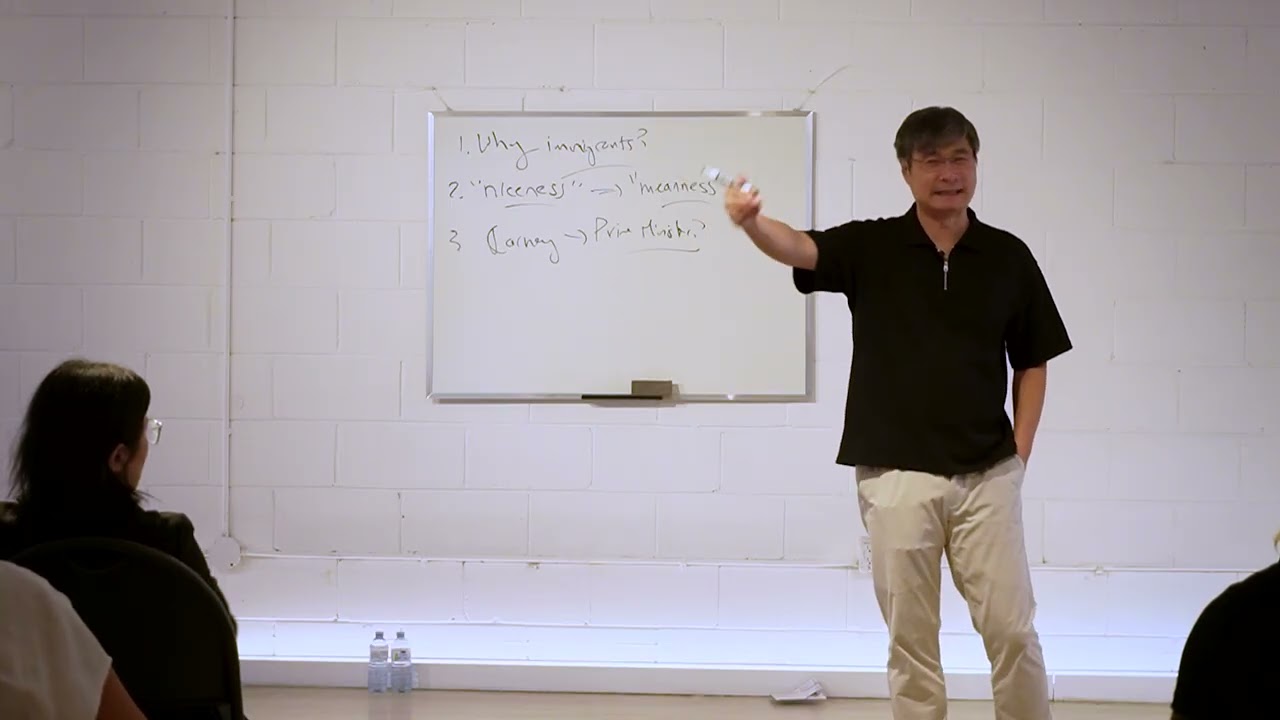
US-Canada trade negotiations have collapsed amid threats from Donald Trump of sweeping tariffs on Canadian steel, dairy, and alcohol, while Ottawa continues mass immigration despite severe domestic housing shortages and public discontent. (1:06)
Professor Jiang argues Canada operates not as a sovereign nation-state but as an administrative corporate territory subordinate to the City of London, with 89% of its land legally held by the British Crown. (10:18)
A projected Alberta independence referendum could serve as a flashpoint for American Monroe Doctrine enforcement, paving the way for the US to partition and secure Canadian resource basins rather than pursue outright annexation. (28:06)
The Canadian state faces an irreversibility crisis regarding millions of temporary residents and international students, as attempting mass deportations would overwhelm administrative and legal infrastructure. (55:46)
Detailed notes
## Background
Published on YouTube by the Predictive History channel on September 15, 2026, this video documents a live lecture held in Toronto, Ontario on September 5, 2026. Organized by Cathy Tie and filmed and edited by Tim Gabor, the session features Professor Jiang addressing the unfolding US-Canada trade war and the systemic realignment of the Canadian state.
## TL;DR
Professor Jiang presents a thesis framing Canada not as a traditional sovereign nation-state, but as an administrative corporate territory subordinate to British financial capital in the City of London. He argues that post-WWII economic models have broken down, prompting transnational elites led by figures like Mark Carney to pursue rapid demographic turnover and asset liquidation while facing pressure and potential partition from Donald Trump's United States. Throughout the extensive lecture and audience Q&A, Jiang addresses elite overproduction, mass immigration realities, and geopolitical friction over resources like Alberta crude, urging listeners to prepare for institutional collapse by building resilient local communities, family ties, and spiritual grounding.
## Atmosphere & style
The session has the intimate, conspiratorial air of a high-level dissident salon, blending rigorous macro-geopolitical framing with Jiang's mordant, self-deprecating wit. Audience interactions are cerebral and direct, featuring sharp pushback from highly credentialed attendees on immigration policy and caste realities alongside discussions of biblical prophecy and imperial decline. Throughout the dialogue, Jiang punctures conventional Canadian politeness with bleak, comedic parables about leadership and systemic fragility, ultimately shifting from macro-level despair into an earnest, pastoral call for personal faith, humor, and community resilience.
## Bulletin
- [01:06](https://www.youtube.com/watch?v=hcuT_mpeTxo&t=66s) US-Canada trade negotiations have collapsed amid threats from Donald Trump of sweeping tariffs on Canadian steel, dairy, and alcohol, while Ottawa continues mass immigration despite severe domestic housing shortages and public discontent.
- [10:18](https://www.youtube.com/watch?v=hcuT_mpeTxo&t=618s) Professor Jiang argues Canada operates not as a sovereign nation-state but as an administrative corporate territory subordinate to the City of London, with 89% of its land legally held by the British Crown.
- [28:06](https://www.youtube.com/watch?v=hcuT_mpeTxo&t=1686s) A projected Alberta independence referendum could serve as a flashpoint for American Monroe Doctrine enforcement, paving the way for the US to partition and secure Canadian resource basins rather than pursue outright annexation.
- [55:46](https://www.youtube.com/watch?v=hcuT_mpeTxo&t=3346s) The Canadian state faces an irreversibility crisis regarding millions of temporary residents and international students, as attempting mass deportations would overwhelm administrative and legal infrastructure.
## Key takeaways
- [10:18](https://www.youtube.com/watch?v=hcuT_mpeTxo&t=618s) Canada fundamentally lacks the social contract, blood-and-soil ethnic heritage, or meritocratic constitutional myths of traditional nation-states, operating instead as a corporate administrative entity subordinate to transnational finance.
- [20:32](https://www.youtube.com/watch?v=hcuT_mpeTxo&t=1232s) For seven decades post-WWII, Canada's economic model relied on offshore capital recycling with the City of London, high immigration, and resource extraction tailored to American industry, managed by a hereditary Laurentian elite.
- [28:06](https://www.youtube.com/watch?v=hcuT_mpeTxo&t=1686s) Demands for higher capital yields from London financiers have prompted a corporate restructuring of Canada, utilizing demographic turnover to replace a complacent domestic populace with imported labor.
- [39:28](https://www.youtube.com/watch?v=hcuT_mpeTxo&t=2368s) Crown ownership of 89% of Canada's land is a legal fiction vulnerable to American military power and Monroe Doctrine enforcement, as Britain lacks the military capacity to defend Canadian territory.
- [48:21](https://www.youtube.com/watch?v=hcuT_mpeTxo&t=2901s) The Century Initiative's goal to scale Canada's population to 100 million by 2100 serves corporate extraction and labor restructuring rather than creating an autonomous global superpower.
- [55:46](https://www.youtube.com/watch?v=hcuT_mpeTxo&t=3346s) Due to severe court backlogs, refugee claims, and limited administrative machinery, Canada lacks the capacity to deport millions of undocumented or temporary residents, creating an irreversible demographic reality.
- [01:00:44](https://www.youtube.com/watch?v=hcuT_mpeTxo&t=3644s) The United States has shifted from an 'empire by consent' to an 'empire by force,' relying on disruptive political figures to enforce imperial mandates and coerce historical allies under severe debt and domestic decay.
- [01:18:41](https://www.youtube.com/watch?v=hcuT_mpeTxo&t=4721s) Mark Carney and financial technocrats represent transnational capital interests focused on asset-stripping and liquidating Canadian resources to foreign buyers rather than preserving national sovereignty.
- [02:00:26](https://www.youtube.com/watch?v=hcuT_mpeTxo&t=7226s) Beijing views Canada and Europe as secondary players incapable of absorbing Chinese exports, focusing its diplomatic efforts entirely on direct bilateral summits with Washington.
- [02:07:43](https://www.youtube.com/watch?v=hcuT_mpeTxo&t=7663s) American trade friction with Ottawa is calculated to divide Canada and isolate Alberta's vital energy resources rather than execute an annexation of the entire Canadian federation.
- [02:12:30](https://www.youtube.com/watch?v=hcuT_mpeTxo&t=7950s) Pierre Poilievre functions as controlled opposition designed within Westminster parliamentary conventions to absorb and pacify conservative pushback without mounting genuine institutional resistance.
- [02:26:01](https://www.youtube.com/watch?v=hcuT_mpeTxo&t=8761s) US strategic doctrine to secure Alberta's resources relies on asymmetric methods—such as funding and embedding within regional secessionist groups—rather than overt conventional troop deployments.
- [02:09:52](https://www.youtube.com/watch?v=hcuT_mpeTxo&t=7792s) To withstand impending macroeconomic fractures and elite-driven restructuring, citizens should shift focus away from uncontrollable macro-politics toward decentralized local resilience cells, family, and spiritual purpose.
Event organizer Cathy Tie opens the evening by welcoming the crowd to what she notes is the first Predictive History meetup held in Canada. She highlights the personal resonance of the gathering, mentioning that both she and Professor Jiang are originally from Toronto, making this homecoming particularly meaningful.
Before handing over the microphone, Cathy takes time to acknowledge several individuals who made the event possible:
- **Tim Gabor**, host of a podcast on which Cathy and Professor Jiang recently appeared to discuss biotechnology and geopolitics, who located the venue and managed the recording and editing equipment.
- **Her brother**, who assisted with the overall logistics and on-site setup.
- **Gerard and friends**, who prepared the food, snacks, and whiteboard.
- **An unnamed volunteer**, recognized on the spot in the audience with a wave of gratitude for stepping in to organize and serve the sandwiches.
With the logistics settled, Cathy yields the floor to Professor Jiang to commence the lecture.
[01:06](https://www.youtube.com/watch?v=hcuT_mpeTxo&t=66s) Professor Jiang’s Opening Remarks and the US-Canada Trade Breakdown
Taking the stage to applause, Professor Jiang welcomes the audience and frames the Toronto stop as part of his tongue-in-cheek "end of the world global tour." He showers praise on Cathy Tie for putting the gathering together, noting that this is her second time organizing a meetup following a successful initial session in New York. Jiang quips with a dry smile that he eventually intends to "steal Cathy from Peter Thiel," joking that while Thiel is undeniably a billionaire, "at least I'm not the Antichrist, I hope."
Shifting into the core content of the evening, Jiang sets the stage for a roughly one-hour talk centered on the US–Canada trade war and the trajectory of the country over the next decade or two. He observes that official trade talks between Washington and Ottawa have collapsed, with both sides refusing to return to the negotiating table. Donald Trump is threatening sweeping tariffs designed to choke off Canadian access to the American market, zeroing in on key Canadian export sectors:
- Steel
- Dairy products
- Alcohol
To frame Canada's geopolitical and economic trajectory, Jiang lays out three underlying paradoxes that have perplexed him from abroad over the preceding five years while keeping tabs on the country through his family in Toronto.
[03:17](https://www.youtube.com/watch?v=hcuT_mpeTxo&t=197s) Paradox 1: Post-COVID Mass Immigration and Social Strain
Jiang prefaces his analysis with an upfront warning: he fully expects to offend people in the room. He jokes that he spent considerable time living in the United States and was likely "infected with their rudeness," adding that his recent appearances on edgy comedy podcasts alongside hosts Kurt Metzger and Sam Hyde meant their abrasiveness rubbed off on him: "If I'm being offensive tonight, it's their fault. It's not my fault... maybe a couple more weeks and my Canadian niceness will return to me."
Jiang presents his first paradox: the abrupt influx of millions of immigrants into Canada during the five to ten years following the COVID-19 pandemic. This rapid population growth, he argues, has introduced acute friction into Canadian society. Young domestic workers find it practically impossible to buy a home, and wage levels are being depressed across industries. Conventional political logic suggests that severe strain on housing and living standards would trigger a political pause or a formal moratorium on intake. Instead, Canadian leadership doubles down: Jiang recalls former central banker Mark Carney traveling to India and essentially pleading, "Please send more. In fact, we'll give you scholarships to come here." Jiang questions why a government would actively supercharge immigration precisely when it is creating intense societal pressure.
[04:53](https://www.youtube.com/watch?v=hcuT_mpeTxo&t=293s) Paradox 2: The Disappearance of Canadian Niceness
Jiang’s second paradox concerns the sudden cultural erosion of Canada's renowned social fabric. Having grown up in Canada during the 1980s and 1990s, he recalls an ethos defined worldwide by polite deference, friendly demeanor, and mutual respect for personal space. Yet, after spending just thirty-six hours back in Toronto riding the subway and walking the streets to gauge the local milieu, Jiang observed an unsettling shift toward public hostility.
He shares two vivid encounters from the previous day:
- **Subway confrontation**: While stepping off a subway train with his son, Jiang watched a heated verbal dispute between an aggressive young man and an elderly man in his seventies. The young man abruptly shoved the senior citizen into a wall and onto the floor with enough force that the victim struggled to stand back up. Commuters walked past without intervening or checking on him—Jiang admitted that, caught off guard and unwilling to escalate matters, he walked past as well, reflecting that in the 1980s or 1990s passersby would have immediately rushed to help or contacted the police.
- **Bloor Street and Koreatown**: While walking down Bloor Street near Koreatown, Jiang witnessed screaming matches between pedestrians and noticed people deliberately crowding and violating the physical boundaries of others to provoke reactions.
This leads to his second driving inquiry: how an famously polite, accommodating society transformed so rapidly into an aggressive, mean-spirited one.
[07:18](https://www.youtube.com/watch?v=hcuT_mpeTxo&t=438s) Paradox 3: The Mark Carney Election and the Poilievre Campaign
Jiang introduces his third paradox: the political elevation of Mark Carney to the prime ministership. Acknowledging the obvious response—that the electorate voted him in—Jiang questions the deeper logic behind that outcome. Setting aside conspiratorial thinking, he dissects the dynamics of the contest between Mark Carney and Conservative leader Pierre Poilievre:
```mermaid
flowchart TD
accTitle: Dynamics of the Carney-Poilievre Election
accDescr: Diagram illustrating the political dynamic where Carney acts as the puppeteer behind Trudeau, while Poilievre failed to leverage the Ignatieff-style carpetbagger line of attack.
subgraph Liberal["The Liberal Axis"]
JT["Justin Trudeau<br/>(Frontman / 10 Years in Power)"]
MC["Mark Carney<br/>(Shadow Policy Architect)"]
MC -.->|"Puppet Master Behind Policies"| JT
end
subgraph Conservative["Conservative Strategy Failure"]
PP["Pierre Poilievre<br/>(Squandered Major Lead)"]
MI["Michael Ignatieff Precedent<br/>(Defeated Twice as 'Carpetbagger')"]
PP -.->|"Failed to Deploy"| MI
end
JT -->|"Voter Fatigue"| MC
```
Jiang argues that Justin Trudeau rarely possessed original policy insights and instead operated as a figurehead for intellectual architects like Carney, who acted as a shadow leader within the Liberal establishment. If voters were exhausted by a decade of Trudeau's governing record, installing the behind-the-scenes architect made little sense. Furthermore, the Conservative campaign collapsed under mysterious circumstances: despite holding a commanding lead, Poilievre failed to deploy the most obvious, historically proven line of attack:
- **The "Carpetbagger" Line of Attack**: Highlighting that Carney spent the vast majority of his professional career outside Canada working for Goldman Sachs in New York or the Bank of England in London, leaving his assets abroad and returning home only to seek political power.
- **The Michael Ignatieff Precedent**: Jiang points to former Liberal leader Michael Ignatieff, a Canadian academic who returned from Harvard to lead the Liberals and was routed in elections precisely because his opponents effectively tagged him as an opportunistic outsider who spent his adult life in the United States and returned merely to advance himself.
Jiang finds it inexplicable that Poilievre neglected this winning strategy, allowing Carney to take power without serious resistance.
[10:18](https://www.youtube.com/watch?v=hcuT_mpeTxo&t=618s) Canada as a Corporation and the Concept of the Nation-State
Jiang offers a single, unifying thesis to resolve all three paradoxes: "Canada is not a real country. Canada is not a nation-state. Canada is a corporation." Specifically, he asserts that the country operates as an administrative corporate entity subordinate to financial power centers like the City of London. Once this premise is accepted, the actions of its leaders—from prioritizing labor imports and suppressing wages to preserving elite continuity—cease to appear irrational.
Jiang emphasizes that his objective is analytical rather than moral: he is not passing ideological judgment, but offering a conceptual framework so listeners can draw their own informed conclusions about the country's trajectory.
To demonstrate why Canada fails to qualify as a genuine country, Jiang contrasts it with the historical emergence of the modern nation-state, which evolved along three distinct structural pathways:
- **France**: Founded upon the Rousseauian social contract.
- **Germany**: Defined by cultural and ethnic ties.
- **The United States**: Defined by constitutional and ideological principles.
Focusing on the French model, Jiang explains Jean-Jacques Rousseau’s *The Social Contract*. In this framework, human beings are born free—freedom being God's most precious gift. Citizens consciously choose to surrender part of that natural freedom to construct and sustain a functioning society; in exchange for this sacrifice, the state is strictly bound to grant, secure, and defend their fundamental rights.
[12:11](https://www.youtube.com/watch?v=hcuT_mpeTxo&t=731s) The Three Models of the Modern Nation-State: France, Germany, and the US
To understand modern nationhood, Professor Jiang outlines three distinct historical archetypes:
```mermaid
flowchart TD
accTitle: Three Models of the Modern Nation-State
accDescr: Diagram contrasting the foundational bases of France, Germany, and the United States.
subgraph France["France: Civic Social Contract"]
F1["Revolution & Napoleonic Wars"] --> F2["Sacrifice in Blood"]
F2 --> F3["Secular Citizenry & State Rights"]
end
subgraph USA["United States: Constitutional Ambition"]
U1["The Constitution"] --> U2["Rule-bound 'Game'"]
U2 --> U3["Individual Drive & Wealth Creation"]
end
```
- **The French Model (The Social Contract & Citizenship):** In France, citizenship is held with extreme sanctity, creating a rigid secularism where the state supersedes religious symbols (such as contemporary debates over the hijab). This secular social contract was forged through the bloodshed of the French Revolution and the Napoleonic Wars. It is a pact where people sacrificed their lives in exchange for state-guaranteed, inalienable rights.
- **The German Model (Iron, Blood, and Ethnos):** Germany was not unified by a piece of paper or an organic common tongue, but formed through philosophical conception and military dominance. Thinkers like Johann Gottlieb Fichte—the father of German nationalism—crafted the very idea of "Germanness" when disparate German populations did not even share a standardized language. Unified through Prussian conquest and Bismarck's "blood and iron," German nationalism posits that one is born into the culture, land, and blood, instilling a duty to sacrifice everything for the state's destiny.
- **The American Model (The Constitution as a Game of Ambition):** In the United States, nationalism does not care about ancestral origin. The US Constitution functions as the rules of a game: regardless of background, individuals with drive, talent, and raw ambition can work hard, build wealth, and succeed.
---
[15:27](https://www.youtube.com/watch?v=hcuT_mpeTxo&t=927s) Why Canada Is Not a Nation-State: Crown Ownership and Anti-Nationalism
Canada fits none of these paradigms. Canadians have never fought a revolution, fought no defining expansionist wars, and possess no unifying national mythology comparable to George Washington crossing the Delaware, Napoleon's campaigns, or Bismarck's unification. Canada has two official languages, and its culture is fundamentally allergic to ambition.
Instead, Canada was structurally designed to be an anti-nationalist resource colony:
- **Crown Ownership:** 89% of Canadian land is owned by the Crown—literally the British monarch. While modern sources like ChatGPT dismiss this as a legal technicality or historical fiction overlaying a people's democracy, Professor Jiang calls that interpretation pure nonsense.
- **Winston Churchill’s Wartime Plan:** In his iconic 1940 "we shall fight on the beaches" radio address, Churchill included an often-overlooked conclusion: if Great Britain itself were subjugated, the empire would not surrender; it would simply relocate to Canada to carry on the war. To the British imagination, Canada was and remains a territorial asset and resource refuge.
- **Continuous Colonial Rule:** Because Canadians never rebelled, the original colonial apparatus established under institutions like the Hudson's Bay Company was never dismantled. The trappings of Canadian democracy, civil liberties, and the separation of powers serve primarily as a veneer obscuring its status as a British resource holding designed to suppress the emergence of organic nationalism.
---
[20:32](https://www.youtube.com/watch?v=hcuT_mpeTxo&t=1232s) The 70-Year Golden Age: Offshore Finance and American Manufacturing
For the 70 years following World War II, Canada's lack of true nationhood was not a liability; it gave Canadians one of the easiest, wealthiest, and most stable standards of living on earth. By sitting comfortably between Great Britain and the United States, Canada relied on a tripartite economic model:
```mermaid
flowchart LR
accTitle: The Post-WWII Canadian Wealth Model
accDescr: Flowchart showing the three pillars supporting Canada's economic model between Britain and the US.
subgraph Pillars["Post-WWII Wealth Pillars"]
direction TB
P1["Offshore Finance & Capital Recycling<br>(City of London)"]
P2["Immigration Flow<br>(Energy, Talent & Capital)"]
P3["Infinite Resource Extraction<br>(Supplying US Industry)"]
end
- **Offshore Financial Center for Britain:** Working hand-in-hand with the City of London, major institutions like the Royal Bank of Canada (RBC), Bank of Montreal (BMO), and Scotiabank operated effectively as offshore hubs, recycling and laundering foreign capital generated from global arms, drugs, and illicit trade.
- **Continuous Immigration:** High immigration streams constantly infused fresh energy, external private capital, and skilled labor into the domestic economy.
- **Resource Feeder to the United States:** Canada leveraged its vast raw material reserves to feed the insatiable post-war American industrial manufacturing engine.
---
[23:25](https://www.youtube.com/watch?v=hcuT_mpeTxo&t=1405s) The Power Structure: The City of London and the Laurentian Elite
The true sovereign power behind the Canadian Crown is not the British monarch personally, but the **City of London**—the financial nexus that historically financed the monarchy and dictated imperial policy.
Because financiers in London have little interest in running day-to-day administrative affairs across the Atlantic, Canada is governed by domestic managerial custodians known as the **Laurentian elite**:
- These administrators include high ministers, prime ministers (exemplified by political dynasties like Justin Trudeau), and corporate leaders.
- Functioning like hereditary, pseudo-aristocratic "CEOs" and "manor lords" who read Jane Austen, their primary role is managing the domestic resource territory on behalf of foreign imperial capital rather than building a sovereign, unified nation.
[24:50](https://www.youtube.com/watch?v=hcuT_mpeTxo&t=1490s) The Structure of Canadian Society and the Laurentian Elite
Professor Jiang begins by dissecting the traditional Canadian socio-economic model. Historically, the Canadian ruling class never really had to exert itself because the country sat conveniently at the crossroads between the British offshore financial system and American industrial manufacturing might. Positioned in this lucrative middle ground, the domestic upper crust—the Laurentian elite—did not have to build or fight for an economy; it simply functioned on autopilot. Jiang likens their existence to the world of Jane Austen novels, describing a pseudo-British aristocracy characterized by idle leisure, inherited status, and aristocratic pretension.
Beneath this ruling echelon sits the permanent government bureaucracy that actually administers the country, followed outward by generational, established white Canadians who have lived in the country for two or three generations. Because the domestic population and the elites avoid strenuous productive labor, the engine that has perpetually kept this administrative state afloat is continuous, high-volume immigration.
```mermaid
flowchart TD
accTitle: Traditional Canadian Social Hierarchy
accDescr: Concentric rings of the Canadian establishment powered by continuous immigration.
subgraph EliteCore["Ruling Core"]
A["Laurentian Elite<br/>(Pseudo-British Aristocracy)"]
end
subgraph AdminLayer["Administrative & Demographics"]
B["Federal Bureaucracy<br/>(State Managers)"]
C["Established Generational Canadians"]
end
subgraph Engine["Economic Driver"]
D["Continuous Immigration Pipeline"]
end
A --> B
B --> C
D -->|"Fuels & Subsidizes"| C
```
---
[26:18](https://www.youtube.com/watch?v=hcuT_mpeTxo&t=1578s) The Three Pillars of Canadian Culture: Rules, Politeness, and Mediocrity
According to Jiang, because Canada operates fundamentally as a corporate bureaucracy rather than an organic nation-state, its social conditioning has bred three distinct cultural pillars:
1. **Following the rules:** In a corporate state, procedural compliance is paramount. From childhood schooling onward, the primary lesson drilled into citizens is to obey bureaucratic protocol without questioning it.
2. **Politeness:** Being polite in Canada is not merely about kindness; it is a mechanism for enforcing rigid social deference. It means "respecting the social hierarchy," recognizing one's place within it, and never rocking the boat.
3. **Mediocrity:** The natural consequence of this deference is an active suppression of ambition. Jiang emphasizes that within Canadian culture, being overtly ambitious is treated as an unforgivable character flaw—"the worst insult you can throw at someone," on par with horrific accusations. Those with true drive or entrepreneurial hunger quickly realize they are unwelcome and leave for the United States, an exodus Jiang notes that both he and the event's organizer, Cathy Tie, personally took part in.
This trio of traits formed a functional equilibrium for decades because it protected the status quo, preserving a comfortable, unchallenging existence for the established classes.
---
[28:06](https://www.youtube.com/watch?v=hcuT_mpeTxo&t=1686s) Elite Overproduction and the Corporate Restructuring of Canada
Jiang raises the central puzzle: if this cozy arrangement worked so smoothly, why has it recently begun tearing at the seams with runaway immigration surges, social tension, political conflict, and Mark Carney entering the political arena to clash with Donald Trump? The structural explanation is elite overproduction—too many elite aspirants chasing too few levers of real power.
Jiang argues that the City of London—the ultimate financial principal behind Canada—is struggling economically and facing mounting global financial strain. Historically content with a modest, reliable return on its Canadian investments, London now demands significantly higher margins and aggressive yields. But the domestic Canadian population and its entrenched middle management are far too sluggish, polite, and preoccupied with work-life balance, environmental protections, and family life to generate those returns.
In corporate finance, when an investor determines that existing middle management is idle and unprofitable, they initiate a restructuring. Jiang asserts that this is precisely what is unfolding across Canada today: the entire country is undergoing a ruthless corporate restructuring where the "old Canadian Guard" is deliberately downsized and replaced by a harder-working, more pliable imported demographic base to extract higher returns on investment:
> "Canadians like the environment. Canadians care about family. Canadians care about being polite. We don't want that crap, okay? We just want a higher return on investment. Go and destroy the environment. Abandon your families. Stop being so nice. Start making more money for us."
- **Mechanism of suppression:** To prevent the domestic population from resisting this replacement, the educational and cultural apparatus has systematically pushed anti-nationalism. By declaring that the land belongs exclusively to Indigenous peoples—a message Jiang recalls seeing broadcast even on commercial Air Canada domestic flights—the establishment effectively strips the domestic population of moral standing to claim ownership over the country, smoothing the path for land transfers, court challenges against private property in British Columbia, and demographic replacement.
- **The replacement coalition:** The City of London has partnered with historical high-return drivers, creating what Jiang terms an alliance between Zionist capital and imported Hindu labor, explaining the dramatic and targeted influx of Indian immigrants into the country.
---
[32:28](https://www.youtube.com/watch?v=hcuT_mpeTxo&t=1948s) The Laurentian Dilemma and the Coming Alignment with the United States
Jiang addresses why the Laurentian elite would actively cooperate with their own obsolescence instead of resisting it. Drawing the corporate analogy further, he explains that domestic middle managers naively believe that by rubber-stamping the restructuring and complying with top-down directives, they can preserve their own aristocratic standing and save their children's privileges. Yet in real corporate shakeups, middle managers are invariably discarded alongside the lower tiers.
Eventually, over the next 10 to 20 years, factions within the Laurentian establishment will realize that London intends to discard them entirely. When that reality sets in, their only viable survival strategy will be defecting from the British imperial orbit and seeking annexation or integration into the United States.
Jiang dismisses the notion that the emerging trade friction is merely a conventional political dispute between Mark Carney and Donald Trump over tariffs. Carney does not answer to the Canadian public; his allegiances lie with the City of London. Trump's broader geopolitical objective is the absolute revival and enforcement of the Monroe Doctrine—or the "Trump corollary" to the Monroe Doctrine—which aims to permanently expel British and City of London influence from the Western Hemisphere.
Jiang outlines two key flashpoints that will test this geopolitical clash in the near term:
- **The Falkland Islands:** Trump's vocal support for Argentina reclaiming the Falkland (Malvinas) Islands from the United Kingdom is not an arbitrary stance about distant, isolated territory; it is an opening salvo to test Britain's imperial resolve and enforce complete American hemisphere dominance.
- **Alberta Separation:** The second critical litmus test will occur in Western Canada. Alberta will eventually vote to secede from the Canadian Confederation. When this referendum is challenged, the Supreme Court of Canada will drop the democratic facade and rule that Alberta cannot legally leave because all provincial land ultimately belongs to the Crown rather than the sovereign people. That constitutional crisis, Jiang predicts, will provide the pretext for Trump to intervene directly—potentially deploying American "peacekeeping" forces under the guise of defending democratic self-determination in Alberta.
[36:37](https://www.youtube.com/watch?v=hcuT_mpeTxo&t=2197s) The Coming Alberta Secession Crisis and Canada's Dual Fate
Alberta will serve as the primary litmus test for whether this geopolitical analysis holds true. In the long term, the people of Alberta will likely hold a referendum and vote to become an independent nation rather than immediately joining the United States directly. However, once that referendum passes, the matter will be elevated to the Supreme Court of Canada, which will inevitably strike it down as unconstitutional, ruling that Alberta has no legal right to secede. This judicial intervention will be the exact catalyst that draws Donald Trump directly into the dispute.
```mermaid
flowchart TD
accTitle: Projected Alberta Secession Escalation
accDescr: Flowchart showing the steps leading from an Alberta independence referendum to US intervention.
A["Alberta Independence Referendum"] -->|"Passes"| B["Supreme Court of Canada"]
B -->|"Rules Unconstitutional"| C["Constitutional Impasse"]
C -->|"Draws Intervention"| D["Donald Trump / US Involvement"]
D --> E["Fracturing of Canadian Confederation"]
```
Canada cannot sustain its current socio-economic model. The country faces two stark outcomes—both of which will likely unfold in tandem:
1. **Internal Demographic & Capital Realignment:** A comprehensive restructuring where Zionist capital combined with Hindu labor supplants the old establishment, amounting in stark terms to a demographic and elite population replacement.
2. **Territorial Fracturing:** The domino-like secession of the confederation. If Alberta departs, the other Western provinces will follow suit, followed by Quebec, and then the Maritimes. That chain reaction leaves Ontario isolated as the sole remnant of "Canada"—a rump territory that lacks the economic foundation to function as a self-sufficient, sustainable state.
---
[39:28](https://www.youtube.com/watch?v=hcuT_mpeTxo&t=2368s) Q&A: Crown Land as a Legal Fiction vs. US Hard Power
Tim Gabor steps in to moderate questions specifically about the Canadian thesis. An audience member opens by questioning how Canada could realistically fracture when roughly 89% of the land is legally vested in the British Crown and Canadians have no historical appetite for violent anti-monarchical revolution.
Professor Jiang replies that modern Canada is built upon a series of competing legal and political "fictions." The idea that the Crown holds sovereign control over Canadian territory is only valid so long as the Crown possesses the military force to back it up. Under the American Monroe Doctrine, the Western Hemisphere falls under Washington's absolute sphere of dominance:
> "Trump is saying, 'Well, technically, yes, the Crown controls 89% of Canada, but we are the United States and the Western Hemisphere is ours because of the Monroe Doctrine. So, like, what's going to happen is if we roll our tanks into Toronto, is Britain going to send their 5,000 troops over to protect Toronto?' Probably not."
Just as the notion of Canadian democracy is functionally a fiction, international borders and land titles are hollow when tested by real power. Both Donald Trump and Vladimir Putin operate by aggressively exposing and breaking these geopolitical legalisms.
---
[41:14](https://www.youtube.com/watch?v=hcuT_mpeTxo&t=2474s) Laurentian Elite Blindness and the Inevitable Recession
Another audience member asks whether the Laurentian elite or the Canadian populace could successfully triangulate between Washington and the Crown to assert sovereign, domestic control. Jiang acknowledges that while Canada sits at the geographical and economic nexus between the United States and the City of London, a deliberate triangulation strategy is rendered impossible by a national culture of profound ignorance and cognitive dissonance.
Most Canadians instinctively tune out, dismiss critical perspectives as offensive or foolish, and retreat into denial. Jiang highlights glaring domestic examples:
- The complete absence of public reckonings or serious analysis regarding the policy decisions of the COVID-19 pandemic.
- The backroom political elevation of figures like Mark Carney, who was anointed within the Liberal Party apparatus rather than having to compete through an authentic, open democratic leadership race.
The Laurentian elites operate with no grand national strategy. They behave like "feudal manor lords who are interested in raising sheep," entirely complacent about the economic and political storms gathering on the horizon.
---
[43:03](https://www.youtube.com/watch?v=hcuT_mpeTxo&t=2583s) The Breakdown of Social Safety Nets and the Trade War Reality
When an attendee asks what will happen to Canada's healthcare system and social safety net if provinces break off or integrate into the United States, Jiang offers an unsparing assessment: anyone below a certain age should not expect to receive a public pension or guaranteed healthcare. Survival itself will be an uphill struggle. Canadians take material security for granted, unlike the wave of new immigrants entering the country who have lived through genuine deprivation—including famine, extreme violence, and gang warfare.
The Canadian economic model has rested on three core pillars:
- Offshore financial servicing and money laundering
- Uncapped immigration
- Raw resource extraction
This foundation is collapsing because of the ongoing trade dispute. Jiang pushes back against the portrayal of Mark Carney as an economic savior, pointing out the basic law of trade: the United States is the primary buyer, Canada is merely the seller, and a seller cannot alienate its sole essential customer.
This is not a conventional tariff dispute, but an existential imperial conflict between Washington and the City of London. The United States will win by deliberately inflicting severe economic pain across the Canadian economy, creating the precise domestic misery required to drive Albertans toward a secession vote. A severe recession over the coming 5 to 10 years is inevitable. Referring to an earlier appearance on Courtlin Metger's show where he joked that the US ought to invade Canada instead of Iran, Jiang noted that many Canadian commenters responded favorably, seeing American annexation as the only viable escape from domestic elite mismanagement and demographic replacement.
---
[46:18](https://www.youtube.com/watch?v=hcuT_mpeTxo&t=2778s) Comparing the UK Model: Demographic Shift vs. National Identity
An audience member asks a two-part question about whether Canada's future will mirror Britain's recent history, and whether the influx of ambitious immigrants could unexpectedly turn Canada into the next global superpower as the United States declines:
- Does Britain's immigration trajectory over the past decade or two show what is in store for Canada?
- Could bringing in highly ambitious immigrant talent turn Canada into an energetic economic titan similar to America's rise?
Jiang outlines that while Britain's primary immigration tensions revolve around Islamification and severe domestic cultural clashes, the comparison between the two countries is fundamentally flawed. Great Britain is an ancient nation-state anchored by a distinct historic heritage, shared language, and deep cultural self-conception—attributes that make rapid demographic upheaval exceptionally volatile there, whereas Canada lacks that same unified national bedrock.
[48:21](https://www.youtube.com/watch?v=hcuT_mpeTxo&t=2901s) The City of London, Canada's Docility, and the Century Initiative
Professor Jiang begins by contrasting Great Britain with Canada. In Britain, severe social friction has pushed the country "very, very close to civil war," sitting right at the tipping point. The fundamental dynamic to understand, Jiang argues, is that Britain as a nation-state and the City of London are entirely distinct entities. The City of London represents transnational finance capital whose only imperative is maximizing return on investment (ROI) for global investors. London operates essentially as a parasite on Britain and can pack up and relocate anywhere across the globe whenever necessary. Unlike Britain, Canada exhibits far less domestic resistance to mass immigration, making it an ideal target.
Jiang tackles the argument surrounding the Century Initiative—the projection aiming to scale Canada's population to 100 million people by the end of the century so that its vast landmass and natural resources might elevate it into an economic superpower. Jiang flatly rejects this possibility:
```mermaid
flowchart TD
accTitle: The Resource Extraction Model
accDescr: Diagram illustrating transnational capital restructuring Canada into a resource colony.
subgraph London["Transnational Finance"]
A["City of London Capital"]
end
subgraph Restructuring["Canada's Restructuring"]
B["Zionist Financial Architecture"]
C["Imported Mass Labor Force"]
end
Because the Canadian populace does not push back, the City of London views the country as the premier testing ground for corporate societal restructuring. The design, according to Jiang, pairs concentrated capital control with an enormous, compliant labor force to extract natural wealth, leaving Canada not as an independent superpower, but merely as a resource colony serving external loyalties.
- The Century Initiative targets 100 million Canadians by 2100 under the pretext of superpower status.
- Transnational capital operates independently of British national borders, extracting ROI wherever resistance is lowest.
- Canadian docility makes the country an open laboratory for rapid corporate social engineering.
---
[50:10](https://www.youtube.com/watch?v=hcuT_mpeTxo&t=3010s) The Synergy of Capital and Labor, and the Geopolitical Trap
Jiang elaborates on the structural synergy he sees being assembled: the combination of elite capital networks and an imported labor base. India faces an acute demographic crisis with a surging youth population; if millions of unemployed or underemployed youth remain idle inside the country, domestic unrest inevitably follows—as evidenced by waves of student demonstrations and protests against educational and institutional corruption. For the Indian state, exporting surplus youth overseas is an essential pressure release valve, and Canada has become the primary destination.
Jiang argues that this creates a transactional marriage between transnational capital and imported labor, pointing out that India is among the few countries where public opinion toward Israel remains consistently favorable. Yet this framework cannot transform Canada into an independent powerhouse, because neither the capital class nor the imported workforce holds foundational loyalty to the Canadian state. Instead, loyalties remain anchored overseas, reducing Canada to an extracted resource basin. Furthermore, this dynamic operates only as long as the United States tolerates it. Jiang asserts that Washington will never allow an autonomous, competitor bloc on its northern border; rather than permit a unified, restructured Canada, the United States would prefer to see the nation fragment into regional provinces under classic divide-and-rule dynamics.
---
[53:30](https://www.youtube.com/watch?v=hcuT_mpeTxo&t=3210s) Audience Pushback: High-Skilled Exclusion vs. Low-Wage Realities
During the Q&A, an audience member stands up to challenge Jiang's thesis directly. The attendee introduces himself as a Hindu Brahmin who previously asked a question during an earlier Zoom session, explaining that while he fits the intellectual archetype Jiang described, his lived experience completely contradicts the narrative of an elite Brahmin pipeline into Canada:
> "I fit into your archetype. So, I'm Hindu Brahmin from India, and I'll tell you why I think I can push back on this thesis. First of all, most of the Indians that come here actually are Sikhs from Punjab, and almost none of them—a very small minority—are Brahmins, which are the upper caste that come to Canada."
The speaker details his background: he earned his undergraduate degree at Carnegie Mellon University, attended grad school at Northeastern University, and worked as a senior AI engineer at Amazon. Despite having near-perfect credentials, top English fluency from growing up in the UK, and eight years on the Canadian immigration waitlist, he could not accumulate enough Comprehensive Ranking System (CRS) points because he was single, childless, and did not speak French. He eventually obtained a US green card instead. In contrast, he points out, Canada’s system currently imports masses of low-skilled workers from lower-caste and rural backgrounds to drive trucks and work retail odd jobs, stressing national housing and social infrastructure rather than building high-tier tech capability.
---
[55:46](https://www.youtube.com/watch?v=hcuT_mpeTxo&t=3346s) Game Theory, Mass Influx, and the Irreversibility Problem
Jiang responds by clarifying that his analysis is not a conspiracy theory about shadowy elites plotting population replacement in corporate boardrooms, nor is it an endorsement of state policy. Instead, he applies game theory: analyzing the incentives of different actors within the current global architecture to forecast what will inevitably occur over the next ten to twenty years.
Regardless of whether the intake matches an idealized high-skilled profile, millions of temporary residents and students from South Asia are already inside Canadian borders working basic jobs without permanent resident status or a clear path to citizenship. Crucially, Jiang argues, the Canadian state lacks the administrative and political capacity to deport them. If a political figure like Mark Carney or any government administration were to order mass deportations, the legal and institutional machinery would immediately seize up: individuals would apply for refugee status, bog down the courts for years, and remain physically present. The sheer economic inertia, domestic business demand for cheap labor, and institutional friction make this demographic shift a structural reality rather than an intentional master plan.
---
[57:43](https://www.youtube.com/watch?v=hcuT_mpeTxo&t=3463s) Resilience Cells and the Rejection of Hyper-Individualism
A second audience member, introducing himself as a Fulbright scholar with a PhD from Harvard and MIT specializing in AI and system dynamics, steps up to reframe the discussion. He observes that modern institutional breakdowns reflect ancient civilizational warnings—drawing a parallel to biblical passages in Revelation concerning nations rising against nations as the onset of "birth pains." He asks Jiang whether the only rational response for individuals is to step away from macroeconomic noise and actively construct decentralized "cells of resilience"—self-sufficient local communities endowed with shared resources and mutual support to weather the coming systemic breakdown.
Jiang agrees emphatically with the premise. He argues that modern hyper-individualism has atomized society and stripped individuals of the resilience necessary to survive systemic upheaval. To navigate what lies ahead, people must abandon extreme individualism and reclaim the foundational human capacity to build community through solemn mutual commitment: making binding promises to one another and organizing collective survival networks from the ground up.
[59:27](https://www.youtube.com/watch?v=hcuT_mpeTxo&t=3567s) Resilient Communities and the Roots of US-Canada Friction
Wrapping up a previous discussion, Professor Jiang emphasizes that enduring communities rest on two foundational pillars: pulling together and extending mutual forgiveness for mistakes. When a community embraces both, it develops the resilience needed to survive severe calamities. Moving past general community dynamics, the moderator nudges the room back to the central theme: "let's stick to Canada and then we'll roll it up later."
An audience member immediately steps up to probe the geopolitical framework underpinning the lecture. Observing that the anticipated fallout in Canada appears driven by friction between the United States and Britain, the questioner asks whether this crisis is solely a byproduct of Donald Trump. Pointing to domestic American political tensions—referencing figures like Zohran Mamdani and the clashes between AIPAC and progressive factions in Minnesota—the attendee asks whether Trump truly has a path to a third presidential term, and whether Canada's predicament would look any different without him in the White House.
---
[01:00:44](https://www.youtube.com/watch?v=hcuT_mpeTxo&t=3644s) The Transition from Empire by Consent to Empire by Force
Jiang frames the situation not as a historical accident, but as a structural evolution of American hegemony. For decades, the United States maintained an "empire by consent"—it was broadly admired, enjoyed high international prestige, and the global public accepted Washington as the rightful hegemon. However, decades of profound domestic mismanagement, a $40 trillion national debt, endless foreign wars, and systemic inequality and corruption inside Washington have shattered America's standing. Crucially, Jiang argues, losing popularity does not cause an imperial elite to willingly surrender its domain; rather, it forces the system to transition into an "empire by force."
```mermaid
flowchart TD
accTitle: The American Imperial Transition
accDescr: Flowchart showing how domestic decay forced the US empire to transition from governance by consent to governance by force, positioning Donald Trump as the necessary enforcer and scapegoat.
subgraph Phase1["Post-War Hegemony"]
A["Empire by Consent"] --> B["Global Popularity & Soft Power"]
end
subgraph Crisis["Structural Mismanagement"]
B --> C["$40T Debt, Overseas Wars & Inequality"]
C --> D["Collapse of International Standing"]
end
subgraph Phase2["Late-Stage Empire"]
D --> E["Empire by Force"]
E --> F["Coercion of Allies: Canada, Europe, Japan"]
F --> G["Donald Trump as Scapegoat & Enforcer"]
end
```
The fundamental obstacle in this transition is psychological: conventional politicians like Joe Biden or Kamala Harris may be ambitious, but they obsess over their polite legacies and shrink from being viewed as ruthless despots. Donald Trump, by contrast, is completely unbothered by being despised and actively leans into the role. Reviewing recent political history, Jiang notes that in 2020 the entire American elite spent $6 billion to unseat Trump and install Biden. Yet when Vladimir Putin subsequently invaded Ukraine, humiliating American power, Biden proved too weak to respond decisively. Consequently, the ruling establishment recognized its need for a ruthless figurehead—someone willing to serve as a lightning rod and bully historical allies like Canada, Europe, and Japan while taking full blame for imperial decay.
Because institutional Democrats cannot be relied upon to follow through on these aggressive, transactional imperial mandates, Jiang predicts the establishment may find it necessary to keep Trump in power for a third term. He contrasts the public reaction to the 2003 invasion of Iraq—where massive worldwide protests denounced a systemic "war for oil" rather than merely blaming George W. Bush—with modern military actions under Trump, where global outrage focuses entirely on Trump's personal depravity rather than systemic imperial motives. For the American deep state, having a leader who absorbs all the blame while executing aggressive statecraft makes him virtually "indispensable."
---
[01:04:29](https://www.youtube.com/watch?v=hcuT_mpeTxo&t=3869s) France, Quebec, and the Elusive Canadian Nation-State
The floor opens to a question exploring external interventions. Clarifying that the imperial struggle involves the City of London rather than Downing Street, a participant asks where France fits into this picture. Given Quebec's historical roots and strategic access to the Northwest Passage, could Paris or a French populist movement step in to alter Canada's trajectory? Jiang dismisses the idea immediately: modern France does not view Quebec as an extension of itself, and if anyone suggested Paris should intervene or take on Quebec's domestic headaches, French leadership would flatly decline: "We don't want this problem."
A follow-up question considers whether Canada could ever evolve into a genuine, self-determining nation-state rather than remaining an economic satellite. In theory, Jiang notes, an existential trade war with Washington could provide the catalyst for true nationhood:
> "The Americans are putting a lot of pressure on Canada and Mark Carney rallies the people to say we will... as a people fear this pain, fear the suffering and we will become independent."
However, Jiang contends that this scenario remains purely theoretical because Canada's leadership has no allegiance to national sovereignty. Figures like Mark Carney do not work for ordinary Canadians; they operate on behalf of the City of London. Operating strictly with the mindset of an international investment banker seeking optimal terms for foreign capital, Carney will, at the critical juncture, "eventually sell Canada."
---
[01:06:40](https://www.youtube.com/watch?v=hcuT_mpeTxo&t=4000s) The Trucker Convoy, Mark Carney, and Voter Complicity
An attendee asks whether this top-down imperial model explains the harsh state reaction against the 2022 Freedom Convoy truckers in Ottawa. Jiang agrees, arguing that Justin Trudeau merely acted as the public figurehead while figures like Carney pulled the structural levers behind the scenes. The institutional crackdown—from police suppression to the unprecedented freezing of bank accounts of citizens who donated as little as a single dollar—demonstrated how swiftly corporate and state power mobilizes against domestic disruption. The questioner remarks on the public amnesia surrounding Carney's published opinions at the time advocating for the protesters to be debanked.
Jiang broadens the critique to Canadian political psychology, arguing that the electorate does not behave like a robust democratic citizenry willing to depose an exploitative ruling class:
- **Transactional Complicity:** Older demographics and the traditional middle class subconsciously understand the colonial hierarchy and play along to preserve personal material privileges.
- **Demographic Denial:** Many voters operate under the illusion that their status shields them, ignoring ongoing structural and demographic replacements.
- **The Illusion of Opposition:** Citizens embraced the belief that an elite financier like Mark Carney would stand up to Donald Trump on behalf of the common worker, an assumption Jiang characterizes as absurd.
---
[01:09:13](https://www.youtube.com/watch?v=hcuT_mpeTxo&t=4153s) Canada's Resource Wealth: Fresh Water, Fertilizer, and American Ambition
A self-deprecating audience member steps up to the microphone, drawing quiet laughter by introducing himself as "one of the Hindu laborers that's taking over this country." He asks how Canada's vast tangible wealth—such as its global reserves of potash and fertilizer, agricultural capacity, and immense freshwater reservoirs—factors into the broader corporate squeeze. Noting Trump's rhetoric regarding North American resource consolidation and water rights, the speaker asks how these vital commodities fit into the imperial maneuvering, and how establishment figures like Mark Carney managed to win over conservative elements across the political divide.
Jiang affirms the premise, underscoring the cruel irony of Canada's structural subservience: objectively speaking, when measured by per-capita arable land, abundant energy, essential mineral resources, and vast reserves of fresh water relative to its tiny population base, Canada should be the wealthiest, most secure sovereign country on Earth.
[01:10:31](https://www.youtube.com/watch?v=hcuT_mpeTxo&t=4231s) The Resource Trap, Societal Complacency, and Restructuring
Professor Jiang challenges the assumption that Canada's vast natural wealth guarantees a bright economic future, pointing to the classic economic dilemma of the "resource trap." Throughout history, an overabundance of natural commodities has frequently produced perverse outcomes: widespread corruption, extreme wealth inequality, and pervasive societal complacency. While resource-rich nations in the developing world, such as Nigeria, have historically suffered from deep-seated political corruption, Jiang notes that Canada faces a different pathology. Canada remains one of the least corrupt nations globally, but its populace has fallen victim to comfort and inertia.
Rather than mobilizing to turn resource wealth into sustainable national prosperity, the collective national mood during periods of decline tends toward exhaustion and disengagement. Jiang argues that instead of uniting to work harder during economic difficulties, many Canadians adopt an attitude of doing the bare minimum to get by—a mindset of "ah, whatever." In his analysis, this domestic exhaustion creates an economic vacuum, accelerating immigration and corporate restructuring as institutional financiers in the City of London look elsewhere to maintain a return on their Canadian investments.
- **The Resource Trap Dynamic:** Wealth in raw materials frequently disincentivizes innovation, creating vulnerability to corruption, inequality, and complacency.
- **The Canadian Pathology:** Low levels of institutional corruption paired with widespread societal fatigue and lack of productivity drive.
- **Financial Imperatives:** Overseas financial centers demand consistent returns on capital, accelerating demographic and corporate restructuring when domestic output stagnates.
---
[01:12:25](https://www.youtube.com/watch?v=hcuT_mpeTxo&t=4345s) Raising a Family: Toronto Real Estate vs. the Sun Belt
Responding to an audience member seeking advice on whether to start a family in Canada, Jiang offers a sobering personal perspective. Having three young children himself, Jiang recounts that he had strongly considered moving back to Canada two years prior, even spending the previous summer in Toronto with his older two kids. On the surface, Toronto retains considerable charm—it appears safe, quiet, prosperous, and peaceful. Yet underneath that veneer, Jiang remains profoundly pessimistic regarding the country's long-term trajectory.
The core issue comes down to a fundamental economic barrier: housing. For most young couples in major Canadian cities, buying a home is either an outright impossibility or a path to sustained financial distress. Jiang advises young families to evaluate prospective cities not merely on superficial preference, but on affordability and welcoming policy environments. He highlights Sun Belt metros in Texas—such as Austin, Dallas, and Houston—where a four-bedroom home can still be acquired for approximately $500,000 with the stability of a 30-year fixed-rate mortgage. Cities building and pricing housing for families inherently signal that they value population growth and economic vitality, whereas Toronto's prohibitive costs send the opposite signal.
```mermaid
flowchart TD
accTitle: Housing Affordability and Family Relocation Decision
accDescr: Flowchart contrasting the economic dynamics of raising a family in Toronto versus the Texas Sun Belt.
subgraph Toronto["Toronto / Major Canadian Metros"]
T1["Surface Appeal: Safe, Quiet, Prosperous"] --> T2["Severe Housing Unaffordability"]
T2 --> T3["Financial Strain & Exhaustion"]
T3 --> T4["Unwelcoming to Young Families"]
end
- **Family Viability Test:** The primary benchmark for assessing a location for family life is whether an average earner can purchase a home without extreme hardship.
- **The Texas Alternative:** Texas markets offer 4-bedroom homes for around half a million dollars under 30-year fixed financing, deliberately structured to attract ambitious young families.
- **Core Relocation Rule:** Prioritize places that actively welcome population influx and value newcomer contributions over established, stagnant cities that price them out.
---
[01:14:38](https://www.youtube.com/watch?v=hcuT_mpeTxo&t=4478s) American Imperial Decline, Civil Conflict, and Canadian Vulnerability
A participant who immigrated to Canada 33 years ago steps up to observe a psychological contrast between the two North American neighbors: while Canadians appear to have lost their patriotic passion, Americans retain an intense, volatile zeal. The questioner asks whether an increasingly polarized United States will survive through an authoritarian model or collapse into civil war. Jiang responds by framing the US through the historical lens of an empire in late-stage decline. When empires contract, they routinely display two destabilizing traits: external hyper-aggression and severe internal rupture.
Jiang anticipates that the next decade could bring prolonged civil friction within the United States. He sketches a plausible scenario involving a potential third term for Donald Trump sparking open defiance from large Democratic states such as California, New York, and Massachusetts. Such friction could manifest in direct jurisdictional standoffs between federal entities like Immigration and Customs Enforcement (ICE) and local municipal or state police. Historically, declining empires externalize internal turmoil by meddling in or projecting power into neighboring regions. When the questioner asks where this leaves Canada, Jiang delivers a blunt assessment: Canada possesses no military capacity capable of checking American ambition. "Canada doesn't have a military, guys. I'm sorry. I mean, like, how do you resist the US military?"
- **Dual Crises of Imperial Decline:** Escalating foreign aggression paired with domestic institutional breakdown.
- **Federal vs. State Flashpoints:** Future American civil strife is likely to resemble systemic state-level defiance against Washington rather than traditional battlefield warfare.
- **Canadian Exposure:** With an under-resourced military establishment, Canada lacks the sovereignty tools or defensive leverage to insulate itself if the US externalizes its internal crises northward.
---
[01:17:18](https://www.youtube.com/watch?v=hcuT_mpeTxo&t=4638s) Global Capital Networks and Strategic Deployment
An audience member asks for clarification regarding international capital flows, specifically asking how institutional capital networks acquire everyday consumer infrastructure like Tim Hortons and whether overseas financial coordination directly funds foreign geopolitical priorities.
Jiang explains that transnational financial networks operate along cultural and community lines to coordinate large pools of investment. He points to historical European banking dynasties, such as the Rothschilds, noting that generational access to bullion and merchant banking established vast capital pools capable of acting in concert. In this framework, geopolitical alignment simply means that capital allocators deliberately direct their investments, acquisitions, and cross-border transactions in a manner intended to protect and reinforce the geopolitical interests of their allied states abroad.
---
[01:18:41](https://www.youtube.com/watch?v=hcuT_mpeTxo&t=4721s) Mark Carney, Asset Stripping, and the Illusion of Modern Banking
The conversation turns to high finance and diplomacy when an attendee asks Jiang—noting his background in poker—how to interpret former central banker Mark Carney's diplomatic and trade missions, such as trade discussions with China involving canola oil and electric vehicles. The attendee questions whether courting Chinese investment crosses red lines with Washington, given Canada's historical role as a resource colony for British and global financiers. Jiang asserts that technocrats like Carney operate primarily on behalf of the City of London's financial ecosystem rather than the domestic Canadian public. From the viewpoint of distant capital allocators managing an underperforming outpost, the rational playbook is simple: asset-strip and sell strategic resources to the highest bidders, whether that means China, Qatar, or Saudi Arabia.
However, Jiang doubts this fire-sale strategy can succeed over the long term. Global commerce and international investment treaties have historically relied on American military hegemony to guarantee safe transit and contract enforcement. If Chinese sovereign entities pour hundreds of billions or a trillion dollars into Canadian real estate and natural resources, there is no longer any guarantee those assets will remain secure under an increasingly volatile, anti-China US regime. Jiang concludes that foundational assumptions about the global economy are unraveling in real time. He draws an analogy to the fractional reserve banking system: individuals may believe their bank account balances represent physical, private property, but attempting to withdraw $500,000 or $5 million in cash quickly reveals that the money is an illiquid ledger entry subject to institutional control.
- **The Asset-Stripping Playbook:** When colonial or resource investments underperform, managing financiers look to liquidate physical assets, courting Chinese and Gulf state sovereign wealth funds.
- **The Breakdown of Pax Americana:** Foreign investment security relies on global stability enforced by the US; as American geopolitical power destabilizes, offshore investments face unprecedented seizure and political risk.
- **The Banking Fiction:** Modern depositors confuse digital account balances with accessible, sovereign cash, masking the fragility of everyday financial institutions.
[01:21:43](https://www.youtube.com/watch?v=hcuT_mpeTxo&t=4903s) Burning Down the Granary: Complacency and the Great Financial Reset
An audience member opens the floor by asking how an increase in productivity translates into returns for transnational capital, and how Professor Jiang's theory of population replacement affects Canadian complacency. If existing middle management is gutted and Canadians are replaced by ambitious, hardworking immigrants, how does that shift Canada's standing within the broader imperial hierarchy? Jiang clarifies the premise with a simple allegory: imagine the City of London as an absentee landlord holding idle land. By itself, bare land produces nothing and is practically worthless. The landlord relies on peasants to cultivate crops, taking a fixed cut—such as ten percent—of the harvest. Naturally, the landlord's prime objective is maximizing crop output to extract the largest possible tribute.
```mermaid
flowchart TD
accTitle: The Granary Allegory of Economic Reset
accDescr: Diagram illustrating the cycle of peasant labor, wealth accumulation, complacency, and forced economic destruction by the landlord.
subgraph S1["Accumulation Phase"]
A["Immigrant Labor Cultivates Land"] --> B["Surplus Stored in Family Granary"]
end
subgraph S2["Complacency Phase"]
B --> C["Descendants Inherit Wealth"]
C --> D["Labor Withheld from Landlord"]
end
subgraph S3["The Great Reset"]
D --> E["Landlord Destroys Granary<br/>(Asset Deflation / Financial Collapse)"]
E --> F["New Empty-Handed Labor Brought In"]
F --> A
end
```
The friction begins over generations. The initial generation of peasants works relentlessly and amasses a surplus, storing grain inside a family granary. Their children grow up looking at this stockpile and ask themselves: *"Well, I could go work for the landlord and grow crops, but my parents have a granary, so why don't I just like, you know, not work?"* That dynamic, Jiang argues, defines modern Canada. Faced with a complacent domestic population sitting on accumulated assets, the landlord's rational calculation is to *"burn down the granary"* and import destitute workers who have no inherited safety net and are forced to labor intensely.
Jiang warns that corporate restructuring and immigration surges are only part of the mechanism; an engineered financial wipeout is inevitable within the coming decade to destroy domestic safety cushions. Baby boomers sitting comfortably on two-million-dollar homes and million-dollar stock portfolios are living on borrowed time. Within five to ten years, he forecasts a severe market reset designed to strip that accumulated generational wealth and restart the cycle of forced economic productivity.
[01:24:56](https://www.youtube.com/watch?v=hcuT_mpeTxo&t=5096s) Censorship Bills, the Overton Window, and Cultivating Personal Resilience
A participant brings up legislative developments in Ottawa—including sweeping internet and speech regulations such as Bill C-63 and related digital governance frameworks—noting that the Overton window is rapidly shifting while basic online and civil discourse faces state pressure. The attendee asks what ordinary citizens can do to safeguard themselves. Jiang responds that these regulatory crackdowns exist specifically to mask the economic and demographic transition. When a governing regime sets out to restructure an entire corporate economy and displace its population base, it must suppress dissent to make the friction as manageable and quiet as possible.
When asked how individuals can counter this clampdown, Jiang offers a grim assessment of political pushback: conventional protesting is a trap where participants face immediate criminalization and arrest. At the same time, most people love their country and have no desire to emigrate. Rather than trying to beat the state at politics or doubling down on material accumulation, Jiang advises a deliberate psychological and cultural retreat:
- **Focus on foundational pillars**: Prioritize family bonds, tight-knit local communities, and personal spirituality over corporate careerism.
- **Relinquish material obsession**: Stepping off the treadmill of relentless asset acquisition removes the points of leverage the state and financial system use against individuals.
- **Build psychological resilience**: Recognizing structural decline ahead of time allows households to adapt emotionally and socially rather than panicking when institutions collapse.
[01:26:42](https://www.youtube.com/watch?v=hcuT_mpeTxo&t=5202s) The Myth of High-Tech Warfare: AI, Robotics, and the Conscription Draft
When an attendee asks whether technological advances in artificial intelligence and robotics might alter the likelihood of a military draft in Canada, Jiang dismisses the idea that automated systems will spare populations from physical conscription. In his view, the political establishment will inevitably introduce mandatory military service, funneling Canadian youth into foreign proxy conflicts such as the war in Ukraine.
Jiang argues that the Silicon Valley narrative surrounding robotics and autonomous battlefield systems is vastly inflated. High-end computing, microchips, and robotic hardware rely on fragile, complex global supply chains and critical rare earth minerals sourced from every corner of the planet. During major international conflicts, those supply networks rupture almost immediately, bringing tech manufacturing to a standstill. Furthermore, political elites do not evaluate statecraft through technocratic daydreams; their primary levers of rule remain the direct coercion, regimentation, and economic exploitation of warm bodies.
[01:28:03](https://www.youtube.com/watch?v=hcuT_mpeTxo&t=5283s) Property Rights Under Territorial Annexation: The Crown Land Divide
An audience member asks about the safety of private physical property: should Canadian landowners with substantial real estate holdings feel secure, or could their deeds be invalidated in the event of an American intervention?
Jiang contends that if the United States were to occupy or absorb Canadian territory, American authorities would scrupulously uphold private real estate titles. An invading power seeking to pacify a neighboring population cannot afford widespread civil rebellion; honoring everyday land titles is the fastest way to buy civilian compliance. The geopolitical target of an American takeover is not the ordinary homeowner or farmer, but rather the sovereign entity holding the vast majority of the nation's wealth:
- **Crown Land Dominion**: Approximately 89% of Canada's landmass is Crown land held under the British monarchical apparatus and administered by the state.
- **Private Freehold**: Only about 11% of Canadian land is privately owned.
- **Targeted Confiscation**: American imperial interests care about seizing control of the 89% containing timber, water, and critical mineral wealth, leaving the remaining 11% in private hands unmolested.
[01:29:23](https://www.youtube.com/watch?v=hcuT_mpeTxo&t=5363s) Elite Overproduction and the Clash Between Washington and the City of London
A listener questions why the American empire would need to seize Canada from the City of London at all, given that both financial centers are supposedly steered by the same overarching network of transnational capital. Jiang points to the sociological reality of "elite overproduction"—a structural crisis where a society educates and cultivates far more aspiring power-seekers, managers, and oligarchs than there are positions of authority to distribute.
```mermaid
flowchart LR
accTitle: Elite Overproduction and Imperial Expansion
accDescr: Flow showing how surplus American elites drive geopolitical territorial seizure against competing financial centers.
A["US Elite Overproduction<br/>(Surplus Ambitious Elites)"] --> B{"Internal Revolution Risk?"}
B -->|"Export Pressure"| C["External Conquest / Extraction<br/>(Alberta, BC, Venezuela)"]
C --> D["Conflict with Rivals<br/>(City of London's 89% Crown Land)"]
```
When surplus elites are trapped inside domestic borders without avenues for enrichment, they inevitably turn inward and ignite revolution or regime collapse. Imperial powers resolve this crisis by directing surplus elites outward: *"Guys, go to Alberta, or go to British Columbia and take over that place. Go to Venezuela, guys."* Territorial expansion serves as an escape valve for domestic elite rivalries. While London and Wall Street share ideological commonalities, they represent distinct, competing factions of predators:
- **London's Hold**: Currently exercises legal and resource stewardship over Canada's 89% Crown land asset base.
- **Washington's Ambition**: Views Canadian resources as an easy target for direct seizure to satisfy its own hungry domestic oligarchs.
- **The Core Dynamic**: As Jiang bluntly summarizes, *"They're all thieves, but they're different groups of thieves."*
[01:30:51](https://www.youtube.com/watch?v=hcuT_mpeTxo&t=5451s) Balkanization Versus Integration: Rejecting the 51st State
The dialogue turns to alternate outcomes for Canada's future. The questioner notes that alongside Jiang's prediction of provincial balkanization—where Alberta splits away, Ontario isolates, and Quebec declares formal independence—prominent figures have floated contrasting visions. Kevin O'Leary has proposed an EU-style North American economic union, Donald Trump frequently muses about Canada becoming the 51st American state, and Mark Carney's speeches at forums like the World Economic Forum suggest building coalitions among middle powers or aligning closely with the European Union to counterbalance Washington.
Jiang dismisses the notion that the United States would ever absorb Canada wholesale as a 51st state or accept a comprehensive union. Annexing the country in its entirety means inheriting massive administrative liabilities, including a broken single-payer healthcare system, unfunded public pension commitments, and an entrenched, unproductive federal bureaucracy. Washington has no desire to absorb those burdens; its strategic objective is to dismantle the federation so it can secure Western energy and mineral resources without taking on Ottawa's social safety net obligations.
[01:32:33](https://www.youtube.com/watch?v=hcuT_mpeTxo&t=5553s) The Strategic Balkanization of Canada and the Myth of Joining the EU
Professor Jiang addresses why the United States would have no incentive to absorb all of Canada wholesale. A conqueror or imperial hegemon only targets assets that provide strategic value: Alberta has energy and oil sands, making it an obvious target, whereas taking on Ontario or Saskatchewan brings liabilities rather than pure upside. Stripping Alberta away deprives the rest of Canada of its core revenue engine, collapsing government subsidies, healthcare, and public pension systems until street riots force desperate citizens to beg for outside rescue—giving an outside power full leverage to cherry-pick what it wants. Absorbing the entire administrative overhead of Canada makes far less sense than strategically balkanizing the country.
Turning to the alternative floating around Canadian public discourse—pivoting away from the US to join the European Union—Jiang dismisses it as a non-starter. He disparages European political leadership, calling leaders like Emmanuel Macron and former figures like Angela Merkel fundamentally incompetent and "even more idiotic than Mark Carney." He points to the war in Ukraine as proof of European mismanagement. Beyond political dysfunction, the geography and economics are irreconcilable: Europe is at least a seven-hour flight across the Atlantic Ocean, whereas the US is directly driveable. Furthermore, Canada is a resource-exporting economy, the United States is a manufacturing powerhouse starved for those resources, and Europe is "a dying museum" that lacks the dynamic industrial demand Canada needs.
[01:34:28](https://www.youtube.com/watch?v=hcuT_mpeTxo&t=5668s) The Technate, Trump as an Agent, and the Institutional Consensus
An audience member who recently relocated from Chicago to Toronto shares their firsthand observations of the privatization of police and military forces, as well as clashes between local authorities and ICE. They ask what happens to the military-industrial complex's push toward a "technate" and territorial expansion if Donald Trump—who is aging, facing assassination attempts, and potentially losing public confidence—is removed from the board as their primary agent.
```mermaid
flowchart TD
accTitle: Continuity of the Technate Project
accDescr: Diagram showing how political succession and institutional consensus drive the Greater North America agenda regardless of Trump's personal presence.
subgraph EliteConsensus["Broader Policy Alignment"]
A["Institutional Swamp & National Security Apparatus"]
B["Key Figures: JD Vance, Marco Rubio, Pete Hegseth"]
end
subgraph Execution["Strategic Trajectory"]
C{"Trump in Power?"}
D["Rapid, Flashy Execution<br/>(Public attention fixated on Trump)"]
E["Slower, More Chaotic Shift<br/>(Structural forces exposed to scrutiny)"]
F["Consolidated 'Greater North America' Technate"]
end
A --> B
B --> C
C -- "Yes" --> D
C -- "No" --> E
D --> F
E --> F
```
Jiang responds that the underlying agenda is not dependent on a single personality. Key figures within the conservative apparatus—naming JD Vance, Marco Rubio, and Pete Hegseth—share the exact same broader consensus regarding a unified "Greater North America." The military-industrial and national security complex has already established this strategic direction:
- If Trump remains, his polarizing figure serves as a lightning rod, drawing all public attention and allowing the structural restructuring to proceed smoothly.
- If Trump is eliminated, the same trajectory will continue under the next figure, though the process would unfold more slowly, become significantly more chaotic, and force the public to look directly at the underlying structural forces at play.
[01:35:59](https://www.youtube.com/watch?v=hcuT_mpeTxo&t=5759s) US Regional Hegemony vs. Global Decline
An attendee points out an apparent paradox in Jiang's thesis: how can Canada be better off closely integrating with the United States if the US is simultaneously described as a declining empire? Jiang clarifies that imperial decline does not mean sudden internal collapse; rather, it marks the transition from an unchecked "global hegemon" to a dominant "regional hegemon." While the US can no longer sustain direct control over the entire globe as it attempted over the preceding three to four decades, its retreat into the Western Hemisphere leaves it completely unmatched in its home region, where no rival power exists to contest its dominance.
[01:36:48](https://www.youtube.com/watch?v=hcuT_mpeTxo&t=5808s) The Mechanics of the City of London and Capital Extraction
Addressing an audience question about labor importation, imperial restructuring, and the City of London, Jiang clears up a misunderstanding: the United States is not fundamentally opposed to Canada's economic restructuring. Both American and British capital share the same ultimate motive—maximizing return on investment (ROI). The real conflict is not over whether restructuring should happen, but over who owns the underlying land and controls the extraction.
When pressed on how the City of London economically extracts returns from Canada beyond nominal constitutional or Commonwealth ties, Jiang explains that "the City of London" functions as an umbrella term, exactly like Wall Street. It represents massive multinational banking houses and conglomerates, such as mining giant Rio Tinto, which hold immense portfolios of Canadian resources:
- Direct ownership and concessions over Canadian mines, timber and forestry, and water rights.
- A structural crisis across the complacent Western world, where comfortable populations prefer working just enough to enjoy cottage weekends, family life, and two vacations a year.
- Capital's need to replace relaxed domestic labor with hungry, energetic immigrant labor (such as arrivals from India willing to work relentless hours to survive) because capitalists ultimately extract surplus value from human energy and labor productivity rather than passive capital sitting idle.
[01:40:52](https://www.youtube.com/watch?v=hcuT_mpeTxo&t=6052s) Laurentian Elite Self-Denial and Structural Forces
A participant raises a game-theory question: if the Laurentian elite recognize that they are being phased out and replaced, why don't they preemptively strike a deal to sell out the country to Washington in exchange for retaining managerial governorship under American supervision?
Jiang explains that political elites rarely think in terms of cold macroeconomic game theory or acknowledge deep structural transformations:
- To ruling elites, systemic analyses sound like complete madness because everyday policy decisions are made on short-term, granular incentives rather than deliberate grand-conspiracy planning.
- The primary determinants of history are deep, invisible social and economic currents that operate beneath the conscious perception of political figures who are merely trying to optimize quarterly ROI and execute daily duties.
- Elite psychology relies heavily on self-denial; directly confronting their own obsolescence and the dismantling of their nation would trigger unbearable cognitive dissonance and despair. Consequently, the Laurentian establishment shelters inside an insular political bubble that reinforces its own delusions while the restructuring happens around them regardless.
The segment concludes as another audience member begins to ask whether incoming figures like Mark Carney might break from London financial circles to govern genuinely on behalf of ordinary Canadians facing historical economic turmoil reminiscent of the 1920s and 1930s.
[01:43:41](https://www.youtube.com/watch?v=hcuT_mpeTxo&t=6221s) Mark Carney vs. FDR: The Anatomy of a Technocratic Elite
An audience member asks about the Canadian government’s large-scale capital investments, drawing a comparison to Franklin D. Roosevelt’s New Deal. Canada has directed roughly $10 billion into upgrading its national railway network, approximately $10 billion into an Eastern electrification initiative, another $10 billion toward constructing an icebreaker fleet, and committed vast sums toward acquiring a new submarine fleet. The questioner wonders whether pouring billions into these domestic programs and their corresponding industrial supply chains, paired with international trade realignments, represents an FDR-style program designed to stimulate and shield the Canadian economy.
Professor Jiang dismisses the comparison outright, stating that Bank of Canada and Bank of England veteran Mark Carney bears no resemblance to FDR. Roosevelt was an American aristocrat who, like John F. Kennedy, possessed an independent fortune and a ferocious personal will. Carney, by contrast, is "first and foremost a creature of finance." Tracing his career through Goldman Sachs, the governorship of the Bank of Canada, and the Bank of England, Jiang argues that someone with an independent mind could never rise through those institutional filters: "You do not climb into that position of power... unless you're completely controlled and you're controllable."
Jiang scoffs at any suggestion that Carney might undergo a principled conversion. Looking at his trajectory and character, Jiang insists Carney is driven purely by personal status and elite power. In a burst of biting humor, he describes Carney’s public presence as that of an archetype straight out of central casting: "The guy's like a classic Hollywood villain... a cross between Emperor Palpatine and Voldemort." In Jiang's assessment, Carney exemplifies pure opportunism and could never survive an American democratic election, because genuine mass electorates instinctively reject leaders who project such unvarnished technocratic malice.
- **FDR Comparison**: Contrasted Roosevelt's aristocratic independence and Kennedy-like resolve against Carney's background as an institutional financial functionary.
- **Institutional Track Record**: Carney's rise through Goldman Sachs, the Bank of Canada, and the Bank of England is cited as proof that he is thoroughly vetted and managed by elite networks.
- **Domestic Programs Cited**: Around $10 billion in rail infrastructure, $10 billion in Eastern electrification, $10 billion for an icebreaker fleet, alongside substantial expenditures on a submarine fleet.
---
[01:46:29](https://www.youtube.com/watch?v=hcuT_mpeTxo&t=6389s) The One-World Government and the Hubris of the Blueprint Mindset
An audience member raises a broader existential concern: beyond visible geopolitical friction, is there an underlying force driving global unification into a techno-authoritarian "one world order" governed by digital surveillance? If so, the questioner asks, shouldn't our attention be centered on that overarching threat rather than on localized national divisions? Jiang acknowledges that many share this intuition, particularly after observing the rhetoric and social engineering initiatives promoted at forums like Davos and the World Economic Forum. However, he offers a psychological explanation for why ultra-elites lean toward centralized global governance.
Jiang explains that when individuals scale the heights of power and amass colossal fortunes—advancing into billionaire or trillionaire territory—their mental processing fundamentally shifts. Ordinary people perceive the world through the lens of human relationships, empathy, and community. At the apex of elite power, however, individuals become completely detached from ordinary humanity: they begin viewing human populations as mere "dots on a screen or lines on a blueprint." Seen through this cold, systems-engineering mindset, a one-world government seems like the obvious, streamlined blueprint for managing the human herd from a single administrative perch.
```mermaid
flowchart TD
accTitle: The Elite Power-Hubris Cycle
accDescr: Flowchart illustrating how the accumulation of extreme wealth detaches elites from humanity, creating hubris that sparks their inevitable collapse.
subgraph Ascent ["Accumulation of Power"]
A["Climb to Extreme Wealth & Status"] --> B["Detachment from Humanity"]
B --> C["Blueprint Mindset: Humans as Dots on a Screen"]
end
subgraph Hubris ["The Babel Trap"]
C --> D["Drive for One-World Government"]
D --> E["Inverse Law: Power Rises, Imagination Declines"]
E --> F["Blind Hubris & Inevitable Collapse"]
end
```
Yet this mechanistic worldview suffers from a critical flaw: an inverse relationship between power and imagination. As power accumulates, human imagination shrivels. Swollen with authority, elite planners develop blinding hubris, leaving them incapable of recognizing their own intellectual limitations or anticipating catastrophic failure. Jiang concludes that their project carries the seeds of its own destruction, likening their dream of a global managerial regime to a modern Tower of Babel, destined to crumble under the weight of its architects' arrogance.
- **Psychological Shift of the Ultra-Wealthy**: Transition from human-scale empathy to an abstract systems mindset where populations are treated as drafting lines on a managerial blueprint.
- **The Inverse Power-Imagination Law**: Unchecked accumulation of authority degrades strategic imagination, fostering hubris and an inability to foresee failure.
- **The Babel Metaphor**: The one-world government project is diagnosed not as an unstoppable destiny, but as an unstable monument bound to collapse like the Tower of Babel.
---
[01:51:09](https://www.youtube.com/watch?v=hcuT_mpeTxo&t=6669s) The Lack of Canadian Resistance: Why Canada Is Not Vietnam
An attendee returns to Jiang's earlier thesis—voiced during a prior appearance in Austin—that Canada could fracture and see its assets partitioned by American power brokers under a figure like Donald Trump. Seeking historical precedent, the questioner asks why the US would succeed in absorbing Canada when American imperial power famously collapsed against Vietnam due to imperial overreach. The attendee asks what life on the ground would actually look like if the United States annexed Canadian territory.
Jiang answers with an immediate thought experiment, asking the audience member how they would personally react if American armored columns rolled down the streets of Toronto to declare the city annexed by the United States. The questioner admits they would feel initial shock, but would ultimately adapt and simply try to figure out how to get to work. Jiang seizes on this reaction as a reflection of the national psyche: Canada lacks any militant, protective ethnic nationalism. Without an underpinning mythological framework of resistance, Canadians would not mount sustained opposition.
In stark contrast, Jiang examines the historical tenacity of the Vietnamese. Vietnam resisted foreign conquest for two millennia, turning back the Chinese Empire, the Mongol hordes, the French colonial empire, and finally the United States military machine. The Vietnamese possessed an extraordinary depth of pride and courage; when an occupying force killed a Vietnamese citizen, their entire surviving family took up arms. Despite facing overwhelming firepower and carpet-bombing campaigns that stopped short only of nuclear weapons, the Vietnamese refused to break. Canadians, Jiang observes, possess none of that sacrificial martial culture, ensuring that any imperial absorption would be absorbed with bureaucratic compliance rather than armed revolt.
- **The Annexation Thought Experiment**: The immediate civilian reaction to US tanks entering Toronto is anticipated to be initial shock followed by swift domestic accommodation and concerns about daily commuting.
- **Absence of Resistance Mythology**: Unlike nations formed through defensive bloodshed, Canada possesses no cultural mythos capable of mobilizing the population for asymmetric warfare.
- **The Vietnamese Model of Defense**: 2,000 years of repelling imperial incursions (China, Mongols, France, United States) rooted in fierce family-based mobilization and collective endurance.
---
[01:53:26](https://www.youtube.com/watch?v=hcuT_mpeTxo&t=6806s) Eschatology, Kali Yuga, and the Lindsay Clancy Case
The discussion broadens into eschatology. An audience member points to Jiang's previous lectures on how major geopolitical transformations are driven by ideological and religious radicals, citing the rise of hardline nationalism in Israel and India. Drawing from Hindu cosmology, the questioner notes that we are currently living through the Kali Yuga—an age of moral darkness where demonic and divine forces no longer appear as physical entities, but wage spiritual combat within the soul and actions of every human being. The questioner asks whether this internal spiritual warfare—similar to the prophetic war of Gog and Magog in Jewish tradition—suggests that divine good will eventually prevail, or whether those currently engineering global governance might experience an inward moral awakening.
Jiang agrees that humanity is living through the Kali Yuga, noting that the age of spiritual decay described across ancient eschatological traditions reflects contemporary reality. To illustrate the profound moral disintegration characterizing the present era, he turns to an example from current news, asking the audience if they have been following the harrowing, high-profile case of Lindsay Clancy, setting up an examination of societal decay and psychological collapse.
[01:55:01](https://www.youtube.com/watch?v=hcuT_mpeTxo&t=6901s) Moral Division, the Kali Yuga, and Civilizational Collapse
Professor Jiang reflects on the deep moral fractures tearing through contemporary society, pointing to a shocking high-profile case involving a mother accused of killing her three children. He observes that beyond the horror of the crime itself, the most alarming aspect is the societal reaction: millions of people online vehemently insisted on her innocence, blaming her husband Patrick instead. When an event so glaringly horrific occurs and society still proves fundamentally incapable of reaching a clear consensus or moral verdict—even resulting in a mistrial—it signals something much darker than ordinary political disagreement. To Jiang, this inability to agree on basic reality and morality demonstrates that the world has entered the *Kali Yuga*, an age of profound spiritual decay, discord, and confusion.
Addressing theories that the ruling global elite are deliberately steering humanity toward a unified global government or a centralized "New World Order," Jiang pushes back against such organized visions. He argues that eschatological observers who anticipate a consolidated super-state are mistaken; the future will not bring a stable, centrally administered world regime. Instead, humanity is facing an outright, messy collapse of civilization. Had global elites possessed the competence to construct a durable new order, everyone might have stood to benefit from the resulting stability. Instead, Jiang envisions a chaotic, uncoordinated unraveling marked by the disintegration of global trade networks, pervasive local violence, and the steady erosion of the foundational structures of modern civil life.
[01:56:47](https://www.youtube.com/watch?v=hcuT_mpeTxo&t=7007s) Organized Religion vs. Free Spirituality and Long-Term Theocracies
An audience member asks about a concept Jiang raised in an earlier lecture: the notion that the future spiritual struggle will not be waged between organized religion and atheism or scientific materialism, but rather between rigid organized religion and autonomous, "free spirituality" (citing the resurgence of Hermeticism, Gnosticism, and Neoplatonism). The attendee asks how this dynamic will play out if traditionalist, Christian-leaning theocratic states begin taking power in places like the United States.
Jiang clarifies the time horizons of his forecasts. While his immediate lecture focuses on the geopolitical upheaval of the next 5 to 10 years, the rise of theocratic regimes represents a much longer-term trend over the next 20 to 30 years. When institutional theocracies inevitably re-emerge, they will encounter intense grassroots resistance. Jiang explains that human beings inherently seek direct spiritual communion—striving for personal connection with the divine Monad and an "inner God." Because established religious hierarchies and organized ecclesia view unmediated spiritual experiences as fundamentally subversive to institutional authority, friction between internal mysticism and external religious control is bound to escalate over the decades ahead.
[01:58:11](https://www.youtube.com/watch?v=hcuT_mpeTxo&t=7091s) First Nations Resource Pacts, Capital Flight, and China's Impending Retreat
The discussion turns back to Canadian domestic affairs when an attendee inquires about the First Nations in Canada. Despite holding only 2 to 3% of the land base, several First Nations signed a resource pact with Western provinces and territories in 2016 targeting mining, water, and forestry, backed by Chinese business interests. The questioner asks whether Indigenous groups will align with the United States or remain tied to China as resources tighten.
Jiang reframes the premise, arguing that what Western observers view as state-level Chinese investments are often simply private Chinese corporate vehicles with hidden motives:
- **Money Laundering via Canadian Havens**: Chinese companies signing resource and trade agreements in Canada are frequently less interested in long-term resource extraction than in finding conduits to launder capital out of mainland China into Canada's offshore financial ecosystem.
- **Impending Conflict with Japan**: Jiang makes a dramatic short-term forecast, asserting that China is on the brink of conflict with Japan. A Japanese-led coalition will attempt to enforce an embargo, forcing Beijing to retreat internationally, repatriate overseas capital, and pull back foreign commitments.
- **Border Closures and "Turtling"**: Jiang predicts that around September 15th—just ten days after the lecture date—China will begin locking down its borders and adopting an isolationist crouch. As Beijing "turtles," outward corporate ventures like resource deals with Canadian First Nations will prove completely unsustainable.
[02:00:26](https://www.youtube.com/watch?v=hcuT_mpeTxo&t=7226s) The US–China Geopolitical Dance and Canada's False Hopes
Addressing whether Canada might forge a closer strategic and trade alliance with Beijing amid growing friction with Washington, Jiang dismisses the viability of such an alignment. While Canadian establishment figures like Mark Carney—whom Jiang describes as a representative of the City of London's financial interests—actively seek alliances with Beijing, Europe, and the Middle East to hedge against Donald Trump, China has little practical interest in playing along.
```mermaid
flowchart TD
accTitle: Divergent Alignments Between Canada and China
accDescr: Diagram illustrating Mark Carney's efforts to align with China versus China's actual focus on direct bilateral deals with the United States.
subgraph CarneyStrategy["City of London / Carney Strategy"]
MC["Mark Carney"] -->|"Seeks anti-Trump bloc"| Allies["Middle East, Europe & China"]
Allies -.->|"Ignored by Beijing"| RealPower
end
subgraph SuperpowerBilateral["Great Power Reality"]
RealPower["United States"] <-->|"4 Bilateral Summits (State Visit, APEC, G20)"| China["China (Xi Jinping)"]
China -->|"Priority: Direct market access & stability"| RealPower
end
```
Jiang emphasizes that from Beijing's perspective, the United States remains the sole counterpart with actual power. Chinese manufacturing demands stable, high-volume export markets that secondary players in Canada or Europe cannot guarantee:
- **Carney's Flawed Grand Strategy**: Mark Carney is courting China, Europe, and the Middle East to counterbalance American pressure on behalf of British financial networks, but Chinese leadership views these peripheral players as largely irrelevant.
- **Direct Washington–Beijing Engagement**: Rather than partnering with Ottawa, Chinese President Xi Jinping is prioritizing bilateral diplomacy directly with Trump.
- **Four Bilateral Summits**: Pointing out that state leaders only schedule personal encounters when they are ready to ink major agreements rather than posture, Jiang notes that Xi and Trump are set to meet four times in a single year—including an upcoming high-profile state visit and dinner in Washington, followed by summits at APEC and the G20.
[02:02:26](https://www.youtube.com/watch?v=hcuT_mpeTxo&t=7346s) Oil Geopolitics and the Degradation of Strategic Leadership
An audience member asks about the global crude oil landscape, specifically Canada's efforts to diversify oil exports away from the United States via Western pipelines to China, as well as China's delicate balancing act with Iran and the Strait of Hormuz.
In response, Jiang laments a profound generational shift in the mindset of modern political and economic elites. Two or three decades ago, statesmen and corporate chiefs operated on principles that were:
1. **Long-term**: Planning within 10-, 20-, or 30-year operational horizons.
2. **National**: Prioritizing broader state and public welfare over narrow personal enrichment.
3. **Strategic**: Actively anticipating secondary and tertiary reactions from geopolitical rivals.
Today, Jiang argues, leadership across the globe has completely abandoned this framework. Modern decision-makers operate on an outlook that is strictly short-term, partial, and narrowly tactical—obsessed exclusively with immediate, personal self-interest and fast payouts.
To illustrate this systemic degradation, Jiang shares an infamous real-life crime case from China where a businessman hired a hitman for a million dollars to eliminate a rival business partner. Instead of completing the contract, the hitman outsourced the job to a second assassin for half a million dollars to secure an effortless cut. The second assassin then subcontracted it again for an even smaller sum, creating an absurd chain of subcontracted hitmen, each acting purely out of immediate, short-sighted personal calculation rather than executing the primary strategic objective.
[02:06:18](https://www.youtube.com/watch?v=hcuT_mpeTxo&t=7578s) The Hitman Subcontracting Parable and Elite Posturing
Professor Jiang wraps up a darkly comedic parable illustrating how modern institutional and political power operates through endless delegation and mercenary self-interest. In the story, a contract hit is repeatedly passed down the line: the second man subcontracts the job to a third person for $250,000, who in turn hires a fourth individual for roughly $100,000 to $120,000. The fourth subcontractor realizes that actually committing the murder is far less profitable than playing both sides, so he approaches the intended victim directly: "I’ll give you $100,000 to kill you. You give me $200,000. I’ll go and help you." The baffled business partner promptly reports the scheme to law enforcement, and every single link in the chain is arrested.
Jiang points to this absurd chain of subcontracting as a metaphor for global leadership today: "This is how the world works today. The leaders in charge, Trump, Carney, they're all like this." To expect these figures to shepherd vast, nation-building endeavors is, in Jiang’s view, completely naive. When figures like Mark Carney propose a 20-year undertaking like a Western energy pipeline, Jiang argues it is pure theater: Carney has no genuine intention of building it. Instead, the multi-decade proposal serves merely as an ephemeral bargaining chip to extract leverage against Donald Trump. Whenever contemporary political figures announce grand projects projected two decades into the future, Jiang warns the audience to recognize it as an illusion, because none of them actually operate on long-term time horizons.
```mermaid
flowchart TD
accTitle: Subcontracted Hit Parable
accDescr: Diagram illustrating the cascading subcontracting scheme used as an analogy for modern elite governance.
subgraph HitChain ["The Subcontracting Chain"]
A["Original Contractor"] -->|"$250,000"| B["Third Subcontractor"]
B -->|"$100,000 – $120,000"| C["Fourth Subcontractor"]
end
subgraph DoubleCross ["The Arbitrage Attempt"]
C -->|"Demands $200,000 to spare life"| D["Targeted Business Partner"]
D -->|"Reports extortion"| E["Police Intervention & Mass Arrests"]
end
```
[02:07:43](https://www.youtube.com/watch?v=hcuT_mpeTxo&t=7663s) Trump's Tariffs, Canadian Crude, and the Partition Strategy
An audience member challenges Jiang's earlier lecture remarks, expressing curiosity about Jiang placing the blame for the trade war on Mark Carney. While making clear he does not personally support Carney, the questioner points out that Trump initiated the conflict over the bilateral trade deficit. That trade imbalance is heavily driven by American imports of unrefined Canadian crude oil, which the United States processes and refines before selling back across the border at a steep premium. The attendee argues that Carney deserves credit for taking a firm stand against Trump's punitive tariffs. Furthermore, the attendee asks about Pierre Poilievre’s electoral failure: did Poilievre hold back from attacking Carney over ties to the City of London because Poilievre is beholden to transnational capital and aligns too closely with Trump to mount an effective, even if performative, defense of Canada?
Jiang clarifies his position, correcting the audience member's premise. He explains that he never claimed Carney caused the trade war to break out; rather, Carney's strategic response was fundamentally foolish and ineffectual. Given that the United States is Canada's dominant economic patron and the primary consumer of its natural resources, posturing aggressively without structural leverage is counterproductive. Jiang agrees that Trump deliberately initiated the trade confrontation, but argues the ultimate objective is far more radical than simple tariff revenue: Trump is engineering the structural conditions to force the partition of Canada. While Trump publicly mused about absorbing Canada as the 51st state, Jiang contends that Trump has no interest in governing the entire country—the real prize the Americans want to peel away and integrate is Alberta.
- **US-Canada Energy Dynamic:** Canadian heavy crude is exported south at a discount, refined in American facilities, and sold back north as high-margin finished petroleum products.
- **The 51st State Ambition:** Jiang views Trump's rhetoric regarding Canadian annexation as targeted primarily at the natural resource wealth of Alberta rather than the confederation as a whole.
- **Carney's Counter-Strategy:** Regarded by Jiang as purely performative leverage rather than a viable economic counterweight to Canada's primary trading partner.
[02:09:52](https://www.youtube.com/watch?v=hcuT_mpeTxo&t=7792s) Elite Factionalism, Censorship, and Personal Agency
Noting his exhaustion, Jiang agrees to take a final round of questions. An attendee raises the issue of free speech and grassroots resistance, asking how regular citizens can push back when the City of London, corporate elites, and political figures like Trump appear aligned behind entrenched financial interests. The questioner highlights growing censorship, citing how ordinary Canadians cannot easily share news articles on platforms like Facebook and faced demonetization or channel bans during COVID-19. They ask Jiang how ordinary people can organize or speak out under increasing suppression.
Jiang fundamentally rejects the popular framing of "the people versus the elite." Throughout history, he argues, real geopolitical transformation is driven not by grassroots uprisings, but by vicious conflicts *between rival elite factions*. Ordinary citizens possess negligible political power in these high-stakes clashes and inevitably end up used as pawns in the broader game. Because macro-level geopolitical maneuvering cannot be directed by the individual, obsessing over it leads only to despair and mental exhaustion: "If you just focus on what you can't control, that will just make you insane."
Instead of fixating on systemic doom and gloom, Jiang urges the audience to invest their energy entirely in areas where they retain tangible agency: cultivating deep personal spirituality, studying classic literature and the Great Books, and dedicating themselves to family and local community. Jiang shares a personal reflection from his recent travels across the United States. Although he recorded high-profile podcasts and crossed paths with famous figures, his overriding priority was simply traveling with his son, showing him the world and equipping him with knowledge. Real legacy, Jiang insists, lies in preparing one's children to navigate the future with clear eyes, maintaining personal integrity, being decent to neighbors, and expanding one's own understanding.
[02:12:30](https://www.youtube.com/watch?v=hcuT_mpeTxo&t=7950s) Pierre Poilievre as Controlled Opposition and the Death of Dialogue
A member of the audience thanks Jiang for speaking in Toronto and poses two related questions. First, noting that many who grew up in Canada embraced multiculturalism and mutual respect, the attendee asks how Canadians can recover compassion toward recent waves of immigrants amid visible cultural friction and strained social fabric. Second, they ask whether Pierre Poilievre, had he won the election, would have simply served as another puppet of the City of London or if his administration would have charted a different course.
Jiang tackles the Poilievre question first, dismissing the idea that Poilievre ever had a chance to lead the country: "There's no way Pierre Poilievre was going to win... He’s been set up to be the loser always." Under standard Westminster parliamentary norms, when an opposition leader fails to win a general election, party convention dictates their immediate resignation. Yet after his defeat, Poilievre not only remained at the helm of the party but, after losing his own parliamentary seat, orchestrated taking over someone else's safe riding to remain in the House of Commons. For Jiang, this anomaly proves the entire dynamic is stage-managed. Poilievre is functionally unsuited to govern as Prime Minister; his designated role in the political apparatus is to serve as a charismatic actor who channels, rallies, and safely exhausts the simmering anger of conservative Canadians.
Turning to the crisis of Canadian multiculturalism, Jiang argues that the prevailing public anger stems from profound democratic disenfranchisement. The Canadian public feels completely powerless as rapid demographic shifts alter their communities, while public institutions strictly prohibit open discussion of the consequences:
> "A lot of this anger is being driven by such powerlessness... Canadians are not even allowed to articulate this frustration. You’re just not—you're not allowed to say, you know, 'these immigrants don't know the rules' without being called a racist. So there are lots of systems built to ensure no opposition could arise, and so this has led to a lot of anger."
Jiang argues that if communities had legitimate, democratic outlets—such as local town hall meetings where citizens could air valid infrastructure, cultural, and economic concerns openly—social tensions would significantly de-escalate. Instead, institutional censorship suppresses honest dialogue, creating an environment of deep resentment while the political class remains entirely indifferent to public distress.
[02:15:55](https://www.youtube.com/watch?v=hcuT_mpeTxo&t=8155s) Searching for an Alternative to Klaus Schwab's Dystopia
An attendee poses the final question of the evening, pressing Jiang on whether there is any coherent, widely accepted alternative vision for the future of humanity. The speaker observes that beyond the dystopian model articulated by Klaus Schwab and the World Economic Forum—which ordinary people instinctively reject—the global public has been offered no constructive paradigm around which to organize. They ask how many generations might be lost wandering through the current era of "gloom and doom" and disarray, emphasizing the urgent need for a clear, shared vision that people can actually participate in building.
Jiang begins his response by noting that behind the apparent chaos of modern global governance, there is indeed a coherent consensus among the governing elite regarding what comes next.
[02:17:39](https://www.youtube.com/watch?v=hcuT_mpeTxo&t=8259s) Population Reduction and the Elite Accelerated Timeline
Addressing private elite perspectives, Professor Jiang outlines an uncomfortable premise: behind closed doors, global elites broadly believe that the planet suffers from severe overpopulation, and that shrinking the human population from roughly eight billion down to five hundred million would supposedly resolve resource scarcity and yield an earthly utopia. Setting aside the specific mechanisms—remarking dryly that "God will take care of this"—Jiang explains that the elite debate centers entirely on velocity. The question is not how to preserve an unsustainable peace and prosperity, but whether to accelerate an inevitable imperial collapse down to a ten- or twenty-year timeframe rather than allowing it to drag out across the typical two-hundred-year historical arc of declining empires, theoretically compressing and minimizing aggregate human suffering.
When an audience member asks whether technocratic figures offer any genuine alternatives, Jiang dismisses prominent techno-utopians like Elon Musk, arguing that promises of colonizing Mars or relying on humanoid robots are mere public posturing. In Jiang's view, these figures do not actually believe their own marketing; their private consensus remains that the global population must be reduced to five hundred million as rapidly as possible to truncate the crisis period.
---
[02:19:57](https://www.youtube.com/watch?v=hcuT_mpeTxo&t=8397s) Lightning Q&A: Milton's Lucifer, Border Disasters, and the Occult Series
The floor opens to broad-ranging audience inquiries. One attendee asks an interpretive literary question regarding John Milton's *Paradise Lost*, wondering whether Milton originally invented the association of the serpent in the Garden of Eden with Lucifer. Jiang quickly clarifies that Milton did not originate this theological link; the identification of Satan with the Edenic serpent was already widespread and commonly understood well before Milton wrote the epic.
Another audience member expresses emotional exhaustion from listening to Jiang's sobering analyses, asking about recent border disasters along the China-Nepal frontier. While noting he has not closely followed that specific local incident, Jiang emphasizes that increasing natural catastrophes are an unavoidable consequence of shifting macro-environmental cycles that populations will simply have to endure. When a fan asks when Jiang's anticipated lecture series on the occult and Kabbalah will launch, Jiang explains that after wrapping up his current United States tour, he needs about another month of dedicated reading and preparation before debuting the material.
---
[02:22:08](https://www.youtube.com/watch?v=hcuT_mpeTxo&t=8528s) The Real Nature of Beijing's Purges: Factional Stalemate and Passive Foreign Policy
An attendee raises news reports alleging that President Xi Jinping had recently purged approximately thirteen high-ranking military and government officials, asking what this signals for Taiwan, Japan, and Canada, particularly regarding foreign interference. Jiang pushes back against Western media framing, characterizing reports of Xi acting as a paranoid, Stalin-like dictator purging friends and foes alike as fundamentally flawed. In reality, China is far too vast for a single autocrat to micromanage, and governance is driven by deeply entrenched political factions constantly attempting to neutralize one another's leverage.
```mermaid
flowchart TD
accTitle: Beijing Factional Power Balancing
accDescr: Diagram illustrating how rival factions neutralize leadership by targeting lieutenants rather than the top leader directly.
subgraph Balancing ["Internal Balancing Mechanism"]
Rival["Rival Factions"] -->|"Coordinate against"| Lieutenants["Key Lieutenants & Military Brass"]
Lieutenants -->|"Purged / stripped of power"| Figurehead["President Xi (Figurehead)"]
end
Figurehead -->|"Constrained to consensus"| Policy["Passive Foreign Policy & Caution Toward Japan"]
```
Rather than executing a suicidal frontal attack on the top leader, competing factions target key lieutenants. Stripping away a leader's operational network effectively neuters their independent power base without destabilizing the regime's public facade. Because of this ongoing internal equilibrium, no single faction holds absolute command, reducing Xi to a figurehead who executes whatever minimal consensus the factions reach—specifically the preservation of international stability and maintaining economic ties with the United States to brace for the regional re-emergence of Japan. Jiang argues this factional gridlock explains why Beijing has remained strikingly passive on the world stage, even as developments harmful to Chinese interests unfold, such as instability surrounding Iran.
- **Western media misconception:** Portrays President Xi as an omnipotent dictator arbitrarily purging allies.
- **Factional reality:** Opposing internal factions target senior lieutenants to hollow out top-level authority without triggering outright civil warfare.
- **Foreign policy fallout:** Stalemate produces a cautious, passive stance abroad while competing groups agree only on preparing for external threats like Japan.
---
[02:25:00](https://www.youtube.com/watch?v=hcuT_mpeTxo&t=8700s) Individual Spiritual Preparation for Coming Crises
Turning away from geopolitical macro-analysis, a younger audience member asks how individuals—particularly members of Generation Z—can practically brace for the coming turbulence on a personal level, beyond earlier advice about starting families, loving one another, and fostering local community resilience.
Jiang immediately asks whether the questioner believes in God. Upon receiving an affirmative answer, Jiang advises that individual preparation hinges entirely on cultivating and deepening one's direct relationship with God. Rather than relying on modern, detached wellness practices like secular meditation, Jiang emphasizes traditional spiritual discipline: frequent prayer, disciplined Bible study, attending church, and actively anchoring oneself in serious faith.
---
[02:26:01](https://www.youtube.com/watch?v=hcuT_mpeTxo&t=8761s) Transnational Capital Clashes: Trump, Mark Carney, and the Alberta Playbook
An attendee questions whether the financial interests symbolized by the City of London might fund an anti-Trump coalition or foment an American civil war to safeguard Canadian assets against potential territorial encroachment during a future Trump administration. Jiang clarifies that "City of London" serves as shorthand for transnational financial capital, which is itself deeply fractured into competing camps rather than operating as a monolith. The conflict is not between a unified City of London and the United States, but rather between rival factions within transnational capital—one alignment backing Donald Trump and an opposing internationalist faction aligned with figures like Mark Carney.
```mermaid
flowchart TD
accTitle: US Unconventional Strategy in Alberta
accDescr: Flowchart illustrating the doctrine of unconventional warfare over direct invasion.
subgraph Playbook ["US Asymmetric Doctrine"]
US["US Strategic Command / CIA"] -->|"Deploy & embed"| SF["Special Forces & Covert Operatives"]
SF -->|"Fund, train, & coordinate"| Insurgents["Local Alberta Separatist Groups"]
Insurgents -->|"Asymmetric / Guerrilla leverage"| Secession["Political & Resource Secession"]
end
```
When asked whether potential American efforts to secure Alberta's resource wealth would involve overt conventional ground troops or the covert funding of aligned separatist movements, Jiang points directly to standard United States military and intelligence doctrine. Deploying a conventional standing army would be politically unpopular and prohibitively expensive. Instead, American strategy relies on inserting CIA operatives and Special Forces to organize, finance, and embed within indigenous separatist movements, manufacturing local guerrilla friction and proxy leverage to secure geopolitical objectives without a formal invasion.
[02:27:56](https://www.youtube.com/watch?v=hcuT_mpeTxo&t=8876s) Future Lecture Plans and Teaching Outside the High School
An audience member asks Professor Jiang about his upcoming lecture series on the occult, noting that he is no longer teaching at the high school where he previously recorded his classroom lectures and therefore lacks the familiar student cohort to interact with. The attendee inquires about the physical setting and format he plans to adopt moving forward.
Jiang acknowledges that it is an important logistical consideration, explaining that he is actively weighing several options. However, he clarifies that his primary focus at the moment is developing and refining the core content of the occult series rather than securing a venue. The physical setting, live audience, and student interaction dynamics remain details he intends to sort out once the curriculum itself is fully prepared.
---
[02:28:39](https://www.youtube.com/watch?v=hcuT_mpeTxo&t=8919s) Transcending Materialism: Death, Purpose, and the Monad
Another attendee refers back to Jiang's earlier advice urging Generation Z to "get closer to God," asking how that relationship works in connection with the Bible, the Monad, and the reality of death. Jiang responds by challenging the purely materialistic worldview that dominates modern culture. Under pure materialism, death is viewed as absolute cessation—a void where an individual simply ceases to exist—which induces profound dread and existential angst.
```mermaid
flowchart TD
accTitle: Materialism vs. The Monad
accDescr: Comparison of how a materialistic worldview leads to dread while belief in the Monad provides purpose and views death as a transition.
subgraph MAT["Materialist Worldview"]
M1["Belief: Nothing beyond matter"] --> M2["Death = Absolute annihilation"]
M2 --> M3["Existential dread and angst"]
end
subgraph MON["The Monad / Source"]
S1["Belief: Origin from the Source"] --> S2["Life has assigned purpose"]
S2 --> S3["Death = A transition / new beginning"]
S3 --> S4["Discover purpose and rebuild connection"]
end
```
In contrast, Jiang points toward belief in the Monad—the ultimate metaphysical Source:
- **Structure and Source:** Recognizing that the universe possesses an inherent spiritual architecture means understanding that human beings exist for a deliberate purpose.
- **Death as a Beginning:** Rather than representing finality, "death is only a new beginning," and consciousness eventually cycles back to the Source.
- **Rebuilding Connection:** Once an individual accepts this transcendent origin, the immediate priority becomes identifying their unique purpose and actively cultivating a direct connection to God, which in turn unlocks their true trajectory in life.
---
[02:31:00](https://www.youtube.com/watch?v=hcuT_mpeTxo&t=9060s) Wealth, Charisma, and the Search for Meaning
An immigrant attendee shares his personal struggles with the rat race in Canada. Referencing Jiang’s background—growing up poor, achieving upward mobility through Yale, and navigating the immigration system before finding contentment in marriage and fatherhood—the speaker asks what specific income threshold a young, single working man should aim for before halting the endless pursuit of money in order to focus on connecting with the Monad.
Jiang reframes the premise of the question entirely, calling the pursuit of a specific financial target "a wrong way to perceive things." Rather than agonizing over an exact dollar figure, young men should focus on becoming genuinely happy, well-adjusted individuals:
- **Energy and Attraction:** Cultivating inner happiness radiates outward, creating an appealing charisma that naturally attracts genuine friendships, romantic prospects, and community.
- **Humor Over Net Worth:** Jiang emphasizes that developing the ability to tell good jokes and make others laugh is far more transformative than chasing extra wealth. Humor requires humility, stripping away self-centered pride, being truthful about one's flaws, and prioritizing the comfort and joy of others above oneself.
---
[02:32:34](https://www.youtube.com/watch?v=hcuT_mpeTxo&t=9154s) The Limits of Psychedelics: Tools Versus Life's Real Purpose
An attendee who has been using psychedelics over the previous four years asks Jiang how psychoactive substances can be best leveraged to deepen spiritual connections.
Jiang acknowledges that psychedelics possess genuine utility because they break down rigid material constraints and temporarily open channels to perceive deeper layers of reality. However, he warns against confusing the tool with the destination:
- **A Means, Not an End:** Jiang cautions, "You're not here to do psychedelics... Psychedelics is a tool, but it's not the purpose."
- **The True Mission:** The real human purpose lies in concrete, grounded earthly engagement: learning, loving, raising a family, and assisting others.
- **Enlightenment Through Suffering:** Crucially, Jiang stresses that spiritual maturity and genuine enlightenment are forged through surviving actual adversity, trauma, and personal tragedy rather than through chemically induced shortcuts.
---
[02:33:36](https://www.youtube.com/watch?v=hcuT_mpeTxo&t=9216s) Central Asia, the SCO, and the Limits of Multilateral Counterweights
In the final question of the meet-up, an attendee who recently returned from Kyrgyzstan asks for Jiang's perspective on Central Asia and the recent Shanghai Cooperation Organisation (SCO) summit. Jiang analyzes the structural realities of the SCO, positioning it as an attempted counterweight to the declining American-led financial architecture of *Pax Americana*. While the theoretical goal of the SCO is to establish an alternative trade and security bloc based on mutual cooperation and peaceful commerce outside US coercion, Jiang argues that the institution cannot function effectively in practice due to severe internal contradictions:
- **Internal Divisions:** The member states have fundamentally conflicting geopolitical priorities. Jiang notes that Russian President Vladimir Putin was visibly aggravated at the summit when fellow members pressured him to halt the war in Ukraine, highlighting the absence of real unity among member states.
- **Absence of Hegemonic Leadership:** A workable multilateral system requires a dominant anchor willing to enforce stability, yet China remains reluctant to shoulder the necessary burdens.
- **China's Reluctance to Lead:** Fully assuming leadership over the SCO would force Beijing into unwanted foreign military entanglements in Central Asia and require the full liberalization of the Chinese yuan—a financial reform that would unleash massive, destabilizing shocks across China’s domestic economy.
## Video description
On Saturday, September 5, 2026, Professor Jiang was in Toronto, Ontario to lecture on the US-Canada Trade War.
Thanks to Cathy Tie for organizing, and Tim Gabor for filming and editing.
Professor Jiang contends that Canada functions not as a sovereign nation-state, but as an administrative corporate resource asset managed on behalf of transnational capital centered in the City of London. Confronting global financial pressures and American regional dominance, he argues that the country is undergoing a ruthless corporate restructuring that threatens domestic living standards and territorial integrity.
Canada as a Corporate Crown Colony (10:18)
Jiang contrasts Canada with historical nation-states founded upon social contracts (France), ethnic bonds (Germany), or constitutional principles (the United States). Because Canada never fought a defining revolution or war of independence, Jiang asserts that its colonial administrative apparatus—originally structured around entities like the Hudson's Bay Company—was never dismantled. Approximately 89% of Canada's landmass remains Crown land owned by the British monarch, with only 11% held in private freehold.
In Jiang's analysis, ultimate sovereign authority over this land does not reside in the British Crown personally, but in the financial nexus of the City of London. Domestic governance is left to the Laurentian elite, an insular managerial class that includes figures like Justin Trudeau and Mark Carney. Jiang describes these domestic leaders not as sovereign nation-builders, but as managerial custodians administering natural resources and labor on behalf of foreign imperial capital.
Demographic Engineering and Elite Restructuring (28:06)
Jiang attributes Canada's post-COVID surge in mass immigration and the erosion of traditional Canadian social decorum to an intentional restructuring initiated by London financiers. Facing global economic strain, London capital demands higher yields than an established, leisurely domestic population can deliver. To extract greater returns, the managerial regime imports large volumes of foreign labor to suppress wages and inflate the asset base, directly contributing to severe housing shortages and social friction.
During the event's Q&A, an audience attendee challenged this demographic thesis, noting that Canadian points systems often exclude highly qualified upper-caste professionals while importing low-wage workers for gig and retail sectors. Nonetheless, Jiang maintains that the restructuring is deliberate, pointing to federal speech regulations such as Bill C-63 as tools designed to suppress public resistance. Consequently, Jiang forecasts an inevitable severe recession over the coming decade and the collapse of traditional public safety nets, including pensions and healthcare.
American Hegemony and the Alberta Crisis (36:37)
Geopolitically, Jiang frames Canada's trajectory as caught in an imperial clash between Washington and the City of London. As the United States transitions from a global hegemon into a dominant regional hegemon, surplus American elites—driven by structural elite overproduction—seek outward expansion and resource extraction. Jiang forecasts that this dynamic will trigger an existential crisis in Alberta.
In Jiang's projection, Alberta voters will pass an independence referendum, which the Supreme Court of Canada will strike down as unconstitutional. This constitutional stalemate will invite covert or direct intervention by the United States under a leader like Donald Trump. Rather than annexing Canada wholesale and absorbing burdensome administrative liabilities like Ontario, Jiang argues that Washington will strategically balkanize the country to cherry-pick valuable energy, water, and mineral assets. He contends that an American intervention would leave the 11% of privately held land untouched to pacify citizens while confiscating the 89% held as Crown land.
Failed Counterweights and Local Resilience (57:43)
Jiang dismisses alternative geopolitical strategies for Canada, such as pivoting to the European Union or forming trade partnerships with China. He characterizes European leadership as dysfunctional and geographically distant, while arguing that Beijing prioritizes direct bilateral relations with Washington and is constrained by domestic and regional tensions. Furthermore, Jiang views large-scale state infrastructure initiatives and pipeline proposals as political theater rather than genuine nation-building programs.
In response to state censorship, institutional decay, and unaffordable urban housing in cities like Toronto, Jiang advises against conventional political protests, which he argues lead to state criminalization. Instead, he urges individuals to abandon hyper-individualism and organize decentralized, self-sufficient community "resilience cells." He emphasizes strengthening family units, practicing mutual forgiveness, and anchoring personal purpose in spiritual connection to the "Monad" rather than pursuing endless material accumulation.
Jiang frames Canada's future as an inevitable descent into economic austerity, corporate replacement, and potential territorial fracture driven by great-power maneuvering. However, his thesis relies heavily on the premise that Canadian political and demographic policies are orchestrated entirely by external financial interests, an assertion that drew pushback from attendees who highlighted the ground-level administrative realities and contradictions of Canada's actual immigration and labor policies.
Original transcript
[0:01] My name is Kathy. I am the host of this
[0:03] event. Thank you guys all so much for
[0:05] coming. This is um I think the first
[0:08] meetup in Canada, which is awesome
[0:10] because we're, you know, I'm from
[0:11] Toronto. Professor J's from Toronto.
[0:13] It's really nice to be back. And also
[0:16] before we begin, I just want to give a
[0:17] shout out to some people who helped me
[0:19] with this event. This is Tim. Tim uh
[0:21] hosts a podcast which we were actually
[0:23] just on talking about biotechnology and
[0:26] uh and geopolitics. and Tim helped me
[0:28] find the venue and is recording this.
[0:30] And then I also want to give a shout out
[0:31] to my brother who helped just set up the
[0:33] whole event as well. And my friends
[0:35] Gerard and his friends with setting up
[0:37] the whiteboard and uh some of the food
[0:39] and snacks that you guys have had. And
[0:41] another really kind person who I met
[0:43] today, but I forgot his name. And he
[0:44] helped set up the sandwiches. If that's
[0:46] you, feel free to wave. And um that's
[0:49] him. Yes. Thank you. So thank you
[0:51] everyone.
[0:54] Um awesome. Um well without further ado
[0:57] um I'm going to give the stage to
[0:59] Professor Jung and we'll start with the
[1:00] lecture. Thank you so much.
[1:02] >> Thank you. Thank you Kathy.
[1:06] >> Okay. Good evening everyone. Uh it's
[1:08] really exciting to be with you uh this
[1:12] evening. As Kathy mentioned, this is my
[1:16] first Canada stop in my end of the world
[1:19] uh tour. Um end of the world global
[1:23] tour. Um, so thanks so much to Kathy for
[1:26] organizing this. It's it's really a lot
[1:28] of work to put these meetups together
[1:31] and Kathy has done this twice already.
[1:33] Once in New York and this is will be our
[1:36] second time in Toronto. The New York one
[1:38] was fantastic. I'm sure this uh Toronto
[1:42] one will be great as as well. Um,
[1:46] I will eventually try to steal Kathy
[1:49] from Peter Theel.
[1:52] I know he's a billionaire, but at least
[1:54] I'm not any Christ.
[1:57] I hope. Okay. All right. Um, so without
[2:00] further ado, we will do a lecture about
[2:02] an hour and I know we're in Canada, so
[2:06] we will talk about the US Canada trade
[2:09] war and what will happen. Okay. So, as
[2:12] you know, um, the US Canada trade talks
[2:16] have broken down and they are now
[2:18] refusing to negot negotiate with each
[2:20] other. Um and Trump is threatening to
[2:23] impose a lot of tariffs on Canada.
[2:26] Basically, um prohibit Canada from
[2:30] exporting alcohol, steel, uh dairy
[2:33] products to thei to the United States.
[2:37] Um so that's the general uh theme of
[2:41] tonight's lecture. Uh where is Canada
[2:44] heading in the next 10 20 years? Okay.
[2:48] So to establish
[2:51] um this talk, I'm going to ask three
[2:54] questions or three paradoxes that that
[2:57] have been troubling me for the past 5
[2:59] years because even though um I've not
[3:01] been in Canada uh for the past 5 years,
[3:04] I've been observing just because I have
[3:06] family back here. Okay. So I have three
[3:07] questions uh that maybe you guys can
[3:10] help me answer or answer together uh
[3:12] tonight. The first question is
[3:17] why are there so many immigrants?
[3:19] Okay,
[3:21] so um just just as a warning, I'm going
[3:25] to offend a lot of people tonight. Um I
[3:28] was in the United States. They're very
[3:29] rude down there. So I was probably
[3:31] infected with their rudeness. As some of
[3:33] you may know, I was also on a couple of
[3:35] comedy podcasts, Kurt Mezer and uh um
[3:39] Sam Hyde, and they're very offensive.
[3:42] And so if if I'm being offensive
[3:43] tonight, it's their fault. It's not my
[3:45] fault. Okay? Uh maybe a couple more
[3:48] weeks and my Canadian niceness will
[3:50] return to me. Okay? But the first
[3:52] question we have is why do we have
[3:54] millions of immigrants coming into this
[3:57] country these past 5 to 10 years? It's
[4:00] all very sudden right after COVID and
[4:02] it's being um and it's really um causing
[4:05] a lot of friction within ch within
[4:08] Canadian society. for example, it's
[4:10] almost impossible for a young person to
[4:13] afford a house. Um, at the same time,
[4:16] the uh wages have been be are being
[4:19] driven down and you would think that
[4:21] because all the friction being caused by
[4:23] mass immigration, they would put a
[4:26] moratorum on immigration. Instead, Mark
[4:30] Carney visits India. He visited India, I
[4:32] think last year, and he told the
[4:35] Indians, "Please send more. In fact,
[4:37] we'll give you scholarships to come
[4:39] here. So that's just weird. Okay.
[4:42] Immigration is causing a lot of friction
[4:44] in Canadian society and you are
[4:46] encouraging more of it. So a so this is
[4:48] a paradox. Why? Why migration? Um the
[4:53] second um thing is I remember grow up in
[4:57] Canada in the 80s and 90s. Canadians
[5:00] were known for their neness, being
[5:03] polite, being nice, being very friendly.
[5:07] Um, but I've been back in Toronto for
[5:10] about a day and a half and I take the
[5:14] subway and I walk around in order to get
[5:16] a sense of the maloo of this place. And
[5:19] I and I've been startled by a couple of
[5:21] incidents. For example, I got off a
[5:23] subway with my son um and I saw a very
[5:28] angry young man get an argument with an
[5:32] old man. The man was probably in his
[5:34] 70s. the young man gets very upset and
[5:38] violently pushes the young man, the old
[5:42] man down and against the wall. And um I
[5:47] think that in the 80s and 90s that would
[5:49] never happen because it takes a lot for
[5:52] a young person to violently attack an
[5:56] old man who is basically defenseless.
[5:59] Um, the old man took some time to get up
[6:03] and people were just walking past him,
[6:06] including myself. I I I didn't know what
[6:08] had happened. Um, I didn't want to get
[6:10] involved. I walked past him. But I'm
[6:12] pretty sure in the 80s and 90s there
[6:14] would have been people who went to help
[6:16] him get up or at least call the police.
[6:18] Okay, so that's one incident that I saw
[6:21] yesterday. Um yesterday as well I was
[6:25] walking on Blore and and around Korea
[6:29] Town and I saw a huge argument between
[6:31] two people just walking around. Um I
[6:35] feel a sense of aggressiveness in this
[6:38] country that didn't really exist before.
[6:40] For example, um in the 80s and 90s
[6:44] people would make sure to give each
[6:45] other space, right? Uh to respect each
[6:48] other's space. Now it seems as though
[6:51] there are certain individuals that are
[6:53] trying to provoke others by infringing
[6:57] other people's um space. Okay. So
[6:59] there's a certain meanness
[7:02] to
[7:05] this
[7:06] country that didn't really exist before.
[7:09] So that's the second paradox which is
[7:11] how do you get nice people to become
[7:14] mean? What happened? Okay. Um, and then
[7:18] the third paradox
[7:20] is why is Mark Carney
[7:25] prime minister?
[7:27] And you're like, well, duh. Well, we
[7:29] voted for him. Okay, but my question is
[7:31] why did you vote for him? Because I
[7:35] again, I mean, I'm the furthest from a
[7:37] conspiracy theorist, as you know. But I
[7:40] will say that there are certain things
[7:41] about the general election between Mark
[7:44] Carney and Pierre
[7:47] Po pir which basically um confused me.
[7:51] So I mean
[7:54] Justin Trudeau was not a smart guy.
[7:57] Okay. He probably never had an original
[8:00] thought in his in his life. Someone was
[8:03] giving him these ideas.
[8:05] Um and it was probably not himself. It
[8:07] was probably Mark Carney, right? And and
[8:09] I think it's pretty obvious that Mark
[8:11] Carney was uh a shadow leader of the
[8:14] Liberal Party. So if you're upset with
[8:16] like Justin Trudeau for the for because
[8:19] he was in power for 10 years, he screwed
[8:21] things up, why would you put his puppet
[8:24] master in charge? Okay. And then the
[8:27] general election between Pierre Polar
[8:30] and Mark Carney was kind of strange
[8:33] because the conservatives had a huge
[8:36] lead and PV whatever for reason decides
[8:40] to just implode. Okay, he basically
[8:42] doesn't even try. There's one of attack.
[8:45] There's one line of attack that he could
[8:47] have used which he did not use during
[8:50] the general election, which is, "Hey,
[8:52] Mark Carney, you're a carpet bagger."
[8:56] Okay. Yes, you're a Canadian, but you
[8:59] spent most of your adult life either in
[9:01] New York or London working for Goldman
[9:04] Sachs or the Bank of England. Most of
[9:07] your assets are foreign. Your family is
[9:11] overseas. You're a carpet bagger. you're
[9:13] not a true Canadian. A very simple, easy
[9:17] and effective attack. And we know this
[9:20] because previously uh there was a man
[9:25] um Michael
[9:28] who was a Canadian but he was a Harvard
[9:31] professor. He came back become leader of
[9:34] the Liberal Party and he lost twice.
[9:37] Why? Because his opponent just said this
[9:39] guy's a carbon bagger. Yes, he's
[9:42] Canadian, but he spent his all adult
[9:45] life in the United States. He's come
[9:47] back in order to steal from us. Okay, so
[9:50] this attack is very effective. For every
[9:53] reason, the current service did not use
[9:55] it. All right, so we have these three
[9:57] paradoxes. Why is there so much
[9:58] immigration
[10:00] um in Canada? Uh how the Canadians
[10:04] turned from niceness to meanness? And
[10:06] the third is why do you guys elect Mark
[10:10] Carney? Okay. Why not elect change?
[10:14] Right? Okay. So, um the answer to all
[10:18] three questions
[10:20] is and I know this is going to offend
[10:22] some of you, but Canada is not a real
[10:24] country. Canada is not a nation state.
[10:27] Canada is a corporation. Okay, that's my
[10:29] main argument to you today. A
[10:31] corporation.
[10:36] And this is what's leading to a lot of
[10:39] current trends. And once we understand
[10:42] this, then it will help us better
[10:44] understand future trends. Okay. The
[10:47] point of my teaching is not to uh make
[10:51] judgments. The point of my teaching is
[10:53] to provide deep analysis so that you can
[10:55] come to your own conclusions. Right? So
[10:57] that's my argument to you today. The the
[11:00] solution uh to these three parts is the
[11:03] fact that Canada is not a real nation
[11:05] state. a real country. It is just a
[11:07] corporation that is controlled by the
[11:09] city of London. All right. So,
[11:13] first what many of you will ask, well,
[11:17] what then is a nation state?
[11:19] Well,
[11:21] historically, we've had three major
[11:23] examples of nation states. Okay? And
[11:26] they're all different examples. Uh the
[11:28] first is France, which basically gave us
[11:31] a concept of a nation state. Second is
[11:33] Germany. The third is United States.
[11:35] Okay, these are all three different
[11:37] conceptions of the nation state. All
[11:40] right, let's start with France. Okay, so
[11:43] if you know your history, France has
[11:46] something called a social contract. And
[11:48] this was a theory developed by Jeanjac
[11:50] Rouso in his book called the social
[11:52] contract, which is we're born free. Our
[11:55] freedom is is our most precious gift
[11:57] from God. We choose to surrender our
[11:59] freedom in order to work in society, in
[12:03] order to create a society. But in return
[12:06] for um our freedom, we must be given
[12:09] rights.
[12:11] Um and this creates the idea of the
[12:13] citizen.
[12:15] Okay? And even today, if you go to
[12:17] France, I'm not sure if um any of you
[12:19] are have lived in France, but they take
[12:21] this idea of citizenship very very
[12:25] seriously. Okay? Okay. And it's created
[12:26] a lot of conflict in uh in France
[12:29] because uh there are many Muslims who
[12:31] want to wear the um uh hijab and the
[12:36] French is like no we are a secular
[12:39] nation state with a social contract. We
[12:41] don't allow that. We're not religious.
[12:42] Okay. So, but what made the social
[12:45] contract possible was not a piece of
[12:48] paper. It was through blood.
[12:50] Specifically the French Revolution,
[12:52] right? And then and the Napoleonic Wars.
[12:55] That's what established France as a
[12:58] nation state, the sacrifice of the
[12:59] people in return for eternal and in inel
[13:04] rights guaranteed by the state. Okay,
[13:06] that's the French model, a social
[13:08] contract brought about by a people's
[13:11] revolution.
[13:12] Okay, and it's still in effect today.
[13:14] And as I said, the French are very proud
[13:16] of this achievement. Then you have
[13:18] Germany.
[13:21] [clears throat]
[13:23] For Germany, it's iron and blood.
[13:28] It is the language. It is the uh
[13:32] heritage, the culture that makes you
[13:34] German. Okay. And this is this is
[13:36] interesting. And this idea proposed by
[13:39] Johan Ficte, who was considered the
[13:41] father of German nationalism. And um at
[13:45] this time in history, and you guys don't
[13:46] really appreciate this, the Germans were
[13:49] not a united people. They didn't even
[13:51] speak the same language. And so it was
[13:53] up to philosophers like Johan Fete to
[13:56] come up a conception of Germanists.
[13:59] Okay. It was really the Prussians
[14:02] through their conquest that create the
[14:04] modern nation state of Germany and
[14:07] people like Hitler would will reinforce
[14:10] the German ethnic identity. Um and the
[14:14] idea of German nationalism is you are
[14:17] born into this culture, this land, this
[14:22] language, this blood makes you who you
[14:24] are. Therefore, you might sacrifice
[14:27] everything in order to make the nation
[14:29] state great. Okay. So this is a very
[14:31] different conception of n nationalism.
[14:33] Uh and it's Germany. The last example of
[14:37] the nation state is the United States of
[14:38] America. Okay. US
[14:41] [clears throat]
[14:42] and the US have something called the
[14:44] constitution.
[14:46] It is best to think of the constitution
[14:50] as
[14:51] a game. Okay, you come to United States
[14:54] and as long as you have ambition, you
[14:57] can become rich and that is guaranteed
[15:00] to you by the constitution.
[15:02] Okay, so um for the United States, what
[15:06] matters is ambition. We don't care who
[15:08] you are. We don't care what we come
[15:09] from, but if you come here, you work
[15:11] hard, you're talented, you're ambitious,
[15:13] you will succeed. Okay? And that's the
[15:16] idea behind American nationalism. As you
[15:20] can see, all three are very different,
[15:23] but they all work. Okay? Why I say
[15:27] Canada is not a nation state is the
[15:29] Canadians, US, we we have n we don't
[15:32] have any of this history. Okay? So, for
[15:36] example, the French had a revolution.
[15:39] Canada never had a revolution.
[15:43] And you guys may not know this, but
[15:46] Canada is not even owned by the
[15:49] government. It's owned by the crown.
[15:51] 89%. Okay? 89% of all Canadian land is
[15:56] owned by the crown. You're like, "Wait a
[15:59] minute. Who the hell is the crown?"
[16:01] Okay? It literally means the king of
[16:03] England. Okay? Literally the king of
[16:06] England owns
[16:09] 89% of all the land in Canada.
[16:12] Well, this is interesting. You you go
[16:14] online, you ask Chachi Beti,
[16:17] does the king of England own 89% of
[16:20] Canada? Because if he did, that would be
[16:22] a very strange thing. And Chachi says
[16:25] yes, he does. But it's all just a
[16:27] fiction, guys. Okay? It's all just a
[16:31] technicality.
[16:33] what the real power is the government
[16:36] and the provincial uh both the federal
[16:38] and the provincial governments and they
[16:40] are empowered by the people. Okay. So
[16:43] it's just a fiction
[16:45] um that the king is in charge for
[16:48] historical and heritage reasons but in
[16:51] reality the people in Canada are in
[16:53] charge. So don't worry about this guys.
[16:56] I'm telling you right now that's BS.
[16:58] Okay? The king of England is really in
[17:00] charge. And um the example I use is
[17:05] World War II. Okay, World War II, uh the
[17:08] Germans are kicking everyone's ass and
[17:12] the British are forced to retreat from
[17:15] uh Europe in a very embarrassing and
[17:17] humiliating defeat. Okay. Um and Winston
[17:21] Churchill gives a radio address before
[17:23] Parliament, before the English people,
[17:25] and he says, and it is the one most
[17:27] famous speeches in the world. I've
[17:29] actually taught this speech, but he
[17:30] basically says, "We will never
[17:31] surrender. We will fight on the
[17:34] beaches." Okay, I'm sure you've you've
[17:36] all heard the speech. It's a very short
[17:37] speech. It's a very powerful speech, but
[17:40] there's an ending that you guys don't
[17:42] remember. Okay, I'm sure you guys don't
[17:44] remember the ending, but the ending goes
[17:45] like this. We will never surrender.
[17:48] And providence, God is on our side. But
[17:52] for if for whatever reason we lose
[17:55] Britain, it's okay. Why? Because we'll
[17:58] just go to Canada
[18:01] and we'll fight from there. And you guys
[18:04] understand this? Okay. The prime
[18:05] minister of England, Winston Churchill,
[18:08] says Canada is our territory. If we lose
[18:11] Britain, it's okay. We'll just all move
[18:14] over to Canada and fight from Canada.
[18:18] Right? So, in the British imagination,
[18:20] Canada is just a resource colony of uh
[18:23] the British. And legally speaking, it is
[18:27] true. Okay. The democracy here, the
[18:31] separation of powers, the sort of rights
[18:33] and freedom, it's all just an illusion
[18:35] to disguise the fact that Canada is a
[18:39] resource colony of uh Britain. And the
[18:42] reason why is Canada ne Canadians never
[18:47] had a revolution. Okay? If you never had
[18:50] a revolution, then the people in charge
[18:52] are still in charge. It was the It was a
[18:54] British who founded Canada through the
[18:57] Hudson Bay Company and they're still in
[18:59] charge. Okay. So, uh Canada um is not a
[19:03] real nation state. Okay. The Germans say
[19:07] um nationalism is iron and blood. Well,
[19:11] um first of all, Canada has two
[19:14] languages, which is confusing. Uh but
[19:16] also can Canadians haven't really fought
[19:18] a war of expansion. Okay? So Canadians
[19:21] don't have mythology
[19:23] of say France, Germany and United
[19:27] States. Okay, the mythology
[19:30] the Americans have the American
[19:31] Revolution, George Washington crossing
[19:34] the Bamic. Okay,
[19:37] um the Germans have um Bismar, France
[19:43] has Napoleon. Okay, so there's no
[19:45] mythology to unite the country. there's
[19:49] no
[19:50] um sense of destiny.
[19:54] Um
[19:56] and United States has ambition, right?
[19:59] What do Canadians what are Canadians
[20:00] allergic to? What do Canadians really
[20:02] really hate? Ambition, right?
[20:05] Okay. So you could also make the
[20:09] argument that not only is Canada not
[20:12] nationalistic.
[20:14] Okay. But it is fundamentally anti-istic
[20:18] that Canada was designed in a way to
[20:20] ensure that nationalism could never ever
[20:23] arise
[20:24] in in order for Britain to maintain
[20:27] control over Canada. All right. Okay. So
[20:32] um Canada is not a nation state. So what
[20:35] what does that mean? Well,
[20:39] for 50 years, oh, sorry, for 70 years
[20:43] after World War II, this was actually
[20:46] beneficial for Canada because it allowed
[20:50] Canada to navigate the relationship, the
[20:52] very complex relationship between
[20:54] Britain and the United States. Okay. So,
[20:58] uh this is Britain far away
[21:02] and this is the US down south. This is
[21:04] Canada.
[21:08] Okay. The the nature of Canadian
[21:10] antinationalism allowed Canadians to
[21:13] basically live the easiest,
[21:17] happiest, best life of anyone in the
[21:20] world for the past 70 years. All right.
[21:24] The relationship with Britain allowed
[21:26] Canada to become what is often referred
[21:29] to as an offshore financial center.
[21:32] Okay, what is an offshore financial
[21:33] center? It just means money laundering.
[21:35] Okay, that's all it means. Money
[21:37] laundering.
[21:41] You think that the World Bank of uh
[21:44] Canada, Bank of Montreal, Bank of Bank
[21:46] of Nova Scotia, they make your money
[21:48] taking your deposits. No, they don't
[21:50] need they don't do that. Okay, they
[21:52] don't need your money. What they really
[21:53] do is they do money laundering. Okay?
[21:55] They allow um um dirty money um that
[22:01] that was won for the drug trade and wars
[22:04] and arm smuggling and all that to be
[22:06] recycled back into Canada. Okay, that's
[22:08] that's a real function. So Britain allow
[22:11] Canada to be an offshore um financial
[22:15] center as well as a land of immigration.
[22:22] Okay. and immigrants bring energy,
[22:24] wealth and ideas to Canada. The
[22:28] relationship with the United States was
[22:29] also really good because the United
[22:31] States was a growing manufacturing power
[22:33] and so Canada provided resources to the
[22:36] United States. All right, resources.
[22:40] So as you can see
[22:43] for the past 70 years, Canada did really
[22:46] well because it there were three main
[22:50] sources for Canadian wealth. They were
[22:52] selling resources to the United States
[22:54] and Canada has an infinite amount of
[22:55] resources
[22:57] um becoming an offshore financial center
[22:59] for Britain for the state of London
[23:01] basically and allowing immigration into
[23:05] Canada. Okay. The nature of the Canadian
[23:09] economy
[23:10] basically then form the nature the
[23:13] structure of Canadian society. All
[23:16] right. Okay. So let me explain to you
[23:19] what the Canadian society
[23:22] the structure looks like.
[23:25] Okay. So,
[23:28] as I said, Canada's owned by the crown,
[23:31] but we say crown, okay, we literally
[23:34] mean the king of England, but it's not
[23:35] really the king of England who's in
[23:36] charge. It's a city of London that's in
[23:38] charge.
[23:40] Why? Because historically, it is the
[23:42] city of London which has led money to
[23:46] the crown and therefore the city of
[23:47] London can can dictate the policies of
[23:50] Britain. Okay? So, when we say the
[23:51] crown, we actually mean the city of
[23:53] London. Now
[23:56] um the the city of London does not
[23:58] really care about everyday operations in
[24:00] Canada. So instead there are these um
[24:04] CEOs that are responsible for the
[24:07] everyday management of Canada and we
[24:09] call them the Lorian elite. Okay, the
[24:13] Laurian elite.
[24:20] And they're basically um you know the
[24:23] prime ministers, the ministers. Okay.
[24:26] And a lot of this is hereditary. Okay.
[24:29] Justin Trudeau is part of the luration
[24:31] elite. The people around him are part of
[24:33] the luration elite. And it is best to
[24:36] think of them as pseudo aristocrats. I
[24:39] would say pseudo aristocrats. Okay.
[24:42] People who like to read Jane Austin
[24:44] basically man-in-lords.
[24:48] It's very easy to be part of the
[24:50] originally. You don't have to do
[24:51] anything because the economy just
[24:53] functions by itself. Okay? You're at the
[24:54] crossroads of the British um offshore
[24:57] financial center as well as the US
[24:59] manufacturing power. And so the don't
[25:02] have to do anything. Okay? And so they
[25:04] just live a life of leisure and aristo
[25:07] aristocratic virtue very much like Jane
[25:10] Austin if you read her novels. Okay?
[25:12] their their life is basically mirrored
[25:15] in the life in the novels of Jane Austin
[25:17] and they aspire to that sort of life a
[25:19] sort of pseudo British aristocracy.
[25:22] Okay. Um so
[25:26] then
[25:27] around the origin elite are the
[25:29] bureaucracy. Okay. The federal the the
[25:31] the basically the government that
[25:35] actually runs Canada. All right. And
[25:38] then um
[25:42] um around the bureaucracy are basically
[25:44] white Canadians, okay? Canadians who
[25:45] have been here for like more than two,
[25:46] three generations.
[25:49] And what keeps this system going, okay,
[25:53] because quite honestly, these guys don't
[25:55] really do any work is immigration,
[25:59] continuous immigration.
[26:03] Okay? And this structure allows Canadian
[26:07] society to function. But once you have
[26:10] the structure that um determines the
[26:14] very composition or nature of the
[26:17] Canadian culture and I would say there
[26:18] are three aspects to Canadian culture.
[26:23] Okay. Or the three most salient pillars
[26:25] of Canadian culture. Um the first I
[26:28] would say is
[26:31] uh following the rules.
[26:35] Okay? Because remember, Canada is a
[26:37] corporation. It's a bureaucracy. So,
[26:38] what's really important is just follow
[26:41] the rules. When you go to school, what
[26:42] are you taught? Follow the damn rules.
[26:44] Okay? All right? That's number one.
[26:46] Number two is
[26:48] be polite.
[26:50] Okay? So, you think that being polite is
[26:52] just means being nice. Actually, what
[26:54] being polite really, really means is um
[26:58] respecting the social hierarchy. Okay?
[27:01] Okay, understanding your place in the
[27:02] social hierarchy and investing yourself
[27:06] in it. Which leads us to the third
[27:08] character characteristic of Cancer,
[27:10] which is mediocrity. Okay, mediocrity
[27:12] just means a lack of ambition. Again, uh
[27:15] in Canada, the worst insult you can
[27:19] fraud someone is this guy's ambitious.
[27:21] Okay, that's like saying this guy's a
[27:23] pedophile or something, right? So, these
[27:25] are the three main characteristics of
[27:27] Canadian society. Everyone has to follow
[27:29] the rules. You have to be polite and you
[27:31] have to uh be conventional. You have to
[27:34] be mediocre. Being ambitious is wrong.
[27:36] And that's and and if you are too
[27:38] ambitious, then you should do everyone a
[27:40] favor, move to United States, which is
[27:42] what I did and what what Kathy did,
[27:44] right? Um so this is what this is what
[27:49] um has worked in Canada for the past
[27:51] seven years. And this is how this helps
[27:54] us explain why Canadians are so nice
[27:56] because the point in Canada is to
[27:58] maintain a status quo because the status
[28:00] quo works for everyone.
[28:03] Okay.
[28:06] All right. So then the question then is
[28:10] right. So this is fine, right? So why
[28:12] would the system break down? Why are we
[28:15] seeing massive immigration? Why are
[28:17] Canadians being mean? Why is Mark Carney
[28:20] being prime minister and starting a
[28:21] trade war with Trump? And the answer
[28:26] um is
[28:31] um and and you guys will know the answer
[28:33] if you've watched my lectures, but the
[28:34] answer is elite over overp production.
[28:36] Okay, you've got um too
[28:41] um few pitches of power and you've got
[28:43] too many too much elite competing
[28:44] against each other. And to put this in
[28:46] very simple terms, what this means is
[28:48] right now, okay, is the city of London
[28:52] is not doing well economically and so it
[28:55] needs to put more pressure on Canada in
[28:59] order to create more profit and more
[29:00] revenue. Okay, before the city of London
[29:03] was perfectly happy to get a certain
[29:05] return on investment. But as time
[29:07] passes, as as the city of London faces
[29:10] pressure, financial pressure, it needs
[29:12] to exert more pressure on Canada to
[29:14] create more revenue. Okay. The problem
[29:16] with Canadians is they are too polite
[29:20] and they are too mediocre. So if you're
[29:22] a company, okay, you're the investor and
[29:25] you look at a company, you're like, wait
[29:26] a minute here, the middle management, if
[29:28] they're not actually working that hard,
[29:30] what do you do? You replace them. Okay,
[29:33] we call this a corporate restructuring.
[29:35] That is literally what is happening
[29:37] Canada today. Right before your eyes,
[29:40] there's a restructuring going on where
[29:42] the where the uh old Canadian Guard is
[29:46] being replaced by immigrants.
[29:49] Okay, that's why they're doing this to
[29:51] generate better return on investment in
[29:54] Canada. Canadians like the environment.
[29:56] Canadians like care about family.
[29:58] Canadians care about being polite. We
[30:00] don't want that crap, okay? We just want
[30:02] a higher return on investment. go and
[30:05] destroy the environment. Um, abandon
[30:07] your families. Okay? Stop being so nice.
[30:10] Start making more money for us. Okay?
[30:12] This is why this is happening.
[30:15] Okay? And it's very clever what they're
[30:17] doing because
[30:20] um Canadians can't respond because of
[30:24] the antiationalism that has been um
[30:27] indoctrinated EU
[30:29] uh in the educ in in the educ system.
[30:31] Okay. specifically this idea that's been
[30:33] very popular which is this land in
[30:36] Canada does not belong to anyone except
[30:38] the native people right on the plane
[30:42] from New York from Boston to Toronto I
[30:45] mean Air Canada and for whatever reason
[30:47] it kind of puts on an ad saying uh thank
[30:51] you this land is the is the original
[30:54] people we are grateful why are they
[30:57] doing that
[30:59] it's to diminish or reduce resistance to
[31:03] this corporate restructuring. If this
[31:04] land does not belong to Canadians, then
[31:06] it's probably fine to give it to the
[31:07] immigrants. Right? In fact, you have
[31:09] these court cases in BC where they're
[31:11] trying to uh take private property and
[31:14] return it to the indigenous people.
[31:16] Okay? Right? All right. So there there's
[31:18] corporate restriction going on and
[31:19] there's really nothing the Canadians do
[31:21] can do about it because the
[31:22] antinationalism in this country. You can
[31:25] make the argument that antinationalism
[31:27] um was part of the of the ch of the
[31:29] Canadian education system in order to
[31:31] make the restructuring fast and easy.
[31:33] Okay. But then you're like okay if
[31:36] there's restructuring going on
[31:39] who's coming in? Okay. And if you're the
[31:42] British people, if if you're the city of
[31:44] London, you're an investor.
[31:46] Historically, you recognize that um
[31:50] there are two groups of people that
[31:53] offer you the best return on investment.
[31:55] All right. Okay. So, what we're seeing
[31:58] in Canada is an invasion. you. It's not
[32:01] really an invasion, but it's a
[32:02] restructuring of an alliance between
[32:06] Zionist capital
[32:10] and Hindu labor.
[32:14] Okay, this is why the vast majority of
[32:17] immigrants are Indians and that's what
[32:20] and and there are Zionist capital that's
[32:22] supporting this movement. Okay, this is
[32:24] what the corporate corporate
[32:26] restructuring looks like. All right. And
[32:28] then you ask yourself, wait, wait a
[32:30] minute here. If it's clearly population
[32:32] replacement, why isn't the Lorian elite
[32:37] opposing this or why are they even
[32:40] supporting this? And the answer is
[32:43] because if you are the middle
[32:45] management, okay, you're just trying to
[32:47] keep your job for God's sake, okay? You
[32:50] just want to keep your job. So if you're
[32:51] like, you know what, if I go with a
[32:54] stupid uh restructuring,
[32:56] then maybe I can continue being a man of
[33:00] lord and an aristocrat and like my
[33:04] children can continue to be so. But no,
[33:07] no, no, that's not how restructuring
[33:08] works. Okay, the restructuring, you
[33:11] know, restructuring everyone goes,
[33:13] especially the old management. Okay. And
[33:17] eventually
[33:19] eventually maybe not now but eventually
[33:22] the loweration elite or certain factions
[33:25] elite will recognize this in which case
[33:28] what is their play? What is their
[33:31] strategy? It's to join the United
[33:33] States. Right.
[33:40] Okay. So this is over the next 10 years
[33:42] 10 20 years the conflict in Canada where
[33:46] it's been whereas the Russian elite
[33:49] become much more um clear about what's
[33:53] happening that there's a restriction
[33:54] going on and the city of London wants to
[33:56] replace everyone in order to make Canada
[33:59] more profitable for the city of London
[34:01] there'll be certain factions of the Lion
[34:03] League elite who are like we're back
[34:05] we're actually better off being with the
[34:07] Americans. Okay.
[34:10] So, you think that what's happening is a
[34:14] trade war between Canada and the United
[34:17] States, between Mark Carney and Donald
[34:18] Trump. No. Okay. Mark Carney, his boss
[34:21] is not the Canadian people
[34:25] or or
[34:27] he works for the Sea of London.
[34:31] All right. And um if you don't believe
[34:35] me, consider what's happening in
[34:38] Argentina where Trump has come out and
[34:41] said that Argentina should reclaim the
[34:43] Faulland Islands. Why is he doing that?
[34:47] Do you guys have you seen the map?
[34:49] Argentina is in the middle of nowhere,
[34:51] man. It's far away. Who cares about
[34:54] these stupid islands? Trump is doing
[34:56] this in order to enforce the mineral
[34:59] doctrine or the Trump corollary to the
[35:01] mineral doctrine which is like the
[35:02] entire western hemisphere is United
[35:04] States guys of London get out of here.
[35:07] All right. So the first major limit test
[35:10] is what happens with the Folkland
[35:13] Islands because Argentina wants to
[35:16] reclaim the Folkland Islands. Trump will
[35:18] help um will help Argentina do so and we
[35:21] will we will try to see Britain's
[35:23] response. Okay. How will the city of
[35:25] London respond? The second big limits
[35:27] test is Alberta.
[35:30] Okay. If um all my predictions, all my
[35:35] analysis is correct, what will happen is
[35:37] this. The people in Alberta will vote to
[35:41] succeed from the Confederation.
[35:44] Okay? And then this will go to the
[35:46] Canadian Supreme Court. And the K
[35:48] Supreme Court will then tell the reality
[35:51] to everyone which is guys you think can
[35:55] is a democracy. [snorts] You think the
[35:57] people are sovereign? No, that's not
[35:59] true. Okay, actually everything belongs
[36:02] to the crown. Therefore, Alberta, you
[36:06] can't succeed. Okay, this is
[36:09] Why do you think you have sovereignty?
[36:11] No one like like the crown owns all the
[36:13] land. You cannot succeed. Okay. And this
[36:16] is going to cause Trump to intervene and
[36:19] says maybe I'll send a peacekeeping
[36:21] force to Alberta in order to uh make
[36:25] sure there's freedom of democracy in
[36:26] Alberta. Okay. So, so um if my analysis
[36:29] is correct, there will be next two years
[36:32] two major points of friction. The first
[36:34] is the Folkland Islands. The second will
[36:37] be Alberta. Okay. And Alberta will be
[36:39] the major test if my analysis is correct
[36:42] or not. I think I think what will happen
[36:44] is that one the people of Alberta will
[36:48] uh choose uh to to become independent.
[36:52] Okay, they won't join the United States
[36:54] because they cannot but they can choose
[36:56] to become independent.
[36:58] This referendum will pass but then it
[37:01] will go to the Canadian Supreme Court
[37:02] who will rule for I don't know what
[37:05] reason they will say but they will rule
[37:07] this referendum is not constitutional.
[37:10] It is unconstitutional. Alberta cannot
[37:12] succeed. This will draw Trump into the
[37:15] conflict. Okay. So that's what I think
[37:18] will happen longterm.
[37:22] Um it is very hard for Canada to
[37:27] maintain its current way of life. Okay.
[37:30] You either have this massive
[37:32] restructuring where Zionist capital and
[37:34] Hindu labor become the new uh elite.
[37:38] Okay. where it's basically population
[37:41] replacement. Okay, like to put to put it
[37:42] in very simple stark terms, it is
[37:44] population replacement
[37:47] or you could have um Canada divide up
[37:51] into different provinces. If Alberta
[37:53] goes, the western provinces will go as
[37:55] well, then Quebec will go, then the
[37:57] Maritimes will go and the only place the
[37:59] only uh place left will be Ontario.
[38:02] Okay, Ontario will become Canada. So
[38:06] um but the question then is well Ontario
[38:10] by itself is it really a sustainable
[38:13] self-sufficient economy and the answer
[38:14] is no it's not okay so I would say um
[38:18] that is the stark choice Canada is
[38:20] facing I will also say both will
[38:23] probably happen okay you will have
[38:25] population replacement and you will also
[38:27] have the provinces break up and some
[38:29] like Alberta will choose join United
[38:31] States some will become independent Um
[38:35] and maybe Ontario will be the last
[38:37] province standing um in Canada. Okay.
[38:41] All right. So um I know this was a lot
[38:46] to take in and but um are there any
[38:50] questions
[38:52] uh about this? Okay. So so so so here
[38:54] here's what we'll do. Okay. Uh maybe Tim
[38:56] can come and moderate but we'll first
[38:59] discuss this general thesis. Okay. and
[39:03] then after that we will open up to more
[39:05] general questions. Okay. But but first
[39:07] let's focus our discussion on this topic
[39:09] because we're in Canada and this is most
[39:12] pertinent to your lives in your future.
[39:15] Okay. So uh Tim will moderate Tim Tim
[39:17] will pick the we'll pick the speaker and
[39:19] then we'll have a discussion. Okay.
[39:28] So you just mentioned that uh there's a
[39:31] possibility of Canada splitting up at
[39:34] the end in the long term, but all the
[39:37] land belongs to the crown.
[39:40] But then the Canadian people are not
[39:43] like, you know, they're going to they're
[39:45] not going to revolt against the the the
[39:48] crown. So there's no revolution.
[39:50] How are they able to split up if
[39:52] everything belongs to the crown legally?
[39:55] Okay, so that's a really good question.
[39:58] And so what we what we need to what we
[40:00] need what we need to appreciate is that
[40:02] Canada is a series of fictions. Okay.
[40:05] And these fictions can be uh
[40:08] contradictory. Okay. So one fiction is
[40:10] the crown controls all Canada. But it's
[40:13] a fiction because unless you have the
[40:15] military to enforce
[40:18] uh your your claim, then it's just a
[40:20] fiction, right? And that's what Trump is
[40:22] saying. Trump is saying, "Well, uh,
[40:23] well, technically, yes, the Quran
[40:25] controls 89% of, um, Canada, but we are
[40:29] the United States and the Western
[40:31] Hemisphere is ours because of the Monroe
[40:33] Doctrine. So, like what what's going to
[40:36] happen is if we roll our tanks into
[40:38] Toronto, is Britain going to send their
[40:40] 5,000 troops over to protect Toronto?"
[40:44] Probably not. Okay. So, the idea that
[40:47] the crown controls 89% of Canada, it's
[40:49] just a fiction. All right. Um the idea
[40:53] that Canada is a democracy, that's also
[40:55] a fiction. So there are different
[40:56] fictions in in place. And what Trump is
[40:59] doing, but not just Trump, but also
[41:00] Putin. What they're doing is just
[41:02] saying, well, let's test these fictions
[41:05] and and Okay. Does that make sense? All
[41:08] right. Okay. Anybody have like a related
[41:10] question before we view topics? Yeah.
[41:12] Right here.
[41:14] >> So again, guys, we're focusing on this
[41:15] topic, right?
[41:16] >> Yes.
[41:17] >> Hello.
[41:17] >> Yes.
[41:17] >> Can you hear me?
[41:18] >> Yes. Uh so what if neither the
[41:21] Laurentians nor the Canadian people
[41:26] prefer to be the underdog of the US or
[41:29] the crown? Uh if they play their cards
[41:33] right, will they be successful in
[41:35] setting up their own ruling, their own
[41:38] uh system?
[41:40] >> Yeah. So that's a really good question
[41:43] because it is possible for Canada to
[41:45] triangulate because it's already at the
[41:47] nexus point between the city of London
[41:50] and United States. Okay. The problem in
[41:53] Canada and the reason why Canada is able
[41:55] to maintain
[41:58] um the stat for so long is listen
[42:00] ignorance and self-denial.
[42:03] Okay. So maybe because you guys are used
[42:05] to me and um you're willing to put up
[42:09] with this. you're willing to hear this
[42:11] out, but I guarantee most Canadians do
[42:13] not want to hear any of his crap. Okay?
[42:15] They actually they would come in racist.
[42:17] They would say, "I'm stupid." But most
[42:20] of but most would just tune off. It'd be
[42:23] kind of dissonance. They they would just
[42:25] not do anything and they walk out and
[42:26] they would forget forget everything.
[42:28] Okay. So, Canada is in a state of
[42:31] self-denial. And the problems in this
[42:34] country, no one talks about I mean, no
[42:36] one ever talks about COVID and what
[42:38] happened with CO. No one ever talks
[42:40] about the fact that Mark Carney was able
[42:43] to be anointed as prime minister. It it
[42:46] was not a real leadership race from the
[42:47] liberals. No one talks about this stuff.
[42:50] Okay. So, uh there's no strategy in this
[42:53] country. Okay. These people in charge
[42:55] the racial les. They're just basically
[42:57] like feudal manner lords who are
[43:00] interested in raising sheep. That's
[43:02] about it. Yes.
[43:03] >> Um yeah. So, I'm curious uh if if your
[43:07] hypothesis is correct, right? and
[43:08] Alberta is kind of amalgamated into the
[43:10] United States and slowly kind of Canada
[43:12] fractures as a as a in the state that
[43:14] it's currently in. Um, what do you think
[43:17] will happen to healthcare? Because I
[43:18] know healthcare is like a source of
[43:19] great pride in Canada. If Alberta
[43:21] becomes part of the states, they're all
[43:22] going to lose their healthcare and
[43:24] independent provinces aren't going to be
[43:26] able to kind of provide the resources
[43:27] necessary. So, can you kind of address
[43:29] that?
[43:30] >> Yeah, that's a great question. Um so um
[43:34] if you're of a certain age uh don't
[43:37] expect to have a pension, don't expect
[43:40] to um have healthcare and uh just
[43:45] getting by will be enough. So one thing
[43:50] that I don't think Canadians really
[43:51] appreciate is uh the idea of scarcity.
[43:57] Um, and there are a lot of immigrants
[44:00] coming into this country and they're
[44:02] tough people, meaning they have lived
[44:04] through the worst lives. They've lived
[44:07] through famine, they've lived uh they
[44:09] live through violence, gang warfare, all
[44:12] that. So, Canadians don't really know
[44:16] what's um coming. But um the Canadian
[44:21] economy is in deep deep trouble because
[44:26] as I mentioned there's three pillars to
[44:28] the Canadian economy. There is um the
[44:31] offshore financial
[44:33] center the moneyaundering immigration
[44:36] and the um uh resources. Well because of
[44:41] the trade can the economy is gonna
[44:45] be screwed. Okay. So Mark I I don't know
[44:48] why people think Mark is a genius. Look,
[44:52] United States is the buyer. Ken is a
[44:55] seller. You don't piss off your
[44:57] customer. Okay? You don't do that. So
[45:01] Trump knows he has all the cards and uh
[45:04] you will have a massive recession in
[45:06] Canada very very soon. And uh there's no
[45:10] hope because this is not a trade war.
[45:12] Okay? This is a this is a fundamental
[45:14] conflict between the United States and
[45:15] the city of London. The United States
[45:17] will win this war. Um and United States
[45:20] will win this war by inflicting as much
[45:22] pain as possible on the economy which
[45:25] will then provoke people in Alberta to
[45:29] vote for independence and it will cause
[45:31] a lot of pain in Canada. So, so like a
[45:36] lot of people will want United States to
[45:39] invade. Look um um I was on court met
[45:44] showing the boys. I was joking about
[45:46] this how you know like the United States
[45:48] should stop attacking Iran and start
[45:50] attacking Canada. Okay. And there were
[45:53] opinions in the comment section was like
[45:55] we welcome this. Thank you very much.
[45:57] Okay. Because they understand that
[46:02] what's really going on is population
[46:04] replacement and maybe Trump can save
[46:06] them from what's going on. Okay. So, um
[46:10] I would say next 5 to 10 years will be
[46:13] pretty bad. All right. Let's go front
[46:16] over here.
[46:18] [clears throat]
[46:20] >> Hi. Um so since Canada is as you're
[46:24] saying is a corporation of UK, UK tried
[46:28] this immigration model uh and probably
[46:31] is now trying again with Canada bringing
[46:33] in more immigrants. So if we have to
[46:36] predict future patterns that would
[46:39] happen in Canada should we look at UK
[46:41] what happened what is hap what has
[46:42] happened in UK in past 10 20 years that
[46:46] might be that is what exactly going to
[46:48] happen in Canada. Secondly now as you
[46:50] said uh immigrants are being brought in
[46:54] to raise ambition uh they bring in
[46:56] ambition and the three countries that
[46:58] you gave example like France, Germany
[47:00] and US ambition was connected to US. Now
[47:05] since ambition would raise here in
[47:07] Canada would rise here in Canada. Is
[47:09] there a slightest possibility that
[47:11] Canada might actually be and become the
[47:14] next US and US is declining as per your
[47:17] other theories?
[47:17] >> Yeah, thank you. So these are two great
[47:19] questions. Okay. So um let me summarize.
[47:22] The first question is um will Canada
[47:27] uh the immigration here kind of be like
[47:30] Britain? Now we know the major problem
[47:31] in Britain is the Islamicification of
[47:35] Britain. There are a lot of uh Muslims
[47:37] in Britain that's causing a lot of
[47:40] social conflict within the uh the
[47:43] country. Okay. Uh that's the first
[47:45] question. Second question is well in
[47:48] theory if you have all these ambitious
[47:50] immigrants come into this country that
[47:52] would kind of become like the United
[47:54] States and therefore maybe a dominant
[47:56] power and they and so both both really
[47:59] interesting questions. Okay. Okay. So I
[48:00] spend some pawn be analysis. All right.
[48:03] So Britain and Canada are not the same
[48:06] place. Britain is a nation state. People
[48:10] in Britain have a heritage. They have a
[48:13] language. They have a culture that
[48:14] they're very proud of. And um this is
[48:19] someification of Britain is causing a
[48:21] lot of social profit because of that.
[48:23] you have lots of people who are setting
[48:25] up and quite honestly I think Britain is
[48:27] very very close to um civil war and in
[48:31] fact um I mean it's almost at the
[48:34] tipping point what you need to
[48:36] appreciate is the city of London and
[48:38] Britain are not the same vein the city
[48:40] of London is the center of trans capital
[48:43] all city of London is interested in is
[48:45] trying to create as much s much return
[48:48] on investment for the investors as
[48:49] possible okay Britain is actually a
[48:51] nation state so London is a for her
[48:53] sight on Britain. It's possible the for
[48:56] the civil lender to move anywhere around
[48:57] the world um if they need if they need
[49:00] to. Okay. So um Canada and Britain are
[49:03] not the same thing. You have the
[49:05] resistance to immigration that you had
[49:08] in Britain. Okay. But now you ask ask
[49:11] the question, okay, but now you bring in
[49:14] Zionist capital and Hindu labor.
[49:18] And so theoretically, wouldn't that make
[49:23] Canada in the future a superpower? Okay,
[49:25] there's something called a century
[49:26] project where by the end of the century,
[49:28] they're hoping 100 million Canadians and
[49:30] it's all part of like the idea that
[49:32] Canada can can because of its resources,
[49:35] because of its uh size become a
[49:38] superpower as well. And the answer is
[49:40] no. Okay, so let me explain why. If
[49:42] you're the city of London, Canada for
[49:44] you is almost the ideal place to
[49:47] corporate restructure because of the
[49:49] people. The people will not resist you.
[49:51] Therefore, you can find the ideal
[49:52] combination in order to restructure the
[49:54] society in order in order to generate
[49:56] the most return on investment for you.
[49:58] Okay. So, um there is Zitus Capital
[50:05] and Higu Labor.
[50:10] All right. So first let me explain Hindu
[50:11] labor. Basically it's it's easy to
[50:13] understand where um India is one of the
[50:17] fastest growing populations in the
[50:19] world. That's a problem. You have too
[50:22] many young people in India and you let
[50:25] them sit in the country eventually they
[50:28] will revolt. Okay. And this already
[50:30] happening in uh India. If you've been
[50:32] following the news there's something
[50:33] called a todd revolution in India.
[50:35] Basically young people protesting
[50:36] against the corruption in the school
[50:38] system. Right. So your only solution
[50:40] long term is to export your people
[50:42] overseas and already seeing that to
[50:45] Canada but you need to export even more
[50:48] to Canada. Okay. Now Zionism
[50:53] uh controls capital
[50:56] and what's really interesting between
[50:58] about Hindu labor and Zionist capital is
[51:01] it's actually a pretty good combination.
[51:04] Okay? Because Zionism,
[51:06] look, to put it in very simple terms,
[51:08] Zionism is about racial supremacy. All
[51:11] right? They don't say this, but if you
[51:14] actually look at what they do and you
[51:16] look at their belief system, it's about
[51:18] supremacy where where the Zionists, the
[51:20] Jews are at the very top, and everyone
[51:22] else is basically a servant. But you
[51:25] enjoy being a servant because they'll
[51:26] treat you well. Okay.
[51:29] Hinduism,
[51:30] pacism.
[51:32] All right? So you can imagine a
[51:34] relationship where Zionism marries into
[51:36] a Brahman class
[51:39] and then they're able to control Hindu
[51:42] labor, right? Pretty simple pretty
[51:46] simple
[51:47] um relationship. In fact, what's really
[51:49] interesting is that um India is only was
[51:53] one of only four countries in the world
[51:55] where Israel has a net favor rating. I
[51:58] was in Austin and an Indian American
[52:01] told me he went back to India and he was
[52:03] asking people where they were planning
[52:06] to immigrate and a lot of them say we
[52:07] we're to immigrate to Israel.
[52:10] Okay. Okay. So this is a this is the
[52:14] combination that the civilian wants in
[52:16] not Canada but also Australia, Ukraine,
[52:19] Argentina, other places as well because
[52:20] for them it's the best return on
[52:22] investment. Okay. Because Indians and
[52:24] Jews are pretty hardworking and they're
[52:26] really talented. So it makes a lot of
[52:28] sense but you're like okay what's the
[52:30] possibility of them uh making Canada
[52:33] supreme none. Okay why because uh the
[52:37] Hindus and the Zionists are also
[52:40] practice their own racial supremacy. So
[52:42] Zionism is loyal to Israel
[52:46] and Hindu labor is loyal to India. Okay.
[52:50] So rather become a resource colony for
[52:52] Britain, what will happen in the future
[52:54] is that Canada becomes a resource colony
[52:55] for India and Israel. But it's the same
[52:58] thing. Okay, Canada is our resources to
[53:01] be extracted.
[53:04] Okay, but that this is only assuming
[53:07] United States goes along this clan and
[53:08] the United States will not go along this
[53:10] clan.
[53:11] So uh the United States would rather
[53:14] Canada break up into different provinces
[53:16] and divide and rule Canada. All right.
[53:19] Yeah. Snoop over here and popped up
[53:21] first just over here. I'll come back to
[53:24] here.
[53:29] >> Yeah.
[53:30] >> Yeah. Professor Jen, I'm enjoy. I asked
[53:32] you a question yesterday on the Zoom.
[53:34] >> Okay.
[53:34] >> Um, fundamentally I kind of see where
[53:37] you're going with the thesis, but I fit
[53:39] fit into your archetype. So, I'm Hindu
[53:41] Brahmin from India and I'll tell you why
[53:43] I think I can push back on this thesis.
[53:46] Um so first of all I know you say Hindu
[53:49] labor but I think my friend can hear
[53:51] correct me as well. Most of the Indians
[53:53] that come here actually seek from Punjab
[53:55] and almost none of them a very minority
[53:58] are Brahmans which are the uppercas that
[53:59] come to Canada. Um so I don't know if
[54:02] you're aware of the immigration
[54:04] application system to Canada but there's
[54:05] an application system where you have
[54:07] points. So I studied in the US. So I
[54:10] went to CMU for my undergrad and I I was
[54:13] at Northeastern for my grad school and I
[54:15] was a senior AI engineer at Amazon. I
[54:18] applied to the immigration system of
[54:20] Canada for 8 years. I was on the wait
[54:22] list and I had the minimal points
[54:25] because I was not married. Um so I
[54:28] didn't have kids. Um I didn't speak
[54:30] French. Um so I did the English language
[54:33] test and I got like a perfect school cuz
[54:34] I'm from the UK. I grew up there. So
[54:37] those still didn't give me any points.
[54:39] But and I had a lot of friends from my
[54:42] sort of circles of the similar profile.
[54:45] None of them got into the Canadian
[54:47] system. But the people that actually got
[54:49] into the system were a lot of people
[54:51] from India that are from the lower costs
[54:53] not Hindus didn't have an education and
[54:56] most of them when they come here they do
[54:59] odd jobs. They do like they drive trucks
[55:01] they do like grocery stores and
[55:03] everything. So, and I wanted to come
[55:06] here as a senior AI engineer and I was
[55:08] like very ambitious. I ended up getting
[55:10] my green card in the US first. Um, so I
[55:13] kind of pushed back on the ambition cuz
[55:15] I don't think Canada is looking to
[55:17] attract the the top tier talent which
[55:20] maybe Israel would like. So, I'm not
[55:22] sure what the overall thesis. I do
[55:25] fundamentally agree with the Indian
[55:26] labor theory but and the the cockroach
[55:29] party and all of the stuff but I don't
[55:30] understand why I would not be allowed
[55:33] into the system whereas people much less
[55:34] qualified like get here with all the
[55:36] perks and also puts pressure on their
[55:39] housing system and stuff cuz they bring
[55:40] families and the extended relatives and
[55:42] so on. So I don't know your thoughts on
[55:44] this.
[55:44] >> Okay. Yeah. Okay. I I really appreciate
[55:46] the push back. Okay. So so so let let me
[55:49] explain what what what how I think
[55:52] right. I am not saying there are people
[55:55] in a boardroom discussing how to do this
[56:00] nor am I saying that policies are
[56:03] developed in order to promote this I use
[56:05] aim theory okay which is say like given
[56:09] the structure of the world and given
[56:12] people's incentives how are they most
[56:14] likely to be aid in the future okay so
[56:17] these are predictions I'm not saying
[56:19] that there are people in charge who want
[56:21] this to often I'm not saying uh that
[56:24] they are planning to replace the
[56:25] population I I don't think anyone is
[56:27] like that but I'm to say that given the
[56:30] current state of the world given the
[56:32] particular structure of Canada what is
[56:34] most likely like likely to happen in the
[56:35] next 10 20 years okay so as you point
[56:38] out there are millions of Indian
[56:41] students in Canada right now that do not
[56:44] have legal permanent resident status
[56:47] they have no path to citizenship okay
[56:50] and they're here just doing our jobs.
[56:52] They're here as as students. Okay, but
[56:54] then you ask yourself, okay,
[56:57] how can Canada make them go home? And
[57:01] the answer is you cannot. Okay, if
[57:04] tomorrow Carney says we are going to
[57:06] make every Canadian go home,
[57:10] you can't prove it. That they will apply
[57:13] for refugee status. They'll pull up the
[57:15] court system and they will continue just
[57:17] be here. All right. So um um um so I'm
[57:24] not saying this is what they want to
[57:25] happen. I'm saying this is what's going
[57:26] to happen over the next 10 20 years
[57:29] because of of the particular pressure
[57:31] and friction within the Canadian
[57:34] economy. Okay. Does that make sense?
[57:36] Okay. All right. Uh yeah.
[57:43] >> So I have a pretty pretty much a
[57:45] scientific mind. and I have done my PhD
[57:48] as a fullbray scholar. I went to Harvard
[57:50] to MIT to specialize in AI and uh I
[57:54] studied system dynamics coming out of
[57:56] MIT trying to understand where the world
[57:59] is going and what I found out is that uh
[58:02] the Bible is very much informing us
[58:05] about what's coming in the book of
[58:07] revelation. Everything is aligning in
[58:09] that direction and we can read there
[58:12] that it says nation will rise against
[58:14] nation. Those are the birth pains, the
[58:17] beginning of of the pain. So I I love
[58:19] that you talk about the different layers
[58:22] of the narrative, but I think if we can
[58:24] go a level deeper into the narrative and
[58:28] what's coming. Um do would you agree
[58:31] that what we need to do is to build
[58:32] cells of resilience? Yes, all these
[58:34] noise things are happening, but
[58:36] shouldn't we put our focus and attention
[58:39] into building cells of resilience that
[58:41] would have the resources and the support
[58:43] system and the community support to
[58:46] withstand what's coming.
[58:48] >> Yeah. No, I can agree. So I think like
[58:51] one of one of the things that have made
[58:55] people weak um is a heavy focus on um
[59:01] individualism
[59:03] right and if we're to survive what's
[59:05] coming then there has to be um a
[59:09] commitment to other people right so I
[59:12] think as human beings there are two
[59:13] things but we do two things that make us
[59:15] truly human and which has allow us to
[59:18] um live the best possible light. The
[59:21] first thing is to make promises. Making
[59:23] promises means building community. Okay,
[59:25] I we promise to come together and work
[59:27] together. But the other thing is to uh
[59:29] is also forgiveness to forgive other
[59:32] people's mistakes. And so any community
[59:35] should be based on these two basic
[59:36] principles and if they do these two two
[59:39] basic principles and the community
[59:41] really becomes resilient is able to
[59:43] survive heavy calamity that that goes
[59:45] off. Okay. All right. Thank you. All
[59:47] right. Okay guys, let's stick to Canada
[59:50] and then we'll roll it up later. Okay.
[59:52] >> Okay. Um, professor, um, just a quick
[59:56] question because the analysis that you
[59:58] made seems like
[60:01] whatever the effects or consequences
[60:03] going to happen in Canada, it's all
[60:04] based on the friction between the United
[60:06] States and the Britain. Uh do you think
[60:09] that it is all because we have Trump
[60:12] here in United States and if the Trump
[60:14] would not be there because I know one of
[60:15] the predictions yet you have that could
[60:17] come for the third term but the the the
[60:20] the
[60:22] past trends that we saw that you know
[60:25] having Mandani in one of the area and in
[60:28] the Minnesota there is a Apac versus
[60:30] nonApac people are coming up and rising
[60:33] up. So do you still think that the Trump
[60:35] would um come and go for the third term
[60:38] and if Trump would not be there will
[60:40] will that consequence of what you said
[60:42] about the Canada will remain the same or
[60:44] not?
[60:44] >> Great question. Okay. All right. So um
[60:48] United States
[60:51] uh for the longest time was an empire
[60:54] that governed by consent. Okay. The
[60:56] United States was very popular around
[60:57] the world and um people believe the
[61:01] United States should be the hedgeim.
[61:04] But over time because of severe
[61:07] mismanagement, you have a $40 trillion
[61:09] debt. You have these wars overseas. You
[61:12] have inequality corruption in Washington
[61:14] DC. Uh America's global setting has gone
[61:17] way down. Okay. But just because you're
[61:20] not popular anymore doesn't mean you
[61:21] surround the empire. It just means
[61:23] you're now forced to have an empire by
[61:26] force. Okay. Now,
[61:29] before you empire um by consent, now you
[61:33] are an empire by force. Okay. The
[61:36] problem is a transition because most
[61:39] people don't want to be Okay?
[61:43] Joe Biden, Cam Harris, yeah, they're
[61:45] politicians and they're very ambitious,
[61:46] but they don't be perceived as
[61:49] They care about the legacy. Okay?
[61:50] There's only one person in the US
[61:53] political system that's a will be an
[61:55] and is proud to be an
[61:56] and that's Donald Trump. Okay, so this I
[62:01] think helps us understand why he's in
[62:04] power because remember in 2020 the
[62:08] entire elite, the entire American elite
[62:10] coalesed against Trump. $6 billion was
[62:13] spent on defeating this guy in 2020 and
[62:16] bringing Joe Biden to power. What
[62:17] happens then? What happens afterwards?
[62:20] Putin comes comes and invades Ukraine
[62:22] and embarrasses the American Empire and
[62:25] Biden was too weak to resist Putin.
[62:28] Okay. So in 2024 the empire is basically
[62:31] we need somebody to be the scapegoat.
[62:35] Okay.
[62:37] The scape just means like we know the
[62:40] empire is collapsing. So like let's get
[62:43] someone to be the scapegoat so everyone
[62:45] blames this guy. We also want to
[62:49] maintain our empire. That seems means
[62:52] being an to Canada, to Europe,
[62:54] to Japan. And so we need someone who's
[62:59] willing to do all this. And that person
[63:01] is Donald Trump, right? And not only
[63:04] that, but this transition might kick
[63:06] some high. And so in campus in the
[63:10] second term, we can't trust Democrats
[63:12] come in and follow through on a lot of
[63:16] his um uh policies. So we might have to
[63:20] take him a third term. Also, what's
[63:23] moving to us about Schwah is he's unique
[63:26] in American politics and but that is
[63:28] able to capture the entire tension
[63:31] conscious consciousness of the global
[63:33] public. It's really strange. Go back to
[63:35] 2003.
[63:37] Um, United States invades
[63:40] uh Iraq and there are huge protests
[63:42] around the world saying there's a war
[63:43] for oil. Okay. No one's like George W.
[63:46] Bush is a They're all like no
[63:48] it's all for oil. Fast forward to to
[63:51] today Donald Trump invades Iran. No
[63:54] one's like this wars for oil. Everyone's
[63:55] like this guy's a That's really
[63:58] strange. Okay. But if you're part of the
[64:00] elite empire, this is really useful.
[64:04] Okay. where who else can you get to uh
[64:08] do all this evil crap? And they get all
[64:11] the blame for it.
[64:13] Okay. So, I think Donald Trump will get
[64:16] a third term because for the empire, he
[64:19] is indispensable.
[64:21] Okay. All right. Somebody here.
[64:29] Um so while Downing Street is fighting
[64:32] the White House uh presumably with the
[64:34] awesome
[64:34] >> It's not Downing Street. It's the city
[64:35] of London.
[64:35] >> The city of London.
[64:36] >> Yeah, it's not the same thing.
[64:38] >> Okay, my apologies. While um the
[64:40] Commonwealth like um the city of London
[64:42] is fighting the White House with their
[64:44] lessons in India and their cast system,
[64:46] what is France doing cuz they have
[64:48] Quebec here and so they presumably have
[64:50] a bit of a say in the Northwest Passage.
[64:53] Um is the Allesium coming to save us?
[64:55] Are we going to have a revolution here
[64:57] from the yellow jacket French?
[65:01] >> Um, the French don't see Quebec as part
[65:03] of France.
[65:04] >> But could they once start going?
[65:06] >> No. No. If you said a French person
[65:08] should go back, I'm pretty sure you'd be
[65:09] like, "We don't want this problem."
[65:10] Okay.
[65:11] >> No. No. No. Quebec. No. No. France does
[65:15] not want anything of Quebec.
[65:17] Sorry. Uh, next. Sorry.
[65:21] >> All right. Um, [clears throat] just in
[65:24] theory. um even if in practice it's
[65:27] futile which is the implication that I'm
[65:29] getting from you. Um but just in theory
[65:32] how would Canada become more of a nation
[65:34] state?
[65:36] >> Oh um in theory how can be can become a
[65:39] nation state? Um well Canada needs to
[65:43] stand out and fight. Okay. So in theory,
[65:48] this trade war could be an opportunity
[65:52] uh for Canada become a nation state
[65:54] where the Americans are putting a lot of
[65:57] pressure on Canada and Mark Coning
[66:00] rallies the people to say we will we
[66:04] will as a people fear this pain, fear
[66:07] the suffering and we will become
[66:09] independent. Okay, if you were to do
[66:11] that then that would help Canada become
[66:13] more of an issue state. But Mark Cron
[66:15] does not care about Canada does not work
[66:17] for Tenny. He works for see London.
[66:19] Okay. So for him as a banker, it's like
[66:21] how do I make the best deal for my
[66:23] investors?
[66:25] Okay. So in other words, Mark Carney at
[66:27] a very critical point will eventually
[66:29] sell Canada.
[66:40] Yeah. Professor Jang, thank you for what
[66:42] you do. Right. So just an observation
[66:45] now. Do you considering how you've set
[66:48] up the power structure in Canada, do you
[66:50] think that explains their reaction of
[66:52] the elite towards the trucker convoy
[66:55] back in 2022?
[66:57] >> Uh yeah. No, that that's a really that's
[67:00] a really good point. Um the
[67:04] um yeah, so Justin Trudeau was his
[67:08] scapegoat, right? Uh it was Mark Carney
[67:11] that was actually running things and uh
[67:14] what Canada did to the Trumpers I think
[67:17] was really unfair. Um not not only to
[67:21] the truckers but I think you you uh gave
[67:24] a dollar to the to the truckers you got
[67:27] debanked. Um so yeah so so I think
[67:31] you're right that the trucker uh the co
[67:33] response it is uh you could in theory uh
[67:38] predict it from from a structure of main
[67:40] side.
[67:41] >> Yeah I and yeah I think I think in the
[67:44] Glob and Mail or someone in the papers
[67:46] um Carney made a comment about why they
[67:49] should be debunked and I can't believe
[67:51] that people forgot that he actually
[67:53] expressed an opinion of why they should
[67:55] be debunked.
[67:57] >> Yeah. So, it's really interesting how
[67:59] Canadians vote and how they think. Okay?
[68:01] Because
[68:03] um most gay voters, and when when I mean
[68:06] most voters, I'm actually talking about
[68:08] the baby boomers and um the uh white um
[68:13] class of of of v voters, they understand
[68:17] the system subconsciously. And so their
[68:20] mentality, their gate their response is
[68:22] if I play along with this system, then I
[68:25] can maintain my privileges, okay?
[68:28] Because they think that if they're
[68:29] white, they can have these these
[68:31] privileges and they don't appreciate
[68:33] that it's population replacement. Okay?
[68:36] So, um the way that Canadians vote is
[68:41] not indicative of democracy.
[68:44] Okay? Right? If it's a true democracy,
[68:46] then the voters would not be afraid to
[68:49] overturn the government. And Can voters
[68:52] are very unique. I mean, I don't
[68:54] understand why people voted for Mark
[68:56] Carney. And the idea that, oh, Mark
[68:58] Carney will set up against Trump, that's
[69:00] Okay. So, so, so I think that
[69:04] the voters are conscious of the system.
[69:06] They play a law in order to maintain the
[69:08] privileges. Okay. All right. Uh, yeah.
[69:13] >> Hello. Welcome, Professor Xiang. Thank
[69:15] you, Kathy, for putting all this
[69:16] together. Um,
[69:19] uh, I'm one of the Hindu laborers that's
[69:20] taking over this country. I'm sorry,
[69:22] guys. Okay. So um everything that you've
[69:26] described here um the kind of the
[69:28] structure of how Canada um is controlled
[69:31] by the crown um just on a ground level
[69:33] as people um with all the natural
[69:35] resources that we have in this country,
[69:37] the fresh water, the um fertilizers, all
[69:40] that kind of stuff, isn't it an
[69:41] advantage for us to be in Canada? And
[69:44] also um you've seen uh Trump what he's
[69:47] saying with Lake America. Maybe he's
[69:48] interested in in the freshwater of
[69:50] Canada. he's trying to kind of um set
[69:52] that all up. I'm just wondering uh could
[69:55] you speak more about the fertilizer
[69:57] situation and um how that's going to
[69:59] play and also maybe if you can go into
[70:02] um Mark Carney how he kind of got uh
[70:05] conservatives to cross the line. Right.
[70:08] So I I hope you can uh get into all
[70:10] that. Thank you again.
[70:12] >> Right. Okay. So that's a great point in
[70:14] that Canada is objectively speaking the
[70:17] richest country in the world. Okay. And
[70:19] Canada has like almost unlimited
[70:21] freshwater resources, energy, land, and
[70:25] uh very low population. So in theory,
[70:28] Canada is the richest country in the
[70:31] world. And you would think that Canada
[70:33] has a very bright future. But uh
[70:36] historically,
[70:38] wealth and resources
[70:41] does not necessarily lead to the best
[70:44] outcome for a nation. Okay? It is often
[70:46] referred to as a resource trap. Um in
[70:50] that you you have too much wealth. It
[70:52] leads to corruption. It leads to
[70:54] inequality. It leads to complacency in
[70:57] society. Okay. So uh we we see this all
[71:01] the time in Africa place like Nigeria
[71:03] which is extremely wealthy with
[71:05] resources but it's always been corrupt.
[71:07] Um Canada
[71:10] um is not as corrupt. Um Canada is one
[71:13] of the least corpor countries in the
[71:15] world but people here are complacent.
[71:17] People here are not going to work uh
[71:20] very hard. Uh, one thing that we need to
[71:24] factor in is the mood and the energy of
[71:27] the people where um, in theory if
[71:31] Canadians got together, work really hard
[71:33] with its resources, Canada have a great
[71:35] future, but often in times often
[71:39] decline, uh, you have exhaustion. You
[71:42] have people who are just lazy and want
[71:45] to do as little work as possible in
[71:47] order to get by. Okay? Okay. And that's
[71:49] why this population replacement is
[71:50] happening, right? Because ifian people
[71:54] are like, you know what? Um, things are
[71:56] not as good as they used to be. So,
[71:58] let's work harder because we're the war
[72:01] in the world and if we send together,
[72:03] we'll, you know, be better off, right?
[72:07] Instead, the attitude seems to be like,
[72:10] ah, whatever. Okay. Uh, in which case,
[72:13] this is forcing the restructuring of
[72:15] Canada. This is forcing uh the
[72:17] population replacement because again the
[72:19] city of London wants return on
[72:21] investment. Okay. All right.
[72:25] >> Hi, thank you for sharing your ideas. Um
[72:27] what would you recommend for someone
[72:29] who's thinking about having a family
[72:30] here?
[72:34] >> Um this is creepy. Okay. So, I have
[72:36] three young kids and um a couple years
[72:40] ago, I was thinking of actually
[72:42] returning to Canada and living here and
[72:46] um given what I've seen these past two
[72:49] years. I came uh to Canada with with my
[72:52] two kids last summer and um I I will say
[72:58] that on the surface it looks Toronto
[73:02] looks like a great place to raise a
[73:03] family. It's quiet. Um, it's prosperous.
[73:07] It's peaceful. It's saved. But I'm not
[73:10] I'm not optimistic about Toronto,
[73:13] Canada's long-term prospects. And I
[73:17] think that Canada is um on decline. So,
[73:21] one question that you need to ask
[73:23] yourself is um can I buy a house? And
[73:28] the answer in Canada can is often no, I
[73:30] can't buy a house. uh or I or I will
[73:33] suffer if I buy a house. Um so my honest
[73:37] advice is to look for a place where you
[73:40] can afford a house because often a place
[73:43] where where you can afford a house is
[73:45] often a place in which they're
[73:47] familyfriendly. They're growing. They
[73:49] welcome families because they want to
[73:51] grow the population and they want to
[73:53] grow the economy. A place like that is
[73:55] uh Austin, Texas. So, I'm not sure if
[73:57] you ever been to Texas, Dallas, Houston,
[73:59] Austin, but uh you can still buy a very
[74:03] large house, a fourbedroom for maybe
[74:06] half a million uh at a 30-year fixed
[74:09] year fixed rate mortgage. That's really
[74:12] good. Okay. I I think like they have
[74:14] that in order to entice young people to
[74:17] go. So, ask yourself, you know, not
[74:21] where you rather be, but ask yourself
[74:23] where I will be welcome.
[74:25] And that's actually more important. Uh
[74:27] where they value my contribution
[74:30] um where I can be part of a growing
[74:32] community and and Toronto is definitely
[74:35] not welcoming.
[74:38] >> I came 33 years ago to Canada and I can
[74:42] say that we as a Canadians because I
[74:45] consider myself Canadian basically lost
[74:48] the passion for Canada. On the other
[74:51] hand, Americans because I worked over
[74:53] there for many years have a passion for
[74:56] United States. Now, United States
[75:00] divided as it is in my opinion can
[75:03] survive either to having the
[75:06] dictatorship
[75:07] that looks like EU4
[75:10] or
[75:12] it will have a civil war. Can you
[75:15] comment a little bit uh about it because
[75:18] that's the only way through the history
[75:21] that empire or better say remnants of
[75:25] empire will survive. Um yeah so it's
[75:29] interesting because United States it it
[75:31] is imperial decline and when empire
[75:35] decline it causes all sort of havoc to
[75:38] itself as as well as to the world. So an
[75:40] empire decline tends to be
[75:42] overaggressive and it overextends itself
[75:44] and engages in wars or conquest
[75:46] throughout the world. Uh that's why he
[75:48] wants Canada. That's why they want Cuba.
[75:51] That's that's why he invaded Venezuela.
[75:53] But also the empire decline tends to
[75:56] rupture eternal internally. That's why
[75:59] it's very likely in the next 10 years
[76:01] there will be a civil war of some sorts
[76:04] in uh in the United States. And uh the
[76:08] civil war will be a long-term thing
[76:13] where the states are in defiance for the
[76:16] federal government. Okay? So maybe Trump
[76:17] has a third term. In response, New York,
[76:21] California, Massachusetts, these very
[76:23] liberal Democratic states, they are
[76:26] openly defying Trump. And what and and
[76:30] this could lead to conflicts between
[76:32] federal law enforcement, ICE basically,
[76:34] and local law enforcement. uh and and I
[76:38] think this will be a very long-term
[76:40] thing. So it's a very strange thing
[76:41] where uh within the United States
[76:43] there's civil conflict and this the
[76:45] civil conflict is externalized w by um
[76:48] going and conflicting other places. So
[76:50] the civil war in the United States um
[76:53] the Americans are much more likely to
[76:56] come in Canada okay in order to resolve
[76:59] their eternal disputes. Okay.
[77:01] >> If that turmoil in Canada doesn't have a
[77:04] chance in your opinion,
[77:06] >> Canada doesn't have a military.
[77:09] >> I mean, like, how do you resist the US
[77:11] military? Canada doesn't have a
[77:13] military, guys. I'm sorry. I mean, like,
[77:16] yeah. All right.
[77:18] Uh,
[77:20] >> yeah. Uh, I wanted to understand more
[77:23] about the Zionist capital side. So I
[77:26] understand uh like the Hindu labor, but
[77:28] does the Zionist capital look like
[77:30] buying up of Tim Hortons and all of
[77:33] those corporations and what exactly
[77:36] makes it Zionist? Is it because it's
[77:37] going back to funding like the war in
[77:40] Israel and the greater Israel project?
[77:43] >> Yeah, I mean um Zionist
[77:46] um capital often just means Jewish
[77:49] capital. Okay. So there are Jewish
[77:52] diaspora around the world and um a lot
[77:56] of them have access to a lot of wealth
[77:58] and they were able to because of the
[78:00] religion because of the community
[78:02] they're able to coordinate the
[78:04] application of this wealth they're able
[78:06] to uh invest together. All right. So, uh
[78:10] Jewish um
[78:13] uh there are Jewish bankers who have had
[78:16] access to gold for a long long time,
[78:18] right? The Rothsch and over time
[78:22] um your investment just grow and grow
[78:24] and Zionism just means that you care
[78:28] about Israel and your investment, how
[78:31] you choose to apply your capital, um you
[78:35] are doing in a way that benefits Israel.
[78:37] Okay. Does does that make sense? Okay.
[78:39] Thank you.
[78:40] >> Yeah.
[78:41] >> Professor Jang, you play a lot of poker
[78:43] as we know. So, uh, how would you
[78:45] approach Carney going to China? Um, we
[78:49] know that he's already, you know, had
[78:50] this canola deal for electric vehicles.
[78:53] Uh, was that any kind of a red line
[78:55] maybe for our relationship with the US?
[78:57] Um, given that we are this resource
[78:59] colony for a waning empire in the city
[79:01] of London, are there other, you know,
[79:04] larger, namely China, would they be
[79:05] interested in our resources? Thank you.
[79:07] >> Yeah, that's a great question. Okay, so
[79:08] again, Mark Carney does not work against
[79:11] people. He works for the city of London
[79:13] and the city of London sees Canada as a
[79:15] resource colony. So what do you do if um
[79:20] you're not doing well? Well, you strip
[79:21] your assets, right? You sell your assets
[79:23] off to the highest bidder. And that's
[79:25] why Carney visited China and wants to
[79:28] sign all these deals with Chinese.
[79:30] That's why Mark Carney um um visited the
[79:35] Middle East as well. Okay. Qatar, Saudi
[79:37] Arabia. Okay. So, they're trying to sell
[79:39] their assets
[79:41] to the rest of the world, right? Because
[79:46] um because they're trying to generate as
[79:48] much return on investment as possible
[79:50] for their investors.
[79:53] Um
[79:55] is that going to work? Because what
[79:58] people don't appreciate is that global
[80:00] trade, global finance, it's predicated
[80:03] on the United States being able to
[80:05] guaranteed world peace, right? And so
[80:09] you're you're China and you're like, you
[80:11] know, like if I put in a trillion
[80:13] dollars in the Canian real estate,
[80:16] um how can I make sure this is safe for
[80:20] me?
[80:21] Okay, because again, remember before it
[80:24] was United States which guaranteed
[80:27] that uh people could trade peacefully.
[80:31] But now the United States is going into
[80:32] decline. The United States is very
[80:34] aggressive especially towards China. If
[80:36] the Chinese is certain that they put
[80:39] this investment into Canada, uh they
[80:41] will be able to maintain it. Okay. So
[80:44] basically another saying this and it's
[80:46] hard for us to appreciate is all the
[80:49] traditional paradigms that we grew up
[80:51] with are collapsing right before us.
[80:55] Okay? All these fictions that we we
[80:57] believed in are collapsing before us.
[81:00] You put five if you have $5 million in
[81:01] the bank. Okay. Uh you think that oh
[81:05] this money is mine and I can at any
[81:07] point take it out. Don't go try it. You
[81:10] can't do it. Okay. You go to the bank
[81:12] you're like I want I want I $500
[81:14] committed in my bank. I want to take it
[81:16] out. They're like sorry we can't do
[81:17] that. You're like how much can I take
[81:19] out? Maybe$10,000.
[81:22] Try it. Okay. Try going to the bank and
[81:24] and try to get get all your money. It's
[81:27] a fiction. Okay, that money you think is
[81:30] yours. It's not yours. It's just a
[81:31] number they made up. Okay. So, all these
[81:33] fictions that we believed in are
[81:35] collapsing uh right right before our
[81:38] eyes. Okay. Yes.
[81:40] >> Hi. Uh just a quick question. Um can you
[81:43] just explain in simple terms how does
[81:45] the increase in productivity um generate
[81:48] an return an increase in return on
[81:51] investment for transnational capital and
[81:53] then the second question is um let's say
[81:56] your population replacement theory is
[81:58] correct and let's say in a couple of
[82:00] generations Canada gets hauled out and
[82:02] middle management is replaced how does
[82:04] that change the status quo of the the
[82:06] picture that you laid out for us thank
[82:09] you
[82:10] >> sorry sir can you repeat the same
[82:12] It's like um you're saying basically the
[82:14] problem is that Canadians are too
[82:16] complacent, right?
[82:18] >> If let's say you this population
[82:20] replacement theory happens and we get
[82:22] replaced with hardworking, productive,
[82:25] potentially ambitious people, how does
[82:27] it change the complacency of Canada
[82:30] within the whole like Israel
[82:32] kind of hierarchy?
[82:33] >> Okay. All right. Okay. All right. Okay.
[82:35] So, so I want to answer your question
[82:37] like very simple trunks. Okay.
[82:39] >> All right. So, imagine this. Say London
[82:41] is a landlord.
[82:44] Save London landlord. Okay, I have land.
[82:49] So land what I want is people come and
[82:51] like grow crops on it, right? And then I
[82:54] take a share of the of these crops. It's
[82:57] only they use the land is my land
[82:59] valuable just sitting there. It's
[83:00] worthless. Okay. So um the peasants come
[83:07] and they grow food on the land. Okay.
[83:09] And the more food they grow, the greater
[83:11] cut I take, right? Because I get 10% of
[83:14] everything. So I want them to grow as
[83:16] much food as possible. Problem though is
[83:19] okay, over time, these peasants are
[83:22] really hardworking
[83:24] and they set up a lot of grain. Okay,
[83:27] they have a grain a grainery.
[83:32] Uh, and then the children are like,
[83:35] "Well, I could go work for the landlord
[83:39] and grow crops, but my parents have a
[83:42] greenery, so why don't I just like, you
[83:45] know, not work." Okay? And that's still
[83:47] Canada today. So, if you're a lander,
[83:49] you're like, "Screw this man. This isn't
[83:51] sucks." So, what do I do? Well,
[83:55] what I do is I burn down the grainery,
[83:59] okay? and I bring in new peasants who
[84:03] have no grain and so they're forced to
[84:04] work really hard,
[84:06] right? That's what's happening in Canada
[84:08] today, right? So, not only will you have
[84:11] population replacement, corporate
[84:13] structuring, but you should also you
[84:15] will also see the next about 10 years a
[84:18] financial collapse.
[84:20] All right? Because you have to burn down
[84:22] the greenery in order to make the
[84:26] country much more productive.
[84:29] Okay. So, um your parents uh these baby
[84:34] boomers who think they had like a
[84:35] million dollars in the stock market, $2
[84:37] million in uh housing, and so they're
[84:41] good. No, no, no. Wait five years. Okay.
[84:44] I guarantee you there's going to be a
[84:45] great financial collapse in order to
[84:48] reset the economy. Okay. The great
[84:51] reset. All right. Okay.
[84:55] Yes.
[84:56] >> Uh hello, professor. um with uh sticking
[85:00] to Canada and all the new bills that are
[85:03] being introduced like Bill C8 2232 and
[85:07] all the freedoms that we're currently
[85:09] that we currently have to say what we
[85:11] want to say online and you know in
[85:12] public discourse um and you're seeing
[85:16] the expansion of that Orton window um in
[85:20] the in the recent past. How is that
[85:22] going to change with these bills being
[85:25] introduced? what can we do about it and
[85:27] how can we safeguard ourselves? That's
[85:30] >> Yeah. Okay. So, um that's a great
[85:32] question. Um as you probably understand
[85:36] or appreciate, a lot of these bills are
[85:37] being passed in order to disguise
[85:41] the transition, right? So, they are
[85:43] trying to restructure the economy,
[85:46] replace the population, and so they're
[85:48] trying to step up critism in order to
[85:51] make this process as smooth as possible.
[85:53] Okay? And that's why they are passing
[85:56] uh these laws. So what can you as a
[86:01] person do? You can't protest. They'll
[86:04] come and arrest you. Um and maybe you
[86:08] don't want to flee the country because
[86:10] you love this country. Um, and so my
[86:14] best advice is to
[86:18] um, and I keep on saying this, but it's
[86:20] very important to start focusing on
[86:23] spirituality, on community, and on
[86:26] family. Okay? And so if you just shift
[86:29] your focus from one of material
[86:30] acquisition to one of
[86:34] enjoying your time, the time of your
[86:35] family, then you'll be much more
[86:37] resilient. Okay. All right.
[86:41] Okay.
[86:42] >> Oh. Uh, will AI and robotics have an
[86:44] impact of your idea with the draft?
[86:47] >> Uh, sorry.
[86:48] >> AI and robotics, uh, will that will that
[86:50] have an impact on your idea like within
[86:52] with warfare? Will that have an impact
[86:54] with your idea of the draft or
[86:58] >> um, okay, so the draft? Yes. um to
[87:03] facilitate this process. What what
[87:05] Carter is going to do is introduce a
[87:06] draft and force Canadians to go fight
[87:08] this stupid war in Ukraine. Um robotics
[87:12] and AI are overhyped. The reason why is
[87:16] both are very dependent on the global
[87:19] supply chain network. Okay. So if you
[87:20] are uh if you work in AI, if you in work
[87:23] in robotics, you know that you are
[87:26] dependent on critical um minerals and
[87:30] elements that you import from all around
[87:32] the world. Okay? In a time of war, these
[87:35] global supply chains break down and so
[87:38] you're not able to advance AI and
[87:41] robotics. Okay? And really, look, look,
[87:44] I I I know there's a lot of hype around
[87:47] AI and robotics, but
[87:51] um the people in charge don't think in
[87:54] terms in those terms. They just think
[87:56] about how to control the population and
[87:59] how to better exploit the population.
[88:00] Okay. All right. Uh who's next?
[88:03] >> Over here, stand up.
[88:05] >> All right. Well, please mention that you
[88:08] believe that Canadians who have their
[88:10] investments lying in Canada might not be
[88:14] too good uh in the near future. And I'm
[88:16] wondering if you think that people who
[88:19] have uh land in Caner or people that are
[88:21] land owners with significant uh pieces
[88:24] of land here um should feel secure or if
[88:27] they should be looking at other options
[88:30] for places to be or if like their land
[88:34] may not be so secure in the coming
[88:36] future with all the things you were
[88:38] discussing today about how Canada might
[88:39] turn out.
[88:41] >> Yeah. Uh that's a really good question.
[88:43] So let's just imagine a scenario in
[88:46] which United States comes and invades
[88:48] and would they respect property rights
[88:50] and I I think they would respect
[88:52] property rights because if there if they
[88:54] come and invade they would want um to
[88:58] basically get the population on their
[89:00] side. The best way to do that is by
[89:01] respecting property rights. Okay. Uh
[89:04] remember their enemy is not the people
[89:06] their enemy is to say lend it. Okay. Um
[89:11] again 89% of Canada is crown land. So
[89:15] the other 11% do do the Americans really
[89:18] care? Not really. Okay. Right. Uh yep.
[89:23] >> Hi Professor Jang. My question is um why
[89:26] does the US empire need uh why is it
[89:29] necessary for them to to take over uh
[89:31] the Canada which is uh owned by the city
[89:34] of London? Isn't the city of London and
[89:36] American empire powered by the same
[89:38] transnational capital?
[89:40] >> Yeah. Okay. It's elite o over over
[89:42] production. Okay. Elite over production.
[89:45] Meaning you have too many young
[89:47] ambitious people who want power. Okay.
[89:51] So like if you just let them in the
[89:52] country, they'll just cause revolution.
[89:55] So the way you resolve this issue is
[89:56] like guys go to Alberta or go to go to
[89:59] like you know British Columbia and take
[90:01] take over that place. Go to Venezuela
[90:03] guys. Okay. So, so empire extension is
[90:07] about trying to um relieve the domestic
[90:13] pressure. Okay.
[90:15] >> So, is is Trump in a different
[90:18] national capital?
[90:20] I mean um is a US empire um different
[90:24] from the city of London in because you
[90:27] know US is trying to take over Canada.
[90:30] >> Yeah. Yeah. They're different groups.
[90:32] Okay. Let's say London right now
[90:33] controls Canada 89%. The United States
[90:36] is like, "Well, are we just steal it?
[90:39] So, let's go steal it." Okay. So, I
[90:43] mean, they're all thieves, but they're
[90:45] different groups of thieves for
[90:47] carrying.
[90:50] Uh, yeah.
[90:51] >> Oh, yeah. Got it. Um, so just go a quick
[90:53] question on um the state or the future
[90:56] of Canada. You So, you basically said
[90:58] that essentially Canada will be sort of
[91:00] balkcanized, right? So Alberta,
[91:02] >> yeah,
[91:03] >> might be on its own. Ontario also and
[91:05] maybe Quebec might be independent. But
[91:08] there's some other theories that are
[91:10] floating around there, which is one, I
[91:12] think Kevin Oly talked about the
[91:13] potential for Canada to join the United
[91:16] States, but under an economic union,
[91:18] very much like the European Union. Um,
[91:21] there's also obviously the theory that
[91:23] Trump keeps talking about, which is
[91:24] becoming the 51st state. Um, but there
[91:26] was also a question that was posed to
[91:28] Carney about potentially joining the
[91:30] European Union.
[91:31] um as a way of sort of combating what's
[91:34] going on with the United States. And
[91:36] then Carne obviously had that famous
[91:38] speech regarding middle powers which
[91:40] then also kind of leads the theory that
[91:42] there might be some sort of you know tie
[91:44] up there in the future with the
[91:46] Europeans to combat what's happening
[91:47] with the United States. So just curious
[91:49] to see if you think those alternate
[91:52] realities are possible versus the
[91:54] vulcanization.
[91:55] >> Yeah. Okay. So there are two
[91:57] possibilities, right? The first is that
[91:59] Canada becomes a 50 first 51 first day.
[92:01] Second possibility is that Canada joins
[92:03] the EU basically in the lines of middle
[92:05] powers that Mark Cron talked about in
[92:07] his uh world economics form speech. Um
[92:11] okay so my question is why does United
[92:16] States want Canada? Right? Because you
[92:19] take all Canada you're stuck with a
[92:21] health care system. You're stuck you're
[92:23] stuck with a pension. You're still stuck
[92:25] with a lot of government burdens. Okay.
[92:27] So you start with the bureaucracy. Go
[92:28] the United States. I'm like, why do I
[92:31] want to absorb this crap? I I want
[92:33] Alberta because Alberta has the energy,
[92:37] right? It has the car sand. That makes
[92:39] sense. But why do I want Ontario? Why do
[92:42] I want Saskatchewan?
[92:45] What good do these places do me, right?
[92:47] I'm better off just taking Alberta and
[92:50] then letting the rest of the country
[92:51] burn down because once you lose Alberta,
[92:54] you lose the main source of of revenue
[92:56] for the country. You lose government
[92:58] subsidies. The healthare system goes
[92:59] bankrupt. The pension system goes
[93:00] bankrum. You have rise on the street and
[93:02] then the Canadian begging you to come
[93:04] and save them. But then I can choose
[93:06] where to go. Right? So that makes
[93:08] absolutely no sense for me to take over
[93:10] all Canada. I'm better off just bugizing
[93:12] Canada and taking part I want. Right?
[93:16] Now then you're like, "Okay, well then
[93:18] what if Canada joins the EU?" Do you
[93:21] know how incredibly incompetent the EU
[93:23] is? Like have you seen this war in
[93:25] Ukraine? It's a disaster. It's a trust
[93:28] guy. I mean like the European
[93:31] leaders are even more idiotic than Mark
[93:33] Carney. Like uh like the British leaders
[93:37] mron, you have um Merel. They're just
[93:41] the most unprofit people that ever
[93:43] existed. What good would would it do
[93:46] Canada to join the EU? Also, like um you
[93:49] know how far Europe is from Canada?
[93:53] Okay, we can drive the United States.
[93:55] Europe is at least 7 hours away by by by
[93:58] flight. Okay, the Atlantic Ocean is
[94:00] pretty big. Makes no sense for Canada to
[94:03] join the EU. And again, look, Canada's a
[94:07] resource economy. It sells resources.
[94:11] The United States is a manufacturing
[94:13] power. It wants resources.
[94:17] Europe is a dying museum. It doesn't
[94:20] need the resources. Okay. So, I mean,
[94:24] it's completely unrealistic. Um, yeah.
[94:27] Go ahead.
[94:28] >> I just moved from Chicago to Toronto, so
[94:31] I experienced a bunch of privatization
[94:33] of military and the police, and Chicago
[94:36] was in conflict with ICE, so people were
[94:38] terrorized. I completely understand
[94:39] that. My question is the
[94:41] military-industrial complex is trying to
[94:43] expand the empire and take make the
[94:44] technate and they're trying to drive out
[94:47] transnational capital. Their biggest
[94:49] agent is Donald Trump who is getting old
[94:52] has had assassination attempts and is
[94:55] losing you know confident people are
[94:57] losing confidence in him but doesn't
[94:59] matter he'll take back power with force.
[95:02] What happens if the military-industrial
[95:05] complex loses this agent? What happens
[95:07] to their would someone else come and
[95:09] continue driving the defense strategy
[95:11] that they've outlined that they've
[95:12] outlined to go all the way to the
[95:13] technate?
[95:15] >> Yeah. So, look, if you look at the swamp
[95:17] administration, they pretty much go
[95:20] align on the vision. Okay? You got
[95:22] people like Kitty Vance, Marco Rubio,
[95:25] Peter Hex,
[95:27] uh they're all aligned with this vision
[95:29] of the greater North America. It it's a
[95:31] pretty broad consensus of people. So it
[95:34] doesn't matter if Trump is still in
[95:36] power. Next guy will follow through.
[95:38] Okay? But it'll probably be a much
[95:40] slower process
[95:42] and it'll probably much more chaotic
[95:44] process, right? What's making this
[95:45] process so smooth is the fact that
[95:47] everyone's attention is focused on
[95:49] Trump. But if you remove Trump, then
[95:52] people will be much more able to analyze
[95:54] the structural forces at work. Okay.
[95:59] >> Hi, Professor Jen. Um, I have you quoted
[96:01] saying two different things. I have you
[96:03] saying Canada is better off working with
[96:05] the US and then also that the US is a
[96:08] declining country. So how do we square
[96:10] that? Thank you.
[96:12] >> Um yeah, that's a really good question.
[96:14] So when I say United States is
[96:16] declining, you have to appreciate that
[96:18] the decline just means that you go from
[96:20] a global hegeimon to a regional
[96:23] hedgeimon, right? it I mean like it's
[96:27] pretty incredible United States was able
[96:28] to control the entire world for the past
[96:32] 30 40 years and now it needs to retreat
[96:35] from the world and focus on the western
[96:37] hemisphere but I mean like within the
[96:40] western hemisphere there's no power that
[96:42] challenges the United States okay all
[96:45] right
[96:48] >> yeah um I wanted to ask uh when you said
[96:51] about capital
[96:54] uh bringing Hindu labor into Canada and
[96:57] the US not letting that happen. Uh I
[97:01] don't understand uh why they wouldn't
[97:03] let that happen, especially when Trump
[97:05] has acted not in the interest of the US
[97:08] with Iran and other stuff and why
[97:12] breaking down Canada would conflict with
[97:14] bringing Hindu labor. I just don't see
[97:17] how those ideas conflict. I I don't I
[97:20] said the United States was against the
[97:22] restructuring.
[97:24] The United States is not against
[97:26] restructuring. It's it's a question like
[97:28] who owns the land like who controls
[97:32] Hannah, right? So the restructure is
[97:35] happen regardless
[97:37] if the United States is in power or does
[97:40] London in power.
[97:41] >> Okay? Because because they both are
[97:43] looking for the best return on
[97:45] investment. So I never really said the
[97:47] United States is against restructure.
[97:48] Okay. They're for this. Okay. All right.
[97:53] >> Can you double down on the uh City of
[97:56] London bit? Like there's it's not an e
[97:59] is it an economic like where is the flow
[98:00] of funds or the economical tie that sits
[98:03] there for like that return on investment
[98:08] because it's not like like it's not like
[98:09] we pay there's like a very nominal
[98:11] amount like yearly that's actually paid
[98:12] out to the UK or the Commonwealth so to
[98:15] speak. like where is that actual
[98:19] economic bit that sits like how how does
[98:22] the city of London actually benefit year
[98:25] to year or decade to decade?
[98:28] >> Okay. All right. So, um that's a really
[98:32] good question. Okay. And
[98:40] we need to appreciate the city of
[98:41] London. It's like Wall Street, right?
[98:45] It's an umbrella term. Okay. Within the
[98:49] city of London, there are these
[98:50] corporations, these banks, companies.
[98:54] Okay? They have assets in Canada.
[98:59] Okay? So, they control mines, they
[99:01] control forestry, they control water
[99:04] rights. Okay? And so, as a corporation,
[99:08] you make money
[99:11] when the nation is productive. When we
[99:13] mean productive, we just mean they're
[99:14] energetic. They work really hard.
[99:17] Okay? And uh these companies are global.
[99:21] They're everywhere. Okay? They're in
[99:23] Australia. They're in some America, the
[99:24] United States. Uh companies like Rio
[99:27] Tinto, right? Rio Tinto,
[99:30] uh
[99:32] a major mining conglomerate.
[99:35] What I'm saying is the entire Western
[99:38] world is declined. Okay? Why? because
[99:43] um the people are not as hardworking as
[99:45] they used to be. They're very
[99:46] complacent.
[99:48] And so for you, if the company's not
[99:51] doing well, what do you do? Well, you
[99:54] restructure the management in order to
[99:56] make the workers work harder.
[100:00] Okay. So, another way of saying this is,
[100:03] okay, in Canada, uh, the average
[100:06] Canadian is like, you know what, I'm
[100:09] good with making enough to get by. I'm
[100:12] more focused on my family. I want to
[100:16] enjoy my weekends and my cottage. I want
[100:18] my two vacations a year. Okay, that's a
[100:21] Canadian attitude. Whereas maybe if you
[100:24] are Indian, okay, and you are poor, you
[100:28] come here and you're like, you know
[100:29] what, I need to bust my ass in order to
[100:31] stay in this country.
[100:34] So,
[100:36] uh, the Canadian has more money, but the
[100:39] Indian will do more will be more
[100:41] energetic. He'll do more labor and as a
[100:43] capitalist, I extract value from the
[100:47] energy and not the capital. Okay. All
[100:50] right.
[100:52] Yes. Hi, Professor Jang. Uh, two two
[100:54] questions, a macro and a micro. The
[100:57] macro one, if you're Laurentian elite,
[100:59] like you know, applying game theory, you
[101:01] see yourself being replaced, doesn't it
[101:04] make strategic sense that you cut
[101:06] yourself a deal with the US and sell
[101:08] your country to the US? Like, I mean,
[101:10] I'm sure they know that the US can take
[101:12] over Canada and like, you know, you'll
[101:14] be out of a job anyway. So why don't you
[101:17] sell Canada to the US be be and manage
[101:21] to like you know hold on to power still
[101:23] like you know agree to manage Canada.
[101:26] Uh
[101:28] >> so um I I hate to emphasize this point,
[101:30] okay? But when I do my analysis, the
[101:34] people in charge think I'm a cleat war,
[101:38] okay? Because you're like, this is not
[101:39] re what we actually do, man. And so what
[101:42] I'm going to say is these sort of
[101:44] structural forces are invisible
[101:47] to people. All right? And what one one
[101:51] reason why my predictions have been so
[101:53] accurate is I look at these social
[101:56] forces as the main determinant of
[102:00] history. Okay. So the people in charge
[102:05] don't really think in in these terms.
[102:08] They don't really think that there's a
[102:10] population replacement going on. There's
[102:12] a restructuring going on. They're just
[102:14] trying to do the best job they can uh
[102:17] and return uh in and have the biggest
[102:20] RAI
[102:21] return on investment where they can.
[102:23] What I'm saying is that over time they
[102:26] will behave like this. Okay. So number
[102:31] one is a lot of these things are thisful
[102:34] to people. Number two is
[102:37] um it is easier to practice self-denial
[102:41] than just seeing things clearly. Okay?
[102:44] Because obviously if you are in charge
[102:46] of the liberation elites, you see things
[102:49] so clearly that can only lead to dismay
[102:52] and these people don't want to feel bad
[102:55] about themselves. Okay? So these things
[102:58] happen and no one can stop them because
[103:00] the people in charge practice
[103:02] self-denia. Okay? They are delusional.
[103:04] They live in their own bubble which
[103:06] reinforces their own prejudices. All
[103:09] right. Yes.
[103:11] >> Oh. Uh so the top level question is
[103:15] what do you think are the odds that
[103:18] Carney will not kind of sell out to city
[103:21] of London or kind of people who are
[103:23] associated with him on that side but
[103:25] more so he does perform more for the
[103:28] Canadian people in light of these
[103:32] upcoming economic challenges being
[103:34] potentially addressable in the similar
[103:36] way that in history in the 19 kind of
[103:40] 20s and 30s
[103:41] Um, we saw FDR do kind of like a new
[103:44] deal with infrastructure programs
[103:46] similar to how we got what 10 billion
[103:48] into the railway system into Canada. Uh,
[103:51] another like 10 billion electrification
[103:53] program into the east. Um, another
[103:55] another like 10 billion for the
[103:57] icebreaker fleet. And of course, we've
[103:58] heard about the submarine fleet. these
[104:00] domestic programs where billions are
[104:02] being poured in to those and their
[104:04] corresponding supply chains as an FDR
[104:07] like New Deal response that could help
[104:10] that that you know that this does seem
[104:12] to be kind of in lines with trying to
[104:13] help stimulate and protect the economy
[104:15] from that and of course the the trade
[104:18] deals internationally as well.
[104:20] >> Okay. Um, that's a really interesting
[104:22] question. And what you what you do
[104:25] recognize is that Mark Cardi is not FDR.
[104:30] Um, FDR was an American aristocrat. Uh,
[104:34] very much like John Kennedy. They were
[104:37] both very strong willed, very
[104:38] independent. Um, Mark Carney is first
[104:41] and foremost a creature of finance. He
[104:44] first started his career at Goldman
[104:46] Sachs. Then he went to the bank of Bank
[104:48] of um Canada and then he went to Bank of
[104:51] England and um
[104:55] um given his resume, there's no way he
[104:58] he he
[105:01] is independent. There's just no way. You
[105:03] do not climb into that position of
[105:05] power, the Bank of England, the Bank of
[105:07] Canada, the governor, unless you're
[105:10] completely controlled and you're
[105:11] controllable.
[105:13] Okay? There's just actually no way
[105:15] someone with an independent streak would
[105:17] be allowed into that that position.
[105:22] And
[105:23] um and you could argue, well, you know,
[105:28] maybe he'll he'll have a change of
[105:31] heart, right? And um
[105:36] the reality is
[105:39] um there's nothing about his character
[105:43] that suggests that he cares about
[105:46] anything except his own status, about
[105:50] his own power. Look guys, look at the
[105:54] picture of Mark Carney. The guy's like a
[105:56] the guy's like a classic Hollywood
[105:58] villain. Okay, there's a cross between
[106:02] Emperor Palpatine and Voldemort. Okay,
[106:06] who face is not lie. He is pure evil. He
[106:10] is pure opportunism if you have like
[106:13] just look at his face, man. Okay, I mean
[106:16] like Mark Cardi would have never ever
[106:20] got elected in the United States. Okay,
[106:23] wherever you have democracy, there's no
[106:24] way the people would would have put
[106:26] together got in power.
[106:28] >> Okay.
[106:29] Oh,
[106:30] >> yeah. So,
[106:33] you're talking about these forces that a
[106:36] lot of people can't see and you're
[106:39] talking about the divisions and the
[106:42] west, but isn't there a deeper force
[106:45] that is actually driving unification? Do
[106:48] you believe that we will get to the
[106:50] point of a one world order with digital
[106:55] technology that's actually controlling
[106:57] us more and trying to put even more um
[107:01] well controlling us in the end? If
[107:03] that's the case, if you believe that's
[107:05] coming, isn't that where we should be
[107:08] putting our focus? What are the
[107:09] implications
[107:11] for all of us rather than us? because I
[107:14] think these are all it's very important
[107:16] analysis but I find it it's distracting
[107:19] us from the real threat.
[107:22] >> Okay, that's a really interesting point.
[107:24] Okay, so it is true that there are a lot
[107:27] of people who suspect that the real
[107:28] purpose is going to want government a
[107:31] world government. Okay, that is true.
[107:35] So
[107:37] um why is it that everyone believes that
[107:40] we're moving towards a one world
[107:42] government? Um and I think a lot of it
[107:45] is just intuition about how the elite
[107:47] operate and how the elite think. Okay,
[107:49] if you go to a world economic forum, you
[107:51] hear our carative speeches, you if you
[107:54] see how these people talk, they are at
[107:57] the back of mind thinking of a one world
[107:59] government. Okay. But what's really
[108:02] important for us to understand is why
[108:04] would they think in those terms? Why why
[108:07] do they want a one world government? And
[108:09] the and the answer is and this answer is
[108:12] going to surprise you guys. Okay. But
[108:13] what I believe is that
[108:18] as you climb in the power hierarchy,
[108:21] okay,
[108:22] as you become more and more powerful, as
[108:25] you absorb more and more wealth, okay,
[108:27] you become a billionaire or
[108:28] trillionaire, the way that your mind
[108:31] operates changes.
[108:34] Okay? So for example, using an average
[108:36] person, you see the world in terms of
[108:40] other human beings. Okay?
[108:42] But at that level you are removed from
[108:46] humanity. We see humans as more thoughts
[108:51] on a screen or
[108:54] life on a blueprint. Okay? You stop
[108:57] seeing things from a human lens. You see
[109:00] start seeing things from a systems or
[109:02] structural. You basically see the world
[109:03] as a blueprint.
[109:05] Okay? And so your mind what happens is
[109:09] your mind becomes focused on
[109:14] creating a one world government. Okay?
[109:16] Because then it's easier for you to
[109:18] manage society and it's only a small
[109:20] group of people anyway. Okay. But there
[109:22] but there's a problem or weakness to
[109:27] this uh
[109:29] style of thinking which is as your power
[109:32] increases
[109:34] your imagination
[109:37] decreases.
[109:40] Okay. So there's this inverse
[109:43] relationship between power and
[109:44] imagination. The more your power
[109:47] increases, the um more your imagin
[109:51] decreases, which means that
[109:54] [clears throat]
[109:55] you develop
[109:58] um hubris.
[110:03] You are not capable of understanding
[110:07] your own limitations. You're not capable
[110:10] of appreciating you could fail.
[110:15] Okay. In which case
[110:18] um
[110:19] you can't actually succeed.
[110:22] So it's a very strange dynamic where um
[110:27] never before in human history have so
[110:29] few pe so few people accumulate so much
[110:31] wealth and power for themselves. But
[110:33] because they've done so it creates
[110:35] hubris and the hubris will ultimately
[110:38] lead to their downfall. Okay. So
[110:43] another way of thinking fig figuring of
[110:45] this is maybe think thinking of this as
[110:49] the uh
[110:51] power.
[110:53] Okay. So the one world government is
[110:58] their version
[111:00] of the power of vapa
[111:02] and we know how this sort of how how
[111:04] double uh turned out. Okay. Yeah.
[111:09] So, I'm just trying to have a little bit
[111:11] more clarity in my mind. Let's uh let's
[111:14] imagine what you say in terms of Canada
[111:16] happens. Uh the country breaks up and
[111:19] then I think you spoke to it when you
[111:21] were in Austin that uh Trump would give
[111:22] it to his friends and powerful people
[111:24] and such. Uh you know, if the US were to
[111:26] absorb it. I'm just trying to understand
[111:28] because you tend to ground a lot of your
[111:30] examples with historical president or at
[111:32] least stories and mythologies. That's
[111:34] the one that I haven't really been able
[111:35] to understand because for example this
[111:37] one my mind immediately went to Vietnam
[111:39] as far as the the hubris of the US. They
[111:41] had all the power but they weren't able
[111:43] to defeat the Vietnamese and they were
[111:45] they were defeated themselves. What
[111:47] would it look like in your [snorts]
[111:48] estimation if the US is able to absorb
[111:50] Canada and what does life look like on
[111:52] the ground in that reality? That's my
[111:54] question.
[111:54] >> Okay. Let let me ask you now that if US
[111:58] tanks were roll into the streets of
[111:59] Toronto and declare Toronto to be angry
[112:02] kind of by the United States, how would
[112:04] you feel?
[112:06] >> I mean, not great.
[112:09] Not great. Just like, oh, what's going
[112:11] on? Just shock kind of thing.
[112:13] >> Shock. But but then
[112:15] >> eventually get used to it probably.
[112:16] >> Yeah, you get used to it.
[112:17] >> Yeah.
[112:18] >> Right. To be honest,
[112:19] >> put the vast majority of response. Maybe
[112:22] in the beginning you're like the
[112:23] Americans are and then the next
[112:25] thing like oh whatever. Okay.
[112:27] >> Like how do I get to work kind of thing.
[112:28] Yeah.
[112:29] >> Okay. So so so this is what what I've
[112:31] been saying. Um Canada has any
[112:34] nationalism.
[112:35] Okay. So it's almost impossible for kids
[112:38] to to to resist because there's no
[112:40] mythology underpinning this resistance.
[112:43] The Vietnamese were able to resist
[112:45] because they had like 2,000 years of
[112:47] resistance against imperialism. They
[112:49] resisted the Chinese. They resisted the
[112:51] Mongols. They resist the French. Okay,
[112:54] that Vietnamese are very proud and um
[113:00] very brave people. And people don't
[113:02] appreciate that about the Vietnamese.
[113:04] But when you go and you kill one
[113:05] Vietnamese um their entire family will
[113:08] take up arms and fight you. The number
[113:10] of people that the Americans killed in
[113:11] Vietnam were just were just tremendous.
[113:15] Okay. Okay. The Americans tried almost
[113:16] every except nuclear bombs against
[113:18] Vietnam and Vietnamese refused to
[113:20] surrender. The Canadian aren't like
[113:22] this. Okay. Okay. Uh next
[113:26] I have a question. Um it's not related
[113:28] to Canada, but one of the driving forces
[113:31] that you've talked about which is the
[113:33] rise of Israel in India and the fact
[113:35] that the people that drive change the
[113:38] most are usually the most um extreme or
[113:41] the most esqueological.
[113:43] So there's an esquetology in Hinduism
[113:46] which is we're in the kalyug and where
[113:49] this is the age of darkness where even
[113:52] though we don't see the physical
[113:53] manifestation of demons and angels
[113:57] every human is basically fighting this
[114:00] war within themselves. So it's it's the
[114:02] demon demonic powers versus the the good
[114:06] the good the angels trying to fight over
[114:08] what we do and our actions. And so we
[114:12] truly don't define like Trump or like
[114:14] Carney like you said is the epidome of
[114:17] evil. Um if this fight and also I think
[114:21] Jewish um esquetology is like there's a
[114:24] war of Gog and the Gog um eventually
[114:27] good will prevail. So is that what you
[114:30] see as well in this one world government
[114:32] like essentially the people in charge
[114:34] will have good forces or good thoughts
[114:36] to change or lose their evil sort of
[114:40] plans.
[114:41] >> Okay. Um so the kayuga
[114:45] I think we're definitely in the kioa
[114:47] yuga because um and it like with a lot
[114:51] of other esquetologies
[114:53] um because I I I I look at this Lindsy
[114:57] Krenzy case. Have you guys been
[114:58] following this Lindsay credit case? And
[115:01] I mean, it's shocking to me uh not only
[115:04] because she was able to do this, but
[115:07] also like there's so much division about
[115:11] what happened. Okay, there are literally
[115:15] millions of women who believe that she
[115:18] is completely innocent and the husband
[115:20] Patrick was the one responsible for
[115:22] killing the three kids. And like what
[115:25] kind of society um what kind of age are
[115:28] we in when it's so obvious what happened
[115:32] and then um um you know it's
[115:35] unbelievable that this was able to
[115:37] happen and then society is not able to
[115:39] come to a clear moral understanding or
[115:42] verdict. Um so I think we are definitely
[115:44] in the Kuga I'm not making a judgment
[115:46] about what happened. Okay.
[115:48] >> And there was mistrial
[115:49] >> and there was a mistrial. Okay. But I'm
[115:51] I'm just saying like like the the that
[115:53] these actions and the fact that there's
[115:55] so much conflict uh in the vision
[115:57] society, it is definitely indicative of
[115:59] like kali uh yuga. Um but I think that
[116:05] what these escalologists say is we will
[116:08] not enter a stage of a new world
[116:11] government or stability. It's just like
[116:14] complete another civilization collapse.
[116:16] Okay, that's what we're really facing.
[116:19] So um the elites I mean if the elite
[116:23] were able to construct a new system then
[116:26] I think everyone would benefit. I think
[116:28] what's going to happen is just the
[116:30] gradual collapse of everything that we
[116:33] we that we would call civilization. The
[116:36] breakdown of global trade the um uh um
[116:41] violence all around the place. Okay. It
[116:43] won't be very pretty. Okay. Yep.
[116:46] Yep.
[116:47] >> Hi. Uh I have a spirituality related
[116:49] question uh similar to the last one. Um
[116:52] in a previous lecture you said um
[116:55] something like the future will be not a
[116:57] battle between organized religion and
[116:59] atheism or materialism but between
[117:01] organized religion and free spirituality
[117:04] and with emerging ideas like u growing
[117:07] popularity of like hermeticism,
[117:09] narcissism, neoplatanism
[117:11] uh and at the same time a potential
[117:14] theocratic state in the US. How how did
[117:17] how does that world develop if there's a
[117:19] theocratic state that's more
[117:22] traditionally Christian that's being
[117:24] enforced?
[117:26] >> Yeah. Okay. So I I did mention this but
[117:29] this is a more long to prediction. Okay.
[117:31] Like maybe the next 30 years. Um what
[117:34] I'm saying today is next 5 to 10 years.
[117:37] But the idea like ultimately you have
[117:39] more theocracies around the world I
[117:41] think is a very long-term thing. And
[117:42] when these theocracies emerge, what we
[117:44] know is there will be a lot of
[117:46] resistance to organized religion because
[117:50] uh as human beings, we first and
[117:52] foremost strive for connection to the
[117:55] monab. We we first want an ini god. Um
[118:00] but organized glazia doesn't want that
[118:03] because it is subverser. Okay. But but
[118:06] but that is something that to me in the
[118:07] long term. Yeah. Um yep. Uh my question
[118:11] is uh more towards the First Nations in
[118:14] Canada. I know they're small and pretty
[118:16] unorganized, but back in 2016, they
[118:20] signed the China First Nations pact um
[118:23] with the Western provinces and
[118:25] territories for resources like mining,
[118:28] water, and forestry. If China, I know
[118:30] you touched on China, if China doesn't
[118:32] have enough energy to go through with
[118:34] that pact, who would you see the First
[118:37] Nations kind of align with? I know they
[118:39] have only about 2 to 3% of Canadian
[118:42] land, but would they go with the United
[118:45] States or would China try and
[118:47] re-energize to get those resources since
[118:49] they're going to be quite restricted
[118:50] over the next 10 years?
[118:52] >> Yeah. Okay. So, um something to be clear
[118:55] about. Okay. When we say China in
[118:59] practice, it's not really China. It's
[119:01] companies that are Chinese. And why this
[119:04] is important is you you have to ask
[119:06] yourself why these Chinese companies are
[119:09] coming to Canada. You think that it is
[119:11] about resource exportation but really a
[119:14] lot of these companies are coming in
[119:16] order to uh launder money into Canada
[119:22] and a lot of these trade agreements are
[119:24] way to launder that. remember because
[119:25] Canada is first and foremost of offshore
[119:27] financial center and there's a lot of
[119:29] money that's trying to leave China and
[119:31] come into Canada. Okay, that's point
[119:34] one. Point two and this and this
[119:36] actually more important is
[119:38] um China is about to go to war with
[119:41] Japan and this will change everything.
[119:44] Okay, because what Jamaican can do is
[119:46] build an alliance to embargo China which
[119:50] will force China to retreat to basically
[119:52] repatriate a lot of capital and a lot of
[119:55] resources from overseas. So on September
[119:59] 15th
[120:00] um you know 10 days from now what's
[120:03] going to happen is China will restrict
[120:07] or close its border basically. Okay. So
[120:11] China would basically turtle out. So a
[120:13] lot of actions you're seeing from China
[120:15] of of an outward expansion it will not
[120:18] be sustainable. Uh Japan will put too
[120:20] much pressure on China. So yeah. Okay.
[120:25] Yeah.
[120:26] >> Uh related point on the US and Canada
[120:30] trade war. Uh do you like basically what
[120:35] you talked about with China aligning
[120:37] with potentially Canada? Do you see
[120:39] Canada potentially like, you know, doing
[120:43] more trade with Canada or aligning
[120:46] partnering more with uh China?
[120:49] >> Yeah, certainly Mark Carney wants to
[120:52] align more with China, right? So, uh
[120:57] again, Mark Carney represents the
[121:00] interest of the city of London and the
[121:02] city of London sees Trump as a threat.
[121:04] So what Carney is trying to do is build
[121:07] an alliance to counter the United
[121:10] States. That that's why he's reaching
[121:11] out to the Middle East, to China, and to
[121:15] Europe. But if you're China, you're
[121:17] like, I'm better off actually working
[121:19] than United States. Okay? Because the
[121:21] real power Americans. And quite
[121:24] honestly, if I'm China, I need to export
[121:27] my goods to the world and I need to do
[121:30] it in a very stable relationship. So I'm
[121:32] better off working with the United
[121:34] States because they have real power
[121:35] whereas the Canadians, the Europeans,
[121:38] the Middle Easterns, like who cares?
[121:40] Okay. So I know that McCary does want
[121:41] want to reach out to China, but China
[121:44] doesn't care. China wants to build a
[121:45] strong relationship with the United
[121:46] States. And at the end of this month,
[121:49] President C will visit um Trump in
[121:53] Washington. It'll be a king thing, okay?
[121:55] It'll be a state visit, a state dinner.
[121:58] There'll be a lot of pop and
[121:59] circumstance. But not only that, there
[122:01] are two more visits scheduled
[122:04] for the rest of this year. One in Apac,
[122:07] another in the D20. So all together this
[122:09] year, there are four
[122:11] uh bilateral meetings between Trump and
[122:14] C.
[122:16] State leaders do not meet unless they
[122:19] are about to reach a major agreement.
[122:21] Okay? They don't need to fight the need
[122:23] in order to sign documents.
[122:26] Yes.
[122:26] >> Hey, professor. Thank you so much for
[122:28] what you do. I have a question on
[122:31] looking at the geopolitics through the
[122:33] lens of what's happening with the oil
[122:34] market. So for example, Canada exports a
[122:37] lot of oil to the United States, but
[122:40] recently because of the conflict,
[122:41] they're looking to diversify. So
[122:43] creating the western pipeline and
[122:46] potentially exporting to China. I was
[122:49] curious about your view of how this will
[122:52] develop over time and also like if we
[122:56] look at it, China imports oil from
[122:58] Canada but also recently because of the
[123:01] Iran war they decreased their uh imports
[123:05] significantly probably because of the uh
[123:08] pressures from the US side. uh so this
[123:11] complex way of how US, China uh and uh
[123:16] Iran are managing the oil market. I was
[123:18] curious about your thoughts. Um
[123:21] secondary question is kind of more tied
[123:23] to what China is doing specifically is
[123:26] he China has a relationship with Iran
[123:30] and China doesn't want Iran to fall. So
[123:34] when China reduced the import, it
[123:36] actually reduced the oil price a lot
[123:38] which kind of counters what Iran is
[123:40] doing with the straight off Hormuz. So I
[123:42] was curious about your thoughts of how
[123:44] they will navigate going forward. That's
[123:46] the second question um I have. Yeah.
[123:48] Thank you.
[123:48] >> Okay. All right. So
[123:50] uh I hate to say this okay but one thing
[123:55] that you need we need to appreciate is
[123:58] local leaders
[124:02] their mentality [clears throat] has
[124:04] changed a lot. Okay. So maybe before
[124:07] like 20 30 years ago, you had global
[124:09] leaders who fought long-term
[124:14] um nationally
[124:17] and strategically.
[124:19] Okay, long-term is basically like, you
[124:21] know, I'm going to fake the next 10 to
[124:23] 20 year, 30-year time break. All right.
[124:26] Uh nationally just means like I'm going
[124:28] to put my natural interests before my
[124:31] own personal interests. And then
[124:33] strategically just means I'm gonna
[124:35] consider
[124:37] uh the reactions of other parties. Okay.
[124:40] And today
[124:43] none of these three things apply. So
[124:46] right now they think in terms of very
[124:48] shortterm results.
[124:52] Okay. short term
[124:56] then it's partial
[125:00] and it's um uh like basically just
[125:05] pathically okay
[125:08] practically
[125:10] all right so basically it's always a
[125:13] question like how do I benefit as soon
[125:16] as possible from what I do okay so let
[125:20] me give you an example um a Couple years
[125:23] ago, there's a really famous um case in
[125:26] China. And what happened was this
[125:29] business guy, this businessman has a
[125:33] falling out with his business partner.
[125:35] So he he hires a hitman to go kill his
[125:38] partner. Okay, he gives a million
[125:42] dollars. I I I'm just making the summar
[125:44] up. Okay, he gives a million dollars to
[125:45] hit man. Says, "Go kill this guy."
[125:48] Before 20 years ago, the hitman would
[125:50] just go and kill that guy. Okay? And
[125:51] then the business is done. Today, what
[125:54] that did was like, well, I could go and
[125:57] pull the trigger and kill a guy, but you
[126:00] know what? What's my best short-term
[126:04] personal tactical interest? Okay, I'm
[126:07] going to go and give half million
[126:10] dollars to another guy to kill the to to
[126:13] kill the um business partner. All right.
[126:16] Then the second man is like, "Well, I
[126:18] could go and kill the guy, but
[126:22] let me hire someone else to do it." So
[126:23] he subcontracts to the third guy who
[126:26] gets $250,000 now.
[126:29] And then the guy's like, "Well, I'll
[126:30] subract again." And again, he gives the
[126:33] fourth guy $100,000, $20,000 US. And the
[126:36] fourth guy was like, "Well, I think
[126:38] they'll kill the business partner, but I
[126:39] can make more money by renting out
[126:44] the the guy." Okay. So, he gets he goes
[126:47] to business partner and says, "Hey, um,
[126:49] I'll give you $100,000 to kill you. You
[126:52] give me $200,000. I I'll go and help
[126:56] you." The business partner like, "Sue
[126:57] you are. I'm going to report you to the
[126:58] police." They were all arrested.
[127:02] Okay?
[127:04] This is how the world works today. The
[127:07] leaders in charge, Trump, Carney,
[127:10] they're all like this. Okay?
[127:13] So, you think that
[127:17] Carney wants to create the Western
[127:20] Pipeline, a 20-year project? No, he
[127:23] doesn't. He doesn't care. He's using as
[127:26] negotiating tactic to get the most
[127:28] leverage against Trump. Okay? Whenever
[127:31] leaders say 20 years from now or you
[127:34] know like let's do this big project,
[127:37] it's all an illusion. Okay? They none of
[127:39] them actually think in these terms.
[127:42] All right?
[127:43] Uh yeah. So I'm I'm I'm curious. When
[127:46] you were uh talking in your lecture
[127:47] previously, uh you blamed the trade war
[127:49] on Carney. Um well, I definitely I want
[127:52] to say I by in no means support Carney,
[127:55] but don't you think that Trump started
[127:56] it and he started it because of the the
[127:58] deficit? Uh but that deficit is driven
[128:01] by their imports of Canadian crude,
[128:03] which they then refine and sell at a
[128:05] much higher premium, you know, back to
[128:07] Canada. Um, you know, as I said, I don't
[128:10] support Carney, but I got to give credit
[128:11] where credit is due. He is standing
[128:13] against against the the tariffs, right?
[128:16] And related to that, uh, another
[128:18] question when you're talking about, you
[128:19] know, the reason Polyv lost is because
[128:21] he refused to to to blame Carney for
[128:24] being, you know, just in the in the
[128:26] pocket of of London, right? Uh don't you
[128:29] think he didn't he didn't challenge
[128:31] Carney in that in that way because he
[128:34] himself is in the the pocket of you know
[128:36] transnational kind of Zionist capital
[128:38] right but Paulv is actually leans more
[128:41] on the side of Trump so he wasn't able
[128:43] to challenge Trump in the way that
[128:44] Carney did which was obviously
[128:46] performative but nonetheless.
[128:48] >> Okay. Yeah. Okay. So I don't I I
[128:50] understand that it's Carney's fault this
[128:53] trigger war started. Okay. I didn't say
[128:56] that. What I said was Carney's response
[128:59] is stupid or ineffectual, right? Because
[129:02] like United States is the biggest trade
[129:04] partner of Canada, the biggest customer
[129:06] of Canadian resources. So I so um what I
[129:10] do believe is Trump did start this war
[129:13] and the point of starting this war is to
[129:16] force um circumstances in a way that
[129:21] allow that that would create the uh
[129:23] partition of Canada. Okay. So 12
[129:27] remember before this war started he said
[129:28] he said that he wants to make Canada
[129:31] into the 51st state right so this is
[129:34] part of the process of turning Canada
[129:36] into the 51st state but again he doesn't
[129:38] want Canada as a 51 first state he wants
[129:40] Alberta
[129:42] all right okay uh okay so guys I'm
[129:46] pretty tired so we'll do final questions
[129:48] and and and then we'll call it okay all
[129:51] right yes
[129:52] >> so my question is on freedom of speech
[129:55] and what the people can do. So if you
[129:58] look at our issues, right, the city of
[130:00] London is basically controlled by the
[130:02] elite. Even Trump is actually working
[130:05] with the Zionists. So at the end of the
[130:07] day, the world is controlled by the
[130:09] elite. It's up to our people, we the
[130:11] people to to uh revolt against that. But
[130:15] then you know some of us are now we
[130:18] can't even share a news article on
[130:19] Facebook and we are restricted during co
[130:23] you know we our channel get shut down.
[130:26] So how do you see what the people can do
[130:28] and how how are we going to be
[130:31] restricted to speak up and can you
[130:34] comment on that?
[130:35] >> Yeah. Okay. So um I think it is
[130:39] incorrect to say the people versus the
[130:41] elite. Um I think like what drives the
[130:45] world is conflict amongst the elite.
[130:48] Okay. So different factions of elite are
[130:50] fighting uh amongst each other and um
[130:54] it's our place to get involved because
[130:56] we don't have the power and we'll
[130:59] probably be used as pawns in the great
[131:01] game anyway. Uh but it is in our power
[131:04] to focus on spirituality, to focus on
[131:08] our families, focus on communities.
[131:10] Okay. So um I do know uh that
[131:17] uh yes I yes it is true that I am very
[131:20] doom and gloom in my jupal analysis.
[131:23] Okay but what I also do is um I also
[131:28] teach the beauty of the great books. I
[131:30] also teach the beauty of spirituality
[131:33] and I talk about the importance of
[131:35] having a family and focusing on children
[131:38] and um you know so a lot of what I do um
[131:43] is for my kids. I I want my kids to
[131:47] learn about the world and have more
[131:50] control over their own destiny because
[131:52] eventually I will pass on the scene and
[131:54] my kids will inherit uh the future and
[131:58] that is what keeps me safe. So you know
[132:01] when I went to United States I did a lot
[132:03] of podcast I met a lot of famous people
[132:05] but my focus was on taking my son around
[132:09] and showing him. Um, so I I think um if
[132:14] you just focus on what you can't
[132:15] control, that will just make you insane.
[132:17] You have to focus on what things you can
[132:19] control and you know, learning by
[132:21] yourself, learning as much as you can,
[132:23] being nice to people around you,
[132:25] educating the people around you, that's
[132:26] something that you can control. Okay.
[132:29] >> All right.
[132:30] >> Um, thank you for coming to Toronto and
[132:32] uh enlightening us. I'm Professor Jen.
[132:34] Two quick question. number one um for
[132:36] many Canadians who grew up uh in Canada,
[132:38] we really embraced the u
[132:40] multiculturalism and respecting
[132:42] different cultures, learning from
[132:43] another. Um but for the recent years
[132:45] with like a influx of immigrants and
[132:48] like they also brought us a lot of
[132:49] things, you know, like guess I don't
[132:51] want I don't want to use the word the
[132:52] bad side of cultures but like caused a
[132:54] lot of um I guess conflicts between like
[132:57] Canadians and immigrants. How do we
[133:00] refine this compassion to accept like
[133:02] the immigrants that come to our country
[133:05] um and be able to you know embrace
[133:08] multiculturalism again? And um the
[133:10] second question is um if uh let's say uh
[133:15] uh uh PP poly very won like do you think
[133:19] he would also be like a agent of um the
[133:23] uh uh England like the city of London or
[133:27] do you think he will act differently?
[133:29] Thank you.
[133:30] >> Okay. Well, let me ask you a second
[133:31] question first. Okay.
[133:32] >> Sure.
[133:32] >> There's no way Pierre Holl wasn't going
[133:35] to win. Okay. He he's been set up to be
[133:37] the loser always. Okay. And and the one
[133:41] reason why we know is after he lost
[133:44] against Barardi, he's he still stayed in
[133:48] power. That doesn't happen if politics.
[133:51] If you're the opposite leader and you
[133:52] lose election,
[133:54] then you're supposed to resign. He can
[133:56] never resign. In fact, he lost his seat.
[133:59] And what he did was he took someone
[134:01] else's seat. Like what what what's going
[134:04] on? Right? So it tells us all this is
[134:07] being states managed and he's being set
[134:09] up as an opposition leader not the prime
[134:12] minister he's doing competent to be
[134:14] prime minister and he makes a very good
[134:16] opposition leader okay he rallies the um
[134:20] anger of Kan people that that's his role
[134:22] okay and he's very happy being this
[134:25] actor first question about
[134:27] multiculturalism I mean look the
[134:30] population is being replaced people are
[134:32] aimed there there's no there's No
[134:35] solution to this. Okay. People know them
[134:37] convenient place,
[134:38] >> right?
[134:41] you know to be nice to our neighbor
[134:44] isn't there all
[134:47] canvas
[134:56] all cultures and so
[135:01] >> yeah so so I think a lot of his anger is
[135:05] being driven by such powerlessness
[135:08] okay meaning like Canadians are not even
[135:11] allowed to articulate this frustration.
[135:14] They're just not you're not allowed to
[135:15] say you know like these immigrants are
[135:18] um don't don't know the rules and that
[135:20] you because you're racist. Okay. So
[135:22] there are lots of system built to ensure
[135:26] no prison could arise
[135:29] and so this has led to a lot of anger.
[135:31] Okay. So I think that if u there are
[135:34] opportunities for constructive dialogue
[135:37] then I think things will be a lot better
[135:39] but as Canadians you're not allowed to
[135:41] discuss these things. There should be
[135:42] town hall meetings where Canadians are
[135:45] permitted to discuss um their concerns.
[135:50] Okay. But the government doesn't care
[135:51] anymore. All right. Yes.
[135:55] Are you aware of um any consistent um
[135:59] picture of the future that has been
[136:01] formulated and offered to the public
[136:04] after doom and gloom happens except
[136:07] basically what Schwab offered as a
[136:10] dystopian world that we supposed to live
[136:13] in? That's number one. And number two,
[136:16] from your perspective, how many
[136:18] generations will be wasted in that gloom
[136:21] and doom uh picture that basically
[136:24] everybody is accepting will happen?
[136:28] >> So what's the first question?
[136:30] Are you aware of any let's say picture
[136:34] of the world picture of the future
[136:37] that is offered to the public that
[136:40] majority of humanity can accept as a
[136:45] founding let's say point to go into
[136:48] brighter future after the gloom and doom
[136:52] schwab offered what he offered basically
[136:54] which is dystopian picture that I think
[136:58] normal and will not agree with. Now, do
[137:03] we have anything else consistently
[137:07] opened and offered to all of us that we
[137:11] can discuss and participate in
[137:13] contributing and so on and so forth
[137:15] because in my opinion that's the most
[137:18] important part. Now the whole world is
[137:21] in disarray and nobody offers the future
[137:26] that we can gather around Schwab offered
[137:29] it but we know what is that.
[137:32] >> Okay. Um so there is a consensus amongst
[137:36] the elite. Okay. The consensus is this.
[137:39] There are just way too many people on
[137:42] this planet. All right. If you if you
[137:45] really go to the least and you really uh
[137:49] are able to find private, everyone will
[137:52] agree there's way too many people on
[137:55] this planet. that's leading to a lot of
[137:58] problems. So if we went from 8 billion
[138:01] people to 500 billion people, the world
[138:04] would be a better place. Okay, let's not
[138:07] discuss how we do this. All right, but
[138:11] if we were to do this,
[138:13] then we could create a utopia. There'll
[138:16] be enough resources for everyone and
[138:18] people would get along a lot better,
[138:21] right? Imagine how much space there
[138:23] would be, how much resource there be if
[138:24] we only have 5 million people. Um, so
[138:29] um, how do we make how do we go from 8
[138:31] million people to 500 million people?
[138:33] Well, I think God will take care of
[138:35] this. Okay. But what might be important
[138:38] is if we make this happen as fast as
[138:42] possible because if we were to
[138:43] accelerate the process, we would reduce
[138:46] human suffering. Okay. So the options
[138:49] aren't, you know, like how do we
[138:51] maintain peace and prosperity because we
[138:53] can't do that. The options are do we
[138:55] want to accelerate the process and make
[138:58] it into a 20-year process or do we just
[139:01] not do anything and have the process be
[139:03] 200 200 years because empires when they
[139:05] decline 10 to about 20 200 years? Okay.
[139:08] Would it be better if we did it in 20
[139:10] years or maybe in 10 years? Okay. That's
[139:13] how they're thinking.
[139:14] >> Yeah. But we came to the schwah.
[139:17] Is there any alternative that you are
[139:19] fairly
[139:22] present to the to the world?
[139:25] >> Well, I mean there are these
[139:27] technoutopians like Ellen Mus who tell
[139:30] us we'll go to Mars and everything will
[139:32] be solved. Okay? Or robots will take
[139:35] care of everything, but they're lying to
[139:36] everybody. Okay? That's not what they
[139:39] really think. What they really think is
[139:40] we need to reduce the population 500
[139:42] people as soon as possible. That's how
[139:44] they really think. All right, we have
[139:45] three more questions. Okay.
[139:46] >> How how many generations I ask another
[139:48] question in your opinion?
[139:51] >> They want to do it as soon as possible
[139:53] because I would reduce you in software.
[139:55] Okay. So, it could be 10 years.
[139:57] >> Um
[139:57] >> um I have a question. Um it doesn't have
[139:59] to do with Canada. So, if there's a
[140:00] better time to ask it, I'm happy to pass
[140:02] it on to the next person.
[140:03] >> Okay. What? We're finished. Okay. So, so
[140:06] just ask. Okay. We got one more
[140:07] question. So, um, in Paradise Lost, um,
[140:11] Milton, he like interprets the story of
[140:14] Adam and Eve as the serpent being
[140:16] Lucifer. Um, and it's my understanding,
[140:19] uh, let me know if I'm wrong, but before
[140:21] this interpretation, that was not like
[140:24] commonly understood, right? He kind of
[140:27] started that association. Oh, he didn't.
[140:30] >> Yeah. I mean, this this was commonly
[140:31] understood.
[140:32] >> Oh, okay. Okay, then. No, that's good.
[140:35] >> Yeah. Okay. Yeah.
[140:36] >> Uh, Professor Jang S. Professor Jang,
[140:38] thank you so much for sharing all the
[140:41] information with us and uh when reading
[140:44] your content or listening to the content
[140:48] your content uh you know you make my
[140:52] soul sober my heart pain it's really
[140:56] hopeless it's it seems but you know my
[140:58] question for you today is do you have
[141:00] any comments on the Nepole uh Chinese
[141:03] border disaster any comment on that?
[141:07] Um right so I've not been following the
[141:09] news about the China Nepole uh border
[141:12] thing but the reality is that over next
[141:16] few years these things will become much
[141:18] more common um just because of how
[141:21] nature works okay so I think that
[141:24] natural disasters will be a very common
[141:26] thing and this is something something
[141:27] that we'll have to get used to all right
[141:29] um if you have not if you have not yet
[141:31] asked a question okay if you ask a
[141:32] question please not raise your hand here
[141:36] I Just wanted to know big fan and when
[141:39] will be your series on the occult and
[141:42] cabala will be coming really looking
[141:44] forward to it.
[141:45] >> Yeah. Okay. Um so right now I went on a
[141:49] tour of the United States and um what I
[141:53] what I want to do now is just focus on
[141:55] the reading and a study of the cult and
[141:58] the cabala. I have a general idea of
[141:59] what what I want to talk about but um I
[142:02] I I I'll call you another month of
[142:05] preparation. Okay. All right. Right
[142:06] here. Yeah. Yes.
[142:08] >> Hi, I'm a big fan. Um I just wanted to
[142:11] know this week President G um looks like
[142:14] he purged about 13 military and
[142:17] government officials. What does that
[142:20] mean for Taiwan, Japan, and specifically
[142:23] Canada? Because sometimes
[142:26] um I do feel that there is a lot of um
[142:30] you know infiltration with the CCP and
[142:32] Canada as is there is the IRGC. So just
[142:35] wondering if you could I know it's a
[142:36] multiaceted question but
[142:38] >> yeah that's a great question um and
[142:41] reporting on what's happening in China
[142:43] is completely wrong. Okay. So reporting
[142:45] is there this is one god in power. He's
[142:48] hol dictator going to purge everyone
[142:50] including his own friends. This is
[142:52] reporting. Okay.
[142:54] >> So he's purged his enemies and now he's
[142:55] purging his friends because he's a
[142:57] paranoid dictator like Stalin. That's
[142:59] not what's happening. Okay. What's
[143:01] happening is this. Um, China is much too
[143:05] large a country for one person to be in
[143:08] control of and there are maybe different
[143:11] factions that are competing against each
[143:13] other, fighting against each other and
[143:16] um, one major consequence of this uh,
[143:20] internal struggle is they're all trying
[143:22] to balance each other out. Okay. So
[143:25] maybe before presidency had too much
[143:27] power. So the different factions aligned
[143:31] against him and and and so what you do
[143:34] is you don't attack the top guy. Okay?
[143:37] Because that's too obvious and it would
[143:39] lead to disaster. What you do is you
[143:41] attack his lieutenants because once his
[143:43] lieutenants are removed from power, he
[143:45] himself has actually no power
[143:46] whatsoever. All right. So what's been
[143:49] happening these this past year in China
[143:51] is there's constant global purge where
[143:54] different factions are removing each
[143:55] other's uh their their enemies from
[143:58] position of power and so they're
[144:00] basically neutering each other in in
[144:01] order to create u a b of power in China.
[144:04] Does that make sense? In which case what
[144:06] I'm saying is no one now is in charge of
[144:09] China. President C could be seen as the
[144:13] leader, but all he's doing is
[144:14] implementing a consensus they agree on.
[144:17] And one consensus consensus they agree
[144:18] on is we need international stability
[144:22] and we need to work states. Why? Because
[144:24] Japan is coming. Okay? So they agree on
[144:28] basic things but like right now there's
[144:32] really no want command and that's why
[144:36] China has been so passive
[144:38] these past few years even though a lot
[144:40] of things are happening that go against
[144:43] Chinese national interests especially
[144:45] this war in Iran. Okay. So the reporting
[144:48] around China is completely wrong. No
[144:50] one's in charge right now. The guy is
[144:52] just a figurehead. There are different
[144:54] political factions and they're all
[144:56] trying to balance each other out.
[144:58] >> Okay. Uh yes.
[145:00] >> I just wanted to ask uh how can we
[145:03] prepare for what's coming essentially
[145:06] especially uh the younger generation
[145:08] like Gen Z uh beyond of what you've
[145:12] already mentioned like get together have
[145:14] a family love each other build a
[145:16] community uh
[145:17] >> do you believe in God? I do but I I
[145:20] wanted to say on an individual level
[145:22] what can do what can one person do to
[145:25] prepare?
[145:26] >> Um I would strengthen my relationship
[145:27] with God. So whatever you need to do in
[145:31] order to strengthen your relationship
[145:32] with God is important. So that could
[145:34] mean uh going to church. That could mean
[145:36] reading a Bible. That could that could
[145:38] mean doing a lot of prayer. That could
[145:41] be that could mean engaging in your own
[145:43] spiritual practice where like forget
[145:45] meditation. Okay.
[145:48] All right.
[145:48] >> You want to pick you want to pick the
[145:49] last one?
[145:50] >> Yeah. Okay. All right. So, so, so, so
[145:53] we'll we'll do some more, but only if
[145:55] you have not yet as a question. Okay.
[145:58] All right. So, so we'll make sure
[145:59] everyone has a chance to ask something.
[146:00] Yes.
[146:01] >> Go faster. So, game theory. So, uh,
[146:05] thank you. Um if Trump has been very
[146:08] open about a third term and potentially
[146:11] invade Canada, right, or at least take
[146:13] over one province, um for for the city
[146:17] of London from their perspective,
[146:19] wouldn't it make sense for them to
[146:22] invest ahead of time, let's say, uh
[146:25] strong coalition against Trump with
[146:27] military support and they could
[146:30] potentially trigger uh American civil
[146:33] civil war in a vest so that you know
[146:36] their interest in Canada is protected.
[146:40] >> Um okay so again the civil lend is an
[146:42] umbrella term for transnational capital
[146:45] interests. Okay and it's transational
[146:47] capital interests are divided among
[146:50] different groups. So I'm not saying it's
[146:52] 12 versus trans capital. It's one group
[146:55] of trans capitalist behind Trump versus
[146:59] another group of transaist under Mark
[147:01] Colony. Okay. That's a real conflict.
[147:03] All right. Okay. Uh, next.
[147:07] >> Hi. Uh, with regards to Alberta and the
[147:11] potential for a US uh, trying to take
[147:14] claim of it, uh, do you think it's more
[147:16] likely that they will send in their own
[147:19] military ground troops as a way to uh,
[147:21] take claim of it or through the use of
[147:24] uh, funding separatist groups um, that
[147:28] align with US interests?
[147:29] >> Yeah, that's a great question. Okay, so
[147:31] if you look at US military gawk trip,
[147:34] their main strategy is use special
[147:36] forces and embed them into local
[147:38] insurgents. Okay, that that's the way
[147:40] they do things. So there's no way
[147:42] they're going to send in a ground
[147:42] invasion because it's too costly, been
[147:44] unpopular. Uh what what they'll most
[147:46] likely do is insert special forces, CIA
[147:49] agents, and uh organize local
[147:51] insurgents. Okay. To create go warfare.
[147:54] Uh yeah, next.
[147:56] >> Uh hi, Professor Jang. Um, so I know
[147:59] you're doing the uh the next series on
[148:01] the occult and I know you're no longer
[148:03] at the high school that you were before.
[148:05] So I was wondering uh what setting are
[148:08] you going to be doing this uh class in
[148:11] because you no longer have uh your
[148:13] students to interact with?
[148:15] >> Yeah. Okay, that's a really good
[148:17] question. Okay, so right now um I am
[148:21] considering different possibilities. Um
[148:24] I am um um I'm considering a lot of
[148:29] possibilities right now. Okay. But like
[148:31] right now I'm just focus on the content
[148:33] and then the location the students is
[148:35] something that I'll think about later
[148:36] on. Okay. All right. Yes.
[148:39] >> Hello professor. You were saying that
[148:41] your advice to the younger generation
[148:44] Gen Z is to get closer to God. So I
[148:47] wanted to understand
[148:49] the relationship between God, the Bible,
[148:53] the nomad, basically death.
[148:56] >> Okay. So when I say get close to God, I
[148:59] I mean you have to give up your
[149:01] materialistic understanding of the
[149:03] universe. Okay. So in a materialistic
[149:06] understanding when you die, you lose you
[149:09] you just die. Okay? You become nothing.
[149:12] And that creates tremendous angst and
[149:14] dread in people. But if you believe the
[149:17] monol, you believe that there's a
[149:18] source, you believe that there's
[149:20] structure to the universe, then what you
[149:23] believe is that you're just here for a
[149:26] purpose and that when you die, you'll
[149:28] come back eventually. Okay? So, um,
[149:32] death is only a new beginning. So, you
[149:34] have to believe this. Once you believe
[149:36] this, then everything else can fall into
[149:38] place. But once you accept that there is
[149:40] a God and that God uh is the source from
[149:44] which you come you come here for a
[149:46] purpose then for you what's important is
[149:48] to first of all discover your purpose
[149:51] and then rebuild your connection with
[149:53] God
[149:55] um which will lead you to your purpose.
[149:58] Okay.
[150:01] >> Yeah.
[150:05] >> Thank you John. Um, I watch many of your
[150:08] videos and I feel a lot when you mention
[150:12] you came from a poor family and trying
[150:15] to establish a life here in Canada. So
[150:18] you tried and went to Yale College and
[150:21] you mentioned a lot of times you were a
[150:23] product of meritocracy
[150:26] and I feel that because
[150:28] I could say I'm an immigrant here in
[150:31] Canada and I worked really hard until I
[150:33] find you mentioned about trying to
[150:36] connect with nomad and the more we work
[150:38] the more money that we earn. We're
[150:41] farther. We We go farther and distance
[150:44] from Nomad. But and then watching your
[150:47] other videos like immigration trap in a
[150:49] rat utopia. I tried to connect the dots.
[150:53] And I've seen a transition when you
[150:57] mentioned you met your wife and you have
[150:58] your kids. That's when you felt
[151:00] comfortable with your life. But right
[151:03] now, I'm not married. I'm a single young
[151:06] working force male. And I believe a lot
[151:08] of people are like me and before I get
[151:13] married or like a young man get married,
[151:15] what would be the right income number
[151:19] for us to be comfortable
[151:22] and then we stop continuing to earning
[151:24] more money because we also want to
[151:26] connect with nomad, right? And money
[151:29] it's extract from our energy and time.
[151:31] Thank you so much. Um yeah, I think um
[151:34] that's a wrong way to perceive things
[151:37] like like how much money do I need to
[151:38] make? You have to ask yourself, you
[151:40] know, like what makes me a happy person
[151:43] because once you become a happy person,
[151:45] you exude a positive energy and then
[151:48] that attracts people to you. You have
[151:50] more friends, you have more dating
[151:52] options. So for you, it's really a
[151:54] question of like, you know, why can
[151:56] bring happiness to my life? And then
[151:59] once you have this happiness, then this
[152:00] will bring happiness to to others. And I
[152:03] think um one thing that I've learned
[152:06] that's really helpful is the ability to
[152:09] to tell jokes. Um the the ability to
[152:12] make people laugh. What? Because like to
[152:14] tell jokes, you have to like be honest
[152:17] with who you are and you have to like go
[152:19] with your pride and you have to like put
[152:22] the interest of others before before
[152:25] yourself. So um I think learning to tell
[152:28] jokes will be much more effective than
[152:29] like making a lot of money, right? Okay.
[152:34] >> Yeah.
[152:34] >> So I've heard you mention uh the use of
[152:36] psychedelics uh to explore spiritual
[152:39] connections and this is something that
[152:40] I've been doing uh probably the for the
[152:43] past four years now and I'm curious what
[152:45] you think about how they could be used
[152:47] uh to streng that to to strengthen that
[152:50] connection in ways that I may not have
[152:52] thought of.
[152:53] >> Yeah, that's a good question. Okay. So,
[152:54] psychedelics does open new channels.
[152:58] Okay. It removes these material um
[153:02] constraints and allows you to see a
[153:04] deeper reality. But you're not here to
[153:07] do psychics. Okay? Psychis is a tool.
[153:10] You're here to love. You're here to
[153:12] learn. We're here to create. Um so, uh
[153:17] your real purpose is to
[153:20] start a family. Your real purpose is to
[153:23] help others. Your real your real purpose
[153:25] is to suffer is to suffer tragedy and
[153:29] trauma so that you can develop
[153:30] enlightenment. And psychedelics is a
[153:31] tool, but it's not the purpose. Okay.
[153:34] >> Wait.
[153:34] >> All right. Last question here.
[153:36] >> Yeah. This is our last question of the
[153:37] guys. All right.
[153:38] >> Uh, hi professor. I just I came from
[153:41] Kyrgyzstan where the recent SEO meeting
[153:43] was held. I just wanted to know your
[153:45] perspective on the Central Asia like
[153:48] region or like Kyrgyzstan in particular.
[153:51] Yeah, couple question. Okay, so the SEO,
[153:54] Shanghai Cooperative Organization. Um,
[153:58] this is meant to be an alternative to
[154:01] the current financial system which is
[154:03] PAS Americana.
[154:05] Um, and the idea behind the SEO is um
[154:10] the US empire is in decline and it is uh
[154:15] trying to
[154:17] coersse the world to follow its will. So
[154:20] let's come together and let's work
[154:22] together cooperatively to trade with
[154:26] each other and bring peace to the world.
[154:28] Okay, that's a theory. Doesn't work in
[154:31] practice because there are lots of
[154:33] internal disagreements
[154:36] amongst the members. Okay. So, for
[154:38] example, um Putin was very angry because
[154:41] there were lots of people during the SEO
[154:44] who were trying to get him to stop the
[154:46] war in Ukraine and he's like, "What? I
[154:50] just saw this war." Okay. So, um the SEO
[154:55] it's not feasible. Okay. You need a
[154:58] strong leader um to control this
[155:01] organization. It could be China if it s
[155:04] want to do that because it would mean
[155:06] military commitments in places it
[155:08] doesn't want to be committed. It would
[155:10] also mean um the liberalization of its
[155:13] of its currency which would cause a lot
[155:15] of financial problems within China.