## Detailed walkthrough
### [00:01](https://www.youtube.com/watch?v=q7GdLK1xwAo&t=1s) Ground Rules and Setting the Stage
Professor Jiang opens the emergency Zoom session while managing the incoming attendees, repeatedly asking participants to mute their microphones before taking administrative control of the room. He lays down strict parameters for the gathering, announcing that the entire session will be dedicated exclusively to analyzing President Xi Jinping’s high-stakes visit to the United States. The plan entails an hour-long formal presentation covering the background, context, and structural analysis of the trip, followed by an open floor for audience observations, questions, and commentary.
Jiang adopts an unusually firm disciplinary tone, warning the audience that he will enforce conversational boundaries aggressively. "I will be very harsh today. So, if you are getting off topic or you're asking a question that's not really relevant... I will cut you off. All right? I apologize for that." Emphasizing that US-China relations represent a critically consequential subject, he explains that these Zoom sessions must remain focused on deep, rigorous geopolitical analysis rather than devolving into scattered tangents, ensuring every participant leaves with a coherent grasp of the strategic picture.
[01:53](https://www.youtube.com/watch?v=q7GdLK1xwAo&t=113s) Personal Reflections from the Canadian Woods
Before diving into the presentation slides, Jiang pauses to express profound gratitude to his community of supporters, sharing a glimpse of his physical surroundings. Broadcasting against a vibrant backdrop of Canadian autumn foliage, he notes the rich canopy of red, orange, and yellow leaves outside Ottawa where he is currently residing. Accompanied by his young son, Chris, Jiang reflects on how the generous financial support of his audience has made his ideal life possible—allowing him to raise his child playing in the woods while dedicating himself to independent historical scholarship.
He shares highlights from his broader North American tour, detailing the hospitality of friends who supported his work along the way:
- In Los Angeles, Jiang and his son were hosted by their close friend Reza.
- During their stay in Toronto, friends stepped in to look after Chris, enabling Jiang to spend 8 to 10 hours a day sequestered in the university library conducting intensive archival research for his upcoming video series on the occult.
- At the time of the stream, he and his son are staying with family friends near Ottawa, taking full advantage of the peaceful rural environment.
[03:36](https://www.youtube.com/watch?v=q7GdLK1xwAo&t=216s) Zoom Disruptions and Removing the AI Bot
As Jiang prepares to share his slide deck, an attendee named Fritz interrupts with a procedural and privacy concern, pointing out that a third-party automated AI note-taker is silently recording the call. Jiang expresses immediate bewilderment, clarifying that he is already recording the meeting locally to publish on YouTube and cannot understand why an unauthorized bot is harvesting the audio.
```mermaid
flowchart TD
accTitle: Technical Interruption Resolution
accDescr: Steps taken by Jiang to resolve Zoom recording and audio issues before starting.
A["Attendee Fritz flags third-party bot"] --> B["Identification of 'Fireflies.ai' recorder"]
B --> C["Host removes AI bot from meeting"]
C --> D["Host applies global mute to all participants"]
D --> E["Screen share begins for slide presentation"]
```
Fritz suggests that Jiang, as meeting host, remove the offending bot—identified as Fireflies.ai—and apply a global mute to all participants. Jiang navigates the Zoom interface, purges the automated bot, mutes the room, and jokes about his own technological clumsiness ("I am terrible with technology") before successfully launching his slide deck.
[05:16](https://www.youtube.com/watch?v=q7GdLK1xwAo&t=316s) The Four-Summit Roadmap between Trump and Xi
Resuming his lecture, Jiang frames Xi Jinping's trip within the broader diplomatic calendar, revealing that this encounter is merely the second of four bilateral summits scheduled between Donald Trump and Xi Jinping over the course of the year. The first summit occurred during Trump's state visit to China in May; that meeting was cordial but concluded without substantive deliverables. This second meeting in Washington similarly went smoothly on the surface while failing to produce any landmark agreements.
Looking forward, Jiang outlines the remaining two meetings on the horizon:
- **November (Shenzhen, China):** Trump has accepted Xi's invitation to attend the APEC summit in Shenzhen. Russian President Vladimir Putin is also scheduled to attend, marking what is likely to be the first trilateral gathering of Trump, Xi, and Putin in a single venue in years.
- **December (Florida, United States):** A fourth bilateral meeting is slated to take place at Trump National Golf Club in Palm Beach, Florida, where Xi is anticipated to meet Trump around the sidelines of the G20 summit.
Jiang underscores that because of this aggressive schedule of summits, China will remain the primary focus of his channel’s analytical coverage in the months ahead as observers watch to see if actual compromises materialize.
[07:16](https://www.youtube.com/watch?v=q7GdLK1xwAo&t=436s) Bessent–He Lifeng Talks and Domestic Factional Sabotage
Turning to the substantive diplomacy preceding the summit, Jiang details the preliminary economic negotiations held in New York between United States Treasury Secretary Scott Bessent and Chinese Vice Premier He Lifeng at the corporate offices of JPMorgan. The bilateral trade war remains suspended under an official pause, but the New York talks resulted only in an extension of that truce by a few additional months. Anticipated discussions regarding the establishment of a joint global artificial intelligence committee to establish safety guardrails completely failed to materialize, leaving the bilateral dialogue thoroughly lackluster.
Jiang acknowledges the conventional argument that broader diplomatic relations are operating under extraordinary strain, pointing to several flashpoints:
- The detention and arrest of an unnamed American citizen conducted by Chinese state authorities while he was carrying out research in southern China, held on suspicion of espionage.
- Direct accusations from Washington alleging that Beijing provided sensitive targeting intelligence to Iran, enabling lethal strikes against American personnel.
Jiang challenges the notion that these frictions simply represent state-to-state conflict between the United States and China. Instead, he diagnoses the tension as a manifestation of fierce domestic factional warfare inside both nations. Factions within Washington seeking detente with Beijing are locked in conflict with rival hardliners aiming to escalate belligerence, and both American and Chinese factions are actively leaking damaging stories to embarrass their domestic rivals and torpedo diplomatic breakthroughs.
[10:05](https://www.youtube.com/watch?v=q7GdLK1xwAo&t=605s) Presidential Protocol: Joint Base Andrews and the Second State Dinner
Jiang presents the official schedule of the summit, highlighting the extraordinary diplomatic honors Trump bestowed upon Xi Jinping upon his arrival. Breaking standard protocol, Trump traveled directly to Joint Base Andrews to greet Xi on the tarmac as he deplaned. Jiang points out that a sitting American president personally receiving a foreign head of state at the airbase is virtually unprecedented in modern history, drawing a direct parallel to President Barack Obama personally greeting Pope Francis at Andrews in 2015.
The lavish welcome extended beyond the tarmac:
- The arrival ceremony featured a formal military flyover to honor the Chinese leader.
- First Lady Melania Trump and Peng Liyuan spent extensive personal time together during the diplomatic program.
- Trump hosted a full White House state dinner for Xi—only the second state dinner of Trump's second presidential administration, with the first having been held for King Charles III.
Jiang stresses that these elaborate arrangements demonstrate that Trump maintains genuine personal admiration for the Chinese president, sparing no effort to publicly welcome him as a respected peer.
[10:09](https://www.youtube.com/watch?v=q7GdLK1xwAo&t=609s) The Banquet Guest List: Tech Oligarchs, Wall Street, and Zhongnanhai
Jiang pulls up the White House banquet guest list, noting that an analysis of who was—and was not—invited reveals the administration's true strategic priorities. The first striking anomaly is the complete absence of cultural figures. Traditional state dinners honoring Chinese leaders customarily feature prominent artists, performers, or filmmakers—such as classical pianist Lang Lang, Oscar-winning director Chloé Zhao, or internationally celebrated actors like Jackie Chan and Michelle Yeoh. In this instance, cultural diplomacy was wiped off the program in favor of an exclusively corporate, transaction-oriented guest list.
```mermaid
flowchart TD
accTitle: White House Banquet Power Axis
accDescr: Influence alignment between the Trump administration, tech oligarchs, and select financiers.
subgraph Trump["Trump Administration Priorities"]
WH["White House Strategy"]
end
subgraph Valley["Silicon Valley Tech Oligarchs"]
AI["AI & High-Tech CEOs"]
end
subgraph Bridge["Hybrid Finance & AI Infrastructure"]
LF["Larry Fink (BlackRock)"]
SS["Stephen Schwarzman (Blackstone)"]
end
subgraph China["Beijing Leadership"]
ZN["Zhongnanhai Channels"]
end
WH -->|"Allied with tech in internal civil war"| AI
WH -->|"AI Datacenter Capital"| LF
WH <-->|"Historic Diplomatic Middleman"| SS
SS <-->|"Direct High-Level Access"| ZN
```
Second, the corporate delegation was heavily dominated by high-tech and artificial intelligence executives rather than traditional manufacturing or retail leaders. Jiang connects this directly to what he describes as an internal American civil war pitting Silicon Valley oligarchs against traditional Wall Street financiers—a battle between technological power and financial capital. Trump's guest list confirms his strategic alignment with the tech camp.
Where Wall Street figures did appear on the list, their presence was strategic:
- **Larry Fink (BlackRock):** Jiang explains that Fink straddles the finance and tech divide, functioning as one of the world's most aggressive institutional investors in the physical infrastructure and database power required to run AI models.
- **Stephen Schwarzman (Blackstone):** Beyond his heavy capital deployments into AI data infrastructure, Schwarzman has spent decades serving as an essential, high-level diplomatic interlocutor bridging the White House and the leadership compound in Zhongnanhai.
[13:35](https://www.youtube.com/watch?v=q7GdLK1xwAo&t=815s) The Missing Chinese Tycoons and Trump's Core Demands
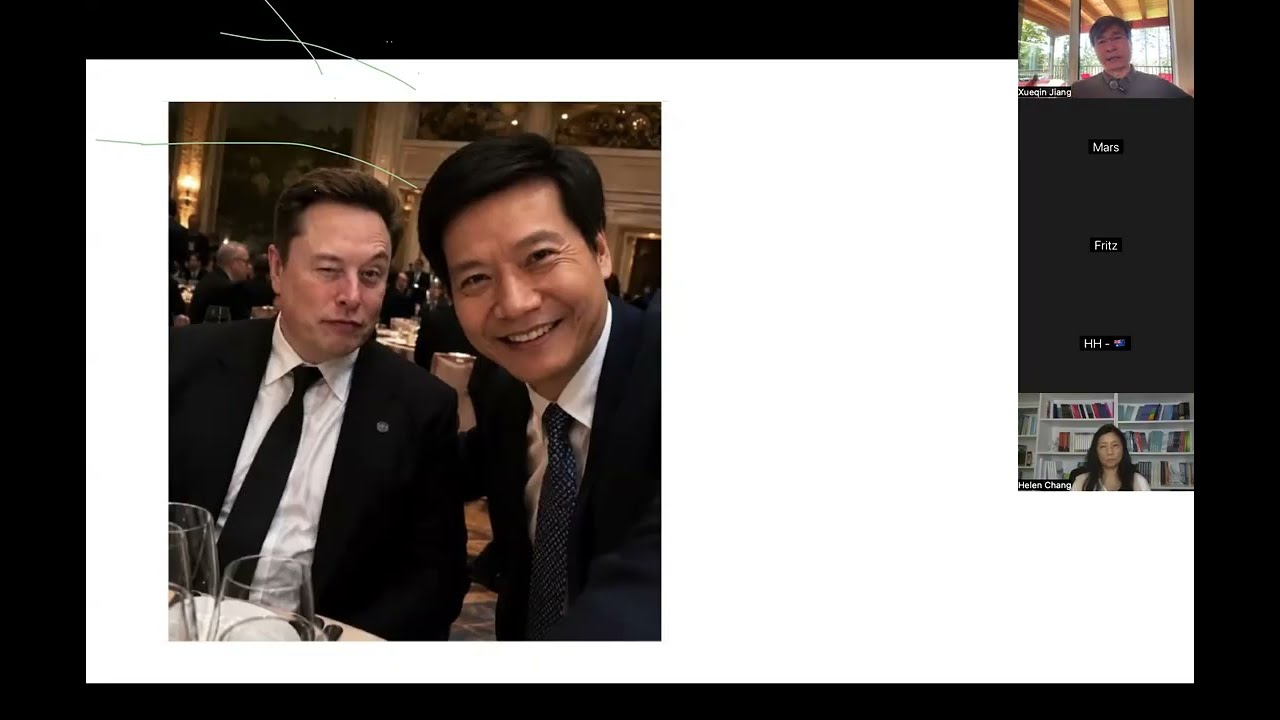
The attendee list at the White House banquet revealed clear American priorities, but the most glaring anomaly was the total absence of Chinese entrepreneurs. When Donald Trump visited China earlier in May, he brought prominent American business leaders, and Beijing reciprocated by inviting its own premier commercial figures. That trip produced iconic images, such as the widely circulated photograph of Xiaomi's Lei Jun alongside Elon Musk—a meeting between the world's wealthiest individual and the man who was, at least for a time, China's richest and most acclaimed entrepreneur. The decision not to bring any equivalent Chinese figures to the Washington dinner defied standard diplomatic practice.
```mermaid
flowchart TD
accTitle: Core Diplomatic Deadlock
accDescr: Diagram illustrating the clash between Donald Trump's transactional demands and China's inability to negotiate concessions due to collective rule.
subgraph US["Washington's Direct Demands"]
D1["Open Chinese Financial Sector"]
D2["Increase Chinese Inbound Students"]
D3["Direct Investment in U.S. Manufacturing"]
D4["Expanded Market Access for American Firms"]
end
subgraph PRC["Beijing's Internal Impasse"]
C1["Primacy of Politics over Economics"]
C2["Paralysis of Committee Governance"]
C3["Zero Authority to Make Concessions"]
end
US -->|"Transactional pressure"| PRC
PRC -->|"Inability to execute deals"| US
```
In Chinese governance, politics permanently overrides economics. Donald Trump operates strictly as a transactional businessman: he demanded China open its domestic financial sector, permit American firms to capture higher profits in the Chinese market, send more students to American universities, and commit massive direct investments to the United States. Beijing's refusal to accommodate these demands is not an effort to defend national sovereignty, but rather a reflection of the reality that no individual in Beijing currently possesses the singular authority to authorize controversial concessions. China is governed by committee rather than absolute one-man command.
[16:01](https://www.youtube.com/watch?v=q7GdLK1xwAo&t=961s) The Three Paradoxes of the U.S.–China Summit
The visit highlighted three major paradoxes that expose Beijing's internal paralysis:
1. **The Violation of Reciprocity and Equality:** Chinese diplomacy operates around reciprocity and equality as sovereign peers. By failing to bring Chinese corporate titans to match America's industrial leaders, Beijing broke protocol and sent a perplexing signal to both domestic and international observers.
2. **The Evaporation of the $1 Trillion Investment Deal:** Prominent rumors surfaced in May that China would unveil a massive $1 trillion investment pledge into U.S. electric vehicle manufacturing, leveraging its globally dominant and low-cost EV sector. While three months remain in the calendar year—leaving a slim possibility of an announcement at a forum like the G20—no commitment materialized at the summit. Historically, visiting Chinese leaders showcase national power through massive commercial packages, yet this trip offered symbolic gestures like two giant pandas.
3. **Setbacks Instead of Diplomatic Momentum:** Bilateral summits are carefully choreographed to project progress. This summit offered no meaningful policy breakthroughs and visibly regressed from the May meetings. The headline accomplishment touted by Donald Trump was an agreement between the United States and China to rebrand "artificial intelligence" as "super intelligence," alongside Xi Jinping's standard goodwill proposal to host 100,000 young Americans to study in China over five years—a talking point Elon Musk had previewed days earlier.
[20:09](https://www.youtube.com/watch?v=q7GdLK1xwAo&t=1209s) Three Realities of Contemporary China
Western coverage from outlets such as *The New York Times*, BBC, and CNN consistently misleads the public, creating inflated expectations for these bilateral meetings. Understanding China requires dispelling three major misconceptions:
* **The Chinese Economy Has Peaked:** The national economy reached its absolute zenith around 2014–2015 and has been locked in structural, secular decline ever since.
* **Xi Jinping Lacks Total Control:** Contrary to the foreign consensus that Xi commands totalitarian authority, he does not wield absolute power. Had an absolute authority been running the country, Beijing would not have spent the last two years sitting entirely passive while geopolitical crises flared globally. What analysts mistake for "strategic patience" is bureaucratic inertia driven by rule by committee.
* **Loss of Strategic Initiative:** Because leadership is fractured among committee factions, Beijing cannot execute proactive strategic plans. It operates strictly reactively, responding piecemeal to foreign crises such as American military moves or operations involving Iran.
[22:11](https://www.youtube.com/watch?v=q7GdLK1xwAo&t=1331s) The Domestic Purges of Huawei and the AI Sector
The exclusion of Chinese entrepreneurs from the summit stemmed directly from domestic crackdowns, leaving Beijing unsure of which business leaders were safe to display. While the regulatory wave began years earlier with Jack Ma's fall from grace, the pressure has expanded to Huawei—often regarded as China's premier military-linked enterprise, backed by hundreds of billions in direct state subsidies to manufacture an independent domestic semiconductor ecosystem.
Both Huawei founder Ren Zhengfei and his daughter, Meng Wanzhou, have abruptly vanished from public view for several weeks, leaving top internal company executives completely unable to establish contact. Despite having the corporate PR apparatus of a prominent enterprise capable of quashing speculation, the company has offered no explanation. Rumors are circulating that Ren either fled the country or was placed under formal investigation for semiconductor fraud.
Huawei's claims that it circumvented Western supply chains without ASML lithography equipment or Nvidia chips are alleged to be fraudulent. Rather than genuine domestic technological breakthroughs, Huawei reportedly relied on illicit, smuggled Nvidia hardware. In an environment where the authorities fear corporate deceit and potential defections, state planners chose not to showcase private tycoons at the White House. This scrutiny has also spread to the frontier tech sector, with Chinese investigators opening inquiries into DeepSeek and Moonshot AI's Kimi.
[26:12](https://www.youtube.com/watch?v=q7GdLK1xwAo&t=1572s) DeepSeek, AI Mirroring, and the Intelligence Security Trap
Addressing the widespread narrative surrounding Chinese artificial intelligence, Professor Jiang examines how DeepSeek initially became a source of enormous national pride. When OpenAI rolled out ChatGPT, DeepSeek appeared to achieve a breakthrough, producing an apparently superior, hyper-efficient large language model using only a fraction of the time, capital, and personnel expended by its American rival. Chinese state media and tech circles celebrated this as a triumph of domestic algorithm design capable of parsing web data far faster and leaner than Western models. However, Jiang argues that the reality behind the curtain was far less flattering: rather than pioneering new computational paradigms, DeepSeek reportedly created thousands or even millions of automated accounts to systematically mirror, scrape, and appropriate OpenAI’s proprietary database.
```mermaid
flowchart TD
accTitle: Chinese AI Data Flow and Security Compromise
accDescr: Diagram illustrating how mirrored US AI models funnel sensitive Chinese military queries back to American servers.
subgraph DataSourcing["IP Acquisition"]
A["OpenAI Database"] -->|"Mirrored via bulk accounts"| B["Chinese LLMs (DeepSeek)"]
end
subgraph DomesticUse["Domestic Deployment"]
B --> C["Chinese Military Personnel Queries"]
C -->|"Sensitive intel entered as prompts"| B
end
subgraph SecurityBreach["Intelligence Leakage"]
B -->|"Telemetry & backchannel feeds"| D["US AI Providers"]
D --> E["Pentagon & US Intelligence Databases"]
end
```
This shortcut has triggered severe unintended consequences for Beijing's defense establishment. Chinese military personnel began turning to these domestic models to analyze sensitive problems, feeding classified military intelligence, operational questions, and doctrine directly into the software. Because the underlying engines remained tied to Western infrastructure or retained telemetry backchannels, that sensitive intelligence flowed straight back into the hands of American AI companies. Consequently, American firms and intelligence agencies effectively acquired a self-updating archive of Chinese military personnel activities and strategic concerns, deeply compromising Chinese national security interests.
Jiang does not mince words, asserting that living in China reveals an environment where genuine innovation is often substituted by shortcuts and theft: "Chinese people do not innovate. They just cheat and they steal." He extends this dynamic to hardware, pointing to Huawei's reliance on smuggled Nvidia chips. While domestic technologists believed they were outsmarting Western export controls, Jiang suggests these smuggled units and reverse-engineered telecom boxes almost certainly carry National Security Agency backdoors. When engineers merely steal hardware and copy code without understanding the foundational architecture, they leave themselves completely vulnerable to trapdoors embedded by Western designers.
---
[29:13](https://www.youtube.com/watch?v=q7GdLK1xwAo&t=1753s) Audience Interventions: The BMW Clone Factory and Huawei's Semiconductor Struggle
The floor opens to audience members who offer firsthand accounts that complicate and enrich the discussion. A participant named Liquid Monk chimes in to corroborate the theft of intellectual property with a personal anecdote from a 2013 tour of the BMW headquarters in Munich, Germany. A tour guide explained that because the BMW X6 was selling exceptionally well in China, management built a domestic assembly plant there. Shortly thereafter, an anomalous spike in vehicle accidents occurred exclusively in China, with none reported in Germany. An internal investigation revealed that local plant workers, upon completing their eight-hour shifts, traveled 60 kilometers down the road to a clandestine clone facility that was a complete replica of the German plant, set up specifically to pirate the entire engineering concept. While BMW ultimately pulled back some operations to protect its designs, the proprietary know-how had already leaked, enabling Chinese domestic automakers to eventually produce vehicles that rival or exceed European models.
Another participant, Robert Lee, challenges Jiang’s sweeping assessment of Chinese engineering, drawing upon his decade-long career in the semiconductor industry since 2010. Lee explains that prior to 2018, nearly half of Huawei's high-level research workforce consisted of foreigners, including an elite semiconductor design team based in Israel. Huawei was not simply copying; it built an international technical apparatus that was abruptly dismantled after 2018 when the United States weaponized visa restrictions, making it impossible for foreign engineers to work for Huawei while retaining access to the United States. Lee emphasizes that Huawei has faced unique, suffocating geopolitical pressure:
> "The US government use all their power to against one company... all the chipset suit in China have the back door... in the world only Huawei can compete with Silicon Valley... Silicon Valley is gone."
Lee argues that Silicon Valley has lost its cost-effectiveness and raw engineering edge, noting that an Israeli engineering team operating on a mere fraction of a million-dollar Silicon Valley budget consistently delivers higher quality semiconductor projects on tighter deadlines.
---
[34:33](https://www.youtube.com/watch?v=q7GdLK1xwAo&t=2073s) Silicon Valley Stagnation and State Subordination of Chinese Tech
Jiang finds common ground with Lee regarding the decay of American tech hubs, conceding that Silicon Valley has devolved into a decadent, rent-seeking ecosystem. Top American tech firms increasingly focus on regulatory capture and lobbying in Washington, D.C., to outlaw competition—including blocking Chinese open-source AI models—rather than driving organic technological breakthroughs. Yet, Jiang draws a sharp distinction between how entrepreneurs function under the two systems. In the United States, figures like Elon Musk hold immense institutional power and can challenge political leaders. In China, regardless of personal net worth or technical capability, entrepreneurs remain completely subordinate servants to the Communist Party apparatus.
Because domestic technologists must continuously cater to party officials and fulfill unrealistic political quotas, they systematically cut corners. Rather than admitting technical limitations to the state, Chinese tech executives falsify capabilities, conceal algorithmic shortcuts, and recycle foreign IP to demonstrate superficial parity with the West, baking systemic vulnerability directly into China's technological foundation.
---
[35:54](https://www.youtube.com/watch?v=q7GdLK1xwAo&t=2154s) Exit Bans on Talent and the Panic Over 2008 Infrastructure Stimulus
Turning to domestic governance, Jiang highlights a major policy shift implemented on September 15th, when Beijing enacted sweeping revisions to its exit and entry administration laws. Under the pretext of safeguarding national security, the Chinese state granted itself arbitrary authority to prevent any entrepreneurial, technical, or scientific talent from departing the country. Jiang identifies this as an aggressive clampdown on capital flight and brain drain. For two decades, between 2000 and 2020, Chinese engineers in Silicon Valley followed a lucrative, well-trodden path: acquiring Western code, expertise, and occasional trade secrets, then returning to China to launch venture-backed clones of American companies with lavish state subsidies.
```mermaid
flowchart LR
accTitle: Evolution of Chinese Tech Talent Trajectory (2000-Present)
accDescr: Flowchart contrasting the 2000-2020 returnee boom with current exit bans and capital flight restrictions.
subgraph GoldenEra["2000–2020: Returnee Cycle"]
A["Silicon Valley Experience & IP"] --> B["Return to China with Subsidies"]
B --> C["Massive Wealth Creation"]
end
subgraph CurrentEra["Post-2020: Wealth Defense & Exit Bans"]
C --> D["Attempted Flight to Western Property Rights"]
D -->|"September 15 Law"| E["Arbitrary State Exit Bans"]
end
```
Having amassed fortunes, these entrepreneurs now recognize that China lacks enforceable private property rights, prompting them to attempt to spirit their families and wealth back to the West. The September 15 measures slam that door shut, effectively telling the country's wealthiest innovators that their fortunes and persons belong to the state.
Jiang links this systemic insecurity to the thesis of Logan Wright’s book *Broken China*. Addressing China’s economic history, Jiang dismisses the popular Western myth of Chinese leaders as master chess players who plan centuries ahead. When the 2008 subprime mortgage crisis struck Wall Street, the Chinese leadership succumbed to sheer panic over the imminent collapse of Western export markets. The legendary four-trillion-yuan infrastructure stimulus was not an act of visionary long-term statecraft, but a desperate, reactive maneuver to avert mass unemployment, setting off the debt-fueled imbalances that plague the nation today.
- **DeepSeek's Data Acquisition**: Accused of utilizing vast account networks to mirror OpenAI's core database rather than pioneering genuine algorithmic speedups.
- **Counter-Intelligence Hazard**: Chinese military personnel querying domestic LLMs inadvertently leaked classified defense queries back to US-based server networks.
- **September 15 Exit Bans**: Border authorities received broad authority to arbitrarily prevent domestic technical, scientific, and business elites from leaving China under national security statutes.
- **2008 Stimulus Reality**: Chinese state infrastructure spending was a frantic survival response to crashing Western export markets during the financial crisis, rather than calculated long-range planning.
[38:55](https://www.youtube.com/watch?v=q7GdLK1xwAo&t=2335s) The Reality of Chinese Debt and Corruption
Professor Jiang dismisses the popular Western perception that Beijing operates with a grand, visionary master plan for domestic innovation. The massive boom was not an act of strategic foresight, but an ad-hoc emergency reaction to the 2008 subprime mortgage crisis in the United States. While this tidal wave of liquidity enriched China's entrepreneurial elite, it fueled staggering levels of leverage and systemic graft that the current leadership is now desperately trying to unwind.
Jiang stresses that while Americans frequently panic about their own national debt, China's underlying debt predicament is far more precarious. Western observers often misread the Chinese leadership as hyper-competent, calculating players playing multi-dimensional chess:
> "People are now slowly waking up to the fact that the Chinese are not these brilliant Machiavellian strategists. They're just corrupt as hell. It’s that simple, guys. There’s no magic here. They’re just corrupt."
For those skeptical of this assessment, Jiang points to Logan Wright's work on China's financial fault lines, noting that the reality of this hollowed-out system has been obvious to seasoned observers for years.
---
[40:07](https://www.youtube.com/watch?v=q7GdLK1xwAo&t=2407s) The Purged Central Military Commission and Beijing's Political Stalemate
Turning to internal elite politics, Jiang highlights the unprecedented state of the Central Military Commission (CMC), China's highest and most powerful military authority. Normally composed of seven top officials, the commission has been hollowed out by relentless internal purges:
```mermaid
flowchart TD
accTitle: Depletion of the Central Military Commission
accDescr: Diagram showing the reduction of the 7-member CMC down to only 2 active members due to continuous purges.
subgraph Standard ["Nominal Composition"]
M1["Member 1"]
M2["Member 2"]
M3["Member 3"]
M4["Member 4"]
M5["Member 5"]
M6["Member 6"]
M7["Member 7"]
end
subgraph Purged ["After 3 Years of Purges"]
R1["Active Member 1"]
R2["Active Member 2"]
X["5 Seats Left Vacant / Purged"]
end
Standard -->|"Systemic Purges & Factional Infighting"| Purged
```
While some external commentators frame these dismissals as evidence of Xi Jinping consolidating absolute authority, Jiang argues it signals the exact opposite. If you are an effective dictator, leaving the nation's supreme military body staffed by only two men is humiliating:
- Either you exercised terrible judgment by personally appointing officials you could not trust;
- Or you elevated deeply corrupt officers to command the armed forces;
- Or, most plausibly, intense factional warfare has paralyzed the regime to the point where vacancies cannot even be replaced.
Rather than demonstrating supreme control, the blatant failure to fill these empty seats reveals a tense political stalemate where rival factions attack one another while no single authority is genuinely in charge.
---
[42:06](https://www.youtube.com/watch?v=q7GdLK1xwAo&t=2526s) Mao's Messianic Rule and the Three Phases of the Cultural Revolution
To trace how Beijing arrived at this impasse, Jiang reviews the political evolution of the People's Republic of China since 1949. When the CCP's guerrilla army took national power, Mao Zedong governed not as a orthodox Marxist technocrat, but as a messianic figure convinced he was destined to restore China to global supremacy. This impulse produced the catastrophic Great Leap Forward, which sought to transform an agrarian country into an industrial power within five years by pulling peasants off farms into factories. Because China operated in dogmatic autarky and refused to trade or admit ideological failure, the policy sparked a massive famine that starved millions.
When the Party establishment attempted to sidelin Mao in favor of competent technocrats, Mao struck back by launching the Cultural Revolution (1966–1976), which Jiang divides into three distinct phases:
1. **The Mass Mobilization Phase (1966–1968):** Mao unleashed the youthful Red Guards to purge and overthrow the entrenched bureaucratic elite.
2. **The Military Phase (1968–1971):** Once the student radicals spiraled out of control, Mao turned to the military to crush them, appointing defense minister Lin Biao as his official successor—until a falling out prompted Lin's fatal plane crash while fleeing toward the Soviet Union.
3. **The Theocratic Phase (1971–1976):** Following Lin Biao's demise, China operated effectively as a personal theocracy around Mao until his death in 1976.
---
[46:05](https://www.youtube.com/watch?v=q7GdLK1xwAo&t=2765s) Deng Xiaoping's Counter-Revolution and the Four Broken Rules
Following Mao's death, the veteran Communist Party elite rebelled against his handpicked successor. Led by Deng Xiaoping, the Old Guard reclaimed power. From their perspective, the greatest threat to China's survival was never capitalism or the Sino-Soviet split; it was Mao's messianic personality cult and the theocratic fervor of the Cultural Revolution.
To prevent another personal dictatorship and pull China out of isolation, Deng pivoted to the West—famously donning a ten-gallon hat on a tour of Texas to charm the American public and lay the groundwork for modern trade and globalization. Domestically, Deng and the Party elders established four strict institutional guardrails:
* **Rule 1: The Red Nobility is untouchable.** The revolutionary vanguard and their princeling descendants were immune from lethal purges. Factions could divide up economic rents and state assets, but they could never destroy one another's families the way Mao had.
* **Rule 2: Collective leadership.** Power was never again to be concentrated in a single messianic supreme leader; decisions had to be forged through committee consensus and technocratic management.
* **Rule 3: Economics above ideology.** The regime's central legitimacy rested on material growth and pragmatic economic development rather than radical ideological mobilization.
* **Rule 4: Depoliticize the military.** The People's Liberation Army was kept strictly out of factional civilian politics, placated instead with a guaranteed share of the economic spoils.
Jiang argues that the present crisis stems directly from the fact that Xi Jinping has dismantled every single one of these four foundational rules, destabilizing the Deng-era consensus and turning contemporary elite politics into a chaotic "dumpster fire."
[50:47](https://www.youtube.com/watch?v=q7GdLK1xwAo&t=3047s) Post-Tiananmen Consensus and Massive Infrastructure Spending
Following the Tiananmen Square protests and subsequent crackdown, which severely damaged China's international standing, the leadership under Jiang Zemin and Zhu Rongji set out to institutionalize Deng Xiaoping's governing consensus. This process was later cemented under the Hu Jintao and Wen Jiabao administration. A visible byproduct of this era was colossal spending on infrastructure. While outside observers often praise this as proof of Beijing's strategic farsightedness, the underlying reality was quite different: China did not inherently have surplus money to pour into concrete and high-speed rail, but acted out of crisis management following the 2008 Great Financial Crisis in the United States.
Prior to 2008, China's primary economic engine was its export sector. When Western markets cratered, Chinese leadership recognized that foreign trading partners could go broke and renege on trade commitments, forcing a pivot toward domestic infrastructure investment. However, this domestic stimulus was fundamentally designed to buy domestic political peace rather than construct a modern nation for its own sake. The Hu-Wen strategy relied on appeasing as many regional and factional interest groups as possible through state-sanctioned enrichment—allowing local elites, domestic bankers, property developers, and regional bureaucrats to effectively plunder the state together. For over a decade, this system preserved peace and stability by keeping everyone financially satisfied, right up until Xi Jinping took office.
[53:05](https://www.youtube.com/watch?v=q7GdLK1xwAo&t=3185s) The Compromise Candidate vs. Bo Xilai
Xi Jinping did not rise through the meritocratic technocracy that produced leaders like Jiang Zemin, Zhu Rongji, or Hu Jintao. Instead, he emerged directly from the "red nobility" as a princeling. His father, Xi Zhongxun, was counted among the Eight Immortals of the Chinese Communist Party, whose families carved up China's economic spoils under Deng Xiaoping—securing control over lucrative regions such as Shenzhen. When party elders evaluated candidates in 2012–2013, they viewed Xi as an unassuming compromise pick who would not rock the boat or upset the delicate equilibrium between the technocrats and the red nobility.
```mermaid
flowchart TD
accTitle: Succession Choice in 2012
accDescr: Comparison between Bo Xilai and Xi Jinping leading to the compromise selection of Xi.
subgraph Contenders["2012 Leadership Contenders"]
BX["Bo Xilai<br/>• Charismatic, proven leader<br/>• Booming track record in Dalian<br/>• Neo-Maoist rhetoric in Chongqing<br/>• Feared as a potential second Mao"]
XJ["Xi Jinping<br/>• Red nobility pedigree<br/>• No major accomplishments<br/>• Deemed harmless & predictable<br/>• Consensus compromise choice"]
end
subgraph Outcome["Elder Selection"]
BX -->|"Too ambitious / risky"| Rejected["Sidelined"]
XJ -->|"Least likely to rock boat"| Chosen["Appointed General Secretary"]
end
```
The alternative was Bo Xilai, a magnetic, highly ambitious figure with a proven administrative track record. As mayor of Dalian, Bo transformed the coastal hub into one of China's fastest-growing cities; later, in Chongqing, he pursued high-profile campaigns against organized crime while reviving Cultural Revolution-style red songs and capturing vast central state subsidies. While the public admired Bo's decisive persona, the party elite was terrified that his populist ambition would transform him into another Mao Zedong. Faced with a choice between a dynamic leader who might overturn the system and an unremarkable figure with no significant achievements, the elders opted for Xi Jinping, never anticipating how he would dismantle Deng's institutional guardrails.
[55:52](https://www.youtube.com/watch?v=q7GdLK1xwAo&t=3352s) Audience Interjection: Tiananmen Square and Student Grievances
A Zoom participant interrupts to ask whether the 1989 Tiananmen Square demonstration was a genuine pro-democracy movement or a Western-engineered CIA color revolution.
Professor Jiang clarifies that Tiananmen was neither a Western plot nor a textbook democratic push, but rather a direct reaction by the intellectual class to being economically sidelined. While Deng's market reforms showered riches onto the military establishment and the red nobility, university-educated youths remained tethered to the socialist state apparatus. Under the old central planning rules, university graduates were routinely dispatched to remote provincial postings to serve as low-ranking bureaucrats instead of securing lucrative, prestigious positions in Beijing or Shanghai. The movement was essentially driven by an educated elite demanding greater personal mobility, privileges, and political standing—demands that the state largely satisfied in the decades following the crackdown.
[57:49](https://www.youtube.com/watch?v=q7GdLK1xwAo&t=3469s) The Three Catalysts of Xi's Power Consolidation
Xi consolidated unchecked authority through a sequence of unexpected crises that forced the party apparatus to rally around him:
```mermaid
flowchart LR
accTitle: Catalysts of Xi Jinping's Power Consolidation
accDescr: Three external and internal crises that enabled Xi Jinping to dismantle institutional constraints.
C1["1. Bo Xilai Coup Attempt<br/>Party rallies behind Xi;<br/>Bo placed under house arrest"] --> C2["2. Trump Trade War<br/>Weakened merchant middle class;<br/>Bolstered central state apparatus"]
C2 --> C3["3. COVID-19 Controls<br/>Four-year biosecurity theater;<br/>Authoritarian administrative grip"]
C3 --> Centralized["Absolute Consolidation of Power"]
```
The first catalyst was Bo Xilai's attempted political coup after Xi was anointed. Because influential dynastic families retained regional power bases capable of mobilizing enormous resources, the party elite faced an existential factional threat and felt compelled to unify behind Xi to neutralize Bo. Because party norms protected the red nobility from execution, Bo was placed under house arrest rather than put to death.
The second catalyst arrived with Donald Trump's trade war. Prior to this confrontation, significant economic clout resided with the private entrepreneurial middle class. The trade dispute squeezed private exporters and gave Beijing the justification to place the broader economy under tighter central political supervision.
The third and most decisive catalyst was COVID-19. Drawing on personal memories of the 2003 SARS outbreak—where infections burned out within weeks through voluntary community self-isolation without sweeping state dictates—Professor Jiang notes that viruses naturally lose virulence over time. While acknowledging that the original Wuhan strain presented a severe, furnace-like biosecurity threat, he characterizes China's four-year zero-COVID lockdowns and widespread oral swab tests as authoritarian political theater. These stringent controls permitted Xi to construct a vast tracking bureaucracy, lock down entire populations, and banish positive cases to quarantine facilities for weeks, resulting in personal control that exceeded the excesses of the Cultural Revolution.
[01:01:33](https://www.youtube.com/watch?v=q7GdLK1xwAo&t=3693s) Deflating the Real Estate Bubble
Despite criticizing the extreme political centralization under zero-COVID, Professor Jiang supports Xi Jinping's decisive intervention in the domestic property sector. The Hu Jintao and Wen Jiabao years saddled the Chinese economy with reckless borrowing and widespread municipal corruption, creating a systemic debt crisis that threatened to collapse the financial system if left unaddressed. Rather than deploying state funds to prop up overleveraged developers, Xi chose to deliberately deflate the property bubble by refusing to bail out defaulting firms, actively breaking the cycle of institutional graft he inherited.
[01:02:15](https://www.youtube.com/watch?v=q7GdLK1xwAo&t=3735s) The Evergrande Collapse and the Shattering of Deng's Consensus
The collapse of China’s real estate sector marks a critical turning point in Xi Jinping’s consolidation of power. Evergrande served as the textbook example of this dynamic: operating essentially as a massive Ponzi scheme, company leadership believed they were fundamentally "too big to fail" and operated under the assumption that local governments would perpetually step in to bail them out and secure funding. Xi Jinping put a decisive halt to these guarantees, triggering a cascading chain reaction that brought down China's broader property market. While the unwinding of this completely unsustainable bubble can be viewed as an economically positive correction, it also served a secondary political function by clearing the board and allowing Xi to tighten his grip over the state apparatus.
```mermaid
flowchart TD
accTitle: Erosion of Deng Xiaoping's Elite Consensus
accDescr: Flowchart illustrating how Xi Jinping dismantled post-Mao norms and triggered elite factional struggles.
subgraph DengNorms["Deng Xiaoping Consensus (1980s)"]
direction TB
N1["Two-term presidential limit"]
N2["No violent purges among elites"]
N3["Military separated from factional politics"]
N4["Collective leadership & consensus"]
end
subgraph XiConsolidation["Xi's Centralization & Breaches"]
direction TB
C1["Pricking real estate bubble (Evergrande)"]
C2["Dismantling rival factions (Ling Jihua, Wen family)"]
C3["Third term & public purge of Hu Jintao (2022)"]
end
subgraph Backlash["Elite Backlash & Military Chaos"]
direction TB
B1["Targeting Xi loyalists (Qin Gang, Li Shangfu)"]
B2["Central Military Commission gutted (7 down to 2)"]
B3["Clash with General Zhang Youxia"]
end
Xi capitalized on structural crises that he did not entirely originate, using them to dismantle the tacit rules governing elite Chinese politics since the 1980s. Following the trauma of the Cultural Revolution, Deng Xiaoping and the surviving bureaucratic leadership formed a core pact: they agreed never again to slaughter one another over political differences, pledging instead to adhere to institutional conventions and "play nice." Xi Jinping fundamentally tore up this gentleman's agreement, resurrecting high-stakes political warfare against rival factions within the Chinese Communist Party (CCP).
[01:03:19](https://www.youtube.com/watch?v=q7GdLK1xwAo&t=3799s) Factional Takedowns: The Ling Jihua Scandal and the Wen Jiabao Leaks
The systematic dismantling of former President Hu Jintao's power base began early in Xi's administration with the downfall of Ling Jihua. In the Chinese bureaucratic apparatus, a top leader's personal secretary acts as an indispensable gatekeeper and power broker. Ling Jihua was effectively Hu Jintao’s bagman; gaining an audience with the president or facilitating bribes required going directly through him. Ling's political career disintegrated following a bizarre, morbid incident in Beijing: his son was killed in a high-speed Ferrari crash, surrounded by rumors that the young man was found naked alongside two intoxicated women. The resulting investigation inevitably uncovered vast corruption, leading to Ling Jihua's imprisonment and gutting Hu Jintao's network. While official state reports classified the crash as an accident, pervasive rumors suggest it may have been an engineered operation by internal secret police to frame and destroy Ling, who himself reportedly insisted his son was assassinated to orchestrate his downfall.
Around the same period in 2012, another devastating blow struck the top leadership when *The New York Times* reporter David Barboza published an explosive exposé detailing the vast, hidden billions amassed by Premier Wen Jiabao’s family. The investigation supposedly relied on combing through thousands of corporate and regulatory filings, a task that would realistically require an army of ten thousand researchers working over years. The reality was that someone within the Chinese system was feeding the American journalist the exact corporate paper trail. Handing a foreign reporter the proverbial "needle in the haystack" effectively pulverized Wen Jiabao’s faction, facilitating Xi's accumulation of authority. Leaking high-level internal dirt to foreign media violated the post-Mao consensus that top leaders would never weaponize political struggle against each other's families. Similar bizarre intelligence leaks—such as reports delivered to US intelligence that Chinese military missiles were filled with water rather than rocket propellant—highlighted how deeply the internal machinery had begun to fracture.
- Ling Jihua's fall eliminated the primary administrative gatekeeper of the Hu Jintao faction.
- David Barboza's 2012 *New York Times* investigation into Wen Jiabao’s family fortune dealt a severe blow to the State Council faction.
- The calculated deployment of leaks to foreign press violated Deng Xiaoping's core taboo against open inter-factional warfare.
[01:07:13](https://www.youtube.com/watch?v=q7GdLK1xwAo&t=4033s) The 20th Party Congress and the Public Ejection of Hu Jintao
Xi Jinping’s power reached its symbolic zenith at the 20th National Congress of the CCP in October 2022. By engineering a third term as general secretary and president, Xi explicitly trashed the two-term constitutional limit established during the Deng Xiaoping era to prevent the resurrection of lifelong dictatorship. The absolute consolidation of one-man rule was punctuated by an extraordinary spectacle broadcast around the globe: the forced physical removal of former President Hu Jintao from the stage of the Great Hall of the People.
Given the obsessive discipline of Chinese state media, the incident cannot be dismissed as a spontaneous medical issue or an elderly leader getting disoriented. Chinese political choreography is planned down to the millimeter: thousands of public relations officials and media handlers spend days orchestrating lighting, camera framing, posture, and clothing for provincial and national figures alike. The televised, humiliated extraction of Hu Jintao in front of the international press was an unmistakable, calculated display designed to show that Deng's collective consensus was dead and that Xi Jinping reigned supreme.
[01:09:15](https://www.youtube.com/watch?v=q7GdLK1xwAo&t=4155s) Elite Retaliation: Striking Down Xi’s Inner Circle
Xi's bid for total autocratic control ran headlong into the reality that China is simply too vast and complex for any single ruler to micro-manage. Unlike Mao Zedong, who possessed genuine messianic legitimacy forged through revolutionary conquest—commanding authority as though backed by the "will of God"—Xi merely inherited the bureaucratic throne. Viewing Xi's autocratic posturing as an existential threat, rival factions organized to push back using the cardinal rule of Chinese governance: "personnel is politics, politics is personnel." Lacking the leverage to directly oust Xi, opposing factions moved aggressively against the loyalists he had elevated.
The counter-offensive began with Foreign Minister Qin Gang, a rapid-rising Xi protégé who abruptly vanished from public view. The pretext was an explosive personal scandal involving an extramarital affair with a prominent television host who gave birth to their child on American soil, making the infant a United States citizen. Given the intense surveillance surrounding senior cadres, intelligence regarding Qin’s overseas family was almost certainly fed to rival factions through American backchannels; US and Chinese intelligence operators often find common ground in exchanging material relevant to Beijing’s internal power struggles. Shortly after Qin’s removal, Defense Minister Li Shangfu was unceremoniously ousted over defense procurement corruption, followed by the purge of two senior generals.
- Deng Xiaoping's four institutional guardrails were systematically erased:
1. Preventing the over-concentration of absolute personal power.
2. Insulating the military from domestic factional power struggles.
3. Ensuring collective leadership by consensus.
4. Prioritizing economic modernization above ideological purges.
[01:12:12](https://www.youtube.com/watch?v=q7GdLK1xwAo&t=4332s) The Military Purges and the Standoff with General Zhang Youxia
The weaponization of anti-corruption campaigns has dragged the People's Liberation Army (PLA) squarely into the center of factional conflict, undermining its professional cohesion and turning it into a primary engine of domestic instability. The Central Military Commission (CMC), the paramount defense body, was gutted: out of its seven established members, only two remained actively standing, with the rest purged or sidelined.
The most consequential figure caught in this maelstrom is General Zhang Youxia. Zhang was widely regarded as the military counterpart to Xi Jinping: while Xi controlled political party organs, Zhang held authority over "the gun." Although the CCP operates on the ideological principle that the Party commands the gun, in realpolitik the military and political hierarchies have long functioned as co-equal pillars. As the son of an esteemed founding revolutionary general, Zhang possessed elite "princeling" pedigree and institutional military credibility that rivaled Xi’s own. Speculation grew that Zhang was quietly coordinating purges against Xi's personal military appointees to check the president's reach. Recognizing that open conflict would destabilize the state, the factions initially tolerated a precarious power balance. Ultimately, Xi chose to "cross the Rubicon" by moving directly against his rival, ordering the arrest of General Zhang Youxia and escalating the elite power struggle to the brink.
[01:13:36](https://www.youtube.com/watch?v=q7GdLK1xwAo&t=4416s) Chinese Elite Infighting and Xi Jinping's Travel Patterns
Professor Jiang characterizes the internal political situation in China as an outright "dumpster fire" where fierce factional infighting has eroded central control. He cites rumors of high-level purges—noting that Zhang Youxia was arrested in January and subsequently expelled from the Chinese Communist Party for factionalism. Because various factions are actively trying to destroy each other, Jiang argues that Xi Jinping currently holds very little real power.
Jiang examines Xi's foreign travel records to illustrate this domestic vulnerability. In 2023, Xi traveled very little. When looking at his travel schedule in 2025—which included visits to Vietnam, Malaysia, Cambodia, Russia, Kazakhstan, and South Korea—a distinct pattern emerges: all these destinations are in close geographic proximity to China. Because of intense internal political struggles, Xi could not afford to travel far, needing to stay nearby to ensure rival factions did not conspire against him.
```mermaid
flowchart TD
accTitle: Internal Chinese Power Dynamics and Foreign Travel Hypotheses
accDescr: Chart illustrating the domestic factional struggles in Beijing leading to two competing explanations for Xi's sudden foreign travel in 2026.
subgraph FactionalCrisis ["Internal Power Struggle"]
A["Elite Factionalism"] --> B["Arrests & Purges<br/>(e.g., Zhang Youxia)"]
B --> C["Domestic Instability"]
end
subgraph TravelDilemma ["2026 Travel Patterns"]
C --> D{"Unusual Late-2026<br/>Foreign Visits"}
D -->|"Hypothesis A"| E["Full Power Consolidation<br/>(Invincible leader)"]
D -->|"Hypothesis B"| F["Lame-Duck Figurehead<br/>(Stripped of authority, outbound)"]
end
```
The year 2026 presented an even starker contrast: Xi did not travel abroad for the entire first half of the year, but suddenly undertook numerous international trips in August and September. Because Chinese high politics remains an opaque "political black box," Jiang lays out two competing hypotheses:
1. Xi has completely consolidated power, feels entirely invincible, and can travel abroad without fearing domestic coups.
2. Xi has been stripped of all substantive power because his loyalist network has been purged. In this scenario, he acts purely as a lame-duck figurehead tasked with routine ceremonial foreign representation before being replaced the following year.
- **Arrests and Expulsions**: Zhang Youxia was reportedly arrested in January and recently expelled by the party on factionalism charges.
- **2023–2025 Regional Limitation**: Trips were constrained to bordering or neighboring nations (Vietnam, Malaysia, Cambodia, Russia, Kazakhstan, South Korea) so Xi could return rapidly if political crises erupted.
- **2026 Travel Surge**: A completely dormant first half of 2026 was followed by a sudden burst of travel in August and September.
---
[01:15:45](https://www.youtube.com/watch?v=q7GdLK1xwAo&t=4545s) Physical Frailty and the Airport Arrival Footage
To back his second hypothesis—that Xi has lost effective dominance—Professor Jiang reviews video footage of Xi's public appearances. A supreme dictator, Jiang contends, typically exudes swagger and confidence; by contrast, Xi appears exhausted and frail. Reviewing archival clips from Xi's November 2023 visit to San Francisco, Jiang points out that Xi already looked remarkably tired compared to world leaders like Vladimir Putin, Narendra Modi, or Donald Trump.
Jiang then shares screen footage of Xi arriving in the United States two days prior. The clip highlights Xi gripping his wife Peng Liyuan's hand tightly as he descends the stairs of the airplane, taking slow, cautious, unsteady steps. Jiang remarks bluntly: "He does not look healthy." Concluding his formal presentation slides, he opens the Zoom floor to student questions while emphasizing that attendees keep their questions focused strictly on US-China dynamics.
---
[01:18:58](https://www.youtube.com/watch?v=q7GdLK1xwAo&t=4738s) Fertilizer Vulnerabilities and Trump's Pressure Strategy
Baron opens the Q&A by corroborating Jiang's observation of Xi's physical condition, noting that Xi looked visibly nervous and agitated on the tarmac, repeatedly glancing left and right, while the Chinese delegation displayed jarringly mixed reactions ranging from excitement to complete indifference. Baron then shifts the discussion to agricultural commodities, specifically Canadian potash (potassium) fertilizer. With global potash production concentrated in Canada, Belarus, and Russia, and with few viable industrial substitutes available at short notice, Baron asks what would happen if tensions between the US and Canada disrupted the supply chain, referencing Canadian rhetoric about resisting US pressure.
Jiang dismisses talk of a physical US ground invasion of Canada, characterizing remarks by Canadian figures like Mark Carney as pure optical posturing:
> "There will be no US invasion of Canada. It's not going to happen. I know that Mark Carney has been talking about it. I know that Mark Carney is like, 'Well, you know, we'll just do a guerrilla warfare and we're ready for the US.' It's just politics."
Jiang compares the situation to Donald Trump's past posturing over Greenland, where high-stakes threats eventually concluded in agreements granting US strategic access once the other party conceded to American military and economic leverage. Trump's true objective regarding Canada is leveraging control over Canadian natural resources—especially fertilizer—to force sweeping concessions out of China.
| Commodity / Domain | Key Sources / Trade Flow | Strategic Leverage & Dynamics |
|:--- |:--- |:--- |
| **Potash Fertilizer** | Canada, Belarus, Russia | Non-substitutable in the short term; Trump seeks dominion over Canadian output to squeeze Chinese agricultural security. |
| **Soybeans & Feed Corn** | Brazil, United States | China heavily imports Brazilian beans; Trump aims to force South America into a unified Western Hemisphere trade bloc, compelling China to deal through Washington. |
| **Global Supply Chains** | Worldwide interdependent trade | An outright breakdown remains unmodeled because the systemic shock of global trade halting is catastrophic. |
Jiang warns that focusing solely on fertilizer misses the larger peril: the fragility of global supply networks as a whole. No think tank or military war game has realistically simulated a total collapse of global supply chains because the systemic consequences of global trade shutting down are too horrifying to contemplate. Baron adds that China faces an identical predicament with Brazilian soybeans and feed corn; Jiang confirms that Trump intends to exert intense pressure on Brazil to fold it into a Western Hemisphere trade pact, forcing China to negotiate with resource providers through Washington rather than via bilateral deals.
---
[01:24:17](https://www.youtube.com/watch?v=q7GdLK1xwAo&t=5057s) Reluctant Superpowers and Corporate Tech Interests
JD raises a macro-level question regarding whether the US-China bilateral dialogue is merely a futile attempt to prop up a failing globalized economy within an emerging multipolar order. Professor Jiang agrees, observing that both China and the United States are the primary historical beneficiaries of globalization. Because neither can afford a systemic collapse, both operate as reluctant status quo powers forced to cooperate against their will to preserve the international trading framework during wartime.
JD then asks about the role of tech oligarchs, specifically asking about figures like Elon Musk and what incentives drive their engagement with China. Jiang responds that their behavior is dictated entirely by financial self-interest: they are maneuvering to preserve direct access to the massive Chinese consumer market and to extract favorable commercial subsidies from Beijing.
[01:25:55](https://www.youtube.com/watch?v=q7GdLK1xwAo&t=5155s) AI Governance, Technocrats, and Purposeful History vs. Randomness
Responding to a thread on technological coordination, Professor Jiang characterizes the joint United States–China initiatives around artificial intelligence governance boards—framed publicly as measures to prevent AI from destroying humanity—as something far more cynical. In his view, these initiatives represent an effort by technocrats and oligarchs to shield their enterprises using state power: nationalizing risk while privatizing profit. Under the guise of regulatory oversight, the tech elite position the state to "privatize the gains and socialize the losses," reflecting an era where institutional actors are primarily concerned with securing resources for themselves.
```mermaid
flowchart TD
accTitle: The US-China Trade and Treasury Recycling Mechanism
accDescr: Flowchart illustrating the export loop between China and the US, asset freezing risks, and the proposed stablecoin backdoor.
subgraph TradeLoop["The Traditional Mercantilist Cycle"]
CN_Goods["Chinese Manufactured Goods"] -->|"Exported to"| US_Market["US Consumer Market"]
US_Market -->|"Payment in USD"| CN_Elite["Chinese Elite & Exporters"]
CN_Elite -->|"Recycled into"| US_Debt["US Treasuries (Sovereign Collateral)"]
end
subgraph Shift["Geopolitical Fracture"]
US_Debt -.->|"Russian Foreign Reserves Frozen ($300B)"| DeRisk["De-risking: Selling Treasuries for Gold"]
end
subgraph Workaround["Proposed Alternative Channel"]
DeRisk -.-> Stablecoins["USD Stablecoins (Treasury-Backed)"]
Stablecoins -->|"Backdoor Retail Capital Flight"| US_Debt
end
```
A participant questions Professor Jiang's broader analytical framework, noting a strong reluctance in his commentary to attribute major historical milestones to pure randomness or coincidence. Jiang pushes back against the idea that he ignores contingency, citing two major accidents:
- The COVID-19 outbreak: Jiang considers the laboratory leak an unintended accident rather than a deliberate, masterminded plot, noting that Beijing simply lacked the administrative and technical capacity to coordinate such an operation intentionally.
- The political downfall of Bo Xilai: His attempt to stage a coup was an unpredictable, rogue event, from which Xi Jinping emerged as the primary opportunistic beneficiary.
However, Jiang distinguishes between isolated accidents and calculated political maneuvers that form deliberate patterns, pointing directly to the fatal Ferrari crash involving Ling Jihua's son as an example of an event that was almost certainly not accidental.
---
[01:27:53](https://www.youtube.com/watch?v=q7GdLK1xwAo&t=5273s) Provincial Factions and Political Deterioration in Beijing
Turning to internal regime dynamics, attendee Erin asks who constitutes the principal opposition to Xi Jinping, who his primary rival is, and what the outlook is for the supreme leadership at the 2027 Party Congress. Jiang declines to frame the Chinese political apparatus through simplistic personality rivalries, explaining instead that power is divided among regional and provincial cliques.
China's vast provincial administrations are run by entrenched political factions that evaluate whether alignment with Beijing serves their survival. Under normal conditions, provincial bosses comply with directives from the capital because central stability preserves the peace, and civil war carries prohibitive costs. However, Jiang argues this imperial compact is fraying. If economic and administrative conditions continue to deteriorate over the next decade, provincial governors and regional power centers will inevitably pull away, reverting to historical patterns of warlordism when political compromises in the imperial center collapse completely.
As stark evidence of this institutional breakdown, Jiang points to the Central Military Commission (CMC): out of its standard seven seats, only two active members remain functional, signaling deep structural paralysis and purge-driven decay at the highest levels of the military command.
---
[01:29:39](https://www.youtube.com/watch?v=q7GdLK1xwAo&t=5379s) US Treasuries, the "Plantation Economy," and the Breakdown of the Reserve System
Addressing a question from attendee Mele regarding China's drawdown of US Treasury holdings from approximately $1.2 trillion down to $600 billion—and whether a grand bargain exchanging debt purchases for concessions on Taiwan could materialize—Jiang deconstructs the economic relationship underwriting the bilateral debt.
China's massive Treasury holdings are the mathematical byproduct of a chronic trade surplus: China ships physical goods to the United States, earns US dollars, and reinvests those balances into sovereign paper. Jiang describes US Treasuries as an institutional "bribe" paid by Beijing to Washington to keep American markets open to Chinese exports. For the Chinese Communist Party elite, this arrangement forms the core of an extractive "plantation economy" or "slave economy":
- Domestic laborers are treated as extractable units of energy who produce physical wealth in exchange for foreign exchange reserves that the ruling elite can spend abroad.
- The arrangement maintains domestic social order by keeping hundreds of millions of citizens employed in factories, which, while exploitative, remains preferable to the agrarian destitution of the country's feudal past.
- Holding US sovereign debt has historically provided Beijing with high-grade liquid collateral to finance global commodity procurements, such as Brazilian soybean imports.
Jiang explains that this reciprocal arrangement—which hollowed out the American industrial working class while extracting surplus value from Chinese factory workers—is disintegrating because Washington demonstrated its willingness to weaponize the global financial plumbing. The freezing of roughly $300 billion in Russian sovereign assets following the invasion of Ukraine (including approximately $200 billion impounded across European financial institutions) alarmed Beijing. In response, Chinese state institutions and commercial entities began systematically offloading US debt to purchase gold and hedge against asset seizures.
---
[01:33:28](https://www.youtube.com/watch?v=q7GdLK1xwAo&t=5608s) The Treasury Buyer Triad and the Stablecoin Backdoor
Jiang outlines the fragile buyer base currently financing Washington's $40 trillion national debt burden. With benchmark interest rates hovering between 5% and 6%, the US government faces an annual debt-servicing expense approaching $2 trillion. The market relies on three primary sovereign buyers:
| Rank | Sovereign / Institutional Buyer | Mechanism & Strategic Dynamic |
|:--- |:--- |:--- |
| **1** | **Japan** | Compliant US ally; compelled to purchase Treasuries and buy American weaponry to counter China. |
| **2** | **Gulf Cooperation Council (GCC)** | Disguised in official data under the United Kingdom; GCC petrodollars are routed through the City of London as an intermediary. |
| **3** | **China** | Sovereign actor systematically diversifying out of direct holdings to insulate against Western sanctions. |
Jiang rejects the surface-level narrative that Britain is the second-largest creditor to the US, noting that the United Kingdom lacks the domestic capital reserves to finance US deficits: "the UK has no money," and its elevated position on Treasury balance sheets merely reflects the City of London acting as a broker for Middle Eastern petrodollars.
Because Japan and the Gulf monarchies can be pressured diplomatically and militarily, Washington's core problem lies with Beijing, which cannot be coerced into balance-sheet expansion. To circumvent this sovereign resistance, American financial strategists are eyeing digital stablecoins pegged to the US dollar and collateralized by short-term Treasuries. If Beijing were to permit stablecoins within its commercial perimeter, Chinese retail investors and private firms could bypass capital controls and acquire dollar-denominated assets, creating a backdoor channel of liquidity for US sovereign debt.
However, Jiang concludes that this mechanism remains deadlocked due to a total leadership vacuum in Beijing. With Xi Jinping focused entirely on securing a fourth term at the upcoming Party Congress, no official has the political capital or authority to approve a policy concession of this magnitude.
[01:36:26](https://www.youtube.com/watch?v=q7GdLK1xwAo&t=5786s) The Global Stalemate and Why the "Grand Bargain" Failed
Professor Jiang explains that within the Chinese political system, survival depends entirely on "not making a mistake." Granting American corporations entry into China to market dollar-backed stablecoins, for instance, would be seized upon immediately by rival factions looking to pounce on any sign of vulnerability. Consequently, international affairs appear frozen in an overarching stalemate. Jiang candidly reflects on his own prior geopolitical forecast: he had predicted a sweeping "grand bargain" in which China would agree to open its financial markets to the United States in exchange for Washington abandoning support for Taiwanese independence, setting up a ten-year pathway toward cross-strait unification.
Admitting that this prediction now appears to be wrong, Jiang interrogates why his thesis collapsed. While acknowledging that circumstances could theoretically shift in two or three months, he argues that the root cause of the current paralysis is domestic: no single person is genuinely in charge of China today. Because executive power is fractured and nobody dares to accept the political risk of concession, decisive actions cannot be taken, leaving the country stuck in what he terms a "slow death."
```mermaid
flowchart TD
accTitle: Stalemate in Chinese Decision-Making
accDescr: Diagram showing how fear of domestic rival factions prevents leadership concessions, leading to policy paralysis and stalemates.
subgraph PoliticalConstraints["Domestic Power Dynamics"]
RivalFactions["Rival Factions Watch Closely"]
RiskAversion["Zero-Mistake Mentality"]
RivalFactions --> RiskAversion
end
subgraph ProposedConcessions["Proposed Concessions (Grand Bargain)"]
OpenMarkets["Open Financial Markets / Stablecoins"]
TaiwanDeal["US Halts Support for Taiwan Independence"]
end
subgraph Outcome["Systemic Paralysis"]
NoOneInCharge["No Single Leader Has Authority"]
Paralysis["Stalemate & 'Slow Death'"]
end
[01:37:42](https://www.youtube.com/watch?v=q7GdLK1xwAo&t=5862s) Tokyo Mega-Earthquake Theory and Why China and India "Do Not Matter"
Participant Robert Lee joins the call, praising Professor Jiang's intellect and offering a generational critique of Chinese corruption. In Robert's view, people educated during the Mao Zedong era were uncorrupted, whereas those born in the 1970s and 1980s worship only money and power, exchanging one for the other. Robert agrees that Xi Jinping cannot win because he refuses to take risks, making any US-China bargain impossible. However, Robert pivots to an apocalyptic scenario: he warns that a coming mega-earthquake in Tokyo will destroy global supply chains, bring down AI and semiconductor bubbles, and collapse the entire material world. He also asks what will occur if India and China become "Gog and Magog."
Jiang responds calmly to the catastrophe scenario. While he cannot verify whether an earthquake will strike Tokyo, he acknowledges that the global economy has been unusually fortunate regarding major natural disasters; because modern supply chains lack resilience and international structures are exceedingly brittle, any major natural shock would cause outsized devastation.
Turning to the question of India and China, Jiang offers a provocative thesis: neither India nor China truly matters in global geopolitics:
- What transpires inside China or India does not structurally steer the direction of world geopolitics the way events in the United States, Russia, or Europe do.
- Western powers and Russia possess an outward imperial trajectory; when facing domestic crisis, they are far more prone to project power and fight wars overseas.
- In stark contrast, if China faces a civil war or if domestic instability rocks India, both civilizations instinctively "turtle up"—collapsing inward to manage internal conflicts.
- Because of massive, unresolved internal domestic contradictions, Jiang classifies both India and China as fundamentally weak, inward-looking nations rather than outward global shapers.
---
[01:40:46](https://www.youtube.com/watch?v=q7GdLK1xwAo&t=6046s) The Chinese Elite as "Parasites" and the Colonization of Peasant Labor
Listener Leandrew asks about a theme from Jiang's civilization lectures: why China effectively agreed to be industrialized by the United States following major economic turning points, questioning whether China was truly so powerless that it had no other choice.
Jiang clarifies that the decision had little to do with national powerlessness and everything to do with class structure. Chinese society consists of a tiny ruling elite governing one billion peasants who represent virtually free labor. From the standpoint of that elite, the primary objective is to monetize this massive pool of human energy as cheaply and effortlessly as possible. When the United States offered technology, factory infrastructure, and access to global consumer markets on the condition that transactions be settled in US dollars, the elite viewed it as free money and an absolute "no-brainer."
Jiang bluntly characterizes the Chinese ruling class as "parasites" who have operated under the same premise for 5,000 years: ordinary peasants are treated as property rather than human beings, making China an inherently "anti-human society" comparable to historical caste-based systems. The personal aspirations of this elite are remarkably consistent:
- Educate their children at elite American universities so their lineage integrates into the Western upper class.
- Extract wealth domestically, convert it to US dollars, and funnel it into North American residential real estate.
- Retire in tranquil, clean environments abroad while leaving the Chinese working class behind to generate the income stream.
Jiang injects a personal reflection, noting that thanks to subscribers on Substack, he recently moved into a rented room in the woods near Ottawa. Taking long morning and evening walks in nature, he marvels at two simple luxuries: clean air and complete silence without crowds. This serene escape, he explains, is precisely the end goal of every member of the Chinese elite: "You don't want to deal with Chinese people. You want to come to the United States, buy some property out in the woods, and just retire and enjoy your wealth." To maintain that quiet retirement, the ruling class simply needs the peasant population back home to keep working.
---
[01:44:50](https://www.youtube.com/watch?v=q7GdLK1xwAo&t=6290s) Bureaucrats vs. Politicians: Political Culture and Youth Ambition
Niko asks Jiang to compare youth culture in the United States and China, specifically inquiring which population is more politically educated, aware, and engaged, and which harbors greater ambitions to enter politics.
Jiang argues without hesitation that American youth are far more politically aware. Even if critics label American democracy "fake," citizens are actively encouraged to voice political opinions and engage in civic debates, requiring them to follow the news. In China, by contrast, following political developments too closely or attempting to engage in political debate only leads to trouble with the authorities, breeding deliberate public disengagement.
When asked where young people aspire more to become politicians, Jiang draws a sharp line between a *politician* and a *bureaucrat*:
- In China, ambitious youth do not aspire to become politicians who debate policy or champion causes; they aspire to become state bureaucrats.
- A bureaucrat functions as a safe, predictable "pencil pusher." Because Chinese culture values stability and security above all else, bureaucratic state jobs remain the pinnacle of domestic ambition.
- In the United States, by contrast, the culture rewards overt ambition, competition, and public political maneuvering.
---
[01:46:26](https://www.youtube.com/watch?v=q7GdLK1xwAo&t=6386s) The Real Purpose Behind the Xi–Trump Meetings
Participant Lyel raises the central question of the session: if no one in China has the authority to make a controversial deal, what is the point of Xi Jinping meeting with Donald Trump multiple times within a single year?
Jiang agrees enthusiastically with the premise, underscoring that from a strict nation-state perspective, an institutional treaty or grand bargain is virtually impossible under current conditions. Despite Xi's visibly frail physical health, he nevertheless made the taxing journey to the United States specifically to spend face-to-face time with Trump. Jiang begins to unpack the real, personal motive behind Xi's visits, hinting that the meetings serve a distinct agenda separate from formal state diplomacy.
[01:47:35](https://www.youtube.com/watch?v=q7GdLK1xwAo&t=6455s) The Modern Triumvirate: Why Xi and Trump Need Each Other
From the perspective of Chinese domestic politics, stabilizing relations with Washington is the rare issue where all internal factions align. The paramount fear across Beijing is the resumption of an all-out US-China trade war; the current state of affairs is effectively an uneasy ceasefire that nobody in China wants broken. Regardless of factional rivalries, party elites agree that President Xi Jinping needed to travel to the United States to leverage his personal rapport with Donald Trump, ensuring Trump "doesn't go wacky again and declare war on us economically."
```mermaid
flowchart TD
accTitle: Modern Triumvirate Mutual Power Preservation
accDescr: Diagram showing how Trump, Xi, and Putin form a transactional triad to reinforce each other's domestic rule.
subgraph Leaders["The Proposed Triumvirate"]
T["Donald Trump<br/>(United States)"]
X["Xi Jinping<br/>(China)"]
P["Vladimir Putin<br/>(Russia)"]
end
subgraph Objectives["Shared Personal Objectives"]
O1["Secure third term & bypass limits"]
O2["Consolidate CCP authority indefinitely"]
O3["Maintain wartime regime stability"]
end
T <-->|"Ceasefire & Trade Deals"| X
X <-->|"Strategic Alignment"| P
P <-->|"Geopolitical Leverage"| T
T --- O1
X --- O2
P --- O3
```
Beyond state-level incentives, the summit must be understood through the lens of personal self-preservation. Donald Trump, approaching 80 years old, is theoretically serving his final constitutional term, yet acts like a man pursuing a third term. Dismissing the argument that Trump is merely cultivating an honorable historical legacy, Professor Jiang questions whether a leader preoccupied with high-minded legacy would launch wars against Iran or extract millions of dollars from cryptocurrency barons. Xi Jinping faces an identical imperative: clinging to absolute authority. Consequently, the meeting functions as a mutual survival pact.
Just as Julius Caesar, Pompey, and Marcus Licinius Crassus formed Rome's First Triumvirate in 60 BC to divide power and advance one another's ambitions outside constitutional norms, a new triad is emerging among Trump, Xi, and Vladimir Putin:
- **Mutual Political Life-Support:** Each leader actively benefits from the others remaining in power for the next four to five years rather than dealing with unpredictable domestic replacements.
- **Rapport-Building as Collusion:** High-level bilateral summits serve primarily to forge personal trust among authoritarian-minded strongmen seeking to reinforce their respective domestic reigns.
---
[01:50:24](https://www.youtube.com/watch?v=q7GdLK1xwAo&t=6624s) 15-Minute Cities, Jane Jacobs, and the Psychopathy of Power
A question from audience member JL steers the discussion toward urban engineering, referencing Jacque Fresco’s Venus Project and whether the concept of 15-minute cities—widely implemented in Shanghai and other Chinese metropolises—could leverage artificial intelligence for the betterment of humanity rather than mass surveillance. Professor Jiang rejects any optimistic view of AI in urban planning, citing China’s recent history with pandemic lockdowns. Authoritarian containment failed in the West because citizens predominantly occupy detached single-family homes that defy complete surveillance. In Chinese cities, however, populations reside in concentrated high-rise compounds that can be sealed instantly: "China's lockdowns were extremely effective. I know because I was locked down. It really, really sucks."
Jiang argues that the premise of deploying AI for the common good is fundamentally flawed because artificial intelligence requires extreme economies of scale, which inevitably concentrates power in central institutions. Historically, institutional centralization erodes empathy and produces rigid top-down control:
- **Jane Jacobs vs. Robert Moses:** In *The Death and Life of Great American Cities*, Jacobs illustrated how vibrant, safe communities develop organically from human diversity, foot traffic, and cross-purposes. Yet mid-century master planner Robert Moses prevailed over Jacobs because institutions inherently favor mechanical blueprints over organic complexity.
- **The Psychology of Rulers:** Powerful technocrats and political elites cannot comprehend human diversity or spirituality; to them, non-linear human living warrants a dismissive "What the hell, man? Get out of here."
- **The Inevitability of Surveillance:** Because only the ultra-wealthy and state apparatuses possess the capital to build and deploy advanced AI models, the technology will inherently mirror the narrow, simplistic, and psychopathic worldview of the powerful.
---
[01:53:58](https://www.youtube.com/watch?v=q7GdLK1xwAo&t=6838s) The Illusion of the Beijing-Moscow Axis
Salivat raises Russia’s position on the world stage, asking how its stumbling war effort, declining economy, and junior-partner status shape relations between Beijing and Washington. While Xi and Putin maintain an exaggerated public friendship and have multiplied commercial flights between Moscow and Beijing over the past decade, Jiang stresses that popular and geopolitical reality sharply contradicts this top-level optics. At the grassroots, Chinese citizens strongly favor the West over Russia. The United States remains a fundamentally open and tolerant society, whereas Chinese travelers in Russia routinely face systemic harassment, extortionate police shake-downs, arbitrary detention over bribes, and pervasive racism.
| Dynamic | US–China Relationship | Russia–China Relationship |
|:--- |:--- |:--- |
| **People-to-People Ties** | Over 300,000 Chinese students study in the US; high cultural and economic pull despite political frictions. | Limited grass-roots movement; frequent reports of police shakedowns, bribes, and xenophobia. |
| **Geopolitical Friction** | Lack of structural, contiguous land disputes; primary disputes are commercial and maritime. | Deep friction in Central Asia (Belt and Road vs. Russia's North-South Corridor); unresolved tensions in Kazakhstan. |
| **Territorial Claims** | Separated by the Pacific Ocean; no overlapping land borders. | Heavily militarized land border; historical Chinese claims over territories in the Russian Far East. |
While official rhetoric warns Chinese students about studying in the West and Donald Trump's rhetoric remains combative, the organic ties between the US and China remain remarkably resilient. By contrast, the Beijing-Moscow axis is riddled with latent structural flashpoints. China's economic expansion through Central Asia via the Belt and Road Initiative directly infringes on Moscow's traditional sphere of influence, and historical grievances over territories in the Russian Far East still simmer beneath the surface. Jiang concludes that if forced to wager, a long-term diplomatic rapprochement between Washington and Beijing is vastly more probable than a permanent Sino-Russian partnership, as Beijing will ultimately recognize Moscow as its greater geographic and strategic threat.
[01:58:24](https://www.youtube.com/watch?v=q7GdLK1xwAo&t=7104s) The Thucydides Trap and Xi Jinping's Diplomatic Rhetoric
An attendee opens with a question about the summit between Donald Trump and Xi Jinping, observing that Xi once again invoked the concept of the "Thucydides Trap"—the classical notion that war tends to break out when a rising power challenges an established power. The questioner remarks that invoking this historical framework feels far too far-sighted to serve merely as a superficial sound bite for the American press, and posits that the fundamental friction stems from China's Belt and Road Initiative, an infrastructure corridor the United States adamantly opposes.
Professor Jiang contextualizes the phrase, explaining that the term was popularized by Harvard historian Graham Allison in his book (*Destined for War: Can America and China Escape Thucydides's Trap?*). Allison is described as Xi Jinping's "favorite historian," visiting China roughly once a year and maintaining close ties with the senior leadership. Jiang points out that the Chinese political apparatus loves Western intellectuals like Allison or Martin Jacques (author of *When China Rules the World*), who are willing to argue that China possesses imperial scale, a rising trajectory, and the potential to eclipse the United States. In Beijing's political ecosystem, optics represent the core of politics, so Western academics affirming Chinese ascendance are consistently wined and dined. Because Xi shares a close personal affinity with Allison, he enjoys paying homage to his friend by dropping the term.
Critically, Jiang emphasizes that when Xi invokes the Thucydides Trap, Western commentators often misinterpret his intent. Xi is not asserting that conflict is destiny or boasting about China's inevitable supremacy. Rather, both in the current summit and during their previous engagement in May, Xi's explicit argument has been that both sides must actively work to *avoid* the trap. He is proposing a pivot away from "strategic competition" toward "strategic stability"—a preservation of the status quo that suits Beijing's immediate priorities. Jiang notes that Trump and Xi are deploying nearly mirrored, highly scripted rhetoric, recalling historical friendships between the American and Chinese peoples. This rhetorical overlap suggests backchannel coordination aimed at forging a working accommodation—not a comprehensive "grand bargain" resolving the Taiwan question permanently, but a baseline agreement to get along.
```mermaid
flowchart LR
accTitle: Xi's Strategic Framing of the Thucydides Trap
accDescr: Flowchart contrasting the popular interpretation of Thucydides's Trap with Xi Jinping's actual diplomatic objective.
subgraph Popular["Western / Media Perception"]
A["Thucydides Trap Invoked"] --> B["Rising Power vs Established Power"]
B --> C["Inevitability of Hegemonic War"]
end
subgraph Reality["Xi's Intended Framing"]
D["Homage to Graham Allison"] --> E["Acknowledge Mutual Danger"]
E --> F["Shift from Strategic Competition"]
F --> G["Establish Strategic Stability (Status Quo)"]
end
```
[02:03:07](https://www.youtube.com/watch?v=q7GdLK1xwAo&t=7387s) Contrasting Visions on Artificial Intelligence
The questioner follows up with a second inquiry regarding a visible divergence over artificial intelligence policy during the summit. Trump insisted on a laissez-faire stance, projecting his view onto China by asserting that both nations believe AI should be left unregulated. Xi immediately pushed back, declaring that both great powers bear an obligation to ensure AI remains under strict human control and is managed exclusively for human welfare.
Jiang explains that this public split reflects the fundamentally distinct domestic political pressures acting on each leader:
- **Trump and the Silicon Valley Oligarchy:** Trump is heavily influenced by prominent tech oligarchs—such as Elon Musk, Peter Thiel, and Sam Altman—who have his ear and expect the administration to defend their corporate interests by resisting disruptive federal regulation.
- **Xi Jinping's Authoritarian Calculus:** Xi approaches artificial intelligence through an authoritarian, state-centric lens. While he anticipates that AI could help cure China's severe structural economic stagnation, he views the technology first and foremost as an instrument of statecraft designed to cement the monopoly power of the Chinese Communist Party.
Despite this sharp divergence in public philosophy, Jiang considers the disagreement largely rhetorical rather than a dealbreaker that would prevent bilateral cooperation on broader fronts.
[02:04:40](https://www.youtube.com/watch?v=q7GdLK1xwAo&t=7480s) Internal Discord: The Shared Threat of Domestic Civil Conflict
Helen joins the queue to ask about the potential for domestic collapse, noting that outside analysts frequently warn of severe civil unrest or civil war brewing inside both the United States and China. She asks whether the true danger is an international clash between the two superpowers or the internal implosion of each society.
Jiang firmly agrees with this assessment, arguing that the genuine existential danger for both countries is domestic political breakdown and civil war, not a direct military clash with one another:
- **Geographic and Strategic Separation:** The US and China are physically separated by the Pacific Ocean, rendering conventional invasion impractical.
- **Lack of an Existential Casus Belli:** Jiang expresses skepticism that the two nations would ever fight over Taiwan, arguing that Washington would not sacrifice itself or deploy significant forces to defend the island: "If China wants to take Taiwan, United States is not going to go defend Taiwan... like, who cares?"
- **Identical Structural Crises:** Both nations suffer from sputtering domestic economies and a severe demographic aging crisis. In both the US and China, an aging, entrenched ruling class hoards economic and political capital, locking younger generations out of opportunity and upward mobility.
Jiang argues that these internal structural distortions generate intense popular resentment, making civil conflict within both nations far more probable than a great-power war across the Pacific.
[02:06:35](https://www.youtube.com/watch?v=q7GdLK1xwAo&t=7595s) Total Supply Chain Breakdown and the Bronze Age Collapse Analogy
Baron raises a scenario regarding the total collapse of global supply chains. As an export-oriented economy reliant on importing raw materials, manufacturing goods, and shipping finished products overseas, China would theoretically be forced into regional trade with neighbors like Russia, Japan, and Southeast Asia. Yet Beijing's political relations with these neighbors remain strained, and open-ocean trade with the distant American market would be paralyzed by rampant maritime piracy, threatening to turn Chinese manufacturing hubs into hollowed-out Rust Belts reminiscent of dying American automotive towns.
Jiang responds that attempts to model a supply chain collapse as an orderly retreat into regional trading blocs fundamentally underestimate the catastrophe. Drawing a parallel to the systemic Late Bronze Age collapse, Jiang outlines a far more apocalyptic trajectory:
- **Absence of a Floor:** When complex globalized supply chains disintegrate, disruption cannot be contained at the inter-state trade level because globalization is deeply woven into the institutional fabric of domestic societies.
- **Cascading Failure:** The initial shock immediately triggers second- and third-order crises, unleashing political revolutions, widespread violence, and civil wars across the globe rather than neat regional trade arrangements.
- **Imminent Timeline:** Jiang warns that this systemic fragility is not a distant, theoretical thought experiment, but an unravelling that the world could realistically begin to witness within just one or two years.
[02:09:09](https://www.youtube.com/watch?v=q7GdLK1xwAo&t=7749s) The Collapse of Industrial Progress and the Concept of a Technate
The conversation continues with a participant observing that the collapse of the global order will likely not result in a neat "new world order," but rather "complete chaos." The caller notes that virtually all technological and social progress accumulated during and since the Industrial Revolution—which originated in the UK—risks getting wiped out. Professor Jiang immediately agrees with this grim assessment ("Yeah, that's right"). When the caller attempts to steer the discussion toward how small local communities might survive such a collapse, Jiang intervenes to keep the session focused specifically on China.
```mermaid
flowchart TD
accTitle: Technate Ambitions: Japan vs China
accDescr: Contrasting Japan's historical outward technate ambitions with China's inward-looking plantation model.
subgraph Japan ["Japan: Homogeneous & Cohesive"]
J1["Historical poverty & equal footing"] --> J2["High societal solidarity"]
J2 --> J3["Outward expansion"]
J3 --> J4["Greater East Asia Co-Prosperity Sphere / Technate"]
end
subgraph China ["China: Plantation & Slaves"]
C1["Red nobility / elite rule"] --> C2["Population viewed as peasants to exploit"]
C2 --> C3["No interest in foreign conquest"]
C3 --> C4["Obsession with domestic stability & harmony"]
end
```
The next caller brings up Jiang’s prior discussions about a United States "technate"—the idea that America, facing systemic collapse, might choose to withdraw inward into an autarkic, technologically managed bloc. The caller asks whether China shares a similar strategic philosophy, referencing an India-Pakistan border clash where Pakistan utilized Chinese military hardware that supposedly outperformed India's Western-supplied equipment. Given such capabilities, the caller asks why Beijing doesn't leverage its military-industrial strength to build an Asian technate of its own.
Jiang responds by pointing out a fundamental historical and cultural distinction between China and Japan. In East Asia, it has historically been Japan, not China, that sought to establish an overarching technate, exemplified by imperial Japan's "Greater East Asia Co-Prosperity Sphere." Jiang explains that Japan developed as a remarkably poor, resource-scarce, yet culturally homogeneous and cohesive society where citizens maintained a strong sense of internal equality and solidarity. China, by contrast, operates under what Jiang characterizes as a domestic "plantation economy" or "slave system." The ruling elite does not view the masses as fellow citizens to be elevated, but rather as peasants to be extracted from and exploited. Consequently, Beijing has no deep cultural or imperial impulse to conquer foreign lands or manage an Asian technate; its overriding priority has always been inward-looking: preserving domestic stability, balance, and regime control within China itself.
---
[02:12:08](https://www.youtube.com/watch?v=q7GdLK1xwAo&t=7928s) Red Nobility, Transnational Capital, and the Lack of an Occult Priesthood
A participant named Stephen asks about the relationship between transnational capital, the occult, and where China fits into that dynamic relative to the United States. Jiang frames China's economic and political architecture as unique: China does not possess an autonomous national capitalist class in the Western sense because wealth and enterprise are dominated by the "red nobility"—the founding revolutionary dynasties and families. These elite families interact directly with transnational capital, yet they remain hyper-vigilant about preventing foreign transnational capital from monopolizing Chinese assets, as that would strip the party families of their own monopoly on power.
Jiang then argues that the Chinese fundamentally do not practice the occult, which he views as one of China's deepest structural weaknesses. He characterizes Chinese culture as intensely pragmatic, utilitarian, and materialist. Historically, Chinese dynasties did have occult and mystical traditions, but the imperial throne methodically degraded and suppressed them over the centuries:
- The imperial court saw independent priesthoods as dangerous competing power centers capable of threatening the emperor's absolute authority.
- Unlike in India (with the Brahmins) or among the Jewish people (where rabbinical and mystical authority was decentralized and operated independently of an emperor), Chinese civilization crushed independent religious classes in favor of a rigid, top-down bureaucratic hierarchy.
- Jiang contends this dynamic explains why China lacks raw speculative imagination. He provocatively remarks that if one observes elite Western universities like Harvard or Yale, the most intellectually daring and innovative thinkers tend to be Jewish, Indian, or Persian scholars rather than Chinese, attributing this disparity in part to traditions of esoteric thought and occult philosophical depth.
---
[02:14:39](https://www.youtube.com/watch?v=q7GdLK1xwAo&t=8079s) Spiritual Emptiness and the Rise of Messianic Rebellions
A caller named Dan asks whether the intense spiritual void, existential despair, and acute economic suffering experienced by young Chinese people today could ignite a religious reawakening or spiritual revival over the coming decades. Jiang enthusiastically affirms this prediction, noting that throughout Chinese history, moments of acute distress, state breakdown, and economic ruin routinely cause the Chinese populace to revert to superstitious, apocalyptic, and messianic movements.
Jiang draws a direct historical parallel to the 19th-century Taiping Rebellion, sparked in the wake of the Opium Wars by Hong Xiuquan, who claimed to be the younger brother of Jesus Christ. Jiang notes that China is currently experiencing a dangerous combination of systemic economic unraveling and mounting natural catastrophes, particularly widespread flooding. Historically, floods and disasters break the psychological mandate of heaven, producing intense societal anxiety, desperation, and fertile ground for charismatic figures claiming messianic authority. He predicts that over the next 5 to 10 years, these grassroots cult-like and messianic movements will proliferate rapidly across China. Once they take root, the ruling regime will find them nearly impossible to eradicate, particularly because rival elite factions will attempt to weaponize these millenarian religious currents against one another for factional political leverage.
---
[02:16:36](https://www.youtube.com/watch?v=q7GdLK1xwAo&t=8196s) Beyond Nation-States: Trump's Game and the Emerging "Pax Judea"
Another caller, Sultan, questions whether the high-level diplomacy between Donald Trump and Xi Jinping is merely scripted "political theater"—a classic Chinese judo defense to buy time, or a game of US leverage regarding Iran. Jiang rejects the entire premise of the question, arguing that analyzing world events through the lens of nation-states is fundamentally obsolete:
> "The United States actually doesn't care if it wins or loses this war in Iran. The United States doesn't care if China is helping Iran or not. What Trump wants is to further his own political interest."
Jiang emphasizes that domestic political factions and technological oligarchies (such as the "AI oligarchs") dictate behavior, not national interests. Trump's primary objective is domestic political survival, securing a path to power, and defeating his primary adversaries: the Western globalist establishment aligned with Europe and the British financial sphere. To break their grip, Trump is naturally inclined to deal pragmatically with Beijing and Moscow. The geopolitical tension over Iran is merely a theatrical sideshow distracting from the deeper conflict between nationalists and transnational globalists.
The final question comes from Sam, calling directly from Haifa, Israel. Sam notes that Chinese firms control the port of Haifa and hold major stakes in Israeli high-tech assets, suggesting that the US, China, and Israel maintain intricate underlying connections. He asks how Jiang envisions the rise of a "Pax Judea" amid global state breakdown. Jiang reiterates that the modern nation-state serves as an ideological smokescreen for stateless multinational corporations. The port of Haifa is held by a corporate entity pursuing capital returns independent of Beijing's direct political ideology. As the nation-state model collapses worldwide under political and economic strain, multinational conglomerates will bypass sovereign governments entirely, seeking secure havens with robust institutional protection and high returns on investment—leading major American, European, and Chinese corporate entities to relocate their headquarters and capital reserves into Israel.
[02:20:46](https://www.youtube.com/watch?v=q7GdLK1xwAo&t=8446s) Human Capital and Geopolitical Positioning: Israel vs. CENTCOM
Professor Jiang elaborates on the relative geopolitical and human capital advantages of Israel compared to the rest of the world. While acknowledging that many Israelis might push back and say their country has severe issues, Jiang clarifies that he is evaluating the situation purely in relative terms. From the perspective of a major United States corporation searching for cheap, highly educated, smart, and effective technical talent, neither the domestic United States nor China fits the bill in the same way; Israel remains a prime destination. Furthermore, Israel retains an indispensable geographic and strategic location across the Middle East.
Turning to military capabilities, Jiang addresses the ongoing criticisms leveled against the Israel Defense Forces (IDF), noting that despite public complaints about their operational setbacks in southern Lebanon, they look remarkably capable when contrasted with the United States Central Command (CENTCOM). Characterizing CENTCOM as thoroughly incompetent, Jiang contends that the command has been losing its military footholds across the Middle East and is actively transferring vital assets and resources directly into Israel for protection. In absolute terms, Israel certainly contends with immense internal and external strains, but on a relative basis, Jiang expects Israel to emerge as the dominant regional power in the Middle East once the ongoing confrontation with Iran runs its course.
- Israel offers high-value, cost-effective human capital for US corporations looking outside the domestic market and China.
- US CENTCOM is described as losing operational bases across the region, prompting an asset consolidation inside Israel.
- Relative military and institutional competence positions Israel to act as the primary regional hegemon after the current conflict with Iran concludes.
---
[02:22:18](https://www.youtube.com/watch?v=q7GdLK1xwAo&t=8538s) The Manufactured Rivalry: Big Tech, AGI Hype, and Threat Perception
A participant named Julius asks who genuinely benefits from the pervasive Western media narrative framing China as the primary existential rival to the United States. Jiang immediately identifies American interests as the prime beneficiaries, specifically pointing to United States technology giants and artificial intelligence executives like Sam Altman. Silicon Valley is pouring hundreds of billions of dollars into massive data center infrastructure while struggling to demonstrate tangible commercial utility. When investors and consumers question why so much capital is being funneled into AI when basic necessities are far more valuable—Jiang quips, "If I had a choice whether to have water [and] electricity for free or ChatGPT for free, I'm always going to pick water [and] electricity"—tech executives rely on an existential threat to silence skepticism: "Do you want China to get AGI first?"
```mermaid
flowchart TD
accTitle: Tech Threat Narrative Flow
accDescr: Diagram showing how tech firms use the China threat narrative to justify massive AI data center spending.
subgraph Justification ["The AI Capital Cycle"]
A["Massive Data Center Capex"] --> B{"Lacking Direct Consumer Value"}
B --> C["Existential Threat Narrative: 'China will achieve AGI first'"]
C --> D["Continued Investment & State Support"]
end
subgraph Reality ["Comparative Reality"]
E["US possesses ~10x more data centers than China"]
D -.-> E
end
```
Jiang exposes the absurdity of this panic by noting that the United States already possesses roughly ten times as many data centers as China. The primary function of corporate media, in Jiang's view, is to induce fear and anxiety, because fear reliably creates public obedience. However, he argues that the general public is not genuinely terrified of China. During the Cold War, the Soviet Union presented a visceral threat because the Russian population was viewed as culturally battle-hardened and unafraid of dying in a direct fight. In contrast, everyday Americans interact with Chinese immigrants and students in academic settings, recognizing that ordinary Chinese people do not pose a menacing, violent physical threat. When another participant, Rang, attempts to ask a broader question, Jiang redirects the discussion to maintain strict focus on China.
---
[02:25:07](https://www.youtube.com/watch?v=q7GdLK1xwAo&t=8707s) Game Theory of Artificial General Intelligence and Dollar Hegemony
Another caller, Tyler, presents a hypothetical scenario: assuming Professor Jiang is mistaken about Artificial General Intelligence (AGI) being years away, how would its sudden realization impact US-China relations? Jiang applies game theory to analyze the two potential outcomes depending on which nation crosses the threshold first. If the United States develops AGI, he argues other nations—including China—would have little rational incentive to resist it. Chinese political leadership is motivated above all else by regime survival and domestic economic growth; if adopting American-developed AGI strengthens China's economy, infrastructure, and party control, Beijing would eagerly adopt it rather than closing its borders over ideological pride.
Jiang draws a direct historical parallel to the United States dollar:
> "The United States controls the world's currency and that's an absurd power it's it's almost as powerful even more powerful than the idea of AGI, right? And China could have been like screw this we're not we're not going to trade with the US dollar because that would destroy our national sovereignty... but what happened? China did trade in the US dollar... and China became very wealthy."
The reverse scenario, however, yields a profoundly destabilizing outcome. If China were to achieve AGI first, the United States would refuse to surrender its sovereignty or global hegemony to an algorithm controlled by Beijing. While China has invested heavily into AI over the past five years to gain this advantage, Jiang questions whether winning the race would ultimately benefit Beijing. Washington still commands the global financial system through the US dollar and maintains a coalition including Japan, India, Southeast Asia, and Australia that could completely embargo China. An AGI cannot neutralize nuclear deterrence or compel regional powers—nor would a nuclear-armed Russia willingly surrender sovereignty to Chinese artificial intelligence. Consequently, Jiang concludes that American AGI dominance would lead to global integration under US leadership, whereas Chinese AGI dominance would trigger intense economic blockades or outright war by the United States.
---
[02:29:09](https://www.youtube.com/watch?v=q7GdLK1xwAo&t=8949s) Xi's Health Rumors, Political Paralysis, and Bo Xilai Speculation
A caller named FH questions the ongoing speculation regarding Xi Jinping’s health and rumors of political instability. FH observes that ever since Xi took power in 2012, there has been a seasonal cycle of rumors whenever he drops out of public view for a week or two, only for him to resurface unscathed every time. FH also asks about a claim circulated in Jiang’s Substack regarding whispers that Bo Xilai—imprisoned since 2012 and now 77 years old—might be freed to stage a political comeback, questioning how such an implausible rumor could gain traction.
Jiang acknowledges the recurring nature of these rumors but highlights that the most credible and consequential report centers on Xi having suffered a stroke a few years prior. Rather than dismissing health talk entirely, Jiang explains that Xi's compromised physical capacity provides the missing link that explains the pervasive policy paralysis within the Chinese governing apparatus. Over the preceding decade, Xi systematically dismantled rival factions, accumulated unchecked executive authority, and packed the Politburo Standing Committee and critical state organs exclusively with personal cronies, old associates, and loyalists. With supreme power concentrated entirely in Xi's hands, any physical impairment leaves the entire bureaucratic hierarchy frozen and incapable of autonomous decision-making.
[02:31:36](https://www.youtube.com/watch?v=q7GdLK1xwAo&t=9096s) Rumors of Xi’s Health Scare and the Sense of Systemic Paralysis
Addressing questions about how Xi Jinping could have lost so much control following widespread military purges, Professor Jiang recounts the prevailing rumors circulating about elite Chinese politics. According to these rumors—which Jiang repeatedly caveats are unverified gossip—Xi allegedly suffered a stroke during an important meeting and had to be hospitalized for several days. During that brief window of physical absence, rival political factions reportedly mobilized, coordinated, and moved against his key associates. Jiang stresses that while there is no hard proof for this scenario, it would neatly explain the profound sense of paralysis that currently grips the Chinese bureaucracy.
Living and working directly on the ground in China, Jiang observes that it simply does not feel as though anyone is in command of the country. This starkly contradicts the external Western media narrative depicting Xi as an all-powerful, domineering, and uncompromising authoritarian strongman. If an autocratic leader were truly firmly in charge and steering the ship of state, Jiang argues, observers would see three undeniable developments:
1. **Concrete Preparations for War Over Taiwan:** A coordinated, society-wide "rally around the flag" campaign would dominate state media, public discourse, and school curricula, mobilizing the populace for reunification.
2. **Dynamic National Champions:** The state would be vigorously backing and energizing chosen industrial leaders, especially in fields like artificial intelligence. While some AI firms exist, they appear subdued and lack genuine dynamism.
3. **An Aggressive Geopolitical Voice:** Ten years ago, Beijing projected power through assertive "wolf warrior diplomacy", backed by unquestioned central authority. Today, China has virtually no prominent international public advocates. While figures like Professor Mohammad Marandi routinely appear on Western platforms like Piers Morgan, CNN, or the BBC to articulate Iranian geopolitical interests during Middle Eastern crises, China offers no equivalent voice to defend its stance on Ukraine or global flashpoints.
Jiang highlights a dramatic contrast between Xi's first five years in office and the past two years. In his early tenure, Xi constantly championed the "Chinese Dream" (*Zhongguo Meng*), projecting an ambitious vision of a rejuvenated global power. Today, he has stopped talking about the Chinese Dream altogether, nor has he offered any replacement slogan. Chinese leaders traditionally rely on a defining thematic doctrine to communicate their agenda, but currently, even paramount issues like Taiwanese reunification have faded from domestic focus.
---
[02:36:06](https://www.youtube.com/watch?v=q7GdLK1xwAo&t=9366s) Elite Longevity, Hot Mics, and the Game Theory of Succession
An attendee asks a follow-up question regarding a hot-mic moment from the previous year's World War II commemoration, where Vladimir Putin and Xi Jinping were reportedly overheard discussing cutting-edge life-extension technologies. The participant asks whether powerful autocrats might realistically access exclusive medical advances to extend their functional lifespans far beyond ordinary humans, referencing Jiang's past remarks that modern autocrats do not necessarily die on predictable schedules.
Jiang agrees that modern leaders have access to the world's most advanced medical treatments. Leaders like Putin and Narendra Modi remain remarkably alert, vigorous, and physically robust well into their 70s. However, turning back to Chinese internal court politics, Jiang offers an intriguing counter-intuitive game theory perspective: if intense factional warfare is underway, looking frail and unwell could actually serve Xi's tactical interests. While political rivals could theoretically unite to depose him, they are opportunistic, deeply suspicious of one another, and constantly jockeying for advantage. In elite Chinese power struggles, the governing maxim is that "whoever is the first to act is the first to die." Feigning vulnerability buys time and exposes overeager conspirators who miscalculate.
```mermaid
flowchart TD
accTitle: Elite Power Struggle Dynamics in Beijing
accDescr: A diagram illustrating the high-risk game theory between Xi Jinping and opportunistic rival factions.
Bait -->|"Deters Preemptive Strikes"| Factions
Factions -->|"Premature Move"| Trap["Political Elimination:<br>'First to act is the first to die'"]
```
---
[02:38:10](https://www.youtube.com/watch?v=q7GdLK1xwAo&t=9490s) The Fate of Nuclear Arsenals During Societal Collapse
A participant named SM asks what would happen to the nuclear arsenals of major powers like China—which has been visibly expanding its nuclear stockpile—in the event of a systemic, Bronze Age-style civilizational collapse accompanied by internal civil conflicts.
Jiang explains that when an empire or state suffers a catastrophic domestic collapse, warfare turns predominantly inward and local. Under conditions of domestic factional fighting, deploying nuclear warheads is practically useless. Furthermore, maintaining nuclear warheads, delivery systems, and command-and-control infrastructure requires enormous amounts of continuous capital, technical expertise, and administrative upkeep. As state capacity disintegrates and resources evaporate, the nuclear infrastructure simply degrades from neglect, rendering the weapons inoperable and effectively forgotten rather than fired.
---
[02:39:05](https://www.youtube.com/watch?v=q7GdLK1xwAo&t=9545s) The Fulton Sheen Beatification and Xi’s Hasty Washington Schedule
Another participant, Elena, raises an intriguing symbolic coincidence: the beatification of Archbishop Fulton Sheen took place the exact same day that Donald Trump hosted Xi Jinping for a state dinner at the White House. Sheen was one of America's most prominent 20th-century anti-communist crusaders, whose famed devotion to a daily Holy Hour was inspired by the 1950s martyrdom of a ten-year-old Chinese girl named "Little Li" during the Communist Revolution. Elena notes that over 50,000 people packed a stadium in St. Louis for the beatification, dominating grassroots and religious media coverage, and asks whether scheduling this massive celebration of an anti-communist figure during Xi's state visit was an intentional slight by the Vatican or US organizers.
Jiang admits he was unfamiliar with Archbishop Fulton Sheen and the story of Little Li, but dismisses the idea of a coordinated diplomatic insult. He explains that the Vatican set the beatification date roughly six months in advance, long before the bilateral summit between Washington and Beijing was ever organized. In reality, Xi's visit to the United States was arranged with extreme haste and confirmed a mere two days before his arrival. Jiang adds that Xi had recently experienced an abrupt health scare during an official trip to India, where he was forced to skip the formal state dinner and fly directly back to China. Given the chaotic, last-minute logistics and the health uncertainties surrounding the Chinese leadership, Jiang sees the overlapping dates as pure happenstance rather than a calculated geopolitical message.
[02:42:34](https://www.youtube.com/watch?v=q7GdLK1xwAo&t=9754s) Public Underwhelm, Fulton Sheen, and the Durability of the US Dollar
A participant remarks on how underwhelming President Xi Jinping’s visit has felt. Having gone into it expecting potential surprises, the attendee observes that it looks like an uninspiring rehash of the May visit, drawing sparse media coverage and very little commentary from the public. The participant also leaves a cultural recommendation, telling listeners that if they do not know who Archbishop Fulton Sheen is, they should look him up on YouTube, describing him as a very entertaining television star of his era.
Professor Jiang transitions the floor to Sam, who raises a question about the fate of the US dollar. Sam notes that while Professor Jiang previously discussed the eventual demise of the dollar, he had also mentioned that post-visit, it would likely recover or stabilize. Given recent signs of revival, Sam asks whether this dollar resilience will persist for one to two years, or merely last a few months until geopolitical conflict re-emerges.
Professor Jiang emphasizes that replacing the US dollar remains extraordinarily difficult. While alternative currencies may challenge its supremacy in worst-case scenarios and distinct trading blocs could form, he offers his frank assessment:
> "Honestly, if I had wealth, I would just keep it in US Treasuries—the most liquid. And I'm not saying this because I think US Treasuries are the best investment... I'm just saying like the US Treasuries are just the most convenient, right? You can do the most with US Treasuries. And I think that in just a time of uncertainty, then I think that you want the most flexibility."
- US Treasuries provide unmatched liquidity and flexibility during geopolitical and macroeconomic instability, even if other asset classes yield higher nominal returns.
---
[02:45:13](https://www.youtube.com/watch?v=q7GdLK1xwAo&t=9913s) Domestic Anxieties: Immigration Enforcement Under Trump
The floor is given to Roberto, an immigrant from Mexico who has lived in the United States for four years. Roberto shares his growing anxiety regarding the pervasive presence of Immigration and Customs Enforcement (ICE) agents in his local area. Expressing fear of going about daily life outside of work and worrying that borders could close and trap him, Roberto asks Professor Jiang how he views the unfolding ICE situation across the nation.
Professor Jiang prefaces his response by noting that as a non-American, it is difficult to offer definitive counsel. However, he provides a sobering structural projection: he expects ICE’s power to grow continuously, but anticipates a pivotal strategic pivot. Instead of solely hunting undocumented immigrants, ICE may redirect its apparatus toward non-compliant sanctuary cities, effectively transforming into a personal political police force for Donald Trump. Jiang then politely redirects the room back to Chinese affairs, as only ten minutes remain in the session.
---
[02:47:18](https://www.youtube.com/watch?v=q7GdLK1xwAo&t=10038s) The Three-Way Axis and a Potential "New World Order" Deal
Addressing a written question submitted via private chat, Professor Jiang reads the query aloud: *Does Xi support Trump securing a third presidential term by mediating between the US and Iran to manufacture Nobel Peace Prize theater?* Jiang dismisses the idea as "much too clever," stating outright that Trump does not require assistance from Xi Jinping or Vladimir Putin to secure another term.
Nevertheless, Jiang outlines a deeper convergence of interests among Washington, Beijing, and Moscow. All three leaders—Trump, Xi, and Putin—reap strategic advantages from managed global instability because it erodes the geopolitical standing of traditional globalists, specifically targeting the influence of Canada, European leadership, and the financial establishment tied to the City of London. Jiang envisions a future scenario where the three leaders—potentially bringing Iran into the fold—negotiate a grand bargain establishing a new global equilibrium of stability, a diplomatic spectacle that could indeed hand Trump his coveted Nobel Peace Prize.
```mermaid
flowchart TD
accTitle: Trilateral Axis Strategy
accDescr: Diagram illustrating how shared interests among Trump, Xi, and Putin lead to a proposed new order.
subgraph Disruption ["Geopolitical Disruption"]
Chaos["Fostering Global Instability"]
Target["Degrade Globalist Power\n(EU, Canada, City of London)"]
Chaos --> Target
end
subgraph Resolution ["Grand Bargain"]
Leaders["Trump, Xi, Putin\n(with Iran)"]
NewOrder["New Global Order of Stability"]
Prize["Trump Awarded Nobel Peace Prize"]
Leaders --> NewOrder
NewOrder --> Prize
end
Disruption --> Resolution
```
---
[02:48:35](https://www.youtube.com/watch?v=q7GdLK1xwAo&t=10115s) Artificial Intelligence: Monopolies, Regulations, and State Data Centers
With time winding down, Jiang opens the queue for rapid questions. Baron steps forward to ask about the tech industry, noting how American AI giants simultaneously lobby Donald Trump for domestic regulations to shut out smaller open-source players and point to Chinese developers as an existential threat to justify their primacy. Baron asks whether the US government will ultimately restrict open-source AI models to safeguard dominant firms like Anthropic (Claude) or OpenAI, and how cross-border performance benchmarks would function if Chinese models are banned.
Professor Jiang offers two predictions regarding the artificial intelligence landscape:
1. **Import bans on Chinese open-source AI:** The United States will almost certainly prohibit Chinese open-source foundation models from entering the American market.
2. **Infrastructure nationalization:** Major AI corporations are primarily focused on capturing massive public subsidies, which may ultimately manifest as the nationalization of AI data centers—where the state absorbs capital and operational expenditures while corporations deploy their proprietary models on top of public infrastructure.
Addressing benchmark transparency, Jiang remarks that corporate monopolists do not care about objective competitive metrics; their sole priority is capturing the levers of power and regulatory policymaking in Washington, D.C.
A participant named Robert follows up with an industry observation, arguing that elite cross-border venture capital networks—such as Hillhouse Capital, Alibaba co-founders, and US institutional investors tied to Yale University alumni networks—render US-China tech rivalry mere "theater." When Robert asks what comes after this staged competition, Jiang agrees with the theatrical premise, projecting that both nations are moving toward an ultimate AI-driven bureaucratic takeover of governance.
---
[02:53:15](https://www.youtube.com/watch?v=q7GdLK1xwAo&t=10395s) BRICS, the Gold Standard, and the Necessity of an Imperial Hegemon
The final question comes from Helen, who asks about China launching a BRICS gold-backed financial mechanism out of Hong Kong to challenge the hegemony of the petrodollar.
Jiang explains the foundational difference between the historic petrodollar architecture and alternative arrangements like BRICS. The petrodollar functioned because it had a clear imperial hegemon acting as an ultimate dispute resolution mechanism—a global "godfather" that backed financial pacts with overwhelming force. In contrast, BRICS lacks any central enforcement authority:
> "The difference between the petrodollar and the BRICS system is in the petrodollar you have a hegemon... a dispute resolution mechanism, okay, like a godfather. You don't have that in BRICS. And so what's been happening is no one can actually agree on anything. Unless China is willing to employ or deploy military force to resolve conflicts, then no one's going to take China seriously."
Jiang concludes that the utopian vision of sovereign nations sitting peacefully around a table to forge consensus simply never works in statecraft. Systemic stability requires an actor in charge with the resolve to use force, a burden that Beijing remains fundamentally unwilling to shoulder.
[02:54:14](https://www.youtube.com/watch?v=q7GdLK1xwAo&t=10454s) The Contradictions of Chinese Hegemony and the Myth of Elites Studying Kabbalah
Professor Jiang examines the structural trap facing China's global ambitions. For Beijing to realistically lead the international order, it would need to pursue one of two paths: either project hard power by deploying its military across the globe, or establish the renminbi as the undisputed global reserve currency. China is adamantly unwilling to do the former, and achieving the latter requires completely open capital markets—a concession Beijing refuses to make due to domestic financial controls. The result is an absurd geopolitical stance: China seeks the prestige of global leadership while refusing to take on any of the underlying risks, financial burdens, or security liabilities, somehow expecting everyone to simply get along without enforcement.
Addressing a question from the audience about whether Chinese elites study Kabbalah to understand Western esoteric power structures, Jiang dismisses the idea outright. He explains that Kabbalah is an exceptionally complex, esoteric tradition requiring deep familiarity with biblical texts, Hebrew hermeneutics, and occult traditions—frameworks that are culturally foreign to Chinese officials. Bluntly assessing the ruling class in Beijing, Jiang remarks that Chinese elites simply lack the intellectual curiosity, diligence, and esoteric background needed for such study, summarizing that they are "not that bright" and "kind of lazy."
[02:55:19](https://www.youtube.com/watch?v=q7GdLK1xwAo&t=10519s) Life in North America vs. China: Daily Friction, Pollution, and Childhood Freedom
An attendee named FH references Jiang's earlier talk in Los Angeles, recalling how Jiang had previously wondered why his American friends were so enamored with China until he landed in LA and saw the stark contrast. FH asks how Jiang's perspective on both countries has evolved after spending several years in China followed by his recent travels across the United States and Canada. Jiang concedes that spending extended, uninterrupted stretches in China skewed his baseline, causing him to judge China too harshly while viewing the United States through an idealized lens. Having now spent a month in the US and two months traveling across North America, he clarifies that he remains deeply pessimistic about both superpowers. Neither country is heading in the right direction, and he predicts their respective structural crises will become painfully obvious within the next year or two.
```mermaid
flowchart TD
accTitle: Jiang's Comparative Assessment of US and China
accDescr: Diagram contrasting systemic geopolitical issues in both countries against everyday quality of life factors.
subgraph Macro ["Macro-Level Trajectory"]
US_M["United States: Systemic Decline"]
CN_M["China: Structural Dead-End"]
end
subgraph DailyLife ["Quality of Life Factors"]
CN_D["Daily Friction in China<br/>• Street spitting & shoving<br/>• Short tempers & cursing<br/>• Heavy air pollution<br/>• Restricted childhood"]
NA_D["North American Environment<br/>• Physical space & clean air<br/>• Kids roaming woods safely<br/>• Higher day-to-day comfort"]
end
Macro -->|"Both heading in wrong direction"| DailyLife
```
Despite the deep political and economic decay in the West, Jiang emphasizes that daily existence in North America remains vastly superior to living in China. He speaks candidly about the visceral exhaustion of everyday life in Chinese cities, admitting, "I really hate China" and expressing a firm desire never to move back. He points to grinding social frictions—routine street spitting, strangers shoving each other in public spaces, people flying into rages and cursing over minor inconveniences, and relentless air pollution. Contrasting that with his stay near the Canadian woods, Jiang highlights the simple joy of letting his children explore the forest independently with their friends. That freedom, he argues, is the environment a child deserves, making his departure from China an urgent priority despite North America's obvious institutional decay.
- Both the US and China face mounting structural problems that Jiang expects to escalate visibly within one to two years.
- Jiang plans to relocate his family permanently out of China to escape environmental pollution and severe social friction.
- The ability for children to wander freely in nature in Canada stands as Jiang's primary benchmark for personal quality of life over hyper-regulated urban China.
[02:58:06](https://www.youtube.com/watch?v=q7GdLK1xwAo&t=10686s) Defending Predictions, Game Theory Models, and Facing Accusations of Alarmism
In the final segment, an attendee named Shadur raises a delicate question shared by him and his cousin: while they find Jiang's deep-dive geopolitical commentary uniquely illuminating, critics frequently accuse Jiang of stirring up panic, peddling doom, or operating with an ulterior agenda as a commentator from China. Shadur asks how Jiang answers charges of fearmongering and bad-faith motives. Jiang welcomes the question, acknowledging that balancing urgent warnings with audience anxiety is an ethical tension he wrestles with on a daily basis.
Jiang explains that his entire analytical project is grounded in teaching audiences how to utilize objective game-theoretic modeling to think for themselves, rather than passively consuming establishment narratives. Predictions, he argues, are simply the scientific test of whether an analytical framework works:
> "How do you know if my analysis is correct? Well, if my predictions turn out to be correct... When I was making these predictions, everyone online would call me crazy for saying that the United States would attack Iran because they'll be like, 'Why would we do that? That's insane.' But it happened and, you know, that's why I blew up online."
Rather than cashing in on his growing internet fame, Jiang insists his sole objective is educational. The specific forecast is secondary to the deductive method behind it; the real value lies in showing students and listeners how to map out strategic actor incentives, test outcomes, and fearlessly revise assumptions whenever a forecast fails. With the session running past 4:00 PM, Jiang brings the emergency broadcast to a close, thanking the group and signing off to take care of his child.
## Video description
In this Zoom discussion, Professor Jiang analyzes President Xi Jinping's visit to the United States. Why didn't Chinese entrepreneurs accompany him, and why were there no major announcements?
Professor Jiang argues that President Xi lacks the authority to make any controversial concessions.
Professor Jiang argues that high-stakes diplomacy between Donald Trump and Xi Jinping represents theatrical elite maneuvering for domestic stability rather than substantive geopolitical realignment, as internal factional paralysis and structural economic decline prevent Beijing from executing proactive strategic agreements.
Diplomatic Pageantry and the Missing Business Contingent (5:16)
Professor Jiang contextualizes Xi Jinping’s Washington visit as the second of four bilateral summits planned with Donald Trump over the year, following a May meeting in Beijing and preceding upcoming gatherings at the Shenzhen APEC summit in November and in Florida in December. Trump extended extraordinary protocol honors, personally greeting Xi on the tarmac at Joint Base Andrews—an honor Jiang compares to Barack Obama receiving Pope Francis in 2015—alongside an official military flyover and the administration's second formal state dinner.
Despite the lavish optics, the summit produced no concrete deliverables. A conspicuous anomaly was the total absence of Chinese commercial executives, in contrast to the May summit where business leaders like Xiaomi’s Lei Jun met Elon Musk. Jiang attributes this omission to domestic crackdowns within China's tech and semiconductor sectors, highlighting unverified public disappearances of Huawei founder Ren Zhengfei and his daughter Meng Wanzhou, as well as official fears of executive defections and corporate fraud regarding smuggled Nvidia hardware.
Bureaucratic Inertia and Regime Fractionalization in Beijing (20:09)
Challenging Western consensus that Xi Jinping exercises unchallenged totalitarian rule, Jiang argues that Chinese governance is paralyzed by committee rule, factional infighting, and extreme institutional risk aversion. In Jiang's assessment, China's economy peaked around 2014–2015 and has entered secular decline, leaving the state leadership capable only of reactive responses rather than proactive global strategy.
Jiang cites the depletion of the Central Military Commission as evidence of deep domestic instability, noting that ongoing purges have reduced the supreme seven-member military body to just two active standing officials amid friction with figures like General Zhang Youxia. Observing footage of Xi descending the stairs of his aircraft with cautious, unsteady steps, Jiang contends that whether Xi is genuinely physically impaired or tactically feigning weakness in elite power struggles, internal paranoia prevents any Chinese official from taking the political risk of offering concessions.
Domestic Bubble Deflation and Capital-Flight Controls (35:54)
Jiang traces China's current financial stress back to post-2008 stimulus measures that relied on massive infrastructure spending and regional corruption to maintain social stability. He supports Xi's decision to pop the real estate bubble by withholding bailouts from overleveraged developers such as Evergrande, which ended the consensus established under Deng Xiaoping and Hu Jintao while initiating severe economic deflation across municipal and property markets.
To contain resulting capital flight and brain drain, Beijing enacted revisions to its exit and entry administration laws on September 15th, granting authorities arbitrary power to prevent technical and entrepreneurial figures from leaving the country. Externally, Jiang analyzes China’s reduction of US Treasury holdings from roughly $1.2 trillion down to $600 billion, defining these debt purchases as an institutional bribe previously used to preserve American market access for China's export-oriented manufacturing base.
Managed Instability and the Limits of Multilateral Alternatives (107:35)
Jiang rejects traditional nation-state analysis in favor of an elite self-preservation model, arguing that Donald Trump, Xi Jinping, and Vladimir Putin form an informal triad whose shared interests benefit from managed global disruption that undermines Western globalist establishments. Furthermore, Jiang expresses skepticism toward imminent US-China warfare over Taiwan, claiming that both powers are geographically insulated, lack an existential casus belli, and face far greater threats from internal demographic decline and domestic civil unrest.
Addressing proposals for alternative economic frameworks, Jiang dismisses claims that BRICS or a Hong Kong gold mechanism can replace the petrodollar. A functional reserve system requires an imperial hegemon willing to enforce agreements and deploy military power to settle disputes. Because Beijing remains unwilling to deploy hard military force abroad or relax domestic currency controls to open its capital markets, Jiang concludes China cannot realistically lead a global financial order.
Jiang concedes that his earlier forecast of a sweeping bilateral grand bargain—in which Beijing would open its financial markets in exchange for American concessions on Taiwan—has proven incorrect due to the absence of unified Chinese decision-making. He maintains that both the United States and China are fundamentally constrained by domestic societal decay and factional deadlock rather than impending external conflict.
Original transcript
[0:01] Okay, good afternoon. I am we are I'm
[0:04] currently um
[0:07] >> Hi guys.
[0:08] >> Hi. Could you please mute yourself?
[0:11] Okay,
[0:12] >> let um I I I need to mute everyone
[0:14] first. Okay, we have
[0:19] >> Yeah, just please everyone just mute
[0:22] yourself. Okay. So, what I'm going to do
[0:24] first is I will do a presentation and
[0:27] today it's a meeting uh it's a
[0:29] discussion on
[0:33] um President Ciding Ping's visit to the
[0:37] United States and that's all we will
[0:39] discuss. All right. So for an hour I
[0:42] will go over what I think happened,
[0:45] provide some background, some context,
[0:48] some analysis, and then um you'll be
[0:51] invited to ask questions, make comments
[0:55] or observations. But I want this um
[1:00] discussion to be centered only on the
[1:04] topic today. So, I would really
[1:07] appreciate it if we stick to the rules
[1:10] and um I will be very harsh today. So,
[1:13] if you are getting off topic or you're
[1:15] asking a question that's not really
[1:16] relevant
[1:17] um to the discussion and I will cut you
[1:21] off. All right? I apologize for that.
[1:23] But um you know these meetings uh zoom
[1:27] discussions is really an opportunity for
[1:28] us to go deep into a topic um and you
[1:34] know USChina relations obviously is a
[1:37] very very um important topic and I want
[1:41] to make sure that everyone um today has
[1:46] a pretty good understanding
[1:49] of what's going on.
[1:53] Okay. Um so first of all um I want to
[1:58] thank everyone for your support. So I am
[2:04] currently um as you can see in the
[2:06] woods. Uh there's there's a lot of
[2:08] foliage uh behind me and it's the fall
[2:13] in Canada and so it is just beautiful.
[2:18] lots of autumn colors, uh, red, orange,
[2:22] yellow, and my son is with me and we are
[2:25] staying with some family friends and
[2:29] it's just been wonderful. Um, and this
[2:32] is a life that I've always dreamt of,
[2:35] you know, to have children, have
[2:37] children, play in the woods, and um, you
[2:41] guys, because of your general support
[2:42] have made this um, possible. So again, I
[2:46] can't I can't express enough gratitude.
[2:49] This entire trip uh back to North
[2:51] America has been um fantastic. Uh we've
[2:55] met so many wonderful people. Um there's
[2:59] um a good friend Reza who hosted us in
[3:01] Los Angeles and uh when we went back to
[3:05] Toronto um some friends helped look
[3:08] after my son Chris. So I could spend
[3:10] about 8 10 hours a day in the library
[3:12] really uh grinding away doing some
[3:15] really deep research into the occult
[3:17] series that I will present. Um now we
[3:20] are staying with some friends near
[3:22] Ottawa and um um so this is really the
[3:27] life I've I've always wanted and uh you
[3:30] guys have made this possible. So thank
[3:33] you so much everyone. Okay. So I am
[3:36] going to
[3:38] um start my presentation. So I'm going
[3:41] to share the screen and please um if you
[3:43] are if you are
[3:46] um
[3:48] new if you just come in please remember
[3:50] to mute yourself. Um and and again um we
[3:55] Fritz did you have a question?
[3:58] Uh I'm about to start.
[4:00] >> Yes. Uh, I just wanted to make sure that
[4:02] you were aware this is being recorded by
[4:04] some by a third-party AI notetaker. And
[4:07] if you're not aware of that, I think it
[4:09] should be shut off.
[4:11] >> Oh, okay. Um, who who is using a third
[4:16] party AI
[4:18] recorder?
[4:21] Um Um, and how do I shut it off? I'm
[4:26] recording this myself and this will be
[4:28] uploaded to YouTube.
[4:30] Um, and why I don't understand why this
[4:34] is being recorded by by a third party.
[4:36] Um,
[4:38] and I I I don't even know how to
[4:41] >> I think the moderator could probably
[4:42] kick the fireflies.ai note.
[4:46] >> Okay. All right. Yeah, let me look for
[4:48] it. Okay. But thanks so much, Fritz. Um,
[4:51] >> and while you're at it, I'll say that
[4:53] the moderator can also mute everybody.
[4:57] >> Yes, I am the muter. Okay, I I'll I'll
[4:59] just mute everyone. Thank you. All
[5:00] right, so I'm going to meet everyone and
[5:03] I'm going to figure out Okay.
[5:16] Okay. All right. So, I' I've turned off
[5:18] the third party. Um again the entire
[5:22] point um all this conversation
[5:25] um is to really go deep into China and
[5:29] I'll be doing so over the next few
[5:30] months um because as you know um this is
[5:34] only the second of four meetings that
[5:36] are scheduled between Trump and CE this
[5:38] year. So uh um Trump first visited China
[5:43] in May and that went well but didn't
[5:47] really produce anything. This visit went
[5:49] okay but again he didn't produce
[5:51] anything. There are two more visits
[5:52] scheduled.
[5:54] >> Uh there are two more v uh uh v visit
[5:58] scheduled. One will be in Apac in China
[6:01] in Shenzhen in November and Putin is
[6:03] scheduled be to be there as well and
[6:06] presidenc has invited Trump to China and
[6:09] Trump has said yes. So I think it's very
[6:11] likely all three leaders will be there
[6:13] for the first time in a long time. Putin
[6:17] of Russia, CE of China, and Trump of the
[6:19] United States. And that'll be very
[6:20] interesting. And then, um, in December,
[6:25] uh, there will be a one more meeting in
[6:28] Florida at Trump's National Golf Course.
[6:30] Um, and Presidency will will will
[6:33] probably be there for the G20 summit.
[6:34] Okay. All right. So, um, we will be
[6:38] discussing more of China
[6:40] um, as this year progresses. And so what
[6:45] I'm going to do now is I'm going to
[6:46] provide some background on what's
[6:48] happening and then we can um
[6:52] um
[6:54] um go try to make predictions about what
[6:59] might happen. Okay. All right. So I'm
[7:00] going to share my screen. Okay. So
[7:02] again, I apologize if I um
[7:06] if um you guys have problems with this.
[7:11] I um I'm terrible with technology. All
[7:13] right. So, I'm going to play this one
[7:14] from the start. Okay. All right, guys.
[7:16] Okay.
[7:18] So, um before the meeting, there was a
[7:23] meeting between Treasury Secretary Scott
[7:25] Bessant and his counterpart uh Hul Hifan
[7:29] in uh New York at the JP Morgan offices
[7:32] and they were trying to figure out uh a
[7:35] trade deal.
[7:37] And as you know there is a pause to the
[7:41] trade war between United States and
[7:42] China and um they basically extended by
[7:47] by a few months. So it didn't seem as
[7:49] though there was some major results out
[7:55] of these meetings. They were supposed to
[7:57] discuss the possibility of establishing
[8:00] an AI committee global committee to
[8:03] discuss uh guard rails and all that. I I
[8:06] mean that happened either. So these
[8:09] meetings they are happening but for
[8:11] whatever reason they are extremely
[8:14] lackluster. Now you can make the
[8:17] argument and it's a very legitimate
[8:18] argument that right now US China
[8:21] relations are under tremendous strain.
[8:24] Right? So remember there is another US
[8:26] citizen um I forgot his name but he was
[8:30] in South China doing some research and
[8:32] he was apprehended by the Chinese
[8:34] authorities and detained and arrested
[8:37] and um on the suspicion of spying u and
[8:42] that has caused a lot lot of tension
[8:44] between um China and the United States
[8:48] also um the United States have accused
[8:51] China of providing targeting information
[8:54] um for the Iranians which has allowed
[8:58] the Iranians to kill Americans. And so
[9:01] there's a lot of conflict between China,
[9:05] United States. And what I will say is
[9:10] um my intuition is that a lot of this
[9:15] isn't really conflict between the United
[9:17] States and China. A lot of it is given
[9:20] factions within both United States and
[9:22] within China who are trying to uh
[9:26] railroad each other who are trying to
[9:28] embarrass each other's factions. Okay.
[9:31] So another thing this is right now
[9:34] United States there are certain factions
[9:36] that want reproachment with China. There
[9:38] are also many different factions that
[9:41] want um to
[9:44] um increase belligerance to increase
[9:49] this conflict between China and United
[9:50] States and that's what's really driving
[9:53] um a lot of these news leaks. Um so uh
[9:59] that is um um okay.
[10:05] All right. This is the schedule of the
[10:09] meeting. And something to remember to to
[10:11] note is how President President Trump
[10:14] went directly to the Air Force Joint
[10:18] Base Andrews to greet uh President C.
[10:22] And this was a very big deal. Uh the
[10:23] last time this happened was when Obama
[10:26] went and greeted uh the Pope. Um, and
[10:29] this is Trump showing the greatest
[10:32] hospitality to President C. There was
[10:36] also a flyover and um um the two first
[10:43] ladies also spent a lot of time
[10:46] together. There there was this big state
[10:49] dinner um and this is only the second
[10:51] state dinner that Trump has hosted in
[10:54] his second term. The first was uh for
[10:56] King Charles. Uh and so again, Trump
[10:59] thinks very highly of Presidency of
[11:02] China, and he's he's gone really all out
[11:05] to welcome uh his friend.
[11:09] I want to show you this list of CEOs who
[11:13] attended the um White House banquet.
[11:18] Now, um sort of things to note about
[11:21] this list. Number one is it's unusual.
[11:25] Uh, sorry JL, did you did you have a
[11:28] question?
[11:30] Yeah. Could you unmute yourself, JL?
[11:34] All right. [snorts] All right.
[11:37] Um, yeah. So, certain things to note
[11:40] about this list. Number one is these are
[11:42] all CEOs. There are no cultural figures.
[11:46] Uh this is unusual because uh
[11:49] traditionally when there are these um
[11:52] white house banquetss, cultural figures
[11:55] are invited. So um you know someone like
[11:58] Lang Lang who is a Chinese pianist, he
[12:00] would have been invited maybe maybe uh
[12:03] uh Khloe Dao who is an Oscarinning
[12:06] Chinese director. Um she would have she
[12:09] would have been invited in the past. Um
[12:11] an actor like Jackie Chan or Michelle
[12:13] Yao would have been invited in in the
[12:15] past. So clearly the emphasis is purely
[12:19] on business. Uh that's point number one.
[12:22] Point number two is um as you can see
[12:25] from this list most of these people
[12:28] happen to work in the AI high-tech
[12:31] sector and that uh really highlights
[12:34] Trump's priority. Um, as I've mentioned
[12:37] many times in previous lectures,
[12:40] right now there's civil war going on in
[12:42] the United States between the Wall
[12:43] Street people as well as the Silicon
[12:45] Valley oligarchs. And it's really a war
[12:48] between finance and technology. And this
[12:51] list shows how um um Trump is being
[12:57] supported by the Silicon Valley
[12:59] oligarchs. Now you will see there are uh
[13:02] financial people on this list including
[13:04] Larry Frink and Stephen Schwarzman. I
[13:07] think it's because they sort of straddle
[13:09] these two worlds between finance and AI.
[13:11] Larry Fink and Steven Schwarzman are
[13:14] heavy heavy investors in AI databases
[13:17] especially Larry Fink. Another thing I
[13:19] will point out is that Stephen
[13:20] Schwarzman is very very close with both
[13:22] the White House and with Jonah High. um
[13:24] he's he's been in um a very effective
[13:27] middleman between China and the United
[13:29] States for the long longest time. So it
[13:33] shows the priority. So this list of
[13:35] CACOs shows the list so shows you the
[13:38] priorities of the White House. Another
[13:39] thing that I will point out is there
[13:42] were no Chinese entrepreneurs at the
[13:46] White House banquet. This is extremely
[13:49] unusual. Okay. um in May when Trump
[13:54] visited China, he brought with him most
[13:56] of these people. Um and China um invited
[14:02] a lot of their own entrepreneurs. Um so
[14:06] for example, one of the most famous
[14:07] pictures taken during that time was
[14:10] between Le Jun and Elm Mus. El Mus of
[14:12] course is the world's wealthiest man and
[14:14] Lelay Jun was at one point uh China's
[14:17] wealthiest man. I'm not sure if he's
[14:18] still number one, but for some time he
[14:21] was number one. And he's considered like
[14:22] the uh best entrepreneur China has right
[14:26] now. So, I was extremely taken aback. I
[14:29] was extremely surprised when um um they
[14:33] they were not invited to the dinner. And
[14:36] then you ask yourself, what's going on?
[14:38] I mean, a lot of things that you would
[14:39] expect to happen um um are not
[14:42] happening. So something to appreciate
[14:45] about Chinese politics is it's
[14:48] everything in China. It's always
[14:50] politics number one. Everything else is
[14:52] second including um economics.
[14:56] Um so I think that what's really going
[14:59] on is Trump has been very clear and
[15:05] direct in his demands. Uh he basically
[15:08] wants China to open up its financial
[15:09] sector. He wants um more Chinese
[15:13] students to come to United States.
[15:15] Basically, he wants China to invest more
[15:17] in the United States and allow American
[15:20] companies make more money in China.
[15:22] That's what Trump wants. He's he's a
[15:23] business person, right? And China has
[15:25] been very very reluctant to do so. And I
[15:29] don't think it's because China is trying
[15:30] to protect its own sovereignty. Um I
[15:34] think it's because no one is in charge
[15:37] of China right now. No one person has
[15:40] the authority to make any controvers
[15:42] controversial concessions. I know this
[15:44] is a very provocative statement, okay?
[15:46] But so like let me slowly explain to you
[15:48] my logic. Okay, my argument to you today
[15:51] is that China there's no there's really
[15:55] no one in charge. Um it's rule by
[15:57] committee. Okay. So there are three
[16:01] paradoxes that I've seen that I I I saw
[16:05] during uh uh this summit. Okay. The big
[16:10] paradox is there were no Chinese
[16:12] entrepreneurs present. What what this is
[16:14] important is it violates two important
[16:16] Chinese principles. The principle of
[16:19] reciprocity and equality. Okay. So if
[16:23] you come to my house and um um I invite
[16:29] these Chinese entrepreneurs then when I
[16:31] go to your house then then you know it's
[16:35] expected that I bring Chinese
[16:36] entrepreneurs to as well. This is the
[16:38] idea of reciprocity. Um it's like giving
[16:40] gifts right if I give you a nice gift
[16:42] you have to return you have to give me a
[16:43] nice gift back in return. Um it also
[16:46] violates the principle of equality
[16:48] right. Um so China sees itself as a peer
[16:52] to the United States. So the question
[16:53] then is why is it that all these U you
[16:57] American um titans of industry were
[17:01] present but these um uh Chinese titans
[17:05] of industry were not present. That does
[17:07] that mean to say that China does not
[17:09] have any titans? Does it mean to say
[17:10] that Chinese economy is not important?
[17:12] It's it's a really weird thing. Okay,
[17:15] remember in in China um these things
[17:18] happen for political purposes. So
[17:21] clearly
[17:22] um um you know the things were arranged
[17:27] in order to deliver a certain political
[17:29] message to the Chinese people. And so
[17:31] what we're trying to figure out is what
[17:32] is this message? Okay, that's f that's
[17:35] the first paradox. The second paradox is
[17:40] so there was a rumor this year in May
[17:43] that China would invest $1 trillion
[17:46] in the United States primarily setting
[17:48] up these EV factories, right? So China
[17:51] has these EV cars that are very uh uh
[17:56] popular, very cheap um and they dominate
[17:59] the global market. So, there was this
[18:02] rumor that China would announce a
[18:04] trillion dollars in um investment in the
[18:07] United States. It it may still happen.
[18:08] Remember, there's still three uh months
[18:12] to go um before the year ends. Um and
[18:16] they might save it for the G20. Okay? It
[18:19] may still happen, but it has not
[18:20] happened yet. And this is very strange
[18:23] because usually you know when you are u
[18:26] a Chinese president you come to China
[18:28] and you come to United States well you
[18:30] want to show how powerful you are by
[18:32] offering a major gift and the only thing
[18:35] that you know presidency has offered so
[18:37] far is like two pandas right uh that's
[18:40] kind of strange okay and like the third
[18:42] paradox is there have been no major
[18:45] announcements during this summit um in
[18:49] fact you can argue that um uh things
[18:54] have regressed since the May summit. Uh
[18:56] usually they would want to create a
[18:58] create a narrative where things are
[19:00] progressing, but it seems as though
[19:03] there's there's there are these major
[19:05] setbacks um this um this time around.
[19:08] Okay. All right. So, this is what Donald
[19:12] Trump said. Um one major major uh
[19:17] agreement is China and United States
[19:20] have agreed to rename artificial
[19:21] intelligence into super intelligence.
[19:24] Yippee we did it. Okay. Yay. This is a
[19:29] major accomplishment guys. We changed
[19:31] the name. Um again usually a Chinese
[19:35] president when he visits United States
[19:39] um he tries to offer a gesture of
[19:42] goodwill. The judge of goodwill is he
[19:44] wants to invite 100,000 young Americans
[19:46] to study in China um over the next five
[19:49] years. Okay. Sure. Um
[19:54] Ellen Mus telegraphed this a few days
[19:57] before the actual announcement which
[19:59] says that you know um they are in
[20:03] coronation.
[20:05] Um, okay. So, to understand what's going
[20:09] on, uh, you need to understand three
[20:11] things about China. And I I I know this
[20:13] is going to be hard. Okay. Once you
[20:15] accept these three things, then
[20:17] everything starts to make more sense.
[20:19] So, when you read, when you consume
[20:21] media, New York Times, BBC, CNN,
[20:24] um, you are misled into believing
[20:28] certain things. And I think that's why
[20:31] the expectations were so high for the
[20:33] summit. But I will but living in China,
[20:37] knowing China very well. Um in fact I
[20:39] know China better than uh any any other
[20:41] country in the world. Right? Um I will
[20:43] say there are three major
[20:44] misunderstandings about China. The first
[20:46] and what people don't appreciate is the
[20:48] Chinese economy is in decline. Okay. It
[20:51] peaked back in uh 2014 2015 and now it
[20:55] is in steady
[20:57] >> decline. Um that's point one. Point two
[21:02] is Cin is not really in charge of China.
[21:07] This is I I I I I know this is going to
[21:09] shock everyone uh in this room, but he's
[21:14] not in charge. If he were really in
[21:16] charge, if anyone were in charge, China
[21:19] would not be behaving the way it's
[21:21] behaving. China um has been extremely
[21:24] passive these past uh two years. It's
[21:28] done really nothing. And this this is
[21:31] while the world is burning. Um so China
[21:34] has been extremely quiet and passive.
[21:37] And a lot of people are saying well this
[21:38] is just China's strategic long-term
[21:43] patient thinking. It's that's not true.
[21:46] It's because no one's in charge. That's
[21:48] a real reason. Um and so this gets my
[21:51] third point which is like China does not
[21:53] is not able to think strategically
[21:55] because no one's in charge. it can only
[21:57] respond to crisis like the US invasion
[22:00] or the US attack on uh Iran. Okay, so
[22:03] that's my central central um argument to
[22:07] you today. Okay.
[22:11] Um so let's get to the first question
[22:15] which is like why is it like no Chinese
[22:17] entrepreneurs showed up at the same bank
[22:20] and a lot of reason why is Chinese
[22:23] entrepreneurs have been under a lot of
[22:25] pressure lately. Okay. It started with
[22:27] um like two three years ago with Jack Ma
[22:30] falling from grace. But now it's even
[22:32] extend to uh Ren Jangf who is the
[22:35] founder of Huawei. Now if you know
[22:37] China, you know that Huawei, it is a
[22:40] Chinese military company and it is
[22:42] probably the most powerful company in
[22:43] China right now. It receives billions uh
[22:47] possibly hundreds of billions of dollars
[22:49] in state subsidies mainly to create its
[22:52] own semiconductor
[22:54] uh ecosystem.
[22:56] And for the past couple of weeks,
[23:01] um, both Renjan Fate, the founder of
[23:04] Huawei and his daughter, Mwen Jo have
[23:08] disappeared.
[23:09] It is impossible for people to get in
[23:12] touch with them, including
[23:15] um the the the executives who work under
[23:17] them. And this is extremely extremely
[23:20] unusual. Uh Huawei, it is a public
[23:24] company
[23:26] um and it has a massive PR operation in
[23:32] order to squash any rumors and it has
[23:36] not done so. So this is extremely uh
[23:39] unusual and there are certain rumors.
[23:42] Okay. Uh there are rumors that uh he has
[23:46] fled the country. I don't know where he
[23:48] would go to but there are rumors that
[23:49] he's fled the country. There are rumors
[23:52] that um he is under investigation.
[23:56] Um so why would he be under
[23:58] investigation? Well, it turns out that
[24:02] um Huawei has been promoting the fact
[24:05] that it's developed its own
[24:06] semiconductors that are high-tech and
[24:09] it's been able to circumvent the US
[24:12] dominant global supply chain. Right? So
[24:14] it doesn't need uh fargo machines from
[24:18] ASML. doesn't need to buy chips from
[24:20] Nvidia. And it turns out that um
[24:26] um the rumor is it turns out that uh
[24:31] this is all BS. It turns out that
[24:33] whatever innovations Huawei has made um
[24:37] in these past few years, it's because
[24:38] they've smuggled in N invidia chips uh
[24:41] through other sources. And quite
[24:44] honestly, living in China, being
[24:46] Chinese, knowing China very well, I
[24:48] would say it is far more plausible that
[24:51] Huawei was smuggling in chips than um
[24:56] Huawei developed its own innovative
[24:58] semiconductors. Okay, just being being
[25:00] Chinese and knowing how China works,
[25:02] Chinese are much more likely to cheat
[25:04] than to innovate. Okay. So, um
[25:08] regardless, I think, uh the Huawei first
[25:12] family is in a lot of trouble and um the
[25:17] reason why they they haven't announced
[25:18] this yet is it's completely
[25:20] embarrassing. It's entirely possible
[25:22] that um Random Fay will return
[25:26] um and everyone will pretend nothing
[25:28] happened. Okay? Uh and the reason why is
[25:31] it's would be too embarrassing for China
[25:34] to admit that Huawei was lying to
[25:36] everyone all along. Okay. Uh but as as
[25:40] you can see uh because because of this
[25:43] topic because of of this um um issue the
[25:48] Chinese would be reluctant to showcase
[25:49] entrepreneurs at the White House because
[25:53] it really doesn't know who it can trust.
[25:56] Okay. All right. Um,
[25:59] some other news is there are rumors that
[26:03] the Chinese are investigating Deepseek
[26:06] and Kim.
[26:08] Okay, this is huge because Deepseek um
[26:12] has been a source of tremendous national
[26:14] pride these past few years. So remember
[26:15] what happened was that um open AI
[26:17] released chat GPT and then using a
[26:21] fraction of the resources of the time of
[26:25] the personnel of open AI deepseek was
[26:28] able to create a much more efficient
[26:31] large language model than chat uh than
[26:34] than open AI and again this was a source
[26:37] of tremendous pride. It seems like um
[26:41] it's not like Deep Seek said that was
[26:44] because they created more efficient
[26:46] algorithms um that was able to parse the
[26:49] internet [clears throat] much more fast
[26:51] than um um OpenAI. It seems that it
[26:55] seems like that's not what happened. It
[26:56] seems what happened was that deepseek
[26:57] basically created like thousands um
[27:02] possibly millions of accounts and
[27:04] basically mirrored or stole the beta
[27:07] database of um of open AI and just used
[27:11] it for um itself. It's a practice that
[27:15] these Chinese um AI companies are
[27:18] continuing to use. And the problem with
[27:20] that is
[27:22] um what's been happening is that Chinese
[27:24] military personnel have been asking AI
[27:26] some really sensitive questions and
[27:28] providing some really sensitive um
[27:30] Chinese military intelligence to the AI
[27:34] and and this is going back to um the US
[27:39] companies. And so basically these US AI
[27:42] companies are now able to
[27:45] um have their own um Chinese military
[27:50] database, have access to the Chinese
[27:52] military personnel database. And um as a
[27:55] as a result, this has compromised uh
[27:58] Chinese national security interests. And
[28:02] again, guys, I live in China. Chinese
[28:05] people do not innovate. They just cheat
[28:06] and they steal. And this is what
[28:08] happens. Um this this is this is what
[28:10] happens when when when we you we pull
[28:12] this crap. Huawei thought it was being
[28:14] really smart by um smuggling these
[28:17] Nvidia chips. But these immediate chips
[28:19] probably had some back door that allowed
[28:22] um national US um the US NSA to create
[28:27] back doors to access Huawei secrets.
[28:31] Okay? Like look look think about this.
[28:33] Okay? Just just just use just a thought
[28:34] experiment. For years and years, you
[28:38] know that Huawei engineers have been
[28:40] stealing IP left and right from Western
[28:44] companies. Okay, there are videos of uh
[28:47] Huawei engineers going into
[28:51] um you know telecom firms in the United
[28:53] States and then stealing the hardware.
[28:56] Okay, there videos like that. If you
[28:58] know that they're going to do that and
[29:01] you know that all they're going to do is
[29:03] reverse engineer what you have and they
[29:05] don't really know what the source code
[29:07] is, then um why aren't you going to
[29:11] create these back doors? Sorry, Liquid
[29:13] Monk, did you have a question or
[29:16] comment?
[29:20] >> Yeah. Could you unmute yourself?
[29:22] >> Hello. Good afternoon. Uh I have
[29:26] something to support what you're saying
[29:28] about the extending the technology. Uh
[29:31] in 2013 I was in BMW Munish in Germany
[29:37] and I was having a tour and the tour
[29:40] guide said that um because of uh by then
[29:44] German model X6 was being sold very well
[29:49] in China. So the BMW management decided
[29:54] to open a factory in China and ship
[30:04] only
[30:11] and
[30:14] from German they investigated the fact
[30:18] that why is is it happening? that we
[30:21] don't have any accidents in Germany and
[30:24] we have a lot of accidents in China. And
[30:26] if it it popped up that those employees
[30:30] who were working in in that factory
[30:33] after 8 hours shift, they were going 60
[30:36] kilometers away and there was another
[30:38] factory which was exactly the copy paste
[30:42] of what the the Germans did in in there
[30:45] in China. and and uh the reason for that
[30:48] was just to copy the the whole concept
[30:51] of the car. So that resulted that the
[30:54] management pull out everything from from
[30:57] China and started to shape the cars uh
[31:00] back as as they were up to the 2012.
[31:05] But the technology was lost and uh we
[31:08] have a result that now that the cars
[31:11] that Chinese are producing are much
[31:14] better than the cars that we produce
[31:16] Europe
[31:18] >> right
[31:18] >> in in a sense technology is is
[31:21] everything is power based. So just to
[31:25] support your your idea because I believe
[31:27] it's
[31:28] >> okay thank you. Okay. Um Robert Lee
[31:31] >> that's true.
[31:33] >> Oh yes. uh professor song something I
[31:36] don't agree with you because I work in
[31:38] semiconductor for over 10 years in 2010
[31:43] movie AI good connection with Huawei CU
[31:46] and all these guys but Huawei in fact
[31:50] before half of their employers is is
[31:53] foreigners okay but but after 2018
[31:57] especially Israel okay because Huawei
[32:01] have a strong team in Israel to dur
[32:03] semiconductor but after 2018 Huawei shut
[32:08] a lot why because the USA government see
[32:11] that if you work in Huawei it's
[32:14] impossible for you to get to get into
[32:16] USA that is the biggest problem okay you
[32:19] should understand that Huawei is is is
[32:22] facing much much challenges than anybody
[32:25] can see because the US government use
[32:27] all their power to against one company
[32:30] while equipped to be all the technology
[32:33] all the high-tech gent of the USA it's
[32:37] it is it's it's the factor and all the
[32:40] all the chipset suit in China have the
[32:44] bad have the um have had the bad uh bad
[32:47] door okay
[32:49] >> yeah thank you no that's absolutely
[32:51] right the the United States is intent on
[32:54] destroying Huawei the reason why is
[32:56] Huawei has been very successful at
[32:57] penetrating foreign markets which is a
[32:59] direct threat to US companies such as
[33:02] Intel Nvidia and and Apple. And that's
[33:05] why um US is intent on destroying Huawei
[33:08] and any companies that are trying to
[33:11] penetrate into the global market. If
[33:13] Huawei just stayed in China, then the
[33:16] United States would obviously no problem
[33:18] with Huawei stealing every uh American
[33:21] IP. Um because
[33:24] >> the US government also
[33:26] >> Yeah, go ahead. also also in the world
[33:29] only Huawei can compete with the Silicon
[33:32] Valley value okay plus Israel okay but
[33:36] in in fact now the the is the S value
[33:39] don't have any advantage of the of the
[33:41] innovation why they don't have the new
[33:44] technology I totally agree that the A
[33:46] comp company okay and and as is a
[33:49] semicconnected innovation why I work in
[33:52] I'm the guy very deeply work in in in
[33:56] Israel Okay, I know that for example I
[33:58] give you a practice example $1 million
[34:01] US. Okay, if you have some technical
[34:04] engineers to make some project
[34:07] you the engineer cannot deliver in in
[34:10] timely and quality high quality but I
[34:14] only use one of the budget okay and one
[34:18] of the 1 million US dollars okay high
[34:20] engineered in Israel okay the Israel
[34:22] engineer can deliver in high quality and
[34:24] timely okay in fact the Israel is is a
[34:27] core is is a is a center of the semic
[34:31] innovation
[34:32] Silicon Valley is gone.
[34:33] >> Yeah. No, I I Yeah, thank you for
[34:35] pointing that out. Yes, it's very true
[34:37] that Silicon Valley has become extremely
[34:39] corrupt, inefficient, and all they're
[34:42] interested in is rent syncing. Okay,
[34:45] they want to control Washington DC and
[34:47] they want to prevent innovation from
[34:50] happening. That's why um you know they
[34:53] are banning these open Chinese open AI
[34:57] models. Um that No, that's exactly
[35:00] correct. and and you know that that's
[35:01] exactly the issue facing um the United
[35:05] States right now. Okay. All right. So so
[35:06] let me continue. All right. Let let me
[35:09] finish this presentation and then then
[35:10] we can ask questions. But thank you so
[35:12] much for that Robert Lee um and Liquid
[35:15] Monk. Okay. So again the Chinese having
[35:19] problems with their entrepreneurs. Um it
[35:23] seems as though that these Chinese
[35:25] technologists have not been transparent
[35:28] about what's really going on and in fact
[35:30] a lot of these Chinese technology
[35:32] companies
[35:33] um they are cutting corners in order to
[35:36] please state officials because as
[35:39] because remember in maybe in the United
[35:41] States these entrepreneurs like Elmas
[35:43] they have all the power but in China
[35:46] these these entrepreneurs no matter how
[35:48] wealthy they become they are still
[35:49] servants to the date. Okay. All right.
[35:54] Um, so another thing that's been
[35:56] happening and this is really important
[35:58] is on September 15th, China announced
[36:01] um, uh, changes to its exit and entry
[36:05] administration. And basically the thing
[36:07] to uh remember is now China has the
[36:12] authority to ban any entrepreneurial and
[36:17] technological and scientific talent from
[36:19] leaving the country for no reason
[36:21] whatsoever. They can just say national
[36:23] security and they can prevent you from
[36:26] leaving the the country. And so um I
[36:30] think this is a response of the fact
[36:32] that there are a lot of wealthy
[36:34] entrepreneurs who are trying to flee the
[36:37] country. So it's really interesting
[36:39] what's happened these past 30 years
[36:41] because um you know in 2000 from 2000 to
[36:44] 2020
[36:46] if you were a Silicon Valley engineer
[36:48] who was of Chinese descent what you
[36:50] would do is you would take your
[36:52] knowledge and the code that you create
[36:55] and maybe you would steal some some IP
[36:57] as well. you fly back to China to create
[37:00] a company and you get a lot of financing
[37:03] and state support in order to do so and
[37:05] you create a lot of and you made a lot
[37:07] of money that that way
[37:09] um and that's what was happening from
[37:11] 2000 to about 2020. Okay, these
[37:14] thousands of these Chinese engineers
[37:17] coming back from Silicon Valley and then
[37:19] using their knowledge and knowhow to
[37:21] create Chinese versions of American
[37:24] companies and this minted lots of
[37:27] millionaires and billionaires. But now
[37:29] what they want to do is take this money
[37:31] and go to the west because unlike China
[37:35] there's respect for private property
[37:37] rights in the western world and China
[37:41] has been trying very hard to stop this
[37:44] trend and now it just made the decision
[37:47] you know what we don't care if you want
[37:49] to leave uh but you made a lot of money
[37:51] in this country we won't let you leave
[37:54] okay um and this is scaring a lot of
[37:58] very wealthy people. But it just shows
[38:00] you the tumultuous state um of the
[38:03] Chinese economy and of the Chinese um
[38:06] middle class right now. Okay. Um this is
[38:12] a new book called Broken China by Logan
[38:15] Wright. I've actually not read the book,
[38:18] but his central argument, okay, is
[38:21] something that I've been arguing my
[38:22] entire life, um my entire time in China,
[38:26] which is that um in 2008,
[38:31] um after the subcomm
[38:37] uh the United States, the Chinese
[38:38] leadership freaked out uh because they
[38:41] were afraid that the global economy
[38:42] would collapse and China would lose its
[38:44] export market And so the response of the
[38:47] Chinese government was to invest heavily
[38:49] in infrastructure spending. This is this
[38:51] is not because the Chinese think long
[38:53] term, okay guys? It's not because they
[38:55] have this great grand vision for how to
[38:58] foster innovation in China. They do not.
[39:01] It was a response to the subprime crisis
[39:04] in the United States. And um this bubble
[39:11] uh was great for the entrepreneurial
[39:15] elite, but it's led to lots and lots of
[39:17] debt. It's it led to a lot lot of
[39:18] corruption. And now we're living in a
[39:20] time when they're trying to unwind this
[39:22] debt, unwind this this corruption. Okay.
[39:25] So you think that well China, you know,
[39:27] United States has $40 trillion in debt.
[39:29] That's really bad. Actually, the Chinese
[39:31] debt situation is much much worse than
[39:33] the United States. And people people
[39:35] don't appreciate this. So if you don't
[39:37] believe me, then I suggest picking up
[39:38] this book uh Broken China by Logan
[39:41] Wright. I'm not going to read it because
[39:42] this the system I've known uh for a long
[39:45] long time and people are now slowly
[39:47] waking up to the fact that um China the
[39:51] Chinese are not these brilliant
[39:54] Machavelian strategists. They're just
[39:56] corrupt as hell. Okay? It's it's that
[39:59] simple, guys. There's no there's no
[40:00] magic here. They're just corrupt.
[40:04] All right, let's continue. All right,
[40:07] another thing that has been happening in
[40:09] China that um has gotten a lot of
[40:11] international attention is the political
[40:14] struggle within China. So this is the
[40:18] highest military body in China. You can
[40:21] say it's really the most powerful body
[40:22] of China of China. seven people, the
[40:25] military commission which controls the
[40:27] military. And
[40:30] there are supposed to be seven members
[40:32] and after like three years of purchase,
[40:34] we are now left with two.
[40:37] And there are some who say, well, it
[40:39] just shows the consolidation of power
[40:42] under sea. Look, if you are a dictator,
[40:46] you don't want this crap to happen. It
[40:47] makes you look really, really bad. Okay?
[40:50] It makes you look like a fool because
[40:54] think about this, okay? What happened? I
[40:56] mean, if you're a dictator, what
[40:57] happened here? Why are you um
[41:02] why is a seven member commission only
[41:04] staffed by two people? Well, there are
[41:06] different possibilities. One is you're
[41:08] just stupid and you appointed people you
[41:09] can't trust and you had to fire them.
[41:11] Which case, why you dictator? Okay,
[41:13] that's number one. Number two is well
[41:15] they were corrupt and that's what the
[41:16] trans media reported but why do you
[41:19] again why do you appoint corrupt people
[41:22] to this position okay what this really
[41:25] shows us is the intense um um u
[41:31] political struggles within China where
[41:33] different factions are trying to like
[41:35] knock off different different people and
[41:37] because of the intense political
[41:38] struggle China is in stalemate right now
[41:41] again this looks China look really
[41:43] really bad. Seven, there's a seven
[41:45] member commission. What you should be
[41:47] doing is replacing these people as you
[41:50] go. Okay. The fact that this is so open
[41:54] and it's so blatant and so transparent
[41:56] shows you like really no one's in charge
[41:59] and it's just like these different
[42:00] political factions going after um each
[42:04] other.
[42:06] All right. So um having gone through
[42:09] that I want to explain to you a quick
[42:11] history of the people's republic of
[42:13] China so you understand the context in
[42:15] which all all this political struggle is
[42:18] happening. And once you understand the
[42:19] history I think it's pretty fairly
[42:21] pretty easy to project into the future
[42:24] and see where China is is heading. The
[42:26] year is 1949 and America happens. this
[42:30] gorilla army that has was basically
[42:33] fighting a gorilla uh insurgency for the
[42:37] past 20 years is now ruler of China
[42:41] under mudon and mudon and people don't
[42:44] appreciate this right they think of him
[42:45] as this communist ideologue he was not a
[42:49] communist ideologue he was first and
[42:50] foremost a mezzanic figure
[42:53] um who believe that he was god's
[42:59] champion
[43:00] who would help Chinese China stand up
[43:02] and be a dominant power in the world.
[43:06] And that's why they ushered in something
[43:08] called the greatly forward. The great
[43:10] leap forward was a plan with to within
[43:12] five years to change China from an
[43:15] agricultural
[43:17] nation into an industrial powerhouse.
[43:19] That basically meant just shifting
[43:21] farmers from the fields to the
[43:25] factories. Okay? And if you know any
[43:28] Chinese history, you you will know that
[43:30] this was a disaster
[43:32] for China. Uh it led to a great famine
[43:36] where millions of people cherish. And
[43:38] the reason why is they focus so much on
[43:40] industrial production that they forgot
[43:43] to grow food and because at this time
[43:46] China was an archy meaning to really
[43:49] trade with the rest of the world. China
[43:52] refused to ask for help from the rest of
[43:53] the world. Rather than just say to the
[43:56] world, you know what? Um, socialism
[43:57] doesn't really work guys and we we need
[44:00] to buy some food from you. Um, they
[44:02] rather just let their people starve.
[44:05] Um, eventually the greatly forward, the
[44:08] famine caused by the greatly fort will
[44:09] will lead to something called the
[44:10] cultural revolution which happened
[44:11] between 1966
[44:13] um and 1976.
[44:15] What people don't appreciate about the
[44:18] cultural revolution is it happened
[44:20] actually in different phases. Okay. So
[44:23] because of the great lead forward um
[44:26] Ma's leadership was challenged by the
[44:29] rest of the communist party and so the
[44:31] communist party elite got together and
[44:34] says listen Mao um you were a great
[44:37] leader but maybe you're too old and
[44:38] maybe it's time to transfer power to
[44:40] younger technocrats who know how to
[44:42] manage the affairs of the state. and
[44:46] Maong went with it went along with this
[44:48] for a few years but then he decided that
[44:52] you know what I'm the messiah uh people
[44:55] follow me and these technocrats will
[44:59] just turn China into a corrupt olararchy
[45:03] which was the case for thousand years
[45:06] and why so why do we fight the
[45:07] revolution so Mosone uh promoted the
[45:10] cultural revolution where he encouraged
[45:12] the people to rise up against the
[45:15] bureaucrats, against the bureaucratic
[45:17] elite and overthrow them. And for about
[45:20] two three years, there were these
[45:22] massive purges of the bureaucratic
[45:25] elite. But then uh Ma was like, you know
[45:28] what? Uh these kids, these teenagers,
[45:30] the red guards are kind of out of
[45:32] control. So he called in the military to
[45:34] purge these revolutionaries. Okay, that
[45:37] that was the second phase of the cult
[45:38] revolution. And now the military is in
[45:41] in charge. and Mongon appointed a
[45:43] successor called Ling Bao who was
[45:45] basically head of the military but then
[45:47] they had a falling out and then Ling
[45:49] Bella uh tried to escape to Russia and
[45:51] he was killed when his plane crashed and
[45:55] um that created the third phase of the
[45:57] cult revolution which is basically China
[45:58] became a theocracy under Ma Sudon and it
[46:02] it remained so until 1976 when Mao died.
[46:05] When Mal died, he appointed a successor
[46:08] who will continue his legacy. But the
[46:12] Chinese bureaucratic elite, the the
[46:14] communist old guard, they got together
[46:16] and said, "No, we don't want any any
[46:19] more of this crap. We want be we want to
[46:21] restore our own power base." And so
[46:24] under Danoping, they came back. Okay.
[46:28] Now what's really important for us to
[46:30] appreciate is from their perspective
[46:33] from the perspective of the communist o
[46:36] guard the worst thing that happened to
[46:39] China was not capitalism it was not um
[46:43] the sinoviet split it was
[46:47] ma mez mezzianism okay so they were
[46:51] afraid of two things one they were
[46:55] really afraid that a dictator would
[46:57] arise and um basically restore Ma's
[47:02] legacy. They were afraid of Maism. They
[47:04] were also really afraid of people's
[47:06] religious tendencies because the cult
[47:08] revolution was a theocracy. Um they were
[47:11] really afraid of the power of religion.
[47:14] And so under Danoping they created all
[47:16] sorts of policies in order to ensure
[47:19] that these two things maism and
[47:21] messianism would never ever arise in
[47:26] China. And to make and then to
[47:27] facilitate this process the Dona Ping
[47:30] visited the United States. This is uh
[47:33] Donoping in Texas putting on a 10gon
[47:36] hat. And this was of course a diplomatic
[47:40] breakthrough because it endeared the
[47:42] American population to you know this old
[47:47] communist um zealot. And uh this allowed
[47:51] for uh if China and United States to
[47:54] eventually establish um a very strong
[47:57] trading relationship which became the
[47:59] basis for modern day uh globalization.
[48:02] But the key for us to remember is that
[48:04] under Da under Danoping they created
[48:07] policies to move away from both mauism
[48:10] and messianism. Okay. And they had
[48:12] certain rules that they all obeyed.
[48:17] Okay. Rule number one is the
[48:22] uh party elite, the revolutionary
[48:25] vanguard and their children are
[48:26] untouchable. The princlings are not
[48:29] touchable. Okay? You can go after other
[48:32] political opponents, but you cannot go
[48:34] after the families of the red nobility.
[48:39] Okay? The red nobility would cheer in
[48:42] the spoils. They would split up China
[48:45] and div up the spoils and they would not
[48:47] go after each other like they did during
[48:49] the course revolution. Okay? They would
[48:51] rem maintain unity. That's rule number
[48:54] one. Um rule number two is never again
[48:59] will one person be allowed to have all
[49:02] the power
[49:04] in China. It will be
[49:07] consensus. It will be committee
[49:09] decision- making. um it it it'll be a
[49:12] very tenocratic tenocratic process.
[49:15] That's number two. Uh number three is um
[49:20] from now on the focus will be on
[49:24] economics.
[49:25] Okay.
[49:27] Rule number four is the military will
[49:30] stay out of political affairs. This is
[49:33] really important. All right. there's be
[49:36] a clear democration between the military
[49:38] and pol the politics. Uh the military
[49:42] will enjoy the spoils economic reform,
[49:46] right? To keep them happy, but they will
[49:48] not engage in political
[49:52] um affairs. All four rules are important
[49:55] for us to remember. Okay? Why? Because
[49:57] they broke broken all four rules today.
[50:00] And that this is why it's led to this
[50:03] political stalemate that we have in
[50:05] China. So to summarize the four rules,
[50:07] okay, number one is red nobility is
[50:09] untouchable. Rule number two is there
[50:11] will never again be a supreme leader
[50:13] like Maong. Rule number three is just
[50:16] focus on on economics. Uh and that's
[50:19] good. And then number four is the
[50:21] military must stay out of political
[50:23] affairs. All right. Okay. And I'll show
[50:26] you that what's happened under Cinping
[50:29] is they broken all four rule four rules
[50:31] and that's why China today is a dumpster
[50:32] fire. Okay. So um Dong did usher in a
[50:38] time of like a new consensus but there
[50:43] were certain people who felt left out
[50:45] and this this was the intellectual class
[50:47] the universe students and so yeah the
[50:51] military the red nobility they benefited
[50:53] from all of those reforms but the
[50:56] intellectual class felt they wanted to
[50:58] get involved as well and that's what led
[50:59] to the tenants square protest and that's
[51:01] what also led to the crackdown. out and
[51:04] of course this really damaged China's
[51:07] international standing and so um when
[51:11] Dung died and Jung and Jim came to power
[51:16] they were intent on instit
[51:18] institutionalizing all four of these
[51:21] major consensus okay and um under Jung
[51:25] and they start this process but then
[51:28] what will h what will happen is that uh
[51:30] huge will then cement this process
[51:33] process and one major
[51:36] um result of this process is massive
[51:40] spending on infrastructure and a lot of
[51:43] people are like well this just shows you
[51:44] how farsighted
[51:46] uh China is problem is China didn't have
[51:48] the money to spend on this
[51:50] infrastructure why they spent money on
[51:52] this infrastructure again was a response
[51:54] to a crisis which is 2008 uh great
[51:57] financial crisis in United States
[51:58] remember at this time in history China's
[52:01] main driver of e of economic reform was
[52:03] its export industry. But once it
[52:06] recognized that you know what the rest
[52:08] of the world could go bankrupt and
[52:10] renegade on um on on trade promises then
[52:14] China realized it need to spend more
[52:15] money on infrastructure. And the best
[52:18] way to understand this infrastructure
[52:19] spending
[52:20] like the best way to understand this is
[52:22] it was not
[52:24] about building an a modern nation. It
[52:27] was about trying to appease as many
[52:30] different political factions as possible
[52:32] within China. And the best way to do
[52:33] that is to bribe everyone. Okay? like
[52:36] like that's how Huin went about were
[52:38] able to um basically calm things down
[52:42] while global markets were in turmoil
[52:44] turmoil like let this rob local elites
[52:47] let let you know let let these bankers
[52:49] these real estate developers these
[52:50] government officials steal together from
[52:53] the nation and then the the world like
[52:56] China will be very peaceful and stable
[52:58] and for the longest time it worked right
[53:01] until Ping came into power and the
[53:05] problem with Sidin Ping is he is not of
[53:08] the tenocratic mode. Okay, he didn't
[53:10] rise in in the technocracy like the way
[53:12] that gentleman Jongi Huentau did. He
[53:16] rose as part of the red nobility. His
[53:18] father is considered one of the um eight
[53:21] immortals. Okay. Uh one of the eight
[53:24] families that rule China and as part of
[53:28] Danoping's basically giving up all of
[53:30] spoils, right? They got Shinjzhen. Um
[53:32] and as you know Shinjzhin is is one of
[53:34] the wealthiest parts of China today.
[53:38] What's really so um
[53:43] when Cing rose to power he was
[53:46] considered the
[53:48] uh he was considered a compromised
[53:50] candidate. Uh um so the red nobility and
[53:54] the technocratic elite all saw him as
[53:58] the least likely to rock the boat. Now,
[54:01] now we can understand how ironic that is
[54:04] today. Back back back in 20 2012, 2013
[54:06] when they anointed him, um he was
[54:10] considered the most stable, the least
[54:13] likely to rock the boat, the most
[54:15] consensus candidate. Okay. Um and the
[54:18] reason why is his opponent was Porsche.
[54:21] All right. So you had two candidates.
[54:23] You had Ping, you had Borcheli. Borchai
[54:26] was charismatic. He was ambitious
[54:29] and he was a proven leader. Okay. He was
[54:33] uh when he was mayor of Dalian
[54:38] um Dalian was one of the fastest growing
[54:40] cities in the world in China and then he
[54:43] went over to Chongqing and he basically
[54:47] promoted cult revolution policies and he
[54:50] got a lot of state subsidies for
[54:52] Chongqing. He went out when he went
[54:53] after the mafia. And so a lot of of
[54:57] Chinese people thought this is a great
[54:59] leader, but a lot of Chinese leaders
[55:01] leaders like, "Oh my god, if he comes to
[55:04] power, he'll probably end up like Ma
[55:06] Zone." And so of these two, Sin Ping,
[55:10] who at that time had absolutely no major
[55:12] accomplishments and Bilai, a very
[55:14] charismatic, ambitious person, you
[55:16] always pick the other guy. Okay? You
[55:18] pick the guy who is less likely to rock
[55:20] the boat. But then what happened is a
[55:24] series of events that um no one really
[55:27] expected and which allowed Cinping to
[55:31] cement power in a way that was
[55:33] unprecedented
[55:35] um in modern Chinese politics. Okay,
[55:38] remember Dano Ping created all these
[55:40] institutional systems to ensure no one
[55:43] like Maong would arise again and then
[55:45] slowly
[55:47] uh Singping broke down all these
[55:49] systems. All right. So the first thing
[55:52] that happened is that after the party
[55:56] elders after the Chinese picked Borilai
[56:00] sorry picked Singi Ping to be leader
[56:02] Borilai states a coup. Okay. He tried to
[56:06] wrestle power from uh Xiinping and that
[56:10] and this made the party leadership um um
[56:16] HH did do you have a question or
[56:18] comment?
[56:21] >> Oh J uh yeah uh just just like a really
[56:24] quick question. Um can you I think that
[56:26] slide you had was like Tenement Square,
[56:28] wasn't it? Can you just comment on
[56:29] Tenement Square and do you think it was
[56:31] a like a genuine democracy protest or
[56:34] like a CIA color revolution thing? Sorry
[56:36] for interrupting. I just like a quick
[56:38] question. Yeah.
[56:40] >> Yeah. So um I what I said was tenon
[56:42] square was a response by the
[56:45] intellectual class to what they what
[56:48] they felt was being left behind by these
[56:51] reforms. Okay. So the reforms that the
[56:53] party was instit was was in instituting
[56:57] benefit primarily the military as well
[56:59] as well as the red nobility and the
[57:02] intellectual class felt that um they
[57:06] were being left left behind. One thing
[57:07] that they really protested uh one demand
[57:10] that they had was at this time um like
[57:13] China was still a socialist country. So
[57:15] you went to a university in China and
[57:17] you graduated. They sent you off to like
[57:19] a farway place in the middle of nowhere
[57:21] to work as a bureaucrat and you were
[57:23] like screw that I want to be in Beijing
[57:24] or Shanghai. Okay. So I I wouldn't say
[57:27] it was a color revolution. I wouldn't
[57:28] even say it was a dem democracy protest.
[57:30] It was really about um a privileged
[57:34] group group in society university
[57:36] students who wanted more power and more
[57:38] rights. And honestly after after 10
[57:40] minutes square they got what they got
[57:42] everything that they wanted. Okay. Um,
[57:45] that's what I that's what I think
[57:46] happened. All right. Okay. So, back to
[57:49] Borilai. He stages his coup d'eta and so
[57:53] the partip party leadership had no
[57:55] choice but to rally around Siing Ping
[57:56] and give him more power in order to
[57:58] stamp out the threat of Borilai because
[58:01] remember um under Dou Ping different
[58:04] families control different regions in
[58:06] China. So this one guy was able to
[58:09] summon an ar could possibly summon an
[58:10] army of millions. And so the only way to
[58:13] stamp out this threat was for everyone
[58:15] to unify under Sing Ping. Okay. Um and
[58:21] so uh but there's a rule like the red no
[58:24] is not is not touchable. He can't
[58:25] actually kill this guy. So he's not
[58:27] under house arrest even though he did
[58:29] try to uh launch a coup d'eta against
[58:31] the communist party. Okay. So that's one
[58:33] major event that helped to solify and
[58:35] consolidate seiz.
[58:38] Another major event was a trade war,
[58:39] right? because um after Donald Trump and
[58:44] C's being met, Donald Trump basically
[58:48] launched a trade war against China and
[58:51] that really helped to solidify C's power
[58:55] because um previously a lot of the power
[58:59] was centered in the entrepreneurial
[59:01] middle class but because they were under
[59:03] threat from this trade war that allow
[59:06] the political system to consolidate more
[59:09] power. Okay, so that's number two.
[59:11] Number three, of course, and the most
[59:12] important is CO. Um, I was in China
[59:15] during CO and when CO first happened, I
[59:19] was like, oh, you know, this will last a
[59:22] like maybe two days and it'll go away.
[59:24] And I know this because in 2003, I also
[59:26] experienced SARS. And what happened was
[59:28] that for like during SARS, there was no
[59:31] government mandate. There was no
[59:32] government order. People just decided to
[59:34] lock themselves in the in apartments for
[59:36] two weeks and then SARS went away.
[59:38] That's how diseases work. That's how
[59:40] these viruses work. There has to be like
[59:42] these um like uh infection points,
[59:45] contagion points for it to spread. And
[59:47] people are just in their apartments.
[59:48] Then this thing goes away really
[59:50] quickly. And if you know about viruses,
[59:52] you know, like their uh malicious
[59:55] nature, their mealinity,
[59:58] it decreases over time. Um but instead,
[60:02] China chose to lock down the country for
[60:04] four years, which is really weird. But
[60:06] what it but why that happened is it
[60:09] allowed Ciinping to consolidate power
[60:12] onto himself. He created this huge
[60:14] bureaucracy around him um to in order to
[60:19] uh deal with COVID. Now to be fair,
[60:22] okay, what I do know is when the virus
[60:25] first broke out in Wuhan, it was a
[60:28] boweapon. It was killing a lot of
[60:30] people. The reporting back then was that
[60:32] when you first got the virus in Wuhan,
[60:35] your lungs burned. They're like a
[60:37] furnace, right? So, it was a real
[60:39] serious threat. And that's what gave C
[60:41] the authority to lock down the entire
[60:43] country for four years uh and create
[60:46] this really absurd authoritarian regime.
[60:50] Look, look, look. This is a picture of
[60:53] um guys getting swabs.
[60:56] If you're a medical professional, you
[60:59] know for a fact these swab tests are not
[61:01] very accurate. Okay? Don't tell me that
[61:06] like just by swabbing your your mouth,
[61:08] I'm able to diagnose effectively whether
[61:11] or not you have COVID. It was all just
[61:13] theater. Okay. But but if you got
[61:17] unlucky, okay, if you got if you tested
[61:18] positive, well, you were sent to the
[61:21] detention center for a month. It this is
[61:23] what's worse in the cultural revolution.
[61:25] Okay? And why they did this was it
[61:26] allowed CDP to consolidate power uh
[61:31] under himself.
[61:33] And um the other thing that he did that
[61:35] was really important was he collapsed
[61:37] the real estate bubble. Now to be fair
[61:41] a lot of things he did I actually agree
[61:42] with because remember I said that during
[61:44] the huena wbal period it was just
[61:47] blatant corruption um and it was just
[61:49] too much debt and he inherited this mess
[61:52] and he had he had to take certain steps
[61:54] in order to address these issues or or
[61:57] they would just blow up. Um um and I I
[62:01] agree with what he did with in the real
[62:03] estate market, which is he basically
[62:05] caused the real estate bubble to
[62:08] collapse by refusing to bail out
[62:12] companies uh that were in default. Okay,
[62:15] so Everrand was the classic example
[62:17] where it was basically a Ponzi scheme
[62:19] and they thought they were too big to
[62:21] fail. they could always secure funding
[62:23] from the local government and uh see put
[62:26] an end to that and that has caused this
[62:29] um cascading effect it's just chain
[62:32] reaction where China's real estate
[62:34] market has collapsed and and again I
[62:36] think this is a very positive thing um
[62:39] because the real estate market was
[62:40] completely unsustainable
[62:42] um but uh that's also allowed him to
[62:44] consolidate power
[62:47] um so these are things that he was not
[62:49] really in control of but there are
[62:50] things that that were happening and it
[62:53] was clear
[62:55] that um he might have had some part in
[62:59] them. Okay. So remember how high said in
[63:01] 1980s basically the bureaucratic elite
[63:04] got together and says like you know we
[63:05] agree not to kill each other the way
[63:09] that that we were killing each other
[63:10] during the cult revolution. Okay like we
[63:12] agree to play by certain rules and
[63:15] conventions. We agree to play nice. And
[63:17] Stephen Ping broke all these rules. So
[63:19] one example is um so um this is Ling Jin
[63:24] Hua and Ling Xin Hua is actually the
[63:27] secretary to President Huenta. If you
[63:30] know anything about the Chinese system,
[63:32] you know that these people are extremely
[63:34] powerful people because they are the
[63:36] gatekeepers, right? So if you want to
[63:37] meet uh Huenta, you have to go through
[63:40] this guy. Also, um he's basically Huaw's
[63:43] backman. Okay? So if you want to bribe
[63:45] Huenta for anything, you have to bribe
[63:47] this guy. Um, early on in Singin Ping's
[63:51] tenure,
[63:52] Ling Hua's son died in a Ferrari car
[63:55] crash and it was pretty morbid. Okay.
[63:59] Um, the details have have not been um
[64:03] have not been confirmed, but there were
[64:05] rumors that like like the guy was naked
[64:08] with like two other girls and they were
[64:10] both drunk when they had this horrific
[64:13] car crash. because of this horic
[64:16] horrific car crash. There's a massive
[64:18] investigation into uh Ling Jingua the
[64:21] father, Linguis's son, and they found
[64:24] out of course he was corrupt and so they
[64:26] jailed him and this did a lot in
[64:28] destroying Huenta's power base.
[64:32] There are rumors that this is complete
[64:34] setup that um um basically they some
[64:40] secret police um create c create a
[64:44] situation in order to implicate the
[64:46] father. Okay. Um and you know lingua
[64:48] himself believes that his son is
[64:51] innocent and his son was basically
[64:53] murdered in order to frame him. Okay.
[64:56] But this uh event and and again I can't
[64:59] confirm the veracity of what happened.
[65:02] Okay. The Chinese authorities say was
[65:03] say it was an accident. I can't say it
[65:05] was accident or not. But this did um uh
[65:08] weaken
[65:10] power base and allow she to further
[65:13] consolidate power. Another thing is
[65:17] the New York Times got hold of W Java's
[65:20] financial records which is by the way
[65:23] impossible
[65:25] to do. I actually know the reporter who
[65:27] broke the story. Okay. So, in 2012,
[65:30] there was a New York Times reporter,
[65:31] David Barbar Roa, who broke the story of
[65:35] the Wal family's corruption.
[65:38] And to do break to break the story, he
[65:41] went through thousands and thousands of
[65:44] SEC filings.
[65:47] And honestly, um, maybe if you had a
[65:50] staff of 10,000, you had like 10,000
[65:52] years, you could pull this off. He was a
[65:54] he was able to pull this off in a matter
[65:56] of days which tells me like someone was
[65:58] feeding him this information. Yes, I
[66:00] understand you did go for the filings
[66:02] and yes you did prove that these
[66:05] companies tie back to the WA family. I
[66:08] understand that. Okay. But someone had
[66:09] to point you put you in the right
[66:10] direction. It was like trying to find a
[66:11] needle in the haststack. Someone had to
[66:13] tell you exactly where to look for you
[66:15] to find that. All right. So uh and then
[66:18] you we can speculate as to who might
[66:20] have pointed this reporter for the New
[66:22] York Times in the right direction. Okay.
[66:25] And we can also say like because of the
[66:28] scandal wal power base was severely
[66:31] depleted that allow C to further
[66:33] consolidate power. Again you're not
[66:35] supposed to do this crap there. There's
[66:36] a consensus where the top leadership
[66:39] would not engage in these political
[66:40] struggles against each other because
[66:42] they did this during the cultural
[66:43] revolution. They know exactly what what
[66:44] happened during the cultural revolution.
[66:46] Um, so you can see Dungeon Ping's
[66:48] consensus uh breaking down.
[66:52] Um, you would also have like these
[66:55] really silly leaks where somehow US
[66:58] intel got news that the US Army had
[67:01] missiles filled with water instead of
[67:03] fuel. Okay. And this
[67:08] >> Sorry guys. Um, could you please mute
[67:10] yourself? Okay.
[67:13] And um the the big um um thing is in 20
[67:20] 2022
[67:22] Xinping was able to get a third term. So
[67:26] the constitution says that a president
[67:28] should only be in power for two terms.
[67:30] He's he broke that convention uh
[67:32] established by Dja Ping and and his
[67:35] people. and now and he got a third term
[67:38] and the peak of his power was um getting
[67:42] a third term but also having hua
[67:45] escorted out of the great hall of the
[67:48] people and there's a lot of uh
[67:50] speculation as to what happened
[67:53] um why hujint was es escorted out um the
[67:57] thing to remember is whenever something
[67:59] is televised in China it's a highly
[68:02] choreographed event they spend days with
[68:06] thousand people figuring out the camera
[68:07] angle, the lighting,
[68:10] the um clothes leader uh the clothes
[68:13] that that the leaders wear, the um um
[68:17] how the leaders are depicted. Okay, they
[68:20] spent a lot of time on this. They have
[68:23] like each of these guys uh even a uh
[68:27] provincial leader will have thousands in
[68:29] in a PR office just going coming over
[68:32] how this person is portrayed on the
[68:34] internet and in the uh media. Okay, this
[68:38] is really important uh for these people.
[68:40] So So the idea like okay well Huin
[68:44] shouldn't have been there and they have
[68:45] to remove him because you know he got
[68:47] lost somewhere that's absurd. This is
[68:49] this is a highly choreographed event
[68:50] meant to embarrass Hujin Tao uh to show
[68:54] that Sidin Ping was in the ascendency.
[68:58] Okay. So 2022 basically the consensus
[69:02] that Trump sorry the consens consensus
[69:05] that Donoping had established was now
[69:07] completely broken and now you have one
[69:10] man in charge. The problem is, okay, and
[69:15] and and this is hard for this is really
[69:17] important for you guys to remember is
[69:19] China's much too big for one person to
[69:24] control. Also, Mao was a messiah who
[69:28] proved himself the Messiah by obtaining
[69:31] power through the will of God. Um, this
[69:34] guy, he inherited his throne. Okay. So
[69:39] because he saw himself as ma basically
[69:43] all these different political factions
[69:45] decided they needed to get rid of this
[69:47] guy and the and the best way to do that
[69:49] is you destroy
[69:51] the people who who who who was who who
[69:53] who he put into power. Okay. So in
[69:58] China, personnel is politics, politics
[70:01] is personnel. That the way you um
[70:04] basically uh struggle against each other
[70:06] for power is by going after each
[70:09] person's associates. Okay? So the first
[70:11] person to fall was foreign minister
[70:13] Ching Gang. And this is a huge scandal
[70:15] in China where Chingang was personally
[70:17] appointed by President Xiinping. And
[70:20] then um news got out that he had a
[70:23] concubine
[70:25] uh who being a decided to have a
[70:29] child in the United States. So this
[70:32] child was a US citizen. The child's
[70:34] father was Ching Gang. Okay. And so um
[70:39] this this got out. We can speculate as
[70:41] to how they got the news. I I I would
[70:43] imagine that they got the news from the
[70:44] Americans. Um so so uh one thing to
[70:49] appreciate is these US spies work very
[70:51] very closely with these Chinese spies
[70:52] because ultimately um um what they're
[70:56] interested in are these domestic
[70:58] political struggles as opposed to these
[71:00] international um political struggles and
[71:02] so he was forced to resign. Then the
[71:06] defense minister very shortly was forced
[71:08] to resign because of corruption and it
[71:12] and again people struggle as to like how
[71:14] this happened.
[71:16] Then
[71:18] um you have two generals who are forced
[71:21] to resign because of corruption. Okay.
[71:24] So all these rules that Dung had
[71:27] established in 1980s to to make to
[71:29] ensure that Malism would never arise
[71:31] again. Okay. Number one
[71:34] um
[71:36] um um never allow someone to consult all
[71:39] power. Number two, um avoid
[71:44] um like don't allow the military to
[71:47] engage in politics. Uh number three,
[71:50] make sure everything is consensus. Um
[71:54] number four, focus on economy. It's all
[71:56] being destroyed now. Okay, the military
[71:58] is now forced into all these these
[72:00] political factions, uh factionalism,
[72:02] which is destroying the military's
[72:04] capacity to maintain order. And in fact,
[72:07] you can now argue like the military is a
[72:08] source of a lot disorder in China today.
[72:12] And you have like again seven members
[72:16] in this military commission and now you
[72:19] only have two. Everyone else has been
[72:22] replaced. The most important has been
[72:25] Junga. Jongosa was considered the
[72:29] military equivalent to Xiinping. Xinping
[72:32] was in control of politics but was in
[72:35] control of the gun. Okay. So again
[72:39] remember in the Chinese system these two
[72:41] forces are meant to be parallel with
[72:44] each other. In theory the politics
[72:46] controls the gun but in reality they're
[72:48] supposed to be equal. And Jang Xiao's
[72:51] father is also another major general. So
[72:53] he has the pedigree the credibility to
[72:56] counter uh singing pinging. And um
[73:00] there's a lot of rumors, there's a lot
[73:02] of speculation that Jung Sha was behind
[73:05] a lot of the purges against Cian Ping's
[73:08] people and uh Jao was trying to
[73:11] constrain Cing's power. But because um
[73:15] Cinping is a president and they didn't
[73:18] want things to blow out of control, they
[73:21] agreed to let him stay in power. In
[73:24] response, Cinping decided that he would
[73:28] basically
[73:29] um cross Rubicon and he ordered the
[73:33] arrest of Jung Yosha. Um and there are
[73:36] rumors that actually Junga is dead but
[73:39] um January this year Jung Sha was
[73:42] arrested
[73:43] and a couple weeks ago he has been
[73:46] expelled uh by the party for
[73:49] factionalism. Okay. for engaging in
[73:51] fascism and um
[73:55] um and so
[74:00] China right now it's just a dumpster
[74:01] fire. No one's in control and they're
[74:04] all trying to destroy each other which
[74:08] basically means that Shining Ping
[74:11] himself has absolutely no power. Um, one
[74:14] thing that that is really strange is um
[74:18] for so this is this is all the list of
[74:21] his foreign trips in 2023
[74:24] and as you can see it's really not that
[74:25] much. He doesn't really go out that
[74:27] much. 2025 he look look at all these
[74:30] countries Vietnam, Malaysia, Cambodia,
[74:33] Russia Kazakhstan, South Korea. What the
[74:36] thing that distinguishes these places is
[74:38] they're really close to China. So this
[74:40] guy when he leaves he doesn't go that
[74:43] far and the reason why is because of so
[74:45] much political struggles within the
[74:47] country you need to make sure that
[74:49] you're around to make sure you know the
[74:52] different factions don't conspire
[74:53] against you. Um this is even more
[74:55] blatant in 2026 where for the first half
[74:58] of the year he really didn't go out but
[75:00] then we see forever reason August se
[75:03] September he's going to a lot of places
[75:06] and we can speculate as to why. Okay,
[75:08] one speculation again, we can only
[75:10] speculate because the Chinese system
[75:12] it's a it's a political blackbox. Um, we
[75:15] can speculate that
[75:17] um he's consolidated power and so he's
[75:20] invincible and so he he can do whatever
[75:22] he wants. Okay, that's one possibility.
[75:25] Another possibility is he's stripped of
[75:27] all power because his personnel, the
[75:29] people loyal to him are have been
[75:30] stripped of their power and so he's he's
[75:33] lame president. uh next year uh he'll be
[75:37] replaced and so
[75:40] uh his job is now to go out and
[75:42] represent China and
[75:45] um and one piece of evidence to support
[75:49] this. Okay, I I'll show you guys this is
[75:53] he does not look healthy. All right, if
[75:55] you're a Supreme dictator, you you tend
[75:57] to have a certain confidence to you. You
[75:58] have a certain swagger to you. If you
[76:01] just look at um how he's been behaving
[76:05] um
[76:07] um
[76:09] then
[76:10] uh you'll you'll see he is not um sorry
[76:14] I need to um so
[76:24] okay all right
[76:26] >> professor you're only sharing the
[76:29] Okay. All right. So, I want to show you
[76:31] guys this. Okay.
[76:34] All right. I want I'll show you guys
[76:35] this. Okay. This is in 2023 when he's um
[76:40] visiting Watch San Francisco.
[76:54] And by 2023, he looks pretty tired.
[77:02] I mean, he does not look like a supreme
[77:03] leader.
[77:06] I mean, compare him like Putin or Modi
[77:09] or Trump really,
[77:14] right? Okay. But
[77:18] I want to show you guys another video.
[77:21] All right.
[77:34] Okay,
[77:44] this is um
[77:46] two days ago when she came to
[77:53] uh the United states. And look, look at
[77:56] this. Okay, he's holding he look the way
[77:59] he holds on to his wife's hand and look
[78:02] at the way like he
[78:06] is walking down the stairs.
[78:11] He does not look healthy.
[78:14] Okay.
[78:22] Okay. So that is it. I have finished my
[78:28] presentation.
[78:30] Uh I'm sure you guys have lots of
[78:32] questions.
[78:34] So let's uh let's get started again
[78:38] guys. Um we let's just focus
[78:42] on this topic, okay? because it's really
[78:44] important that we understand what's
[78:46] going on because US China relations uh
[78:49] are will be really important and well
[78:52] China's China is really important. Okay.
[78:53] So um let's uh let's start with uh
[78:56] Baron.
[78:58] >> Okay. Uh yes. So uh actually I also
[79:02] noticed the same thing you did um about
[79:05] like he had to hold Pang's hand as he
[79:09] walked down the airplane steps. Um, and
[79:12] then he also uh when he was on the
[79:14] ground, he also seemed kind of nervous
[79:17] or agitated. He kept uh she kept um
[79:21] having to like look left and right in
[79:23] order I don't know what he was trying to
[79:25] see but
[79:26] >> he looked surprisingly nervous and then
[79:29] like the expressions of the other uh
[79:32] like security members and the Chinese uh
[79:36] governors who are like with him um they
[79:39] also seem to have different reactions
[79:42] when they were meeting with President
[79:44] Trump. She just seemed kind of normal,
[79:47] but the other people were like excited
[79:49] and then some of the people seem
[79:51] indifferent. It just seems very
[79:52] scattered. Um, but the actual thing I
[79:56] wanted to focus on was the uh is about
[80:01] uh something I think you kind of skipped
[80:04] over in Canada, but I think someone
[80:06] mentioned it during a question uh about
[80:08] potach fertilizer which is uh potassium
[80:12] fertilizer
[80:13] um which is mined uh from Canada which a
[80:18] big portion of it uh like the world
[80:20] global supply of pesh fertilizer. Uh
[80:24] some of it is mined in can uh Canada and
[80:28] you uh the other two countries you get
[80:30] it from are from Bellarus and Russia. Um
[80:34] but in this case uh for Canada uh if you
[80:40] uh if you run sorry I'm going to sorry I
[80:43] need to organize my thoughts better.
[80:45] >> No worries. No worries. Um, so for
[80:47] fertilizer, you basically you don't have
[80:49] a good substitute for pot ash
[80:52] fertilizer. You can try to burn wood ash
[80:54] and like try to reactivate with salt or
[80:56] whatever, but you need like a ton ton of
[80:58] industrial process that you can't set up
[81:00] immediately. Um, so, uh, in the
[81:04] situation that the United States does
[81:07] attempt some sort of invasion of Canada
[81:10] and that pawn fertilizer supply trade is
[81:13] disrupted, uh, what would happen or like
[81:16] what would China try to do about that?
[81:19] Um,
[81:21] >> yeah. Okay. So,
[81:25] um, look, there there will be no US
[81:27] invasion of Canada. It's not going to
[81:29] happen. I I know that Mark Carney has
[81:31] been talking about it. I know that Mark
[81:33] Carney is like, "Well, you know, we'll
[81:34] just do a guerilla warfare and we're
[81:37] ready for the US." It's just politics. I
[81:40] mean, it's just optics. There's no way
[81:41] the United States will actually launch a
[81:43] ground invasion of Canada. Um, look look
[81:47] at what what happened uh in Greenland,
[81:50] right? where okay for a few months Trump
[81:53] was talking about invading Greenland but
[81:56] ultimately they signed a deal where uh
[81:58] United States has this access to
[82:00] Greenland and um basically it just
[82:05] Denmark recognizing that the United
[82:06] States is too powerful militarily and
[82:08] there's actually no point in trying to
[82:09] resist so let's just save face and sign
[82:11] a treaty I think the same thing will
[82:13] happen in Canada and you're absolutely
[82:16] right Baron in that what Trump really
[82:18] wants is to control over Canadian
[82:20] resources.
[82:22] And um why he wants that is to be able
[82:26] to pressure China into making lots and
[82:29] lots of trade concessions and fertilizer
[82:32] is a very important uh part of that. So
[82:36] um I think this thing will resolve
[82:38] itself naturally where the Chinese are
[82:41] extremely problematic, the Canon people
[82:42] are extremely problematic and Trump is a
[82:45] business person and they'll come to an
[82:47] agreement at some point. But the bigger
[82:51] issue is not fertilizer. You can always
[82:54] access fertilizer. The problem is just a
[82:57] breakdown in global supply chains. We
[82:59] have absolutely no idea how
[83:02] consequential
[83:03] um things will be if you break down
[83:06] global supply chains. Okay. So, it's not
[83:08] just that fertilizers are part of the
[83:10] global supply chain. It's everything is
[83:13] part of the glob global supply chain.
[83:15] And so, um we haven't really gone up
[83:20] into we haven't really game out or war
[83:23] game out what a breakdown in global
[83:25] supply chain looks like. No one's done
[83:27] it. And the reason why is it is
[83:29] horrifying to even contemplate the
[83:32] possibility that global trade stops.
[83:35] Okay. Did you are are you okay with that
[83:38] answer, Baron? Or or or
[83:40] >> Yeah. Uh yes, I think that's fine. Um
[83:44] Okay. And then Yeah, because I was later
[83:46] going to ask about soybeans and uh corn
[83:49] being used for animal feed. Yeah, it's
[83:52] the same thing where yeah, China China's
[83:54] getting a lot of beans from Brazil right
[83:56] now and Trump will eventually pressure
[83:58] pressure pressure pressure Brazil uh
[84:00] into signing a western hemisphere trade
[84:03] pack. So like you know when when you so
[84:05] China's not negotiating with these
[84:07] countries individually but negotiating
[84:10] with um all these countries via the
[84:13] United States. That's what Trump really
[84:14] wants.
[84:16] >> Okay. Thank you.
[84:17] >> All right. Uh JD, you're next.
[84:20] Uh hi professor. Uh so I wanted to ask
[84:23] like what is the macro impact of this
[84:26] USChina relationship because as you have
[84:28] said that the world is moving towards a
[84:30] multipolar world. So China and US cannot
[84:32] be a dual polar power. So is this just a
[84:35] win effort to try to save the supply
[84:37] chain and economy which will eventually
[84:39] collapse?
[84:40] >> Yeah. So really, China and United States
[84:44] are the two main beneficiaries of
[84:47] globalization.
[84:49] And so both are status quo powers. And
[84:52] so both are stuck working together to
[84:55] try to save the global economy in a time
[84:58] of war. And unfortunately,
[85:02] I don't think either really wants to do
[85:05] this. They're kind of stuck doing it. Uh
[85:08] they don't have a choice in the matter.
[85:10] And if they don't do it, then they'll
[85:11] suff suffer even more. So they're
[85:13] reluctant partners basically.
[85:17] >> Okay. And what is the role of tech
[85:20] oligarchs like Elon Musk and this like
[85:21] as an actor in the game? What is the
[85:23] incentive they're working towards
[85:25] specifically to collaborate with China
[85:27] or associations?
[85:28] >> Excuse me.
[85:30] >> What was what is their role?
[85:34] >> What is their role as an actor in the
[85:35] game? Can you hear me?
[85:37] >> Which country?
[85:39] >> No. I was asking what is the role of
[85:41] tech oligarchs like Elon Musk as an
[85:43] actor in the game? Like what are they
[85:44] buying as an incentive in the game?
[85:46] >> Yeah, they they just want to get more
[85:48] money for themselves. They they want
[85:49] access to the China market. They want
[85:51] more subsidies from the Chinese
[85:53] government. Okay. So, for example, um
[85:55] you guys have may may know about, you
[85:58] know, China and United States
[86:00] collaborating together on like an AI
[86:02] governance board, right? To prevent AI
[86:04] from kill killing humanity. What this
[86:07] really is, it's an attempt on the part
[86:09] of oligarchs, these technies
[86:13] from the government, right? Because um
[86:17] how do you ensure these tech companies
[86:19] don't go go out of control? Well, you
[86:21] you nationalize them. You you you and so
[86:24] um when you nationalize them, what
[86:26] happens is like these tech argued
[86:28] the gains and socialize the losses. And
[86:31] that's like like like we're living in a
[86:33] time when everyone's trying to steal as
[86:34] much as possible.
[86:37] Right. Uh, professor, something I've
[86:39] noticed in your thinking is you seem
[86:41] reluctant to attribute major outcomes to
[86:44] randomness or coincidence. So, what
[86:46] makes you lean towards a purposeful
[86:48] explanation rather than just accepting
[86:50] that things may be random?
[86:52] >> Okay. Um, that that's a good point. But,
[86:55] uh, during my presentation, I did say
[86:57] certain things were random. Okay. So,
[86:58] for example, number one, the co thing, I
[87:00] think there's certain randomness into
[87:02] it. I don't think uh they purposely plan
[87:05] out the lab league. If they did, I'd be
[87:08] very impressed, but I don't think China
[87:09] has actually had has a capacity to
[87:11] actually execute something like that to
[87:14] the extent. Okay. Um I think the co lab
[87:16] league was just was just a u u an
[87:19] accident. That's random. Um I also said
[87:23] that Borchai trying to stage a coup
[87:25] d'eta um that was pretty random as well.
[87:28] and seating ping is just a major
[87:30] beneficiary of these events. But then I
[87:33] also point out there are certain things
[87:34] that happen that were probably not
[87:36] random. For example, the car crash. So
[87:39] um I'm trying I'm not saying like you
[87:41] know one random event. I'm just saying
[87:43] like you know if you look at a pattern
[87:44] of things um Okay.
[87:47] >> Right. Uh thank you professor. It's
[87:49] speaking to
[87:50] >> Okay. Uh Erin you're next.
[87:53] >> So who is the main opposition of she?
[87:57] who is his rifle and do you have any
[87:59] prediction for the 2027 turn supreme
[88:03] leader?
[88:05] >> So I think
[88:07] >> yeah no that that that's a great point.
[88:08] So so one thing I didn't do was go into
[88:10] the different political factions. Okay.
[88:13] So here's the best way to understand or
[88:16] in a very simple way. Okay. China has a
[88:19] lot of provinces. Each of these
[88:21] provinces is controlled by a political
[88:23] click. All right. Um and these political
[88:27] clicks can choose to align with each
[88:30] other. Um so that's the best way to
[88:32] understand it. So basically uh President
[88:34] C has control over Beijing and is the
[88:37] best in the best interest of these
[88:38] provinces to go along with um orders
[88:43] from Beijing in order to project
[88:45] stability. But if things get really bad,
[88:48] then what will happen is these promises
[88:49] will break away. And I think this is
[88:51] something that that will happen in the
[88:52] next 10 years. Um I I I think um look at
[88:56] all empires. It's basically these
[88:58] different warlords or these different
[88:59] provincial governors who basically make
[89:02] the decision it's probably better for
[89:03] them to get along than to fight fight
[89:05] each other because you know fighting
[89:06] each other there's too much cost. But
[89:08] you always reach a point when well you
[89:11] know uh we can't settle anything
[89:13] politically so so so we're forced to
[89:16] fight things out and I think that China
[89:18] is heading in that direction. I mean the
[89:20] fact that you have only two members of
[89:22] the seven member military commission
[89:24] still active tells you a lot about how
[89:27] bad things have deteriorated in China.
[89:30] Okay.
[89:32] >> Thank you.
[89:33] >> All right. Um Mele
[89:39] um can you hear me?
[89:40] >> Yeah. Go ahead.
[89:41] >> Yes. I have a question on the US
[89:43] treasuries holdings from China. Um I
[89:46] think they went down from like 1.2 2
[89:49] trillion to right now like 600 billion.
[89:52] Do you think there could be um like a
[89:54] deal between the US and China to say
[89:57] China has to buy a lot of more
[89:59] treasuries but get like Taiwan in maybe
[90:02] 10 years because the yields are really
[90:04] hurting um the US um like economy. What
[90:08] do you think?
[90:09] >> Yeah, that's a good question. Yeah. So,
[90:10] this is something that I've been
[90:11] thinking a lot about. Okay. So, so let
[90:13] me explain what's going on. All right.
[90:15] So, what is what are US treasuries? US
[90:18] treasuries um um um are just debt right
[90:22] so why does China have so much US debt
[90:25] it's because of the trade imbalance
[90:26] where Chinese makes make a lot of goods
[90:30] and then um sell it to United States and
[90:34] China doesn't really buy things from the
[90:36] United States okay and that creates a
[90:38] trade imbalance and this trade balance
[90:40] shows up in US treasuries right because
[90:42] when you sell things to the United
[90:46] States they pay you in US You can take
[90:48] the US dollars and buy US treasuries.
[90:50] Okay. So, basically another way of
[90:54] saying this is US treasuries
[90:57] is a way for China to bribe the United
[91:01] States to let China export its goods to
[91:06] the United States. All right. Now, why
[91:09] would China want this? Well, first of
[91:11] all, it's because China is a plantation
[91:13] economy. It's a slave economy where all
[91:16] that matters is the elite. The people
[91:17] don't the people are just energy to be
[91:19] extracted, right? So from the
[91:21] perspective of the elite, this is a
[91:23] great deal because you're just taking um
[91:27] Chinese labor in your you are then um
[91:33] selling it for US dollars which they
[91:34] which they can use to go to the United
[91:36] States and uh spend money on. Okay,
[91:39] that's one real advantage to China.
[91:41] Another advantage for China is it keeps
[91:43] people busy. It keeps people employed.
[91:45] Right. Right. So, um uh even though
[91:48] Chinese workers aren't paid that much,
[91:50] they at least have something to do. It's
[91:52] a lot better than working in the fields.
[91:53] Right. So, uh even though we say it's a
[91:57] slave system, it's still better than the
[92:00] system they had before, which was this
[92:01] feudal system. Okay. Um that's number
[92:05] two. Number three is
[92:08] um even though US debt, US treasuries is
[92:11] not really worth that much, it's still
[92:13] the main basis of the global economy. So
[92:15] China, China can take this US the US
[92:18] treasuries and then use as collateral to
[92:20] go um and buy other things like soy
[92:24] beans, soy beans from Brazil. Okay. So
[92:27] the current system for many years
[92:31] benefited both the Chinese elite and the
[92:34] American elite. Okay? And I mean the
[92:36] people suffered, right? The the US uh
[92:40] people lost a lot of manufacturing jobs
[92:41] to China. The Chinese people are working
[92:44] for slave wages, but they don't matter.
[92:46] All right? So So why is the system
[92:48] breaking down? The system is breaking
[92:51] down because United States has proven
[92:54] that it can it can choose to weaponize
[92:57] its financial system in order to
[92:59] maintain its hijgemony. The classic
[93:01] example of course is Russia where Russia
[93:03] has about $300 billion of its assets
[93:06] frozen by Western financial institutions
[93:08] mainly Europe. Okay, so about Europe
[93:09] throws about $200 billion in Russian
[93:12] assets and that and starting then
[93:14] China's like uhoh
[93:16] um what do we do now? So what what they
[93:20] started to do was basically
[93:24] um
[93:26] um use US treasuries
[93:29] sell sell US treasuries to buy more
[93:31] gold. And we have to remember something.
[93:33] This is really important. Okay? It's not
[93:35] one government that controls all these
[93:38] US treasuries. A lot of these are
[93:40] Chinese corporations who are trying to
[93:43] um better hedge hedge risk. Okay. So the
[93:49] idea is okay right now there are three
[93:54] major buyers of US treasuries. Japan,
[93:57] the GCC and China. Some of you were
[94:00] saying it's the UK. No guys the UK if
[94:03] you live the UK you know the UK is not
[94:05] buying US treasuries because the UK has
[94:06] no money. It is the GCC buying US
[94:09] treasuries with citizen as the
[94:13] middleman. Okay. That's why UK appears
[94:15] number two when it's really the GCC.
[94:16] Okay. Okay, number one is Japan, number
[94:18] two is GCC, number three is China.
[94:22] You're absolutely right in that right
[94:24] now if these three countries stop buying
[94:27] US treasuries, then the United States
[94:30] could not finance its debt. Right now
[94:33] it's at is at $40 trillion.
[94:36] if it's forced to raise u interest rates
[94:39] to five 6%. It's it it it it has to pay
[94:43] $2 trillion a year in uh interest
[94:46] payments alone. Okay. So this will
[94:48] create huge problems for the US economy.
[94:51] And so therefore what uh the United
[94:54] States wants is for Japan, the GCC and
[94:58] China to continue to buy US treasuries.
[95:01] The GC and Japan aren't a problem
[95:03] because they're essentially US vessels.
[95:04] And so the United States can force them
[95:06] to buy US weapons. So the United States
[95:08] wants the GC to go to go to war against
[95:10] the Houthis and the Iranians. Um the
[95:13] United States wants Japan to go to war
[95:15] against China. Okay. China is a much
[95:18] bigger problem because China is
[95:19] independent. It's sovereign. It doesn't
[95:22] need to buy um US treasuries. And um you
[95:28] can actually make China buy US
[95:30] treasuries. So they're trying to think
[95:31] think of a workaround and the workaround
[95:33] um are something called stable coins. So
[95:35] I'm not sure how much you know about
[95:37] stable coin but stable coins are are
[95:39] essentally digital currency that is
[95:40] backed by US treasuries. Right? So if uh
[95:45] China agrees
[95:47] uh to allow stable coins into the
[95:49] country, this is a backdoor where
[95:51] Chinese citizens can privately buy US
[95:55] treasuries uh for stable coins. And
[95:58] that's the workaround that they want to
[96:00] do. But the problem is right now there's
[96:04] no one in charge of China. And like I I
[96:06] keep on going back to this point where
[96:08] no one can make this decision
[96:11] um because it's too controversial. Um
[96:14] and uh she doesn't want to make this
[96:17] make make this decision because he's
[96:19] still hoping that next year during party
[96:22] congress somehow he'll get a fourth
[96:24] term. But the only way you can do that
[96:26] is by not making a mistake. And I think
[96:27] like letting um US corporations into the
[96:31] country to sell stable coins. Uh
[96:33] different factions will pounce on that.
[96:35] So
[96:37] uh it seems like the entire world is in
[96:39] a stalemate right now. It seems like
[96:41] like things aren't progressing. Look,
[96:44] look, I made a prediction that there'll
[96:46] be a grand bargain between China and
[96:48] United States where basically China
[96:51] agrees to open up its financial markets
[96:54] and u United States get like tells China
[96:58] we won't deal with Taiwan. Okay, we
[97:00] won't support Taiwanese independence and
[97:02] basically creates a pathway for Taiwan
[97:04] and China to unify in the next 10 years.
[97:07] Um I I think like like as things unfold,
[97:10] it seems I'm I'm wrong about this
[97:12] prediction. It's possible, you know, in
[97:14] two, three months time things will
[97:15] change, but it seems right now that I'm
[97:18] on on track to be wrong. And if I'm
[97:20] wrong, I'm I'm always asking myself, why
[97:23] am I wrong? I think I'm wrong because
[97:24] like um no one's in charge of China
[97:27] right now. So no decision can can be
[97:30] made and and and and that's why you you
[97:32] have this slow death. Okay.
[97:37] >> Hi, Malay. Okay. All right. Uh
[97:40] >> yes, thank you so much. Thank you.
[97:42] >> Okay. Okay, Robert Lee, did did you have
[97:44] a question? [snorts]
[97:45] >> Yes. Um, professor, you are very smart.
[97:48] Okay, because advice know that
[97:51] the people who who would born who would
[97:55] adequate in the mode period they are
[97:58] they are not corrupted. But the people
[98:01] who were born in in the 1970s and 1980s
[98:04] are very corrupted. Why? Because for
[98:07] them money is God. Money and money is
[98:10] God. power is God they exchange each
[98:12] each other but you are right that she
[98:15] don't want to make she's why he can't
[98:18] win because he don't want to take a risk
[98:21] I don't think any bargaining will be
[98:23] happened between China USA okay as at
[98:26] any time I'm not see is that okay the
[98:29] coming mega earthquake in Tokyo will end
[98:33] everything will end the collapse of the
[98:35] semiconductor the collapse of the AI the
[98:38] collapse of the material world that is
[98:39] the big The people don't understand that
[98:42] the two cube will will have the mega
[98:45] earthquake will end everything the AI
[98:48] bubble some mechanic bubble material
[98:50] water so you professor read more about
[98:55] the document about the the mega
[98:57] earthquake in in Tokyo I think the this
[99:01] scene will be changed total totally but
[99:04] another thing professor I want to ask
[99:07] you if the end if the Indian and China
[99:11] is Gog and Moga and what will happen?
[99:17] Um, okay. So, on your point about the
[99:19] earthquake, look, um, I don't know if an
[99:22] earthquake will happen in Tokyo, but I
[99:24] think you're right in like we've we have
[99:26] been really lucky in that there have
[99:27] been no real major natural disasters
[99:30] so far. And if if if a natural disaster
[99:33] were to happen somewhere
[99:35] um then the world would be really badly
[99:38] affected because right now the world is
[99:40] not very resilient. In fact, the world
[99:42] is much more um unstable than ever ever
[99:46] before.
[99:47] Um I am of the opinion that India and
[99:50] China do not matter in geopolitics.
[99:54] Um I I don't think what happens in
[99:56] China, what happens in India actually
[99:58] impacts uh geopolitics.
[100:01] I think it matters more what happens to
[100:03] United States and or or in Russia or
[100:06] Europe. Um and the reason why is
[100:10] um if things happen in these nations
[100:14] they are much more likely to
[100:17] um [snorts] go to war overseas. I think
[100:20] if um there's a war civil war in China
[100:24] then China will just turtle up. If
[100:26] things break down in India then India
[100:27] will will just uh turtle up as well. And
[100:31] I think that because of these inter
[100:33] internal domestic structural
[100:36] contradictions both India and China are
[100:38] very weak countries. Okay. All right.
[100:41] Thank you. Uh Leandrew.
[100:46] >> Yes. Hello professor.
[100:47] >> Hi to be back. So my question I've been
[100:51] thinking about this week is why because
[100:55] I've also gone through like your
[100:56] civilization series and at the end you
[100:58] talked a bit I think about how China has
[101:03] kind of been industrialized by the US.
[101:06] So like why like why would China have
[101:11] agreed to [snorts] be basically
[101:13] industrialized by the US after the
[101:16] financial crisis? Like I've kind of I've
[101:19] been struggling with that idea like why
[101:21] would China just agree to that? Like is
[101:23] it was it really that powerless against
[101:26] the US at that point or how was it at
[101:30] that time?
[101:31] >> So look I mean at the end of the day uh
[101:35] it has to do with the way the Chinese
[101:37] society is structured. Okay, you have an
[101:39] elite
[101:41] um which controls 1 billion peasants.
[101:44] these 1 billion peasants is basically
[101:45] free labor. And if you're the elite,
[101:48] what you want to do is basically try to
[101:50] monetize this labor as cheaply as
[101:53] possible. United States comes on and
[101:54] says, "Listen, we'll give you the
[101:56] technology. We'll give them market
[101:58] access. Uh we'll even help you set up
[102:01] these factories and all you have to do
[102:04] is agree to make this trade in US
[102:08] dollars, right? For the elite, it's
[102:10] no-brainer."
[102:12] Okay? Does that make sense? I mean, like
[102:15] they're basically being offered free
[102:16] money because otherwise they would do
[102:19] they weren't doing much with with this
[102:20] um with this energy anyway, right? In
[102:23] the United States is like we'll come in
[102:24] and we'll buy it from you. Well, if
[102:26] you're elite, right, uh you're basically
[102:28] a parasite. Yeah. You you would take
[102:30] this deal.
[102:32] >> Okay. So because the elite they just
[102:36] didn't care about all their billion
[102:38] people and they thought well this is a
[102:40] good way to to to use them because we
[102:43] don't know what to do with them besides
[102:45] that.
[102:46] >> Exactly. Uh I mean like and this has
[102:48] been true in China for the past 5,000
[102:50] years. The peasants are considered
[102:52] property and they're considered real
[102:54] people. you came to China and like you
[102:56] actually met Chinese people, uh
[103:00] you would recognize that China is a very
[103:04] anti-human society. Um it's quite it's
[103:07] no different than like like India or
[103:11] other countries. Yeah.
[103:13] >> And so and so the elites have also
[103:16] basically gotten their like what they've
[103:19] gotten promised that also came true. So
[103:21] it's paid off for them.
[103:23] Look, if if you're the Chinese elite,
[103:25] okay, what do you want? You want to have
[103:28] your children go to elite US
[103:30] universities to become part of the
[103:32] American elite. You want to make a lot
[103:34] of money and then transfer this money to
[103:35] United States so they can buy
[103:37] residential property and retire. And
[103:40] it's worked out great for them. I mean,
[103:43] like, listen, I I lived in China most of
[103:45] my life. I I finally made some money
[103:47] thanks to you guys on Substack. And um I
[103:51] am now renting a room um in Ottawa in
[103:56] the woods. And every morning and every
[103:59] evening I go out for these long walks
[104:02] out in nature and I'm like, "Wow." First
[104:06] of all, the air is clean. Oh my god, I
[104:09] finally have clean air. Number two is
[104:12] it's quiet. It's quiet. There's no
[104:14] noise. There's no people going around.
[104:19] um making a lot of noise and um I I'm
[104:24] I'm just really really happy. Okay, if
[104:26] you're the Chinese lead, you you this is
[104:28] a life you want to live. You don't want
[104:29] to deal with Chinese people. You want to
[104:32] come to United States, buy buy some
[104:33] property out in the woods and just
[104:35] retire and and en enjoy your wealth. But
[104:37] for that to happen, you need to
[104:40] basically ensure the Chinese people are
[104:42] still working for you.
[104:45] >> Okay, got it. It's all about the the
[104:47] elite once again.
[104:48] >> Yep.
[104:49] >> Okay. Thank you very much.
[104:50] >> Okay. Uh Niko,
[104:53] >> hello professor. So my question to you
[104:57] is that you have been both to China as
[105:00] well as US. So which country's
[105:02] population you of the youth take
[105:05] interest in politics more? Who is more
[105:08] politically educated and aware? Which
[105:11] country? US or China? Well, I mean
[105:13] obviously United States because United
[105:15] States it's a democracy. I mean you can
[105:17] say it's a fake democracy but it's still
[105:20] democracy
[105:22] in which case you know you are allowed
[105:23] to discuss political opinions and you
[105:25] you are asked to engage in politics and
[105:29] so therefore you need to keep aware of
[105:31] the news. Um
[105:34] in China it's the opposite where if you
[105:37] engage in politics where if you try to
[105:39] read too much too many political news
[105:40] you can only get into trouble. Um so um
[105:44] there there's really no doubt about
[105:46] this.
[105:48] >> Okay. So let me put it in another way.
[105:51] Which country's population aspire to
[105:54] become politician in future? More
[105:57] aspiration for becoming a politician. So
[106:00] um Chinese aspire to become bureaucrats,
[106:03] not politicians. There's a difference.
[106:05] Being a bureaucrat just means that
[106:07] you're a pencil pusher and for them they
[106:09] consider that that to be a very safe and
[106:11] stable job. The Chinese like stability.
[106:14] Um whereas United States people here are
[106:17] very ambitious.
[106:20] >> All right. Thank you. That was it.
[106:22] >> Okay. Thank you. Okay. Lyel.
[106:26] Uh you're next. Lyel.
[106:32] Hello, Lyel.
[106:35] >> Okay. Hello.
[106:37] >> Oh, yeah. Sorry. Go ahead. Go ahead.
[106:39] >> Yeah. Sorry. Just figuring out how to
[106:40] get uh unmuted. Um nice to talk to you.
[106:44] Um I wanted to know what is the goal of
[106:48] G and Trump meeting three times this
[106:50] year if um it's hard to even get a deal
[106:54] or even attempt a deal if no one is in
[106:56] charge.
[106:56] >> Yeah, that's a great question. Exactly.
[106:58] Yeah. And this is something I didn't
[106:59] touch on. Okay. So, if you look at
[107:02] things from a nation state perspective,
[107:05] it's very hard for a deal to happen.
[107:08] Okay. So, then the question is like
[107:09] what's the point of uh C and Trump
[107:13] meeting like four times this year. Um,
[107:18] so a as we discussed earlier, C doesn't
[107:21] look that healthy, but he made a point
[107:23] of coming all the way to the United
[107:26] States to spend some time with uh with
[107:30] Trump. And so I would say the simple
[107:32] explanation is what C is trying to do is
[107:35] trying to stabilize USChina relations.
[107:38] Okay. So what what what what he's afraid
[107:41] of is the USChina trade war erupting
[107:44] again. Right now there's sort of it's a
[107:45] ceasefire
[107:47] um uh between the two and
[107:51] China does not want this ceasefire
[107:56] to um end. Okay. So that's something
[107:59] that all factions can agree on. Okay.
[108:00] all political factions within China can
[108:02] agree we need this guy presidency to go
[108:06] to go to United States and based on his
[108:09] personal rapport with Trump
[108:12] um make sure Trump doesn't go wacky
[108:16] again and declare war on us economically
[108:19] okay so that's something that they can
[108:20] all agree on and that's why I think um
[108:23] they wanted presidency to go to the
[108:26] United States that's from the nation
[108:28] state perspective but we also need to
[108:30] look at things from a personal
[108:32] perspective. And what is it that both
[108:35] people want? Okay, Donald Trump
[108:38] obviously wants a third term. I mean,
[108:40] like the guy is like 80 years old. Uh
[108:44] theoretically, this is his last term in
[108:46] office. Why is he working so hard? I
[108:49] mean, um and and you you be like, well,
[108:53] it's to have his legacy. I know it's but
[108:57] I mean like if if he really cared about
[108:58] his legacy would he have declared war on
[109:00] Iran? Would he have stolen like millions
[109:03] of dollars uh from these crypto barons?
[109:06] Um so I think Trump wants a third term
[109:08] but the same applies to C. He wants to
[109:10] continue to maintain power. So I think
[109:12] for these two people the purpose of
[109:14] meeting is how can we work together to
[109:19] extend our power right because for from
[109:22] Trump perspect from Trump's perspective
[109:24] he wants presidency to be in power um
[109:28] for another four or five years he wants
[109:30] Putin to be in power for another four or
[109:32] five years and so my argument is at the
[109:36] end of the year what we'll see is the
[109:39] rise of the triumphirate okay a secret
[109:41] alliance between among three people,
[109:43] Putin of Russia, CE of China, Trump of
[109:46] the United States where the three agree
[109:49] to help each other maintain power. Very
[109:51] similar to what happened in Rome uh in
[109:54] the first triumpvirant and the second
[109:55] triant, right? The first triant of
[109:57] course was Pompei, Cassis and Caesar and
[110:01] they agreed to secretly help each other
[110:03] uh win political positions. I think the
[110:05] same thing will will transpire. Okay,
[110:07] that's why President C went to meet with
[110:10] Trump. Okay, if you are going to create
[110:13] this alliance, you need to create trust
[110:15] and rapport um among these different
[110:18] players and and and that's why I think
[110:19] he ultimately went. Okay. All right. Um
[110:23] >> thank you.
[110:24] >> Okay, JL.
[110:26] >> Uh good afternoon. Thank you so much for
[110:29] your wisdom. Uh I just want to ask about
[110:32] um I'm not sure if you heard 15minute or
[110:35] urban planning both in China and around
[110:38] >> Shanghai cities. Yes. Yes.
[110:40] >> Yes. I just want to I mean the basis of
[110:43] it from my [snorts] understanding from
[110:45] my readings as a child I've read about
[110:47] Jacqu Fresco. I'm not sure if you're
[110:49] familiar with his work and Venus Project
[110:52] is a resource-based economy as an
[110:54] alternative to a monetary system. uh but
[110:57] increasingly I'm noticing that it's
[110:59] turning into actually AI civilian cities
[111:02] pretty much. So I just want to know your
[111:04] opinion on that and how um actually this
[111:07] technology u can be used for betterment
[111:11] of humanity if is in right hands not in
[111:14] hands of these secret societies and
[111:17] government. What do you think about
[111:18] that?
[111:20] >> Okay. Um so China has a lot of these
[111:23] 50-minute cities. Okay. and um China has
[111:28] been very successful
[111:30] in um being very authoritarian. So the
[111:34] example is COVID lockdowns, right? These
[111:36] co co lockdowns were completely
[111:37] ineffectual in the western world because
[111:40] people live in houses and you can't
[111:42] actually monitor every single house. But
[111:44] in China, everyone lives in a
[111:45] residential building and it's very easy
[111:47] to lock down a res residential building.
[111:50] So, um, China's lockdowns were
[111:53] extremely, uh, effective. I know because
[111:56] I was locked down. It really, really
[111:58] sucks. Um, so I think that the idea that
[112:06] people will use AI for the common good
[112:09] is just ridiculous, right? And the logic
[112:11] is very, very, very, very simple. For AI
[112:14] to be effective, you need economies of
[112:17] scale. um you need to concentrate power
[112:20] and we what we know is like in an
[112:23] institution the more power you give it
[112:26] the less empathy it has the more um the
[112:29] more or the more um top down it becomes
[112:33] okay and the classic example is city
[112:35] planning okay I'm not sure if you've
[112:38] read about Jane Jacobs if you read Jane
[112:40] Jacobs her book um the fall and decline
[112:43] of the great American cities it's a
[112:45] wonderful book it shows how usually
[112:47] alone they will develop these organic
[112:50] diverse
[112:52] um communities with lots of cross
[112:54] purposes and I highly re recommend
[112:56] everyone read that book. Okay. So why is
[112:59] it like her ideas never like never
[113:03] became popular. Okay. Instead you have
[113:05] someone like Robert Moses who who was
[113:08] probably the most famous urban planner
[113:09] of the 20th century. Um why did he
[113:12] become so dominant? And and the answer
[113:14] is that's how power works. You put
[113:17] powerful people together and you give
[113:18] them a blueprint, they understand what a
[113:20] blueprint is and they understand how to
[113:22] implement the blueprint. But if you talk
[113:24] to them about human creativity and human
[113:26] diversity and human spirituality,
[113:29] they're like, "What the man? Get
[113:31] out of here." Okay. Um, people in power
[113:34] are psychopaths. People in power are not
[113:36] very imaginative. They see the world in
[113:38] a very top down way. So, the idea that
[113:40] we will use AI for the common good is
[113:42] just complete nonsense. If you if you
[113:44] have access to AI, it means you're a
[113:46] really powerful p person. And then if
[113:48] you're a very powerful person, you're
[113:49] going to see the world in a very
[113:51] limited, very simplistic uh very narrow
[113:54] manner. Okay.
[113:57] >> Thank you.
[113:58] >> All right, Tyler.
[114:00] Hi, Tyler. You're next.
[114:07] Hi, Tyler. Could you unmute yourself,
[114:09] please?
[114:19] Uh, hi Tyler. Are you here? Okay. Well,
[114:22] we'll come back to you. Okay, Tyler. Uh,
[114:23] Salivat.
[114:26] >> Hi, Salivat.
[114:28] >> Hey, professor.
[114:29] >> Hi.
[114:29] >> Uh, so we covered uh AI, we covered
[114:33] China, we covered the United States, and
[114:35] it's uh northern neighbor, right? Uh
[114:38] Canada. How about Russia? So we also a
[114:40] little bit covered the vessel states
[114:42] like Japan and others. What's the role
[114:44] of Russia because Russia uh in a war
[114:48] it's they're kind of losing not winning
[114:50] for for sure. Economy is declining right
[114:52] and then
[114:53] >> you ask your question related to to
[114:55] today's topic like like like I I don't
[114:58] want to like go off topic. Okay. We're
[115:01] talking about Russia later on but like
[115:03] today I I just want to focus on China
[115:05] and the United States.
[115:06] >> Yeah. It's it's it's a more relation of
[115:08] China and Russia,
[115:11] >> right? Okay. Yeah. So, um as you know,
[115:16] President C and President Putin have a
[115:18] very strong personal relationship and
[115:22] for the past 10 years, they've been
[115:24] trying very hard to strengthen the
[115:27] relationship between uh Moscow and
[115:29] Beijing. There are lots of flights
[115:32] between Moscow and Beijing. The problem
[115:36] is that if you're a middle- class
[115:38] Chinese, you would much prefer to be
[115:41] United States than in Russia. You know,
[115:44] like when you go United States, um
[115:47] United States is a very tolerant, very
[115:48] open society.
[115:51] And when Chinese go to Russia, they're
[115:53] al all these horror stories of being,
[115:56] you know, being shook down by the
[115:58] police. You know, you're driving a car
[115:59] and the police stop you and uh demand a
[116:01] bribe. You say, "No, I did nothing
[116:03] wrong." they put you in prison until
[116:05] someone comes and pays a bribe off. Um,
[116:09] and Russia is still a pretty racist
[116:12] society as compared to the United
[116:15] States. So even though at the top level
[116:17] there's a lot of cooperation between the
[116:19] United States uh between Russia and
[116:21] China at the peopleto people level which
[116:24] is what really matters um the
[116:26] interactions are much more limited than
[116:29] um between Chinese and United States.
[116:32] People don't appreciate that. Yeah. Even
[116:35] though there's a trade war going on,
[116:36] there's still a lot of interactions
[116:37] between China and the United States. So,
[116:40] 300,000 Chinese students are not are
[116:41] still studying in the United States. and
[116:44] like more and more wanting of the United
[116:46] States. uh even though Trump h is not
[116:48] very nice to Chinese students and even
[116:50] though China has been trying to to warn
[116:54] um um to warn uh Chinese students
[116:59] against going United States like so um I
[117:02] think in the long term United States and
[117:04] and China will still be very strong
[117:07] friends and strong partners and I'm not
[117:10] really sure about Russia and China like
[117:12] the reality is like the United States
[117:14] and China they do not have any real
[117:17] geopolitical conflicts. Whereas if you
[117:19] look at Russia and China, there could
[117:22] there could potentially be a lot of
[117:24] geopolitical conflicts. Okay, one area
[117:27] conflict is of course Central Asia where
[117:30] you know China is trying to create its
[117:33] um belt and road initiative and Russia
[117:35] is trying to create its north south
[117:36] corridor. Uh Kazakhstan uh has always
[117:40] been a source of tension between these
[117:42] two countries.
[117:44] um the Russian Chinese border is still
[117:48] heavily defended. Okay. So there's lots
[117:50] of um the Russian far east that China
[117:54] considers it to be historically part of
[117:56] part of China. So um if I were a betting
[117:59] man I would just say it is much more
[118:01] likely for China to have a reproachment
[118:04] with United States and I think in the
[118:07] long term China will see Russia as a
[118:09] greater threat than the United States.
[118:12] Thank you.
[118:13] >> Okay. All right. Um,
[118:17] uh, Tyler. Okay. Sorry. Sorry.
[118:20] >> Hey, sorry about that.
[118:21] >> Yeah, no worries.
[118:21] >> Yeah. Yeah. Sorry. I just had to change
[118:22] a setting in my browser. Um, so I do
[118:24] have a couple of questions. I'll start
[118:26] with the one that I would look most like
[118:28] an answer to and then if you have time,
[118:29] I'd like to get to another one.
[118:31] Um so something that I found interesting
[118:34] about the summit between Trump and Gi is
[118:36] that Gi once again uh invoked the
[118:40] Thusidities trap. Yeah. Which you know
[118:43] basically for those who don't know it's
[118:45] basically just the concept that when
[118:47] there's a established power and a rising
[118:50] power [snorts] um war tends to break out
[118:53] between those two. Um so
[118:57] let me collect my thoughts here real
[118:59] quick.
[119:00] Um
[119:01] my my reading of that is that um you
[119:05] that that's a concept that's a bit too
[119:10] far-sighted to just be like a sound bite
[119:12] to present to media
[119:14] >> or to an American audience for politics
[119:17] sake. So I do wonder what you think is
[119:19] the significance of his repeated
[119:21] invocation of the Thusidities trap. Um,
[119:25] and you know, from from where I see it,
[119:28] I think that it has a lot to do with the
[119:30] Belt and Road initiative.
[119:31] >> Yeah.
[119:32] >> Uh, I think I think that that's the
[119:33] fundamental conflict between uh, China
[119:36] and the US because that's something that
[119:39] China obviously, you know, they they've
[119:42] spent a lot of resources in building the
[119:44] belt and road uh, corridor and from the
[119:48] US perspective, that's something that
[119:49] absolutely cannot happen. Uh so I think
[119:52] that there is [snorts]
[119:54] um you know a pretty big legitimate
[119:57] conflict over that. So [snorts] uh yeah
[120:01] we'll just leave it at that for now.
[120:02] >> Okay. All right. So um all right. So
[120:04] certain things to appreciate is
[120:07] >> the facilities trap is a book written by
[120:09] a his a Harvard historian called Graham
[120:12] Allison. Graham Allison is king's
[120:16] favorite historian. Graham Allison
[120:18] visits China a lot, maybe once a year
[120:20] and uh he's very close to the Chinese
[120:23] leadership and it's flattering for the
[120:26] Chinese to think that they could
[120:28] potentially replace United States one
[120:30] day. Okay. So, uh there are certain
[120:33] historians uh Graham Allison is one of
[120:35] them. Martin Jax is another person.
[120:38] Martin Jax wrote a book I think that's a
[120:40] book called like China's number one or
[120:42] China will become the like the global
[120:44] superpower. Okay. So if you're a
[120:46] historian, you're will you're willing to
[120:47] say like China has these imperial
[120:49] ambitions and like China is dominant
[120:52] power, then the Chinese love you. Um and
[120:55] again it's because in China politics is
[120:58] everything. Optics is just politics. And
[121:01] you know if a western historian is
[121:02] willing to say that you know China is
[121:04] rising and rising then you'll be whine
[121:07] and dime by the Chinese leadership. So,
[121:09] Cin Ping knows Graham Allison very well
[121:12] and so Cen Ping has a personal
[121:16] um affinity for the term the fidilities
[121:19] trap and that's why he mentions a lot
[121:22] you know it's it's it's paying homage to
[121:24] his friend Graham Ellison but when he
[121:27] mentions the term fusid trap okay what
[121:30] he's really saying is we and he says and
[121:34] like so he did this in May and he did
[121:36] this this time time around okay what
[121:38] he's really saying to is we need to
[121:40] avoid the fidity strap. The best way to
[121:42] do that is to transition from from a
[121:44] relationship based on strategic
[121:46] competition to one based on strategic
[121:49] stability. Okay, the status quo. Um so
[121:52] that's what he's really saying. He's not
[121:54] really saying that, you know, we the
[121:56] file trap is inedible and we China are
[121:59] on the rise. What he's really saying is
[122:02] we should both work hard to avoid the
[122:04] file strap. It's not something that that
[122:06] either either of us want. Okay. [snorts]
[122:08] Um, uh, rhetorically, what's really
[122:11] interesting is like
[122:15] both in May and in in in this recent
[122:19] summit, both leaders Trump and C are
[122:23] using very similar rhetoric. The
[122:25] speeches are almost identical to to the
[122:28] ones they gave back in May, where Trump
[122:30] is trying to invoke the historical
[122:33] friendship between the Chinese people
[122:35] and the American people. and she is
[122:37] trying to invoke the same friendship. Um
[122:42] so I I think that there's a lot of
[122:45] coordination
[122:46] uh between the both of them and I think
[122:48] that um um eventually both will come to
[122:54] a compromise of some some some sort. not
[122:57] necessarily a grand bargain, right,
[122:58] where they settle the Taiwan issue once
[123:00] and for all, but basically a compromise
[123:02] where they agree to get along.
[123:07] >> Great. Thank you for that. Um, and do
[123:08] you have time for one more question? I
[123:10] just have one more quick one
[123:11] >> if you ask a quick one. Okay.
[123:13] >> Yeah. So, so again, again referring to
[123:16] the recent uh the ongoing uh summit
[123:19] between Jay and Trump. Uh I'm not sure
[123:21] if it's still going on or not. Um but
[123:23] there was an interesting disagreement.
[123:26] um regarding AI. Uh so Trump made a
[123:29] statement that he also projected upon
[123:32] um China, you know, insisting that China
[123:34] also shares this view that uh AI should
[123:37] be left alone without new regulation. Um
[123:40] and then Xi
[123:42] >> uh completely contradicted that with his
[123:44] own statement saying that um the two
[123:47] powers have a responsibility to ensure
[123:50] that AI remains under human control and
[123:52] is managed and regulated for human
[123:54] welfare. So, I'm wondering if you make
[123:56] anything about that that split.
[123:59] >> Um, well, I think Trump is definitely
[124:03] being controlled by the tech argu. Okay.
[124:05] So, people like Elm Mas, Peter Theo,
[124:07] Senator Alman, uh, they do have Trump's
[124:10] ear and Trump is defending their their
[124:12] interests. Um, Siding Ping just has a
[124:17] very authoritarian perspective when it
[124:19] comes to AI where he sees AI as solving
[124:22] all of China's economic economic
[124:24] problems, but he also sees AI as first
[124:27] and foremost a political tool used to
[124:29] cement the power of the Communist Party.
[124:32] Okay. And and and that's why I don't
[124:34] really see eye to eye on that. But like
[124:35] it's not really an issue for the two.
[124:39] Okay.
[124:40] >> Okay. Helen, you're next.
[124:43] >> Hi, Professor Jang. It's an honor to
[124:45] meet you. Love your work. Um, I'm just
[124:48] curious about uh potential civil war in
[124:53] the US as well as I've heard from um,
[124:58] you know, following other thinkers as
[125:00] well that there's a potential for civil
[125:02] war in China as well. So, I mean, we're
[125:06] looking at a fight between these two
[125:09] powers and yet we're looking at the
[125:11] potential collapse of both powers. So,
[125:14] just wondering what you think about
[125:16] that.
[125:17] >> Yeah, I mean I I actually agree with
[125:19] this analysis where I think the real
[125:21] danger is not conflict between the
[125:24] United States and China. The real
[125:25] conflict is civil discord and civil war
[125:29] within these two countries. Um, first of
[125:33] all, I think these two countries are too
[125:35] far apart. Uh, they're separated by a
[125:37] huge ocean to actually engage in a war.
[125:42] Second, second law, I I I don't know
[125:43] what what they would fight over. If
[125:44] China wants to take Taiwan, United
[125:46] States is not going to go defend Taiwan.
[125:47] Like, why why the United States go do
[125:49] that? It's like, who cares? Um, so I
[125:52] don't really see the United States and
[125:54] China ever going to war against each
[125:57] other. the same time uh what what I do
[126:00] see is a lot of discontent within these
[126:05] countries. Uh the economies of both
[126:08] countries are not doing very well. You
[126:10] have an aging crisis um where basically
[126:13] this is an aging elite are able to
[126:15] control all the resources leaving
[126:17] nothing for young people. So the
[126:19] similarities between these two nations,
[126:21] it's so stark that I think it's very
[126:24] hard for both these nations to avoid
[126:27] civil war at some point.
[126:31] >> Thank you.
[126:33] >> Okay. All right. All right. Thanks,
[126:35] Alan. All right. Um Baron,
[126:39] >> uh yes. Okay. So, I've been thinking
[126:42] about the uh supply chain the total
[126:45] supply chain uh collapse issue a lot. Um
[126:49] and then I've been just uh thinking that
[126:52] so China is currently an export economy,
[126:55] right? So they take resources, they
[126:56] manufacture into something and export it
[126:58] to another nation and then they get
[127:00] money back. So um so if a supply chain
[127:05] uh collapse were to happen, uh China
[127:08] would only be able to trade regionally.
[127:10] So let's say with Russia, Japan and
[127:12] these Southeast Asian countries, but
[127:15] they don't really have good relations
[127:18] with any of those countries. So
[127:21] uh so in this and then the US is way is
[127:25] too far away uh for any decent amount of
[127:29] trading to happen because if the supply
[127:31] chain collapsed there would be piracy
[127:33] everywhere. So a lot of that would get
[127:35] lost. So um so what uh so what could
[127:39] China do in this sit uh in a situation
[127:42] like that because or else their
[127:44] factories are going to close and then
[127:46] end up like the rust belts and US
[127:48] automobile companies.
[127:50] >> So I don't know how much you've thought
[127:52] about the breakdown of supply chains.
[127:54] Okay. But um I think if you actually war
[127:57] game it out um you would recognize
[128:01] there's no bottom to the chaos that
[128:04] would be unleashed. Okay. So you you
[128:08] would think like okay well worst case
[128:10] scenario you have these regional
[128:11] training blocks. That's not that's not
[128:13] what's going to happen. What's going to
[128:15] happen is civil war and conflict
[128:18] throughout the entire world. You have
[128:19] political revolutions and there's really
[128:21] no bottom to this. And I I think the
[128:23] best analogy you can use is the bronze
[128:25] age collapse. And because like once you
[128:28] set off this chain
[128:31] um I think like the second order third
[128:33] order effects is something that's very
[128:35] hard for us to imagine because
[128:38] globalization is not something that
[128:41] happens just at the um state-to-state
[128:44] level. It happens it's embedded
[128:47] throughout all of society. Okay. Um, so
[128:51] I I I mean I I if the once the global
[128:55] chain supply chain starts breaking down,
[128:57] then it's complete another utter chaos
[128:59] and something that we'll probably see in
[129:01] a year or two. Okay. So um so I mean
[129:05] like I don't be I don't mean like well
[129:07] okay once the global supply chain breaks
[129:09] down then um there will be a new world
[129:12] order. No, I think we complete chaos.
[129:14] Okay.
[129:14] >> Yeah.
[129:16] I've seen so far is like basically uh
[129:19] all progress during and after the
[129:22] industrial age that started in the UK is
[129:25] going to basically get wiped out because
[129:29] >> yeah that's right
[129:32] >> um okay uh and then uh I think that's it
[129:35] but I wanted to ask a question about how
[129:38] do small communities survive in
[129:41] >> Yeah yeah yeah so let's just focus on
[129:42] China okay
[129:45] Uh you're next.
[129:49] >> Hello sir, how are you? Uh so you I have
[129:52] a quick question. Um so you've mentioned
[129:55] in the past uh the concept of the u of
[129:58] the US a technate how essentially um how
[130:03] America has this concept of of
[130:07] withdrawing inwards at at the time of
[130:10] the collapse or something along the
[130:13] those lines. So my question is
[130:17] does China have a similar kind of
[130:21] philosophy and and that's ties into um a
[130:26] certain geopolitical incident if you
[130:28] recall when there was that small spat
[130:31] between um India and Pakistan how
[130:35] Pakistan's
[130:37] Chinese um military technology
[130:40] overpowered India's um westester western
[130:44] technology. So, you know, you know, so
[130:47] in my mind, why doesn't China kind of um
[130:53] um just use that technology to
[130:56] to to kind of have its own
[130:59] technate of Asia? Okay, so um that's a
[131:04] good question. So, in East Asia, it's
[131:08] not China that wants to create a
[131:10] technate, it's Japan. Okay. So,
[131:11] historically, Japan has something called
[131:13] a Japanese co- uh prosperity sphere
[131:17] where it controls all of East Asia.
[131:19] Okay. But China doesn't do that. Why?
[131:22] Because culturally,
[131:24] China and Japan are very different.
[131:26] Japan, it's a very cohesive
[131:29] society. Uh that is also very
[131:33] homogeneous. Okay. There's a lot of
[131:35] equality in Japan. So, they stick
[131:37] together because historically they've
[131:39] been very poor. China is a plantation
[131:41] economy. It's a slave system. Meaning
[131:44] like the elite sees its people as
[131:47] peasants to be exploited. So it's not
[131:49] interested in conquer territory. It's
[131:51] what what it's interested in is
[131:53] maintaining stability and harmony and
[131:55] balance in China itself. Okay. All
[131:57] right. Um we're running out of time. Uh
[132:00] c can you ask your question, please,
[132:04] Stephen?
[132:08] >> Yeah. Can you hear me?
[132:09] >> Yeah. Go ahead.
[132:10] >> Um, so you've talked before about
[132:15] transnational capital being basically
[132:17] infesting the world, uh, and their
[132:20] relationship to the occult. So I was
[132:21] just wondering what China's what's the
[132:24] relationship between China, the occult,
[132:26] and their relationship to the United
[132:28] States.
[132:29] >> Yeah, that's a great question. Um, so
[132:31] China doesn't have
[132:33] um Chinese capital. The reason why is
[132:36] it's controlled by families. Okay. So
[132:38] China is controlled by the re
[132:40] revolutionary families, the red nobility
[132:42] and they interact with transnational
[132:44] capital. Um and but at the same time
[132:49] they're trying to prevent transational
[132:50] capital from monopolizing China because
[132:52] if if that were the case then they would
[132:55] cease to have any power. Um and China
[133:00] the Chinese don't practice the occult.
[133:03] And I think that's one of the
[133:04] fundamental weaknesses of China. The
[133:07] Chinese are extremely pragmatic, very
[133:11] practical, very
[133:13] utilitarian. Um they don't really have
[133:15] conception of the occult. They used to,
[133:17] but over time what the emperor did was
[133:21] um degrade the influence of the occult
[133:23] because they because the emperor saw the
[133:24] occult as
[133:26] um basically
[133:29] um another power center that could
[133:32] challenge the emperor, right? Because
[133:33] the occult is run by priests and the
[133:37] emperor would not want a priesthood um
[133:40] like India or
[133:43] um in Israel. Okay. So the thing about
[133:46] the Jews is the power base isn't a
[133:48] rabbis. It's decentralized. There's no
[133:51] one emperor. Um same thing with the
[133:54] Indian people. The Chinese are very
[133:56] different. The Chinese are very top down
[133:58] authorit authoritarian system. And quite
[134:00] honestly that's why the Chinese are not
[134:02] very imaginative. Okay? I hate to say
[134:03] this guys go to university, go to
[134:04] Harvard, go to Yale. Smartest people are
[134:06] who? Jews, Indians, and Persians. Not
[134:09] the Chinese people. Uh, and and that's
[134:11] that's something that um and I think a
[134:13] lot of it is because uh the Chinese
[134:15] don't engage in the cult the way that
[134:16] the Jews and the Indians do. Okay,
[134:18] Plato, you're next.
[134:23] Plato. Okay. All right, Dan.
[134:25] >> No, no, no.
[134:26] >> Oh, sorry. Go, go, go ahead. Go ahead,
[134:27] Plato.
[134:30] >> No, no. I had my hand raised.
[134:33] I just leave someone else.
[134:35] >> Okay. Okay. Uh, Dad.
[134:39] Hi. Can you hear me? Yeah. I got here.
[134:41] >> Hi, thank you for your um lessons,
[134:42] Professor Jang. I was wondering um with
[134:45] um with the Chinese population because
[134:48] there's such a lack of spirituality. Uh
[134:51] is it possible that next decades that
[134:53] there's going to be a reawakening of the
[134:55] Chinese population because of how you
[134:57] know how empty the lives are as you said
[134:58] like how how much the young people are
[135:00] suffering? Uh and what do you think
[135:01] would it would take for for that to
[135:03] happen?
[135:03] >> Yeah. Yeah. No, that's a great question
[135:05] and I'm seeing the same thing where as
[135:08] times get bad
[135:10] um Chinese revert back to a
[135:14] superstitious messianic
[135:17] um uh personality. And we saw that um
[135:21] during the u 19th century when after the
[135:25] open war you had something called the uh
[135:28] Taiping
[135:30] um Tango rebellions. Okay. And it was
[135:34] started by this guy who thought he was
[135:35] the long-lost brother of of Jesus. So
[135:38] what's been happening in China is yes
[135:40] you do have e economic collapse but you
[135:43] another issue that's been arising in
[135:45] China is these natural disasters a lot
[135:47] of flooding and that's always a source
[135:50] of um um creating that all this mess
[135:54] messianic energy. Okay. Almost a sort of
[135:56] like anxiety and desperation. And it's
[135:59] very in in these situations of poverty,
[136:02] of suffering,
[136:04] of natural calamity, it's very easy for
[136:07] people to come out and say like I'm the
[136:09] Messiah.
[136:11] Follow me. Um and so so I I think over
[136:14] the next 5 10 years, you will see a lot
[136:17] of this behavior. And once it starts,
[136:20] it's almost impossible to stamp out uh
[136:23] because the elite sees these messianic
[136:25] tendencies as a tool as political tool
[136:28] they can use to further their own uh
[136:31] power. Okay. Um Sultan
[136:36] >> Mr. Mr. Hello, it's is it's I'm watching
[136:39] your videos for two years and it's
[136:43] quite surprising for me to watch you man
[136:46] become very popular in these two years.
[136:49] So I have a question with Trump and she
[136:51] meeting
[136:53] um are we just watching the political
[136:56] theater when um US just forcing China to
[137:01] do some action to pressure Iran or we're
[137:05] just watching the Beijing Yeah. I mean
[137:08] it it appears that Beijing uh playing
[137:10] classic judo defense buying time for
[137:13] themsel and from game uh theory
[137:16] perspective is uh US China grand bargain
[137:21] fundamentally is illusion or does
[137:25] Washington really have uh leverage left
[137:28] to force China into structural deal?
[137:32] Thank you.
[137:33] So I think one assumption that you make
[137:35] that is erroneous is you think the
[137:38] nation state is the basis of geopolitics
[137:40] and that's not true. Like the United
[137:42] States actually doesn't care if it wins
[137:45] or loses this war in Iran. Um United
[137:48] States doesn't care if China is helping
[137:50] Iran or not. What Trump wants is to
[137:53] further his own political interest. And
[137:55] there are different political factions
[137:56] in the United States. The AI oligarchs
[137:58] for example who want to further their
[138:00] own political interests. and uh focusing
[138:04] on geopolitics, focusing on uh the
[138:07] nation state rivalry sort of distracts
[138:09] us from the the grander game being
[138:12] played. Okay. So again, as I mentioned,
[138:16] um Trump is just interested in
[138:20] um a third term and that means
[138:21] destroying his political opponents and
[138:23] who who are who are his political
[138:25] opponents? The globalists, right? Um, so
[138:28] he wants to work with China and Russia
[138:30] in order to destroy the power of Europe
[138:34] and the British Empire. Okay, that's
[138:36] that's the game you want you want to
[138:37] watch. The um game between the
[138:39] nationalist and the globalist. This Iran
[138:41] thing, it's almost a distraction. Okay,
[138:44] Sam, uh you're next.
[138:47] >> Hi, professor. So, I'm speaking to you
[138:49] from Hifa and I'm looking at the Hifa
[138:52] port which is uh owned by Chinese. Okay.
[138:56] [snorts] Well, Hifi is beautiful. I've
[138:58] actually been to Hifa.
[138:59] >> Oh, it's a beautiful city. I love it.
[139:02] >> And yes, so Chinese also own other
[139:07] companies such as Nova. There is Huawei
[139:10] here. I used to work there. And
[139:14] the China US relation as you pointed
[139:16] out, they're basically friends.
[139:19] >> Yeah.
[139:20] >> So, and Israel is friends with both.
[139:23] >> Yeah.
[139:24] So after the global breakdown, how do
[139:29] you see like past Judea rising and the
[139:33] US, China, Israel relationship going on?
[139:38] >> Yeah. Yeah. I mean um so I think what's
[139:42] happening today is the nation state is a
[139:44] cover for these multinationals. Okay.
[139:47] It's really these multinationals that
[139:48] have all the power. So like the the port
[139:50] in in Hi, it's not owned by the Chinese.
[139:52] is owned by a Chinese corporation that
[139:55] is independent or of the Chinese
[139:58] government. Okay, it acts its own
[139:59] interest and these companies are going
[140:02] to go to places where they can in where
[140:05] they can have the best return on
[140:07] investment and that's often Israel. Um
[140:10] so so I think like Pax Judea will become
[140:15] dominant is as the world breaks down
[140:18] these nation states become less
[140:19] relevant. these corporations, these
[140:21] multinationals become even more uh
[140:25] salient. They become even more obvious
[140:27] and they're looking for places to
[140:31] uh invest, places where they can find
[140:33] safe harbor. So what happens? What
[140:36] happens is you have a lot of
[140:37] corporations, both Chinese and American
[140:40] and European moving their headquarters
[140:42] to Israel. Uh because in Israel they
[140:46] have lots of human capital. Um, Israelis
[140:49] are really hardworking, really smart,
[140:51] really well educated and um, I
[140:54] understand there are there's been lots
[140:56] of Israelis who are like, "No, where
[140:58] that's not true, dude. I understand it's
[141:00] not I'm talking about things in relative
[141:02] terms. If I'm a if I'm a US corporation,
[141:05] I'm like, okay, where can I go in order
[141:08] to find talent that's that's cheap and
[141:11] effective?" Not the United States, not
[141:13] China. Well, I mean, it's Israel. Um and
[141:17] and Israel is still in a very strategic
[141:20] location in the uh Middle East. And one
[141:25] um one one example that I like I like to
[141:29] think about is the military. Okay. So
[141:32] yes, you can complain all you want about
[141:34] the IDF. Yeah. And like they're and like
[141:37] you know they're getting their asses
[141:38] kicked in Lebanon, whatever. Okay. But
[141:40] like you compare the IDF to like Sencom,
[141:42] which is just completely incompetent.
[141:45] Okay. And what we're seeing is SNCOM
[141:47] transferring a lot of its assets and
[141:48] resources to Israel uh because of its
[141:51] incompetence. Um right now Sangom is
[141:54] losing all its bases in the Middle East
[141:55] and therefore it's shifting all its
[141:58] assets over to Israel for protection. So
[142:01] I mean you know things aren't absolute.
[142:04] Yes, in absolute terms Israel has a lot
[142:05] of issues but I'm saying you compare
[142:07] Israel to other places and it seems
[142:09] right now that uh Israel will probably
[142:11] emerge as a dominant power in the Middle
[142:14] East. uh after this war in Iran is done
[142:16] with. Okay.
[142:18] >> All right. Uh Julius,
[142:21] >> Julius, you're next.
[142:23] >> Yes. Hello. Um just quick question. Um
[142:26] so I mean you probably talked about it,
[142:29] but still could you just briefly explain
[142:32] um so many media portray China as the US
[142:37] main rival. So I mean who who benefits
[142:40] from the narrative and and why? Yeah,
[142:43] that's that's a great question. Um, it's
[142:46] really the Americans who benefit from
[142:48] the narrative that China is um the main
[142:51] rival. Okay. Uh, specifically US tech
[142:56] companies, right? Because you're like s
[142:59] Alman or you're an AI company and
[143:02] everyone's asking you like why are we
[143:05] investing so much in data centers when
[143:08] um we're not actually deriving much
[143:10] value from your AI services. Okay. If I
[143:12] had a choice whether to have water
[143:14] electricity for free or chachi pity for
[143:17] free, I'm always going to pick water
[143:18] electricity. Okay? Because I need water
[143:20] electricity to survive and to live a
[143:22] good life. Whereas I don't actually need
[143:23] Chachi PT. And so the only response
[143:26] these companies have is well, if we
[143:28] don't do it, then China will do it. Do
[143:29] you want China to get AGI first? Because
[143:32] China will get AGI first if we don't
[143:34] actually invest in um data centers.
[143:37] Meanwhile, I think the United States has
[143:39] 10 times as as many data centers as uh
[143:42] as uh China. So, it's it's it's absurd.
[143:46] But, you know, the media, the function
[143:48] of the media is to cause fairing anxiety
[143:52] in the United States. So, like, you
[143:54] know, fair because fair anxiety causes
[143:56] uh obedience. And so, they're always
[143:59] coming up with like these um uh
[144:01] narratives to scare people. And right
[144:05] now, honestly, they're focusing a lot on
[144:07] the China narrative, but like honestly,
[144:09] no one's scared of China because I mean,
[144:13] okay, back in the cold war, yeah, Russia
[144:16] was scary. Uh because, you know, Russ
[144:20] Russians are not afraid to die and uh
[144:24] Russia will kick your ass will kick your
[144:26] ass in a fight. China, Chinese people,
[144:29] no no. I mean you you there are you
[144:33] you've gone to school of Chinese kids.
[144:34] Okay. You you know what they're like.
[144:36] They are not a threat. Okay.
[144:38] >> Yeah. Okay. Thank you.
[144:40] >> Thank you. Uh Rang.
[144:44] >> Hi Jan. Can you hear me?
[144:45] >> Yeah. Go ahead.
[144:46] >> I have a I have a question that's only
[144:48] tangentially related to uh the US China
[144:51] relations. I'm wondering do we have
[144:53] enough time to to get into it?
[144:55] >> No. No we don't. I I I want to focus on
[144:57] China right now. Uh
[144:59] >> all right. Understood.
[145:00] >> Yeah. Thank you. Okay. Uh Tyler.
[145:07] >> Hey, professor. Can you hear me?
[145:08] >> Yep. Go ahead.
[145:09] >> Yep.
[145:09] >> Hi. Thank you. Uh long time listener,
[145:12] big fan. Um quick question just
[145:14] basically I know you believe that AGI is
[145:17] not something that will come about
[145:20] within the next couple of years. But if
[145:21] you're wrong in that regard, how do you
[145:23] think that will affect the USChina
[145:25] relationship moving forward once that is
[145:28] created?
[145:29] >> Yeah. Yeah, that's a great question. Um,
[145:31] okay. So, let's game theory this out.
[145:33] Okay, let's just say for example,
[145:35] they're able to achieve AGI.
[145:38] Um, well, whichever nation um is able to
[145:43] achieve AGI first will obviously
[145:48] dominate. Okay, but but here's my
[145:50] question. Yeah, I'm just using game
[145:52] theory. [snorts]
[145:54] Why would other nations be hostile
[145:56] towards this AGI? Right? Because like
[146:00] United States achieves AGI and China's
[146:02] like okay does that mean like we shut we
[146:04] shut our borders and not allow our
[146:06] people to access this AGI or do we allow
[146:09] our people to access this AGI because we
[146:11] know that it will bring much more e
[146:12] economic benefits to us right
[146:16] um if if I am a politician in China do I
[146:19] care who actually controls this AGI all
[146:21] I care about is staying in power more um
[146:24] and and so the example I use is well
[146:27] there there is an analogy which is um
[146:31] the US dollar right so so so the United
[146:34] States controls the world's currency and
[146:37] that's an absurd power it's it's almost
[146:39] as powerful even more powerful than the
[146:41] idea of AGI right and China could have
[146:43] been like screw this we're not we're not
[146:45] going to um uh trade with the US dollar
[146:49] because that would destroy our national
[146:51] sovereignty which would be a legitimate
[146:53] argument but what happened China did
[146:55] trade in the US dollar okay and China
[146:57] became very wealthy because of its trade
[146:59] with the US dollar. Um its people became
[147:02] much more productive. Um they were able
[147:04] to build better infrastructure that
[147:05] people were able to travel around the
[147:06] world and learn learn more knowledge.
[147:08] Okay. So my question then is if the
[147:10] United States were the first to achieve
[147:12] AGI, why would China actually be hostile
[147:16] towards this AGI, right? Why would China
[147:18] be like no, we had to create our own
[147:19] AGI? They wouldn't care. They'd be like
[147:21] no. If AGI means like our economy
[147:24] becomes stronger, if AGI means that our
[147:26] political system becomes much stronger,
[147:28] then then we will adopt it. And I think
[147:30] this would be true for like every
[147:32] country. All right. Now, let's just say
[147:33] China were were
[147:36] to be the first to achieve AGI, right?
[147:40] Um this would be a problem for the
[147:43] United States because United States
[147:44] would would not surrender
[147:46] uh it sovereignty over to this Chinese
[147:50] um uh AGI. Um so
[147:56] um so I mean it it would benefit China
[147:59] to achieve this AGI and honestly this is
[148:02] why if you look at Chinese policym these
[148:05] past five years China has gone all in in
[148:09] to AGI but again I'm not really sure if
[148:13] China were to achieve AGI if that would
[148:16] be a good thing for China because United
[148:18] States still controls the US dollar and
[148:21] United States could in theory choose to
[148:24] embargo China, right? So, China has this
[148:26] AGI, but Japan, India, Southeast Asia,
[148:31] Australia have chosen to
[148:34] embargo China. Um, how would the AGI
[148:38] respond to that? Well, it couldn't
[148:39] respond to that, right? Because nuclear
[148:41] weapons. Then how about Russia? Would
[148:44] would Russia surrender its sovereignty
[148:46] to this Chinese AGI? Probably not. Okay.
[148:48] So, so it's a really upsett situation
[148:50] where if America were to achieve Agi
[148:52] first, then the world would basically
[148:55] follow the American lead, especially
[148:57] China. But if China were to achieve AGI
[148:59] first, then uh the United States would
[149:01] basically declare war declare war on
[149:03] China. All right.
[149:07] >> Very interesting stuff. Thank you for
[149:08] answering.
[149:09] >> Okay. All right. Uh FH.
[149:14] >> Um hello. So
[149:17] um the regarding the analysis about she
[149:21] looking a little frail um a little
[149:24] unhealthy
[149:26] you know ever since he he came to power
[149:28] in 2012 there've been you know it's like
[149:31] a seasonal thing where if he disappears
[149:33] for a week or two and people um start
[149:36] talking about oh is you know did
[149:37] something happen and he always reappears
[149:39] it's you there's been so many false
[149:42] alarms and you know I just uh personally
[149:46] just um [snorts] have an attitude of uh
[149:50] whenever something happens to him like
[149:52] uh it's going to happen but you can't
[149:55] you can't read the tea leaves or
[149:57] anticipate it because it's you know he's
[149:59] he always comes back every time so far.
[150:01] So um what makes you know the these
[150:06] recent uh signals he's giving or people
[150:10] observations that people are making like
[150:12] is there anything different about them
[150:14] or is this just another false alarm so
[150:16] to speak and also um regarding something
[150:19] you said in um your Substack about
[150:22] Chinese whispers you said that there's a
[150:25] rumor about
[150:27] um you know potentially being freed uh
[150:29] from prison
[150:31] um and you know somehow staging some
[150:36] political action uh possibly you know
[150:39] himself is already 77 years old you know
[150:43] is that really does that how how would
[150:45] that rumor have any wings when um
[150:48] somebody's been been in prison himself
[150:50] since 2012 is already 77 years old I
[150:53] mean how how how would something like
[150:55] that possibly work
[150:58] >> yeah Um yeah, no no you make a great
[151:02] point which is yeah throughout the years
[151:04] there's been always been rumors about
[151:07] she's health and the most um serious
[151:10] rumor is he actually suff suffered a
[151:12] stroke uh a couple years ago and this
[151:15] explains the paralysis in the Chinese
[151:18] system. So um I did say throughout this
[151:21] presentation that through a series of
[151:25] events he was able to consolidate power
[151:28] and install his friends, his cronies,
[151:32] his associates into very important
[151:34] position of power, especially in the
[151:36] military. But over time they've been
[151:38] purged. So the question then is like how
[151:41] like like how did he lose so much power?
[151:43] And the answer is uh apparently the
[151:46] rumor is again this this is all rumors.
[151:48] We have absolutely no idea. During a
[151:50] very important meeting, he had a stroke
[151:52] and he was hospitalized for a few days
[151:54] and while he's away that um allowed uh
[151:59] different political factions to get
[152:00] together and go after all his associates
[152:04] and that's why we have this paralysis
[152:06] right now in the Chinese system. Again,
[152:08] this is only a rumor. I have absolutely
[152:10] no idea um if this is true. If it if it
[152:13] were true, it would actually help help
[152:15] us explain a lot. My main question, my
[152:19] main problem with uh what's going on in
[152:23] China right now is a sense of deep
[152:25] paralysis where it doesn't like I'm
[152:28] again I live and work in China. It
[152:29] doesn't feel as though someone is in
[152:33] control. Now, um all the reporting about
[152:36] C is that he's a very authoritarian
[152:38] person. He's a very strong willed. He's
[152:40] very doineering. But in China, it
[152:44] doesn't again it doesn't feel as though
[152:46] the country is moving in towards a
[152:49] certain direction. Okay. So let's just
[152:52] game the insistence. Okay. Well, if
[152:54] someone were in charge, what would be
[152:56] happening? Okay. Well, first of all, I
[152:58] think what would be happening is
[152:59] basically
[153:01] uh the beginnings of preparation for war
[153:04] against Taiwan to reclaim Taiwan, right?
[153:06] And you would see that in the Chinese
[153:08] media. Um you would see that in schools.
[153:12] you you would just basically see a rally
[153:14] around the flag. Okay, that's number
[153:16] one. Number two is you will you would
[153:19] see the emergence of some national
[153:23] champions
[153:24] um maybe um um that are heavily
[153:28] supported by by the state. And yeah, you
[153:32] do have some some some of these AI
[153:33] companies, but it seems very much like
[153:37] um a lot of these companies are,
[153:40] you know, they're they're not as
[153:42] energetic as you would think they are.
[153:44] Number three is you would see a much
[153:47] more strong Chinese voice on the
[153:52] geopolitical stage. Okay, so remember
[153:53] back um 10 years ago, there was this
[153:56] huge trend of this wolf warrior
[153:58] diplomacy, right? where you have like
[154:00] these very outspoken Chinese diplomats
[154:03] speaking the Chinese narrative in
[154:05] different places. They were very
[154:06] aggressive, but it was clear they're
[154:08] being supported by by a very strong
[154:11] central authority. And nowadays, you
[154:13] don't have these people. You don't have
[154:16] any real spokesperson for the Chinese
[154:20] interest on the geopolitical stage. It's
[154:23] very weird how you have this one
[154:24] Ukraine, you have this war in Iran, and
[154:27] there's no real spokesperson who
[154:30] representing the Chinese interest. You
[154:31] have like someone like Professor Morandi
[154:33] representing the um Iranian interest,
[154:36] but you don't have a designated figure
[154:38] going on like Piers Morgan or CNN or BBC
[154:41] just speaking out the Chinese interest.
[154:43] That to me is really weird and that
[154:45] suggests like they don't really have a
[154:47] narrative they want to present. Um, so,
[154:50] so all of this is really weird to me and
[154:52] my my only explanation is the country is
[154:54] in paralysis. Why is the country in
[154:55] paralysis? There's no leader in charge.
[154:58] Um, but again, I mean like like like I
[155:00] could be wrong. Um, but I do see some
[155:04] stark contrast between C's first five
[155:07] years in office and like these past two
[155:10] years. um especially in terms like wolf
[155:13] warrior diplomacy especially in terms of
[155:16] um you know presenting an international
[155:18] agenda like you know like like remember
[155:21] in his first uh five-year term he
[155:23] emphasized the Chinese dream a lot right
[155:26] the idea of an emergent China on the
[155:28] world stage now he doesn't even talk
[155:31] about the Chinese dream anymore that
[155:32] that that is his singular and you know
[155:35] um idea and he doesn't really talk about
[155:38] it in fact he doesn't talk about any
[155:39] ideas and that's weird Because
[155:41] traditionally these Chinese leaders,
[155:42] they do have a slogan or a theme that
[155:46] captures the essence of what they're
[155:48] trying to achieve. And I'm I don't know
[155:50] what he's trying to achieve. Okay. Maybe
[155:52] Taiwanese uh re reunification, but like
[155:56] that's not really discussed anymore in
[155:58] in China, which is really weird.
[156:02] >> Okay.
[156:03] >> Thank you. Um if do I have time for a
[156:06] quick follow?
[156:06] >> Sure. Sure. Sure. Sure. Go ahead.
[156:08] >> Yeah. So, um I I also remember that last
[156:12] year um at the um the commemoration for
[156:17] uh World War II, Putin and she were
[156:20] caught talking on the hot mic about you
[156:22] know possibly um extending lifespan with
[156:25] with new technologies. Um, I mean, is is
[156:28] that just idle talk or is that a real
[156:31] possibility for people with that kind of
[156:34] power to, you know, live at functioning
[156:38] um healthy uh age um long term that that
[156:42] normal people don't have access to. And
[156:44] I know that um in a recent talk um in
[156:47] the US that you said, you know, there's
[156:50] no guarantee that that the leaders would
[156:52] die at any normal timeline.
[156:55] No, I mean um he looks like Putin who is
[157:00] again his 70s and he looks extremely
[157:02] alert. Um he looks pretty healthy. U
[157:05] Modi um is also someone who looks pretty
[157:08] alert, pretty healthy. So um I do think
[157:12] they have access to to the best
[157:15] technology and um you know like let's
[157:18] just assume that there is this factional
[157:20] struggle within China right now. Well,
[157:24] actually it it would be in the best
[157:25] interest of presidency to look sick and
[157:28] unwell in order to throw his opponents
[157:31] off, okay? Because remember the like
[157:34] like it's not hard for these guys to get
[157:36] together and overthrow him, okay? But
[157:39] like the problem is like what happens
[157:40] afterwards? They don't actually trust
[157:42] each other, okay? They're they're always
[157:44] like scrambling to figure out. They're
[157:46] opportunistic. They're they're
[157:47] speculative. They're trying to they're
[157:48] trying to like position themselves into
[157:51] uh power and and in China like the
[157:55] general rule is like whoever is the
[157:56] first to act is is the first to die.
[157:59] Okay. All right. Uh let's continue. Um
[158:02] sorry. Uh SM, you're next.
[158:06] SM.
[158:10] >> Hello, professor. Can you hear me?
[158:11] >> Yes. Yes, I can. Go ahead.
[158:13] >> Yes. Uh my question is with the coming
[158:15] Bronze Age like collapse and civil wars
[158:18] what would happen to countries which are
[158:20] which have nuclear weapons like China
[158:22] which I recently read was increasing its
[158:25] nuclear arsenal.
[158:27] >> Yeah that's that's a great question. Um
[158:29] basically what happens u if if there's a
[158:32] branch collapse then a lot of the
[158:34] struggle is is domestic and internal
[158:36] which just basically means you're not
[158:38] you just can't use these nuclear
[158:39] weapons. Um and over time what happens
[158:42] is the state's capacity to deploy these
[158:45] nuclear weapons becomes degraded right
[158:48] so you need a lot of upkeep and
[158:51] maintenance to maintain these nuclear
[158:52] weapons if you don't have the resources
[158:54] then they get ignored and then um
[158:58] they're just they're just like not used.
[159:00] Okay.
[159:01] >> All right. Uh but thank you for the
[159:03] question. Yeah. Uh Elena, you're you're
[159:05] next.
[159:10] Sorry, I just figured out how to unmute
[159:11] here. Can you hear me?
[159:12] >> Yes. Yes, I can. Yes, I can.
[159:14] >> Okay. Um, one thing that hasn't been
[159:16] mentioned, and I don't know if you saw
[159:18] this, but I find it really intriguing,
[159:21] the um, beatification of Archbishop
[159:24] Fulton Sheen
[159:26] happened yesterday, which is the same
[159:29] day Trump hosted she for the state
[159:32] dinner and everything at the White
[159:33] House. And what I find so ironic is
[159:37] Fulton Sheen was an incredibly popular
[159:41] American
[159:43] advocate against communism.
[159:46] Super super um famous story in the
[159:48] 1950s. It was actually the story of a
[159:51] 10-year-old Chinese girl named Little
[159:54] Lee that um was martyed in in China
[159:58] during the Communist Revolution. um that
[160:02] inspired his big devotion to a daily
[160:04] holy hour. And um I don't know if you
[160:07] know that story, but anyway, I just find
[160:09] it so odd that this date of Fton Sheen's
[160:13] um beatification, which 50,000 people
[160:16] filled a football stadium for in um St.
[160:19] Louis and it had all this media
[160:21] coverage, it kind of really overshadowed
[160:24] she's visit. And um this date for Fton
[160:29] Sheen's beatification was picked 6
[160:32] months ago by the Vatican which is
[160:34] probably before China and the US made
[160:37] their their arrangement. So, do you
[160:40] think that that is just pure coincidence
[160:43] or do you think that it was maybe um
[160:48] kind of an insult to she especially
[160:50] since Trump was complaining that the
[160:52] media didn't cover his event cuz I guess
[160:54] there's all the White House media ban
[160:57] all that drama going on. But meanwhile,
[160:59] all these grassroots news agencies were
[161:02] covering this feel-good, happy
[161:05] grassroots, you know, we love America,
[161:08] we are so not communist. So, I just
[161:11] wanted to know if if you saw the the
[161:14] alignment of those two events
[161:17] and how, you know, Fulton Sheen, he he
[161:20] was inspired by a martyrdom of a
[161:23] 10-year-old Chinese girl. Um, so I just
[161:26] I just want to know your thoughts on um
[161:29] on perhaps the religious
[161:33] >> uh vein in all of this.
[161:36] >> Yeah. Um so thank you for drawing for
[161:39] for bringing this up. I actually have
[161:41] absolutely no idea about um about who
[161:44] who he is um and his relationship to to
[161:48] China. Um so I I think it's a
[161:52] coincidence. I I I it's very hard for me
[161:54] to imagine they actually planned this
[161:56] out and they picked a date when um
[161:59] President C would be in uh the United
[162:02] States because remember something really
[162:03] important is they only confirm that
[162:05] President C would visit United States
[162:09] two days prior to his actual visit. Um
[162:12] and there was actually a health scare um
[162:15] where he was in India and he had to he
[162:17] had he skipped the the state dinner and
[162:20] he had he had to go back to China. So um
[162:24] I don't know how much u planning goes
[162:28] into these things. What I will say
[162:30] though is the I think people are just
[162:34] underwhelmed by this visit where maybe
[162:39] um
[162:40] I had some expectations that there would
[162:42] be some some surprises
[162:44] um and it's been very underwhelming. It
[162:47] it almost seems like a rehash of the May
[162:50] visit of the May visit, but but not as
[162:53] interesting. Um I I think there's just
[162:56] not that much media coverage of um of of
[163:01] the visit, and there's been very little
[163:03] commentary. I I I don't think I don't
[163:04] think people are that interested in the
[163:07] uh in the in the China visit. So So
[163:10] that's what I find really interesting,
[163:11] how there just doesn't seem that much
[163:14] interest out there.
[163:16] Okay. Well, um, thank you for your
[163:18] thoughts and if you don't know who
[163:20] Fulton Sheen is, uh, look him up on
[163:22] YouTube sometime. He, uh, was a very
[163:24] entertaining TV star back in his day.
[163:26] >> Okay. Okay. Thanks. Okay. Um, uh, Sam,
[163:31] you're next.
[163:34] >> Yeah. Hey, professor again. So, um, you
[163:37] talked about the US dollar crashing
[163:41] and coming to an end, but before it's
[163:44] going to come to an end, you said after
[163:47] the Chinese visit,
[163:49] it's going to probably return uh back to
[163:53] normal levels somehow. We've already
[163:56] seen it like reviving but do you see it
[164:00] uh
[164:01] this is like happening for the one next
[164:04] one two years or like is it like for the
[164:06] couple of months until the war returns?
[164:10] How do you see the dollar hanging
[164:13] around?
[164:14] >> Yeah, I I think it's very hard to
[164:16] replace the US dollar. Um I think in the
[164:20] worst case scenario there'll be other um
[164:23] currencies that challenge the dominance
[164:26] of the US dollar but like um and it's
[164:29] possible you will have these different
[164:31] uh trading blocks emerge but um honestly
[164:36] and this is not financial advice
[164:37] honestly if if I had um wealth I would
[164:41] just keep it in in US treasuries the
[164:43] most the most the most liquid. And I'm
[164:45] not saying this because I think US
[164:48] treasuries um are the best investment.
[164:50] There are probably some some um other uh
[164:54] more uh there's probably some other
[164:57] investments that give better or return
[164:59] on investment. I'm just saying like the
[165:01] US treasuries are just the most
[165:02] convenient, right? You can do the most
[165:05] with with with US treasuries. And I
[165:07] think that in just a time of
[165:08] uncertainty, then I think that you want
[165:11] the most flexibility. Okay. Uh Roberto,
[165:13] uh you're next.
[165:18] Roberto, is he here?
[165:24] Uh, Roberto, you you you have your hand
[165:26] raised?
[165:28] >> Hi. Um, hey, just big fan, professor.
[165:32] Can you hear me?
[165:33] >> Yes. Yes, I can. Yeah.
[165:36] >> Okay. Okay. So, at the moment, I'm
[165:39] living in the US as an immigrant. I've
[165:42] been here for four years.
[165:45] And my question is, how do you see the
[165:49] ice
[165:50] uh situation all around the US? You
[165:53] think it's safe for me? Uh I've seen
[165:56] locally ice it's around. So I'm always
[166:01] careful where I'm going. So I I try to
[166:04] stay at home most of the time I go to
[166:06] work, but I'm just afraid that they will
[166:09] close the borders and I end up trapped.
[166:12] I'm originally from Mexico and
[166:16] yeah, that's pretty much it.
[166:19] >> What do you think?
[166:20] >> Yeah, I mean, you know, it's hard for me
[166:22] to comment on this because I mean, I'm
[166:26] not American. Um, and um I'm not I like
[166:33] um yeah, it it's really hard for for for
[166:37] me to make a judgment. I I think ISIS's
[166:39] power will only grow, but I think it's
[166:43] possible ICE shifts its focus from
[166:46] dealing with illegal immigrants to
[166:47] dealing with um cities that don't
[166:50] cooperate. Um I think ICE is slowly
[166:52] becoming a police force, a personal
[166:54] police force for Donald Trump.
[166:57] >> Okay. But I mean it's very hard for for
[167:00] comment and and like I I I hope like we
[167:02] have 10 more minutes left, but I I want
[167:03] to keep focused on China. Okay. So,
[167:07] um, we've done one round. Okay. And I I
[167:10] see some hands up. Um,
[167:16] um,
[167:18] uh, you know what? I have a good
[167:19] question. Um, and let me respond to this
[167:23] question. Okay. So, if you have a
[167:24] question, you can also send me a private
[167:25] message. Do you think so this question
[167:28] is do you think C is supporting Trump to
[167:30] get his third term by mediating between
[167:32] Iran and US to make a good Nobel Peace
[167:34] Prize theater? Yeah. Um I think this is
[167:38] much too clever.
[167:40] Um I think Trump doesn't need she and
[167:44] Putin's help to get a third term. Okay.
[167:47] Uh but what I do think is
[167:51] that uh the three Trump, C and Putin,
[167:54] they do benefit from global chaos in
[167:58] order to
[168:00] um degrade the power of the globalists,
[168:04] especially the Europeans and the
[168:05] Canadians, uh the city of London
[168:07] basically. And I think that at some
[168:09] point um the three will get together and
[168:12] propose maybe a new world order where
[168:16] the where the three countries and
[168:17] possibly Iran get together and they
[168:20] agree on a new global uh order of
[168:25] stability and that will get Trump the um
[168:27] Nobel Peace Prize. So I think that's
[168:30] what what what might happen. All right.
[168:33] Um
[168:35] okay. So, we have 10 more minutes and
[168:40] let us do another round. Okay. But like
[168:43] please ask your question really quick.
[168:44] Okay. JL, did did you have a question? A
[168:47] really quick question.
[168:52] Uh JL.
[168:55] Okay.
[168:56] Uh Stephen Stefan.
[169:00] Okay. Sorry. All right. We have two two
[169:02] two. Okay. And and we'll end the
[169:04] session. Okay. Baron, did you have a
[169:07] >> Yes, I have a China related question.
[169:09] So, uh, lastly, just I wanted to ask
[169:12] about this while we stop. So, the, uh,
[169:15] currently the US AI companies, I assume
[169:18] they're trying to pressure Trump into
[169:21] releasing new AI regulations in order to
[169:25] prevent competition so they can
[169:26] monopolize it themselves. Y,
[169:28] >> but they're also in a situation where
[169:31] they're treating uh Chinese AI companies
[169:34] as like, oh, we're the they're the main
[169:36] threat. We have to make sure we out
[169:38] compete these guys. So, uh will they
[169:42] will the US eventually try to release
[169:45] regulations that prevent open-source AI
[169:48] models from being uh run by smaller
[169:52] companies or individuals and then just
[169:55] only allow like the big companies like
[169:58] Claude or Open AI or whatever.
[170:00] >> Yeah. Um yeah, that's a really good
[170:02] question. So I I don't know enough about
[170:04] the industry to uh comment um but but
[170:09] but I I will make two guesses. Okay,
[170:11] guess number one is they will definitely
[170:13] block Chinese opensource models from
[170:16] entering the United States. That's
[170:18] pretty obvious. Um and my prediction
[170:22] number two is they're actually much more
[170:25] interested in securing government
[170:28] funding for their projects. Okay. And so
[170:31] what that might mean is a
[170:34] nationalization of data of data centers
[170:37] um where the government ass like assumes
[170:40] the cost of running these data centers
[170:43] and then uh these air companies can can
[170:45] just run run run their their models.
[170:48] Okay.
[170:49] >> Uh but I I I don't know know enough
[170:51] about the industry but but but those are
[170:53] my two guesses.
[170:54] >> Okay.
[170:55] >> Right now big thing used to compare the
[170:57] different models is like benchmarks. So
[170:59] how would if Chinese AI open source AIS
[171:02] get cut off from the United States, how
[171:04] would people compare the performances
[171:07] between the two and say, "Oh, the
[171:09] Chinese is still right on US's tail."
[171:13] Uh, so we need to keep doing more
[171:14] funding.
[171:15] >> Yeah. I I don't think they care. I mean,
[171:17] like like I I I think you're right. I
[171:19] think all they're interested in is is
[171:21] creating a monopoly. Um, and that means
[171:24] controlling the levers of of of policym
[171:26] in Washington DC. Okay.
[171:28] um uh Robert and then Helen. Okay. And
[171:32] and and [clears throat]
[171:34] we'll we'll close the session.
[171:36] >> Professor, I just share from the the AI
[171:39] industry. Okay. All the investor in
[171:42] China AI
[171:43] like Hill House Capital like the the
[171:47] co-founder of the Alibaba group all the
[171:49] guy they graduated from same university
[171:51] like you like yours from GR from GR from
[171:54] Yo through the AI competition among USC
[171:58] and China is theater okay so the in fact
[172:02] the investor of the China AI robotics is
[172:06] the ch is USC fund venture capital okay
[172:09] They are agent they are transnational
[172:11] agents. Okay. They are graded from same
[172:14] university the Yale university. Okay.
[172:16] Also professor S master go I got a I
[172:20] find a reason why you why you are
[172:23] admitted by the year because they have
[172:26] the guy who name is he lose his fun of
[172:29] the of the time magazine fortune
[172:31] magazine. Every single US read and
[172:35] educated is funded BY THIS GUY. THIS guy
[172:38] is the founder of the of the USC
[172:40] century. This guy was born in the 70s.
[172:44] >> Sorry. Do you have a question? Like like
[172:45] like we're running out of time.
[172:46] >> Yeah. Yeah. I mean I mean I mean that so
[172:49] since the the the it's a theater. Okay.
[172:53] The competition between USA and China.
[172:57] What will happen?
[173:00] >> As you point out I I I think you're
[173:02] right. I think a lot of this is theater.
[173:04] I I think I think that um um what's
[173:07] going to happen is an AI AI takeover of
[173:10] government in both places. Okay. Uh
[173:13] Helen, your your question.
[173:15] >> I'm just wondering about the bricks uh
[173:18] goldback system that China launched out
[173:20] of Hong Kong. What's your take on that
[173:22] and the petro dollar?
[173:25] >> Yeah, that's a great question. Um so the
[173:27] difference between the petro dollar and
[173:28] the brick system is in the petro dollar
[173:31] you have a hegeimon. Okay. What a
[173:33] hedgeimon is a resolution sorry a
[173:36] dispute resolution mechanism okay like a
[173:39] godfather you don't have that in breaks
[173:41] uh and so what's what's been happening
[173:43] is no one can actually agree on on
[173:45] anything unless China's willing to
[173:48] employ or deploy military force to
[173:51] resolve conflicts then no one's going to
[173:53] take China seriously um I mean the idea
[173:56] like you know we all sit together and we
[173:57] all get along never works I mean like
[174:01] like if you actually have people coming
[174:03] together and sitting around and trying
[174:05] to come to a like a you know like like
[174:07] like a decision it will never ever work
[174:10] you always need someone in charge and
[174:12] unfortunately China is not willing to do
[174:14] this okay so for China to be in in
[174:16] charge it either needs to deploy its
[174:18] military which is it doesn't want to do
[174:20] and it also or it needs to be the global
[174:23] reserve currency but the global reserve
[174:24] currency just means like you have open
[174:27] capital markets right and China doesn't
[174:29] want to do that either so so it's it's a
[174:31] ridiculous situation where China doesn't
[174:34] want want to assume any of the risks and
[174:36] liabilities but it wants everyone to get
[174:38] along which never happens. Okay. Um so I
[174:41] have a question uh about this about the
[174:44] cabala. Again this is an interesting
[174:45] question. Question is do you think there
[174:48] are some Chinese elites who are trying
[174:49] to study the cabala? And the answer is
[174:51] they're not because it's too hard. Uh
[174:54] the cabala is u a very complex uh
[174:58] tradition. Uh, it's pretty simple if
[175:00] you're Jewish because you need to both
[175:02] access the Bible as well as the occult.
[175:05] And the Chinese, I mean, like the
[175:07] Chinese elite, my god, you know, they're
[175:10] they're not that bright. Um, and they're
[175:12] kind of lazy, too. Okay. Uh, FH, did did
[175:17] you have a question? FH.
[175:19] >> Um, yeah. So, you touched on this
[175:21] briefly um I think in your Los Angeles
[175:25] talk where where you were always
[175:27] confused about your American friends
[175:29] coming to China and and sort of you know
[175:31] being enamored with everything and then
[175:33] when you step into LA you you you felt
[175:35] like um you understood their perspective
[175:38] much more. suggest, you know, now that
[175:41] um you've had a little time away from
[175:44] the the states, I mean, can you speak on
[175:47] um how your perspective might have
[175:49] shifted whether um you look at China
[175:52] differently or whether you look at um
[175:54] the US differently um after um you know,
[175:57] not being there for several years.
[175:59] >> Yeah, that's a great question. Um, so
[176:01] you're absolutely right in that when I
[176:03] was in China for too long, I tend to
[176:06] maybe judge China too harshly and I tend
[176:10] to
[176:11] um perceive the US in a more positive
[176:14] light and uh um uh that's just human
[176:19] nature and you know it's a great
[176:21] question like you know so after spending
[176:23] a month in United States how do I feel
[176:24] about the US? How do I feel about China?
[176:27] Well, I I I mean like I I don't think
[176:31] the United States is heading in the
[176:33] right direction. I don't think China is
[176:35] heading in in the right direction. Um
[176:38] and my uh my my my desire is to explore
[176:42] more of the world so I can get a more
[176:44] global perspective. But I am not
[176:46] optimistic about either the United
[176:48] States or um or China. I think both
[176:52] countries have a lot of of issues. I
[176:56] think uh these issues will become much
[176:58] more clear um in a year or two. Uh I
[177:02] will also say that regardless of the
[177:07] issues in United States, United States
[177:09] is still a nicer place to live than than
[177:11] China. I mean um one main takeaway I've
[177:15] had uh these two months of traveling
[177:18] North America is I really don't want to
[177:20] go back to China, man. I really hate
[177:23] China. I I don't like people spitting on
[177:26] the streets everywhere. I don't like
[177:28] people bubbing each other, pushing each
[177:30] other around. I don't like people like
[177:32] just cursing each other out for like the
[177:34] most minor things. I I don't like the
[177:37] pollution in China. Um you know, I mean
[177:40] like like I'm spend I'm spending some
[177:42] time in the woods in Canada. I love the
[177:44] fact that my kids can just explore the
[177:46] woods by himself with his friends. I I I
[177:49] I think that's how kids should just grow
[177:50] up and you can't do that in China. So um
[177:55] I'm looking to get out of China as soon
[177:56] as possible. Um but I I do understand
[178:00] the limitations and problems in um North
[178:03] America as well. Okay. So Shadur, you
[178:06] have do do you want to ask your question
[178:08] and and then that'll be it. Okay. We're
[178:10] we're four o'clock. Yeah.
[178:12] >> Thanks, Professor. Professor, I have a a
[178:15] very transparent and open question. This
[178:17] is uh my my cousin and I have been
[178:19] listening to you for a while now and
[178:21] really the things you talk about are
[178:22] really enlightening. You go very deep on
[178:24] a lot of things that I think are not
[178:27] said. One one criticism of you that
[178:30] constantly come up with me and my
[178:31] cousins when we talk about these things
[178:33] is um you know a lot of I feel like a
[178:37] lot of podcasters and just people in
[178:39] general nowadays they they say things
[178:42] that kind of stir up a lot of anxiety in
[178:44] people. um you know obviously times are
[178:46] bad and it it causes people to you know
[178:48] worry about the future and one Christian
[178:51] that's come up of you a lot and it's
[178:53] it's that you know you have some sort of
[178:55] ulterior motive whether people are
[178:57] saying that you know because you're from
[178:59] China that might have something to do
[179:00] with it where you're trying to stir up
[179:02] something or whatever it is some
[179:03] ulterior motive and you know my cousin
[179:05] and me we're on the side of no like
[179:07] you're we truly believe you're doing it
[179:09] because you want to better the world you
[179:12] want to you know what I mean you you
[179:13] have a you have a mission that that you
[179:15] want to just expose truth basically. So
[179:19] I I guess kind of what what I I always
[179:23] we always kind of defend you but what
[179:25] would you say to that if if that came up
[179:27] to you that question?
[179:29] >> Yeah. No no it's a great question and
[179:30] something I struggle with every day.
[179:32] Okay. So my main response it's very
[179:34] simple is I try to make predictions. But
[179:37] the reason why I try to make make
[179:38] predictions is like I think that we as
[179:40] humans we have the capacity to control
[179:43] our own fate for our own analysis. So
[179:46] what I'm trying to do is I'm trying to
[179:50] teach people how to think for themselves
[179:52] and to validate my uh model is I make
[179:56] predictions. Okay. So how do you know if
[179:58] my analysis is correct? Well, if my
[180:00] prediction turn up to correct. So, um,
[180:04] you know, I blew up because of the Iran
[180:06] war. So, if you go back two years, okay,
[180:09] um, when I was making these predictions,
[180:11] everyone on online would call me crazy
[180:13] for saying that the United States would
[180:15] attack Iran because they'll be like, why
[180:17] would we do that? That's that that's
[180:18] insane. But it happened and, you know,
[180:20] that's why um, I blew up online. But
[180:22] just because I became popular online
[180:24] doesn't mean I'm I'm going sit back and
[180:26] just, you know, make money. What my my
[180:28] mission is to educate people. So now I'm
[180:31] making new predictions and I'm
[180:32] presenting um but but it's all based on
[180:35] my game theory uh model of of of the
[180:39] world. And that's what I'm trying to do.
[180:40] I'm trying to teach people. You don't
[180:42] have to like listen to what I say. Um if
[180:45] you listen to to what I say, what what I
[180:47] hope you you're doing is you're
[180:49] listening carefully as to how I'm making
[180:51] my analysis. But that's actually more
[180:53] more important than my predictions. And
[180:55] and what you also
[180:57] >> find uh is like I'm willing to admit
[180:59] when I'm wrong and then go back and
[181:01] analyze my model and figure out where
[181:03] where I went went wrong. Okay, so that
[181:05] that that's my memory response. Okay,
[181:07] guys. Uh it's been great, but it's way
[181:09] past it's it's past 4:00 and um I I need
[181:13] to look look after my my kid. Okay, so
[181:15] I'll see you guys next time. Thank
[181:16] Thanks for coming.
[181:18] >> Thank you so much.