## Detailed walkthrough
### [00:00](https://www.youtube.com/watch?v=Ipj_Tdzokzo&t=0s) "The Rupture" and the Crisis of the Global Order
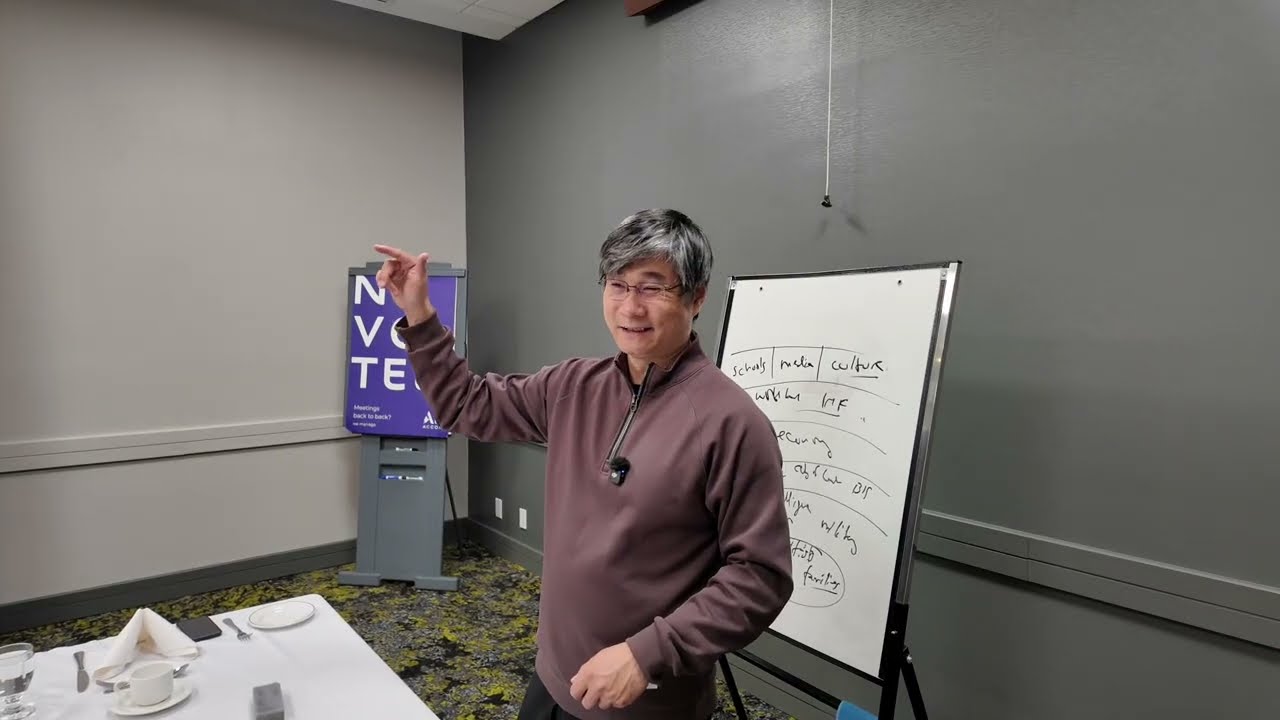
Professor Jiang opens the Toronto meetup by introducing the title of the evening's lecture: "The Rupture." He explains that the term was notably used earlier in the year by Mark Carney at the World Economic Forum to describe a perilous historical juncture where the established global order—Pax Americana—is dying out, while a replacement order struggles to take its place. Rather than treating recent international developments as isolated accidents, Jiang proposes to examine the chaotic events of the past week through a single predictive model, offering an overarching framework to explain why the world is fracturing across multiple fronts simultaneously.
[01:00](https://www.youtube.com/watch?v=Ipj_Tdzokzo&t=60s) Crisis 1: The Escalating War in Iran and Middle East Energy Shock
The first major crisis confronting the global system is the war involving Iran. Jiang stresses the bizarre and unsettling nature of this conflict: even now, the public is left completely in the dark regarding why the war was initiated, what the strategic objectives of the United States actually are, or how the confrontation could realistically conclude. What began ostensibly as an American effort to prevent Iran from acquiring a nuclear weapon has rapidly metastasized into a regional conflagration that is destabilizing the international economy.
The battlefield has already widened into Yemen, pulling the Houthis into open warfare against Saudi Arabia and an allied coalition including the United Arab Emirates, Pakistan, and Turkey. Jiang warns that this Middle Eastern escalation threatens to intersect with the ongoing war in Ukraine, creating the dangerous architecture of a synchronized global conflict. Beyond the immediate military clashes, the most acute consequence is the impending cutoff of Persian Gulf energy flows from world markets. This choke point is already driving diesel prices sharply higher, carrying the catastrophic secondary risk of triggering a worldwide famine.
- **Primary theater:** War between the United States and Iran, initially justified as an effort to halt Iranian nuclear capability.
- **Regional spillover:** Expansion to Yemen, pitting the Houthis directly against Saudi Arabia, the UAE, Pakistan, and Turkey.
- **Systemic risks:** Convergence with the war in Ukraine into a multi-theater global war, severe disruption of Middle Eastern energy supplies, spiking diesel costs, and the looming threat of global agricultural collapse and famine.
[02:45](https://www.youtube.com/watch?v=Ipj_Tdzokzo&t=165s) Crisis 2: The Rightward Turn in Latin America and the Brazilian Election
Turning south, Jiang identifies a pervasive rightward realignment across Latin America, exemplified by the recent presidential election in Brazil. Incumbent president Luiz Inácio Lula da Silva, a veteran political figure who historically lifted millions of citizens out of poverty and long enjoyed broad popular support, faced Flávio Bolsonaro. Jiang characterizes Flávio as a corrupt figure entangled in bank fraud, lurid personal controversies, and the baggage of his father, Jair Bolsonaro, who remains under house arrest.
Pre-election polling overwhelmingly pointed to an effortless victory for Lula. When the ballots were counted, however, Flávio Bolsonaro outperformed expectations so dramatically that he nearly captured an outright majority above 50 percent in the first round. Although the race was pushed to a runoff, general expectations quickly shifted toward an anticipated Bolsonaro triumph. Jiang points out that this shock is not unique to Brazil; across Latin America, nations are abandoning the left in favor of fiercely nationalistic, pro-Trump, and pro-Israel political movements, raising the fundamental question of what structural force is driving this sudden continental swing.
- **Incumbent:** Luiz Inácio Lula da Silva, long-standing left-wing icon credited with major historic poverty reduction in Brazil.
- **Challenger:** Flávio Bolsonaro, son of the house-arrested former president Jair Bolsonaro, dogged by allegations of corruption and bank fraud.
- **Electoral outcome:** Polling misses masked a near-first-round victory for Flávio Bolsonaro, forcing a runoff that he is widely expected to win.
- **Broader regional trend:** Latin American governments rapidly shifting toward nationalistic, pro-Trump, and pro-Israel alignments.
[04:45](https://www.youtube.com/watch?v=Ipj_Tdzokzo&t=285s) Crisis 3: The US-Canada Trade War and North American Secessionism
Jiang shifts focus directly to the host country, addressing the escalating trade conflict between the United States and Canada. Mark Carney has characterized this friction not merely as a dispute over tariffs, but as an existential struggle for Canadian sovereignty, sparked by Washington's insistence on dictating Canada’s external trading partners. However, Jiang argues that the confrontation has rapidly spilled over from trade policy into direct political warfare targeting Canada's territorial integrity.
Fresh from a trip to Quebec, Jiang highlights the recent provincial election in which the Parti Québécois secured a minority government on an explicit pledge to hold a third sovereignty referendum. Prior to the vote, *The Globe and Mail* revealed that American Republican operatives were on the ground in both Quebec and Alberta, coordinating electoral strategy with domestic secessionist movements. If either province breaks away, Canada's geographical cohesion is functionally shattered. In response, Mark Carney has spearheaded retaliatory Canadian tariffs calculated to inflict maximum economic distress on key battleground states ahead of the US midterm elections, deliberately pressuring American voters to back the Democratic Party.
```mermaid
flowchart TD
accTitle: US-Canada Asymmetric Conflict Architecture
accDescr: Diagram illustrating the economic and political points of attack between the United States and Canada.
subgraph US_Offensive["United States Points of Pressure"]
US1["Trade Restrictions & Sovereignty Demands"]
US2["GOP Operatives Assisting Secessionists"]
US2 --> Prov1["Quebec (Parti Québécois 3rd Referendum)"]
US2 --> Prov2["Alberta Separatism"]
end
subgraph Impact_Canada["Existential Threat to Canada"]
Prov1 -.-> Split["Geographic Splitting of Canadian Federation"]
Prov2 -.-> Split
end
subgraph Canadian_Counter["Canadian Retaliation"]
Carney["Mark Carney Counter-Strategy"]
Carney --> RetalTariffs["Targeted Strategic Tariffs"]
RetalTariffs --> USMidterms["Inflict Pain on US Midterm Swing States"]
USMidterms --> PushDems["Drive Electoral Shift Toward Democrats"]
end
```
[06:34](https://www.youtube.com/watch?v=Ipj_Tdzokzo&t=394s) Crisis 4: Global Gen Z Upheaval and the Need for a Unified Theory
The fourth shockwave is an eruption of youth-driven unrest spanning multiple continents. In Asia, demonstrations earlier in the year in Nepal have been followed by massive street mobilizations across India, where millions of young people are demanding the resignation of the Chief Election Commissioner. Meanwhile, across France, students have abandoned classrooms to stage violent confrontations in the streets, with no clear political offramp in sight.
Jiang observes that the French demonstrators are explicitly channeling the rhetoric of past upheavals, evoking the French Revolution and chanting slogans about reviving the Paris Commune. Facing this dizzying tapestry of turmoil—from Middle Eastern regional war and Latin American electoral shifts to North American constitutional fracturing and youth revolts across Eurasia—Jiang insists that these events cannot be treated as random coincidences. Instead, he promises to lay out a single "grand unified theory" demonstrating that every one of these crises is systematically interconnected.
- **Nepal & India:** Widespread Gen Z mobilizations; millions of Indian youth demanding the resignation of the election commissioner.
- **France:** Student boycotts, violent street battles, and the revival of revolutionary rhetoric centered on restoring the Paris Commune.
- **Core thesis:** These crises are neither disconnected nor coincidental; they are symptomatic byproducts of a single underlying global transformation.
[07:58](https://www.youtube.com/watch?v=Ipj_Tdzokzo&t=478s) The Inverted Civics: Debunking the Social Contract Theory
To unpack this grand unified framework, Jiang asks the audience to dismantle their basic assumptions about how human societies are constructed. In standard educational curricula and democratic theory, power is taught as an organic, bottom-up process rooted in the population. Citizens possess inherent cultural norms and values, which gradually crystallize into legal systems such as common law. This legal foundation gives birth to representative government, which in turn organizes civilian society—building schools, fostering the arts and media—and finally establishes a military tasked with safeguarding the population's pre-existing rights and liberties.
This worldview draws directly from Jean-Jacques Rousseau and classical social contract theory, which posits that autonomous individuals enter into society of their own free will, surrendering certain liberties in exchange for state-guaranteed protections for life, liberty, and the pursuit of happiness. Jiang dismisses this narrative entirely, declaring that it is fundamentally false and represents the literal inverse of how power and reality actually operate. Rather than society being constructed from the bottom up by free citizens, the true mechanisms of control function in the exact opposite direction.
- **The conventional civics model:** People's Norms & Values $\rightarrow$ Common Law $\rightarrow$ Government $\rightarrow$ Society (Institutions, Media, Schools) $\rightarrow$ Military Protection.
- **The Rousseauian social contract:** The premise that free individuals willingly yield baseline autonomy to a government in exchange for fundamental legal rights.
- **Jiang's refutation:** This widely taught democratic model is an illusion that completely obscures the real, top-down structure of political and social reality.
[10:34](https://www.youtube.com/watch?v=Ipj_Tdzokzo&t=634s) Plato's Allegory of the Cave: The Architecture of Projected Reality
Rather than modern political science textbooks, Jiang turns to Plato's Allegory of the Cave from *The Republic* as the foundational metaphor for understanding how human reality is engineered. He asks the room to visualize a dark, subterranean cavern where a million individuals are shackled to the stone floor by their limbs and necks, completely unable to turn their heads. Having spent their entire lives facing forward in the dark, their sensory experience is restricted exclusively to a single blank wall.
Behind these prisoners burns a massive, roaring fire. Between the fire and the prisoners stands an unchained, shadowy caste—identified simply as "they" in Plato's dialogue. These puppeteers hold cutouts and figures aloft, casting flickering silhouettes onto the cavern wall before the captive audience. To the chained inhabitants, this projection is not an illusion; it is the entirety of existence. They invent a lexicon to assign names to the passing shapes, invent foundational myths to contextualize what they see, and establish an elaborate social division of labor to interpret the shadows.
Poets and writers invent the descriptive vocabulary; priests construct dogmatic religious systems to invest the shadows with divine meaning; and teachers drill the rules of this shadow world into subsequent generations. Over time, the prisoners come to thoroughly revere this fabricated matrix, never suspecting that the universe they inhabit is an entirely artificial cinema operated by masters behind the fire.
- **The captive populace:** Bound from birth, immobilized, and capable only of viewing shadows projected onto a stone screen.
- **The puppeteers ("they"):** The unchained elite operating behind the fire, curating the projected silhouettes that dictate the subjects' worldview.
- **The institutionalization of the illusion:**
- *Poets & writers:* Formulate language and naming conventions to catalog the shadows.
- *Priests:* Build theological and mythological frameworks to sanctify the projected images.
- *Teachers:* Indoctrinate each successive generation to accept the simulation as absolute truth.
[13:32](https://www.youtube.com/watch?v=Ipj_Tdzokzo&t=812s) Plato's Cave and the Architecture of the Simulation
Professor Jiang takes Plato's Allegory of the Cave—where prisoners chained to the floor mistake shadows on the wall for reality and would gladly murder anyone who dares to tell them "Guys, it's just a shadow on the wall. It's all fake"—and directly maps it onto modern civilization to demonstrate how contemporary life is essentially a manufactured simulation. At the very top sit the hidden puppet masters manipulating the apparatus. Rather than fixating on conspiratorial identities, Jiang categorizes them into an alliance of three structural forces: the occultists (individuals who believe they possess direct communion with God), secret societies (such as the Freemasons and Jesuits), and dynastic ruling families (frequently labeled the Illuminati). To maintain captivity and keep the population chained inside the metaphorical cave, this oligarchy deploys three primary physical enforcement arms: organized crime and the mafia, intelligence agencies, and the armed military.
```mermaid
flowchart TD
accTitle: The Architecture of the Simulation
accDescr: A structural diagram illustrating how ruling forces project shadows of reality through institutions to control the public.
subgraph Masters["The Puppet Masters"]
O["Occultists"]
S["Secret Societies"]
F["Ruling Families"]
end
subgraph Enforcers["Enforcement Layer"]
M["Military & Intelligence Agencies"]
Maf["Mafia & Black Ops"]
end
subgraph Projection["Shadow Projection & Abstractions"]
Bank["Central Banking & Capital\n(Fed, City of London, BIS)"]
Gov["Multilateral Facades\n(UN, IMF, Nation-States)"]
end
subgraph Indoctrination["Cultural Indoctrination"]
Culture["Schools, Media & Pop Culture"]
Public["Chained Public / Captive Minds"]
end
Masters --> Enforcers
Enforcers --> Projection
Bank --> Gov
Gov --> Culture
Culture --> Public
```
Beneath the enforcement layer lies the projection mechanism that captures the human imagination. Historically, this distraction began as religious mythmaking, transitioning from ancient paganism into monotheism, before ultimately evolving into its modern secular manifestation: transactional capital. The puppet masters coordinate money creation through institutions like the Federal Reserve, Wall Street, the City of London, the Bank for International Settlements, and private conglomerates like J.P. Morgan. This monetary spigot fuels corporations and the broader global economy. To obscure this underlying machinery, the system fabricates grand political abstractions—multinational, multilateral entities like the United Nations, the World Bank, and the IMF. The public is conditioned to believe that their lives are governed by sovereign nation-states and democratic assemblies, completely unaware that these political facades exist primarily to deflect scrutiny away from the financiers and secretive alliances operating behind the screen.
[17:21](https://www.youtube.com/watch?v=Ipj_Tdzokzo&t=1041s) Indoctrination and the Cult of "Reason" Over Emotion
To ensure the populace never questions the nature of these projected shadows, society relies on a tri-part indoctrination apparatus: schooling, the media, and popular culture. Together, these vectors manufacture legal systems, social norms, and consensus realities. To demonstrate how culture successfully fabricates value out of thin air, Jiang points to the diamond industry: despite raw diamonds being practically worthless stones kept artificially scarce, mainstream Hollywood films depict elaborate diamond heists where criminals spend years plotting to steal them, and competitive video games like *StarCraft* elevate the "Diamond" league above gold and platinum. In Jiang’s telling, legacy outlets such as *The New York Times*, the BBC, and CNN operate with identical deceptive intent, systematically reinforcing the core axiom of the simulation: that "reason is superior to emotion."
This enforced primacy of reason is driven home throughout childhood education and media narratives. Jiang cites the cultural treatment of intelligent design versus Darwinian evolution as a prime case study. While religious fundamentalists asserting divine cosmological blueprints are reflexively dismissed as simpletons, scientific rationalism is dogmatized. He highlights the celebrated Hollywood drama *Inherit the Wind*—a fictionalized dramatization of the 1925 Scopes Monkey Trial—where defense attorney Clarence Darrow is immortalized as a secular hero liberating humanity from the darkness of biblical ignorance. The message hammered into every institution is unmistakable: analytical rationality represents enlightenment, while emotional or spiritual conviction represents retrograde stupidity.
- **Manufactured Perceptions**: The artificial elevation of inherently worthless items (e.g., diamond rings and movie heists, *StarCraft* competitive tier ladders ranking Diamond above Platinum and Gold).
- **Consensus Fabrication**: Major media conglomerates (*The New York Times*, BBC, CNN) systematically framing institutional dogma as empirical reality.
- **Cultural Paradigms**: The Scopes Trial dramatized in *Inherit the Wind*, positioning Clarence Darrow as the archetype of rationality vanquishing religious backwardness.
[20:50](https://www.youtube.com/watch?v=Ipj_Tdzokzo&t=1250s) The Modern Dichotomy: Capital Versus the Sacred
When this sacred cultural dichotomy is subjected to rigorous analysis, Jiang argues, a deeply troubling truth reveals itself: in the operational code of modern society, "reason" is simply a polite synonym for capital, liquidity, and financial profit. For a capitalist enterprise, reason demands frictionless transactions regardless of identity, faith, or border; it mandates the unrestricted velocity of capital, goods, ideas, and human labor. Consequently, reason is the philosophical bedrock of open society liberalism, championed through individualism, technological progress, multiculturalism, open borders, and absolute labor mobility.
Conversely, "emotion" is institutional shorthand for any organic human sentiment that impedes the frictionless circulation of global capital. This category encompasses spirituality, religious piety, nationalism, deep familial loyalty, local community cohesion, ancestral tradition, and cultural preferences. Jiang defines the overarching struggle of the modern era as a calculated campaign to sever humanity from God and the sacred in order to force an absolute surrender to capital. Anyone dissenting from this orthodoxy faces immediate excommunication: questioning Darwinism gets one branded as clinically insane, while voicing skepticism about vaccine mandates during the COVID-19 pandemic immediately resulted in being ostracized as an "anti-science bigot."
| Ideological Pole | Systemic Definition | Institutional Manifestations |
|:--- |:--- |:--- |
| **Reason (Capital)** | Mechanisms facilitating the frictionless, borderless velocity of money and labor | Liberalism, open borders, global supply chains, multiculturalism, corporate diversity, hyper-individualism |
| **Emotion (Sacred / Organic)** | Organic social bonds and spiritual beliefs that restrict market exchange | Religion, community solidarity, traditional family structures, nationalism, ancestral heritage |
[23:51](https://www.youtube.com/watch?v=Ipj_Tdzokzo&t=1431s) The Ossification of the Open Society and Elite Overproduction
While acknowledging that the post-war liberal framework generated unprecedented material prosperity, peace, and social progress across the West for decades, Jiang argues that every historical system inevitably ossifies, decays, and collapses under its own weight. Over the preceding few decades, and with brutal acceleration during the last five years, the open society degenerated across three major axes:
First, genuine human *reason*—defined by independent critical judgment, situational empathy, and basic common sense—has entirely disintegrated into rigid *rules*. Under the pandemic regime, instead of allowing individuals to exercise rational discretion regarding their own physical health, institutions enforced dogmatic compliance: people were barred from boarding flights, entering hospitals, or dining in restaurants solely because they lacked a bureaucratic vaccine passport. Second, the bedrock of *community* has been swallowed by narcissistic *individualism*. Where young people in 1980s or 1990s Toronto aspired to enter public service to help their local municipality prosper, today's high schoolers openly admit their primary ambition is to become a social media celebrity chasing a million Instagram followers. Third, dynamic *innovation* has been strangled by an entrenched *bureaucracy*, illustrated by the fact that over 10 percent of the Canadian workforce now draws government paychecks in comfortable, tenured, low-effort positions.
Jiang frames this institutional rot through the structural lens of Peter Turchin's theory of "elite overproduction." When an empire produces vastly more credentialed, aspiring elites than there are legitimate positions of power and prestige, the surplus ruling class ends up clogging institutional gears, manufacturing useless managerial layers, and accelerating the internal rupture of the state.
[27:30](https://www.youtube.com/watch?v=Ipj_Tdzokzo&t=1650s) Elite Overproduction and the Stagnating Status Quo
Society enters a period of decay when its existing structures ossify and break down under the weight of "elite overproduction." This dynamic serves as the foundational lens for understanding the geopolitical conflicts erupting across the globe. Looking back at the core societal model, entrenched civil society institutions sit at the apex, orchestrating abstract systems like the globalized economy. Beneath them operates the intellectual class—the academics inhabiting universities, the journalists writing for *The New York Times* or broadcasting on the BBC, and the culture-makers producing Hollywood entertainment. This cohort does not exist to seek truth or foster dynamic growth; they are lavishly compensated solely to defend, justify, and maintain the existing status quo.
Because this legacy system has turned deeply corrupt, stagnant, and ossified, the incumbent elites are desperate to freeze reality in place. However, structural decay inevitably births an ambitious counter-elite. This insurgent faction has no interest in reforming the old order from within; their objective is to dismantle the existing architecture entirely so they can construct an alternative system tailored to their own hegemony.
- The proliferation of geopolitical crises is directly traceable to elite overproduction and structural ossification.
- The intellectual class—spanning the Ivy League, prestige news media, and entertainment conglomerates—functions primarily as high-paid guardians of the institutional status quo.
- The clash between incumbent elites trying to preserve a decaying system and counter-elites seeking its destruction produces systemic rupture.
[29:11](https://www.youtube.com/watch?v=Ipj_Tdzokzo&t=1751s) The Keystone of Power: Keystroke Money vs. Tech Oligarchs
To locate where ultimate authority resides within the current architecture, one must identify its central organizing mechanism: the exclusive power to print money. Despite the mystique surrounding modern finance, very few people understand how fiat currency is actually created. Banks do not lend out money gathered from existing depositors. When an ordinary homebuyer in Toronto asks for a $1,000,000 mortgage to purchase a modest condo—or attempts to buy an exorbitant $10,000,000 detached house—the institution creates that capital out of sheer nothingness. A bank employee simply strikes a few keys on a computer, and new currency is conjured instantly into ledger existence.
This unchecked power makes the private banking cartel the undisputed masters of the world. Centered across Wall Street, the Federal Reserve, and the City of London, this cartel exercises near-total control over societal development. In response, a rival faction of counter-elites has emerged: the Silicon Valley oligarchs, tech entrepreneurs, and artificial intelligence titans. For these "tech bros" to usurp power, they cannot simply compete within the legacy financial framework; they must violently strip the money-creation monopoly away from the banking establishment. Their chosen weapons are digital currency, algorithmic stablecoins, and universal digital ID. Under this emerging paradigm, consumers will no longer need to approach traditional lenders like TD or Canada Trust to finance their lives; they will borrow directly from corporate platforms like Apple or Google, transferring the power to print money and define reality into the hands of Big Tech.
```mermaid
flowchart TD
accTitle: The Battle for Money-Creation Power
accDescr: Diagram illustrating the incumbent banking monopoly versus the insurgent tech ecosystem vying for control of currency and reality.
subgraph LegacySystem ["Legacy Incumbent Power"]
A["Banking Cartel<br/>(Wall Street, Fed, City of London)"]
B["Keystroke Fiat Creation<br/>(Loans from Nothing)"]
C["Institutional Gatekeepers<br/>(Universities, BBC, NYT, Hollywood)"]
A --> B
A --> C
end
subgraph TechInsurge ["Counter-Elite Insurgency"]
D["Tech Oligarchs & AI Firms<br/>(Google, Apple, Big Tech)"]
E["Digital ID & Stablecoins<br/>(Platform Lending)"]
F["Alternative Intellectuals<br/>(New Justification Framework)"]
D --> E
D --> F
end
D -.->|"Seize Money-Printing Monopoly"| A
E -.->|"Displace Sovereign Reserves"| B
```
- Bank lending operates via pure keystroke credit expansion rather than intermediating customer deposits.
- The core cartel dominating global power consists of private commercial banks, the Federal Reserve, and the City of London.
- The counter-elite strategy centers on deploying digital IDs and stablecoins to bypass traditional banking intermediaries entirely.
- By issuing platform-native credit, tech companies become the primary arbiters of liquidity, bypassing the historical requirement for traditional central bank reserves.
[32:25](https://www.youtube.com/watch?v=Ipj_Tdzokzo&t=1945s) The Blueprint for Rupture: Destroying the Edifice
Because the incumbent banking cartel derives its supremacy from the existing monetary and social order, tech oligarchs cannot seize control by operating within current rules. If an insurgent elite wants to capture the power to print money, they must systematically demolish the entire institutional edifice of the contemporary world. This mandate extends far beyond dislodging commercial bankers; it necessitates a scorched-earth campaign against the legacy intellectual apparatus that manufactures legitimacy for the old world.
Elite universities like Harvard and Yale, media titans like the BBC and *The New York Times*, and the cultural engines of Hollywood must all be dismantled. The tech counter-elite must sweep these institutions aside to install their own cadre of public intellectuals capable of legitimizing digital ID regimes, algorithmic governance, and private digital currencies. "In other words, if I want to rebuild the world, I first need to destroy it." To create the blank slate required for platform-issued stablecoins, the counter-elite must ensure the destruction of three load-bearing pillars: the US dollar, the petrodollar recycling system, and the legacy intellectual class.
- Total systemic replacement requires dismantling the cultural and academic institutions that rationalize the current power structure.
- Legacy university systems and mainstream media will be replaced by a newly minted intellectual class dedicated to normalizing digital currencies and digital IDs.
- Rebuilding global governance around corporate stablecoins structurally requires the collapse of the petrodollar and fiat reserve currency system.
[33:56](https://www.youtube.com/watch?v=Ipj_Tdzokzo&t=2036s) The Petrodollar Cycle and the Logic of a Planned Defeat in Iran
This macro-struggle provides the explanatory framework for military adventures that seem irrational on the surface, most notably the disastrous war with Iran. Observers struggle to understand why Western leaders entered a conflict they are blatantly losing, operating under the naive assumption that policy planners expected a conventional victory. The geopolitical calculus becomes immediately clear once the perspective is flipped: what if the architects of the war entered the conflict knowing they would lose, and specifically sought that defeat to engineer systemic collapse?
The basis of global commerce has long been the petrodollar architecture anchored by Saudi Arabia and the Gulf Cooperation Council (GCC). Under this arrangement, Saudi Arabia sells cheap hydrocarbons to world markets denominated exclusively in US dollars. Because the kingdom has nowhere else to store this ocean of greenbacks, it recycles the revenue back into US Treasuries. This recycling mechanism allows the United States to run staggering debt loads—ballooning to $40 trillion—while maintaining cheap borrowing costs, financing luxurious domestic living standards, and pumping massive liquidity into the tech sector to fuel artificial intelligence research. In turn, Saudi energy powers East Asian manufacturing, which churns out inexpensive consumer goods for the West while reinvesting surplus earnings back into American sovereign debt.
The war involving Iran deliberately sabotages this delicate circulatory system. Disrupted shipping lanes and military strikes prevent Saudi Arabia from safely exporting oil, crippling East Asian industrial output and choking off foreign purchases of US Treasuries. As buyers vanish, the United States faces an acute sovereign debt crisis and the imminent threat of debt default. Simultaneously, this liquidity drought will puncture the speculative AI bubble. Companies like OpenAI run unsustainable balance sheets—effectively operating as multi-billion-dollar Ponzi schemes that absorb enormous tranches of venture capital solely to burn it on computing power.
- The petrodollar feedback loop relies on Saudi Arabia recycling oil revenues directly into US Treasuries, subsidizing American consumption and tech liquidity.
- A war-driven halt in Gulf hydrocarbon exports severs the supply chain: East Asian manufacturing stalls, and foreign purchases of US sovereign debt collapse.
- The liquidity freeze threatens to trigger a catastrophic US sovereign debt default.
- Major AI frontier labs operate as unhedged compute Ponzi schemes that depend entirely on cheap global liquidity to survive.
[37:25](https://www.youtube.com/watch?v=Ipj_Tdzokzo&t=2245s) The Bailout Endgame: Nationalized Compute and Stablecoin Hegemony
The deliberate precipitation of a sovereign debt crisis and the bursting of the AI bubble look disastrous from the outside, yet they form the core mechanics of a calculated transition away from fiat currency. When the US debt crisis erupts and the greenback forfeits its status as the world reserve currency, international commerce will face a total vacuum of trust. Global trade will not adopt the Chinese Yuan or the Russian Ruble to settle transactions. The only viable structural alternative ready to deploy will be corporate stablecoins backed by tech conglomerates like Apple, Google, or tech-aligned institutions like JPMorgan Chase.
```mermaid
flowchart LR
accTitle: The Shock-Bailout Consolidation Flow
accDescr: Flowchart tracing how the collapse of the AI bubble leads to state bailouts, nationalized compute infrastructure, and private stablecoin dominance.
subgraph CollapsePhase ["Engineered Shock"]
G["Petrodollar Stoppage"] --> H["Sovereign Debt Crisis"]
H --> I["AI Bubble Burst"]
end
subgraph BailoutPhase ["State Absorption"]
I --> J["Recession / Crisis"]
J --> K["2008-Style Bailouts<br/>('Too Big to Fail')"]
K --> L["Compute & Data Centers<br/>Nationalized by State"]
end
subgraph HegemonyPhase ["Corporate Takeover"]
L --> M["Zero-Capex Tech Giants<br/>Turn Highly Profitable"]
M --> N["Tech-Issued Stablecoins<br/>Replace Collapsed USD"]
end
```
The inevitable popping of the AI bubble will not bankrupt the premier tech companies; it will permanently entrench them. An oil firm that enjoys state-subsidized drilling rigs generates extraordinary net margins because its heaviest capital expenditures are socialized. Today, artificial intelligence developers bleed cash because they must privately foot the staggering capital expenses of advanced data centers and electrical compute infrastructure. When the AI bubble bursts and tips the broader American economy into a severe recession, the federal government will treat frontier AI companies exactly as it treated Wall Street during the 2008 Great Financial Crisis: as entities "too big to fail."
Congress and the executive branch will intervene by absorbing the toxic capital costs, taking equity stakes, and nationalizing the data centers and compute grids. Relieved of their crushing infrastructure overhead, AI enterprises will achieve immense operational profitability virtually overnight. Backed by the coercive power and balance sheet of the state, these tech monopolies will proceed to issue the dominant stablecoins required to replace the collapsed dollar. In this endgame, the tech oligarchs secure ultimate victory, while the legacy banking cartel is obliterated, left holding worthless collateral tied to the GCC and the ruins of the petrodollar system.
- Neither the Chinese Yuan nor the Russian Ruble possesses the trust or institutional velocity to step in as the global reserve currency after a dollar crash.
- Commercial stablecoins issued by platform monopolies represent the sole ready-to-run settlement infrastructure for post-crash global trade.
- AI developers are currently constrained by capital expenditures on energy, server farms, and specialized processing hardware.
- A systemic crash will force a 2008-style federal bailout that socializes private data center infrastructure, leaving AI firms unburdened by capital costs.
- Legacy commercial banks will collapse under the weight of unserviceable debt and overleveraged collateral rooted in the Gulf and petrodollar assets.
[40:48](https://www.youtube.com/watch?v=Ipj_Tdzokzo&t=2448s) The Tech Bailout, Stablecoins, and the Shenzhen APEC Summit
In the wake of overseas banking exposure—particularly massive loans extended across Saudi Arabia and the Gulf Cooperation Council (GCC)—a systemic collapse of traditional financial institutions allows the major AI tech conglomerates to ascend and assert control over Washington, D.C. In this unfolding scenario, the federal government nationalizes critical data center infrastructure, floods tech companies with liquidity, and formally grants them the authority to issue dollar-pegged stablecoins. Anticipating skepticism from the audience that rival superpowers like China or Russia would never tolerate an American-led tech monetary order, attention is directed toward an upcoming gathering: an APEC summit in Shenzhen where Donald Trump, Xi Jinping, and Vladimir Putin are slated to sit in the same room.
While public diplomacy will frame their dialogue around existential risks, guardrails, and establishing a "global AI governance board" to ensure technology benefits humanity, this rhetoric is merely a cover story. The major geopolitical powers care very little about AGI (Artificial General Intelligence) or ASI (Artificial Superintelligence) in the abstract. Instead, "AI governance" is diplomatic code for negotiating digital currency protocols and stablecoin architecture. The ultimate objective is a historic transfer of monetary power: wresting the ability to print money away from legacy private commercial banks and reassigning it to private tech firms. This overarching power struggle forms the structural basis for escalating regional conflicts, including hostilities with Iran.
```mermaid
flowchart TD
accTitle: Power Shift from Banking Cartel to AI Tech Cartel
accDescr: Flow diagram showing the transition of monetary authority from legacy private banks to AI tech conglomerates.
subgraph Legacy["Legacy Financial Architecture"]
B1["City of London & Global Commercial Banks"]
B2["Monetary Monopoly: Power to Create Fiat Currency"]
B1 --> B2
end
subgraph Rupture["The Rupture"]
R1["Bank Collapses & Middle East Debt Crises"]
R2["AI Companies Capture Washington"]
R1 --> R2
end
subgraph NewTech["New Algorithmic Order"]
A1["Nationalized Data Centers & Liquidity Injections"]
A2["Private Stablecoin Issuance & Digital ID"]
A3["Global AI Governance via Great Powers (US, China, Russia)"]
A1 --> A2
A2 --> A3
end
Legacy --> Rupture
Rupture --> NewTech
```
[43:03](https://www.youtube.com/watch?v=Ipj_Tdzokzo&t=2583s) The US-Canada Trade War and Mark Carney's "Rupture"
The brewing trade war between the United States and Canada must be understood through this same prism: a factional civil war between emergent AI tech giants and the legacy banking apparatus. Canada functions fundamentally as a resource colony for the City of London, which remains the historical epicenter of global banking cartels. With the vast majority of Canadian territory structured legally as Crown land, Donald Trump's trade posture is aimed at destabilizing and ultimately partitioning the Canadian state to capture its resource base, aided by operatives active in both Quebec and Alberta.
Within this context, figures like Mark Carney do not represent Canadian national interests, but rather the institutional prerogatives of the City of London. Carney’s pedigree traces directly through Goldman Sachs, the governorship of the Bank of Canada, and his tenure as the first foreign-born Governor of the Bank of England. Carney’s public warnings about an impending global "rupture" reflect an elite insider's realization that traditional central banking and private banking networks are being systematically sidelined by Silicon Valley tech oligarchs. In an outright trade clash between the two neighbors, Canada lacks any real leverage: as a mere resource supplier negotiating against the world's primary consumer market, "it's not really a fair fight."
- **Imperial Banking Nexus**: The City of London maintains sovereign financial dominance over Canada's extractive resource wealth and Crown lands.
- **The Partition Strategy**: U.S. political factions leverage trade friction and regional separatist sentiment in Alberta and Quebec to fracture Canadian federal cohesion.
- **Structural Vulnerability**: In bilateral trade warfare, the consumer market (the United States) holds absolute structural leverage over the raw commodity producer (Canada).
[45:17](https://www.youtube.com/watch?v=Ipj_Tdzokzo&t=2717s) Algorithm Manipulation in Brazil and the Municipal Election in Toronto
Mainstream geopolitical analysis routinely misdiagnoses political shifts across the Western Hemisphere. Coverage of Brazilian politics in outlets like *The New York Times* attributes right-wing surges entirely to demographic changes—namely, the expansion of the Brazilian evangelical and Christian Zionist population from roughly 8% two decades ago to over 20% today, which catalyzed Jair Bolsonaro's political rise. What media narratives deliberately omit is that Brazil’s digital information sphere is monopolized by American tech behemoths, including Meta, Google, and YouTube. These platforms actively calibrate their recommendation algorithms to manufacture specific election outcomes, driving a continent-wide right-wing, nationalistic wave designed to serve broader financial interests.
This algorithmic political engineering can be observed down to local municipal contests. In the Toronto mayoral election, despite public opinion polls giving progressive candidate Olivia Chow an eight- to ten-point lead over Brad Bradford, Bradford is poised for an upset victory. His prominent, outspoken Zionist positioning aligns closely with the geopolitical factions currently manipulating algorithmic visibility across Western political races.
[47:19](https://www.youtube.com/watch?v=Ipj_Tdzokzo&t=2839s) Gen Z Protests and AI Dismantling the "Priest Class"
Rising youth unrest, typified by Gen Z student demonstrations across France where youths lament that schools teach them nothing of practical value, stems from an acute fear of algorithmic obsolescence. Yet popular cultural anxieties that AI will evolve into an autonomous AGI bent on wiping out humanity misunderstand the weapon's true purpose. The real agenda behind commercial AI rollout is the establishment of universal digital ID and programmable digital currency systems.
In the immediate term, AI functions as a disruptive tool to shatter the modern institutional simulation. By effortlessly replicating the core intellectual tasks of high school teachers, university professors, attorneys, and medical professionals, basic generative models reveal that the credentialed "intellectual priest class" has been largely posturing. The primary attack vector of the tech conglomerates is not humanity itself, but this managerial priest class, whose prestige historically conferred moral and epistemic legitimacy upon the global banking cartel.
[49:00](https://www.youtube.com/watch?v=Ipj_Tdzokzo&t=2940s) Testing the Theory: The Three Upcoming Flashpoints
To avoid descending into unfalsifiable speculation, the validity of this entire framework must be tested against three critical geopolitical flashpoints occurring within a four-week window:
1. **The Alberta Referendum (October 19)**: Albertans vote on whether to formally place provincial secession on an upcoming ballot. Conventional wisdom and polling suggest independence sentiment commands only 20% to 30% support, meaning the measure should fail under ordinary conditions.
2. **The Israeli General Elections (October 27)**: Orthodox political modeling suggests that Benjamin Netanyahu ought to face electoral defeat.
3. **The U.S. Midterm Elections (Early November)**: Mainstream forecasts predict a decisive Democratic wave, delivering both the House of Representatives and the Senate to the opposition.
Should conventional polling hold true—Alberta defeating the secession ballot, Netanyahu losing power, and Democrats sweeping the midterms—the thesis of an ascendant tech coup is refuted. However, if the underlying theory holds, a radically different sequence will unfold across all three arenas:
- **Alberta & Algorithm Manipulation**: Regardless of the nominal tally, Donald Trump will allege the Alberta referendum was rigged. AI companies may leverage social media feeds to stimulate separatist votes, mirroring earlier interventions by figures like Elon Musk, who publicly urged Alberta, Saskatchewan, and Quebec to break away following the Parti Québécois' minority victory. Such disruptions create a pretext for the U.S. executive branch to intervene under the guise of guaranteeing "fair elections" or deploying peacekeeping forces.
- **Netanyahu's Strategic Indispensability**: Netanyahu will retain power because his aggressive posture in the Middle East is an irreplaceable catalyst for destabilizing regional bank funding lines and advancing tech-aligned strategic objectives.
- **Tech Money Flooding Congress**: Unprecedented sums of tech dark money are pouring into congressional races—including roughly $90 million from Elon Musk, approximately $100 million from Marc Andreessen and Ben Horowitz, and tens of millions from other Silicon Valley leaders. The objective is not whether Democrats or Republicans claim the majority, but the sheer volume of legacy incumbents replaced by compliant lawmakers willing to authorize an inevitable multitrillion-dollar federal bailout for the AI sector.
[54:21](https://www.youtube.com/watch?v=Ipj_Tdzokzo&t=3261s) The Coming Cascade: The Anthropic IPO, Bailouts, and Geopolitical Rupture
Laying out a predictive timeline of what will unfold over the next three months, Professor Jiang outlines the specific dominoes that must fall if his broader thesis holds true. The opening trigger to watch for is the planned public listing of Anthropic in early November, timed right around the US midterm elections. The company is seeking an astronomical $2 trillion valuation while attempting to raise roughly $100 billion. Jiang bluntly dismisses these ambitions: "They're not worth $2 trillion. Everyone knows this. There's no way they're raising that much money." Consequently, the IPO is bound to fail, threatening to burst the entire artificial intelligence bubble. Because tech giants are intricately intertwined, an Anthropic collapse immediately prevents them from purchasing data center capacity and compute, dragging down partners like Oracle and Broadcom in rapid succession. Jiang compares the entire ecosystem to a house of cards: "Like it's a Ponzi scheme. Everything collapses."
```mermaid
flowchart TD
accTitle: The AI Bubble Collapse Cascade
accDescr: Flowchart illustrating the chain reaction from the Anthropic IPO failure to global digital currency rollout.
subgraph TechCollapse["AI Bubble Unraveling"]
A["Failed Anthropic IPO<br/>($2T valuation / $100B raise fails)"]
B["Halt in Data Center & Compute Purchases"]
C["Contagion Hits Infrastructure<br/>(Oracle, Broadcom)"]
A --> B --> C
end
subgraph StateIntervention["Political & Geopolitical Escalation"]
D["Bipartisan Bailout<br/>(Dem Congress + Trump White House)"]
E["APEC Summit Agreement<br/>(Xi, Trump, Putin Global AI Board)"]
F["Iran War Escalation & Collateral Destruction<br/>(GCC & Ukraine bank collapses)"]
C --> D
D --> E
E --> F
end
subgraph EndGame["Monetary Reset"]
G["Introduction of Digital ID & CBDC"]
F --> G
end
```
Rather than letting the sector perish, Washington will inevitably step in. In Jiang's forecast, a Democratic Congress and a Trump White House will link arms to bail out the AI industry, while legacy media celebrates the bipartisan spectacle as proof that American democracy still functions. On the geopolitical stage, the upcoming APEC summit will serve as another key checkpoint. Jiang predicts that Chinese President Xi Jinping, Donald Trump, and Russian President Vladimir Putin will meet in person to announce a tripartite global AI governance board.
Simultaneously, the geopolitical theater will see an escalation of war in Iran. Jiang argues that this conflict is intentionally leveraged to dismantle the existing global economic order. By destabilizing critical nodes such as Ukraine and the Gulf Cooperation Council (GCC), the conflict wipes out the underlying collateral held by traditional private banks, pushing them into bankruptcy. This engineered collapse clears the board for the rapid introduction of digital identification and central bank digital currencies. Acknowledging the boldness of his claims, Jiang notes that audience members will not have to wait long for validation: "This is a theory... And we'll know over the next three months. It will only take three months to test this theory out."
- **Anthropic target numbers**: Seeking a $2 trillion valuation and an equity raise of $100 billion.
- **Supply chain contagion**: An Anthropic cash freeze directly imperils data center commitments, hitting Oracle and Broadcom.
- **Banking collateral zones**: Destruction of financial collateral tied up in the GCC and Ukraine intended to break traditional private banking balance sheets.
---
[57:48](https://www.youtube.com/watch?v=Ipj_Tdzokzo&t=3468s) Q&A: Ambient Conditioning, Operating Systems, and the Digital Enclosure
Transitioning into an open Q&A session over food, attendee Daryl raises the first question, pointing out that digital ID and cryptographic verification are already being aggressively forced into the underlying operating system layer—ensuring that in the near future, users will not even be able to install software without verified digital identification. Jiang agrees emphatically, observing how aggressively society is being conditioned to accept pervasive automation. Everyday human interactions are steadily phased out; during recent travels through US airports, Jiang recounts being completely barred from approaching an airline check-in desk staffed by a human and instead directed toward automated kiosks and artificial intelligence systems.
This shift reshapes the fundamental nature of labor and human agency. Jiang observes that workers are no longer employed to perform substantive tasks, but rather "to just train the AI to do your job." From the proliferation of Waymo autonomous vehicles to the ubiquity of Flock safety cameras across California and Texas, algorithmic surveillance is tightening its grip. Yet Jiang reiterates that technical ubiquity is merely the surface layer. The true prize remains monetary sovereignty: regardless of how deeply software infiltrates daily life, the ruling tech factions cannot achieve total dominance until they wrest the power of money creation away from the central banks.
---
[01:00:23](https://www.youtube.com/watch?v=Ipj_Tdzokzo&t=3623s) Starlink, Undersea Cables, and the Corporate "Network State"
A participant asks whether Elon Musk's recent push to position Starlink as a major US mobile network provider represents an attack by tech counter-elites against legacy institutions. Jiang contextualizes Starlink as part of a sweeping effort by the tech elite to construct an entirely sovereign infrastructure stack. Because the physical backbone of the global internet still consists of undersea fiber-optic cables controlled or regulated by traditional nation-states, Starlink provides an orbital bypass that wrests communications control away from governments and places it directly into private corporate hands.
This dynamic underpins the broader philosophical ideology championed by figures like Peter Thiel: the concept of the "Network State." In this paradigm, democratic governance is treated as obsolete, friction-heavy, and hopelessly inefficient compared to corporate monarchy. Tech titans despise being constrained by Washington regulators or local voters who object to massive data centers consuming municipal water and power grids. Rather than remaining subordinate to the nation-state, they aim to either capture governments or build sovereign corporate enclaves from scratch—a motivation Jiang directly connects to Peter Thiel's physical and financial moves in Javier Milei's Argentina:
> "Governments are slow bureaucracies. Corporations are monarchies. They're very efficient, and so they're trying to promote this right now: the network state."
- **Physical sovereignty**: Starlink serves as an alternative to sovereign-regulated undersea communications cables.
- **The Network State vision**: Replacing democratic nation-states with corporate-run enclaves free from voter oversight, environmental complaints, or energy restrictions.
- **Argentine testing ground**: Peter Thiel's engagement in Argentina viewed as a real-world proof-of-concept for corporate-run territory.
---
[01:03:30](https://www.youtube.com/watch?v=Ipj_Tdzokzo&t=3810s) The Illusion of Onshoring and the Financialization Trap
An audience member working on the ground floor of the automation and manufacturing equipment sector notes an unprecedented boom in industrial robotics. He asks whether policymakers are deliberately pushing to devalue the US dollar to engineer a transition toward an export-driven manufacturing economy powered by automation. Jiang breaks down the mechanics behind this argument, separating political rhetoric from structural economic reality.
He argues that the mainstream political push for "onshoring"—the drive over the past five years to repatriate industrial production from China and East Asia—is fundamentally doomed. Decades of structural financialization have permanently warped the American economy: the highest returns and best-compensated positions exist strictly within financial services and speculative assets. Jiang points out the impossibility of staffing a domestic industrial base under these conditions: "It's going to be very hard to find a young man to go and work at a factory that pays like $30, $40, when he can just gamble on cryptocurrency." Furthermore, the United States cannot match China's cost efficiencies, given that Beijing operates without regard for labor rights or environmental regulations. Onshoring human-driven manufacturing is an economic dead end, leaving full automation as the tech sector's only viable alternative.
[01:06:12](https://www.youtube.com/watch?v=Ipj_Tdzokzo&t=3972s) The Supply Chain Reality of Automation
The discussion begins by dismantling a common assumption about factory automation: replacing human laborers with robotics to streamline manufacturing. While this sounds clean in theory, automation fundamentally relies on a complex, fragile global supply chain. Building robots requires thousands of specialized components and raw materials scattered unevenly across the planet. For instance, lithium comes primarily from the "Lithium Triangle" in South America, China produces around 60% of the world's silicon, and copper is mined largely in Chile and Peru. Because no single country produces all of these essential elements, robotics manufacturing collapses the moment global trade routes deteriorate.
When international networks fray, industrial automation becomes prohibitively expensive. In a humorous, provocative comparison, Professor Jiang remarks that from a purely cold, cost-effective standpoint, companies are "actually just better off... importing illegal immigrants" to handle manual manufacturing rather than attempting full robotic automation. As a consequence, automation is not an easy domestic panacea. Instead, giant corporations will step in to build their own private, sovereign supply chains, bypassing unpredictable nation-states. Starlink serves as a primary example of this behavior: tech giants can no longer trust volatile governments to maintain the critical infrastructure required for their operations. Jiang points out that this corporate coordination will become overt at forums like the upcoming APEC summit, where major tech corporations across China, the United States, and Russia quietly negotiate their own interlinked supply networks.
[01:08:54](https://www.youtube.com/watch?v=Ipj_Tdzokzo&t=4134s) Stablecoins, Cartels, and the Illusion of the Nation-State
An attendee named Mike asks for clarification on Professor Jiang's previous comments, asking if China, Russia, and the United States will establish an official organization to govern stablecoins. Jiang immediately corrects him: stablecoins will not be run by sovereign state governments or a formal multilateral body. Instead, they will operate much like the US dollar does today—governed by an informal international cartel of private banks and commercial institutions that coordinate protocols and enforce reserve usage. The governance of stablecoins will simply be a boardroom committee of corporate actors setting universal digital currency rules.
```mermaid
flowchart TD
accTitle: The Two Factions Fighting for Control
accDescr: Diagram illustrating the incumbent financial elite versus the challenger counter-elite alliance of tech, nationalism, and religion.
subgraph Elite["The Incumbent Elite"]
Fin["Central Bankers & Financial Elite"]
FiSys["Global Fiat System"]
Fin --> FiSys
end
All -->|"Seeks to dismantle"| Fin
Tech -->|"Proposes replacement"| SC["Corporate Stablecoins & AI Matrix"]
```
Mike pushes further, asking how this alters the geopolitical balance among superpowers like the US, Russia, and China. Jiang warns the audience to stop looking through the framework of the nation-state altogether, dismissing borders and flags as "an illusion" and "a matrix." The apparent geopolitical conflict between Washington, Beijing, and Moscow is largely theater designed to distract the public. Behind closed doors, the international financial elites across these countries share identical interests: they send their children to the same elite prep schools, attend the same exclusive parties, and intermarry. The true battle line is not horizontal between countries, but vertical within them: a clash between the ruling elite and an insurgent counter-elite.
- **The Elite:** The entrenched global financial establishment and central bankers who have monopolized systemic power for decades.
- **The Counter-Elite:** The AI technologists and Silicon Valley elites seeking to break the existing financial architecture.
- **The Grand Alliance:** A coordinated coalition between **nationalism**, **technology**, and **religion** engineered to topple the global financial cartel.
- **Political Instruments:** Leaders like Donald Trump, who was carried into power by this triad to dismantle the "deep state" administrative structure in Washington (which Jiang notes would require "a third term and possibly a fourth term" to fully complete), with parallel factional dynamics playing out under Vladimir Putin in Russia and Xi Jinping in China.
[01:13:49](https://www.youtube.com/watch?v=Ipj_Tdzokzo&t=4429s) Plato's Cave and the Three Futures of the Rupture
A member of the audience brings up Plato's Allegory of the Cave, asking about the nature of the reality being projected onto the wall and whether ordinary people have any path to break their shackles through free will, neighborly love, and inner spiritual awakening. Jiang explains the allegory through the lens of political succession. The incumbent puppet-masters casting the shadows—the old financial elites—have grown lazy, decrepit, and exhausted on the job, leaving ordinary people bored and anxious. Sensing an opening, a younger group of technologists believes they can project a far more compelling, sophisticated simulation. To displace the old guard, the counter-elite stirs up youth unrest, such as Gen Z protest movements, using popular mobilization as leverage to crack the status quo. Yet, the underlying paradigm remains the same: the public simply swaps one set of shadowy projections for another.
Addressing the audience member's question about the long-term resolution of this crisis, Jiang emphasizes that humanity has arrived at a monumental civilizational inflection point. Over the next decade, this rupture will inevitably bring cataclysmic upheaval, which Jiang breaks down into three potential historical outcomes:
1. **The AI Hegemony:** The technology titans—championed by figures like Elon Musk, Sam Altman, Mark Zuckerberg, Peter Thiel, and Jeff Bezos—successfully crush the central bankers. A new automated reality is imposed. Over successive generations, humanity forgets a world without AI ever existed, in the same way modern societies have forgotten an era before fiat currency.
2. **Total Civilizational Collapse:** The entrenched financial oligarchs and the insurgent nationalist-tech coalition prove evenly matched and fight a war of attrition to mutual destruction, leaving human society shattered.
3. **The Messianic Age:** Driven by apocalyptic religious factions, the collision between the old world and the new triggers an eschatological transformation. Jiang hints at religious movements in places like Israel actively pushing global events toward this prophetic threshold.
[01:18:03](https://www.youtube.com/watch?v=Ipj_Tdzokzo&t=4683s) Plato's Cave and the Accelerators of the Apocalypse
Addressing the mindset of modern extremist leadership, Professor Jiang pushes back against the simplistic view that figures driving destructive conflicts are "just Nazis" or comic-book villains. When examining the true command structure, one discovers that these leaders genuinely operate on an apocalyptic logic: they believe human civilization must pass through absolute ruin before humanity can finally awaken to reality. To explain this worldview, Jiang draws upon the allegory of Plato's Cave. Imagine a million people chained in the dark; they have grown so accustomed to the shadows, and are so terrified of stepping into the sunlight, that they refuse to leave voluntarily. How do you force people to snap their chains under those conditions? In the eyes of religious extremists, you must make their cave so unlivable and unbearable that remaining there becomes utterly impossible.
Jiang notes that this exact eschatological blueprint animates contemporary religious fanatics, including both hardline Zionists and Christian Zionists. These factions actively work toward catastrophe under the conviction that global devastation is required to hasten the Messianic Age or force the Second Coming of Jesus. By precipitating world collapse, they believe they are compassionately forcing humanity to tear off its blindfolds.
---
[01:19:21](https://www.youtube.com/watch?v=Ipj_Tdzokzo&t=4761s) Breaking the Historical Cycle: From the Network State to Latent Powers
Jiang summarizes three major trajectories that humanity could face over the coming decade: an AI-driven hallucination matrix orchestrated by a new technocratic elite; a total civilizational collapse that merely resets the board back to the "same old, same old"; or an engineered messianic catastrophe where religious extremists seize power and immediately abandon their spiritual ideals to hoard control. Historically, every structural crisis inevitably circles back to elite consolidation and domination. To escape this trap, Jiang insists that passive complaining must be replaced by direct, sacrificial action aimed at inaugurating an entirely new civilizational paradigm.
```mermaid
flowchart TD
accTitle: Paths of Civilizational Crisis vs Spiritual Breakout
accDescr: A diagram contrasting three cyclical dead ends with Jiang proposed spiritual education alternative.
subgraph CyclicalPaths["Historical Dead Ends"]
A["Technological Path"] -->|"AI hallucination matrix"| D["New Elite Hegemony"]
B["Societal Collapse"] -->|"Civilizational reset"| D
C["Messianic Catastrophe"] -->|"Apocalyptic war"| D
end
subgraph ProposedBreakout["The Alternative: Breaking the Cycle"]
E["Spiritual Education"] --> F["Awaken Latent Monad Powers"]
F --> G["Counter-Societies & Communities"]
G -.->|"Opposes"| H["Silicon Valley Network State"]
end
```
Jiang's long-term thesis centers entirely on child development and education. He argues that every child is an direct offshoot of the divine source—a monad—possessing an innate, uncorrupted spiritual connection. If a society builds an educational model specifically designed to nurture that spiritual essence rather than crush it, latent capabilities like telepathy and prophecy could naturally emerge. Jiang announces that his lifelong project is to establish an alternative network of spiritual communities to counter Silicon Valley's model of "the Network State." When an audience member playfully interjects, "You want to be Professor X," Jiang laughs, admitting he might end up as a prophet or teacher, but emphasizes that everyone gathered in the room shares a duty to seek a genuine path forward for their families and communities.
- **The Three Dead Ends:** The AI hallucination matrix, branch civilizational collapse leading to repeated historic patterns, and apocalyptic takeovers by power-hungry fanatics.
- **The Child as Monad:** Education must be redirected toward drawing out divine latency (including telepathic and prophetic faculties).
- **The Alternative Counterweight:** Building intentional spiritual networks specifically designed to prevent the digital feudalism of Balaji Srinivasan's "Network State."
---
[01:23:19](https://www.youtube.com/watch?v=Ipj_Tdzokzo&t=4999s) The Audience Interlude: A Defense of Classical Education
An audience member steps in to offer a philosophical and historical defense of education, framing the modern erosion of genuine learning as one of history's most devastating, unacknowledged wars. Tracing the Latin etymology of education back to *educare* and *educere* ("to lead out" or "reach out"), the attendee recounts personal struggles within the conventional school system: despite achieving academic success, they felt routinely penalized simply for attempting to reach out and probe deeper truths. In their view, genuine education must satisfy the human soul rather than serve utilitarian, servile ends, allowing the student to transcend purely sensory input to reconcile the known with the unknown.
The attendee explains that following the First World War, the West mounted an aggressive campaign to discard classical education in favor of purely applied, servile job-training programs. By abandoning soul-craft in favor of utilitarian output, society inevitably dismantled the moral foundation necessary to maintain a true republic. Concluding their reflection, the speaker remarks that in a conformist nation like Canada, anyone acting as an authentic prophet is immediately labeled as "weird"—a social alienation they understand intimately as an immigrant—and commends Jiang's unorthodox push for new spiritual and civilizational ideas.
---
[01:26:34](https://www.youtube.com/watch?v=Ipj_Tdzokzo&t=5194s) The Root of the Rupture: Reconnection, the Reformation, and Sabbateanism
Returning to the lecture's core theme, Jiang defines "the rupture" as an existential civilizational scream: humanity has lost its direct relationship with God and is desperately trying to reconnect. He points to the Protestant Reformation as a clear historical blueprint for this tension. For centuries, the Roman Catholic Church insisted that individual humans were inherently fallen, broken by original sin, and completely incapable of approaching God except through the mediation of priests and sacraments. When everyday people grew weary of clerical gatekeeping, prophetic figures emerged to declare that every individual possesses direct access to the divine, sparking a revolution that fragmented European power structures.
Jiang reveals that an identical, though widely obscured, rebellion took place within seventeenth-century Judaism through the movement known as Sabbateanism. In 1666, Sabbatai Zevi proclaimed himself the Messiah, rapidly drawing the devotion of roughly one-third of European Jewry. Although standard historical narratives frame Sabbatai Zevi as an outright traitor who disgraced his followers by converting to Islam under Ottoman pressure, Jiang stresses that large enclaves of believers secretly remained loyal to his teachings long after his apostasy.
The true, suppressed core of Sabbatai Zevi's theology was antinomian: he insisted that humans had never been abandoned by God, and that institutional rabbis had trapped believers in guilt and ritualistic legalism. Zevi taught that believers no longer needed the Talmudic law or rabbinic authorities to achieve grace. Arbitrary rules—such as strict Sabbath restrictions or dietary prohibitions against pork—were treated as external superstitions that obscured genuine spiritual communion. By actively discarding the law, individuals reclaimed their direct connection to the divine, discovering that each person is ultimately the author of their own salvation and redemption.
[01:30:08](https://www.youtube.com/watch?v=Ipj_Tdzokzo&t=5408s) The Educational "Lobotomy" and Denying the Divine
The speaker argues that contemporary schooling repeats the historical subjugation carried out by ancient religious hierarchies: modern educators treat young people identically to how priests and rabbis once controlled their populations. Children enter the system and are told they are a "blank slate"—they know nothing, so the institution will supply them with "habits of mind and work" to make them "smart" and furnish them with "critical thinking skills" required to become obedient employees. The speaker flatly rejects this paradigm, insisting that children are never blank slates; having three children of his own, he notes that each child naturally possesses a unique personality, an intuitive grasp of reality, and an active imagination. While an adult may view a child's worldview as alien, that does not make it incorrect.
```mermaid
flowchart TD
accTitle: Modern Education vs Innate Childhood Faculties
accDescr: Contrast between institutional reductionism in schooling and natural childlike imagination and divine synthesis.
subgraph Modern["Modern Schooling"]
A["Blank Slate Dogma"] --> B["Reduction & Categorization"]
B --> C["Meritocracy Sorting"]
C --> D["Institutional Employee"]
end
subgraph Natural["Innate Human State"]
E["Divine Connection"] --> F["Imagination & Synthesis"]
F --> G["Empathy & Creativity"]
G --> H["Actualized Human"]
end
```
The speaker contrasts institutional critical thinking with childhood imagination:
- **School-imposed critical thinking** is not true analysis, but mere "reduction" and "categorization." It continually fractures the world into binary, material fragments—splitting people into categories like "men, woman" or "black, white, brown."
- **Childhood imagination** operates as "synthesis," instinctively linking diverse things together and perceiving the living soul in both fellow human beings and animals.
By severing this innate capacity, institutional education amounts to a spiritual and intellectual "lobotomy." Imagination, empathy, and creativity flow directly from an organic connection to God. The sorting mechanism that sustains this anti-human system is the meritocracy: an unrelenting pipeline where early evaluation in kindergarten dictates whether one attends a reputable primary school, secondary school, and university, all designed to trap developing minds inside Plato's cave and make them believe the shadows are the only reality. The speaker declares his aim is to dismantle this system and replace it with one that nurtures children's innate divinity, intuition, and creative gifts.
---
[01:33:56](https://www.youtube.com/watch?v=Ipj_Tdzokzo&t=5636s) MKUltra, Trauma Programming, and Elite Control
The speaker shifts to discussing government mind-control experiments, comparing institutional education's stifling methods to programs like Project MKUltra and Project Monarch. He claims these clandestine experiments were aimed at unlocking latent human abilities—such as telepathy—under the belief that extreme trauma could trigger dormant gifts. Although he asserts that "99% failed," the institutional disregard for the subjects mattered little to the orchestrators. The speaker speculates that prominent political figures often emerge from the institutional orbits of these operations, citing Vice President Kamala Harris's mother working at McGill University in Montreal, which historically hosted Allan Memorial Institute's MKUltra experiments: "I don't know, again I'm not saying anything, but they were doing these experiments."
The conversation links these state-sponsored initiatives directly to the activities documented around Jeffrey Epstein, pointing out that both relied on trauma to manufacture compliant, programmable subjects:
- **Trauma vs. Love:** The speaker asks why planners never relied on love rather than trauma to unlock human potential. He answers his own question: love makes a human being impossible to control. Trauma is systematically chosen precisely because the overarching objective is total subordination.
- **Not Fringe, but the Elite:** The speaker forcefully challenges the notion that MKUltra was merely the work of isolated, fringe CIA agents. Rather, it was overseen by the most prominent psychiatrists and medical figures of the era. Their proteges and research networks subsequently integrated into the leadership of premier academic, scientific, and medical institutions.
---
[01:36:28](https://www.youtube.com/watch?v=Ipj_Tdzokzo&t=5788s) The Elite's Historical Obsession with Youth
During the meal, an audience member remarks on the surreal atmosphere, noting an eerie sense of déjà vu reminiscent of Cypher savoring his steak inside the Matrix: "The steak is very good. It's pretty happy here. I hope we don't get unplugged." The attendee asks about youth-training organizations—contrasting civic youth groups like Scouts Canada with private, transnational apparatuses such as Jeffrey Epstein's ocean-conservation initiative (The TerraMar Project) or the Church of Scientology's Sea Org—and questions whether these operate as vehicles for elite capital to shape children in closed societies.
The speaker replies that across every historical epoch and geographic boundary, ruling elites have exhibited a persistent obsession with children and adolescents. He points to Dante Alighieri's *Divine Comedy*, noting how Dante depicted prominent Florentine aristocrats suffering in Hell for predatory acts committed against young boys, demonstrating that elite child exploitation is a recurring historical phenomenon rather than a modern novelty.
The speaker offers two primary explanations for why powerful elites obsess over the young:
1. **The Pursuit of Unconditional Love:** Billionaires and powerful figures possess limitless material luxuries and political influence, yet they suffer from an absolute deficit of authentic affection and trust. Highlighting figures like Elon Musk, who has accumulated vast wealth and numerous children but struggles with lasting romantic companionship, the speaker argues that powerful men know neither supermodels nor adult peers love them for who they genuinely are. Because young children lack real-world experience and status-consciousness, an insecure elite figure seeks out an impressionable child in a twisted search for affection detached from wealth or influence—discarding them the moment that dynamic fails.
2. **The Extraction of Vitality (Adrenochrome):** The speaker references beliefs surrounding adrenochrome—the idea that terrified children produce chemical compounds and hormones that adults cannot produce, which elite consumers exploit as a rejuvenating, energizing drug. Regardless of the literal biochemical claims, the speaker emphasizes that the underlying spiritual truth remains constant: children retain a pure, uncorrupted link to the divine that adults have long lost.
[01:41:19](https://www.youtube.com/watch?v=Ipj_Tdzokzo&t=6079s) Elite Inheritance, Trauma, and the Utility of Dissociation
Professor Jiang wraps up his thoughts on why ruling elites are obsessed with youth and children, contrasting the natural inspiration of fatherhood with elite exploitation. Reflecting on his own life at fifty years old, Jiang notes that he has never worked harder—giving three-hour lectures, writing constantly on Substack, and doing four-hour podcast marathons—solely because he is fueled and inspired by the innocence and soulful energy of his own children. Elites, however, seeking a shortcut to harness that vitality without the hard work, pursue darker avenues—speculating wryly, "Well, maybe adrenochrome. Who knows?" Beyond exploiting vital energy, Jiang points to a third, institutional necessity for the ruling class: deliberately inflicting trauma.
When an elite dynasty must pass down dynastic power, heirs often lack the requisite "killer instinct" or may not even want power at all. To prepare a young prince or heir to rule, the ruling caste subjects the child to systematic trauma. Severe trauma fractures the psyche and induces dissociation, which Jiang characterizes as an elite superpower because it numbs stress entirely. He points to Donald Trump as an archetype: despite being loathed by half the globe, Trump functions unaffected because "he disassociates, doesn't feel anything, doesn't care." High stress tolerance is forged through childhood trauma; consequently, those who are traumatized grow up with an internalized, compulsive urge to traumatize the next generation. Jiang concludes that these dark dynamics—vampiric energy extraction and ritualized traumatic conditioning—are very likely all true simultaneously.
```mermaid
flowchart TD
accTitle: Elite Generational Trauma Cycle
accDescr: Diagram showing how childhood trauma leads to dissociation, enabling power retention and the cycle of traumatizing heirs.
subgraph Conditioning ["Elite Conditioning"]
A["Severe Childhood Trauma"] --> B["Psychological Dissociation"]
B --> C["Extremely High Stress Tolerance"]
end
subgraph DynasticPower ["Inheritance of Power"]
C --> D["Acquisition of 'Killer Instinct'"]
D --> E["Preservation of Elite Rule"]
E -->|"Compulsion to perpetuate"| A
end
```
[01:43:45](https://www.youtube.com/watch?v=Ipj_Tdzokzo&t=6225s) Fatherhood in an Age of Rupture: Souls Choosing Crisis
An audience member steps up to shift the conversation toward a more personal, grounded note. With his wife heavily pregnant and due any day, the attendee expresses deep anxiety about peering into the next ten to fifteen years of raising a child against the backdrop of looming major-power wars, resource shortages, and an underreported global fertilizer crisis. Congratulating the expectant father on receiving the "greatest gift in the world," Jiang immediately counsels against trying to micromanage the distant future. Worrying about prestige schools, elite university tuition, and corporate job security will only drive parents and children insane. Instead, parenthood in collapsing times requires spiritual faith: trusting that the child arrived with an innate purpose and entered this specific historical era with full soul-level awareness of what was coming.
Jiang explains that souls do not incarnate into a breaking world by accident or as victims of bad timing. From a spiritual perspective, incarnating into a comfortable, utopian society offers little spiritual utility. If existence were meant to be effortless bliss, a spirit would simply remain in the non-physical realm. Spirits consciously elect to enter a fractured, declining civilization precisely because breakdown, suffering, physical pain, and adversity represent the most accelerated path to genuine wisdom. Therefore, parents must rest in the knowledge that their child deliberately chose this difficult world to gain experiences unattainable in purely peaceful dimensions.
[01:46:43](https://www.youtube.com/watch?v=Ipj_Tdzokzo&t=6403s) Unconditional Love as an Antidote to Celebrity and Insecurity
Connecting parental love to adult psychological stability, Jiang recounts a recent conversation he had with the controversial online streamer Sneako. While dealing with internet celebrities often reveals deeply damaged egos, Jiang noticed that Sneako genuinely listened, asked open questions, and showed a willingness to admit when he was wrong. Jiang traced this demeanor directly back to being loved by his parents, observing that genuine parental affection provides children with rare, bedrock courage. In Jiang's assessment, the vast majority of individuals who relentlessly chase wealth, power, and fame do so not out of a pure love for the craft, but out of desperate unhappiness rooted in childhood neglect, abuse, or bullying.
When people chase status simply to prove their worth to parents who never loved them, they inevitably turn dishonest, manipulative, and destructive in their quest for external validation. The primary and most radical duty of a parent is therefore deceptively simple: love the child unconditionally. When an individual possesses an unshakeable foundation of maternal and paternal acceptance, they rarely succumb to megalomania or corrupted ambitions. However, Jiang admits to the audience that practicing unconditional love is far more demanding than most parents realize.
- **The Driver of Celebrity**: Jiang contends that elite ambition and influencer celebrity are largely compensations for childhood trauma and lack of parental love.
- **The Parent's True Mandate**: Providing total emotional security prevents children from developing the destructive status-seeking behaviors that plague modern public life.
[01:48:29](https://www.youtube.com/watch?v=Ipj_Tdzokzo&t=6509s) Institutional Conditioning: The Prussian Roots of Schooling
When asked by the expectant father how to protect children from institutional school systems, Jiang validates the concern, arguing that modern institutional schooling is intentionally designed to withhold love and foster compliance. Society conditions children to feel fundamentally insecure because an insecure individual becomes a lifelong consumer and a subservient worker who reflexively obeys authority. The primary mechanism for engineering this insecurity is severing the parental bond far too early.
Referencing an observation made on Joe Rogan's podcast regarding the historical roots of compulsory education, Jiang details how the 19th-century Prussian state faced a military dilemma: soldiers with strong family bonds often deliberately aimed their rifles to miss enemy troops because their capacity for human empathy prevented them from killing strangers. To manufacture ruthless, compliant soldiers, the Prussian system pioneered early institutional separation through kindergarten. Prying toddlers from their mothers induced mutual attachment anxiety, which over time morphed into suppressed hostility and self-hatred that the state could direct outward at enemies. Jiang strongly advises that, despite modern economic pressures, families should make whatever financial sacrifices are necessary to keep at least one parent at home, delaying early or full-time institutional schooling in order to build ironclad emotional security during formative years.
[01:50:54](https://www.youtube.com/watch?v=Ipj_Tdzokzo&t=6654s) Embodiment, Pain, and the Nature of the Monad
Another audience member, Mike, prompts Jiang on his philosophical views regarding the spiritual plane and physical existence. Mike points out Jiang's past remarks suggesting that souls incarnate for novel experiences unavailable in the spirit world, questioning whether Jiang truly considers the spiritual realm "perfect." Jiang clarifies his position: he does not define the spiritual world as morally or structurally perfect, but rather as non-corporeal. Because the spirit world lacks biological bodies, it cannot register physical sensations—meaning it possesses neither physical agony nor physical misery, but likewise lacks bodily pleasures like sexuality. The entire point of physical incarnation is precisely the raw, textured polarity that only a physical vessel can provide.
Mike follows up by asking whether the Monad—the ultimate singular source within Gnostic and Neoplatonic metaphysics—is merely an element of the spiritual world or something transcendent beyond it. Jiang affirms the depth of the question, noting that in classical esoteric frameworks, the Monad stands as the unconditioned Source from which all subsequent spiritual and material planes emanate, placing human physical embodiment at the far perimeter of these descending emanations.
[01:53:10](https://www.youtube.com/watch?v=Ipj_Tdzokzo&t=6790s) The Monad and Splintered Consciousness
Professor Jiang wraps up an esoteric metaphysical reflection on reality and the nature of the cosmos. He notes that while one framing suggests humanity is fundamentally removed from the source, another perspective—rooted in occult thought—holds that dimensions are infinite yet permanently conjoined. In this view, "the Monad is still with us as long as we look deep in ourselves." Because consciousness is splintered across these infinite dimensions without any genuine separation, practices such as meditation and disciplined introspection allow an individual to cut through the fragmentation and reconnect directly back to the ultimate Monad.
---
[01:53:54](https://www.youtube.com/watch?v=Ipj_Tdzokzo&t=6834s) The Triad of Accelerated Collapse: Aging, Billionaires, and 8 Billion People
An audience member steps in with a question regarding historical cycles. Throughout history, civilizations rise and fall, taking two to three centuries to transition toward a new governing idea. However, the attendee points out three novel variables that never existed in past imperial collapses: a global population exceeding eight billion, exponential technological acceleration, and a ruling gerontocracy that refuses to surrender power or die. The questioner asks whether these conditions will simply accelerate civilizational demise, usher in a new idea, or trap society in an indefinite state of decay.
Jiang affirms that these factors radically alter civilizational dynamics, beginning with the disproportionate power of the elderly. In textbook economic theory, when an economy collapses and the state runs out of revenue, governments would theoretically curtail spending on non-productive, end-of-life demographics. In practice, the exact reverse occurs: because the elderly hold the vast majority of accumulated wealth, political connections, and voting status, the state cannibalizes the broader economy to protect them. The elderly retreat behind gated enclaves while metropolitan centers like Toronto are left to decay or burn.
Because every remaining public dollar is transferred upward to sustain the aged, nations with top-heavy demographics face unavoidable ruin. Jiang argues that resource abundance and geographic scale cannot save a society in this position: "Canada is completely utterly screwed. There's no way around it... I don't care how much resource Canada has. I don't care how big Canada is. If you have a large population of elderly people, you're screwed as a nation." The COVID-19 pandemic served as the prime diagnostic case: the Canadian state enforced some of the most draconian lockdowns in the world because an elderly voting base, terrified of infectious germs, demanded total societal paralysis to buy themselves marginal increments of life, regardless of whether the interventions succeeded or vaccines halted infection.
```mermaid
flowchart TD
accTitle: The Mechanics of Gerontocratic Civilizational Collapse
accDescr: Flowchart illustrating how elderly political dominance drains state resources and accelerates collapse during economic strain.
[01:57:19](https://www.youtube.com/watch?v=Ipj_Tdzokzo&t=7039s) The Billionaire Elysium and the Curse of Power
Jiang expands on the second unprecedented variable: the modern billionaire class. Driven by the same existential dread of mortality, hyper-wealthy elites warp institutional incentives, directing scientific research, capital, and medical infrastructure toward life extension, organ transplantation, and radical longevity. To insulate themselves from the consequences of civilizational unraveling, this elite plans network states, deep bunkers, and segregated retreats—resembling the science-fiction film *Elysium*—in isolated regions like Patagonia. By hoovering up immense shares of societal capital to secure their own physical survival, they drain the productive vitality of the rest of the world.
This dynamic collides with the third variable: eight billion people globally. In a fractured, deglobalized world, climate disruption, agricultural failure, and localized famine—such as across parts of Africa, South America, or East Asia—inevitably trigger unprecedented waves of mass migration toward Europe and North America. Jiang stresses that once this migration begins in earnest, it will overwhelm host nations with sudden velocity, while the broader public rapidly becomes desensitized to human death.
Meanwhile, political elites and billionaires remain entirely insulated within their private bubbles, oblivious and indifferent to street-level devastation. Jiang shares his own dark observation of nonagenarians who have lost all cognitive capacity: "The brain is no longer functioning, man. But the brain is like, 'I need to live another day longer. I don't care how much money I have to spend.'" Meaning and purpose have vanished, yet the raw, reptilian survival drive persists. He frames this refusal to accept mortality as "the curse of power"—the pathological compulsion to control every facet of existence, even when dying and returning to the Monad would be the natural and peaceful outcome.
- **COVID Lockdowns as Precedent:** Societal shutdown was enacted at the behest of an aging demographic gripped by a primal fear of pathogens.
- **The *Elysium* Paradigm:** Ultra-wealthy elites establish autonomous enclaves and private redoubts (such as in Patagonia) while central cities deteriorate.
- **Demographic Reality:** Poorer nations in the Global South will bear the earliest and sharpest brunt of supply and resource shocks, driving secondary migration shocks into the West.
---
[02:00:09](https://www.youtube.com/watch?v=Ipj_Tdzokzo&t=7209s) A Challenge from Africa: Demographics, Self-Sufficiency, and Western Over-Socialization
A Nigerian audience member—formerly the president of both the graduate student association and the engineering student society at McMaster University—stands up to challenge Jiang's pessimistic assessment of the developing world, drawing directly on Jiang's earlier lectures about historical succession, including how rugged, historically poorer peripheries (such as the Qin state and the early Han dynasty) routinely conquer and outlast decadent centers.
The attendee contrasts the fragility of the West with everyday conditions in Nigeria:
1. **Demographic Vitality:** Africa holds the youngest median population globally, free from the institutional drag of an overwhelming gerontocracy.
2. **Foundational Resilience:** The speaker explains that he was raised on a farm and retains the hands-on agricultural knowledge required to cultivate food from raw grain if industrial supply chains collapse.
3. **Absence of Dependency:** Nigerian society does not rely on state support: "We never grew up depending on the government. I don't know what a pension is." Extended families operate their own enterprises without expecting public safety nets.
4. **Strategic Industrial Adaptation:** While disruptions around Iran and the Persian Gulf choke off international fertilizer shipments, regional capitalists within Africa are already building massive local refineries and chemical fertilizer plants to insulate the domestic market.
5. **Absence of Water Stress:** Substantial parts of the region do not suffer from systemic water shortages.
6. **Reverse Migration and Western Stagnation:** Contrary to Western assumptions that all Africans wish to migrate northward, there is a burgeoning counter-movement among educated youth who want to return home. The speaker explains that Western societies—particularly Canada—are profoundly "over-socialized" and enforce rigid intellectual conformity. He recounts that during his leadership tenure at McMaster, his attempts to introduce independent perspectives met severe resistance, which was further compounded by racial prejudice.
Given that Africa possesses the exact characteristics Jiang routinely cites as prerequisites for surviving civilizational collapse—demographic youth, practical self-reliance, cultural stamina, and freedom from high-overhead social democratic entitlements—the attendee presses Jiang on why he assumes Africa will necessarily succumb to crisis rather than emerge as a resilient victor in a mercantilist, deglobalizing world.
[02:03:37](https://www.youtube.com/watch?v=Ipj_Tdzokzo&t=7417s) The African Social Order and the "Helpless" Narrative
A participant from Nigeria steps up to address Professor Jiang's earlier assertions about how deglobalization and closing borders might adversely affect developing regions. While he had originally intended to ask the question privately, he feels compelled to raise it publicly—not out of defensiveness for Africa, but to understand why mainstream global analysis constantly treats the continent as inherently fragile. He argues that African societies possess deep biological and social advantages rarely seen in the industrialized world, rooted in an unyielding commitment to kinship and community over personal finance. In Nigeria, obligations like "black taxes" and caring for one's parents and extended family are unquestioned cultural imperatives: a mother may run her own enterprise, yet a son feels a sacred duty to watch over her, just as a man's wealth is evaluated not by his bank account, but by how well his wife and siblings are cared for.
```mermaid
flowchart TD
accTitle: Elite Extraction and Cultural Disconnect vs Organic Leadership
accDescr: Diagram contrasting the Western colonial apparatus of elite co-optation with the organic African social order and divinely inspired leadership.
subgraph Extractive["The Western Colonial Apparatus"]
Curriculum["Western Education & Curriculum<br>(Materialist & Individualist Indoctrination)"]
London["City of London & Foreign Financial Centers"]
Coopted["Manufactured Expatriate Elites<br>(Material interests held overseas)"]
end
subgraph Organic["Organic African Social Order"]
Tradition["Kinship Primacy & 'Black Taxes'<br>(Family obligation trumps individual wealth)"]
Divine["Spiritual Realm & Multi-Dimensional Entities"]
Poets["True Poets & Messianic Figures<br>(Singers channeling the spirit through music)"]
end
The speaker challenges the pervasive Western habit of brushing the continent off in a "handwavy way like we are helpless." He asks Jiang directly whether this persistent depiction of African vulnerability is an "understudy problem"—a fundamental failure by outsiders to properly research and understand local dynamics—or an "inferred problem" derived from flawed theoretical models.
- Cultural wealth metrics: In Nigerian culture, judging a man's prosperity requires looking at the living condition of his siblings and wife rather than his personal accumulation.
- The duty of care: Familial wealth distribution takes precedence over individual savings; surplus capital automatically flows back to siblings and elders.
- Analytical blind spots: Western commentary frequently ignores non-material social resilience, writing off the region as structurally incapable of surviving disruptions to global trade.
[02:04:49](https://www.youtube.com/watch?v=Ipj_Tdzokzo&t=7489s) Hidden History, Extractive Colonization, and the Expatriate Elite
Professor Jiang welcomes the reflection, acknowledging that it sharpens his own perspective, and lays out three counter-points regarding Africa's place in world history. First, he asserts that mainstream academic history is "almost completely wrong," arguing that complex, globalized human civilizations must have existed tens or hundreds of thousands of years ago. Pointing to anomalous claims such as rumored pyramids in restricted areas of Antarctica or Egyptian architecture deep inside the Grand Canyon, Jiang contends that globalization is cyclical rather than modern, and that Africa has necessarily been a cornerstone throughout every chapter of humanity's past. Second, he emphasizes that Africa was never an isolated backwater; it maintained deep trade networks and intellectual exchanges across ancient global circuits, making the erasure of African civilizational contributions one of the great injustices of modern historiography.
Jiang’s third and primary critique centers on the colonial mechanism engineered by Western European powers over the past two centuries. Colonialism, in his view, is not merely the extraction of raw materials; it functions primarily by co-opting the indigenous leadership class. "Where are the Nigerian elite? Probably in London somewhere," Jiang remarks, noting that the contemporary African ruling class is incentivized to siphon national resources directly into the City of London. This extraction extends beyond mineral wealth into intellectual capital, narrative authority, and cultural memory. Historically, great civilizations rise when a "messianic figure born of the region who is divinely inspired by God" unifies their people through poetry, visionary action, or martial leadership. When an elite is manufactured abroad in foreign salons rather than emerging organically from native soil, society is stripped of the visionary leadership necessary to resist exploitation.
- Cyclical civilizational history: Jiang argues that modern history curricula suppress evidence of ancient globalized epochs, citing rumored pyramids in Antarctica and the Grand Canyon to illustrate how historical memory is sanitized.
- Elite flight: Wealth and intellectual property extracted from nations like Nigeria are parked overseas, aligning the personal interests of the ruling class with foreign financial centers rather than domestic resilience.
- The crisis of leadership: Authentic societal renaissance requires organic, spiritually rooted leaders; foreign-manufactured leadership leaves native populations vulnerable despite their intrinsic communal strength.
[02:08:58](https://www.youtube.com/watch?v=Ipj_Tdzokzo&t=7738s) The Primacy of Kinship, Plato’s Cave, and Co-Opted Ideologies
The Nigerian attendee builds on Jiang's points by contrasting African communitarian realities with Western urban hyper-materialism. Drawing on his own upbringing in classical studies—guided by a Catholic priest uncle and an uncle who was both a monk and a physicist, who taught him that "the goal of a being is to think and to be able to understand and observe the world"—he notes that in hyper-individualistic metropolises like New York, life has become entirely over-socialized around monetary status. In traditional African structures, however, capital does not trump the moral and social order. Even if one brother becomes immensely wealthy, his money grants him zero moral authority over an older sibling; if summoned home, he must return and show deference. He notes that when the Portuguese arrived in the Kingdom of Benin, a sophisticated urban civilization was already flourishing, only to be undermined when European religion and trade disrupted local harmony.
```
+------------------------------------+------------------------------------+
| Traditional African Kinship Order | Western Hyper-Materialist Order |
+------------------------------------+------------------------------------+
| Wealth is communal; obligations | Wealth is privatized; atomized |
| like "black taxes" are mandatory. | individualism is prioritized. |
+------------------------------------+------------------------------------+
| Social hierarchy and elder respect | Financial net worth determines |
| override raw monetary net worth. | social hierarchy and authority. |
+------------------------------------+------------------------------------+
| Insulated from hyper-materialism | Vulnerable to utilitarian logic |
| through active familial duty. | and consumerist social systems. |
+------------------------------------+------------------------------------+
```
This dynamic leads the participant to a fundamental philosophical dilemma rooted in Plato's allegory of the cave. He explains that he had long regarded poets and philosophers as the natural defenders of truth, observing how the genealogy of ideas—from Socrates and Plato, through Saint Augustine 800 years later, to Thomas Aquinas 400 years after that, down to modern clashes between Jeremy Bentham's utilitarianism and Robert Nozick's libertarianism—shapes the architecture of human societies. His central worry is whether poetry and philosophical narratives can be so effectively co-opted by state power that they turn into instruments of psychological enslavement. If poets can be hijacked to craft intoxicating illusions that keep nations in chains, he wonders whether poetic myth-making itself has become dangerous, and asks how a society can cultivate authentic poets capable of liberating Africa.
- Resilience against capital: Traditional moral hierarchies resist pure market forces; familial respect and mutual obligation take absolute precedence over financial status.
- Historical precedent in Benin: The Portuguese encounter with the Kingdom of Benin serves as an example of an existing, sophisticated civilization subjected to foreign religious and conceptual subversion.
- The weaponization of philosophy: Ideas dictate political reality across centuries; the co-optation of narrative architects allows ruling regimes to maintain control over populations from within the metaphorical cave.
[02:12:17](https://www.youtube.com/watch?v=Ipj_Tdzokzo&t=7937s) Educational Indoctrination and Poets as Vessels of the Divine
Jiang addresses the vulnerability of intellectuals by examining how Western educational systems systematically neutralize independent thought. To join the global elite, individuals across the world must learn English and pass through institutional curricula that masquerade as education while functioning as psychological conditioning. This schooling enforces a worldview premised on materialism, atomized individualism, and liberal ideology. Jiang reflects openly on his own past, sharing that for most of his life he fully believed in this liberal gospel, even relocating to China with the explicit purpose of instilling these ideals in Chinese students. It was only over the preceding four to five years that he came to see that this curriculum is fundamentally designed to indoctrinate rather than liberate, making intellectual escape exceedingly difficult for anyone trained within it.
Turning to the metaphysics of poetry, Jiang rejects the notion that genuine poetry is intrinsically corrupt. He outlines his personal cosmology: existence spans the physical world, the soul, and the spirit realm, populated by multi-dimensional entities communicating across distinct spiritual planes. Genuine poets are not mere wordsmiths; they are sensitive intermediaries who channel the spirit world into human language. Historically, poetry was never confined to printed text on a page—true poets were singers who utilized melody, meter, and voice to bridge the mortal and the divine. Because contemporary culture has drastically narrowed the definition of poetry to academic literature, it fails to recognize living poets where they actually appear. As an example, Jiang points to Kanye West as a prime modern archetype: an artist channeling spiritual currents through music and verse to move millions, embodying the ancient, divinely inspired vocation of the poet.
- The trap of elite education: Westernized global schooling operates as an ideological filter, assimilating bright minds worldwide into a materialist and individualist consensus.
- Jiang's pedagogical evolution: Having previously taught liberal philosophy in China, Jiang experienced a sharp paradigm shift, coming to understand that institutional humanities curricula pacify rather than free the mind.
- The metaphysical role of the poet: True poets act as channels between higher spiritual realms and human society, historically relying on vocal music rather than dry text to transmit divine insight.
[02:15:04](https://www.youtube.com/watch?v=Ipj_Tdzokzo&t=8104s) Poets, the Divine Channel, and Institutional Indoctrination
Continuing his thoughts on culture and revelation, Professor Jiang explains that singers are fundamentally poets who are divinely inspired. They do not originate their art from ego or technique; rather, "they channel, they don't create, they channel." Throughout human history, across every culture, geography, and epoch, true poets have always existed because the spiritual realm inevitably requires avenues to communicate with the physical world.
The crisis facing contemporary society, however, lies in how modern institutional schooling disrupts this conduit. Contemporary education is purposefully structured to sever, mediate, curate, and regulate the individual's connection to the divine. Children who possess the latent spark to become true poets are separated from their parents at an early age and subjected to institutional indoctrination. Consequently, they lose their natural spiritual transmission and never realize their poetic gifts. Jiang frames this as the central societal dilemma: how can a culture protect and harness authentic poets when the figures promoted by the cultural apparatus are merely parrots reading from the establishment's script? A voice that merely recites the official narrative cannot be a poet. By contrast, Jiang points to Kanye West as an archetype of an authentic contemporary poet—someone who spoke what he believed to be the truth, faced severe institutional backlash and punishment, and defiantly declared, "Screw you. I'm still going to speak the truth." When looking at developing societies such as Nigeria, Jiang questions whether the intellectual elite are genuine truth-seekers or simply conformists, warning that without individuals willing to channel unvarnished truth, society cannot progress.
[02:17:05](https://www.youtube.com/watch?v=Ipj_Tdzokzo&t=8225s) Is the Earth Hell? Eschatology, Judaism, and Worldly Redemption
An audience member asks a direct philosophical question: "Do you think the earth is hell?" Jiang sighs, acknowledging the gravity of the inquiry, and begins by surveying the world's major theological frameworks. Most traditions—including Christianity, Catholicism, Hinduism, Buddhism, and Islam—essentially operate on the premise that the Earth is a fallen realm or an ordeal akin to hell. In these systems, human existence is treated as temporary penance meant to spiritually harden the soul. The physical realm is viewed as an ephemeral, corrupted territory ruled by Satan, where Satan cannot be fundamentally defeated; believers are instructed to avoid sin, practice their rites, and wait for salvation and entry into heaven after physical death.
```mermaid
flowchart TD
accTitle: Eschatological Views of the World
accDescr: Comparison between standard religious worldviews treating Earth as fallen and the Jewish temporal redemption model.
subgraph StandardViews["Standard Eschatology (Christianity, Islam, Hinduism, Buddhism)"]
A["Earth is fallen / realm of Satan"] --> B["Spirit is superior to body"]
B --> C["Endure penance, avoid sin, discard body at death"]
end
subgraph JewishView["Jewish Eschatological Model"]
D["Earth is temporal & redeemable"] --> E["Body and spirit are co-equal"]
E --> F["Redeem world through love, justice & obedience"]
F --> G["Resurrection: infinite physical & spiritual fulfillment"]
end
```
Jiang contrasts this dominant ascetic narrative with Judaism, which he characterizes as a distinctly temporal religion. In Jewish theology, the Earth is not written off as an irredeemable playground of evil; instead, the physical world is the precise arena that must be prepared and redeemed for God's ultimate presence. Jiang explains the philosophical premise: God is infinite and seeks self-knowledge, which can only be achieved through manifestation, experimentation, and error. Humans were placed in this world to cleanse it through love, education, and social justice. Within this structure, the Jewish people act as divine representatives charged with modeling this redemption, while Gentiles are tasked with observing the Seven Noahide Laws.
Crucially, while other traditions view the spirit as superior to the physical vessel, Jewish eschatology treats the body and spirit as co-equal. If physical embodiment were meaningless, bodily pleasure would serve no divine purpose. Thus, at the end of days, Jewish eschatology envisions the body and spirit being redeemed together in a state where sin is eliminated, allowing for infinite physical joy—feasting and sexuality—alongside the unmediated love of God.
Aligning his own philosophical outlook with this worldly focus, Jiang rejects both the notion that Earth is purely hell and the escapist hope of passively avoiding sin until death. Even if the world is broken, living as if one's actions matter is the only stance that gives life meaning: "What happens is my action. I have to live my life as though I do matter and this world does matter." He attributes the outsized success of Jewish culture to this theological imperative, which demands strenuous labor, deep intellectual curiosity and debate, and tight communal solidarity.
[02:23:28](https://www.youtube.com/watch?v=Ipj_Tdzokzo&t=8608s) Channeling vs. Creating: Connecting Beauty and Truth to the Monad
An attendee returns to Jiang's earlier point about poets, asking for clarification on whether artistic and intellectual creation is entirely channeled from the spiritual plane or if it can be independently produced by human agency.
Jiang clarifies that true poetry depends on the fusion of two core elements: beauty and truth. When a figure like Kanye West fills a stadium with 70,000 spectators, the resonance is not merely a matter of catchy melodies; the music communicates an underlying truth that strikes directly at the human condition. That resonance cannot be an isolated, individual invention; if it were merely individual, it would resonate only with the artist. To move tens of thousands of people, an expression must connect to the source—the monad—which links all human consciousness together.
Poets, Jiang argues, tap directly into this primal fire and vocalize it spontaneously in real time. They channel without overthinking, calculating, or dryly drafting:
- Authentic transmission relies on direct speech and immediate vocalization rather than premeditated manipulation.
- When an artist or speaker connects to the monad, their personal anecdotes serve only as vehicles for a broader spiritual signal.
- Jiang applies this exact framework to his own teaching, noting that although he illustrates concepts using his own life, he is ultimately channeling rather than inventing the underlying message.
- He concludes with a blunt Maxim: "You never create, you channel. You're always channeling. If you create, you suck."
[02:26:14](https://www.youtube.com/watch?v=Ipj_Tdzokzo&t=8774s) Parallels with the Apostle Paul and the Logistics of Faith
A participant steps forward to offer an observation about Jiang's own journey, referencing an earlier lecture by Jiang titled *The Organization of Evil*. The questioner draws a parallel between Jiang's career trajectory and that of Saul of Tarsus (the Apostle Paul).
The attendee notes how Jiang had previously scrutinized the practical, earthly logistics of early Christian evangelism—specifically wondering how Paul funded his extensive missionary journeys, how he paid for his secretarial scribes, and how the financial and institutional apparatus was assembled to spread the gospel across the Greco-Roman world, setting up a deeper inquiry into the practical funding behind ideological movements.
[02:26:54](https://www.youtube.com/watch?v=Ipj_Tdzokzo&t=8814s) The Paul Comparison: Double Agent or Grassroots Awakening?
An audience member challenges Professor Jiang by holding up a mirror to his own life path. Recalling a video where Jiang announced his departure from high school teaching to "go and teach the world," funded directly by Substack founding members, the questioner points out a historical vulnerability: could someone look back a century or five centuries from now and accuse Jiang of being a funded propagandist? If ordinary believers who genuinely believed in the Apostle Paul funded his missionary journeys, how can Jiang argue so definitively that Paul was a double agent operating on behalf of the rabbis and the Roman Empire without opening himself up to the exact same accusation?
```mermaid
flowchart TD
accTitle: Comparison of Mission Models: Paul vs Jiang
accDescr: Contrasting the top-down organizational model of the Apostle Paul with Professor Jiang's decentralized, spark-based approach.
subgraph PaulModel ["Paul's Institutional Model"]
P1["State & Rabbinical Backing"] --> P2["Centralized Organization & Hierarchy"]
P2 --> P3["External Faith: 'Believe in Paul / the Church'"]
end
Jiang enthusiastically accepts the comparison, conceding that his current worldwide journey to meet people face-to-face and spread ideas mirrors Paul's travels. However, he draws a sharp boundary regarding intent, backing, and structure. Jiang acknowledges that even if Paul operated as a double agent receiving funds from the Jewish rabbinical authorities and the Romans, Paul still genuinely viewed himself as being on a messianic mission to spread his gospel, treating imperial and rabbinic resources merely as a means to an end.
The fundamental divide, Jiang explains, lies in organization, hierarchy, and core doctrine. Paul’s mission was explicitly institutional: building an authoritarian apparatus, establishing rigid church hierarchies, and substituting internal truth with allegiance to an external power: "Don't believe yourself. Don't believe Jesus. Believe in Paul. Believe in the church." By contrast, Jiang insists his own purpose is diametrically opposed:
> "My message is complete opposite. Okay, my message is believe in yourself, you will find the way. Okay, my job, my mission is to ignite that spark in you."
- **The Institutional Refusal:** Jiang stresses that despite having the status and reach to launch a "$100 million multimedia company" featuring massive global lecture tours and commercialized podcasts, he deliberately refuses to build an organization or formal institution.
- **Spark to Spark:** Jiang asserts that spiritual awakening cannot take place purely over the internet; it requires direct, human-to-human intimacy to ignite the spark that empowers parents to raise their children with love and transform society from the bottom up.
- **The Trap of Counter-Institutions:** Echoing earlier discussions, Jiang reiterates that forming an underground or secret organization to fight the existing order simply ends in replacing one corrupt hierarchy with another of the exact same structure.
---
[02:33:09](https://www.youtube.com/watch?v=Ipj_Tdzokzo&t=9189s) The Broken World as a Necessary Spiritual Crucible
An audience member interjects with a theological reflection on Jiang’s earlier claim that most world religions—aside from Judaism—treat the material world as an exile or a fallen realm that does not truly matter. The participant suggests that this escapist view reflects institutional corruption rather than original revelation. Citing the Sufi Hadith (*"I was a hidden treasure and I loved to be known, so I created worlds visible and invisible"*) as well as Christian scripture (*"God so loved the world that he gave his only son"*), the attendee argues that the brokenness and friction of worldly existence are essential. Without conflict, irritation, or suffering, virtues like forgiveness, patience, and genuine love would have no reality in which to be practiced or refined.
Jiang fully agrees, observing that the original teachings of great spiritual masters were systematically sanitized and altered once captured by institutions. Focusing on the historical Jesus, Jiang strips away later ecclesiastical dogma to portray an ordinary person preaching an inherently subversive, grassroots gospel centered on three radical principles that threatened the ruling elite of his time.
- **Direct Immanence ("God is with us"):** Jesus taught that access to the divine is innate and immediate, requiring no priestly intermediary or institutional gatekeeping. Materialism pulls people away, while love and spiritual clarity turn them toward God. Speaking in parables left the choice entirely to the individual listener ("if you hear, hear"), directly bypassing the authority of the Sadducees, the Pharisees, and the temple sacrificial system.
- **Radical Self-Forgiveness ("God forgives you, so you must forgive yourself"):** Jesus deliberately spent his time with the social outcasts—prostitutes, thieves, lepers, and despised tax collectors. By extending unconditional divine love to the marginalized, he taught that accepting God's love requires forgiving oneself first, which in turn becomes the sole prerequisite for extending love and forgiveness to others.
- **Absolute Spiritual Equality ("We are one and the same"):** Jesus rejected the transactional spirituality of the era, where generous temple donations bought closer proximity to God. He declared that wealth, social rank, and political power offer zero spiritual advantage, as all people share the same equal, unbroken bond with God.
Jiang concludes that these three core tenets have been shared across history by all genuine poets and prophets across traditions. Yet precisely because these principles proclaim that God is within everyone, that guilt cannot be leveraged for control, and that hierarchy is spiritually meaningless, they represent an existential threat to worldly power structures—rendering churches, standing armies, policing systems, and political hierarchies fundamentally obsolete.
[02:39:43](https://www.youtube.com/watch?v=Ipj_Tdzokzo&t=9583s) The Universal Messages of Revolutionary Prophets
Reflecting on his research into early messianic and religious movements, Professor Jiang underscores that every major revolutionary religious figure initially taught three fundamental, eternal truths before their doctrines became distorted over time: God is with us, God forgives you, and we are one and the same. He argues that roughly a third of Jewish people in the seventeenth century followed Sabbatai Zevi specifically because he preached these three ideas. In Jiang’s view, the Prophet Muhammad during his lifetime, alongside other foundational prophets and poets, taught the exact same core message. The enduring human struggle across history is not inventing new doctrines, but coming to terms with these three truths and living life accordingly.
---
[02:40:44](https://www.youtube.com/watch?v=Ipj_Tdzokzo&t=9644s) Sabbateanism, Frankism, and the Schism of Power vs. Celebration
An audience member asks a follow-up question referencing a previous lecture on Sabbatai Zevi and the deliberate transgression of religious law. The attendee asks whether encouraging sin makes elites powerful—citing figures like Peter Thiel who can transgress boundaries ordinary people cannot—and asks whether a gospel of love and emotion inevitably leaves people weak while those willing to commit sins stay a step ahead.
Jiang clarifies the distinction between Sabbateanism proper and its later derivative, Frankism. Sabbatai Zevi did not promote sin for evil's sake; rather, he rejected the very concept of sin. Under the premise that God is with humanity, God forgives, and all are one, the category of "sin" was viewed as an artificial barrier preventing people from realizing spiritual unity. Hence, Zevi flouted traditional dietary restrictions and ritual boundaries—asking why God would care whether someone ate pork, or whether someone identified as a Muslim, Christian, or Jew—seeking to dismantle rigid organized structures.
The radical shift toward raw power arrived with Jacob Frank. Frank inverted the premise: if God forgives and all are one, then believers should unreservedly pursue worldly dominance, wealth, and empire. Where traditional prophets concluded that spiritual unity meant embracing poverty, Frank told his followers to acquire material wealth without hesitation. Jiang outlines how Sabbateanism ultimately fractured into two divergent traditions:
```mermaid
flowchart TD
accTitle: Divergence of Sabbateanism into Hasidism and Frankism
accDescr: Chart showing Sabbateanism splitting into Hasidism for poor Jews and Frankism for elite European Jews.
SZ["Sabbateanism (Sabbatai Zevi)<br/>Rejection of ritual sin; direct divine connection"]
subgraph Hasidism_Branch ["Hasidism (Popular Movement)"]
H["Hasidism<br/>Adopted by poorer communities"]
H_P["Premise: Celebrate the world to draw God near,<br/>regardless of wealth or status"]
end
subgraph Frankism_Branch ["Frankism (Elite Movement)"]
F["Frankism (Jacob Frank)<br/>Adopted by wealthy urban elites"]
F_P["Premise: Pursue material wealth, nobility, and power;<br/>no moral inhibition on accumulation"]
end
SZ --> H
H --> H_P
SZ --> F
F --> F_P
```
- **Hasidism**: Adopted primarily by poorer Jewish communities, emphasizing joyful celebration of the world to bring God closer, maintaining that one's material status does not affect divine presence.
- **Frankism**: Championed by wealthy Jewish families in Prague, Warsaw, and the broader European nobility (including financial dynasties like the Rothschilds), adopting the outlook that believers were entitled to material power by any means necessary.
---
[02:46:42](https://www.youtube.com/watch?v=Ipj_Tdzokzo&t=10002s) The Modern Backlash Against Credentialed Authority
Jiang observes that both Hasidism and Frankism gained traction because regular people were exhausted by rabbinic and Talmudic legalism. Endless debates over intricate Talmudic questions, complex dietary minutiae, or modern restrictions like forbidding the touching of an elevator button on the Sabbath felt entirely alien to direct spiritual experience. Believers simply wanted to feel God without mediating gatekeepers dictating convoluted rules.
Jiang draws a direct historical parallel to the contemporary world. Just as seventeenth- and eighteenth-century worshipers questioned why they needed a specialist in rabbinic law to understand Scripture, the modern public is increasingly asking why they need elite credentialed figures to interpret reality. He points to the aftermath of the COVID pandemic: prior to the crisis, public deference toward individuals with PhDs or medical titles was nearly automatic. Today, skepticism has surged, with widespread public questioning of whether institutional scientists, doctors, and academic authorities actually know what they are doing. This reflects a cyclical, populist revolt against institutional gatekeepers.
---
[02:47:32](https://www.youtube.com/watch?v=Ipj_Tdzokzo&t=10052s) Why Souls Choose Their Path: The Case of the Five-Year-Old Entrepreneur
A participant pivots back to a comment Jiang made earlier about children, asking why he believes human beings enter the world by their own "choice" rather than by mere will or accident. Jiang responds through personal experience, explaining that he and his wife have three children who are bafflingly different from one another and completely unlike their parents.
To illustrate, Jiang shares an anecdote about his middle child, who is five years old. The boy proposed a business venture to his mother: when Jiang visits Beijing, the five-year-old plans to set up a stage in the yard, force Jiang to sing, and charge an admission fee of 500 RMB (roughly $100 CAD) per ticket. Jiang was stunned by the child's raw, calculating instinct. At five, the boy accurately pinpointed Jiang's commercial market value—realizing that people would readily pay good money to watch an intellectual embarrass himself singing—and immediately sought to monetize it.
This capitalistic drive stands in stark contrast to Jiang and his wife:
- Jiang notes that despite high demand, he refuses to charge speaking fees for his podcasts or public lectures, adhering to the principle that one should never sell knowledge for personal profit.
- His wife is radically anti-materialistic; the couple avoids buying consumer goods, owns no real estate, and spends money almost exclusively on their children rather than themselves.
Jiang jokes that he and his wife refer to their middle son as a "lizard person" destined for the ruling class, possessed from birth with an innate desire for wealth, influence, and control. When Jiang tried to discipline him, nothing worked:
- Reasoning, scolding, five-minute bedroom timeouts, threats, and even physical discipline proved completely ineffective.
- Having experienced physical abuse from his own father during childhood, Jiang had vowed never to strike his kids, yet the boy's absolute defiance pushed him past his limits.
- The child displayed an iron determination: if he could not have his way and remain entirely in control, he literally preferred not to live, repeatedly running away from home rather than submitting to parental authority.
For Jiang, this unyielding temperament proves that souls enter the world with their own pre-existing nature and individual purpose, wholly independent of their parents' upbringing or worldview.
[02:51:46](https://www.youtube.com/watch?v=Ipj_Tdzokzo&t=10306s) Free Will, Contracts, and Why the "Lizard People" Can't Touch You
Professor Jiang opens with a candid reflection on family life and purpose, jokingly recalling how his own five-year-old son managed to impose his absolute will on both Jiang and his wife: "He's five years old and like he's basically forced both my wife and myself to submit to his will." He reflects that individuals arrive in this world with an innate mission, pursuing it with unrelenting drive: "they are here to achieve their purpose no matter what. And if they don't achieve their purpose, they'd rather be dead."
When an audience member asks if this implies the existence of genuine free will, Jiang firmly agrees, arguing that human beings always retain choice. To illustrate, he addresses why he feels completely safe despite publicly mocking ruling factions:
> "Why am I so certain that I'm not in danger? Okay, I talk a lot of trash about the lizard people. Would the lizard people get pissed off at me? And the answer is, well, they can only cause me harm if I were to sign a contract with them."
He describes a hypothetical scenario where elites offer $100 million claiming there are no strings attached—"no condition, we just like you, man, we're just friends"—only to hold the recipient to an implicit bargain the moment criticism continues. If you sign and break their terms, they can destroy you; if you never enter a contract, they are powerless. He invokes John Milton's *Paradise Regained*, noting that when Satan confronted Jesus in the desert, Satan could only tempt him: "The only thing Satan can do is tempt you. He can't actually kill you or do anything against you... But if you resist, there's nothing he can do about it."
---
[02:53:50](https://www.youtube.com/watch?v=Ipj_Tdzokzo&t=10430s) The Faustian Bargain: Goethe, the Illuminati, and Redeeming the Sinner
An audience member challenges this dynamic, bringing up American folklore like the devil going down to Georgia: why make a pact unless you believe you can outwit the devil in a contest of skill? Jiang responds by citing Johann Wolfgang von Goethe's epic poem *Faust*. In the drama, Heinrich Faust craves universal knowledge and seals a pact with Mephistopheles. Even though Faust logically loses to the devil, God steps in at the very end to redeem him. The underlying theological premise is that "with enough faith, God will always save you."
Jiang explains that this framework held deep sway among certain ruling classes, pointing out that Goethe was associated with the Bavarian Illuminati:
- **The pursuit of knowledge as divine mandate:** The elite adopted the rationale that as long as one's quest for insight and creativity was pure, any transgression committed along the way was excusable.
- **Creativity over strict piety:** Because God seeks creative exploration, Faust could inflict severe harm on others and still find ultimate salvation.
---
[02:55:36](https://www.youtube.com/watch?v=Ipj_Tdzokzo&t=10536s) The Paradox of the Old Testament: The Punishment of Moses vs. The Favor of David and Jacob
```mermaid
flowchart TD
accTitle: Biblical Figures and Divine Favor
accDescr: Comparison of moral conduct versus divine reward between Moses, King David, and Jacob.
subgraph Moral Obedience
M["Moses: Pure & Obedient"] -->|Punished| M_Fate["Barred from entering the Promised Land"]
end
subgraph Transgression and Favor
D["King David: Adultery & Murder"] -->|Rewarded| D_Fav["God's Beloved Friend"]
J["Jacob: Deceit & Cheating"] -->|Rewarded| J_Fav["Father of the 12 Tribes of Israel"]
end
```
Jiang extends this dynamic to biblical history, asking the room to name the most central figures of Jewish scripture. While the traditional, obvious answer is Moses, Jiang argues that the text reveals God displaying far deeper affection for figures who acted far more ruthlessly: King David and the patriarch Jacob.
Moses served God loyally across decades of wandering in the desert. Even though the Israelites committed idolatry by fashioning the golden calf, Moses was up on the mountain receiving the Ten Commandments and was entirely innocent. Yet after eighty years of devoted service, when Moses pleaded merely to set foot in the promised land before dying, God flatly refused, permitting him only to view it from afar.
By contrast, the figures elevated to supreme favor engaged in blatant moral violations:
- **King David:** Committed adultery with Bathsheba and engineered the death of her husband, Uriah the Hittite, yet became God’s closest confidant.
- **Jacob:** Systematically cheated and deceived his brother Esau out of his birthright and blessing, fled, married Rachel, and was chosen by God to bear the name *Israel* and father the twelve tribes.
Jiang synthesizes the elite's theological interpretation: in their view, God cannot experience sin directly and therefore relies on human beings to introduce friction, depth, and sin into creation. If an individual pushes moral boundaries and later seeks redemption, divine forgiveness is assured.
---
[02:59:34](https://www.youtube.com/watch?v=Ipj_Tdzokzo&t=10774s) Sabbatean-Frankism and the Elite Obsession with Immortality
An audience member interjects that this logic turns spirituality into a cynical contest to see who can be the most insolent transgressor before repenting at the final second—joking about whether a militant atheist like Richard Dawkins converting on his deathbed would make him God's favorite. Jiang agrees that this mirrors a well-known story involving the Lubavitcher Rebbe (Menachem Mendel Schneerson) of the Chabad movement, who reportedly told a convert to Judaism that God loved the newcomer more than the Rebbe himself, despite a lifetime of devout service.
This principle—that one must descend into the abyss of darkness in order to truly experience the light—serves as the foundational doctrine of Sabbatean-Frankism (the antinomian movements tracing back to Sabbatai Zevi and Jacob Frank). Jiang emphasizes why this ideology holds immense sway across elite corridors:
- **Legitimizing indulgence:** Conventional faiths teach that transgression leads to eternal damnation, restricting the wealthy from indulging every impulse.
- **Transgression as sacred duty:** Sabbatean-Frankism reframes transgression as the very vehicle for liberation and spiritual ascent ("sin is the path to God... that lets you break your chains in the cave").
- **Universal appeal to power:** It provides an intoxicating philosophical license for the wealthy to chase worldly desires free of guilt.
When asked whether modern billionaires pursue life extension and radical longevity technologies to escape divine judgment, Jiang offers a more grounded psychological assessment. Rather than fearing cosmic reckoning, ultra-wealthy individuals become pathological control freaks. Having conquered every financial, social, and logistical limitation, they view biological death as the sole remaining obstacle to total mastery. Drawing on his own acquaintances who linger into senility well into their nineties, Jiang concludes that immense wealth, status, and power inevitably calcify into an obsession with hoarding control that makes them refuse to let go.
[03:02:53](https://www.youtube.com/watch?v=Ipj_Tdzokzo&t=10973s) The Fear of Death, Immortality Tech, and the Derangement of Billionaires
Professor Jiang shares an observation from a trip to Montreal, where he spoke with several oncologists about how patients confront mortality. The doctors noted that regardless of the cancer's progression or the individual's background, patients are almost universally terrified of dying. When asked what is keeping them tethered to life, patients are often taken aback by the question and cannot articulate a clear reason. Jiang suggests this instinct stems from raw existential fear—whether the dread of confronting God, judgment, or simply an absolute terror of losing control. Crucially, the oncologists pointed out that the individuals most terrified of death are the ultra-wealthy. Multi-millionaires and billionaires in their nineties will fight aggressively against dying, refusing to let go even when their physical bodies are in agony, their minds have deteriorated, and they spend ninety percent of their days asleep.
Jiang argues that while the ruling class has sought to escape mortality throughout human history, modern biomedical technology has fundamentally altered the stakes. With life-support equipment, ventilators, and cutting-edge interventions, the wealthy can now prolong bodily existence almost indefinitely. To illustrate, Jiang recalls consulting his cousin, who works in a hospital, about a ninety-year-old acquaintance who had become senile, bedridden, and essentially in a vegetative state. When asked how long such an individual could be kept alive, his cousin replied without hesitation that with unlimited financial resources, hospital care could easily sustain her for another twenty years.
An audience member interjects to ask about the logical consequence of this pursuit: if the elite achieve indefinite life extension, wouldn't they end up like the fallen watchers atop the mountain in the Book of Enoch, paralyzed by sheer boredom until the end of time? Would they not eventually choose suicide after a millennium of experiencing everything this realm has to offer? Jiang pushes back against the premise that elite behavior can be understood through rational logic. In his view, anyone who accumulates billions of dollars is already operating outside standard rationality; a sane person would look at a fortune of $100 million, conclude that it is more than enough, and stop inflicting harm on the world. Beyond a certain threshold of wealth and power, Jiang argues, individuals become genuinely deranged and delusional. As a prime example, he points to Peter Thiel, noting that Thiel's public obsession with the Antichrist is deeply bizarre behavior for an oligarch—reflecting a warped mindset where powerful figures act destructively while entertaining grand delusions of ultimate redemption.
[03:06:40](https://www.youtube.com/watch?v=Ipj_Tdzokzo&t=11200s) Incarnation, Soul Purpose, and Non-Duality Beyond Time and Space
The discussion shifts back to metaphysics when an attendee asks for clarification regarding pre-birth intentionality: do souls enter this physical plane knowing there is a distinct risk of failing to fulfill their purpose? Jiang confirms that every soul enters incarnation with a specific objective or task it wishes to achieve, fully cognizant of the possibility of failure. When the attendee asks whether a child who dies young has failed their purpose, Jiang clarifies that earthly failure carries no permanent penalty. Because existence is infinite, an unfulfilled purpose simply leads to another incarnation: "you come back again."
```mermaid
flowchart TD
accTitle: Cyclical Incarnation and Non-Dual Consciousness
accDescr: Diagram showing the cycle of soul incarnation and its relationship to the transcendent Monad.
subgraph Transcendent ["The Transcendent Realm"]
M["The Single Monad<br/>(Unified Consciousness)"]
ND["Non-Dual Existence<br/>(Simultaneously One and Distinct)"]
M --- ND
end
subgraph Physical ["Physical Manifestation"]
B["Physical Husk / Body<br/>(Bound by Time and Space)"]
P["Soul Purpose & Experience"]
R["Civilizational Resets / Floods"]
B --> P
P -->|"Failure or Physical Death"| ND
R -->|"Physical Annihilation"| ND
ND -->|"Re-manifestation"| B
end
```
Another audience member asks whether all human beings are fundamentally the same soul experiencing different physical bodies simultaneously—derivatives of a single source. Jiang explains that addressing this requires thinking beyond the constraints of physical spacetime:
- **Non-duality of identity:** Outside of space and time, standard physical categories of separation collapse. Sameness and difference exist concurrently; all consciousness is unified within the source while remaining distinct individuals.
- **Transcendence over physical derivation:** Because consciousness does not originate in physicality, individuals are not merely fragmented pieces or numerical derivatives; infinite contradictory possibilities hold true at once.
[03:08:48](https://www.youtube.com/watch?v=Ipj_Tdzokzo&t=11328s) The Monad, Civilizational Resets, and the Myth of the Great Flood
An audience member asks about human destiny through a Dantean lens: despite societal decay, are human beings situated in a "lighter" sphere, and will humanity endure despite looming catastrophes? Jiang reframes the question by emphasizing that our physical world is merely one possibility among an infinity of coexisting worlds. The physical body is nothing more than a temporary "husk," whereas true human identity consists of consciousness that spans infinite dimensions, operates beyond spacetime, and remains permanently linked to the Monad.
Consequently, the physical destruction of this world is inconsequential in cosmic terms. If humanity destroys itself—such as through a full-scale nuclear war—civilization will simply undergo another reset. Jiang highlights how every major ancient culture preserves a myth of a Great Flood, indicating that cyclical civilizational purges and reboots have occurred before. Even if nuclear fallout renders the earth uninhabitable for 100,000 years, consciousness will eventually remanifest in new physical vessels once conditions clear.
An attendee follows up by asking whether two Monads could ever compete against one another across an infinite multiverse. Jiang rejects the premise immediately, stating that infinity contains only one supreme source: "There's only one monad... that's why it's called a monad. If there were two, we'd call it a dyad."
[03:11:21](https://www.youtube.com/watch?v=Ipj_Tdzokzo&t=11481s) H-1B Visa Politics and the Triad of Technological Progress
The dialogue pivots to contemporary geopolitics and political economy. A participant asks about transnational capital's reliance on cheap labor and points to recent political moves by the Trump administration—specifically mentioning an announcement by JD Vance targeting tech giants like Microsoft by threatening their access to the H-1B visa program right before the midterm elections. The participant asks whether this represents an authentic push by populist leadership to counter the elite.
Jiang dismisses the policy posturing as pure electioneering theater. Silicon Valley's artificial intelligence and software sectors are fundamentally reliant on skilled Indian engineers to function, and corporate capital will never permit that labor pipeline to be permanently severed.
```mermaid
flowchart LR
accTitle: The Three Drivers of Technological Progress
accDescr: Flowchart illustrating how globalization, specialization, and population growth multiply to produce technological progress.
subgraph Inputs ["Civilizational Drivers"]
G["Globalization<br/>(Cross-Border Trade)"]
S["Specialization<br/>(Comparative Advantage)"]
P["Population Growth<br/>(Expanded Talent Pool)"]
end
As the session nears its conclusion, Jiang agrees to take three final questions. An attendee asks how humanity might build a healthy society that transcends race, nationality, and religion without succumbing to the pathologies of contemporary corporate globalism. Jiang sets up his response by presenting the macroeconomic formula governing all historical technological advance:
Technological breakthroughs like modern artificial intelligence do not occur in isolation; they are the direct mathematical output of cross-border trade networks (globalization), nation-states dedicating their domestic industries strictly to their comparative advantages (specialization), and an expanding global labor pool (population growth).
[03:14:23](https://www.youtube.com/watch?v=Ipj_Tdzokzo&t=11663s) The Formula of Progress and the Need for Spiritual Awakening
Professor Jiang outlines the structural formula that has driven modern technological progress: nation-states specialize in specific economic capabilities, and globalization links them together. This integration enables both population expansion and rapid technological leaps. However, Jiang challenges the underlying premise of this trajectory by asking a fundamental question people rarely pose: "Why is technological progress a good thing?"
He illustrates the emptiness of modern conveniences with a contemporary vignette: why does it inherently matter if someone can hop on a flight tomorrow to the Maldives, set up on hotel Wi-Fi, and prompt ChatGPT to do their work for them? Alongside these surface efficiencies, modern life reveals severe societal decay:
- People feel unprecedentedly lonely, disconnected, and depressed.
- Cancer rates and depression rates are skyrocketing across populations.
- Younger generations are increasingly refusing to have children.
Jiang insists that without confronting why progress is pursued at the expense of human vitality, society cannot construct a true solution. Historically, the only real counterweight has been an individual spiritual reconnection to God in defiance of society's dictates—realizing that "God is in me. I am in God and that's what makes us human." He argues that humanity is heading toward an inevitable spiritual awakening, adding that the entrenched ruling elite fear this above all else, drawing the historical parallel: "That's why they killed Jesus."
---
[03:16:26](https://www.youtube.com/watch?v=Ipj_Tdzokzo&t=11786s) Free Will, Divine Predestination, and the Nature of Hell
The floor opens for questions, and an attendee named Jeff asks for clarification on reconciling theological ideas previously introduced by Jiang—specifically the simplified teaching of Jesus that humanity is fundamentally "one and the same," versus the existence of hell or inferno, which functions precisely to divide and separate people.
Jiang responds that while humanity originates from a shared essence and God loves everyone equally, human beings are endowed with free will and become the sum of their individual choices and actions. Aligning with God brings harmony, whereas choices that pull someone away from the divine plunge them into suffering. To illustrate this, Jiang points to modern tech billionaires obsessing over physical longevity. Echoing a point raised earlier by an audience member named Daryl, Jiang notes that wanting to live forever in a decrepit, malfunctioning body after seeing everything, yet refusing to let go, is itself the definition of hell: "Heaven and hell is something we choose based on our actions."
Jeff follows up by asking how human free will coexists with providence or predestination, wondering how individual accountability aligns with God's overarching will. Jiang explains that Jewish tradition resolves this paradox through the trajectory of time:
- The broad arc and final destination of human history are predetermined: the ultimate reunion with God.
- What remains within human free will is the velocity and alignment—whether humanity accelerates the journey toward the divine or drags its feet in resistance.
- An audience member named Vesson affirms that it boils down to individual alignment; Jiang concurs, summarizing that choosing to defy God's will is tantamount to worshiping Satan.
---
[03:20:41](https://www.youtube.com/watch?v=Ipj_Tdzokzo&t=12041s) The War Between Tech Elites and the Financial Old Guard
```mermaid
flowchart TD
accTitle: Clash Between Tech Counter-Elites and the Financial Old Guard
accDescr: Diagram showing the battlefronts and institutional anchors between tech counter-elites and the central banking old guard.
subgraph CounterElites["Tech Counter-Elites (New Guard)"]
direction TB
A1["AI Labs & Big Tech\n(e.g., Anthropic, Elon Musk)"]
A2["Political Disruptors\n(e.g., Donald Trump)"]
A3["Financial Disruption\n(Stablecoins, GENIUS Act)"]
end
subgraph Battlegrounds["Current Battlegrounds & Flashpoints"]
direction TB
B1["Legislative Battles\n(GENIUS Act vs. CLARITY Act)"]
B2["Trade Blocs\n(US Nationalism vs. Europe-Canada Pact)"]
B3["Market Events\n(Proposed Anthropic IPO & Bailouts)"]
end
subgraph OldGuard["Central Bankers & Institutional Old Guard"]
direction TB
C1["Legacy Finance & Central Banks\n(Hundreds of Trillions in Capital)"]
C2["Institutional Network\n(Mark Carney, Harvard, Yale, Legacy Media)"]
C3["Demographic Base\n(Entrenched Boomer Elites)"]
end
CounterElites <-->|"Struggle to Control Reality"| OldGuard
CounterElites --> Battlegrounds
OldGuard --> Battlegrounds
```
Jeff turns to his second inquiry: the structural conflict pitting the artificial intelligence factions against traditional central banking and finance. He notes the multifaceted offensive previously outlined:
- Geopolitical flashpoints (such as tensions surrounding Iran).
- Technological strikes against the legacy "preaching class" via generative AI.
- Attacks on the incumbent banking system by threatening financial crashes to capture state bailouts.
Jeff cites recent legislative maneuvers in the United States, pointing to the GENIUS Act and the CLARITY Act, which attempted to integrate stablecoins into the financial system as higher-yield savings vehicles—a move designed to siphon deposits away from commercial banks' most lucrative models, though the effort stalled. Jeff asks what actually prevents the Old Guard from simply blocking this takeover. Given that the Old Guard commands hundreds of trillions of dollars across global capital markets, controls legacy institutions, and can easily outspend or influence compromised government agents, why wouldn't they just let an AI crash occur without granting tech firms a bailout?
Jiang confirms that this struggle is quite literally an open war with intense back-and-forth skirmishes, rather than a guaranteed walkover for Silicon Valley:
- The Old Guard is fighting back vigorously. For instance, former central banker Mark Carney is countering Donald Trump's economic maneuvers by attempting to orchestrate an alternative transatlantic trade bloc between Europe and Canada.
- Carney represents the global network of the Old Guard, which retains massive leverage backed by elite universities like Harvard and Yale, legacy media organizations, and the majority of baby-boomer power-brokers worldwide.
- The outcome remains deeply uncertain: the AI counter-elites might prevail, or the entrenched Old Guard's refusal to surrender power could drag the system into a catastrophic global collapse.
Jiang concludes by naming several critical upcoming events that will serve as early indicators of which faction is seizing control of the board:
- The upcoming U.S. midterm elections.
- The pivotal vote in Alberta regarding regional autonomy and trade alignments.
- The upcoming APEC summit.
- The high-stakes market trajectory surrounding the anticipated Anthropic IPO.
[03:24:39](https://www.youtube.com/watch?v=Ipj_Tdzokzo&t=12279s) The AI Bubble, GDP Growth, and the Inevitability of a Bailout
The session opens with a sharp exchange on the structural fragility of the artificial intelligence boom. Professor Jiang clarifies that while there is no absolute guarantee that a failed Anthropic initial public offering (IPO) followed by a catastrophic sector crash would trigger government intervention, a state rescue remains the logical conclusion of his overarching thesis: "if my thesis is correct, then there will be a bailout." Attendees chime in agreement, noting that the likelihood appears overwhelming given the macroeconomic stakes. Artificial intelligence is cited as driving roughly fifty percent of gross domestic product growth and underpinning millions of jobs, making it nearly inconceivable that Congress and the White House would stand aside and allow the sector's flagship corporations to collapse.
```mermaid
flowchart TD
accTitle: AI Bubble Collapse and Bailout Mechanics
accDescr: Flowchart tracing how an AI crash triggers systemic economic risks leading to state intervention.
subgraph MarketShock["Market Shock"]
A["Anthropic IPO Stumbles"] --> B["AI Bubble Bursts"]
end
subgraph SystemicThreat["Macroeconomic Impact"]
B --> C["50% of GDP Growth Threatened"]
B --> D["Millions of Jobs at Risk"]
end
subgraph StateReaction["Political Outcome"]
C & D --> E["White House & Congress Intervene"]
E --> F["Federal AI Bailout"]
end
```
Attention is also drawn to a curious trend across legacy outlets and social media channels, where commentators and algorithms have begun aggressively signaling an imminent bubble burst. In Jiang's framework, this coordinated media telegraphing is not random noise, but a deliberate precursor preparing public sentiment for the rupture and the sweeping interventions that must follow.
- **Market Exposure:** AI represents an estimated 50% of current GDP growth, binding federal policymakers directly to the survival of leading AI firms.
- **Catalyst Risk:** An unsuccessful public listing by Anthropic is highlighted as a potential trigger for a broader market unwinding.
- **Coordinated Signaling:** Mainstream and digital media channels are already laying the groundwork by priming the public for a burst bubble.
---
[03:25:39](https://www.youtube.com/watch?v=Ipj_Tdzokzo&t=12339s) Facing Persecution: How to Speak Truth in the Face of Power
With the lecture winding down, Jiang calls on an attendee named Stephen for the final question of the evening. Stephen acknowledges the sheer difficulty of Jiang’s work, insisting that while outside observers might dismiss him as merely another online content creator, those in attendance recognize him as an authentic teacher bringing entirely unprecedented ideas to life. Stephen reflects candidly on the personal fear involved in pursuing truth, admitting that just deciding to show up to the meetup in Toronto was deeply uncomfortable for him. He asks how one trains oneself in isolation to speak boldly, embrace discomfort, and maintain courage when knowing that institutional opposition and persecution inevitably follow once ideas become genuinely disruptive: "when ideas become powerful, they will step in. How do you... stay confident and brave to keep pushing forward in pursuit of truth?"
---
[03:27:04](https://www.youtube.com/watch?v=Ipj_Tdzokzo&t=12424s) The Anatomy of a Movement: Sparks of Light and the Tour Across North America
Jiang responds by turning the credit back onto the audience, confessing that his courage is directly sustained by gatherings like this one. Far from feeling isolated, he draws renewed inspiration and resolve whenever he meets the people drawn to his work, describing an invisible compulsion that brings individuals into the room as if a "spark of light was ignited" inside them. Reflecting on his travels, Jiang notes that he has been back in North America for two and a half months, conducting an intensive tour of cities through private lectures, dinners, panel debates, and open-floor discussions.
Across these stops, Jiang highlights four distinct patterns that have reinforced his sense of conviction:
1. **Unprecedented Demographic Diversity:** The rooms bring together attendees from wildly differing socioeconomic backgrounds, formal education levels, ethnicities, and religious traditions, all united around the same core ideas.
2. **Dense, Consistent Attendance:** Despite strictly restricting gatherings to paid Substack Founding Members to manage security risks, every city consistently yields forty to sixty dedicated participants; opening them to the general public, Jiang notes, would draw thousands, though doing so would be physically dangerous.
3. **Pervasive Public Recognition:** Across every city he visits, strangers regularly approach him in public spaces to express gratitude for his YouTube lectures.
4. **A Universal Mandate:** The single refrain repeated by supporters in person and in letters is a passionate plea to keep going: "Please keep on doing what you're doing. Please, we need it."
This collective resonance convinces Jiang that a genuine "global awakening" is underway. Gathering these dispersed sparks of light empowers and liberates him, leaving him feeling that he no longer has a personal choice in the matter—he is thrust into a historical moment that demands total commitment.
---
[03:29:49](https://www.youtube.com/watch?v=Ipj_Tdzokzo&t=12589s) From 500 to 3 Million: Serving the Monad and Closing the Toronto Meet-Up
Jiang reflects on the dizzying speed of his platform's ascent, which he finds shocking in retrospect. Having launched his YouTube channel in May 2024, he spent his first year speaking to an audience of barely five hundred subscribers. Yet within the span of a single subsequent year, the audience underwent an explosive exponential leap, soaring from that modest base of five hundred to nearly three million subscribers on YouTube alone—entirely independent of his reach across other social media ecosystems.
For Jiang, such an abrupt, unprompted trajectory defies ordinary sociological explanation and points to a metaphysical reality. He interprets his sudden prominence as a duty assigned by the Monad, asserting that his only viable path forward is to intuitively discern what this higher order demands and execute it without hesitation. Concluding the night on a warm, personal note, he thanks the Toronto audience for providing him with the hope and faith necessary to carry out his mission, prompting enthusiastic applause from the room before casually fielding a quirky closing request from Stephen to autograph an "orb."
- **Rapid Channel Growth:** Rose from roughly 500 subscribers during its first year (launched May 2024) to nearly 3,000,000 subscribers by late 2026.
- **Ontological Duty:** Jiang frames his platform not as a commercial brand, but as an intuitive assignment from the Monad that must be carried out regardless of personal comfort.
- **Closing Banter:** The evening wraps with warm laughter and Jiang agreeing to sign Stephen's orb as attendees celebrate the end of the meetup.
## Video description
On Friday, October 9, 2026, Professor Jiang delivered a lecture to his Substack Founding Members in Toronto. He argued that current global crises (including the war in the Middle East, the rightward shift in South America, and the US-Canada trade war) can be best explained as by-products of a struggle between the Tech Bros and central bankers to control the nature of reality.
Professor Jiang argues that concurrent international crises signal a structural rupture in Pax Americana, driven by elite overproduction and institutional decay. In his analysis, an insurgent tech counter-elite is deliberately destabilizing legacy central banking and cultural institutions to install a new regime of algorithmic governance and corporate stablecoins.
Structural Decay and Global Realignment (0:00)
Jiang interprets seemingly disparate global upheavals—such as the unexpected electoral strength of Flávio Bolsonaro against Luiz Inácio Lula da Silva in Brazil, alongside widespread youth demonstrations in India, Nepal, and France—as synchronized symptoms of an exhausting international order. Rather than isolated events, he attributes this worldwide turbulence to elite overproduction and structural ossification, asserting that legacy institutions and their intellectual apparatus are increasingly incapable of preserving stability.
Furthermore, Jiang argues that mainstream remedies like industrial onshoring are economically unviable. Decades of financialization have entrenched high returns in speculative markets, making it unfeasible to staff domestic manufacturing plants or compete with Asian labor dynamics. Consequently, Jiang contends that capital will inevitably bypass human industrial repatriation entirely in favor of accelerated robotics and automation.
Tech Counter-Elites Versus Legacy Finance (32:25)
At the center of the global fracture, according to Jiang, is an escalating conflict between an entrenched financial elite—anchored in central banking cartels, the City of London, and figures like Mark Carney—and a rising tech counter-elite aligned with artificial intelligence conglomerates. Jiang maintains that tech oligarchs cannot capture monetary authority within existing legal frameworks, making the demolition of the U.S. dollar, petrodollar recycling, and traditional universities a structural necessity for their rise.
In Jiang's blueprint, an engineered sovereign debt crisis and the deflation of the AI market will induce an unprecedented global liquidity shock. He forecasts that international trade will reject rival sovereign currencies like the Chinese yuan or Russian ruble, turning instead to platform-issued corporate stablecoins backed by conglomerates such as Apple or Google and coordinated by private banking cartels.
Algorithmic Governance in Plato's Cave (10:34)
Applying Plato's Allegory of the Cave, Jiang depicts modern civilization as a manufactured simulation where institutional forces project managed narratives to control the population. Within this operational code, he characterizes institutional "reason" as a euphemism for the frictionless velocity of capital, labor, and open-society liberalism, while organic community ties, national identity, and religious devotion are marginalized as inefficient "emotion."
Jiang argues that narrative management has largely shifted from legacy media to digital platforms like Meta, Google, and YouTube. He asserts that these conglomerates calibrate algorithmic recommendations to engineer political outcomes, attributing right-wing populist surges across Latin America and surprising municipal political shifts in North America to targeted algorithmic visibility rather than purely organic demographic trends.
Transgressive Theology and Apocalyptic Ambitions (78:03)
Examining elite motivations, Jiang claims that key political and religious factions operate under apocalyptic and antinomian belief systems rather than conventional political rationales. Citing historical precedents such as seventeenth-century Sabbateanism and Frankism, he argues that certain extremist networks view deliberate transgression and civilizational devastation as sacred prerequisites to force human awakening, hasten messianic intervention, or dismantle institutional restraints.
Jiang connects this theological outlook to elite social practices, claiming that dynastic rulers rely on systematic trauma to induce dissociation, thereby creating leaders immune to normal emotional constraints. In response to this civilizational pressure, Jiang advocates an individual spiritual reconnection with the transcendent source—the Monad—built on unconditional affection and personal sovereignty rather than subservience to institutional mediators.
To test the predictive accuracy of his framework, Jiang outlines three near-term flashpoints: the Alberta secession referendum, the Israeli general election, and the U.S. midterm elections. He asserts that if conventional polling holds and establishment outcomes prevail, his hypothesis of an ascendant tech coup is refuted; conversely, contested outcomes, algorithmic disruptions, or populist upsets would substantiate his model of systemic rupture.
Original transcript
[0:00] Okay guys, um, welcome to our Toronto
[0:04] meetup and tonight's lecture is called
[0:07] the rupture.
[0:10] And this is a term that Mark Carney used
[0:15] earlier this year at the World Economic
[0:17] Forum to describe the state of the world
[0:20] where an old order Pax Americana was
[0:25] dying out
[0:27] um and a new order is being replaced.
[0:30] Okay. So um I want to describe what the
[0:34] rupture is and how it explains the world
[0:37] that
[0:38] um we are living in today. So basically
[0:41] I want to go through some of the major
[0:42] events of the past week and try to use a
[0:46] model or a framework to explain why
[0:50] things are happening the way they are.
[0:53] All right. Right. So, let's go over some
[0:54] major crises that the world is facing as
[0:59] of right now. Okay. Number one, of
[1:01] course, is the war in Iran. Even today,
[1:08] we don't know why this war started.
[1:11] And we have absolutely no idea what the
[1:14] goals of the Americans are and how this
[1:16] war could possibly end. We do know that
[1:20] this war is causing massive disruption
[1:23] to the global economy. Also, what is
[1:27] very worrying is how this war is
[1:29] escalating. So right now the war has
[1:32] extended to the uh to Yemen and now the
[1:36] Houthies are at war uh with Saudi Arabia
[1:42] and its allies including the UAE
[1:46] uh Pakistan and Turkey. So this war is
[1:50] expanding
[1:52] regionally
[1:54] and at some point it could even
[1:58] um link up with the war in Ukraine to to
[2:00] create a global war. Right? So initially
[2:05] this war was between the United States
[2:06] and Iran. Remember the United States
[2:09] wanted to uh prevent Iran from from
[2:12] getting a nuclear weapon. And now this
[2:14] war has extended regionally in a way
[2:18] that could cut off Middle East energy
[2:22] from the rest of the world. And this
[2:24] would not only lead to higher diesel
[2:27] prices which which is already happening
[2:29] but al could also lead to a global
[2:32] famine. Okay, it is a catastrophe that
[2:35] is
[2:37] um and we don't even know why this is
[2:39] happening. Okay, so this is the first
[2:41] major crisis. Second major crisis
[2:45] um is the uh how the world is turning
[2:51] right.
[2:53] Okay, we've gone from left to right and
[2:57] the example of course is Brazil. So, um,
[3:02] earlier this week there was a
[3:03] presidential election in Brazil
[3:07] and Lula was incumbent and he's been in
[3:11] politics for decades. Um, and he's
[3:14] helped uh relieve poverty in Brazil. He
[3:19] he brought millions out of poverty in
[3:21] Brazil. He's very popular. And then his
[3:24] opponent Flavio Barceloniro is a son of
[3:30] um uh Her Barciniro who is under house
[3:33] arrest and the Barcelona [snorts] family
[3:35] is known for being extremely corrupt.
[3:39] There are rumors that uh Flavio
[3:42] Barciniro is depraved. You know, he has
[3:45] a lot of like sexual sexual problems.
[3:49] And what is also known is that he's also
[3:51] very corrupt. He's engaged in bank fraud
[3:53] and other stuff. Okay. So, the poll
[3:56] suggested that Lula would would win
[3:59] easily against Flavio Barinero, but when
[4:03] it actually happened, it seemed as
[4:06] though Flavio Barcini would have could
[4:08] have won in the first round. He could
[4:09] have almost gotten over 50% in the first
[4:12] round. He didn't not, so he's going to a
[4:14] second round. But Evan expects him to
[4:17] win. And so, this is surprising for a
[4:20] lot of people. But not only that, but
[4:23] throughout Latin America, you're seeing
[4:25] a lot of countries shift rightwards.
[4:28] Okay? Meaning that they have become very
[4:30] pro-Trump and pro- Israel
[4:34] and um very nationalistic. All right? So
[4:38] why is this happening? That's the second
[4:41] problem. The third crisis is the US
[4:45] Canada
[4:47] trade war. you know, okay, we are in
[4:50] Toronto and so this is something that
[4:51] impacts us directly. Uh, we don't even
[4:55] know why this war started, right? Um,
[4:58] but Mark Carney believes that this is a
[5:01] war for Canada sovereignty. Basically,
[5:03] the United States wants to control who
[5:06] can who Canada can can trade with and so
[5:09] this initiate the trade war. But this is
[5:12] expanding, right? So, um, this week
[5:16] there was the elections in Quebec. I
[5:18] just came back from Quebec and the part
[5:20] Kubakqua uh won a minority government
[5:23] and um so and they promised a third
[5:27] referendum of independence. Before the
[5:30] election, Global Mail, Canada's national
[5:32] newspaper reported that Republican
[5:35] operatives were in Quebec and Alberta
[5:39] helping secessionists
[5:41] um plan out their electoral strategy.
[5:45] >> [snorts]
[5:45] >> So it seems that this trade war is
[5:48] expanding and there are different points
[5:50] of attack, right? So Trump wants Quebec
[5:54] and Alberta to succeed from Canada. We
[5:57] know the geography of Canada. So if any
[5:59] one of these two provin succeed, Canada
[6:01] is done for, right? Uh you just
[6:03] basically split Canada in half. Mark
[6:07] Carney is imposing tariffs strategically
[6:10] against the Americans in key
[6:13] battleground states for the midterms
[6:15] because he wants to inflict pain on
[6:18] voters so that they vote Democrat during
[6:20] the midterms. Okay, so this is not just
[6:23] a trade war. It's it's also a political
[6:25] war. And so why is this happening? All
[6:29] right, that's another question that we
[6:31] have. And then of course there are the
[6:34] Gen Z protests.
[6:37] and they're happening throughout the
[6:40] world. Um earlier this year, uh there
[6:43] were the protests in Nepal. Uh now we're
[6:46] seeing major protests in India where
[6:49] millions of young people are out in the
[6:51] streets uh in India demanding for the
[6:55] resignation of the uh election
[6:57] commissioner. Okay. Then in France, you
[7:02] have lots of young people who are not
[7:05] going to school and instead protesting
[7:08] in the streets. And you probably have
[7:09] seen footage from France. It is pretty
[7:11] violent. And
[7:14] the problem is there doesn't seem to be
[7:17] an offramp for these protests. Uh it's
[7:20] almost like the French Revolution over
[7:23] again. In fact, they they're using a lot
[7:25] of slogans from the previous revolutions
[7:28] of of the past. they're talking about
[7:29] like rebuilding the parish commune. All
[7:31] right. So, this is another major um
[7:36] issue that is happening. So, there are
[7:40] there are lots of lots of these issues
[7:43] and today I want to present to you a
[7:46] grand unified theory as to why these
[7:48] things are happening and my argument to
[7:50] you is that they are all linked
[7:53] together.
[7:55] Okay.
[7:57] All right.
[7:58] So to appreciate what's happening,
[8:04] we need to figure out how the world is
[8:07] constructed.
[8:09] And in school,
[8:11] um, what you're usually taught is that
[8:15] every everything flows from a people,
[8:18] right? We live in democracy. And so what
[8:21] happens is that people have norms and
[8:26] values.
[8:29] All right? And then these norms and
[8:31] values become translated into law. In
[8:34] Canada, we call this common law, right?
[8:37] Common law.
[8:39] And this common law becomes the basis of
[8:42] our government.
[8:44] um which then builds our society which
[8:48] includes um schools,
[8:52] um the media, the popular culture
[8:56] and then we have a military
[8:59] to defend our rights and our freedoms.
[9:05] And this is traditionally how we un we
[9:08] understand democracies to function,
[9:12] right? everything comes from
[9:14] an expression of the values and norms of
[9:17] the community.
[9:19] Um this is often called social contract
[9:22] theory
[9:26] meaning and this comes from of course
[9:27] Jeanjac Rouso who said that a society is
[9:31] people of their own free will coming
[9:33] together to surrender their freedom in
[9:37] return for rights from the government.
[9:41] All right. the freedom to life, liberty,
[9:44] happiness.
[9:46] Um,
[9:47] this is what you're taught in school and
[9:49] this is a theory that is most commonly
[9:52] accepted.
[9:54] What I want to show you tonight is that
[9:58] this is wrong and this is the opposite
[10:01] of what really happens in reality. Okay,
[10:05] I don't have enough time to show you
[10:08] from first principles how this works,
[10:11] but I want to present you a model of the
[10:14] world and then apply it to current
[10:16] events to see if we can better explain
[10:18] why things are happening the way they
[10:20] are. Okay. All right. So again, this is
[10:22] what you're traditionally taught. This
[10:24] is all wrong. In fact, the truth is it's
[10:26] the opposite. It's the opposite system.
[10:29] Okay. All right. So to understand this,
[10:34] [snorts] I want to
[10:36] I want you to understand Plato's
[10:39] allegory of the cave. And Plato's
[10:42] allegory of the cave is a metaphor for
[10:45] how all of reality is constructed. All
[10:48] right? So the metaphor is this. Imagine
[10:50] a million people [snorts]
[10:55] all line up in a cave, a dark cave.
[10:58] There's no lighting. They are all seated
[11:00] and chained to the floor and their necks
[11:04] are shackled so that they they can only
[11:06] steer forward and they're looking at a
[11:08] blank wall. Okay,
[11:12] again this is just a thought experiment.
[11:14] It's a metaphor
[11:16] and this is how they grew up. This is
[11:18] this the only thing that they've known.
[11:20] Okay, they can only stare at the at the
[11:21] blank wall.
[11:23] Behind them is a great fire. Okay, a
[11:27] great fire. And then
[11:31] um surround this great fire are
[11:34] people. We don't know who they are,
[11:36] okay? They're called they. In the
[11:37] Republic written by um
[11:40] um Plato, they're just called they. We
[11:43] And honestly, it doesn't really matter
[11:44] who they are, but they are different
[11:47] from us and that they're free to roam
[11:49] around.
[11:51] And what they want to do is control us
[11:55] by projecting a reality on the wall so
[11:58] that we focus on this reality and obey
[12:02] whatever they tell us to be true. Okay?
[12:04] So what they do is they take puppets and
[12:07] project these puppets, the shadows onto
[12:11] the wall. And so now people are looking
[12:13] at the wall and they're seeing a movie.
[12:16] Now these are just shadows. These are
[12:19] just puppets. But this is the only thing
[12:21] they known. So what they instinctively
[12:23] try to do is try to figure out how this
[12:26] reality works. So what they do is
[12:30] they create language, right? Language to
[12:35] give names
[12:37] to the shadows
[12:39] and then from these names you can create
[12:41] myths or stories of who these shadows
[12:44] are and how they got there. All right?
[12:47] And what then what then they do is they
[12:49] specialize amongst themselves to figure
[12:52] out what they should all do in order to
[12:55] better understand this reality. So some
[12:57] become poets or writers who create the
[13:02] language for this reality. Some become
[13:04] priests who take this reality and create
[13:07] a religion to explain this reality. Some
[13:10] become teachers who teach
[13:13] this reality to young people. Okay? And
[13:18] after a while,
[13:21] and again, no one knows how they got
[13:23] there. No one knows how these shadows
[13:25] got there. But after a while, they come
[13:27] to believe that this reality, which is
[13:29] all just a matrix or simulation, is the
[13:32] only reality that exists. and they're so
[13:36] um convinced it's the only reality, they
[13:38] will kill anyone who says, "Guys, it's
[13:42] just a shadow on the wall. It's all
[13:44] fake." Okay. So, I want I want them to
[13:48] take this metaphor, this allegory, and
[13:51] apply it to our reality
[13:53] and explain how the the reality that we
[13:57] live in actually work. Okay? All right.
[14:00] So now what I'm going to do is apply
[14:03] this and show
[14:06] how our reality is essentially just a
[14:09] simulation.
[14:10] So the people they who control the
[14:13] puppets, okay, we don't know who they
[14:16] are, but um they are three types of
[14:22] people. Okay, they are the occultist.
[14:26] The cultists are just are just people
[14:29] who think they are in connection with
[14:31] God. Then you have secret societies,
[14:36] Freemasons,
[14:37] Jesuits. Okay? And then you have the
[14:40] families.
[14:43] They're often called the Illuminati.
[14:44] Doesn't matter. Okay? Again, we don't
[14:47] need to know who they are. All we need
[14:49] need to know is this is a structure of
[14:52] power. Okay? of an alliance between
[14:55] three forces. The occultists, the
[14:57] families that rule the world, and the
[14:59] secret societies.
[15:01] All right? [snorts]
[15:03] Then in order for them to imprison us,
[15:06] they have enforcement mechanisms. These
[15:08] enforcement mechanisms
[15:10] uh include the mafia, they include
[15:13] intelligence agencies,
[15:17] and they can include the military.
[15:20] All right, that's the second layer where
[15:22] they're now able to imprison us or chain
[15:25] us into the cave. Now, what they need to
[15:28] do is project shadows onto the wall to
[15:32] distract us, okay? To capture our
[15:34] imagination. And they do that um
[15:37] initially by creating a religious
[15:41] system, okay? Paganism or whatever. And
[15:44] then paganism of course went to and
[15:47] became monotheism. And monotheism today
[15:50] is expressed uh in terms of money. Okay,
[15:53] transactual capital. So there are
[15:55] different organizations working together
[15:58] to print money. Okay, they include uh
[16:02] the Federal Reserve, [snorts]
[16:05] Wall Street,
[16:07] City of London,
[16:09] um Bank of Nationals, just lots of these
[16:14] um financial organizations. Okay, JP
[16:16] Morgan. Okay, does and again we don't
[16:18] need to go into specifics. Okay, I I'm
[16:19] just showing the layers at work. All
[16:22] right. And then and then once you're
[16:24] able to print money, then you have a
[16:27] global economy, right? And this is where
[16:29] the corporations come in. Corporations,
[16:31] global economy.
[16:33] All right? So this is how reality itself
[16:36] is created. But again, they're trying to
[16:39] create shadows on the wall to fool us,
[16:42] to control us. So what they do is they
[16:45] create um abstractions
[16:48] to and we believe that these
[16:50] abstractions are the ones that are
[16:51] really controlling us. Okay. So above
[16:53] the glo economy are multinational
[16:58] multilateral organizations like the UN
[17:00] right the world bank the IMF
[17:03] and we think that oh these are the ones
[17:06] that actually control us because they're
[17:07] a collection of nation states okay
[17:10] rather than us believe that it is these
[17:12] societies that control us we believe
[17:14] instead that we are controlled by nation
[17:16] states all right and then um in order to
[17:21] indoctrinate us into the system. What
[17:24] happens is that um we create schools,
[17:30] media
[17:32] and culture.
[17:34] All right? And these three things
[17:36] together, they're trying to
[17:40] um
[17:42] just focus our attention and make us
[17:45] believe that this matrix, this
[17:46] hallucination, the simulation is real.
[17:48] And so I'll give you examples of this.
[17:50] For example, we know as a fact that
[17:53] diamonds are worthless, right? But when
[17:57] you watch movies,
[18:00] diamonds are the most valuable thing.
[18:02] Okay? There are lots of movies that
[18:04] involve diamond heist, right? Where
[18:06] these criminals will spend years trying
[18:09] to figure out how to steal diamonds,
[18:12] right? Um, if you play video games like
[18:15] Starcraft or whatever, the highest rank
[18:18] is not gold, not platinum, but diamond.
[18:22] But again, remember, diamonds are
[18:24] absolutely worthless. All right? So
[18:26] that's what c popular culture does. It
[18:29] lies to you. All right? And this is no
[18:32] different, guys. New York Times, BBC,
[18:34] CN, CNN, they're all lying to you.
[18:37] They're all trying to indoctrinate you
[18:38] into certain ideas.
[18:40] All right?
[18:42] And then of of course um from school
[18:45] media and culture you have great norms
[18:48] and values
[18:50] and the legal system.
[18:53] All right. So this is the actually how
[18:56] reality works.
[18:58] Okay.
[19:00] And what this reality is what what this
[19:02] entire system is doing, it's trying to
[19:06] enforce certain values onto us and deny
[19:10] other values.
[19:12] Okay? So in very simple terms, what the
[19:15] system is trying to teach us is reason
[19:19] is superior to emotion.
[19:24] Okay? all of the culture, all of
[19:26] schooling, all of um the media is trying
[19:32] to teach us that reason is always
[19:35] superior to emotion. And um one example
[19:38] is something called intelligent design,
[19:42] right? Intelligence design is where some
[19:45] Christian fundamentalists believe that
[19:46] there's a God who had a blueprint for
[19:49] the universe. Right? Now, in school,
[19:52] you're taught that these people are
[19:53] idiots. The truth is Darwinism.
[19:57] And this is not just taught in schools,
[19:59] but it's propagated in the media. So,
[20:02] um, one of the most popular Hollywood
[20:04] movies in is called Inherit the Win. I'm
[20:07] not sure if you've seen it, but it's
[20:09] about the Scopes trial where a, um,
[20:12] teacher was trying to teach Darwinism
[20:15] and he was put on trial for teaching
[20:17] against the Bible, right? And um
[20:22] Clarence Darrow became the hero because
[20:24] he defended the teacher's right to teach
[20:26] the truth and and um teach people away
[20:30] from ignorance.
[20:32] All right? So for so our entire society
[20:35] is structured to teach us that reason is
[20:38] good, emotion is bad. But if you break
[20:42] things down and ask yourself what is
[20:44] reason, what is emotion, then you come
[20:47] to a pretty troubling economy. Okay. So
[20:50] let's let's look at what reason and
[20:52] emotion really are.
[20:59] If you look at reality, okay,
[21:02] and ask yourself what reason really is,
[21:06] it is capital,
[21:08] money,
[21:12] right?
[21:14] So if you're a business person,
[21:16] what is reasonable? You you take
[21:19] business from anyone regardless of race,
[21:23] regard regardless of religion. Okay?
[21:25] Just reason, right? Because you're here
[21:27] to make as much money as possible.
[21:30] Capital entails the free movement of
[21:33] people, goods, and ideas. Okay? So, this
[21:38] would also argue for the open society.
[21:44] The open society is essentially uh
[21:46] liberalism, liberalism,
[21:49] individuality,
[21:52] progress. Okay? Things like women's
[21:56] equality,
[21:58] things like
[22:00] immigration, open borders, take anyone
[22:03] and everyone, okay? Multiculturalism.
[22:07] [snorts]
[22:11] Okay?
[22:12] And what is emotion? Emotion is anything
[22:17] that gets in the way of the free
[22:19] movement of money, ideas, and people.
[22:22] And they include religion and
[22:25] spirituality.
[22:28] They include
[22:30] nationalism.
[22:32] They include family and community.
[22:37] Okay? They include prejudice.
[22:42] tradition.
[22:44] Does that make sense? Okay. This is the
[22:47] real struggle of modernity. How to
[22:50] remove people from God and have people
[22:53] embrace capital.
[22:56] All right? So, if you look at the school
[22:57] system, if you look at popular culture,
[22:59] if you look at the media, it's always
[23:01] telling us
[23:04] that spirituality is bad. Materialism is
[23:07] right. Right?
[23:09] If in school you ever say that Darnism
[23:13] is wrong,
[23:16] um you'll be labeled insane. Okay?
[23:20] If during the if during CO you ever
[23:23] said, "I don't really trust vaccines,"
[23:25] you're an anti-science bigot.
[23:28] Right?
[23:30] So, um nationalism, family, community,
[23:34] prejudice, tradition, they're all bad
[23:36] things. What's good is multiculturalism,
[23:39] diversity, liberalism, individuality,
[23:43] um,
[23:44] equality, women's rights, all that.
[23:46] Okay.
[23:48] All right. Now,
[23:51] for most of our lives, the system has
[23:55] been extremely beneficial.
[23:58] It's led to tremendous prosperity and
[24:02] peace in the world. That cannot be
[24:04] denied. Okay.
[24:06] The problem is that any system
[24:11] will oify over time. It will break down.
[24:16] And this system has broken down over the
[24:21] uh few decades because
[24:24] um what's happened is
[24:29] reason
[24:31] has given away to rules. It doesn't make
[24:35] sense. So the idea is we're meant to be
[24:38] reasonable people, right? Which meant
[24:39] that we are meant to exercise our own
[24:42] judgment to have empathy
[24:46] uh to show good judgment.
[24:49] Now
[24:51] we're not we're not supposed to exercise
[24:52] our reason. We're just supposed to
[24:54] follow the rules, right? The classic
[24:57] example of course is CO. If you just use
[25:00] your reason, you would know like maybe
[25:02] it's not a good idea to enforce the
[25:06] vaccine menu on everyone
[25:09] now. But they're like, "Nope, the rule
[25:11] is you need a vaccine to get into into
[25:13] the restaurant or the hospital or board
[25:15] a plane." Okay, so that's one major
[25:17] thing that has happened in our society
[25:19] where rule reason has broken down into
[25:23] rules. Okay, does that make sense? Okay,
[25:26] another major transition is community
[25:30] to the individual.
[25:33] Okay, so if you go back to to the 80s
[25:34] and 90s, if you asked a young person in
[25:38] Canada, in Toronto, what do you want to
[25:41] do when you grow up? That person will
[25:44] most likely say, I want to contribute to
[25:47] my community. I want to help Toronto
[25:50] prosper.
[25:52] Today if you go into a high school they
[25:54] will say I want to become a social media
[25:57] star like me. Okay I want a million
[26:00] followers on Instagram.
[26:03] Me
[26:05] okay so that's another thing that's
[26:06] happened.
[26:08] [snorts] And the third thing that's
[26:10] happened is innovation
[26:14] has become a bureaucracy.
[26:19] All right. So maybe in the 80s and 90s
[26:21] there was lots of entrepreneurship there
[26:23] people were young people were very
[26:25] energetic
[26:26] now you have too many bureaucrats I
[26:29] think like over 10% of Canadians work
[26:31] for the government it's a very nice job
[26:33] it's tenured you you don't have to work
[26:35] hard you get lots of benefits okay so
[26:38] society has broken down
[26:41] all right again again the open society
[26:45] multiculturalism
[26:46] liberalism these are all really good
[26:49] ideas for their time. But what's
[26:52] happened in the next in the last five
[26:54] years is this system has broken down
[26:56] into just bureaucracy,
[26:59] right? A stagnant corrupt
[27:03] um bureaucracy.
[27:06] And the question then is like why why
[27:08] does this happen? Why is that all
[27:11] systems eventually have to break down?
[27:13] And the answer is um Peter Turchin
[27:16] proposed the idea of elite over
[27:19] production.
[27:23] Okay.
[27:25] And so over time as society you have too
[27:28] much elite. They all want to have the
[27:30] power in society and as a result um
[27:34] society oifies and breaks down. Okay.
[27:37] And this is the time we we are living
[27:39] in. We're living in a time of elite
[27:42] overprouction
[27:43] and this is what best explains all the
[27:46] conflicts that are happening in the
[27:48] world. Okay. So now what I'm going to do
[27:51] is I'm going to put all this all
[27:53] together and apply it to our reality and
[27:56] I'll show you how the rupture is
[27:58] happening and what this will eventually
[28:01] lead to. Okay.
[28:04] All right.
[28:07] [clears throat]
[28:11] All right. So let's go back to our
[28:12] original model, right? You have the
[28:14] civil societies, okay? They who control
[28:17] everything. Then they um then they
[28:20] create these different abstractions
[28:22] uh the global economy. But then you have
[28:24] the intellectual class.
[28:27] the intellectual class, the who work in
[28:29] the schools, the um uh the media, New
[28:34] York Times, BC, public culture,
[28:36] Hollywood, they're all they all exist in
[28:40] order to protect the status quo. That's
[28:43] why they get paid so much money, guys.
[28:45] Okay?
[28:48] Right?
[28:49] So, this is system and as I said, it's
[28:53] stagnating. It's corrupt. It's oifying.
[28:55] And so the so the elite want to maintain
[29:00] this system and when that happens you
[29:02] have a counter elite
[29:04] who want to destroy the system and
[29:08] create their own system. Okay.
[29:11] So
[29:13] you ask yourself in the system what is
[29:16] the central power? What is a central
[29:18] organizing organizing power? Okay. And
[29:21] it's a power to print money.
[29:27] All right. So
[29:30] almost no one understands this principle
[29:33] but the money can be created out of
[29:35] nothing. How do they print money? By
[29:38] issuing loans,
[29:41] right? So when you go to the bank and
[29:43] says, "Hey, I need to buy a house. So So
[29:45] can I take out a mortgage for a million
[29:47] dollar to buy a apartment or condo in
[29:50] Toronto?" Okay, it'll cost you $10
[29:51] million to buy a house, but a million
[29:52] dollar to buy an apartment, right? Where
[29:54] do you think the money comes from? Most
[29:57] people think it comes from depositors,
[29:59] right? No, guys, it comes from nothing.
[30:02] They just press a keyboard, they press a
[30:05] key, and the meaning the the blank the
[30:06] money just printed out like that. Okay,
[30:09] that's how they print money. This means
[30:11] that the banks
[30:15] have all the power in society. doesn't
[30:19] make sense. Okay. The cartel of private
[30:23] banks controls the world. Um and this
[30:27] includes Wall Street, the Federal
[30:28] Reserve, City of London. Okay. They are
[30:31] the ones who control the um society. And
[30:35] so now there's counting elite, okay? And
[30:38] these are AI companies, the oligarchs,
[30:42] okay? The tech bros, AI companies, okay?
[30:45] And so for them to win out,
[30:49] they must steal the power to print money
[30:54] from the bankers.
[30:56] And how do they do that? For a mechanism
[30:58] called digital currency and digital ID.
[31:02] Does it make sense? Okay. Okay. Digital
[31:05] currency
[31:08] and digital ID. [clears throat]
[31:12] Because with digital currency and
[31:14] digital ID, when you take out a loan,
[31:16] you don't have to go to to TD or Canada
[31:19] Trust to take out the loan. You can just
[31:21] bought from Google or Apple. Right now,
[31:25] they're the ones with the power to print
[31:28] money and control reality.
[31:32] That's what they want. Okay. So the very
[31:36] so what's happening in the world today
[31:38] can be simplified into a struggle among
[31:41] amongst the elites to control the nature
[31:44] reality. Who gets who gets to print
[31:46] money? Is it the banks or is it the tech
[31:49] companies? Right now of course um um
[31:53] with digital currency and digital ID you
[31:55] actually don't need US dollars. Doesn't
[31:58] make sense. When you when banks print
[32:01] money, they need a global reserve
[32:03] currency.
[32:04] But uh tech companies don't have to do
[32:06] that. They can just print out their own
[32:08] stable coins, right? Their own uh
[32:11] bitcoins. Okay. Something called stable
[32:14] coins.
[32:19] Okay.
[32:21] All right. So this is it. Okay. Once you
[32:25] understand this, then everything else
[32:28] follows because if I'm the tech
[32:31] companies and I want to steal from the
[32:34] bankers the power to print money, I need
[32:39] destroy the entire edifice of power in
[32:42] the world right now. Okay, this means
[32:47] not just they okay I I need to go out to
[32:50] these guys but also the intellectual
[32:52] class as well. The universities,
[32:54] Harvard, Yale, I need to destroy them.
[32:57] The media corporations, BBC, New York
[32:59] Times, I need to destroy them. Okay? The
[33:02] old institutions of culture and power,
[33:04] Hollywood, I need to destroy that as
[33:06] well. Okay? Because I need to put in
[33:07] place my own set of intellectuals to
[33:10] justify digital currency and digital ID.
[33:14] All right? In other words, if I want to
[33:16] rebuild the world, I first need to
[33:19] destroy it. So I need to destroy the US
[33:22] dollar.
[33:24] I need to destroy the petro dollar.
[33:27] I need to destroy the intellectual
[33:30] class.
[33:31] Okay? Then once that happens, then it's
[33:34] possible for me to replace the bankers
[33:39] with stable coins or digital currency.
[33:42] All right. So now that we understand
[33:45] this, let's use this to explain what's
[33:49] happening in the world right now. All
[33:52] right.
[33:56] So [clears throat] the first problem
[34:00] of course is the Iran war. Why do they
[34:04] start this stupid thing?
[34:06] And why are they losing it? They didn't
[34:09] they didn't know they were going to lose
[34:11] it. If you think about this, you can
[34:14] never ever get to an answer unless you
[34:17] change your perspective that says, "What
[34:19] if they went into this war
[34:22] knowing they would lose it and they
[34:25] wanted to lose this war?" You're like,
[34:28] "That makes no sense." Okay, let me
[34:30] let's use this framework to explain
[34:32] this. Okay. All right. So, what's
[34:35] happening? Okay. Saudi Arabia, the GCC,
[34:41] it's a basis of the petro dollar.
[34:44] Okay, [snorts] the petro dollar is very
[34:46] simple. It's a basis of the global
[34:48] economy. Saudi Arabia sells cheap energy
[34:52] to the world for US dollars. Then Saudi
[34:56] Arabia takes these US dollars and puts
[34:58] it back into the US economy, right?
[35:00] Because there's no actually no place for
[35:02] it to store its dollars except in US
[35:04] treasuries. All right? Right? And this
[35:06] becomes the basis of the
[35:10] uh petro dollar. And this is great for
[35:13] the Americans because they're able to
[35:17] live an extravagant lifestyle,
[35:20] right? Because they're able to basically
[35:21] print money. They're able to borrow
[35:23] money for really cheaply. Unfortunately,
[35:25] this has also led to a $40 trillion
[35:27] debt. All right? A $40 trillion debt.
[35:32] This money also drives
[35:35] uh innovation in the United States
[35:38] because all it liquidity is what drives
[35:42] the AI system, right?
[35:45] Okay. So, um Saudi Arabia basically
[35:49] sells this oil to East Asia
[35:53] which then makes manufactured goods for
[35:54] the world. In East Asia and Saudi
[35:57] Arabia, the GDC invests all this money
[35:59] back into the United States so that
[36:02] everyone can live a pretty good life.
[36:05] Well, if you're middle class and uh
[36:07] Right. Okay. So, this system worked
[36:10] really well. And now, because of the war
[36:14] in Iran, this entire system is breaking
[36:16] down. Saudi Arabia can no longer export
[36:19] oil. So, East Asia can no longer um um
[36:24] basically fuel its manufacturing
[36:25] industry. The money is not is no longer
[36:27] going to America. So, what's happening
[36:30] is the US treasuries are getting harder
[36:33] and harder to sell because you have
[36:34] fewer and fewer buyers, right? This
[36:37] could possibly create a sovereign debt
[36:39] crisis in the United States, meaning the
[36:41] United States defaults on the loan. It
[36:45] is also going to cause the AI bubble to
[36:48] pop at some point because open AI is not
[36:51] profitable. They are they're basically a
[36:54] Ponzi scheme where they just take
[36:56] billions of dollars and then um u buys a
[37:00] lot of compute. Okay. So it's a huge
[37:02] Ponzi scheme. It's a huge bubble. So two
[37:05] major consequences is the southern debt
[37:08] crisis collapse. There's you have some
[37:10] debt crisis in the United States.
[37:11] Another problem is the egg bubble
[37:13] collapses, right? You're like, "Wait a
[37:16] minute here.
[37:19] This is really, really bad."
[37:22] Okay, but
[37:25] what if all this is intentional?
[37:31] What if all this is part of a master
[37:33] plan to shift from fiat currency to
[37:39] digital currency? And it's the AI
[37:41] companies that want this to happen.
[37:44] You're like, "Oh, wait a minute here.
[37:48] The AI bubble burst."
[37:50] Okay, so let me explain the logic here.
[37:53] All right,
[37:55] so
[37:58] the
[38:00] sovereign debt crisis happens. The US
[38:03] dollar is no longer the global reserve
[38:07] currency, right?
[38:10] because you can't trust the US dollar.
[38:14] So now what do you use?
[38:17] What do you use? Do you use Chinese UN?
[38:21] Probably not. Do you use
[38:25] um Russian rubles? No. What are your
[38:28] options? Your only option is something
[38:30] called stable coins,
[38:33] right? Who and who runs the stable
[38:35] coins?
[38:37] The tech companies.
[38:40] Right?
[38:43] Sable coins you can buy from Apple, you
[38:45] can buy from Google, you can buy from JP
[38:46] Morgan, doesn't matter. Okay?
[38:49] But it's a way
[38:52] um to still do global trade when the US
[38:54] dollar global reserve currency
[38:56] collapses.
[38:58] Okay. But then you have the AI bubble,
[38:59] right? Once it collapses,
[39:03] well then these companies go bankrupt.
[39:06] No, they don't. Okay. They don't go
[39:08] bankrupt. In fact, they become
[39:10] profitable. Now, [snorts]
[39:12] look, if you're an oil company and you
[39:15] actually don't have to pay for the cost
[39:17] of infrastructure, the oil rigs, right?
[39:20] You make a lot of money.
[39:23] Air companies are the same thing where
[39:25] now they have to pay for compute, the
[39:27] data centers, which cost them a lot of
[39:29] money. There's no way for make money
[39:31] with data centers, right? But if the air
[39:34] bubble were to burst and the the economy
[39:38] in America goes in recession, then the
[39:41] government will have no choice but to
[39:42] bail out these AI companies. How? By
[39:46] nationalizing the data centers and
[39:49] taking a stake in these AI companies,
[39:52] which is exactly what happened after the
[39:55] 2008 great financial crisis, right?
[39:58] Congress and the White House got
[39:59] together and says, "We have to bail
[40:01] these guys out because they're too big
[40:02] to fail." Same thing would happen
[40:05] right now. What happens is the power of
[40:09] the government goes into these AI
[40:10] companies. They the government takes a
[40:12] stake and then um
[40:16] these AI companies become profitable
[40:20] and with the power government, they're
[40:22] now able to issue stable coins to
[40:25] replace the US dollar.
[40:27] Right?
[40:30] They win. Who loses? The bankers lose.
[40:34] Why? Because they have too much
[40:36] collateral in the GCC. Do you
[40:39] understand? If the global economy
[40:42] collapses, these banks go bankrupt
[40:45] because you're too leverage
[40:48] overseas, right? How much money have
[40:51] they loaned to Saudi Arabia, the GCC?
[40:55] So the banks collapse, the A companies
[40:58] are ascended. They take over Washington
[40:59] DC. Uh Washington DC nationalizes the
[41:03] data centers and gives a lot of
[41:05] liquidity to a companies and gives the
[41:08] these egg companies the power to print
[41:10] stable coins. Okay. And you're like,
[41:13] "No, no, no, wait. That's just a US
[41:14] night. That's just the US. China won't
[41:17] go for this. Russia won't go for this."
[41:21] Well,
[41:23] watch what happens in November, okay?
[41:26] Next month,
[41:28] China, Russia, and United States get
[41:31] together at APAC in Shinjzhen.
[41:35] And this will be the first time in a
[41:38] long time when Donald Trump, Xiinping,
[41:43] and Vladimir Putin are in the same room
[41:44] together, right? And what do you think
[41:47] they'll discuss, guys?
[41:50] AI,
[41:52] right? AI is both a threat as well as a
[41:57] promise to humanity.
[42:00] If we don't put guard rails on AI, AI
[42:03] may destroy us. But if China, Russia,
[42:07] United States were to get together and
[42:10] create a AI global governance board,
[42:13] then AI could benefit all of humanity,
[42:17] right?
[42:19] That's might that might what hap that
[42:21] that's that could happen in November. If
[42:23] it does happen, this theory is correct,
[42:25] right? Also, when they say a governance,
[42:27] what they're really talking about is
[42:28] like digital currency, stable coins.
[42:30] Okay? Does that make sense? They don't
[42:32] really care about AGI or SI. They don't
[42:34] care about that crap. All they care
[42:35] about is digital currency. The power
[42:37] these companies, private companies to
[42:39] print money, right? Before private banks
[42:42] have the power to print money. Now,
[42:44] these private companies want to rest the
[42:47] power
[42:48] to print money from these these banks.
[42:52] All right, so that explains the Iran
[42:54] war. Okay, then how about [snorts]
[42:58] [clears throat]
[43:03] the trade war, right? US Canada trade
[43:07] war. What's happening there? Well,
[43:11] what is Canada?
[43:14] what Canada really is a is a resource
[43:16] colony for the city of London.
[43:22] Okay.
[43:24] So remember the war is between
[43:28] the AI companies and the banks. Okay.
[43:32] City of London is the epicenter of the
[43:35] global banking system and the city of
[43:38] London controls Canada.
[43:42] Um,
[43:44] unfort Canada, Canada is basically crown
[43:46] land, right? So, basically what Donald
[43:51] Trump wants to do is is partition Canada
[43:56] and then basically take take over it,
[44:00] right? Mark Carney
[44:04] represents the city of London. Okay? He
[44:06] does not work for the Canadian people.
[44:09] He works for the city of London. the
[44:11] guy's Goldman Sachs. Then he went to
[44:13] work for the Bank of Canada as governor.
[44:15] Then he went to the Bank of England to
[44:17] be the first foreignb born governor of
[44:21] the Bank of England. Okay. A guy like
[44:23] that works for the city of London. Okay.
[44:27] And that's why this past year Mark Con
[44:30] has been talking about the rupture
[44:31] because he intuitively understands
[44:33] what's happening. The private banks are
[44:36] being being uh pushed aside. the AI
[44:40] companies are taking over. Okay, that's
[44:42] why he calls it the rupture
[44:44] and that's why this trade war is has
[44:48] started. Okay, and that's why Trump has
[44:51] operatives in Quebec and Alberta to
[44:55] divide Canada up.
[44:57] Okay, does Canada have a chance in a
[45:00] trade war? No. Okay, it does not.
[45:03] Because in a trade war, if the United
[45:05] States is the consumer and Canada is the
[45:10] um seller, it's not really a fair fight.
[45:13] Okay. All right. Um this also explains
[45:17] helps us explain what's happening in
[45:19] Brazil.
[45:23] [snorts] Okay. So um when you read the
[45:27] news, read the New York Times, what they
[45:30] would tell you is a major reason for
[45:34] what happened in Brazil is that um the
[45:40] Brazilian evangelical population
[45:42] increased in in the past 20 years. Okay,
[45:45] maybe maybe 20 years ago was about 8%.
[45:47] Now it's about 20%.
[45:49] And you know what? These invent in these
[45:51] religious Brazilians, they only care
[45:53] about one issue, the return of Jesus,
[45:55] right? They care about Israel. They're
[45:58] Zionist. They're Christian Zionists. And
[46:00] that's why Boston won. What they will
[46:04] not tell you is this. What they will not
[46:06] tell you is that the Brazilian
[46:11] social media companies are all
[46:13] controlled by the United States. You
[46:15] understand? Facebook, Meta, Google,
[46:19] YouTube, they're all in in Brazil. And
[46:22] and what are they doing? They're
[46:23] tweaking the algorithm in order to
[46:25] create election results that they want
[46:27] to create. Okay? That's why you're
[46:29] seeing this massive rightward push in
[46:31] Latin America because these AI companies
[46:34] are trying to create a much more
[46:36] nationalistic
[46:38] socalism
[46:41] which benefits the bankers.
[46:44] All right.
[46:45] Um, so what another way to test this is
[46:49] right now there's a there's there's an
[46:50] election in Toronto, right? Olivia Chow
[46:53] and Brad Bradford. Who do [snorts] you
[46:56] think is going to win?
[46:58] Right now the polls say Olivia Chow is
[47:00] way ahead, right? But eight points, 10
[47:02] points, right? I think Brad Bradford
[47:05] will win. Okay.
[47:07] My guess is he will win because he's
[47:10] been he's been a pretty outspoken
[47:12] Zionist.
[47:14] Okay. All right. [snorts]
[47:16] Um, so then this gets us to our final
[47:19] topic, which is the Z Gen Z protest. Why
[47:22] is Gen Z happening?
[47:28] Why are these protests happening?
[47:31] Well, because you're afraid of AI,
[47:32] right?
[47:34] Um, in in France, the students are
[47:36] saying, "We don't learn learn anything
[47:37] in school and we're afraid of being
[47:39] replaced by AI." Okay.
[47:43] Okay, what is AI?
[47:47] So the great fear is that um AI will
[47:52] become AGI
[47:54] and just eliminate humanity or dominate
[47:57] humanity. I've already told you guys
[47:59] that's not the goal. The goal is to
[48:01] create digital ID and digital currency.
[48:03] Okay. What AI is doing is it is
[48:06] revealing this matrix and and
[48:10] hallucination.
[48:11] Okay. What is what is showing the world
[48:14] is you know what these high school
[48:15] teachers these lawyers these doctors
[48:20] there these university professors this
[48:22] intellectual priest class that we have
[48:24] to maintain the simulation they're full
[48:26] of man
[48:28] okay and how do we know cuz the shitty
[48:31] chatbt is able to do what they're doing
[48:34] right
[48:37] so that is the main attack vector of
[48:39] these companies to destroy
[48:42] the priest class that legitimize the
[48:48] banking cartel. All right. So that's
[48:51] what's happening in the world. This is
[48:52] the rupture at work.
[48:56] All right. So that's a theory. Okay. But
[49:00] what's really important for us is always
[49:02] to test our theory against reality.
[49:05] Okay. So if this theory is correct, then
[49:08] we should see certain things happen.
[49:12] over the next few months. All right. So,
[49:15] so I will now paint you a picture of
[49:17] what should happen if this theory is
[49:20] correct. Okay. Does it make sense? Okay.
[49:22] All right. Let's So
[49:26] there are three major events that that
[49:29] will happen within the space of a month.
[49:31] Okay. The first major event is the
[49:35] Alberta
[49:37] referendum.
[49:39] Okay. So, as you guys know, on October
[49:41] 19th, the people of Alberta will go to
[49:44] the polls and vote whether or not to put
[49:48] um secession
[49:50] on the ballot. Okay? And right now,
[49:53] maybe 20 to 30% support a vote for
[49:57] independence. So, in theory, on October
[50:00] 19th, this ballot should be defeated.
[50:03] Okay? In theory. Okay. Then you have
[50:08] um next um in late October October 27th
[50:12] the Israeli elections.
[50:17] Okay. And in theory and again in theory
[50:21] Netanyahu should be defeated. All right.
[50:24] That's the second thing uh to look out
[50:27] for. The third thing to look out for the
[50:28] most important of course is the US
[50:30] midterms in early November. US midterms.
[50:36] And here they are predicting
[50:39] a Democrat sweep. The Democrats take
[50:43] both the House and the Senate. Okay? So
[50:48] on all three of these things, I'll be
[50:50] honest with you, I have no idea what's
[50:52] going to happen. Okay? I have no idea
[50:54] what what what's happened from my
[50:56] perspective. all these things, all three
[50:59] of these things [snorts]
[51:01] um in theory
[51:04] um should go a certain way. Okay. And if
[51:09] the Alberta referendum is defeated, if
[51:12] Netanyahu loses the Israeli elections,
[51:14] then and if the Democrats sweep the
[51:16] midterms, then in theory, my uh
[51:20] everything I said tonight is just wrong.
[51:22] Okay. All right. So, these are three
[51:24] things to look out for. If my theory is
[51:27] correct, let me show you sequence. Let
[51:29] me show you a sequence of events. Okay.
[51:32] All right. First thing, the Alberta
[51:34] referendum.
[51:36] Regardless of what happens, Donald Trump
[51:40] will say this was rigged. Okay. And it
[51:44] is possible
[51:47] Alberta
[51:49] votes to to have a vote to succeed.
[51:53] Okay? If that were the case, then you
[51:56] can blame the social social media
[51:59] algorithms. Remember, after the party
[52:02] Quebec
[52:04] uh won minor government, who came out
[52:06] and said, "Hey, Alberta, Saskatchewan,
[52:10] and Quebec should separate Ella Musk.
[52:13] Why would he do that? Is it I mean, why
[52:16] what what is what does even care about
[52:18] Canada, right?
[52:20] So, it is entirely possible the AI
[52:24] companies rigged the referendum in a way
[52:27] that allows Donald Trump to come in and
[52:28] says, "This was unfair. Let me send
[52:31] peacekeeping troops to make sure you
[52:33] guys have a fair election." Okay. So, I
[52:35] think that the referendum is something
[52:38] that's really important. Donald Trump
[52:41] will interfere in some way. All right.
[52:45] There's real elections. I think Nanyahu
[52:47] will win. [snorts]
[52:49] Nanyahu is key to the plans in the
[52:53] Middle East.
[52:55] All right. You need Nanyahu to store
[52:58] things up. So, I think Nah will win. If
[53:02] you lose this, um, then I'm wrong. Okay.
[53:06] The US midterms are interesting because
[53:09] if you look at the midterms, there's so
[53:11] much dark money being spent on the
[53:13] midterms, especially by the AI
[53:15] companies. LM is spending about $90
[53:17] million. Uh Mark Andre, his partner, uh
[53:21] Horitz are spending like I think $100
[53:24] million. Nana is spending $50 million.
[53:27] Like like so much money is going in the
[53:28] midterms, right? And what are they
[53:31] doing? They are rigging Congress
[53:37] and
[53:39] um
[53:41] putting people in place for an eventual
[53:44] a AI bailout. Okay, do you guys you guys
[53:46] understand? So, I don't care. Watch what
[53:49] happens in Congress. The issue is not
[53:52] whether the Democrats win or the
[53:54] Republicans win. That doesn't matter.
[53:55] What matters is how many incumbents are
[53:59] replaced in in elections. Does that make
[54:02] sense? Because you're trying to pave the
[54:04] ground for Congress to bail out the
[54:07] industry and over the next few months.
[54:10] All right. Okay. So this is what I think
[54:14] the watch these three major
[54:18] um
[54:19] events.
[54:21] Okay. All right. So let me give you a
[54:24] timeline
[54:26] of what happens
[54:28] if these three things are true. Okay.
[54:32] Well
[54:34] um the first thing to watch out for is
[54:36] the enthropic IPO.
[54:42] Anthropic wants to list publicly in
[54:46] November. I think the early November the
[54:48] like right after the midterms. Okay.
[54:51] Right now they want a $2 trillion
[54:52] evaluation.
[54:54] They want a two trillion valuation and
[54:57] raise about $100 billion guys. They're
[55:00] not worth $2 trillion. Everyone knows
[55:02] this. There's no way they're raising
[55:04] that much money. Okay? In which case you
[55:06] can expect the IPO to be a failure. And
[55:11] if it's a failure, this might trigger an
[55:14] AI bubble collapse,
[55:16] right? Because um all these companies
[55:21] are linked together. So if AI if the
[55:23] enthropic IPO collapses,
[55:25] then anthropic is no longer able to buy
[55:29] data centers and compute, which means
[55:31] that Oracle's in trouble, which means
[55:33] that Broadcom is in trouble. Okay? Like
[55:36] like it's a Ponzi scheme. Everything
[55:37] collapses.
[55:39] All right? So, but then what should
[55:41] happen is Congress is like, "Nope,
[55:46] we've got to bail these guys out." Okay?
[55:48] So, Congress and the White House get
[55:50] together and bail out the AI industry.
[55:53] And again, this is probably a Democratic
[55:55] Congress working with a Trump White
[55:57] House.
[55:59] All right? And then the news media will
[56:01] be like, "Look how great US democracy
[56:04] is. The Democrats and Republicans
[56:06] working together to save American
[56:08] democracy." Great. Okay, another
[56:10] [snorts] thing to watch out for of
[56:11] course is the Apac summit
[56:15] um where
[56:18] um
[56:20] President C of China, Donald Trump of
[56:23] United States and President Putin of
[56:25] Russia get together. I almost guarantee
[56:27] you that that the three will meet at
[56:29] this conference and they will announce
[56:32] an global AI governance board.
[56:37] Okay.
[56:43] And then what should happen is
[56:47] the war in Iran will escalate. Okay?
[56:52] Again, they're using this war in Iran to
[56:54] destroy the entire global economy. If
[56:57] they destroy the entire global economy,
[56:59] they screw over the banks because the
[57:01] banks
[57:03] have collateral in these places. Okay?
[57:06] If the GCC falls, if Ukraine falls, a
[57:10] lot of these private banks go bankrupt.
[57:14] Okay. And this prepares the ground for
[57:17] the introduction of digital ID and
[57:19] digital currency
[57:20] into the world. Okay. All right. So
[57:24] again, this is a theory. I have
[57:26] absolutely no idea if this is correct or
[57:28] not. Okay. And we'll know over the next
[57:31] three months. Okay. It will only take
[57:33] three months to test this theory out if
[57:35] to if this theory is correct or not.
[57:37] Okay. All right. So, um let's take a
[57:40] break. We come back, we'll have question
[57:43] answer. Yeah. While we're eating, we can
[57:46] have a discussion.
[57:48] Okay. So, um any questions?
[57:53] Okay. So, um Daryl will go first.
[57:58] >> Yeah. Um, so you are talking a lot about
[58:01] the digital ID stuff and the
[58:02] cryptocurrency. That's cool. Um, have
[58:04] you been paying attention to how they're
[58:05] slamming it into the operating system
[58:07] layer? So like anyone that wants to use
[58:09] computers in the near future is going to
[58:11] have to digitally identify to even
[58:14] install anything.
[58:16] >> Yeah. So um, if you look at society and
[58:19] just like everyday life, um, it's crazy
[58:23] how this ram stuff down our throats,
[58:26] right? So AI uh agents um is becoming
[58:30] much more commonplace even though I'm
[58:33] not really sure how useful AI agents
[58:35] are. Um when you go to when when I went
[58:37] to the airport in United States, I
[58:40] couldn't go to the to the check-in
[58:41] counter. I couldn't actually see a
[58:42] person. I was told to go to a checkout
[58:45] counter uh and and just deal deal with
[58:48] the AI. Okay. When when when you uh
[58:51] you're no longer allowed to go check in,
[58:53] you have to do it digitally nowadays.
[58:55] So, so what's happening is first of all
[59:00] everyone is being conditioned
[59:03] to deal uh with with the software the AI
[59:07] directly and also if your job your job
[59:10] is no long no longer to do your job your
[59:12] job is to just train the AI to do your
[59:15] job. So again, what what they're trying
[59:18] to do is they're trying to collapse the
[59:21] um collapse the global economy, collapse
[59:25] just the infrastructure
[59:27] of um the global economy and so they can
[59:31] replace it easily with their digital
[59:33] currency and digital um um ID.
[59:39] Okay. So, um that I think is just very
[59:43] very common and they're being very
[59:45] aggressive about it.
[59:46] >> You know, not not not just um uh
[59:49] [snorts] AI, but also like you know in
[59:51] California and and Texas they're uh they
[59:53] have Whimo, they have flaw cameras. So
[59:57] AI has just become much more intrusive.
[59:59] So I think I think it's the patterns are
[60:01] pretty are pretty clear. Okay. But the
[60:03] problem is like again how the real
[60:06] challenge is how do you replace the
[60:08] banks? Okay. Right? Because the banks
[60:10] but the banks have the power to print
[60:11] money and that's what and that's the
[60:13] power you need in order to really
[60:14] control the world. Okay. All right. Uh
[60:18] anyone else? Uh yep.
[60:23] [clears throat]
[60:24] >> Uh do you think Elon Musk Musk's recent
[60:26] announcement that Starlink will be a uh
[60:29] major mobile provider in the states part
[60:31] of the counter elites attack on they?
[60:35] >> Um yeah. So,
[60:40] um, Starlink, it's really, um,
[60:44] interesting.
[60:46] Um,
[60:47] and what again, what they're trying to
[60:50] do is they're trying to create their own
[60:52] complete infrastructure.
[60:55] Um, and, uh, Starlink is a way to
[60:59] replace the underseas cables,
[61:03] right? It's an alternative to to
[61:04] undersea cables because if you think
[61:06] think about what the internet is, it's
[61:08] just undersea cables.
[61:10] Okay. So, um there's there's a struggle
[61:15] um amongst these companies to rest the
[61:18] power of digital infrastructure away
[61:20] from the nation state to themselves.
[61:23] Okay.
[61:24] All right. So a very um interesting
[61:29] trend is you have like these tech bros
[61:32] like Peter Theo they're talk they talk
[61:34] about the idea of a network state. Okay.
[61:37] So what is a network state? Network
[61:40] state is basically a corporation
[61:42] becoming a nation state. Okay. So rather
[61:45] than we we having a democracy
[61:49] uh we vote in the government which is
[61:50] not very efficient. uh instead we'll
[61:53] have a company control us. Okay? And
[61:55] this company will uh be much more
[61:58] efficient. Okay? And and and and and
[62:01] that's what what they're thinking of.
[62:02] Okay? Because if you're like um Google
[62:06] or Meta [clears throat]
[62:08] or any of these tech companies, Open AI,
[62:12] you're a company, but your existence
[62:15] depends on your relationship with a
[62:17] nation state, and you hate that. Okay?
[62:20] And you don't want to be controlled by
[62:21] Washington DC. You don't want voters to
[62:23] muck things up. You don't want voters
[62:25] saying you like you you guys are taking
[62:28] away our water and electricity, so like
[62:29] let's ban data centers. They don't want
[62:31] that crap, okay? It's just too costly.
[62:32] It's too inefficient. So what they would
[62:34] rather do is just build their own nation
[62:37] state, okay? Or take it over. If you
[62:40] can't take it over, then uh build your
[62:42] own one. And and that's that's that's
[62:43] what we're seeing throughout the world.
[62:45] Um, so you so in Argentina, Peter Theo
[62:49] moved to Argentina. Why did he do so?
[62:52] Because he wants to take parts of
[62:53] Argentina and create his own uh network
[62:56] state.
[62:57] Okay. And and and so that's what they're
[63:00] trying to promote. And it's proof of
[63:03] concept where once they have something
[63:05] up and running, it will show everyone
[63:07] how more efficient corporations are uh
[63:11] compared with government, right?
[63:13] Governments are slow bureaucracies.
[63:15] Corporations are monarchies. They're
[63:16] very efficient and and so and so they're
[63:18] trying to promote this um right now the
[63:21] network state. Okay. Um yeah.
[63:26] [clears throat]
[63:30] >> Hi professor. Uh so I'm in the
[63:33] automation industry and uh I'm just on
[63:35] the ground floor and I see what's going
[63:37] on. There's a huge boom for automation
[63:40] equipment, manufacturing equipment and
[63:42] um that kind of also like ties into um
[63:46] uh the dollar wanting to be tanked
[63:48] because that also helps with the export
[63:50] economy situation for the US. So um I
[63:55] see all these connecting. So how do
[63:57] what's your thoughts on that?
[63:58] >> So sorry, so what what is your question?
[64:01] So automation um do you think they're
[64:04] trying to um uh purposefully tank the
[64:07] dollar to pivot to an export economy now
[64:10] through automation they need u materials
[64:13] so you're going to get material inflow
[64:15] and you're going to get products and you
[64:16] have to ship export that to the world.
[64:18] So is that going to improve the the the
[64:20] kind of like the middle class of every
[64:22] other and we're just going to be funding
[64:24] their lifestyles now the opposite of
[64:26] what's been going on right because
[64:28] there's now a demand for our exports
[64:30] right okay all right so there are
[64:33] different concepts at work here okay um
[64:36] the first concept is onshoring
[64:39] onshoring is basically like you know
[64:41] let's let's take back the manufacturing
[64:45] sector right we subcontracted
[64:47] manufacturing to China and East Asia for
[64:50] too long but we need to take this stuff
[64:53] back um otherwise we become too
[64:55] dependent on China that's it of
[64:57] onshoring and they've been trying this
[64:59] for the past five years it does not work
[65:02] okay it doesn't work for a variety of
[65:04] reasons the first reason is your entire
[65:07] economy United States it's geared
[65:08] towards financialization
[65:11] um so most most jobs that are profitable
[65:15] are in the financial services industry
[65:16] they're not in manufacturing
[65:18] you you you it's going to be very hard
[65:19] to find young man to go and work at a
[65:23] factory that pays like $30 $40 when he
[65:27] can just gamble on cryptocurrency,
[65:29] right? So, um the financial services is
[65:33] too strong in in Washington DC. Um that
[65:37] you have very few young American men who
[65:40] want to actually work in these
[65:42] factories. And no matter how you do it,
[65:44] you're not as competitive as you are a
[65:47] as China is, right? China has absolutely
[65:49] no regard for environmental
[65:53] and labor protection. It doesn't care.
[65:56] So you cannot beat China in terms of uh
[66:00] cost efficiency. So onshoring does not
[66:03] really work. All right. Second is the
[66:07] idea of automation.
[66:10] Automation
[66:12] is just
[66:14] replacing your workers with robots,
[66:17] okay? Just streamlining your
[66:19] manufacturing process. And in theory,
[66:23] that makes a lot of sense. But there's a
[66:25] problem with automation that people
[66:27] don't appreciate, which is um automation
[66:31] requires a global supply chain.
[66:35] And what what I mean by that is
[66:38] um if you want to build robots you need
[66:41] certain elements and these elements are
[66:44] scattered around the world. You need
[66:46] lithium, you need copper,
[66:49] um you need silicon and there's no
[66:52] country that produces all three
[66:54] together. Okay? And I'm I'm only talking
[66:56] about like the most basic ones. There
[66:58] are like thousands of different
[67:00] components that you need in order to
[67:01] create robots. Okay? And lithium is
[67:05] found primarily in the lithium triangle
[67:07] which is South America. China China
[67:09] produces about the world 60% of the
[67:11] world silicon. Uh copper is found in
[67:14] like Chile, Peru, these places. Okay.
[67:16] So, so it's a global supply chain that
[67:19] you need. So automation if in a time
[67:22] when global supply chain networks break
[67:24] down, automation becomes too expensive
[67:27] actually. Okay, you're actually just
[67:29] better off if you think about it
[67:31] importing illegal immigrants. It's a
[67:34] much more cost-e effective solution to
[67:37] manufacturing. Okay, so on doesn't
[67:40] really work. Automation doesn't really
[67:42] work. So,
[67:44] so what will happen? And the answer is
[67:48] that these corporations will become much
[67:51] more dominant
[67:53] um across different nation states and
[67:56] these corporations will work together to
[67:59] build their own independent global
[68:02] supply chain. Right? So Starlink is is
[68:05] an example of this, right? where they
[68:07] can no longer trust nation states to um
[68:13] um control the global supply chain
[68:15] because these nation states are too
[68:16] unstable, too volatile, right? So
[68:19] corporations will come and works amongst
[68:21] themselves and and that's another I
[68:23] think another output of the Apac summit
[68:27] um in November where you will see
[68:30] corporations emerge in China, United
[68:34] States and Russia and they agree to work
[68:36] together much more closely. It's already
[68:38] happening. Okay. But I think that this
[68:41] will become much more clear and blatant
[68:44] um as global crises become much more
[68:48] persistent. Okay.
[68:50] >> Okay. That does that answer your
[68:52] question?
[68:53] >> Okay. All right.
[68:54] >> Yeah. Um Mike
[68:59] >> uh uh Professor Junk, you said that
[69:05] uh China, Russia and US might
[69:09] start governing the
[69:13] stable coins in the future and
[69:16] >> I didn't say that the companies will
[69:18] control the stable coins.
[69:20] >> Okay. But there will be some kind of
[69:22] organization might there might be some
[69:24] kind of organization that will do it
[69:27] right.
[69:27] >> No. Okay. So you look at like the the US
[69:30] dollar. Okay. It's it's a cartel of
[69:34] private banks and organizations
[69:36] scattered around the world that agree
[69:39] to use the US dollar as a global reserve
[69:41] currency. Same thing with stable coins
[69:43] where you will have a committee a
[69:45] governance board of different companies
[69:47] getting together and agreeing on the
[69:50] protocol protocols for stable coins.
[69:53] Okay.
[69:54] >> Uh how how can that uh change the
[69:58] dynamic between um those major countries
[70:01] uh if it will somehow like between US,
[70:05] Russia and China.
[70:07] >> Okay. So, so one thing that you guys
[70:11] need to get out of your head is the
[70:13] nation state. It's an illusion. It's a
[70:15] matrix. It doesn't matter. Okay? Russia,
[70:19] China, United States, Canada, these are
[70:22] all just illusions. They're just
[70:24] conventions. Okay? What matters are the
[70:27] political forces operating within the
[70:29] nation state. All right? So for example,
[70:33] you have in the USA,
[70:36] Russia [snorts] and China a war between
[70:40] the elite and the counter elite. Okay.
[70:42] Who represents the elite? The financial
[70:44] people, right? Finance. Who represents
[70:48] the counter elite? The AI people.
[70:52] Okay. And so this is that dynamic that's
[70:56] happening throughout the world. Now the
[70:59] financial people have been in power for
[71:01] too long and they've created an edifice
[71:03] of power. Okay. So for AI to become
[71:06] dominant, it needs to work with other
[71:10] powerful factions in order to destroy
[71:13] the system of finance we have today.
[71:15] Okay. And so um what's happening is an
[71:18] alliance between three forces.
[71:21] Nationalism,
[71:23] technology, and religion.
[71:28] Okay. This is the Grand Alliance that is
[71:30] trying to topple
[71:32] the um financial people. Okay. And so in
[71:39] order for these people to top the
[71:43] financial people, what they need to do
[71:45] is control the levers of government in
[71:49] these nation states. Okay? Does that
[71:52] make sense? So, it was this force,
[71:55] nationalism,
[71:56] uh, technology and religion that brought
[71:58] Trump into power.
[72:01] And what Trump's trying to do is he's
[72:03] trying to remake
[72:07] um the power structure in Washington DC.
[72:10] Okay. But in other words, he's trying to
[72:12] fight the deep state. But to do that, he
[72:15] needs more time. He needs a third term
[72:18] and possibly a fourth term.
[72:21] Okay. So that's Trump. But you see the
[72:23] same dynamic happening in Russia and in
[72:28] China as well. Okay. Now what is the
[72:32] main advantage of the financial people?
[72:35] The the main advantage is they work
[72:37] globally together. Does that make sense?
[72:40] Okay. [snorts] They're able to work
[72:43] globally together. And so guess what
[72:46] guys? The Chinese elite, the Russian
[72:48] elite, the American elite, they're best
[72:50] friends. The idea of this nation state
[72:52] struggle, it's all Okay? Meant
[72:55] to confuse you, meant to focus your
[72:58] attention somewhere else where the real
[73:00] action is the Chinese elite, the Russian
[73:04] elite, the American elite, they're all
[73:06] having their like they're all they all
[73:07] send their kids to the same schools.
[73:10] They all go to the same parties, okay?
[73:12] And they all intermar together. That's a
[73:15] structure of power today.
[73:17] So in order for
[73:20] um Putin he and Trump to win out against
[73:24] the financial global elite, they they
[73:26] need to work together and install new
[73:29] power centers in their own countries.
[73:31] Okay? And the best people to install in
[73:34] their countries are the AI people, the
[73:36] corporations.
[73:38] Okay? So that's what's happening,
[73:42] right? Does that make sense?
[73:44] >> Yeah. Okay.
[73:46] Um, yep.
[73:49] >> So, um, so you talked about how one
[73:53] reality on Plato's cave is being
[73:55] replaced by the other reality.
[73:59] That's my how I understood this.
[74:02] >> Imagine Plato's cave, right? And um, the
[74:06] elite they they are shining these
[74:09] puppets on the wall. What's happening is
[74:14] first of all these elite are getting
[74:17] kind of lazy. So like they're sleeping
[74:20] on a job. They're like not really doing
[74:23] a good job. Okay, they're just getting
[74:24] old. The people are bored by the shadows
[74:28] of the one. Like you know what? This is
[74:30] something we we've been looking at for
[74:31] the past few decades. There must be
[74:32] something bigger than this, right?
[74:35] They're they're getting anxious.
[74:38] And so there's another group of people
[74:41] who are like, you know what, I I can
[74:43] probably do a better job of like
[74:45] projecting reality. So like, let me
[74:47] replace these old people. And but to
[74:50] replace these old people, I I need to
[74:52] get the people, the prisoners on my
[74:54] side. So I need to get them to like
[74:56] revolt, right? Right? That's why you see
[74:58] these Gen Z protests around the world
[75:00] because they're trying to create
[75:01] political momentum to replace the um
[75:05] status quo.
[75:06] >> But ultimately the people will still
[75:07] remain in shackles and look at the
[75:09] different reality on Plato's cave.
[75:11] >> That's how reality works. And my my
[75:13] question is more what could
[75:17] what could help get rid of the shackles?
[75:20] And you know is it possible that through
[75:24] the this rapture which will lead to
[75:27] further wars and further suffering and
[75:30] further unrest that more people may be
[75:33] asking a question why are we here and
[75:35] you know what is ours to do? And you
[75:40] know when you talk about the us having
[75:42] free will and we can decide and not be
[75:46] compliant and focus on how we are and
[75:49] what our state is and our love towards
[75:53] the neighbor and how we are with others.
[75:57] Is it possible that that
[76:00] understanding and wish to become in
[76:03] contact in Spark may
[76:06] may spread towards more people.
[76:10] >> Okay. Great question. Okay. All right.
[76:12] So, I think we're all in agreement that
[76:14] we are at a major infection point in
[76:17] human history. Okay. And I think that
[76:20] most people around the world will will
[76:22] agree the next 10 years will will be a
[76:25] turning point in human history and we we
[76:28] will argue about what will happen after
[76:31] this major cataclysm that is going to
[76:34] impact our civilization. Okay. So there
[76:37] are three possibilities. The first
[76:38] possibility of course is that the AI
[76:41] people win out. Okay. and we'll have
[76:45] like new masters but over time we'll
[76:48] forget okay because we'll die and our
[76:51] children will grow up with AI and
[76:53] they'll never know a period when there
[76:55] was no AI just as like we go up in a
[76:57] time when everyone uses money and we
[76:59] never remember a time when there was no
[77:01] more money okay um so that's one
[77:04] possibility and that's certainly the
[77:06] possibility that Ellen Musk son Alman
[77:08] Mark Zuckerberg Peter Theo Jeff Bezos
[77:11] they're fighting for Okay, another
[77:15] possibility is just uh social collapse
[77:20] because the war between the financial
[77:21] global elite the AI nationalist
[77:25] um mec people it leads to
[77:30] complete disaster. Okay, because both
[77:33] sides are too strong and they end up
[77:34] destroying each other. All right. Now,
[77:36] there's a third possibility and this is
[77:39] something that a lot of people also
[77:41] aspire for and it's it's something
[77:42] called the messianic age. The messianic
[77:46] age.
[77:49] Okay. So, this is a third possibility.
[77:52] This is definitely a possibility that a
[77:53] lot of religious fanatics are fighting
[77:58] for as well. So, like you look at what
[78:00] what happens in in Israel. Okay. Yeah. I
[78:03] mean, we can say they're just Nazis,
[78:04] just evil people, but if you actually
[78:07] like uh meet their leaders, if you look
[78:10] at who's actually in command, they
[78:12] really believe that
[78:14] the world needs to go to before
[78:18] people awake to reality. Okay. So, the
[78:23] question then is you have a million
[78:25] people in chains. They're in little
[78:28] cave. you they you know they're in the
[78:30] cave and you want them to leave the
[78:32] cave. You want them to see the light.
[78:34] Okay, but they don't want to because
[78:37] they're used to the cave and they're too
[78:39] scared to go see the light.
[78:42] Okay, and the answer is like how do you
[78:45] get them to like break all the shackles?
[78:47] You make the world into the shittest
[78:49] place possible? You make it impossible
[78:52] for them to stay there.
[78:54] Okay, so I know this kind of sounds kind
[78:58] of crazy, but there are literally people
[79:00] who who are religious fanatics, Zionists
[79:03] or Christian Zionists or whatever. They
[79:05] believe that the only way to force the
[79:08] coming of Jesus, the only way to awaken
[79:10] humanity into the messianic age is by
[79:14] destroying the world and forcing people
[79:17] to open their eyes and break free of
[79:19] their chains.
[79:21] Okay. So these are the three things,
[79:26] three possibilities ahead for humanity
[79:29] in the next uh 10 years. The question
[79:33] then is um
[79:37] is there is it possible for us to create
[79:40] a new world? Because if you because
[79:46] historically
[79:48] in all three of these situations you get
[79:50] the same crap. Okay. Right. The AI Yeah.
[79:54] You now you have a new elite creating a
[79:58] hallucination matrix. Okay. Same thing.
[80:00] Okay. Branches you have to collapse.
[80:02] Branches collapse. But what happens
[80:03] after branches collapse? A new society
[80:06] created and we get back to the same old
[80:07] same old. Okay. The missing age. Um.
[80:12] Yeah, you might have the world go to
[80:14] but all that happens is that these
[80:17] religious fanatics take charge and once
[80:19] they're in charge, they're no longer
[80:20] interested in the messianic age. All
[80:22] they're interested in is accumulating
[80:23] more accumulating more power from
[80:25] themselves. Okay. So, historically, no
[80:27] matter how you do it, you get up to the
[80:29] you get up to the same situation, which
[80:31] is the situation we are in today. Okay.
[80:33] So question then is it is it possible
[80:37] how's it possible that over the next 10
[80:39] years
[80:41] um humanity creates a new chapter in its
[80:44] history humanity is able to break the
[80:46] cycle
[80:48] um and
[80:50] um
[80:53] the
[80:55] answer is I think that
[81:00] we have to choose to act. Okay? And this
[81:04] something that's hard for people because
[81:06] people are so used to like criticizing
[81:09] or complaining. But if you really want
[81:12] to change the world, you have to act.
[81:14] You have to make sacrifices. You have to
[81:18] um um commit to a new possibility. Okay?
[81:24] And so my theory and this something that
[81:26] I I'll discuss more so over the next few
[81:29] months is the future depends on our
[81:33] children
[81:35] and we have to commit to our children
[81:38] because I think our children and not
[81:41] just my children not just your children
[81:42] but every children um comes from the
[81:45] source comes from a monad and has direct
[81:48] connection. So if we're able to create
[81:50] an educ educate system that um fosters
[81:56] the child's spirituality then it's
[81:59] possible we unleash
[82:01] tremendous spiritual powers that the
[82:04] child has okay that is latent in a child
[82:07] and this could include telepathy this
[82:10] could include prophecy this this could
[82:12] include a lot of things okay we don't
[82:15] know unless we try it and I'm and what I
[82:18] want
[82:19] do over next um for the rest of my life
[82:22] is try to build a society or build a
[82:25] network of societies that counter the
[82:27] network state. Okay, the network state
[82:31] is I think a very strong possibility and
[82:34] I I want to show that there are some
[82:36] other possibilities um including
[82:39] spiritual communities,
[82:41] right?
[82:41] >> You want to be you want to be professor
[82:43] X. Um yeah or prophet profit
[82:48] um yeah right okay so again I don't know
[82:51] right but I think that you know we came
[82:55] into this room that we all came for a
[82:58] reason and we may have different reasons
[83:00] but I think like we all came for a
[83:02] reason we're all looking for a better
[83:06] future for ourselves our community our
[83:10] family okay right does that make sense
[83:15] Okay. Yeah. Yes. Yes.
[83:19] >> Thank you.
[83:20] >> I I I have no questions specifically. Um
[83:25] I think
[83:28] I I want to agree with you, but I want
[83:31] to come from a more philosophical and
[83:34] practical perspective.
[83:36] >> Okay.
[83:37] I think
[83:39] that one of the biggest wars ever fought
[83:42] in humanity was the war against
[83:44] education.
[83:45] >> It's not really talked about a lot, but
[83:49] [snorts]
[83:49] um
[83:51] if you look if you study the history of
[83:53] education um from in the Latin word
[83:57] educa, it means to reach out. Mhm. Mhm.
[84:00] >> Um and as a growing young person, I
[84:04] struggled with the
[84:06] current system of education. I did well
[84:09] in it, but I couldn't understand why I
[84:12] [snorts] was punished for reaching out.
[84:16] >> Mhm.
[84:16] >> Um in in in the sense that education in
[84:21] my mind for it to be useful must not be
[84:23] survile. It must in its own self satisfy
[84:26] the soul of the person.
[84:28] >> Yep. studying it because you can now
[84:32] graduate from sensory feelings and then
[84:35] to be able to trust truth and fact and
[84:37] to be able to um reach where the known
[84:41] the knowing and the unknown is now one.
[84:44] So and I studied the history of
[84:46] education and I realized that um uh
[84:51] education for for it meaning to reach
[84:54] out means that
[84:56] it's like the universe is waiting for
[84:57] you to ask the question and to give you
[84:59] the answers
[85:00] >> but I I realized that what what happened
[85:02] over time it's really like the first
[85:03] world war was that there was this huge
[85:08] >> fight against classical education
[85:10] because classical education was not
[85:12] applied
[85:12] >> it's not survile
[85:14] It's the soul of the man first before
[85:18] application.
[85:19] >> And I really do believe that one of the
[85:24] ways that we can save the world is to
[85:28] take unorthodox approach to remind
[85:32] people about classical education.
[85:34] >> Yeah. which is I think education of the
[85:37] soul where um
[85:41] we people shouldn't design themselves to
[85:44] make things but because I read an
[85:47] argument that said because we've
[85:48] forgotten how to educate we've now lost
[85:51] the republic. So I really think that in
[85:53] to agree with what because I watched
[85:56] when you said something about um the age
[85:59] of the prophets
[86:01] and
[86:03] if you look at society like Canada,
[86:08] you can't you need to be weird to be a
[86:11] prophet. And I understand this as an
[86:14] immigrant. So, I really do think that
[86:16] it's about time for and and what am I
[86:19] doing here is because
[86:21] >> I really do believe that you think you
[86:23] know you know we're going to and we need
[86:25] a new idea. So, I I just want to make an
[86:29] an apology for classical education.
[86:32] >> Yeah. Thank you so much. Okay. All
[86:34] right. So, um the rupture,
[86:38] what is the rupture?
[86:40] I think what's really driving the
[86:42] rupture is that we as a civilization
[86:48] have lost our connection to God. We are
[86:50] screaming for our for a connection a
[86:54] reconnection to God. Okay. So the
[86:56] historical example is the protest
[87:00] reformation.
[87:03] Why did it happen? It happened because
[87:05] the Catholic Church said you have no
[87:08] connection to God because you are of
[87:10] sin. You if you want to connect to God,
[87:12] if you want to talk to God, you have to
[87:13] go through us the church. Only church
[87:16] can give you salvation and redemption.
[87:19] And for centuries,
[87:21] people accepted this. But there are
[87:24] always these weird people, these
[87:27] prophets who were like, "Screw that. I'm
[87:29] connected to God. We're all connected to
[87:30] God." And that's what led to the
[87:33] Protestant Reformation. Now what you
[87:35] don't know is in the Jewish world, in
[87:38] the Jewish diaspora, the same thing was
[87:40] happening. It was called sabatinism.
[87:43] Sabatianism.
[87:46] And this is one of the most
[87:47] misunderstood
[87:50] um things in history. First of all, most
[87:53] of you have never heard of this thing,
[87:54] Sabentinism.
[87:56] Second of all, the history around it is
[88:00] um purposefully
[88:03] um designed to fool people. Okay? So, if
[88:06] you are Jewish, you're taught about
[88:09] somebody Zevi and how in the year 1666,
[88:12] he declared himself the the Messiah of
[88:15] the Jewish people and about a third of
[88:17] all Jews in Europe um followed him and
[88:21] believed he was a Messiah. But then he
[88:22] betrayed the Jewish people by converting
[88:25] to Islam.
[88:26] Okay?
[88:28] And so um they they destroyed
[88:32] separatism. But what they don't tell you
[88:34] is even after 1666 when Sabi converted
[88:38] to Islam, there are still a lot of Jews
[88:40] who followed him, who believed in him.
[88:43] And the answer is like why?
[88:46] And the answer is because sometimes
[88:49] Zeb's message
[88:51] and what they have discuss what they
[88:53] have disguised or hidden from the Jewish
[88:55] people is his original message is we're
[88:58] all connected to God. You don't need the
[89:00] rabbis. You don't need the law, the
[89:03] Torah. Okay?
[89:06] Because at this time, the rabbis and the
[89:08] Catholic priests, they were all saying
[89:09] the same thing, which is like we're we
[89:11] all fell from grace. Therefore, God has
[89:13] left us. And if we want God to return,
[89:16] we have to follow the law. We have to
[89:19] avoid sin. We have to obey the Torah.
[89:24] And whatever says like screw that God
[89:27] would never abandon us. The problem is
[89:30] like we've lost faith. We've lost a
[89:33] connection. So we must embrace God. How?
[89:38] By ignoring the law. Okay? Do not let
[89:42] the rabbis enforce these silly laws on
[89:44] you. Like for example, you must rest on
[89:46] the Sabbath. Who cares? You cannot eat
[89:50] pork. Who cares?
[89:52] All this is superstition. You know in
[89:54] your heart you're connected to God. So
[89:56] focus on that and that will lead you to
[89:58] your salvation and redemption. You are
[90:00] your own salvation and redemption. Okay.
[90:03] Now, why is this important? Because we
[90:08] today are doing the same thing to our
[90:10] children
[90:13] what the priests and the rabbis did to
[90:15] their people and this time. Okay. When
[90:19] you
[90:21] go to school,
[90:24] what are you taught? You're a blank
[90:26] slate,
[90:27] right?
[90:29] You're a You know nothing. So
[90:32] what I will do is I will teach you
[90:36] habits of mind and work.
[90:39] And then with these habits of mind and
[90:42] work, you become a really smart person.
[90:46] And then we will teach you critical
[90:48] thinking skills
[90:51] which you will need in order to
[90:56] be a successful employee.
[91:00] Okay? That's what you're taught in
[91:01] school. And this is all wrong. Okay.
[91:05] First of all, you're not a blank slate.
[91:07] First of all, you have an imagination
[91:10] and you have an intuitive understanding
[91:13] of things. I know cuz I have like three
[91:16] kids. Okay? And you if you have kids,
[91:17] you know, they all have their own
[91:18] personality.
[91:20] They have all they have they have their
[91:21] own interpretation of the world.
[91:24] It's not our interpretation, but it does
[91:27] not mean it's wrong. Okay? And critical
[91:30] thinking skills it is not like analysis
[91:34] it's reduction. Okay. It's
[91:36] categorization
[91:38] and reduction.
[91:42] Okay.
[91:44] And what the imagination is is
[91:46] synthesis. [snorts]
[91:50] All right. So again if you have children
[91:52] you know this where children are always
[91:54] putting things together. Okay. But in
[91:57] school, you're always taught to reduce
[91:59] things to the fundamental
[92:01] parts. Okay? Men, woman, men, woman,
[92:05] right? Black, white, brown. Okay? Kids
[92:08] don't do that. Kids see the soul in
[92:12] people, in animals. Okay? Kids have a
[92:15] divine connection to
[92:19] um God. And so what we're doing in
[92:21] schools is first of all, we're denying
[92:24] children God. Okay. And we deny children
[92:28] God. It becomes a labbotomy.
[92:32] Why? Because creativity, imagination,
[92:34] empathy comes from this connection to
[92:37] God.
[92:39] All right? And the way to enforce this
[92:42] labbotomy is something called the
[92:43] meritocracy.
[92:46] Why is it
[92:49] that
[92:50] if you don't do well in kindergarten,
[92:53] you go to a bad school, but if you do
[92:54] well in kindergarten, you go to a good
[92:56] primary school, then you go to a good
[92:57] high school, then you go go to good
[92:59] university, you get a good job. Why?
[93:02] Because it's to enforce
[93:05] this antihuman
[93:08] education system that we have. Okay? I
[93:10] would I would go even further than you
[93:11] say that the school system we have
[93:12] today, it's pretty evil.
[93:15] It's designed to be evil.
[93:17] >> Um because it's designed to make people
[93:22] believe the cave we're living in is the
[93:25] only reality. And so that's why I want
[93:29] to focus on children in schools because
[93:31] I want to destroy the system and create
[93:34] a system in which children from day one
[93:37] are taught that you're divinely
[93:38] connected. You have an imagination.
[93:41] You have intuition. You have creativi
[93:44] you have creativity. You have all this.
[93:46] Okay. And this is the greatest gift that
[93:48] God has given to you. And so what we
[93:50] will do is we will nurture these gifts
[93:53] and harness your true potential. And
[93:56] again I I've and you know it's
[93:58] interesting because if you look at MK
[94:00] Ultra, they were trying to do the same
[94:03] thing. They were trying to figure out
[94:04] these children must have some special
[94:07] latent ability like maybe telepathy,
[94:09] whatever. And so like let's try to
[94:11] induce that out of people and like and
[94:13] how they do so through trauma. Okay. MK
[94:16] Ultra, MK Monarch or these mass
[94:19] experiments conducted by the government.
[94:20] Okay. In order to induce trauma in in
[94:24] children in order to maybe provoke some
[94:28] lactin lactin gifts in in people. And
[94:30] you know what 99% failed but who cares?
[94:34] Okay. And look look look look I hate to
[94:36] say this but if you look at these very
[94:38] famous politicians
[94:40] often they're the products of these MK
[94:42] ultra experiments. So my theory is that
[94:44] Kamala Harris where was her mother
[94:47] working middle university
[94:50] right where was the site of MK Ultra in
[94:55] uh Canada
[94:57] Montreal right at a hospital right next
[95:00] to McGill University.
[95:02] I don't know again I'm not saying
[95:04] anything but um they were doing these
[95:07] experiments and you know if you look at
[95:09] the Jeffrey Epstein files he was the
[95:10] same he was saying the same thing where
[95:11] they were trying to use trauma in order
[95:13] to create get the children that they
[95:15] could program and control I'm saying
[95:17] okay
[95:19] rather use trauma why not try love man
[95:22] you know wouldn't that be better would
[95:25] love basically make them um um more
[95:29] special and the problem with love of
[95:30] course is you can't control the children
[95:33] you program. The point is control and
[95:36] that's why you use trauma as opposed to
[95:38] to love. Okay. And like honestly um they
[95:43] say that MK Ultra MK monarchs are these
[95:45] fringe CI experiments, right?
[95:48] Um, no, no, no. They were run by the top
[95:52] doctors and psychiatrists that time and
[95:55] they were extremely influential and you
[95:57] can imagine that their prodigies, their
[96:00] researchers were then embedded into the
[96:02] upper echelons of our education and
[96:06] scientific medical apparatus, right?
[96:09] That would make more sense. These were
[96:11] not fringe people. They were the elite.
[96:13] And these elite, what they were doing to
[96:15] these children is no different from what
[96:17] Epson was doing the children as well, by
[96:19] the way. Okay. All right. Um, yeah.
[96:25] [snorts]
[96:28] So, uh, I'm getting extreme deja vu as
[96:30] we're sitting here eating steak like
[96:32] that scene in the Matrix. The steak is
[96:34] very good. It's pretty happy here. I
[96:35] hope we don't get unplugged. But my
[96:38] question is um with this uh need to
[96:41] educate the youth, something I grew up
[96:42] with was like service groups like Scouts
[96:44] Canada and I know other service groups
[96:47] seem to be lacking in their publicism in
[96:50] the world. Um and you also mentioned the
[96:52] big J and so that's the farthest end of
[96:55] the spectrum. Um, and so in terms of
[96:57] transnational capital, when I think
[96:59] about Jeffrey's stuff, um, Terramar
[97:02] comes to mind. And when I think about
[97:03] other things that are currently active,
[97:05] um, there's things like the Seaorg, uh,
[97:08] also training the youth. Um, and so is
[97:10] that an example of early transnational
[97:14] capital training um, children in what's
[97:17] not really a secret society, but it's a
[97:19] society with secrets kind of thing.
[97:22] Look, if you look at any society, any
[97:25] culture, the elite have always been
[97:28] obsessed with children. Okay? It doesn't
[97:30] matter what country you are, doesn't
[97:32] matter what time you are, there's always
[97:33] been an elite obsession with children.
[97:37] Okay? We we see that manifest in uh
[97:40] Jeffrey Epstein. Um but there are lots
[97:43] and lots of other examples. Okay? Even
[97:46] even Divine Comedy, I taught Divine
[97:49] Comedy, Dante. Okay?
[97:51] He was talking about pedophilia, right?
[97:54] Because in um in in hell he he has he
[97:58] had a lot of his friends and these were
[97:59] the leading aristocrats of
[98:01] [clears throat] Florentine society. They
[98:03] were burning in hell. Why? Because they
[98:05] were practicing
[98:07] uh you know sodomy against children.
[98:10] These are homosexuals and they were you
[98:13] know doing bad things to like young
[98:15] boys. So like this is a very common
[98:18] thing and people don't appreciate how
[98:20] common this is. Okay, it's common in our
[98:22] society but it's been common throughout
[98:24] all of human history. And the question
[98:25] then is like why is it that the elite
[98:30] are obsessed with children? Okay. And
[98:33] like I think there are different
[98:34] possibilities.
[98:36] Um the first possibility is
[98:39] control
[98:41] and love.
[98:45] If you're the elite, you have so much
[98:47] power, right? But what you really want,
[98:50] what you really lack is love
[98:54] and because and like honestly no one
[98:55] loves you. You can't really trust anyone
[98:57] around you, right? So like you're a
[98:59] billionaire. You're like, well, I can
[99:00] sleep with any woman I want, but
[99:02] actually it's a pain in the ass, right?
[99:04] So like, so like, you know, let's say
[99:06] I'm building like Ellen Musk. Has he had
[99:08] any successful romantic relationship?
[99:11] No. He can't he can't find one. It's
[99:12] annoying. Okay. like like you're
[99:15] billionaire and you can have anything
[99:16] you want. You can have ember emblehood.
[99:19] You can have like 13 kids, but you
[99:20] cannot have love because you know your
[99:22] kids don't love you and you know your
[99:24] your your your wives don't love you,
[99:26] right? It's really annoying. So what do
[99:29] you do? Well, one solution is you find
[99:34] someone who could love you and that's
[99:35] often a child who has actually no
[99:37] experience in life. Okay, that child
[99:39] could be like 12 or 13 or 14. That's
[99:41] what Jeff Epstein was doing, right?
[99:43] right? They were sex trafficking like
[99:45] these children because they wanted these
[99:48] children to love them and if they didn't
[99:51] love them then screw that. Let's let's
[99:53] find another one. Okay. So So that's
[99:55] what I think what was happening on Epson
[99:57] Island. These people like Prince Andrew
[99:59] Andrew, Bill Clinton, Bill Gates, they
[100:02] got anything in the world except true
[100:04] love, right? If they dated a model,
[100:07] supermodel, there's no way that
[100:08] supermodel actually loves him, right?
[100:13] But children, young children who are
[100:16] impressionable, there's a possibility
[100:18] that this child will love him for
[100:21] himself because that child has actually
[100:23] no conception of who you are. Um, so
[100:27] that's one possibility. Okay? Like
[100:29] they're just looking for love. [snorts]
[100:32] Another possibility is the idea of
[100:35] enginrome.
[100:38] Okay, which is to say that
[100:41] um young people, children when they're
[100:45] afraid, they're able to emit a special
[100:48] hormone that doesn't really h that
[100:51] adults cannot cannot emit. And so and
[100:54] this chemical enochrome is like it's a
[100:57] drug, okay? It's it makes you young. It
[101:00] makes you energetic. Okay. But but but
[101:02] this is actually whether this is true or
[101:04] not. What is true is that children,
[101:09] okay,
[101:11] they are they are connected
[101:14] to the divine in a way we are not.
[101:19] They're innocent. They're soulful.
[101:21] And there's a special innocence to them.
[101:24] and being with them, you can harness
[101:26] that innocence and make you extremely
[101:29] energetic. And I know because I'm a
[101:30] father, okay? I I'm like 50 years old
[101:33] and never before have I worked so hard.
[101:36] Um, you know, I'm giving three-hour
[101:38] lectures. I'm running on Substack. I'm
[101:42] doing podcast interviews like four
[101:43] hours. Why am I working so hard? Because
[101:45] I'm inspired by my children.
[101:48] Okay. Now, if you're elite, you're like,
[101:49] "Well, that's too hard of work." But can
[101:51] I harness that somehow really quickly?
[101:54] Well, maybe a general comb. Who knows?
[101:56] Okay. But they do know that um children
[102:00] do have a special second energy to them
[102:02] and it's really about um um harnessing
[102:07] uh them. Okay. [snorts] Um and
[102:11] [clears throat] the third thing
[102:13] is this trauma,
[102:16] right? And so like let me explain. If
[102:18] you are the elite,
[102:22] you
[102:24] need your children to inherit your
[102:28] power. Okay. The problem is your
[102:33] children may lack may lack your killer
[102:37] instinct, right?
[102:39] Your children may not even want the
[102:40] power. So the way to basically
[102:46] get the child ready to inherit power
[102:48] whether he's a prince or whatever is by
[102:52] traumatizing a child because trauma
[102:54] creates disassociation and dis
[102:56] association as you guys know it's a it's
[102:58] a special power because like you just
[103:01] don't feel any stress look at Donald
[103:02] Trump the world hates Donald Trump but
[103:05] guess what he disassociates doesn't feel
[103:07] anything doesn't care okay So a stress
[103:11] tolerance is a special power of the
[103:14] elite and you have stress tolerance
[103:15] because you are traumatized as a child
[103:18] but and it's really important because
[103:22] you're traumatized as a child
[103:24] you [clears throat]
[103:25] have a natural urge to traumatize
[103:27] children as well.
[103:30] Okay. So I would say these are the three
[103:34] possibilities and quite honestly they
[103:37] are uh probably all true.
[103:42] Okay.
[103:43] All right.
[103:45] >> So maybe transitioning to a lighter side
[103:48] of kids. I'm about to be a father any
[103:50] day now. Um my wife is super pregnant.
[103:54] So, I'm looking down the barrel of the
[103:56] future and seeing these these wars u of
[104:00] of major nations um having issues with
[104:03] the energy and also the fertilizer
[104:05] crisis that nobody really goes really
[104:08] deep into.
[104:09] >> So now I'm just trying to like project
[104:12] out what is my next 10 years, 15 years
[104:14] of raising my kid look like and what
[104:16] does their future look like? Maybe a
[104:18] little bit more long term. Okay.
[104:22] So, first of all, congratulations on
[104:24] being a father. It is it is the um
[104:27] greatest gift in the world. So, the
[104:31] first thing that you need to have when
[104:34] you have children is faith. Okay? You
[104:36] cannot plan too far ahead. You can't be
[104:37] like, "How do I get my child into a good
[104:40] school and how do I pay for a good
[104:42] university? What kind of job uh will my
[104:45] child have?" If you do that, you'll
[104:46] drive yourself crazy. You'll drive
[104:47] yourself, your your wife, and your child
[104:49] crazy. Okay. So, the first trick is
[104:52] faith. Faith that your child came
[104:57] with a purpose and it's really about
[105:00] trust in the child, let the child and
[105:02] let's let them in a child um do whatever
[105:06] he or she wants. Okay. And faith also is
[105:10] understand that the child knowingly came
[105:15] to our world knowing it was going to go
[105:18] to Does that make sense? Okay. You
[105:21] can't be like, I feel bad for bring my
[105:23] child into this world because the world
[105:25] is going to No, you you have to
[105:27] have faith that the child knew already
[105:29] what's going to happen and the child
[105:31] came to to this world. Why? Because
[105:37] um there's a lot of spiritual
[105:39] um forces out there that are like I want
[105:42] to come to a world where things are
[105:44] breaking down. Why? because that is the
[105:46] greatest that is the easiest path to
[105:48] wisdom. Okay? I don't want to come to a
[105:50] world where everyone's happy and
[105:52] comfortable because like what's the
[105:53] point? Why am I coming here, right? I'm
[105:56] probably happier being a spirit up there
[105:58] than being like a happy person down
[106:00] here. Okay? I want to come to this world
[106:03] because I can experience things that I
[106:04] cannot experience up there. And these
[106:07] things include pain, suffering, trauma.
[106:11] Okay? So your child has made if your
[106:14] child is born to you today, your child
[106:16] has made a conscious decision to come
[106:18] here to experience wisdom that he or she
[106:21] cannot experience anywhere else. Okay?
[106:23] You have to have faith in that.
[106:25] Um and then once you have this faith
[106:28] then everything else follows because
[106:31] just trust and love your child and then
[106:34] everything will work out the way uh it
[106:38] it it should. Um, so yesterday
[106:43] I had a very interesting conversation
[106:44] with Sneo and I met a lot of like
[106:47] streamers, okay? Like a lot of streamers
[106:50] and I said to Sneo, "You're you're kind
[106:52] of different because
[106:54] um when I talked to Sneo, I feel he's
[106:58] really trying to learn. He asked me a
[107:01] question and he's open-minded
[107:03] and he's willing to admit he's wrong."
[107:06] And I said, I think you are like this
[107:09] because your parents really love you and
[107:13] this love has given you tremendous
[107:15] courage. And this makes you unique in
[107:18] the world of celebrities because like
[107:19] look, the reality is most people choose
[107:23] to pursue wealth, power, and fame
[107:27] because they're really unhappy people.
[107:30] Okay? It's not because they're like, "I
[107:33] really love fame, power, and wealth."
[107:35] It's often it's just like my parents
[107:37] don't love me and I want to prove myself
[107:40] and I was traumatized as a child and I
[107:42] was bullied as a child and so I want to
[107:44] prove myself and so I'm going to
[107:45] accumulate all this celebrity in order
[107:48] to make to make myself feel loved. Okay.
[107:51] In which case um they
[107:56] um are pretty evil and they are pretty
[108:00] dishonest and all they're interested in
[108:02] is is is like accumulating more more
[108:04] celebrity. Okay. So the only thing you
[108:07] can do as a parent is to love your child
[108:08] unconditionally and like everything else
[108:11] don't worry about. But like once you do
[108:13] that, once you love your child
[108:14] unconditionally, then the child grows up
[108:17] to be a pretty good person who will do
[108:20] pretty good things because loving a
[108:23] child unconditionally is actually a lot
[108:25] harder than uh you think it is. Okay.
[108:29] >> How do you how do you escape the the
[108:31] school system instead of sending them
[108:33] through that that system?
[108:36] >> You're absolutely right. Okay. All
[108:37] [snorts] right. Um, look, the reality is
[108:42] all society it's pretty evil and it's
[108:44] structured in a way to make sure the
[108:47] child does not feel love, right? Because
[108:49] if the child is not loved, the child is
[108:51] going to uh buy things. The child is
[108:55] going to work hard to obey authority.
[108:58] Okay? So, uh there are many tricks that
[109:01] they use in order to make the child feel
[109:04] insecure. The easiest thing they do is
[109:06] this. They take the child away from you
[109:09] when the child is too young.
[109:12] Okay.
[109:14] Um, kindergarten,
[109:17] you know, like I saw this on Joe Rogan,
[109:19] so I'm not sure if it's true or not.
[109:20] Okay. But but he said something really
[109:21] interesting, which is like the Prussians
[109:23] created kindergarten because he had a
[109:25] problem. The problem was like the
[109:26] soldiers would not kill other people.
[109:30] They would take a gun and they would
[109:32] point it at a person and they would
[109:33] purposely miss because they didn't want
[109:35] to kill their their enemy uh because
[109:39] they were loved and they didn't want to
[109:41] inflict pain on other people. They
[109:42] didn't care if it was an enemy. They
[109:44] don't want to kill other people. So the
[109:46] pressure resolved this issue by
[109:49] separating the mother and the child very
[109:52] early. And when that happens, the child
[109:54] feels anxiety, but so does the mother.
[109:57] And then there's anxiety translate into
[109:59] a self-hatred that can then be used
[110:03] against the enemies. Okay. So if
[110:07] possible
[110:09] definitely one parent should be at home
[110:12] if possible. Okay. I I understand the
[110:14] economy sucks. Okay. But if but if you
[110:18] make that sacrifice, I guarantee you
[110:21] this will be a lifecher for your child
[110:22] to make sure that one parent is always
[110:24] at home and also to delay sending a
[110:27] child to school full-time. Maybe maybe
[110:31] half the day. Um but don't send a child
[110:35] too early to school. Take your time and
[110:38] like just spend as much time with the
[110:40] child as possible to build that
[110:42] emotional security.
[110:44] Um, and this is something I've learned
[110:46] having three kids. Okay. So, yeah. All
[110:50] right. Yeah. Mike,
[110:54] >> uh, you said in in lectures before and
[110:56] today also you said that we as you think
[110:59] in your view, uh, we come here, uh,
[111:02] because we can have different
[111:04] experience, new experience that we can
[111:06] could not have in a spiritual world.
[111:09] [snorts] So,
[111:12] and also you said before that
[111:15] uh you you think that the spiritual
[111:18] world is perfect.
[111:21] Um why do you think it's perfect?
[111:27] >> H
[111:40] Okay.
[111:42] [snorts]
[111:44] So, I don't think I've ever said the the
[111:47] spiritual world is perfect. [snorts]
[111:49] The spiritual world, you don't have a
[111:51] body. If you don't have a body, you
[111:53] can't feel pain. You can't feel
[111:56] unhappiness.
[111:58] Okay? You don't really feel anything but
[112:00] a body.
[112:02] So that's the spirit world. Um so but
[112:06] with a body you can feel things you
[112:10] can't possibly feel anywhere else. Pain,
[112:13] you can have sex. Um okay. So it's a
[112:17] different experience.
[112:19] Yeah.
[112:22] Um
[112:25] might be stupid question but
[112:30] the
[112:33] monad.
[112:34] >> Yes.
[112:35] >> Do you think it's the part of uh
[112:37] spiritual world or it's beyond your
[112:40] [clears throat] view?
[112:42] >> Okay.
[112:43] So that's a really interesting question.
[112:45] Okay.
[112:47] because it's really about how you frame
[112:51] um the monad in our lives. So
[112:55] there is a common understanding
[112:58] that the monad is the source
[113:03] right and then from the monad emanates
[113:05] other dimensions
[113:08] and so we are maybe in a dimension far
[113:10] removed from the monad.
[113:12] Okay, that's one way to frame this. But
[113:15] another way to frame this is these
[113:17] dimensions are infinite but they're
[113:20] always conjoined together.
[113:22] So the monet is still with us as long as
[113:26] we look deep in ourselves. Okay. And
[113:28] that's something that the occultist
[113:30] believe like all these dimensions are
[113:32] they're intertwined together. There is
[113:35] no separation.
[113:37] Okay. Okay. And your consciousness is um
[113:40] splintered across these infinite
[113:42] dimensions. So through meditation,
[113:45] through deep reflection, you're able to
[113:47] connect back to the monad.
[113:51] Okay.
[113:54] >> I have a question.
[113:56] >> Sure. [clears throat]
[113:57] Uh, professor you mentioned about the
[114:00] cycle in the history also the
[114:02] civilization ends the new idea comes in
[114:05] but the factor here is that we never had
[114:09] in the in the past
[114:11] >> is the 8 billion population
[114:14] >> the exponential increase with the
[114:15] technology
[114:16] >> and the second is the the old people
[114:19] they don't do not want to die
[114:21] >> and they want to they know about this
[114:24] power change it the power decline and
[114:27] the new empire comes in it takes like
[114:29] 200 300 years they wanted to accelerate
[114:33] so that they will remain in the power do
[114:35] you think that this time while
[114:37] civilization end or the new idea will
[114:39] come in or will this remain as as is?
[114:42] Yeah, that's a great question. Yeah, so
[114:44] there are a lot of factors that
[114:50] um
[114:52] we have to think deeply about. Okay, the
[114:54] first as you say is the aging population
[114:57] and the aging population is probably
[115:00] going to accelerate collapse. Why?
[115:04] Because let's imagine the economy
[115:06] collapses, right? The government has no
[115:09] more money.
[115:11] What does the government do? Well, in
[115:13] theory, the government should let old
[115:15] people die. The opposite happens, right?
[115:18] Because the old people have all the
[115:19] money and the local power and the
[115:22] status. So, what happens is the old
[115:24] people reach into gay communities and
[115:27] the cities Toronto, they burn down.
[115:30] Doesn't make sense. Everyone's left
[115:32] fighting for the resources because all
[115:34] remain government resources are
[115:36] transferred to the elderly.
[115:39] All right. So this would only accelerate
[115:41] collapse, which means that
[115:45] nation states or communities that have
[115:47] fewer elderly people
[115:51] are more likely to survive than nation
[115:54] states that have too many elderly
[115:56] people. Okay? So Canada is completely
[115:57] utterly screwed. There's no way around
[115:59] it. This is just this just isn't okay. I
[116:01] don't care how much resource Canada has.
[116:03] I don't care how big Canada is. If you
[116:04] have a large population of elderly
[116:06] people, you're screwed as a nation. And
[116:08] there's no way around it because they
[116:11] have all the political power. Okay? So
[116:13] whatever solution there is to any crisis
[116:16] will benefit the elderly and hurt
[116:18] everyone else. And the classic example
[116:20] of course is COVID, right?
[116:24] Why did Canada lock down? Because the
[116:26] elderly demanded it demanded society
[116:28] lockdown because they are afraid of
[116:30] infectious diseases. Right? These two
[116:32] words infectious diseases elderly people
[116:34] are just afraid to death of germs. And
[116:37] that's why Canada locked down. That's
[116:39] why Canada had some of the harshest
[116:41] responses to COVID. Even though quite
[116:43] honestly they didn't really work, right?
[116:46] You you took the CO vaccines, you still
[116:48] got CO, man. All right. And now even
[116:51] though no one talks about CO. All right.
[116:54] So, um the first thing we need to
[116:56] recognize is the elderly will screw over
[116:59] the world in order to live a year or two
[117:02] more years. Okay. But not [snorts] only
[117:04] that, but you also have a phenomena you
[117:08] didn't really have before in human in
[117:10] human history history. Um, which are the
[117:12] billionaire class.
[117:19] And the billionaire class is a huge
[117:20] problem because guess what? If you're
[117:22] billionaire, you want to live forever,
[117:25] right? And again, they're going to warp
[117:28] social policy in a way that benefits
[117:30] them. So all this medical research is
[117:33] going to go into longevity. It's going
[117:35] to go into immortality. It's going to go
[117:37] into organ transplant. Okay? They are
[117:40] going to build their own network states,
[117:42] their own like Elysium.
[117:44] I'm not I'm not sure if you guys seen
[117:45] the movie Elysium,
[117:48] right?
[117:50] Maybe you know in Pentagonia or
[117:52] wherever, okay? The bunkers, whatever.
[117:54] Okay? And then because they absorb so
[117:56] many resources, that's going to screw
[117:57] everyone over.
[117:59] All right? That's the second factor. The
[118:01] third factor as you point out is the 8
[118:04] billion people. Guys, this is a lot of
[118:07] people. Okay? And [snorts]
[118:10] when there is fam in Africa, guess what
[118:13] happens? They all come to Europe or they
[118:16] try to find a way to North America,
[118:20] right? So all these crises brought up by
[118:24] the elderly and the billionaires they
[118:25] will be most salient in the poorest
[118:27] countries which which will probably
[118:29] South America and Africa and East Asia
[118:33] then this will force mass migration that
[118:35] will overwhelm
[118:37] other societies. Okay. So if this when
[118:41] this starts happening, it happens really
[118:43] quickly,
[118:45] right? And also, yes, I know it's scary
[118:49] to think that people will die, but
[118:53] people get desensitized really, really
[118:54] quickly. And again, the problem is like
[118:57] the elderly and the billionaires who
[118:58] have all the power, they will live in
[119:01] their own bubbles. So that they won't
[119:03] even know the streets of Toronto are
[119:05] burning, okay? They don't they won't
[119:06] know, they won't care. They'll just live
[119:08] in their own world. I mean, like
[119:14] I know elderly people in their 80s and
[119:16] 90s. They're basically brain dead.
[119:19] Okay? And it's just the weirdest thing
[119:20] in the world where the brain is no
[119:23] longer functioning, man. But the brain
[119:26] is like, I need to live another day
[119:28] longer. I don't care how much money I
[119:30] have to spend, but I want to live
[119:33] another another day longer. So the
[119:36] purpose, the meaning of life is gone,
[119:37] but the will to survive is still there.
[119:40] And it's a really scary thing.
[119:43] And I'm like,
[119:46] what's the point, man? You know, you've
[119:48] had a good life. When you die, you go
[119:51] back to the Monad. That's a pretty good
[119:52] deal.
[119:54] But they just won't let go. And I think
[119:57] that's just the curse of power. Okay?
[119:59] Once you have too much power, you want
[120:01] control. You need to control everything.
[120:03] And that means staying staying alive as
[120:05] long as possible.
[120:07] >> Okay.
[120:09] >> Can I ask a question?
[120:09] >> Yeah. Yeah. Go ahead. [clears throat]
[120:11] >> You I I was going to ask another
[120:12] question, but you know, you mentioned um
[120:15] Africa and I have a question.
[120:17] >> Mhm.
[120:18] >> Um when I I watched I think I've watched
[120:20] all your lectures and there is a there
[120:23] there is a resounding statement that you
[120:25] make about regions that eventually win
[120:28] out. You you you get I think you
[120:30] mentioned Shinan Han dynasty.
[120:33] um once when you talk about the fact
[120:35] that it's usually like the poorest
[120:37] people would always like you know there
[120:40] there are certain characteristics of
[120:41] people that like eventually win out
[120:43] >> and I want to offer um I I don't know so
[120:47] I'm pres I'm I'm trying to put these two
[120:49] things in parallel so let me describe
[120:50] Africa I'm Nigerian right
[120:52] >> okay
[120:53] >> and
[120:54] we have the youngest population in the
[120:56] world
[120:57] >> okay
[120:58] >> um like for instance right now I know
[121:01] how to make food. I had a farm growing
[121:04] up. So if western civilization
[121:08] collapses, I know how to make food from
[121:11] grain. I still know the process. And
[121:13] [snorts]
[121:14] within Africa right now, in Nigeria, for
[121:16] instance, we never grew up
[121:20] depending on the government. I we don't
[121:22] I don't know what a pension is. If you
[121:24] know, my my parents just had their
[121:26] businesses. We we don't really burden
[121:28] the government. And there's a new trend
[121:30] that started happening recently where um
[121:32] because I always ask a very fundamental
[121:34] question. Why would uh a billionaire
[121:39] knowing supposedly that this region is
[121:43] because you said that with the straight
[121:45] of with the issue happening so I'm
[121:47] constructing my logic as I'm thinking
[121:49] the the the the the conflict happening
[121:52] in in in in Iran block of which caused
[121:55] the the the flow of um fertilizers down
[121:57] the region
[121:59] >> and one of the counter u um um play that
[122:01] has happened recently is that you have
[122:04] like certain billionaires building
[122:05] refineries in Africa to make fertilizers
[122:08] within the region.
[122:09] >> Mhm.
[122:09] >> And we don't have water stress problem.
[122:12] Um and a fundamental Nigerian person
[122:16] does not look at the like the whole
[122:18] concept of being old and all of that. So
[122:19] a question I have for you is and we also
[122:22] are not pro migration as most people
[122:24] would think the the there is this new
[122:28] thought amongst young people to return
[122:29] back home because the west is not really
[122:33] digestible from where where I'm from. It
[122:35] does not offer it's over socialized.
[122:38] >> I I s there's a one of my biggest
[122:40] challenges in Canada is that people are
[122:41] over socialized. Um there is an
[122:44] expectation for you to think alike which
[122:46] I don't agree with. Mhm.
[122:47] >> Um I was the president of grad student
[122:50] at McMaster. I was president of
[122:52] engineering at McMaster.
[122:54] >> Um and one of the biggest challenges
[122:55] that I had was I was I offered new
[122:57] thoughts and and and it was not
[123:00] accepted.
[123:01] >> Mhm.
[123:02] >> Um again by my skin color I'm also not
[123:05] very digestible. So we are realizing
[123:06] that wait a minute um we we in this
[123:11] region we self-sufficient. You mentioned
[123:14] mercantile ideologies of like what's
[123:16] going to happen when globalism ends
[123:17] where people will retreat back in their
[123:19] regions. Now looking at most of the
[123:21] things that you've mentioned that would
[123:23] make a region win out or survive during
[123:27] crisis. I I struggle to see how we are
[123:31] in trouble
[123:32] >> in Africa. I I [clears throat] struggle
[123:34] to see um
[123:37] how if globalism ends or mood closes how
[123:41] it it will gravely affect that. I'm just
[123:44] Yeah, I wasn't going to ask this
[123:45] question. I was going to ask you
[123:46] personally.
[123:46] >> Yeah.
[123:47] >> But like you mentioned it now and I do
[123:49] not I'm not asking this question because
[123:50] I'm trying to defend Africa. I'm just
[123:52] trying to understand
[123:55] >> how would it happen because we have
[123:57] fundamental biological social advantages
[124:01] that it doesn't exist anywhere else in
[124:02] the world. A good example would be
[124:04] >> we are family first. If I have money,
[124:07] >> it has to go to my siblings first.
[124:09] >> We still pay black taxes.
[124:11] >> My mom my mama can have a business, but
[124:14] I feel an obligation that as her son,
[124:16] I'm supposed to
[124:18] >> watch her as she's growing up. It's
[124:20] fundamental. Like everything say in
[124:22] Nigeria that if you want to know that a
[124:23] man is rich, you have to go look at the
[124:24] siblings and the wife.
[124:26] >> So there is a culture that we grew up
[124:28] with that does not exist anywhere else
[124:30] on in the world. But whenever Africa is
[124:33] described is described in a handwavy way
[124:36] like we are helpless. So I I want to
[124:38] kind of understand is it an understudy
[124:40] problem or it's an inferred problem.
[124:43] Yeah.
[124:49] So, thank you so much. Um, what you said
[124:53] really help me help me better understand
[124:54] Africa and um, so I I will make some
[124:59] certain comments about Africa.
[125:02] First of all, the history that we're
[125:05] taught in school is almost completely
[125:08] wrong. Okay, it has to be completely
[125:11] wrong. Um first thing is
[125:16] um there had to be ancient civilizations
[125:19] going way back. There had to be um I'm
[125:23] talking like hundred hundred thousand
[125:25] thousands of years because um if you go
[125:28] to um Antarctica, there are places you
[125:31] can't go and there are rumors that there
[125:34] are pyramids in Antarctica.
[125:37] Okay? You go to the Grand Canyon, United
[125:39] States, there are rumors that there are
[125:41] Egyptian pyramids near the Grand Canyon
[125:44] or some Egyptian um architecture in the
[125:48] Grand Canyon. All right? And so I think
[125:51] that this globalized world that we live
[125:54] in has appeared throughout human
[125:58] history. And I think that logically
[126:00] speaking is if afa
[126:03] is [snorts] an important part of our
[126:05] world then Africa has always been an
[126:07] important part throughout human history.
[126:11] Okay, that's point one. Point two is
[126:16] throughout human history there have
[126:18] always been an exchange of ideas where
[126:21] Africa was not isolated. Africa [snorts]
[126:23] was trading with everyone else and the
[126:26] and there were ideas that had to be
[126:30] exchanged and we'll never know the true
[126:33] impact of African civilization on
[126:36] humanity and and I I think this is one
[126:38] of the great injustices towards um
[126:41] Africa. Okay. The [clears throat] third
[126:44] point is
[126:48] um my major issue with Africa. Okay.
[126:50] Right. And this is just based on my
[126:52] ignorance, right? But my issue is one of
[126:54] col colonization
[126:57] where
[127:00] the western European powers have
[127:03] established a system over the like
[127:05] established over the past 200 years
[127:08] where they colonize Africa. Meaning that
[127:12] not only do they extract wealth, right?
[127:15] because they were a because they're able
[127:16] to co-opt the elite. Like where are the
[127:20] Nigerian elite? Probably in London
[127:22] somewhere. Okay. Um and so their
[127:26] incentive is to try to steal as many
[127:27] resources as possible for and then um
[127:30] for the city of London transfer this
[127:33] wealth overseas.
[127:36] And but it's not just
[127:38] um money and value, it's also ideas.
[127:42] It's also narrative. It's also uh
[127:46] intellectual capital. This is a huge
[127:48] problem because historically if you look
[127:52] at
[127:54] um how great societies emerge, they
[127:57] usually have a messic figure
[128:00] born of the region who is divineely
[128:02] inspired by God. And that person either
[128:06] through poetry or through action
[128:10] uh or just through exceptional
[128:11] leadership is able to unify
[128:14] um his or her people and then lead his
[128:18] or her people to to glory. But if the
[128:22] elite are being manufactured elsewhere
[128:26] and [snorts] they're not native to the
[128:27] land, then it's hard for Africa to
[128:31] emerge. Okay, does that make sense?
[128:33] Okay, that's my concern.
[128:35] >> Yeah.
[128:36] >> So, I think if Africa were to be left
[128:38] alone,
[128:39] >> Yes.
[128:39] >> then I think that African people would
[128:41] be really resilient. But because the
[128:44] elite uh their material interests lie
[128:49] overseas,
[128:50] then then I think that they will just
[128:52] continue to uh exploit the African
[128:55] people.
[128:56] >> Y
[128:56] >> and and so I I don't know what the
[128:58] solution to that is. This is very
[129:00] interesting um because I want to provide
[129:03] um a local thought.
[129:04] >> Okay.
[129:05] >> I'm someone that grew up I was raised in
[129:07] classical studies. Okay.
[129:08] >> My uncle was a priest, Catholic priest.
[129:11] >> Okay.
[129:12] >> Um my mom's brother was a monk and he
[129:15] was a physicist
[129:16] >> and he would always tell me that the
[129:19] goal of a being is to think
[129:21] >> and to be able to understand and observe
[129:23] the world. Um
[129:26] this is important because even as most
[129:29] countries are having a good example
[129:32] would be in contrast would be
[129:35] let's say what is the most civilized
[129:37] city in the world let's say New York
[129:38] where people are very materialistically
[129:42] oriented as the world is over socialized
[129:45] money does not trump the African social
[129:48] order like money is not you cannot for
[129:52] instance you money doesn't mean
[129:54] anything. It would mean anything in the
[129:56] global system of thing in the terms of
[129:57] politics but we still maintain a social
[130:00] order where money cannot like for
[130:02] instance right now if I have money than
[130:03] my other brother it means nothing if if
[130:06] he needs to see me I need to go back
[130:09] right but now this means that there is a
[130:12] there is a there is a local force that
[130:14] is fighting against this um too much
[130:17] interest in material materialism we've
[130:19] already made a mistake which happened
[130:21] maybe in the 1700s with the importation
[130:24] of um by the time the Portuguese arrived
[130:26] in Benin, a city in Nigeria, we already
[130:28] had civilization, but they brought
[130:30] religion as an offer. Now, that is
[130:34] specifically one of the questions I
[130:35] wanted to ask you because you drew a
[130:38] line. I have always thought about all my
[130:40] life about Pluto's allegory of the cave
[130:41] and the the my biggest issue with it was
[130:44] I've always thought poets to be on the
[130:47] right side of the universe. How then
[130:51] could poets be co-opted by they to be
[130:56] able to provide this idea? Because I
[130:58] already know that everything about human
[130:59] history is ideas. Like if you look at it
[131:01] um Plato, Socrates, 800 uh um then
[131:06] 800 years later you have St. Augustine,
[131:10] 400 years later Aquinus. and they kept
[131:12] producing this ideology and and a
[131:15] classical example right now would be I'm
[131:16] sure you talked about like you know you
[131:17] me you talked about a lot about
[131:19] utilitarianism about Jeff Jeremy Bentham
[131:22] and then you you could see that Jeremy
[131:23] Bentham utilitarian theory goes side by
[131:26] side by uh for instance uh no Nosik and
[131:29] you know arguing again in political
[131:30] thought whether people should be liberal
[131:33] to own whatever now h how do you make
[131:37] better poets how can we because I really
[131:40] believe the biggest issue we have in
[131:42] Africa is that
[131:44] we we we we had poets that were able to
[131:47] put people good ideas.
[131:50] >> But I'm not struggling that so this day
[131:53] can co-opt poets to generate ideas that
[131:56] can do bad things to people and keep
[131:59] them in shackles. It makes me wonder is
[132:03] poetry bad?
[132:05] And if poetry is bad, how can we make
[132:07] good poet? because I believe that if we
[132:09] can make good poets,
[132:11] [snorts] this is how we can save Africa,
[132:14] >> right? Okay. So, um let me make some
[132:17] certain points. Okay. Um number one is
[132:23] um
[132:25] that unfortunately
[132:29] the global elite it's been co-opted by
[132:32] western culture, right? because in order
[132:36] to access the best education, you have
[132:38] to learn English. And when you go to
[132:42] um schools that teach English, you are
[132:46] indoctrinated in a curriculum. Um and as
[132:51] I taught, as I said at the very
[132:53] beginning of this lecture, this
[132:55] curriculum is meant to indoctrinate you.
[132:57] It's not meant to educate you. It's not
[132:58] meant to liberate you. It's meant to
[132:59] indoctrinate you in a certain way of
[133:01] seeing the world. and you believe that
[133:03] this way of um seeing the world is right
[133:07] and good. What one a worldview that is
[133:09] materialistic, individualistic, liberal.
[133:12] Okay. Certainly I for most of my life
[133:14] believed this was a good thing and I
[133:16] [snorts] went to China hoping to promote
[133:18] these ideals to young people in China.
[133:21] Only these past four or five years have
[133:23] I really changed my attitude.
[133:26] So this system, this curriculum, this
[133:28] education, it's a very powerful. It's a
[133:30] seductive way. And I think it's very
[133:32] hard if you are a um human being to
[133:38] escape this indoctrination. Okay,
[133:42] >> that said, I do believe that poets are
[133:45] divinely inspired. All right, so I have
[133:47] a theory about the world. Okay, the
[133:48] theory is
[133:50] that, you know, there's a world, there's
[133:54] the soul, and there's a spirit.
[133:58] And there are entities
[134:01] in all dimensions
[134:04] and these entities communicate with each
[134:07] other through different forces. Okay. So
[134:10] the poets are people who channel the
[134:15] spirit world and communicate the spirit
[134:18] world uh through language.
[134:22] meaning that does not matter the
[134:26] culture, does not matter the time,
[134:28] you'll always have poets. But maybe they
[134:31] are described differently. Okay? So we
[134:33] think of poets as
[134:36] who write poetry, right? Historically
[134:38] that's not true. Poets sing poetry,
[134:42] right? Poets are singers. They sing and
[134:46] this music is able to connect them to
[134:49] the divine. So unfortunately our very
[134:54] conception of poetry is much more
[134:56] limited than be than than ever before. I
[134:58] think someone like Kanye West is a poet,
[135:01] right?
[135:01] >> He's a poet.
[135:02] >> Exactly. Someone like um a lot of these
[135:04] singers are poets. Um and they're
[135:06] divineely inspired. They channel, they
[135:08] don't create, they channel. And uh in
[135:12] every society you will have these poets
[135:14] regardless of your um time and and um
[135:19] and culture and and location doesn't
[135:21] really matter. Poets will always be
[135:23] around because the spirit world always
[135:25] needs to communicate with our world. Um
[135:29] unfortunately
[135:30] what's happened is as as I said at the
[135:33] very beginning of this lecture the
[135:36] education system that we have today it's
[135:37] designed to break off this connection
[135:41] okay it's meant to um mediate curate and
[135:45] control uh the connection right so our
[135:49] children
[135:51] could there are so many poets who could
[135:55] be born of our children but because of
[135:56] our school system because we take them
[135:59] away from their parents at a very early
[136:01] age and we indoctrinate them in in
[136:02] complete nonsense. They lose this
[136:05] connection to the vine and therefore
[136:06] they cease to become poets. And so that
[136:10] I think is the great challenge for our
[136:13] society like how do we
[136:16] harness the power of poets for for good?
[136:20] Because the poets that are promoted are
[136:24] probably not poets,
[136:25] >> right? They are just ones that speak the
[136:28] official narrative. But you're speaking
[136:29] the official narrative that you're not a
[136:31] poet, right? Again, Kany West is a poet,
[136:33] right? Who spoke the truth, who was
[136:36] punished for it, and he's like, "Screw
[136:37] you. I'm still going to speak the
[136:38] truth." That's what a poet is. And so,
[136:41] if society doesn't move forward, then
[136:43] you need more of these people, and they
[136:45] need to be nurtured and protected. So,
[136:48] I'm not sure what the situation is in
[136:50] Nigeria like the intellectual elite. Are
[136:53] they truth seekers? Are they? Well,
[136:56] that's a problem. Yeah. So, so that's my
[136:58] concern. Okay. Um, yeah. Do you know?
[137:02] >> Uh, can I pick your brain a bit?
[137:04] >> Yeah.
[137:05] >> All right. So, do you think the earth is
[137:07] hell?
[137:10] [sighs]
[137:10] >> That's a really good question. Okay.
[137:13] >> So, if you look at most religions, they
[137:15] do believe earth is hell. They believe
[137:18] that we're here to learn some spiritual
[137:21] truths and then we go, okay, we do our
[137:24] penance. It's it's it's meant to um
[137:28] basically
[137:29] um armor our our spirituality. Okay. Um
[137:34] and we're only here for a short life, so
[137:37] it's not too bad. There's one religion
[137:40] that believes something very different,
[137:42] and it's called Judaism. Okay?
[137:45] >> [snorts]
[137:45] >> And what makes Judaism very distinct is
[137:48] that it's a very temporal
[137:51] religion. Okay? So if you if you're a
[137:53] Christian, if you're a Catholic, if
[137:55] you're a Hindu, if you're a Buddhist, if
[137:57] you're a Muslim, you're taught that this
[137:58] world doesn't really matter. You
[138:00] shouldn't get too involved in this world
[138:02] because this world is hell. This world
[138:04] is of Satan. And you can never defeat
[138:06] Satan in this world. Okay? But just
[138:10] avoid sin.
[138:12] uh practice your religion and then you
[138:14] will be granted access to heaven upon
[138:17] your your death. Okay, that's what most
[138:19] religions teach. Uh Judaism is a temple
[138:22] religion meaning that the point of this
[138:25] world is to redeem it to make it ready
[138:28] for God's arrival. It's very different.
[138:30] Okay. Um but the idea is that God is
[138:36] infinite. God seeks to be everywhere.
[138:39] But God also seeks to know itself. And
[138:42] the only way um to know itself is
[138:45] through experimentation, through error.
[138:48] So God created this world um and created
[138:51] us in order to
[138:54] make this world ready for God. And how
[138:57] do we do that? By
[138:59] redeeming this world and cleansing it of
[139:02] sin. And how do you do that? through
[139:05] love, through education, through social
[139:08] justice.
[139:10] Okay. So is the the Jews are the chosen
[139:13] people because they are the divine
[139:17] repres representatives of God and
[139:19] they're here to educate all of us in
[139:22] order to redeem the world. Okay. Now God
[139:27] as Jews and as Gentiles different
[139:31] things. Gentiles meaning non-Jews have
[139:35] to follow something called the seven
[139:36] nohide laws. Seven no no no no laws
[139:42] but the Jews
[139:44] must seek redemption.
[139:47] Okay, redemption basically is to humble
[139:50] yourself before God and to always obey
[139:53] God and to love God so that God can love
[139:55] you unconditionally. Okay, so the Jews
[139:59] don't believe the world is hell. They
[140:02] believe the world can be heaven because
[140:06] it's the only possibility. Okay.
[140:08] Something else that's really unique
[140:09] about the Jews is whereas other
[140:12] religions teach that spirit is superior
[140:15] to body, the Jews believe spirit and
[140:19] body are co-equal.
[140:21] If the body was pointless, you wouldn't
[140:26] feel any pleasure from the body. Right?
[140:28] So um in most esquetologies you're
[140:32] taught as a Christian that at the end of
[140:34] days the body will be discarded and the
[140:36] spirit will be free. Okay. But in the
[140:39] Jewish esquetology it's really
[140:40] interesting. They believe that the end
[140:42] at the end of days the body and the and
[140:44] the spirit will be redeemed together. So
[140:48] like you will feel infinite pleasure.
[140:51] Okay. You'll be able to feast. You'll
[140:53] able to have sex. you will but you'll
[140:55] also be able to feel the love of God.
[140:58] Okay? And at the end of the days once
[141:00] sin is defeated we can do no wrong.
[141:03] All right. So
[141:06] these are two contrasting
[141:09] um opinions. I think
[141:14] um the Jews are right. Okay. I I don't
[141:18] see
[141:20] the logic of, you know, you come here
[141:23] and you do you don't do anything, you
[141:25] commit no sin, then you go back to
[141:26] heaven. That makes no sense to me. All
[141:29] right? I think like we came here for a
[141:31] purpose and the purpose is to make a
[141:34] better world and maybe it is impossible.
[141:39] Maybe we'll never succeed. But unless
[141:42] you act in the belief that you matter
[141:47] and that you can create a better world,
[141:49] there's really no point to your
[141:50] existence. Does that make sense? Right?
[141:53] I'm like, why am I working so hard
[141:55] knowing that the world will collapse one
[141:58] day knowing that we could possibly all
[142:00] die? And the answer is it doesn't matter
[142:03] what happens to the world. What happens
[142:04] is my action.
[142:06] I have to live my life um as though I do
[142:10] matter and this world does matter
[142:14] and that's what makes for a better
[142:16] world. Okay, so I don't buy the idea
[142:18] that this world is hell. I also don't
[142:20] buy the idea that this world is
[142:22] controlled by Satan. Okay, maybe Satan
[142:24] does rule the world, but that uh gives
[142:29] me a responsibility to work harder to
[142:31] make for a u better world. Okay. And
[142:35] like I had to say this, but [snorts]
[142:38] um the reason why Jews are so successful
[142:40] in the world is
[142:42] um they're forced to work harder than
[142:45] other people because of their religion.
[142:47] Does that make sense, guys? Okay, we can
[142:49] say we can say a lot of bad things about
[142:52] Jews, but there's no doubt in my mind
[142:54] that first of all, Jews work really,
[142:56] really hard. Okay, that's number one.
[142:59] Number two is they're really, really
[143:01] curious people. they have tremendous
[143:04] deep intellectual discussions.
[143:06] The third thing is they um they work
[143:12] well together, you know, they cooperate
[143:13] really well together. They look after
[143:15] each other. So, and I think that, you
[143:17] know, if all of us were like that, if
[143:20] all societies were like that, then that
[143:21] would lead to a better world.
[143:26] Okay. Yeah.
[143:28] Um
[143:30] when um you were answering the question
[143:33] about poets
[143:35] you said that they channel and they not
[143:38] create they channel
[143:42] >> their let's say ideas from the spiritual
[143:44] world
[143:46] um
[143:49] so I'm asking about it because I thought
[143:51] that in your view
[143:54] the creation is something that is unique
[143:56] for our
[143:58] So are we channeling channel channeling
[144:01] it from the spiritual world man or is it
[144:07] unique for to our world?
[144:09] >> Yeah. So
[144:11] um poets okay
[144:14] there are two things that make poets
[144:16] special. The first is beauty
[144:20] meaning like they sing a song right and
[144:22] a song is beautiful. But the second
[144:24] thing is truth.
[144:28] Okay. So these are the two things that
[144:30] makes poets poets. Okay. Kany West,
[144:33] right? When he sings, why do 70,000
[144:35] people go to his concerts? Because not
[144:38] only
[144:40] um is what he sings beautiful, but it's
[144:42] also truthful. It speaks to the human
[144:44] heart. And then you ask yourself,
[144:47] how is this possible? The answer is it
[144:49] has to be it has to come from the
[144:52] source.
[144:54] Okay? Because
[144:57] otherwise it makes no sense. Beauty and
[144:59] truth have to resonate with us, right?
[145:02] It has to connect with us.
[145:04] If it was just individual,
[145:07] then it should connect with only
[145:10] yourself. It should connect with other
[145:11] people. And so the beauty and truth
[145:14] happens when you connect to the uh
[145:19] monad. Okay? Because a monad connects
[145:22] with all of us.
[145:24] And what poets do is they channel the
[145:29] source. And the source is basically fire
[145:33] and then they speak the truth verbally.
[145:38] Okay? They don't write it down. Don't
[145:40] think it. They just speak it. Okay? So
[145:43] when Cayenne West is singing a song,
[145:47] he's just channeling. Okay? when I am
[145:51] talking to you guys, I am also
[145:52] channeling as well. Like I I do use my
[145:57] own personal experience and my personal
[145:59] examples, but what I'm really doing is
[146:01] channeling.
[146:03] Okay. So, so that's how creativity
[146:05] happens. You never create, you channel.
[146:08] You're always channeling. If you create,
[146:10] you suck. Okay.
[146:13] Yeah.
[146:14] >> This is going to be an interesting uh
[146:16] proposition. I want to is a question but
[146:19] it's like I'm I've inspected your life a
[146:21] bit. I think in one of your in one of
[146:25] your YouTube lectures the the
[146:28] organization of evil you made
[146:32] you proposed
[146:34] I think I liken your light journey with
[146:36] that of Saul that is Paul but this is my
[146:38] argument. Um, one of the things that you
[146:41] mentioned was you you were were
[146:42] concerned about was how did Saul fund
[146:46] that journey? How were he able to you
[146:49] know pay had a secretary and to spread
[146:52] like because you know the gospel but you
[146:54] see like when I also inspect your own
[146:56] life I I I see this being a question in
[146:59] the future. I mean you can imagine that
[147:01] you know you talk about how you were
[147:03] once um like a class like high school
[147:06] teacher and now you you need to go I I I
[147:10] I remember that particular part of the
[147:11] video you now say you know what this is
[147:13] the last time I'm going to be here in
[147:14] class I want to go and teach the world
[147:17] and the way you did that was to have
[147:19] found members and substack form that
[147:22] if this is not common knowledge by the
[147:27] to the entire population to the world
[147:29] you can imagine Imagine that 100 years
[147:32] later, 500 years later, they're going to
[147:34] probably going to say, "Oh,
[147:36] Jang probably was uh spreading
[147:39] propaganda because who was funding
[147:41] that?"
[147:42] >> Mhm. Um, if there are people like us
[147:45] that really believed in Paul at the time
[147:48] they were, you know, funding the
[147:51] mission,
[147:53] I I don't see how that is a good
[147:55] argument that Paul was working as a, you
[147:59] know, double agent for the Jews and, you
[148:02] know, the Roman Empire. So, I wonder how
[148:04] you can reconcile your that.
[148:06] >> Okay, you're you're exactly right. Um
[148:10] I am now on a journey around the world
[148:14] to connect with people like you and to
[148:18] first of all understand um you guys
[148:21] better but also to spread certain
[148:23] messages
[148:25] and
[148:26] that's exactly what Paul did. So what is
[148:30] the difference between Paul and myself?
[148:34] Paul, I've argued before, was a double
[148:36] agent for the rabbis and for the Roman
[148:39] authorities.
[148:41] And I don't work for anyone. Okay.
[148:45] [snorts] So,
[148:47] first of all, how can I claim that Paul
[148:50] was a spy? And how do I um explain how
[148:55] I'm not a spy? Because like who's
[148:56] funding me? who who's encouraging me to
[148:59] go around and and talk to a lot of
[149:02] people and
[149:05] um so first of all
[149:09] I've said this in my lecture okay even
[149:11] though Paul was a double agent he still
[149:14] saw himself as on a messenic mission
[149:19] okay because otherwise why would you
[149:20] work so hard and so yes he was getting
[149:24] funding from the rabbis and the Roman
[149:26] authorities
[149:27] But he saw that as a means to an end.
[149:29] And the means of the end was to spread
[149:31] the message.
[149:34] Okay. The message of the church.
[149:40] Okay. So that's my first point that Paul
[149:46] did see himself as a messianic figure
[149:48] and he had a mission to spread the the
[149:50] truth. Okay.
[149:52] where Paul and I differ and why I think
[149:54] that Paul did have an agenda and where
[149:58] he probably had sponsors is
[150:04] Paul was focused on organization
[150:08] and hierarchy,
[150:11] okay? And messaging,
[150:15] okay? Don't believe yourself. Don't
[150:17] believe Jesus. Believe in Paul. Believe
[150:20] in the church. My message is complete
[150:23] opposite. Okay, my message is believe in
[150:27] yourself, you will find the way.
[150:32] Okay, my job, my mission is to ignite
[150:37] that spark in you.
[150:39] That spark in you to want to raise your
[150:43] ch your child to be the best father
[150:45] possible and to uh help improve society.
[150:49] Okay, it may not be there
[150:54] and it may not work but it's my mission
[150:59] to help
[151:01] you know uh ignite that spark and only
[151:04] way I can do that is I think at a human
[151:06] level. Okay. So rather than like me make
[151:08] videos and me um um just run on subse
[151:17] and have conversations with you. Okay.
[151:18] And that's and that's just how these
[151:20] things work because a spark must inspire
[151:23] another spark. Okay? It can't be done
[151:25] through the internet. Okay?
[151:29] I have
[151:31] throughout this entire journey
[151:34] refused to set up an organization.
[151:38] Does that make sense? I don't want to
[151:39] set up an organization. A lot of people
[151:41] have proposition me and says, "Let's set
[151:42] up an organization." Like no, that would
[151:44] be the opposite of what I want to do.
[151:48] Okay. I don't want I mean like given my
[151:51] fame, given my status, I could easily
[151:55] start a $100 million media multimedia
[151:57] company, right? Easily. Podcasts,
[152:00] lectures. I I I I could go on a global
[152:03] tour
[152:05] and I could make a lot of money that
[152:06] way. Instead, I'm like, "No, I rather
[152:09] have intimate conversations
[152:12] with people." And that I think is a
[152:16] major difference between Paul and
[152:17] myself.
[152:19] Okay,
[152:20] >> that is a satisfying argument.
[152:21] >> Yeah, I'm not trying to create an
[152:22] organization and I don't want to create
[152:24] an organization because that that would
[152:25] defeat the purpose of this entire
[152:28] endeavor. Okay, so remember how before I
[152:30] was saying how like you know Vess asked
[152:32] this question like like there are three
[152:35] possibilities, right?
[152:37] And the the only way out of our mess is
[152:42] if we commit to our children.
[152:45] Okay? Um if we create a secret society,
[152:49] we could possibly win, but we end up in
[152:51] the same spot as today. Okay? Just like
[152:54] the people are different. Who cares? The
[152:56] same structure. And I think that if we
[152:58] really want to change the world then we
[153:01] we need to harness the spiritual
[153:04] creative powers of our children through
[153:08] love.
[153:09] Okay. All right. So I just want to
[153:12] comment on something that you you
[153:14] mentioned that most of the religions
[153:17] actually all instead except Judaism
[153:21] uh think of this world as
[153:24] uh it doesn't matter and it is said it's
[153:27] the exile the fall and I can see how
[153:30] that's true in their institutionalized
[153:34] incarnation and not necessarily so in
[153:38] >> the original intent of people who
[153:41] brought about it and
[153:42] >> even in the Sufi saying I was a hidden
[153:45] treasure and I love to be known so I
[153:47] created worlds visible and invisible or
[153:51] or God so loved the world that he gave
[153:53] his only son. So that all suggests to me
[153:56] that there is you know something really
[153:58] valuable going on here in this world
[154:00] that even the infinite
[154:03] was compelled to take the form. Mhm.
[154:07] >> So and and these conditions as as you
[154:10] mentioned if everything was here nicely
[154:13] flowing like it would be boring but it
[154:16] also if we wish to
[154:20] um
[154:21] work on being being capable of loving or
[154:26] being capable of forgiving or or what
[154:29] like how do you practice forgiveness if
[154:31] there is nothing to forgive? How do you
[154:34] practice kindness unless there is you
[154:38] try to be kind to someone who is really
[154:40] irritating you? So it's all kind of
[154:43] suggesting that there is more
[154:46] wisdom about the value of this world the
[154:49] broken as it is uh than we may be aware
[154:53] of.
[154:54] >> Yep. You're you're exactly right. So but
[154:57] like your point I I want to expand on
[154:59] which is like in its original form these
[155:01] religions taught something different.
[155:04] Okay. So let's look at the example of
[155:06] Jesus.
[155:08] Okay. So the thing about Jesus was that
[155:10] he was an ordinary person
[155:15] and
[155:17] what he taught
[155:19] um in his actual gospel. Okay. Not not
[155:23] what we have from the Bible. Okay. But I
[155:24] would say there's some core messages to
[155:26] his me to his um gospel. Okay. The first
[155:30] is okay God is with us.
[155:37] Okay. God is always with us. It's just
[155:41] it's just like we ourselves choose
[155:45] to turn to him or not. Okay. So money,
[155:50] material, materialism is what makes us
[155:53] turn away from God. And spirituality,
[155:55] generosity, love is what make allows us
[155:57] to turn back to God. It's always our
[155:59] choice. And he's not going to make you
[156:03] um do anything, right? What he says is
[156:05] if you hear, hear.
[156:09] Okay? So it's your choice. That that's
[156:11] why he spoke in parables because if you
[156:13] hear, you hear. If you don't hear, you
[156:16] don't hear. It's but it's your choice.
[156:18] All right. Um this is important because
[156:22] he was denying the authority
[156:25] of the Jewish elite, right? The seduces
[156:29] and the Pharisees
[156:31] because from their perspective,
[156:34] God could be only accessed through the
[156:37] Torah or through sacrifice or through
[156:41] the temple. Okay. the high priest
[156:44] had the most direct access to to um God.
[156:49] So Jesus was a revolutionary who taught
[156:51] us no, we're all equal in the eyes of
[156:56] God. Okay, that's the first message.
[156:59] Second message is, and this is really
[157:02] important, is God forgives you.
[157:09] So you must
[157:12] forgive
[157:13] yourself,
[157:16] right?
[157:18] Jesus spent most of his time with who?
[157:20] The sinners, right? The lepers, the
[157:23] people ostracized, marginalized,
[157:26] forgotten by society. At this time, if
[157:29] you're a sinner, maybe if you're a
[157:31] prostitute or you were a thief,
[157:34] right? Or even a um tax man, you were
[157:41] you were basically ostracized by
[157:43] society. No one wanted to talk to you.
[157:46] And Jesus says like, "No,
[157:49] God forgives you because God loves you.
[157:53] If you truly love yourself, then you
[157:54] would forgive yourself. If you truly
[157:57] were able to love and forgive yourself,
[157:58] then you could love and forgive others.
[158:02] Okay?
[158:04] And the third message is
[158:07] we are one and the same.
[158:13] Okay? We're all connected to God. Just
[158:16] because you're rich or powerful or more
[158:19] famous does not mean you have a greater
[158:21] direct more direct connection to God.
[158:22] This is a revolutionary message because
[158:24] at the time in history
[158:27] if you donate more to the temple well
[158:30] you had a more direct connection to God.
[158:32] Right? Okay. Now the these three
[158:35] messages are important because guess
[158:37] what in all times
[158:41] all poets and prophets taught the same
[158:44] three things regardless
[158:47] of the religion.
[158:50] But all three of these things threaten
[158:53] the status quo because they are
[158:55] revolutionary messages. Right? If we are
[158:58] all one and the same, why do we have to
[159:01] have authority? Why do we have to have
[159:03] schools? Why do we have to have police?
[159:06] Why do we have to have powerful people?
[159:09] Okay, we are all one and the same. If
[159:12] we're if God is with us, then why do we
[159:15] need religion,
[159:17] right? If God is with us, just pray to
[159:20] yourself. Just talk to God yourself. You
[159:22] don't need to go to church, guys.
[159:25] And the message, God forgives you, so
[159:28] you must forgive yourself. It's like,
[159:29] then why do we have laws? Why do we have
[159:33] a concept of call sin?
[159:35] Okay. Now this is interesting because
[159:39] um these three messages
[159:43] um are probably messages that every
[159:46] revolutionary religious figure taught in
[159:48] the early stages but then became
[159:52] transformed
[159:54] um over time. So again, I'm doing a lot
[159:56] of research into Sabatinism 7 Zi. Okay,
[160:00] I guarantee you
[160:02] a third of Jews at that time follow him
[160:05] because he taught these three things.
[160:08] Muhammad, I guarantee you when he was
[160:12] alive, he taught these three things.
[160:16] Okay? I guarantee you all these major
[160:20] religious prophets and poets, they
[160:23] taught the same message because these
[160:26] three messages are fundamental eternal
[160:29] truths.
[160:30] And the struggle for us is to realize
[160:34] the truth of these three messages and
[160:37] live our lives accordingly.
[160:41] Okay.
[160:44] All right. Professor um in your previous
[160:47] lecture you mentioned uh septide Zevi he
[160:51] actually told people um basically doing
[160:56] sin is good do not follow the law of
[160:59] Moses which helps the Jews to
[161:03] uh basically um you know go through the
[161:07] other religion and so just make sure
[161:10] that the faith is there with the god
[161:12] there's no problem to do the sin
[161:14] Now you also mentioned that makes this
[161:17] makes them powerful. Uh and you also
[161:20] gave the example that if you wanted to
[161:21] kill someone you probably can't but
[161:24] maybe the people [snorts] like Peter the
[161:26] or something of them they can do this
[161:29] and they that makes them superpower.
[161:31] >> Now is this the encouragement of doing
[161:33] the sin makes it powerful uh because
[161:36] it's unique not not everybody could do
[161:38] that. The second is uh if that's so then
[161:42] we are saying to spread the message of
[161:44] love then I would say that love and uh
[161:48] emotions will make the person always
[161:49] weak but the people who can make the sin
[161:52] they will always be one step ahead and
[161:54] be powerful. How how would you say that?
[161:57] >> Okay so first of all my lecture was on
[162:02] 17 Frankism. Okay. So this is sabotage
[162:05] evi but then you have Frank and Frank
[162:08] changed sabotage Zy's teachings by a
[162:11] great deal okay so 17ism by itself per
[162:16] perceives sin as wrong right because he
[162:20] objects to the concept of sin right
[162:22] because if you look at these three
[162:23] things God is with us God forgives you
[162:26] and we are one the same then sin is a
[162:29] concept that fools us or prevents us
[162:34] from seeing these three fundamental
[162:37] truths. Okay? And that's why he was
[162:39] like, "You know what? I'm not going I'm
[162:41] not going to uh not eat pork cuz why do
[162:45] I care? Why would God care if we ate
[162:47] pork or not?" Okay. So, um Svi
[162:52] believed and like
[162:55] is like why what does why would God care
[162:56] if you were like a is a Muslim or
[162:59] Christian or a Jew? Who cares, right? He
[163:03] he wanted to do away with organized
[163:05] religion. Okay. So then Jacob Frank came
[163:10] along and said you know what if God is
[163:14] with us if God forgives us and if go if
[163:18] we are one and the same then maybe we
[163:21] should strive for power
[163:24] right?
[163:26] If if like we're all one one the same
[163:29] then we should then maybe I should be
[163:31] emperor. Okay? Because like
[163:34] traditionally most most prophets have
[163:37] taught that hey um if we're all one of
[163:40] the same then we should all be poor and
[163:43] say like that's Why can't we
[163:45] all be rich? Right? Obviously he's
[163:47] talking to his followers. Okay. So
[163:51] um Frank made a lot of um changes to to
[163:54] this idea but basically his main change
[163:57] is if God forgives you then it's good to
[164:02] seek material wealth and power right
[164:06] because I mean why else would these
[164:09] things exist unless they were meant to
[164:11] be obtained right and then um but the
[164:17] core idea which is that God is with us.
[164:19] God for forgives us and we are one and
[164:21] the same. This this is a powerful
[164:24] message. Okay. And it attracts a lot of
[164:26] people. So at this time 17ism would in
[164:31] would diverge into two major
[164:36] u branches. The first is called hetism.
[164:43] Okay. So you guys know hetic Jews,
[164:44] right? Okay. The these are people who
[164:46] believe who believe these things. God is
[164:48] with us. So we should celebrate the
[164:50] world and through celebration we can
[164:53] bring God closer to us. Okay. But then
[164:56] you have also faggism
[164:58] and [snorts] people don't appreciate
[164:59] this. Okay. What happened was that 17ism
[165:03] splitter off into two major branches.
[165:06] Hidism for poor Jews.
[165:10] Okay.
[165:12] And frankism for like rich juice.
[165:17] Right. Andism is like doesn't matter if
[165:18] you're rich or poor as long as you
[165:21] celebrate God will be with you. Fanism
[165:23] is like well it doesn't matter if you're
[165:25] rich or poor let's just be rich then.
[165:28] Okay. And it doesn't matter what you do
[165:30] in order to get rich. What's what's
[165:32] important is you
[165:35] uh believe
[165:37] uh that you are worthy of becoming
[165:39] wealthy. Okay. As you can imagine,
[165:41] Ferguson became very popular among the
[165:44] elite Jewish families where in Prague
[165:47] and in Warsaw and especially among the
[165:51] European uh nobility, the Jew, the the
[165:54] Rothschilds, all the elite Jewish
[165:57] families. Okay. But but really uh the
[166:02] appeal is
[166:05] a lot of Jews were just disgusted with
[166:07] rabbitic authority because these rabbis
[166:09] were coming out with these very complex
[166:12] like comedic explanations for things
[166:14] like who cares man like like like if God
[166:18] is like I should be able to feel God,
[166:21] right? So there's a desire to want to
[166:23] feel God and they want to like do away
[166:25] with like the tomud and allbidding
[166:27] authority because like they were like
[166:28] this is so so complicated stuff like who
[166:31] cares about these dietary laws and like
[166:33] and like on the Sabbath you can't what
[166:35] touch an elevator what like what what is
[166:37] that what is this crap like who cares
[166:40] okay and the same process happening
[166:42] today I mentioned all this because it's
[166:43] is happening today where people are like
[166:47] do I really really need a PhD
[166:51] and religion to like know how the Bible
[166:53] works like like I should be able to read
[166:56] the stuff intuitively and understand
[166:57] myself if it's truthful right so so I
[167:01] think a similar dynamic is happening
[167:03] today where you're going to have this
[167:06] tremendous backlash against authority
[167:08] we're already seeing it happening right
[167:10] where maybe like before COVID a
[167:12] scientist oh my god PhD
[167:15] um wow I should listen to this person
[167:17] because he's like smart smarter than we
[167:18] are but like now you're like not is the
[167:21] doctor really qualified
[167:23] are these scientists really do they
[167:25] really know what they're doing? Okay. So
[167:27] I I think we're seeing a sim similar
[167:29] shift. Uh yeah.
[167:32] >> Um [snorts] when you [clears throat]
[167:33] were answering the question about the
[167:37] kids uh today um you said that
[167:43] the kids uh and so everybody comes in
[167:46] into this world uh oh I'm sorry into
[167:49] this world um by their own will
[167:54] >> their own choice.
[167:55] >> Choice choice.
[167:56] >> Yeah. Not will but choice.
[167:57] >> Choice.
[167:58] >> Yes. Um
[168:00] so why do you think that that uh we are
[168:04] coming here by by our own choice?
[168:08] >> Um okay so I have three kids
[168:11] >> and all three of my kids are just really
[168:13] really different and my wife can't and I
[168:16] can't explain it. Okay. So, for example,
[168:18] my middle child um [snorts] he's 5 years
[168:21] old
[168:22] and um he he said to uh my wife, when I
[168:30] go to Beijing, he wants to set up a
[168:32] stage
[168:33] in the yard and make me sing and he'll
[168:38] charge a missions ticket for
[168:41] uh like a 500 room, which is like, you
[168:44] know, 100 Canadian. And like I I was
[168:47] told to the I was like having discuss
[168:50] with my wife like first of all why is he
[168:53] so accurate about my value, right? He
[168:57] knows that if you can get me on stage to
[169:00] sing, people will pay good money to come
[169:03] see me sing, make me make make a fool
[169:06] myself. Okay. How is he able to like so
[169:10] quickly and precisely figure out my
[169:12] value and how is he able to uh exploit
[169:15] my value and are and because my wife and
[169:19] I are and I are not the same thing.
[169:22] Don't do this. Right? So like when I
[169:24] give speeches when I go on podcast I
[169:26] don't charge anyone anything even though
[169:28] I could theoretically charge a lot of
[169:30] money and make a lot of money for myself
[169:32] but I don't do that because I think that
[169:34] it's wrong to charge money for
[169:36] knowledge. But my son who's five years
[169:38] old who is born of me, he's completely
[169:42] different. And then my uh my wife is
[169:46] also the most anti-materialistic person
[169:49] you will meet. Like we don't buy stuff.
[169:52] We don't we don't have any property. We
[169:54] refuse to spend money on ourselves. We
[169:56] spend a lot of money on our children.
[169:57] And so it's confusing to us how we have
[170:00] three kids. They're all very different
[170:02] and they're that all not all like us.
[170:06] And um and I think it's because
[170:10] they come with their own purpose. Okay.
[170:14] So my middle son, the 5-year-old, he
[170:17] probably came to be rich, to be part of
[170:19] the ruling elite. Okay. My my my wife
[170:22] and I joke that he's a a lizard person.
[170:24] Okay. Um and at first I was not happy
[170:29] about this. Okay. Like I don't want my
[170:31] child to be a lizard person. Like so,
[170:34] you know, we tried many different
[170:36] techniques to try to discipline him. And
[170:40] um
[170:42] I was uh abused. I was hit by my father
[170:46] when I was young. And so I made a point
[170:48] of like never ever being violent with my
[170:50] children.
[170:51] But he drove me insane. I first tried
[170:54] to, you know, scold him, reason with
[170:57] him. Didn't work. I tried to lock him up
[171:00] in the bedroom for five minutes. didn't
[171:03] work. And I tried to threaten him.
[171:06] Didn't work. I hit him. Didn't work.
[171:08] Okay. Nothing worked. And I realized
[171:11] that if he didn't get his way, he didn't
[171:14] mind being dead. He He had no will to
[171:18] survive. It's like, I have to get my
[171:20] way. I have to achieve my goal or I I I
[171:24] I don't want to live. Okay. I came here
[171:27] to this world to be rich, to be
[171:29] powerful. And that means doing my way
[171:31] being me being in control and I refuse
[171:33] to submit to your authority. And if you
[171:35] make me for make me submit to your
[171:37] authority, I'll run away. And he he's
[171:39] run away from home many many times.
[171:41] Okay? He was really serious about it. So
[171:43] we're like like you know what? Um let's
[171:46] not do let's not mess with this guy.
[171:48] Okay. He's 5 years old and like he's
[171:51] basically forced
[171:53] uh both my wife and myself to submit to
[171:57] his will. Okay. And um and so I I think
[172:04] they come for a purpose and they are
[172:06] here to achieve their purpose no matter
[172:08] what. And and if they don't achieve
[172:09] their purpose, they rather be dead.
[172:11] >> Okay.
[172:12] >> And that's why you think that there is
[172:15] there's free will in our world, right?
[172:19] >> Yeah.
[172:20] >> You know, I I think we always choose we
[172:23] always have free will. Okay. An example
[172:26] is Okay.
[172:29] Um, why am I so certain that I'm not in
[172:33] danger? Okay, I talk a lot of trash
[172:34] about the lizard people. Would the
[172:36] lizard people get pissed off at me? And
[172:38] the answer is, [snorts] well, they would
[172:40] only they can only cause me harm if I
[172:44] were to sign a contract with them. Does
[172:46] it make sense? If they come to me and
[172:48] says, "Listen, you're a really smart
[172:50] guy. Um, we're going to give you $100
[172:52] million." I'm like, "Sure." Right. Um,
[172:56] but but what condition do you want? And
[172:58] they're like, no, no condition. We just
[173:00] like you, man. Uh, we're just friends.
[173:04] I'm like, [snorts] fine, I'll sign the
[173:05] contract. And then I I keep on talking
[173:07] trash about them. They come and say,
[173:08] hey, I thought we were friends,
[173:11] right? So, it's free will, but you also
[173:14] have the free will to sign a contract.
[173:15] If you sign a contract with them, you
[173:17] break their contract, then they can kill
[173:19] you. Okay? Okay. But if you don't sign a
[173:21] contract with them, then um um they
[173:24] can't do anything about you, right? So,
[173:26] think of like Satan and Jesus, right? Uh
[173:30] there's this book called Paradise Regain
[173:32] by John Milton where Jesus was in a
[173:36] desert. He was tempted by Satan. But the
[173:39] only thing Satan can do is tempt you. He
[173:41] can't actually kill you or do anything
[173:42] against you. But he can he can tempt
[173:44] you, right? But if you resist, there's
[173:47] nothing he can do about it.
[173:50] >> Right. Okay.
[173:53] >> Well, okay.
[173:54] >> Why do you make a contract with the
[173:55] express intention of betraying the
[173:57] contract? Like,
[174:00] >> shouldn't there more games to be played?
[174:02] Like, say you agree to fiddle for the
[174:04] [snorts] devil, but you always knew you
[174:06] could win. Isn't that like an American
[174:08] folklore thing where Johnny's so good he
[174:10] beats the devil?
[174:12] >> Yeah. Um so there's actually a epic poem
[174:16] called false by guta which talks about
[174:19] this where
[174:21] um false who desires all knowledge he
[174:26] signs a deal with meles the devil um and
[174:31] at the at the end when it's clear that
[174:35] the devil has won because you can't beat
[174:36] the devil god intervenes
[174:39] and saves uh false. And so the idea is
[174:47] with enough faith,
[174:49] God will always save you.
[174:52] And
[174:53] um but I don't know how true that is. Uh
[174:57] but but but but it is commonly accepted
[174:59] amongst um certain elite because uh Gera
[175:03] was part of the Illuminati, Bavarian
[175:06] Illuminati
[175:07] that um as long as they had enough faith
[175:12] [snorts] and if their pursuit of
[175:15] knowledge was
[175:18] pure, then they could do anything in
[175:20] order to pursue knowledge because God
[175:26] sought creativity.
[175:28] Okay. And like Gera, sorry, False was
[175:30] doing terrible, terrible things to
[175:32] people, but that's okay. Okay. And the
[175:34] example
[175:36] um is from the Bible. Okay. So, if
[175:39] you're Jewish, who are the two major
[175:43] most influential figures in the Bible,
[175:46] do you think?
[175:48] >> Noah.
[175:50] >> Maybe.
[175:51] >> Well, mo most Jews would say Moses,
[175:53] right?
[175:54] >> Yeah. Moses. Okay. Um, and in some
[175:57] tradition, Moses is the most important
[175:59] figure from the Bible.
[176:00] >> But as you read the Bible, there are two
[176:03] people that God loves beyond anyone
[176:05] else. They are right.
[176:07] >> King David.
[176:08] >> King David is number one. And who's
[176:09] number two? Do you know? Jacob, right?
[176:13] Because why? Because Jacob gives the
[176:16] name to Israel, the chosen people. Okay?
[176:19] So, Jacob is the most important
[176:22] patriarch because he's the one who
[176:24] fathers the 10 tribes uh 12 tribes of of
[176:27] Israel. And King David is the most
[176:30] beloved of God. But if you go into the
[176:33] backstory,
[176:35] it's really complicated. Okay, Moses is
[176:38] pure. He follows God. He's going to do
[176:41] anything in order to please God.
[176:44] And um how did God treat him? Not very
[176:48] well, man. Right? is like um so Moses,
[176:53] you know, took his people out of Egypt
[176:56] in and they were moved to a promised
[176:58] land. They just they did something
[176:59] stupid which is like worship the golden
[177:01] calf and God said you can't worship
[177:04] idols. You can't have you can't actually
[177:07] present me as a golden calf. But that
[177:08] was not Moses' fault. That was not his
[177:11] fault. Okay? Because Moses was in the
[177:13] mountain getting the ten commandments
[177:14] from God. So Moses was completely
[177:16] innocent. But Moses was punished. Okay.
[177:19] And Moses said to God, "Oh, um, I've
[177:23] spent decades, 80 years following you,
[177:26] serving you, and I've succeeded in your
[177:28] mission, which is to bring my your
[177:30] people out of Egypt into the promised
[177:31] land. I only have one request before I
[177:33] die, which is to set foot on the
[177:36] promised land. That's all I want. Okay?
[177:38] I just want to die in the promised
[177:40] land." And God said, "Nope.
[177:44] Nope. You're not getting that." Okay?
[177:46] But hey, I'll give you
[177:48] [snorts] um I'll let you see the
[177:50] promised land, but that's it. But that's
[177:52] about it. Okay, that's kind of weird,
[177:54] man. How is it that you are without sin,
[177:58] you you're completely loyal to God, you
[178:00] right, and then God's like, screw off.
[178:04] David, on the other hand, is completely
[178:05] different, right? David did did nothing
[178:07] but sin. Okay, look at look at all the
[178:10] evil things he did in the Bible. The
[178:12] most evil of course was to um bet
[178:15] Bashibba and then kill the husband Yura
[178:17] the high height. What happened to David?
[178:19] He became God's best friend. Okay. But
[178:21] not only that, Jacob is also
[178:23] problematic, right? Because Jacob lied
[178:26] and cheated.
[178:27] >> Mhm.
[178:28] >> To get the blessing.
[178:29] >> Yeah. With against Esau
[178:30] >> again and the birthight.
[178:31] >> Yeah.
[178:32] >> Right. That was wrong. Then what happens
[178:35] is he goes off and finds the love of his
[178:38] life, Rachel. And then God says to
[178:41] Jacob, "I will now make you the father
[178:44] of Israel." Okay? And like that's kind
[178:48] of weird.
[178:49] Why is it that the most heroic figure in
[178:52] the entire Jewish tradition, Moses, he's
[178:55] kind of punished for being a good
[178:56] person? You have Jacob and David
[179:02] uh rewarded for being bad people. And
[179:05] this goes back to your question which is
[179:09] in the eyes of the elite. Okay. Sin
[179:12] makes this world interesting. Okay. God
[179:15] is interested in creativity. God is
[179:18] interested in knowing itself and God is
[179:22] capable incapable of sin. So God relies
[179:24] on us to sin. But we also have to like
[179:27] redeem ourselves. And we if we do that
[179:30] then God will always forgive us. Does
[179:32] that make sense?
[179:34] Yeah, but it seems like a a competition
[179:36] now to see who can be more evil for the
[179:39] longest and then say sorry. Like for
[179:41] instance, Richard Dawkins going all
[179:44] atheist forever if I'm getting the name
[179:46] right. Sorry. And then in the last
[179:47] second converting, is he the superman
[179:50] then that like said no to God and then
[179:52] the last second woke up and therefore
[179:55] he's the most loved because
[179:56] >> Yep.
[179:57] >> he was the rudest.
[179:58] >> That's right.
[179:59] >> Yeah.
[179:59] >> Yeah. So um there's a very famous video
[180:03] of Reberson who's the leader of the
[180:04] Habat Lubage movement but he meets a
[180:07] convert and a convert um you know
[180:11] convert to Judaism and rene says to the
[180:14] convert you are the most loved beloved
[180:16] of God. God loves you the convert more
[180:19] than me the reb who served God his
[180:22] entire life.
[180:24] Okay. Um, and this has to do with the
[180:31] idea that only if you go into darkness
[180:35] can you actually see the light.
[180:38] Okay. So that's that's what they
[180:40] believe. This is the very basis for
[180:42] sapotain frankenism and that's why 17
[180:45] fragism is so popular among amongst the
[180:47] elite regardless of your religion. Okay?
[180:50] because it provides you with theories,
[180:53] ideas that appeal to your instincts.
[180:57] Right.
[180:59] Right. So like you know if you are a
[181:02] wealthy person, you want to enjoy life,
[181:03] you want to have different experiences,
[181:05] but you cannot enjoy life while
[181:06] committing sin.
[181:08] >> Right. And the organized religion says
[181:10] that if you sin, you'll go to hell.
[181:13] Whereas 17 fism is like no sin is the
[181:16] path to God.
[181:19] It is right
[181:20] >> that lets you break your chains in the
[181:21] cave.
[181:22] >> Exactly. Exactly. Right. Again, if you
[181:25] are part of the elite, this is a really
[181:27] appealing religion. Much more appealing
[181:29] than like oh like or an organized
[181:32] religion and and and that's why I I said
[181:35] that effective really conquer the world.
[181:37] >> So regarding um these billionaires,
[181:40] trillionaires,
[181:41] um what do you think is uh do you think
[181:43] they're trying to live forever because
[181:45] they're trying to avoid facing God? What
[181:47] [snorts] do you think is their ultimate
[181:48] fate?
[181:49] >> Um,
[181:51] so there are different
[181:54] theories, okay? And I'm not a
[181:55] billionaire, okay? But um I think for
[182:00] them it's just control. They're obsessed
[182:04] with control and they have so much
[182:06] control and they think that death is the
[182:08] ultimate um hurdle to their full
[182:11] control. And so they don't really know
[182:13] why they're doing it. They just want to
[182:15] live forever and they refuse to die. So
[182:17] again, I have like these rich friends um
[182:19] and I swear they're in their 90s and
[182:21] they're like scenile and they h they
[182:25] won't die and like they're not all
[182:27] religious and they're not actually part
[182:31] of the elite. Okay, they're rich,
[182:33] they're famous, but they're not like
[182:35] like billionaire um rich and they just
[182:38] won't die. And I and I think that what
[182:41] happens is over time
[182:44] um
[182:46] the power, the money, the fame makes you
[182:50] a control freak and you just want to
[182:53] hang on even though you don't even know
[182:55] why. So um I I was in Montreal. I met a
[183:00] couple of cancer doctors and like they
[183:03] they say like regardless of the of the
[183:07] cancer, regardless who the patient is,
[183:10] the the patient is always afraid to die.
[183:13] Okay? And the doctor's like, "Why are
[183:16] you afraid to die? What's keeping you
[183:19] here?" And the and the patient's like,
[183:22] "Why didn't you ask me that question?"
[183:25] But the person doesn't know why he or
[183:28] she is afraid.
[183:30] So I I I think it's just fear. Maybe
[183:33] it's fear of like converting God or fear
[183:35] of losing control, whatever. Okay. But
[183:37] and the the other thing that the cancer
[183:39] doctor told me is
[183:41] the people who are most afraid to die
[183:44] are the wealthiest people.
[183:47] You have people who are who are rich in
[183:49] their 90s who just absolutely refuse
[183:52] to let go. And I'm like, what's the
[183:55] point, man? You know, like your body
[183:58] hurts. It sucks to be older, right? Your
[184:01] body hurts. Your mind is no longer
[184:02] functioning. You're asleep like 90% of
[184:05] the time. What's what's keeping you
[184:07] here? And it's like they just refuse to
[184:10] let go. And I think this is something
[184:11] that's happened throughout human
[184:13] history. I think that the elite have
[184:16] been like this. The problem is that
[184:19] today we have the technology and the
[184:23] medicine to keep them alive forever.
[184:25] Right.
[184:27] Right. And I mean like I mean with
[184:29] modern technology with like this um with
[184:32] this ventilators and all that they keep
[184:34] on going for a long time. I mean I I
[184:37] asked my uh cousin who works in hospital
[184:39] you know I've got this friend who's like
[184:41] who's like 90 years old and she's senile
[184:43] okay she doesn't get out of bed. Uh
[184:45] she's basically vegetable. How long
[184:48] could she keep on going if she wanted
[184:50] to? And it was like easily 20 years.
[184:52] Easily 20 years. If money is not an
[184:55] issue, then 20 years is not a problem.
[184:59] >> If you're like trying to live forever,
[185:00] though, don't you like basically build
[185:02] the mountain from Enoch where you're
[185:04] just like sitting there being bored
[185:06] until the end of time?
[185:09] >> Isn't that just like a
[185:10] >> I don't think there's a rational
[185:11] explanation for what's going on. I don't
[185:14] >> But boredom get them eventually? Won't
[185:16] they get bored and kill themselves after
[185:18] a thousand years?
[185:20] >> No. What if you experience everything in
[185:24] this realm?
[185:27] >> I don't think there's a rational logical
[185:30] explanation for why they do what they
[185:31] do. I I don't I mean like
[185:36] >> But that would make sense.
[185:38] >> I I I I don't I don't think I don't
[185:40] think these people are rational. I I
[185:42] think if they were rational, they
[185:43] wouldn't become billionaires because
[185:46] you'll be like, um, why don't the why am
[185:49] I doing all this evil? Yeah, enough is
[185:51] enough.
[185:52] >> Yeah, eventually you're like, "Well, I
[185:54] mean, $100 million is pretty good,
[185:55] right? Maybe I should stop being so
[185:56] evil." But no, they keep on being evil.
[185:59] All right. I mean, like
[186:02] I I think after you reach a certain
[186:04] point, you just become deranged.
[186:07] >> Like Peter Theo clearly is deranged,
[186:10] man. Like why you going around talking
[186:12] about the Antichrist? You know, it's not
[186:14] a good look, but he's obsessed with the
[186:16] Antichrist.
[186:18] >> All right. I I
[186:19] >> and he's talking about bad stuff. He's
[186:21] being a bad boy and then he can redeem
[186:23] himself at the end.
[186:25] >> Um yeah, but I I don't think that's
[186:27] that's that's how they think. I I I just
[186:28] think like they're just deranged.
[186:30] They're delusional.
[186:32] Okay. Yeah.
[186:34] >> Yeah.
[186:40] >> Yeah. regarding my past last question
[186:43] about um
[186:46] the
[186:48] our choice to come here.
[186:52] So we are coming here and
[186:58] sorry.
[187:05] So if I understood it right, we're
[187:07] coming here knowing that we can fail.
[187:10] For example, for our purpose or
[187:12] >> No, you come here with a purpose.
[187:13] >> With a purpose.
[187:14] >> Yes. You before you come here, you have
[187:16] a purpose.
[187:16] >> Yeah.
[187:16] >> Yeah. You want to achieve something.
[187:18] Yes.
[187:18] >> Yeah.
[187:19] >> And also we know that we can fail it,
[187:22] right?
[187:23] >> Yeah.
[187:24] >> Okay.
[187:25] >> Yeah.
[187:25] >> Um
[187:30] Okay. So basically if you came into this
[187:34] world and died as a child, you just
[187:38] failed your purpose, right? I mean just
[187:41] it's just the possibility, right?
[187:42] There's
[187:42] >> Yeah, but then you come back again.
[187:44] >> Okay, I see.
[187:45] >> Right.
[187:47] It's infinite.
[187:49] Okay.
[187:50] >> Do you think we're all the same people
[187:52] having the same experience? The same
[187:54] soul?
[187:54] >> Excuse me.
[187:55] >> Are we the same soul? All experiencing
[187:57] different bodies at the same time?
[188:00] >> Um, that's a really good question. I
[188:03] don't have an answer because um what the
[188:07] think beyond time and space. Okay. So
[188:10] beyond time and space um everything is
[188:13] true. So yeah, we are one and we're we
[188:15] we're all the same but we're also
[188:17] separate. We're all different. Okay. So
[188:21] they're both true at the same time.
[188:22] >> We're derivatives of the one.
[188:24] >> Uh no no because you're beyond time and
[188:26] space, right? So there's no physical
[188:29] physicality.
[188:31] Difference and sameness are the same.
[188:33] Okay? We're all united together, but
[188:35] we're all separate.
[188:38] Okay? So, like there are infinite
[188:40] possibilities and there are two at the
[188:41] same time.
[188:43] Okay.
[188:46] >> Anybody else have a question?
[188:48] >> Do you feel like we're in like a lighter
[188:50] part as Dante says like some parts are
[188:53] lighter than others? Like I know it's
[188:54] it's the societyy's bad, but like are we
[188:57] as humans in a good light spot? Like are
[189:01] we going to do you think we're going to
[189:04] keep going despite all these bad things
[189:07] that we talk about?
[189:08] >> Okay. So what you need to appreciate is
[189:12] that this world is just a possibility
[189:16] and it's just a world amongst infinite
[189:20] worlds. And so what happens to this
[189:22] world doesn't really matter.
[189:25] And we are not so we are we we have
[189:28] bodies but these bodies are husk. Okay.
[189:31] What we truly are are consciousness.
[189:33] Okay. And this consciousness um it
[189:36] exists across infinite dimensions. It
[189:40] exists beyond time and space and it's
[189:43] always connected to the monad. Okay. So
[189:46] if this world were to end another world
[189:48] would be created.
[189:51] Um and so you know the example is
[189:55] if you look at all traditions they talk
[189:57] talk about the great flood right for the
[190:00] reason every single culture has a mythos
[190:04] around the great flood which is a reset
[190:06] of civilization
[190:08] >> right
[190:09] >> so it is entirely possible that we do
[190:12] something stupid and we all die in a
[190:15] nuclear war
[190:16] >> and we're like okay well this is the end
[190:19] of humanity right No, because our
[190:21] consciousness is still around. And so
[190:24] maybe a 100,000 years later on when the
[190:28] uh pollution when the fallout from the
[190:30] nuclear war dissipates, we'll will come
[190:34] back. Maybe our bodies will will be
[190:36] different. Okay. Well, maybe we'll take
[190:38] different forms, but our consciousness
[190:40] will remanifest itself in this world
[190:45] >> and this will keep on going.
[190:49] And so if it's infinite like it just
[190:51] keeps like there could be more than one
[190:54] of us happening at the same time then if
[190:55] infinity is that great that large so
[190:59] would there ever be a possibility that
[191:00] two monads compete?
[191:03] >> No
[191:03] >> there's only one monad
[191:05] >> in infin all of infinity there's only
[191:07] one monad.
[191:08] >> Yeah
[191:08] >> that's a pretty big bound on infinity.
[191:13] >> There's only one monad.
[191:15] Yes,
[191:16] >> that is the definition I guess
[191:17] >> that that's why it's called a monad.
[191:18] Okay, there are two we call a duat. Yes.
[191:21] Uh, professor um
[191:24] the elite and financial or transential
[191:27] capital as you said earlier as well they
[191:30] they would like to have a cheap labor uh
[191:33] same as in Europeans as well they would
[191:35] like to have cheap labor so that they
[191:37] can have more money
[191:39] um and same as I guess it's for the AI
[191:42] or tech Silicon Valley as well but
[191:45] recently or it was interestingly uh the
[191:48] Trump administration announced that
[191:50] there will be H1B visa restrictions for
[191:52] the Indian people.
[191:53] >> Mhm.
[191:54] >> Uh do you think that it's an it's just
[191:56] based on the because of the elections
[191:59] that are coming midterm elections or is
[192:01] it something Trump wants to um counter
[192:04] the elite or he wants to go against
[192:07] them?
[192:08] >> I think it's just election
[192:10] >> just election. Um so JJ events announced
[192:13] yesterday I think
[192:14] >> yesterday
[192:15] >> that Microsoft would lose access to the
[192:17] H1B
[192:20] >> visa program and it's right right before
[192:22] the midterms right so that's kind of
[192:24] strange um but I think that
[192:28] um you know for these tech companies
[192:32] um Indian labor is very important
[192:34] >> right
[192:34] >> so they won't stop
[192:37] Yeah.
[192:40] >> Okay. Well, well, it's it's running
[192:42] late, guys. So, we'll do three three
[192:44] more questions that then we'll call it
[192:45] call. Okay.
[192:46] >> Yeah.
[192:49] So [clears throat]
[192:51] this current system uh and globalism is
[192:55] sort of achieved um
[192:59] uh kind of ascending ascending our race,
[193:03] nation, uh language, religion. Um but
[193:09] the we are not living in the same time
[193:12] we're not living in a healthy society.
[193:16] um [snorts] how to achieve
[193:20] same thing I mean I think all of those
[193:22] aspects in our world uh in other way
[193:26] more healthier way is it possible and
[193:29] you what do you think about it
[193:32] >> okay so go so like we need to appreciate
[193:36] something okay
[193:38] technology
[193:41] all technological progress
[193:44] uh is a byproduct of three forces. Okay,
[193:47] they are uh globalization.
[193:53] So just trade. Okay,
[193:55] uh times specialization.
[193:59] So basically each nation state focuses
[194:02] on what is what it what it's good at
[194:04] comparative advantage. Okay, times
[194:06] population growth.
[194:12] Okay. So this is the um formula that
[194:15] explains tech technological progress.
[194:18] Why is it why is it that we have AI?
[194:21] It's because each nation state
[194:23] specializes in something and then
[194:26] globalization connects these nation
[194:27] states uh which allows us to um grow the
[194:32] population and then have technological
[194:34] improvement. Okay. So this is the
[194:38] formula that drives technological
[194:41] progress. And something that people have
[194:44] never asked is like why is technological
[194:47] progress a good thing? Why does it
[194:50] matter if you can fly tomorrow to the
[194:55] Maldes and then in the Malds work from
[194:58] there using Wi-Fi and then using
[195:02] ChachiBT you can get chatb to do the
[195:04] work for you. Why is this a good thing?
[195:07] Right? Because um we also know that in
[195:12] this world people feel much more lonely,
[195:16] feel much more disconnected,
[195:18] feel much more depressed.
[195:21] Okay, the cancer rates are skyrocketing,
[195:25] depression rates are skyrocketing, young
[195:27] people refuse to have children. So why
[195:30] is this a good thing? And um unless we
[195:34] answer this question, it's really hard
[195:37] for us to move towards a solution. But
[195:42] we also know that historically
[195:46] um there is a solution and it's and and
[195:48] it's something that people are going to
[195:50] fight for and it's the connection
[195:53] reconnection to God. Okay. An individual
[195:56] connection to God and defiance of
[196:00] society. Okay.
[196:02] people are going to wake up and said God
[196:05] is in me. I am in God and that's what
[196:09] makes makes us human. So uh we are
[196:13] moving towards a spiritual awakening.
[196:15] Unfortunately the powers that be the
[196:17] elite most fear this spiritual
[196:20] awakening, right? That's why they killed
[196:22] Jesus. All right. Okay. Two more
[196:25] questions.
[196:26] >> And and and and for people and and so
[196:28] like if you did not ask a question.
[196:30] Okay. So, so Jeff, um, could you ask
[196:32] please?
[196:33] >> Yeah, just a quick question. Um, I have
[196:34] two questions actually. First question
[196:36] is,
[196:36] >> sure, ask both. Yeah.
[196:37] >> Yeah. Um,
[196:39] >> I have a hard time reconciling because
[196:42] you mentioned that Jesus said three
[196:44] things, right? One was that God is with
[196:45] us.
[196:46] >> No, I simplified that.
[196:47] >> Simplify, right? In in the simplified
[196:49] version, right?
[196:50] >> And but the last one is that we are all
[196:52] one and the same. I I have a really hard
[196:55] time reconciling that because like
[196:56] what's the point of like having the
[196:58] inferno, let's say,
[197:00] >> if not to separate
[197:01] >> Yeah.
[197:02] >> us. [snorts]
[197:03] And
[197:05] that's like a really hard thing that
[197:08] it's hard for me to to to to reconcile.
[197:10] That's that that's my first question.
[197:12] The second question is um
[197:15] in this war that you speak of where the
[197:17] AI
[197:18] >> So so so let me answer your question
[197:19] first. Okay.
[197:20] >> Okay.
[197:20] >> All right. All right. So, you as a
[197:21] really good question like if we are one
[197:22] if we're one and the same then why is
[197:25] there like hell what's there heaven and
[197:27] the answer is we are all in the same but
[197:29] we always have free will
[197:31] >> so we are a sum of our are our choices
[197:35] and actions do you understand
[197:38] >> so we all have a connection to God loves
[197:40] us all equally but our actions may lead
[197:44] us astray from God in which case the
[197:48] further we become removed from God uh
[197:52] the more hell we suffer.
[197:54] Okay. Does does that make sense?
[197:57] >> It it does.
[197:57] >> So and so so think of the case of the
[197:59] billionaires where
[198:02] they want to live forever but
[198:05] as Daryl points out that's hell,
[198:09] right? You want to live forever in this
[198:12] like really, you know, old body and your
[198:17] brain's not functioning and like you've
[198:19] seen everything but you won't leave.
[198:21] That's hell. So heaven and hell is
[198:23] something we choose based on our
[198:25] actions.
[198:27] Okay? And we are allowed to make these
[198:28] actions because God loves us. If God
[198:31] loves us, God trusts us to make our own
[198:33] decisions which is free will. And just
[198:36] just to follow up so that in this model
[198:38] of of free will then you don't believe
[198:42] in providence per se where everything is
[198:45] like
[198:48] >> pred.
[198:49] >> Yeah.
[198:50] >> Predestination
[198:51] like you know why you're here
[198:53] >> like you know [clears throat] I mean
[198:54] where [snorts] everything is like God's
[198:56] will per se cuz that's that's another
[198:59] part that I kind of run into problems
[199:00] with is like
[199:02] >> so let's say God creates us all equally.
[199:04] >> Yeah. But then ultimately if we are as
[199:08] depicted the sum of our choices and that
[199:10] we are judged by it but how does that
[199:13] correspond with God's will?
[199:15] >> Yeah.
[199:16] >> So that's a really good question. Okay.
[199:17] So in the Jewish tradition this is how
[199:20] they reconcile it.
[199:22] >> The course of human history has been
[199:24] predetermined.
[199:26] Okay.
[199:27] >> It is our choice
[199:30] where how fast we want to go.
[199:32] >> Right. It's our choice to accelerate the
[199:36] process or move slower in the process.
[199:39] But the course of events have been
[199:43] predetermined. Okay? The end, the very
[199:47] end is reunion with God.
[199:50] Okay? It's just entirely your choice
[199:51] whether you want this to be a really
[199:52] fast process or a really slow process.
[199:55] >> So obviously you would want this to be
[199:57] as fast as possible. Okay? But it's your
[199:59] choice of how fast you want to go. Could
[200:02] it also be just for on the individual
[200:05] level, our choice or our capacity to
[200:08] align with God's will or not?
[200:10] >> Exactly.
[200:11] >> Right.
[200:12] >> In the free will,
[200:13] >> right? Exactly. If you align with God's
[200:14] will, that's heaven, right? You move
[200:16] away from God's will, that that's hell.
[200:18] Okay. But but but that but your choices
[200:21] but that's your choice.
[200:22] >> Okay. But like according to this
[200:24] theology, that's these are only choice
[200:26] that really matter. Okay. Ultimately
[200:29] your choice is as Vesson says, do you
[200:31] want to align with God's will or do you
[200:33] want to defy God's will? You defy God's
[200:35] will then you obviously worship Satan.
[200:38] >> Okay.
[200:39] >> Okay. And then I guess my second
[200:41] question in regards to the whole like AI
[200:43] versus the the finance people, right? Um
[200:47] this is basically a war like a like a
[200:49] struggle for power.
[200:50] >> Yeah, it it is literally a war. Right.
[200:52] And the the cuz you you you related the
[200:57] um the the Iran war. Um you related the
[201:01] the attack on the the the preaching
[201:03] class, right, through a AI and whatnot.
[201:06] And then lastly is you're going to
[201:08] they're going to I guess attack the
[201:10] financial system by crashing it and then
[201:12] getting a government bailout by
[201:14] asserting
[201:15] agents in in the government, stuff like
[201:18] that. Right. Um I don't know if you
[201:20] heard recently they tried to pass like
[201:22] the I think it's called the Genius the
[201:24] Genius Act.
[201:25] >> The Genius Act. Yes. Yes.
[201:26] >> To basically try to
[201:27] >> there two acts. The Genius Act and the
[201:28] Clarity Act.
[201:29] >> The Clarity Act. Sorry. The Genius Act
[201:30] was passed and then the Clarity Act was
[201:32] the more recent one, right? Where
[201:33] they're trying to regulate basically
[201:35] stable [snorts] coins as a financial
[201:38] instrument for people to to deposit into
[201:40] to create like better yields for savings
[201:42] which takes away at the banks one of the
[201:44] banks more lucrative ways of and that
[201:47] failed right. It it didn't.
[201:48] >> Yeah, that's right.
[201:49] >> Right. And so what's stopping in this
[201:52] war? What's stopping the old guards from
[201:58] breaking the this plan where they
[202:01] basically anthropic IPO crashes the
[202:04] market and then the bailout doesn't
[202:06] come, right? Cuz like obviously these
[202:10] these forces
[202:13] as these metaphysical beings are smart,
[202:15] but the agents themselves are not that
[202:17] smart, right? Like the people in the
[202:19] government, they can be bought off like
[202:21] that comes down to money and on on the
[202:23] government level and the old guard still
[202:25] have money. Sure, Elon is a
[202:26] trillionaire. Yeah. But
[202:27] >> there's hundreds of trillions of dollars
[202:29] in the system, right?
[202:30] >> So what's stopping like what's stopping
[202:33] the old guard from, you know, preventing
[202:36] this plan? Okay. So, first of all, there
[202:39] is a war going on.
[202:41] >> Okay. Second of all, um this war
[202:46] um as you point out, there's a lot of
[202:48] back and forth.
[202:49] >> So, it's not just like the AI people can
[202:51] do what they want. The old guard, they
[202:54] are fighting back and there's a lot of
[202:56] resistance. Okay. So, for example, Mark
[202:58] Carney had is responding to Trump by
[203:01] trying to create a trade block between
[203:03] Europe and Canada, right?
[203:05] >> Okay. So, um, Mark Carney represents the
[203:08] old guard. Um, Trump represents the new
[203:12] guard, the counter elites.
[203:13] >> Right.
[203:13] >> And but it's just not Carney. It's like
[203:15] you have the reality is that most most
[203:18] powerful people in the world are part of
[203:21] the old guard.
[203:21] >> True.
[203:22] >> Right. And as I point out the old guard,
[203:24] it's a global network.
[203:25] >> Yes.
[203:26] >> And you in like the old guard like
[203:28] they're supported by the universities,
[203:29] Harvard, Yale.
[203:30] >> Yes.
[203:31] >> Uh, by the the legacy media. Um so
[203:35] there's a lot of power behind the um
[203:38] Ogard and the reality is that most of
[203:40] the world's elite especially the baby
[203:41] boomers
[203:43] >> um are part of the Ogard
[203:45] >> and so um this conflict there's going to
[203:49] be a lot of back and forth
[203:51] >> um and it's not entirely certain who who
[203:54] will prevail. Okay. And as I point out
[203:57] there are different possibilities. One
[203:59] possibility is that the AI people went
[204:02] out. But another possibility is like
[204:03] this war leads to complete global
[204:04] collapse because the old guard will
[204:07] refuse to give up power. And what I also
[204:09] said is like there are certain events
[204:11] that are going to come up.
[204:12] >> True.
[204:12] >> And these events are are going to give
[204:14] us a clue as to who's winning this war
[204:18] and how this war might turn out. Okay.
[204:22] So again, things to watch out for the
[204:23] midterms,
[204:24] >> right? Um and then the Alberta
[204:28] uh vote is very important. Then you have
[204:30] the AP pack meeting. Then you have the
[204:33] anthropic IPO. Okay. There there are a
[204:36] lot of things. Okay. And you're but
[204:37] you're absolutely right in that there's
[204:39] no certainty that the anthropic IPO
[204:42] fails
[204:44] and there's a massive AI crash that
[204:47] they'll be bailed out. There's no
[204:48] certainty. Okay. But what I said is if
[204:52] my thesis is correct
[204:54] >> then there will be a bailout.
[204:57] >> It's looking very likely. It is looking
[204:59] very likely.
[205:00] >> Well, I don't see how they don't do a
[205:02] bailout, you know, cuz like a AI is 50%
[205:06] of GDP growth, right?
[205:08] >> You're talking like millions of jobs.
[205:11] >> And so I'd be very surprised if they
[205:14] didn't the Congress and the White House
[205:17] did not work together to bail out these
[205:18] AI companies.
[205:20] Um and honestly if you just look at
[205:22] social media, if you look at um the
[205:26] media, they are signaling a major AI
[205:31] bubble burst. Why would they do that?
[205:37] >> Interesting.
[205:38] >> Okay. All right. Uh one last question
[205:39] and then we'll we'll we'll break. Yeah.
[205:41] Yeah. Stephen.
[205:43] >> Okay.
[205:43] >> And this is it, guys. Okay. But but but
[205:45] it was great. Um Yeah.
[205:48] Um,
[205:50] how can someone
[205:54] train themselves to speak? I mean, I
[205:58] know that you can say study classical
[205:59] studies, but you you are literally a new
[206:04] idea and this is not simple. Um, and it
[206:08] takes most people will perceive you as
[206:11] like a as a YouTube. I don't see it that
[206:13] way. I actually do believe that you were
[206:15] a teacher, right? But it takes courage.
[206:18] How do you in oneself when nobody is
[206:22] there? How do you train yourself to be
[206:24] able to get comfortable speaking the
[206:26] truth? Get comfortable doing
[206:29] uncomfortable things. This was very
[206:30] uncomfortable for me to come here. um
[206:34] and get comfortable knowing that there's
[206:36] going to be persecution
[206:38] possibly coming which I'm sure that if
[206:41] the more you you might not you might say
[206:45] oh I didn't sign a contract with them
[206:47] but you cannot you and I both would
[206:50] agree that when ideas become powerful
[206:53] the they will step in how do you what do
[206:56] you do to stay confident and and brave
[207:01] to keep pushing forward in position of
[207:03] truth. Yeah.
[207:04] >> Okay, that's a great question and my
[207:07] answer is whenever I do these meetups,
[207:11] I feel more confident and I feel more
[207:15] inspired and I feel more encouraged
[207:18] because I think that everyone in this
[207:22] room is here because you were drawn
[207:25] here. You had a compulsion to come to
[207:28] come here. It's like a spark of light
[207:30] was ignited in you. you're like, I have
[207:32] to meet this person. I have to be here
[207:34] and hear his message. And uh I've been
[207:39] through a lot of places on this tour.
[207:41] Okay. Uh I've been back in North America
[207:44] for the past two and a half months and
[207:46] I've been to a lot of cities and um I've
[207:50] done many different uh different
[207:52] meetups. I've done lectures. I've done
[207:54] dinners. Um I've done discussions and
[207:57] debates. And first of all, I am
[208:00] surprised by the range diversity of
[208:05] people. I mean, just look at this room
[208:06] where everyone's coming from a different
[208:08] background, uh different religion,
[208:10] different belief, different um
[208:13] ethnicity,
[208:14] um different education levels. Just just
[208:16] the the diversity is just incredible.
[208:19] Okay, that's point one. Point two is I'm
[208:22] surprised by the number of people who
[208:25] appear. Okay, I've done meetups and I'
[208:27] I've only limited to paid subscribers of
[208:30] Substack and but I'm still able to draw
[208:33] 40 to 60 people in each event. Um, and
[208:37] so there's this real hunger amongst
[208:40] people. I'm sure if I would just open
[208:42] those publicly, I could possibly have
[208:44] thousands of people. I'm not going to do
[208:45] that because it's dangerous. Uh, but I'm
[208:48] sure I could get thousands.
[208:51] And
[208:52] um there and it's the third thing is
[208:56] like like I have fans wherever I go
[209:00] regardless of the city regardless of the
[209:02] place I'm always going to run into
[209:04] someone who's like oh I know you from
[209:05] YouTube and like thanks for what you're
[209:07] doing. Okay. The fourth thing is
[209:11] the phrase that keeps on appearing
[209:14] whenever I run write to people is like
[209:17] please keep on doing what you're doing.
[209:22] >> Okay. Please, we need it. So that to me
[209:26] is very um inspiring. And so um I I feel
[209:32] there's a global awakening happening. I
[209:34] feel that sparks of light are being
[209:36] drawn to me and that empowers me, that
[209:41] liberates me, that gives me the courage
[209:44] to do what I'm I'm doing. So, it's it's
[209:49] almost like I don't have a choice. Okay?
[209:52] I I'm in the situation. Um I don't know
[209:56] if the situation is actually a good
[209:58] thing or a bad thing. Okay? But it's
[210:00] just like where I found myself in my
[210:02] life. And so I feel a compulsion, I feel
[210:06] an urgency to continue what I'm doing
[210:09] and enlighten more people. And like the
[210:11] other thing is um I'm surprised also by
[210:15] how fast this is going. It it's it's
[210:18] shocking to me cuz like uh my YouTube
[210:21] channel has been around for like maybe
[210:24] >> a year.
[210:26] >> Yeah, maybe two years at most. Okay. Um,
[210:30] and so I started YouTube in May 2024.
[210:35] Yeah, May 2024. And for the first year I
[210:39] had at most 500 subscribers
[210:42] >> and but I kept on going because it's
[210:44] like
[210:46] um I I I I need to keep on going. And
[210:49] then this past year alone,
[210:53] it's gone from 500 to about like almost
[210:54] three million YouTube. And that's just
[210:56] YouTube, okay? This does not include
[210:58] other social media platforms. So I feel
[211:02] as though
[211:03] um you know I I I have a mission
[211:08] because like I can't explain otherwise
[211:10] like why else would I be so popular? Why
[211:13] else um am I in this position? It's
[211:15] because the monet wants me to do
[211:18] something. Okay, I'm just going to
[211:19] intuitively figure out what the Monet
[211:21] wants me to do and just go do it. And
[211:23] you know that's that's the only thing I
[211:25] can do.
[211:27] But again, it's just like being with you
[211:29] guys. Um, having these conversations
[211:31] that give me faith and and hope. So,
[211:33] thank you so much. Okay. All right.
[211:36] >> Thank you. [applause]
[211:40] >> Great, guys. Great. All right.
[211:42] >> Will you sign my orb?
[211:44] >> I'll sign your orb. Yeah. Yeah. Yeah.
[211:45] Yeah. Thanks so much, Stephen. Yeah.
[211:47] Yeah.