Biologists Rule Out AI Sentience Over Energy, Multiscale Architecture
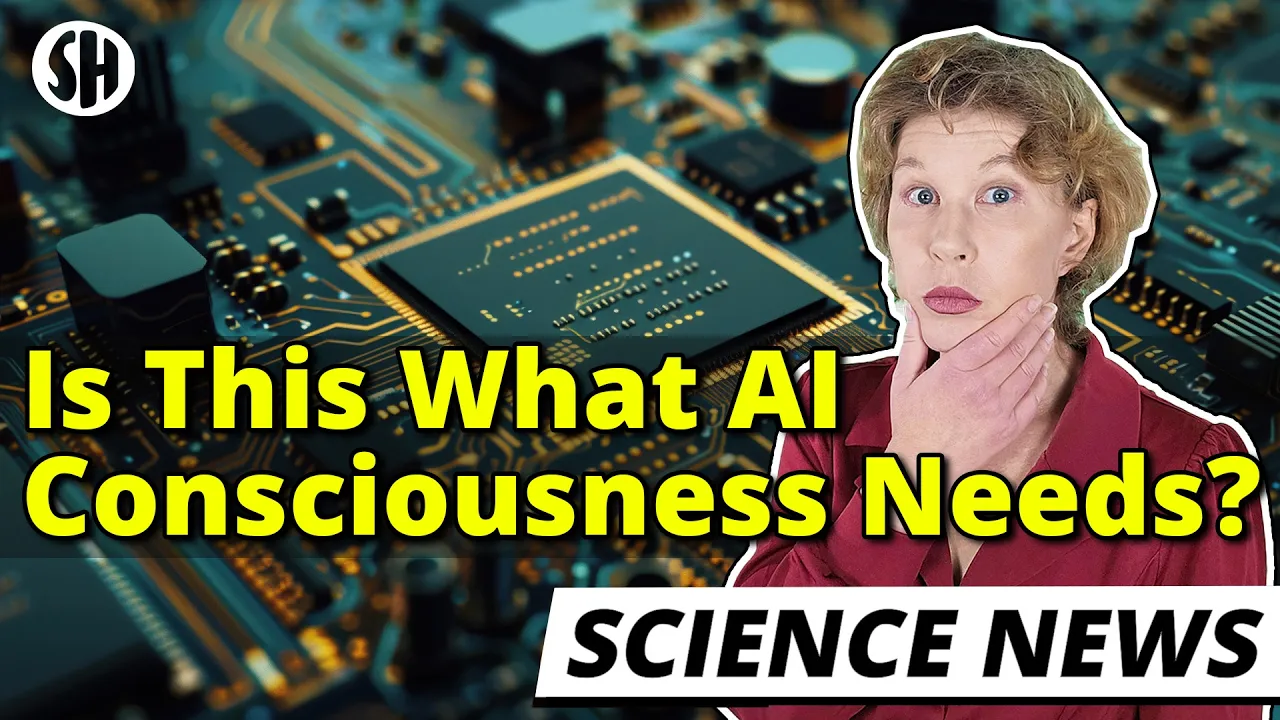
Sabine Hossenfelder
Current artificial intelligence models will never replicate human consciousness unless systems adopt the brain's multiscale hierarchy and extreme metabolic efficiency.
AI-assisted summary of Scientists identify what it takes for AI to become conscious — original source. Check the original for full context.
Source published:
Key ideas
- A new paper by two biologists proposes 'biological computationalism' as a middle ground in the AI consciousness debate, examining structural differences rather than insisting on wet biological substrates. (2:01)
- Researchers identify three fundamental architectural gaps between the mammalian brain and modern LLMs: multiscale hierarchy, broad spatio-temporal dynamics, and strict metabolic energy budgets. (2:01)
- The human brain operates on merely ~20 watts, suggesting consciousness may have evolved primarily as a solution to extreme energy optimization rather than pure computational power. (3:24)
- The authors clarify that artificial consciousness remains possible in principle, but current digital architectures are unlikely to achieve it or may develop forms of sentience unrecognizable to humans. (4:04)
Detailed notes
## Background Published by physicist Sabine Hossenfelder on YouTube on October 10, 2026, this video examines whether artificial intelligence can ever achieve consciousness. Based on a recent paper by biologists, the description highlights the architectural criteria an artificial system must fulfill to mirror the biological human brain and potentially develop conscious experience.
## TL;DR Hossenfelder analyzes the philosophical clash between computational functionalism and biological naturalism before examining a proposed compromise called biological computationalism. Drawing from a recent neuroscience paper, she details three critical gaps separating current large language models from human brains: deeply multiscale hierarchies, wide spatio-temporal dynamics, and brutal metabolic energy constraints. Because modern silicon architectures ignore these organic computational traits, the authors conclude that today's AI is unlikely to replicate biological consciousness. Hossenfelder notes that future machine sentience may therefore either never materialize or emerge in forms so fundamentally alien that humans fail to detect them.
## Atmosphere & style The video features Hossenfelder's signature deadpan delivery, blending dry wit with sharp, accessible analytical rigor. Her tone is brisk, conversational, and irreverent, using punchy asides about human overconfidence and speculative consciousness taxes to demystify dense theoretical debates. The presentation feels like an engaging, no-nonsense whiteboard session that strips mystical hype away from artificial intelligence and brain science.
## Bulletin - [02:01](https://www.youtube.com/watch?v=Q-tcml1wzM0&t=121s) A new paper by two biologists proposes 'biological computationalism' as a middle ground in the AI consciousness debate, examining structural differences rather than insisting on wet biological substrates. - [02:01](https://www.youtube.com/watch?v=Q-tcml1wzM0&t=121s) Researchers identify three fundamental architectural gaps between the mammalian brain and modern LLMs: multiscale hierarchy, broad spatio-temporal dynamics, and strict metabolic energy budgets. - [03:24](https://www.youtube.com/watch?v=Q-tcml1wzM0&t=204s) The human brain operates on merely ~20 watts, suggesting consciousness may have evolved primarily as a solution to extreme energy optimization rather than pure computational power. - [04:04](https://www.youtube.com/watch?v=Q-tcml1wzM0&t=244s) The authors clarify that artificial consciousness remains possible in principle, but current digital architectures are unlikely to achieve it or may develop forms of sentience unrecognizable to humans.
## Key takeaways - [00:00](https://www.youtube.com/watch?v=Q-tcml1wzM0&t=0s) The debate over AI consciousness has traditionally split between computational functionalism (medium independence) and biological naturalism (organic substrate dependence). - [00:35](https://www.youtube.com/watch?v=Q-tcml1wzM0&t=35s) Large language models excel at mimicking human output, including human-like overconfidence, raising ethical and philosophical concerns about potential machine sentience. - [00:55](https://www.youtube.com/watch?v=Q-tcml1wzM0&t=55s) Rumors that AI labs like Anthropic preserve backups of earlier models illustrate growing practical caution surrounding machine consciousness and legal liability. - [01:40](https://www.youtube.com/watch?v=Q-tcml1wzM0&t=100s) Biological naturalism frequently falls short by failing to explain why silicon or non-organic hardware could never functionally replicate biological neurons. - [02:01](https://www.youtube.com/watch?v=Q-tcml1wzM0&t=121s) Biological computationalism sidesteps substrate chauvinism to focus on the specific physical and functional organization of living brains. - [02:20](https://www.youtube.com/watch?v=Q-tcml1wzM0&t=140s) The biological brain relies on a deep multiscale architecture spanning sub-cellular molecules, neurons, and macro-level oscillatory brain waves. - [02:40](https://www.youtube.com/watch?v=Q-tcml1wzM0&t=160s) Anesthesia demonstrates the necessity of macro-level oscillatory rhythms for consciousness, silencing awareness while cellular-level functions remain active. - [03:05](https://www.youtube.com/watch?v=Q-tcml1wzM0&t=185s) Biological computation spans wide spatio-temporal scales, smoothly blending fast millisecond spikes, slow analog neuromodulation, and graded signals. - [03:24](https://www.youtube.com/watch?v=Q-tcml1wzM0&t=204s) Unlike enterprise AI clusters consuming megawatts, the human brain runs on approximately 20 watts, constrained by extreme evolutionary metabolic optimization. - [03:45](https://www.youtube.com/watch?v=Q-tcml1wzM0&t=225s) Consciousness may have evolved not as an optimization for superior thinking, but as a mechanism for drastically more energy-efficient computation. - [04:04](https://www.youtube.com/watch?v=Q-tcml1wzM0&t=244s) The researchers explicitly do not claim biological tissue is strictly required for consciousness, only that current digital architectures fundamentally omit key brain mechanisms. - [04:30](https://www.youtube.com/watch?v=Q-tcml1wzM0&t=270s) If current models do achieve consciousness despite these architectural gaps, their internal states may be too alien for humans to recognize. - [04:50](https://www.youtube.com/watch?v=Q-tcml1wzM0&t=290s) Benchmarking artificial models against the mammalian brain remains science's only empirical route while a definitive test for consciousness is lacking.
## Detailed walkthrough ### [00:00](https://www.youtube.com/watch?v=Q-tcml1wzM0&t=0s) The AI Consciousness Debate: Functionalism vs. Biological Naturalism
Whether artificial intelligence can achieve consciousness is currently one of the most hotly contested debates in modern technology—at least within Sabine Hossenfelder's immediate social circle, which she wryly admits says far more about her peer group than about global controversy at large. Recent headlines have stirred the pot with assertions like *"New research argues that consciousness depends on biological computation"* and *"Consciousness may depend on the physics of the brain."* These assertions run counter to Hossenfelder's longstanding intuition, prompting her to take a deep look at the underlying science.
Modern artificial intelligence predominantly takes the form of large language models (LLMs). These systems have achieved astonishing fluency in text and audio generation, excelling at mimicking human behavior—particularly what Hossenfelder characterizes as humanity's most distinctive trait: "being confidently wrong." As these systems become ever more convincing, the question of machine sentience grows increasingly urgent. In fact, rumors suggest that Anthropic retains archived backups of earlier versions of its Claude model, hedging against the possibility that deleting an older iteration might one day be legally classified as murder.
Historically, this philosophical divide has split into two entrenched camps:
* **Computational Functionalism:** The view that consciousness is purely an emergent property of how information is processed, completely independent of the physical medium. Proponents (including Hossenfelder) argue that biological neurons are not fundamentally required, because the functional dynamics of a neuron can be faithfully simulated on silicon. * **Biological Naturalism:** The competing stance holding that consciousness strictly depends on the precise, wet biological mechanisms operating inside organic brains, and that these cannot simply be swapped out for non-biological hardware. To Hossenfelder's frustration, this camp rarely provides a compelling explanation for *why* alternative substrates are fundamentally insufficient.
---
[02:01](https://www.youtube.com/watch?v=Q-tcml1wzM0&t=121s) Biological Computationalism: The Three Key Architectural Differences
A newly published paper authored by two biologists (DOI: 10.1016/j.neubiorev.2025.106524) proposes a pragmatic compromise dubbed **biological computationalism**. Rather than getting bogged down in whether a thinking machine strictly requires meat and organic chemistry, the authors suggest setting aside substrate chauvinism and instead analyzing the functional ways in which the biological brain diverges from current artificial architectures. They identify three profound differences:
```mermaid flowchart TD accTitle: Biological Brain vs LLM Architectural Differences accDescr: A comparison between human brain organization and current LLM architectures across scale, time, and energy. subgraph Brain["Human Brain System"] B1["Multiscale Hierarchy: Molecules to Oscillations"] B2["Spatio-Temporal Range: Fast Blips to Slow Analog Drifts"] B3["Metabolic Optimization: Severe Energy Budgets"] end subgraph LLM["Current Large Language Models"] L1["Layered Matrix Math: Tokens to Context Windows"] L2["Uniform Clocking: Discrete Digital Operations"] L3["Megawatt Compute: Inefficient Brute-Force Scaling"] end B1 -.->|"Complexity gap"| L1 B2 -.->|"Dynamic range gap"| L2 B3 -.->|"Efficiency gap"| L3 ```
1. **A Deeply Multiscale Architecture:** Biological consciousness does not kick off at the level of individual neurons; it is grounded in a deep continuum starting with sub-cellular molecules and chemical cascades, building upward to cells, synaptic connections, axonal electrical impulses, and whole-brain oscillatory rhythms. Every scale appears essential. For instance, medical anesthesia can switch off macroscopic oscillatory waves while leaving baseline cellular machinery fully operational, causing conscious experience to vanish completely. In contrast, while large language models possess representational hierarchies spanning from individual tokens to overarching planning layers, their structural depth remains vastly simpler than the multiscale reality of a living organism. 2. **Wide Spatio-Temporal Spectra:** Brain processes cover multiple orders of magnitude across both physical dimensions and time scales—ranging from ultra-rapid millisecond blips to agonizingly slow neuromodulatory drifts. Biological computation smoothly interpolates between digital-like spikes and analog graded signals without fitting neatly into either definition. Modern digital models operate on far more uniform, rigid temporal cadences. 3. **Stringent Metabolic Constraints:** Unlike enterprise AI clusters consuming megawatts of power, the human brain runs on approximately 20 watts. It operates under brutal evolutionary limits that demand extreme energy efficiency. From an algorithmic standpoint, the brain solves a much tighter optimization problem than any artificial neural network. Hossenfelder notes that our evolutionary path to consciousness might not have been driven by an imperative for "better thinking per se," but rather by a survival mandate for drastically *more efficient* thinking.
---
[04:04](https://www.youtube.com/watch?v=Q-tcml1wzM0&t=244s) Implications for Artificial Minds and Economic Realities
Crucially, the authors do not endorse mystical organic exceptionalism. They explicitly state in the paper: *"We do not claim that only biological tissue can instantiate consciousness."* Their central contention is simply that modern artificial neural networks are "unlikely to replicate conscious processing as it arises in biology" because their design ignores these critical functional properties.
Assuming this argument holds, Hossenfelder points out two potential conclusions: either current AI architectures will never become conscious at all, or they will develop forms of consciousness so fundamentally alien that human observers will fail to recognize them. While skeptics might complain that this taxonomy fails to solve the hard problem of consciousness—since science still lacks a definitive test for what consciousness actually is—benchmarking artificial systems against the only proven conscious architecture in existence (the mammalian brain) remains the only sensible empirical route. Hossenfelder dryly jokes that the lack of mainstream enthusiasm for recognizing machine consciousness probably comes down to economics: if AI models are ever proven sentient, the tech sector will suffer, and "the European Commission is already working on a consciousness tax."
Reflecting on the pace of technological upheaval, Hossenfelder pivots to how standard educational systems fail to equip children for these looming scientific paradigms. She highlights the video's sponsor, Brilliant, emphasizing their newly rolled-out AI tutor designed to coach learners through interactive modules in mathematics, programming, and general science. Rather than spitting out ready-made solutions, the system prompts students past conceptual roadblocks, builds upon their existing foundation, and steadily adapts to their specific learning style. Her own daughter prefers the software over asking her parents, purely because "in contrast to me, Brilliant's Tutor is infinitely patient and always has time." Viewers can try out the tutor for free or use the sponsored link (`brilliant.org/Sabine`) to claim 20% off an annual premium subscription.
## Notable quotes > [00:00](https://www.youtube.com/watch?v=Q-tcml1wzM0&t=0s) New research argues that consciousness depends on biological computation — Sabine Hossenfelder
> [00:00](https://www.youtube.com/watch?v=Q-tcml1wzM0&t=0s) Consciousness may depend on the physics of the brain. — Sabine Hossenfelder
> [00:00](https://www.youtube.com/watch?v=Q-tcml1wzM0&t=0s) being confidently wrong. — Sabine Hossenfelder
> [02:01](https://www.youtube.com/watch?v=Q-tcml1wzM0&t=121s) biological computationalism — Sabine Hossenfelder
> [02:01](https://www.youtube.com/watch?v=Q-tcml1wzM0&t=121s) better thinking per se — Sabine Hossenfelder
> [02:01](https://www.youtube.com/watch?v=Q-tcml1wzM0&t=121s) more efficient — Sabine Hossenfelder
> [04:04](https://www.youtube.com/watch?v=Q-tcml1wzM0&t=244s) We do not claim that only biological tissue can instantiate consciousness. — Paper authors
> [04:04](https://www.youtube.com/watch?v=Q-tcml1wzM0&t=244s) unlikely to replicate conscious processing as it arises in biology — Paper authors
> [04:04](https://www.youtube.com/watch?v=Q-tcml1wzM0&t=244s) the European Commission is already working on a consciousness tax. — Sabine Hossenfelder
> [04:04](https://www.youtube.com/watch?v=Q-tcml1wzM0&t=244s) in contrast to me, Brilliant's Tutor is infinitely patient and always has time. — Sabine Hossenfelder
## Mentioned Sabine Hossenfelder, Anthropic, Claude, Brilliant, European Commission, DOI: 10.1016/j.neubiorev.2025.106524
## Video description Click the link below or scan the QR code to get started with Brilliant’s tutor for free. You can upgrade to Premium to unlock all courses. And right now, Science with Sabine viewers can save 20% off an annual subscription at https://Brilliant.org/Sabine/
One of the biggest debates in tech at the moment is the question of whether current AI models can become conscious. Whatever “conscious” means. According to a group of biologists, current AI models are far from it – but it’s not because consciousness can only appear in biological systems. They identify which key properties an artificial system would have to fulfill to become more like the human brain and hence have a chance at developing consciousness. Let’s take a look.
Paper: DOI: 10.1016/j.neubiorev.2025.106524
#sciencenews #AI #consciousness #neuroscience
👕T-shirts, mugs, posters and more: ➜ https://sabines-store.dashery.com/ 💌 Support me on Donorbox ➜ https://donorbox.org/swtg 👉 Transcript with links to references on Patreon ➜ https://www.patreon.com/Sabine 📝 Transcripts and written news on Substack ➜ https://sciencewtg.substack.com/ 📩 Free weekly science newsletter ➜ https://sabinehossenfelder.com/newsletter/ 👂 Audio only podcast ➜ https://open.spotify.com/show/0MkNfXlKnMPEUMEeKQYmYC 🔗 Join this channel to get access to perks ➜ https://www.youtube.com/channel/UC1yNl2E66ZzKApQdRuTQ4tw/join 📚 Buy my book ➜ https://amzn.to/3HSAWJW
[Source](https://www.youtube.com/watch?v=Q-tcml1wzM0)